A Practical Guide to APA Style
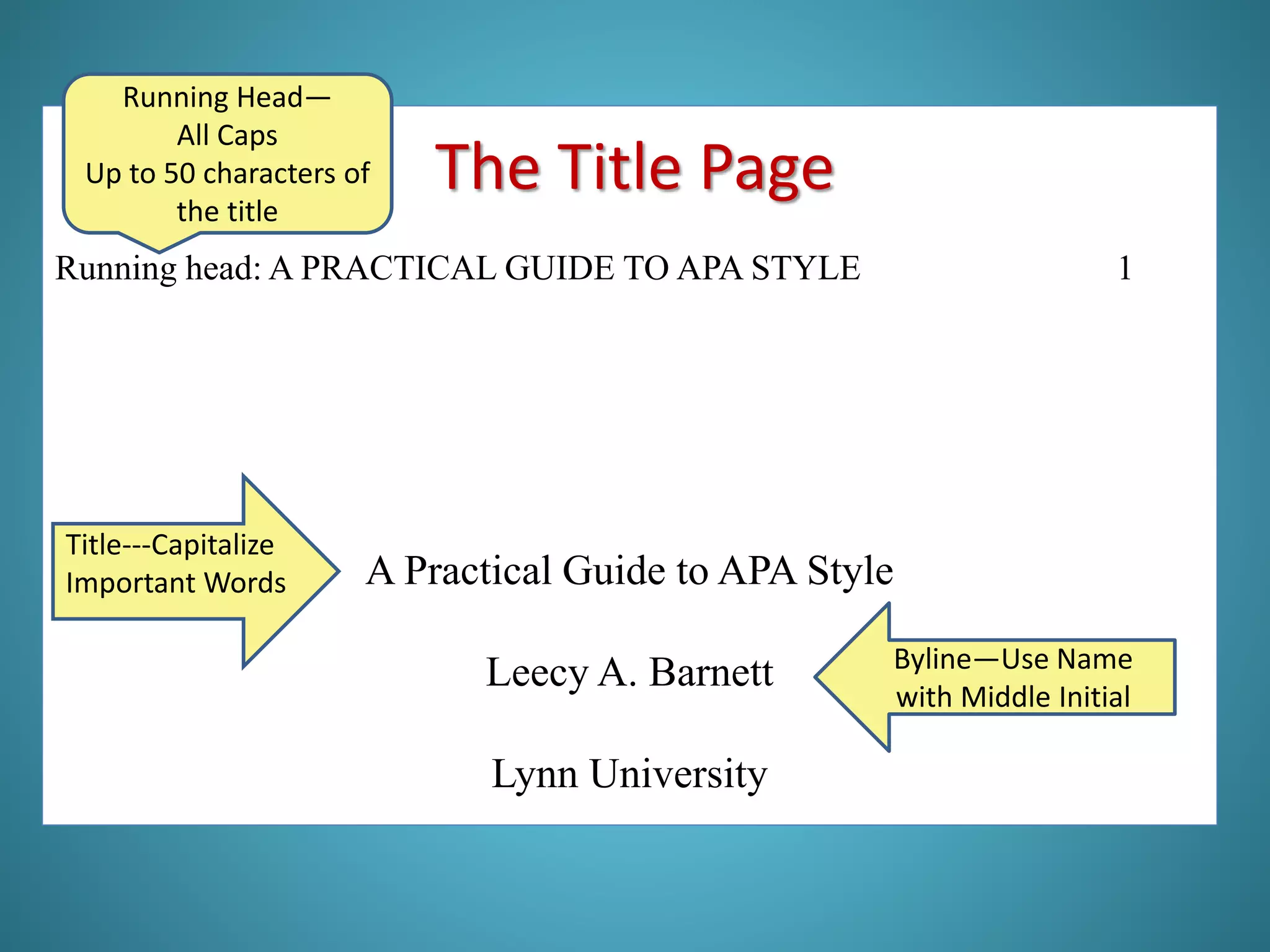
Running head: A PRACTICAL GUIDE TO APA STYLE 1
A Practical Guide to APA Style
Leecy A. Barnett
Lynn University
Running Head—
All Caps
Up to 50 characters of
the title
Byline—Use Name
with Middle Initial
The Title Page
Title---Capitalize
Important Words
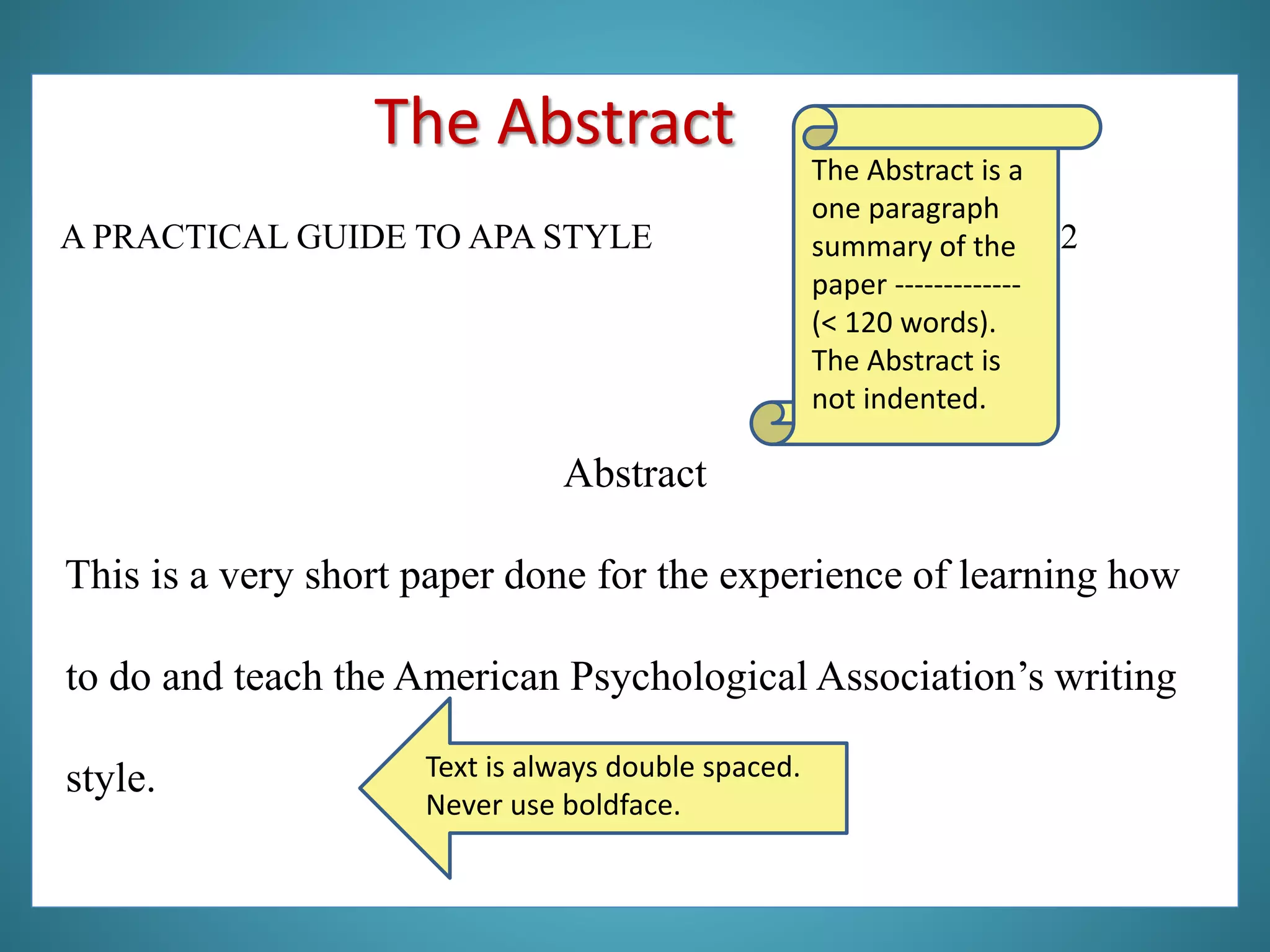
A PRACTICAL GUIDE TO APA STYLE 2
Abstract
This is a very short paper done for the experience of learning how
to do and teach the American Psychological Association’s writing
style.
The Abstract is a
one paragraph
summary of the
paper -------------
(< 120 words).
The Abstract is
not indented.
Text is always double spaced.
Never use boldface.
The Abstract
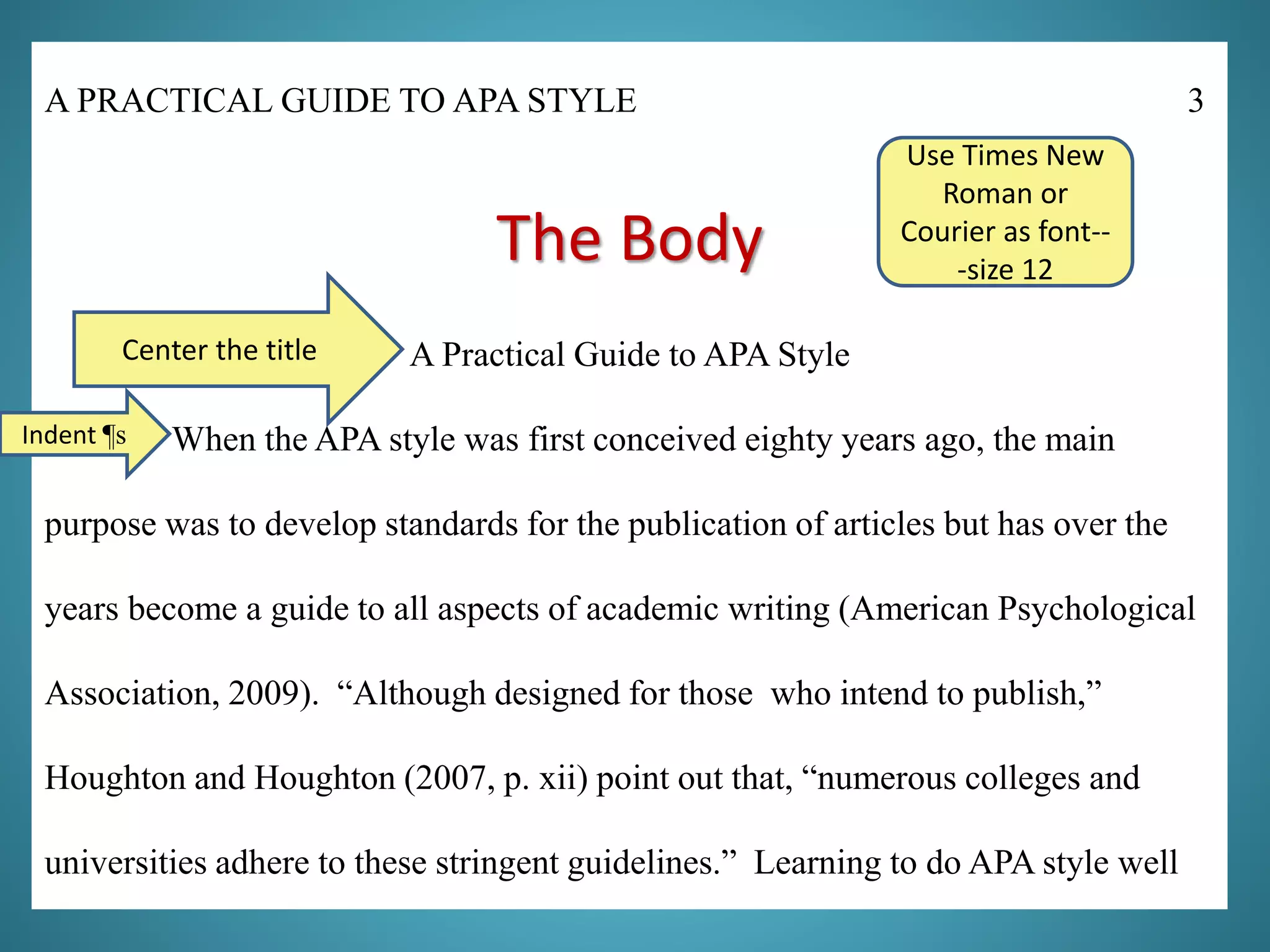
A PRACTICAL GUIDE TO APA STYLE 3
The Body
A Practical Guide to APA Style
When the APA style was first conceived eighty years ago, the main
purpose was to develop standards for the publication of articles but has over the
years become a guide to all aspects of academic writing (American Psychological
Association, 2009). “Although designed for those who intend to publish,”
Houghton and Houghton (2007, p. xii) point out that, “numerous colleges and
universities adhere to these stringent guidelines.” Learning to do APA style well
Center the title
Indent ¶s
Use Times New
Roman or
Courier as font--
-size 12
Headings
•Complicated System of Multiple Levels
•Not always required by professors
• See at Purdue---
http://owl.english.purdue.edu/owl/resource/56
0/01 -
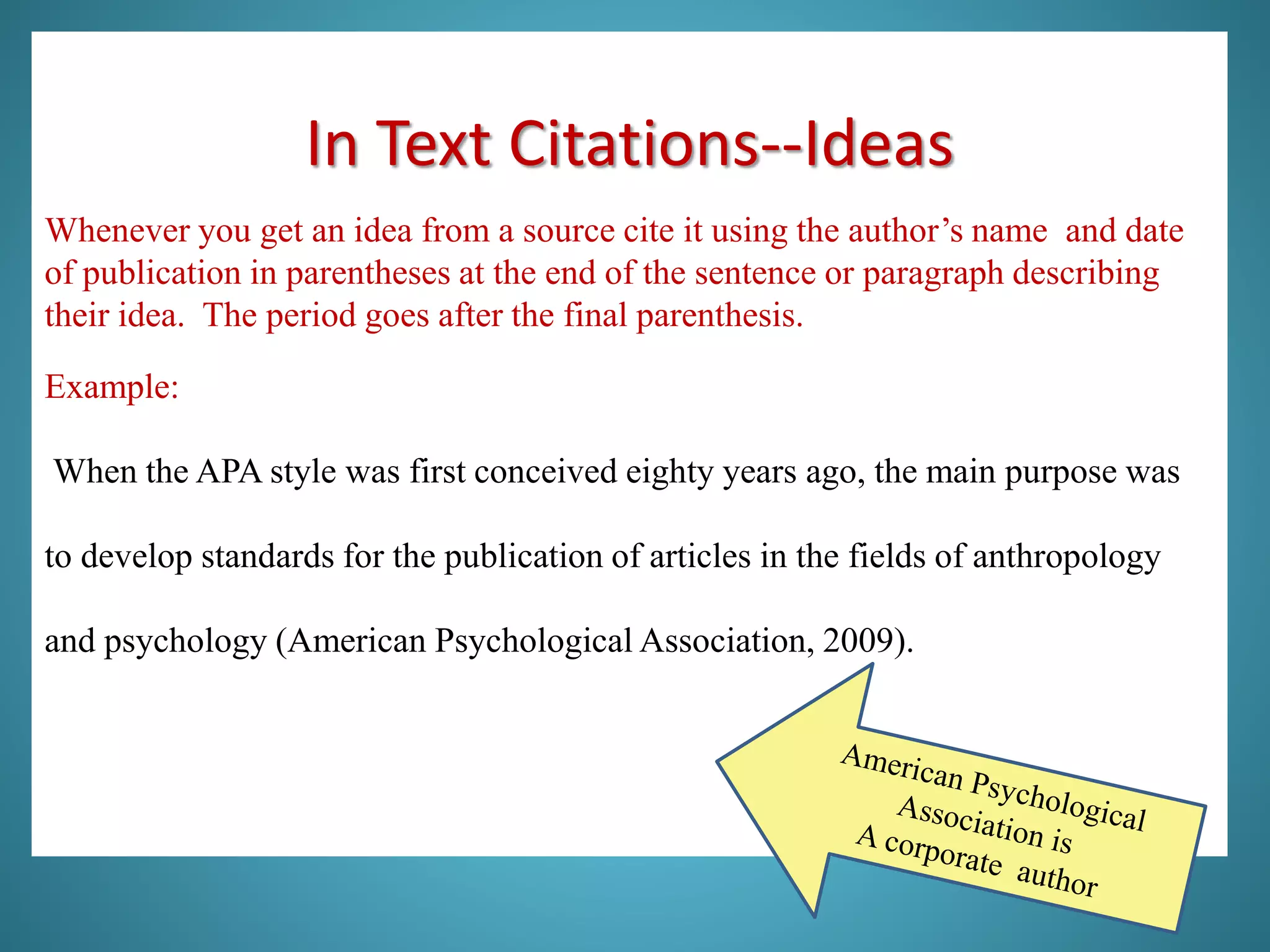
In Text Citations--Ideas
Whenever you get an idea from a source cite it using the author’s name and date
of publication in parentheses at the end of the sentence or paragraph describing
their idea. The period goes after the final parenthesis.
Example:
When the APA style was first conceived eighty years ago, the main purpose was
to develop standards for the publication of articles in the fields of anthropology
and psychology (American Psychological Association, 2009).
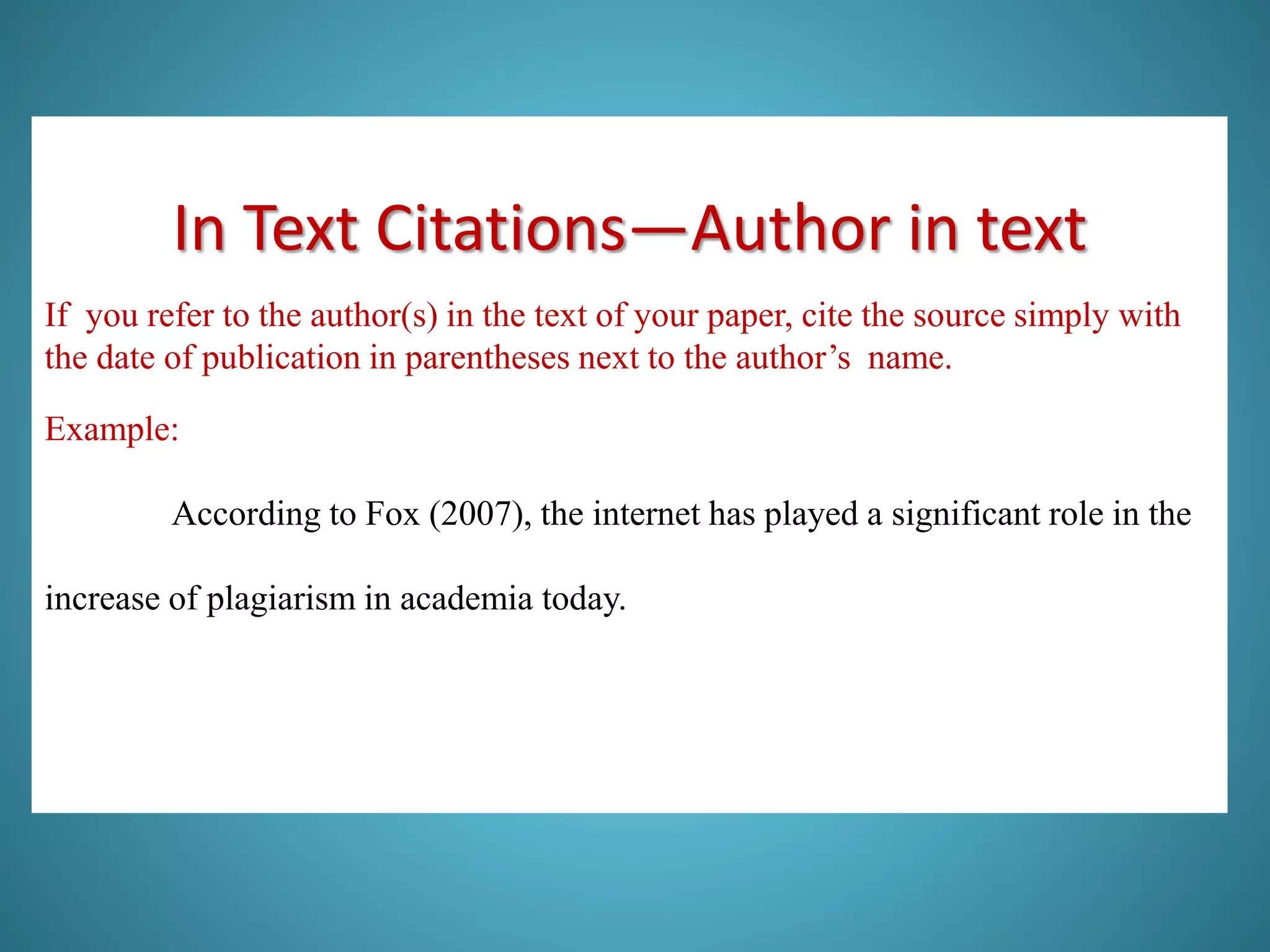
In Text Citations—Author in text
If you refer to the author(s) in the text of your paper, cite the source simply with
the date of publication in parentheses next to the author’s name.
Example:
According to Fox (2007), the internet has played a significant role in the
increase of plagiarism in academia today.
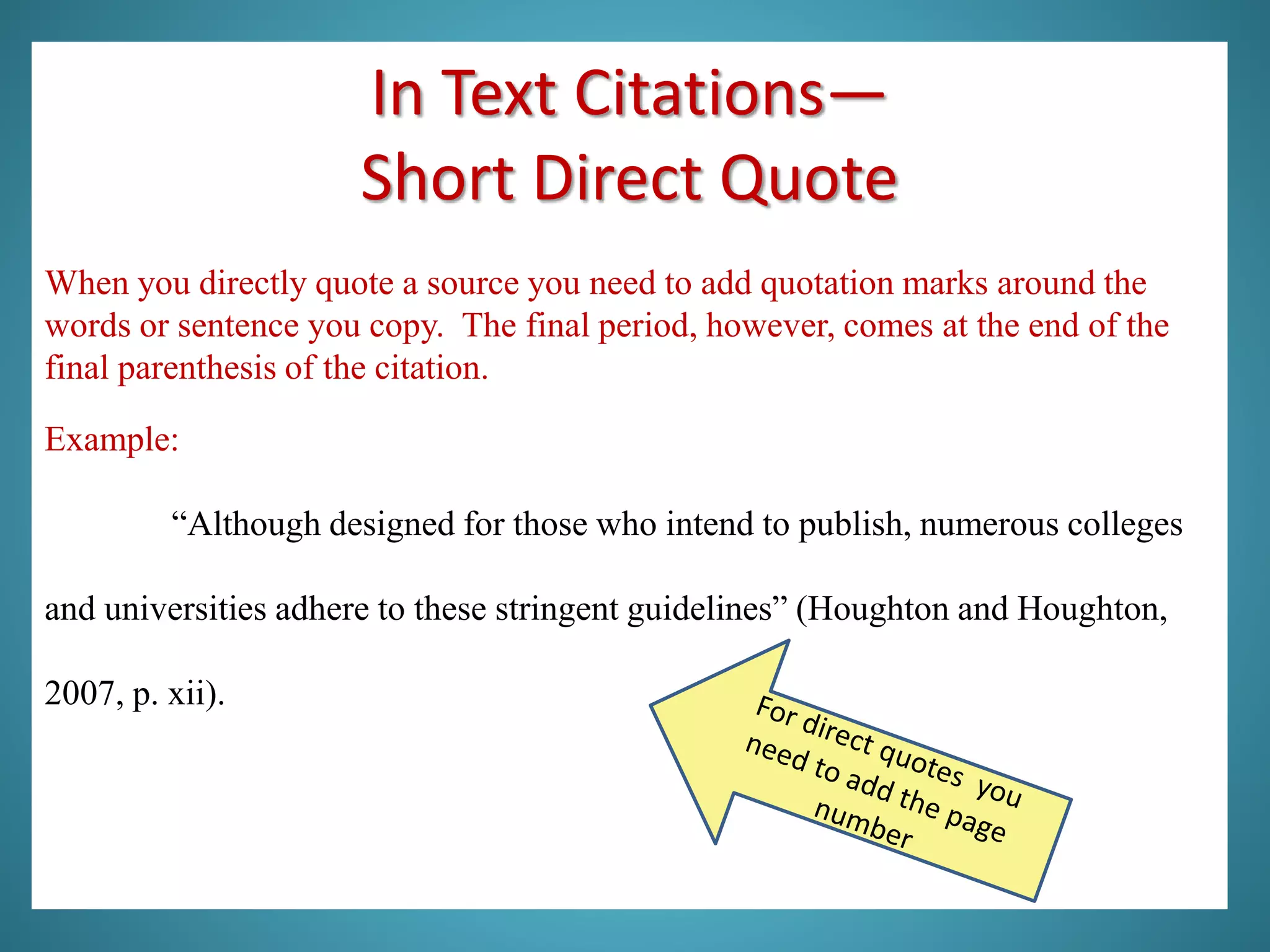
In Text Citations—
Short Direct Quote
When you directly quote a source you need to add quotation marks around the
words or sentence you copy. The final period, however, comes at the end of the
final parenthesis of the citation.
Example:
“Although designed for those who intend to publish, numerous colleges
and universities adhere to these stringent guidelines” (Houghton and Houghton,
2007, p. xii).
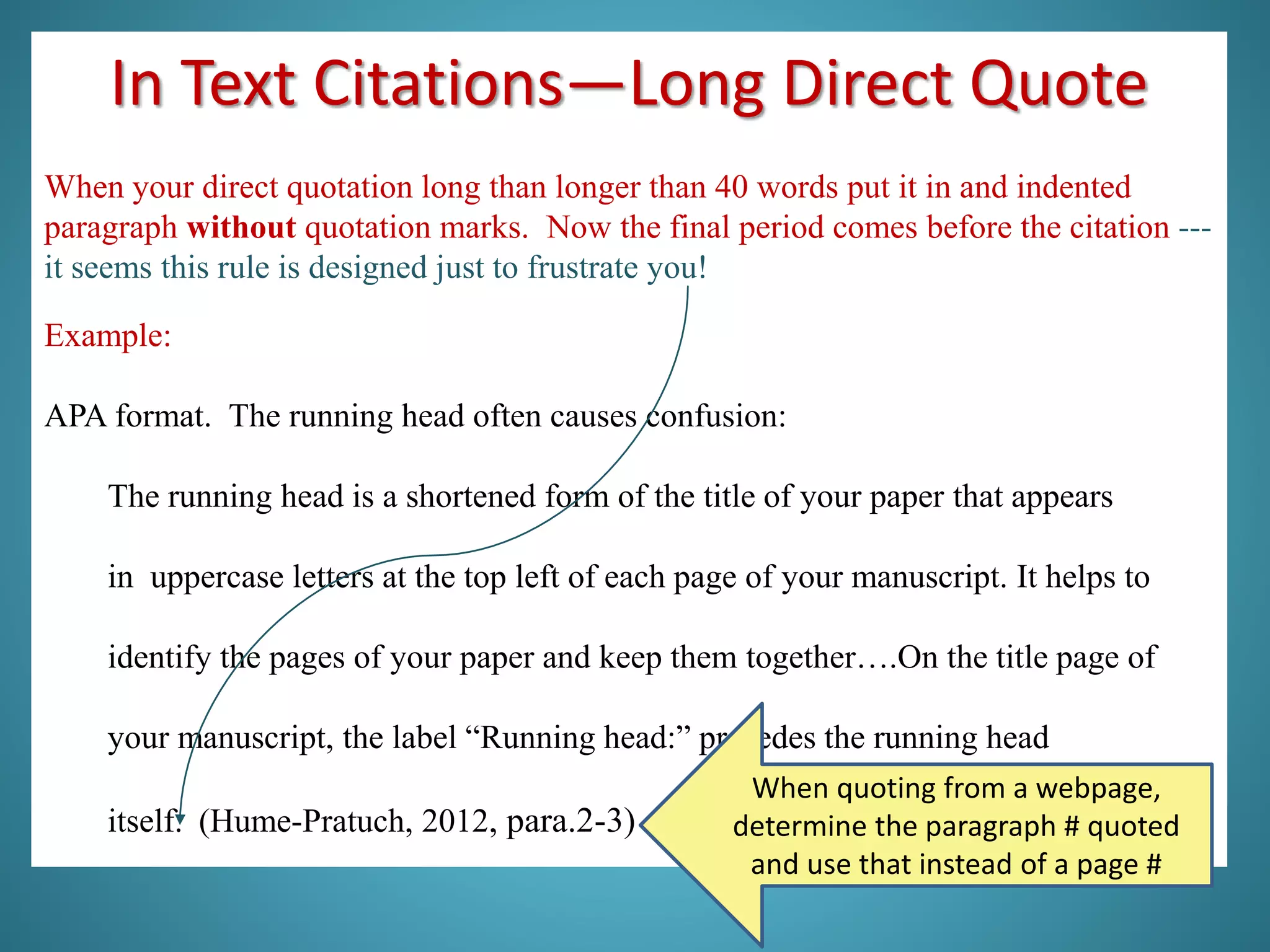
In Text Citations—Long Direct Quote
When your direct quotation long than longer than 40 words put it in and indented
paragraph without quotation marks. Now the final period comes before the citation ---
it seems this rule is designed just to frustrate you!
Example:
APA format. The running head often causes confusion:
The running head is a shortened form of the title of your paper that appears
in uppercase letters at the top left of each page of your manuscript. It helps to
identify the pages of your paper and keep them together….On the title page of
your manuscript, the label “Running head:” precedes the running head
itself. (Hume-Pratuch, 2012, para.2-3)
When quoting from a webpage,
determine the paragraph # quoted
and use that instead of a page #
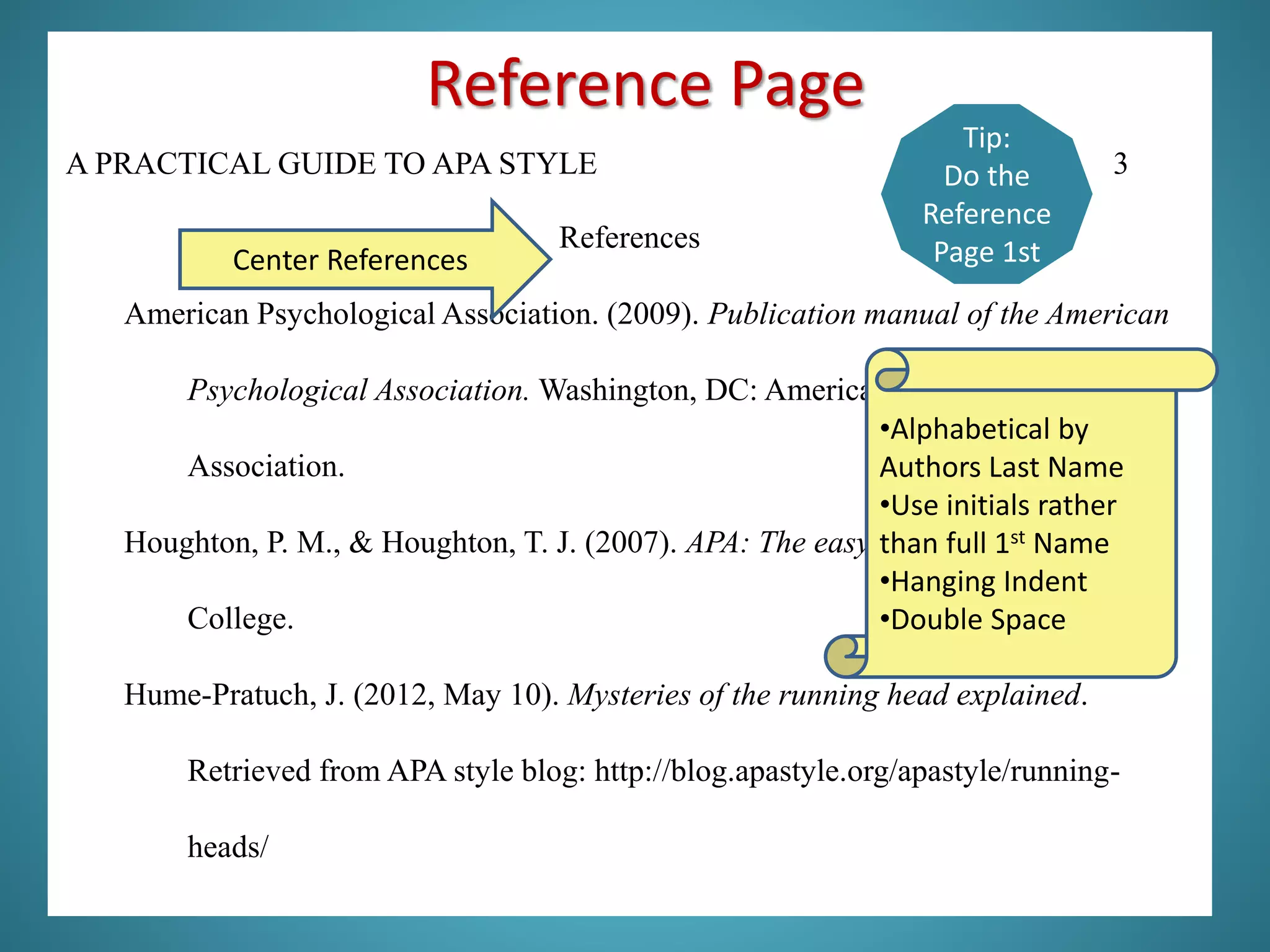
References
American Psychological Association. (2009). Publication manual of the American
Psychological Association. Washington, DC: American Psychological
Association.
Houghton, P. M., & Houghton, T. J. (2007). APA: The easy way. Flint, MI: Baker
College.
Hume-Pratuch, J. (2012, May 10). Mysteries of the running head explained.
Retrieved from APA style blog: http://blog.apastyle.org/apastyle/running-
heads/
Center References
•Alphabetical by
Authors Last Name
•Use initials rather
than full 1st Name
•Hanging Indent
•Double Space
Tip:
Do the
Reference
Page 1st
A PRACTICAL GUIDE TO APA STYLE 3
Reference Page
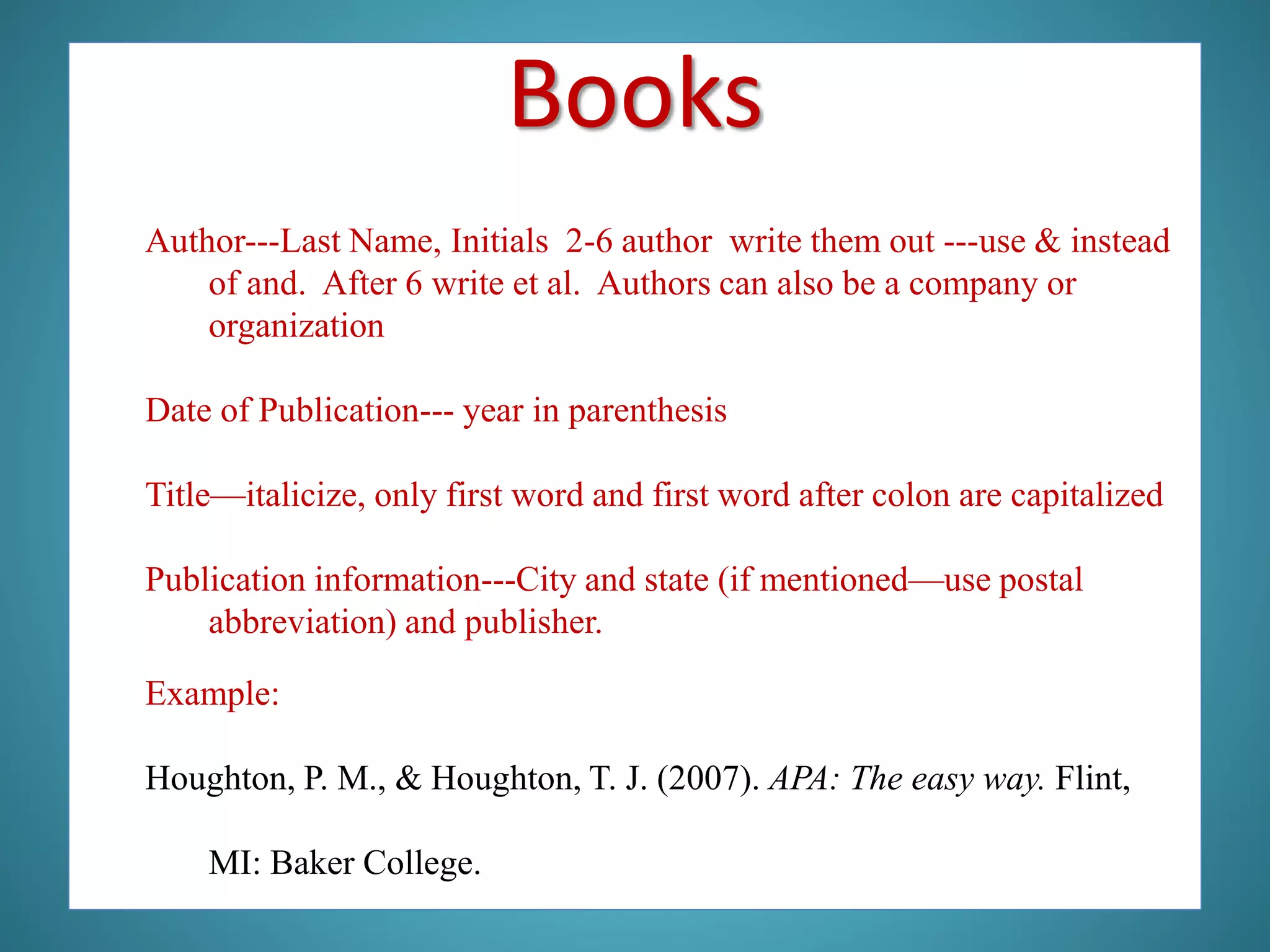
Author---Last Name, Initials 2-6 author write them out ---use & instead
of and. After 6 write et al. Authors can also be a company or
organization
Date of Publication--- year in parenthesis
Title—italicize, only first word and first word after colon are capitalized
Publication information---City and state (if mentioned—use postal
abbreviation) and publisher.
Example:
Houghton, P. M., & Houghton, T. J. (2007). APA: The easy way. Flint,
MI: Baker College.
Books
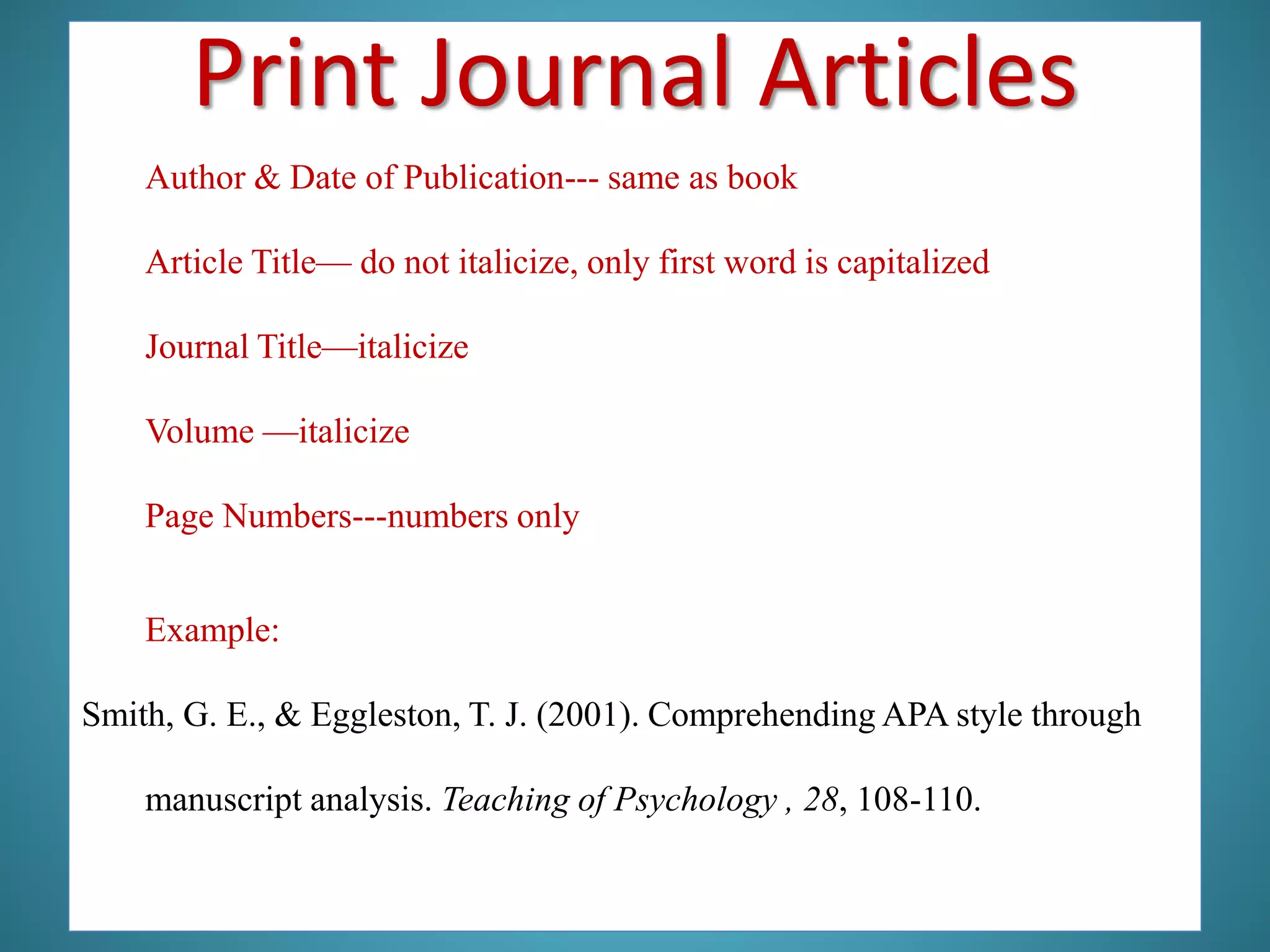
Author & Date of Publication--- same as book
Article Title— do not italicize, only first word is capitalized
Journal Title—italicize
Volume —italicize
Page Numbers---numbers only
Example:
Smith, G. E., & Eggleston, T. J. (2001). Comprehending APA style through
manuscript analysis. Teaching of Psychology , 28, 108-110.
Print Journal Articles
Author & Date of Publication--- same as book
Article Title— do not italicize, only first word is capitalized
Journal Title—italicize
Volume —italicize, (put issue in parentheses if page numbers start over in each volume)
Page Numbers---numbers only
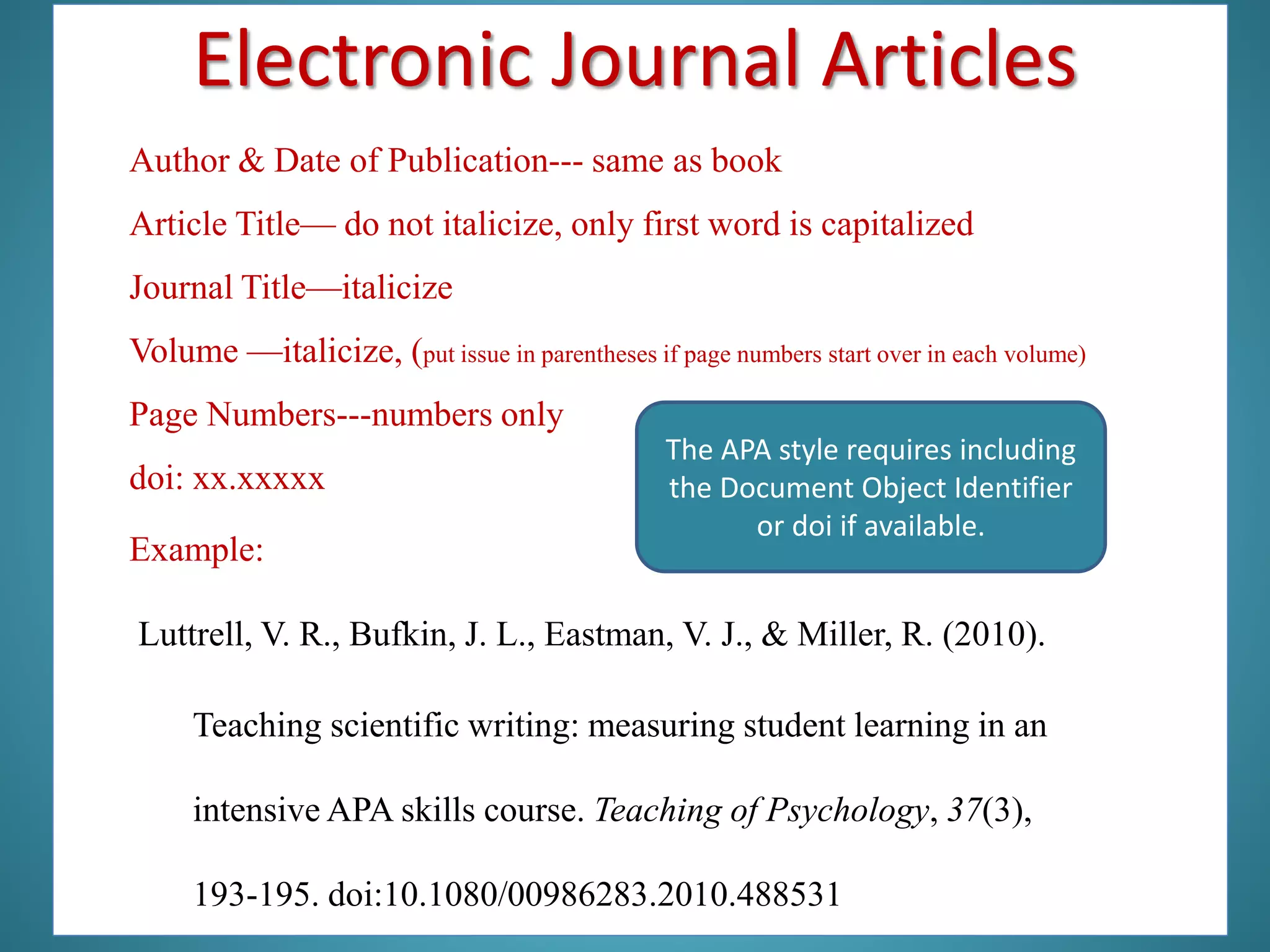
doi: xx.xxxxx
Example:
Luttrell, V. R., Bufkin, J. L., Eastman, V. J., & Miller, R. (2010).
The APA style requires including
the Document Object Identifier
or doi if available.
Teaching scientific writing: measuring student learning in an
intensive APA skills course. Teaching of Psychology, 37(3),
193-195. doi:10.1080/00986283.2010.488531
Electronic Journal Articles
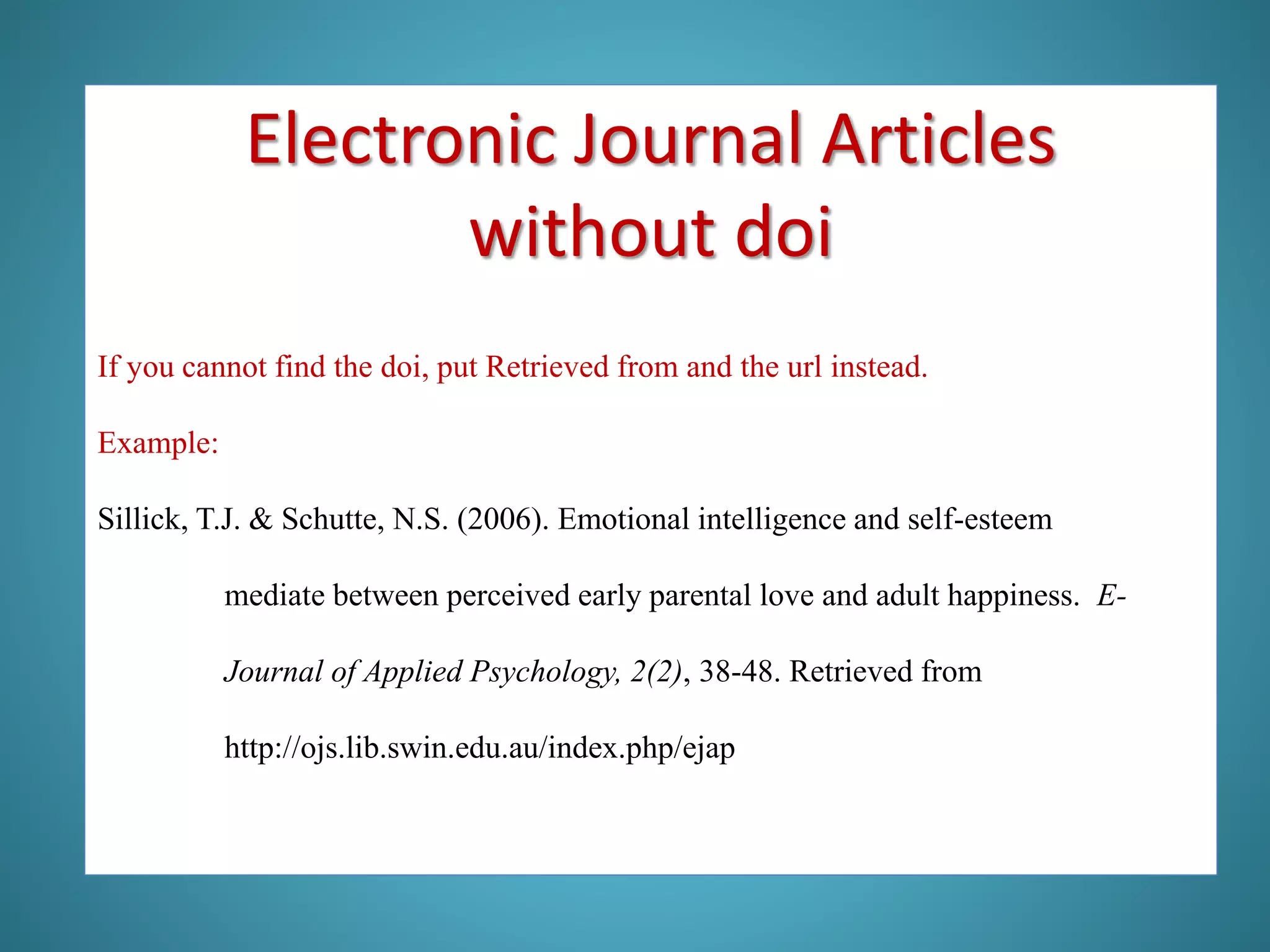
If you cannot find the doi, put Retrieved from and the url instead.
Example:
Sillick, T.J. & Schutte, N.S. (2006). Emotional intelligence and self-esteem
mediate between perceived early parental love and adult happiness. E-
Journal of Applied Psychology, 2(2), 38-48. Retrieved from
http://ojs.lib.swin.edu.au/index.php/ejap
Electronic Journal Articles
without doi
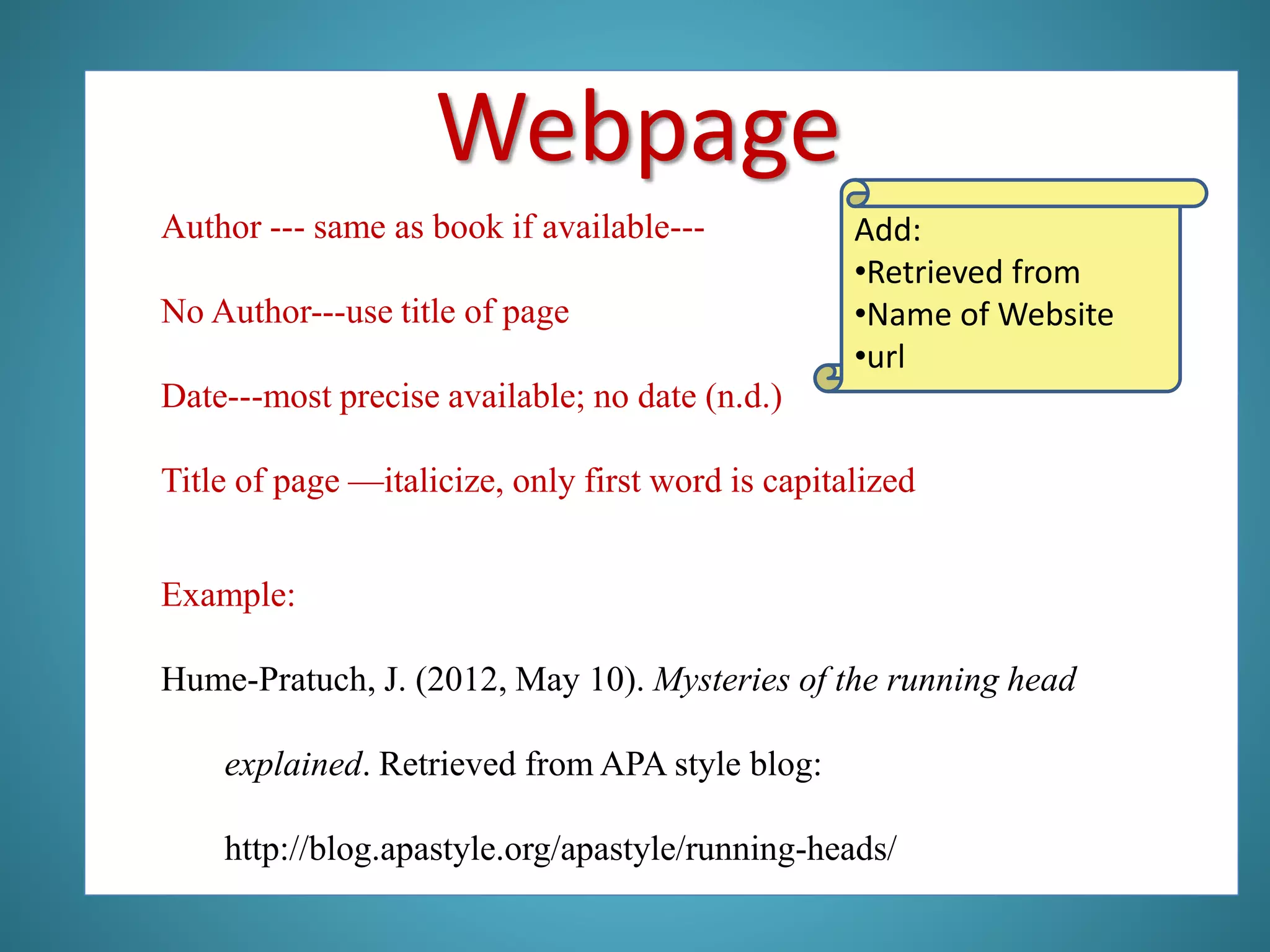
Author --- same as book if available---
No Author---use title of page
Date---most precise available; no date (n.d.)
Title of page —italicize, only first word is capitalized
Example:
Hume-Pratuch, J. (2012, May 10). Mysteries of the running head
explained. Retrieved from APA style blog:
http://blog.apastyle.org/apastyle/running-heads/
Webpage
Add:
•Retrieved from
•Name of Website
•url
Author or Compiler name.
No Author---use title of page
Date---(showing year, month, date).
Title of video —italicize [Video file]--- only first word is capitalized
Example:
The Cobalt Agent. (2007, September 14) Ronald Reagan’s remarks on the
Challenger shuttle explosion [Video file]. Retrieved from
http://www.youtube.com/watch?v=5JKIZ7j20EA
Add:
•Retrieved from
•url
YouTube video
A Word about Automatic Citation
Makers (such as Citation Machine)
Automatic citation creators often miss vital information that is on the
webpage. They will often miss the author’s name or the date
published. If you are going to use an automatic citation creator, be
sure you add the missing information. You are responsible for your
citations not a machine!

A practical guide to apa style updated 2.0

  • 1.
    A Practical Guideto APA Style
  • 2.
    Running head: APRACTICAL GUIDE TO APA STYLE 1 A Practical Guide to APA Style Leecy A. Barnett Lynn University Running Head— All Caps Up to 50 characters of the title Byline—Use Name with Middle Initial The Title Page Title---Capitalize Important Words
  • 3.
    A PRACTICAL GUIDETO APA STYLE 2 Abstract This is a very short paper done for the experience of learning how to do and teach the American Psychological Association’s writing style. The Abstract is a one paragraph summary of the paper ------------- (< 120 words). The Abstract is not indented. Text is always double spaced. Never use boldface. The Abstract
  • 4.
    A PRACTICAL GUIDETO APA STYLE 3 The Body A Practical Guide to APA Style When the APA style was first conceived eighty years ago, the main purpose was to develop standards for the publication of articles but has over the years become a guide to all aspects of academic writing (American Psychological Association, 2009). “Although designed for those who intend to publish,” Houghton and Houghton (2007, p. xii) point out that, “numerous colleges and universities adhere to these stringent guidelines.” Learning to do APA style well Center the title Indent ¶s Use Times New Roman or Courier as font-- -size 12
  • 5.
    Headings •Complicated System ofMultiple Levels •Not always required by professors • See at Purdue--- http://owl.english.purdue.edu/owl/resource/56 0/01 -
  • 6.
    In Text Citations--Ideas Wheneveryou get an idea from a source cite it using the author’s name and date of publication in parentheses at the end of the sentence or paragraph describing their idea. The period goes after the final parenthesis. Example: When the APA style was first conceived eighty years ago, the main purpose was to develop standards for the publication of articles in the fields of anthropology and psychology (American Psychological Association, 2009).
  • 7.
    In Text Citations—Authorin text If you refer to the author(s) in the text of your paper, cite the source simply with the date of publication in parentheses next to the author’s name. Example: According to Fox (2007), the internet has played a significant role in the increase of plagiarism in academia today.
  • 8.
    In Text Citations— ShortDirect Quote When you directly quote a source you need to add quotation marks around the words or sentence you copy. The final period, however, comes at the end of the final parenthesis of the citation. Example: “Although designed for those who intend to publish, numerous colleges and universities adhere to these stringent guidelines” (Houghton and Houghton, 2007, p. xii).
  • 9.
    In Text Citations—LongDirect Quote When your direct quotation long than longer than 40 words put it in and indented paragraph without quotation marks. Now the final period comes before the citation --- it seems this rule is designed just to frustrate you! Example: APA format. The running head often causes confusion: The running head is a shortened form of the title of your paper that appears in uppercase letters at the top left of each page of your manuscript. It helps to identify the pages of your paper and keep them together….On the title page of your manuscript, the label “Running head:” precedes the running head itself. (Hume-Pratuch, 2012, para.2-3) When quoting from a webpage, determine the paragraph # quoted and use that instead of a page #
  • 10.
    References American Psychological Association.(2009). Publication manual of the American Psychological Association. Washington, DC: American Psychological Association. Houghton, P. M., & Houghton, T. J. (2007). APA: The easy way. Flint, MI: Baker College. Hume-Pratuch, J. (2012, May 10). Mysteries of the running head explained. Retrieved from APA style blog: http://blog.apastyle.org/apastyle/running- heads/ Center References •Alphabetical by Authors Last Name •Use initials rather than full 1st Name •Hanging Indent •Double Space Tip: Do the Reference Page 1st A PRACTICAL GUIDE TO APA STYLE 3 Reference Page
  • 11.
    Author---Last Name, Initials2-6 author write them out ---use & instead of and. After 6 write et al. Authors can also be a company or organization Date of Publication--- year in parenthesis Title—italicize, only first word and first word after colon are capitalized Publication information---City and state (if mentioned—use postal abbreviation) and publisher. Example: Houghton, P. M., & Houghton, T. J. (2007). APA: The easy way. Flint, MI: Baker College. Books
  • 12.
    Author & Dateof Publication--- same as book Article Title— do not italicize, only first word is capitalized Journal Title—italicize Volume —italicize Page Numbers---numbers only Example: Smith, G. E., & Eggleston, T. J. (2001). Comprehending APA style through manuscript analysis. Teaching of Psychology , 28, 108-110. Print Journal Articles
  • 13.
    Author & Dateof Publication--- same as book Article Title— do not italicize, only first word is capitalized Journal Title—italicize Volume —italicize, (put issue in parentheses if page numbers start over in each volume) Page Numbers---numbers only doi: xx.xxxxx Example: Luttrell, V. R., Bufkin, J. L., Eastman, V. J., & Miller, R. (2010). The APA style requires including the Document Object Identifier or doi if available. Teaching scientific writing: measuring student learning in an intensive APA skills course. Teaching of Psychology, 37(3), 193-195. doi:10.1080/00986283.2010.488531 Electronic Journal Articles
  • 14.
    If you cannotfind the doi, put Retrieved from and the url instead. Example: Sillick, T.J. & Schutte, N.S. (2006). Emotional intelligence and self-esteem mediate between perceived early parental love and adult happiness. E- Journal of Applied Psychology, 2(2), 38-48. Retrieved from http://ojs.lib.swin.edu.au/index.php/ejap Electronic Journal Articles without doi
  • 15.
    Author --- sameas book if available--- No Author---use title of page Date---most precise available; no date (n.d.) Title of page —italicize, only first word is capitalized Example: Hume-Pratuch, J. (2012, May 10). Mysteries of the running head explained. Retrieved from APA style blog: http://blog.apastyle.org/apastyle/running-heads/ Webpage Add: •Retrieved from •Name of Website •url
  • 16.
    Author or Compilername. No Author---use title of page Date---(showing year, month, date). Title of video —italicize [Video file]--- only first word is capitalized Example: The Cobalt Agent. (2007, September 14) Ronald Reagan’s remarks on the Challenger shuttle explosion [Video file]. Retrieved from http://www.youtube.com/watch?v=5JKIZ7j20EA Add: •Retrieved from •url YouTube video
  • 17.
    A Word aboutAutomatic Citation Makers (such as Citation Machine) Automatic citation creators often miss vital information that is on the webpage. They will often miss the author’s name or the date published. If you are going to use an automatic citation creator, be sure you add the missing information. You are responsible for your citations not a machine!