HACCP stands for Hazard Analysis Critical Control Points. It involves identifying potential hazards in the food production process, determining critical control points (CCPs) that require monitoring to ensure food safety, and establishing procedures to monitor and control the CCPs. The HACCP system is based on seven principles including conducting a hazard analysis, identifying CCPs, establishing critical limits, monitoring procedures, corrective actions, validation, and record keeping. The HACCP team is responsible for developing and managing the HACCP plan to prove that safe food is being produced.
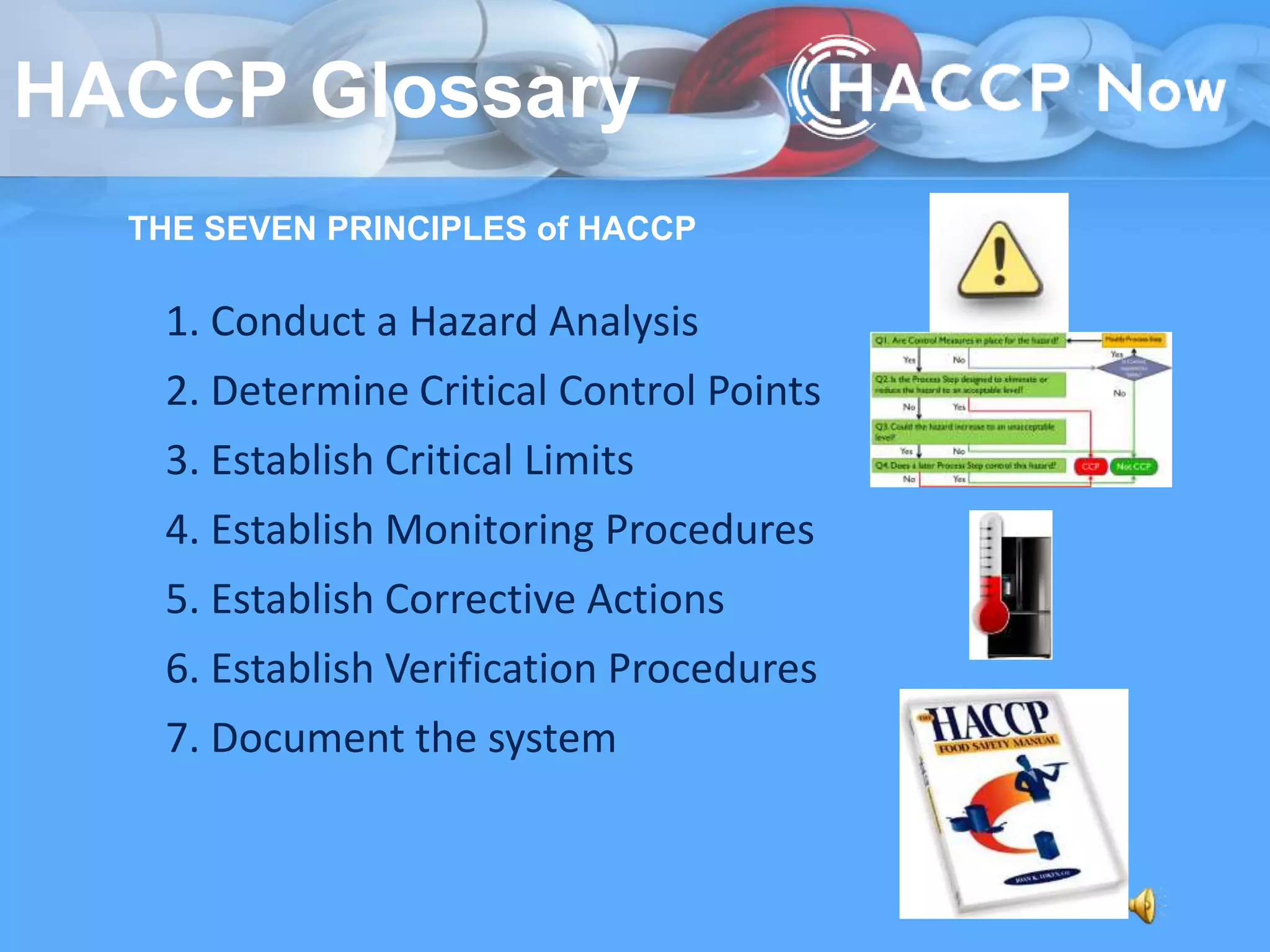
THE SEVEN PRINCIPLESof HACCP
3. Establish Critical Limits
5. Establish Corrective Actions
6. Establish Verification Procedures
1. Conduct a Hazard Analysis
2. Determine Critical Control Points
4. Establish Monitoring Procedures
7. Document the system
HACCP Glossary
5.
THE SEVEN PRINCIPLES(..... the Logical Way):
If you Decide a Hazard is Critical to food safety then
it needs Limits that are Monitored.
Monitoring rings the Alarm Bell when it finds
bad results.
Everything needs to be Documented so we can
prove the food is safe for human consumption.
Corrective Action is required to bring things under
control once more.
HACCP Glossary
6.
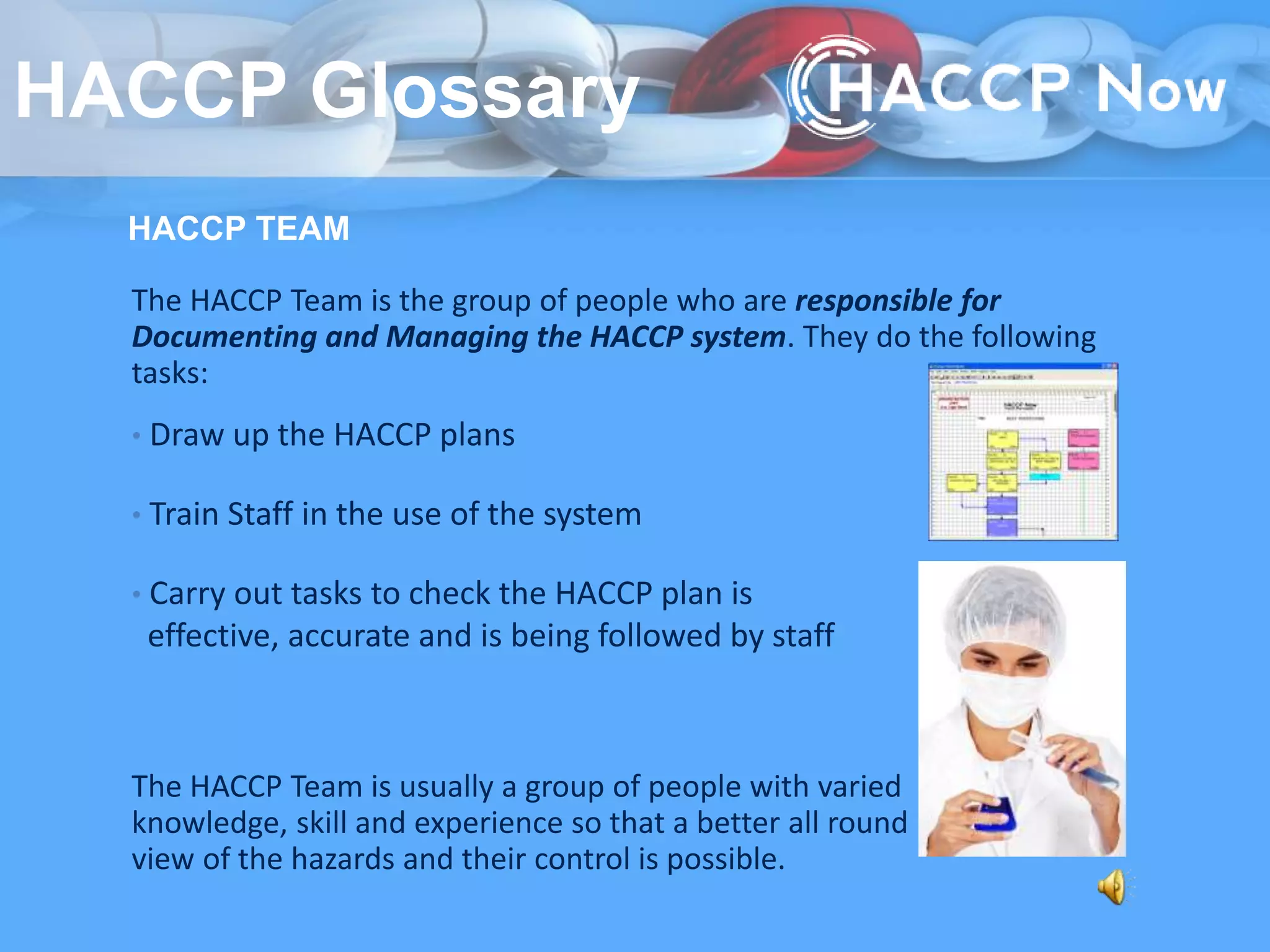
The HACCP Teamis the group of people who are responsible for
Documenting and Managing the HACCP system. They do the following
tasks:
HACCP TEAM
• Train Staff in the use of the system
• Carry out tasks to check the HACCP plan is
effective, accurate and is being followed by staff
The HACCP Team is usually a group of people with varied
knowledge, skill and experience so that a better all round
view of the hazards and their control is possible.
• Draw up the HACCP plans
HACCP Glossary
7.
Pesticides in un-washedfruit and vegetables.Food that is not properly cookedFood contaminated with Bacteria or VirusesFood that contains something UNEXPECTED!Sometimes it’s something that may make only a FEW people ill
HAZARD
A Hazard is simply something that can HURT you or others ... Like ..
HACCP Glossary
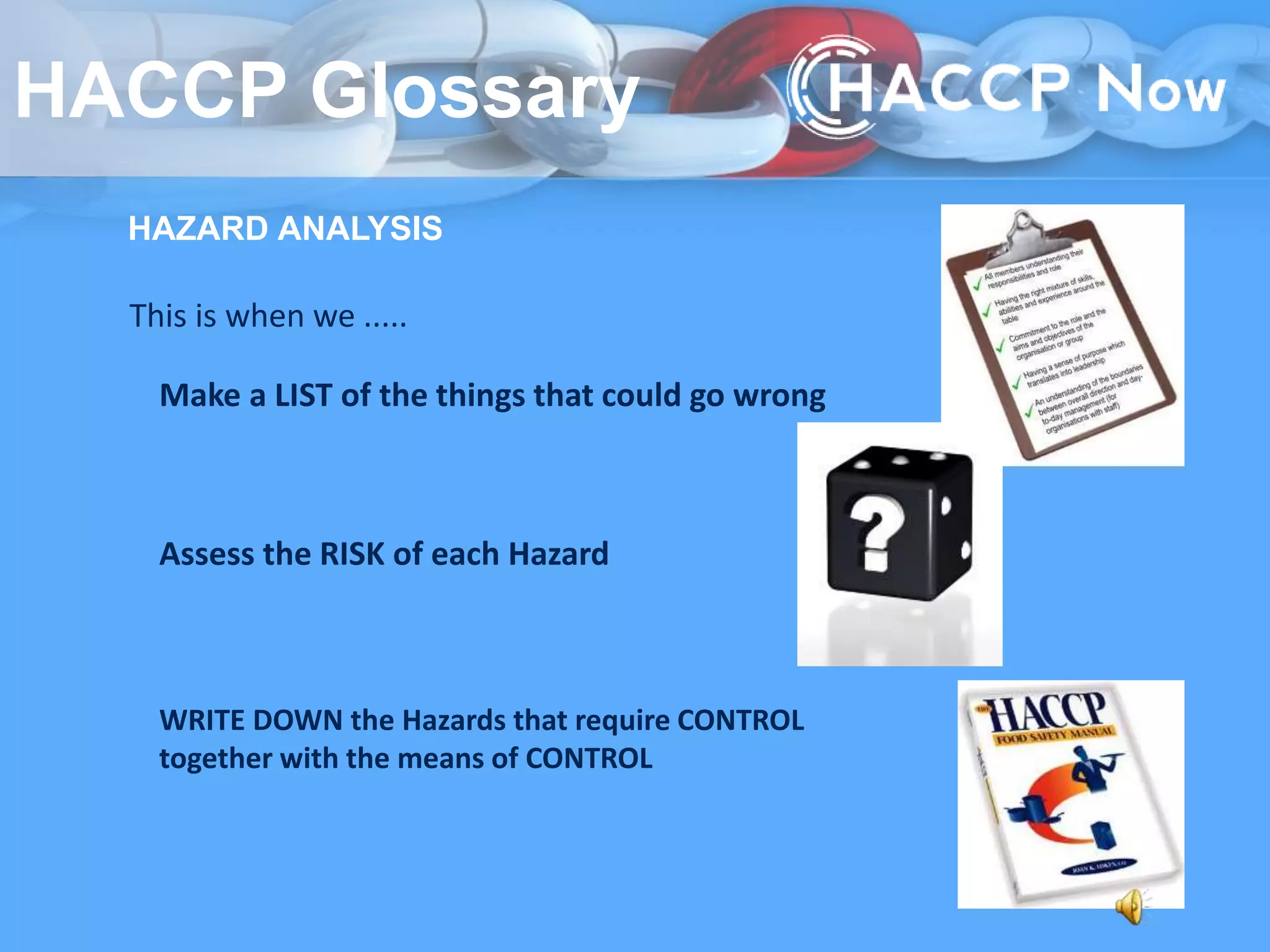
HAZARD ANALYSIS
This iswhen we .....
Make a LIST of the things that could go wrong
Assess the RISK of each Hazard
WRITE DOWN the Hazards that require CONTROL
together with the means of CONTROL
HACCP Glossary
10.
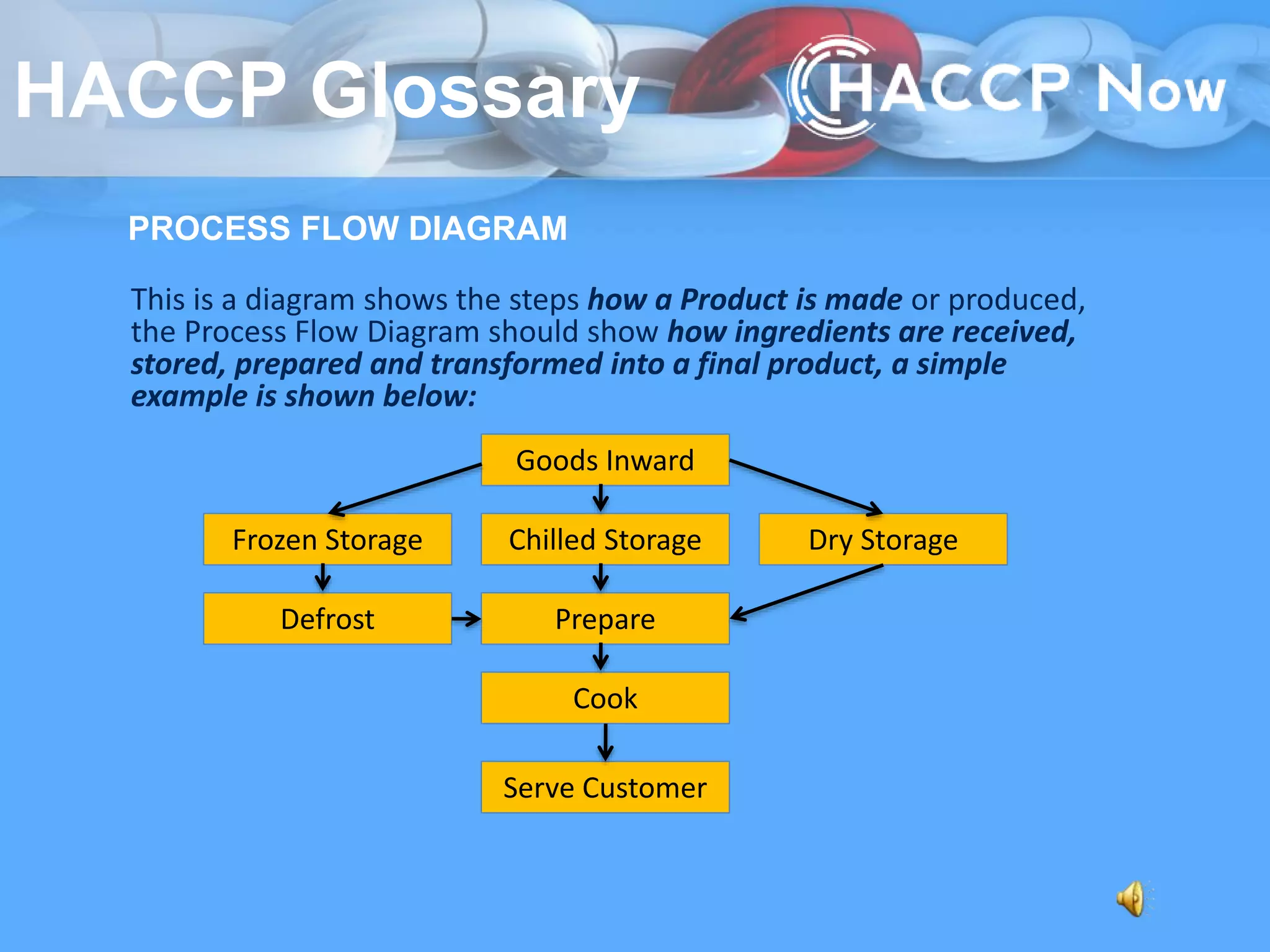
PROCESS FLOW DIAGRAM
Thisis a diagram shows the steps how a Product is made or produced,
the Process Flow Diagram should show how ingredients are received,
stored, prepared and transformed into a final product, a simple
example is shown below:
Goods Inward
Frozen Storage Chilled Storage Dry Storage
Prepare
Cook
Defrost
Serve Customer
HACCP Glossary
11.
PROCESS STEP
A ProcessStep is when an ingredient of a product or the product itself
changes in some way. Process Step’s are represented by a “box” on the
Flow Diagram, e.g. Chilled Storage and Cook are Process Step’s.
Goods Inward
Frozen Storage Chilled Storage Dry Storage
Prepare
Cook
Defrost
Serve Customer
HACCP Glossary
12.
Proper and thoroughCOOKING controls BACTERIA by KILLING them.
CONTROL MEASURE
A Control Measure is a method of ELIMINATING or REDUCING a Hazard
to a safe or ACCEPTABLE level .. for example
A FRIDGE controls the GROWTH of BACTERIA by lowering the temperatureSeparate equipment for Cooked and Raw Foods helps
PREVENT CROSS CONTAMINATION
HACCP Glossary
13.
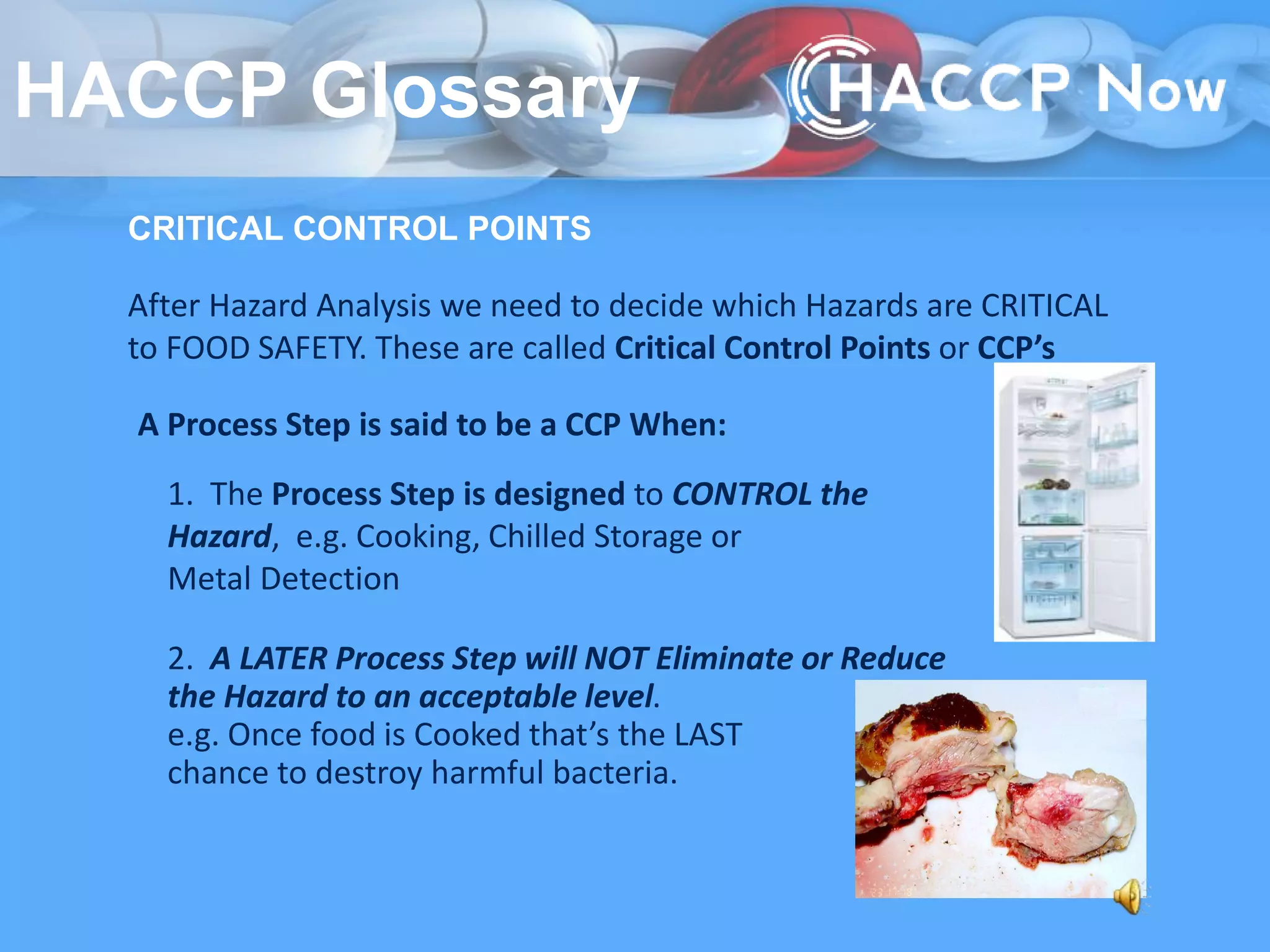
CRITICAL CONTROL POINTS
AfterHazard Analysis we need to decide which Hazards are CRITICAL
to FOOD SAFETY. These are called Critical Control Points or CCP’s
A Process Step is said to be a CCP When:
1. The Process Step is designed to CONTROL the
Hazard, e.g. Cooking, Chilled Storage or
Metal Detection
2. A LATER Process Step will NOT Eliminate or Reduce
the Hazard to an acceptable level.
e.g. Once food is Cooked that’s the LAST
chance to destroy harmful bacteria.
HACCP Glossary
14.
DECISION TREE
A DecisionTree is a series of Questions that are asked about a Hazard
to determine if the Process Step is a Critical Control Point or CCP.
Yes
No
Q1. Are Control Measures in place for the hazard? Modify Process Step
Q2. Is the Process Step designed to eliminate or
reduce the hazard to an acceptable level?
Is Control
required for
Safety?
CCP
Q3. Could the hazard increase to an unacceptable
level?
Q4. Does a later Process Step control this hazard? Not CCP
No
YesNo
No
Yes
Yes No
Yes
HACCP Glossary
15.
CRITICAL LIMIT
• Temperatureof food in fridge 1-5oC
• Cooking temperature 75oC for a
minimum of 2 minutes
Critical Limit’s are normally decided by use of a DECISION TREE and they
should always be MEASURABLE.
When we have identified a Critical Control Point using the Decision
Tree we need to set Critical Limits. These are values at which the
Hazard is known to be reduced to a safe or acceptable level. Some
examples are given below:
HACCP Glossary
16.
MONITORING PROCEDURE
A MonitoringProcedure is a planned and documented method for
checking that the all CCP’s are within their Critical Limit’s.
• Check and record temperature of food in
fridge every 4 hrs.
• Check and record cooking temperature
each batch made.
Monitoring Procedure’s result in records that prove food is safe for human
consumption.
Examples:
HACCP Glossary
17.
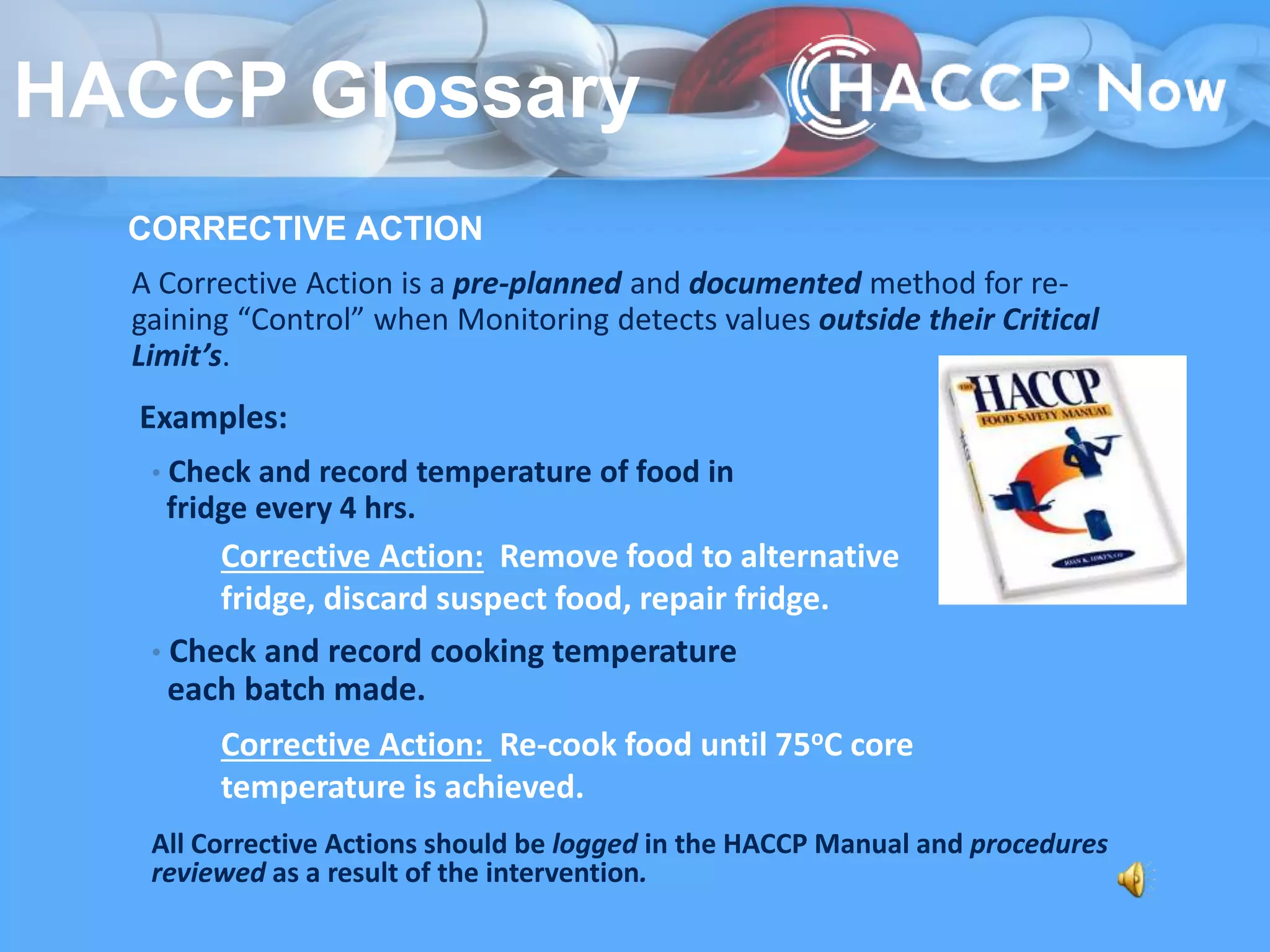
CORRECTIVE ACTION
A CorrectiveAction is a pre-planned and documented method for re-
gaining “Control” when Monitoring detects values outside their Critical
Limit’s.
• Check and record temperature of food in
fridge every 4 hrs.
• Check and record cooking temperature
each batch made.
All Corrective Actions should be logged in the HACCP Manual and procedures
reviewed as a result of the intervention.
Examples:
Corrective Action: Remove food to alternative
fridge, discard suspect food, repair fridge.
Corrective Action: Re-cook food until 75oC core
temperature is achieved.
HACCP Glossary
18.
VALIDATION
Validation is away of checking the EFFECTIVENESS of the HACCP
Plan, i.e. Is the HACCP Plan VALID?
• Check samples of food after Cooking to ensure
there are no harmful bacteria in the food.
Proof of Validation should be from a combination of external and internal
sources and it should be logged in the HACCP Manual.
Examples:
EFFECTIVENESS: Having an absence of dangerous
bacteria proves that the Control Measure “Cooking”
is effective.
EFFECTIVENESS: Low levels of Customer
Complaints prove that food being produced
is safe.
• Check customer complaints records to ensure
there has not been a rise in complaints recently.
HACCP Glossary
19.
VERIFICATION
Verification is away of checking that the HACCP plan is being used
and followed as intended.
• Review the Process Flow and Hazard Analysis
to ensure that it remains accurate.
Verification is a way of making sure the HACCP plan is correct and that staff
are using it correctly.
Examples:
Checks: Carry out an Audit to ensure
staff know and are following procedures.
Checks: “Walk through” the Process Flow and ensure
it is correct and look for any new hazards.
• Audit / Observe staff using the correct
Monitoring Procedures
HACCP Glossary
20.
SUMMARY
• HACCP standsfor Hazard Analysis Critical Control Points
• A HACCP Team normally produces and manages the HACCP system
• The SEVEN Principles of HACCP mean that we need to IDENTIFY and
MONITOR CRITICAL HAZARDS in order to PROVE we are making SAFE
FOOD
• HACCP is based on SEVEN Principles
• Critical Control Points require Monitoring to ensure the food is SAFE
• A HACCP Plan needs to be regularly VALIDATED for EFFECTIVENESS
• A HACCP System needs to be VERIFIED to ensure it remains UP TO DATE
HACCP Glossary