www.emcl-mundus.com
www.emcl-mundus.com


Bologna degrees
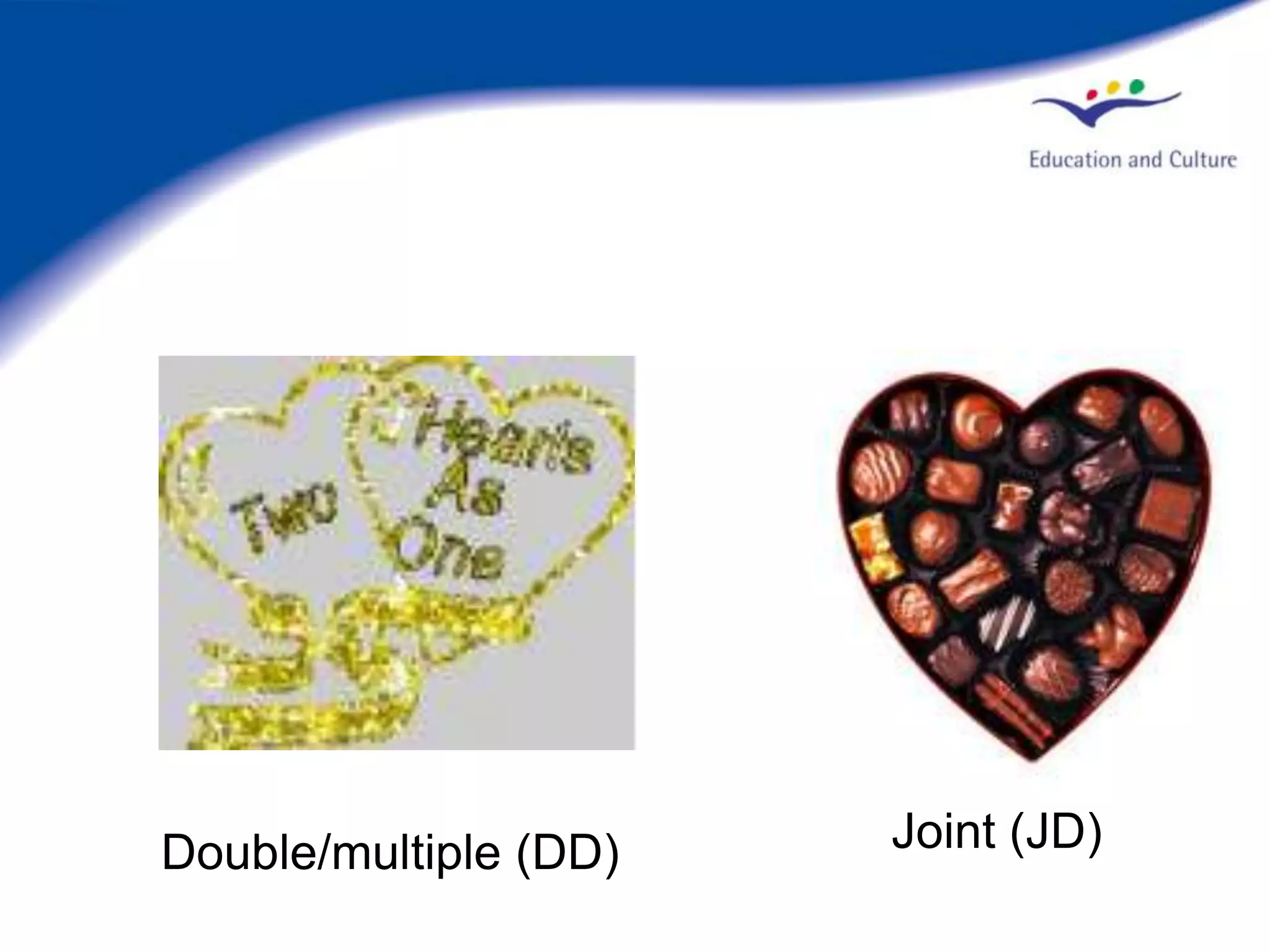
Double/multiple (DD)   Joint (JD)
JDD--Prebologna context
HE in Europe fragmented:
• Degrees differed in name, requirements
  – National degrees could not be compared


• Access, length of programmes, dissemination
  – varied from country to country


• One-tier systems without distinction between
  undergraduate and postgraduate level
  – could not be compared to systems allowing students
    to leave university at different levels
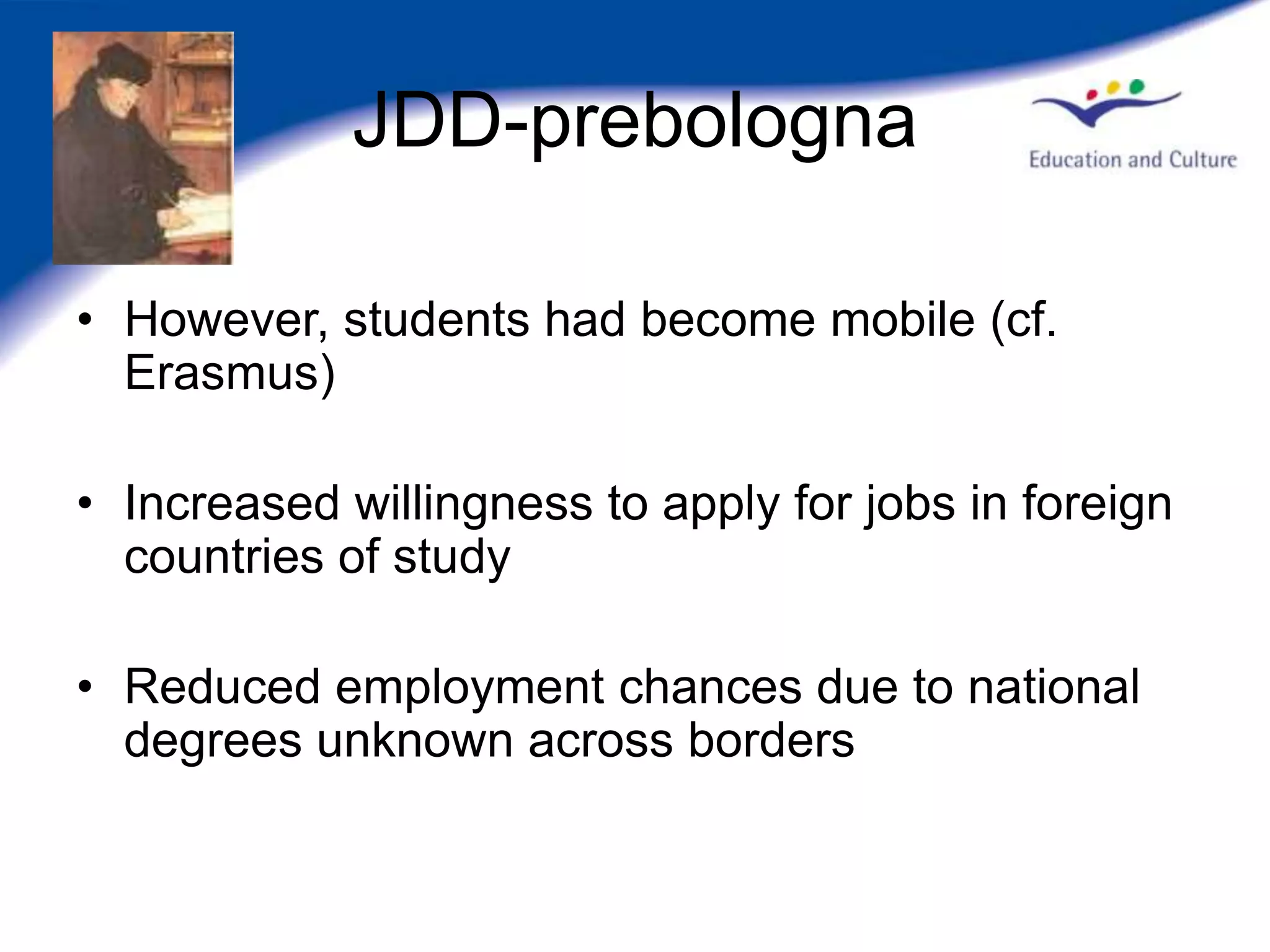
JDD-prebologna

• However, students had become mobile (cf.
  Erasmus)

• Increased willingness to apply for jobs in foreign
  countries of study

• Reduced employment chances due to national
  degrees unknown across borders
First JDD:
            toward integration
Goal: increase employability of internationally
 mobile students

• Mutual evaluation of programmes became more
  based on learning outcomes
   – rather than on individual modules


• Individual modules became mutually recognized
   – even though contents of individual modules not
     completely identical
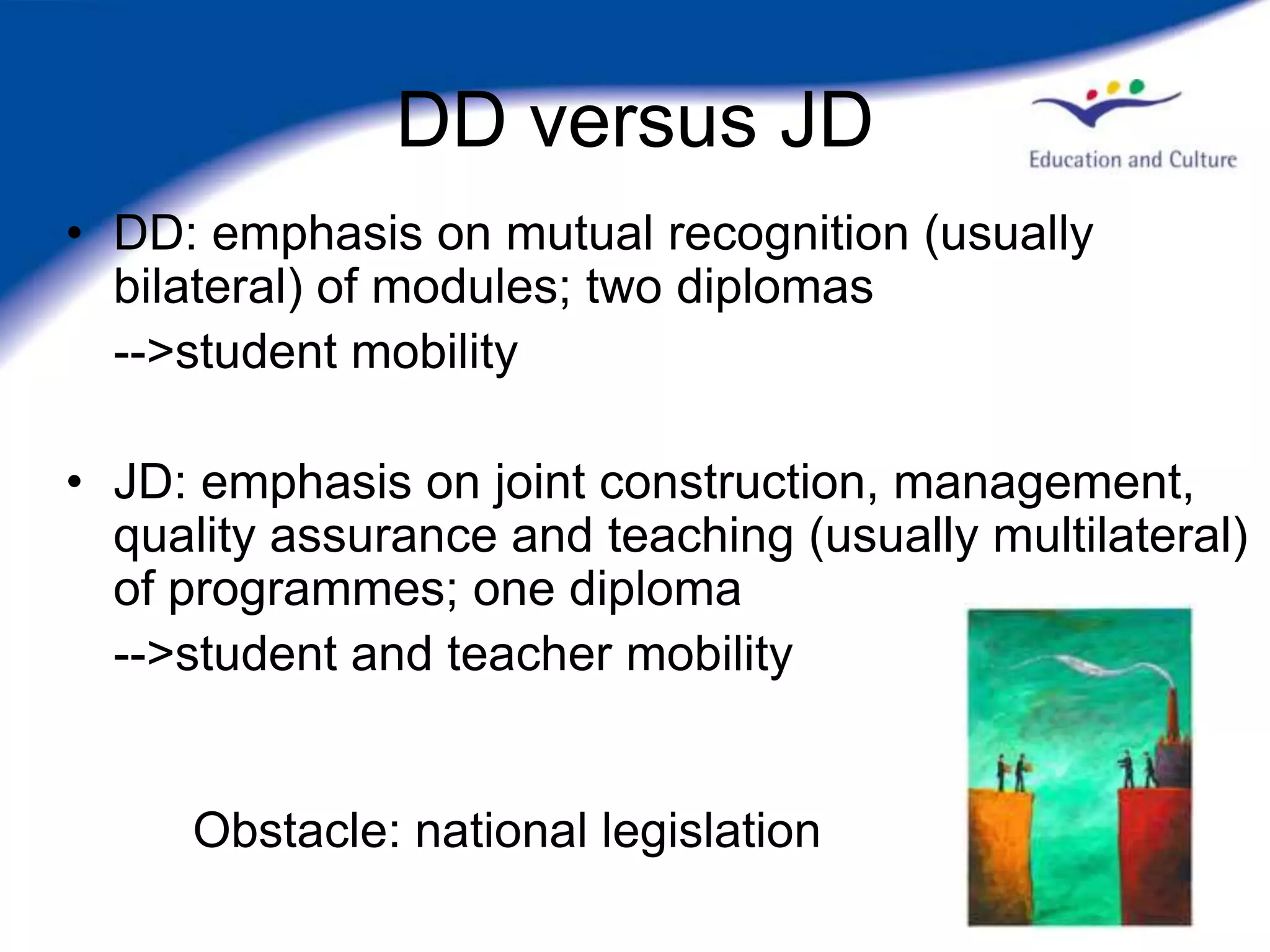
DD versus JD
• DD: emphasis on mutual recognition (usually
  bilateral) of modules; two diplomas
  -->student mobility

• JD: emphasis on joint construction, management,
  quality assurance and teaching (usually multilateral)
  of programmes; one diploma

  -->student and teacher mobility


     Obstacle: national legislation
Bologna Process
Joint Degree Programmes:

• create a Common European Educational Area

• Preferred instruments:
  – joint programmes, joint quality assurance,
    joint organisational structure

  – joint degrees (mutual recognition of academic
    degrees and qualifications, University
    Seal/Signature, even though a student was
    never on the spot)
Getting there:
• Bologna (1999) and Prague (2001)
   – develop modules, courses and curricula at all levels
   – with „European‟ content, orientation or organisation”.

• EUA joint Masters project (2002)
   – Support of 11 “joint” Masters programmes

• Coimbra (2003)
   – First distinctive definition Joint
   – versus Double/Multiple degree

• Berlin Ministerial Communiqué (2003)
   – develop integrated curricula
   – remove national legal obstacles to joint degrees
Cluj 2003
      EUA conference on Joint Degrees
 Recommends further discussion and action in:

– amending national legislation to enable HE to
  award joint degrees;

– anchoring joint programmes firmly within
  institutional structures;

– developing appropriate QA and recognition
  mechanisms, with ‘European label’for joint
  programmes
ERASMUS MUNDUS I
In accordance with these recommendations:

• 2004, launching of Erasmus Mundus by EU: mobility
  programme aiming to strengthen links between the
  EU Member States and third countries.

• AIM: create 250 new inter-university Masters courses
  and provide EU-funded scholarships for third country
  nationals studying in the EU (and for EU nationals
  studying in third countries).
EM I, 2004-2008
                       EM goal

• enhance attractiveness and competitiveness of
  European HE

• Support Bologna drive to promote joint degrees.

• EM I became crown jewel of EU HE policy

• Extended as EM II (2009-2013) with a budget
  multipled by 5 (€230 M-€950M)
Changes in EM II
• joint PhD-programmes
  – (in addition to joint Masters programmes)
• grants for EU-students
  – (as well as Non-EU-students)
• non-EU universities can be full partners
  – (integration of prev. Action 3: cooperation with non-EU
    universities into Action 1: prev. Action 1, 2):
• industrial partners required
  – (strong emphasis on employability)
• EU-support maximum of 2 phases
  – (strong emphasis on sustainability)
PhD in EM II
         versus Marie Curie
In EM II, as in Marie Curie ITN,
• association with industry/potential employers
• professionals = employment contract
  – (not students=scholarship)
BUT
• EMII is at institutional level,
• MC at research network level.
Unsolved question:
• ECTS??? (for mobility, training: YES)
Joint degree problem
• 2009: still not officially recognised in some
  member states but ammendments to
  legislation are being prepared.

• Double/multiple diplomas considered
  transition state towards EU-desired joint
  diplomas
EMCL in EMII: 2009-2013
• Changed EM system

• Changed EMCL application
  – Changed partnership
  – Changed programme
  – Changed semester system
  – Changed boards
  – Improved quality assurance
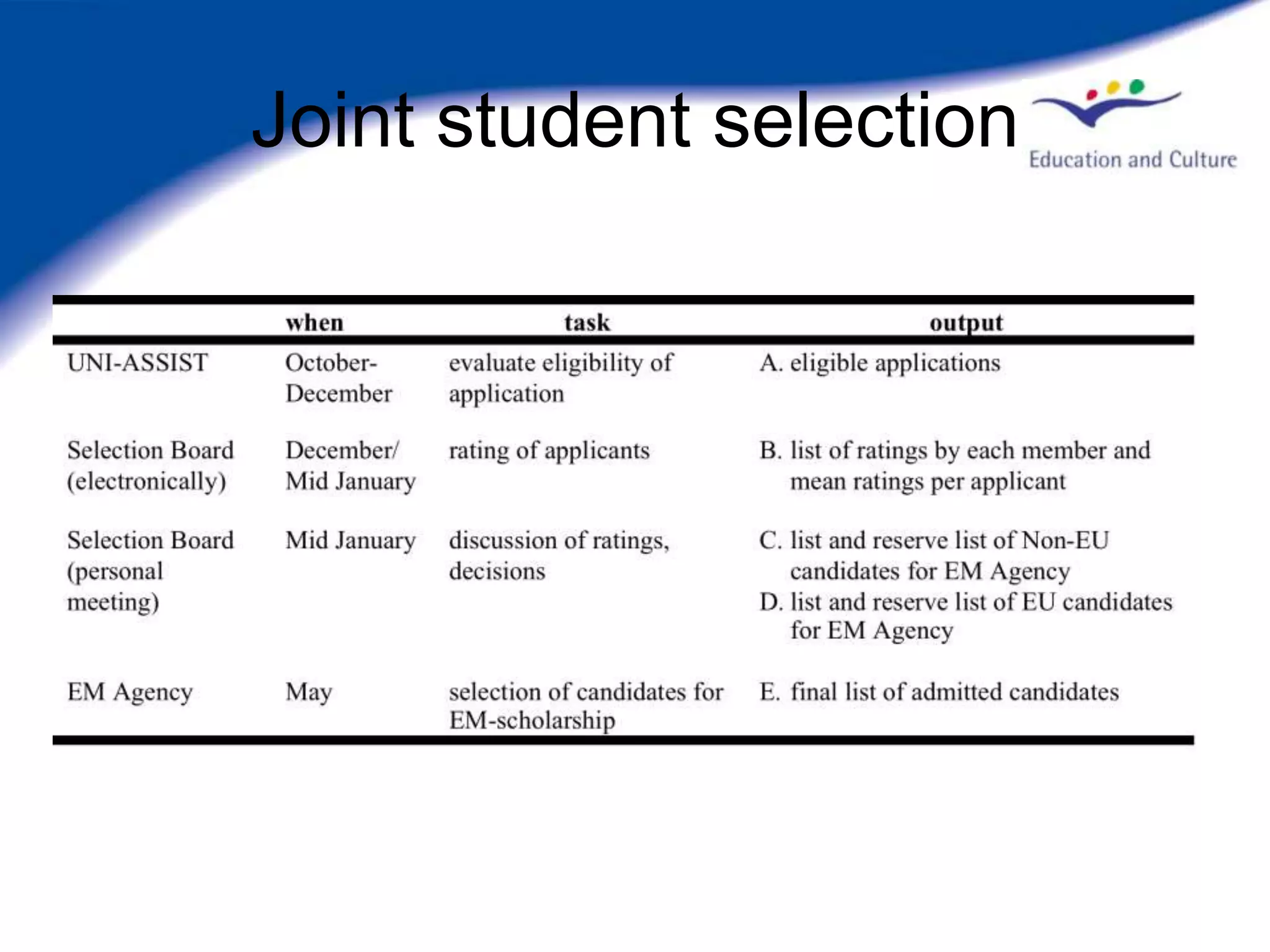
Joint student selection
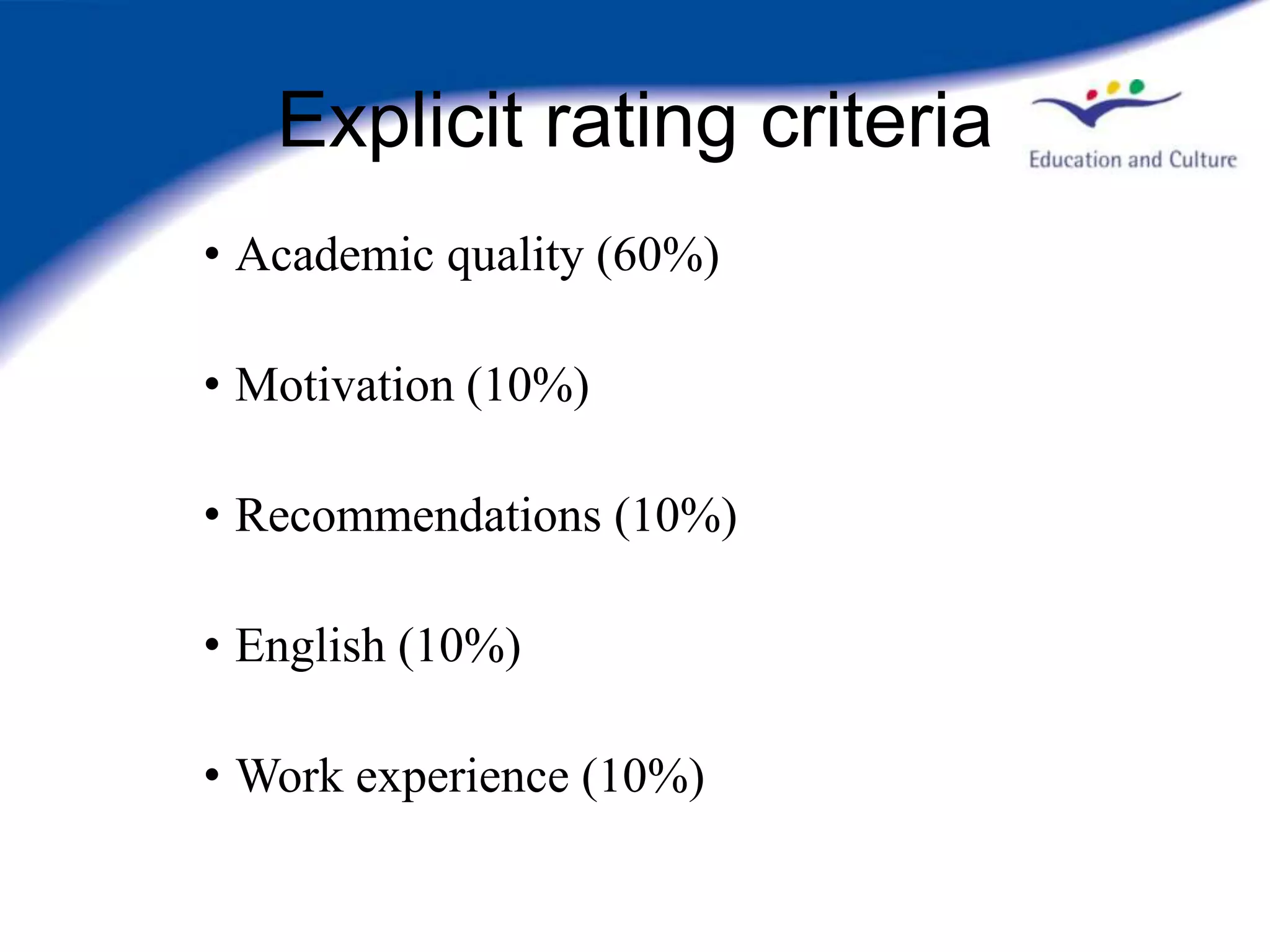
Explicit rating criteria
• Academic quality (60%)

• Motivation (10%)

• Recommendations (10%)

• English (10%)

• Work experience (10%)
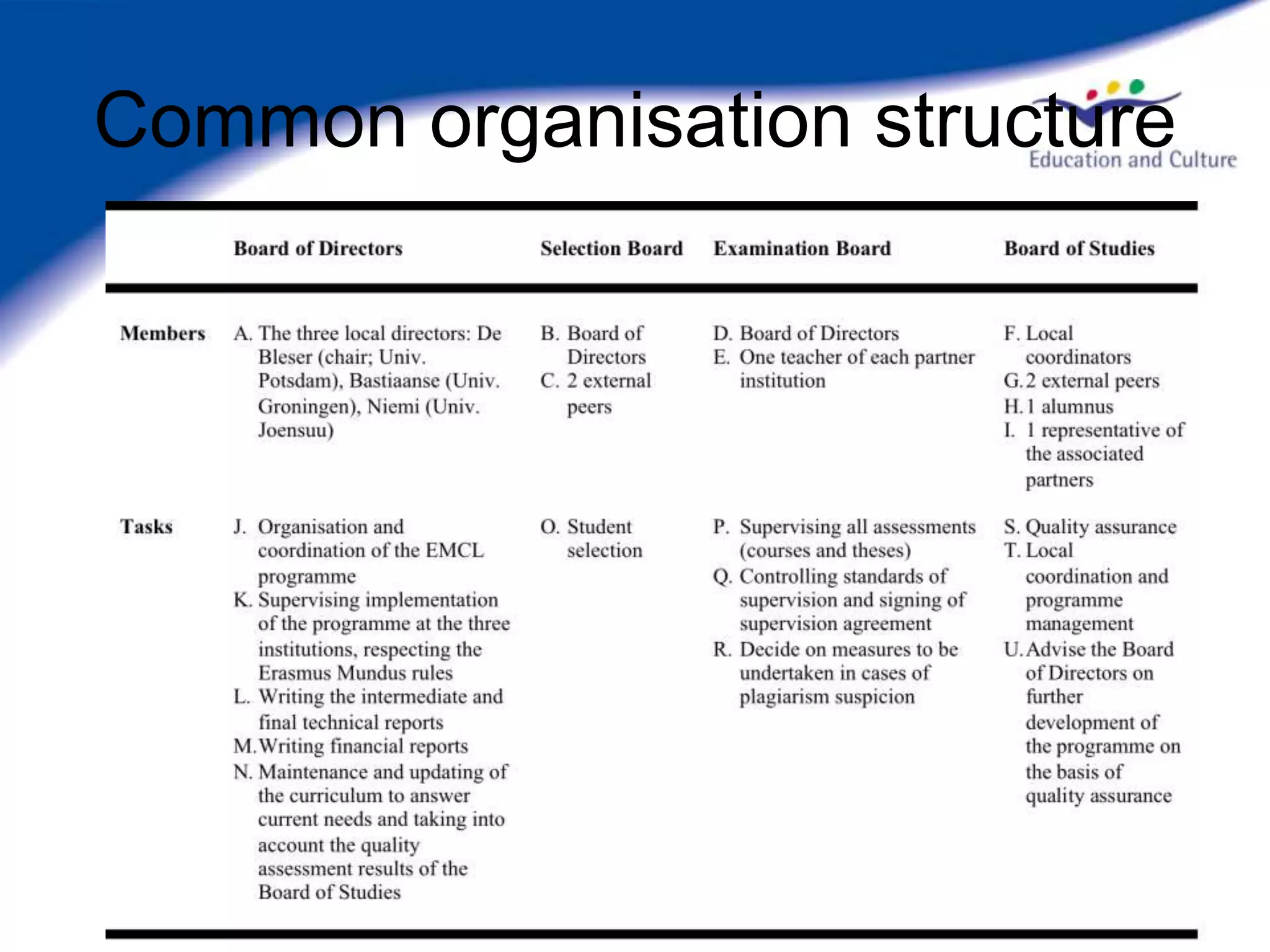
Common organisation structure
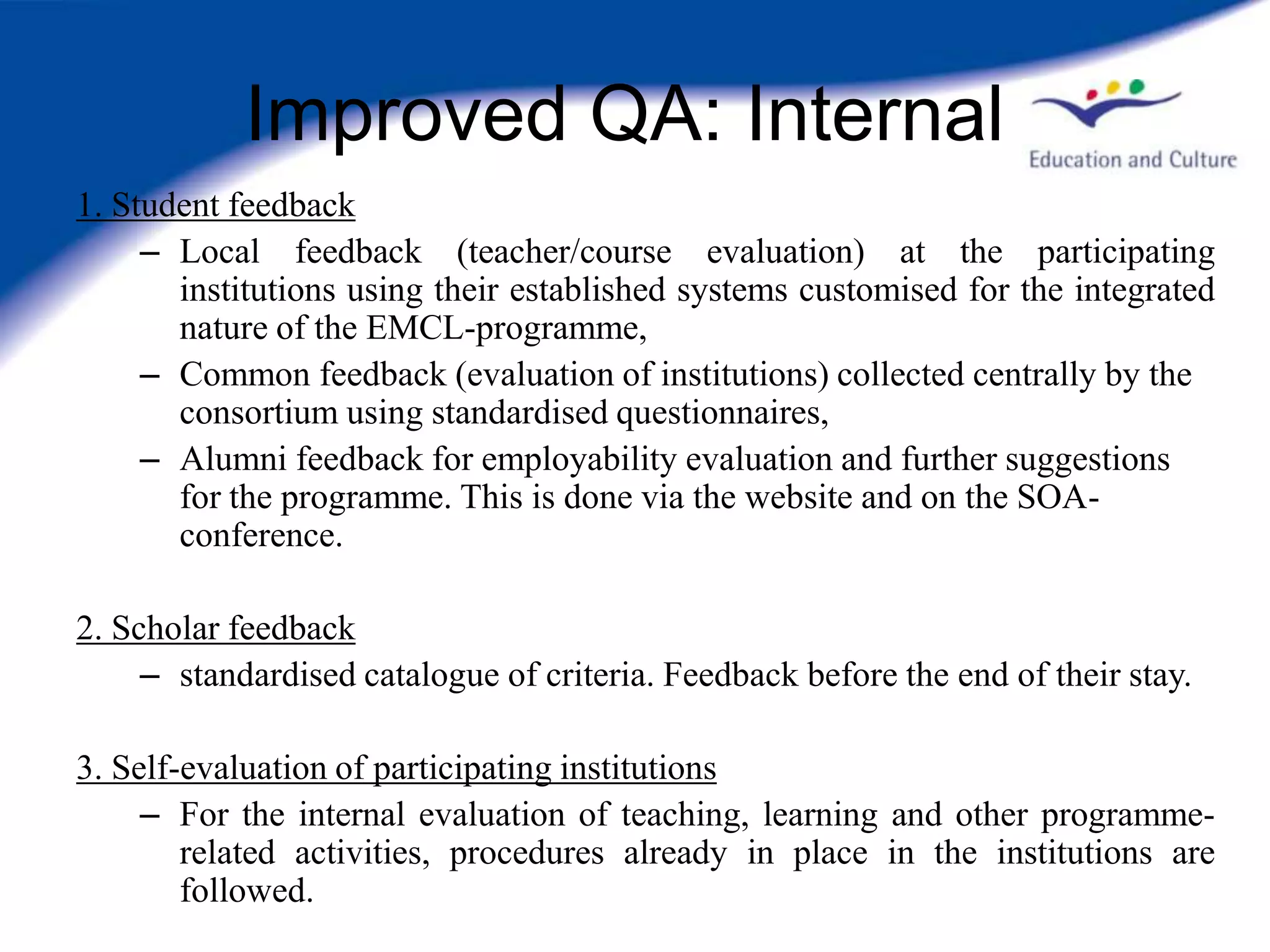
Improved QA: Internal
1. Student feedback
     – Local feedback (teacher/course evaluation) at the participating
       institutions using their established systems customised for the integrated
       nature of the EMCL-programme,
     – Common feedback (evaluation of institutions) collected centrally by the
       consortium using standardised questionnaires,
     – Alumni feedback for employability evaluation and further suggestions
       for the programme. This is done via the website and on the SOA-
       conference.

2. Scholar feedback
     – standardised catalogue of criteria. Feedback before the end of their stay.

3. Self-evaluation of participating institutions
     – For the internal evaluation of teaching, learning and other programme-
        related activities, procedures already in place in the institutions are
        followed.
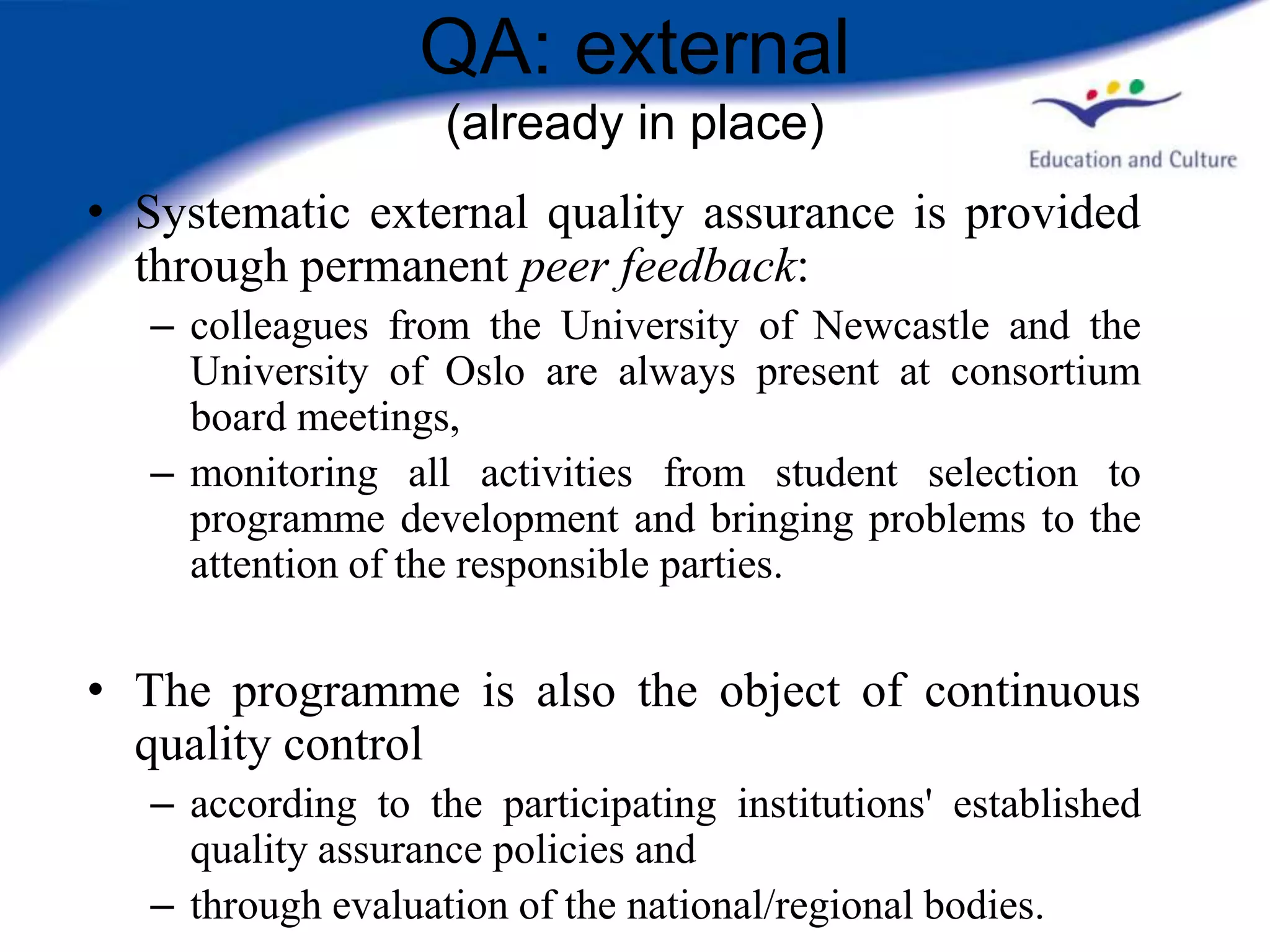
QA: external
                    (already in place)
• Systematic external quality assurance is provided
  through permanent peer feedback:
   – colleagues from the University of Newcastle and the
     University of Oslo are always present at consortium
     board meetings,
   – monitoring all activities from student selection to
     programme development and bringing problems to the
     attention of the responsible parties.


• The programme is also the object of continuous
  quality control
   – according to the participating institutions' established
     quality assurance policies and
   – through evaluation of the national/regional bodies.
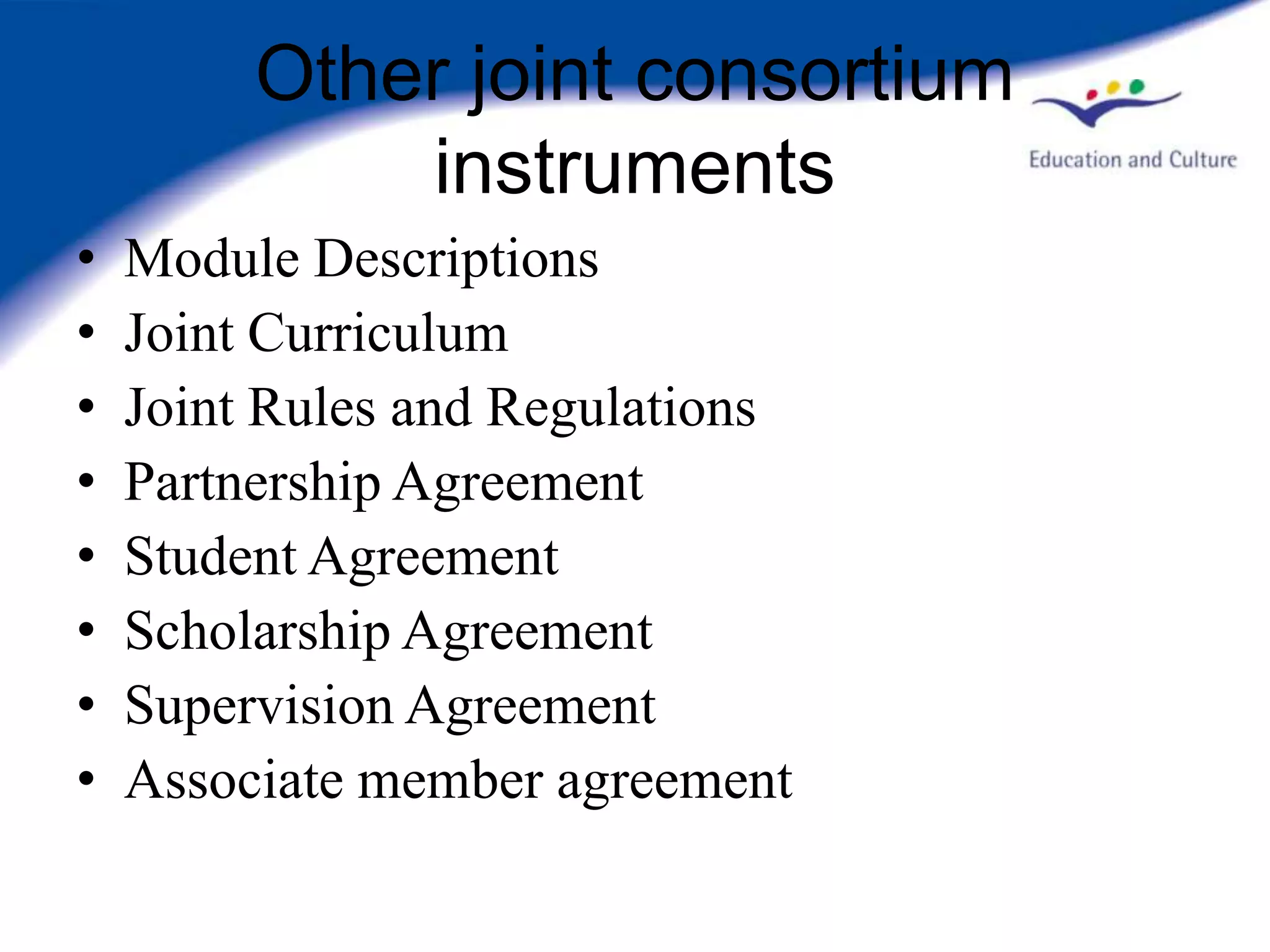
Other joint consortium
             instruments
•   Module Descriptions
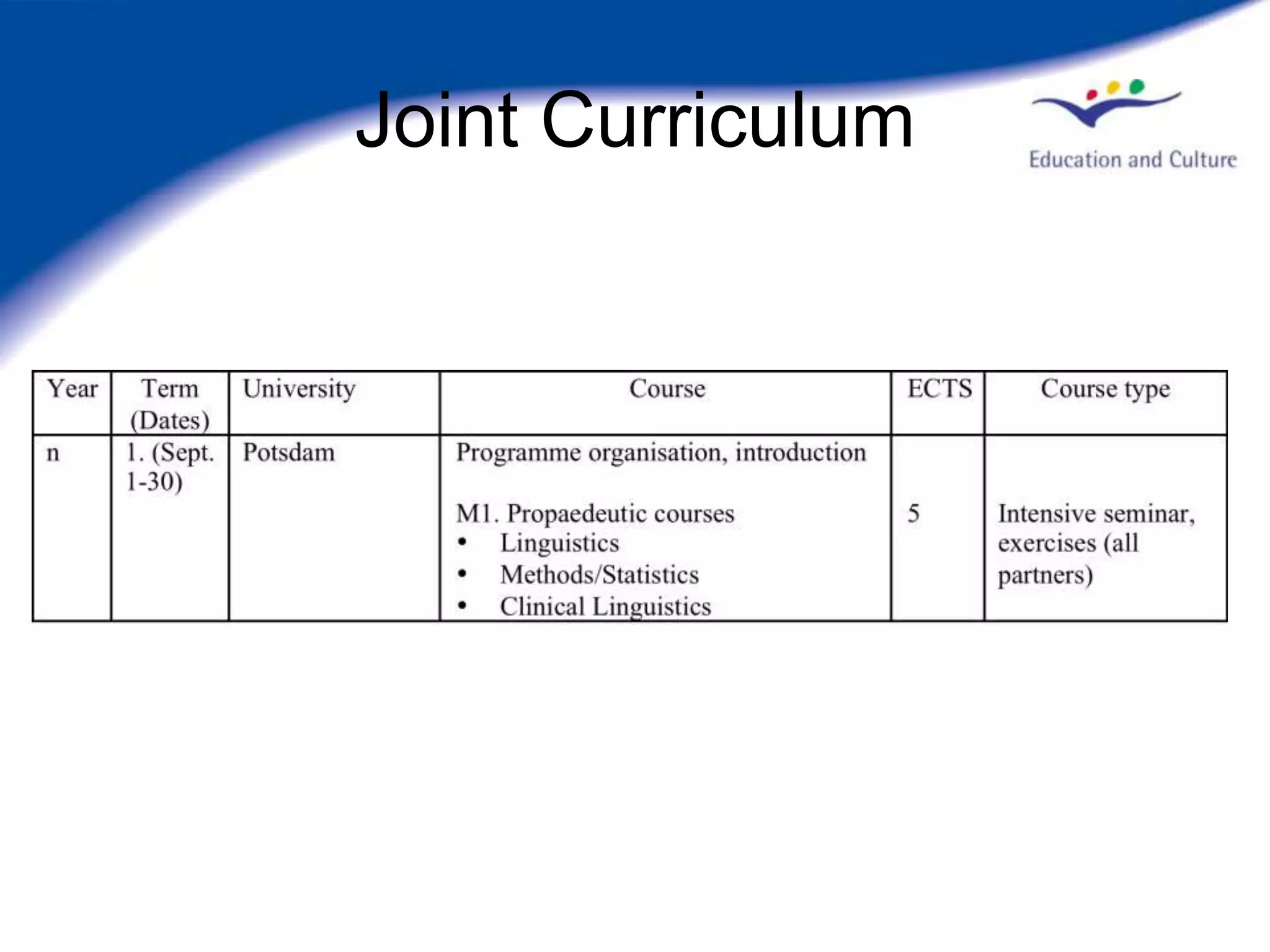
•   Joint Curriculum
•   Joint Rules and Regulations
•   Partnership Agreement
•   Student Agreement
•   Scholarship Agreement
•   Supervision Agreement
•   Associate member agreement
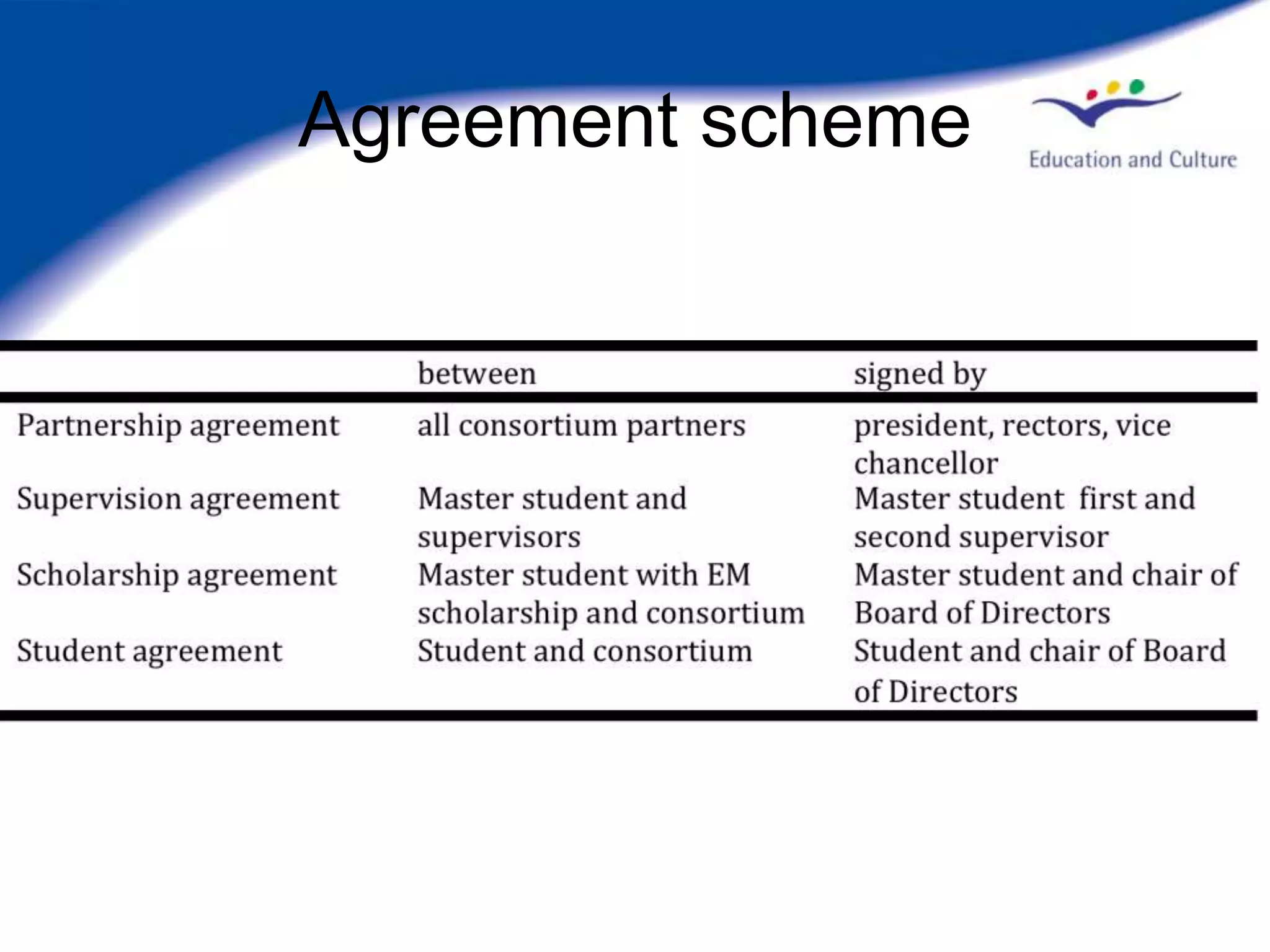
Agreement scheme
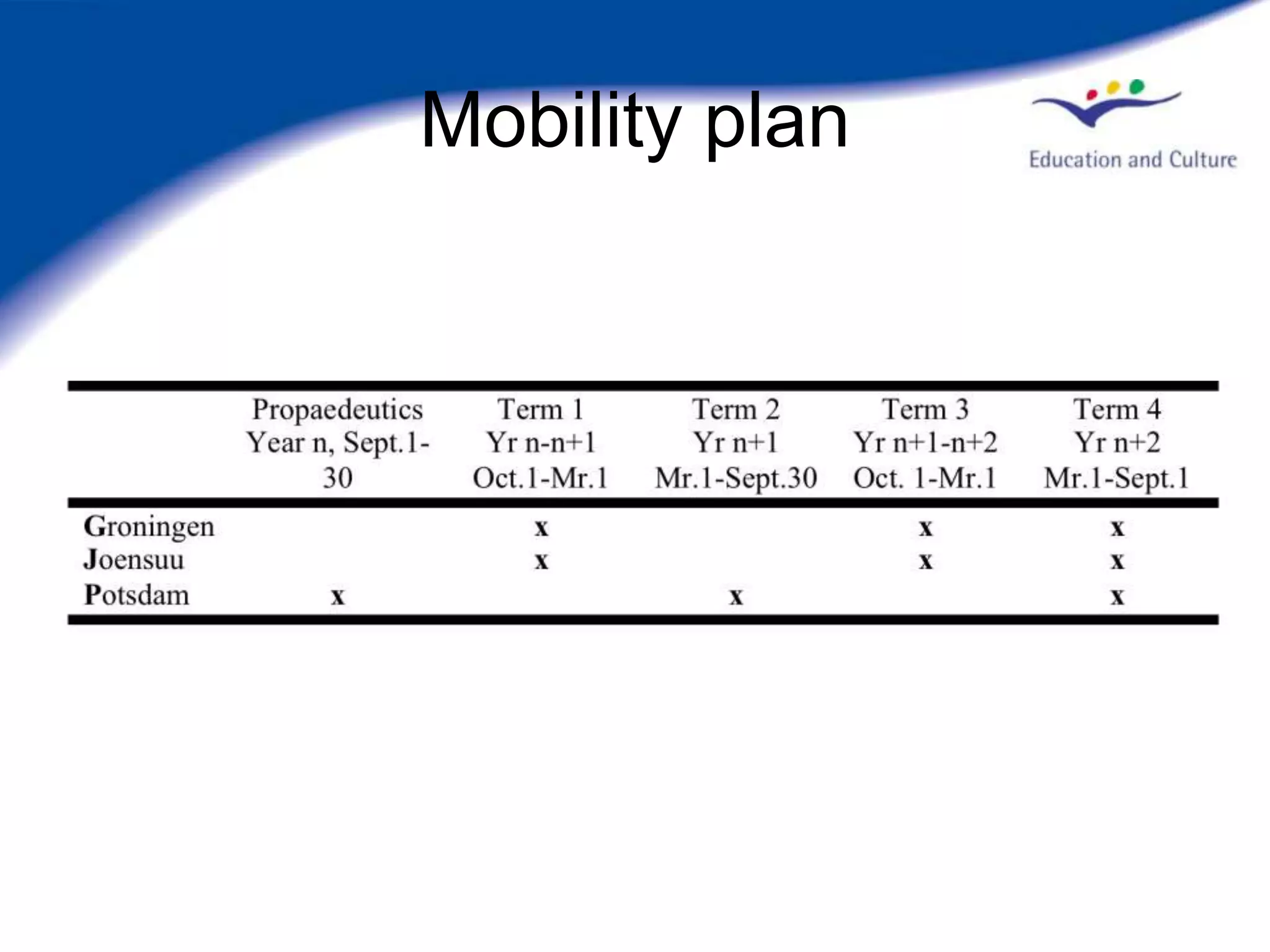
Mobility plan
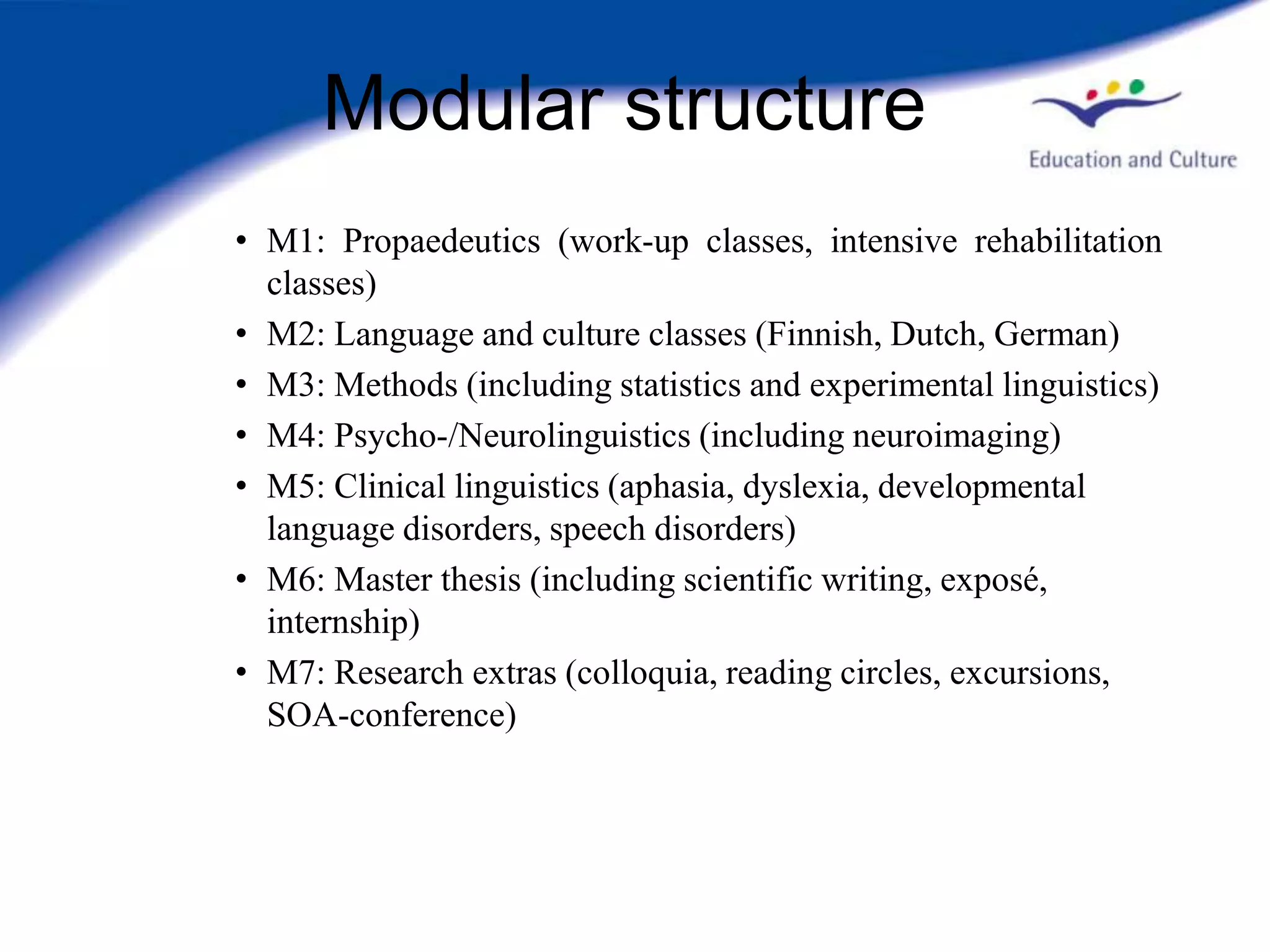
Modular structure
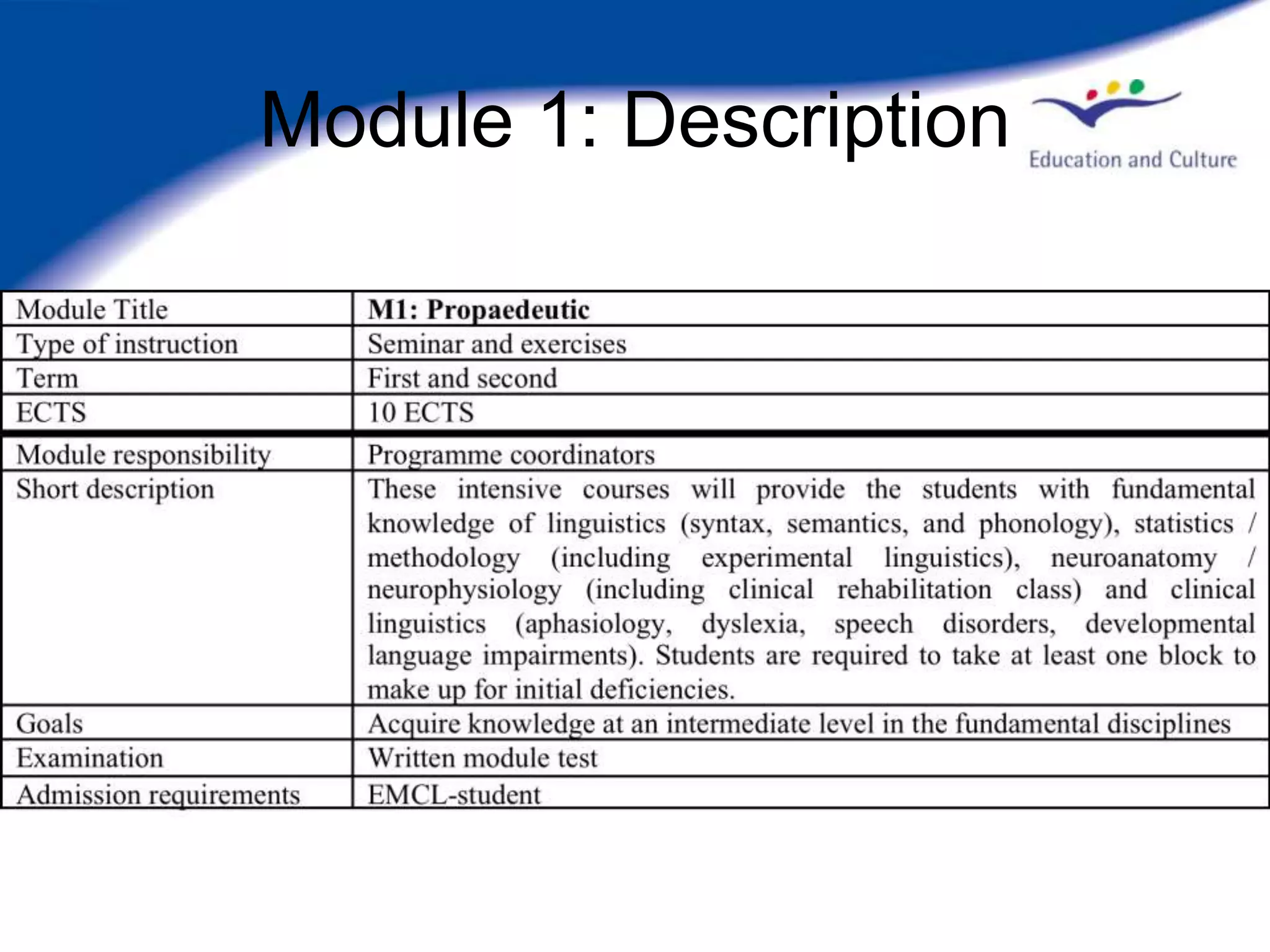
• M1: Propaedeutics (work-up classes, intensive rehabilitation
  classes)
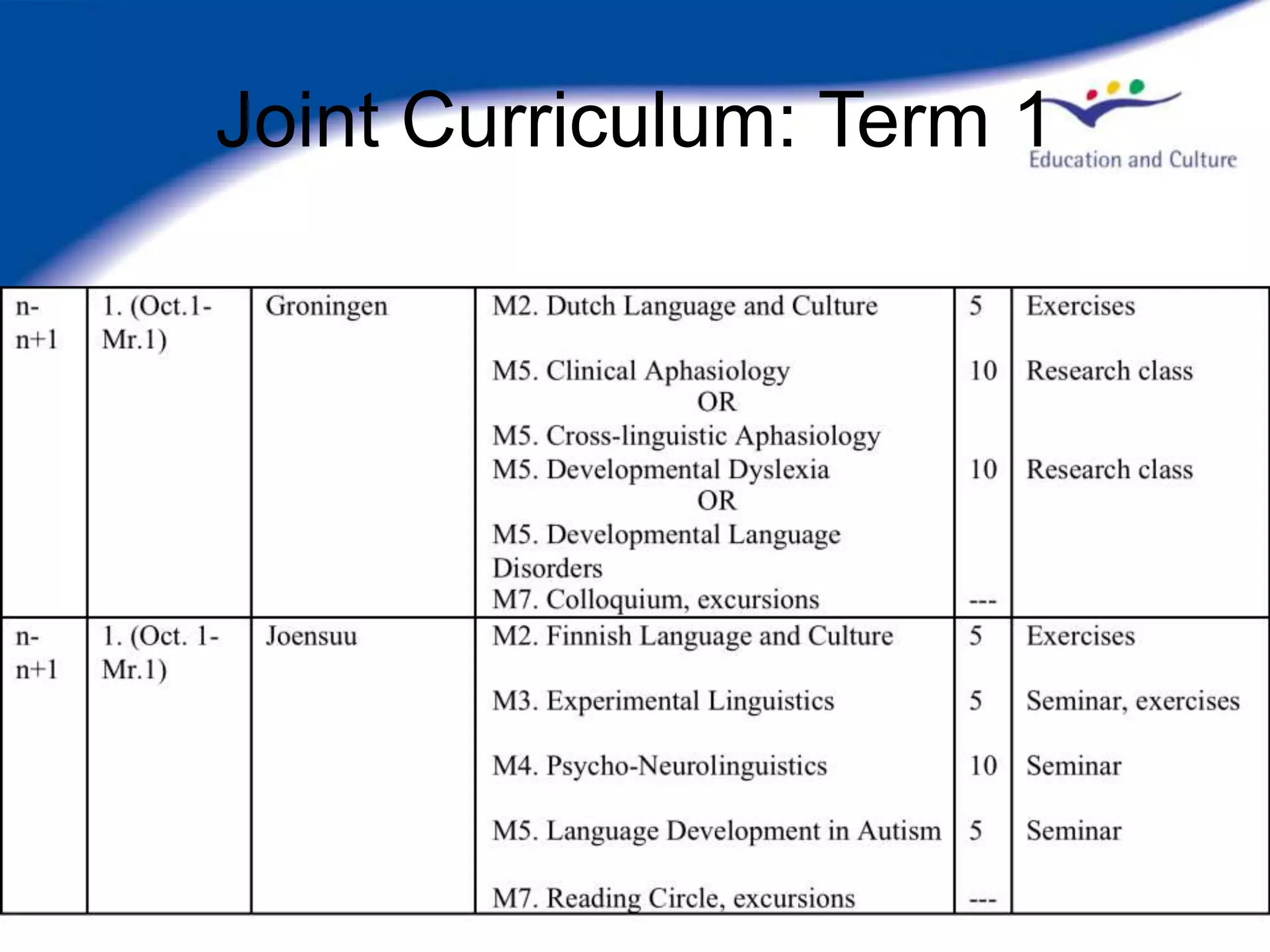
• M2: Language and culture classes (Finnish, Dutch, German)
• M3: Methods (including statistics and experimental linguistics)
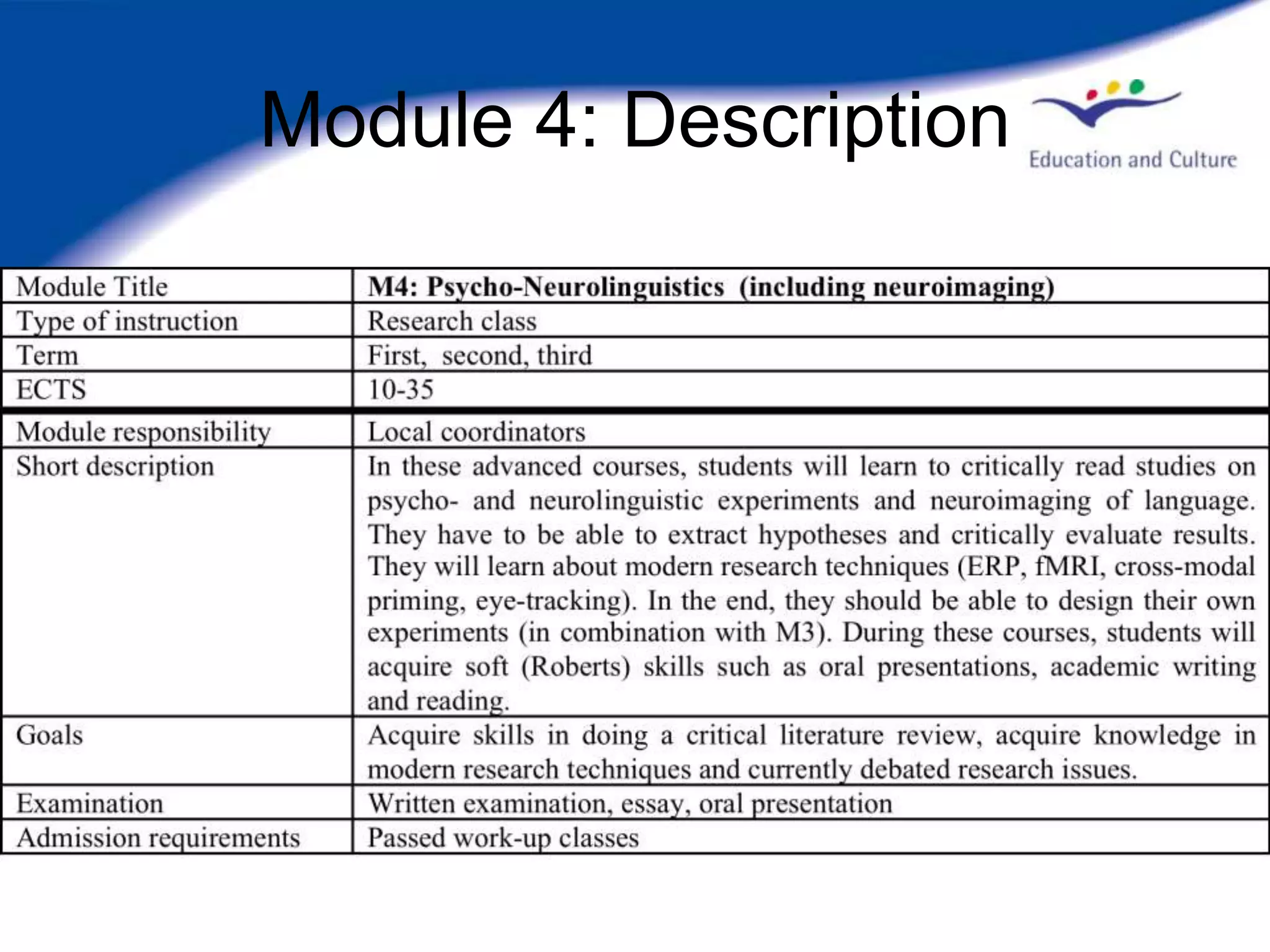
• M4: Psycho-/Neurolinguistics (including neuroimaging)
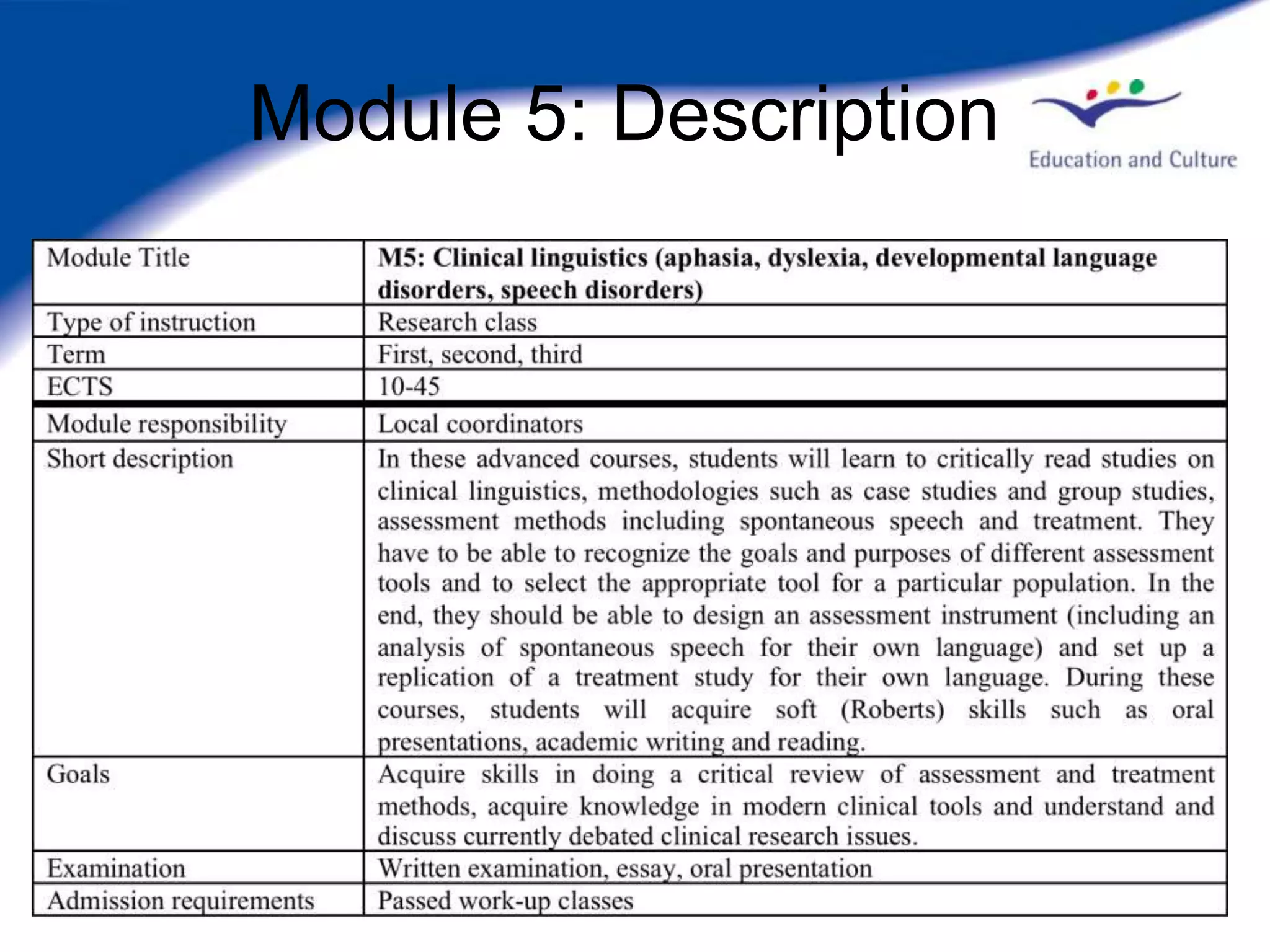
• M5: Clinical linguistics (aphasia, dyslexia, developmental
  language disorders, speech disorders)
• M6: Master thesis (including scientific writing, exposé,
  internship)
• M7: Research extras (colloquia, reading circles, excursions,
  SOA-conference)
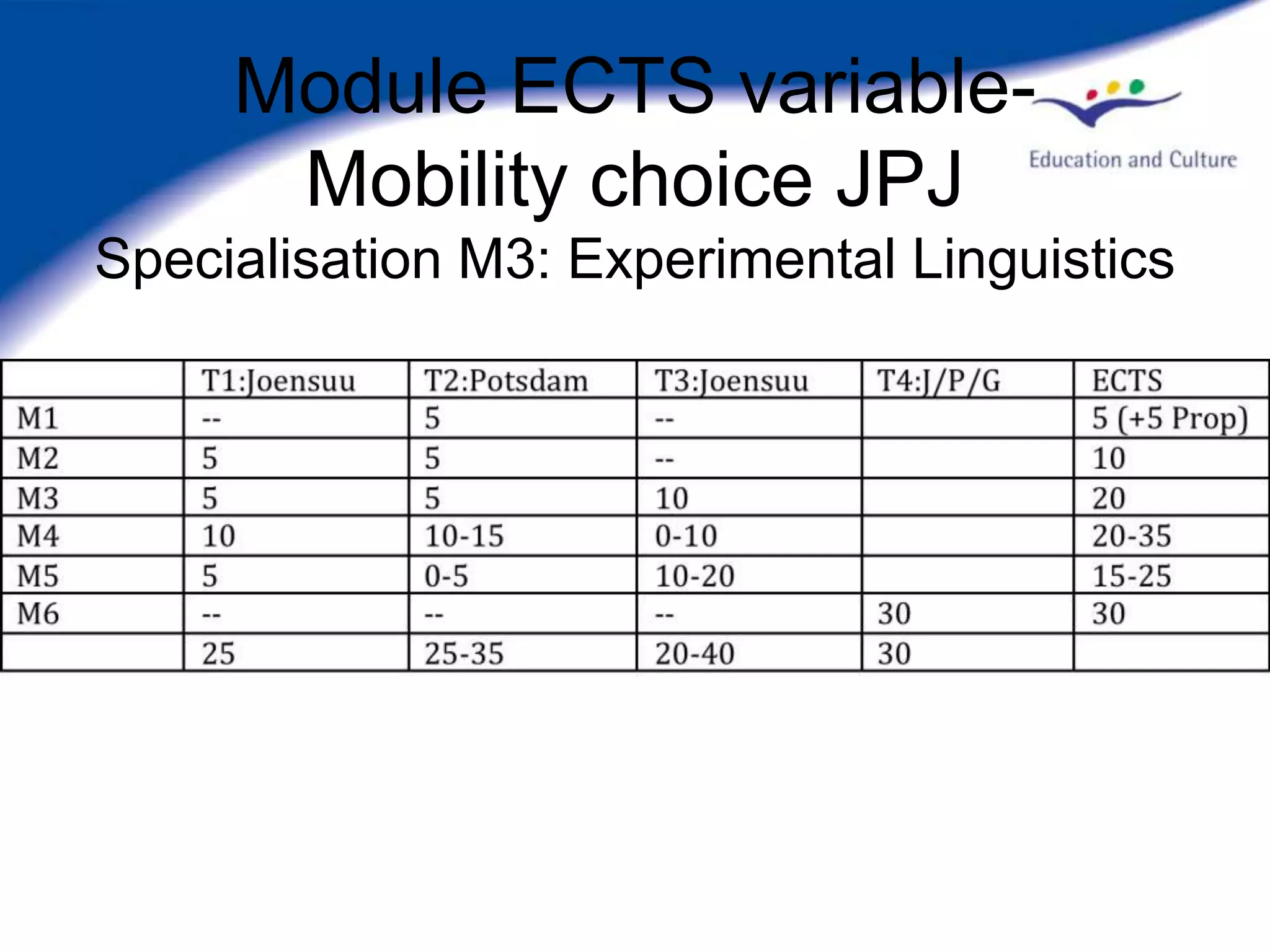
Module ECTS variable-
      Mobility choice JPJ
Specialisation M3: Experimental Linguistics
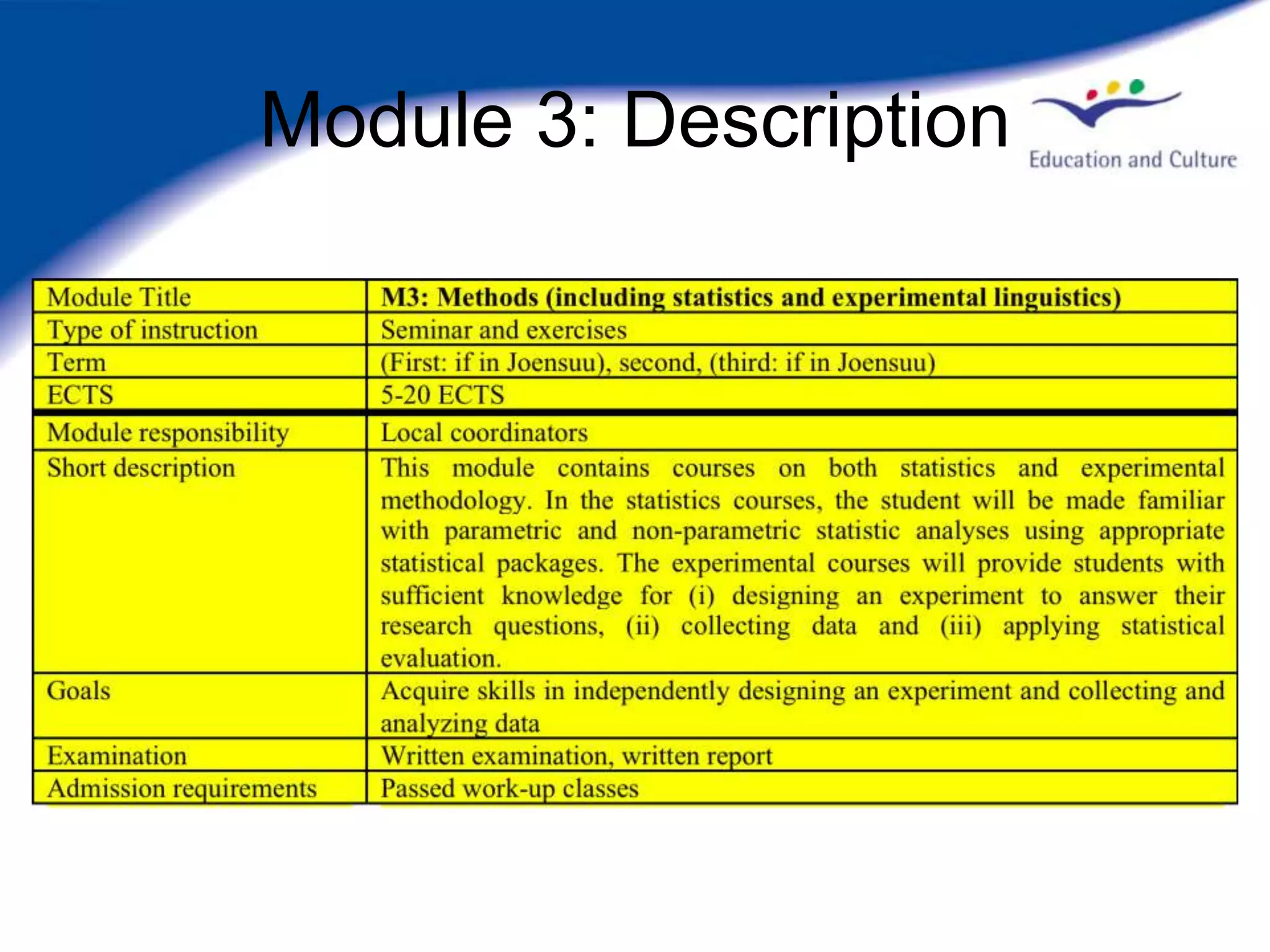
Module 3: Description
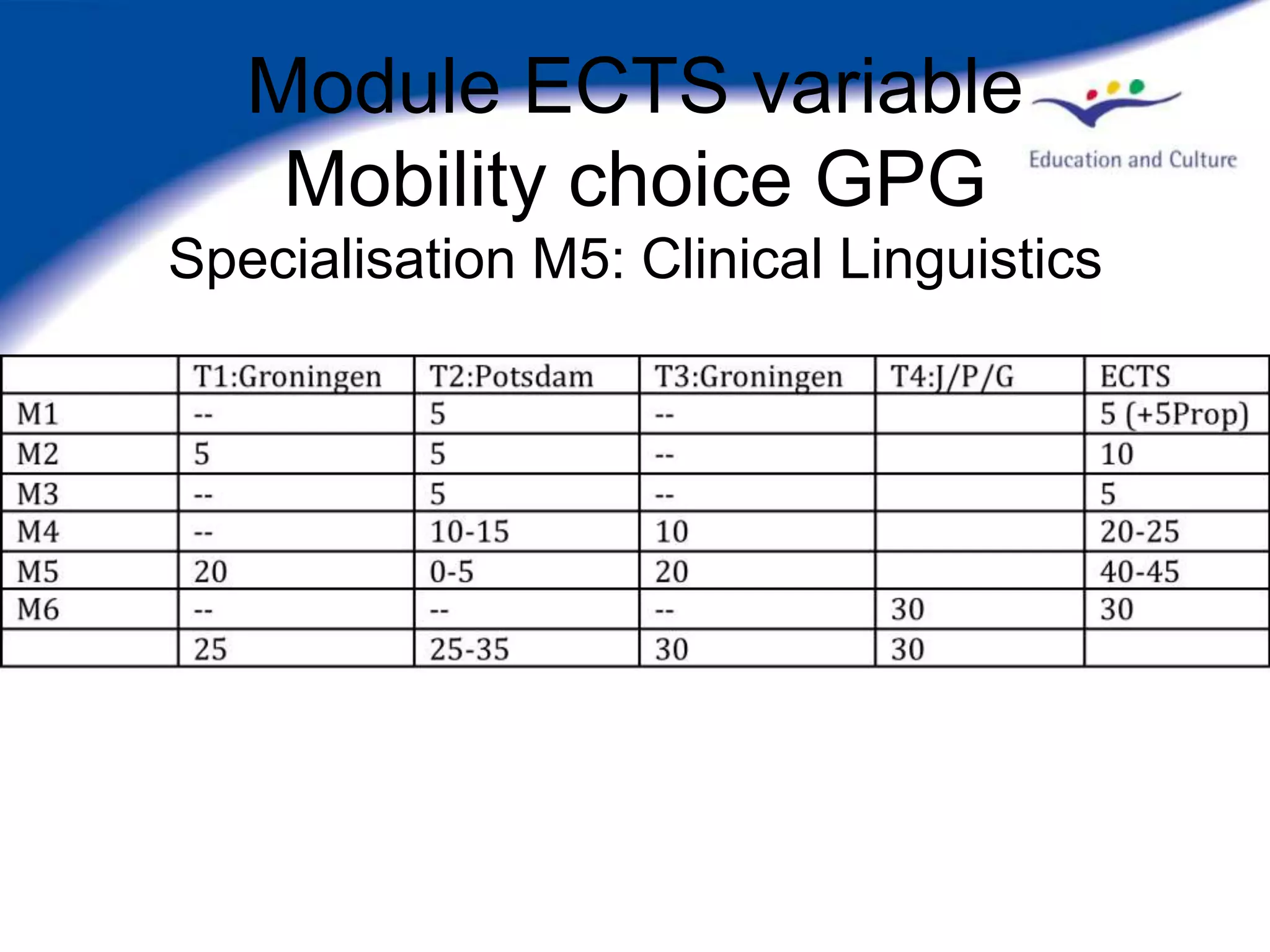
Module ECTS variable
    Mobility choice GPG
Specialisation M5: Clinical Linguistics
Module 5: Description
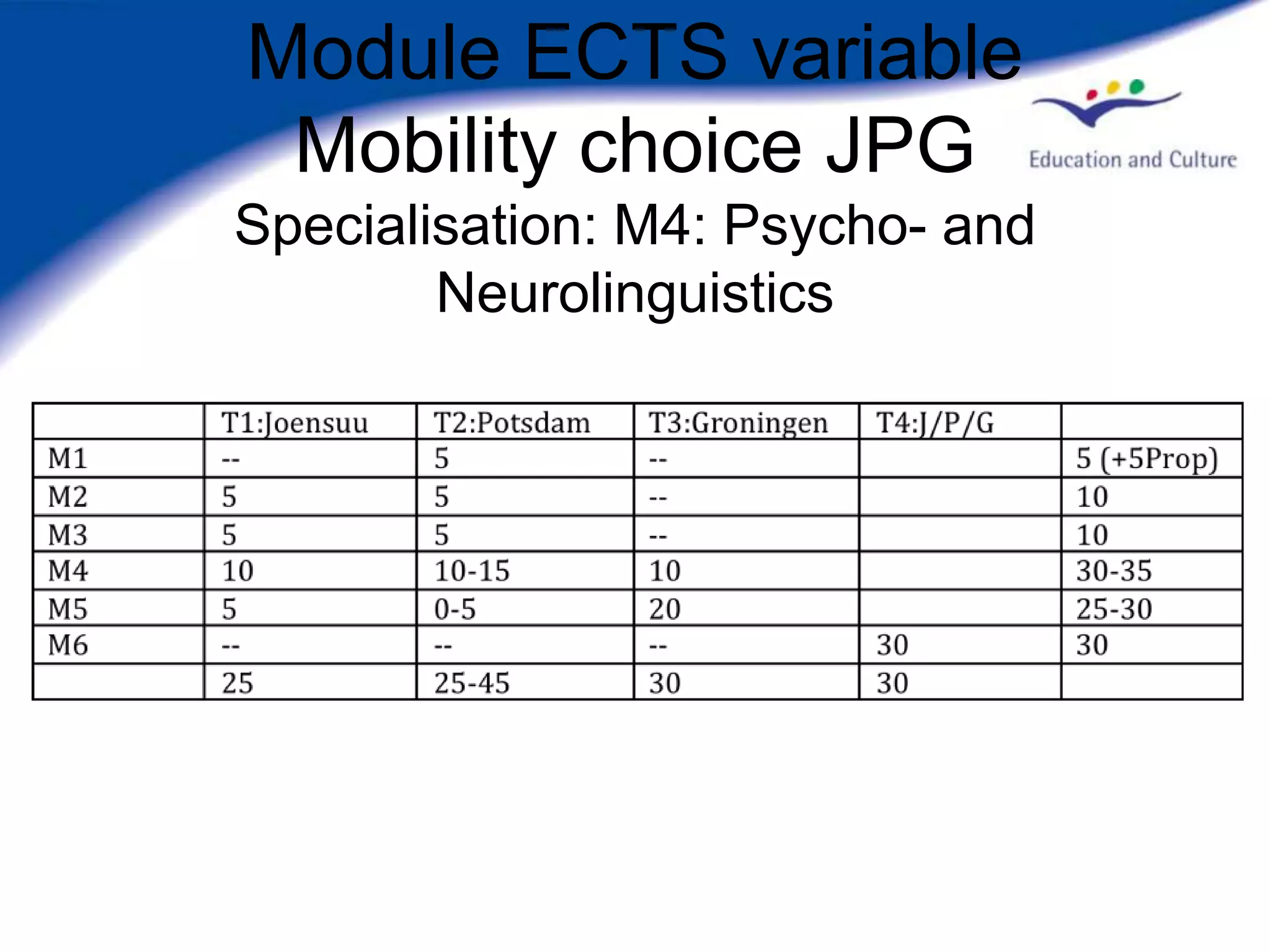
Module ECTS variable
 Mobility choice JPG
Specialisation: M4: Psycho- and
        Neurolinguistics
Module 4: Description
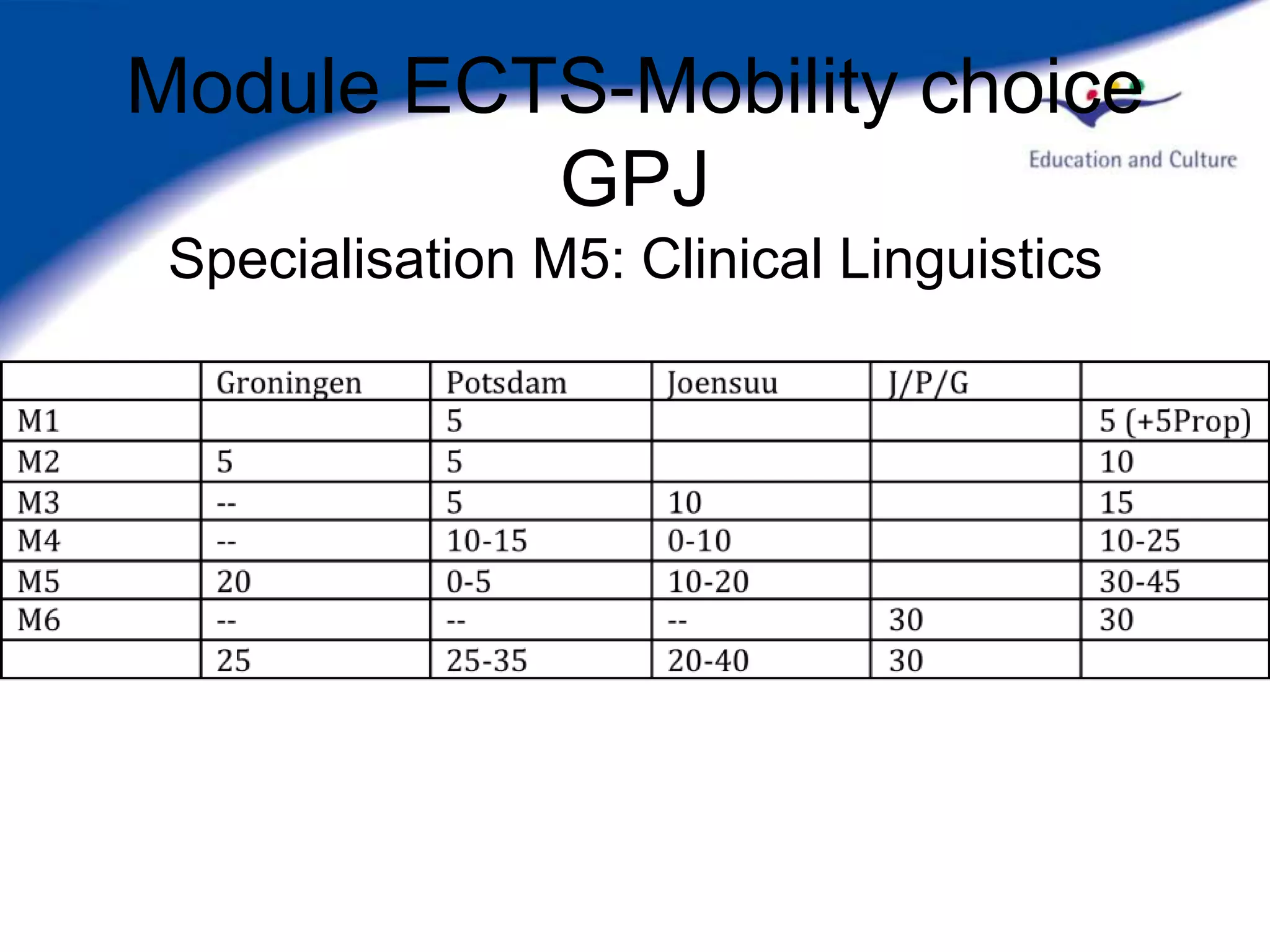
Module ECTS-Mobility choice
          GPJ
 Specialisation M5: Clinical Linguistics
Variable ECTS/Module
      depending on mobility,
        i.e. specialisation

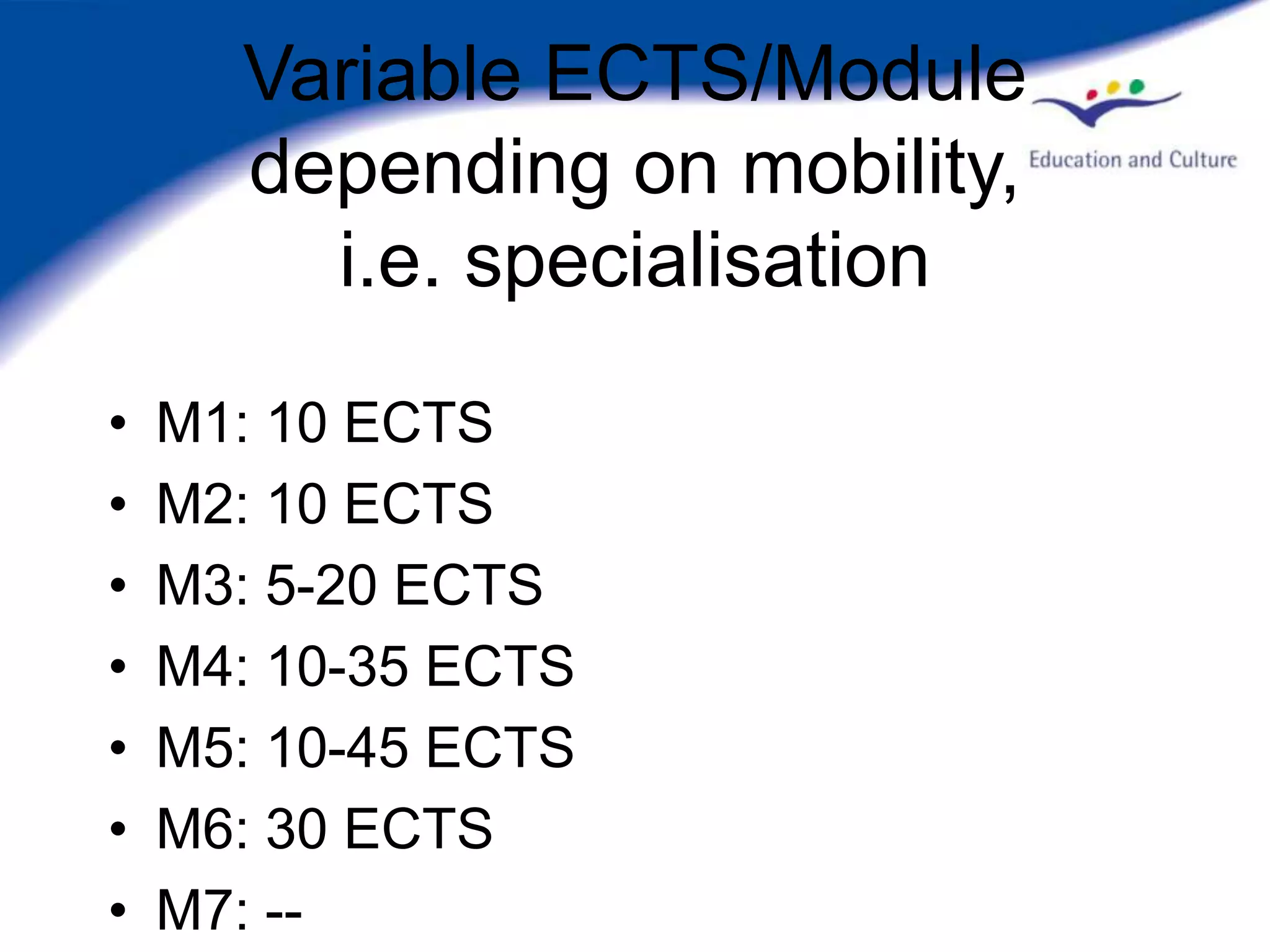
•   M1: 10 ECTS
•   M2: 10 ECTS
•   M3: 5-20 ECTS
•   M4: 10-35 ECTS
•   M5: 10-45 ECTS
•   M6: 30 ECTS
•   M7: --
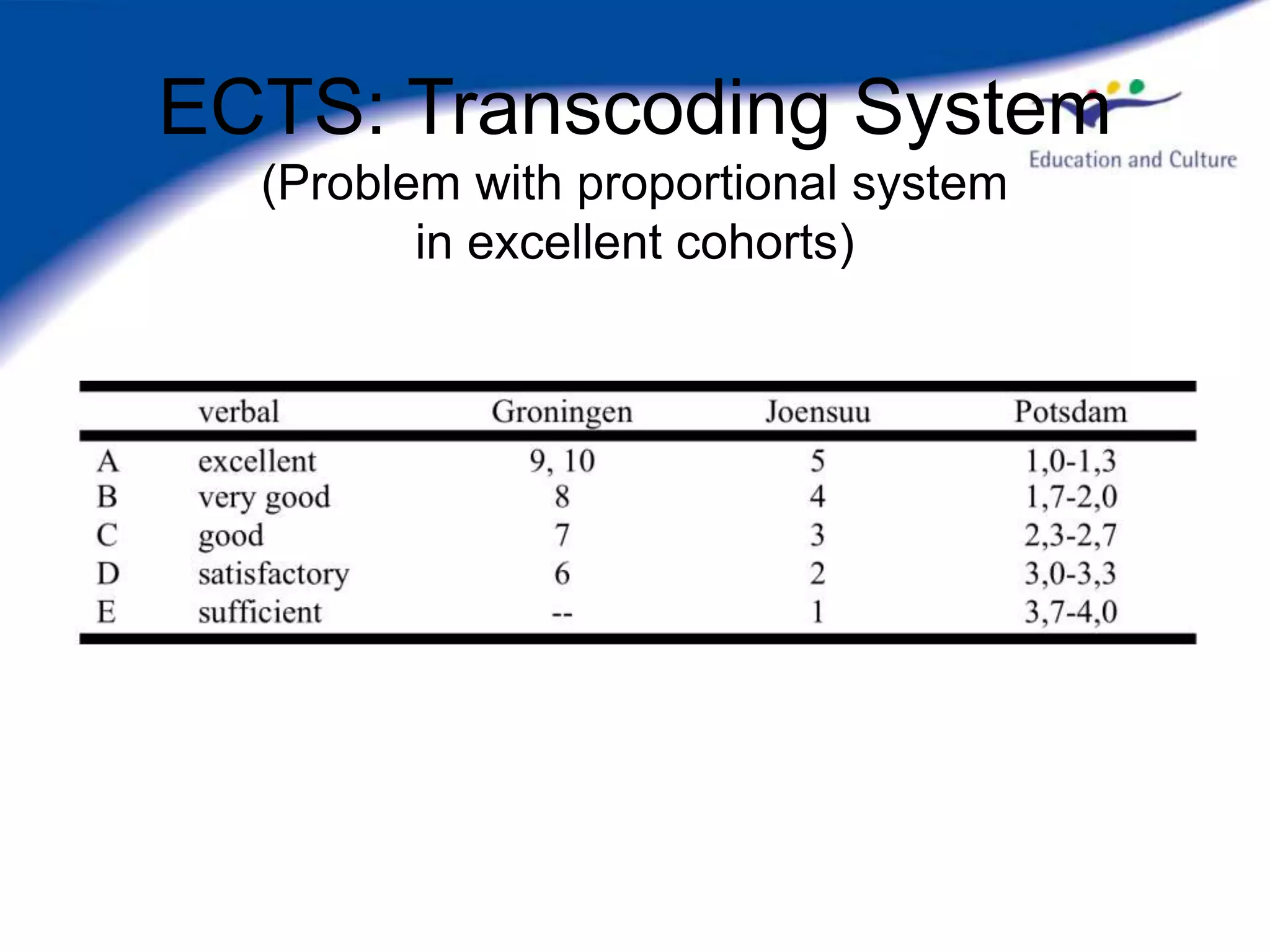
ECTS: Transcoding System
  (Problem with proportional system
         in excellent cohorts)
ECTS-weighted module grade
             and total grade
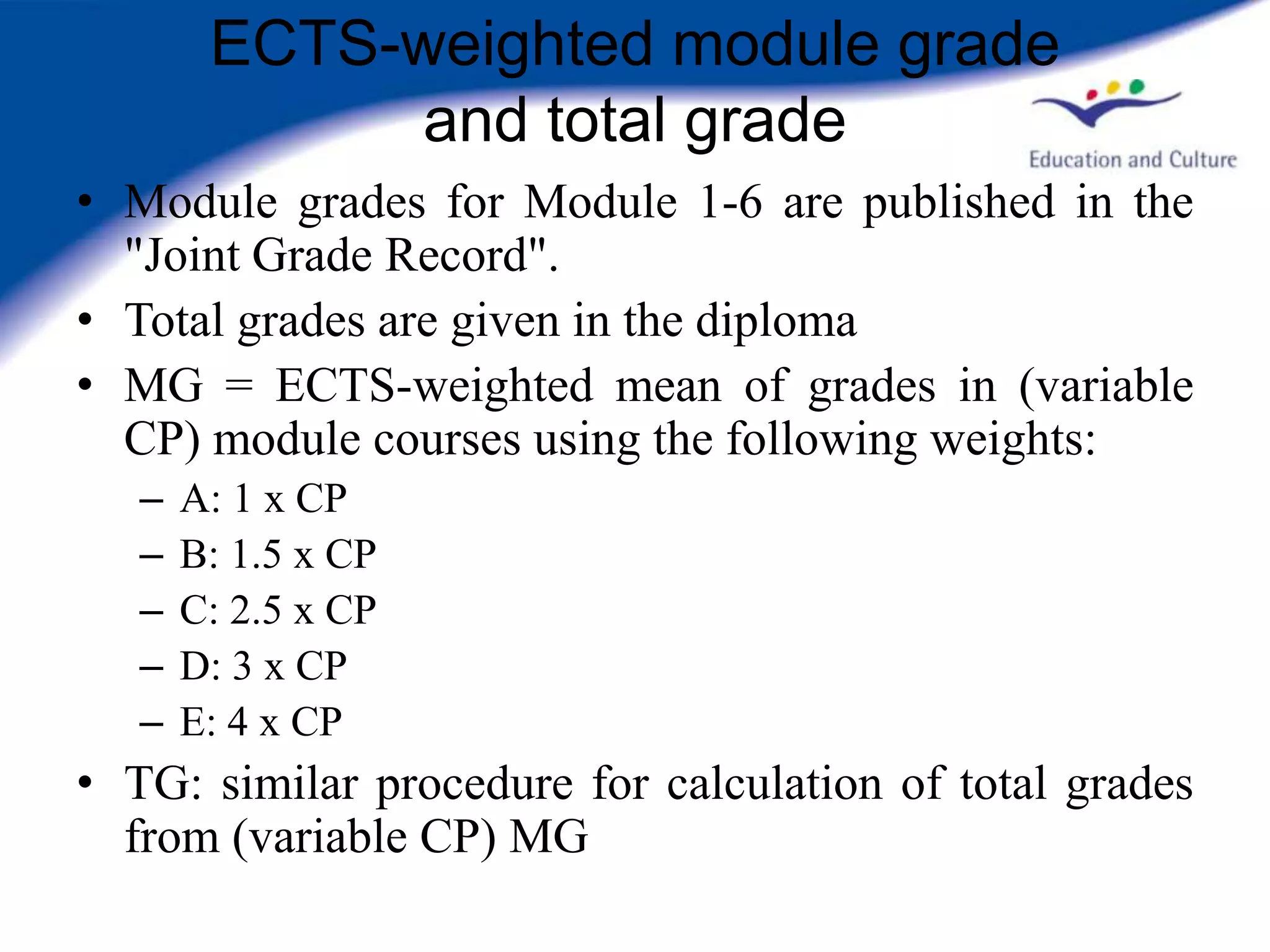
• Module grades for Module 1-6 are published in the
  "Joint Grade Record".
• Total grades are given in the diploma
• MG = ECTS-weighted mean of grades in (variable
  CP) module courses using the following weights:
   –   A: 1 x CP
   –   B: 1.5 x CP
   –   C: 2.5 x CP
   –   D: 3 x CP
   –   E: 4 x CP
• TG: similar procedure for calculation of total grades
  from (variable CP) MG
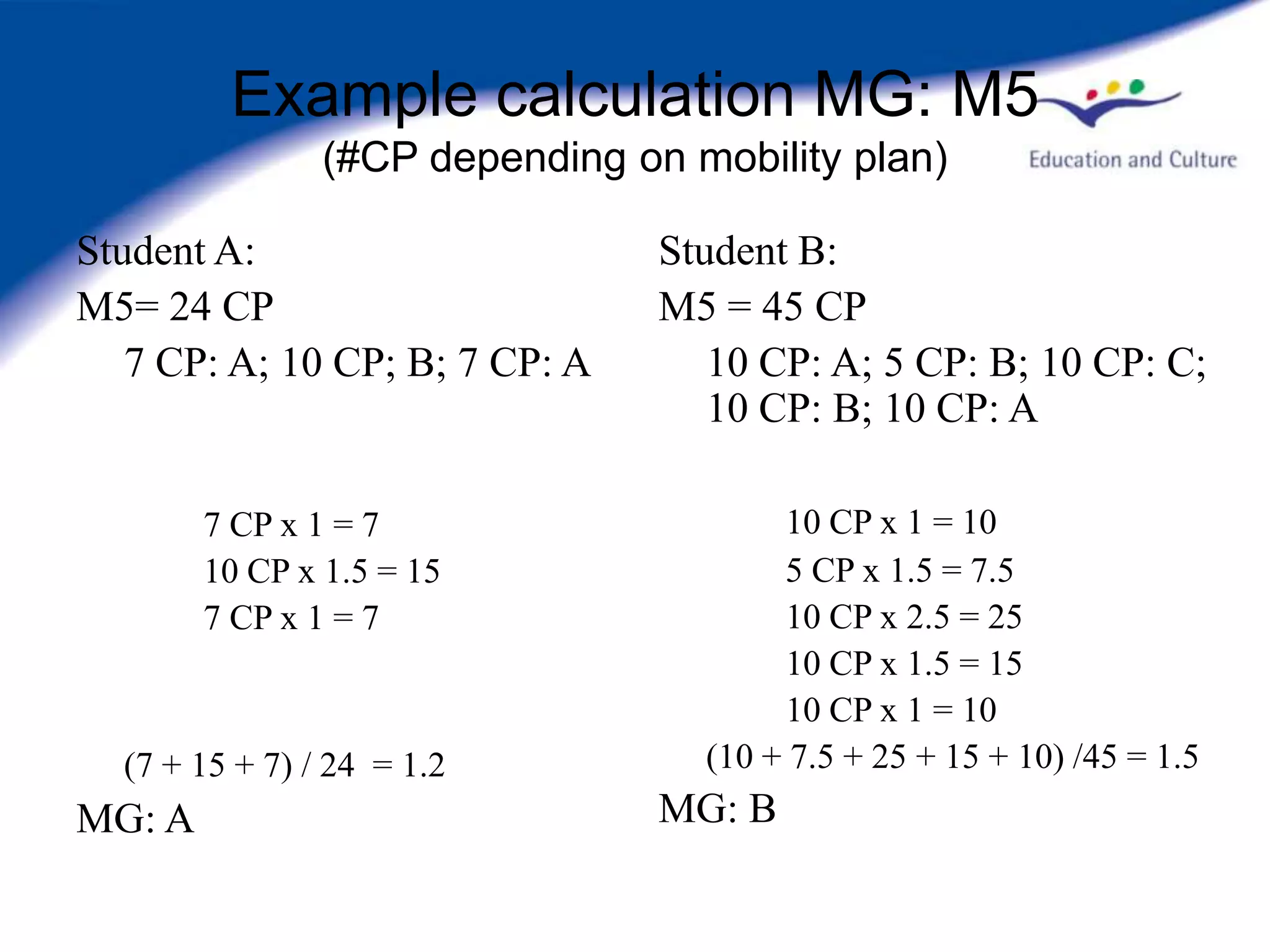
Example calculation MG: M5
                (#CP depending on mobility plan)

Student A:                       Student B:
M5= 24 CP                        M5 = 45 CP
   7 CP: A; 10 CP; B; 7 CP: A       10 CP: A; 5 CP: B; 10 CP: C;
                                    10 CP: B; 10 CP: A

        7 CP x 1 = 7                    10 CP x 1 = 10
        10 CP x 1.5 = 15                5 CP x 1.5 = 7.5
        7 CP x 1 = 7                    10 CP x 2.5 = 25
                                        10 CP x 1.5 = 15
                                        10 CP x 1 = 10
  (7 + 15 + 7) / 24 = 1.2          (10 + 7.5 + 25 + 15 + 10) /45 = 1.5
MG: A                            MG: B
Final student documents
• Joint (multiple) degree

• Joint diploma supplement

• Joint grade record
Thank you
for your attention
Joint Curriculum
Module 1: Description
Joint Curriculum: Term 1
Joint Curriculum Term 2
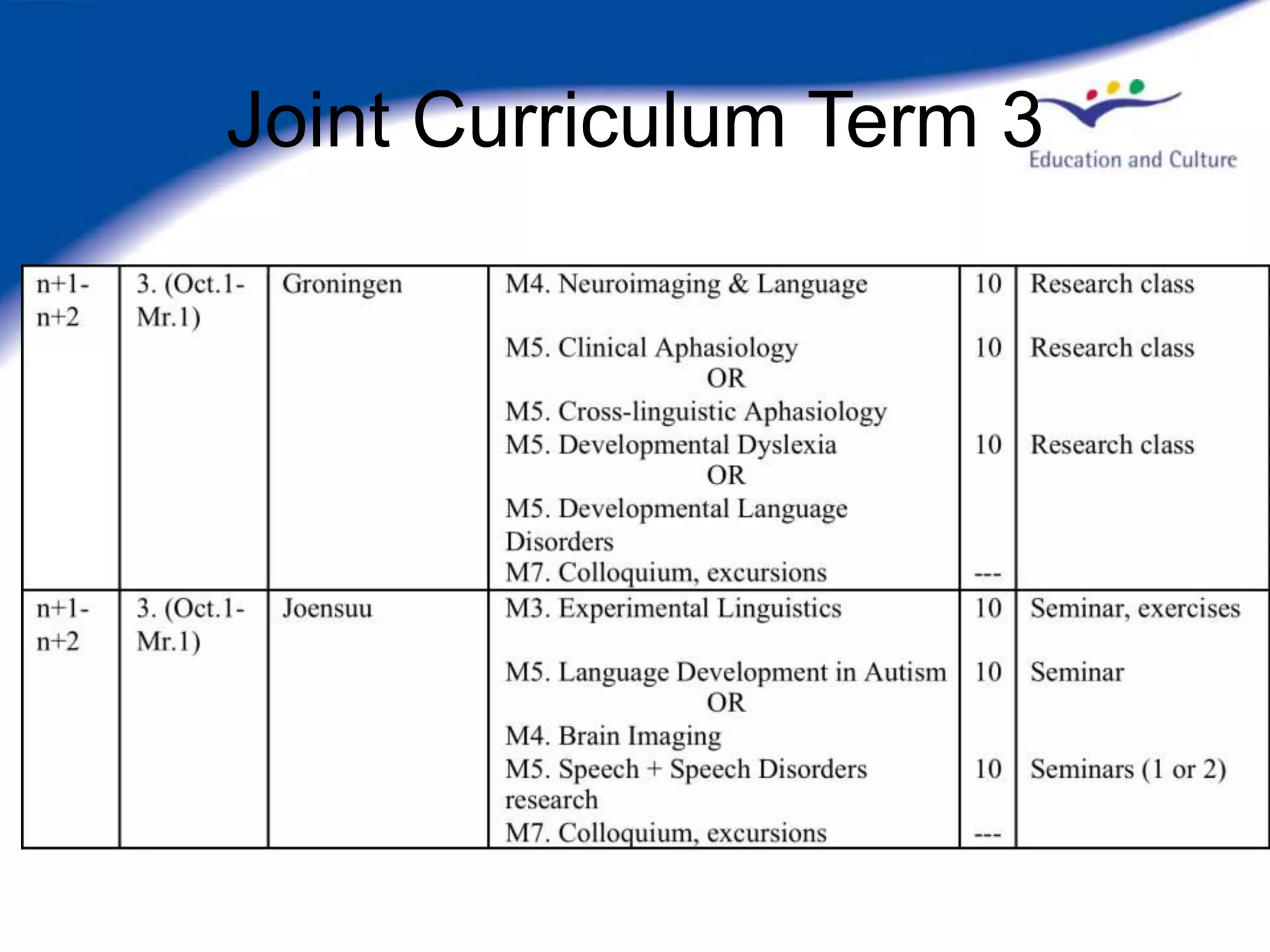
Joint Curriculum Term 3
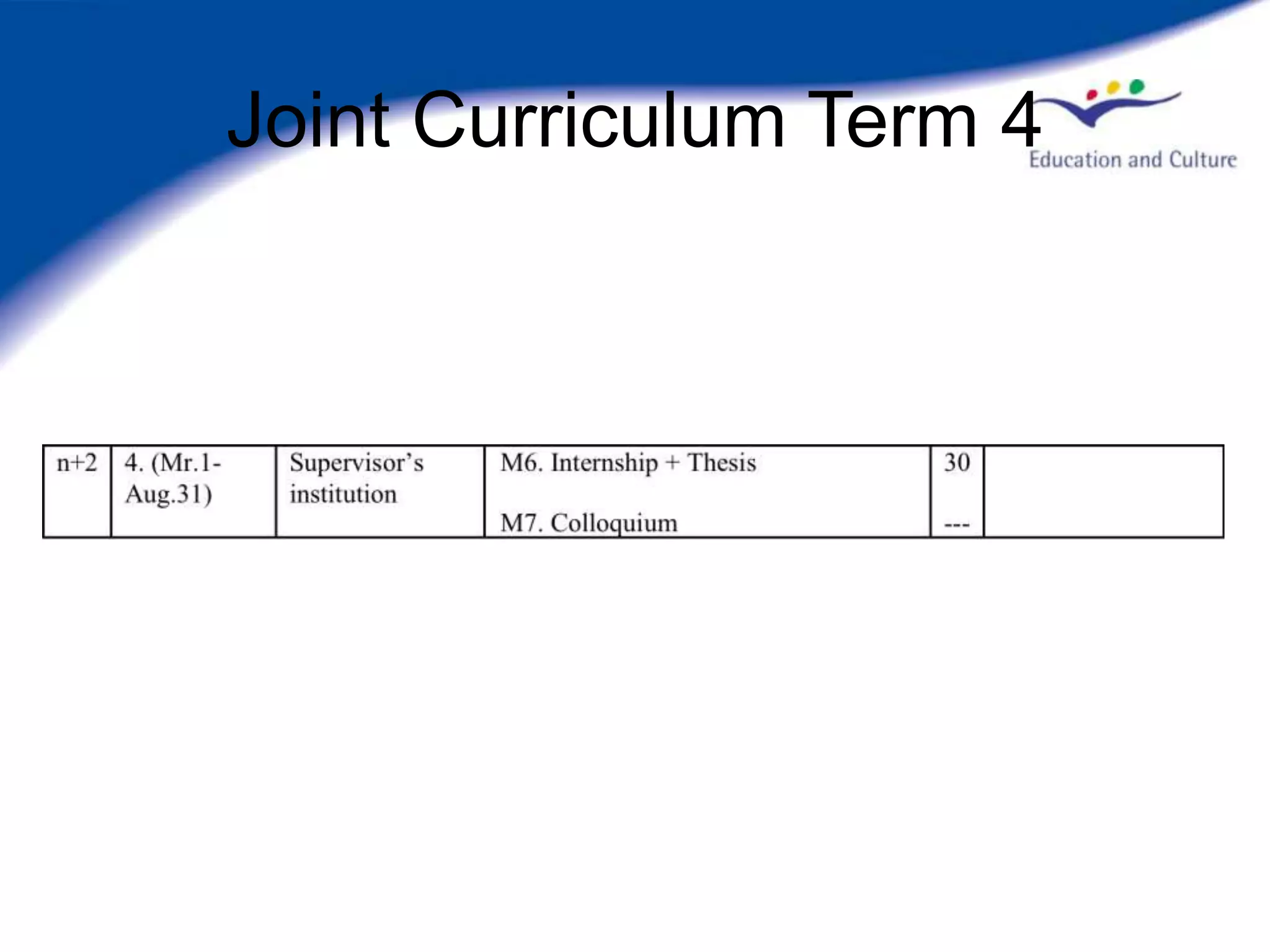
Joint Curriculum Term 4

EMMC: Course management and joint degrees

  • 1.
  • 2.
  • 3.
  • 4.
    JDD--Prebologna context HE inEurope fragmented: • Degrees differed in name, requirements – National degrees could not be compared • Access, length of programmes, dissemination – varied from country to country • One-tier systems without distinction between undergraduate and postgraduate level – could not be compared to systems allowing students to leave university at different levels
  • 5.
    JDD-prebologna • However, studentshad become mobile (cf. Erasmus) • Increased willingness to apply for jobs in foreign countries of study • Reduced employment chances due to national degrees unknown across borders
  • 6.
    First JDD: toward integration Goal: increase employability of internationally mobile students • Mutual evaluation of programmes became more based on learning outcomes – rather than on individual modules • Individual modules became mutually recognized – even though contents of individual modules not completely identical
  • 7.
    DD versus JD •DD: emphasis on mutual recognition (usually bilateral) of modules; two diplomas -->student mobility • JD: emphasis on joint construction, management, quality assurance and teaching (usually multilateral) of programmes; one diploma -->student and teacher mobility Obstacle: national legislation
  • 8.
    Bologna Process Joint DegreeProgrammes: • create a Common European Educational Area • Preferred instruments: – joint programmes, joint quality assurance, joint organisational structure – joint degrees (mutual recognition of academic degrees and qualifications, University Seal/Signature, even though a student was never on the spot)
  • 9.
    Getting there: • Bologna(1999) and Prague (2001) – develop modules, courses and curricula at all levels – with „European‟ content, orientation or organisation”. • EUA joint Masters project (2002) – Support of 11 “joint” Masters programmes • Coimbra (2003) – First distinctive definition Joint – versus Double/Multiple degree • Berlin Ministerial Communiqué (2003) – develop integrated curricula – remove national legal obstacles to joint degrees
  • 10.
    Cluj 2003 EUA conference on Joint Degrees Recommends further discussion and action in: – amending national legislation to enable HE to award joint degrees; – anchoring joint programmes firmly within institutional structures; – developing appropriate QA and recognition mechanisms, with ‘European label’for joint programmes
  • 11.
    ERASMUS MUNDUS I Inaccordance with these recommendations: • 2004, launching of Erasmus Mundus by EU: mobility programme aiming to strengthen links between the EU Member States and third countries. • AIM: create 250 new inter-university Masters courses and provide EU-funded scholarships for third country nationals studying in the EU (and for EU nationals studying in third countries).
  • 12.
    EM I, 2004-2008 EM goal • enhance attractiveness and competitiveness of European HE • Support Bologna drive to promote joint degrees. • EM I became crown jewel of EU HE policy • Extended as EM II (2009-2013) with a budget multipled by 5 (€230 M-€950M)
  • 13.
    Changes in EMII • joint PhD-programmes – (in addition to joint Masters programmes) • grants for EU-students – (as well as Non-EU-students) • non-EU universities can be full partners – (integration of prev. Action 3: cooperation with non-EU universities into Action 1: prev. Action 1, 2): • industrial partners required – (strong emphasis on employability) • EU-support maximum of 2 phases – (strong emphasis on sustainability)
  • 14.
    PhD in EMII versus Marie Curie In EM II, as in Marie Curie ITN, • association with industry/potential employers • professionals = employment contract – (not students=scholarship) BUT • EMII is at institutional level, • MC at research network level. Unsolved question: • ECTS??? (for mobility, training: YES)
  • 15.
    Joint degree problem •2009: still not officially recognised in some member states but ammendments to legislation are being prepared. • Double/multiple diplomas considered transition state towards EU-desired joint diplomas
  • 16.
    EMCL in EMII:2009-2013 • Changed EM system • Changed EMCL application – Changed partnership – Changed programme – Changed semester system – Changed boards – Improved quality assurance
  • 17.
  • 18.
    Explicit rating criteria •Academic quality (60%) • Motivation (10%) • Recommendations (10%) • English (10%) • Work experience (10%)
  • 19.
  • 20.
    Improved QA: Internal 1.Student feedback – Local feedback (teacher/course evaluation) at the participating institutions using their established systems customised for the integrated nature of the EMCL-programme, – Common feedback (evaluation of institutions) collected centrally by the consortium using standardised questionnaires, – Alumni feedback for employability evaluation and further suggestions for the programme. This is done via the website and on the SOA- conference. 2. Scholar feedback – standardised catalogue of criteria. Feedback before the end of their stay. 3. Self-evaluation of participating institutions – For the internal evaluation of teaching, learning and other programme- related activities, procedures already in place in the institutions are followed.
  • 21.
    QA: external (already in place) • Systematic external quality assurance is provided through permanent peer feedback: – colleagues from the University of Newcastle and the University of Oslo are always present at consortium board meetings, – monitoring all activities from student selection to programme development and bringing problems to the attention of the responsible parties. • The programme is also the object of continuous quality control – according to the participating institutions' established quality assurance policies and – through evaluation of the national/regional bodies.
  • 22.
    Other joint consortium instruments • Module Descriptions • Joint Curriculum • Joint Rules and Regulations • Partnership Agreement • Student Agreement • Scholarship Agreement • Supervision Agreement • Associate member agreement
  • 23.
  • 24.
  • 25.
    Modular structure • M1:Propaedeutics (work-up classes, intensive rehabilitation classes) • M2: Language and culture classes (Finnish, Dutch, German) • M3: Methods (including statistics and experimental linguistics) • M4: Psycho-/Neurolinguistics (including neuroimaging) • M5: Clinical linguistics (aphasia, dyslexia, developmental language disorders, speech disorders) • M6: Master thesis (including scientific writing, exposé, internship) • M7: Research extras (colloquia, reading circles, excursions, SOA-conference)
  • 26.
    Module ECTS variable- Mobility choice JPJ Specialisation M3: Experimental Linguistics
  • 27.
  • 28.
    Module ECTS variable Mobility choice GPG Specialisation M5: Clinical Linguistics
  • 29.
  • 30.
    Module ECTS variable Mobility choice JPG Specialisation: M4: Psycho- and Neurolinguistics
  • 31.
  • 32.
    Module ECTS-Mobility choice GPJ Specialisation M5: Clinical Linguistics
  • 33.
    Variable ECTS/Module depending on mobility, i.e. specialisation • M1: 10 ECTS • M2: 10 ECTS • M3: 5-20 ECTS • M4: 10-35 ECTS • M5: 10-45 ECTS • M6: 30 ECTS • M7: --
  • 34.
    ECTS: Transcoding System (Problem with proportional system in excellent cohorts)
  • 35.
    ECTS-weighted module grade and total grade • Module grades for Module 1-6 are published in the "Joint Grade Record". • Total grades are given in the diploma • MG = ECTS-weighted mean of grades in (variable CP) module courses using the following weights: – A: 1 x CP – B: 1.5 x CP – C: 2.5 x CP – D: 3 x CP – E: 4 x CP • TG: similar procedure for calculation of total grades from (variable CP) MG
  • 36.
    Example calculation MG:M5 (#CP depending on mobility plan) Student A: Student B: M5= 24 CP M5 = 45 CP 7 CP: A; 10 CP; B; 7 CP: A 10 CP: A; 5 CP: B; 10 CP: C; 10 CP: B; 10 CP: A 7 CP x 1 = 7 10 CP x 1 = 10 10 CP x 1.5 = 15 5 CP x 1.5 = 7.5 7 CP x 1 = 7 10 CP x 2.5 = 25 10 CP x 1.5 = 15 10 CP x 1 = 10 (7 + 15 + 7) / 24 = 1.2 (10 + 7.5 + 25 + 15 + 10) /45 = 1.5 MG: A MG: B
  • 37.
    Final student documents •Joint (multiple) degree • Joint diploma supplement • Joint grade record
  • 38.
  • 40.
  • 41.
  • 42.
  • 43.
  • 44.
  • 45.