From Pretty Picture of the Future to Operations
How to Operationalize a
Strategy
Executing Strategy Deployment
New Brunswick Internal Services Agency
Introduction
• Purpose in the next 75 minutes we will
discuss how to deliver strategy using
programme and project management.
• Learning Points
1. Provide an overview of Programme Management
2. Learn how to create the Blueprint that will drive the
delivery of new capabilities as identified in the
Strategy.
3. Explore the organizational change and the
differences between Stakeholder Management and
Stakeholder Engagement.
CONTEXT
Where do we want to be and how do we get there?
New Brunswick Internal Services Agency
The Future
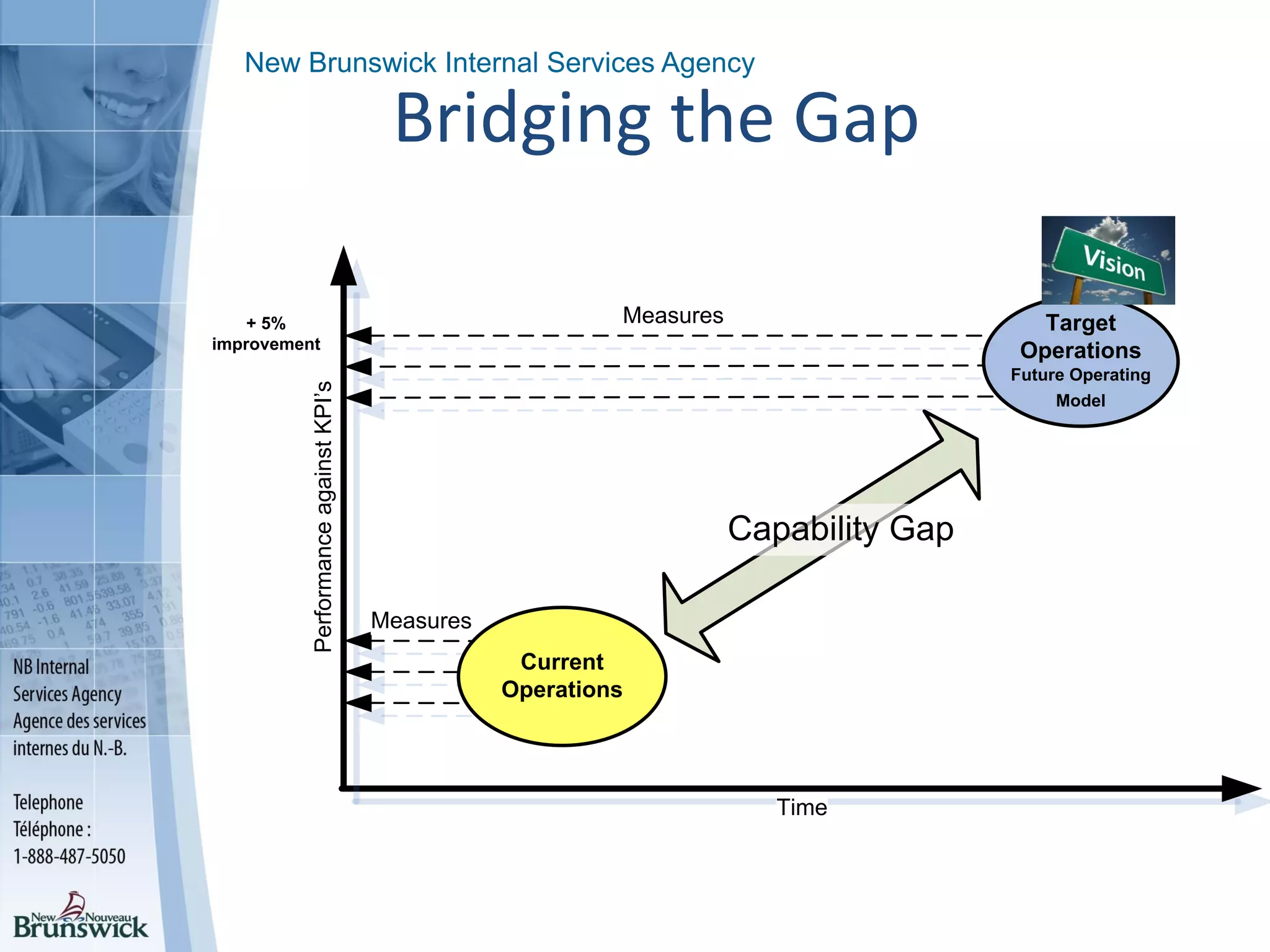
• Change is happening faster than ever,
there is no such thing as the steady state
• Organizations have to improve 3% per
annum just to keep pace.
– If you want to get ahead you need to be
improving at 5-10% per annum!
• > 60% of organization change fails to
deliver any/major benefits
• How to bridge the Performance Gap?
New Brunswick Internal Services Agency
Bridging the Gap
Time
PerformanceagainstKPI’s Measures Target
Operations
Future Operating
Model
Measures
Current
Operations
Capability Gap
+ 5%
improvement
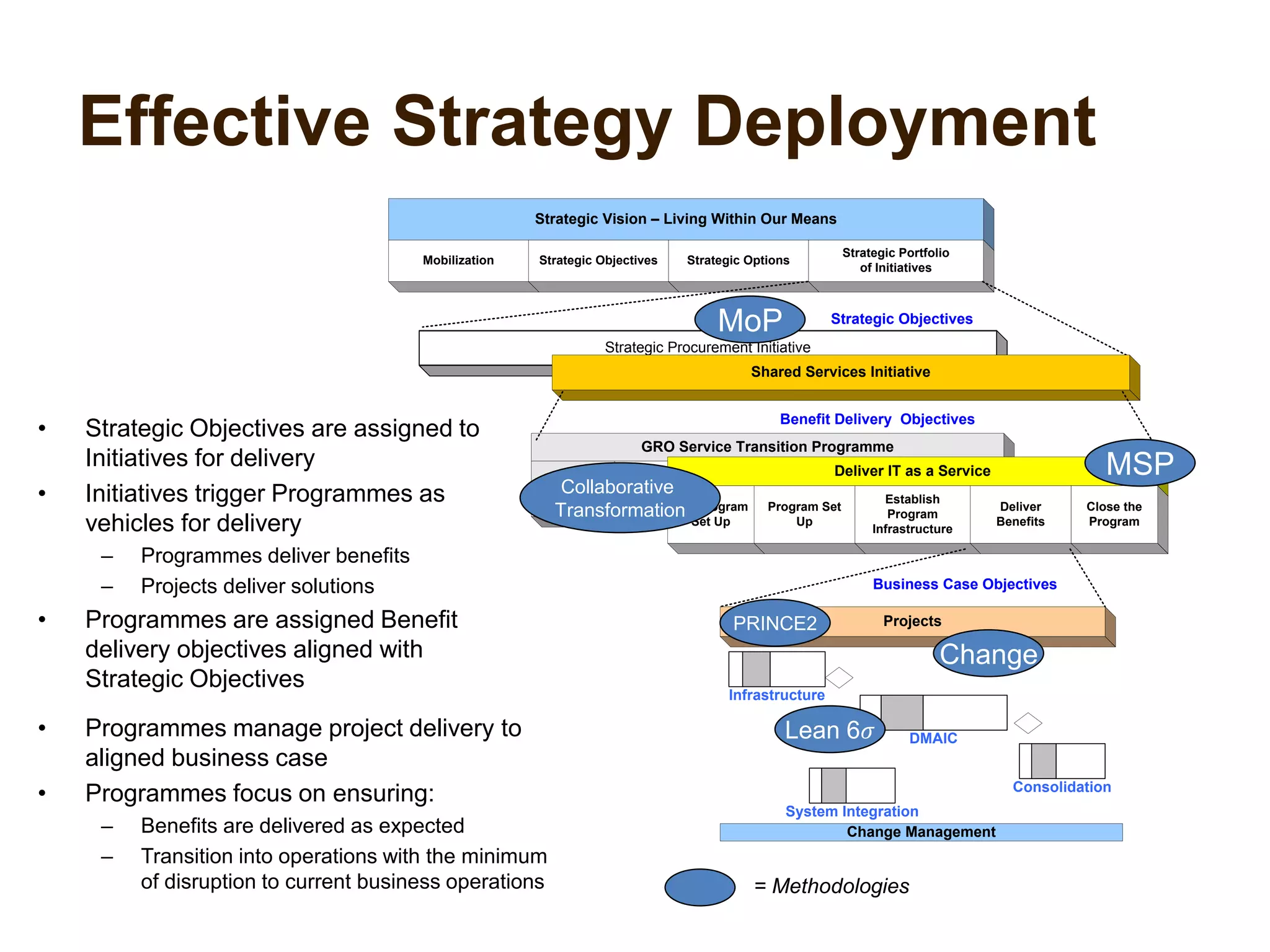
Effective Strategy Deployment
Strategic Procurement Initiative
GRO Service Transition Programme
Pre-
Program Set
Up
Program Set
Up
Establish
Program
Infrastructure
Deliver
Incremental
Benefits
Close the
Program
Strategic Vision – Living Within Our Means
Mobilization Strategic Objectives Strategic Options
Strategic Portfolio
of Initiatives
Projects
1 2 4
Infrastructure
1 2 4
DMAIC
1 2 4
System Integration
1 2 4
Consolidation
Change Management
Shared Services Initiative
Deliver IT as a Service
Pre-Program
Set Up
Program Set
Up
Establish
Program
Infrastructure
Deliver
Benefits
Close the
Program
Strategic Objectives
Business Case Objectives
Benefit Delivery Objectives
• Strategic Objectives are assigned to
Initiatives for delivery
• Initiatives trigger Programmes as
vehicles for delivery
– Programmes deliver benefits
– Projects deliver solutions
• Programmes are assigned Benefit
delivery objectives aligned with
Strategic Objectives
MSP
PRINCE2
Collaborative
Transformation
Lean 6𝜎• Programmes manage project delivery to
aligned business case
• Programmes focus on ensuring:
– Benefits are delivered as expected
– Transition into operations with the minimum
of disruption to current business operations
Change
= Methodologies
MoP
Information
Technology
Organization
Process
Operational
Approach
“Shared Services”
Tactical
Delivery
Strategic
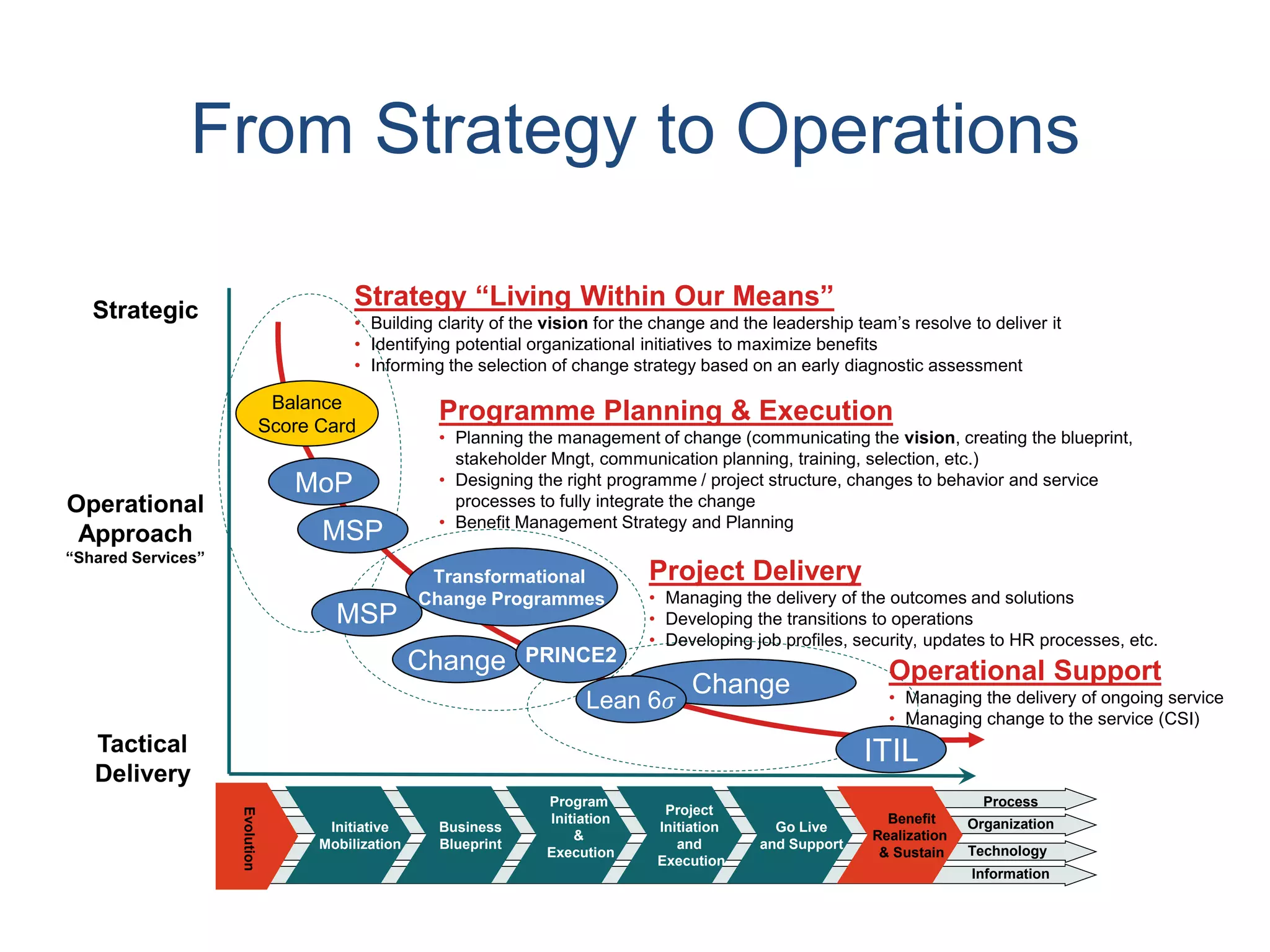
Strategy “Living Within Our Means”
• Building clarity of the vision for the change and the leadership team’s resolve to deliver it
• Identifying potential organizational initiatives to maximize benefits
• Informing the selection of change strategy based on an early diagnostic assessment
Programme Planning & Execution
• Planning the management of change (communicating the vision, creating the blueprint,
stakeholder Mngt, communication planning, training, selection, etc.)
• Designing the right programme / project structure, changes to behavior and service
processes to fully integrate the change
• Benefit Management Strategy and Planning
Project Delivery
• Managing the delivery of the outcomes and solutions
• Developing the transitions to operations
• Developing job profiles, security, updates to HR processes, etc.
Business
Blueprint
Initiative
Mobilization
Program
Initiation
&
Execution
Project
Initiation
and
Execution
Go Live
and Support
Benefit
Realization
& Sustain
Evolution
From Strategy to Operations
MSP
Transformational
Change Programmes
ITIL
Operational Support
• Managing the delivery of ongoing service
• Managing change to the service (CSI)
Change
Balance
Score Card
Lean 6𝜎
MSP
Change PRINCE2
MoP
New Brunswick Internal Services Agency
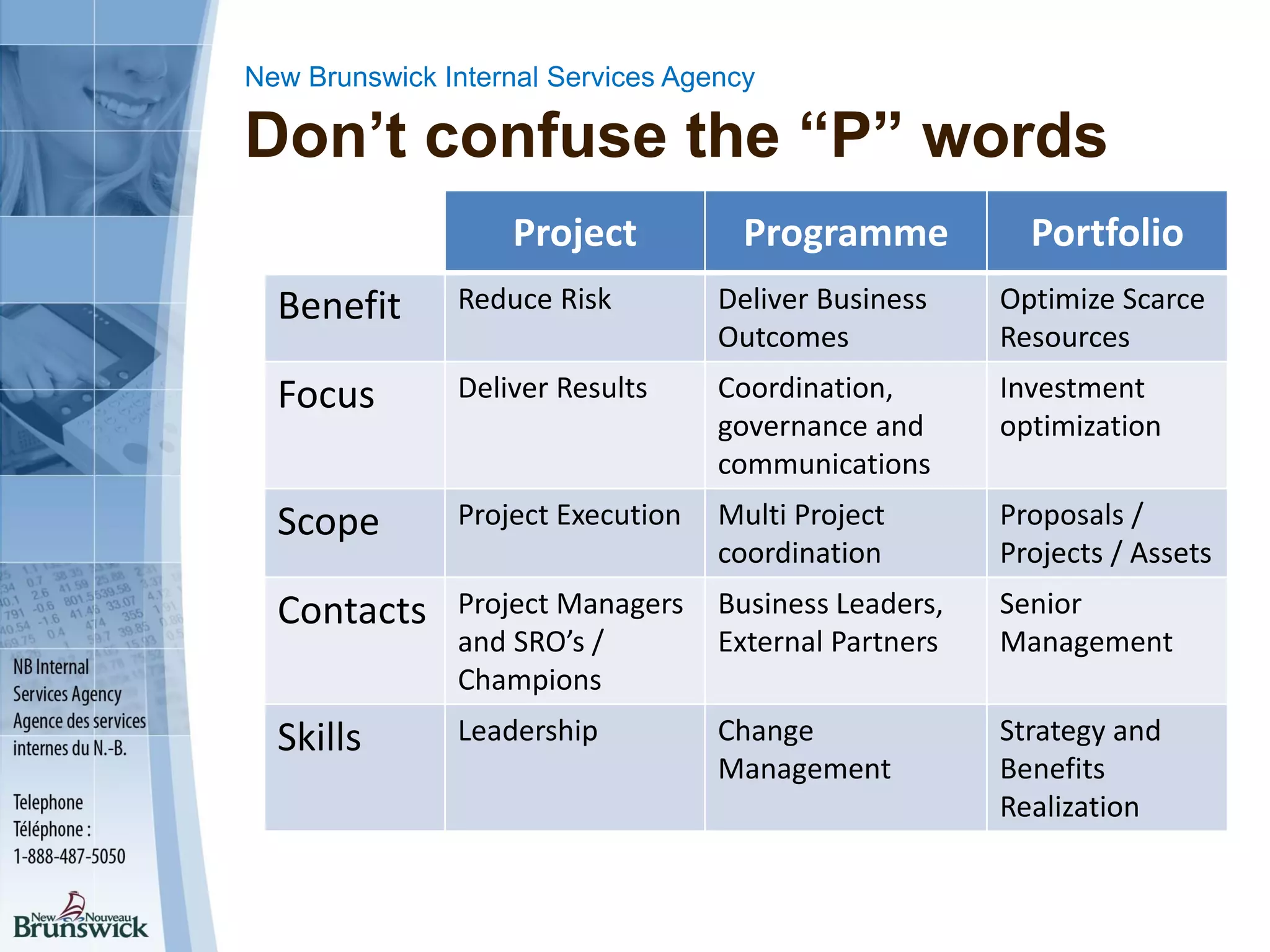
Don’t confuse the “P” words
Project Programme Portfolio
Benefit Reduce Risk Deliver Business
Outcomes
Optimize Scarce
Resources
Focus Deliver Results Coordination,
governance and
communications
Investment
optimization
Scope Project Execution Multi Project
coordination
Proposals /
Projects / Assets
Contacts Project Managers
and SRO’s /
Champions
Business Leaders,
External Partners
Senior
Management
Skills Leadership Change
Management
Strategy and
Benefits
Realization
PROGRAMME
MANAGEMENT
Transformational change is radical in nature …
New Brunswick Internal Services Agency
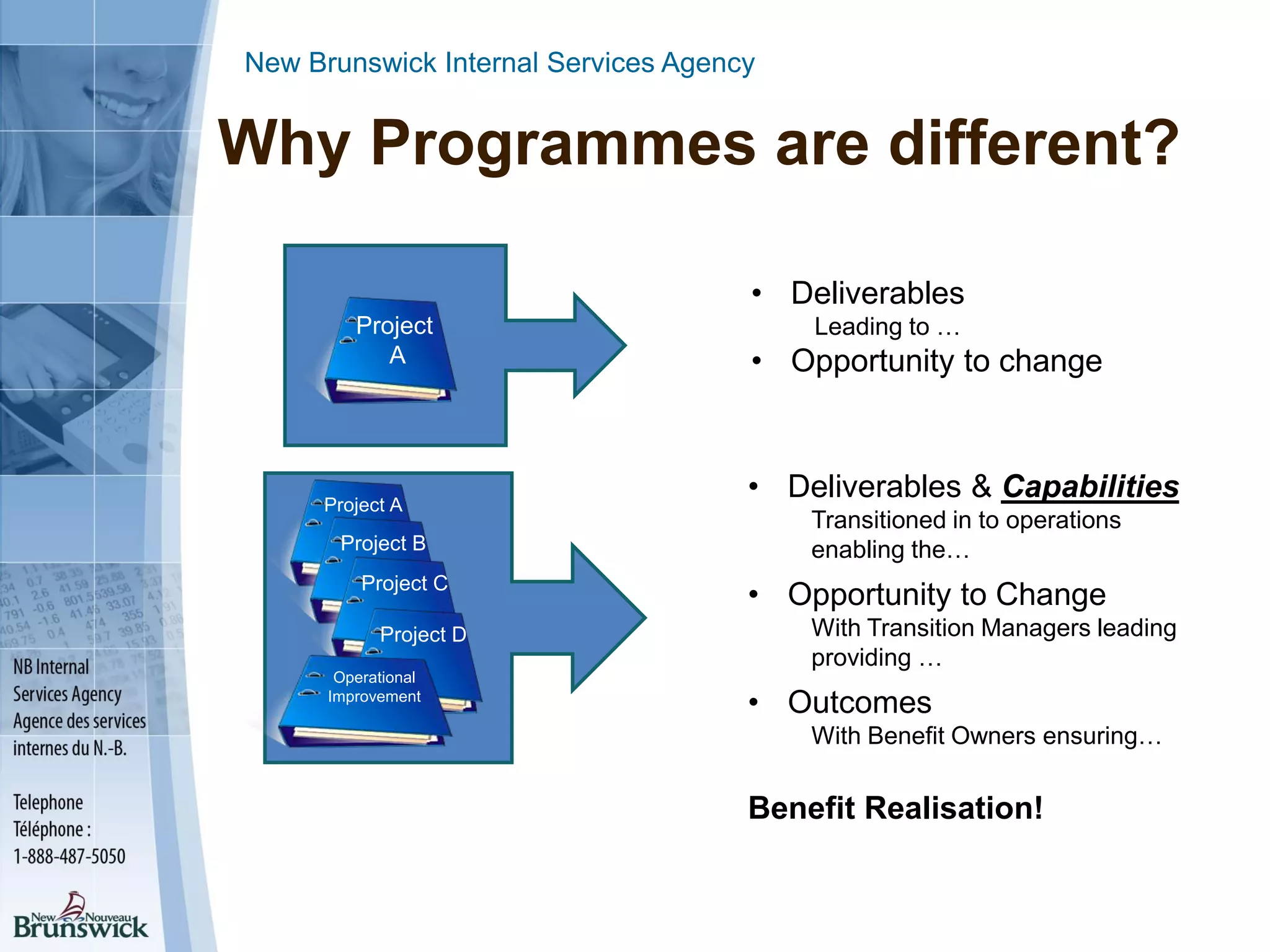
Why Programmes are different?
• Deliverables
Leading to …
• Opportunity to change
Project
A
Project A
Project B
Project C
• Deliverables & Capabilities
Transitioned in to operations
enabling the…
• Opportunity to Change
With Transition Managers leading
providing …
• Outcomes
With Benefit Owners ensuring…
Benefit Realisation!
Project D
Operational
Improvement
New Brunswick Internal Services Agency
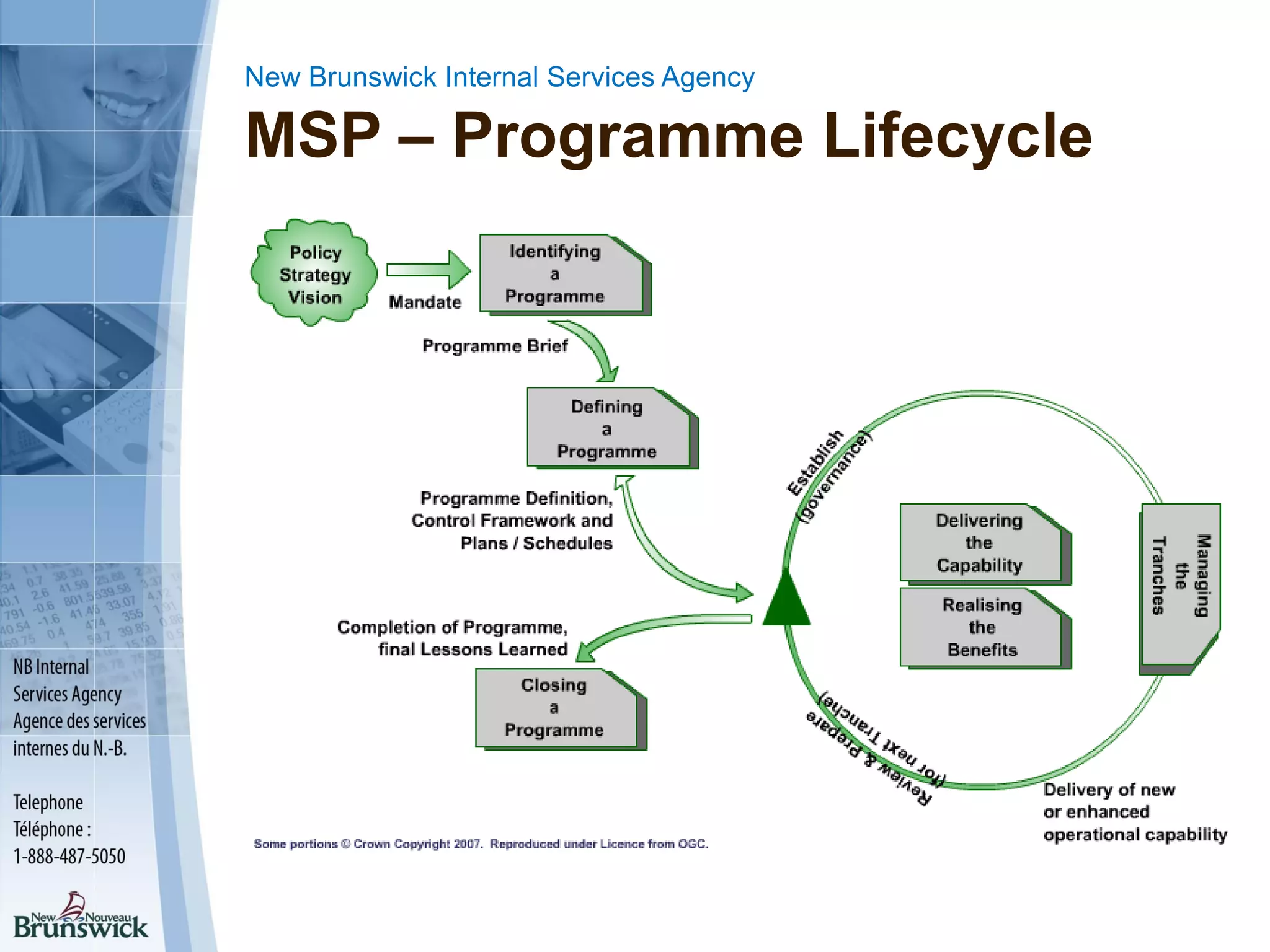
MSP – Programme Lifecycle
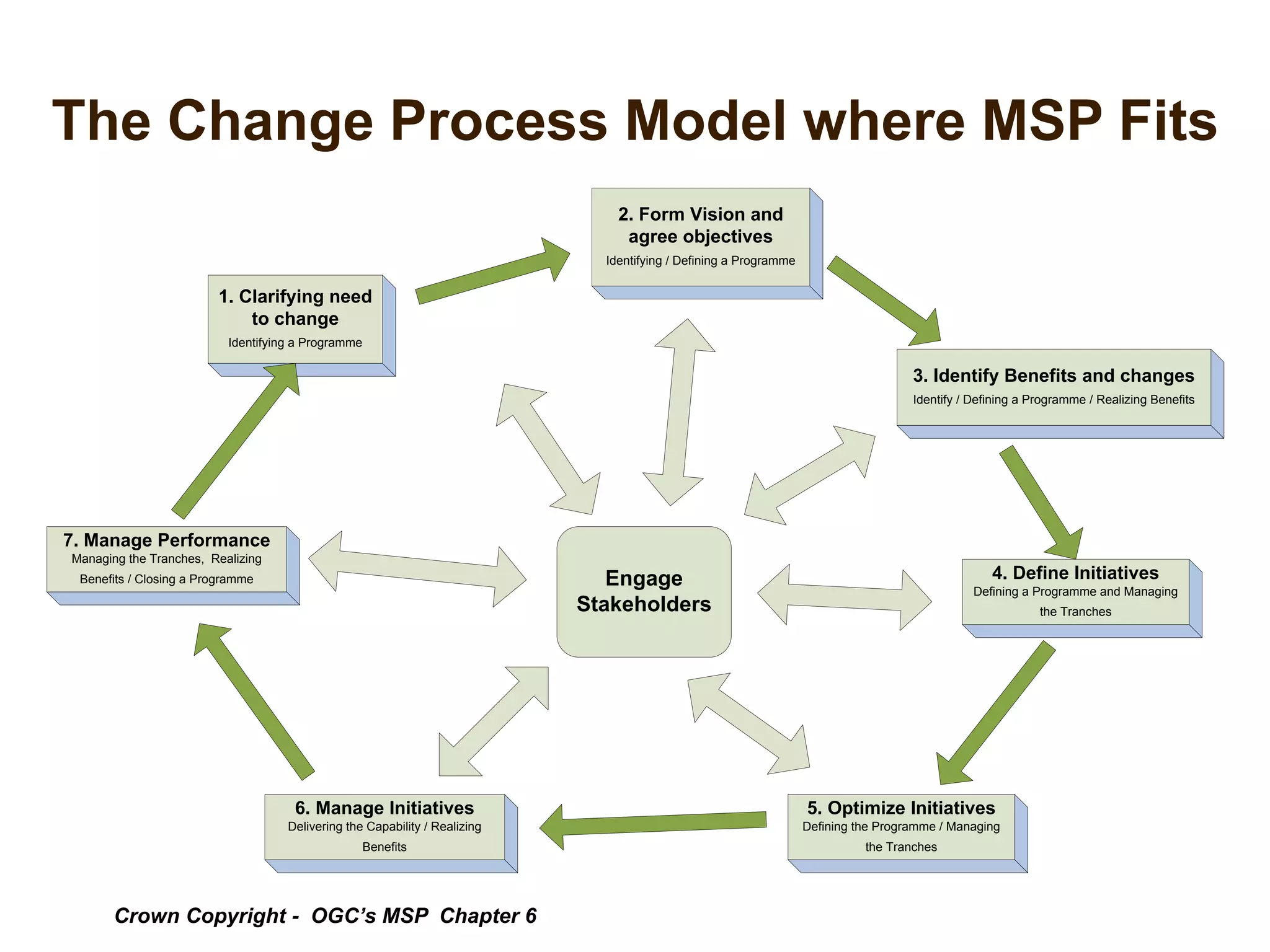
The Change Process Model where MSP Fits
Engage
Stakeholders
1. Clarifying need
to change
Identifying a Programme
2. Form Vision and
agree objectives
Identifying / Defining a Programme
3. Identify Benefits and changes
Identify / Defining a Programme / Realizing Benefits
4. Define Initiatives
Defining a Programme and Managing
the Tranches
5. Optimize Initiatives
Defining the Programme / Managing
the Tranches
6. Manage Initiatives
Delivering the Capability / Realizing
Benefits
7. Manage Performance
Managing the Tranches, Realizing
Benefits / Closing a Programme
Crown Copyright - OGC’s MSP Chapter 6
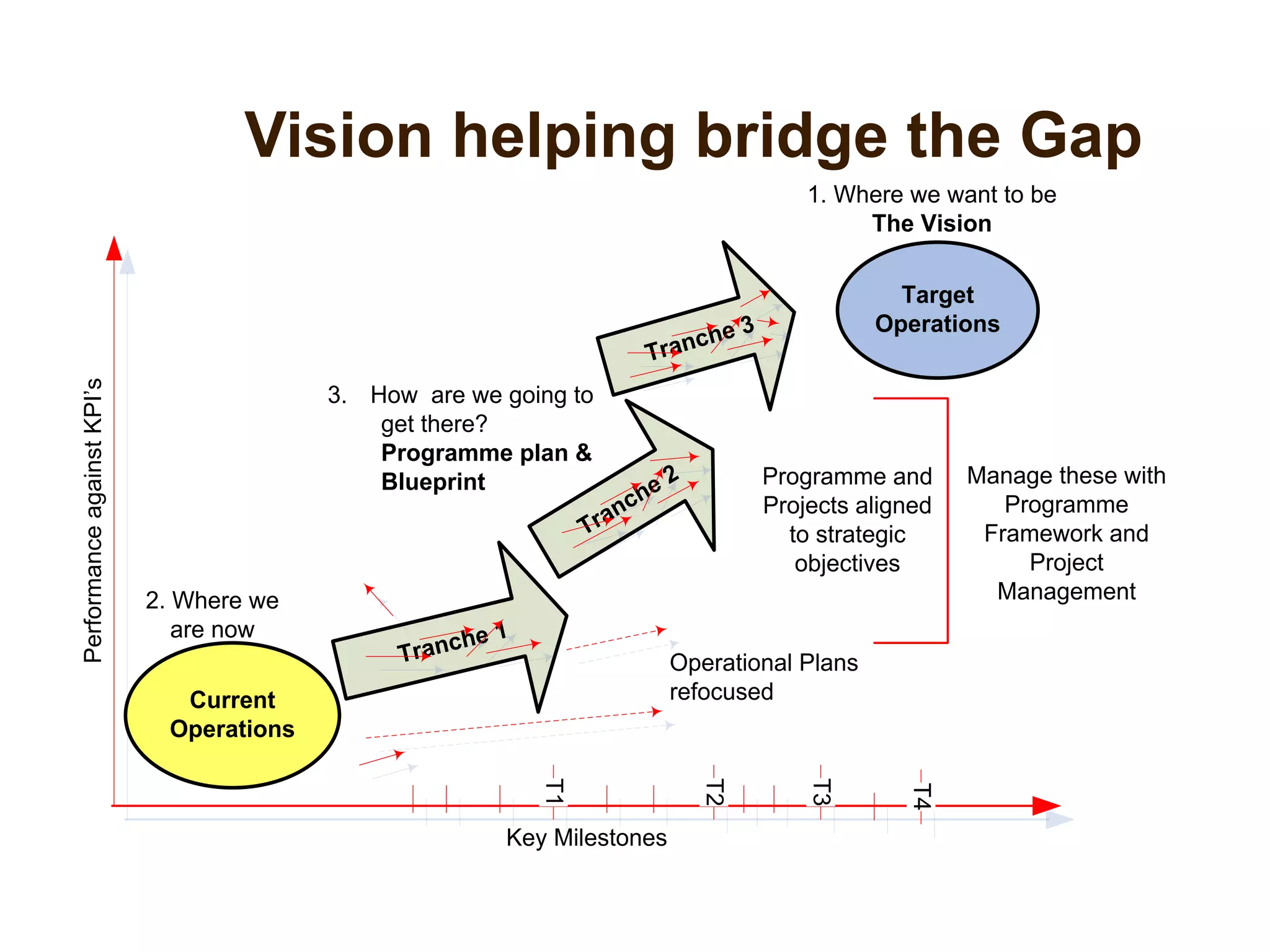
Vision helping bridge the Gap
Key Milestones
PerformanceagainstKPI’s
Target
Operations
Current
Operations
Tranche 1
Tranche 2
Tranche 3
1. Where we want to be
The Vision
3. How are we going to
get there?
Programme plan &
Blueprint
2. Where we
are now
Operational Plans
refocused
Programme and
Projects aligned
to strategic
objectives
Manage these with
Programme
Framework and
Project
Management
T1
T2
T3
T4
New Brunswick Internal Services Agency
“Vision without action is merely a
dream. Action without vision just
passes time.
Vision with action can change the
world.”
Author: Joel Barker- The Power of Vision
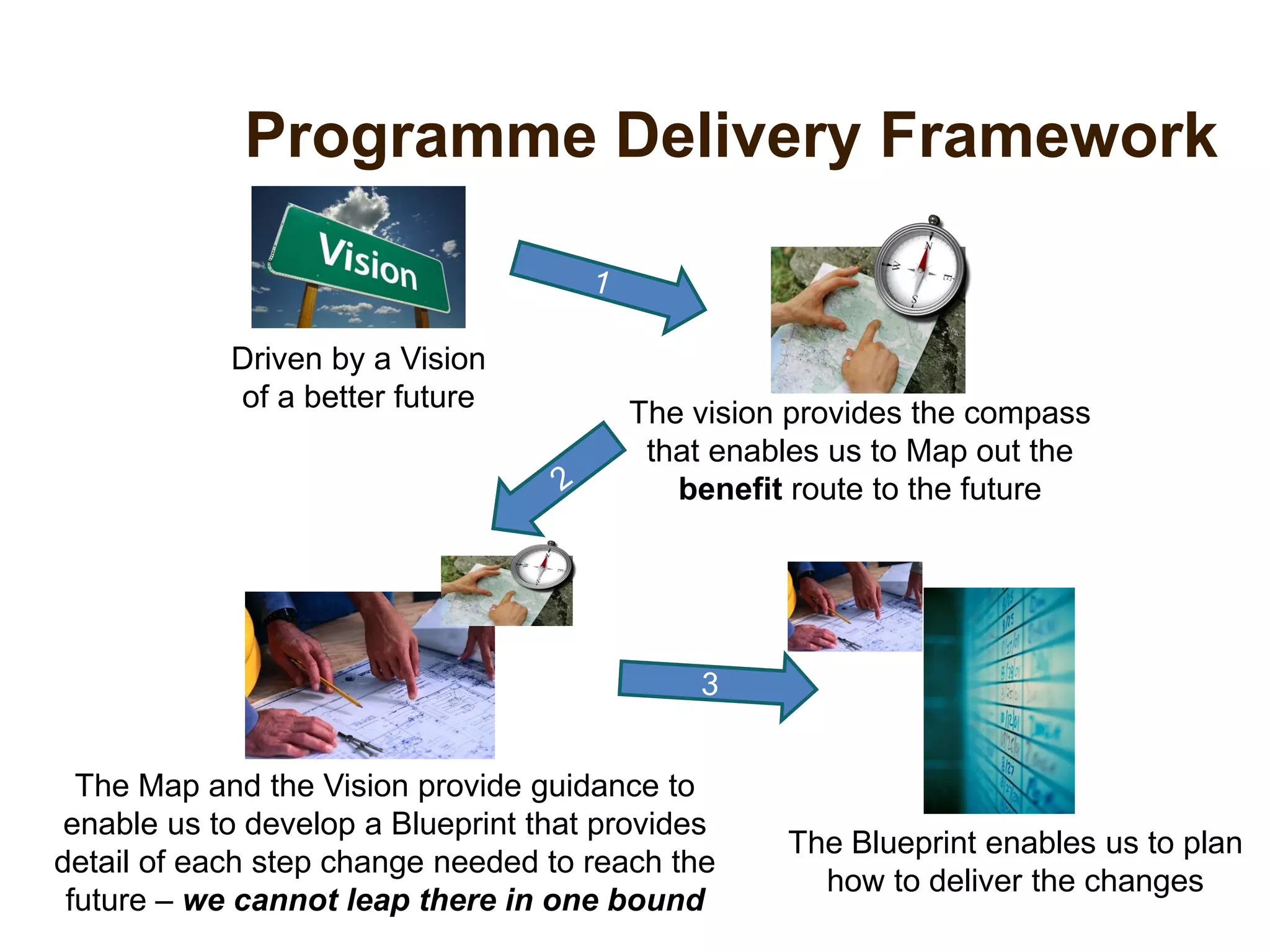
Programme Delivery Framework
Driven by a Vision
of a better future
The vision provides the compass
that enables us to Map out the
benefit route to the future
The Map and the Vision provide guidance to
enable us to develop a Blueprint that provides
detail of each step change needed to reach the
future – we cannot leap there in one bound
The Blueprint enables us to plan
how to deliver the changes
New Brunswick Internal Services Agency
Programme Delivery Framework
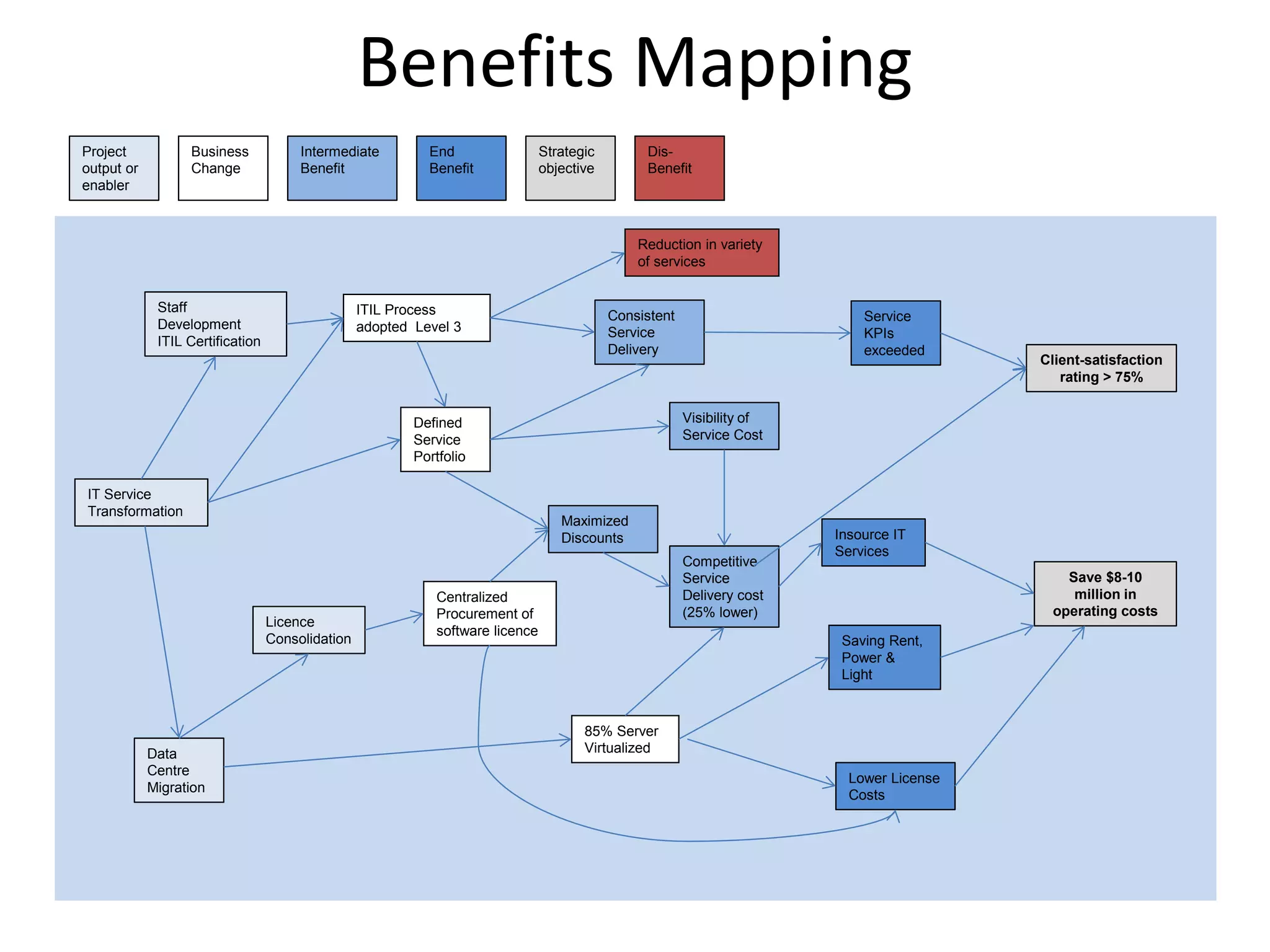
• Benefits Map
– A Benefit is a measurable improvement
resulting from an outcome which is
perceived as an advantage by a stakeholder
– The Benefits Map provides a link from
strategic objectives to Programme Goals
– The Benefits Map provides a link from
Programme Goals backwards to enablers
and project actions
Benefits Mapping
Consistent
Service
Delivery
Service
KPIs
exceeded
Client-satisfaction
rating > 75%
Reduction in variety
of services
Save $8-10
million in
operating costs
Insource IT
Services
Saving Rent,
Power &
Light
Lower License
Costs
Visibility of
Service Cost
Maximized
Discounts
Competitive
Service
Delivery cost
(25% lower)
ITIL Process
adopted Level 3
Defined
Service
Portfolio
Centralized
Procurement of
software licence
85% Server
Virtualized
Project
output or
enabler
Business
Change
Intermediate
Benefit
End
Benefit
Strategic
objective
Dis-
Benefit
Data
Centre
Migration
Licence
Consolidation
IT Service
Transformation
Staff
Development
ITIL Certification
New Brunswick Internal Services Agency
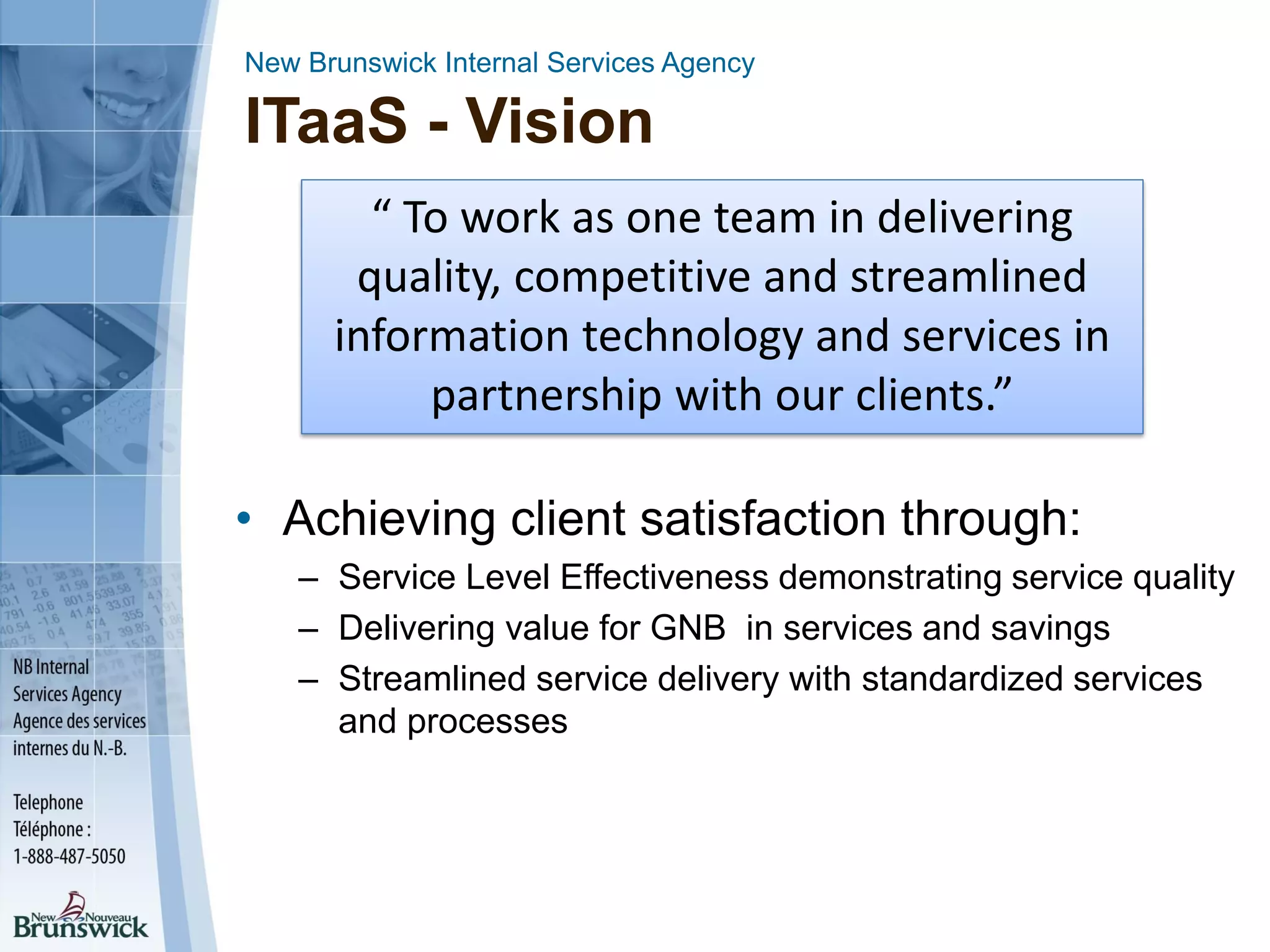
ITaaS - Vision
“ To work as one team in delivering
quality, competitive and streamlined
information technology and services in
partnership with our clients.”
• Achieving client satisfaction through:
– Service Level Effectiveness demonstrating service quality
– Delivering value for GNB in services and savings
– Streamlined service delivery with standardized services
and processes
New Brunswick Internal Services Agency
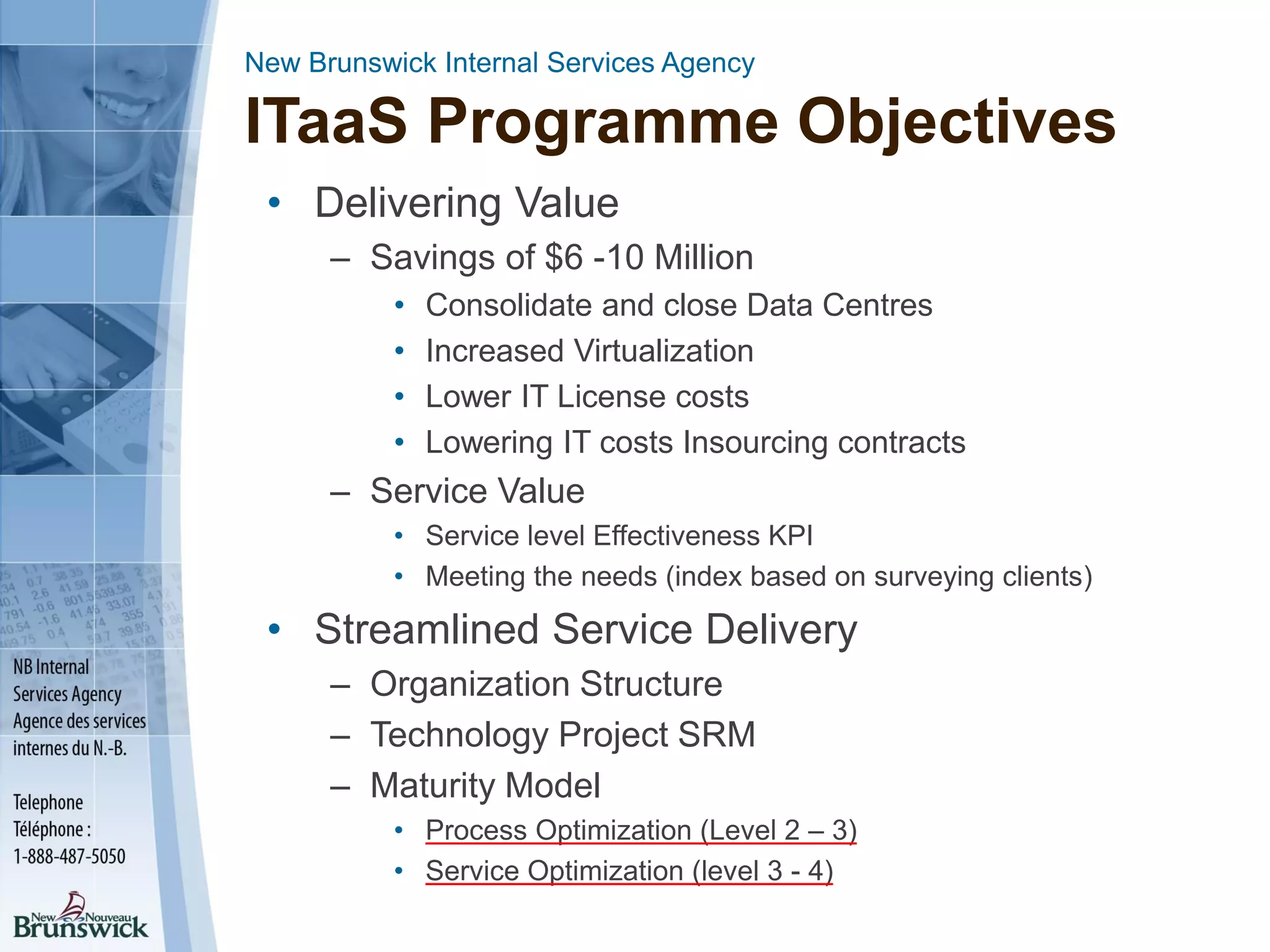
ITaaS Programme Objectives
• Delivering Value
– Savings of $6 -10 Million
• Consolidate and close Data Centres
• Increased Virtualization
• Lower IT License costs
• Lowering IT costs Insourcing contracts
– Service Value
• Service level Effectiveness KPI
• Meeting the needs (index based on surveying clients)
• Streamlined Service Delivery
– Organization Structure
– Technology Project SRM
– Maturity Model
• Process Optimization (Level 2 – 3)
• Service Optimization (level 3 - 4)
Stakeholder Engagement
Start
20-01-13
Finish
31-12-2014
2nd Quarter 3rd Quarter 4th Quarter 1st Quarter 2nd Quarter 3rd Quarter 4th Quarter
Design Enablement
Design
Organizational Change Management
ADC
Monitoring
Technology
Build &
Test
Data Centre Migration
Wave 1
Establish
IOC
Remedy - SRM Module
02 Jul - 28 Oct
Design Build & Test
Remedy - CM
Module
01 Sep - 29 Oct
Capability Consolidation Benefit Delivery
Data Centre Migration
Wave 2
Design Build & Test Insource IT Contracts
Data Centre Migration
Wave 3
CSI Maturity
Phase 1
01 Mar - 21 Jun
2013
Phase 2
24 Jun - 31 Oct
2013
Phase 3
01 Nov - 31 Mar
2014
Phase 4
01 Apr - 12 Aug
2014
Phase 5
13 Aug - 30 Nov
2014
ADC
Operational
T1
21 Jun
T2
31 Oct
T3
31 Mar
T4
12 Aug
Today
Data Centre
Service
Transformation
Technology
Programme
Deliverables
License Consolidation
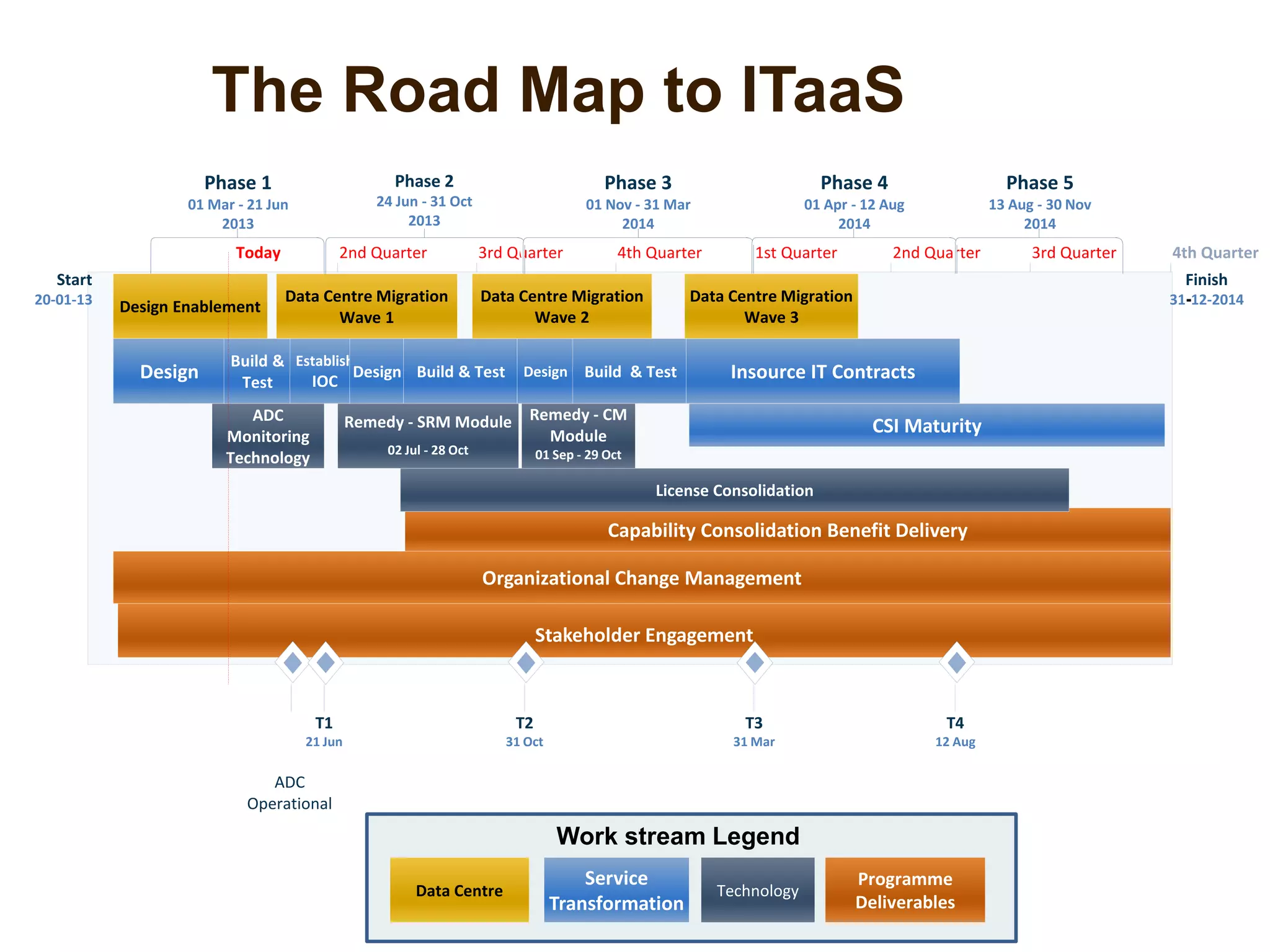
The Road Map to ITaaS
Work stream Legend
THE BLUEPRINT
Designing Transformation – A single point of reference
New Brunswick Internal Services Agency
Programme Delivery Framework
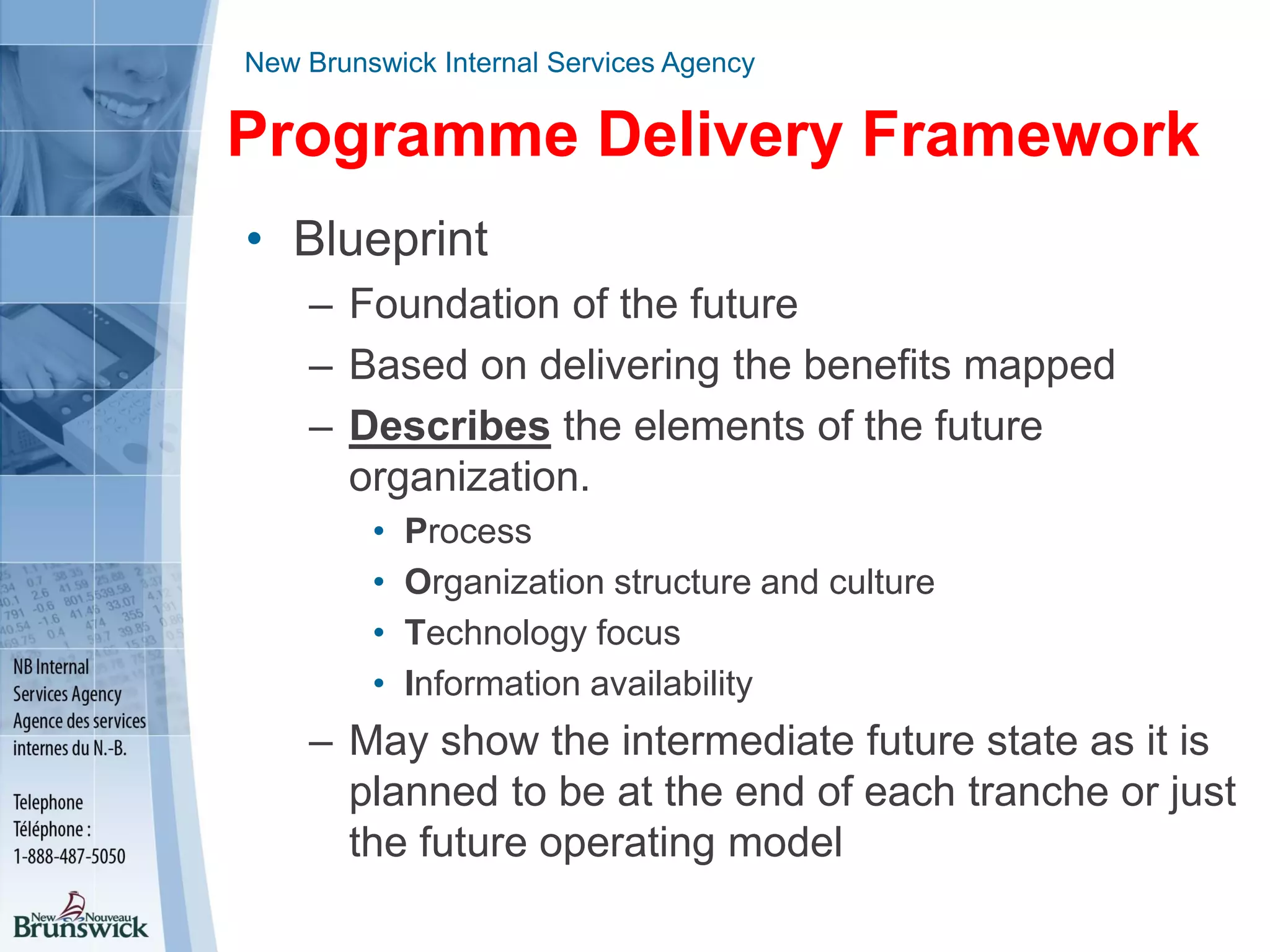
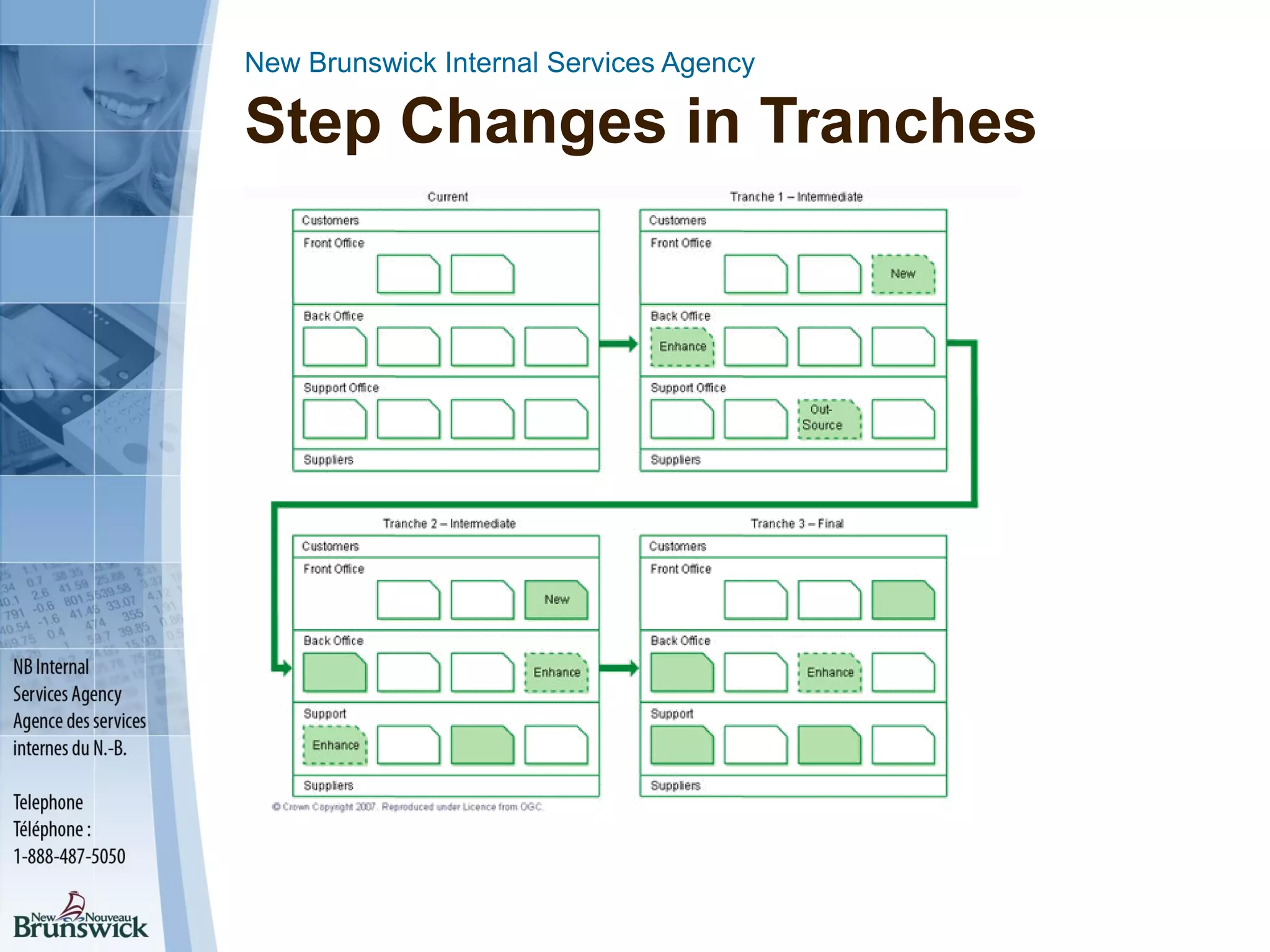
• Blueprint
– Foundation of the future
– Based on delivering the benefits mapped
– Describes the elements of the future
organization.
• Process
• Organization structure and culture
• Technology focus
• Information availability
– May show the intermediate future state as it is
planned to be at the end of each tranche or just
the future operating model
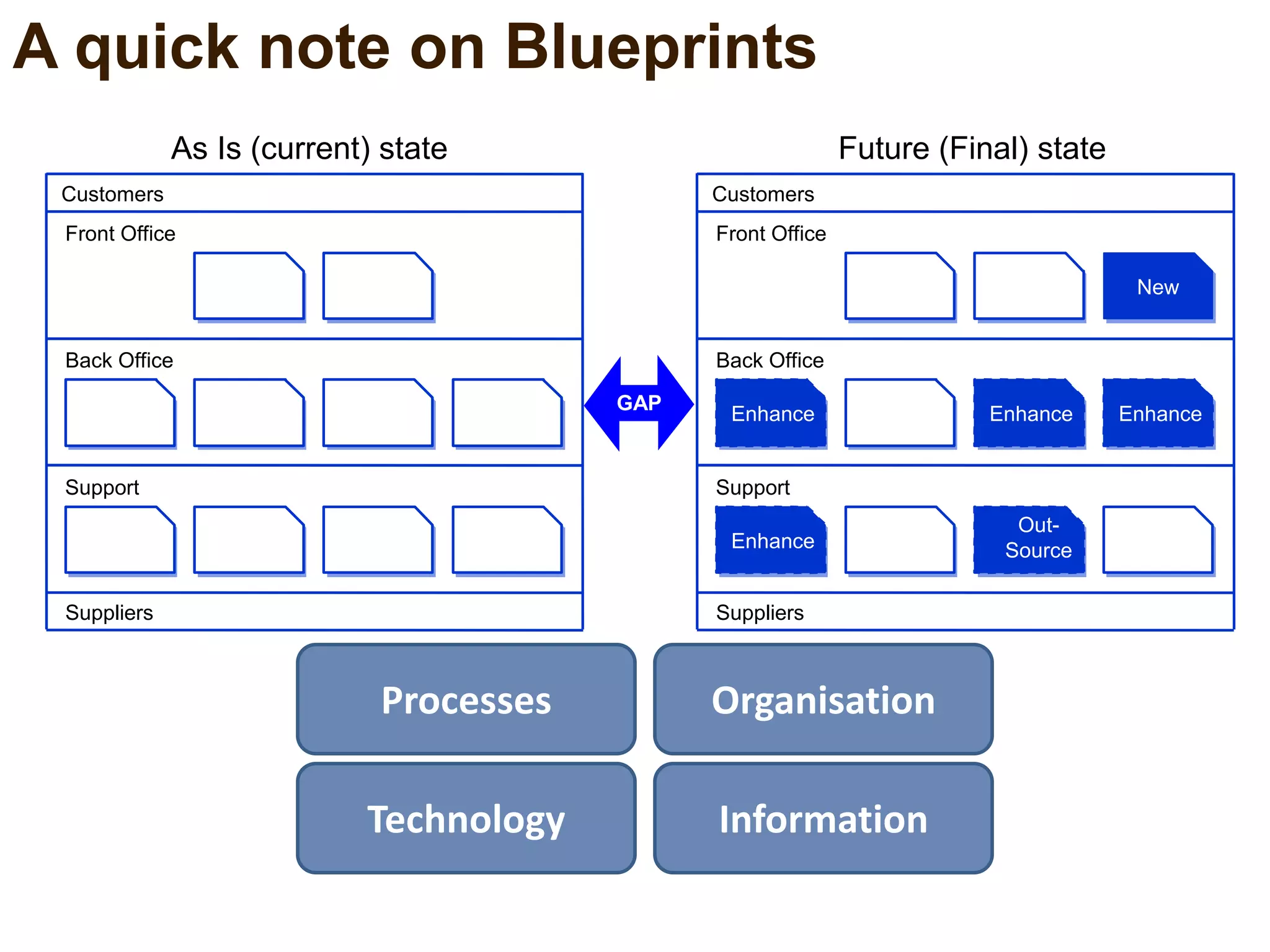
A quick note on Blueprints
Processes
Technology Information
Organisation
Front Office
Back Office
Support
Customers
Suppliers
New
Front Office
Enhance Enhance Enhance
Back Office
Enhance
Out-
Source
Support
Customers
Suppliers
GAP
As Is (current) state Future (Final) state
New Brunswick Internal Services Agency
Programme Delivery Framework
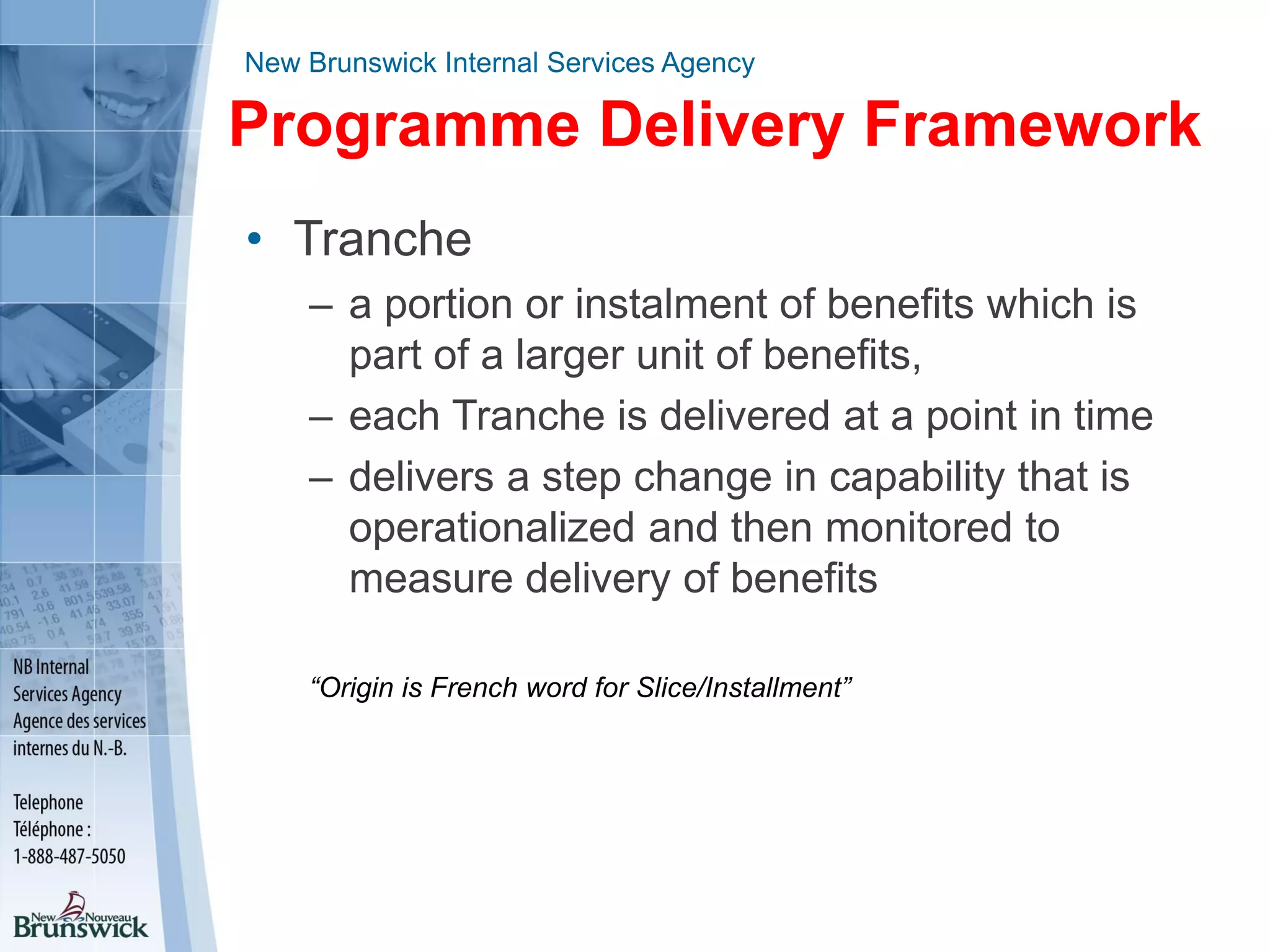
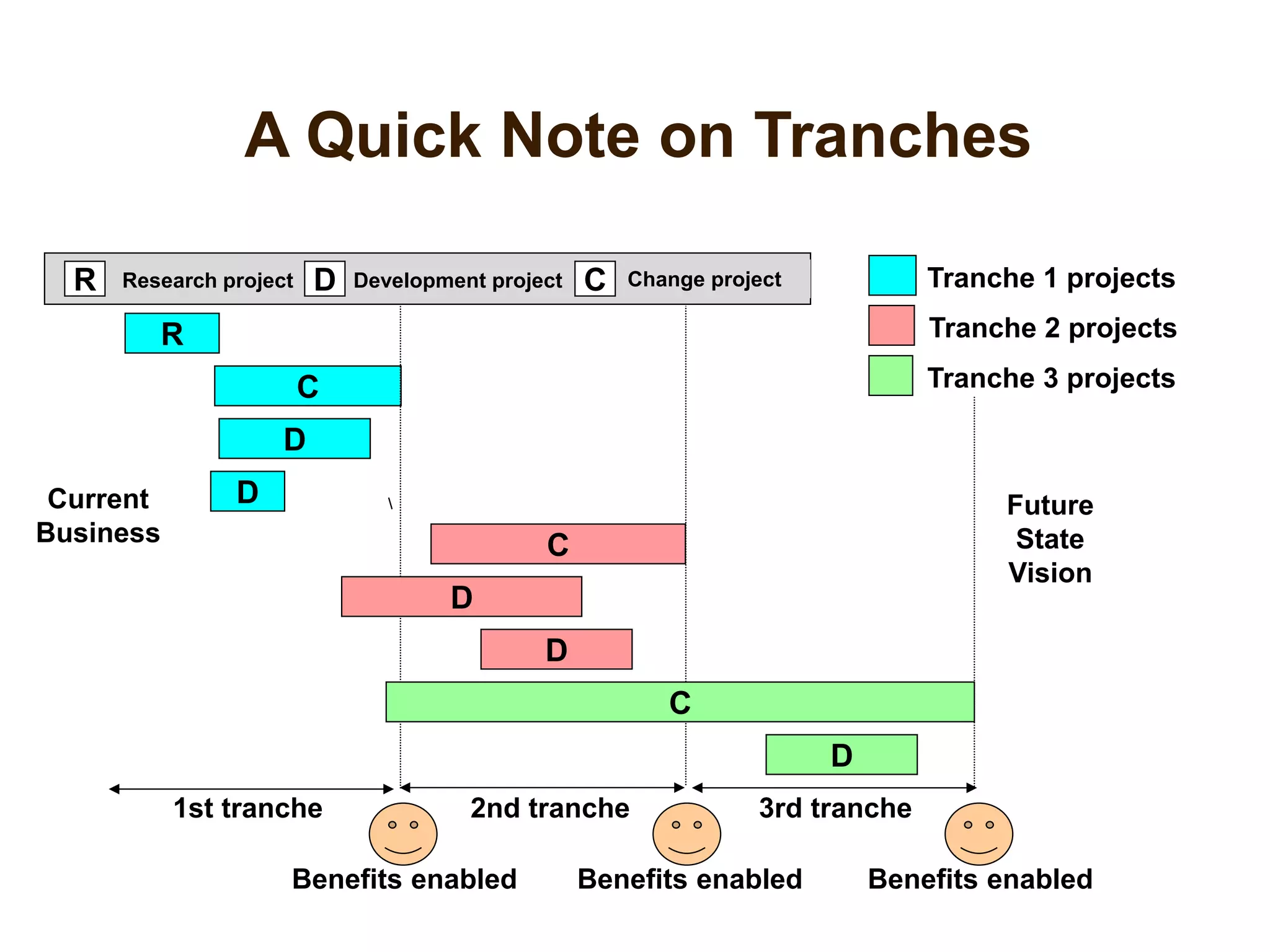
• Tranche
– a portion or instalment of benefits which is
part of a larger unit of benefits,
– each Tranche is delivered at a point in time
– delivers a step change in capability that is
operationalized and then monitored to
measure delivery of benefits
“Origin is French word for Slice/Installment”
A Quick Note on Tranches
R
D
C
1st tranche 2nd tranche 3rd tranche
Current
Business
R Research project Development project Change projectD C
D
C
D
D
D
C
Tranche 1 projects
Tranche 2 projects
Tranche 3 projects
Future
State
Vision
Benefits enabled Benefits enabled Benefits enabled
New Brunswick Internal Services Agency
Step Changes in Tranches
LEADING CHANGE WITH
STAKEHOLDER ENGAGEMENT
Building support and successful transition to realize benefits
New Brunswick Internal Services Agency
Leading Change
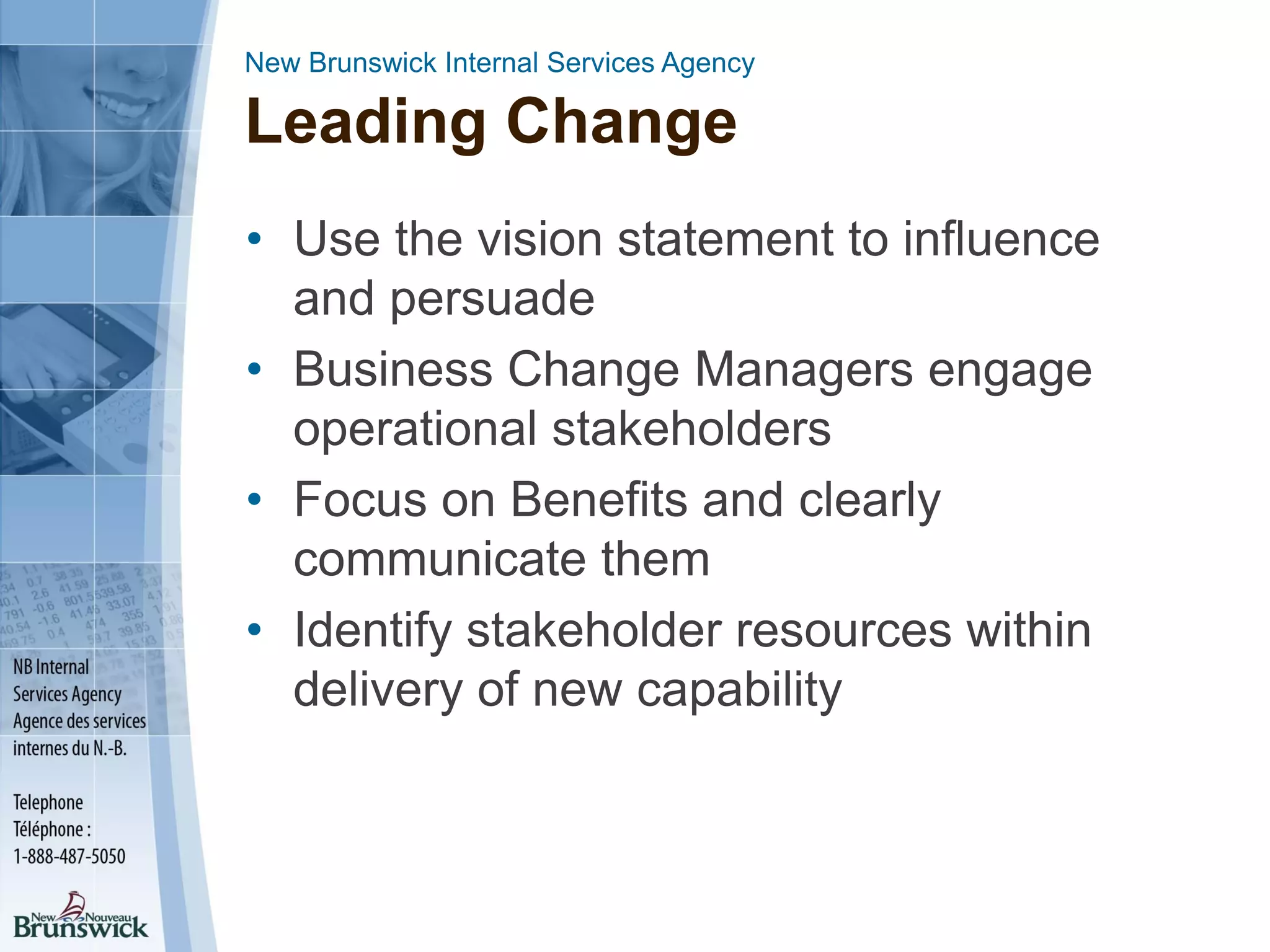
• Use the vision statement to influence
and persuade
• Business Change Managers engage
operational stakeholders
• Focus on Benefits and clearly
communicate them
• Identify stakeholder resources within
delivery of new capability
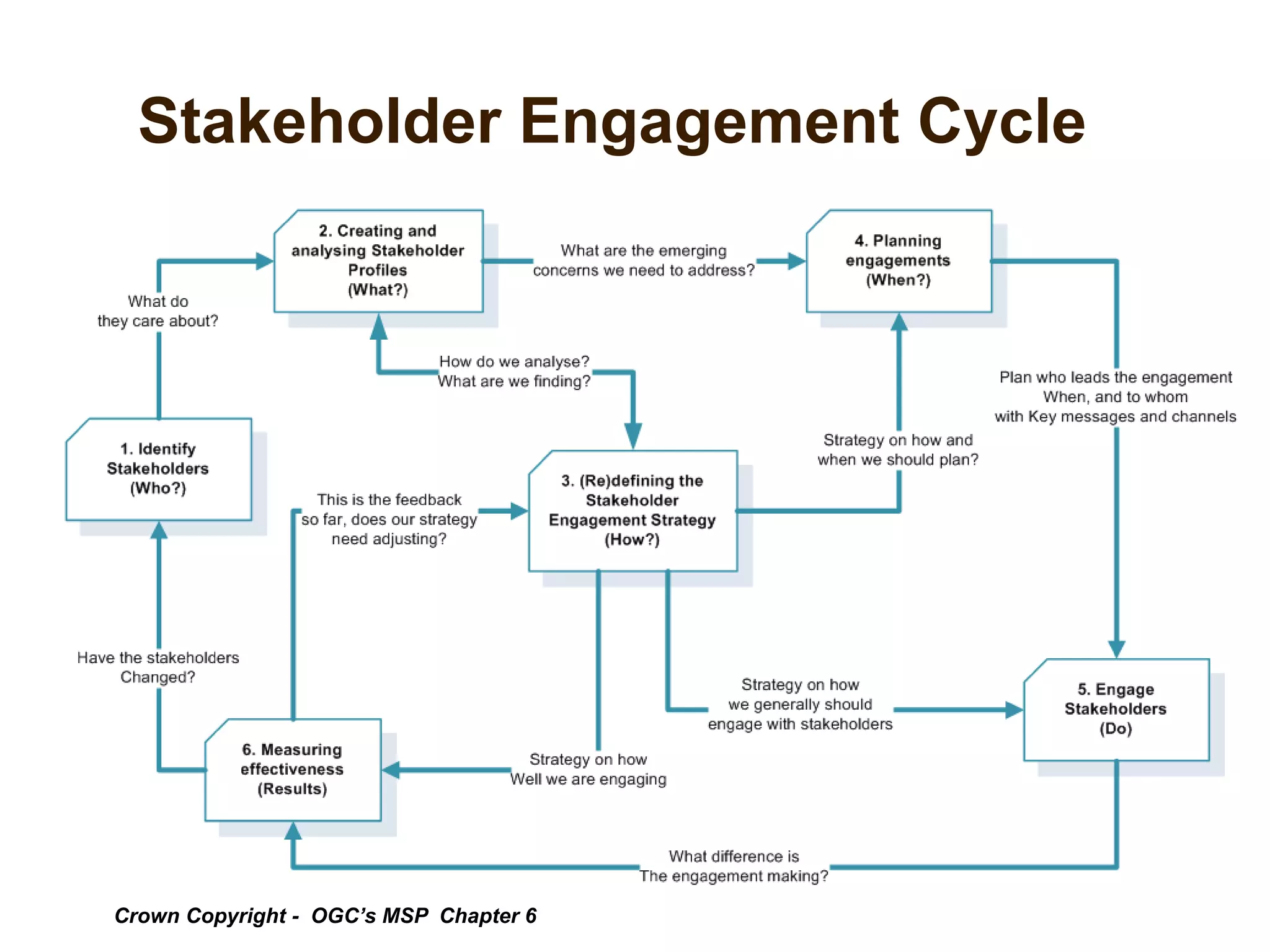
Stakeholder Engagement Cycle
Crown Copyright - OGC’s MSP Chapter 6
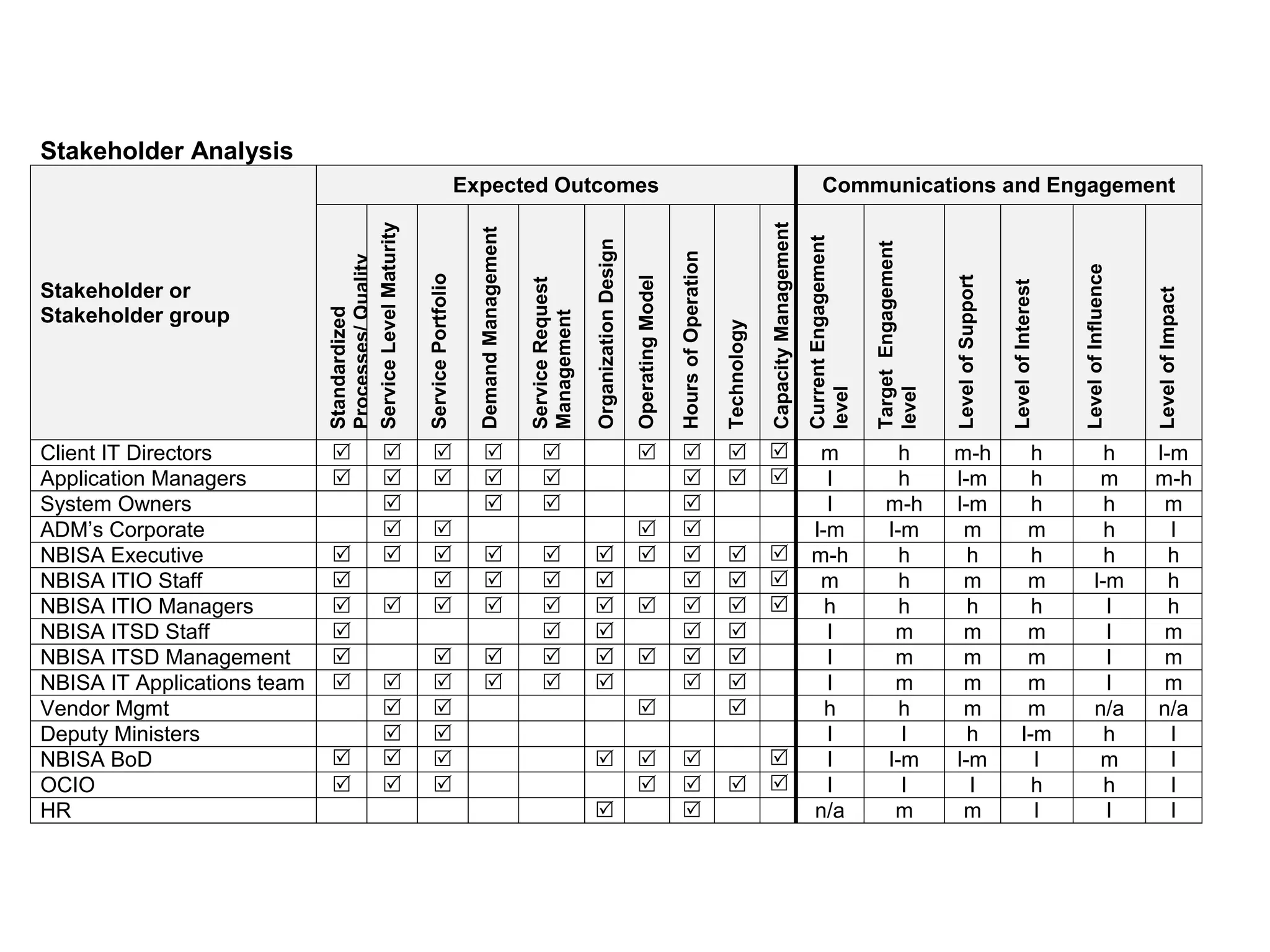
Stakeholder Map
Stakeholder Analysis
Stakeholder or
Stakeholder group
Expected Outcomes Communications and Engagement
Standardized
Processes/Quality
ServiceLevelMaturity
ServicePortfolio
DemandManagement
ServiceRequest
Management
OrganizationDesign
OperatingModel
HoursofOperation
Technology
CapacityManagement
CurrentEngagement
level
TargetEngagement
level
LevelofSupport
LevelofInterest
LevelofInfluence
LevelofImpact
Client IT Directors          m h m-h h h l-m
Application Managers         l h l-m h m m-h
System Owners     l m-h l-m h h m
ADM’s Corporate     l-m l-m m m h l
NBISA Executive           m-h h h h h h
NBISA ITIO Staff         m h m m l-m h
NBISA ITIO Managers           h h h h l h
NBISA ITSD Staff      l m m m l m
NBISA ITSD Management         l m m m l m
NBISA IT Applications team         l m m m l m
Vendor Mgmt     h h m m n/a n/a
Deputy Ministers   l l h l-m h l
NBISA BoD        l l-m l-m l m l
OCIO        l l l h h l
HR   n/a m m l l l
New Brunswick Internal Services Agency
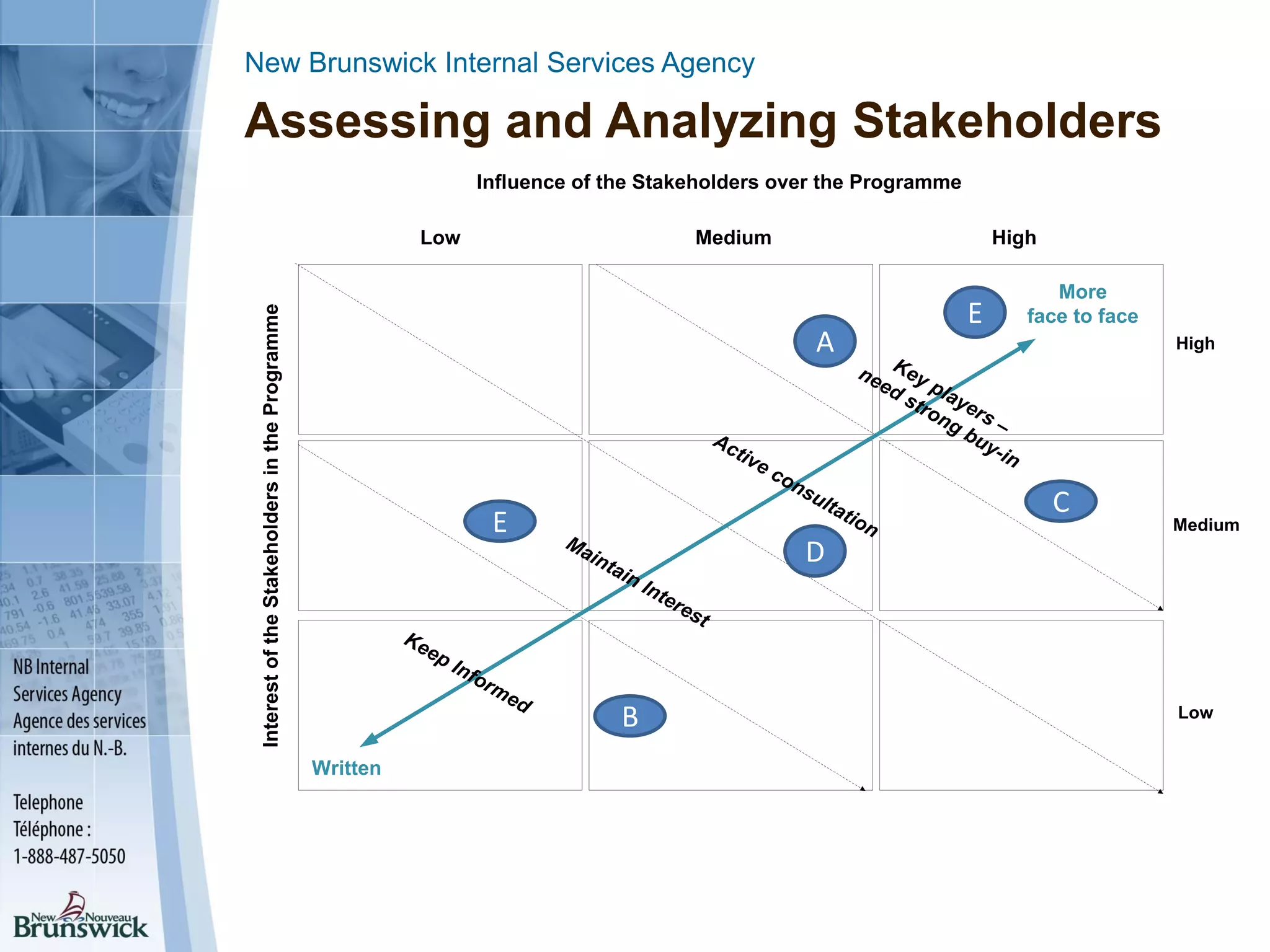
Assessing and Analyzing Stakeholders
High
Low
Medium
HighLow Medium
Influence of the Stakeholders over the Programme
InterestoftheStakeholdersintheProgramme
Keep Informed
Key players –
need strong buy-in
Active consultation
Maintain Interest
Written
More
face to face
A
C
E
B
D
E
New Brunswick Internal Services Agency
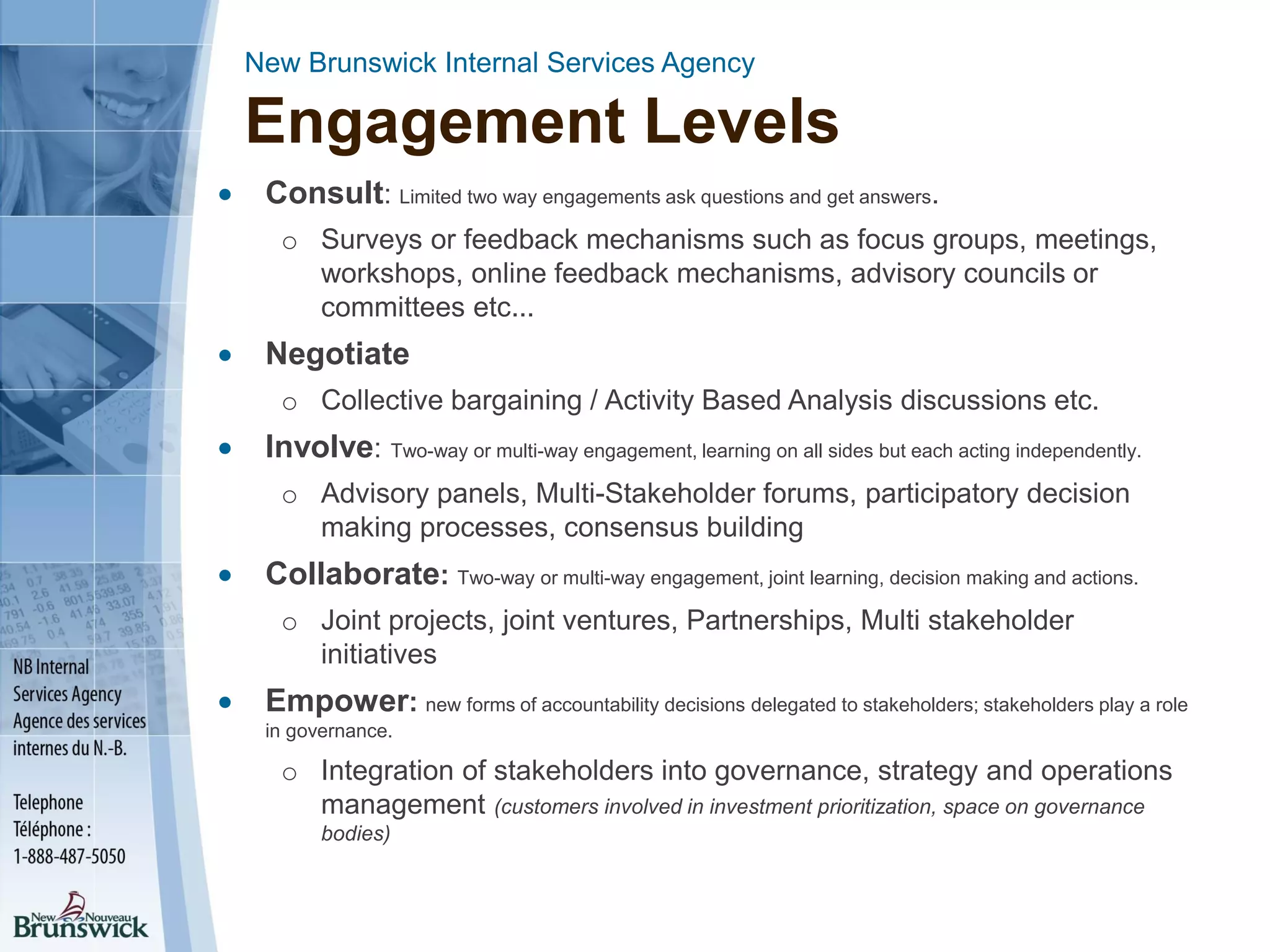
Engagement Levels
 Consult: Limited two way engagements ask questions and get answers.
o Surveys or feedback mechanisms such as focus groups, meetings,
workshops, online feedback mechanisms, advisory councils or
committees etc...
 Negotiate
o Collective bargaining / Activity Based Analysis discussions etc.
 Involve: Two-way or multi-way engagement, learning on all sides but each acting independently.
o Advisory panels, Multi-Stakeholder forums, participatory decision
making processes, consensus building
 Collaborate: Two-way or multi-way engagement, joint learning, decision making and actions.
o Joint projects, joint ventures, Partnerships, Multi stakeholder
initiatives
 Empower: new forms of accountability decisions delegated to stakeholders; stakeholders play a role
in governance.
o Integration of stakeholders into governance, strategy and operations
management (customers involved in investment prioritization, space on governance
bodies)
New Brunswick Internal Services Agency
Other thoughts
“Ideas without execution are just delusion”
“Knowing doing Gap”
“All Talk No Action”
“Change is fun when you are doing it, however it is
terrifying if it is being done to you”
“It is all about people, getting people to see the future,
getting them to see themselves in the new vision, and then
getting them to shape how they get there”
New Brunswick Internal Services Agency
Learning Points Revisited
 Provided an overview of Programme
Management
 Learn how to create the Blueprint that will
drive the delivery of new capabilities as
identified in the Strategy.
 Explore the organizational change and the
differences between Stakeholder
Management and Stakeholder Engagement.
Did we hit them?
New Brunswick Internal Services Agency
Additional Information
• Managing Successful Programmes (MSP)
– Part of UK’s Best Management Practice site
• Includes PRINCE2, ITIL, P3M3 and MoR, P30, MoV
– First released in 1999 – 4th edition currently (2011)
– Official Website
• http://www.msp-officialsite.com/
• http://www.best-management-practice.com/Publications-
Library/Programme-Management-MSP
• CHAMPS2 http://www.champs2.info
• APMG International (examine organization)
– http://www.apmg-international.com
– Webinars
• http://www.apmg-international.com/en/news-events/webinars/webinar-list.aspx
• LinkedIn – North American MSP Community of Interest
– http://www.linkedin.com/groups?gid=5088283
– Apply for membership we want to control commercialism
– Webinar in January on Leadership and Stakeholder Engagement
Email: David.whelbourn@gnb.ca
New Brunswick Internal Services Agency
Characteristics of a Good Vision Statement
• "A vision is a picture of a better future and it is used to
communicate the end goal of the programme"
– Written in the future state
– Easy to communicate
– How this future is different from the past
– Written for the widest target audience (Stakeholders)
– Matches the degree of change with the boldness of the
conveyed vision
– Avoids target dates, unless the programme is time dependent
– Describes the desirable future, not how to get there
– Is verifiable without too many detailed targets
– Is sufficiently flexible without too many constraints
– Is short and memorable
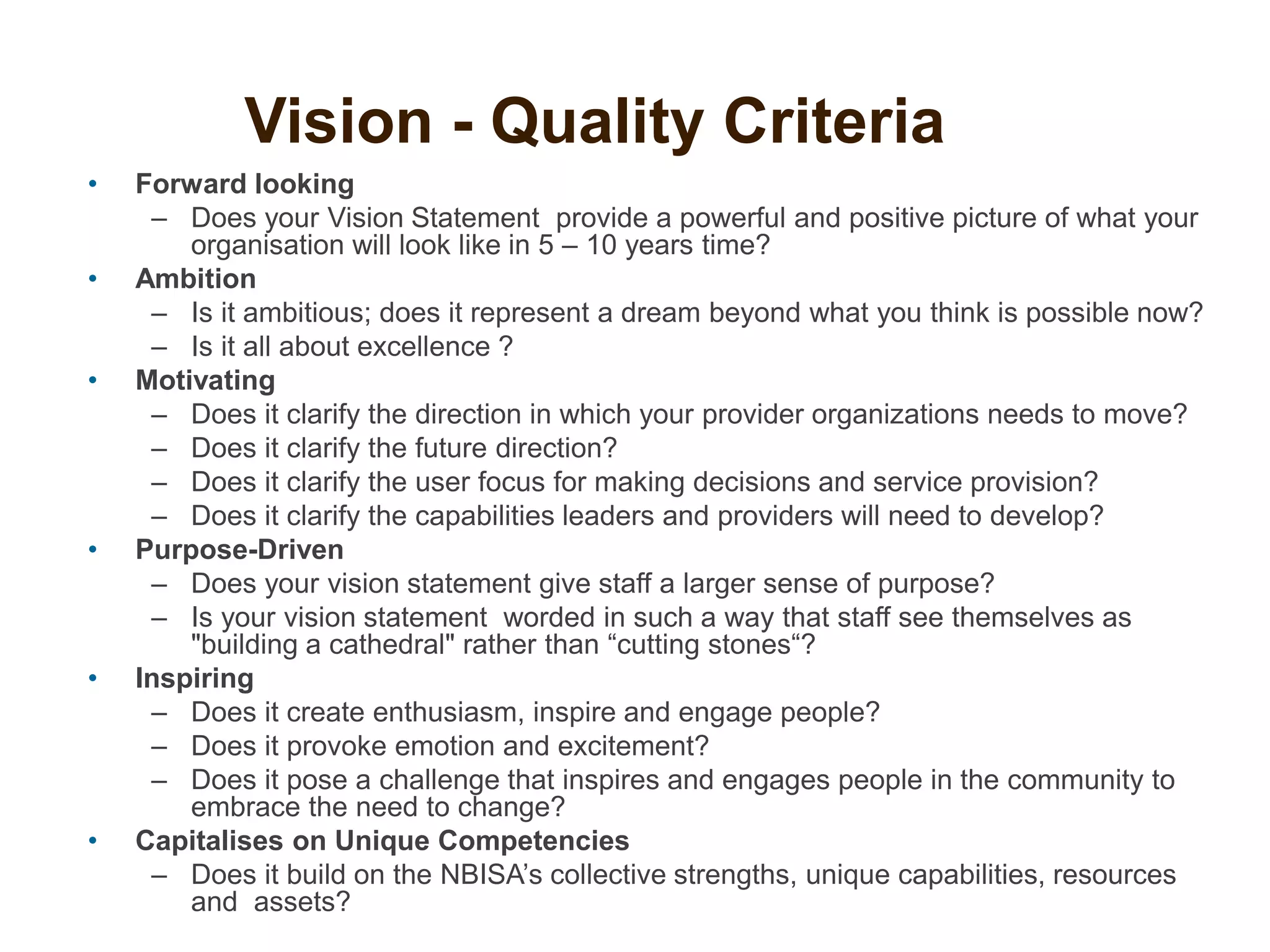
Vision - Quality Criteria
• Forward looking
– Does your Vision Statement provide a powerful and positive picture of what your
organisation will look like in 5 – 10 years time?
• Ambition
– Is it ambitious; does it represent a dream beyond what you think is possible now?
– Is it all about excellence ?
• Motivating
– Does it clarify the direction in which your provider organizations needs to move?
– Does it clarify the future direction?
– Does it clarify the user focus for making decisions and service provision?
– Does it clarify the capabilities leaders and providers will need to develop?
• Purpose-Driven
– Does your vision statement give staff a larger sense of purpose?
– Is your vision statement worded in such a way that staff see themselves as
"building a cathedral" rather than “cutting stones“?
• Inspiring
– Does it create enthusiasm, inspire and engage people?
– Does it provoke emotion and excitement?
– Does it pose a challenge that inspires and engages people in the community to
embrace the need to change?
• Capitalises on Unique Competencies
– Does it build on the NBISA’s collective strengths, unique capabilities, resources
and assets?
New Brunswick Internal Services Agency
Stakeholder Engagement Plan

From Strategy to Operations ProjectWorld 2013

  • 1.
    From Pretty Pictureof the Future to Operations How to Operationalize a Strategy Executing Strategy Deployment
  • 2.
    New Brunswick InternalServices Agency Introduction • Purpose in the next 75 minutes we will discuss how to deliver strategy using programme and project management. • Learning Points 1. Provide an overview of Programme Management 2. Learn how to create the Blueprint that will drive the delivery of new capabilities as identified in the Strategy. 3. Explore the organizational change and the differences between Stakeholder Management and Stakeholder Engagement.
  • 3.
    CONTEXT Where do wewant to be and how do we get there?
  • 4.
    New Brunswick InternalServices Agency The Future • Change is happening faster than ever, there is no such thing as the steady state • Organizations have to improve 3% per annum just to keep pace. – If you want to get ahead you need to be improving at 5-10% per annum! • > 60% of organization change fails to deliver any/major benefits • How to bridge the Performance Gap?
  • 5.
    New Brunswick InternalServices Agency Bridging the Gap Time PerformanceagainstKPI’s Measures Target Operations Future Operating Model Measures Current Operations Capability Gap + 5% improvement
  • 6.
    Effective Strategy Deployment StrategicProcurement Initiative GRO Service Transition Programme Pre- Program Set Up Program Set Up Establish Program Infrastructure Deliver Incremental Benefits Close the Program Strategic Vision – Living Within Our Means Mobilization Strategic Objectives Strategic Options Strategic Portfolio of Initiatives Projects 1 2 4 Infrastructure 1 2 4 DMAIC 1 2 4 System Integration 1 2 4 Consolidation Change Management Shared Services Initiative Deliver IT as a Service Pre-Program Set Up Program Set Up Establish Program Infrastructure Deliver Benefits Close the Program Strategic Objectives Business Case Objectives Benefit Delivery Objectives • Strategic Objectives are assigned to Initiatives for delivery • Initiatives trigger Programmes as vehicles for delivery – Programmes deliver benefits – Projects deliver solutions • Programmes are assigned Benefit delivery objectives aligned with Strategic Objectives MSP PRINCE2 Collaborative Transformation Lean 6𝜎• Programmes manage project delivery to aligned business case • Programmes focus on ensuring: – Benefits are delivered as expected – Transition into operations with the minimum of disruption to current business operations Change = Methodologies MoP
  • 7.
    Information Technology Organization Process Operational Approach “Shared Services” Tactical Delivery Strategic Strategy “LivingWithin Our Means” • Building clarity of the vision for the change and the leadership team’s resolve to deliver it • Identifying potential organizational initiatives to maximize benefits • Informing the selection of change strategy based on an early diagnostic assessment Programme Planning & Execution • Planning the management of change (communicating the vision, creating the blueprint, stakeholder Mngt, communication planning, training, selection, etc.) • Designing the right programme / project structure, changes to behavior and service processes to fully integrate the change • Benefit Management Strategy and Planning Project Delivery • Managing the delivery of the outcomes and solutions • Developing the transitions to operations • Developing job profiles, security, updates to HR processes, etc. Business Blueprint Initiative Mobilization Program Initiation & Execution Project Initiation and Execution Go Live and Support Benefit Realization & Sustain Evolution From Strategy to Operations MSP Transformational Change Programmes ITIL Operational Support • Managing the delivery of ongoing service • Managing change to the service (CSI) Change Balance Score Card Lean 6𝜎 MSP Change PRINCE2 MoP
  • 8.
    New Brunswick InternalServices Agency Don’t confuse the “P” words Project Programme Portfolio Benefit Reduce Risk Deliver Business Outcomes Optimize Scarce Resources Focus Deliver Results Coordination, governance and communications Investment optimization Scope Project Execution Multi Project coordination Proposals / Projects / Assets Contacts Project Managers and SRO’s / Champions Business Leaders, External Partners Senior Management Skills Leadership Change Management Strategy and Benefits Realization
  • 9.
  • 10.
    New Brunswick InternalServices Agency Why Programmes are different? • Deliverables Leading to … • Opportunity to change Project A Project A Project B Project C • Deliverables & Capabilities Transitioned in to operations enabling the… • Opportunity to Change With Transition Managers leading providing … • Outcomes With Benefit Owners ensuring… Benefit Realisation! Project D Operational Improvement
  • 11.
    New Brunswick InternalServices Agency MSP – Programme Lifecycle
  • 12.
    The Change ProcessModel where MSP Fits Engage Stakeholders 1. Clarifying need to change Identifying a Programme 2. Form Vision and agree objectives Identifying / Defining a Programme 3. Identify Benefits and changes Identify / Defining a Programme / Realizing Benefits 4. Define Initiatives Defining a Programme and Managing the Tranches 5. Optimize Initiatives Defining the Programme / Managing the Tranches 6. Manage Initiatives Delivering the Capability / Realizing Benefits 7. Manage Performance Managing the Tranches, Realizing Benefits / Closing a Programme Crown Copyright - OGC’s MSP Chapter 6
  • 13.
    Vision helping bridgethe Gap Key Milestones PerformanceagainstKPI’s Target Operations Current Operations Tranche 1 Tranche 2 Tranche 3 1. Where we want to be The Vision 3. How are we going to get there? Programme plan & Blueprint 2. Where we are now Operational Plans refocused Programme and Projects aligned to strategic objectives Manage these with Programme Framework and Project Management T1 T2 T3 T4
  • 14.
    New Brunswick InternalServices Agency “Vision without action is merely a dream. Action without vision just passes time. Vision with action can change the world.” Author: Joel Barker- The Power of Vision
  • 15.
    Programme Delivery Framework Drivenby a Vision of a better future The vision provides the compass that enables us to Map out the benefit route to the future The Map and the Vision provide guidance to enable us to develop a Blueprint that provides detail of each step change needed to reach the future – we cannot leap there in one bound The Blueprint enables us to plan how to deliver the changes
  • 16.
    New Brunswick InternalServices Agency Programme Delivery Framework • Benefits Map – A Benefit is a measurable improvement resulting from an outcome which is perceived as an advantage by a stakeholder – The Benefits Map provides a link from strategic objectives to Programme Goals – The Benefits Map provides a link from Programme Goals backwards to enablers and project actions
  • 17.
    Benefits Mapping Consistent Service Delivery Service KPIs exceeded Client-satisfaction rating >75% Reduction in variety of services Save $8-10 million in operating costs Insource IT Services Saving Rent, Power & Light Lower License Costs Visibility of Service Cost Maximized Discounts Competitive Service Delivery cost (25% lower) ITIL Process adopted Level 3 Defined Service Portfolio Centralized Procurement of software licence 85% Server Virtualized Project output or enabler Business Change Intermediate Benefit End Benefit Strategic objective Dis- Benefit Data Centre Migration Licence Consolidation IT Service Transformation Staff Development ITIL Certification
  • 18.
    New Brunswick InternalServices Agency ITaaS - Vision “ To work as one team in delivering quality, competitive and streamlined information technology and services in partnership with our clients.” • Achieving client satisfaction through: – Service Level Effectiveness demonstrating service quality – Delivering value for GNB in services and savings – Streamlined service delivery with standardized services and processes
  • 19.
    New Brunswick InternalServices Agency ITaaS Programme Objectives • Delivering Value – Savings of $6 -10 Million • Consolidate and close Data Centres • Increased Virtualization • Lower IT License costs • Lowering IT costs Insourcing contracts – Service Value • Service level Effectiveness KPI • Meeting the needs (index based on surveying clients) • Streamlined Service Delivery – Organization Structure – Technology Project SRM – Maturity Model • Process Optimization (Level 2 – 3) • Service Optimization (level 3 - 4)
  • 20.
    Stakeholder Engagement Start 20-01-13 Finish 31-12-2014 2nd Quarter3rd Quarter 4th Quarter 1st Quarter 2nd Quarter 3rd Quarter 4th Quarter Design Enablement Design Organizational Change Management ADC Monitoring Technology Build & Test Data Centre Migration Wave 1 Establish IOC Remedy - SRM Module 02 Jul - 28 Oct Design Build & Test Remedy - CM Module 01 Sep - 29 Oct Capability Consolidation Benefit Delivery Data Centre Migration Wave 2 Design Build & Test Insource IT Contracts Data Centre Migration Wave 3 CSI Maturity Phase 1 01 Mar - 21 Jun 2013 Phase 2 24 Jun - 31 Oct 2013 Phase 3 01 Nov - 31 Mar 2014 Phase 4 01 Apr - 12 Aug 2014 Phase 5 13 Aug - 30 Nov 2014 ADC Operational T1 21 Jun T2 31 Oct T3 31 Mar T4 12 Aug Today Data Centre Service Transformation Technology Programme Deliverables License Consolidation The Road Map to ITaaS Work stream Legend
  • 21.
    THE BLUEPRINT Designing Transformation– A single point of reference
  • 22.
    New Brunswick InternalServices Agency Programme Delivery Framework • Blueprint – Foundation of the future – Based on delivering the benefits mapped – Describes the elements of the future organization. • Process • Organization structure and culture • Technology focus • Information availability – May show the intermediate future state as it is planned to be at the end of each tranche or just the future operating model
  • 23.
    A quick noteon Blueprints Processes Technology Information Organisation Front Office Back Office Support Customers Suppliers New Front Office Enhance Enhance Enhance Back Office Enhance Out- Source Support Customers Suppliers GAP As Is (current) state Future (Final) state
  • 24.
    New Brunswick InternalServices Agency Programme Delivery Framework • Tranche – a portion or instalment of benefits which is part of a larger unit of benefits, – each Tranche is delivered at a point in time – delivers a step change in capability that is operationalized and then monitored to measure delivery of benefits “Origin is French word for Slice/Installment”
  • 25.
    A Quick Noteon Tranches R D C 1st tranche 2nd tranche 3rd tranche Current Business R Research project Development project Change projectD C D C D D D C Tranche 1 projects Tranche 2 projects Tranche 3 projects Future State Vision Benefits enabled Benefits enabled Benefits enabled
  • 26.
    New Brunswick InternalServices Agency Step Changes in Tranches
  • 27.
    LEADING CHANGE WITH STAKEHOLDERENGAGEMENT Building support and successful transition to realize benefits
  • 28.
    New Brunswick InternalServices Agency Leading Change • Use the vision statement to influence and persuade • Business Change Managers engage operational stakeholders • Focus on Benefits and clearly communicate them • Identify stakeholder resources within delivery of new capability
  • 29.
    Stakeholder Engagement Cycle CrownCopyright - OGC’s MSP Chapter 6
  • 30.
    Stakeholder Map Stakeholder Analysis Stakeholderor Stakeholder group Expected Outcomes Communications and Engagement Standardized Processes/Quality ServiceLevelMaturity ServicePortfolio DemandManagement ServiceRequest Management OrganizationDesign OperatingModel HoursofOperation Technology CapacityManagement CurrentEngagement level TargetEngagement level LevelofSupport LevelofInterest LevelofInfluence LevelofImpact Client IT Directors          m h m-h h h l-m Application Managers         l h l-m h m m-h System Owners     l m-h l-m h h m ADM’s Corporate     l-m l-m m m h l NBISA Executive           m-h h h h h h NBISA ITIO Staff         m h m m l-m h NBISA ITIO Managers           h h h h l h NBISA ITSD Staff      l m m m l m NBISA ITSD Management         l m m m l m NBISA IT Applications team         l m m m l m Vendor Mgmt     h h m m n/a n/a Deputy Ministers   l l h l-m h l NBISA BoD        l l-m l-m l m l OCIO        l l l h h l HR   n/a m m l l l
  • 31.
    New Brunswick InternalServices Agency Assessing and Analyzing Stakeholders High Low Medium HighLow Medium Influence of the Stakeholders over the Programme InterestoftheStakeholdersintheProgramme Keep Informed Key players – need strong buy-in Active consultation Maintain Interest Written More face to face A C E B D E
  • 32.
    New Brunswick InternalServices Agency Engagement Levels  Consult: Limited two way engagements ask questions and get answers. o Surveys or feedback mechanisms such as focus groups, meetings, workshops, online feedback mechanisms, advisory councils or committees etc...  Negotiate o Collective bargaining / Activity Based Analysis discussions etc.  Involve: Two-way or multi-way engagement, learning on all sides but each acting independently. o Advisory panels, Multi-Stakeholder forums, participatory decision making processes, consensus building  Collaborate: Two-way or multi-way engagement, joint learning, decision making and actions. o Joint projects, joint ventures, Partnerships, Multi stakeholder initiatives  Empower: new forms of accountability decisions delegated to stakeholders; stakeholders play a role in governance. o Integration of stakeholders into governance, strategy and operations management (customers involved in investment prioritization, space on governance bodies)
  • 33.
    New Brunswick InternalServices Agency Other thoughts “Ideas without execution are just delusion” “Knowing doing Gap” “All Talk No Action” “Change is fun when you are doing it, however it is terrifying if it is being done to you” “It is all about people, getting people to see the future, getting them to see themselves in the new vision, and then getting them to shape how they get there”
  • 34.
    New Brunswick InternalServices Agency Learning Points Revisited  Provided an overview of Programme Management  Learn how to create the Blueprint that will drive the delivery of new capabilities as identified in the Strategy.  Explore the organizational change and the differences between Stakeholder Management and Stakeholder Engagement. Did we hit them?
  • 35.
    New Brunswick InternalServices Agency Additional Information • Managing Successful Programmes (MSP) – Part of UK’s Best Management Practice site • Includes PRINCE2, ITIL, P3M3 and MoR, P30, MoV – First released in 1999 – 4th edition currently (2011) – Official Website • http://www.msp-officialsite.com/ • http://www.best-management-practice.com/Publications- Library/Programme-Management-MSP • CHAMPS2 http://www.champs2.info • APMG International (examine organization) – http://www.apmg-international.com – Webinars • http://www.apmg-international.com/en/news-events/webinars/webinar-list.aspx • LinkedIn – North American MSP Community of Interest – http://www.linkedin.com/groups?gid=5088283 – Apply for membership we want to control commercialism – Webinar in January on Leadership and Stakeholder Engagement Email: David.whelbourn@gnb.ca
  • 36.
    New Brunswick InternalServices Agency Characteristics of a Good Vision Statement • "A vision is a picture of a better future and it is used to communicate the end goal of the programme" – Written in the future state – Easy to communicate – How this future is different from the past – Written for the widest target audience (Stakeholders) – Matches the degree of change with the boldness of the conveyed vision – Avoids target dates, unless the programme is time dependent – Describes the desirable future, not how to get there – Is verifiable without too many detailed targets – Is sufficiently flexible without too many constraints – Is short and memorable
  • 37.
    Vision - QualityCriteria • Forward looking – Does your Vision Statement provide a powerful and positive picture of what your organisation will look like in 5 – 10 years time? • Ambition – Is it ambitious; does it represent a dream beyond what you think is possible now? – Is it all about excellence ? • Motivating – Does it clarify the direction in which your provider organizations needs to move? – Does it clarify the future direction? – Does it clarify the user focus for making decisions and service provision? – Does it clarify the capabilities leaders and providers will need to develop? • Purpose-Driven – Does your vision statement give staff a larger sense of purpose? – Is your vision statement worded in such a way that staff see themselves as "building a cathedral" rather than “cutting stones“? • Inspiring – Does it create enthusiasm, inspire and engage people? – Does it provoke emotion and excitement? – Does it pose a challenge that inspires and engages people in the community to embrace the need to change? • Capitalises on Unique Competencies – Does it build on the NBISA’s collective strengths, unique capabilities, resources and assets?
  • 38.
    New Brunswick InternalServices Agency Stakeholder Engagement Plan