Rubena St. Louis BAW 09


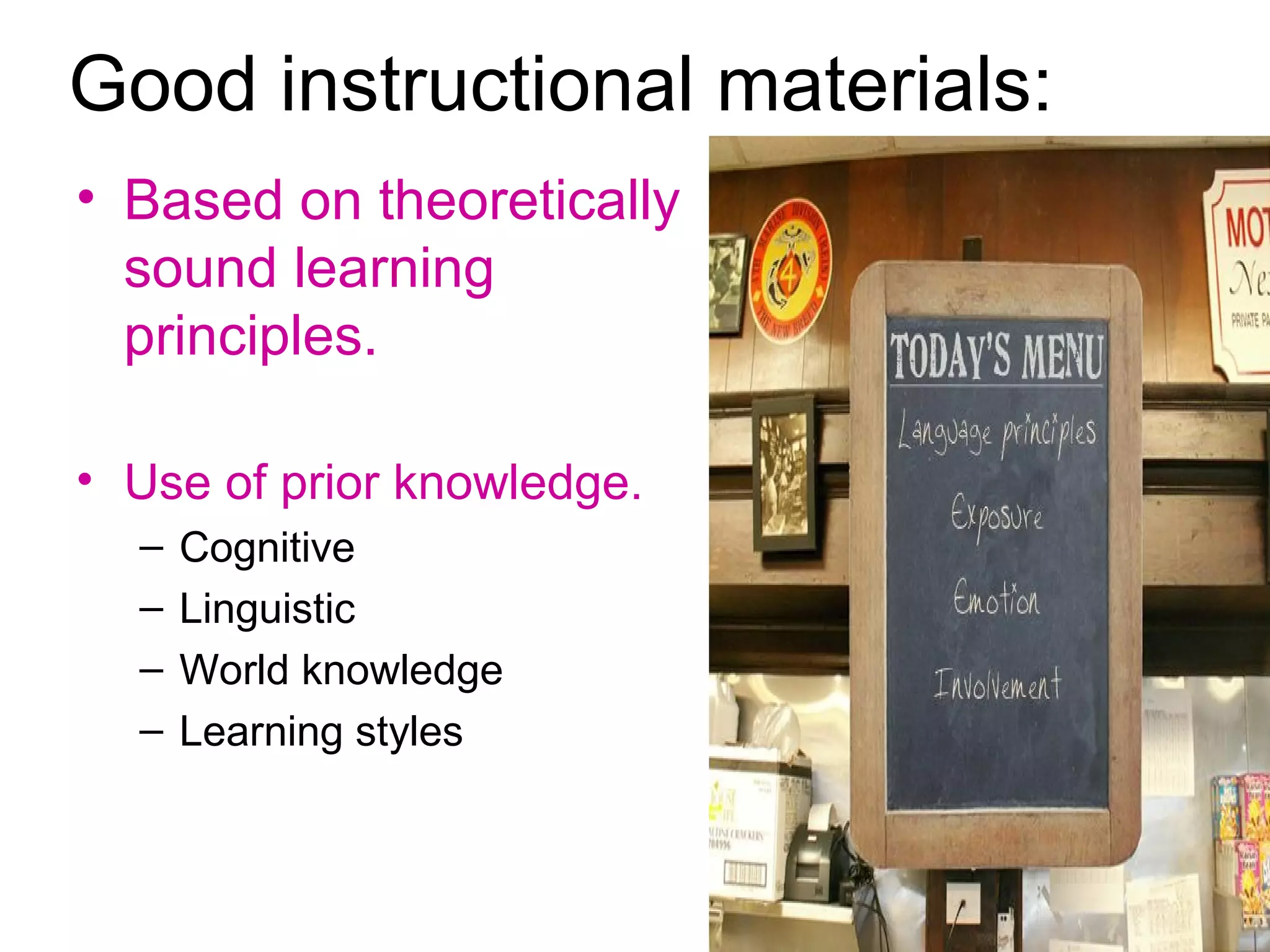
Good instructional materials:  Based on theoretically sound learning principles. Use of prior knowledge. Cognitive Linguistic World knowledge  Learning styles
 
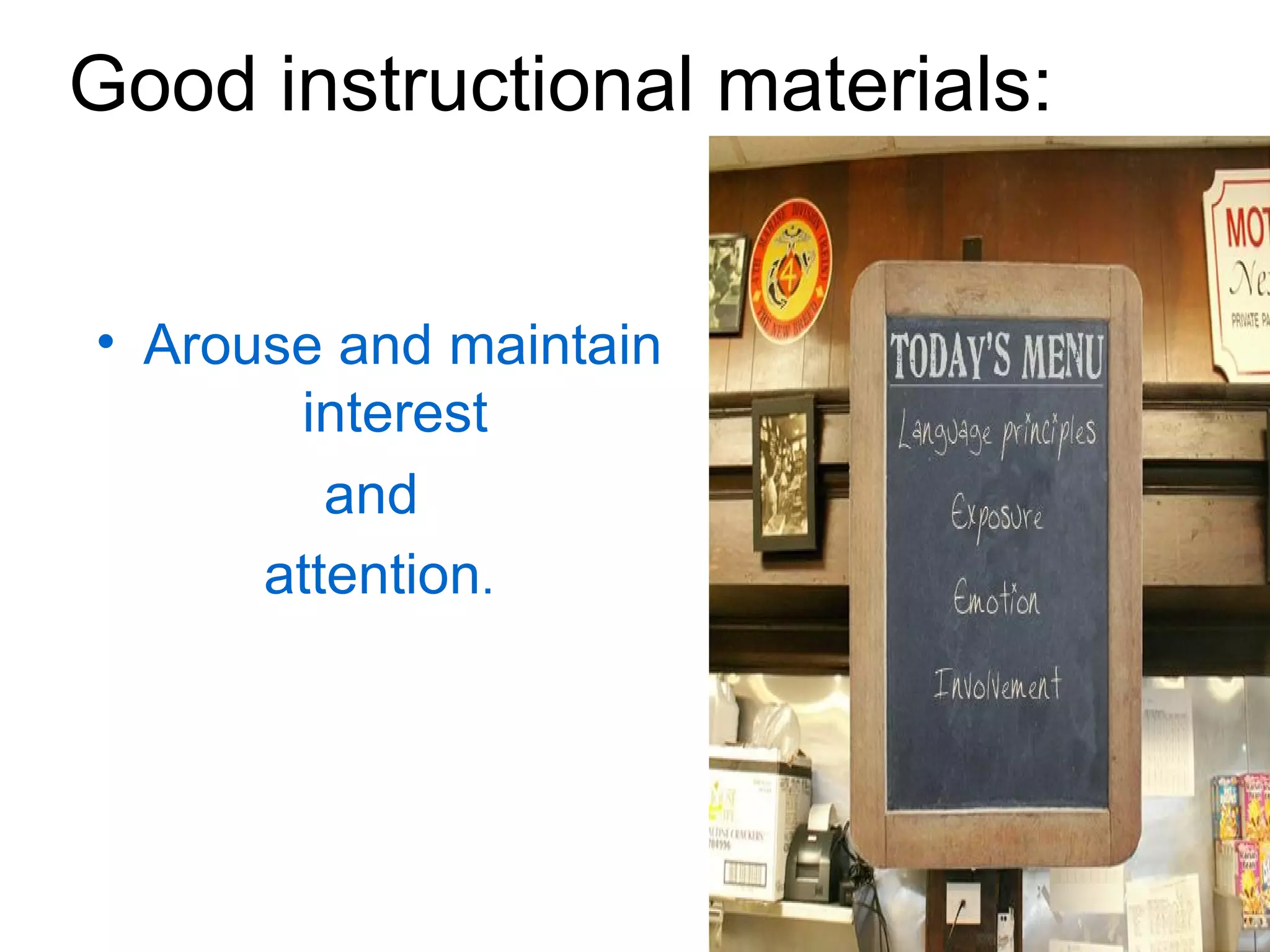
Good instructional materials:  Arouse and maintain interest  and  attention .
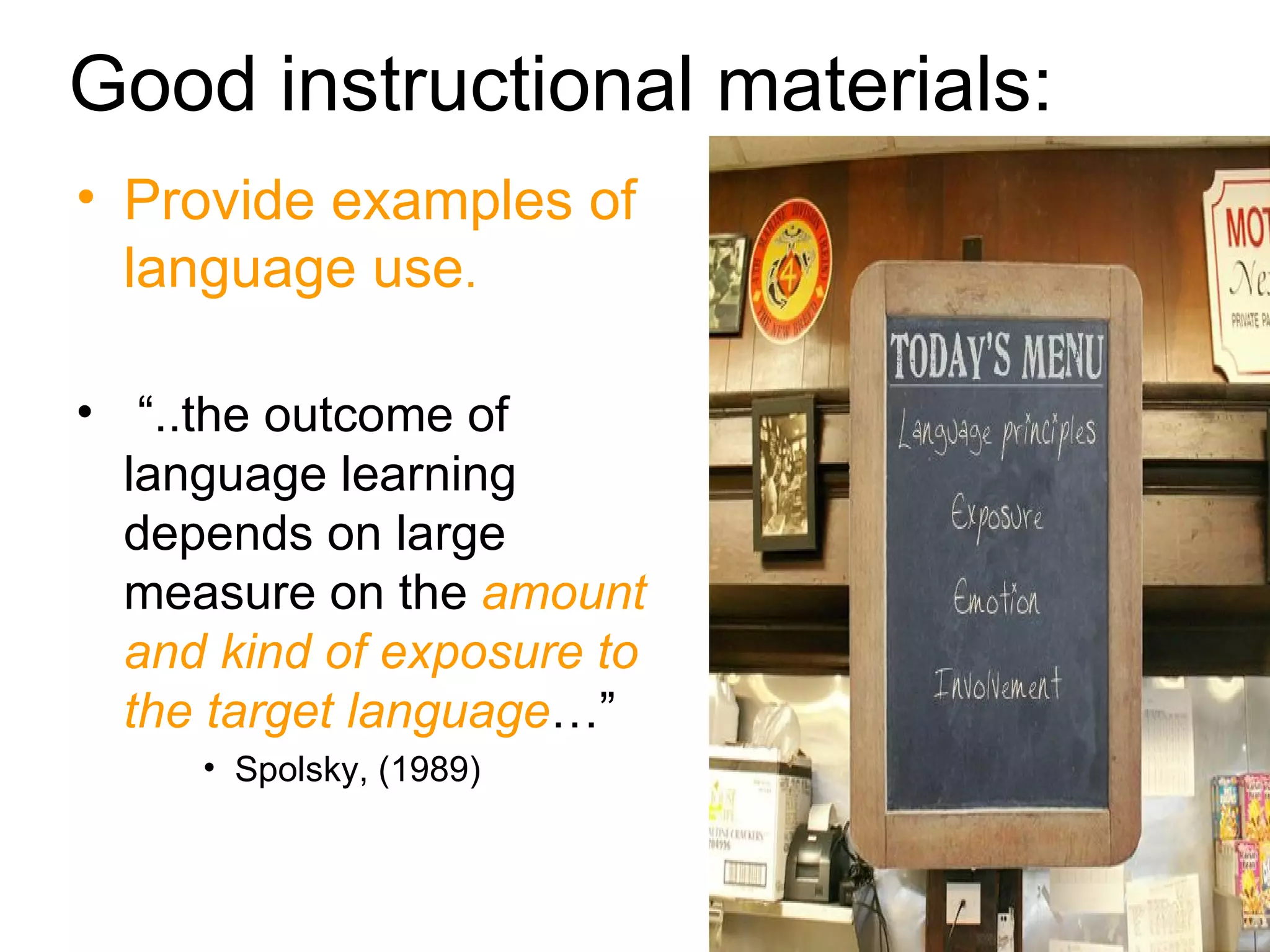
Good instructional materials:  Provide examples of language use . “ ..the outcome of language learning depends on large measure on the  amount and kind of exposure to the target language …”  Spolsky, (1989)
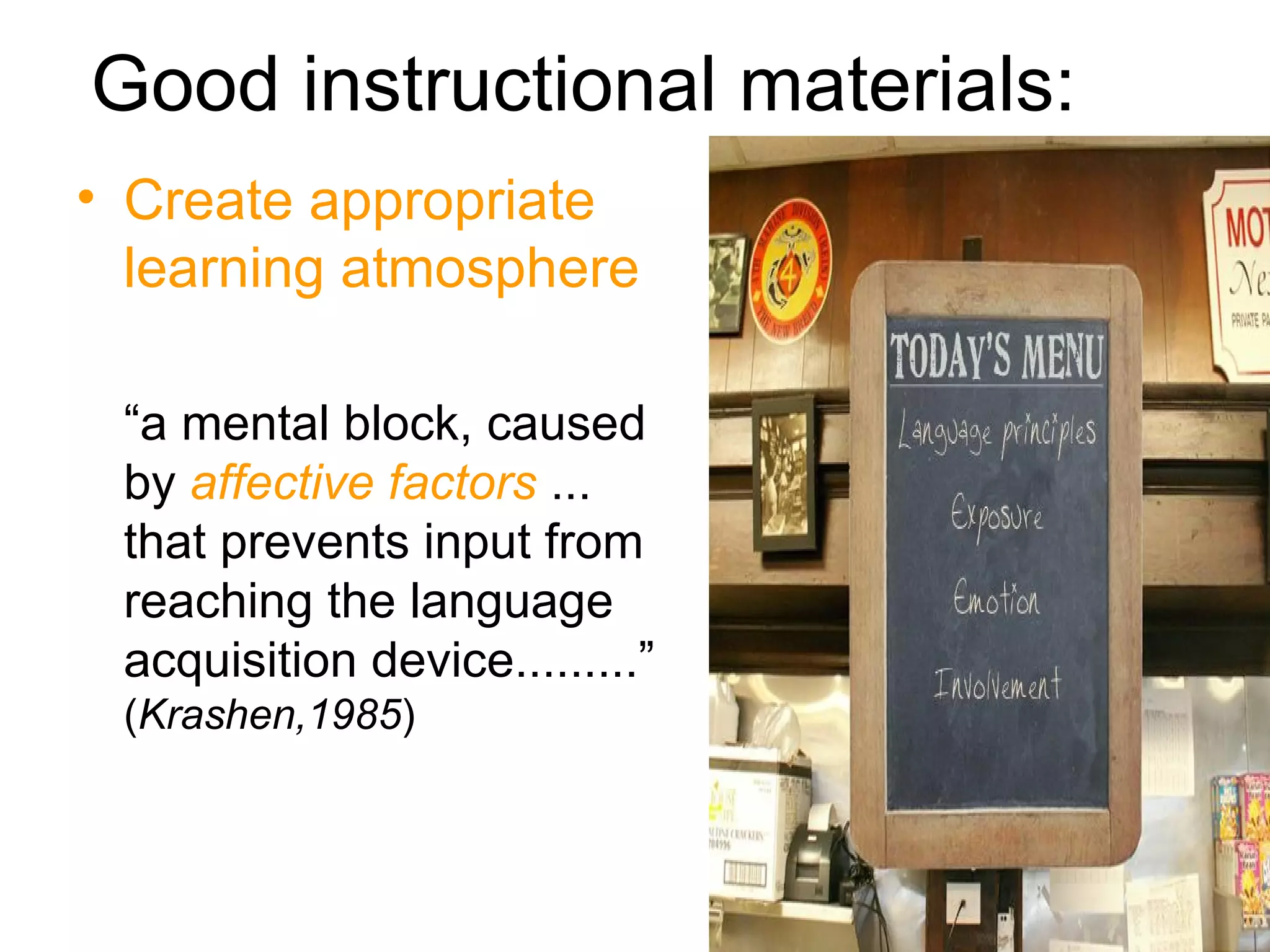
Good instructional materials:  Create appropriate learning atmosphere “ a mental block, caused by  affective factors  ... that prevents input from reaching the language acquisition device.........”  ( Krashen,1985 )
Good instructional materials:  Build confidence Use pair work Encourage interaction Use interesting activities Use  “fun” activities
Good instructional materials:  Build confidence Give enough time Individual learner differences Give feedback Explicit Appropriate Individual Give encouragement
Good instructional materials:  Relevant to students and their needs .   Variety of activities Allow student creativity Increase expectancy of success Grade level of difficulty
Good instructional materials:  Provide opportunities for interaction   Negotiation of meaning Reformulations Formation of hypothesis Testing of hypothesis
Good instructional materials:  Provide involvement with authentic tasks Authentic tasks are those having the same types of cognitive challenges as complicated real-world tasks do.   Egbert, Chin-chi Chao, & Hanson-Smith, (1999)
Good instructional materials:  Include a variety of tasks. Deep semantic level Problem solving  Emotionally significant to learner Variety of language input Focus on meaning Focus on form
Good instructional materials:  Encourage learner autonomy. Teacher as facilitator Learner-centred Learner as decision maker Learner creates internal  system
 
Learning delivered almost anywhere at any time Materials easy to update Large number of resources available Ability to include multiple media Real-time content through  video conferencing  video streaming  chat rooms
Increased interaction Learners and facilitators Learners and learners Learner centred  Use of different learning styles Immediate feedback on progress
 
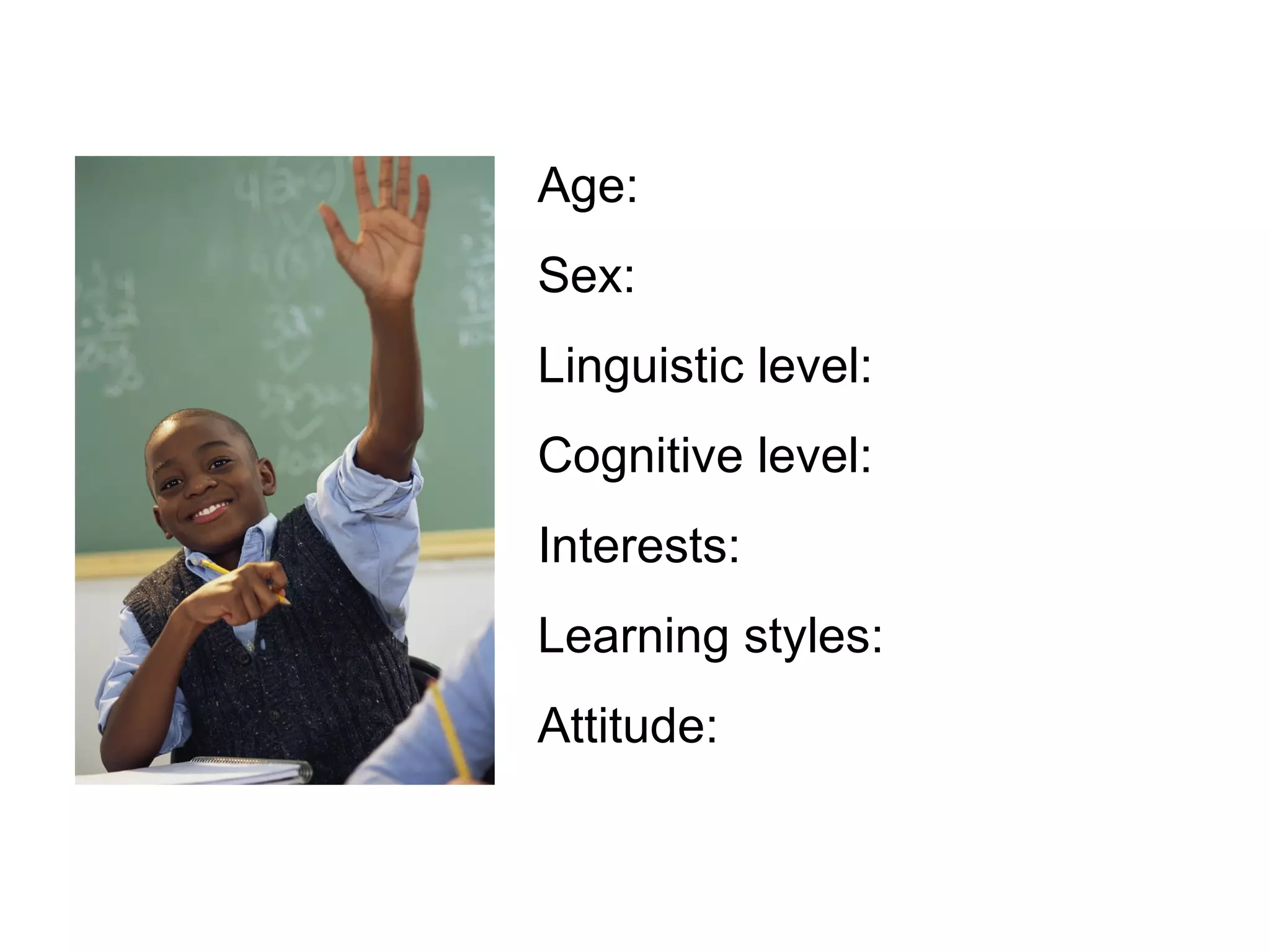
Age: Sex: Linguistic level: Cognitive level: Interests: Learning styles: Attitude:
Stimulate students Arouse students’ interest Catch students’ attention Cause an impact Engage students Promote interaction Produce a variety of activities
What am I teaching? Content? Functions? Language? Where is the learning taking place? How is the learning taking place? How much time do I have? What resources are available?
Type of input/output Video Audio Text Type of activity Introduction Practice Consolidation Type of control Teacher Student
User friendly On or off line Cost effective Secure Effective
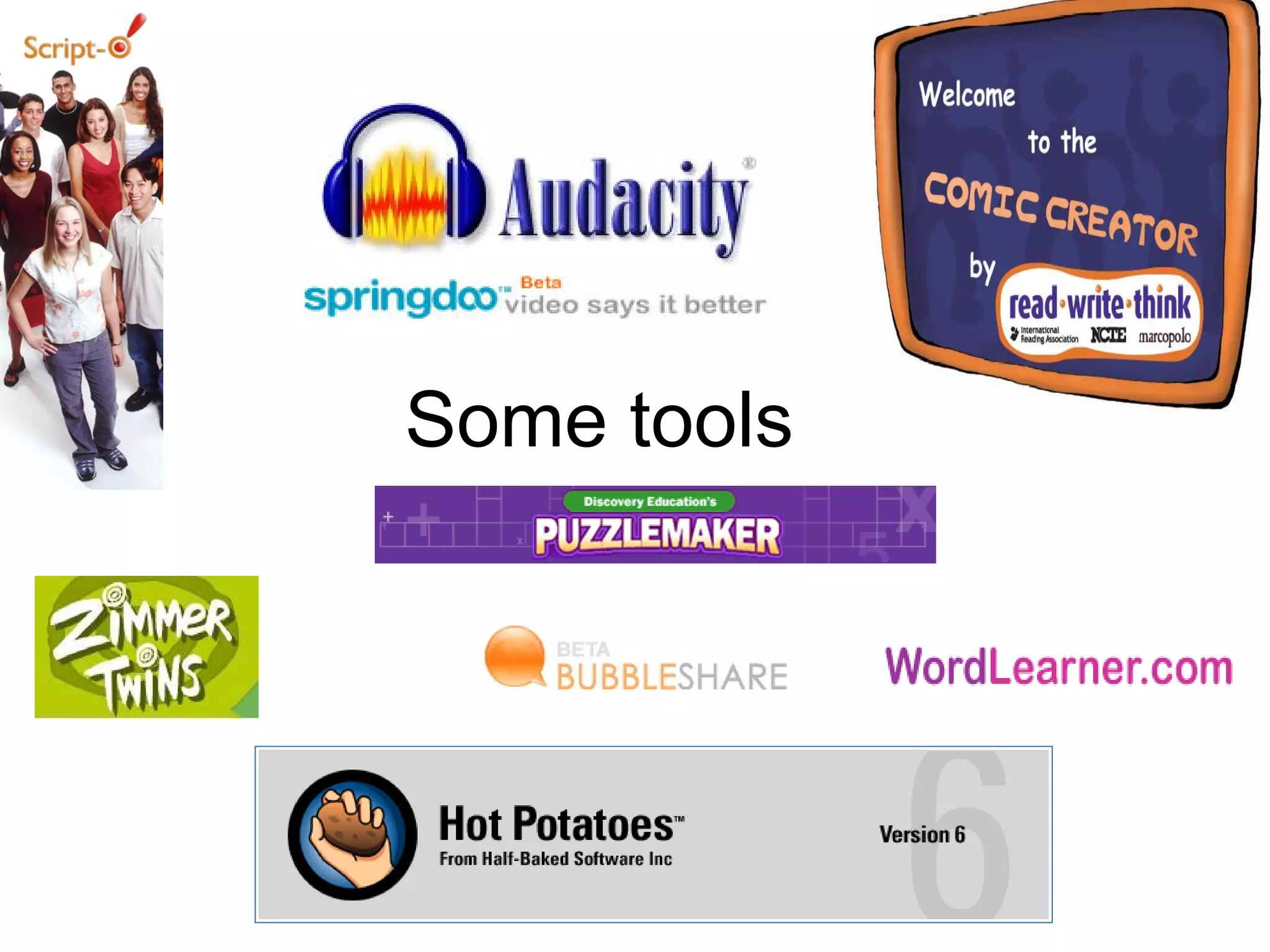
Some tools
Age group: ________________ Level: ______________ Microsoft image gallery Picture show (BubbleShare) Audio (Springdoo) Student initiated search Reports Oral:podcast Written:  Video  segment (beauty pageant) Audio (police  line up)  Describe people both orally and in writing.  Ask & answer questions…. Verbs: Adjectives:  Nouns:  Will they do what is required of them? Check instructions Exercise generator (Hot potatoes) Search engine (google) Voice recorder Vocabulary Labelling Drag & drop Matching  Games Guess who? Hang man (Images) Pictures Photos Flash cards Texts Use of adjectives nouns related to the topic Present simple tense To describe someone:  Physically Personality Problems  Tools Activities correspond Outcomes/ objectives Authentic material needed Learning Outcomes  Objectives
Traditional activities Open ended questions Multiple choice questions One correct answer Several correct answers True or False questions Cloze activities Fill-in-the-blanks Drag and drop Matching  Ordering  Input stimulus Visual   Text Drawing/Picture Video Aural   Music/lyrics of a song Recital of a poem Monologue Dialogue
The more creative side of things… Make, show and tell  Move over Spielberg! I’m afraid that I don’t agree with you there.
Some sites   Hotpotatoes:  http://hotpot.uvic.ca/ Script O:  http://www.readingmatrix.com/quizmaker/index.php Word learner:  http://www.wordlearner.com/ Audacity: http://audacity.sourceforge.net/ Springdoo: http://www.springdoo.com/ Voice thread:  http://voicethread.com/#home Splash cast:  http://web.splashcast.net/catalog/search.aspx Zimmer twins: http://www.abc.net.au/zimmertwins/ Comic creator: http://www.readwritethink.org/materials/comic/ Bubbleshare:  http://www.bubbleshare.com/ Discovery school educator:  http://puzzlemaker.discoveryeducation.com/
 

Materials Creation Rsl

  • 1.
  • 2.
  • 3.
  • 4.
  • 5.
  • 6.
  • 7.
    Good instructional materials: Based on theoretically sound learning principles. Use of prior knowledge. Cognitive Linguistic World knowledge Learning styles
  • 8.
  • 9.
    Good instructional materials: Arouse and maintain interest and attention .
  • 10.
    Good instructional materials: Provide examples of language use . “ ..the outcome of language learning depends on large measure on the amount and kind of exposure to the target language …” Spolsky, (1989)
  • 11.
    Good instructional materials: Create appropriate learning atmosphere “ a mental block, caused by affective factors ... that prevents input from reaching the language acquisition device.........” ( Krashen,1985 )
  • 12.
    Good instructional materials: Build confidence Use pair work Encourage interaction Use interesting activities Use “fun” activities
  • 13.
    Good instructional materials: Build confidence Give enough time Individual learner differences Give feedback Explicit Appropriate Individual Give encouragement
  • 14.
    Good instructional materials: Relevant to students and their needs . Variety of activities Allow student creativity Increase expectancy of success Grade level of difficulty
  • 15.
    Good instructional materials: Provide opportunities for interaction Negotiation of meaning Reformulations Formation of hypothesis Testing of hypothesis
  • 16.
    Good instructional materials: Provide involvement with authentic tasks Authentic tasks are those having the same types of cognitive challenges as complicated real-world tasks do. Egbert, Chin-chi Chao, & Hanson-Smith, (1999)
  • 17.
    Good instructional materials: Include a variety of tasks. Deep semantic level Problem solving Emotionally significant to learner Variety of language input Focus on meaning Focus on form
  • 18.
    Good instructional materials: Encourage learner autonomy. Teacher as facilitator Learner-centred Learner as decision maker Learner creates internal system
  • 19.
  • 20.
    Learning delivered almostanywhere at any time Materials easy to update Large number of resources available Ability to include multiple media Real-time content through video conferencing video streaming chat rooms
  • 21.
    Increased interaction Learnersand facilitators Learners and learners Learner centred Use of different learning styles Immediate feedback on progress
  • 22.
  • 23.
    Age: Sex: Linguisticlevel: Cognitive level: Interests: Learning styles: Attitude:
  • 24.
    Stimulate students Arousestudents’ interest Catch students’ attention Cause an impact Engage students Promote interaction Produce a variety of activities
  • 25.
    What am Iteaching? Content? Functions? Language? Where is the learning taking place? How is the learning taking place? How much time do I have? What resources are available?
  • 26.
    Type of input/outputVideo Audio Text Type of activity Introduction Practice Consolidation Type of control Teacher Student
  • 27.
    User friendly Onor off line Cost effective Secure Effective
  • 28.
  • 29.
    Age group: ________________Level: ______________ Microsoft image gallery Picture show (BubbleShare) Audio (Springdoo) Student initiated search Reports Oral:podcast Written: Video segment (beauty pageant) Audio (police line up) Describe people both orally and in writing. Ask & answer questions…. Verbs: Adjectives: Nouns: Will they do what is required of them? Check instructions Exercise generator (Hot potatoes) Search engine (google) Voice recorder Vocabulary Labelling Drag & drop Matching Games Guess who? Hang man (Images) Pictures Photos Flash cards Texts Use of adjectives nouns related to the topic Present simple tense To describe someone: Physically Personality Problems Tools Activities correspond Outcomes/ objectives Authentic material needed Learning Outcomes Objectives
  • 30.
    Traditional activities Openended questions Multiple choice questions One correct answer Several correct answers True or False questions Cloze activities Fill-in-the-blanks Drag and drop Matching Ordering Input stimulus Visual Text Drawing/Picture Video Aural Music/lyrics of a song Recital of a poem Monologue Dialogue
  • 31.
    The more creativeside of things… Make, show and tell Move over Spielberg! I’m afraid that I don’t agree with you there.
  • 32.
    Some sites Hotpotatoes: http://hotpot.uvic.ca/ Script O: http://www.readingmatrix.com/quizmaker/index.php Word learner: http://www.wordlearner.com/ Audacity: http://audacity.sourceforge.net/ Springdoo: http://www.springdoo.com/ Voice thread: http://voicethread.com/#home Splash cast: http://web.splashcast.net/catalog/search.aspx Zimmer twins: http://www.abc.net.au/zimmertwins/ Comic creator: http://www.readwritethink.org/materials/comic/ Bubbleshare: http://www.bubbleshare.com/ Discovery school educator: http://puzzlemaker.discoveryeducation.com/
  • 33.