How Do ITeach
Learners at the
PreK-3 Levels?
Angie Gugger
READ6706
Literacy Development, PreK-3
KnowYour Students…
Create opportunities to get to know your students.
Use both cognitive and non-cognitive forms of assessment to
guide your instruction.
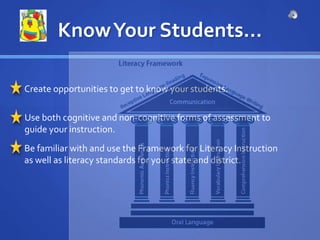
Be familiar with and use the Framework for Literacy Instruction
as well as literacy standards for your state and district.
Create a Literate Environment
Provide a print rich environment to communicate the
importance of literacy.
The environment sends a message to children about what we
value.
Provide areas in the classroom where students
can authentically practice new skills.
Environmental print must be attended to – make it functional
and useful.
SelectingTexts
At least half the books in an emergent classroom should be
informational.
For most of a student’s educational career, all the reading will be
non fiction and informational exclusively.
Majority of adult reading (85% or more) is informational text.
There are many myths associated with students and
informational texts.
Literacy Matrix
Consider mapping or plotting texts to help see the balance of
materials being used in the classroom.
Linguistic = word oriented Semiotic = communication other than words
Selecting and UsingTexts
Use read alouds because the language is more sophisticated
than in books at their independent level, fostering vocabulary
growth.
Use small group instruction when possible to give students the
opportunity to talk.
The Emergent Learner
Emergent learners learn so much from the people in their lives.
Phonemic Awareness is important. A rich oral language base is
very important.
Vocabulary growth comes from conversations and books read aloud.
Writing can promote reading development. Emergent learners
start with scribbling and pictures. Encourage these
early literacy activities.
The Beginning Learner
Phonemic Awareness and Phonics are still very important skills.
Fluency is more important in this stage. It is important for the
reader to practice reading real texts.
In order to build comprehension, continue reading aloud to
beginning learners because text at their independent level is still
not conceptually deep.
Encourage writing, but not revising and editing. Allow
beginning readers to dictate pictures and drawings.
References
Afflerbach, P. (2012). Understanding and using reading assessments: K–12 (2nd ed.).
Newark, DE: International Reading Association.
Laureate Education (Producer). (2014a). Analyzing and selecting text [Video file].
Baltimore, MD: author.
Laureate Education (Producer). (2014c). The beginning reader [Video file]. Baltimore,
MD: author.
Laureate Education (Producer). (2014h). Developing language and literacy [Video file].
Baltimore, MD: author.
Laureate Education (Producer). (2014k). Getting to know your students [Video file].
Baltimore, MD: author.
Reutzel, D. R., & Cooter, R. B. (2016). Strategies for reading assessment and
instruction: Helping every child succeed (5th ed.). Boston, MA: Pearson.

Digital Storytelling: Lessons Learned for Effective Teaching

  • 1.
    How Do ITeach Learnersat the PreK-3 Levels? Angie Gugger READ6706 Literacy Development, PreK-3
  • 2.
    KnowYour Students… Create opportunitiesto get to know your students. Use both cognitive and non-cognitive forms of assessment to guide your instruction. Be familiar with and use the Framework for Literacy Instruction as well as literacy standards for your state and district.
  • 3.
    Create a LiterateEnvironment Provide a print rich environment to communicate the importance of literacy. The environment sends a message to children about what we value. Provide areas in the classroom where students can authentically practice new skills. Environmental print must be attended to – make it functional and useful.
  • 4.
    SelectingTexts At least halfthe books in an emergent classroom should be informational. For most of a student’s educational career, all the reading will be non fiction and informational exclusively. Majority of adult reading (85% or more) is informational text. There are many myths associated with students and informational texts.
  • 5.
    Literacy Matrix Consider mappingor plotting texts to help see the balance of materials being used in the classroom. Linguistic = word oriented Semiotic = communication other than words
  • 6.
    Selecting and UsingTexts Useread alouds because the language is more sophisticated than in books at their independent level, fostering vocabulary growth. Use small group instruction when possible to give students the opportunity to talk.
  • 7.
    The Emergent Learner Emergentlearners learn so much from the people in their lives. Phonemic Awareness is important. A rich oral language base is very important. Vocabulary growth comes from conversations and books read aloud. Writing can promote reading development. Emergent learners start with scribbling and pictures. Encourage these early literacy activities.
  • 8.
    The Beginning Learner PhonemicAwareness and Phonics are still very important skills. Fluency is more important in this stage. It is important for the reader to practice reading real texts. In order to build comprehension, continue reading aloud to beginning learners because text at their independent level is still not conceptually deep. Encourage writing, but not revising and editing. Allow beginning readers to dictate pictures and drawings.
  • 9.
    References Afflerbach, P. (2012).Understanding and using reading assessments: K–12 (2nd ed.). Newark, DE: International Reading Association. Laureate Education (Producer). (2014a). Analyzing and selecting text [Video file]. Baltimore, MD: author. Laureate Education (Producer). (2014c). The beginning reader [Video file]. Baltimore, MD: author. Laureate Education (Producer). (2014h). Developing language and literacy [Video file]. Baltimore, MD: author. Laureate Education (Producer). (2014k). Getting to know your students [Video file]. Baltimore, MD: author. Reutzel, D. R., & Cooter, R. B. (2016). Strategies for reading assessment and instruction: Helping every child succeed (5th ed.). Boston, MA: Pearson.