The Basic Concepts of Conformal Coating  An examine of conformal coating materials available today and how they perform  
Summary Definition of a Conformal coating What the coating actually does Why coatings are used The types of coating available How to select a coating How a coating is applied How to test for performance
Definition of a Conformal coating It is a thin plastic protective film  “ conforms” to the surface of an electronic circuit assembly. It is a breathing membrane that filters water vapour and solid debris Protects the assembly from corrosion in harsh environments.
Definition of a Conformal coating Nominally, the coating should be 0.001” to 0.008” thick (25 to 200µm) Too thick may cause problems such as solvent entrapment, bubbling, shrinkage and cracking. Too thin means inadequate protection
What the coating actually does Improves reliability in humid environments Reduces need to hermetically seal PCB Reduces conductor spacing’s on PCB Protects the PCB in aggressive environment Protects the PCB against environmental particulates
What the coating actually does Good dielectrics Insulation & Moisture resistance Breakdown voltage Good flexibility so as not to stress components Be Repairable
Is the coating waterproof?   NO! All coatings breathe. However, i t seals IN AS WELL AS OUT Coatings permit air, which may contain moisture, to migrate in and out through the film. If there is a soluble contaminant on the surface beneath the coating, then this may cause osmosis.
Why coatings are used  If your circuit is: High-reliability and /or safety critical Are operating in an aggressive environment Fine line, fine pitch There may be problems with long term reliability
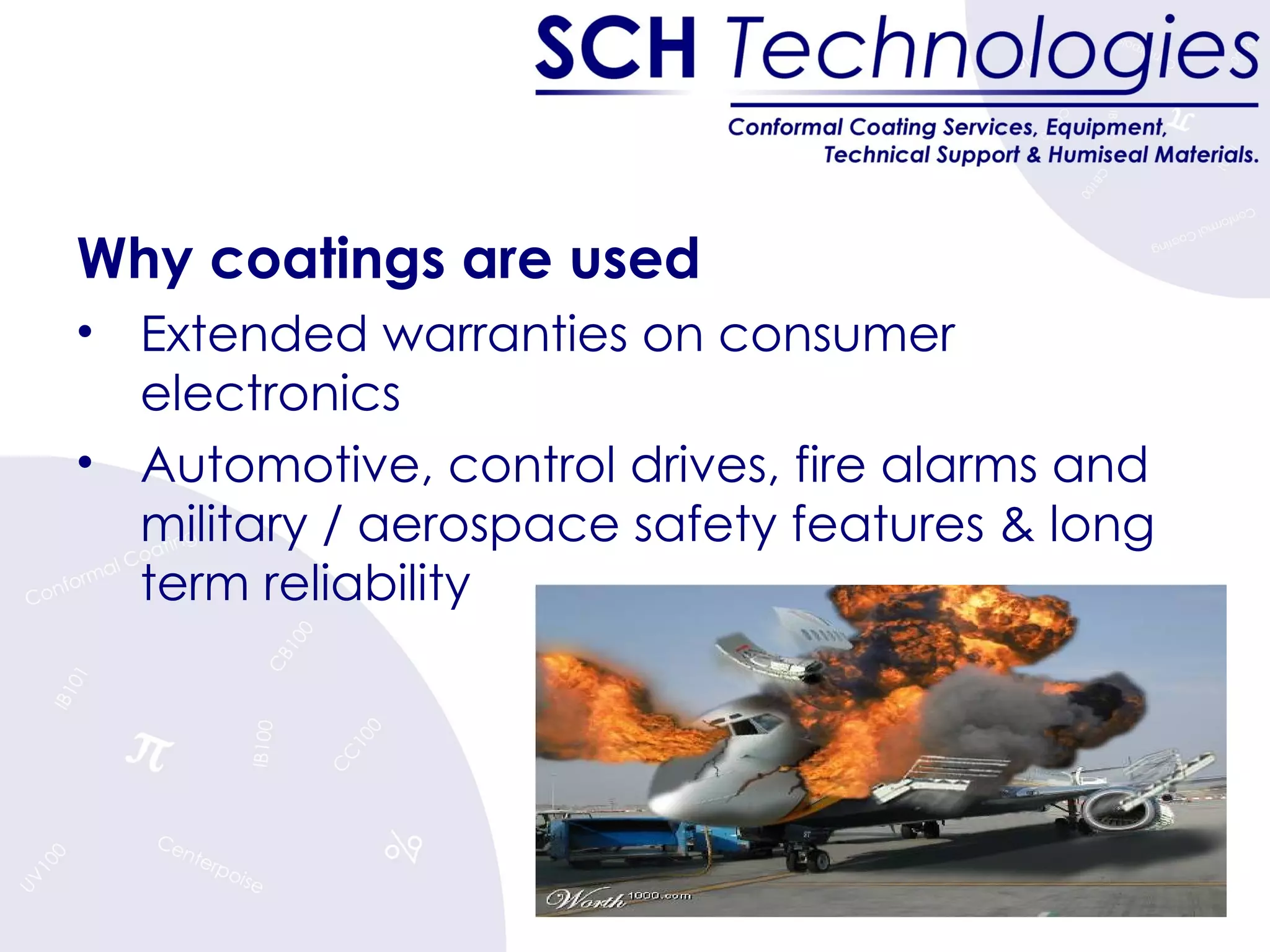
Why coatings are used  Extended warranties on consumer electronics Automotive, control drives, fire alarms and military / aerospace safety features & long term reliability
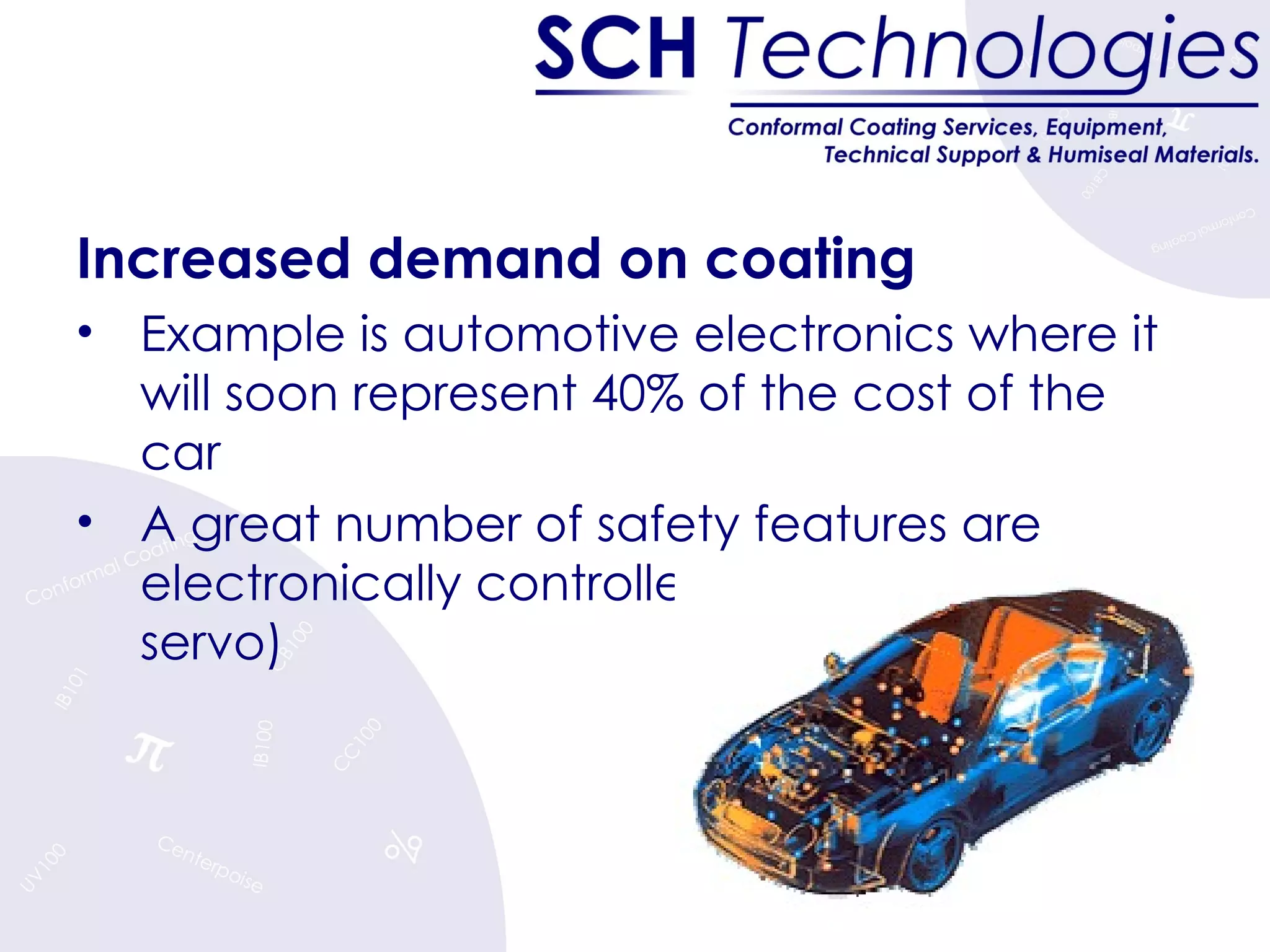
Increased demand on coating Example is automotive electronics where it will soon represent 40% of the cost of the car A great number of safety features are electronically controlled (ABS, airbag, servo)
The types of coatings available Acrylics Polyurethanes Epoxies Silicones Paraxylylenes Fluorocarbon
Acrylic Conformal Coatings AR Represent 80% of market Single component materials Excellent Moisture resistance Easy to apply Cure very quickly Easy to repair by removal with solvent
Acrylic Conformal Coatings AR Especially suitable for: Any application ‘in a box’ Boards with long service life Any environment where water is main threat Any environment without solvent exposure
Acrylic Conformal Coatings AR Examples of use include: Engine management Air bag controllers Avionics Communication Equipment Elevator Controls
Polyurethane Conformal Coatings  UR Very good solvent resistance 1 and 2 part systems Easy to apply Longer cure times Difficult to repair
Polyurethane Conformal Coatings  UR Especially suitable for: Salt Spray protection Applications where solvent resistance required Directly mounted assemblies Reparability is not an issue
Silicone Conformal Coatings SR Excellent High Temperature Performance Limited solvent resistance Solventless Products Harder to apply Can be difficult to cure Nearly impossible to repair EXPENSIVE
Silicone Conformal Coatings SR OVERKILL for all but specialist applications Used in: Huge, industrial drilling/mining equipment High temperature electronics  Under bonnet electronics
Epoxy Conformal Coatings ER Good moisture resistance Good dielectric resistance Excellent chemical resistance Excellent temperature resistance Poor flexibility Poor to repair
Paraxylylene Conformal Coatings XY Excellent moisture resistance Excellent dielectric resistance Excellent chemical resistance Excellent temperature resistance High cost of process Critical processing
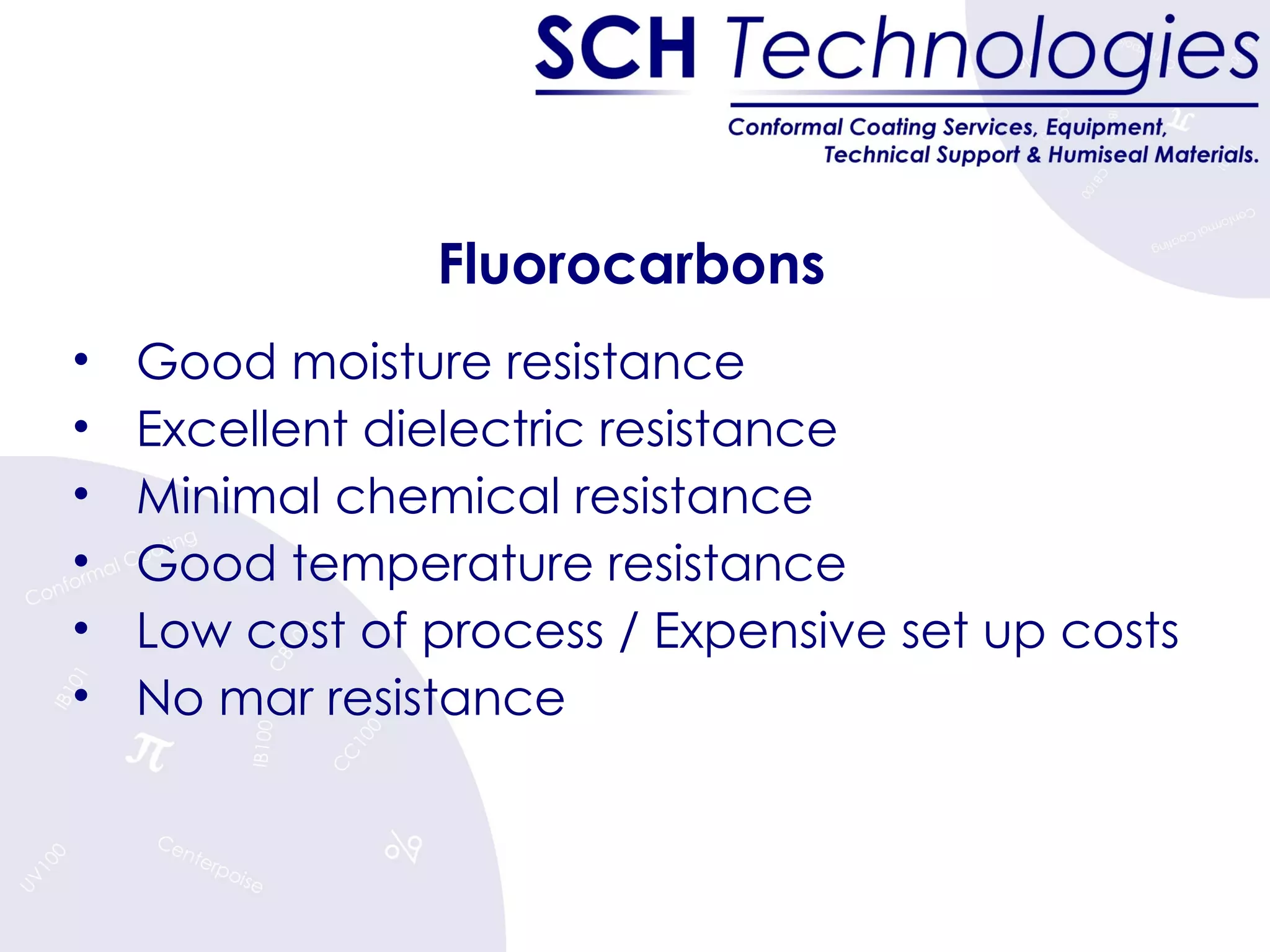
Fluorocarbons Good moisture resistance Excellent dielectric resistance Minimal chemical resistance Good temperature resistance Low cost of process / Expensive set up costs No mar resistance
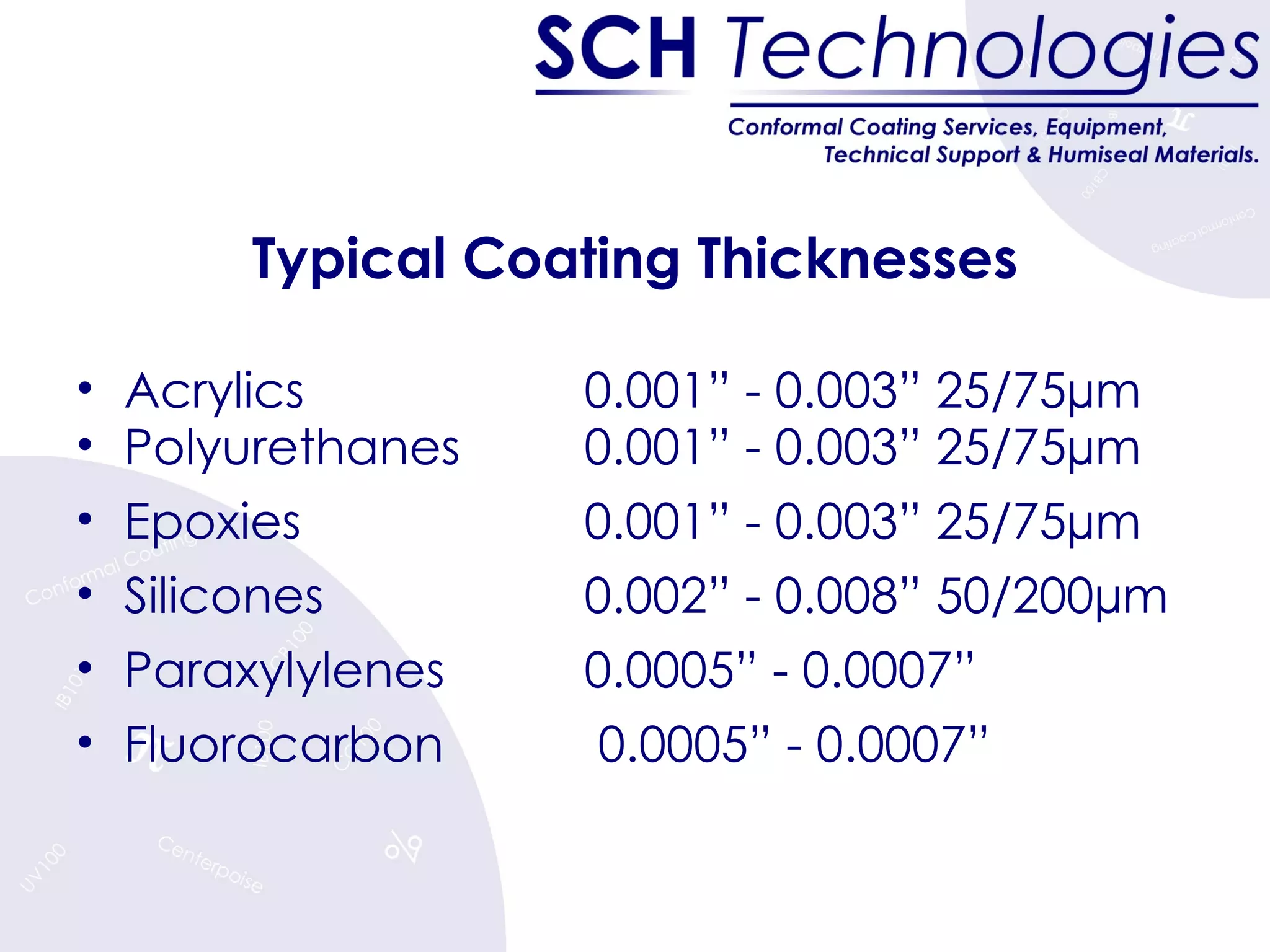
Typical Coating Thicknesses Acrylics 0.001” - 0.003” 25/75µm Polyurethanes 0.001” - 0.003” 25/75µm Epoxies 0.001” - 0.003” 25/75µm Silicones 0.002” - 0.008” 50/200µm Paraxylylenes 0.0005” - 0.0007” Fluorocarbon  0.0005” - 0.0007”
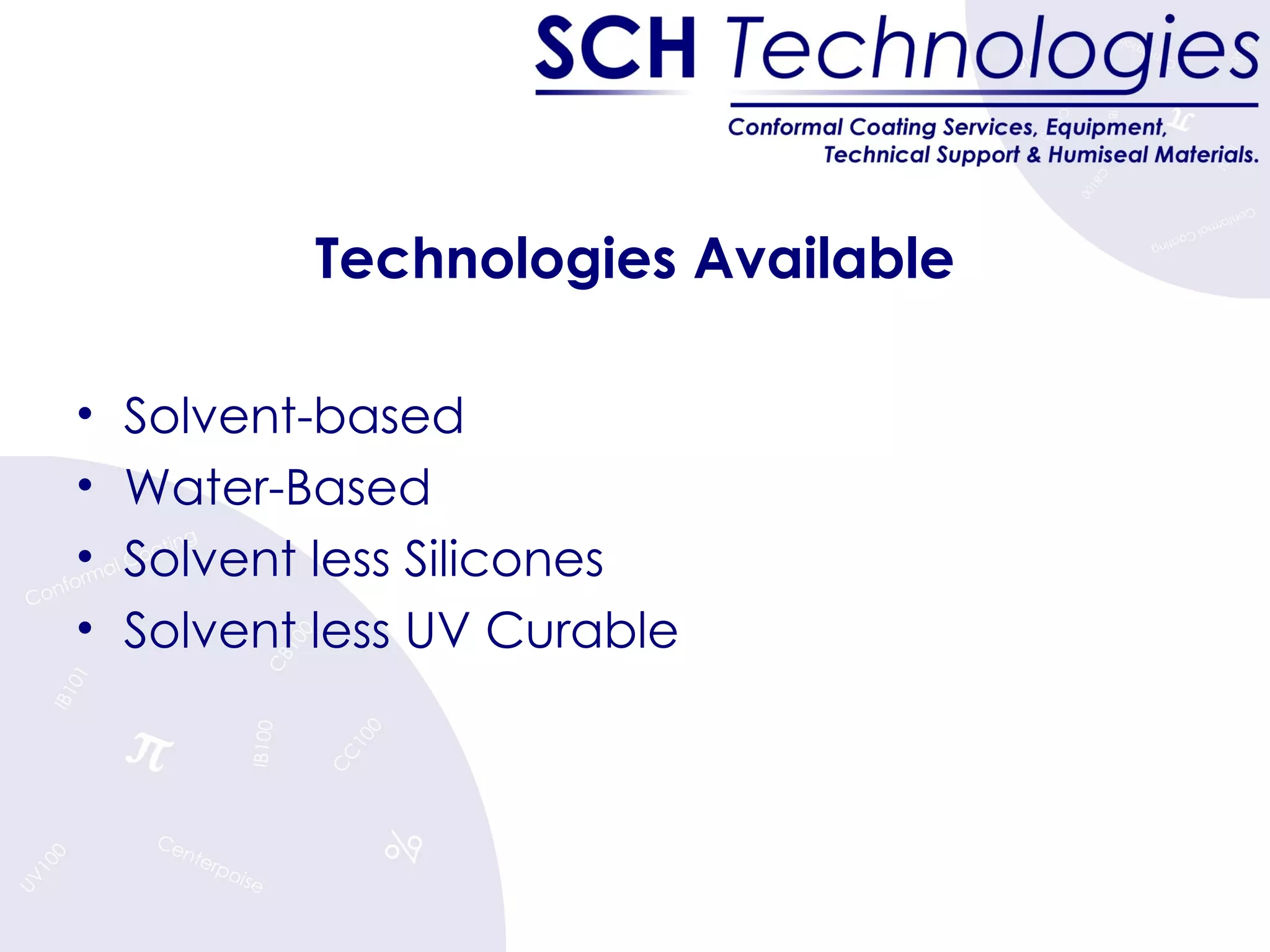
Technologies Available Solvent-based Water-Based Solvent less Silicones Solvent less UV Curable
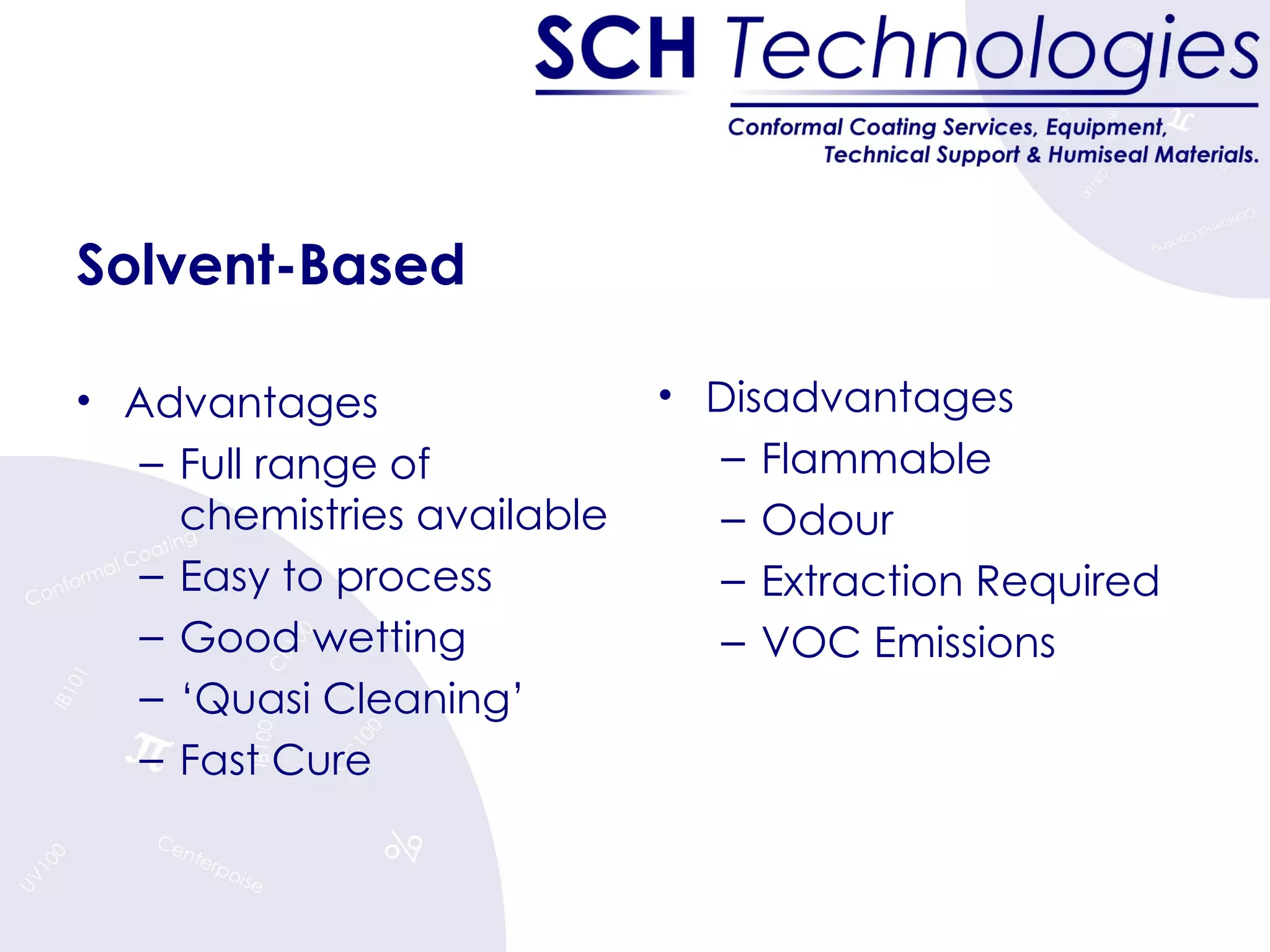
Solvent-Based Advantages Full range of chemistries available Easy to process Good wetting ‘ Quasi Cleaning’ Fast Cure Disadvantages Flammable Odour Extraction Required VOC Emissions
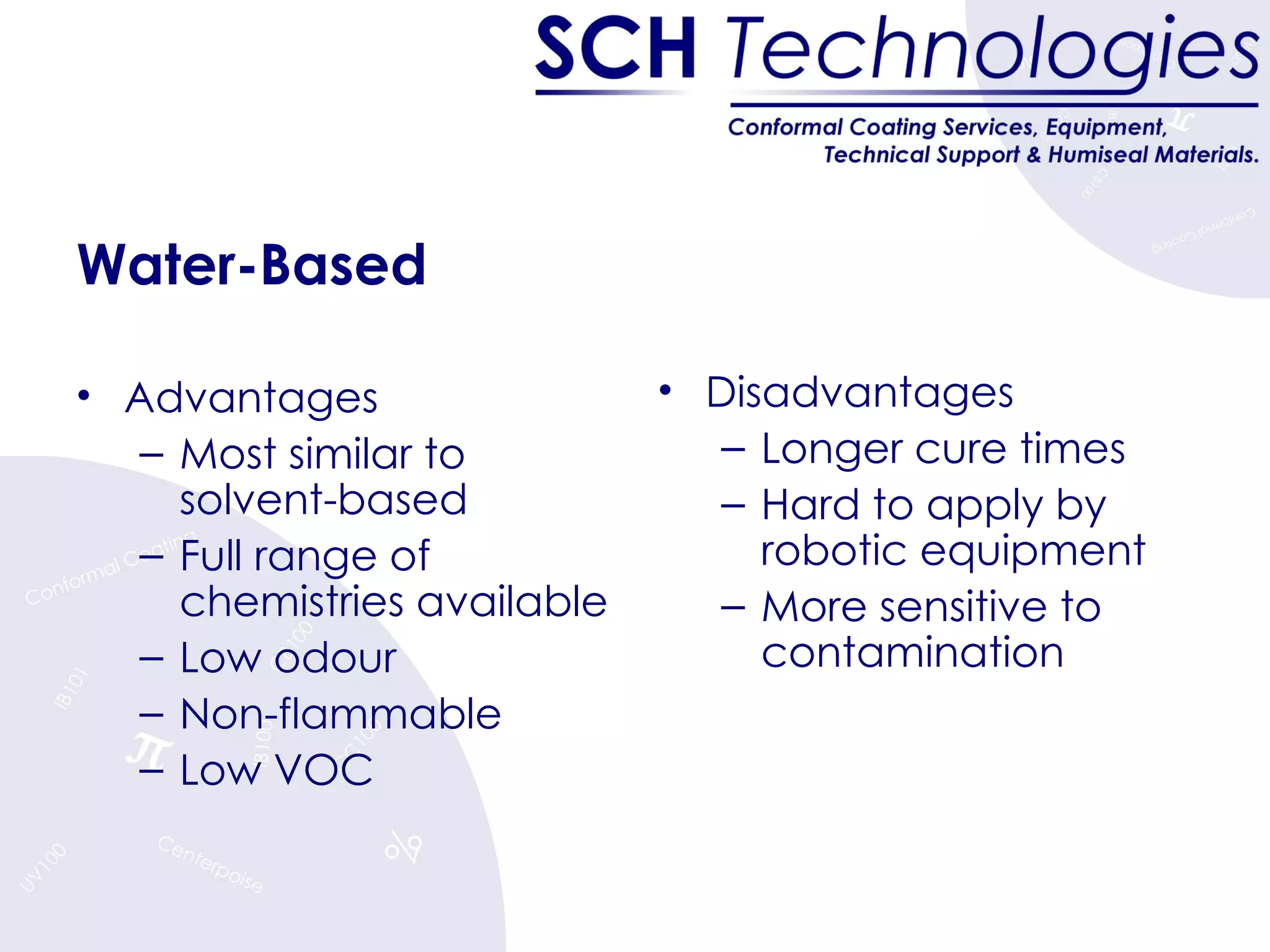
Water-Based Advantages Most similar to solvent-based Full range of chemistries available Low odour Non-flammable Low VOC Disadvantages Longer cure times Hard to apply by robotic equipment More sensitive to contamination
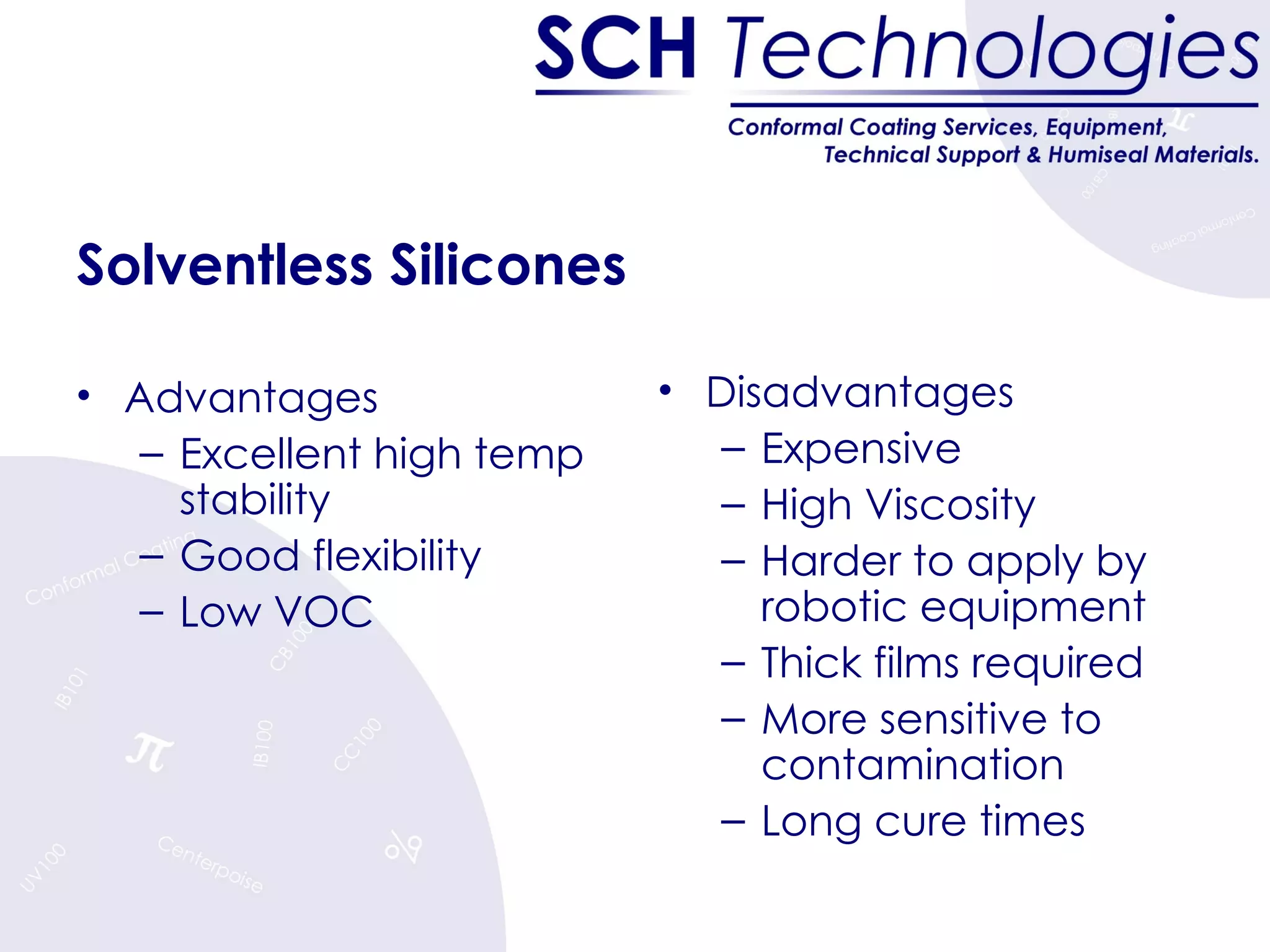
Solventless Silicones Advantages Excellent high temp stability Good flexibility Low VOC Disadvantages Expensive High Viscosity Harder to apply by robotic equipment Thick films required More sensitive to contamination Long cure times
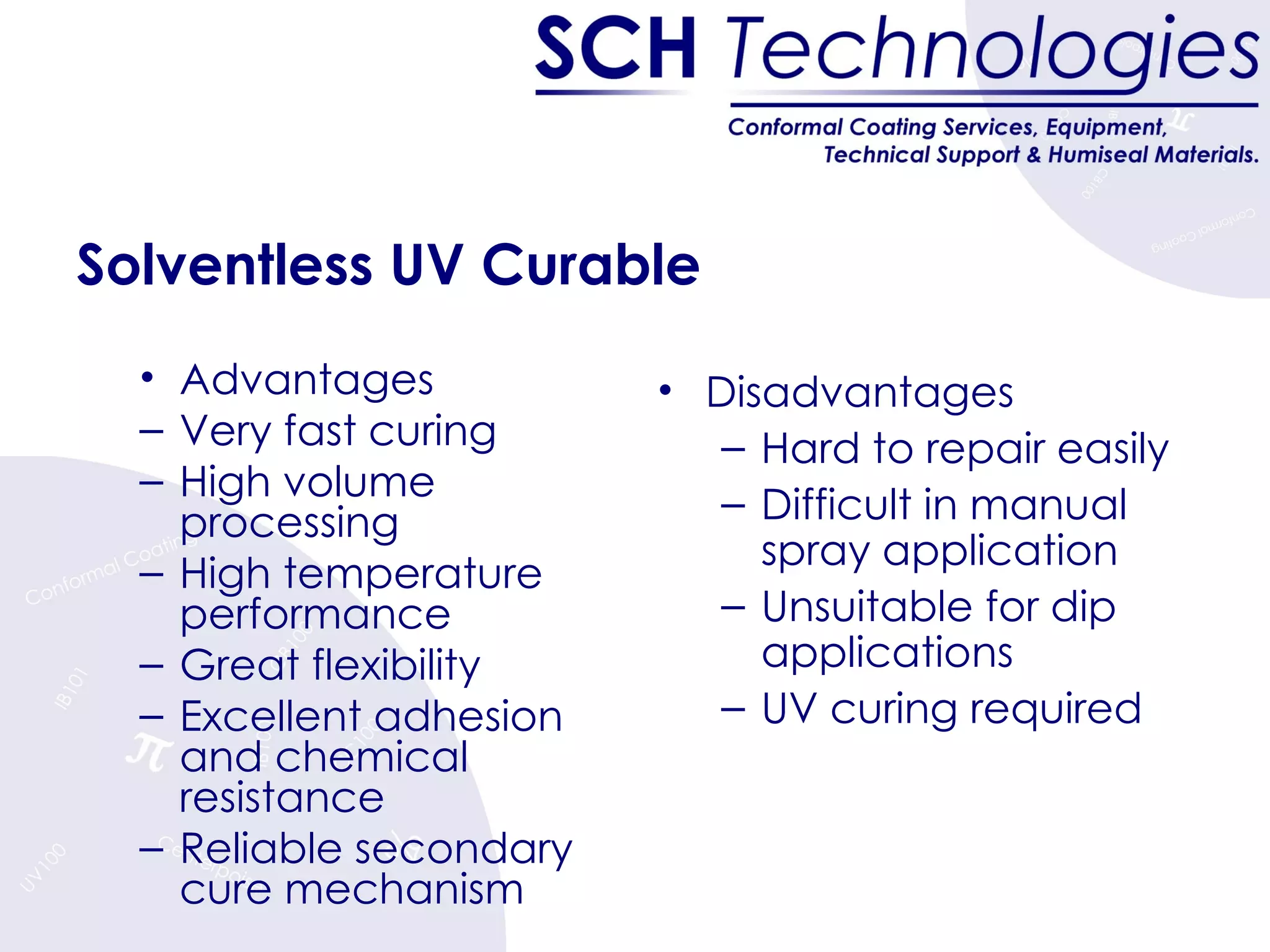
Solventless UV Curable Advantages Very fast curing High volume processing High temperature performance Great flexibility Excellent adhesion and chemical resistance Reliable secondary cure mechanism Disadvantages Hard to repair easily Difficult in manual spray application Unsuitable for dip applications UV curing required
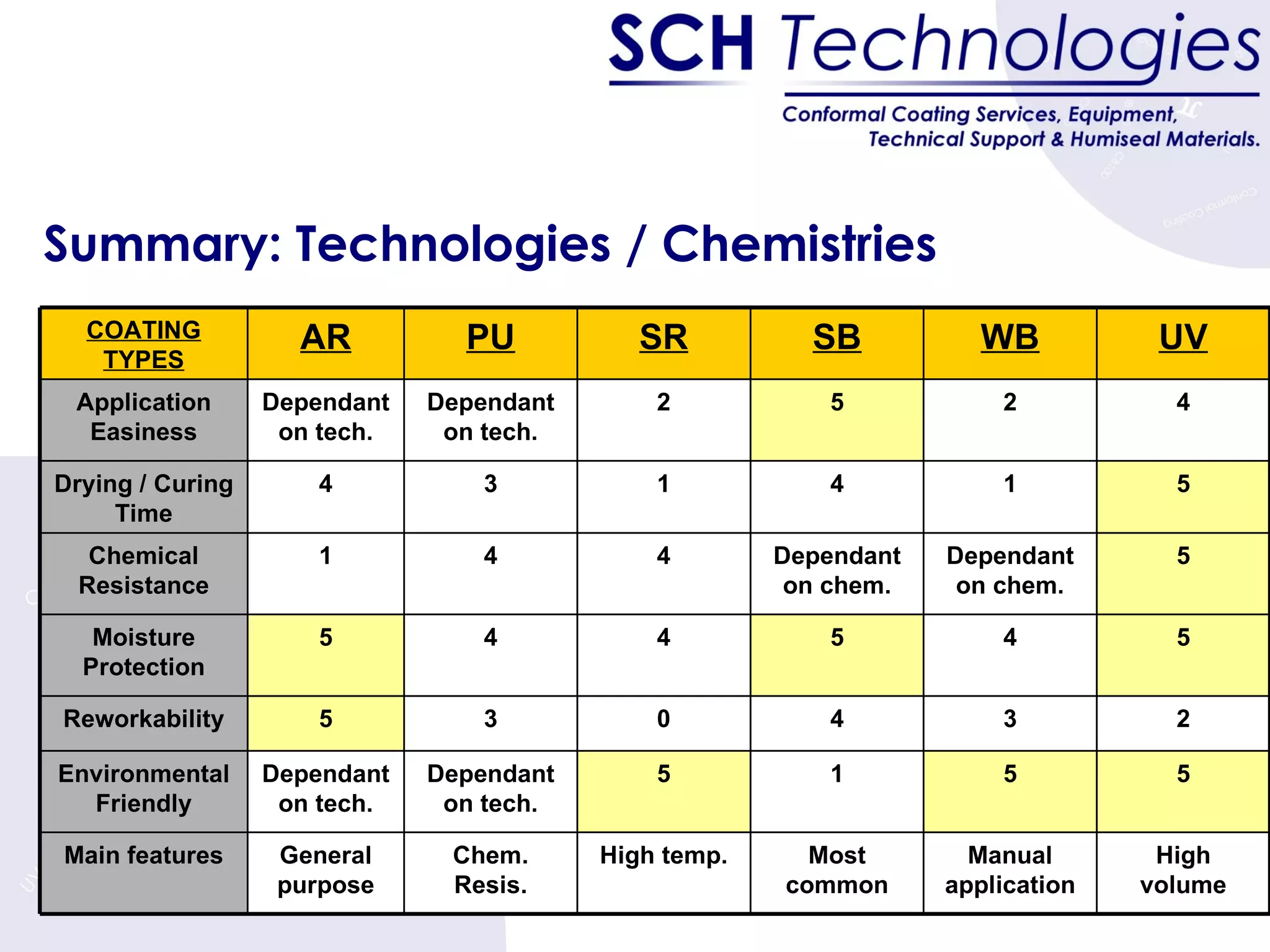
Summary: Technologies / Chemistries COATING TYPES AR PU SR SB WB UV Application Easiness Dependant on tech. Dependant on tech. 2 5 2 4 Drying / Curing Time 4 3 1 4 1 5 Chemical Resistance 1 4 4 Dependant on chem. Dependant on chem. 5 Moisture Protection 5 4 4 5 4 5 Reworkability 5 3 0 4 3 2 Environmental Friendly Dependant on tech. Dependant on tech. 5 1 5 5 Main features General purpose Chem. Resis. High temp. Most common Manual application High volume
Humiseal Product Range & Codes
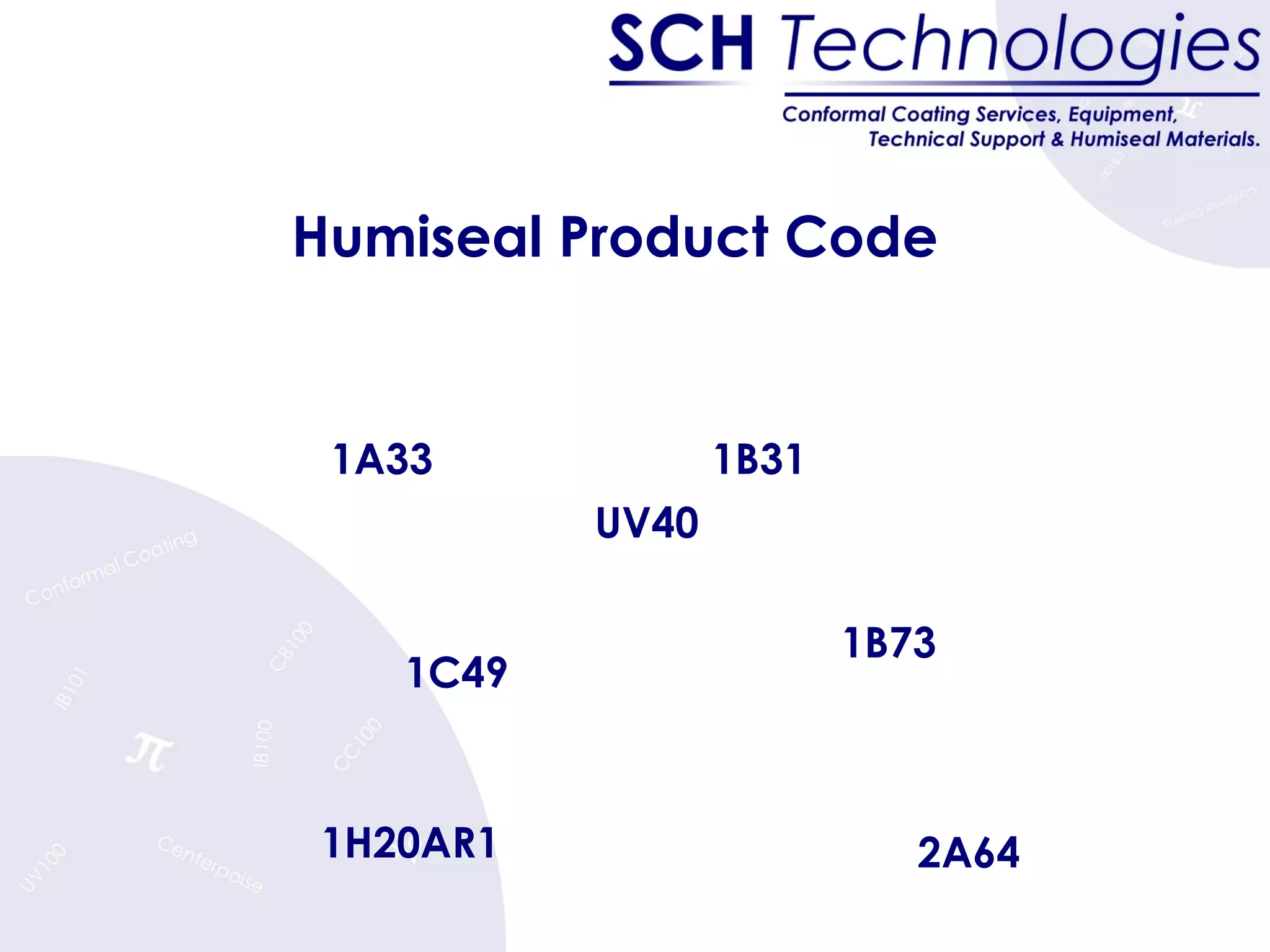
Humiseal Product Code  1A33 1B31 1C49 1H20AR1 1B73 2A64 UV40
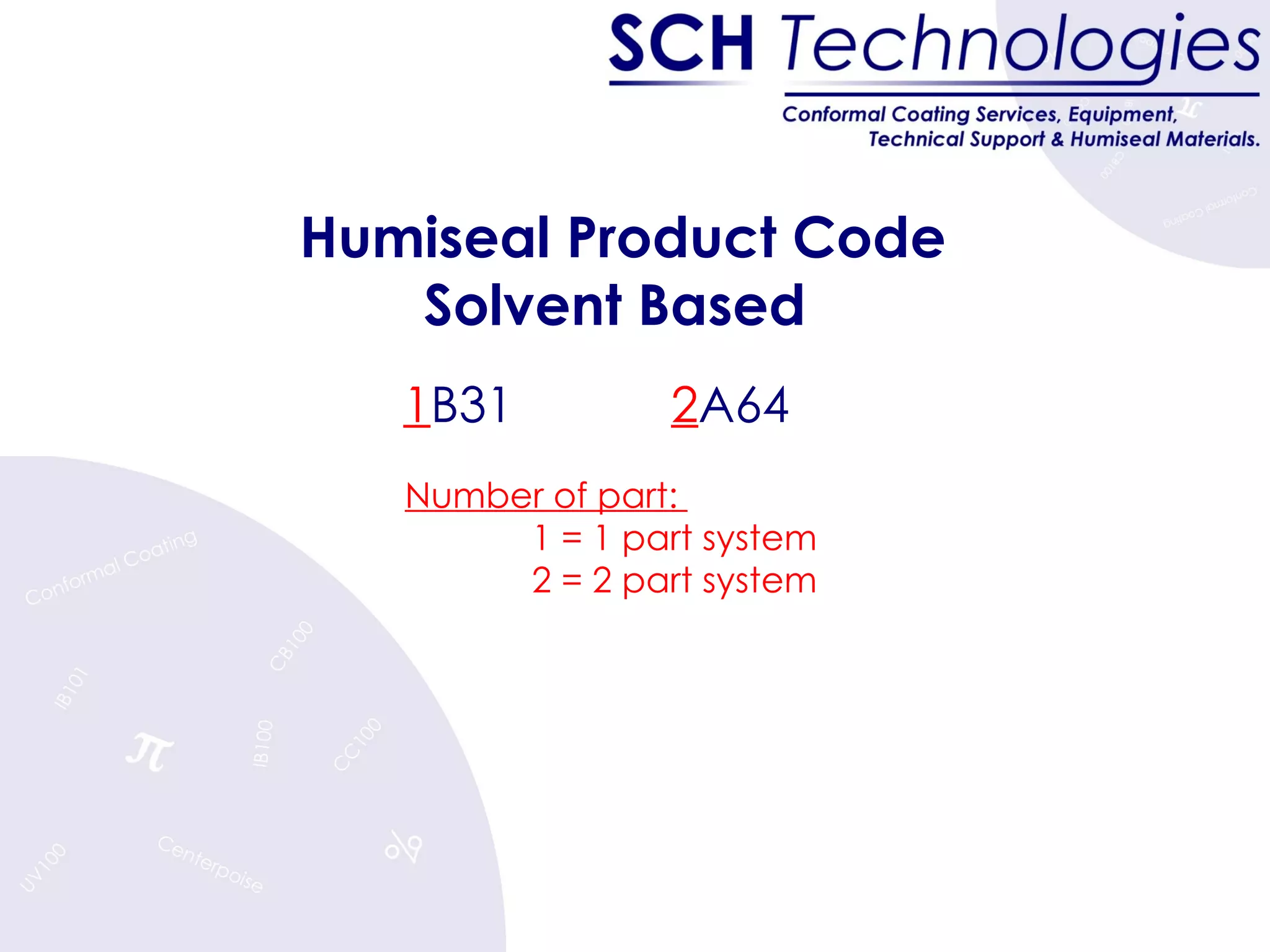
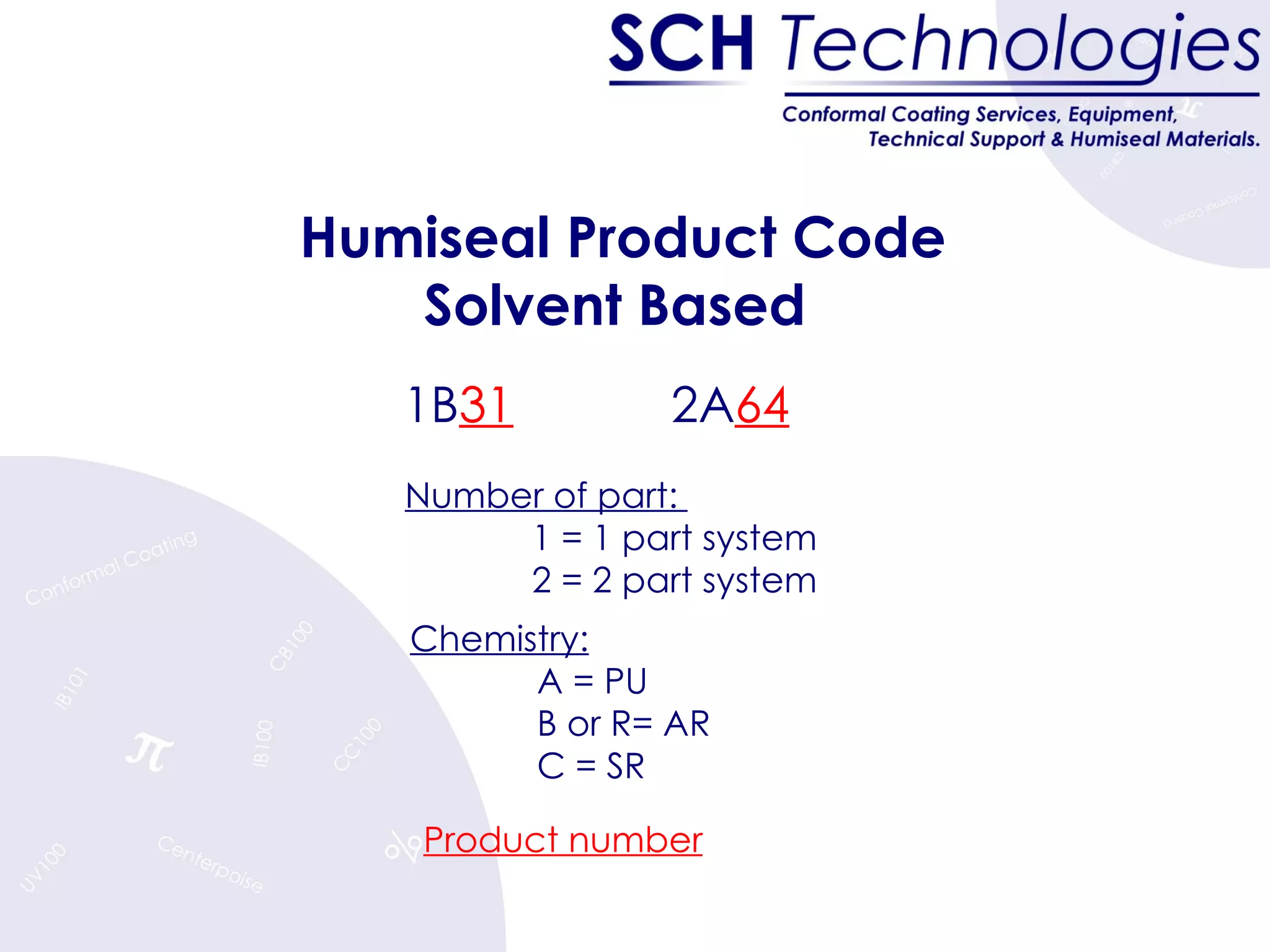
Humiseal Product Code Solvent Based  Number of part:  1 = 1 part system 2 = 2 part system 1 B31   2 A64
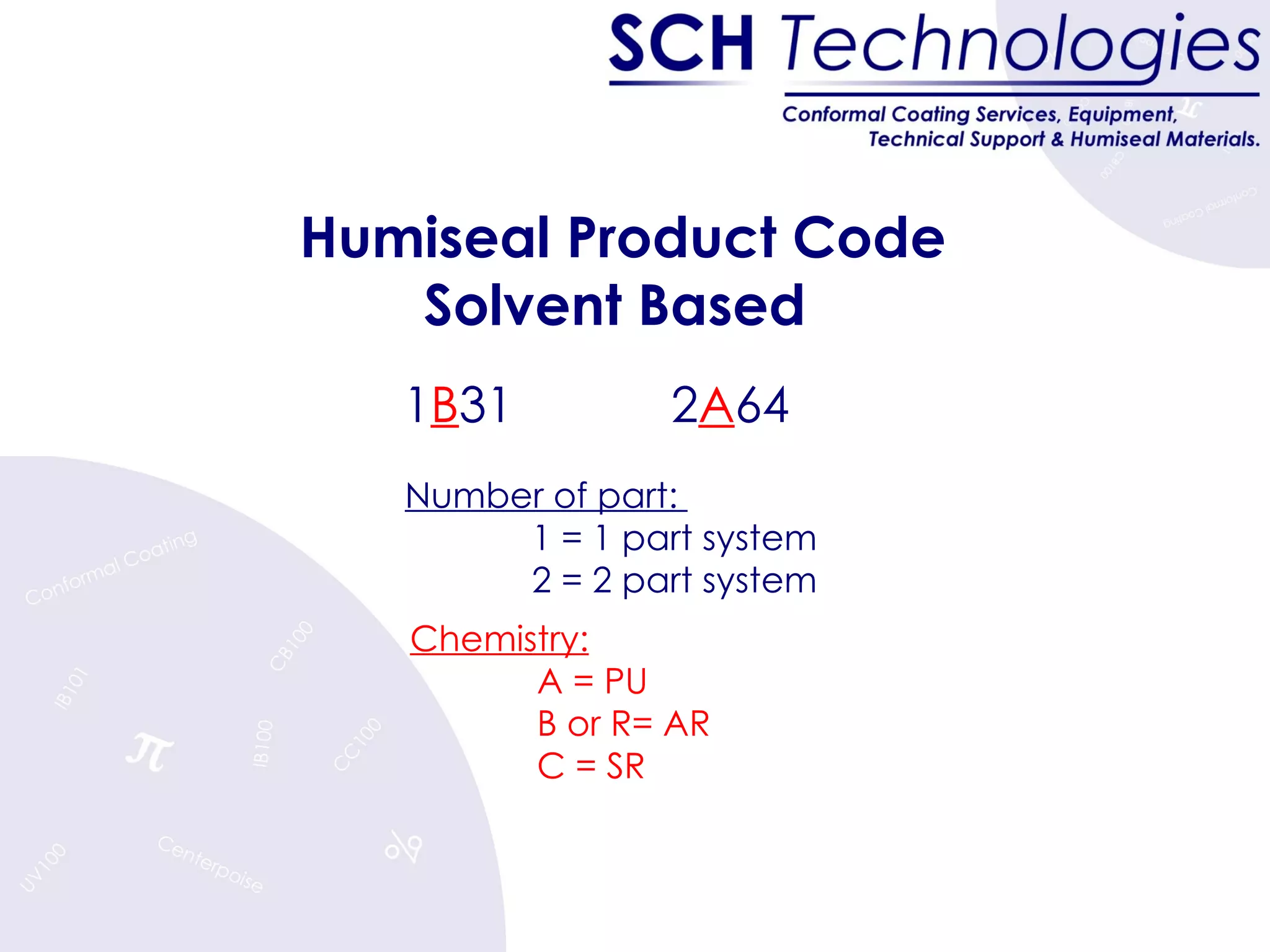
Humiseal Product Code Solvent Based  Number of part:  1 = 1 part system 2 = 2 part system 1 B 31  2 A 64  Chemistry:   A = PU B or R= AR C = SR
Humiseal Product Code Solvent Based  Number of part:  1 = 1 part system 2 = 2 part system 1B 31  2A 64   Chemistry:   A = PU B or R= AR C = SR Product number
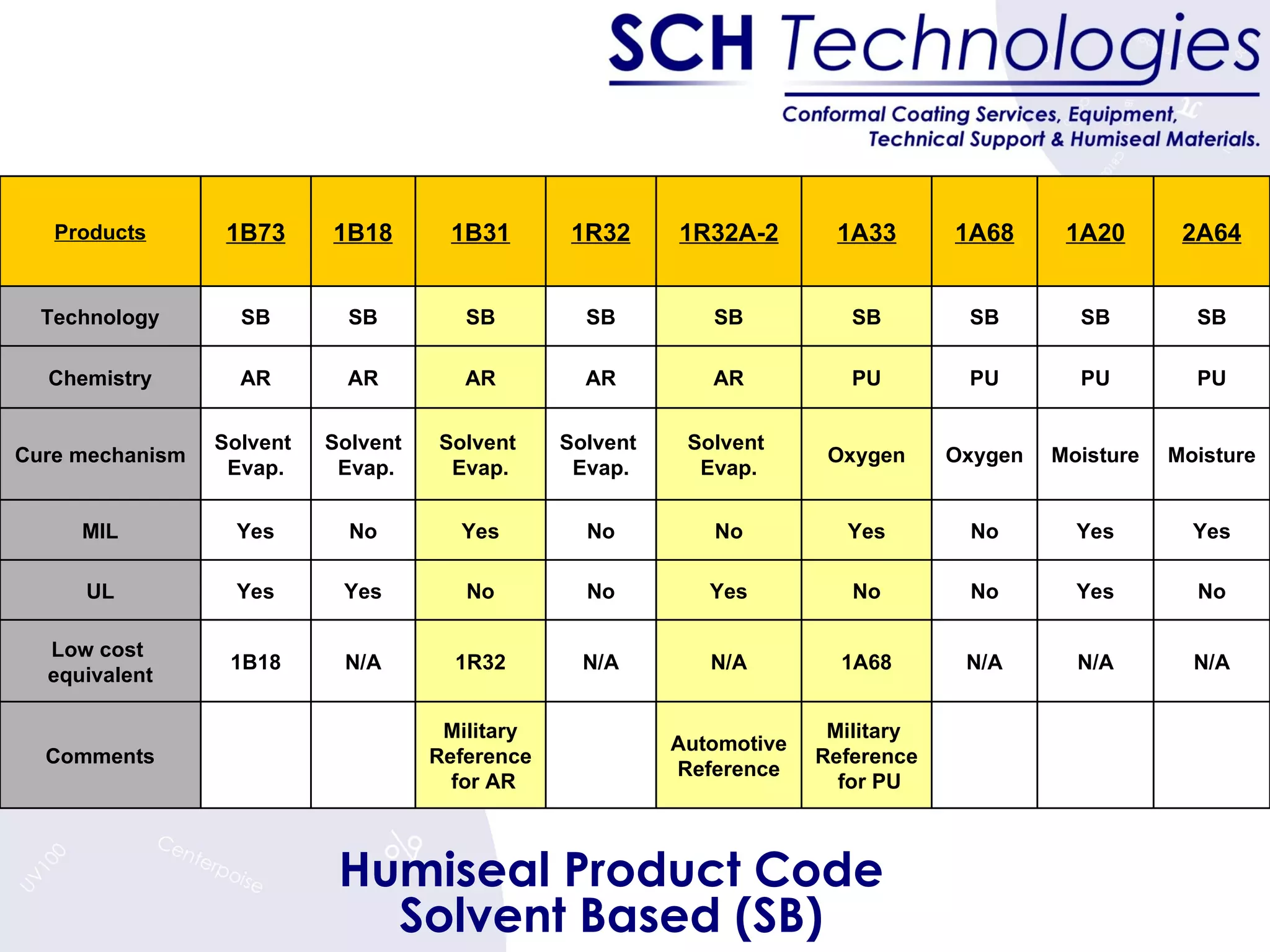
Humiseal Product Code Solvent Based (SB) Products 1B73 1B18 1B31 1R32 1R32A-2 1A33 1A68 1A20 2A64 Technology SB SB SB SB SB SB SB SB SB Chemistry AR AR AR AR AR PU PU PU PU Cure mechanism Solvent  Evap. Solvent Evap. Solvent  Evap. Solvent  Evap. Solvent  Evap. Oxygen Oxygen Moisture Moisture MIL Yes No Yes No No Yes No Yes Yes UL Yes Yes No No Yes No No Yes No Low cost  equivalent 1B18 N/A 1R32 N/A N/A 1A68 N/A N/A N/A Comments Military Reference for AR Automotive Reference Military  Reference for PU
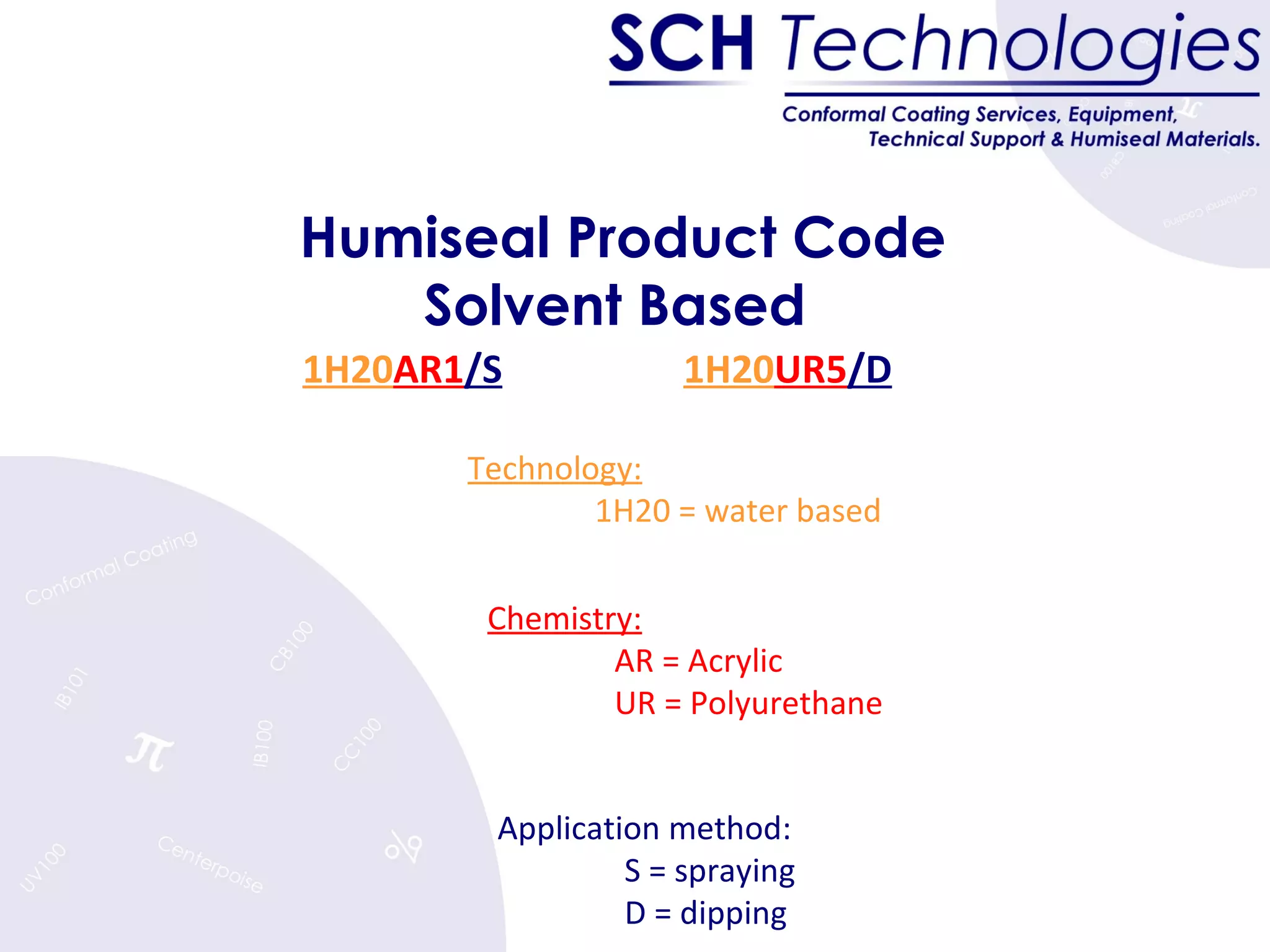
Humiseal Product Code Solvent Based  1H20 AR1 /S 1H20 UR5 /D   Technology: 1H20 = water based Chemistry:   AR = Acrylic UR = Polyurethane Application method: S = spraying D = dipping
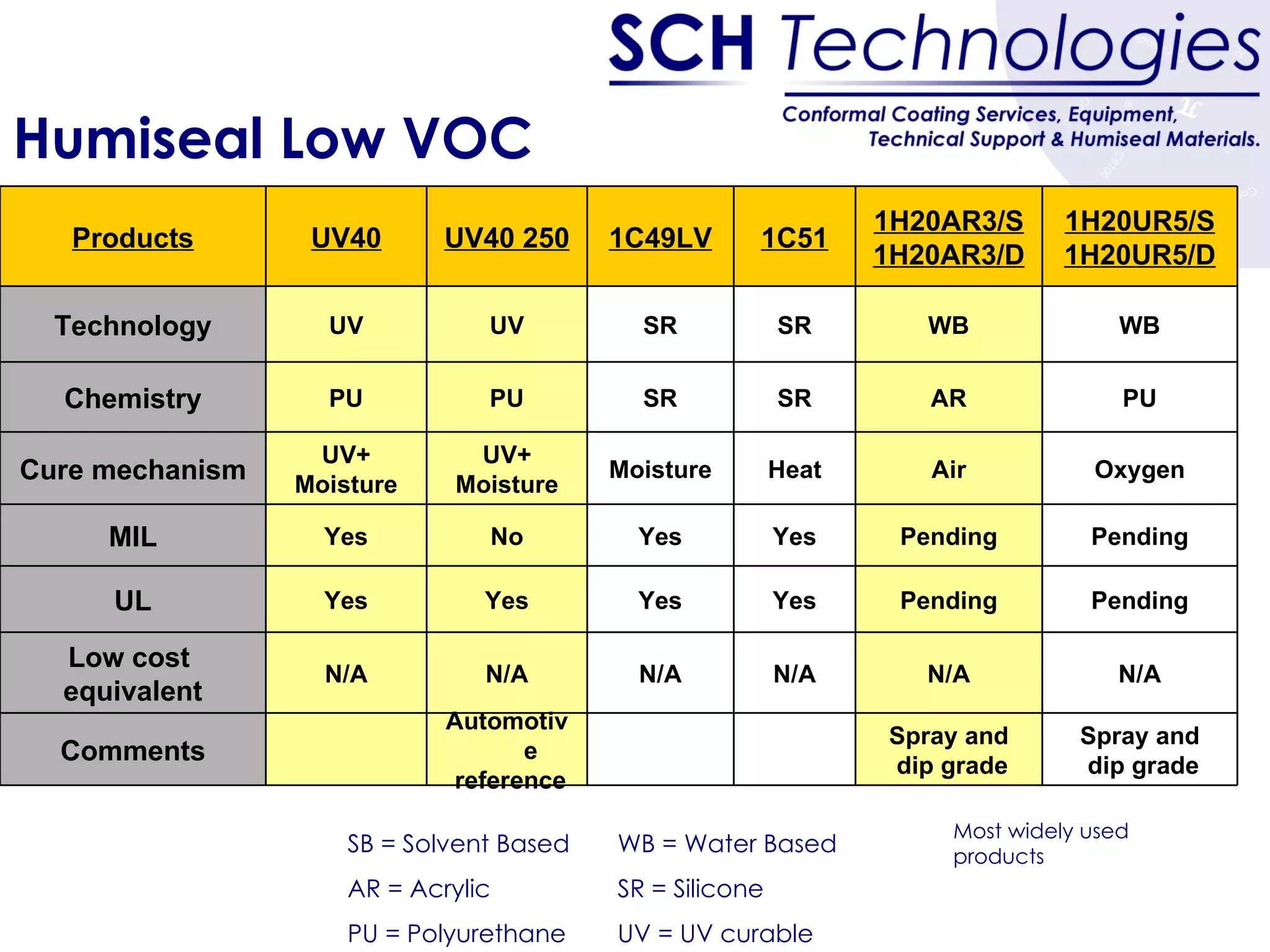
Humiseal Low VOC SB = Solvent Based AR = Acrylic PU = Polyurethane WB = Water Based SR = Silicone UV = UV curable Most widely used products Products UV40 UV40 250 1C49LV 1C51 1H20AR3/S 1H20AR3/D 1H20UR5/S 1H20UR5/D Technology UV UV SR SR WB WB Chemistry PU PU SR SR AR PU Cure mechanism UV+ Moisture UV+ Moisture Moisture Heat Air Oxygen MIL Yes No Yes Yes Pending Pending UL Yes Yes Yes Yes Pending Pending Low cost  equivalent N/A N/A N/A N/A N/A N/A Comments Automotive reference Spray and dip grade Spray and dip grade
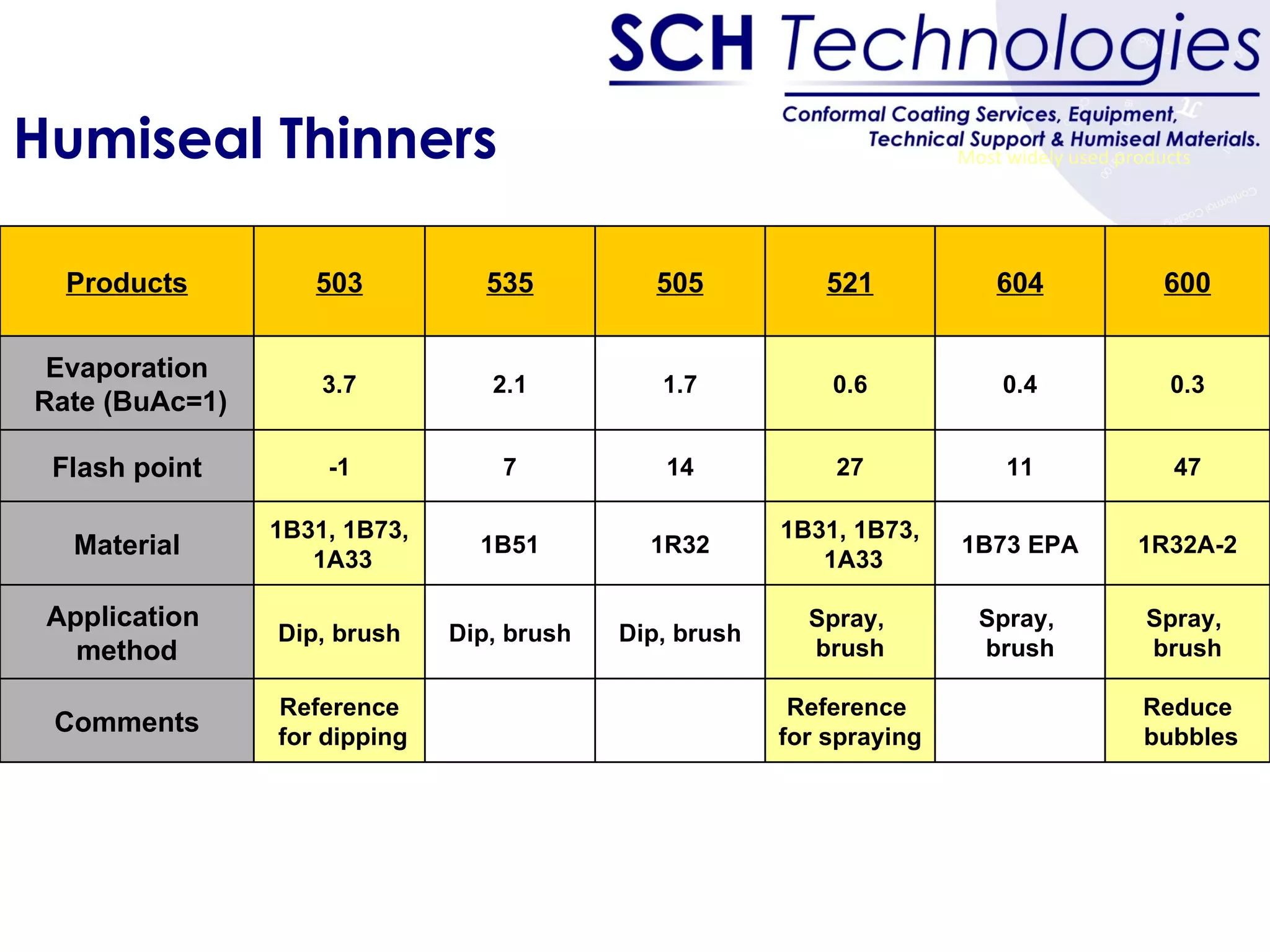
Humiseal Thinners Most widely used products Products 503 535 505 521 604 600 Evaporation Rate (BuAc=1) 3.7 2.1 1.7 0.6 0.4 0.3 Flash point -1 7 14 27 11 47 Material 1B31, 1B73, 1A33 1B51 1R32 1B31, 1B73, 1A33 1B73 EPA 1R32A-2 Application  method Dip, brush Dip, brush Dip, brush Spray,  brush Spray,  brush Spray,  brush Comments Reference for dipping Reference  for spraying Reduce bubbles
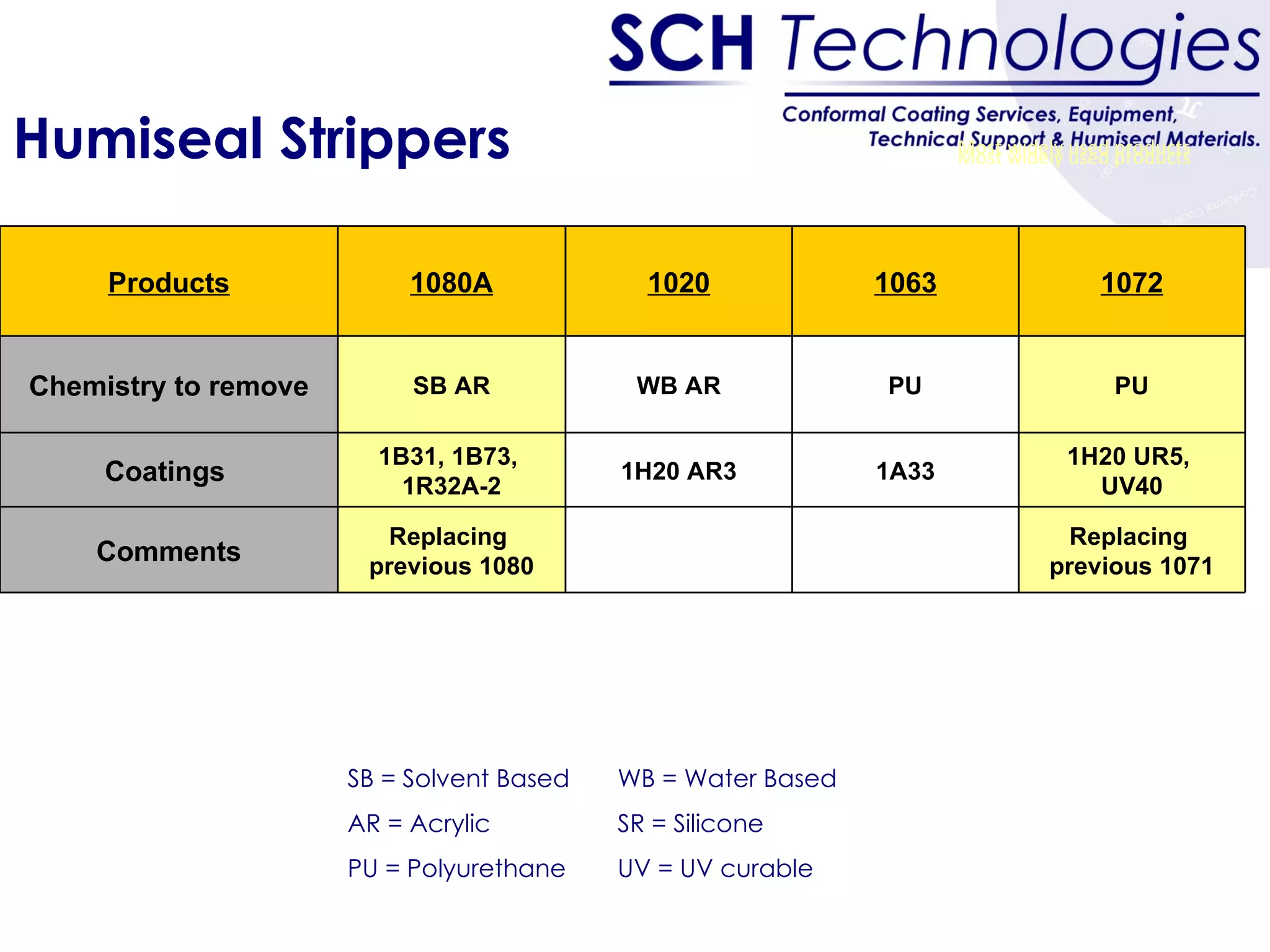
Humiseal Strippers Most widely used products SB = Solvent Based AR = Acrylic PU = Polyurethane WB = Water Based SR = Silicone UV = UV curable Most widely used products Products 1080A 1020 1063 1072 Chemistry to remove SB AR WB AR PU PU Coatings  1B31, 1B73,  1R32A-2 1H20 AR3 1A33 1H20 UR5,  UV40 Comments Replacing  previous 1080 Replacing  previous 1071
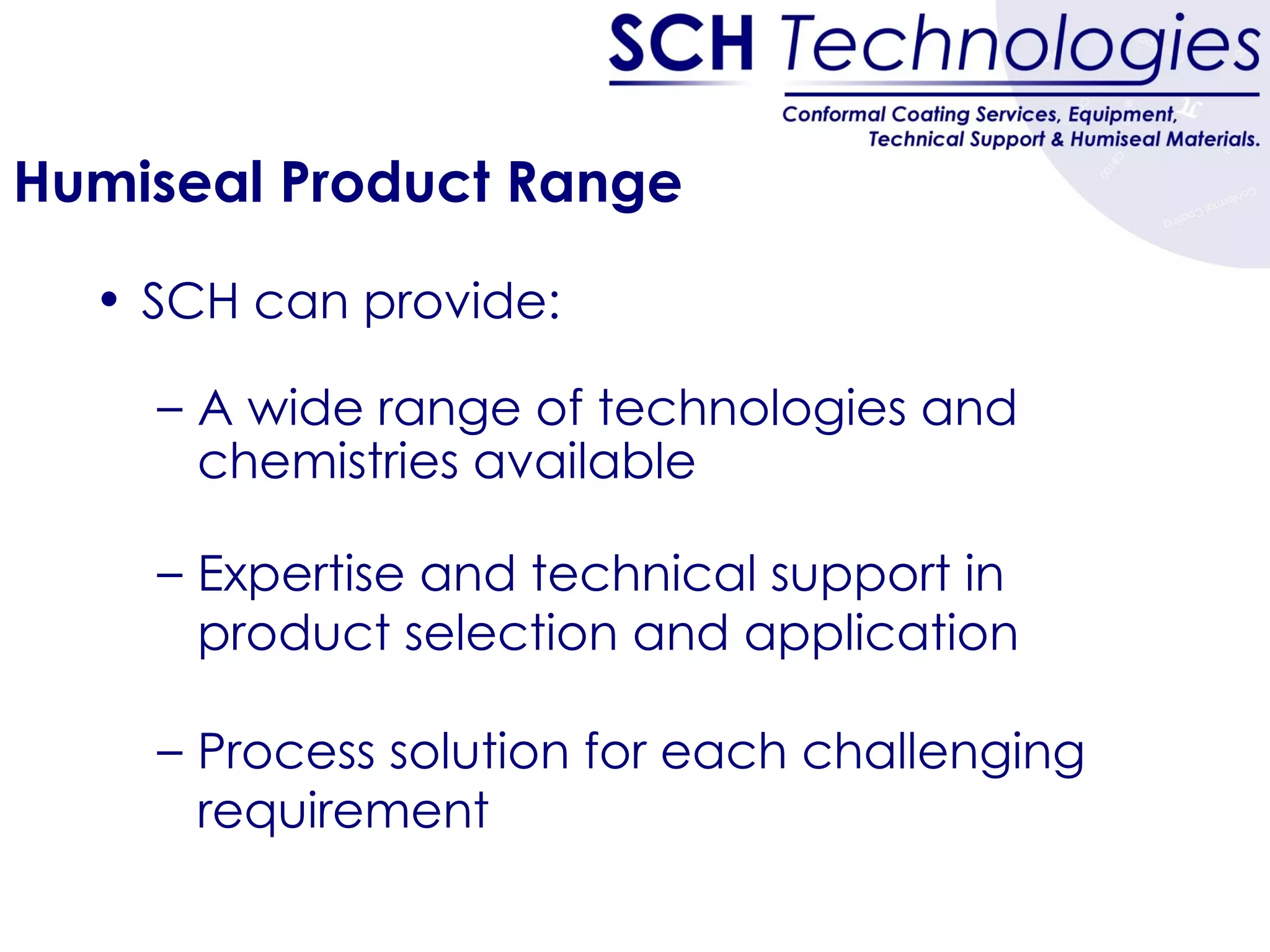
Humiseal Product Range SCH can provide: A wide range of technologies and chemistries available Expertise and technical support in product selection and application Process solution for each challenging requirement
Humiseal Product Range ANY QUESTIONS....?

Basic Concepts Of Conformal Coating

  • 1.
    The Basic Conceptsof Conformal Coating An examine of conformal coating materials available today and how they perform  
  • 2.
    Summary Definition ofa Conformal coating What the coating actually does Why coatings are used The types of coating available How to select a coating How a coating is applied How to test for performance
  • 3.
    Definition of aConformal coating It is a thin plastic protective film “ conforms” to the surface of an electronic circuit assembly. It is a breathing membrane that filters water vapour and solid debris Protects the assembly from corrosion in harsh environments.
  • 4.
    Definition of aConformal coating Nominally, the coating should be 0.001” to 0.008” thick (25 to 200µm) Too thick may cause problems such as solvent entrapment, bubbling, shrinkage and cracking. Too thin means inadequate protection
  • 5.
    What the coatingactually does Improves reliability in humid environments Reduces need to hermetically seal PCB Reduces conductor spacing’s on PCB Protects the PCB in aggressive environment Protects the PCB against environmental particulates
  • 6.
    What the coatingactually does Good dielectrics Insulation & Moisture resistance Breakdown voltage Good flexibility so as not to stress components Be Repairable
  • 7.
    Is the coatingwaterproof? NO! All coatings breathe. However, i t seals IN AS WELL AS OUT Coatings permit air, which may contain moisture, to migrate in and out through the film. If there is a soluble contaminant on the surface beneath the coating, then this may cause osmosis.
  • 8.
    Why coatings areused If your circuit is: High-reliability and /or safety critical Are operating in an aggressive environment Fine line, fine pitch There may be problems with long term reliability
  • 9.
    Why coatings areused Extended warranties on consumer electronics Automotive, control drives, fire alarms and military / aerospace safety features & long term reliability
  • 10.
    Increased demand oncoating Example is automotive electronics where it will soon represent 40% of the cost of the car A great number of safety features are electronically controlled (ABS, airbag, servo)
  • 11.
    The types ofcoatings available Acrylics Polyurethanes Epoxies Silicones Paraxylylenes Fluorocarbon
  • 12.
    Acrylic Conformal CoatingsAR Represent 80% of market Single component materials Excellent Moisture resistance Easy to apply Cure very quickly Easy to repair by removal with solvent
  • 13.
    Acrylic Conformal CoatingsAR Especially suitable for: Any application ‘in a box’ Boards with long service life Any environment where water is main threat Any environment without solvent exposure
  • 14.
    Acrylic Conformal CoatingsAR Examples of use include: Engine management Air bag controllers Avionics Communication Equipment Elevator Controls
  • 15.
    Polyurethane Conformal Coatings UR Very good solvent resistance 1 and 2 part systems Easy to apply Longer cure times Difficult to repair
  • 16.
    Polyurethane Conformal Coatings UR Especially suitable for: Salt Spray protection Applications where solvent resistance required Directly mounted assemblies Reparability is not an issue
  • 17.
    Silicone Conformal CoatingsSR Excellent High Temperature Performance Limited solvent resistance Solventless Products Harder to apply Can be difficult to cure Nearly impossible to repair EXPENSIVE
  • 18.
    Silicone Conformal CoatingsSR OVERKILL for all but specialist applications Used in: Huge, industrial drilling/mining equipment High temperature electronics Under bonnet electronics
  • 19.
    Epoxy Conformal CoatingsER Good moisture resistance Good dielectric resistance Excellent chemical resistance Excellent temperature resistance Poor flexibility Poor to repair
  • 20.
    Paraxylylene Conformal CoatingsXY Excellent moisture resistance Excellent dielectric resistance Excellent chemical resistance Excellent temperature resistance High cost of process Critical processing
  • 21.
    Fluorocarbons Good moistureresistance Excellent dielectric resistance Minimal chemical resistance Good temperature resistance Low cost of process / Expensive set up costs No mar resistance
  • 22.
    Typical Coating ThicknessesAcrylics 0.001” - 0.003” 25/75µm Polyurethanes 0.001” - 0.003” 25/75µm Epoxies 0.001” - 0.003” 25/75µm Silicones 0.002” - 0.008” 50/200µm Paraxylylenes 0.0005” - 0.0007” Fluorocarbon 0.0005” - 0.0007”
  • 23.
    Technologies Available Solvent-basedWater-Based Solvent less Silicones Solvent less UV Curable
  • 24.
    Solvent-Based Advantages Fullrange of chemistries available Easy to process Good wetting ‘ Quasi Cleaning’ Fast Cure Disadvantages Flammable Odour Extraction Required VOC Emissions
  • 25.
    Water-Based Advantages Mostsimilar to solvent-based Full range of chemistries available Low odour Non-flammable Low VOC Disadvantages Longer cure times Hard to apply by robotic equipment More sensitive to contamination
  • 26.
    Solventless Silicones AdvantagesExcellent high temp stability Good flexibility Low VOC Disadvantages Expensive High Viscosity Harder to apply by robotic equipment Thick films required More sensitive to contamination Long cure times
  • 27.
    Solventless UV CurableAdvantages Very fast curing High volume processing High temperature performance Great flexibility Excellent adhesion and chemical resistance Reliable secondary cure mechanism Disadvantages Hard to repair easily Difficult in manual spray application Unsuitable for dip applications UV curing required
  • 28.
    Summary: Technologies /Chemistries COATING TYPES AR PU SR SB WB UV Application Easiness Dependant on tech. Dependant on tech. 2 5 2 4 Drying / Curing Time 4 3 1 4 1 5 Chemical Resistance 1 4 4 Dependant on chem. Dependant on chem. 5 Moisture Protection 5 4 4 5 4 5 Reworkability 5 3 0 4 3 2 Environmental Friendly Dependant on tech. Dependant on tech. 5 1 5 5 Main features General purpose Chem. Resis. High temp. Most common Manual application High volume
  • 29.
  • 30.
    Humiseal Product Code 1A33 1B31 1C49 1H20AR1 1B73 2A64 UV40
  • 31.
    Humiseal Product CodeSolvent Based Number of part: 1 = 1 part system 2 = 2 part system 1 B31 2 A64
  • 32.
    Humiseal Product CodeSolvent Based Number of part: 1 = 1 part system 2 = 2 part system 1 B 31 2 A 64 Chemistry: A = PU B or R= AR C = SR
  • 33.
    Humiseal Product CodeSolvent Based Number of part: 1 = 1 part system 2 = 2 part system 1B 31 2A 64 Chemistry: A = PU B or R= AR C = SR Product number
  • 34.
    Humiseal Product CodeSolvent Based (SB) Products 1B73 1B18 1B31 1R32 1R32A-2 1A33 1A68 1A20 2A64 Technology SB SB SB SB SB SB SB SB SB Chemistry AR AR AR AR AR PU PU PU PU Cure mechanism Solvent Evap. Solvent Evap. Solvent Evap. Solvent Evap. Solvent Evap. Oxygen Oxygen Moisture Moisture MIL Yes No Yes No No Yes No Yes Yes UL Yes Yes No No Yes No No Yes No Low cost equivalent 1B18 N/A 1R32 N/A N/A 1A68 N/A N/A N/A Comments Military Reference for AR Automotive Reference Military Reference for PU
  • 35.
    Humiseal Product CodeSolvent Based 1H20 AR1 /S 1H20 UR5 /D Technology: 1H20 = water based Chemistry: AR = Acrylic UR = Polyurethane Application method: S = spraying D = dipping
  • 36.
    Humiseal Low VOCSB = Solvent Based AR = Acrylic PU = Polyurethane WB = Water Based SR = Silicone UV = UV curable Most widely used products Products UV40 UV40 250 1C49LV 1C51 1H20AR3/S 1H20AR3/D 1H20UR5/S 1H20UR5/D Technology UV UV SR SR WB WB Chemistry PU PU SR SR AR PU Cure mechanism UV+ Moisture UV+ Moisture Moisture Heat Air Oxygen MIL Yes No Yes Yes Pending Pending UL Yes Yes Yes Yes Pending Pending Low cost equivalent N/A N/A N/A N/A N/A N/A Comments Automotive reference Spray and dip grade Spray and dip grade
  • 37.
    Humiseal Thinners Mostwidely used products Products 503 535 505 521 604 600 Evaporation Rate (BuAc=1) 3.7 2.1 1.7 0.6 0.4 0.3 Flash point -1 7 14 27 11 47 Material 1B31, 1B73, 1A33 1B51 1R32 1B31, 1B73, 1A33 1B73 EPA 1R32A-2 Application method Dip, brush Dip, brush Dip, brush Spray, brush Spray, brush Spray, brush Comments Reference for dipping Reference for spraying Reduce bubbles
  • 38.
    Humiseal Strippers Mostwidely used products SB = Solvent Based AR = Acrylic PU = Polyurethane WB = Water Based SR = Silicone UV = UV curable Most widely used products Products 1080A 1020 1063 1072 Chemistry to remove SB AR WB AR PU PU Coatings 1B31, 1B73, 1R32A-2 1H20 AR3 1A33 1H20 UR5, UV40 Comments Replacing previous 1080 Replacing previous 1071
  • 39.
    Humiseal Product RangeSCH can provide: A wide range of technologies and chemistries available Expertise and technical support in product selection and application Process solution for each challenging requirement
  • 40.
    Humiseal Product RangeANY QUESTIONS....?