How to Design a Quality system that meets compliance requirements 2014
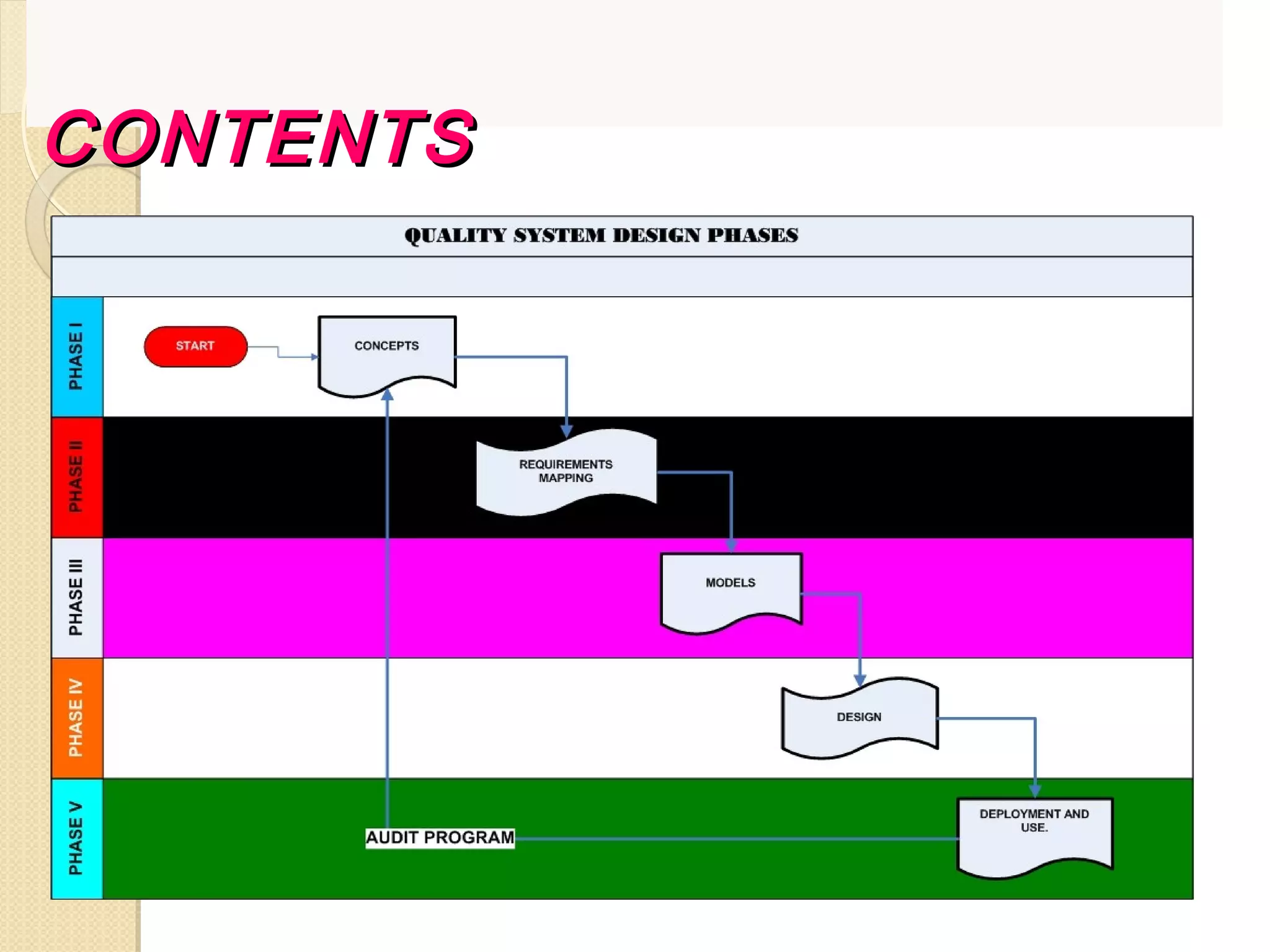
The document provides an overview of how to design a quality system that meets compliance requirements for medical devices, biotech, and pharmaceutical companies. It discusses key quality concepts like quality management systems, processes, procedures, responsibilities, and resources. It explains that a quality management system has two parts - quality assurance and quality control. It also reviews the main regulatory requirements for quality systems from standards like the Quality System Regulation, ISO 13485, ISO 9001, and the EU Medical Device Directive. These standards require organizations to establish documented quality policies, procedures, processes, manuals, audits and management reviews to ensure compliance.
In this document
Powered by AI
Introduction to designing quality systems that meet compliance requirements in medical devices, biotech, and pharma.
Introduction to the concept phase focusing on the fundamental principles of quality.
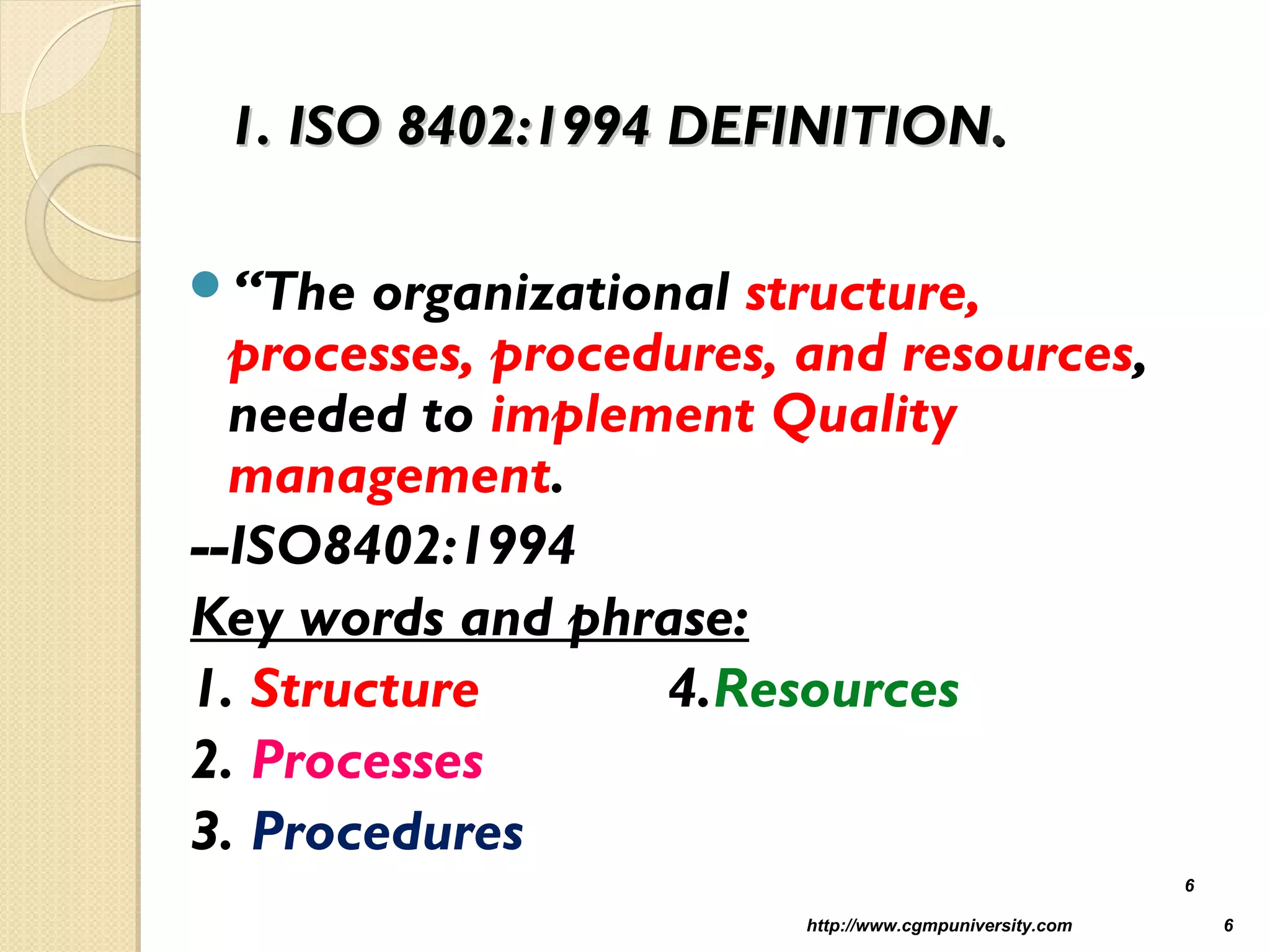
Overview of what a Quality Management System (QMS) is, including ISO 8402:1994 definition and key components.
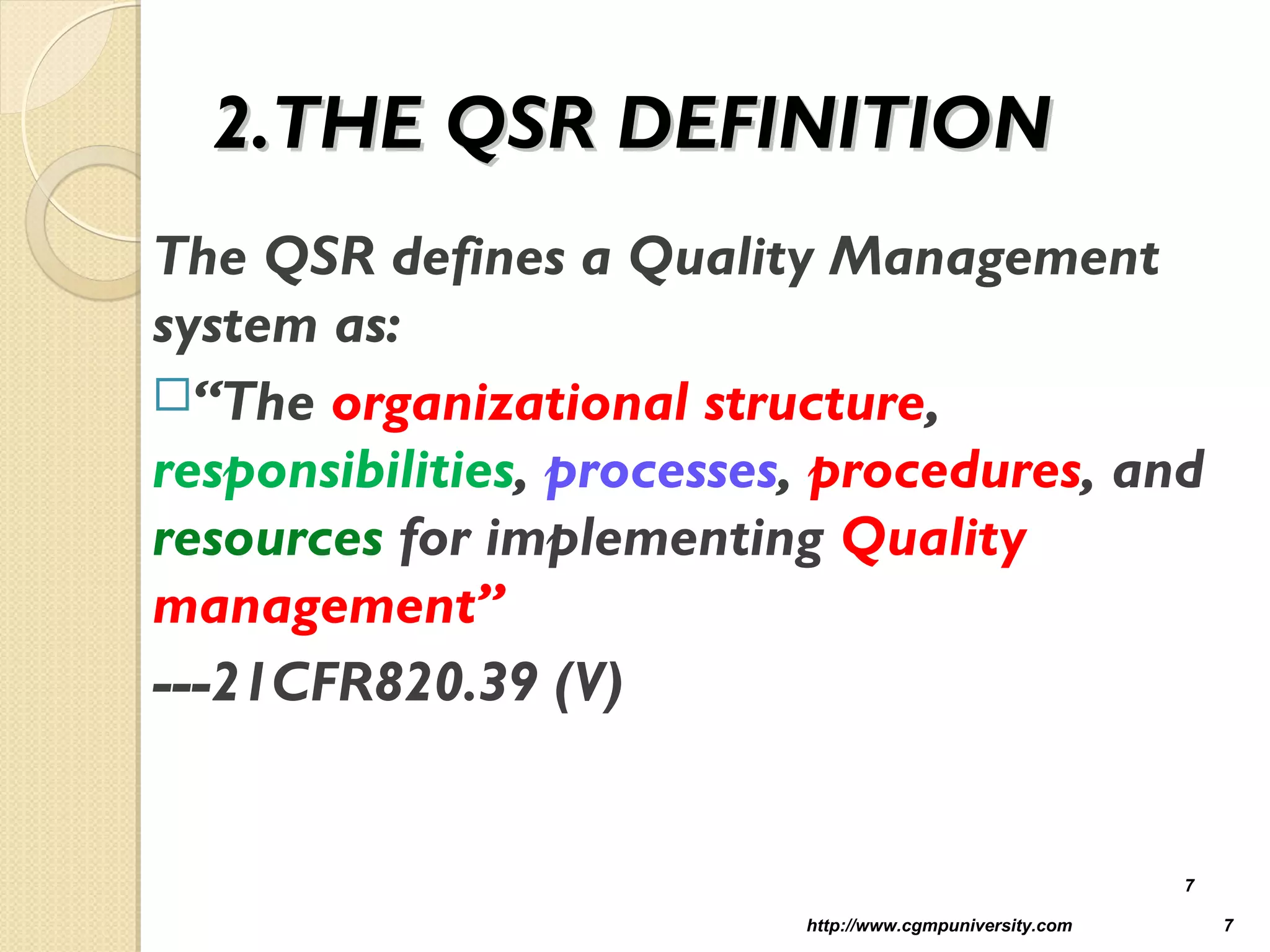
Definition of QMS as per QSR, organization structure, responsibilities, and their importance in compliance.
Emphasis on processes as essential steps that add value and the need for documented procedures to control variation.
Defined responsibilities for quality management, importance of resources including trained personnel and infrastructure.
Explains the two parts of quality management: quality assurance activities and quality control activities.
Summarizes key components of a QMS such as processes, procedures, and their overall role.
Introduction to the various quality system requirements, including regulatory standards like ISO 13485.
Detailed explanation of QSR regulations, what's required including quality planning and management review.
Essential requirements of the MDD and how manufacturers must ensure quality system conformity.
Highlights important ISO 13485 requirements for quality management systems in medical devices.
Comprehensive overview of ISO 9001 requirements concerning organization and management processes.
Creating a quality system matrix to bridge requirements from different standards and regulations.
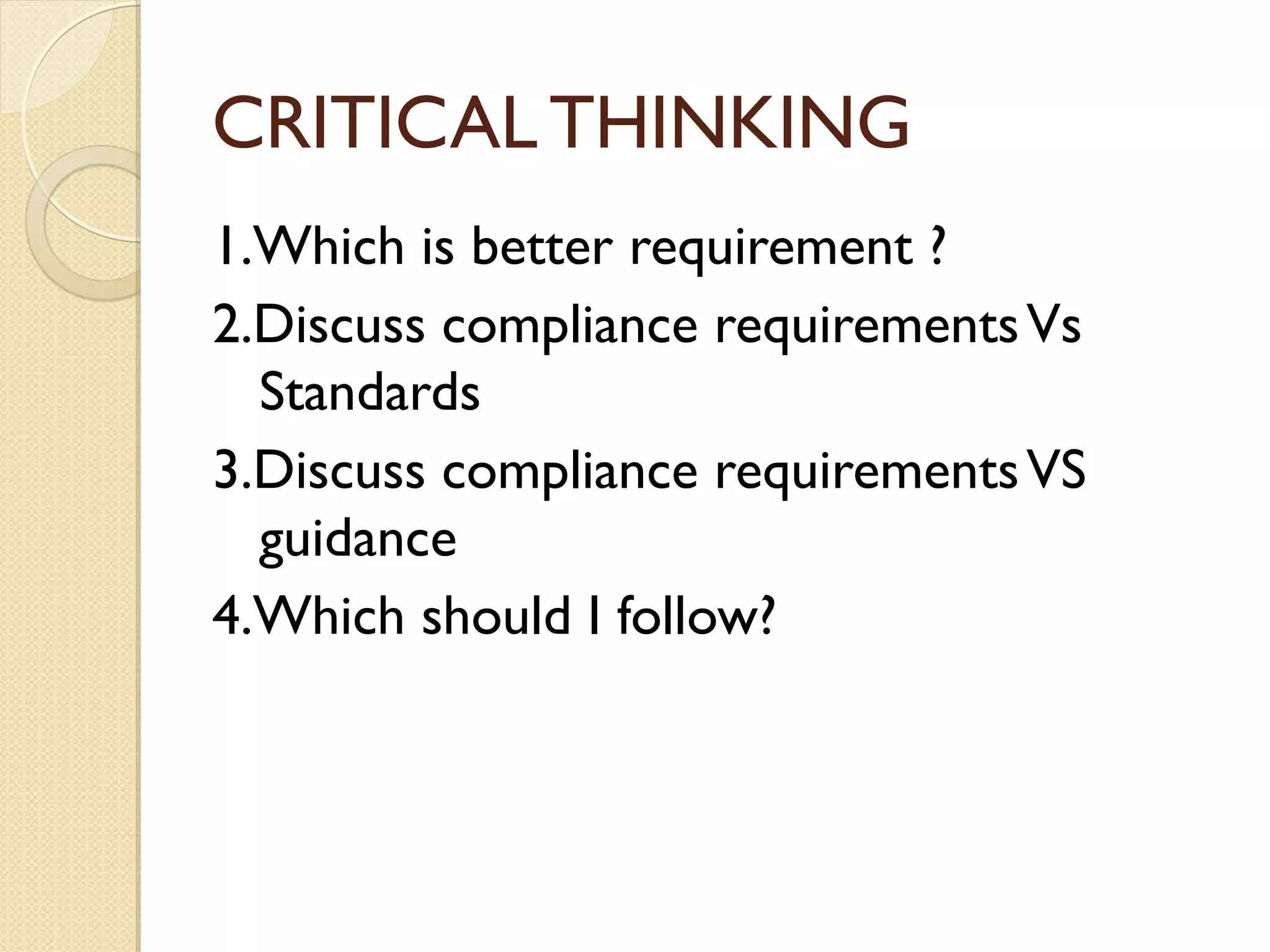
Open questions for discussion on compliance versus standards in quality management.Selection of various quality system models relevant for organizations including ISO approaches.
Introduction to how quality systems are structured and the documentation hierarchy within them.
Instructions on writing a quality policy that defines the mission, vision, and objectives.
Guidelines to create a quality manual, essential sections and content to include.
Importance and writing of SOPs, ensuring they describe workflows and are cross-functional.
Factors in writing effective work instructions, detailing the steps necessary for task performance.
Steps for defining records and establishing retention policies crucial for compliance.
Overview of different types of templates needed for official documentation in quality systems.
Necessity of following good documentation practices to maintain quality system integrity.
Explains compliance requirements for electronic records and electronic signatures.
Discussion on internal and external feedback mechanisms that help maintain the quality management system.
Approach to risk management based on ISO guidelines and the tools for assessing quality risks.
Summary of major points discussed throughout the seminar.
Open floor to ask questions and clarify concepts discussed during the presentation.
How to Design a Quality system that meets compliance requirements 2014
1.
HOW TO DESIGNA QUALITY SYSTEM THATHOW TO DESIGN A QUALITY SYSTEM THAT
MEETS COMPLIANCE REQUIREMENTS.MEETS COMPLIANCE REQUIREMENTS.
QUALITY SYSTEM DESIGN FORQUALITY SYSTEM DESIGN FOR
MEDICAL DEVICES,BIOTECH ANDMEDICAL DEVICES,BIOTECH AND
PHARMA.PHARMA.
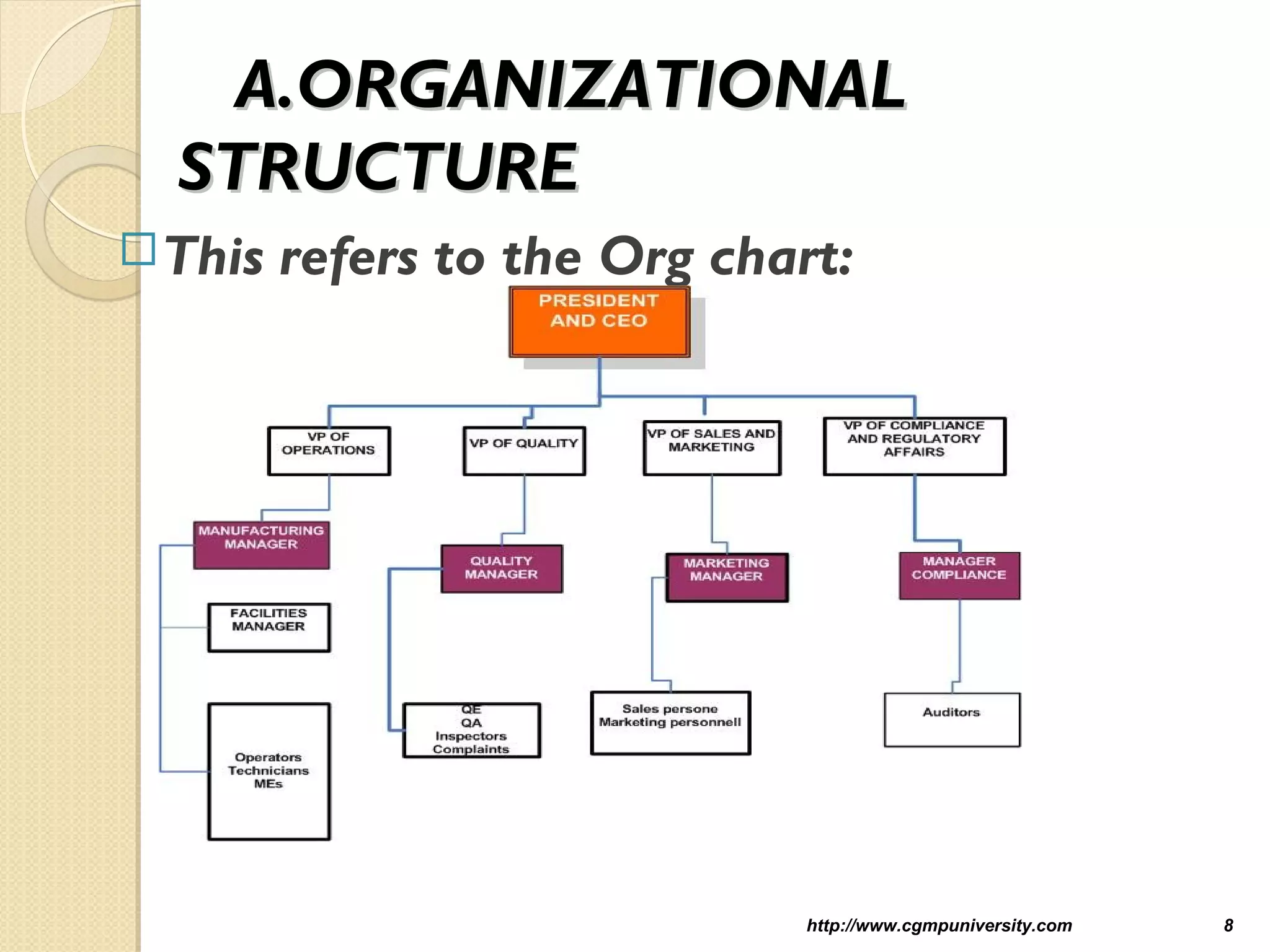
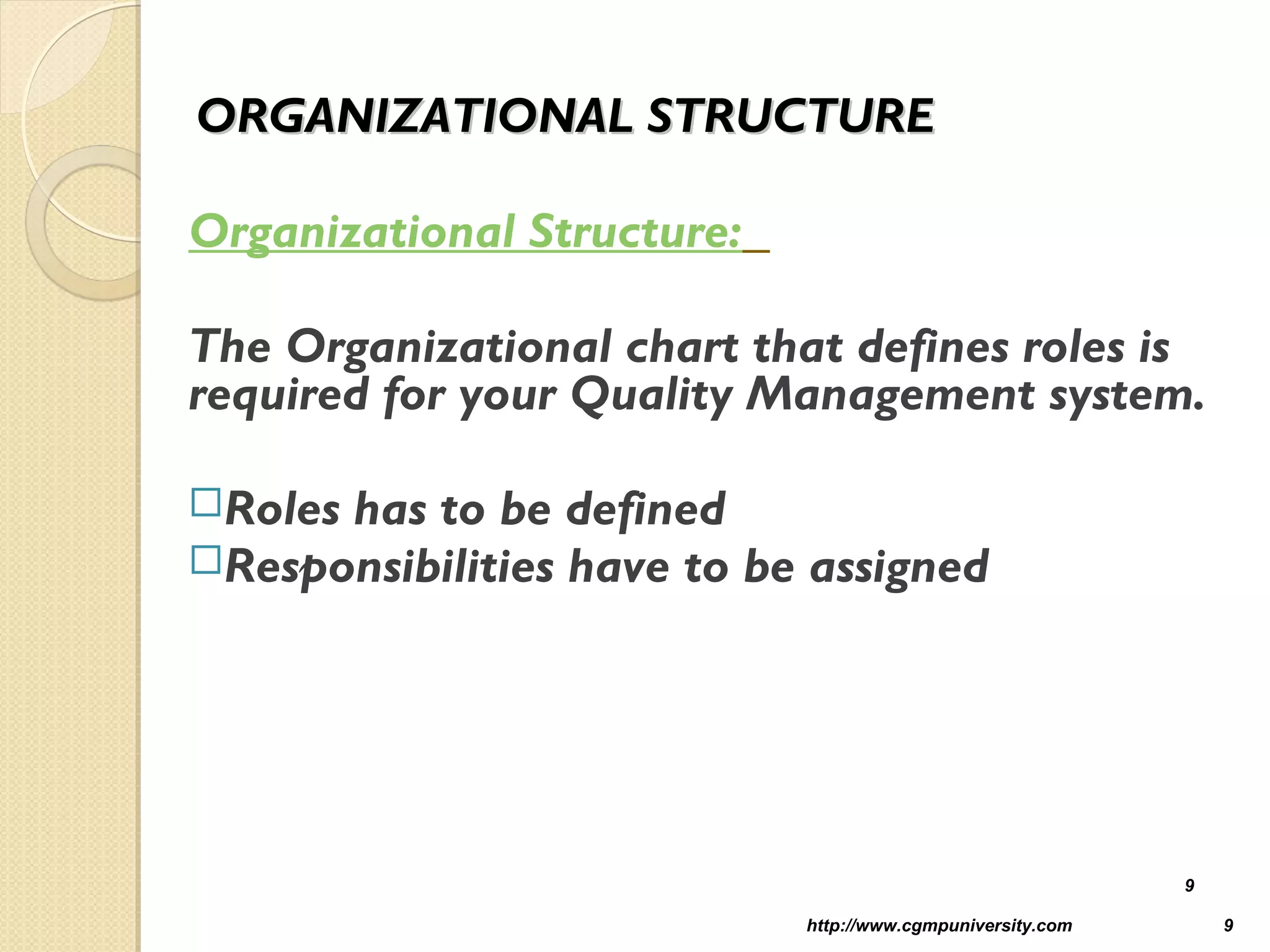
ORGANIZATIONAL STRUCTUREORGANIZATIONAL STRUCTURE
OrganizationalStructure:
The Organizational chart that defines roles is
required for your Quality Management system.
Roles has to be defined
Responsibilities have to be assigned
http://www.cgmpuniversity.com 9
9
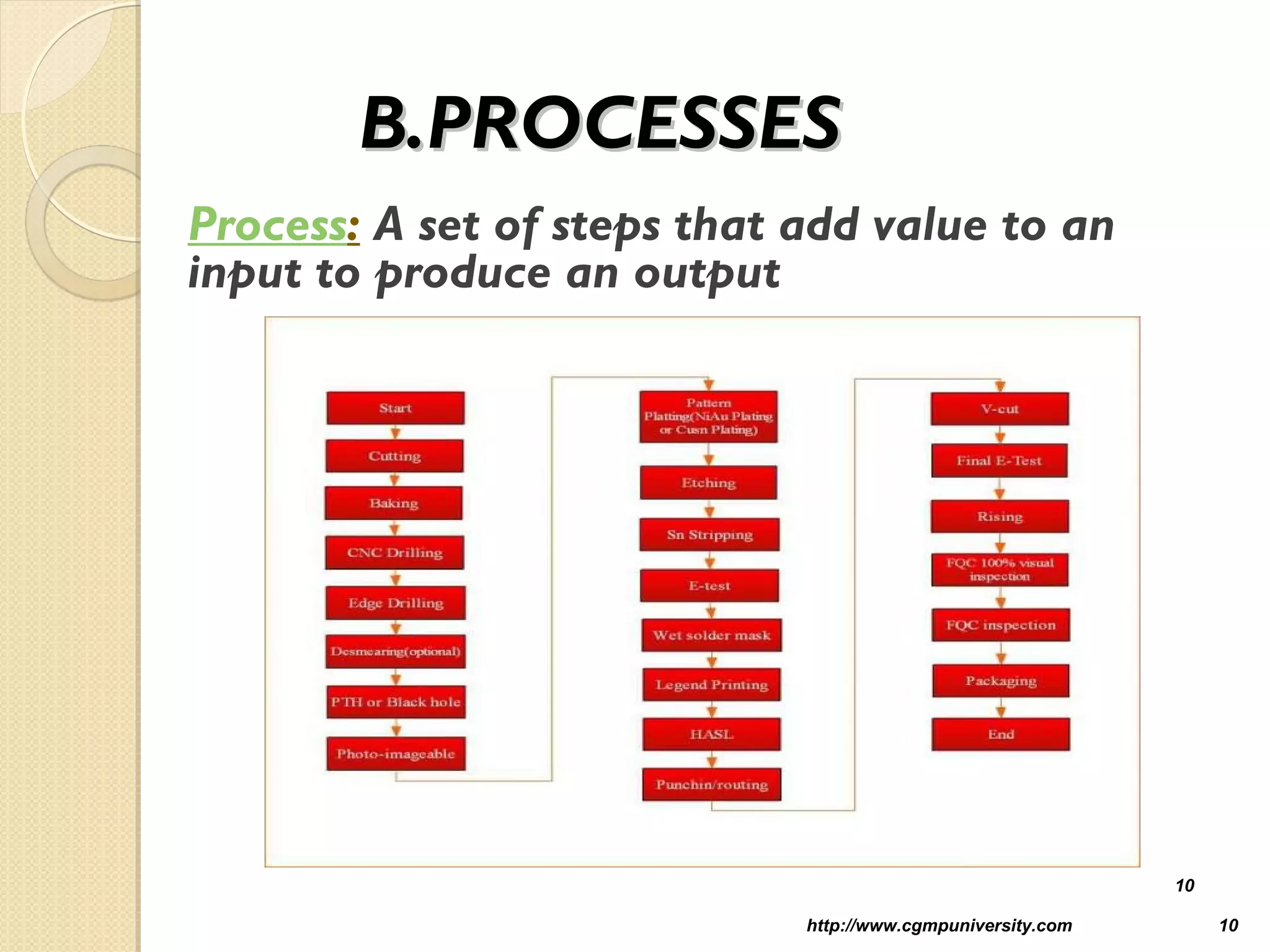
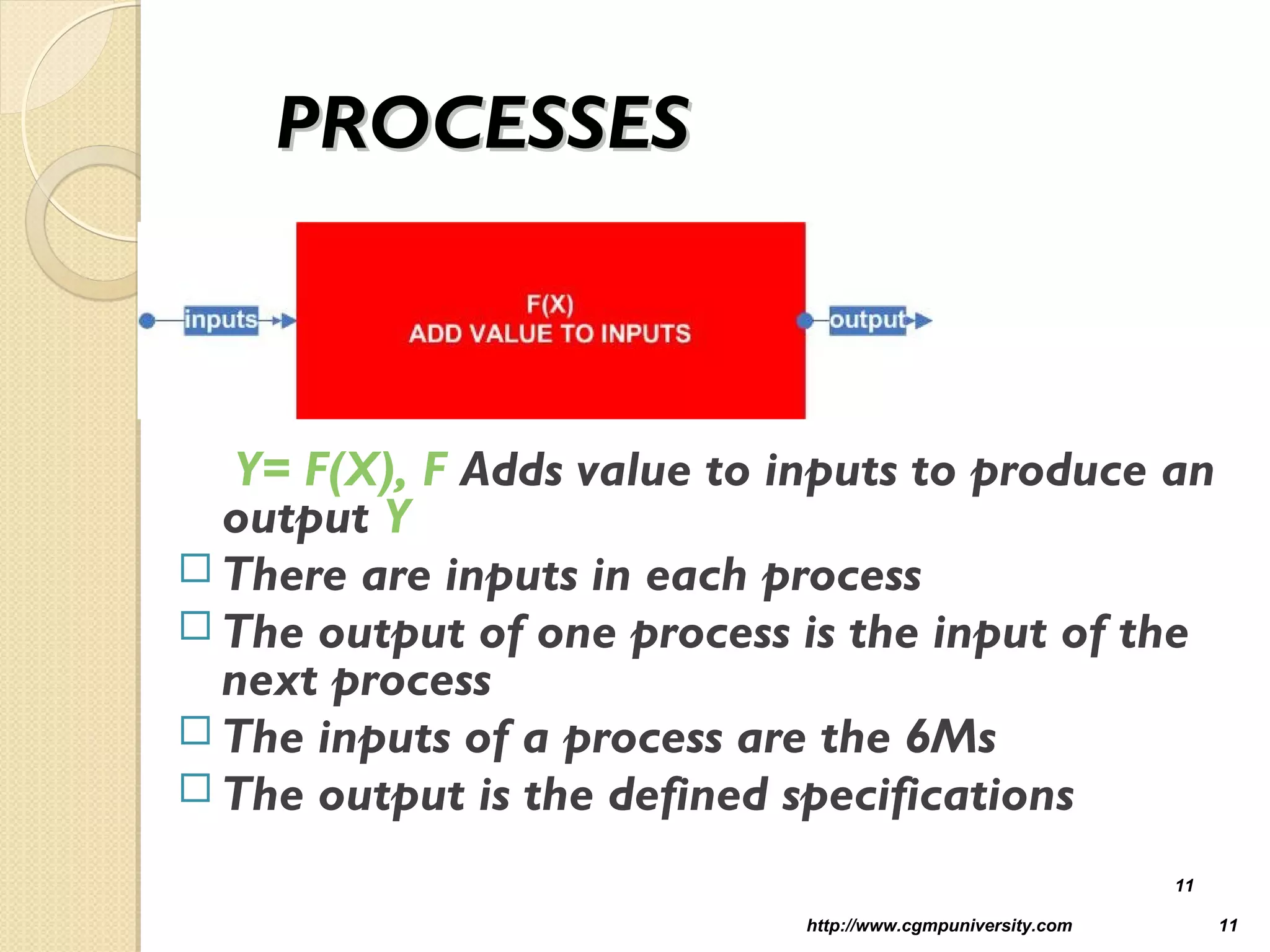
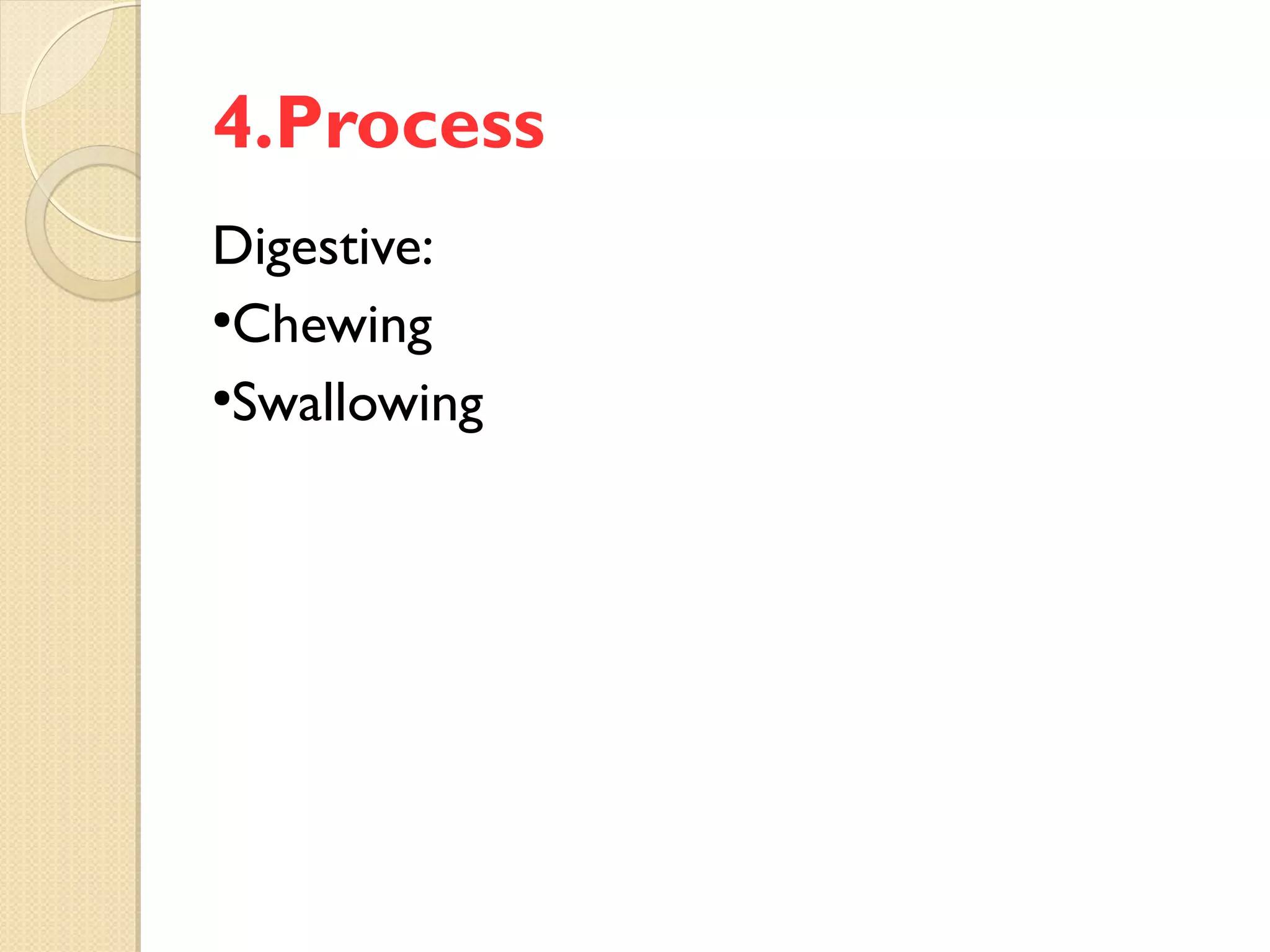
PROCESSESPROCESSES
Y= F(X), FAdds value to inputs to produce an
output Y
There are inputs in each process
The output of one process is the input of the
next process
The inputs of a process are the 6Ms
The output is the defined specifications
http://www.cgmpuniversity.com 11
11
12.
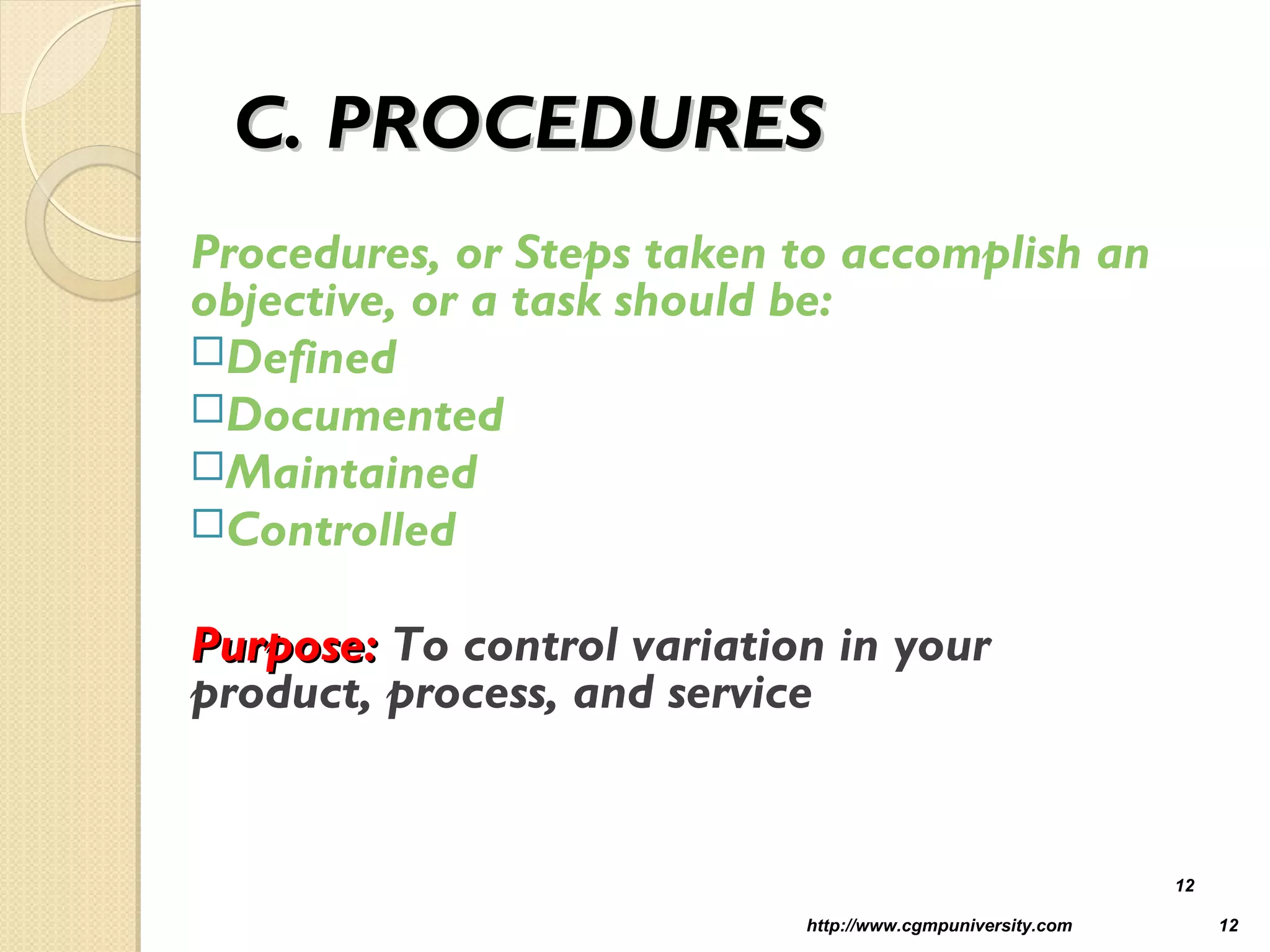
C. PROCEDURESC. PROCEDURES
Procedures,or Steps taken to accomplish an
objective, or a task should be:
Defined
Documented
Maintained
Controlled
Purpose:Purpose: To control variation in your
product, process, and service
http://www.cgmpuniversity.com 12
12
13.
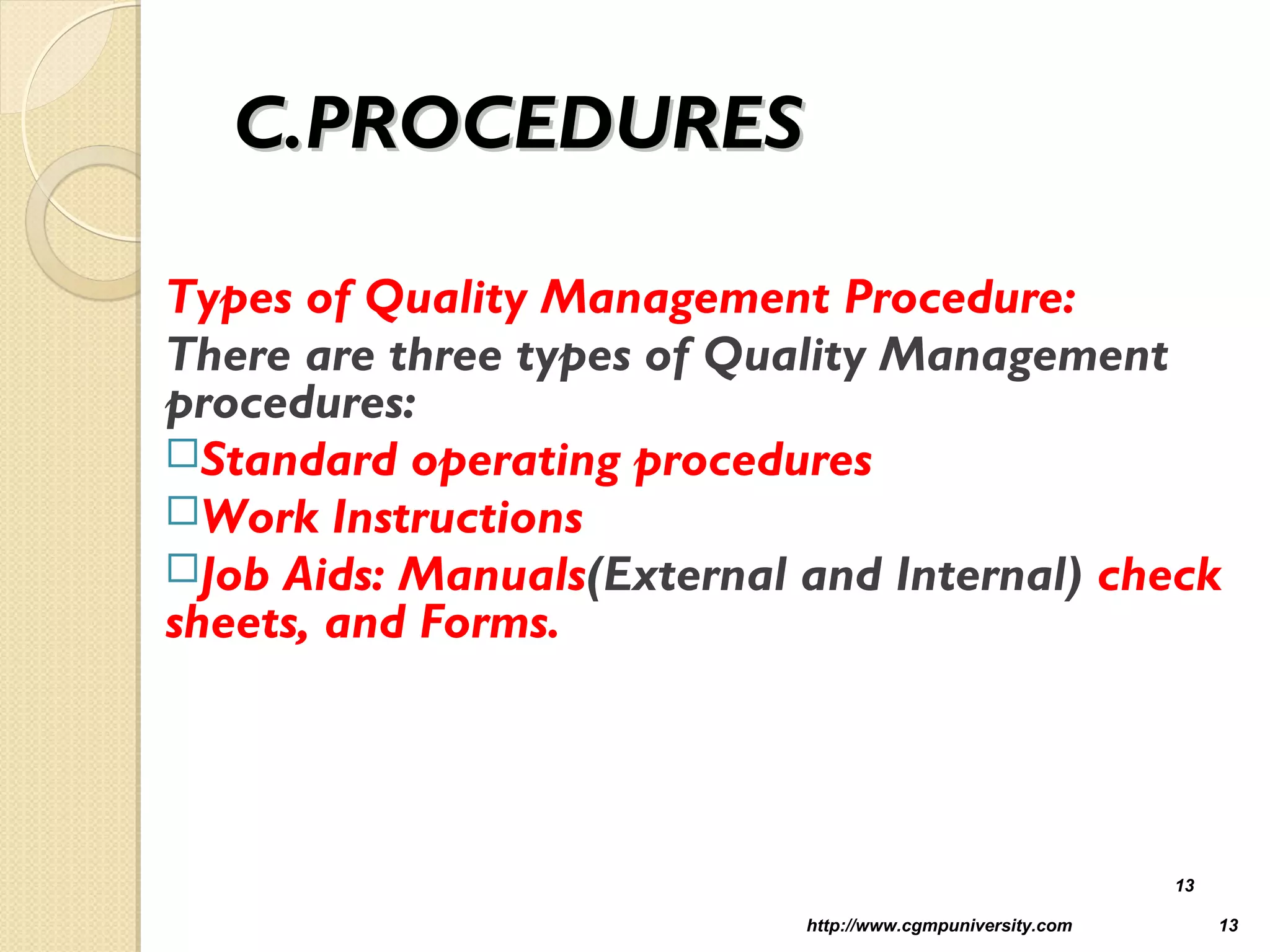
C.PROCEDURESC.PROCEDURES
Types of QualityManagement Procedure:
There are three types of Quality Management
procedures:
Standard operating procedures
Work Instructions
Job Aids: Manuals(External and Internal) check
sheets, and Forms.
http://www.cgmpuniversity.com 13
13
E.RESOURCESE.RESOURCES
Resources for QualityManagement include:
Trained personnel: “Know why they are
doing, what they are doing and how to do
it.”
Facilities: Buildings etc
Infrastructure
Equipment
The five elements are meant to implement
Quality Management
http://www.cgmpuniversity.com 16
16
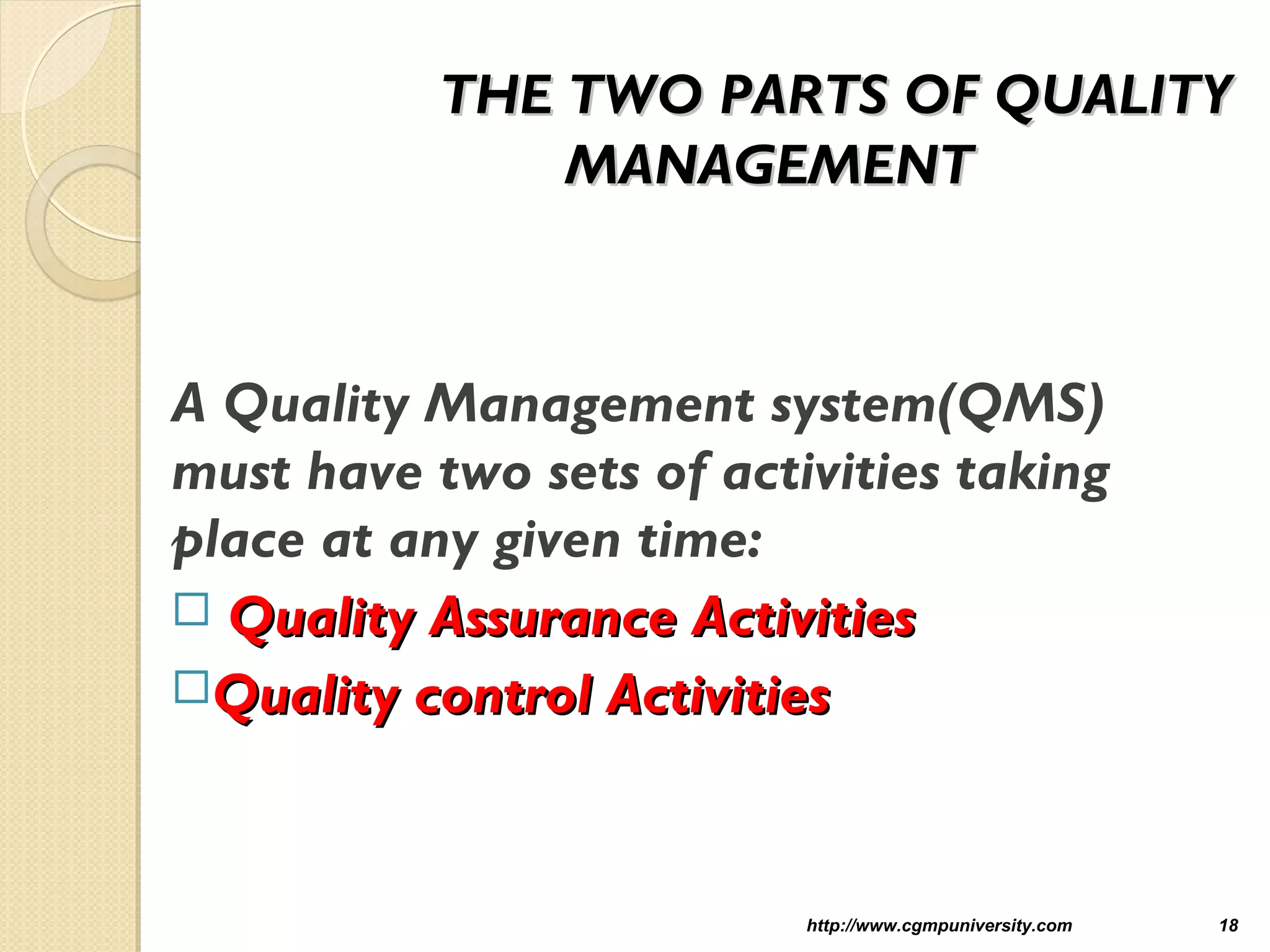
THE TWO PARTSOF QUALITYTHE TWO PARTS OF QUALITY
MANAGEMENTMANAGEMENT
A Quality Management system(QMS)
must have two sets of activities taking
place at any given time:
Quality Assurance ActivitiesQuality Assurance Activities
Quality control ActivitiesQuality control Activities
http://www.cgmpuniversity.com 18
19.
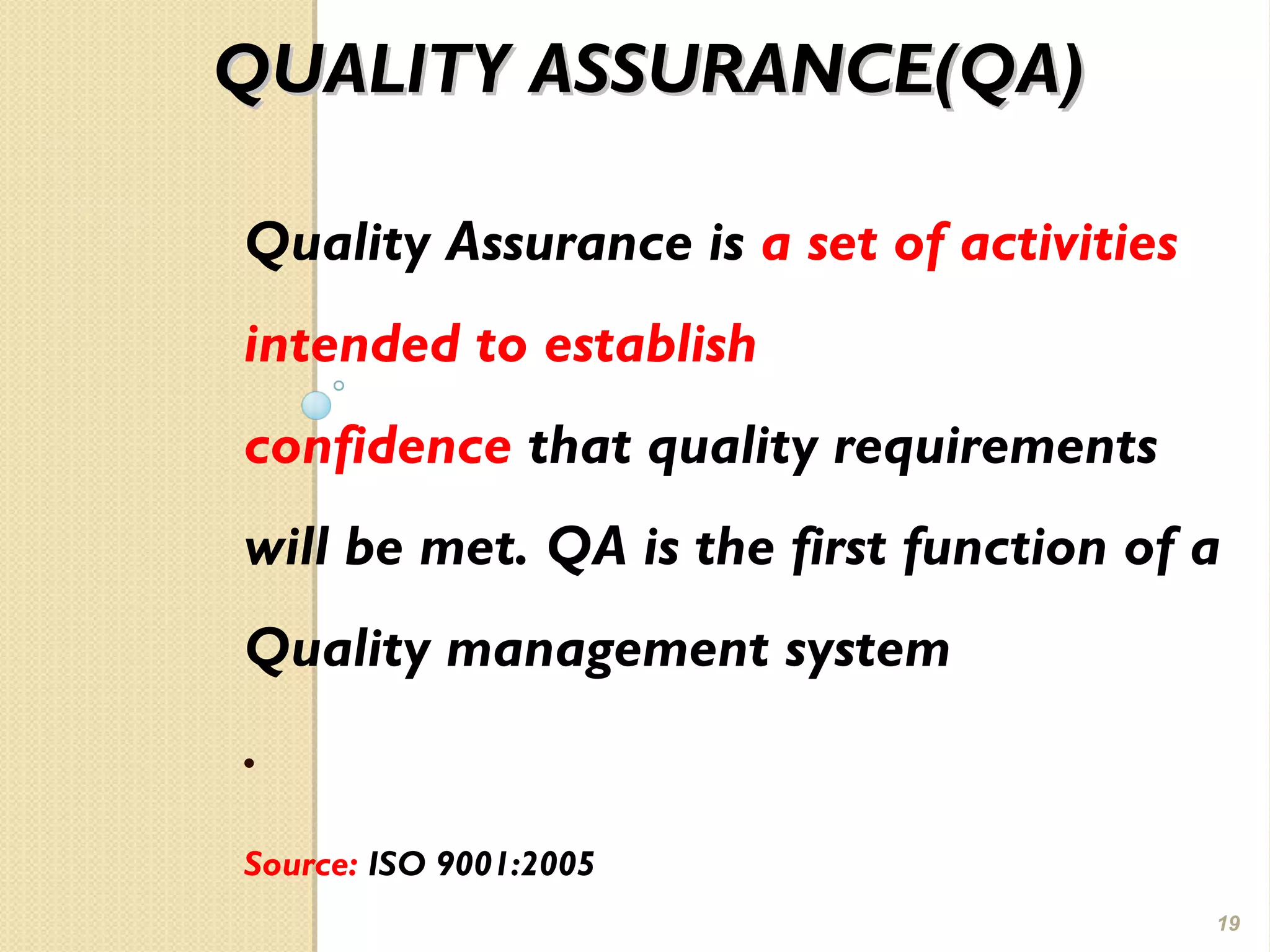
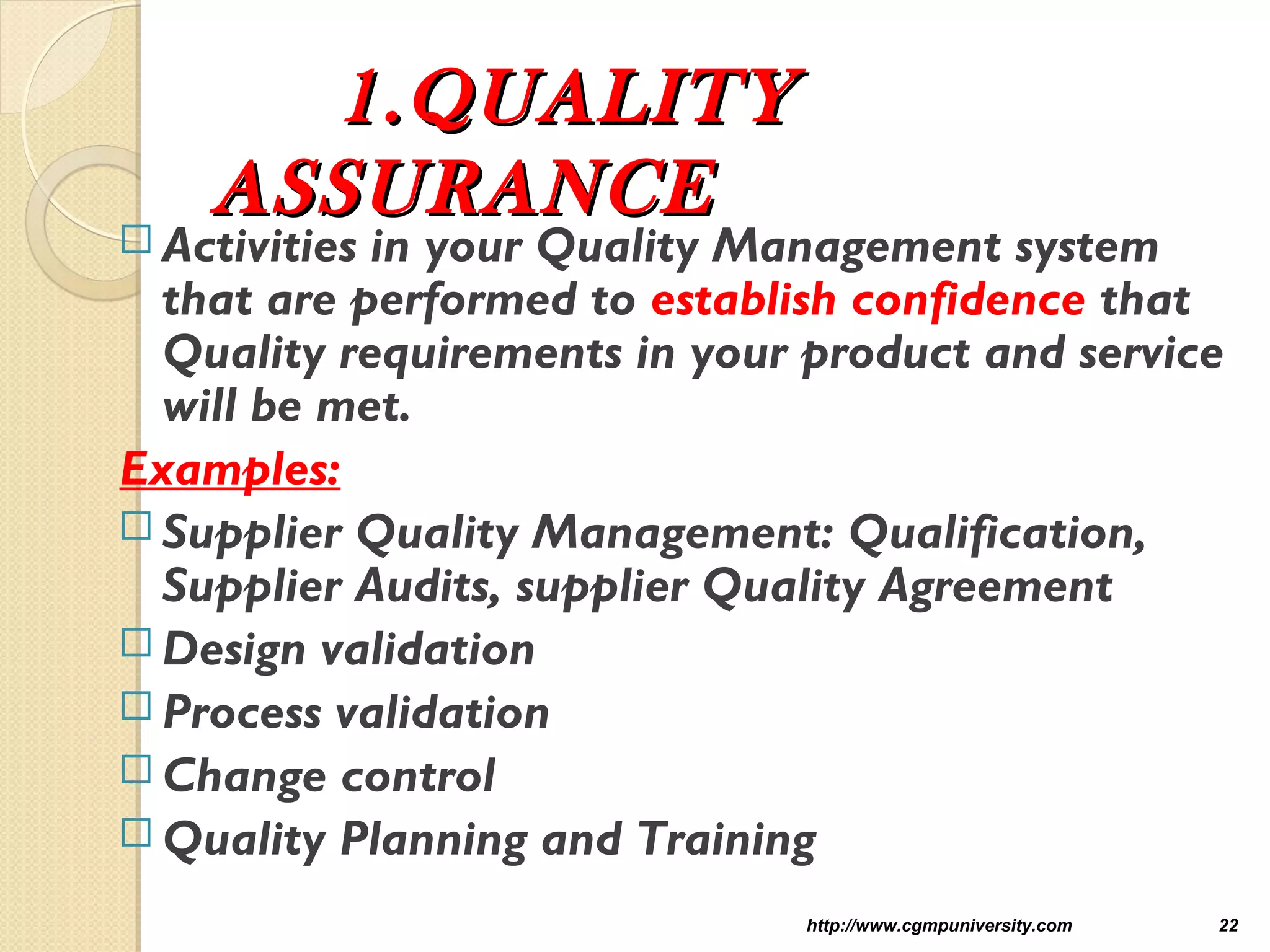
QUALITY ASSURANCE(QA)QUALITY ASSURANCE(QA)
QualityAssurance is a set of activities
intended to establish
confidence that quality requirements
will be met. QA is the first function of a
Quality management system
.
Source: ISO 9001:2005
19
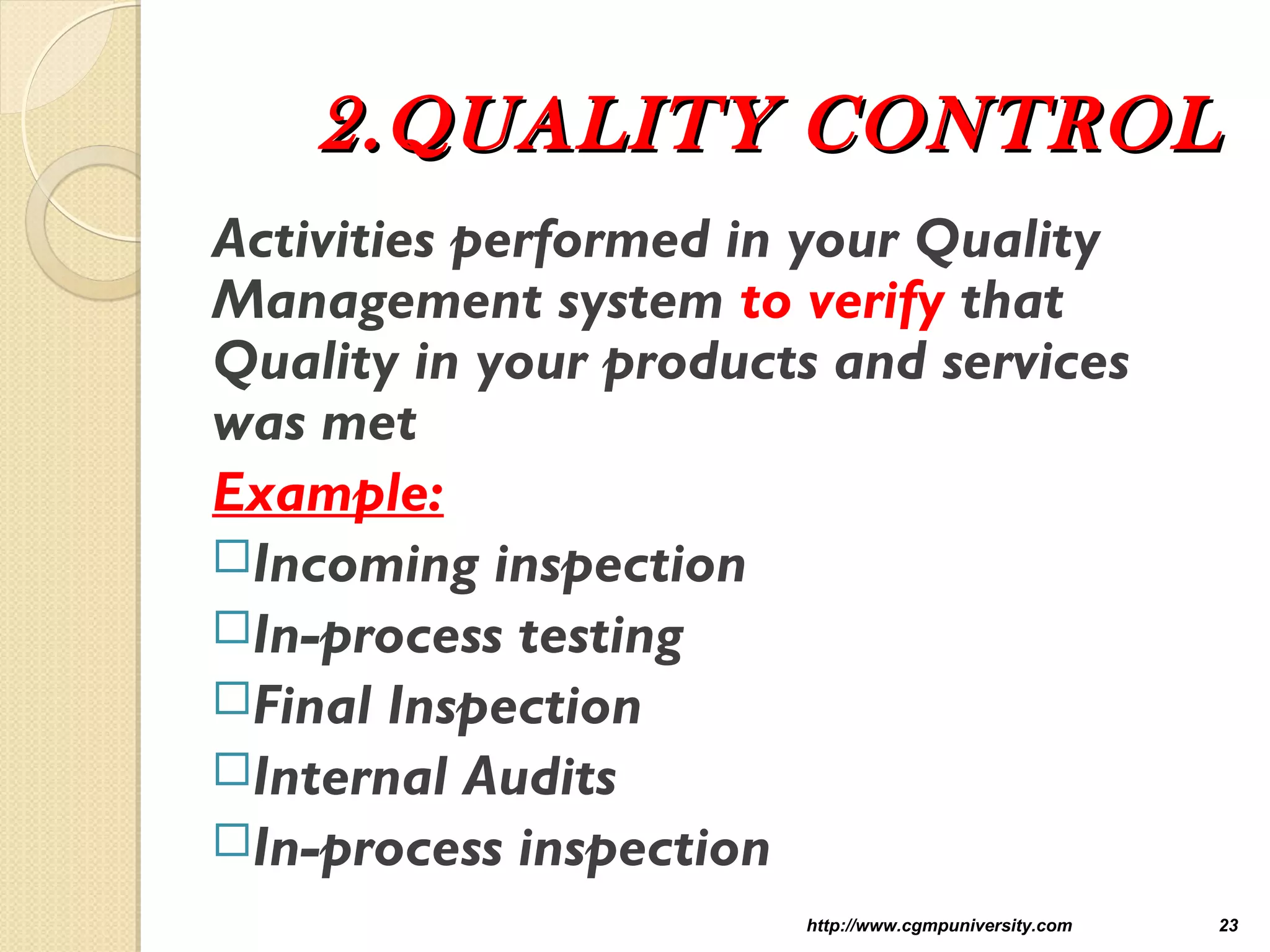
20.
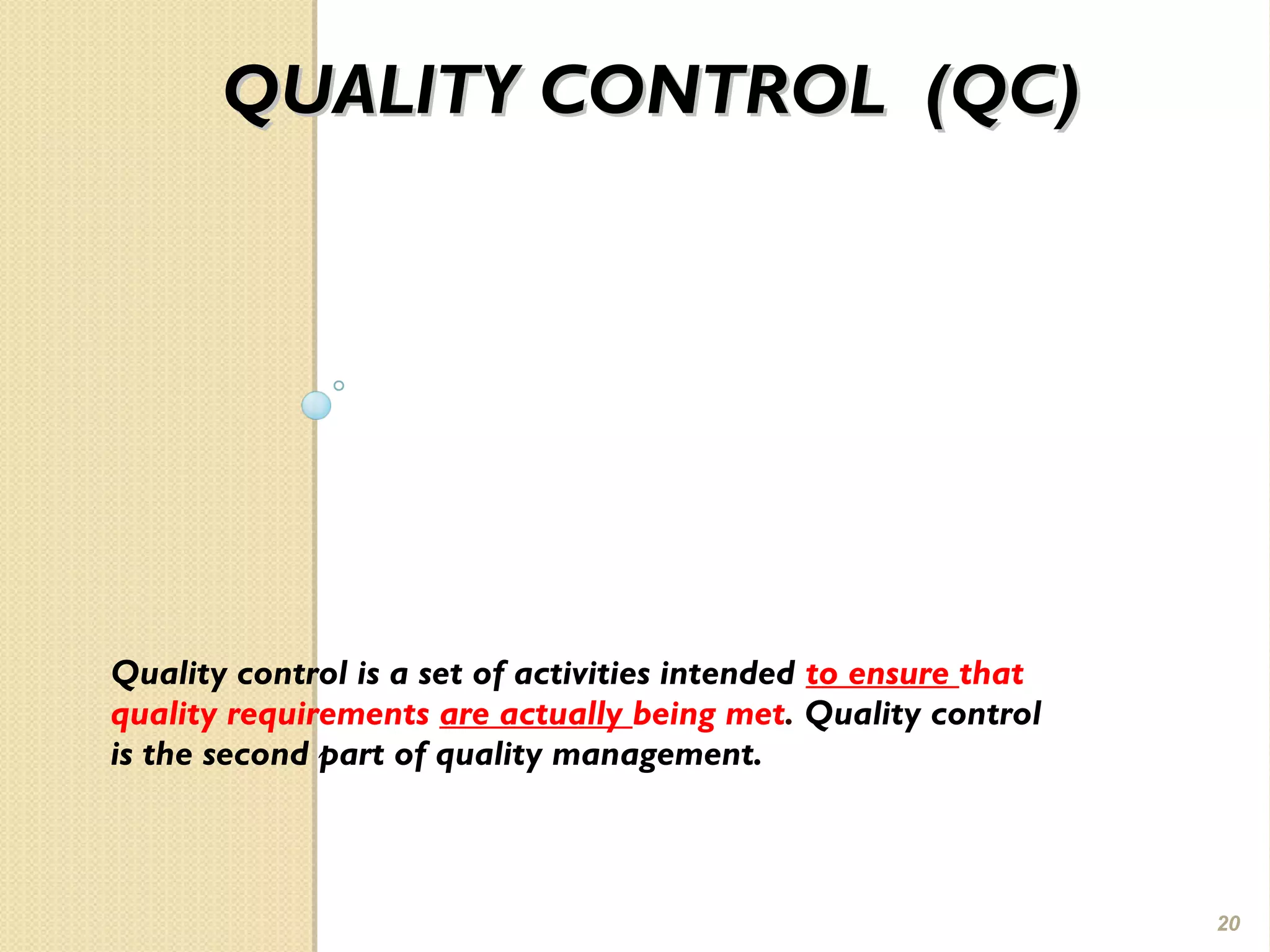
QUALITY CONTROL (QC)QUALITYCONTROL (QC)
Quality control is a set of activities intended to ensure that
quality requirements are actually being met. Quality control
is the second part of quality management.
20
21.
THE TWO SIDESOF QUALITYTHE TWO SIDES OF QUALITY
MANAGEMENTMANAGEMENT
http://www.cgmpuniversity.com 21
22.
1.QUALITY1.QUALITY
ASSURANCEASSURANCE
Activities inyour Quality Management system
that are performed to establish confidence that
Quality requirements in your product and service
will be met.
Examples:
Supplier Quality Management: Qualification,
Supplier Audits, supplier Quality Agreement
Design validation
Process validation
Change control
Quality Planning and Training
http://www.cgmpuniversity.com 22
23.
2.QUALITY CONTROL2.QUALITY CONTROL
Activitiesperformed in your Quality
Management system to verify that
Quality in your products and services
was met
Example:
Incoming inspection
In-process testing
Final Inspection
Internal Audits
In-process inspection
http://www.cgmpuniversity.com 23
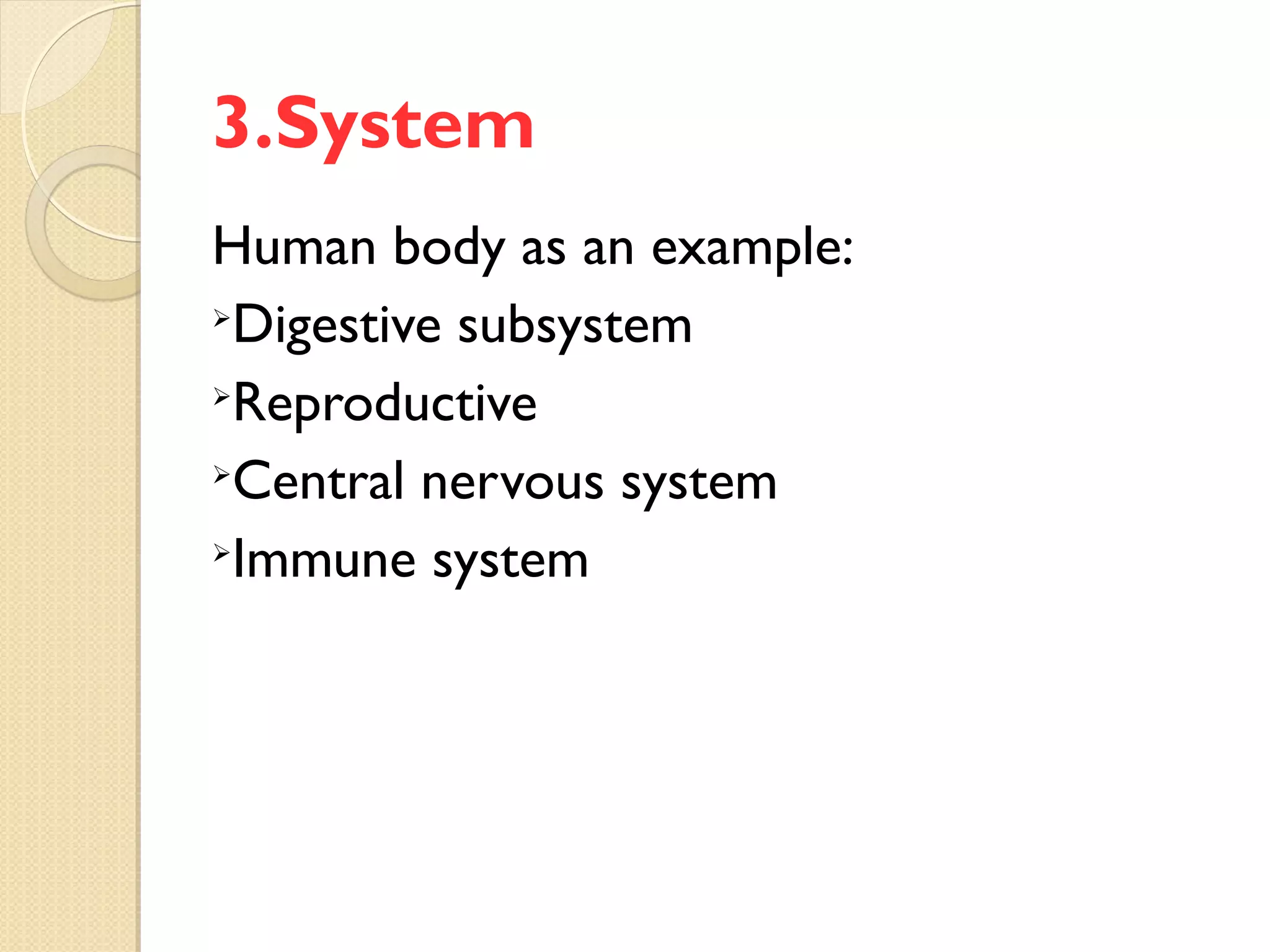
24.
3.System
Human body asan example:
➢
Digestive subsystem
➢
Reproductive
➢
Central nervous system
➢
Immune system
SUMMARYSUMMARY
By now youshould Know:
1.The five components of your Quality
Management system.
2.What a process is
3.What a procedure is
4.The three types of Quality Management
procedures
http://www.cgmpuniversity.com 26
QUALITY CONTROL VsQUALITYQUALITY CONTROL Vs QUALITY
ASSURANCEASSURANCE
Where should companies spend most of
their resources? And why?
What is the problem with Quality
Assurance? How do we change that?
What is the problem with Quality control?
What are the current issues in the industry?
Which one is more important?
http://www.cgmpuniversity.com 28
29.
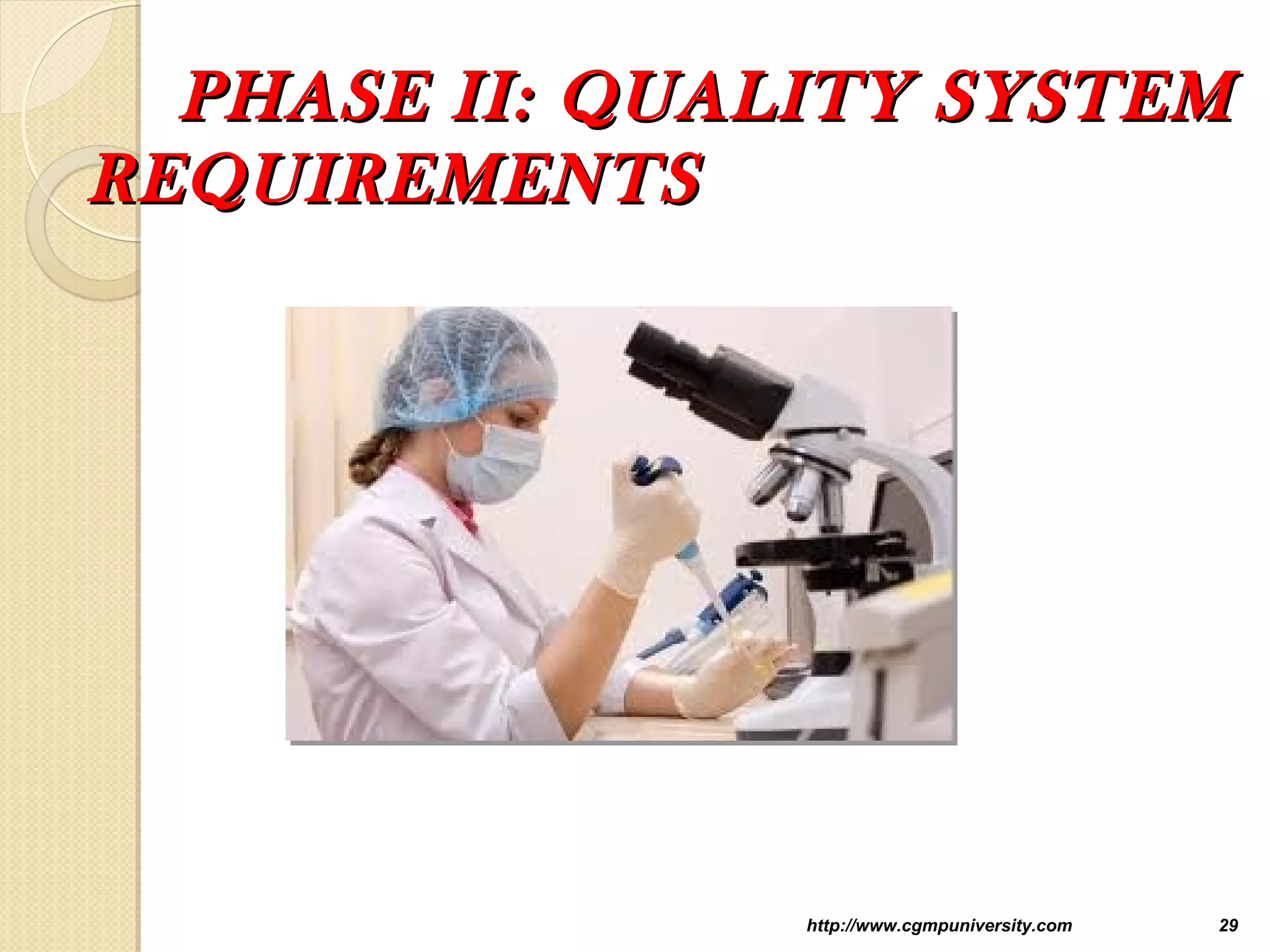
PHASE II: QUALITYSYSTEMPHASE II: QUALITY SYSTEM
REQUIREMENTSREQUIREMENTS
http://www.cgmpuniversity.com 29
QUALITY SYSTEMQUALITY SYSTEM
REQUIREMENTSREQUIREMENTS
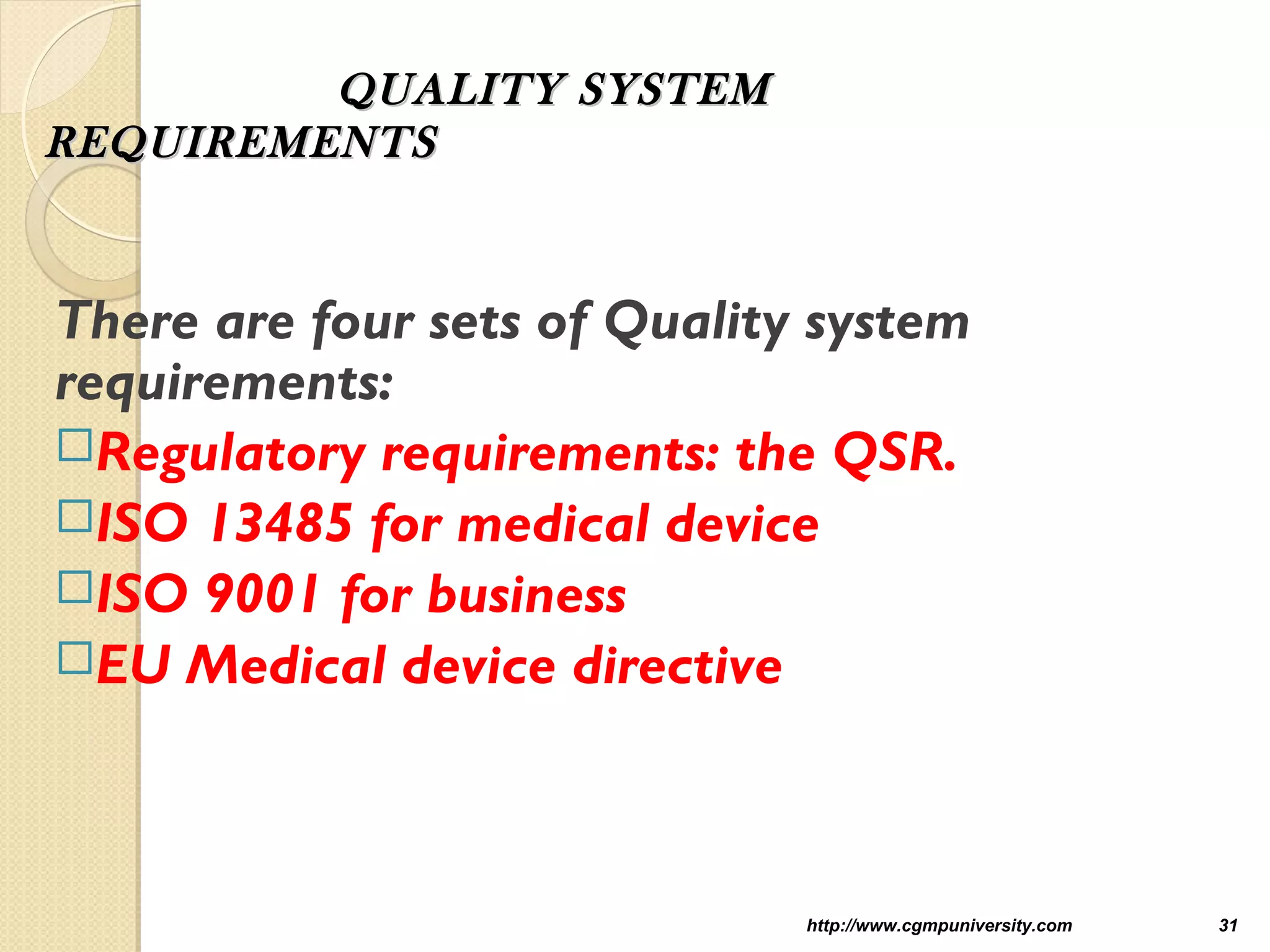
Thereare four sets of Quality system
requirements:
Regulatory requirements: the QSR.
ISO 13485 for medical device
ISO 9001 for business
EU Medical device directive
http://www.cgmpuniversity.com 31
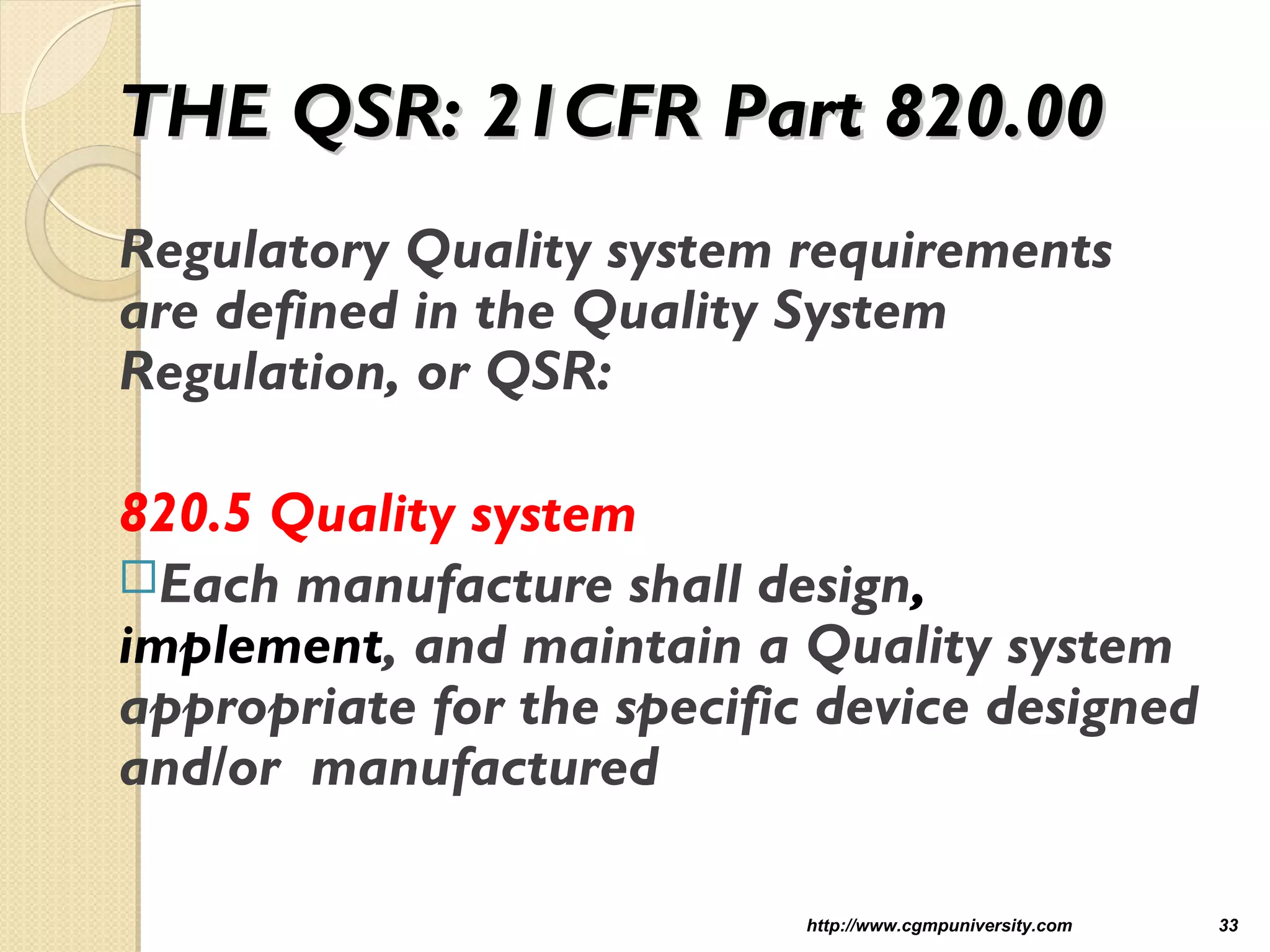
THE QSR: 21CFRPart 820.00THE QSR: 21CFR Part 820.00
Regulatory Quality system requirements
are defined in the Quality System
Regulation, or QSR:
820.5 Quality system
Each manufacture shall design,
implement, and maintain a Quality system
appropriate for the specific device designed
and/or manufactured
http://www.cgmpuniversity.com 33
34.
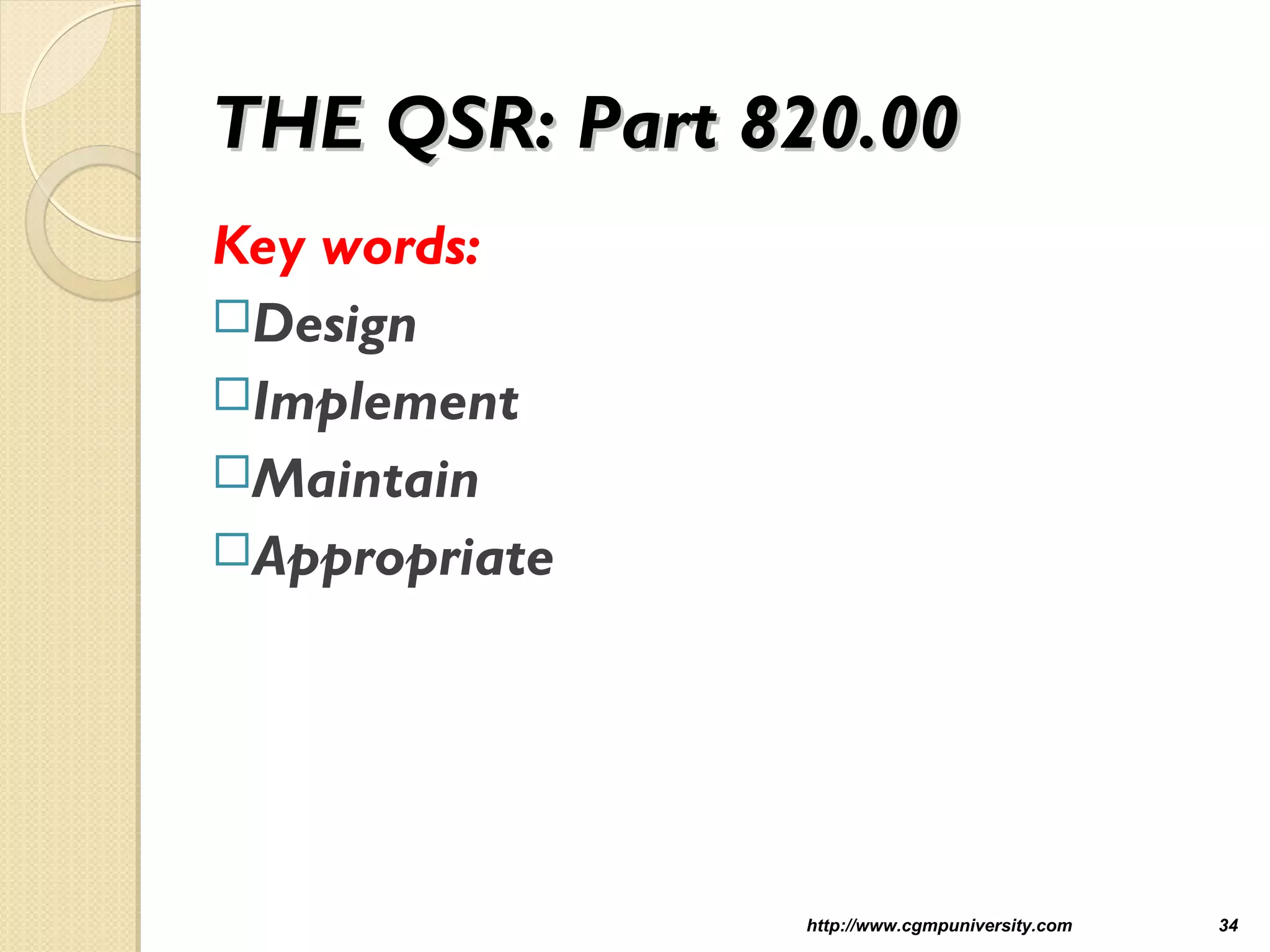
THE QSR: Part820.00THE QSR: Part 820.00
Key words:
Design
Implement
Maintain
Appropriate
http://www.cgmpuniversity.com 34
35.
THE QSR: Part820.00THE QSR: Part 820.00
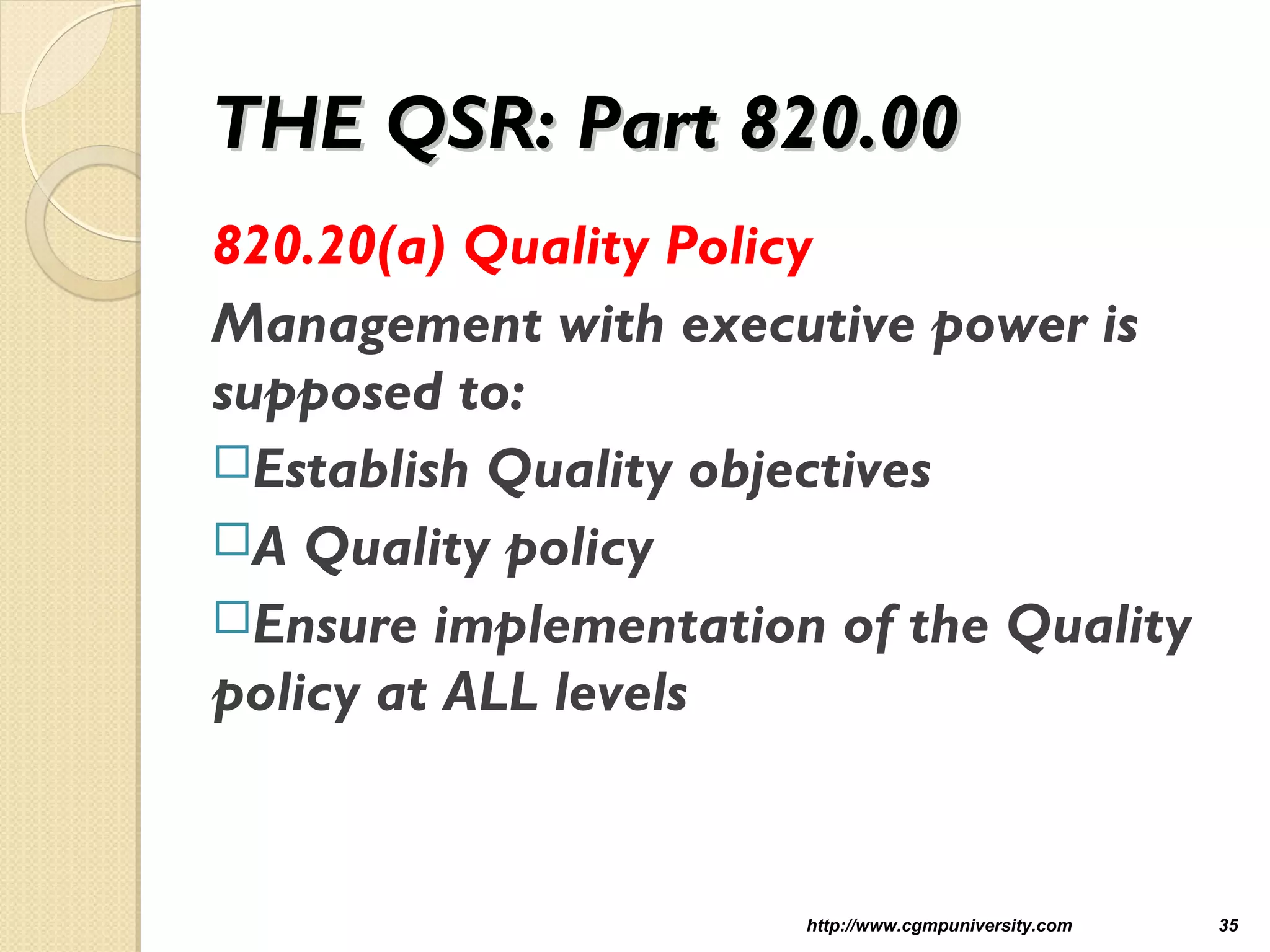
820.20(a) Quality Policy
Management with executive power is
supposed to:
Establish Quality objectives
A Quality policy
Ensure implementation of the Quality
policy at ALL levels
http://www.cgmpuniversity.com 35
36.
THE QSR: Part820.00THE QSR: Part 820.00
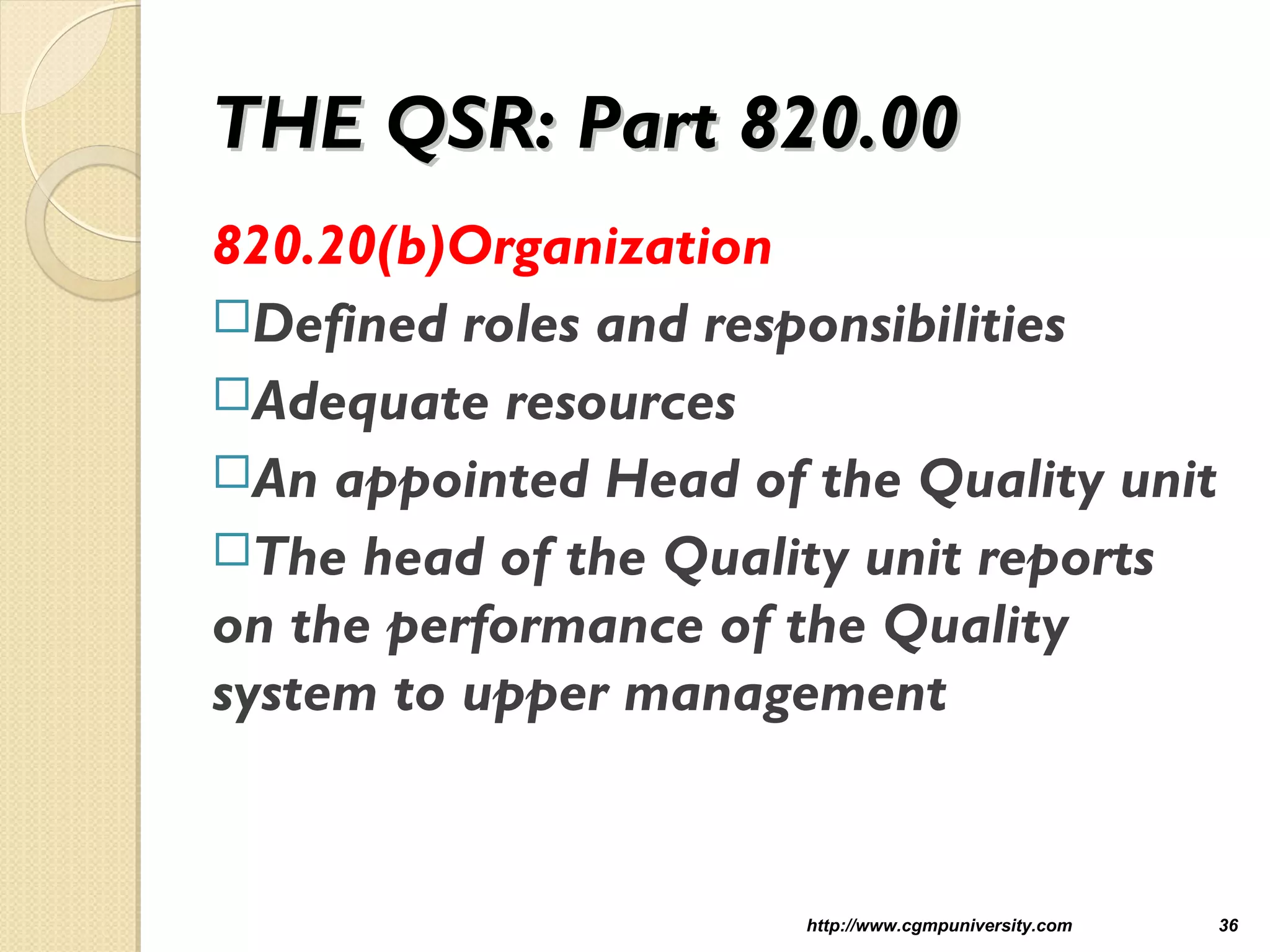
820.20(b)Organization
Defined roles and responsibilities
Adequate resources
An appointed Head of the Quality unit
The head of the Quality unit reports
on the performance of the Quality
system to upper management
http://www.cgmpuniversity.com 36
37.
THE QSR: Part820.00THE QSR: Part 820.00
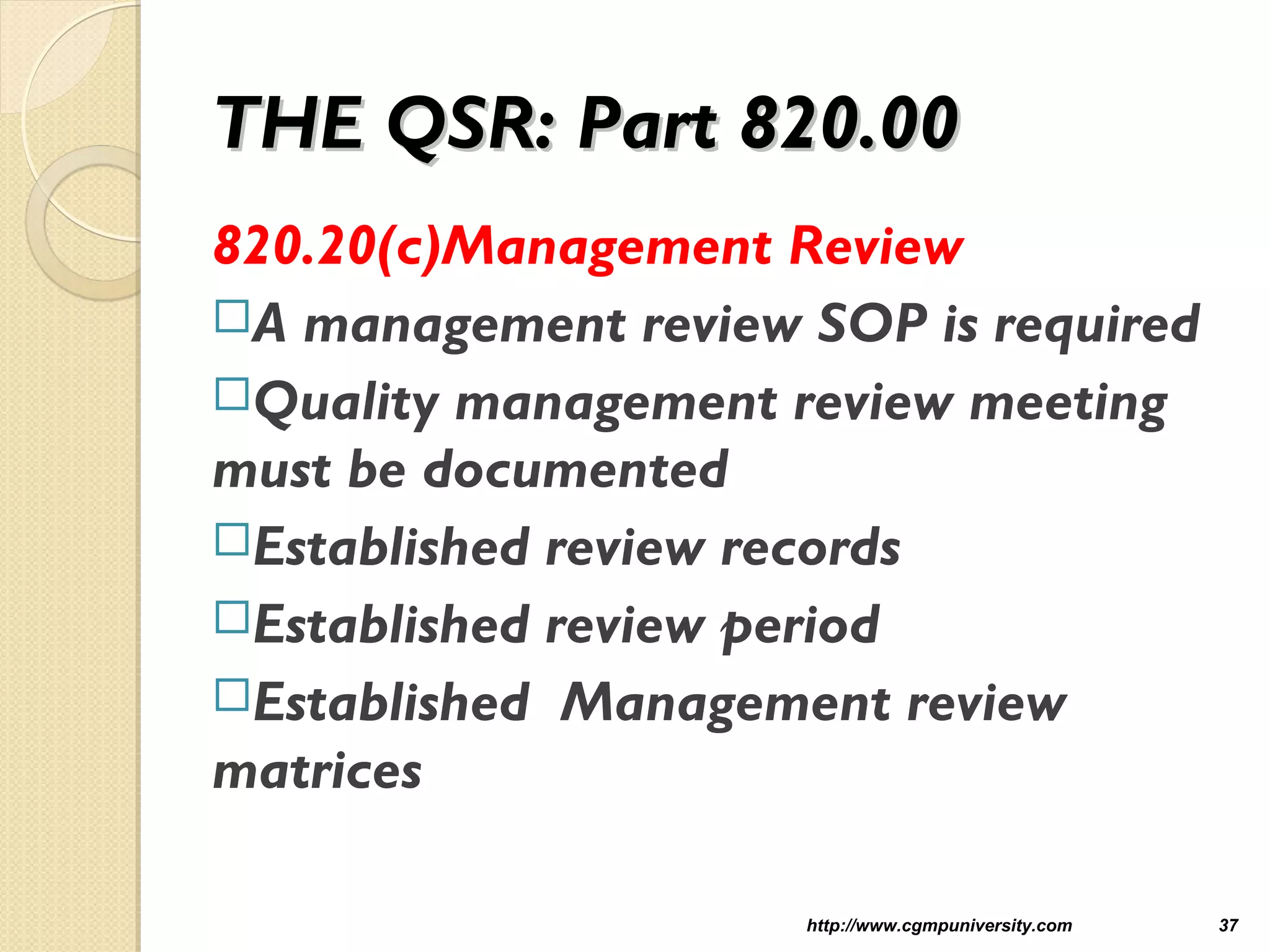
820.20(c)Management Review
A management review SOP is required
Quality management review meeting
must be documented
Established review records
Established review period
Established Management review
matrices
http://www.cgmpuniversity.com 37
38.
THE QSR: Part820.00THE QSR: Part 820.00
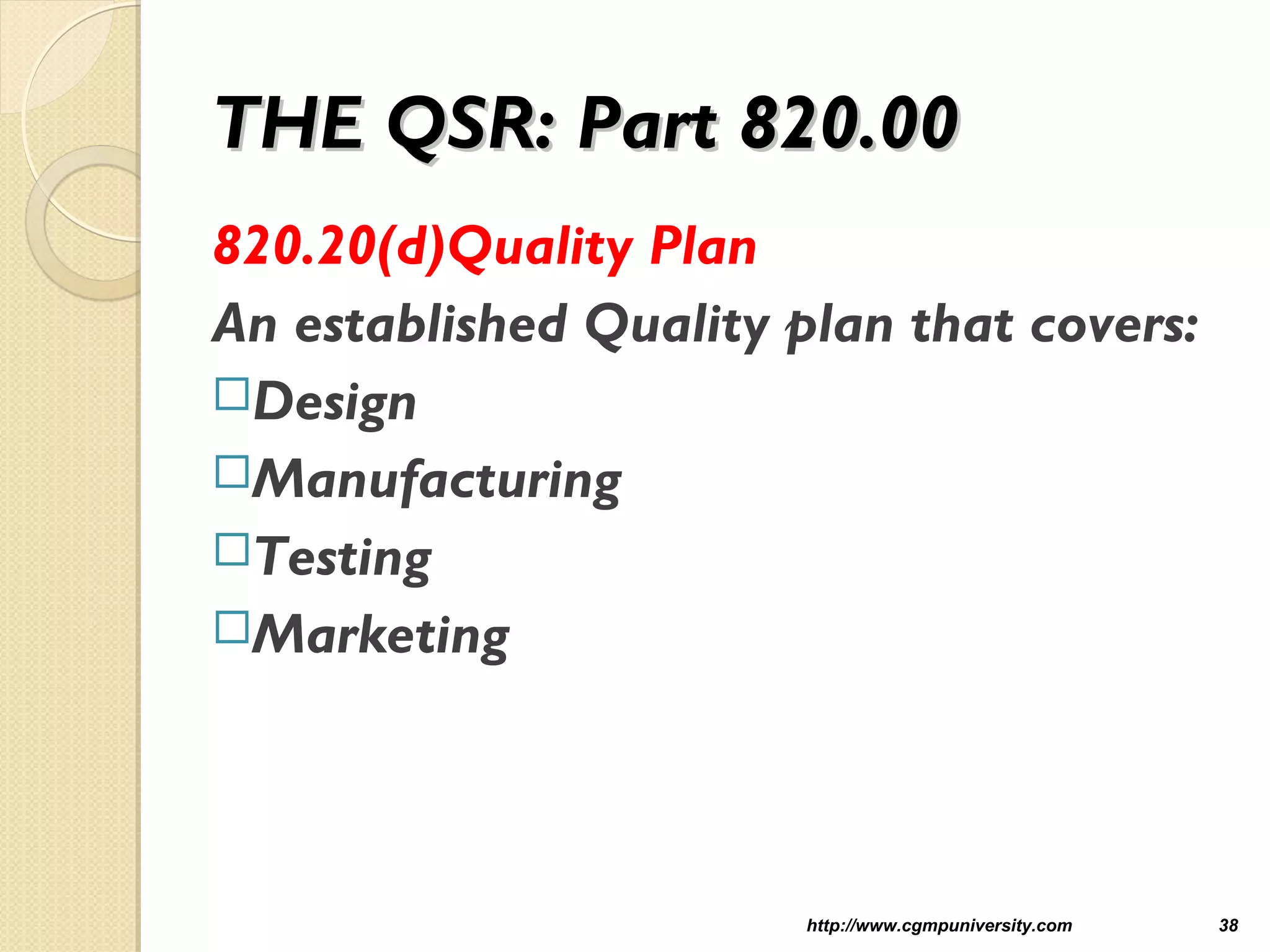
820.20(d)Quality Plan
An established Quality plan that covers:
Design
Manufacturing
Testing
Marketing
http://www.cgmpuniversity.com 38
39.
THE QSR: Part820.00THE QSR: Part 820.00
820.20(e)Quality system procedures
Established Quality system procedures:
Outline of Documentation used
Quality system Instructions
Quality system procedures
http://www.cgmpuniversity.com 39
40.
THE QSR: Part820.00THE QSR: Part 820.00
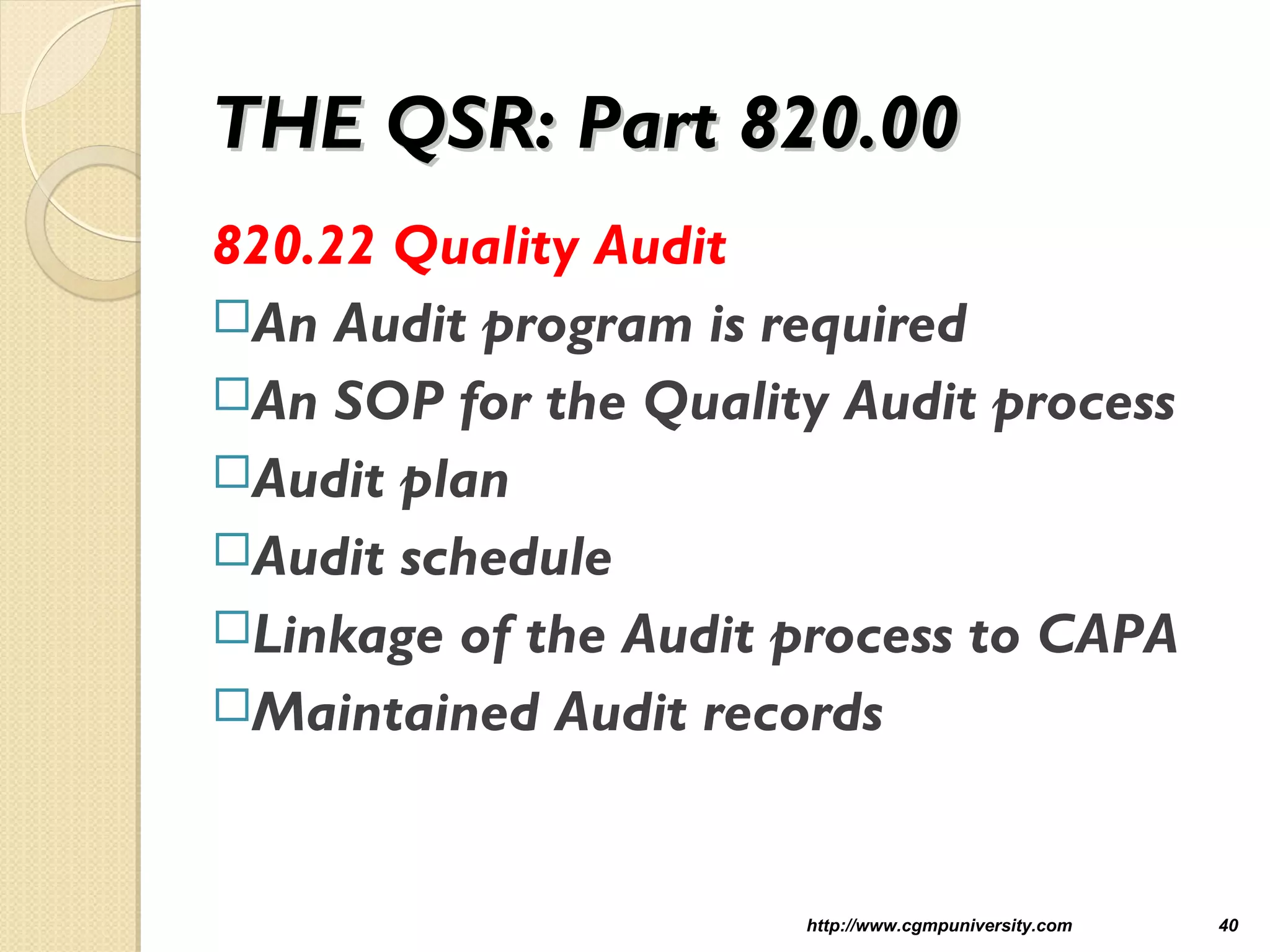
820.22 Quality Audit
An Audit program is required
An SOP for the Quality Audit process
Audit plan
Audit schedule
Linkage of the Audit process to CAPA
Maintained Audit records
http://www.cgmpuniversity.com 40
41.
TH21E QSR: Part820.002TH21E QSR: Part 820.002
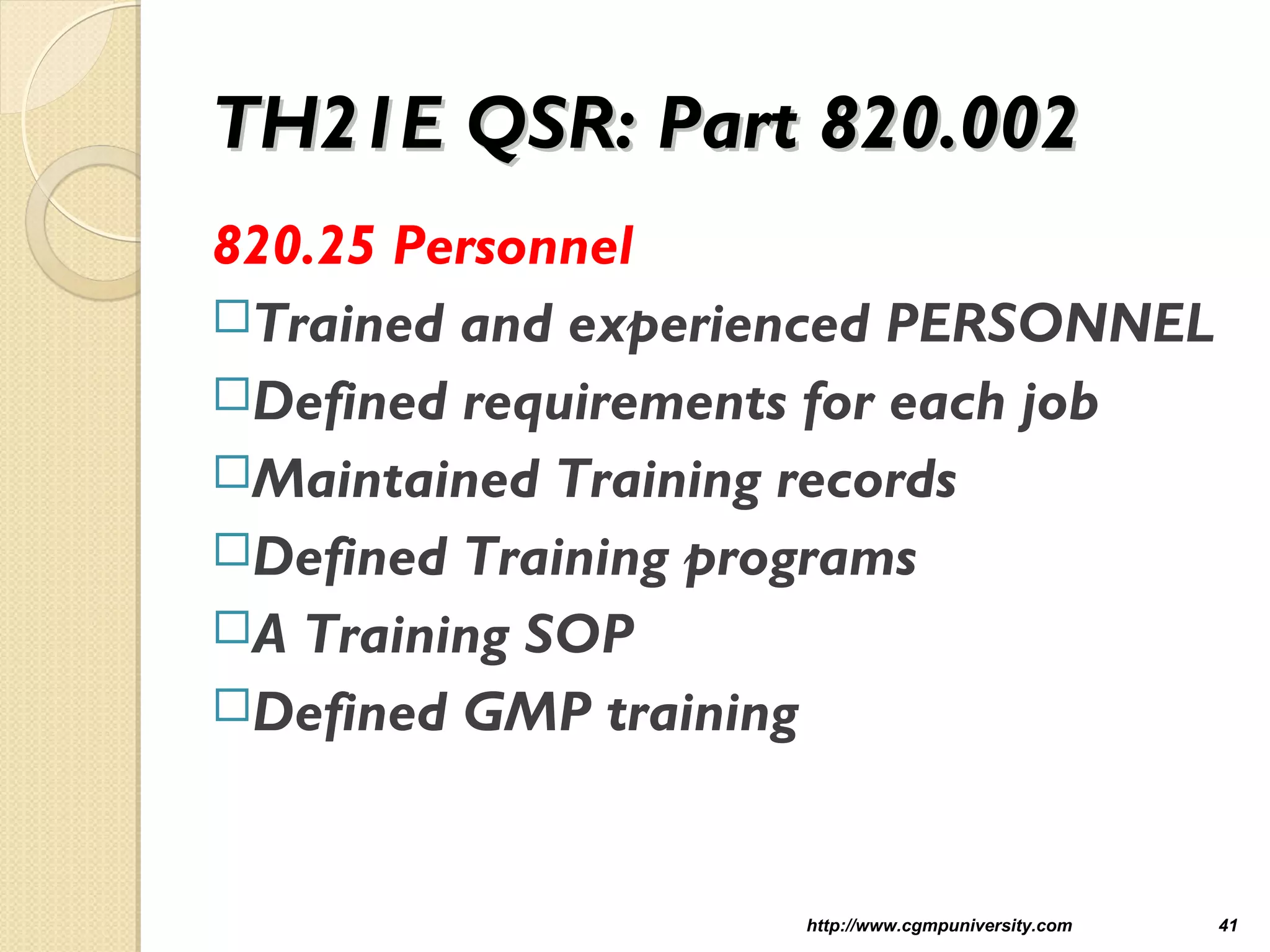
820.25 Personnel
Trained and experienced PERSONNEL
Defined requirements for each job
Maintained Training records
Defined Training programs
A Training SOP
Defined GMP training
http://www.cgmpuniversity.com 41
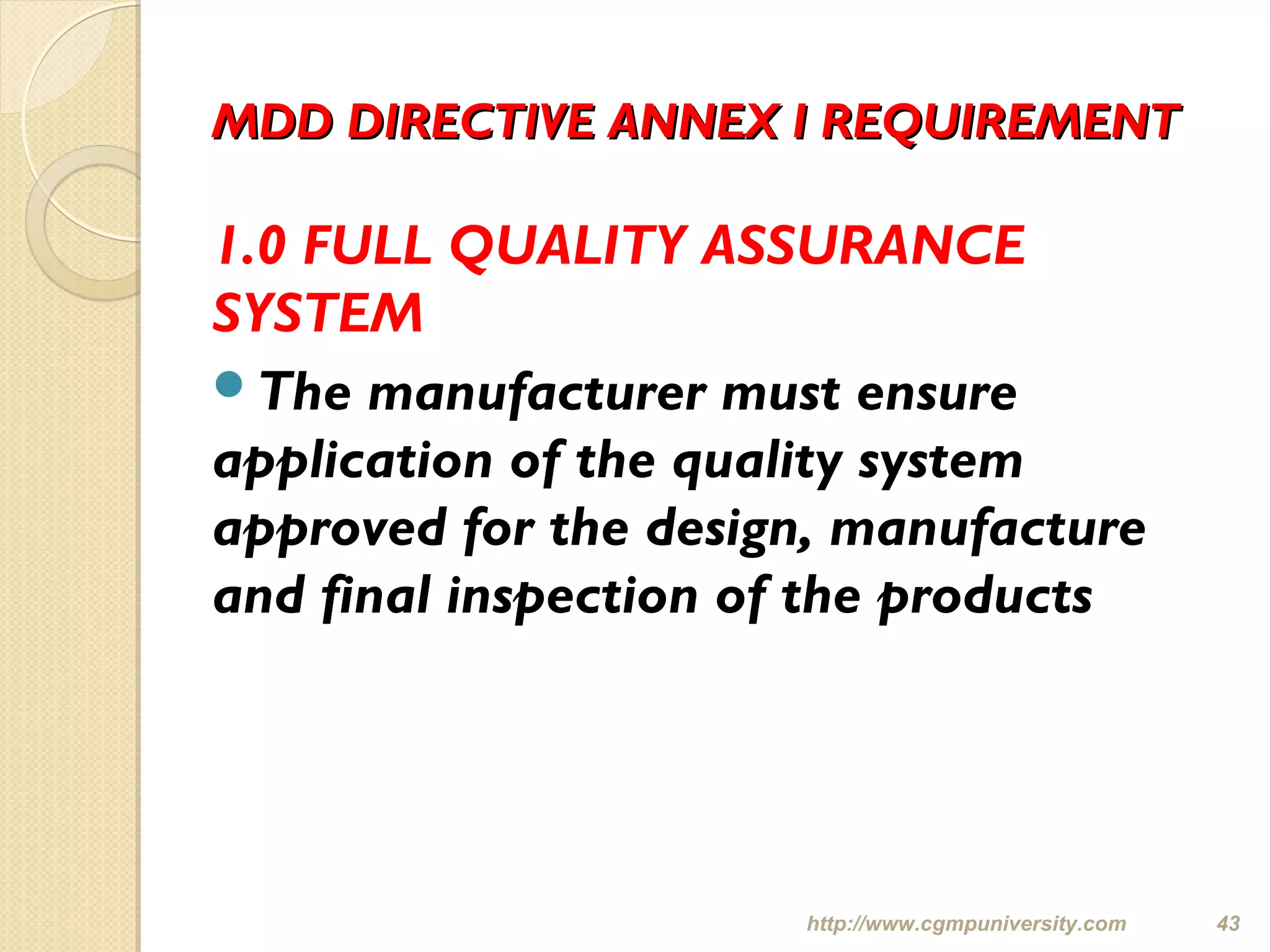
MDD DIRECTIVE ANNEXI REQUIREMENTMDD DIRECTIVE ANNEX I REQUIREMENT
1.0 FULL QUALITY ASSURANCE
SYSTEM
The manufacturer must ensure
application of the quality system
approved for the design, manufacture
and final inspection of the products
http://www.cgmpuniversity.com 43
44.
MDD ANNEX IREQUIREMENTMDD ANNEX I REQUIREMENT
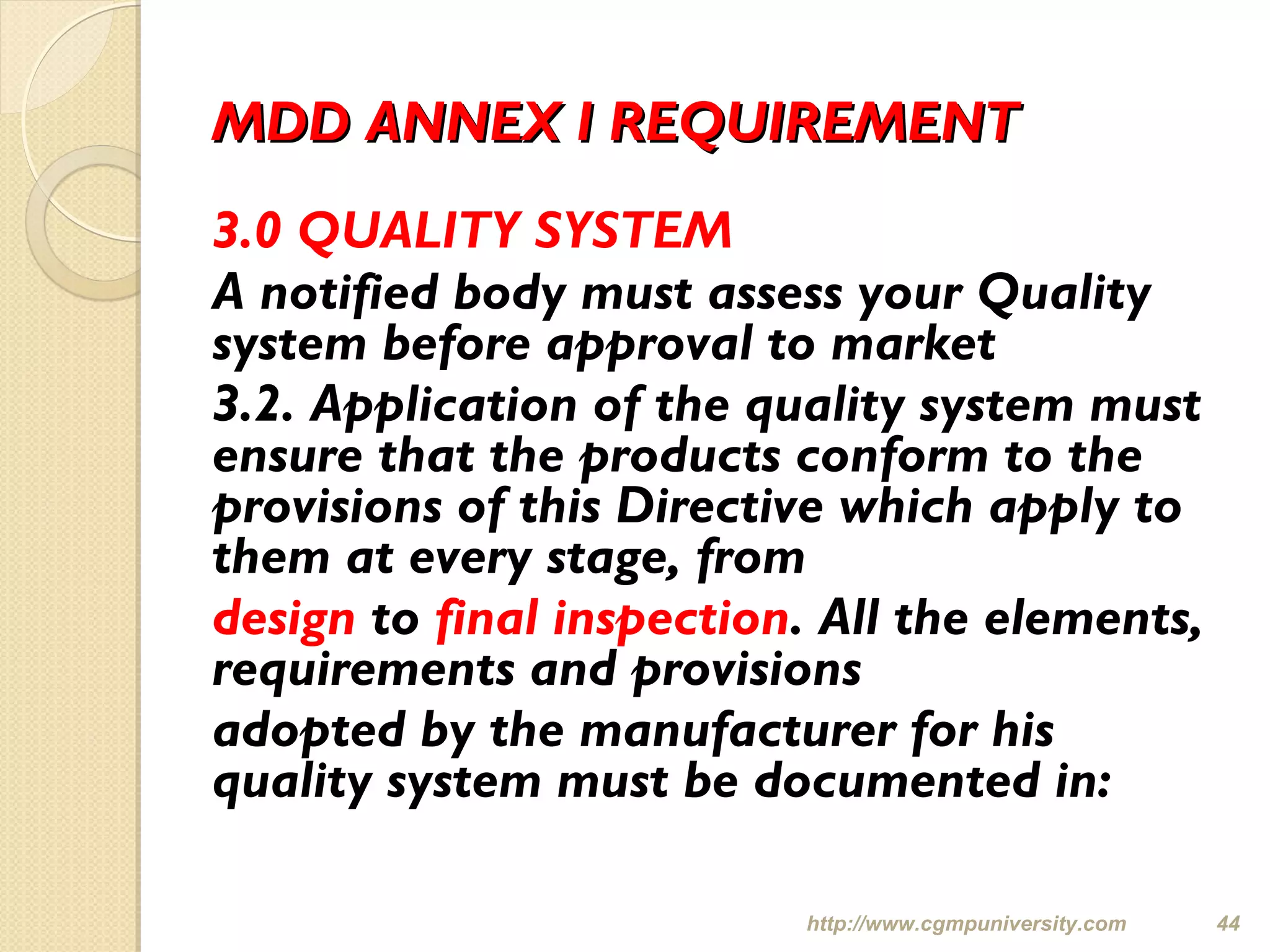
3.0 QUALITY SYSTEM
A notified body must assess your Quality
system before approval to market
3.2. Application of the quality system must
ensure that the products conform to the
provisions of this Directive which apply to
them at every stage, from
design to final inspection. All the elements,
requirements and provisions
adopted by the manufacturer for his
quality system must be documented in:
http://www.cgmpuniversity.com 44
45.
MDD ANNEX IREQUIREMENTMDD ANNEX I REQUIREMENT
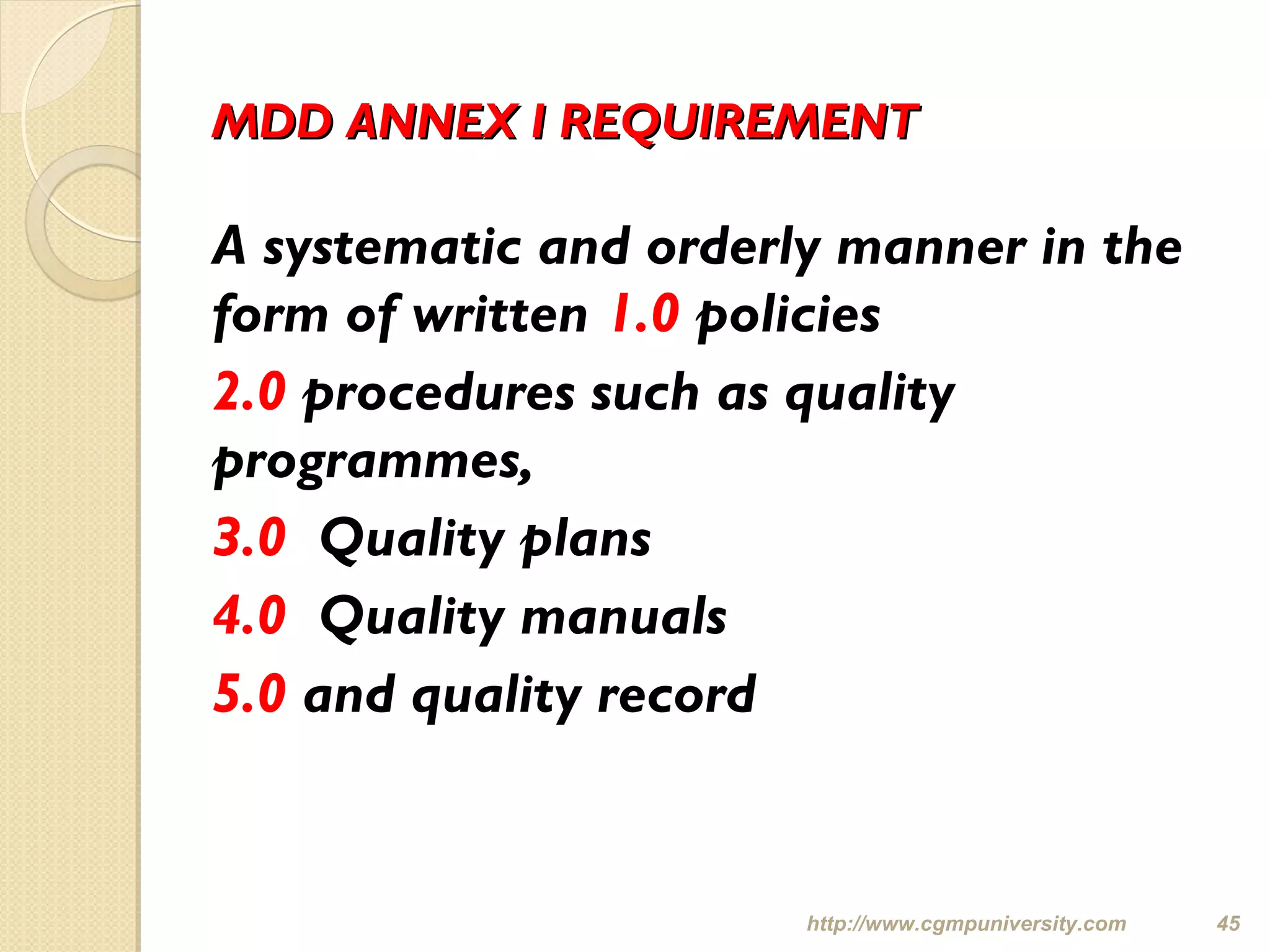
A systematic and orderly manner in the
form of written 1.0 policies
2.0 procedures such as quality
programmes,
3.0 Quality plans
4.0 Quality manuals
5.0 and quality record
http://www.cgmpuniversity.com 45
46.
MDD ANNEX IREQUIREMENTMDD ANNEX I REQUIREMENT
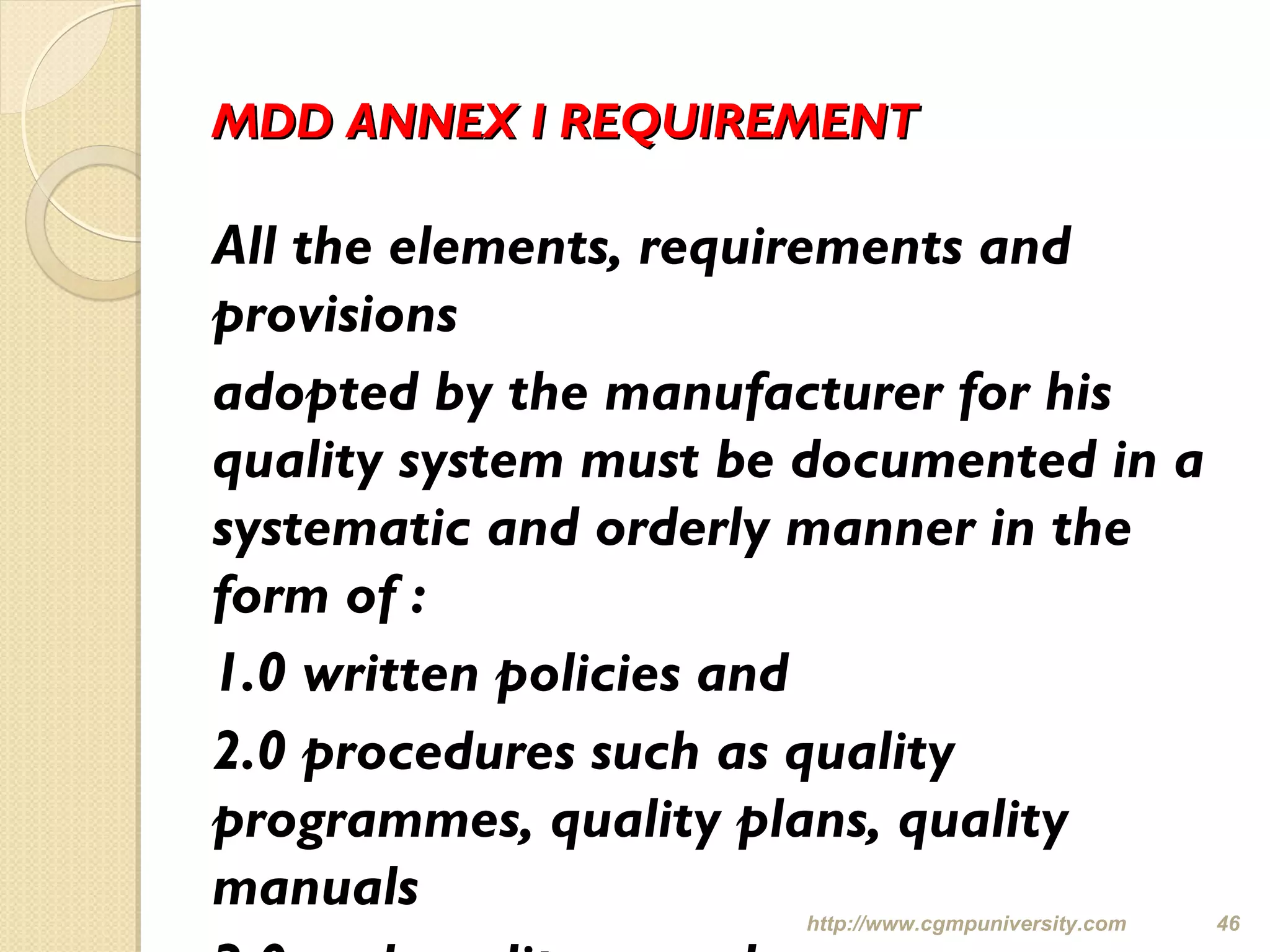
All the elements, requirements and
provisions
adopted by the manufacturer for his
quality system must be documented in a
systematic and orderly manner in the
form of :
1.0 written policies and
2.0 procedures such as quality
programmes, quality plans, quality
manuals http://www.cgmpuniversity.com 46
C. ISO 13485STANDARDSC. ISO 13485 STANDARDS
0.2 Process approach to Quality management
The output from one process directly forms the
input to the next
4.0 Quality management system requirements
The organization shall establish, document,
implement and maintain a quality
management system and maintain its
effectiveness
http://www.cgmpuniversity.com 48
49.
ISO13485 REQUIREMENTSISO13485 REQUIREMENTS
4.2Documentation requirements
The quality management system documentation
shall include
(a) Documented statements of a quality policy
and quality objectives
(b) A quality manual,
(c) Documented procedures
(d) documents needed by the organization to
ensure the effective planning, operation and
control of its
Processes.
(e) Records
http://www.cgmpuniversity.com 49
ISO9001 REQUIREMENTSISO9001 REQUIREMENTS
4.0Quality management system
4.1 General requirements
The organization shall establish, document, implement and maintain a quality
management system and
continually improve its effectiveness in accordance with the requirements of this
International Standard.
The organization shall
a) determine the processes needed for the quality management system and their
application throughout the
organization (see 1.2),
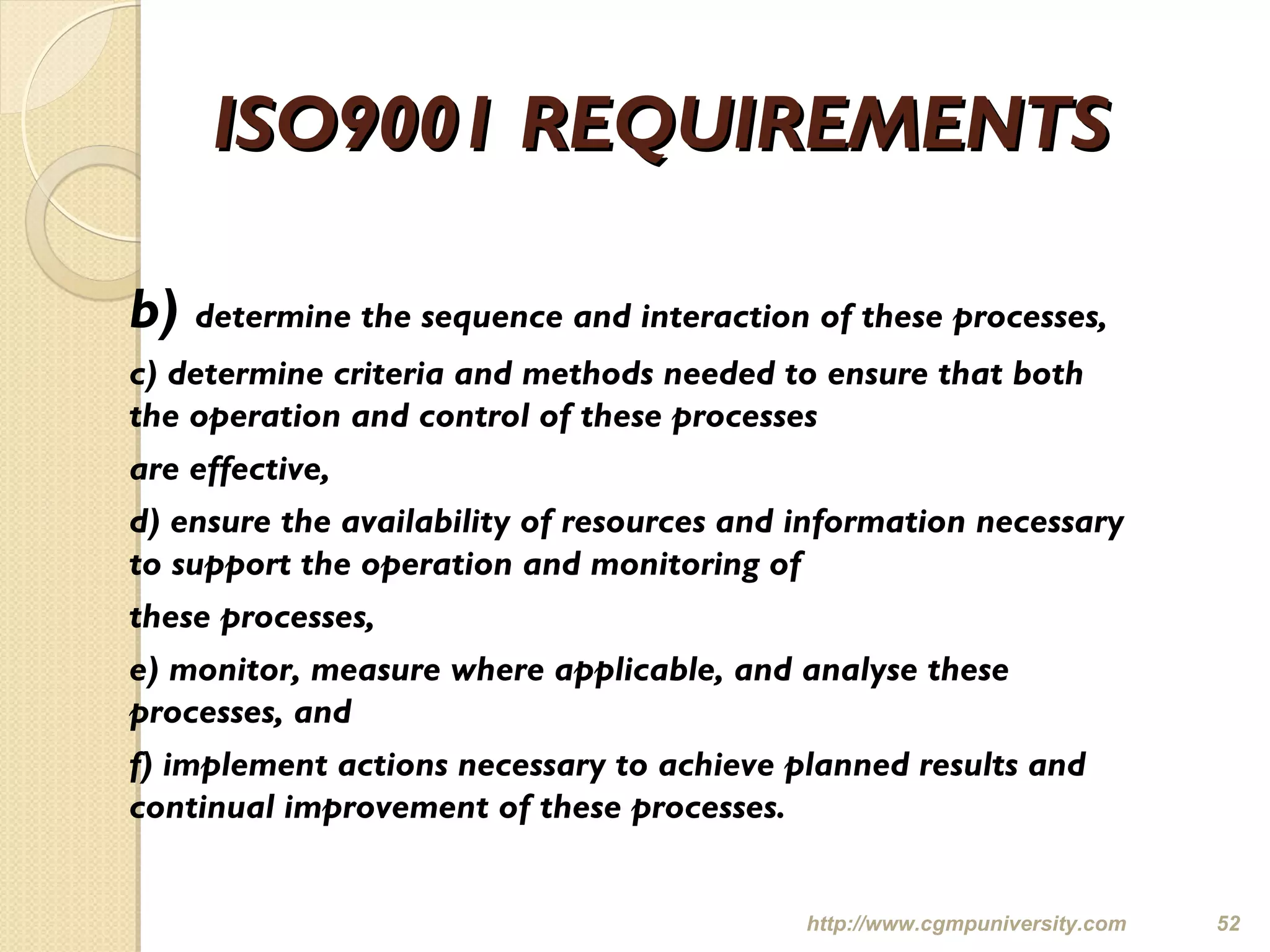
b) determine the sequence and interaction of these processes,
c) determine criteria and methods needed to ensure that both the operation and
control of these processes
are effective,
d) ensure the availability of resources and information necessary to support the
operation and monitoring of
these processes,
e) monitor, measure where applicable, and analyse these processes, and
f) implement actions necessary to achieve planned results and continual
improvement of these processes.
http://www.cgmpuniversity.com 51
52.
ISO9001 REQUIREMENTSISO9001 REQUIREMENTS
b)determine the sequence and interaction of these processes,
c) determine criteria and methods needed to ensure that both
the operation and control of these processes
are effective,
d) ensure the availability of resources and information necessary
to support the operation and monitoring of
these processes,
e) monitor, measure where applicable, and analyse these
processes, and
f) implement actions necessary to achieve planned results and
continual improvement of these processes.
http://www.cgmpuniversity.com 52
53.
D. ISO 9001STANDARDD. ISO 9001 STANDARD
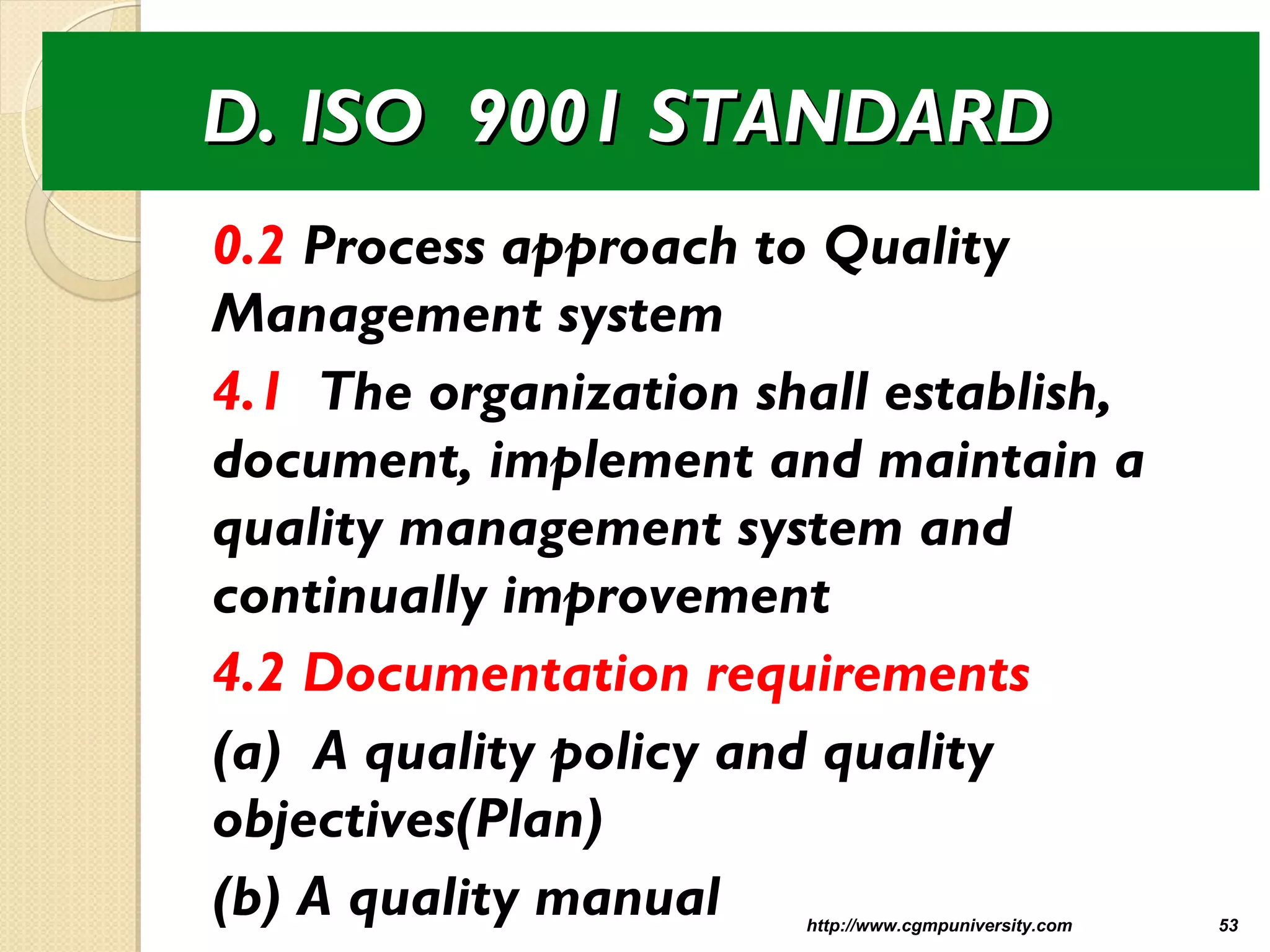
0.2 Process approach to Quality
Management system
4.1 The organization shall establish,
document, implement and maintain a
quality management system and
continually improvement
4.2 Documentation requirements
(a) A quality policy and quality
objectives(Plan)
(b) A quality manual http://www.cgmpuniversity.com 53
54.
ISO9001 REQUIREMENTSISO9001 REQUIREMENTS
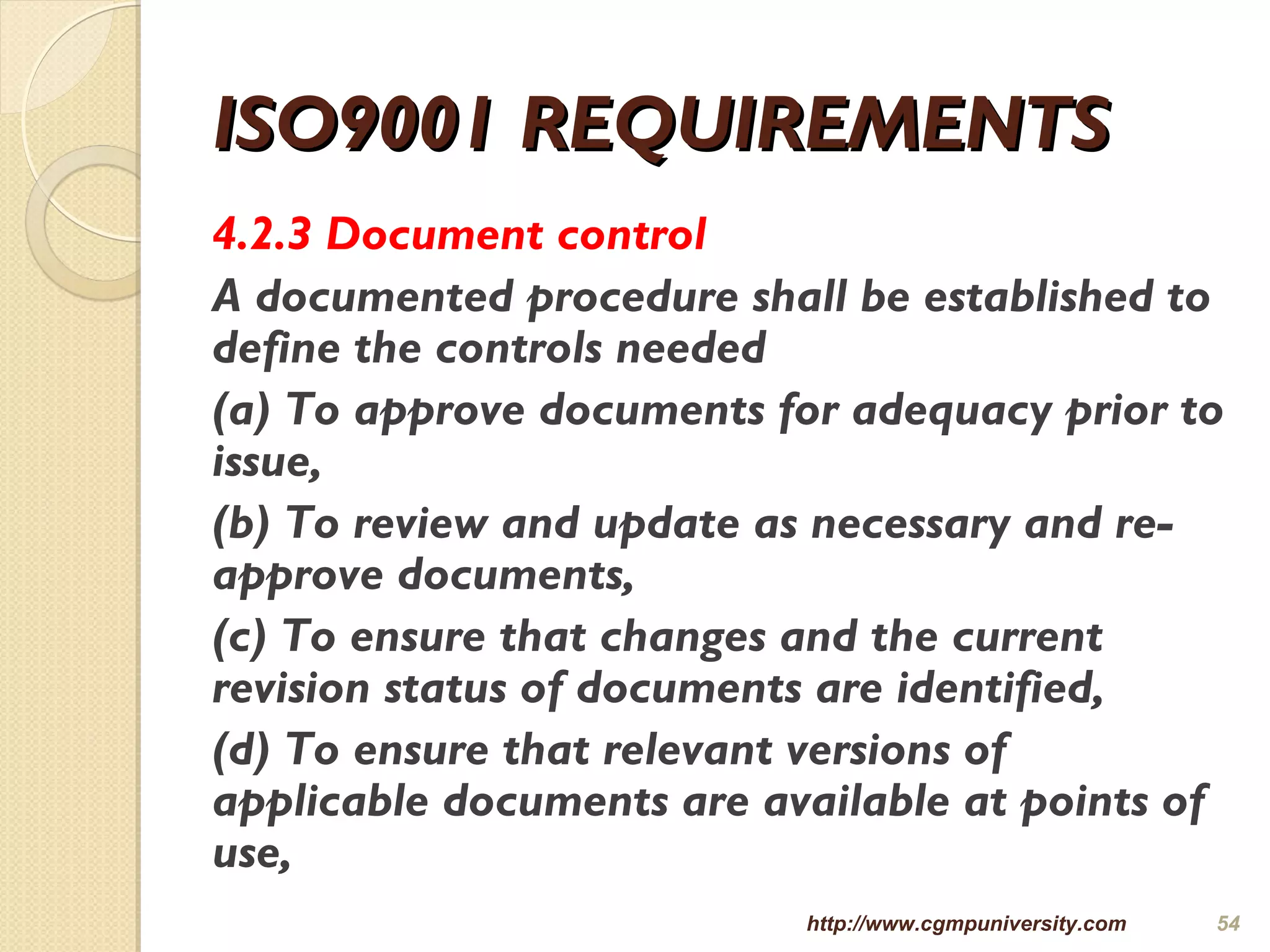
4.2.3Document control
A documented procedure shall be established to
define the controls needed
(a) To approve documents for adequacy prior to
issue,
(b) To review and update as necessary and re-
approve documents,
(c) To ensure that changes and the current
revision status of documents are identified,
(d) To ensure that relevant versions of
applicable documents are available at points of
use,
http://www.cgmpuniversity.com 54
55.
ISO9001 REQUIREMENTSISO9001 REQUIREMENTS
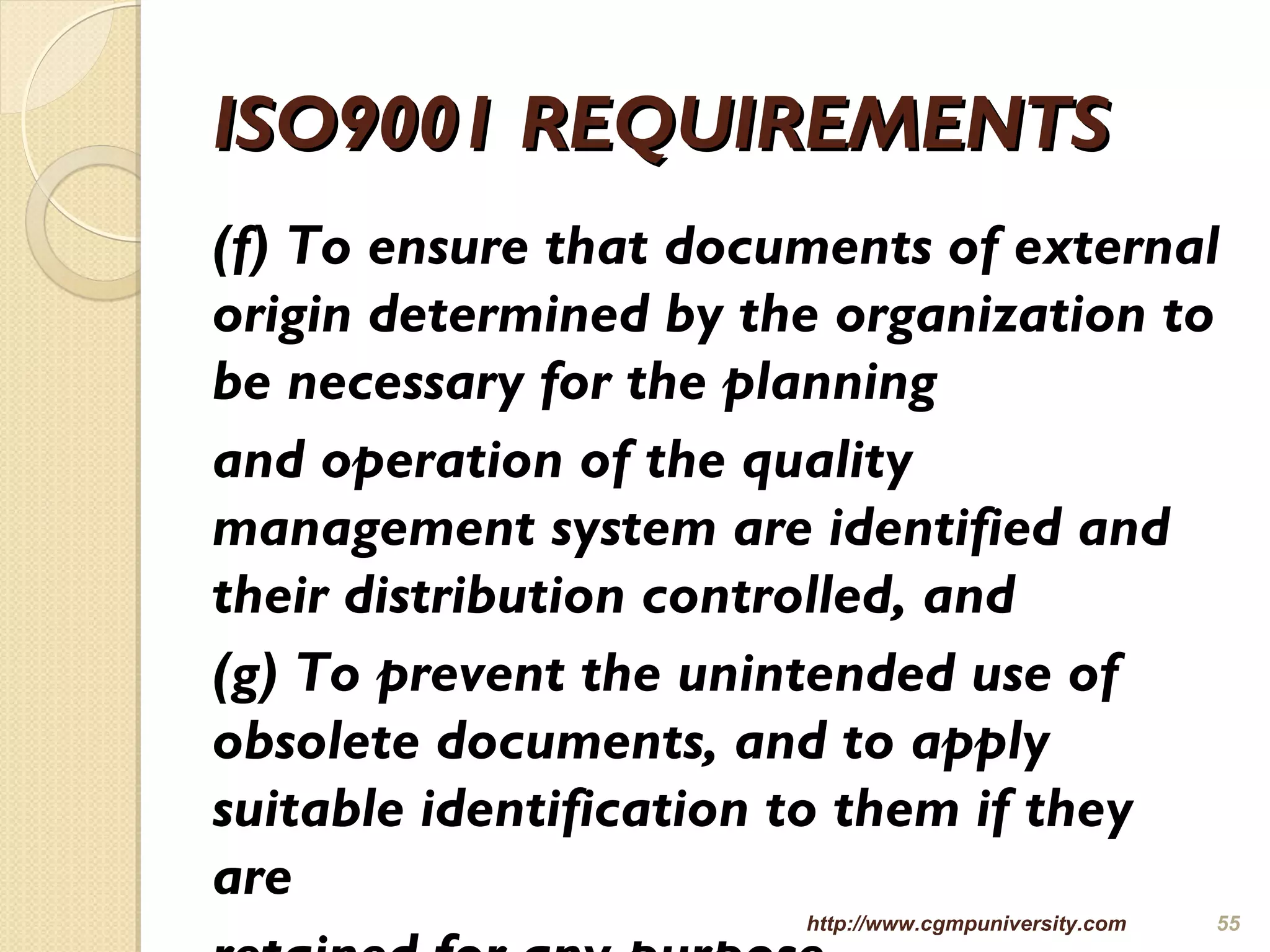
(f)To ensure that documents of external
origin determined by the organization to
be necessary for the planning
and operation of the quality
management system are identified and
their distribution controlled, and
(g) To prevent the unintended use of
obsolete documents, and to apply
suitable identification to them if they
are
http://www.cgmpuniversity.com 55
56.
ISO9001 REQUIREMENTSISO9001 REQUIREMENTS
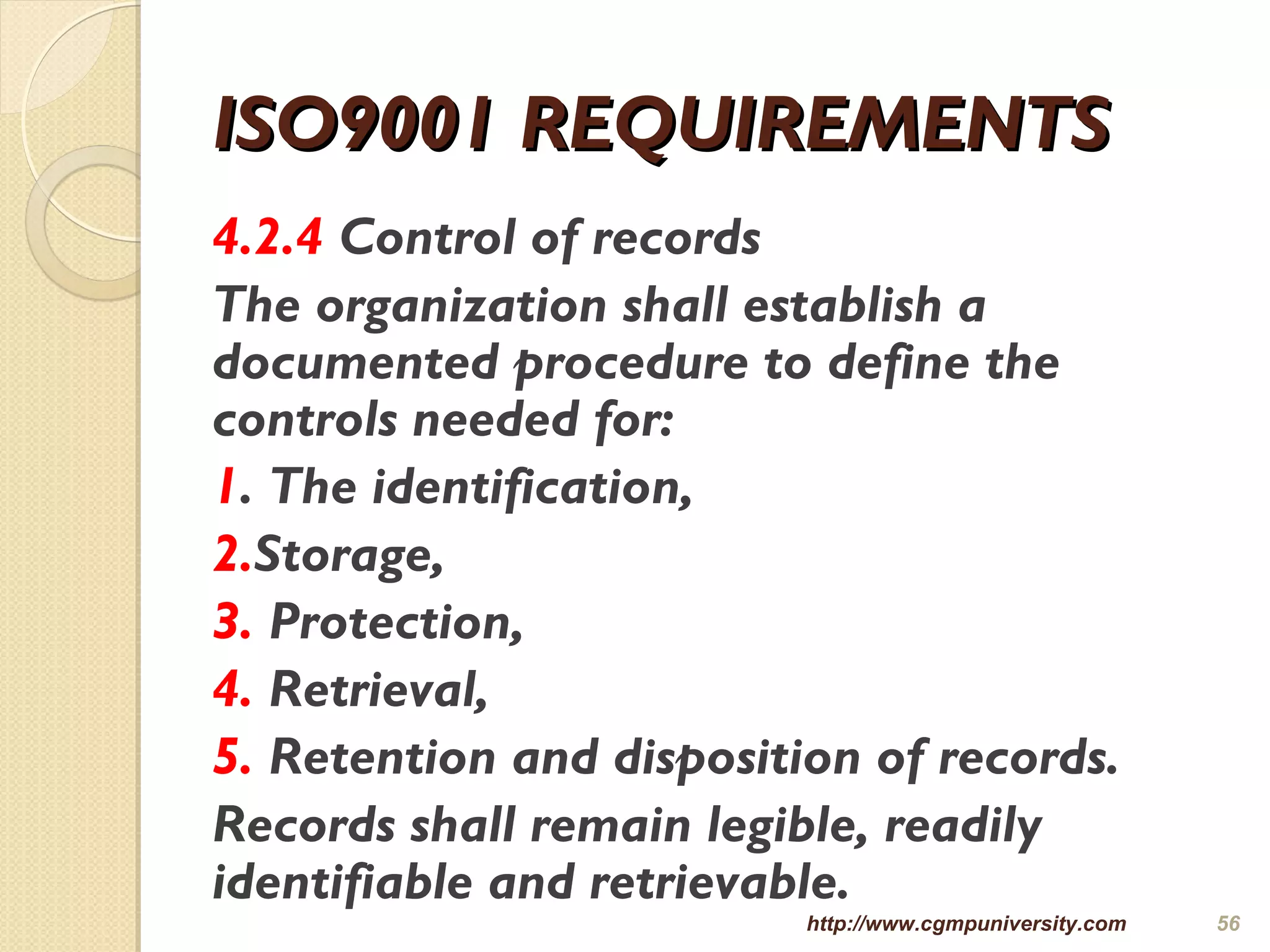
4.2.4Control of records
The organization shall establish a
documented procedure to define the
controls needed for:
1. The identification,
2.Storage,
3. Protection,
4. Retrieval,
5. Retention and disposition of records.
Records shall remain legible, readily
identifiable and retrievable.
http://www.cgmpuniversity.com 56
57.
ISO9001 REQUIREMENTSISO9001 REQUIREMENTS
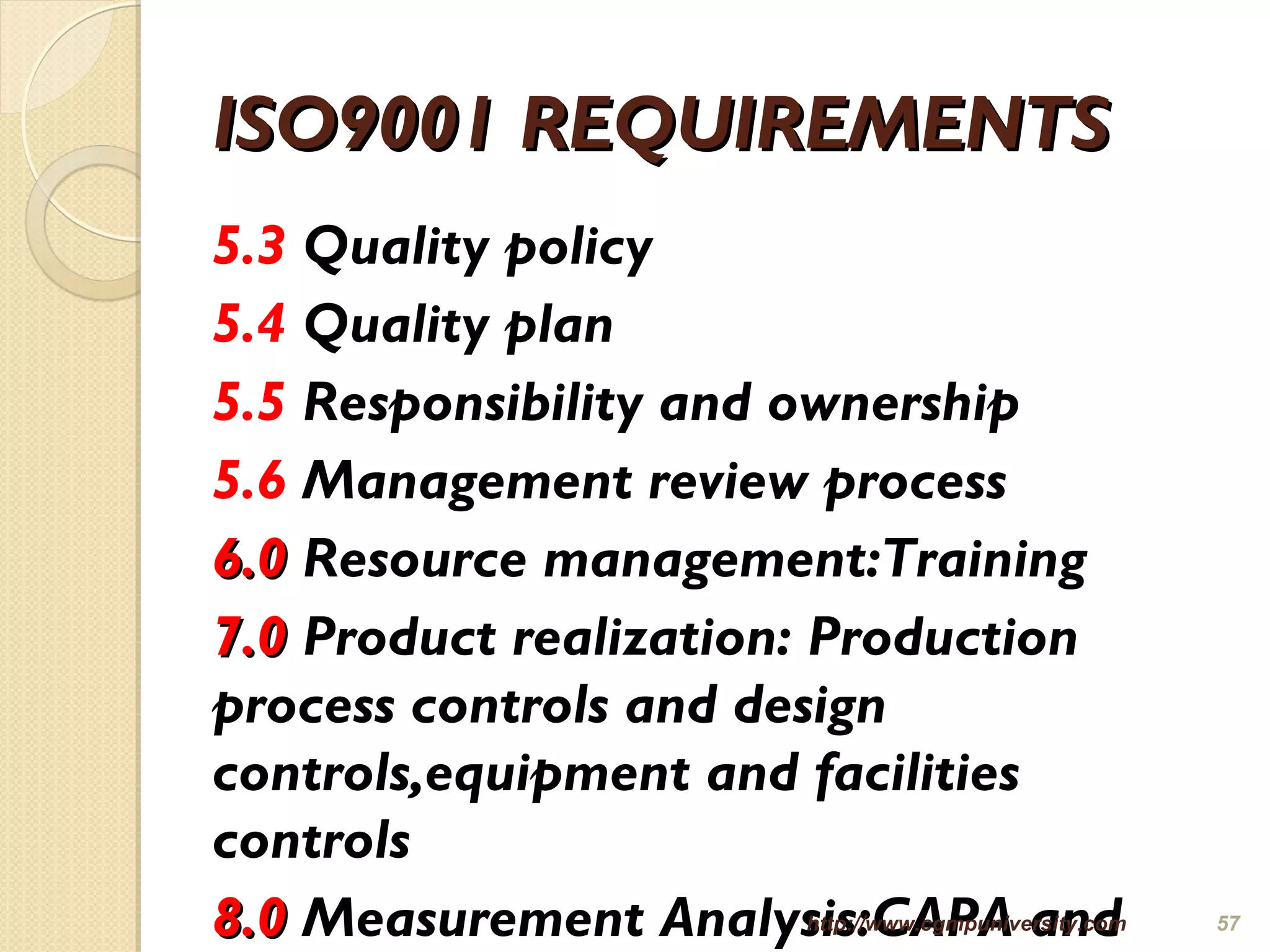
5.3Quality policy
5.4 Quality plan
5.5 Responsibility and ownership
5.6 Management review process
6.06.0 Resource management:Training
7.07.0 Product realization: Production
process controls and design
controls,equipment and facilities
controls
8.08.0 Measurement Analysis:CAPA andhttp://www.cgmpuniversity.com 57
58.
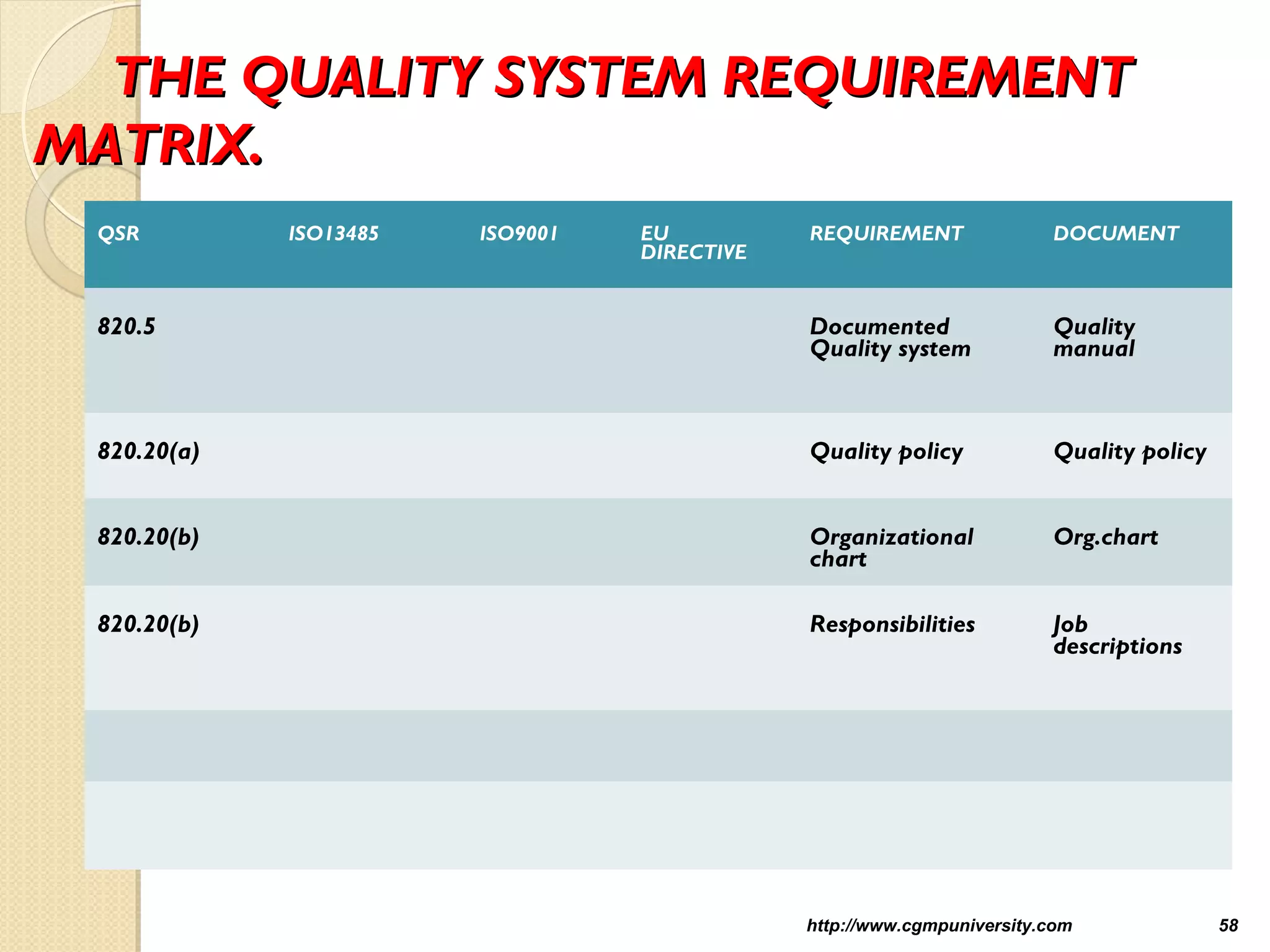
THE QUALITY SYSTEMREQUIREMENTTHE QUALITY SYSTEM REQUIREMENT
MATRIX.MATRIX.
http://www.cgmpuniversity.com 58
QSR ISO13485 ISO9001 EU
DIRECTIVE
REQUIREMENT DOCUMENT
820.5 Documented
Quality system
Quality
manual
820.20(a) Quality policy Quality policy
820.20(b) Organizational
chart
Org.chart
820.20(b) Responsibilities Job
descriptions
QUALITY SYSTEM MODELSQUALITYSYSTEM MODELS
There are four Quality system models
you can choose from:
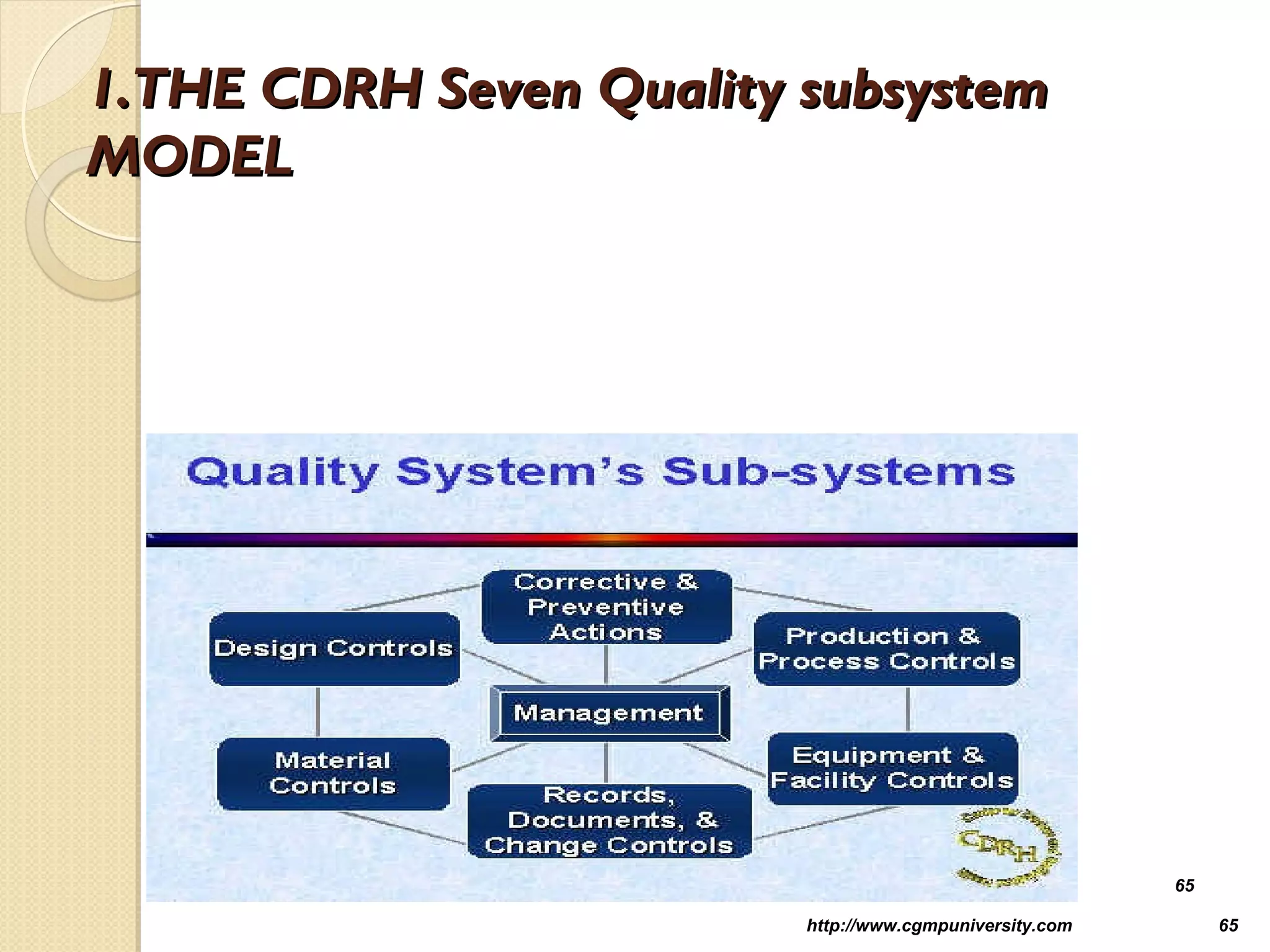
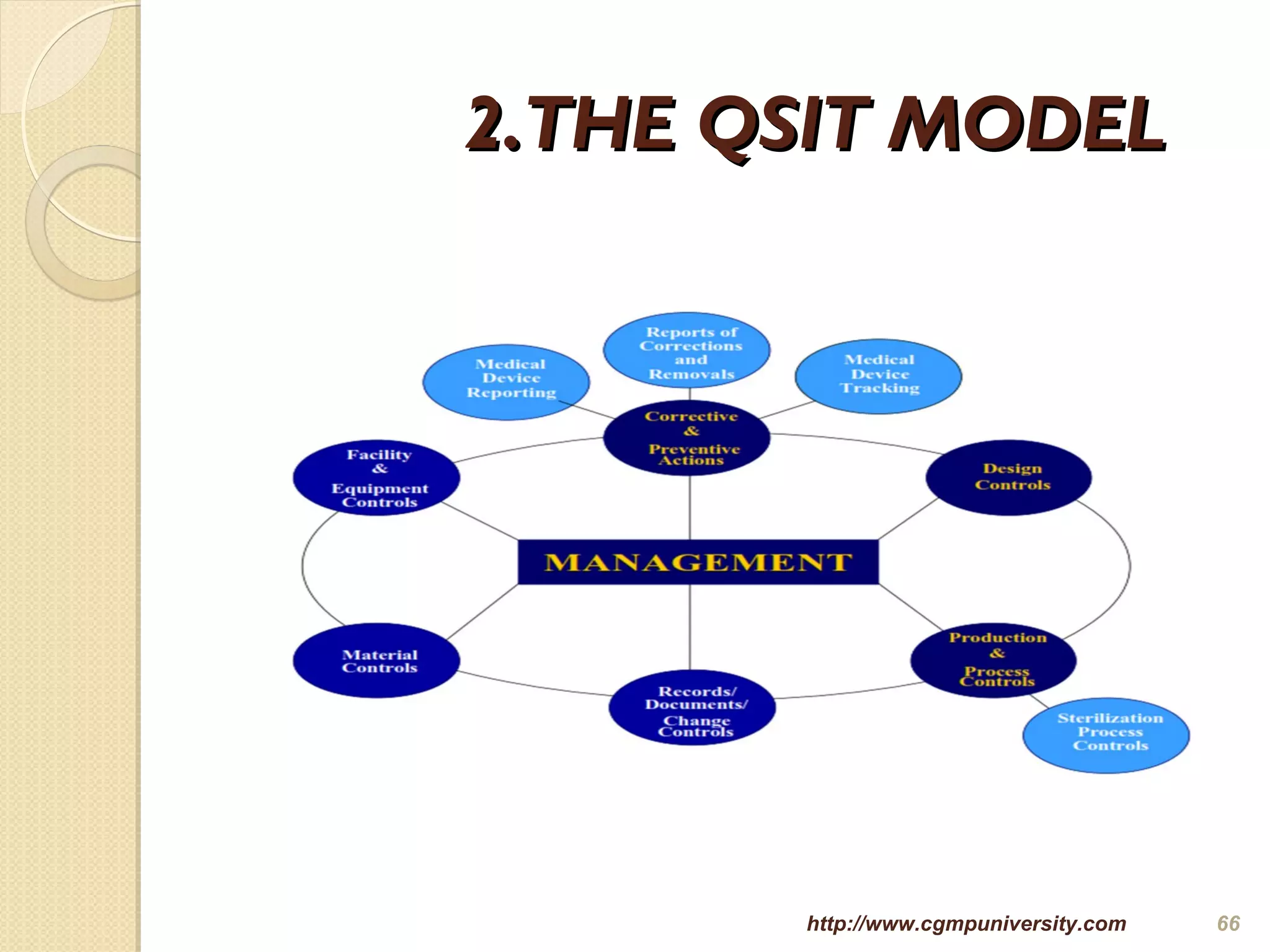
The CDRH seven subsystem Quality
system
The QSIT seven subsystems with Four
satellite Quality subsystems
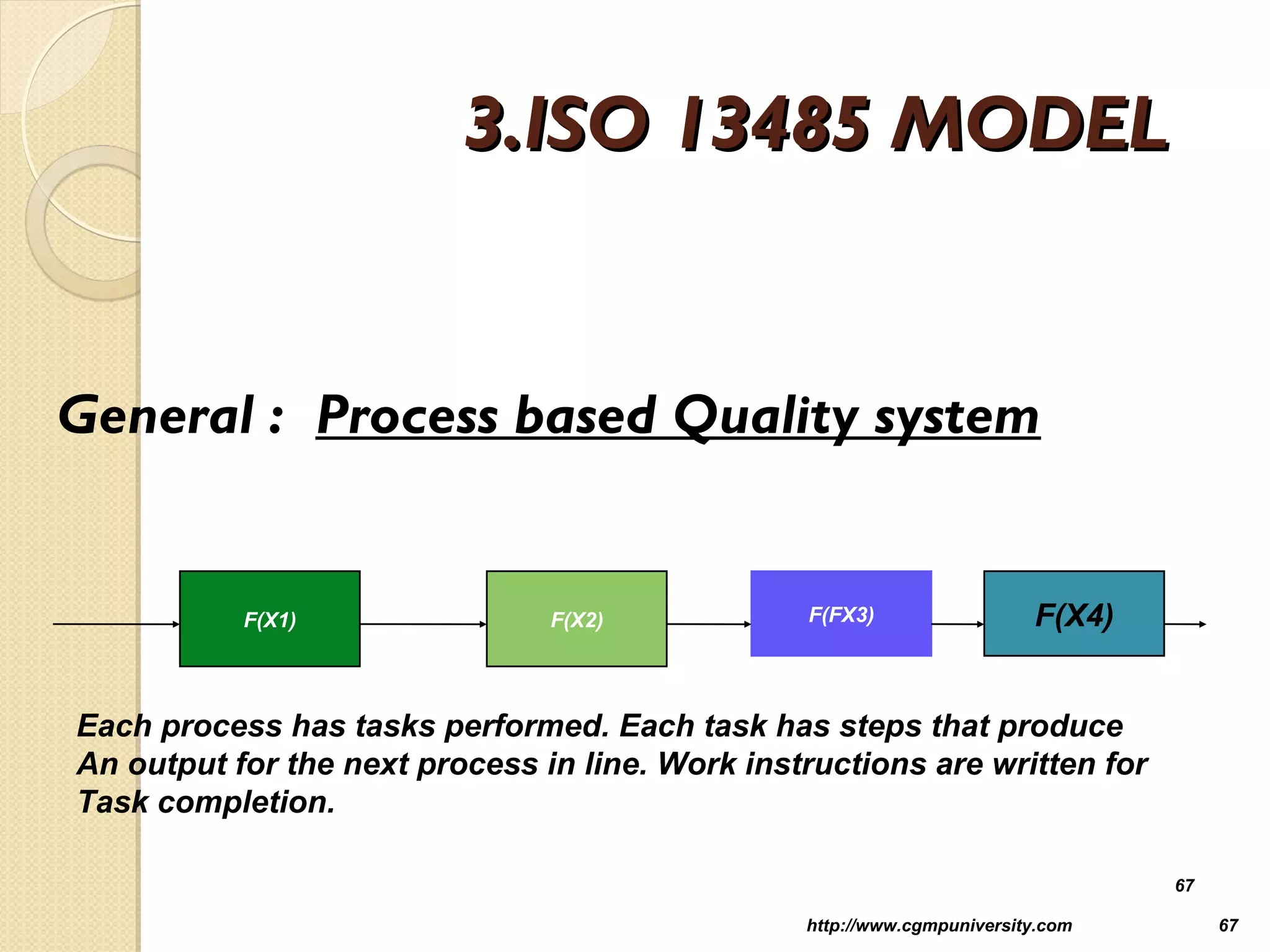
The ISO13485 model
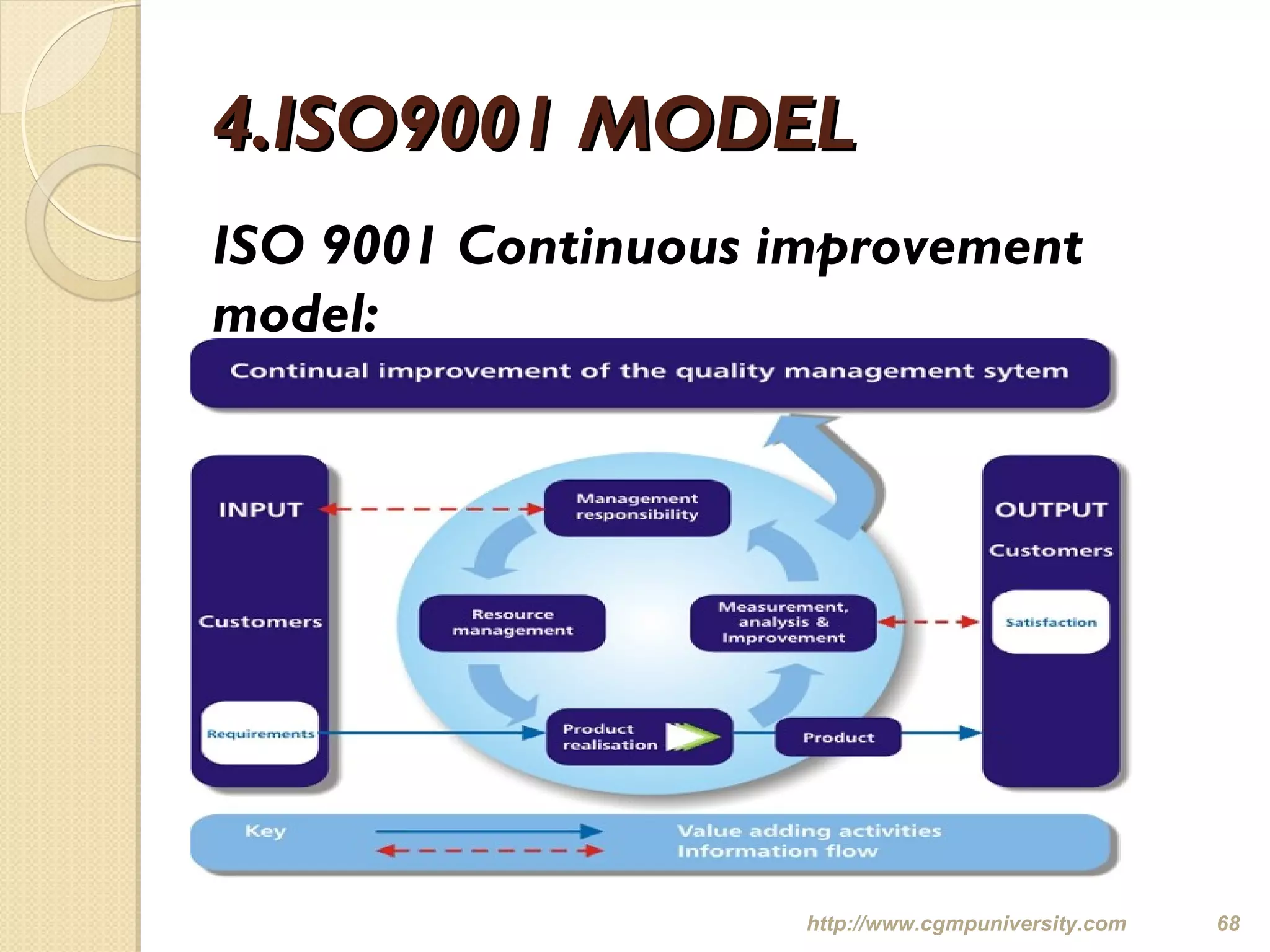
ISO 9001 Contious improvement
model
http://www.cgmpuniversity.com 64
3.ISO 13485 MODEL3.ISO13485 MODEL
General : Process based Quality system
http://www.cgmpuniversity.com 67
67
F(X1) F(X4)F(FX3)F(X2)
Each process has tasks performed. Each task has steps that produce
An output for the next process in line. Work instructions are written for
Task completion.
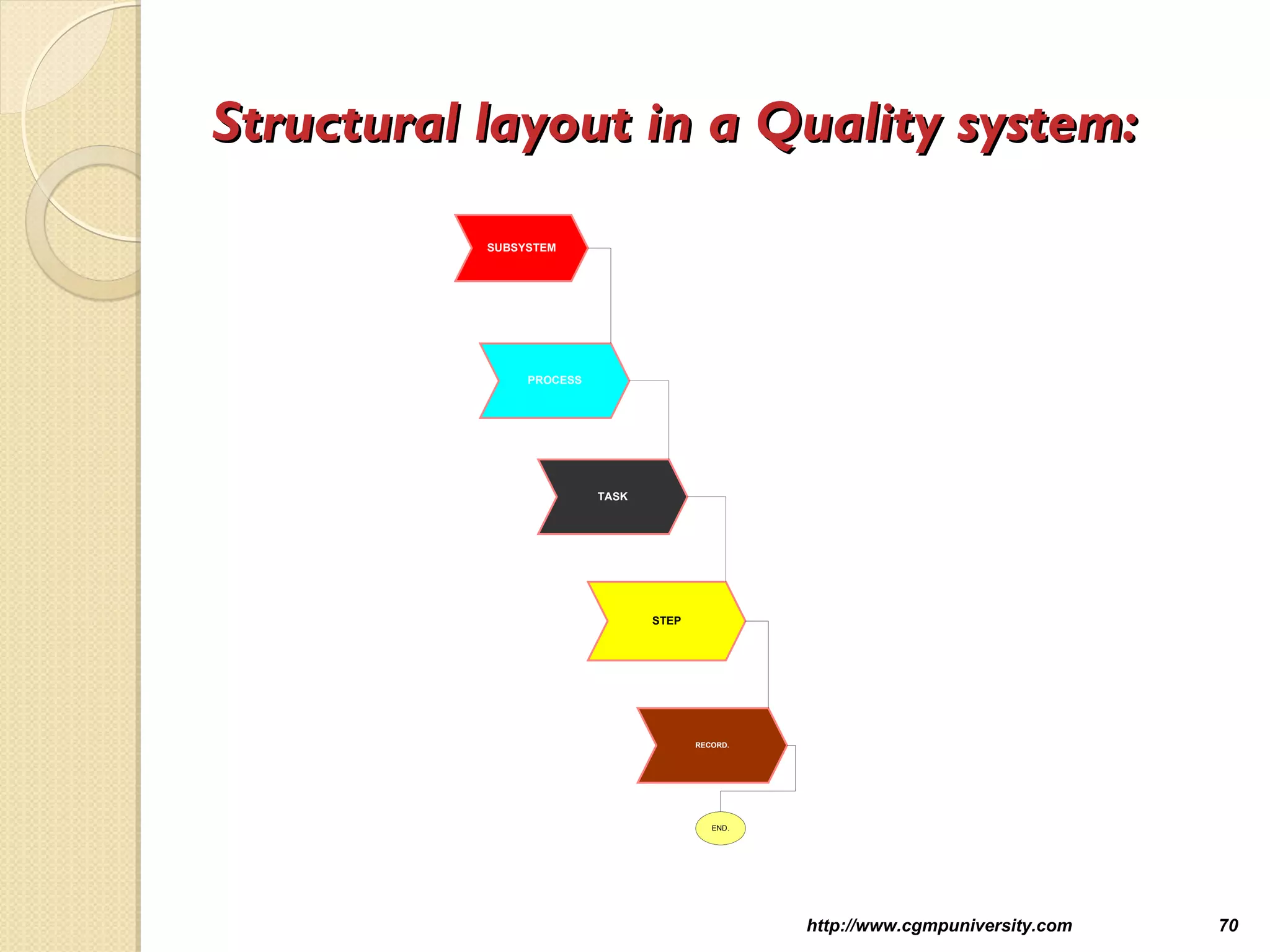
QUALITY SYSTEMQUALITY SYSTEM
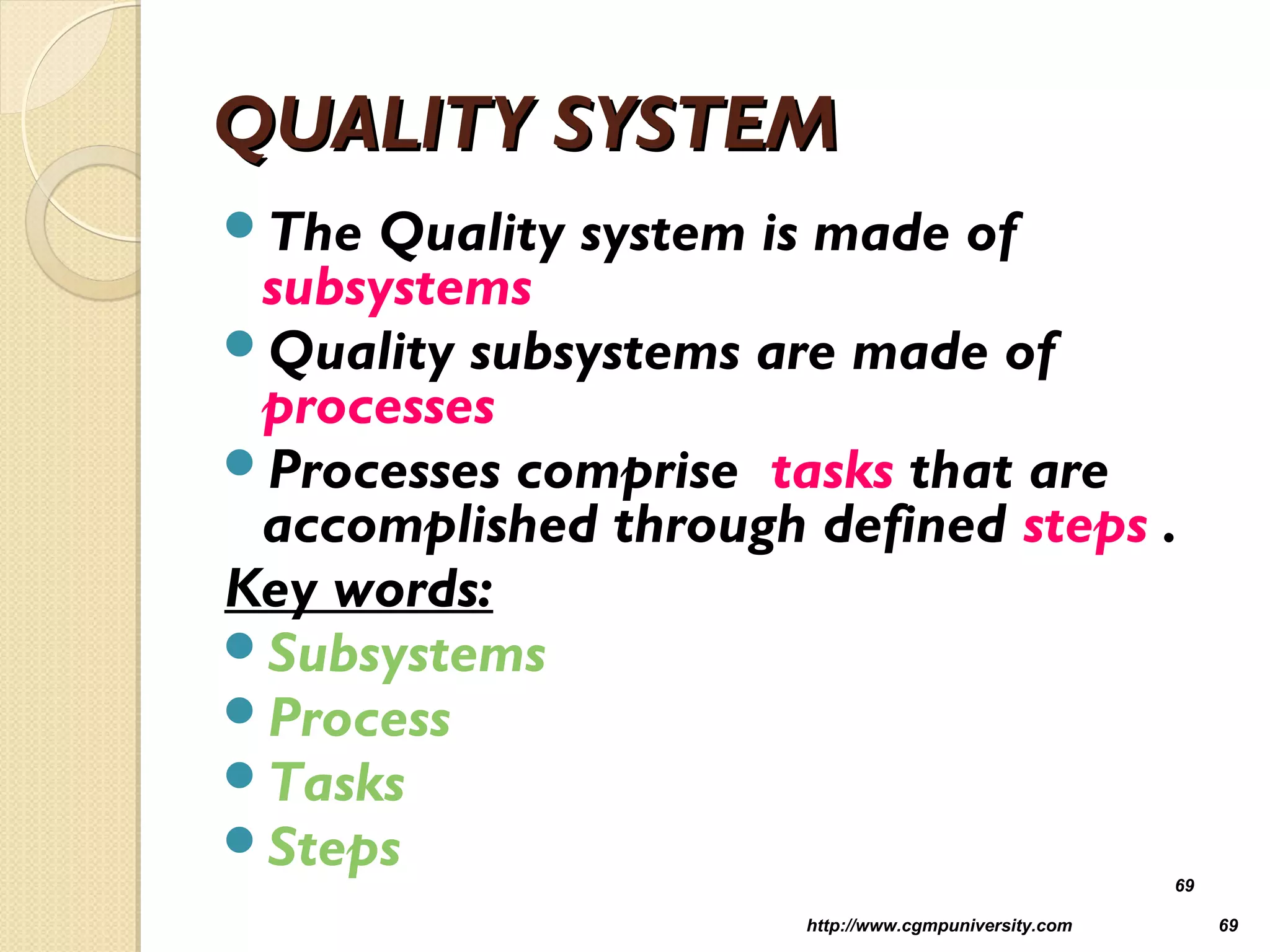
TheQuality system is made of
subsystems
Quality subsystems are made of
processes
Processes comprise tasks that are
accomplished through defined steps .
Key words:
Subsystems
Process
Tasks
Steps
http://www.cgmpuniversity.com 69
69
70.
Structural layout ina Quality system:Structural layout in a Quality system:
SUBSYSTEM
PROCESS
TASK
STEP
RECORD.
END.
http://www.cgmpuniversity.com 70
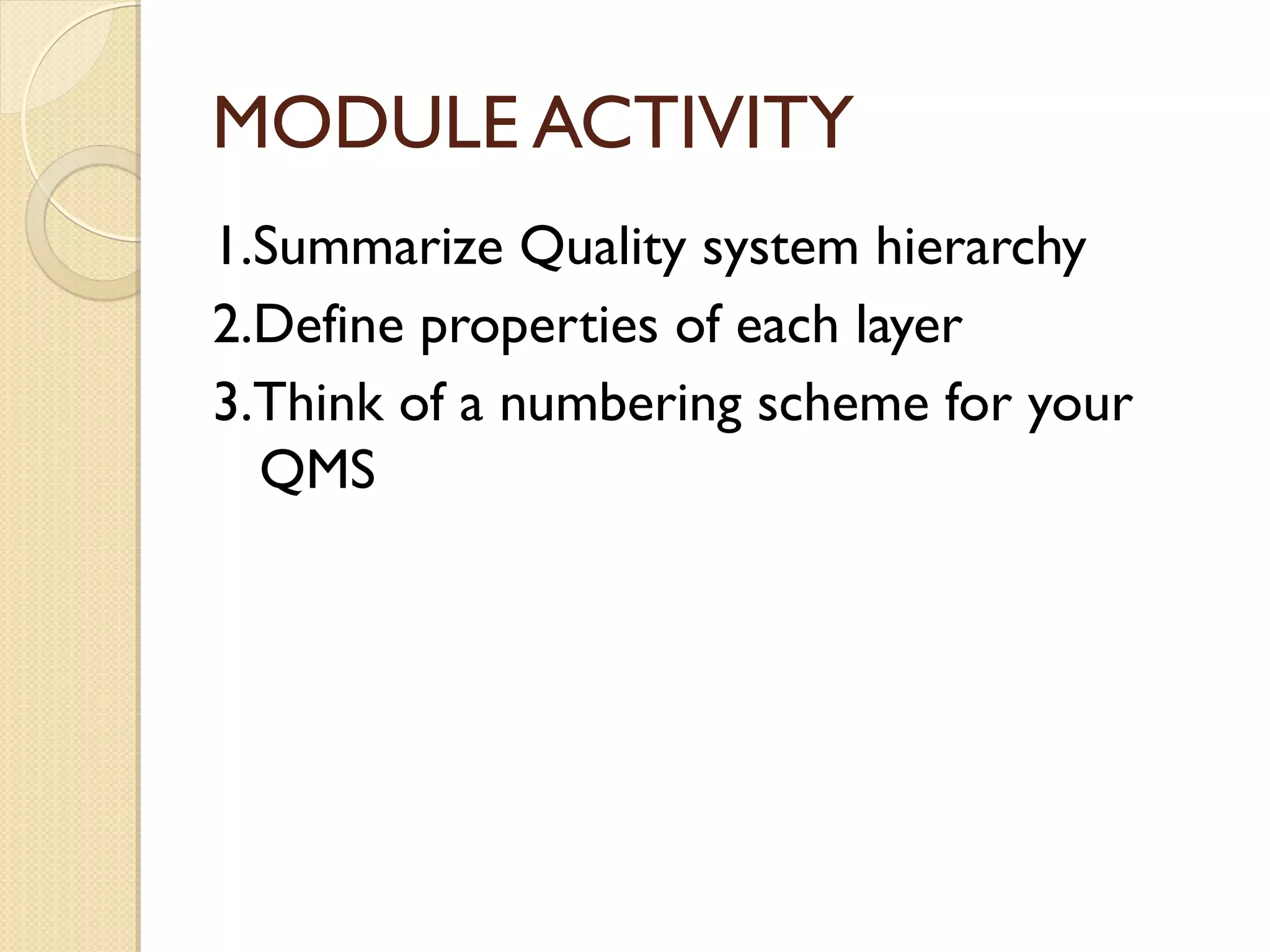
MODULE ACTIVITY
1.Review someof the processes at work
2.Name some of the tasks in those
processes
3.Discuss ownership is required for the
process
4.Discuss whether Instructions are required
THE QUALITY SYSTEMDOCUMENTTHE QUALITY SYSTEM DOCUMENT
STRUCTURESTRUCTURE
MODULE ONEMODULE ONE
DEFINE YOUR QUALITY SYSTEM DOCUMENT
STRUCTURE.
77.
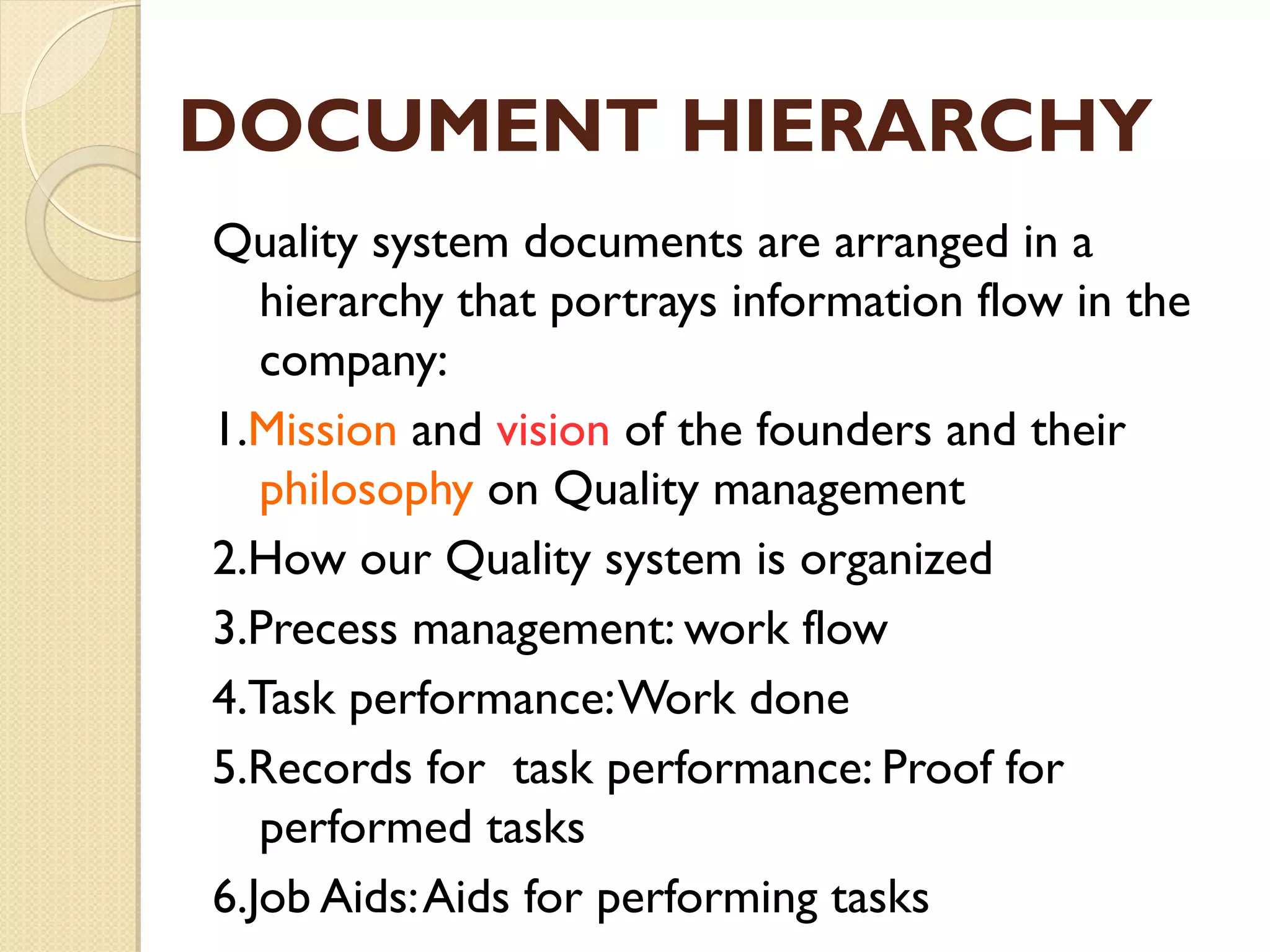
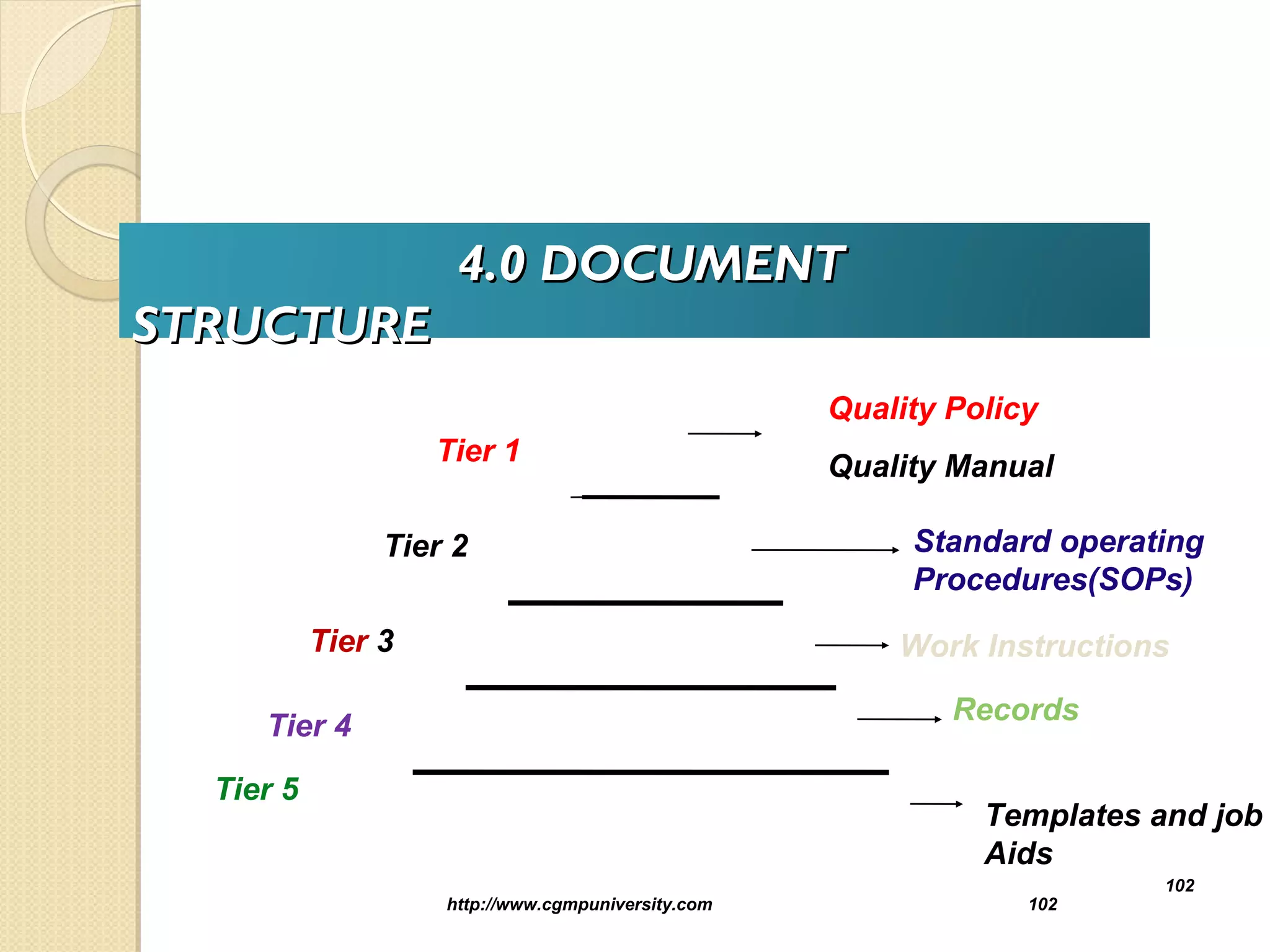
DOCUMENT HIERARCHY
Quality systemdocuments are arranged in a
hierarchy that portrays information flow in the
company:
1.Mission and vision of the founders and their
philosophy on Quality management
2.How our Quality system is organized
3.Precess management: work flow
4.Task performance:Work done
5.Records for task performance: Proof for
performed tasks
6.Job Aids:Aids for performing tasks
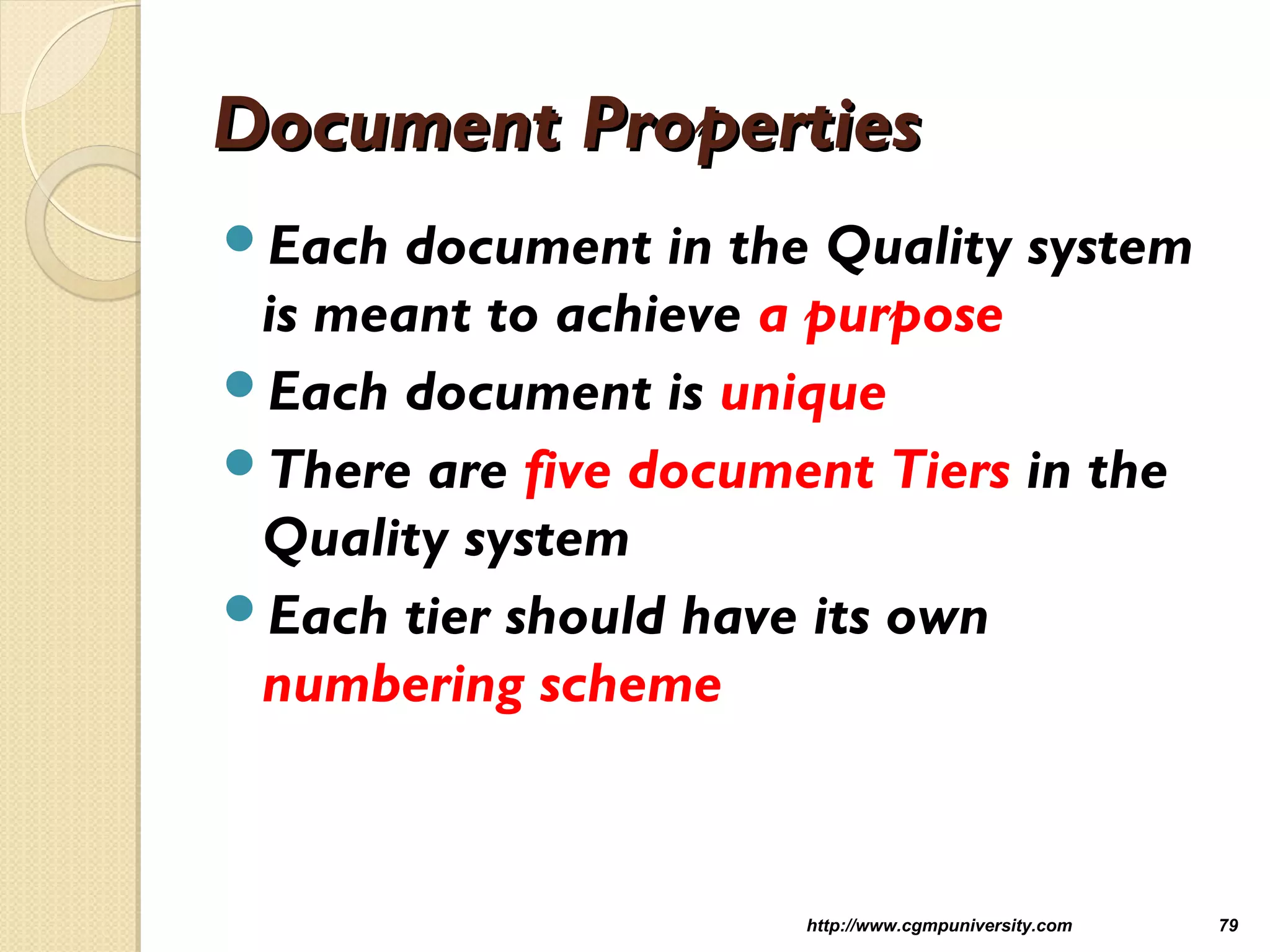
Document PropertiesDocument Properties
Eachdocument in the Quality system
is meant to achieve a purpose
Each document is unique
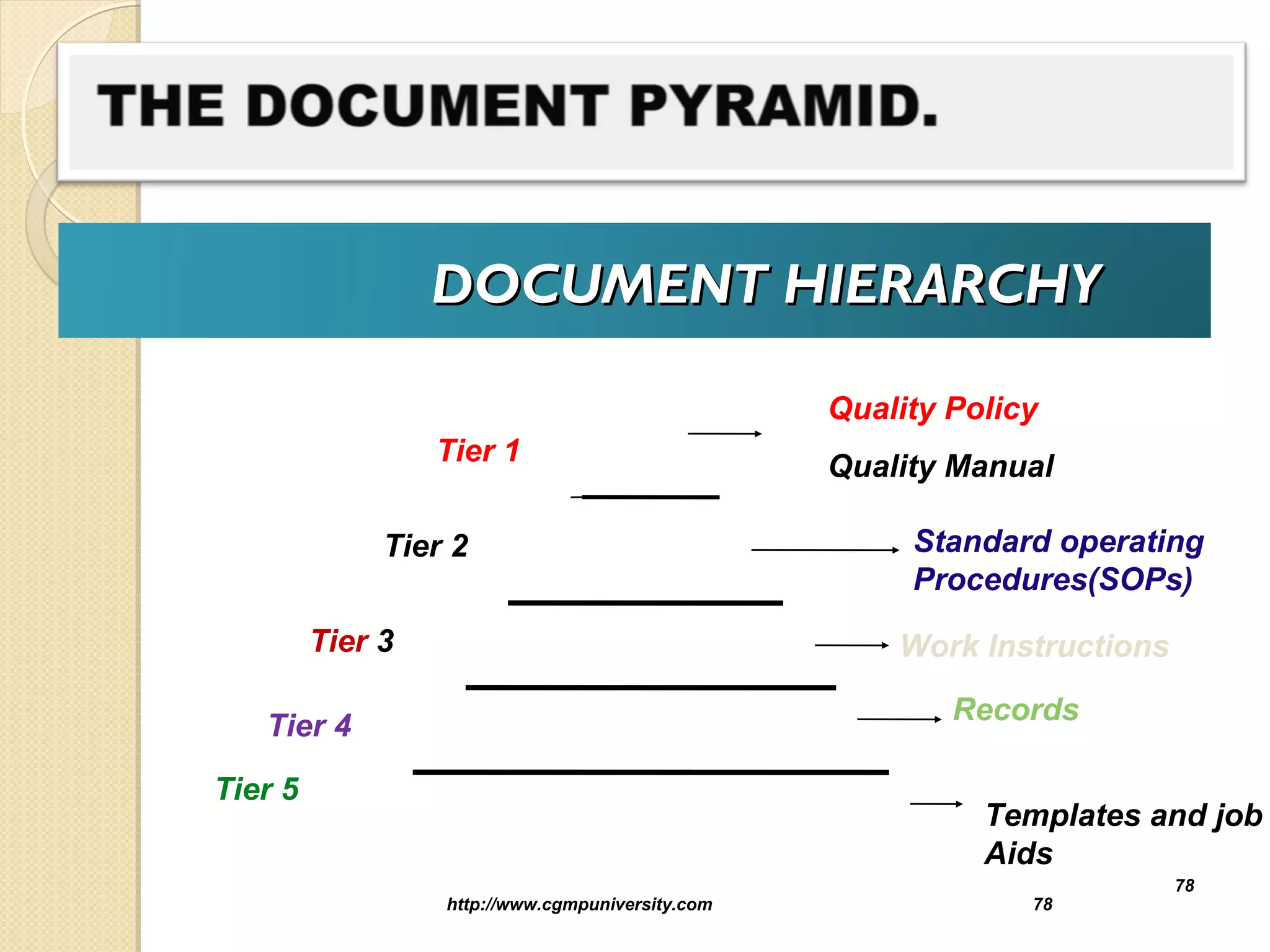
There are five document Tiers in the
Quality system
Each tier should have its own
numbering scheme
http://www.cgmpuniversity.com 79
80.
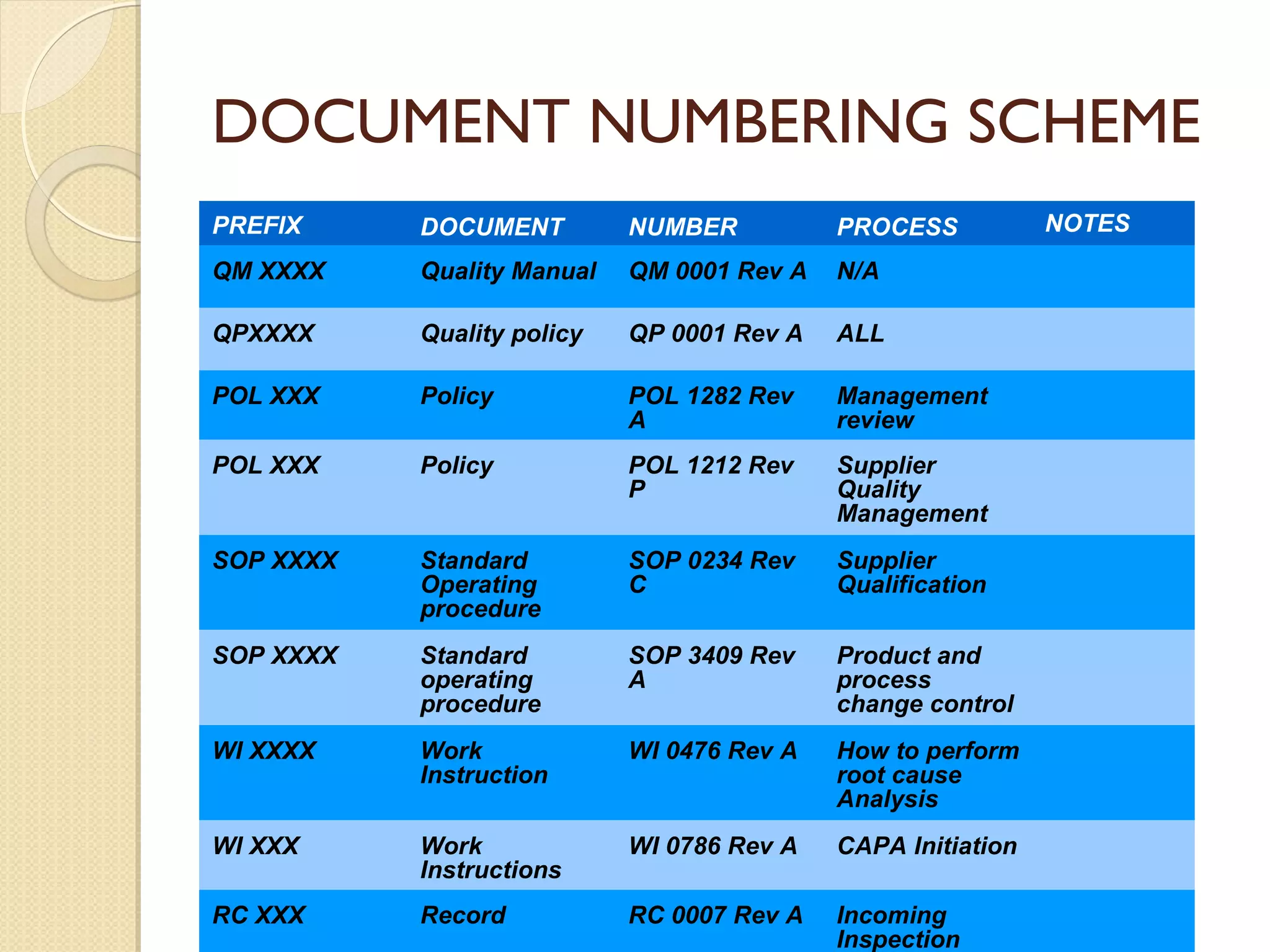
DOCUMENT NUMBERING SCHEME
PREFIXDOCUMENT NUMBER PROCESS NOTES
QM XXXX Quality Manual QM 0001 Rev A N/A
QPXXXX Quality policy QP 0001 Rev A ALL
POL XXX Policy POL 1282 Rev
A
Management
review
POL XXX Policy POL 1212 Rev
P
Supplier
Quality
Management
SOP XXXX Standard
Operating
procedure
SOP 0234 Rev
C
Supplier
Qualification
SOP XXXX Standard
operating
procedure
SOP 3409 Rev
A
Product and
process
change control
WI XXXX Work
Instruction
WI 0476 Rev A How to perform
root cause
Analysis
WI XXX Work
Instructions
WI 0786 Rev A CAPA Initiation
RC XXX Record RC 0007 Rev A Incoming
Inspection
http://www.cgmpuniversity.com 84
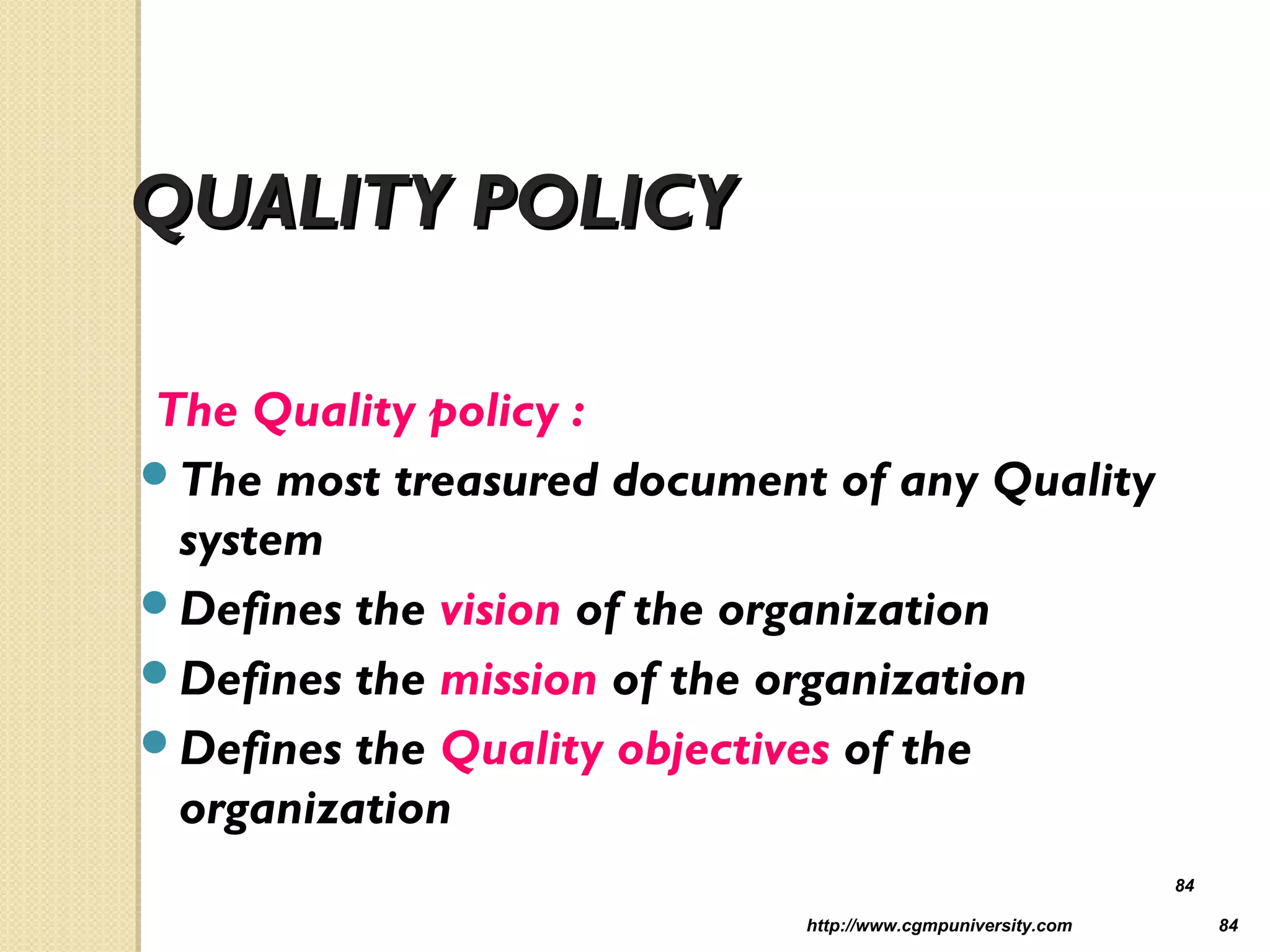
QUALITY POLICYQUALITYPOLICY
The Quality policy :
The most treasured document of any Quality
system
Defines the vision of the organization
Defines the mission of the organization
Defines the Quality objectives of the
organization
84
85.
QUALITY POLICYQUALITY POLICY
1.Statethe purpose of your
organization’s existence.
2.State the value of your existence to
the end-user of your product, or
service.
3.State your Quality objectives
http://www.cgmpuniversity.com 85
86.
QUALITY POLICYQUALITY POLICY
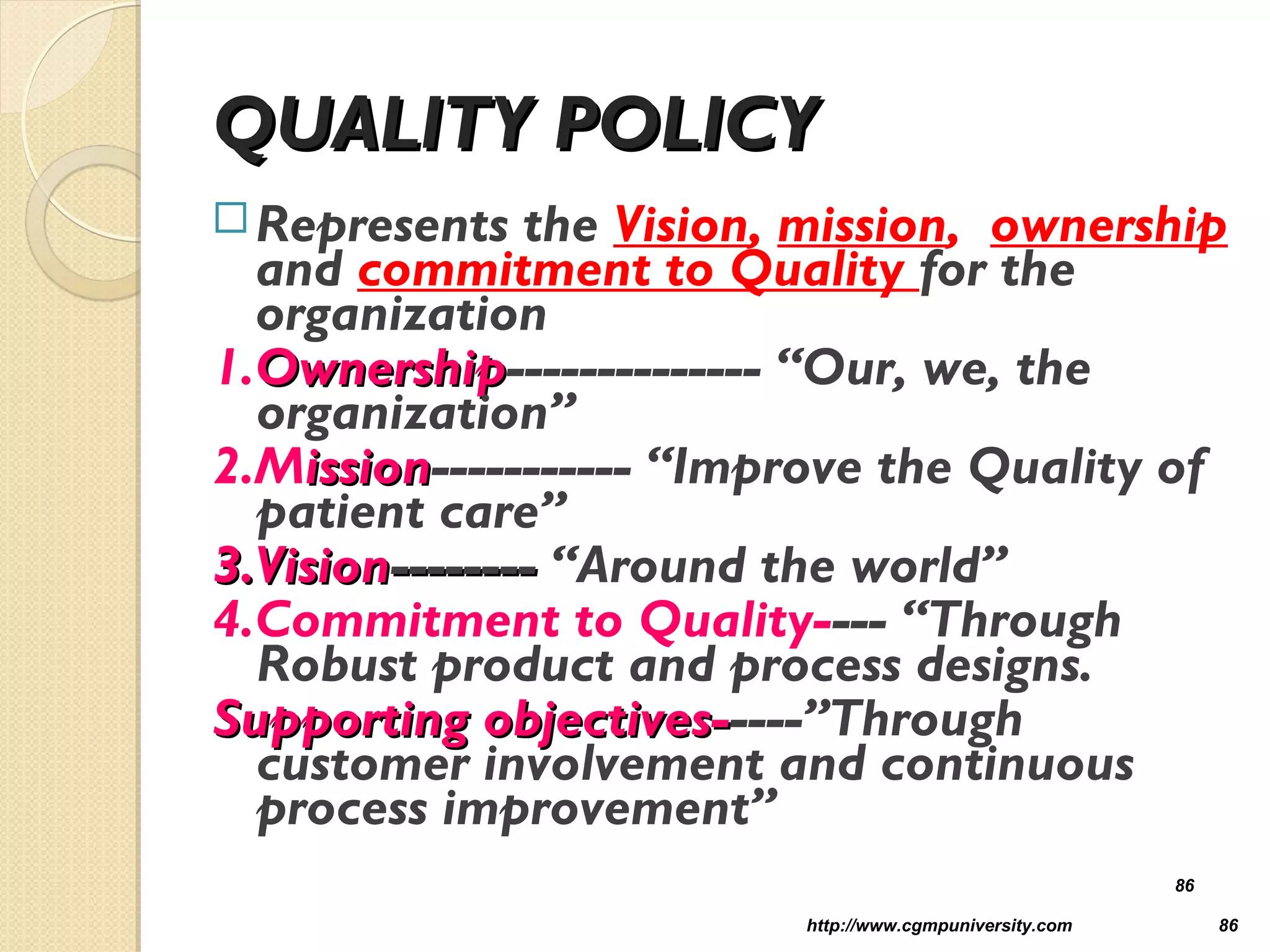
Representsthe Vision, mission, ownership
and commitment to Quality for the
organization
1.OwnershipOwnership-------------- “Our, we, the
organization”
2.Missionission----------- “Improve the Quality of
patient care”
3.Vision3.Vision---------------- “Around the world”
4.Commitment to Quality---- “Through
Robust product and process designs.
Supporting objectives-Supporting objectives-----”Through
customer involvement and continuous
process improvement”
http://www.cgmpuniversity.com 86
86
87.
QUALITY POLICYQUALITY POLICY
4.Specifyhow your organization will
meet Quality objectives
5.Review statements 1 through 4
6.Draft a statement from each
statement
7.Identify the following from drafted
statements:
http://www.cgmpuniversity.com 87
88.
QUALITY POLICYQUALITY POLICY
8.Identifythe vision
9.Identify commitments to ownership
10.Identify Quality objectives
11.Identify the relationship with the
end-user of your product.
http://www.cgmpuniversity.com 88
89.
QUALITY POLICYQUALITY POLICY
12.Combinevision, commitment to
Quality, and objectives in your policy
statement.
13.Route your statement to
stakeholders for review
14.Route the final policy statement for
approval
http://www.cgmpuniversity.com 89
90.
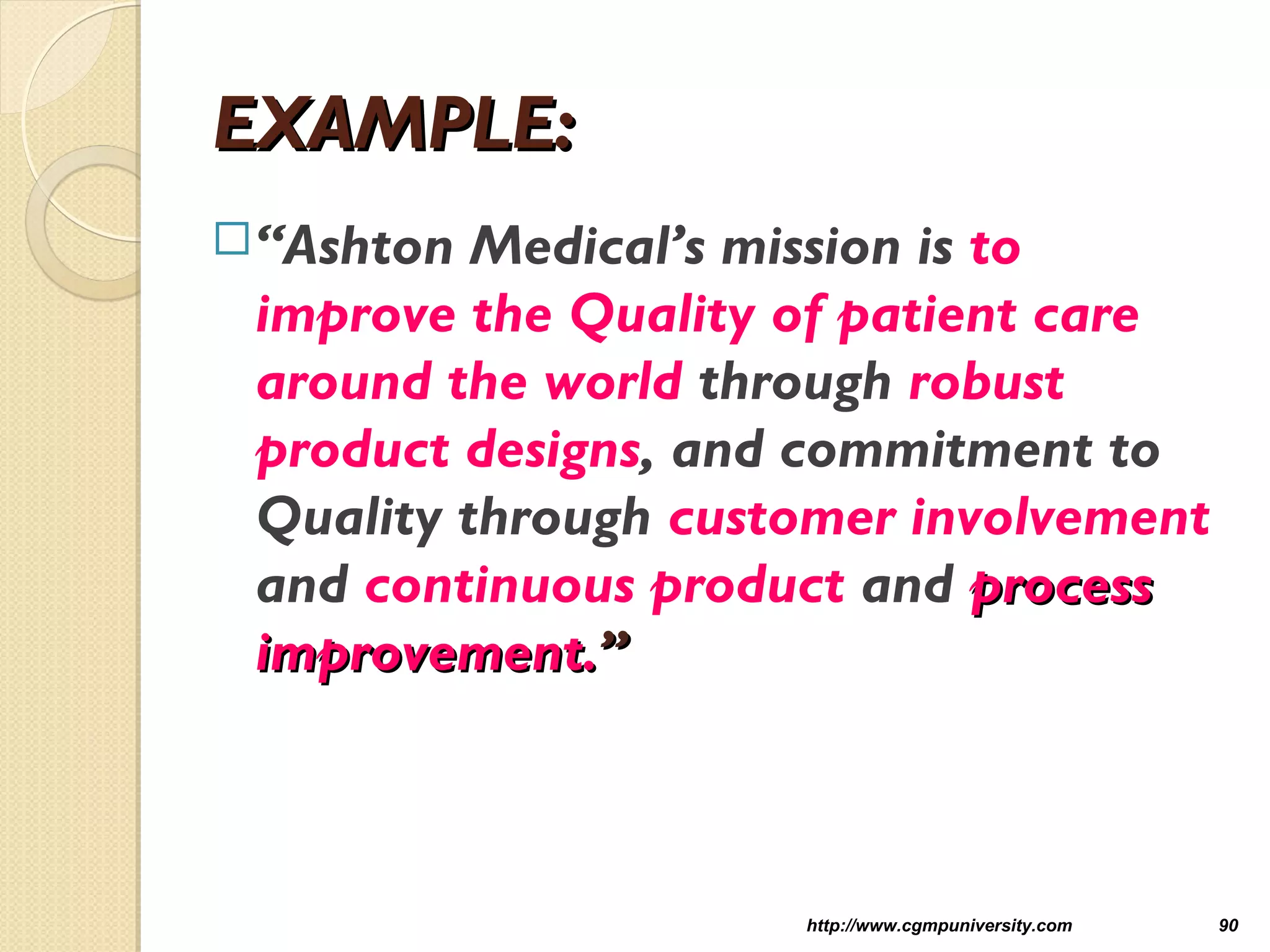
EXAMPLE:EXAMPLE:
“Ashton Medical’s missionis to
improve the Quality of patient care
around the world through robust
product designs, and commitment to
Quality through customer involvement
and continuous product and processprocess
improvement.improvement.””
http://www.cgmpuniversity.com 90
THE QUALITY MANUALTHEQUALITY MANUAL
MODULE THREEMODULE THREE
WRITE YOUR QUALITY MANUAL
94.
THE QUALITY MANUALTHEQUALITY MANUAL
It is the second most important document
in your Quality system
It is controlled by the Quality executive
and the president, or CEO of the
company.
http://www.cgmpuniversity.com 94
95.
WRITE THE QUALITYMANUALWRITE THE QUALITY MANUAL
To start:
Know your organizational chart
Know your Quality policy
Know the Quality model your QMS is
based on
Draft the content sections of the
manual
http://www.cgmpuniversity.com 95
96.
CONTENT SECTIONCONTENT SECTION
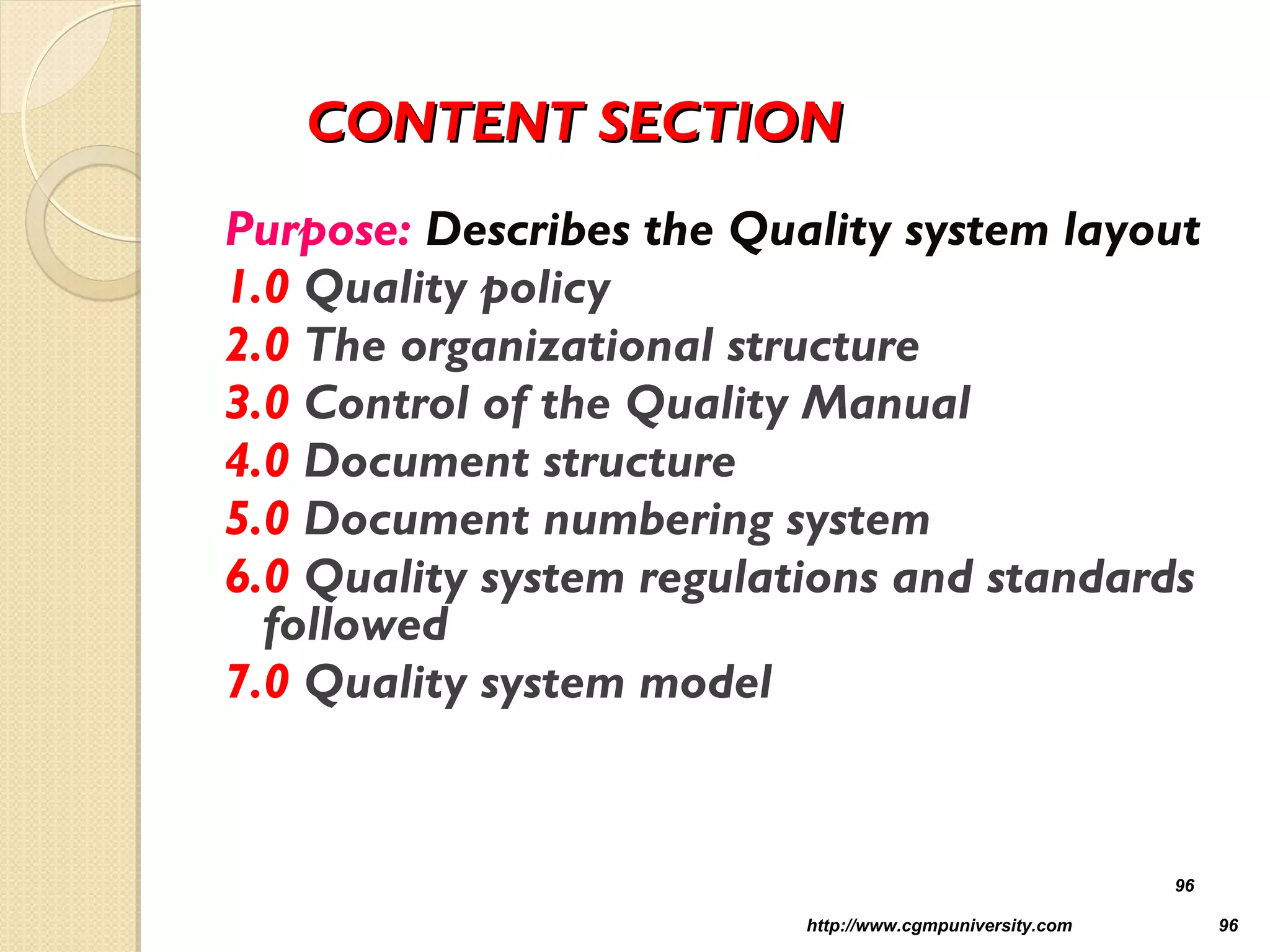
Purpose:Describes the Quality system layout
1.0 Quality policy
2.0 The organizational structure
3.0 Control of the Quality Manual
4.0 Document structure
5.0 Document numbering system
6.0 Quality system regulations and standards
followed
7.0 Quality system model
http://www.cgmpuniversity.com 96
96
97.
CONTENT SECTIONCONTENT SECTION
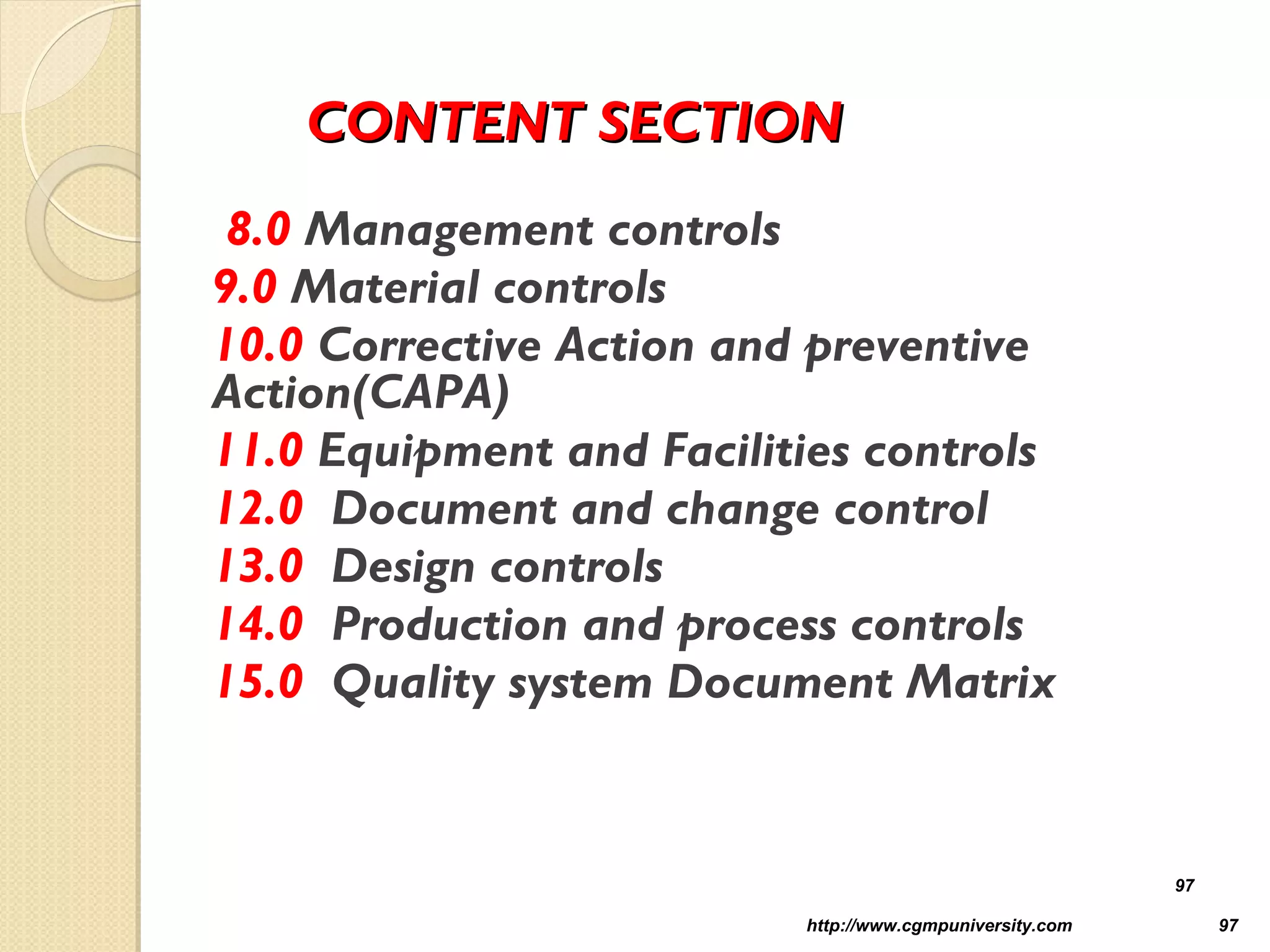
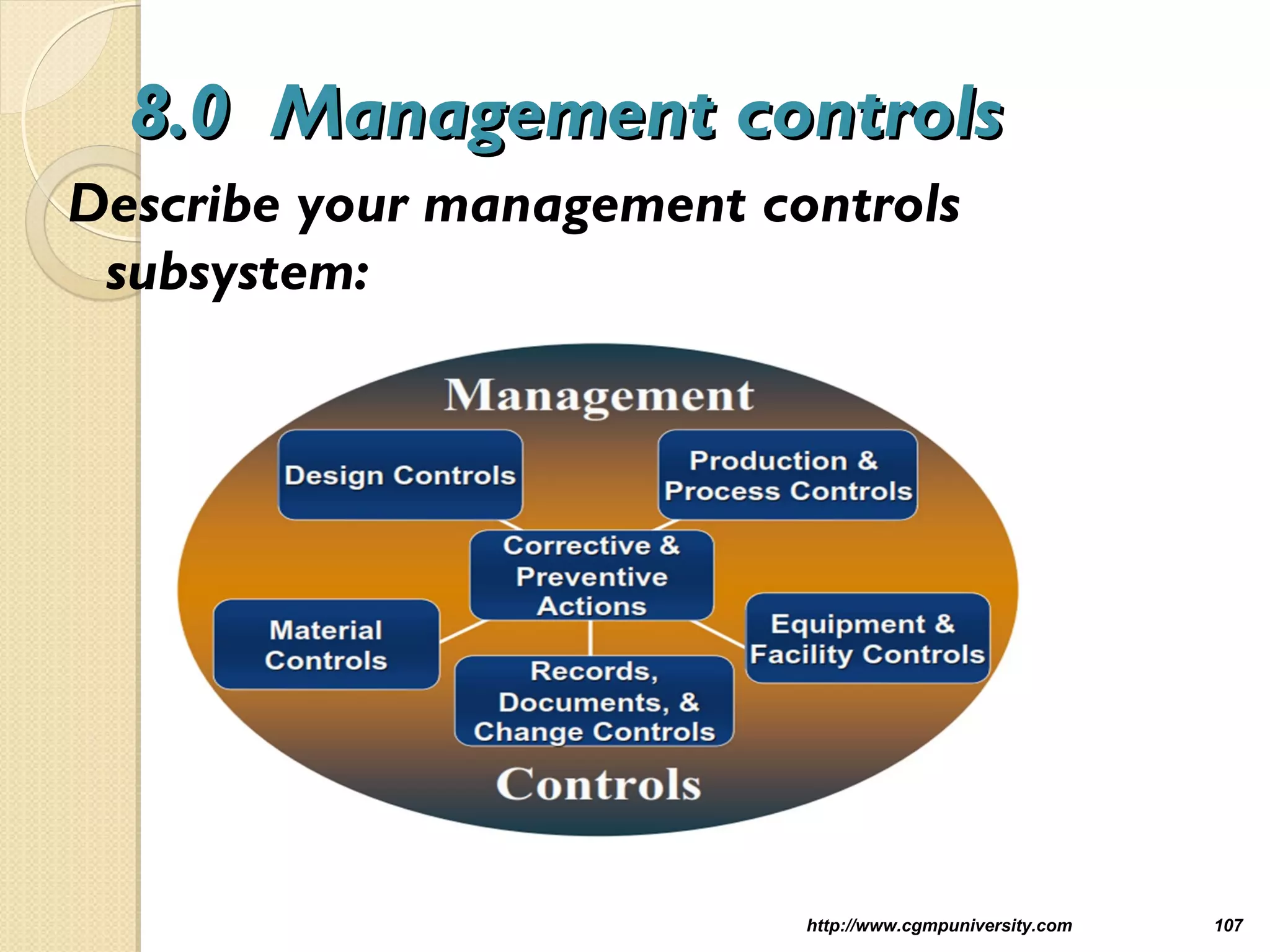
8.0Management controls
9.0 Material controls
10.0 Corrective Action and preventive
Action(CAPA)
11.0 Equipment and Facilities controls
12.0 Document and change control
13.0 Design controls
14.0 Production and process controls
15.0 Quality system Document Matrix
http://www.cgmpuniversity.com 97
97
98.
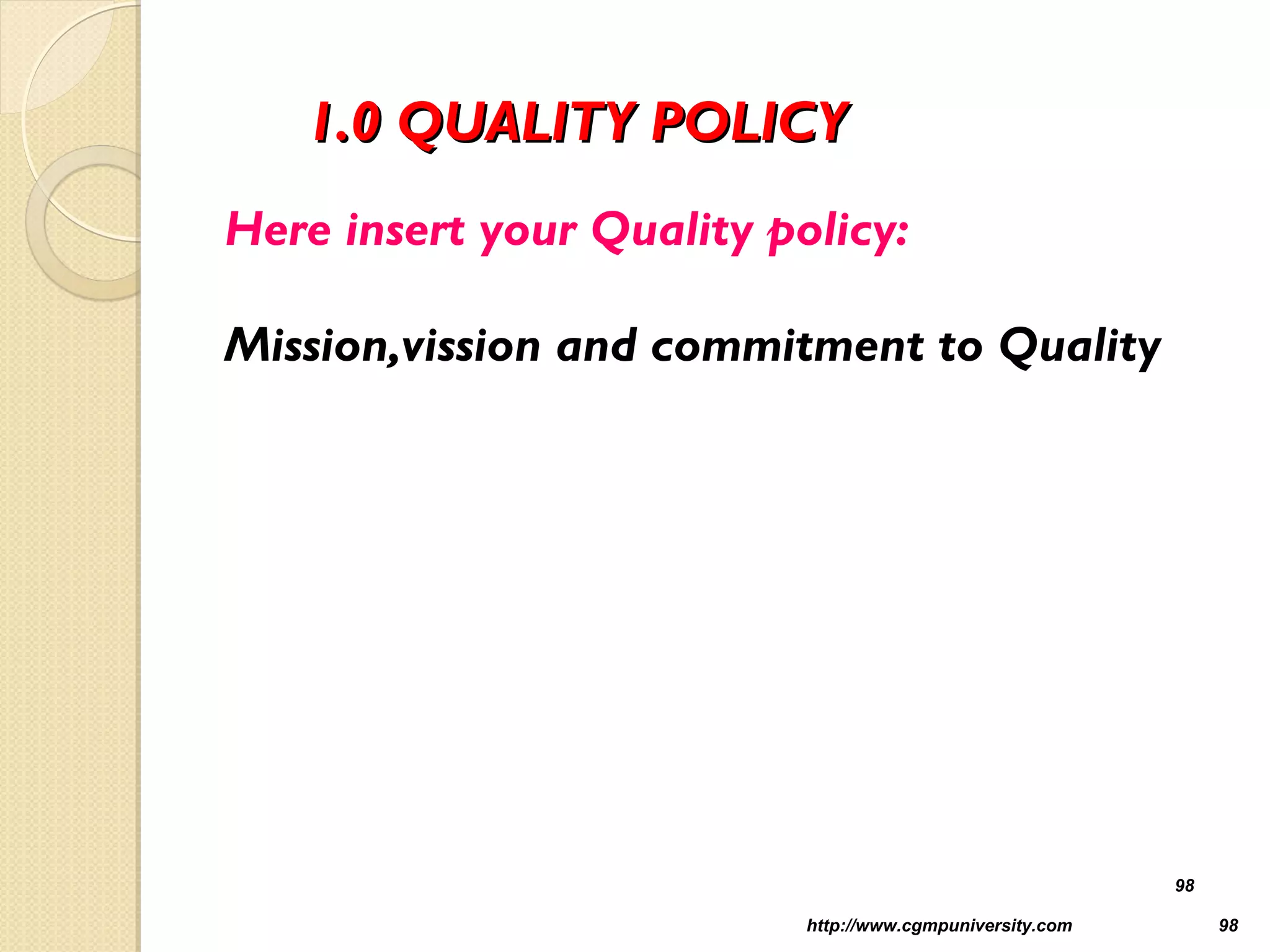
1.0 QUALITY POLICY1.0QUALITY POLICY
Here insert your Quality policy:
Mission,vission and commitment to Quality
http://www.cgmpuniversity.com 98
98
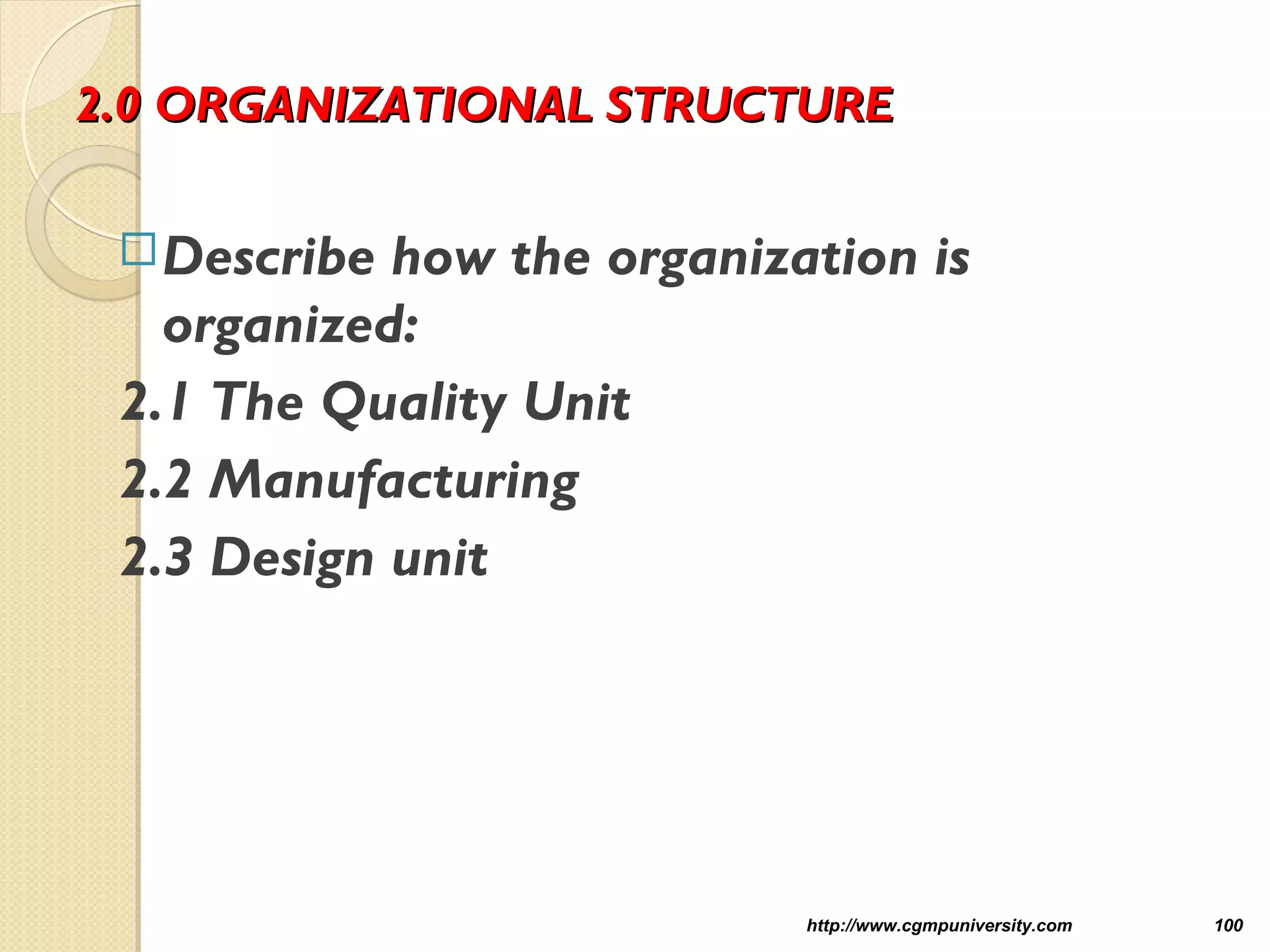
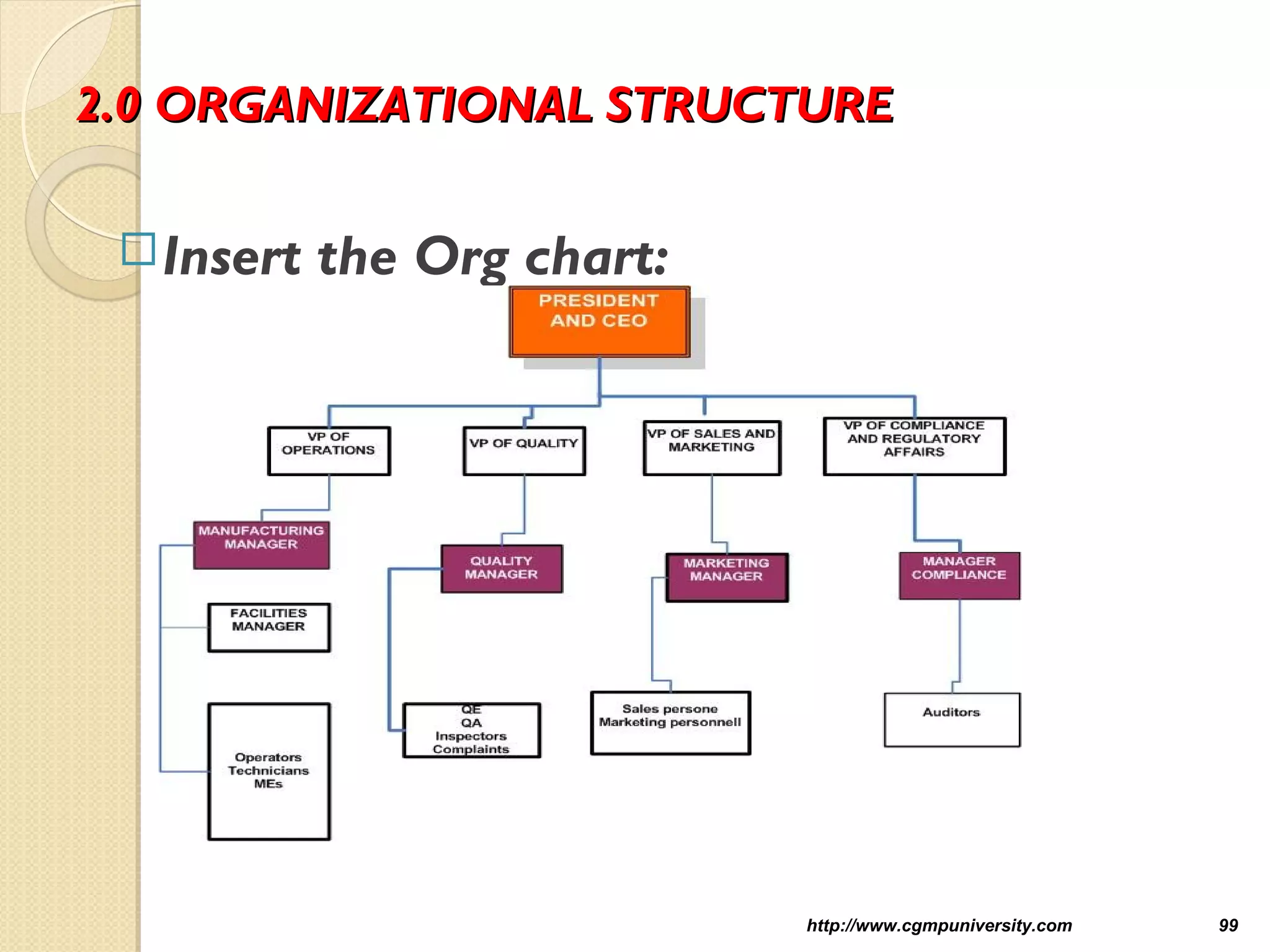
2.0 ORGANIZATIONAL STRUCTURE2.0ORGANIZATIONAL STRUCTURE
Describe how the organization is
organized:
2.1 The Quality Unit
2.2 Manufacturing
2.3 Design unit
http://www.cgmpuniversity.com 100
101.
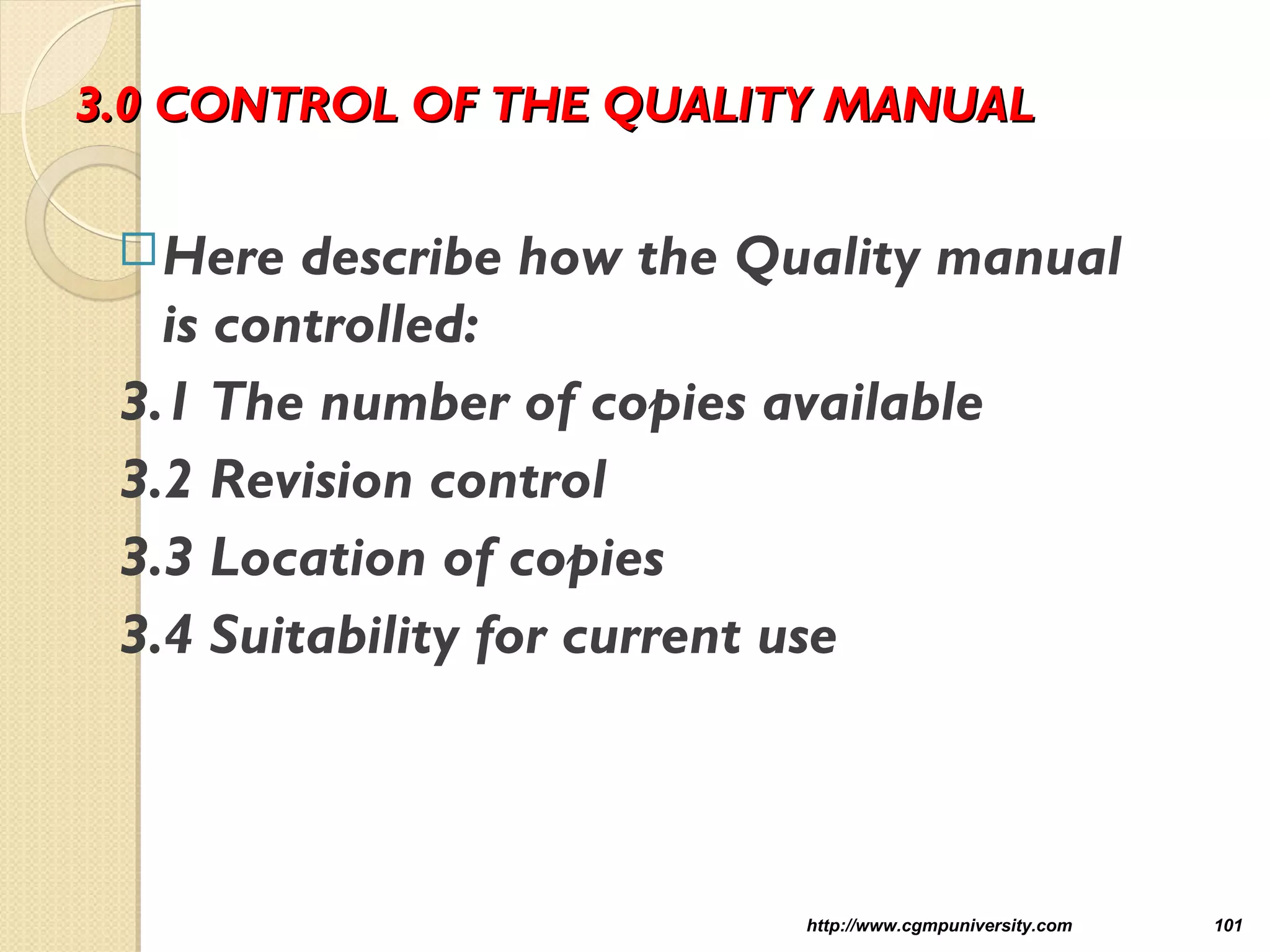
3.0 CONTROL OFTHE QUALITY MANUAL3.0 CONTROL OF THE QUALITY MANUAL
Here describe how the Quality manual
is controlled:
3.1 The number of copies available
3.2 Revision control
3.3 Location of copies
3.4 Suitability for current use
http://www.cgmpuniversity.com 101
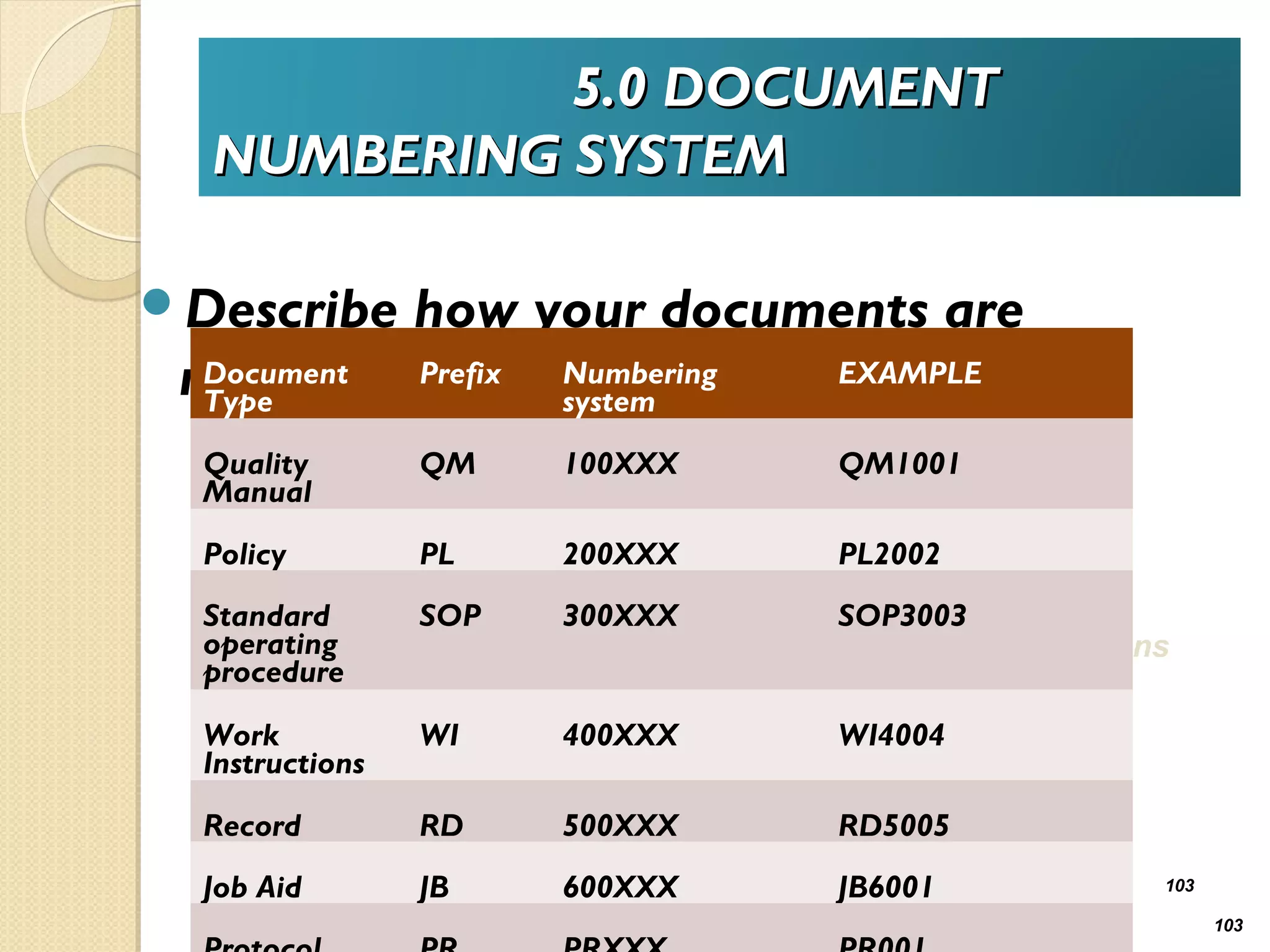
5.05.0 DOCUMENTDOCUMENT
NUMBERING SYSTEMNUMBERINGSYSTEM
Describe how your documents are
numbered:
http://www.cgmpuniversity.com 103
103
Work Instructions
Document
Type
Prefix Numbering
system
EXAMPLE
Quality
Manual
QM 100XXX QM1001
Policy PL 200XXX PL2002
Standard
operating
procedure
SOP 300XXX SOP3003
Work
Instructions
WI 400XXX WI4004
Record RD 500XXX RD5005
Job Aid JB 600XXX JB6001
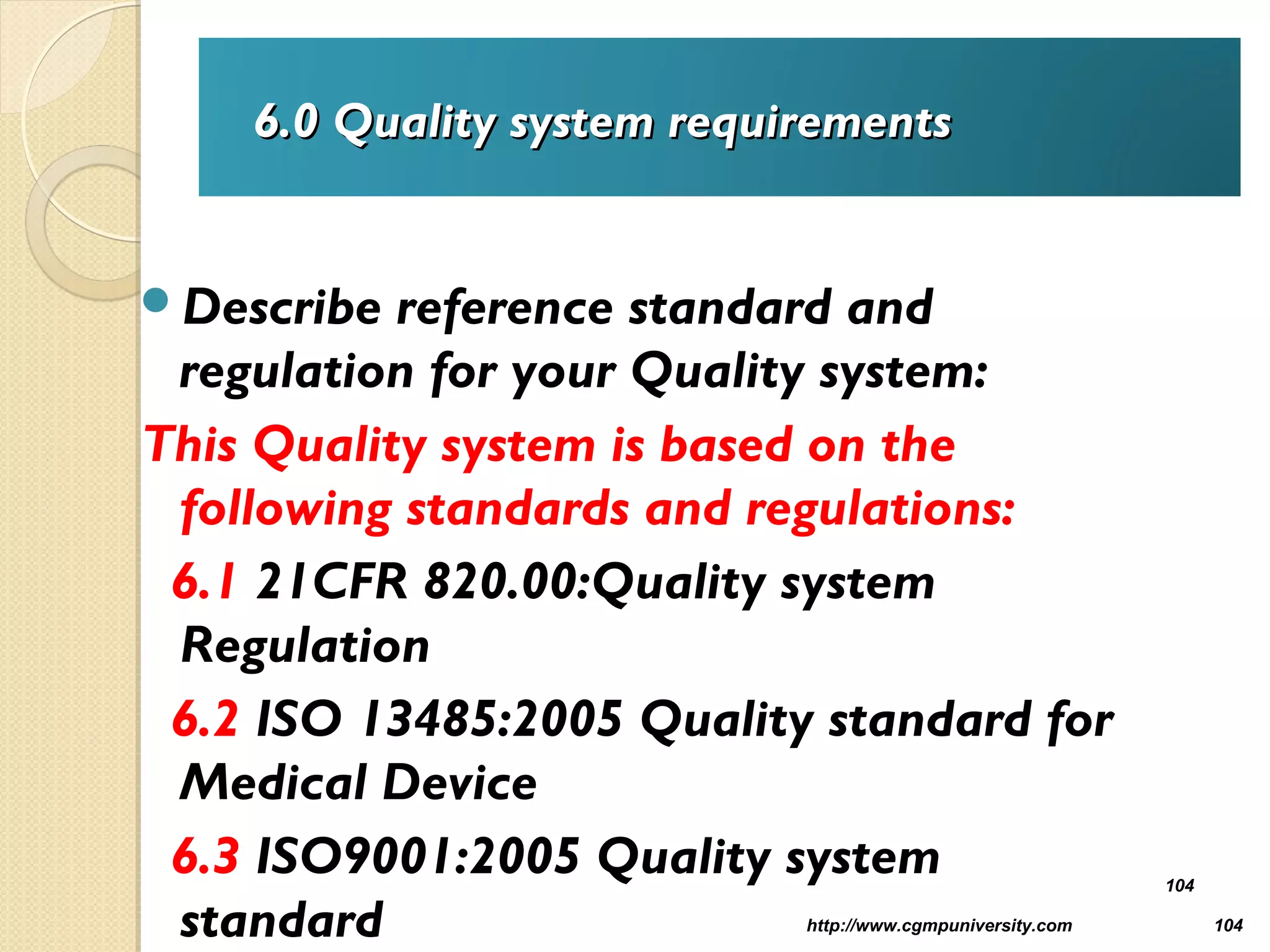
104.
6.06.0 Quality systemrequirementsQuality system requirements
Describe reference standard and
regulation for your Quality system:
This Quality system is based on the
following standards and regulations:
6.1 21CFR 820.00:Quality system
Regulation
6.2 ISO 13485:2005 Quality standard for
Medical Device
6.3 ISO9001:2005 Quality system
standard http://www.cgmpuniversity.com 104
104
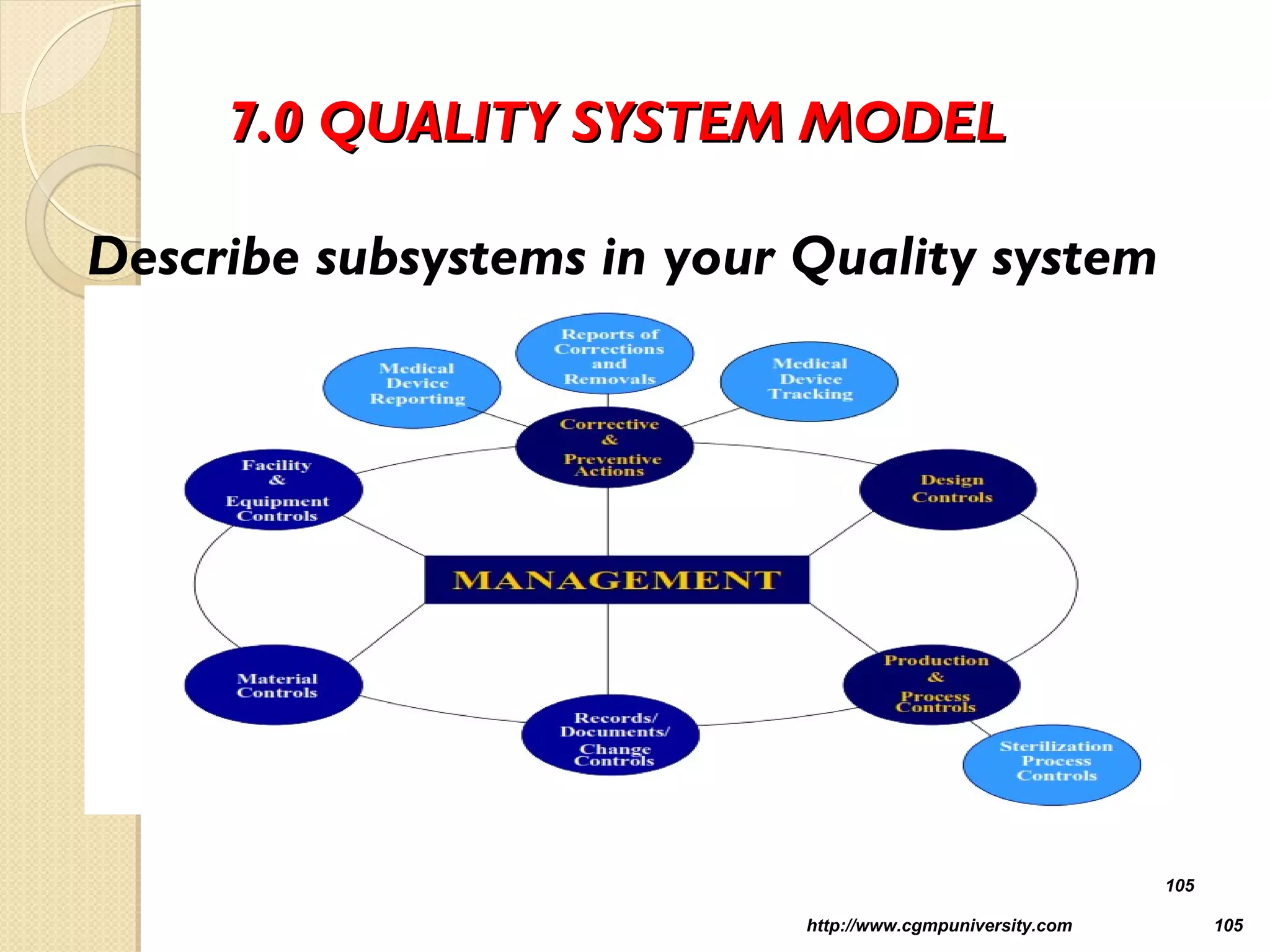
105.
7.0 QUALITY SYSTEMMODEL7.0 QUALITY SYSTEM MODEL
Describe subsystems in your Quality system
http://www.cgmpuniversity.com 105
105
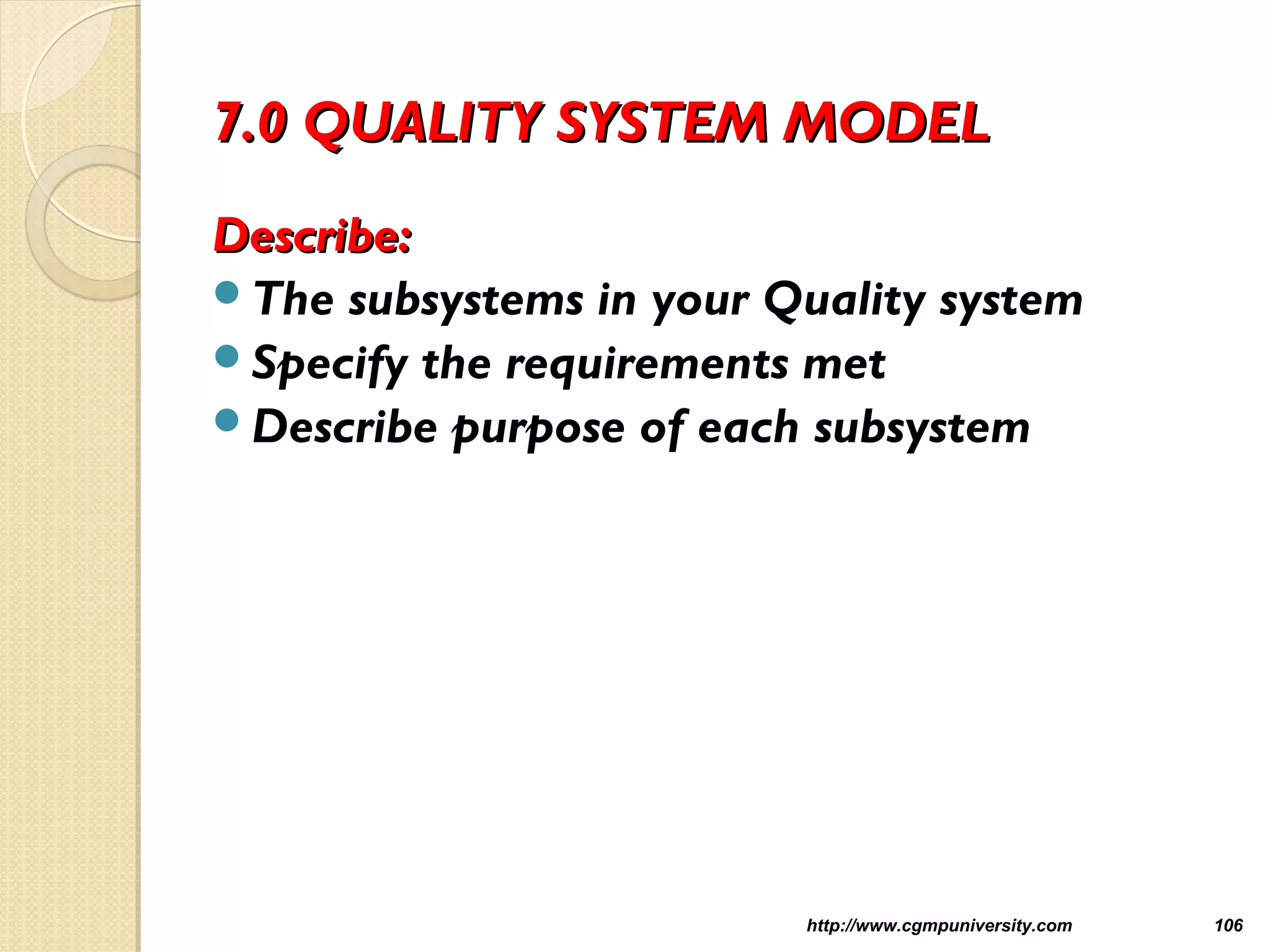
106.
7.0 QUALITY SYSTEMMODEL7.0 QUALITY SYSTEM MODEL
Describe:Describe:
The subsystems in your Quality system
Specify the requirements met
Describe purpose of each subsystem
http://www.cgmpuniversity.com 106
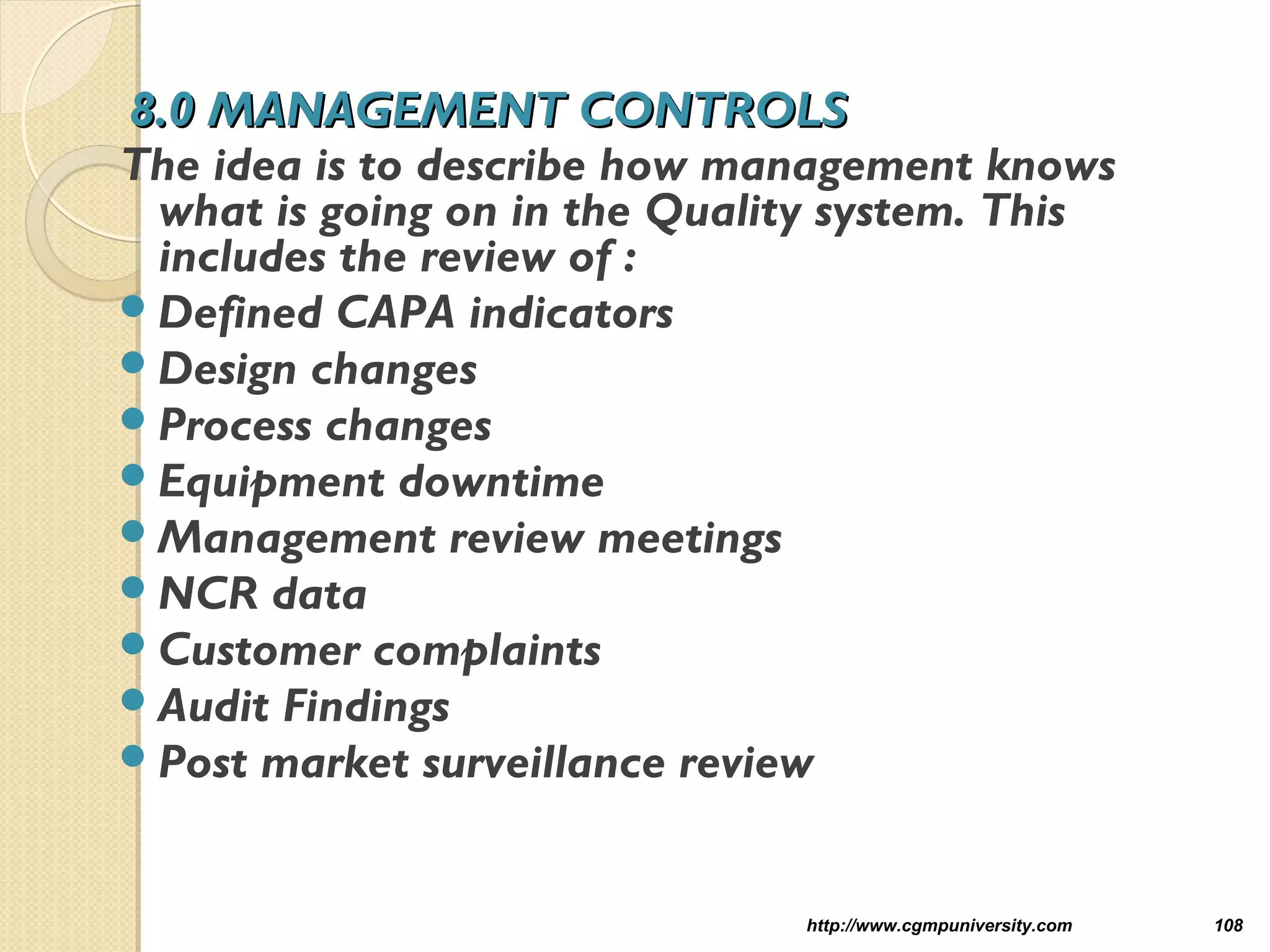
8.0 MANAGEMENT CONTROLS8.0MANAGEMENT CONTROLS
The idea is to describe how management knows
what is going on in the Quality system. This
includes the review of :
Defined CAPA indicators
Design changes
Process changes
Equipment downtime
Management review meetings
NCR data
Customer complaints
Audit Findings
Post market surveillance review
http://www.cgmpuniversity.com 108
109.
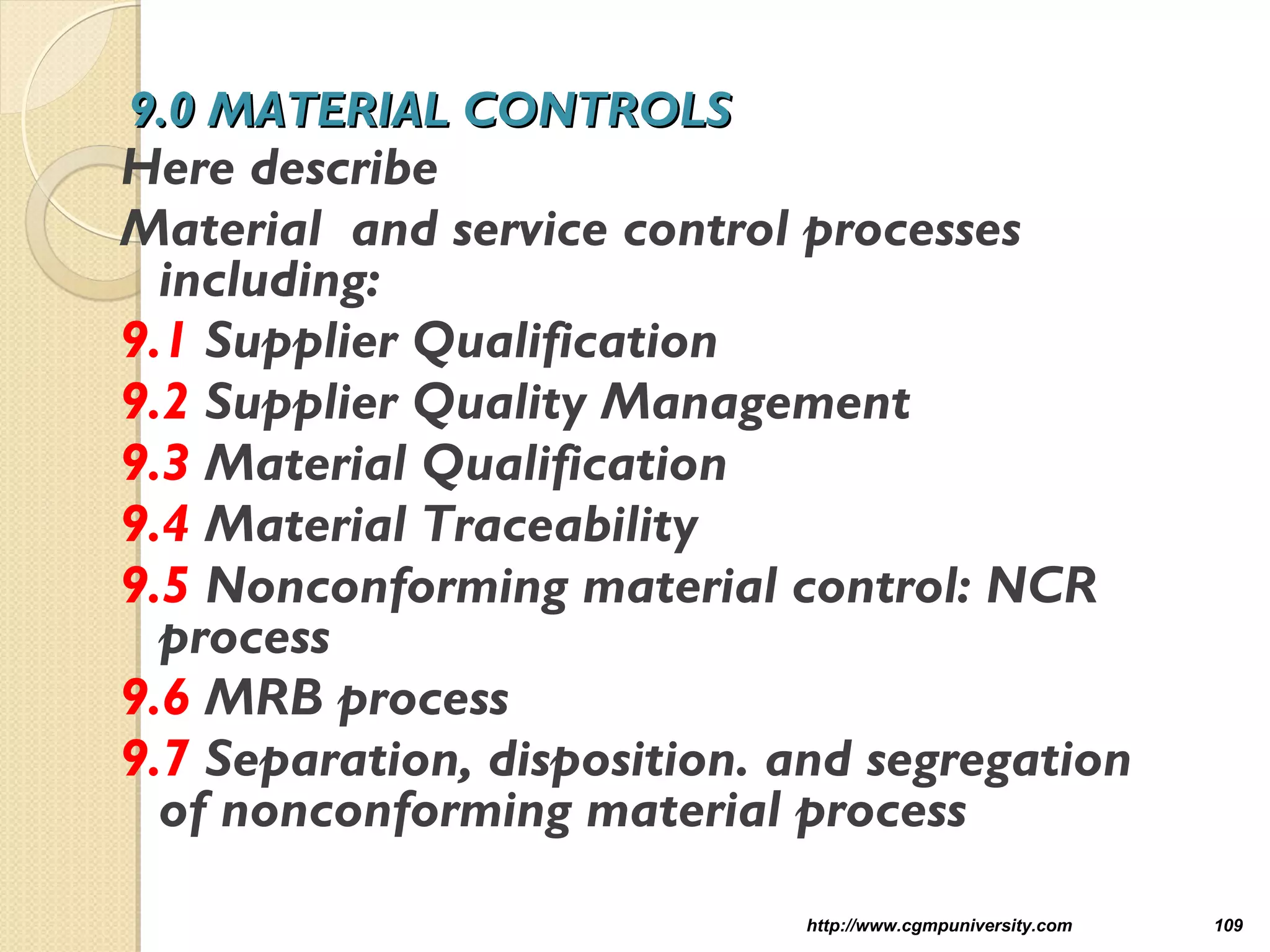
9.0 MATERIAL CONTROLS9.0MATERIAL CONTROLS
Here describe
Material and service control processes
including:
9.1 Supplier Qualification
9.2 Supplier Quality Management
9.3 Material Qualification
9.4 Material Traceability
9.5 Nonconforming material control: NCR
process
9.6 MRB process
9.7 Separation, disposition. and segregation
of nonconforming material process
http://www.cgmpuniversity.com 109
110.
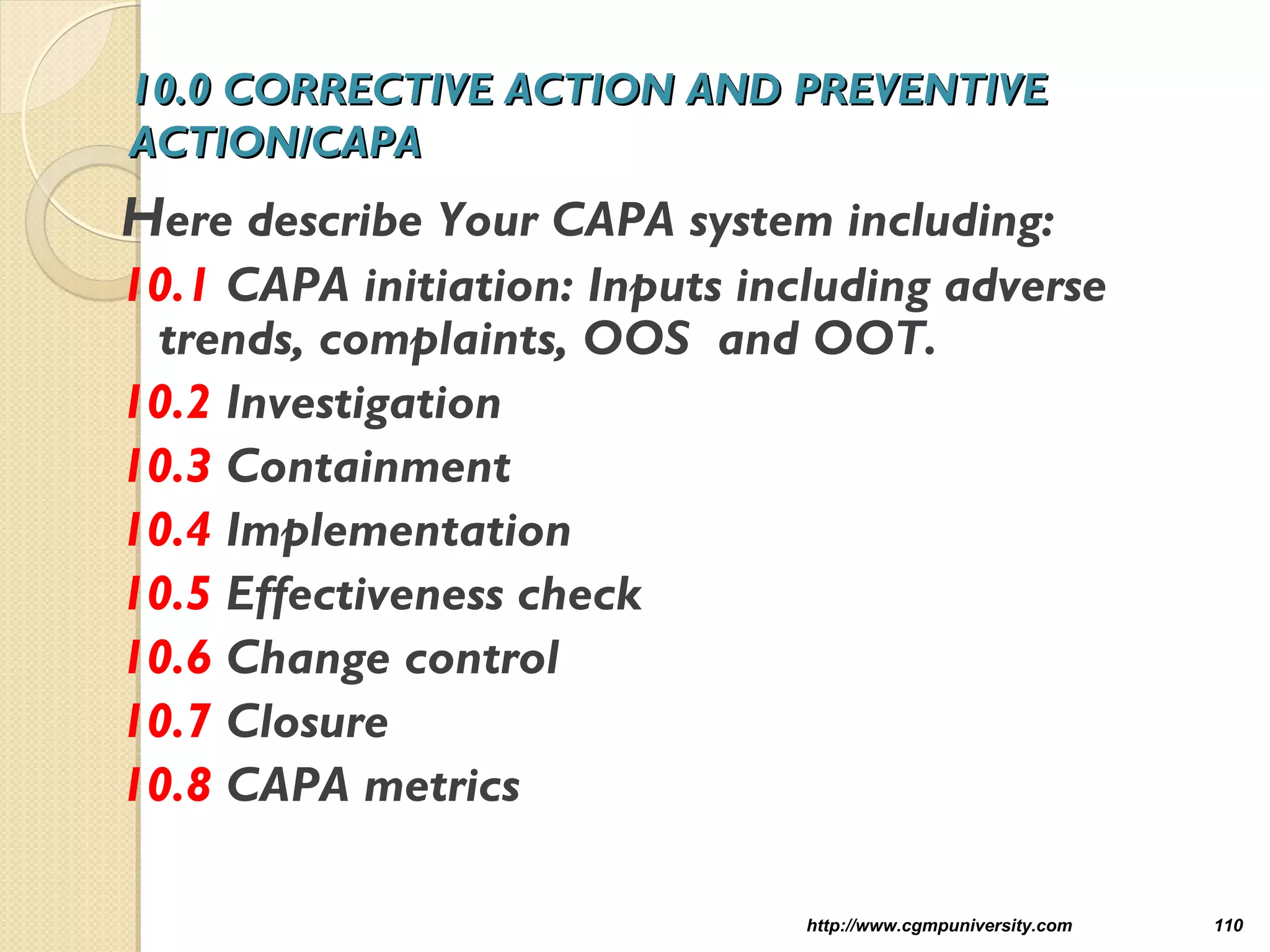
10.0 CORRECTIVE ACTIONAND PREVENTIVE10.0 CORRECTIVE ACTION AND PREVENTIVE
ACTION/CAPAACTION/CAPA
Here describe Your CAPA system including:
10.1 CAPA initiation: Inputs including adverse
trends, complaints, OOS and OOT.
10.2 Investigation
10.3 Containment
10.4 Implementation
10.5 Effectiveness check
10.6 Change control
10.7 Closure
10.8 CAPA metrics
http://www.cgmpuniversity.com 110
111.
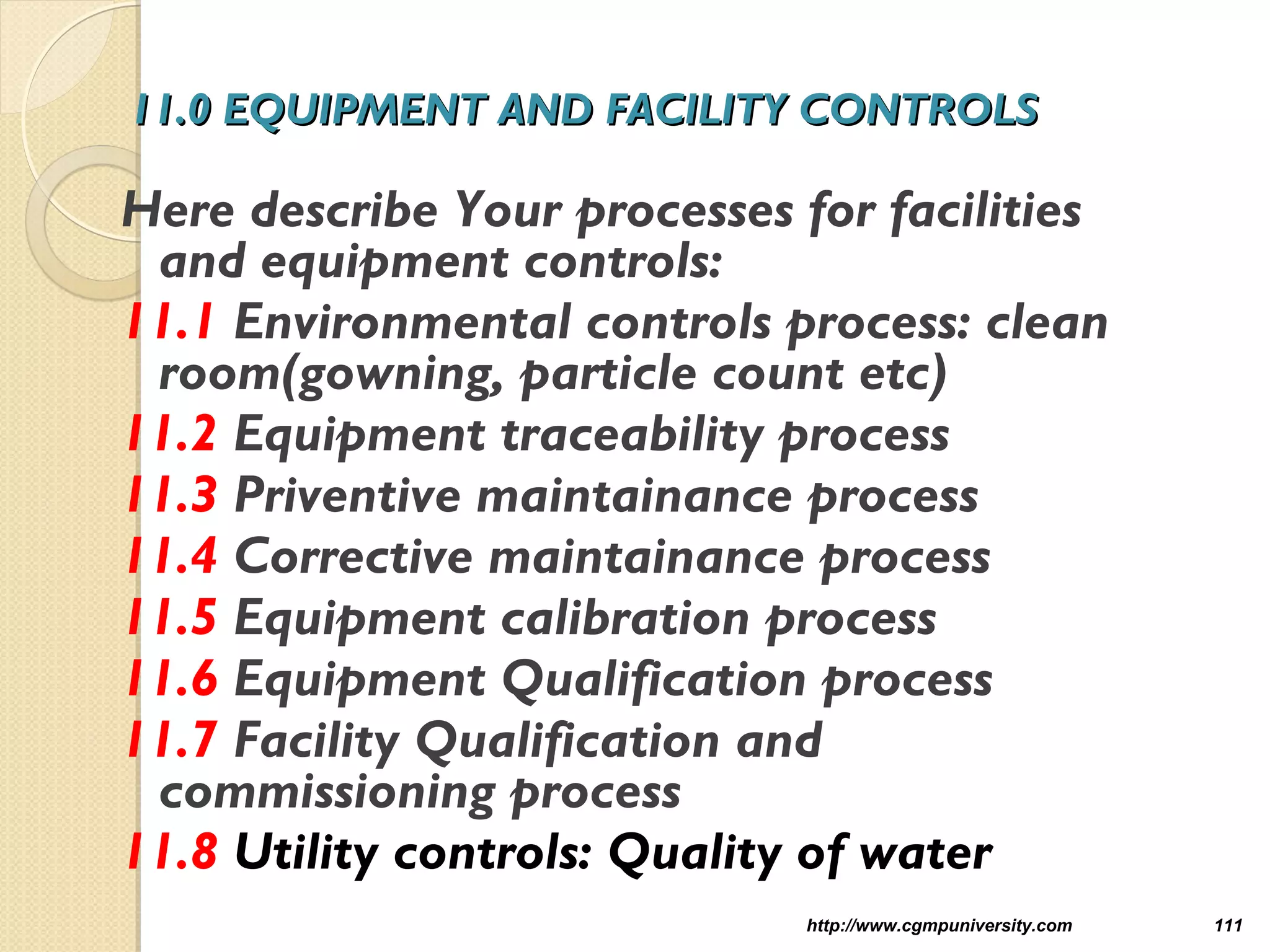
11.0 EQUIPMENT ANDFACILITY CONTROLS11.0 EQUIPMENT AND FACILITY CONTROLS
Here describe Your processes for facilities
and equipment controls:
11.1 Environmental controls process: clean
room(gowning, particle count etc)
11.2 Equipment traceability process
11.3 Priventive maintainance process
11.4 Corrective maintainance process
11.5 Equipment calibration process
11.6 Equipment Qualification process
11.7 Facility Qualification and
commissioning process
11.8 Utility controls: Quality of water
http://www.cgmpuniversity.com 111
112.
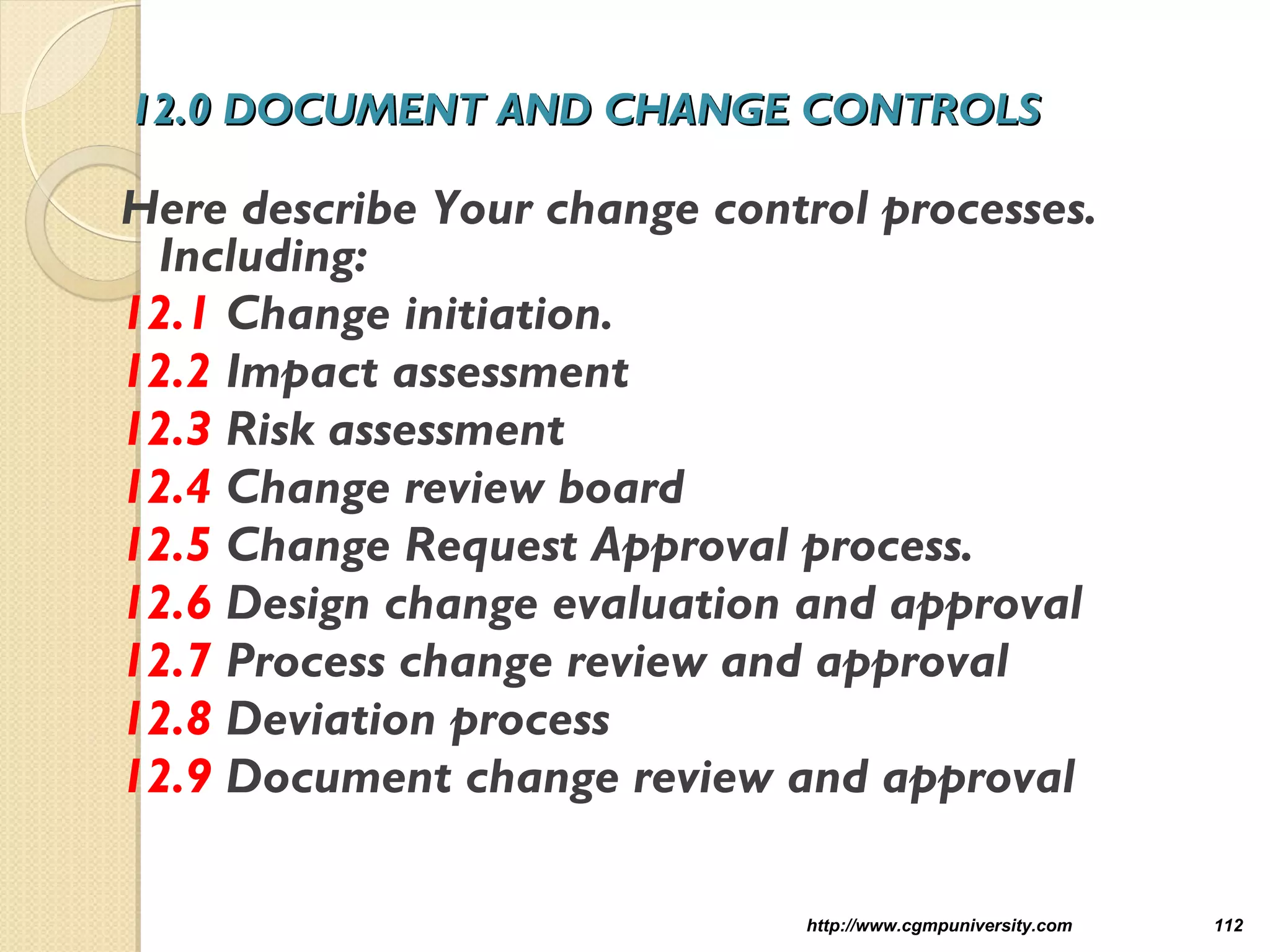
12.0 DOCUMENT ANDCHANGE CONTROLS12.0 DOCUMENT AND CHANGE CONTROLS
Here describe Your change control processes.
Including:
12.1 Change initiation.
12.2 Impact assessment
12.3 Risk assessment
12.4 Change review board
12.5 Change Request Approval process.
12.6 Design change evaluation and approval
12.7 Process change review and approval
12.8 Deviation process
12.9 Document change review and approval
http://www.cgmpuniversity.com 112
113.
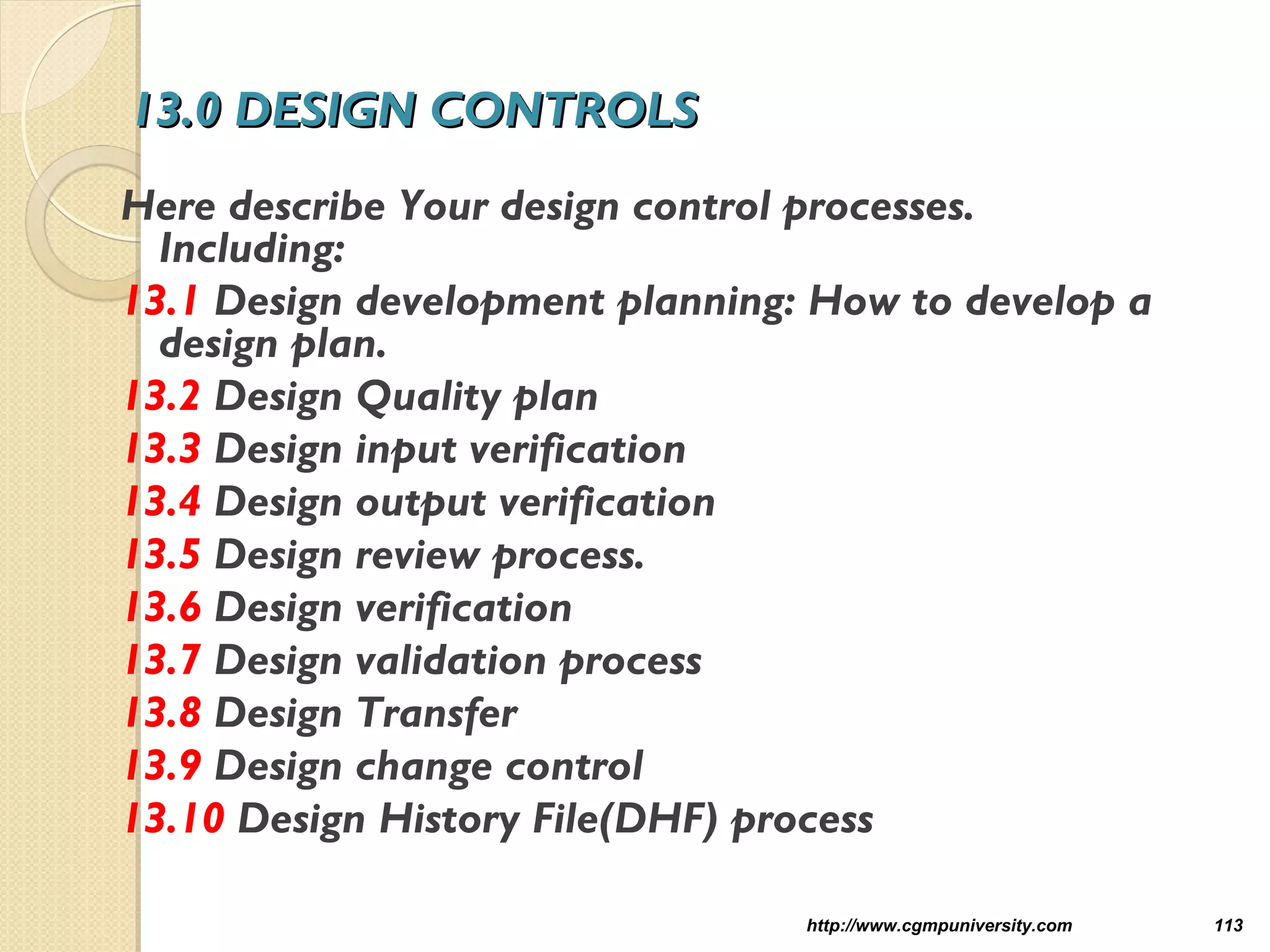
13.0 DESIGN CONTROLS13.0DESIGN CONTROLS
Here describe Your design control processes.
Including:
13.1 Design development planning: How to develop a
design plan.
13.2 Design Quality plan
13.3 Design input verification
13.4 Design output verification
13.5 Design review process.
13.6 Design verification
13.7 Design validation process
13.8 Design Transfer
13.9 Design change control
13.10 Design History File(DHF) process
http://www.cgmpuniversity.com 113
114.
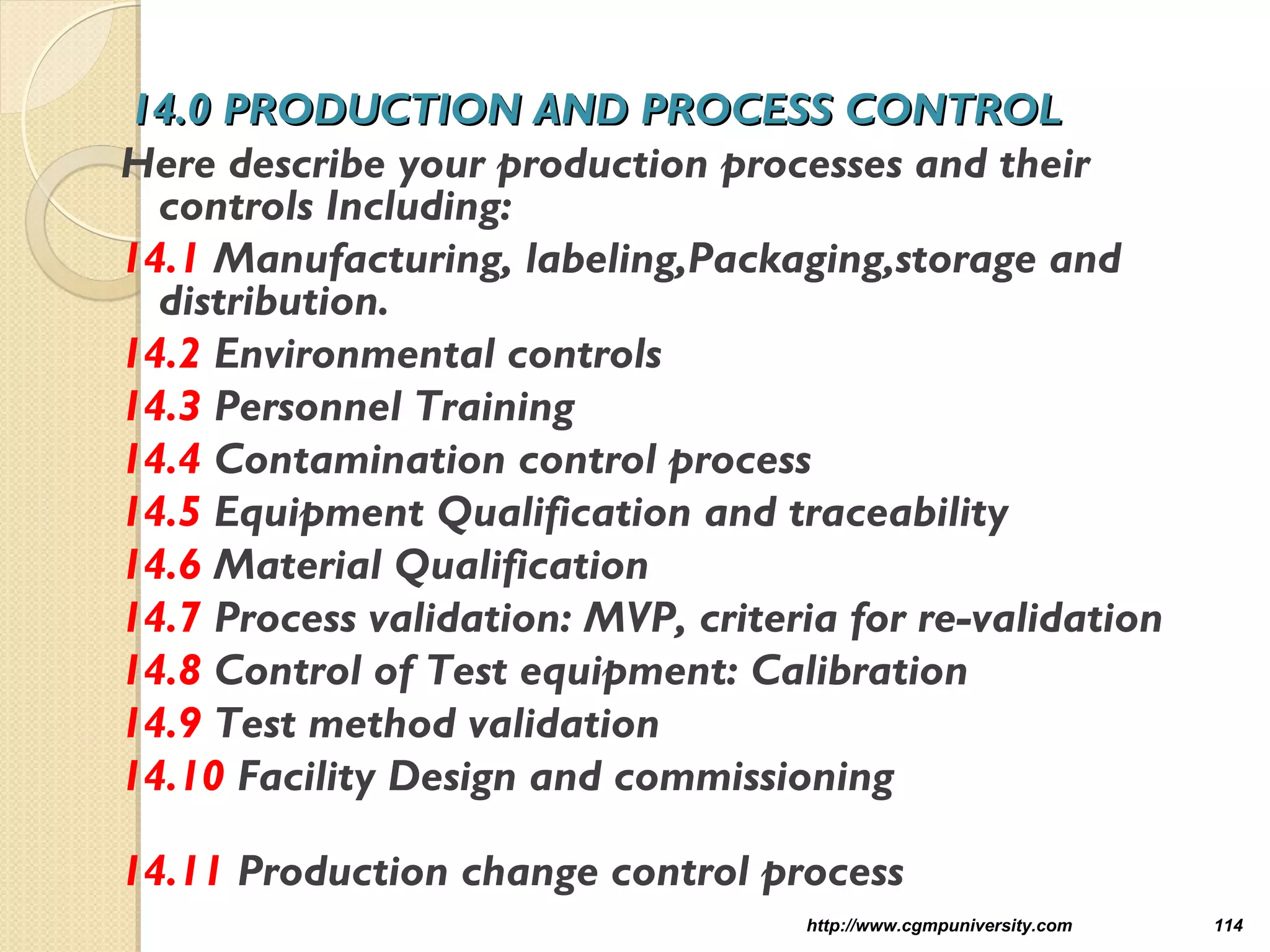
14.0 PRODUCTION ANDPROCESS CONTROL14.0 PRODUCTION AND PROCESS CONTROL
Here describe your production processes and their
controls Including:
14.1 Manufacturing, labeling,Packaging,storage and
distribution.
14.2 Environmental controls
14.3 Personnel Training
14.4 Contamination control process
14.5 Equipment Qualification and traceability
14.6 Material Qualification
14.7 Process validation: MVP, criteria for re-validation
14.8 Control of Test equipment: Calibration
14.9 Test method validation
14.10 Facility Design and commissioning
14.11 Production change control process
http://www.cgmpuniversity.com 114
115.
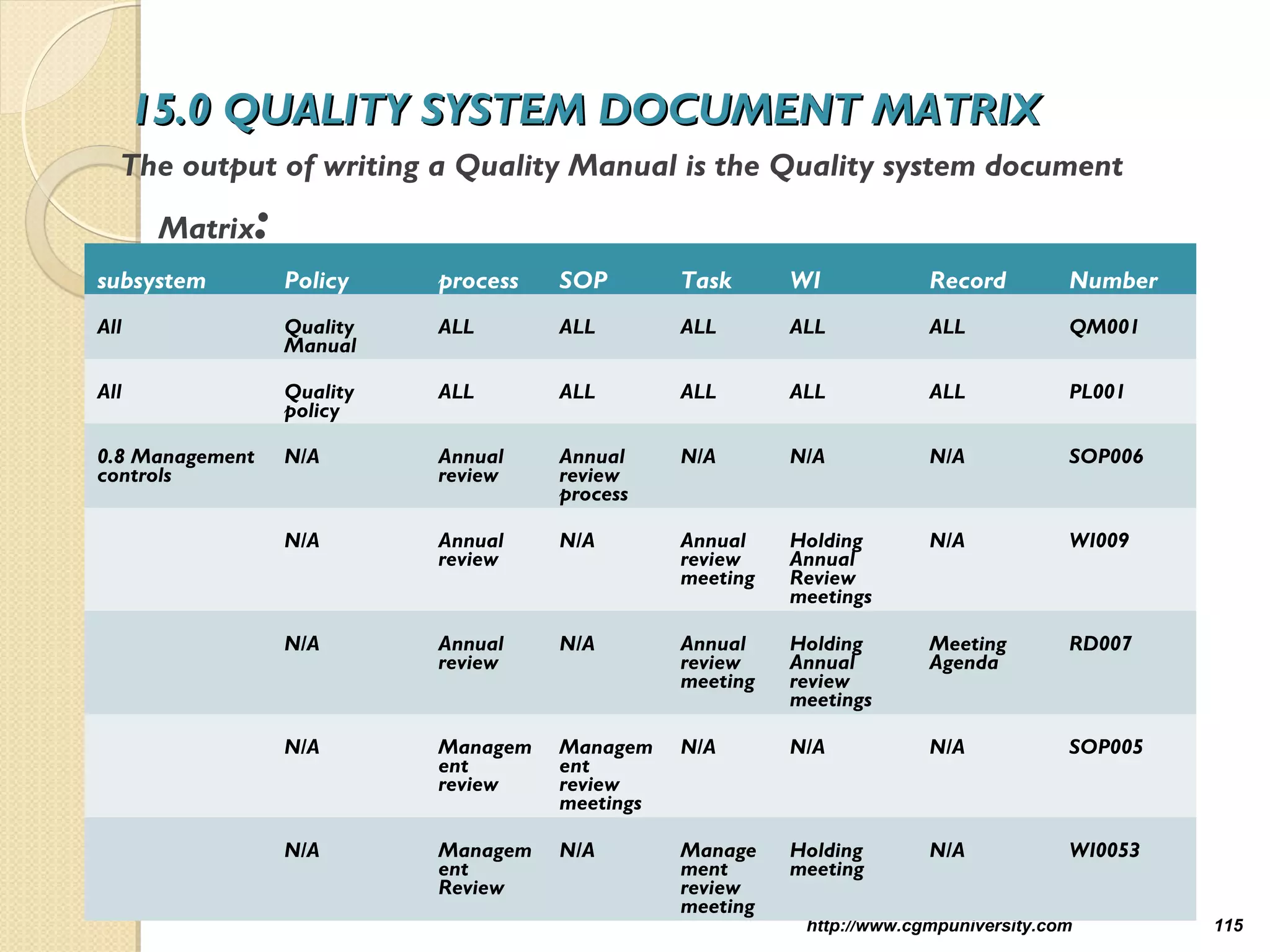
15.0 QUALITY SYSTEMDOCUMENT MATRIX15.0 QUALITY SYSTEM DOCUMENT MATRIX
The output of writing a Quality Manual is the Quality system document
Matrix:
http://www.cgmpuniversity.com 115
subsystem Policy process SOP Task WI Record Number
All Quality
Manual
ALL ALL ALL ALL ALL QM001
All Quality
policy
ALL ALL ALL ALL ALL PL001
0.8 Management
controls
N/A Annual
review
Annual
review
process
N/A N/A N/A SOP006
N/A Annual
review
N/A Annual
review
meeting
Holding
Annual
Review
meetings
N/A WI009
N/A Annual
review
N/A Annual
review
meeting
Holding
Annual
review
meetings
Meeting
Agenda
RD007
N/A Managem
ent
review
Managem
ent
review
meetings
N/A N/A N/A SOP005
N/A Managem
ent
Review
N/A Manage
ment
review
meeting
Holding
meeting
N/A WI0053
http://www.cgmpuniversity.com 118
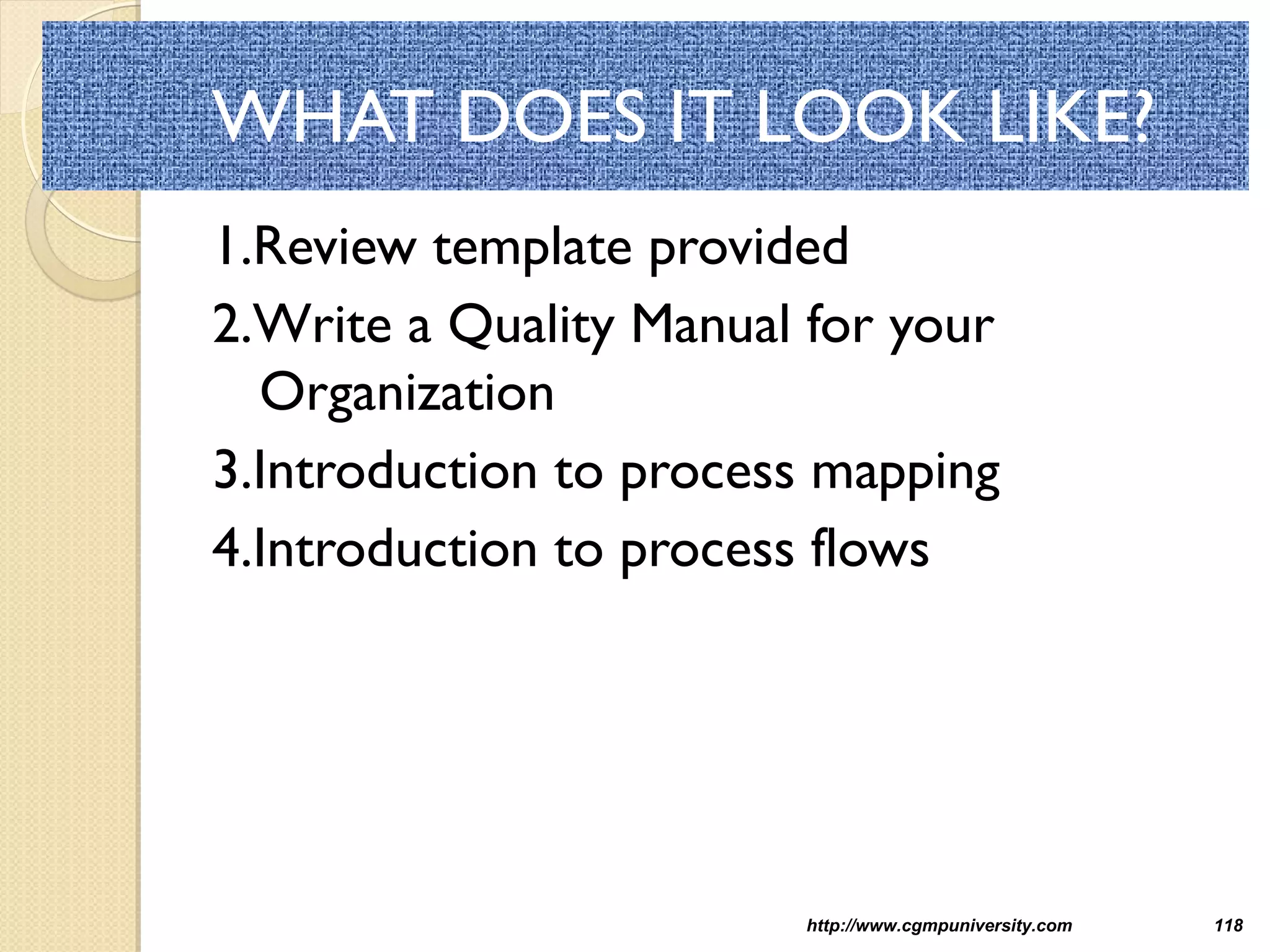
WHAT DOESIT LOOK LIKE?
1.Review template provided
2.Write a Quality Manual for your
Organization
3.Introduction to process mapping
4.Introduction to process flows
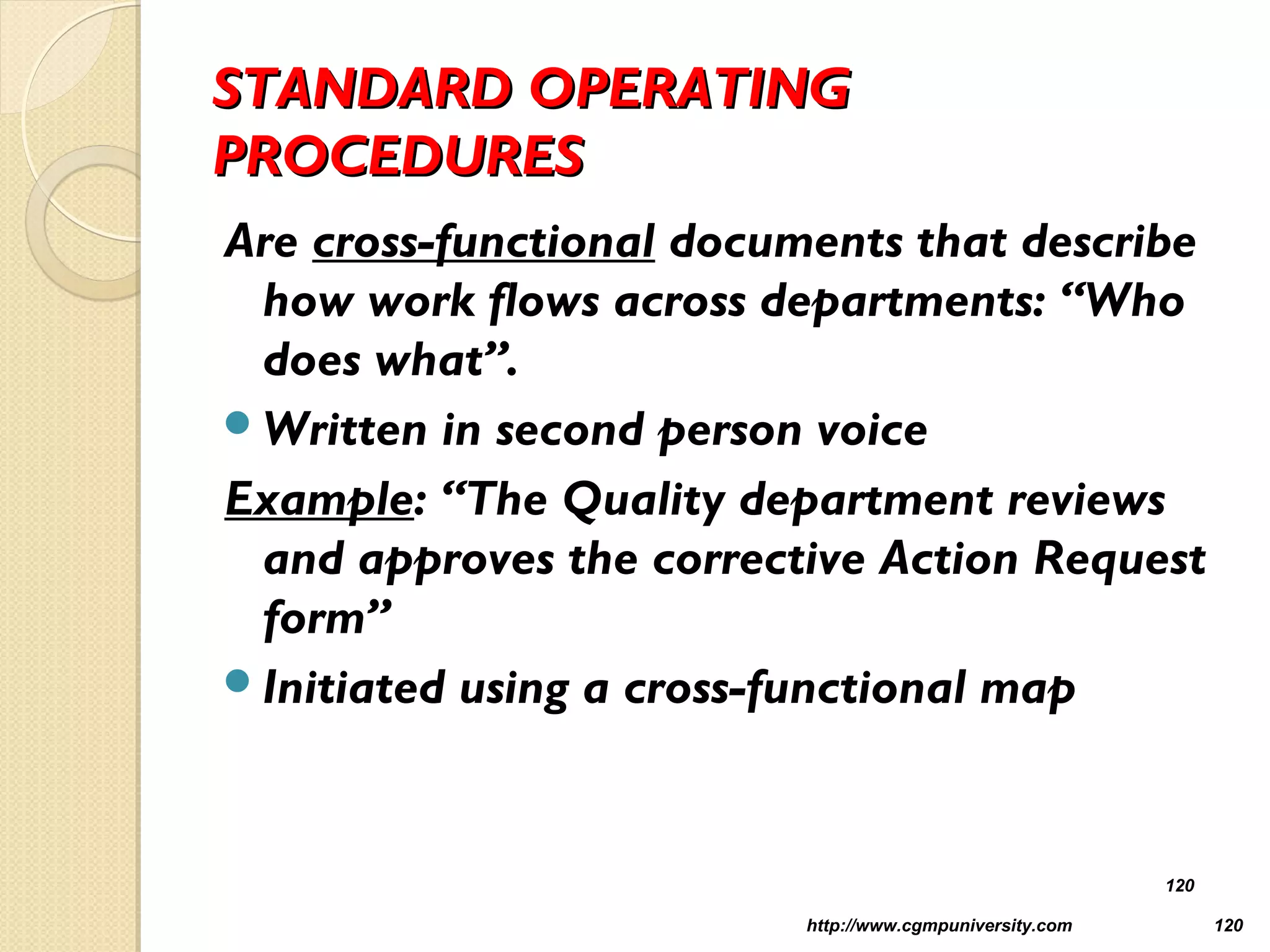
STANDARD OPERATINGSTANDARD OPERATING
PROCEDURESPROCEDURES
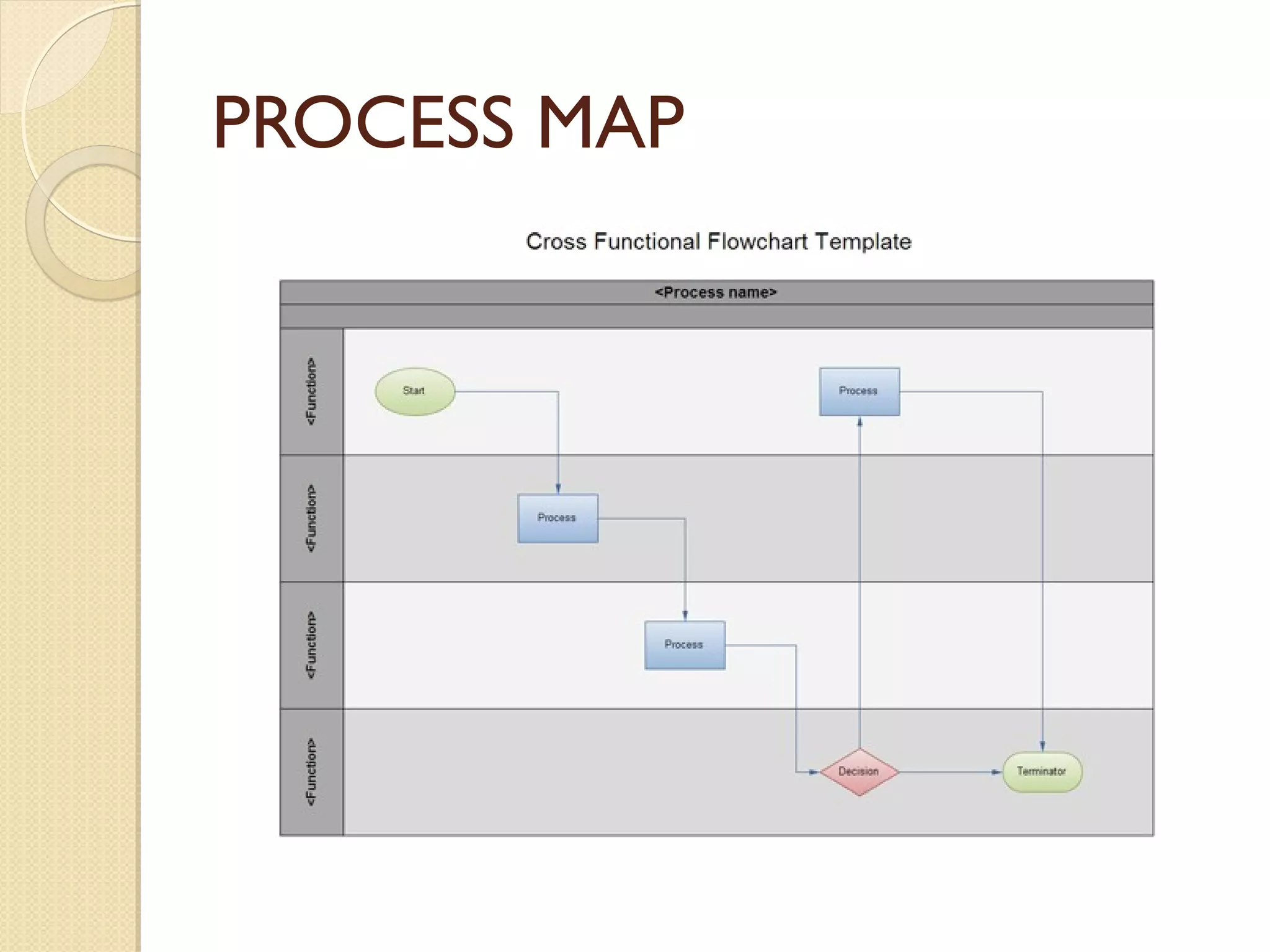
Arecross-functional documents that describe
how work flows across departments: “Who
does what”.
Written in second person voice
Example: “The Quality department reviews
and approves the corrective Action Request
form”
Initiated using a cross-functional map
http://www.cgmpuniversity.com 120
120
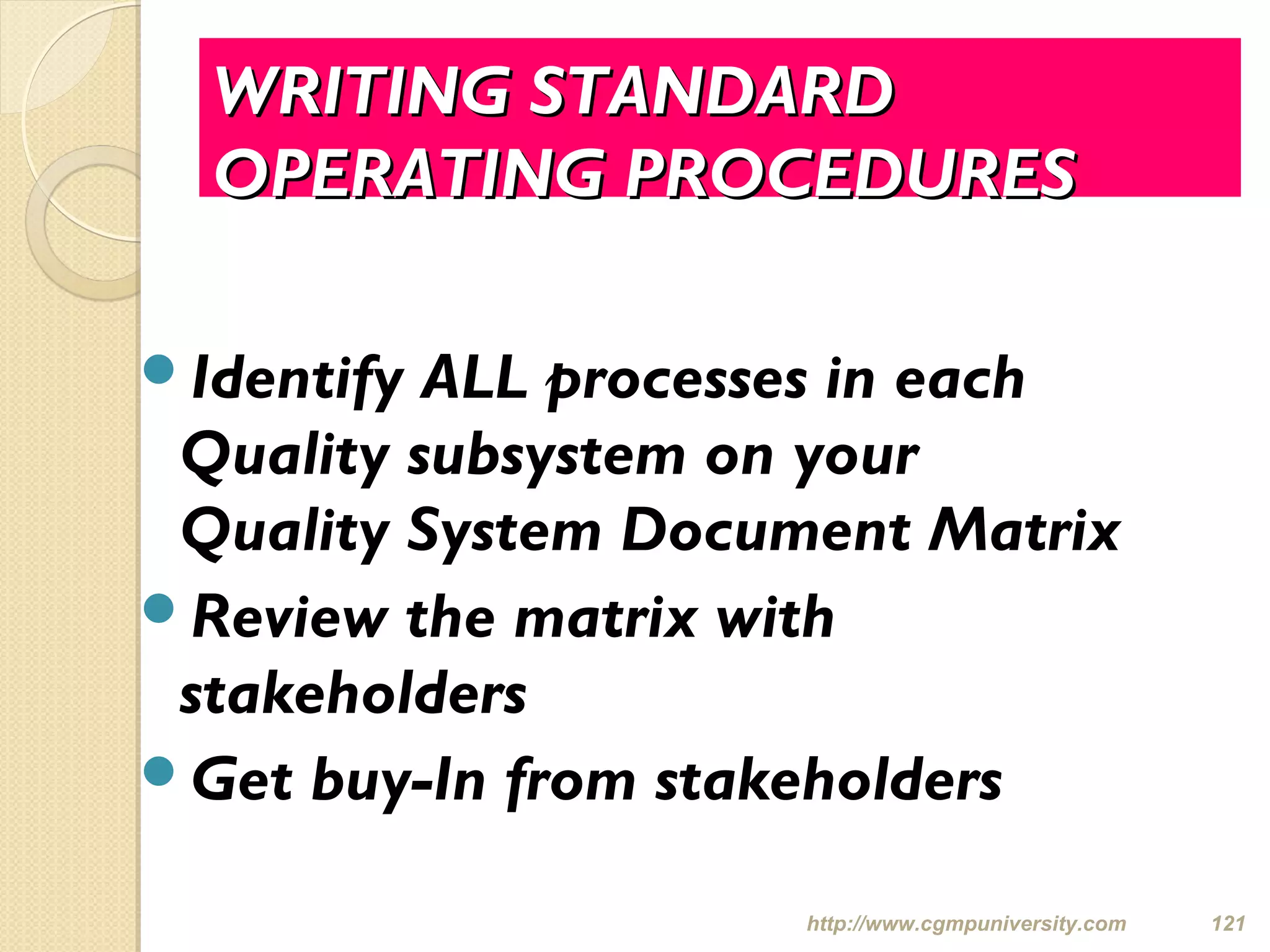
121.
WRITING STANDARDWRITING STANDARD
OPERATINGPROCEDURESOPERATING PROCEDURES
Identify ALL processes in each
Quality subsystem on your
Quality System Document Matrix
Review the matrix with
stakeholders
Get buy-In from stakeholders
http://www.cgmpuniversity.com 121
122.
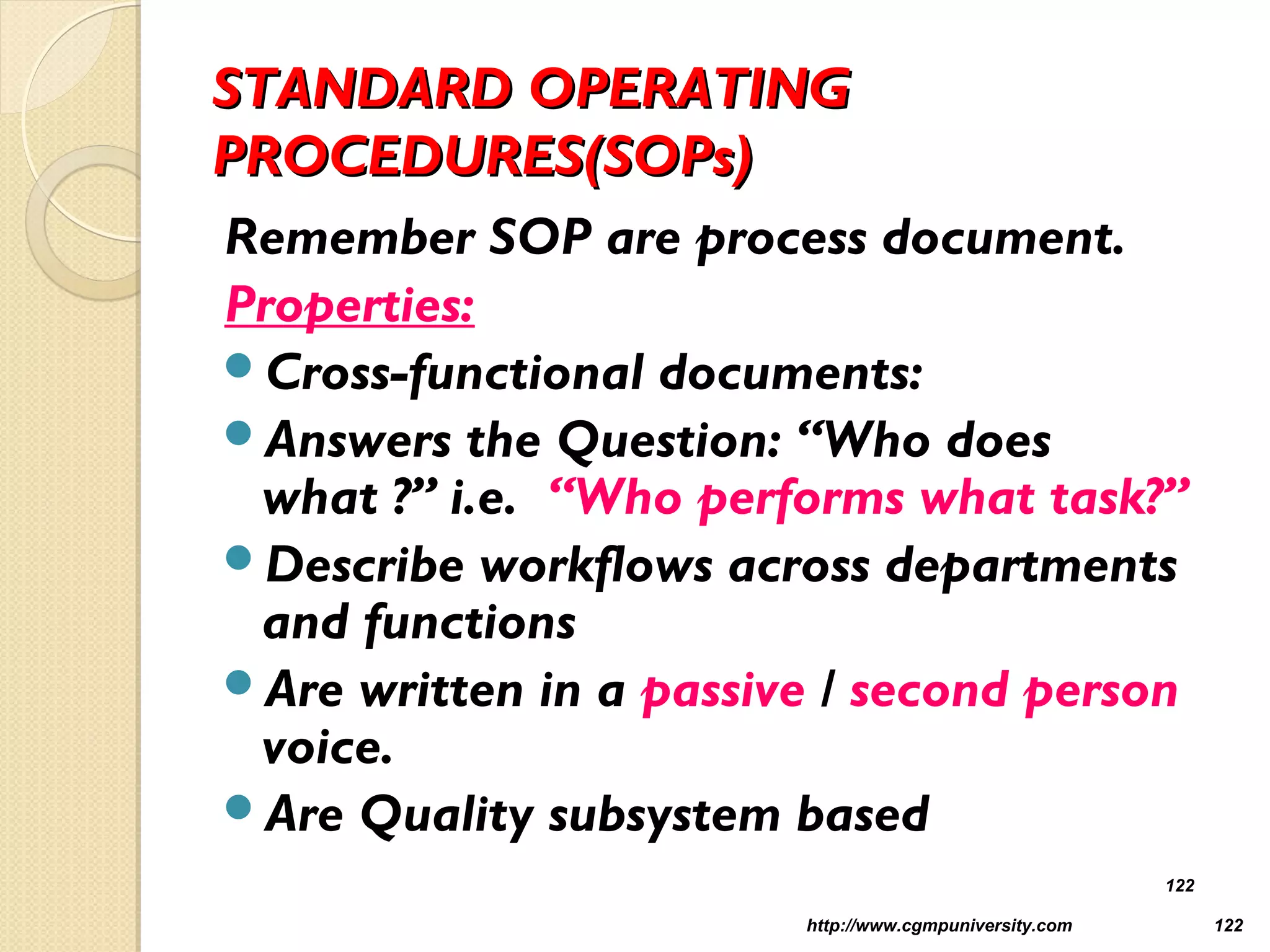
STANDARD OPERATINGSTANDARD OPERATING
PROCEDURES(SOPs)PROCEDURES(SOPs)
RememberSOP are process document.
Properties:
Cross-functional documents:
Answers the Question: “Who does
what ?” i.e. “Who performs what task?”
Describe workflows across departments
and functions
Are written in a passive / second person
voice.
Are Quality subsystem based
http://www.cgmpuniversity.com 122
122
123.
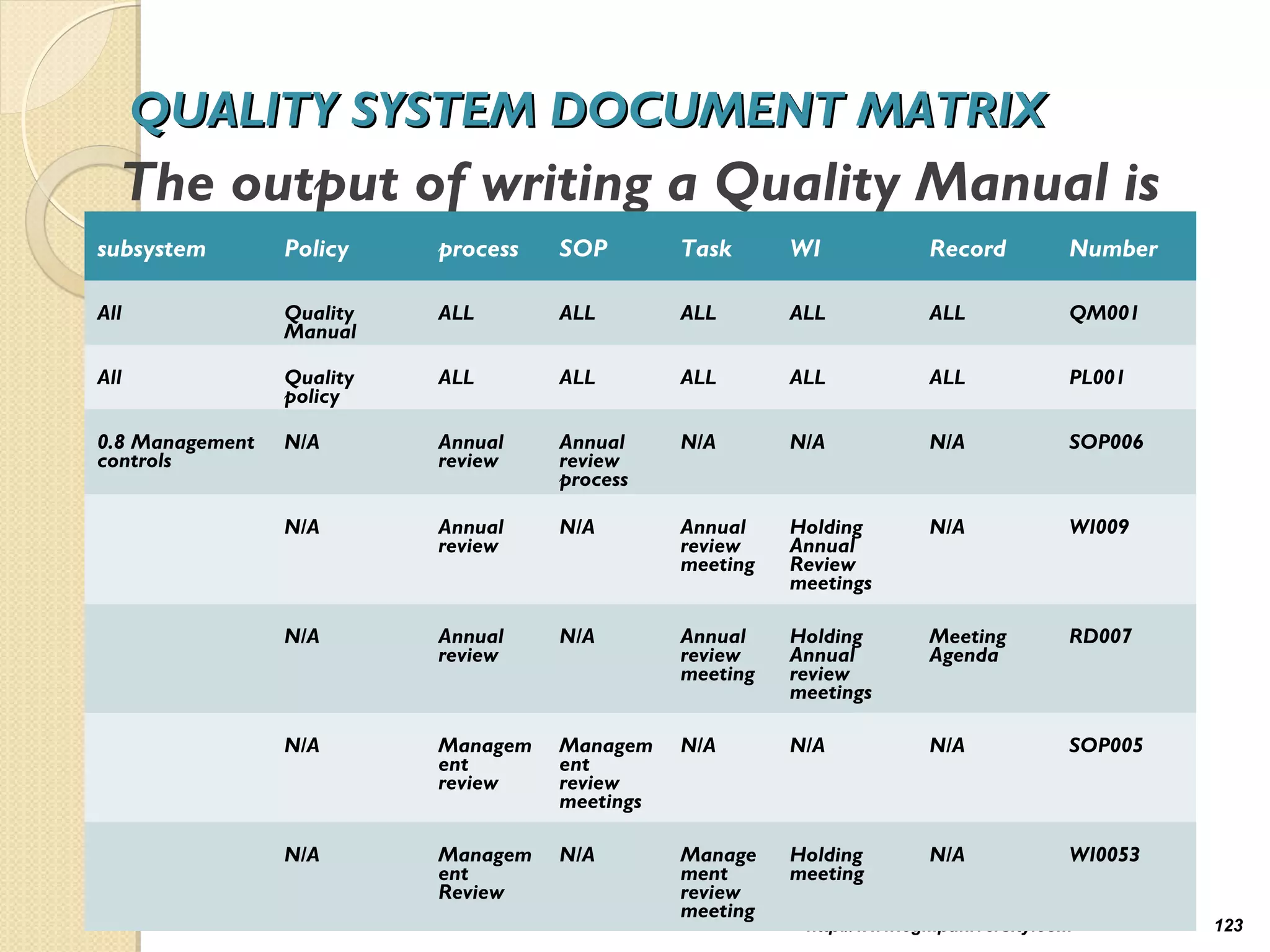
QUALITY SYSTEM DOCUMENTMATRIXQUALITY SYSTEM DOCUMENT MATRIX
The output of writing a Quality Manual is
the Quality system document Matrix:
http://www.cgmpuniversity.com 123
subsystem Policy process SOP Task WI Record Number
All Quality
Manual
ALL ALL ALL ALL ALL QM001
All Quality
policy
ALL ALL ALL ALL ALL PL001
0.8 Management
controls
N/A Annual
review
Annual
review
process
N/A N/A N/A SOP006
N/A Annual
review
N/A Annual
review
meeting
Holding
Annual
Review
meetings
N/A WI009
N/A Annual
review
N/A Annual
review
meeting
Holding
Annual
review
meetings
Meeting
Agenda
RD007
N/A Managem
ent
review
Managem
ent
review
meetings
N/A N/A N/A SOP005
N/A Managem
ent
Review
N/A Manage
ment
review
meeting
Holding
meeting
N/A WI0053
124.
STEPSSTEPS
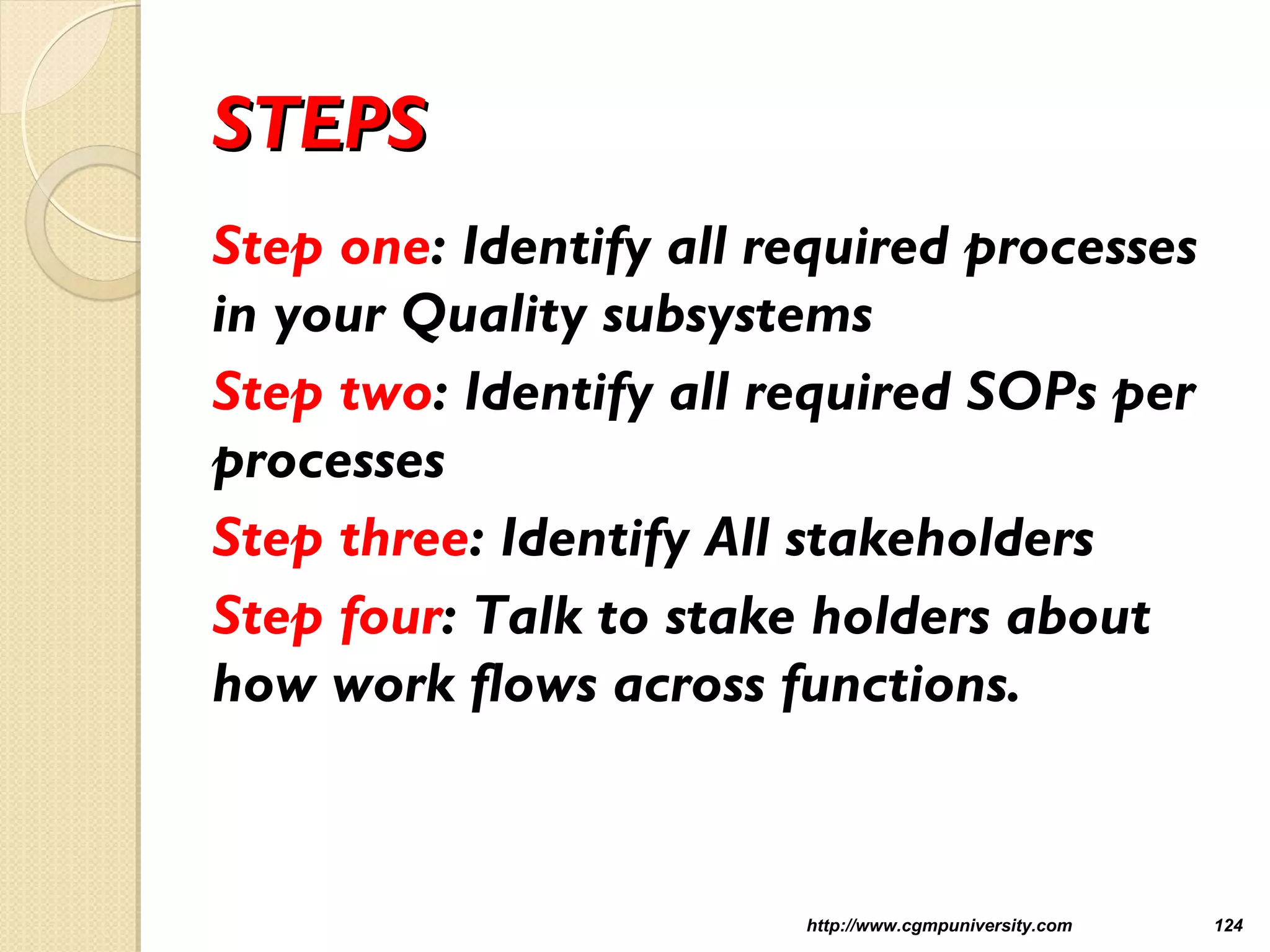
Step one: Identifyall required processes
in your Quality subsystems
Step two: Identify all required SOPs per
processes
Step three: Identify All stakeholders
Step four: Talk to stake holders about
how work flows across functions.
http://www.cgmpuniversity.com 124
STEPSSTEPS
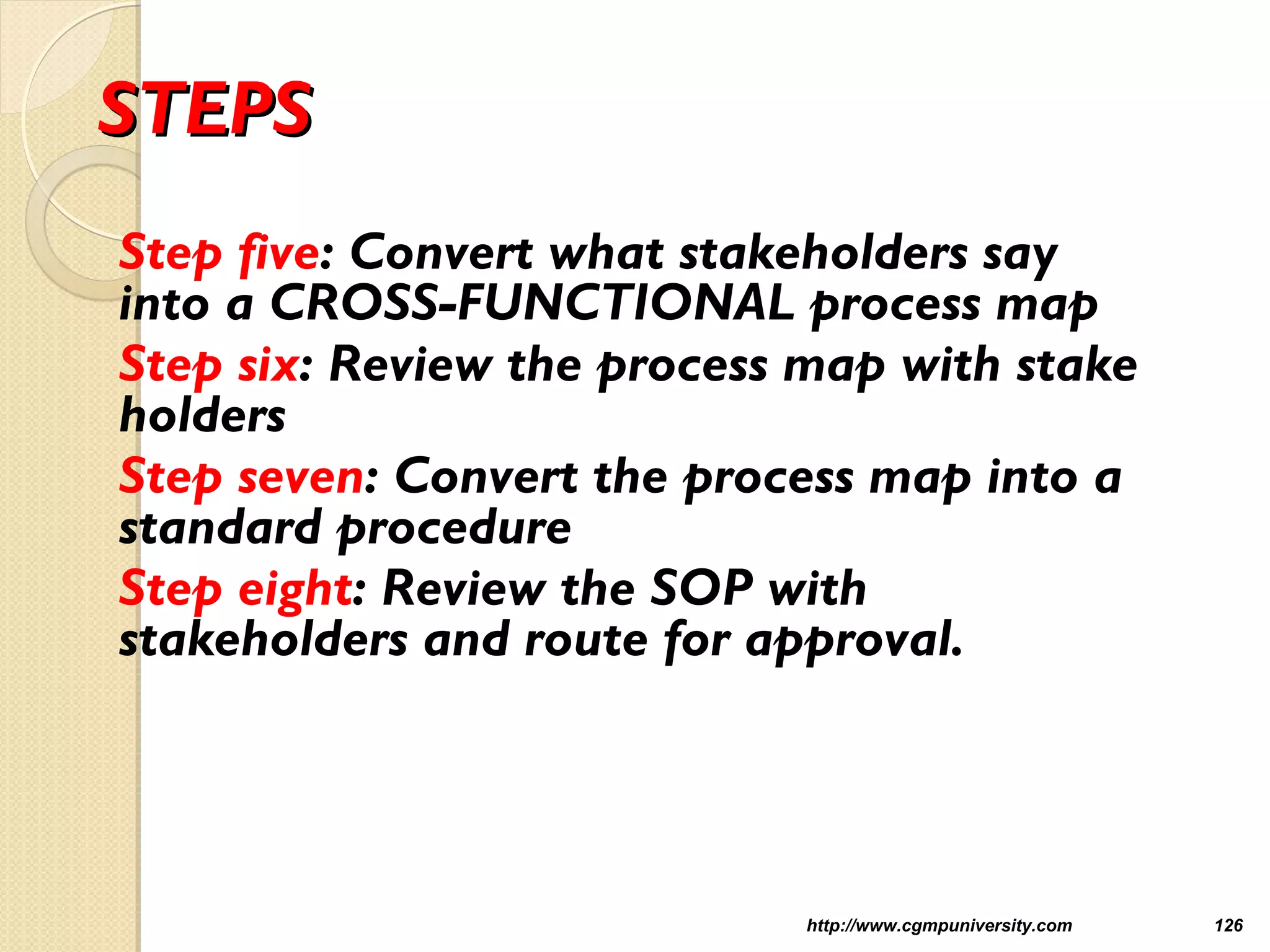
Step five: Convertwhat stakeholders say
into a CROSS-FUNCTIONAL process map
Step six: Review the process map with stake
holders
Step seven: Convert the process map into a
standard procedure
Step eight: Review the SOP with
stakeholders and route for approval.
http://www.cgmpuniversity.com 126
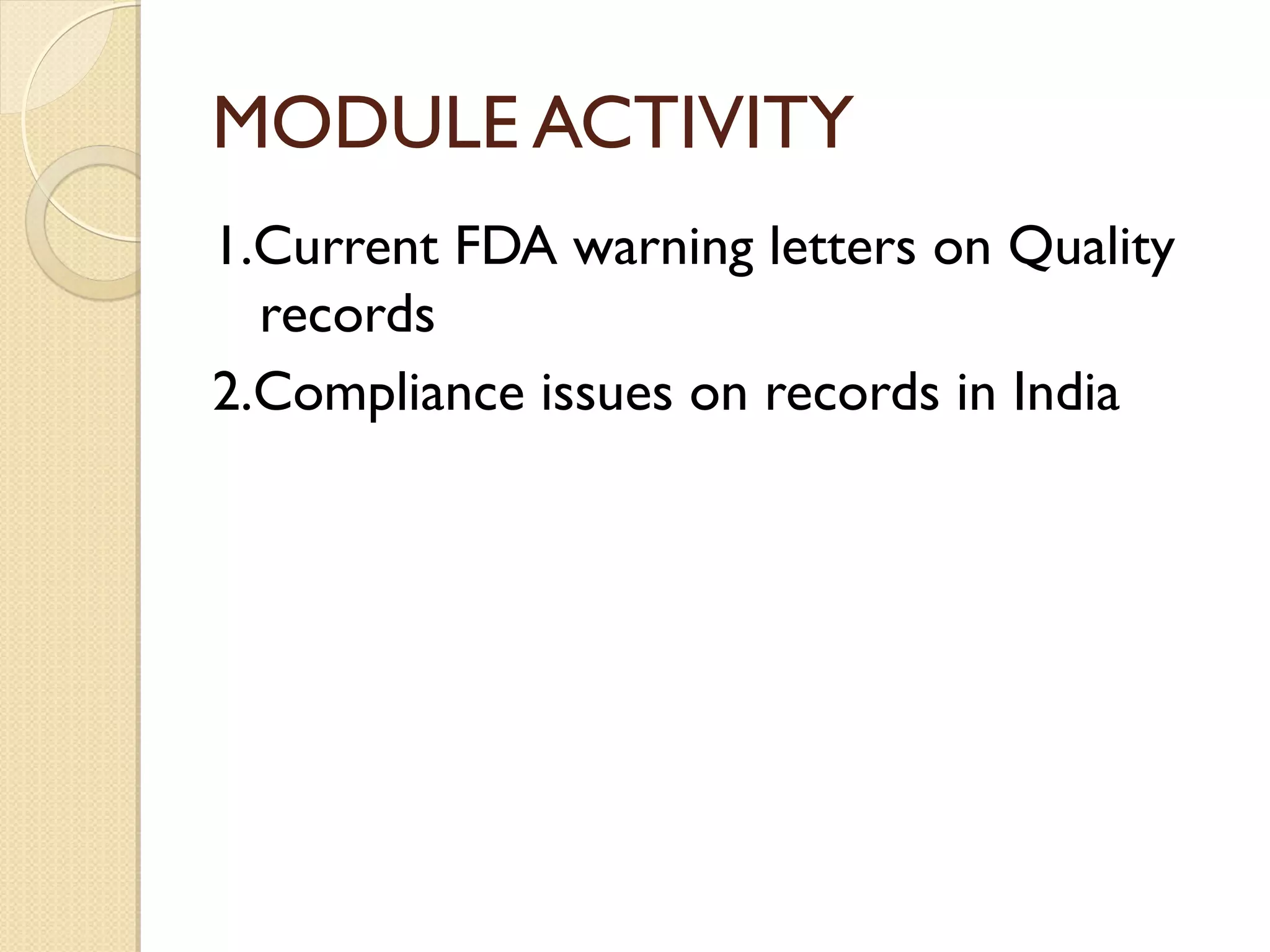
MODULE ACTIVITY
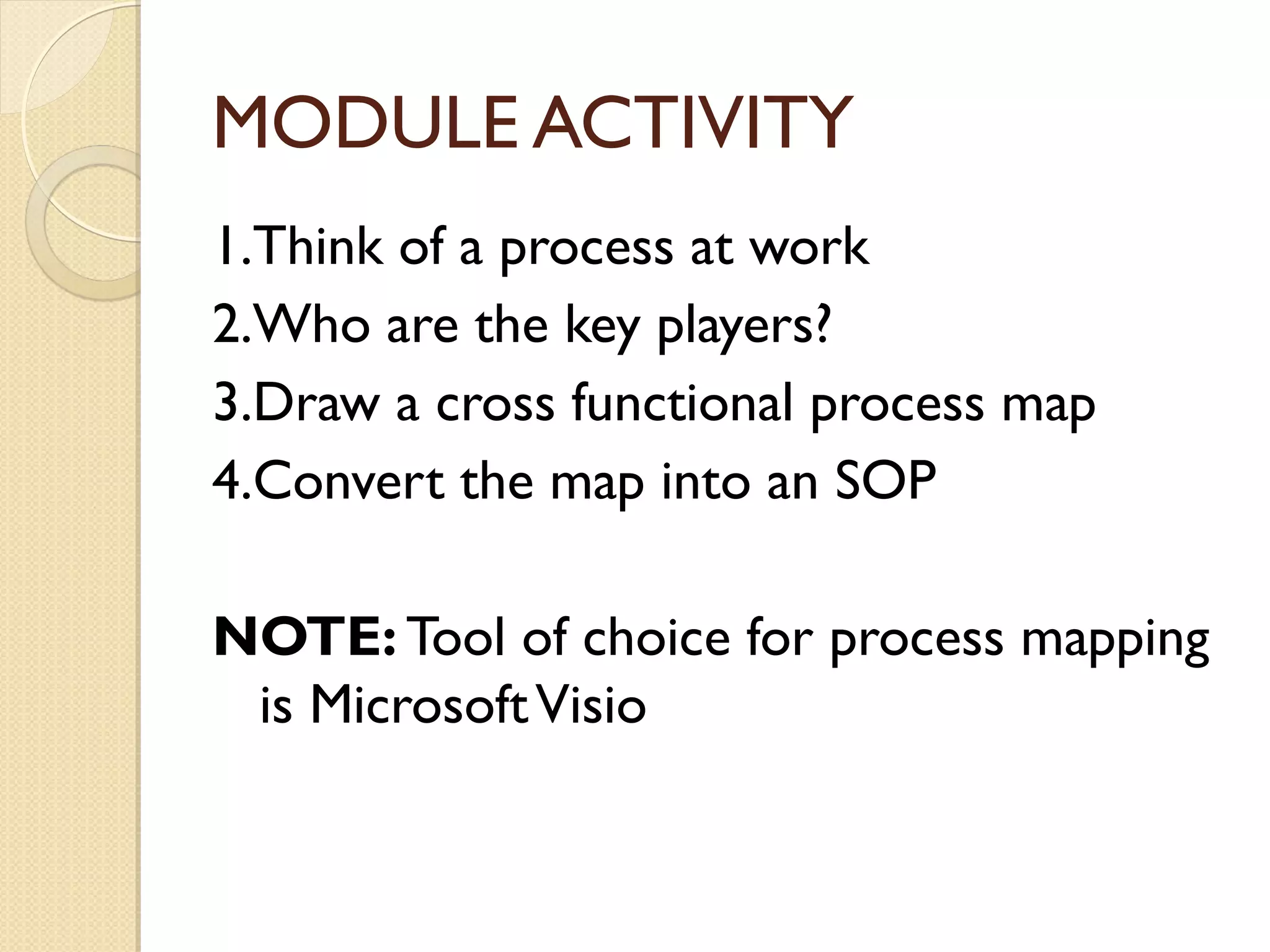
1.Think ofa process at work
2.Who are the key players?
3.Draw a cross functional process map
4.Convert the map into an SOP
NOTE: Tool of choice for process mapping
is MicrosoftVisio
WORK INSTRUCTIONSWORK INSTRUCTIONS
Providestep by step instructions to perform a
task.
Written in an active voice
Example: 1.“ Push the red button on the
panel”
2. “ Slowly, add 50ML of 2.0M
Sulfuric acid to the copper sulfate in the
flask”
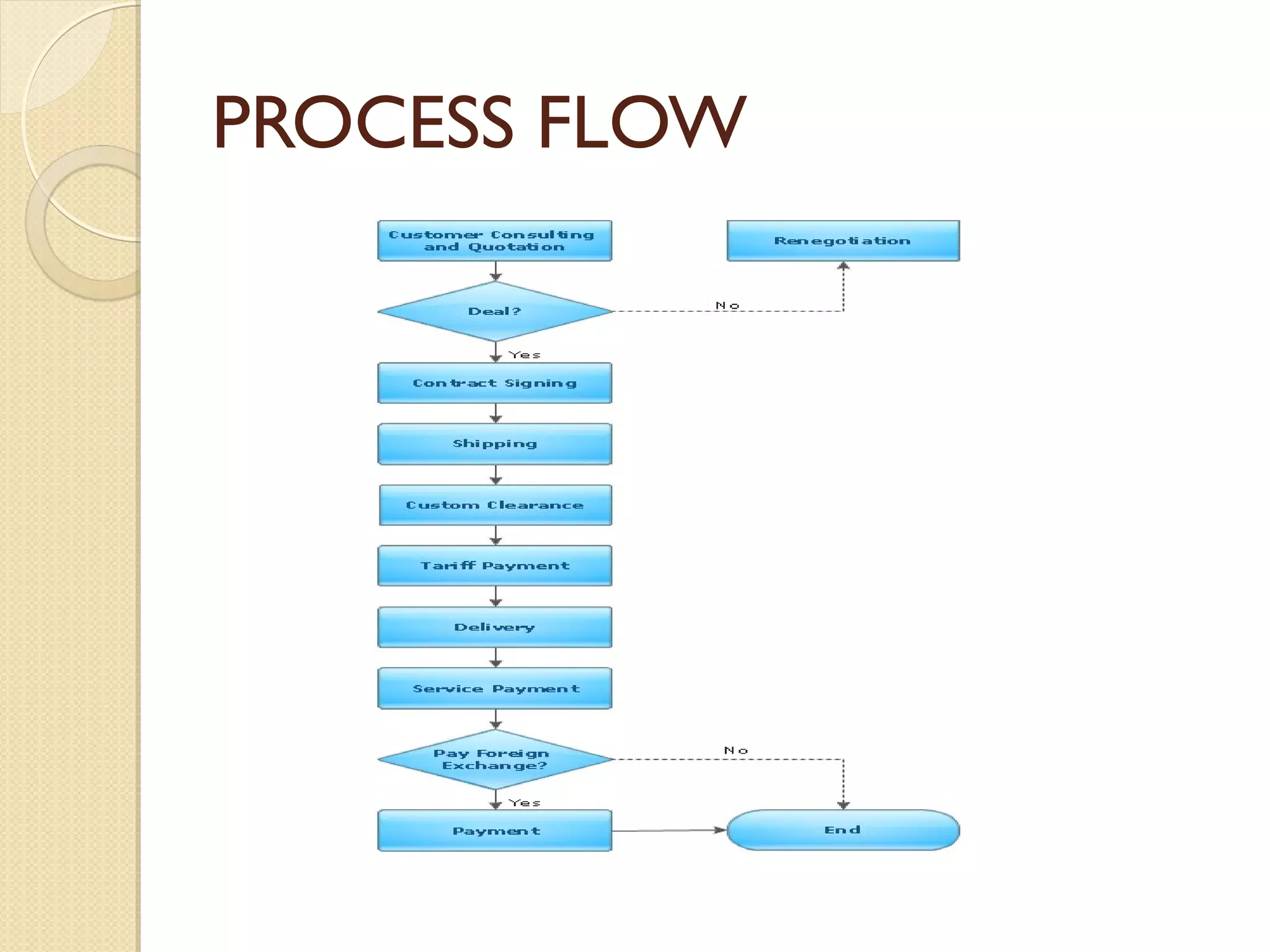
Initiated by drawing a process flow
http://www.cgmpuniversity.com 130
130
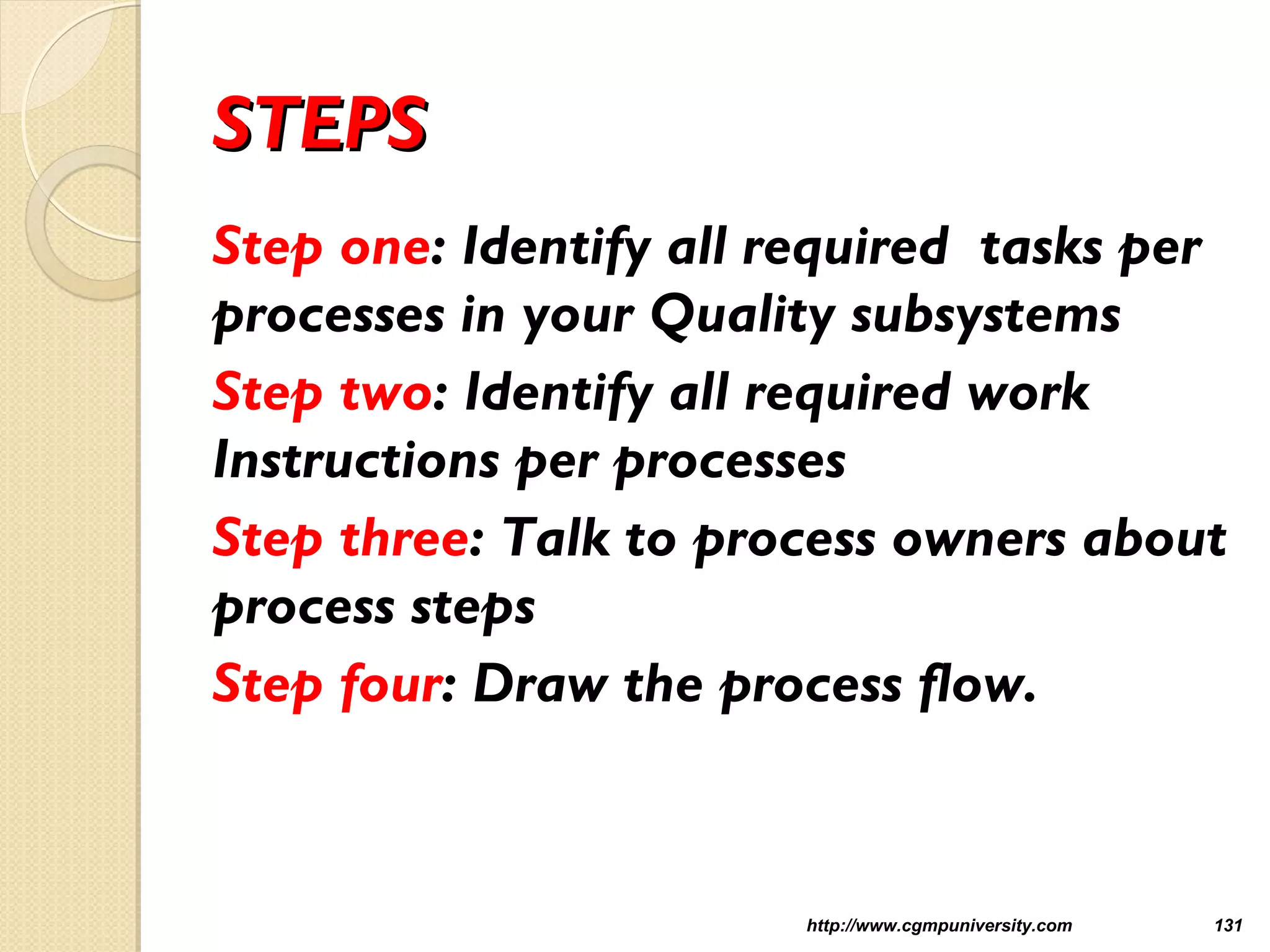
131.
STEPSSTEPS
Step one: Identifyall required tasks per
processes in your Quality subsystems
Step two: Identify all required work
Instructions per processes
Step three: Talk to process owners about
process steps
Step four: Draw the process flow.
http://www.cgmpuniversity.com 131
STEPSSTEPS
Step five: Reviewthe process flow with
the process owner
Step six: Convert the process flow into a
work Instruction
Step seven: Review the work Instruction
with the process owner and route for
approval
http://www.cgmpuniversity.com 133
134.
http://www.cgmpuniversity.com 134
Work Instructions(WIs)Work Instructions (WIs)
Properties:Properties:
Task oriented
Answers the Question: “how is it done ?” i.e. “How
is this task performed?”
Describe workflows
Are written in an active voice.
Are task based
134
MODULE SUMMARY
StepsSteps
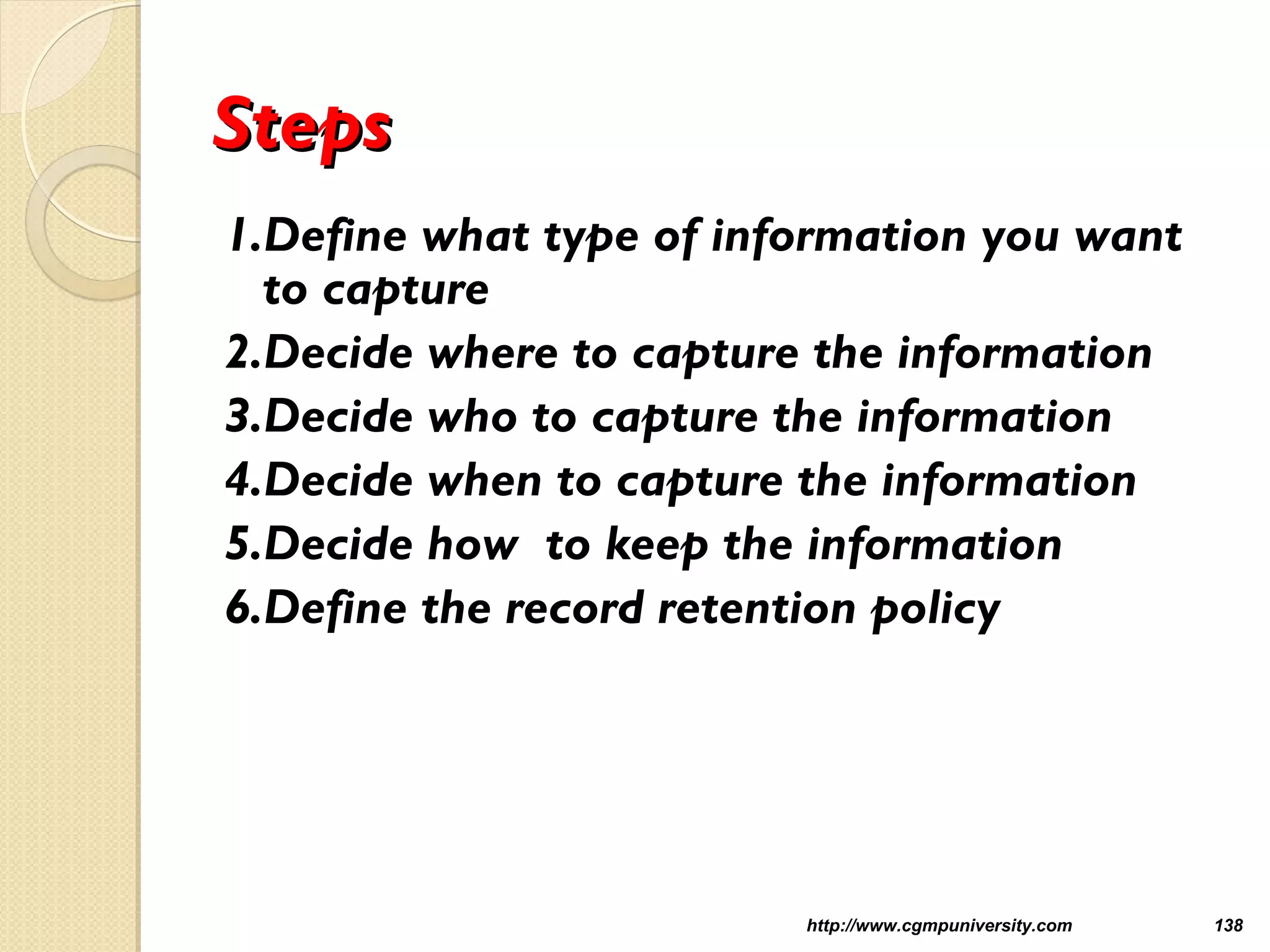
1.Define what typeof information you want
to capture
2.Decide where to capture the information
3.Decide who to capture the information
4.Decide when to capture the information
5.Decide how to keep the information
6.Define the record retention policy
http://www.cgmpuniversity.com 138
139.
http://www.cgmpuniversity.com 139
STEPSSTEPS
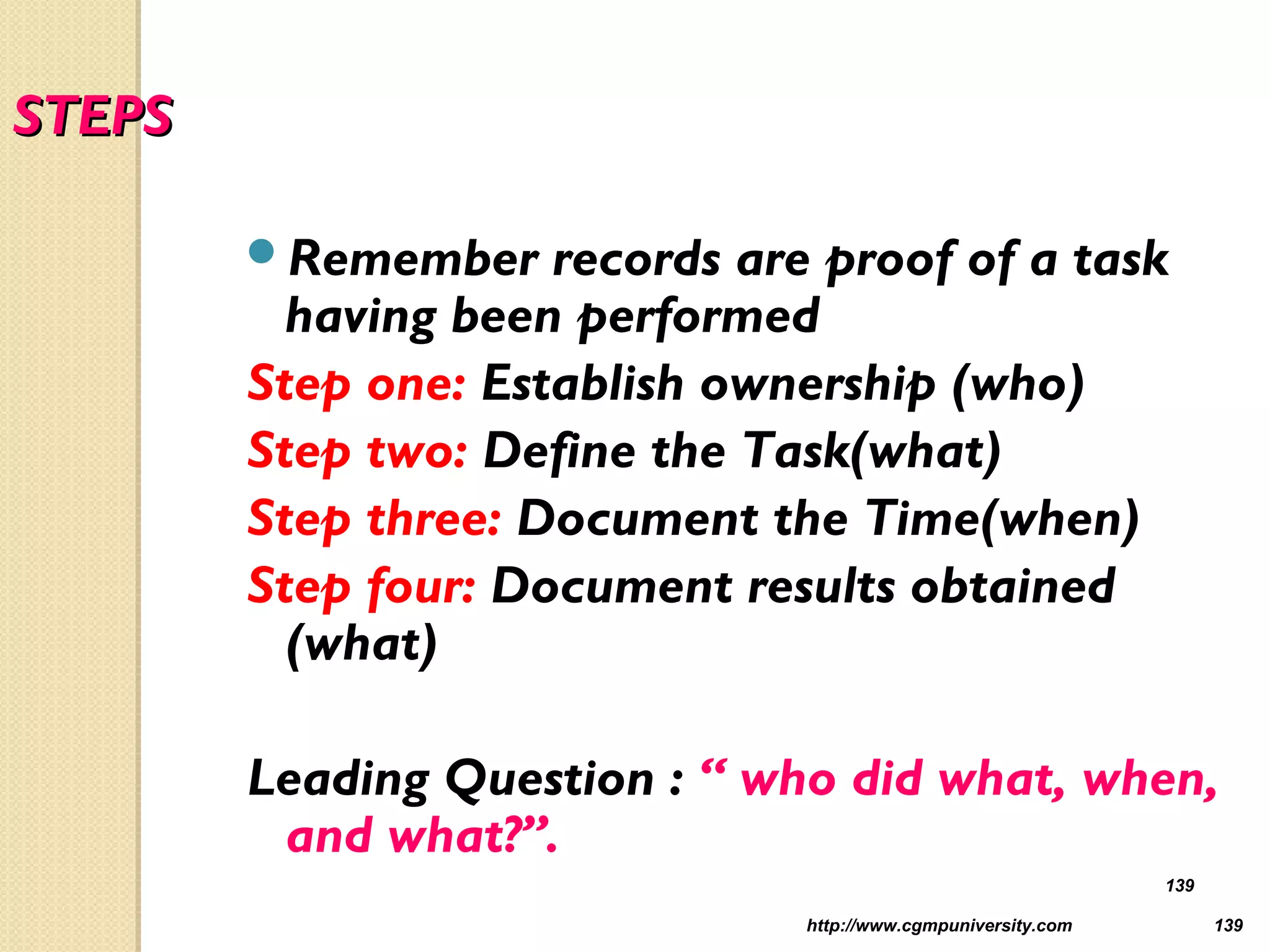
Remember recordsare proof of a task
having been performed
Step one: Establish ownership (who)
Step two: Define the Task(what)
Step three: Document the Time(when)
Step four: Document results obtained
(what)
Leading Question : “ who did what, when,
and what?”.
139
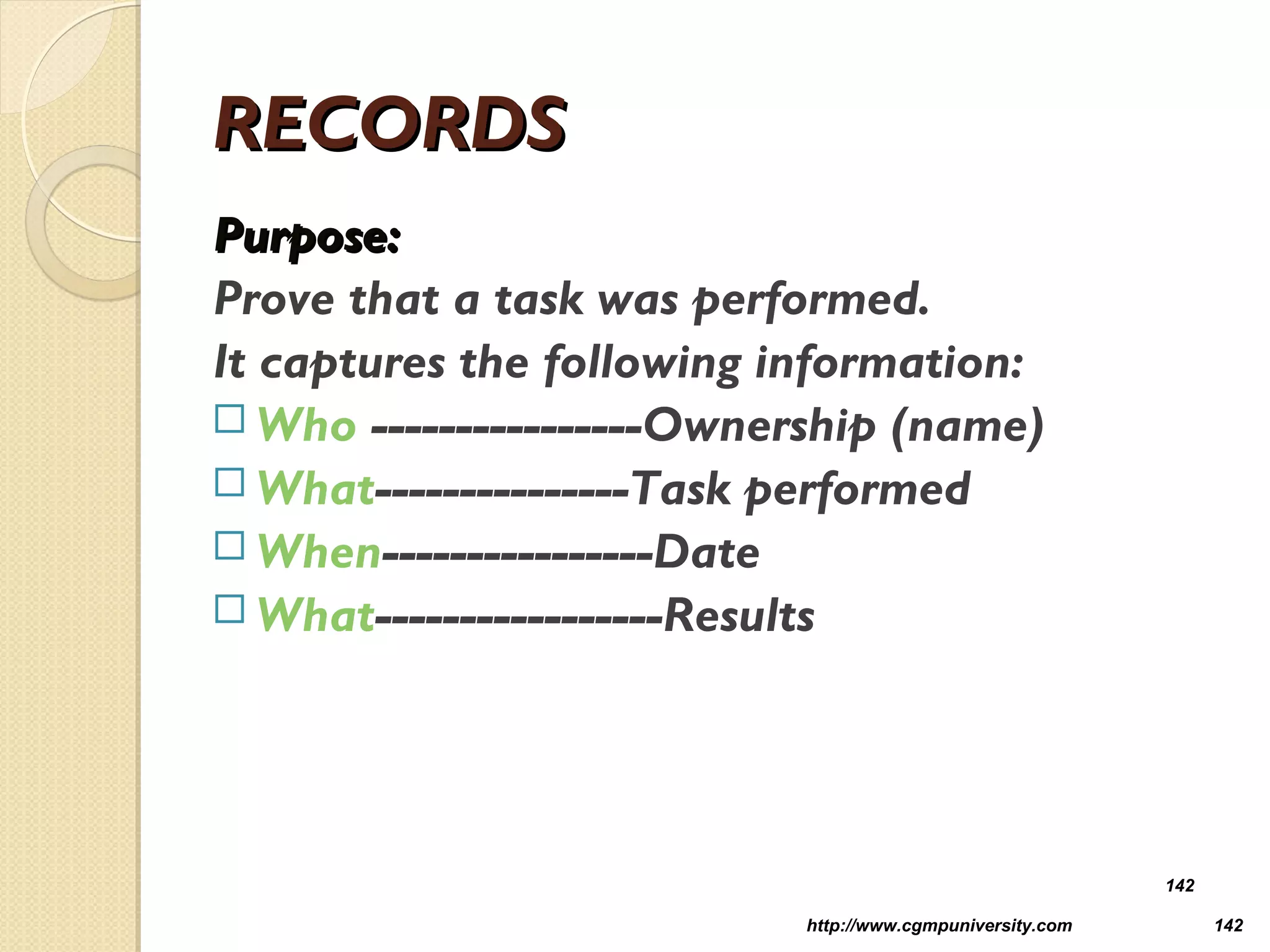
RECORDSRECORDS
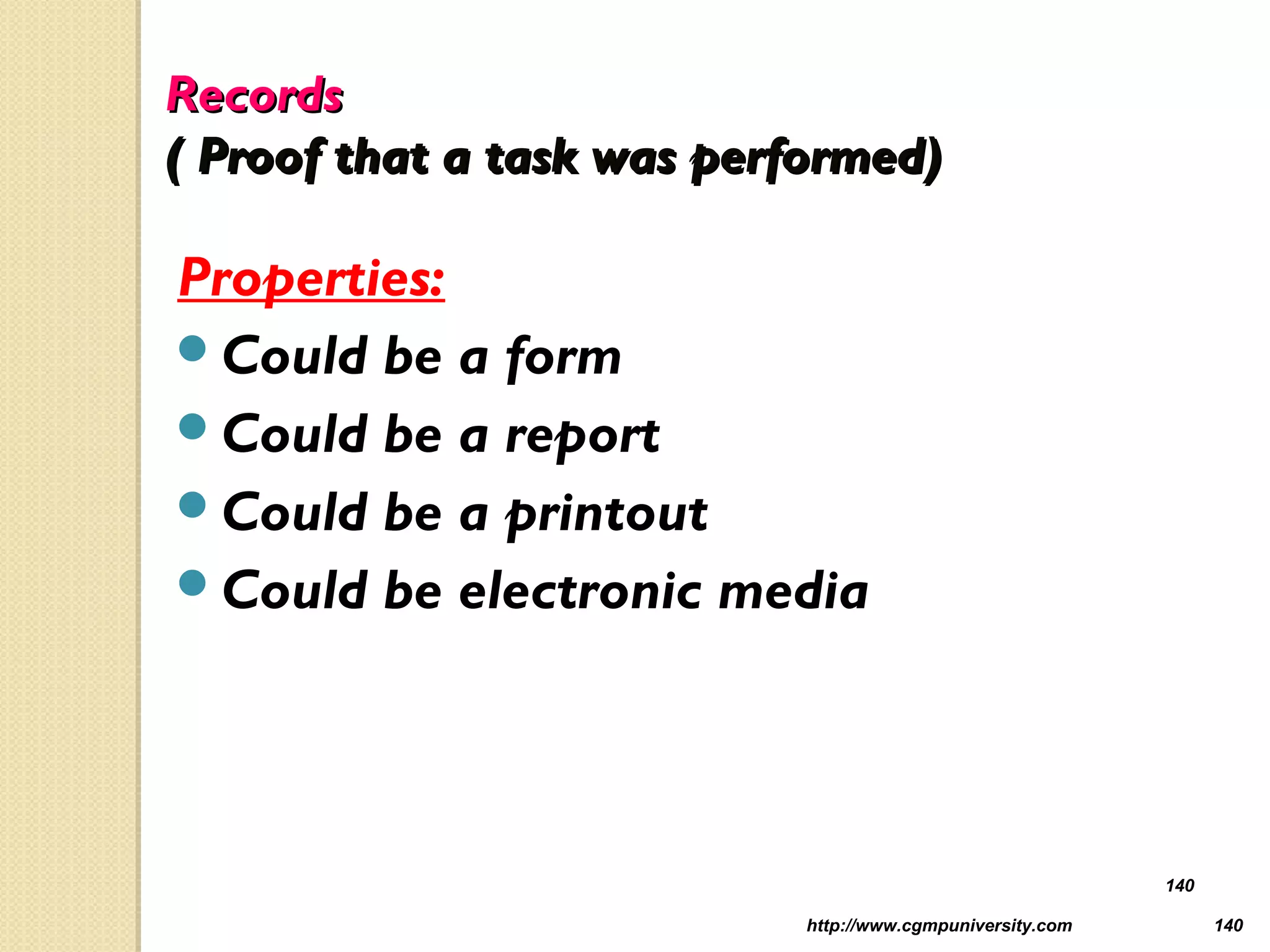
Purpose:Purpose:
Prove that atask was performed.
It captures the following information:
Who ----------------Ownership (name)
What---------------Task performed
When----------------Date
What-----------------Results
http://www.cgmpuniversity.com 142
142
143.
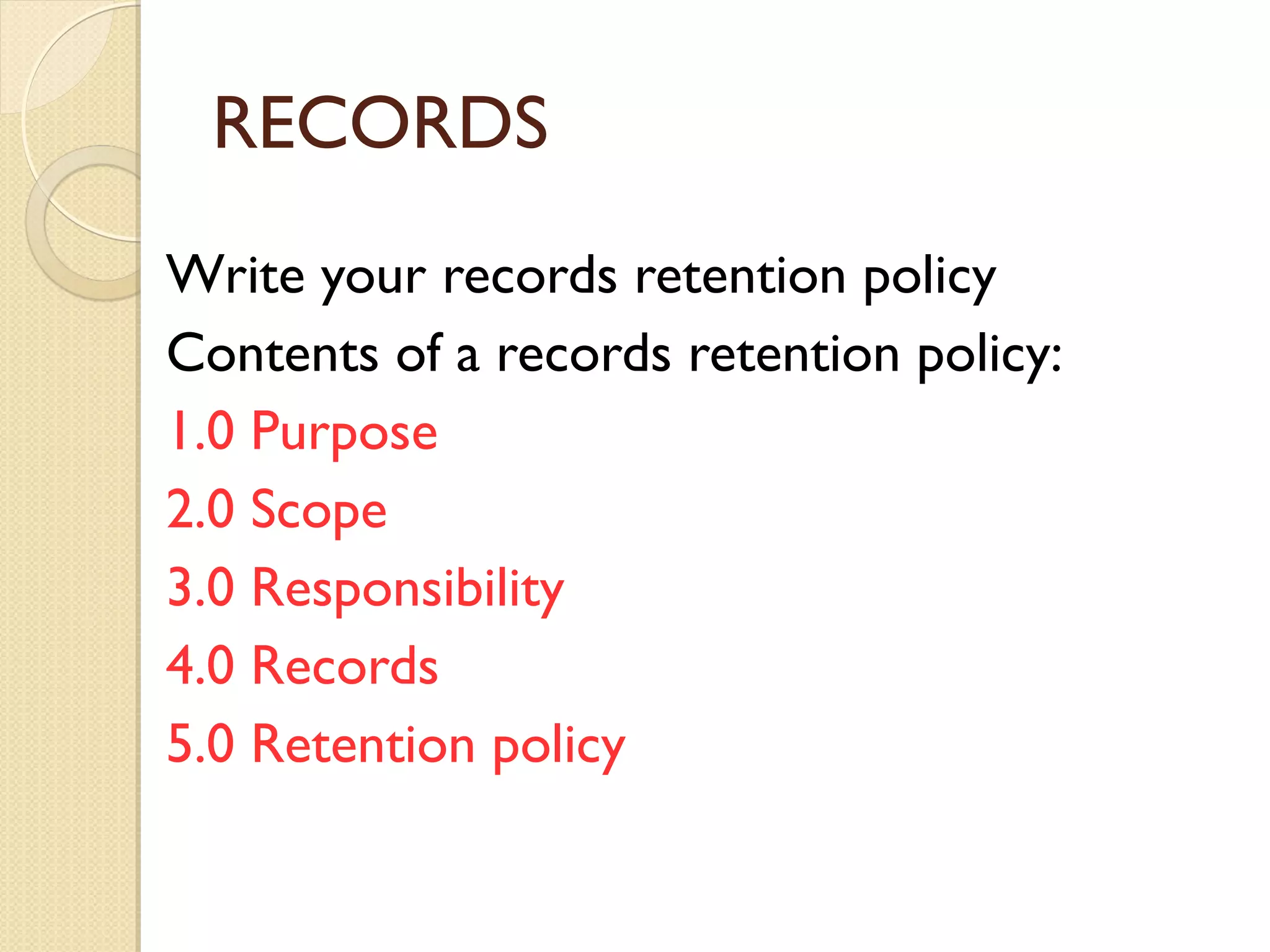
RECORDS
Write your recordsretention policy
Contents of a records retention policy:
1.0 Purpose
2.0 Scope
3.0 Responsibility
4.0 Records
5.0 Retention policy
144.
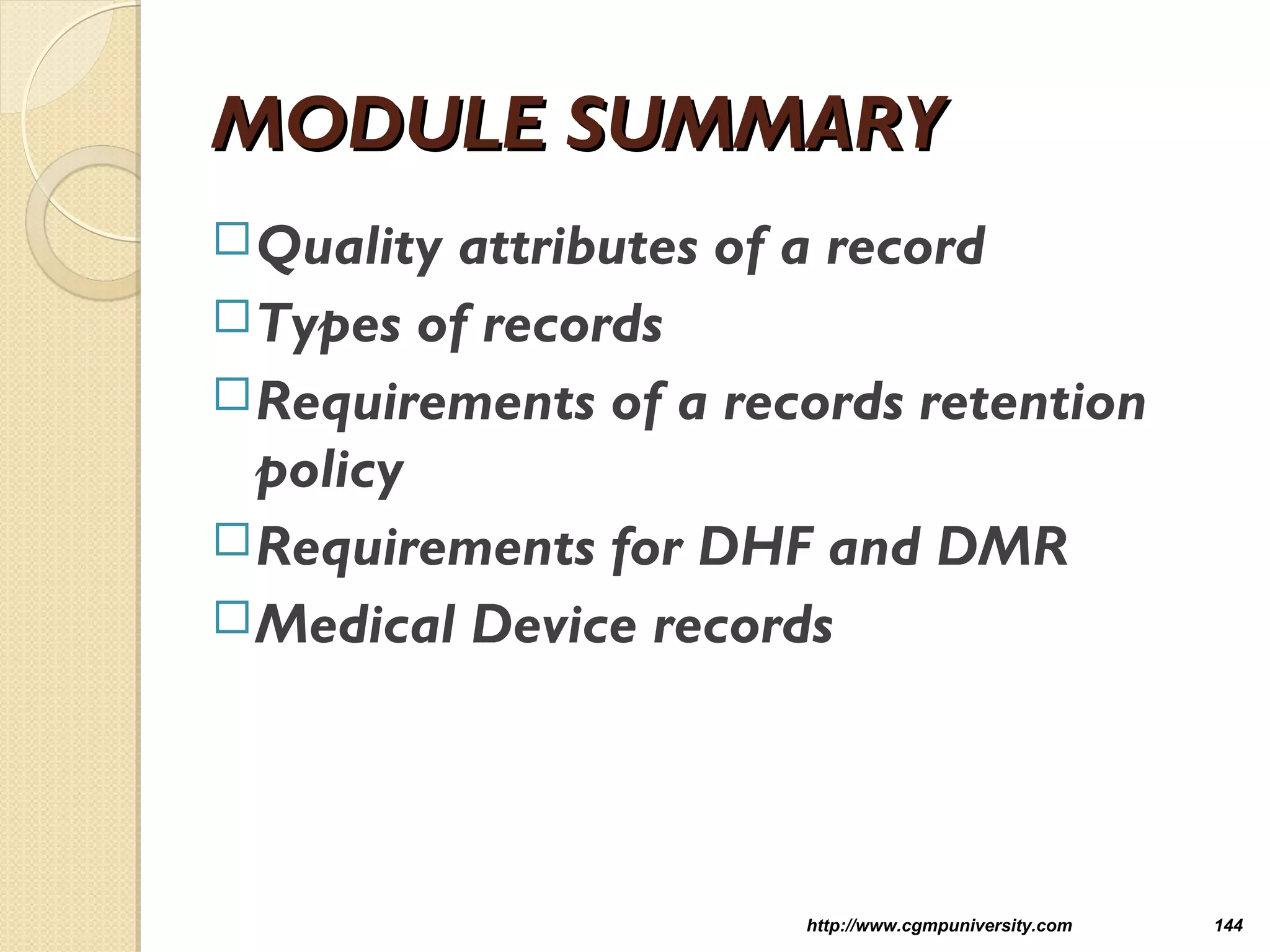
MODULE SUMMARYMODULE SUMMARY
Qualityattributes of a record
Types of records
Requirements of a records retention
policy
Requirements for DHF and DMR
Medical Device records
http://www.cgmpuniversity.com 144
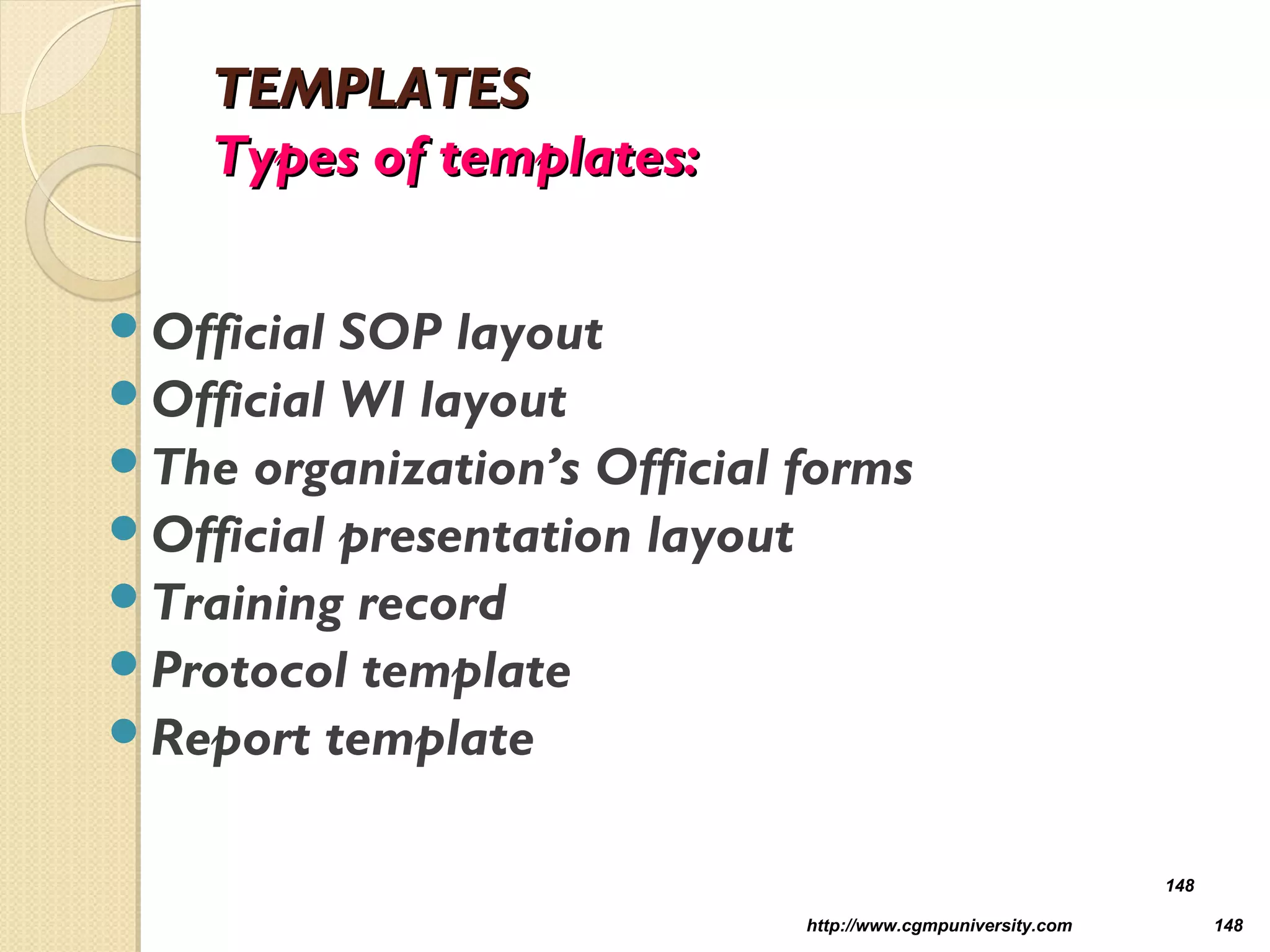
TEMPLATESTEMPLATES
Types of templates:Typesof templates:
Official SOP layout
Official WI layout
The organization’s Official forms
Official presentation layout
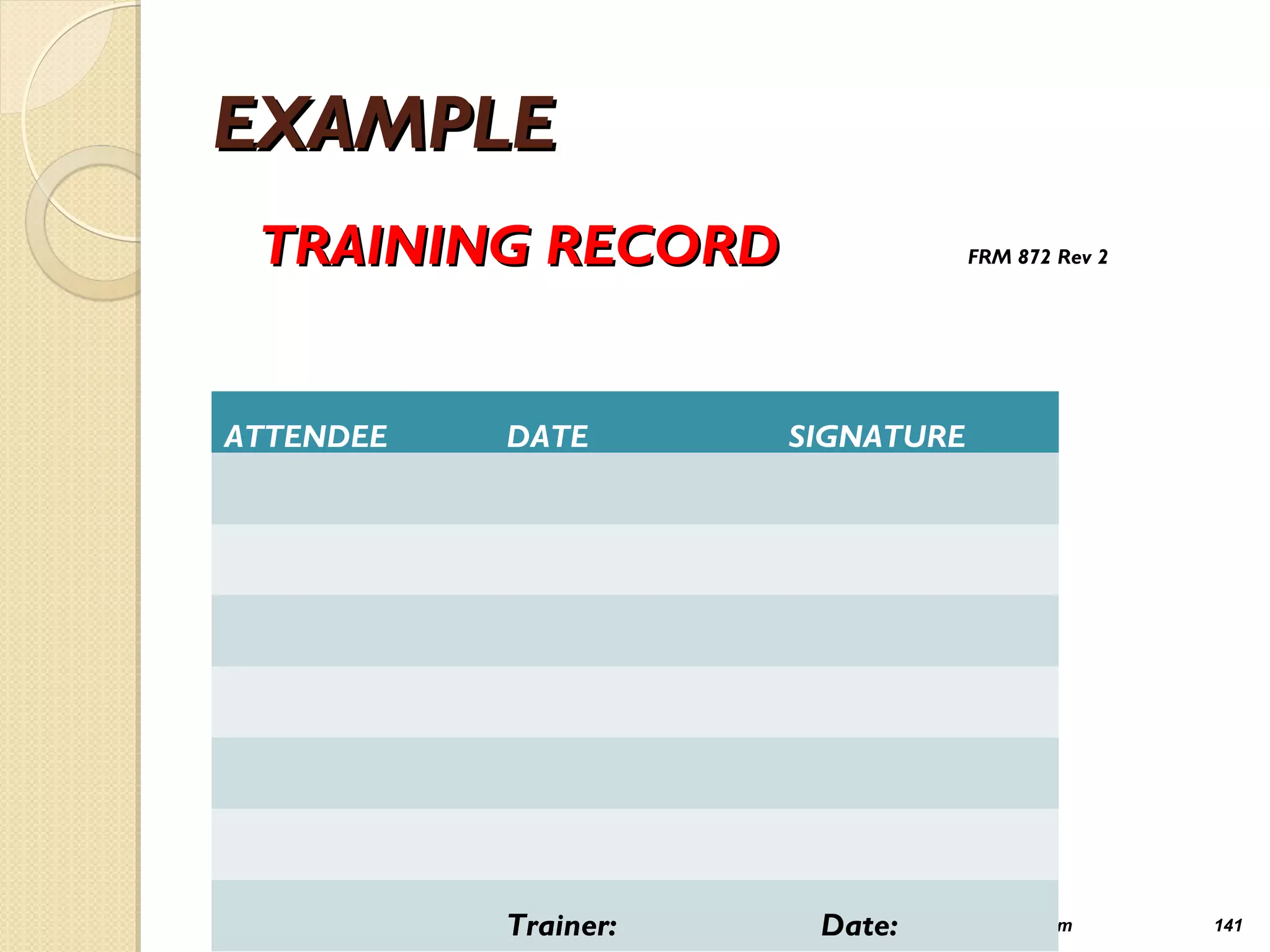
Training record
Protocol template
Report template
http://www.cgmpuniversity.com 148
148
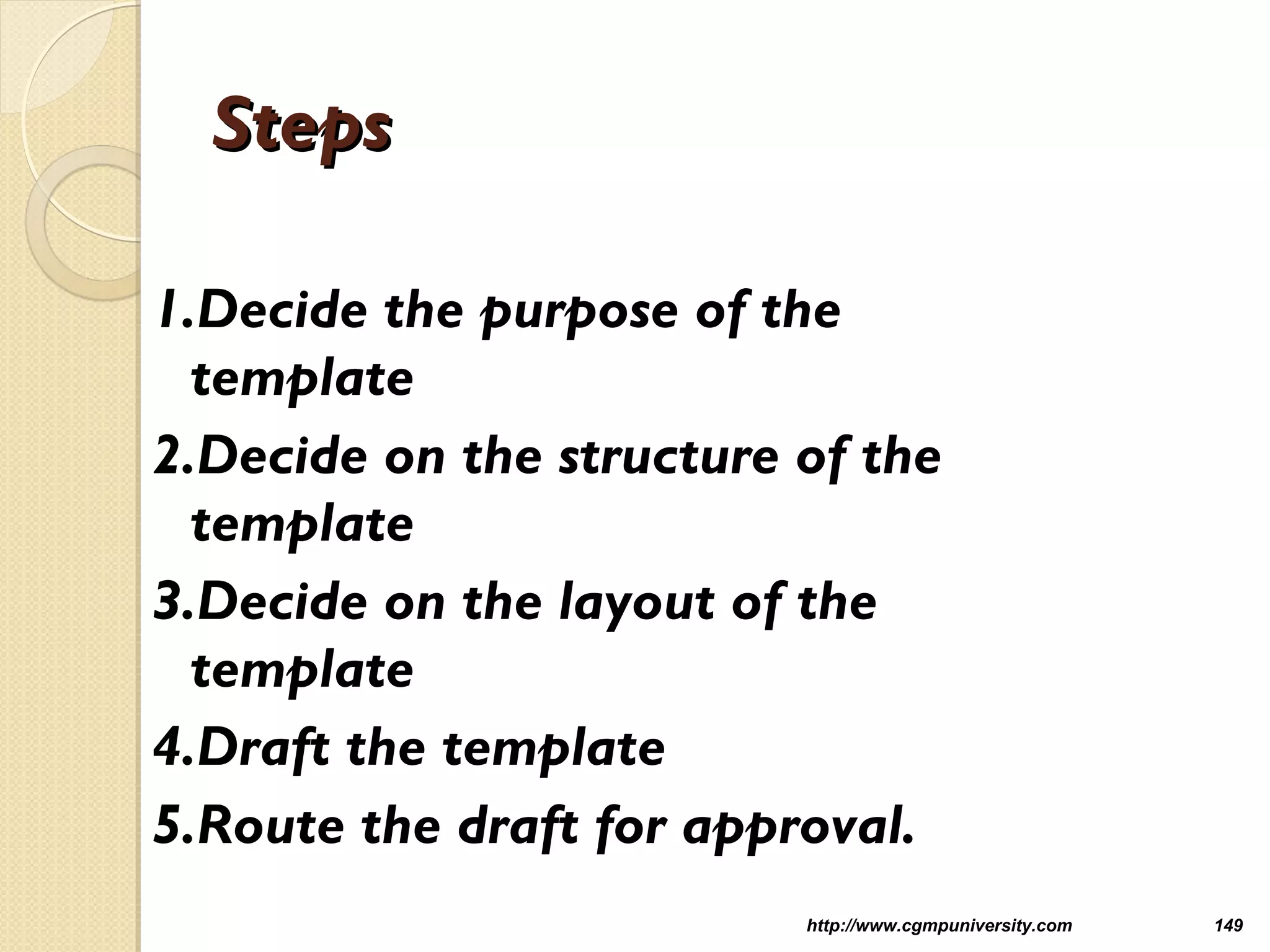
149.
StepsSteps
1.Decide the purposeof the
template
2.Decide on the structure of the
template
3.Decide on the layout of the
template
4.Draft the template
5.Route the draft for approval.
http://www.cgmpuniversity.com 149
150.
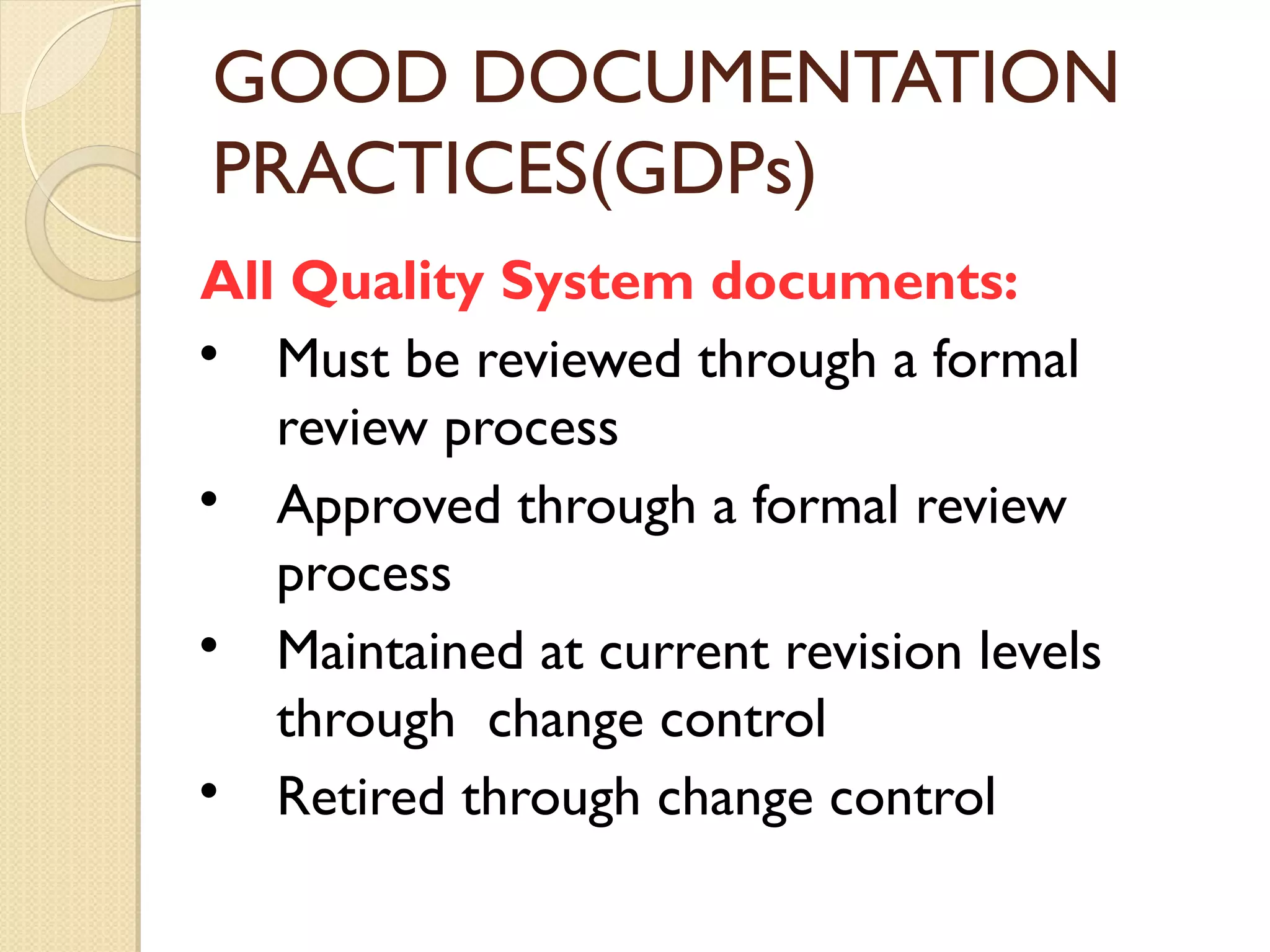
GOOD DOCUMENTATION
PRACTICES(GDPs)
All QualitySystem documents:
Must be reviewed through a formal
review process
Approved through a formal review
process
Maintained at current revision levels
through change control
Retired through change control
151.
ELECTRONIC RECORDS ANDELECTRONICRECORDS AND
SIGNATURESSIGNATURES
MODULE EIGHT: REQUIREMENTS FOR ELECTRONICMODULE EIGHT: REQUIREMENTS FOR ELECTRONIC
SYSTEMSSYSTEMS
PART 11PART 11
152.
PART 11 REQUIREMENTSPART11 REQUIREMENTS
Electronic systems(Open systems,and
closed systems) must meet two sets of
compliance requirements:
1.0 Electronic records
2.0 Electronic signatures
http://www.cgmpuniversity.com 152
153.
1.0 ELECTRONIC SIGNATURES1.0ELECTRONIC SIGNATURES
http://www.cgmpuniversity.com 153
Limiting system access to authorized individuals
1.By use of operational system checks
2.By the use of authority checks
3.By the use of device checks
Determination that persons who develop, maintain, or
use electronic systems have the
education, training, and experience to perform their
assigned tasks
4. Establishment of and adherence to written policies
that hold individuals accountable for actions initiated
under their electronic signatures
5. Established appropriate controls over systems
documentation
154.
2.0 ELECTRONIC RECORDS2.0ELECTRONIC RECORDS
These requirement must beThese requirement must be
met:met:
1.Audit trail1.Audit trail
2.System validation2.System validation
3.Revision control for3.Revision control for
softwaresoftware
http://www.cgmpuniversity.com 154
155.
QUALITY FEEDBACK LOOPS
Oncedesigned and implemented the Quality
management system is maintained through:
The internal Feed-backloop
External Feedback-loop
Internal feedback loop:
Quality information from within the
Quality system initiated by the
organization
156.
INTERNAL FEEDBACK LOOP
Informationmaintained by this loop includes:
Internal Quality Audits
In-process inspection
Management Review
Annual document reviews
Change requests: product,process and
document
157.
EXTERNAL FEED-BACK
LOOP
The externalfeedback loop is Quality
information from third party users of your
Quality system. This includes:
Customer complaints
Post market surveillance data
Customer returns
Regulatory Audits
Notified body/third party Audits
Customer returns
158.
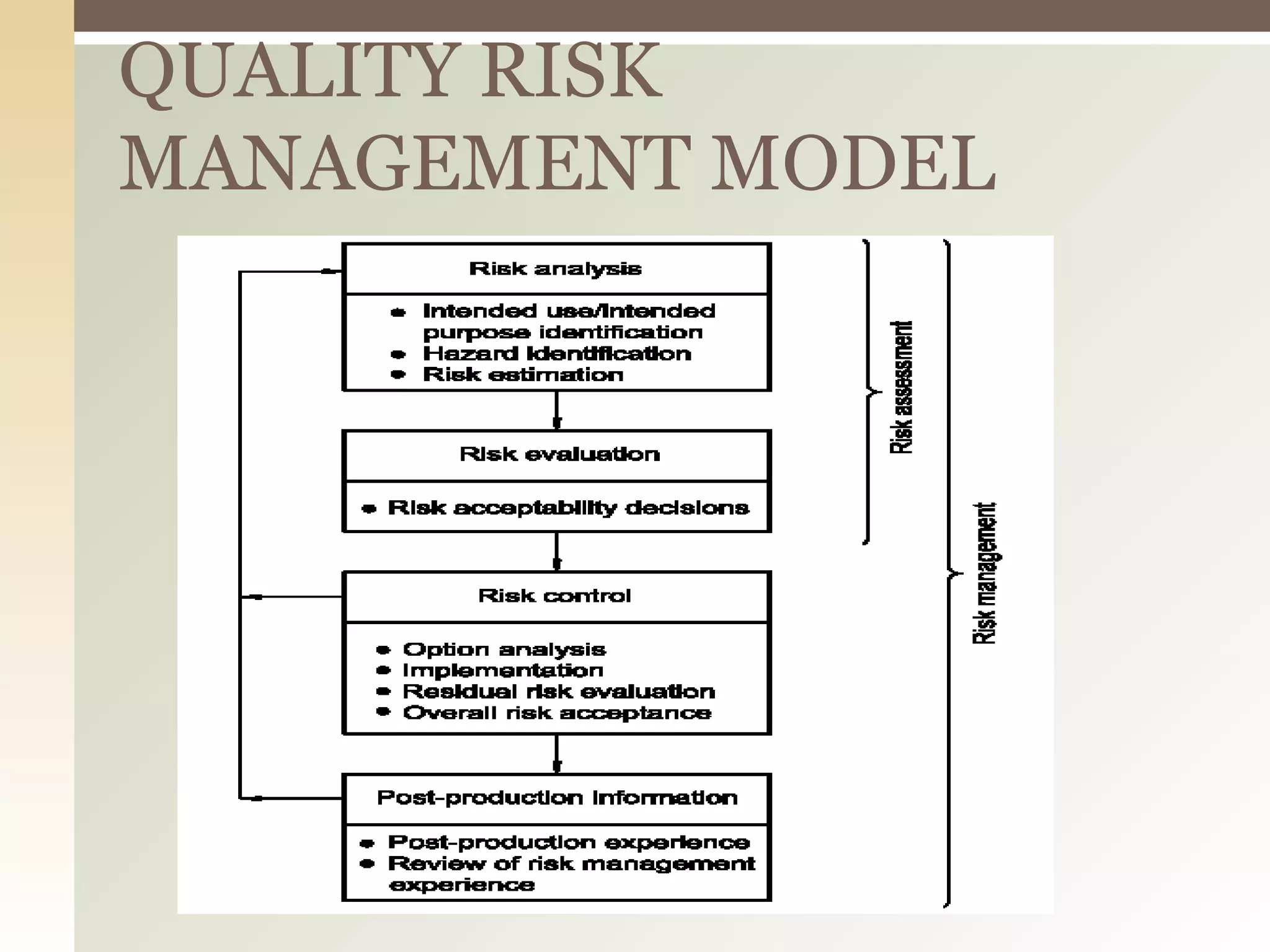
QUALITY RISK MANAGEMENT
Oncean adverse is established,or a non-
conformity is discovered the risk is assessed
The risk level dictates:
Whether a CAPA is to be opened or
not
The priority level of the
nonconformity,or adverse trend
Note:
Not every nonconformity is a candidate
for CAPA.
159.
QUALITY RISK MANAGEMENT
REQUIREMENTS
ENISO 14971 gives three options to manufacturers
for how to reduce and control risks for their
devices:
Design an inherently safe device: DFMEA
Use of protective measures in the device itself:
Hazard mitigation
In the manufacturing process: PFMEA
160.
QUALITY RISK MANAGEMENT
REQUIREMENTS
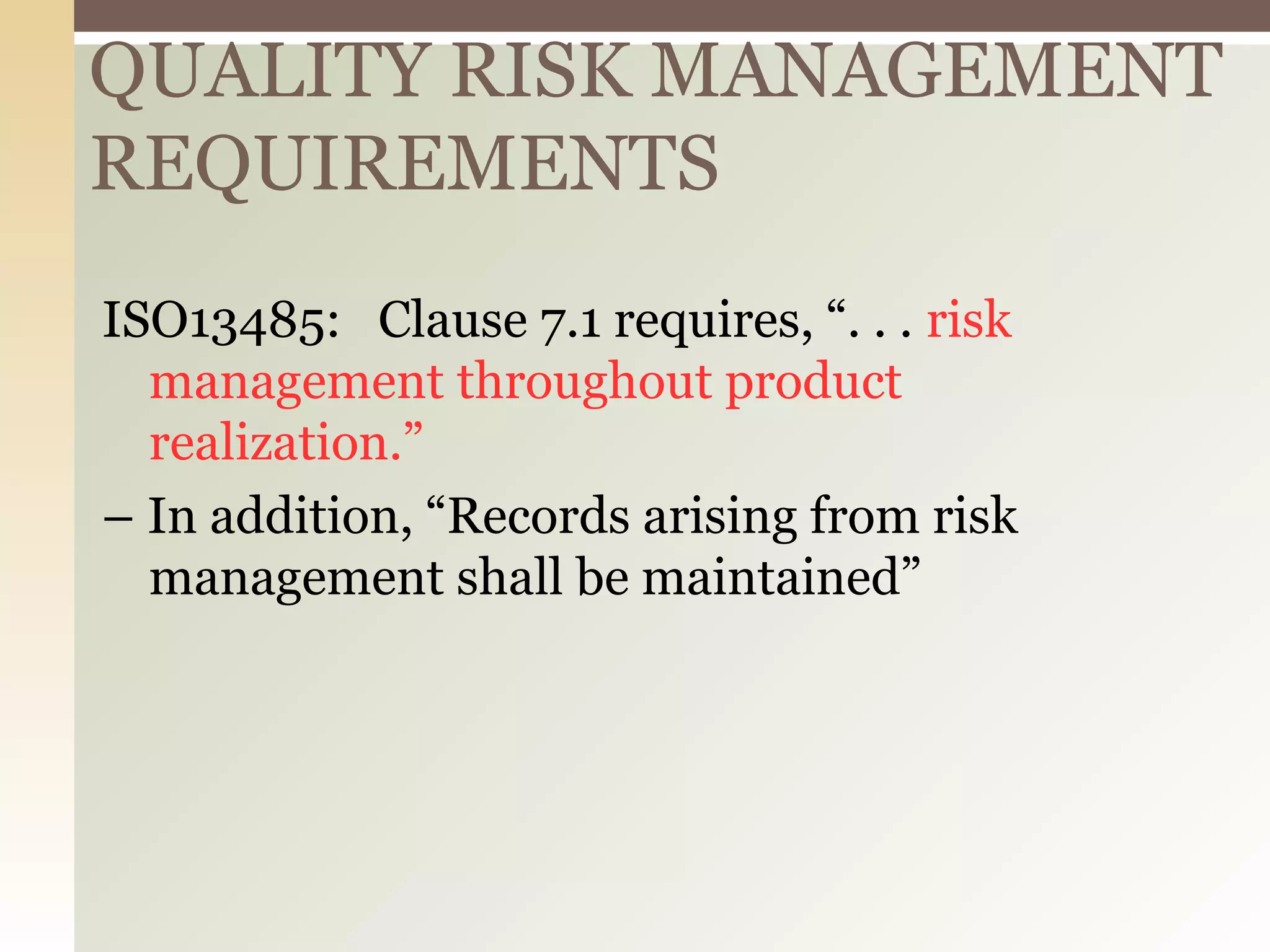
ISO13485:Clause 7.1 requires, “. . . risk
management throughout product
realization.”
– In addition, “Records arising from risk
management shall be maintained”
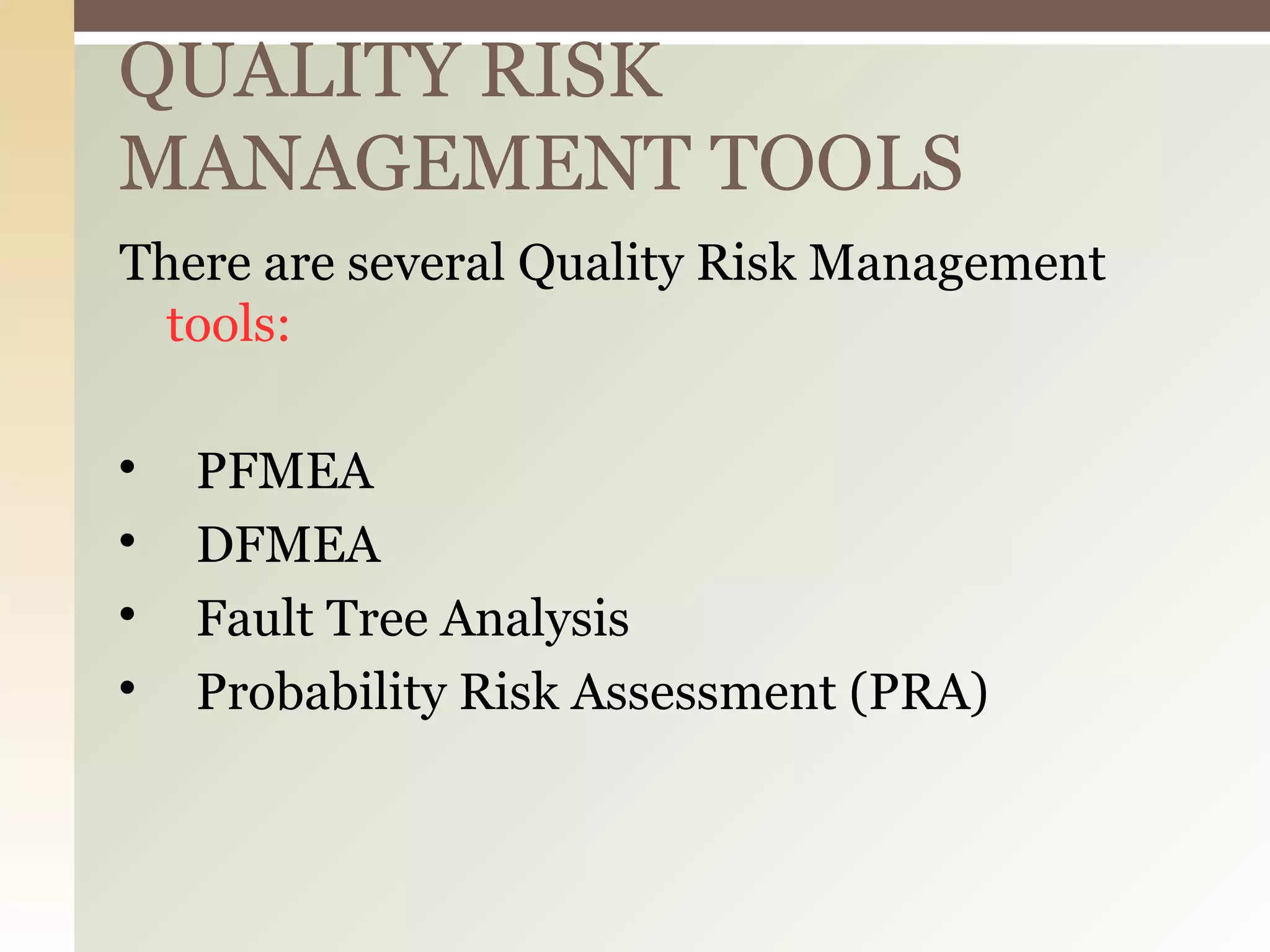
QUALITY RISK
MANAGEMENT TOOLS
Thereare several Quality Risk Management
tools:
PFMEA
DFMEA
Fault Tree Analysis
Probability Risk Assessment (PRA)
163.
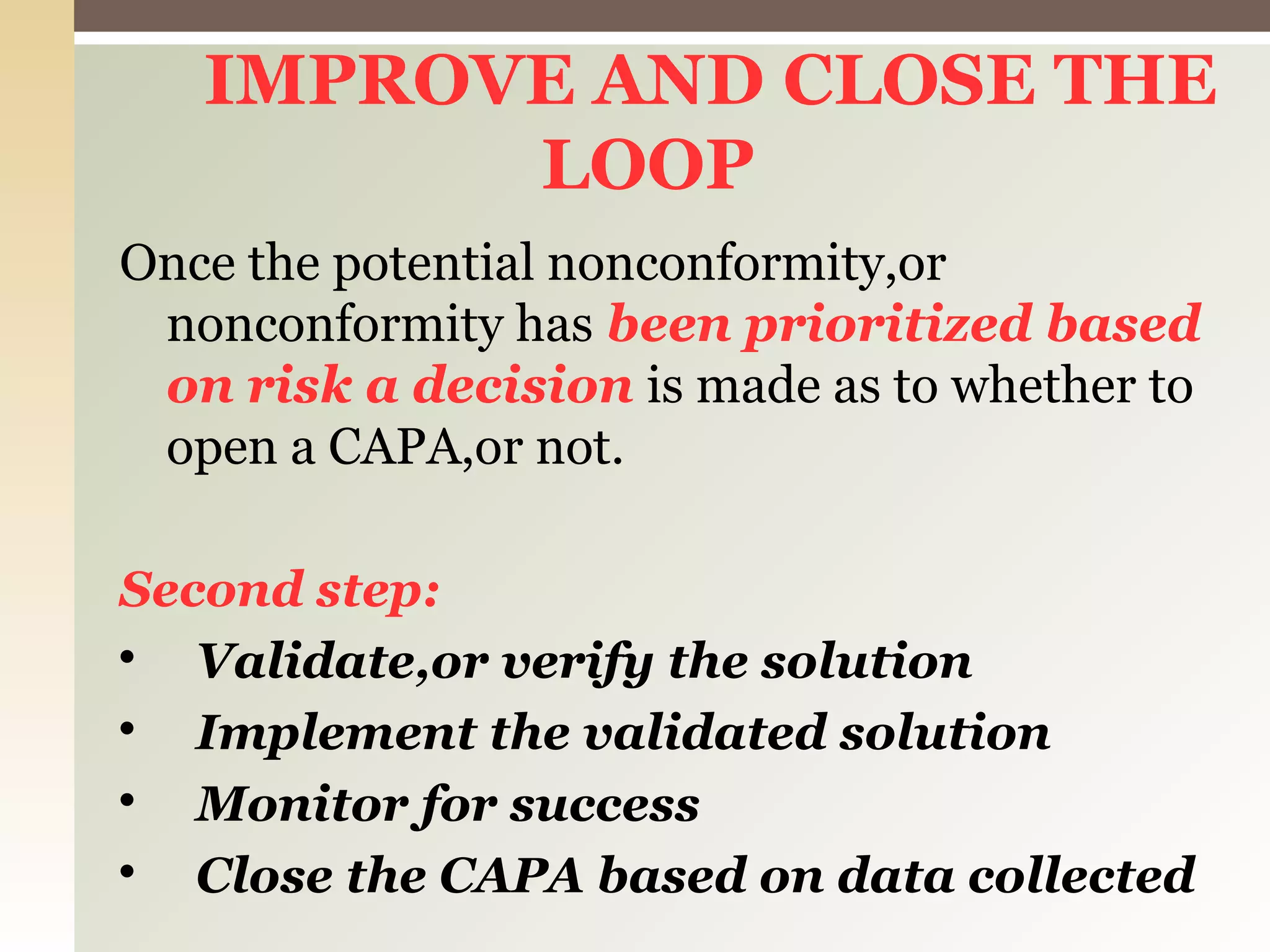
IMPROVE AND CLOSETHE
LOOP
Once the potential nonconformity,or
nonconformity has been prioritized based
on risk a decision is made as to whether to
open a CAPA,or not.
Second step:
Validate,or verify the solution
Implement the validated solution
Monitor for success
Close the CAPA based on data collected
164.
WHAT WE HAVELEARNED?WHAT WE HAVE LEARNED?
SEMINAR SUMMARYSEMINAR SUMMARY
Post your QuestionsPostyour Questions
LinkedIn: cgmpuniversity
Facebook: cgmpuniversity.com
E-mail: support @cgmpuniversity.com
E-mail the instructorE-mail the instructor:
david@cgmpuniversity.com
http://www.cgmpuniversity.com 176