IS0 9001 Requirements
ISO9001 Requirements has eight clauses of the
standard.
Scope
Normative References
Definitions
Quality Management Systems
Management Responsibility
Resource Management
Product and/or Service Realization
Measurement, Analysis, and Improvement
3.
IS0 9001 Requirements
Classification:
Thefirst three clauses are informational.
The last five clauses are mandatory requirements
for organizations to meet.
Process Approach Emphasis:
Understanding and Fulfilling the Requirements:
Ensuring the organization's processes align with
ISO 9001 standards.
1.
Value-Added Consideration: Evaluating
processes based on their contributions to value
creation.
2.
Process Performance and Effectiveness:
Measuring and achieving desired results.
3.
Continual Improvement: Enhancing processes
through objective measurements and ongoing
refinements.
4.
4.
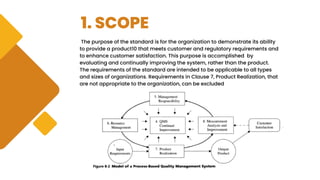
1. SCOPE
The purposeof the standard is for the organization to demonstrate its ability
to provide a product10 that meets customer and regulatory requirements and
to enhance customer satisfaction. This purpose is accomplished by
evaluating and continually improving the system, rather than the product.
The requirements of the standard are intended to be applicable to all types
and sizes of organizations. Requirements in Clause 7, Product Realization, that
are not appropriate to the organization, can be excluded
5.
2.Normative Reference
ISO 9000:2005Quality Management Systems—
Fundamentals and vocabulary are a normative
reference that provides applicable concepts and
definitions
3.Terms and Definitions
For the purposes of this standard, the terms and
definitions given in ISO 9000:2000 apply.
Throughout the text of this standard, the term
“Product” also means “Service.”
6.
4. Quality ManagementSystem (QMS)
4.1 GENERAL REQUIREMENTS
The organization shall establish, document, implement, and maintain a QMS
and continually improve its effectiveness. The organization shall (a) determine
the processes needed for QMS and their applications throughout the
organization, (b) determine their sequence and interaction, (c) determine
criteria and meth ods for effective operation and control of these processes,
(d) ensure the availability of resources and information necessary to support
and monitor these processes, (e) monitor, measure wherever applicable, and
analyze these processes, and (f) implement actions to achieve planned
results and continual improve ment of these processes. Outsourced processes
that affect the quality of the product shall be identified and included in the
system
7.
4. Quality ManagementSystem (QMS)
4.2 DOCUMENTATION
4.2.1 General Documentation shall include (a) statements of a quality policy
and quality objectives, (b) a quality manual, (c) required documented
procedures and records, (d) needed documents to ensure effective planning,
operation, and control of processes, and records. A procedure or work
instruction is needed if its absence could adversely affect the product quality.
The extent of the documentation will depend on the orga nization’s size and
type of activities; the complexity of the processes and their interactions; and
the compe tency of the employees. For example: a small organization may
verbally notify a manager of an upcoming meeting, whereas a large
organization would need written notification. The standard should satisfy the
contractual, statutory, and regulatory requirements and the needs and
expectations of customers and other interested parties. Documentation may
be in any form or type of medium
8.
4. Quality ManagementSystem (QMS)
4.2.2 Quality Manual A quality manual shall be established and maintained
that includes (a) the scope of the QMS with details and justification for any
exclusions, (b) the documented procedures or reference to them, and (c) a
description of the interaction among the QMS processes.
4.2.3 Control of Documents Documents required by the QMS shall be
controlled. Records are special type of documents. A documented procedure
shall be in place to define the controls needed to (a) approve docu ments
prior to use, (b) review, update, and re-approve as necessary, (c) identify the
current revision status, (d) ensure that current versions are available at the
point of use, (e) ensure that documents are legible and readily identified, (f)
identify and distribute documents of external origin, and (g) provide for the
prompt removal of obsolete documents and suitably identify any that may be
retained. Documented procedure means that the procedure is established,
documented, implemented, and maintained. They are required in elements
4.2.3, 4.2.4, 8.2.2, 8.3, 8.5.2, and 8.5.3
9.
4. Quality ManagementSystem (QMS)
4.2.4 Control of Records Records which are established to provide evidence of
conformity to requirements and the effective operation of QMS shall be
controlled. A documented procedure shall be established to define the
controls needed for the identification, storage, protection, retrieval, retention
and disposition of records. Records shall remain legible, readily identifiable
and retrievable. Records can be used to document traceability and to provide
evidence of verification, preventive action, and corrective action. They are
required in elements 5.5.6, 5.6.3, 6.2.2, 7.2.2, 7.3.4, 7.3.6, 7.3.7, 7.4.1, 7.5.2, 7.6, and
8.2.4
10.
5. Management Responsibility
5.1MANAGEMENT COMMITMENT Top management shall provide evidence of its
commitment to the development, implementation, and contin ual
improvement of the QMS by (a) communicating the need to meet customer,
legal, and regulatory require ments, (b) establishing a quality policy, (c)
ensuring that quality objectives are established, (d) conducting management
reviews, and (e) ensuring the availability of resources. Top management is
defined as the per son or group of people who directs and controls an
organization
5.2 CUSTOMER FOCUS Top management shall ensure that customer
requirements are determined and met with the aim of enhancing customer
satisfaction
11.
5. Management Responsibility
5.3QUALITY POLICY Top management shall insure that the quality policy (a) is
appropriate to the organization’s purpose or mis sion, (b) includes a
commitment to comply with requirements and continually improve the
effectiveness of the QMS, (c) provides a framework for establishing and
reviewing the quality objectives, (d) is communi cated and understood within
the organization, and (e) is reviewed for continuing stability. The quality policy
gives the overall intention and direction of the organization related to quality.
5.4 PLANNING
5.4.1 Quality Objectives Top management shall ensure that quality objectives
are established at relevant functions and levels within the organization and
include product requirements. They shall be measurable and consistent with
the quality policy. In addition, they should ensure that customer expectations
are met. Qual ity objectives are something sought or aimed for related to
quality. For example, finishing department scrap will be reduced from 5.0% to
4.3% and the first line supervisor is the person responsible.
12.
5. Management Responsibility
5.4.2Quality Management System Planning Top management shall ensure
that the planning of the QMS is accomplished in order to meet the
requirements of the QMS as stated in the General Requirements, Element 4.1, as
well as the Quality Objectives, 5.4.1. In addition, the integrity of the QMS is
maintained when changes are planned and implemented.
5.5 RESPONSIBILITY, AUTHORITY, AND COMMUNICATION
5.5.1 Responsibility and Authority Top management shall ensure that
responsibilities and authorities are defined and communicated within the
organization. Responsibilities can be defined in job descriptions, pro cedures,
and work instructions. Authorities and interrelationships can be defined in an
organization chart.
13.
5. Management Responsibility
5.5.2Management Representative Top management shall appoint a
member of organization’s management, regardless of his/her other duties,
that shall have the responsibility and authority that includes (a) ensuring that
processes needed for the QMS system are established, implemented, and
maintained, (b) reporting to top man agement on the performance of the QMS
and any need for improvement, and (c) ensuring the promotion of awareness
of customer requirements throughout the organization. Appointment of a
member of top manage ment as the representative can contribute to the
effectiveness of the QMS.
5.5.3 Internal Communication Top management shall ensure that appropriate
communication channels are established within the organization and that
communication takes place regarding the QMS. Typical communication
techniques are management workplace briefing, recognition of achievement,
bulletin boards, e-mail, and in-house news brochures
14.
5. Management Responsibility
5.6MANAGEMENT REVIEW
5.6.1 General Top management shall review the QMS at planned intervals to
ensure its continuing suit ability, adequacy, and effectiveness. This review shall
include assessing opportunities for improvement and the need for changes to
the QMS including the quality policy and quality objectives. Records from the
reviews shall be maintained.
5.6.2 Review Input The input to the review shall include information on (a)
results of audits, (b) customer feedback, (c) process performance and
product conformity, (d) status of corrective and preventative per formance,
(e) follow-up actions from previous management reviews, (f) changes that
could affect the QMS, and (g) recommendations for improvement.
5.6.3 Review Output The output from the review shall include any decisions
and actions related to (a) improvement of the effectiveness of the QMS and its
processes, (b) improvement of the product related to customer requirements,
and (c) resource needs. Top management can use the outputs as inputs to
improve ment opportunities
15.
6. Resource Management
6.1PROVISION OF RESOURCES The organization shall determine and provide the
resources needed (a) to implement and maintain the QMS and continually improve
its effectiveness, and (b) to enhance customer satisfaction by meeting customer
requirements. Resources may be people, infrastructure, work environment,
information, suppliers, natural resources, and financial resources. Resources can be
aligned with quality objectives. 6.2 HUMAN RESOURCES
6.2.1 General Personnel performing work that affects conformity to product
requirements shall be competent on the basis of appropriate education, training,
skills, and experience. Conformity to product requirements can be affected directly or
indirectly by personnel performing any task within the QMS. QUALITY MANAGEMENT
SYSTEMS ■ 175 6.2.2 Competence, Training, and Awareness The organization shall (a)
determine the necessary competence for personnel performing work affecting
conformity to product requirements, (b) where applicable, provide training or take
other actions to achieve the necessary competence, (c) evaluate the effectiveness of
the actions taken, (d) ensure that its personnel are aware of the relevance and
importance of their activities and how they contribute to the achievement of the
quality objectives, and (e) maintain appropriate records of education, train ing, skills,
and experience. Competency is defined as the demonstrated ability to apply
knowledge and skills. It can be contained in the job description by function, group, or
specific position. Training effectiveness can be determined by before and after tests,
performance, or turnover.11 ISO 10015 Guidelines for Training will help organizations
comply with this standard
16.
6. Resource Management
6.3INFRASTRUCTURE The organization shall determine, provide, and maintain
the infrastructure needed to achieve conformity to prod uct requirements.
Infrastructure includes, as applicable (a) buildings, workspace, and associated
utilities, (b) process equipment (both hardware and software), and (c)
supporting services (such as transport, communication or information
systems).
6.4 WORK ENVIRONMENT The organization shall determine and manage the
work environment needed to achieve conformity to prod uct requirements.
Creation of a suitable work environment can have a positive influence on
employee moti vation, satisfaction, and performance. The term “work
environment” relates to those conditions under which work is performed
including phys ical, environmental and other factors (such as noise,
temperature, humidity, lighting and weather).
17.
7. Product Realization
7.1PLANNING OF PRODUCT REALIZATION The organization shall plan and
develop the processes needed for product realization. Planning of product
realization shall be consistent with the requirements of the other processes of
QMS. In planning product realization, the organization shall determine the
following, as appropriate: (a) quality objectives and requirements for the
product; (b) the need to establish processes and documents, and to provide
resources specific to the product; (c) required verification, validation,
monitoring, measurement inspection, and test activities specific to the product
and the criteria for product acceptance; and (d) records needed to provide
evidence that the realization processes and resulting product or service meet
requirements. The output of this planning shall be in a form suitable for the
organization’s method of operations. A document specify ing the processes of
the QMS (including the product realization processes) and the resources to be
applied to a specific product, project or contract, can be referred to as a
quality plan. The organization may also apply the requirements given in 7.3 to
the development of the product realization processes.
18.
7. Product Realization
7.2CUSTOMER-RELATED PROCESSES
7.2.1 Determination of Requirements Related to the Product The organization
shall determine (a) require ments specified by the customer, including the
requirements for delivery and post-delivery activities, (b) require ments not
stated by the customer but necessary for specified or intended use, where
known, (c) statutory and regulatory requirements applicable to the product,
and (d) any additional requirements considered necessary by the
organization.
19.
7. Product Realization
7.2.2Review of Requirements Related to the Product The organization shall review
the requirements related to the product. This review shall be conducted prior to the
organization’s commitment to supply a product to the customer (for example,
submission of tenders, acceptance of contracts or orders, acceptance of changes to
contracts or orders) and shall ensure that (a) product requirements are defined, (b)
contract or order requirements differing from those previously expressed are resolved,
and (c) the organization has the ability to meet the defined requirements. Records of
the results of the review and actions arising from the review shall be maintained.
Where the customer provides no documented statement of requirement, the
customer requirements shall be confirmed by the organization before acceptance.
Where product requirements are changed, the organization shall ensure that relevant
documents are amended and that relevant personnel are made aware of the
changed requirements. In some situations, such as Internet sales, a formal review is
imprac tical for each order. Instead, the review can cover relevant product information
such as catalogs or advertis ing material.
7.2.3 Customer Communication The organization shall determine and implement
effective arrangements for communicating with customers in relation to (a) product
information, (b) inquiries, contracts, or order han dling, including amendments, and
(c) customer feedback, including customer complaints.
20.
7. Product Realization
7.3DESIGN AND DEVELOPMENT
7.3.1 Design and Development Planning The organization shall plan and control the
design and develop ment of the product. During the design and development
planning, the organization shall determine (a) the design and development stages,
(b) the review, verification and validation that are appropriate to each design and
development stage, and (c) the responsibilities and authorities for design and
development. The organi zation shall manage the interfaces between different groups
involved in design and development to ensure effective communication and clear
assignment of responsibility. Planning output shall be updated, as appro priate, as the
design and development progresses. Design, development, review, verification and
validation have district purposes. They can be conducted and recorded separately or
in any combination as suitable for the product and the organization.
7.3.2 Design and Development Inputs Inputs relating to product requirements shall be
determined and records maintained. These shall include (a) functional and
performance requirements, (b) applicable statutory and regulatory requirements, (c)
where applicable, information derived from previous similar designs, and (d) other
requirements essential for design and development. The inputs shall be reviewed for
adequacy. Requirements shall be complete, unambiguous and not in conflict with
each other
21.
7. Product Realization
7.3.3Design and Development Outputs The outputs of design and development shall
be in a form suitable for verification against the design and development input and
shall be approved prior to release. Design and development outputs shall (a) meet the
input requirements for design and development, (b) pro vide appropriate information
for purchasing, production, and service provision, (c) contain or reference prod uct
acceptance criteria, and (d) specify the characteristics of the product that are
essential for its safe and proper use.
7.3.4 Design and Development Review At suitable stages, systematic reviews of
design and development shall be performed in accordance with planned
arrangements (a) to evaluate the ability of the results of design and development to
meet requirements, and (b) to identify any problems and propose necessary actions.
Par ticipants in such reviews shall include representatives of functions concerned with
the design and development stage(s) being reviewed. Records of the results of the
reviews and any necessary actions shall be maintained. Risk assessment such as
FMEA, reliability prediction, and simulation techniques can be undertaken to deter
mine potential failures in products or processes.
22.
7. Product Realization
7.3.5Design and Development Verification Verification shall be performed in
accordance with planned arrangements to ensure that the design and development
outputs have met the design and development input requirements. Records of the
results of the verification and any necessary actions shall be maintained. Veri fication
confirms, through objective evidence, that the specified requirements have been
fulfilled. Confirmation can comprise activities such as performing alternate
calculations, comparing the new design specification to a similar proven design
specification, undertaking tests and demonstrations, and reviewing documents prior
to issue.
7.3.6 Design and Development Validation Design and development validation shall
be performed in accordance with planned arrangements to ensure that the resulting
product is capable of meeting the requirements for the specified application or
intended use, when known. Wherever practicable, validation shall be com pleted prior
to the delivery or implementation of the product. Records of the results of validation
and any nec essary actions shall be maintained. Validation confirms, through
objective evidence, that the requirements for a specific intended use have been
fulfilled.
23.
7. Product Realization
7.3.7Control of Design and Development Changes Design and development changes
shall be identified and records maintained. The changes shall be reviewed, verified
and validated, as appropriate, and approved before implementation. The review of
design and development changes shall include evaluation of the effect of the
changes on constituent parts and product already delivered. Records of the results of
the review of changes and any necessary actions shall be maintained
24.
7. Product Realization
7.4PURCHASING
7.4.1 Purchasing Process The organization shall ensure that purchased
product conforms to specified purchase requirements. The type and extent of
control applied to the supplier and the purchased product shall be dependent
upon the effect of the purchased product on subsequent product realization or
the final prod uct. The organization shall evaluate and select suppliers based
on their ability to supply product in accor dance with the organization’s
requirements. Criteria for selection, evaluation, and re-evaluation shall be
established. Records of the results of evaluations and any necessary actions
arising from the evaluation shall be maintained. This standard does not apply
to items such as office and maintenance supplies, unless they are a product
25.
7. Product Realization
7.4.2Purchasing Information Purchasing information shall describe the
product to be purchased, includ ing where appropriate (a) requirements for
approval of product, procedures, processes, and equipment, (b) requirements
for qualification of personnel, and (c) QMS requirements. The organization
shall ensure the adequacy of specified requirements prior to their
communication to the supplier.
7.4.3 Verification of Purchased Product The organization shall establish and
implement the inspection or other activities necessary for ensuring that
purchased product meets specified purchase requirements. Where the
organization or its customer intends to perform verification at the supplier’s
premises, the organization shall state the intended verification arrangements
and method of product release in the purchasing information.
26.
7. Product Realization
7.5PRODUCTION AND SERVICE PROVISION
7.5.1 Control of Production and Service Provision The organization shall plan
and carry out production and service provision under controlled conditions.
Controlled conditions shall include, as applicable (a) the availabil ity of
information that describes the characteristics of the product, (b) the
availability of work instructions, as nec essary, (c) the use of suitable
equipment, (d) the availability and use of monitoring and measuring
equipment (e) the implementation of monitoring and measurement, and (f)
the implementation of product release, delivery, and post-delivery activities.
27.
7. Product Realization
7.5.2Validation of Processes for Production and Service Provision The
organization shall validate any processes for production and service provision
where the resulting output cannot be verified by subsequent monitoring or
measurement, and as a consequence, deficiencies become apparent only
after the product is in use or the service has been delivered. Validation shall
demonstrate the ability of these processes to achieve planned results. The
organization shall establish arrangements for these processes including, as
applicable (a) defined criteria for review and approval of the processes, (b)
approval of equipment and qualification of personnel, (c) use of specific
methods and procedures, (d) requirements for records, and (e) revalidation.
28.
7. Product Realization
7.5.3Identification and Traceability Where appropriate, the organization shall
identify the product by suit able means throughout product realization. The
organization shall identify the product status with respect to monitoring and
measurement requirements throughout product realization. Where traceability is
a require ment, the organization shall control and record the unique identification
of the product and maintain records. In some industry sectors, configuration
management is a means by which identification and traceability are maintained.
Identification can frequently be accomplished with a production router or
traveller.
7.5.4 Customer Property The organization shall exercise care with customer
property while it is under the organization’s control or being used by the
organization. The organization shall identify, verify, protect and safeguard
customer property provided for use or incorporation into the product. If any
customer property is lost, damaged, or otherwise found to be unsuitable for use,
the organization shall report this to the customer and main tain records.
Customer property can include intellectual property and personal data.
29.
7. Product Realization
7.5.5Preservation of Product The organization shall preserve the
product during internal processing and delivery to the intended
destination in order to maintain conformity to the requirements. This
preservation shall include identification, handling, packaging, storage,
and protection. Preservation shall also apply to the con stituent parts of
a product
30.
7. Product Realization
7.6CONTROL OF MONITORING AND MEASURING EQUIPMENT The organization shall
determine the monitoring and measurement to be undertaken and the monitoring
and measuring equipment needed to provide evidence of conformity of product to
determined requirements. The organization shall establish processes to ensure that
monitoring and measurement can be carried out and are carried out in a manner
that is consistent with the monitoring and measurement requirements. Where
neces sary to ensure valid results, measuring equipment shall (a) be calibrated or
verified or both at specified inter vals or prior to use, against measurement
standards; where no such standards exist, the basis used for calibration or
verification shall be recorded, (b) be adjusted or re-adjusted as necessary, (c)
have identifica tion in order to determine its calibration status (d) be safeguarded
from adjustments that would invalidate the measurement result, and (e) be
protected from damage and deterioration during handling, maintenance and
storage.
31.
7. Product Realization
7.6CONTROL OF MONITORING AND MEASURING EQUIPMENT
In addition, the organization shall assess and record the validity of the previous
measuring results when the equipment is found not to conform to requirements.
The organization shall take appropriate action on the equipment and any product
affected. Records of the results of calibration and verification shall be maintained.
When used in the monitoring and measurement of specified requirements, the
ability of computer software to satisfy the intended application shall be confirmed.
This shall be undertaken prior to initial use and reconfirmed as necessary.
Confirmation of the ability of computer software to satisfy the intended application
would typically include its verification and configuration management to maintain
its suitability for use.
32.
8. Measurement, Analysis,and Improvement
8.1 GENERAL The organization shall plan and implement the monitoring,
measurement, analysis, and improvement processes needed (a) to demonstrate
conformity to product requirements (b) to ensure conformity of the QMS, and (c) to
continually improve the effectiveness of the QMS. This shall include determination of
applicable methods, including statistical techniques, and the extent of their use.
8.2 MONITORING AND MEASUREMENT
8.2.1 Customer Satisfaction As one of the measurements of the performance of the
QMS, the organization shall monitor information relating to customer perception as
to whether the organization has met customer requirements. The methods for
obtaining and using this information shall be determined. Monitoring customer
perception can include inputs from sources such as customer satisfication surveys,
customer data on delivered product quality, user opinion surveys, lost business
analysis, compliments, war ranty claims and dealer reports
33.
8. Measurement, Analysis,and Improvement
8.2.2 Internal Audit The organization shall conduct internal audits at planned
intervals to determine whether the QMS (a) conforms to the planned arrangements
(see 7.1), to the requirements of this standard, and to the requirements established
by the organization, and (b) is effectively implemented and maintained. An audit
program shall be planned, taking into consideration the status and importance of
the processes and areas to be audited, as well as the results of previous audits. The
audit criteria, scope, frequency, and methods shall be defined. The selection of
auditors and conduct of audits shall ensure objectivity and impartiality of the audit
process. Auditors shall not audit their own work. The responsibilities and require
ments for planning and conducting audits and for reporting results and
maintaining records shall be defined in a documented procedure. The
management responsible for the area being audited shall ensure that any
necessary corrections and corrective actions are taken without undue delay to
eliminate detected noncon formities and their causes. Follow-up activities shall
include the verification of the actions taken and the reporting of verification results.
ISO 19011 Guidelines on quality and/or environmental management audit ing can be
used for guidance
34.
8. Measurement, Analysis,and Improvement
8.2.3 Monitoring and Measurement of Processes The organization shall apply
suitable methods for moni toring and, where applicable, measurement of the QMS
processes. These methods shall demonstrate the abil ity of the processes to
achieve planned results. When planned results are not achieved, correction and
corrective action shall be taken, as appropriate.
When determining suitable methods, it is adviseable that the organization
considers the type and extent of monitoring or takes measures appropriate to each
of its processes in relation to their impact on the conform ity to product
requirements and on the effectiveness of the quality management system.
35.
8. Measurement, Analysis,and Improvement
8.2.4 Monitoring and Measurement of Product and Service The organization shall
monitor and measure the characteristics of the product to verify that product
requirements have been met. This shall be carried out at appropriate stages of the
product realization process in accordance with the planned arrangements.
Evidence of conformity with the acceptance criteria shall be maintained. Records
shall indicate the person(s) authorizing release of product for delivery to the
customer. The release of product and delivery of service to the customer shall not
proceed until the planned arrangements have been satisfactorily completed,
unless otherwise approved by a relevant authority and, where applicable, by the
customer.
36.
8. Measurement, Analysis,and Improvement
8.3 CONTROL OF NONCONFORMING PRODUCT The organization shall ensure that
product which does not conform to product requirements is identified and
controlled to prevent its unintended use or delivery. A document procedure shall be
established to define the controls and related responsibilities and authorities for
dealing with nonconforming product. Wherever appli cable, the organization shall
deal with nonconforming product in one or more of the following ways: (a) by
taking action to eliminate the detected nonconformity; (b) by authorizing its use,
release or acceptance under concession by a relevant authority and, where
applicable, by the customer; and (c) by taking action to preclude its original
intended use or application, (d) by taking action appropriate to the effects of the
non-conformity, when non-conforming product is detected after delivery or use
has started. Records of the nature of noncon formities and any subsequent actions
taken, including concessions obtained, shall be maintained. When non conforming
product is corrected, it shall be subject to re-verification to demonstrate conformity
to the requirements.
37.
8. Measurement, Analysis,and Improvement
8.4 ANALYSIS OF DATA The organization shall determine, collect, and analyze
appropriate data to demonstrate the suitability and effectiveness of the QMS and
to evaluate where continual improvement of the effectiveness of the QMS can be
made. This shall include data generated as a result of monitoring and
measurement and from other rele vant sources. The analysis of data shall provide
information relating to (a) customer satisfaction, (b) con formity to product
requirements, (c) characteristics and trends of processes and products, including
opportunities for preventive action, and (d) suppliers.
38.
8. Measurement, Analysis,and Improvement
8.5 IMPROVEMENT
8.5.1 Continual Improvement The organization shall continually improve the
effectiveness of the QMS through the use of the quality policy, quality objectives,
audit results, analysis of data, corrective and pre ventive actions, and management
review.
8.5.2 Corrective Action The organization shall take action to eliminate the causes of
nonconformities in order to prevent recurrence. Corrective actions shall be
appropriate to the effects of the nonconformities encountered. Adocumented
procedure shall be established to define requirements for (a) reviewing
nonconformities (includ ing customer complaints), (b) determining the causes of
nonconformities, (c) evaluating the need for action to ensure that nonconformities
do not recur, (d) determining and implementing action needed, (e) records of the
results of action taken, and (f) reviewing the effectiveness of the corrective action
taken
39.
8. Measurement, Analysis,and Improvement
8.5.3 Preventive Action The organization shall determine action to eliminate the
causes of potential non conformities in order to prevent their occurrence.
Preventive actions shall be appropriate to the effects of the potential problems. A
documented procedure shall be established to define requirements for (a)
determining potential nonconformities and their causes, (b) evaluating the need for
action to prevent occurrence of non conformities, (c) determining and
implementing action needed, (d) records of results of action taken, and (e)
reviewing the effectiveness of the preventive action taken. Preventive action is
taken to prevent occur rence while corrective action is taken to prevent
reoccurrence. Eight total quality management principles form the basis for the QMS
standards. They are customer focus, leadership, employee involvement, process
approach, system approach to management, continual improve ment, factual
approach to decision making, and mutually-beneficial supplier relationships. These
principles are similar to the core values of the Malcolm Baldrige National Quality
Award.
Implementation
There are anumber of steps that are necessary to
implement a quality management system
1. Top Management Commitment
2. Appoint the Management Representative
3. Awareness
4. Appoint an Implementation Team
5. Training
6. Time Schedule
7. Select Element Owners
8. Review the Present System
9. Write the Documents
10. Install the New System
11. Internal Audit
12. Management Review
13. Preassessment
14. Registration
42.
1. Top ManagementCommitment
The most important step in implementing a quality system that
will meet or exceed an ISO 9000 standard is to acquire the full
support of upper management. The chief executive officer (CEO)
must be willing to com mit the resources necessary to achieve
certification. This is critical to the success of the project. Without
the CEO’s support, the process may continuously run into
unnecessary roadblocks or even be doomed to failure. Because
top management is assigned specific responsibilities in the
standard, it is necessary that they be involved in its
implementation.
43.
2. Appoint theManagement Representative
Once the commitment has been made, the process can
proceed by adopting a project team approach and treating it
the same as any other business undertaking. The next step is the
appointment of a management representative. This person is
responsible for coordinating the implementation and
maintenance of the qual ity system and is the contact person for
all parties involved in the process, both internal and external. The
representative can be a member of the top management group
who is able to ensure that the quality system is effectively
implemented, documented, and maintained. The
implementation of the quality system should involve everyone in
the organization.
44.
3. Awareness
This steprequires an awareness program. Because the process
is going to affect every member of the organ ization as well as
require their input, it stands to reason that everyone should
understand the quality system. They should know how it will
affect day-to-day operations and the potential benefits. This
information can be relayed through short, one-hour awareness
training sessions. Be sure everyone knows the intent of the
standard. Habibganj station at Bhopal was the first railway
station in India to be certified as ISO 9001:2005. It didn’t happen
until they realized that the new system would allow them to
make difference in their day to-day activities.
45.
4. Appoint anImplementation Team
After everyone has been informed of the organization’s
intentions to develop the quality system, an imple mentation
team should be assembled. This team should be drawn from all
levels and areas of the organiza tion so that it is representative.
Committees for each of the five clauses may be used. The team
should identify the QMS processes and their sequence and
interaction. It is important to keep the project visible for all
employees.
46.
5. Training
The implementationteam, supervisors, and internal audit team
should be trained. This activity can be accom plished by sending
team leaders for training and having them train the other team
members or by bringing the training in-house for all team
members through a one- or two-day seminar
47.
6. Time Schedule
Thisactivity develops a time schedule for the implementation
and registration of the system. This time frame will vary,
depending on the size and type of organization and the extent of
its existing quality system. Most organizations can complete the
entire process in less than 1.5 years. Divide the implementation
process into manageable units. Be sure to provide for the
celebration of small victories
48.
7. Select ElementOwners
The implementation team selects owners for each of the system
elements. Many of these owners will be mem bers of the
implementation team. Owners may be assigned more than one
element. Each owner has the option of selecting a team to assist
in the process. The more people involved, the more effective the
system.
49.
8. Review thePresent System
Perform a review of the present quality system. Copies of all the
quality manuals, procedures, work instructions, and forms
presently in use are obtained. These documents are sorted into
the system elements to deter mine what is available and what is
needed to complete the system. This activity is a gap analysis
and can be performed by the element owners and their teams or
by an external consultant
50.
9. Write theDocuments
Prepare written quality policy and procedure manuals—they can
be combined into one document. Write appro priate work
instructions to maintain the quality of specific functions. This
process should involve every employee, because the best person
to write a work instruction is the one who performs the job on a
regular basis. Stream International of Crawfordsville, IN
encouraged employees to expose the flaws in existing processes
and docu ment new processes that would work correctly.
However, it is important to be prudent when creating documen
tation. Too much documentation or complicated documentation
will destroy the system
51.
10. Install theNew System
Integrate the policies, procedures, and work instructions into the
day-to-day workings of the organization, and document what is
being done. It is not necessary for all elements to be
implemented at the same time. Be sure all people are trained
52.
11. Internal Audit
Conductan internal audit of the quality system. This step is
necessary to ensure that the system is working effec tively and to
provide management with information for the comprehensive
management review. Minor correc tions to the system are made
as they occur. A cross-section of trained people should be used
for the audit team.
53.
12. Management Review
Conducta management review. The management review is
used to determine the effectiveness of the system in achieving
the stated quality goals. The system is revised as needed.
13. Preassessment
This step is optional. If a good job has been done on the previous
steps, preassessment is not necessary
54.
14. Registration
This stephas three parts: choosing a registrar, submitting an
application, and conducting the registrar’s system audit.
Considerations in choosing a registrar include cost, lead time,
your customer’s acceptance of the registrar, the registrar’s
accreditation, and familiarity with your industry.The application
for registration should also include supplying the registrar with
the policy and procedure manuals for their review. The time
involved in the regis trar’s system audit will vary depending on
the size and complexity of the organization and the number of
auditors involved. Aregistrar’s audit usually lasts one to three
days and will consist of an opening meeting to describe the
process the auditors will follow, the audit itself, and a closing
meeting to discuss the findings of the audit.
55.
14. Registration
Some ofthese steps, such as documentation, internal auditing,
and registration are described in greater detail in the sections
that follow. Some pitfalls to successful implementation are:
Using a generic documentation program or another
organization’s documentation program.
Overdocumentation or documentation that is too complex.
Using external consultants without internal ownership and
involvement.
Limiting documentation to text rather than other types of
media.
Neglecting to obtain top management’s involvement.
Developing a system that does not represent what actually
occurs