“The Facility’s Perspective”
(FDA) Inspections
The Speaker

Patrick R. Ayd RN, MBA

2
The Facility‘s Perspective

How to prepare
for an FDA Inspection
Understanding the Goal of the Auditor

3
Why Does the FDA Conduct Inspections?

•
•

Assess adherence to federal laws and regulations

•
•

Confirm validity of data supporting INDs and NDAs

Determine that the safety, rights and welfare of
subjects were protected through consent and IRB/EC
procedures

Determine whether the trial was well controlled and
conducted according to the trial protocol/SOPs/
contracts/regulatory guidelines/CFRs

4
Major Federal Regulations Governing Clinical Research

Title 21, Code of Federal Regulations
Electronic Records; Electronic Signatures:

Part 11

Protection of Human Subjects:

Part 50

Financial Disclosure by Clinical Investigators:

Part 54

Institutional Review Boards:

Part 56

Investigational New Drug Applications:

Part 312

(Subpart D), Responsibilities of Clinical Investigators
and Sponsor
New Drug Applications:

Part 314
5
Inspection of Clinical Investigators

•

Does the principal investigator retain control of the trial and
has any authority been delegated?

•

If authority has been delegated, has the principal
investigator retained control of the trial or has he/she given
full or partial control to someone else who FDA may not be
aware of until they initiate their inspection?

•

FDA inspectors will conduct interviews and review
documentation in effort to identify all other physicians,
assistants, and any other personnel who are, or were,
associated with the trial; and to assess compliance to
protocol/SOPs/regulations
6
Three Types of Inspections of Clinical Investigators

Trial Oriented Inspection
• Primary focus is on verification of reported trial data related to an
NDA submission (pivotal trials)

Investigator Oriented Inspection
• Investigator Oriented: an inspection in which the focus is related
to suspicious behavior by the clinical investigator

Bioequivalence/Bioavailability Inspection
• Focus is mainly related to the conduct of the trial and collection
of data

7
Routine Inspections

Advance Notice
Usually Inspect trials That Were Completed and Reported in NDA
Inspections Usually Last 3-4 Days

8
Why is “My” Site Being Audited
 Investigator is conducting a significant # of clinical trials
 Investigator is conducting clinical trials outside his/her field of
specialization
 The investigator reports efficacy for a drug that appears to be too
good compared with the results of other investigators conducting
the same trial
 The investigator reports few adverse drug reactions as compared
with other investigators conducting the same trial
 Luck

9
“For Cause” Inspections

No Advance Notice (1 day if lucky)
More Stressful Than Routine Inspections
Can Last for Weeks or Months with Intermittent Visits
May Involve FDA HQ Personnel

10
What Could Prompt a “For Cause” Audit

 Complaint Related To Safety, Informed Consent, Coercion
 The Investigator Is Conducting Clinical Trials Outside His/Her Field
Of Specialization
 The FDA has received complaints from a patient or the sponsor
that the investigator is in alleged violation of the regulations,
protocol, or human rights
 The Investigator Reports Few Adverse Drug Reactions As
Compared With Other Investigators Conducting The Same Trial

11
Four Major Segments of an FDA Inspection

Announcement of an
Inspection
Conduct of the Inspection
Exit Interview
Post Inspection

12
They’re Here!

Now what?????

13
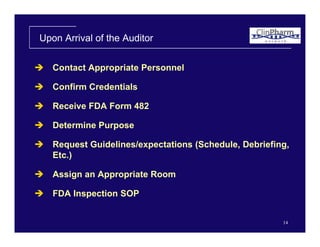
Upon Arrival of the Auditor
 Contact Appropriate Personnel
 Confirm Credentials
 Receive FDA Form 482
 Determine Purpose
 Request Guidelines/expectations (Schedule, Debriefing,
Etc.)
 Assign an Appropriate Room
 FDA Inspection SOP

14
Upon Announcement of an Inspection,

 Notify sponsor

cont.

 Retrieve CRFs for each
subject

 Establish roles
• primary/secondary
contacts

 Gather source
documents

• documentation
• making copies

 Retrieve & review trial
file & trial protocol

 Alert & prepare support
staff
 Visit/alert ancillary
facilities ( pharmacy,
clinical laboratory, etc.)

15
Conduct of Inspection


Tour/Facility Inspection



Accompany At All Times
• Allow Inspector Quiet Time To Work
• Set Expectations
• Check Periodically To Answer Questions



Staff Interviews



Data Reviews



Daily Debriefing

16
Investigator Interview and Facility Inspection

People-Related Issues
 Who assisted in performing the trial?
 What were each person’s specific duties?
 How were the trial subjects recruited?
 Describe the monitoring (quality control)
procedures & your interaction with the monitor
• frequency of visits
• frequency of telephone calls
• information provided by monitor

17
Investigator Interview and Facility Inspection, cont.

Facility-Related Issues
 Where was the trial conducted?
 What protocol specific equipment was used?
Where is it located?
 How and where were data recorded and stored?
 Where was investigational drug stored?
 What records provide documentation of drug
accountability to and from the sponsor?

18
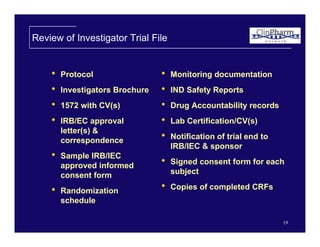
Review of Investigator Trial File

•
•
•
•

Protocol
Investigators Brochure
1572 with CV(s)
IRB/EC approval
letter(s) &
correspondence

•

Sample IRB/IEC
approved informed
consent form

•

Randomization
schedule

•
•
•
•
•

Monitoring documentation

•

Signed consent form for each
subject

•

Copies of completed CRFs

IND Safety Reports
Drug Accountability records
Lab Certification/CV(s)
Notification of trial end to
IRB/IEC & sponsor

19
Review of the Subjects’ Consent Forms

•

Review of the Signed Original And/or Revised Consent
Forms for Selected trial Subjects

•

Verify Who Obtained or Witnessed Consent Process

•

Verify Date of Consent to Ensure the Process Was
Before the Date of the First Trial Procedure

•

Verify That Subjects Were Consented With the IRBApproved Form

•

Verify That Each Subject Received a Copy of the
Original Signed Consent Form

20
Audit of Subjects’ Records

•

Review of Organization, Completeness, Condition, and
Location of Subjects’ Records

•

Review of Documentation to Assure That the Trial
Subjects Did Exist and Were Alive and Available for
Trial Participation

•

Review and Cross-comparison of Selected Case
Report Forms With Corresponding Source
Documentation

21
Audit of Subjects’ Records, cont.

•

Review and evaluation of Serious Adverse Events,
and how and when they were reported to the IRB/IEC
and Sponsor

•

Review for subject Drop-Outs
• Are they being reported to the sponsor?

•

What are the reported reasons for Drop-Outs?
• Did patient move, experience some type of adverse
event, or decide to voluntarily withdraw?

22
Examples of Areas Reviewed

•

Compare adherence to
practices & procedures
to Contract/SOPs/
protocol/guidelines

•

Identify
departments/functions/
key personnel

•

Authority delegated

•

Authority to review & approve
reports & data tables,
evaluations , AE’s

•

Review contractual
agreement

•

Organization charts

•

Names/titles of
responsible persons

•

Job descriptions, CV’s,
training records

•

Facility

•

Subject records

•

Drug accountability
23
Be Prepared to Discuss

•

Responsibilities

•

SOPs

•

Organization Chart

•

Roles/Functions

•

Training
• general
• trial specific

•

Transfer of obligations

•

Tracking of activities

•
•
•
•
•
•
•
•
•

Central Files
Source Documents
Trial Documentation
Problem Resolution
Subject Screening/Decisions
AE Reporting
Validation
Equipment
Quality Assurance
24
Be Prepared to Discuss

Essentially,
anything related to your job,
internal processes
and the project

25
During the Interview…...
 be able to clearly & succinctly
explain your job responsibilities,
processes (know your job
description, SOPs, contracts,
protocol, etc.)
 think before you speak
 make sure you understand the
question
• DON’T ASSUME
• clarify if necessary

26
During the Interview…… cont.
 answer ONLY questions asked
• don’t volunteer
• get comfortable with ‘pregnant
pause’

 answer ONLY questions related to
your position
 answer ONLY questions you
know, otherwise
• I don’t know
• I will/someone else will follow up

 answer truthfully

27
During the Interview…… cont.

 Correct Erroneous Information
Provided
 Know & Refer Back to Processes
 Refer Back to Protocol, Reports, and
Other Documents
 Know Contract & Protocol
Expectations
 Be Positive
 Be Polite
 Be Prepared
 Be Alert to Hallway Talk

28
During the Interview…… cont.

 Do Not Argue
 Do Not Deny the Obvious
 Do Not Get Hooked on ‘Fishing
Expeditions’
 Do Not Comment on Quality
 Do Not Respond to Casual
Comments

29
During the Interview…… cont.

 Do Not Express Frustrations
or Editorialize
 Do Not Respond to Questions
Unless QA/Management Is
Present
 Do Not Read or Sign
Affidavits or Statements
 Do Not Provide Copies of Any
Documents (QA/Management)

30
FDA is trained in
interviewing &
interrogation
techniques

31
Conclusion

 Know & Follow SOPs, Protocol, Contract, Plans,
etc.
 Ensure Your CV, Training Records Are Current
 Document & Follow up With Problems
 Be Aware of Quality Trends
 Ensure Documentation Is Adequate & Accurately
Reflects Activities

32
Most Common Reasons for FDA to Reject a Trial

•

Source Documentation Not Available

•

Failed to Follow the Protocol

•

Unreported Concomitant Medications That Might
Interfere With Evaluation of the Drug

•

Unreported Adverse Experiences That Could Be
Associated With the Investigational Drug

33
Investigator-Oriented Inspections Results (FDA)

Inadequate and
inaccurate records

52%

failure to adhere
to protocol

52%

Inadequate subject
consent form

44%

inadequate record of
drug accountability

28%

Failure to inform IRB/IEC
of changes / progress
14%

34
Investigator-Oriented Inspections Results (FDA),

Deficiency

cont.

451 Inspections

Unapproved Concomitant Therapy

11%

Submission of False Data

11%

Problems With Records Availability

9%

Inappropriate Follow-up of Adverse Reactions

7%

Inappropriate Delegation of Authority

5%

Failure to Obtain IRB Approval

3%

Sub-investigators Not Listed

4%

June, 2008 to October, 2009
35
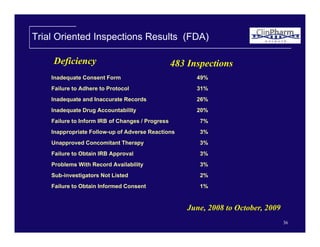
Trial Oriented Inspections Results (FDA)
Deficiency

483 Inspections

Inadequate Consent Form

49%

Failure to Adhere to Protocol

31%

Inadequate and Inaccurate Records

26%

Inadequate Drug Accountability

20%

Failure to Inform IRB of Changes / Progress

7%

Inappropriate Follow-up of Adverse Reactions

3%

Unapproved Concomitant Therapy

3%

Failure to Obtain IRB Approval

3%

Problems With Record Availability

3%

Sub-investigators Not Listed

2%

Failure to Obtain Informed Consent

1%

June, 2008 to October, 2009
36
Possible Adverse Consequences of FDA’s
Observation of Deficient Clinical Research

Investigator

Sponsor

•

Restrictive Sanctions

•

Rejection of Invalid Data

•

Disqualification

•

Delay of NDA Review
and Approval

•

Criminal Prosecution

•

Unapproved NDA

37
Contact ClinPharm Network at info@clinpharmnetwork.com

FDA Audit Prep

  • 1.
  • 2.
  • 3.
    The Facility‘s Perspective Howto prepare for an FDA Inspection Understanding the Goal of the Auditor 3
  • 4.
    Why Does theFDA Conduct Inspections? • • Assess adherence to federal laws and regulations • • Confirm validity of data supporting INDs and NDAs Determine that the safety, rights and welfare of subjects were protected through consent and IRB/EC procedures Determine whether the trial was well controlled and conducted according to the trial protocol/SOPs/ contracts/regulatory guidelines/CFRs 4
  • 5.
    Major Federal RegulationsGoverning Clinical Research Title 21, Code of Federal Regulations Electronic Records; Electronic Signatures: Part 11 Protection of Human Subjects: Part 50 Financial Disclosure by Clinical Investigators: Part 54 Institutional Review Boards: Part 56 Investigational New Drug Applications: Part 312 (Subpart D), Responsibilities of Clinical Investigators and Sponsor New Drug Applications: Part 314 5
  • 6.
    Inspection of ClinicalInvestigators • Does the principal investigator retain control of the trial and has any authority been delegated? • If authority has been delegated, has the principal investigator retained control of the trial or has he/she given full or partial control to someone else who FDA may not be aware of until they initiate their inspection? • FDA inspectors will conduct interviews and review documentation in effort to identify all other physicians, assistants, and any other personnel who are, or were, associated with the trial; and to assess compliance to protocol/SOPs/regulations 6
  • 7.
    Three Types ofInspections of Clinical Investigators Trial Oriented Inspection • Primary focus is on verification of reported trial data related to an NDA submission (pivotal trials) Investigator Oriented Inspection • Investigator Oriented: an inspection in which the focus is related to suspicious behavior by the clinical investigator Bioequivalence/Bioavailability Inspection • Focus is mainly related to the conduct of the trial and collection of data 7
  • 8.
    Routine Inspections Advance Notice UsuallyInspect trials That Were Completed and Reported in NDA Inspections Usually Last 3-4 Days 8
  • 9.
    Why is “My”Site Being Audited  Investigator is conducting a significant # of clinical trials  Investigator is conducting clinical trials outside his/her field of specialization  The investigator reports efficacy for a drug that appears to be too good compared with the results of other investigators conducting the same trial  The investigator reports few adverse drug reactions as compared with other investigators conducting the same trial  Luck 9
  • 10.
    “For Cause” Inspections NoAdvance Notice (1 day if lucky) More Stressful Than Routine Inspections Can Last for Weeks or Months with Intermittent Visits May Involve FDA HQ Personnel 10
  • 11.
    What Could Prompta “For Cause” Audit  Complaint Related To Safety, Informed Consent, Coercion  The Investigator Is Conducting Clinical Trials Outside His/Her Field Of Specialization  The FDA has received complaints from a patient or the sponsor that the investigator is in alleged violation of the regulations, protocol, or human rights  The Investigator Reports Few Adverse Drug Reactions As Compared With Other Investigators Conducting The Same Trial 11
  • 12.
    Four Major Segmentsof an FDA Inspection Announcement of an Inspection Conduct of the Inspection Exit Interview Post Inspection 12
  • 13.
  • 14.
    Upon Arrival ofthe Auditor  Contact Appropriate Personnel  Confirm Credentials  Receive FDA Form 482  Determine Purpose  Request Guidelines/expectations (Schedule, Debriefing, Etc.)  Assign an Appropriate Room  FDA Inspection SOP 14
  • 15.
    Upon Announcement ofan Inspection,  Notify sponsor cont.  Retrieve CRFs for each subject  Establish roles • primary/secondary contacts  Gather source documents • documentation • making copies  Retrieve & review trial file & trial protocol  Alert & prepare support staff  Visit/alert ancillary facilities ( pharmacy, clinical laboratory, etc.) 15
  • 16.
    Conduct of Inspection  Tour/FacilityInspection  Accompany At All Times • Allow Inspector Quiet Time To Work • Set Expectations • Check Periodically To Answer Questions  Staff Interviews  Data Reviews  Daily Debriefing 16
  • 17.
    Investigator Interview andFacility Inspection People-Related Issues  Who assisted in performing the trial?  What were each person’s specific duties?  How were the trial subjects recruited?  Describe the monitoring (quality control) procedures & your interaction with the monitor • frequency of visits • frequency of telephone calls • information provided by monitor 17
  • 18.
    Investigator Interview andFacility Inspection, cont. Facility-Related Issues  Where was the trial conducted?  What protocol specific equipment was used? Where is it located?  How and where were data recorded and stored?  Where was investigational drug stored?  What records provide documentation of drug accountability to and from the sponsor? 18
  • 19.
    Review of InvestigatorTrial File • • • • Protocol Investigators Brochure 1572 with CV(s) IRB/EC approval letter(s) & correspondence • Sample IRB/IEC approved informed consent form • Randomization schedule • • • • • Monitoring documentation • Signed consent form for each subject • Copies of completed CRFs IND Safety Reports Drug Accountability records Lab Certification/CV(s) Notification of trial end to IRB/IEC & sponsor 19
  • 20.
    Review of theSubjects’ Consent Forms • Review of the Signed Original And/or Revised Consent Forms for Selected trial Subjects • Verify Who Obtained or Witnessed Consent Process • Verify Date of Consent to Ensure the Process Was Before the Date of the First Trial Procedure • Verify That Subjects Were Consented With the IRBApproved Form • Verify That Each Subject Received a Copy of the Original Signed Consent Form 20
  • 21.
    Audit of Subjects’Records • Review of Organization, Completeness, Condition, and Location of Subjects’ Records • Review of Documentation to Assure That the Trial Subjects Did Exist and Were Alive and Available for Trial Participation • Review and Cross-comparison of Selected Case Report Forms With Corresponding Source Documentation 21
  • 22.
    Audit of Subjects’Records, cont. • Review and evaluation of Serious Adverse Events, and how and when they were reported to the IRB/IEC and Sponsor • Review for subject Drop-Outs • Are they being reported to the sponsor? • What are the reported reasons for Drop-Outs? • Did patient move, experience some type of adverse event, or decide to voluntarily withdraw? 22
  • 23.
    Examples of AreasReviewed • Compare adherence to practices & procedures to Contract/SOPs/ protocol/guidelines • Identify departments/functions/ key personnel • Authority delegated • Authority to review & approve reports & data tables, evaluations , AE’s • Review contractual agreement • Organization charts • Names/titles of responsible persons • Job descriptions, CV’s, training records • Facility • Subject records • Drug accountability 23
  • 24.
    Be Prepared toDiscuss • Responsibilities • SOPs • Organization Chart • Roles/Functions • Training • general • trial specific • Transfer of obligations • Tracking of activities • • • • • • • • • Central Files Source Documents Trial Documentation Problem Resolution Subject Screening/Decisions AE Reporting Validation Equipment Quality Assurance 24
  • 25.
    Be Prepared toDiscuss Essentially, anything related to your job, internal processes and the project 25
  • 26.
    During the Interview…... be able to clearly & succinctly explain your job responsibilities, processes (know your job description, SOPs, contracts, protocol, etc.)  think before you speak  make sure you understand the question • DON’T ASSUME • clarify if necessary 26
  • 27.
    During the Interview……cont.  answer ONLY questions asked • don’t volunteer • get comfortable with ‘pregnant pause’  answer ONLY questions related to your position  answer ONLY questions you know, otherwise • I don’t know • I will/someone else will follow up  answer truthfully 27
  • 28.
    During the Interview……cont.  Correct Erroneous Information Provided  Know & Refer Back to Processes  Refer Back to Protocol, Reports, and Other Documents  Know Contract & Protocol Expectations  Be Positive  Be Polite  Be Prepared  Be Alert to Hallway Talk 28
  • 29.
    During the Interview……cont.  Do Not Argue  Do Not Deny the Obvious  Do Not Get Hooked on ‘Fishing Expeditions’  Do Not Comment on Quality  Do Not Respond to Casual Comments 29
  • 30.
    During the Interview……cont.  Do Not Express Frustrations or Editorialize  Do Not Respond to Questions Unless QA/Management Is Present  Do Not Read or Sign Affidavits or Statements  Do Not Provide Copies of Any Documents (QA/Management) 30
  • 31.
    FDA is trainedin interviewing & interrogation techniques 31
  • 32.
    Conclusion  Know &Follow SOPs, Protocol, Contract, Plans, etc.  Ensure Your CV, Training Records Are Current  Document & Follow up With Problems  Be Aware of Quality Trends  Ensure Documentation Is Adequate & Accurately Reflects Activities 32
  • 33.
    Most Common Reasonsfor FDA to Reject a Trial • Source Documentation Not Available • Failed to Follow the Protocol • Unreported Concomitant Medications That Might Interfere With Evaluation of the Drug • Unreported Adverse Experiences That Could Be Associated With the Investigational Drug 33
  • 34.
    Investigator-Oriented Inspections Results(FDA) Inadequate and inaccurate records 52% failure to adhere to protocol 52% Inadequate subject consent form 44% inadequate record of drug accountability 28% Failure to inform IRB/IEC of changes / progress 14% 34
  • 35.
    Investigator-Oriented Inspections Results(FDA), Deficiency cont. 451 Inspections Unapproved Concomitant Therapy 11% Submission of False Data 11% Problems With Records Availability 9% Inappropriate Follow-up of Adverse Reactions 7% Inappropriate Delegation of Authority 5% Failure to Obtain IRB Approval 3% Sub-investigators Not Listed 4% June, 2008 to October, 2009 35
  • 36.
    Trial Oriented InspectionsResults (FDA) Deficiency 483 Inspections Inadequate Consent Form 49% Failure to Adhere to Protocol 31% Inadequate and Inaccurate Records 26% Inadequate Drug Accountability 20% Failure to Inform IRB of Changes / Progress 7% Inappropriate Follow-up of Adverse Reactions 3% Unapproved Concomitant Therapy 3% Failure to Obtain IRB Approval 3% Problems With Record Availability 3% Sub-investigators Not Listed 2% Failure to Obtain Informed Consent 1% June, 2008 to October, 2009 36
  • 37.
    Possible Adverse Consequencesof FDA’s Observation of Deficient Clinical Research Investigator Sponsor • Restrictive Sanctions • Rejection of Invalid Data • Disqualification • Delay of NDA Review and Approval • Criminal Prosecution • Unapproved NDA 37
  • 38.
    Contact ClinPharm Networkat info@clinpharmnetwork.com