NORZULAIKA BINTI ALIAS 
PENGAJAR JURUPULIH 
PERUBATAN ANGGOTA 
EVIDENCE BASED PRACTICE
Evidence Based Practice(EBP) 
The practice of health care in which the 
practitioner systematically finds, appraises, 
and uses the most current and valid research 
findings as the basis for clinical decisions. 
(Mosby’s Medical Dictionary, 8th edition.©2009,Elsevier)
Evidence Based Practice(EBP) 
“the conscientious, explicit and judicious use 
of current best evidence in making decisions 
about the care of the individual patient. It 
means integrating individual clinical expertise 
with the best available external clinical 
evidence from systematic research.” 
(Sackett D, 1996)
Evidence Based Practice(EBP) 
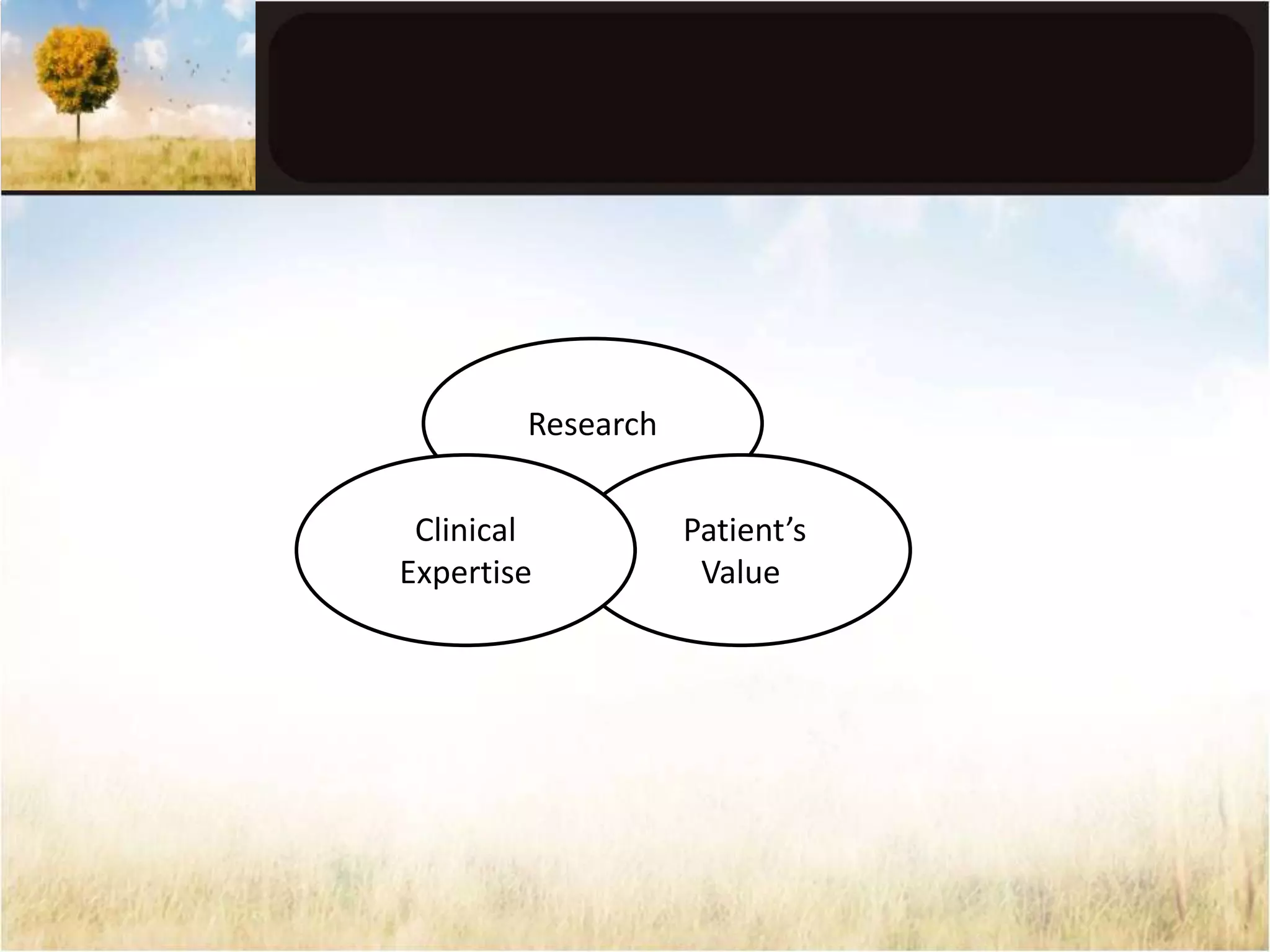
“evidence-based medicine(EBM) is integration 
of best research evidence with clinical 
expertise and patient value” 
(Sackett et al. 2000)
Research 
Patient’s 
Value 
Clinical 
Expertise
Evidence Based Practice(EBP) 
“The practice of evidence-based medicine 
means integrating individual clinical expertise 
with the best available external clinical 
evidence from systematic research” 
(Sackett et al. 1996)
Sackett et al, 1996 
As Sackett and his colleagues point out, clinical 
practices become out of date if new evidence is not 
drawn upon. 
However, the clinician must be aware of what 
evidence is appropriate to integrate into their 
practice 
This can prove to be a difficult and time-consuming 
task but it is an essential skill in implementing 
evidence based practice.
Evidence Based Practice(EBP) 
• Evidence based practice is one useful 
approach to improving the impact of practice 
in medicine, psychology, social work, nursing 
and allied fields. 
• EBP and practice evaluation work together 
very well, but they have different purposes 
and use very different methods.
Evidence Based Practice(EBP) 
• Clinical guidelines should be freely accessible 
with international collaboration and 
endorsement 
• Information to support EBP should be made 
available in different languages and format. 
• Duplicated in effort should be avoided 
• EBP must be part of long learning and all PTs 
should recognize the important of developing 
necessary skill for EBP.
Why Evidence Based Practice(EBP)? 
• It is one step toward making sure each client 
gets the best service possible 
• Some argue it helps keep your knowledge up 
to date, supplements clinical judgment, can 
save time and most important can improve 
care and even save lives. 
• Some say, it’s unethical to use treatments that 
aren’t known to work.
How is EBP Implemented in Practice? 
• Profiling research that informs professionals 
and clients about what works is where 
evidence based practice starts. 
• These summaries tell us what we know about 
treatment and program efficacy based on 
experimental work-as well as what we don’t 
know or aren’t really sure about.
How is EBP Implemented in Practice? 
• Having access to information on what works 
allows professionals, in conjunction with 
clients, to select treatments that are most 
likely to be helpful before intervention is 
begun.
Examples 
Evidence Based Practice(EBP)
MANUAL THERAPY IN TREATMENT OF NECK PAIN 
Rheumatic Diseases Clinics of North America- 
Volume 22,Issue 3(August 1996) 
• Manual therapies have been demonstrated to be effective for 
mechanical neck pain in the short term when used in 
combination with other treatments. 
• The risk of increased symptoms resulting from manual 
therapy is low(in the range of 1%-2%),with the most common 
symptom aggravation being vertigo or dizziness. 
• The risk of serious complication or death from neck 
manipulation is extremely low(in the range of 0.0001%)
Evaluation of The Effects Of Shortwave Diathermy in 
Patients With Chronic Low Back Pain 
Bangladesh Med Res Counc Bull-01-APR-2009;35(1):18- 
20 
 A prospective experimental study on 97 patients of chronic low back 
pain was conducted to find out the effects of shortwave diathermy. 
 They were divided randomly into two groups and treated with 
nonsteroidal anti-inflammatory drugs, exercises, activities of daily 
living instructions and with or without shortwave diathermy 
 After six weeks of treatment, improvements were observed in both 
the group. But significant difference in improvement was found in 
shortwave diathermy group than in placebo group. The present 
study suggests that shortwave diathermy is effective for the 
treatment of patients with chronic low back pain.
A survey of Malaysia Physiotherapist On Current 
Practice And Reasons For Preference Of Treatment 
Techniques On Non-specific Low Back Pain 
• The result indicated that Manual Therapy and 
Electrotherapy were most preferred, indicating a lack 
of EBPT which could have been contributed by PTs 
attending skill based course that lacked evidence 
findings on the techniques recommended. 
• This study also identified the lack of formal higher 
education training to implement EBPT. 
(Divinder Kaur, 2002)
INTRODUCTION TO RESEARCH
• The concept of research in physiotherapy has evolved with the 
development of techniques of practice and changes in the 
health care system. 
• Clinical research is a structured process of investigating facts and 
theories and exploring connections. 
• It proceeds in a systematic way: 
- to examine clinical conditions and outcomes. 
-to establish relationships among clinical 
phenomena. 
-to generate evidence for decision making 
-to provide the impetus for improving methods of practice.
• Clinical research must be empirical and critical 
-results must be observable, documented and examined for 
validity. 
• The objective process is dynamic and creative activity: 
-performed in many different settings 
-using a variety of quantitative and qualitative measurement 
tools. 
-focus on the application of clinical theory and interventions.
Types of research related to scope 
of physiotherapy 
• Experimental research 
-it refers to investigations in which the researcher 
manipulates and controls one or more variables and 
observe the resultant variation in other variables 
-to compare conditions or intervention groups, to 
suggest cause-and-effect relationships. 
• Nonexperimental research 
-it refers to descriptive or exploratory investigations in 
nature and do not exhibit direct control over the studied 
variables 
-it is often referred as observational reseach:to reflect 
the idea that phenomena are observed rather than 
manipulated.
Evidence based practice

Evidence based practice

  • 1.
    NORZULAIKA BINTI ALIAS PENGAJAR JURUPULIH PERUBATAN ANGGOTA EVIDENCE BASED PRACTICE
  • 2.
    Evidence Based Practice(EBP) The practice of health care in which the practitioner systematically finds, appraises, and uses the most current and valid research findings as the basis for clinical decisions. (Mosby’s Medical Dictionary, 8th edition.©2009,Elsevier)
  • 3.
    Evidence Based Practice(EBP) “the conscientious, explicit and judicious use of current best evidence in making decisions about the care of the individual patient. It means integrating individual clinical expertise with the best available external clinical evidence from systematic research.” (Sackett D, 1996)
  • 4.
    Evidence Based Practice(EBP) “evidence-based medicine(EBM) is integration of best research evidence with clinical expertise and patient value” (Sackett et al. 2000)
  • 5.
    Research Patient’s Value Clinical Expertise
  • 6.
    Evidence Based Practice(EBP) “The practice of evidence-based medicine means integrating individual clinical expertise with the best available external clinical evidence from systematic research” (Sackett et al. 1996)
  • 7.
    Sackett et al,1996 As Sackett and his colleagues point out, clinical practices become out of date if new evidence is not drawn upon. However, the clinician must be aware of what evidence is appropriate to integrate into their practice This can prove to be a difficult and time-consuming task but it is an essential skill in implementing evidence based practice.
  • 8.
    Evidence Based Practice(EBP) • Evidence based practice is one useful approach to improving the impact of practice in medicine, psychology, social work, nursing and allied fields. • EBP and practice evaluation work together very well, but they have different purposes and use very different methods.
  • 9.
    Evidence Based Practice(EBP) • Clinical guidelines should be freely accessible with international collaboration and endorsement • Information to support EBP should be made available in different languages and format. • Duplicated in effort should be avoided • EBP must be part of long learning and all PTs should recognize the important of developing necessary skill for EBP.
  • 10.
    Why Evidence BasedPractice(EBP)? • It is one step toward making sure each client gets the best service possible • Some argue it helps keep your knowledge up to date, supplements clinical judgment, can save time and most important can improve care and even save lives. • Some say, it’s unethical to use treatments that aren’t known to work.
  • 11.
    How is EBPImplemented in Practice? • Profiling research that informs professionals and clients about what works is where evidence based practice starts. • These summaries tell us what we know about treatment and program efficacy based on experimental work-as well as what we don’t know or aren’t really sure about.
  • 12.
    How is EBPImplemented in Practice? • Having access to information on what works allows professionals, in conjunction with clients, to select treatments that are most likely to be helpful before intervention is begun.
  • 13.
  • 14.
    MANUAL THERAPY INTREATMENT OF NECK PAIN Rheumatic Diseases Clinics of North America- Volume 22,Issue 3(August 1996) • Manual therapies have been demonstrated to be effective for mechanical neck pain in the short term when used in combination with other treatments. • The risk of increased symptoms resulting from manual therapy is low(in the range of 1%-2%),with the most common symptom aggravation being vertigo or dizziness. • The risk of serious complication or death from neck manipulation is extremely low(in the range of 0.0001%)
  • 15.
    Evaluation of TheEffects Of Shortwave Diathermy in Patients With Chronic Low Back Pain Bangladesh Med Res Counc Bull-01-APR-2009;35(1):18- 20  A prospective experimental study on 97 patients of chronic low back pain was conducted to find out the effects of shortwave diathermy.  They were divided randomly into two groups and treated with nonsteroidal anti-inflammatory drugs, exercises, activities of daily living instructions and with or without shortwave diathermy  After six weeks of treatment, improvements were observed in both the group. But significant difference in improvement was found in shortwave diathermy group than in placebo group. The present study suggests that shortwave diathermy is effective for the treatment of patients with chronic low back pain.
  • 16.
    A survey ofMalaysia Physiotherapist On Current Practice And Reasons For Preference Of Treatment Techniques On Non-specific Low Back Pain • The result indicated that Manual Therapy and Electrotherapy were most preferred, indicating a lack of EBPT which could have been contributed by PTs attending skill based course that lacked evidence findings on the techniques recommended. • This study also identified the lack of formal higher education training to implement EBPT. (Divinder Kaur, 2002)
  • 17.
  • 18.
    • The conceptof research in physiotherapy has evolved with the development of techniques of practice and changes in the health care system. • Clinical research is a structured process of investigating facts and theories and exploring connections. • It proceeds in a systematic way: - to examine clinical conditions and outcomes. -to establish relationships among clinical phenomena. -to generate evidence for decision making -to provide the impetus for improving methods of practice.
  • 19.
    • Clinical researchmust be empirical and critical -results must be observable, documented and examined for validity. • The objective process is dynamic and creative activity: -performed in many different settings -using a variety of quantitative and qualitative measurement tools. -focus on the application of clinical theory and interventions.
  • 20.
    Types of researchrelated to scope of physiotherapy • Experimental research -it refers to investigations in which the researcher manipulates and controls one or more variables and observe the resultant variation in other variables -to compare conditions or intervention groups, to suggest cause-and-effect relationships. • Nonexperimental research -it refers to descriptive or exploratory investigations in nature and do not exhibit direct control over the studied variables -it is often referred as observational reseach:to reflect the idea that phenomena are observed rather than manipulated.