Introduction to Textile
Manufacturing
(TEXT-175)
Textiles and the Environment
• The textile and leather industries are the most
environmentally harmful industries in the
world!
• From raw material to end product, the
majority of conventional substances and
processes involved are hazardous to the
ecosystem.
Major Pollutants
• Extreme pH bearing chemicals
• Formaldehyde
• Heavy Metal Residues
• Pesticide & Antifungal Residues
• Dyestuffs
• Chlorination
• Heavy metals
• Ozone, brighteners, softeners etc.
• Packaging
• Noise
Why Go EcoFriendly?
• Social responsibility
• Biodegradability issues
• Health concerns
• Absorption issues
• Popularity
• Protection of environment and species
Colourants
• Carcinogenic
• Allergenic
• Colour fastness
• Usage and disposal of excess
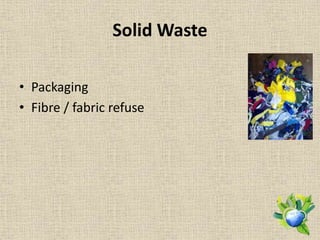
Solid Waste
• Packaging
• Fibre / fabric refuse
Gases and Airborne Particles
• Fibre matter (particles)
• Sizing (Nitrogen oxides, Sulphur
oxides, Carbon monoxide)
• Bleaching (Chlorine, Chlorine
dioxide)
• Dyeing (Particles and vapours)
• Printing (Hydrocarbons, ammonia)
• Finishing (Formaldehyde, Carriers,
Polymers, lubricating oils)
Noise
• Detrimental to factory
employees’ health
• Major stress inducer
Water & Energy Consumption
• High consumption of clean water
• Energy intensive
Prevention
• As a producer, reduce the waste discharge by
using the amount of chemical that can be
used up during the process, to avoid excess
• As a consumer, go green, and reduce
consumption of environmentally harmful
materials
• Effluent treatment
• International green standards
• Reduce, reuse & recycle
Prevention
• Recognize pollution as your enemy and that
the damage caused by it is irreversible and
deadly.
• Be a part of the green movement by adopting
green processes, technology, and materials.

Textiles and the environment

  • 1.
  • 2.
    Textiles and theEnvironment • The textile and leather industries are the most environmentally harmful industries in the world! • From raw material to end product, the majority of conventional substances and processes involved are hazardous to the ecosystem.
  • 4.
    Major Pollutants • ExtremepH bearing chemicals • Formaldehyde • Heavy Metal Residues • Pesticide & Antifungal Residues • Dyestuffs • Chlorination • Heavy metals • Ozone, brighteners, softeners etc. • Packaging • Noise
  • 5.
    Why Go EcoFriendly? •Social responsibility • Biodegradability issues • Health concerns • Absorption issues • Popularity • Protection of environment and species
  • 6.
    Colourants • Carcinogenic • Allergenic •Colour fastness • Usage and disposal of excess
  • 7.
    Solid Waste • Packaging •Fibre / fabric refuse
  • 8.
    Gases and AirborneParticles • Fibre matter (particles) • Sizing (Nitrogen oxides, Sulphur oxides, Carbon monoxide) • Bleaching (Chlorine, Chlorine dioxide) • Dyeing (Particles and vapours) • Printing (Hydrocarbons, ammonia) • Finishing (Formaldehyde, Carriers, Polymers, lubricating oils)
  • 9.
    Noise • Detrimental tofactory employees’ health • Major stress inducer
  • 10.
    Water & EnergyConsumption • High consumption of clean water • Energy intensive
  • 11.
    Prevention • As aproducer, reduce the waste discharge by using the amount of chemical that can be used up during the process, to avoid excess • As a consumer, go green, and reduce consumption of environmentally harmful materials • Effluent treatment • International green standards • Reduce, reuse & recycle
  • 12.
    Prevention • Recognize pollutionas your enemy and that the damage caused by it is irreversible and deadly. • Be a part of the green movement by adopting green processes, technology, and materials.