FErrari
ORGANIZATION AND CORPORATE MANAGMENT
YARI BRUGNONI, IMIM 2014-2016
introduction
INTERNAL ANALYSIS EXTERNAL ANALYSIS
•  Work philosophy and
Environmental attention
•  Strategic Decisions
•  Supply Chain
•  Competitors and
Customers’ Analysis
•  Environmental Analysis
•  Market Analysis
HOW LONG ARE YOU WILLING TO WAIT FOR DRIVING
YOUR FERRARI ?
2
Company overview
 
 
•  MISSION
•  HIGH INVESTMENTS AND INNOVATIONS through R&D of race cars:
•  ETHICAL AND SOCIAL RESPONSABILITIES
Ferrari is an eco-friendly company that cares about the well being of its employees
3
history
•  1929: Scuderia Ferrari was founded by Enzo Ferrari as a race team
•  1947: presentation of first Ferrari’s model. It will win the Rome Grand Prix
•  1969: Fiat purchased 50% of shares
•  1988: manufacturing of F40
•  1988: Enzo Ferrari died and Fiat acquired 90% of the company
•  1991: Luca Cordero di Montezemolo as new Chairman
•  2014: L.C. di Montezemolo has been replaced by Sergio Marchionne
•  15 F1 Driver’ s World titles and 16 F1 Constructor’s World titles, 9 victories in the
Le Mans 24 Hours,8 in the Mille Miglia …
4
Ferrari dna
SUSTAINABILITY
•  Reduce polluting emissions (-42% CO2)
•  Produce energy & renewable energies
•  Improve safety and quality of life of its
employees
INNOVATION
•  150 patents registered
•  Integration on road cars of F1 technologies
•  Benchmark for the entire automotive
industry
DESIGN
•  Mix of innovation, extreme technologies,
endure quality and design
•  Make cars recognizable maintaining its
traditional values
PEOPLE
•  2,900 employees: 40% white collar, 60%
blue collar, with an average of 38 years.
•  Formula Uomo philosophy
•  High level of knowledge: 70% WC has a
degree, 60% BC has a diploma
5
Strategy
development
CENTRALIZED STRUCTURE
•  Centralization of decision-making among the highest managerial levels
•  Guarantee constant high quality standards for each vehicle
•  No tolerance for defects à precise guidelines to be followed
•  Workers high trained and well prepared
6
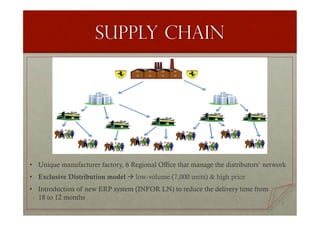
Supply chain
•  Unique manufacturer factory, 6 Regional Office that manage the distributors’ network
•  Exclusive Distribution model à low-volume (7,000 units) & high price
•  Introduction of new ERP system (INFOR LN) to reduce the delivery time from
18 to 12 months
7
Resources &
capabilities analysis
RESOURCE-BASED VIEW (RBV)
Differentiation
Niche marketing
High Performance and Technology
Quality and Service
Vertical Integration
Synergy
Breakthrough Resources
8
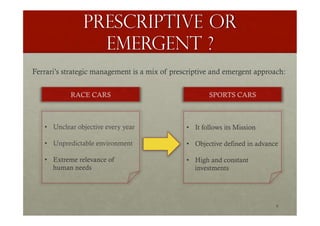
Prescriptive or
emergent ?
Ferrari’s strategic management is a mix of prescriptive and emergent approach:
RACE CARS SPORTS CARS
•  Unclear objective every year
•  Unpredictable environment
•  Extreme relevance of
human needs
•  It follows its Mission
•  Objective defined in advance
•  High and constant
investments
9
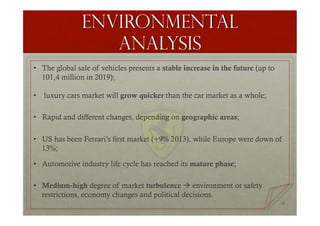
Environmental
analysis
•  The global sale of vehicles presents a stable increase in the future (up to
101,4 million in 2019);
•  luxury cars market will grow quicker than the car market as a whole;
•  Rapid and different changes, depending on geographic areas;
•  US has been Ferrari’s first market (+9% 2013), while Europe were down of
13%;
•  Automotive industry life cycle has reached its mature phase;
•  Medium-high degree of market turbulence à environment or safety
restrictions, economy changes and political decisions.
10
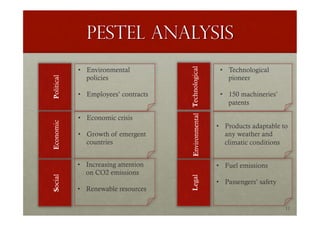
Pestel analysis
•  Environmental
policies
•  Employees’ contracts
•  Technological
pioneer
•  150 machineries’
patents
•  Increasing attention
on CO2 emissions
•  Renewable resources
•  Fuel emissions
•  Passengers’ safety
•  Products adaptable to
any weather and
climatic conditions
•  Economic crisis
•  Growth of emergent
countries
TechnologicalEnvironmentalLegal
PoliticalEconomicSocial
11
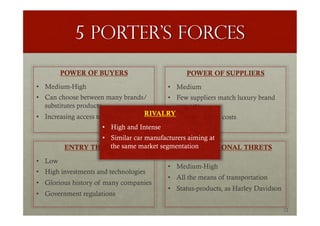
5 porter’s forces
POWER OF BUYERS
•  Medium-High
•  Can choose between many brands/
substitutes products
•  Increasing access to information
POWER OF SUPPLIERS
•  Medium
•  Few suppliers match luxury brand
requests
•  High switching costs
ENTRY THREATS
•  Low
•  High investments and technologies
•  Glorious history of many companies
•  Government regulations
SUBSTITUTIONAL THRETS
•  Medium-High
•  All the means of transportation
•  Status-products, as Harley Davidson
RIVALRY
•  High and Intense
•  Similar car manufacturers aiming at
the same market segmentation
12
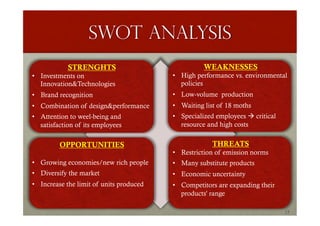
Swot analysis
STRENGHTS
•  Investments on
Innovation&Technologies
•  Brand recognition
•  Combination of design&performance
•  Attention to weel-being and
satisfaction of its employees
WEAKNESSES
•  High performance vs. environmental
policies
•  Low-volume production
•  Waiting list of 18 moths
•  Specialized employees à critical
resource and high costs
OPPORTUNITIES
•  Growing economies/new rich people
•  Diversify the market
•  Increase the limit of units produced
THREATS
•  Restriction of emission norms
•  Many substitute products
•  Economic uncertainty
•  Competitors are expanding their
products' range
13
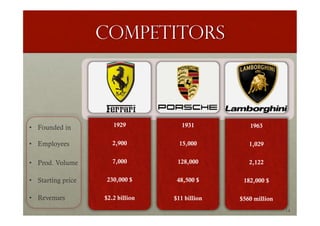
competitors
1929
2,900
7,000
230,000 $
$2.2 billion
1931
15,000
128,000
48,500 $
$11 billion
1963
1,029
2,122
182,000 $
$560 million
•  Founded in
•  Employees
•  Prod. Volume
•  Starting price
•  Revenues
14
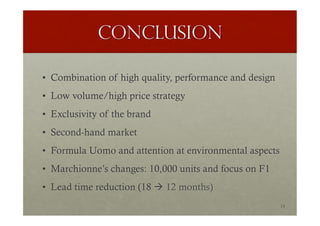
Conclusion
•  Combination of high quality, performance and design
•  Low volume/high price strategy
•  Exclusivity of the brand
•  Second-hand market
•  Formula Uomo and attention at environmental aspects
•  Marchionne’s changes: 10,000 units and focus on F1
•  Lead time reduction (18 à 12 months)
15
END
ANY QUESTIONS?
16

Ferrari Strategy Analysis

  • 1.
    FErrari ORGANIZATION AND CORPORATEMANAGMENT YARI BRUGNONI, IMIM 2014-2016
  • 2.
    introduction INTERNAL ANALYSIS EXTERNALANALYSIS •  Work philosophy and Environmental attention •  Strategic Decisions •  Supply Chain •  Competitors and Customers’ Analysis •  Environmental Analysis •  Market Analysis HOW LONG ARE YOU WILLING TO WAIT FOR DRIVING YOUR FERRARI ? 2
  • 3.
    Company overview     •  MISSION • HIGH INVESTMENTS AND INNOVATIONS through R&D of race cars: •  ETHICAL AND SOCIAL RESPONSABILITIES Ferrari is an eco-friendly company that cares about the well being of its employees 3
  • 4.
    history •  1929: ScuderiaFerrari was founded by Enzo Ferrari as a race team •  1947: presentation of first Ferrari’s model. It will win the Rome Grand Prix •  1969: Fiat purchased 50% of shares •  1988: manufacturing of F40 •  1988: Enzo Ferrari died and Fiat acquired 90% of the company •  1991: Luca Cordero di Montezemolo as new Chairman •  2014: L.C. di Montezemolo has been replaced by Sergio Marchionne •  15 F1 Driver’ s World titles and 16 F1 Constructor’s World titles, 9 victories in the Le Mans 24 Hours,8 in the Mille Miglia … 4
  • 5.
    Ferrari dna SUSTAINABILITY •  Reducepolluting emissions (-42% CO2) •  Produce energy & renewable energies •  Improve safety and quality of life of its employees INNOVATION •  150 patents registered •  Integration on road cars of F1 technologies •  Benchmark for the entire automotive industry DESIGN •  Mix of innovation, extreme technologies, endure quality and design •  Make cars recognizable maintaining its traditional values PEOPLE •  2,900 employees: 40% white collar, 60% blue collar, with an average of 38 years. •  Formula Uomo philosophy •  High level of knowledge: 70% WC has a degree, 60% BC has a diploma 5
  • 6.
    Strategy development CENTRALIZED STRUCTURE •  Centralizationof decision-making among the highest managerial levels •  Guarantee constant high quality standards for each vehicle •  No tolerance for defects à precise guidelines to be followed •  Workers high trained and well prepared 6
  • 7.
    Supply chain •  Uniquemanufacturer factory, 6 Regional Office that manage the distributors’ network •  Exclusive Distribution model à low-volume (7,000 units) & high price •  Introduction of new ERP system (INFOR LN) to reduce the delivery time from 18 to 12 months 7
  • 8.
    Resources & capabilities analysis RESOURCE-BASEDVIEW (RBV) Differentiation Niche marketing High Performance and Technology Quality and Service Vertical Integration Synergy Breakthrough Resources 8
  • 9.
    Prescriptive or emergent ? Ferrari’sstrategic management is a mix of prescriptive and emergent approach: RACE CARS SPORTS CARS •  Unclear objective every year •  Unpredictable environment •  Extreme relevance of human needs •  It follows its Mission •  Objective defined in advance •  High and constant investments 9
  • 10.
    Environmental analysis •  The globalsale of vehicles presents a stable increase in the future (up to 101,4 million in 2019); •  luxury cars market will grow quicker than the car market as a whole; •  Rapid and different changes, depending on geographic areas; •  US has been Ferrari’s first market (+9% 2013), while Europe were down of 13%; •  Automotive industry life cycle has reached its mature phase; •  Medium-high degree of market turbulence à environment or safety restrictions, economy changes and political decisions. 10
  • 11.
    Pestel analysis •  Environmental policies • Employees’ contracts •  Technological pioneer •  150 machineries’ patents •  Increasing attention on CO2 emissions •  Renewable resources •  Fuel emissions •  Passengers’ safety •  Products adaptable to any weather and climatic conditions •  Economic crisis •  Growth of emergent countries TechnologicalEnvironmentalLegal PoliticalEconomicSocial 11
  • 12.
    5 porter’s forces POWEROF BUYERS •  Medium-High •  Can choose between many brands/ substitutes products •  Increasing access to information POWER OF SUPPLIERS •  Medium •  Few suppliers match luxury brand requests •  High switching costs ENTRY THREATS •  Low •  High investments and technologies •  Glorious history of many companies •  Government regulations SUBSTITUTIONAL THRETS •  Medium-High •  All the means of transportation •  Status-products, as Harley Davidson RIVALRY •  High and Intense •  Similar car manufacturers aiming at the same market segmentation 12
  • 13.
    Swot analysis STRENGHTS •  Investmentson Innovation&Technologies •  Brand recognition •  Combination of design&performance •  Attention to weel-being and satisfaction of its employees WEAKNESSES •  High performance vs. environmental policies •  Low-volume production •  Waiting list of 18 moths •  Specialized employees à critical resource and high costs OPPORTUNITIES •  Growing economies/new rich people •  Diversify the market •  Increase the limit of units produced THREATS •  Restriction of emission norms •  Many substitute products •  Economic uncertainty •  Competitors are expanding their products' range 13
  • 14.
    competitors 1929 2,900 7,000 230,000 $ $2.2 billion 1931 15,000 128,000 48,500$ $11 billion 1963 1,029 2,122 182,000 $ $560 million •  Founded in •  Employees •  Prod. Volume •  Starting price •  Revenues 14
  • 15.
    Conclusion •  Combination ofhigh quality, performance and design •  Low volume/high price strategy •  Exclusivity of the brand •  Second-hand market •  Formula Uomo and attention at environmental aspects •  Marchionne’s changes: 10,000 units and focus on F1 •  Lead time reduction (18 à 12 months) 15
  • 16.