MSc International Business Program
Corporate Governance Module - Dr. György Gonda


             Corporate
            Governance
            Assessment
             o Lucas Antonio
             o Can Erkirtay
             o Kian Ansari
             o Francesca Pedicini
                              Budapest, April - 2012
Agenda


Company Overview


Board of Directors and Management


Committees


Codes, Reports and Italy CG
History and Important Facts – 1899 / 1970

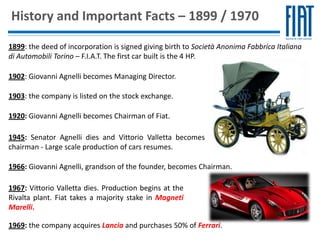
1899: the deed of incorporation is signed giving birth to Società Anonima Fabbrica Italiana
di Automobili Torino – F.I.A.T. The first car built is the 4 HP.

1902: Giovanni Agnelli becomes Managing Director.

1903: the company is listed on the stock exchange.

1920: Giovanni Agnelli becomes Chairman of Fiat.

1945: Senator Agnelli dies and Vittorio Valletta becomes
chairman - Large scale production of cars resumes.

1966: Giovanni Agnelli, grandson of the founder, becomes Chairman.

1967: Vittorio Valletta dies. Production begins at the
Rivalta plant. Fiat takes a majority stake in Magneti
Marelli.

1969: the company acquires Lancia and purchases 50% of Ferrari.
History and Important Facts – 1970 / 2011

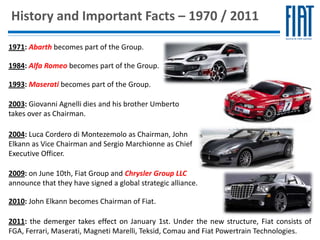
1971: Abarth becomes part of the Group.

1984: Alfa Romeo becomes part of the Group.

1993: Maserati becomes part of the Group.

2003: Giovanni Agnelli dies and his brother Umberto
takes over as Chairman.

2004: Luca Cordero di Montezemolo as Chairman, John
Elkann as Vice Chairman and Sergio Marchionne as Chief
Executive Officer.

2009: on June 10th, Fiat Group and Chrysler Group LLC
announce that they have signed a global strategic alliance.

2010: John Elkann becomes Chairman of Fiat.

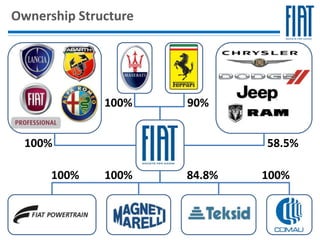
2011: the demerger takes effect on January 1st. Under the new structure, Fiat consists of
FGA, Ferrari, Maserati, Magneti Marelli, Teksid, Comau and Fiat Powertrain Technologies.
Ownership Structure


              100%    90%


  100%                        58.5%

      100%    100%    84.8%   100%
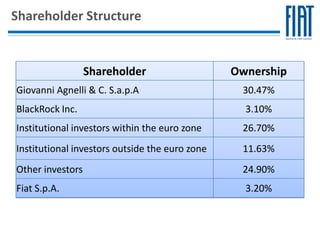
Shareholder Structure


                  Shareholder                   Ownership
Giovanni Agnelli & C. S.a.p.A                    30.47%
BlackRock Inc.                                    3.10%
Institutional investors within the euro zone     26.70%
Institutional investors outside the euro zone    11.63%
Other investors                                  24.90%
Fiat S.p.A.                                       3.20%
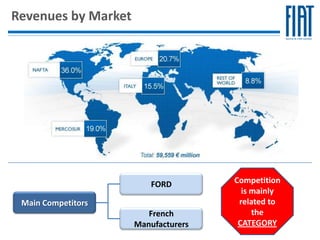
Revenues by Market


                         FORD        Competition
                                       is mainly
 Main Competitors                     related to
                        French            the
                     Manufacturers    CATEGORY
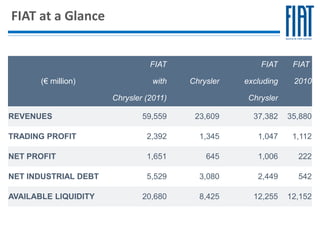
FIAT at a Glance


                                FIAT                   FIAT     FIAT

       (€ million)               with   Chrysler   excluding    2010

                      Chrysler (2011)               Chrysler

REVENUES                      59,559     23,609      37,382    35,880

TRADING PROFIT                 2,392      1,345       1,047     1,112

NET PROFIT                     1,651        645       1,006      222

NET INDUSTRIAL DEBT            5,529      3,080       2,449      542

AVAILABLE LIQUIDITY           20,680      8,425      12,255    12,152
FIAT Shares
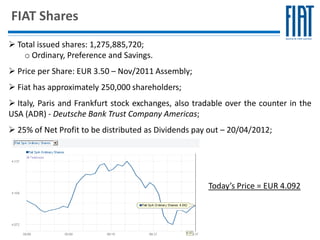
 Total issued shares: 1,275,885,720;
    o Ordinary, Preference and Savings.
 Price per Share: EUR 3.50 – Nov/2011 Assembly;
 Fiat has approximately 250,000 shareholders;
 Italy, Paris and Frankfurt stock exchanges, also tradable over the counter in the
USA (ADR) - Deutsche Bank Trust Company Americas;
 25% of Net Profit to be distributed as Dividends pay out – 20/04/2012;


                                                      Today’s Price = EUR 4.092
Corporate Governance Structure

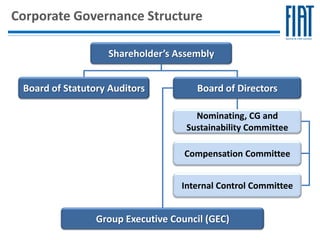
                   Shareholder’s Assembly


 Board of Statutory Auditors           Board of Directors

                                      Nominating, CG and
                                    Sustainability Committee

                                    Compensation Committee


                                   Internal Control Committee


                 Group Executive Council (GEC)
Board of Directors

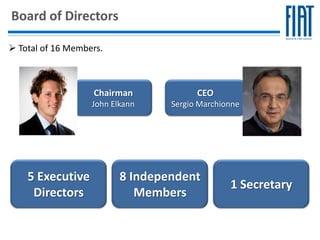
 Total of 16 Members.


                   Chairman             CEO
                   John Elkann    Sergio Marchionne


    5 Executive           8 Independent
                                                1 Secretary
     Directors               Members
Board of Statutory Auditors

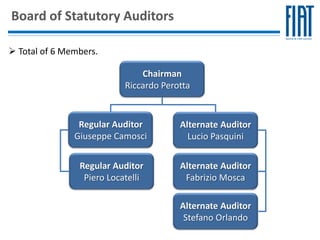
 Total of 6 Members.

                               Chairman
                           Riccardo Perotta


                Regular Auditor         Alternate Auditor
               Giuseppe Camosci           Lucio Pasquini


                Regular Auditor         Alternate Auditor
                 Piero Locatelli         Fabrizio Mosca

                                        Alternate Auditor
                                         Stefano Orlando
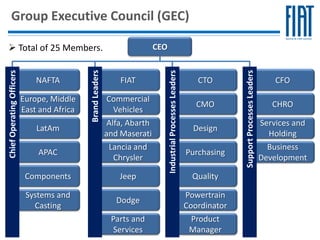
Group Executive Council (GEC)

 Total of 25 Members.                                                       CEO


                                             Brand Leaders
Chief Operating Officers


                                                                                                                                Support Processes Leaders
                                                                                   Industrial Processes Leaders
                               NAFTA                             FIAT                                                CTO                                        CFO

                           Europe, Middle                     Commercial
                                                                                                                     CMO                                       CHRO
                           East and Africa                      Vehicles
                                                              Alfa, Abarth                                                                                  Services and
                               LatAm                                                                                Design
                                                             and Maserati                                                                                     Holding
                                                              Lancia and                                                                                      Business
                               APAC                                                                               Purchasing
                                                                Chrysler                                                                                    Development

                            Components                           Jeep                                               Quality

                            Systems and                                                                           Powertrain
                                                                Dodge
                              Casting                                                                             Coordinator
                                                              Parts and                                             Product
                                                               Services                                            Manager
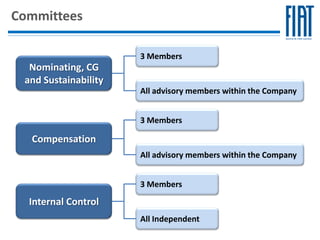
Committees

                      3 Members
  Nominating, CG
 and Sustainability
                      All advisory members within the Company


                      3 Members

  Compensation
                      All advisory members within the Company


                      3 Members

  Internal Control
                      All Independent
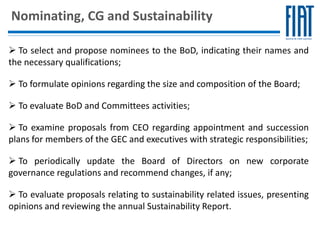
Nominating, CG and Sustainability

 To select and propose nominees to the BoD, indicating their names and
the necessary qualifications;

 To formulate opinions regarding the size and composition of the Board;

 To evaluate BoD and Committees activities;

 To examine proposals from CEO regarding appointment and succession
plans for members of the GEC and executives with strategic responsibilities;

 To periodically update the Board of Directors on new corporate
governance regulations and recommend changes, if any;

 To evaluate proposals relating to sustainability related issues, presenting
opinions and reviewing the annual Sustainability Report.
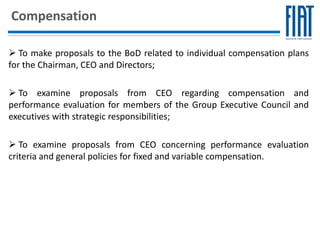
Compensation

 To make proposals to the BoD related to individual compensation plans
for the Chairman, CEO and Directors;

 To examine proposals from CEO regarding compensation and
performance evaluation for members of the Group Executive Council and
executives with strategic responsibilities;

 To examine proposals from CEO concerning performance evaluation
criteria and general policies for fixed and variable compensation.
Internal Control

 Assist the Board of Directors with internal control systems;

 Assess the work plan prepared by the Compliance Officer;

 Report to the BoD the adequacy of the internal control system;

 Assess the adequacy of accounting principles adopted in relation to
preparation of the consolidated financial statements;

 Assess proposals presented by candidates for the position of
independent auditor;

 Assess the audit work plan and the results included in the audit report;

 Assess the organizational placement, structure and work plan of Internal
Audit.
Italian Corporate Governance

SOME FACTS:
 Italian family capitalism: more than 90% of the Italian registered
companies are family-owned;
 Italian C.G. is classified as: relationship-based corporate system which
adopts the Latin Approach.
 The Italian system is a little influenced by institutional investors (such as
in the Anglo-American system) or by banks (such as in Germany and in
Japan).
 Limited degree of separation between ownership and control. Control is
achieved mainly by using pyramidal groups.
 Weak managers, strong blockholders and unprotected minority
shareholders.
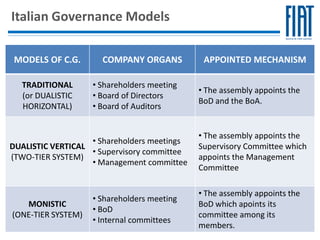
Italian Governance Models

 MODELS OF C.G.       COMPANY ORGANS          APPOINTED MECHANISM

  TRADITIONAL       • Shareholders meeting
                                             • The assembly appoints the
  (or DUALISTIC     • Board of Directors
                                             BoD and the BoA.
  HORIZONTAL)       • Board of Auditors


                                             • The assembly appoints the
                   • Shareholders meetings
DUALISTIC VERTICAL                           Supervisory Committee which
                   • Supervisory committee
(TWO-TIER SYSTEM)                            appoints the Management
                   • Management committee
                                             Committee

                                             • The assembly appoints the
                    • Shareholders meeting
   MONISTIC                                  BoD which apoints its
                    • BoD
(ONE-TIER SYSTEM)                            committee among its
                    • Internal committees
                                             members.
Codes and Principles

 Italian corporate governance practices are principally governed by the
Italian Corporate Governance Code (Codice di Autodisciplina, revised in
2011);
 In the wake of other corporate governance codes inspired by the Cadbury
in 1992, Italy launched 2 codes:
   o    The Draghi Reform (1998): “Audit committees”.
Objective: to strenght investors’s protection and minority shareholders.

   o    The Preda Code (2002): “Freedom with accountability”.
Main Focus: issues relating to the board of directors.
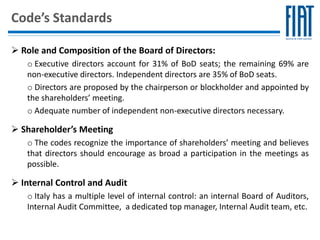
Code’s Standards

 Role and Composition of the Board of Directors:
   o Executive directors account for 31% of BoD seats; the remaining 69% are
   non-executive directors. Independent directors are 35% of BoD seats.
   o Directors are proposed by the chairperson or blockholder and appointed by
   the shareholders’ meeting.
   o Adequate number of independent non-executive directors necessary.

 Shareholder’s Meeting
   o The codes recognize the importance of shareholders’ meeting and believes
   that directors should encourage as broad a participation in the meetings as
   possible.

 Internal Control and Audit
   o Italy has a multiple level of internal control: an internal Board of Auditors,
   Internal Audit Committee, a dedicated top manager, Internal Audit team, etc.
Thank You!
o Lucas Antonio:         lucasabrantes@gmail.com

o Can Erkirtay:          can2e3@hotmail.com

o Kian Ansari:           kianansari@yahoo.com

o Francesca Pedicini:    francesca.pedicini@gmail.com

FIAT S.p.A. - Corporate Governance Structure

  • 1.
    MSc International BusinessProgram Corporate Governance Module - Dr. György Gonda Corporate Governance Assessment o Lucas Antonio o Can Erkirtay o Kian Ansari o Francesca Pedicini Budapest, April - 2012
  • 2.
    Agenda Company Overview Board ofDirectors and Management Committees Codes, Reports and Italy CG
  • 3.
    History and ImportantFacts – 1899 / 1970 1899: the deed of incorporation is signed giving birth to Società Anonima Fabbrica Italiana di Automobili Torino – F.I.A.T. The first car built is the 4 HP. 1902: Giovanni Agnelli becomes Managing Director. 1903: the company is listed on the stock exchange. 1920: Giovanni Agnelli becomes Chairman of Fiat. 1945: Senator Agnelli dies and Vittorio Valletta becomes chairman - Large scale production of cars resumes. 1966: Giovanni Agnelli, grandson of the founder, becomes Chairman. 1967: Vittorio Valletta dies. Production begins at the Rivalta plant. Fiat takes a majority stake in Magneti Marelli. 1969: the company acquires Lancia and purchases 50% of Ferrari.
  • 4.
    History and ImportantFacts – 1970 / 2011 1971: Abarth becomes part of the Group. 1984: Alfa Romeo becomes part of the Group. 1993: Maserati becomes part of the Group. 2003: Giovanni Agnelli dies and his brother Umberto takes over as Chairman. 2004: Luca Cordero di Montezemolo as Chairman, John Elkann as Vice Chairman and Sergio Marchionne as Chief Executive Officer. 2009: on June 10th, Fiat Group and Chrysler Group LLC announce that they have signed a global strategic alliance. 2010: John Elkann becomes Chairman of Fiat. 2011: the demerger takes effect on January 1st. Under the new structure, Fiat consists of FGA, Ferrari, Maserati, Magneti Marelli, Teksid, Comau and Fiat Powertrain Technologies.
  • 5.
    Ownership Structure 100% 90% 100% 58.5% 100% 100% 84.8% 100%
  • 6.
    Shareholder Structure Shareholder Ownership Giovanni Agnelli & C. S.a.p.A 30.47% BlackRock Inc. 3.10% Institutional investors within the euro zone 26.70% Institutional investors outside the euro zone 11.63% Other investors 24.90% Fiat S.p.A. 3.20%
  • 7.
    Revenues by Market FORD Competition is mainly Main Competitors related to French the Manufacturers CATEGORY
  • 8.
    FIAT at aGlance FIAT FIAT FIAT (€ million) with Chrysler excluding 2010 Chrysler (2011) Chrysler REVENUES 59,559 23,609 37,382 35,880 TRADING PROFIT 2,392 1,345 1,047 1,112 NET PROFIT 1,651 645 1,006 222 NET INDUSTRIAL DEBT 5,529 3,080 2,449 542 AVAILABLE LIQUIDITY 20,680 8,425 12,255 12,152
  • 9.
    FIAT Shares  Totalissued shares: 1,275,885,720; o Ordinary, Preference and Savings.  Price per Share: EUR 3.50 – Nov/2011 Assembly;  Fiat has approximately 250,000 shareholders;  Italy, Paris and Frankfurt stock exchanges, also tradable over the counter in the USA (ADR) - Deutsche Bank Trust Company Americas;  25% of Net Profit to be distributed as Dividends pay out – 20/04/2012; Today’s Price = EUR 4.092
  • 10.
    Corporate Governance Structure Shareholder’s Assembly Board of Statutory Auditors Board of Directors Nominating, CG and Sustainability Committee Compensation Committee Internal Control Committee Group Executive Council (GEC)
  • 11.
    Board of Directors Total of 16 Members. Chairman CEO John Elkann Sergio Marchionne 5 Executive 8 Independent 1 Secretary Directors Members
  • 12.
    Board of StatutoryAuditors  Total of 6 Members. Chairman Riccardo Perotta Regular Auditor Alternate Auditor Giuseppe Camosci Lucio Pasquini Regular Auditor Alternate Auditor Piero Locatelli Fabrizio Mosca Alternate Auditor Stefano Orlando
  • 13.
    Group Executive Council(GEC)  Total of 25 Members. CEO Brand Leaders Chief Operating Officers Support Processes Leaders Industrial Processes Leaders NAFTA FIAT CTO CFO Europe, Middle Commercial CMO CHRO East and Africa Vehicles Alfa, Abarth Services and LatAm Design and Maserati Holding Lancia and Business APAC Purchasing Chrysler Development Components Jeep Quality Systems and Powertrain Dodge Casting Coordinator Parts and Product Services Manager
  • 14.
    Committees 3 Members Nominating, CG and Sustainability All advisory members within the Company 3 Members Compensation All advisory members within the Company 3 Members Internal Control All Independent
  • 15.
    Nominating, CG andSustainability  To select and propose nominees to the BoD, indicating their names and the necessary qualifications;  To formulate opinions regarding the size and composition of the Board;  To evaluate BoD and Committees activities;  To examine proposals from CEO regarding appointment and succession plans for members of the GEC and executives with strategic responsibilities;  To periodically update the Board of Directors on new corporate governance regulations and recommend changes, if any;  To evaluate proposals relating to sustainability related issues, presenting opinions and reviewing the annual Sustainability Report.
  • 16.
    Compensation  To makeproposals to the BoD related to individual compensation plans for the Chairman, CEO and Directors;  To examine proposals from CEO regarding compensation and performance evaluation for members of the Group Executive Council and executives with strategic responsibilities;  To examine proposals from CEO concerning performance evaluation criteria and general policies for fixed and variable compensation.
  • 17.
    Internal Control  Assistthe Board of Directors with internal control systems;  Assess the work plan prepared by the Compliance Officer;  Report to the BoD the adequacy of the internal control system;  Assess the adequacy of accounting principles adopted in relation to preparation of the consolidated financial statements;  Assess proposals presented by candidates for the position of independent auditor;  Assess the audit work plan and the results included in the audit report;  Assess the organizational placement, structure and work plan of Internal Audit.
  • 18.
    Italian Corporate Governance SOMEFACTS:  Italian family capitalism: more than 90% of the Italian registered companies are family-owned;  Italian C.G. is classified as: relationship-based corporate system which adopts the Latin Approach.  The Italian system is a little influenced by institutional investors (such as in the Anglo-American system) or by banks (such as in Germany and in Japan).  Limited degree of separation between ownership and control. Control is achieved mainly by using pyramidal groups.  Weak managers, strong blockholders and unprotected minority shareholders.
  • 19.
    Italian Governance Models MODELS OF C.G. COMPANY ORGANS APPOINTED MECHANISM TRADITIONAL • Shareholders meeting • The assembly appoints the (or DUALISTIC • Board of Directors BoD and the BoA. HORIZONTAL) • Board of Auditors • The assembly appoints the • Shareholders meetings DUALISTIC VERTICAL Supervisory Committee which • Supervisory committee (TWO-TIER SYSTEM) appoints the Management • Management committee Committee • The assembly appoints the • Shareholders meeting MONISTIC BoD which apoints its • BoD (ONE-TIER SYSTEM) committee among its • Internal committees members.
  • 20.
    Codes and Principles Italian corporate governance practices are principally governed by the Italian Corporate Governance Code (Codice di Autodisciplina, revised in 2011);  In the wake of other corporate governance codes inspired by the Cadbury in 1992, Italy launched 2 codes: o The Draghi Reform (1998): “Audit committees”. Objective: to strenght investors’s protection and minority shareholders. o The Preda Code (2002): “Freedom with accountability”. Main Focus: issues relating to the board of directors.
  • 21.
    Code’s Standards  Roleand Composition of the Board of Directors: o Executive directors account for 31% of BoD seats; the remaining 69% are non-executive directors. Independent directors are 35% of BoD seats. o Directors are proposed by the chairperson or blockholder and appointed by the shareholders’ meeting. o Adequate number of independent non-executive directors necessary.  Shareholder’s Meeting o The codes recognize the importance of shareholders’ meeting and believes that directors should encourage as broad a participation in the meetings as possible.  Internal Control and Audit o Italy has a multiple level of internal control: an internal Board of Auditors, Internal Audit Committee, a dedicated top manager, Internal Audit team, etc.
  • 22.
    Thank You! o LucasAntonio: lucasabrantes@gmail.com o Can Erkirtay: can2e3@hotmail.com o Kian Ansari: kianansari@yahoo.com o Francesca Pedicini: francesca.pedicini@gmail.com