KABIHASNANG MYCENAEAN
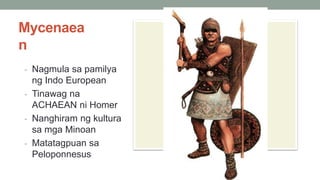
Mycenaea
n
- Nagmula sa pamilya
ng Indo European
- Tinawag na
ACHAEAN ni Homer
- Nanghiram ng kultura
sa mga Minoan
- Matatagpuan sa
Peloponnesus
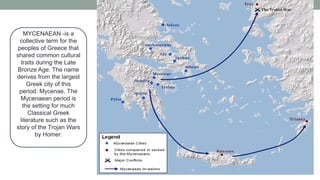
MYCENAEAN -is a
collective term for the
peoples of Greece that
shared common cultural
traits during the Late
Bronze Age. The name
derives from the largest
Greek city of this
period: Mycenae. The
Mycenaean period is
the setting for much
Classical Greek
literature such as the
story of the Trojan Wars
by Homer.
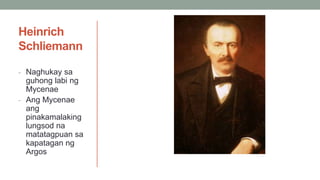
Heinrich
Schliemann
- Naghukay sa
guhong labi ng
Mycenae
- Ang Mycenae
ang
pinakamalaking
lungsod na
matatagpuan sa
kapatagan ng
Argos
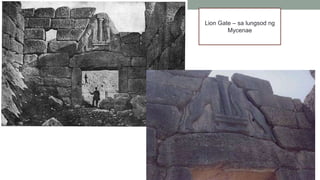
Lion Gate – sa lungsod ng
Mycenae
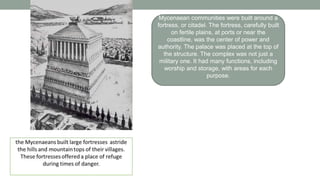
Mycenaean communities were built around a
fortress, or citadel. The fortress, carefully built
on fertile plains, at ports or near the
coastline, was the center of power and
authority. The palace was placed at the top of
the structure. The complex was not just a
military one. It had many functions, including
worship and storage, with areas for each
purpose.
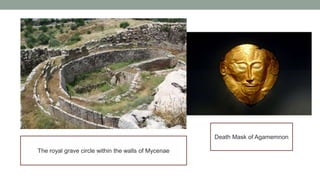
The royal grave circle within the walls of Mycenae
Death Mask of Agamemnon
Kabihasnang Mycenaean
Pulitika
• Upper class Mycenaeans lived in
the fortress. At the top was the
King, or “Wamax." He was in
charge of both political and religious
issues. Below him was a chain of
command that covered everything
from the military to collecting taxes
and organizing trade. The
governmental structure was strong
and effective.
Lipunan
• Upper Class - King
• Chain of command
• Farmers - Not all Mycenaean
people lived in the fortresses. Most
of them (the lower class) lived
nearby. Taking care of crops and
animals, they were like farmers and
ranchers of today, and were
considered self-employed.
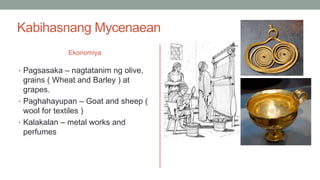
Kabihasnang Mycenaean
Ekonomiya
• Pagsasaka – nagtatanim ng olive,
grains ( Wheat and Barley ) at
grapes.
• Paghahayupan – Goat and sheep (
wool for textiles )
• Kalakalan – metal works and
perfumes
Kabihasnang Mycenaean
Religion
• They worshipped many gods, but only a few
names of their many gods have appeared in
tablets uncovered in archeological digs.
Almost no temples or central places of
worship have been discovered.
• They believed that the gods and mankind
had a partnership with one another and that
both existed to serve one another. They
believed that their gods were human in form
and that they exhibited human emotions,
including jealously, love and hatred. Their
gods married, had families, and even
committed murder.
• Each Greek city-state selected a patron
god as their protector. This god was
worshiped (in an effort to please them) so
that their good favor would fall upon the
people of that region. Every Greek citizen
also worshipped the chief god, Zeus.
• The Greeks believed that the twelve most
important and most powerful gods lived on
top of a mountain in northern Greece
known as Mount Olympus. From this holy
mountain, the people believed that the
gods ruled and controlled all aspects of the
natural world as well as all aspects of the
lives of individual people.
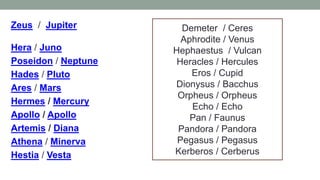
Zeus / Jupiter
Hera / Juno
Poseidon / Neptune
Hades / Pluto
Ares / Mars
Hermes / Mercury
Apollo / Apollo
Artemis / Diana
Athena / Minerva
Hestia / Vesta
Demeter / Ceres
Aphrodite / Venus
Hephaestus / Vulcan
Heracles / Hercules
Eros / Cupid
Dionysus / Bacchus
Orpheus / Orpheus
Echo / Echo
Pan / Faunus
Pandora / Pandora
Pegasus / Pegasus
Kerberos / Cerberus
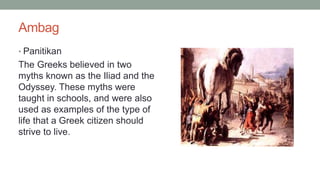
Ambag
• Panitikan
The Greeks believed in two
myths known as the Iliad and the
Odyssey. These myths were
taught in schools, and were also
used as examples of the type of
life that a Greek citizen should
strive to live.
Mycenaean

Mycenaean

  • 1.
  • 2.
    Mycenaea n - Nagmula sapamilya ng Indo European - Tinawag na ACHAEAN ni Homer - Nanghiram ng kultura sa mga Minoan - Matatagpuan sa Peloponnesus
  • 3.
    MYCENAEAN -is a collectiveterm for the peoples of Greece that shared common cultural traits during the Late Bronze Age. The name derives from the largest Greek city of this period: Mycenae. The Mycenaean period is the setting for much Classical Greek literature such as the story of the Trojan Wars by Homer.
  • 4.
    Heinrich Schliemann - Naghukay sa guhonglabi ng Mycenae - Ang Mycenae ang pinakamalaking lungsod na matatagpuan sa kapatagan ng Argos
  • 5.
    Lion Gate –sa lungsod ng Mycenae
  • 6.
    Mycenaean communities werebuilt around a fortress, or citadel. The fortress, carefully built on fertile plains, at ports or near the coastline, was the center of power and authority. The palace was placed at the top of the structure. The complex was not just a military one. It had many functions, including worship and storage, with areas for each purpose.
  • 7.
    The royal gravecircle within the walls of Mycenae Death Mask of Agamemnon
  • 8.
    Kabihasnang Mycenaean Pulitika • Upperclass Mycenaeans lived in the fortress. At the top was the King, or “Wamax." He was in charge of both political and religious issues. Below him was a chain of command that covered everything from the military to collecting taxes and organizing trade. The governmental structure was strong and effective. Lipunan • Upper Class - King • Chain of command • Farmers - Not all Mycenaean people lived in the fortresses. Most of them (the lower class) lived nearby. Taking care of crops and animals, they were like farmers and ranchers of today, and were considered self-employed.
  • 9.
    Kabihasnang Mycenaean Ekonomiya • Pagsasaka– nagtatanim ng olive, grains ( Wheat and Barley ) at grapes. • Paghahayupan – Goat and sheep ( wool for textiles ) • Kalakalan – metal works and perfumes
  • 10.
    Kabihasnang Mycenaean Religion • Theyworshipped many gods, but only a few names of their many gods have appeared in tablets uncovered in archeological digs. Almost no temples or central places of worship have been discovered. • They believed that the gods and mankind had a partnership with one another and that both existed to serve one another. They believed that their gods were human in form and that they exhibited human emotions, including jealously, love and hatred. Their gods married, had families, and even committed murder. • Each Greek city-state selected a patron god as their protector. This god was worshiped (in an effort to please them) so that their good favor would fall upon the people of that region. Every Greek citizen also worshipped the chief god, Zeus. • The Greeks believed that the twelve most important and most powerful gods lived on top of a mountain in northern Greece known as Mount Olympus. From this holy mountain, the people believed that the gods ruled and controlled all aspects of the natural world as well as all aspects of the lives of individual people.
  • 11.
    Zeus / Jupiter Hera/ Juno Poseidon / Neptune Hades / Pluto Ares / Mars Hermes / Mercury Apollo / Apollo Artemis / Diana Athena / Minerva Hestia / Vesta Demeter / Ceres Aphrodite / Venus Hephaestus / Vulcan Heracles / Hercules Eros / Cupid Dionysus / Bacchus Orpheus / Orpheus Echo / Echo Pan / Faunus Pandora / Pandora Pegasus / Pegasus Kerberos / Cerberus
  • 12.
    Ambag • Panitikan The Greeksbelieved in two myths known as the Iliad and the Odyssey. These myths were taught in schools, and were also used as examples of the type of life that a Greek citizen should strive to live.