CHARACTERISTICS OF
QUADRATIC EQUATIONS
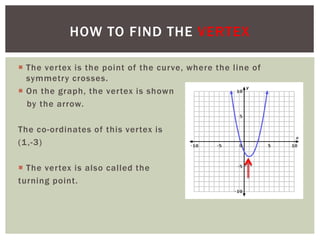
 The vertex is the point of the curve, where the line of
symmetry crosses.
 On the graph, the vertex is shown
by the arrow.
The co-ordinates of this vertex is
(1,-3)
 The vertex is also called the
turning point.
HOW TO FIND THE VERTEX
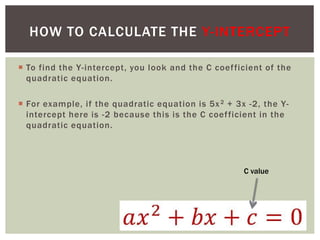
 To find the Y-intercept, you look and the C coefficient of the
quadratic equation.
 For example, if the quadratic equation is 5x2 + 3x -2, the Y-
intercept here is -2 because this is the C coefficient in the
quadratic equation.
HOW TO CALCULATE THE Y-INTERCEPT
C value
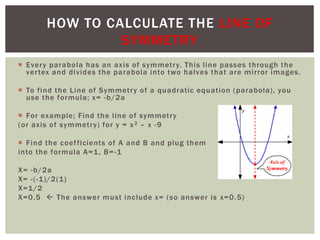
 Every parabola has an axis of symmetry. This line passes through the
vertex and divides the parabola into two halves that are mirror images.
 To find the Line of Symmetry of a quadratic equation (parabola), you
use the formula; x= -b/2a
 For example; Find the line of symmetry
(or axis of symmetry) for y = x2 – x -9
 Find the coefficients of A and B and plug them
into the formula A=1, B=-1
X= -b/2a
X= -(-1)/2(1)
X=1/2
X=0.5  The answer must include x= (so answer is x=0.5)
HOW TO CALCULATE THE LINE OF
SYMMETRY
 Question: Find the minimum value of y= x2 +6x +10
 To find the minimum value, first identify the A and B
coefficients. (A=1, B=6).
 Use the equation X=-b/2a and plug in the coefficients of A and B.
X=-(6)/2(1)
X=-6/2
X=-3
 Then plug the answer (the X value) into the original parabola to
find the minimum value.
X2 + 6x + 10
(-3)2 + 6(-3) + 10
9-18+10=1
HOW TO CALCULATE THE MINIMUM VALUE
 Question: Find the vertex (turning point) of y= 3x2 + 12x – 12
 First identify the coefficients of A and B (A=3, B=12) and plug
them into this equation; x=-b/2a
X=-(12)/2(3)
X=-12/6
X=-2  so this is the x-coordinate of the vertex
 Then plug that value of X into the original parabola:
3(-2)2 + 12(-2) – 12
12 – 24 – 12 = -24  this is the y-coordinate of the vertex
 So the vertex (turning point of this parabola is (-2,-24)
HOW TO CALCULATE THE VERTEX (TURNING
POINT)

Quadratic equations (Minimum value, turning point)

  • 1.
  • 2.
     The vertexis the point of the curve, where the line of symmetry crosses.  On the graph, the vertex is shown by the arrow. The co-ordinates of this vertex is (1,-3)  The vertex is also called the turning point. HOW TO FIND THE VERTEX
  • 3.
     To findthe Y-intercept, you look and the C coefficient of the quadratic equation.  For example, if the quadratic equation is 5x2 + 3x -2, the Y- intercept here is -2 because this is the C coefficient in the quadratic equation. HOW TO CALCULATE THE Y-INTERCEPT C value
  • 4.
     Every parabolahas an axis of symmetry. This line passes through the vertex and divides the parabola into two halves that are mirror images.  To find the Line of Symmetry of a quadratic equation (parabola), you use the formula; x= -b/2a  For example; Find the line of symmetry (or axis of symmetry) for y = x2 – x -9  Find the coefficients of A and B and plug them into the formula A=1, B=-1 X= -b/2a X= -(-1)/2(1) X=1/2 X=0.5  The answer must include x= (so answer is x=0.5) HOW TO CALCULATE THE LINE OF SYMMETRY
  • 5.
     Question: Findthe minimum value of y= x2 +6x +10  To find the minimum value, first identify the A and B coefficients. (A=1, B=6).  Use the equation X=-b/2a and plug in the coefficients of A and B. X=-(6)/2(1) X=-6/2 X=-3  Then plug the answer (the X value) into the original parabola to find the minimum value. X2 + 6x + 10 (-3)2 + 6(-3) + 10 9-18+10=1 HOW TO CALCULATE THE MINIMUM VALUE
  • 6.
     Question: Findthe vertex (turning point) of y= 3x2 + 12x – 12  First identify the coefficients of A and B (A=3, B=12) and plug them into this equation; x=-b/2a X=-(12)/2(3) X=-12/6 X=-2  so this is the x-coordinate of the vertex  Then plug that value of X into the original parabola: 3(-2)2 + 12(-2) – 12 12 – 24 – 12 = -24  this is the y-coordinate of the vertex  So the vertex (turning point of this parabola is (-2,-24) HOW TO CALCULATE THE VERTEX (TURNING POINT)