Universal Design for
Learning
By Willy Golden
Principles and Practice
• There is no “average” student.
• Students who struggle, are
  ESL or ELL, and students with
  disabilities are marginalized by an “average student” curriculum.
  Gifted and talented are underserved too.
• UDL designs a curriculum which can enable all students to become
  expert learners.
• There are three broad principles under UDL:
 •   Providing Multiple Means of Representation.
 •   Providing Multiple Means of Action and Expression.
 •   Providing Multiple Means of Engagement.
Principles and Practices
• Providing Multiple Means of Representation.
  • There’s no one way to present information for everyone to
    learn it successfully, so teachers must present content of each lesson in
    various ways.
  • This ensures each learner is able to understand the table, language, symbols,
    ect.
• Providing Multiple Means of Action and Expression.
  • Students differ widely in how they can express or show what their
    skills, what they know or what they have learned.
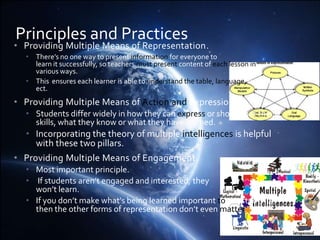
  • Incorporating the theory of multiple intelligences is helpful
    with these two pillars.
• Providing Multiple Means of Engagement.
  • Most important principle.
  • If students aren’t engaged and interested, they
    won’t learn.
  • If you don’t make what’s being learned important to the students,
    then the other forms of representation don’t even matter.
Guidelines of UDL Principles
I.
• Provide options for perception.
• Provide options for language and symbols.
• Provide options for comprehension.
II.
• Provide options for physical actions.
• Provide options for expression skills and fluency.
• Provide options for executive functions.
Guidelines Continued…
III.

• Provide options for recruiting interest.
• Provide options for sustaining effort and persistence.
• Provide options for self-regulation.
Implementing UDL
• Teachers must use the UDL framework when designing lessons.
• S/He must anticipate what will be a barrier for certain students
   and utilize the available materials to help them over come
        those barriers.


• Team teaching is key. Team teachers and the principal must participate
  and assist in implementing the
  Universal Design for Learning.

Universal Design for Learning

  • 1.
  • 2.
    Principles and Practice •There is no “average” student. • Students who struggle, are ESL or ELL, and students with disabilities are marginalized by an “average student” curriculum. Gifted and talented are underserved too. • UDL designs a curriculum which can enable all students to become expert learners. • There are three broad principles under UDL: • Providing Multiple Means of Representation. • Providing Multiple Means of Action and Expression. • Providing Multiple Means of Engagement.
  • 3.
    Principles and Practices •Providing Multiple Means of Representation. • There’s no one way to present information for everyone to learn it successfully, so teachers must present content of each lesson in various ways. • This ensures each learner is able to understand the table, language, symbols, ect. • Providing Multiple Means of Action and Expression. • Students differ widely in how they can express or show what their skills, what they know or what they have learned. • Incorporating the theory of multiple intelligences is helpful with these two pillars. • Providing Multiple Means of Engagement. • Most important principle. • If students aren’t engaged and interested, they won’t learn. • If you don’t make what’s being learned important to the students, then the other forms of representation don’t even matter.
  • 4.
    Guidelines of UDLPrinciples I. • Provide options for perception. • Provide options for language and symbols. • Provide options for comprehension. II. • Provide options for physical actions. • Provide options for expression skills and fluency. • Provide options for executive functions.
  • 5.
    Guidelines Continued… III. • Provideoptions for recruiting interest. • Provide options for sustaining effort and persistence. • Provide options for self-regulation.
  • 6.
    Implementing UDL • Teachersmust use the UDL framework when designing lessons. • S/He must anticipate what will be a barrier for certain students and utilize the available materials to help them over come those barriers. • Team teaching is key. Team teachers and the principal must participate and assist in implementing the Universal Design for Learning.