
Science, Technology and
Innovation for development
Presentation at the Arab Forum for
Scientific Research and Sustainable
Development
Tunis
20-22 December 2013
Mongi Hamdi
Head, Science, Technology and ICT at UNCTAD and
Head of the Secretariat of the United Nations Commission
on Science and Technology for Development
Why should Arab countries care about
science, technology and innovation (STI)?
• STI cut across all sectors of the economy and offer
opportunities for economic and social gains;
• Much of the global differences in economic and social
well-being can be traced to differences in levels and
spread of STI;
• In fact, technology has become the dividing line
between development and underdevelopment.
2
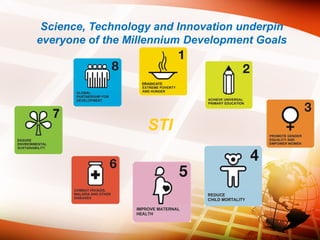
STI
Science, Technology and Innovation underpin
everyone of the Millennium Development Goals
1950s 1960s 1970s 1980s 1990s 2000s
Credit card
Superglue
Power
steering
Barcode
Hydrogen
bomb
Flight
recorder
Transistor
radio
Birth
control pill
Nonstick
pan
Polio
Vaccine
Modem
Laser
Internal
pacemaker
Halogen
lamp
Valium
Non dairy
creamer
Audio
cassette
Smoke
detector
Silicone
breast
implant
Soft
contact
lenses
Compact
disk
Computer
mouse
ATM
Electronic
fuel
injection
for cars
Floppy
disk
Food
processor
Microproc
essor
VCR
Air bags
Word
processor
Gene
splicing
Disposabl
e lighter
Liposuctio
n
Laser
printer
MRI
Artificial
heart
Cellular
phone
Email
Walkman
Hepatitis B
vaccine
MS DOS
First IBM
PC
Human
growth
hormone
genetically
engineere
d
CD ROM
Apple
Macintosh
Windows
program
Disposabl
e camera
3D video
game
Digital
cellular
phones
Morning
after pill
Prozac
High
Definition
TV
World
Wide
Web/Intern
et protocol
(HTTP)
Digital
answering
machine
Small pill
Pentium
processor
HIV
protease
inhibitor
Java
computer
language
DVD
Web TV
Gas
powered
fuel cell
Viagra
Cloning of
mammals
MP3 player
Personal
video
recorder
Wireless
LAN
Birth
control
patch
Braille
globe
iTunes
Music
Store
Camera
phone
Hybrid car
Nasal mist
flu shot
LED light
Human
genome
gene chip
Micro fuel
cell
Artificial
liver
Fuel cell
bike
Infrared
fever
screening
system
Digital
satellite
radio
Blackberry
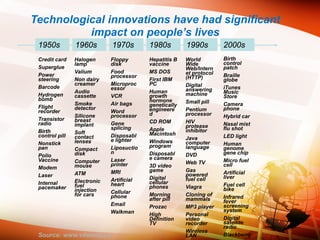
Technological innovations have had significant
impact on people’s lives
Source: www.vifamily.ca
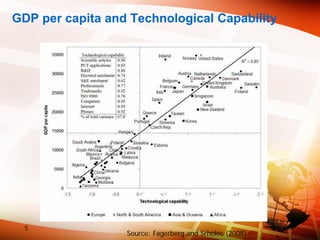
GDP per capita and Technological Capability
Source: Fagerberg and Srholec (2008)
5
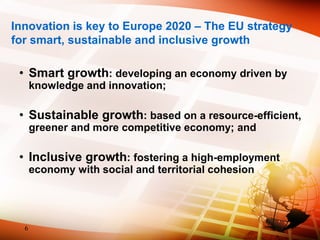
Innovation is key to Europe 2020 – The EU strategy
for smart, sustainable and inclusive growth
• Smart growth: developing an economy driven by
knowledge and innovation;
• Sustainable growth: based on a resource-efficient,
greener and more competitive economy; and
• Inclusive growth: fostering a high-employment
economy with social and territorial cohesion
6
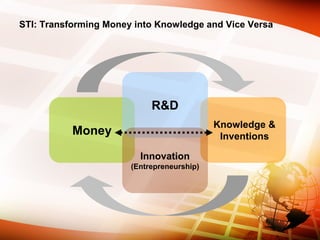
The importance of R&D and Innovation
“Where R&D focuses on transforming
money into knowledge,
innovation is about transforming
knowledge into money.”
Esko Aho, Former Prime Minister of Finland
STI: Transforming Money into Knowledge and Vice Versa
Knowledge &
InventionsMoney
R&D
Innovation
(Entrepreneurship)
Source: Tahseen Consulting
http://fr.slideshare.net/TahseenConsulting/arab-world-research-and-rd-situation-analysis-and-options?utm_source=slideshow02&utm_medium=ssemail&utm_campaign=share_slideshow
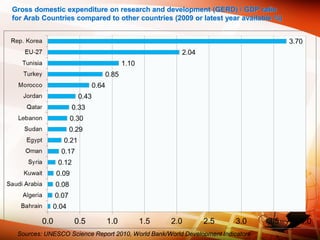
Gross domestic expenditure on research and development (GERD) / GDP ratio
for Arab Countries compared to other countries (2009 or latest year available %)
Sources: UNESCO Science Report 2010, World Bank/World Development Indicators
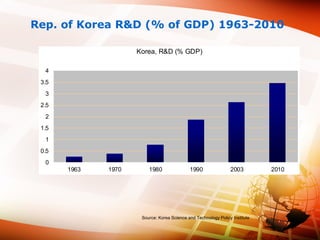
Rep. of Korea R&D (% of GDP) 1963-2010
Source: Korea Science and Technology Policy Institute
0
0.5
1
1.5
2
2.5
3
3.5
4
1963 1970 1980 1990 2003 2010
Korea, R&D (% GDP)
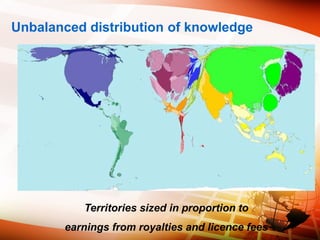
Unbalanced distribution of knowledge
Territories sized in proportion to
earnings from royalties and licence fees
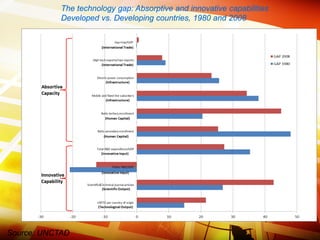
The technology gap: Absorptive and innovative capabilities
Developed vs. Developing countries, 1980 and 2008
Source: UNCTAD
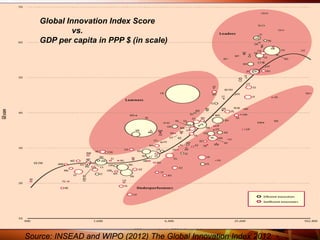
Global Innovation Index Score
vs.
GDP per capita in PPP $ (in scale)
Source: INSEAD and WIPO (2012) The Global Innovation Index 2012
Building STI Capacity
What types and levels of STI capacity are
needed for technology absorption and STI-led
development in Arab countries?
Should Arab countries focus on building capacity
to generate new knowledge or focus on existing
knowledge and adapt it to their needs?
Building appropriate STI capacity
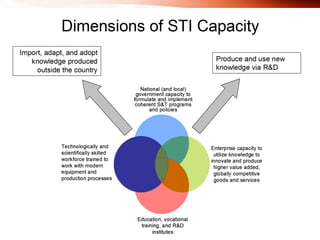
STI capacity building involves building two kinds of
capacity:
1. The capacity to acquire and use existing knowledge
2. The capacity to produce and use new knowledge
It also needs building capacity at four levels:
1. The level of education and training
2. The level of labor force skills
3. The level of acquisition and innovation
4. The level of government policy making
17
STIP Reviews: Objectives
• The purpose of the STIP Review is to help the Government
ensure that its STI programmes become an instrument for
supporting relevant components of the national
development agenda, helping local industry compete,
generating better paying jobs, increasing standards of living,
reducing poverty, and promoting the Government’s growth
and export diversification strategy
• Other objectives of STIP reviews:
– Improve linkages between SMEs, large firms, science and
technology institutions, and business associations
– Identify measures to encourage transfer of technology
STIP Reviews: Process
• STIP Process:
– At the request of interested Governments
– Full involvement of national counterpart (Usually the Ministry of S&T)
– Team of UNCTAD staff and international experts conducts field
mission and prepares an evaluation report
– Internal review process and feedback from country counterparts
– Report and recommendations discussed at multistakeholder national
workshop
– Final report of the STIP Review including the outcome of the national
workshop presented to the UN Commission on Science and
Technology for Development and in other appropriate forums
– Implementation of recommendations
STIP Reviews common findings for most
developing countries:
– Lack of key capacities (to identify, acquire, use, adapt, diffuse) at all
levels (State, industry firm, individuals)
– Lack of critical mass: human capital, infrastructure, policy-making
– general lack of technical training facilities
– Lack of resources at the disposal of S&T institutions
– Weak NSI, with lack of linkages within the economy and with
technology markets
– Weak linkages between SMEs, larger firms and S&T institutions
– Lack of focus of STI agendas on national development needs
– Lack of STI awareness and political leadership
– Brain drain
Common findings for a large number of developing countries
• The absence of a S&T governance mechanism at the
government level;
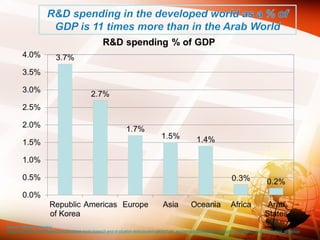
• Low expenditure on R&D as a percentage of GDP;
• Lack of coordiantion between and among S&T institutions;
• Lack of co-operation between scientific organizations and
productive sectors;
• Low technology component, leading to few manufactured
exports and a limited number of high-tech exports;
• Poor capacity to innovate;
• Lack of databases providing information on S&T;
General Reforms
• Reform of education and vocational education systems
• Improved collaboration between industry, Govt., R&D, education system
and consumer (e.g, through an appropriate national innovation system)
• Encourage widespread and comprehensive innovation at all levels, from
grassroots to SMEs and to large firms as an enabler of economic growth
and competitiveness
Reforms relating to financing
• Science and Technology Fund, especially for SMEs
• Evolve funding mechanisms such as various forms of loans and equity,
for such technology-intensive acquisition
• Strategic positioning of the Arab world as a technology creator and
knowledge-based economy will depend not just on development of
indigenous technological expertise, but also on the ability to identify,
acquire, adapt and master imported technologies
Reforms related to legislation
• Provide incentives for R&D by enacting legislation for inventions arising out of
government-funded research in order to encourage industry-government-
academia interaction and enable commercialization of research findings;
• Give universities and research institutions ownership and patent rights over
inventions arising out of government-funded research;
• Create a conducive environment for universities and research institutions to
commercialize their inventions through licensing arrangements where inventors
would also be allowed to receive a share of the royalty
Reforms related education
• Create insentives for young students to go to vocational training
• Encourage science education at primary and secondary level. Science
education for young kids can be exciting and motivating, and is an
effective way to build essential skills-- in communication, social
interaction, and continued learning
• Create better linkages in higher education with industry to deliver
necessary skill sets and meet industry needs and requirements (e.g.,
both in quantity and type of skills)
• To fully realize the demographic dividend, make education more flexible,
contemporary, relevant, inclusive and creative
• Emphasize more on quality and excellence and less on quantity of
graduates
• Increase public spending and diversify sources of funding
Closing thoughts
• The challenges of the new paradigm of economic development are not
going to be addressed properly until we better integrate STI into basic
economic development strategies.
• There is need for vision; strategy; and commitment at the highest level.
• Political support at the highest level (e.g. Supreme Council or national
commissions on STI)
. To build appropriate STI: (1) to acquire and use existing knowledge; and (2) to
produce and use new knowledge
. STI funds to support infrastructure development (ICTs, transport) and R&D
. STI hubs and technoparks to build STI capacity to identify, acquire, absorb,
adapt and use technology (i.e., technology transfer).
. Incentives for linkages among research institutes, universities, the private
sector and government (i.e., NIS).
mongi.hamdi@unctad.org

Tunisian Minister of Foreign Affairs and Former Head of the UN Commission on Science and Technology for Development Cites Tahseen Consulting’s Research on Innovation Systems in the Arab World

  • 1.
    Science, Technology and Innovationfor development Presentation at the Arab Forum for Scientific Research and Sustainable Development Tunis 20-22 December 2013 Mongi Hamdi Head, Science, Technology and ICT at UNCTAD and Head of the Secretariat of the United Nations Commission on Science and Technology for Development
  • 2.
    Why should Arabcountries care about science, technology and innovation (STI)? • STI cut across all sectors of the economy and offer opportunities for economic and social gains; • Much of the global differences in economic and social well-being can be traced to differences in levels and spread of STI; • In fact, technology has become the dividing line between development and underdevelopment. 2
  • 3.
    STI Science, Technology andInnovation underpin everyone of the Millennium Development Goals
  • 4.
    1950s 1960s 1970s1980s 1990s 2000s Credit card Superglue Power steering Barcode Hydrogen bomb Flight recorder Transistor radio Birth control pill Nonstick pan Polio Vaccine Modem Laser Internal pacemaker Halogen lamp Valium Non dairy creamer Audio cassette Smoke detector Silicone breast implant Soft contact lenses Compact disk Computer mouse ATM Electronic fuel injection for cars Floppy disk Food processor Microproc essor VCR Air bags Word processor Gene splicing Disposabl e lighter Liposuctio n Laser printer MRI Artificial heart Cellular phone Email Walkman Hepatitis B vaccine MS DOS First IBM PC Human growth hormone genetically engineere d CD ROM Apple Macintosh Windows program Disposabl e camera 3D video game Digital cellular phones Morning after pill Prozac High Definition TV World Wide Web/Intern et protocol (HTTP) Digital answering machine Small pill Pentium processor HIV protease inhibitor Java computer language DVD Web TV Gas powered fuel cell Viagra Cloning of mammals MP3 player Personal video recorder Wireless LAN Birth control patch Braille globe iTunes Music Store Camera phone Hybrid car Nasal mist flu shot LED light Human genome gene chip Micro fuel cell Artificial liver Fuel cell bike Infrared fever screening system Digital satellite radio Blackberry Technological innovations have had significant impact on people’s lives Source: www.vifamily.ca
  • 5.
    GDP per capitaand Technological Capability Source: Fagerberg and Srholec (2008) 5
  • 6.
    Innovation is keyto Europe 2020 – The EU strategy for smart, sustainable and inclusive growth • Smart growth: developing an economy driven by knowledge and innovation; • Sustainable growth: based on a resource-efficient, greener and more competitive economy; and • Inclusive growth: fostering a high-employment economy with social and territorial cohesion 6
  • 7.
    The importance ofR&D and Innovation “Where R&D focuses on transforming money into knowledge, innovation is about transforming knowledge into money.” Esko Aho, Former Prime Minister of Finland
  • 8.
    STI: Transforming Moneyinto Knowledge and Vice Versa Knowledge & InventionsMoney R&D Innovation (Entrepreneurship)
  • 9.
  • 10.
    Gross domestic expenditureon research and development (GERD) / GDP ratio for Arab Countries compared to other countries (2009 or latest year available %) Sources: UNESCO Science Report 2010, World Bank/World Development Indicators
  • 11.
    Rep. of KoreaR&D (% of GDP) 1963-2010 Source: Korea Science and Technology Policy Institute 0 0.5 1 1.5 2 2.5 3 3.5 4 1963 1970 1980 1990 2003 2010 Korea, R&D (% GDP)
  • 12.
    Unbalanced distribution ofknowledge Territories sized in proportion to earnings from royalties and licence fees
  • 13.
    The technology gap:Absorptive and innovative capabilities Developed vs. Developing countries, 1980 and 2008 Source: UNCTAD
  • 14.
    Global Innovation IndexScore vs. GDP per capita in PPP $ (in scale) Source: INSEAD and WIPO (2012) The Global Innovation Index 2012
  • 15.
    Building STI Capacity Whattypes and levels of STI capacity are needed for technology absorption and STI-led development in Arab countries? Should Arab countries focus on building capacity to generate new knowledge or focus on existing knowledge and adapt it to their needs?
  • 16.
    Building appropriate STIcapacity STI capacity building involves building two kinds of capacity: 1. The capacity to acquire and use existing knowledge 2. The capacity to produce and use new knowledge It also needs building capacity at four levels: 1. The level of education and training 2. The level of labor force skills 3. The level of acquisition and innovation 4. The level of government policy making
  • 17.
  • 18.
    STIP Reviews: Objectives •The purpose of the STIP Review is to help the Government ensure that its STI programmes become an instrument for supporting relevant components of the national development agenda, helping local industry compete, generating better paying jobs, increasing standards of living, reducing poverty, and promoting the Government’s growth and export diversification strategy • Other objectives of STIP reviews: – Improve linkages between SMEs, large firms, science and technology institutions, and business associations – Identify measures to encourage transfer of technology
  • 19.
    STIP Reviews: Process •STIP Process: – At the request of interested Governments – Full involvement of national counterpart (Usually the Ministry of S&T) – Team of UNCTAD staff and international experts conducts field mission and prepares an evaluation report – Internal review process and feedback from country counterparts – Report and recommendations discussed at multistakeholder national workshop – Final report of the STIP Review including the outcome of the national workshop presented to the UN Commission on Science and Technology for Development and in other appropriate forums – Implementation of recommendations
  • 20.
    STIP Reviews commonfindings for most developing countries: – Lack of key capacities (to identify, acquire, use, adapt, diffuse) at all levels (State, industry firm, individuals) – Lack of critical mass: human capital, infrastructure, policy-making – general lack of technical training facilities – Lack of resources at the disposal of S&T institutions – Weak NSI, with lack of linkages within the economy and with technology markets – Weak linkages between SMEs, larger firms and S&T institutions – Lack of focus of STI agendas on national development needs – Lack of STI awareness and political leadership – Brain drain
  • 21.
    Common findings fora large number of developing countries • The absence of a S&T governance mechanism at the government level; • Low expenditure on R&D as a percentage of GDP; • Lack of coordiantion between and among S&T institutions; • Lack of co-operation between scientific organizations and productive sectors; • Low technology component, leading to few manufactured exports and a limited number of high-tech exports; • Poor capacity to innovate; • Lack of databases providing information on S&T;
  • 22.
    General Reforms • Reformof education and vocational education systems • Improved collaboration between industry, Govt., R&D, education system and consumer (e.g, through an appropriate national innovation system) • Encourage widespread and comprehensive innovation at all levels, from grassroots to SMEs and to large firms as an enabler of economic growth and competitiveness
  • 23.
    Reforms relating tofinancing • Science and Technology Fund, especially for SMEs • Evolve funding mechanisms such as various forms of loans and equity, for such technology-intensive acquisition • Strategic positioning of the Arab world as a technology creator and knowledge-based economy will depend not just on development of indigenous technological expertise, but also on the ability to identify, acquire, adapt and master imported technologies
  • 24.
    Reforms related tolegislation • Provide incentives for R&D by enacting legislation for inventions arising out of government-funded research in order to encourage industry-government- academia interaction and enable commercialization of research findings; • Give universities and research institutions ownership and patent rights over inventions arising out of government-funded research; • Create a conducive environment for universities and research institutions to commercialize their inventions through licensing arrangements where inventors would also be allowed to receive a share of the royalty
  • 25.
    Reforms related education •Create insentives for young students to go to vocational training • Encourage science education at primary and secondary level. Science education for young kids can be exciting and motivating, and is an effective way to build essential skills-- in communication, social interaction, and continued learning • Create better linkages in higher education with industry to deliver necessary skill sets and meet industry needs and requirements (e.g., both in quantity and type of skills) • To fully realize the demographic dividend, make education more flexible, contemporary, relevant, inclusive and creative • Emphasize more on quality and excellence and less on quantity of graduates • Increase public spending and diversify sources of funding
  • 26.
    Closing thoughts • Thechallenges of the new paradigm of economic development are not going to be addressed properly until we better integrate STI into basic economic development strategies. • There is need for vision; strategy; and commitment at the highest level. • Political support at the highest level (e.g. Supreme Council or national commissions on STI) . To build appropriate STI: (1) to acquire and use existing knowledge; and (2) to produce and use new knowledge . STI funds to support infrastructure development (ICTs, transport) and R&D . STI hubs and technoparks to build STI capacity to identify, acquire, absorb, adapt and use technology (i.e., technology transfer). . Incentives for linkages among research institutes, universities, the private sector and government (i.e., NIS).
  • 27.