A Cloud-Based Bayesian Smart
Agent Architecture
for Internet-of-Things Applications
Authors: Veselin Pizurica, Piet Vandaele @waylay
Rome, 27/10/2014
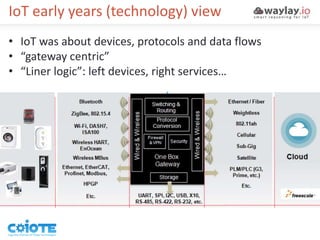
IoT early years (technology) view
• IoT was about devices, protocols and data flows
• “gateway centric”
• “Liner logic”: left devices, right services…
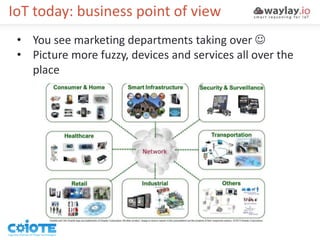
IoT today: business point of view
• You see marketing departments taking over 
• Picture more fuzzy, devices and services all over the
place
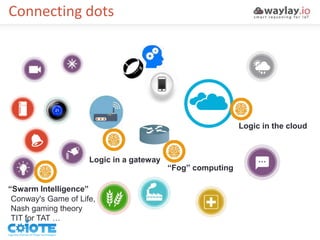
Connecting dots
“Swarm Intelligence”
Logic in a gateway
“Fog” computing
Logic in the cloud
Conway's Game of Life,
Nash gaming theory
TIT for TAT …
Why NOT intelligence in the cloud?
• Latency
• Failure (in)tolerance (lack of redundancy) – general issue
in internet, adding more blocks system even less stable
• Cost of pushing data in the cloud
– Energy (battery)
– Data storage (data can be of a huge volume)
– SW cost of integration
– Lack of standardization
• Security concerns: Authentication/Authorization
• Privacy concerns
Why intelligence in the cloud?
• Device-agnostic and decouples logic from the
presentation layer
• Combination of the sensor data with API “economy”
• Integrating multiple IoT vertical solutions
• Cloud-capacity scales horizontally, while distributed HW
often needs to be swapped when HW resources are no
longer sufficient
• Cloud intelligence also allows easy generation of analytics
regarding the usage of the logic itself. Which rules fired
and why? How often?
• An architectural model arises where logic is built once
together with a REST API
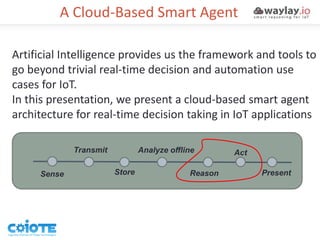
A Cloud-Based Smart Agent
Sense
Transmit
Store
Analyze offline
PresentReason
Act
Artificial Intelligence provides us the framework and tools to
go beyond trivial real-time decision and automation use
cases for IoT.
In this presentation, we present a cloud-based smart agent
architecture for real-time decision taking in IoT applications
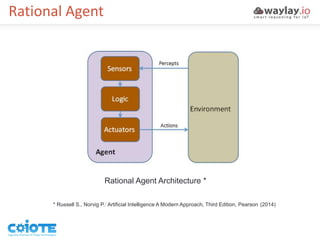
Rational Agent
* Russell S., Norvig P.: Artificial Intelligence A Modern Approach, Third Edition, Pearson (2014)
Rational Agent Architecture *
Agent architecture choices
• The choice for a particular type of agent logic is
influenced by the characteristics of the environment in
which an agent needs to operate
• Type of agents (using software language to express the
logic):
– ‘if-then-else’ constructs that are available in any programming
language or rules engine
– flowchart models
– CEP (complex event processing) engines
– Graph models (Markov, Bayesian nets)
Why Bayesian Networks in IOT?
• Environments that cannot be completely observed, i.e.
when not all aspects that could impact a choice of action
are observable.
• Unreliable, noisy or incomplete data or when domain
knowledge is incomplete such that probabilistic reasoning
is required
• Use cases where the number of causes for a particular
observation is so large, that it is nearly impossible to
enumerate them explicitly
• Well suited to model expert-knowledge together with
knowledge that is retrieved from accumulated data
• Use cases where there are asynchronous information flows
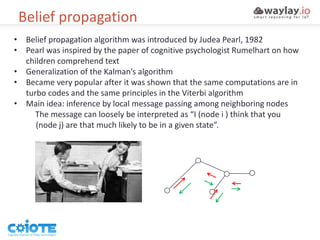
• Belief propagation algorithm was introduced by Judea Pearl, 1982
• Pearl was inspired by the paper of cognitive psychologist Rumelhart on how
children comprehend text
• Generalization of the Kalman’s algorithm
• Became very popular after it was shown that the same computations are in
turbo codes and the same principles in the Viterbi algorithm
• Main idea: inference by local message passing among neighboring nodes
The message can loosely be interpreted as “I (node i ) think that you
(node j) are that much likely to be in a given state”.
Belief propagation
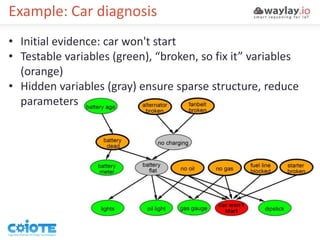
Example: Car diagnosis
• Initial evidence: car won't start
• Testable variables (green), “broken, so fix it” variables
(orange)
• Hidden variables (gray) ensure sparse structure, reduce
parameters
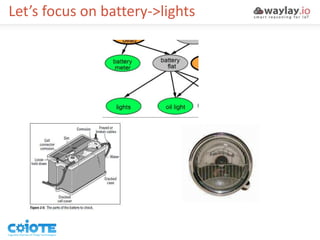
Let’s focus on battery->lights
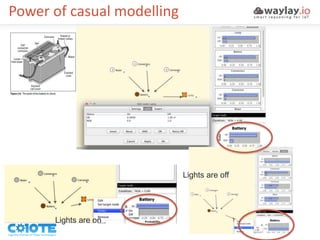
Power of casual modelling
Lights are on
Lights are off
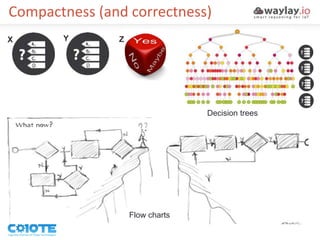
Compactness (and correctness)
Decision trees
Flow charts
X Y Z
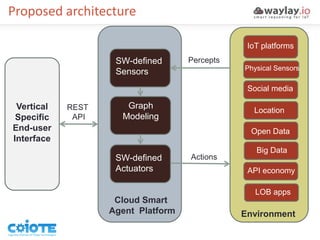
Cloud Smart
Agent Platform Environment
SW-defined
Sensors
Graph
Modeling
SW-defined
Actuators
Percepts
Actions
Physical Sensors
IoT platforms
Social media
Location
Open Data
Big Data
API economy
REST
API
LOB apps
Proposed architecture
Vertical
Specific
End-user
Interface
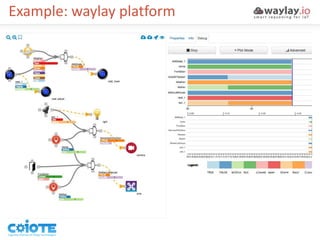
Example: waylay platform

A Cloud-Based Bayesian Smart Agent Architecture for Internet-of-Things Applications

  • 1.
    A Cloud-Based BayesianSmart Agent Architecture for Internet-of-Things Applications Authors: Veselin Pizurica, Piet Vandaele @waylay Rome, 27/10/2014
  • 2.
    IoT early years(technology) view • IoT was about devices, protocols and data flows • “gateway centric” • “Liner logic”: left devices, right services…
  • 3.
    IoT today: businesspoint of view • You see marketing departments taking over  • Picture more fuzzy, devices and services all over the place
  • 4.
    Connecting dots “Swarm Intelligence” Logicin a gateway “Fog” computing Logic in the cloud Conway's Game of Life, Nash gaming theory TIT for TAT …
  • 5.
    Why NOT intelligencein the cloud? • Latency • Failure (in)tolerance (lack of redundancy) – general issue in internet, adding more blocks system even less stable • Cost of pushing data in the cloud – Energy (battery) – Data storage (data can be of a huge volume) – SW cost of integration – Lack of standardization • Security concerns: Authentication/Authorization • Privacy concerns
  • 6.
    Why intelligence inthe cloud? • Device-agnostic and decouples logic from the presentation layer • Combination of the sensor data with API “economy” • Integrating multiple IoT vertical solutions • Cloud-capacity scales horizontally, while distributed HW often needs to be swapped when HW resources are no longer sufficient • Cloud intelligence also allows easy generation of analytics regarding the usage of the logic itself. Which rules fired and why? How often? • An architectural model arises where logic is built once together with a REST API
  • 7.
    A Cloud-Based SmartAgent Sense Transmit Store Analyze offline PresentReason Act Artificial Intelligence provides us the framework and tools to go beyond trivial real-time decision and automation use cases for IoT. In this presentation, we present a cloud-based smart agent architecture for real-time decision taking in IoT applications
  • 8.
    Rational Agent * RussellS., Norvig P.: Artificial Intelligence A Modern Approach, Third Edition, Pearson (2014) Rational Agent Architecture *
  • 9.
    Agent architecture choices •The choice for a particular type of agent logic is influenced by the characteristics of the environment in which an agent needs to operate • Type of agents (using software language to express the logic): – ‘if-then-else’ constructs that are available in any programming language or rules engine – flowchart models – CEP (complex event processing) engines – Graph models (Markov, Bayesian nets)
  • 10.
    Why Bayesian Networksin IOT? • Environments that cannot be completely observed, i.e. when not all aspects that could impact a choice of action are observable. • Unreliable, noisy or incomplete data or when domain knowledge is incomplete such that probabilistic reasoning is required • Use cases where the number of causes for a particular observation is so large, that it is nearly impossible to enumerate them explicitly • Well suited to model expert-knowledge together with knowledge that is retrieved from accumulated data • Use cases where there are asynchronous information flows
  • 11.
    • Belief propagationalgorithm was introduced by Judea Pearl, 1982 • Pearl was inspired by the paper of cognitive psychologist Rumelhart on how children comprehend text • Generalization of the Kalman’s algorithm • Became very popular after it was shown that the same computations are in turbo codes and the same principles in the Viterbi algorithm • Main idea: inference by local message passing among neighboring nodes The message can loosely be interpreted as “I (node i ) think that you (node j) are that much likely to be in a given state”. Belief propagation
  • 12.
    Example: Car diagnosis •Initial evidence: car won't start • Testable variables (green), “broken, so fix it” variables (orange) • Hidden variables (gray) ensure sparse structure, reduce parameters
  • 13.
    Let’s focus onbattery->lights
  • 14.
    Power of casualmodelling Lights are on Lights are off
  • 15.
  • 16.
    Cloud Smart Agent PlatformEnvironment SW-defined Sensors Graph Modeling SW-defined Actuators Percepts Actions Physical Sensors IoT platforms Social media Location Open Data Big Data API economy REST API LOB apps Proposed architecture Vertical Specific End-user Interface
  • 17.