SMOKE EXTRACTION IN BUILDINGS Presented byVysakhManoharGATE-ChennaiTuesday, June 07, 20111Smoke Extraction In Buildings
INTRODUCTIONEffective smoke extraction in buildings has been one of the  inevitable considerations in the building design as the number of buildings  and the concern of people about the regular fire accidents in buildings are increasing much.This presentation includes a brief description about the different design consideration principles and methods to be taken care for the effective heat extraction in different types of buildings . Tuesday, June 07, 20112Smoke Extraction In Buildings
What is smoke?By product of combustion or pyrolysis .Mixture of liquid , solid particulate matter and gaseous products.It is a cocktail of carbon monoxide, carbon dioxide ,HCL and HCNTuesday, June 07, 20113Smoke Extraction In Buildings
FIRE TIME LINE00.00-    Household is asleep00.30-    Fire ignites and grows in downstairs1.04-      Fire spreads and smoke begins to fillIn the room.1.35-      Smoke layer descends rapidly and            	temperature exceeds 88 deg1.50 –    Smoke detector sounds an alarm.2.30-      Temperature becomes 205 deg2.48-      smoke pours into other roomsTuesday, June 07, 20114Smoke Extraction In Buildings
3.03-Temperature  in the room becomes more    	     than 260 deg3.20-upstairs,corridors,all the rooms are filled 	      	     with smoke3.41- flashover occurs , temperature becomes 	      	      760 deg 3.50 –Two minutes after the alarm sound, 	       	     only the second exit will be the way out4.33- Flames will be apparent from the 			     outside , the first evidence of fire visible 		      from outside.Tuesday, June 07, 20115Smoke Extraction In Buildings
Will follow similar scenario in other locationThe variations will be based on        1-fire size        2-size of building        3-flammable materials in the building        4-alarm systems        5-safety measures availableTuesday, June 07, 20116Smoke Extraction In Buildings
GETTING THE DESIGN RIGHT FROM THE BEGINNINGFactors affected         Design fire size         Stack and wind effectsTemperature effect of fire         HVAC and ventilation systemsClimate         Expansion of ducts
COMMON SAFETY METHODSUse sprinklersSmoke curtainsHVAC system incorporating F & S dampers.Extraction fansAlarm systemsPressurisationTuesday, June 07, 20118Smoke Extraction In Buildings
HAZARDS OF DANGEROUS SMOKEImpair visibilityCoughing,nausea,vomitingGeneration of high temperatureIrritation and respiratory problemsBronchospasms and hypoxiaInflict death if it contains dangerous gasesEven low concentration of CO can cause diminished coordination and increased disorientationAmount of oxygen is reduced- suffocationExacerbate corrosive nature of HCLTuesday, June 07, 20119Smoke Extraction In Buildings
Smoke PathwaysAir and service ducts connecting floorsHVAC/ventilation systemsExtract duct systemsGaps between wall and floor constructionsStairwellsLift shaftsTuesday, June 07, 201110Smoke Extraction In Buildings
Need of smoke extraction for life safety and reducing property loss for fire fighter accessTo  clear smoke after a fire –smoke purgingTuesday, June 07, 201111Smoke Extraction In Buildings
Smoke extraction design objectivesEffective protection of building occupants by maintaining tenable conditions on egress systems.Reliable and functional fire fighting controls used by firefighters to increase visibility and reduce heat exposure.Tuesday, June 07, 201112Smoke Extraction In Buildings
Make up air routesExternal doorsLouvers in wall or roofCentral air plant configured to supply airFrom adjacent unaffected areas->avoid mixing of smoke and make up air->extraction points-avoid creation of “hole”Tuesday, June 07, 201113Smoke Extraction In Buildings
Smoke Production and movementAmount of smoke produced is dependent on size of firePath through which it goesPlume heightTuesday, June 07, 201114Smoke Extraction In Buildings
Fundamental design factorsDesign fire sizeSmoke layer depthIdentify smoke reservoirsCalculate smoke volume and temperatureMinimum number of extract pointsVent or fan size and fan temperature ratingInlet airDuct workTuesday, June 07, 201115Smoke Extraction In Buildings
Design fire sizeFire starts small and becomes largeVent area=2.5 % of floor area-otherwise mechanical6 ac/hour is used oftenDesign fire size is greatly dependent on building contents.Based on the largest fire sourceCannot surely withstand post flash over conditionsTuesday, June 07, 201116Smoke Extraction In Buildings
Heat output of fireNational bureau of standards in USABased on time-             safe escape time              brigade response timeTuesday, June 07, 201117Smoke Extraction In Buildings
Acceptable smoke layer depthSmoke layer base should be above the people2.5 m-single storey3 m    - upper storey of 2 storeyTuesday, June 07, 201118Smoke Extraction In Buildings
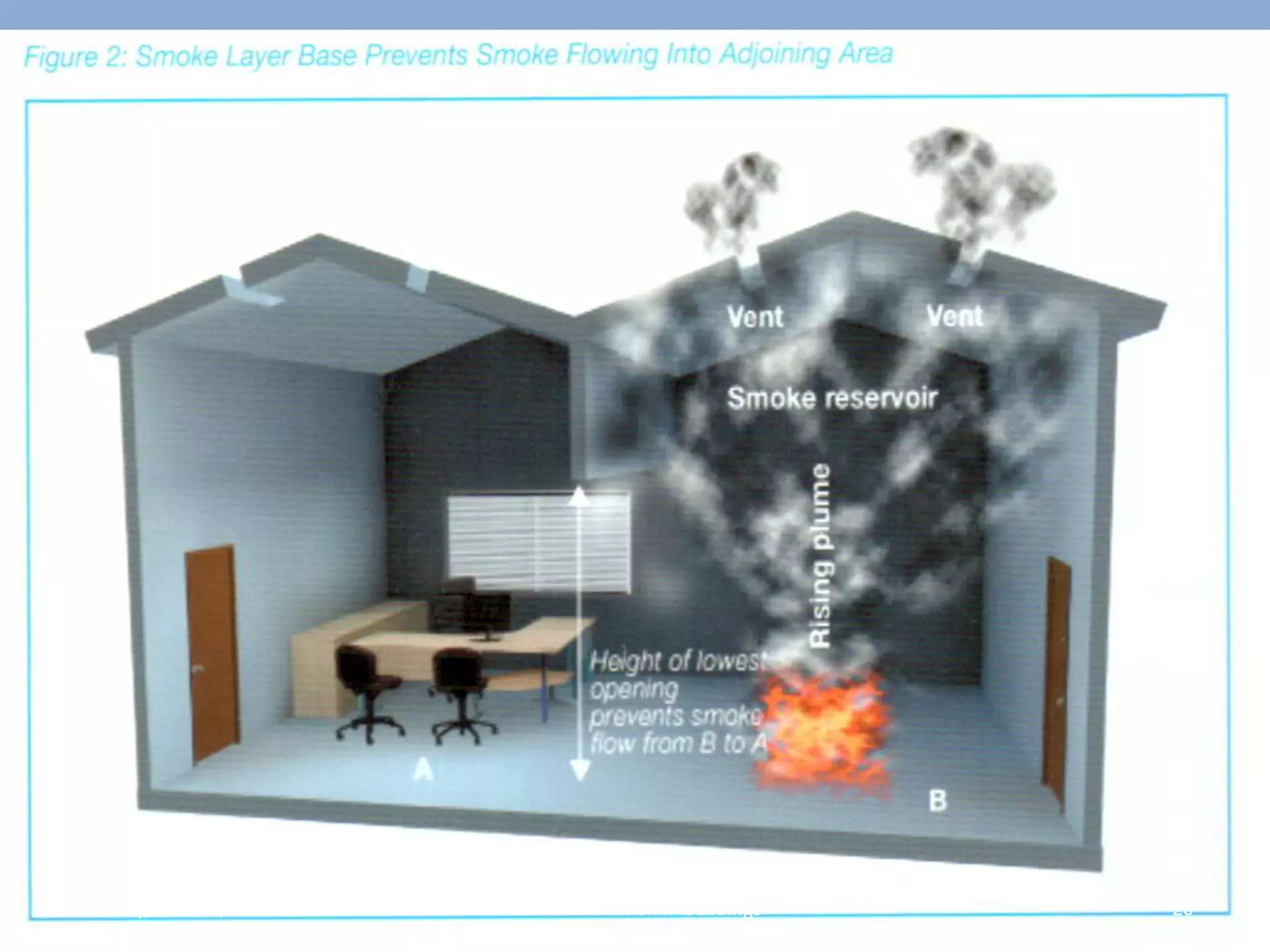
Smoke reservoirsIf smoke is held in a too large reservoir-lose buoyancy2000 m^2  -  natural  extraction2600 m^2  -powered extractionSmoke curtains can be used to reduce horizontal  spreadTuesday, June 07, 201119Smoke Extraction In Buildings
Tuesday, June 07, 201120Smoke Extraction In Buildings
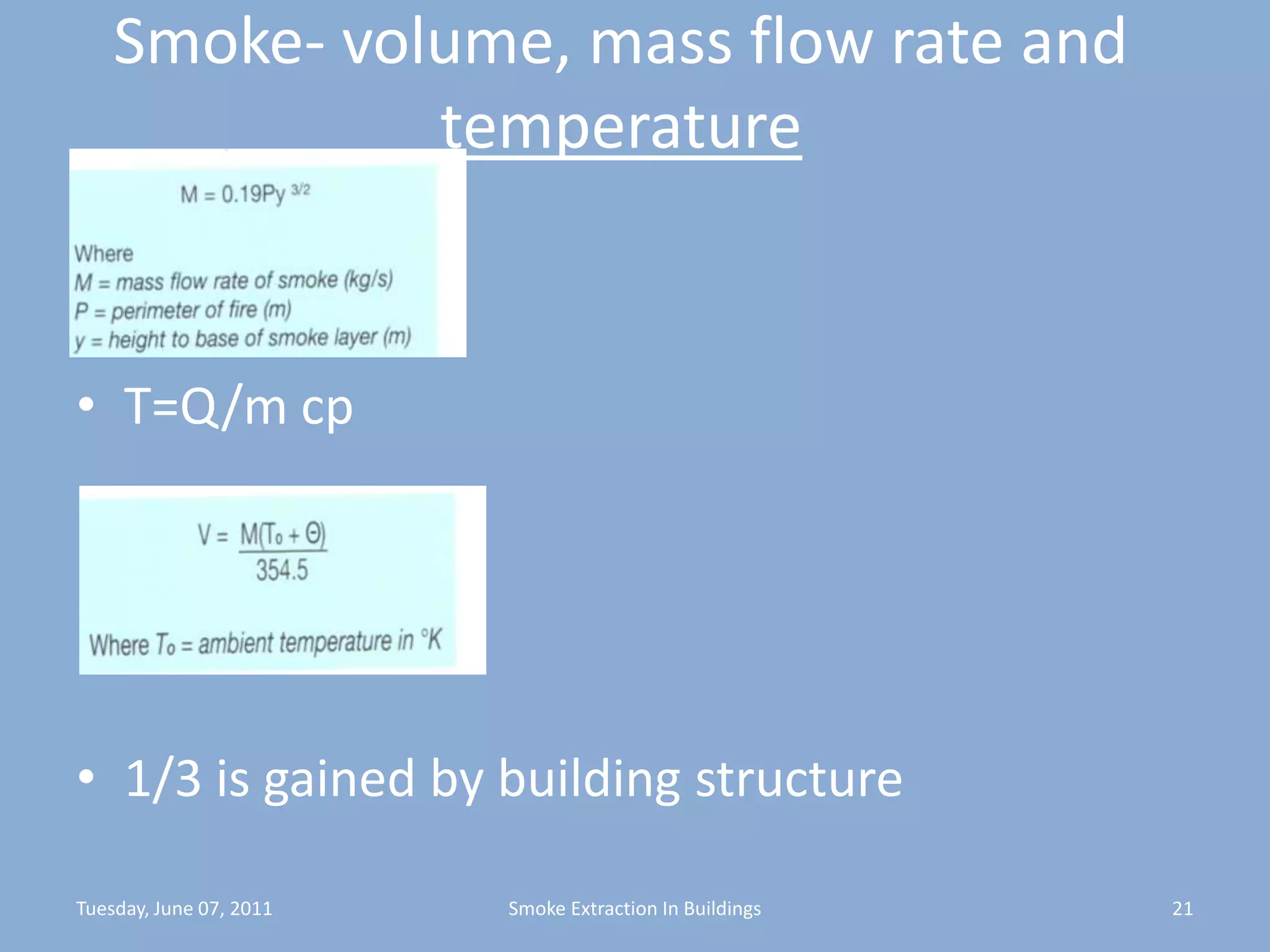
Smoke- volume, mass flow rate and temperatureT=Q/m cp1/3 is gained by building structureTuesday, June 07, 201121Smoke Extraction In Buildings
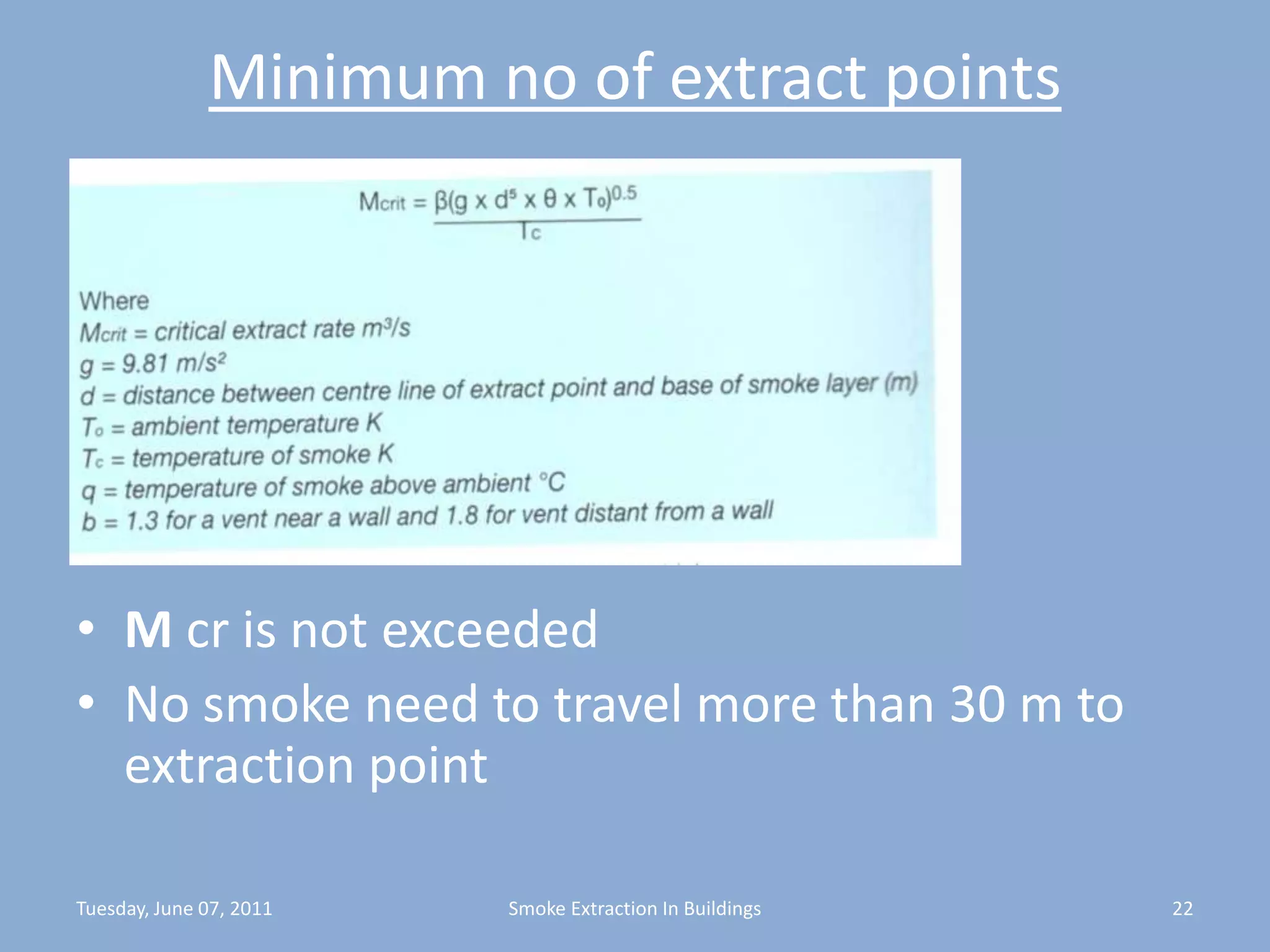
Minimum no of extract pointsMcr is not exceededNo smoke need to travel more than 30 m to extraction pointTuesday, June 07, 201122Smoke Extraction In Buildings
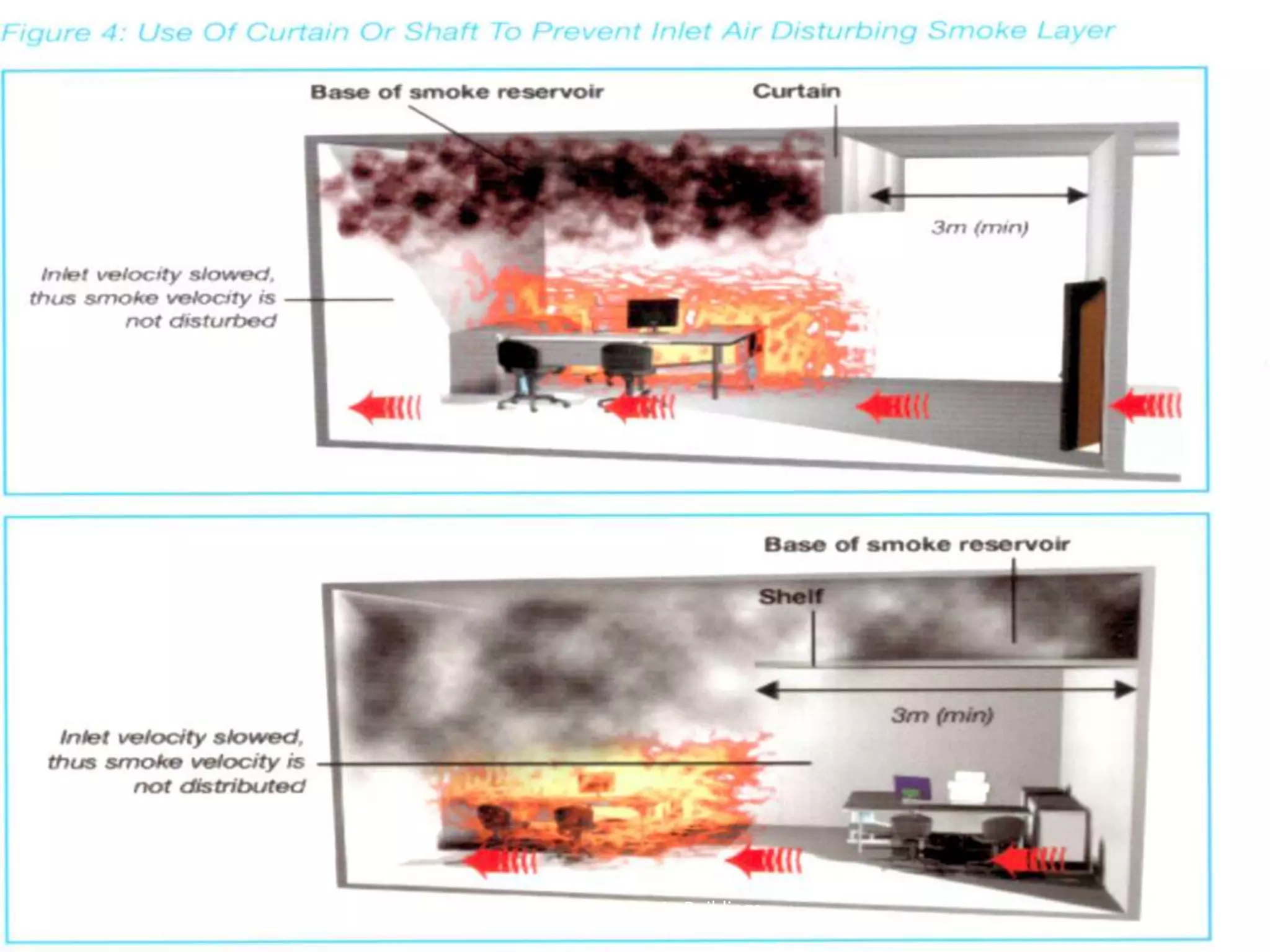
Inlet airTo make up the smoky gasesAt least 1.5m beneath smoke layerIf natural inlet is givenInlets should be away from the outletsInlet velocity should be less than 3 m/sTuesday, June 07, 201123Smoke Extraction In Buildings
Tuesday, June 07, 201124Smoke Extraction In Buildings
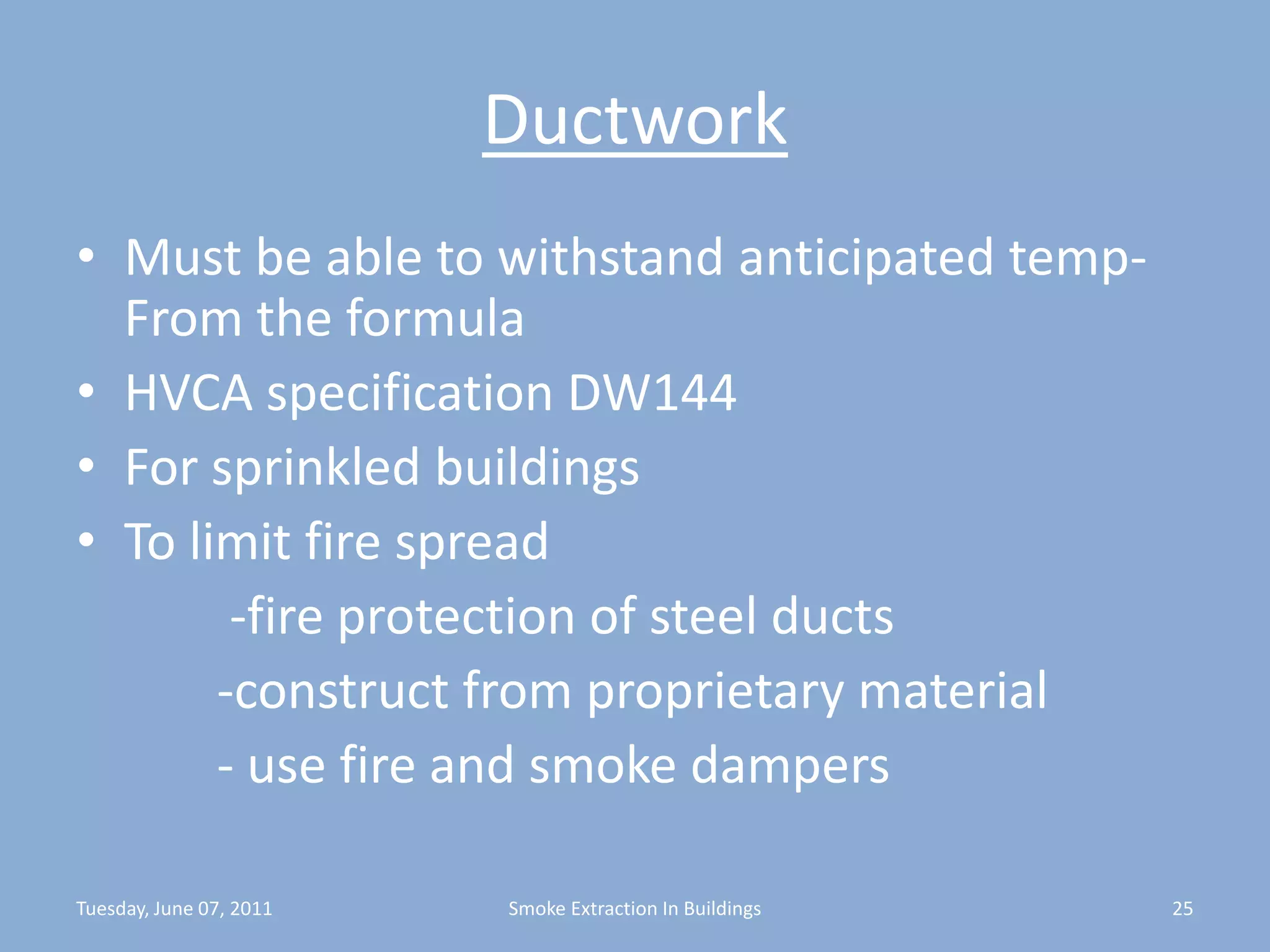
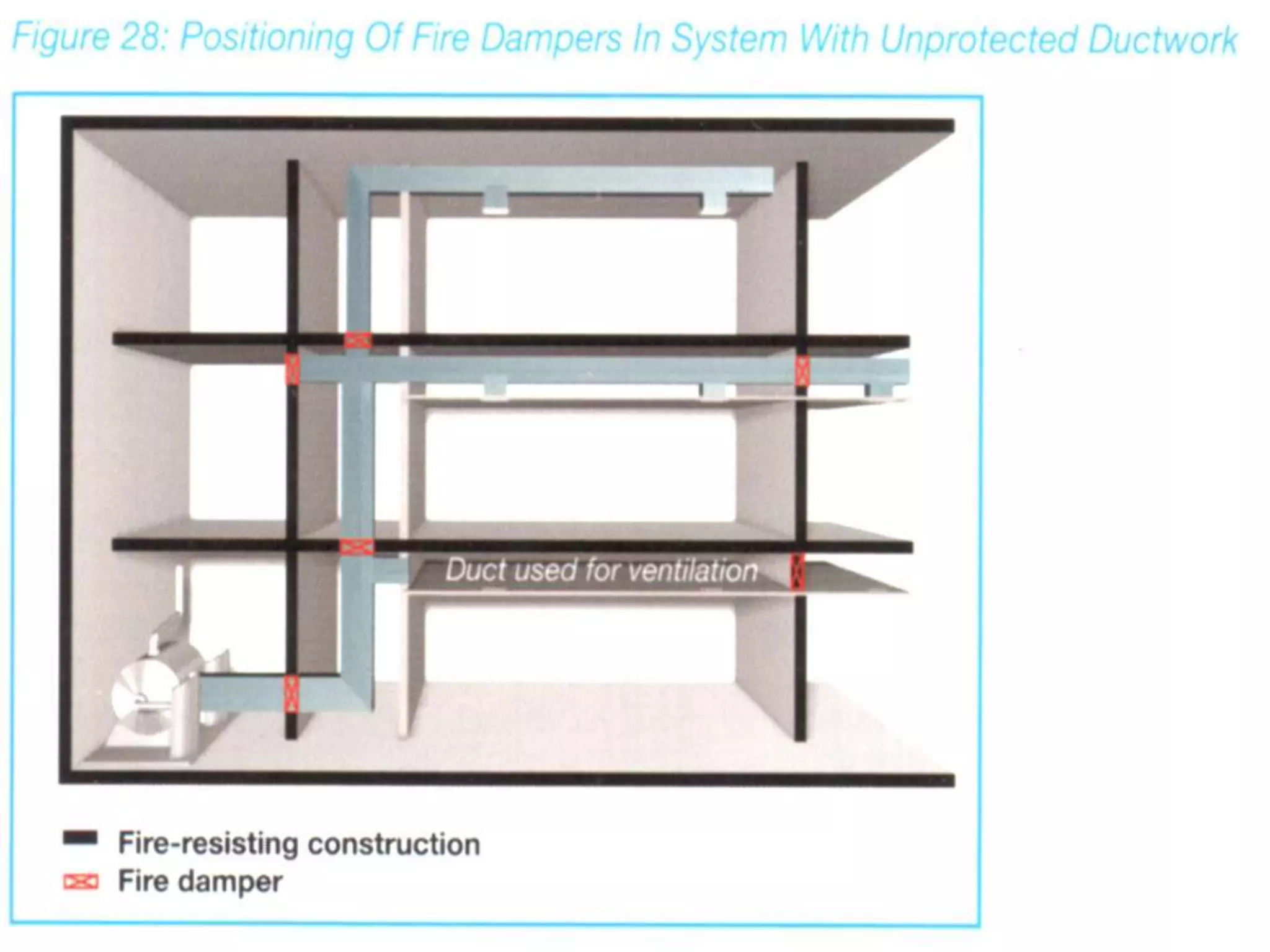
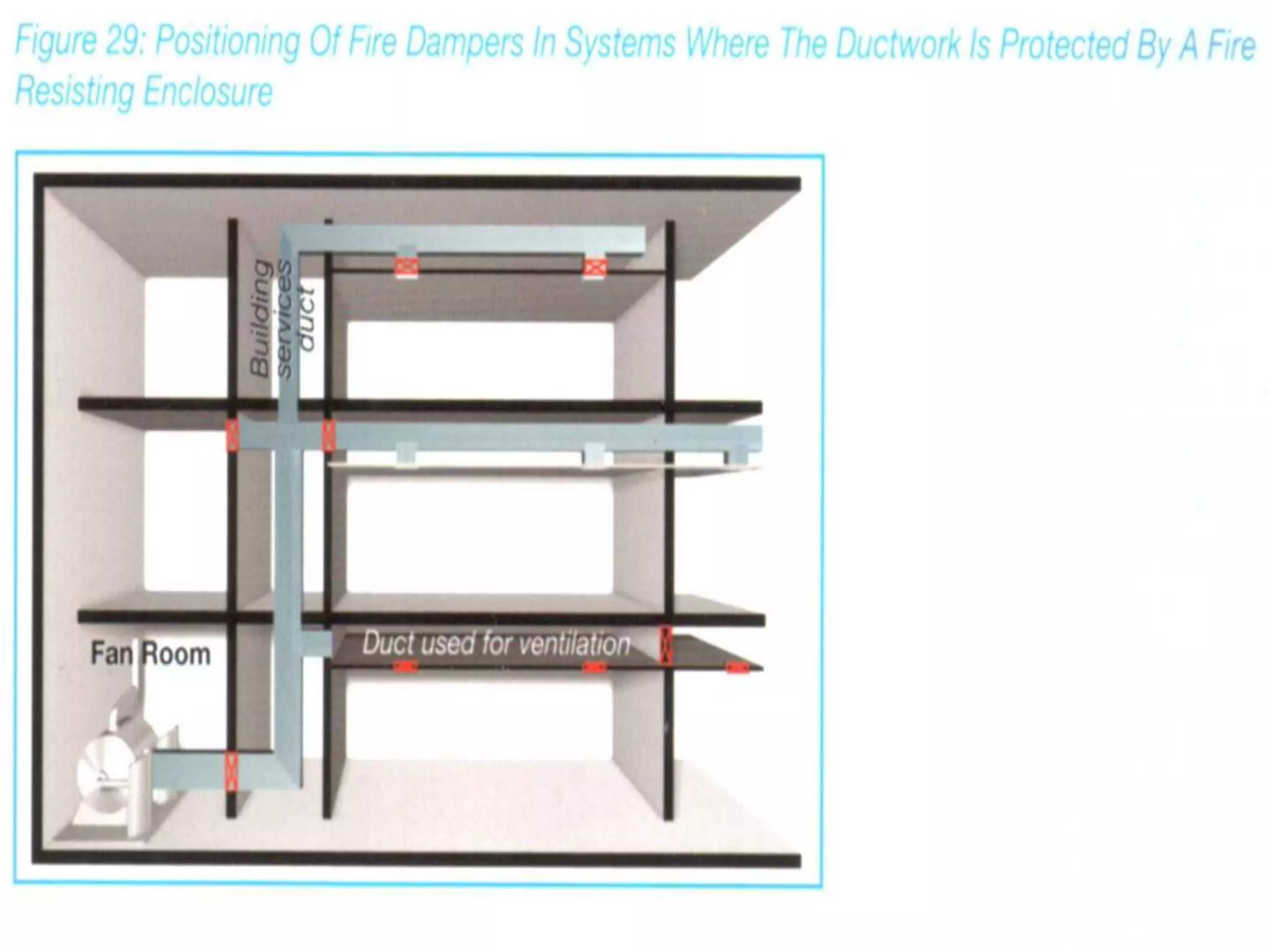
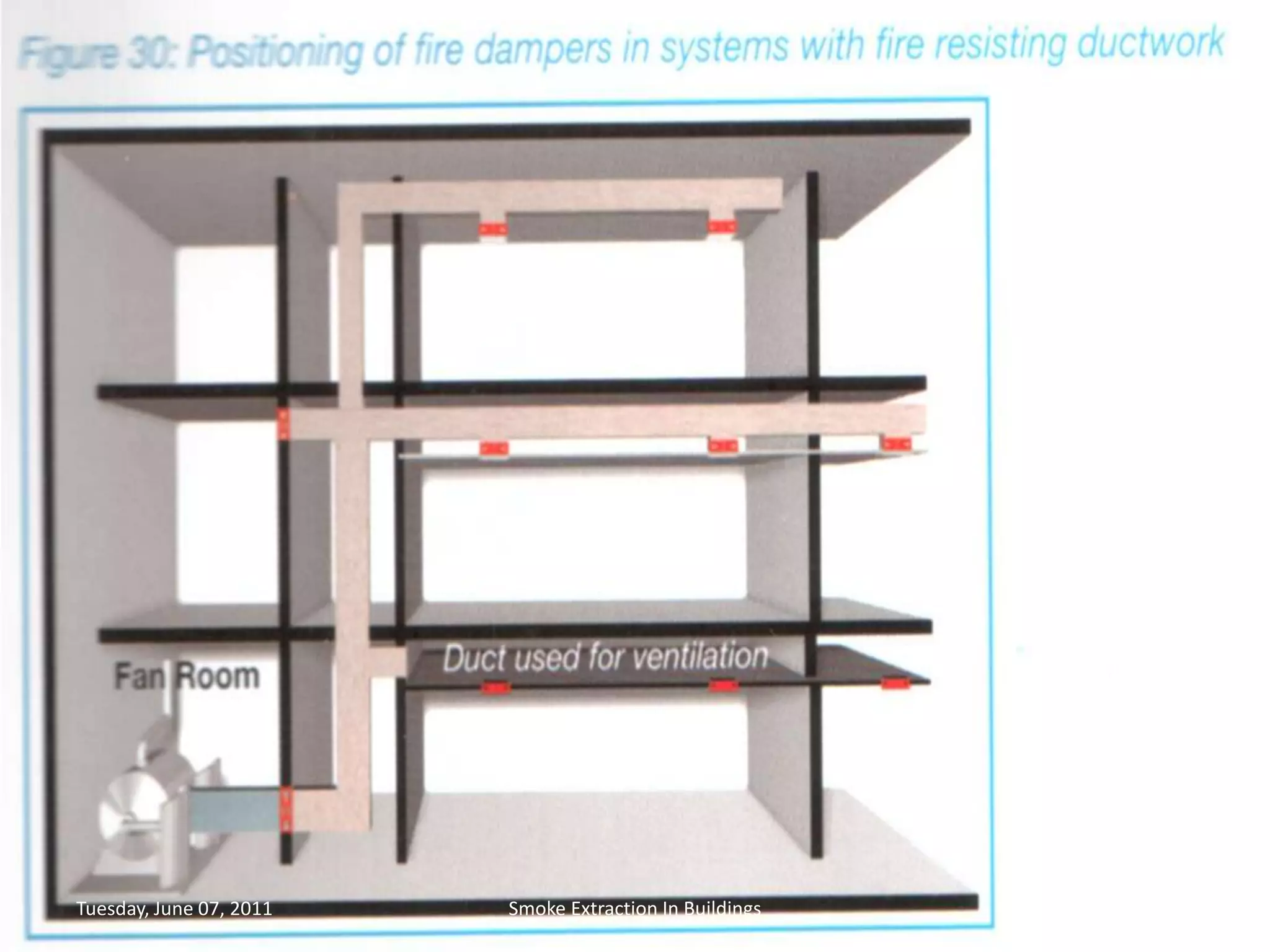
DuctworkMust be able to withstand anticipated temp- From the formulaHVCA specification DW144For sprinkled buildingsTo limit fire spread            -fire protection of steel ducts           -construct from proprietary material           - use fire and smoke dampersTuesday, June 07, 201125Smoke Extraction In Buildings
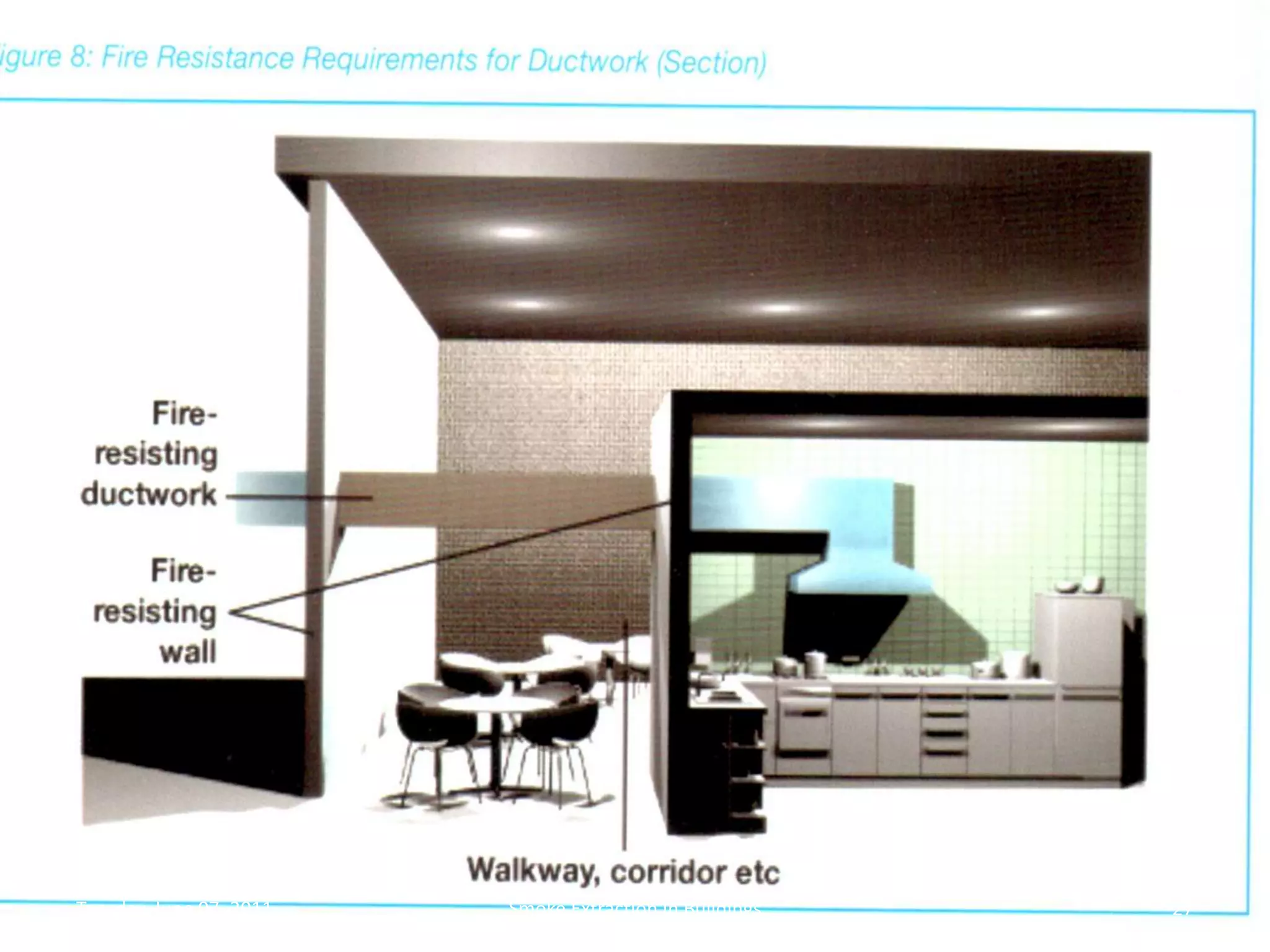
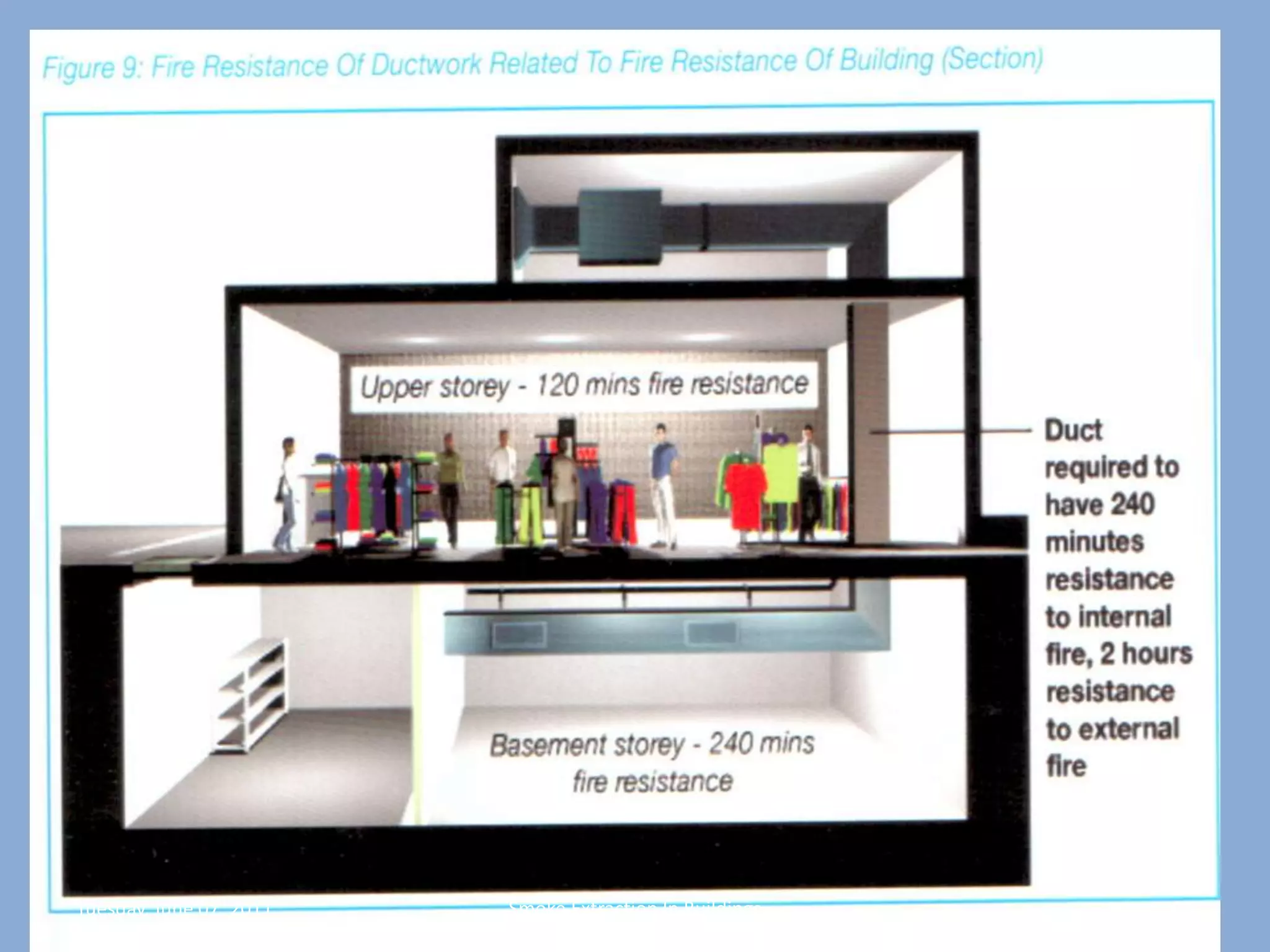
Fire resisting requirement of ductworkTo prevent fire inside one duct to breaking out to other compartment.To prevent fire  from outside enter into duct and  then enter another fire compartmentTo prevent fire  from outside enter into duct and  the break out into other compartmentTuesday, June 07, 201126Smoke Extraction In Buildings
Tuesday, June 07, 201127Smoke Extraction In Buildings
Tuesday, June 07, 201128Smoke Extraction In Buildings
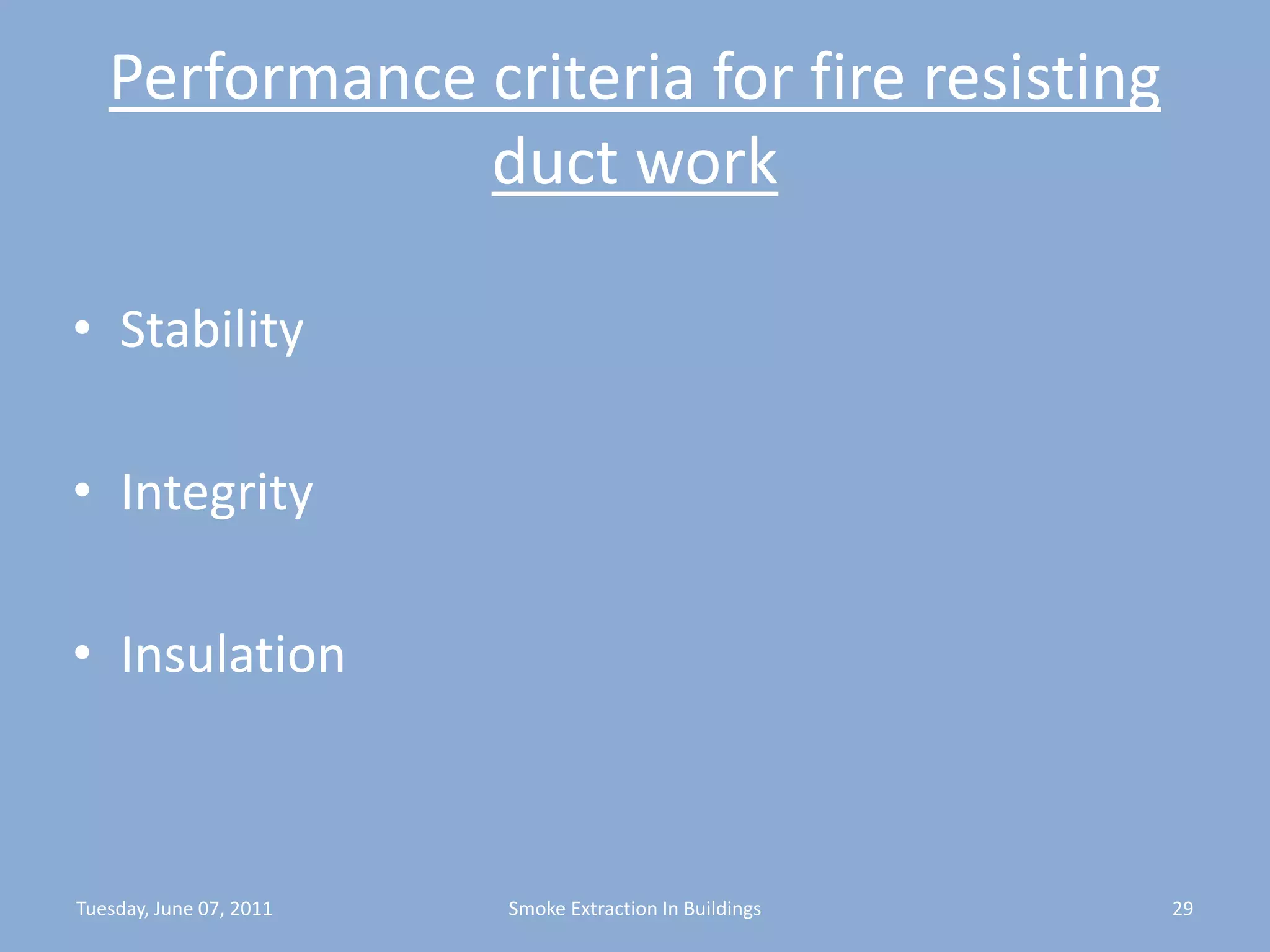
Performance criteria for fire resisting duct workStabilityIntegrityInsulationTuesday, June 07, 201129Smoke Extraction In Buildings
Other things to be notedDuct must be able to retain at least 75% of its size after the smoke removal.Sound or thermal insulation should not be raised to ignition temperature.Fire stopping seals should be usedBuckling or collapse.Tuesday, June 07, 201130Smoke Extraction In Buildings
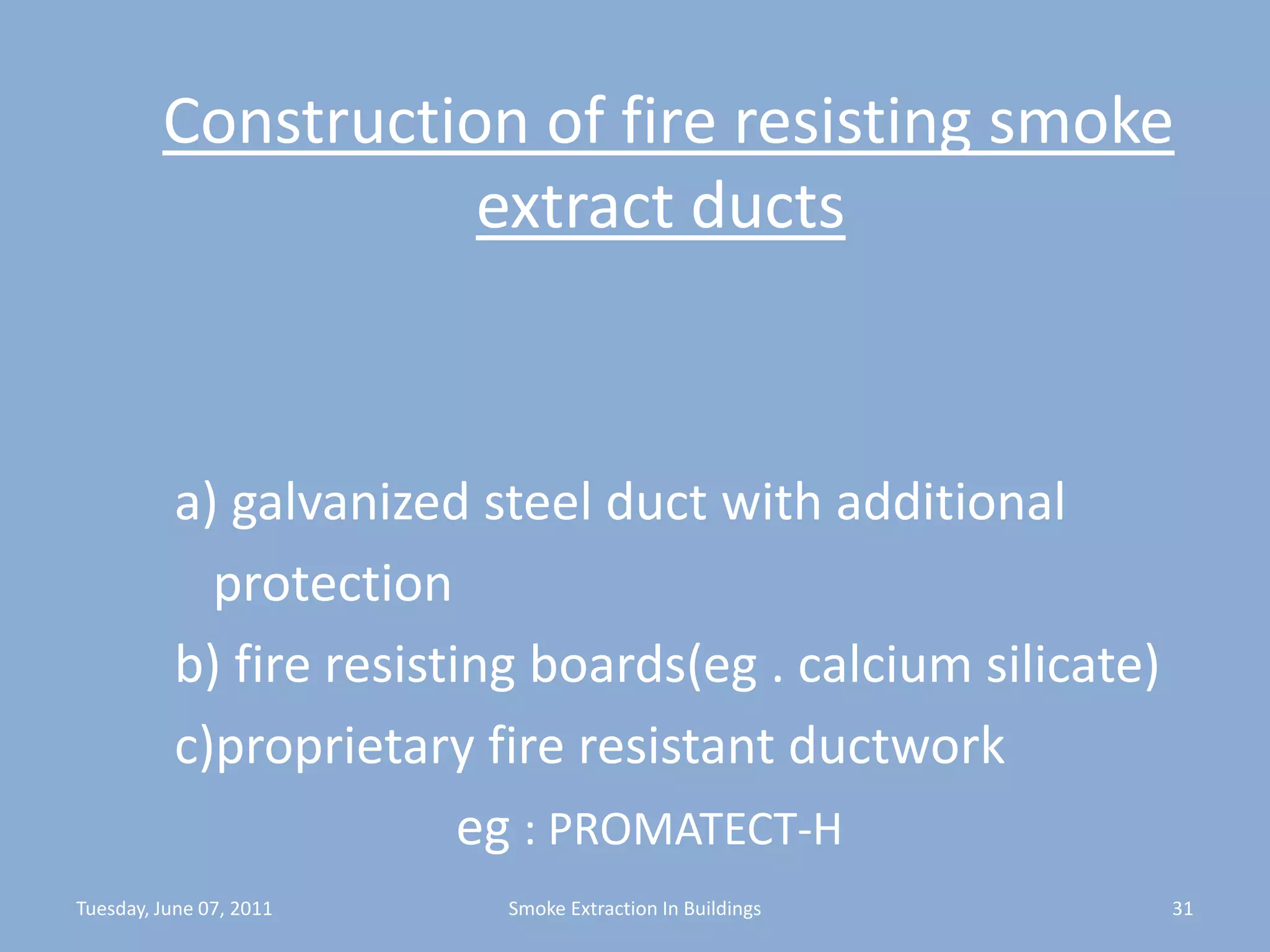
Construction of fire resisting smoke extract ducts         a) galvanized steel duct with additional           protection        b) fire resisting boards(eg . calcium silicate)        c)proprietary fire resistant ductworkeg: PROMATECT-HTuesday, June 07, 201131Smoke Extraction In Buildings
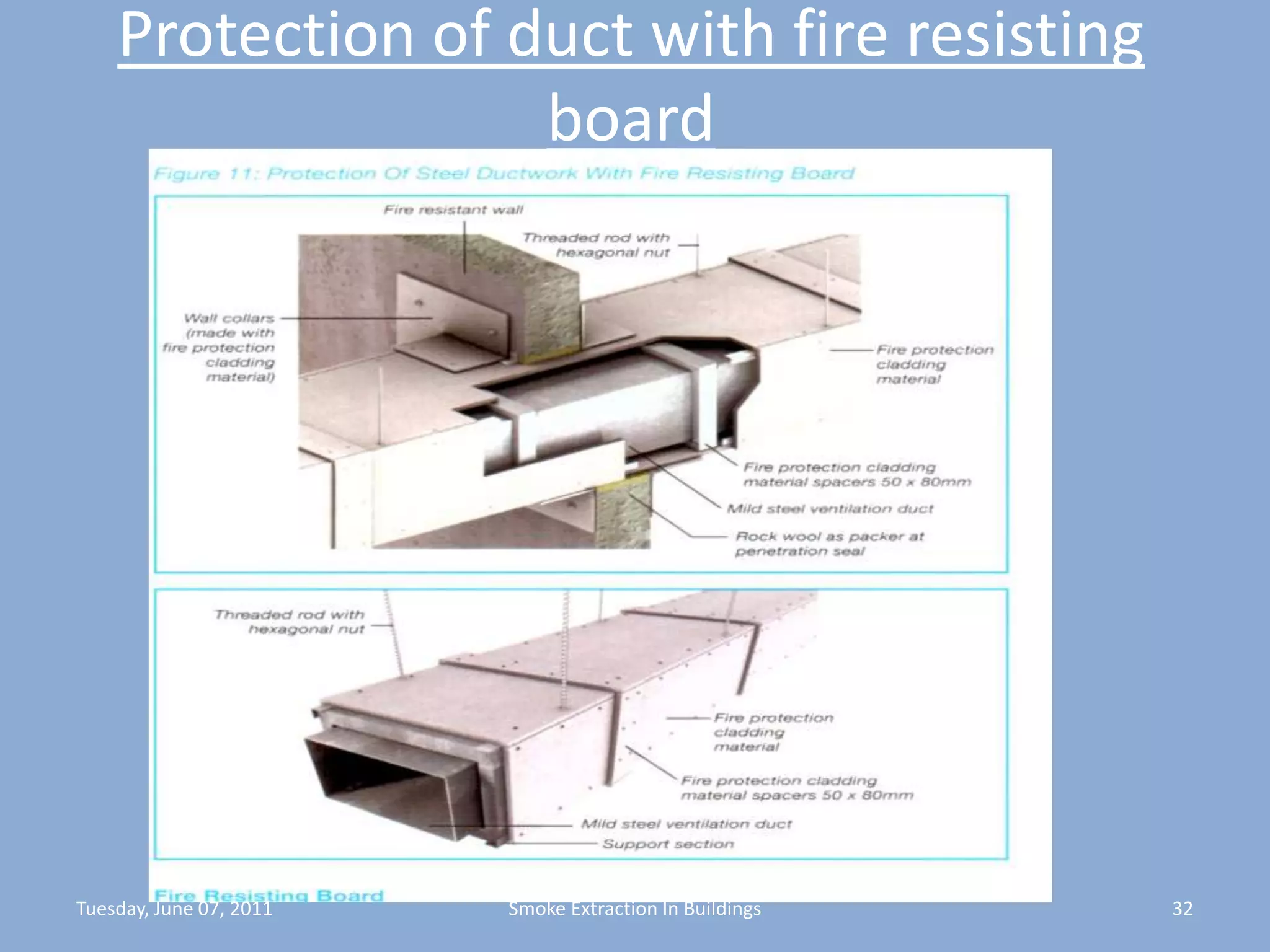
Protection of duct with fire resisting boardTuesday, June 07, 201132Smoke Extraction In Buildings
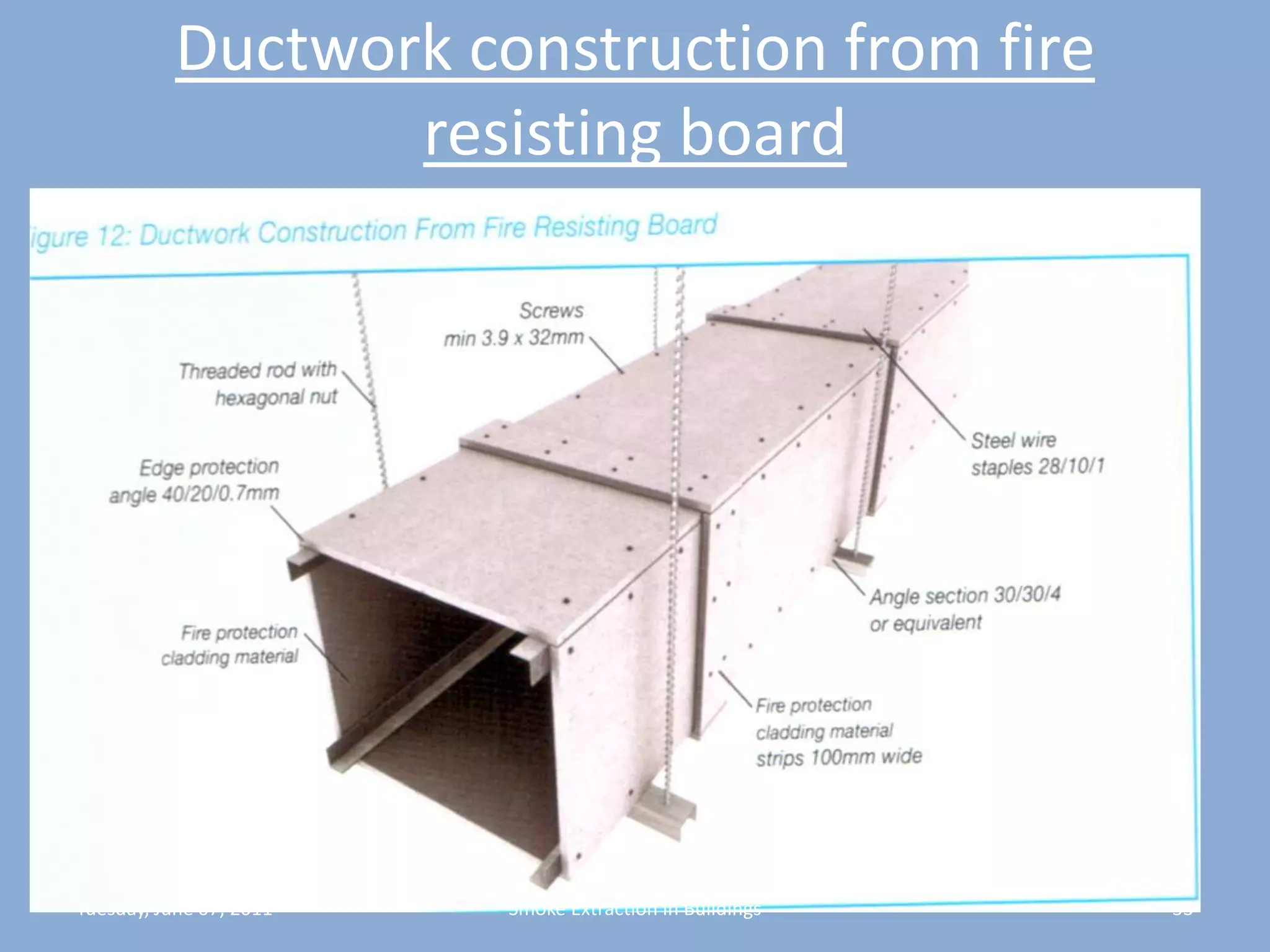
Ductwork construction from fire resisting boardTuesday, June 07, 201133Smoke Extraction In Buildings
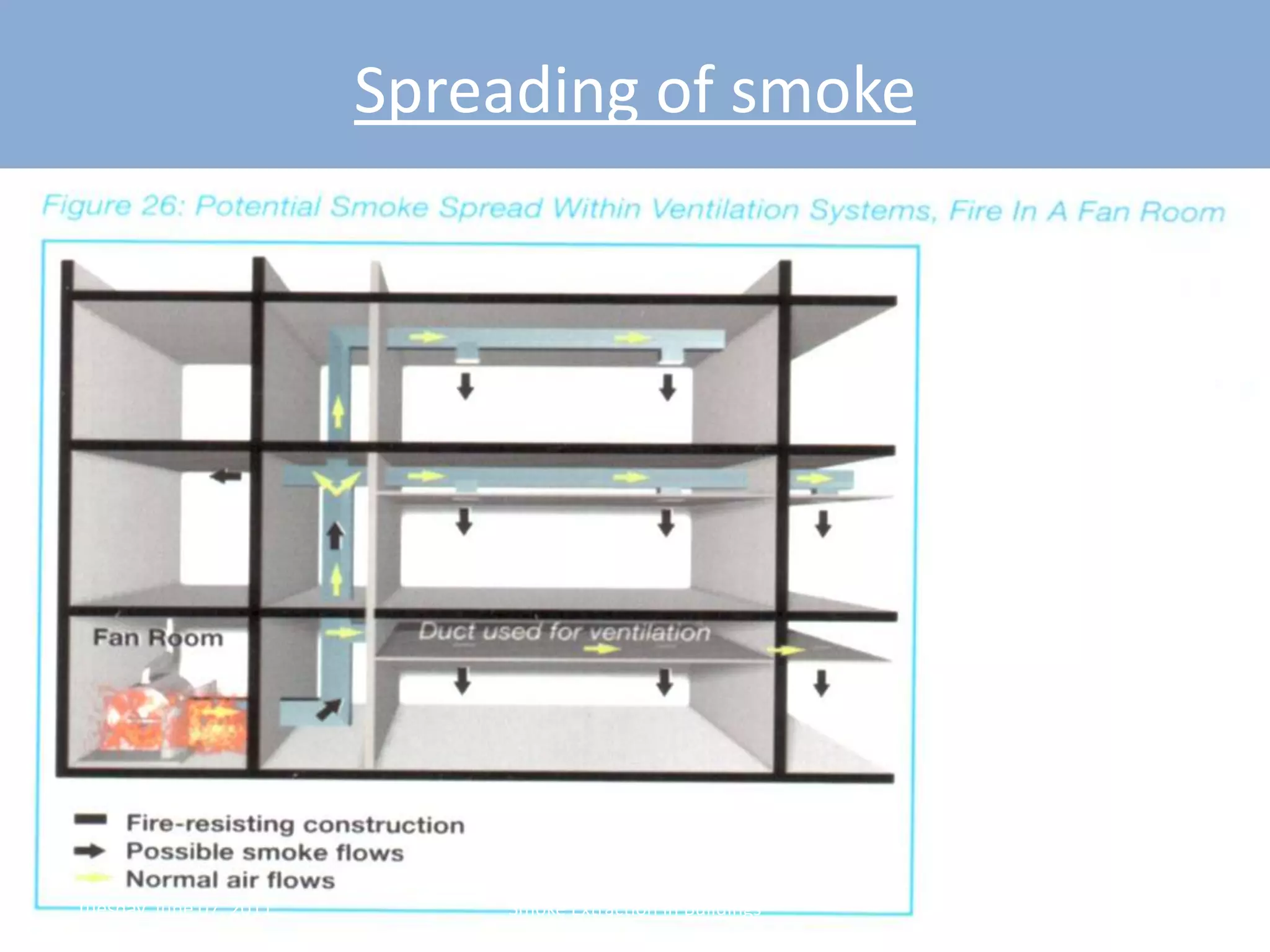
Spreading of smokeTuesday, June 07, 201134Smoke Extraction In Buildings
Tuesday, June 07, 201135Smoke Extraction In Buildings
Tuesday, June 07, 201136Smoke Extraction In Buildings
Tuesday, June 07, 201137Smoke Extraction In Buildings
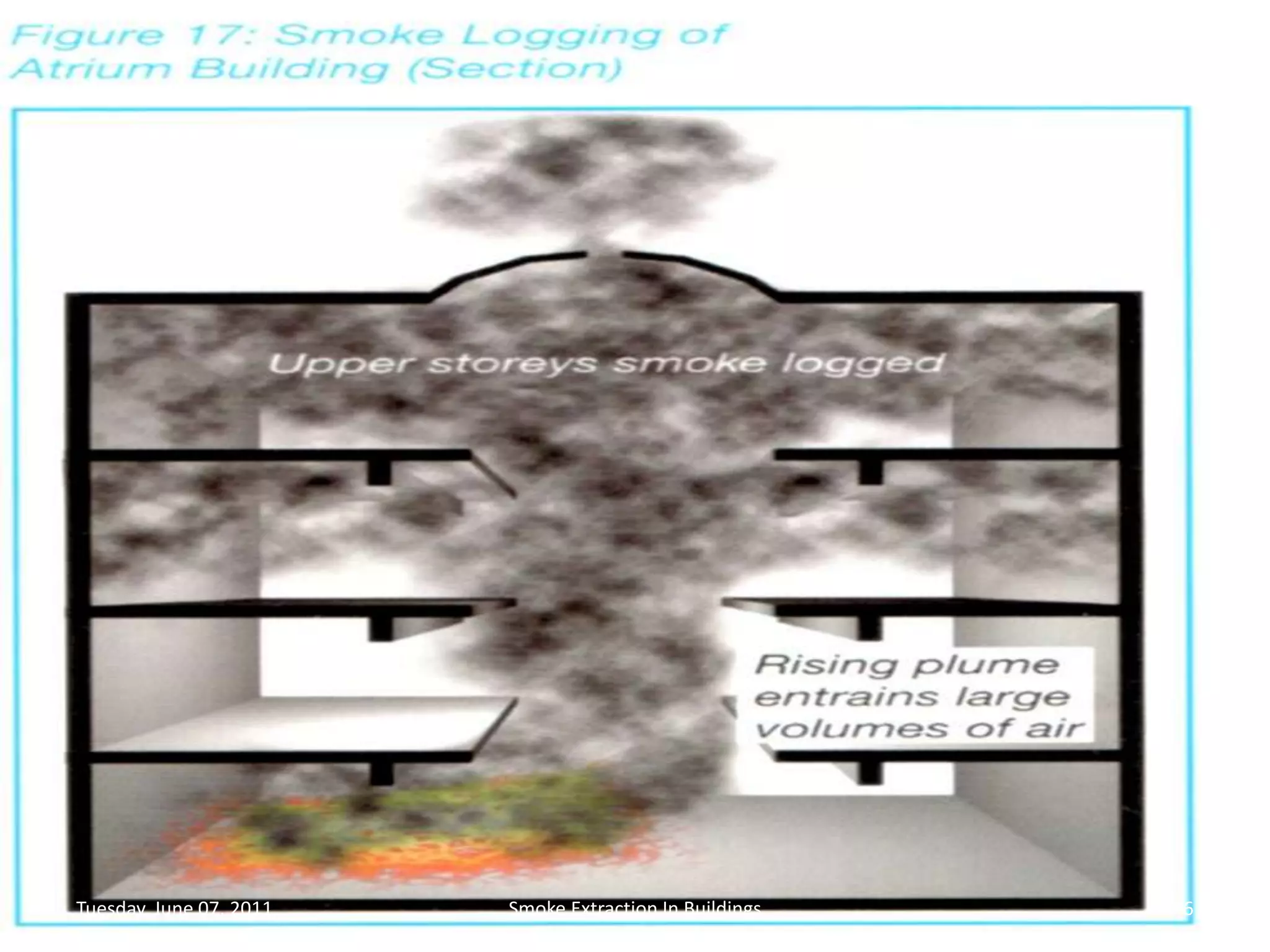
Design guide for different building typesMulti-storey office and similar buildingsWarehouseUnderground car parks/basementAtrium buildingsShopping mallsTuesday, June 07, 201138Smoke Extraction In Buildings
Multi storey office and similar buildingsPhased evacuationEvacuation time will be varyingSmoke should not spread        1, smoke extraction        2, pressurisationThe recirculation of air in normal hvac system is prevented  by dampersTuesday, June 07, 201139Smoke Extraction In Buildings
Tuesday, June 07, 201140Smoke Extraction In Buildings
Important design considerationsThe system is not for providing a smoke free layerBoth supply and extract ducts should be having fire resistance equal to that of the floors /wallsExhaust fans  should be able to run at the highest expected temperatureTuesday, June 07, 201141Smoke Extraction In Buildings
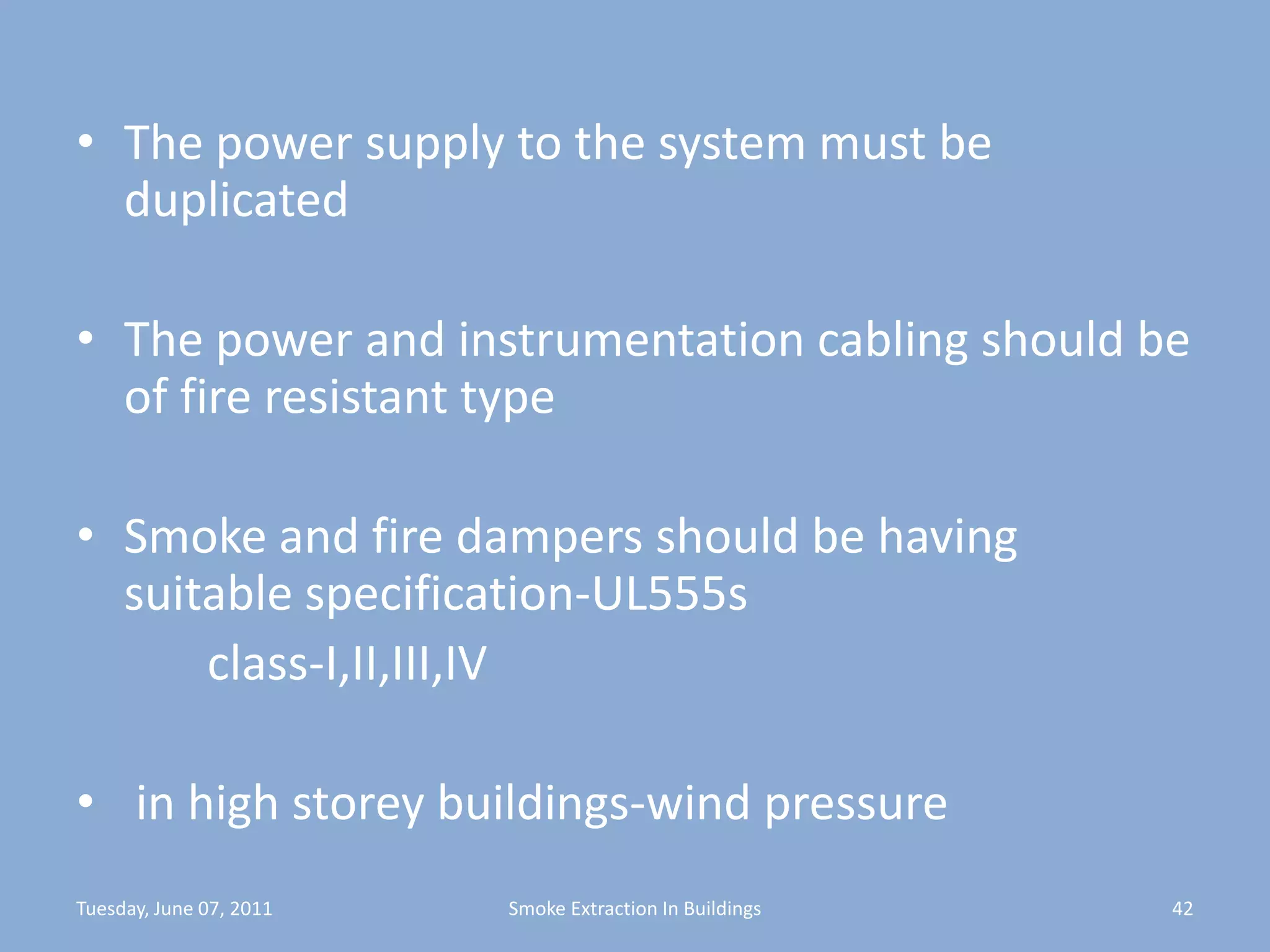
The power supply to the system must be duplicatedThe power and instrumentation cabling should be of fire resistant typeSmoke and fire dampers should be having suitable specification-UL555s           class-I,II,III,IV in high storey buildings-wind pressure Tuesday, June 07, 201142Smoke Extraction In Buildings
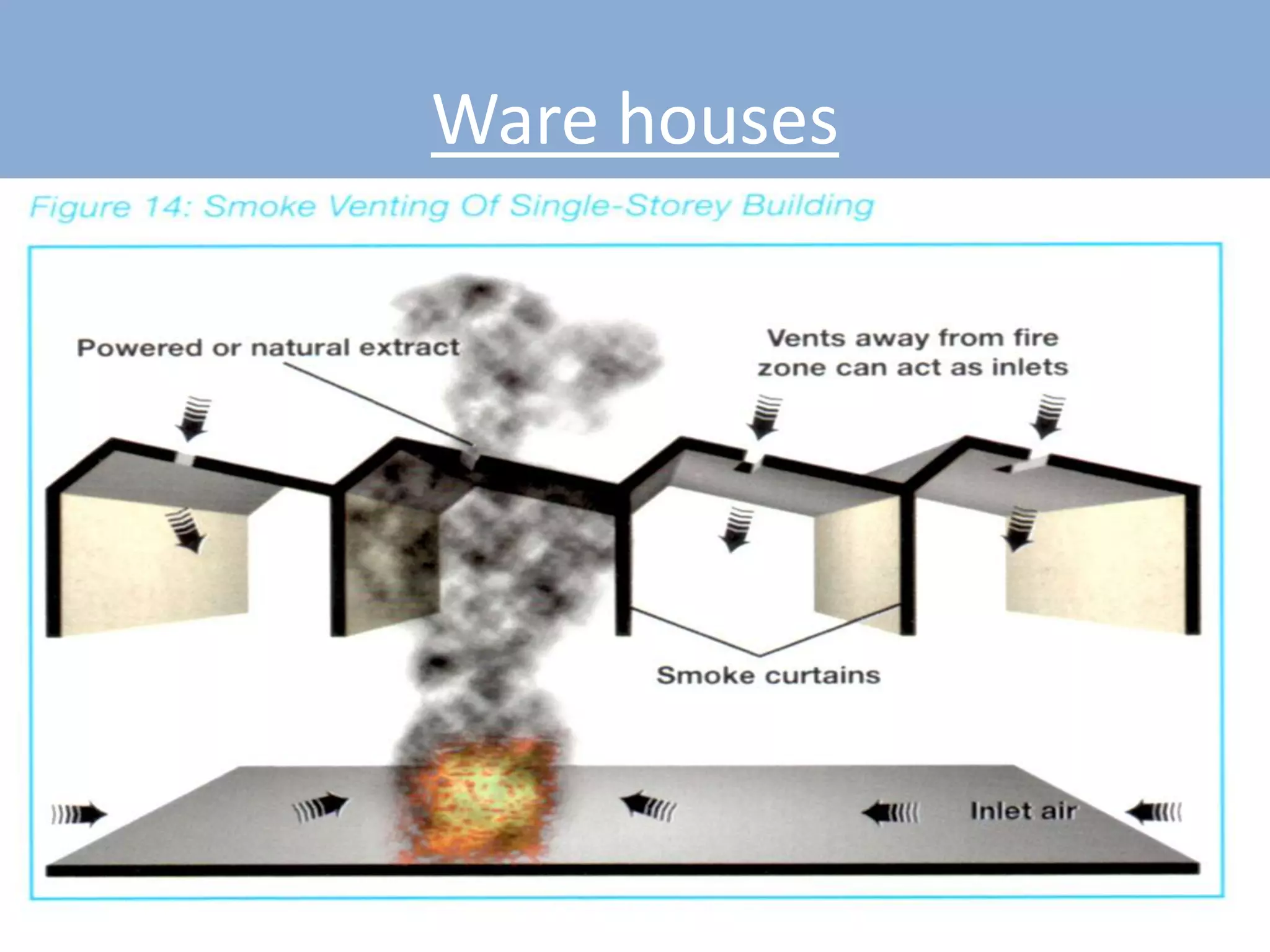
Ware housesTuesday, June 07, 201143Smoke Extraction In Buildings
Underground car parks/basementTuesday, June 07, 201144Smoke Extraction In Buildings
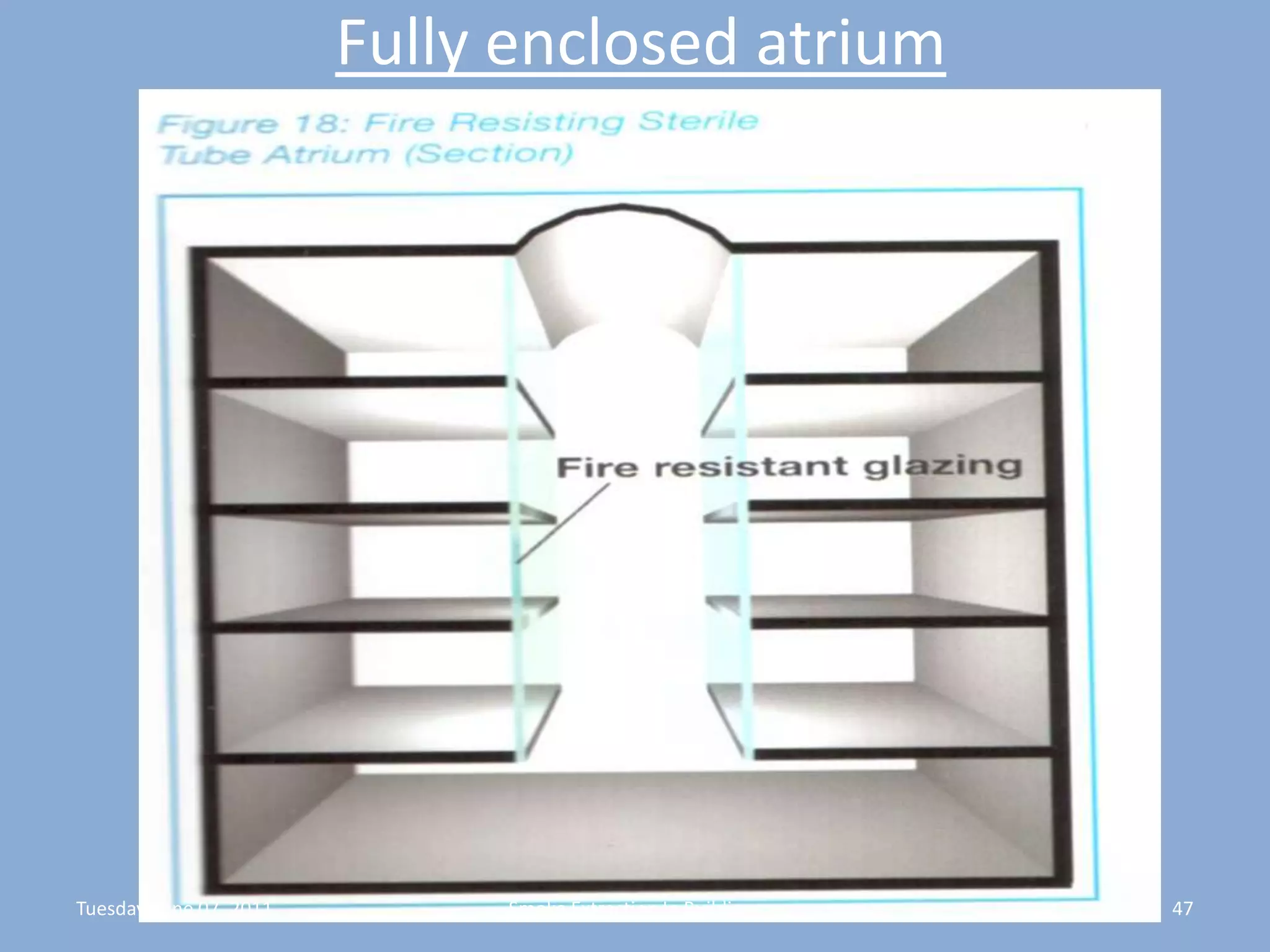
ATRIUM CONSTRUCTIONSFully enclosed atriumPartially opened atriumFully opened atriumTuesday, June 07, 201145Smoke Extraction In Buildings
Tuesday, June 07, 201146Smoke Extraction In Buildings
Fully enclosed atriumTuesday, June 07, 201147Smoke Extraction In Buildings
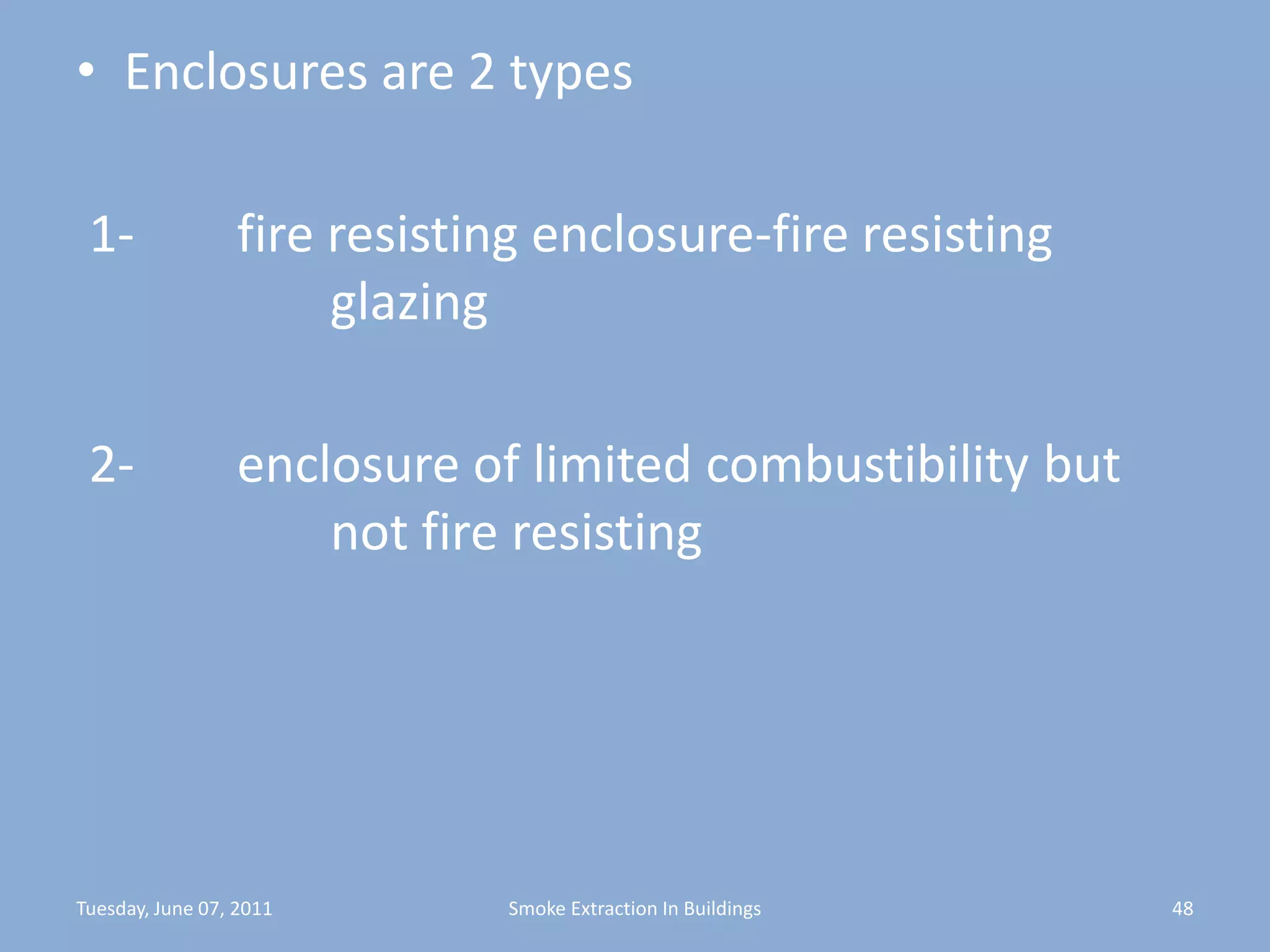
Enclosures are 2 types 1-        fire resisting enclosure-fire resisting 			glazing 2-        enclosure of limited combustibility but 		not fire resistingTuesday, June 07, 201148Smoke Extraction In Buildings
Partially enclosed atriumTuesday, June 07, 201149Smoke Extraction In Buildings
Fully open atriumTuesday, June 07, 201150Smoke Extraction In Buildings
Shopping mallsTuesday, June 07, 201151Smoke Extraction In Buildings
Extract from single shopsSmoke is prevented to enter to mall areaVery large fans are not requiredBut complex and costlyShops must be sprinkledCombined duct work is used to reduce costTuesday, June 07, 201152Smoke Extraction In Buildings
Extract from mallTuesday, June 07, 201153Smoke Extraction In Buildings
Channeling screensTuesday, June 07, 201154Smoke Extraction In Buildings
LimitationsWith high atriums  there is a cut off point of mass flow rate of 150 to 250 kg/s-economically impractical. Temperature stratificationCooling effectTuesday, June 07, 201155Smoke Extraction In Buildings
Fire,smoke and building code agenciesIndustrial risk insurers (IRI)Southern building code congress inc(SBCCI)National fire protection association(NFPA)Underwriters Laboratories(UL)British standards(BS)National Building Standards(NBS)Tuesday, June 07, 201156Smoke Extraction In Buildings
CONCLUSIONBy following discriminative approaches and methods needed for different types of buildings and constructions provided by the different  approved agencies ,the threat from fire and smoke can be reduced to a considerable level.Tuesday, June 07, 2011Smoke Extraction In Buildings57
ReferencesPromat International LtdNational Fire protection Association,Guide for smoke and heat venting,NFPA-204 MBS 5839: Fire Protection and alarm systems in buildings,Part1 2002Underwriters Laboratories,Leakage rated dampers for use in smoke in control systems,UL555 STuesday, June 07, 201158Smoke Extraction In Buildings
          THANKING YOU ALL……..Tuesday, June 07, 201159Smoke Extraction In Buildings

Smoke extraction in buildings

  • 1.
    SMOKE EXTRACTION INBUILDINGS Presented byVysakhManoharGATE-ChennaiTuesday, June 07, 20111Smoke Extraction In Buildings
  • 2.
    INTRODUCTIONEffective smoke extractionin buildings has been one of the inevitable considerations in the building design as the number of buildings and the concern of people about the regular fire accidents in buildings are increasing much.This presentation includes a brief description about the different design consideration principles and methods to be taken care for the effective heat extraction in different types of buildings . Tuesday, June 07, 20112Smoke Extraction In Buildings
  • 3.
    What is smoke?Byproduct of combustion or pyrolysis .Mixture of liquid , solid particulate matter and gaseous products.It is a cocktail of carbon monoxide, carbon dioxide ,HCL and HCNTuesday, June 07, 20113Smoke Extraction In Buildings
  • 4.
    FIRE TIME LINE00.00- Household is asleep00.30- Fire ignites and grows in downstairs1.04- Fire spreads and smoke begins to fillIn the room.1.35- Smoke layer descends rapidly and temperature exceeds 88 deg1.50 – Smoke detector sounds an alarm.2.30- Temperature becomes 205 deg2.48- smoke pours into other roomsTuesday, June 07, 20114Smoke Extraction In Buildings
  • 5.
    3.03-Temperature inthe room becomes more than 260 deg3.20-upstairs,corridors,all the rooms are filled with smoke3.41- flashover occurs , temperature becomes 760 deg 3.50 –Two minutes after the alarm sound, only the second exit will be the way out4.33- Flames will be apparent from the outside , the first evidence of fire visible from outside.Tuesday, June 07, 20115Smoke Extraction In Buildings
  • 6.
    Will follow similarscenario in other locationThe variations will be based on 1-fire size 2-size of building 3-flammable materials in the building 4-alarm systems 5-safety measures availableTuesday, June 07, 20116Smoke Extraction In Buildings
  • 7.
    GETTING THE DESIGNRIGHT FROM THE BEGINNINGFactors affected Design fire size Stack and wind effectsTemperature effect of fire HVAC and ventilation systemsClimate Expansion of ducts
  • 8.
    COMMON SAFETY METHODSUsesprinklersSmoke curtainsHVAC system incorporating F & S dampers.Extraction fansAlarm systemsPressurisationTuesday, June 07, 20118Smoke Extraction In Buildings
  • 9.
    HAZARDS OF DANGEROUSSMOKEImpair visibilityCoughing,nausea,vomitingGeneration of high temperatureIrritation and respiratory problemsBronchospasms and hypoxiaInflict death if it contains dangerous gasesEven low concentration of CO can cause diminished coordination and increased disorientationAmount of oxygen is reduced- suffocationExacerbate corrosive nature of HCLTuesday, June 07, 20119Smoke Extraction In Buildings
  • 10.
    Smoke PathwaysAir andservice ducts connecting floorsHVAC/ventilation systemsExtract duct systemsGaps between wall and floor constructionsStairwellsLift shaftsTuesday, June 07, 201110Smoke Extraction In Buildings
  • 11.
    Need of smokeextraction for life safety and reducing property loss for fire fighter accessTo clear smoke after a fire –smoke purgingTuesday, June 07, 201111Smoke Extraction In Buildings
  • 12.
    Smoke extraction designobjectivesEffective protection of building occupants by maintaining tenable conditions on egress systems.Reliable and functional fire fighting controls used by firefighters to increase visibility and reduce heat exposure.Tuesday, June 07, 201112Smoke Extraction In Buildings
  • 13.
    Make up airroutesExternal doorsLouvers in wall or roofCentral air plant configured to supply airFrom adjacent unaffected areas->avoid mixing of smoke and make up air->extraction points-avoid creation of “hole”Tuesday, June 07, 201113Smoke Extraction In Buildings
  • 14.
    Smoke Production andmovementAmount of smoke produced is dependent on size of firePath through which it goesPlume heightTuesday, June 07, 201114Smoke Extraction In Buildings
  • 15.
    Fundamental design factorsDesignfire sizeSmoke layer depthIdentify smoke reservoirsCalculate smoke volume and temperatureMinimum number of extract pointsVent or fan size and fan temperature ratingInlet airDuct workTuesday, June 07, 201115Smoke Extraction In Buildings
  • 16.
    Design fire sizeFirestarts small and becomes largeVent area=2.5 % of floor area-otherwise mechanical6 ac/hour is used oftenDesign fire size is greatly dependent on building contents.Based on the largest fire sourceCannot surely withstand post flash over conditionsTuesday, June 07, 201116Smoke Extraction In Buildings
  • 17.
    Heat output offireNational bureau of standards in USABased on time- safe escape time brigade response timeTuesday, June 07, 201117Smoke Extraction In Buildings
  • 18.
    Acceptable smoke layerdepthSmoke layer base should be above the people2.5 m-single storey3 m - upper storey of 2 storeyTuesday, June 07, 201118Smoke Extraction In Buildings
  • 19.
    Smoke reservoirsIf smokeis held in a too large reservoir-lose buoyancy2000 m^2 - natural extraction2600 m^2 -powered extractionSmoke curtains can be used to reduce horizontal spreadTuesday, June 07, 201119Smoke Extraction In Buildings
  • 20.
    Tuesday, June 07,201120Smoke Extraction In Buildings
  • 21.
    Smoke- volume, massflow rate and temperatureT=Q/m cp1/3 is gained by building structureTuesday, June 07, 201121Smoke Extraction In Buildings
  • 22.
    Minimum no ofextract pointsMcr is not exceededNo smoke need to travel more than 30 m to extraction pointTuesday, June 07, 201122Smoke Extraction In Buildings
  • 23.
    Inlet airTo makeup the smoky gasesAt least 1.5m beneath smoke layerIf natural inlet is givenInlets should be away from the outletsInlet velocity should be less than 3 m/sTuesday, June 07, 201123Smoke Extraction In Buildings
  • 24.
    Tuesday, June 07,201124Smoke Extraction In Buildings
  • 25.
    DuctworkMust be ableto withstand anticipated temp- From the formulaHVCA specification DW144For sprinkled buildingsTo limit fire spread -fire protection of steel ducts -construct from proprietary material - use fire and smoke dampersTuesday, June 07, 201125Smoke Extraction In Buildings
  • 26.
    Fire resisting requirementof ductworkTo prevent fire inside one duct to breaking out to other compartment.To prevent fire from outside enter into duct and then enter another fire compartmentTo prevent fire from outside enter into duct and the break out into other compartmentTuesday, June 07, 201126Smoke Extraction In Buildings
  • 27.
    Tuesday, June 07,201127Smoke Extraction In Buildings
  • 28.
    Tuesday, June 07,201128Smoke Extraction In Buildings
  • 29.
    Performance criteria forfire resisting duct workStabilityIntegrityInsulationTuesday, June 07, 201129Smoke Extraction In Buildings
  • 30.
    Other things tobe notedDuct must be able to retain at least 75% of its size after the smoke removal.Sound or thermal insulation should not be raised to ignition temperature.Fire stopping seals should be usedBuckling or collapse.Tuesday, June 07, 201130Smoke Extraction In Buildings
  • 31.
    Construction of fireresisting smoke extract ducts a) galvanized steel duct with additional protection b) fire resisting boards(eg . calcium silicate) c)proprietary fire resistant ductworkeg: PROMATECT-HTuesday, June 07, 201131Smoke Extraction In Buildings
  • 32.
    Protection of ductwith fire resisting boardTuesday, June 07, 201132Smoke Extraction In Buildings
  • 33.
    Ductwork construction fromfire resisting boardTuesday, June 07, 201133Smoke Extraction In Buildings
  • 34.
    Spreading of smokeTuesday,June 07, 201134Smoke Extraction In Buildings
  • 35.
    Tuesday, June 07,201135Smoke Extraction In Buildings
  • 36.
    Tuesday, June 07,201136Smoke Extraction In Buildings
  • 37.
    Tuesday, June 07,201137Smoke Extraction In Buildings
  • 38.
    Design guide fordifferent building typesMulti-storey office and similar buildingsWarehouseUnderground car parks/basementAtrium buildingsShopping mallsTuesday, June 07, 201138Smoke Extraction In Buildings
  • 39.
    Multi storey officeand similar buildingsPhased evacuationEvacuation time will be varyingSmoke should not spread 1, smoke extraction 2, pressurisationThe recirculation of air in normal hvac system is prevented by dampersTuesday, June 07, 201139Smoke Extraction In Buildings
  • 40.
    Tuesday, June 07,201140Smoke Extraction In Buildings
  • 41.
    Important design considerationsThesystem is not for providing a smoke free layerBoth supply and extract ducts should be having fire resistance equal to that of the floors /wallsExhaust fans should be able to run at the highest expected temperatureTuesday, June 07, 201141Smoke Extraction In Buildings
  • 42.
    The power supplyto the system must be duplicatedThe power and instrumentation cabling should be of fire resistant typeSmoke and fire dampers should be having suitable specification-UL555s class-I,II,III,IV in high storey buildings-wind pressure Tuesday, June 07, 201142Smoke Extraction In Buildings
  • 43.
    Ware housesTuesday, June07, 201143Smoke Extraction In Buildings
  • 44.
    Underground car parks/basementTuesday,June 07, 201144Smoke Extraction In Buildings
  • 45.
    ATRIUM CONSTRUCTIONSFully enclosedatriumPartially opened atriumFully opened atriumTuesday, June 07, 201145Smoke Extraction In Buildings
  • 46.
    Tuesday, June 07,201146Smoke Extraction In Buildings
  • 47.
    Fully enclosed atriumTuesday,June 07, 201147Smoke Extraction In Buildings
  • 48.
    Enclosures are 2types 1- fire resisting enclosure-fire resisting glazing 2- enclosure of limited combustibility but not fire resistingTuesday, June 07, 201148Smoke Extraction In Buildings
  • 49.
    Partially enclosed atriumTuesday,June 07, 201149Smoke Extraction In Buildings
  • 50.
    Fully open atriumTuesday,June 07, 201150Smoke Extraction In Buildings
  • 51.
    Shopping mallsTuesday, June07, 201151Smoke Extraction In Buildings
  • 52.
    Extract from singleshopsSmoke is prevented to enter to mall areaVery large fans are not requiredBut complex and costlyShops must be sprinkledCombined duct work is used to reduce costTuesday, June 07, 201152Smoke Extraction In Buildings
  • 53.
    Extract from mallTuesday,June 07, 201153Smoke Extraction In Buildings
  • 54.
    Channeling screensTuesday, June07, 201154Smoke Extraction In Buildings
  • 55.
    LimitationsWith high atriums there is a cut off point of mass flow rate of 150 to 250 kg/s-economically impractical. Temperature stratificationCooling effectTuesday, June 07, 201155Smoke Extraction In Buildings
  • 56.
    Fire,smoke and buildingcode agenciesIndustrial risk insurers (IRI)Southern building code congress inc(SBCCI)National fire protection association(NFPA)Underwriters Laboratories(UL)British standards(BS)National Building Standards(NBS)Tuesday, June 07, 201156Smoke Extraction In Buildings
  • 57.
    CONCLUSIONBy following discriminativeapproaches and methods needed for different types of buildings and constructions provided by the different approved agencies ,the threat from fire and smoke can be reduced to a considerable level.Tuesday, June 07, 2011Smoke Extraction In Buildings57
  • 58.
    ReferencesPromat International LtdNationalFire protection Association,Guide for smoke and heat venting,NFPA-204 MBS 5839: Fire Protection and alarm systems in buildings,Part1 2002Underwriters Laboratories,Leakage rated dampers for use in smoke in control systems,UL555 STuesday, June 07, 201158Smoke Extraction In Buildings
  • 59.
    THANKING YOU ALL……..Tuesday, June 07, 201159Smoke Extraction In Buildings

Editor's Notes

  • #4 Toxicity depends upon the material which is under fire.Pyrolysis- Thermochemicaldecomposition of organics without oxygen.
  • #5 The given time line is for a 2 storey house –this is just a time line representing the different steps from fire commence to the fire fighter arrivalNFPA-types of firesA,-from paper, cloth etcB,-from gasoline ..C,-electrical equipmentsD,-from metalsK- kitchen containing natural oilsOther classifications are also there.Borosilicate glass-fire resistant glazing Fire resistant wall-gypsum board partitions, reinforced concrete
  • #8 ->not practical to design based on any fire size->smoke developed depends on room size,firesize,material combustibility->smoke extraction rate –fan size,temperature rating for fans,incoming air resistance of make up air.->extract fans are the principal mechanical means of smoke and fume removal->vent size,escapetime,sprinklers,fans,fire and smoke dampers,smoke curtains,->stack effect-movement of air due to the buoyancy,temperature effect and pressure difference-chimney effect-dP=Cah(1/T0-1/T1)-during heating season,the hot air in the room rise high,and make the cold air enter through the lower openings
  • #9 - Sprinkler-each closed head sprinkler is held closed by heat sensitive glass bulb or two part metal link held together with fusible alloy -in a standard wet pipe sprinkler system,each sprinklers operate indipendantly- Sprinklers will be in to the action 1-4 minutes,for fire fighters it will requre minimum 5 minutes to reach and 10 minutes to fix the arrangemets.
  • #10 -low amount of oxygen-affect fire fighting-corrosive nature of hcl-attack structural steel and rcc-weakens the construction-treatment-avail oxygen
  • #12 Reduce property loss
  • #14 Extreme care for avoiding mixingHole-if smoke is tried to be extracted through 1 opening only ,then a hole like shape occurs just below the extraction point and thorugh this more fresh air than the smoke will be lostMany extraction points-evenly placed
  • #15 -don’t push or suck-just carry smoke from the room to outside area.
  • #16 -all fire starts small and grow larger-difficult to select a smoke extraction system for all fire sizes-
  • #17 -fire cant be represented by a single source-frequent strategy is to relate design fire size to sprinkler operation-normal combustibles rarely exceeds .5MW/m2-sprinklers are placed according to max fire size area(below)-
  • #19 Smoke production depends on fire size and plume heightFor fire fighter access only-2 and 2.5 respectivelyProperty protectionPrevents to adjacent areasSmoke curtains
  • #20 Half for the multi storey buildingPermanent smoke curtains- glazed smoke screenRetractable smoke screen-drops when alarm operatesMust extend below the base of smoke layer
  • #22 300 deg is usually expectedBut will be less if sprinklers are thereSpecific heat of smoke=1kj/kg
  • #23 When smoke being extracted from 2 or more interconnected storeys ,the highest smoke temperature will occur with fire on highest storey
  • #24 If natural inlet is given-like doors and windows , should open automatically when extract system starts workingIf not possible to maintain below 1.5 m- use smoke curtains , horizontal shields.Curtains or shafts are used not to make mix of fresh air with the smoke
  • #26 Standard galvanized steel ductwork can withstand up to 400 deg provided no aluminium rivets and combustible seals-dampers should be within the thicknes-the fsd should be operated not only with temp but also with smoke detectionHVCA-heating and ventilation contractors association
  • #28 Most cases fire resistance to internal and external fire are required-but some cases its not required.Fire resistance of the duct =fire resistance of wall through which it passes. But in some cases eg: here the possibility of getting any fire in the corridor is very less ,so the duct at that place need not be fire resistant to external fire.
  • #30 BS 476.part 24:1987-another requirement is that duct must be able to retain 75% of its cs area throughout the fireStabilitySaid to have violated stability criteria,if a frdw exposed to external fire (duct A) collapses in furnaceSaid to have violated s .if either length of duct A or duct B exposed to internal and external fire within furnace collapses outside the furnaceIntegrityCracks ,holes or other types of openings through which smoke leaksInsulationWhen temperature rise above initial temperature on the unexposed surface of duct exceeds 1, 140 deg as an avg value 2, 180 deg as maximum valueThen it fails to keep its insulation property
  • #31 Buckling-when smoke goes –expansion occur
  • #34 HangersSteel hangers with more than 2000mm of length must be insulated with fire resisting material to resisting expansion and catastrophic failure
  • #40 Evacuation time is >60 minSmoke must not spreadNormal hvac system can be modified to smoke extract
  • #43 Fsd-leakage-for exhaust-I,IISupply-III,IVHigh wind pressure-break windows,use sprinklers
  • #44 Here the main function of smoke extraction system is property protection and fire fighting assistance
  • #45 Design fire size is based on 1 carIf sprinkled-1.5 MwUnsprinkled-3 MwGenerally both inlets and outlets are ductedInlets should be at low level and outlet at high levelMin 10 ach If duct 500mm there is no fire chance –insulation requirement may be given with some flexibility.
  • #48 Separated from all other floors except at the base
  • #49 1,if it provides both integrity and insulation-no other action is needed2, if provides only integrity, fire protection systems should be designed-temp should not go beyond -300 deg, sprinklersNon combustible non fire resistant-Building should be sprinkled,300 deg or failure temperature of glass whichever is lower, negative atrium pressure can be given to avoid the movement of smoke to floors
  • #50 If the people are acquaintant with the then normal single stage evacuation can be provided,If not aquaintant ,then smoke base should not come beyond the enclosure for a specific time
  • #51 Sprinkler systems must be providedMust be designed in a way that no untenable should occur ,atleast for the expected evacuation timeWaiting areas-which is pressurised-can be used for other purposes when there is no fire, provided there should be having enough space for people to enter to that place when fire happens.
  • #52 Mall area are the escape areas
  • #54 Not effective for more than 2 stories
  • #55 If area of shop greater than 3000m sq, and 1000 m sq,then independent extraction is better
  • #56 Temp stratification-happens if the temp of smoke just below the ceiling is more hotter than the floor smoke –it happens in summer-due to this the smoke will not be able to reach fastly to the top where the detectors are placed. so this time lag will create a situation of spreading of smoke to more areas before the fire alarm starts.Cooling effect- is the process of mixing of smoke with more fresh air and settling down by the loss of buoyancy when the height or area of reservoir is more than that of allowed value.
  • #57 -deals with life safety-design and performance standards-IRI-insures properties based on information manual deals with belt driven smoke exhaust fans-sbcci-us +other foreign countries-building codes-NFPA-3 functional categories 1-improves the methods of fire protection ,elctrical safety and other safeties 2-obtains and circulates information on these subjects 3-secures cooperation of its members and public in establishing proper safeguards against loss of life and -National building code of India(NBC)-2005-London District Surveyors Association(LDSA)