Project by-
V.Bindiya ,
Narayana IIT Olympiad School
Robotics

Robotic
History

Robotic
Technology

Types of
 Robots
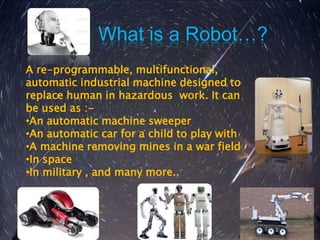
What is a Robot…?
A re-programmable, multifunctional,
automatic industrial machine designed to
replace human in hazardous work. It can
be used as :-
•An automatic machine sweeper
•An automatic car for a child to play with
•A machine removing mines in a war field
•In space
•In military , and many more..
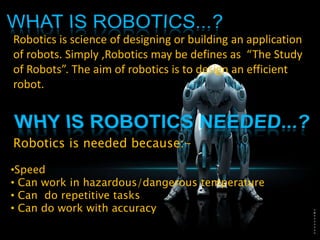
Robotics is science of designing or building an application
of robots. Simply ,Robotics may be defines as “The Study
of Robots”. The aim of robotics is to design an efficient
robot.


Robotics is needed because:-

•Speed
• Can work in hazardous/dangerous temperature
• Can do repetitive tasks
• Can do work with accuracy
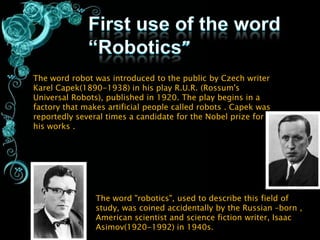
The word robot was introduced to the public by Czech writer
Karel Capek(1890-1938) in his play R.U.R. (Rossum's
Universal Robots), published in 1920. The play begins in a
factory that makes artificial people called robots . Capek was
reportedly several times a candidate for the Nobel prize for
his works .


                The word "robotics", used to describe this field of
                study, was coined accidentally by the Russian –born ,
                American scientist and science fiction writer, Isaac
                Asimov(1920-1992) in 1940s.
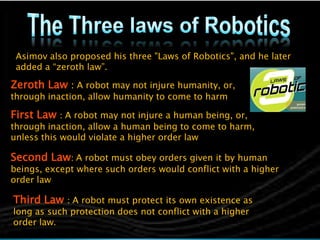
Asimov also proposed his three "Laws of Robotics", and he later
 added a “zeroth law”.

Zeroth Law : A robot may not injure humanity, or,
through inaction, allow humanity to come to harm

First Law : A robot may not injure a human being, or,
through inaction, allow a human being to come to harm,
unless this would violate a higher order law

Second Law: A robot must obey orders given it by human
beings, except where such orders would conflict with a higher
order law

Third Law : A robot must protect its own existence as
long as such protection does not conflict with a higher
order law.
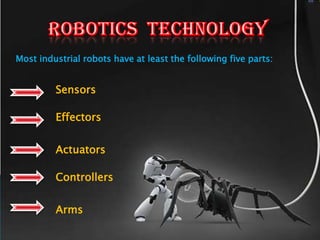
Most industrial robots have at least the following five parts:


         Sensors

         Effectors


         Actuators

         Controllers


         Arms
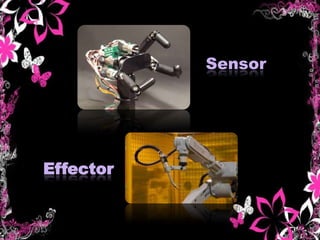
Sensor


Effector
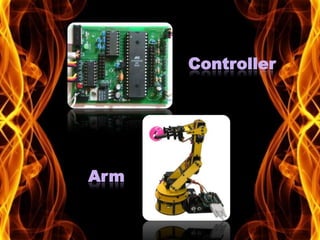
Controller


Arm
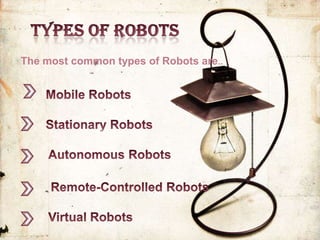
The most common types of Robots are..
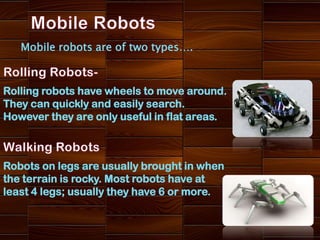
Mobile robots are of two types….


Rolling robots have wheels to move around.
They can quickly and easily search.
However they are only useful in flat areas.


Robots on legs are usually brought in when
the terrain is rocky. Most robots have at
least 4 legs; usually they have 6 or more.
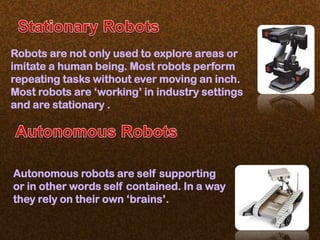
Robots are not only used to explore areas or
imitate a human being. Most robots perform
repeating tasks without ever moving an inch.
Most robots are ‘working’ in industry settings
and are stationary .


Autonomous robots are self supporting
or in other words self contained. In a way
they rely on their own ‘brains’.
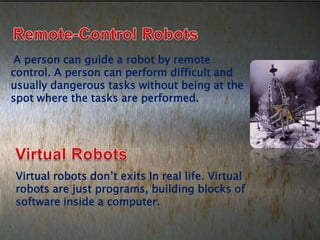
A person can guide a robot by remote
control. A person can perform difficult and
usually dangerous tasks without being at the
spot where the tasks are performed.


Virtual robots don’t exits In real life. Virtual
robots are just programs, building blocks of
software inside a computer.
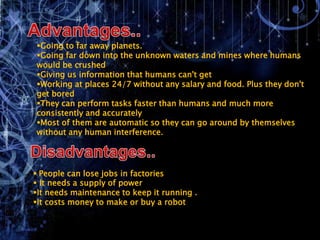
Going to far away planets.
Going far down into the unknown waters and mines where humans
would be crushed
Giving us information that humans can't get
Working at places 24/7 without any salary and food. Plus they don't
get bored
They can perform tasks faster than humans and much more
consistently and accurately
Most of them are automatic so they can go around by themselves
without any human interference.


 People can lose jobs in factories
 It needs a supply of power
It needs maintenance to keep it running .
It costs money to make or buy a robot
Robotics project ppt

Robotics project ppt

  • 1.
  • 2.
  • 3.
    What is aRobot…? A re-programmable, multifunctional, automatic industrial machine designed to replace human in hazardous work. It can be used as :- •An automatic machine sweeper •An automatic car for a child to play with •A machine removing mines in a war field •In space •In military , and many more..
  • 4.
    Robotics is scienceof designing or building an application of robots. Simply ,Robotics may be defines as “The Study of Robots”. The aim of robotics is to design an efficient robot. Robotics is needed because:- •Speed • Can work in hazardous/dangerous temperature • Can do repetitive tasks • Can do work with accuracy
  • 6.
    The word robotwas introduced to the public by Czech writer Karel Capek(1890-1938) in his play R.U.R. (Rossum's Universal Robots), published in 1920. The play begins in a factory that makes artificial people called robots . Capek was reportedly several times a candidate for the Nobel prize for his works . The word "robotics", used to describe this field of study, was coined accidentally by the Russian –born , American scientist and science fiction writer, Isaac Asimov(1920-1992) in 1940s.
  • 7.
    Asimov also proposedhis three "Laws of Robotics", and he later added a “zeroth law”. Zeroth Law : A robot may not injure humanity, or, through inaction, allow humanity to come to harm First Law : A robot may not injure a human being, or, through inaction, allow a human being to come to harm, unless this would violate a higher order law Second Law: A robot must obey orders given it by human beings, except where such orders would conflict with a higher order law Third Law : A robot must protect its own existence as long as such protection does not conflict with a higher order law.
  • 9.
    Most industrial robotshave at least the following five parts: Sensors Effectors Actuators Controllers Arms
  • 10.
  • 11.
  • 12.
    The most commontypes of Robots are..
  • 13.
    Mobile robots areof two types…. Rolling robots have wheels to move around. They can quickly and easily search. However they are only useful in flat areas. Robots on legs are usually brought in when the terrain is rocky. Most robots have at least 4 legs; usually they have 6 or more.
  • 14.
    Robots are notonly used to explore areas or imitate a human being. Most robots perform repeating tasks without ever moving an inch. Most robots are ‘working’ in industry settings and are stationary . Autonomous robots are self supporting or in other words self contained. In a way they rely on their own ‘brains’.
  • 15.
    A person canguide a robot by remote control. A person can perform difficult and usually dangerous tasks without being at the spot where the tasks are performed. Virtual robots don’t exits In real life. Virtual robots are just programs, building blocks of software inside a computer.
  • 16.
    Going to faraway planets. Going far down into the unknown waters and mines where humans would be crushed Giving us information that humans can't get Working at places 24/7 without any salary and food. Plus they don't get bored They can perform tasks faster than humans and much more consistently and accurately Most of them are automatic so they can go around by themselves without any human interference.  People can lose jobs in factories  It needs a supply of power It needs maintenance to keep it running . It costs money to make or buy a robot