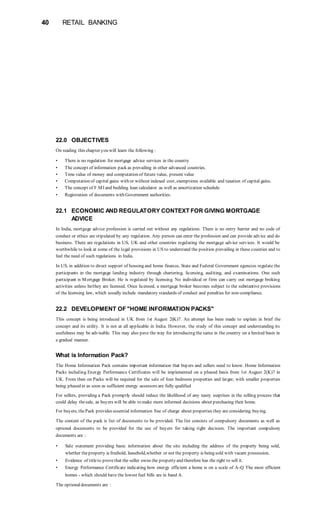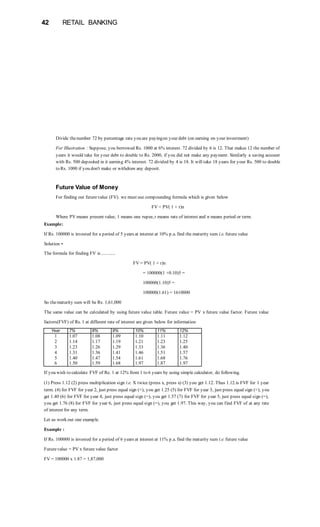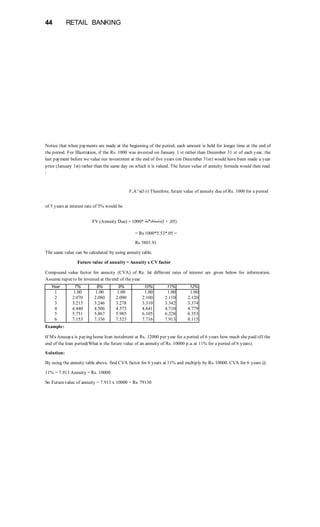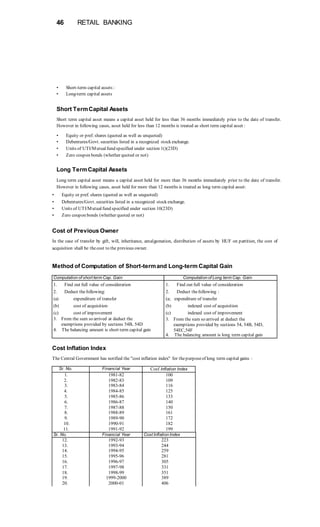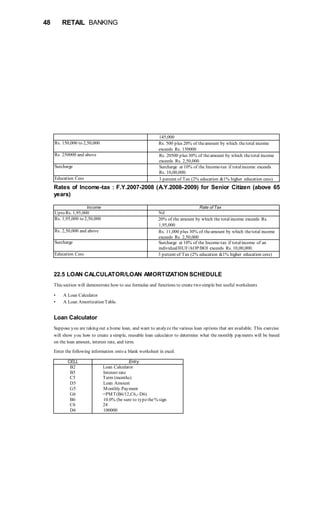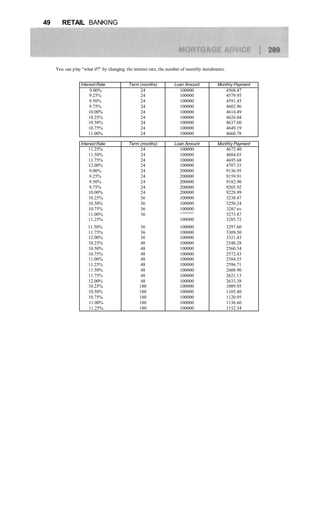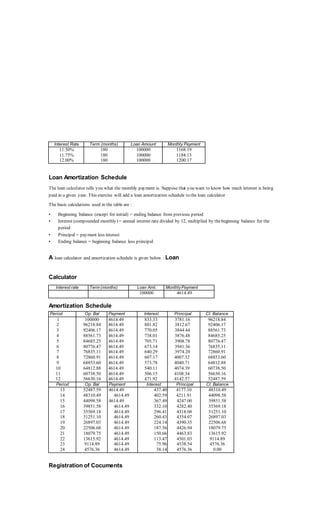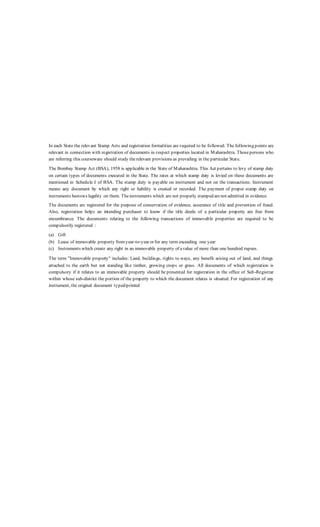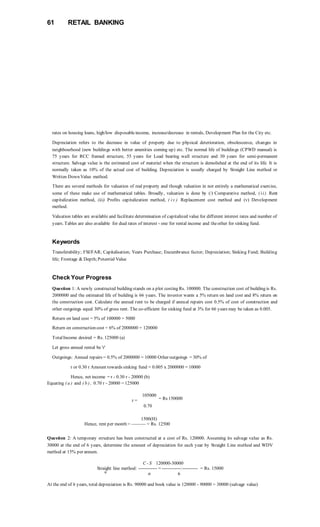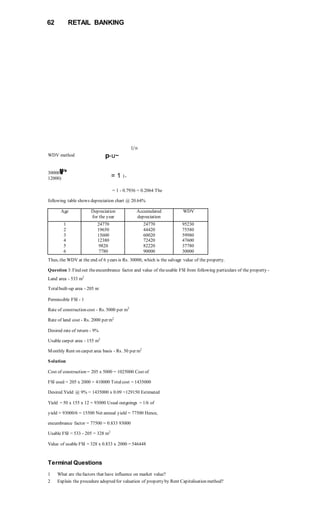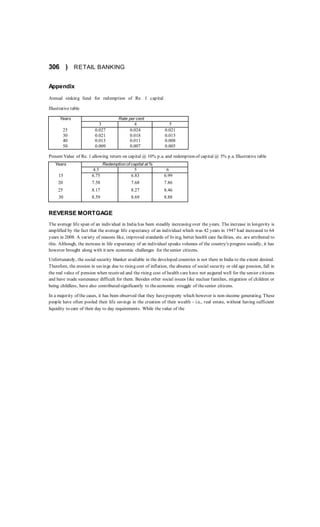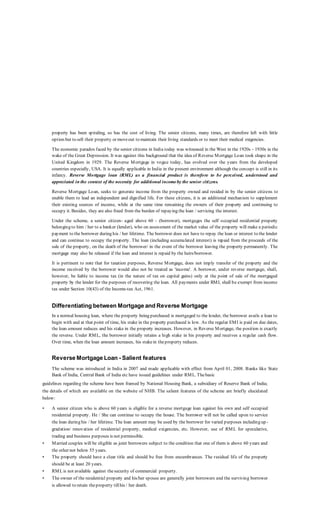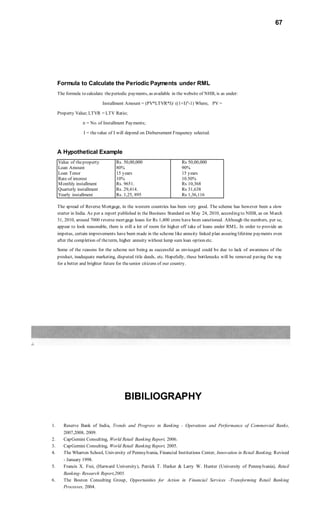


MODULE E
ADDITIONAL READING MATERIAL
ON HOME LOANS
Units
19. Lender's AppraisalProcedure
20. Securitisation - Mortgage Backed Securities
21. Housing Finance and Tax Planning
22. Mortgage Advice
23. Valuation of Real Property
U N I T 19 LENDER'S
APPRAISAL PROCEDURE
STRUCTURE
19.0 Objectives
19.1 Introduction
19.2 AppraisalProcedures
19.3 Application Form
19.4 Documents to be Submitted for Availing a Home Loan
19.5 Other Relevant Issues at Pre-sanction Stage
19.6 Documentation
19.7 Mortgage as Security
19.8 Detection of Forged and Fabricated TitleDeeds
19.9 Other Securities
Keywords Let Us Sum
Up Terminal Questions
19.0 OBJECTIVES
After reading this chapter you would have learnt the following:
• Lending principles and procedures
• Contents of an application form and documents to be submitted for availing loan
• Pre-sanction and post-sanction procedures
• Closure of a loan account
19.1 INTRODUCTION
2
Loan origination refers to processes right from the time the customer walks into the bank with a request for loan, till
the time the loan is finally disbursed. Three major phases of loan origination are information acquisition, credit
appraisaland sanction, and disbursement.
The processes revolve around two key aspects. One critically appraising the credit worthiness of a customer and two
analyzing the risk in lending. It is necessary to capture all the information required to cater to these aspects.
Demographic, employment, financial details are a must for processing. To minimize the risk, it is necessary to check
that the customer is not a fraud or black listed within the bank or with other institutions. It is also important to verify
that the information provided by the customer is correct and authentic. Banks achieve this mostly through external
agencies. Another method of validation of information is to collect and verify documentary proofs of income,
residence, age and other information.
As a factor of loan amount and the financial product, a bank may request co-borrowers or guarantors to support the
loan. This may be required as a risk mitigant.
Banks collect fees for processing, documentation, and administration, from customer as part of application processing.
This supplements a banks' income.
The second phase in loan origination is credit appraisal and sanction. Credit officers scrutinize the information made
available to them and arrive at the loan eligibility and fix the terms and conditions to be offered to the customer.
Generally two key techniques are used for this purpose. Confirming that the customer satisfies the basic norms and
policies and by applying weighted risk based credit scoring. This is an important phase in the origination cycle as
decisions made here affect the health of the portfolio. Incorrect decisions increase the risk and may add to bad debts,
affecting theportfolio performance.
The third phase is disbursement. Either a cheque for the sanctioned amount is issued to the customer, or the amount is
transferred to the customer account. A repayment schedule stating theamortization is prepared for the customer.
19.2 APPRAISAL PROCEDURES
The previous chapter dealt with theprocess of home loans from application to disbursement. The present chapter deals
with the procedures that thelender must follow internally, as well as the underlying principles.
LENDER'S APPRAISAL PROCEDURE | 3
Secondly, since the execution of documents is a process, the preparation and procedure could be complex given the
laws of the land on transfer of property. The lender's operation manual, desk cards etc. would deal with each step in
some detail. This chapter captures the essential features of each of these procedures. It also lists the requirements in
each step of the process, the sub-processes, related activities and documentation.
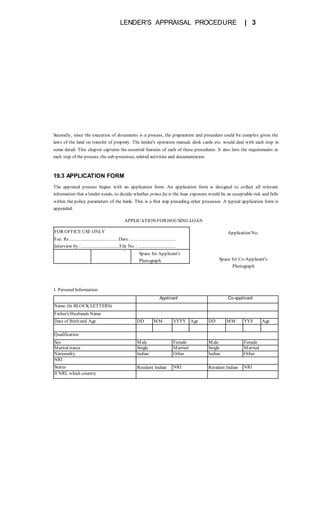
19.3 APPLICATION FORM
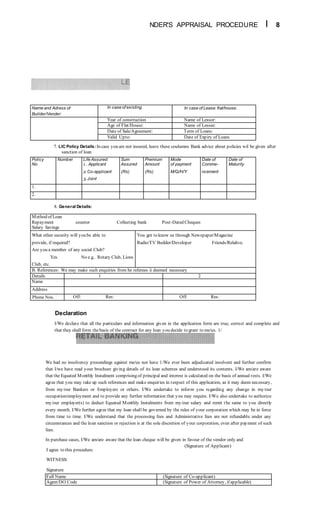
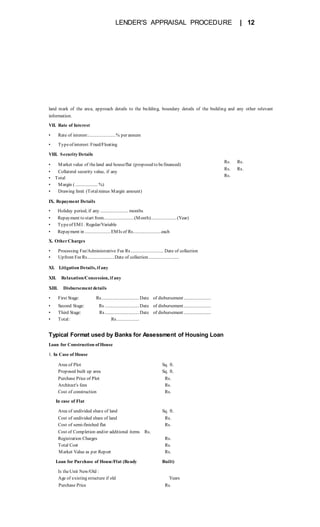
The appraisal process begins with an application form. An application form is designed to collect all relevant
information that a lender needs, to decide whether prima facie the loan exposure would be an acceptable risk and falls
within the policy parameters of the bank. This is a first step preceding other processes. A typical application form is
appended.
Application No.
Space for Co-Applicant's
Photograph
FOR OFFICE USE ONLY
Fee: Rs ......................................... Date:.......................................
Interview by :................................File No. :................................
•
Space for Applicant's
Photograph
APPLICATION FOR HOUSING LOAN
Applicant Co-applicant
Name (In BLOCK LETTERS)
Father's/Husbands Name
Date of Birth and Age DD MM YYYY Age DD MM YYY Age
Qualification
Sex Male Female Male Female
Maritalstatus Single Married Single Married
Nationality Indian Other Indian Other
NRI
Status Resident Indian NRI Resident Indian NRI
If NRI, which country
I. Personal Information:
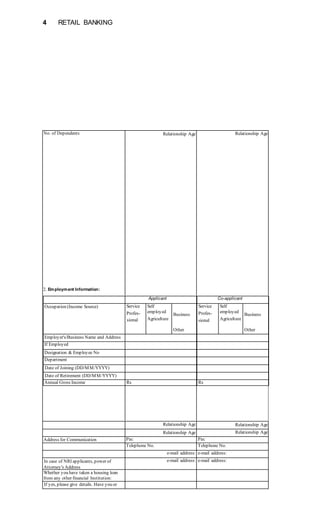
4 RETAIL BANKING
No. of Dependents Relationship Age Relationship Age
Relationship Age Relationship Age
Address for Communication Pin: Pin:
Telephone No. Telephone No.
e-mail address: e-mail address:
In case of NRI applicants, power of
Attorney's Address
e-mail address: e-mail address:
Whether you have taken a housing loan
from any other financial Institution:
If yes, please give details. Have you or
Applicant Co-applicant
Occupation (Income Source) Service
Profes-
sional
Self
employed
Agriculture
Business
Other
Service
Profes-
sional
Self
employed
Agriculture
Business
Other
Employer's/Business Name and Address
If Employed
Designation & Employee No
Department
Date of Joining (DD/MM/YYYY)
Date of Retirement (DD/MM/YYYY)
Annual Gross Income Rs Rs
2. Employment Information:
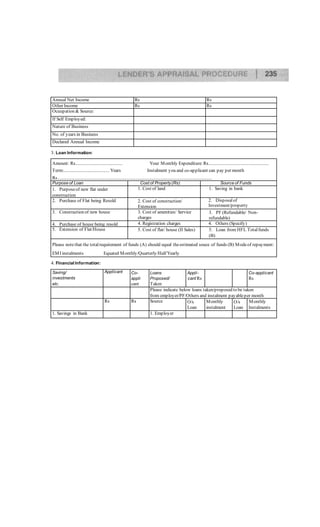
5 RETAIL BANKING
your spousestood as guarantee for any
other Housing Finance loan? If yes, please
give details
Annual Net Income Rs Rs
Other Income Rs Rs
Ocuupation & Source:
If Self Employed:
Nature of Business
No. of years in Business
Declared Annual Income
3. Loan Information:
Amount: Rs........................................ Your Monthly Expenditure:Rs...................................................
Term:....................................... Years Instalment you and co-applicant can pay per month
Rs...................................................................................................................................
Purpose of Loan Cost of Property(Rs) Source of Funds
1. Purposeof new flat under
construction
1. Cost of land 1. Saving in bank
2. Purchase of Flat being Resold 2. Cost of construction/
Extension
2. Disposalof
Investment/property
3. Construction of new house 3. Cost of amenities/ Service
charges
3. PF (Refundable/ Non-
refundable)
4. Purchase of house being resold 4. Registration charges 4. Others (Specify)
5. Extension of Flat/House 5. Cost of flat/ house (II Sales) 5. Loan from HFL Totalfunds
(B)
Please notethat the totalrequirement of funds (A) should equal theestimated souce of funds (B) Modeof repayment:
EMI instalments Equated Monthly/Quarterly/Half Yearly
4. Financial Information:
Saving/
investments
etc.
Applicant Co-
appli
cant
Loans
Proposed/
Taken
Appli-
cant Rs
Co-applicant
Rs
Please indicate below loans taken/proposed to be taken
from employer/PF/Others and instalment payableper month
Rs Rs Source O/s
Loan
Monthly
instalment
O/s
Loan
Monthly
Instalments
1. Savings in Bank 1. Employer
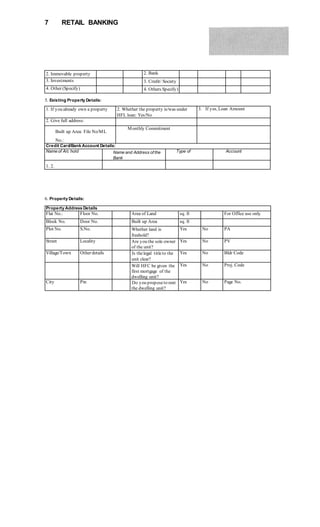
7 RETAIL BANKING
2. Immovable property 2. Bank
3. Investments 3. Credit/ Society
4. Other (Specify) 4. Others Specify)
5. Existing Property Details:
1. If you already own a property 2. Whether the property is/was under
HFL loan: Yes/No
3. If yes, Loan Amount
2. Give full address:
Built up Area: File No/ML
No.:
Monthly Commitment
Credit Card/Bank Account Details:
Name of A/c hold Name and Address of the
Bank
Type of Account
1. 2.
Property Address Details
Flat No.: Floor No. Area of Land sq. ft For Office use only
Block No. Door No. Built up Area sq. ft
Plot No. S.No. Whether land is
freehold?
Yes No PA
Street Locality Are you the sole owner
of the unit?
Yes No PV
Village/Town Other details Is thelegal titleto the
unit clear?
Yes No Bldr Code
Will HFC be given the
first mortgage of the
dwelling unit?
Yes No Proj. Code
City Pin Do you proposeto rent
the dwelling unit?
Yes No Page No.
6. Property Details:
NDER'S APPRAISAL PROCEDURE I 8
Name and Adress of
Builder/Vender:
In case of existing In case of Lease: flat/house:
Year of construction Name of Lessor:
Age of Flat/House: Name of Lessee:
Date of Sale/Agreement: Term of Loans:
Valid Upto: Date of Expiry of Loans
7. LIC Policy Details:In case you are not insured, leave these coulumns Bank advice about policies wil be given after
sanction of loan
Policy Number Life Assured: Sum Premium Mode Date of Date of
No 1. Applicant Assured Amount of payment Comme- Maturity
2. Co-applicant (Rs) (Rs) M/Q/H/Y ncement
3. Joint
1.
2.
8. General Details:
Method of Loan
Repayment counter Collecting bank Post-Dated Cheques
Salary Savings
What other security will you be able to
provide, if required?
Are you a member of any social Club?
Yes No e.g.. Rotary Club, Lions
Club, etc.
You got to know us through Newspaper/Magazine
Radio/TV Builder/Developer Friends/Relahve.
B. References: We may make such enquiries from he referees ii deemed necessary
Details 1 2
Name
Address
Phone Nos. Off: Res: Off: Res:
Declaration
I/We declare that all the particulars and information given in the application form are true, correct and complete and
that they shall form thebasis of the contract for any loan you decide to grant to me/us. 1/
We had no insolvency proceedings against me/us nor have 1/We ever been adjudicated insolvent and further confirm
that I/we have read your brochure giving details of its loan schemes and understood its contents. I/We am/are aware
that the Equated Monthly Instalment comprising of principal and interest is calculated on the basis of annual rests. I/We
agree that you may take up such references and make enquiries in respect of this application, as it may deem necessary,
from my/our Bankers or Employers or others. I/We undertake to inform you regarding any change in my/our
occupation/employment and to provide any further information that you may require. I/We also undertake to authorize
my/our employer(s) to deduct Equated Monthly Instalments from my/our salary and remit the same to you directly
every month. I/We further agree that my loan shall be governed by the rules of your corporation which may be in force
from time to time. I/We understand that the processing fees and Administrative fees are not refundable under any
circumstances and the loan sanction or rejection is at the sole discretion of your corporation, even after payment of such
fees.
In purchase cases, I/We am/are aware that the loan cheque will be given in favour of the vendor only and
I agree to this procedure.
WITNESS:
Signature
(Signature of Applicant)
Full Name (Signature of Co-applicant)
Agent/DO Code (Signature of Power of Attorney, if applicable)
9
Address
PIN: Place: Date :
Telephone
19.4 DOCUMENTS TO BE SUBMITTED FOR AVAILING A HOME LOAN
Along with the application form, the lending institution should also call for a few other documents, which
supplement/establish the particulars provided in the application form. The following is a list of the set of documents
that will be called for:
• Duly completed application form
• Passport sizephotograph.
• Proof of identity such as Voters ID Card/Passport/Driving license/PAN card.
• Proof of residence - Recent Telephone Bills, Electricity Bill, Property taxreceipt/Passport/Voters ID Card.
• Proof of business address for non-salaried individuals.
• Sale Deed/Agreement of Sale.
10
• Statement of Bank Account/Pass Book for last six months.
• Letter of allotment from Housing Board/Society, etc. (wherever applicable).
• Copy of approved plan, wherever applicable.
• Permission for construction, wherever applicable.
• Estimate/Valuation Report from approved valuers in respect of the property to befinanced, wherever applicable.
• In case of conversion of agricultural land - copy of therelative order.
• Search Report/Non-encumbrance certificate for 13 years from Bank's Advocate.
• NOC under theprovision of ULC Regulation Act. 1976 in original.
Appraisal
The appraisal comprises a validation of the information submitted by the applicant, collected by the various credit
verification agencies, property appraisers, bank's solicitors etc. In the process of validation, the information is checked
against the bank's policy, budgetary guidelines, risk management practices, any negative list etc.
Agreements/letters/application/forms required for theappraisal process:
• Housing Loan application.
• Appraisalform.
• Term Loan agreement for Home Finance.
• Guarantee Agreement (if required).
• Arrangement letter (Terms and conditions for Housing Finance).
• Equitable Mortgage intent letter.
• Equitable Mortgage confirmation letter.
• Letter of undertaking (where finance is availed for purchase of plot).
• Letter to be addressed by theborrower to his/her employer.
• Letter to be addressed by theborrower's employer to the Bank. Letter when theapplicant himself/ herself is the
drawing officer. Mortgage Deed (in case of Registered Mortgage)
• Mortgage Confirmation Letter.
• Documents in connection with pledge of other securities, wherever applicable.
Appraisal form for a Home Loan
I. Eligible loan amount
Eligibility: The lender could have a policy laying down the criteria for acceptance of a home loan exposure, against
which a loan application is checked. The parameters could be:
• A preferred age group.
• Minimum salary/income level.
• Areas/localities where home loan will be given; and areas where he will not take an exposure.
• Negative list containing other disqualifications.
The banker/lender would be well advised to develop such Risk Asset Acceptance Criteria (RAAC). This will ensure
that theportfolio quality is developed and maintained in terms of the policy of the bank. Leaving the same to the skills
of the several credit officers of the institution could result in disparate credit standards being applied in selection of the
borrowers
Parameter 1:
(a) Loan Amount Requested
(b) Cost of purchase/construction/renovation/repair of flat/house Plus
registration fee/stamp duty
(c) Amount under (b) above less margin stipulated
(d) Loan amount: (a) or (c) whichever is less
Paramet
er 2:
11
Rs.
Rs. Rs.
Rs.
(a)
(b)
(c) (d) (e)
Gross monthly income Gross income of
the applicant Add: Income of thespouse,
if any Add: Other income, if any (say 50-
60% of future rental) Total
Net monthly income:
Net income of theapplicant
Add: Net Income of the spouse, if any
Add: Other net income, if any
(say 50-60% of future rental)
Total
Certain multiples of (a) (say 36 times)
Certain multiples of (b) (say 60 times)
Loan amount (c) or (d) whichever is higher
Eligible loan limit: Lower than Parameter 1 or Parameter 2
Rs. Rs.
Rs.
Rs.
Rs. Rs.
Rs. Rs.
Rs. Rs.
Rs. Rs.
A. B.
(In case of take-over, the loan amount should not exceed the balance principal outstanding)
EMI for eligible loan amount for a repayment period of ... years Rs. Net monthly income minus 40% of
TotalMonthly Gross Income Rs. (B should be equal to or more than A)
II. Service Eligibility
Minimum years of service......................years (applicable for loan to salaried class people)
III. Age Eligibility
• Present age of the borrower
• Repayment period
• Age at theend of therepayment period
• Retirement age (in case of salaried class people)
IV. Legal Opinion
• Date of opinion
• Name of theadvocate (who should be in the panel of the financing institution)
V. Valuation Details
• Date of valuation
• Name of thevaluer (who should be in thepanel of the financing institution) Value of theproperty as per valuer's
report: Rs....................
• Estimated cost of construction/repair: Rs....................
Whether the property is encumbered: Yes/No
• If yes, name of the mortgagee
• Amount of loan taken Rs....................
• Amount of loan outstanding Rs ...................
VI. Inspection Details
• Date of inspection by staff of the financing institution:............................
• Inspection done by:.................................................
Observation: Specific comments on interaction with neighbours/officials of society in case of existing building,
discussion with builder and observation regarding the state of construction in case of a building under construction,
LENDER'S APPRAISAL PROCEDURE | 12
land mark of the area, approach details to the building, boundary details of the building and any other relevant
information.
VII. Rate of Interest
• Rate of interest:.......................% per annum
• Typeof interest:Fixed/Floating
VIII. Security Details
• Market value of theland and house/flat (proposed to befinanced)
• Collateral security value, if any
• Total
• Margin ( ................... %)
• Drawing limit (Totalminus Margin amount)
IX. Repayment Details
Rs. Rs.
Rs. Rs.
Rs.
• Holiday period, if any ........................ months
• Repayment to start from..........................(Month)......................(Year)
• Typeof EMI : Regular/Variable
• Repayment in ......................EMIs of Rs........................each
X. OtherCharges
• Processing Fee/Administrative Fee Rs............................ Date of collection
• Upfront FeeRs.......................Date of collection..........................
XI. Litigation Details, if any
XII. Relaxation/Concession, if any
XIII. Disbursement details
• First Stage: Rs................................ Date of disbursement.......................
• Second Stage: Rs ............................. Date of disbursement.......................
• Third Stage: Rs............................. Date of disbursement.......................
• Total: Rs...................
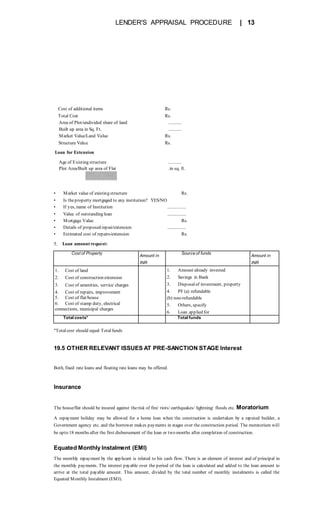
Typical Format used by Banks for Assessment of Housing Loan
Loan for Construction of House
1. In Case of House
Area of Plot Sq. ft.
Proposed built up area Sq. ft.
Purchase Price of Plot Rs.
Architect's fees Rs.
Cost of construction Rs.
In case of Flat
Area of undivided share of land Sq. ft.
Cost of undivided share of land Rs.
Cost of semi-finished flat Rs.
Cost of Completion and/or additional items Rs.
Registration Charges Rs.
Total Cost Rs.
Market Value as per Report Rs.
Loan for Purchase of House/Flat (Ready Built)
Is theUnit New/Old :
Age of existing structure if old Years
Purchase Price Rs.
LENDER'S APPRAISAL PROCEDURE | 13
Cost of additional items Rs.
Total Cost Rs.
Area of Plot/undivided share of land ...........
Built up area in Sq. Ft. ...........
Market Value/Land Value Rs.
Structure Value Rs.
Loan for Extension
Age of Existing structure ...........
Plot Area/Built up area of Flat .in sq. ft.
• Market value of existing structure Rs.
• Is theproperty mortgaged to any institution? YES/NO
• If yes, name of Institution ................
• Value of outstanding loan ................
• Mortgage Value Rs.
• Details of proposed repair/extension ................
• Estimated cost of repairs/extension Rs.
5. Loan amount request:
Cost of Property
Amount in
INR
Source of funds
Amount in
INR
1. Cost of land
2. Cost of construction extension
3. Cost of amenities, service charges
4. Cost of repairs, improvement
5. Cost of flat/house
6. Cost of stamp duty, electrical
connections, municipal charges
1. Amount already invested
2. Savings in Bank
3. Disposalof investment, property
4. PF (a) refundable
(b) non-refundable
5. Others, specify
6. Loan applied for
Total costs* Total funds
"Totalcost should equal Totalfunds
19.5 OTHER RELEVANT ISSUES AT PRE-SANCTION STAGE Interest
Both, fixed rate loans and floating rate loans may be offered.
Insurance
The house/flat should be insured against therisk of fire/ riots/ earthquakes/ lightning/ floods etc. Moratorium
A repayment holiday may be allowed for a home loan when the construction is undertaken by a reputed builder, a
Government agency etc. and the borrower makes payments in stages over the construction period. The moratorium will
be upto 18 months after the first disbursement of the loan or two months after completion of construction.
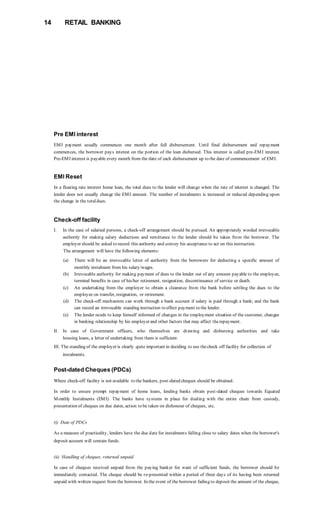
Equated Monthly Instalment (EMI)
The monthly repayment by the applicant is related to his cash flow. There is an element of interest and of principal in
the monthly payments. The interest payable over the period of the loan is calculated and added to the loan amount to
arrive at the total payable amount. This amount, divided by the total number of monthly instalments is called the
Equated Monthly Instalment (EMI).
14 RETAIL BANKING
Pre EMI interest
EMI payment usually commences one month after full disbursement. Until final disbursement and repayment
commences, the borrower pays interest on the portion of the loan disbursed. This interest is called pre-EMI interest.
Pre-EMI interest is payable every month from the date of each disbursement up to the date of commencement of EMI.
EMI Reset
In a floating rate interest home loan, the total dues to the lender will change when the rate of interest is changed. The
lender does not usually change the EMI amount. The number of instalments is increased or reduced depending upon
the change in the totaldues.
Check-off facility
I. In the case of salaried persons, a check-off arrangement should be pursued. An appropriately worded irrevocable
authority for making salary deductions and remittance to the lender should be taken from the borrower. The
employer should be asked to record this authority and convey his acceptance to act on this instruction.
The arrangement will have the following elements:
(a) There will be an irrevocable letter of authority from the borrowers for deducting a specific amount of
monthly instalment from his salary/wages.
(b) Irrevocable authority for making payment of dues to the lender out of any amount payable to the employee,
terminal benefits in case of his/her retirement, resignation, discontinuance of service or death.
(c) An undertaking from the employer to obtain a clearance from the bank before settling the dues to the
employee on transfer, resignation, or retirement.
(d) The check-off mechanism can work through a bank account if salary is paid through a bank; and the bank
can record an irrevocable standing instruction to effect payment to the lender.
(e) The lender needs to keep himself informed of changes in the employment situation of the customer, changes
in banking relationship by his employer and other factors that may affect therepayment.
II. In case of Government officers, who themselves are drawing and disbursing authorities and take
housing loans, a letter of undertaking from them is sufficient.
III. The standing of the employer is clearly quite important in deciding to use thecheck off facility for collection of
instalments.
Post-dated Cheques (PDCs)
Where check-off facility is not available to the bankers, post-dated cheques should be obtained.
In order to ensure prompt repayment of home loans, lending banks obtain post-dated cheques towards Equated
Monthly Instalments (EMI). The banks have systems in place for dealing with the entire chain from custody,
presentation of cheques on due dates, action to be taken on dishonour of cheques, etc.
(i) Date of PDCs
As a measure of practicality, lenders have the due date for instalments falling close to salary dates when the borrower's
deposit account will contain funds.
(ii) Handling of cheques, returned unpaid
In case of cheques received unpaid from the paying banker for want of sufficient funds, the borrower should be
immediately contacted. The cheque should be re-presented within a period of three days of its having been returned
unpaid with written request from the borrower. In the event of the borrower failing to deposit the amount of the cheque,
15 RETAIL BANKING
the undernoted procedure for initiating legal action under section 138 of the Negotiable Instruments Act, 1881, should
be initiated:
Steps to be taken when a cheque is dishonoured on account of (a) insufficient funds (b) closing the account, (c) stop
payment of the cheque (on account of insufficient funds).
Step1
When a cheque is dishonoured, the bank has to give a notice in writing to the drawer within 15 days of the receipt of
information by it from thefinance institution regarding the return of thecheque.
Step2
If drawer fails to make the payment of the said amount of money to the Bank within 15 days of the receipt of the notice
mentioned in Step-1, Step-3 should be followed.
Step3
A complaint should be filed before Court, within one month from the date of cause of action.
Example: If the last date for honouring the demand for payment was 1.1.2003, then cause of action is said to arise on
that date. The complaint should be filed on or before 31.1.2003.
Management of PDCs is the most important measure for recovery as this ensures the regularity of repayment and
prevention of overdues and NPAs.
19.6 DOCUMENTATION
The following is a listing of thedocumentation effort:
1. List of security documents related to theloan
2. Documents related to theproperty
3. Documentation where the mortgage is a second charge.
1. Documentation
Banks obtain the following documents, prior to disbursement of the loan.
• Demand Promissory Noteand/or Term Loan Agreement for home loans.
• Agreement of Guarantee from the guarantors
• Letter authorising the bank to dispose of theproceeds of loan to ensure the end use of funds in accordance with the
terms of sanction.
• Stamped letter of Memorandum of Equitable Mortgage (EM) for deposit of title deeds with an intention to create
an EM in favour of the financing bank (or) Registered Mortgage Deed against theimmovable property.
• Subrogation of mortgage agreement, in case of takeover of accounts from other bank/financial institution.
• Documents for pledge of Deposits in banks/NSC/IVP/KVP or assignment of Life Policy or hypothecation of
movables. - Wherever applicable.
• An undertaking letter from the builders to the effect that they have not violated any norms or guidelines issued by
Statutory authorities/Government restrictions/guidelines. (If this is not available, the branch must verify that the
fiat financed has not been built in violation of the approved plan.)
• An indemnity/guarantee may be obtained if the builder has appealed to the authorities for regularisation of an
unauthorised construction. (The decision to finance will depend upon the banks' judgment.)
• Valuation report from an engineer on the panel of the bank. Engineer's valuation report need not be insisted upon
if the flat is acquired from Housing Board, State Development Authority/Bodies/ Local Improvement Trust.
Engineer's valuation report should not be older than 5 years.
• Legal opinion from the bank's advocate
• Declaration as to whether any relative is working in theBank's prescribed format.
• Letter authorizing the bank to furnish opinion on the borrower's credit to Credit Information Bureau of India Ltd.
(CIBIL).
16 RETAIL BANKING
• No Objection Certificate (NOC) and a letter of undertaking from Housing Society (with whom flat is registered) to
mark a lien in favour of thefinancing bank.
2. Documents relating to the house
• Sale deeds through which theapplicant has acquired titleto theproperty/Agreement of Sale along with patta.
• If parent sale deed is not available, pattais a must.
• Encumbrance Certificate for 13 years showing nil encumbrances.
• Approved Building Plan.
• Parent Documents of 30 years.
• Legal opinion from the Bank's advocate certifying clear title to the property.
• Letter of Allotment from Housing Board/Society.
• Copy of approved plan.
• License/Permit for construction.
• Estimate/Valuation Report from approved valuers.
• Search Report from the records of the Registrar under whose jurisdiction the property is located/ Non-
encumbrance certificate for 13 years to be obtained by the Bank's advocate.
• Registration Receipt.
• NOC from builder/seller.
• Payment Receipts.
• Possession Certificate (where applicable).
• NOC under theprovisions of ULC Regulation Act, 1976 in original, wherever applicable.
• Copy of relative order, in case of conversion of agricultural lands to homestead land.
• Certificate from the Bank/Govt, approved architect/structural engineer regarding the condition of the house/flat,
in the case of purchaseof old property.
3. List of documents to be obtained in case of second mortgage/pari-passu
charge
• Letter from the borrower to the bank (prospective mortgagee) for extending the earlier mortgage to secure the
bank's (loan).
• Letter to be addressed by the prior mortgagee to the subsequent mortgagee, stating that the existing mortgage
charge will subsist and will rank prior in charge to the proposed charge and authorizing the new lender to create a
further charge on theproperty.
• Pari passu letter to be exchanged.
• Inter se pari passu agreement.
• Letter from first charge holder addressed to second charge holder.
• Letter to be issued by Bank for having second charge on the fixed assets. (This letter is to be addressed by the
second charge holder to the first charge holder).
• All documents necessary for creation of a mortgage listed in the preceding paragraphs will form a part of the
documentation.
Note: Given the complex nature of the process it would be a good idea to get an advocate to vet the documentation,
necessary in each case.
19.7 MORTGAGE AS SECURITY
The next section deals with an important part of the security documentation, viz. mortgage. The basic steps in creating
a mortgage are listed therein. The legal position surrounding the creation of mortgage and the precautions to be taken
by a lender to secure his position are discussed in some detail.
Mortgage
1. Section 58(a) of the Transfer of Property Act, 1882 defines mortgage as "a transfer of an interest in specific
immovable property for thepurpose of security, for the payment of money advanced or to be advanced by way of
17 RETAIL BANKING
a loan, an existing or future debit or the performance of an engagement which may give rise to a pecuniary
liability".
2. Types of Mortgage:
In India. Immovable property is accepted by the Banks as security usually by way of:
(a) Registered or Simple Mortgage,
(b) Mortgage by Deposit of Title Deeds.
(a) Simple registeredmortgage
Where, without delivering possession of the mortgaged property, the mortgagor binds himself personally to pay the
mortgage money, and agrees, either expressly or impliedly, that in the event of his failing to pay according to the
contract, the mortgagee shall have a right to cause the mortgaged property to be sold and the proceeds of the sale to be
applied, so far as may be necessary, in payment of mortgage money, the transaction is called simple registered
mortgage.
Under simple registered mortgage, the Deed of Mortgage is required to be registered with the concerned sub-
Registrar/Registrar of assurances by paying applicable stamp duty and registration charges within whose jurisdiction
the whole or some portion of the property to which the document relates is situated, within four months from its date
of execution. In this type of mortgage, property can be sold only with the intervention of the court. Thus, registered
mortgage involves preparation of mortgage deed duly witnessed by two witnesses, payment of ad valorem stamp duty
and registration of deed. Hence, it is a costly proposition.
(b) Mortgage by deposit of title deeds or equitable mortgage
1. Transfer of Property Act defines the "Mortgage by Deposit of TitleDeeds" as follows:
"Where a person in any of the following towns, namely, the towns of Kolkata, Chennai and Mumbai and in any
other town which the Statement Government concerned may, by notification in the Official Gazette, specify in
this behalf, delivers to a creditor or his agent documents of title to immovable property, with intent to create a
security thereon, the transaction is called a mortgage by Deposit of Title Deeds".
2. The essential requisites of a "Mortgage by Deposit of Title Deeds" are:
(a) There must be a debt, existing or future.
(b) There must be a deposit of documents of titleto immovable property.
(c) The deposit must be made in one of thenotified towns.
(d) The deposit must be made by the mortgagor or his agent with the mortgagee or his agent.
(e) The deposit must be made with an intent to create a security for the debt.
(f) Letter of intent should be obtained. Necessary entry should be made in the document register.
3. A mortgagee has the same rights under equitable and registered mortgages. So, an equitable mortgage will have
priority over subsequent registered mortgages. An equitable mortgage remains valid as
long as the mortgagee retains the title deeds. If the mortgagee parts with possession of the title deeds,
the mortgage will stand extinguished. If, however, the mortgagee parts with thepossession of title deeds
for a specific purpose, like examination by the solicitors or advocates of the intending purchaser of the
mortgaged property, or for the creation of subsequent mortgage in favour of a second mortgagee on a
specific understanding with the latter that the earlier mortgage is to subsist, the mortgagor will not be
deemed to have parted with possession although he has parted with thecustody of thetitle deeds.
4. The remedy of the mortgagee under an equitable mortgage is only sale of the mortgaged property through
the court (i.e., suit for sale). One can tabulate, as follows, the transfer of rights in case of simple
mortgage and equitable mortgage:
Particulars Simple Equitable
18 RETAIL BANKING
Mortgage Mortgage
1. Transfer of possession No No
2. Mortgagee's right
(i) To sue for personalliability Yes Yes
(ii) To sue for sale of mortgaged property Yes Yes
(iii) To sue for foreclosure No No
(iv) To sell property without court's permission No No
(v) To enjoy income out of mortgaged property No No
(vi) To appoint receiver with court's permission No No
Right of Foreclosure
On default by a mortgagor, in case of mortgage by conditional sale the mortgagee has the right to sue for a
decree from the court to the effect that the former be debarred forever to get back the mortgaged property.
Such a right is called Right of Foreclosure, which is provided for under section 67 of Transfer of Property
Act. A suit for foreclosure must be filed within 30 years from the day the mortgage money becomes due.
Priority of Charge
1. Where a mortgagor creates more than one equitable mortgage over the same property in favour of two
financing institutions, the institution in whose favour the mortgage is created first, has priority of
charge.
2. Where a mortgagor has created separate registered mortgages over the same property in favour of two or
more financing institutions, the priority of charge will be determined with reference to the date of the
execution of the deeds which has been duly registered within four months of execution (not the date of
registration).
3. Where a mortgagor gives the same property in equitable mortgage to one financing institution and in
registered mortgage to another financing institution, the priority of charge will be determined with
reference to the date of deposit of title deeds in equitable mortgage and the date of execution of
registered mortgage deed. An equitable mortgage in no way gives inferior rights compared to a
registered mortgage.
Important aspects to be looked into while obtaining equitable mortgage of immovable property :
1. It must be borne in mind that establishing title to property requires the expertise of an advocate, to whom the
documents must be referred for clearance. The title to a property may have been derived out of differing
conveyance acts, like partition, settlement, gift, decree of a court etc. and, therefore, the documents called for
from the customer, as listed in the earlier paragraphs, are just generic. The bank's advocate will interact with the
customer and will ask for and obtain all other necessary documents to establish title and the chain of ownership.
All of these documents must be deposited with the bank to create a valid mortgage on theproperty.
2. Where mortgage cannot be readily created, an agreement to mortgage should be taken. This is a deviation from
policy and is done at the absolute discretion of the lender, after appropriate internal approvals. There has to be an
undertaking that by a certain future date, the underlying mortgage must be created. The responsibility for
following this up and completing the formality lies with thecredit officer of thelender bank.
3. Where immovable property (of which land is the main constituent) is taken as security (primary or collateral)
either by way of registered mortgage or equitable mortgage, the following aspects should be looked into:
(a) tenure
(b) valuation
(c) title of land
Tenure of Land
1. It is necessary to ascertain the tenure of land, viz., whether it is freehold, leasehold or state-owned. If it is
freehold, the question of obtaining the consent of any person other than the owner does not arise. Under freehold
19 RETAIL BANKING
tenure, the owner is the absolute owner of the land; he is only liable for payment of rates, taxes and assessments to
Government and local authorities.
2. In leasehold tenure, the land is held for the period and on the terms and conditions contained in an instrument
called 'Deed of Lease'.
3. In the case of State-owned lands, the ownership vests with the State or Central Government as the case may be
and the holder of such land will be entitled to occupancy rights only.
Valuation of Land
1. The value of land should be examined to determine whether the price paid for the land is in line with the prevailing
prices for similar land in the area. Where the land is not of recent acquisition, it is very important to assess the
value of the land in line with the present market trend. The following steps help in this:
I. personal inspection;
II. comparison with recent sales of similar properties in theneighbourhood; and
III. enquiries from parties having a good knowledge of local land values.
2. For this purpose, the assistance of qualified valuers is taken. The valuation given in their report should be cross-
checked by independent (inquiries).
3. In general, while determining the value of the property to be mortgaged, allowance must always be made for the
fact that the price realised under a forced sale often falls short of the real worth of the property and that it usually
takes a considerable time to sell landed property even at a reduced value.
Title to property
1. The same amount of care as is taken for purchase of a property should be taken in investigating the title of the
property to be mortgaged. A good 'root of title' is "a document which deals with the whole legal and equitable
interest in the land, describes the property adequately and contains nothing to throw any doubt on the title".
Copies of title deeds are not documents of title, the only exception being the case where the original has been
destroyed or irretrievably lost and is not in existence. Certified copies of the title deeds issued by the Registrar of
Assurances should, therefore, be accepted only in exceptional cases, where there is conclusive proof that originals
have been destroyed or irretrievably lost.
2. In view of the priority of the Government's rights over the mortgage in the Bank's favour in the event of the
borrower keeping the land revenue/other public dues in arrears, it is, therefore, necessary to ensure that:
(a) all land revenue and municipal taxes due on the immovable property havebeen paid upto date;
(b) all land revenue and municipal taxes accruing or falling due, subsequent to the creation of themortgage are
paid promptly in future;
(c) no income tax dues are outstanding, to avoid any claim of priority under section 295 of the Income Tax Act.
3. Reference to advocates/solicitors: The task of investigation of title and scrutiny of title deeds should be entrusted
to advocates/solicitors and specific and categorical opinion should be obtained on the following points:
(a) Whether the documents of title are complete in all respects and sufficient to convey a clear, absolute and
marketable title to the property;
(b) Whether the property offered as security to thebank is unencumbered/unattached;
(c) Whether the documents examined and based on which theopinion is furnished, form a complete set of
documents of the subject property and deposit of these create a charge on the property;
(d) Whether the persons seeking to secure the property to thebank have a clear and marketable title thereto and
are legally capable of creating thecharge thereon in favour of the bank; and
(e) Whether the property is subject to any tenancy law, which will affect the bank's rights eventually to take
possession thereof or cause it to be sold or otherwise exercise its rights as mortgagee.
4. Search to be carried out: Search of the registers and other records with the Sub-Registrar of Assurances, Collector
and/or other revenue authorities should be carried out by the local advocates or the banks' solicitors, if and when
20 RETAIL BANKING
considered necessary, for ascertaining whether there is any outstanding mortgage or charge on the property to be
mortgaged to theBank.
19.8 DETECTION OF FORGED AND FABRICATED TITLE DEEDS
The title deeds submitted by the applicants need to be examined to detect any fake/forged title deeds. The following
are certain tips:
(a) Schedule of property and Registration of the document: It is necessary to verify the Schedule of the property
where it is situated and the Registration of the same with the Sub-Registrar Office concerned. Any discrepancy
could indicate forgery/fraud.
(b) Stamp Duty affixed on the document and the consideration shown in the document: It is necessary to verify the
consideration paid in thedocument and also verify the Stamp Duty affixed on the document.
(c) Affixation of stamps, cancellation and date of execution: It is necessary to verify the source of purchase of stamps
and its cancellation and also the execution of the document. The execution of the document should be subsequent
to the cancellation of stamps/dateof purchase.
(d) Examine security marks on the stamp paper, which are visible only on a close examination. The stamp paper
should not be mutilated.
19.9 OTHER SECURITIES
The lender, at his discretion, may accept LIC policies, Government promissory notes, shares and debentures, gold
ornaments of adequate value if a mortgage of property being financed is not possible. Margins stipulated for loans
against these securities shall apply.
Monitoring
Monitoring relates to post-sanction activities, dealing with proper documentation, disbursement, in a manner, to ensure
the proper end use of funds, periodical inspection, follow-up of recovery, restructuring of loan if needed, etc. It is a
function of the credit administration department.
In some banks, the risk management department has to indicate by a certificate that documentation is in perfect order
before disbursement can be authorized. If a part of documentation is incomplete and risk management does not sign
off. the Manager (Credit) will have to seek waiver of procedures prescribed in policy before authorizing disbursement.
Banks have well laid written policies on the level of authority, which must approve such waivers. For example, if a
guarantee document is to be signed by four brothers of an applicant for a loan and one of them has not signed it for a
reason acceptable to the bank, then such a fact must be recorded and a waiver sought to release the disbursement
without the signature of the fourth guarantor. The waiver is usually accorded for a specific period of. say, one month
up to a maximum of three months and by appropriateauthority.
The discretion to approve the waiver in a single disbursement loan will be at higher levels than in multiple
disbursement loans. This is because if in the period of waiver the lacuna in the documentation is not removed with
completion of documentation, then further disbursements can be stopped.
Other routine checks that the credit administration will perform:
1. Check that the sanction letter contains complete particulars, records all covenants fully and is signed by
authorized bank officials. Some banks require that the risk management officer sign on the sanction letter attesting
that it is prepared in accordance with the policy of the bank and all terms of sanction have been incorporated in
the letter. The authorized officer of thebank can sign the sanction letter only after it has been so signed off.
2. Check if the letter has been signed off by the borrower/guarantor acknowledging/agreeing to the terms and
conditions.
3. Check that all the documents are complete in all particulars, with no blanks left and that these have been signed
by the bank representativeand borrower/guarantors.
4. Check that required registration of documents has been done.
5. Check that insurance policy is in place.
21 RETAIL BANKING
6. Noting in daily lists has been made to follow up renewals, instalment payments, inspection etc.
Inspection
Inspection should be conducted as stipulated in the sanction. A record of the inspection must be kept in the files. The
inspection report must carry notings on the condition of the property, verification of payment of tax dues, and details
of any other encumbrance noted. Annually/Periodically, a fresh encumbrance certificate must be obtained. Any change
in the condition of the property should trigger a full-scale review.
Recovery
Check that EMI payments are coming in on due dates or that the post-dated cheques are being honoured on
presentation. If the bank's accounts have been "computerized", there will be a detailed computer generated daily
exception report on the defaulting accounts.
Restructuring
A home loan may have to be restructured when delays turn into defaults. A restructuring is considered where the
borrower's integrity is not doubted and his willingness to repay the loan is clearly established and only his ability to do
so is impaired. If the cash flows are found inadequate to pay in accordance with the EMI set, but enough to pay the
loan over a longer period of time, then the EMI could be reset. The lender may also allow the borrower to repay the
loan without changing the EMI, but allowing him to repay all the overdue and other interest charges in an extended
period. There should be a written request from the borrower and the guarantor for taking up this exercise.
Other circumstances when a restructuremay be considered:
• Unforeseen event/major illness/social functions requiring significant outlay of funds in the family of the borrower
or any other circumstance that affect therepayment capacity.
• In case of salaried class, borrowers who are on "loss of pay" due to lock out/strike/disciplinary action/delayed
payment of salary by employer
• Delayed completion of housing project.
• Death/Disability of the borrower.
However, wilful defaulters should not be covered under restructuring programs.
Annual Review of Credit Rating
The credit rating should be reviewed annually. Annual credit rating could include parameters like
(a) Record of repayment during thepast 12 months.
(b) Documentation as per sanctioned terms.
(c) Percentage of security coverage of the outstanding loan.
(d) Land value as percentage of totalproperty value (guidance value).
(e) Improvement in income level (as confirmed by Income-tax returns) plus including rental income at the
post-sanction stage.
(f) Liquidity of theborrower in terms of deposits with the financing institution, to cover certain minimum
number of EMIs.
Purchase of Old Property
The property should be valued afresh in accordance with the policy of the lender relating to old property. A
structural condition certificate should also be taken from a Chartered Engineer, to verify that the condition of
the fiat is such that the residual life of the fiat/house is adequate to cover the period of the loan. All other
formalities and documentation for home loans will apply.
Closure
On repayment of the scheduled EMI or the outstanding loan amount along with interest due, penal charges,
processing/servicing/documentation fees, if any, the loan account is closed. If the borrower has no other direct,
indirect outstanding or contingent liability to the financing institution, the charge created in favour of the
lender can be closed and documents of title to the property can be returned under acknowledgement of receipt.
It should be carefully considered whether the house/property is being bought for accommodation or for
investment expecting appreciation of value over a period. In case of the latter, the loan should be considered as
one having a higher risk with necessary improved margin/security/guarantee.
Home Loan Frauds
Studies have shown that the home loan market has multiplied 11 times in five years, with credit deployment
increasing from Rs. 14,100 crore in 2000 to Rs. 153,267 crore by October 2005. This is great news, since
adequate housing is a key factor in India's transformation. The bad news is that nationalised banks are another
big target of home-loans fraudsters and defaults. A year ago, in one PSB officials colluded to hand over loans
of Rs. 25 lakhs each to 110 workers of a construction company based on a single sheet of fake documentation.
The money was quickly transferred and routed through several accounts and found its way to Mumbai. An
investigation was launched, but the information was carefully hidden from the public. More recently, six
nationalised banks and a housing finance company were cheated in Gujarat when the borrower was found to
have used the same set of documents to borrow from each bank and defaulted in every case. This case too is
being quietly investigated by the police. A leading bank reportedly shut down it home loan operations at
certain branches after detecting collusion by its own staff in various frauds. Worryingly, the numbers are
adding up.
Keywords
Power of attorney: It is an instrument empowering a specified person or persons to act for and in the name of the
person executing it. The person for whom the act is done or who is so represented is called the principal. The person
who is so authorised to do or represent is called the agent. It may be either notarised or registered depending on the
transaction.
Let Us Sum Up
The process begins with receipt of application form along with the required documents giving information about
applicant, employment, loan amount, sources of finance, property details etc. Then the bank undertakes the appraisal of
the proposal. It comprises the validation of the information submitted by the applicant. After sanction of the loan the
documentation work is initiated and completed. The mortgage formalities are completed. The mortgage may be of two
types viz. registered (simple) mortgage or by deposit of title deeds. Issues relating to the right of foreclosure and
priority of charges are settled and accordingly mentioned in the mortgage deed. The lender also gives due importance
to monitoring of the loan accounts. Monitoring relates to post-sanction activities, dealing with proper documentation,
disbursement, ensuring end use of funds, periodical inspection, follow-up of recovery, restructuring of loan if needed,
etc. On repayment of the loan amount along with interest the loan account is closed and the charge created in favour of
the lender is vacated and documents of titleto theproperty arereturned to the borrower.
Check Your Progress
(i) Prepayments charges collected by branches should be credited to which account?
(a) Interest A/c
(b) Commission A/c
(c) Exchange A/c
(d) Current A/c
Ans: Interest A/c
(ii) To consider the loan amount under housing loan scheme which of thefollowing statements are true?
(i) the property is jointly held with the spouseand thespouseis co-borrower
the property is held in single name and the spousestands as a guarantor the borrower's son or daughter who
has a steady income, the salary is routed through Bank account and joins as a co-borrower
expected rental less taxes, cess, etc., in case thehouse/flat being purchased is proposed to be rented
Regular income from all sources can be considered to arrive at totaleligible loan amount.
(a) All the above
(b) a,b,d & e
(c) a, d & e
(d) a, b, c & e
(e) a, c, d & e
ans: All theabove
(iii) Mr. Satish Kumar working as a Senior Gazetted Officer in a Government Department having 20 years left over
service was recently transferred to Hyderabad. He approached a branch and requested that he is in pursuit of a
good house or apartment in Hyderabad for immediate purchase and he requires in principle sanction. Whether the
Bank accede to his request? If so, it is valid for how
many months?
(i) No. We cannot accede to such request
(ii) Yes, it is valid for one month
(iii) Yes, it is valid for three months
(iv) Yes, it is valid for six months
Ans: Yes, it is valid for three months
(iv) State whether thefollowing statement is true or false:
If the house property is bought purely from investment angle, expecting appreciation of value over a period, the
loan should be considered as risky and dealt with differently by tightening norms relating to margin, security and
guarantee.
Ans: true
Answers to Check Your Progress
(i) Interest A/c
(ii) All the above
(iii) Yes, it is valid for three months
(iv) True
Terminal Questions
1. List out the circumstances, where the commercial banks are restructuring the terms of thehome loans.
2. List out the various documents that are required by thecommercial banks for sanctioning of a home loan.
3. Who can be co-applicant?
4. Mow is the home loan eligibility determined?
5. What is the maximum amount which an applicant can borrow?
6. What are thetypes of home loans available?
7. Can one take a home loan for a construction in a city while working in another city?
8. Can persons of Indian origin holding foreign passportsget loans from Indian banks?
9. What security does the applicant provideto avail a home loan from commercial banks?
10. Write short notes on thefollowing:
(i) Simple registered mortgage.
(ii) Right of foreclosure.
(iii) Priority of charge.
(iv) Restructuring of home loan.
11. What documents are required to get theloan sanctioned?
12. What is pre-EMI interest?How is it calculated?
13. When theEMI commences for the housing loan?
14. Can the EMI be reset during the tenure of a loan?
15. Can the EMI be fixed upwards?
16. What is the importance of an amortization schedule?
17. When is theIT certificate issued?
18. What is the security for theloan?
19. When will the lender disburse his/her share of housing loan?
20. What is property insurance?
21. Whether additional loan and extension of repayment period is possiblein case of takeover of home loan?
22. How is the worth guarantor calculated?
23. What are thespecial features of a housing finance scheme for Persons of Indian Origin (PIO)?
U N I T 20 SECURITISATION - MORTGAGE
BACKED SECURITIES
STRUCTURE
20.0 Objectives
20.1 Introduction
20.2 The Need for Securitisation
20.3 Securitisation - Concept and Rationale
20.4 Other Securitisation Efforts
Let Us Sum Up Keywords
Terminal Questions
20.0 OBJECTIVES
After reading this chapter you would have learnt the following:
• Concept of securitisation for generation of funds by selling loan portfolio
• Modus operandi of securitisation
• Mortgage Backed Securitisation (MBS)
• MBSin theIndian scenario and efforts made by NHB for popularization of MBS
20.1 INTRODUCTION
Simply put, 'securitisation' means the conversion of existing or future cash inflows to any person into tradable security
which then may be sold in the market. The cash inflow from financial assets such as mortgage loans, automobile loans,
trade receivables, credit card receivables, fare collections become the security against which borrowings are raised. In
fact, even individuals can take the help of securitisation instruments for better economic efficiency, e.g., an individual
having regular inflows by way of rent from property can raise a loan by offering his/her rent receivables as security,
i.e., the rent receipts will first be used to pay the loan and then for other purposes. Since the lender is assured of regular
cash inflows, there is an enhanced element of creditworthiness and, therefore, he/she may offer the lo an at a lower rate
of interest. Of course, corporate securitisation deals involving crores of rupees are much more complicated. The
importance of securitisation lies in the fact that it helps convert illiquid assets or future receivables into current cash
inflows and that too at a low cost. The company may sell the receivables in the market and raise loans.
20.2 THE NEED FOR SECURITISATION
The funds required for new housing are estimated at Rs. 140,000 crores for the next five years. The HFCs, banks and
other lenders do not have resources of this magnitude to allocate specifically to home loans.
Banks generally lend for a short-term in the form of cash credits, with a repayment cycle of 12 months. The funds
therefore become available for another cycle of lending in a period of a year. On the other hand, home loans have a life
of 5 to 20 years, with probably an average life of 15 years. These funds therefore are not available for fresh lending for
a long period of time.
In theory, one method by which the banks can generate fresh funds is to sell the home loan assets in the financial
market. This would bring in funds into the banking system for fresh loans and each time a lender does this, he will be
able to generate a new pool of home loan assets and earn new fee income. Of course, such sale of assets can take place
if there are savers in the system looking for investments in assets; and market has adequate depth to create a continuous
demand for the home loan assets that the lenders will place in themarket.
If all placements of banks in the market were fully picked up by investors things would be smooth for the banker. This
however does not happen. The market consists of players with differing expectations for investments and returns. They
have no appetite for the home loan book of a bank, with all its retail lending features. These assets are transaction
intensive and need regular follow-up and require an organization to manage the assets. In their original form, only
other bankers with similar capabilities will be interested in acquiring these assets. Such a match of sale and purchase
requirement would be rather rare, although it does happen. In general, though, the market players have different
characteristics, relating to:
• Risk Appetite: Market contains participants with varying risk appetite. Some would prefer a low risk asset with
an acceptable return, while another class of investors may accept a higher risk profde for a higher return.
• Maturity: Home loans have an average maturity of 15 years. The investors however may look for investments
with a lower maturity. Theaverage bond market investor may accept a maturity of 7 years.
• Return Expectations: The return expectations will be different. While every investor would expect a return
higher than what a sovereign risk would pay, each class of investor would accept a different level of bond
interest payment, depending upon its structure.
• Periodicity: Periodicity in which each investor would expect interest payments and the structure of interest
payments, linked to fixed rate instruments or floating rate instruments.
• Liquidity of Promissory Note: If there is a well-developed secondary market, investments will come in easily. If
not, the investor will expect a higher risk premium; or the sale of home loan assets may not take place, leaving
the asset book to be carried by the bank.
Therefore, home loan assets have to be appropriately structured to meet some or all of these needs before they can be
marketed. Before studying how such structuring is done, we can look at what are the features available in a home loan
portfolio of a bank:
• Home loans are supported by mortgages. So, there is a poolof mortgage assets available for packaging as
collateral for a bond/promissory noteissue.
• Home loans are placed on monthly - and in some cases quarterly - repayments. As such, there is a pool of
receivables.
• It would be possibleto select home loans (mortgages), representing a mix of assets with average residual life of,
say, 5 years, 7 years or 10 years etc.
The next step is to think in terms of structuring a bond or promissory note with features that would make it attractive to
the market. The Lending Institution (Known as LI) who desires to raise funds by selling the home loans might take the
following steps:
Approach another banker, (say "Bank A") to
1. Buy the identified class of home loans off the lender's books.
2. Accept the mortgages of thepool of home loans as security for the issue of promissory notes/bonds, which the
"Bank A" would market.
3. Bank A would decide the size of theissue that can be marketed.
4. Bank A would determine the features of security, like (tenure), coupon rate, security needs etc. that would be well
received in the market and recommend it to the lender.
5. "Bank A" would set up a trust that would deal with the management of promissory noteissue. (The points to be
taken care of would be, to secure the promissory notes, document thesecurity, document thetransaction between
the lender and the trust, ensurethat money is received either from the poolof home loan assets bought off the LI
or from the lender who may be asked to continue to monitor and manage theloans in his book on behalf of the
trust etc.)
6. The LI itself may not be able to issue the securities, if the, market perception is that he does not have a LI AAA
risk. Perhaps, its home loan book may not get a good credit rating. Either of these would lead to the intervention
of Bank A who would issue a letter of credit or a guarantee to enhance the credit of the proposed promissory
notes/bonds.
7. Discuss and finalise the trustee's management fee, note issue charges, mortgage creation charges, and price the
promissory note/bond. That is, decide the coupon rate of interest thenote/bond will carry.
8. Discuss and decide how the receivables will be dealt with in future, whether they'll be received by the present LI
and then passed on to Bank A or will be directly received by thebank.
9. Discuss and decide how shortfalls in monthly/periodic collections will be met. It is possible that the pool of
mortgages or loans being sold may include a surplus amount as margin to deal with this contingency, based on
historical rates of default/delinquency of thehome loan book of theLI.
10. Bank A acts as a matchmaker between the LI who wants to off-load some assets from its books and the retail
investor who is looking for return on his funds.
It is obvious that there are a number of issues, which would need to be resolved in structuring a mortgage backed
securitisation effort. Each such effort would be unique and would depend upon
• The quality of the home loans (mortgages), thesecurity value, the receivable quality.
• The history of collections, delinquencies.
• The home loan lender's credit rating.
• The probable rating for theproposed security, by a rating agency.
• Issue costs, including credit enhancement costs, trust management costs etc.
The housing finance system in many developed countries, particularly USA and UK, is characterised by the presence
of a strong secondary market which enables the mortgage originators to off-load their loan portfolios from their
balance sheets by selling them off to major players in the secondary market. This imparts greater liquidity to the system
and results in larger funds flows to the housing sector. In India, the National Housing Bank is making an effort to
create a market for such securities.
20.3 SECURITISATION - CONCEPT & RATIONALE
The process of converting mortgage loans (any loan for that matter) together with future receivables into negotiable
securities or assignable debt, is called securitisation. It involves the steps discussed above viz. packaging designated
pool of mortgages and receivables and selling these packages to the various investors in the form of securities which
are collateralised by theunderlying assets and their associated income streams.
Securitisation involves conversion of mortgages into securities, which are tradable debt instruments. The securities,
which are backed by the mortgages, are then freely traded in the market, giving rise to a secondary market. The process
helps the lender to re-assign his capital to different asset building efforts.
28
maybe even exit the home loan segment and enter other fields. This also facilitates inter-regional and inter-sectoral
flow of funds.
Flow Chart - Securitisation
Originator Functiona
l
Secondar
y
Investors
'V can sell PTCs in Secon-dary Market
Securitisation is a process by which a
selected pool of homogenous and quality credit assets (loans) of a lending institution is sold to investors through a
trust/intermediary by packaging them in the form of securities, which are transferred by way of Pass Through or Pay
Through Certificates (PTC). All homogenous assets having similar characteristics for maturities, interest rates,
realisation, return etc. are pooled together by the lending institution and a Total Asset Base (TAB) is created. The
investment 'quality' of this asset is established through credit rating.
Here we discuss one particular form of securitisation. In the above flow chart, the lending institution assigns/sells its
receivables to Bank 'A' who acts as the special purpose vehicle and functional trustee. Bank A pays the discounted
value of the receivables to LA, who issues a pass/pay through certificate in the form of a receipt to the former for
having received the money. LA may continue to act as the receiving and paying agent. In that case, even after selling
the debt, it collects the receivables due (principal and interest due on the underlying loans) and passes out the
collections to the trust for distribution among the investors towards part or full liquidation of securities.
The trust notionally splits the pool of assets into small units/shares and sells the Pay Through or Pass Through
Certificate in the form of negotiable promissory notes/bond to interested investors.
Asset-backed securities (ABS) can be structured in two different ways. The first is the 'Pass Through Structure'. This is
generally used for loans with a tenure of more than one year, such as, car or housing loans. In a Pass Through
Structure, a bunch of loans are converted into ABS. The maturity of the ABS is usually comparable to the tenure of the
loans. The returns on ABS are paid directly from instalments of theloans.
The second structure, called the 'Pay-Through Structure,' is generally used for loans of short maturity such as credit
card receivables. The ABS in this case are issued for longer periods than that of the loans securitised. This calls for
active cash management by the issuer since he will have to reinvest the money he has received from instalments. The
ABS holders are paid from the returns on this reinvestment.
Mortgage Backed Securitisation (MBS)
The concept is popular among housing finance companies in the west. The home-loan assets are bundled into securities
and sold to investors. These are called mortgage-Backed Securities (MBS) because the
pool of receivables sold to the SPV is supported by the mortgaged home-loans. MBS is structured in such a way that
the HFCs simply pass on the cash flows from payments to the investors. Typically, a third party guarantees investment
in MBS. In the US, for instance, Ginni Mae and Freddie Mac guarantee MBS. Besides, MBS offers a good yield to
compensate for the re-investment risk. The guarantee and the yield make MBS an attractive investment. To structure
an MBS, the HFCs, typically bundle loans off like maturities but as those that have differing credit risk for
securitisation. A company can, for instance, bundle 500 individual loans with an average maturity of 10 years but
varying credit risk into 10 years MBS. Such loans are actually transferred to a Special Purpose Vehicle (SPV) created
for this purpose. It is the SPV that issues the securities to the investors. In order to pay for this portfolio, the Special
PurposeVehicle (SPV) in turn issues securities to the investors at a discounted present value.
There are two basic methods of securitisation. First, the originator does not actually sell the assets to the SPV. It
merely enters into an 'agreement to assign' with the trustee. Accordingly the legal title of the pool of assets remains
Lender sells
loans to
SPY
Special
Purpose
Vehicle (SPV)
Bank 'A'
Investor 'V
purchases
PTC Bank 'A'
29
with the originator and only the beneficial interest in the portfolio of receivables held, is transferred to the SPV. This
procedure is followed to avoid the high stamp duty ranging from 3-15% payable on the transfer of assets, but a
nominal stamp duty still has to be paid, when the SPV issues certificates or securities in the form of receipts to the
investors. However, these receipts are not negotiable instruments and, hence, not very liquid. Alternatively, the
originator sells the assets i.e. transfers all the interest to the SPV. This transfer attracts stamp duty ad valorem and
registration charges. In this transaction, SPV becomes the legal owner of the assets and it can issue certificates in the
form of promissory notes, which are more liquid and marketable.
The MBS have not been popular in India on account of two reasons. Firstly, lack of stringent foreclosure laws. At
present, if home loan borrowers default in payments, the HFCs cannot sell the property to realise their dues without
going to court. The final disposal in these cases happens after long delays, with funds getting locked up, expenses
going up and asset deteriorating in quality and therefore in value. This effectively kills the market and defeats attempts
at securitisation. Secondly, conversion of assets into securities attracts high stamp duty, taking away any margin
available for offering attractive yields. Also the stamp duty in most cases, for the SPV is very high, making it
impossible for MBSto be a financially viable instrument.
Securitisation - NHB's Efforts
NHB is pioneering MBS in India. In order to introduce MBS in its true sense, NHB had to first resolve a number of
issues. Such as the issues related to sale of mortgage loans (transferability of assets, method of transfer), insolvency of
the originator, issuance and transferability of MBS, foreclosure of mortgages, provisions concerning investments by
institutions, fiscal issues relating to borrowers, originators, issuers and investors, accounting issues and regulatory
issues. Besides there were certain areas, like, selection of mortgage pools, credit rating and prepayment behaviour of
mortgages which had to be examined.
As the existing law is biased against borrowers it would necessitate a large number of high quality loan originators and
a large set of high quality mortgages. This would imply a narrow base of clientele among the home borrowers and act
as a constraint. In order to simplify the recovery procedure, a new chapter has been added to the National Housing
Bank Act. This chapter provides for appointment of officers of approved institutions as recovery officers, the
procedures to make application to and hearings by such recovery officers and the procedure for promulgation and
enforcement of orders by recovery officers. Further, in the case of securitised loans, NHB may, without prejudice to
any other mode of recovery, make an application to the State Government for the recovery of the amount in the same
manner as arrears of land revenue.
In the case of NHB theprocess of securitisation of home loan receivables works as follows: Securitisation process can
be perceived as a two-stage process.
First stage: Transfer of mortgage debt from the primary lending institution (Originator) to a Special Purpose Vehicle
(NHB SPV Trust set up by NHB through declaration) with or without the underlying security.
Second stage: The mortgage debt so acquired will be converted into tradable debt instruments (say in the form of pass
through Certificates) without any recourse to theoriginator or theSPV.
Securitisation of Mortgage Debt: NHB SPV may purchase and convert the housing loans into securities/ PTCs
concurrently and issue them in the capital market for investment by investing institutions.
Execution of Memorandum of Agreement with NHB: Based on the willingness to sell or securities its portfolio of
housing loans, the Primary Lending Institution is required to enter into an umbrella agreement (called Memorandum of
Agreement) with NHB to sell/securities its portfolio of housing loans. The Memorandum of Agreement encapsulates
the entire MBS transaction and entitles NHB to take necessary steps to purchase or securities an identified pool of
housing loans, including circulation of the Information Memorandum and collection of subscription amount from
investors, as the case may be.
Selection of Pool of Housing Loans: The pool of housing loans would be selected by the Primary Lending Institution
from its existing housing loans based upon a 'poolselection criteria'.
30
Eligibility criteria for home loans to qualify for securitisation: The home loans should satisfy the following standards
for being considered for selection in theMortgage Pool offered for securitization :
• The borrower should be individual(s).
• The home loans should be current at thetime of selection/securitization.
• The home loans should have a minimum seasoning of 12 months (excluding moratorium period).
• The Maximum loan to Value (LTV) Ratio permissible is 85%. Housing loans originally sanctioned with an LTV
of more than 85% but where the present outstandingis within 85% of the value of thesecurity, will be eligible.
• The Maximum Instalment to (EMI) to Gross Income ratio permissible is 45%.
• The loan should not have overdues outstanding for more than three months, at any time throughout the period of
the loan.
• The Quantumof Principal OutstandingLoan size should be in the range of Rs. 0.50 lakh to Rs. 100 lakhs.
• The poolof housing loans may comprise of fixed and/or variable interest rates.
• The Borrowers have only one loan contract with the Primary Lending Institution (PLI).
31 RETAIL BANKING
• The loans should be free from any encumbrances/charge on the date of selection/securitization. The sole exception
to this norm being loans refinanced by NHB (In such cases, the loans may be securitised subject to the originator
substituting the same with other eligible housing loans conforming with the provisions of the refinance schemes of
NHB).
• The Loan Agreement in each of the individual housing loans, should have been duly executed and the security in
respect thereof duly created by the borrower in favour of the PLI and all the documents should be legally valid and
enforceable in accordance with theterms thereof.
• The Bank/HFC has with respect to each of the housing loans valid and enforceable mortgage in the
land/building/dwelling unit securing such housing loan and have full and absolute right to transfer and assign the
same to NHB.
The Pool selection criteria may be modified by NHB from time to time at its sole discretion. Submission of
Pool Information
The Primary Lending Institution will be required to submit loan details relating to the pool as under in prescribed
formats attached.
Due Diligence Audit
The Primary Lending Institution will get a due diligence review of the loan accounts conducted by Statutory Auditors
of the Company or a firm of Chartered Accountants acceptable to NHB and shall submit a due diligence and report to
NHB after execution of the MoA certifying thefollowing :—
• Each of the housing loans in the poolconforms and satisfies theselection criteria laid down by NHB.
• All the information furnished by the Primary Lending Agency to NHB with regard to the Borrower of the said
agency is true and correct.
• All the documents connected with the pool of housing loans proposed for sale to/securitisation through NHB are
legally valid and enforceable and the said agency has good and assignable right to each of the housing loans free
and clear of any set off, cross-claims, demands, encumbrance, equity, pledge, charge, claim or security interest
thereon.
• None of the housing loans has been sold, assigned, transferred or pledged to any person and I IK-HFC is sole legal
and full beneficial owner of these housing loans and has full right to transfer and assign the housing loans to NHB.
Valuation of the Pool and Consideration of Assignment
NHB will consider making payment of purchase consideration to the Primary Lending Agency under the following
methodology, with a view to obtain a sound and efficient pricing structureto the benefit of originators:
(i) Per Pricing Methodology: The consideration payable to the Primary Lender for transferring the pool would be equal
to the totalfuture outstanding principal balances of the individual loans on a Cut-Off Date.
(ii) Premium Pricing Methodology : The consideration paid to the Primary Lender for transferring the pool would be
decided and paid on the basis of discounting of future stream of net cashflows relating to the pool. It shall
normally be higher than the total outstanding principal balances of the individual loans on a Cut-Off Date as the
discounting rate used shall be lower than the weighted average coupon of the pool.
(ii) Discount Pricing Methodology : The consideration paid to the Primary Lender for transferring the pool would be
lower than the total outstanding principal balances of the individual loans on a Cut-Off Date as the discounting
rate used shall be higher than the weighted average coupon of thepool due to higher risk perception.
Salient Aspects of Valuation
• The outstanding principalof the underlying home loans should not be less than the face value of the RMBSpapers.
32 RETAIL BANKING
• Pool Receivables : The HFC shall assign, transfer and convey to NHB (either in its corporate capacity or in the
capacity of Trustee) for securitization the balance outstanding principal of these housing loans as on the cut off
date and all future interest due thereon together with all its other rights, titles and interest in relation thereto and in
the mortage or other securities therefor.
• As per the structure of the arrangement between NHB and the PLI, interest differential portion of the pool (i.e..
Weighted Average Coupon of the pool less the Total Cost of the Transaction including coupon interest payable to
the buyer of housing loans/investors in MBS, as the case may be), may be structured as continuous stream of
subordinated cashflows in the form of either an "Excess Servicing Fee" or "Income on Investment in a particular
class of MBS or in some other form.
Note:
In respect of (ii) and (m) stated above, the net cashflows shall he arrived at by deducting the recurring expenses such
as rating surveillance fee, trustee fee, registrar's fee, listing fee, audit/out-of-pocket expenses, and any other form of
credit enhancement measure as decided in the structure, from the gross cashflows. The discounting factor shall be
determined on the basis of some realistic assessment of the prevalent rate of interest in the debt market in respect of
similarly rated papers as well as risk being transferred under the transaction and the risk premium perceived
thereagainst, including assessment of the capabilities/credit-worthiness of the service provider.
NHB will not purchase any overdue EMIs or penal interest/out-of-pocket expenses outstanding in the originator's
books as on the cut-off date. These amounts as and when collected from the respective borrowers will be retained by
the originator or shall be allowed to be deducted from the first month's collection after the cut off date as agreed to
between parties.
Working Out Cut off Date Balances
The outstanding principal as on the cut-off date, may be worked out by adjusting the original loan amount to the extent
of the principal component of the EMIs payable up to the cut-off date together with the adjustment for any prepayments
received during this period. Any EMI/other charges remaining unpaid as on the cut off date shall be shown separately
as the cut off date receivables.
33 RETAIL BANKING
Credit Enhancement
In order to maintain a AAA rating and to improve the performance of the pool as also to ensure uninterrupted cashflow
for yielding the indicated coupon interest to the purchaser or subsequent investors in the MBS paper, the Rating
Agency or NHB may insist for additional credit support (called credit enhancement) under the transaction. The credit
enhancement may be provided in various forms such as setting aside a cash pool (called cash co llateral account),
limited corporate guarantee, third party guarantee, setting aside an additional mortgage pool (called over-
collateralisation), investment in sub-ordinated MBS paper (in the event of securitisation) etc. In the event of
securitisation of mortgage debt abinitio, credit support will be sought on the basis of recommendation of the credit
rating agency.
Liquidity Adjustment Facility
In view of delayed receipt of instalments from some borrowers at times and grace periods allowed by the primary
lending agencies to its borrowers, collection efficiencies may vary from month to month leading to inadequacy of
cashflow required for servicing. In order to protect the purchaser of housing loans/ investors in MBS from such
uncertainties, there may be a need to set up a 'liquidity Adjustment Facility' as a temporary stopgap arrangement. NHB
may decide the size/quantum of such a facility and require the seller of housing loans to provide such a facility
separately or in combination with the credit enhancement provided by them. NHB may also consider outsourcing such
a facility at a cost to be borne by theseller or out of thepool cashflows depending on thestructureof the arrangement.
Custody of Mortgage Documents
While the mortgage debt or the receivables pertaining to theMBS transaction will be legally transferred to NHB/SPV
Trust, the originator (primary lending agency) will continue to physically hold the title documents in respect of the
housing properties obtained as security on the loans issued, in the capacity of a custodian to NHB/SPV Trust and deal
with the same or all realisations therefrom only in accordance with the directions of NHB. Also, the originator shall, on
being so advised by NHB, give notice to the Borrower/s and/or third parties and enforce the security/lies in its own
name, if so required, for realisations of the outstanding due/s which is/are unpaid by the Borrowers and shall, when so
advised by NHB in writing, transfer or deliver to the NHB all relative documents records, contracts and writing and
papers in respect of thehousing loans and securities connected therewith.
Design of MBS Instruments
The mortgage debt will be purchased by NHB with a right to securitize them on the same/at later date. However,
irrespective of whether theproposal is for purchase of mortgage debt or for securitization of housing loans, NHB will
be free to design and issue any kind of innovative instruments as it may deem fit.
Appointment of Various Agencies
In the event of securitization of mortgage debts by NHB, NHB may decide to get the MBS instrument(s) rated by one
or more rating agencies, engage the services of one or more Issue Arrangers for preparation of the Memorandum of
Information pertaining to the issue and placement of the issue on private placement of public issue basis, appoint the
originator (Primary Lending Agency) or any other agency as the Servicing and Paying Agent under the transaction,
engage the services of Registrar and Transfer Agent (in the event of securitization) and such other agencies as NHB
may consider appropriatefor smooth operation of thescheme.
NHB may consider getting the MBS instrument listed in one or more Stock Exchange and dematerialized the same
with any of theDepositories at its sole discretion.
Payment of Consideration
NHB will make payment of consideration for the purchase of mortgage debts (for holding it in its own book or for the
purpose of securitization abinitio) after issue of allotment letters to investors or after execution of the legal documents
relating to the transaction or on such date as mutually agreed to between the buyer and theseller.
Establishment of Special Purpose Vehicle for Issue of MBS
34 RETAIL BANKING
In the event of securitization of housing loans, NHB may set up one or more Special Purpose Vehicles (SPVs) in the
form of Trust(s) or any other constitution for implementation of the scheme.
Post Issue of Servicing and Reporting Requirements
The Servicing and Paying Agent appointed by NHB shall submit monthly reports in respect of collections in t he
transferred pool of mortgages and such other MIS Reports, Statement of Accounts and Trial Balances as prescribed by
NHB from time to time. NHB or a firm of Chartered Accountants appointed by NHB in this behalf will have the right
to carry out inspection and/or audit of the loan account to verify the correctness of thereports and statements.
Hierarchy or Appropriation of Collection mounts (Payment "Waterfall")
The hierarchy of payments shall generally be as follows :
• Payment to Service Providers viz. Trustee, Servicing Agent, Rating Agency, & other service providers'
• Payment of Interest to Senior Class RMBS(Class A PTC) holders
• Payment of Principal to Senior Class RMBS(Class A PTC) holders
• Replenishment of Cash Collateral/Guarantee/such other form of credit enhancement
• Payment of Principal to Subordinate RMBS(Class B PTC) holders
• Payment of Residual income to Subordinate (Class B PTC) holders
The Servicing and Paying Agent appointment by NHB shall continue to make all reasonable endeavours to collect the
monthly instalments from the borrower and shall continue to administer the housing loans and undertake to devote
such time and to exercise such skill, due care and diligence in the administration and enforcement of the rights,
powers, privileges and securities in respect of the housing loans as it would have exercised had the entire beneficial
interest in housing loans been retained by it and release and return specific documents relating to any housing loan
Agreement under advice to NHB, if and only if, the relative borrower has paid his entire dues.
The Servicing and Paying Agent will continue to follow the standard norms (as being followed in respect of its other
borrowers) for apportionment of monies received from the borrowers. For specific deviation of norms or use of
discretion by the Servicing and Paying Agent especially relating to waiver of penal interest, interest, treatment of
prepayments, transfer out cases, re-schedulement of loans, conversion of loans from fixed rate to variable rate etc.
specific of general approvalof thebuyer (NHB) shall be taken.
20.4 OTHER SECURITISATION EFFORTS
The securitisation of Housing Finance receivables was initiated in the early nineties by Citibank in the form of Pass
Through Certificate (PTC), but MBS is still at a nascent stage in India on account of legal issues. The most formidable
of these has been the stamp duty structure, the inter-State variations that come in the way of the development of a
countrywide market etc. In March 1997, Maharashtra, Karnataka and Tamil Nadu slashed stamp duties on transactions
by HFCs; but this is not a complete solution. The cumbersome foreclosure and transfer or property laws are also
dampners.
Apart from legal impediments, the absence of uniform lending norms and documentation standards among the 23
HFCs/HFIs and a secondary market, stand in theway of the success of MBSin thecountry.
Conditions for a vibrant MBS market
One of the important reasons for the growth of housing finance in the developed markets is the systematic
development of a secondary market. A secondary market provides liquidity to the lenders and moderates the cyclical
flow of capital, in the real estate market. A vibrant secondary market will develop if a few of the following conditions
are met:
1. Risk identification, packaging and rating of themortgage pool/MBSby rating agencies.
2. Standard accounting procedure for all HFCs, banks and other lenders of home loans, especially on the treatment
of securitised pool of assets as an off-balance sheet item.
3. Tax treatment and tax incidence amongst theoriginator of themortgage based security, the SPV and the ultimate
investor.
4. Effective foreclosure systems.
5. Reduction in stamp duty on transfer of assets.
6. Availability of mortgage insurance, titleinsurance providing risk cover.
7. Innovative mortgage instruments with features that meet the different investment requirements of themarket
players.
35 RETAIL BANKING
8. Standardisation in respect of loan origination and underwriting practices across different HFIs/HFCs.
9. In order to induce institutionalinvestors to invest in MBS, investment in such products could be declared as
approved investments under the Insurance Act, as also for, the provident funds.
Home loans are becoming a significant part of bank loan books. There are more lenders in the market today. Product
line expansion is happening. The larger lenders are already thinking in terms of securitised products to add depth to the
market. The financial market is acquiring some depth as the economy grows in size. The new market players from the
developed countries are bringing in good market practices. All of this augurs well for the development of a sound,
healthy market in collateralized securities.
Let Us Sum Up
Securitisation is a process by which the future cash inflows of an entity (originator) are converted and sold as debt
instruments called pay through or pass through certificates with a fixed rate of return to the holders of beneficial
interest. The originator of a typical securitisation transfers a portfolio of financial assets to a Special Purpose Vehicle
(SPV), commonly a trust. The SPV is basically funded by investors. In return for the transfer, the originator gets cash
up-front on the basis of a mutually agreed valuation of the receivables. The transfer value of the receivables is done in
such a manner so as to give the lenders a reasonable rate of return. In 'pass-through' and 'pay-through' securitisation,
receivables are transferred to the SPV at the inception of the securitisation, and no further transfers are made. AH cash
collections are paid to theholders of beneficial interests in the SPV (basically thelenders).
Keywords
Risk appetite: Market contains participants with varying risk appetite. Some would prefer a low risk asset with an
acceptable return, while another class of investors may accept a higher risk profile for a higher return.
Mortgage Backed Securitisation (MBS): The Home Loan assets are bundled into securities and sold to investors called
MBS.
Securitisation: Means conversion of mortgages in securities, which are tradable debt instruments.
Terminal Questions
1. Define Securitisation. What is theneed of securitization in Financial Market ?
2. What are theissues involved in MBS ?
3. What are thefeatures available in a Home Loan portfolio of a Bank ?
4. Draw theFlow Chart of Securitisation processes and elaborate each of the processes.
5. What is meant by Mortgage Backed Securitisation (MBS) ?
6. What are theconditions that are required for a vibrant MBS Market ?
UNIT 21 HOUSING FINANCE AND TAX
PLANNING
STRUCTURE
21.0 Objectives
21.1 Introduction
Keywords Let Us Sum Up Terminal
Questions
21.0 OBJECTIVES
On reading this Chapter, you will learn thefollowing :
• Tax Benefits available in respect of Housing Finance
• Use of theBenefits to reduce Tax Liability
21.1 INTRODUCTION
36 RETAIL BANKING
Over the years, announcements have been made in the Union Budgets for tax concessions, waivers, etc. to encourage
housing & housing finance so as to counter the shortage of houses in India. The benefits available & use of the benefits
to reduce one's tax liability are being detailed below.
Tax benefits in respect of Housing Finance
In respect of Loan taken for Purchase/Construction of a Residential Unit, the borrower can avail benefit of payment of
interest as well as repayment of principal.
Interest on housing loan can be claimed as a deduction from income from property, salary, business/ profession, capital
gains, or any other source upto a maximum of Rs. 1,50.000 under section 24(b) of the Income-tax Act, 1961 every year
subject to fulfilment of the following conditions.
(a) Loan has been taken on or after 1st April 1999.
(b) Loan is for purchase or construction of a residential property or as re-finance (takeover) of the principal amount
outstanding under a loan taken earlier for purchase or construction of a residential property. However, in case of
loan for construction, the construction should get completed within 3 Years of raising the Loan. Deduction can be
claimed only from thefinancial year when the purchase/ construction is completed.
(c) The lender issues a certificate at the end of the financial year mentioning therein the interest & principal paid
during the year in respect of that loan.
If any of the first 2 Conditions mentioned above is not satisfied, i.e., loan was taken before 1st April 1999 &/or loan is
for repairs/renovation/reconstruction, deduction of only upto a maximum of Rs. 30,(K)() every year can be claimed.
The third condition mentioned above, however, has to be satisfied.
In case the Loan is for repairs/renovation/reconstruction, deduction on account of interest on that loan can be claimed
only if the property is self-occupied or if the owner is not able to occupy the property only because of his
employment/business/profession at another place, where he/she resides in a building not owned by him/her or his/her
spouse/close blood relatives.
The deductions are permissible only in respect of one property of the borrower, i.e., if he/she has raised loans for
multiple properties, interest can be claimed as a deduction only in respect of one property, depending upon the
borrower's choice.
As regards principal repayment, it can be claimed as a deduction from the gross total Income only by an
Individual/HUF borrower under section 80C of the Income Tax Act, 1961. However, the maximum deduction which
can be availed under Section 80C [deduction in respect of life insurance premium, deferred annuity, contribution to
provident fund, repayment of housing loan, etc.], Section 80CCC [deduction in respect of pension fundi, & Section
80CCD deduction in respect of contribution to pension scheme of Central Government] cannot exceed Rs. 1,00,000.
If the property is rented out, interest paid on Loan can be fully deducted from the Income derived from the property
without thelimit of Rs. 1,50,000 or Rs. 30,000, as the case may be.
Interest on loan taken for commercial property or on loan taken for business/personal needs against the mortgage of
property by an individual/HUF/partnership firm/company/any other person can be fully claimed as deduction from
income from rent/business/profession/other sources, as the case may be. However, the benefit on account of principal
repayment shall not be available in such cases.
Interest on unpaid interest, i.e., penal interest, is not deductible. Use of
Benefits to Reduce Tax Liability
We shall consider the Scenario of a 35-year old man.
HOUSING FINANCE& TAX PLANNING
No Housing Loan Housing Loan taken for Purchase/
Construction of Residential Unit on or after 1st
April1999 for Self-occupation
Income declared in ITR Rs. 4,50,000 Rs. 4,50,000
Contributions eligible for deduction
under section 80C of the Income
Tax Act, 1961
Rs. 1,00,000 Rs. 1,00,000
Interest paid on Housing Loan
during F.Y. 2006-07
- Rs. 1,68,000
Repayment towards principal
amount of housing loan during F.Y.
Rs. 21,000
37 RETAIL BANKING
2006-07
Basic Tax Liability, excluding
surcharge & education cess as per
Income Tax Slabs & Rates
applicable to A.Y. 2007-08
Rs. 54,000 [On Net
Income of Rs. 3,50,000
(i.e., Rs. 4,50,000 -Rs.
1,00,000]
Rs. 14,000 [On
Net Income of Rs. 2,00,000 (i.e., Rs. 4,50,000 -
Rs. 1,50,000 {max. permissible Dedn. towards
Interest} - Rs. 1,00,000 (max. permissible dedn.
under Sec. 80C, 80CCC, & 80CCD}]
Suppose in the above Case, the Income of Rs. 4,50,000 included Rs. 30,000 as rental income from the property
purchased/constructed with the Loan, the basic tax liability could have reduced to Rs. 8,600 [On Net Income of Rs.
1,74,800 (i.e., Rs. 4,50,000 - Rs. 9,000 {Standard Deduction @ 30% of Rs. 30,000 under Section 24 (a) 1 -Rs.
1,68.0(H) {full interest amount as property is rented out) -Rs. 1,00.000].
38 RETAIL BANKING
However, if in para 12.3.1 above, the man had taken the loan before 1st April, 1999 &/or taken the loan for
repairs/renovation/reconstruction, his basic tax liability for A.Y. 2007-08 would have been Rs. 45,000 [On Net Income
of Rs. 2,00,000 (i.e., Rs. 4,50,000 - Rs. 30,000 (Maximum permissible Deduction towards Interest) - Rs. 1,00,(XK)
{Maximum Permissible Deduction under Sections 80C, 80CCC, & 80CCD)].
No Tax Benefit is available in respect of Loan taken for purchase of plot of land. Hence, instead of taking a Loan for
purchase of plot, he/she should take loan for purchase of plot as well as construction of house & complete construction
of a self-sufficient House within 3 Years of raising the Loan.
If Loan is raised jointly by husband & wife or any other combination of persons acceptable to the lender, the interest &
principal can be claimed by the co-borrowers in proportion to the amounts paid by them, subject to the combined
maximum limit of Rs. 1,50,000 (or Rs. 30,000) & Rs. 1.00.000 towards interest & principalrespectively.
If the housing loan is taken before 1st April, 1999, deduction on account of interest shall be limited to Rs. 30,000 every
Year. However, if the loan is taken after 1st April, 1999, deduction of interest upto Rs. 1,50,000 can be claimed every
Year.
Keywords
HUF:Hindu Undivided Family ITR:
Income Tax Return A.Y.: Assessment
Year FY: Financial Year
Let Us Sum Up
Raising a housing loan can not only help in lowering one's tax liability, but can more importantly, allow one to get his/
her home for self-occupation or for supplementing his/her existing Income. However, the benefits have to be used
judiciously.
Check Your Progress
1: Fill in the Blanks by choosing theappropriateWords from the Bracket.
(a) An Individual took a Loan of Rs. 15.00 Lacs for purchasing a flat for self-occupation on 30/03/
1999 & paid Rs. 1,20,000 towards Interest during FY. 2006-07. The maximum amount of
Interest which he can claim as a deduction would be .................................. (Rs. 1,50,000; Rs. 1,20,000;
Rs. 30,000).
(b) Husband & Wife jointly raise a loan in April 2005 for constructing a house for self-occupation.
The construction was completed in July 2006. They have been paying the housing loan
instalments on 50:50 Basis from their respective Incomes. During FY 2006-07, they paid
39 RETAIL BANKING
Interest of Rs. 3,00,000. Themaximum interest which each of them can claim as deduction is
..................... (Rs. 1,50,000; Rs. 75,000).
(c) An individual took a loan of Rs. 10.00 Lakhs for purchasing a plot of land during F.Y. 2005-06 & has paid
around Rs. 1,10,000 towards Interest & around Rs. 57,000 towards principal during F.Y. 2006-07. He has
not made any other contribution under Sections 80C, 80CCC, or 80CCD.
He will be able to claim deduction of................................ (Rs. 1,50,000; Rs. 1,10,000; Rs. 0) towards
Interest &......................... (Rs. 1,00,000; Rs. 57,000; Rs. 0) towards principal.
Answers to Check Your Progress
(a) Rs. 30,000; (b) Rs. 75,000; (c) Rs. 0; Rs. 0
Terminal questions
1. Enumerate the Benefits of taking a housing loan.
2. Demonstratehow housing loan can help in reduction of tax liability.
U N I T 22 MORTGAGE
ADVICE
STRUCTURE
22.0 Objectives
22.1 Economic and Regulatory Context for Giving Mortgage Advice
22.2 Development of "Home Information Packs"
22.3 Time Value of Money-interest and Annuities
22.4 Capital Gains
22.5 Loan Calculator/Loan Amortization Schedule
Let Us Sum Up
Terminal Questions
40 RETAIL BANKING
22.0 OBJECTIVES
On reading this chapter you will learn the following :
• There is no regulation for mortgage advice services in the country
• The concept of information pack as prevailing in other advanced countries.
• Time value of money and computation of future value, present value
• Computation of capital gains with or without indexed cost, exemptions available and taxation of capital gains.
• The concept of F.MI and building loan calculator as well as amortization schedule.
• Registration of documents with Government authorities.
22.1 ECONOMIC AND REGULATORY CONTEXT FOR GIVING MORTGAGE
ADVICE
In India, mortgage advice profession is carried out without any regulations. There is no entry barrier and no code of
conduct or ethics are stipulated by any regulation. Any person can enter the profession and can provide advice and do
business. There are regulations in US, UK and other countries regulating the mortgage advice services. It would be
worthwhile to look at some of the legal provisions in US to understand the position prevailing in these counties and to
feel the need of such regulations in India.
In US, in addition to direct support of housing and home finance, State and Federal Government agencies regulate the
participants in the mortgage lending industry through chartering, licensing, auditing, and examinations. One such
participant is Mortgage Broker. He is regulated by licensing. No individual or firm can carry out mortgage broking
activities unless he/they are licensed. Once licensed, a mortgage broker becomes subject to the substantive provisions
of the licensing law, which usually include mandatory standards of conduct and penalties for non-compliance.
22.2 DEVELOPMENT OF "HOME INFORMATION PACKS"
This concept is being introduced in UK from 1st August 2(K)7. An attempt has been made to explain in brief the
concept and its utility. It is not at all applicable in India. However, the study of this concept and understanding its
usefulness may be advisable. This may also pave the way for introducing the same in the country on a limited basis in
a gradual manner.
What is Information Pack?
The Home Information Pack contains important information that buyers and sellers need to know. Home Information
Packs including Energy Performance Certificates will be implemented on a phased basis from 1st August 2(K)7 in
UK. From then on Packs will be required for the sale of four bedroom properties and larger, with smaller properties
being phased in as soon as sufficient energy assessors are fully qualified
For sellers, providing a Pack promptly should reduce the likelihood of any nasty surprises in the selling process that
could delay thesale, as buyers will be able to make more informed decisions about purchasing their home.
For buyers, thePack provides essential information free of charge about properties they are considering buying.
The content of the pack is list of documents to be provided. The list consists of compulsory documents as well as
optional documents to be provided for the use of buyers for taking right decision. The important compulsory
documents are :
• Sale statement providing basic information about the site including the address of the property being sold,
whether theproperty is freehold, leasehold,whether or not the property is being sold with vacant possession.
• Evidence of titleto provethat the seller owns the property and therefore has the right to sell it.
• Energy Performance Certificate indicating how energy efficient a home is on a scale of A-Q The most efficient
homes - which should have the lowest fuel bills are in band A.
The optionaldocuments are :
41 RETAIL BANKING
• Home Condition Report containing information about the physical condition of a property, which sellers, buyers
and lenders will be able to rely on legally as an accurate report.
• Legal summary giving summary of the legal aspects helpful to buyers. However, buyer can take his own legal
advice as well.
• Home use/contents forms providing information on a range of matters relating to the property. These include
information on boundaries, notices, services, sharing with neighbours, and other matters of interest to potential
buyers. It is usual for sellers to declare which fixtures and fittings and other contents of the property are included
in the sale, are excluded from the sale, or are subject to negotiation.
22.3 TIME VALUE OF MONEY-INTEREST AND ANNUITIES
A rupee today is worth more than a rupee tomorrow. To permit realistic appraisal the value of a cash payment or
receipt must be related to the time when the payment takes place. In particular, it must be recognised that Re. 1
received today is worth more than Re. 1 receivable at some future date, because Re. 1 received today could be earning
interest in theintervening period. This is the concept of the time value of money.
To illustrate this if Rs. 100 was invested today at 5% per annum compound interest, it would accumulate to Rs. 105 at
the end of one year (i.e. Rs. 100 x 1.05) to Rs. 110.25 at the end of two years (i.e. Rs. 100 x 1.05 x 1.05 or Rs. 105 x
(1.05)2 and so on. In other words, Rs. 110.25 receivable in two years time is only worth Rs. 1(X) today if 5% per
annum can be earned in the meantime, [i.e. 110.25/( 1.05 x 1.05) = 100].
The process of converting future sums into their present equivalents is known as discounting, which is simply the
opposite of compounding. Compounding is used to determine the future value of present cash flows, whereas
discounting is used to determine the present value of futurecash Hows.
| ------------►----------- ► Compounding --------»--------► j
Present j J Future
| -« -------------■*--------- Discounting ■» -------- « ----- J
Frequently compounding of interest What if interest is paid
more frequently?Annually = P( 1 + r) = Annual
compounding Quarterly = P(l + r/4)4
= Quarterly
compounding
Monthly = P(l+r/l2)12
= montly compounding
The following table shows the final principal (p) after t = 1 year of an account initially with P= 10000 at 6% interest
rate with given compounding (n)
n P
1 (yearly) 10600
2 (semiannually) 10609
4 (quarterly) 10613
12 (monthly) 10616
52 (weekly) 10618
The Rule of 72
This rule allows you to determine the number of years before your money doubles whether in debt or investment. Here
is how to do it.
42 RETAIL BANKING
Divide thenumber 72 by percentage rate you are payingon your debt (on earning on your investment)
For Illustration : Suppose, you borrowed Rs. 1000 at 6% interest. 72 divided by 6 is 12. That makes 12 the number of
years it would take for your debt to double to Rs. 2000, if you did not make any payment. Similarly a saving account
with Rs. 500 deposited in it earning 4% interest. 72 divided by 4 is 18. It will take 18 years for your Rs. 500 to double
to Rs. 1000 if you don't make or withdraw any deposit.
Future Value of Money
For finding out futurevalue (FV). we must use compounding formula which is given below
FV = PV( 1 + r)n
Where PV means present value, 1 means one rupee, r means rate of interest and n means period or term.
Example:
If Rs. 100000 is invested for a period of 5 years at interest at 10% p.a. find the maturity sum i.e. future value
Solution •
The formula for finding FV is ............
FV = PV( 1 + r)n
= 100000(1 +0.10)5 =
100000(1.10)5 =
100000(1.61) = 1610000
So thematurity sum will be Rs. 1,61,000
The same value can be calculated by using future value table. Future value = PV x future value factor. Future value
factors(FVF) of Rs. 1 at different rate of interest are given below for information
Year 7% 8% 9% 10% 11% 12%
1 1.07 1.08 1.09 1.10 1.11 1.12
2 1.14 1.17 1.19 1.21 1.23 1.25
3 1.23 1.26 1.29 1.33 1.36 1.40
4 1.31 1.36 1.41 1.46 1.51 1.57
5 1.40 1.47 1.54 1.61 1.68 1.76
6 1.50 1.59 1.68 1.97 1.87 1.97
If you wish to calculate FVF of Re. 1 at 12% from 1 to 6 years by using simple calculator, do following.
(1) Press 1.12 (2) press multiplication sign i.e. X twice (press x, press x) (3) you get 1.12. Thus 1.12.is FVF for 1 year
term. (4) for FVF for year 2, just press equal sign (=), you get 1.25 (5) for FVF for year 3, just press equal sign (=), you
get 1.40 (6) for FVF for year 4, just press equal sign (=), you get 1.57 (7) for FVF for year 5, just press equal sign (=),
you get 1.76 (8) for FVF for year 6, just press equal sign (=), you get 1.97. This way, you can find FVF of at any rate
of interest for any term.
Let us work out one example.
Example :
If Rs. 100000 is invested for a period of 6 years at interest at 11% p.a. find the maturity sum i.e. future value
Futurevalue = PV x future value factor
FV = 100000 x 1.87 = 1,87,000
Solving problem through MSEXCEL program
The in-built function of FV in excel is----------------
FV (RATE, NPER, PV, TYPE)
FV = Future value, RATE = rate of interest, NPER=Total number of periods, PV = present value. PMT and TYPE are
included to handle annuities (a series of payments equally spaced over a period of time). TYPE is for indicating whether
the cash flow occurs at the beginning (1) or at the end (0) of the period.
In order to do calculation with EXCEL go to Insert, go to function, click financial function.
Exam pl e :
If Rs. 100000 is invested for a period of 6 years at interest at 11% p.a. find the future value at the end of the period.
Enter: FV (0.11,6,0, - 100000, 0) [Please do not forget to put minus sign (-) before PV] The result is Rs. 187041. Future
value of annuities
Annuities are essentially series of fixed payments required from you or paid to you at a specified frequency over the
course of a fixed period of time.
• Ordinary Annuity : Payments are made/received at the end of each period.
• Annuity Due : Payments are made/received at thebeginning of each period.
Calculating the Future Value of an Ordinary Annuity
If you know how much you can invest per period for a certain time period, the future value of an ordinary annuity
formula is useful for finding out how much you would have in the future by investing at your given interest rate. If you
are making payments on a loan, the future value is useful for determining the total cost of the loan. In order to calculate
the futurevalue of the annuity, we have to calculate thefuture value of each cash flow.
i
Where F = future value of an annuity A =
annuity i = interest rate n = term
Calculating the Future Value of an Annuity Due
Since each payment in the series is made one period sooner, we need to discount the formula one period back. A slight
modification to theFV-of-an-ordinary-annuity formula accounts for payments occurring at the beginning of each period.
44 RETAIL BANKING
Notice that when payments are made at the beginning of the period, each amount is held for longer time at the end of
the period. For Illustration, if the Rs. 1000 was invested on January 1 st rather than December 31 st of each year, the
last payment before we value our investment at the end of five years (on December 31st) would have been made a year
prior (January 1st) rather than the same day on which it is valued. The future value of annuity formula would then read
:
F,A^x(l+r) Therefore, future value of annuity due of Rs. 1000 for a period
of 5 years at interest rate of 5% would be
FV (Annuity Due) = 1000* ^ +
°^~'»(l + ,05)
= Rs 1000*5.53*.05 =
Rs 5801.91
The same value can be calculated by using annuity table.
Future value of annuity = Annuity x CV factor
Compound value factor for annuity (CVA) of Re. lat different rates of interest are given below for information.
Assume rupeeto be invested at theend of theyear.
Year 7% 8% 9% 10% 11% 12%
1 1.00 1.00 1.00 1.00 1.00 1.00
2 2.070 2.080 2.090 2.100 2.110 2.120
3 3.215 3.246 3.278 3.310 3.342 3.374
4 4.440 4.506 4.573 4.641 4.710 4.779
5 5.751 5.867 5.985 6.105 6.228 6.353
6 7.153 7.336 7.523 7.716 7.913 8.115
Example:
If Ms Anusaya is paying home loan instalment at Rs. 12000 per year for a period of 6 years how much she paid till the
end of the loan period(What is the future value of an annuity of Rs. 10000 p.a. at 11% for a period of 6 years).
Solution:
By using the annuity table above, find CVA factor for 6 years at 11% and multiply by Rs. 10000. CVA for 6 years @
11% = 7.913 Annuity = Rs. 10000
So Futurevalue of annuity = 7.913 x 10000 = Rs. 79130
45 RETAIL BANKING
Present Value
Present value is nothing but the reverse of future value.For finding out present value (PV), we must use discounting
formula which is given below
PV = FV + (1 +r)n
Where PV means present value, I means one rupee, r means rate of interest and n means period or term and FV means
future value
Example:
If Rs. 16KMX) is the maturity value(future value) of investment, invested for a period of 5 years at interest at 10% p.a.
find the amount invested (present value)
Solution:
The formula for finding PV is-------------
PV = FV/( 1 + r)n
= 161000/(1 +0.10)5 =
161000/(1.61) =
161000(1.61) = 100000
So thepresent value will be Rs. 100,000
The same value can be calculated by using present value table.
Present value = FV x Present value factor
Present value factors(PVF) of Rs. 1 at different rates of interest are given below for information
Year 7% 8% 9% 10% 11% 12%
1 0.93 0.93 0.92 0.91 0.90 0.89
2 0.87 0.86 0.84 0.83 0.81 0.80
3 0.81 0.79 0.77 0.75 0.73 0.71
4 0.76 0.74 0.71 0.68 0.66 0.63
5 0.71 0.68 0.65 0.62 0.59 0.57
6 0.66 0.63 0.60 0.56 0.53 0.51
Solving Present Value problems with the use of Excel Program.
The in-built function of PV in excel is---------------
PV (RATE, NPER, FV, TYPE)
PV = Present value. RATE = rate of interest, NPER = Total number of periods FV = Future value. TYPE is for
indicating whether thecash flow occurs at thebeginning (1) or at the end (0) of the period.
In order to do calculation with EXCEL go to Insert, go to function, click financial function. Example :
If the maturity value of an amount invested for a period of 6 years at interest at 11% p.a. is Rs. 187041 find the amount
invested at thebeginning (find present value)
Enter: PV (0.11,6, -187041, 0) [Please do not forget to put minus sign (-) before FV] The result is Rs. 100000.
22.4 CAPITAL GAINS
Any profit or gain from sale or transfer of a capital asset is chargeable to tax under the head "capital gains" Capital
asset means any property whether movable or immovable, tangible or intangible. Transfer, in relation to capital asset,
includes sale, exchange of the asset.
The following assets are, however, excluded from the definition of capital assets :
(a) Stock-in-trade, stores, raw material
(b) Personal effects (excluding Jewellery)
(c) Agricultural land outside the limit of municipality or notified area.
The transfer of assets on account gift, will etc. so also distribution of assets by HUF to its members on partition are not
transfer from the point of capital gains chargeability. As such no capital gains arises from such transactions
Types of Capital Assets
46 RETAIL BANKING
• Short-term capital assets :
• Long-term capital assets
Short TermCapital Assets
Short term capital asset means a capital asset held for less than 36 months immediately prior to the date of transfer.
However in following cases, asset held for less than 12 months is treated as short term capital asset :
• Equity or pref. shares (quoted as well as unquoted)
• Debentures/Govt. securities listed in a recognized stock exchange.
• Units of UTI/Mutualfund specified under section 1()(23D)
• Zero coupon bonds (whether quoted or not)
Long TermCapital Assets
Long term capital asset means a capital asset held for more than 36 months immediately prior to the date of transfer.
However in following cases, asset held for more than 12 months is treated as long term capital asset:
• Equity or pref. shares (quoted as well as unquoted)
• Debentures/Govt. securities listed in a recognized stock exchange.
• Units of UTI/Mutualfund specified under section 10(23D)
• Zero coupon bonds (whether quoted or not)
Cost of Previous Owner
In the case of transfer by gift, will, inheritance, amalgamation, distribution of assets by HUF on partition, the cost of
acquisition shall be thecost to the previous owner.
Method of Computation of Short-termand Long-term Capital Gain
Computation of short term Cap. Gain Computation of Long term Cap. Gain
1. Find out full value of consideration
2. Deduct thefollowing:
(a) expenditure of transfer
(b) cost of acquisition
(c) cost of improvement
3. From the sum so arrived at deduct the
exemptions provided by sections 54B, 54D
4. The balancing amount is short term capital gain
1. Find out full value of consideration
2. Deduct thefollowing :
(a; expenditure of transfer
(b) indexed cost of acquisition
(c) indexed cost of improvement
3. From the sum so arrived at deduct the
exemptions provided by sections 54, 54B, 54D,
54EC,54F
4. The balancing amount is long term capital gain
Cost Inflation Index
The Central Government has notified the "cost inflation index" for thepurposeof long term capital gains :
Sr. No. Financial Year Cosf Inflation Index
1. 1981-82 100
2. 1982-83 109
3. 1983-84 116
4. 1984-85 125
5. 1985-86 133
6. 1986-87 140
7. 1987-88 150
8. 1988-89 161
9. 1989-90 172
10. 1990-91 182
11. 1991-92 199
Sr. No. Financial Year Cost Inflation Index
12. 1992-93 223
13. 1993-94 244
14. 1994-95 259
15. 1995-96 281
16. 1996-97 305
17. 1997-98 331
18. 1998-99 351
19. 1999-2000 389
20. 2000-01 406
47
21. 2001-02 426
22. 2002-03 447
23. 2003-04 463
24. 2004-05 480
25. 2005-06 497
26. 2006-07 519
Capital Gains - When and to What Extent Exempt from Tax
1. Capital gains arising from the sale of residential house property (Section 54) is exempted provided the property is
held for more than 36 months before sate and transferor has purchased another residential house by utilizing the
capital gain amount within one year before sale of old house or within 2 years from the date of sale or construct a
new house within a period of three years from the date of sale. If the amount of capital gain is not fully utilized
for above, then only proportionateamount that is utilized will only be exempt.
2. Capital gains from transfer of land used for agricultural purpose (Section 54 B) is exempt if utilized for purchase
of another land.
3. Capital gains on compulsory acquisitions of land and building of an industrial undertaking - (Section 54 D) is
exempt if utilized for purchaseof another land and building
4. Capital gain is invested in bonds issued by National Highway Authority of India or RECL (Section 54 EC)
5. Capital gains on transfer of long term capital assets other than a house property - (Section 54 F) is exempt
provided the transferor has purchased residential house by utilizing the capital gain amount within one year before
the date of transfer or within 2 years from the date of transfer or construct a new house within a period of three
years from the date of transfer. If the amount of capital gain is not fully utilized for above, then only proportionate
amount that is utilized will only be exempt.
Capital Gain Tax Calculator
• Long term capital gain on transfer of property is taxable at a flat rate of 20% (plus surcharge and education cess). The
surcharge @> 10% is applicable if the total income including capital gains exceeds Rs. 10 lakh. The education
cess @3% of income-tax (2% education cess and 1% Secondary and Higher education cess) is applicable.
• Deductions under sections 80C to 80U are not available in respect of long term capital gains.
• In case of resident individual or Resident HUF, if the taxable income minus long term capital gain is less than the
amount of exemption limit (e.g. Rs. 185000 for senior citizen), the relief in capital gain upto exemption limit is
available, e.g. if Mr. Manohar, a senior citizen, has total income of Rs. 300000 consisting of Rs. 200000 from
capital gain and Rs. 100000 from other sources (interest) relief in capital gain to the extent of Rs. 85000 will be
available to Mr. Manohar. [Rs. 185000 -(300000- 200000) = Rs. 85000]
Rates of Income-tax : F.Y. 2007-2008 (A.Y. 2008-2009) for Individual/HUF/AOP/BOl
Income Rate of Tax
Upto Rs. 110,000 Nil
Rs. 110,000 to 1,50,000 10% of the amount by which the totalincome exceeds Rs.
110000
Income Rate of Tax
Rs. 150,000 to 2,50,000 Rs. 4000 plus 20% of theamount by which thetotal income
exceeds Rs. 150000
Rs. 250000 and above Rs. 24000 plus 30% of theamount by which thetotal income
exceeds Rs. 2,50,000
Surcharge Surcharge at 10% of the Income-tax if totalincome of an
individual/HUF/AOP/BOl exceeds Rs. 10,00,000.
Education Cess 3% of Tax (2% education &1% higher education cess)
Rates of Income-tax: F.Y.2007-2008 (A.Y.2008-2009) for resident woman (below 65
years)
Income Rate of Tax
Upto Rs. 1,45,000 Nil
Rs. 145,000 to 1,50,000 10% of the amount by which the totalincome exceeds Rs.
48 RETAIL BANKING
145,000
Rs. 150,000 to 2,50,000 Rs. 500 plus 20% of theamount by which thetotal income
exceeds Rs. 150000
Rs. 250000 and above Rs. 20500 plus 30% of theamount by which thetotal income
exceeds Rs. 2,50,000
Surcharge Surcharge at 10% of the Income-tax if totalincome exceeds
Rs. 10,00,000.
Education Cess 3 percent of Tax (2% education &1% higher education cess)
Rates of Income-tax : F.Y.2007-2008 (A.Y.2008-2009) for Senior Citizen (above 65
years)
Income Rate of Tax
Upto Rs. 1,95,000 Nil
Rs. 1,95,000 to 2,50,000 20% of the amount by which the totalincome exceeds Rs.
1,95,000
Rs. 2,50,000 and above Rs. 11,000 plus 30% of theamount by which thetotal income
exceeds Rs. 2,50,000
Surcharge Surcharge at 10% of the Income-tax if totalincome of an
individual/HUF/AOP/BOl exceeds Rs. 10,00,000.
Education Cess 3 percent of Tax (2% education &1% higher education cess)
22.5 LOAN CALCULATOR/LOAN AMORTIZATION SCHEDULE
This section will demonstrate how to use formulas and functions to create two simple but useful worksheets
• A Loan Calculator
• A Loan Amortization Table.
Loan Calculator
Suppose you are taking out a home loan, and want to analyze the various loan options that are available. This exercise
will show you how to create a simple, reusable loan calculator to determine what the monthly payments will be based
on the loan amount, interest rate, and term.
Enter the following information onto a blank worksheet in excel.
CELL Entry
B2 Loan Calculator
B5 Interest rate
C5 Term (months)
D5 Loan Amount
G5 Monthly Payment
G6 =PMT(B6/12,C6,- D6)
B6 10.0% (be sure to typethe% sign
C6 24
D6 100000
49 RETAIL BANKING
Interest Rate Term (months) Loan Amount Monthly Payment
9.00% 24 100000 4568.47
9.25% 24 100000 4579.95
9.50% 24 100000 4591.45
9.75% 24 100000 4602.96
10.00% 24 100000 4614.49
10.25% 24 100000 4626.04
10.50% 24 100000 4637.60
10.75% 24 100000 4649.19
11.00% 24 100000 4660.78
Interest Rate Term (months) Loan Amount Monthly Payment
11.25% 24 100000 4672.40
11.50% 24 100000 4684.03
11.75% 24 100000 4695.68
12.00% 24 100000 4707.35
9.00% 24 200000 9136.95
9.25% 24 200000 9159.91
9.50% 24 200000 9182.90
9.75% 24 200000 9205.92
10.00% 24 200000 9228.99
10.25% 36 100000 3238.47
10.50% 36 100000 3250.24
10.75% 36 100000 326? n«
11.00% 36 • i OOOOU
3273.87
11.25% 100000 3285.72
11.50% 36 100000 3297.60
11.75% 36 100000 3309.50
12.00% 36 100000 3321.43
10.25% 48 100000 2548.28
10.50% 48 100000 2560.34
10.75% 48 100000 2572.43
11.00% 48 100000 2584.55
11.25% 48 100000 2596.71
11.50% 48 100000 2608.90
11.75% 48 100000 2621.13
12.00% 48 100000 2633.38
10.25% 180 100000 1089.95
10.50% 180 100000 1105.40
10.75% 180 100000 1120.95
11.00% 180 100000 1136.60
11.25% 180 100000 1152.34
You can play "what if?" by changing the interest rate, the number of monthly instalments.
Interest Rate Term (months) Loan Amount Monthly Payment
11.50% 180 100000 1168.19
11.75% 180 100000 1184.13
12.00% 180 100000 1200.17
Loan Amortization Schedule
The loan calculator tells you what the monthly payment is. Suppose that you want to know how much interest is being
paid in a given year. This exercise will add a loan amortization schedule to the loan calculator
The basic calculations used in the table are :
• Beginning balance (except for initial) = ending balance from previous period
• Interest (compounded monthly) = annual interest rate divided by 12, multiplied by thebeginning balance for the
period
• Principal = payment less interest
• Ending balance = beginning balance less principal
A loan calculator and amortization schedule is given below : Loan
Calculator
Interest rate Term (months) Loan Amt. MonthlyPayment
100000 4614.49
Amortization Schedule
Period Op. Bal Payment Interest Principal CI. Balance
1 100000 4614.49 833.33 3781.16 96218.84
2 96218.84 4614.49 801.82 3812.67 92406.17
3 92406.17 4614.49 770.05 3844.44 88561.73
4 88561.73 4614.49 738.01 3876.48 84685.25
5 84685.25 4614.49 705.71 3908.78 80776.47
6 80776.47 4614.49 673.14 3941.36 76835.11
7 76835.11 4614.49 640.29 3974.20 72860.91
8 72860.91 4614.49 607.17 4007.32 68853.60
9 68853.60 4614.49 573.78 4040.71 64812.88
10 64812.88 4614.49 540.11 4074.39 60738.50
11 60738.50 4614.49 506.15 4108.34 56630.16
12 56630.16 4614.49 471.92 4142.57 52487.59
Period Op. Bal Payment Interest Principal CI. Balance
13 52487.59 4614.49 437.40 4177.10 48310.49
14 48310.49 4614.49 402.59 4211.91 44098.58
15 44098.58 4614.49 367.49 4247.00 39851.58
16 39851.58 4614.49 332.10 4282.40 35569.18
17 35569.18 4614.49 296.41 4318.08 31251.10
18 31251.10 4614.49 260.43 4354.07 26897.03
19 26897.03 4614.49 224.14 4390.35 22506.68
20 22506.68 4614.49 187.56 4426.94 18079.75
21 18079.75 4614.49 150.66 4463.83 13615.92
22 13615.92 4614.49 113.47 4501.03 9114.89
23 9114.89 4614.49 75.96 4538.54 4576.36
24 4576.36 4614.49 38.14 4576.36 0.00
Registration of Cocuments
In each State the relevant Stamp Acts and registration formalities are required to be followed. The following points are
relevant in connection with registration of documents in respect properties located in Maharashtra. Thosepersons who
are referring this courseware should study therelevant provisions as prevailing in the particular State.
The Bombay Stamp Act (BSA), 1958 is applicable in the State of Maharashtra. This Act pertains to levy of stamp duty
on certain types of documents executed in the State. The rates at which stamp duty is levied on these documents are
mentioned in Schedule I of BSA. The stamp duty is payable on instrument and not on the transactions. Instrument
means any document by which any right or liability is created or recorded. The payment of proper stamp duty on
instruments bestows legality on them. Theinstruments which are not properly stamped arenot admitted in evidence.
The documents arc registered for the purpose of conservation of evidence, assurance of title and prevention of fraud.
Also, registration helps an intending purchaser to know if the title deeds of a particular property are free from
encumbrance. The documents relating to the following transactions of immovable properties are required to be
compulsorily registered :
(a) Gift
(b) Lease of immovable property fromyear-to-year or for any term exceeding one year
(c) Instruments which create any right in an immovable property of avalue of more than one hundred rupees.
The term "Immovable property" includes: Land, buildings, rights to ways, any benefit arising out of land, and things
attached to the earth but not standing like timber, growing crops or grass. All documents of which registration is
compulsory if it relates to an immovable property should be presented for registration in the office of Sub-Registrar
within whose sub-district the portion of the property to which the document relates is situated. For registration of any
instrument, the original document typed/printed
52
on one side only along with two photocopies of the original have to be submitted to the Registering Officer. The
registration procedure also requires the presence of two witnesses and the payment of the appropriate registration fees.
On completion of theprocedure, a receipt bearing a distinct serial number is issued.
Fees for Registration of a Document
The State Government has been empowered to fix the fees for registration of the document. The registration fees at
present fixed by the Govt, of Maharashtra are approximately 1 % of the consideration of the document but subject to a
maximum limit of Rs. 20,000. The registration fee for the following immovable property transactions is leviable on the
market value of property on which stamp duty is charged.
The transactions are as under :
(i) Conveyance,
(ii) Exchange,
(iii) Gift,
(iv) Partition
(v) Transfer of Lease by way of Assignment,
(vi) Sale,
(vii) Settlement,
(viii) Power of Attorney given for consideration and
(ix) Authorising the attorney to sell the property.
In the case of lease, the amount of registration fees will be dependent either on the premium or on the sum payable
under the lease or period/periods of lease.
Every document which is to be registered should be presented by: ( a ) the concerned person himself or ( b ) the
representative or the agent of such a person duly authorized. The language of a document presented for registration
should be in a language commonly used in the district existing in the State. The Registering Officer is empowered to
refuse to register a document if it is presented for registration in a language which is not commonly used in the district
unless the document is accompanied by a true translation into a language commonly used in the district and also by a
true copy. It is always necessary that the description of the property is mentioned in a separate schedule, preferably
with maps or plans, so as to enable the Registering Authority to make notes in the books to be preserved. The
description should mention the area of the property, the number of the property, the boundaries of the property, the
streets on which it is situated, along with the name of the village, Taluka, district. The City Survey Number, with Hissa
Number, if any, should also be mentioned.
Time frame for Registration of a Document
Any document other than a will has to be presented for registration within four months from the date of its execution.
The term 'execution' means signing of the agreement. Under the present rules and regulations, all agreements in respect
of a transfer of a immovable property haveto be duly stamped.
MORTGAGE ADVICE | 53
under the provisions of the Bombay Stamp Act, before the document is presented for registration. If a document is not
presented for registration within the prescribed time period of four months, and if in such a case the delay in
presentation of the document does not exceed a subsequent period of four months, then the parties to the agreement can
apply to the Registrar. The Registrar may on payment of a fine not exceeding ten times of proper registration fees
admit the document for registration.
If the delay goes even beyond these additional four months the parties to the document execute a Deed of Confirmation
confirming that the main deed is valid and binding upon them. By way of such a deed the transferor/s also confirm/s
that he/they hold/s no right, title and interest in the property and the same is being transferred to the transferee/s. A
copy of the main deed is annexed to this Deed of Confirmation. This is the only manner in which the lapse in
registration can be rectified.
Verification of the Title of the Property
Normally the person purchasing the property has to ensure that the seller has a good and marketable title. In order to
find out if the title of the seller is clear and marketable, one has to take search of the property. The search of the
property has to be taken at the offices of the relevant Sub-Registrars normally 30 years search has to be taken. The
purchaser can also ask copies of the documents lodged with the office of the Sub-Registrar by the seller. The
objections pertaining to the title of the property can be easily verified after taking the search, for example: if the party
has mortgaged and registered the documents with the Sub-Registrar of Assurances then it can be known only after
taking the search of the property. After satisfyingthetitle of the property theparty should proceed with the transaction.
Let Us Sum Up
There is no licensing requirement for carrying out the profession of mortgage broker or mortgage advisor or home loan
advisor. The concept of " home information pack" is new to our country. It is already introduced in UK. This pack
contains important information about the property, condition and thus assists the buyers and sellers of property in
concluding the deal. For home loan advisors, knowledge about time value of money and methods of computation of
future value of investment, present value of maturity and future value of annuity etc. will help to answer any queries of
client. Even by applying rule of 72, any one can find out in how many months the amount will double. For this, divide
the number 72 by given percentage, you get the answer. For example, if the rate of interest is 12% divide 72 by 12, you
get answer as 6. So at 12% rate, the amount will double within 6 years.
The capital gain refers to profit on sale of capital assets. Land, building, securities, units of mutual funds are all capital
assets. There is provision of enhancing value of cost of acquisition by applying cost inflation index (CII) factor taking
into consideration CII for the year of purchase and year of sale. The general rate of long term capital gain tax is 20%.
There are certain ways whereby capital gain is exempt from tax e.g. if the capital gain is invested in certain specified
securities ( e.g NHAI bonds) the tax rates for individual, woman and senior citizen needs to be referred and hence it is
necessary that up to date rates needs to be kept handy. The knowledge about the equated monthly instalment and
amortization schedule is sine quo non for taking home loan decisions. The use of EXCEL Program helps to find out
EMI quickly. The documents such as sale deed are required to be registered with respective State Government
authorities. The knowledge of formalities of registration, stamp duty computation and payment of registration fee etc.
is needed to each home loan advisor and keeping note of changes in this field will be helpful.
Check Your Progress
1. Fill in the blanks by selecting suitable word given in thebracket.
(i) A rupee........ is worth more than a rupee.................(tomorrow, today)
(ii) By applyingRule 72, rupeewill double in nine years if the rate of interest is...........................% p.a. (18%,
9 %, 8%, 6%)
54 RETAIL BANKING
(a). The registration fees for registration of documents in Maharashtra is approximately .... % of the
consideration of the document but subject to a maximum limit of Rs. ( 3%,2%,1%, 50,000, 30,000,
20000)
(b) Interest at 15% p.a. means monthly interest at ......................%
2. State whether thefollowing statements are true or false :
(i) In India, mortgage advice profession is carried out without any regulations.
(ii) By applyingRule 72, rupeewill double in nine years if the rate of interest is ..........................% p.a. (18%,
9 %, 8%, 6%)
(iii) Cost Inflation Index from 2000-01 to 2006-07 and other information is given below
(i) 406, 426, 447, 463, 480,497 and 519.
(ii) Mr. Sukumar bought a house in 2001-02 for Rs. 3 Lakh and sold the same in 2006-07 for
Rs. 700,000. Calculate the capital gains.
3. Select the correct statement from thefollowing.
The documents relating to the following transactions of immovable properties are required to be compulsorily
registered :
(a) Gift
(b) Lease of immovable property whereperiod is more than one year
(c) Instruments which create any right in an immovable property of avalue of more than one hundred rupees.
Answer:
(i) (a) above
(ii) (a) (b) above
(iii) all of the above
(iv) None of the above
Answers to Check Your Progress
1. (i) Today, tomorrow (ii) 8%
(iii) 1%, 20000
(iv) 1.25%
2. (i) True
(ii) 8%
(iii) Rs. 334508
3. (iii) all of above
Terminal Questions
1. Can anybody start working as mortgage advisor?
2. What is a time frame for registration of a document?
3. Prepare a Loan Calculator and Loan amortization schedule with following data :
(i) Loan amount Rs. 800000
(ii) Loan period: 20 years (240 months)
(iii) Rate of interest 9.75%
4. Write a short noteon 'Information Pack'. Is the requirement mandatory in our country?
5. What is Equated Monthly Instalment (EMI), how it is calculated with thehelp of EXCEL program.
U N I T 23 VALUATION OF
REAL PROPERTY
STRUCTURE
23.1 Introduction
23.2 Who does Valuation?
23.3 Land with building
23.4 Life of Structures
23.5 Sinking Fund
Keywords Terminal
Questions
23.1 INTRODUCTION
Valuation means assessment of the worth of an asset or property. The worth or value of a property is based on the
income and other advantages that will accrue from the property in future. It is distinct from cost, which refers to the
actual amount spent in producing an asset. Price is the cost of production plus profit of the producer. Price depends on
demand and supply of a commodity and rises or falls accordingly. Cost is related to the past while value refers to the
future. Thus, cost is not the same as value and price is not necessarily equal to value.
We attach value to things that are useful for satisfying our wants or needs. However, the utility of same asset varies
from person-to-person. Again, the price of the commodity tends to be higher if it is available only in limited quantity
(supply) while there are many buyers (demand). Another attribute of value is the transferability of the asset to the
purchaser. Thus, a real property derives value if it possesses utility, scarcity and demand apart from transferability.
It may be noted that value undergoes change with passage of time because of change in demand and supply conditions,
lifestyle changes, and physicaldeterioration due to wear and tear (depreciation).
23.2 WHO DOES VALUATION?
Valuation is a specialized area practiced by qualified engineers and architects who possess knowledge of building
costs, awareness of market conditions and economic trends, developmental plans, legal statutes and provisions
governing real property, rental income and outgoings etc. The Valuer is required to collect data on aforesaid aspects
but as the information is not easily accessible and/or authentic particularly about demand and supply, the Valuer has to
rely on his own experience and judgment in arriving at the fair market value! It is hence inevitable that there will be
difference of opinion between two Valuers in respect of the value of same property.
VALUATION OF REAL PROPERTY 56
The Income-tax Department grants registration to Valuers u/s 34AB of the Wealth Tax Act, 1957, on the basis of their
technical background and experience. For the purpose, the Deptt. has classified Valuers under separate categories
thosefor ( a ) immovable property, (/>) agricultural land, (c) plant & machinery ( d ) jewellery etc.
The Institution of Valuers, Delhi is a professional body that grants membership to practicing Valuers. There are
several Banks/Financial Institutions, which require besides registration under Wealth Tax Act, membership/fellowship
of the Institution.
Types of Real Property
Agricultural land: Agricultural land means land capable of being used for farming or for raising plants or trees that
carry value. Thefactors that influence thereturn from agricultural land are—
(a) Location
(b) Soil quality
(c) Availability of water & electricity
(d) Size of holding
(e) Clear Title of land
(f) Access by road and approaches
(g) Cottage or Farm house, fencing and gates (7i)
Types of crops that can be cultivated
Valuation of agricultural land is done by following two methods -
Income Capitalisation Method: The income is determined by assuming that the land is rented on crop-sharing basis.
The net annual income is arrived at after deducting the expenses incurred such as local taxes, cost of maintenance, cost
of inputs, insurance etc. and theamount is then capitalized at an appropriaterate of interest to get the value of land.
Capitalised value means the amount of money required today to get a certain fixed income in the form of annual
instalments over a very long time (perpetuity). The present value of future annual income is obtained by multiplying it
by a factor called 'Years Purchase* (YP). The factor or multiplier is so called because it represents the purchase price
for the yearly income. It is obtained from Present Value tables and for annual income in perpetuity (asset that does not
depreciate), it is equal to 1/i where 'i' is the rate of interest.
Sales Statistics Method: In this method, the valuation is based on the comparable sale value of similar agricultural land
located in the vicinity of the land to be valued. The factors generally considered for comparison are:
1. Size of holding
2. Physical features, roads, fencing, cottages, soil quality etc.
3. Title of land and conditions of letting out for cultivation
Urban land
Urban open lands could be put to residential or industrial use and their value depends on their potential for
development through construction of appropriate structures. The factors that have a bearing on value of vacant land
are:
1. Location - nearness to schools, shops, entertainment, transport, medical, recreation facilities, police station, etc.
2. Size, shape and level - there is larger demand for plots of certain sizes in particular locality. Similarly, plots of
irregular shape or at lower than road level carry lower value.
3. Soil quality, water availability - low bearing capacity of soil increases thecost of foundation.
4. Frontage & depth - Street frontage adds to value while disproportionatedepth reduces value of plot.
5. Restrictions on development - Land with higher FSI commands higher price. FSl or Floor Space Index (also
called Floor Space Area - FAR) refers to the ratio of total built-up area inclusive of all floors to the area of land
on which the building is constructed. It is determined by local authority and varies for different areas or
different buildings in the city. Available FSI refers to the difference between the permissible FSI and the FSI
utilized.
VALUATION OF REAL PROPERTY 57
6. Encumbrances - such as easement rights, unauthorized hutment dwellers etc. - The value of land
with encumbrances is much less compared to land with no encumbrance. Valuation of
open land is done by following methods—
Comparative Method: The value is determined on the basis of a fair rate for land situated in the vicinity as reflected
from various recent sale-purchase transactions. The Valuer has to draw on his experience while using this method, as
the land rates as per sale deeds do not often reflect the actual rate. Land value in urban areas is a function of the
collective demand for real property, both present and future.
Rent Capitalisation Method : First, a comparable property in nearby area on rent is used as benchmark and the
capitalised value is calculated by multiplying the net income by Years Purchase. Next, the replacement cost of the
building is worked taking into account the quality of construction etc. and its present value is worked out by charging
suitable depreciation. Thevalue of land is obtained by subtracting thelatter from the capitalised value.
The net rental income, on an average, varies from 4% to 6.5% depending on the location for residential property and
from 6% to 9% for commercial property.
Belting Method: It is adopted for big size plots with lesser frontage and more depth. The land is divided into several
belts running parallel to the frontage and progressively lower rates are taken for belts farther from thefrontage.
23.3 LAND WITH BUILDING
The methods used for valuation of land with building are:
Comparative Method: The Town Planning Deptt. generally adopts the ComparativeMethod for estimating the value of
land with building because the property is generally sold as a single piece i.e. land with building. The term composite
rate is used to indicate the rate of land together with the structure erected on it. The rate is determined by collecting
information on sale rates of nearby similar properties in recent past. The method is used for valuation of residential
flats and office units in multi-storied buildings in urban areas. The Apartment Ownership Acts have been framed by
Slate Governments to give a marketable title to the purchasers of the premises as residence, office, showroom or
godown.
Rent Capitalisation Method: The rental income is the rent actually paid when the property has been let out in the
recent past vis-a-vis the date of valuation. However, the actual rent may not always represent the fair rental income in
cases where the tenant has paid some lump-sum amount upfront or the property is newly constructed etc. When the
property is self-occupied or vacant, the rental value is estimated by comparison to the rent received from similar
properties in the locality. One must look into the terms of letting, the floor area, date of letting etc. for making a
reasonable comparison.
The method of valuation, as already discussed, consists in deducting the outgoings from gross income to get the net
income. The multiplication of net income and YP worked out for the useful life of the structure or in perpetuity gives
the capitalized value. Theformula for YP for a particular number of years is given by:
1 X (1 + /)"
- 'i' is therate of interest and 'n' is the number of years. The YP for income in perpetuity is given by -1/i.
Valuation based on profits: In cases of property which is used for conducting trade or business, like hotels, cinema
houses, restaurants etc., the valuation is done on the basis of capitalized value of the net profit as reflected in the books
of account of the business entity. The net profit is capitalized by multiplying it by the YP for certain number of years or
in perpetuity, for arate of return pertinent to the specific business.
Valuation based on cost: The present cost of building is estimated with prevalent rates taking into account the type of
construction, age and condition of the building and appropriate depreciation is charged to get the depreciated value.
The value of land is worked out on the basis of current rates after making due allowance for the encumbrance factor.
The totalvalue of property is worked out by adding thetwo.
Encumbrance factor refers to the value imposed on the land due to the type of structure erected on it because it is the
earning capacity of the building that determines the value of the land. The type of building puts a constraint on deriving
the full economic value of land and thus encumbers the land.
This method is generally adopted in cases where sale instances are not available for comparison. The method is
suitable for such type of properties as hospitals, police stations, libraries, town halls, temples, mosques etc. The
valuation may be required for purposes of fire insurance etc.
Development Method: This method is based on the potential value of the property if it is developed in the best possible
manner by making necessary modifications. The property may be open land or land with building. The cost of
additions and alterations is estimated and the difference between the estimated increase in capital value and the
estimated cost of additions etc. represents the potential value. This method is useful for properties, which possess
hidden value on account of development or re-development possibilities.
Valuation of specialized buildings: Buildings erected to serve specific purpose such as bars, breweries, hotels, motels,
cinema houses are valued by specialists having experience of market practices and rules that apply to the particular
trade. The business can be pursued only after a license is obtained from the authorities. When the business is sold as a
going concern, one has to take into account the value of intangible assets such as monopoly, goodwill, competence of
management etc. apart from thevalue of the premises.
Valuation is based on capitalization of average net profit over past couple of years at appropriate rate of interest. This
method is also known as the balance-sheet method. The rate of interest for capitalization should represent not only the
normal rate of return for the type of business but also the risks and uncertainties involved in it. The valuation exercise
in respect of cinema houses or hotels requires a proper assessment of gross income from the business and also the
shops & service establish-ments which have been leased out space in the premises. Likewise, an estimate of direct and
overhead expenses
including taxes has to be made to arrive at net income. The Valuer needs to have knowledge of occupancy rates,
management quality, standard of accommodation and other facilities available like parking lot, lifts, garden etc. for
making a reasonable assessment of value.
23.4 LIFE OF STRUCTURES
A Valuer is required to make an estimate of the future life of the building during which it can yield an assured income,
while carrying out the valuation of land with building constructed on it. A building loses capital value with passage of
time due to wear & tear, advent of new construction technology and provision of improved amenities in new buildings
etc. The durability of the structure is estimated on the basis of materials used in construction, maintenance, climatic
conditions etc. Normally, the life of buildings varies from 40 years to 80 years. The useful life of a building can be
extended by proper upkeep and maintenance of the property, making suitable additions and alterations to structure to
improve its strength and durability etc.
23.5 SINKING FUND
At the end of life of the structure i.e. when it ceases to yield desired income, a property has to be replaced or rebuilt so
that the income may continue for further period. The fund set aside for the purpose of recovering the original capital is
called sinking fund. The amount to be regularly set aside out of annual income to create the sinking fund depends on
the compound interest it is supposed to earn over the life of the structure. The sinking fund factor is the amount that
accumulates to Re. 1 if invested at specified rate of interest for certain number of years. It can be obtained from
Valuation Tables. The factor for redemption of Re 1 at the end of 25 years @ 5% compound interest is 0.021 from the
table (see Appendix). Thus the sinking fund for redeeming original capital of Rs. 15 lacs will be 15,00,000 x 0.021 =
315000.
In actual practice, separate provision for sinking fund is not done but the capitalized value is obtained by referring to
dual rate Valuation Tables to determine the multiplying factor (YP) based on income for a specified p eriod (life of
building) at particular interest rate and redemption of capital at another rate of interest. Thus the YP or present value of
Re 1 per annum for income @ 10% rate of interest and redemption of capital @ 5% rate of interest for a period of 25
years is 8.27 as per the tables (see Appendix). In other words, if a property is purchased for Rs. 8,00,000, its
capitalized value will be 8.27 x 8,00,000 = 66,16,000.
Depreciation
Depreciation means loss in value. A building loses value due to deterioration in its physical condition as a result of
usage (wear & tear), effect of climatic conditions, poor structural design or workmanship. An estimate of the useful
life of the building is made after which it will become unserviceable and depreciation is charged accordingly so that
accumulated depreciation becomes equal to the original investment at theend of its life.
302  ft t~ TAIL BANKING
A building also loses value due to obsolescence. There is continual improvement in construction technology and
architecture and new buildings provide more comfortable living conditions by providing better amenities such as modular
kitchen, wash basins, hot and cold water, geyser, lift, better ventilation etc.
There are several methods to calculate depreciation but the following two methods are usually adopted—
Straight Line Method : In this method, the depreciation is allocated uniformly over the life of the property and is generally
adopted for tax purposes and preparing financial statements. Theannual depreciation is given by:
n
D is annual depreciation, C is
original cost,
S is salvage value (value that property may fetch at theend of useful life), n is life of
building in years.
Written Down Value (WDV) Method: In this method, it is assumed that the property will lose value by a constant
percentage of its value at the beginning of the year. Thus, the amount of depreciation goes on reducing every year because
while depreciation is charged at fixed percentage, the capital value of asset decreases by dep reciation charged every year.
The object is to charge higher depreciation in initial years when the asset yields higher income due to low cost of repairs &
maintenance and lower depreciation in later years when cost of repairs goes up. This method is also called the Declining
Balance Method and is generally adopted by industrial units because of advantage of lower income-tax. The WDV of an
asset can be found out by theformula -
WDV = C(1 -p)n
C being original cost, n being life in years, and p being the percentage at which depreciation is charged. Here, salvage
value is assumed as zero.
Summary
Valuation of real property is a specialized area. It calls for technical knowledge related to structural design, construction
materials, architectural aspects etc. as well as cost of construction based on estimate of items of work, quantity of
materials & rates, labour rates, cost of electrical fittings, plumbing and water supply and many other costs associated with
building construction. It also requires knowledge of various sanctions and approvals required from civic authorities and
the rules pertaining to permissible FSI, parking facilities, provision of lifts etc. Further, it calls for familiarity with
incidence of taxes and levies, statutes and legal provisions such as the Apartments Act, Stamp duty. Registration fees and
the documentation for transfer of clear and marketable title to the purchaser. The Valuer must also keep track of the
demand and supply conditions, which influence market value such as changes in interest
61 RETAIL BANKING
rates on housing loans, high/low disposableincome, increase/decrease in rentals, Development Plan for the City etc.
Depreciation refers to the decrease in value of property due to physical deterioration, obsolescence, changes in
neighbourhood (new buildings with better amenities coming up) etc. The normal life of buildings (CPWD manual) is
75 years for RCC framed structure, 55 years for Load bearing wall structure and 30 years for semi-permanent
structure. Salvage value is the estimated cost of material when the structure is demolished at the end of its life. It is
normally taken as 10% of the actual cost of building. Depreciation is usually charged by Straight Line method or
Written Down Value method.
There are several methods for valuation of real property and though valuation in not entirely a mathematical exercise,
some of these make use of mathematical tables. Broadly, valuation is done by (/) Comparative method, ( ii) Rent
capitalization method, (iii) Profits capitalization method, ( iv ) Replacement cost method and (v) Development
method.
Valuation tables are available and facilitate determination of capitalized value for different interest rates and number of
years. Tables are also available for dual rates of interest - one for rental income and theother for sinking fund.
Keywords
Transferability; FSI/FAR; Capitalisation; Years Purchase; Encumbrance factor; Depreciation; Sinking Fund; Building
life; Frontage & Depth;Potential Value
Check Your Progress
Question 1: A newly constructed building stands on a plot costing Rs. 100000. The construction cost of building is Rs.
2000000 and the estimated life of building is 66 years. The investor wants a 5% return on land cost and 8% return on
the construction cost. Calculate the annual rent to be charged if annual repairs cost 0.5% of cost of construction and
other outgoings equal 30% of gross rent. The co-efficient for sinking fund at 3% for 66 years may be taken as 0.005.
Return on land cost = 5% of 100000 = 5000
Return on construction cost = 6% of 2000000 = 120000
TotalIncome desired = Rs. 125000 (a)
Let gross annual rental be 'r'
Outgoings: Annual repairs = 0.5% of 2000000 = 10000 Other outgoings = 30% of
r or 0.30 r Amount towards sinking fund = 0.005 x 2000000 = 10000
Hence, net income = r - 0.30 r - 20000 (b)
Equating ( a ) and ( b ) , 0.70 r - 20000 = 125000
105000
r = = Rs 150000
0.70
1500(H)
Hence, rent per month = ——— = Rs. 12500
Question 2: A temporary structure has been constructed at a cost of Rs. 120000. Assuming its salvage value as Rs.
30000 at the end of 6 years, determine the amount of depreciation for each year by Straight Line method and WDV
method at 15% per annum.
C - S 120000-30000
Straight line method: ------------ = ------------:---------- = Rs. 15000
fc
n 6
At the end of 6 years, total depreciation is Rs. 90000 and book value is 120000 - 90000 = 30000 (salvage value)
62 RETAIL BANKING
l/n
WDV method p-u~
30000V/n
12000)
= 1 - 0.7936 = 0.2064 The
following table shows depreciation chart @ 20.64%
Age Depreciation Accumulated WDV
for the year depreciation
1 24770 24770 95230
2 19650 44420 75580
3 15600 60020 59980
4 12380 72420 47600
5 9820 82220 37780
6 7780 90000 30000
Thus, the WDV at the end of 6 years is Rs. 30000, which is the salvage value of the property.
Question 3:Find out theencumbrance factor and value of theusable FSI from following particulars of the property -
Land area - 533 m2
Totalbuilt-up area - 205 nr
Permissible FSI - 1
Rate of construction cost - Rs. 5000 per m2
Rate of land cost - Rs. 2000 per m2
Desired rate of return - 9%
Usable carpet area - 155 m2
Monthly Rent on carpet area basis - Rs. 50 per m2
Solution
Cost of construction = 205 x 5000 = 1025000 Cost of
FSI used = 205 x 2000 = 410000 Totalcost = 1435000
Desired Yield @ 9% = 1435000 x 0.09 =129150 Estimated
Yield = 50 x 155 x 12 = 93000 Usual outgoings = 1/6 of
yield = 93000/6 = 15500 Net annual yield = 77500 Hence,
encumbrance factor = 77500 = 0.833 93000
Usable FSI = 533 - 205 = 328 m2
Value of usable FSI = 328 x 0.833 x 2000 = 546448
Terminal Questions
1 What are thefactors that have influence on market value?
2 Explain the procedure adopted for valuation of property by Rent Capitalisation method?
= 1 1-
63 RETAIL BANKING
3 What are thetypeof buildings for which the valuation is based on profits and what are the points to be noted?
4 What arc thereasons for functional obsolescence of buildings?
5 What factors should be considered for assuming a certain rate of interest for capitalization of income?
References
1. Valuation of Real Properties by S.C. Rangwala.
2. Depreciation of Real Estasteby O.P Khosla (Journal of Institution of Valuers, May 2007)
306 ) RETAIL BANKING
Appendix
Annual sinking fund for redemption of Re. 1 capital
Illustrative table
Years Rate per cent
3 4 5
25 0.027 0.024 0.021
30 0.021 0.018 0.015
40 0.013 0.011 0.008
50 0.009 0.007 0.005
Present Value of Re. 1 allowing return on capital @ 10% p.a. and redemption of capital @ 5% p.a. Illustrative table
Years Redemption of capital at %
4.5 5 6
15 6.75 6.83 6.99
20 7.58 7.68 7.86
25 8.17 8.27 8.46
30 8.59 8.69 8.88
REVERSE MORTGAGE
The average life span of an individual in India has been steadily increasing over the years. The increase in longevity is
amplified by the fact that the average life expectancy of an individual which was 42 years in 1947 had increased to 64
years in 2008. A variety of reasons like, improved standards of living, better health care facilities, etc. are attributed to
this. Although, the increase in life expectancy of an individual speaks volumes of the country's progress socially, it has
however brought along with it new economic challenges for thesenior citizens.
Unfortunately, the social security blanket available in the developed countries is not there in India to the extent desired.
Therefore, the erosion in savings due to rising cost of inflation, the absence of social security or old age pension, fall in
the real value of pension when received and the rising cost of health care have not augured well for the senior citizens
and have made sustenance difficult for them. Besides other social issues like nuclear families, migration of children or
being childless, have also contributed significantly to theeconomic struggle of thesenior citizens.
In a majority of the cases, it has been observed that they haveproperty which however is non-income generating. These
people have often pooled their life savings in the creation of their wealth - i.e., real estate, without having sufficient
liquidity to care of their day to day requirements. While the value of the
property has been spiraling, so has the cost of living. The senior citizens, many times, are therefore left with little
option but to sell their property or moveout to maintain their living standards or to meet their medical exigencies.
The economic paradox faced by the senior citizens in India today was witnessed in the West in the 1920s - 1930s in the
wake of the Great Depression. It was against this background that the idea of Reverse Mortgage Loan took shape in the
United Kingdom in 1929. The Reverse Mortgage in vogue today, has evolved over the years from the developed
countries especially, USA. It is equally applicable in India in the present environment although the concept is still in its
infancy. Reverse Mortgage loan (RML) as a financial product is therefore to be perceived, understood and
appreciated in the context of the necessity for additional incomeby the senior citizens.
Reverse Mortgage Loan, seeks to generate income from the property owned and resided in by the senior citizens to
enable them to lead an independent and dignified life. For these citizens, it is an additional mechanism to supplement
their existing sources of income, while at the same time remaining the owners of their property and continuing to
occupy it. Besides, they are also freed from the burden of repaying the loan / servicing the interest.
Under the scheme, a senior citizen- aged above 60 - (borrower), mortgages the self occupied residential property
belonging to him / her to a banker (lender), who on assessment of the market value of the property will make a periodic
payment to the borrower during his / her lifetime. The borrower does not have to repay the loan or interest to the lender
and can continue to occupy the property. The loan (including accumulated interest) is repaid from the proceeds of the
sale of the property, on the death of the borrower/ in the event of the borrower leaving the property permanently. The
mortgage may also be released if the loan and interest is repaid by the heirs/borrower.
It is pertinent to note that for taxation purposes, Reverse Mortgage, does not imply transfer of the property and the
income received by the borrower would also not be treated as 'income'. A borrower, under reverse mortgage, shall,
however, be liable to income tax (in the nature of tax on capital gains) only at the point of sale of the mortgaged
property by the lender for the purposes of recovering the loan. All payments under RML shall be exempt from income
tax under Section 10(43) of the Income-tax Act, 1961.
Differentiating between Mortgage and Reverse Mortgage
In a normal housing loan, where the property being purchased is mortgaged to the lender, the borrower avails a loan to
begin with and at that point of time, his stake in the property purchased is low. As the regular EMI is paid on due dates,
the loan amount reduces and his stake in the property increases. However, in Reverse Mortgage, the position is exactly
the reverse. Under RML, the borrower initially retains a high stake in his property and receives a regular cash flow.
Over time, when the loan amount increases, his stakein theproperty reduces.
Reverse Mortgage Loan - Salient features
The scheme was introduced in India in 2007 and made applicable with effect from April 01, 2008. Banks like State
Bank of India, Central Bank of India etc have issued guidelines under RML. Thebasic
guidelines regarding the scheme have been framed by National Housing Bank, a subsidiary of Reserve Bank of India;
the details of which are available on the website of NHB. The salient features of the scheme are briefly elucidated
below:
• A senior citizen who is above 60 years is eligible for a reverse mortgage loan against his own and self occupied
residential property. He / She can continue to occupy the house. The borrower will not be called upon to service
the loan during his / her lifetime. The loan amount may be used by the borrower for varied purposes including up -
gradation/ renovation of residential property, medical exigencies, etc. However, use of RML for speculative,
trading and business purposes is not permissible.
• Married couples will be eligible as joint borrowers subject to the condition that one of them is above 60 years and
the other not below 55 years.
• The property should have a clear title and should be free from encumbrances. The residual life of the property
should be at least 20 years.
• RMLis not available against thesecurity of commercial property.
• The owner of the residential property and his/her spouse are generally joint borrowers and the surviving borrower
is allowed to retain theproperty tillhis / her death.
• The loan amount will be based upon the market value of the property and could range from 60% to 90% of the
value of the property dependingon the age of theborrower (s); with theinterest rate being market driven.
• The loan installments could be paid through monthly/quarterly/half-yearly/annual disbursements or a lump-sum or
as a committed line of credit or as a combination of the three. As per the guidelines, the maximum monthly
payment is pegged at Rs. 50,000.00 p.m. with the maximum lump sum payment being restricted to 50% of the
eligible loan amount subject to a limit of Rs. 15 lakhs, to be used for medical treatment. The balance loan amount
would be paid periodically.
• The maximum period of the loan is 15 years. If the borrower outlives the maximum loan period, he/ she can
continue to retain the property and need not repay the loan or service the interest. However, the periodic payments
under Reverse Mortgage will cease and interest will continue to accrue till the death of the borrower or till he / she
moves out of the property. In such an eventuality, the loan will be liquidated from the sale proceeds of the
property.
• The usual charges in regard to the appraisal fee, documentation charges, etc. have to be borne by the borrowers.
The borrower is required to insure the property at his own cost and is also liable to pay the taxes and statutory
charges to the authorities concerned regularly.
• The banker (lender) is free to decide the periodicity of valuing the property with such valuation being at least once
every five years. The quantum of loan may undergo revisions based on such revaluation of property at the
discretion of the lender.
• All reverse mortgage loan products are expected to carry a 'no negative equity' or 'non-recourse' guarantee. In
simple words, this means that the borrower(s) will never owe more than the net realizable value of their property,
provided theterms and conditions of the loan have been met.
• The borrowers)/legal heir(s) can also repay the loan with accumulated interest and have the mortgage released
without resorting to sale of the property. No charges will be levied if theloan is prepaid.
67
Formula to Calculate the Periodic Payments under RML
The formula to calculate theperiodic payments, as available in the website of NHB, is as under:
Installment Amount = (PV*LTVR*I)/ ((1+I)n
-1) Where, PV =
Property Value; LTVR = LTV Ratio;
n = No. of Installment Payments;
I = thevalue of I will depend on Disbursement Frequency selected.
A Hypothetical Example
Value of theproperty Rs. 50,00,000 Rs 50,00,000
Loan Amount 80% 90%
Loan Tenor 15 years 15 years
Rate of interest 10% 10.50%
Monthly installment Rs. 9651. Rs 10,368
Quarterly installment Rs. 29,414. Rs 31,638
Yearly installment Rs. 1,25, 895 Rs 1,36,116
The spread of Reverse Mortgage, in the western countries has been very good. The scheme has however been a slow
starter in India. As per a report published in the Business Standard on May 24, 2010, according to NHB, as on March
31, 2010, around 7000 reverse mortgage loans for Rs 1,400 crore have been sanctioned. Although the numbers, per se,
appear to look reasonable, there is still a lot of room for higher off take of loans under RML. In order to provide an
impetus, certain improvements have been made in the scheme like annuity linked plan assuring lifetime payments even
after the completion of theterm, higher annuity without lump sum loan option etc.
Some of the reasons for the scheme not being as successful as envisaged could be due to lack of awareness of the
product, inadequate marketing, disputed title deeds, etc. Hopefully, these bottlenecks will be removed paving the way
for a better and brighter future for thesenior citizens of our country.
BIBILIOGRAPHY
1. Reserve Bank of India, Trends and Progress in Banking - Operations and Performance of Commercial Banks,
2007,2008, 2009.
2. CapGemini Consulting, World Retail Banking Report, 2006.
3. CapGemini Consulting, World Retail Banking Report, 2005.
4. The Wharton School, University of Pennsylvania, Financial Institutions Center, Innovation in Retail Banking, Revised
- January 1998.
5. Francis X. Frei, (Harward University), Patrick T. Harker & Larry W. Hunter (University of Pennsylvania), Retail
Banking- Research Report,2005.
6. The Boston Consulting Group, Opportunities for Action in Financial Services -Transforming Retail Banking
Processes, 2004.
7. Fuses, Peter, Faculty of Management Comenius University - Slovakia, Bundling Models in Retail Banking Sector,
2004.
8. Consulting, Financial Services -The way we see it, Branch Optimisation - New Channels-New Competitive
environment for traditional retail banks, 2005.
9. CapGemini Consulting, Financial Services -The way we see it, Sales and Service Innovation -Improving Customer
Facing Sales and Service Processes Branch Optimisation, 2005.
10. McKinsey&Company Perspectives, Emerging Challenges to the Indian Financial System, April2007.
11. European Banking-The future of Distribution System in Retail Banking-Strategy, Resources and Technology, Dieter
Bartnann, University of Regensburg, Germany; Arnaldo Camuffo, University Ca'Foscari, Venice, Italy; Marco De
Marco, Catholic University, Milan Italy; Robert Winter, University of St.Gallen, Switzerland.
12. Outsourcing - An Avenue of Profitability ;,The Indian Banker (January 2007), Dr.T.S Sangwan
13. Banking Industry -Vision 2010, TheIndian Banker,January 2007 Dr.Sumathy Venkatesan.
14. Leveraging on Technology Initiatives/The Indian Banker, November 2006 N.Vijayakumar.
15. Marketing Channels for Retail Banking & CRM v/s CRM, Compliance Risk & Opportunity, Journal of Compliance
Risk & Opportunity, January 2007.
16. The Emerging Paradigm, Retail Biz, July 2006,Dr.J.Sethuraman
17. Right Pricing & Right Channel, World Retail Banking Report 2006.
18. Retail Banking -Opportunities and Challenges, Shyamala Gopinath, Deputy Governor, Reserve Bank of India.
19. The Next Wave of Internet Banking, Merwin Fernandes, Vice President and Business Head -Finnacle, Infosys
Technologies Ltd.
312 | BIBLIOGRAPHY
20. Retail Banking in India: Considerations for entering high growth product areas, IBM Institute for Business
Value.Financial Services News Letter, 17Jan 2005,Sunny Banerjea, Cormac Petit de la Roche and John Raposo.
21. Technological Transformation and the Non Bank Competition in a Model of Retail Banking Oligopoly -
Abstract, Bank of Finland - Research Department, Studies in Economics and Finance, Vesala.J.
22. Transforming Retail Banking for a Successful Future - Meeting the Challenge Technology Issues, Temenos
Core banking. Presentation.
23. Measuring Customer Relationships: The Case of Retail Banking Industry, Management Science, June
2005,Venky Nagar,University of Michigan-Stephen M. Ross School of Business, Madhav V.Rajan, Stanford
Graduate School of Business.
24. Predictive Analytics:An Asset to Retail Banking Worldwide, KMWorld, November 2005, Judith Lamont.
25. Value Showcasing -New Mantra to boost Retail Banking, Business Line, Chennai June 30,2006,
Dr.J.Sethuraman.
26. The evolution of retail banking services in United Kingdom: a Retrospective Analysis, Davide Consoli, CRIC
Working Paper No 13, September 2003, ISBN: 184052 0116.
27. The Evolution of U.S. Bank Branch Networks: Growth, Consolidation and Strategy, Beverly Hirtle and
Christopher Metli, Current Issues in Economics and Finance,Federal Reserve Bank of New York, July 2004.
28. Article on Banking in Europe,- Rekha Menon, Research and Contributing Editor, Finacle Connect.
29. Retail Banking in Russia, Different Loans-Different Risks, June 2007, Report by Rus Rating.
30. Retail Banking - Models, Strategies, Performances and the Future- The Indian Scenario,-Unpublished Research
Report, Dr.J.Sethuraman, Indian Overseas Bank for Indian Instituteof Banking &Finance.
31. Come out a Winner in Retail Banking- Killian Berz, Vincent Chin, and Andy Maguire- BCG White Paper -
October 2009.
32. Transforming Retail Banking Processes, Boston Consulting Group Report.
33. Retail Asset Financing, Crisil Infac Study.
34. Credit Scoring Model by CIBIL-TransUnion, C1BIL, Article on Mint Newspaper and other sources.
35. Credit Cards - Wikipedia and other Internet Resources.
36. National Electronic Funds Transfer System, Procedural Guidelines, Reserve Bank of India, Department of
Payment & Settlement Systems, Central Office, Mumbai.
37. Real Time Gross Settlement, RBI Guidelines.
38. Point Of Sale - Web resources.
39. Mobile Banking, Union Bank of India Brochure on Mobile Banking.
40. Internet Banking, RBI Report.
41. Electronic Channels, Ernest. T. Parkins, October 1997.
42. Customer Relationship Management in Financial Services with Special Reference to Retail Banking in India,
Tapan K. Panda and Bivraj Bhusan Parida, SCMS Journal of Indian Management, July-September, 2005.
43. Banking Codes and Standards Board of India (BCSBI), RBI Website.
IBLIOGRAPHY 313
44. Paper on Technology in Retail Banking, website of Infosys.
45. Customer Analytics, Website of Infosys.
46. Overview of Retail Asset Securitisation Market FY 09, CARE Ratings.
47. RBI Circular on Para Banking Activities (RBI/2009-10/65 - DBOD. No.FSD.BC 18/ 24.01.001/ 2009-10, July
1,2009).
48. Bascom.Wilbert O, Bank Management and Supervision in Developing Financial Markets, Macmillan Press
Limited,London,1997.
49. Cambridge Seminar, The Marketing of Banking Services, The Instituteof Banking,London,1997.
50. Donnelly.James H Jr.,25 Management Lessons from the Customer side of theCounter.Irwin Professional
Publishing,U.S.A,1992.
51. Kotler,Philip,Kotler on Marketing:How to create,win and dominate markets,Simon & Schuster UK Ltd.,
London, 1999.
52. Martin,William B.Quality Customer ServicerA Positive Guide to Superior Service, Crisp Publications Inc.
U.S.A.1993.
53. Pezzullo Mary Ann, Marketing Financial Services, Macmillan India Ltd.,New Delhi 1992.
54. Trout Jack and Rivkin Steeve, The New Positioning :The Latest on the world's Business Strategy, McGraw Hill
Book Company, Singapore, 1995.
55. Technology in Banking - A Global Persepctive,Journalof The Indian Instituteof Bankers,Jan-Mar 1997.
56. Marketing Management - 'An Asian Perspective', Philip Kotler et al.
57. Marketing Management,V.S. Ramasamy and S. Namakumari.
58. Theodre Levitt, Marketing success through differentiation of any thing, Harvard Business Review.

Retail003

  • 1.
    MODULE E ADDITIONAL READINGMATERIAL ON HOME LOANS Units 19. Lender's AppraisalProcedure 20. Securitisation - Mortgage Backed Securities 21. Housing Finance and Tax Planning 22. Mortgage Advice 23. Valuation of Real Property U N I T 19 LENDER'S APPRAISAL PROCEDURE STRUCTURE 19.0 Objectives 19.1 Introduction 19.2 AppraisalProcedures 19.3 Application Form 19.4 Documents to be Submitted for Availing a Home Loan 19.5 Other Relevant Issues at Pre-sanction Stage 19.6 Documentation 19.7 Mortgage as Security 19.8 Detection of Forged and Fabricated TitleDeeds 19.9 Other Securities Keywords Let Us Sum Up Terminal Questions 19.0 OBJECTIVES After reading this chapter you would have learnt the following: • Lending principles and procedures • Contents of an application form and documents to be submitted for availing loan • Pre-sanction and post-sanction procedures • Closure of a loan account 19.1 INTRODUCTION
  • 2.
    2 Loan origination refersto processes right from the time the customer walks into the bank with a request for loan, till the time the loan is finally disbursed. Three major phases of loan origination are information acquisition, credit appraisaland sanction, and disbursement. The processes revolve around two key aspects. One critically appraising the credit worthiness of a customer and two analyzing the risk in lending. It is necessary to capture all the information required to cater to these aspects. Demographic, employment, financial details are a must for processing. To minimize the risk, it is necessary to check that the customer is not a fraud or black listed within the bank or with other institutions. It is also important to verify that the information provided by the customer is correct and authentic. Banks achieve this mostly through external agencies. Another method of validation of information is to collect and verify documentary proofs of income, residence, age and other information. As a factor of loan amount and the financial product, a bank may request co-borrowers or guarantors to support the loan. This may be required as a risk mitigant. Banks collect fees for processing, documentation, and administration, from customer as part of application processing. This supplements a banks' income. The second phase in loan origination is credit appraisal and sanction. Credit officers scrutinize the information made available to them and arrive at the loan eligibility and fix the terms and conditions to be offered to the customer. Generally two key techniques are used for this purpose. Confirming that the customer satisfies the basic norms and policies and by applying weighted risk based credit scoring. This is an important phase in the origination cycle as decisions made here affect the health of the portfolio. Incorrect decisions increase the risk and may add to bad debts, affecting theportfolio performance. The third phase is disbursement. Either a cheque for the sanctioned amount is issued to the customer, or the amount is transferred to the customer account. A repayment schedule stating theamortization is prepared for the customer. 19.2 APPRAISAL PROCEDURES The previous chapter dealt with theprocess of home loans from application to disbursement. The present chapter deals with the procedures that thelender must follow internally, as well as the underlying principles.
  • 3.
    LENDER'S APPRAISAL PROCEDURE| 3 Secondly, since the execution of documents is a process, the preparation and procedure could be complex given the laws of the land on transfer of property. The lender's operation manual, desk cards etc. would deal with each step in some detail. This chapter captures the essential features of each of these procedures. It also lists the requirements in each step of the process, the sub-processes, related activities and documentation. 19.3 APPLICATION FORM The appraisal process begins with an application form. An application form is designed to collect all relevant information that a lender needs, to decide whether prima facie the loan exposure would be an acceptable risk and falls within the policy parameters of the bank. This is a first step preceding other processes. A typical application form is appended. Application No. Space for Co-Applicant's Photograph FOR OFFICE USE ONLY Fee: Rs ......................................... Date:....................................... Interview by :................................File No. :................................ • Space for Applicant's Photograph APPLICATION FOR HOUSING LOAN Applicant Co-applicant Name (In BLOCK LETTERS) Father's/Husbands Name Date of Birth and Age DD MM YYYY Age DD MM YYY Age Qualification Sex Male Female Male Female Maritalstatus Single Married Single Married Nationality Indian Other Indian Other NRI Status Resident Indian NRI Resident Indian NRI If NRI, which country I. Personal Information:
  • 4.
    4 RETAIL BANKING No.of Dependents Relationship Age Relationship Age Relationship Age Relationship Age Relationship Age Relationship Age Address for Communication Pin: Pin: Telephone No. Telephone No. e-mail address: e-mail address: In case of NRI applicants, power of Attorney's Address e-mail address: e-mail address: Whether you have taken a housing loan from any other financial Institution: If yes, please give details. Have you or Applicant Co-applicant Occupation (Income Source) Service Profes- sional Self employed Agriculture Business Other Service Profes- sional Self employed Agriculture Business Other Employer's/Business Name and Address If Employed Designation & Employee No Department Date of Joining (DD/MM/YYYY) Date of Retirement (DD/MM/YYYY) Annual Gross Income Rs Rs 2. Employment Information:
  • 5.
    5 RETAIL BANKING yourspousestood as guarantee for any other Housing Finance loan? If yes, please give details
  • 6.
    Annual Net IncomeRs Rs Other Income Rs Rs Ocuupation & Source: If Self Employed: Nature of Business No. of years in Business Declared Annual Income 3. Loan Information: Amount: Rs........................................ Your Monthly Expenditure:Rs................................................... Term:....................................... Years Instalment you and co-applicant can pay per month Rs................................................................................................................................... Purpose of Loan Cost of Property(Rs) Source of Funds 1. Purposeof new flat under construction 1. Cost of land 1. Saving in bank 2. Purchase of Flat being Resold 2. Cost of construction/ Extension 2. Disposalof Investment/property 3. Construction of new house 3. Cost of amenities/ Service charges 3. PF (Refundable/ Non- refundable) 4. Purchase of house being resold 4. Registration charges 4. Others (Specify) 5. Extension of Flat/House 5. Cost of flat/ house (II Sales) 5. Loan from HFL Totalfunds (B) Please notethat the totalrequirement of funds (A) should equal theestimated souce of funds (B) Modeof repayment: EMI instalments Equated Monthly/Quarterly/Half Yearly 4. Financial Information: Saving/ investments etc. Applicant Co- appli cant Loans Proposed/ Taken Appli- cant Rs Co-applicant Rs Please indicate below loans taken/proposed to be taken from employer/PF/Others and instalment payableper month Rs Rs Source O/s Loan Monthly instalment O/s Loan Monthly Instalments 1. Savings in Bank 1. Employer
  • 7.
    7 RETAIL BANKING 2.Immovable property 2. Bank 3. Investments 3. Credit/ Society 4. Other (Specify) 4. Others Specify) 5. Existing Property Details: 1. If you already own a property 2. Whether the property is/was under HFL loan: Yes/No 3. If yes, Loan Amount 2. Give full address: Built up Area: File No/ML No.: Monthly Commitment Credit Card/Bank Account Details: Name of A/c hold Name and Address of the Bank Type of Account 1. 2. Property Address Details Flat No.: Floor No. Area of Land sq. ft For Office use only Block No. Door No. Built up Area sq. ft Plot No. S.No. Whether land is freehold? Yes No PA Street Locality Are you the sole owner of the unit? Yes No PV Village/Town Other details Is thelegal titleto the unit clear? Yes No Bldr Code Will HFC be given the first mortgage of the dwelling unit? Yes No Proj. Code City Pin Do you proposeto rent the dwelling unit? Yes No Page No. 6. Property Details:
  • 8.
    NDER'S APPRAISAL PROCEDUREI 8 Name and Adress of Builder/Vender: In case of existing In case of Lease: flat/house: Year of construction Name of Lessor: Age of Flat/House: Name of Lessee: Date of Sale/Agreement: Term of Loans: Valid Upto: Date of Expiry of Loans 7. LIC Policy Details:In case you are not insured, leave these coulumns Bank advice about policies wil be given after sanction of loan Policy Number Life Assured: Sum Premium Mode Date of Date of No 1. Applicant Assured Amount of payment Comme- Maturity 2. Co-applicant (Rs) (Rs) M/Q/H/Y ncement 3. Joint 1. 2. 8. General Details: Method of Loan Repayment counter Collecting bank Post-Dated Cheques Salary Savings What other security will you be able to provide, if required? Are you a member of any social Club? Yes No e.g.. Rotary Club, Lions Club, etc. You got to know us through Newspaper/Magazine Radio/TV Builder/Developer Friends/Relahve. B. References: We may make such enquiries from he referees ii deemed necessary Details 1 2 Name Address Phone Nos. Off: Res: Off: Res: Declaration I/We declare that all the particulars and information given in the application form are true, correct and complete and that they shall form thebasis of the contract for any loan you decide to grant to me/us. 1/ We had no insolvency proceedings against me/us nor have 1/We ever been adjudicated insolvent and further confirm that I/we have read your brochure giving details of its loan schemes and understood its contents. I/We am/are aware that the Equated Monthly Instalment comprising of principal and interest is calculated on the basis of annual rests. I/We agree that you may take up such references and make enquiries in respect of this application, as it may deem necessary, from my/our Bankers or Employers or others. I/We undertake to inform you regarding any change in my/our occupation/employment and to provide any further information that you may require. I/We also undertake to authorize my/our employer(s) to deduct Equated Monthly Instalments from my/our salary and remit the same to you directly every month. I/We further agree that my loan shall be governed by the rules of your corporation which may be in force from time to time. I/We understand that the processing fees and Administrative fees are not refundable under any circumstances and the loan sanction or rejection is at the sole discretion of your corporation, even after payment of such fees. In purchase cases, I/We am/are aware that the loan cheque will be given in favour of the vendor only and I agree to this procedure. WITNESS: Signature (Signature of Applicant) Full Name (Signature of Co-applicant) Agent/DO Code (Signature of Power of Attorney, if applicable)
  • 9.
    9 Address PIN: Place: Date: Telephone 19.4 DOCUMENTS TO BE SUBMITTED FOR AVAILING A HOME LOAN Along with the application form, the lending institution should also call for a few other documents, which supplement/establish the particulars provided in the application form. The following is a list of the set of documents that will be called for: • Duly completed application form • Passport sizephotograph. • Proof of identity such as Voters ID Card/Passport/Driving license/PAN card. • Proof of residence - Recent Telephone Bills, Electricity Bill, Property taxreceipt/Passport/Voters ID Card. • Proof of business address for non-salaried individuals. • Sale Deed/Agreement of Sale.
  • 10.
    10 • Statement ofBank Account/Pass Book for last six months. • Letter of allotment from Housing Board/Society, etc. (wherever applicable). • Copy of approved plan, wherever applicable. • Permission for construction, wherever applicable. • Estimate/Valuation Report from approved valuers in respect of the property to befinanced, wherever applicable. • In case of conversion of agricultural land - copy of therelative order. • Search Report/Non-encumbrance certificate for 13 years from Bank's Advocate. • NOC under theprovision of ULC Regulation Act. 1976 in original. Appraisal The appraisal comprises a validation of the information submitted by the applicant, collected by the various credit verification agencies, property appraisers, bank's solicitors etc. In the process of validation, the information is checked against the bank's policy, budgetary guidelines, risk management practices, any negative list etc. Agreements/letters/application/forms required for theappraisal process: • Housing Loan application. • Appraisalform. • Term Loan agreement for Home Finance. • Guarantee Agreement (if required). • Arrangement letter (Terms and conditions for Housing Finance). • Equitable Mortgage intent letter. • Equitable Mortgage confirmation letter. • Letter of undertaking (where finance is availed for purchase of plot). • Letter to be addressed by theborrower to his/her employer. • Letter to be addressed by theborrower's employer to the Bank. Letter when theapplicant himself/ herself is the drawing officer. Mortgage Deed (in case of Registered Mortgage) • Mortgage Confirmation Letter. • Documents in connection with pledge of other securities, wherever applicable. Appraisal form for a Home Loan I. Eligible loan amount Eligibility: The lender could have a policy laying down the criteria for acceptance of a home loan exposure, against which a loan application is checked. The parameters could be: • A preferred age group. • Minimum salary/income level. • Areas/localities where home loan will be given; and areas where he will not take an exposure. • Negative list containing other disqualifications. The banker/lender would be well advised to develop such Risk Asset Acceptance Criteria (RAAC). This will ensure that theportfolio quality is developed and maintained in terms of the policy of the bank. Leaving the same to the skills of the several credit officers of the institution could result in disparate credit standards being applied in selection of the borrowers Parameter 1: (a) Loan Amount Requested (b) Cost of purchase/construction/renovation/repair of flat/house Plus registration fee/stamp duty (c) Amount under (b) above less margin stipulated (d) Loan amount: (a) or (c) whichever is less Paramet er 2:
  • 11.
    11 Rs. Rs. Rs. Rs. (a) (b) (c) (d)(e) Gross monthly income Gross income of the applicant Add: Income of thespouse, if any Add: Other income, if any (say 50- 60% of future rental) Total Net monthly income: Net income of theapplicant Add: Net Income of the spouse, if any Add: Other net income, if any (say 50-60% of future rental) Total Certain multiples of (a) (say 36 times) Certain multiples of (b) (say 60 times) Loan amount (c) or (d) whichever is higher Eligible loan limit: Lower than Parameter 1 or Parameter 2 Rs. Rs. Rs. Rs. Rs. Rs. Rs. Rs. Rs. Rs. Rs. Rs. A. B. (In case of take-over, the loan amount should not exceed the balance principal outstanding) EMI for eligible loan amount for a repayment period of ... years Rs. Net monthly income minus 40% of TotalMonthly Gross Income Rs. (B should be equal to or more than A) II. Service Eligibility Minimum years of service......................years (applicable for loan to salaried class people) III. Age Eligibility • Present age of the borrower • Repayment period • Age at theend of therepayment period • Retirement age (in case of salaried class people) IV. Legal Opinion • Date of opinion • Name of theadvocate (who should be in the panel of the financing institution) V. Valuation Details • Date of valuation • Name of thevaluer (who should be in thepanel of the financing institution) Value of theproperty as per valuer's report: Rs.................... • Estimated cost of construction/repair: Rs.................... Whether the property is encumbered: Yes/No • If yes, name of the mortgagee • Amount of loan taken Rs.................... • Amount of loan outstanding Rs ................... VI. Inspection Details • Date of inspection by staff of the financing institution:............................ • Inspection done by:................................................. Observation: Specific comments on interaction with neighbours/officials of society in case of existing building, discussion with builder and observation regarding the state of construction in case of a building under construction,
  • 12.
    LENDER'S APPRAISAL PROCEDURE| 12 land mark of the area, approach details to the building, boundary details of the building and any other relevant information. VII. Rate of Interest • Rate of interest:.......................% per annum • Typeof interest:Fixed/Floating VIII. Security Details • Market value of theland and house/flat (proposed to befinanced) • Collateral security value, if any • Total • Margin ( ................... %) • Drawing limit (Totalminus Margin amount) IX. Repayment Details Rs. Rs. Rs. Rs. Rs. • Holiday period, if any ........................ months • Repayment to start from..........................(Month)......................(Year) • Typeof EMI : Regular/Variable • Repayment in ......................EMIs of Rs........................each X. OtherCharges • Processing Fee/Administrative Fee Rs............................ Date of collection • Upfront FeeRs.......................Date of collection.......................... XI. Litigation Details, if any XII. Relaxation/Concession, if any XIII. Disbursement details • First Stage: Rs................................ Date of disbursement....................... • Second Stage: Rs ............................. Date of disbursement....................... • Third Stage: Rs............................. Date of disbursement....................... • Total: Rs................... Typical Format used by Banks for Assessment of Housing Loan Loan for Construction of House 1. In Case of House Area of Plot Sq. ft. Proposed built up area Sq. ft. Purchase Price of Plot Rs. Architect's fees Rs. Cost of construction Rs. In case of Flat Area of undivided share of land Sq. ft. Cost of undivided share of land Rs. Cost of semi-finished flat Rs. Cost of Completion and/or additional items Rs. Registration Charges Rs. Total Cost Rs. Market Value as per Report Rs. Loan for Purchase of House/Flat (Ready Built) Is theUnit New/Old : Age of existing structure if old Years Purchase Price Rs.
  • 13.
    LENDER'S APPRAISAL PROCEDURE| 13 Cost of additional items Rs. Total Cost Rs. Area of Plot/undivided share of land ........... Built up area in Sq. Ft. ........... Market Value/Land Value Rs. Structure Value Rs. Loan for Extension Age of Existing structure ........... Plot Area/Built up area of Flat .in sq. ft. • Market value of existing structure Rs. • Is theproperty mortgaged to any institution? YES/NO • If yes, name of Institution ................ • Value of outstanding loan ................ • Mortgage Value Rs. • Details of proposed repair/extension ................ • Estimated cost of repairs/extension Rs. 5. Loan amount request: Cost of Property Amount in INR Source of funds Amount in INR 1. Cost of land 2. Cost of construction extension 3. Cost of amenities, service charges 4. Cost of repairs, improvement 5. Cost of flat/house 6. Cost of stamp duty, electrical connections, municipal charges 1. Amount already invested 2. Savings in Bank 3. Disposalof investment, property 4. PF (a) refundable (b) non-refundable 5. Others, specify 6. Loan applied for Total costs* Total funds "Totalcost should equal Totalfunds 19.5 OTHER RELEVANT ISSUES AT PRE-SANCTION STAGE Interest Both, fixed rate loans and floating rate loans may be offered. Insurance The house/flat should be insured against therisk of fire/ riots/ earthquakes/ lightning/ floods etc. Moratorium A repayment holiday may be allowed for a home loan when the construction is undertaken by a reputed builder, a Government agency etc. and the borrower makes payments in stages over the construction period. The moratorium will be upto 18 months after the first disbursement of the loan or two months after completion of construction. Equated Monthly Instalment (EMI) The monthly repayment by the applicant is related to his cash flow. There is an element of interest and of principal in the monthly payments. The interest payable over the period of the loan is calculated and added to the loan amount to arrive at the total payable amount. This amount, divided by the total number of monthly instalments is called the Equated Monthly Instalment (EMI).
  • 14.
    14 RETAIL BANKING PreEMI interest EMI payment usually commences one month after full disbursement. Until final disbursement and repayment commences, the borrower pays interest on the portion of the loan disbursed. This interest is called pre-EMI interest. Pre-EMI interest is payable every month from the date of each disbursement up to the date of commencement of EMI. EMI Reset In a floating rate interest home loan, the total dues to the lender will change when the rate of interest is changed. The lender does not usually change the EMI amount. The number of instalments is increased or reduced depending upon the change in the totaldues. Check-off facility I. In the case of salaried persons, a check-off arrangement should be pursued. An appropriately worded irrevocable authority for making salary deductions and remittance to the lender should be taken from the borrower. The employer should be asked to record this authority and convey his acceptance to act on this instruction. The arrangement will have the following elements: (a) There will be an irrevocable letter of authority from the borrowers for deducting a specific amount of monthly instalment from his salary/wages. (b) Irrevocable authority for making payment of dues to the lender out of any amount payable to the employee, terminal benefits in case of his/her retirement, resignation, discontinuance of service or death. (c) An undertaking from the employer to obtain a clearance from the bank before settling the dues to the employee on transfer, resignation, or retirement. (d) The check-off mechanism can work through a bank account if salary is paid through a bank; and the bank can record an irrevocable standing instruction to effect payment to the lender. (e) The lender needs to keep himself informed of changes in the employment situation of the customer, changes in banking relationship by his employer and other factors that may affect therepayment. II. In case of Government officers, who themselves are drawing and disbursing authorities and take housing loans, a letter of undertaking from them is sufficient. III. The standing of the employer is clearly quite important in deciding to use thecheck off facility for collection of instalments. Post-dated Cheques (PDCs) Where check-off facility is not available to the bankers, post-dated cheques should be obtained. In order to ensure prompt repayment of home loans, lending banks obtain post-dated cheques towards Equated Monthly Instalments (EMI). The banks have systems in place for dealing with the entire chain from custody, presentation of cheques on due dates, action to be taken on dishonour of cheques, etc. (i) Date of PDCs As a measure of practicality, lenders have the due date for instalments falling close to salary dates when the borrower's deposit account will contain funds. (ii) Handling of cheques, returned unpaid In case of cheques received unpaid from the paying banker for want of sufficient funds, the borrower should be immediately contacted. The cheque should be re-presented within a period of three days of its having been returned unpaid with written request from the borrower. In the event of the borrower failing to deposit the amount of the cheque,
  • 15.
    15 RETAIL BANKING theundernoted procedure for initiating legal action under section 138 of the Negotiable Instruments Act, 1881, should be initiated: Steps to be taken when a cheque is dishonoured on account of (a) insufficient funds (b) closing the account, (c) stop payment of the cheque (on account of insufficient funds). Step1 When a cheque is dishonoured, the bank has to give a notice in writing to the drawer within 15 days of the receipt of information by it from thefinance institution regarding the return of thecheque. Step2 If drawer fails to make the payment of the said amount of money to the Bank within 15 days of the receipt of the notice mentioned in Step-1, Step-3 should be followed. Step3 A complaint should be filed before Court, within one month from the date of cause of action. Example: If the last date for honouring the demand for payment was 1.1.2003, then cause of action is said to arise on that date. The complaint should be filed on or before 31.1.2003. Management of PDCs is the most important measure for recovery as this ensures the regularity of repayment and prevention of overdues and NPAs. 19.6 DOCUMENTATION The following is a listing of thedocumentation effort: 1. List of security documents related to theloan 2. Documents related to theproperty 3. Documentation where the mortgage is a second charge. 1. Documentation Banks obtain the following documents, prior to disbursement of the loan. • Demand Promissory Noteand/or Term Loan Agreement for home loans. • Agreement of Guarantee from the guarantors • Letter authorising the bank to dispose of theproceeds of loan to ensure the end use of funds in accordance with the terms of sanction. • Stamped letter of Memorandum of Equitable Mortgage (EM) for deposit of title deeds with an intention to create an EM in favour of the financing bank (or) Registered Mortgage Deed against theimmovable property. • Subrogation of mortgage agreement, in case of takeover of accounts from other bank/financial institution. • Documents for pledge of Deposits in banks/NSC/IVP/KVP or assignment of Life Policy or hypothecation of movables. - Wherever applicable. • An undertaking letter from the builders to the effect that they have not violated any norms or guidelines issued by Statutory authorities/Government restrictions/guidelines. (If this is not available, the branch must verify that the fiat financed has not been built in violation of the approved plan.) • An indemnity/guarantee may be obtained if the builder has appealed to the authorities for regularisation of an unauthorised construction. (The decision to finance will depend upon the banks' judgment.) • Valuation report from an engineer on the panel of the bank. Engineer's valuation report need not be insisted upon if the flat is acquired from Housing Board, State Development Authority/Bodies/ Local Improvement Trust. Engineer's valuation report should not be older than 5 years. • Legal opinion from the bank's advocate • Declaration as to whether any relative is working in theBank's prescribed format. • Letter authorizing the bank to furnish opinion on the borrower's credit to Credit Information Bureau of India Ltd. (CIBIL).
  • 16.
    16 RETAIL BANKING •No Objection Certificate (NOC) and a letter of undertaking from Housing Society (with whom flat is registered) to mark a lien in favour of thefinancing bank. 2. Documents relating to the house • Sale deeds through which theapplicant has acquired titleto theproperty/Agreement of Sale along with patta. • If parent sale deed is not available, pattais a must. • Encumbrance Certificate for 13 years showing nil encumbrances. • Approved Building Plan. • Parent Documents of 30 years. • Legal opinion from the Bank's advocate certifying clear title to the property. • Letter of Allotment from Housing Board/Society. • Copy of approved plan. • License/Permit for construction. • Estimate/Valuation Report from approved valuers. • Search Report from the records of the Registrar under whose jurisdiction the property is located/ Non- encumbrance certificate for 13 years to be obtained by the Bank's advocate. • Registration Receipt. • NOC from builder/seller. • Payment Receipts. • Possession Certificate (where applicable). • NOC under theprovisions of ULC Regulation Act, 1976 in original, wherever applicable. • Copy of relative order, in case of conversion of agricultural lands to homestead land. • Certificate from the Bank/Govt, approved architect/structural engineer regarding the condition of the house/flat, in the case of purchaseof old property. 3. List of documents to be obtained in case of second mortgage/pari-passu charge • Letter from the borrower to the bank (prospective mortgagee) for extending the earlier mortgage to secure the bank's (loan). • Letter to be addressed by the prior mortgagee to the subsequent mortgagee, stating that the existing mortgage charge will subsist and will rank prior in charge to the proposed charge and authorizing the new lender to create a further charge on theproperty. • Pari passu letter to be exchanged. • Inter se pari passu agreement. • Letter from first charge holder addressed to second charge holder. • Letter to be issued by Bank for having second charge on the fixed assets. (This letter is to be addressed by the second charge holder to the first charge holder). • All documents necessary for creation of a mortgage listed in the preceding paragraphs will form a part of the documentation. Note: Given the complex nature of the process it would be a good idea to get an advocate to vet the documentation, necessary in each case. 19.7 MORTGAGE AS SECURITY The next section deals with an important part of the security documentation, viz. mortgage. The basic steps in creating a mortgage are listed therein. The legal position surrounding the creation of mortgage and the precautions to be taken by a lender to secure his position are discussed in some detail. Mortgage 1. Section 58(a) of the Transfer of Property Act, 1882 defines mortgage as "a transfer of an interest in specific immovable property for thepurpose of security, for the payment of money advanced or to be advanced by way of
  • 17.
    17 RETAIL BANKING aloan, an existing or future debit or the performance of an engagement which may give rise to a pecuniary liability". 2. Types of Mortgage: In India. Immovable property is accepted by the Banks as security usually by way of: (a) Registered or Simple Mortgage, (b) Mortgage by Deposit of Title Deeds. (a) Simple registeredmortgage Where, without delivering possession of the mortgaged property, the mortgagor binds himself personally to pay the mortgage money, and agrees, either expressly or impliedly, that in the event of his failing to pay according to the contract, the mortgagee shall have a right to cause the mortgaged property to be sold and the proceeds of the sale to be applied, so far as may be necessary, in payment of mortgage money, the transaction is called simple registered mortgage. Under simple registered mortgage, the Deed of Mortgage is required to be registered with the concerned sub- Registrar/Registrar of assurances by paying applicable stamp duty and registration charges within whose jurisdiction the whole or some portion of the property to which the document relates is situated, within four months from its date of execution. In this type of mortgage, property can be sold only with the intervention of the court. Thus, registered mortgage involves preparation of mortgage deed duly witnessed by two witnesses, payment of ad valorem stamp duty and registration of deed. Hence, it is a costly proposition. (b) Mortgage by deposit of title deeds or equitable mortgage 1. Transfer of Property Act defines the "Mortgage by Deposit of TitleDeeds" as follows: "Where a person in any of the following towns, namely, the towns of Kolkata, Chennai and Mumbai and in any other town which the Statement Government concerned may, by notification in the Official Gazette, specify in this behalf, delivers to a creditor or his agent documents of title to immovable property, with intent to create a security thereon, the transaction is called a mortgage by Deposit of Title Deeds". 2. The essential requisites of a "Mortgage by Deposit of Title Deeds" are: (a) There must be a debt, existing or future. (b) There must be a deposit of documents of titleto immovable property. (c) The deposit must be made in one of thenotified towns. (d) The deposit must be made by the mortgagor or his agent with the mortgagee or his agent. (e) The deposit must be made with an intent to create a security for the debt. (f) Letter of intent should be obtained. Necessary entry should be made in the document register. 3. A mortgagee has the same rights under equitable and registered mortgages. So, an equitable mortgage will have priority over subsequent registered mortgages. An equitable mortgage remains valid as long as the mortgagee retains the title deeds. If the mortgagee parts with possession of the title deeds, the mortgage will stand extinguished. If, however, the mortgagee parts with thepossession of title deeds for a specific purpose, like examination by the solicitors or advocates of the intending purchaser of the mortgaged property, or for the creation of subsequent mortgage in favour of a second mortgagee on a specific understanding with the latter that the earlier mortgage is to subsist, the mortgagor will not be deemed to have parted with possession although he has parted with thecustody of thetitle deeds. 4. The remedy of the mortgagee under an equitable mortgage is only sale of the mortgaged property through the court (i.e., suit for sale). One can tabulate, as follows, the transfer of rights in case of simple mortgage and equitable mortgage: Particulars Simple Equitable
  • 18.
    18 RETAIL BANKING MortgageMortgage 1. Transfer of possession No No 2. Mortgagee's right (i) To sue for personalliability Yes Yes (ii) To sue for sale of mortgaged property Yes Yes (iii) To sue for foreclosure No No (iv) To sell property without court's permission No No (v) To enjoy income out of mortgaged property No No (vi) To appoint receiver with court's permission No No Right of Foreclosure On default by a mortgagor, in case of mortgage by conditional sale the mortgagee has the right to sue for a decree from the court to the effect that the former be debarred forever to get back the mortgaged property. Such a right is called Right of Foreclosure, which is provided for under section 67 of Transfer of Property Act. A suit for foreclosure must be filed within 30 years from the day the mortgage money becomes due. Priority of Charge 1. Where a mortgagor creates more than one equitable mortgage over the same property in favour of two financing institutions, the institution in whose favour the mortgage is created first, has priority of charge. 2. Where a mortgagor has created separate registered mortgages over the same property in favour of two or more financing institutions, the priority of charge will be determined with reference to the date of the execution of the deeds which has been duly registered within four months of execution (not the date of registration). 3. Where a mortgagor gives the same property in equitable mortgage to one financing institution and in registered mortgage to another financing institution, the priority of charge will be determined with reference to the date of deposit of title deeds in equitable mortgage and the date of execution of registered mortgage deed. An equitable mortgage in no way gives inferior rights compared to a registered mortgage. Important aspects to be looked into while obtaining equitable mortgage of immovable property : 1. It must be borne in mind that establishing title to property requires the expertise of an advocate, to whom the documents must be referred for clearance. The title to a property may have been derived out of differing conveyance acts, like partition, settlement, gift, decree of a court etc. and, therefore, the documents called for from the customer, as listed in the earlier paragraphs, are just generic. The bank's advocate will interact with the customer and will ask for and obtain all other necessary documents to establish title and the chain of ownership. All of these documents must be deposited with the bank to create a valid mortgage on theproperty. 2. Where mortgage cannot be readily created, an agreement to mortgage should be taken. This is a deviation from policy and is done at the absolute discretion of the lender, after appropriate internal approvals. There has to be an undertaking that by a certain future date, the underlying mortgage must be created. The responsibility for following this up and completing the formality lies with thecredit officer of thelender bank. 3. Where immovable property (of which land is the main constituent) is taken as security (primary or collateral) either by way of registered mortgage or equitable mortgage, the following aspects should be looked into: (a) tenure (b) valuation (c) title of land Tenure of Land 1. It is necessary to ascertain the tenure of land, viz., whether it is freehold, leasehold or state-owned. If it is freehold, the question of obtaining the consent of any person other than the owner does not arise. Under freehold
  • 19.
    19 RETAIL BANKING tenure,the owner is the absolute owner of the land; he is only liable for payment of rates, taxes and assessments to Government and local authorities. 2. In leasehold tenure, the land is held for the period and on the terms and conditions contained in an instrument called 'Deed of Lease'. 3. In the case of State-owned lands, the ownership vests with the State or Central Government as the case may be and the holder of such land will be entitled to occupancy rights only. Valuation of Land 1. The value of land should be examined to determine whether the price paid for the land is in line with the prevailing prices for similar land in the area. Where the land is not of recent acquisition, it is very important to assess the value of the land in line with the present market trend. The following steps help in this: I. personal inspection; II. comparison with recent sales of similar properties in theneighbourhood; and III. enquiries from parties having a good knowledge of local land values. 2. For this purpose, the assistance of qualified valuers is taken. The valuation given in their report should be cross- checked by independent (inquiries). 3. In general, while determining the value of the property to be mortgaged, allowance must always be made for the fact that the price realised under a forced sale often falls short of the real worth of the property and that it usually takes a considerable time to sell landed property even at a reduced value. Title to property 1. The same amount of care as is taken for purchase of a property should be taken in investigating the title of the property to be mortgaged. A good 'root of title' is "a document which deals with the whole legal and equitable interest in the land, describes the property adequately and contains nothing to throw any doubt on the title". Copies of title deeds are not documents of title, the only exception being the case where the original has been destroyed or irretrievably lost and is not in existence. Certified copies of the title deeds issued by the Registrar of Assurances should, therefore, be accepted only in exceptional cases, where there is conclusive proof that originals have been destroyed or irretrievably lost. 2. In view of the priority of the Government's rights over the mortgage in the Bank's favour in the event of the borrower keeping the land revenue/other public dues in arrears, it is, therefore, necessary to ensure that: (a) all land revenue and municipal taxes due on the immovable property havebeen paid upto date; (b) all land revenue and municipal taxes accruing or falling due, subsequent to the creation of themortgage are paid promptly in future; (c) no income tax dues are outstanding, to avoid any claim of priority under section 295 of the Income Tax Act. 3. Reference to advocates/solicitors: The task of investigation of title and scrutiny of title deeds should be entrusted to advocates/solicitors and specific and categorical opinion should be obtained on the following points: (a) Whether the documents of title are complete in all respects and sufficient to convey a clear, absolute and marketable title to the property; (b) Whether the property offered as security to thebank is unencumbered/unattached; (c) Whether the documents examined and based on which theopinion is furnished, form a complete set of documents of the subject property and deposit of these create a charge on the property; (d) Whether the persons seeking to secure the property to thebank have a clear and marketable title thereto and are legally capable of creating thecharge thereon in favour of the bank; and (e) Whether the property is subject to any tenancy law, which will affect the bank's rights eventually to take possession thereof or cause it to be sold or otherwise exercise its rights as mortgagee. 4. Search to be carried out: Search of the registers and other records with the Sub-Registrar of Assurances, Collector and/or other revenue authorities should be carried out by the local advocates or the banks' solicitors, if and when
  • 20.
    20 RETAIL BANKING considerednecessary, for ascertaining whether there is any outstanding mortgage or charge on the property to be mortgaged to theBank. 19.8 DETECTION OF FORGED AND FABRICATED TITLE DEEDS The title deeds submitted by the applicants need to be examined to detect any fake/forged title deeds. The following are certain tips: (a) Schedule of property and Registration of the document: It is necessary to verify the Schedule of the property where it is situated and the Registration of the same with the Sub-Registrar Office concerned. Any discrepancy could indicate forgery/fraud. (b) Stamp Duty affixed on the document and the consideration shown in the document: It is necessary to verify the consideration paid in thedocument and also verify the Stamp Duty affixed on the document. (c) Affixation of stamps, cancellation and date of execution: It is necessary to verify the source of purchase of stamps and its cancellation and also the execution of the document. The execution of the document should be subsequent to the cancellation of stamps/dateof purchase. (d) Examine security marks on the stamp paper, which are visible only on a close examination. The stamp paper should not be mutilated. 19.9 OTHER SECURITIES The lender, at his discretion, may accept LIC policies, Government promissory notes, shares and debentures, gold ornaments of adequate value if a mortgage of property being financed is not possible. Margins stipulated for loans against these securities shall apply. Monitoring Monitoring relates to post-sanction activities, dealing with proper documentation, disbursement, in a manner, to ensure the proper end use of funds, periodical inspection, follow-up of recovery, restructuring of loan if needed, etc. It is a function of the credit administration department. In some banks, the risk management department has to indicate by a certificate that documentation is in perfect order before disbursement can be authorized. If a part of documentation is incomplete and risk management does not sign off. the Manager (Credit) will have to seek waiver of procedures prescribed in policy before authorizing disbursement. Banks have well laid written policies on the level of authority, which must approve such waivers. For example, if a guarantee document is to be signed by four brothers of an applicant for a loan and one of them has not signed it for a reason acceptable to the bank, then such a fact must be recorded and a waiver sought to release the disbursement without the signature of the fourth guarantor. The waiver is usually accorded for a specific period of. say, one month up to a maximum of three months and by appropriateauthority. The discretion to approve the waiver in a single disbursement loan will be at higher levels than in multiple disbursement loans. This is because if in the period of waiver the lacuna in the documentation is not removed with completion of documentation, then further disbursements can be stopped. Other routine checks that the credit administration will perform: 1. Check that the sanction letter contains complete particulars, records all covenants fully and is signed by authorized bank officials. Some banks require that the risk management officer sign on the sanction letter attesting that it is prepared in accordance with the policy of the bank and all terms of sanction have been incorporated in the letter. The authorized officer of thebank can sign the sanction letter only after it has been so signed off. 2. Check if the letter has been signed off by the borrower/guarantor acknowledging/agreeing to the terms and conditions. 3. Check that all the documents are complete in all particulars, with no blanks left and that these have been signed by the bank representativeand borrower/guarantors. 4. Check that required registration of documents has been done. 5. Check that insurance policy is in place.
  • 21.
    21 RETAIL BANKING 6.Noting in daily lists has been made to follow up renewals, instalment payments, inspection etc. Inspection Inspection should be conducted as stipulated in the sanction. A record of the inspection must be kept in the files. The inspection report must carry notings on the condition of the property, verification of payment of tax dues, and details of any other encumbrance noted. Annually/Periodically, a fresh encumbrance certificate must be obtained. Any change in the condition of the property should trigger a full-scale review. Recovery Check that EMI payments are coming in on due dates or that the post-dated cheques are being honoured on presentation. If the bank's accounts have been "computerized", there will be a detailed computer generated daily exception report on the defaulting accounts. Restructuring A home loan may have to be restructured when delays turn into defaults. A restructuring is considered where the borrower's integrity is not doubted and his willingness to repay the loan is clearly established and only his ability to do so is impaired. If the cash flows are found inadequate to pay in accordance with the EMI set, but enough to pay the loan over a longer period of time, then the EMI could be reset. The lender may also allow the borrower to repay the loan without changing the EMI, but allowing him to repay all the overdue and other interest charges in an extended period. There should be a written request from the borrower and the guarantor for taking up this exercise. Other circumstances when a restructuremay be considered: • Unforeseen event/major illness/social functions requiring significant outlay of funds in the family of the borrower or any other circumstance that affect therepayment capacity. • In case of salaried class, borrowers who are on "loss of pay" due to lock out/strike/disciplinary action/delayed payment of salary by employer
  • 22.
    • Delayed completionof housing project. • Death/Disability of the borrower. However, wilful defaulters should not be covered under restructuring programs. Annual Review of Credit Rating The credit rating should be reviewed annually. Annual credit rating could include parameters like (a) Record of repayment during thepast 12 months. (b) Documentation as per sanctioned terms. (c) Percentage of security coverage of the outstanding loan. (d) Land value as percentage of totalproperty value (guidance value). (e) Improvement in income level (as confirmed by Income-tax returns) plus including rental income at the post-sanction stage. (f) Liquidity of theborrower in terms of deposits with the financing institution, to cover certain minimum number of EMIs. Purchase of Old Property The property should be valued afresh in accordance with the policy of the lender relating to old property. A structural condition certificate should also be taken from a Chartered Engineer, to verify that the condition of the fiat is such that the residual life of the fiat/house is adequate to cover the period of the loan. All other formalities and documentation for home loans will apply. Closure On repayment of the scheduled EMI or the outstanding loan amount along with interest due, penal charges, processing/servicing/documentation fees, if any, the loan account is closed. If the borrower has no other direct, indirect outstanding or contingent liability to the financing institution, the charge created in favour of the lender can be closed and documents of title to the property can be returned under acknowledgement of receipt. It should be carefully considered whether the house/property is being bought for accommodation or for investment expecting appreciation of value over a period. In case of the latter, the loan should be considered as one having a higher risk with necessary improved margin/security/guarantee. Home Loan Frauds Studies have shown that the home loan market has multiplied 11 times in five years, with credit deployment increasing from Rs. 14,100 crore in 2000 to Rs. 153,267 crore by October 2005. This is great news, since adequate housing is a key factor in India's transformation. The bad news is that nationalised banks are another big target of home-loans fraudsters and defaults. A year ago, in one PSB officials colluded to hand over loans of Rs. 25 lakhs each to 110 workers of a construction company based on a single sheet of fake documentation. The money was quickly transferred and routed through several accounts and found its way to Mumbai. An investigation was launched, but the information was carefully hidden from the public. More recently, six nationalised banks and a housing finance company were cheated in Gujarat when the borrower was found to have used the same set of documents to borrow from each bank and defaulted in every case. This case too is being quietly investigated by the police. A leading bank reportedly shut down it home loan operations at
  • 23.
    certain branches afterdetecting collusion by its own staff in various frauds. Worryingly, the numbers are adding up. Keywords Power of attorney: It is an instrument empowering a specified person or persons to act for and in the name of the person executing it. The person for whom the act is done or who is so represented is called the principal. The person who is so authorised to do or represent is called the agent. It may be either notarised or registered depending on the transaction. Let Us Sum Up The process begins with receipt of application form along with the required documents giving information about applicant, employment, loan amount, sources of finance, property details etc. Then the bank undertakes the appraisal of the proposal. It comprises the validation of the information submitted by the applicant. After sanction of the loan the documentation work is initiated and completed. The mortgage formalities are completed. The mortgage may be of two types viz. registered (simple) mortgage or by deposit of title deeds. Issues relating to the right of foreclosure and priority of charges are settled and accordingly mentioned in the mortgage deed. The lender also gives due importance to monitoring of the loan accounts. Monitoring relates to post-sanction activities, dealing with proper documentation, disbursement, ensuring end use of funds, periodical inspection, follow-up of recovery, restructuring of loan if needed, etc. On repayment of the loan amount along with interest the loan account is closed and the charge created in favour of the lender is vacated and documents of titleto theproperty arereturned to the borrower. Check Your Progress (i) Prepayments charges collected by branches should be credited to which account? (a) Interest A/c (b) Commission A/c (c) Exchange A/c (d) Current A/c Ans: Interest A/c (ii) To consider the loan amount under housing loan scheme which of thefollowing statements are true? (i) the property is jointly held with the spouseand thespouseis co-borrower the property is held in single name and the spousestands as a guarantor the borrower's son or daughter who has a steady income, the salary is routed through Bank account and joins as a co-borrower expected rental less taxes, cess, etc., in case thehouse/flat being purchased is proposed to be rented Regular income from all sources can be considered to arrive at totaleligible loan amount. (a) All the above (b) a,b,d & e (c) a, d & e (d) a, b, c & e (e) a, c, d & e ans: All theabove
  • 24.
    (iii) Mr. SatishKumar working as a Senior Gazetted Officer in a Government Department having 20 years left over service was recently transferred to Hyderabad. He approached a branch and requested that he is in pursuit of a good house or apartment in Hyderabad for immediate purchase and he requires in principle sanction. Whether the Bank accede to his request? If so, it is valid for how many months? (i) No. We cannot accede to such request (ii) Yes, it is valid for one month (iii) Yes, it is valid for three months (iv) Yes, it is valid for six months Ans: Yes, it is valid for three months (iv) State whether thefollowing statement is true or false: If the house property is bought purely from investment angle, expecting appreciation of value over a period, the loan should be considered as risky and dealt with differently by tightening norms relating to margin, security and guarantee. Ans: true Answers to Check Your Progress (i) Interest A/c (ii) All the above (iii) Yes, it is valid for three months (iv) True Terminal Questions 1. List out the circumstances, where the commercial banks are restructuring the terms of thehome loans. 2. List out the various documents that are required by thecommercial banks for sanctioning of a home loan. 3. Who can be co-applicant? 4. Mow is the home loan eligibility determined? 5. What is the maximum amount which an applicant can borrow? 6. What are thetypes of home loans available? 7. Can one take a home loan for a construction in a city while working in another city? 8. Can persons of Indian origin holding foreign passportsget loans from Indian banks? 9. What security does the applicant provideto avail a home loan from commercial banks? 10. Write short notes on thefollowing: (i) Simple registered mortgage. (ii) Right of foreclosure. (iii) Priority of charge. (iv) Restructuring of home loan. 11. What documents are required to get theloan sanctioned? 12. What is pre-EMI interest?How is it calculated? 13. When theEMI commences for the housing loan? 14. Can the EMI be reset during the tenure of a loan? 15. Can the EMI be fixed upwards? 16. What is the importance of an amortization schedule? 17. When is theIT certificate issued? 18. What is the security for theloan? 19. When will the lender disburse his/her share of housing loan? 20. What is property insurance? 21. Whether additional loan and extension of repayment period is possiblein case of takeover of home loan?
  • 25.
    22. How isthe worth guarantor calculated? 23. What are thespecial features of a housing finance scheme for Persons of Indian Origin (PIO)? U N I T 20 SECURITISATION - MORTGAGE BACKED SECURITIES STRUCTURE 20.0 Objectives 20.1 Introduction 20.2 The Need for Securitisation 20.3 Securitisation - Concept and Rationale 20.4 Other Securitisation Efforts Let Us Sum Up Keywords Terminal Questions 20.0 OBJECTIVES After reading this chapter you would have learnt the following: • Concept of securitisation for generation of funds by selling loan portfolio • Modus operandi of securitisation • Mortgage Backed Securitisation (MBS) • MBSin theIndian scenario and efforts made by NHB for popularization of MBS 20.1 INTRODUCTION Simply put, 'securitisation' means the conversion of existing or future cash inflows to any person into tradable security which then may be sold in the market. The cash inflow from financial assets such as mortgage loans, automobile loans, trade receivables, credit card receivables, fare collections become the security against which borrowings are raised. In fact, even individuals can take the help of securitisation instruments for better economic efficiency, e.g., an individual having regular inflows by way of rent from property can raise a loan by offering his/her rent receivables as security, i.e., the rent receipts will first be used to pay the loan and then for other purposes. Since the lender is assured of regular cash inflows, there is an enhanced element of creditworthiness and, therefore, he/she may offer the lo an at a lower rate of interest. Of course, corporate securitisation deals involving crores of rupees are much more complicated. The importance of securitisation lies in the fact that it helps convert illiquid assets or future receivables into current cash inflows and that too at a low cost. The company may sell the receivables in the market and raise loans. 20.2 THE NEED FOR SECURITISATION The funds required for new housing are estimated at Rs. 140,000 crores for the next five years. The HFCs, banks and other lenders do not have resources of this magnitude to allocate specifically to home loans. Banks generally lend for a short-term in the form of cash credits, with a repayment cycle of 12 months. The funds therefore become available for another cycle of lending in a period of a year. On the other hand, home loans have a life
  • 26.
    of 5 to20 years, with probably an average life of 15 years. These funds therefore are not available for fresh lending for a long period of time. In theory, one method by which the banks can generate fresh funds is to sell the home loan assets in the financial market. This would bring in funds into the banking system for fresh loans and each time a lender does this, he will be able to generate a new pool of home loan assets and earn new fee income. Of course, such sale of assets can take place if there are savers in the system looking for investments in assets; and market has adequate depth to create a continuous demand for the home loan assets that the lenders will place in themarket. If all placements of banks in the market were fully picked up by investors things would be smooth for the banker. This however does not happen. The market consists of players with differing expectations for investments and returns. They have no appetite for the home loan book of a bank, with all its retail lending features. These assets are transaction intensive and need regular follow-up and require an organization to manage the assets. In their original form, only other bankers with similar capabilities will be interested in acquiring these assets. Such a match of sale and purchase requirement would be rather rare, although it does happen. In general, though, the market players have different characteristics, relating to: • Risk Appetite: Market contains participants with varying risk appetite. Some would prefer a low risk asset with an acceptable return, while another class of investors may accept a higher risk profde for a higher return. • Maturity: Home loans have an average maturity of 15 years. The investors however may look for investments with a lower maturity. Theaverage bond market investor may accept a maturity of 7 years. • Return Expectations: The return expectations will be different. While every investor would expect a return higher than what a sovereign risk would pay, each class of investor would accept a different level of bond interest payment, depending upon its structure. • Periodicity: Periodicity in which each investor would expect interest payments and the structure of interest payments, linked to fixed rate instruments or floating rate instruments. • Liquidity of Promissory Note: If there is a well-developed secondary market, investments will come in easily. If not, the investor will expect a higher risk premium; or the sale of home loan assets may not take place, leaving the asset book to be carried by the bank. Therefore, home loan assets have to be appropriately structured to meet some or all of these needs before they can be marketed. Before studying how such structuring is done, we can look at what are the features available in a home loan portfolio of a bank: • Home loans are supported by mortgages. So, there is a poolof mortgage assets available for packaging as collateral for a bond/promissory noteissue. • Home loans are placed on monthly - and in some cases quarterly - repayments. As such, there is a pool of receivables. • It would be possibleto select home loans (mortgages), representing a mix of assets with average residual life of, say, 5 years, 7 years or 10 years etc. The next step is to think in terms of structuring a bond or promissory note with features that would make it attractive to the market. The Lending Institution (Known as LI) who desires to raise funds by selling the home loans might take the following steps: Approach another banker, (say "Bank A") to 1. Buy the identified class of home loans off the lender's books. 2. Accept the mortgages of thepool of home loans as security for the issue of promissory notes/bonds, which the "Bank A" would market. 3. Bank A would decide the size of theissue that can be marketed. 4. Bank A would determine the features of security, like (tenure), coupon rate, security needs etc. that would be well received in the market and recommend it to the lender. 5. "Bank A" would set up a trust that would deal with the management of promissory noteissue. (The points to be taken care of would be, to secure the promissory notes, document thesecurity, document thetransaction between the lender and the trust, ensurethat money is received either from the poolof home loan assets bought off the LI
  • 27.
    or from thelender who may be asked to continue to monitor and manage theloans in his book on behalf of the trust etc.) 6. The LI itself may not be able to issue the securities, if the, market perception is that he does not have a LI AAA risk. Perhaps, its home loan book may not get a good credit rating. Either of these would lead to the intervention of Bank A who would issue a letter of credit or a guarantee to enhance the credit of the proposed promissory notes/bonds. 7. Discuss and finalise the trustee's management fee, note issue charges, mortgage creation charges, and price the promissory note/bond. That is, decide the coupon rate of interest thenote/bond will carry. 8. Discuss and decide how the receivables will be dealt with in future, whether they'll be received by the present LI and then passed on to Bank A or will be directly received by thebank. 9. Discuss and decide how shortfalls in monthly/periodic collections will be met. It is possible that the pool of mortgages or loans being sold may include a surplus amount as margin to deal with this contingency, based on historical rates of default/delinquency of thehome loan book of theLI. 10. Bank A acts as a matchmaker between the LI who wants to off-load some assets from its books and the retail investor who is looking for return on his funds. It is obvious that there are a number of issues, which would need to be resolved in structuring a mortgage backed securitisation effort. Each such effort would be unique and would depend upon • The quality of the home loans (mortgages), thesecurity value, the receivable quality. • The history of collections, delinquencies. • The home loan lender's credit rating. • The probable rating for theproposed security, by a rating agency. • Issue costs, including credit enhancement costs, trust management costs etc. The housing finance system in many developed countries, particularly USA and UK, is characterised by the presence of a strong secondary market which enables the mortgage originators to off-load their loan portfolios from their balance sheets by selling them off to major players in the secondary market. This imparts greater liquidity to the system and results in larger funds flows to the housing sector. In India, the National Housing Bank is making an effort to create a market for such securities. 20.3 SECURITISATION - CONCEPT & RATIONALE The process of converting mortgage loans (any loan for that matter) together with future receivables into negotiable securities or assignable debt, is called securitisation. It involves the steps discussed above viz. packaging designated pool of mortgages and receivables and selling these packages to the various investors in the form of securities which are collateralised by theunderlying assets and their associated income streams. Securitisation involves conversion of mortgages into securities, which are tradable debt instruments. The securities, which are backed by the mortgages, are then freely traded in the market, giving rise to a secondary market. The process helps the lender to re-assign his capital to different asset building efforts.
  • 28.
    28 maybe even exitthe home loan segment and enter other fields. This also facilitates inter-regional and inter-sectoral flow of funds. Flow Chart - Securitisation Originator Functiona l Secondar y Investors 'V can sell PTCs in Secon-dary Market Securitisation is a process by which a selected pool of homogenous and quality credit assets (loans) of a lending institution is sold to investors through a trust/intermediary by packaging them in the form of securities, which are transferred by way of Pass Through or Pay Through Certificates (PTC). All homogenous assets having similar characteristics for maturities, interest rates, realisation, return etc. are pooled together by the lending institution and a Total Asset Base (TAB) is created. The investment 'quality' of this asset is established through credit rating. Here we discuss one particular form of securitisation. In the above flow chart, the lending institution assigns/sells its receivables to Bank 'A' who acts as the special purpose vehicle and functional trustee. Bank A pays the discounted value of the receivables to LA, who issues a pass/pay through certificate in the form of a receipt to the former for having received the money. LA may continue to act as the receiving and paying agent. In that case, even after selling the debt, it collects the receivables due (principal and interest due on the underlying loans) and passes out the collections to the trust for distribution among the investors towards part or full liquidation of securities. The trust notionally splits the pool of assets into small units/shares and sells the Pay Through or Pass Through Certificate in the form of negotiable promissory notes/bond to interested investors. Asset-backed securities (ABS) can be structured in two different ways. The first is the 'Pass Through Structure'. This is generally used for loans with a tenure of more than one year, such as, car or housing loans. In a Pass Through Structure, a bunch of loans are converted into ABS. The maturity of the ABS is usually comparable to the tenure of the loans. The returns on ABS are paid directly from instalments of theloans. The second structure, called the 'Pay-Through Structure,' is generally used for loans of short maturity such as credit card receivables. The ABS in this case are issued for longer periods than that of the loans securitised. This calls for active cash management by the issuer since he will have to reinvest the money he has received from instalments. The ABS holders are paid from the returns on this reinvestment. Mortgage Backed Securitisation (MBS) The concept is popular among housing finance companies in the west. The home-loan assets are bundled into securities and sold to investors. These are called mortgage-Backed Securities (MBS) because the pool of receivables sold to the SPV is supported by the mortgaged home-loans. MBS is structured in such a way that the HFCs simply pass on the cash flows from payments to the investors. Typically, a third party guarantees investment in MBS. In the US, for instance, Ginni Mae and Freddie Mac guarantee MBS. Besides, MBS offers a good yield to compensate for the re-investment risk. The guarantee and the yield make MBS an attractive investment. To structure an MBS, the HFCs, typically bundle loans off like maturities but as those that have differing credit risk for securitisation. A company can, for instance, bundle 500 individual loans with an average maturity of 10 years but varying credit risk into 10 years MBS. Such loans are actually transferred to a Special Purpose Vehicle (SPV) created for this purpose. It is the SPV that issues the securities to the investors. In order to pay for this portfolio, the Special PurposeVehicle (SPV) in turn issues securities to the investors at a discounted present value. There are two basic methods of securitisation. First, the originator does not actually sell the assets to the SPV. It merely enters into an 'agreement to assign' with the trustee. Accordingly the legal title of the pool of assets remains Lender sells loans to SPY Special Purpose Vehicle (SPV) Bank 'A' Investor 'V purchases PTC Bank 'A'
  • 29.
    29 with the originatorand only the beneficial interest in the portfolio of receivables held, is transferred to the SPV. This procedure is followed to avoid the high stamp duty ranging from 3-15% payable on the transfer of assets, but a nominal stamp duty still has to be paid, when the SPV issues certificates or securities in the form of receipts to the investors. However, these receipts are not negotiable instruments and, hence, not very liquid. Alternatively, the originator sells the assets i.e. transfers all the interest to the SPV. This transfer attracts stamp duty ad valorem and registration charges. In this transaction, SPV becomes the legal owner of the assets and it can issue certificates in the form of promissory notes, which are more liquid and marketable. The MBS have not been popular in India on account of two reasons. Firstly, lack of stringent foreclosure laws. At present, if home loan borrowers default in payments, the HFCs cannot sell the property to realise their dues without going to court. The final disposal in these cases happens after long delays, with funds getting locked up, expenses going up and asset deteriorating in quality and therefore in value. This effectively kills the market and defeats attempts at securitisation. Secondly, conversion of assets into securities attracts high stamp duty, taking away any margin available for offering attractive yields. Also the stamp duty in most cases, for the SPV is very high, making it impossible for MBSto be a financially viable instrument. Securitisation - NHB's Efforts NHB is pioneering MBS in India. In order to introduce MBS in its true sense, NHB had to first resolve a number of issues. Such as the issues related to sale of mortgage loans (transferability of assets, method of transfer), insolvency of the originator, issuance and transferability of MBS, foreclosure of mortgages, provisions concerning investments by institutions, fiscal issues relating to borrowers, originators, issuers and investors, accounting issues and regulatory issues. Besides there were certain areas, like, selection of mortgage pools, credit rating and prepayment behaviour of mortgages which had to be examined. As the existing law is biased against borrowers it would necessitate a large number of high quality loan originators and a large set of high quality mortgages. This would imply a narrow base of clientele among the home borrowers and act as a constraint. In order to simplify the recovery procedure, a new chapter has been added to the National Housing Bank Act. This chapter provides for appointment of officers of approved institutions as recovery officers, the procedures to make application to and hearings by such recovery officers and the procedure for promulgation and enforcement of orders by recovery officers. Further, in the case of securitised loans, NHB may, without prejudice to any other mode of recovery, make an application to the State Government for the recovery of the amount in the same manner as arrears of land revenue. In the case of NHB theprocess of securitisation of home loan receivables works as follows: Securitisation process can be perceived as a two-stage process. First stage: Transfer of mortgage debt from the primary lending institution (Originator) to a Special Purpose Vehicle (NHB SPV Trust set up by NHB through declaration) with or without the underlying security. Second stage: The mortgage debt so acquired will be converted into tradable debt instruments (say in the form of pass through Certificates) without any recourse to theoriginator or theSPV. Securitisation of Mortgage Debt: NHB SPV may purchase and convert the housing loans into securities/ PTCs concurrently and issue them in the capital market for investment by investing institutions. Execution of Memorandum of Agreement with NHB: Based on the willingness to sell or securities its portfolio of housing loans, the Primary Lending Institution is required to enter into an umbrella agreement (called Memorandum of Agreement) with NHB to sell/securities its portfolio of housing loans. The Memorandum of Agreement encapsulates the entire MBS transaction and entitles NHB to take necessary steps to purchase or securities an identified pool of housing loans, including circulation of the Information Memorandum and collection of subscription amount from investors, as the case may be. Selection of Pool of Housing Loans: The pool of housing loans would be selected by the Primary Lending Institution from its existing housing loans based upon a 'poolselection criteria'.
  • 30.
    30 Eligibility criteria forhome loans to qualify for securitisation: The home loans should satisfy the following standards for being considered for selection in theMortgage Pool offered for securitization : • The borrower should be individual(s). • The home loans should be current at thetime of selection/securitization. • The home loans should have a minimum seasoning of 12 months (excluding moratorium period). • The Maximum loan to Value (LTV) Ratio permissible is 85%. Housing loans originally sanctioned with an LTV of more than 85% but where the present outstandingis within 85% of the value of thesecurity, will be eligible. • The Maximum Instalment to (EMI) to Gross Income ratio permissible is 45%. • The loan should not have overdues outstanding for more than three months, at any time throughout the period of the loan. • The Quantumof Principal OutstandingLoan size should be in the range of Rs. 0.50 lakh to Rs. 100 lakhs. • The poolof housing loans may comprise of fixed and/or variable interest rates. • The Borrowers have only one loan contract with the Primary Lending Institution (PLI).
  • 31.
    31 RETAIL BANKING •The loans should be free from any encumbrances/charge on the date of selection/securitization. The sole exception to this norm being loans refinanced by NHB (In such cases, the loans may be securitised subject to the originator substituting the same with other eligible housing loans conforming with the provisions of the refinance schemes of NHB). • The Loan Agreement in each of the individual housing loans, should have been duly executed and the security in respect thereof duly created by the borrower in favour of the PLI and all the documents should be legally valid and enforceable in accordance with theterms thereof. • The Bank/HFC has with respect to each of the housing loans valid and enforceable mortgage in the land/building/dwelling unit securing such housing loan and have full and absolute right to transfer and assign the same to NHB. The Pool selection criteria may be modified by NHB from time to time at its sole discretion. Submission of Pool Information The Primary Lending Institution will be required to submit loan details relating to the pool as under in prescribed formats attached. Due Diligence Audit The Primary Lending Institution will get a due diligence review of the loan accounts conducted by Statutory Auditors of the Company or a firm of Chartered Accountants acceptable to NHB and shall submit a due diligence and report to NHB after execution of the MoA certifying thefollowing :— • Each of the housing loans in the poolconforms and satisfies theselection criteria laid down by NHB. • All the information furnished by the Primary Lending Agency to NHB with regard to the Borrower of the said agency is true and correct. • All the documents connected with the pool of housing loans proposed for sale to/securitisation through NHB are legally valid and enforceable and the said agency has good and assignable right to each of the housing loans free and clear of any set off, cross-claims, demands, encumbrance, equity, pledge, charge, claim or security interest thereon. • None of the housing loans has been sold, assigned, transferred or pledged to any person and I IK-HFC is sole legal and full beneficial owner of these housing loans and has full right to transfer and assign the housing loans to NHB. Valuation of the Pool and Consideration of Assignment NHB will consider making payment of purchase consideration to the Primary Lending Agency under the following methodology, with a view to obtain a sound and efficient pricing structureto the benefit of originators: (i) Per Pricing Methodology: The consideration payable to the Primary Lender for transferring the pool would be equal to the totalfuture outstanding principal balances of the individual loans on a Cut-Off Date. (ii) Premium Pricing Methodology : The consideration paid to the Primary Lender for transferring the pool would be decided and paid on the basis of discounting of future stream of net cashflows relating to the pool. It shall normally be higher than the total outstanding principal balances of the individual loans on a Cut-Off Date as the discounting rate used shall be lower than the weighted average coupon of the pool. (ii) Discount Pricing Methodology : The consideration paid to the Primary Lender for transferring the pool would be lower than the total outstanding principal balances of the individual loans on a Cut-Off Date as the discounting rate used shall be higher than the weighted average coupon of thepool due to higher risk perception. Salient Aspects of Valuation • The outstanding principalof the underlying home loans should not be less than the face value of the RMBSpapers.
  • 32.
    32 RETAIL BANKING •Pool Receivables : The HFC shall assign, transfer and convey to NHB (either in its corporate capacity or in the capacity of Trustee) for securitization the balance outstanding principal of these housing loans as on the cut off date and all future interest due thereon together with all its other rights, titles and interest in relation thereto and in the mortage or other securities therefor. • As per the structure of the arrangement between NHB and the PLI, interest differential portion of the pool (i.e.. Weighted Average Coupon of the pool less the Total Cost of the Transaction including coupon interest payable to the buyer of housing loans/investors in MBS, as the case may be), may be structured as continuous stream of subordinated cashflows in the form of either an "Excess Servicing Fee" or "Income on Investment in a particular class of MBS or in some other form. Note: In respect of (ii) and (m) stated above, the net cashflows shall he arrived at by deducting the recurring expenses such as rating surveillance fee, trustee fee, registrar's fee, listing fee, audit/out-of-pocket expenses, and any other form of credit enhancement measure as decided in the structure, from the gross cashflows. The discounting factor shall be determined on the basis of some realistic assessment of the prevalent rate of interest in the debt market in respect of similarly rated papers as well as risk being transferred under the transaction and the risk premium perceived thereagainst, including assessment of the capabilities/credit-worthiness of the service provider. NHB will not purchase any overdue EMIs or penal interest/out-of-pocket expenses outstanding in the originator's books as on the cut-off date. These amounts as and when collected from the respective borrowers will be retained by the originator or shall be allowed to be deducted from the first month's collection after the cut off date as agreed to between parties. Working Out Cut off Date Balances The outstanding principal as on the cut-off date, may be worked out by adjusting the original loan amount to the extent of the principal component of the EMIs payable up to the cut-off date together with the adjustment for any prepayments received during this period. Any EMI/other charges remaining unpaid as on the cut off date shall be shown separately as the cut off date receivables.
  • 33.
    33 RETAIL BANKING CreditEnhancement In order to maintain a AAA rating and to improve the performance of the pool as also to ensure uninterrupted cashflow for yielding the indicated coupon interest to the purchaser or subsequent investors in the MBS paper, the Rating Agency or NHB may insist for additional credit support (called credit enhancement) under the transaction. The credit enhancement may be provided in various forms such as setting aside a cash pool (called cash co llateral account), limited corporate guarantee, third party guarantee, setting aside an additional mortgage pool (called over- collateralisation), investment in sub-ordinated MBS paper (in the event of securitisation) etc. In the event of securitisation of mortgage debt abinitio, credit support will be sought on the basis of recommendation of the credit rating agency. Liquidity Adjustment Facility In view of delayed receipt of instalments from some borrowers at times and grace periods allowed by the primary lending agencies to its borrowers, collection efficiencies may vary from month to month leading to inadequacy of cashflow required for servicing. In order to protect the purchaser of housing loans/ investors in MBS from such uncertainties, there may be a need to set up a 'liquidity Adjustment Facility' as a temporary stopgap arrangement. NHB may decide the size/quantum of such a facility and require the seller of housing loans to provide such a facility separately or in combination with the credit enhancement provided by them. NHB may also consider outsourcing such a facility at a cost to be borne by theseller or out of thepool cashflows depending on thestructureof the arrangement. Custody of Mortgage Documents While the mortgage debt or the receivables pertaining to theMBS transaction will be legally transferred to NHB/SPV Trust, the originator (primary lending agency) will continue to physically hold the title documents in respect of the housing properties obtained as security on the loans issued, in the capacity of a custodian to NHB/SPV Trust and deal with the same or all realisations therefrom only in accordance with the directions of NHB. Also, the originator shall, on being so advised by NHB, give notice to the Borrower/s and/or third parties and enforce the security/lies in its own name, if so required, for realisations of the outstanding due/s which is/are unpaid by the Borrowers and shall, when so advised by NHB in writing, transfer or deliver to the NHB all relative documents records, contracts and writing and papers in respect of thehousing loans and securities connected therewith. Design of MBS Instruments The mortgage debt will be purchased by NHB with a right to securitize them on the same/at later date. However, irrespective of whether theproposal is for purchase of mortgage debt or for securitization of housing loans, NHB will be free to design and issue any kind of innovative instruments as it may deem fit. Appointment of Various Agencies In the event of securitization of mortgage debts by NHB, NHB may decide to get the MBS instrument(s) rated by one or more rating agencies, engage the services of one or more Issue Arrangers for preparation of the Memorandum of Information pertaining to the issue and placement of the issue on private placement of public issue basis, appoint the originator (Primary Lending Agency) or any other agency as the Servicing and Paying Agent under the transaction, engage the services of Registrar and Transfer Agent (in the event of securitization) and such other agencies as NHB may consider appropriatefor smooth operation of thescheme. NHB may consider getting the MBS instrument listed in one or more Stock Exchange and dematerialized the same with any of theDepositories at its sole discretion. Payment of Consideration NHB will make payment of consideration for the purchase of mortgage debts (for holding it in its own book or for the purpose of securitization abinitio) after issue of allotment letters to investors or after execution of the legal documents relating to the transaction or on such date as mutually agreed to between the buyer and theseller. Establishment of Special Purpose Vehicle for Issue of MBS
  • 34.
    34 RETAIL BANKING Inthe event of securitization of housing loans, NHB may set up one or more Special Purpose Vehicles (SPVs) in the form of Trust(s) or any other constitution for implementation of the scheme. Post Issue of Servicing and Reporting Requirements The Servicing and Paying Agent appointed by NHB shall submit monthly reports in respect of collections in t he transferred pool of mortgages and such other MIS Reports, Statement of Accounts and Trial Balances as prescribed by NHB from time to time. NHB or a firm of Chartered Accountants appointed by NHB in this behalf will have the right to carry out inspection and/or audit of the loan account to verify the correctness of thereports and statements. Hierarchy or Appropriation of Collection mounts (Payment "Waterfall") The hierarchy of payments shall generally be as follows : • Payment to Service Providers viz. Trustee, Servicing Agent, Rating Agency, & other service providers' • Payment of Interest to Senior Class RMBS(Class A PTC) holders • Payment of Principal to Senior Class RMBS(Class A PTC) holders • Replenishment of Cash Collateral/Guarantee/such other form of credit enhancement • Payment of Principal to Subordinate RMBS(Class B PTC) holders • Payment of Residual income to Subordinate (Class B PTC) holders The Servicing and Paying Agent appointment by NHB shall continue to make all reasonable endeavours to collect the monthly instalments from the borrower and shall continue to administer the housing loans and undertake to devote such time and to exercise such skill, due care and diligence in the administration and enforcement of the rights, powers, privileges and securities in respect of the housing loans as it would have exercised had the entire beneficial interest in housing loans been retained by it and release and return specific documents relating to any housing loan Agreement under advice to NHB, if and only if, the relative borrower has paid his entire dues. The Servicing and Paying Agent will continue to follow the standard norms (as being followed in respect of its other borrowers) for apportionment of monies received from the borrowers. For specific deviation of norms or use of discretion by the Servicing and Paying Agent especially relating to waiver of penal interest, interest, treatment of prepayments, transfer out cases, re-schedulement of loans, conversion of loans from fixed rate to variable rate etc. specific of general approvalof thebuyer (NHB) shall be taken. 20.4 OTHER SECURITISATION EFFORTS The securitisation of Housing Finance receivables was initiated in the early nineties by Citibank in the form of Pass Through Certificate (PTC), but MBS is still at a nascent stage in India on account of legal issues. The most formidable of these has been the stamp duty structure, the inter-State variations that come in the way of the development of a countrywide market etc. In March 1997, Maharashtra, Karnataka and Tamil Nadu slashed stamp duties on transactions by HFCs; but this is not a complete solution. The cumbersome foreclosure and transfer or property laws are also dampners. Apart from legal impediments, the absence of uniform lending norms and documentation standards among the 23 HFCs/HFIs and a secondary market, stand in theway of the success of MBSin thecountry. Conditions for a vibrant MBS market One of the important reasons for the growth of housing finance in the developed markets is the systematic development of a secondary market. A secondary market provides liquidity to the lenders and moderates the cyclical flow of capital, in the real estate market. A vibrant secondary market will develop if a few of the following conditions are met: 1. Risk identification, packaging and rating of themortgage pool/MBSby rating agencies. 2. Standard accounting procedure for all HFCs, banks and other lenders of home loans, especially on the treatment of securitised pool of assets as an off-balance sheet item. 3. Tax treatment and tax incidence amongst theoriginator of themortgage based security, the SPV and the ultimate investor. 4. Effective foreclosure systems. 5. Reduction in stamp duty on transfer of assets. 6. Availability of mortgage insurance, titleinsurance providing risk cover. 7. Innovative mortgage instruments with features that meet the different investment requirements of themarket players.
  • 35.
    35 RETAIL BANKING 8.Standardisation in respect of loan origination and underwriting practices across different HFIs/HFCs. 9. In order to induce institutionalinvestors to invest in MBS, investment in such products could be declared as approved investments under the Insurance Act, as also for, the provident funds. Home loans are becoming a significant part of bank loan books. There are more lenders in the market today. Product line expansion is happening. The larger lenders are already thinking in terms of securitised products to add depth to the market. The financial market is acquiring some depth as the economy grows in size. The new market players from the developed countries are bringing in good market practices. All of this augurs well for the development of a sound, healthy market in collateralized securities. Let Us Sum Up Securitisation is a process by which the future cash inflows of an entity (originator) are converted and sold as debt instruments called pay through or pass through certificates with a fixed rate of return to the holders of beneficial interest. The originator of a typical securitisation transfers a portfolio of financial assets to a Special Purpose Vehicle (SPV), commonly a trust. The SPV is basically funded by investors. In return for the transfer, the originator gets cash up-front on the basis of a mutually agreed valuation of the receivables. The transfer value of the receivables is done in such a manner so as to give the lenders a reasonable rate of return. In 'pass-through' and 'pay-through' securitisation, receivables are transferred to the SPV at the inception of the securitisation, and no further transfers are made. AH cash collections are paid to theholders of beneficial interests in the SPV (basically thelenders). Keywords Risk appetite: Market contains participants with varying risk appetite. Some would prefer a low risk asset with an acceptable return, while another class of investors may accept a higher risk profile for a higher return. Mortgage Backed Securitisation (MBS): The Home Loan assets are bundled into securities and sold to investors called MBS. Securitisation: Means conversion of mortgages in securities, which are tradable debt instruments. Terminal Questions 1. Define Securitisation. What is theneed of securitization in Financial Market ? 2. What are theissues involved in MBS ? 3. What are thefeatures available in a Home Loan portfolio of a Bank ? 4. Draw theFlow Chart of Securitisation processes and elaborate each of the processes. 5. What is meant by Mortgage Backed Securitisation (MBS) ? 6. What are theconditions that are required for a vibrant MBS Market ? UNIT 21 HOUSING FINANCE AND TAX PLANNING STRUCTURE 21.0 Objectives 21.1 Introduction Keywords Let Us Sum Up Terminal Questions 21.0 OBJECTIVES On reading this Chapter, you will learn thefollowing : • Tax Benefits available in respect of Housing Finance • Use of theBenefits to reduce Tax Liability 21.1 INTRODUCTION
  • 36.
    36 RETAIL BANKING Overthe years, announcements have been made in the Union Budgets for tax concessions, waivers, etc. to encourage housing & housing finance so as to counter the shortage of houses in India. The benefits available & use of the benefits to reduce one's tax liability are being detailed below. Tax benefits in respect of Housing Finance In respect of Loan taken for Purchase/Construction of a Residential Unit, the borrower can avail benefit of payment of interest as well as repayment of principal. Interest on housing loan can be claimed as a deduction from income from property, salary, business/ profession, capital gains, or any other source upto a maximum of Rs. 1,50.000 under section 24(b) of the Income-tax Act, 1961 every year subject to fulfilment of the following conditions. (a) Loan has been taken on or after 1st April 1999. (b) Loan is for purchase or construction of a residential property or as re-finance (takeover) of the principal amount outstanding under a loan taken earlier for purchase or construction of a residential property. However, in case of loan for construction, the construction should get completed within 3 Years of raising the Loan. Deduction can be claimed only from thefinancial year when the purchase/ construction is completed. (c) The lender issues a certificate at the end of the financial year mentioning therein the interest & principal paid during the year in respect of that loan. If any of the first 2 Conditions mentioned above is not satisfied, i.e., loan was taken before 1st April 1999 &/or loan is for repairs/renovation/reconstruction, deduction of only upto a maximum of Rs. 30,(K)() every year can be claimed. The third condition mentioned above, however, has to be satisfied. In case the Loan is for repairs/renovation/reconstruction, deduction on account of interest on that loan can be claimed only if the property is self-occupied or if the owner is not able to occupy the property only because of his employment/business/profession at another place, where he/she resides in a building not owned by him/her or his/her spouse/close blood relatives. The deductions are permissible only in respect of one property of the borrower, i.e., if he/she has raised loans for multiple properties, interest can be claimed as a deduction only in respect of one property, depending upon the borrower's choice. As regards principal repayment, it can be claimed as a deduction from the gross total Income only by an Individual/HUF borrower under section 80C of the Income Tax Act, 1961. However, the maximum deduction which can be availed under Section 80C [deduction in respect of life insurance premium, deferred annuity, contribution to provident fund, repayment of housing loan, etc.], Section 80CCC [deduction in respect of pension fundi, & Section 80CCD deduction in respect of contribution to pension scheme of Central Government] cannot exceed Rs. 1,00,000. If the property is rented out, interest paid on Loan can be fully deducted from the Income derived from the property without thelimit of Rs. 1,50,000 or Rs. 30,000, as the case may be. Interest on loan taken for commercial property or on loan taken for business/personal needs against the mortgage of property by an individual/HUF/partnership firm/company/any other person can be fully claimed as deduction from income from rent/business/profession/other sources, as the case may be. However, the benefit on account of principal repayment shall not be available in such cases. Interest on unpaid interest, i.e., penal interest, is not deductible. Use of Benefits to Reduce Tax Liability We shall consider the Scenario of a 35-year old man. HOUSING FINANCE& TAX PLANNING No Housing Loan Housing Loan taken for Purchase/ Construction of Residential Unit on or after 1st April1999 for Self-occupation Income declared in ITR Rs. 4,50,000 Rs. 4,50,000 Contributions eligible for deduction under section 80C of the Income Tax Act, 1961 Rs. 1,00,000 Rs. 1,00,000 Interest paid on Housing Loan during F.Y. 2006-07 - Rs. 1,68,000 Repayment towards principal amount of housing loan during F.Y. Rs. 21,000
  • 37.
    37 RETAIL BANKING 2006-07 BasicTax Liability, excluding surcharge & education cess as per Income Tax Slabs & Rates applicable to A.Y. 2007-08 Rs. 54,000 [On Net Income of Rs. 3,50,000 (i.e., Rs. 4,50,000 -Rs. 1,00,000] Rs. 14,000 [On Net Income of Rs. 2,00,000 (i.e., Rs. 4,50,000 - Rs. 1,50,000 {max. permissible Dedn. towards Interest} - Rs. 1,00,000 (max. permissible dedn. under Sec. 80C, 80CCC, & 80CCD}] Suppose in the above Case, the Income of Rs. 4,50,000 included Rs. 30,000 as rental income from the property purchased/constructed with the Loan, the basic tax liability could have reduced to Rs. 8,600 [On Net Income of Rs. 1,74,800 (i.e., Rs. 4,50,000 - Rs. 9,000 {Standard Deduction @ 30% of Rs. 30,000 under Section 24 (a) 1 -Rs. 1,68.0(H) {full interest amount as property is rented out) -Rs. 1,00.000].
  • 38.
    38 RETAIL BANKING However,if in para 12.3.1 above, the man had taken the loan before 1st April, 1999 &/or taken the loan for repairs/renovation/reconstruction, his basic tax liability for A.Y. 2007-08 would have been Rs. 45,000 [On Net Income of Rs. 2,00,000 (i.e., Rs. 4,50,000 - Rs. 30,000 (Maximum permissible Deduction towards Interest) - Rs. 1,00,(XK) {Maximum Permissible Deduction under Sections 80C, 80CCC, & 80CCD)]. No Tax Benefit is available in respect of Loan taken for purchase of plot of land. Hence, instead of taking a Loan for purchase of plot, he/she should take loan for purchase of plot as well as construction of house & complete construction of a self-sufficient House within 3 Years of raising the Loan. If Loan is raised jointly by husband & wife or any other combination of persons acceptable to the lender, the interest & principal can be claimed by the co-borrowers in proportion to the amounts paid by them, subject to the combined maximum limit of Rs. 1,50,000 (or Rs. 30,000) & Rs. 1.00.000 towards interest & principalrespectively. If the housing loan is taken before 1st April, 1999, deduction on account of interest shall be limited to Rs. 30,000 every Year. However, if the loan is taken after 1st April, 1999, deduction of interest upto Rs. 1,50,000 can be claimed every Year. Keywords HUF:Hindu Undivided Family ITR: Income Tax Return A.Y.: Assessment Year FY: Financial Year Let Us Sum Up Raising a housing loan can not only help in lowering one's tax liability, but can more importantly, allow one to get his/ her home for self-occupation or for supplementing his/her existing Income. However, the benefits have to be used judiciously. Check Your Progress 1: Fill in the Blanks by choosing theappropriateWords from the Bracket. (a) An Individual took a Loan of Rs. 15.00 Lacs for purchasing a flat for self-occupation on 30/03/ 1999 & paid Rs. 1,20,000 towards Interest during FY. 2006-07. The maximum amount of Interest which he can claim as a deduction would be .................................. (Rs. 1,50,000; Rs. 1,20,000; Rs. 30,000). (b) Husband & Wife jointly raise a loan in April 2005 for constructing a house for self-occupation. The construction was completed in July 2006. They have been paying the housing loan instalments on 50:50 Basis from their respective Incomes. During FY 2006-07, they paid
  • 39.
    39 RETAIL BANKING Interestof Rs. 3,00,000. Themaximum interest which each of them can claim as deduction is ..................... (Rs. 1,50,000; Rs. 75,000). (c) An individual took a loan of Rs. 10.00 Lakhs for purchasing a plot of land during F.Y. 2005-06 & has paid around Rs. 1,10,000 towards Interest & around Rs. 57,000 towards principal during F.Y. 2006-07. He has not made any other contribution under Sections 80C, 80CCC, or 80CCD. He will be able to claim deduction of................................ (Rs. 1,50,000; Rs. 1,10,000; Rs. 0) towards Interest &......................... (Rs. 1,00,000; Rs. 57,000; Rs. 0) towards principal. Answers to Check Your Progress (a) Rs. 30,000; (b) Rs. 75,000; (c) Rs. 0; Rs. 0 Terminal questions 1. Enumerate the Benefits of taking a housing loan. 2. Demonstratehow housing loan can help in reduction of tax liability. U N I T 22 MORTGAGE ADVICE STRUCTURE 22.0 Objectives 22.1 Economic and Regulatory Context for Giving Mortgage Advice 22.2 Development of "Home Information Packs" 22.3 Time Value of Money-interest and Annuities 22.4 Capital Gains 22.5 Loan Calculator/Loan Amortization Schedule Let Us Sum Up Terminal Questions
  • 40.
    40 RETAIL BANKING 22.0OBJECTIVES On reading this chapter you will learn the following : • There is no regulation for mortgage advice services in the country • The concept of information pack as prevailing in other advanced countries. • Time value of money and computation of future value, present value • Computation of capital gains with or without indexed cost, exemptions available and taxation of capital gains. • The concept of F.MI and building loan calculator as well as amortization schedule. • Registration of documents with Government authorities. 22.1 ECONOMIC AND REGULATORY CONTEXT FOR GIVING MORTGAGE ADVICE In India, mortgage advice profession is carried out without any regulations. There is no entry barrier and no code of conduct or ethics are stipulated by any regulation. Any person can enter the profession and can provide advice and do business. There are regulations in US, UK and other countries regulating the mortgage advice services. It would be worthwhile to look at some of the legal provisions in US to understand the position prevailing in these counties and to feel the need of such regulations in India. In US, in addition to direct support of housing and home finance, State and Federal Government agencies regulate the participants in the mortgage lending industry through chartering, licensing, auditing, and examinations. One such participant is Mortgage Broker. He is regulated by licensing. No individual or firm can carry out mortgage broking activities unless he/they are licensed. Once licensed, a mortgage broker becomes subject to the substantive provisions of the licensing law, which usually include mandatory standards of conduct and penalties for non-compliance. 22.2 DEVELOPMENT OF "HOME INFORMATION PACKS" This concept is being introduced in UK from 1st August 2(K)7. An attempt has been made to explain in brief the concept and its utility. It is not at all applicable in India. However, the study of this concept and understanding its usefulness may be advisable. This may also pave the way for introducing the same in the country on a limited basis in a gradual manner. What is Information Pack? The Home Information Pack contains important information that buyers and sellers need to know. Home Information Packs including Energy Performance Certificates will be implemented on a phased basis from 1st August 2(K)7 in UK. From then on Packs will be required for the sale of four bedroom properties and larger, with smaller properties being phased in as soon as sufficient energy assessors are fully qualified For sellers, providing a Pack promptly should reduce the likelihood of any nasty surprises in the selling process that could delay thesale, as buyers will be able to make more informed decisions about purchasing their home. For buyers, thePack provides essential information free of charge about properties they are considering buying. The content of the pack is list of documents to be provided. The list consists of compulsory documents as well as optional documents to be provided for the use of buyers for taking right decision. The important compulsory documents are : • Sale statement providing basic information about the site including the address of the property being sold, whether theproperty is freehold, leasehold,whether or not the property is being sold with vacant possession. • Evidence of titleto provethat the seller owns the property and therefore has the right to sell it. • Energy Performance Certificate indicating how energy efficient a home is on a scale of A-Q The most efficient homes - which should have the lowest fuel bills are in band A. The optionaldocuments are :
  • 41.
    41 RETAIL BANKING •Home Condition Report containing information about the physical condition of a property, which sellers, buyers and lenders will be able to rely on legally as an accurate report. • Legal summary giving summary of the legal aspects helpful to buyers. However, buyer can take his own legal advice as well. • Home use/contents forms providing information on a range of matters relating to the property. These include information on boundaries, notices, services, sharing with neighbours, and other matters of interest to potential buyers. It is usual for sellers to declare which fixtures and fittings and other contents of the property are included in the sale, are excluded from the sale, or are subject to negotiation. 22.3 TIME VALUE OF MONEY-INTEREST AND ANNUITIES A rupee today is worth more than a rupee tomorrow. To permit realistic appraisal the value of a cash payment or receipt must be related to the time when the payment takes place. In particular, it must be recognised that Re. 1 received today is worth more than Re. 1 receivable at some future date, because Re. 1 received today could be earning interest in theintervening period. This is the concept of the time value of money. To illustrate this if Rs. 100 was invested today at 5% per annum compound interest, it would accumulate to Rs. 105 at the end of one year (i.e. Rs. 100 x 1.05) to Rs. 110.25 at the end of two years (i.e. Rs. 100 x 1.05 x 1.05 or Rs. 105 x (1.05)2 and so on. In other words, Rs. 110.25 receivable in two years time is only worth Rs. 1(X) today if 5% per annum can be earned in the meantime, [i.e. 110.25/( 1.05 x 1.05) = 100]. The process of converting future sums into their present equivalents is known as discounting, which is simply the opposite of compounding. Compounding is used to determine the future value of present cash flows, whereas discounting is used to determine the present value of futurecash Hows. | ------------►----------- ► Compounding --------»--------► j Present j J Future | -« -------------■*--------- Discounting ■» -------- « ----- J Frequently compounding of interest What if interest is paid more frequently?Annually = P( 1 + r) = Annual compounding Quarterly = P(l + r/4)4 = Quarterly compounding Monthly = P(l+r/l2)12 = montly compounding The following table shows the final principal (p) after t = 1 year of an account initially with P= 10000 at 6% interest rate with given compounding (n) n P 1 (yearly) 10600 2 (semiannually) 10609 4 (quarterly) 10613 12 (monthly) 10616 52 (weekly) 10618 The Rule of 72 This rule allows you to determine the number of years before your money doubles whether in debt or investment. Here is how to do it.
  • 42.
    42 RETAIL BANKING Dividethenumber 72 by percentage rate you are payingon your debt (on earning on your investment) For Illustration : Suppose, you borrowed Rs. 1000 at 6% interest. 72 divided by 6 is 12. That makes 12 the number of years it would take for your debt to double to Rs. 2000, if you did not make any payment. Similarly a saving account with Rs. 500 deposited in it earning 4% interest. 72 divided by 4 is 18. It will take 18 years for your Rs. 500 to double to Rs. 1000 if you don't make or withdraw any deposit. Future Value of Money For finding out futurevalue (FV). we must use compounding formula which is given below FV = PV( 1 + r)n Where PV means present value, 1 means one rupee, r means rate of interest and n means period or term. Example: If Rs. 100000 is invested for a period of 5 years at interest at 10% p.a. find the maturity sum i.e. future value Solution • The formula for finding FV is ............ FV = PV( 1 + r)n = 100000(1 +0.10)5 = 100000(1.10)5 = 100000(1.61) = 1610000 So thematurity sum will be Rs. 1,61,000 The same value can be calculated by using future value table. Future value = PV x future value factor. Future value factors(FVF) of Rs. 1 at different rate of interest are given below for information Year 7% 8% 9% 10% 11% 12% 1 1.07 1.08 1.09 1.10 1.11 1.12 2 1.14 1.17 1.19 1.21 1.23 1.25 3 1.23 1.26 1.29 1.33 1.36 1.40 4 1.31 1.36 1.41 1.46 1.51 1.57 5 1.40 1.47 1.54 1.61 1.68 1.76 6 1.50 1.59 1.68 1.97 1.87 1.97 If you wish to calculate FVF of Re. 1 at 12% from 1 to 6 years by using simple calculator, do following. (1) Press 1.12 (2) press multiplication sign i.e. X twice (press x, press x) (3) you get 1.12. Thus 1.12.is FVF for 1 year term. (4) for FVF for year 2, just press equal sign (=), you get 1.25 (5) for FVF for year 3, just press equal sign (=), you get 1.40 (6) for FVF for year 4, just press equal sign (=), you get 1.57 (7) for FVF for year 5, just press equal sign (=), you get 1.76 (8) for FVF for year 6, just press equal sign (=), you get 1.97. This way, you can find FVF of at any rate of interest for any term. Let us work out one example. Example : If Rs. 100000 is invested for a period of 6 years at interest at 11% p.a. find the maturity sum i.e. future value Futurevalue = PV x future value factor FV = 100000 x 1.87 = 1,87,000
  • 43.
    Solving problem throughMSEXCEL program The in-built function of FV in excel is---------------- FV (RATE, NPER, PV, TYPE) FV = Future value, RATE = rate of interest, NPER=Total number of periods, PV = present value. PMT and TYPE are included to handle annuities (a series of payments equally spaced over a period of time). TYPE is for indicating whether the cash flow occurs at the beginning (1) or at the end (0) of the period. In order to do calculation with EXCEL go to Insert, go to function, click financial function. Exam pl e : If Rs. 100000 is invested for a period of 6 years at interest at 11% p.a. find the future value at the end of the period. Enter: FV (0.11,6,0, - 100000, 0) [Please do not forget to put minus sign (-) before PV] The result is Rs. 187041. Future value of annuities Annuities are essentially series of fixed payments required from you or paid to you at a specified frequency over the course of a fixed period of time. • Ordinary Annuity : Payments are made/received at the end of each period. • Annuity Due : Payments are made/received at thebeginning of each period. Calculating the Future Value of an Ordinary Annuity If you know how much you can invest per period for a certain time period, the future value of an ordinary annuity formula is useful for finding out how much you would have in the future by investing at your given interest rate. If you are making payments on a loan, the future value is useful for determining the total cost of the loan. In order to calculate the futurevalue of the annuity, we have to calculate thefuture value of each cash flow. i Where F = future value of an annuity A = annuity i = interest rate n = term Calculating the Future Value of an Annuity Due Since each payment in the series is made one period sooner, we need to discount the formula one period back. A slight modification to theFV-of-an-ordinary-annuity formula accounts for payments occurring at the beginning of each period.
  • 44.
    44 RETAIL BANKING Noticethat when payments are made at the beginning of the period, each amount is held for longer time at the end of the period. For Illustration, if the Rs. 1000 was invested on January 1 st rather than December 31 st of each year, the last payment before we value our investment at the end of five years (on December 31st) would have been made a year prior (January 1st) rather than the same day on which it is valued. The future value of annuity formula would then read : F,A^x(l+r) Therefore, future value of annuity due of Rs. 1000 for a period of 5 years at interest rate of 5% would be FV (Annuity Due) = 1000* ^ + °^~'»(l + ,05) = Rs 1000*5.53*.05 = Rs 5801.91 The same value can be calculated by using annuity table. Future value of annuity = Annuity x CV factor Compound value factor for annuity (CVA) of Re. lat different rates of interest are given below for information. Assume rupeeto be invested at theend of theyear. Year 7% 8% 9% 10% 11% 12% 1 1.00 1.00 1.00 1.00 1.00 1.00 2 2.070 2.080 2.090 2.100 2.110 2.120 3 3.215 3.246 3.278 3.310 3.342 3.374 4 4.440 4.506 4.573 4.641 4.710 4.779 5 5.751 5.867 5.985 6.105 6.228 6.353 6 7.153 7.336 7.523 7.716 7.913 8.115 Example: If Ms Anusaya is paying home loan instalment at Rs. 12000 per year for a period of 6 years how much she paid till the end of the loan period(What is the future value of an annuity of Rs. 10000 p.a. at 11% for a period of 6 years). Solution: By using the annuity table above, find CVA factor for 6 years at 11% and multiply by Rs. 10000. CVA for 6 years @ 11% = 7.913 Annuity = Rs. 10000 So Futurevalue of annuity = 7.913 x 10000 = Rs. 79130
  • 45.
    45 RETAIL BANKING PresentValue Present value is nothing but the reverse of future value.For finding out present value (PV), we must use discounting formula which is given below PV = FV + (1 +r)n Where PV means present value, I means one rupee, r means rate of interest and n means period or term and FV means future value Example: If Rs. 16KMX) is the maturity value(future value) of investment, invested for a period of 5 years at interest at 10% p.a. find the amount invested (present value) Solution: The formula for finding PV is------------- PV = FV/( 1 + r)n = 161000/(1 +0.10)5 = 161000/(1.61) = 161000(1.61) = 100000 So thepresent value will be Rs. 100,000 The same value can be calculated by using present value table. Present value = FV x Present value factor Present value factors(PVF) of Rs. 1 at different rates of interest are given below for information Year 7% 8% 9% 10% 11% 12% 1 0.93 0.93 0.92 0.91 0.90 0.89 2 0.87 0.86 0.84 0.83 0.81 0.80 3 0.81 0.79 0.77 0.75 0.73 0.71 4 0.76 0.74 0.71 0.68 0.66 0.63 5 0.71 0.68 0.65 0.62 0.59 0.57 6 0.66 0.63 0.60 0.56 0.53 0.51 Solving Present Value problems with the use of Excel Program. The in-built function of PV in excel is--------------- PV (RATE, NPER, FV, TYPE) PV = Present value. RATE = rate of interest, NPER = Total number of periods FV = Future value. TYPE is for indicating whether thecash flow occurs at thebeginning (1) or at the end (0) of the period. In order to do calculation with EXCEL go to Insert, go to function, click financial function. Example : If the maturity value of an amount invested for a period of 6 years at interest at 11% p.a. is Rs. 187041 find the amount invested at thebeginning (find present value) Enter: PV (0.11,6, -187041, 0) [Please do not forget to put minus sign (-) before FV] The result is Rs. 100000. 22.4 CAPITAL GAINS Any profit or gain from sale or transfer of a capital asset is chargeable to tax under the head "capital gains" Capital asset means any property whether movable or immovable, tangible or intangible. Transfer, in relation to capital asset, includes sale, exchange of the asset. The following assets are, however, excluded from the definition of capital assets : (a) Stock-in-trade, stores, raw material (b) Personal effects (excluding Jewellery) (c) Agricultural land outside the limit of municipality or notified area. The transfer of assets on account gift, will etc. so also distribution of assets by HUF to its members on partition are not transfer from the point of capital gains chargeability. As such no capital gains arises from such transactions Types of Capital Assets
  • 46.
    46 RETAIL BANKING •Short-term capital assets : • Long-term capital assets Short TermCapital Assets Short term capital asset means a capital asset held for less than 36 months immediately prior to the date of transfer. However in following cases, asset held for less than 12 months is treated as short term capital asset : • Equity or pref. shares (quoted as well as unquoted) • Debentures/Govt. securities listed in a recognized stock exchange. • Units of UTI/Mutualfund specified under section 1()(23D) • Zero coupon bonds (whether quoted or not) Long TermCapital Assets Long term capital asset means a capital asset held for more than 36 months immediately prior to the date of transfer. However in following cases, asset held for more than 12 months is treated as long term capital asset: • Equity or pref. shares (quoted as well as unquoted) • Debentures/Govt. securities listed in a recognized stock exchange. • Units of UTI/Mutualfund specified under section 10(23D) • Zero coupon bonds (whether quoted or not) Cost of Previous Owner In the case of transfer by gift, will, inheritance, amalgamation, distribution of assets by HUF on partition, the cost of acquisition shall be thecost to the previous owner. Method of Computation of Short-termand Long-term Capital Gain Computation of short term Cap. Gain Computation of Long term Cap. Gain 1. Find out full value of consideration 2. Deduct thefollowing: (a) expenditure of transfer (b) cost of acquisition (c) cost of improvement 3. From the sum so arrived at deduct the exemptions provided by sections 54B, 54D 4. The balancing amount is short term capital gain 1. Find out full value of consideration 2. Deduct thefollowing : (a; expenditure of transfer (b) indexed cost of acquisition (c) indexed cost of improvement 3. From the sum so arrived at deduct the exemptions provided by sections 54, 54B, 54D, 54EC,54F 4. The balancing amount is long term capital gain Cost Inflation Index The Central Government has notified the "cost inflation index" for thepurposeof long term capital gains : Sr. No. Financial Year Cosf Inflation Index 1. 1981-82 100 2. 1982-83 109 3. 1983-84 116 4. 1984-85 125 5. 1985-86 133 6. 1986-87 140 7. 1987-88 150 8. 1988-89 161 9. 1989-90 172 10. 1990-91 182 11. 1991-92 199 Sr. No. Financial Year Cost Inflation Index 12. 1992-93 223 13. 1993-94 244 14. 1994-95 259 15. 1995-96 281 16. 1996-97 305 17. 1997-98 331 18. 1998-99 351 19. 1999-2000 389 20. 2000-01 406
  • 47.
    47 21. 2001-02 426 22.2002-03 447 23. 2003-04 463 24. 2004-05 480 25. 2005-06 497 26. 2006-07 519 Capital Gains - When and to What Extent Exempt from Tax 1. Capital gains arising from the sale of residential house property (Section 54) is exempted provided the property is held for more than 36 months before sate and transferor has purchased another residential house by utilizing the capital gain amount within one year before sale of old house or within 2 years from the date of sale or construct a new house within a period of three years from the date of sale. If the amount of capital gain is not fully utilized for above, then only proportionateamount that is utilized will only be exempt. 2. Capital gains from transfer of land used for agricultural purpose (Section 54 B) is exempt if utilized for purchase of another land. 3. Capital gains on compulsory acquisitions of land and building of an industrial undertaking - (Section 54 D) is exempt if utilized for purchaseof another land and building 4. Capital gain is invested in bonds issued by National Highway Authority of India or RECL (Section 54 EC) 5. Capital gains on transfer of long term capital assets other than a house property - (Section 54 F) is exempt provided the transferor has purchased residential house by utilizing the capital gain amount within one year before the date of transfer or within 2 years from the date of transfer or construct a new house within a period of three years from the date of transfer. If the amount of capital gain is not fully utilized for above, then only proportionate amount that is utilized will only be exempt. Capital Gain Tax Calculator • Long term capital gain on transfer of property is taxable at a flat rate of 20% (plus surcharge and education cess). The surcharge @> 10% is applicable if the total income including capital gains exceeds Rs. 10 lakh. The education cess @3% of income-tax (2% education cess and 1% Secondary and Higher education cess) is applicable. • Deductions under sections 80C to 80U are not available in respect of long term capital gains. • In case of resident individual or Resident HUF, if the taxable income minus long term capital gain is less than the amount of exemption limit (e.g. Rs. 185000 for senior citizen), the relief in capital gain upto exemption limit is available, e.g. if Mr. Manohar, a senior citizen, has total income of Rs. 300000 consisting of Rs. 200000 from capital gain and Rs. 100000 from other sources (interest) relief in capital gain to the extent of Rs. 85000 will be available to Mr. Manohar. [Rs. 185000 -(300000- 200000) = Rs. 85000] Rates of Income-tax : F.Y. 2007-2008 (A.Y. 2008-2009) for Individual/HUF/AOP/BOl Income Rate of Tax Upto Rs. 110,000 Nil Rs. 110,000 to 1,50,000 10% of the amount by which the totalincome exceeds Rs. 110000 Income Rate of Tax Rs. 150,000 to 2,50,000 Rs. 4000 plus 20% of theamount by which thetotal income exceeds Rs. 150000 Rs. 250000 and above Rs. 24000 plus 30% of theamount by which thetotal income exceeds Rs. 2,50,000 Surcharge Surcharge at 10% of the Income-tax if totalincome of an individual/HUF/AOP/BOl exceeds Rs. 10,00,000. Education Cess 3% of Tax (2% education &1% higher education cess) Rates of Income-tax: F.Y.2007-2008 (A.Y.2008-2009) for resident woman (below 65 years) Income Rate of Tax Upto Rs. 1,45,000 Nil Rs. 145,000 to 1,50,000 10% of the amount by which the totalincome exceeds Rs.
  • 48.
    48 RETAIL BANKING 145,000 Rs.150,000 to 2,50,000 Rs. 500 plus 20% of theamount by which thetotal income exceeds Rs. 150000 Rs. 250000 and above Rs. 20500 plus 30% of theamount by which thetotal income exceeds Rs. 2,50,000 Surcharge Surcharge at 10% of the Income-tax if totalincome exceeds Rs. 10,00,000. Education Cess 3 percent of Tax (2% education &1% higher education cess) Rates of Income-tax : F.Y.2007-2008 (A.Y.2008-2009) for Senior Citizen (above 65 years) Income Rate of Tax Upto Rs. 1,95,000 Nil Rs. 1,95,000 to 2,50,000 20% of the amount by which the totalincome exceeds Rs. 1,95,000 Rs. 2,50,000 and above Rs. 11,000 plus 30% of theamount by which thetotal income exceeds Rs. 2,50,000 Surcharge Surcharge at 10% of the Income-tax if totalincome of an individual/HUF/AOP/BOl exceeds Rs. 10,00,000. Education Cess 3 percent of Tax (2% education &1% higher education cess) 22.5 LOAN CALCULATOR/LOAN AMORTIZATION SCHEDULE This section will demonstrate how to use formulas and functions to create two simple but useful worksheets • A Loan Calculator • A Loan Amortization Table. Loan Calculator Suppose you are taking out a home loan, and want to analyze the various loan options that are available. This exercise will show you how to create a simple, reusable loan calculator to determine what the monthly payments will be based on the loan amount, interest rate, and term. Enter the following information onto a blank worksheet in excel. CELL Entry B2 Loan Calculator B5 Interest rate C5 Term (months) D5 Loan Amount G5 Monthly Payment G6 =PMT(B6/12,C6,- D6) B6 10.0% (be sure to typethe% sign C6 24 D6 100000
  • 49.
    49 RETAIL BANKING InterestRate Term (months) Loan Amount Monthly Payment 9.00% 24 100000 4568.47 9.25% 24 100000 4579.95 9.50% 24 100000 4591.45 9.75% 24 100000 4602.96 10.00% 24 100000 4614.49 10.25% 24 100000 4626.04 10.50% 24 100000 4637.60 10.75% 24 100000 4649.19 11.00% 24 100000 4660.78 Interest Rate Term (months) Loan Amount Monthly Payment 11.25% 24 100000 4672.40 11.50% 24 100000 4684.03 11.75% 24 100000 4695.68 12.00% 24 100000 4707.35 9.00% 24 200000 9136.95 9.25% 24 200000 9159.91 9.50% 24 200000 9182.90 9.75% 24 200000 9205.92 10.00% 24 200000 9228.99 10.25% 36 100000 3238.47 10.50% 36 100000 3250.24 10.75% 36 100000 326? n« 11.00% 36 • i OOOOU 3273.87 11.25% 100000 3285.72 11.50% 36 100000 3297.60 11.75% 36 100000 3309.50 12.00% 36 100000 3321.43 10.25% 48 100000 2548.28 10.50% 48 100000 2560.34 10.75% 48 100000 2572.43 11.00% 48 100000 2584.55 11.25% 48 100000 2596.71 11.50% 48 100000 2608.90 11.75% 48 100000 2621.13 12.00% 48 100000 2633.38 10.25% 180 100000 1089.95 10.50% 180 100000 1105.40 10.75% 180 100000 1120.95 11.00% 180 100000 1136.60 11.25% 180 100000 1152.34 You can play "what if?" by changing the interest rate, the number of monthly instalments.
  • 50.
    Interest Rate Term(months) Loan Amount Monthly Payment 11.50% 180 100000 1168.19 11.75% 180 100000 1184.13 12.00% 180 100000 1200.17 Loan Amortization Schedule The loan calculator tells you what the monthly payment is. Suppose that you want to know how much interest is being paid in a given year. This exercise will add a loan amortization schedule to the loan calculator The basic calculations used in the table are : • Beginning balance (except for initial) = ending balance from previous period • Interest (compounded monthly) = annual interest rate divided by 12, multiplied by thebeginning balance for the period • Principal = payment less interest • Ending balance = beginning balance less principal A loan calculator and amortization schedule is given below : Loan Calculator Interest rate Term (months) Loan Amt. MonthlyPayment 100000 4614.49 Amortization Schedule Period Op. Bal Payment Interest Principal CI. Balance 1 100000 4614.49 833.33 3781.16 96218.84 2 96218.84 4614.49 801.82 3812.67 92406.17 3 92406.17 4614.49 770.05 3844.44 88561.73 4 88561.73 4614.49 738.01 3876.48 84685.25 5 84685.25 4614.49 705.71 3908.78 80776.47 6 80776.47 4614.49 673.14 3941.36 76835.11 7 76835.11 4614.49 640.29 3974.20 72860.91 8 72860.91 4614.49 607.17 4007.32 68853.60 9 68853.60 4614.49 573.78 4040.71 64812.88 10 64812.88 4614.49 540.11 4074.39 60738.50 11 60738.50 4614.49 506.15 4108.34 56630.16 12 56630.16 4614.49 471.92 4142.57 52487.59 Period Op. Bal Payment Interest Principal CI. Balance 13 52487.59 4614.49 437.40 4177.10 48310.49 14 48310.49 4614.49 402.59 4211.91 44098.58 15 44098.58 4614.49 367.49 4247.00 39851.58 16 39851.58 4614.49 332.10 4282.40 35569.18 17 35569.18 4614.49 296.41 4318.08 31251.10 18 31251.10 4614.49 260.43 4354.07 26897.03 19 26897.03 4614.49 224.14 4390.35 22506.68 20 22506.68 4614.49 187.56 4426.94 18079.75 21 18079.75 4614.49 150.66 4463.83 13615.92 22 13615.92 4614.49 113.47 4501.03 9114.89 23 9114.89 4614.49 75.96 4538.54 4576.36 24 4576.36 4614.49 38.14 4576.36 0.00 Registration of Cocuments
  • 51.
    In each Statethe relevant Stamp Acts and registration formalities are required to be followed. The following points are relevant in connection with registration of documents in respect properties located in Maharashtra. Thosepersons who are referring this courseware should study therelevant provisions as prevailing in the particular State. The Bombay Stamp Act (BSA), 1958 is applicable in the State of Maharashtra. This Act pertains to levy of stamp duty on certain types of documents executed in the State. The rates at which stamp duty is levied on these documents are mentioned in Schedule I of BSA. The stamp duty is payable on instrument and not on the transactions. Instrument means any document by which any right or liability is created or recorded. The payment of proper stamp duty on instruments bestows legality on them. Theinstruments which are not properly stamped arenot admitted in evidence. The documents arc registered for the purpose of conservation of evidence, assurance of title and prevention of fraud. Also, registration helps an intending purchaser to know if the title deeds of a particular property are free from encumbrance. The documents relating to the following transactions of immovable properties are required to be compulsorily registered : (a) Gift (b) Lease of immovable property fromyear-to-year or for any term exceeding one year (c) Instruments which create any right in an immovable property of avalue of more than one hundred rupees. The term "Immovable property" includes: Land, buildings, rights to ways, any benefit arising out of land, and things attached to the earth but not standing like timber, growing crops or grass. All documents of which registration is compulsory if it relates to an immovable property should be presented for registration in the office of Sub-Registrar within whose sub-district the portion of the property to which the document relates is situated. For registration of any instrument, the original document typed/printed
  • 52.
    52 on one sideonly along with two photocopies of the original have to be submitted to the Registering Officer. The registration procedure also requires the presence of two witnesses and the payment of the appropriate registration fees. On completion of theprocedure, a receipt bearing a distinct serial number is issued. Fees for Registration of a Document The State Government has been empowered to fix the fees for registration of the document. The registration fees at present fixed by the Govt, of Maharashtra are approximately 1 % of the consideration of the document but subject to a maximum limit of Rs. 20,000. The registration fee for the following immovable property transactions is leviable on the market value of property on which stamp duty is charged. The transactions are as under : (i) Conveyance, (ii) Exchange, (iii) Gift, (iv) Partition (v) Transfer of Lease by way of Assignment, (vi) Sale, (vii) Settlement, (viii) Power of Attorney given for consideration and (ix) Authorising the attorney to sell the property. In the case of lease, the amount of registration fees will be dependent either on the premium or on the sum payable under the lease or period/periods of lease. Every document which is to be registered should be presented by: ( a ) the concerned person himself or ( b ) the representative or the agent of such a person duly authorized. The language of a document presented for registration should be in a language commonly used in the district existing in the State. The Registering Officer is empowered to refuse to register a document if it is presented for registration in a language which is not commonly used in the district unless the document is accompanied by a true translation into a language commonly used in the district and also by a true copy. It is always necessary that the description of the property is mentioned in a separate schedule, preferably with maps or plans, so as to enable the Registering Authority to make notes in the books to be preserved. The description should mention the area of the property, the number of the property, the boundaries of the property, the streets on which it is situated, along with the name of the village, Taluka, district. The City Survey Number, with Hissa Number, if any, should also be mentioned. Time frame for Registration of a Document Any document other than a will has to be presented for registration within four months from the date of its execution. The term 'execution' means signing of the agreement. Under the present rules and regulations, all agreements in respect of a transfer of a immovable property haveto be duly stamped.
  • 53.
    MORTGAGE ADVICE |53 under the provisions of the Bombay Stamp Act, before the document is presented for registration. If a document is not presented for registration within the prescribed time period of four months, and if in such a case the delay in presentation of the document does not exceed a subsequent period of four months, then the parties to the agreement can apply to the Registrar. The Registrar may on payment of a fine not exceeding ten times of proper registration fees admit the document for registration. If the delay goes even beyond these additional four months the parties to the document execute a Deed of Confirmation confirming that the main deed is valid and binding upon them. By way of such a deed the transferor/s also confirm/s that he/they hold/s no right, title and interest in the property and the same is being transferred to the transferee/s. A copy of the main deed is annexed to this Deed of Confirmation. This is the only manner in which the lapse in registration can be rectified. Verification of the Title of the Property Normally the person purchasing the property has to ensure that the seller has a good and marketable title. In order to find out if the title of the seller is clear and marketable, one has to take search of the property. The search of the property has to be taken at the offices of the relevant Sub-Registrars normally 30 years search has to be taken. The purchaser can also ask copies of the documents lodged with the office of the Sub-Registrar by the seller. The objections pertaining to the title of the property can be easily verified after taking the search, for example: if the party has mortgaged and registered the documents with the Sub-Registrar of Assurances then it can be known only after taking the search of the property. After satisfyingthetitle of the property theparty should proceed with the transaction. Let Us Sum Up There is no licensing requirement for carrying out the profession of mortgage broker or mortgage advisor or home loan advisor. The concept of " home information pack" is new to our country. It is already introduced in UK. This pack contains important information about the property, condition and thus assists the buyers and sellers of property in concluding the deal. For home loan advisors, knowledge about time value of money and methods of computation of future value of investment, present value of maturity and future value of annuity etc. will help to answer any queries of client. Even by applying rule of 72, any one can find out in how many months the amount will double. For this, divide the number 72 by given percentage, you get the answer. For example, if the rate of interest is 12% divide 72 by 12, you get answer as 6. So at 12% rate, the amount will double within 6 years. The capital gain refers to profit on sale of capital assets. Land, building, securities, units of mutual funds are all capital assets. There is provision of enhancing value of cost of acquisition by applying cost inflation index (CII) factor taking into consideration CII for the year of purchase and year of sale. The general rate of long term capital gain tax is 20%. There are certain ways whereby capital gain is exempt from tax e.g. if the capital gain is invested in certain specified securities ( e.g NHAI bonds) the tax rates for individual, woman and senior citizen needs to be referred and hence it is necessary that up to date rates needs to be kept handy. The knowledge about the equated monthly instalment and amortization schedule is sine quo non for taking home loan decisions. The use of EXCEL Program helps to find out EMI quickly. The documents such as sale deed are required to be registered with respective State Government authorities. The knowledge of formalities of registration, stamp duty computation and payment of registration fee etc. is needed to each home loan advisor and keeping note of changes in this field will be helpful. Check Your Progress 1. Fill in the blanks by selecting suitable word given in thebracket. (i) A rupee........ is worth more than a rupee.................(tomorrow, today) (ii) By applyingRule 72, rupeewill double in nine years if the rate of interest is...........................% p.a. (18%, 9 %, 8%, 6%)
  • 54.
    54 RETAIL BANKING (a).The registration fees for registration of documents in Maharashtra is approximately .... % of the consideration of the document but subject to a maximum limit of Rs. ( 3%,2%,1%, 50,000, 30,000, 20000) (b) Interest at 15% p.a. means monthly interest at ......................% 2. State whether thefollowing statements are true or false : (i) In India, mortgage advice profession is carried out without any regulations. (ii) By applyingRule 72, rupeewill double in nine years if the rate of interest is ..........................% p.a. (18%, 9 %, 8%, 6%) (iii) Cost Inflation Index from 2000-01 to 2006-07 and other information is given below (i) 406, 426, 447, 463, 480,497 and 519. (ii) Mr. Sukumar bought a house in 2001-02 for Rs. 3 Lakh and sold the same in 2006-07 for Rs. 700,000. Calculate the capital gains. 3. Select the correct statement from thefollowing. The documents relating to the following transactions of immovable properties are required to be compulsorily registered : (a) Gift (b) Lease of immovable property whereperiod is more than one year (c) Instruments which create any right in an immovable property of avalue of more than one hundred rupees. Answer: (i) (a) above (ii) (a) (b) above (iii) all of the above (iv) None of the above Answers to Check Your Progress 1. (i) Today, tomorrow (ii) 8%
  • 55.
    (iii) 1%, 20000 (iv)1.25% 2. (i) True (ii) 8% (iii) Rs. 334508 3. (iii) all of above Terminal Questions 1. Can anybody start working as mortgage advisor? 2. What is a time frame for registration of a document? 3. Prepare a Loan Calculator and Loan amortization schedule with following data : (i) Loan amount Rs. 800000 (ii) Loan period: 20 years (240 months) (iii) Rate of interest 9.75% 4. Write a short noteon 'Information Pack'. Is the requirement mandatory in our country? 5. What is Equated Monthly Instalment (EMI), how it is calculated with thehelp of EXCEL program. U N I T 23 VALUATION OF REAL PROPERTY STRUCTURE 23.1 Introduction 23.2 Who does Valuation? 23.3 Land with building 23.4 Life of Structures 23.5 Sinking Fund Keywords Terminal Questions 23.1 INTRODUCTION Valuation means assessment of the worth of an asset or property. The worth or value of a property is based on the income and other advantages that will accrue from the property in future. It is distinct from cost, which refers to the actual amount spent in producing an asset. Price is the cost of production plus profit of the producer. Price depends on demand and supply of a commodity and rises or falls accordingly. Cost is related to the past while value refers to the future. Thus, cost is not the same as value and price is not necessarily equal to value. We attach value to things that are useful for satisfying our wants or needs. However, the utility of same asset varies from person-to-person. Again, the price of the commodity tends to be higher if it is available only in limited quantity (supply) while there are many buyers (demand). Another attribute of value is the transferability of the asset to the purchaser. Thus, a real property derives value if it possesses utility, scarcity and demand apart from transferability. It may be noted that value undergoes change with passage of time because of change in demand and supply conditions, lifestyle changes, and physicaldeterioration due to wear and tear (depreciation). 23.2 WHO DOES VALUATION? Valuation is a specialized area practiced by qualified engineers and architects who possess knowledge of building costs, awareness of market conditions and economic trends, developmental plans, legal statutes and provisions governing real property, rental income and outgoings etc. The Valuer is required to collect data on aforesaid aspects but as the information is not easily accessible and/or authentic particularly about demand and supply, the Valuer has to rely on his own experience and judgment in arriving at the fair market value! It is hence inevitable that there will be difference of opinion between two Valuers in respect of the value of same property.
  • 56.
    VALUATION OF REALPROPERTY 56 The Income-tax Department grants registration to Valuers u/s 34AB of the Wealth Tax Act, 1957, on the basis of their technical background and experience. For the purpose, the Deptt. has classified Valuers under separate categories thosefor ( a ) immovable property, (/>) agricultural land, (c) plant & machinery ( d ) jewellery etc. The Institution of Valuers, Delhi is a professional body that grants membership to practicing Valuers. There are several Banks/Financial Institutions, which require besides registration under Wealth Tax Act, membership/fellowship of the Institution. Types of Real Property Agricultural land: Agricultural land means land capable of being used for farming or for raising plants or trees that carry value. Thefactors that influence thereturn from agricultural land are— (a) Location (b) Soil quality (c) Availability of water & electricity (d) Size of holding (e) Clear Title of land (f) Access by road and approaches (g) Cottage or Farm house, fencing and gates (7i) Types of crops that can be cultivated Valuation of agricultural land is done by following two methods - Income Capitalisation Method: The income is determined by assuming that the land is rented on crop-sharing basis. The net annual income is arrived at after deducting the expenses incurred such as local taxes, cost of maintenance, cost of inputs, insurance etc. and theamount is then capitalized at an appropriaterate of interest to get the value of land. Capitalised value means the amount of money required today to get a certain fixed income in the form of annual instalments over a very long time (perpetuity). The present value of future annual income is obtained by multiplying it by a factor called 'Years Purchase* (YP). The factor or multiplier is so called because it represents the purchase price for the yearly income. It is obtained from Present Value tables and for annual income in perpetuity (asset that does not depreciate), it is equal to 1/i where 'i' is the rate of interest. Sales Statistics Method: In this method, the valuation is based on the comparable sale value of similar agricultural land located in the vicinity of the land to be valued. The factors generally considered for comparison are: 1. Size of holding 2. Physical features, roads, fencing, cottages, soil quality etc. 3. Title of land and conditions of letting out for cultivation Urban land Urban open lands could be put to residential or industrial use and their value depends on their potential for development through construction of appropriate structures. The factors that have a bearing on value of vacant land are: 1. Location - nearness to schools, shops, entertainment, transport, medical, recreation facilities, police station, etc. 2. Size, shape and level - there is larger demand for plots of certain sizes in particular locality. Similarly, plots of irregular shape or at lower than road level carry lower value. 3. Soil quality, water availability - low bearing capacity of soil increases thecost of foundation. 4. Frontage & depth - Street frontage adds to value while disproportionatedepth reduces value of plot. 5. Restrictions on development - Land with higher FSI commands higher price. FSl or Floor Space Index (also called Floor Space Area - FAR) refers to the ratio of total built-up area inclusive of all floors to the area of land on which the building is constructed. It is determined by local authority and varies for different areas or different buildings in the city. Available FSI refers to the difference between the permissible FSI and the FSI utilized.
  • 57.
    VALUATION OF REALPROPERTY 57 6. Encumbrances - such as easement rights, unauthorized hutment dwellers etc. - The value of land with encumbrances is much less compared to land with no encumbrance. Valuation of open land is done by following methods— Comparative Method: The value is determined on the basis of a fair rate for land situated in the vicinity as reflected from various recent sale-purchase transactions. The Valuer has to draw on his experience while using this method, as the land rates as per sale deeds do not often reflect the actual rate. Land value in urban areas is a function of the collective demand for real property, both present and future. Rent Capitalisation Method : First, a comparable property in nearby area on rent is used as benchmark and the capitalised value is calculated by multiplying the net income by Years Purchase. Next, the replacement cost of the building is worked taking into account the quality of construction etc. and its present value is worked out by charging suitable depreciation. Thevalue of land is obtained by subtracting thelatter from the capitalised value. The net rental income, on an average, varies from 4% to 6.5% depending on the location for residential property and from 6% to 9% for commercial property. Belting Method: It is adopted for big size plots with lesser frontage and more depth. The land is divided into several belts running parallel to the frontage and progressively lower rates are taken for belts farther from thefrontage. 23.3 LAND WITH BUILDING The methods used for valuation of land with building are: Comparative Method: The Town Planning Deptt. generally adopts the ComparativeMethod for estimating the value of land with building because the property is generally sold as a single piece i.e. land with building. The term composite rate is used to indicate the rate of land together with the structure erected on it. The rate is determined by collecting information on sale rates of nearby similar properties in recent past. The method is used for valuation of residential flats and office units in multi-storied buildings in urban areas. The Apartment Ownership Acts have been framed by Slate Governments to give a marketable title to the purchasers of the premises as residence, office, showroom or godown. Rent Capitalisation Method: The rental income is the rent actually paid when the property has been let out in the recent past vis-a-vis the date of valuation. However, the actual rent may not always represent the fair rental income in cases where the tenant has paid some lump-sum amount upfront or the property is newly constructed etc. When the property is self-occupied or vacant, the rental value is estimated by comparison to the rent received from similar properties in the locality. One must look into the terms of letting, the floor area, date of letting etc. for making a reasonable comparison. The method of valuation, as already discussed, consists in deducting the outgoings from gross income to get the net income. The multiplication of net income and YP worked out for the useful life of the structure or in perpetuity gives the capitalized value. Theformula for YP for a particular number of years is given by: 1 X (1 + /)" - 'i' is therate of interest and 'n' is the number of years. The YP for income in perpetuity is given by -1/i. Valuation based on profits: In cases of property which is used for conducting trade or business, like hotels, cinema houses, restaurants etc., the valuation is done on the basis of capitalized value of the net profit as reflected in the books of account of the business entity. The net profit is capitalized by multiplying it by the YP for certain number of years or in perpetuity, for arate of return pertinent to the specific business. Valuation based on cost: The present cost of building is estimated with prevalent rates taking into account the type of construction, age and condition of the building and appropriate depreciation is charged to get the depreciated value. The value of land is worked out on the basis of current rates after making due allowance for the encumbrance factor. The totalvalue of property is worked out by adding thetwo. Encumbrance factor refers to the value imposed on the land due to the type of structure erected on it because it is the earning capacity of the building that determines the value of the land. The type of building puts a constraint on deriving the full economic value of land and thus encumbers the land.
  • 58.
    This method isgenerally adopted in cases where sale instances are not available for comparison. The method is suitable for such type of properties as hospitals, police stations, libraries, town halls, temples, mosques etc. The valuation may be required for purposes of fire insurance etc. Development Method: This method is based on the potential value of the property if it is developed in the best possible manner by making necessary modifications. The property may be open land or land with building. The cost of additions and alterations is estimated and the difference between the estimated increase in capital value and the estimated cost of additions etc. represents the potential value. This method is useful for properties, which possess hidden value on account of development or re-development possibilities. Valuation of specialized buildings: Buildings erected to serve specific purpose such as bars, breweries, hotels, motels, cinema houses are valued by specialists having experience of market practices and rules that apply to the particular trade. The business can be pursued only after a license is obtained from the authorities. When the business is sold as a going concern, one has to take into account the value of intangible assets such as monopoly, goodwill, competence of management etc. apart from thevalue of the premises. Valuation is based on capitalization of average net profit over past couple of years at appropriate rate of interest. This method is also known as the balance-sheet method. The rate of interest for capitalization should represent not only the normal rate of return for the type of business but also the risks and uncertainties involved in it. The valuation exercise in respect of cinema houses or hotels requires a proper assessment of gross income from the business and also the shops & service establish-ments which have been leased out space in the premises. Likewise, an estimate of direct and overhead expenses
  • 59.
    including taxes hasto be made to arrive at net income. The Valuer needs to have knowledge of occupancy rates, management quality, standard of accommodation and other facilities available like parking lot, lifts, garden etc. for making a reasonable assessment of value. 23.4 LIFE OF STRUCTURES A Valuer is required to make an estimate of the future life of the building during which it can yield an assured income, while carrying out the valuation of land with building constructed on it. A building loses capital value with passage of time due to wear & tear, advent of new construction technology and provision of improved amenities in new buildings etc. The durability of the structure is estimated on the basis of materials used in construction, maintenance, climatic conditions etc. Normally, the life of buildings varies from 40 years to 80 years. The useful life of a building can be extended by proper upkeep and maintenance of the property, making suitable additions and alterations to structure to improve its strength and durability etc. 23.5 SINKING FUND At the end of life of the structure i.e. when it ceases to yield desired income, a property has to be replaced or rebuilt so that the income may continue for further period. The fund set aside for the purpose of recovering the original capital is called sinking fund. The amount to be regularly set aside out of annual income to create the sinking fund depends on the compound interest it is supposed to earn over the life of the structure. The sinking fund factor is the amount that accumulates to Re. 1 if invested at specified rate of interest for certain number of years. It can be obtained from Valuation Tables. The factor for redemption of Re 1 at the end of 25 years @ 5% compound interest is 0.021 from the table (see Appendix). Thus the sinking fund for redeeming original capital of Rs. 15 lacs will be 15,00,000 x 0.021 = 315000. In actual practice, separate provision for sinking fund is not done but the capitalized value is obtained by referring to dual rate Valuation Tables to determine the multiplying factor (YP) based on income for a specified p eriod (life of building) at particular interest rate and redemption of capital at another rate of interest. Thus the YP or present value of Re 1 per annum for income @ 10% rate of interest and redemption of capital @ 5% rate of interest for a period of 25 years is 8.27 as per the tables (see Appendix). In other words, if a property is purchased for Rs. 8,00,000, its capitalized value will be 8.27 x 8,00,000 = 66,16,000. Depreciation Depreciation means loss in value. A building loses value due to deterioration in its physical condition as a result of usage (wear & tear), effect of climatic conditions, poor structural design or workmanship. An estimate of the useful life of the building is made after which it will become unserviceable and depreciation is charged accordingly so that accumulated depreciation becomes equal to the original investment at theend of its life. 302 ft t~ TAIL BANKING A building also loses value due to obsolescence. There is continual improvement in construction technology and architecture and new buildings provide more comfortable living conditions by providing better amenities such as modular kitchen, wash basins, hot and cold water, geyser, lift, better ventilation etc. There are several methods to calculate depreciation but the following two methods are usually adopted— Straight Line Method : In this method, the depreciation is allocated uniformly over the life of the property and is generally adopted for tax purposes and preparing financial statements. Theannual depreciation is given by: n D is annual depreciation, C is original cost,
  • 60.
    S is salvagevalue (value that property may fetch at theend of useful life), n is life of building in years. Written Down Value (WDV) Method: In this method, it is assumed that the property will lose value by a constant percentage of its value at the beginning of the year. Thus, the amount of depreciation goes on reducing every year because while depreciation is charged at fixed percentage, the capital value of asset decreases by dep reciation charged every year. The object is to charge higher depreciation in initial years when the asset yields higher income due to low cost of repairs & maintenance and lower depreciation in later years when cost of repairs goes up. This method is also called the Declining Balance Method and is generally adopted by industrial units because of advantage of lower income-tax. The WDV of an asset can be found out by theformula - WDV = C(1 -p)n C being original cost, n being life in years, and p being the percentage at which depreciation is charged. Here, salvage value is assumed as zero. Summary Valuation of real property is a specialized area. It calls for technical knowledge related to structural design, construction materials, architectural aspects etc. as well as cost of construction based on estimate of items of work, quantity of materials & rates, labour rates, cost of electrical fittings, plumbing and water supply and many other costs associated with building construction. It also requires knowledge of various sanctions and approvals required from civic authorities and the rules pertaining to permissible FSI, parking facilities, provision of lifts etc. Further, it calls for familiarity with incidence of taxes and levies, statutes and legal provisions such as the Apartments Act, Stamp duty. Registration fees and the documentation for transfer of clear and marketable title to the purchaser. The Valuer must also keep track of the demand and supply conditions, which influence market value such as changes in interest
  • 61.
    61 RETAIL BANKING rateson housing loans, high/low disposableincome, increase/decrease in rentals, Development Plan for the City etc. Depreciation refers to the decrease in value of property due to physical deterioration, obsolescence, changes in neighbourhood (new buildings with better amenities coming up) etc. The normal life of buildings (CPWD manual) is 75 years for RCC framed structure, 55 years for Load bearing wall structure and 30 years for semi-permanent structure. Salvage value is the estimated cost of material when the structure is demolished at the end of its life. It is normally taken as 10% of the actual cost of building. Depreciation is usually charged by Straight Line method or Written Down Value method. There are several methods for valuation of real property and though valuation in not entirely a mathematical exercise, some of these make use of mathematical tables. Broadly, valuation is done by (/) Comparative method, ( ii) Rent capitalization method, (iii) Profits capitalization method, ( iv ) Replacement cost method and (v) Development method. Valuation tables are available and facilitate determination of capitalized value for different interest rates and number of years. Tables are also available for dual rates of interest - one for rental income and theother for sinking fund. Keywords Transferability; FSI/FAR; Capitalisation; Years Purchase; Encumbrance factor; Depreciation; Sinking Fund; Building life; Frontage & Depth;Potential Value Check Your Progress Question 1: A newly constructed building stands on a plot costing Rs. 100000. The construction cost of building is Rs. 2000000 and the estimated life of building is 66 years. The investor wants a 5% return on land cost and 8% return on the construction cost. Calculate the annual rent to be charged if annual repairs cost 0.5% of cost of construction and other outgoings equal 30% of gross rent. The co-efficient for sinking fund at 3% for 66 years may be taken as 0.005. Return on land cost = 5% of 100000 = 5000 Return on construction cost = 6% of 2000000 = 120000 TotalIncome desired = Rs. 125000 (a) Let gross annual rental be 'r' Outgoings: Annual repairs = 0.5% of 2000000 = 10000 Other outgoings = 30% of r or 0.30 r Amount towards sinking fund = 0.005 x 2000000 = 10000 Hence, net income = r - 0.30 r - 20000 (b) Equating ( a ) and ( b ) , 0.70 r - 20000 = 125000 105000 r = = Rs 150000 0.70 1500(H) Hence, rent per month = ——— = Rs. 12500 Question 2: A temporary structure has been constructed at a cost of Rs. 120000. Assuming its salvage value as Rs. 30000 at the end of 6 years, determine the amount of depreciation for each year by Straight Line method and WDV method at 15% per annum. C - S 120000-30000 Straight line method: ------------ = ------------:---------- = Rs. 15000 fc n 6 At the end of 6 years, total depreciation is Rs. 90000 and book value is 120000 - 90000 = 30000 (salvage value)
  • 62.
    62 RETAIL BANKING l/n WDVmethod p-u~ 30000V/n 12000) = 1 - 0.7936 = 0.2064 The following table shows depreciation chart @ 20.64% Age Depreciation Accumulated WDV for the year depreciation 1 24770 24770 95230 2 19650 44420 75580 3 15600 60020 59980 4 12380 72420 47600 5 9820 82220 37780 6 7780 90000 30000 Thus, the WDV at the end of 6 years is Rs. 30000, which is the salvage value of the property. Question 3:Find out theencumbrance factor and value of theusable FSI from following particulars of the property - Land area - 533 m2 Totalbuilt-up area - 205 nr Permissible FSI - 1 Rate of construction cost - Rs. 5000 per m2 Rate of land cost - Rs. 2000 per m2 Desired rate of return - 9% Usable carpet area - 155 m2 Monthly Rent on carpet area basis - Rs. 50 per m2 Solution Cost of construction = 205 x 5000 = 1025000 Cost of FSI used = 205 x 2000 = 410000 Totalcost = 1435000 Desired Yield @ 9% = 1435000 x 0.09 =129150 Estimated Yield = 50 x 155 x 12 = 93000 Usual outgoings = 1/6 of yield = 93000/6 = 15500 Net annual yield = 77500 Hence, encumbrance factor = 77500 = 0.833 93000 Usable FSI = 533 - 205 = 328 m2 Value of usable FSI = 328 x 0.833 x 2000 = 546448 Terminal Questions 1 What are thefactors that have influence on market value? 2 Explain the procedure adopted for valuation of property by Rent Capitalisation method? = 1 1-
  • 63.
    63 RETAIL BANKING 3What are thetypeof buildings for which the valuation is based on profits and what are the points to be noted? 4 What arc thereasons for functional obsolescence of buildings? 5 What factors should be considered for assuming a certain rate of interest for capitalization of income? References 1. Valuation of Real Properties by S.C. Rangwala. 2. Depreciation of Real Estasteby O.P Khosla (Journal of Institution of Valuers, May 2007)
  • 64.
    306 ) RETAILBANKING Appendix Annual sinking fund for redemption of Re. 1 capital Illustrative table Years Rate per cent 3 4 5 25 0.027 0.024 0.021 30 0.021 0.018 0.015 40 0.013 0.011 0.008 50 0.009 0.007 0.005 Present Value of Re. 1 allowing return on capital @ 10% p.a. and redemption of capital @ 5% p.a. Illustrative table Years Redemption of capital at % 4.5 5 6 15 6.75 6.83 6.99 20 7.58 7.68 7.86 25 8.17 8.27 8.46 30 8.59 8.69 8.88 REVERSE MORTGAGE The average life span of an individual in India has been steadily increasing over the years. The increase in longevity is amplified by the fact that the average life expectancy of an individual which was 42 years in 1947 had increased to 64 years in 2008. A variety of reasons like, improved standards of living, better health care facilities, etc. are attributed to this. Although, the increase in life expectancy of an individual speaks volumes of the country's progress socially, it has however brought along with it new economic challenges for thesenior citizens. Unfortunately, the social security blanket available in the developed countries is not there in India to the extent desired. Therefore, the erosion in savings due to rising cost of inflation, the absence of social security or old age pension, fall in the real value of pension when received and the rising cost of health care have not augured well for the senior citizens and have made sustenance difficult for them. Besides other social issues like nuclear families, migration of children or being childless, have also contributed significantly to theeconomic struggle of thesenior citizens. In a majority of the cases, it has been observed that they haveproperty which however is non-income generating. These people have often pooled their life savings in the creation of their wealth - i.e., real estate, without having sufficient liquidity to care of their day to day requirements. While the value of the
  • 65.
    property has beenspiraling, so has the cost of living. The senior citizens, many times, are therefore left with little option but to sell their property or moveout to maintain their living standards or to meet their medical exigencies. The economic paradox faced by the senior citizens in India today was witnessed in the West in the 1920s - 1930s in the wake of the Great Depression. It was against this background that the idea of Reverse Mortgage Loan took shape in the United Kingdom in 1929. The Reverse Mortgage in vogue today, has evolved over the years from the developed countries especially, USA. It is equally applicable in India in the present environment although the concept is still in its infancy. Reverse Mortgage loan (RML) as a financial product is therefore to be perceived, understood and appreciated in the context of the necessity for additional incomeby the senior citizens. Reverse Mortgage Loan, seeks to generate income from the property owned and resided in by the senior citizens to enable them to lead an independent and dignified life. For these citizens, it is an additional mechanism to supplement their existing sources of income, while at the same time remaining the owners of their property and continuing to occupy it. Besides, they are also freed from the burden of repaying the loan / servicing the interest. Under the scheme, a senior citizen- aged above 60 - (borrower), mortgages the self occupied residential property belonging to him / her to a banker (lender), who on assessment of the market value of the property will make a periodic payment to the borrower during his / her lifetime. The borrower does not have to repay the loan or interest to the lender and can continue to occupy the property. The loan (including accumulated interest) is repaid from the proceeds of the sale of the property, on the death of the borrower/ in the event of the borrower leaving the property permanently. The mortgage may also be released if the loan and interest is repaid by the heirs/borrower. It is pertinent to note that for taxation purposes, Reverse Mortgage, does not imply transfer of the property and the income received by the borrower would also not be treated as 'income'. A borrower, under reverse mortgage, shall, however, be liable to income tax (in the nature of tax on capital gains) only at the point of sale of the mortgaged property by the lender for the purposes of recovering the loan. All payments under RML shall be exempt from income tax under Section 10(43) of the Income-tax Act, 1961. Differentiating between Mortgage and Reverse Mortgage In a normal housing loan, where the property being purchased is mortgaged to the lender, the borrower avails a loan to begin with and at that point of time, his stake in the property purchased is low. As the regular EMI is paid on due dates, the loan amount reduces and his stake in the property increases. However, in Reverse Mortgage, the position is exactly the reverse. Under RML, the borrower initially retains a high stake in his property and receives a regular cash flow. Over time, when the loan amount increases, his stakein theproperty reduces. Reverse Mortgage Loan - Salient features The scheme was introduced in India in 2007 and made applicable with effect from April 01, 2008. Banks like State Bank of India, Central Bank of India etc have issued guidelines under RML. Thebasic guidelines regarding the scheme have been framed by National Housing Bank, a subsidiary of Reserve Bank of India; the details of which are available on the website of NHB. The salient features of the scheme are briefly elucidated below: • A senior citizen who is above 60 years is eligible for a reverse mortgage loan against his own and self occupied residential property. He / She can continue to occupy the house. The borrower will not be called upon to service the loan during his / her lifetime. The loan amount may be used by the borrower for varied purposes including up - gradation/ renovation of residential property, medical exigencies, etc. However, use of RML for speculative, trading and business purposes is not permissible. • Married couples will be eligible as joint borrowers subject to the condition that one of them is above 60 years and the other not below 55 years. • The property should have a clear title and should be free from encumbrances. The residual life of the property should be at least 20 years. • RMLis not available against thesecurity of commercial property. • The owner of the residential property and his/her spouse are generally joint borrowers and the surviving borrower is allowed to retain theproperty tillhis / her death.
  • 66.
    • The loanamount will be based upon the market value of the property and could range from 60% to 90% of the value of the property dependingon the age of theborrower (s); with theinterest rate being market driven. • The loan installments could be paid through monthly/quarterly/half-yearly/annual disbursements or a lump-sum or as a committed line of credit or as a combination of the three. As per the guidelines, the maximum monthly payment is pegged at Rs. 50,000.00 p.m. with the maximum lump sum payment being restricted to 50% of the eligible loan amount subject to a limit of Rs. 15 lakhs, to be used for medical treatment. The balance loan amount would be paid periodically. • The maximum period of the loan is 15 years. If the borrower outlives the maximum loan period, he/ she can continue to retain the property and need not repay the loan or service the interest. However, the periodic payments under Reverse Mortgage will cease and interest will continue to accrue till the death of the borrower or till he / she moves out of the property. In such an eventuality, the loan will be liquidated from the sale proceeds of the property. • The usual charges in regard to the appraisal fee, documentation charges, etc. have to be borne by the borrowers. The borrower is required to insure the property at his own cost and is also liable to pay the taxes and statutory charges to the authorities concerned regularly. • The banker (lender) is free to decide the periodicity of valuing the property with such valuation being at least once every five years. The quantum of loan may undergo revisions based on such revaluation of property at the discretion of the lender. • All reverse mortgage loan products are expected to carry a 'no negative equity' or 'non-recourse' guarantee. In simple words, this means that the borrower(s) will never owe more than the net realizable value of their property, provided theterms and conditions of the loan have been met. • The borrowers)/legal heir(s) can also repay the loan with accumulated interest and have the mortgage released without resorting to sale of the property. No charges will be levied if theloan is prepaid.
  • 67.
    67 Formula to Calculatethe Periodic Payments under RML The formula to calculate theperiodic payments, as available in the website of NHB, is as under: Installment Amount = (PV*LTVR*I)/ ((1+I)n -1) Where, PV = Property Value; LTVR = LTV Ratio; n = No. of Installment Payments; I = thevalue of I will depend on Disbursement Frequency selected. A Hypothetical Example Value of theproperty Rs. 50,00,000 Rs 50,00,000 Loan Amount 80% 90% Loan Tenor 15 years 15 years Rate of interest 10% 10.50% Monthly installment Rs. 9651. Rs 10,368 Quarterly installment Rs. 29,414. Rs 31,638 Yearly installment Rs. 1,25, 895 Rs 1,36,116 The spread of Reverse Mortgage, in the western countries has been very good. The scheme has however been a slow starter in India. As per a report published in the Business Standard on May 24, 2010, according to NHB, as on March 31, 2010, around 7000 reverse mortgage loans for Rs 1,400 crore have been sanctioned. Although the numbers, per se, appear to look reasonable, there is still a lot of room for higher off take of loans under RML. In order to provide an impetus, certain improvements have been made in the scheme like annuity linked plan assuring lifetime payments even after the completion of theterm, higher annuity without lump sum loan option etc. Some of the reasons for the scheme not being as successful as envisaged could be due to lack of awareness of the product, inadequate marketing, disputed title deeds, etc. Hopefully, these bottlenecks will be removed paving the way for a better and brighter future for thesenior citizens of our country. BIBILIOGRAPHY 1. Reserve Bank of India, Trends and Progress in Banking - Operations and Performance of Commercial Banks, 2007,2008, 2009. 2. CapGemini Consulting, World Retail Banking Report, 2006. 3. CapGemini Consulting, World Retail Banking Report, 2005. 4. The Wharton School, University of Pennsylvania, Financial Institutions Center, Innovation in Retail Banking, Revised - January 1998. 5. Francis X. Frei, (Harward University), Patrick T. Harker & Larry W. Hunter (University of Pennsylvania), Retail Banking- Research Report,2005. 6. The Boston Consulting Group, Opportunities for Action in Financial Services -Transforming Retail Banking Processes, 2004.
  • 68.
    7. Fuses, Peter,Faculty of Management Comenius University - Slovakia, Bundling Models in Retail Banking Sector, 2004. 8. Consulting, Financial Services -The way we see it, Branch Optimisation - New Channels-New Competitive environment for traditional retail banks, 2005. 9. CapGemini Consulting, Financial Services -The way we see it, Sales and Service Innovation -Improving Customer Facing Sales and Service Processes Branch Optimisation, 2005. 10. McKinsey&Company Perspectives, Emerging Challenges to the Indian Financial System, April2007. 11. European Banking-The future of Distribution System in Retail Banking-Strategy, Resources and Technology, Dieter Bartnann, University of Regensburg, Germany; Arnaldo Camuffo, University Ca'Foscari, Venice, Italy; Marco De Marco, Catholic University, Milan Italy; Robert Winter, University of St.Gallen, Switzerland. 12. Outsourcing - An Avenue of Profitability ;,The Indian Banker (January 2007), Dr.T.S Sangwan 13. Banking Industry -Vision 2010, TheIndian Banker,January 2007 Dr.Sumathy Venkatesan. 14. Leveraging on Technology Initiatives/The Indian Banker, November 2006 N.Vijayakumar. 15. Marketing Channels for Retail Banking & CRM v/s CRM, Compliance Risk & Opportunity, Journal of Compliance Risk & Opportunity, January 2007. 16. The Emerging Paradigm, Retail Biz, July 2006,Dr.J.Sethuraman 17. Right Pricing & Right Channel, World Retail Banking Report 2006. 18. Retail Banking -Opportunities and Challenges, Shyamala Gopinath, Deputy Governor, Reserve Bank of India. 19. The Next Wave of Internet Banking, Merwin Fernandes, Vice President and Business Head -Finnacle, Infosys Technologies Ltd.
  • 69.
    312 | BIBLIOGRAPHY 20.Retail Banking in India: Considerations for entering high growth product areas, IBM Institute for Business Value.Financial Services News Letter, 17Jan 2005,Sunny Banerjea, Cormac Petit de la Roche and John Raposo. 21. Technological Transformation and the Non Bank Competition in a Model of Retail Banking Oligopoly - Abstract, Bank of Finland - Research Department, Studies in Economics and Finance, Vesala.J. 22. Transforming Retail Banking for a Successful Future - Meeting the Challenge Technology Issues, Temenos Core banking. Presentation. 23. Measuring Customer Relationships: The Case of Retail Banking Industry, Management Science, June 2005,Venky Nagar,University of Michigan-Stephen M. Ross School of Business, Madhav V.Rajan, Stanford Graduate School of Business. 24. Predictive Analytics:An Asset to Retail Banking Worldwide, KMWorld, November 2005, Judith Lamont. 25. Value Showcasing -New Mantra to boost Retail Banking, Business Line, Chennai June 30,2006, Dr.J.Sethuraman. 26. The evolution of retail banking services in United Kingdom: a Retrospective Analysis, Davide Consoli, CRIC Working Paper No 13, September 2003, ISBN: 184052 0116. 27. The Evolution of U.S. Bank Branch Networks: Growth, Consolidation and Strategy, Beverly Hirtle and Christopher Metli, Current Issues in Economics and Finance,Federal Reserve Bank of New York, July 2004. 28. Article on Banking in Europe,- Rekha Menon, Research and Contributing Editor, Finacle Connect. 29. Retail Banking in Russia, Different Loans-Different Risks, June 2007, Report by Rus Rating. 30. Retail Banking - Models, Strategies, Performances and the Future- The Indian Scenario,-Unpublished Research Report, Dr.J.Sethuraman, Indian Overseas Bank for Indian Instituteof Banking &Finance. 31. Come out a Winner in Retail Banking- Killian Berz, Vincent Chin, and Andy Maguire- BCG White Paper - October 2009. 32. Transforming Retail Banking Processes, Boston Consulting Group Report. 33. Retail Asset Financing, Crisil Infac Study. 34. Credit Scoring Model by CIBIL-TransUnion, C1BIL, Article on Mint Newspaper and other sources. 35. Credit Cards - Wikipedia and other Internet Resources. 36. National Electronic Funds Transfer System, Procedural Guidelines, Reserve Bank of India, Department of Payment & Settlement Systems, Central Office, Mumbai. 37. Real Time Gross Settlement, RBI Guidelines. 38. Point Of Sale - Web resources. 39. Mobile Banking, Union Bank of India Brochure on Mobile Banking. 40. Internet Banking, RBI Report. 41. Electronic Channels, Ernest. T. Parkins, October 1997. 42. Customer Relationship Management in Financial Services with Special Reference to Retail Banking in India, Tapan K. Panda and Bivraj Bhusan Parida, SCMS Journal of Indian Management, July-September, 2005. 43. Banking Codes and Standards Board of India (BCSBI), RBI Website.
  • 70.
    IBLIOGRAPHY 313 44. Paperon Technology in Retail Banking, website of Infosys. 45. Customer Analytics, Website of Infosys. 46. Overview of Retail Asset Securitisation Market FY 09, CARE Ratings. 47. RBI Circular on Para Banking Activities (RBI/2009-10/65 - DBOD. No.FSD.BC 18/ 24.01.001/ 2009-10, July 1,2009). 48. Bascom.Wilbert O, Bank Management and Supervision in Developing Financial Markets, Macmillan Press Limited,London,1997. 49. Cambridge Seminar, The Marketing of Banking Services, The Instituteof Banking,London,1997. 50. Donnelly.James H Jr.,25 Management Lessons from the Customer side of theCounter.Irwin Professional Publishing,U.S.A,1992. 51. Kotler,Philip,Kotler on Marketing:How to create,win and dominate markets,Simon & Schuster UK Ltd., London, 1999. 52. Martin,William B.Quality Customer ServicerA Positive Guide to Superior Service, Crisp Publications Inc. U.S.A.1993. 53. Pezzullo Mary Ann, Marketing Financial Services, Macmillan India Ltd.,New Delhi 1992. 54. Trout Jack and Rivkin Steeve, The New Positioning :The Latest on the world's Business Strategy, McGraw Hill Book Company, Singapore, 1995. 55. Technology in Banking - A Global Persepctive,Journalof The Indian Instituteof Bankers,Jan-Mar 1997. 56. Marketing Management - 'An Asian Perspective', Philip Kotler et al. 57. Marketing Management,V.S. Ramasamy and S. Namakumari. 58. Theodre Levitt, Marketing success through differentiation of any thing, Harvard Business Review.