
L/O/G/O
Library Study
HOSPITALS
NATIONAL INSTITUTE OF TECHNOLOGY, HAMIRPUR
Hospital
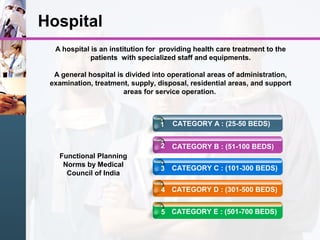
CATEGORY A : (25-50 BEDS)
CATEGORY B : (51-100 BEDS)
CATEGORY C : (101-300 BEDS)
CATEGORY D : (301-500 BEDS)4
1
2
3
A hospital is an institution for providing health care treatment to the
patients with specialized staff and equipments.
A general hospital is divided into operational areas of administration,
examination, treatment, supply, disposal, residential areas, and support
areas for service operation.
CATEGORY E : (501-700 BEDS)5
Functional Planning
Norms by Medical
Council of India
Selection of Site for Hospital
Treatment rooms
Nursing Wards
Special rooms
Aligned along North-West and
North-East direction
Aligned along South to South-
West direction
Aligned along North direction
Quite Place
Future Expansion
area
Almost sq. area
No loss of amenity
No contaminated
land
Location
Connectivity b/w Areas
Space Requirements
Spaces Areas
Supply/disposal 40-80 sqm. PA/planned bed-care area
Nursing area 19-25 sqm. PA/planned bed
Intensive therapy 30-40 sqm. PA/bed
Surgical area 130-160 sqm. PA/surgical unit
Rehabilitation 19-22 sqm. PA/treatment place
Physiotherapy 68-75 sqm. PA/treatment place
X-ray 60-70 sqm. PA/diagnosis room
Radiotherapy 300-350 sqm. PA/equipment
Recovery area 25-30 sqm. PA/recovery bed
NMR diagnosis 100-150 sq. PA/diagnosis room
Clinical physiology 80-100 sqm. PA/diagnosis room
Clinical neurophysiology 78-100 sqm. PA/diagnosis room
Central reception 140-160 sqm. PA/examination/treatment room
Delivery area 85-100 sqm. PA/delivery room
Dialysis 70-80 sqm. PA/dialysis bed
Specialist departments 55-75 sqm. PA/examination/treatment room
PA = Productive area
Corridors, Doors, Stairs and Lifts
CorridorsCorridors
• Normal door –
2.2m
• Vehicle entrance
– 2.5m
• Transport
entrance – 2.8m
• Lift car – 0.9-1.2m
• Shaft – 1.25-1.5m
DoorsDoors StairsStairs LiftsLifts
• Access corridors
– 1.5 m wide
• Patient’s
corridors – 2.25m
wide
• Width – 1.5-2.5m
• Step height –
170mm
•Tread depth –
280mm
Dimensions of Bed Lift
Circulation
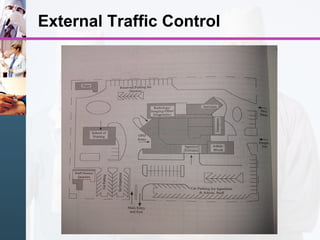
External Traffic Control
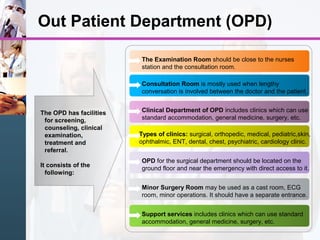
Out Patient Department (OPD)
The OPD has facilities
for screening,
counseling, clinical
examination,
treatment and
referral.
It consists of the
following:
The Examination Room should be close to the nurses
station and the consultation room.
Consultation Room is mostly used when lengthy
conversation is involved between the doctor and the patient.
Clinical Department of OPD includes clinics which can use
standard accommodation, general medicine, surgery, etc.
Types of clinics: surgical, orthopedic, medical, pediatric,skin,
ophthalmic, ENT, dental, chest, psychiatric, cardiology clinic.
OPD for the surgical department should be located on the
ground floor and near the emergency with direct access to it.
Minor Surgery Room may be used as a cast room, ECG
room, minor operations. It should have a separate entrance.
Support services includes clinics which can use standard
accommodation, general medicine, surgery, etc.
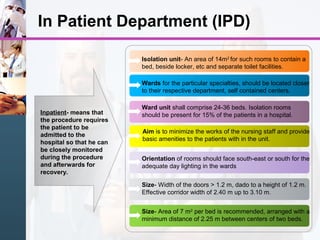
In Patient Department (IPD)
Inpatient- means that
the procedure requires
the patient to be
admitted to the
hospital so that he can
be closely monitored
during the procedure
and afterwards for
recovery.
Isolation unit- An area of 14m2
for such rooms to contain a
bed, beside locker, etc and separate toilet facilities.
Wards for the particular specialties, should be located closer
to their respective department, self contained centers.
Ward unit shall comprise 24-36 beds. Isolation rooms
should be present for 15% of the patients in a hospital.
Aim is to minimize the works of the nursing staff and provide
basic amenities to the patients with in the unit.
Orientation of rooms should face south-east or south for the
adequate day lighting in the wards
Size- Width of the doors > 1.2 m, dado to a height of 1.2 m.
Effective corridor width of 2.40 m up to 3.10 m.
Size- Area of 7 m2
per bed is recommended, arranged with a
minimum distance of 2.25 m between centers of two beds.
Emergency
1
2
3
Should be located on the ground floor with separate access for
the patients and ambulances, away from the outpatient entrance
Should be well marked with proper lighting and signs and should
be easily visible and accessible from the street
Raised platform for ambulance discharge, ramps provided for
wheelchair and pedestrian access
4
5
Close to admission, medical records, cashier’s booth, laboratory
services, and the blood bank
Proximity to elevators is also important in order to proceed to
surgery without loss of time.
Renders services right from the elementary first aid to
sophisticated management of surgical and medical emergencies
and full scale trauma care.
Radiology
1
2
3
Should always be close to the ambulance entrance and because of
the great weight of the equipment should be on ground floor.
A connecting corridor which can be used simultaneously as a
store, dictating room and switch room for staff is desirable.
Sonography, mammography and jaw X-ray require about 12-18 sqm.
Whereas standard X-ray and admission rooms need to be 20-30 sqm.
4
5
The access route for the patients should be through 2 changing
cubical.
WC’s should be installed in the X-ray room used for
stomach/intestinal inspection.
Radiology includes the specialist areas which use ionizing
radiation for diagnostic and therapeutic purposes. This includes
X-Ray diagnosis, radiotherapy and nuclear medicine.
Flow Chart of X-Ray Department
ICU
X-RayX-Ray Room
OT
Waiting
Toilet
Changing
Room
Reception
Control
Dark RoomDark Room
Reading &
Interpretation
(Radiologist)
Doctor’s
Viewing
File Collection&
Storage
Radiotherapy
1
2
3
It comprises of reception, waiting area, doctor’s room (18 sqm.), switch
room (15 sqm.), localization room (20-25 sqm.), service room (20 sqm.),
film developing room (10 sqm.), stores and cleaner’s room.
Each treatment room requires a changing cubicle for patients.
If the department includes a linear accelerator, a workshop (15 sqm.)
and at least one physics laboratory (15-18 sqm.)
4
5
The clear height of the radiation rooms must be 4.3m.
For hygiene reasons the patient waiting area , examination,
localization, preparation and radiation rooms must be well ventilated.
In radiotherapy, conditions diagnosed in the radiography
department (e.g. tumors) are treated.
Physiotherapy
1
2
3
Should be accessed through the main reception area.
Additional rooms – changing rooms, WCs, rest rooms, linen stores,
waiting areas, cleaner’s room and service room.
A gymnasium to be included in it.
4
5
Because of the high internal temperatures (28-30 degree) construction
physics problems should be anticipated.
Should be arranged on basement floor where natural lighting can
be admitted through roof lights and light shafts.
This department contains a wet area consisting of an exercise
pool (4X6m), a four cell bath, a butterfly bath, inhalation rooms, a
massage bath, hand and foot baths as well as necessary
subsidiary rooms. Slip resistant tiles to be used.
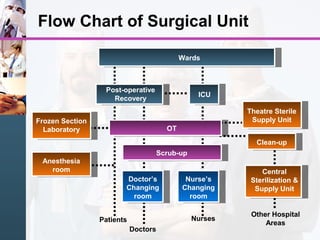
Flow Chart of Surgical Unit
Post-operative
Recovery
Wards
ICU
OT
Theatre Sterile
Supply UnitFrozen Section
Laboratory
Doctor’s
Changing
room
Clean-up
Scrub-up
Anesthesia
room
Nurse’s
Changing
room
Central
Sterilization &
Supply Unit
Patients
Doctors
Nurses
Other Hospital
Areas
Operation Theatre
Freedom from noise and
disturbances.
Freedom from contamination
and possible cross infection.
Independent of general
traffic movement from
rest of the hospital.
OT
Correct & convenient
relationship with ICU, CSSD,
Radiology & Pathology Lab.
Freedom from noise and
disturbances.
Adequate glare free natural
light is required which has
psychological impact. Hence
north light is desirable.
Temperature range should be
between 23 to 24 deg C.
Most present day operations
use artificial light, but good
light and ventilation are of
added advantage.
Operation Theatre
Washroom
Plaster
room
Equipment
roomSub-
sterilisation
room
Size of room – 3.8x3.8m. Electric
sliding door of clear width 1.4m.
Room should be equipped with a
refrigerator, draining sink, rinsing
line, cupboards, connections for
anesthesia equipments and
emergency power.
Size of roughly 10
sqm. Must be directly
accessed by the OT.
For hygiene reasons this is not
located in the surgical zone but
in the outpatient area. In
emergencies the patient must
be channeled through lobbies
in order to get to the OT.
Size of approximately
20 sqm. Should be as
close as possible to
the OT.
Min. width – 1.8m. For each OT
there should be 3 non-splash
wash basins with foot controls.
It contains a non-clean area for non-
sterile material and a clean area for
prepared sterile items. Should be
equipped with a sink, storage surface,
work surface and steam sterilizer.
Anesthetics
room
Sterile
goods
roomAttach-Attach-
mentsments
Ward Facilities
Examination
& Treatment
room
Pantry
Ward store
Linen room
Storage for
the stretcher
Room for
the Head
nurse
Nursing
station
Laboratory
Room for
the staff
nurse
Workroom
for nursing
staff
Sluice room
SanitaryCloakroom
Intensive Care Unit (ICU)
• It should have an OT for
minor interventions (25-30
sqm.), Laboratory spaces,
Kitchenette,
Substerilisation (20 sqm.),
clean material room, non-
clean workroom, cleaning
room, lounge for relatives,
Duty doctor’s room,
Documentation room,
Consulting room and
Sanitary facilities.
Arrangement
Description of ICU
The task of intensive care is to prevent life-threatning disruption of the
vital bodily functions. The services of ICU include monitoring and
treatment as well as care of the patient.
Arrangement
of Bed Spaces
Auxiliary
Functions
• The beds may be placed
in an open, closed or
combined arrangement.
• Beds in clear view of
central nurses’ station.
• Must be a separate area
and only accessed
through lobbies.
• For economical care of
OT patients, recovery
room is located in ICU.
• Number of patients/unit
should be 6 to 10
ICU n CCU
Patient’s Room
One-bed room with
service panel Section of the room
Section of 3-bed
room set
Patient’s
cupboard
Side view
Nursing Services
1
2
3
Double corridor nursing floor provides closer relationship between
beds, nursing stations and other service areas.
Clean utility is designed to accommodate carts for storing linens,
utensils and other supplies .
Elevators are located outside the nursing unit to cut down noise.
4
5
Nursing services can be integrated into the same module which
includes the typical patient room.
Greater flexibility in segregation of patients for various medical
reasons.
Nursing station is given in a ward in such a way that nurse keeps
an eye on all patients. Nurse work room is used to sterilise the
instruments along with storage of necessary instruments and
machinery.
Nursing Services
Flow chart
detail of nursing
station and utility
• ward type • depth • width
• 1 bedroom • 3.4m • 3.15m
• 2 bedroom • 3.3m • 3.5m
• 3 bedroom • 7m • 3.5m
• 4 bedroom • 5.3m • 6.4m
• 6 bedroom • 7m • 6.4m
• 8 bedroom • 5.55m • 2x6.4m
Sizes of Nursing
rooms
Admitting Department
1
2
3
Maintain bed index showing current occupancy status. Prepare
admission and discharge lists and midnight census.
It should be situated on the same level as hospital’s main entrance, be
readily identifiable, and provided with a sign(easily seen).
Admitting patients’ waiting area, large enough to accommodate
patients and relatives accompanying.
4
5
Clerical work area for maintaining hospital occupancy directories,
records, forms,, notices, etc.
Wheelchair and stretcher alcove. Space for computers and office
equipment.
Functions of the admitting department revolve around admitting,
transfer and discharge of patients. This department coordinates
patient’s arrival, registration, medical records and initial tests.
Admitting Department Flowchart
Medical Department
1
2
3
Maintaining proper facilities and services for accurate and timely
production, processing,checking,filing and retrieval of medical records.
It should be close to or on the corridor leading to doctors’ lounge so
that they can stop by and complete their records and study.
It should be so designed with the best possible means of
transportation of medical records thorough all stages of their use.
4
5
Reception-cum-registration area, space for copier. Work area for
record processing, assembling, numbering, indexing, etc.
Storage area for medical carts. Staff facilities.
The medical records department maintains records and
documents relating to patient care.
Medical Flowchart
Flowchart of medical records on
discharge of patient
Flowchart of medical records on
admission of patient
Central Sterilisation and Supply
Department (CSSD)
1
2
3
This method basically involves cleaning, disinfecting and sterilizing
before use all instruments, materials and equipment utilized in patient
care.
.
Is performed by heating them with pressurized steam of by gas
sterilization.
Carrying out the process of decontamination or disinfection prior to
sterilizing
4
5
Packing all materials for sterilizing,Sterilizing,Labelling and dating
materials,Storing and controlling inventory,Issuing and distributing
.Accessiblity to elevators, dumbwaiters and stairs is of utmost
importance.
.
Despite of the advancement, hospital acquired infection remains
the hospital’s single most serious concern that negated some of
its otherwise good work.
Food Service Department
1
2
3
Provide best possible food at a cost consistent with the policy of the
hospital..
The department should be close to the materials management
department.
In general the important factor to be borne in mind is the logical
workflow.
4
5
Plan and implement patient therapy, education and counselling.
.
A ground floor location is preferable, and is also convenient to
deliver supplies.
.
Good food is important in the treatment of the patient and is a
part of his total care. The food service department in today’s
modern hospitals ranks one of the major departments.
Food Service Flowchart
Delhi Bye-Laws
The Medical Facilities In Delhi are provided by various agencies operating at various
hospitals, dispensaries, clinics and nursing homes. These agencies includes Delhi
government, Central Government, Local bodies, Statuary Bodies, Voluntary Organizations
and Private Sectors. A six Tier system of health facilities has been proposed in MPD-2001 as
given below:
S.
No.
Category
Population
Covered
Capacity
Area Of
Hospital
Residential
Area
Total Area
1 Gen. Hospital 2.5 lakh 500 Beds 4 Ha. 2 Ha. 6 Ha.
2
Intermediate
Hospitals (A)
1 lakh 200 Beds 2.7 Ha. 1 Ha. 3.7 Ha.
3
Intermediate
Hospitals (B)
1 lakh 80 Beds 0.6 Ha. 0.4 Ha. 1 Ha.
4 Polyclinics 1 lakh 0.2 – 0.3 Ha. -
0.2 – 0.3 Ha.
5
Nursing Home
Child Welfare
and Maternity
1 lakh 25-30 Beds
0.2 – 0.3 Ha.
-
0.2 – 0.3 Ha.
6 Dispensary 0.15 lakh
0.08 – 0.12 Ha.
-
0.08 – 0.12 Ha.
For 500-200
bedded
hospital
•Maximum Ground Coverage : 35%
•Maximum Far : 200
•Maximum Height: 33M
Case Study: Bhagwan Mahavir
Hospital
INTRODUCTION:INTRODUCTION:
Bhagwan Mahavir Hospital is located inBhagwan Mahavir Hospital is located in
Madhuban Chowk near Pitampura Metro Station,Madhuban Chowk near Pitampura Metro Station,
Delhi. It is a two side open site. There is 60m wideDelhi. It is a two side open site. There is 60m wide
road in front and 5m wide road on the side.road in front and 5m wide road on the side.
As the name suggests Bhagwan Mahavir HospitalAs the name suggests Bhagwan Mahavir Hospital
is dedicated to Bhagwan Mahavir and it runsis dedicated to Bhagwan Mahavir and it runs
under Maha Sati Devi Jain Educational Trust. Theunder Maha Sati Devi Jain Educational Trust. The
Hospital was inaugurated by the President OfHospital was inaugurated by the President Of
India Giani Zail Singh on the 23 October 1986. ItIndia Giani Zail Singh on the 23 October 1986. It
is a 40 Bedded Hospital.is a 40 Bedded Hospital.
CLIMATE:CLIMATE:
Delhi is in the group of composite climateDelhi is in the group of composite climate
•
•
•Rainfall : 1.73MRainfall : 1.73M
In comparison, Delhi has high rainfall andIn comparison, Delhi has high rainfall and
less air movement, which in turn gives riseless air movement, which in turn gives rise
to high humidity round the year.to high humidity round the year.
FACILITIES AVAILABLE:FACILITIES AVAILABLE:
Ground Floor:Ground Floor:
•OPD ChambersOPD Chambers
•LaboratoryLaboratory
•UltrasoundUltrasound
•ICUICU
•ReceptionReception
•ChemistChemist
•X-RayX-Ray
Case Study: Bhagwan Mahavir
Hospital
AREA STATEMENT :AREA STATEMENT :
Total Site Area: 3000 SQ.M.Total Site Area: 3000 SQ.M.
Total Covered Area : 990 SQ.M.Total Covered Area : 990 SQ.M.
F.A.R. = 100F.A.R. = 100
First Floor:First Floor:
•Operation TheatreOperation Theatre
•Staff RoomStaff Room
•WardsWards
•StoreStore
•Nursery roomNursery room
SITE PLANSITE PLAN
The total area of site is 3000SQ.M. . TheThe total area of site is 3000SQ.M. . The
front set back is 10M., rear set back isfront set back is 10M., rear set back is
5M., side set back is 3M. and the other5M., side set back is 3M. and the other
side is 18M. left for future extension.side is 18M. left for future extension.
Saroj HospitalSaroj Hospital R.S. InstituteR.S. Institute
Of AdvancedOf Advanced
StudiesStudies
TecniaTecnia
InstituteInstitute
Case Study: Bhagwan Mahavir
Hospital
Case Study: Bhagwan Mahavir
Hospital
Case Study: Bhagwan Mahavir
Hospital
L/O/G/O
National Institute of Technology, Hamirpur

hospital case study

  • 1.
  • 2.
    Hospital CATEGORY A :(25-50 BEDS) CATEGORY B : (51-100 BEDS) CATEGORY C : (101-300 BEDS) CATEGORY D : (301-500 BEDS)4 1 2 3 A hospital is an institution for providing health care treatment to the patients with specialized staff and equipments. A general hospital is divided into operational areas of administration, examination, treatment, supply, disposal, residential areas, and support areas for service operation. CATEGORY E : (501-700 BEDS)5 Functional Planning Norms by Medical Council of India
  • 3.
    Selection of Sitefor Hospital Treatment rooms Nursing Wards Special rooms Aligned along North-West and North-East direction Aligned along South to South- West direction Aligned along North direction Quite Place Future Expansion area Almost sq. area No loss of amenity No contaminated land Location
  • 4.
  • 5.
    Space Requirements Spaces Areas Supply/disposal40-80 sqm. PA/planned bed-care area Nursing area 19-25 sqm. PA/planned bed Intensive therapy 30-40 sqm. PA/bed Surgical area 130-160 sqm. PA/surgical unit Rehabilitation 19-22 sqm. PA/treatment place Physiotherapy 68-75 sqm. PA/treatment place X-ray 60-70 sqm. PA/diagnosis room Radiotherapy 300-350 sqm. PA/equipment Recovery area 25-30 sqm. PA/recovery bed NMR diagnosis 100-150 sq. PA/diagnosis room Clinical physiology 80-100 sqm. PA/diagnosis room Clinical neurophysiology 78-100 sqm. PA/diagnosis room Central reception 140-160 sqm. PA/examination/treatment room Delivery area 85-100 sqm. PA/delivery room Dialysis 70-80 sqm. PA/dialysis bed Specialist departments 55-75 sqm. PA/examination/treatment room PA = Productive area
  • 6.
    Corridors, Doors, Stairsand Lifts CorridorsCorridors • Normal door – 2.2m • Vehicle entrance – 2.5m • Transport entrance – 2.8m • Lift car – 0.9-1.2m • Shaft – 1.25-1.5m DoorsDoors StairsStairs LiftsLifts • Access corridors – 1.5 m wide • Patient’s corridors – 2.25m wide • Width – 1.5-2.5m • Step height – 170mm •Tread depth – 280mm Dimensions of Bed Lift
  • 7.
  • 8.
  • 9.
    Out Patient Department(OPD) The OPD has facilities for screening, counseling, clinical examination, treatment and referral. It consists of the following: The Examination Room should be close to the nurses station and the consultation room. Consultation Room is mostly used when lengthy conversation is involved between the doctor and the patient. Clinical Department of OPD includes clinics which can use standard accommodation, general medicine, surgery, etc. Types of clinics: surgical, orthopedic, medical, pediatric,skin, ophthalmic, ENT, dental, chest, psychiatric, cardiology clinic. OPD for the surgical department should be located on the ground floor and near the emergency with direct access to it. Minor Surgery Room may be used as a cast room, ECG room, minor operations. It should have a separate entrance. Support services includes clinics which can use standard accommodation, general medicine, surgery, etc.
  • 10.
    In Patient Department(IPD) Inpatient- means that the procedure requires the patient to be admitted to the hospital so that he can be closely monitored during the procedure and afterwards for recovery. Isolation unit- An area of 14m2 for such rooms to contain a bed, beside locker, etc and separate toilet facilities. Wards for the particular specialties, should be located closer to their respective department, self contained centers. Ward unit shall comprise 24-36 beds. Isolation rooms should be present for 15% of the patients in a hospital. Aim is to minimize the works of the nursing staff and provide basic amenities to the patients with in the unit. Orientation of rooms should face south-east or south for the adequate day lighting in the wards Size- Width of the doors > 1.2 m, dado to a height of 1.2 m. Effective corridor width of 2.40 m up to 3.10 m. Size- Area of 7 m2 per bed is recommended, arranged with a minimum distance of 2.25 m between centers of two beds.
  • 11.
    Emergency 1 2 3 Should be locatedon the ground floor with separate access for the patients and ambulances, away from the outpatient entrance Should be well marked with proper lighting and signs and should be easily visible and accessible from the street Raised platform for ambulance discharge, ramps provided for wheelchair and pedestrian access 4 5 Close to admission, medical records, cashier’s booth, laboratory services, and the blood bank Proximity to elevators is also important in order to proceed to surgery without loss of time. Renders services right from the elementary first aid to sophisticated management of surgical and medical emergencies and full scale trauma care.
  • 12.
    Radiology 1 2 3 Should always beclose to the ambulance entrance and because of the great weight of the equipment should be on ground floor. A connecting corridor which can be used simultaneously as a store, dictating room and switch room for staff is desirable. Sonography, mammography and jaw X-ray require about 12-18 sqm. Whereas standard X-ray and admission rooms need to be 20-30 sqm. 4 5 The access route for the patients should be through 2 changing cubical. WC’s should be installed in the X-ray room used for stomach/intestinal inspection. Radiology includes the specialist areas which use ionizing radiation for diagnostic and therapeutic purposes. This includes X-Ray diagnosis, radiotherapy and nuclear medicine.
  • 13.
    Flow Chart ofX-Ray Department ICU X-RayX-Ray Room OT Waiting Toilet Changing Room Reception Control Dark RoomDark Room Reading & Interpretation (Radiologist) Doctor’s Viewing File Collection& Storage
  • 14.
    Radiotherapy 1 2 3 It comprises ofreception, waiting area, doctor’s room (18 sqm.), switch room (15 sqm.), localization room (20-25 sqm.), service room (20 sqm.), film developing room (10 sqm.), stores and cleaner’s room. Each treatment room requires a changing cubicle for patients. If the department includes a linear accelerator, a workshop (15 sqm.) and at least one physics laboratory (15-18 sqm.) 4 5 The clear height of the radiation rooms must be 4.3m. For hygiene reasons the patient waiting area , examination, localization, preparation and radiation rooms must be well ventilated. In radiotherapy, conditions diagnosed in the radiography department (e.g. tumors) are treated.
  • 15.
    Physiotherapy 1 2 3 Should be accessedthrough the main reception area. Additional rooms – changing rooms, WCs, rest rooms, linen stores, waiting areas, cleaner’s room and service room. A gymnasium to be included in it. 4 5 Because of the high internal temperatures (28-30 degree) construction physics problems should be anticipated. Should be arranged on basement floor where natural lighting can be admitted through roof lights and light shafts. This department contains a wet area consisting of an exercise pool (4X6m), a four cell bath, a butterfly bath, inhalation rooms, a massage bath, hand and foot baths as well as necessary subsidiary rooms. Slip resistant tiles to be used.
  • 16.
    Flow Chart ofSurgical Unit Post-operative Recovery Wards ICU OT Theatre Sterile Supply UnitFrozen Section Laboratory Doctor’s Changing room Clean-up Scrub-up Anesthesia room Nurse’s Changing room Central Sterilization & Supply Unit Patients Doctors Nurses Other Hospital Areas
  • 17.
    Operation Theatre Freedom fromnoise and disturbances. Freedom from contamination and possible cross infection. Independent of general traffic movement from rest of the hospital. OT Correct & convenient relationship with ICU, CSSD, Radiology & Pathology Lab. Freedom from noise and disturbances. Adequate glare free natural light is required which has psychological impact. Hence north light is desirable. Temperature range should be between 23 to 24 deg C. Most present day operations use artificial light, but good light and ventilation are of added advantage.
  • 18.
    Operation Theatre Washroom Plaster room Equipment roomSub- sterilisation room Size ofroom – 3.8x3.8m. Electric sliding door of clear width 1.4m. Room should be equipped with a refrigerator, draining sink, rinsing line, cupboards, connections for anesthesia equipments and emergency power. Size of roughly 10 sqm. Must be directly accessed by the OT. For hygiene reasons this is not located in the surgical zone but in the outpatient area. In emergencies the patient must be channeled through lobbies in order to get to the OT. Size of approximately 20 sqm. Should be as close as possible to the OT. Min. width – 1.8m. For each OT there should be 3 non-splash wash basins with foot controls. It contains a non-clean area for non- sterile material and a clean area for prepared sterile items. Should be equipped with a sink, storage surface, work surface and steam sterilizer. Anesthetics room Sterile goods roomAttach-Attach- mentsments
  • 19.
    Ward Facilities Examination & Treatment room Pantry Wardstore Linen room Storage for the stretcher Room for the Head nurse Nursing station Laboratory Room for the staff nurse Workroom for nursing staff Sluice room SanitaryCloakroom
  • 20.
    Intensive Care Unit(ICU) • It should have an OT for minor interventions (25-30 sqm.), Laboratory spaces, Kitchenette, Substerilisation (20 sqm.), clean material room, non- clean workroom, cleaning room, lounge for relatives, Duty doctor’s room, Documentation room, Consulting room and Sanitary facilities. Arrangement Description of ICU The task of intensive care is to prevent life-threatning disruption of the vital bodily functions. The services of ICU include monitoring and treatment as well as care of the patient. Arrangement of Bed Spaces Auxiliary Functions • The beds may be placed in an open, closed or combined arrangement. • Beds in clear view of central nurses’ station. • Must be a separate area and only accessed through lobbies. • For economical care of OT patients, recovery room is located in ICU. • Number of patients/unit should be 6 to 10
  • 21.
  • 22.
    Patient’s Room One-bed roomwith service panel Section of the room Section of 3-bed room set Patient’s cupboard Side view
  • 23.
    Nursing Services 1 2 3 Double corridornursing floor provides closer relationship between beds, nursing stations and other service areas. Clean utility is designed to accommodate carts for storing linens, utensils and other supplies . Elevators are located outside the nursing unit to cut down noise. 4 5 Nursing services can be integrated into the same module which includes the typical patient room. Greater flexibility in segregation of patients for various medical reasons. Nursing station is given in a ward in such a way that nurse keeps an eye on all patients. Nurse work room is used to sterilise the instruments along with storage of necessary instruments and machinery.
  • 24.
    Nursing Services Flow chart detailof nursing station and utility • ward type • depth • width • 1 bedroom • 3.4m • 3.15m • 2 bedroom • 3.3m • 3.5m • 3 bedroom • 7m • 3.5m • 4 bedroom • 5.3m • 6.4m • 6 bedroom • 7m • 6.4m • 8 bedroom • 5.55m • 2x6.4m Sizes of Nursing rooms
  • 25.
    Admitting Department 1 2 3 Maintain bedindex showing current occupancy status. Prepare admission and discharge lists and midnight census. It should be situated on the same level as hospital’s main entrance, be readily identifiable, and provided with a sign(easily seen). Admitting patients’ waiting area, large enough to accommodate patients and relatives accompanying. 4 5 Clerical work area for maintaining hospital occupancy directories, records, forms,, notices, etc. Wheelchair and stretcher alcove. Space for computers and office equipment. Functions of the admitting department revolve around admitting, transfer and discharge of patients. This department coordinates patient’s arrival, registration, medical records and initial tests.
  • 26.
  • 27.
    Medical Department 1 2 3 Maintaining properfacilities and services for accurate and timely production, processing,checking,filing and retrieval of medical records. It should be close to or on the corridor leading to doctors’ lounge so that they can stop by and complete their records and study. It should be so designed with the best possible means of transportation of medical records thorough all stages of their use. 4 5 Reception-cum-registration area, space for copier. Work area for record processing, assembling, numbering, indexing, etc. Storage area for medical carts. Staff facilities. The medical records department maintains records and documents relating to patient care.
  • 28.
    Medical Flowchart Flowchart ofmedical records on discharge of patient Flowchart of medical records on admission of patient
  • 29.
    Central Sterilisation andSupply Department (CSSD) 1 2 3 This method basically involves cleaning, disinfecting and sterilizing before use all instruments, materials and equipment utilized in patient care. . Is performed by heating them with pressurized steam of by gas sterilization. Carrying out the process of decontamination or disinfection prior to sterilizing 4 5 Packing all materials for sterilizing,Sterilizing,Labelling and dating materials,Storing and controlling inventory,Issuing and distributing .Accessiblity to elevators, dumbwaiters and stairs is of utmost importance. . Despite of the advancement, hospital acquired infection remains the hospital’s single most serious concern that negated some of its otherwise good work.
  • 30.
    Food Service Department 1 2 3 Providebest possible food at a cost consistent with the policy of the hospital.. The department should be close to the materials management department. In general the important factor to be borne in mind is the logical workflow. 4 5 Plan and implement patient therapy, education and counselling. . A ground floor location is preferable, and is also convenient to deliver supplies. . Good food is important in the treatment of the patient and is a part of his total care. The food service department in today’s modern hospitals ranks one of the major departments.
  • 31.
  • 32.
    Delhi Bye-Laws The MedicalFacilities In Delhi are provided by various agencies operating at various hospitals, dispensaries, clinics and nursing homes. These agencies includes Delhi government, Central Government, Local bodies, Statuary Bodies, Voluntary Organizations and Private Sectors. A six Tier system of health facilities has been proposed in MPD-2001 as given below: S. No. Category Population Covered Capacity Area Of Hospital Residential Area Total Area 1 Gen. Hospital 2.5 lakh 500 Beds 4 Ha. 2 Ha. 6 Ha. 2 Intermediate Hospitals (A) 1 lakh 200 Beds 2.7 Ha. 1 Ha. 3.7 Ha. 3 Intermediate Hospitals (B) 1 lakh 80 Beds 0.6 Ha. 0.4 Ha. 1 Ha. 4 Polyclinics 1 lakh 0.2 – 0.3 Ha. - 0.2 – 0.3 Ha. 5 Nursing Home Child Welfare and Maternity 1 lakh 25-30 Beds 0.2 – 0.3 Ha. - 0.2 – 0.3 Ha. 6 Dispensary 0.15 lakh 0.08 – 0.12 Ha. - 0.08 – 0.12 Ha. For 500-200 bedded hospital •Maximum Ground Coverage : 35% •Maximum Far : 200 •Maximum Height: 33M
  • 33.
    Case Study: BhagwanMahavir Hospital INTRODUCTION:INTRODUCTION: Bhagwan Mahavir Hospital is located inBhagwan Mahavir Hospital is located in Madhuban Chowk near Pitampura Metro Station,Madhuban Chowk near Pitampura Metro Station, Delhi. It is a two side open site. There is 60m wideDelhi. It is a two side open site. There is 60m wide road in front and 5m wide road on the side.road in front and 5m wide road on the side. As the name suggests Bhagwan Mahavir HospitalAs the name suggests Bhagwan Mahavir Hospital is dedicated to Bhagwan Mahavir and it runsis dedicated to Bhagwan Mahavir and it runs under Maha Sati Devi Jain Educational Trust. Theunder Maha Sati Devi Jain Educational Trust. The Hospital was inaugurated by the President OfHospital was inaugurated by the President Of India Giani Zail Singh on the 23 October 1986. ItIndia Giani Zail Singh on the 23 October 1986. It is a 40 Bedded Hospital.is a 40 Bedded Hospital. CLIMATE:CLIMATE: Delhi is in the group of composite climateDelhi is in the group of composite climate • • •Rainfall : 1.73MRainfall : 1.73M In comparison, Delhi has high rainfall andIn comparison, Delhi has high rainfall and less air movement, which in turn gives riseless air movement, which in turn gives rise to high humidity round the year.to high humidity round the year.
  • 34.
    FACILITIES AVAILABLE:FACILITIES AVAILABLE: GroundFloor:Ground Floor: •OPD ChambersOPD Chambers •LaboratoryLaboratory •UltrasoundUltrasound •ICUICU •ReceptionReception •ChemistChemist •X-RayX-Ray Case Study: Bhagwan Mahavir Hospital AREA STATEMENT :AREA STATEMENT : Total Site Area: 3000 SQ.M.Total Site Area: 3000 SQ.M. Total Covered Area : 990 SQ.M.Total Covered Area : 990 SQ.M. F.A.R. = 100F.A.R. = 100 First Floor:First Floor: •Operation TheatreOperation Theatre •Staff RoomStaff Room •WardsWards •StoreStore •Nursery roomNursery room SITE PLANSITE PLAN The total area of site is 3000SQ.M. . TheThe total area of site is 3000SQ.M. . The front set back is 10M., rear set back isfront set back is 10M., rear set back is 5M., side set back is 3M. and the other5M., side set back is 3M. and the other side is 18M. left for future extension.side is 18M. left for future extension. Saroj HospitalSaroj Hospital R.S. InstituteR.S. Institute Of AdvancedOf Advanced StudiesStudies TecniaTecnia InstituteInstitute
  • 35.
    Case Study: BhagwanMahavir Hospital
  • 36.
    Case Study: BhagwanMahavir Hospital
  • 37.
    Case Study: BhagwanMahavir Hospital
  • 38.
    L/O/G/O National Institute ofTechnology, Hamirpur