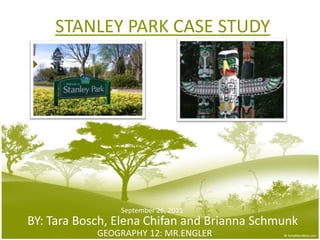
STANLEY PARK CASE STUDYSeptember26, 2011BY: Tara Bosch, Elena Chifan and BriannaSchmunkGEOGRAPHY 12: MR.ENGLER
TABLE OF CONTENTS:
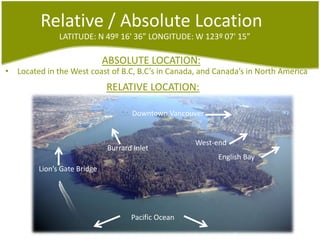
Relative / Absolute LocationLATITUDE: N 49º 16' 36”LONGITUDE: W 123º 07' 15”ABSOLUTE LOCATION:Located in the West coast of B.C, B.C’s in Canada, and Canada’s in NorthAmericaRELATIVE LOCATION:Downtown VancouverWest-endBurrardInletEnglish BayLion’sGate BridgePacific Ocean
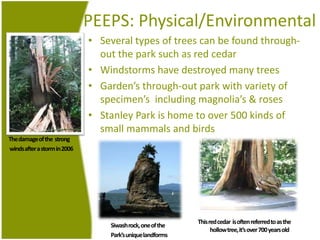
PEEPS: Physical/EnvironmentalSeveral types of treescanbefoundthrough-out the parksuch as redcedarWindstorms have destroyedmanytreesGarden’sthrough-out parkwithvariety of specimen’sincludingmagnolia’s & rosesStanley Park is home to over 500 kinds of smallmammals and birdsThe damage of the  strongwindsafter a storm in 2006This redcedarisoftenreferred to as the hollowtree, it’s over 700 yearsoldSiwash rock, one of the Park’s unique landforms
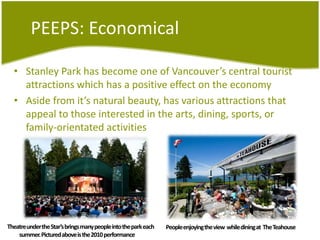
PEEPS: EconomicalStanley Park has become one of Vancouver’s central tourist attractions which has a positive effect on the economyAsidefromit’snatural beauty, has various attractions thatappeal to thoseinterested in the arts, dining, sports, or family-orientatedactivitiesTheatreunder the Star’sbringsmany people into the parkeachsummer. Picturedaboveis the 2010 performancePeople enjoying the viewwhilediningat  The Teahouse
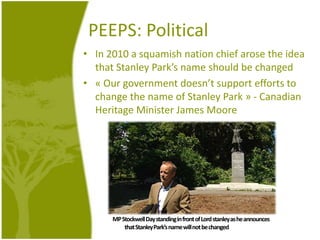
PEEPS: PoliticalIn 2010 a squamish nation chiefarose the ideathat Stanley Park’snameshouldbechanged« Our governmentdoesn’t support efforts to change the name of Stanley Park » - Canadian HeritageMinister James MooreMP Stockwell Day standing in front of Lord stanley as heannouncesthat Stanley Park’snamewill not bechanged
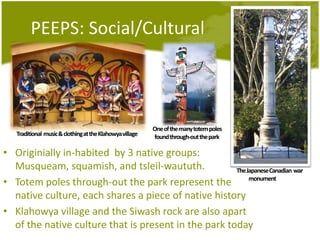
PEEPS: Social/Cultural            One of the many totem polesfoundthrough-out the parkTraditional  music & clothingat the Klahowya villageOriginially in-habited  by 3 native groups: Musqueam, squamish, and tsleil-waututh. Totem poles through-out the park represent the native culture, each shares a piece of native historyKlahowya village and the Siwash rock are also apart of the native culture that is present in the park todayThe Japanese Canadian  war monument
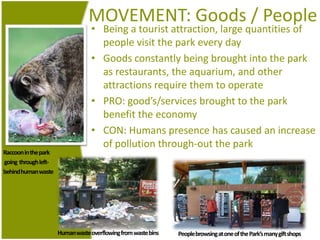
MOVEMENT: Goods / PeopleBeing a tourist attraction, large quantities of people visit the parkeverydayGoodsconstantlybeingbroughtinto the park as restaurants, the aquarium, and other attractions requirethem to operatePRO: good’s/services brought to the parkbenefit the economyCON: Humanspresence has caused an increase of pollution through-out the parkRaccoon in the parkgoingthroughleft-behindhumanwasteHumanwasteoverflowingfromwastebinsPeople browsingat one of the Park’smany gift shops
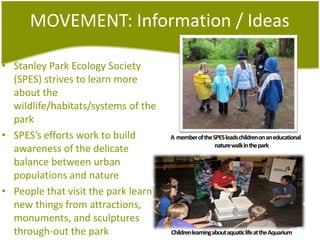
MOVEMENT: Information / IdeasStanley Park Ecology Society (SPES) strives to learn more about the wildlife/habitats/systems of the parkSPES’s efforts work to buildawareness of the delicate balance betweenurban populations and naturePeople thatvisit the parklearn new thingsfrom attractions, monuments, and sculptures through-out the parkA  member of the SPES leadschildren on an educational nature walk in the parkChildrenlearning about aquatic life at the Aquarium
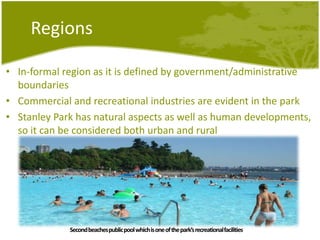
RegionsIn-formalregion as itisdefined by government/administrative boundariesCommercial and recreational industries are evident in the parkStanley Park has natural aspects as well as humandevelopments, soitcanbeconsideredbothurban and ruralSecond beaches public pool whichis one of the park’srecreationalfacilities
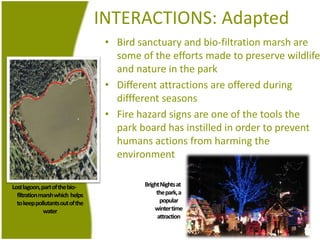
INTERACTIONS: AdaptedBirdsanctuary and bio-filtration marsh are some of the efforts made to preservewildlife and nature in the parkDifferent attractions are offeredduringdiffferentseasonsFirehazardsigns are one of the tools the parkboard has instilled in order to preventhumans actions fromharming the environmentBright Nightsat  the park, a popularwinter time attractionLostlagoon, part of the bio-filtration marshwhichhelps to keeppollutants out of the water
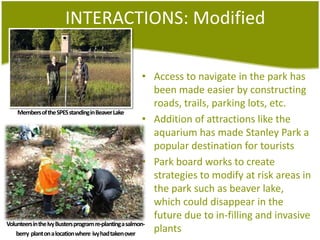
INTERACTIONS: ModifiedAccess to navigate in the park has been made easier by constructingroads, trails, parking lots, etc.Addition of attractions like the aquarium has made Stanley Park a popular destination for touristsPark boardworks to createstrategies to modifyatrisk areas in the parksuch as beaverlake, whichcoulddisappear in the future due to in-filling and invasive plantsMembers of the SPES standing in Beaver LakeVolunteers in the IvyBusters program re-planting a salmon-berry  plant on a location whereivyhadtaken over
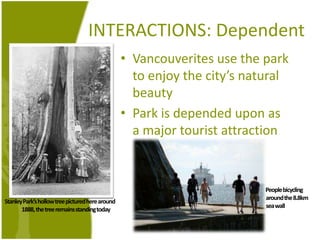
INTERACTIONS: DependentVancouverites use the park to enjoy the city’snatural beautyPark isdependedupon as a major tourist attraction           People bicyclingaround the 8.8km seawallStanley Park’shollowtreepicturedherearound 1888, the treeremains standing today
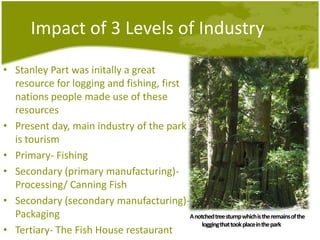
Impact of 3 Levels of IndustryStanley Part wasinitally a greatresource for logging and fishing, first nations people made use of theseresourcesPresentday, main industry of the parkistourismPrimary- FishingSecondary (primary manufacturing)- Processing/ Canning Fish Secondary (secondary manufacturing)- PackagingTertiary- The Fish House restaurantA notchedtreestumpwhichis the remains of the loggingthattook place in the park
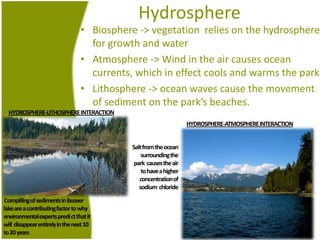
HydrosphereBiosphere -> vegetation  relies on the hydrosphere for growth and waterAtmosphere -> Wind in the air causes ocean currents, which in effect cools and warms the parkLithosphere -> ocean waves cause the movement of sediment on the park’s beaches. HYDROSPHERE-LITHOSPHERE INTERACTIONHYDROSPHERE-ATMOSPHERE INTERACTIONSalt from the oceansurrounding the park  causes the air to have a higher concentration of  sodium  chlorideCompililng of sediments in Beaver lake are a contributing factor to whyenvironmental experts predi ct thatitwilldisappearentirely in the next 10 to 20 years
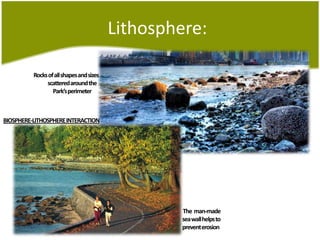
Lithosphere:Rocks of all shapes and sizesscatteredaround the Park’sperimeterBIOSPHERE-LITHOSPHERE INTERACTION            The  man-made seawallhelps to preventerosion
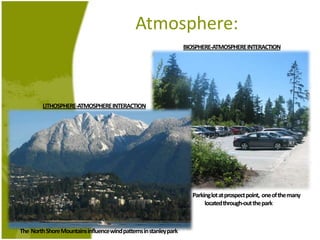
Atmosphere:BIOSPHERE-ATMOSPHERE INTERACTION LITHOSPHERE-ATMOSPHERE INTERACTIONParking lot at prospect point,  one of the manylocatedthrough-out the parkThe  North Shore Mountains influence wind patterns in stanleypark
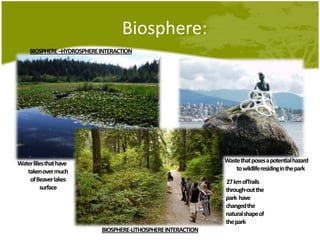
Biosphere:BIOSPHERE –HYDROSPHERE INTERACTIONWastethat poses a potentialhazard to wildliferesiding in the parkWater liliesthat have taken over much of Beaver lakes surface27 km ofTrailsthrough-out the park  have changedthe naturalshapeof the parkBIOSPHERE-LITHOSPHERE INTERACTION
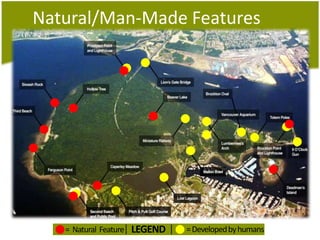
Natural/Man-Made FeaturesLEGEND= Developed by humans=  Natural  Feature
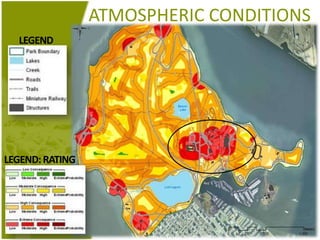
ATMOSPHERIC CONDITIONSLEGENDLEGEND: RATING
Bibliography:"No Stanley Park name change: federal spokesmen" http://www.cbc.ca (Monday, July 5, 2010 | 5:30 PM PT): 9. (Online) http://www.cbc.ca/news/canada/british-columbia/story/2010/07/05/bc-stanley-park-name-change-feds.html"Storm Damage Photo Gallery" http://www.stanleyparkecology.cahttp://www.stanleyparkecology.ca/storm/gallery.php"Stanley Park Landmarks" http://vancouver.cahttp://vancouver.ca/parks/parks/stanley/landmarks.htm"The Stanley Park Ecology Society" http://www.stanleyparkecology.cahttp://www.stanleyparkecology.ca/programs/conservation/research/"Welcome to Interactive Maps of SPES!" http://stanleyparkecology.ca (April 12,2009): 2. http://stanleyparkecology.ca/GoogleMaps/index.php"Stanley Park Gardens" http://vancouver.cahttp://vancouver.ca/parks/parks/stanley/gardens.htm
BibliographyCont:"Environment" http://vancouver.cahttp://vancouver.ca/parks/environment/index.htm"BCGNIS Query Results" http://archive.ilmb.gov.bc.cahttp://archive.ilmb.gov.bc.ca/bcgn-bin/bcg10?name=53257http://fire.cfs.nrcan.gc.ca/questions-fire-feu-eng.phphttp://www.straight.com/article-337039/vancouver/beaver-lakes-future-murkyhttp://www.bablackwell.com/forestry_reports/Stanley_Park_Fire_Preparedness_Plan.html#_Toc171316526http://www.flickr.com/photos/us_mission_canada/5636390017/http://www.portmetrovancouver.com/en/about.aspxhttp://boards.cruisecritic.com/showthread.php?t=1281752&page=3
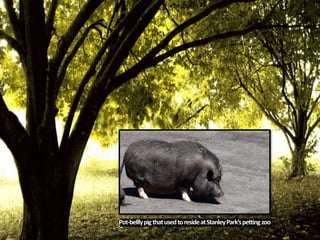
Pot-belllypigthatused to resideat Stanley Park’spetting zoo

Stanley park case study

  • 1.
    STANLEY PARK CASESTUDYSeptember26, 2011BY: Tara Bosch, Elena Chifan and BriannaSchmunkGEOGRAPHY 12: MR.ENGLER
  • 2.
  • 3.
    Relative / AbsoluteLocationLATITUDE: N 49º 16' 36”LONGITUDE: W 123º 07' 15”ABSOLUTE LOCATION:Located in the West coast of B.C, B.C’s in Canada, and Canada’s in NorthAmericaRELATIVE LOCATION:Downtown VancouverWest-endBurrardInletEnglish BayLion’sGate BridgePacific Ocean
  • 4.
    PEEPS: Physical/EnvironmentalSeveral typesof treescanbefoundthrough-out the parksuch as redcedarWindstorms have destroyedmanytreesGarden’sthrough-out parkwithvariety of specimen’sincludingmagnolia’s & rosesStanley Park is home to over 500 kinds of smallmammals and birdsThe damage of the strongwindsafter a storm in 2006This redcedarisoftenreferred to as the hollowtree, it’s over 700 yearsoldSiwash rock, one of the Park’s unique landforms
  • 5.
    PEEPS: EconomicalStanley Parkhas become one of Vancouver’s central tourist attractions which has a positive effect on the economyAsidefromit’snatural beauty, has various attractions thatappeal to thoseinterested in the arts, dining, sports, or family-orientatedactivitiesTheatreunder the Star’sbringsmany people into the parkeachsummer. Picturedaboveis the 2010 performancePeople enjoying the viewwhilediningat The Teahouse
  • 6.
    PEEPS: PoliticalIn 2010a squamish nation chiefarose the ideathat Stanley Park’snameshouldbechanged« Our governmentdoesn’t support efforts to change the name of Stanley Park » - Canadian HeritageMinister James MooreMP Stockwell Day standing in front of Lord stanley as heannouncesthat Stanley Park’snamewill not bechanged
  • 7.
    PEEPS: Social/Cultural One of the many totem polesfoundthrough-out the parkTraditional music & clothingat the Klahowya villageOriginially in-habited by 3 native groups: Musqueam, squamish, and tsleil-waututh. Totem poles through-out the park represent the native culture, each shares a piece of native historyKlahowya village and the Siwash rock are also apart of the native culture that is present in the park todayThe Japanese Canadian war monument
  • 8.
    MOVEMENT: Goods /PeopleBeing a tourist attraction, large quantities of people visit the parkeverydayGoodsconstantlybeingbroughtinto the park as restaurants, the aquarium, and other attractions requirethem to operatePRO: good’s/services brought to the parkbenefit the economyCON: Humanspresence has caused an increase of pollution through-out the parkRaccoon in the parkgoingthroughleft-behindhumanwasteHumanwasteoverflowingfromwastebinsPeople browsingat one of the Park’smany gift shops
  • 9.
    MOVEMENT: Information /IdeasStanley Park Ecology Society (SPES) strives to learn more about the wildlife/habitats/systems of the parkSPES’s efforts work to buildawareness of the delicate balance betweenurban populations and naturePeople thatvisit the parklearn new thingsfrom attractions, monuments, and sculptures through-out the parkA member of the SPES leadschildren on an educational nature walk in the parkChildrenlearning about aquatic life at the Aquarium
  • 10.
    RegionsIn-formalregion as itisdefinedby government/administrative boundariesCommercial and recreational industries are evident in the parkStanley Park has natural aspects as well as humandevelopments, soitcanbeconsideredbothurban and ruralSecond beaches public pool whichis one of the park’srecreationalfacilities
  • 11.
    INTERACTIONS: AdaptedBirdsanctuary andbio-filtration marsh are some of the efforts made to preservewildlife and nature in the parkDifferent attractions are offeredduringdiffferentseasonsFirehazardsigns are one of the tools the parkboard has instilled in order to preventhumans actions fromharming the environmentBright Nightsat the park, a popularwinter time attractionLostlagoon, part of the bio-filtration marshwhichhelps to keeppollutants out of the water
  • 12.
    INTERACTIONS: ModifiedAccess tonavigate in the park has been made easier by constructingroads, trails, parking lots, etc.Addition of attractions like the aquarium has made Stanley Park a popular destination for touristsPark boardworks to createstrategies to modifyatrisk areas in the parksuch as beaverlake, whichcoulddisappear in the future due to in-filling and invasive plantsMembers of the SPES standing in Beaver LakeVolunteers in the IvyBusters program re-planting a salmon-berry plant on a location whereivyhadtaken over
  • 13.
    INTERACTIONS: DependentVancouverites usethe park to enjoy the city’snatural beautyPark isdependedupon as a major tourist attraction People bicyclingaround the 8.8km seawallStanley Park’shollowtreepicturedherearound 1888, the treeremains standing today
  • 14.
    Impact of 3Levels of IndustryStanley Part wasinitally a greatresource for logging and fishing, first nations people made use of theseresourcesPresentday, main industry of the parkistourismPrimary- FishingSecondary (primary manufacturing)- Processing/ Canning Fish Secondary (secondary manufacturing)- PackagingTertiary- The Fish House restaurantA notchedtreestumpwhichis the remains of the loggingthattook place in the park
  • 15.
    HydrosphereBiosphere -> vegetation relies on the hydrosphere for growth and waterAtmosphere -> Wind in the air causes ocean currents, which in effect cools and warms the parkLithosphere -> ocean waves cause the movement of sediment on the park’s beaches. HYDROSPHERE-LITHOSPHERE INTERACTIONHYDROSPHERE-ATMOSPHERE INTERACTIONSalt from the oceansurrounding the park causes the air to have a higher concentration of sodium chlorideCompililng of sediments in Beaver lake are a contributing factor to whyenvironmental experts predi ct thatitwilldisappearentirely in the next 10 to 20 years
  • 16.
    Lithosphere:Rocks of allshapes and sizesscatteredaround the Park’sperimeterBIOSPHERE-LITHOSPHERE INTERACTION The man-made seawallhelps to preventerosion
  • 17.
    Atmosphere:BIOSPHERE-ATMOSPHERE INTERACTION LITHOSPHERE-ATMOSPHEREINTERACTIONParking lot at prospect point, one of the manylocatedthrough-out the parkThe North Shore Mountains influence wind patterns in stanleypark
  • 18.
    Biosphere:BIOSPHERE –HYDROSPHERE INTERACTIONWastethatposes a potentialhazard to wildliferesiding in the parkWater liliesthat have taken over much of Beaver lakes surface27 km ofTrailsthrough-out the park have changedthe naturalshapeof the parkBIOSPHERE-LITHOSPHERE INTERACTION
  • 19.
  • 20.
  • 21.
    Bibliography:"No Stanley Parkname change: federal spokesmen" http://www.cbc.ca (Monday, July 5, 2010 | 5:30 PM PT): 9. (Online) http://www.cbc.ca/news/canada/british-columbia/story/2010/07/05/bc-stanley-park-name-change-feds.html"Storm Damage Photo Gallery" http://www.stanleyparkecology.cahttp://www.stanleyparkecology.ca/storm/gallery.php"Stanley Park Landmarks" http://vancouver.cahttp://vancouver.ca/parks/parks/stanley/landmarks.htm"The Stanley Park Ecology Society" http://www.stanleyparkecology.cahttp://www.stanleyparkecology.ca/programs/conservation/research/"Welcome to Interactive Maps of SPES!" http://stanleyparkecology.ca (April 12,2009): 2. http://stanleyparkecology.ca/GoogleMaps/index.php"Stanley Park Gardens" http://vancouver.cahttp://vancouver.ca/parks/parks/stanley/gardens.htm
  • 22.
    BibliographyCont:"Environment" http://vancouver.cahttp://vancouver.ca/parks/environment/index.htm"BCGNIS QueryResults" http://archive.ilmb.gov.bc.cahttp://archive.ilmb.gov.bc.ca/bcgn-bin/bcg10?name=53257http://fire.cfs.nrcan.gc.ca/questions-fire-feu-eng.phphttp://www.straight.com/article-337039/vancouver/beaver-lakes-future-murkyhttp://www.bablackwell.com/forestry_reports/Stanley_Park_Fire_Preparedness_Plan.html#_Toc171316526http://www.flickr.com/photos/us_mission_canada/5636390017/http://www.portmetrovancouver.com/en/about.aspxhttp://boards.cruisecritic.com/showthread.php?t=1281752&page=3
  • 23.
    Pot-belllypigthatused to resideatStanley Park’spetting zoo