Chapter 3:
The Ecological/Systems Perspective


                                .
      Copyright © 2012 Cengage Learning, Brooks/Cole Publishing
                                  .
Copyright © 2012 Cengage Learning, Brooks/Cole Publishing
                           .
Social Work: A Competency-
           Oriented Education

 Council on Social Work Education (CSWE)
  - Defines Educational Policy and Accreditation
  Standards (EPAs)
  - Developed 10 “Core Competencies” and 41
  Related “Practice Behaviors”
 Every student should master the Practice
  Behaviors and Core Competencies before
  completing the program


           Copyright © 2012 Cengage Learning, Brooks/Cole Publishing
                                      .
Resources Aligned to EPAS 2008


 The Textbook –
 - “Helping Hands” icons call attention to content that
 relates to Practice Behaviors and Competencies


 - “Competency Notes” at the end of the chapter
 help put the Practice Behaviors and Competencies
 in practical context
            Copyright © 2012 Cengage Learning, Brooks/Cole Publishing
                                       .
Resources Aligned to EPAS 2008 (cont’d)


 The Practice Behaviors Workbook developed
  with the text provides assignable exercises that
  assist in mastering the Practice Behavior and
  Competencies

 Additional on-line resources can be found at:
 www.cengage.com/socialwork


            Copyright © 2012 Cengage Learning, Brooks/Cole Publishing
                                       .
Ecological/systems framework
An umbrella framework used by generalist social
work practitioners to understand both social welfare
 problems and individual needs and to guide the
various interventions social workers use when
helping clients.


EP2.1.3a, 2.1.3b, 2.1.7a

             Copyright © 2012 Cengage Learning, Brooks/Cole Publishing
                                        .
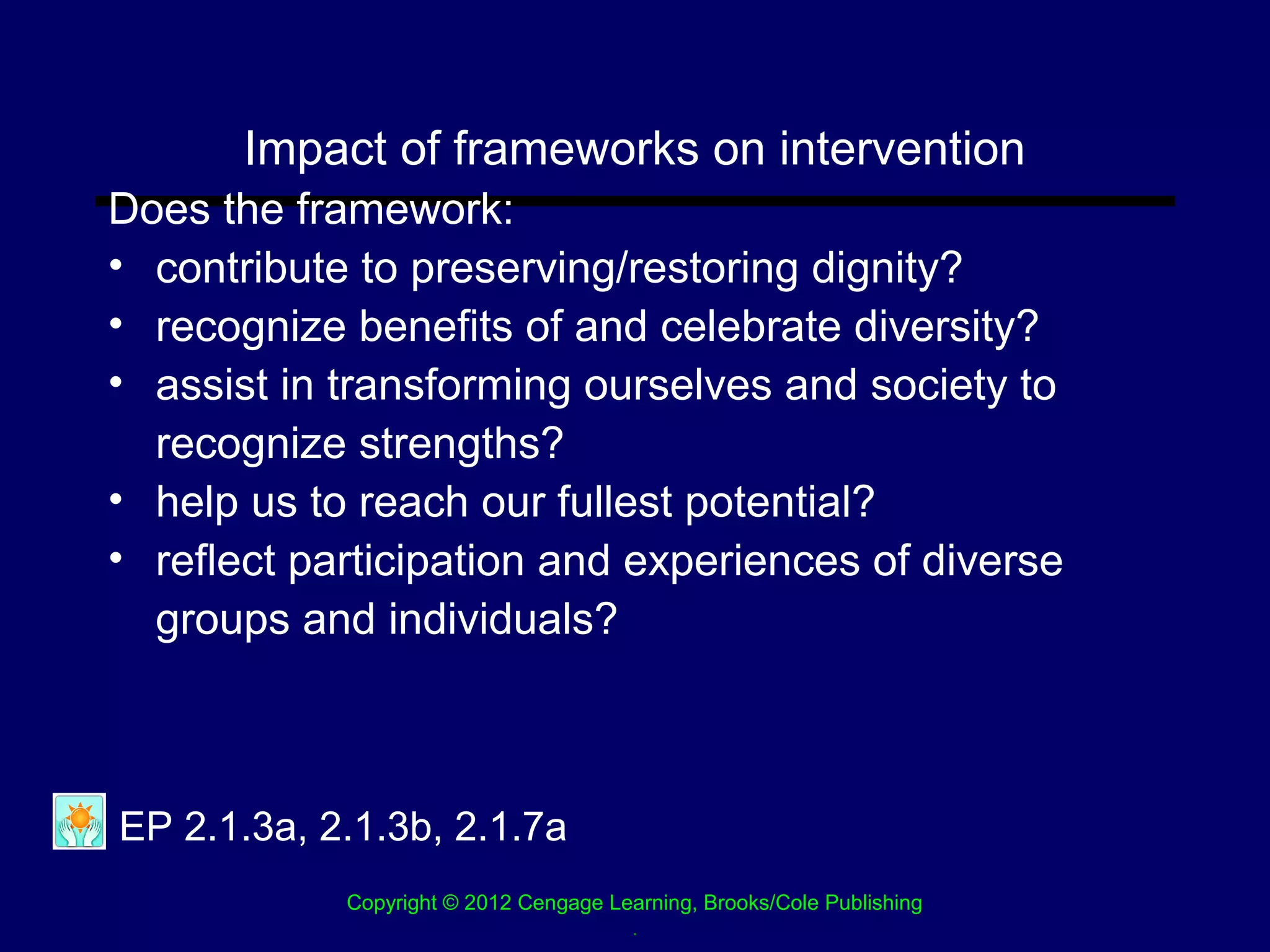
Impact of frameworks on intervention
Does the framework:
• contribute to preserving/restoring dignity?
• recognize benefits of and celebrate diversity?
• assist in transforming ourselves and society to
  recognize strengths?
• help us to reach our fullest potential?
• reflect participation and experiences of diverse
  groups and individuals?


EP 2.1.3a, 2.1.3b, 2.1.7a
            Copyright © 2012 Cengage Learning, Brooks/Cole Publishing
                                       .
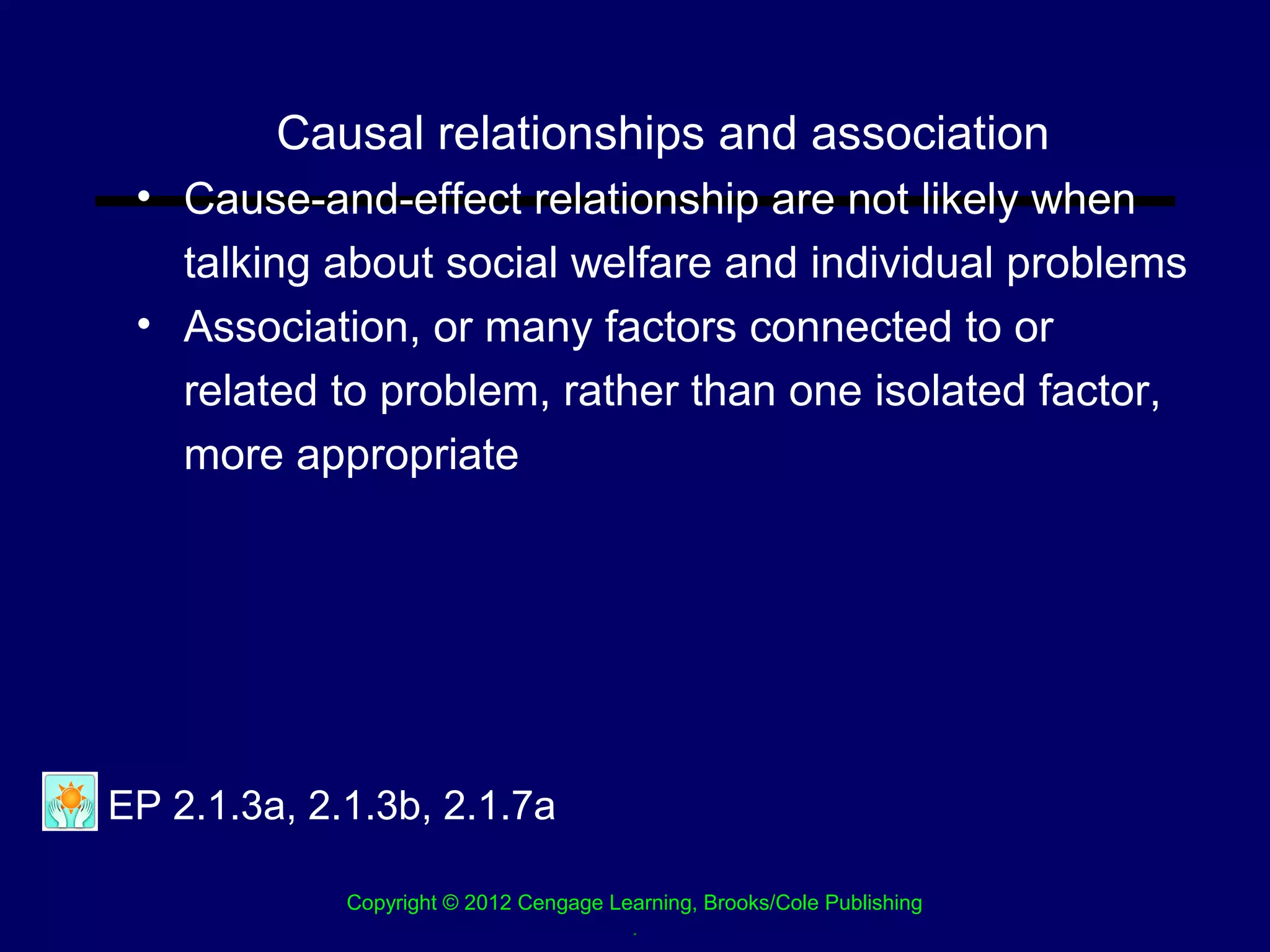
Causal relationships and association
 • Cause-and-effect relationship are not likely when
   talking about social welfare and individual problems
 • Association, or many factors connected to or
   related to problem, rather than one isolated factor,
   more appropriate


EP 2.1.3a, 2.1.3b, 2.1.7a

             Copyright © 2012 Cengage Learning, Brooks/Cole Publishing
                                        .
A conceptual framework for understanding
            Social welfare problems
• Theory – way of clearly and logically organizing a
  set of facts or ideas
• Good theories must be inclusive, capable of being
  generalized, and testable
• There are many theories applicable to social
  work practice


EP 2.1.3a, 2.1.3b, 2.1.7a

             Copyright © 2012 Cengage Learning, Brooks/Cole Publishing
                                        .
A conceptual framework for understanding
            Social welfare problems
• Theory – way of clearly and logically organizing a
  set of facts or ideas
• Good theories must be inclusive, capable of being
  generalized, and testable
• There are many theories applicable to social
  work practice


EP 2.1.3a, 2.1.3b, 2.1.7a

             Copyright © 2012 Cengage Learning, Brooks/Cole Publishing
                                        .
The ecological/systems framework
• Broad “umbrella” framework for understanding
  social welfare problems and determining specific
  intervention theories to address them
• Allows focus on both person and environment
  and interactions between them
• Focuses on both structure (systemic properties)
  and interactions (ecology)


EP 2.1.3a, 2.1.3b, 2.1.7a
            Copyright © 2012 Cengage Learning, Brooks/Cole Publishing
                                       .
Systems theory and concepts
• System – entity composed of separate but
  interacting and interdependent parts
• Synergy – achieved when all the parts of a system
  are working in concert with each other
• Boundary – point at which one system ends and
  another begins
• Open system – system with permeable
  boundaries


EP 2.1.3a, 2.1.3b, 2.1.7a
             Copyright © 2012 Cengage Learning, Brooks/Cole Publishing
                                        .
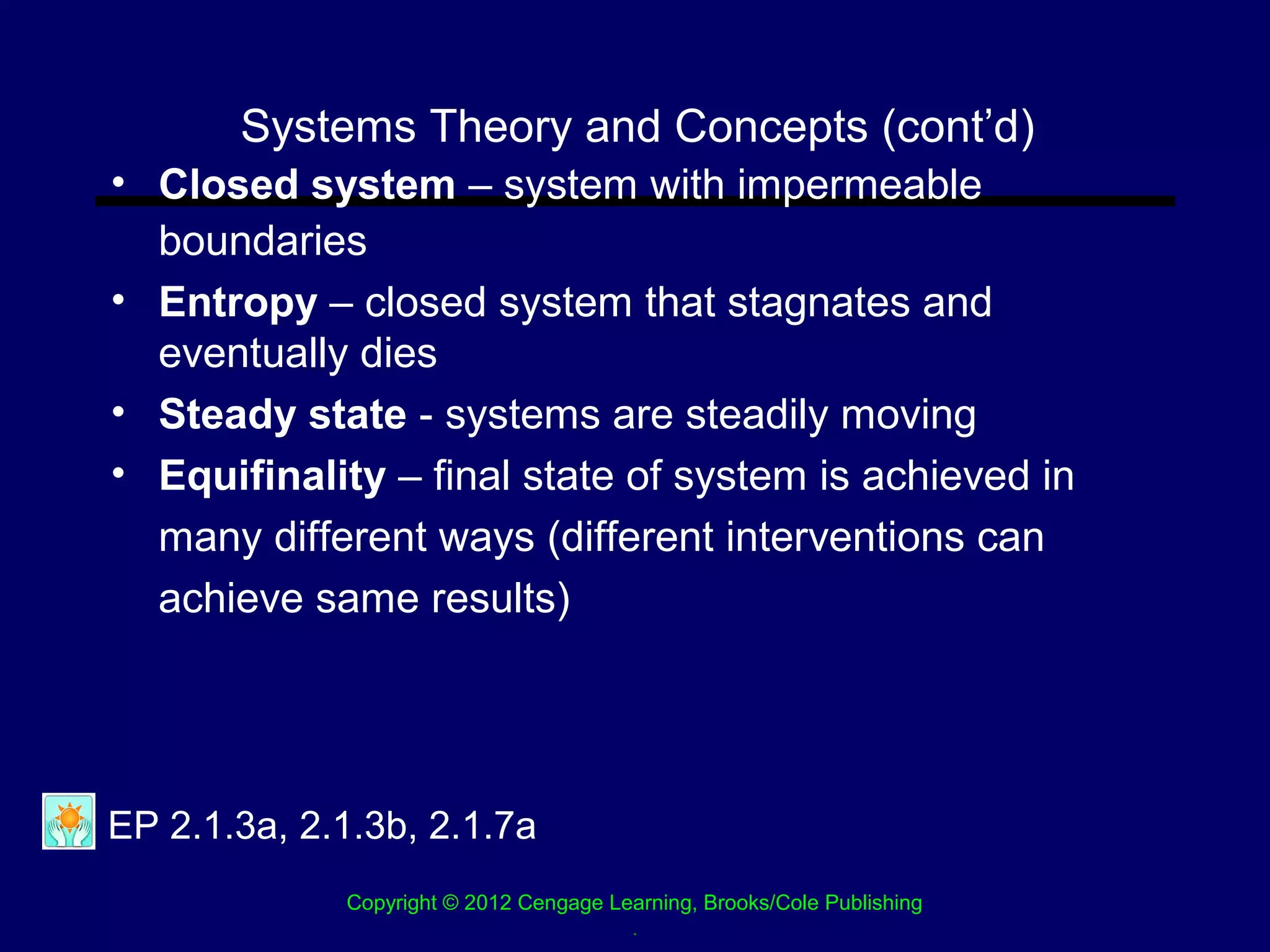
Systems Theory and Concepts (cont’d)
• Closed system – system with impermeable
  boundaries
• Entropy – closed system that stagnates and
  eventually dies
• Steady state - systems are steadily moving
• Equifinality – final state of system is achieved in
  many different ways (different interventions can
  achieve same results)


EP 2.1.3a, 2.1.3b, 2.1.7a
             Copyright © 2012 Cengage Learning, Brooks/Cole Publishing
                                        .
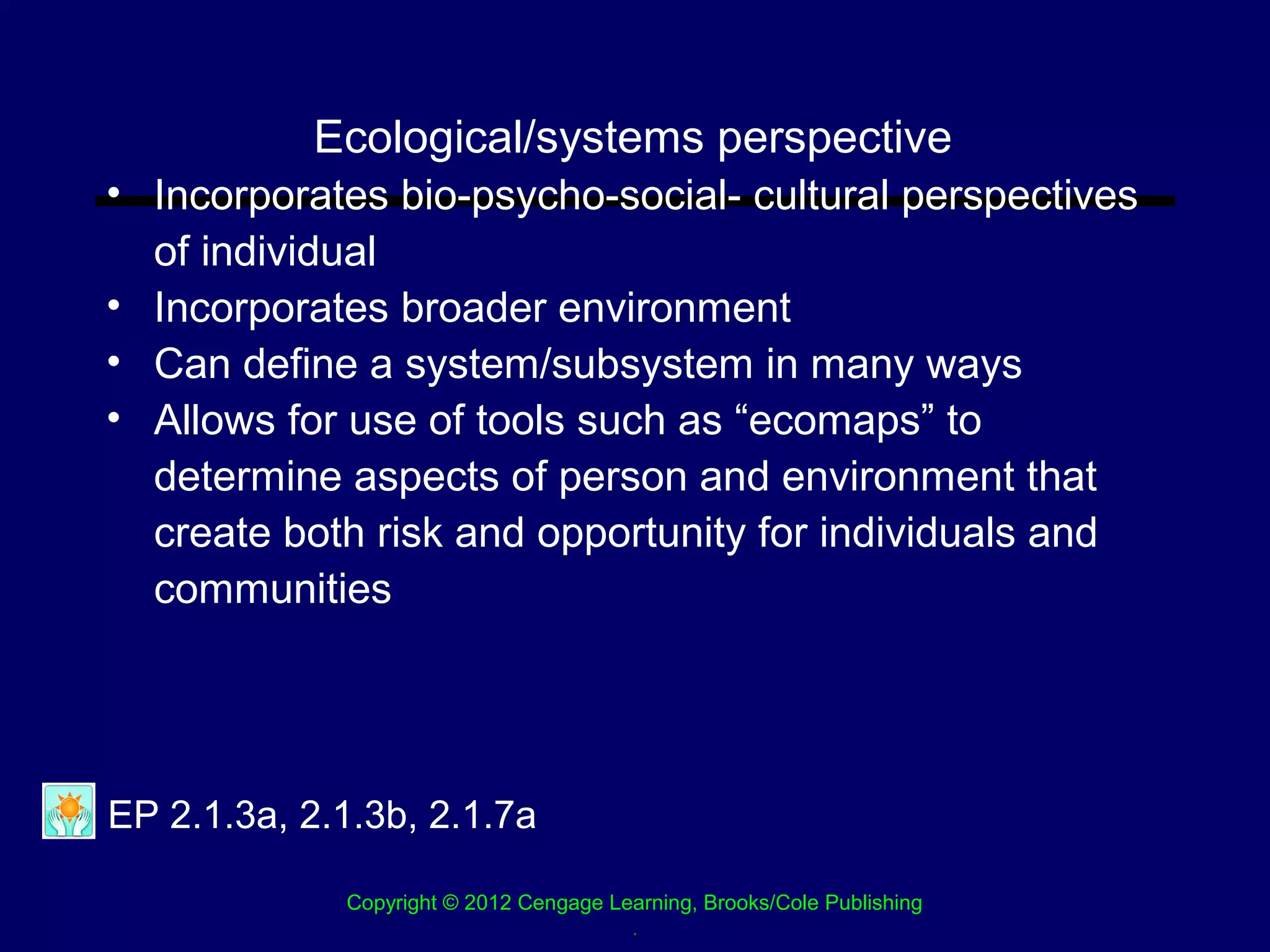
Ecological/systems perspective
• Incorporates bio-psycho-social- cultural perspectives
  of individual
• Incorporates broader environment
• Can define a system/subsystem in many ways
• Allows for use of tools such as “ecomaps” to
  determine aspects of person and environment that
  create both risk and opportunity for individuals and
  communities


EP 2.1.3a, 2.1.3b, 2.1.7a

             Copyright © 2012 Cengage Learning, Brooks/Cole Publishing
                                        .
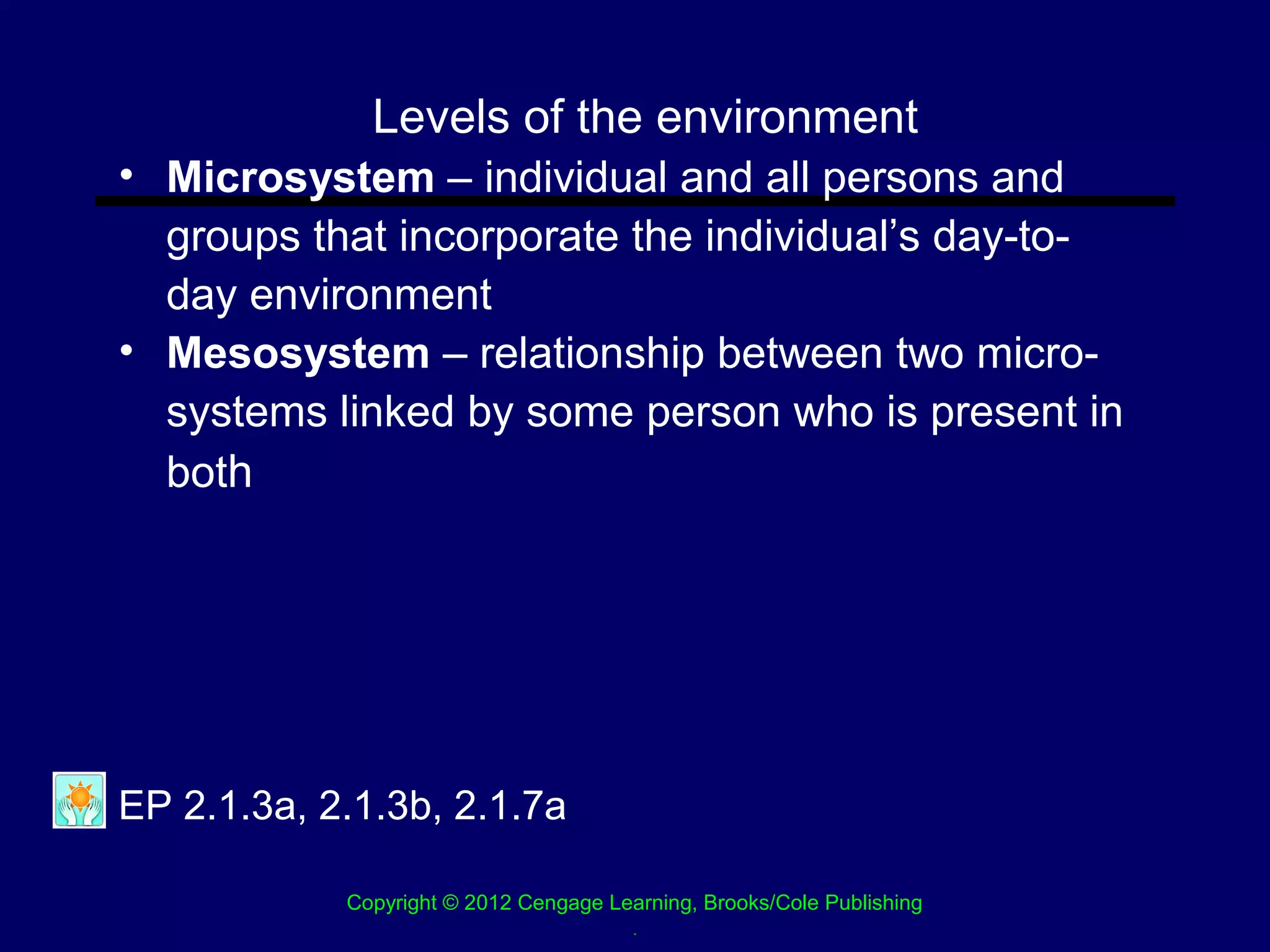
Levels of the environment
• Microsystem – individual and all persons and
  groups that incorporate the individual’s day-to-
  day environment
• Mesosystem – relationship between two micro-
  systems linked by some person who is present in
  both


EP 2.1.3a, 2.1.3b, 2.1.7a

            Copyright © 2012 Cengage Learning, Brooks/Cole Publishing
                                       .
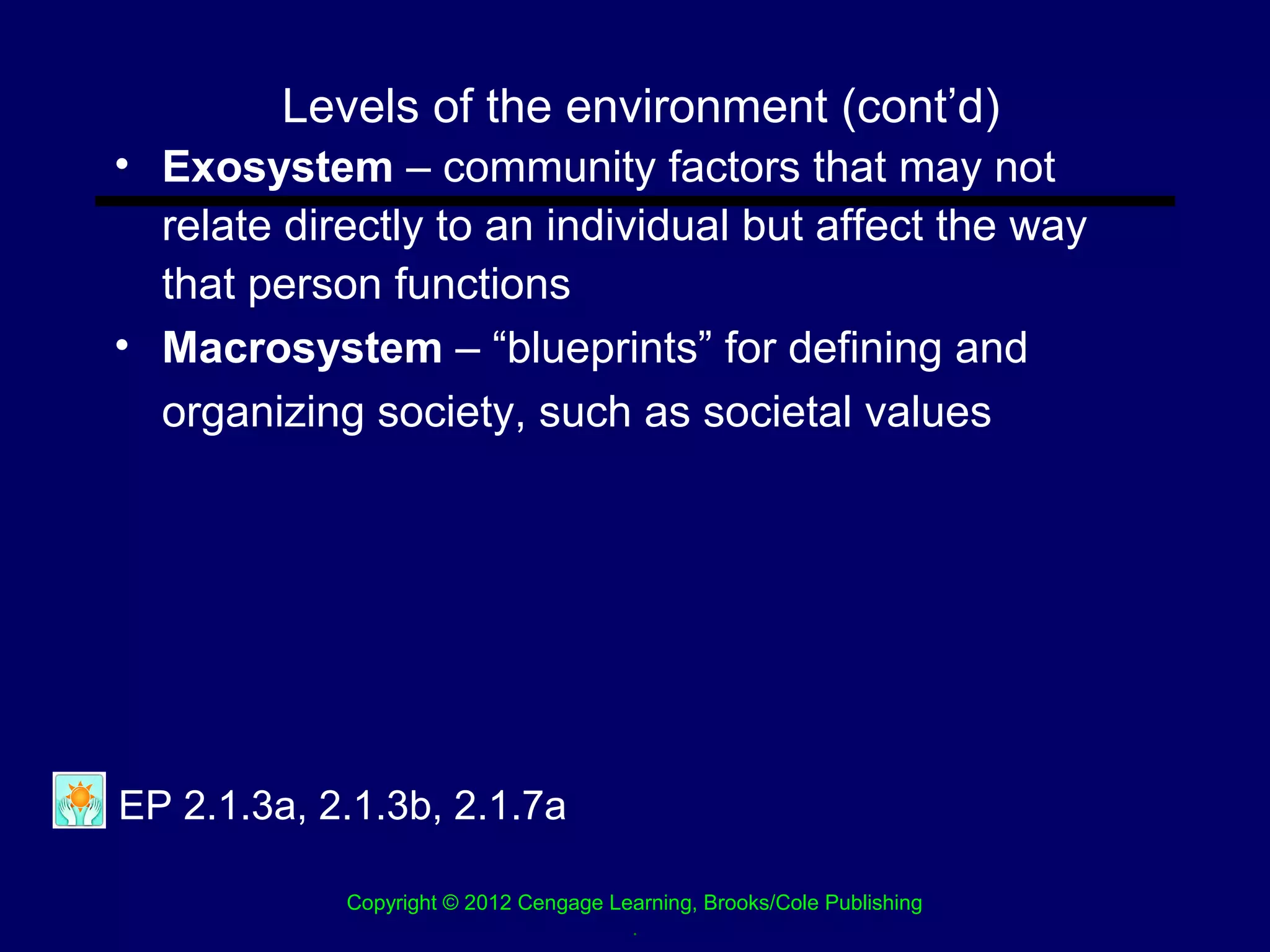
Levels of the environment (cont’d)
• Exosystem – community factors that may not
  relate directly to an individual but affect the way
  that person functions
• Macrosystem – “blueprints” for defining and
  organizing society, such as societal values


EP 2.1.3a, 2.1.3b, 2.1.7a

            Copyright © 2012 Cengage Learning, Brooks/Cole Publishing
                                       .
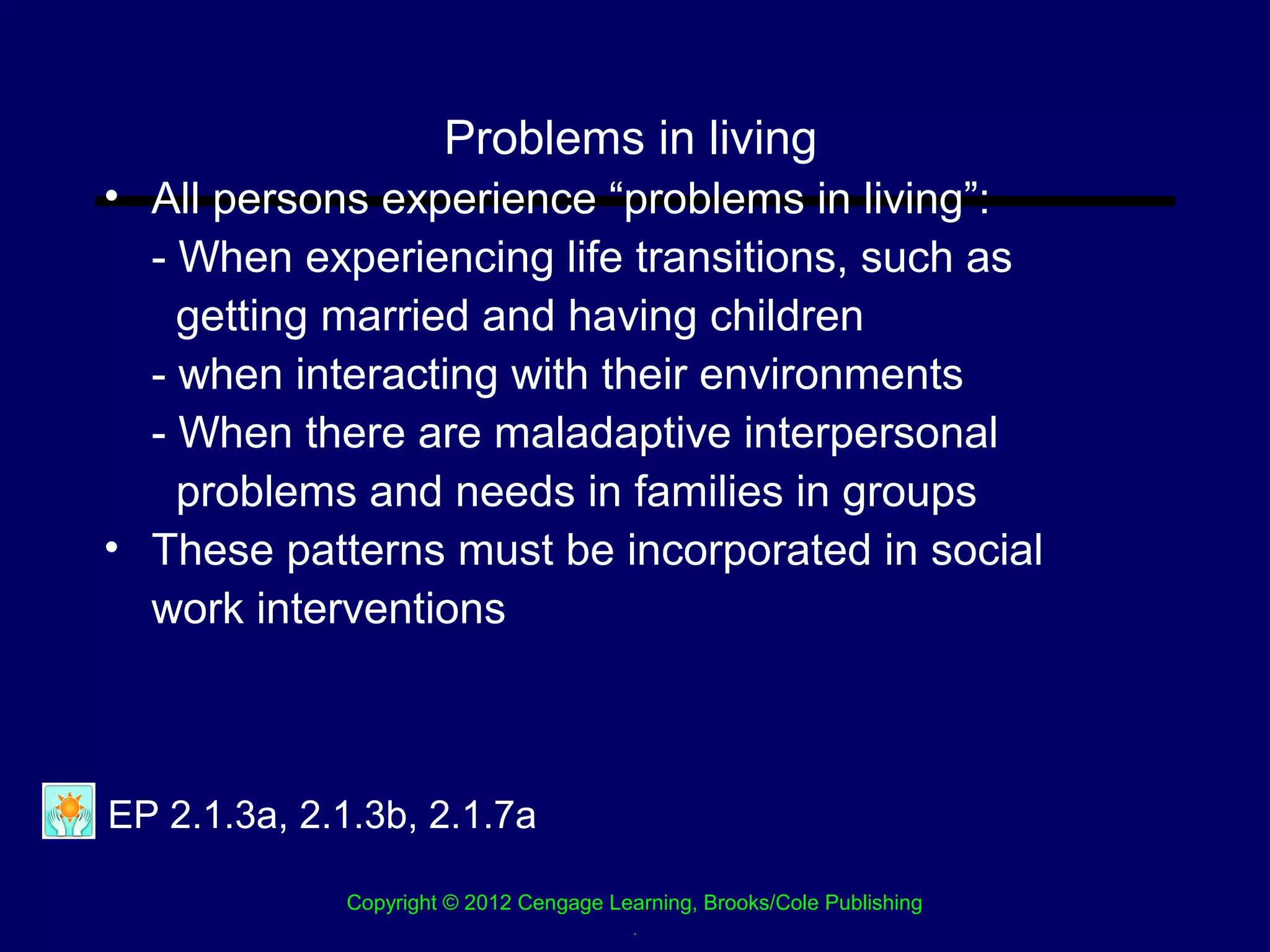
Problems in living
• All persons experience “problems in living”:
  - When experiencing life transitions, such as
    getting married and having children
  - when interacting with their environments
  - When there are maladaptive interpersonal
    problems and needs in families in groups
• These patterns must be incorporated in social
  work interventions


EP 2.1.3a, 2.1.3b, 2.1.7a

             Copyright © 2012 Cengage Learning, Brooks/Cole Publishing
                                        .
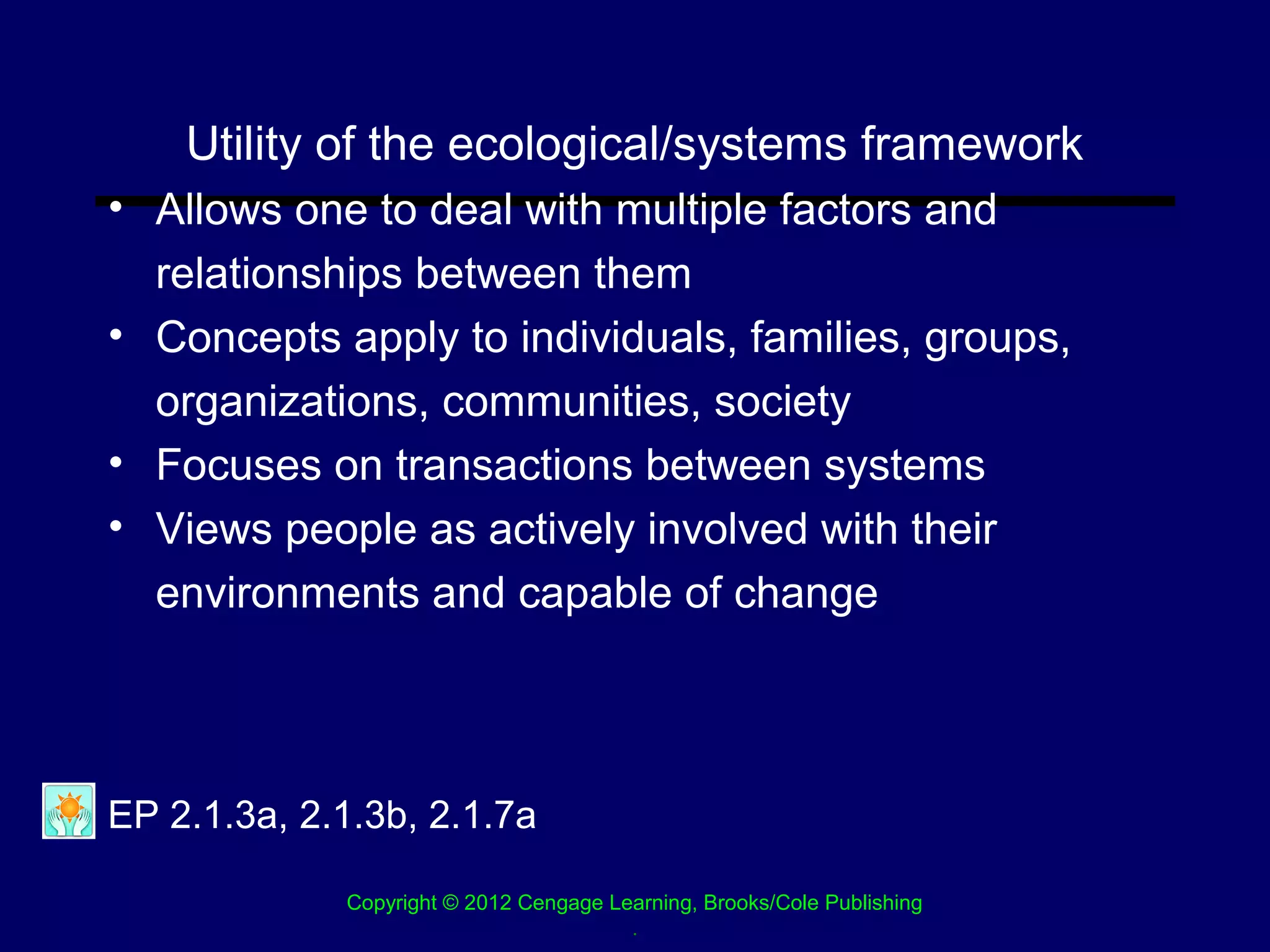
Utility of the ecological/systems framework
• Allows one to deal with multiple factors and
  relationships between them
• Concepts apply to individuals, families, groups,
  organizations, communities, society
• Focuses on transactions between systems
• Views people as actively involved with their
  environments and capable of change


EP 2.1.3a, 2.1.3b, 2.1.7a

             Copyright © 2012 Cengage Learning, Brooks/Cole Publishing
                                        .
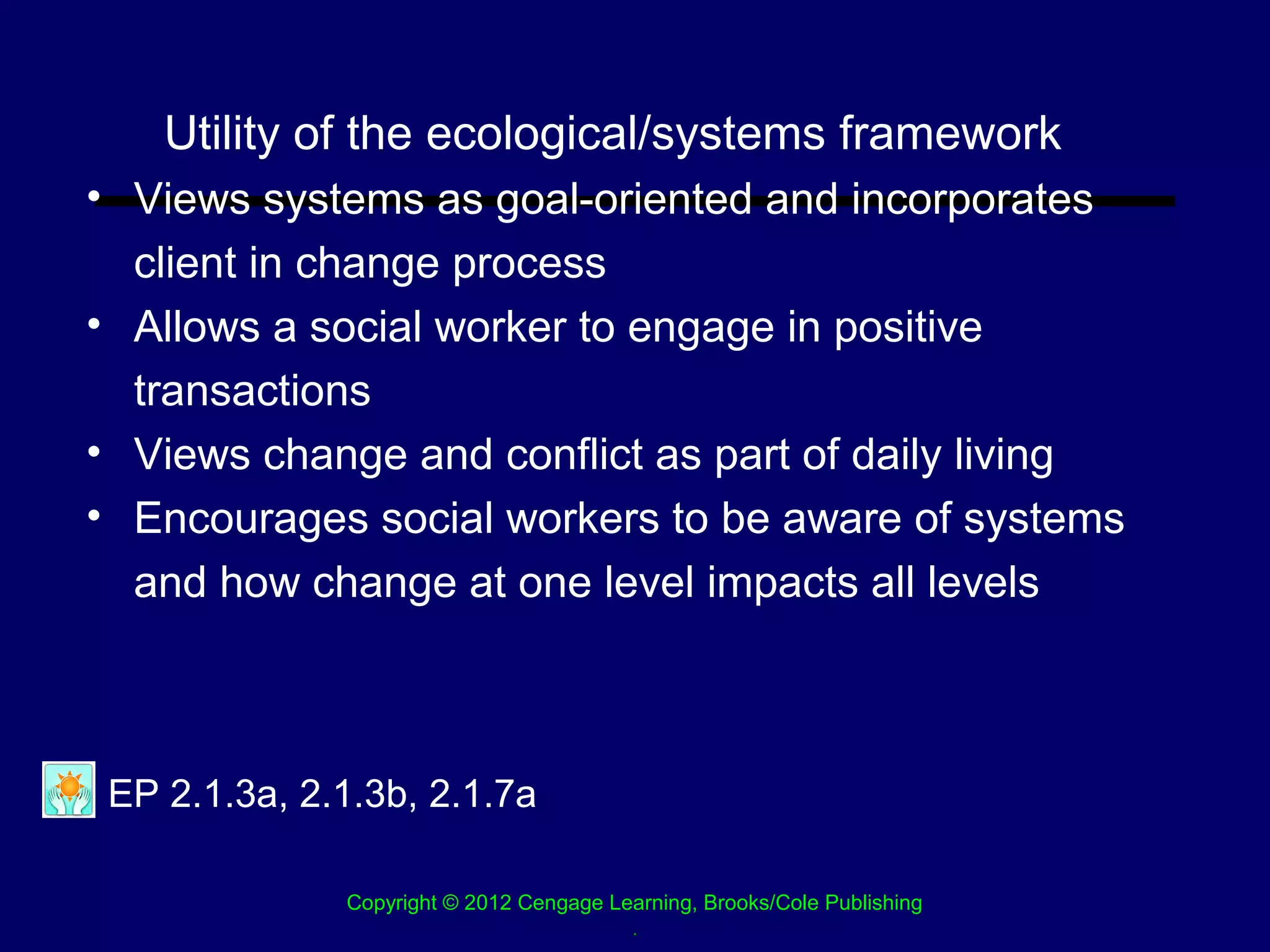
Utility of the ecological/systems framework
• Views systems as goal-oriented and incorporates
  client in change process
• Allows a social worker to engage in positive
  transactions
• Views change and conflict as part of daily living
• Encourages social workers to be aware of systems
  and how change at one level impacts all levels


 EP 2.1.3a, 2.1.3b, 2.1.7a

              Copyright © 2012 Cengage Learning, Brooks/Cole Publishing
                                         .
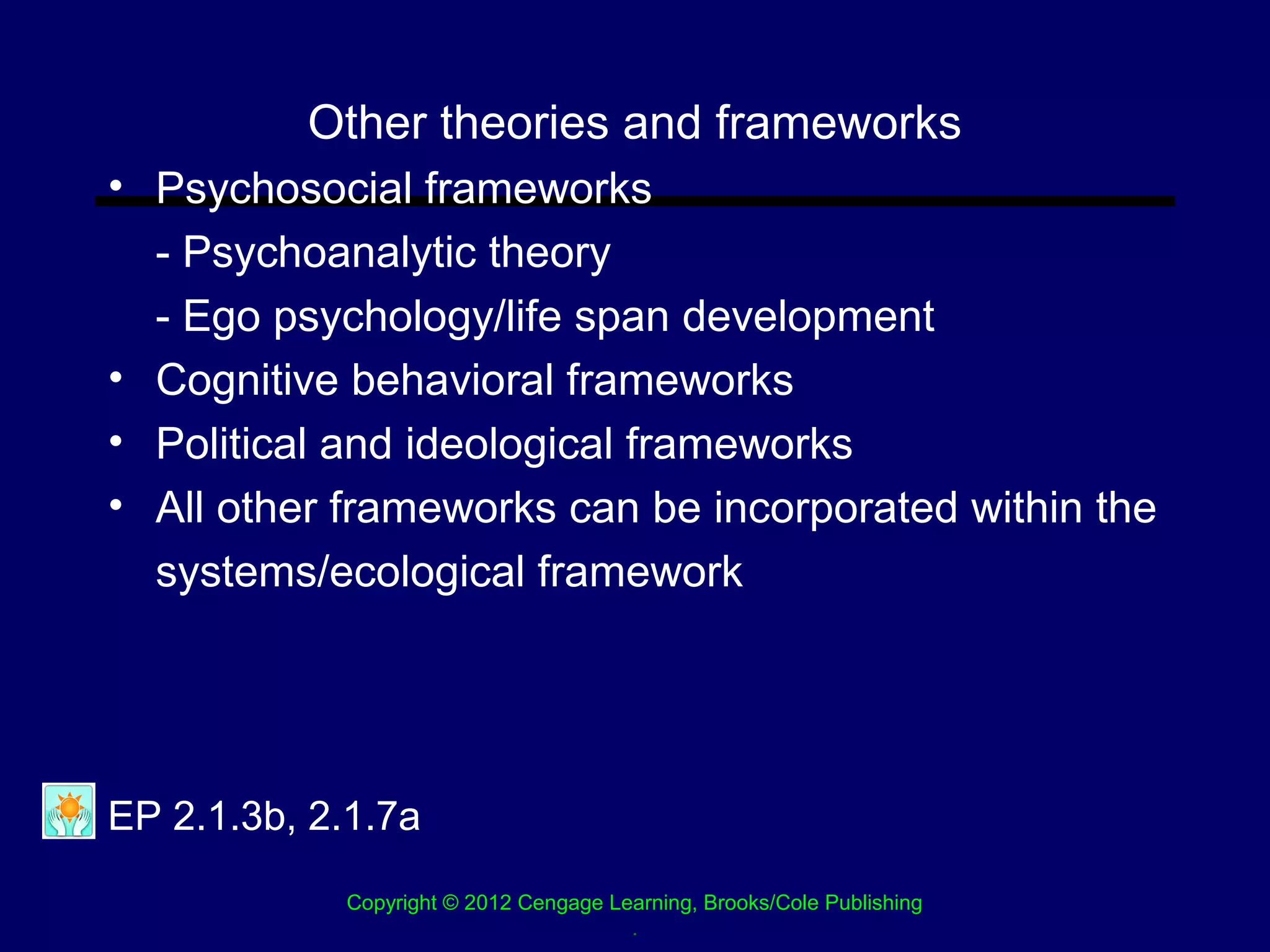
Other theories and frameworks
• Psychosocial frameworks
  - Psychoanalytic theory
  - Ego psychology/life span development
• Cognitive behavioral frameworks
• Political and ideological frameworks
• All other frameworks can be incorporated within the
  systems/ecological framework


EP 2.1.3b, 2.1.7a
            Copyright © 2012 Cengage Learning, Brooks/Cole Publishing
                                       .
The Generalist Model
• Allows for multiple interventions in working with
  clients at the individual, family, group, organizational,
  community, or societal level
• Incorporates a knowledge, value, and skills base that
  is transferable between and among diverse contexts
  and locations
• Incorporates ecological/systems framework and
  focuses on fit between person and environment


EP 2.1.3a, 2.1.3b, 2.1.7a

             Copyright © 2012 Cengage Learning, Brooks/Cole Publishing
                                        .
Concepts of generalist practice
•   Strengths perspective
•   Empowerment and resilience
•   Social and economic justice
•   Social worker is a change agent who uses
    helping process to facilitate change in client
    or client systems


EP 2.1.3a, 2.1.3b, 2.1.7a
              Copyright © 2012 Cengage Learning, Brooks/Cole Publishing
                                         .
Stages of the helping process
• Dialogue/engagement stage
  - Develop relationship
  - Define the problem
  - Identify preliminary goals
• Discovery/contract stage
  - Assess and evaluate needs
  - Explore resources and client strengths
  - Develop action plans and frame solutions


 EP 2.1.3b, 2.1.10 a, b, c
              Copyright © 2012 Cengage Learning, Brooks/Cole Publishing
                                         .
Stages of the helping process
• Development/action stage
  - Carry out plan
  - Strengthen clients/help them get what they need
  - Engage resources
  - Monitor plan and adjust as needed
  - Terminate when appropriate
  - Evaluate change and strategies for continued
    success


EP 2.1.3b, 2.1.10 a, b, c
              Copyright © 2012 Cengage Learning, Brooks/Cole Publishing
                                         .

Unit 3: Ecological Systems Prespective

  • 1.
    Chapter 3: The Ecological/SystemsPerspective . Copyright © 2012 Cengage Learning, Brooks/Cole Publishing .
  • 2.
    Copyright © 2012Cengage Learning, Brooks/Cole Publishing .
  • 3.
    Social Work: ACompetency- Oriented Education  Council on Social Work Education (CSWE) - Defines Educational Policy and Accreditation Standards (EPAs) - Developed 10 “Core Competencies” and 41 Related “Practice Behaviors”  Every student should master the Practice Behaviors and Core Competencies before completing the program Copyright © 2012 Cengage Learning, Brooks/Cole Publishing .
  • 4.
    Resources Aligned toEPAS 2008  The Textbook – - “Helping Hands” icons call attention to content that relates to Practice Behaviors and Competencies - “Competency Notes” at the end of the chapter help put the Practice Behaviors and Competencies in practical context Copyright © 2012 Cengage Learning, Brooks/Cole Publishing .
  • 5.
    Resources Aligned toEPAS 2008 (cont’d)  The Practice Behaviors Workbook developed with the text provides assignable exercises that assist in mastering the Practice Behavior and Competencies  Additional on-line resources can be found at: www.cengage.com/socialwork Copyright © 2012 Cengage Learning, Brooks/Cole Publishing .
  • 6.
    Ecological/systems framework An umbrellaframework used by generalist social work practitioners to understand both social welfare problems and individual needs and to guide the various interventions social workers use when helping clients. EP2.1.3a, 2.1.3b, 2.1.7a Copyright © 2012 Cengage Learning, Brooks/Cole Publishing .
  • 7.
    Impact of frameworkson intervention Does the framework: • contribute to preserving/restoring dignity? • recognize benefits of and celebrate diversity? • assist in transforming ourselves and society to recognize strengths? • help us to reach our fullest potential? • reflect participation and experiences of diverse groups and individuals? EP 2.1.3a, 2.1.3b, 2.1.7a Copyright © 2012 Cengage Learning, Brooks/Cole Publishing .
  • 8.
    Causal relationships andassociation • Cause-and-effect relationship are not likely when talking about social welfare and individual problems • Association, or many factors connected to or related to problem, rather than one isolated factor, more appropriate EP 2.1.3a, 2.1.3b, 2.1.7a Copyright © 2012 Cengage Learning, Brooks/Cole Publishing .
  • 9.
    A conceptual frameworkfor understanding Social welfare problems • Theory – way of clearly and logically organizing a set of facts or ideas • Good theories must be inclusive, capable of being generalized, and testable • There are many theories applicable to social work practice EP 2.1.3a, 2.1.3b, 2.1.7a Copyright © 2012 Cengage Learning, Brooks/Cole Publishing .
  • 10.
    A conceptual frameworkfor understanding Social welfare problems • Theory – way of clearly and logically organizing a set of facts or ideas • Good theories must be inclusive, capable of being generalized, and testable • There are many theories applicable to social work practice EP 2.1.3a, 2.1.3b, 2.1.7a Copyright © 2012 Cengage Learning, Brooks/Cole Publishing .
  • 11.
    The ecological/systems framework •Broad “umbrella” framework for understanding social welfare problems and determining specific intervention theories to address them • Allows focus on both person and environment and interactions between them • Focuses on both structure (systemic properties) and interactions (ecology) EP 2.1.3a, 2.1.3b, 2.1.7a Copyright © 2012 Cengage Learning, Brooks/Cole Publishing .
  • 12.
    Systems theory andconcepts • System – entity composed of separate but interacting and interdependent parts • Synergy – achieved when all the parts of a system are working in concert with each other • Boundary – point at which one system ends and another begins • Open system – system with permeable boundaries EP 2.1.3a, 2.1.3b, 2.1.7a Copyright © 2012 Cengage Learning, Brooks/Cole Publishing .
  • 13.
    Systems Theory andConcepts (cont’d) • Closed system – system with impermeable boundaries • Entropy – closed system that stagnates and eventually dies • Steady state - systems are steadily moving • Equifinality – final state of system is achieved in many different ways (different interventions can achieve same results) EP 2.1.3a, 2.1.3b, 2.1.7a Copyright © 2012 Cengage Learning, Brooks/Cole Publishing .
  • 14.
    Ecological/systems perspective • Incorporatesbio-psycho-social- cultural perspectives of individual • Incorporates broader environment • Can define a system/subsystem in many ways • Allows for use of tools such as “ecomaps” to determine aspects of person and environment that create both risk and opportunity for individuals and communities EP 2.1.3a, 2.1.3b, 2.1.7a Copyright © 2012 Cengage Learning, Brooks/Cole Publishing .
  • 15.
    Levels of theenvironment • Microsystem – individual and all persons and groups that incorporate the individual’s day-to- day environment • Mesosystem – relationship between two micro- systems linked by some person who is present in both EP 2.1.3a, 2.1.3b, 2.1.7a Copyright © 2012 Cengage Learning, Brooks/Cole Publishing .
  • 16.
    Levels of theenvironment (cont’d) • Exosystem – community factors that may not relate directly to an individual but affect the way that person functions • Macrosystem – “blueprints” for defining and organizing society, such as societal values EP 2.1.3a, 2.1.3b, 2.1.7a Copyright © 2012 Cengage Learning, Brooks/Cole Publishing .
  • 17.
    Problems in living •All persons experience “problems in living”: - When experiencing life transitions, such as getting married and having children - when interacting with their environments - When there are maladaptive interpersonal problems and needs in families in groups • These patterns must be incorporated in social work interventions EP 2.1.3a, 2.1.3b, 2.1.7a Copyright © 2012 Cengage Learning, Brooks/Cole Publishing .
  • 18.
    Utility of theecological/systems framework • Allows one to deal with multiple factors and relationships between them • Concepts apply to individuals, families, groups, organizations, communities, society • Focuses on transactions between systems • Views people as actively involved with their environments and capable of change EP 2.1.3a, 2.1.3b, 2.1.7a Copyright © 2012 Cengage Learning, Brooks/Cole Publishing .
  • 19.
    Utility of theecological/systems framework • Views systems as goal-oriented and incorporates client in change process • Allows a social worker to engage in positive transactions • Views change and conflict as part of daily living • Encourages social workers to be aware of systems and how change at one level impacts all levels EP 2.1.3a, 2.1.3b, 2.1.7a Copyright © 2012 Cengage Learning, Brooks/Cole Publishing .
  • 20.
    Other theories andframeworks • Psychosocial frameworks - Psychoanalytic theory - Ego psychology/life span development • Cognitive behavioral frameworks • Political and ideological frameworks • All other frameworks can be incorporated within the systems/ecological framework EP 2.1.3b, 2.1.7a Copyright © 2012 Cengage Learning, Brooks/Cole Publishing .
  • 21.
    The Generalist Model •Allows for multiple interventions in working with clients at the individual, family, group, organizational, community, or societal level • Incorporates a knowledge, value, and skills base that is transferable between and among diverse contexts and locations • Incorporates ecological/systems framework and focuses on fit between person and environment EP 2.1.3a, 2.1.3b, 2.1.7a Copyright © 2012 Cengage Learning, Brooks/Cole Publishing .
  • 22.
    Concepts of generalistpractice • Strengths perspective • Empowerment and resilience • Social and economic justice • Social worker is a change agent who uses helping process to facilitate change in client or client systems EP 2.1.3a, 2.1.3b, 2.1.7a Copyright © 2012 Cengage Learning, Brooks/Cole Publishing .
  • 23.
    Stages of thehelping process • Dialogue/engagement stage - Develop relationship - Define the problem - Identify preliminary goals • Discovery/contract stage - Assess and evaluate needs - Explore resources and client strengths - Develop action plans and frame solutions EP 2.1.3b, 2.1.10 a, b, c Copyright © 2012 Cengage Learning, Brooks/Cole Publishing .
  • 24.
    Stages of thehelping process • Development/action stage - Carry out plan - Strengthen clients/help them get what they need - Engage resources - Monitor plan and adjust as needed - Terminate when appropriate - Evaluate change and strategies for continued success EP 2.1.3b, 2.1.10 a, b, c Copyright © 2012 Cengage Learning, Brooks/Cole Publishing .