SYSTEMS THEORY
incorporating Unitary Approaches,
Family Systems, Institutional
Systems, Ecological Models and
Networking
SYSTEMS THEORY
SYSTEMS THEORY
 What is Systems Theory?
What is Systems Theory?
 Biological Models
Biological Models
 A Case Study
A Case Study
 The Pincus and Minahan model
The Pincus and Minahan model
 Social Work and Ecology
Social Work and Ecology
 Strengths and Weaknesses
Strengths and Weaknesses
An Example
An Example
 Think of Lincoln’s transport system: if you
Think of Lincoln’s transport system: if you
improve car access, you potentially boost the
economy, you satisfy individual demand, but
potentially damage the environment and
increase risks of accidents; if you switch to
public transport, you boost jobs through
infrastructural spending, but you lose income
from car parking, from passing trade,
potentially from tourism…….so any action in
one part has a consequence on the whole
system
system
Another Example
• Excluding your family and blood
relatives, how many friends and
acquaintances do you have?
• Write down the number that
best approximates to your
social system
Further Examples
 Examples of simple systems are babysitting
circles, allotment societies, “share – the
care” schemes
 Examples of complex systems are
neighbourhoods, families, kinship networks,
church / faith groups, peer groups, social
communities
SYSTEMS THEORY: A Definition
“A Social system is a system of processes
of interaction between actors……...it is the
structure of the relations between the
actors as involved in the interactive
process which is essentially the structure
of the social system. The system is a
network of such relationships”
(Talcott Parsons: The Social System)
SYSTEMS THEORY: Roots
 “Things do not have a meaning in
themselves, but only in relation to other
things” (Saying from Eastern philosophy)
 Society is “an organism of functionally
interdependent parts evolving through
structural differentiation” (Herbert
Spencer: The Study of Sociology)
BIOLOGICAL MODELS
BIOLOGICAL MODELS
 The whole is equal to more than the
The whole is equal to more than the
sum of its parts
sum of its parts
 Systems are highly organised
Systems are highly organised
 Boundaries are very important, as are
Boundaries are very important, as are
patterned transactions
 The behaviour of the individual cannot
The behaviour of the individual cannot
be understood without reference to
the system to which s/he belongs
BIOLOGICAL MODELS (2)
 Behaviour is best understood as a
circular process
 Systems are naturally self -
preservationist and conservative
 Systems need energy flow across
boundaries to achieve equilibrium
 Systems are goal directed
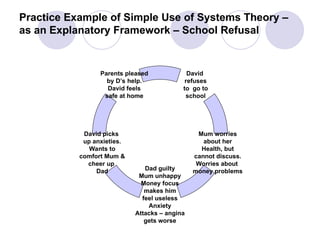
Practice Example of Simple Use of Systems Theory –
as an Explanatory Framework – School Refusal
David
refuses
to go to
school
Mum worries
about her
Health, but
cannot discuss.
Worries about
money problems
Parents pleased
by D’s help.
David feels
safe at home
Dad guilty
Mum unhappy
Money focus
makes him
feel useless
Anxiety
Attacks – angina
gets worse
David picks
up anxieties.
Wants to
comfort Mum &
cheer up
Dad
Reminder – how would other theories
intervene in this case?
1. Psychodynamic – would try to engage
with David’s inner world of feelings
2. Behavioural – identify and try to isolate
those factors positively reinforcing
David’s school refusal
3. Cognitive – what do you think?
4. Systems – as implied earlier – may use
any one of above………BUT would also:
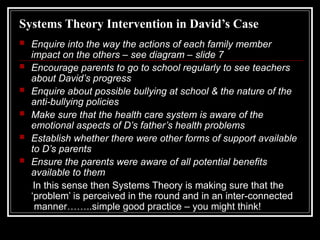
Systems Theory Intervention in David’s Case
 Enquire into the way the actions of each family member
impact on the others – see diagram – slide 7
 Encourage parents to go to school regularly to see teachers
about David’s progress
 Enquire about possible bullying at school & the nature of the
anti-bullying policies
 Make sure that the health care system is aware of the
emotional aspects of D’s father’s health problems
 Establish whether there were other forms of support available
to D’s parents
 Ensure the parents were aware of all potential benefits
available to them
In this sense then Systems Theory is making sure that the
‘problem’ is perceived in the round and in an inter-connected
manner……..simple good practice – you might think!
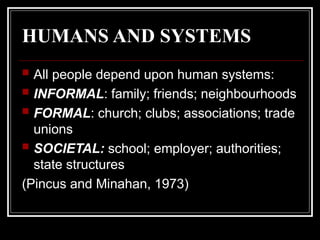
HUMANS AND SYSTEMS
 All people depend upon human systems:
 INFORMAL: family; friends; neighbourhoods
 FORMAL: church; clubs; associations; trade
unions
 SOCIETAL: school; employer; authorities;
state structures
(Pincus and Minahan, 1973)
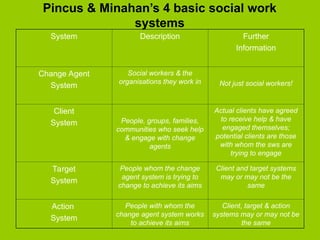
Pincus & Minahan’s 4 basic social work
systems
System Description Further
Information
Change Agent
System
Social workers & the
organisations they work in Not just social workers!
Client
System People, groups, families,
communities who seek help
& engage with change
agents
Actual clients have agreed
to receive help & have
engaged themselves;
potential clients are those
with whom the sws are
trying to engage
Target
System
People whom the change
agent system is trying to
change to achieve its aims
Client and target systems
may or may not be the
same
Action
System
People with whom the
change agent system works
to achieve its aims
Client, target & action
systems may or may not be
the same
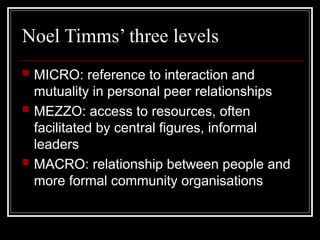
Noel Timms’ three levels
 MICRO: reference to interaction and
mutuality in personal peer relationships
 MEZZO: access to resources, often
facilitated by central figures, informal
leaders
 MACRO: relationship between people and
more formal community organisations
Linking Systems and
Linking Systems and
Structural Theory
Structural Theory
 “
“Community social work demands a
Community social work demands a
systems orientation and a change of
attitude from social work about roles
and tasks” (Coulshed, 1988)
 Working with communities,
Working with communities,
neighbourhoods and networks: a
systems approach to service delivery
Can Systems Theory be Critical?
 Systems theory does allow social workers
to be critical of – and target for change -
considerable ‘issues’ outside the immediate
behaviour of the referral; including:
 The referrer's immediate environment; their
own agency’s policies; other agencies; local
& national government policies; social
conventions generally
Linking Systems theory to Networking
 a systems approach may be applied to the
analysis of “the complexity of biological,
psychological, social and cultural forces at work
in the relations between formal social work and
informal social support networks” (Garbarino,
1986: 24)
 the aim is “to create artificial systems that will
go on to function as natural systems” (Collins
and Pancoast, 1976: 65)
Coates J (2003) Ecology & Social Work
Starts from the notion that SW
Starts from the notion that SW must
must support sustainable
support sustainable
development, through:
 Developing caring communities
Developing caring communities
 Identifying & developing activities that benefit ‘the
Identifying & developing activities that benefit ‘the
common good’
common good’
 Promoting active partnerships
Promoting active partnerships
 Building capacities in individuals & communities
Building capacities in individuals & communities
 Promoting
Promoting decentralised & localised
decentralised & localised decision
decision
making - & making it work!
 Promoting community health & social resilience
Promoting community health & social resilience
 Promoting environmental and social justice
Promoting environmental and social justice
 Reducing human & ecological stress – with much use
Reducing human & ecological stress – with much use
of grief work
of grief work
 Focus on natural methods of healing & spirituality
Focus on natural methods of healing & spirituality
So, it is logical that a radical and critical systems theory
would question all the conventional systems within
which SW is practiced - and promote alternatives
Strengths & Weaknesses of Systems Approach as a
Guide to Practice
Guide to Practice
Strengths
Strengths
 It offers a unitary approach by combining
It offers a unitary approach by combining
psychological, social and community approaches
 It is interactive – it facilitates being able to
It is interactive – it facilitates being able to
understand the impact of people on each other, as
well the impact of systems on people & other
systems
systems
 It offers more than one way to tackle an issue –
It offers more than one way to tackle an issue –
eclectic – not ‘stuck’ in one preferred approach
 It allows for the integration of approaches
It allows for the integration of approaches
 It avoids strict determinist accounts of behaviour
It avoids strict determinist accounts of behaviour
Weaknesses
Weaknesses
 It is not prescriptive – does not tell us what to do
It is not prescriptive – does not tell us what to do
(some might say that’s a strength!)
 It is a generalised theory - hard to apply to specific
It is a generalised theory - hard to apply to specific
situations
situations
 It points to many connections but does not provide
It points to many connections but does not provide
any
any specific theory
specific theory that might link them in an
that might link them in an
explanatory manner
explanatory manner
 Maybe it includes too much – maybe we need theory
Maybe it includes too much – maybe we need theory
that places some emphasis on what is most
important
important
 In many guises it can be quite conservative – creating
In many guises it can be quite conservative – creating
stable self reliant systems
 Similarly it may overstate the importance of social
Similarly it may overstate the importance of social
cohesion and solidarity
 It can have a complex and over technical language –
It can have a complex and over technical language –
like many other theories!

Systems thinking concept explained_ .ppt

  • 1.
    SYSTEMS THEORY incorporating UnitaryApproaches, Family Systems, Institutional Systems, Ecological Models and Networking
  • 2.
    SYSTEMS THEORY SYSTEMS THEORY What is Systems Theory? What is Systems Theory?  Biological Models Biological Models  A Case Study A Case Study  The Pincus and Minahan model The Pincus and Minahan model  Social Work and Ecology Social Work and Ecology  Strengths and Weaknesses Strengths and Weaknesses
  • 3.
    An Example An Example Think of Lincoln’s transport system: if you Think of Lincoln’s transport system: if you improve car access, you potentially boost the improve car access, you potentially boost the economy, you satisfy individual demand, but economy, you satisfy individual demand, but potentially damage the environment and potentially damage the environment and increase risks of accidents; if you switch to increase risks of accidents; if you switch to public transport, you boost jobs through public transport, you boost jobs through infrastructural spending, but you lose income infrastructural spending, but you lose income from car parking, from passing trade, from car parking, from passing trade, potentially from tourism…….so any action in potentially from tourism…….so any action in one part has a consequence on the whole one part has a consequence on the whole system system
  • 4.
    Another Example • Excludingyour family and blood relatives, how many friends and acquaintances do you have? • Write down the number that best approximates to your social system
  • 5.
    Further Examples  Examplesof simple systems are babysitting circles, allotment societies, “share – the care” schemes  Examples of complex systems are neighbourhoods, families, kinship networks, church / faith groups, peer groups, social communities
  • 6.
    SYSTEMS THEORY: ADefinition “A Social system is a system of processes of interaction between actors……...it is the structure of the relations between the actors as involved in the interactive process which is essentially the structure of the social system. The system is a network of such relationships” (Talcott Parsons: The Social System)
  • 7.
    SYSTEMS THEORY: Roots “Things do not have a meaning in themselves, but only in relation to other things” (Saying from Eastern philosophy)  Society is “an organism of functionally interdependent parts evolving through structural differentiation” (Herbert Spencer: The Study of Sociology)
  • 8.
    BIOLOGICAL MODELS BIOLOGICAL MODELS The whole is equal to more than the The whole is equal to more than the sum of its parts sum of its parts  Systems are highly organised Systems are highly organised  Boundaries are very important, as are Boundaries are very important, as are patterned transactions patterned transactions  The behaviour of the individual cannot The behaviour of the individual cannot be understood without reference to be understood without reference to the system to which s/he belongs the system to which s/he belongs
  • 9.
    BIOLOGICAL MODELS (2) Behaviour is best understood as a circular process  Systems are naturally self - preservationist and conservative  Systems need energy flow across boundaries to achieve equilibrium  Systems are goal directed
  • 10.
    Practice Example ofSimple Use of Systems Theory – as an Explanatory Framework – School Refusal David refuses to go to school Mum worries about her Health, but cannot discuss. Worries about money problems Parents pleased by D’s help. David feels safe at home Dad guilty Mum unhappy Money focus makes him feel useless Anxiety Attacks – angina gets worse David picks up anxieties. Wants to comfort Mum & cheer up Dad
  • 11.
    Reminder – howwould other theories intervene in this case? 1. Psychodynamic – would try to engage with David’s inner world of feelings 2. Behavioural – identify and try to isolate those factors positively reinforcing David’s school refusal 3. Cognitive – what do you think? 4. Systems – as implied earlier – may use any one of above………BUT would also:
  • 12.
    Systems Theory Interventionin David’s Case  Enquire into the way the actions of each family member impact on the others – see diagram – slide 7  Encourage parents to go to school regularly to see teachers about David’s progress  Enquire about possible bullying at school & the nature of the anti-bullying policies  Make sure that the health care system is aware of the emotional aspects of D’s father’s health problems  Establish whether there were other forms of support available to D’s parents  Ensure the parents were aware of all potential benefits available to them In this sense then Systems Theory is making sure that the ‘problem’ is perceived in the round and in an inter-connected manner……..simple good practice – you might think!
  • 13.
    HUMANS AND SYSTEMS All people depend upon human systems:  INFORMAL: family; friends; neighbourhoods  FORMAL: church; clubs; associations; trade unions  SOCIETAL: school; employer; authorities; state structures (Pincus and Minahan, 1973)
  • 14.
    Pincus & Minahan’s4 basic social work systems System Description Further Information Change Agent System Social workers & the organisations they work in Not just social workers! Client System People, groups, families, communities who seek help & engage with change agents Actual clients have agreed to receive help & have engaged themselves; potential clients are those with whom the sws are trying to engage Target System People whom the change agent system is trying to change to achieve its aims Client and target systems may or may not be the same Action System People with whom the change agent system works to achieve its aims Client, target & action systems may or may not be the same
  • 15.
    Noel Timms’ threelevels  MICRO: reference to interaction and mutuality in personal peer relationships  MEZZO: access to resources, often facilitated by central figures, informal leaders  MACRO: relationship between people and more formal community organisations
  • 16.
    Linking Systems and LinkingSystems and Structural Theory Structural Theory  “ “Community social work demands a Community social work demands a systems orientation and a change of systems orientation and a change of attitude from social work about roles attitude from social work about roles and tasks” (Coulshed, 1988) and tasks” (Coulshed, 1988)  Working with communities, Working with communities, neighbourhoods and networks: a neighbourhoods and networks: a systems approach to service delivery systems approach to service delivery
  • 17.
    Can Systems Theorybe Critical?  Systems theory does allow social workers to be critical of – and target for change - considerable ‘issues’ outside the immediate behaviour of the referral; including:  The referrer's immediate environment; their own agency’s policies; other agencies; local & national government policies; social conventions generally
  • 18.
    Linking Systems theoryto Networking  a systems approach may be applied to the analysis of “the complexity of biological, psychological, social and cultural forces at work in the relations between formal social work and informal social support networks” (Garbarino, 1986: 24)  the aim is “to create artificial systems that will go on to function as natural systems” (Collins and Pancoast, 1976: 65)
  • 19.
    Coates J (2003)Ecology & Social Work Coates J (2003) Ecology & Social Work Starts from the notion that SW Starts from the notion that SW must must support sustainable support sustainable development, through: development, through:  Developing caring communities Developing caring communities  Identifying & developing activities that benefit ‘the Identifying & developing activities that benefit ‘the common good’ common good’  Promoting active partnerships Promoting active partnerships  Building capacities in individuals & communities Building capacities in individuals & communities  Promoting Promoting decentralised & localised decentralised & localised decision decision making - & making it work! making - & making it work!  Promoting community health & social resilience Promoting community health & social resilience  Promoting environmental and social justice Promoting environmental and social justice  Reducing human & ecological stress – with much use Reducing human & ecological stress – with much use of grief work of grief work  Focus on natural methods of healing & spirituality Focus on natural methods of healing & spirituality So, it is logical that a radical and critical systems theory So, it is logical that a radical and critical systems theory would question all the conventional systems within would question all the conventional systems within which SW is practiced - and promote alternatives which SW is practiced - and promote alternatives
  • 20.
    Strengths & Weaknessesof Systems Approach as a Strengths & Weaknesses of Systems Approach as a Guide to Practice Guide to Practice Strengths Strengths  It offers a unitary approach by combining It offers a unitary approach by combining psychological, social and community approaches psychological, social and community approaches  It is interactive – it facilitates being able to It is interactive – it facilitates being able to understand the impact of people on each other, as understand the impact of people on each other, as well the impact of systems on people & other well the impact of systems on people & other systems systems  It offers more than one way to tackle an issue – It offers more than one way to tackle an issue – eclectic – not ‘stuck’ in one preferred approach eclectic – not ‘stuck’ in one preferred approach  It allows for the integration of approaches It allows for the integration of approaches  It avoids strict determinist accounts of behaviour It avoids strict determinist accounts of behaviour
  • 21.
    Weaknesses Weaknesses  It isnot prescriptive – does not tell us what to do It is not prescriptive – does not tell us what to do (some might say that’s a strength!) (some might say that’s a strength!)  It is a generalised theory - hard to apply to specific It is a generalised theory - hard to apply to specific situations situations  It points to many connections but does not provide It points to many connections but does not provide any any specific theory specific theory that might link them in an that might link them in an explanatory manner explanatory manner  Maybe it includes too much – maybe we need theory Maybe it includes too much – maybe we need theory that places some emphasis on what is most that places some emphasis on what is most important important  In many guises it can be quite conservative – creating In many guises it can be quite conservative – creating stable self reliant systems stable self reliant systems  Similarly it may overstate the importance of social Similarly it may overstate the importance of social cohesion and solidarity cohesion and solidarity  It can have a complex and over technical language – It can have a complex and over technical language – like many other theories! like many other theories!