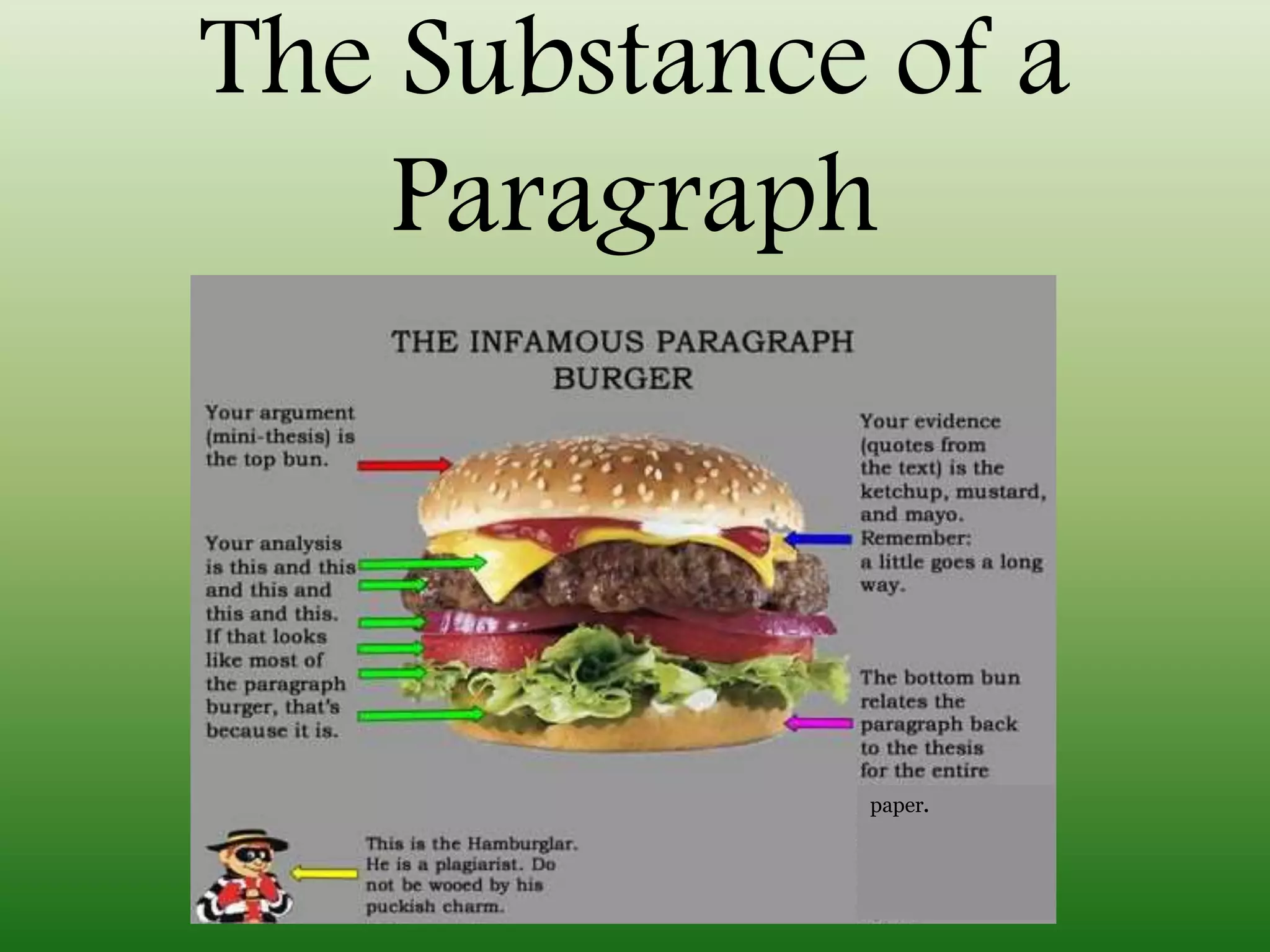
The Substance of a
Paragraph
paper.
The type of paragraph
I expect from
students.
What students
give me.
(By the way)
• Everything in this presentation pertains to
formal writing, such as informative, analytical
and argumentative writing.
• It does NOT apply to creative forms of writing.
What goes in a
paragraph?
Your paragraph should have:
P E E L
Point Evidence Explana-
tion
Links
Have a topic
sentence
that makes
your point
clear.
Provide evidence to
support your point,
which may include:
 Facts & statistics
 Quotes form
authority
 Anecdotes
(examples)
Explain how the
evidence fits
together and
supports your
point. Show why
it’s important.
Link this point
back to your
main topic or
argument for
the overall
essay.
P = Point
• A paragraph should always start with a topic
sentence.
• We need to know the point of the paragraph
early on. Reader’s like to know why they are
reading. It makes our job easier.
• (You may have a transition in front of the topic
sentence, but nothing else.)
• Make sure EVERYTHING else in your paragraph
relates to and supports this point.
More on the E’s:
•Elaboration (Expand)
•Evidence
•Examples
•Explanation
So I guess
it’s PEEEL.
E = ELABORATION
• After stating your topic (P= point, the topic
sentence), elaborate on the idea.
• The first statement is usually simplified for
the purposes of a general topic sentence.
• Before jumping into evidence, expand on the
what that idea really means by exploring it
further. Give more information.
• In other words, put the idea into in other
words!
• Strive to achieve more depth, not just be
repetitive.
E = EVIDENCE
Support ideas with evidence that helps prove
your ideas. Evidence generally consists of
facts, quotes and ideas that come from outside
sources.
E = EVIDENCE
• In a legal case, the side that brings
the charges has “the burden of
proof,” meaning they have the
responsibility to prove their side is
right through use of evidence.
• Writing is the same. You, the
writer, have the responsibly to
prove your claims correct through
solid, researched evidence.
Avoid “Hit and Run” evidence.
This is when a writer gives a piece of evidence, say a
quote or a statistic, but then just stops the paragraph
there or jumps to another point. You can’t just hit the
reader with some evidence and then run away. You
have to interpret the evidence for the reader. Make
meaning of it. Connect it to other ideas. Give the “So
what?” That’s the point of the last E: EXPLAIN.
Quotes as Evidence
When presenting evidence,
use the Quote Sandwich
idea. The quote is the
filling of the sandwich, but
you must surround it with
your own sentences, which
serve as the bread on either
end. This is true of any
evidence, even if it’s not a
direct quotation.
The explanation is the
most important part!
Quotes as Evidence
The best writer BLEND quotes into their own
sentences:
YES: In his book Epic of America, historian and author
James Truslow Adams defines the American Dream as “a
land in which life should be better and richer and fuller for
everyone, with opportunity for each according to ability or
achievement.”
NO: James Truslow Adams talks about the American
Dream in his book Epic of America: “America is a land in
which life should be better and richer and fuller for
everyone, with opportunity for each according to ability or
achievement.”
E =EXAMPLES
General ideas are not
interesting to read and
not very convincing.
Give specific examples
of the idea to illustrate.
These may be real or
hypothetical. Specific
means using names,
places, etc.
E = EXAMPLES
General example: Many athletes have been arrested for
assault.
Specific example: Baltimore Ravens running back Ray
Rice was arrested for striking his then-fiancée and
dragging her out of an elevator unconscious.
It’s okay to lead with a general
statement like the one above, so
long as you follow it with one or
more SPECIFIC examples.
Examples should be specific, not vague.
But wait -- don’t EVIDENCE and
EXAMPLES overlap?
YES
The Ray Rice example on the previous slide can also be evidence.
It’s specific, anecdotal evidence in the form of an example. If you
are writing an in-class essay and can’t research statistics and outside
quotes, you can (and should!) always bring in specific examples.
E=EXPLAIN
• Once evidence and/or example is
given, it needs to be explained.
• You interpret the evidence for the
reader, explaining why it is important.
• This is also called ANALYSIS or
COMMENTARY.
L = LINK
• This is the most important part of the
paragraph! It’s where you tie everything
together and show how the ideas make
sense as a whole.
• You must CONNECT all the ideas in your
paragraph TOGETHER and BACK TO THE
THESIS.
L = LINK
• Ask yourself these
questions:
– Why is this evidence
important?
– Why is this point important?
– How does this relate to my
main point?
• Make sure you answer these
questions before wrapping
up your paragraph.
Remember
the Burger!
← Point
←Evidence
←Examples
←Explanation
←Link
Repeat
the E’s.
One
piece of
evidence
is not
enough!

The Substance of a Paragraph

  • 1.
    The Substance ofa Paragraph paper.
  • 2.
    The type ofparagraph I expect from students. What students give me.
  • 3.
    (By the way) •Everything in this presentation pertains to formal writing, such as informative, analytical and argumentative writing. • It does NOT apply to creative forms of writing.
  • 4.
    What goes ina paragraph?
  • 5.
    Your paragraph shouldhave: P E E L Point Evidence Explana- tion Links Have a topic sentence that makes your point clear. Provide evidence to support your point, which may include:  Facts & statistics  Quotes form authority  Anecdotes (examples) Explain how the evidence fits together and supports your point. Show why it’s important. Link this point back to your main topic or argument for the overall essay.
  • 6.
    P = Point •A paragraph should always start with a topic sentence. • We need to know the point of the paragraph early on. Reader’s like to know why they are reading. It makes our job easier. • (You may have a transition in front of the topic sentence, but nothing else.) • Make sure EVERYTHING else in your paragraph relates to and supports this point.
  • 7.
    More on theE’s: •Elaboration (Expand) •Evidence •Examples •Explanation So I guess it’s PEEEL.
  • 8.
    E = ELABORATION •After stating your topic (P= point, the topic sentence), elaborate on the idea. • The first statement is usually simplified for the purposes of a general topic sentence. • Before jumping into evidence, expand on the what that idea really means by exploring it further. Give more information. • In other words, put the idea into in other words! • Strive to achieve more depth, not just be repetitive.
  • 9.
    E = EVIDENCE Supportideas with evidence that helps prove your ideas. Evidence generally consists of facts, quotes and ideas that come from outside sources.
  • 10.
    E = EVIDENCE •In a legal case, the side that brings the charges has “the burden of proof,” meaning they have the responsibility to prove their side is right through use of evidence. • Writing is the same. You, the writer, have the responsibly to prove your claims correct through solid, researched evidence.
  • 11.
    Avoid “Hit andRun” evidence. This is when a writer gives a piece of evidence, say a quote or a statistic, but then just stops the paragraph there or jumps to another point. You can’t just hit the reader with some evidence and then run away. You have to interpret the evidence for the reader. Make meaning of it. Connect it to other ideas. Give the “So what?” That’s the point of the last E: EXPLAIN.
  • 12.
    Quotes as Evidence Whenpresenting evidence, use the Quote Sandwich idea. The quote is the filling of the sandwich, but you must surround it with your own sentences, which serve as the bread on either end. This is true of any evidence, even if it’s not a direct quotation. The explanation is the most important part!
  • 13.
    Quotes as Evidence Thebest writer BLEND quotes into their own sentences: YES: In his book Epic of America, historian and author James Truslow Adams defines the American Dream as “a land in which life should be better and richer and fuller for everyone, with opportunity for each according to ability or achievement.” NO: James Truslow Adams talks about the American Dream in his book Epic of America: “America is a land in which life should be better and richer and fuller for everyone, with opportunity for each according to ability or achievement.”
  • 14.
    E =EXAMPLES General ideasare not interesting to read and not very convincing. Give specific examples of the idea to illustrate. These may be real or hypothetical. Specific means using names, places, etc.
  • 15.
    E = EXAMPLES Generalexample: Many athletes have been arrested for assault. Specific example: Baltimore Ravens running back Ray Rice was arrested for striking his then-fiancée and dragging her out of an elevator unconscious. It’s okay to lead with a general statement like the one above, so long as you follow it with one or more SPECIFIC examples. Examples should be specific, not vague.
  • 16.
    But wait --don’t EVIDENCE and EXAMPLES overlap? YES The Ray Rice example on the previous slide can also be evidence. It’s specific, anecdotal evidence in the form of an example. If you are writing an in-class essay and can’t research statistics and outside quotes, you can (and should!) always bring in specific examples.
  • 17.
    E=EXPLAIN • Once evidenceand/or example is given, it needs to be explained. • You interpret the evidence for the reader, explaining why it is important. • This is also called ANALYSIS or COMMENTARY.
  • 18.
    L = LINK •This is the most important part of the paragraph! It’s where you tie everything together and show how the ideas make sense as a whole. • You must CONNECT all the ideas in your paragraph TOGETHER and BACK TO THE THESIS.
  • 19.
    L = LINK •Ask yourself these questions: – Why is this evidence important? – Why is this point important? – How does this relate to my main point? • Make sure you answer these questions before wrapping up your paragraph.
  • 20.