Research Methodology
Er. Sukhjit Singh Sehra
Email:- sukhjitsehra@gmail.com
What is research?
• “A careful, systematic , patient study and
investigation in some field of knowledge,
undertaken to establish facts or princilpes”
(Grinnell, 1993:4)
• It is a discovery (Rediscovery); A voyage from
the known to the unknown
• An effort to be closer to the truth
Characteristics
• It is controlled. In real life for an outcome
there could be many affecting factors. In a
study of cause and effect relationships one
has to link effects with causes and causes with
effects. Establishment of this linkage is
impossible unless it is a laboratory test.
Therefore instead of controlling external
factors we have to quantify the impact of such
factors.
Contd.,
• It is rigorous. Procedures followed to find
answers to a problem must be relevant,
appropriate and justifiable. Researcher needs to
be very careful about this.
• It is systematic. Procedures adopted for a
research should follow a logical sequence. Some
procedures must follow others.
• It should be valid and verifiable. Your research
conclusion based on findings should be correct
and can be verified by you as well as others.
Contd.,
• It is empirical. The conclusions of the research
should be based on evidence gathered from
information collected from real life
experiences/ observations
• It is critical. Research procedures and methods
applied should withstand critical scrutiny.
They must be foolproof and free from
drawbacks
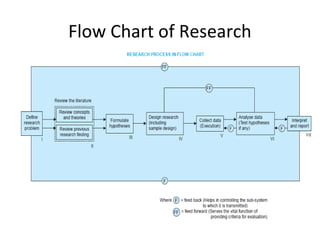
Flow Chart of Research
Research process- Steps
• 1. Formulation a of a research problem
• 2. Creation of a research design
• 3. Constructing instruments for data collection
• 4. Selecting a sample
• 5.Writing the research proposal
• 6. Collecting data
• 7. Processing data
• 8. Writing the report
Formulating research problem
• Tasks:
• Literature review
• Formulating the research problem
• Identifying variables
• Constructing hypotheses
Literature review
• To make your research problem clear and
bring focus into it
• Develop your methodology
• To know where you are
• To have a broader knowledge in your area of
research
Contd.,
• Search and select literature pertaining to your
area
• Review selected literature
• Develop a theoretical framework (theories
and issues related your study)
• Develop a conceptual framework (aspects you
select from theoretical framework that form
the basis of your research)
Contd.,
• Sources:
• Books
• Journals
• Electronic resources: online and offline
How to write the literature review
• Write under themes
• Some may follow chronological order
• Highlight your arguments
• Provide references
Formulating research problem
• Any question that needs answer can be a
research problem. However, not all questions
can be transformed into research problems.
• What matters here:
• Your knowledge in research methodology
• Your knowledge of the subject area
• Your understanding of the issues to be
examined
Contd.,
• Formation of a research problem is the first
step in the research. Identify the destination
before you start the journey. It is the
foundation of your building.
• Sources of research problems:
• People (individuals, groups, organizations,
communities)
• Problems (Issues, situations, associations,,
needs, demographic)
Contd.,
• Programmes (contents, structure, outcomes,
attributes, satisfaction, users, consumers)
• Phenomenon (cause and effect relationships,
study of a phenomenon itself)
• Research problem is your topic.
• Consider the following when selecting a topic:
• Your interest
• Your level of expertise as well as of your
supervisor
Contd.,
• Use concepts that can be measured
• Topic should be relevant to your profession/
subject area
• Availability of data
• Ethical issues
Formulation of objectives
• Objectives are goals of your study
• Main objectives
• Secondary or sub-objectives
• They must be clear, complete and specific
Identifying variables
• A concept or perception that takes on
different values and that can be measured is a
variable. It is something that varies.
• Types:
• Independent variables (they are responsible
for bringing about change in a phenomenon,
situation)
Contd.,
• Dependent variables (effects of a change
variable, the outcome of the changes brought
about by changes in an independent variable)
• Extraneous variables (other factors that affect
the changes bring about by independent
variables)
• Intervening variables (those that link the
independent and dependent variables)
Constructing hypotheses
• It is an ‘anticipation of nature’ or a hunch,
assumption, assertion
• “a tentative statement about something, the
validity of which is usually unknown’ (Bailey,
1976:126)
• It may be right, partially right or wrong
• It should be simple, specific and conceptually
clear
Research design
• It is the plan, structure and strategy of
investigating the research problem
• It is an operational plan
• Procedures to be adopted
• Testing the design
Constructing an instrument for
data collection
• Data collection methods:
• Primary sources
• Observation
• Interview
• Questionnaire
• Use of secondary sources
• Establish the validity of the selected
instrument
Selecting a sample
• “Process of selecting a few from a bigger
group”
• Bigger group is the population and the
selected few is the sample
• Larger the sample size the more accurate will
be the findings
Sampling types
• Sampling strategies are numerous. They can
be categorized into three groups:
• Random/probability sampling
• Non-random/probability sampling
• Mixed sampling
Research proposal
• It is your plan of research
• It reveals what you are going to do, how you
plan to do and why you have selected the
proposed procedures
• It guides you as well as your supervisor
• It is an academic piece of writing
• It shows the strength of your proposed
research
Elements
• Introduction (an overview of the main area
under study, historical background,
philosophical issues etc., trends, major
theories, main issues under consideration
etc.)
• Importance (Why you do it? What are the
benefits?)
• Problem (Your research problem or the
research questions)
• Literature review
Contd.,
• Objectives ( main and secondary)
• Hypotheses
• Study design (population, sample, data
collection methods etc.)
• Setting (brief description of the community,
organization or agency in which you are going
to carry out the research)
• Analysis of data (methods you are going to
use)
Contd.,
• Structure of the report or chapterization
• Limitations and problems you may encounter
• Work plan or schedule
• Budget (optional)
Collection data
• Ethical issues relating to research participants
( their consent, incentives, sensitive
information, harm to participants etc.)
• Ethical issues relating to the researcher
(avoiding bias, using appropriate research
methodology, correct reporting etc.)
Processing data
• Editing data
• Coding data
• Verifying coded data
• Analyzing data
• Displaying data (charts, diagrams, tables)
Writing the report or thesis
• Follow standards (International standards or
departmental guidelines)
• Use appropriate referencing/citation system
• Preparation of a bibliography
• Avoid plagiarism

Research methodology

  • 1.
    Research Methodology Er. SukhjitSingh Sehra Email:- sukhjitsehra@gmail.com
  • 2.
    What is research? •“A careful, systematic , patient study and investigation in some field of knowledge, undertaken to establish facts or princilpes” (Grinnell, 1993:4) • It is a discovery (Rediscovery); A voyage from the known to the unknown • An effort to be closer to the truth
  • 3.
    Characteristics • It iscontrolled. In real life for an outcome there could be many affecting factors. In a study of cause and effect relationships one has to link effects with causes and causes with effects. Establishment of this linkage is impossible unless it is a laboratory test. Therefore instead of controlling external factors we have to quantify the impact of such factors.
  • 4.
    Contd., • It isrigorous. Procedures followed to find answers to a problem must be relevant, appropriate and justifiable. Researcher needs to be very careful about this. • It is systematic. Procedures adopted for a research should follow a logical sequence. Some procedures must follow others. • It should be valid and verifiable. Your research conclusion based on findings should be correct and can be verified by you as well as others.
  • 5.
    Contd., • It isempirical. The conclusions of the research should be based on evidence gathered from information collected from real life experiences/ observations • It is critical. Research procedures and methods applied should withstand critical scrutiny. They must be foolproof and free from drawbacks
  • 6.
    Flow Chart ofResearch
  • 7.
    Research process- Steps •1. Formulation a of a research problem • 2. Creation of a research design • 3. Constructing instruments for data collection • 4. Selecting a sample • 5.Writing the research proposal • 6. Collecting data • 7. Processing data • 8. Writing the report
  • 8.
    Formulating research problem •Tasks: • Literature review • Formulating the research problem • Identifying variables • Constructing hypotheses
  • 9.
    Literature review • Tomake your research problem clear and bring focus into it • Develop your methodology • To know where you are • To have a broader knowledge in your area of research
  • 10.
    Contd., • Search andselect literature pertaining to your area • Review selected literature • Develop a theoretical framework (theories and issues related your study) • Develop a conceptual framework (aspects you select from theoretical framework that form the basis of your research)
  • 11.
    Contd., • Sources: • Books •Journals • Electronic resources: online and offline
  • 12.
    How to writethe literature review • Write under themes • Some may follow chronological order • Highlight your arguments • Provide references
  • 13.
    Formulating research problem •Any question that needs answer can be a research problem. However, not all questions can be transformed into research problems. • What matters here: • Your knowledge in research methodology • Your knowledge of the subject area • Your understanding of the issues to be examined
  • 14.
    Contd., • Formation ofa research problem is the first step in the research. Identify the destination before you start the journey. It is the foundation of your building. • Sources of research problems: • People (individuals, groups, organizations, communities) • Problems (Issues, situations, associations,, needs, demographic)
  • 15.
    Contd., • Programmes (contents,structure, outcomes, attributes, satisfaction, users, consumers) • Phenomenon (cause and effect relationships, study of a phenomenon itself) • Research problem is your topic. • Consider the following when selecting a topic: • Your interest • Your level of expertise as well as of your supervisor
  • 16.
    Contd., • Use conceptsthat can be measured • Topic should be relevant to your profession/ subject area • Availability of data • Ethical issues
  • 17.
    Formulation of objectives •Objectives are goals of your study • Main objectives • Secondary or sub-objectives • They must be clear, complete and specific
  • 18.
    Identifying variables • Aconcept or perception that takes on different values and that can be measured is a variable. It is something that varies. • Types: • Independent variables (they are responsible for bringing about change in a phenomenon, situation)
  • 19.
    Contd., • Dependent variables(effects of a change variable, the outcome of the changes brought about by changes in an independent variable) • Extraneous variables (other factors that affect the changes bring about by independent variables) • Intervening variables (those that link the independent and dependent variables)
  • 20.
    Constructing hypotheses • Itis an ‘anticipation of nature’ or a hunch, assumption, assertion • “a tentative statement about something, the validity of which is usually unknown’ (Bailey, 1976:126) • It may be right, partially right or wrong • It should be simple, specific and conceptually clear
  • 21.
    Research design • Itis the plan, structure and strategy of investigating the research problem • It is an operational plan • Procedures to be adopted • Testing the design
  • 22.
    Constructing an instrumentfor data collection • Data collection methods: • Primary sources • Observation • Interview • Questionnaire • Use of secondary sources • Establish the validity of the selected instrument
  • 23.
    Selecting a sample •“Process of selecting a few from a bigger group” • Bigger group is the population and the selected few is the sample • Larger the sample size the more accurate will be the findings
  • 24.
    Sampling types • Samplingstrategies are numerous. They can be categorized into three groups: • Random/probability sampling • Non-random/probability sampling • Mixed sampling
  • 25.
    Research proposal • Itis your plan of research • It reveals what you are going to do, how you plan to do and why you have selected the proposed procedures • It guides you as well as your supervisor • It is an academic piece of writing • It shows the strength of your proposed research
  • 26.
    Elements • Introduction (anoverview of the main area under study, historical background, philosophical issues etc., trends, major theories, main issues under consideration etc.) • Importance (Why you do it? What are the benefits?) • Problem (Your research problem or the research questions) • Literature review
  • 27.
    Contd., • Objectives (main and secondary) • Hypotheses • Study design (population, sample, data collection methods etc.) • Setting (brief description of the community, organization or agency in which you are going to carry out the research) • Analysis of data (methods you are going to use)
  • 28.
    Contd., • Structure ofthe report or chapterization • Limitations and problems you may encounter • Work plan or schedule • Budget (optional)
  • 29.
    Collection data • Ethicalissues relating to research participants ( their consent, incentives, sensitive information, harm to participants etc.) • Ethical issues relating to the researcher (avoiding bias, using appropriate research methodology, correct reporting etc.)
  • 30.
    Processing data • Editingdata • Coding data • Verifying coded data • Analyzing data • Displaying data (charts, diagrams, tables)
  • 31.
    Writing the reportor thesis • Follow standards (International standards or departmental guidelines) • Use appropriate referencing/citation system • Preparation of a bibliography • Avoid plagiarism