

–Arthur C. Clarke, “Profiles of the Future” (1961)
“Any sufficiently advanced technology is
indistinguishable from magic.”
Communicating with the Audiences of the Future
Steven Jong
InterChange 2014
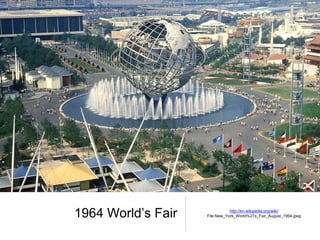
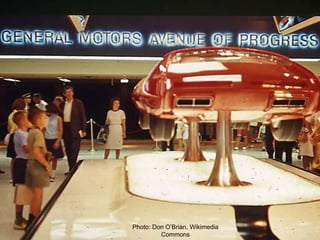
1964 World’s Fair http://en.wikipedia.org/wiki/
File:New_York_World%27s_Fair_August_1964.jpeg
Photo: Don O’Brian, Wikimedia Commons
Disclaimers
• These are broad
characterizations with many
exceptions
• Predictions are prone to
disruption
• US only
• Census data is aligned to years
ending in 0, so I’ll interpolate
• I’m a (Baby) Boomer
• I’ll use neutral generation names
• I’ll try to avoid judgments and
politics
• I’ll label my own predictions
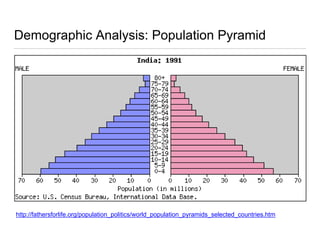
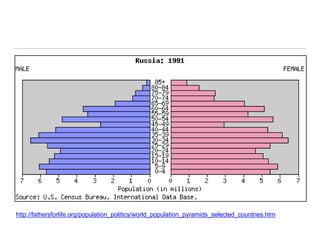
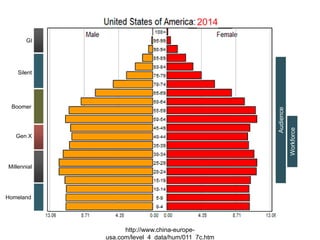
Demographic Analysis: Population Pyramid
http://fathersforlife.org/population_politics/world_population_pyramids_selected_countries.htm
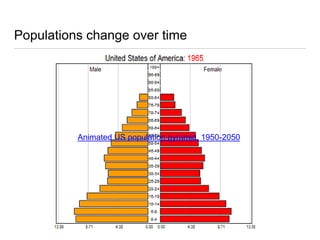
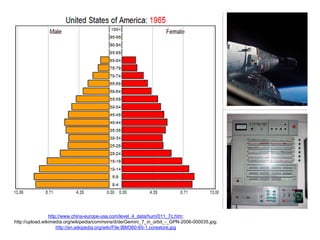
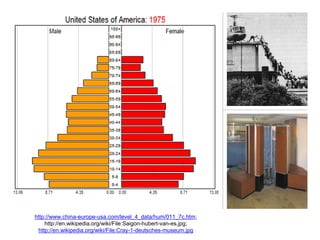
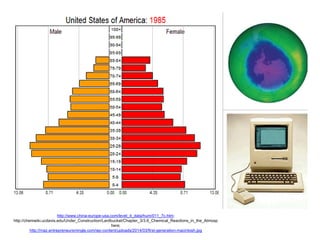
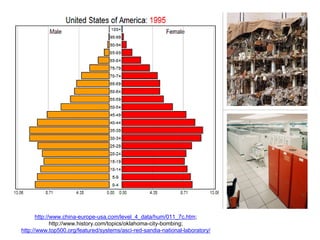
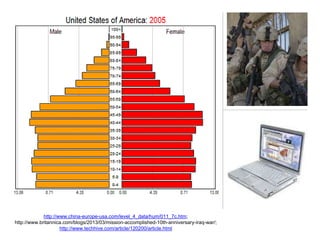
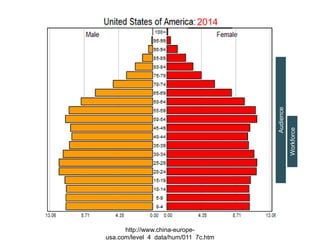
Populations change over time
Animated US population pyramid, 1950-2050
http://www.china-europe-usa.com/level_4_data/hum/011_7c.htm;
http://upload.wikimedia.org/wikipedia/commons/d/de/Gemini_7_in_orbit_-_GPN-2006-
000035.jpg;
http://en.wikipedia.org/wiki/File:IBM360-65-1.corestore.jpg
http://www.china-europe-usa.com/level_4_data/hum/011_7c.htm;
http://en.wikipedia.org/wiki/File:Saigon-hubert-van-es.jpg;
http://en.wikipedia.org/wiki/File:Cray-1-deutsches-museum.jpg
http://www.china-europe-usa.com/level_4_data/hum/011_7c.htm;
http://chemwiki.ucdavis.edu/Under_Construction/Lardbucket/Chapter_3/3.6_Chemical_Reactions_in_the_At
mosphere;
http://maz.entrepreneursmingle.com/wp-content/uploads/2014/03/first-generation-macintosh.jpg
http://www.china-europe-usa.com/level_4_data/hum/011_7c.htm;
http://www.history.com/topics/oklahoma-city-bombing;
http://www.top500.org/featured/systems/asci-red-sandia-national-laboratory/
http://www.china-europe-usa.com/level_4_data/hum/011_7c.htm;
http://www.britannica.com/blogs/2013/03/mission-accomplished-10th-anniversary-iraq-war/;
http://www.techhive.com/article/120200/article.html
Audience
Workforce
http://www.china-europe-usa.com/level_4_data/hum/011_7c.htm
2014
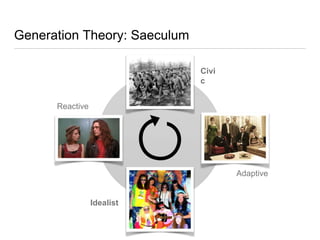
Generation Theory: Saeculum
Civic
Adaptive
Idealist
Reactive
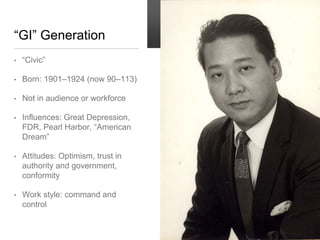
“GI” Generation
• “Civic”
• Born: 1901–1924 (now 90–113)
• Not in audience or workforce
• Influences: Great Depression,
FDR, Pearl Harbor, “American
Dream”
• Attitudes: Optimism, trust in
authority and government,
conformity
• Work style: command and
control
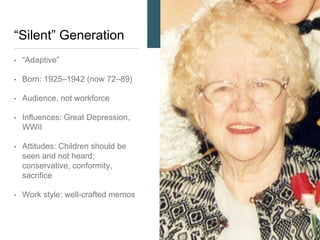
“Silent” Generation
• “Adaptive”
• Born: 1925–1942 (now 72–89)
• Audience, not workforce
• Influences: Great Depression,
WWII (as observers)
• Attitudes: Children should be
seen and not heard;
conservative, conformity,
sacrifice
• Work style: well-crafted memos
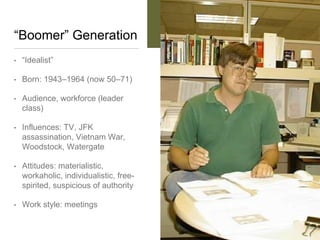
“Boomer” Generation
• “Idealist”
• Born: 1943–1964 (now 50–71)
• Audience, workforce (leader
class)
• Influences: TV, JFK
assassination, Vietnam War,
Woodstock, Watergate
• Attitudes: materialistic,
workaholic, individualistic, free-
spirited, suspicious of authority
• Work style: meetings
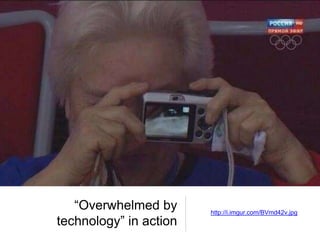
“Overwhelmed by
technology” in action
http://i.imgur.com/BVmd42v.jpg
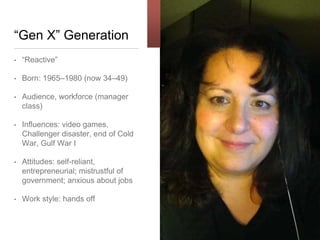
“Gen X” Generation
• “Reactive”
• Born: 1965–1980 (now 34–49)
• Audience, workforce (manager
class)
• Influences: video
games, Challenger disaster, end
of Cold War, Gulf War I
• Attitudes: self-
reliant, entrepreneurial;
mistrustful of government;
anxious about jobs
• Work style: hands off
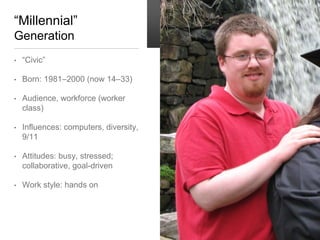
“Millennial”
Generation
• “Civic”
• Born: 1981–2000 (now 14–33)
• Audience, workforce (worker
class)
• Influences: computers, diversity,
9/11
• Attitudes: busy, stressed;
collaborative, goal-driven
• Work style: hands on
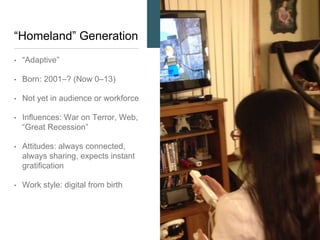
“Homeland” Generation
• “Adaptive”
• Born: 2001–? (Now 0–13)
• Not yet in audience or workforce
• Influences: War on Terror, Web,
“Great Recession”
• Attitudes: always connected,
always sharing, expects instant
gratification
• Work style: digital from birth
“Digital from birth” in action
We won't get paid to document today's interfaces much longer...
http://www.china-europe-usa.com/level_4_data/hum/011_7c.htm
Silent
Boomer
Gen X
Millennial
Homeland
2014
GI
Audience
Workforce
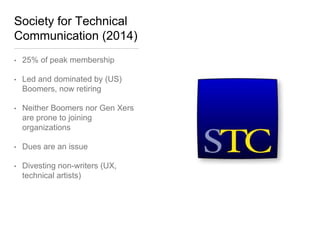
Society for Technical
Communication (2014)
• 25% of peak membership
• Led and dominated by (US)
Boomers, now retiring
• Neither Boomers nor Gen Xers
are prone to joining
organizations
• Dues are an issue
• Divesting non-writers (UX,
technical artists)
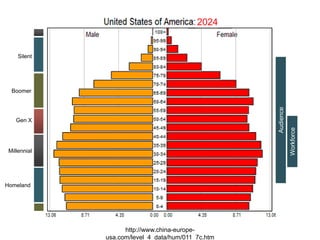
Applying demographics and generation theory to
future personas and practitioner profiles
http://www.china-europe-usa.com/level_4_data/hum/011_7c.htm
Boomer
Gen X
Millennial
Homeland
Silent
2024
Audience
Workforce
© Hanna-Barbera
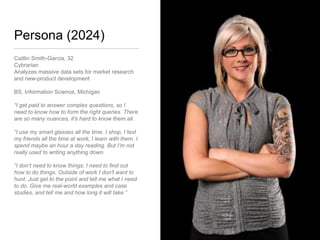
Persona (2024)
Caitlin Smith-Garcia, 32
Cybrarian
Analyzes massive data sets for market research
and new-product development
BS, Information Science, Michigan
“I get paid to answer complex questions, so I
need to know how to form the right queries.
There are so many nuances, it's hard to know
them all.
“I use my smart glasses all the time. I shop, I text
my friends all the time at work, I learn with them. I
spend maybe an hour a day reading. But I’m not
really used to writing anything down.
“I don’t need to know things; I need to find out
how to do things. Outside of work I don't want to
hunt. Just get to the point and tell me what I need
to do. Give me real-world examples and case
studies, and tell me and how long it will take.”
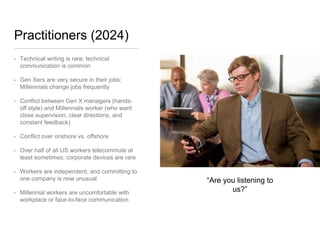
Practitioners (2024)
• Technical writing is rare; technical
communication is common
• Gen Xers are very secure in their jobs;
Millennials change jobs frequently
• Conflict between Gen X managers (hands-
off style) and Millennials worker (who want
close supervision, clear directions, and
constant feedback)
• Conflict over onshore vs. offshore
• Over half of all US workers telecommute at
least sometimes; corporate devices are rare
• Workers are independent, and committing to
one company is now unusual
• Millennial workers are uncomfortable with
workplace or face-to-face communication
“Are you listening to us?”
Society for Technical
Communication (2024)
• Information, and competition, is
everywhere
• Retired members are very
important
• Two-way mentoring
• Younger members crave
institutions and social contact,
actively volunteer
• Fundraising appeals and
crowdfunding options are now
viable
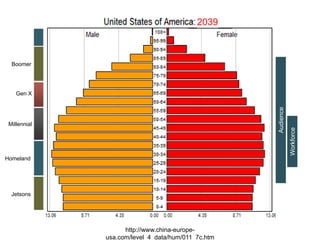
http://www.china-europe-usa.com/level_4_data/hum/011_7c.htm
Boomer
Gen X
Millennial
Homeland
Jetsons
2039
Audience
Workforce
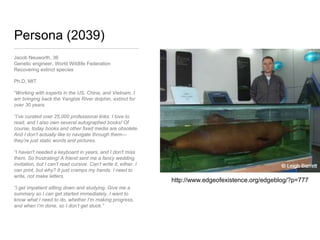
Persona (2039)
Jacob Neuworth, 36
Genetic engineer, World Wildlife Federation
Recovering extinct species
Ph.D, MIT
“Working with experts in the US, China, and Vietnam, I
am bringing back the Yangtze River dolphin, extinct for
over 30 years.
“I’ve curated over 25,000 professional links. I love to
read, and I also own several autographed books! Of
course, today books and other fixed media are
obsolete. And I don’t actually like to navigate through
them—they’re just static words and pictures.
“I haven't needed a keyboard in years, and I don't miss
them. So frustrating! A friend sent me a fancy wedding
invitation, but I can’t read cursive. Can’t write it, either.
I can print, but why? It just cramps my hands. I need to
write, not make letters.
“I get impatient sitting down and studying. Give me a
summary so I can get started immediately. I want to
know what I need to do, whether I’m making
progress, and when I’m done, so I don’t get stuck.”
http://www.edgeofexistence.org/edgeblog/?p=777
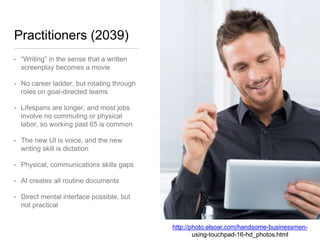
Practitioners (2039)
• “Writing” in the sense that a written
screenplay becomes a movie
• No career ladder, but rotating through
roles on goal-directed teams
• Lifespans are longer, and most jobs
involve no commuting or physical
labor, so working past 65 is common
• The new UI is voice, and the new
writing skill is dictation
• Physical, communications skills gaps
• AI creates all routine documents
• Direct mental interface possible, but
not practical
http://photo.elsoar.com/handsome-businessmen-
using-touchpad-16-hd_photos.html
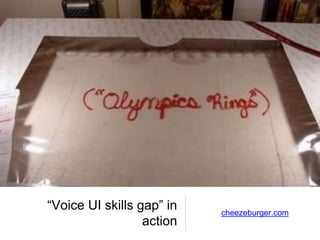
“Voice UI skills gap” in
action
cheezeburger.com
Society for Technical and Web
Communication (2039)
• STC is transformed or replaced
• Members are Millennials and
Homelanders
• Human interactions very
important; chapters in every
major city support F2F
interaction
• Filling in skills gaps
• Curation of information
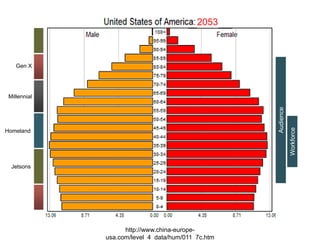
http://www.china-europe-usa.com/level_4_data/hum/011_7c.htm
Gen X
Millennial
Homeland
Jetsons
2053
Audience
Workforce
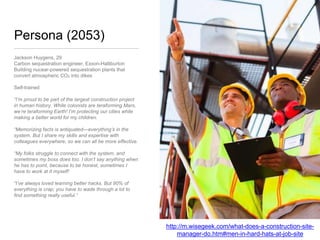
Persona (2053)
Jackson Huygens, 29
Carbon sequestration engineer, Exxon-Halliburton
Building nucear-powered sequestration plants that
convert atmospheric CO2 into dikes
Self-trained
“I’m proud to be part of the largest construction
project in human history. While colonists are
teraforming Mars, we’re teraforming Earth! I’m
protecting our cities while making a better world for
my children.
“Memorizing facts is antiquated—everything’s in the
system. But I share my skills and expertise with
colleagues everywhere, so we can all be more
effective.
“My folks struggle to connect with the system, and
sometimes my boss does too. I don’t say anything
when he has to point, because to be honest,
sometimes I have to work at it myself!
“I’ve always loved learning better hacks. But 90% of
everything is crap; you have to wade through a lot to
find something really useful.”
http://m.wisegeek.com/what-does-a-construction-site-
manager-do.htm#men-in-hard-hats-at-job-site
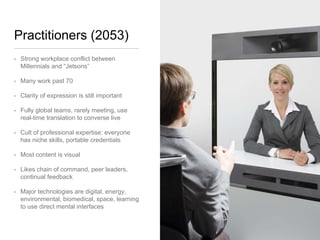
Practitioners (2053)
• Strong workplace conflict between
Millennials and “Jetsons”
• Many work past 70
• Clarity of expression is still important
• Fully global teams, rarely meeting, use
real-time translation to converse live
• Cult of professional expertise: everyone
has niche skills, portable credentials
• Most content is visual
• Likes chain of command, peer leaders,
continual feedback
• Major technologies are digital, energy,
environmental, biomedical, space,
learning to use direct mental interfaces
Society for
Communication (2053)
• Embraces non-technical
communication (greatly increasing
market)
• Goals: Clear, concise, and reliable
communication
• Focuses on communicating skills
and abilities, not knowledge
• Tools utterly different, but best
practices haven’t changed
• Serves as a significant point of
connection for practitioners
• Benefits from legal requirements
to participate in lifelong learning
© ESPN
General Sources
• US Census Bureau, www.census.gov
• Generations: The History of America’s Future, 1584 to 2069. William Strauss and Neil
Howell. New York: Harper Perennial, 1991
• The Second Machine Age: Work, Progress, and Prosperity in a Time of Brilliant
Technologies. Erik Brynjolfsson and Andrew McAfee. New York: W. W. Norton &
Company, 2014
• “Meet the Generations,” extension.missouri.edu/extcouncil/documents/ecyl/Meet-the-
generations.pdf
• “The Power of 4.” Paul Olson and Hannah Brescher. Adayana, 2011,
www.adayana.com/sites/default/files/docs/whitepapers/The%20Four%20Generations
%202011-03_2.pdf
• Mixing and Matching Four generations,” Greg Hammill, FDU Magazine Online,
Winter/Spring 2005, www.fdu.edu/newspubs/magazine/05ws/generations.htm
Boomers
• “If We Work Into Our 70s, What Happens in the Workplace?” Jeanne
Meister, Forbes, 2012-06-26 (retrieved 2014-02-
27), www.forbes.com/sites/jeannemeister/2012/06/26/if-we-work-into-our-70s-
what-happens-in-the-workplace
• “An overview of economic, social, and demographic trends affecting the US labor
market,” Robert I. Lerman and Stefanie R. Schmidt, The Urban
Institute, Washington, DC, www.dol.gov/oasam/programs/history/herman/reports/
futurework/conference/trends/TrendsIV.htm
• “Responding to the Challenge of a Changing Workforce: Recruiting
Nontraditional Demographic Groups,” Dennis Doverspike, Ph.D., Mary Anne
Taylor, Ph.D., Kenneth S. Schultz, Ph.D., Patrick F. McKay, Ph.D. Public
Personnel Management, Vol. 29, No. 4, pp. 445–459
• “The Changing Demographic Profile of the United States,” March 31, 2011, Laura
B. Shrestha, Elayne J. Heisler, Congressional Research Service
Generation X
“Transitioning to Workforce 2020,” Cisco Systems white
paper, 2011, www.cisco.com/web/learning/employer_resour
ces/pdfs/Workforce_2020_White_Paper.pdf
Millennials
• “Millennials: A Portrait of Generation Next.” Pew Research Center, February
2010, pewsocialtrends.org/files/2010/10/millennials-confident-connected-open-to-
change.pdf
• “Big demands and high expectations: The Deloitte Millennial Survey,” January
2014, Deloitte Touche Tohmatsu
Ltd., www2.deloitte.com/content/dam/Deloitte/global/Documents/About-Deloitte/gx-
dttl-2014-millennial-survey-report.pdf
• The Mindset List (Beloit College), www.beloit.edu/mindset/
• “Learning Curve: How College Graduates Solve Information Problems Once They Join
the Workplace.” Alison J. Head, Project Information Literacy, October
2012, journalistsresource.org/studies/society/education/how-college-graduates-solve-
information-problems-join-workplace#sthash.I1r8BddP.dpuf
• “Three Reasons You Need to Adopt a Millennial Mindset Regardless of Your Age,”
Jeanne Meister, Forbes, 2012-10-05 (retrieved 2014-02-
27), www.forbes.com/sites/jeannemeister/2012/10/05/millennialmindse/
Homelanders
• “Gen Z: Digital in their DNA.” April 2012, JWT
Intelligence, www.jwtintelligence.com/wp-
content/uploads/2012/04/F_INTERNAL_Gen_Z_0418122.pdf
• “Consumers of Tomorrow: Insights and Observations About Generation Z.”
Grail Research, November
2011, www.grailresearch.com/pdf/ContenPodsPdf/Consumers_of_Tomorrow
_Insights_and_Observations_About_Generation_Z.pdf
• “How Generation Z Works,” Lance Looper, HowStuffWorks.com (retrieved
2014-02-27), people.howstuffworks.com/culture-traditions/generation-
gaps/generation-z.htm
• “The Complete Visual Guide to Generation Z,” Katie Lepi, 2013-11-15
(retrieved 2014-02-27), www.edudemic.com/generation-z/

Communicating with the Audiences of the Future

  • 1.
    –Arthur C. Clarke,“Profiles of the Future” (1961) “Any sufficiently advanced technology is indistinguishable from magic.”
  • 2.
    Communicating with theAudiences of the Future Steven Jong InterChange 2014
  • 3.
    1964 World’s Fairhttp://en.wikipedia.org/wiki/ File:New_York_World%27s_Fair_August_1964.jpeg
  • 4.
    Photo: Don O’Brian,Wikimedia Commons
  • 6.
    Disclaimers • These arebroad characterizations with many exceptions • Predictions are prone to disruption • US only • Census data is aligned to years ending in 0, so I’ll interpolate • I’m a (Baby) Boomer • I’ll use neutral generation names • I’ll try to avoid judgments and politics • I’ll label my own predictions
  • 7.
    Demographic Analysis: PopulationPyramid http://fathersforlife.org/population_politics/world_population_pyramids_selected_countries.htm
  • 8.
  • 9.
    Populations change overtime Animated US population pyramid, 1950-2050
  • 10.
  • 11.
  • 12.
  • 13.
  • 14.
  • 15.
  • 16.
  • 17.
    “GI” Generation • “Civic” •Born: 1901–1924 (now 90–113) • Not in audience or workforce • Influences: Great Depression, FDR, Pearl Harbor, “American Dream” • Attitudes: Optimism, trust in authority and government, conformity • Work style: command and control
  • 18.
    “Silent” Generation • “Adaptive” •Born: 1925–1942 (now 72–89) • Audience, not workforce • Influences: Great Depression, WWII (as observers) • Attitudes: Children should be seen and not heard; conservative, conformity, sacrifice • Work style: well-crafted memos
  • 19.
    “Boomer” Generation • “Idealist” •Born: 1943–1964 (now 50–71) • Audience, workforce (leader class) • Influences: TV, JFK assassination, Vietnam War, Woodstock, Watergate • Attitudes: materialistic, workaholic, individualistic, free- spirited, suspicious of authority • Work style: meetings
  • 20.
    “Overwhelmed by technology” inaction http://i.imgur.com/BVmd42v.jpg
  • 21.
    “Gen X” Generation •“Reactive” • Born: 1965–1980 (now 34–49) • Audience, workforce (manager class) • Influences: video games, Challenger disaster, end of Cold War, Gulf War I • Attitudes: self- reliant, entrepreneurial; mistrustful of government; anxious about jobs • Work style: hands off
  • 22.
    “Millennial” Generation • “Civic” • Born:1981–2000 (now 14–33) • Audience, workforce (worker class) • Influences: computers, diversity, 9/11 • Attitudes: busy, stressed; collaborative, goal-driven • Work style: hands on
  • 23.
    “Homeland” Generation • “Adaptive” •Born: 2001–? (Now 0–13) • Not yet in audience or workforce • Influences: War on Terror, Web, “Great Recession” • Attitudes: always connected, always sharing, expects instant gratification • Work style: digital from birth
  • 24.
    “Digital from birth”in action We won't get paid to document today's interfaces much longer...
  • 25.
  • 26.
    Society for Technical Communication(2014) • 25% of peak membership • Led and dominated by (US) Boomers, now retiring • Neither Boomers nor Gen Xers are prone to joining organizations • Dues are an issue • Divesting non-writers (UX, technical artists)
  • 27.
    Applying demographics andgeneration theory to future personas and practitioner profiles
  • 28.
  • 29.
  • 30.
    Persona (2024) Caitlin Smith-Garcia,32 Cybrarian Analyzes massive data sets for market research and new-product development BS, Information Science, Michigan “I get paid to answer complex questions, so I need to know how to form the right queries. There are so many nuances, it's hard to know them all. “I use my smart glasses all the time. I shop, I text my friends all the time at work, I learn with them. I spend maybe an hour a day reading. But I’m not really used to writing anything down. “I don’t need to know things; I need to find out how to do things. Outside of work I don't want to hunt. Just get to the point and tell me what I need to do. Give me real-world examples and case studies, and tell me and how long it will take.”
  • 31.
    Practitioners (2024) • Technicalwriting is rare; technical communication is common • Gen Xers are very secure in their jobs; Millennials change jobs frequently • Conflict between Gen X managers (hands- off style) and Millennials worker (who want close supervision, clear directions, and constant feedback) • Conflict over onshore vs. offshore • Over half of all US workers telecommute at least sometimes; corporate devices are rare • Workers are independent, and committing to one company is now unusual • Millennial workers are uncomfortable with workplace or face-to-face communication “Are you listening to us?”
  • 32.
    Society for Technical Communication(2024) • Information, and competition, is everywhere • Retired members are very important • Two-way mentoring • Younger members crave institutions and social contact, actively volunteer • Fundraising appeals and crowdfunding options are now viable
  • 33.
  • 34.
    Persona (2039) Jacob Neuworth,36 Genetic engineer, World Wildlife Federation Recovering extinct species Ph.D, MIT “Working with experts in the US, China, and Vietnam, I am bringing back the Yangtze River dolphin, extinct for over 30 years. “I’ve curated over 25,000 professional links. I love to read, and I also own several autographed books! Of course, today books and other fixed media are obsolete. And I don’t actually like to navigate through them—they’re just static words and pictures. “I haven't needed a keyboard in years, and I don't miss them. So frustrating! A friend sent me a fancy wedding invitation, but I can’t read cursive. Can’t write it, either. I can print, but why? It just cramps my hands. I need to write, not make letters. “I get impatient sitting down and studying. Give me a summary so I can get started immediately. I want to know what I need to do, whether I’m making progress, and when I’m done, so I don’t get stuck.” http://www.edgeofexistence.org/edgeblog/?p=777
  • 35.
    Practitioners (2039) • “Writing”in the sense that a written screenplay becomes a movie • No career ladder, but rotating through roles on goal-directed teams • Lifespans are longer, and most jobs involve no commuting or physical labor, so working past 65 is common • The new UI is voice, and the new writing skill is dictation • Physical, communications skills gaps • AI creates all routine documents • Direct mental interface possible, but not practical http://photo.elsoar.com/handsome-businessmen- using-touchpad-16-hd_photos.html
  • 36.
    “Voice UI skillsgap” in action cheezeburger.com
  • 37.
    Society for Technicaland Web Communication (2039) • STC is transformed or replaced • Members are Millennials and Homelanders • Human interactions very important; chapters in every major city support F2F interaction • Filling in skills gaps • Curation of information
  • 38.
  • 39.
    Persona (2053) Jackson Huygens,29 Carbon sequestration engineer, Exxon-Halliburton Building nucear-powered sequestration plants that convert atmospheric CO2 into dikes Self-trained “I’m proud to be part of the largest construction project in human history. While colonists are teraforming Mars, we’re teraforming Earth! I’m protecting our cities while making a better world for my children. “Memorizing facts is antiquated—everything’s in the system. But I share my skills and expertise with colleagues everywhere, so we can all be more effective. “My folks struggle to connect with the system, and sometimes my boss does too. I don’t say anything when he has to point, because to be honest, sometimes I have to work at it myself! “I’ve always loved learning better hacks. But 90% of everything is crap; you have to wade through a lot to find something really useful.” http://m.wisegeek.com/what-does-a-construction-site- manager-do.htm#men-in-hard-hats-at-job-site
  • 40.
    Practitioners (2053) • Strongworkplace conflict between Millennials and “Jetsons” • Many work past 70 • Clarity of expression is still important • Fully global teams, rarely meeting, use real-time translation to converse live • Cult of professional expertise: everyone has niche skills, portable credentials • Most content is visual • Likes chain of command, peer leaders, continual feedback • Major technologies are digital, energy, environmental, biomedical, space, learning to use direct mental interfaces
  • 41.
    Society for Communication (2053) •Embraces non-technical communication (greatly increasing market) • Goals: Clear, concise, and reliable communication • Focuses on communicating skills and abilities, not knowledge • Tools utterly different, but best practices haven’t changed • Serves as a significant point of connection for practitioners • Benefits from legal requirements to participate in lifelong learning © ESPN
  • 43.
    General Sources • USCensus Bureau, www.census.gov • Generations: The History of America’s Future, 1584 to 2069. William Strauss and Neil Howell. New York: Harper Perennial, 1991 • The Second Machine Age: Work, Progress, and Prosperity in a Time of Brilliant Technologies. Erik Brynjolfsson and Andrew McAfee. New York: W. W. Norton & Company, 2014 • “Meet the Generations,” extension.missouri.edu/extcouncil/documents/ecyl/Meet-the- generations.pdf • “The Power of 4.” Paul Olson and Hannah Brescher. Adayana, 2011, www.adayana.com/sites/default/files/docs/whitepapers/The%20Four%20Generations %202011-03_2.pdf • Mixing and Matching Four generations,” Greg Hammill, FDU Magazine Online, Winter/Spring 2005, www.fdu.edu/newspubs/magazine/05ws/generations.htm
  • 44.
    Boomers • “If WeWork Into Our 70s, What Happens in the Workplace?” Jeanne Meister, Forbes, 2012-06-26 (retrieved 2014-02- 27), www.forbes.com/sites/jeannemeister/2012/06/26/if-we-work-into-our-70s- what-happens-in-the-workplace • “An overview of economic, social, and demographic trends affecting the US labor market,” Robert I. Lerman and Stefanie R. Schmidt, The Urban Institute, Washington, DC, www.dol.gov/oasam/programs/history/herman/reports/ futurework/conference/trends/TrendsIV.htm • “Responding to the Challenge of a Changing Workforce: Recruiting Nontraditional Demographic Groups,” Dennis Doverspike, Ph.D., Mary Anne Taylor, Ph.D., Kenneth S. Schultz, Ph.D., Patrick F. McKay, Ph.D. Public Personnel Management, Vol. 29, No. 4, pp. 445–459 • “The Changing Demographic Profile of the United States,” March 31, 2011, Laura B. Shrestha, Elayne J. Heisler, Congressional Research Service
  • 45.
    Generation X “Transitioning toWorkforce 2020,” Cisco Systems white paper, 2011, www.cisco.com/web/learning/employer_resour ces/pdfs/Workforce_2020_White_Paper.pdf
  • 46.
    Millennials • “Millennials: APortrait of Generation Next.” Pew Research Center, February 2010, pewsocialtrends.org/files/2010/10/millennials-confident-connected-open-to- change.pdf • “Big demands and high expectations: The Deloitte Millennial Survey,” January 2014, Deloitte Touche Tohmatsu Ltd., www2.deloitte.com/content/dam/Deloitte/global/Documents/About-Deloitte/gx- dttl-2014-millennial-survey-report.pdf • The Mindset List (Beloit College), www.beloit.edu/mindset/ • “Learning Curve: How College Graduates Solve Information Problems Once They Join the Workplace.” Alison J. Head, Project Information Literacy, October 2012, journalistsresource.org/studies/society/education/how-college-graduates-solve- information-problems-join-workplace#sthash.I1r8BddP.dpuf • “Three Reasons You Need to Adopt a Millennial Mindset Regardless of Your Age,” Jeanne Meister, Forbes, 2012-10-05 (retrieved 2014-02- 27), www.forbes.com/sites/jeannemeister/2012/10/05/millennialmindse/
  • 47.
    Homelanders • “Gen Z:Digital in their DNA.” April 2012, JWT Intelligence, www.jwtintelligence.com/wp- content/uploads/2012/04/F_INTERNAL_Gen_Z_0418122.pdf • “Consumers of Tomorrow: Insights and Observations About Generation Z.” Grail Research, November 2011, www.grailresearch.com/pdf/ContenPodsPdf/Consumers_of_Tomorrow _Insights_and_Observations_About_Generation_Z.pdf • “How Generation Z Works,” Lance Looper, HowStuffWorks.com (retrieved 2014-02-27), people.howstuffworks.com/culture-traditions/generation- gaps/generation-z.htm • “The Complete Visual Guide to Generation Z,” Katie Lepi, 2013-11-15 (retrieved 2014-02-27), www.edudemic.com/generation-z/