Productivity User Group
16th March 2018
Labour Productivity
Methodological Changes
Ciaren Taylor
Overview
• How is Labour Productivity Calculated?
• Summary of Methodology Changes
• In depth
 Minor Changes
 Proportional Mapping
Overview
• How is Labour Productivity Calculated?
• Summary of Methodology Changes
• In depth
 Minor Changes
 Proportional Mapping
How is (labour) productivity calculated?
Actual Hours Worked
ACTUAL : i.e. excluding lunch breaks, holidays, etc.
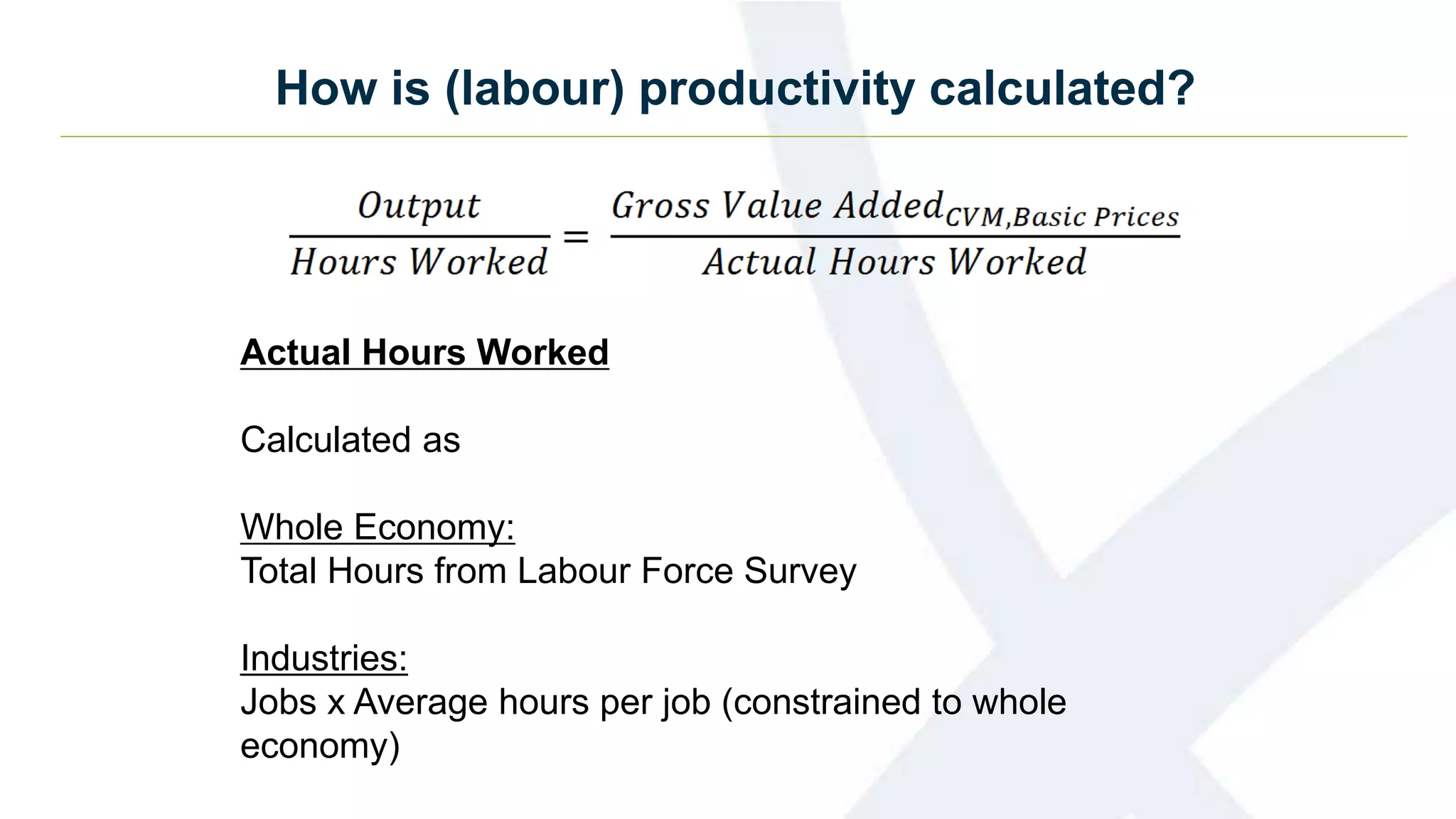
How is (labour) productivity calculated?
Actual Hours Worked
Calculated as
Whole Economy:
Total Hours from Labour Force Survey
Industries:
Jobs x Average hours per job (constrained to whole
economy)
How is (labour) productivity calculated?
Actual Hours Worked
Jobs data come from (primarily):
Private Employees: Short Term Employment Survey and
Business Register Employment Survey
Public Sector Employees: Public Sector Employment
Self-Employed: Labour Force Survey
HM Forces: Ministry of Defence
How is (labour) productivity calculated?
Actual Hours Worked
Average hours data come from LFS
How is (labour) productivity calculated?
Anything Else?
Reporting Unit vs Local Unit
• While much of the jobs data which feed into productivity
hours & productivity jobs come from the same datasources
as Workforce Jobs, productivity measures of labour are on a
RU basis (where WFJ are LU)
• This is because GVA data are RU
How is (labour) productivity calculated?
Anything Else?
Productivity Hours vs. Productivity Jobs systems
• Productivity Hours calculated completely separately to
Productivity Jobs
• Methodological changes being discussed today only
affect the productivity hours system. Even if they affect
the calculation of jobs.
How is (labour) productivity calculated?
Anything Else?
Reporting Unit vs Local Unit
• Some industry data come from LFS – where industry is
self-reported (do they report RU? LU? Or something else?)
Overview
• How is Labour Productivity Calculated?
• Summary of Methodology Changes
• In depth
 Minor Changes
 Proportional Mapping
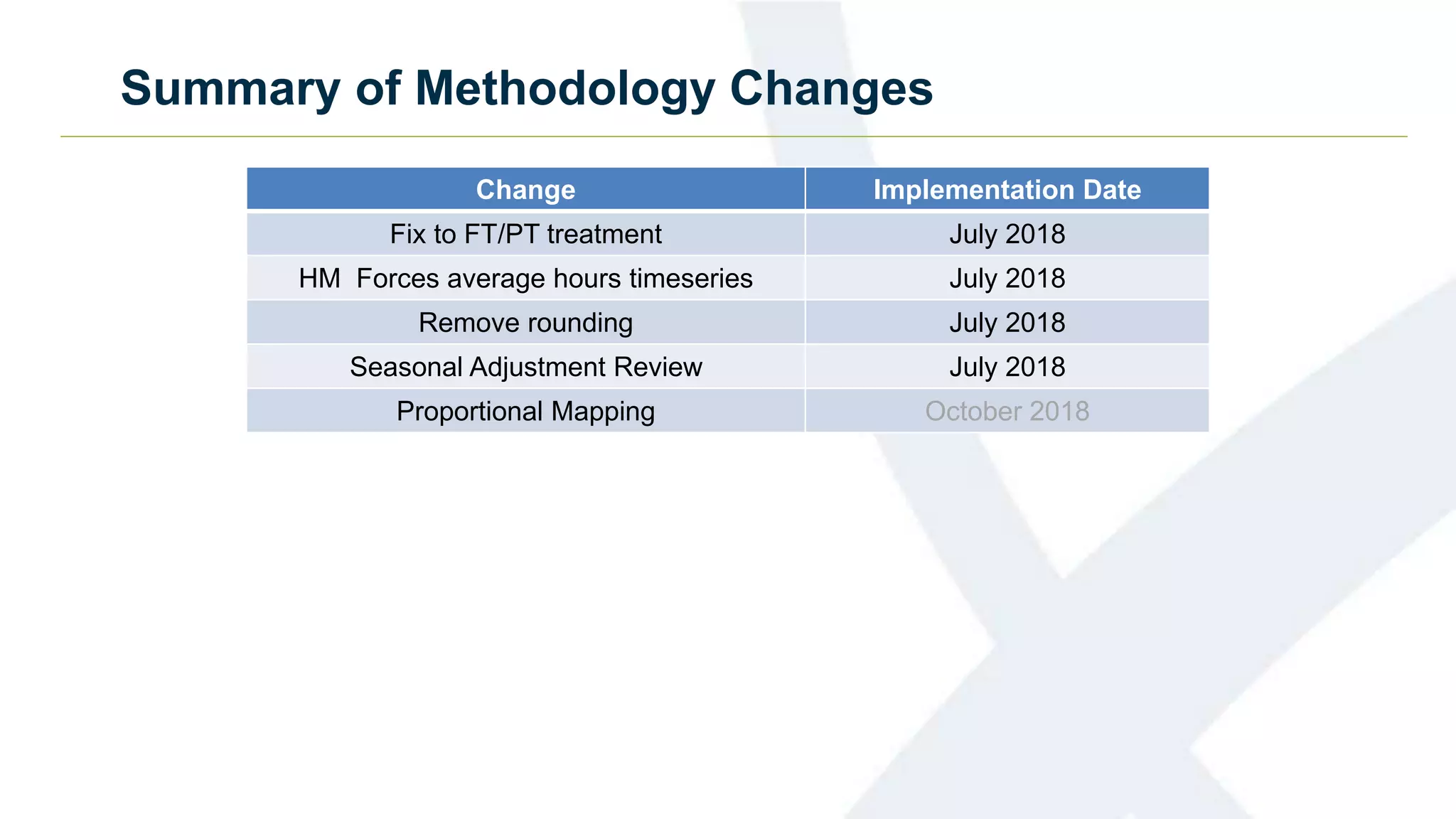
Summary of Methodology Changes
Change Implementation Date
Fix to FT/PT treatment July 2018
HM Forces average hours timeseries July 2018
Remove rounding July 2018
Seasonal Adjustment Review July 2018
Proportional Mapping October 2018
Overview
• How is Labour Productivity Calculated?
• Summary of Methodology Changes
• In depth
 Minor Changes
 Proportional Mapping
In depth: Minor Changes
LFS main jobs missing full-time / part-time flag
Previous Practice:
• Those without a full-time / part-time flag were dropped. Those
working 30.5 hours in second job also dropped.
Proposed Practice:
• Stop dropping these people
In depth: Minor Changes
LFS main jobs missing full-time / part-time flag
How will this impact the data?
• Whole Economy: No impact
• Industry breakdown: Changes to industries of SE jobs (in
productivity hours system) and average hours of all statuses
(excl. HM Forces)
In depth: Minor Changes
HM Forces Average Hours
Previous Practice:
• Two constant average hours figures across time, for men and
women
Proposed Practice:
• Annual average hours timeseries for all HM Forces (sourced
from HM Forces Pay Reviews)
In depth: Minor Changes
HM Forces Average Hours
How will this impact the data?
• Whole Economy: No impact
• Industry breakdown: Government Services will be directly
impacted, while other industries will be indirectly impacted
Overview
• How is Labour Productivity Calculated?
• Summary of Methodology Changes
• In depth
 Minor Changes
 Proportional Mapping
Proportional Mapping
Issue
• Industry Classification change in
2009 (from SIC92 to SIC07)
• How to map old industries to new
industries?
• Applies to LFS microdata
Proportional Mapping
Current Methodology
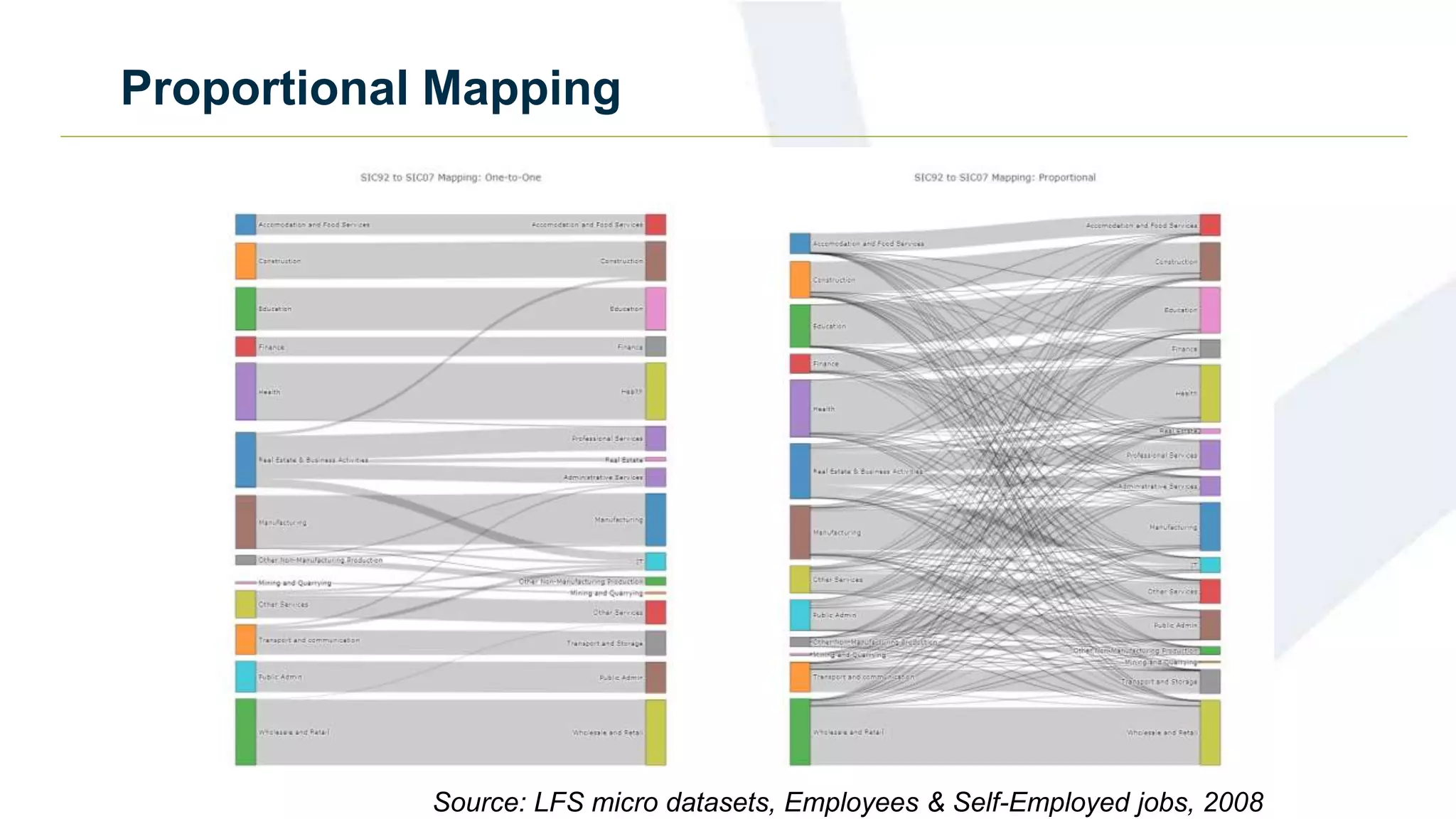
One-to-one mapping
• Based on IDBR data
• 4-digit SIC92 mapped to 2-digit
SIC07
• Each person gets reassigned a
2digit SIC07, based on their
SIC92
Used currently in Labour Productivity National Statistics
Proportional Mapping
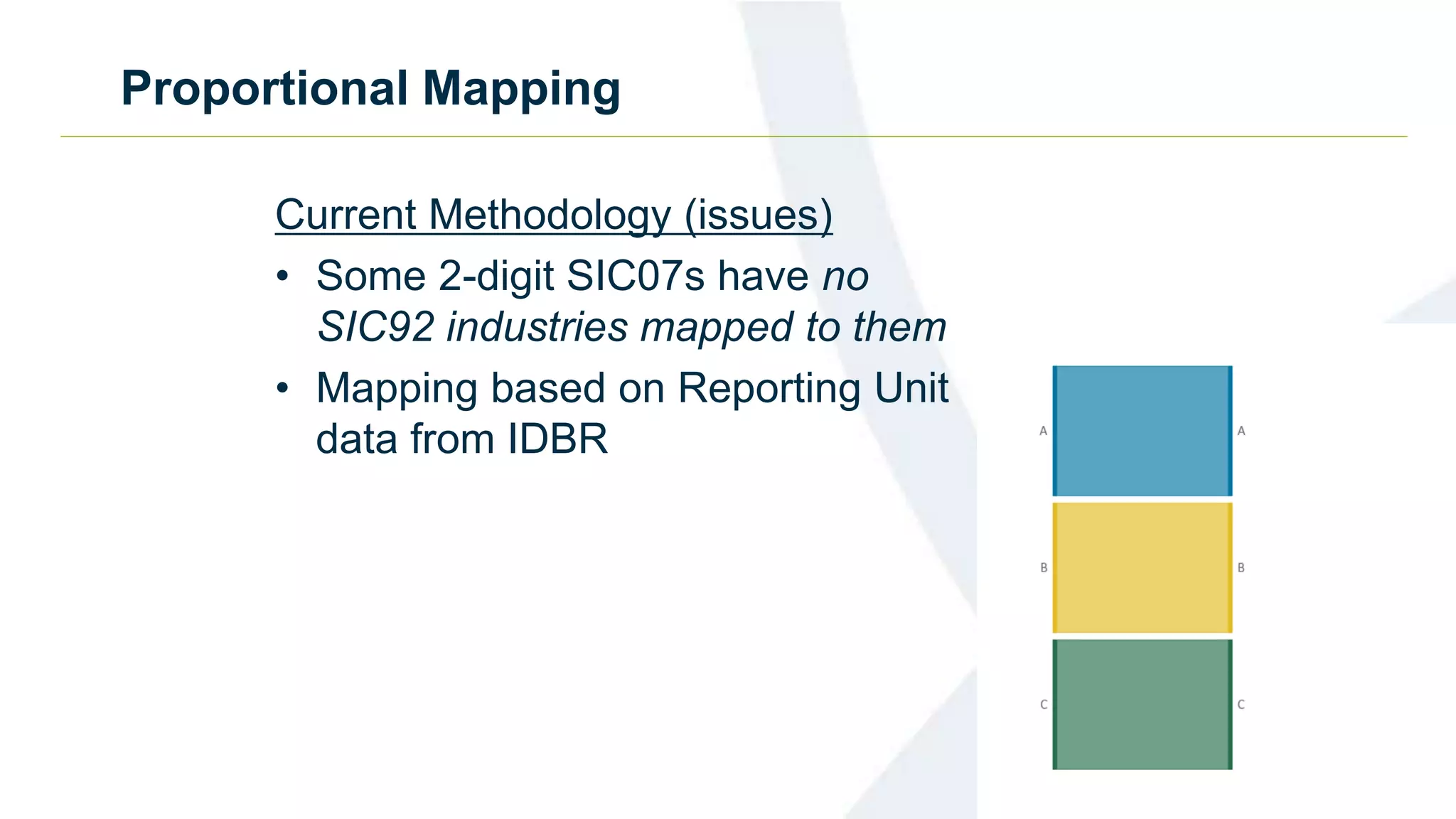
Current Methodology (issues)
• Some 2-digit SIC07s have no
SIC92 industries mapped to them
• Mapping based on Reporting Unit
data from IDBR
Proportional Mapping
Proposed methodology
Proportional Mapping
• Longitudinal LFS based to map the
SIC92 industries people classified
into, and their SIC07 industry in the
next quarter (if they are in the same
job)
• Each person’s observation is split
based on the mapping.
Used currently in Experimental 2-digit SIC data
Proportional Mapping
Proposed methodology
Proportional Mapping
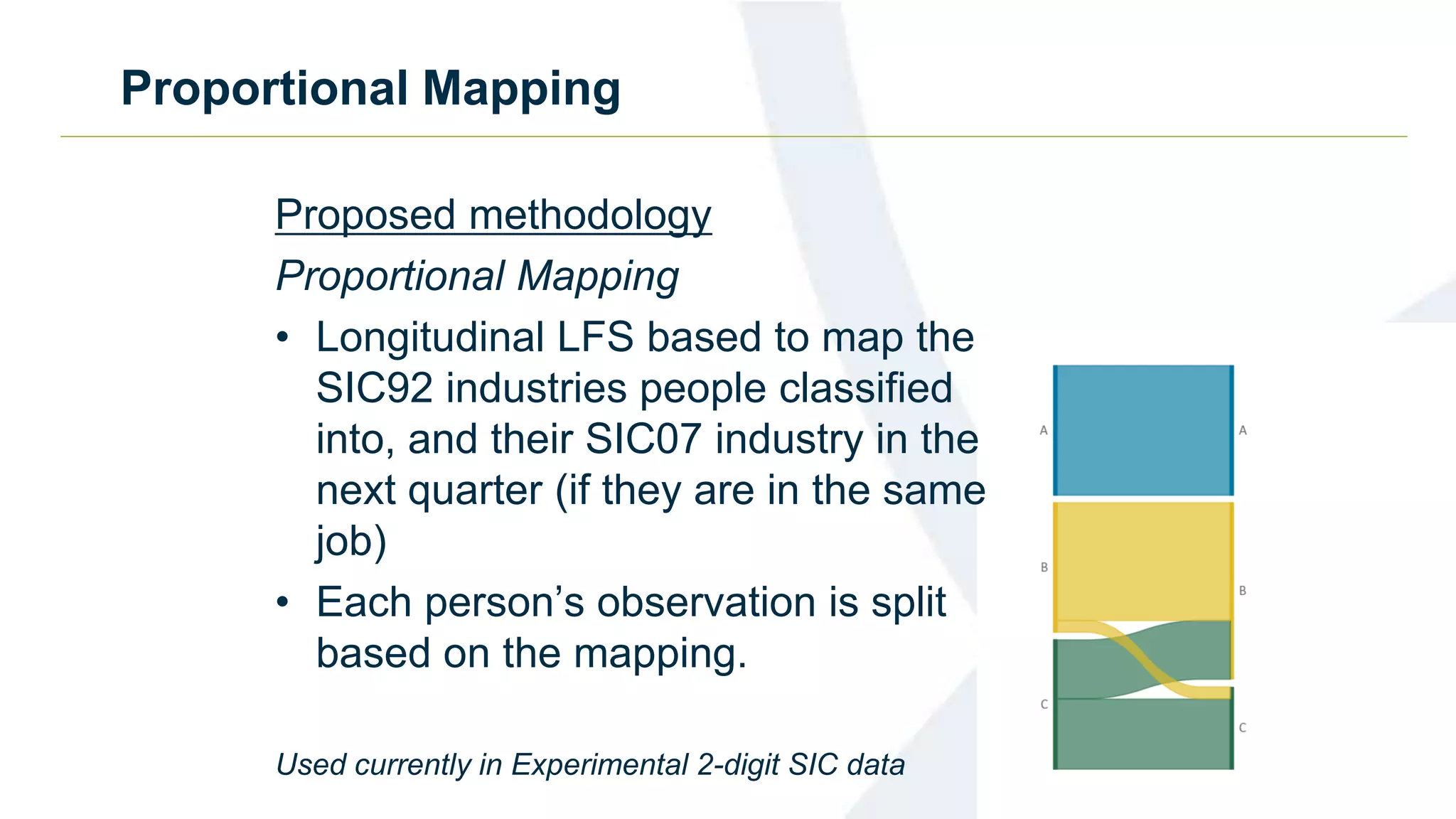
• E.g. An observation represents 100
people, and was in industry C
• The mapping indicates 40% of
people in industry C get reallocated
to B, and 60% stay in C
• The observation is split in two: One
representing 40 people in industry B,
and one representing 60 people in
industry C
Proportional Mapping
Source: LFS micro datasets, Employees & Self-Employed jobs, 2008
Proportional Mapping: Summary
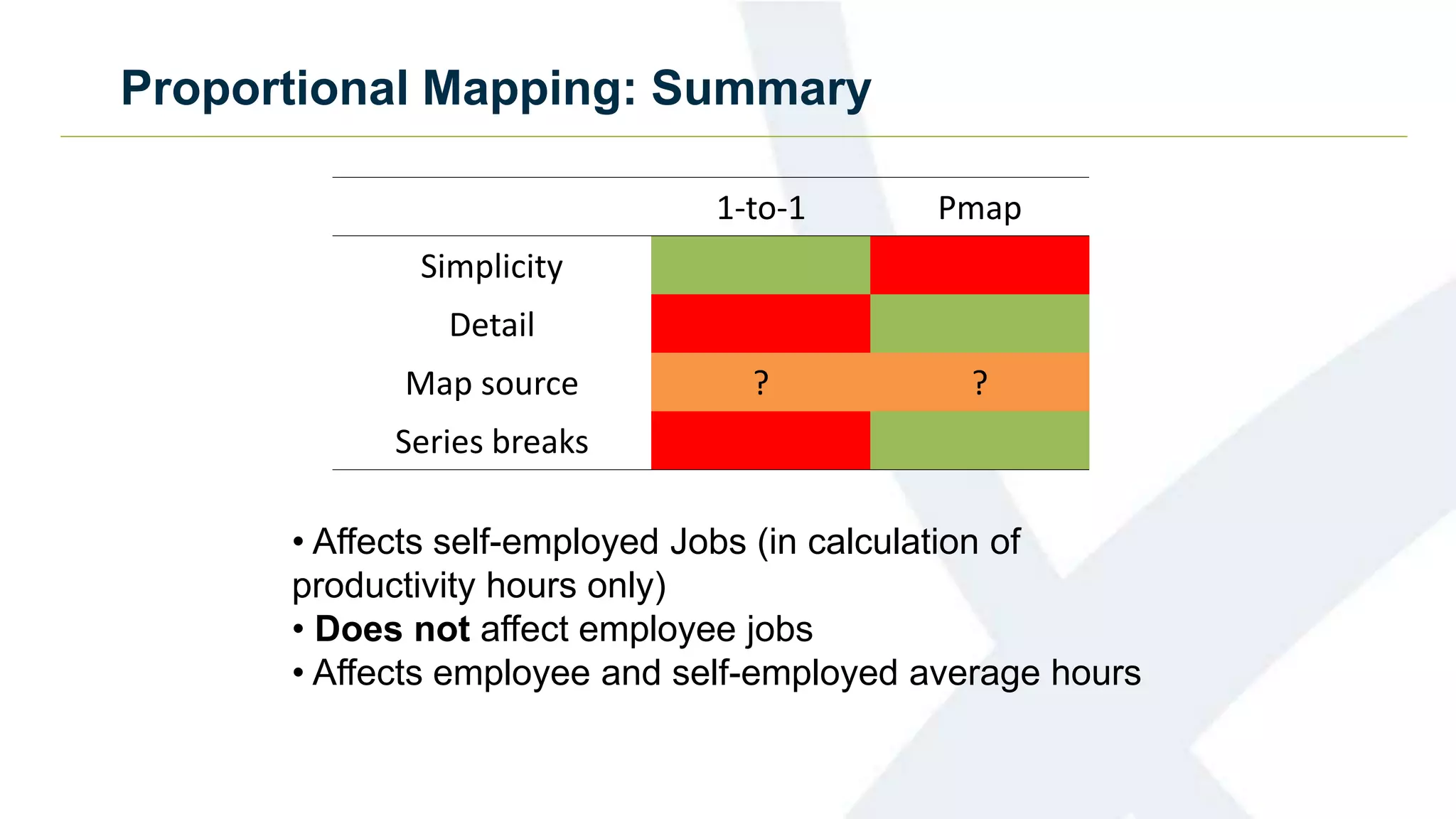
1-to-1 Pmap
Simplicity
Detail
Map source ? ?
Series breaks
• Affects self-employed Jobs (in calculation of
productivity hours only)
• Does not affect employee jobs
• Affects employee and self-employed average hours
Proportional Mapping: Summary
Other options being considered
• Using IDBR-based mapping for employees, and LFS-
based mapping for self-employed
• Testing employee mapping against mapping implied by
matched observations in ASHE
Summary of all questions
• Minor Changes
Stop dropping those without FT/PT marker?
Use HM Forces time series?
• Proportional Mapping
Move to use proportional mapping in productivity hours system?
Should we work to use proportional mapping in productivity jobs for
the self-employed, for consistency?
Regional Labour Productivity
Contents
• Introduction
• Labour measure
• Current Price GVA
• Chained Volume GVA
30
Introduction
What regional data do the Labour Productivity team produce?
• NUTS1 output per hour and output per job
• Quarterly NUTS1 productivity hours and productivity jobs
• Industry by Region output per hour and output per job
In additional ‘Sub-regional’ labour productivity are produced by a separate team
31
Introduction
How is (NUTS1) Regional Productivity calculated?
• Same methodology as UK productivity, except:
Local unit data used for GVA and employee jobs
32
Introduction
What is Industry by Region Labour Productivity?
 Current Price Output per Job and Output per Hour
 Split by 12 regions/nations and 16 industries
What is unique about Industry by Region?
Extremely high granularity : 192 combinations
Different methodology to standard Labour Productivity to utilise different dimensions of different
datasets
Methodology created with eye to administrative data based future
33
Introduction
34
Introduction - Sources
GVA Jobs AvgHours
Regional Accts
•GVA(I) – CP
•GVA(B) - CVM
Employees
•STES
•BRES
•Public Sector Emp Survey
Paid usual hours (EE)
•ASHE
Self-employed, UFS
•APS
Paid v Actual hours (EE)
•LFS
HMF
•MoD Strength by Region
Non-EE (SE, UFS, etc)
•APS
Gov’t Support & Training
(GST)
•LFS 35
RIRI
RI
RI
,,
,
,
AvgHoursJobs
GVA
OpH


Contents
• Introduction
• Labour measure
• Current Price GVA
• Chained Volume GVA
36
Labour Measure
Hours
ASHE
LFS
APS
Labour Measure
Hours
ASHE
LFS
APS
EE paid hours distribution,
region by section (Q2 of
each year)
Labour Measure
Hours
ASHE
LFS
APS
EE paid hours distribution,
region by section (Q2 of
each year)
EE paid hours by actual
hours distribution, region by
section (Q2 of each year)
Labour Measure
Labour Measure
Hours
ASHE
LFS
APS
EE paid hours distribution,
region by section (Q2 of
each year)
EE paid hours by actual
hours distribution, region by
section (Q2 of each year)
EE actual hours
distribution, region
by section (Q2 of
each year)
Labour Measure
Hours
ASHE
LFS
APS
EE paid hours distribution,
region by section (Q2 of
each year)
EE paid hours by actual
hours distribution, region by
section (Q2 of each year)
EE actual hours
distribution, region
by section (Q2 of
each year)
EE average actual hours,
region by section (quarterly)
Labour Measure
Hours
ASHE
LFS
APS
EE paid hours distribution,
region by section (Q2 of
each year)
EE paid hours by actual
hours distribution, region by
section (Q2 of each year)
EE actual hours
distribution, region
by section (Q2 of
each year)
EE average actual hours,
region by section (quarterly)
EE average actual
hours, region by
section (quarterly)
Labour Measure
Hours
ASHE
LFS
APS
EE paid hours distribution,
region by section (Q2 of
each year)
EE paid hours by actual
hours distribution, region by
section (Q2 of each year)
EE actual hours
distribution, region
by section (Q2 of
each year)
EE average actual hours,
region by section (quarterly)
EE average actual
hours, region by
section (quarterly)
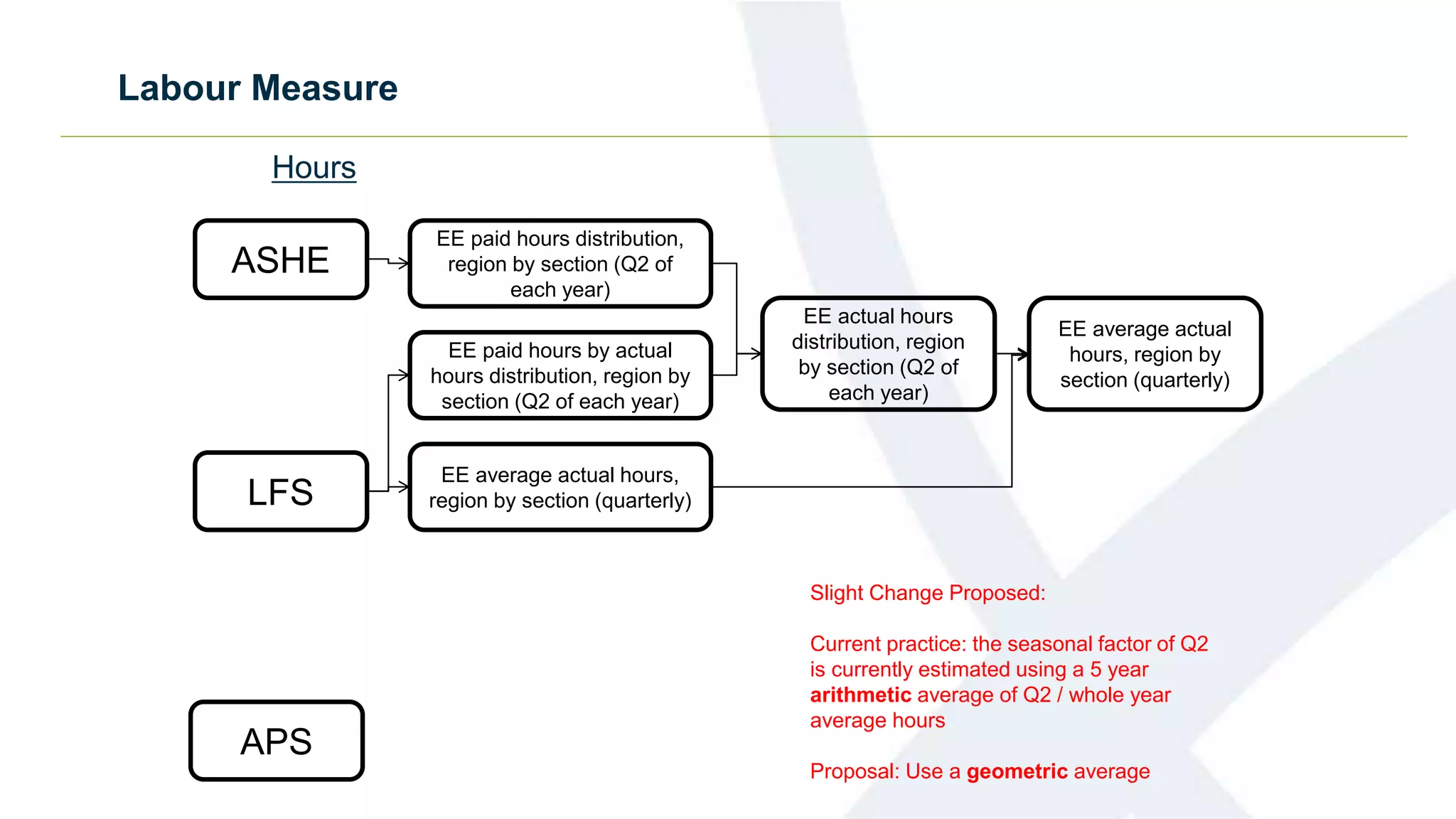
Slight Change Proposed:
Current practice: the seasonal factor of Q2
is currently estimated using a 5 year
arithmetic average of Q2 / whole year
average hours
Proposal: Use a geometric average
Labour Measure
Hours
ASHE
LFS
APS
EE paid hours distribution,
region by section (Q2 of
each year)
EE paid hours by actual
hours distribution, region by
section (Q2 of each year)
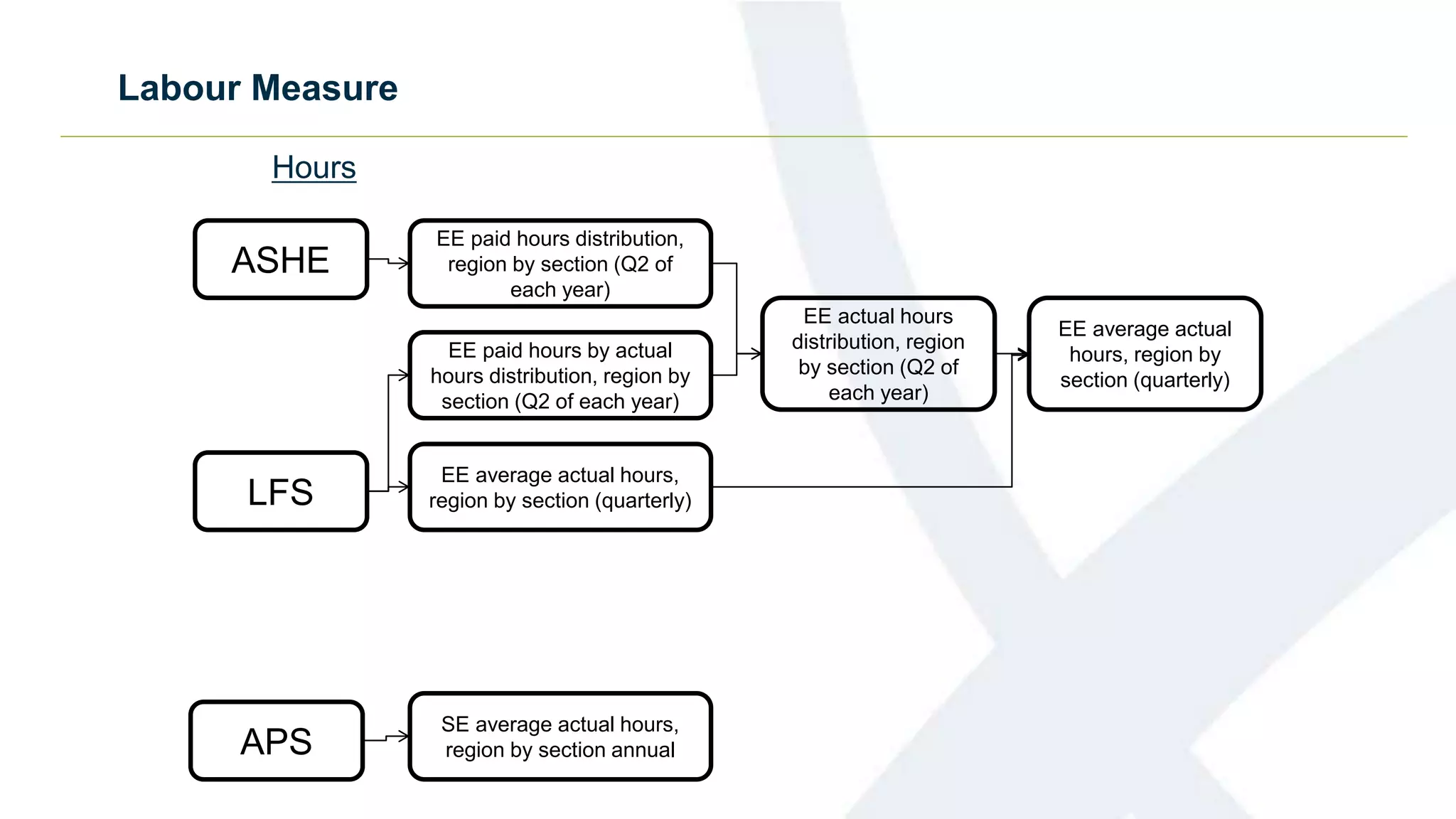
SE average actual hours,
region by section annual
EE actual hours
distribution, region
by section (Q2 of
each year)
EE average actual hours,
region by section (quarterly)
EE average actual
hours, region by
section (quarterly)
Labour Measure
Hours
ASHE
LFS
APS
EE paid hours distribution,
region by section (Q2 of
each year)
EE paid hours by actual
hours distribution, region by
section (Q2 of each year)
SE average actual hours,
region by section (quarterly)
SE average actual hours,
region by section annual
EE actual hours
distribution, region
by section (Q2 of
each year)
EE average actual hours,
region by section (quarterly)
EE average actual
hours, region by
section (quarterly)
Labour Measure
Hours
ASHE
LFS
APS
EE paid hours distribution,
region by section (Q2 of
each year)
EE paid hours by actual
hours distribution, region by
section (Q2 of each year)
SE average actual hours,
region by section (quarterly)
SE average actual hours,
region by section annual
EE actual hours
distribution, region
by section (Q2 of
each year)
EE average actual hours,
region by section (quarterly)
EE average actual
hours, region by
section (quarterly)
SE average actual
hours, region by
section (quarterly)
Contents
• Introduction
• Labour measure
• Current Price GVA
• Chained Volume GVA
48
Current Price GVA
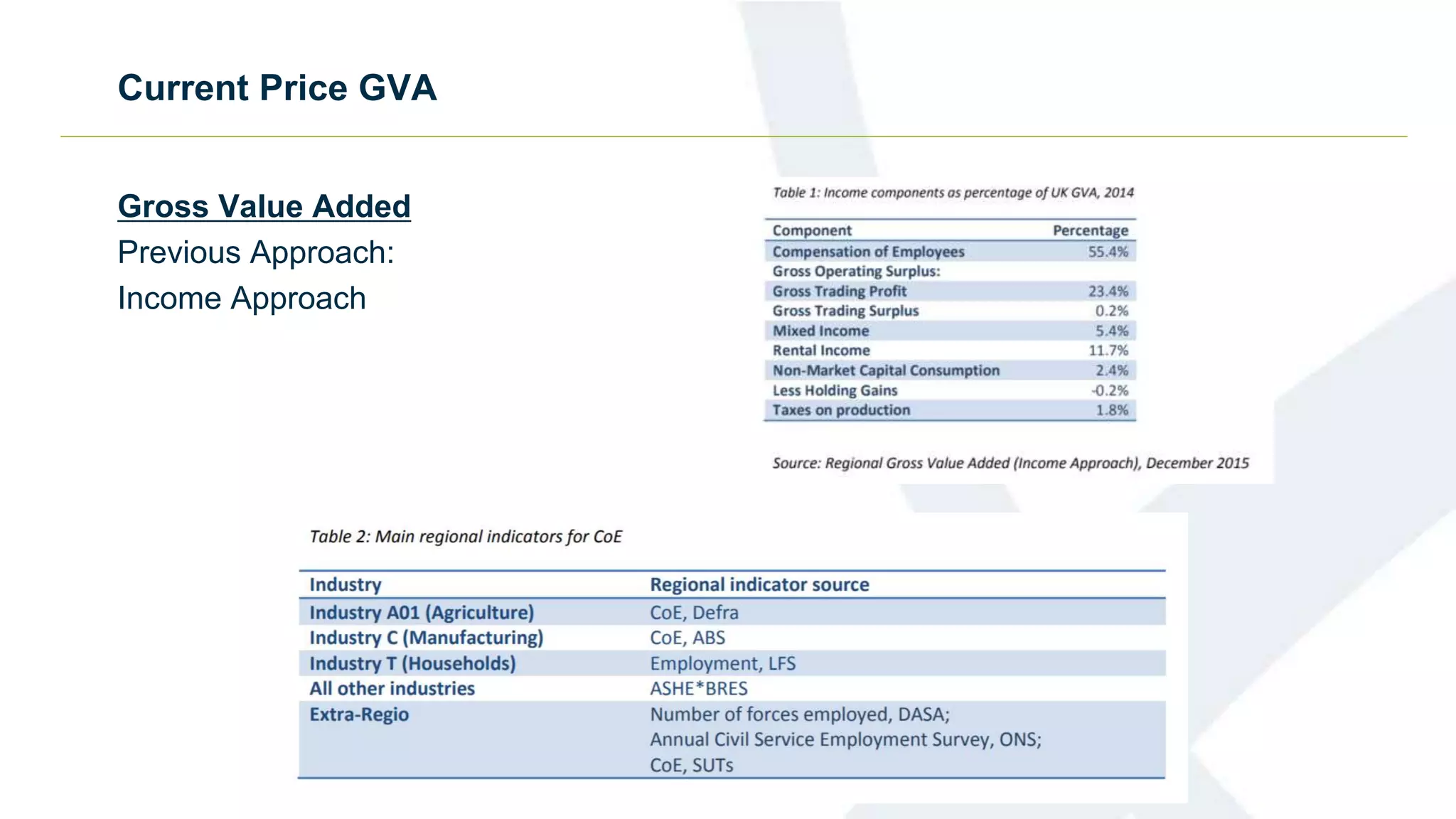
Gross Value Added
Previous Approach:
Income Approach
Current Price GVA
Gross Value Added
New Approach: Balanced (Income & Production)
Production approach mainly uses ABS
Public Sector data comes from PS employees by region * average earnings
of PS in area
Regional estimates of bank and building society fees and commission
income, and financial intermediation services indirectly measured (FISIM)
from HM Treasury are used to allocate the major part of division 64 at the
NUTS1 level.
Current Price GVA
Gross Value Added
New Approach: Balanced (Income & Production)
1. Assign weights to each component of the income and production measures;
2. Assign quality metrics to each component in each region;
3. Multiply quality by weight and aggregate to a single quality metric for each measure;
4. Use these two quality metrics to derive a single weighted estimate for each region;
5. Apply any necessary manual intervention to address anomalous results;
6. Feed the balanced estimates back into the detailed industry and component breakdown.
Current Price GVA
Gross Value Added
New Approach: Balanced (Income & Production)
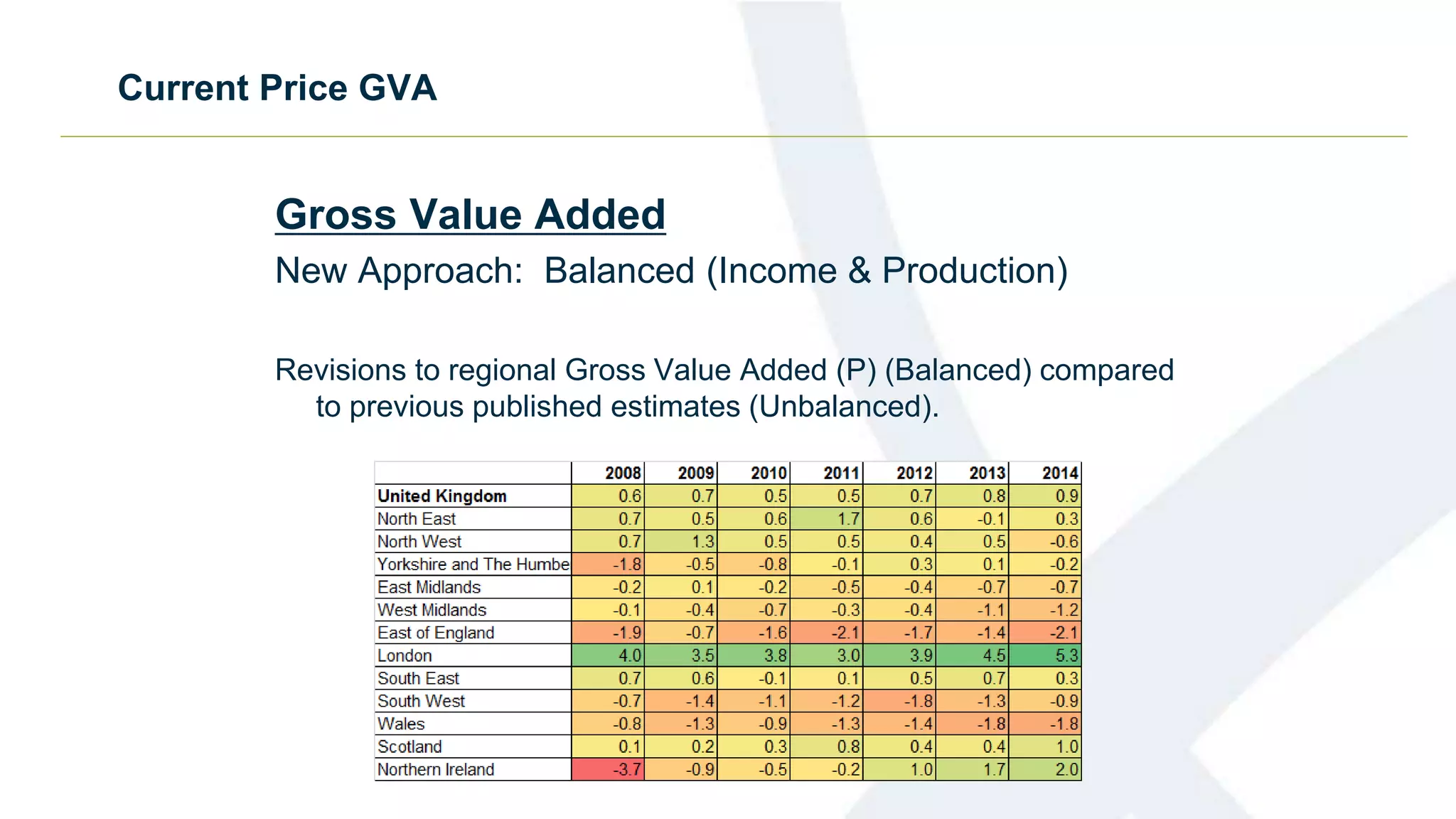
Revisions to regional Gross Value Added (P) (Balanced) compared
to previous published estimates (Unbalanced).
Current Price GVA
Gross Value Added
New Approach: Balanced (Income & Production)
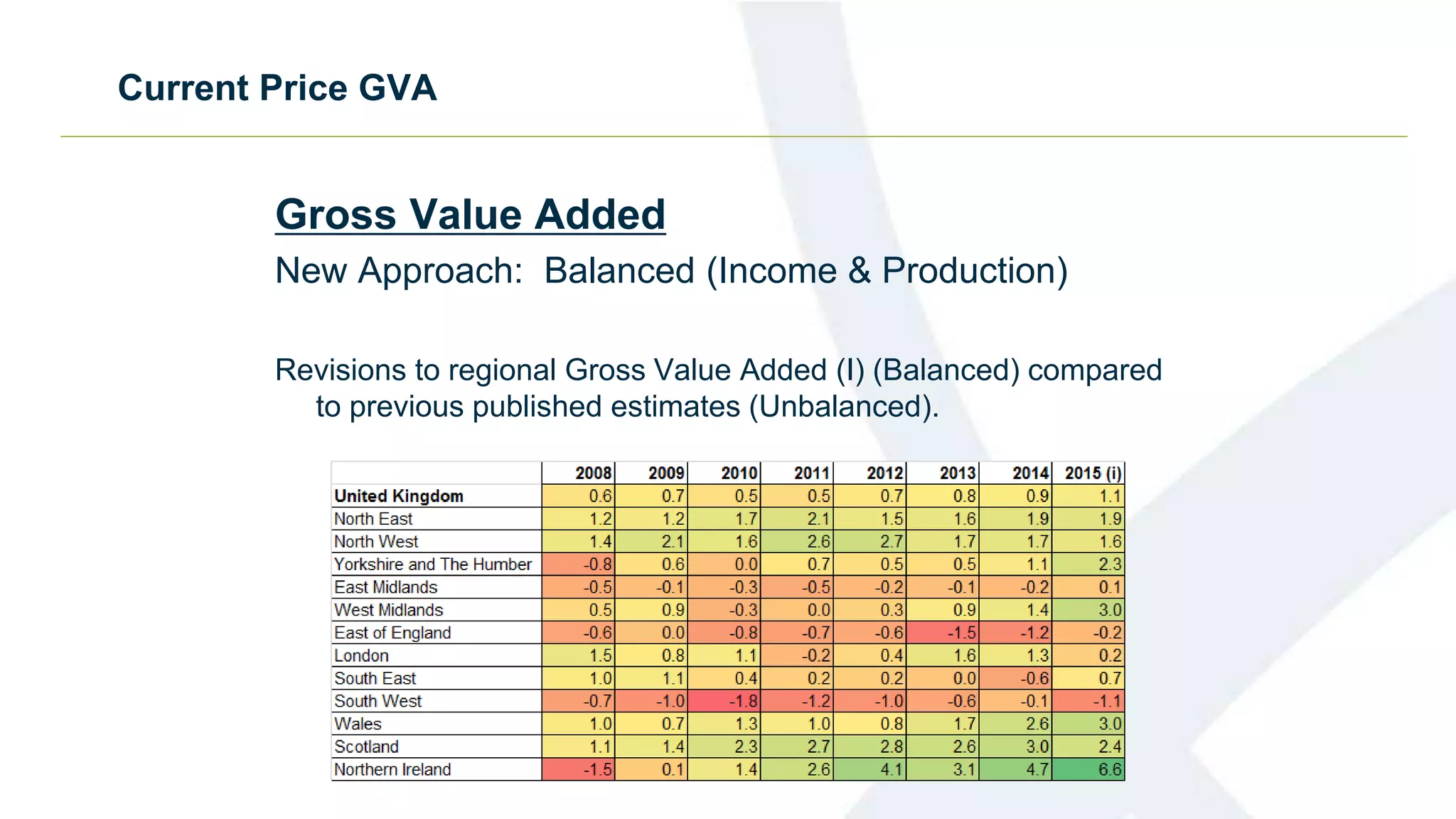
Revisions to regional Gross Value Added (I) (Balanced) compared
to previous published estimates (Unbalanced).
Current Price GVA
Gross Value Added
Revisions to GVA for Manufacturing for UK and All
Regions (2015).
4.0%
-3.5%
-3.1% -2.9%
-2.6%
1.5%
2.2% 2.2%
4.2%
4.6% 4.8%
7.2%
12.4%
-6.0%
-4.0%
-2.0%
0.0%
2.0%
4.0%
6.0%
8.0%
10.0%
12.0%
14.0%
United
Kingdom
Scotland East
Midlands
East of
England
London South
West
North
West
South East West
Midlands
Yorkshire
and The
Humber
North East Wales Northern
Ireland
%
Current Price GVA
Gross Value Added
Revisions to OPH for Information and Communication
Industry for UK and All Regions (2015).
-7.2%
-11.0%
-10.2%
-8.0% -8.0%
-6.7% -6.5%
-6.1% -5.8%
-1.5%
-1.1%
2.9%
5.4%
-12.0%
-10.0%
-8.0%
-6.0%
-4.0%
-2.0%
0.0%
2.0%
4.0%
6.0%
8.0%
United
Kingdom
South East East
Midlands
London South
West
Wales East of
England
West
Midlands
North
West
North East Scotland Yorkshire
and The
Humber
Northern
Ireland
%
Current Price GVA
Proposal
Move to using Balanced GVA in Industry by region
56
Contents
• Introduction
• Labour measure
• Current Price GVA
• Chained Volume GVA
57
Chained Volume GVA
Deflation
• National deflators are used for 112 industries from SU balancing
Constraining
• Each of the 112 industries are constrained to UK totals
58
Chained Volume GVA
Background
• Alongside CP balanced regional GVA, CVM balanced regional GVA were produced in
December 2017
• Updating of Industry by Region was delayed to better analyse this new CVM data
• We plan to present this analysis, alongside the new data, in April
• After, we will update Industry by Region data quarterly.
59
Chained Volume GVA
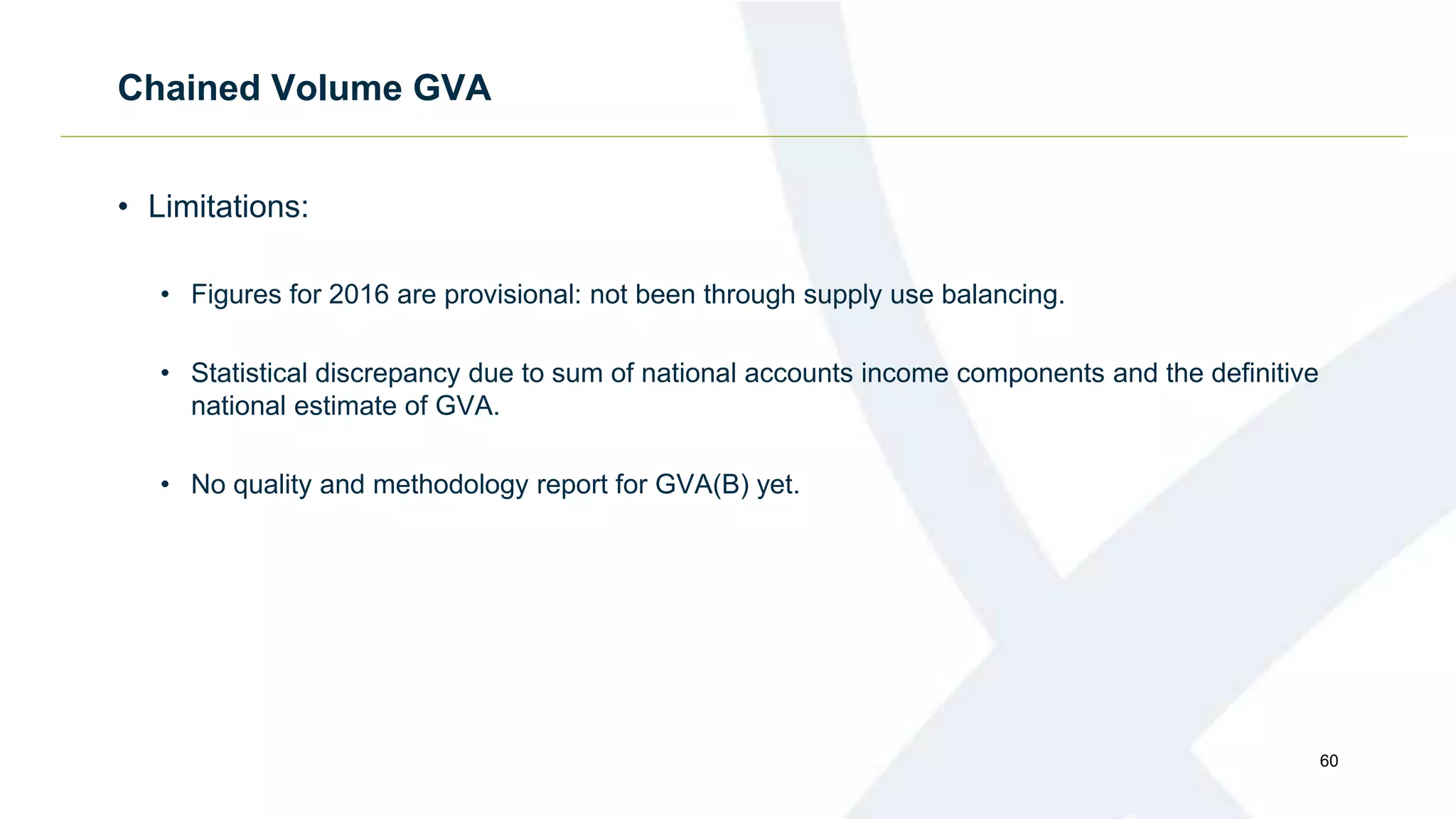
• Limitations:
• Figures for 2016 are provisional: not been through supply use balancing.
• Statistical discrepancy due to sum of national accounts income components and the definitive
national estimate of GVA.
• No quality and methodology report for GVA(B) yet.
60
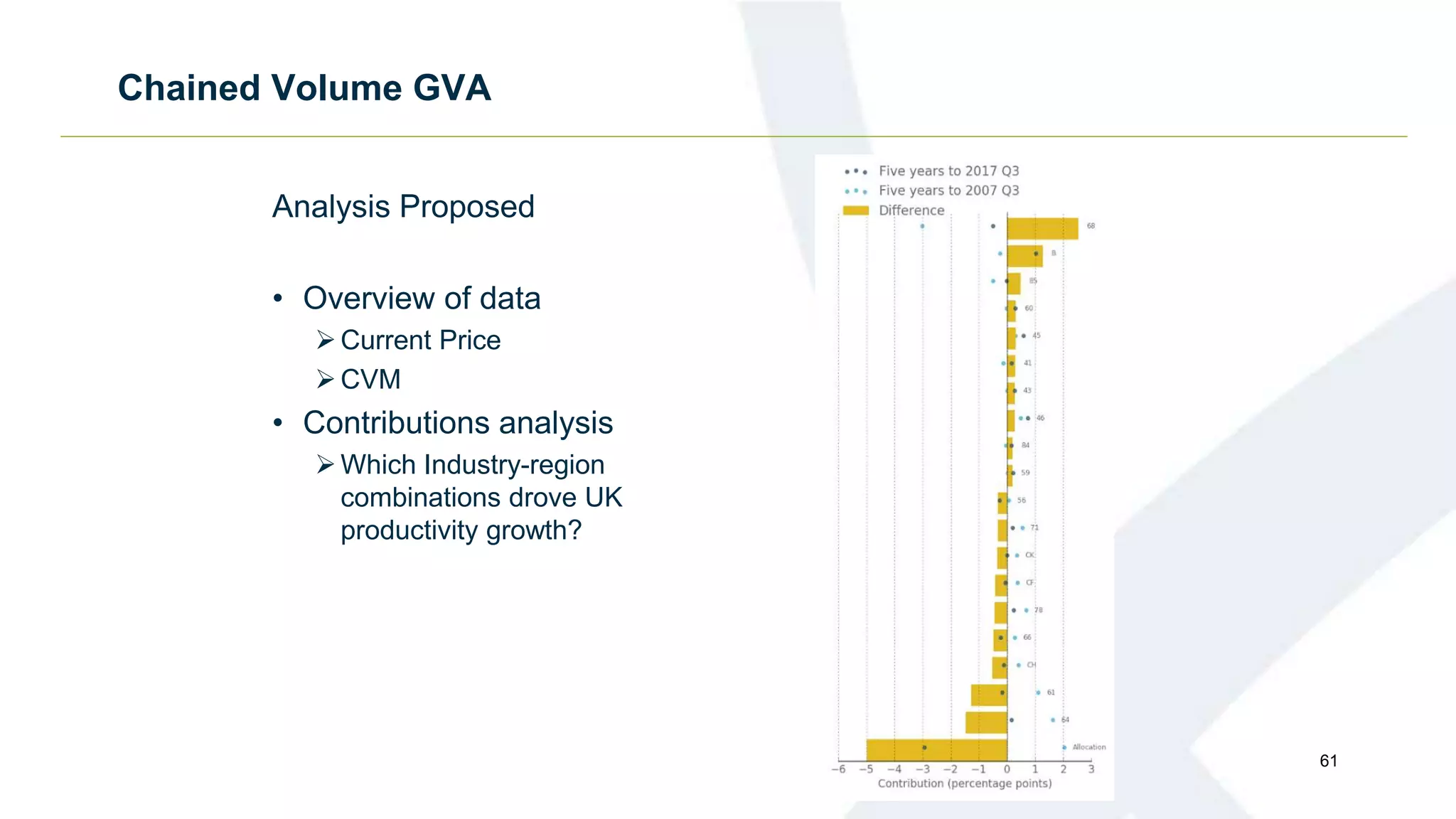
Chained Volume GVA
Analysis Proposed
• Overview of data
Current Price
CVM
• Contributions analysis
Which Industry-region
combinations drove UK
productivity growth?
61
Recap
Proposals
1. Move to using balanced GVA in CP Industry by Region (Experimental Statistic)
2. Create new CVM Industry-by-Region dataset (Experimental Statistic)
3. Move to use geometric averages when adjusting for the seasonal factor of ASHE.
62
International review
Richard Heys
Deputy Chief Economist
63
International review
In early 2017, ONS commissioned London Economics to undertake
a review of the productivity publications of other leading NSIs.
The aims of this survey were:
a) To provide a yardstick against which to judge ONS’ current
productivity offering
b) To provide input for the next stage of ONS’ productivity
development plans
Data were collected through a desk review of publicly available
materials, a survey of National or International Statistics
Organisations (NISOs), and consultations with officials from these
organisations. The results were published on 5th February 2018
64
International review – NISOs involved
• Australian Bureau of Statistics
• BLS - Office of Productivity
and Technology (USA)
• Central Statistical Bureau of Latvia
• Destatis, Statistisches Bundesamt
Germany
• Eurostat
• Federal Statistical Office Switzerland
• Insee (France)
• International Labour Organization
• Istat (Italy)
• OECD
• Statistics Canada
• Statistics Denmark
• Statistics Estonia
• Statistics Finland
• Statistics Netherlands / CBS
• Statistics New Zealand
• Statistics Norway
• Statistics Sweden
Note: Statistics Japan and Statistics Singapore declined to participate,
and no response was received from Statistics Korea. 65
International review – Outputs by country
• 17 of the 18 surveyed NISOs produce data on labour
productivity, as does the ONS;
• Seven NISOs produce capital productivity data. The
ONS does not currently produce equivalent statistics;
and,
• Twelve of the surveyed NISOs and the ONS produce
multi-factor productivity data.
• None of the surveyed NISOs publishes other
productivity data. The ONS currently also produces
‘other’ productivity data in the form of public service
productivity estimates.
66
International review – Outputs by country
Statistical organisation
Labour productivity Capital productivity
Multi-factor
productivity
Office for National Statistics a a
Australian Bureau of Statistics a a a
BLS-Office of Productivity and Technology a a a
Destatis (DE) a a
Eurostat a
Federal Statistical Office (CH) a a a
Insee (FR) a
International Labour Organisation a
Istat (IT) a a a
OECD a a a
Statistics Canada a a
Statistics Denmark a a
Statistics Estonia a
Statistics Finland a a
Statistics Netherlands / CBS a a
Statistics New Zealand a a a
Statistics Norway a a
Statistics Sweden a a
Total number of NISOs publishing
productivity data out of the 17 survey
respondents publishing productivity data
17 7 12
67
• Institutional sectors – 12 NSIOs publish labour productivity estimates
for the whole economy, 7 for the total private business economy, 5 for
the total private economy, and 4 for the total non-financial private
business economy.
• Industries – The granularity of the published labour productivity data
varies considerably with the BLS - Office of Productivity and Technology
and Statistics Canada publishing such information up to the 6-digit
classification level for some industries. ONS produce data at the 1 and 2
digit NACE level.
International review – Granularity/detail
68
International review – Periodicity
• Labour productivity – 16 NISOs publish annually, 1
bi-annually, and 8 publish quarterly estimates in
addition to their annual release
• Capital productivity – 6 NISOs publish, 1 bi-
annually, and none publish quarterly
• Multi-factor productivity – 11 NISOs publish
annually, 1 bi-annually, and none publish quarterly
69
International review – Timeliness
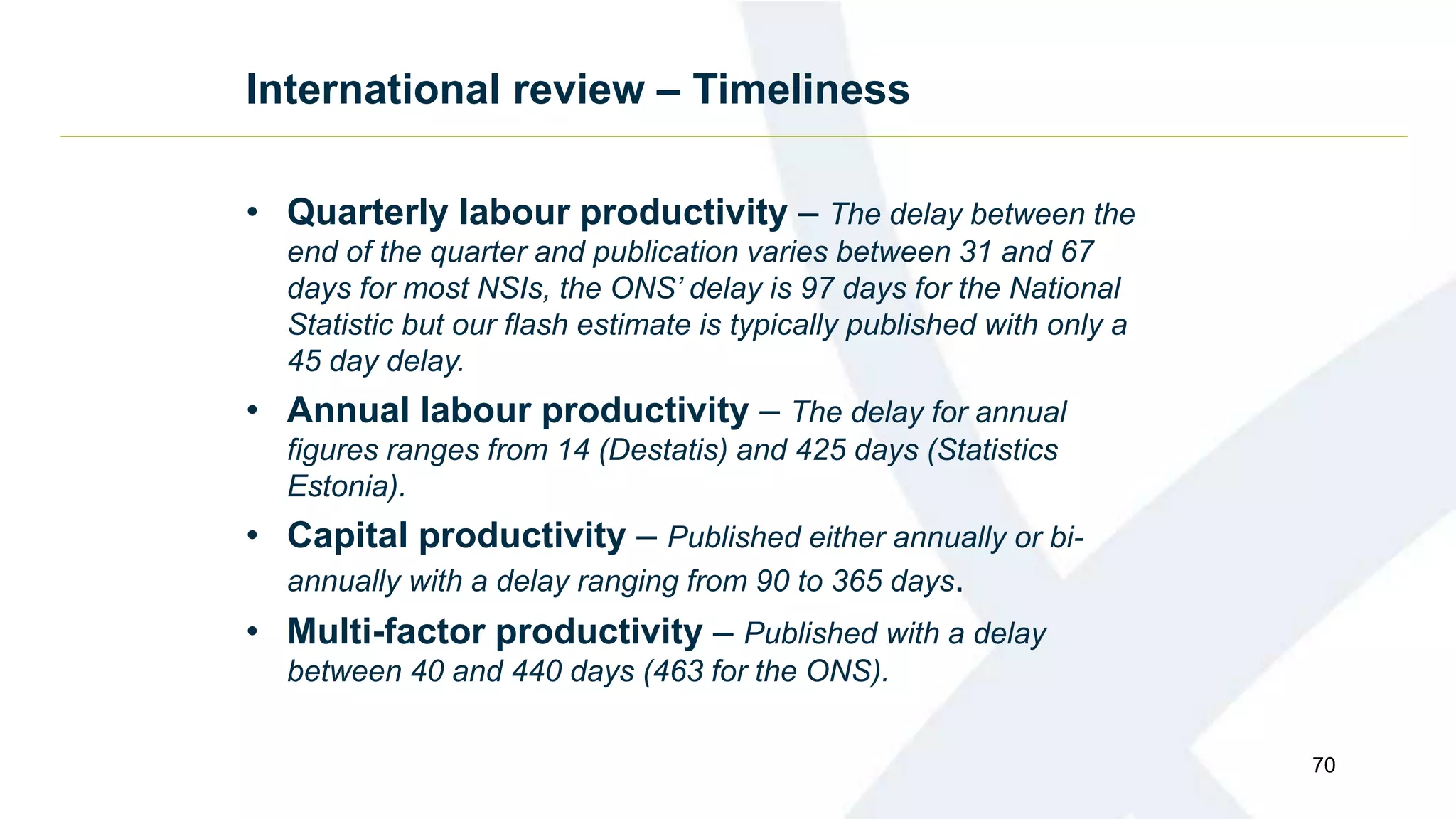
• Quarterly labour productivity – The delay between the
end of the quarter and publication varies between 31 and 67
days for most NSIs, the ONS’ delay is 97 days for the National
Statistic but our flash estimate is typically published with only a
45 day delay.
• Annual labour productivity – The delay for annual
figures ranges from 14 (Destatis) and 425 days (Statistics
Estonia).
• Capital productivity – Published either annually or bi-
annually with a delay ranging from 90 to 365 days.
• Multi-factor productivity – Published with a delay
between 40 and 440 days (463 for the ONS).
70
International review – Best practice NISOs
Aspect of production and dissemination of
productivity statistics
Name(s) of statistical organisation cited by
survey respondents
Range and scope of productivity statistics
Statistics Canada (2x), OECD (2x), Australian
Bureau of Statistics (1x), Bureau of Economic
Analysis (1x), Conference Board(1x)
Underlying methodologies for labour productivity
Australian Bureau of Statistics (1x), Bureau of
Economic Analysis (1x), Conference Board(1x),
Statistics Canada (1x),
Underlying methodologies for MFP
Statistics Canada (3x), Australian Bureau of
Statistics (2x), Eurostat (1x)
Underlying methodologies for capital productivity Statistics Canada (1x)
Documentation and transparency of productivity
statistics
ONS (1x)
Presentation, dissemination and communication of
productivity statistics
Bureau of Economic Analysis (1x), Statistics New
Zealand (1x)
Timeliness of productivity publications Bureau of Economic Analysis/ BLS (1x)
• No single NISO is mentioned as a “best practice”
benchmark in all dimensions by their peers, but some
appear more frequently than others:
International review – Recommendations
72
International review – Recommendations
73
International review – Recommendations
74
International review – Recommendations
75
International review – response
• ONS are considering the results of the Review of
International Best Practice, and will publish their next
development plan – covering the next two year
window – in the coming months.
76
Towards quarterly Multi-factor Productivity (MFP)
Mark Franklin
Outline
• MFP primer
• Current state of play
• Inputs
• Outputs
• Timeline

• Next steps
MFP primer
Decomposition of growth in GVA
Decomposition of growth in GVA/hour
Where
Y = (real) gross value added
L = quality-adjusted labour input (QALI)
H = hours worked
K = capital services (VICS)
A = MFP
Sl = labour share
We use ‘MFP’ to refer to this breakdown of value-added. Once we introduce
‘double-deflated’ National Accounts, we will use ‘TFP’ to refer to the corresponding
breakdown of real gross output, with an additional term on the RHS for real
intermediate consumption
Labour composition Capital deepening
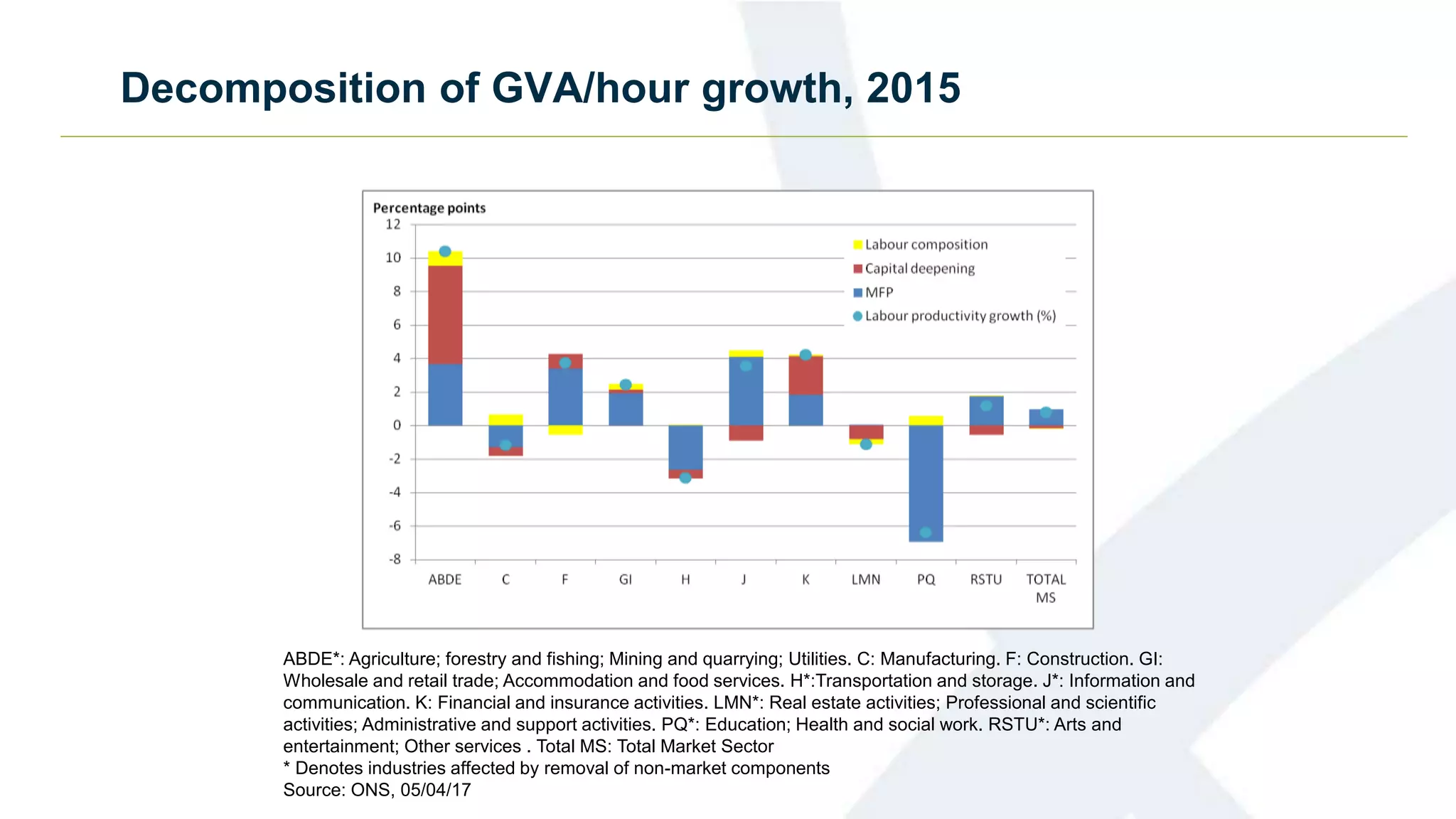
Decomposition of GVA/hour growth, 2015
ABDE*: Agriculture; forestry and fishing; Mining and quarrying; Utilities. C: Manufacturing. F: Construction. GI:
Wholesale and retail trade; Accommodation and food services. H*:Transportation and storage. J*: Information and
communication. K: Financial and insurance activities. LMN*: Real estate activities; Professional and scientific
activities; Administrative and support activities. PQ*: Education; Health and social work. RSTU*: Arts and
entertainment; Other services . Total MS: Total Market Sector
* Denotes industries affected by removal of non-market components
Source: ONS, 05/04/17
Why focus on the market sector?
• Growth accounting theory assumes competitive
product and factor markets
• No market prices for non-Market Sector (xMS)
activities
• Rate of return on xMS capital set at zero to accord
with international standards for national accounts
• xMS activities: general government, NPISH, imputed
rents
• MS is about 80% of the total economy in terms of
hours worked
NB: UK National Accounts are sectorised only in
nominal terms!
Current state of play: inputs
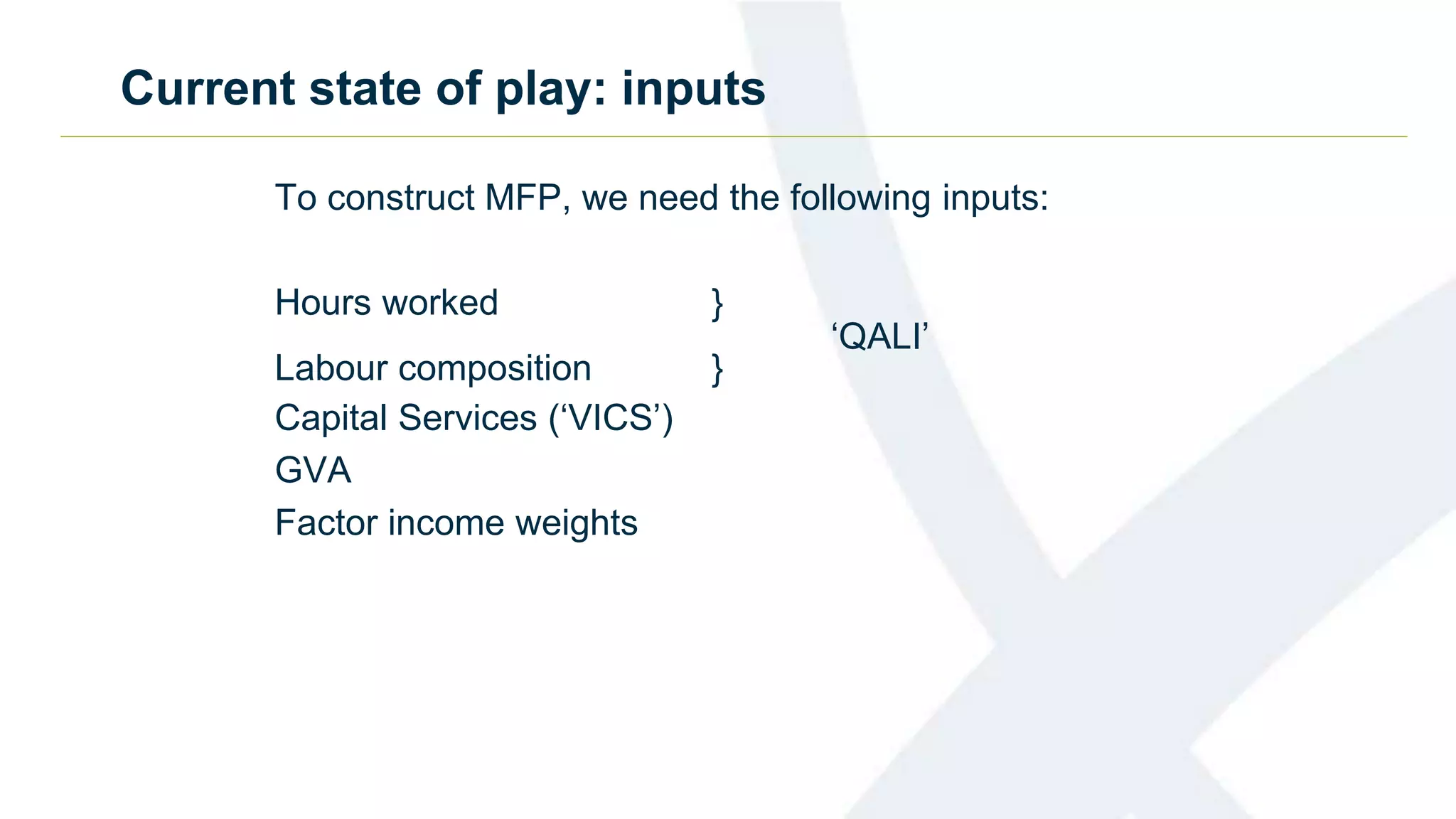
To construct MFP, we need the following inputs:
Hours worked }
‘QALI’
Labour composition }
Capital Services (‘VICS’)
GVA
Factor income weights
Hours worked
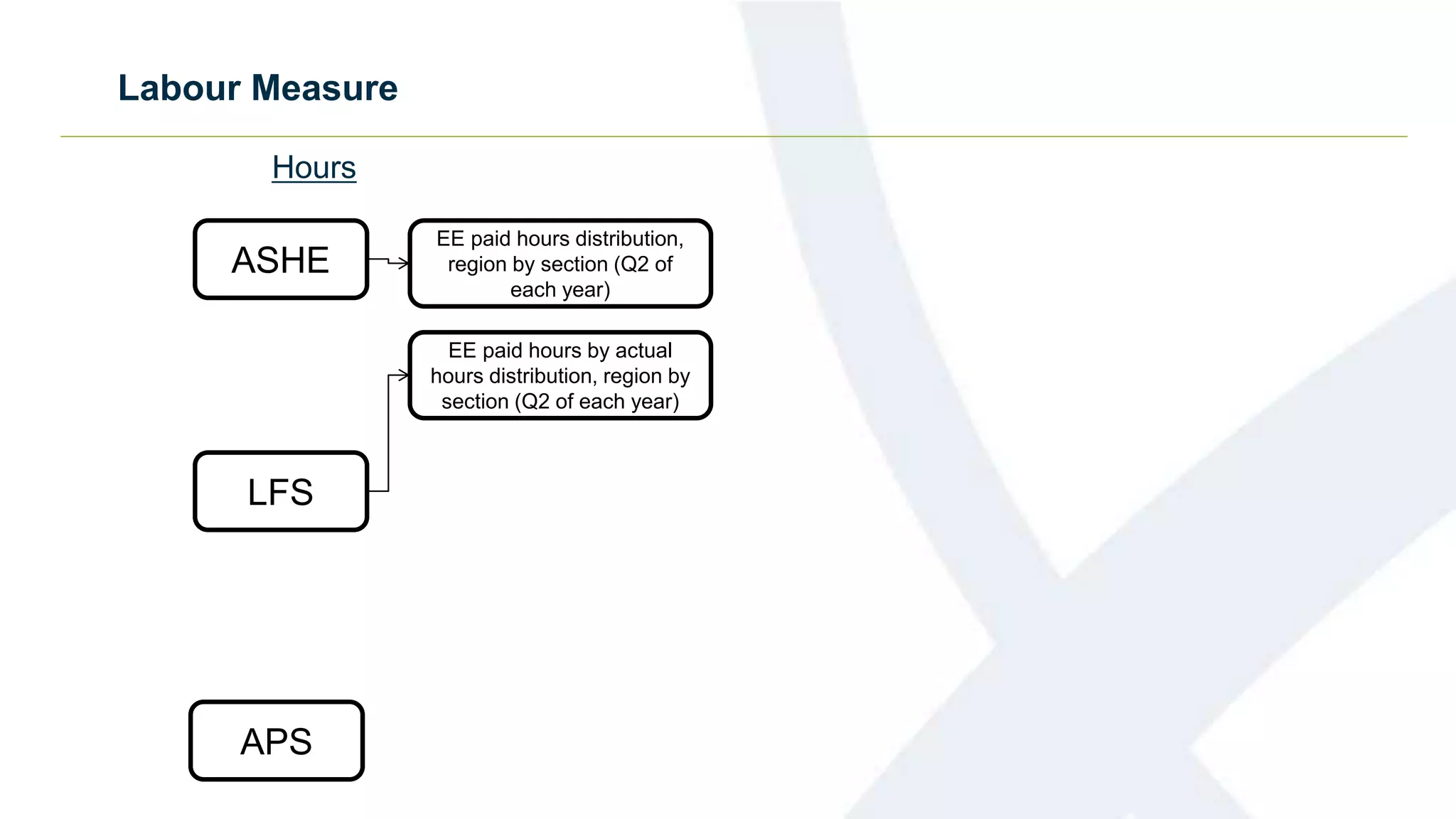
We published quarterly estimates of hours worked for the UK market
sector and 19 letter-level industries from 1994Q1 to 2017Q1 in October
2017
Notes
• Bottom-up estimates, based primarily on sectoral markers in labour
market sources (LFS and ASHE)
• 10 industries with some xMS component, one of which (O: public
admin) is wholly xMS
• Apply filtering, eg to drop observations where no xMS weight in GVA
data (eg construction, manufacturing), and to drop self-employment in
industry O
• Aggregate MS hours worked differs slightly from top-down estimates
used in Labour Productivity release
• Hours worked in wholly MS industries are aligned with those in the
Labour Productivity system
• Under development: 64-industry breakdown, 51 of which are wholly MS
Labour composition
We also published quarterly estimates of labour composition for the UK
market sector and 19 letter-level industries in the October 2017 QALI
release
Notes
• Stratify labour by industry, sex, age-group and level of education, 684
cells in total. Generate weights for each cell using labour income
shares
• Apply benchmarks: (i) to ASHE hourly earnings at lowest available
level, (ii) to (MS) labour income by industry in the National Accounts
• Measure labour composition as difference between growth of weighted
index minus growth of unweighted hours
• Under development: 64-industry breakdown. This is 2304 cells.
Currently exploring ways to deal with missing/volatile data
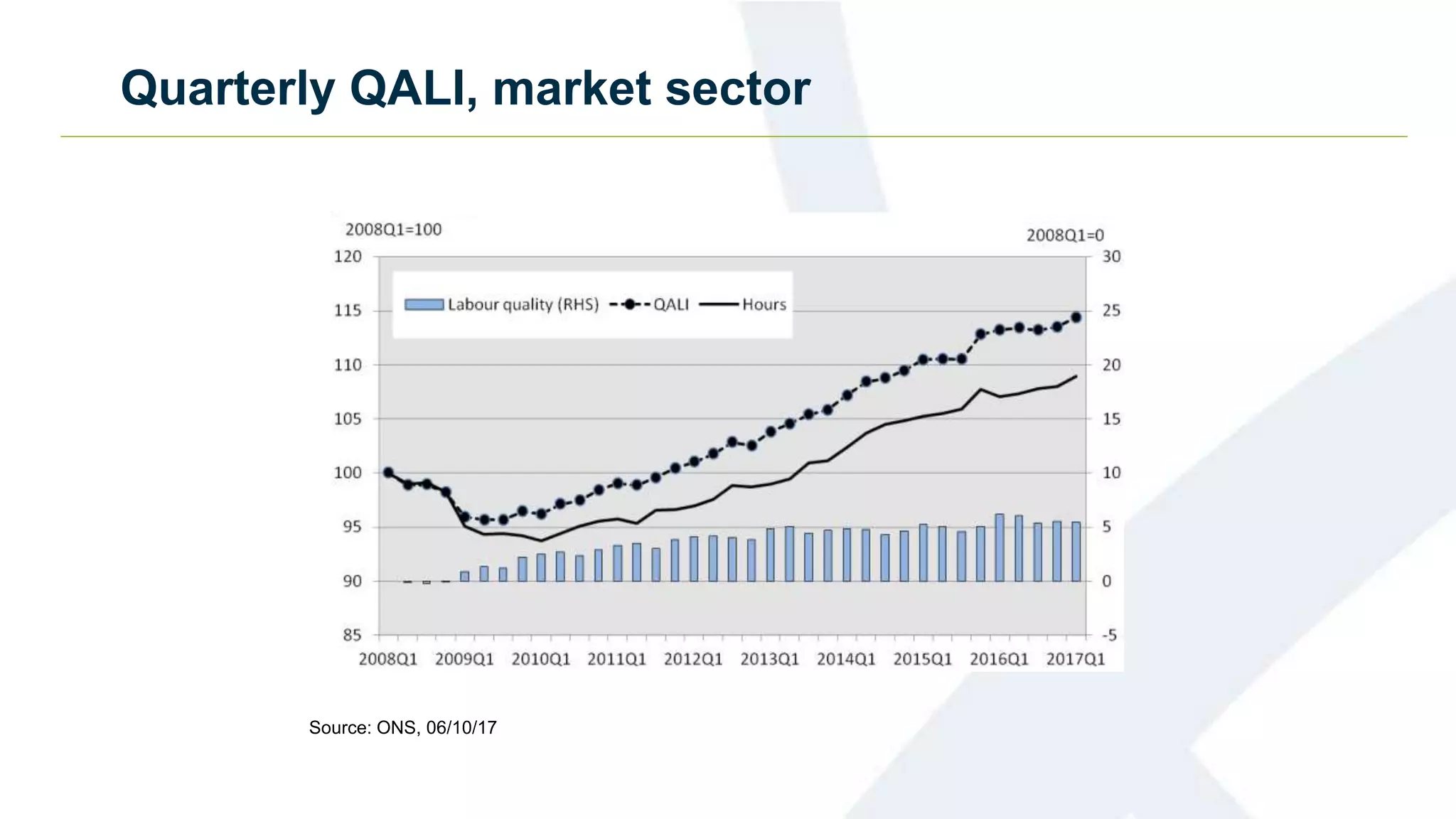
Quarterly QALI, market sector
Source: ONS, 06/10/17
Capital services
• Following a huge amount of development work, we published quarterly
estimates of capital services for the UK market sector and 16 (out of
19) letter-level industries from 1951Q1, and for 57 (out of 64) sub-
industries from 1997Q1 in February 2018
• Capital services are analogous to quality adjusted hours worked:
growth of stratified components (asset type, industry, vintage) weighted
by ‘user costs’
• Growth is a lag function of current and prior investment (GFCF), in
some cases 100s of quarterly estimates
• User costs are analogous to income weights in QALI. Give more weight
to components that give up their services more rapidly in production
than to long-lived assets
• User costs made up of 3 components: depreciation, holding gains and
a rate of return, and are adjusted for different tax treatment of different
assets
Quarterly capital services
Source: ONS, 07/02/18
Capital services: issues
• Some industry level components suppressed pending further QA.
These are industries with small and volatile MS shares
• Development work not yet fully incorporated into National Accounts
series for business investment and capital stocks/consumption of fixed
capital
• Quarterly holding gains can be volatile. Implausible that owners of
capital respond on this timescale
• Endogenous rate of return (ie exhausts returns to capital given other
components of user costs): time varying but common to all industries
and assets
• High rates of return: prima facie evidence of mis-match between asset
coverage and returns to capital – land? Inventories? Missing
intangibles?
GVA
• Estimates of quarterly MS GVA by detailed industry are available from
the ONS National Accounts systems
• These are consistent (i) with the published MS GVA aggregate (L48H),
(ii) with published component level GVA estimates for wholly MS
industries
• Industry detail supports both 19-industry and 64-industry breakdowns
Notes
• Sectoral GVA weights are not wholly explicit, updated infrequently,
occasionally quite simplistic (see published GDP(O) sources catalogue)
• Impact of sectoral reclassifications not always fully synchronised
between GVA and labour market sources
Quarterly GVA growth
Source: ONS
Factor income shares
• Quarterly labour income shares drop out of QALI
• Quarterly capital income by industry are compiled for capital services
Notes
• Industry level capital income used in MFP but not in VICS
Labour shares
Labour share is consistently higher in the market sector due to exclusion of imputed rents
Labour share lowest in ABDE (~31%), highest in H (~79%)
Source: ONS, 05/04/17
Quarterly MFP
• Straightforward to plug input data into MFP framework
• First estimates to be published on 6 April, 1994Q1 to 2017Q2
Notes
• Annual MFP uses Tornqvist factor income weights (average of t, t-1).
Using the same weights gives a break between Q4 and Q1. Using
quarterly Tornqvist weights will iterate away from the annual MFP
estimates
• One option is to benchmark quarterly series to annuals. This is
common across ONS, using Cholette-Dagum method but leads to
revisions for ‘tail’ quarters once annuals become available
• Seasonal adjustment …
Seasonal adjustment
• Hours worked and GVA are seasonally adjusted, other inputs are NSA
• Investigation shows most quarterly VICS industry-level series are not
seasonal, but some do display seasonality, as does the overall MS
series
• A similar story for quarterly labour composition and factor incomes
• Provisional intention is to adjust for seasonality across all inputs, and to
benchmark quarterly MFP series to annuals
Timeline
• 6 April 2018: First quarterly MFP estimates for the UK market sector
and up to 16 industries, to 2017Q2 (ie about 9 months after the event)
• (?) August 2018: Annual MFP estimates to 2017 and quarterly
estimates to 2017Q4 (~7 months after the event). Note Blue Book 2018
will be published on 31/07/18
• (?) October 2018: Quarterly MFP estimates to 2018Q2 (~14 weeks
after the event and ~7 days after publication of the Quarterly National
Accounts)
Next steps
QALI:
• Further work to expand the industry granularity
VICS:
• Evaluate sensitivity of results to input parameters where there is
uncertainty (asset lives, decay functional form, holding gains,
endogenous/exogenous rates of return)
• Address issue of mismatch between asset coverage and returns to
capital
MFP:
• Decomposition analysis – apportion MFP to within and between
industry contributions (cf Tenreyro, 2018)
• MFP in the non-market sector (cf US BEA)
• Adjust for utilisation (cf Fernald, 2014)
TFP:
• Double-deflated National Accounts to be implemented in 2020
Any questions?

Productivity User Group, March 2018

  • 1.
  • 2.
  • 3.
    Overview • How isLabour Productivity Calculated? • Summary of Methodology Changes • In depth  Minor Changes  Proportional Mapping
  • 4.
    Overview • How isLabour Productivity Calculated? • Summary of Methodology Changes • In depth  Minor Changes  Proportional Mapping
  • 5.
    How is (labour)productivity calculated? Actual Hours Worked ACTUAL : i.e. excluding lunch breaks, holidays, etc.
  • 6.
    How is (labour)productivity calculated? Actual Hours Worked Calculated as Whole Economy: Total Hours from Labour Force Survey Industries: Jobs x Average hours per job (constrained to whole economy)
  • 7.
    How is (labour)productivity calculated? Actual Hours Worked Jobs data come from (primarily): Private Employees: Short Term Employment Survey and Business Register Employment Survey Public Sector Employees: Public Sector Employment Self-Employed: Labour Force Survey HM Forces: Ministry of Defence
  • 8.
    How is (labour)productivity calculated? Actual Hours Worked Average hours data come from LFS
  • 9.
    How is (labour)productivity calculated? Anything Else? Reporting Unit vs Local Unit • While much of the jobs data which feed into productivity hours & productivity jobs come from the same datasources as Workforce Jobs, productivity measures of labour are on a RU basis (where WFJ are LU) • This is because GVA data are RU
  • 10.
    How is (labour)productivity calculated? Anything Else? Productivity Hours vs. Productivity Jobs systems • Productivity Hours calculated completely separately to Productivity Jobs • Methodological changes being discussed today only affect the productivity hours system. Even if they affect the calculation of jobs.
  • 11.
    How is (labour)productivity calculated? Anything Else? Reporting Unit vs Local Unit • Some industry data come from LFS – where industry is self-reported (do they report RU? LU? Or something else?)
  • 12.
    Overview • How isLabour Productivity Calculated? • Summary of Methodology Changes • In depth  Minor Changes  Proportional Mapping
  • 13.
    Summary of MethodologyChanges Change Implementation Date Fix to FT/PT treatment July 2018 HM Forces average hours timeseries July 2018 Remove rounding July 2018 Seasonal Adjustment Review July 2018 Proportional Mapping October 2018
  • 14.
    Overview • How isLabour Productivity Calculated? • Summary of Methodology Changes • In depth  Minor Changes  Proportional Mapping
  • 15.
    In depth: MinorChanges LFS main jobs missing full-time / part-time flag Previous Practice: • Those without a full-time / part-time flag were dropped. Those working 30.5 hours in second job also dropped. Proposed Practice: • Stop dropping these people
  • 16.
    In depth: MinorChanges LFS main jobs missing full-time / part-time flag How will this impact the data? • Whole Economy: No impact • Industry breakdown: Changes to industries of SE jobs (in productivity hours system) and average hours of all statuses (excl. HM Forces)
  • 17.
    In depth: MinorChanges HM Forces Average Hours Previous Practice: • Two constant average hours figures across time, for men and women Proposed Practice: • Annual average hours timeseries for all HM Forces (sourced from HM Forces Pay Reviews)
  • 18.
    In depth: MinorChanges HM Forces Average Hours How will this impact the data? • Whole Economy: No impact • Industry breakdown: Government Services will be directly impacted, while other industries will be indirectly impacted
  • 19.
    Overview • How isLabour Productivity Calculated? • Summary of Methodology Changes • In depth  Minor Changes  Proportional Mapping
  • 20.
    Proportional Mapping Issue • IndustryClassification change in 2009 (from SIC92 to SIC07) • How to map old industries to new industries? • Applies to LFS microdata
  • 21.
    Proportional Mapping Current Methodology One-to-onemapping • Based on IDBR data • 4-digit SIC92 mapped to 2-digit SIC07 • Each person gets reassigned a 2digit SIC07, based on their SIC92 Used currently in Labour Productivity National Statistics
  • 22.
    Proportional Mapping Current Methodology(issues) • Some 2-digit SIC07s have no SIC92 industries mapped to them • Mapping based on Reporting Unit data from IDBR
  • 23.
    Proportional Mapping Proposed methodology ProportionalMapping • Longitudinal LFS based to map the SIC92 industries people classified into, and their SIC07 industry in the next quarter (if they are in the same job) • Each person’s observation is split based on the mapping. Used currently in Experimental 2-digit SIC data
  • 24.
    Proportional Mapping Proposed methodology ProportionalMapping • E.g. An observation represents 100 people, and was in industry C • The mapping indicates 40% of people in industry C get reallocated to B, and 60% stay in C • The observation is split in two: One representing 40 people in industry B, and one representing 60 people in industry C
  • 25.
    Proportional Mapping Source: LFSmicro datasets, Employees & Self-Employed jobs, 2008
  • 26.
    Proportional Mapping: Summary 1-to-1Pmap Simplicity Detail Map source ? ? Series breaks • Affects self-employed Jobs (in calculation of productivity hours only) • Does not affect employee jobs • Affects employee and self-employed average hours
  • 27.
    Proportional Mapping: Summary Otheroptions being considered • Using IDBR-based mapping for employees, and LFS- based mapping for self-employed • Testing employee mapping against mapping implied by matched observations in ASHE
  • 28.
    Summary of allquestions • Minor Changes Stop dropping those without FT/PT marker? Use HM Forces time series? • Proportional Mapping Move to use proportional mapping in productivity hours system? Should we work to use proportional mapping in productivity jobs for the self-employed, for consistency?
  • 29.
  • 30.
    Contents • Introduction • Labourmeasure • Current Price GVA • Chained Volume GVA 30
  • 31.
    Introduction What regional datado the Labour Productivity team produce? • NUTS1 output per hour and output per job • Quarterly NUTS1 productivity hours and productivity jobs • Industry by Region output per hour and output per job In additional ‘Sub-regional’ labour productivity are produced by a separate team 31
  • 32.
    Introduction How is (NUTS1)Regional Productivity calculated? • Same methodology as UK productivity, except: Local unit data used for GVA and employee jobs 32
  • 33.
    Introduction What is Industryby Region Labour Productivity?  Current Price Output per Job and Output per Hour  Split by 12 regions/nations and 16 industries What is unique about Industry by Region? Extremely high granularity : 192 combinations Different methodology to standard Labour Productivity to utilise different dimensions of different datasets Methodology created with eye to administrative data based future 33
  • 34.
  • 35.
    Introduction - Sources GVAJobs AvgHours Regional Accts •GVA(I) – CP •GVA(B) - CVM Employees •STES •BRES •Public Sector Emp Survey Paid usual hours (EE) •ASHE Self-employed, UFS •APS Paid v Actual hours (EE) •LFS HMF •MoD Strength by Region Non-EE (SE, UFS, etc) •APS Gov’t Support & Training (GST) •LFS 35 RIRI RI RI ,, , , AvgHoursJobs GVA OpH  
  • 36.
    Contents • Introduction • Labourmeasure • Current Price GVA • Chained Volume GVA 36
  • 37.
  • 38.
    Labour Measure Hours ASHE LFS APS EE paidhours distribution, region by section (Q2 of each year)
  • 39.
    Labour Measure Hours ASHE LFS APS EE paidhours distribution, region by section (Q2 of each year) EE paid hours by actual hours distribution, region by section (Q2 of each year)
  • 40.
  • 41.
    Labour Measure Hours ASHE LFS APS EE paidhours distribution, region by section (Q2 of each year) EE paid hours by actual hours distribution, region by section (Q2 of each year) EE actual hours distribution, region by section (Q2 of each year)
  • 42.
    Labour Measure Hours ASHE LFS APS EE paidhours distribution, region by section (Q2 of each year) EE paid hours by actual hours distribution, region by section (Q2 of each year) EE actual hours distribution, region by section (Q2 of each year) EE average actual hours, region by section (quarterly)
  • 43.
    Labour Measure Hours ASHE LFS APS EE paidhours distribution, region by section (Q2 of each year) EE paid hours by actual hours distribution, region by section (Q2 of each year) EE actual hours distribution, region by section (Q2 of each year) EE average actual hours, region by section (quarterly) EE average actual hours, region by section (quarterly)
  • 44.
    Labour Measure Hours ASHE LFS APS EE paidhours distribution, region by section (Q2 of each year) EE paid hours by actual hours distribution, region by section (Q2 of each year) EE actual hours distribution, region by section (Q2 of each year) EE average actual hours, region by section (quarterly) EE average actual hours, region by section (quarterly) Slight Change Proposed: Current practice: the seasonal factor of Q2 is currently estimated using a 5 year arithmetic average of Q2 / whole year average hours Proposal: Use a geometric average
  • 45.
    Labour Measure Hours ASHE LFS APS EE paidhours distribution, region by section (Q2 of each year) EE paid hours by actual hours distribution, region by section (Q2 of each year) SE average actual hours, region by section annual EE actual hours distribution, region by section (Q2 of each year) EE average actual hours, region by section (quarterly) EE average actual hours, region by section (quarterly)
  • 46.
    Labour Measure Hours ASHE LFS APS EE paidhours distribution, region by section (Q2 of each year) EE paid hours by actual hours distribution, region by section (Q2 of each year) SE average actual hours, region by section (quarterly) SE average actual hours, region by section annual EE actual hours distribution, region by section (Q2 of each year) EE average actual hours, region by section (quarterly) EE average actual hours, region by section (quarterly)
  • 47.
    Labour Measure Hours ASHE LFS APS EE paidhours distribution, region by section (Q2 of each year) EE paid hours by actual hours distribution, region by section (Q2 of each year) SE average actual hours, region by section (quarterly) SE average actual hours, region by section annual EE actual hours distribution, region by section (Q2 of each year) EE average actual hours, region by section (quarterly) EE average actual hours, region by section (quarterly) SE average actual hours, region by section (quarterly)
  • 48.
    Contents • Introduction • Labourmeasure • Current Price GVA • Chained Volume GVA 48
  • 49.
    Current Price GVA GrossValue Added Previous Approach: Income Approach
  • 50.
    Current Price GVA GrossValue Added New Approach: Balanced (Income & Production) Production approach mainly uses ABS Public Sector data comes from PS employees by region * average earnings of PS in area Regional estimates of bank and building society fees and commission income, and financial intermediation services indirectly measured (FISIM) from HM Treasury are used to allocate the major part of division 64 at the NUTS1 level.
  • 51.
    Current Price GVA GrossValue Added New Approach: Balanced (Income & Production) 1. Assign weights to each component of the income and production measures; 2. Assign quality metrics to each component in each region; 3. Multiply quality by weight and aggregate to a single quality metric for each measure; 4. Use these two quality metrics to derive a single weighted estimate for each region; 5. Apply any necessary manual intervention to address anomalous results; 6. Feed the balanced estimates back into the detailed industry and component breakdown.
  • 52.
    Current Price GVA GrossValue Added New Approach: Balanced (Income & Production) Revisions to regional Gross Value Added (P) (Balanced) compared to previous published estimates (Unbalanced).
  • 53.
    Current Price GVA GrossValue Added New Approach: Balanced (Income & Production) Revisions to regional Gross Value Added (I) (Balanced) compared to previous published estimates (Unbalanced).
  • 54.
    Current Price GVA GrossValue Added Revisions to GVA for Manufacturing for UK and All Regions (2015). 4.0% -3.5% -3.1% -2.9% -2.6% 1.5% 2.2% 2.2% 4.2% 4.6% 4.8% 7.2% 12.4% -6.0% -4.0% -2.0% 0.0% 2.0% 4.0% 6.0% 8.0% 10.0% 12.0% 14.0% United Kingdom Scotland East Midlands East of England London South West North West South East West Midlands Yorkshire and The Humber North East Wales Northern Ireland %
  • 55.
    Current Price GVA GrossValue Added Revisions to OPH for Information and Communication Industry for UK and All Regions (2015). -7.2% -11.0% -10.2% -8.0% -8.0% -6.7% -6.5% -6.1% -5.8% -1.5% -1.1% 2.9% 5.4% -12.0% -10.0% -8.0% -6.0% -4.0% -2.0% 0.0% 2.0% 4.0% 6.0% 8.0% United Kingdom South East East Midlands London South West Wales East of England West Midlands North West North East Scotland Yorkshire and The Humber Northern Ireland %
  • 56.
    Current Price GVA Proposal Moveto using Balanced GVA in Industry by region 56
  • 57.
    Contents • Introduction • Labourmeasure • Current Price GVA • Chained Volume GVA 57
  • 58.
    Chained Volume GVA Deflation •National deflators are used for 112 industries from SU balancing Constraining • Each of the 112 industries are constrained to UK totals 58
  • 59.
    Chained Volume GVA Background •Alongside CP balanced regional GVA, CVM balanced regional GVA were produced in December 2017 • Updating of Industry by Region was delayed to better analyse this new CVM data • We plan to present this analysis, alongside the new data, in April • After, we will update Industry by Region data quarterly. 59
  • 60.
    Chained Volume GVA •Limitations: • Figures for 2016 are provisional: not been through supply use balancing. • Statistical discrepancy due to sum of national accounts income components and the definitive national estimate of GVA. • No quality and methodology report for GVA(B) yet. 60
  • 61.
    Chained Volume GVA AnalysisProposed • Overview of data Current Price CVM • Contributions analysis Which Industry-region combinations drove UK productivity growth? 61
  • 62.
    Recap Proposals 1. Move tousing balanced GVA in CP Industry by Region (Experimental Statistic) 2. Create new CVM Industry-by-Region dataset (Experimental Statistic) 3. Move to use geometric averages when adjusting for the seasonal factor of ASHE. 62
  • 63.
  • 64.
    International review In early2017, ONS commissioned London Economics to undertake a review of the productivity publications of other leading NSIs. The aims of this survey were: a) To provide a yardstick against which to judge ONS’ current productivity offering b) To provide input for the next stage of ONS’ productivity development plans Data were collected through a desk review of publicly available materials, a survey of National or International Statistics Organisations (NISOs), and consultations with officials from these organisations. The results were published on 5th February 2018 64
  • 65.
    International review –NISOs involved • Australian Bureau of Statistics • BLS - Office of Productivity and Technology (USA) • Central Statistical Bureau of Latvia • Destatis, Statistisches Bundesamt Germany • Eurostat • Federal Statistical Office Switzerland • Insee (France) • International Labour Organization • Istat (Italy) • OECD • Statistics Canada • Statistics Denmark • Statistics Estonia • Statistics Finland • Statistics Netherlands / CBS • Statistics New Zealand • Statistics Norway • Statistics Sweden Note: Statistics Japan and Statistics Singapore declined to participate, and no response was received from Statistics Korea. 65
  • 66.
    International review –Outputs by country • 17 of the 18 surveyed NISOs produce data on labour productivity, as does the ONS; • Seven NISOs produce capital productivity data. The ONS does not currently produce equivalent statistics; and, • Twelve of the surveyed NISOs and the ONS produce multi-factor productivity data. • None of the surveyed NISOs publishes other productivity data. The ONS currently also produces ‘other’ productivity data in the form of public service productivity estimates. 66
  • 67.
    International review –Outputs by country Statistical organisation Labour productivity Capital productivity Multi-factor productivity Office for National Statistics a a Australian Bureau of Statistics a a a BLS-Office of Productivity and Technology a a a Destatis (DE) a a Eurostat a Federal Statistical Office (CH) a a a Insee (FR) a International Labour Organisation a Istat (IT) a a a OECD a a a Statistics Canada a a Statistics Denmark a a Statistics Estonia a Statistics Finland a a Statistics Netherlands / CBS a a Statistics New Zealand a a a Statistics Norway a a Statistics Sweden a a Total number of NISOs publishing productivity data out of the 17 survey respondents publishing productivity data 17 7 12 67
  • 68.
    • Institutional sectors– 12 NSIOs publish labour productivity estimates for the whole economy, 7 for the total private business economy, 5 for the total private economy, and 4 for the total non-financial private business economy. • Industries – The granularity of the published labour productivity data varies considerably with the BLS - Office of Productivity and Technology and Statistics Canada publishing such information up to the 6-digit classification level for some industries. ONS produce data at the 1 and 2 digit NACE level. International review – Granularity/detail 68
  • 69.
    International review –Periodicity • Labour productivity – 16 NISOs publish annually, 1 bi-annually, and 8 publish quarterly estimates in addition to their annual release • Capital productivity – 6 NISOs publish, 1 bi- annually, and none publish quarterly • Multi-factor productivity – 11 NISOs publish annually, 1 bi-annually, and none publish quarterly 69
  • 70.
    International review –Timeliness • Quarterly labour productivity – The delay between the end of the quarter and publication varies between 31 and 67 days for most NSIs, the ONS’ delay is 97 days for the National Statistic but our flash estimate is typically published with only a 45 day delay. • Annual labour productivity – The delay for annual figures ranges from 14 (Destatis) and 425 days (Statistics Estonia). • Capital productivity – Published either annually or bi- annually with a delay ranging from 90 to 365 days. • Multi-factor productivity – Published with a delay between 40 and 440 days (463 for the ONS). 70
  • 71.
    International review –Best practice NISOs Aspect of production and dissemination of productivity statistics Name(s) of statistical organisation cited by survey respondents Range and scope of productivity statistics Statistics Canada (2x), OECD (2x), Australian Bureau of Statistics (1x), Bureau of Economic Analysis (1x), Conference Board(1x) Underlying methodologies for labour productivity Australian Bureau of Statistics (1x), Bureau of Economic Analysis (1x), Conference Board(1x), Statistics Canada (1x), Underlying methodologies for MFP Statistics Canada (3x), Australian Bureau of Statistics (2x), Eurostat (1x) Underlying methodologies for capital productivity Statistics Canada (1x) Documentation and transparency of productivity statistics ONS (1x) Presentation, dissemination and communication of productivity statistics Bureau of Economic Analysis (1x), Statistics New Zealand (1x) Timeliness of productivity publications Bureau of Economic Analysis/ BLS (1x) • No single NISO is mentioned as a “best practice” benchmark in all dimensions by their peers, but some appear more frequently than others:
  • 72.
    International review –Recommendations 72
  • 73.
    International review –Recommendations 73
  • 74.
    International review –Recommendations 74
  • 75.
    International review –Recommendations 75
  • 76.
    International review –response • ONS are considering the results of the Review of International Best Practice, and will publish their next development plan – covering the next two year window – in the coming months. 76
  • 77.
    Towards quarterly Multi-factorProductivity (MFP) Mark Franklin
  • 78.
    Outline • MFP primer •Current state of play • Inputs • Outputs • Timeline • Next steps
  • 79.
    MFP primer Decomposition ofgrowth in GVA Decomposition of growth in GVA/hour Where Y = (real) gross value added L = quality-adjusted labour input (QALI) H = hours worked K = capital services (VICS) A = MFP Sl = labour share We use ‘MFP’ to refer to this breakdown of value-added. Once we introduce ‘double-deflated’ National Accounts, we will use ‘TFP’ to refer to the corresponding breakdown of real gross output, with an additional term on the RHS for real intermediate consumption Labour composition Capital deepening
  • 80.
    Decomposition of GVA/hourgrowth, 2015 ABDE*: Agriculture; forestry and fishing; Mining and quarrying; Utilities. C: Manufacturing. F: Construction. GI: Wholesale and retail trade; Accommodation and food services. H*:Transportation and storage. J*: Information and communication. K: Financial and insurance activities. LMN*: Real estate activities; Professional and scientific activities; Administrative and support activities. PQ*: Education; Health and social work. RSTU*: Arts and entertainment; Other services . Total MS: Total Market Sector * Denotes industries affected by removal of non-market components Source: ONS, 05/04/17
  • 81.
    Why focus onthe market sector? • Growth accounting theory assumes competitive product and factor markets • No market prices for non-Market Sector (xMS) activities • Rate of return on xMS capital set at zero to accord with international standards for national accounts • xMS activities: general government, NPISH, imputed rents • MS is about 80% of the total economy in terms of hours worked NB: UK National Accounts are sectorised only in nominal terms!
  • 82.
    Current state ofplay: inputs To construct MFP, we need the following inputs: Hours worked } ‘QALI’ Labour composition } Capital Services (‘VICS’) GVA Factor income weights
  • 83.
    Hours worked We publishedquarterly estimates of hours worked for the UK market sector and 19 letter-level industries from 1994Q1 to 2017Q1 in October 2017 Notes • Bottom-up estimates, based primarily on sectoral markers in labour market sources (LFS and ASHE) • 10 industries with some xMS component, one of which (O: public admin) is wholly xMS • Apply filtering, eg to drop observations where no xMS weight in GVA data (eg construction, manufacturing), and to drop self-employment in industry O • Aggregate MS hours worked differs slightly from top-down estimates used in Labour Productivity release • Hours worked in wholly MS industries are aligned with those in the Labour Productivity system • Under development: 64-industry breakdown, 51 of which are wholly MS
  • 84.
    Labour composition We alsopublished quarterly estimates of labour composition for the UK market sector and 19 letter-level industries in the October 2017 QALI release Notes • Stratify labour by industry, sex, age-group and level of education, 684 cells in total. Generate weights for each cell using labour income shares • Apply benchmarks: (i) to ASHE hourly earnings at lowest available level, (ii) to (MS) labour income by industry in the National Accounts • Measure labour composition as difference between growth of weighted index minus growth of unweighted hours • Under development: 64-industry breakdown. This is 2304 cells. Currently exploring ways to deal with missing/volatile data
  • 85.
    Quarterly QALI, marketsector Source: ONS, 06/10/17
  • 86.
    Capital services • Followinga huge amount of development work, we published quarterly estimates of capital services for the UK market sector and 16 (out of 19) letter-level industries from 1951Q1, and for 57 (out of 64) sub- industries from 1997Q1 in February 2018 • Capital services are analogous to quality adjusted hours worked: growth of stratified components (asset type, industry, vintage) weighted by ‘user costs’ • Growth is a lag function of current and prior investment (GFCF), in some cases 100s of quarterly estimates • User costs are analogous to income weights in QALI. Give more weight to components that give up their services more rapidly in production than to long-lived assets • User costs made up of 3 components: depreciation, holding gains and a rate of return, and are adjusted for different tax treatment of different assets
  • 87.
  • 88.
    Capital services: issues •Some industry level components suppressed pending further QA. These are industries with small and volatile MS shares • Development work not yet fully incorporated into National Accounts series for business investment and capital stocks/consumption of fixed capital • Quarterly holding gains can be volatile. Implausible that owners of capital respond on this timescale • Endogenous rate of return (ie exhausts returns to capital given other components of user costs): time varying but common to all industries and assets • High rates of return: prima facie evidence of mis-match between asset coverage and returns to capital – land? Inventories? Missing intangibles?
  • 89.
    GVA • Estimates ofquarterly MS GVA by detailed industry are available from the ONS National Accounts systems • These are consistent (i) with the published MS GVA aggregate (L48H), (ii) with published component level GVA estimates for wholly MS industries • Industry detail supports both 19-industry and 64-industry breakdowns Notes • Sectoral GVA weights are not wholly explicit, updated infrequently, occasionally quite simplistic (see published GDP(O) sources catalogue) • Impact of sectoral reclassifications not always fully synchronised between GVA and labour market sources
  • 90.
  • 91.
    Factor income shares •Quarterly labour income shares drop out of QALI • Quarterly capital income by industry are compiled for capital services Notes • Industry level capital income used in MFP but not in VICS
  • 92.
    Labour shares Labour shareis consistently higher in the market sector due to exclusion of imputed rents Labour share lowest in ABDE (~31%), highest in H (~79%) Source: ONS, 05/04/17
  • 93.
    Quarterly MFP • Straightforwardto plug input data into MFP framework • First estimates to be published on 6 April, 1994Q1 to 2017Q2 Notes • Annual MFP uses Tornqvist factor income weights (average of t, t-1). Using the same weights gives a break between Q4 and Q1. Using quarterly Tornqvist weights will iterate away from the annual MFP estimates • One option is to benchmark quarterly series to annuals. This is common across ONS, using Cholette-Dagum method but leads to revisions for ‘tail’ quarters once annuals become available • Seasonal adjustment …
  • 94.
    Seasonal adjustment • Hoursworked and GVA are seasonally adjusted, other inputs are NSA • Investigation shows most quarterly VICS industry-level series are not seasonal, but some do display seasonality, as does the overall MS series • A similar story for quarterly labour composition and factor incomes • Provisional intention is to adjust for seasonality across all inputs, and to benchmark quarterly MFP series to annuals
  • 95.
    Timeline • 6 April2018: First quarterly MFP estimates for the UK market sector and up to 16 industries, to 2017Q2 (ie about 9 months after the event) • (?) August 2018: Annual MFP estimates to 2017 and quarterly estimates to 2017Q4 (~7 months after the event). Note Blue Book 2018 will be published on 31/07/18 • (?) October 2018: Quarterly MFP estimates to 2018Q2 (~14 weeks after the event and ~7 days after publication of the Quarterly National Accounts)
  • 96.
    Next steps QALI: • Furtherwork to expand the industry granularity VICS: • Evaluate sensitivity of results to input parameters where there is uncertainty (asset lives, decay functional form, holding gains, endogenous/exogenous rates of return) • Address issue of mismatch between asset coverage and returns to capital MFP: • Decomposition analysis – apportion MFP to within and between industry contributions (cf Tenreyro, 2018) • MFP in the non-market sector (cf US BEA) • Adjust for utilisation (cf Fernald, 2014) TFP: • Double-deflated National Accounts to be implemented in 2020
  • 97.

Editor's Notes

  • #36 GVA – as published except (a) unrounded, and (b) ABDE and ST aggregations; CVM data is new this time (Jobs – same as for UK Lprod) AvgHours – extremely clever
  • #88 Note to self: Chart drawn by pasting data over QALI chart and editing axis label
  • #93 Note to self: Chart constructed from published MFP reference table