International Research Journal of Engineering and Technology (IRJET) e-ISSN: 2395-0056
Volume: 05 Issue: 04 | Apr-2018 www.irjet.net p-ISSN: 2395-0072
© 2018, IRJET | Impact Factor value: 6.171 | ISO 9001:2008 Certified Journal | Page 1432
Building Construction: Before & After GST
Meet H. Rawal1, Tej J. Patel2, Vikas V. Vishwakarma3, Mr. Arpit Vyas4
1,2,3 BE Final Year Student at Thakur College of Engineering & Technology, Mumbai, Maharashtra, India,
4Assistant Professor at Thakur College of Engineering & Technology, Mumbai, Maharashtra, India.
---------------------------------------------------------------------***---------------------------------------------------------------------
Abstract: - Introduction of Goods & Service Tax has made
large scale changes in the working pattern of all the sectors
of Indian Economy. The Construction Sector, often known as
an “unorganized sector” has been hit by it the most as in
construction sector, there are large number of activities
involved, a big budget is put up initially, knowledge
regarding the document management as well as the
management of financial aspects is not done as per the
required terms. Often there are shortcuts taken to deal with
the tax enhancing activities, which is making the
construction industry prone to the bad effects of GST on its
working and is regularizing the unorganized sector. There
are myths that construction sector is facing a slow down due
to GST, there is a rise in the cost of materials, machinery as
well as man power due to GST, but the actual scenario is
being studied by taking an existing building if construction
as per the old system of taxation and if the same is
constructed as per the GST regime. The difference in the cost
is calculated on unit basis to check the effects of GST on
Construction Sector.
Key Words: - GST, Construction, Construction Industry,
Effects of GST, GST in Construction, Construction Cost
for GST, Building Construction.
1.INTRODUCTION TO TOPIC
In Construction industry, there has always been a need
to improvise the way of working to achieve better results,
saving in time, energy and cost. In doing so, there are lot of
shortcuts taken, lots of time saving activities are
conducted which results in inadequate data regarding all
aspects of the projects. There are certain things which are
completely absent when it comes to documentation of all
the project data on completion of project. In all these
things, there exists a scope of improvement, in order to
regularize this, the finance ministry has put up Goods &
Service Tax (GST) in order to regularize the construction
sector. Introduction of Goods & Service Tax (GST) by the
government of India has led to a lot of ambiguity in the
Construction industry because it’s not only a new thing to
deal with but, it will also regularize the so called
“Unorganized Sector”.
To arrive at a conclusion, detailed studies starting
from the gestation phase to the handover phase would
depict in detail where are the area of concern where the
cost of project has affected due to GST implementation.
These studies not only give a clearer picture of what all
area of concern are to be seen to eliminate the
unnecessary cost but it will also help the project manager
to analyze and form such schedules that are met with as
per the scheduled cost and time frame to nullify the effects
of cost variation in the building construction industry. So,
to get a clear picture of increase or decrease in cost due to
GST, detailed study of a project before and after GST is
done for a check in cost variation.
2. Literature Review
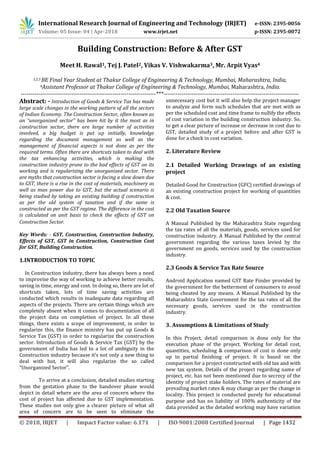
2.1 Detailed Working Drawings of an existing
project
Detailed Good for Construction (GFC) certified drawings of
an existing construction project for working of quantities
& cost.
2.2 Old Taxation Source
A Manual Published by the Maharashtra State regarding
the tax rates of all the materials, goods, services used for
construction industry. A Manual Published by the central
government regarding the various taxes levied by the
government on goods, services used by the construction
industry.
2.3 Goods & Service Tax Rate Source
Android Application named GST Rate Finder provided by
the government for the betterment of consumers to avoid
being cheated by any means. A Manual Published by the
Maharashtra State Government for the tax rates of all the
necessary goods, services used in the construction
industry.
3. Assumptions & Limitations of Study
In this Project, detail comparison is done only for the
execution phase of the project. Working for detail cost,
quantities, scheduling & comparison of cost is done only
up to partial finishing of project. It is based on the
comparison for a project constructed with old tax and with
new tax system. Details of the project regarding name of
project, etc. has not been mentioned due to secrecy of the
identity of project stake holders. The rates of material are
prevailing market rates & may change as per the change in
locality. This project is conducted purely for educational
purpose and has no liability of 100% authenticity of the
data provided as the detailed working may have variation
International Research Journal of Engineering and Technology (IRJET) e-ISSN: 2395-0056
Volume: 05 Issue: 04 | Apr-2018 www.irjet.net p-ISSN: 2395-0072
© 2018, IRJET | Impact Factor value: 6.171 | ISO 9001:2008 Certified Journal | Page 1433
with the location of project. Input Tax Credit (ITC) which
is an accounting term is not taken in consideration as its
out of scope of engineering studies.
4. Relevance of Topic & Need of GST Study for
Civil Engineers
Construction industry comes under the Industry Sector
out of the three sectors of Indian Economy. As it is a
known fact that India is one of the fastest growing
economy, there is lot of infrastructure development going
on in the country to constantly grow at this faster rate of
growth in the range of 6-7%. In the second quarter of
2017, growth rate of Indian Economy was at 7.2% which
surpassed China too. Contribution of industrial sector to
GDP is 29% of the total GDP. In this 29%, construction
industry contributes to 11% of the industry sector. This
seems to be a big digit when it comes to revenue
generation of the nation. Even the latest annual budget has
given due importance to the infrastructure development
as a country is said to be developed if it has the best
infrastructure facilities which invites other sectors,
leading to generation of revenue and growth of country.
While talking about the employment generation,
industry sector is occupying 22% of the labour force of the
country. Whereas the construction sector is the 2nd largest
employer after the agricultural sector. So, due to
implementation of GST, naturally the construction
industry would suffer.
It is often wondered that how does it concern for a Civil
Engineer to study the GST impact, for the same following
points can be stated for which a Civil Engineer needs to
study GST & it’s consequences in construction sector: -
High Initial Investing Sector.
Contractor’s Relied on Labour’s.
Service Charges.
Machinery Cost.
Material Cost.
Man Power Cost.
Rate of Interest on Borrowings.
Labour Contracts Turn Dicey.
Transparency of Tax Reforms.
No Scope of Cheat.
Organising the Unorganised Sector.
Project Planning, Scheduling & Budgeting.
5. Methodology Adopted
To begin with, an existing project is selected & all the
detailed plans are obtained from the project site. Detailed
working of Quantity, Time & Cost is done for the Project by
Conducting the study up to Partial Finishing.
Process of Working on the Project is as follows: -
Plan Study & Analysis.
Quantity Surveying & Estimation.
Documentation of the Quantities.
Project Planning & Scheduling.
Daily Project Report Analysis.
Rate Analysis of all items of Project.
Finding Tax Rates & Their Breakup.
Working Out for Area Statement.
Documentation of Quantities in BOQ.
Working out cost of all items.
Arriving with comparative results.
5. Data Analysis, Documentation & Interpretation
5.1 Project Details
1 Plot Area: - 588.86 m2.
2 Location: - Goregaon (West).
3 No of Flats Per floor: - 4 flats, in all 28 flats.
4 Project Type: - Redevelopment Project.
5 Ground Floor Stilt Parking.
6 Construction Built-Up Area: - 2283.762 m2.
7 Built-Up Area by BMC: - 1459.991 m2.
8 Floor Area: - 2339.470 m2.
9 Approximate Project Duration: - 2years.
Chart 1: Project Details
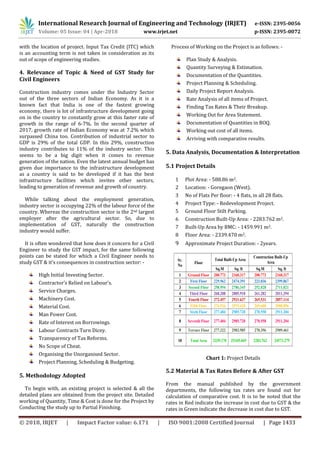
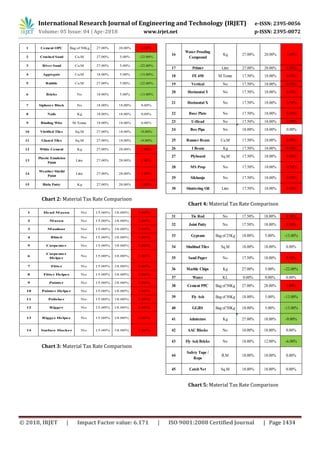
5.2 Material & Tax Rates Before & After GST
From the manual published by the government
departments, the following tax rates are found out for
calculation of comparative cost. It is to be noted that the
rates in Red indicate the increase in cost due to GST & the
rates in Green indicate the decrease in cost due to GST.
Sr.
No
Floor
Total Built-Up Area
Construction Built-Up
Area
Sq.M Sq. ft Sq.M Sq. ft
1 Ground Floor 200.773 2160.317 200.773 2160.317
2 First Floor 229.962 2474.391 223.036 2399.867
3 Second Floor 258.954 2786.345 252.028 2711.821
4 Third Floor 268.208 2885.918 261.282 2811.394
5 Fourth Floor 272.457 2931.637 265.531 2857.114
6 Fifth Floor 276.526 2975.420 269.600 2900.896
7 Sixth Floor 277.484 2985.728 270.558 2911.204
8 Seventh Floor 277.484 2985.728 270.558 2911.204
9 Terrace Floor 277.322 2983.985 270.396 2909.461
10 Total Area 2339.170 25169.469 2283.762 24573.279
International Research Journal of Engineering and Technology (IRJET) e-ISSN: 2395-0056
Volume: 05 Issue: 04 | Apr-2018 www.irjet.net p-ISSN: 2395-0072
© 2018, IRJET | Impact Factor value: 6.171 | ISO 9001:2008 Certified Journal | Page 1434
Chart 2: Material Tax Rate Comparison
Chart 3: Material Tax Rate Comparison
Chart 4: Material Tax Rate Comparison
Chart 5: Material Tax Rate Comparison
1 Cement OPC Bag of 50Kg 27.00% 28.00% 1.00%
2 Crushed Sand Cu.M 27.00% 5.00% -22.00%
3 River Sand Cu.M 27.00% 5.00% -22.00%
4 Aggregate Cu.M 18.00% 5.00% -13.00%
5 Rubble Cu.M 27.00% 5.00% -22.00%
6 Bricks No 18.00% 5.00% -13.00%
7 Siphorex Block No 18.00% 18.00% 0.00%
8 Nails Kg 18.00% 18.00% 0.00%
9 Binding Wire M.Tonne 18.00% 18.00% 0.00%
10 Vitrified Tiles Sq.M 27.00% 18.00% -9.00%
11 Glazed Tiles Sq.M 27.00% 18.00% -9.00%
12 White Cement Kg 27.00% 28.00% 1.00%
13
Plastic Emulsion
Paint
Litre 27.00% 28.00% 1.00%
14
Weather Sheild
Paint
Litre 27.00% 28.00% 1.00%
15 Birla Putty Kg 27.00% 28.00% 1.00%
1 Head Mason No 15.00% 18.00% 3.00%
2 Mason No 15.00% 18.00% 3.00%
3 Mazdoor No 15.00% 18.00% 3.00%
4 Bhisti No 15.00% 18.00% 3.00%
5 Carpenter No 15.00% 18.00% 3.00%
6
Carpenter
Helper
No 15.00% 18.00% 3.00%
7 Fitter No 15.00% 18.00% 3.00%
8 Fitter Helper No 15.00% 18.00% 3.00%
9 Painter No 15.00% 18.00% 3.00%
10 Painter Helper No 15.00% 18.00% 3.00%
11 Polisher No 15.00% 18.00% 3.00%
12 Rigger No 15.00% 18.00% 3.00%
13 Rigger Helper No 15.00% 18.00% 3.00%
14 Surface Hacker No 15.00% 18.00% 3.00%
16
Water Proofing
Compound
Kg 27.00% 28.00% 1.00%
17 Primer Litre 27.00% 28.00% 1.00%
18 FE 450 M.Tonne 17.50% 18.00% 0.50%
19 Vertical No 17.50% 18.00% 0.50%
20 Horizontal Y No 17.50% 18.00% 0.50%
21 Horizontal X No 17.50% 18.00% 0.50%
22 Base Plate No 17.50% 18.00% 0.50%
23 U-Head No 17.50% 18.00% 0.50%
24 Box Pipe No 18.00% 18.00% 0.00%
25 Runner Beam Cu.M 17.50% 18.00% 0.50%
26 I Beam Kg 17.50% 18.00% 0.50%
27 Plyboard Sq.M 17.50% 18.00% 0.50%
28 MS Prop No 17.50% 18.00% 0.50%
29 Sikhanja No 17.50% 18.00% 0.50%
30 Shuttering Oil Litre 17.50% 18.00% 0.50%
31 Tie Rod No 17.50% 18.00% 0.50%
32 Joint Putty No 17.50% 18.00% 0.50%
33 Gypsum Bag of 25Kg 18.00% 5.00% -13.00%
34 Shahbad Tiles Sq.M 18.00% 18.00% 0.00%
35 Sand Paper No 17.50% 18.00% 0.50%
36 Marble Chips Kg 27.00% 5.00% -22.00%
37 Water KL 0.00% 0.00% 0.00%
38 Cement PPC Bag of 50Kg 27.00% 28.00% 1.00%
39 Fly Ash Bag of 50Kg 18.00% 5.00% -13.00%
40 GGBS Bag of 50Kg 18.00% 5.00% -13.00%
41 Admixture Kg 27.00% 18.00% -9.00%
42 AAC Blocks No 18.00% 18.00% 0.00%
43 Fly Ash Bricks No 18.00% 12.00% -6.00%
44
Safety Tape /
Rope
R.M 18.00% 18.00% 0.00%
45 Catch Net Sq.M 18.00% 18.00% 0.00%
International Research Journal of Engineering and Technology (IRJET) e-ISSN: 2395-0056
Volume: 05 Issue: 04 | Apr-2018 www.irjet.net p-ISSN: 2395-0072
© 2018, IRJET | Impact Factor value: 6.171 | ISO 9001:2008 Certified Journal | Page 1435
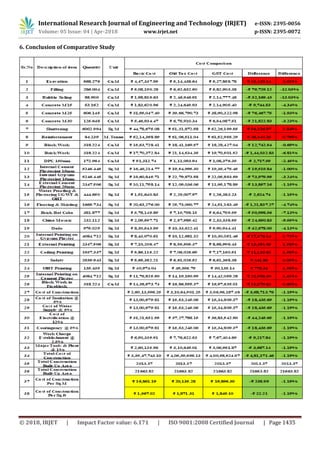
6. Conclusion of Comparative Study
International Research Journal of Engineering and Technology (IRJET) e-ISSN: 2395-0056
Volume: 05 Issue: 04 | Apr-2018 www.irjet.net p-ISSN: 2395-0072
© 2018, IRJET | Impact Factor value: 6.171 | ISO 9001:2008 Certified Journal | Page 1436
It can be easily observed from the above calculations that
even though ITC is not taken in consideration, there has
been a considerable reduction of up to 1.2% of the Project
Cost by application of GST. If the ITC studies are taken in
consideration, then this cost will reduce even more &
hence, it can be said that it is a good effect of GST on
construction industry. It is also seen that only the Labour
Contracts are at total loss which is to be paid attention by
the contractors bidding for labour contract.
7. ACKNOWLEDGEMENT
This work has been performed in Thakur College
of Engineering, Mumbai, India. The authors of this paper
thanks Prof. Pratibha Singh, Prof. Chaitali Mehta and Prof.
Swapnil Raut for the helpful discussions & guide us in
analysis while carrying out this work.
8. REFERENCES
[1] GST: An economic overview: Challenges and Impact
Ahead IRJET Vol 4 Issue 4 Apr-17.
[2] GST- A Game Changer in Indian Tax Structure IOSR
JBM
[3] Planning, Scheduling and tracking of residential
project using primavera IJARCSMS Vol 3 Issue 5 May-
15.
[4] A Benefit Study of Petroleum Inclusion in GST Bill St.
Joseph’s College of Commerce Bangalore.
[5] An overview of GST – Reduction of Tax Burden St.
Joseph’s College of Commerce Bangalore.
[6] First Discussion Paper on GST in India Empowered
Committee of State Finance, New Delhi.

IRJET- Building Construction: Before & After GST

  • 1.
    International Research Journalof Engineering and Technology (IRJET) e-ISSN: 2395-0056 Volume: 05 Issue: 04 | Apr-2018 www.irjet.net p-ISSN: 2395-0072 © 2018, IRJET | Impact Factor value: 6.171 | ISO 9001:2008 Certified Journal | Page 1432 Building Construction: Before & After GST Meet H. Rawal1, Tej J. Patel2, Vikas V. Vishwakarma3, Mr. Arpit Vyas4 1,2,3 BE Final Year Student at Thakur College of Engineering & Technology, Mumbai, Maharashtra, India, 4Assistant Professor at Thakur College of Engineering & Technology, Mumbai, Maharashtra, India. ---------------------------------------------------------------------***--------------------------------------------------------------------- Abstract: - Introduction of Goods & Service Tax has made large scale changes in the working pattern of all the sectors of Indian Economy. The Construction Sector, often known as an “unorganized sector” has been hit by it the most as in construction sector, there are large number of activities involved, a big budget is put up initially, knowledge regarding the document management as well as the management of financial aspects is not done as per the required terms. Often there are shortcuts taken to deal with the tax enhancing activities, which is making the construction industry prone to the bad effects of GST on its working and is regularizing the unorganized sector. There are myths that construction sector is facing a slow down due to GST, there is a rise in the cost of materials, machinery as well as man power due to GST, but the actual scenario is being studied by taking an existing building if construction as per the old system of taxation and if the same is constructed as per the GST regime. The difference in the cost is calculated on unit basis to check the effects of GST on Construction Sector. Key Words: - GST, Construction, Construction Industry, Effects of GST, GST in Construction, Construction Cost for GST, Building Construction. 1.INTRODUCTION TO TOPIC In Construction industry, there has always been a need to improvise the way of working to achieve better results, saving in time, energy and cost. In doing so, there are lot of shortcuts taken, lots of time saving activities are conducted which results in inadequate data regarding all aspects of the projects. There are certain things which are completely absent when it comes to documentation of all the project data on completion of project. In all these things, there exists a scope of improvement, in order to regularize this, the finance ministry has put up Goods & Service Tax (GST) in order to regularize the construction sector. Introduction of Goods & Service Tax (GST) by the government of India has led to a lot of ambiguity in the Construction industry because it’s not only a new thing to deal with but, it will also regularize the so called “Unorganized Sector”. To arrive at a conclusion, detailed studies starting from the gestation phase to the handover phase would depict in detail where are the area of concern where the cost of project has affected due to GST implementation. These studies not only give a clearer picture of what all area of concern are to be seen to eliminate the unnecessary cost but it will also help the project manager to analyze and form such schedules that are met with as per the scheduled cost and time frame to nullify the effects of cost variation in the building construction industry. So, to get a clear picture of increase or decrease in cost due to GST, detailed study of a project before and after GST is done for a check in cost variation. 2. Literature Review 2.1 Detailed Working Drawings of an existing project Detailed Good for Construction (GFC) certified drawings of an existing construction project for working of quantities & cost. 2.2 Old Taxation Source A Manual Published by the Maharashtra State regarding the tax rates of all the materials, goods, services used for construction industry. A Manual Published by the central government regarding the various taxes levied by the government on goods, services used by the construction industry. 2.3 Goods & Service Tax Rate Source Android Application named GST Rate Finder provided by the government for the betterment of consumers to avoid being cheated by any means. A Manual Published by the Maharashtra State Government for the tax rates of all the necessary goods, services used in the construction industry. 3. Assumptions & Limitations of Study In this Project, detail comparison is done only for the execution phase of the project. Working for detail cost, quantities, scheduling & comparison of cost is done only up to partial finishing of project. It is based on the comparison for a project constructed with old tax and with new tax system. Details of the project regarding name of project, etc. has not been mentioned due to secrecy of the identity of project stake holders. The rates of material are prevailing market rates & may change as per the change in locality. This project is conducted purely for educational purpose and has no liability of 100% authenticity of the data provided as the detailed working may have variation
  • 2.
    International Research Journalof Engineering and Technology (IRJET) e-ISSN: 2395-0056 Volume: 05 Issue: 04 | Apr-2018 www.irjet.net p-ISSN: 2395-0072 © 2018, IRJET | Impact Factor value: 6.171 | ISO 9001:2008 Certified Journal | Page 1433 with the location of project. Input Tax Credit (ITC) which is an accounting term is not taken in consideration as its out of scope of engineering studies. 4. Relevance of Topic & Need of GST Study for Civil Engineers Construction industry comes under the Industry Sector out of the three sectors of Indian Economy. As it is a known fact that India is one of the fastest growing economy, there is lot of infrastructure development going on in the country to constantly grow at this faster rate of growth in the range of 6-7%. In the second quarter of 2017, growth rate of Indian Economy was at 7.2% which surpassed China too. Contribution of industrial sector to GDP is 29% of the total GDP. In this 29%, construction industry contributes to 11% of the industry sector. This seems to be a big digit when it comes to revenue generation of the nation. Even the latest annual budget has given due importance to the infrastructure development as a country is said to be developed if it has the best infrastructure facilities which invites other sectors, leading to generation of revenue and growth of country. While talking about the employment generation, industry sector is occupying 22% of the labour force of the country. Whereas the construction sector is the 2nd largest employer after the agricultural sector. So, due to implementation of GST, naturally the construction industry would suffer. It is often wondered that how does it concern for a Civil Engineer to study the GST impact, for the same following points can be stated for which a Civil Engineer needs to study GST & it’s consequences in construction sector: - High Initial Investing Sector. Contractor’s Relied on Labour’s. Service Charges. Machinery Cost. Material Cost. Man Power Cost. Rate of Interest on Borrowings. Labour Contracts Turn Dicey. Transparency of Tax Reforms. No Scope of Cheat. Organising the Unorganised Sector. Project Planning, Scheduling & Budgeting. 5. Methodology Adopted To begin with, an existing project is selected & all the detailed plans are obtained from the project site. Detailed working of Quantity, Time & Cost is done for the Project by Conducting the study up to Partial Finishing. Process of Working on the Project is as follows: - Plan Study & Analysis. Quantity Surveying & Estimation. Documentation of the Quantities. Project Planning & Scheduling. Daily Project Report Analysis. Rate Analysis of all items of Project. Finding Tax Rates & Their Breakup. Working Out for Area Statement. Documentation of Quantities in BOQ. Working out cost of all items. Arriving with comparative results. 5. Data Analysis, Documentation & Interpretation 5.1 Project Details 1 Plot Area: - 588.86 m2. 2 Location: - Goregaon (West). 3 No of Flats Per floor: - 4 flats, in all 28 flats. 4 Project Type: - Redevelopment Project. 5 Ground Floor Stilt Parking. 6 Construction Built-Up Area: - 2283.762 m2. 7 Built-Up Area by BMC: - 1459.991 m2. 8 Floor Area: - 2339.470 m2. 9 Approximate Project Duration: - 2years. Chart 1: Project Details 5.2 Material & Tax Rates Before & After GST From the manual published by the government departments, the following tax rates are found out for calculation of comparative cost. It is to be noted that the rates in Red indicate the increase in cost due to GST & the rates in Green indicate the decrease in cost due to GST. Sr. No Floor Total Built-Up Area Construction Built-Up Area Sq.M Sq. ft Sq.M Sq. ft 1 Ground Floor 200.773 2160.317 200.773 2160.317 2 First Floor 229.962 2474.391 223.036 2399.867 3 Second Floor 258.954 2786.345 252.028 2711.821 4 Third Floor 268.208 2885.918 261.282 2811.394 5 Fourth Floor 272.457 2931.637 265.531 2857.114 6 Fifth Floor 276.526 2975.420 269.600 2900.896 7 Sixth Floor 277.484 2985.728 270.558 2911.204 8 Seventh Floor 277.484 2985.728 270.558 2911.204 9 Terrace Floor 277.322 2983.985 270.396 2909.461 10 Total Area 2339.170 25169.469 2283.762 24573.279
  • 3.
    International Research Journalof Engineering and Technology (IRJET) e-ISSN: 2395-0056 Volume: 05 Issue: 04 | Apr-2018 www.irjet.net p-ISSN: 2395-0072 © 2018, IRJET | Impact Factor value: 6.171 | ISO 9001:2008 Certified Journal | Page 1434 Chart 2: Material Tax Rate Comparison Chart 3: Material Tax Rate Comparison Chart 4: Material Tax Rate Comparison Chart 5: Material Tax Rate Comparison 1 Cement OPC Bag of 50Kg 27.00% 28.00% 1.00% 2 Crushed Sand Cu.M 27.00% 5.00% -22.00% 3 River Sand Cu.M 27.00% 5.00% -22.00% 4 Aggregate Cu.M 18.00% 5.00% -13.00% 5 Rubble Cu.M 27.00% 5.00% -22.00% 6 Bricks No 18.00% 5.00% -13.00% 7 Siphorex Block No 18.00% 18.00% 0.00% 8 Nails Kg 18.00% 18.00% 0.00% 9 Binding Wire M.Tonne 18.00% 18.00% 0.00% 10 Vitrified Tiles Sq.M 27.00% 18.00% -9.00% 11 Glazed Tiles Sq.M 27.00% 18.00% -9.00% 12 White Cement Kg 27.00% 28.00% 1.00% 13 Plastic Emulsion Paint Litre 27.00% 28.00% 1.00% 14 Weather Sheild Paint Litre 27.00% 28.00% 1.00% 15 Birla Putty Kg 27.00% 28.00% 1.00% 1 Head Mason No 15.00% 18.00% 3.00% 2 Mason No 15.00% 18.00% 3.00% 3 Mazdoor No 15.00% 18.00% 3.00% 4 Bhisti No 15.00% 18.00% 3.00% 5 Carpenter No 15.00% 18.00% 3.00% 6 Carpenter Helper No 15.00% 18.00% 3.00% 7 Fitter No 15.00% 18.00% 3.00% 8 Fitter Helper No 15.00% 18.00% 3.00% 9 Painter No 15.00% 18.00% 3.00% 10 Painter Helper No 15.00% 18.00% 3.00% 11 Polisher No 15.00% 18.00% 3.00% 12 Rigger No 15.00% 18.00% 3.00% 13 Rigger Helper No 15.00% 18.00% 3.00% 14 Surface Hacker No 15.00% 18.00% 3.00% 16 Water Proofing Compound Kg 27.00% 28.00% 1.00% 17 Primer Litre 27.00% 28.00% 1.00% 18 FE 450 M.Tonne 17.50% 18.00% 0.50% 19 Vertical No 17.50% 18.00% 0.50% 20 Horizontal Y No 17.50% 18.00% 0.50% 21 Horizontal X No 17.50% 18.00% 0.50% 22 Base Plate No 17.50% 18.00% 0.50% 23 U-Head No 17.50% 18.00% 0.50% 24 Box Pipe No 18.00% 18.00% 0.00% 25 Runner Beam Cu.M 17.50% 18.00% 0.50% 26 I Beam Kg 17.50% 18.00% 0.50% 27 Plyboard Sq.M 17.50% 18.00% 0.50% 28 MS Prop No 17.50% 18.00% 0.50% 29 Sikhanja No 17.50% 18.00% 0.50% 30 Shuttering Oil Litre 17.50% 18.00% 0.50% 31 Tie Rod No 17.50% 18.00% 0.50% 32 Joint Putty No 17.50% 18.00% 0.50% 33 Gypsum Bag of 25Kg 18.00% 5.00% -13.00% 34 Shahbad Tiles Sq.M 18.00% 18.00% 0.00% 35 Sand Paper No 17.50% 18.00% 0.50% 36 Marble Chips Kg 27.00% 5.00% -22.00% 37 Water KL 0.00% 0.00% 0.00% 38 Cement PPC Bag of 50Kg 27.00% 28.00% 1.00% 39 Fly Ash Bag of 50Kg 18.00% 5.00% -13.00% 40 GGBS Bag of 50Kg 18.00% 5.00% -13.00% 41 Admixture Kg 27.00% 18.00% -9.00% 42 AAC Blocks No 18.00% 18.00% 0.00% 43 Fly Ash Bricks No 18.00% 12.00% -6.00% 44 Safety Tape / Rope R.M 18.00% 18.00% 0.00% 45 Catch Net Sq.M 18.00% 18.00% 0.00%
  • 4.
    International Research Journalof Engineering and Technology (IRJET) e-ISSN: 2395-0056 Volume: 05 Issue: 04 | Apr-2018 www.irjet.net p-ISSN: 2395-0072 © 2018, IRJET | Impact Factor value: 6.171 | ISO 9001:2008 Certified Journal | Page 1435 6. Conclusion of Comparative Study
  • 5.
    International Research Journalof Engineering and Technology (IRJET) e-ISSN: 2395-0056 Volume: 05 Issue: 04 | Apr-2018 www.irjet.net p-ISSN: 2395-0072 © 2018, IRJET | Impact Factor value: 6.171 | ISO 9001:2008 Certified Journal | Page 1436 It can be easily observed from the above calculations that even though ITC is not taken in consideration, there has been a considerable reduction of up to 1.2% of the Project Cost by application of GST. If the ITC studies are taken in consideration, then this cost will reduce even more & hence, it can be said that it is a good effect of GST on construction industry. It is also seen that only the Labour Contracts are at total loss which is to be paid attention by the contractors bidding for labour contract. 7. ACKNOWLEDGEMENT This work has been performed in Thakur College of Engineering, Mumbai, India. The authors of this paper thanks Prof. Pratibha Singh, Prof. Chaitali Mehta and Prof. Swapnil Raut for the helpful discussions & guide us in analysis while carrying out this work. 8. REFERENCES [1] GST: An economic overview: Challenges and Impact Ahead IRJET Vol 4 Issue 4 Apr-17. [2] GST- A Game Changer in Indian Tax Structure IOSR JBM [3] Planning, Scheduling and tracking of residential project using primavera IJARCSMS Vol 3 Issue 5 May- 15. [4] A Benefit Study of Petroleum Inclusion in GST Bill St. Joseph’s College of Commerce Bangalore. [5] An overview of GST – Reduction of Tax Burden St. Joseph’s College of Commerce Bangalore. [6] First Discussion Paper on GST in India Empowered Committee of State Finance, New Delhi.