Hydrogen
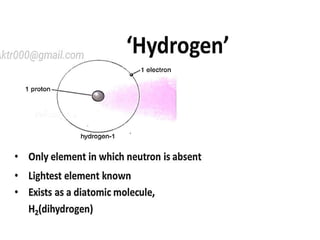
Hydrogen is Diatomic [H2] Why?
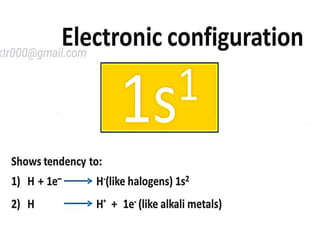
1. Hydrogen having one electron in its
valence shell (E.C-1s1).
2. to attain stability, hydrogen has to have
two electrons so that it can complete it's
duplet.
3. therefore, it shares its single electron
with other H-atom to achieve stable inert
gas configuration of He.
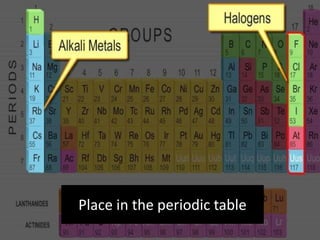
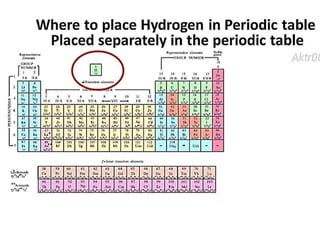
Place in the periodic table
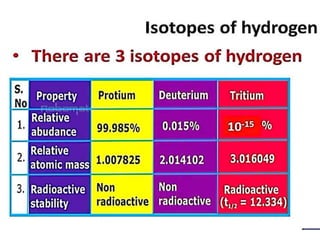
hydrogen
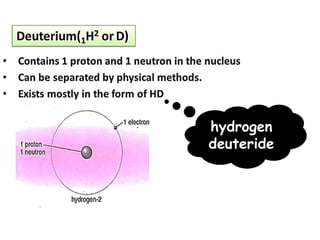
deuteride
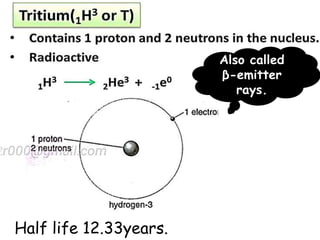
Also called
β-emitter
rays.
Half life 12.33years.
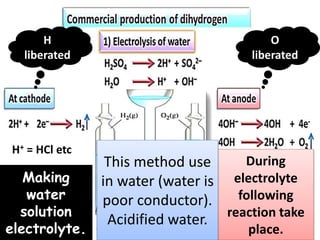
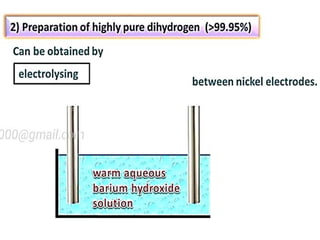
Making
water
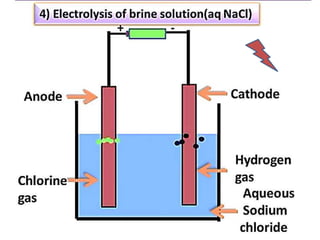
solution
electrolyte.
H
liberated
O
liberated
H+ = HCl etc
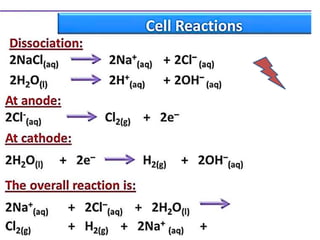
During
electrolyte
following
reaction take
place.
This method use
in water (water is
poor conductor).
Acidified water.
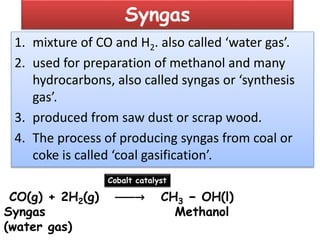
Syngas
1. mixture of CO and H2. also called ‘water gas’.
2. used for preparation of methanol and many
hydrocarbons, also called syngas or ‘synthesis
gas’.
3. produced from saw dust or scrap wood.
4. The process of producing syngas from coal or
coke is called ‘coal gasification’.
CO(g) + 2H2(g) ⎯⎯⎯→ CH3 − OH(l)
Syngas Methanol
(water gas)
Cobalt catalyst
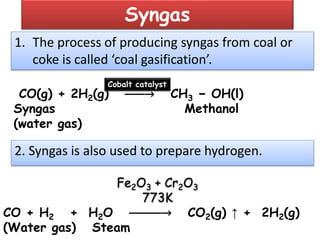
Syngas
1. The process of producing syngas from coal or
coke is called ‘coal gasification’.
CO(g) + 2H2(g) ⎯⎯⎯→ CH3 − OH(l)
Syngas Methanol
(water gas)
Cobalt catalyst
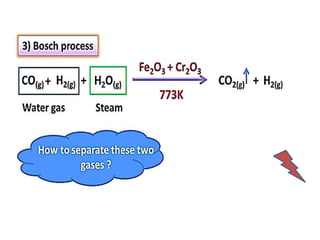
2. Syngas is also used to prepare hydrogen.
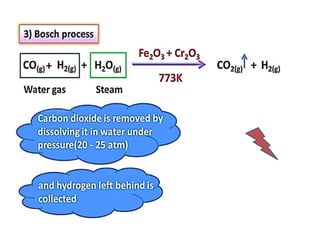
CO + H2 + H2O ⎯⎯⎯⎯⎯→ CO2(g) ↑ + 2H2(g)
(Water gas) Steam
Fe2O3 + Cr2O3
773K
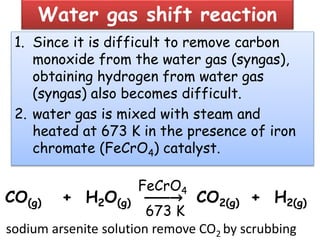
Water gas shift reaction
1. Since it is difficult to remove carbon
monoxide from the water gas (syngas),
obtaining hydrogen from water gas
(syngas) also becomes difficult.
2. water gas is mixed with steam and
heated at 673 K in the presence of iron
chromate (FeCrO4) catalyst.
CO(g) + H2O(g) ⎯⎯⎯→ CO2(g) + H2(g)
FeCrO4
673 K
sodium arsenite solution remove CO2 by scrubbing
Chemical reactivity of dihydrogen
1. Chemical reaction take place when H-H
bond break.
2. The bond dissociation(Break)
enthalpy(energy) of H−H bond is very high
(435.88 kJmol−1 at 298 K).
3. Due to high bond enthalpy, not reactive at
R.T.
4. at high T or presence of catalysts,
hydrogen break combines with metals and
non-metals to form corresponding
hydrides.
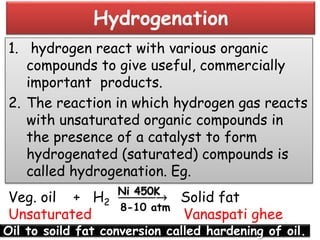
Hydrogenation
1. hydrogen react with various organic
compounds to give useful, commercially
important products.
2. The reaction in which hydrogen gas reacts
with unsaturated organic compounds in
the presence of a catalyst to form
hydrogenated (saturated) compounds is
called hydrogenation. Eg.
Veg. oil + H2 ⎯⎯⎯⎯⎯→ Solid fat
Unsaturated Vanaspati ghee
Ni 450K
8-10 atm
Oil to soild fat conversion called hardening of oil.
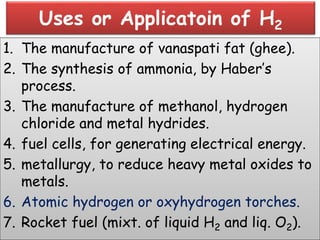
Uses or Applicatoin of H2
1. The manufacture of vanaspati fat (ghee).
2. The synthesis of ammonia, by Haber’s
process.
3. The manufacture of methanol, hydrogen
chloride and metal hydrides.
4. fuel cells, for generating electrical energy.
5. metallurgy, to reduce heavy metal oxides to
metals.
6. Atomic hydrogen or oxyhydrogen torches.
7. Rocket fuel (mixt. of liquid H2 and liq. O2).
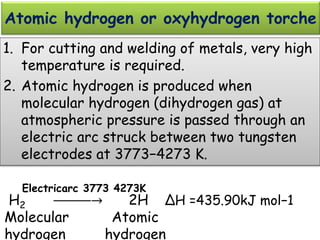
Atomic hydrogen or oxyhydrogen torche
1. For cutting and welding of metals, very high
temperature is required.
2. Atomic hydrogen is produced when
molecular hydrogen (dihydrogen gas) at
atmospheric pressure is passed through an
electric arc struck between two tungsten
electrodes at 3773−4273 K.
H2 ⎯⎯⎯⎯⎯→ 2H ∆H =435.90kJ mol−1
Molecular Atomic
hydrogen hydrogen
Electricarc 3773 4273K
Atomic hydrogen or oxyhydrogen torche
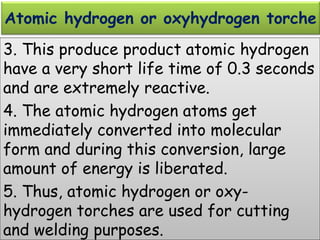
3. This produce product atomic hydrogen
have a very short life time of 0.3 seconds
and are extremely reactive.
4. The atomic hydrogen atoms get
immediately converted into molecular
form and during this conversion, large
amount of energy is liberated.
5. Thus, atomic hydrogen or oxy-
hydrogen torches are used for cutting
and welding purposes.
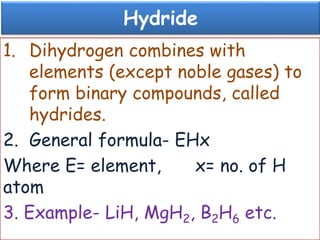
Hydride
1. Dihydrogen combines with
elements (except noble gases) to
form binary compounds, called
hydrides.
2. General formula- EHx
Where E= element, x= no. of H
atom
3. Example- LiH, MgH2, B2H6 etc.
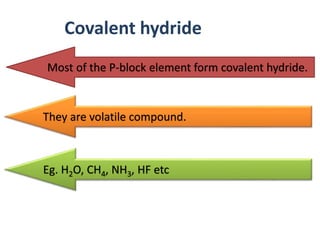
Covalent hydride
Most of the P-block element form covalent hydride.
They are volatile compound.
Eg. H2O, CH4, NH3, HF etc
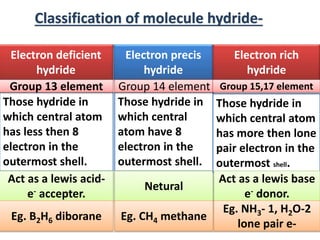
Electron deficient
hydride
Those hydride in
which central atom
has less then 8
electron in the
outermost shell.
Group 13 element
Act as a lewis acid-
e- accepter.
Eg. B2H6 diborane
Electron precis
hydride
Those hydride in
which central
atom have 8
electron in the
outermost shell.
Group 14 element
Netural
Eg. CH4 methane
Electron rich
hydride
Those hydride in
which central atom
has more then lone
pair electron in the
outermost shell.
Group 15,17 element
Act as a lewis base
e- donor.
Eg. NH3- 1, H2O-2
lone pair e-
Classification of molecule hydride-
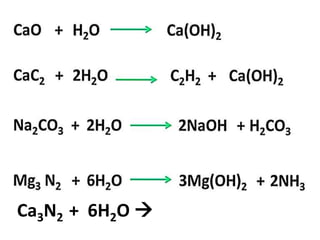
Ca3N2 + 6H2O 
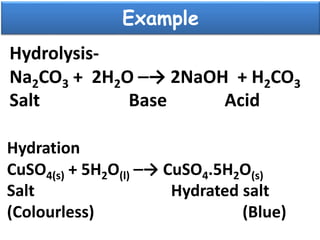
Example
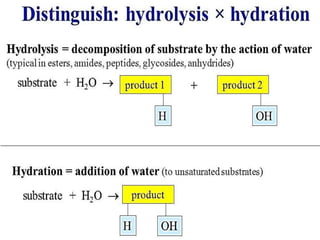
Hydrolysis-
Na2CO3 + 2H2O ⎯→ 2NaOH + H2CO3
Salt Base Acid
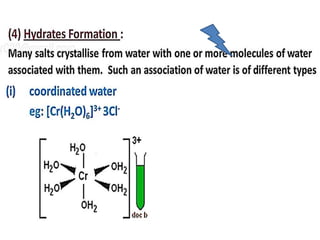
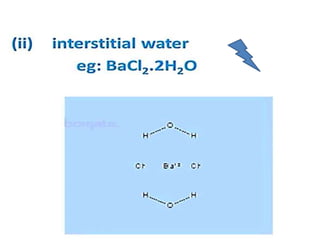
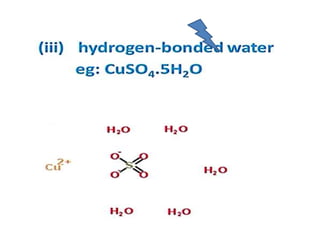
Hydration
CuSO4(s) + 5H2O(l) ⎯→ CuSO4.5H2O(s)
Salt Hydrated salt
(Colourless) (Blue)
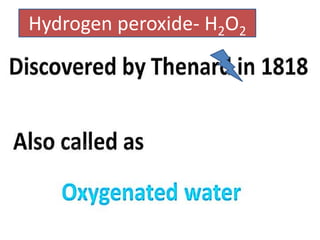
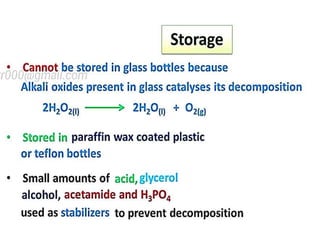
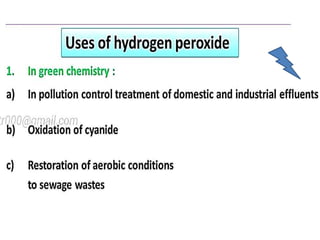
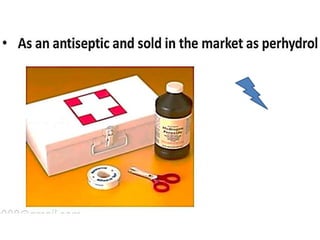
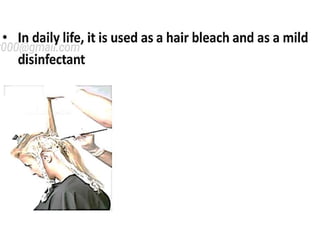
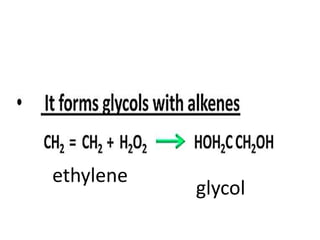
Hydrogen peroxide- H2O2
glycol
ethylene
Hydrogen 2017
Hydrogen 2017

Hydrogen 2017

  • 1.
  • 4.
    Hydrogen is Diatomic[H2] Why? 1. Hydrogen having one electron in its valence shell (E.C-1s1). 2. to attain stability, hydrogen has to have two electrons so that it can complete it's duplet. 3. therefore, it shares its single electron with other H-atom to achieve stable inert gas configuration of He.
  • 5.
    Place in theperiodic table
  • 18.
  • 19.
  • 25.
    Making water solution electrolyte. H liberated O liberated H+ = HCletc During electrolyte following reaction take place. This method use in water (water is poor conductor). Acidified water.
  • 26.
    Syngas 1. mixture ofCO and H2. also called ‘water gas’. 2. used for preparation of methanol and many hydrocarbons, also called syngas or ‘synthesis gas’. 3. produced from saw dust or scrap wood. 4. The process of producing syngas from coal or coke is called ‘coal gasification’. CO(g) + 2H2(g) ⎯⎯⎯→ CH3 − OH(l) Syngas Methanol (water gas) Cobalt catalyst
  • 27.
    Syngas 1. The processof producing syngas from coal or coke is called ‘coal gasification’. CO(g) + 2H2(g) ⎯⎯⎯→ CH3 − OH(l) Syngas Methanol (water gas) Cobalt catalyst 2. Syngas is also used to prepare hydrogen. CO + H2 + H2O ⎯⎯⎯⎯⎯→ CO2(g) ↑ + 2H2(g) (Water gas) Steam Fe2O3 + Cr2O3 773K
  • 28.
    Water gas shiftreaction 1. Since it is difficult to remove carbon monoxide from the water gas (syngas), obtaining hydrogen from water gas (syngas) also becomes difficult. 2. water gas is mixed with steam and heated at 673 K in the presence of iron chromate (FeCrO4) catalyst. CO(g) + H2O(g) ⎯⎯⎯→ CO2(g) + H2(g) FeCrO4 673 K sodium arsenite solution remove CO2 by scrubbing
  • 29.
    Chemical reactivity ofdihydrogen 1. Chemical reaction take place when H-H bond break. 2. The bond dissociation(Break) enthalpy(energy) of H−H bond is very high (435.88 kJmol−1 at 298 K). 3. Due to high bond enthalpy, not reactive at R.T. 4. at high T or presence of catalysts, hydrogen break combines with metals and non-metals to form corresponding hydrides.
  • 30.
    Hydrogenation 1. hydrogen reactwith various organic compounds to give useful, commercially important products. 2. The reaction in which hydrogen gas reacts with unsaturated organic compounds in the presence of a catalyst to form hydrogenated (saturated) compounds is called hydrogenation. Eg. Veg. oil + H2 ⎯⎯⎯⎯⎯→ Solid fat Unsaturated Vanaspati ghee Ni 450K 8-10 atm Oil to soild fat conversion called hardening of oil.
  • 39.
    Uses or Applicatoinof H2 1. The manufacture of vanaspati fat (ghee). 2. The synthesis of ammonia, by Haber’s process. 3. The manufacture of methanol, hydrogen chloride and metal hydrides. 4. fuel cells, for generating electrical energy. 5. metallurgy, to reduce heavy metal oxides to metals. 6. Atomic hydrogen or oxyhydrogen torches. 7. Rocket fuel (mixt. of liquid H2 and liq. O2).
  • 40.
    Atomic hydrogen oroxyhydrogen torche 1. For cutting and welding of metals, very high temperature is required. 2. Atomic hydrogen is produced when molecular hydrogen (dihydrogen gas) at atmospheric pressure is passed through an electric arc struck between two tungsten electrodes at 3773−4273 K. H2 ⎯⎯⎯⎯⎯→ 2H ∆H =435.90kJ mol−1 Molecular Atomic hydrogen hydrogen Electricarc 3773 4273K
  • 41.
    Atomic hydrogen oroxyhydrogen torche 3. This produce product atomic hydrogen have a very short life time of 0.3 seconds and are extremely reactive. 4. The atomic hydrogen atoms get immediately converted into molecular form and during this conversion, large amount of energy is liberated. 5. Thus, atomic hydrogen or oxy- hydrogen torches are used for cutting and welding purposes.
  • 42.
    Hydride 1. Dihydrogen combineswith elements (except noble gases) to form binary compounds, called hydrides. 2. General formula- EHx Where E= element, x= no. of H atom 3. Example- LiH, MgH2, B2H6 etc.
  • 47.
    Covalent hydride Most ofthe P-block element form covalent hydride. They are volatile compound. Eg. H2O, CH4, NH3, HF etc
  • 48.
    Electron deficient hydride Those hydridein which central atom has less then 8 electron in the outermost shell. Group 13 element Act as a lewis acid- e- accepter. Eg. B2H6 diborane Electron precis hydride Those hydride in which central atom have 8 electron in the outermost shell. Group 14 element Netural Eg. CH4 methane Electron rich hydride Those hydride in which central atom has more then lone pair electron in the outermost shell. Group 15,17 element Act as a lewis base e- donor. Eg. NH3- 1, H2O-2 lone pair e- Classification of molecule hydride-
  • 63.
  • 68.
    Example Hydrolysis- Na2CO3 + 2H2O⎯→ 2NaOH + H2CO3 Salt Base Acid Hydration CuSO4(s) + 5H2O(l) ⎯→ CuSO4.5H2O(s) Salt Hydrated salt (Colourless) (Blue)
  • 71.
  • 91.

Editor's Notes

  • #29 Carbon dioxide is then removed by scrubbing with sodium arsenite solution
  • #30 Carbon dioxide is then removed by scrubbing with sodium arsenite solution
  • #31 Carbon dioxide is then removed by scrubbing with sodium arsenite solution
  • #40 Carbon dioxide is then removed by scrubbing with sodium arsenite solution
  • #41 Carbon dioxide is then removed by scrubbing with sodium arsenite solution
  • #42 Carbon dioxide is then removed by scrubbing with sodium arsenite solution
  • #43 Carbon dioxide is then removed by scrubbing with sodium arsenite solution
  • #69 Carbon dioxide is then removed by scrubbing with sodium arsenite solution