HELLO
EVERYBODY!
Group 3H
Animal Communication
Presented by:
Đỗ Minh Hoàng
Lê Thị Hòa
Hoàng Thị Khánh Hòa
OBJECTIVES
• To understand how animals communicate
• To shorten the relationship between human &
animals
• Visual
• Auditory
• Chemical
• Touch
OUTLINE
Visual Communication
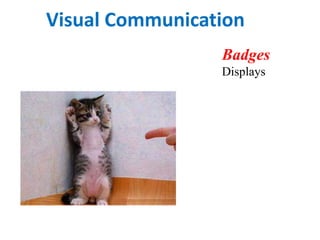
Badges
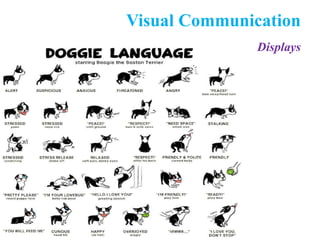
Displays
Visual Communication
Badges
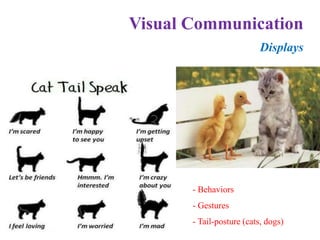
Displays
- Behaviors
- Gestures
- Tail-posture (cats, dogs)
Visual Communication
Displays
Auditory communication
• Means hearing
• Describes sounds animals use to talk to each other
• Lasts for short time: a good form of communication
• Change the volume of sounds: adaptable signal
•Dolphins
•Birds
Auditory Communication
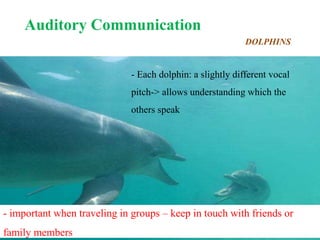
DOLPHINS
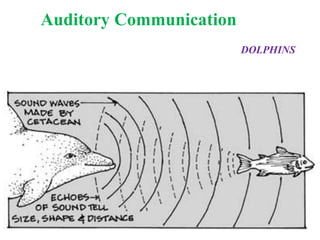
 high- pitched sounds
 whistles
Auditory Communication
DOLPHINS
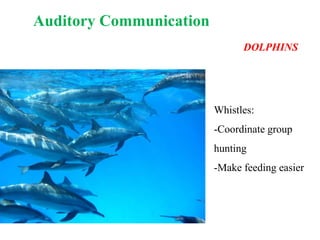
Whistles:
-Coordinate group
hunting
-Make feeding easier
Auditory Communication
DOLPHINS
- important when traveling in groups – keep in touch with friends or
family members
- Each dolphin: a slightly different vocal
pitch-> allows understanding which the
others speak
Auditory Communication
DOLPHINS
Auditory Communication
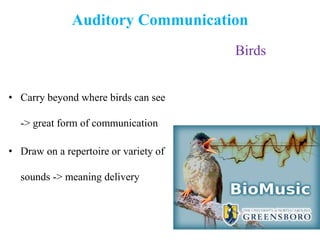
• Carry beyond where birds can see
-> great form of communication
• Draw on a repertoire or variety of
sounds -> meaning delivery
Birds
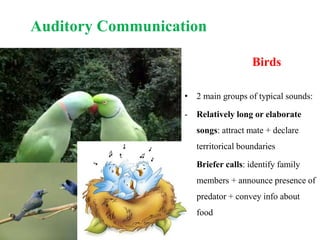
• 2 main groups of typical sounds:
- Relatively long or elaborate
songs: attract mate + declare
territorical boundaries
- Briefer calls: identify family
members + announce presence of
predator + convey info about
food
Auditory Communication
Birds
Chemical
Communication
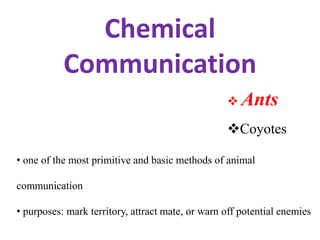
• one of the most primitive and basic methods of animal
communication
• purposes: mark territory, attract mate, or warn off potential enemies
 Ants
Coyotes
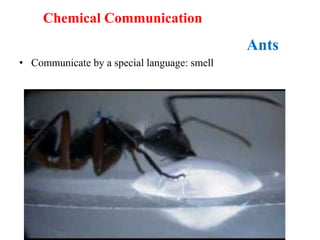
Ants
• Communicate by a special language: smell
Chemical Communication
• Release a type of chemical:
pheromones
• Smell pheromones: follow
the scent trail to food,
protect their young
Chemical Communication
Ants
Chemical
Communication
 Ants
Coyotes
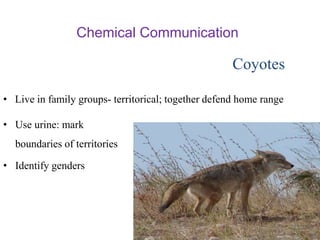
Coyotes
• Use urine: mark
boundaries of territories
• Identify genders
Chemical Communication
• Live in family groups- territorical; together defend home range
Chemical Communication
• Warn: they are on other’s boundary-> if they
don’t want to have a war: go far away this area.
Coyotes
Touch
Communication
 MONKEYS
 ELEPHANTS
•Describes how animals communicate through touch
•Used in different ways-> send messages between animals
Hug
Kiss
Meeting
Touch Communication
MonkeysYawn: tired or angry
• Cover eyes: sad
Touch Communication
Monkeys
• Groom each other:
express affection &
make peace
Touch
Communication
• Monkeys
• Elephants
• Angry : ears-spreading
hold head above shoulders
Touch Communication
Elephants
Carefulness: wrap
trunks
Touch Communication
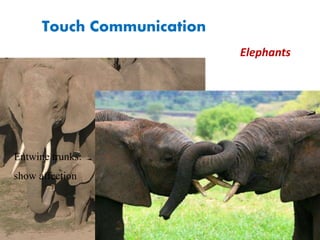
Elephants
Entwine trunks:
show affection
• Visual: geckos (badges), cats and
dogs (displays)
• Auditory: dolphins, birds
• Chemical: ants, coyotes
• Touch: monkeys, elephants
Outline
References
• en.m.wikipedia.org
• www.factmonster.com
• www.animaltalk.net
• sciencenetlinks.com
Thanks For Watching
Q & A

Animal Communication