Component-Based Software
Engineering

Main issues:
• assemble systems out of (reusable) components
• compatibility of components
LEGO analogy

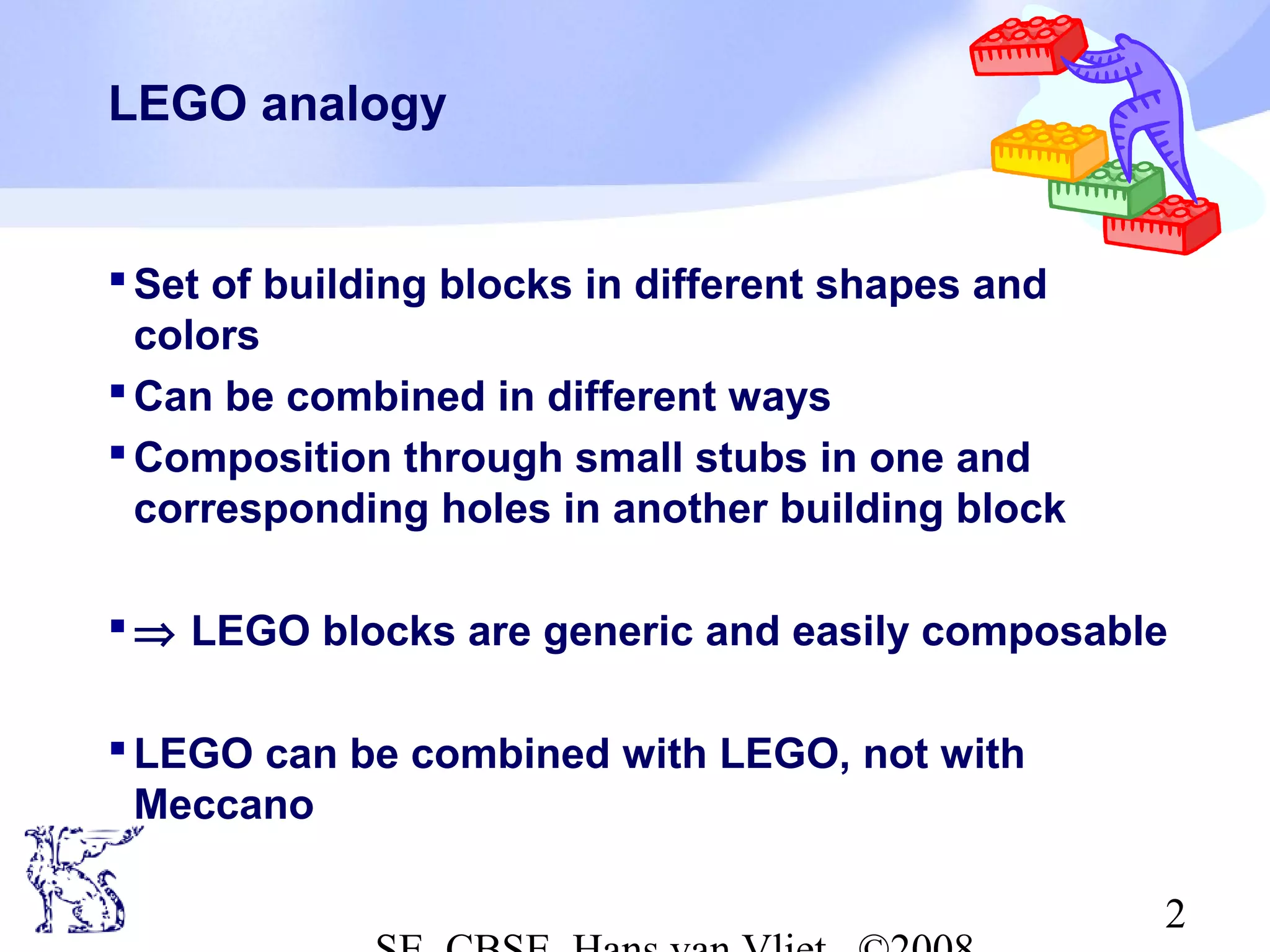
 Set of building blocks in different shapes and
colors
 Can be combined in different ways
 Composition through small stubs in one and
corresponding holes in another building block
 ⇒ LEGO blocks are generic and easily composable
 LEGO can be combined with LEGO, not with
Meccano
2
Why CBSE?

 CBSE increases quality, especially evolvability and
maintainability
 CBSE increases productivity
 CBSE shortens development time

3
Component model

 Defines the types of building block, and the recipe
for putting them together
 More precisely, a component model defines
standards for:
 Properties individual components must satisfy
 Methods and mechanisms for composing components

 Consequently, a component has to conform to
some component model
4
A software component:

 Implements some functionality
 Has explicit dependencies through provides and
required interfaces
 Communicates through its interfaces only
 Has structure and behavior that conforms to a
component model

5
A component technology

 Is the implementation of a component model, by
means of:
 Standards and guidelines for the implementation and
execution of software components
 Executable software that supports the implementation,
assembly, deployment, execution of components

 Examples: EJB, COM+, .NET, CORBA

6
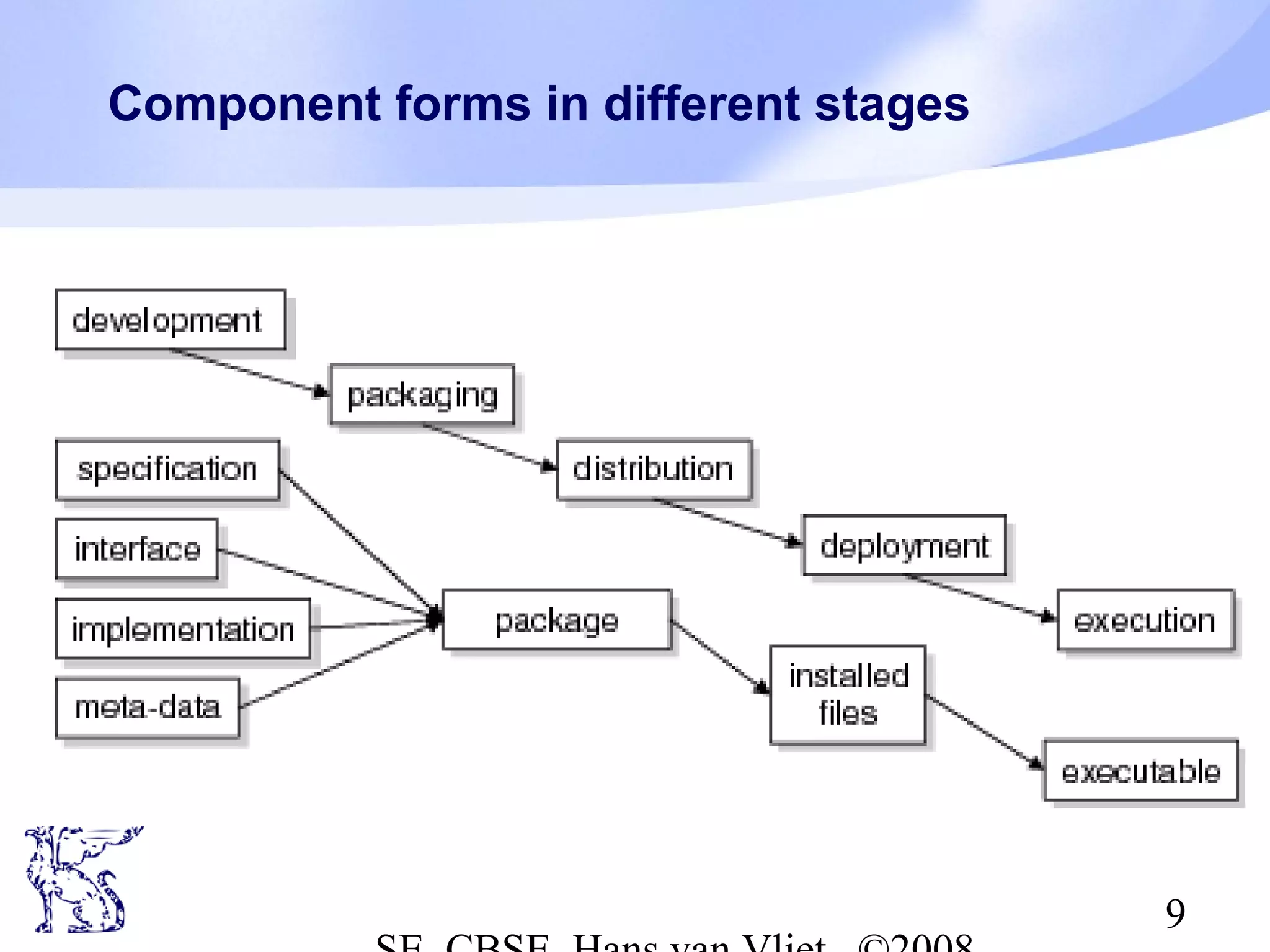
Component forms

 Component goes through different stages:
development, packaging, distribution, deployment,
execution
 Across these stages, components are represented
in different forms:
 During development: UML, e.g.
 When packaging: in a .zip file, e.g.
 In the execution stage: blocks of code and data

7
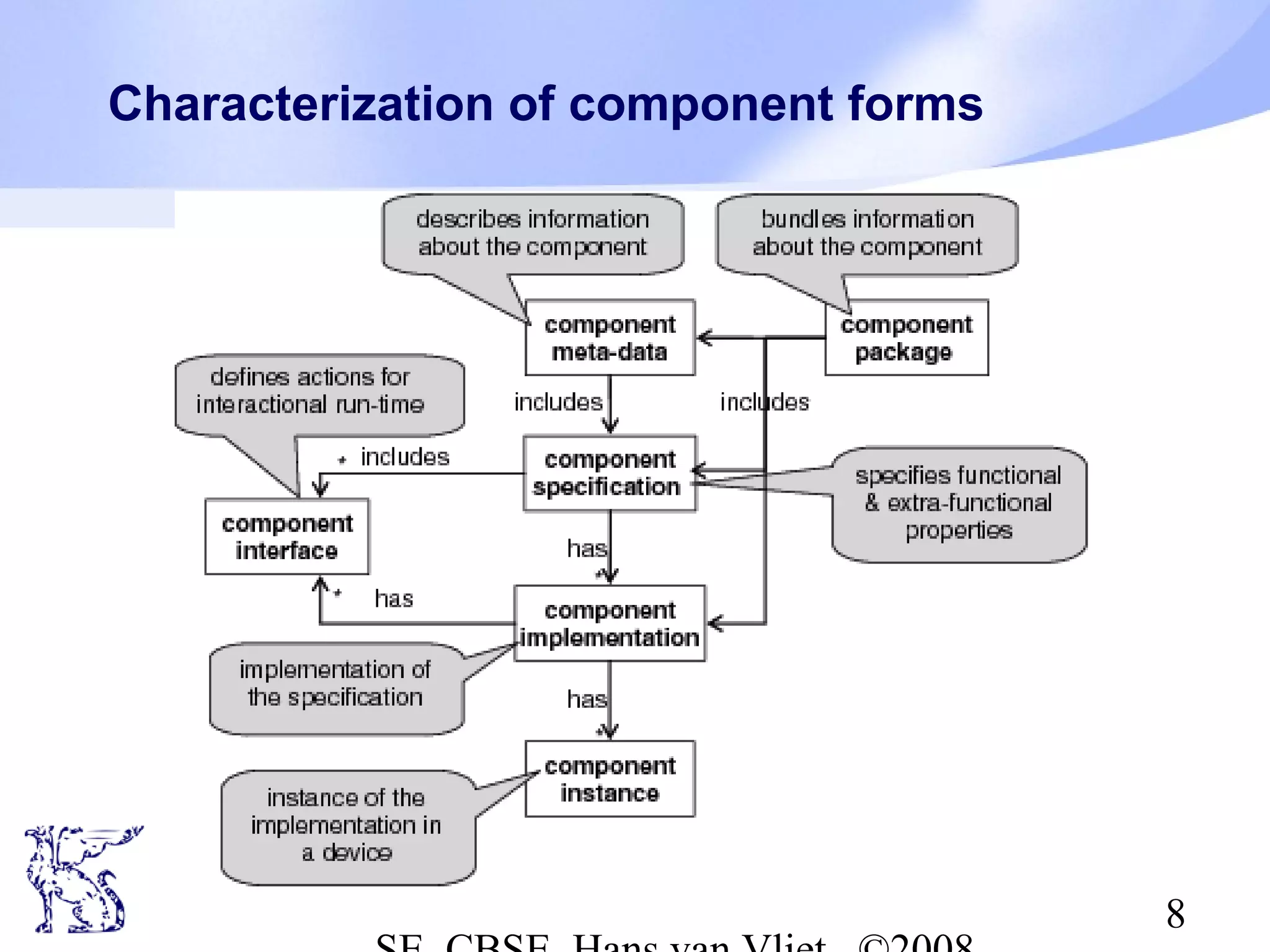
Characterization of component forms

8
Component forms in different stages

9
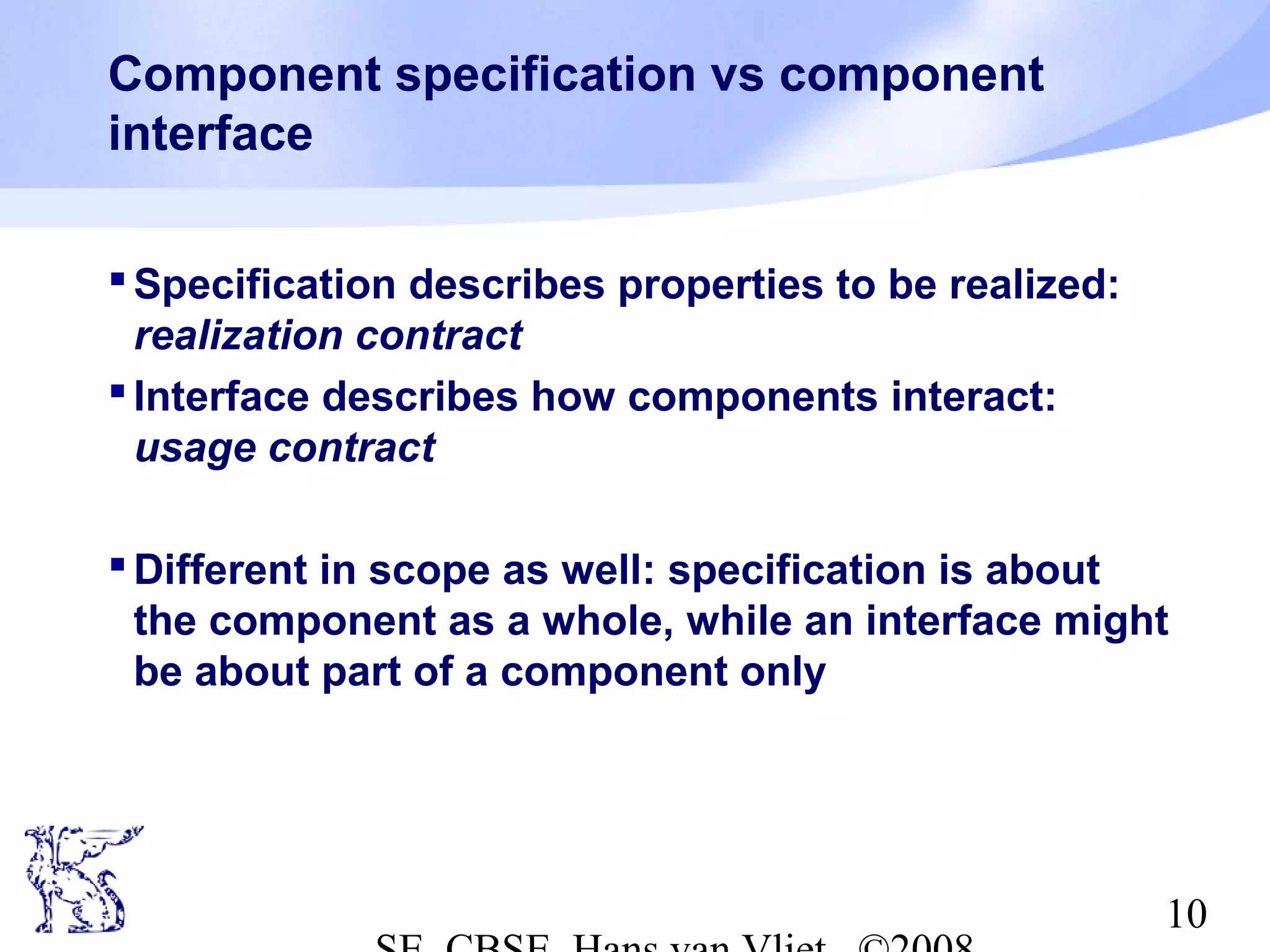
Component specification vs component
interface
 Specification describes properties to be realized:
realization contract
 Interface describes how components interact:
usage contract
 Different in scope as well: specification is about
the component as a whole, while an interface might
be about part of a component only

10
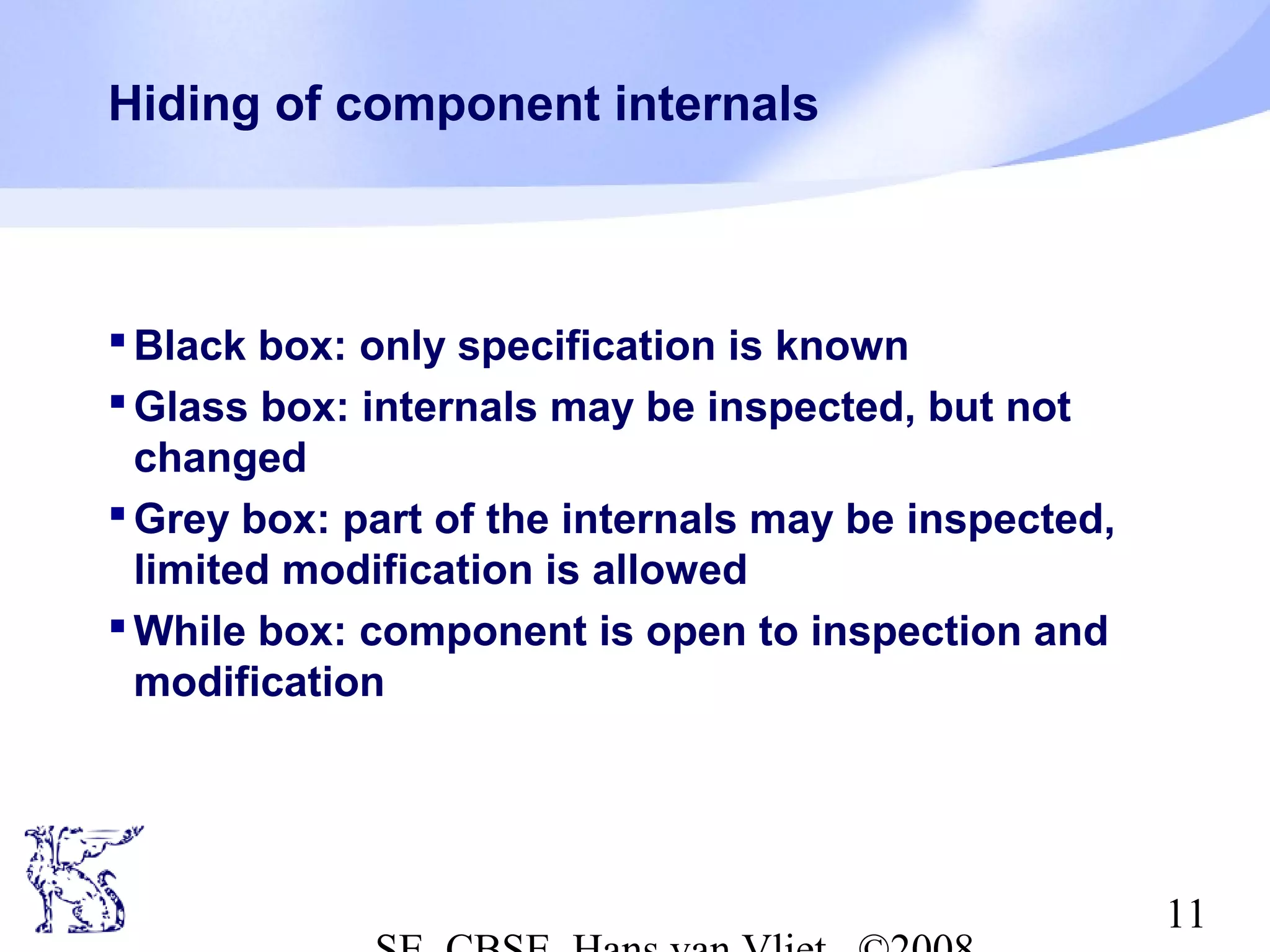
Hiding of component internals

 Black box: only specification is known
 Glass box: internals may be inspected, but not
changed
 Grey box: part of the internals may be inspected,
limited modification is allowed
 While box: component is open to inspection and
modification

11
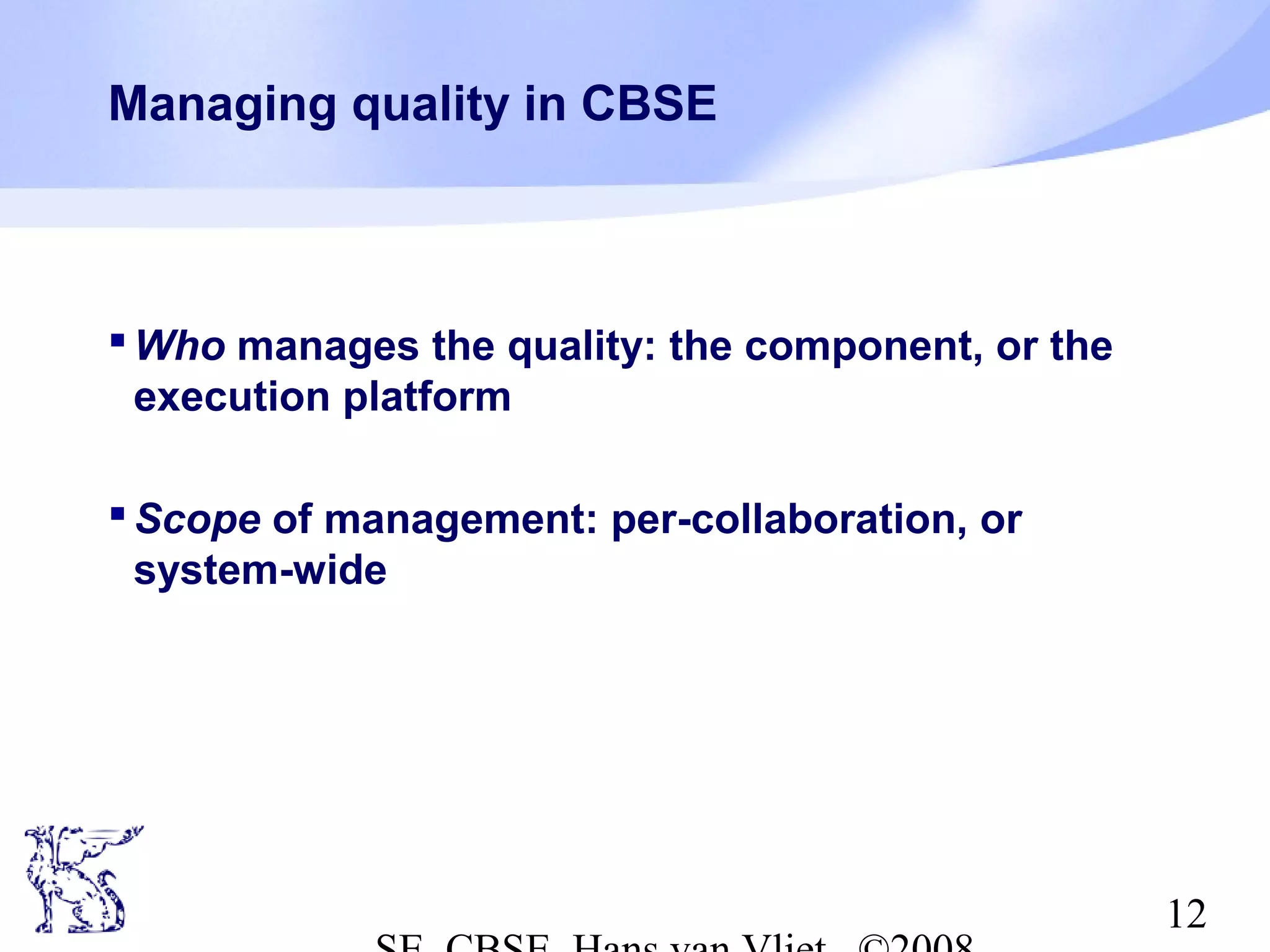
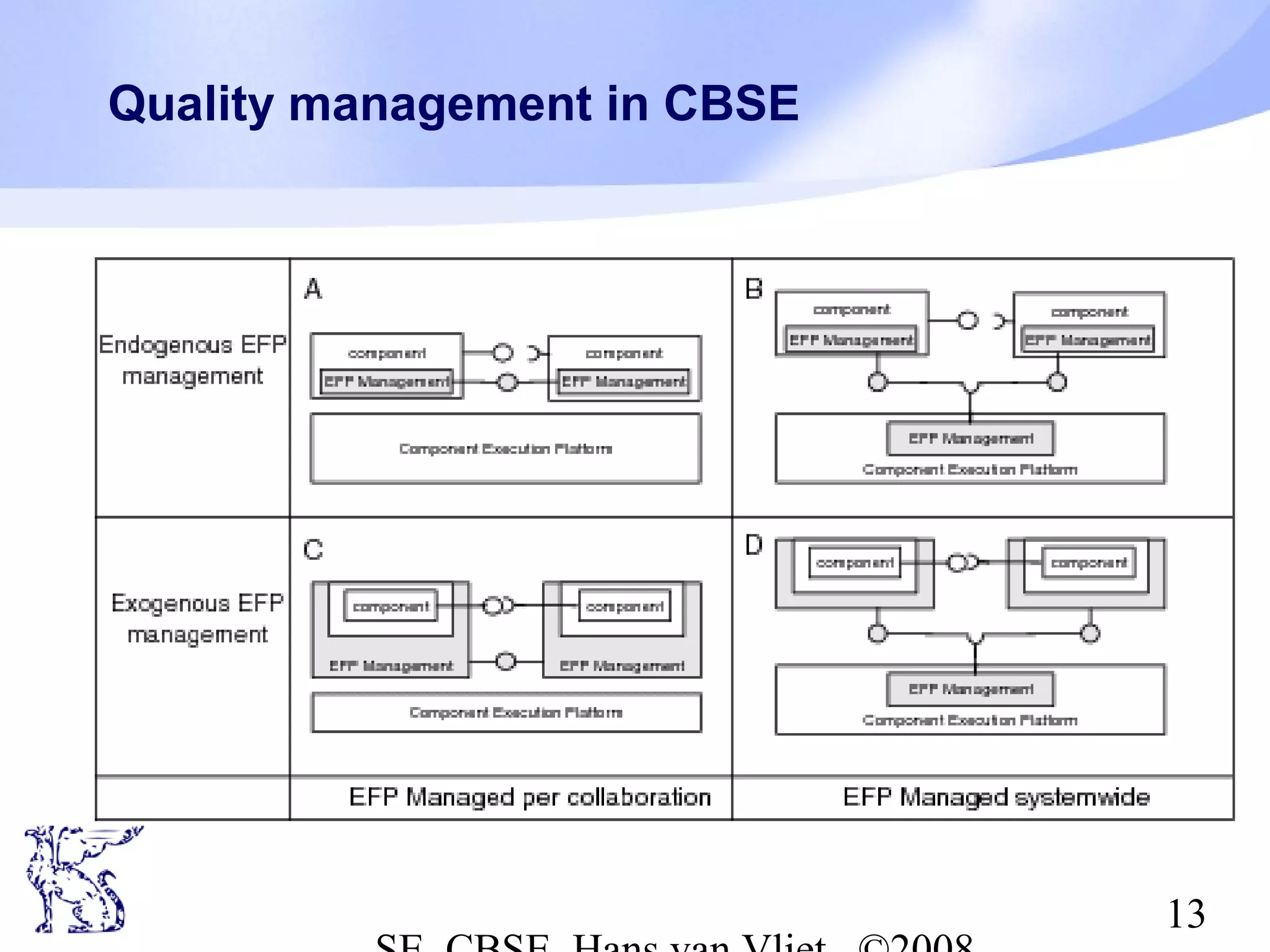
Managing quality in CBSE

 Who manages the quality: the component, or the
execution platform
 Scope of management: per-collaboration, or
system-wide

12
Quality management in CBSE

13
Managing quality in CBSE

 Approach A: left to the designers (e.g. when
integrating COTS components)
 Approach B: model provides standardized facilities
for managing qualities
 Approach C: component only addresses
functionality, quality in surrounding container
 Approach D: similar to C, but container interacts
with platform on quality issues

14
Common features of component models

 Infrastructure mechanisms, for binding, execution, etc
 Instantiation
 Binding (design time, compile time, …)
 Mechanisms for communication between components
 Discovery of components
 Announcement of component capabilities (interfaces)
 Development support
 Language independence
 Platform independence
 Analysis support
 Support for upgrading and extension
 Support for quality properties

15
Development process in CBSE

 Two separate development processes:
 Development of components
 Development of systems out of components

 Separate process to assess components

16
CBSE system development process

 Requirements: also considers availability of
components (like in COTS)
 Analysis and design: very similar to what we
normally do
 Implementation: less coding, focus on selection of
components, provision of glue code
 Integration: largely automated
 Testing: verification of components is necessary
 Release: as in classical approaches
 Maintenance: replace components
17
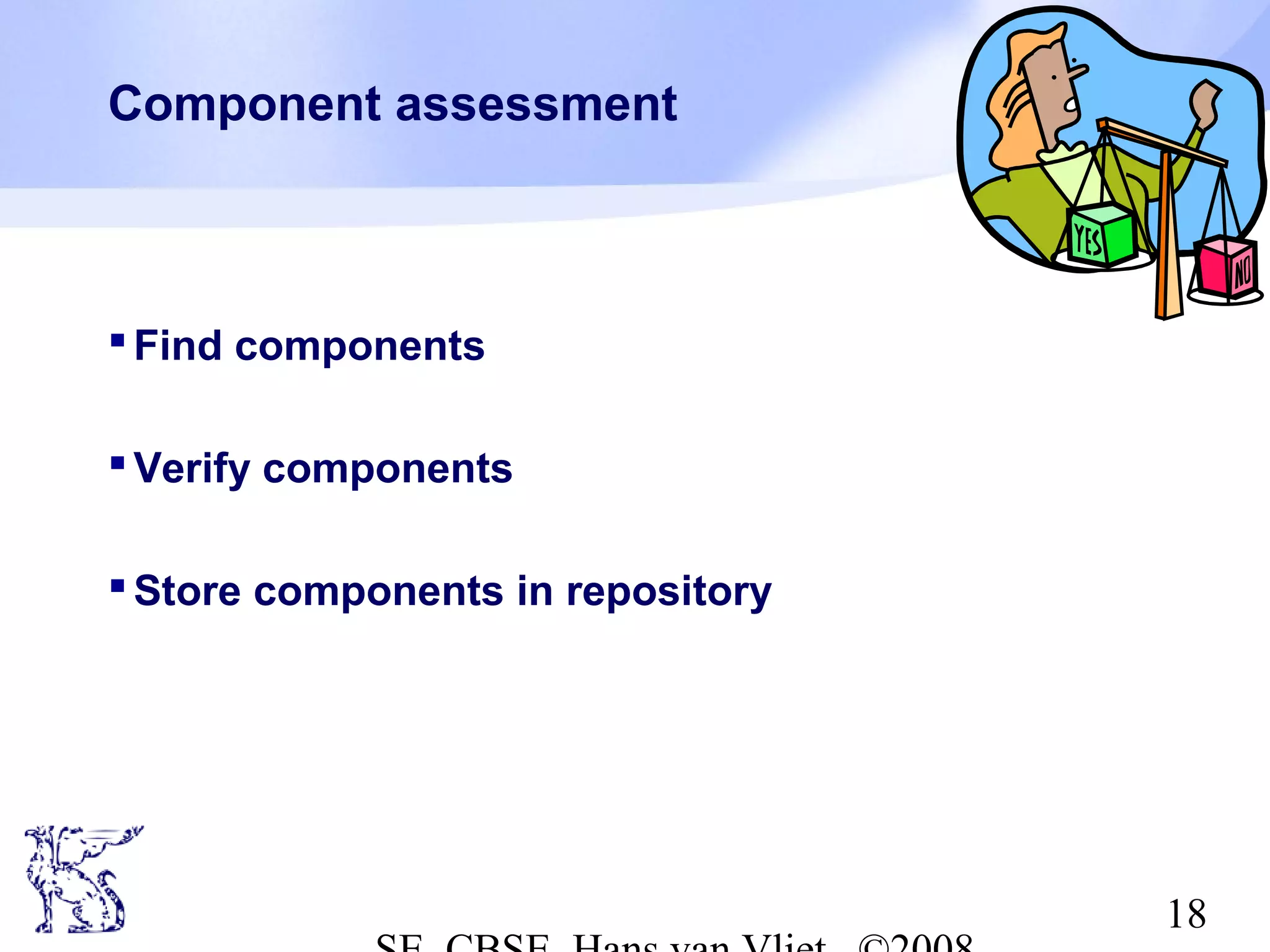
Component assessment

 Find components
 Verify components
 Store components in repository

18
Component development process

 Components are intended for reuse

⇒
 Managing requirements is more difficult
 More effort required to develop reusable
components
 More effort in documentation for consumers
19
Component development process

 Requirements: combination of top-down (from
system) and bottom-up (generality)
 Analysis and design: generality is an issue,
assumptions about system (use) must be made
 Implementation: largely determined by component
technology
 Testing: extensive (no assumptions of usage!), and
well-documented
 Release: not only executables, also metadata

20
Component maintenance

 Who is responsible: producer or consumer?
 Blame analysis: relation between manifestation of
a fault and its cause, e.g.
 Component A requires more CPU time
 As a consequence, B does not complete in time
 As required by C, so
 C issues a time-out error to its user
 Analysis: goes from C to B to A to input of A
 Who does the analysis, if producers of A,B,C are different?

21
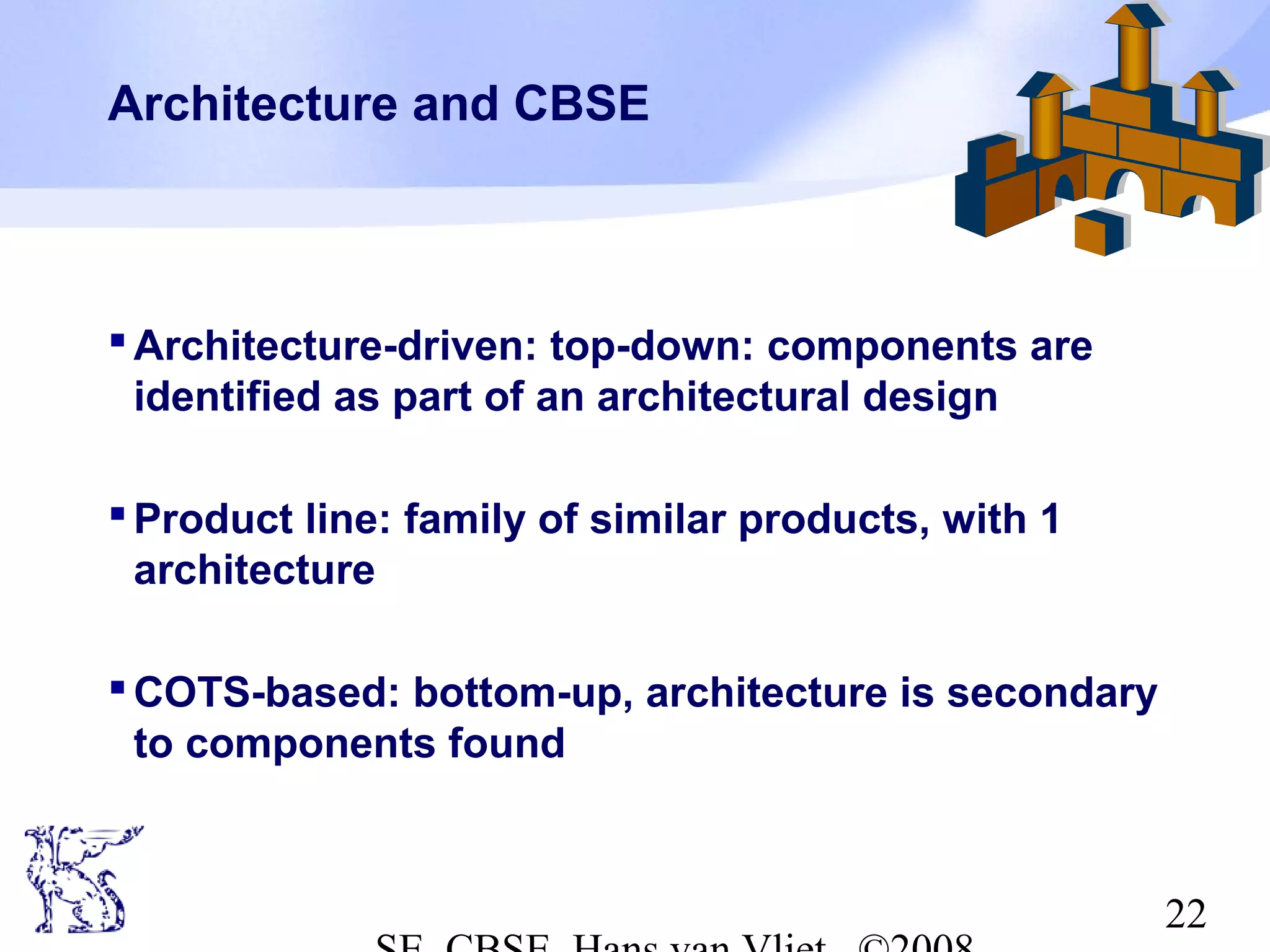
Architecture and CBSE

 Architecture-driven: top-down: components are
identified as part of an architectural design
 Product line: family of similar products, with 1
architecture
 COTS-based: bottom-up, architecture is secondary
to components found

22
Summary

 To enable composition, components must be
compatible: achieved by component model
 Separation of development process for
components from that of assembling systems out
of components
 Architectural plan organizes how components fit
together and meet quality requirements

23

component based softwrae engineering Cbse

  • 1.
    Component-Based Software Engineering Main issues: •assemble systems out of (reusable) components • compatibility of components
  • 2.
    LEGO analogy  Setof building blocks in different shapes and colors  Can be combined in different ways  Composition through small stubs in one and corresponding holes in another building block  ⇒ LEGO blocks are generic and easily composable  LEGO can be combined with LEGO, not with Meccano 2
  • 3.
    Why CBSE?  CBSEincreases quality, especially evolvability and maintainability  CBSE increases productivity  CBSE shortens development time 3
  • 4.
    Component model  Definesthe types of building block, and the recipe for putting them together  More precisely, a component model defines standards for:  Properties individual components must satisfy  Methods and mechanisms for composing components  Consequently, a component has to conform to some component model 4
  • 5.
    A software component: Implements some functionality  Has explicit dependencies through provides and required interfaces  Communicates through its interfaces only  Has structure and behavior that conforms to a component model 5
  • 6.
    A component technology Is the implementation of a component model, by means of:  Standards and guidelines for the implementation and execution of software components  Executable software that supports the implementation, assembly, deployment, execution of components  Examples: EJB, COM+, .NET, CORBA 6
  • 7.
    Component forms  Componentgoes through different stages: development, packaging, distribution, deployment, execution  Across these stages, components are represented in different forms:  During development: UML, e.g.  When packaging: in a .zip file, e.g.  In the execution stage: blocks of code and data 7
  • 8.
  • 9.
    Component forms indifferent stages 9
  • 10.
    Component specification vscomponent interface  Specification describes properties to be realized: realization contract  Interface describes how components interact: usage contract  Different in scope as well: specification is about the component as a whole, while an interface might be about part of a component only 10
  • 11.
    Hiding of componentinternals  Black box: only specification is known  Glass box: internals may be inspected, but not changed  Grey box: part of the internals may be inspected, limited modification is allowed  While box: component is open to inspection and modification 11
  • 12.
    Managing quality inCBSE  Who manages the quality: the component, or the execution platform  Scope of management: per-collaboration, or system-wide 12
  • 13.
  • 14.
    Managing quality inCBSE  Approach A: left to the designers (e.g. when integrating COTS components)  Approach B: model provides standardized facilities for managing qualities  Approach C: component only addresses functionality, quality in surrounding container  Approach D: similar to C, but container interacts with platform on quality issues 14
  • 15.
    Common features ofcomponent models  Infrastructure mechanisms, for binding, execution, etc  Instantiation  Binding (design time, compile time, …)  Mechanisms for communication between components  Discovery of components  Announcement of component capabilities (interfaces)  Development support  Language independence  Platform independence  Analysis support  Support for upgrading and extension  Support for quality properties 15
  • 16.
    Development process inCBSE  Two separate development processes:  Development of components  Development of systems out of components  Separate process to assess components 16
  • 17.
    CBSE system developmentprocess  Requirements: also considers availability of components (like in COTS)  Analysis and design: very similar to what we normally do  Implementation: less coding, focus on selection of components, provision of glue code  Integration: largely automated  Testing: verification of components is necessary  Release: as in classical approaches  Maintenance: replace components 17
  • 18.
    Component assessment  Findcomponents  Verify components  Store components in repository 18
  • 19.
    Component development process Components are intended for reuse ⇒  Managing requirements is more difficult  More effort required to develop reusable components  More effort in documentation for consumers 19
  • 20.
    Component development process Requirements: combination of top-down (from system) and bottom-up (generality)  Analysis and design: generality is an issue, assumptions about system (use) must be made  Implementation: largely determined by component technology  Testing: extensive (no assumptions of usage!), and well-documented  Release: not only executables, also metadata 20
  • 21.
    Component maintenance  Whois responsible: producer or consumer?  Blame analysis: relation between manifestation of a fault and its cause, e.g.  Component A requires more CPU time  As a consequence, B does not complete in time  As required by C, so  C issues a time-out error to its user  Analysis: goes from C to B to A to input of A  Who does the analysis, if producers of A,B,C are different? 21
  • 22.
    Architecture and CBSE Architecture-driven: top-down: components are identified as part of an architectural design  Product line: family of similar products, with 1 architecture  COTS-based: bottom-up, architecture is secondary to components found 22
  • 23.
    Summary  To enablecomposition, components must be compatible: achieved by component model  Separation of development process for components from that of assembling systems out of components  Architectural plan organizes how components fit together and meet quality requirements 23