Understanding the value
proposition as a
cocreated claim
Noelle London, Greg Pogue, Clay Spinuzzi
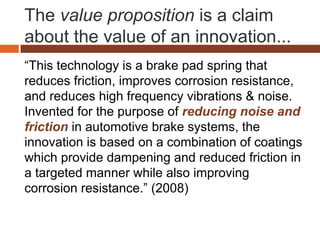
The value proposition is a claim
about the value of an innovation...
“This technology is a brake pad spring that
reduces friction, improves corrosion resistance,
and reduces high frequency vibrations & noise.
Invented for the purpose of reducing noise and
friction in automotive brake systems, the
innovation is based on a combination of coatings
which provide dampening and reduced friction in
a targeted manner while also improving
corrosion resistance.” (2008)
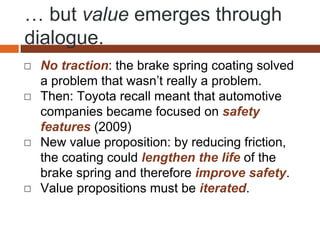
… but value emerges through
dialogue.
◻ No traction: the brake spring coating solved
a problem that wasn’t really a problem.
◻ Then: Toyota recall meant that automotive
companies became focused on safety
features (2009)
◻ New value proposition: by reducing friction,
the coating could lengthen the life of the
brake spring and therefore improve safety.
◻ Value propositions must be iterated.
Value propositions...
◻ Often begin as descriptive arguments:
Value is seen as being a property of the
innovation.
◻ But they work best as proposal arguments:
Value is seen as emerging from the
application of the innovation to the unique
situational needs of the receiver.
The case
◻ A technology commercialization program,
structured as a pitch competition.
◻ Innovators learn to be entrepreneurs;
innovations are transformed into
commercialized technologies.
◻ Firms must make several interrelated claims;
the central claim is the value proposition.
◻ We examine how four firms iterated their
value propositions.
The framework: SDL (Lusch &
Vargo)
◻ Goods-Dominant Logic (GDL): Value is
understood as embedded in goods and
offered to consumers; focus is on exchange-
value (good’s characteristics).
◻ Service-Dominant Logic (SDL): Value is
cocreated by producer and consumer and
realized in use; focus is on use-value (service’
s benefits).
◻ Both claims can be made throughout the
customer development process.
The study
◻ We interviewed mentors of 5 Korean entrepreneurs
in the Gyeonggi-UT Innovation Program (GIP).
Firms A-D iterated their value proposition, Firm E
did not.
◻ Firm A: Coated brake spring
◻ Firm B: Process to produce aluminum in a
rounded shape in a single process
◻ Firm C: Reliability and durability testing systems
and services
◻ Firm D: Noise cancellation software
◻ Firm E: Machine to heat baby formula
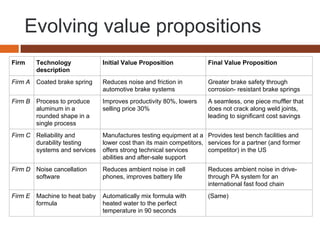
Evolving value propositions
Firm Technology
description
Initial Value Proposition Final Value Proposition
Firm A Coated brake spring Reduces noise and friction in
automotive brake systems
Greater brake safety through
corrosion- resistant brake springs
Firm B Process to produce
aluminum in a
rounded shape in a
single process
Improves productivity 80%, lowers
selling price 30%
A seamless, one piece muffler that
does not crack along weld joints,
leading to significant cost savings
Firm C Reliability and
durability testing
systems and services
Manufactures testing equipment at a
lower cost than its main competitors,
offers strong technical services
abilities and after-sale support
Provides test bench facilities and
services for a partner (and former
competitor) in the US
Firm D Noise cancellation
software
Reduces ambient noise in cell
phones, improves battery life
Reduces ambient noise in drive-
through PA system for an
international fast food chain
Firm E Machine to heat baby
formula
Automatically mix formula with
heated water to the perfect
temperature in 90 seconds
(Same)
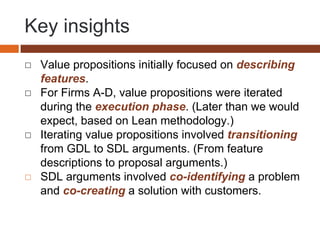
Key insights
◻ Value propositions initially focused on describing
features.
◻ For Firms A-D, value propositions were iterated
during the execution phase. (Later than we would
expect, based on Lean methodology.)
◻ Iterating value propositions involved transitioning
from GDL to SDL arguments. (From feature
descriptions to proposal arguments.)
◻ SDL arguments involved co-identifying a problem
and co-creating a solution with customers.
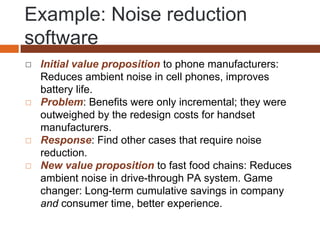
Example: Noise reduction
software
◻ Initial value proposition to phone manufacturers:
Reduces ambient noise in cell phones, improves
battery life.
◻ Problem: Benefits were only incremental; they were
outweighed by the redesign costs for handset
manufacturers.
◻ Response: Find other cases that require noise
reduction.
◻ New value proposition to fast food chains: Reduces
ambient noise in drive-through PA system. Game
changer: Long-term cumulative savings in company
and consumer time, better experience.
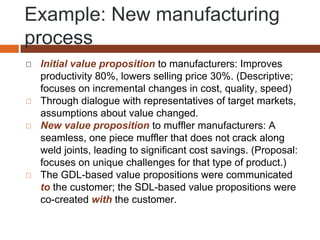
Example: New manufacturing
process
◻ Initial value proposition to manufacturers: Improves
productivity 80%, lowers selling price 30%. (Descriptive;
focuses on incremental changes in cost, quality, speed)
◻ Through dialogue with representatives of target markets,
assumptions about value changed.
◻ New value proposition to muffler manufacturers: A
seamless, one piece muffler that does not crack along
weld joints, leading to significant cost savings. (Proposal:
focuses on unique challenges for that type of product.)
◻ The GDL-based value propositions were communicated
to the customer; the SDL-based value propositions were
co-created with the customer.
Conclusion
◻ GDL- and SDL-based value propositions both have
their place. GDL focuses on products and is appropriate
for “red ocean” markets; SDL focuses on new uses and is
appropriate for “blue ocean” markets.
◻ Pivoting can involve moving from one type of value
proposition to another.
◻ The seizing of opportunity that defines entrepreneurship
is thoroughly rhetorical.
Calls for papers
◻ Special Issue of IEEE Transactions on
Professional Communication on
Entrepreneurship Communication (December
2016)
◻ Special Issue of the Journal of Business and
Technical Communication on the Rhetoric of
Entrepreneurship: Theories, Methodologies,
and Practices (July 2017)
http://spinuzzi.blogspot.com/2015/04/two-calls-for-proposals-on.html

Understanding the value proposition as a cocreated claim

  • 1.
    Understanding the value propositionas a cocreated claim Noelle London, Greg Pogue, Clay Spinuzzi
  • 2.
    The value propositionis a claim about the value of an innovation... “This technology is a brake pad spring that reduces friction, improves corrosion resistance, and reduces high frequency vibrations & noise. Invented for the purpose of reducing noise and friction in automotive brake systems, the innovation is based on a combination of coatings which provide dampening and reduced friction in a targeted manner while also improving corrosion resistance.” (2008)
  • 3.
    … but valueemerges through dialogue. ◻ No traction: the brake spring coating solved a problem that wasn’t really a problem. ◻ Then: Toyota recall meant that automotive companies became focused on safety features (2009) ◻ New value proposition: by reducing friction, the coating could lengthen the life of the brake spring and therefore improve safety. ◻ Value propositions must be iterated.
  • 4.
    Value propositions... ◻ Oftenbegin as descriptive arguments: Value is seen as being a property of the innovation. ◻ But they work best as proposal arguments: Value is seen as emerging from the application of the innovation to the unique situational needs of the receiver.
  • 5.
    The case ◻ Atechnology commercialization program, structured as a pitch competition. ◻ Innovators learn to be entrepreneurs; innovations are transformed into commercialized technologies. ◻ Firms must make several interrelated claims; the central claim is the value proposition. ◻ We examine how four firms iterated their value propositions.
  • 6.
    The framework: SDL(Lusch & Vargo) ◻ Goods-Dominant Logic (GDL): Value is understood as embedded in goods and offered to consumers; focus is on exchange- value (good’s characteristics). ◻ Service-Dominant Logic (SDL): Value is cocreated by producer and consumer and realized in use; focus is on use-value (service’ s benefits). ◻ Both claims can be made throughout the customer development process.
  • 7.
    The study ◻ Weinterviewed mentors of 5 Korean entrepreneurs in the Gyeonggi-UT Innovation Program (GIP). Firms A-D iterated their value proposition, Firm E did not. ◻ Firm A: Coated brake spring ◻ Firm B: Process to produce aluminum in a rounded shape in a single process ◻ Firm C: Reliability and durability testing systems and services ◻ Firm D: Noise cancellation software ◻ Firm E: Machine to heat baby formula
  • 8.
    Evolving value propositions FirmTechnology description Initial Value Proposition Final Value Proposition Firm A Coated brake spring Reduces noise and friction in automotive brake systems Greater brake safety through corrosion- resistant brake springs Firm B Process to produce aluminum in a rounded shape in a single process Improves productivity 80%, lowers selling price 30% A seamless, one piece muffler that does not crack along weld joints, leading to significant cost savings Firm C Reliability and durability testing systems and services Manufactures testing equipment at a lower cost than its main competitors, offers strong technical services abilities and after-sale support Provides test bench facilities and services for a partner (and former competitor) in the US Firm D Noise cancellation software Reduces ambient noise in cell phones, improves battery life Reduces ambient noise in drive- through PA system for an international fast food chain Firm E Machine to heat baby formula Automatically mix formula with heated water to the perfect temperature in 90 seconds (Same)
  • 9.
    Key insights ◻ Valuepropositions initially focused on describing features. ◻ For Firms A-D, value propositions were iterated during the execution phase. (Later than we would expect, based on Lean methodology.) ◻ Iterating value propositions involved transitioning from GDL to SDL arguments. (From feature descriptions to proposal arguments.) ◻ SDL arguments involved co-identifying a problem and co-creating a solution with customers.
  • 10.
    Example: Noise reduction software ◻Initial value proposition to phone manufacturers: Reduces ambient noise in cell phones, improves battery life. ◻ Problem: Benefits were only incremental; they were outweighed by the redesign costs for handset manufacturers. ◻ Response: Find other cases that require noise reduction. ◻ New value proposition to fast food chains: Reduces ambient noise in drive-through PA system. Game changer: Long-term cumulative savings in company and consumer time, better experience.
  • 11.
    Example: New manufacturing process ◻Initial value proposition to manufacturers: Improves productivity 80%, lowers selling price 30%. (Descriptive; focuses on incremental changes in cost, quality, speed) ◻ Through dialogue with representatives of target markets, assumptions about value changed. ◻ New value proposition to muffler manufacturers: A seamless, one piece muffler that does not crack along weld joints, leading to significant cost savings. (Proposal: focuses on unique challenges for that type of product.) ◻ The GDL-based value propositions were communicated to the customer; the SDL-based value propositions were co-created with the customer.
  • 12.
    Conclusion ◻ GDL- andSDL-based value propositions both have their place. GDL focuses on products and is appropriate for “red ocean” markets; SDL focuses on new uses and is appropriate for “blue ocean” markets. ◻ Pivoting can involve moving from one type of value proposition to another. ◻ The seizing of opportunity that defines entrepreneurship is thoroughly rhetorical.
  • 13.
    Calls for papers ◻Special Issue of IEEE Transactions on Professional Communication on Entrepreneurship Communication (December 2016) ◻ Special Issue of the Journal of Business and Technical Communication on the Rhetoric of Entrepreneurship: Theories, Methodologies, and Practices (July 2017) http://spinuzzi.blogspot.com/2015/04/two-calls-for-proposals-on.html