Innovation and Value Proposition
Module 3
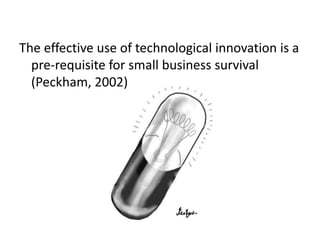
The effective use of technological innovation is a
pre-requisite for small business survival
(Peckham, 2002)
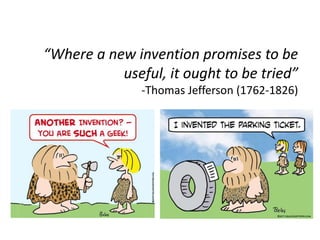
“Where a new invention promises to be
useful, it ought to be tried”
-Thomas Jefferson (1762-1826)
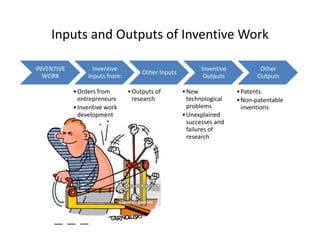
Inputs and Outputs of Inventive Work
INVENTIVE
WORK
Inventive
Inputs from:
•Orders from
entrepreneurs
•Inventive work
development
Other Inputs
•Outputs of
research
Inventive
Outputs
•New
technological
problems
•Unexplained
successes and
failures of
research
Other
Outputs
•Patents
•Non-patentable
inventions
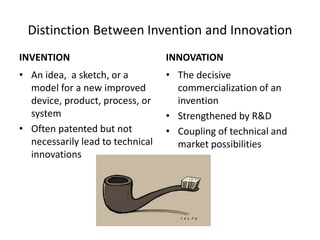
Distinction Between Invention and Innovation
INVENTION
• An idea, a sketch, or a
model for a new improved
device, product, process, or
system
• Often patented but not
necessarily lead to technical
innovations
INNOVATION
• The decisive
commercialization of an
invention
• Strengthened by R&D
• Coupling of technical and
market possibilities
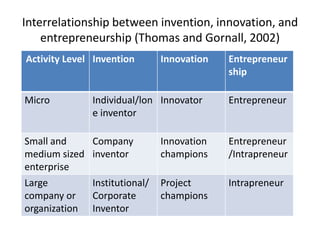
Interrelationship between invention, innovation, and
entrepreneurship (Thomas and Gornall, 2002)
Activity Level Invention Innovation Entrepreneur
ship
Micro Individual/lon
e inventor
Innovator Entrepreneur
Small and
medium sized
enterprise
Company
inventor
Innovation
champions
Entrepreneur
/Intrapreneur
Large
company or
organization
Institutional/
Corporate
Inventor
Project
champions
Intrapreneur
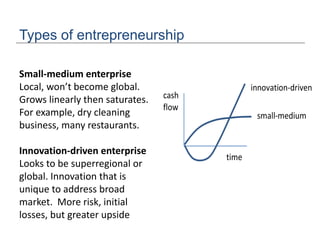
Types of entrepreneurship
Small-medium enterprise
Local, won’t become global.
Grows linearly then saturates.
For example, dry cleaning
business, many restaurants.
Innovation-driven enterprise
Looks to be superregional or
global. Innovation that is
unique to address broad
market. More risk, initial
losses, but greater upside
time
cash
flow
small-medium
innovation-driven
What is innovation?
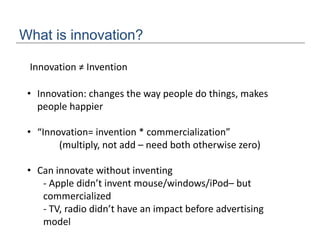
• Innovation: changes the way people do things, makes
people happier
• “Innovation= invention * commercialization”
(multiply, not add – need both otherwise zero)
• Can innovate without inventing
- Apple didn’t invent mouse/windows/iPod– but
commercialized
- TV, radio didn’t have an impact before advertising
model
Innovation ≠ Invention
Types of innovation
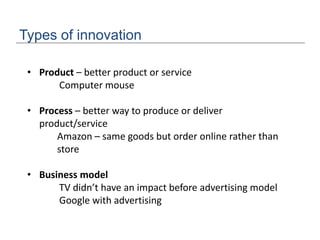
• Product – better product or service
Computer mouse
• Process – better way to produce or deliver
product/service
Amazon – same goods but order online rather than
store
• Business model
TV didn’t have an impact before advertising model
Google with advertising
Outline of course
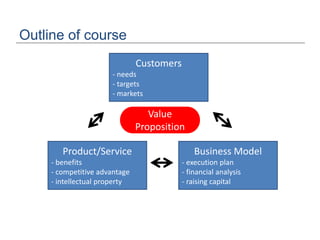
Customers
- needs
- targets
- markets
Product/Service
- benefits
- competitive advantage
- intellectual property
Business Model
- execution plan
- financial analysis
- raising capital
Value
Proposition
Benefits
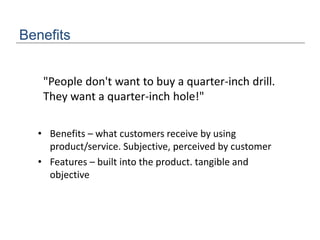
"People don't want to buy a quarter-inch drill.
They want a quarter-inch hole!"
• Benefits – what customers receive by using
product/service. Subjective, perceived by customer
• Features – built into the product. tangible and
objective
Needs-Benefits
How your approach will provide benefits to meet a need?
• What is the need (articulate specifically), customer “Pain Point”
• Describe the ‘as-is’ state, why other approaches not good enough.
• How does your product provide a benefit to meet that need
• Show specific evidence (eg, anecdotes) how benefits meet need
“Use Case”, a specific example showing
• Need, acquisition and benefits of product
• Why customer would get it
• Barriers to adoption
• Interface points
Value
• Value = benefits/price
• Increase value by increasing benefits or decreasing price
• Only the customer defines your value
• Customer satisfaction is the ratio (Value)/(Expected Value)
Value Proposition Statement
A clear, crisp, compelling statement that describes the value of your
offering.
Should include NABC:
Needs
Approach
Benefits per cost
Competition
Example: I understand you are hungry (Need), so let’s go to the X
Restaurant (Approach) instead of McDonalds (Competition) because it
has better food and it is closer (Benefits/cost)
Assignment 2: Value Proposition
• give top three priorities of target customer
• describe “as-is state”, customer pain points, opportunities
• potential solution – given in general terms
• describe anticipated Use Case with solution
• identify key metric measuring how solution meets the need
• give a clear, compelling Value Proposition statement
Ideas can have two origins
Organization driven, “tech push”
• Have a solution, looking for market.
• Have competitive advantage
• Downside: might be no real need for your
product
Market driven, “market pull”
• Know the need, and have an idea to satisfy the
need
• Downside: don’t have competitive advantage
(example: falafel truck)
Elevator pitches
• Have ~60 s with boss/investor to pitch idea
• Goal is to set up lengthier discussion at later time
• Don’t need to give all information, but entice them
Components
a. Start with a hook
b. Address “NABC”:
Needs
Approach
Benefits per cost
Competition (why you’re better than them)
c. Conclude with the “ask”
Assignment 3: Idea’s Elevator Pitch
Individual project: Come up with an idea for a
product/service, and develop a 60 second elevator
pitch
• what is the problem your product or service is going
to solve, and how critical is the problem?
• what types of people or companies suffer from this
problem, and how widespread is it?
• what is the innovation behind your approach, and
its advantage over competitors?
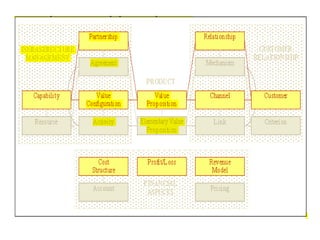
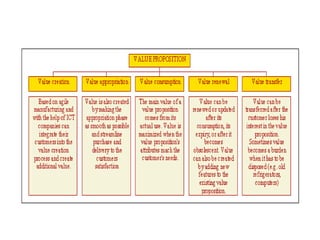
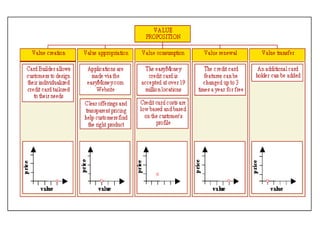
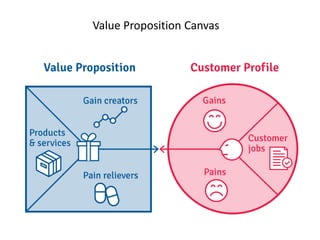
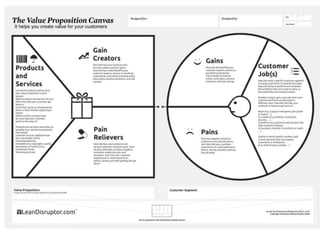
Value Proposition Canvas
Module 3 Innovation and Value Proposition.pptx

Module 3 Innovation and Value Proposition.pptx

  • 1.
    Innovation and ValueProposition Module 3
  • 2.
    The effective useof technological innovation is a pre-requisite for small business survival (Peckham, 2002)
  • 4.
    “Where a newinvention promises to be useful, it ought to be tried” -Thomas Jefferson (1762-1826)
  • 5.
    Inputs and Outputsof Inventive Work INVENTIVE WORK Inventive Inputs from: •Orders from entrepreneurs •Inventive work development Other Inputs •Outputs of research Inventive Outputs •New technological problems •Unexplained successes and failures of research Other Outputs •Patents •Non-patentable inventions
  • 6.
    Distinction Between Inventionand Innovation INVENTION • An idea, a sketch, or a model for a new improved device, product, process, or system • Often patented but not necessarily lead to technical innovations INNOVATION • The decisive commercialization of an invention • Strengthened by R&D • Coupling of technical and market possibilities
  • 7.
    Interrelationship between invention,innovation, and entrepreneurship (Thomas and Gornall, 2002) Activity Level Invention Innovation Entrepreneur ship Micro Individual/lon e inventor Innovator Entrepreneur Small and medium sized enterprise Company inventor Innovation champions Entrepreneur /Intrapreneur Large company or organization Institutional/ Corporate Inventor Project champions Intrapreneur
  • 8.
    Types of entrepreneurship Small-mediumenterprise Local, won’t become global. Grows linearly then saturates. For example, dry cleaning business, many restaurants. Innovation-driven enterprise Looks to be superregional or global. Innovation that is unique to address broad market. More risk, initial losses, but greater upside time cash flow small-medium innovation-driven
  • 9.
    What is innovation? •Innovation: changes the way people do things, makes people happier • “Innovation= invention * commercialization” (multiply, not add – need both otherwise zero) • Can innovate without inventing - Apple didn’t invent mouse/windows/iPod– but commercialized - TV, radio didn’t have an impact before advertising model Innovation ≠ Invention
  • 10.
    Types of innovation •Product – better product or service Computer mouse • Process – better way to produce or deliver product/service Amazon – same goods but order online rather than store • Business model TV didn’t have an impact before advertising model Google with advertising
  • 11.
    Outline of course Customers -needs - targets - markets Product/Service - benefits - competitive advantage - intellectual property Business Model - execution plan - financial analysis - raising capital Value Proposition
  • 12.
    Benefits "People don't wantto buy a quarter-inch drill. They want a quarter-inch hole!" • Benefits – what customers receive by using product/service. Subjective, perceived by customer • Features – built into the product. tangible and objective
  • 13.
    Needs-Benefits How your approachwill provide benefits to meet a need? • What is the need (articulate specifically), customer “Pain Point” • Describe the ‘as-is’ state, why other approaches not good enough. • How does your product provide a benefit to meet that need • Show specific evidence (eg, anecdotes) how benefits meet need “Use Case”, a specific example showing • Need, acquisition and benefits of product • Why customer would get it • Barriers to adoption • Interface points
  • 14.
    Value • Value =benefits/price • Increase value by increasing benefits or decreasing price • Only the customer defines your value • Customer satisfaction is the ratio (Value)/(Expected Value)
  • 15.
    Value Proposition Statement Aclear, crisp, compelling statement that describes the value of your offering. Should include NABC: Needs Approach Benefits per cost Competition Example: I understand you are hungry (Need), so let’s go to the X Restaurant (Approach) instead of McDonalds (Competition) because it has better food and it is closer (Benefits/cost)
  • 19.
    Assignment 2: ValueProposition • give top three priorities of target customer • describe “as-is state”, customer pain points, opportunities • potential solution – given in general terms • describe anticipated Use Case with solution • identify key metric measuring how solution meets the need • give a clear, compelling Value Proposition statement
  • 20.
    Ideas can havetwo origins Organization driven, “tech push” • Have a solution, looking for market. • Have competitive advantage • Downside: might be no real need for your product Market driven, “market pull” • Know the need, and have an idea to satisfy the need • Downside: don’t have competitive advantage (example: falafel truck)
  • 21.
    Elevator pitches • Have~60 s with boss/investor to pitch idea • Goal is to set up lengthier discussion at later time • Don’t need to give all information, but entice them Components a. Start with a hook b. Address “NABC”: Needs Approach Benefits per cost Competition (why you’re better than them) c. Conclude with the “ask”
  • 22.
    Assignment 3: Idea’sElevator Pitch Individual project: Come up with an idea for a product/service, and develop a 60 second elevator pitch • what is the problem your product or service is going to solve, and how critical is the problem? • what types of people or companies suffer from this problem, and how widespread is it? • what is the innovation behind your approach, and its advantage over competitors?
  • 23.