CHAPTER-1                                                     Conceptual framework for strategic managementReported by : Rajmohan Gupta	              Abhishek Neogi	              Kinchit Rai              Milan lakhani 	              Jenish Malaviya		    Meghal ChauhanTo : Virag Shah (Lecturer ESM)
CONTENTSConcept, Meaning, Definition   - Strategy   - Policy   - Tactics	   - Strategic Management   - Program   - Procedure   - Business    - Stakeholders   - SBU   - ETOP   - OCP   - SAPStrategic management process & its implication
Strategic intent   - Organizational Vision,mission,goals&objectives   - Their formulation and role in strategic management
Concept, Meaning, Definition
STRATEGY : Strategy is the determination of the long-term goals and objectives of an enterprise and the adoption of the courses of action and the allocation of resources necessary for carrying out these goals.Strategy isn’t themission—it’s theplan that allowsthe company toaccomplish themissionStrategy is management’s game plan for strengthening the organization’s position, pleasing customers, and achieving performance targets.
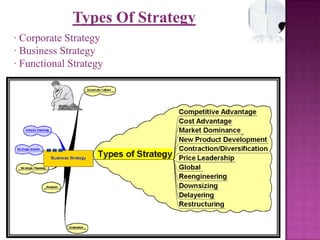
Types Of Strategy· Corporate Strategy· Business Strategy· Functional Strategy
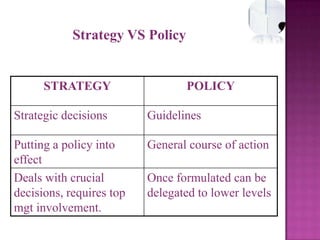
POLICY : A guiding principle, typically established by senior management, which is adopted by an organization or project to influence and determine decisions.Policies are the means by which annual objectives will be achieved. Policies include guidelines, rules, and procedures established to support efforts to achievestated objectives.Policy means having rules and procedures in place so people know what to do in certain situations. Business  can have policy in place so that action and progress can be made.Diff: A strategy is a plan to do things a certain way to achieve a desired outcome. A policy is a rule designed to ensure consistency in governance and to avoid undesirable outcomes. .
Types of policyCorporate policyCorporate policy describes a companies overall direction in terms of its general attitude towards growth and the management of its various businesses and product lines. It typical fit within the three main categories of stability, growth and retrenchment.Business policyBusiness policy usually occurs at the business unit or product level and it emphasizes improvement of the competitive position of a corporation products or services in the specific industry or market segment served by that business unit. Business strategies may fit within the two overall categories of competitive or cooperative strategies.Functional policyFunctional policy is the approach taken by a functional area to achieve corporate and business unit objectives and strategies by maximizing resources productivity. It is concerned with developing and nurturing a distinctive competence to provide a company or business unit with a competitive advantage.
Strategy VS Policy
Tactics : Tactic means the approach towards workflow or the method of performing things. In terms of strategic management we have a solid definition given by Wheelen and Hunger  “A tactic is a specific operating plan detailing how a strategy is to be implemented in terms of when and where it is to be put into action”. Tactics are narrower in scope and shorter in their time ascompared to strategies.There are two types of tactics as given by Wheelen and Hunger .· Timing tactic· Market Location tactic
STRATEGIC MANAGEMENT : Strategic management is defined as the art and science of formulating, implementing, and evaluating cross-functional decisions that enable the organization to achieve its objectives." Generally, strategic management is not only related to a single specialization but covers cross-functional or overall organization.
 Strategic management is a comprehensive area that covers almost all the functional areas of the organization. It is an umbrella concept of management that comprises all such functional areas as marketing, finance & account, human resource, and production & operation into a top level management discipline. Therefore, strategic management has an importance in the organizational success and failure than any specific functional areas.(Cont …….Strategic management deals with organizational level and top level issues whereas functional or operational level management deals with the specific areas of the business.
. Top-level managers such as Chairman, Managing Director, and corporate level planners involve more in strategic management process.
Strategic management relates to setting vision, mission, objectives, and strategies that can be the guideline to design functional strategies in other functional areas
Therefore, it is top-level management that paves the way for other functional or operational management in an organizationDefinition:Glueck – Strategic Management can be defined as a set of decisions, actions resulting in formulations & implementation of strategies designed to achieve the objectives of enterprise.
Advantages of Strategic ManagementIncrease in rate of return on investment
 Reduction in Cost of Capital
 Increase in Trading on Equity
 Increase in Profitability
 Reduction in fixed and flexible expenses
 Motivation to group activity
 Increase in the efficiency of the employees
 Prevention of overlapping of work
 Alertness in employees
 Prevention of organizational gap
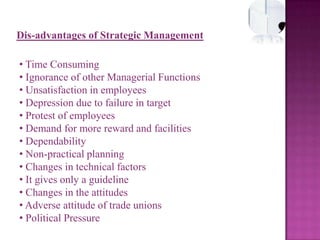
 Acceptance of Organizational ChangesDis-advantages of Strategic Management  Time Consuming
Ignorance of other Managerial Functions

Chapter 1 conceptual framework for strategic management (2)

  • 1.
    CHAPTER-1 Conceptual framework for strategic managementReported by : Rajmohan Gupta Abhishek Neogi Kinchit Rai Milan lakhani Jenish Malaviya Meghal ChauhanTo : Virag Shah (Lecturer ESM)
  • 2.
    CONTENTSConcept, Meaning, Definition - Strategy - Policy - Tactics - Strategic Management - Program - Procedure - Business - Stakeholders - SBU - ETOP - OCP - SAPStrategic management process & its implication
  • 3.
    Strategic intent - Organizational Vision,mission,goals&objectives - Their formulation and role in strategic management
  • 4.
  • 5.
    STRATEGY : Strategyis the determination of the long-term goals and objectives of an enterprise and the adoption of the courses of action and the allocation of resources necessary for carrying out these goals.Strategy isn’t themission—it’s theplan that allowsthe company toaccomplish themissionStrategy is management’s game plan for strengthening the organization’s position, pleasing customers, and achieving performance targets.
  • 6.
    Types Of Strategy·Corporate Strategy· Business Strategy· Functional Strategy
  • 7.
    POLICY : Aguiding principle, typically established by senior management, which is adopted by an organization or project to influence and determine decisions.Policies are the means by which annual objectives will be achieved. Policies include guidelines, rules, and procedures established to support efforts to achievestated objectives.Policy means having rules and procedures in place so people know what to do in certain situations. Business can have policy in place so that action and progress can be made.Diff: A strategy is a plan to do things a certain way to achieve a desired outcome. A policy is a rule designed to ensure consistency in governance and to avoid undesirable outcomes. .
  • 8.
    Types of policyCorporatepolicyCorporate policy describes a companies overall direction in terms of its general attitude towards growth and the management of its various businesses and product lines. It typical fit within the three main categories of stability, growth and retrenchment.Business policyBusiness policy usually occurs at the business unit or product level and it emphasizes improvement of the competitive position of a corporation products or services in the specific industry or market segment served by that business unit. Business strategies may fit within the two overall categories of competitive or cooperative strategies.Functional policyFunctional policy is the approach taken by a functional area to achieve corporate and business unit objectives and strategies by maximizing resources productivity. It is concerned with developing and nurturing a distinctive competence to provide a company or business unit with a competitive advantage.
  • 9.
  • 10.
    Tactics : Tacticmeans the approach towards workflow or the method of performing things. In terms of strategic management we have a solid definition given by Wheelen and Hunger “A tactic is a specific operating plan detailing how a strategy is to be implemented in terms of when and where it is to be put into action”. Tactics are narrower in scope and shorter in their time ascompared to strategies.There are two types of tactics as given by Wheelen and Hunger .· Timing tactic· Market Location tactic
  • 11.
    STRATEGIC MANAGEMENT :Strategic management is defined as the art and science of formulating, implementing, and evaluating cross-functional decisions that enable the organization to achieve its objectives." Generally, strategic management is not only related to a single specialization but covers cross-functional or overall organization.
  • 12.
    Strategic managementis a comprehensive area that covers almost all the functional areas of the organization. It is an umbrella concept of management that comprises all such functional areas as marketing, finance & account, human resource, and production & operation into a top level management discipline. Therefore, strategic management has an importance in the organizational success and failure than any specific functional areas.(Cont …….Strategic management deals with organizational level and top level issues whereas functional or operational level management deals with the specific areas of the business.
  • 13.
    . Top-level managerssuch as Chairman, Managing Director, and corporate level planners involve more in strategic management process.
  • 14.
    Strategic management relatesto setting vision, mission, objectives, and strategies that can be the guideline to design functional strategies in other functional areas
  • 15.
    Therefore, it istop-level management that paves the way for other functional or operational management in an organizationDefinition:Glueck – Strategic Management can be defined as a set of decisions, actions resulting in formulations & implementation of strategies designed to achieve the objectives of enterprise.
  • 16.
    Advantages of StrategicManagementIncrease in rate of return on investment
  • 17.
    Reduction inCost of Capital
  • 18.
    Increase inTrading on Equity
  • 19.
    Increase inProfitability
  • 20.
    Reduction infixed and flexible expenses
  • 21.
    Motivation togroup activity
  • 22.
    Increase inthe efficiency of the employees
  • 23.
    Prevention ofoverlapping of work
  • 24.
    Alertness inemployees
  • 25.
    Prevention oforganizational gap
  • 26.
    Acceptance ofOrganizational ChangesDis-advantages of Strategic Management Time Consuming
  • 27.
    Ignorance of otherManagerial Functions