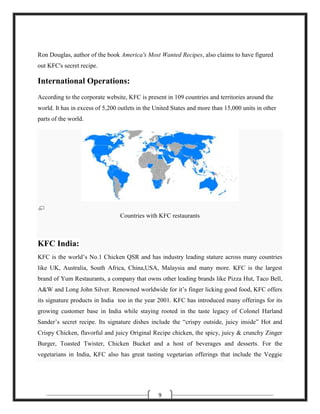
A STUDY ON ATMOSPHERIC STRATEGY OF KFC AND BMWCONTENTS:SL NO.                                             CONTENT                                                           PAGE NO.                                  INTRODUCTION TO THE PROJECT                                 4                                  INTRODUCTION TO KFC                                                   6-11                                  INTRODUCTION TO BMW                                                 13-17                                  ATMOSPHERIC STRATEGY OF KFC                                19-21                                  ATMOSPHERIC STRATEGY OF BMW                              23-25                                  FINDINGS                                                                               27                                  RECOMMENDATIONS                                                         29                                  CONCLUSIONS                                                                      31                                  REFERENCES                                                                         33                                  APPENDIX                                                                              35-36INTRODUCTION TO THE PROJECTIntroduction to the Project<br />The study is based on the store atmospherics and space strategy which different retail stores follow to attract their customer and make them buy or generate interest to buy from their retail outlets.<br />Atmospherics and retail space management are critical to any form of retail business. Their relevance emerges from the link between the shopping behavior and physical environmental factors. Physical environmental factors, for instance, influence the perception of shopping hours spent and the evolution of merchandise. It, therefore becomes important for the retailer to effectively plan and organize all the aspects related to atmospherics and retail space to be able to optimize scare resources and improve profitability. Atmospherics refers to the physical characteristics associated with the store.<br />Atmospherics refers to as a store’s physical characteristics that are used to develop the retail unit image and draw customers. It describes the physical elements in a store’s design that appeals to the customers and encourage them to buy.<br />These characteristics include both interior and exterior elements, as well as layout planning and display. Display is popularly referred to as visual merchandising. Atmospherics plays a significant role in attracting customers to the store, improving to the quality of service experience, creating a brand positioning for the outlet, and improving customers retention rates. Another equally significant but related concept is retail space management attempts to ensure optimum utilization of retail space along with convenience to customers and employees.<br />In this study two different type of retail outlets are taken. One is KFC and another one is BMW showroom. Both these retail outlets are situated at Connaught Place, New Delhi.<br />Both these retail outlets follow different atmospherics and store layout strategy to attract their customer. This study mainly talks about what are the  different atmospherics and store layout strategy follow by KFC and BMW, comparison between them, and some recommendation to the retail outlets.<br />INTRODUCTION TO KFC<br />Introduction to KFC<br />KFC, founded and also known as Kentucky Fried Chicken, is a chain of fast food restaurants based in Louisville, Kentucky, in the United States. KFC has been a brand and operating segment, termed a concept of Yum! Brands since 1997 when that company was spun off from PepsiCo as Tricon Global Restaurants Inc.<br />KFC primarily sells chicken pieces, wraps, salads and sandwiches. While its primary focus is fried chicken, KFC also offers a line of grilled and roasted chicken products, side dishes and desserts. Outside the USA, KFC offers beef based products such as hamburgers or kebabs, poutine, pork based products such as ribs and other regional fare.<br />The company was founded as Kentucky Fried Chicken by Colonel Harland Sanders in 1952, though the idea of KFC's fried chicken actually goes back to 1930. Although Sanders died in 1980, he remains an important part of the company's branding and advertisements, and \"
Colonel Sanders\"
 or \"
The Colonel\"
 is a metonym for the company itself. The company adopted KFC, an abbreviated form of its name, in 1991. Newer and remodeled restaurants will adopt the new logo and name, while older stores will continue to use the 1980s signage. Additionally, Yum! continues to use the abbreviated name freely in its advertising.<br />History of KFC:<br />Born and raised in Henryville, Indiana, Sanders passed through several professions in his lifetime. Sanders first served his fried chicken in 1930 in the midst of the Great Depression at a gas station he owned in North Corbin, Kentucky. The dining area was named Sanders Court & Café and was so successful that in 1935 Kentucky Governor Ruby Laffoon granted Sanders the title of honorary Kentucky Colonel in recognition of his contribution to the state's cuisine. The following year Sanders expanded his restaurant to 142 seats, and added a motel he bought across the street. When Sanders prepared his chicken in his original restaurant in North Corbin, he prepared the chicken in an iron skillet, which took about 30 minutes to do, too long for a restaurant operation. In 1939, Sanders altered the cooking process for his fried chicken to use a pressure fryer, resulting in a greatly reduced cooking time comparable to that of deep frying. In 1940 Sanders devised what came to be known as his Original Recipe.<br />The Sanders Court & Café generally served travelers, often those headed to Florida, so when the route planned in the 1950s for what would become Interstate 75 bypassed Corbin, he sold his properties and traveled the U.S. to sell his chicken to restaurant owners. The first to take him up on the offer was Pete Harman in South Salt Lake, Utah; together, they opened the first \"
Kentucky Fried Chicken\"
 outlet in 1952. By the early 1960s, Kentucky Fried Chicken was sold in over 600 franchised outlets in both the United States and Canada. One of the longest-lived franchisees of the older Col. Sanders' chicken concept, as opposed to the KFC chain, was the Kenny Kings chain. The company owned many Northern Ohio diner-style restaurants, the last of which closed in 2004.<br />With these new groups of investors undertaking the corporation, KFC expamded and matured quickly.<br />The corporation was listed on the New York Stock Exchange on January, 16, 1969. Only after three years it had gone public on March 17, 1966.<br />Sanders sold the entire KFC franchising operation in 1964 for $2 million USD, equal to $14,161,464 today. Since that time, the chain has been sold three more times: to Heublein in 1971, to R.J. Reynolds in 1982 and most recently to PepsiCo in 1986, which made it part of its Tricon Global Restaurants division, which in turn was spun off in 1997, and has now been renamed to Yum! Brands.<br />In 2001, KFC started test in Austin, Texas restaurants of \"
Wing Works\"
 chicken wing line sold with one of a few flavored sauces. Also, KFC hired a consultant to develop a breakfast menu.<br />Additionally, Colonel Sanders' nephew, Lee Cummings, took his own Kentucky Fried Chicken franchises (and a chicken recipe of his own) and converted them to his own \"
spin-off\"
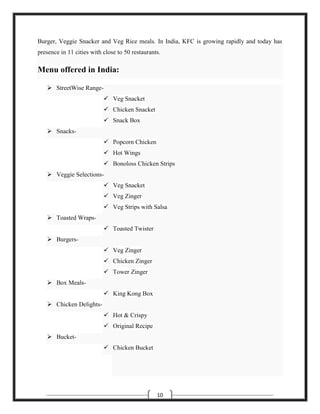
 restaurant chain, Lee's Famous Recipe Chicken.<br />Recipe:<br />The recipe of 11 herbs and spices used by KFC in preparation of their chicken remains a trade secret. Portions of the secret spice mix are made at different locations in the United States, and the only complete, handwritten copy of the recipe is kept in a vault in corporate headquarter.<br />On September 9, 2008, the one complete copy was temporarily moved to an undisclosed location under extremely tight security while KFC revamped the security at its headquarters. Before the move, KFC disclosed that the recipe, which includes exact amounts of each component, is written in pencil on a single sheet of notebook paper and signed by Sanders. It was locked in a filing cabinet with two separate combination locks. The cabinet also included vials of each of the 11 herbs and spices used. Only two unnamed executives had access to the recipe at any one time. One of the two executives said that no one had come close to guessing the contents of the secret recipe, and added that the actual recipe would include some surprises. On February 9, 2009, the secret recipe returned to KFC's Louisville headquarters in a more secure, computerized vault guarded by motion detectors and security cameras. Reportedly, the paper has yellowed and the handwriting is now faint.<br />In 1983, writer William Poundstone examined the recipe in his book Big Secrates. He reviewed Sanders' patent application, and advertised in college newspapers for present or former employees willing to share their knowledge. From the former he deduced that Sanders had diverged from other common fried-chicken recipes by varying the amount of oil used with the amount of chicken being cooked, and starting the cooking at a higher temperature (about 400 °F (200 °C)) for the first minute or so and then lowering it to 250 °F (120 °C) for the remainder of the cooking time. Several of Poundstone's contacts also provided samples of the seasoning mix, and a food lab found that it consisted solely of sugar, flour, salt, black paper and Monosodium Glutamate (MSG). He concluded that it was entirely possible that, in the years since Sanders sold the chain, later owners had begun skimping on the recipe to save costs. Following his buyout in 1964, Colonel Sanders himself expressed anger at such changes, saying:<br />That friggin' ... outfit .... They prostituted every goddamn thing I had. I had the greatest gravy in the world and those sons of bitches-- they dragged it out and extended it and watered it down that I'm so goddamn mad!<br />Ron Douglas, author of the book America's Most Wanted Recipes, also claims to have figured out KFC's secret recipe.<br />International Operations:<br />According to the corporate website, KFC is present in 109 countries and territories around the world. It has in excess of 5,200 outlets in the United States and more than 15,000 units in other parts of the world.<br />Countries with KFC restaurants<br />KFC India:<br />KFC is the world’s No.1 Chicken QSR and has industry leading stature across many countries like UK, Australia, South Africa, China,USA, Malaysia and many more. KFC is the largest brand of Yum Restaurants, a company that owns other leading brands like Pizza Hut, Taco Bell, A&W and Long John Silver. Renowned worldwide for it’s finger licking good food, KFC offers its signature products in India  too in the year 2001. KFC has introduced many offerings for its growing customer base in India while staying rooted in the taste legacy of Colonel Harland Sander’s secret recipe. Its signature dishes include the “crispy outside, juicy inside” Hot and Crispy Chicken, flavorful and juicy Original Recipe chicken, the spicy, juicy & crunchy Zinger Burger, Toasted Twister, Chicken Bucket and a host of beverages and desserts. For the vegetarians in India, KFC also has great tasting vegetarian offerings that include the Veggie Burger, Veggie Snacker and Veg Rice meals. In India, KFC is growing rapidly and today has presence in 11 cities with close to 50 restaurants.<br />Menu offered in India:<br />StreetWise Range-
Veg Snacket
Chicken Snacket
Snack Box
Snacks-
Popcorn Chicken
Hot Wings
Bonoloss Chicken Strips
Veggie Selections-
Veg Snacket
Veg Zinger
Veg Strips with Salsa
Toasted Wraps-
Toasted Twister
Burgers-
Veg Zinger
Chicken Zinger
Tower Zinger
Box Meals-
King Kong Box
Chicken Delights-
Hot & Crispy
Original Recipe
Bucket-
Chicken Bucket
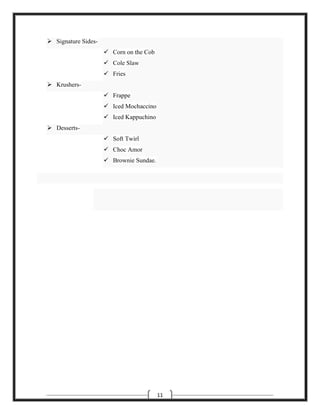
Signature Sides-
Corn on the Cob
Cole Slaw
Fries
Krushers-
Frappe
Iced Mochaccino
Iced Kappuchino
Desserts-
Soft Twirl
Choc Amor

Introduction to the project

  • 1.
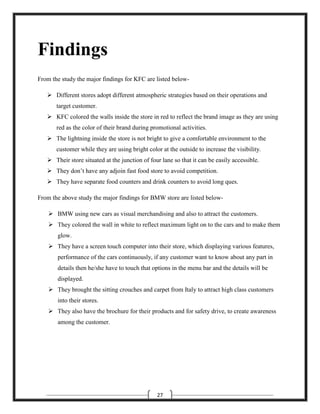
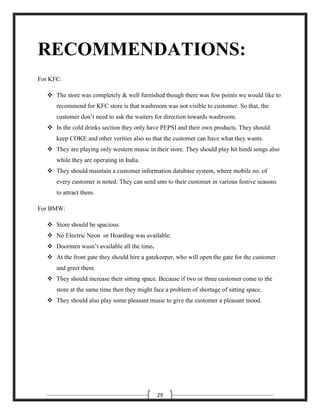
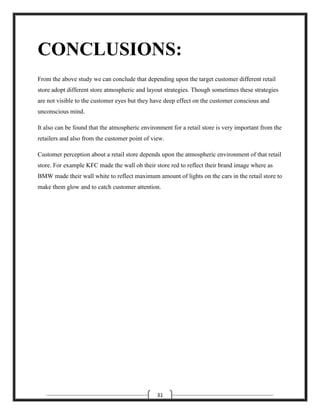
    A STUDY ONATMOSPHERIC STRATEGY OF KFC AND BMWCONTENTS:SL NO. CONTENT PAGE NO. INTRODUCTION TO THE PROJECT 4 INTRODUCTION TO KFC 6-11 INTRODUCTION TO BMW 13-17 ATMOSPHERIC STRATEGY OF KFC 19-21 ATMOSPHERIC STRATEGY OF BMW 23-25 FINDINGS 27 RECOMMENDATIONS 29 CONCLUSIONS 31 REFERENCES 33 APPENDIX 35-36INTRODUCTION TO THE PROJECTIntroduction to the Project<br />The study is based on the store atmospherics and space strategy which different retail stores follow to attract their customer and make them buy or generate interest to buy from their retail outlets.<br />Atmospherics and retail space management are critical to any form of retail business. Their relevance emerges from the link between the shopping behavior and physical environmental factors. Physical environmental factors, for instance, influence the perception of shopping hours spent and the evolution of merchandise. It, therefore becomes important for the retailer to effectively plan and organize all the aspects related to atmospherics and retail space to be able to optimize scare resources and improve profitability. Atmospherics refers to the physical characteristics associated with the store.<br />Atmospherics refers to as a store’s physical characteristics that are used to develop the retail unit image and draw customers. It describes the physical elements in a store’s design that appeals to the customers and encourage them to buy.<br />These characteristics include both interior and exterior elements, as well as layout planning and display. Display is popularly referred to as visual merchandising. Atmospherics plays a significant role in attracting customers to the store, improving to the quality of service experience, creating a brand positioning for the outlet, and improving customers retention rates. Another equally significant but related concept is retail space management attempts to ensure optimum utilization of retail space along with convenience to customers and employees.<br />In this study two different type of retail outlets are taken. One is KFC and another one is BMW showroom. Both these retail outlets are situated at Connaught Place, New Delhi.<br />Both these retail outlets follow different atmospherics and store layout strategy to attract their customer. This study mainly talks about what are the different atmospherics and store layout strategy follow by KFC and BMW, comparison between them, and some recommendation to the retail outlets.<br />INTRODUCTION TO KFC<br />Introduction to KFC<br />KFC, founded and also known as Kentucky Fried Chicken, is a chain of fast food restaurants based in Louisville, Kentucky, in the United States. KFC has been a brand and operating segment, termed a concept of Yum! Brands since 1997 when that company was spun off from PepsiCo as Tricon Global Restaurants Inc.<br />KFC primarily sells chicken pieces, wraps, salads and sandwiches. While its primary focus is fried chicken, KFC also offers a line of grilled and roasted chicken products, side dishes and desserts. Outside the USA, KFC offers beef based products such as hamburgers or kebabs, poutine, pork based products such as ribs and other regional fare.<br />The company was founded as Kentucky Fried Chicken by Colonel Harland Sanders in 1952, though the idea of KFC's fried chicken actually goes back to 1930. Although Sanders died in 1980, he remains an important part of the company's branding and advertisements, and \" Colonel Sanders\" or \" The Colonel\" is a metonym for the company itself. The company adopted KFC, an abbreviated form of its name, in 1991. Newer and remodeled restaurants will adopt the new logo and name, while older stores will continue to use the 1980s signage. Additionally, Yum! continues to use the abbreviated name freely in its advertising.<br />History of KFC:<br />Born and raised in Henryville, Indiana, Sanders passed through several professions in his lifetime. Sanders first served his fried chicken in 1930 in the midst of the Great Depression at a gas station he owned in North Corbin, Kentucky. The dining area was named Sanders Court & Café and was so successful that in 1935 Kentucky Governor Ruby Laffoon granted Sanders the title of honorary Kentucky Colonel in recognition of his contribution to the state's cuisine. The following year Sanders expanded his restaurant to 142 seats, and added a motel he bought across the street. When Sanders prepared his chicken in his original restaurant in North Corbin, he prepared the chicken in an iron skillet, which took about 30 minutes to do, too long for a restaurant operation. In 1939, Sanders altered the cooking process for his fried chicken to use a pressure fryer, resulting in a greatly reduced cooking time comparable to that of deep frying. In 1940 Sanders devised what came to be known as his Original Recipe.<br />The Sanders Court & Café generally served travelers, often those headed to Florida, so when the route planned in the 1950s for what would become Interstate 75 bypassed Corbin, he sold his properties and traveled the U.S. to sell his chicken to restaurant owners. The first to take him up on the offer was Pete Harman in South Salt Lake, Utah; together, they opened the first \" Kentucky Fried Chicken\" outlet in 1952. By the early 1960s, Kentucky Fried Chicken was sold in over 600 franchised outlets in both the United States and Canada. One of the longest-lived franchisees of the older Col. Sanders' chicken concept, as opposed to the KFC chain, was the Kenny Kings chain. The company owned many Northern Ohio diner-style restaurants, the last of which closed in 2004.<br />With these new groups of investors undertaking the corporation, KFC expamded and matured quickly.<br />The corporation was listed on the New York Stock Exchange on January, 16, 1969. Only after three years it had gone public on March 17, 1966.<br />Sanders sold the entire KFC franchising operation in 1964 for $2 million USD, equal to $14,161,464 today. Since that time, the chain has been sold three more times: to Heublein in 1971, to R.J. Reynolds in 1982 and most recently to PepsiCo in 1986, which made it part of its Tricon Global Restaurants division, which in turn was spun off in 1997, and has now been renamed to Yum! Brands.<br />In 2001, KFC started test in Austin, Texas restaurants of \" Wing Works\" chicken wing line sold with one of a few flavored sauces. Also, KFC hired a consultant to develop a breakfast menu.<br />Additionally, Colonel Sanders' nephew, Lee Cummings, took his own Kentucky Fried Chicken franchises (and a chicken recipe of his own) and converted them to his own \" spin-off\"  restaurant chain, Lee's Famous Recipe Chicken.<br />Recipe:<br />The recipe of 11 herbs and spices used by KFC in preparation of their chicken remains a trade secret. Portions of the secret spice mix are made at different locations in the United States, and the only complete, handwritten copy of the recipe is kept in a vault in corporate headquarter.<br />On September 9, 2008, the one complete copy was temporarily moved to an undisclosed location under extremely tight security while KFC revamped the security at its headquarters. Before the move, KFC disclosed that the recipe, which includes exact amounts of each component, is written in pencil on a single sheet of notebook paper and signed by Sanders. It was locked in a filing cabinet with two separate combination locks. The cabinet also included vials of each of the 11 herbs and spices used. Only two unnamed executives had access to the recipe at any one time. One of the two executives said that no one had come close to guessing the contents of the secret recipe, and added that the actual recipe would include some surprises. On February 9, 2009, the secret recipe returned to KFC's Louisville headquarters in a more secure, computerized vault guarded by motion detectors and security cameras. Reportedly, the paper has yellowed and the handwriting is now faint.<br />In 1983, writer William Poundstone examined the recipe in his book Big Secrates. He reviewed Sanders' patent application, and advertised in college newspapers for present or former employees willing to share their knowledge. From the former he deduced that Sanders had diverged from other common fried-chicken recipes by varying the amount of oil used with the amount of chicken being cooked, and starting the cooking at a higher temperature (about 400 °F (200 °C)) for the first minute or so and then lowering it to 250 °F (120 °C) for the remainder of the cooking time. Several of Poundstone's contacts also provided samples of the seasoning mix, and a food lab found that it consisted solely of sugar, flour, salt, black paper and Monosodium Glutamate (MSG). He concluded that it was entirely possible that, in the years since Sanders sold the chain, later owners had begun skimping on the recipe to save costs. Following his buyout in 1964, Colonel Sanders himself expressed anger at such changes, saying:<br />That friggin' ... outfit .... They prostituted every goddamn thing I had. I had the greatest gravy in the world and those sons of bitches-- they dragged it out and extended it and watered it down that I'm so goddamn mad!<br />Ron Douglas, author of the book America's Most Wanted Recipes, also claims to have figured out KFC's secret recipe.<br />International Operations:<br />According to the corporate website, KFC is present in 109 countries and territories around the world. It has in excess of 5,200 outlets in the United States and more than 15,000 units in other parts of the world.<br />Countries with KFC restaurants<br />KFC India:<br />KFC is the world’s No.1 Chicken QSR and has industry leading stature across many countries like UK, Australia, South Africa, China,USA, Malaysia and many more. KFC is the largest brand of Yum Restaurants, a company that owns other leading brands like Pizza Hut, Taco Bell, A&W and Long John Silver. Renowned worldwide for it’s finger licking good food, KFC offers its signature products in India too in the year 2001. KFC has introduced many offerings for its growing customer base in India while staying rooted in the taste legacy of Colonel Harland Sander’s secret recipe. Its signature dishes include the “crispy outside, juicy inside” Hot and Crispy Chicken, flavorful and juicy Original Recipe chicken, the spicy, juicy & crunchy Zinger Burger, Toasted Twister, Chicken Bucket and a host of beverages and desserts. For the vegetarians in India, KFC also has great tasting vegetarian offerings that include the Veggie Burger, Veggie Snacker and Veg Rice meals. In India, KFC is growing rapidly and today has presence in 11 cities with close to 50 restaurants.<br />Menu offered in India:<br />StreetWise Range-
  • 2.
  • 3.
  • 4.
  • 5.
  • 6.
  • 7.
  • 8.
  • 9.
  • 10.
  • 11.
  • 12.
  • 13.
  • 14.
  • 15.
  • 16.
  • 17.
  • 18.
  • 19.
  • 20.
  • 21.
  • 22.
  • 23.
  • 24.
  • 25.
  • 26.
  • 27.
  • 28.
  • 29.
  • 30.
  • 31.
  • 32.
  • 33.
  • 34.
  • 35.
  • 36.