tion
Introduction about Somalia
Today we want to present a brief presentation about our country Somalia.
Somalia Is one of the African Arab country, located in the east of the continent of
Africa, a region known as the Horn of Africa bounded on the east by the Gulf of Aden
and Indian Ocean.
Somalia has been inhabited since the Paleolithic period. Cave paintings said to date
back to 9000 BC have been found in the northern part of the country. Somalia has long
been known as a nation of poets Because of the beautiful views.
Good afternoon
The history of Somali people dates back so many centuries. The first time the word
Somali mentioned in a history books was 3500 years ago, when the queen of Egypt
Hatsebshut sent a fleet of 5 large ships and a crew of 250 men to Somalia which the
Egyptians called The Land of Punt.
Punt means “THE LAND OF SPICES” from the aromatic plants that grow there. The
Egyptians wanted to trade and they brought jewels and glass beads that they exchanged
for gold, elephant tusks myrrh, ostrich feathers, spices and different beads.
Some of these items, especially the aromatic ones were Egyptians used to their religious
festivals and celebration.
Jamhuuriyadda Soomaaliya
Somali Republic
 Capital city (and largest city): Mogadishu
 Official language(s): Somali, Arabic
 Ethnic groups: Somali 92.4%, Arab 2%, Bantu 1.8%, other 3.8%
 Religion: Islam 100%
 Independence from: Britain and Italy
 Independence Day: June 26 and July 1- 1960 (unit of land)
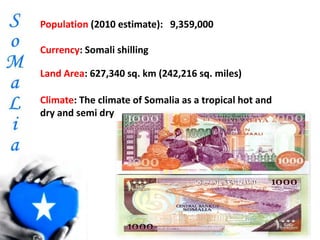
Population (2010 estimate): 9,359,000
Currency: Somali shilling
Climate: The climate of Somalia as a tropical hot and
dry and semi dry
Land Area: 627,340 sq. km (242,216 sq. miles)
Land Divisions 18 regions including: Awdal, Bakool, Banaadir, Bari, Bay,
Galguduud, Gedo, Hiiraan, Jubbada Dhexe, Jubbada Hoose, Mudug, Nugaal,
Sanaag, Shabeellaha Dhexe, Shabeellaha Hoose, Sool, Togdheer and
Woqooyi Galbeed.
Somalia's most famous cities: the capital city Mogadishu, Baidoa, Hargeisa,
Baladwayne, Baraawe, Berbera, Burma, Bossaso, Las Anod, Merka ,Garowe.
Countries border to Somalia: bordered by Djibouti and Eritrea to the
northwest, Kenya to the southwest, the Gulf of Aden with Yemen to the north,
the Indian Ocean to the east, and Ethiopia to the west.
System of government: Republic of coalition
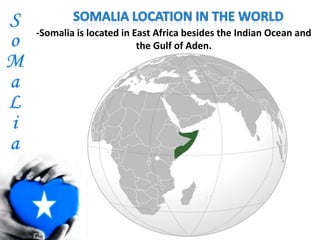
-Somalia is located in East Africa besides the Indian Ocean and
the Gulf of Aden.
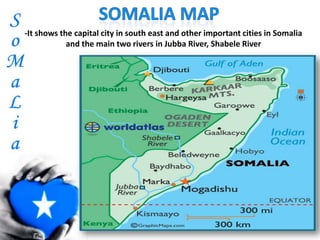
-It shows the capital city in south east and other important cities in Somalia
and the main two rivers in Jubba River, Shabele River
-The map shows The Silk Road extending from southern Europe through
Arabia, Somalia, India and Java until it reaches China.
Somalia is one of fewest country in the world that’s people
are 100% Muslim. Somalia Muslims are all Sunnis who
practice the Shaafi faith. The people living in Somalia speak
Somali and Arabic.
History of Islam in Somalia from Prophet Mohamed's era,
Islam comes to Somalia during the first half of the 7th
century (during the prophet's life time).
Islam had spread from mecca and crossed in to the
northern part of Somalia covering almost all the coastal
towns from northeast to south. Islam is a major influence
on the lives of Somalis.
- By the year of 1100 (493 AH), most Somalis converted to
Islam and now the Somali are from rare people that all its
population is Sunni Muslims (100%).
- In the description of the Somali Constitution, the definition
of Islam as the official state religion and that Sharia law is the
main source of legislation.
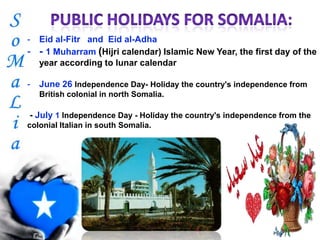
- Eid al-Fitr and Eid al-Adha
- - 1 Muharram (Hijri calendar) Islamic New Year, the first day of the
year according to lunar calendar
- June 26 Independence Day- Holiday the country's independence from
British colonial in north Somalia.
- July 1 Independence Day - Holiday the country's independence from the
colonial Italian in south Somalia.
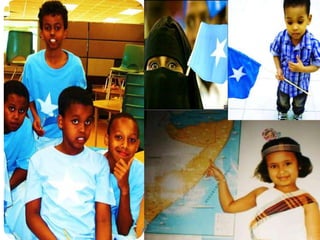
Somali flag is blue with a white star
Blue color symbolizes the Indian Ocean, overlooking the most
of the Somali cities .
The white star symbolizes to the peace and to The five
provinces inhabited by the Somali people in East Africa:
1 - South Somalia 2 - North Somalia 3 - Djibouti
4 - Ogaden 5 – province N.F.D
Is, Camel because it provides
transportation, milk, meat and
income to the local people.
two leopards carrying a shield that
has the national flag featured on it.
The Leopard symbolizes the
protection of the country.
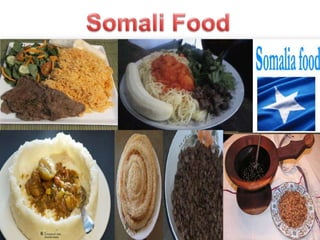
The cuisine of Somalia varies from region to region despite the
variety; there remains one thing that unites the various regional
cuisines: all food is served HaLaL.
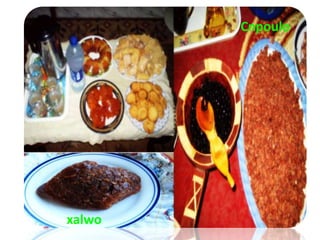
The "Cnpoulo" one of the most famous dishes in Somalia and that is
offered in all parts of the country. It’s a complete meal consists of
grain and beans mixed with butter and sugar.
Other favorite dishes like bariis basmati (rice) and also pasta with
sauce. Also sambuus (Sambosa) offers in Ramadan. Sweets like
xalwo offer in festivals and weddings and other occasions.
Fruits
The most famous fruit in Somalia are bananas. Somalia is one of the
largest banana-exporting countries. And it grown in large areas in
southern Somalia. Bananas are eaten in each and every meal.
xalwo
Cnpoulo
Somalia as a Muslim nation they wear both Islamic and
Somali traditional clothing. Although some Somali dress is
western in style, women dress very modestly, in accordance
with Islamic cultural mandates.
For women usually wear dirac, a long, billowing dress worn
over petticoats. Or Goantino, a four-yard cloth tied over
shoulder and draped around the waist.Hijab, and head
scarfs are very common too.
For Men, they wear Khameez (shirt) with a flowing plaid
kilts (macaawiis) or pants with shawls and Turban.
macaawiis
"Even the moon has a dark face"
"Even the moon has a dark
Civil war
In 1991 was a time of great change for Somalia. Civil war
broke out in Somalia After the opponents dropped the
communist government led by Mohamed Siad Barre.
Chaos and disorder has spread in most parts of the
country and these led to the Appearance of rebel
movements and demand the separation from the
motherland, Somalia.
It did not take but a few months of the collapse of the
Government when one of the opposition movements’
announced the separation of the north-western Somalia,
the separation was from one side.
-The Qu’ranic system (Duqsi) teaches the
greatest number of students, particularly females,
retaining the basic system of traditional religious
instruction in the country.
-Somalia’s ministry of education takes 15 % of the
government’s budget, which now offers free
primary school education and salaries for teachers.
- Higher education is largely private, with the
capital’s University of Mogadishu ranking the 29 in
Africa’s top 100 universities.
-Somalia has the second longest coast in the African continent, with a total length of
3025 km coast of Somalia; and Somali territorial waters extend to 200 nautical miles
within the Indian Ocean.
-In 2000 Somalia had one of Africa's most well developed telecommunications
systems, as well as Internet service for its expanding computer networks.
-In spite of suffering as a result of the civil war and instability at the domestic level,
Somalia has succeeded in establishing a free economic system than many other
African economic systems according to a study of the United Nations.
-Somali architecture is a rich and diverse tradition of engineering and designing
multiple different construction types such as stone cities, castles, citadels, fortresses,
mosques, lighthouses, towers and tombs as well as the fusion of Somali-Islamic
architecture with Occidental designs in contemporary times. The adoption of Islam
in the early medieval era of Somalia's history brought Islamic architectural influences
from Arabia and Persia.
Greetings
• Somali warmly greet each other with
handshakes, but shaking hands with the opposite
sex is avoided.
• Women greet one another informally and may
hug and kiss one another on the cheek.
• Somalis greet one another by saying,
• "Maalin wanaagsan" (Good day) or "Nabad myah?"
(are you ok ?).
• Common verbal greetings include:
• Subah wanaagsan (Good morning)
• Galab wanaagsan (Good afternoon)
• Habeen wanaagsan (Good night)
Ancient sites
in Somalia
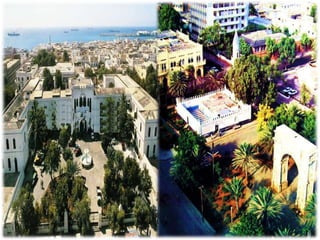
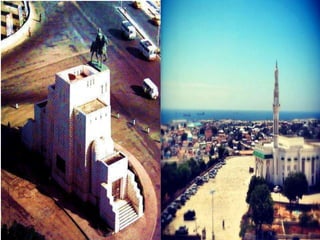
Shingani Old City
Shingani Old City is a very important sightseeing landmark, which provides
an insight into the architectural beauty of the place which is also a hub for
scenic beauty. Shingani located along the shore south of the city. The setup
of the Shengany and its building reflected it was once a very beautiful spot
of Mogadishu.
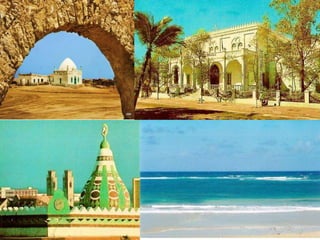
Fakr ad-Din mosque
Fakr ad-Din mosque: the oldest mosque in Mogadishu, Somalia. It is located
in Hamar Weyne, the oldest part of the city. This mosque the advantage of
from the other that is built of white marble and the many carvings and
decorations on its walls. The mosque built in 667 AH (1268) at the hands of
owner Bin Mohamed Al-Shirazi.
Xamarwayne mosque
Xamarwayne mosque is one of the oldest mosques built in the ancient city
and it was built in the first of Muharram 630 AH (1232).
Fakr ad-Din mosque
Hamrwin MosqueFakr Al-Din Mosque
Ahmed Gurey
Ahmad ibn Ibrahim al-Ghazi ( Ahmed Gurey, c. 1507 –1543) he was an Imam and General of
Adal who invaded Ethiopia and defeated several Ethiopian emperors and brought three-
quarters of Ethiopia under the power of the Muslim Sultanate of Adal.
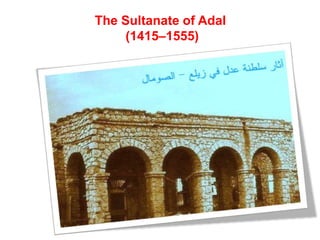
The Sultanate of Adal
(1415–1555)
Sultanate of Adal was one of the Islamic kingdoms which have contributed publishing Islam in
East Africa. This kingdom had relations and trade with countries in Africa, the Near East,
Europe and Asia.
Memorial for S.Y.L
Somali Youth League (SYL) was the first political party in Somalia. It played a key role in the
nation's road to independence during the 1950s and 1960s.
Mohammed Abdullah Hassan
Mohammed Abdullah Hassan was a Somali national religious leader. He established the
Dervish State in Somalia that fought an anti-imperial war for a period of over 20 years against
British, Italian and Ethiopian forces.
Hawo Osman Tako
Hawo Osman Tako was a remarkable woman who has played a significant role in Somalia's
struggle for independence.
Taleh (Somali: Taleex) is an historical town in the northeastern Sool region of Somalia.
Hawo Osman Tako
Ahmed Gurey
The Sultanate of Adal
(1415–1555)
Presentation about Somalia

Presentation about Somalia

  • 1.
  • 3.
    Introduction about Somalia Todaywe want to present a brief presentation about our country Somalia. Somalia Is one of the African Arab country, located in the east of the continent of Africa, a region known as the Horn of Africa bounded on the east by the Gulf of Aden and Indian Ocean. Somalia has been inhabited since the Paleolithic period. Cave paintings said to date back to 9000 BC have been found in the northern part of the country. Somalia has long been known as a nation of poets Because of the beautiful views. Good afternoon The history of Somali people dates back so many centuries. The first time the word Somali mentioned in a history books was 3500 years ago, when the queen of Egypt Hatsebshut sent a fleet of 5 large ships and a crew of 250 men to Somalia which the Egyptians called The Land of Punt. Punt means “THE LAND OF SPICES” from the aromatic plants that grow there. The Egyptians wanted to trade and they brought jewels and glass beads that they exchanged for gold, elephant tusks myrrh, ostrich feathers, spices and different beads. Some of these items, especially the aromatic ones were Egyptians used to their religious festivals and celebration.
  • 4.
    Jamhuuriyadda Soomaaliya Somali Republic Capital city (and largest city): Mogadishu  Official language(s): Somali, Arabic  Ethnic groups: Somali 92.4%, Arab 2%, Bantu 1.8%, other 3.8%  Religion: Islam 100%  Independence from: Britain and Italy  Independence Day: June 26 and July 1- 1960 (unit of land)
  • 5.
    Population (2010 estimate):9,359,000 Currency: Somali shilling Climate: The climate of Somalia as a tropical hot and dry and semi dry Land Area: 627,340 sq. km (242,216 sq. miles)
  • 6.
    Land Divisions 18regions including: Awdal, Bakool, Banaadir, Bari, Bay, Galguduud, Gedo, Hiiraan, Jubbada Dhexe, Jubbada Hoose, Mudug, Nugaal, Sanaag, Shabeellaha Dhexe, Shabeellaha Hoose, Sool, Togdheer and Woqooyi Galbeed. Somalia's most famous cities: the capital city Mogadishu, Baidoa, Hargeisa, Baladwayne, Baraawe, Berbera, Burma, Bossaso, Las Anod, Merka ,Garowe. Countries border to Somalia: bordered by Djibouti and Eritrea to the northwest, Kenya to the southwest, the Gulf of Aden with Yemen to the north, the Indian Ocean to the east, and Ethiopia to the west. System of government: Republic of coalition
  • 7.
    -Somalia is locatedin East Africa besides the Indian Ocean and the Gulf of Aden.
  • 8.
    -It shows thecapital city in south east and other important cities in Somalia and the main two rivers in Jubba River, Shabele River
  • 9.
    -The map showsThe Silk Road extending from southern Europe through Arabia, Somalia, India and Java until it reaches China.
  • 11.
    Somalia is oneof fewest country in the world that’s people are 100% Muslim. Somalia Muslims are all Sunnis who practice the Shaafi faith. The people living in Somalia speak Somali and Arabic. History of Islam in Somalia from Prophet Mohamed's era, Islam comes to Somalia during the first half of the 7th century (during the prophet's life time). Islam had spread from mecca and crossed in to the northern part of Somalia covering almost all the coastal towns from northeast to south. Islam is a major influence on the lives of Somalis.
  • 12.
    - By theyear of 1100 (493 AH), most Somalis converted to Islam and now the Somali are from rare people that all its population is Sunni Muslims (100%). - In the description of the Somali Constitution, the definition of Islam as the official state religion and that Sharia law is the main source of legislation.
  • 13.
    - Eid al-Fitrand Eid al-Adha - - 1 Muharram (Hijri calendar) Islamic New Year, the first day of the year according to lunar calendar - June 26 Independence Day- Holiday the country's independence from British colonial in north Somalia. - July 1 Independence Day - Holiday the country's independence from the colonial Italian in south Somalia.
  • 14.
    Somali flag isblue with a white star Blue color symbolizes the Indian Ocean, overlooking the most of the Somali cities . The white star symbolizes to the peace and to The five provinces inhabited by the Somali people in East Africa: 1 - South Somalia 2 - North Somalia 3 - Djibouti 4 - Ogaden 5 – province N.F.D
  • 15.
    Is, Camel becauseit provides transportation, milk, meat and income to the local people. two leopards carrying a shield that has the national flag featured on it. The Leopard symbolizes the protection of the country.
  • 17.
    The cuisine ofSomalia varies from region to region despite the variety; there remains one thing that unites the various regional cuisines: all food is served HaLaL. The "Cnpoulo" one of the most famous dishes in Somalia and that is offered in all parts of the country. It’s a complete meal consists of grain and beans mixed with butter and sugar. Other favorite dishes like bariis basmati (rice) and also pasta with sauce. Also sambuus (Sambosa) offers in Ramadan. Sweets like xalwo offer in festivals and weddings and other occasions. Fruits The most famous fruit in Somalia are bananas. Somalia is one of the largest banana-exporting countries. And it grown in large areas in southern Somalia. Bananas are eaten in each and every meal.
  • 19.
  • 24.
    Somalia as aMuslim nation they wear both Islamic and Somali traditional clothing. Although some Somali dress is western in style, women dress very modestly, in accordance with Islamic cultural mandates. For women usually wear dirac, a long, billowing dress worn over petticoats. Or Goantino, a four-yard cloth tied over shoulder and draped around the waist.Hijab, and head scarfs are very common too. For Men, they wear Khameez (shirt) with a flowing plaid kilts (macaawiis) or pants with shawls and Turban.
  • 26.
  • 28.
    "Even the moonhas a dark face"
  • 29.
    "Even the moonhas a dark
  • 30.
    Civil war In 1991was a time of great change for Somalia. Civil war broke out in Somalia After the opponents dropped the communist government led by Mohamed Siad Barre. Chaos and disorder has spread in most parts of the country and these led to the Appearance of rebel movements and demand the separation from the motherland, Somalia. It did not take but a few months of the collapse of the Government when one of the opposition movements’ announced the separation of the north-western Somalia, the separation was from one side.
  • 32.
    -The Qu’ranic system(Duqsi) teaches the greatest number of students, particularly females, retaining the basic system of traditional religious instruction in the country. -Somalia’s ministry of education takes 15 % of the government’s budget, which now offers free primary school education and salaries for teachers. - Higher education is largely private, with the capital’s University of Mogadishu ranking the 29 in Africa’s top 100 universities.
  • 34.
    -Somalia has thesecond longest coast in the African continent, with a total length of 3025 km coast of Somalia; and Somali territorial waters extend to 200 nautical miles within the Indian Ocean. -In 2000 Somalia had one of Africa's most well developed telecommunications systems, as well as Internet service for its expanding computer networks. -In spite of suffering as a result of the civil war and instability at the domestic level, Somalia has succeeded in establishing a free economic system than many other African economic systems according to a study of the United Nations. -Somali architecture is a rich and diverse tradition of engineering and designing multiple different construction types such as stone cities, castles, citadels, fortresses, mosques, lighthouses, towers and tombs as well as the fusion of Somali-Islamic architecture with Occidental designs in contemporary times. The adoption of Islam in the early medieval era of Somalia's history brought Islamic architectural influences from Arabia and Persia.
  • 36.
    Greetings • Somali warmlygreet each other with handshakes, but shaking hands with the opposite sex is avoided. • Women greet one another informally and may hug and kiss one another on the cheek.
  • 37.
    • Somalis greetone another by saying, • "Maalin wanaagsan" (Good day) or "Nabad myah?" (are you ok ?). • Common verbal greetings include: • Subah wanaagsan (Good morning) • Galab wanaagsan (Good afternoon) • Habeen wanaagsan (Good night)
  • 39.
  • 40.
    Shingani Old City ShinganiOld City is a very important sightseeing landmark, which provides an insight into the architectural beauty of the place which is also a hub for scenic beauty. Shingani located along the shore south of the city. The setup of the Shengany and its building reflected it was once a very beautiful spot of Mogadishu. Fakr ad-Din mosque Fakr ad-Din mosque: the oldest mosque in Mogadishu, Somalia. It is located in Hamar Weyne, the oldest part of the city. This mosque the advantage of from the other that is built of white marble and the many carvings and decorations on its walls. The mosque built in 667 AH (1268) at the hands of owner Bin Mohamed Al-Shirazi. Xamarwayne mosque Xamarwayne mosque is one of the oldest mosques built in the ancient city and it was built in the first of Muharram 630 AH (1232).
  • 43.
    Fakr ad-Din mosque HamrwinMosqueFakr Al-Din Mosque
  • 44.
    Ahmed Gurey Ahmad ibnIbrahim al-Ghazi ( Ahmed Gurey, c. 1507 –1543) he was an Imam and General of Adal who invaded Ethiopia and defeated several Ethiopian emperors and brought three- quarters of Ethiopia under the power of the Muslim Sultanate of Adal. The Sultanate of Adal (1415–1555) Sultanate of Adal was one of the Islamic kingdoms which have contributed publishing Islam in East Africa. This kingdom had relations and trade with countries in Africa, the Near East, Europe and Asia. Memorial for S.Y.L Somali Youth League (SYL) was the first political party in Somalia. It played a key role in the nation's road to independence during the 1950s and 1960s. Mohammed Abdullah Hassan Mohammed Abdullah Hassan was a Somali national religious leader. He established the Dervish State in Somalia that fought an anti-imperial war for a period of over 20 years against British, Italian and Ethiopian forces. Hawo Osman Tako Hawo Osman Tako was a remarkable woman who has played a significant role in Somalia's struggle for independence.
  • 45.
    Taleh (Somali: Taleex)is an historical town in the northeastern Sool region of Somalia.
  • 48.
  • 49.
    The Sultanate ofAdal (1415–1555)