
Group members
Ammara saleem 1005
Misbah aslam 1032
Amna yousaf 1004
Ansa rasheed 1007
Rabia gulzar 1037
Saudi Arabia
INTRODUCTION
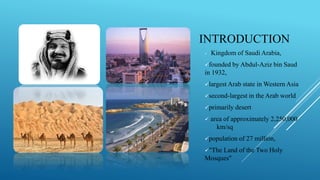
 Kingdom of Saudi Arabia,
founded by Abdul-Aziz bin Saud
in 1932,
largest Arab state in Western Asia
second-largest in the Arab world
primarily desert
 area of approximately 2,250,000
km/sq
population of 27 million,
"The Land of the Two Holy
Mosques"
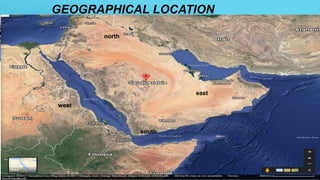
GEOGRAPHICAL LOCATION
north
east
south
west
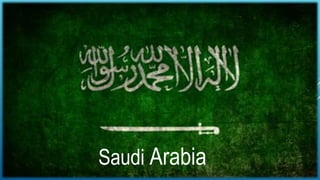
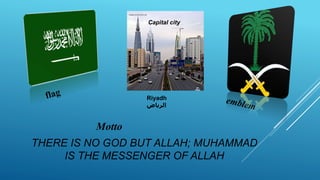
THERE IS NO GOD BUT ALLAH; MUHAMMAD
IS THE MESSENGER OF ALLAH
Motto
Capital city
Riyadh
‫الرياض‬
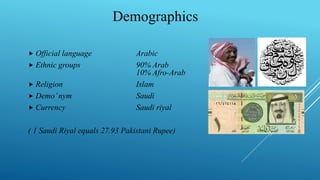
 Official language Arabic
 Ethnic groups 90% Arab
10% Afro-Arab
 Religion Islam
 Demo’nym Saudi
 Currency Saudi riyal
( 1 Saudi Riyal equals 27.93 Pakistani Rupee)
Demographics
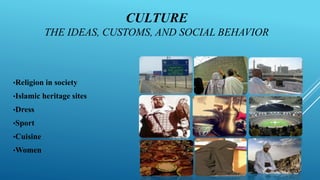
CULTURE
THE IDEAS, CUSTOMS, AND SOCIAL BEHAVIOR
•Religion in society
•Islamic heritage sites
•Dress
•Sport
•Cuisine
•Women
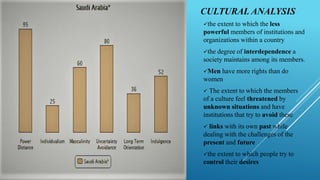
CULTURAL ANALYSIS
the extent to which the less
powerful members of institutions and
organizations within a country
the degree of interdependence a
society maintains among its members.
Men have more rights than do
women
 The extent to which the members
of a culture feel threatened by
unknown situations and have
institutions that try to avoid these
 links with its own past while
dealing with the challenges of the
present and future
the extent to which people try to
control their desires
BUSINESS ETIQUETTE
Greetings
Exchange of Business
Cards
Appropriate Greetings/
Introductions/ Use of Titles
Exchange of Gifts
Business Entertainment
Business Dress Code
Meeting Time
Things to be avoid
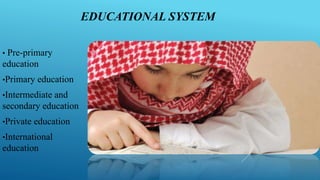
EDUCATIONAL SYSTEM
• Pre-primary
education
•Primary education
•Intermediate and
secondary education
•Private education
•International
education
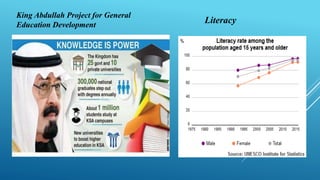
King Abdullah Project for General
Education Development
Literacy
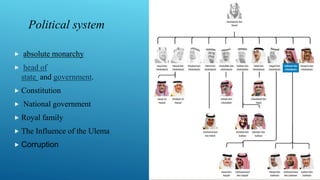
Political system
 absolute monarchy
 head of
state and government.
 Constitution
 National government
 Royal family
 The Influence of the Ulema
 Corruption
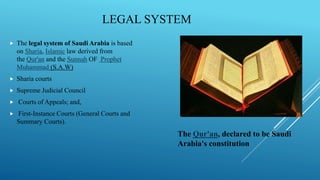
LEGAL SYSTEM
 The legal system of Saudi Arabia is based
on Sharia, Islamic law derived from
the Qur'an and the Sunnah OF Prophet
Muhammad (S.A.W)
 Sharia courts
 Supreme Judicial Council
 Courts of Appeals; and,
 First-Instance Courts (General Courts and
Summary Courts).
The Qur'an, declared to be Saudi
Arabia's constitution
 The new Law of the Judiciary organizes the
Courts System in the following hierarchical
structure in descending order:
 High Court;
 Courts of Appeals; and,
 First-Degree Courts, which are composed
of:
 o General Courts;
 o Criminal Courts;
 o Personal Status Courts;
 o Commercial Courts; and,
 o Labor Court
The police department of the
Saudi Ministry of the Interior
is divided into three forces:
Regular Police
secret police
religious police ( Matawan)
The New Courts System
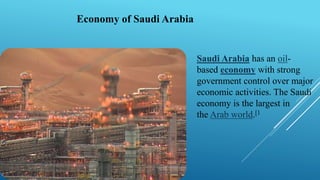
Economy of Saudi Arabia
Saudi Arabia has an oil-
based economy with strong
government control over major
economic activities. The Saudi
economy is the largest in
the Arab world.[1
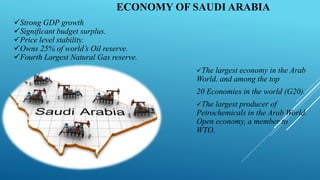
ECONOMY OF SAUDI ARABIA
The largest economy in the Arab
World, and among the top
20 Economies in the world (G20).
The largest producer of
Petrochemicals in the Arab World.
Open economy, a member to
WTO.
Strong GDP growth
Significant budget surplus.
Price level stability.
Owns 25% of world’s Oil reserve.
Fourth Largest Natural Gas reserve.
Political stability, member of many
Arab & International Organizations.
Investment incentives, Income tax
free, financial facilities.
Ranked 12th in ease of doing
businesses in 2012.
10th largest worldwide Exporter
21st largest worldwide importer
Economy of Saudi
Arabia
Re-evaluation and issuance of new laws.
Developing IT and Communication platforms.
Creating more jobs for Saudi youth.
Enhance PPP Private/ Public partnership.
Accelerating Privatization Program.
Support SME’s and family business.
Promotion of Non-Oil export.
REFORMS TO ENHANCE SAUDI’S
ECONOMY
Exports
petroleum and
petroleum products
90%
Main export partners
China 13.1%
Japan 10.9%
United States 9.6%
India 9.6%
South Korea 8.5%
Imports
machinery and
equipment,
Foodstuffs
 chemicals
motor vehicles
textiles
SAUDI ARABIA

SAUDI ARABIA

  • 2.
    Group members Ammara saleem1005 Misbah aslam 1032 Amna yousaf 1004 Ansa rasheed 1007 Rabia gulzar 1037
  • 3.
  • 4.
    INTRODUCTION  Kingdom ofSaudi Arabia, founded by Abdul-Aziz bin Saud in 1932, largest Arab state in Western Asia second-largest in the Arab world primarily desert  area of approximately 2,250,000 km/sq population of 27 million, "The Land of the Two Holy Mosques"
  • 5.
  • 6.
    THERE IS NOGOD BUT ALLAH; MUHAMMAD IS THE MESSENGER OF ALLAH Motto Capital city Riyadh ‫الرياض‬
  • 7.
     Official languageArabic  Ethnic groups 90% Arab 10% Afro-Arab  Religion Islam  Demo’nym Saudi  Currency Saudi riyal ( 1 Saudi Riyal equals 27.93 Pakistani Rupee) Demographics
  • 8.
    CULTURE THE IDEAS, CUSTOMS,AND SOCIAL BEHAVIOR •Religion in society •Islamic heritage sites •Dress •Sport •Cuisine •Women
  • 9.
    CULTURAL ANALYSIS the extentto which the less powerful members of institutions and organizations within a country the degree of interdependence a society maintains among its members. Men have more rights than do women  The extent to which the members of a culture feel threatened by unknown situations and have institutions that try to avoid these  links with its own past while dealing with the challenges of the present and future the extent to which people try to control their desires
  • 10.
    BUSINESS ETIQUETTE Greetings Exchange ofBusiness Cards Appropriate Greetings/ Introductions/ Use of Titles Exchange of Gifts Business Entertainment Business Dress Code Meeting Time Things to be avoid
  • 11.
    EDUCATIONAL SYSTEM • Pre-primary education •Primaryeducation •Intermediate and secondary education •Private education •International education
  • 12.
    King Abdullah Projectfor General Education Development Literacy
  • 13.
    Political system  absolutemonarchy  head of state and government.  Constitution  National government  Royal family  The Influence of the Ulema  Corruption
  • 14.
    LEGAL SYSTEM  Thelegal system of Saudi Arabia is based on Sharia, Islamic law derived from the Qur'an and the Sunnah OF Prophet Muhammad (S.A.W)  Sharia courts  Supreme Judicial Council  Courts of Appeals; and,  First-Instance Courts (General Courts and Summary Courts). The Qur'an, declared to be Saudi Arabia's constitution
  • 15.
     The newLaw of the Judiciary organizes the Courts System in the following hierarchical structure in descending order:  High Court;  Courts of Appeals; and,  First-Degree Courts, which are composed of:  o General Courts;  o Criminal Courts;  o Personal Status Courts;  o Commercial Courts; and,  o Labor Court The police department of the Saudi Ministry of the Interior is divided into three forces: Regular Police secret police religious police ( Matawan) The New Courts System
  • 16.
    Economy of SaudiArabia Saudi Arabia has an oil- based economy with strong government control over major economic activities. The Saudi economy is the largest in the Arab world.[1
  • 17.
    ECONOMY OF SAUDIARABIA The largest economy in the Arab World, and among the top 20 Economies in the world (G20). The largest producer of Petrochemicals in the Arab World. Open economy, a member to WTO. Strong GDP growth Significant budget surplus. Price level stability. Owns 25% of world’s Oil reserve. Fourth Largest Natural Gas reserve.
  • 18.
    Political stability, memberof many Arab & International Organizations. Investment incentives, Income tax free, financial facilities. Ranked 12th in ease of doing businesses in 2012. 10th largest worldwide Exporter 21st largest worldwide importer Economy of Saudi Arabia
  • 19.
    Re-evaluation and issuanceof new laws. Developing IT and Communication platforms. Creating more jobs for Saudi youth. Enhance PPP Private/ Public partnership. Accelerating Privatization Program. Support SME’s and family business. Promotion of Non-Oil export. REFORMS TO ENHANCE SAUDI’S ECONOMY
  • 20.
    Exports petroleum and petroleum products 90% Mainexport partners China 13.1% Japan 10.9% United States 9.6% India 9.6% South Korea 8.5% Imports machinery and equipment, Foodstuffs  chemicals motor vehicles textiles