Zombie Rights


  Andrew Dun
The not too distant future…
Rights Revolutions
 An expanding circle…

 • Women’s suffrage
    • Race Rights
   • Queer Rights
   • Animal Rights
 • …’Zombie’ Rights?
‘Zombie’ 2.0

        • uploads?
• artificial intelligences?
 • hybrid intelligences?
 • non-human animals?
    • ‘brain in a vat’
          • you?
          • me?
     • materialists?
Ethics…
        “Consciousness Matters”

• Consciousness is necessary for suffering
 • Consciousness is necessary for agency

• Identity, selfhood, intentionality, paying
                  attention…
What is consciousness?
Objective: Cognitive, psychological:
              • self-awareness,
            • self-consciousness,
               • introspection,
                • self-identity,
       • relationship to environment.
  • Access-consciousness (Block), Available
              content (Chalmers).
          • A complex of traits…?
Subjective: Experiential, Phenomenal
                      • Qualia
                  • “What it is like”
                     • Intrinsic
                     • Ineffable
                   • Non-relational
                      • Unified
                      • Private
               • Directly apprehensible

 Truths about what it is like to be a subject that are not
    entailed a priori by the physical and functional truth
  (including the environmental truth) about that subject.
                       (Chalmers 2002).
Which kind of consciousness is
    ethically important?

     • Objective? Subjective?
Threats to Zombie Rights?

       • Non-naturalistic worldviews
 • Biological Materialism (eg. Searle 1992)
• General uncertainty about consciousness
        • Conceivability of Zombies
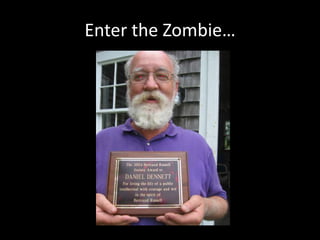
Enter the Zombie…
‘My Zombie Twin’

• “This creature is molecule for molecule
identical to me, and identical in all the low-
 level properties postulated by a complete
 physics, but he lacks conscious experience
       entirely.” (Chalmers 1996, p 92)
Get to know your nearest zombie…
So… how to tell a zombie?

                Supervenience…?

“*High level+ properties supervene on [low level]
    properties if no two possible situations are
     identical with respect to their [low level]
   properties while differing in their [high level]
        properties” (Chalmers 1996, p 31).
More supervenience
 • Logical supervenience – “…if no two logically
  possible situations are identical with respect to
    their low level properties but distinct with
 respect to their high level properties.” (Chalmers
                     1996 p 32)
• Natural supervenience – “…if any two naturally
   possible situations with the same [low-level]
 properties have the same *high level+ properties.”
               (Chalmers 1996 p 34)

       • -> Looking at brains won’t help!
Do zombies know they are zombies?


             Causal
             Closure


                              p
Do non-zombies know they are non-zombies?
A paradox…

      • “of phenomenal judgement”

           …can we resolve this?

Chalmers: Judgements can be justified in the
 absence of a causal link -> ‘Acquaintance’
Are we barking up the wrong tree?
Re-enter…


Monism
‘Qualia’ for monist materialists

  • Heterophenomenology (Dennett):
 “phenomenology of another not oneself”

• A method: Psychology, Cognitive Science,
            Neuroscience etc..
Heterophenomenological Qualia
• When you say “This is my quale,” what you are singling
     out, or referring to, whether you realize it or not, is
  your idiosyncratic complex of dispositions. You seem to
      be referring to be referring to a private, ineffable
  something-or-other in your mind’s eye, a private shade
    of homogenous pink, but this is just how it seems to
   you, not how it is. That “quale” of yours is a character
        in good standing in the fictional world of your
   heterophenomenology, but what it turns out to be in
       the real world in your brain is just a complex of
                          dispositions.
  • (Dennett 1991, Consciousness Explained, pp 388 –
                              389).
~ The End ~
    ?
Does heterophenomenology ‘take
    consciousness seriously’?
• “The crucial argument seems to be… where
 [Dennett] claims (in effect) that what needs to
  be explained is how things seem, and that his
   theory explainthis equivocates between a
     psychological and phenomenal sense of
   “seem.”s how things seem. But… What the
    theory might explain is our disposition to
   make certain judgements about stimuli, but
   those judgements were never the puzzling
                   explananda.
An uploader’s dilemma
• Will my upload just be a piece of ‘software’?
               …a zombie me?

• Is it at least conceivable that this will be the
                        case?

   • If it is conceivable, is it then possible?
Conceivability -> Possiblity


           Chalmers: Yes!

            Dennett: ‘…’

 Physicalist (e.g. Levine, Loar) : No!
Physicalism (‘Type B’ Materialism)
          i) Consciousness is physical
ii) Consciousness is irreducible (non-reductive)

 • A solution without (a clear) explanation?

       Strong metaphysical necessity?
       ‘Don’t-have-a-clue physicalism’
The story so far…
                    A dilemma:

      Take qualia seriously, but struggle with
                 epistemologic gap
                        OR
Close epistemic gap, but take qualia ‘less seriously’

            Ontology or Epistemology?
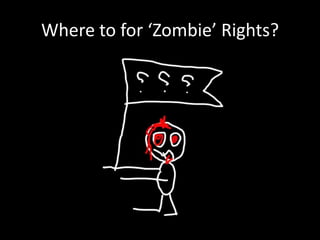
Where to for ‘Zombie’ Rights?
Materialist ZR
• Complex factors, but no metaphysical puzzles -
  > heterophenomenological approach to
  subjective experience, including suffering.
• Agency, responsibility -> cognitive,
  behavioural, psychological, sociological
• Mirrors existing approach, at least for humans.
  A 'common-sense materialism’.
Dualist ZR
 A bifurcated self? Whose rights? Physical self?
               Phenomenal self?

• Physical self -> same treatment as materialist
• Phenomenal self -> evaluate ethical
  significance of pure experience (pure
  phenomenal concepts)
Ethics of ‘a pain in a box’….


    Without cognition, identity
          A reductio?
Inflationary and Deflationary
           Phenomenal Concepts
• “At a first approximation, phenomenal concepts deal with
    the first-person aspects of the mind, and psychological
   concepts deal with the third-person aspects.” (Chalmers
                          1996, p 14).

• Direct (and pure) phenomenal concept: “partly constituted
   by an underlying phenomenal quality, in that the content
  will mirror the quality (picking out instances of the quality
    in all epistemic possibilities), and in that across a wide
   range of nearby conceptually possible cases in which the
   underlying quality is varied while background properties
    are held constant, the content will covary to mirror the
                    quality.” (Chalmers 2003)
Conceptual Bindings?

  Inflationary: ‘Underlying quality’ understood as an
 irreducible (phenomenally real) phenomenal property
    Deflationary: ‘Underlying quality’ understood in
    materialistic (e.g. heterophenomenological) terms

Contention: Phenomenal properties such as pains only
 have ethical significance where associated with direct
 phenomenal concepts of which they are constituents –
                        however…
The ‘deflationary scoop’
Phenomenal concepts - > distinct psychological
 analogues, including direct and pseudo-direct.

          Undermining constitution…

We can ‘scoop out’ deflationary (psychological)
   content from phenomenal concepts (and
 beliefs) – chasing the ‘raw feel’ down a rabbit
                      hole…
Conceptual Constitution

Phenomenal properties are never truly constituent -
              ‘surplus to requirements’.
     All qualia are in this way ‘disembodied’.

   Rights should be based in relationships, goals,
               commitments, actions.

• Contention: Psychological facts are sufficient for
                ethical appraisals.
Acquaintance
•    Chalmers: Phenomenal beliefs can be constituted by phenomenal properties by
               virtue of a subject’s acquaintance with those properties…

•    “Acquaintance is not itself a conceptual relation: rather, it makes certain sorts of
        concepts possible. And it is not itself a justificatory relation: rather, it makes
       certain sorts of justification possible. Phenomenal concepts and phenomenal
     knowledge require not just acquaintance, but acquaintance in the right cognitive
       background: a cognitive background that minimally involves a certain sort of
         attention to the phenomenal quality in question, a cognitive act of concept
        formation, the absence of certain sorts of confusion and other undermining
     factors (for full justification), and so on. But it is acquaintance with the quality or
        the experience itself that does the crucial justifying work.” (Chalmers 2003)

      • “…acquaintance is a relation that makes possible the formation of pure
    phenomenal concepts, and we have seen that pure phenomenal concepts embody
    a certain sort of lucid understanding of phenomenal properties. So acquaintance is
     a relation that makes this sort of lucid understanding possible.” (Chalmers 2003)
Epistemic gap = ethical gap
  ‘Lucid understanding’ -> heterophenomenology

“The question is whether I am justified in the belief,
     not whether my brain is justified in the belief
   (and if property dualism is correct there is more
     to me than my brain)” *Chalmers 1996, page
                         198].

 But: This is not a case of ‘brain and’, it’s a case of
                       ‘brain OR’.
Distinct Selves
- Reasoning, planning, feeling, interacting self
                       (brain)
  - Experiential self (‘a phenomenal mirror’)

           If constitution fails:
 a) We grant these selves rights distinctly?
             b) Change tack?
A ‘psychological consensus’…

• For materialists, physicists and dualists (so too
   for proponents of ‘neutral’ or ‘diet’ qualia)..

 • Metaphysical considerations ‘cancel out’ of
                 the equation.
Can we do better?
                  We want:

         • To ‘take qualia seriously’
• To avoid the epistemic problems of dualism
• To defend an intuitive view of conceivability

   Can we shake the zombie off our back?
Physicalism Revisited

       Can we defend a view where:

• i) possibility/conceivability relation holds
         • ii) qualitative states exist
       • iii) zombies are not possible
• iv) because zombies are not conceivable
Conceiving Zombies

  Missed assumptions?

• Physical 'world for free"
 • Ontological hierarchy
    • Supervenience
• Ontological consistency
Consider…

Physical Realism: The physical world as primary.
 Solipsism: The phenomenal world as primary.

             Which view is ‘correct’?
Is there are any reason we should automatically
              grant ourselves the first?
Symmetric Ontologies
         Physical world as primary…

 Physicality is necessary but not sufficient for
                phenomenal world
Phenomenality is sufficient but not necessary
                 for physical world

               And vice versa…
Symmetric Scenarios
  So: Ontological and epistemic gaps are symmetric.

            Paradox of physical judgement?
                  Absent physicalia?
                 Inverted physicalia?

• “We need some intrinsic properties to make sense of
  the physical world, and we need to find a place for the
   intrinsic properties revealed in phenomenology. The
   two problems seem to be well matched.” (Chalmers
                        1996 p 303).
‘Sorta’ Real
               We can say that…

  Qualia are ‘sorta’ real with respect to their
 hetereophenomenological (rich psychological)
                 representations

Physical properties are ‘sorta’ real with respect
  to phenomenal properties – they are richly
                   representet
Supervenience…

         vs Symmetric Representation

  The physical contains representations of the
                  phenomenal
The phenomenal contains representations of the
                     physical
Ontological Exclusivity vs
           Complementarity
• “...implies the impossibility of any sharp separation
 between the behaviour of atomic objects [i.e., objects
 governed by quantum mechanics] and the interaction
 with the measuring instruments which serve to define
 the conditions under which the phenomena appear....
    Consequently, evidence obtained under different
   experimental conditions cannot be comprehended
     within a single picture, but must be regarded as
  complementary in the sense that only the totality of
 the phenomenena exhausts the possible information
             about the objects.” (Bohr, 1949)
Complementary Photons, Realities
• “The complementarity principle states that
  some objects have multiple properties that
  appear to be contradictory. Sometimes it is
  possible to switch back and forth between
 different views of an object to observe these
 properties, but in principle, it is impossible to
   view both at the same time, despite their
      simultaneous coexistence in reality.”
   (Wikipedia – Complementarity (Physics))
Complementary Dualism
          “How to kill a zombie”


Proposal: Treat all reality in a manner analogous
  to the complementary treatment of photons.
Complementary Symmetric
       Representation


Reality = “two different things
  but not at the same time”.
Applying Complementary Dualism
Which physical entities will have phenomenal
 correlates? Which phenomenal entities will
          have physical correlates?

     Mutual symmetric representation
  A natural suggestion: Intentional states –
  physical and phenomenal (eg. Horgan and
                   Tienson)
Assessment of physical systems

• Presence of physical intentionality will imply
   phenomenal intentionality, and vice versa
• Can therefore confidently asses phenomenal
   properties in terms of physical/functional
     properties, as per Naturalistic Dualism
A Dual Aspect Ontology?

It-from-bit: “Experience is information from the
      inside; physics is information from the
          outside”. (Chalmers 1996, 303).

To the extent that informational or intentional
  states can be abstracted across ontologies…
However…
   We don’t need to identify intentional states across
  ontologies. This is a key advantage for complementary
                          dualism.

Mutual global representation is sufficient. As ontologies
     are complementary, rather than simultaneous or
  coexistent, there is no need to posit a psychophysical
   ‘mapping’ function between ontological particulars
 (i.e. specific qualitative and intentional states). (Just as
 we don’t seek to ‘map’ waves to particles or vice versa
                    in quantum systems).
Quantum Consequences?

          Many minds

       Complementing…

         Many worlds

-> Pan-psychism, Pan-physicalism
Cogency before proof...
  Complementary dualism = a new kind of physicalism

      i) Supports phenomenal (and physical) realism
ii) Phenomenal is not ‘surplus’ to physical nor vice versa
                    ii) Precludes zombies
iii) Assessment of physical functional states = assessment
                      of phenomenal states
            iv) Parsimonious, no supervenience

 Supports a ‘common sense’ psychological approach to
                  ethical questions.
In world without zombies…


 zombie rights
      ->
universal rights
Summary

• ‘Physical rights’ are enough

• Complimentary dualism -> Phenomenal
  realism without zombies
All Aboard!

Zombie Rights

  • 1.
    Zombie Rights Andrew Dun
  • 2.
    The not toodistant future…
  • 3.
    Rights Revolutions Anexpanding circle… • Women’s suffrage • Race Rights • Queer Rights • Animal Rights • …’Zombie’ Rights?
  • 4.
    ‘Zombie’ 2.0 • uploads? • artificial intelligences? • hybrid intelligences? • non-human animals? • ‘brain in a vat’ • you? • me? • materialists?
  • 5.
    Ethics… “Consciousness Matters” • Consciousness is necessary for suffering • Consciousness is necessary for agency • Identity, selfhood, intentionality, paying attention…
  • 6.
  • 7.
    Objective: Cognitive, psychological: • self-awareness, • self-consciousness, • introspection, • self-identity, • relationship to environment. • Access-consciousness (Block), Available content (Chalmers). • A complex of traits…?
  • 8.
    Subjective: Experiential, Phenomenal • Qualia • “What it is like” • Intrinsic • Ineffable • Non-relational • Unified • Private • Directly apprehensible Truths about what it is like to be a subject that are not entailed a priori by the physical and functional truth (including the environmental truth) about that subject. (Chalmers 2002).
  • 9.
    Which kind ofconsciousness is ethically important? • Objective? Subjective?
  • 10.
    Threats to ZombieRights? • Non-naturalistic worldviews • Biological Materialism (eg. Searle 1992) • General uncertainty about consciousness • Conceivability of Zombies
  • 11.
  • 12.
    ‘My Zombie Twin’ •“This creature is molecule for molecule identical to me, and identical in all the low- level properties postulated by a complete physics, but he lacks conscious experience entirely.” (Chalmers 1996, p 92)
  • 13.
    Get to knowyour nearest zombie…
  • 14.
    So… how totell a zombie? Supervenience…? “*High level+ properties supervene on [low level] properties if no two possible situations are identical with respect to their [low level] properties while differing in their [high level] properties” (Chalmers 1996, p 31).
  • 15.
    More supervenience •Logical supervenience – “…if no two logically possible situations are identical with respect to their low level properties but distinct with respect to their high level properties.” (Chalmers 1996 p 32) • Natural supervenience – “…if any two naturally possible situations with the same [low-level] properties have the same *high level+ properties.” (Chalmers 1996 p 34) • -> Looking at brains won’t help!
  • 16.
    Do zombies knowthey are zombies? Causal Closure p Do non-zombies know they are non-zombies?
  • 17.
    A paradox… • “of phenomenal judgement” …can we resolve this? Chalmers: Judgements can be justified in the absence of a causal link -> ‘Acquaintance’
  • 18.
    Are we barkingup the wrong tree?
  • 19.
  • 20.
    ‘Qualia’ for monistmaterialists • Heterophenomenology (Dennett): “phenomenology of another not oneself” • A method: Psychology, Cognitive Science, Neuroscience etc..
  • 21.
    Heterophenomenological Qualia • Whenyou say “This is my quale,” what you are singling out, or referring to, whether you realize it or not, is your idiosyncratic complex of dispositions. You seem to be referring to be referring to a private, ineffable something-or-other in your mind’s eye, a private shade of homogenous pink, but this is just how it seems to you, not how it is. That “quale” of yours is a character in good standing in the fictional world of your heterophenomenology, but what it turns out to be in the real world in your brain is just a complex of dispositions. • (Dennett 1991, Consciousness Explained, pp 388 – 389).
  • 22.
  • 23.
    Does heterophenomenology ‘take consciousness seriously’? • “The crucial argument seems to be… where [Dennett] claims (in effect) that what needs to be explained is how things seem, and that his theory explainthis equivocates between a psychological and phenomenal sense of “seem.”s how things seem. But… What the theory might explain is our disposition to make certain judgements about stimuli, but those judgements were never the puzzling explananda.
  • 24.
    An uploader’s dilemma •Will my upload just be a piece of ‘software’? …a zombie me? • Is it at least conceivable that this will be the case? • If it is conceivable, is it then possible?
  • 25.
    Conceivability -> Possiblity Chalmers: Yes! Dennett: ‘…’ Physicalist (e.g. Levine, Loar) : No!
  • 26.
    Physicalism (‘Type B’Materialism) i) Consciousness is physical ii) Consciousness is irreducible (non-reductive) • A solution without (a clear) explanation? Strong metaphysical necessity? ‘Don’t-have-a-clue physicalism’
  • 27.
    The story sofar… A dilemma: Take qualia seriously, but struggle with epistemologic gap OR Close epistemic gap, but take qualia ‘less seriously’ Ontology or Epistemology?
  • 28.
    Where to for‘Zombie’ Rights?
  • 29.
    Materialist ZR • Complexfactors, but no metaphysical puzzles - > heterophenomenological approach to subjective experience, including suffering. • Agency, responsibility -> cognitive, behavioural, psychological, sociological • Mirrors existing approach, at least for humans. A 'common-sense materialism’.
  • 30.
    Dualist ZR Abifurcated self? Whose rights? Physical self? Phenomenal self? • Physical self -> same treatment as materialist • Phenomenal self -> evaluate ethical significance of pure experience (pure phenomenal concepts)
  • 31.
    Ethics of ‘apain in a box’…. Without cognition, identity A reductio?
  • 32.
    Inflationary and Deflationary Phenomenal Concepts • “At a first approximation, phenomenal concepts deal with the first-person aspects of the mind, and psychological concepts deal with the third-person aspects.” (Chalmers 1996, p 14). • Direct (and pure) phenomenal concept: “partly constituted by an underlying phenomenal quality, in that the content will mirror the quality (picking out instances of the quality in all epistemic possibilities), and in that across a wide range of nearby conceptually possible cases in which the underlying quality is varied while background properties are held constant, the content will covary to mirror the quality.” (Chalmers 2003)
  • 33.
    Conceptual Bindings? Inflationary: ‘Underlying quality’ understood as an irreducible (phenomenally real) phenomenal property Deflationary: ‘Underlying quality’ understood in materialistic (e.g. heterophenomenological) terms Contention: Phenomenal properties such as pains only have ethical significance where associated with direct phenomenal concepts of which they are constituents – however…
  • 34.
    The ‘deflationary scoop’ Phenomenalconcepts - > distinct psychological analogues, including direct and pseudo-direct. Undermining constitution… We can ‘scoop out’ deflationary (psychological) content from phenomenal concepts (and beliefs) – chasing the ‘raw feel’ down a rabbit hole…
  • 35.
    Conceptual Constitution Phenomenal propertiesare never truly constituent - ‘surplus to requirements’. All qualia are in this way ‘disembodied’. Rights should be based in relationships, goals, commitments, actions. • Contention: Psychological facts are sufficient for ethical appraisals.
  • 36.
    Acquaintance • Chalmers: Phenomenal beliefs can be constituted by phenomenal properties by virtue of a subject’s acquaintance with those properties… • “Acquaintance is not itself a conceptual relation: rather, it makes certain sorts of concepts possible. And it is not itself a justificatory relation: rather, it makes certain sorts of justification possible. Phenomenal concepts and phenomenal knowledge require not just acquaintance, but acquaintance in the right cognitive background: a cognitive background that minimally involves a certain sort of attention to the phenomenal quality in question, a cognitive act of concept formation, the absence of certain sorts of confusion and other undermining factors (for full justification), and so on. But it is acquaintance with the quality or the experience itself that does the crucial justifying work.” (Chalmers 2003) • “…acquaintance is a relation that makes possible the formation of pure phenomenal concepts, and we have seen that pure phenomenal concepts embody a certain sort of lucid understanding of phenomenal properties. So acquaintance is a relation that makes this sort of lucid understanding possible.” (Chalmers 2003)
  • 37.
    Epistemic gap =ethical gap ‘Lucid understanding’ -> heterophenomenology “The question is whether I am justified in the belief, not whether my brain is justified in the belief (and if property dualism is correct there is more to me than my brain)” *Chalmers 1996, page 198]. But: This is not a case of ‘brain and’, it’s a case of ‘brain OR’.
  • 38.
    Distinct Selves - Reasoning,planning, feeling, interacting self (brain) - Experiential self (‘a phenomenal mirror’) If constitution fails: a) We grant these selves rights distinctly? b) Change tack?
  • 39.
    A ‘psychological consensus’… •For materialists, physicists and dualists (so too for proponents of ‘neutral’ or ‘diet’ qualia).. • Metaphysical considerations ‘cancel out’ of the equation.
  • 40.
    Can we dobetter? We want: • To ‘take qualia seriously’ • To avoid the epistemic problems of dualism • To defend an intuitive view of conceivability Can we shake the zombie off our back?
  • 41.
    Physicalism Revisited Can we defend a view where: • i) possibility/conceivability relation holds • ii) qualitative states exist • iii) zombies are not possible • iv) because zombies are not conceivable
  • 42.
    Conceiving Zombies Missed assumptions? • Physical 'world for free" • Ontological hierarchy • Supervenience • Ontological consistency
  • 43.
    Consider… Physical Realism: Thephysical world as primary. Solipsism: The phenomenal world as primary. Which view is ‘correct’? Is there are any reason we should automatically grant ourselves the first?
  • 44.
    Symmetric Ontologies Physical world as primary… Physicality is necessary but not sufficient for phenomenal world Phenomenality is sufficient but not necessary for physical world And vice versa…
  • 45.
    Symmetric Scenarios So: Ontological and epistemic gaps are symmetric. Paradox of physical judgement? Absent physicalia? Inverted physicalia? • “We need some intrinsic properties to make sense of the physical world, and we need to find a place for the intrinsic properties revealed in phenomenology. The two problems seem to be well matched.” (Chalmers 1996 p 303).
  • 46.
    ‘Sorta’ Real We can say that… Qualia are ‘sorta’ real with respect to their hetereophenomenological (rich psychological) representations Physical properties are ‘sorta’ real with respect to phenomenal properties – they are richly representet
  • 47.
    Supervenience… vs Symmetric Representation The physical contains representations of the phenomenal The phenomenal contains representations of the physical
  • 48.
    Ontological Exclusivity vs Complementarity • “...implies the impossibility of any sharp separation between the behaviour of atomic objects [i.e., objects governed by quantum mechanics] and the interaction with the measuring instruments which serve to define the conditions under which the phenomena appear.... Consequently, evidence obtained under different experimental conditions cannot be comprehended within a single picture, but must be regarded as complementary in the sense that only the totality of the phenomenena exhausts the possible information about the objects.” (Bohr, 1949)
  • 49.
    Complementary Photons, Realities •“The complementarity principle states that some objects have multiple properties that appear to be contradictory. Sometimes it is possible to switch back and forth between different views of an object to observe these properties, but in principle, it is impossible to view both at the same time, despite their simultaneous coexistence in reality.” (Wikipedia – Complementarity (Physics))
  • 50.
    Complementary Dualism “How to kill a zombie” Proposal: Treat all reality in a manner analogous to the complementary treatment of photons.
  • 51.
    Complementary Symmetric Representation Reality = “two different things but not at the same time”.
  • 52.
    Applying Complementary Dualism Whichphysical entities will have phenomenal correlates? Which phenomenal entities will have physical correlates? Mutual symmetric representation A natural suggestion: Intentional states – physical and phenomenal (eg. Horgan and Tienson)
  • 53.
    Assessment of physicalsystems • Presence of physical intentionality will imply phenomenal intentionality, and vice versa • Can therefore confidently asses phenomenal properties in terms of physical/functional properties, as per Naturalistic Dualism
  • 54.
    A Dual AspectOntology? It-from-bit: “Experience is information from the inside; physics is information from the outside”. (Chalmers 1996, 303). To the extent that informational or intentional states can be abstracted across ontologies…
  • 55.
    However… We don’t need to identify intentional states across ontologies. This is a key advantage for complementary dualism. Mutual global representation is sufficient. As ontologies are complementary, rather than simultaneous or coexistent, there is no need to posit a psychophysical ‘mapping’ function between ontological particulars (i.e. specific qualitative and intentional states). (Just as we don’t seek to ‘map’ waves to particles or vice versa in quantum systems).
  • 56.
    Quantum Consequences? Many minds Complementing… Many worlds -> Pan-psychism, Pan-physicalism
  • 57.
    Cogency before proof... Complementary dualism = a new kind of physicalism i) Supports phenomenal (and physical) realism ii) Phenomenal is not ‘surplus’ to physical nor vice versa ii) Precludes zombies iii) Assessment of physical functional states = assessment of phenomenal states iv) Parsimonious, no supervenience Supports a ‘common sense’ psychological approach to ethical questions.
  • 58.
    In world withoutzombies… zombie rights -> universal rights
  • 59.
    Summary • ‘Physical rights’are enough • Complimentary dualism -> Phenomenal realism without zombies
  • 60.

Editor's Notes

  • #2 [slide 1] “zombie rights now” demonstration[slide 2] the final 'rights revolution'? uploads, artificial intelligences, hybrid intelligence, non-human animals, you?, me?Slide... First blush zombie = an upload, an AI, a simulation, even a person that acts like you or me, but is not 'conscious'Slide... Rights of what kind? Equality...Slide... Assumption: consciousness is a fundamental aspect of ethical consideration - only conscious brings can act, can suffer[slide 3] basic contention: “consciousness matters” what kind of consciousness?[slide 4] self-awareness... [i am me / i am conscious / i have goals. Block says access conscious, chalmers says ][slide 5] phenomenal-awareness.... ‘what it is like’ acquaintance with qualitative entities - pains, colours, emotions[slide 6] what kind of consciousness is important?Self-awareness? AI, person, upload exhibits this...Phenomenal awareness?[slide] enter the zombie... [slide with zombie - wrong slide!][slide] enter the zombie... [slide with Daniel Dennett(!)][slide] what are zombies like? Just like you or me....Puzzle: zombies don't even know they are zombies!Do non-zombies know they are non-zombies?A paradox... [of phenomenal judgement]Logical supervenienceNatural supervenienceProperties of qualia - intrinsic, ineffable, etcDoes this make sense??Can we resolve the paradox...? Maybe? [mention chalmers's counter arguments]Or... Are we barking up the wrong tree?Assumption of dualism...Re-enter... [image of dennett]Materialism. A singular ontology.Heterophenomenology: one liner dennett quoteThe EndOr... Does heterophenomenolgy 'take consciousness seriously'?Chalmers: dennett equivocates on the word 'seems'[to the extent that we conceptualise qualia our brains can represent qualitative states in a relational, functional (non-qualitative) manner... But the strong intuition remains that this is not enough]Ontology: regular concepts / deflationary phenomenal concepts / inflationary/pure phenomenal concepts (contentious)But *are* uploads conscious? "uploads are just software" -> conceivable?Possible?chalmers: yes! Dennett: '...' left the room Shoemaker: no!Physicalism... A solution without an explanation...? Will return to this..A simple but deep dilemma...- take qualia seriously, but don't know we are conscious- we know we are conscious, but leave an elephant in the roomHmmm...Where to for zombie rights?Materialism: complex factors, but no metaphysical puzzles -> heterophenomenological approach to subjective experience, including suffering.Agency, responsibility -> cognitive, behavioural, psychological, sociologicalMirrors existing approach, at least for humans. 'common sense materialism'Dualist rights?Whose rights? Physical self? Phenomenal self?Physical self -> same treatment as materialistPhenomenal self -> evaluate pure phenomenal conceptsIsolate value of a pain quale? Pain in a box?Consider.... A 'pure pain' -> outside space, cognition, timeReductio ad absurdum -> pain qualia only matter in contextA reasonable bifurcation? Re-enter the paradox...A pain quale needs an associated deflationary concept?But even so, whatever is bad or distressing about pain can be captured by a deflationary pain concept... If we consider something matters, our considering is an existence proof that the thing that matters can be captured in a deflationary concept -> we can 'scoop' deflationary content from any complex phenomenal concept, and make an ethical evaluation on this basisEpistemic gap = ethical gapYour brain doesn't know if your phenomenal self is suffering. Your phenomenal self suffers without reporting back to your brainDualist -> considers only deflationary aspects of phenomenal concepts-> evaluates ethical statements in same way as materialist...so too the physicalist...A satisfying conclusion? Can we go one better?We want I) take qualia seriously ii) avoid the problems of dualismCan we defend physicalism?A view where: I) possibility/conceivability relation holds ii) qualitative states exist iii) zombies are not possible -> zombies are not conceivableThe 'logical geography of the issues'Is this territory broader?Missed assumptions: ontological consistency, ontological hierarchy, supervenience, the 'world for free"There is a sense that the physical world can do just fine without the phenomenal world but not vice versa. But we should step over this assumption. On either side of the ontological gap, the primary ontology seems necessary but not sufficient for the secondary, and the secondary sufficient but not necessary for the primary. Each is 'sorta' real with respect to the otherWith the physical world taken as primary we are all zombies...A notion: ontological para consistency -> wave / particle dualityPhysical / phenomenal duality AND exclusivity'para consistent dualism'Reject supervenience. Enter symmetric representationHeterophenom states represent qualitative concepts. Symmetrically, phenomenal states represent cognitive 'deflationary' concepts -> two different things but not at the same timeIsn't this just 'it from bit'? Dual aspect? Parallelism? No -> these views suggest consistent, simultaneous ontologies (though some sympathy with information as binder, the nature of 'information' varies depending on which ontology is taken as primary...A fundamentally different world view -> one where materialism and solipsism are equally weighted: paradox of physical judgementHow do we apply para consistent dualism in practice?Which physical entities will have phenomenal correlates? Which phenomenal entities will have physical correlatesTo determine this we can apply the Intentional stance ->Binding on intentional/representational properties (physical intentionality v phenomenal intentionality) intentional properties are of course not absolute, and in physical ontologies there will be multiple intentional stances available for a give set of functional states, but not infinite. The more complex the system, the more constrained become the set of consistent intentional interpretations..  So in physical systems we may search for complex intentional patterns... Of the kinds we would find in brains, AIs etc.  on the phenomenal side, there is also a clear sense of rich intentionality up for grabs (HorganTienson)The shape of a theory...Finally, we might note an intersection with quantum mechanics, from which we drew some inspiration earlier.A broader ontological para consistency -> the coexistence of a many worlds and many minds interpretation of the wave function, again, with each sorta real with respect to the other, depending on which ontology we take as primaryWhich world 'comes free'? Neither - there is an interdependence between the two - god did not have 'more work to do' for Each world to come in the form in which we conceive it, he had to create both at the same time... (Any thought experiment that starts with the physical world had smuggled in the phenomenal?)If we can show that there is a position that really does respect our theoretical requirements, we might arrive at a new kind of physicalism - one that does justice to our intuitions, while as before, enabling us to reason about the physical world according to a common-sense brand of materialism.From one zombie to another (physical ontology taken as primary), I'd like to leave you with this thought:'zombie rights now!