Assessment involving the use of information and
communication technologies (ICT). ICT can be used
(a) to deliver traditional assessment formats more
effectively and efficiently, and
(b) to change the way competencies are assessed
and develop formats that facilitate the assessment of
competencies that have been difficult to capture with
traditional assessment formats
ICT – Based Assessment
1. Download Zipgrade
2. Navigate and explore the features of
Zipgrade
3. Customize answer sheets
Objectives
A teacher’s tool that can
check papers in seconds.
(https://www.zipgrade .com/)
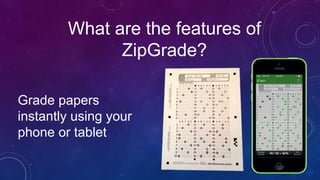
What are the features of
ZipGrade?
Grade papers
instantly using your
phone or tablet
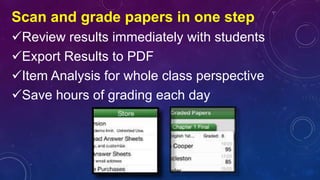
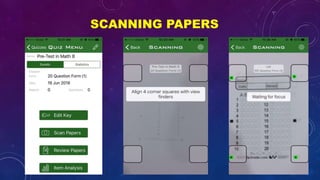
Scan and grade papers in one step
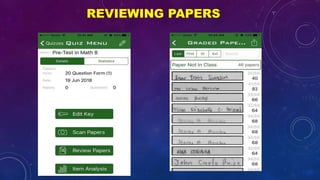
Review results immediately with students
Export Results to PDF
Item Analysis for whole class perspective
Save hours of grading each day
QUICK, ACCURATE, AND
ORGANIZED
• ZipGrade knows when a paper is in focus and is
ready to be graded.
• The phone will vibrate when an image is acquired
to let you know its is ready to scan another.
• Scan, grade and organize up to 20 tests per minute
FLEXIBLE
• With multiple answer sheets sizes and forms.
• The answer sheet are licensed via Creative
Commons (BY-NC/3.0) which means you are
allowed to customized , update, and distribute to
others. Some teachers even laminated answer
sheets to make them reusable
AVOIDS CHEATING DURING
CHECKING
• Answer sheets are scanned
PRACTICE FOR STANDARDIZED
TEST
• Shading of answers
• Checking is not manual
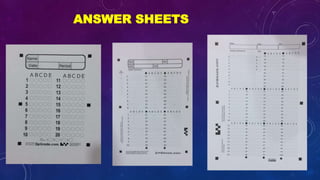
ANSWER SHEETS
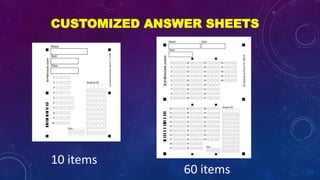
CUSTOMIZED ANSWER SHEETS
10 items
60 items
COST EFFECTIVE
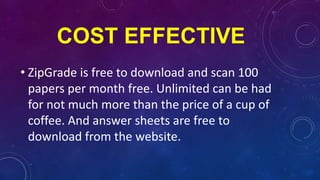
• ZipGrade is free to download and scan 100
papers per month free. Unlimited can be had
for not much more than the price of a cup of
coffee. And answer sheets are free to
download from the website.
INSTANT FEEDBACK
•Many teachers now grade as soon
as students complete a quiz or test.
Students receive immediate
feedback and teachers can redirect
differentiated learning quickly.
DOWNLOAD ZIPGRADE
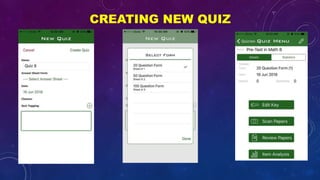
CREATING NEW QUIZ
EDITING KEY
SCANNING PAPERS
REVIEWING PAPERS
ITEM ANALYSIS
ITEM ANALYSIS
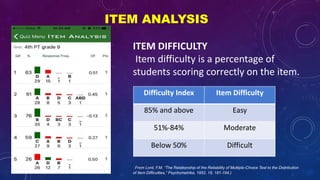
ITEM DIFFICULTY
Item difficulty is a percentage of
students scoring correctly on the item.
Difficulty Index Item Difficulty
85% and above Easy
51%-84% Moderate
Below 50% Difficult
(From Lord, F.M. “The Relationship of the Reliability of Multiple-Choice Test to the Distribution
of Item Difficulties,” Psychometrika, 1952, 18, 181-194.)
ITEM ANALYSIS
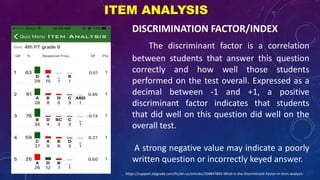
DISCRIMINATION FACTOR/INDEX
The discriminant factor is a correlation
between students that answer this question
correctly and how well those students
performed on the test overall. Expressed as a
decimal between -1 and +1, a positive
discriminant factor indicates that students
that did well on this question did well on the
overall test.
A strong negative value may indicate a poorly
written question or incorrectly keyed answer.
https://support.zipgrade.com/hc/en-us/articles/204847865-What-is-the-Discriminant-Factor-in-item-analysis-
ITEM ANALYSIS
TYPES OF DISCRIMINATION INDEX
1. Positive Discrimination
2. Negative Discrimination
3. Zero Discrimination
Ebel (1986) and Hetzel (1997)
ITEM ANALYSIS
DISCRIMINATION FACTOR
The power of the item to discriminate
the students between those who scored
high and those who scored low in the
overall test.
Index Range Discrimination Level
0.19 and below Poor item, to be eliminated
or revised
0.20 – 0.29 Marginal Item, Needs some
revision
0.30 – 0.39 Reasonably good item but
possibly for improvement
0.40 and above Very good item
Ebel (1986) and Hetzel (1997)
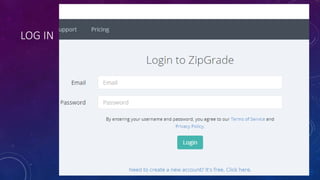
GO TO ZIPGRADE.COM
LOG IN
STEP 1
STEP 2
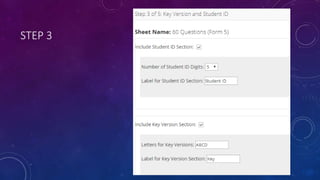
STEP 3
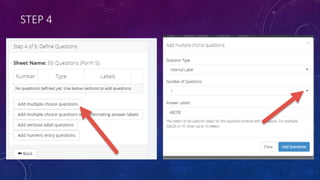
STEP 4
WORKSHOP
ZIpGrade.pptx

ZIpGrade.pptx

  • 2.
    Assessment involving theuse of information and communication technologies (ICT). ICT can be used (a) to deliver traditional assessment formats more effectively and efficiently, and (b) to change the way competencies are assessed and develop formats that facilitate the assessment of competencies that have been difficult to capture with traditional assessment formats ICT – Based Assessment
  • 3.
    1. Download Zipgrade 2.Navigate and explore the features of Zipgrade 3. Customize answer sheets Objectives
  • 4.
    A teacher’s toolthat can check papers in seconds. (https://www.zipgrade .com/)
  • 5.
    What are thefeatures of ZipGrade? Grade papers instantly using your phone or tablet
  • 6.
    Scan and gradepapers in one step Review results immediately with students Export Results to PDF Item Analysis for whole class perspective Save hours of grading each day
  • 7.
    QUICK, ACCURATE, AND ORGANIZED •ZipGrade knows when a paper is in focus and is ready to be graded. • The phone will vibrate when an image is acquired to let you know its is ready to scan another. • Scan, grade and organize up to 20 tests per minute
  • 8.
    FLEXIBLE • With multipleanswer sheets sizes and forms. • The answer sheet are licensed via Creative Commons (BY-NC/3.0) which means you are allowed to customized , update, and distribute to others. Some teachers even laminated answer sheets to make them reusable
  • 9.
    AVOIDS CHEATING DURING CHECKING •Answer sheets are scanned
  • 10.
    PRACTICE FOR STANDARDIZED TEST •Shading of answers • Checking is not manual
  • 11.
  • 12.
  • 13.
    COST EFFECTIVE • ZipGradeis free to download and scan 100 papers per month free. Unlimited can be had for not much more than the price of a cup of coffee. And answer sheets are free to download from the website.
  • 14.
    INSTANT FEEDBACK •Many teachersnow grade as soon as students complete a quiz or test. Students receive immediate feedback and teachers can redirect differentiated learning quickly.
  • 15.
  • 16.
  • 17.
  • 18.
  • 19.
  • 20.
  • 21.
    ITEM ANALYSIS ITEM DIFFICULTY Itemdifficulty is a percentage of students scoring correctly on the item. Difficulty Index Item Difficulty 85% and above Easy 51%-84% Moderate Below 50% Difficult (From Lord, F.M. “The Relationship of the Reliability of Multiple-Choice Test to the Distribution of Item Difficulties,” Psychometrika, 1952, 18, 181-194.)
  • 22.
    ITEM ANALYSIS DISCRIMINATION FACTOR/INDEX Thediscriminant factor is a correlation between students that answer this question correctly and how well those students performed on the test overall. Expressed as a decimal between -1 and +1, a positive discriminant factor indicates that students that did well on this question did well on the overall test. A strong negative value may indicate a poorly written question or incorrectly keyed answer. https://support.zipgrade.com/hc/en-us/articles/204847865-What-is-the-Discriminant-Factor-in-item-analysis-
  • 23.
    ITEM ANALYSIS TYPES OFDISCRIMINATION INDEX 1. Positive Discrimination 2. Negative Discrimination 3. Zero Discrimination Ebel (1986) and Hetzel (1997)
  • 24.
    ITEM ANALYSIS DISCRIMINATION FACTOR Thepower of the item to discriminate the students between those who scored high and those who scored low in the overall test. Index Range Discrimination Level 0.19 and below Poor item, to be eliminated or revised 0.20 – 0.29 Marginal Item, Needs some revision 0.30 – 0.39 Reasonably good item but possibly for improvement 0.40 and above Very good item Ebel (1986) and Hetzel (1997)
  • 25.
  • 26.
  • 31.
  • 32.
  • 33.
  • 34.
  • 36.