Exploring The Role of CollaborativeExploring The Role of Collaborative
Meta-Talk in the Development ofMeta-Talk in the Development of
Argument Skill and UnderstandingArgument Skill and Understanding
Nicole ZillmerNicole Zillmer
Teachers CollegeTeachers College
Columbia UniversityColumbia University
1
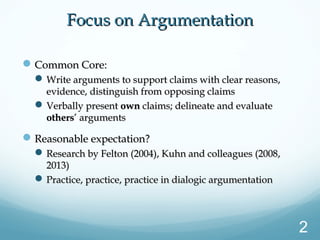
Focus on ArgumentationFocus on Argumentation
Common Core:Common Core:
Write arguments to support claims with clear reasons,Write arguments to support claims with clear reasons,
evidence, distinguish from opposing claimsevidence, distinguish from opposing claims
Verbally presentVerbally present ownown claims; delineate and evaluateclaims; delineate and evaluate
othersothers’ arguments’ arguments
Reasonable expectation?Reasonable expectation?
Research by Felton (2004), Kuhn and colleagues (2008,Research by Felton (2004), Kuhn and colleagues (2008,
2013)2013)
Practice, practice, practice in dialogic argumentationPractice, practice, practice in dialogic argumentation
2
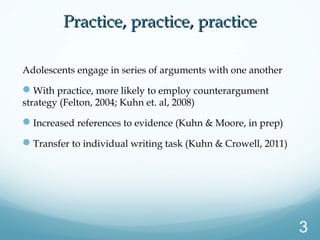
Practice, practice, practicePractice, practice, practice
Adolescents engage in series of arguments with one another
With practice, more likely to employ counterargument
strategy (Felton, 2004; Kuhn et. al, 2008)
Increased references to evidence (Kuhn & Moore, in prep)
Transfer to individual writing task (Kuhn & Crowell, 2011)
3
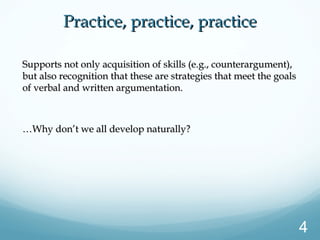
Supports not only acquisition of skills (e.g., counterargument),Supports not only acquisition of skills (e.g., counterargument),
but also recognition that these are strategies that meet the goalsbut also recognition that these are strategies that meet the goals
of verbal and written argumentation.of verbal and written argumentation.
……Why don’t we all develop naturally?Why don’t we all develop naturally?
Practice, practice, practicePractice, practice, practice
4
Development along two dimensionsDevelopment along two dimensions
 Learners choose varying strategies over time; trial and errorLearners choose varying strategies over time; trial and error
 Develop mastery atDevelop mastery at
 Skill levelSkill level (counterargument, evidence use)(counterargument, evidence use)
 Metacognitive levelMetacognitive level: Counterargument is a: Counterargument is a strategystrategy I canI can
use, and I know when to apply ituse, and I know when to apply it
 Individuals’ opportunities to engage are varied in qualityIndividuals’ opportunities to engage are varied in quality
and densityand density
5
 Skill and metacognitive levels develop interdependentlySkill and metacognitive levels develop interdependently
Felton (2004): Verbal reflection with a partner increasedFelton (2004): Verbal reflection with a partner increased
likelihood of counterargument strategy at postlikelihood of counterargument strategy at post
Shaenfield (in preparation): More metacognitive talk withShaenfield (in preparation): More metacognitive talk with
partner led to greater gains in counterargument skillpartner led to greater gains in counterargument skill
Verbal reflection with a partner facilitates gainsVerbal reflection with a partner facilitates gains
Development along two dimensionsDevelopment along two dimensions
6
The role of shared “meta-talk”The role of shared “meta-talk”
 Framework for understanding how meta-talk functionsFramework for understanding how meta-talk functions
in development of argument skill?in development of argument skill?
 What kinds of meta-talk particularly helpful?What kinds of meta-talk particularly helpful?
 What contexts might be supportive?What contexts might be supportive?
7
Proposed StudyProposed Study
 Explore role of pairs’ meta-talk talk during argumentExplore role of pairs’ meta-talk talk during argument
constructionconstruction
 Compare two potential frameworksCompare two potential frameworks
 Uses data from two-year study conducted by Kuhn andUses data from two-year study conducted by Kuhn and
colleagues (2013): Paired argumentation (dyad versus dyad)colleagues (2013): Paired argumentation (dyad versus dyad)
8
 ParticipantsParticipants
 N=62N=62
 77thth
graders, NYC public magnet schoolgraders, NYC public magnet school
 Most Black, HispanicMost Black, Hispanic
 In second year of Kuhn’s argument curriculumIn second year of Kuhn’s argument curriculum
Proposed StudyProposed Study
9
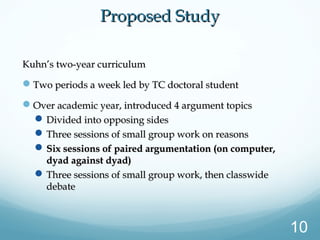
Kuhn’s two-year curriculumKuhn’s two-year curriculum
Two periods a week led by TC doctoral studentTwo periods a week led by TC doctoral student
Over academic year, introduced 4 argument topicsOver academic year, introduced 4 argument topics
Divided into opposing sidesDivided into opposing sides
Three sessions of small group work on reasonsThree sessions of small group work on reasons
Six sessions of paired argumentation (on computer,Six sessions of paired argumentation (on computer,
dyad against dyad)dyad against dyad)
Three sessions of small group work, then classwideThree sessions of small group work, then classwide
debatedebate
Proposed StudyProposed Study
10
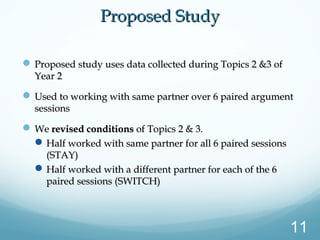
 Proposed study uses data collected during Topics 2 &3 ofProposed study uses data collected during Topics 2 &3 of
Year 2Year 2
 Used to working with same partner over 6 paired argumentUsed to working with same partner over 6 paired argument
sessionssessions
 WeWe revised conditionsrevised conditions of Topics 2 & 3.of Topics 2 & 3.
Half worked with same partner for all 6 paired sessionsHalf worked with same partner for all 6 paired sessions
(STAY)(STAY)
Half worked with a different partner for each of the 6Half worked with a different partner for each of the 6
paired sessions (SWITCH)paired sessions (SWITCH)
Proposed StudyProposed Study
11
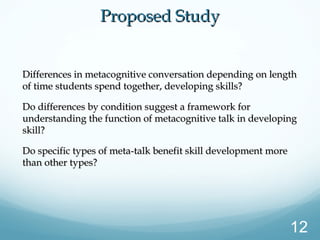
Differences in metacognitive conversation depending on lengthDifferences in metacognitive conversation depending on length
of time students spend together, developing skills?of time students spend together, developing skills?
Do differences by condition suggest a framework forDo differences by condition suggest a framework for
understanding the function of metacognitive talk in developingunderstanding the function of metacognitive talk in developing
skill?skill?
Do specific types of meta-talk benefit skill development moreDo specific types of meta-talk benefit skill development more
than other types?than other types?
Proposed StudyProposed Study
12
FrameworkFramework
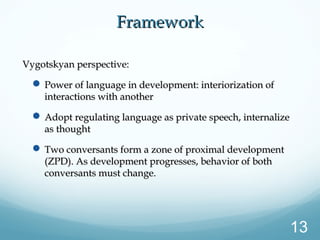
Vygotskyan perspective:Vygotskyan perspective:
 Power of language in development: interiorization ofPower of language in development: interiorization of
interactions with anotherinteractions with another
 Adopt regulating language as private speech, internalizeAdopt regulating language as private speech, internalize
as thoughtas thought
 Two conversants form a zone of proximal developmentTwo conversants form a zone of proximal development
(ZPD). As development progresses, behavior of both(ZPD). As development progresses, behavior of both
conversants must change.conversants must change.
13
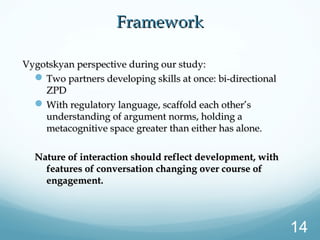
Vygotskyan perspective during our study:Vygotskyan perspective during our study:
Two partners developing skills at once: bi-directionalTwo partners developing skills at once: bi-directional
ZPDZPD
With regulatory language, scaffold each other’sWith regulatory language, scaffold each other’s
understanding of argument norms, holding aunderstanding of argument norms, holding a
metacognitive space greater than either has alone.metacognitive space greater than either has alone.
Nature of interaction should reflect development, withNature of interaction should reflect development, with
features of conversation changing over course offeatures of conversation changing over course of
engagement.engagement.
FrameworkFramework
14
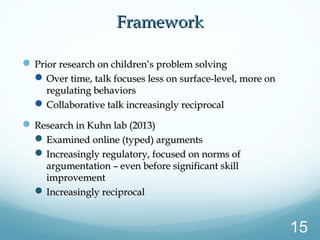
 Prior research on children’s problem solvingPrior research on children’s problem solving
Over time, talk focuses less on surface-level, more onOver time, talk focuses less on surface-level, more on
regulating behaviorsregulating behaviors
Collaborative talk increasingly reciprocalCollaborative talk increasingly reciprocal
 Research in Kuhn lab (2013)Research in Kuhn lab (2013)
Examined online (typed) argumentsExamined online (typed) arguments
Increasingly regulatory, focused on norms ofIncreasingly regulatory, focused on norms of
argumentation – even before significant skillargumentation – even before significant skill
improvementimprovement
Increasingly reciprocalIncreasingly reciprocal
FrameworkFramework
15
HypothesesHypotheses
If role of collaborative meta-talk is to provide a bi-If role of collaborative meta-talk is to provide a bi-
directional ZPD, we would expect that ZPD to changedirectional ZPD, we would expect that ZPD to change
form as students internalize regulatory talk.form as students internalize regulatory talk.
Specifically…Specifically…
16
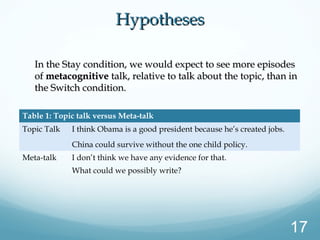
In the Stay condition, we would expect to see more episodesIn the Stay condition, we would expect to see more episodes
ofof metacognitivemetacognitive talk, relative to talk about the topic, than intalk, relative to talk about the topic, than in
the Switch condition.the Switch condition.
Table 1: Topic talk versus Meta-talk
Topic Talk I think Obama is a good president because he’s created jobs.
China could survive without the one child policy.
Meta-talk I don’t think we have any evidence for that.
What could we possibly write?
HypothesesHypotheses
17
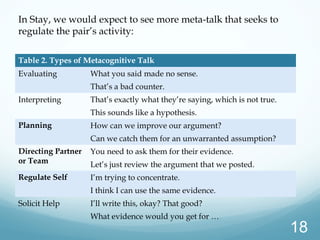
Table 2. Types of Metacognitive Talk
Evaluating What you said made no sense.
That’s a bad counter.
Interpreting That’s exactly what they’re saying, which is not true.
This sounds like a hypothesis.
Planning How can we improve our argument?
Can we catch them for an unwarranted assumption?
Directing Partner
or Team
You need to ask them for their evidence.
Let’s just review the argument that we posted.
Regulate Self I’m trying to concentrate.
I think I can use the same evidence.
Solicit Help I’ll write this, okay? That good?
What evidence would you get for …
In Stay, we would expect to see more meta-talk that seeks to
regulate the pair’s activity:
18
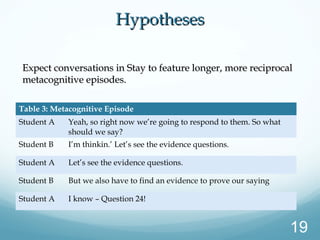
Expect conversations in Stay to feature longer, more reciprocalExpect conversations in Stay to feature longer, more reciprocal
metacognitive episodes.metacognitive episodes.
Table 3: Metacognitive Episode
Student A Yeah, so right now we’re going to respond to them. So what
should we say?
Student B I’m thinkin.’ Let’s see the evidence questions.
Student A Let’s see the evidence questions.
Student B But we also have to find an evidence to prove our saying
Student A I know – Question 24!
HypothesesHypotheses
19
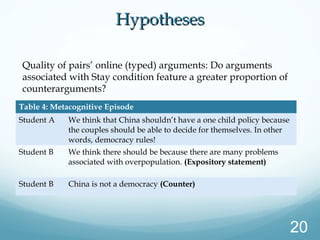
Quality of pairs’ online (typed) arguments: Do arguments
associated with Stay condition feature a greater proportion of
counterarguments?
Table 4: Metacognitive Episode
Student A We think that China shouldn’t have a one child policy because
the couples should be able to decide for themselves. In other
words, democracy rules!
Student B We think there should be because there are many problems
associated with overpopulation. (Expository statement)
Student B China is not a democracy (Counter)
HypothesesHypotheses
20
Individual Metacognitive Reflection Assignment: Does engagement in
Stay lead to greater focus on functional quality of claims, as opposed to
surface features of argument (e.g., spelling, grammar) or verity of claims?
HypothesesHypotheses
Read each statement and assign it a grade (A,B,C,D, or F). How well did this student do when they
made their claim? Be specific; do not just say “I gave this an A because it was good.” Tell us how
you know the statement is good or bad.
Words Grade Explanation
The one child policy shouldn’t be used
because even though the population has
decreased it’s still increasing by a lot
according to evidence question 2.
As you can see in ev number 3 before the
one child policy the population increased
from 540m to 800m
But it is still increasing as I said before (read
evidence 2)
Exactly so that is why we should keep the
law because in ev 21 it says 80% of people
who die in china each year from disease.
21
What if we don’t find differences between Stay and SwitchWhat if we don’t find differences between Stay and Switch
conditions in amount or reciprocity of regulatory talk, or inconditions in amount or reciprocity of regulatory talk, or in
performance on our secondary measures?performance on our secondary measures?
Consider alternative (Piagetian) framework for understandingConsider alternative (Piagetian) framework for understanding
the role of meta-talk in developing argument skill.the role of meta-talk in developing argument skill.
HypothesesHypotheses
22
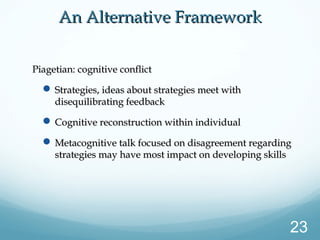
An Alternative FrameworkAn Alternative Framework
Piagetian: cognitive conflictPiagetian: cognitive conflict
 Strategies, ideas about strategies meet withStrategies, ideas about strategies meet with
disequilibrating feedbackdisequilibrating feedback
 Cognitive reconstruction within individualCognitive reconstruction within individual
 Metacognitive talk focused on disagreement regardingMetacognitive talk focused on disagreement regarding
strategies may have most impact on developing skillsstrategies may have most impact on developing skills
23
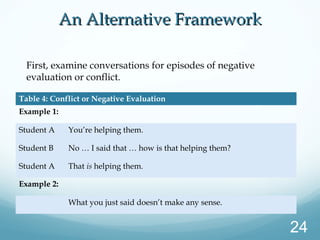
Table 4: Conflict or Negative Evaluation
Example 1:
Student A You’re helping them.
Student B No … I said that … how is that helping them?
Student A That is helping them.
Example 2:
What you just said doesn’t make any sense.
First, examine conversations for episodes of negative
evaluation or conflict.
An Alternative FrameworkAn Alternative Framework
24
HypothesesHypotheses
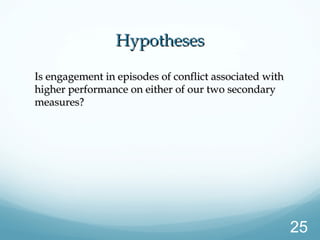
Is engagement in episodes of conflict associated withIs engagement in episodes of conflict associated with
higher performance on either of our two secondaryhigher performance on either of our two secondary
measures?measures?
25
ConclusionConclusion
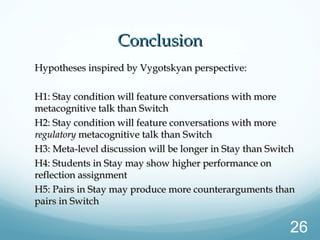
Hypotheses inspired by Vygotskyan perspective:Hypotheses inspired by Vygotskyan perspective:
H1: Stay condition will feature conversations with moreH1: Stay condition will feature conversations with more
metacognitive talk than Switchmetacognitive talk than Switch
H2: Stay condition will feature conversations with moreH2: Stay condition will feature conversations with more
regulatoryregulatory metacognitive talk than Switchmetacognitive talk than Switch
H3: Meta-level discussion will be longer in Stay than SwitchH3: Meta-level discussion will be longer in Stay than Switch
H4: Students in Stay may show higher performance onH4: Students in Stay may show higher performance on
reflection assignmentreflection assignment
H5: Pairs in Stay may produce more counterarguments thanH5: Pairs in Stay may produce more counterarguments than
pairs in Switchpairs in Switch
26
ConclusionConclusion
Hypotheses inspired by Piagetian perspective:
H6: Frequency of disagreement/conflict will be correlated with
higher individual performance on reflection assignment.
H7: Frequency of disagreement/conflict will be correlated with
higher dyadic performance within online argument task (e.g.,
higher proportion of counterarguments)
27

Zillmer proposal final1

  • 1.
    Exploring The Roleof CollaborativeExploring The Role of Collaborative Meta-Talk in the Development ofMeta-Talk in the Development of Argument Skill and UnderstandingArgument Skill and Understanding Nicole ZillmerNicole Zillmer Teachers CollegeTeachers College Columbia UniversityColumbia University 1
  • 2.
    Focus on ArgumentationFocuson Argumentation Common Core:Common Core: Write arguments to support claims with clear reasons,Write arguments to support claims with clear reasons, evidence, distinguish from opposing claimsevidence, distinguish from opposing claims Verbally presentVerbally present ownown claims; delineate and evaluateclaims; delineate and evaluate othersothers’ arguments’ arguments Reasonable expectation?Reasonable expectation? Research by Felton (2004), Kuhn and colleagues (2008,Research by Felton (2004), Kuhn and colleagues (2008, 2013)2013) Practice, practice, practice in dialogic argumentationPractice, practice, practice in dialogic argumentation 2
  • 3.
    Practice, practice, practicePractice,practice, practice Adolescents engage in series of arguments with one another With practice, more likely to employ counterargument strategy (Felton, 2004; Kuhn et. al, 2008) Increased references to evidence (Kuhn & Moore, in prep) Transfer to individual writing task (Kuhn & Crowell, 2011) 3
  • 4.
    Supports not onlyacquisition of skills (e.g., counterargument),Supports not only acquisition of skills (e.g., counterargument), but also recognition that these are strategies that meet the goalsbut also recognition that these are strategies that meet the goals of verbal and written argumentation.of verbal and written argumentation. ……Why don’t we all develop naturally?Why don’t we all develop naturally? Practice, practice, practicePractice, practice, practice 4
  • 5.
    Development along twodimensionsDevelopment along two dimensions  Learners choose varying strategies over time; trial and errorLearners choose varying strategies over time; trial and error  Develop mastery atDevelop mastery at  Skill levelSkill level (counterargument, evidence use)(counterargument, evidence use)  Metacognitive levelMetacognitive level: Counterargument is a: Counterargument is a strategystrategy I canI can use, and I know when to apply ituse, and I know when to apply it  Individuals’ opportunities to engage are varied in qualityIndividuals’ opportunities to engage are varied in quality and densityand density 5
  • 6.
     Skill andmetacognitive levels develop interdependentlySkill and metacognitive levels develop interdependently Felton (2004): Verbal reflection with a partner increasedFelton (2004): Verbal reflection with a partner increased likelihood of counterargument strategy at postlikelihood of counterargument strategy at post Shaenfield (in preparation): More metacognitive talk withShaenfield (in preparation): More metacognitive talk with partner led to greater gains in counterargument skillpartner led to greater gains in counterargument skill Verbal reflection with a partner facilitates gainsVerbal reflection with a partner facilitates gains Development along two dimensionsDevelopment along two dimensions 6
  • 7.
    The role ofshared “meta-talk”The role of shared “meta-talk”  Framework for understanding how meta-talk functionsFramework for understanding how meta-talk functions in development of argument skill?in development of argument skill?  What kinds of meta-talk particularly helpful?What kinds of meta-talk particularly helpful?  What contexts might be supportive?What contexts might be supportive? 7
  • 8.
    Proposed StudyProposed Study Explore role of pairs’ meta-talk talk during argumentExplore role of pairs’ meta-talk talk during argument constructionconstruction  Compare two potential frameworksCompare two potential frameworks  Uses data from two-year study conducted by Kuhn andUses data from two-year study conducted by Kuhn and colleagues (2013): Paired argumentation (dyad versus dyad)colleagues (2013): Paired argumentation (dyad versus dyad) 8
  • 9.
     ParticipantsParticipants  N=62N=62 77thth graders, NYC public magnet schoolgraders, NYC public magnet school  Most Black, HispanicMost Black, Hispanic  In second year of Kuhn’s argument curriculumIn second year of Kuhn’s argument curriculum Proposed StudyProposed Study 9
  • 10.
    Kuhn’s two-year curriculumKuhn’stwo-year curriculum Two periods a week led by TC doctoral studentTwo periods a week led by TC doctoral student Over academic year, introduced 4 argument topicsOver academic year, introduced 4 argument topics Divided into opposing sidesDivided into opposing sides Three sessions of small group work on reasonsThree sessions of small group work on reasons Six sessions of paired argumentation (on computer,Six sessions of paired argumentation (on computer, dyad against dyad)dyad against dyad) Three sessions of small group work, then classwideThree sessions of small group work, then classwide debatedebate Proposed StudyProposed Study 10
  • 11.
     Proposed studyuses data collected during Topics 2 &3 ofProposed study uses data collected during Topics 2 &3 of Year 2Year 2  Used to working with same partner over 6 paired argumentUsed to working with same partner over 6 paired argument sessionssessions  WeWe revised conditionsrevised conditions of Topics 2 & 3.of Topics 2 & 3. Half worked with same partner for all 6 paired sessionsHalf worked with same partner for all 6 paired sessions (STAY)(STAY) Half worked with a different partner for each of the 6Half worked with a different partner for each of the 6 paired sessions (SWITCH)paired sessions (SWITCH) Proposed StudyProposed Study 11
  • 12.
    Differences in metacognitiveconversation depending on lengthDifferences in metacognitive conversation depending on length of time students spend together, developing skills?of time students spend together, developing skills? Do differences by condition suggest a framework forDo differences by condition suggest a framework for understanding the function of metacognitive talk in developingunderstanding the function of metacognitive talk in developing skill?skill? Do specific types of meta-talk benefit skill development moreDo specific types of meta-talk benefit skill development more than other types?than other types? Proposed StudyProposed Study 12
  • 13.
    FrameworkFramework Vygotskyan perspective:Vygotskyan perspective: Power of language in development: interiorization ofPower of language in development: interiorization of interactions with anotherinteractions with another  Adopt regulating language as private speech, internalizeAdopt regulating language as private speech, internalize as thoughtas thought  Two conversants form a zone of proximal developmentTwo conversants form a zone of proximal development (ZPD). As development progresses, behavior of both(ZPD). As development progresses, behavior of both conversants must change.conversants must change. 13
  • 14.
    Vygotskyan perspective duringour study:Vygotskyan perspective during our study: Two partners developing skills at once: bi-directionalTwo partners developing skills at once: bi-directional ZPDZPD With regulatory language, scaffold each other’sWith regulatory language, scaffold each other’s understanding of argument norms, holding aunderstanding of argument norms, holding a metacognitive space greater than either has alone.metacognitive space greater than either has alone. Nature of interaction should reflect development, withNature of interaction should reflect development, with features of conversation changing over course offeatures of conversation changing over course of engagement.engagement. FrameworkFramework 14
  • 15.
     Prior researchon children’s problem solvingPrior research on children’s problem solving Over time, talk focuses less on surface-level, more onOver time, talk focuses less on surface-level, more on regulating behaviorsregulating behaviors Collaborative talk increasingly reciprocalCollaborative talk increasingly reciprocal  Research in Kuhn lab (2013)Research in Kuhn lab (2013) Examined online (typed) argumentsExamined online (typed) arguments Increasingly regulatory, focused on norms ofIncreasingly regulatory, focused on norms of argumentation – even before significant skillargumentation – even before significant skill improvementimprovement Increasingly reciprocalIncreasingly reciprocal FrameworkFramework 15
  • 16.
    HypothesesHypotheses If role ofcollaborative meta-talk is to provide a bi-If role of collaborative meta-talk is to provide a bi- directional ZPD, we would expect that ZPD to changedirectional ZPD, we would expect that ZPD to change form as students internalize regulatory talk.form as students internalize regulatory talk. Specifically…Specifically… 16
  • 17.
    In the Staycondition, we would expect to see more episodesIn the Stay condition, we would expect to see more episodes ofof metacognitivemetacognitive talk, relative to talk about the topic, than intalk, relative to talk about the topic, than in the Switch condition.the Switch condition. Table 1: Topic talk versus Meta-talk Topic Talk I think Obama is a good president because he’s created jobs. China could survive without the one child policy. Meta-talk I don’t think we have any evidence for that. What could we possibly write? HypothesesHypotheses 17
  • 18.
    Table 2. Typesof Metacognitive Talk Evaluating What you said made no sense. That’s a bad counter. Interpreting That’s exactly what they’re saying, which is not true. This sounds like a hypothesis. Planning How can we improve our argument? Can we catch them for an unwarranted assumption? Directing Partner or Team You need to ask them for their evidence. Let’s just review the argument that we posted. Regulate Self I’m trying to concentrate. I think I can use the same evidence. Solicit Help I’ll write this, okay? That good? What evidence would you get for … In Stay, we would expect to see more meta-talk that seeks to regulate the pair’s activity: 18
  • 19.
    Expect conversations inStay to feature longer, more reciprocalExpect conversations in Stay to feature longer, more reciprocal metacognitive episodes.metacognitive episodes. Table 3: Metacognitive Episode Student A Yeah, so right now we’re going to respond to them. So what should we say? Student B I’m thinkin.’ Let’s see the evidence questions. Student A Let’s see the evidence questions. Student B But we also have to find an evidence to prove our saying Student A I know – Question 24! HypothesesHypotheses 19
  • 20.
    Quality of pairs’online (typed) arguments: Do arguments associated with Stay condition feature a greater proportion of counterarguments? Table 4: Metacognitive Episode Student A We think that China shouldn’t have a one child policy because the couples should be able to decide for themselves. In other words, democracy rules! Student B We think there should be because there are many problems associated with overpopulation. (Expository statement) Student B China is not a democracy (Counter) HypothesesHypotheses 20
  • 21.
    Individual Metacognitive ReflectionAssignment: Does engagement in Stay lead to greater focus on functional quality of claims, as opposed to surface features of argument (e.g., spelling, grammar) or verity of claims? HypothesesHypotheses Read each statement and assign it a grade (A,B,C,D, or F). How well did this student do when they made their claim? Be specific; do not just say “I gave this an A because it was good.” Tell us how you know the statement is good or bad. Words Grade Explanation The one child policy shouldn’t be used because even though the population has decreased it’s still increasing by a lot according to evidence question 2. As you can see in ev number 3 before the one child policy the population increased from 540m to 800m But it is still increasing as I said before (read evidence 2) Exactly so that is why we should keep the law because in ev 21 it says 80% of people who die in china each year from disease. 21
  • 22.
    What if wedon’t find differences between Stay and SwitchWhat if we don’t find differences between Stay and Switch conditions in amount or reciprocity of regulatory talk, or inconditions in amount or reciprocity of regulatory talk, or in performance on our secondary measures?performance on our secondary measures? Consider alternative (Piagetian) framework for understandingConsider alternative (Piagetian) framework for understanding the role of meta-talk in developing argument skill.the role of meta-talk in developing argument skill. HypothesesHypotheses 22
  • 23.
    An Alternative FrameworkAnAlternative Framework Piagetian: cognitive conflictPiagetian: cognitive conflict  Strategies, ideas about strategies meet withStrategies, ideas about strategies meet with disequilibrating feedbackdisequilibrating feedback  Cognitive reconstruction within individualCognitive reconstruction within individual  Metacognitive talk focused on disagreement regardingMetacognitive talk focused on disagreement regarding strategies may have most impact on developing skillsstrategies may have most impact on developing skills 23
  • 24.
    Table 4: Conflictor Negative Evaluation Example 1: Student A You’re helping them. Student B No … I said that … how is that helping them? Student A That is helping them. Example 2: What you just said doesn’t make any sense. First, examine conversations for episodes of negative evaluation or conflict. An Alternative FrameworkAn Alternative Framework 24
  • 25.
    HypothesesHypotheses Is engagement inepisodes of conflict associated withIs engagement in episodes of conflict associated with higher performance on either of our two secondaryhigher performance on either of our two secondary measures?measures? 25
  • 26.
    ConclusionConclusion Hypotheses inspired byVygotskyan perspective:Hypotheses inspired by Vygotskyan perspective: H1: Stay condition will feature conversations with moreH1: Stay condition will feature conversations with more metacognitive talk than Switchmetacognitive talk than Switch H2: Stay condition will feature conversations with moreH2: Stay condition will feature conversations with more regulatoryregulatory metacognitive talk than Switchmetacognitive talk than Switch H3: Meta-level discussion will be longer in Stay than SwitchH3: Meta-level discussion will be longer in Stay than Switch H4: Students in Stay may show higher performance onH4: Students in Stay may show higher performance on reflection assignmentreflection assignment H5: Pairs in Stay may produce more counterarguments thanH5: Pairs in Stay may produce more counterarguments than pairs in Switchpairs in Switch 26
  • 27.
    ConclusionConclusion Hypotheses inspired byPiagetian perspective: H6: Frequency of disagreement/conflict will be correlated with higher individual performance on reflection assignment. H7: Frequency of disagreement/conflict will be correlated with higher dyadic performance within online argument task (e.g., higher proportion of counterarguments) 27