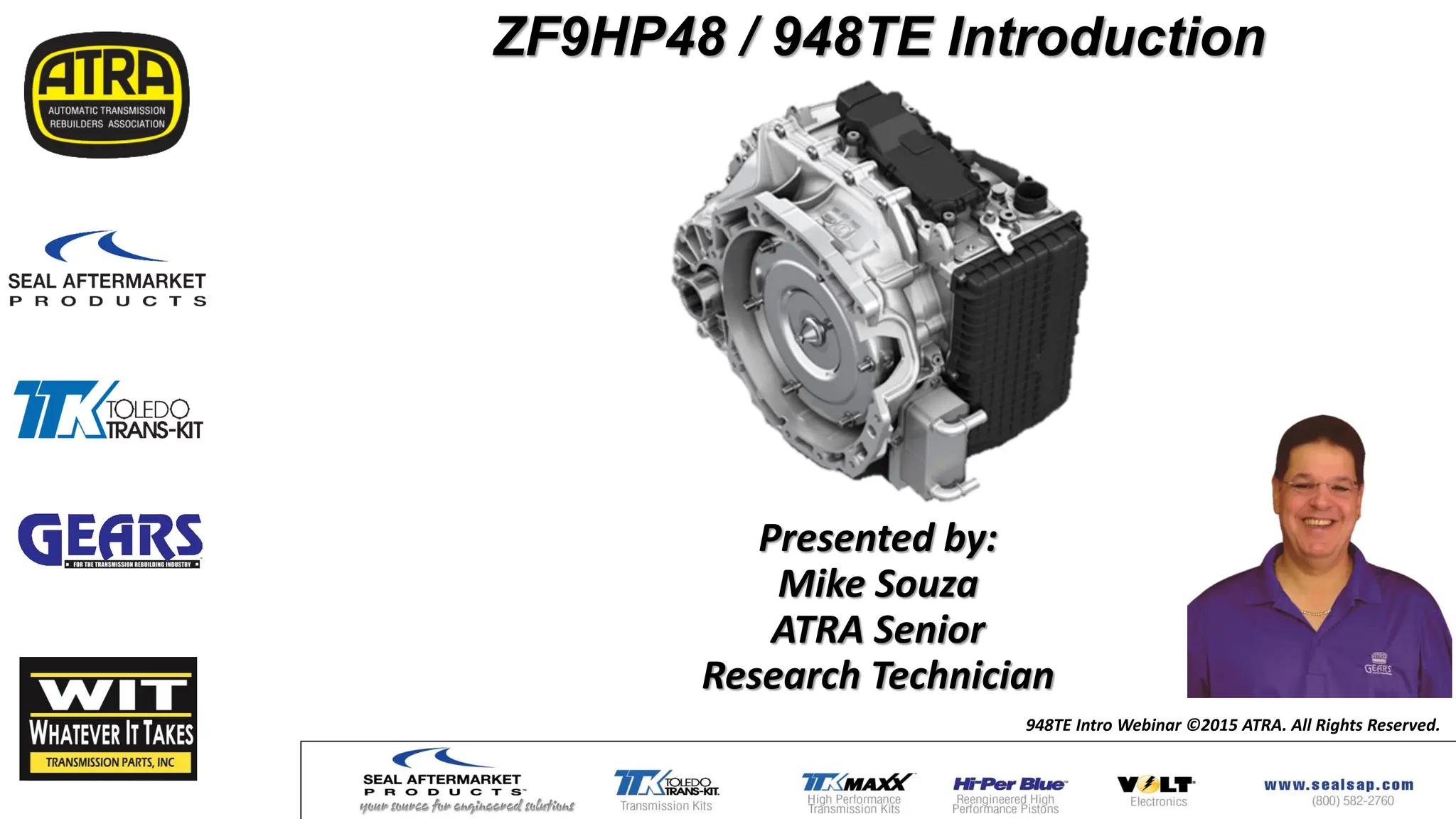
ZF9HP48 / 948TE Introduction
Presented by:
Mike Souza
ATRA Senior
Research Technician
948TE Intro Webinar ©2015 ATRA. All Rights Reserved.
Acura (ZF9HP48) Land Rover
MDX 2014-15 AWD V6 3.5L Range Rover Evoque 2013-15 FWD/4X4 L4 2.0/2.2L
RLX 2014-15 FWD V6 3.5L/3.7L Discovery (LR4) 2015 FWD/AWD L4 2.0
Chrysler (948TE)
TL 2014-15 AWD V6 3.5L/3.7L
200 2014-15 FWD L4 2.4L V6 3.2L
Town & Country 2013-15 FWD 2013-14 L4 2.4L V6 3.6L
Dodge (948TE)
Caravan 2014-15 FWD V6 3.6L
Fiat (EP2)
500X 2014-15 FWD L4 2.4L
Doblo 2015 FWD L4 2.4L
Jeep (948TE)
Cherokee (KL) 2013-15 FWD L4 2.4L V6 3.2L
Renegade 2014-15 FWD L4 2.4L
Honda (ZF9HP48)
Civic 2014-15 FWD L4 1.6L
CRV 2014-15 FWD L4 1.6L
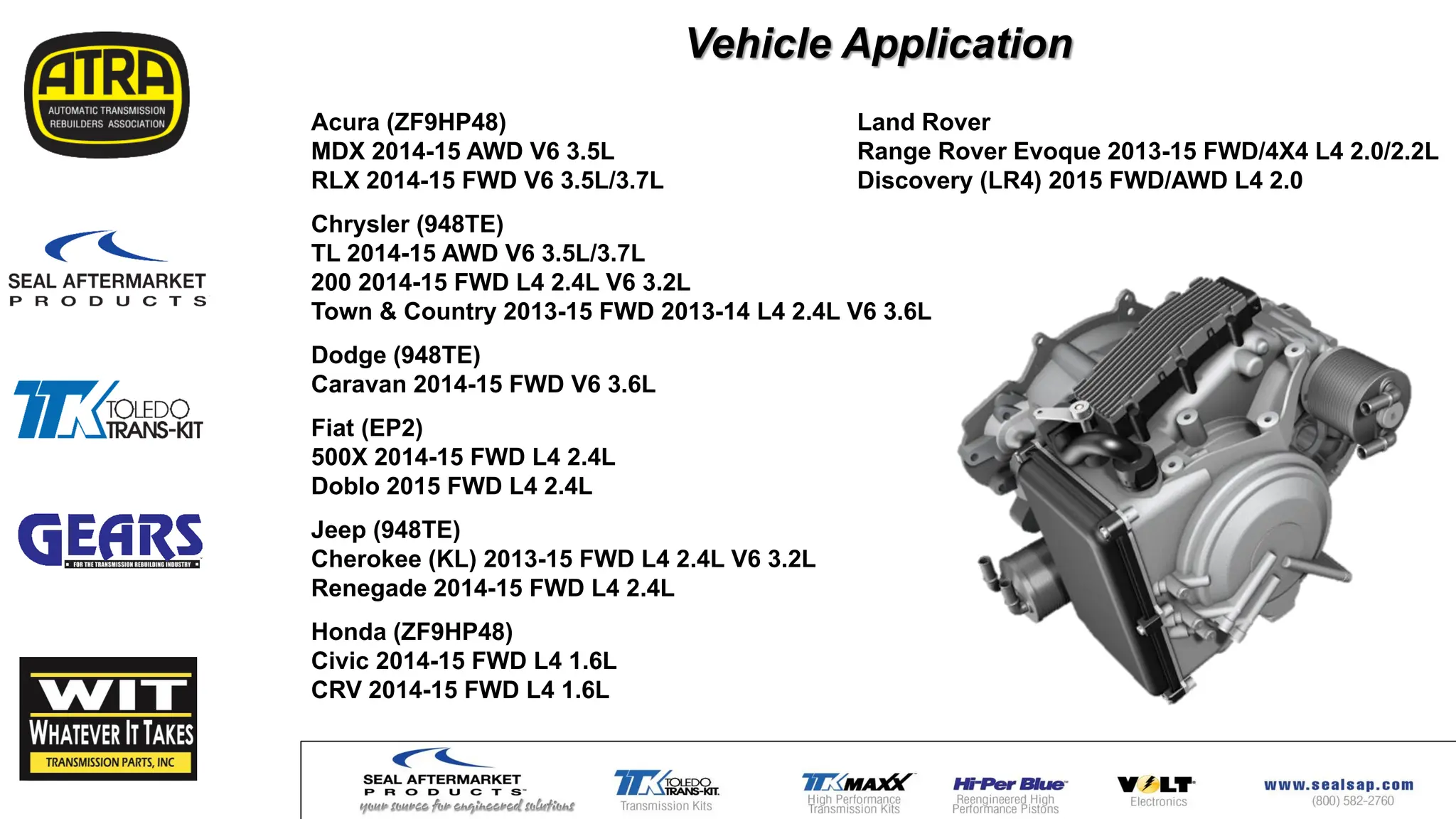
Vehicle Application
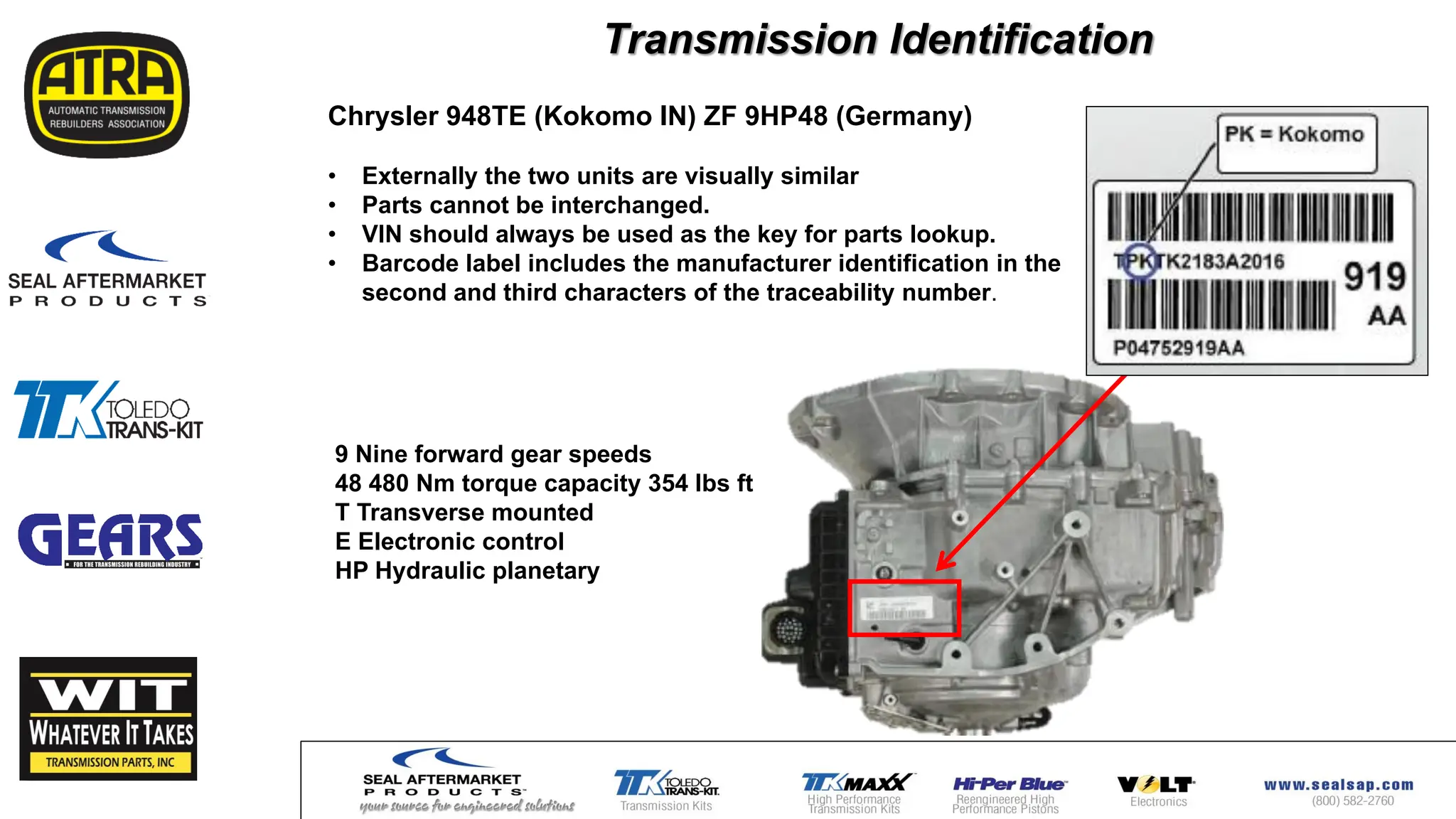
Chrysler 948TE (Kokomo IN) ZF 9HP48 (Germany)
• Externally the two units are visually similar
• Parts cannot be interchanged.
• VIN should always be used as the key for parts lookup.
• Barcode label includes the manufacturer identification in the
second and third characters of the traceability number.
9 Nine forward gear speeds
48 480 Nm torque capacity 354 lbs ft
T Transverse mounted
E Electronic control
HP Hydraulic planetary
Transmission Identification
Introduction
ZF developed the first nine-speed automatic transmission for front wheel drive
vehicles. Although it was built in June 2011 it did not make it’s debut until mid 2013.
This new transmission delivers extremely short shifting times and exceptionally
smooth shifts. The electronic controls select the right gear for the driving conditions,
eliminating unnecessary stepping and constant shifting using over 40 shift maps.
The 9-speed automatic transmission is, without an additional oil pump, stop-start
capable. Since, in the case of restarting, it is only one friction shift element that needs
to be closed, response times are very fast. It can also be used as a hybrid transmission
by replacing the torque converter with an electric motor.
The ZF nine-speed automatic has been designed so that an additional transfer case
can be connected for all wheel drive; ZF itself has an all-wheel drive that can be
decoupled (AWD Disconnect). It actuates the rear axle drive only when needed and
saves five percent less fuel compared to the permanent all-wheel drive (Chrysler
already uses a similar system).
The ZF-built unit is known as the ZF9HP48, while the Chrysler-built unit is known as the
948TE. These transmissions look nearly identical, parts are not necessarily
interchangeable
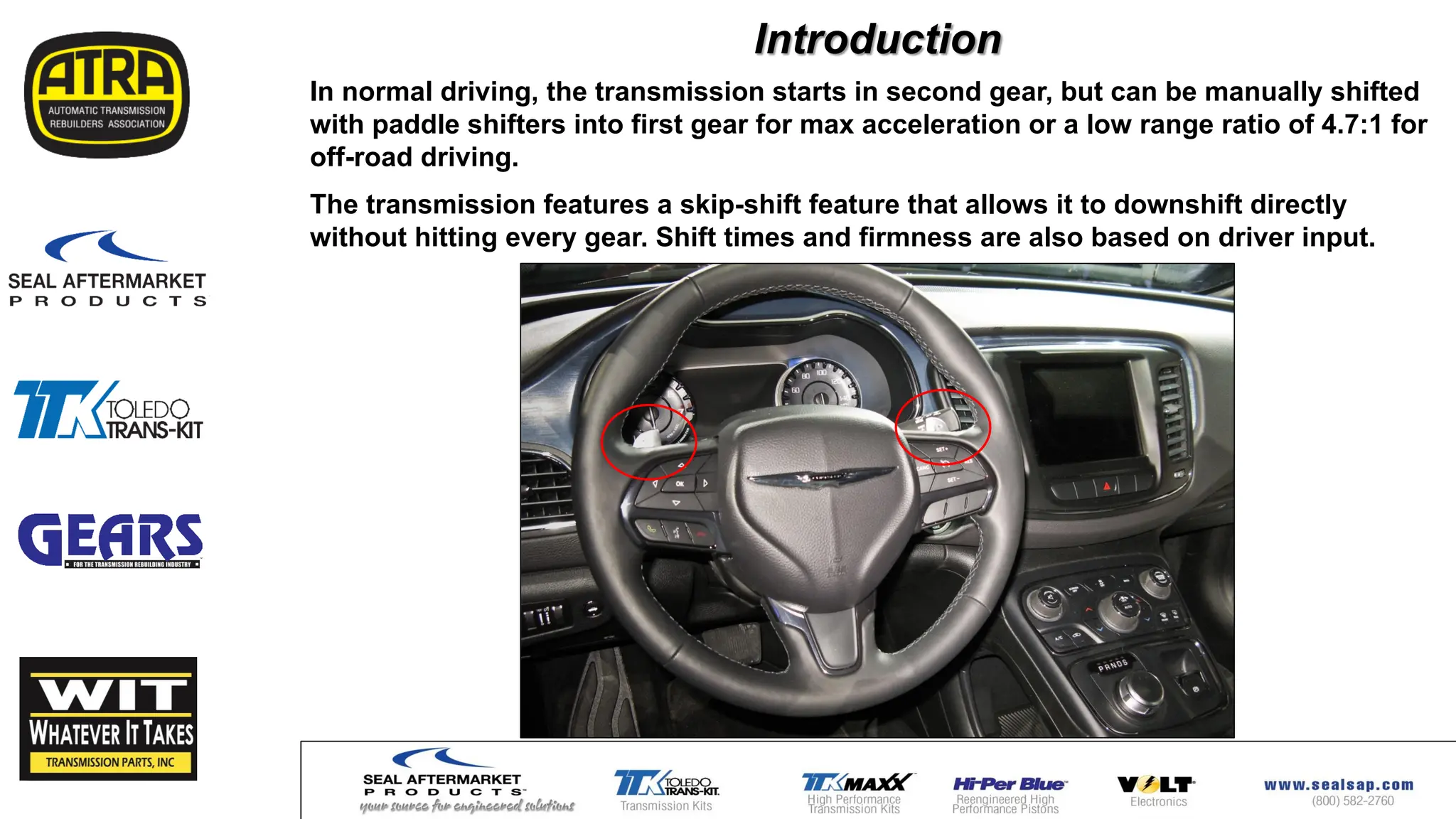
In normal driving, the transmission starts in second gear, but can be manually shifted
with paddle shifters into first gear for max acceleration or a low range ratio of 4.7:1 for
off-road driving.
The transmission features a skip-shift feature that allows it to downshift directly
without hitting every gear. Shift times and firmness are also based on driver input.
Introduction
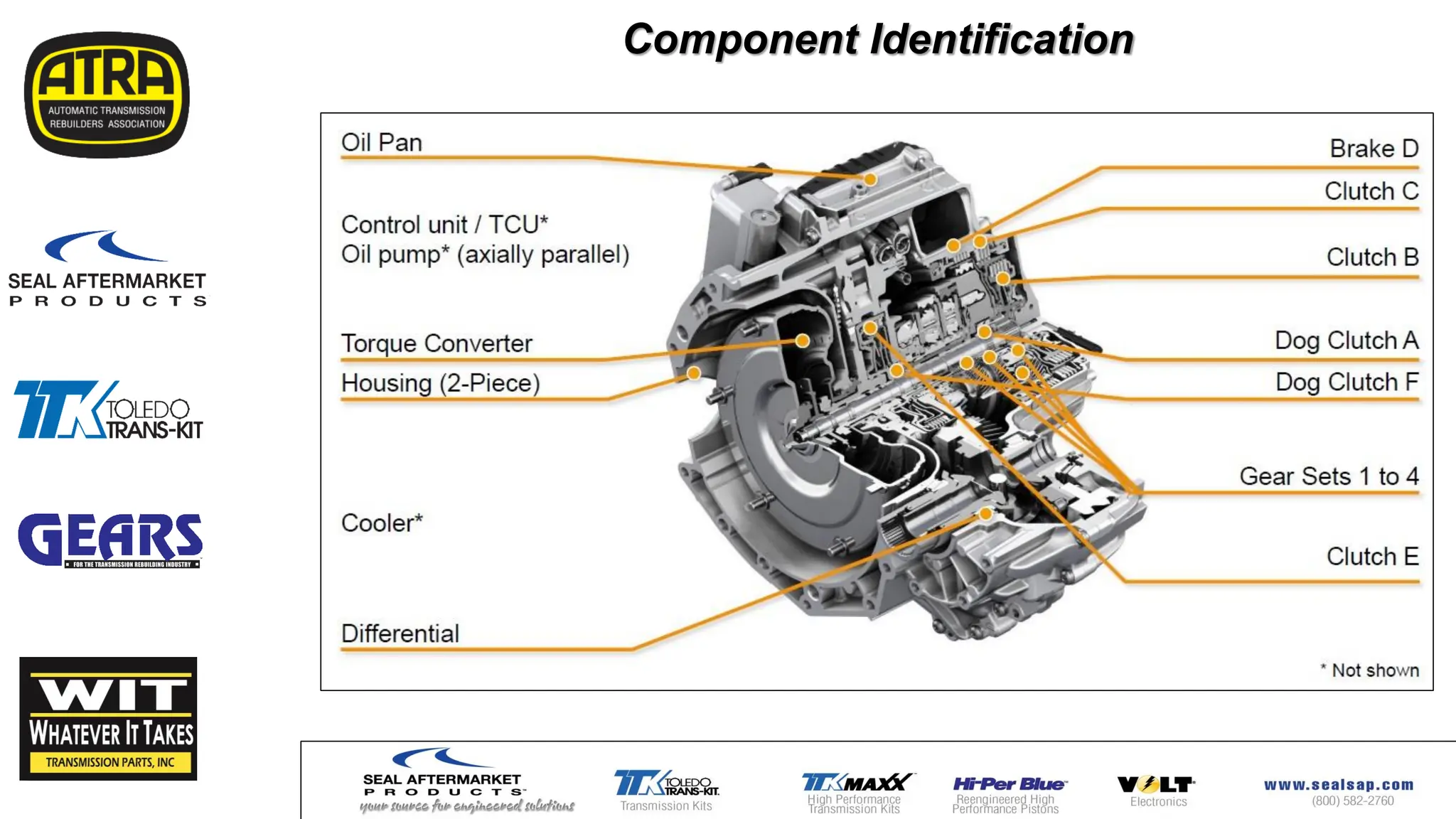
Component Identification
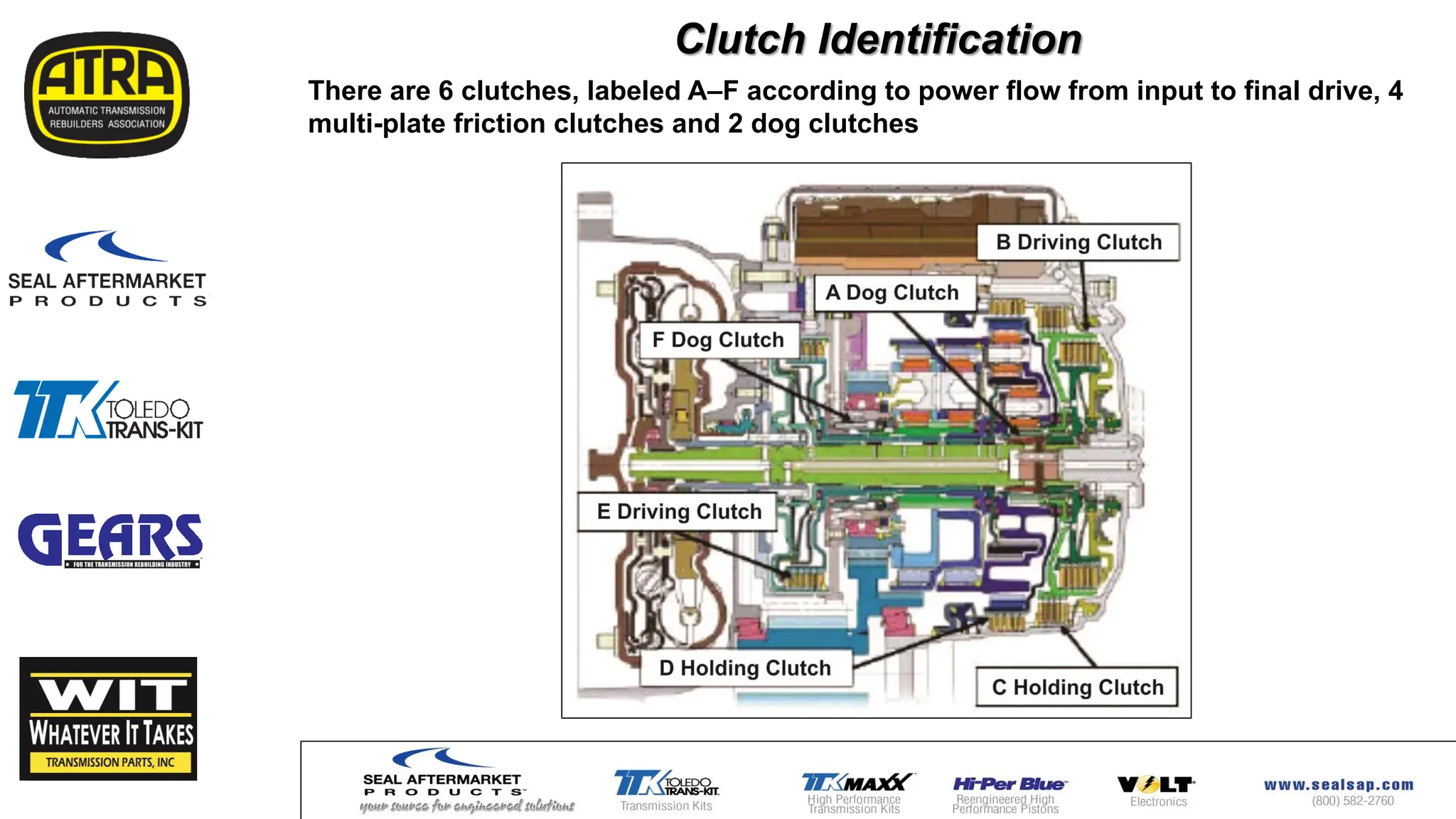
There are 6 clutches, labeled A–F according to power flow from input to final drive, 4
multi-plate friction clutches and 2 dog clutches
Clutch Identification
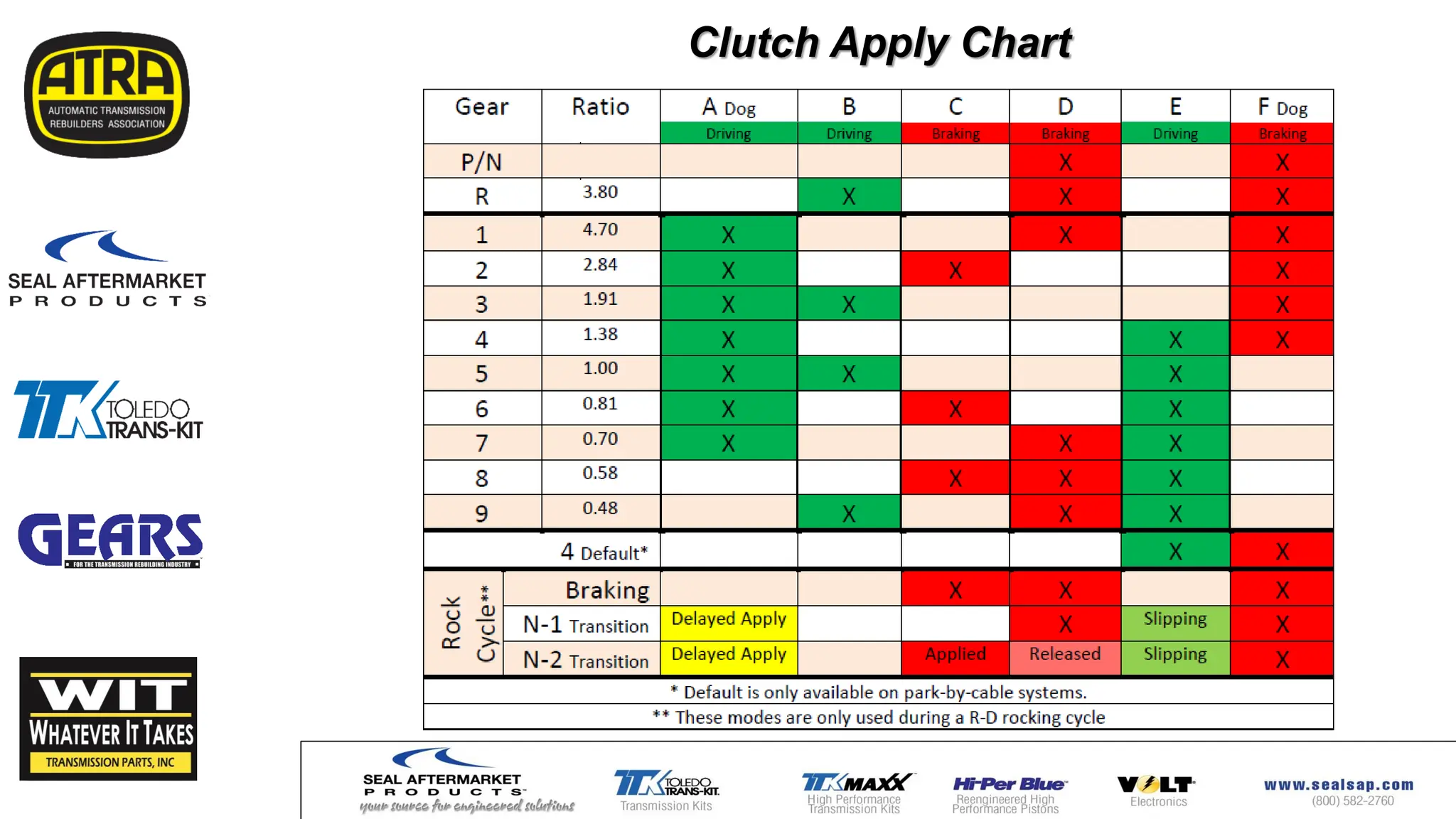
Clutch Apply Chart
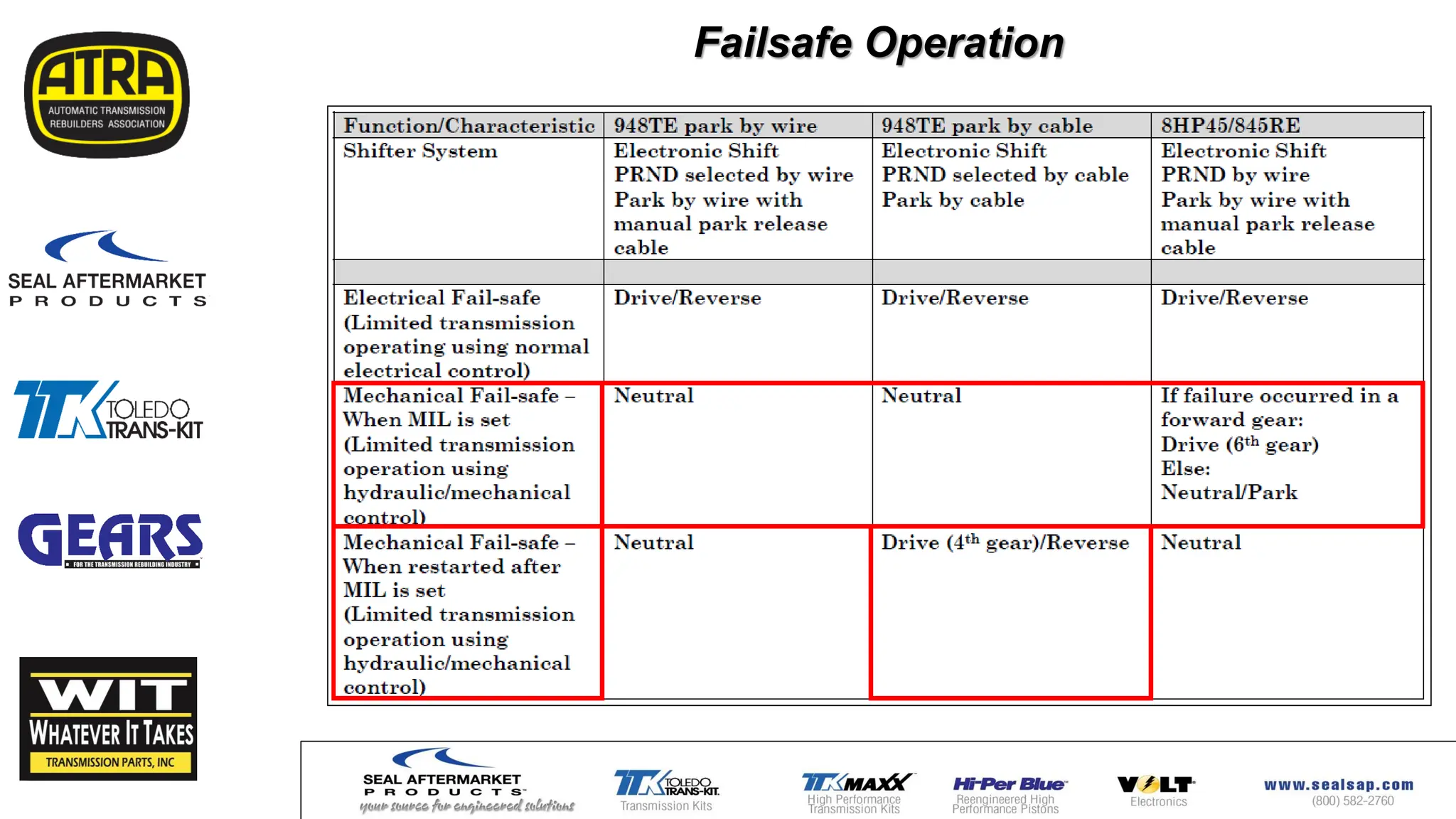
Failsafe Operation
The “A” dog clutch is one of two dog clutches in the 948TE. The dog clutch uses
hydraulic pressure to engage and disengage the spline teeth between two
components.
This provides a non-slipping connection that does not use friction discs. The “A” dog
clutch is a driving clutch located at the rear of the transmission and part of the input
shaft. This clutch is on in 1st through 7th gear.
When the TCM calls for a shift that engages one of the dog clutches, a message is sent
to the PCM requesting that the engine be brought to a certain rpm.
The dog clutches in the 948TE cannot simply be applied during downshifts without
consideration for speed difference between the splined components.
Dog clutches do not have disc-style clutch packs that can provide slip to match
component speed.
As a result, the transmission control module (TCM) can request an engine RPM and
torque increase or decrease to allow speed matching.
Dog Clutch Function
Dog Clutch Speed Matching
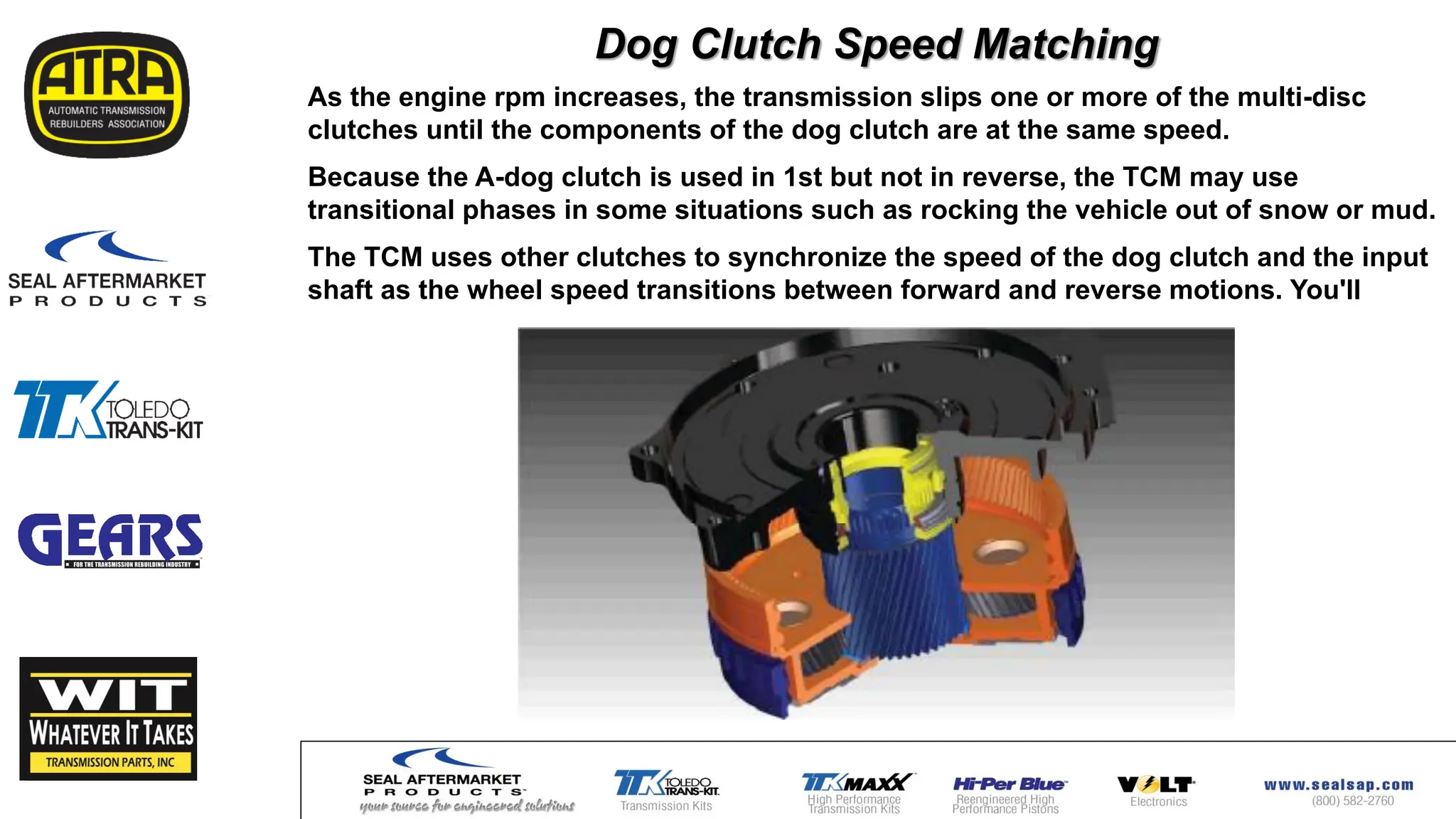
As the engine rpm increases, the transmission slips one or more of the multi-disc
clutches until the components of the dog clutch are at the same speed.
Because the A-dog clutch is used in 1st but not in reverse, the TCM may use
transitional phases in some situations such as rocking the vehicle out of snow or mud.
The TCM uses other clutches to synchronize the speed of the dog clutch and the input
shaft as the wheel speed transitions between forward and reverse motions. You'll
A Dog Clutch Function
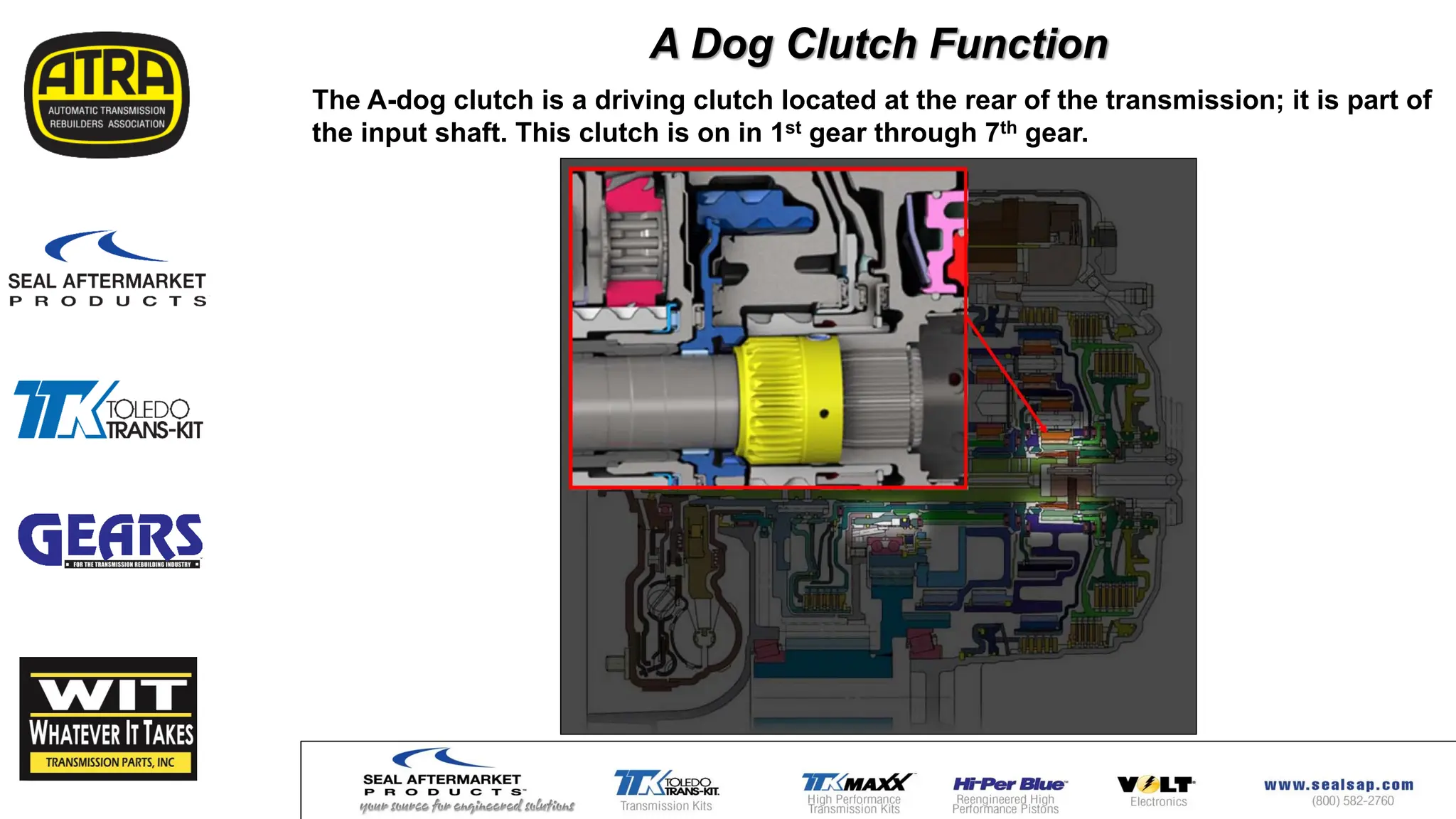
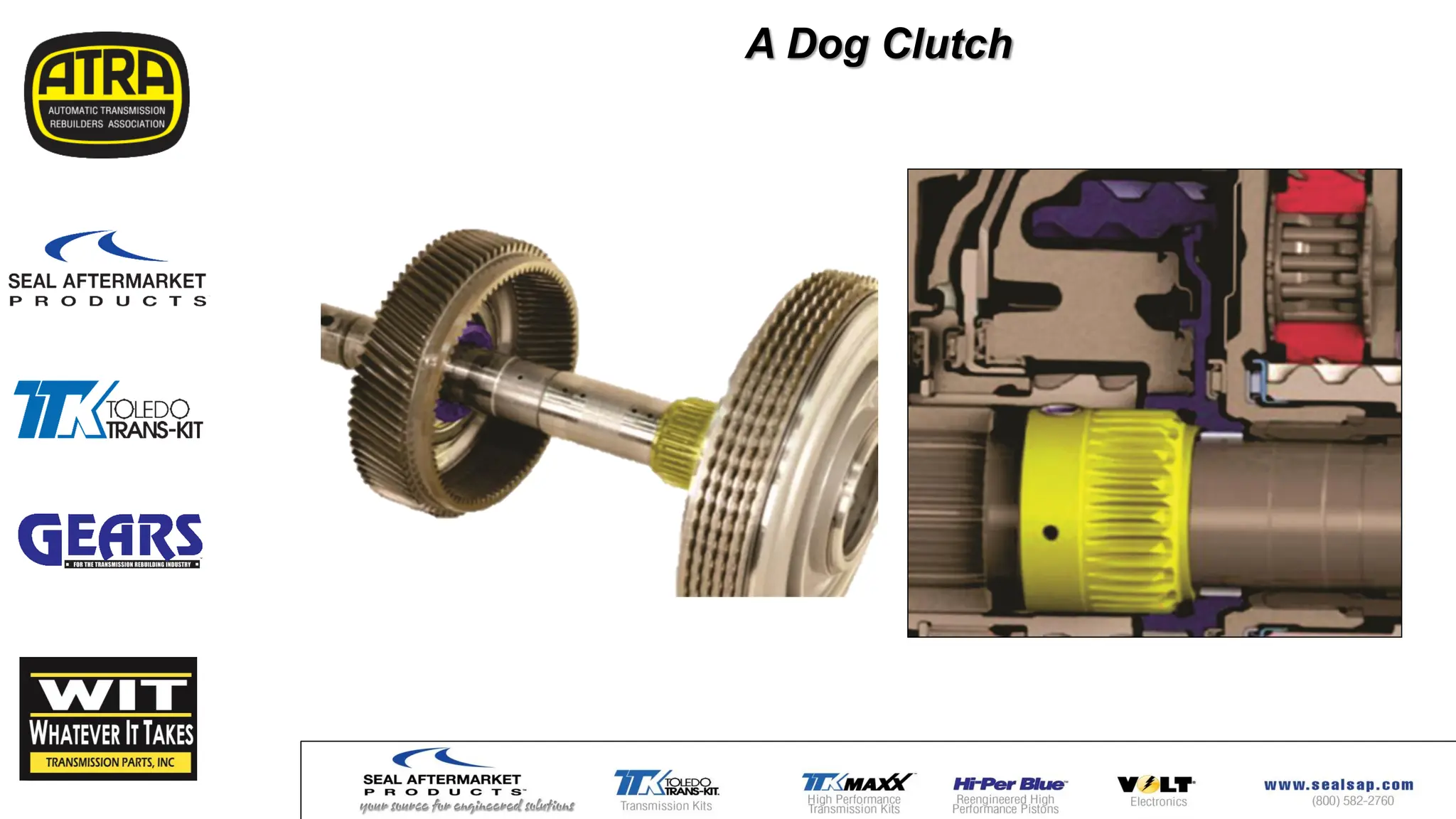
The A-dog clutch is a driving clutch located at the rear of the transmission; it is part of
the input shaft. This clutch is on in 1st gear through 7th gear.
A Dog Clutch
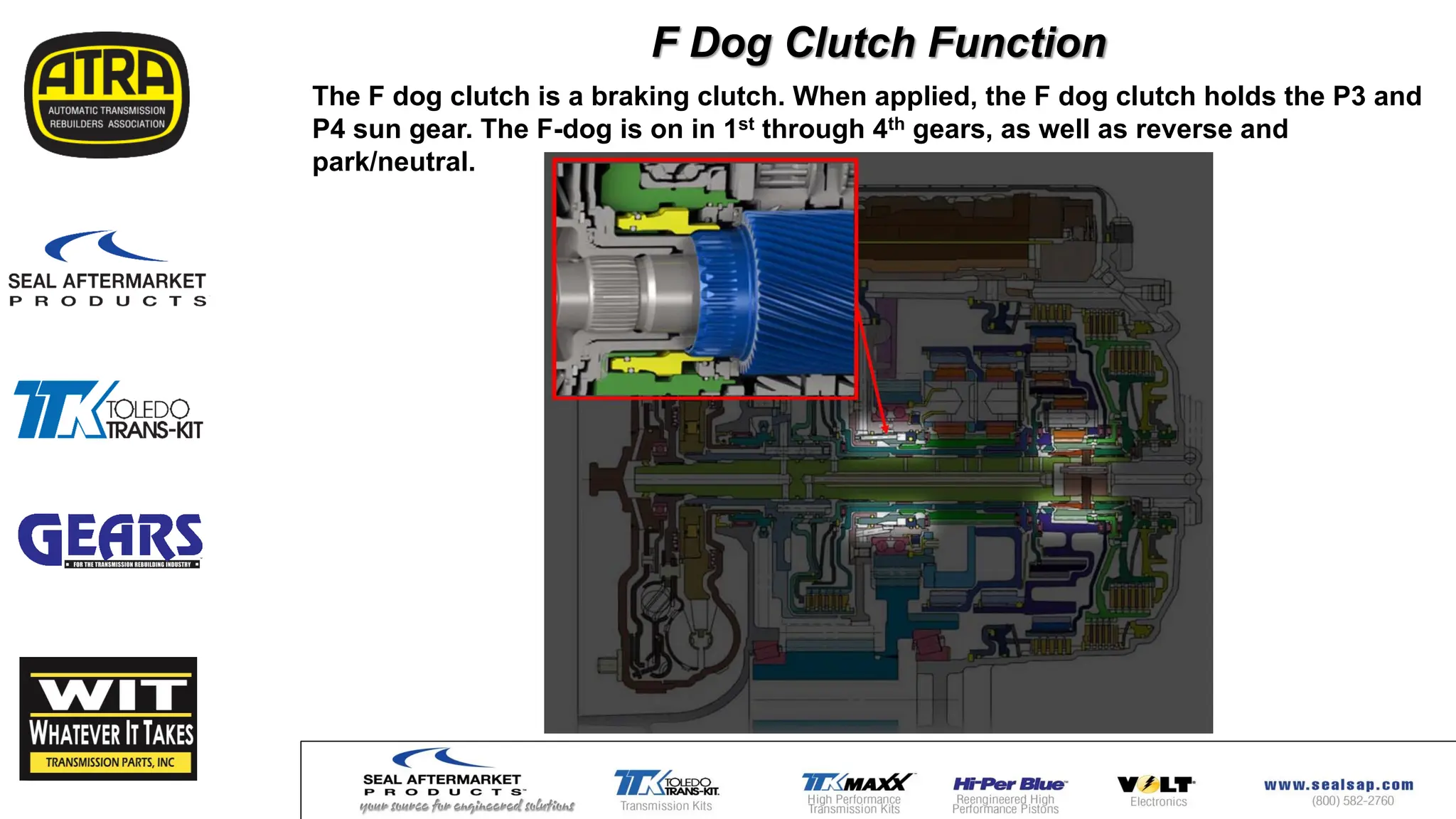
The F dog clutch is a braking clutch. When applied, the F dog clutch holds the P3 and
P4 sun gear. The F-dog is on in 1st through 4th gears, as well as reverse and
park/neutral.
F Dog Clutch Function
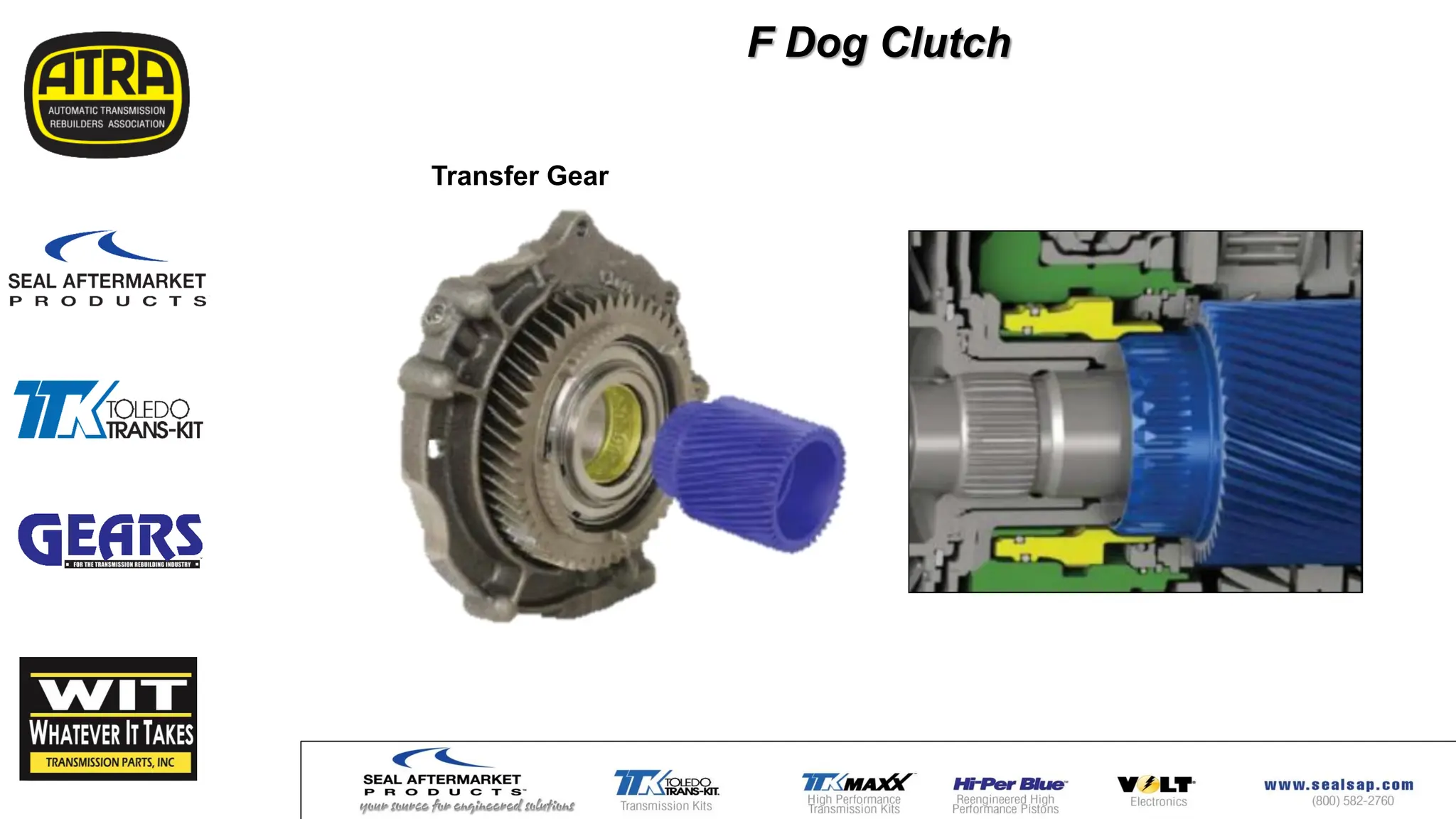
F Dog Clutch
Transfer Gear
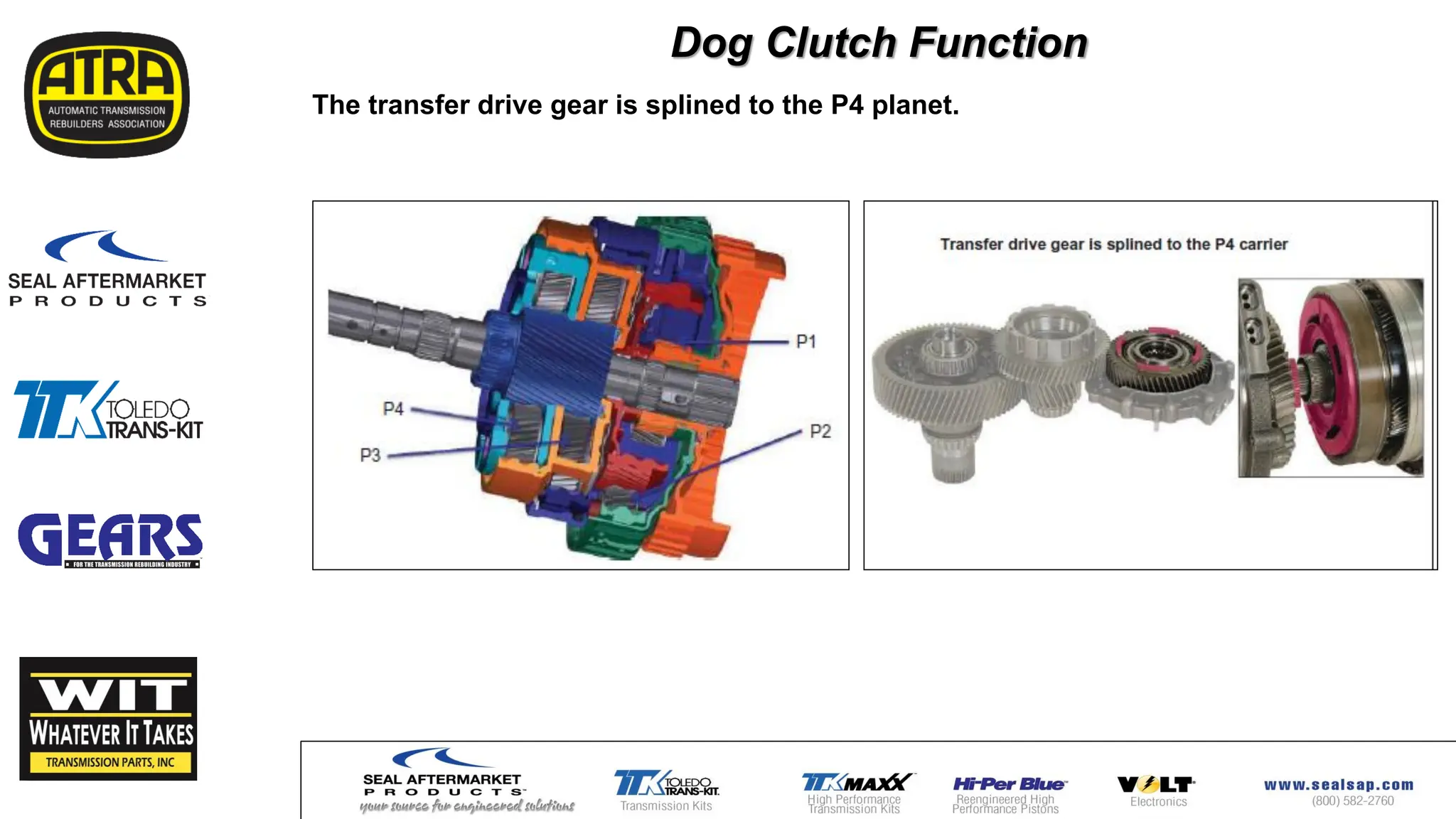
The transfer drive gear is splined to the P4 planet.
Dog Clutch Function
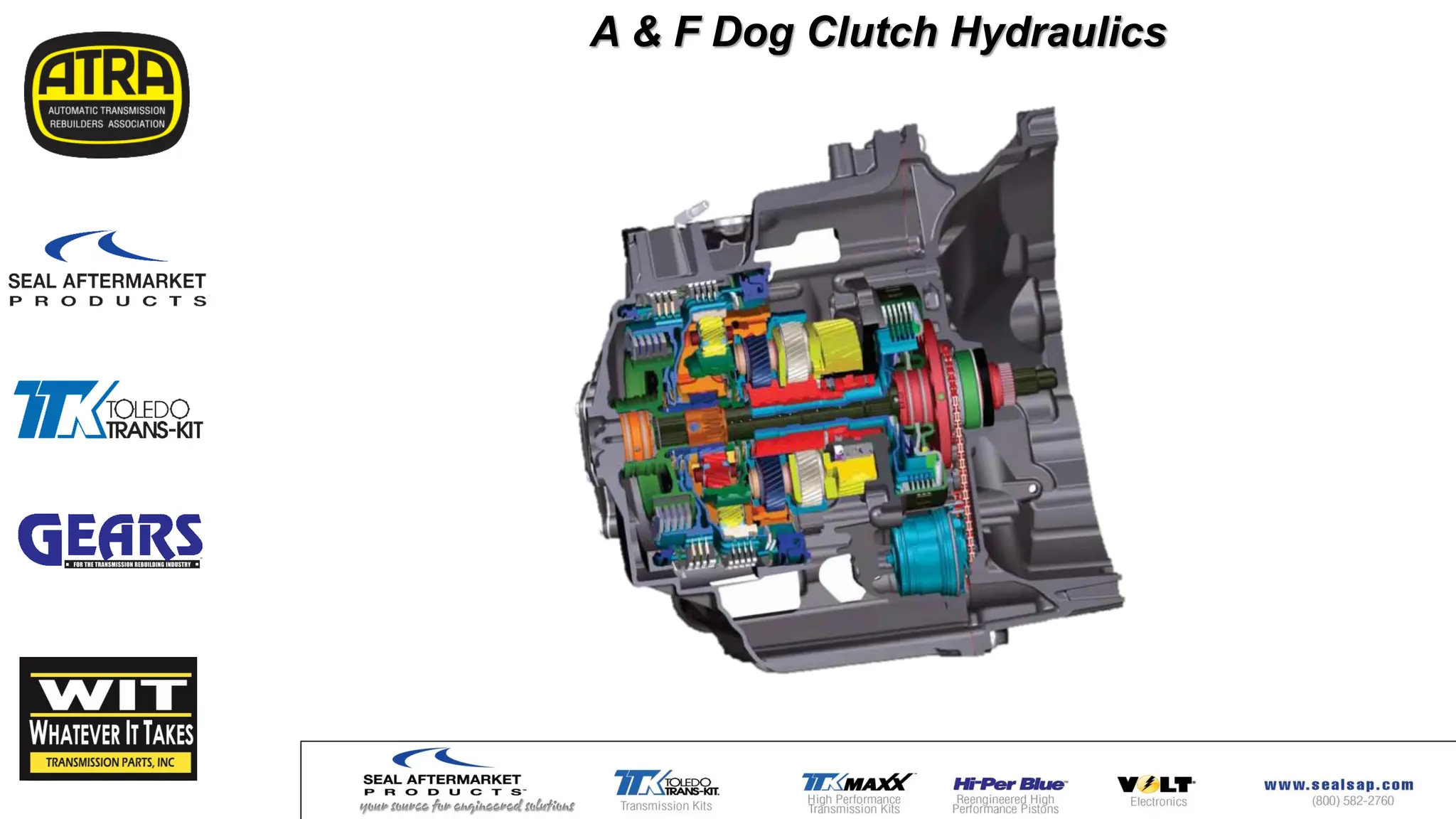
A & F Dog Clutch Hydraulics
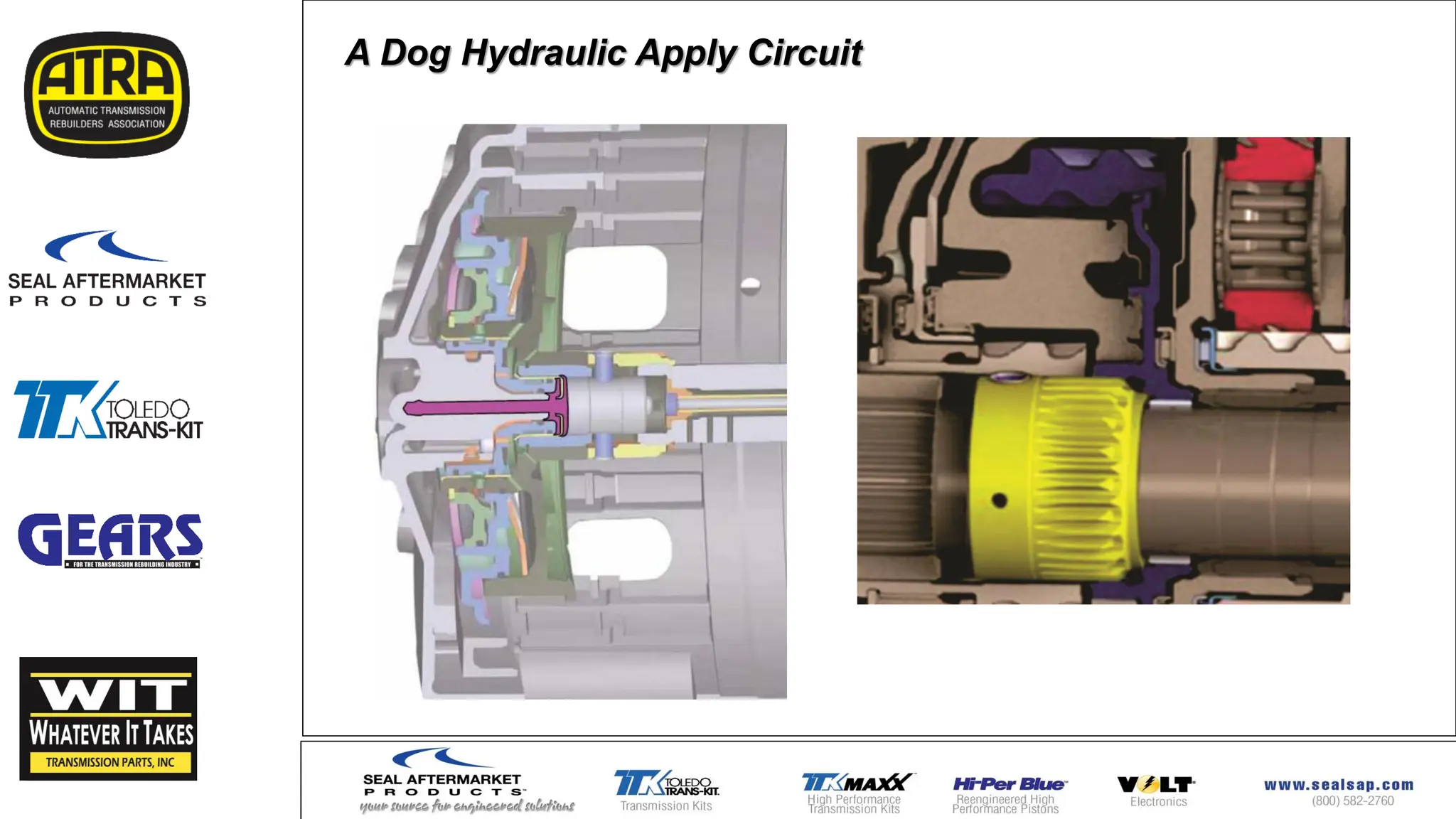
A Dog Hydraulic Apply Circuit
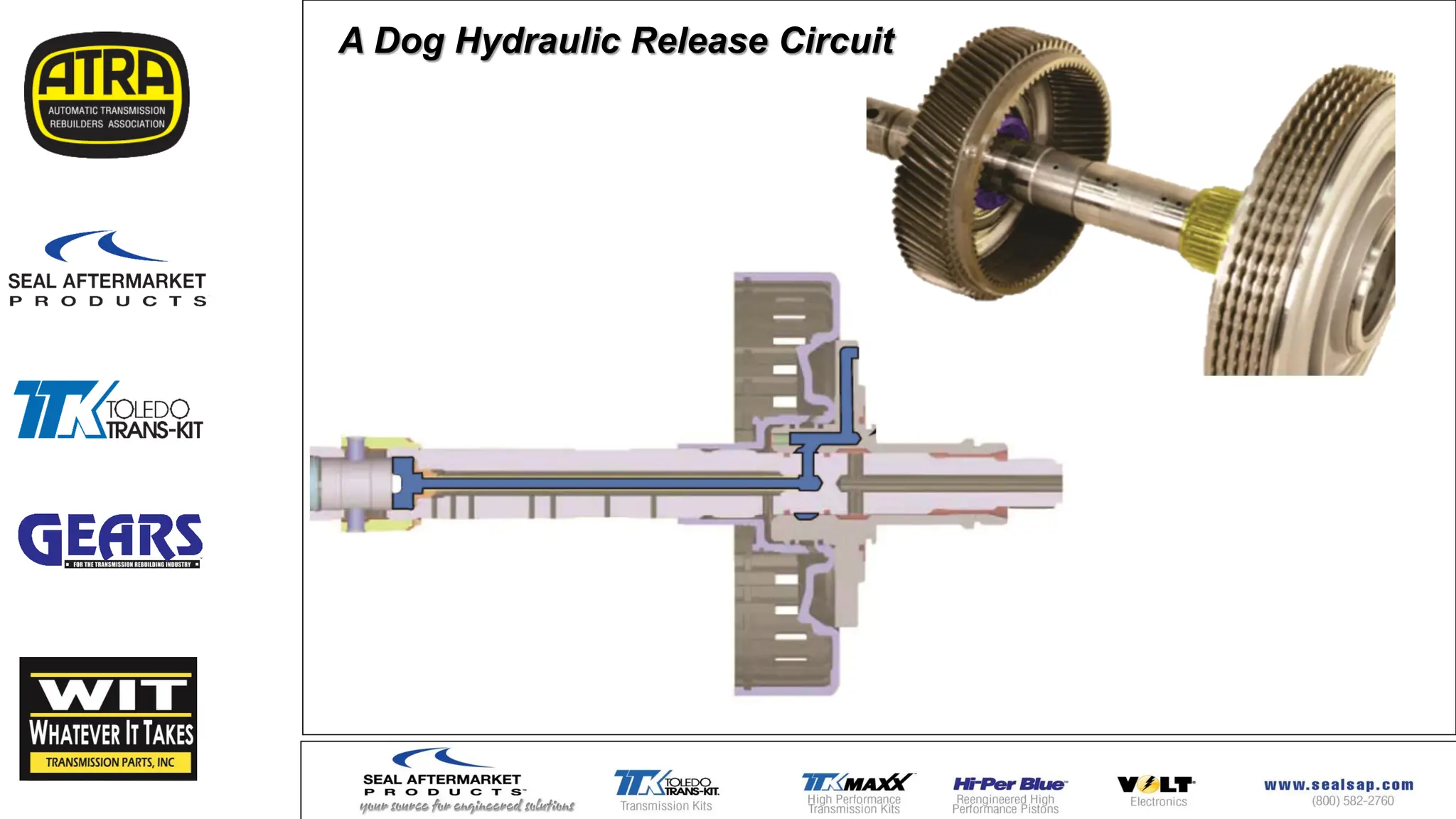
A Dog Hydraulic Release Circuit
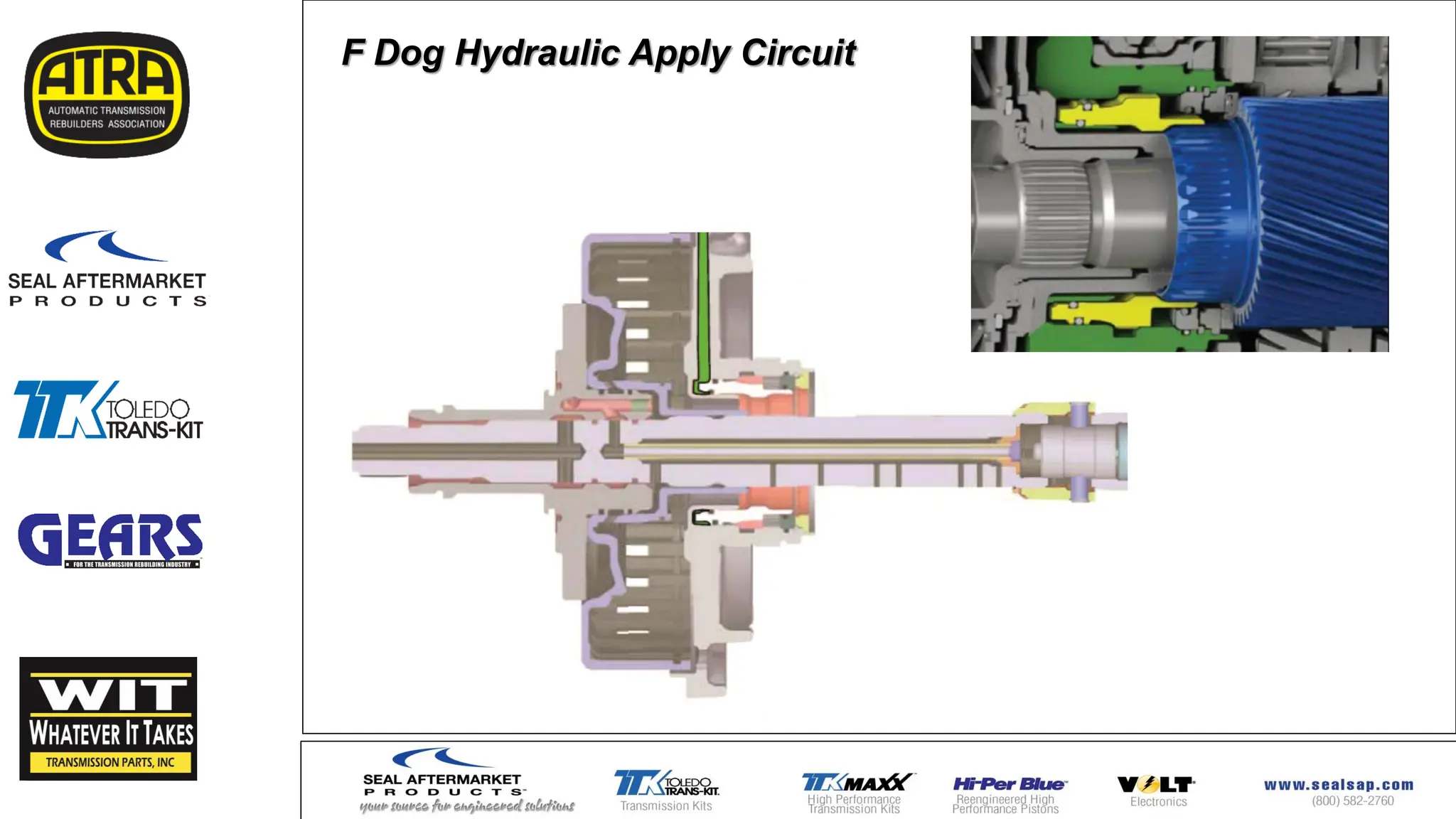
F Dog Hydraulic Apply Circuit
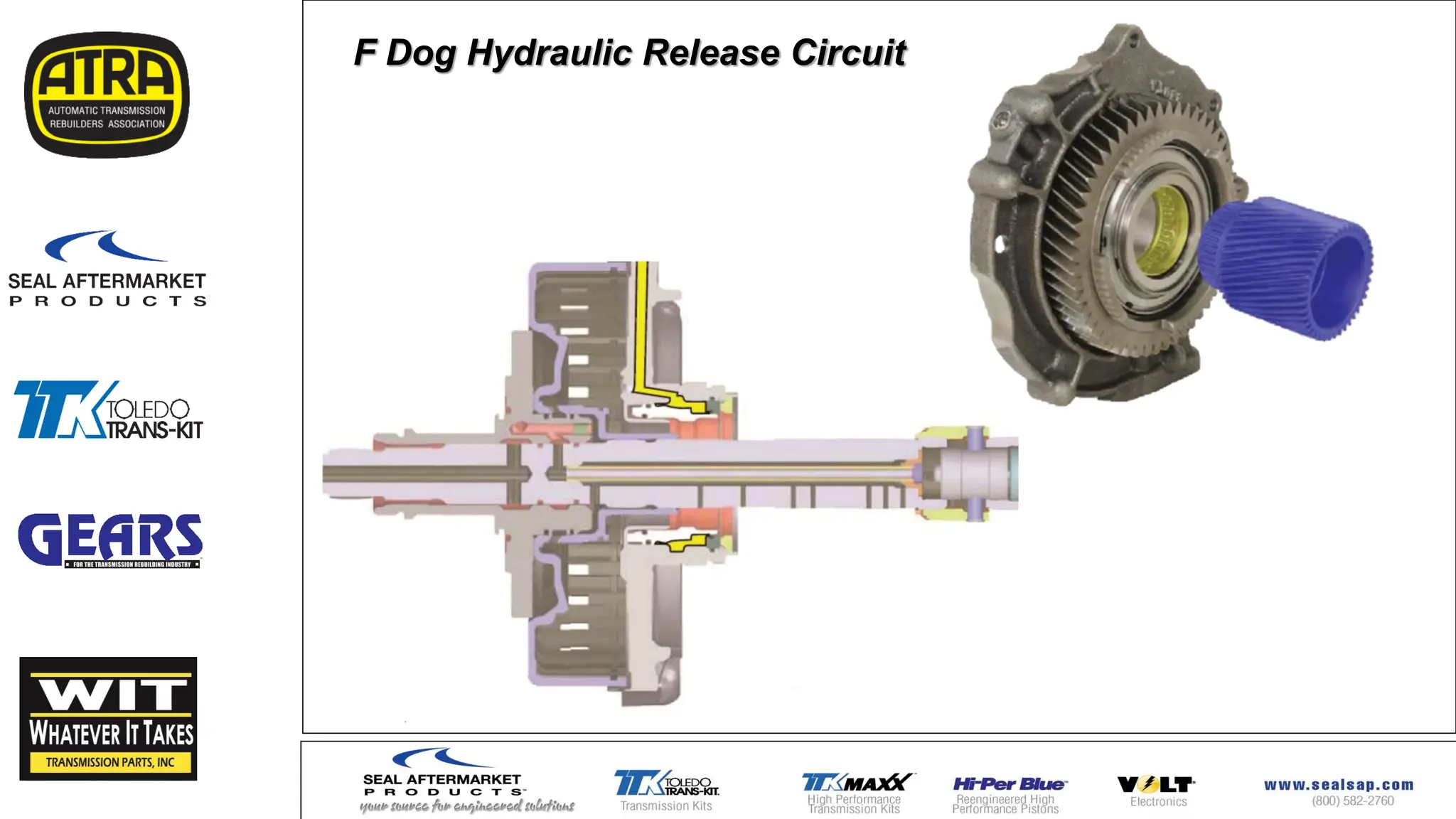
F Dog Hydraulic Release Circuit
Jeep 9-speed needs a reset again (3rd software upgrade)
Software tweak aims to smooth out issues with Cherokee shifting
The dog clutch is the linchpin that allows Chrysler's nine-speed transmission to be so compact.
Chrysler delayed the Jeep Cherokee's launch to tweak the transmission's software. Now, it's
under its third five-minute software reset or "reflash".
A new software recalibration covers more than 100,000 Jeep Cherokees to address continuing
issues with the way some of the nine-speeds shift gears.
A service bulletin advises technicians in certain cases to perform an "adaptation drive learn"
taking the Cherokee out for a test drive of up to 78 minutes to ensure that it is shifting correctly.
Not all Cherokees sold require the reflash, according to the automaker, but it is available under
warranty to customers who complain about the feel or operation of the transmission.
In a written statement, a Chrysler spokeswoman said the reflash was being done "to respond to
customer feedback and improve satisfaction." She said dealers were "asked to perform the
software update on any unsold vehicles in inventory and for any customer who has requested
improved throttle response or shift feel.“
About half of the 30 consumer complaints where “while it can be engaged in highway driving, it'll
likely shift down to 8th gear at higher speeds because the drag starts to slow the car down”.
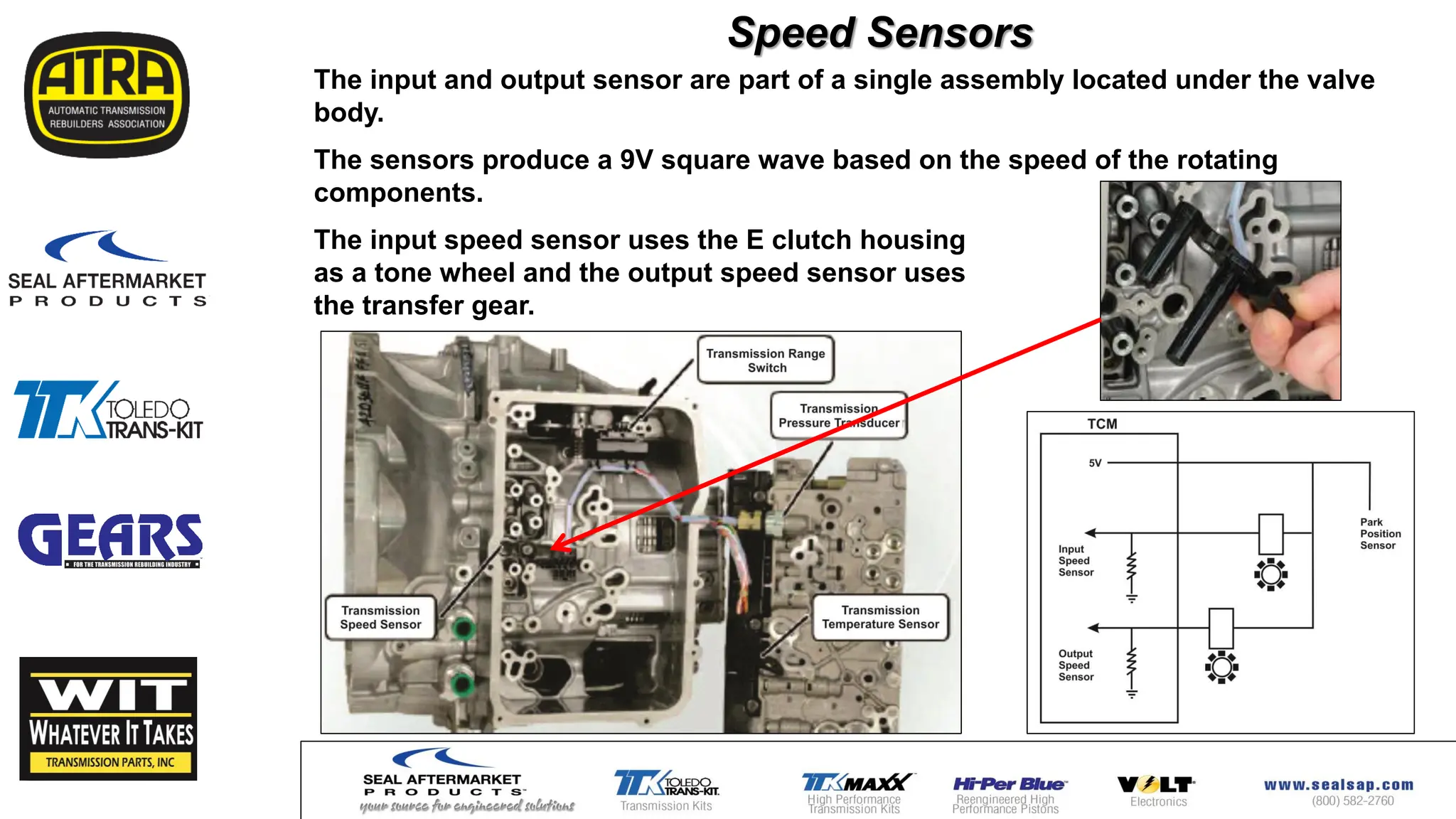
Speed Sensors
The input and output sensor are part of a single assembly located under the valve
body.
The sensors produce a 9V square wave based on the speed of the rotating
components.
The input speed sensor uses the E clutch housing
as a tone wheel and the output speed sensor uses
the transfer gear.
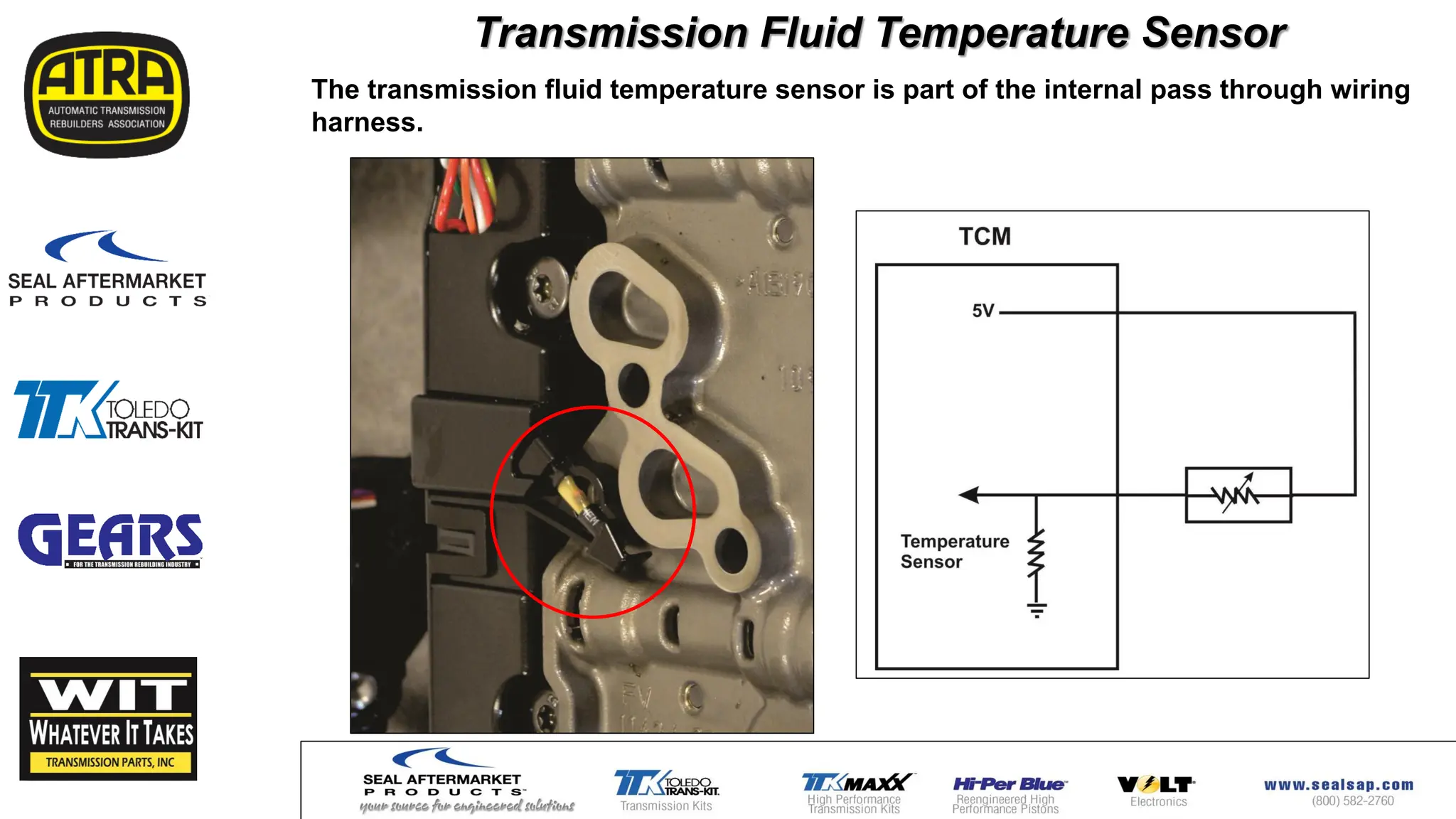
Transmission Fluid Temperature Sensor
The transmission fluid temperature sensor is part of the internal pass through wiring
harness.
Transmission Range Sensor (IMS)
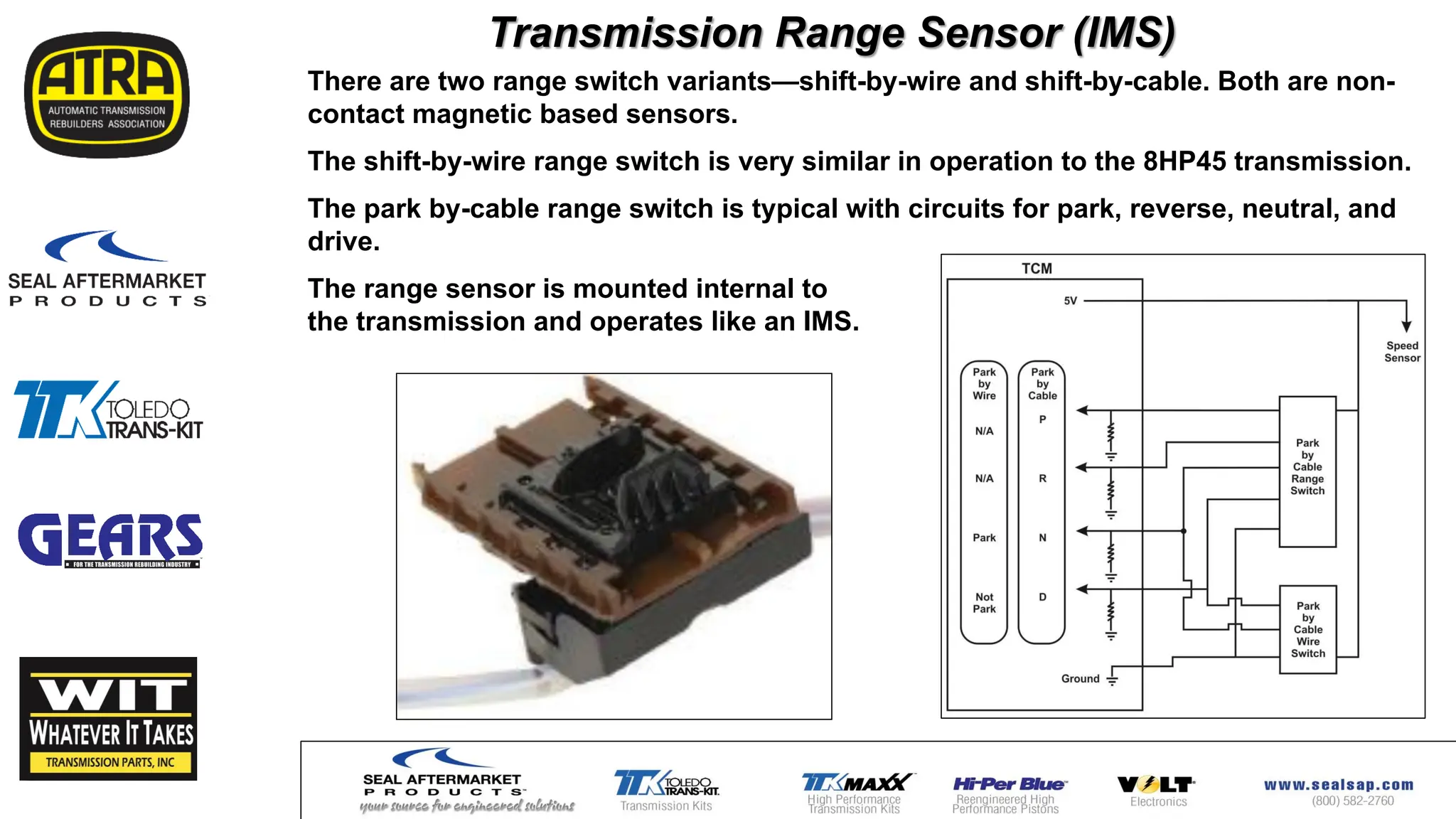
There are two range switch variants—shift-by-wire and shift-by-cable. Both are non-
contact magnetic based sensors.
The shift-by-wire range switch is very similar in operation to the 8HP45 transmission.
The park by-cable range switch is typical with circuits for park, reverse, neutral, and
drive.
The range sensor is mounted internal to
the transmission and operates like an IMS.
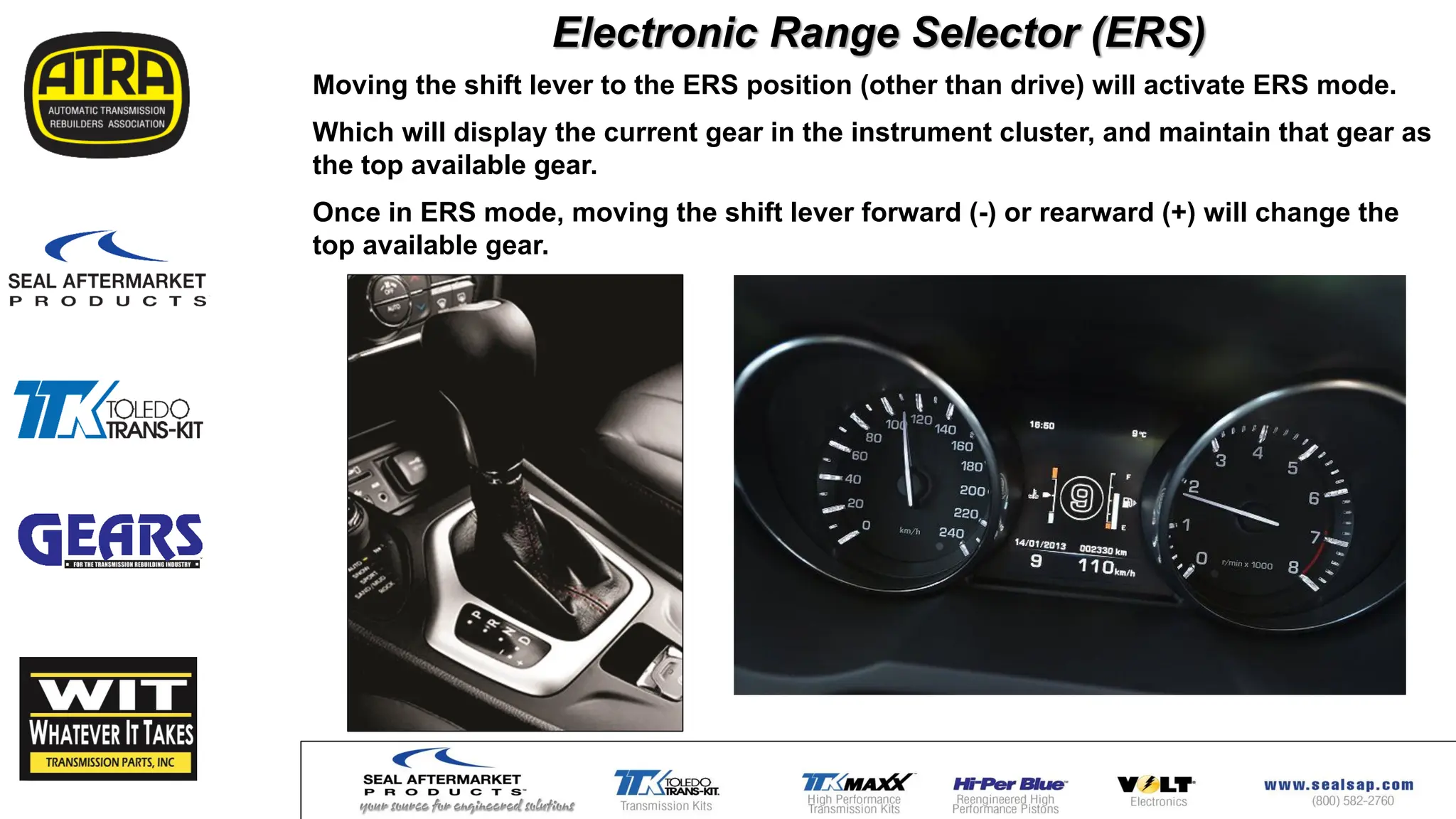
Moving the shift lever to the ERS position (other than drive) will activate ERS mode.
Which will display the current gear in the instrument cluster, and maintain that gear as
the top available gear.
Once in ERS mode, moving the shift lever forward (-) or rearward (+) will change the
top available gear.
Electronic Range Selector (ERS)
Dog Clutch Pressure Transducer
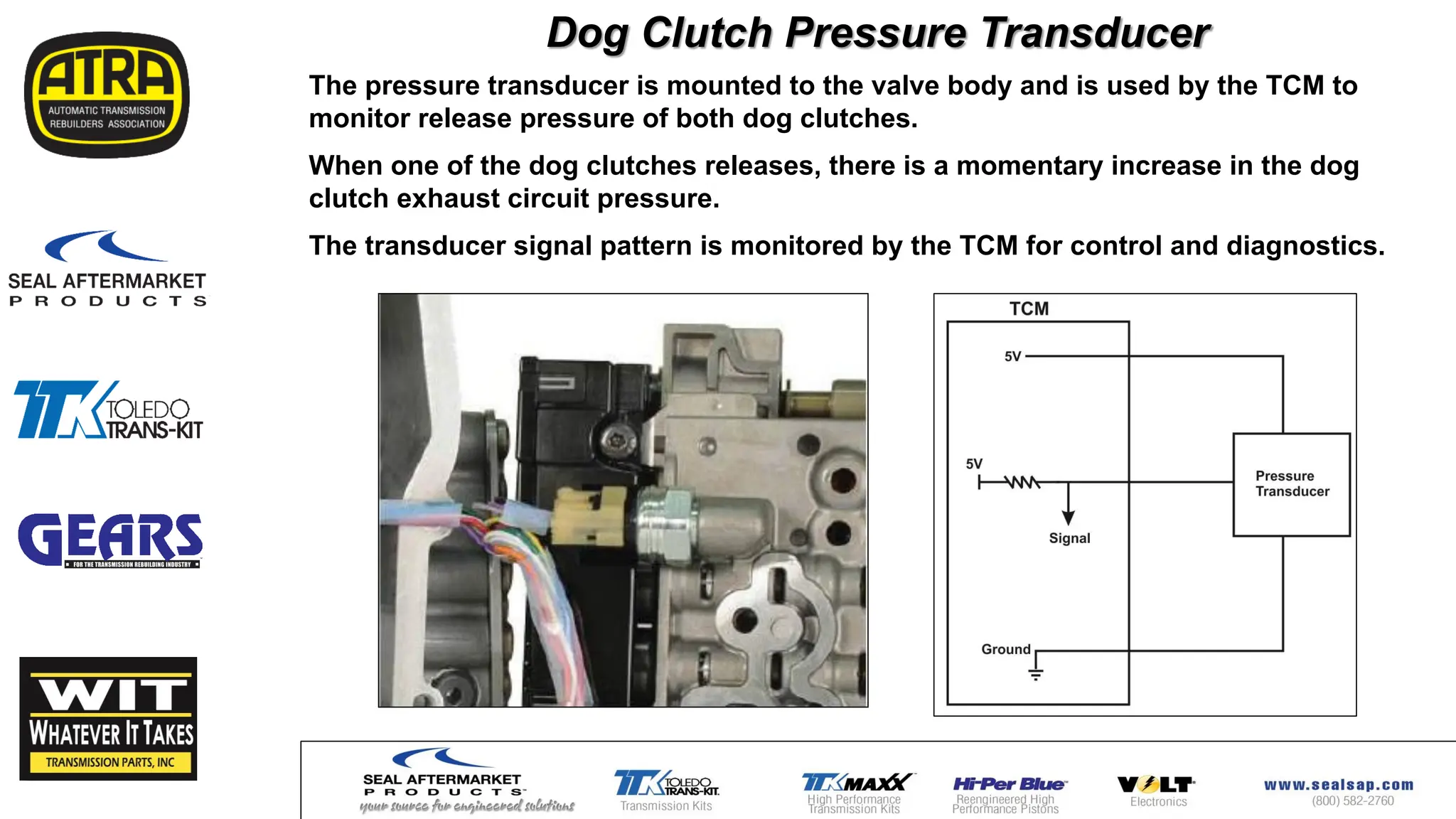
The pressure transducer is mounted to the valve body and is used by the TCM to
monitor release pressure of both dog clutches.
When one of the dog clutches releases, there is a momentary increase in the dog
clutch exhaust circuit pressure.
The transducer signal pattern is monitored by the TCM for control and diagnostics.
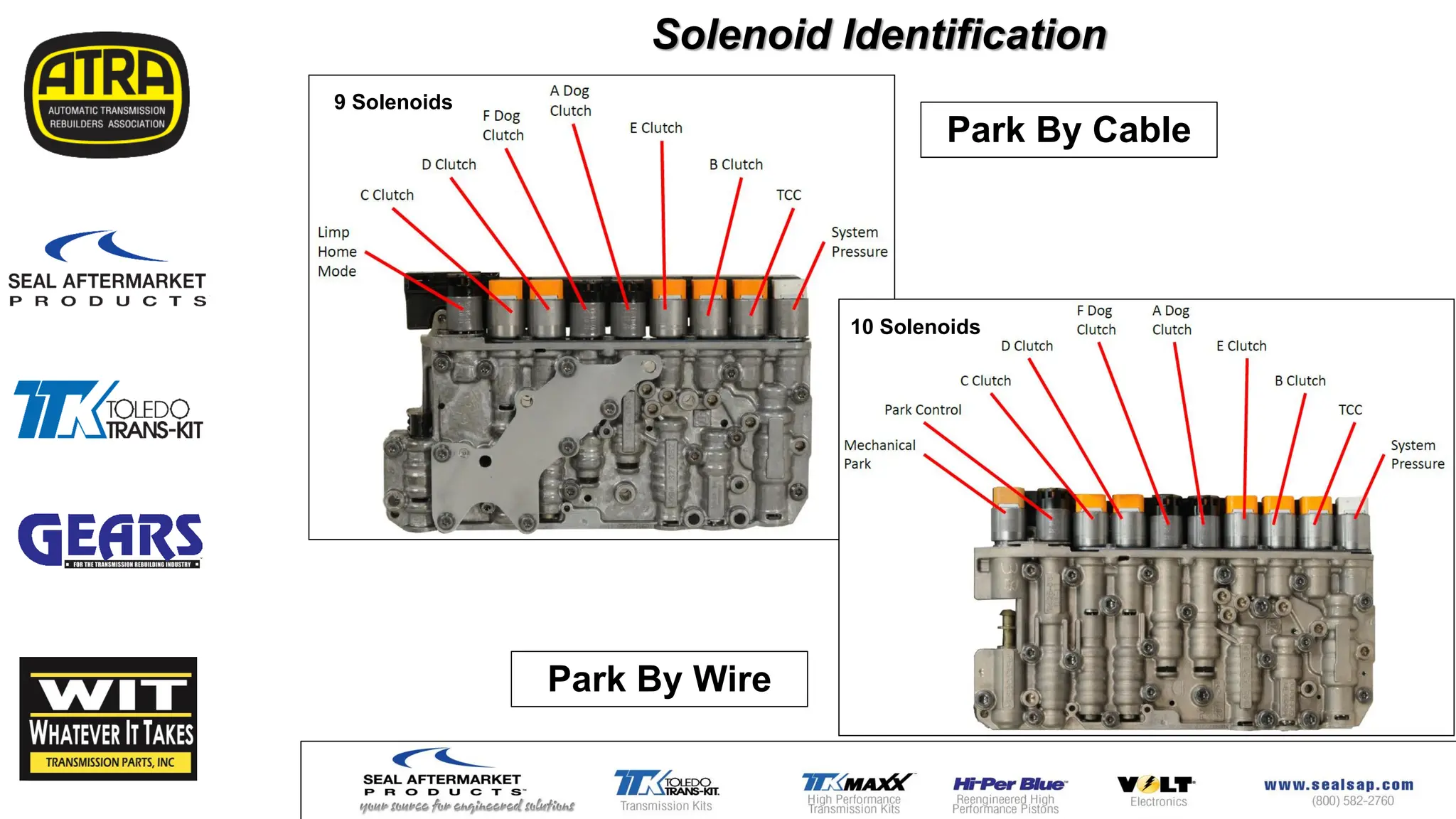
Solenoid Identification
Park By Wire
Park By Cable
9 Solenoids
10 Solenoids
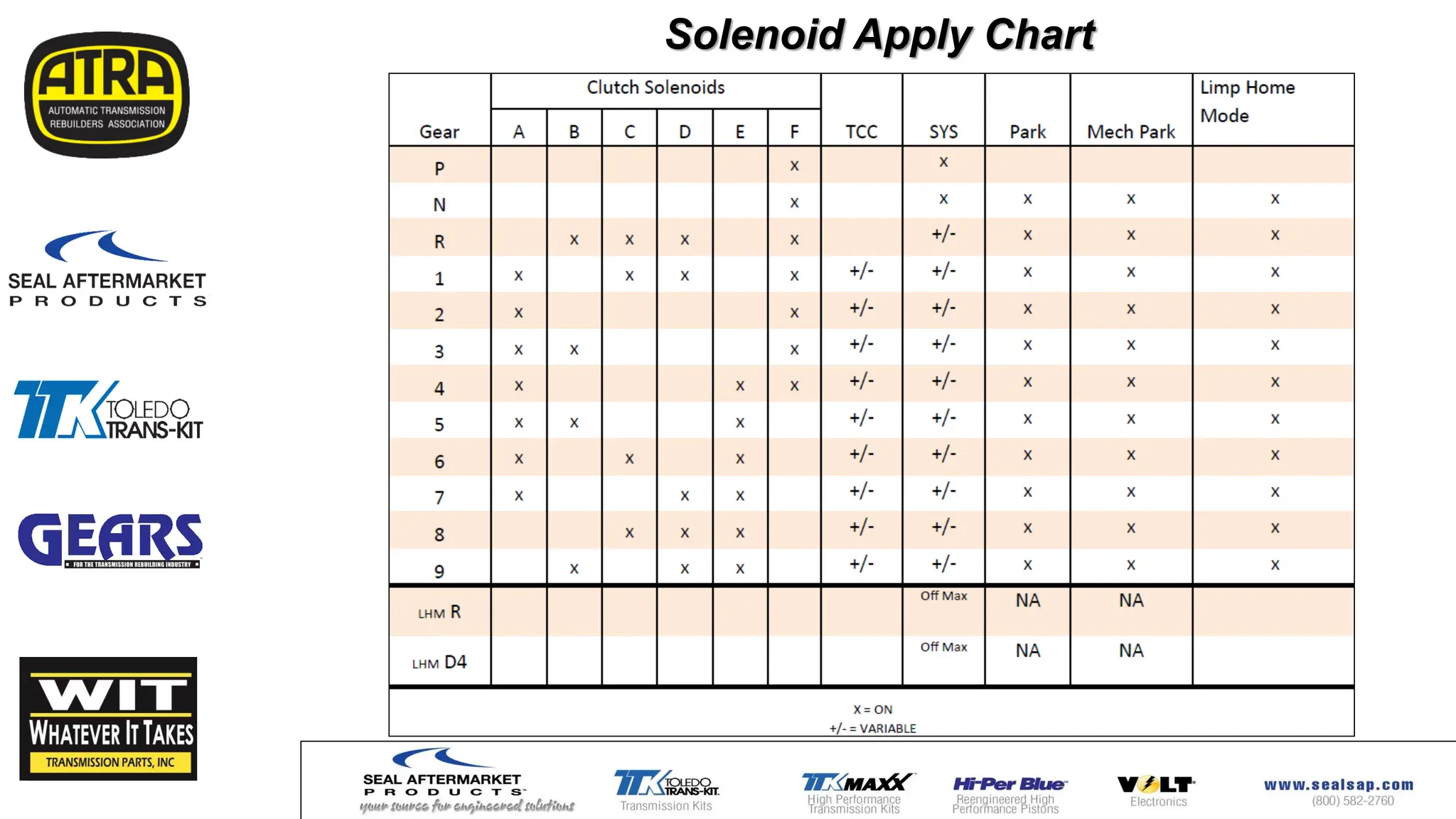
Solenoid Apply Chart
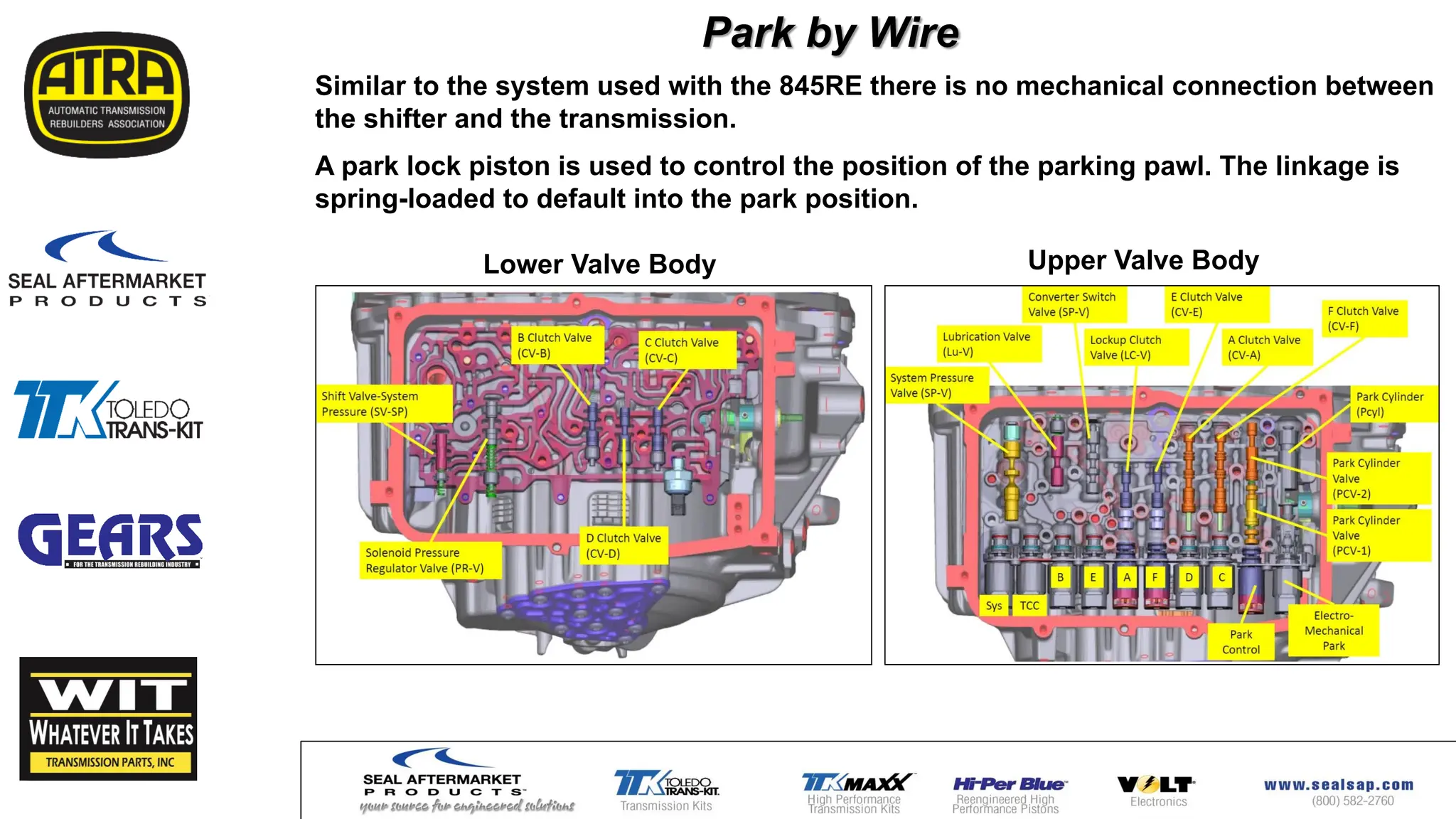
Similar to the system used with the 845RE there is no mechanical connection between
the shifter and the transmission.
A park lock piston is used to control the position of the parking pawl. The linkage is
spring-loaded to default into the park position.
Park by Wire
Lower Valve Body Upper Valve Body
Park by Wire
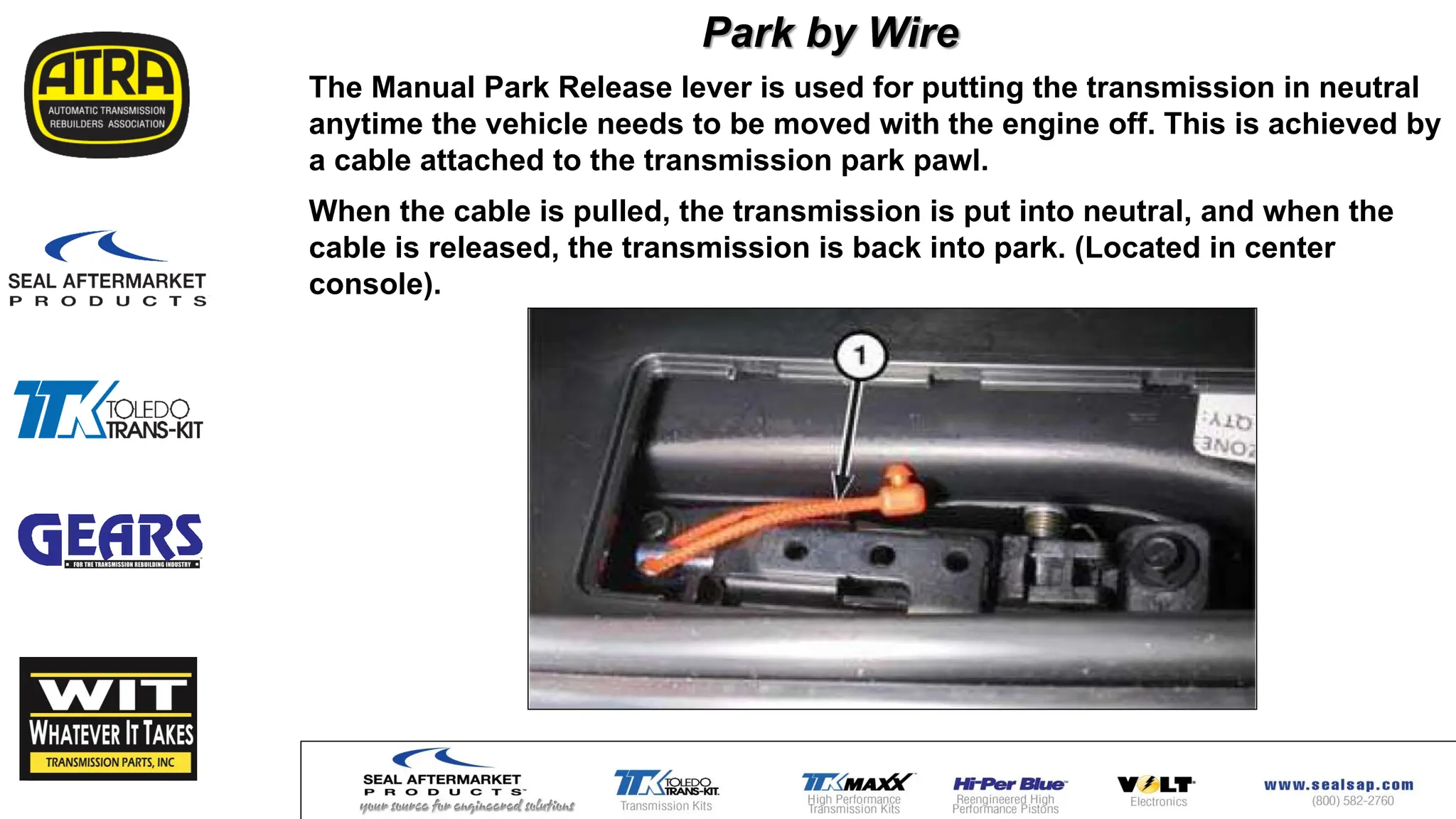
The Manual Park Release lever is used for putting the transmission in neutral
anytime the vehicle needs to be moved with the engine off. This is achieved by
a cable attached to the transmission park pawl.
When the cable is pulled, the transmission is put into neutral, and when the
cable is released, the transmission is back into park. (Located in center
console).
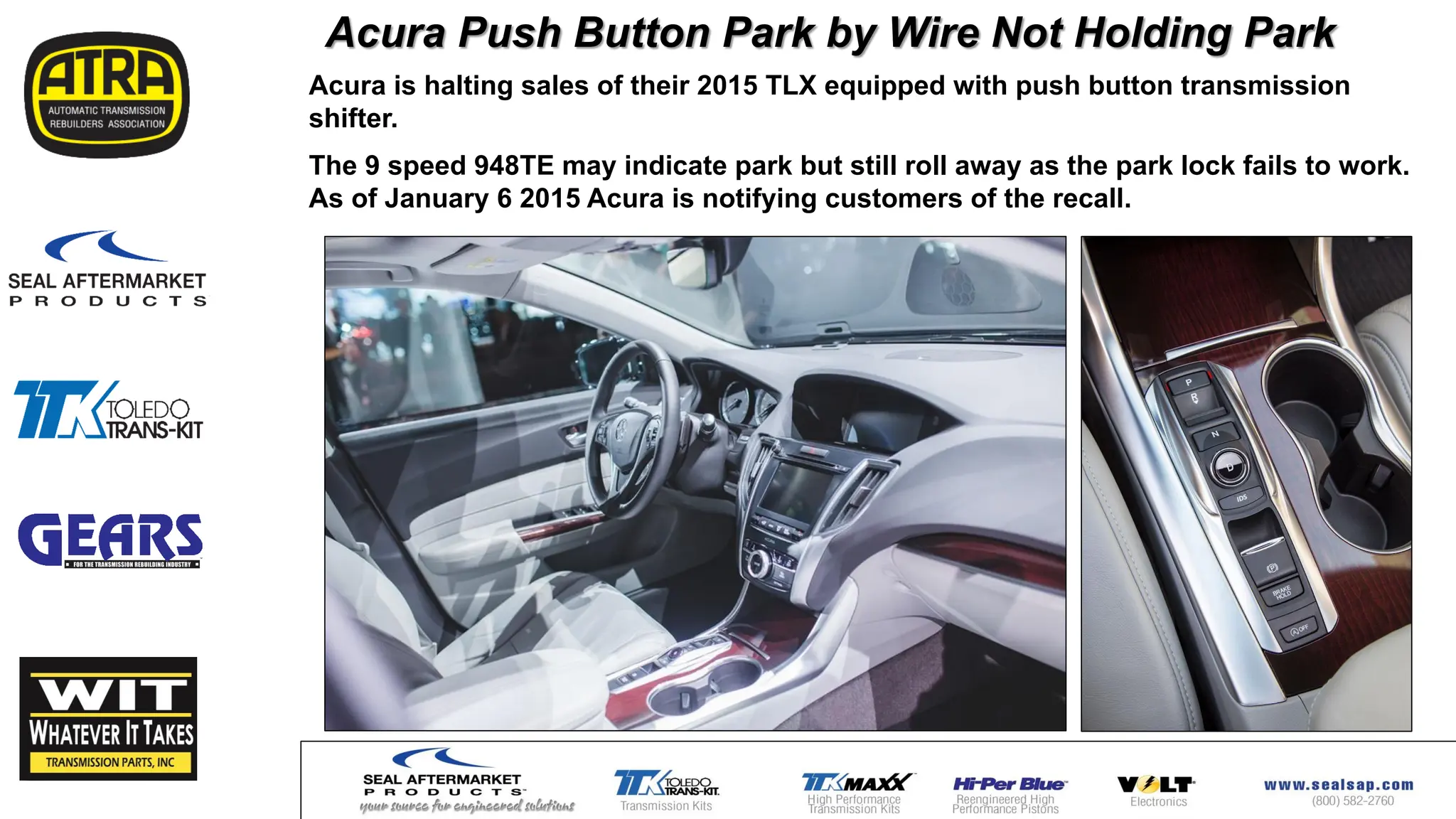
Acura Push Button Park by Wire Not Holding Park
Acura is halting sales of their 2015 TLX equipped with push button transmission
shifter.
The 9 speed 948TE may indicate park but still roll away as the park lock fails to work.
As of January 6 2015 Acura is notifying customers of the recall.
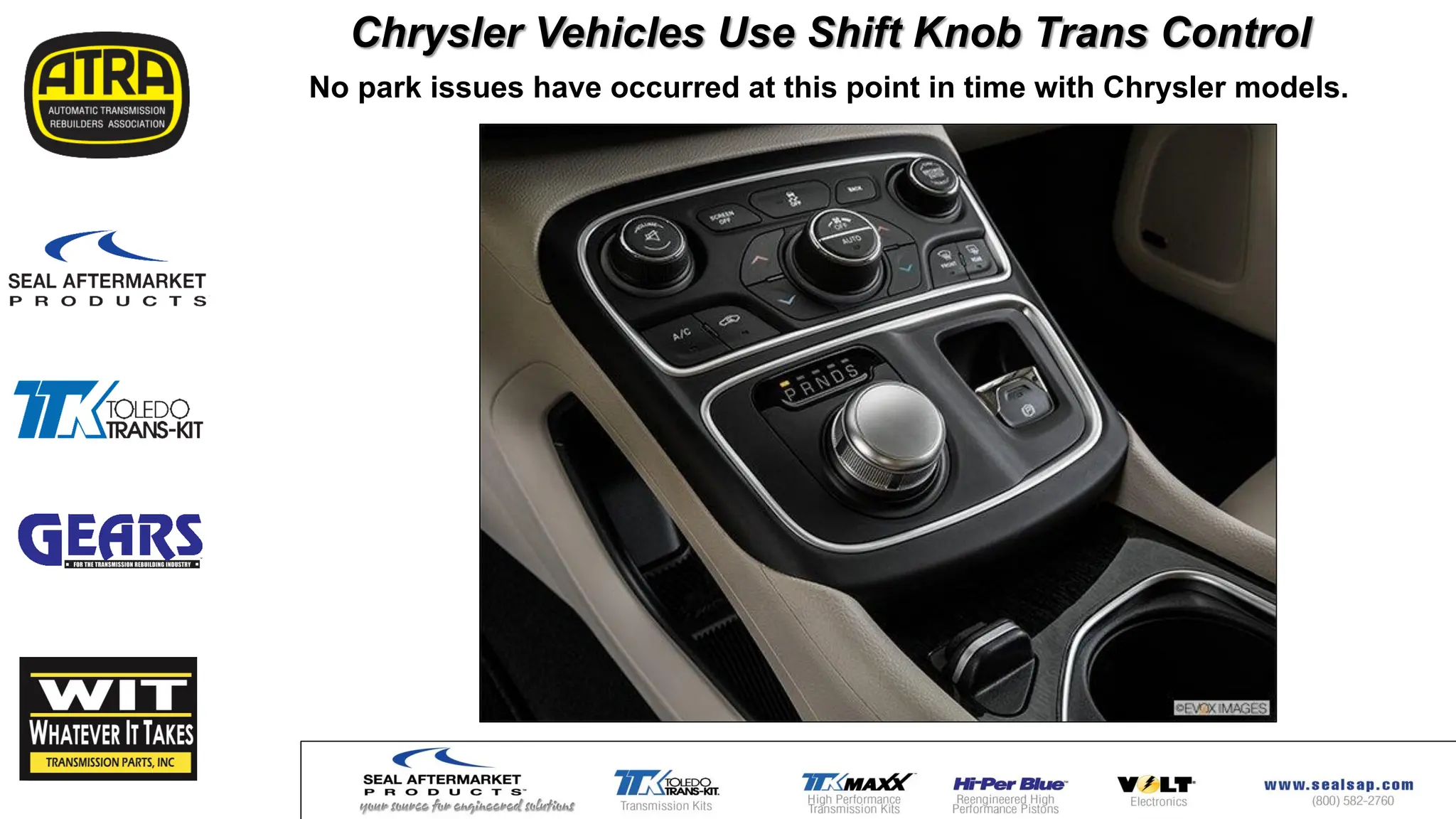
Chrysler Vehicles Use Shift Knob Trans Control
No park issues have occurred at this point in time with Chrysler models.
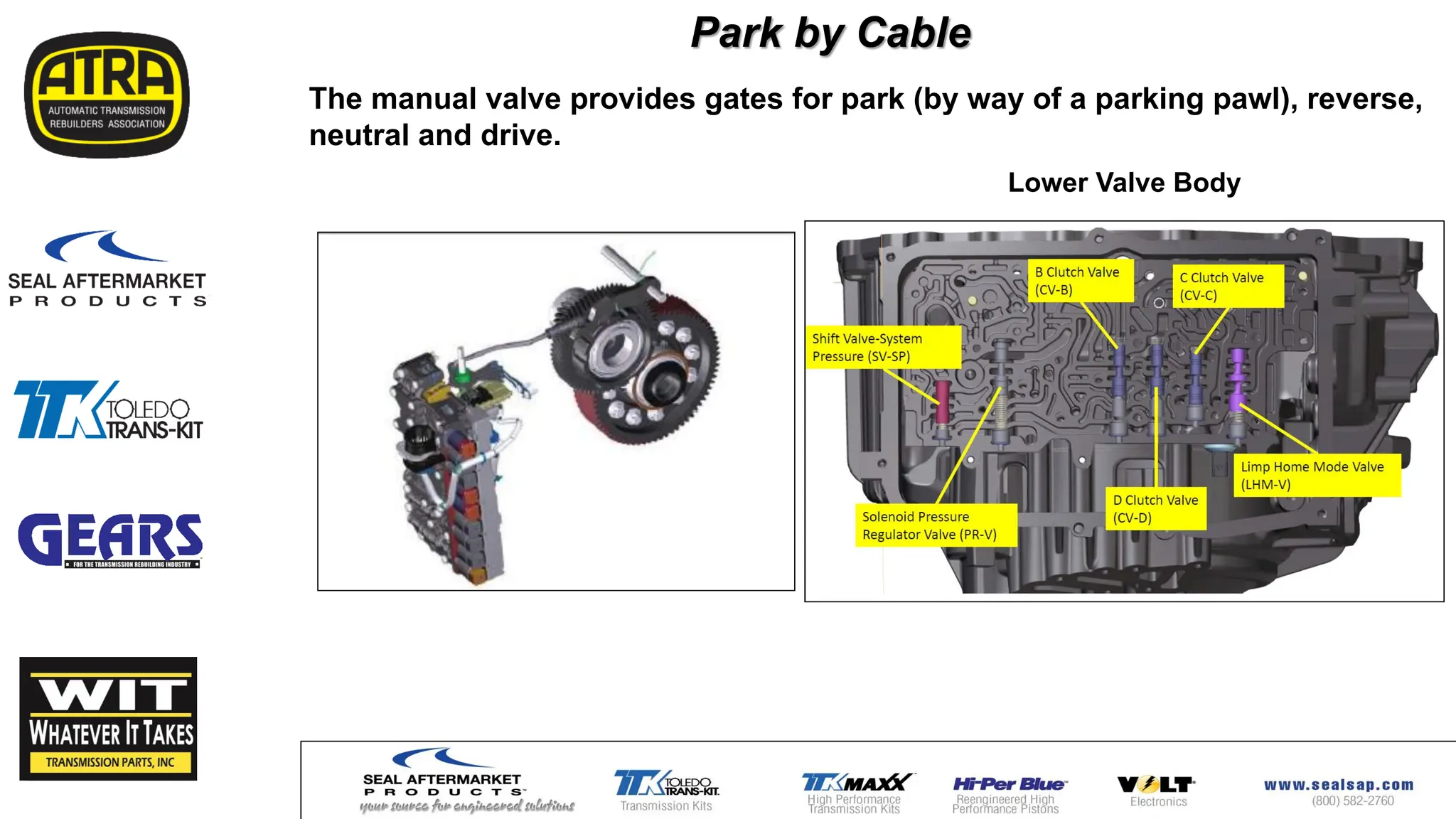
Park by Cable
The manual valve provides gates for park (by way of a parking pawl), reverse,
neutral and drive.
Lower Valve Body
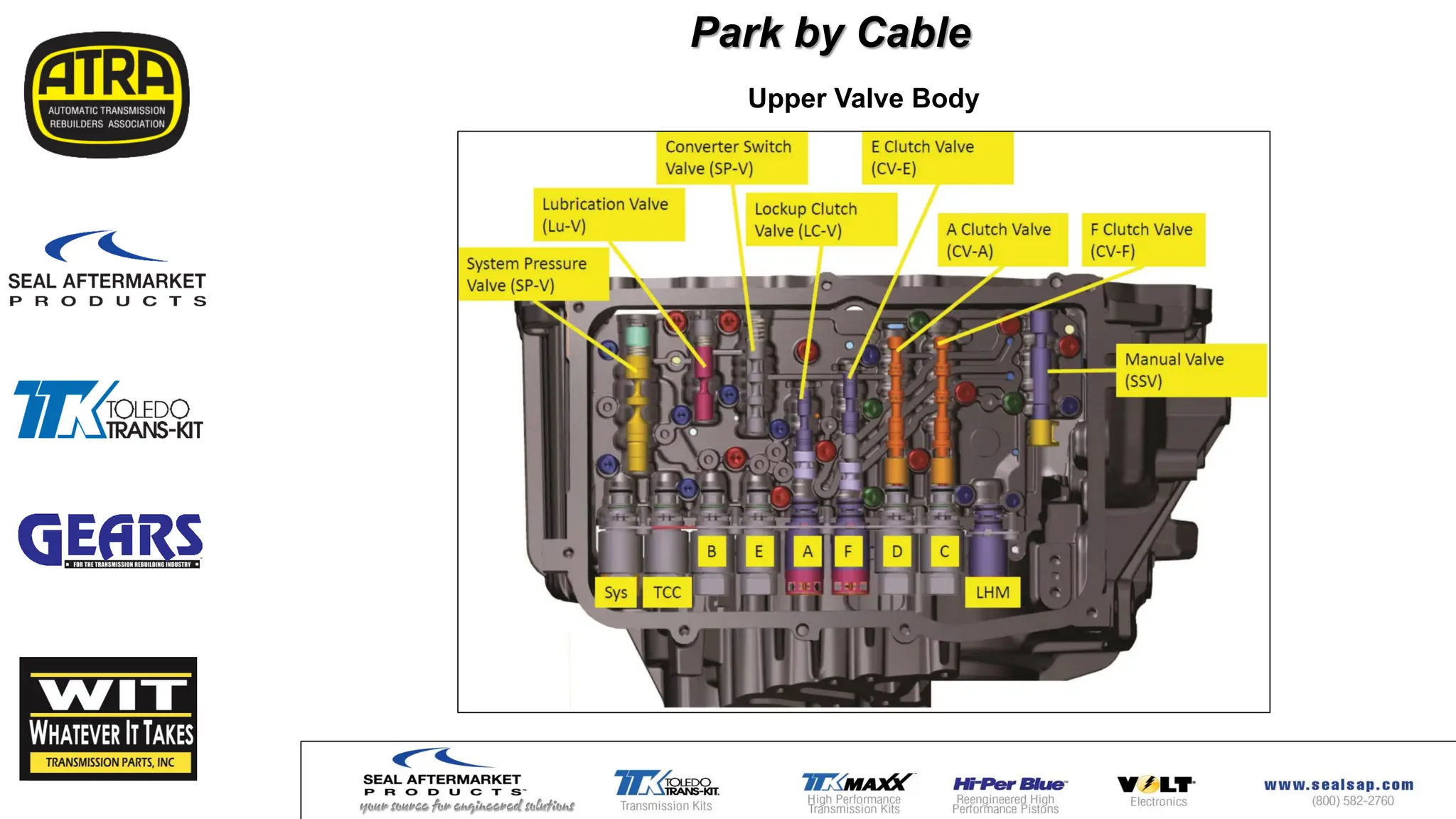
Park by Cable
Upper Valve Body
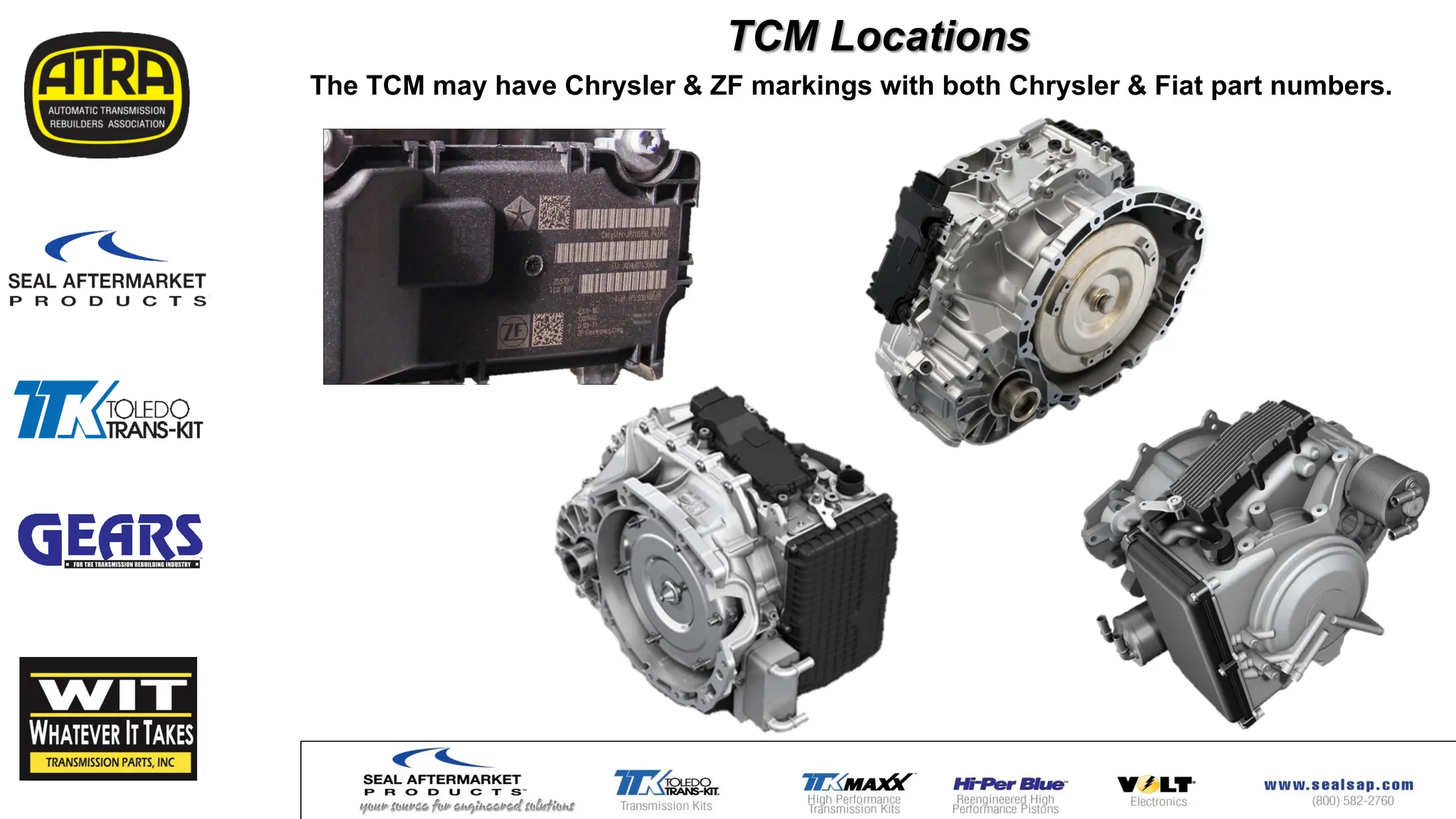
TCM Locations
The TCM may have Chrysler & ZF markings with both Chrysler & Fiat part numbers.
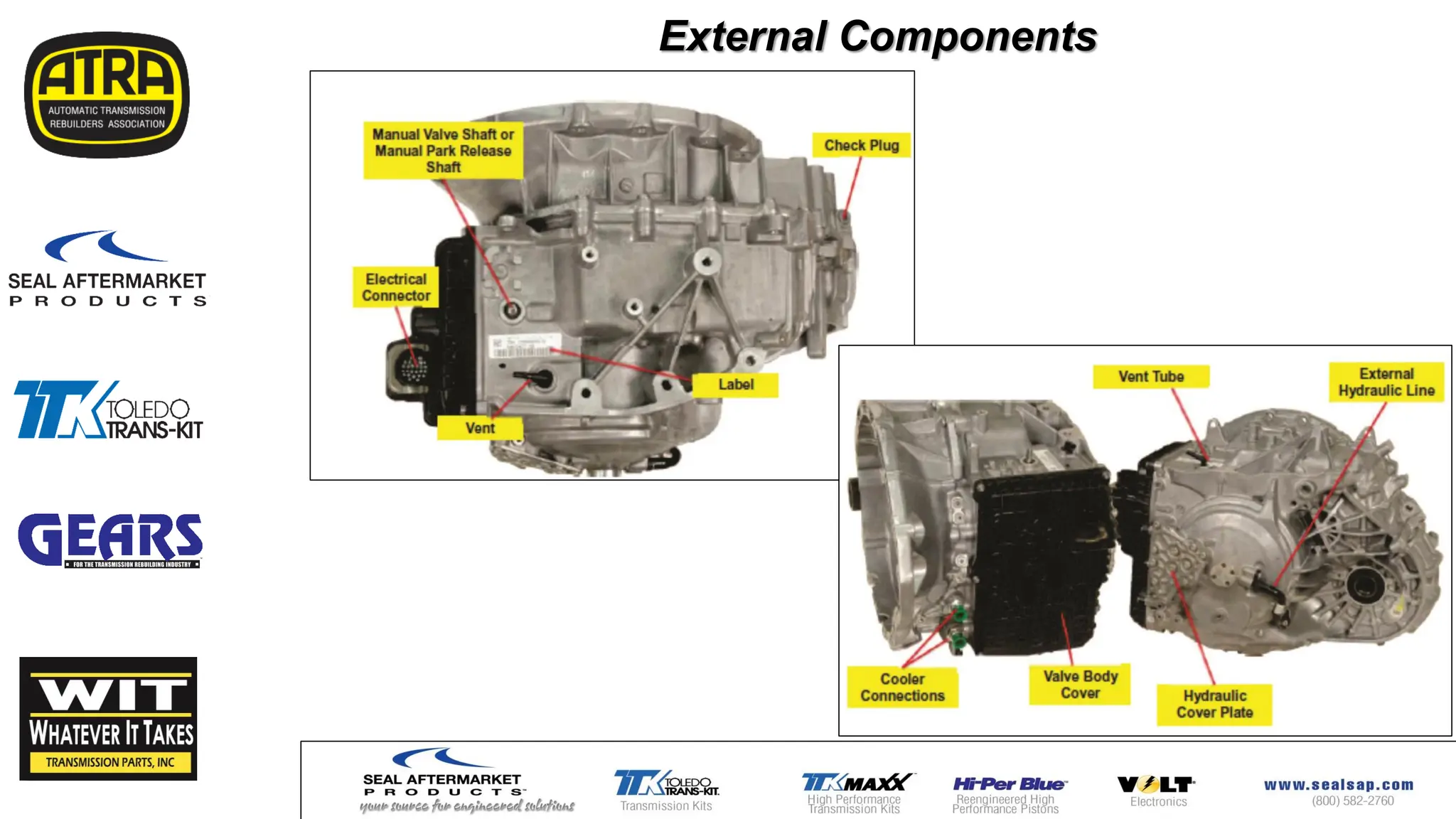
External Components
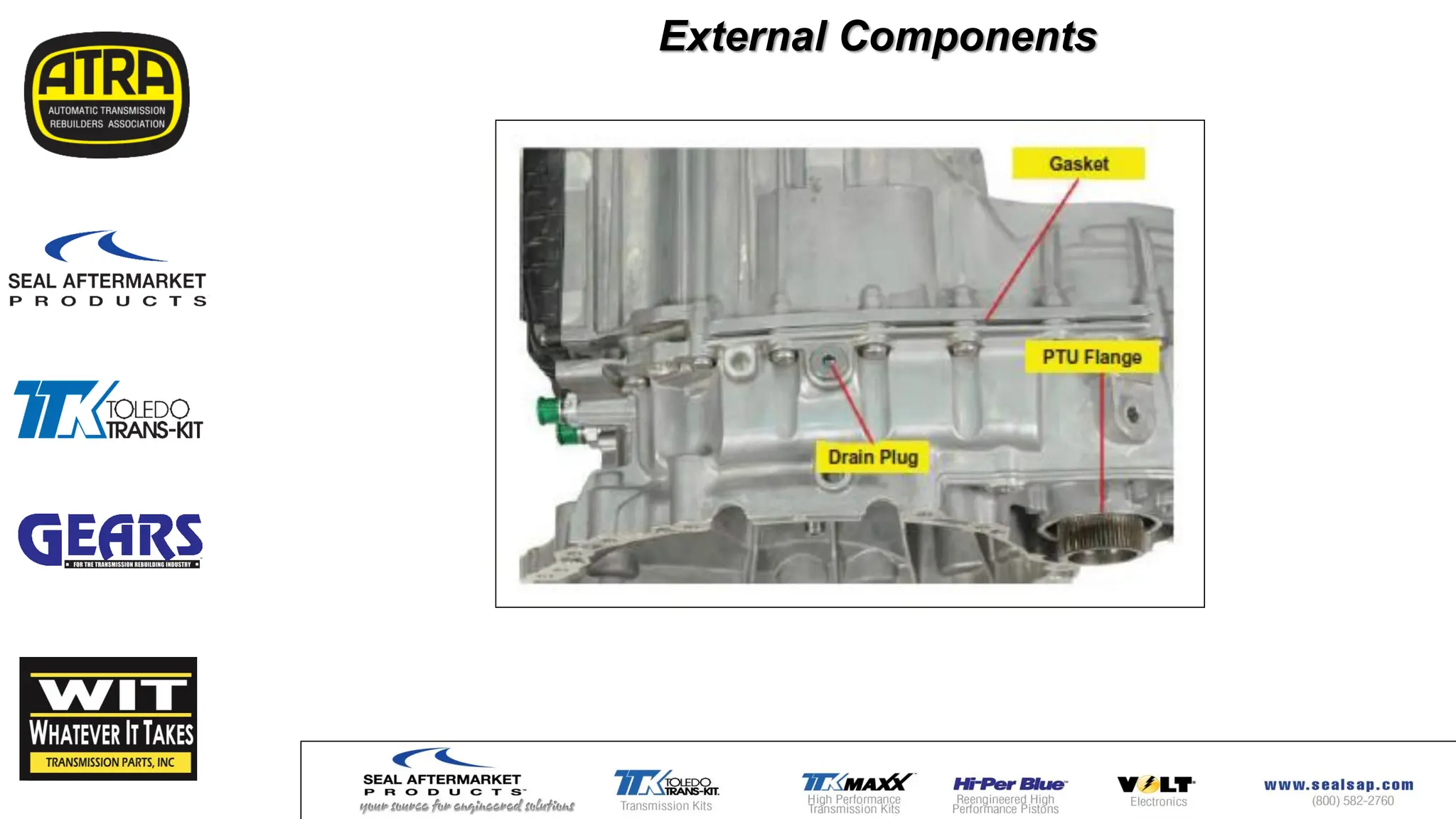
External Components
NOTE: It is not necessary to check the fluid level unless there are shifting issues and/or has
evidence of a transmission fluid leak.
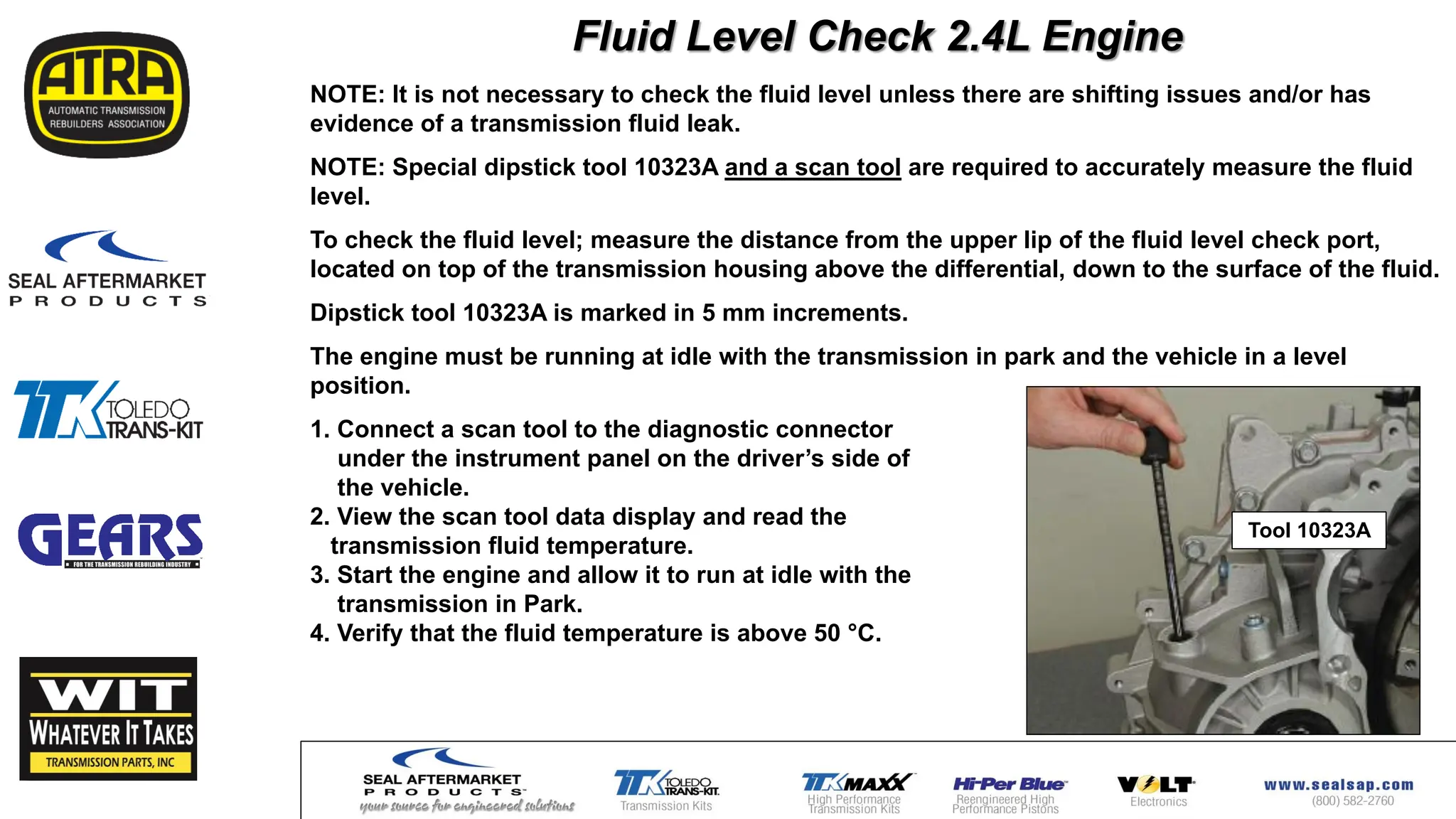
NOTE: Special dipstick tool 10323A and a scan tool are required to accurately measure the fluid
level.
To check the fluid level; measure the distance from the upper lip of the fluid level check port,
located on top of the transmission housing above the differential, down to the surface of the fluid.
Dipstick tool 10323A is marked in 5 mm increments.
The engine must be running at idle with the transmission in park and the vehicle in a level
position.
1. Connect a scan tool to the diagnostic connector
under the instrument panel on the driver’s side of
the vehicle.
2. View the scan tool data display and read the
transmission fluid temperature.
3. Start the engine and allow it to run at idle with the
transmission in Park.
4. Verify that the fluid temperature is above 50 °C.
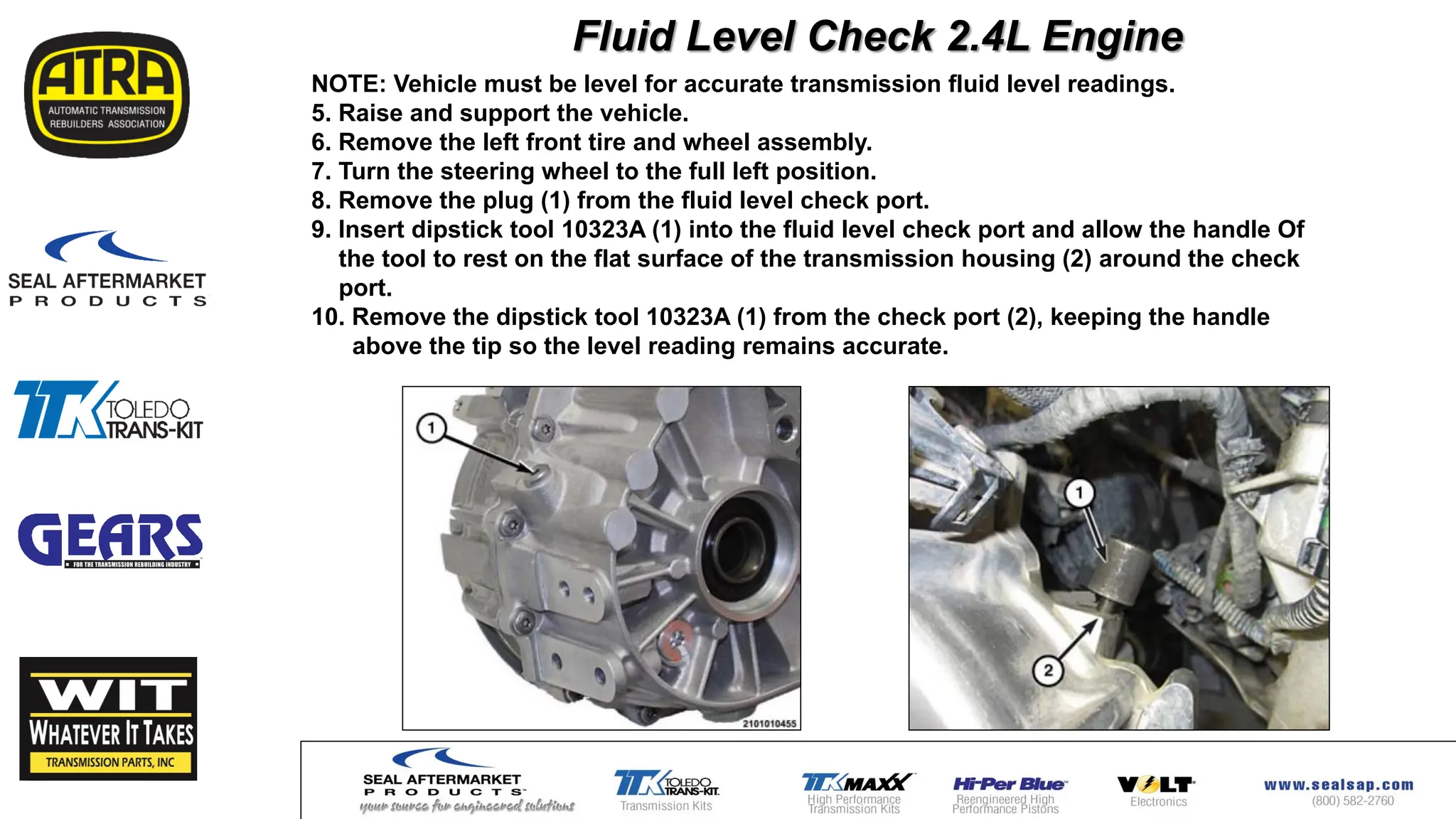
Fluid Level Check 2.4L Engine
Tool 10323A
NOTE: Vehicle must be level for accurate transmission fluid level readings.
5. Raise and support the vehicle.
6. Remove the left front tire and wheel assembly.
7. Turn the steering wheel to the full left position.
8. Remove the plug (1) from the fluid level check port.
9. Insert dipstick tool 10323A (1) into the fluid level check port and allow the handle Of
the tool to rest on the flat surface of the transmission housing (2) around the check
port.
10. Remove the dipstick tool 10323A (1) from the check port (2), keeping the handle
above the tip so the level reading remains accurate.
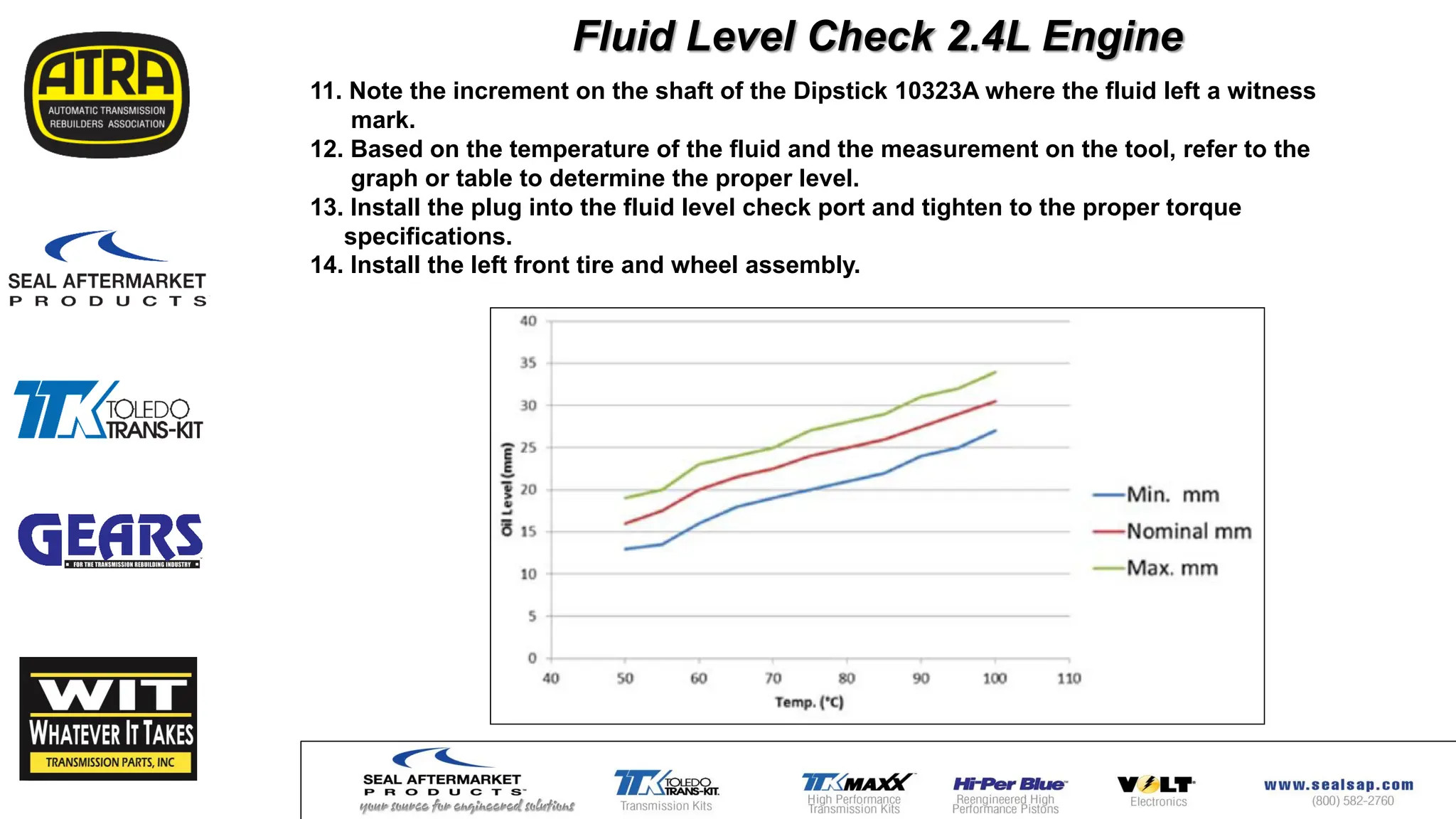
Fluid Level Check 2.4L Engine
11. Note the increment on the shaft of the Dipstick 10323A where the fluid left a witness
mark.
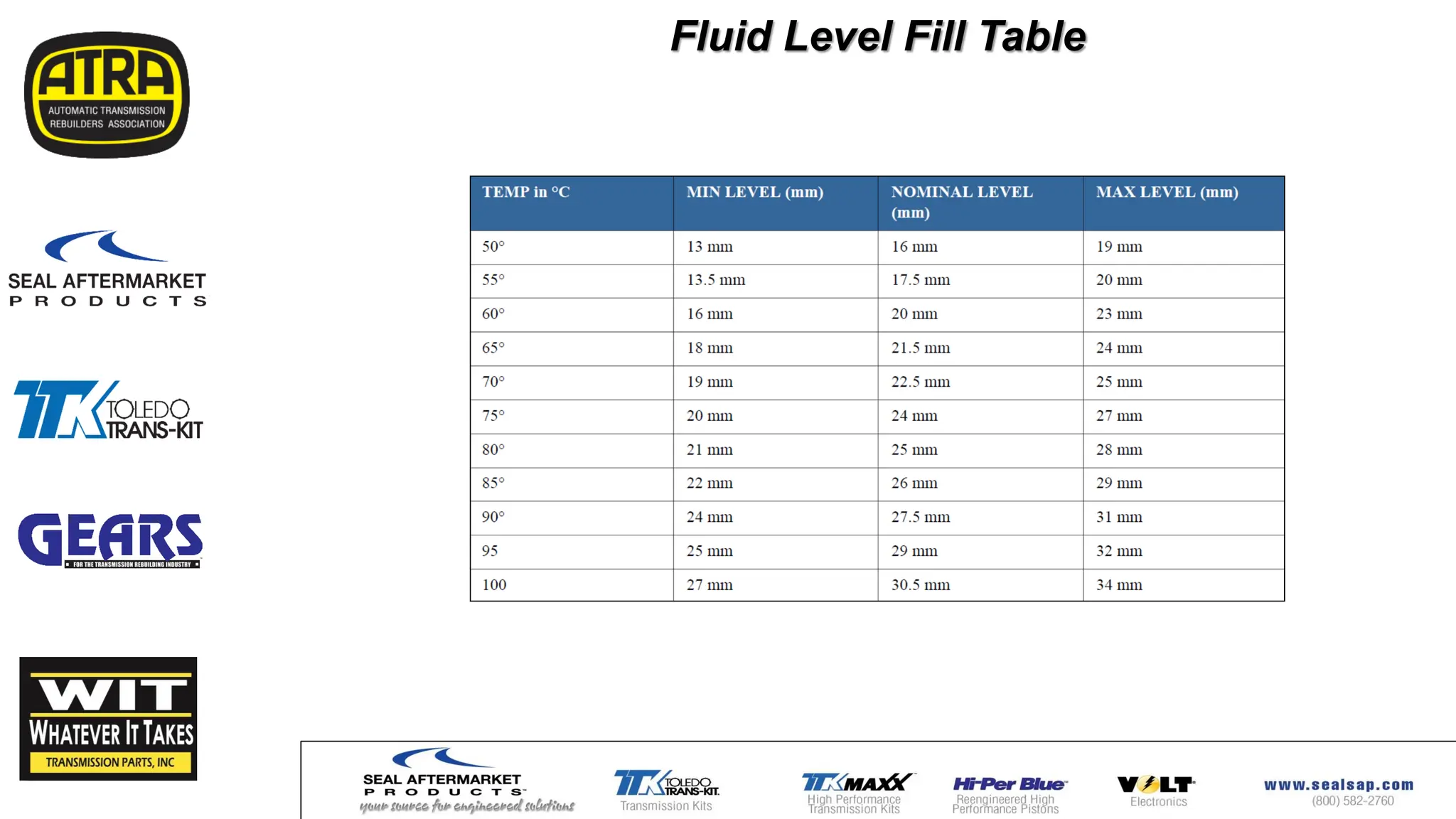
12. Based on the temperature of the fluid and the measurement on the tool, refer to the
graph or table to determine the proper level.
13. Install the plug into the fluid level check port and tighten to the proper torque
specifications.
14. Install the left front tire and wheel assembly.
Fluid Level Check 2.4L Engine
Fluid Level Fill Table
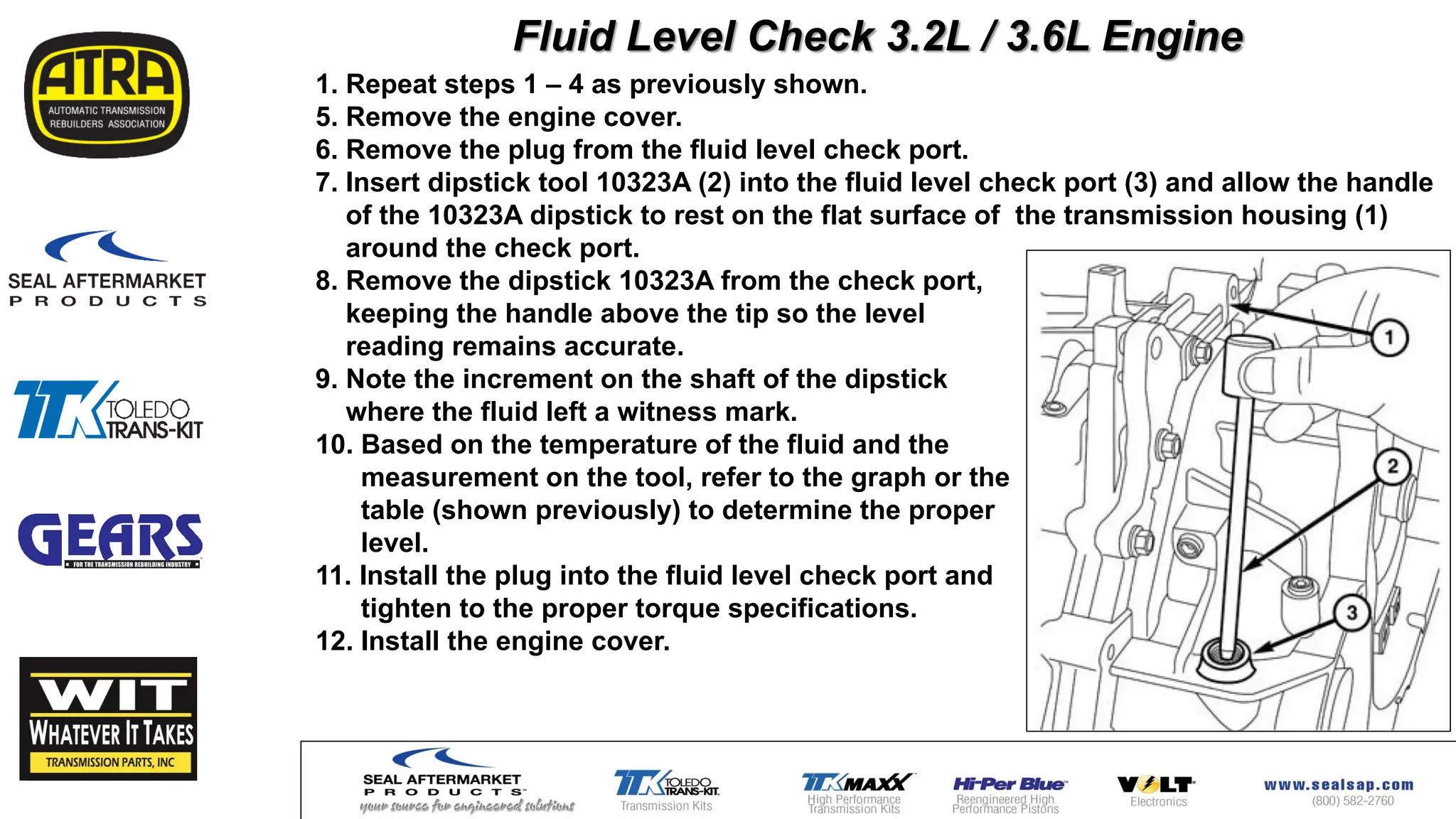
1. Repeat steps 1 – 4 as previously shown.
5. Remove the engine cover.
6. Remove the plug from the fluid level check port.
7. Insert dipstick tool 10323A (2) into the fluid level check port (3) and allow the handle
of the 10323A dipstick to rest on the flat surface of the transmission housing (1)
around the check port.
8. Remove the dipstick 10323A from the check port,
keeping the handle above the tip so the level
reading remains accurate.
9. Note the increment on the shaft of the dipstick
where the fluid left a witness mark.
10. Based on the temperature of the fluid and the
measurement on the tool, refer to the graph or the
table (shown previously) to determine the proper
level.
11. Install the plug into the fluid level check port and
tighten to the proper torque specifications.
12. Install the engine cover.
Fluid Level Check 3.2L / 3.6L Engine
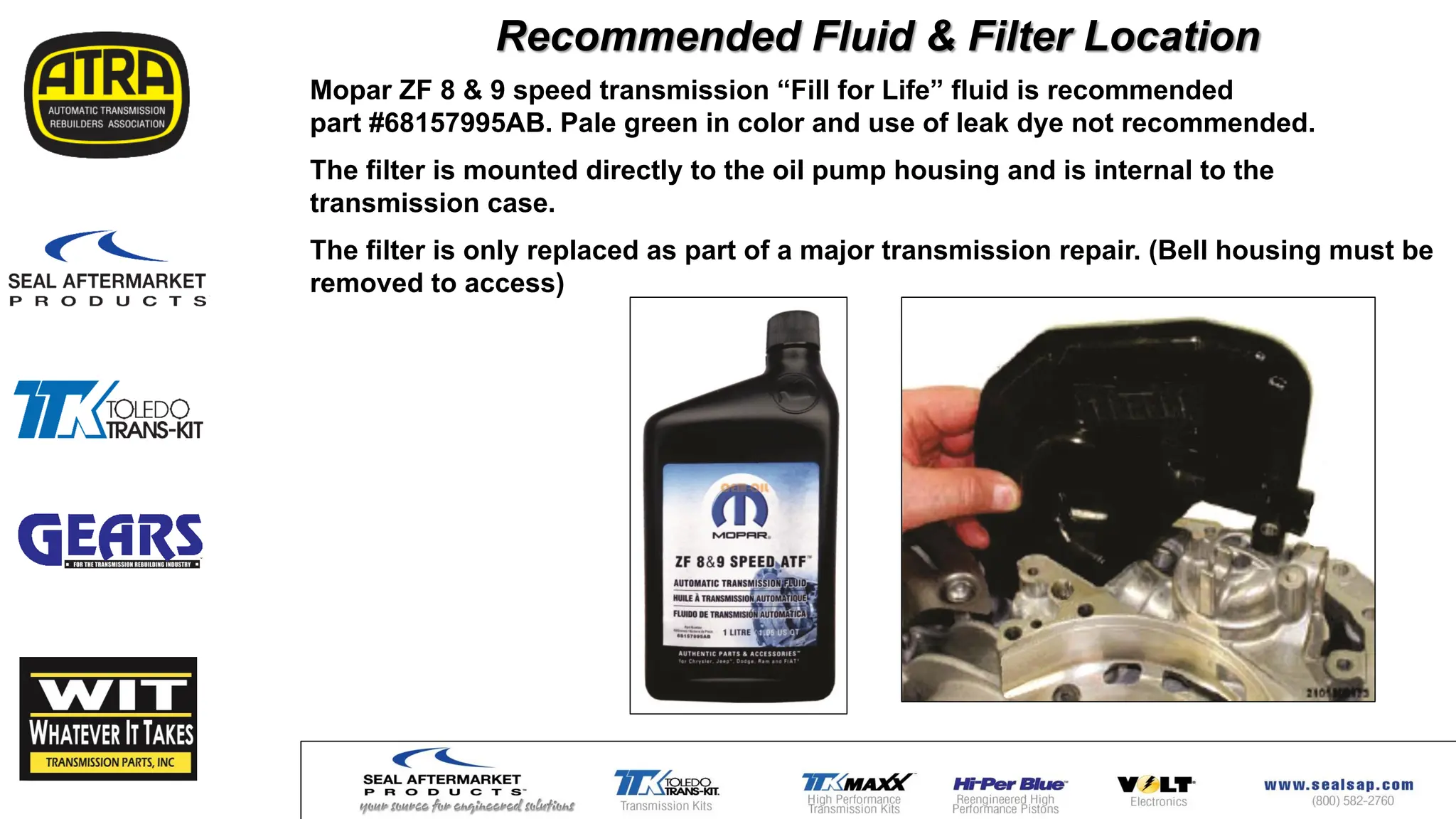
Mopar ZF 8 & 9 speed transmission “Fill for Life” fluid is recommended
part #68157995AB. Pale green in color and use of leak dye not recommended.
The filter is mounted directly to the oil pump housing and is internal to the
transmission case.
The filter is only replaced as part of a major transmission repair. (Bell housing must be
removed to access)
Recommended Fluid & Filter Location
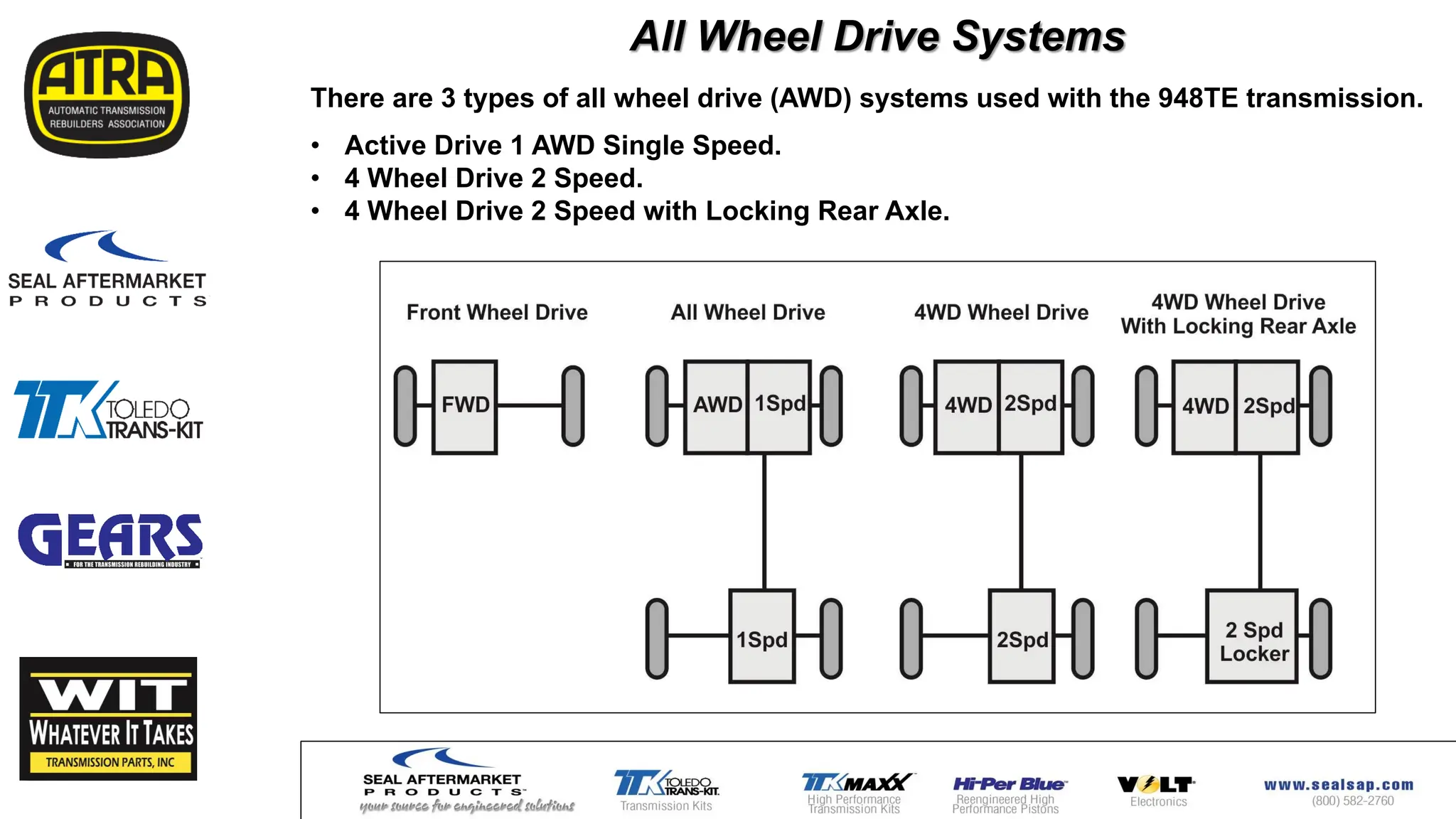
There are 3 types of all wheel drive (AWD) systems used with the 948TE transmission.
• Active Drive 1 AWD Single Speed.
• 4 Wheel Drive 2 Speed.
• 4 Wheel Drive 2 Speed with Locking Rear Axle.
All Wheel Drive Systems
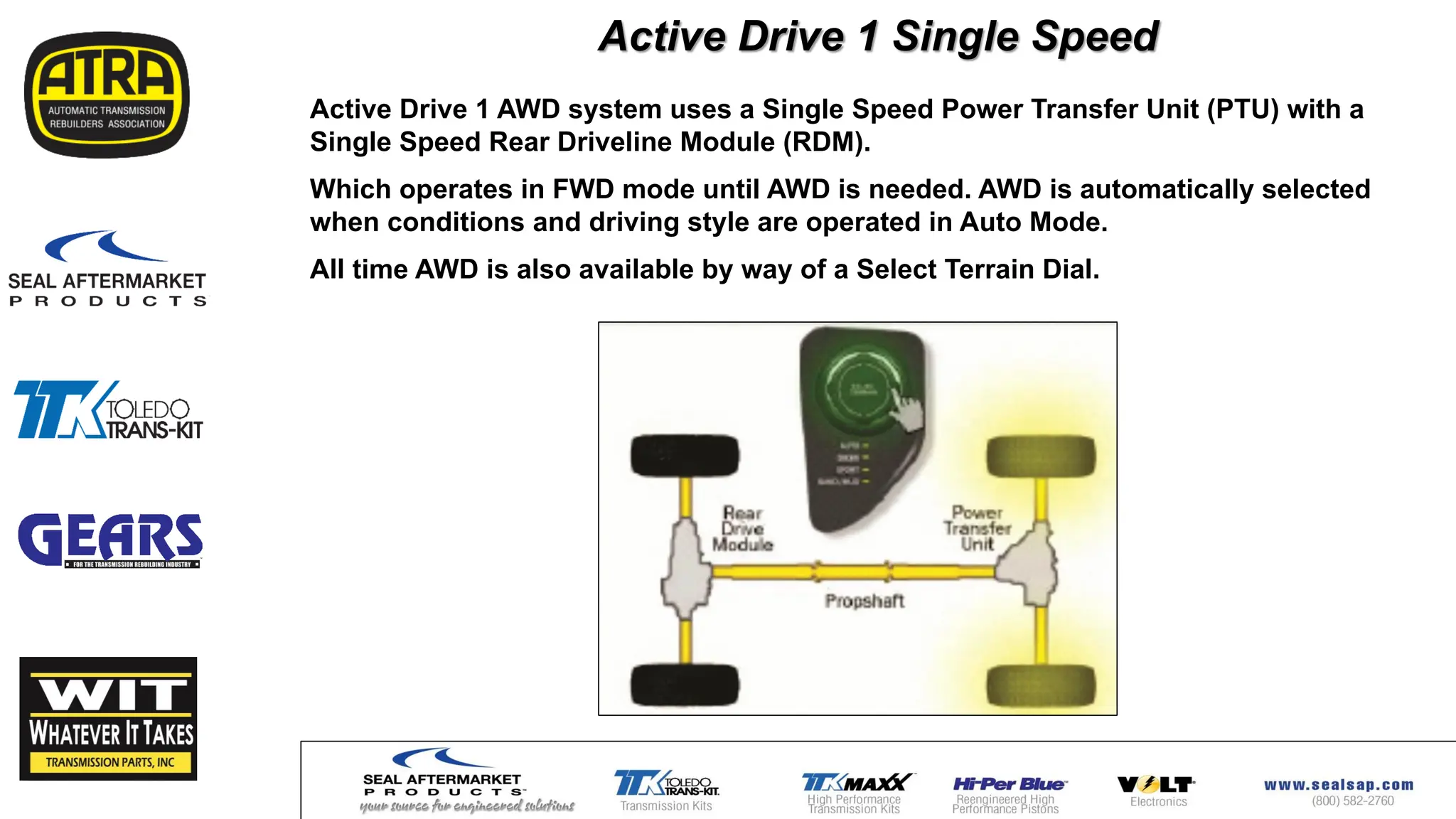
Active Drive 1 AWD system uses a Single Speed Power Transfer Unit (PTU) with a
Single Speed Rear Driveline Module (RDM).
Which operates in FWD mode until AWD is needed. AWD is automatically selected
when conditions and driving style are operated in Auto Mode.
All time AWD is also available by way of a Select Terrain Dial.
Active Drive 1 Single Speed
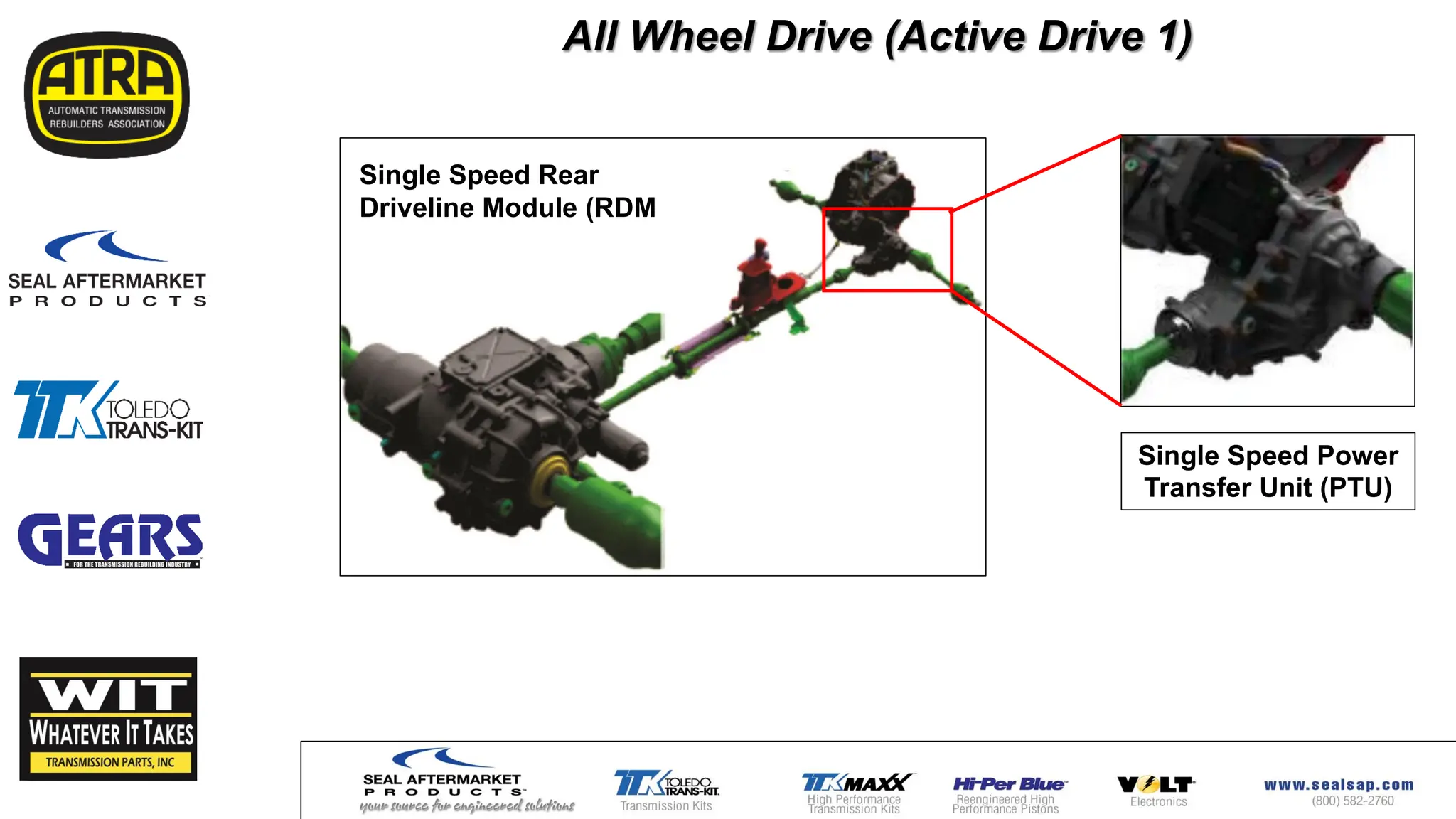
Single Speed Rear
Driveline Module (RDM
All Wheel Drive (Active Drive 1)
Single Speed Power
Transfer Unit (PTU)
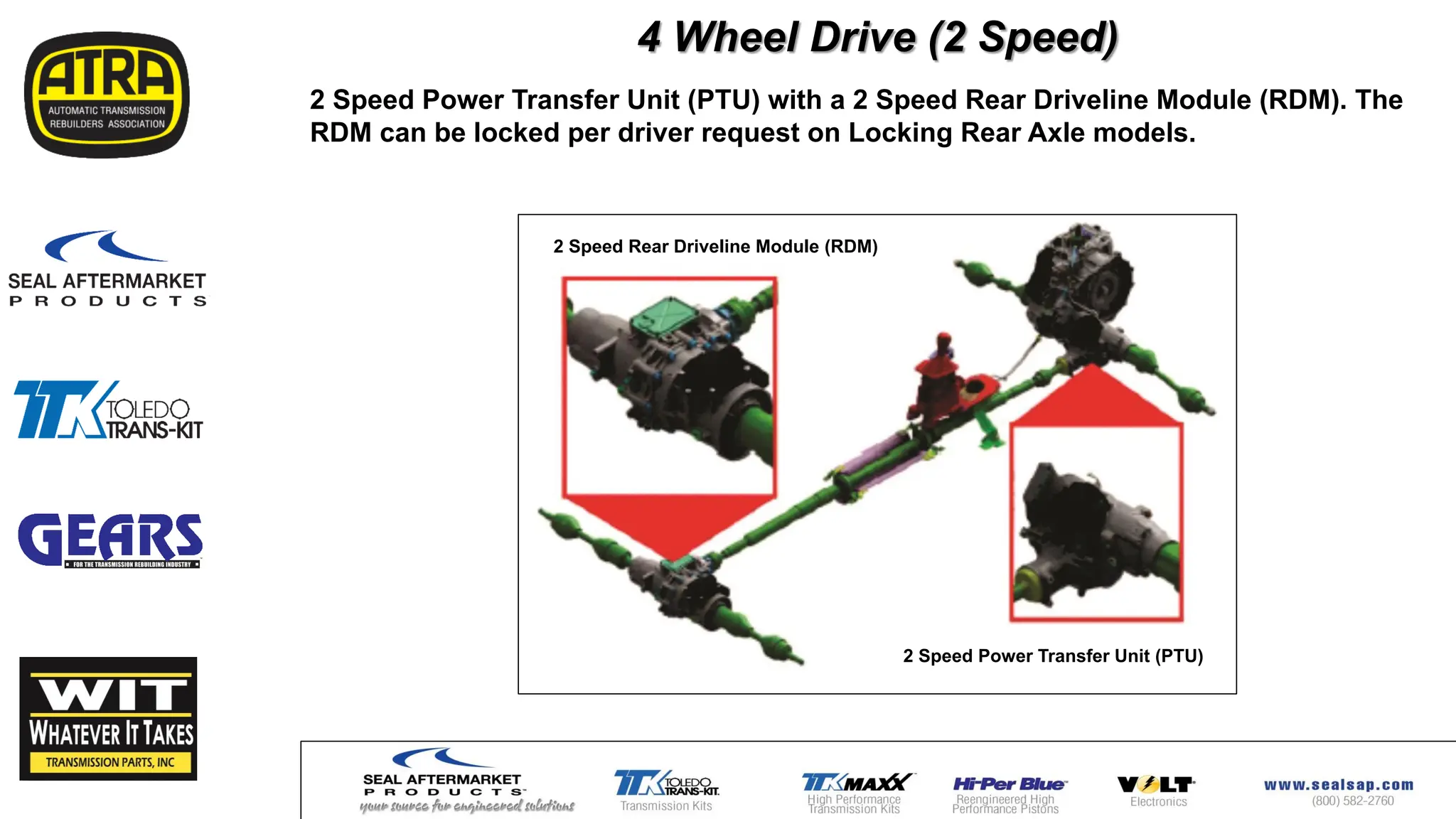
2 Speed Power Transfer Unit (PTU) with a 2 Speed Rear Driveline Module (RDM). The
RDM can be locked per driver request on Locking Rear Axle models.
4 Wheel Drive (2 Speed)
2 Speed Power Transfer Unit (PTU)
2 Speed Rear Driveline Module (RDM)
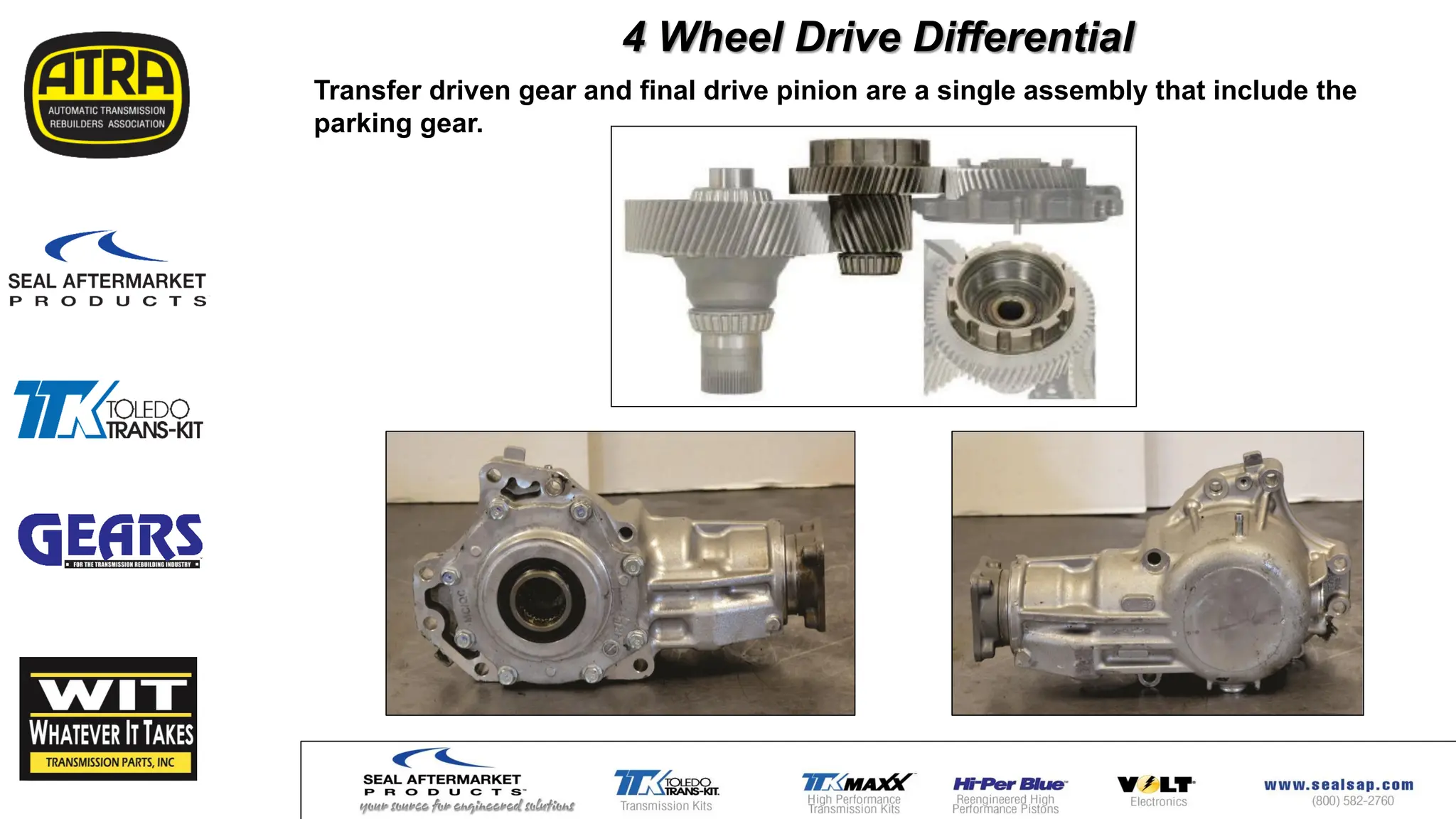
Transfer driven gear and final drive pinion are a single assembly that include the
parking gear.
4 Wheel Drive Differential
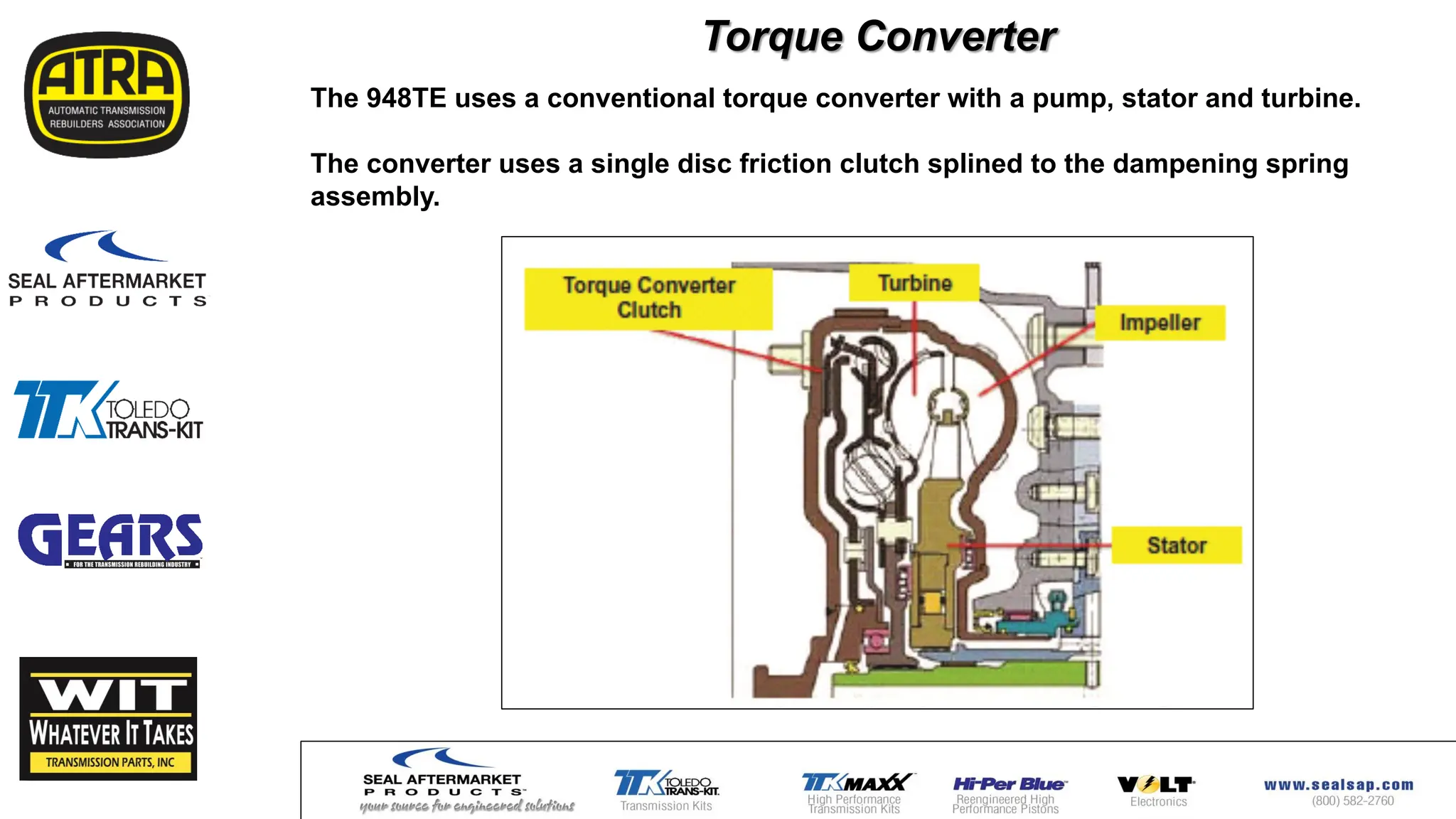
Torque Converter
The 948TE uses a conventional torque converter with a pump, stator and turbine.
The converter uses a single disc friction clutch splined to the dampening spring
assembly.
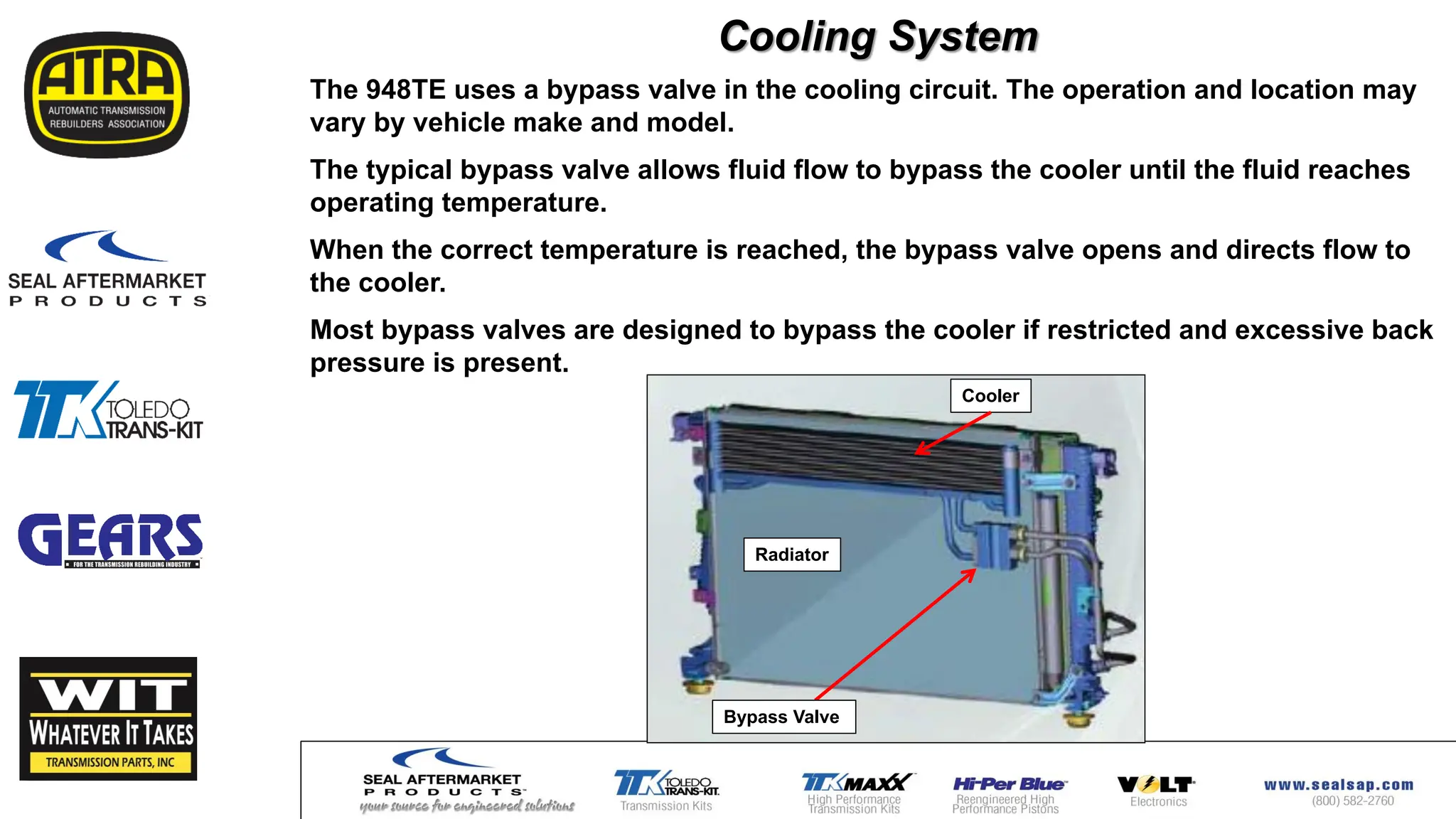
Cooling System
The 948TE uses a bypass valve in the cooling circuit. The operation and location may
vary by vehicle make and model.
The typical bypass valve allows fluid flow to bypass the cooler until the fluid reaches
operating temperature.
When the correct temperature is reached, the bypass valve opens and directs flow to
the cooler.
Most bypass valves are designed to bypass the cooler if restricted and excessive back
pressure is present.
Bypass Valve
Cooler
Radiator
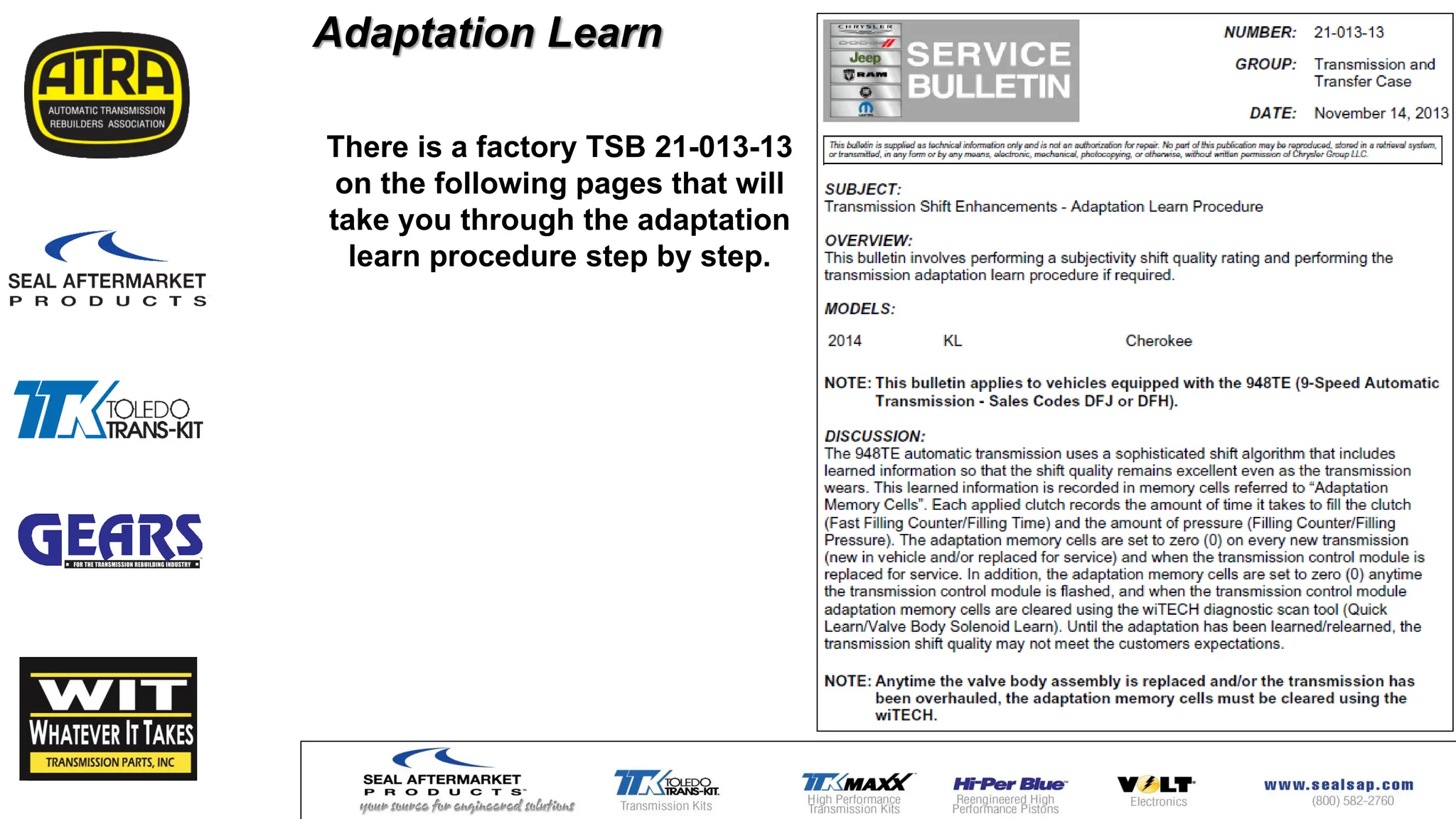
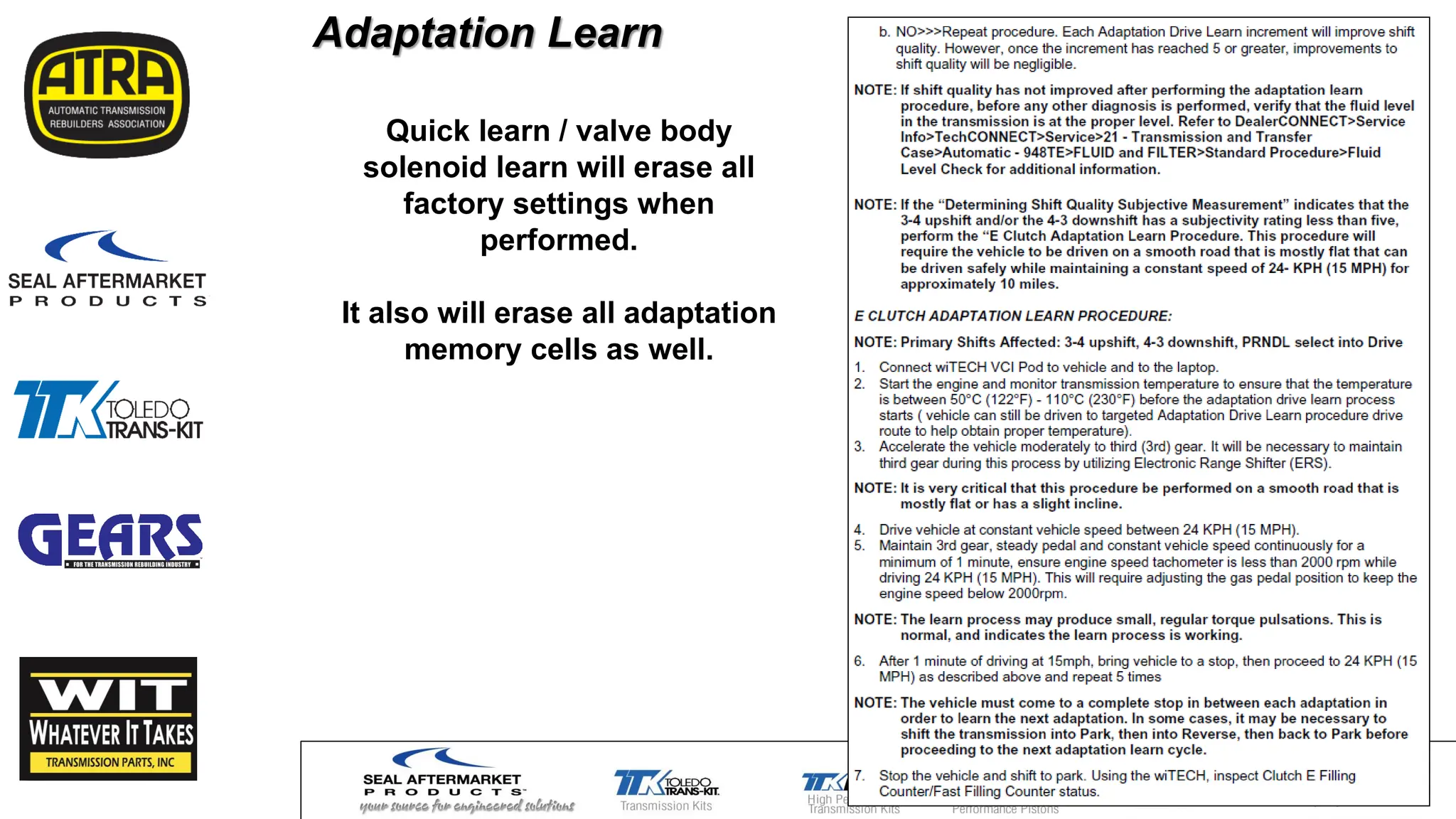
Adaptation Learn
There is a factory TSB 21-013-13
on the following pages that will
take you through the adaptation
learn procedure step by step.
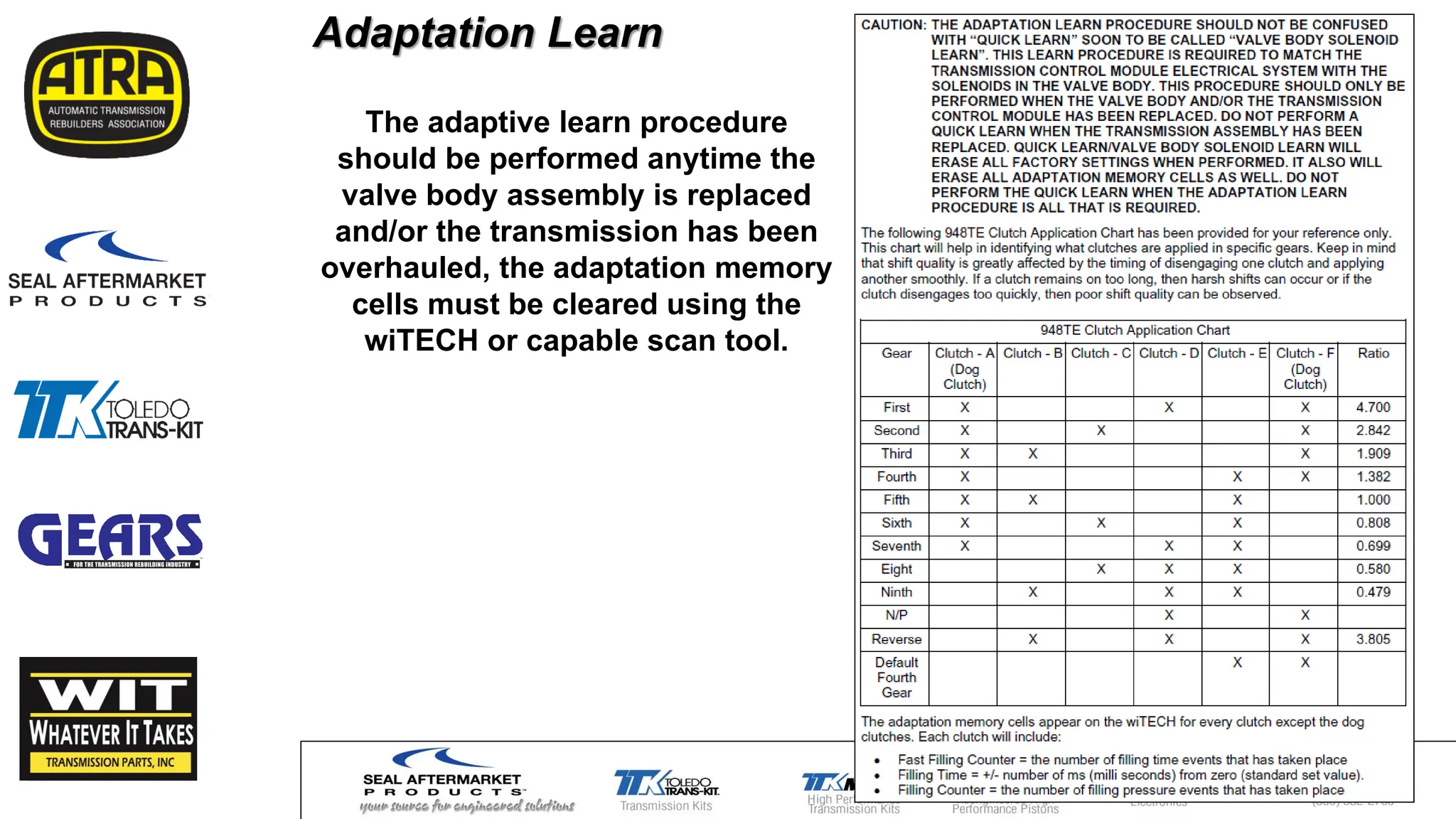
Adaptation Learn
The adaptive learn procedure
should be performed anytime the
valve body assembly is replaced
and/or the transmission has been
overhauled, the adaptation memory
cells must be cleared using the
wiTECH or capable scan tool.
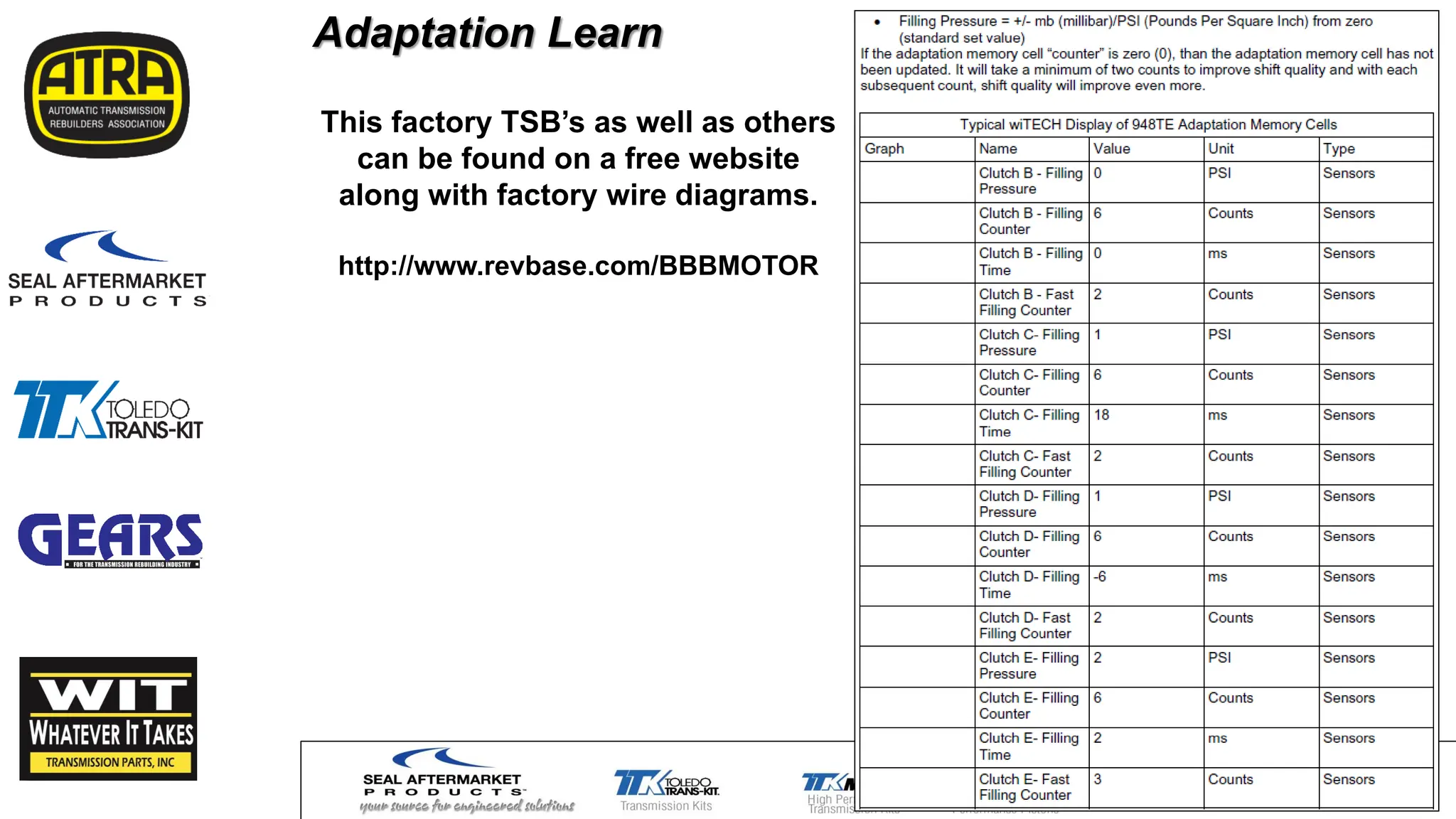
Adaptation Learn
This factory TSB’s as well as others
can be found on a free website
along with factory wire diagrams.
http://www.revbase.com/BBBMOTOR
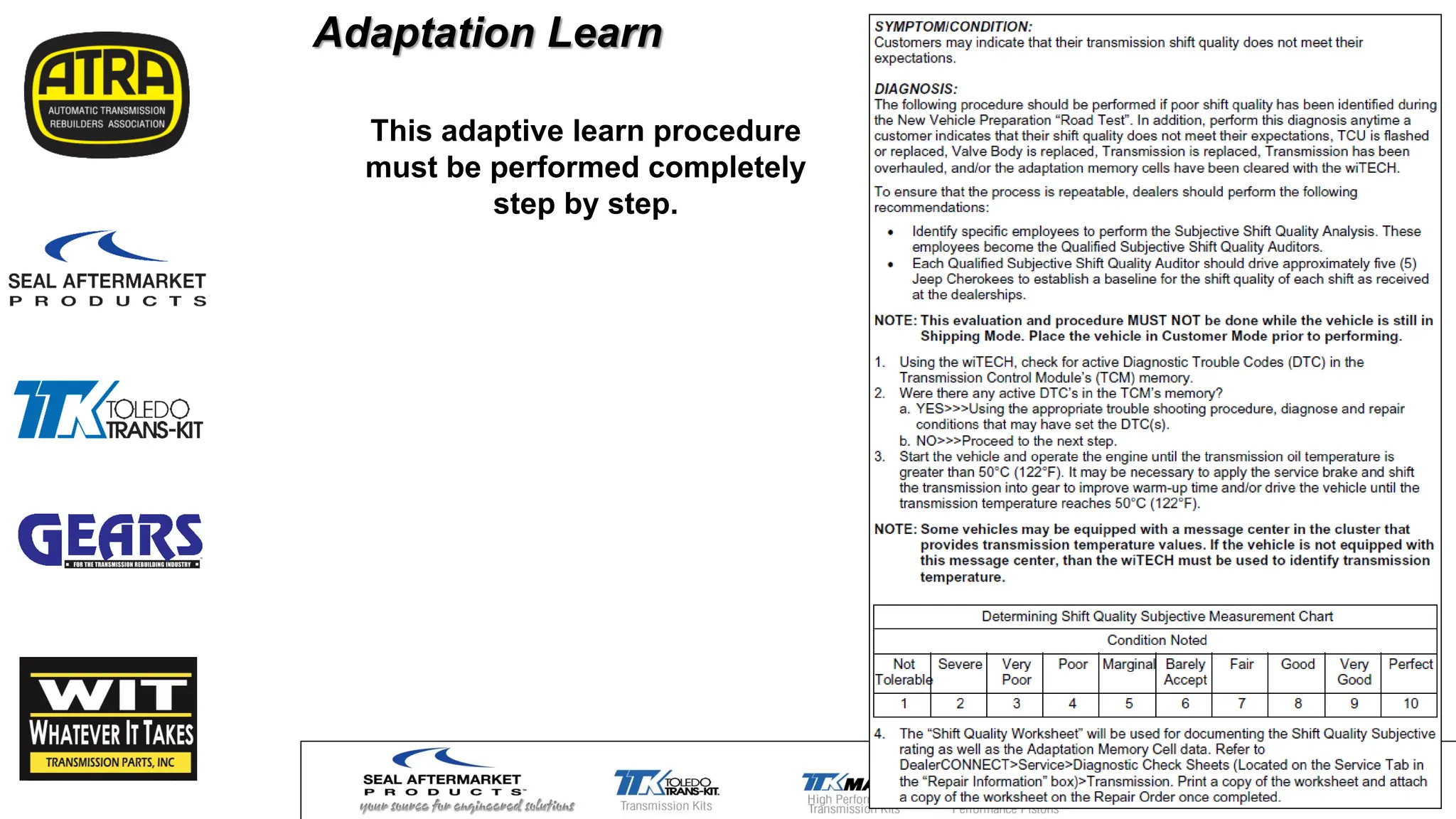
Adaptation Learn
This adaptive learn procedure
must be performed completely
step by step.
Adaptation Learn
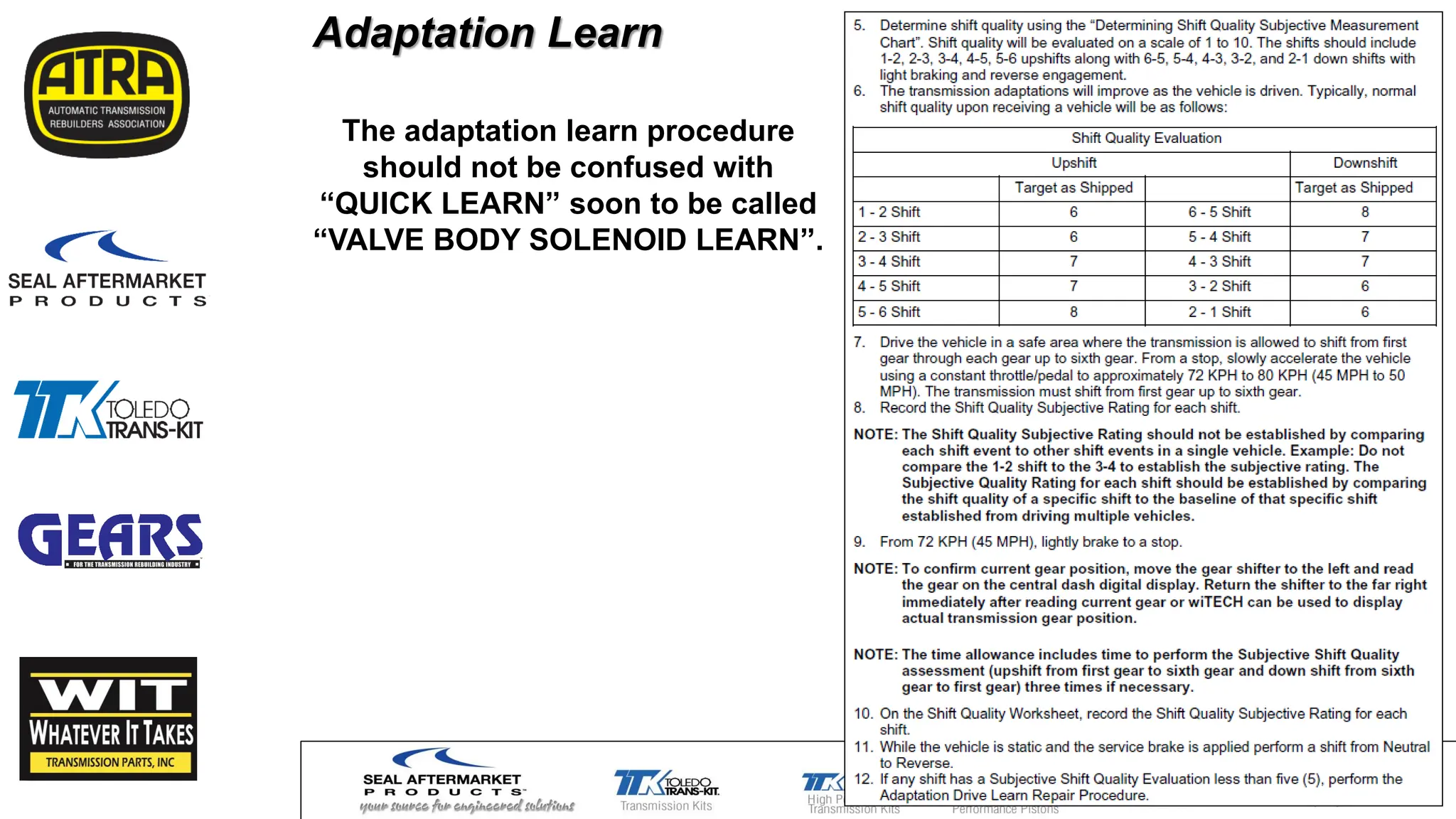
The adaptation learn procedure
should not be confused with
“QUICK LEARN” soon to be called
“VALVE BODY SOLENOID LEARN”.
Adaptation Learn
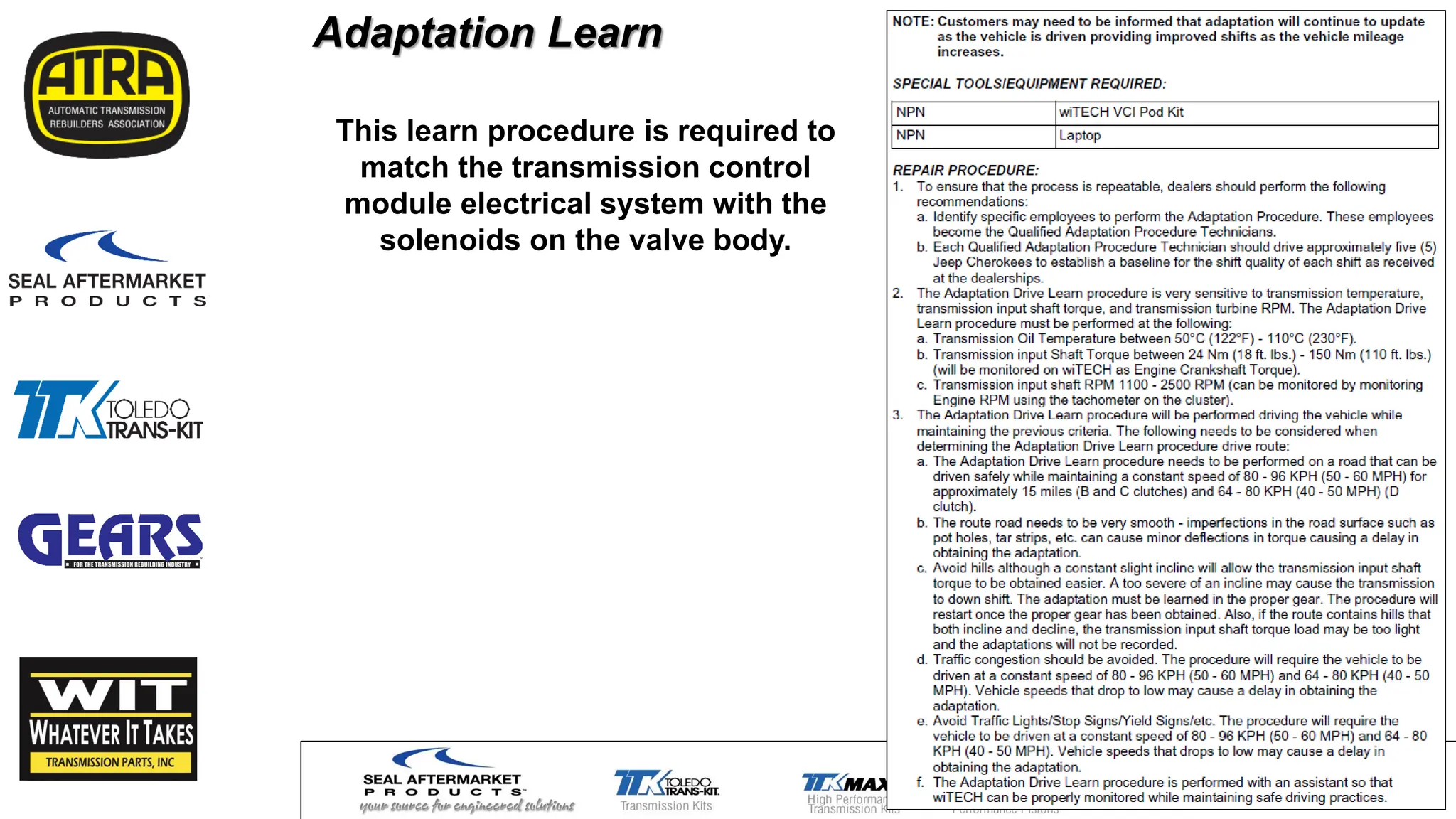
This learn procedure is required to
match the transmission control
module electrical system with the
solenoids on the valve body.
Adaptation Learn
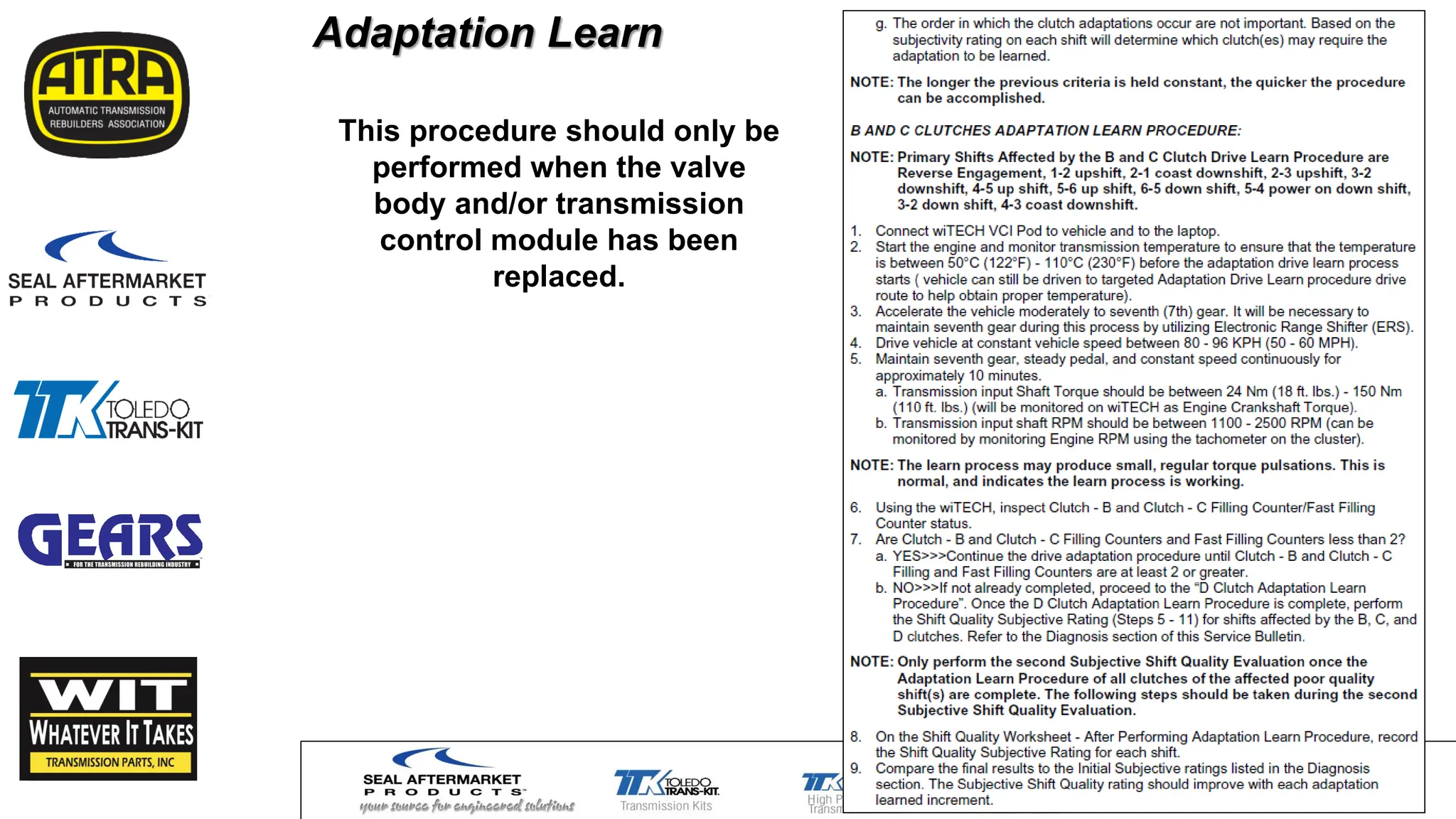
This procedure should only be
performed when the valve
body and/or transmission
control module has been
replaced.
Adaptation Learn
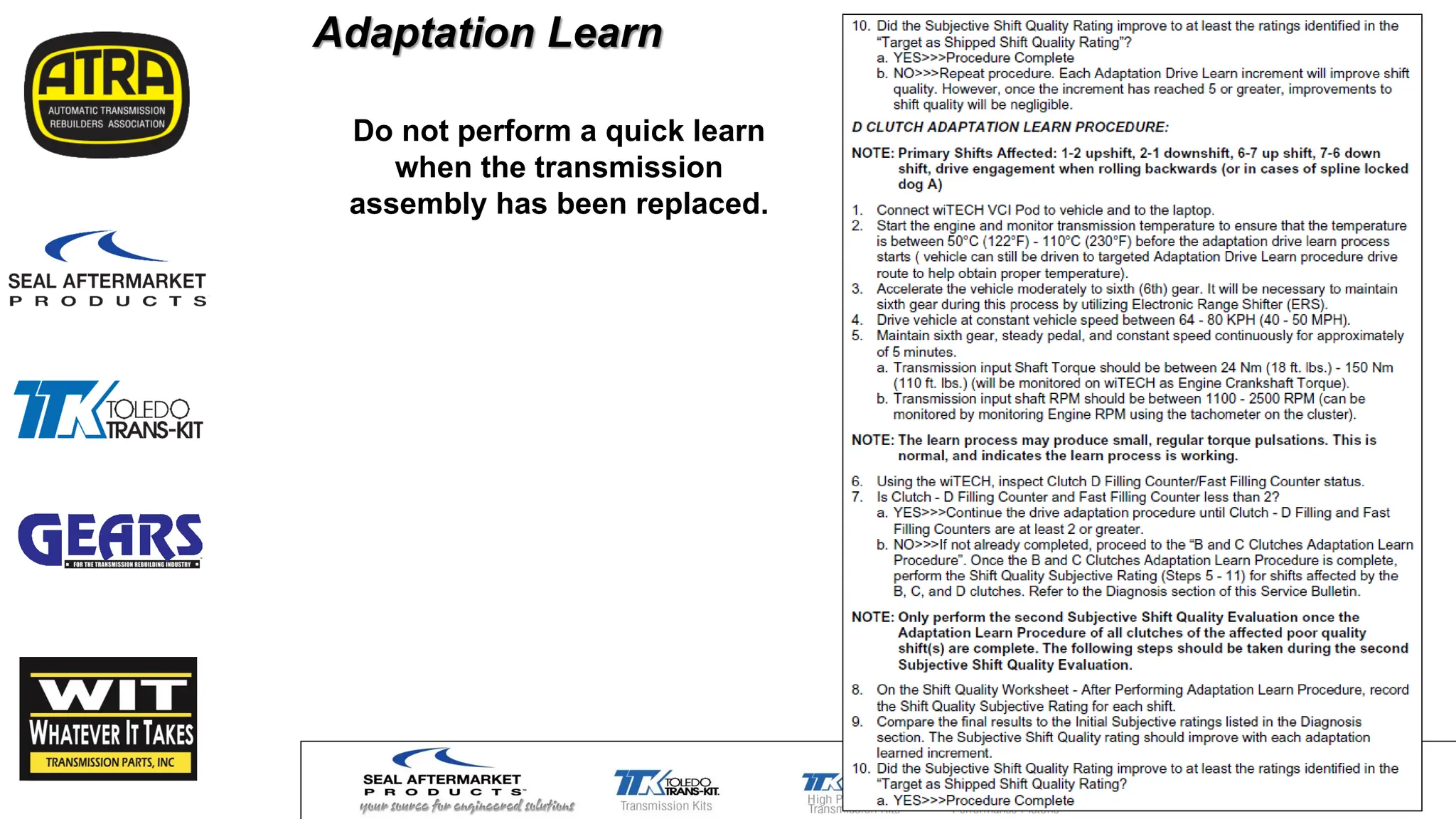
Do not perform a quick learn
when the transmission
assembly has been replaced.
Adaptation Learn
Quick learn / valve body
solenoid learn will erase all
factory settings when
performed.
It also will erase all adaptation
memory cells as well.
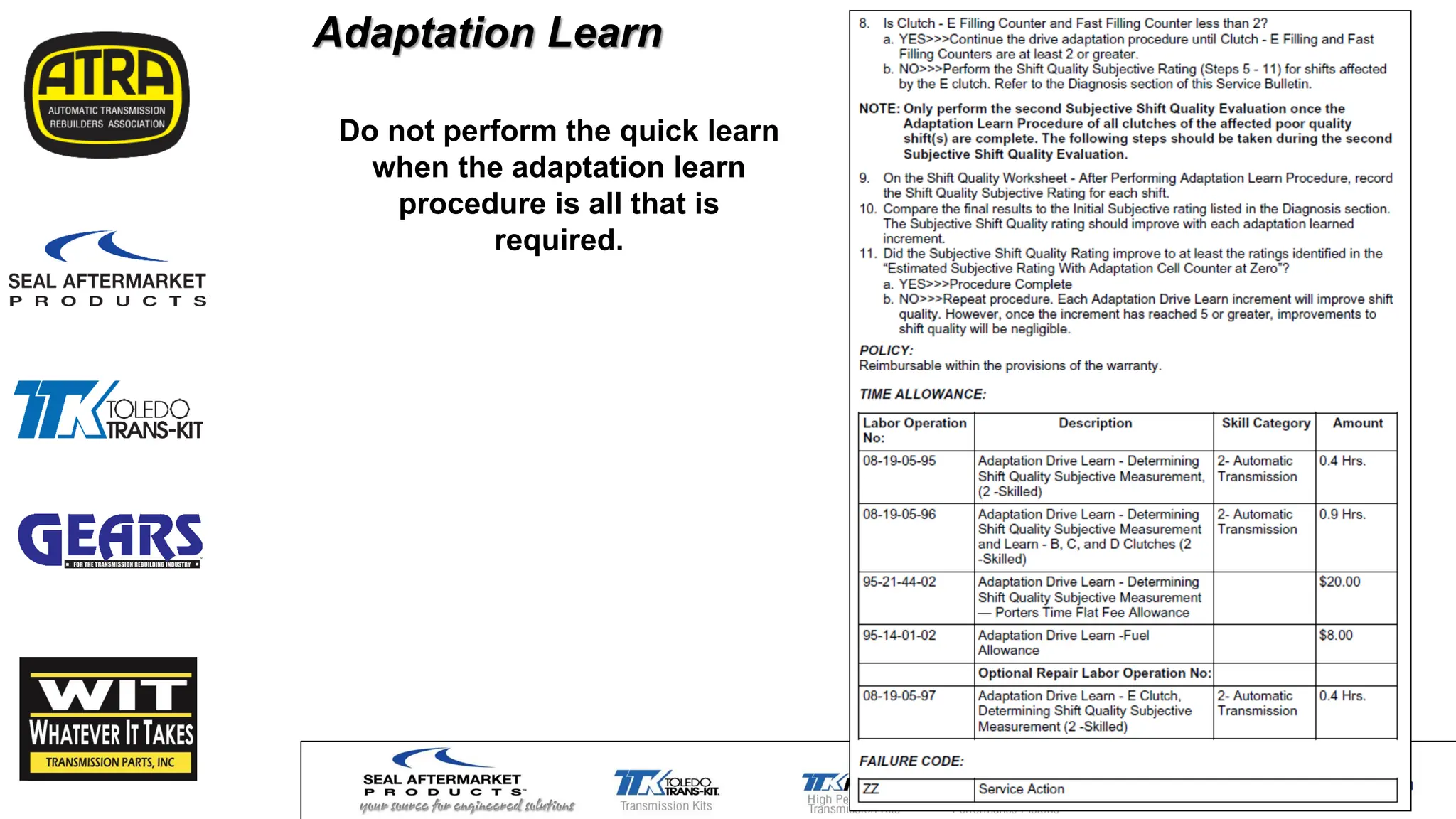
Adaptation Learn
Do not perform the quick learn
when the adaptation learn
procedure is all that is
required.
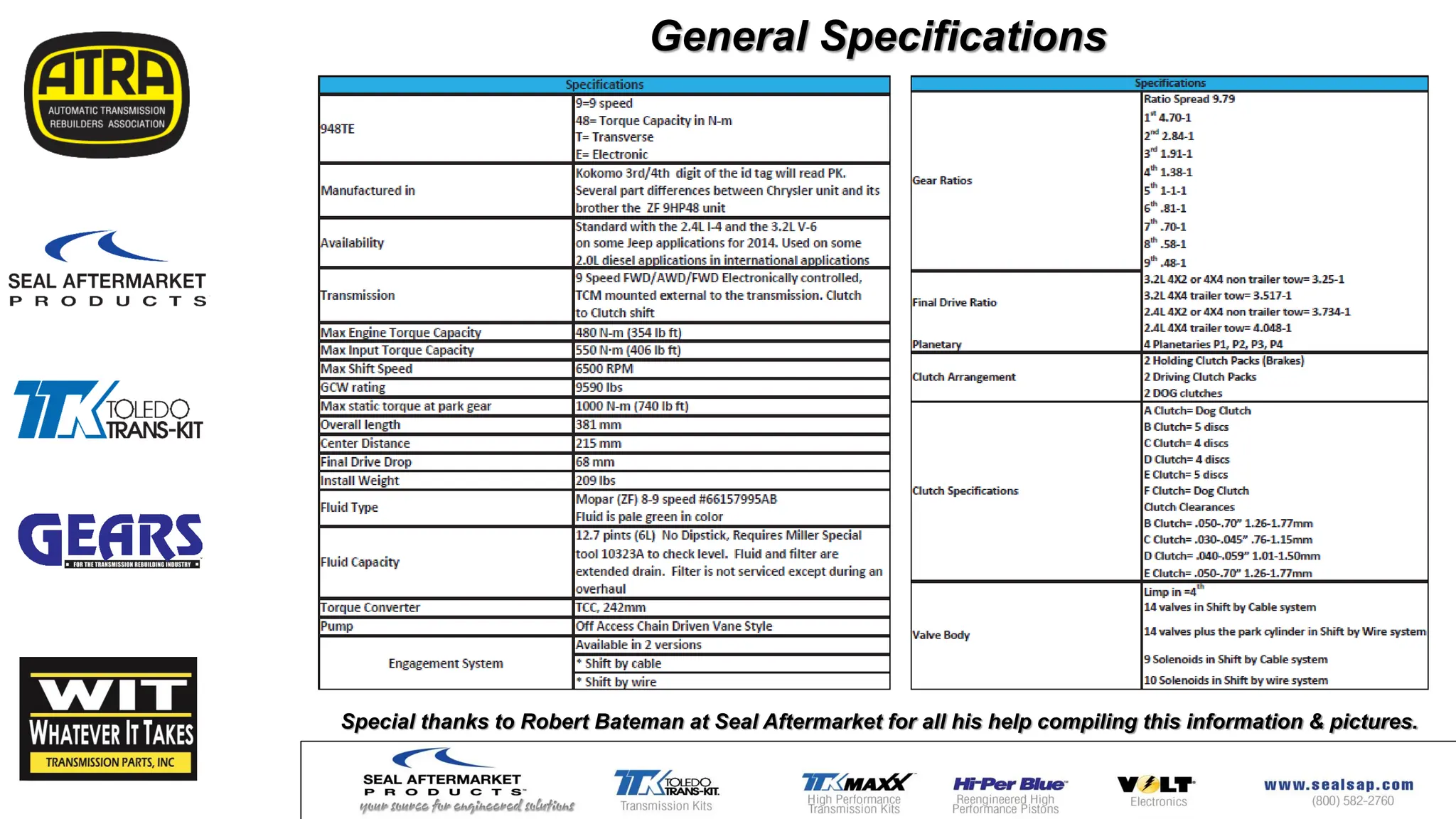
General Specifications
Special thanks to Robert Bateman at Seal Aftermarket for all his help compiling this information & pictures.
948TE Intro Webinar ©2015 ATRA. All Rights Reserved.

ZF9HP48 _ 948TE Introduction_manuals.pdf

  • 1.
    ZF9HP48 / 948TEIntroduction Presented by: Mike Souza ATRA Senior Research Technician 948TE Intro Webinar ©2015 ATRA. All Rights Reserved.
  • 2.
    Acura (ZF9HP48) LandRover MDX 2014-15 AWD V6 3.5L Range Rover Evoque 2013-15 FWD/4X4 L4 2.0/2.2L RLX 2014-15 FWD V6 3.5L/3.7L Discovery (LR4) 2015 FWD/AWD L4 2.0 Chrysler (948TE) TL 2014-15 AWD V6 3.5L/3.7L 200 2014-15 FWD L4 2.4L V6 3.2L Town & Country 2013-15 FWD 2013-14 L4 2.4L V6 3.6L Dodge (948TE) Caravan 2014-15 FWD V6 3.6L Fiat (EP2) 500X 2014-15 FWD L4 2.4L Doblo 2015 FWD L4 2.4L Jeep (948TE) Cherokee (KL) 2013-15 FWD L4 2.4L V6 3.2L Renegade 2014-15 FWD L4 2.4L Honda (ZF9HP48) Civic 2014-15 FWD L4 1.6L CRV 2014-15 FWD L4 1.6L Vehicle Application
  • 3.
    Chrysler 948TE (KokomoIN) ZF 9HP48 (Germany) • Externally the two units are visually similar • Parts cannot be interchanged. • VIN should always be used as the key for parts lookup. • Barcode label includes the manufacturer identification in the second and third characters of the traceability number. 9 Nine forward gear speeds 48 480 Nm torque capacity 354 lbs ft T Transverse mounted E Electronic control HP Hydraulic planetary Transmission Identification
  • 4.
    Introduction ZF developed thefirst nine-speed automatic transmission for front wheel drive vehicles. Although it was built in June 2011 it did not make it’s debut until mid 2013. This new transmission delivers extremely short shifting times and exceptionally smooth shifts. The electronic controls select the right gear for the driving conditions, eliminating unnecessary stepping and constant shifting using over 40 shift maps. The 9-speed automatic transmission is, without an additional oil pump, stop-start capable. Since, in the case of restarting, it is only one friction shift element that needs to be closed, response times are very fast. It can also be used as a hybrid transmission by replacing the torque converter with an electric motor. The ZF nine-speed automatic has been designed so that an additional transfer case can be connected for all wheel drive; ZF itself has an all-wheel drive that can be decoupled (AWD Disconnect). It actuates the rear axle drive only when needed and saves five percent less fuel compared to the permanent all-wheel drive (Chrysler already uses a similar system). The ZF-built unit is known as the ZF9HP48, while the Chrysler-built unit is known as the 948TE. These transmissions look nearly identical, parts are not necessarily interchangeable
  • 5.
    In normal driving,the transmission starts in second gear, but can be manually shifted with paddle shifters into first gear for max acceleration or a low range ratio of 4.7:1 for off-road driving. The transmission features a skip-shift feature that allows it to downshift directly without hitting every gear. Shift times and firmness are also based on driver input. Introduction
  • 6.
  • 7.
    There are 6clutches, labeled A–F according to power flow from input to final drive, 4 multi-plate friction clutches and 2 dog clutches Clutch Identification
  • 8.
  • 9.
  • 10.
    The “A” dogclutch is one of two dog clutches in the 948TE. The dog clutch uses hydraulic pressure to engage and disengage the spline teeth between two components. This provides a non-slipping connection that does not use friction discs. The “A” dog clutch is a driving clutch located at the rear of the transmission and part of the input shaft. This clutch is on in 1st through 7th gear. When the TCM calls for a shift that engages one of the dog clutches, a message is sent to the PCM requesting that the engine be brought to a certain rpm. The dog clutches in the 948TE cannot simply be applied during downshifts without consideration for speed difference between the splined components. Dog clutches do not have disc-style clutch packs that can provide slip to match component speed. As a result, the transmission control module (TCM) can request an engine RPM and torque increase or decrease to allow speed matching. Dog Clutch Function
  • 11.
    Dog Clutch SpeedMatching As the engine rpm increases, the transmission slips one or more of the multi-disc clutches until the components of the dog clutch are at the same speed. Because the A-dog clutch is used in 1st but not in reverse, the TCM may use transitional phases in some situations such as rocking the vehicle out of snow or mud. The TCM uses other clutches to synchronize the speed of the dog clutch and the input shaft as the wheel speed transitions between forward and reverse motions. You'll
  • 12.
    A Dog ClutchFunction The A-dog clutch is a driving clutch located at the rear of the transmission; it is part of the input shaft. This clutch is on in 1st gear through 7th gear.
  • 13.
  • 14.
    The F dogclutch is a braking clutch. When applied, the F dog clutch holds the P3 and P4 sun gear. The F-dog is on in 1st through 4th gears, as well as reverse and park/neutral. F Dog Clutch Function
  • 15.
  • 16.
    The transfer drivegear is splined to the P4 planet. Dog Clutch Function
  • 17.
    A & FDog Clutch Hydraulics
  • 18.
    A Dog HydraulicApply Circuit
  • 19.
    A Dog HydraulicRelease Circuit
  • 20.
    F Dog HydraulicApply Circuit
  • 21.
    F Dog HydraulicRelease Circuit
  • 22.
    Jeep 9-speed needsa reset again (3rd software upgrade) Software tweak aims to smooth out issues with Cherokee shifting The dog clutch is the linchpin that allows Chrysler's nine-speed transmission to be so compact. Chrysler delayed the Jeep Cherokee's launch to tweak the transmission's software. Now, it's under its third five-minute software reset or "reflash". A new software recalibration covers more than 100,000 Jeep Cherokees to address continuing issues with the way some of the nine-speeds shift gears. A service bulletin advises technicians in certain cases to perform an "adaptation drive learn" taking the Cherokee out for a test drive of up to 78 minutes to ensure that it is shifting correctly. Not all Cherokees sold require the reflash, according to the automaker, but it is available under warranty to customers who complain about the feel or operation of the transmission. In a written statement, a Chrysler spokeswoman said the reflash was being done "to respond to customer feedback and improve satisfaction." She said dealers were "asked to perform the software update on any unsold vehicles in inventory and for any customer who has requested improved throttle response or shift feel.“ About half of the 30 consumer complaints where “while it can be engaged in highway driving, it'll likely shift down to 8th gear at higher speeds because the drag starts to slow the car down”.
  • 23.
    Speed Sensors The inputand output sensor are part of a single assembly located under the valve body. The sensors produce a 9V square wave based on the speed of the rotating components. The input speed sensor uses the E clutch housing as a tone wheel and the output speed sensor uses the transfer gear.
  • 24.
    Transmission Fluid TemperatureSensor The transmission fluid temperature sensor is part of the internal pass through wiring harness.
  • 25.
    Transmission Range Sensor(IMS) There are two range switch variants—shift-by-wire and shift-by-cable. Both are non- contact magnetic based sensors. The shift-by-wire range switch is very similar in operation to the 8HP45 transmission. The park by-cable range switch is typical with circuits for park, reverse, neutral, and drive. The range sensor is mounted internal to the transmission and operates like an IMS.
  • 26.
    Moving the shiftlever to the ERS position (other than drive) will activate ERS mode. Which will display the current gear in the instrument cluster, and maintain that gear as the top available gear. Once in ERS mode, moving the shift lever forward (-) or rearward (+) will change the top available gear. Electronic Range Selector (ERS)
  • 27.
    Dog Clutch PressureTransducer The pressure transducer is mounted to the valve body and is used by the TCM to monitor release pressure of both dog clutches. When one of the dog clutches releases, there is a momentary increase in the dog clutch exhaust circuit pressure. The transducer signal pattern is monitored by the TCM for control and diagnostics.
  • 28.
    Solenoid Identification Park ByWire Park By Cable 9 Solenoids 10 Solenoids
  • 29.
  • 30.
    Similar to thesystem used with the 845RE there is no mechanical connection between the shifter and the transmission. A park lock piston is used to control the position of the parking pawl. The linkage is spring-loaded to default into the park position. Park by Wire Lower Valve Body Upper Valve Body
  • 31.
    Park by Wire TheManual Park Release lever is used for putting the transmission in neutral anytime the vehicle needs to be moved with the engine off. This is achieved by a cable attached to the transmission park pawl. When the cable is pulled, the transmission is put into neutral, and when the cable is released, the transmission is back into park. (Located in center console).
  • 32.
    Acura Push ButtonPark by Wire Not Holding Park Acura is halting sales of their 2015 TLX equipped with push button transmission shifter. The 9 speed 948TE may indicate park but still roll away as the park lock fails to work. As of January 6 2015 Acura is notifying customers of the recall.
  • 33.
    Chrysler Vehicles UseShift Knob Trans Control No park issues have occurred at this point in time with Chrysler models.
  • 34.
    Park by Cable Themanual valve provides gates for park (by way of a parking pawl), reverse, neutral and drive. Lower Valve Body
  • 35.
  • 36.
    TCM Locations The TCMmay have Chrysler & ZF markings with both Chrysler & Fiat part numbers.
  • 37.
  • 38.
  • 39.
    NOTE: It isnot necessary to check the fluid level unless there are shifting issues and/or has evidence of a transmission fluid leak. NOTE: Special dipstick tool 10323A and a scan tool are required to accurately measure the fluid level. To check the fluid level; measure the distance from the upper lip of the fluid level check port, located on top of the transmission housing above the differential, down to the surface of the fluid. Dipstick tool 10323A is marked in 5 mm increments. The engine must be running at idle with the transmission in park and the vehicle in a level position. 1. Connect a scan tool to the diagnostic connector under the instrument panel on the driver’s side of the vehicle. 2. View the scan tool data display and read the transmission fluid temperature. 3. Start the engine and allow it to run at idle with the transmission in Park. 4. Verify that the fluid temperature is above 50 °C. Fluid Level Check 2.4L Engine Tool 10323A
  • 40.
    NOTE: Vehicle mustbe level for accurate transmission fluid level readings. 5. Raise and support the vehicle. 6. Remove the left front tire and wheel assembly. 7. Turn the steering wheel to the full left position. 8. Remove the plug (1) from the fluid level check port. 9. Insert dipstick tool 10323A (1) into the fluid level check port and allow the handle Of the tool to rest on the flat surface of the transmission housing (2) around the check port. 10. Remove the dipstick tool 10323A (1) from the check port (2), keeping the handle above the tip so the level reading remains accurate. Fluid Level Check 2.4L Engine
  • 41.
    11. Note theincrement on the shaft of the Dipstick 10323A where the fluid left a witness mark. 12. Based on the temperature of the fluid and the measurement on the tool, refer to the graph or table to determine the proper level. 13. Install the plug into the fluid level check port and tighten to the proper torque specifications. 14. Install the left front tire and wheel assembly. Fluid Level Check 2.4L Engine
  • 42.
  • 43.
    1. Repeat steps1 – 4 as previously shown. 5. Remove the engine cover. 6. Remove the plug from the fluid level check port. 7. Insert dipstick tool 10323A (2) into the fluid level check port (3) and allow the handle of the 10323A dipstick to rest on the flat surface of the transmission housing (1) around the check port. 8. Remove the dipstick 10323A from the check port, keeping the handle above the tip so the level reading remains accurate. 9. Note the increment on the shaft of the dipstick where the fluid left a witness mark. 10. Based on the temperature of the fluid and the measurement on the tool, refer to the graph or the table (shown previously) to determine the proper level. 11. Install the plug into the fluid level check port and tighten to the proper torque specifications. 12. Install the engine cover. Fluid Level Check 3.2L / 3.6L Engine
  • 44.
    Mopar ZF 8& 9 speed transmission “Fill for Life” fluid is recommended part #68157995AB. Pale green in color and use of leak dye not recommended. The filter is mounted directly to the oil pump housing and is internal to the transmission case. The filter is only replaced as part of a major transmission repair. (Bell housing must be removed to access) Recommended Fluid & Filter Location
  • 45.
    There are 3types of all wheel drive (AWD) systems used with the 948TE transmission. • Active Drive 1 AWD Single Speed. • 4 Wheel Drive 2 Speed. • 4 Wheel Drive 2 Speed with Locking Rear Axle. All Wheel Drive Systems
  • 46.
    Active Drive 1AWD system uses a Single Speed Power Transfer Unit (PTU) with a Single Speed Rear Driveline Module (RDM). Which operates in FWD mode until AWD is needed. AWD is automatically selected when conditions and driving style are operated in Auto Mode. All time AWD is also available by way of a Select Terrain Dial. Active Drive 1 Single Speed
  • 47.
    Single Speed Rear DrivelineModule (RDM All Wheel Drive (Active Drive 1) Single Speed Power Transfer Unit (PTU)
  • 48.
    2 Speed PowerTransfer Unit (PTU) with a 2 Speed Rear Driveline Module (RDM). The RDM can be locked per driver request on Locking Rear Axle models. 4 Wheel Drive (2 Speed) 2 Speed Power Transfer Unit (PTU) 2 Speed Rear Driveline Module (RDM)
  • 49.
    Transfer driven gearand final drive pinion are a single assembly that include the parking gear. 4 Wheel Drive Differential
  • 50.
    Torque Converter The 948TEuses a conventional torque converter with a pump, stator and turbine. The converter uses a single disc friction clutch splined to the dampening spring assembly.
  • 51.
    Cooling System The 948TEuses a bypass valve in the cooling circuit. The operation and location may vary by vehicle make and model. The typical bypass valve allows fluid flow to bypass the cooler until the fluid reaches operating temperature. When the correct temperature is reached, the bypass valve opens and directs flow to the cooler. Most bypass valves are designed to bypass the cooler if restricted and excessive back pressure is present. Bypass Valve Cooler Radiator
  • 52.
    Adaptation Learn There isa factory TSB 21-013-13 on the following pages that will take you through the adaptation learn procedure step by step.
  • 53.
    Adaptation Learn The adaptivelearn procedure should be performed anytime the valve body assembly is replaced and/or the transmission has been overhauled, the adaptation memory cells must be cleared using the wiTECH or capable scan tool.
  • 54.
    Adaptation Learn This factoryTSB’s as well as others can be found on a free website along with factory wire diagrams. http://www.revbase.com/BBBMOTOR
  • 55.
    Adaptation Learn This adaptivelearn procedure must be performed completely step by step.
  • 56.
    Adaptation Learn The adaptationlearn procedure should not be confused with “QUICK LEARN” soon to be called “VALVE BODY SOLENOID LEARN”.
  • 57.
    Adaptation Learn This learnprocedure is required to match the transmission control module electrical system with the solenoids on the valve body.
  • 58.
    Adaptation Learn This procedureshould only be performed when the valve body and/or transmission control module has been replaced.
  • 59.
    Adaptation Learn Do notperform a quick learn when the transmission assembly has been replaced.
  • 60.
    Adaptation Learn Quick learn/ valve body solenoid learn will erase all factory settings when performed. It also will erase all adaptation memory cells as well.
  • 61.
    Adaptation Learn Do notperform the quick learn when the adaptation learn procedure is all that is required.
  • 62.
    General Specifications Special thanksto Robert Bateman at Seal Aftermarket for all his help compiling this information & pictures.
  • 63.
    948TE Intro Webinar©2015 ATRA. All Rights Reserved.