Expanded Definition of Student Success
Ed Tech Challenge
Reflections on the Applicant Pool
Justin Wedell
January 2020
2
1. Introduction
2. Applicant Pool Themes
3. Focus Areas
4. Venture Profile
5. Research Profile
6. Diversity Profile
7. Additional Resources
Table of Contents
Introduction
4
What this is
In 2019, NewSchools Venture Fund launched the Expanded Definition of Student Success
(EDSS) Ed Tech Challenge, open to entrepreneurs developing technology-enabled
solutions to enhance academic and social-emotional learning while supporting the
development of nurturing school and classroom environments. A record 192 applicants
applied. This deck analyzes the applicant pool and offers a unique perspective on the
approaches, challenges and opportunities of the current landscape of ed tech solutions
supporting an expanded definition of student success.
What this is not
This analysis focuses specifically on ed tech’s intersection with the EDSS space and is not
intended to be a comprehensive overview of the EDSS landscape. We also acknowledge
the limitations of this analysis. Data was self-reported by challenge applicants. The
definitions and coding of ventures were aligned to NewSchools’ definition of EDSS work.
Despite imperfect conditions, we believe the conclusions drawn from this analysis can be
informative for educators, entrepreneurs, and funders seeking to better understand and
impact this space.
About this analysis
Introduction
5
NewSchools Venture Fund is a nonprofit venture philanthropy that invests in
promising teams of educators and innovators with the vision and skills to
reimagine learning. We help them accomplish their missions to achieve
outstanding results for the students, educators and schools they serve. We are
committed to helping students finish high school prepared and inspired to
achieve their most ambitious dreams and plans. Through our investing,
management assistance, network building and thought leadership, NewSchools
helps to reimagine PreK-12 education.
Introduction
About NewSchools Venture Fund
6
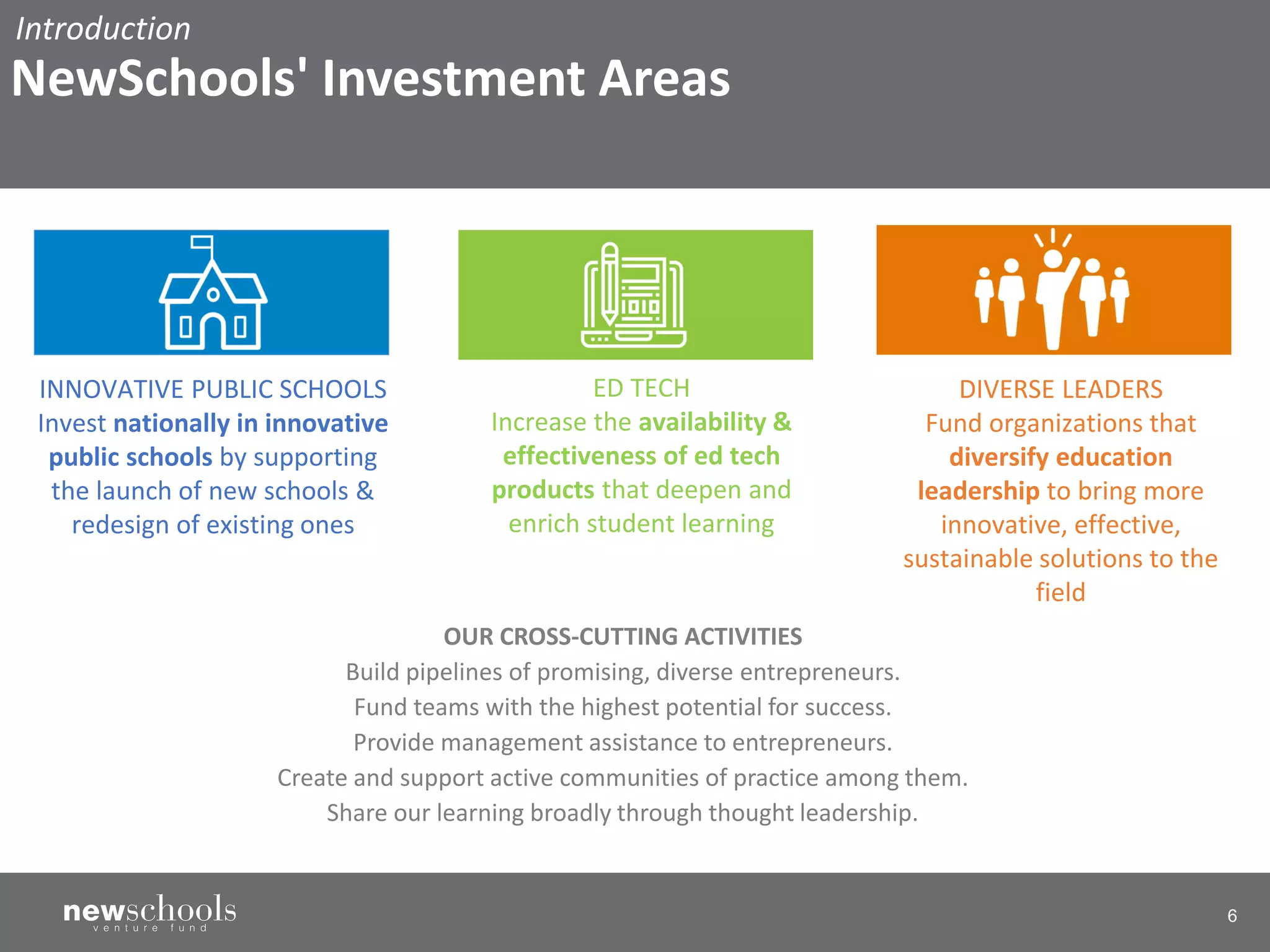
INNOVATIVE PUBLIC SCHOOLS
Invest nationally in innovative
public schools by supporting
the launch of new schools &
redesign of existing ones
ED TECH
Increase the availability &
effectiveness of ed tech
products that deepen and
enrich student learning
DIVERSE LEADERS
Fund organizations that
diversify education
leadership to bring more
innovative, effective,
sustainable solutions to the
field
OUR CROSS-CUTTING ACTIVITIES
Build pipelines of promising, diverse entrepreneurs.
Fund teams with the highest potential for success.
Provide management assistance to entrepreneurs.
Create and support active communities of practice among them.
Share our learning broadly through thought leadership.
Introduction
NewSchools' Investment Areas
7
We are focused on education technology that increases the availability and effectiveness
of products that deepen and enrich student learning.
Our goal is to catalyze product growth in areas that educators and students identify as
important, but where innovation is lagging.
To achieve our goal, we:
Mobilize entrepreneurs through Ignite Challenges, providing funding, management
assistance, research partnership, and collective learning opportunities
Share our lessons with the broader education community to support more
comprehensive and wide-scale impact
Identify market gaps in which education technology is not meeting the critical needs of
educators and students
Introduction
Our approach to education technology
8
In February 2019, NewSchools’ Ed Tech team launched its seventh ed tech challenge, the Expanded
Definition of Student Success Challenge – open to entrepreneurs developing technology-enabled
learning experiences, instructional content, learning diagnostics, administrative tools, and other
products that promote an expanded definition of student success by enhancing academic and social-
emotional learning and supporting the development of nurturing school and classroom environments.
We conducted market research – with students, educators, and researchers from across the country – to
learn more about how technology might support an expanded definition of student success. Research
suggests the most promising ed tech innovations will support the development of a range of social-
emotional competencies, cognitive skills, and attributes of positive learning environments. We
expect challenge winners will address one or more critical area of student need:
• Promoting school readiness and skills that enable successful school transitions;
• Integrating social-emotional development into core academic learning;
• Enabling new ways to measure and analyze an expanded set of student outcomes; and
• Building teachers’, parents’, and communities’ capacity to support an expanded definition of student
success.
Introduction
About the Expanded Definition of Student Success
Ed Tech Challenge
9
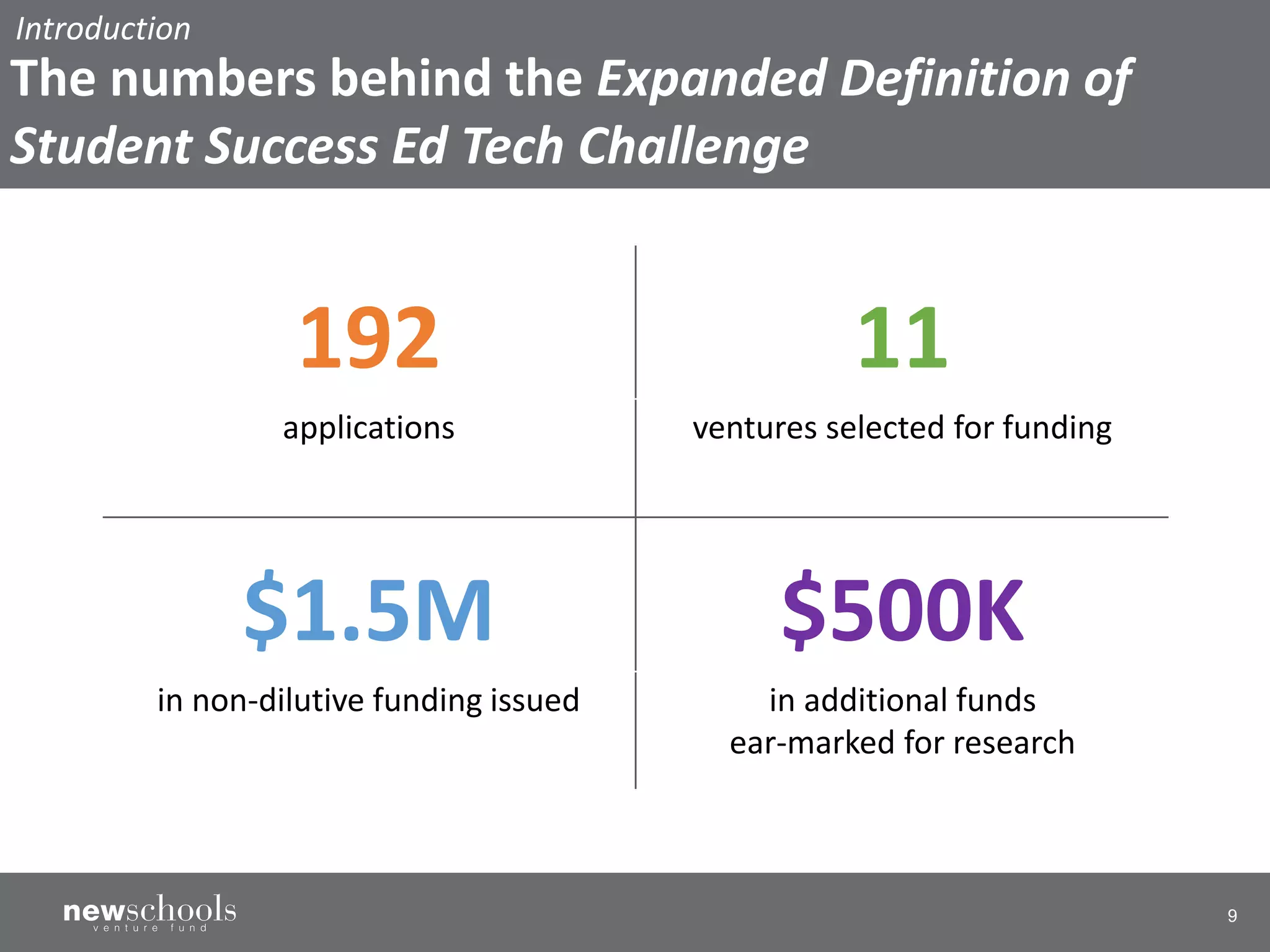
192 11
applications ventures selected for funding
$1.5M $500K
in non-dilutive funding issued in additional funds
ear-marked for research
Introduction
The numbers behind the Expanded Definition of
Student Success Ed Tech Challenge
Applicant Pool Themes
11
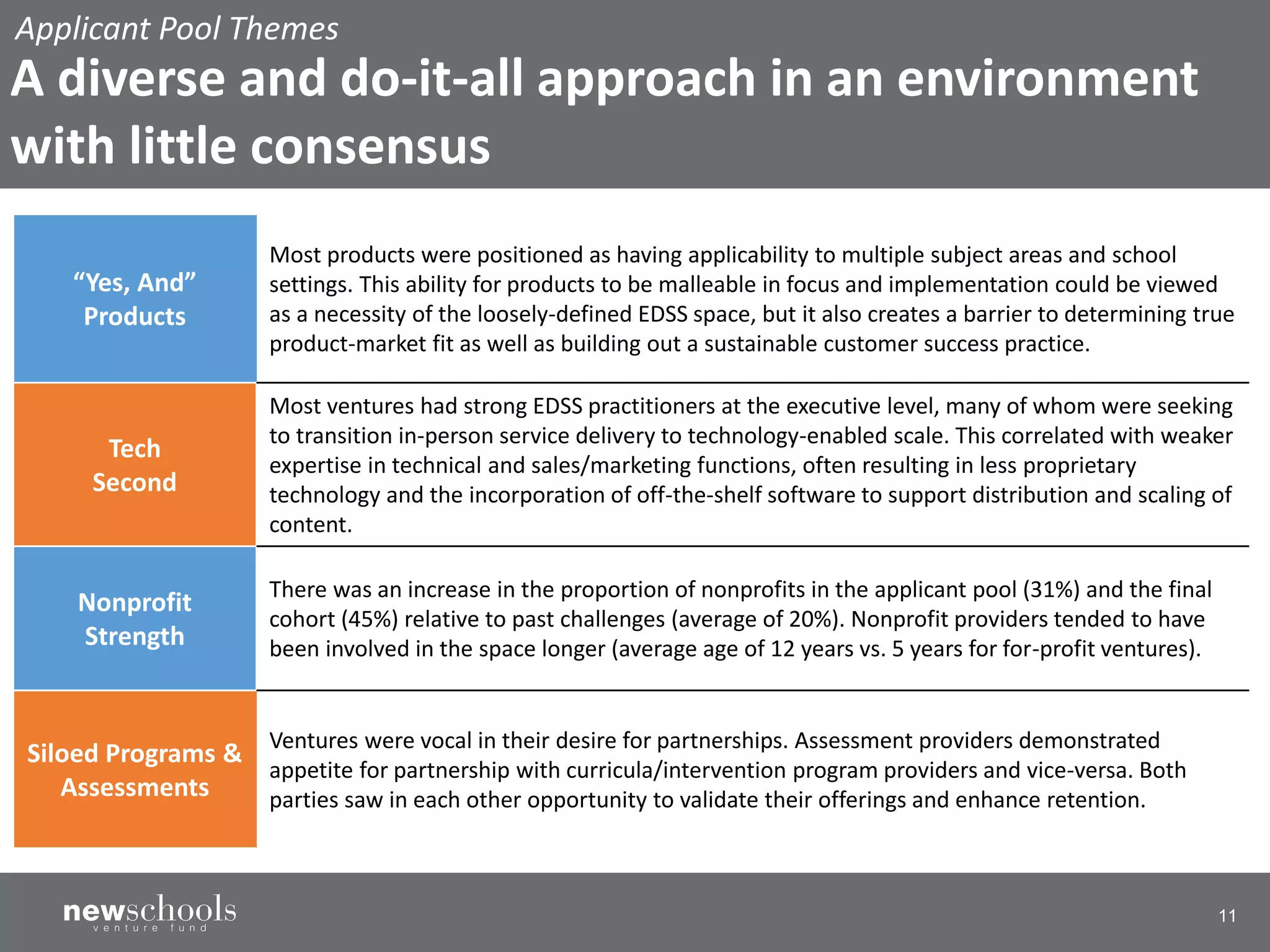
“Yes, And”
Products
Most products were positioned as having applicability to multiple subject areas and school
settings. This ability for products to be malleable in focus and implementation could be viewed
as a necessity of the loosely-defined EDSS space, but it also creates a barrier to determining true
product-market fit as well as building out a sustainable customer success practice.
Tech
Second
Most ventures had strong EDSS practitioners at the executive level, many of whom were seeking
to transition in-person service delivery to technology-enabled scale. This correlated with weaker
expertise in technical and sales/marketing functions, often resulting in less proprietary
technology and the incorporation of off-the-shelf software to support distribution and scaling of
content.
Nonprofit
Strength
There was an increase in the proportion of nonprofits in the applicant pool (31%) and the final
cohort (45%) relative to past challenges (average of 20%). Nonprofit providers tended to have
been involved in the space longer (average age of 12 years vs. 5 years for for-profit ventures).
Siloed Programs &
Assessments
Ventures were vocal in their desire for partnerships. Assessment providers demonstrated
appetite for partnership with curricula/intervention program providers and vice-versa. Both
parties saw in each other opportunity to validate their offerings and enhance retention.
Applicant Pool Themes
A diverse and do-it-all approach in an environment
with little consensus
12
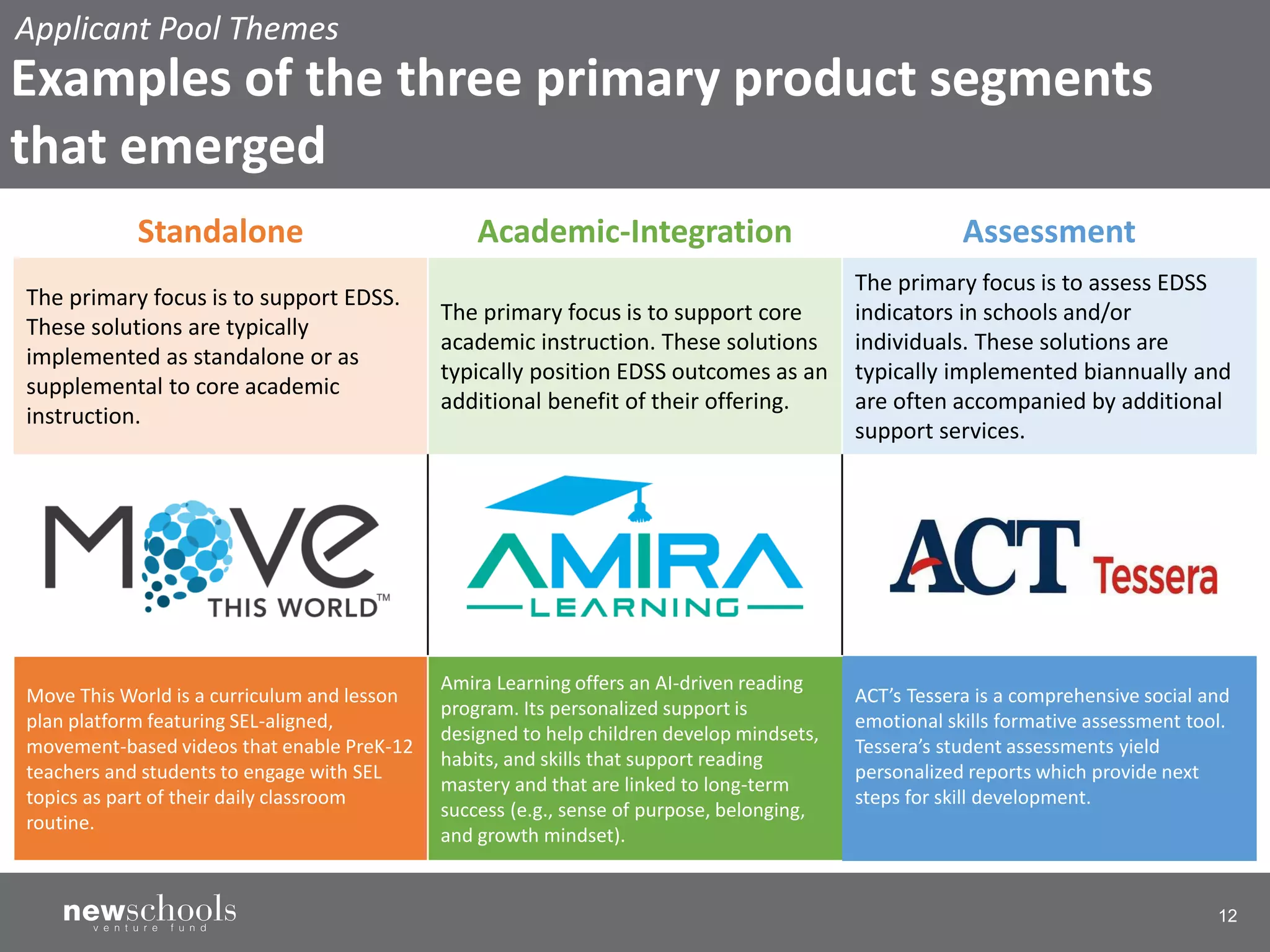
Standalone Academic-Integration Assessment
The primary focus is to support EDSS.
These solutions are typically
implemented as standalone or as
supplemental to core academic
instruction.
The primary focus is to support core
academic instruction. These solutions
typically position EDSS outcomes as an
additional benefit of their offering.
The primary focus is to assess EDSS
indicators in schools and/or
individuals. These solutions are
typically implemented biannually and
are often accompanied by additional
support services.
Move This World is a curriculum and lesson
plan platform featuring SEL-aligned,
movement-based videos that enable PreK-12
teachers and students to engage with SEL
topics as part of their daily classroom
routine.
Amira Learning offers an AI-driven reading
program. Its personalized support is
designed to help children develop mindsets,
habits, and skills that support reading
mastery and that are linked to long-term
success (e.g., sense of purpose, belonging,
and growth mindset).
ACT’s Tessera is a comprehensive social and
emotional skills formative assessment tool.
Tessera’s student assessments yield
personalized reports which provide next
steps for skill development.
Applicant Pool Themes
Examples of the three primary product segments
that emerged
Focus Areas
14
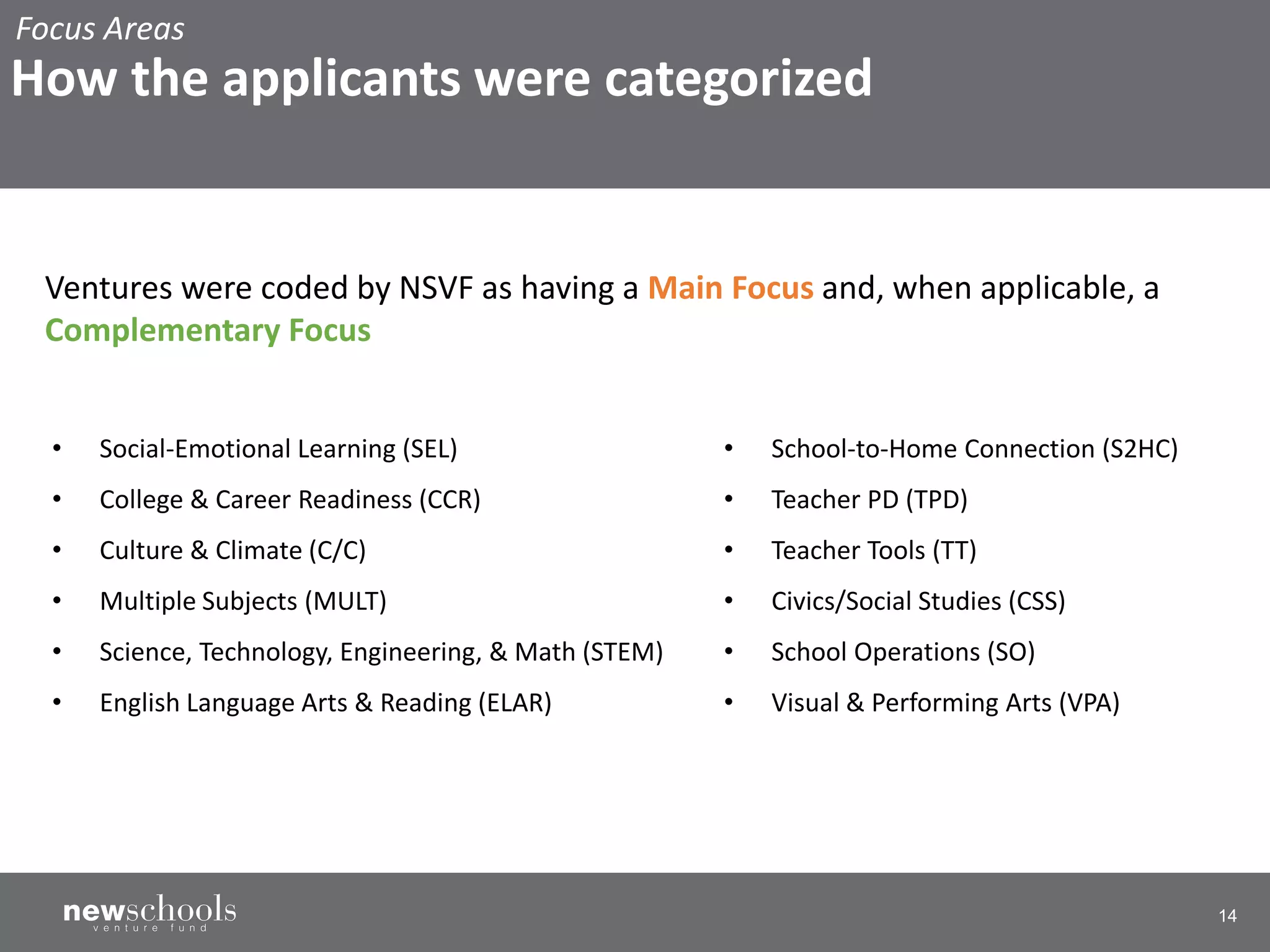
Ventures were coded by NSVF as having a Main Focus and, when applicable, a
Complementary Focus
• Social-Emotional Learning (SEL)
• College & Career Readiness (CCR)
• Culture & Climate (C/C)
• Multiple Subjects (MULT)
• Science, Technology, Engineering, & Math (STEM)
• English Language Arts & Reading (ELAR)
• School-to-Home Connection (S2HC)
• Teacher PD (TPD)
• Teacher Tools (TT)
• Civics/Social Studies (CSS)
• School Operations (SO)
• Visual & Performing Arts (VPA)
Focus Areas
How the applicants were categorized
15
1%
2%
4%
4%
5%
5%
6%
8%
9%
11%
15%
30%
SO
VPA
TT
CSS
S2HC
TPD
C/C
MULT
ELAR
STEM
CCR
SEL
Main Focus
Key Takeaways
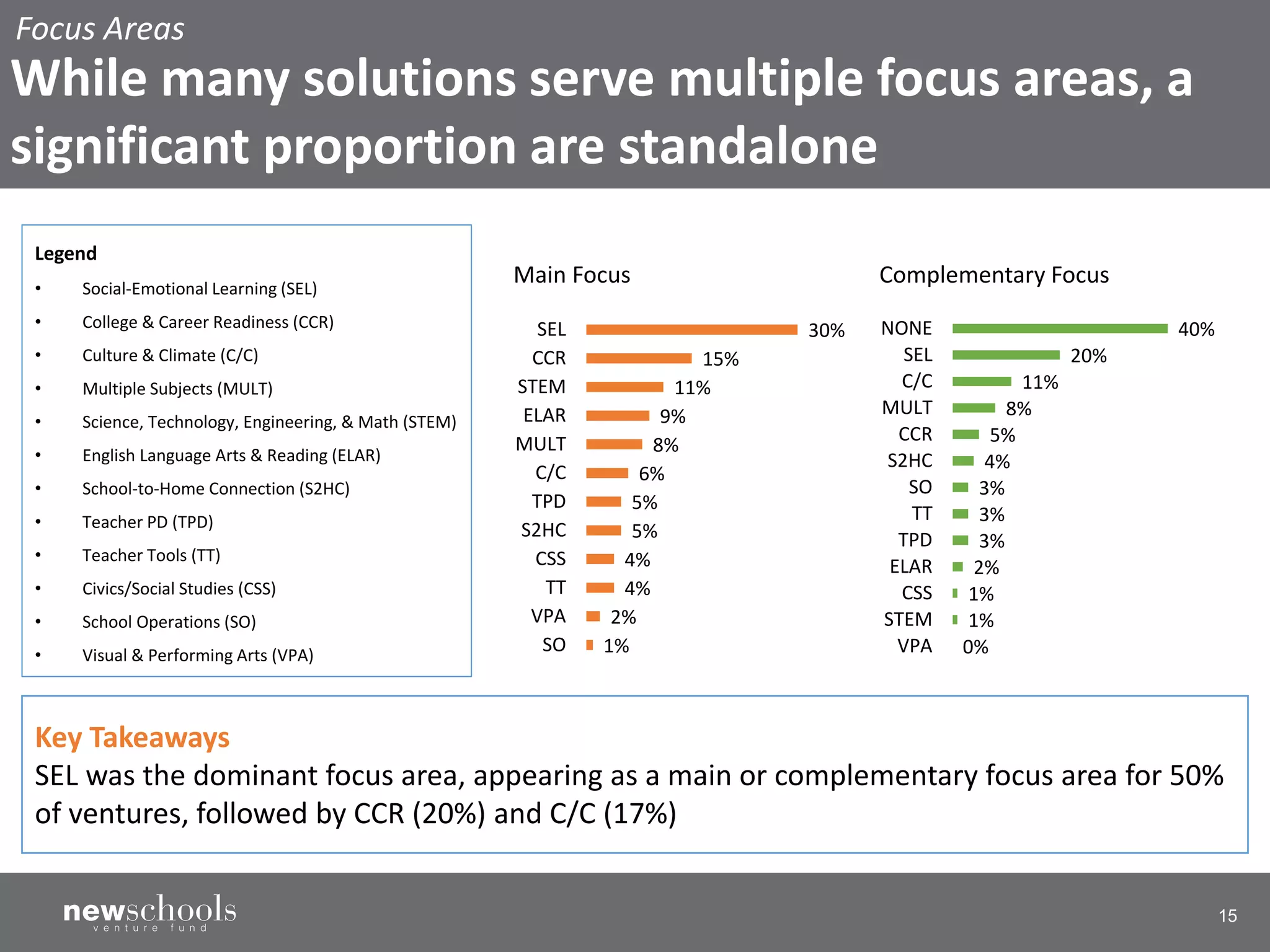
SEL was the dominant focus area, appearing as a main or complementary focus area for 50%
of ventures, followed by CCR (20%) and C/C (17%)
0%
1%
1%
2%
3%
3%
3%
4%
5%
8%
11%
20%
40%
VPA
STEM
CSS
ELAR
TPD
TT
SO
S2HC
CCR
MULT
C/C
SEL
NONE
Complementary Focus
Legend
• Social-Emotional Learning (SEL)
• College & Career Readiness (CCR)
• Culture & Climate (C/C)
• Multiple Subjects (MULT)
• Science, Technology, Engineering, & Math (STEM)
• English Language Arts & Reading (ELAR)
• School-to-Home Connection (S2HC)
• Teacher PD (TPD)
• Teacher Tools (TT)
• Civics/Social Studies (CSS)
• School Operations (SO)
• Visual & Performing Arts (VPA)
Focus Areas
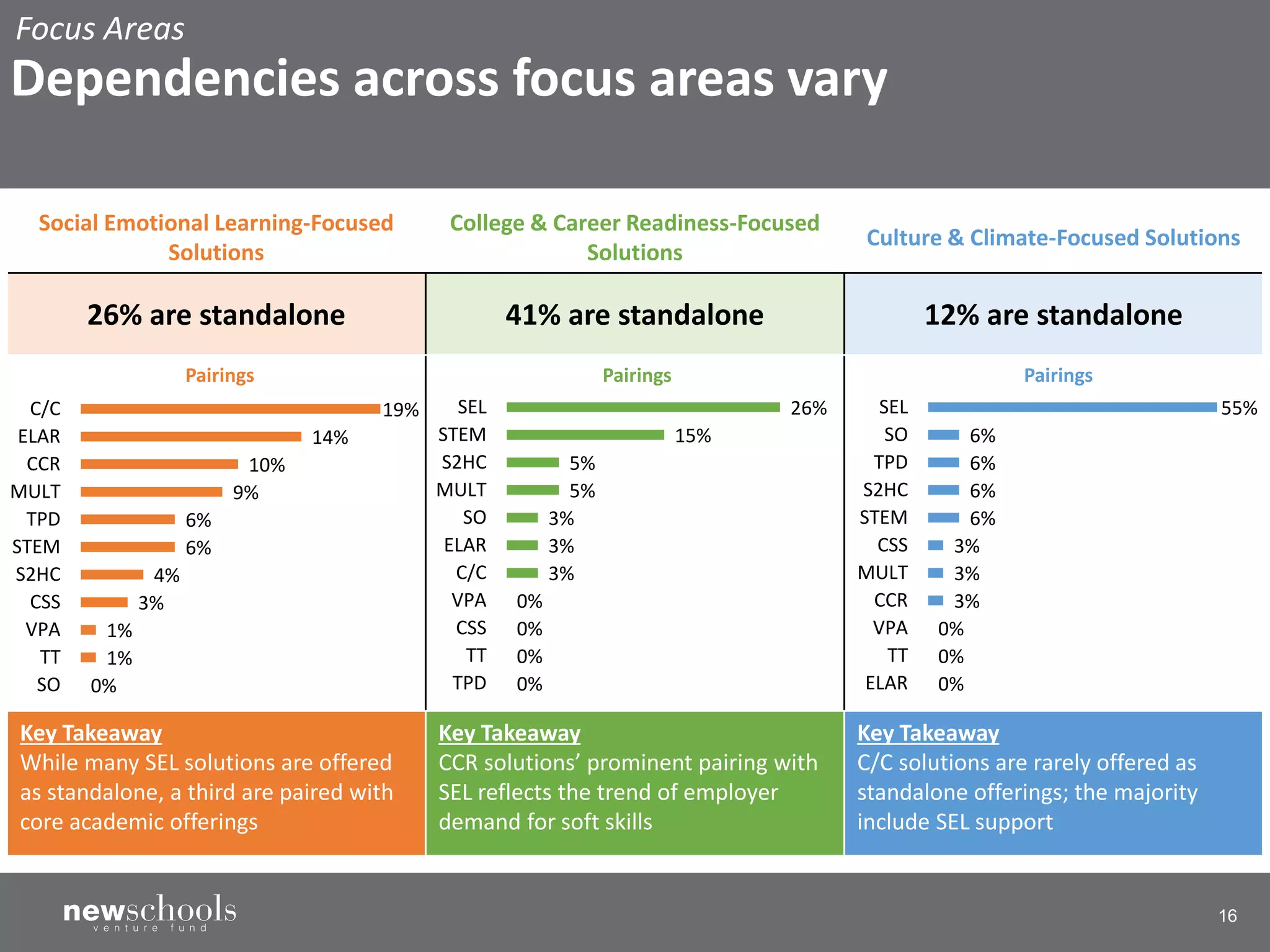
While many solutions serve multiple focus areas, a
significant proportion are standalone
16
Social Emotional Learning-Focused
Solutions
College & Career Readiness-Focused
Solutions
Culture & Climate-Focused Solutions
26% are standalone 41% are standalone 12% are standalone
Key Takeaway
While many SEL solutions are offered
as standalone, a third are paired with
core academic offerings
Key Takeaway
CCR solutions’ prominent pairing with
SEL reflects the trend of employer
demand for soft skills
Key Takeaway
C/C solutions are rarely offered as
standalone offerings; the majority
include SEL support
0%
0%
0%
3%
3%
3%
6%
6%
6%
6%
55%
ELAR
TT
VPA
CCR
MULT
CSS
STEM
S2HC
TPD
SO
SEL
Pairings
0%
0%
0%
0%
3%
3%
3%
5%
5%
15%
26%
TPD
TT
CSS
VPA
C/C
ELAR
SO
MULT
S2HC
STEM
SEL
Pairings
0%
1%
1%
3%
4%
6%
6%
9%
10%
14%
19%
SO
TT
VPA
CSS
S2HC
STEM
TPD
MULT
CCR
ELAR
C/C
Pairings
Focus Areas
Dependencies across focus areas vary
17
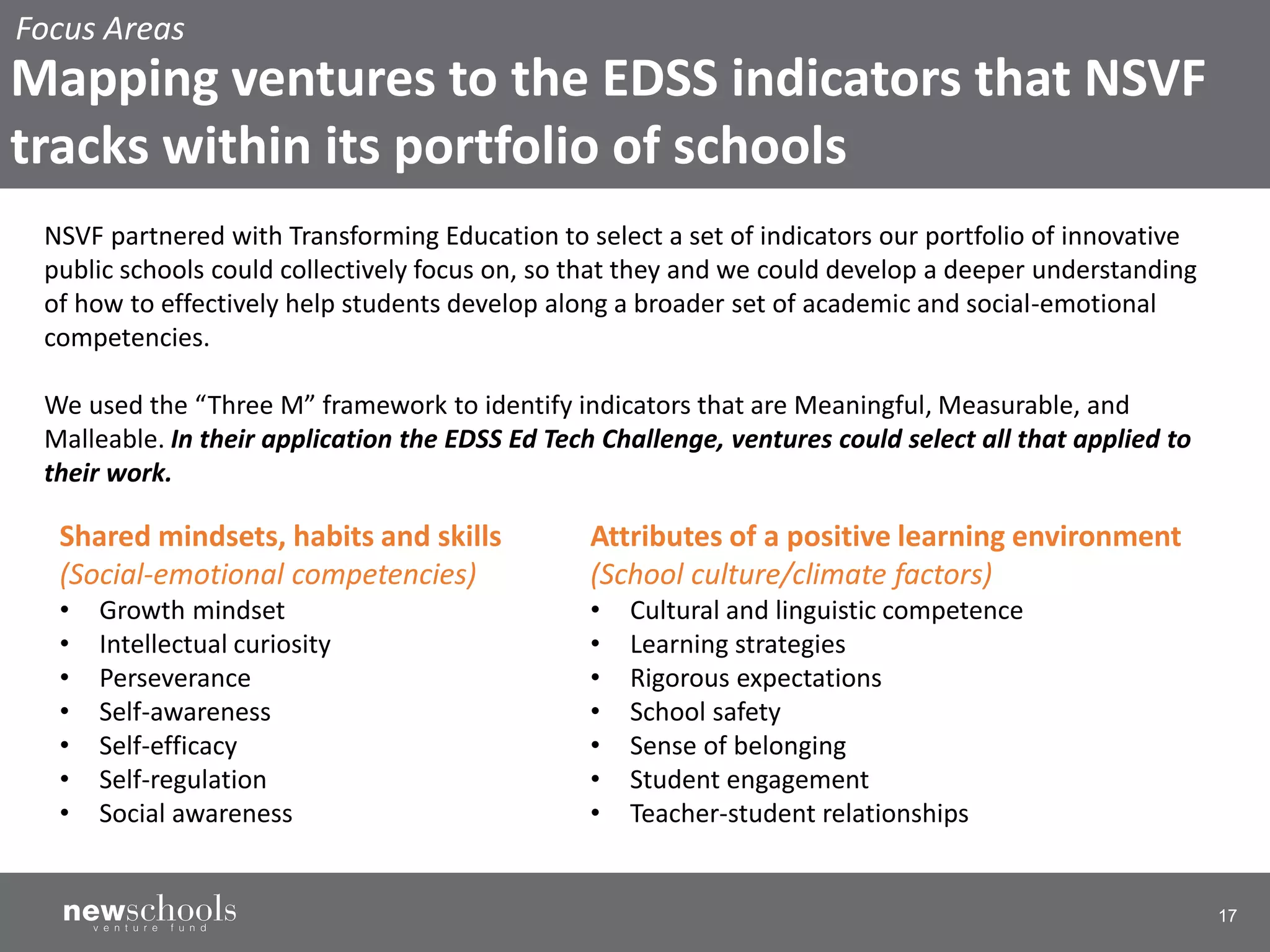
Shared mindsets, habits and skills
(Social-emotional competencies)
• Growth mindset
• Intellectual curiosity
• Perseverance
• Self-awareness
• Self-efficacy
• Self-regulation
• Social awareness
Attributes of a positive learning environment
(School culture/climate factors)
• Cultural and linguistic competence
• Learning strategies
• Rigorous expectations
• School safety
• Sense of belonging
• Student engagement
• Teacher-student relationships
NSVF partnered with Transforming Education to select a set of indicators our portfolio of innovative
public schools could collectively focus on, so that they and we could develop a deeper understanding
of how to effectively help students develop along a broader set of academic and social-emotional
competencies.
We used the “Three M” framework to identify indicators that are Meaningful, Measurable, and
Malleable. In their application the EDSS Ed Tech Challenge, ventures could select all that applied to
their work.
Focus Areas
Mapping ventures to the EDSS indicators that NSVF
tracks within its portfolio of schools
18
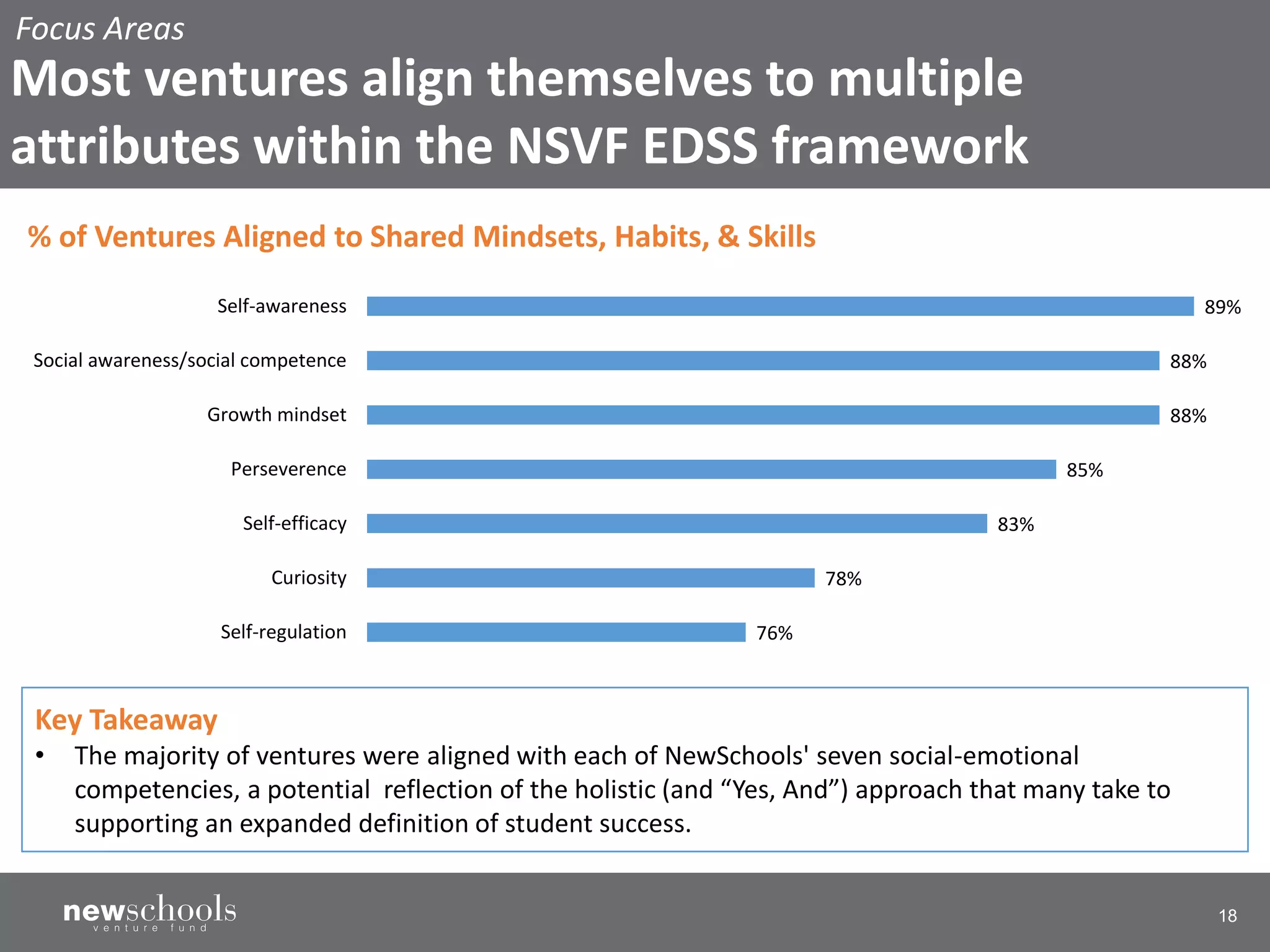
Key Takeaway
• The majority of ventures were aligned with each of NewSchools' seven social-emotional
competencies, a potential reflection of the holistic (and “Yes, And”) approach that many take to
supporting an expanded definition of student success.
76%
78%
83%
85%
88%
88%
89%
Self-regulation
Curiosity
Self-efficacy
Perseverence
Growth mindset
Social awareness/social competence
Self-awareness
% of Ventures Aligned to Shared Mindsets, Habits, & Skills
Focus Areas
Most ventures align themselves to multiple
attributes within the NSVF EDSS framework
19
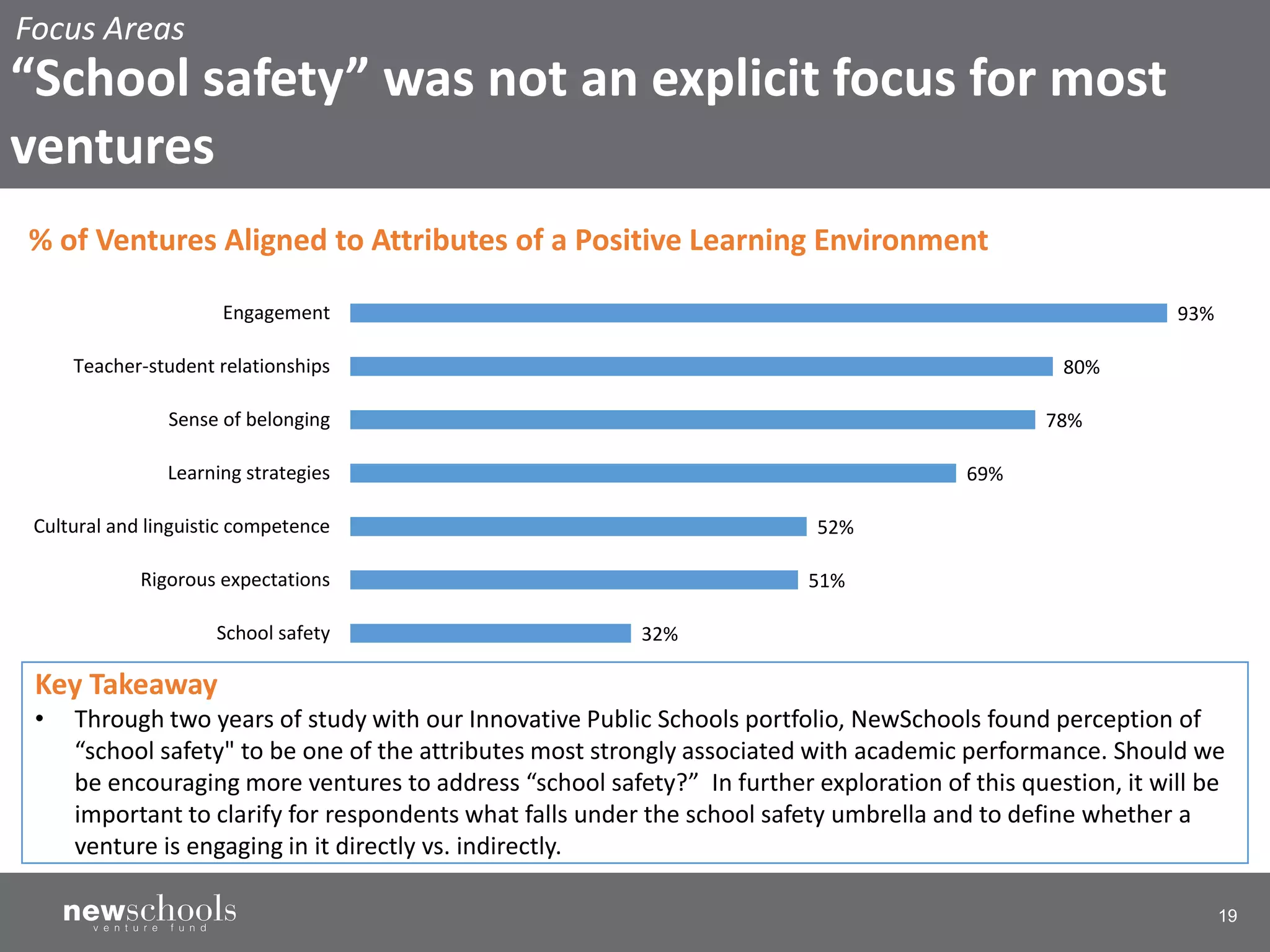
Key Takeaway
• Through two years of study with our Innovative Public Schools portfolio, NewSchools found perception of
“school safety" to be one of the attributes most strongly associated with academic performance. Should we
be encouraging more ventures to address “school safety?” In further exploration of this question, it will be
important to clarify for respondents what falls under the school safety umbrella and to define whether a
venture is engaging in it directly vs. indirectly.
32%
51%
52%
69%
78%
80%
93%
School safety
Rigorous expectations
Cultural and linguistic competence
Learning strategies
Sense of belonging
Teacher-student relationships
Engagement
% of Ventures Aligned to Attributes of a Positive Learning Environment
Focus Areas
“School safety” was not an explicit focus for most
ventures
Venture Profile
21
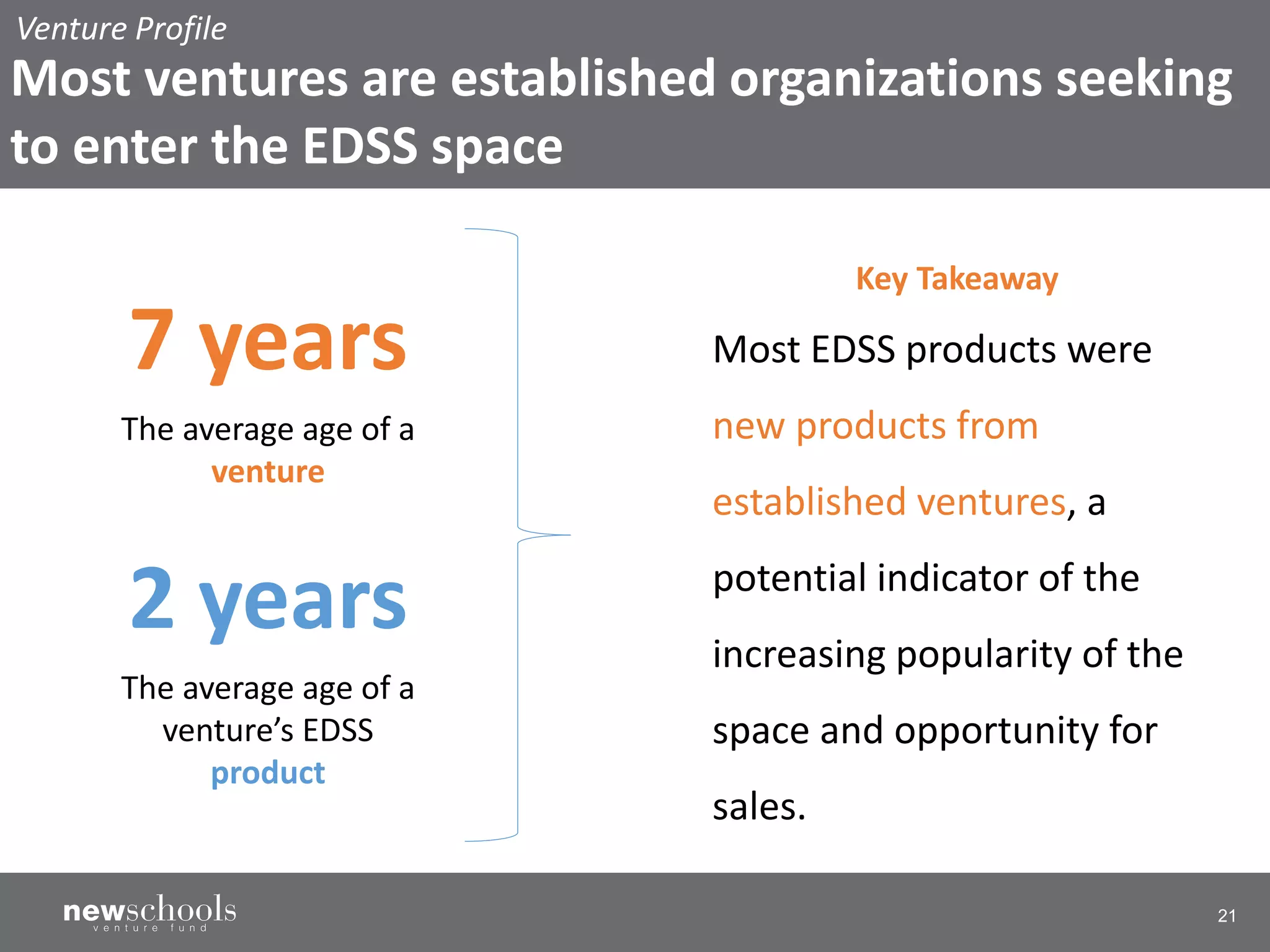
7 years
The average age of a
venture
2 years
The average age of a
venture’s EDSS
product
Key Takeaway
Most EDSS products were
new products from
established ventures, a
potential indicator of the
increasing popularity of the
space and opportunity for
sales.
Venture Profile
Most ventures are established organizations seeking
to enter the EDSS space
22
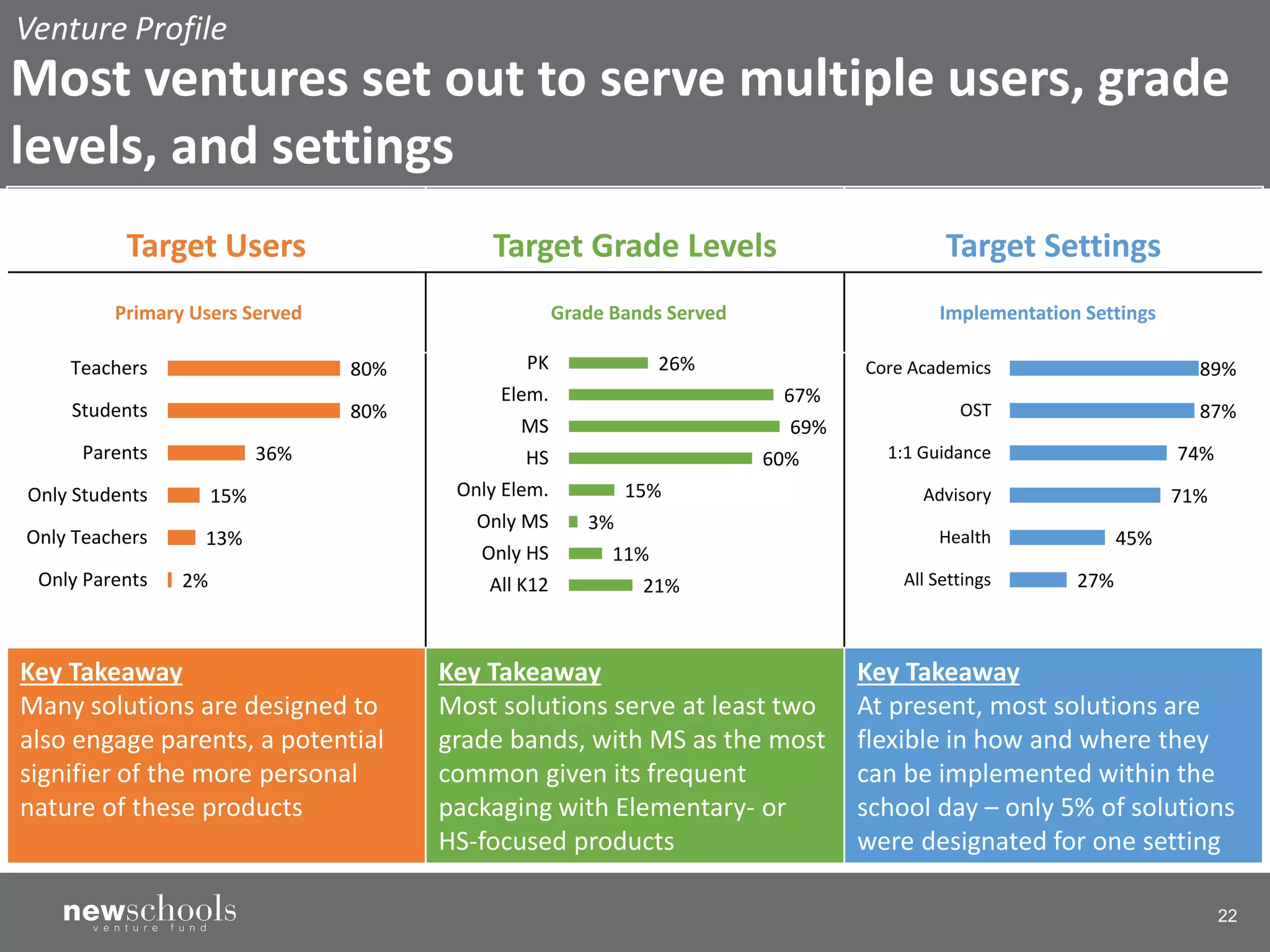
Target Users Target Grade Levels Target Settings
Key Takeaway
Many solutions are designed to
also engage parents, a potential
signifier of the more personal
nature of these products
Key Takeaway
Most solutions serve at least two
grade bands, with MS as the most
common given its frequent
packaging with Elementary- or
HS-focused products
Key Takeaway
At present, most solutions are
flexible in how and where they
can be implemented within the
school day – only 5% of solutions
were designated for one setting
2%
13%
15%
36%
80%
80%
Only Parents
Only Teachers
Only Students
Parents
Students
Teachers
Primary Users Served
21%
11%
3%
15%
60%
69%
67%
26%
All K12
Only HS
Only MS
Only Elem.
HS
MS
Elem.
PK
Grade Bands Served
27%
45%
71%
74%
87%
89%
All Settings
Health
Advisory
1:1 Guidance
OST
Core Academics
Implementation Settings
Venture Profile
Most ventures set out to serve multiple users, grade
levels, and settings
23
Funding Revenue Users Organization Size
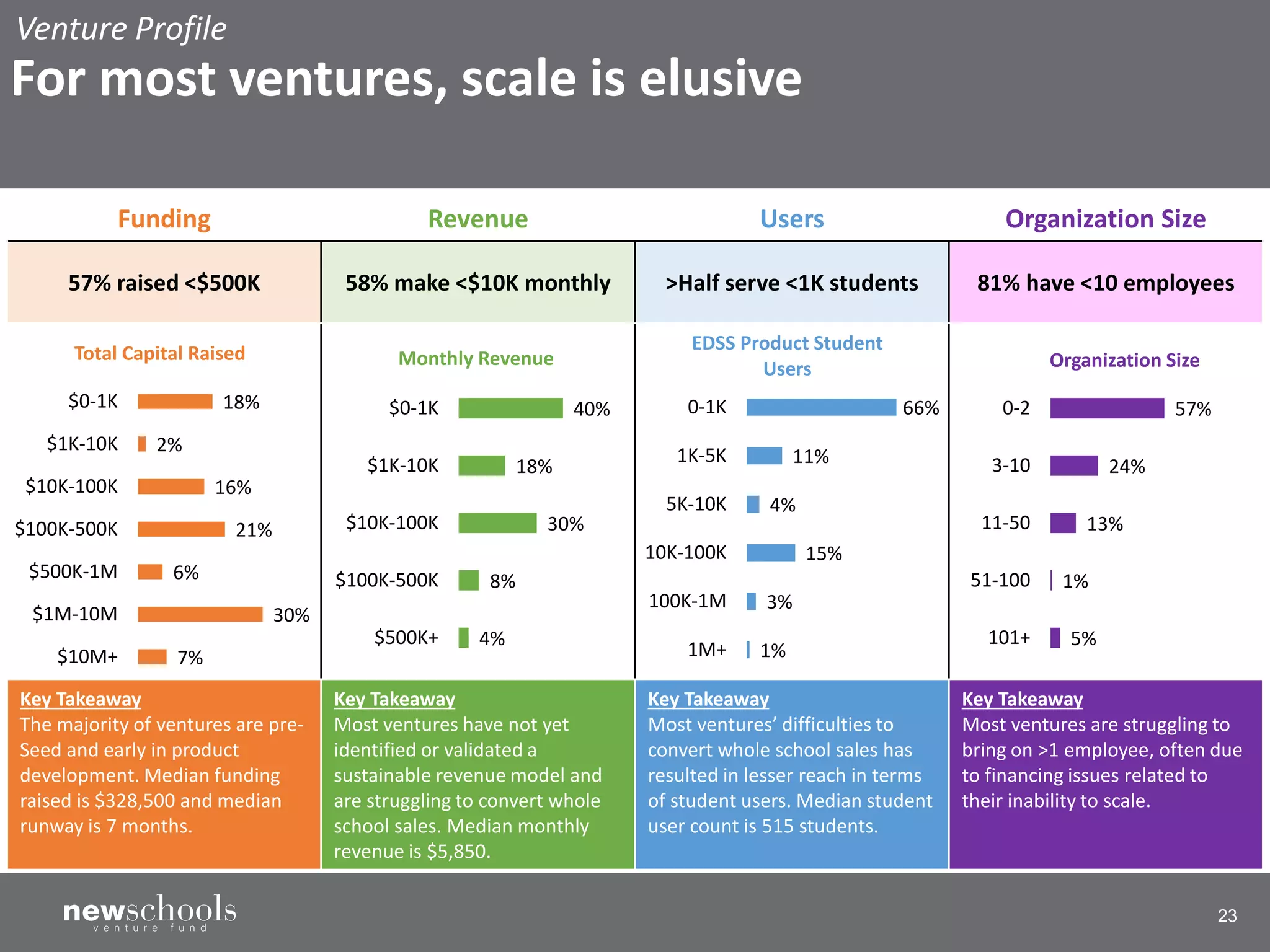
57% raised <$500K 58% make <$10K monthly >Half serve <1K students 81% have <10 employees
Key Takeaway
The majority of ventures are pre-
Seed and early in product
development. Median funding
raised is $328,500 and median
runway is 7 months.
Key Takeaway
Most ventures have not yet
identified or validated a
sustainable revenue model and
are struggling to convert whole
school sales. Median monthly
revenue is $5,850.
Key Takeaway
Most ventures’ difficulties to
convert whole school sales has
resulted in lesser reach in terms
of student users. Median student
user count is 515 students.
Key Takeaway
Most ventures are struggling to
bring on >1 employee, often due
to financing issues related to
their inability to scale.
1%
3%
15%
4%
11%
66%
1M+
100K-1M
10K-100K
5K-10K
1K-5K
0-1K
EDSS Product Student
Users
4%
8%
30%
18%
40%
$500K+
$100K-500K
$10K-100K
$1K-10K
$0-1K
Monthly Revenue
7%
30%
6%
21%
16%
2%
18%
$10M+
$1M-10M
$500K-1M
$100K-500K
$10K-100K
$1K-10K
$0-1K
Total Capital Raised
5%
1%
13%
24%
57%
101+
51-100
11-50
3-10
0-2
Organization Size
Venture Profile
For most ventures, scale is elusive
24
Venture Profile
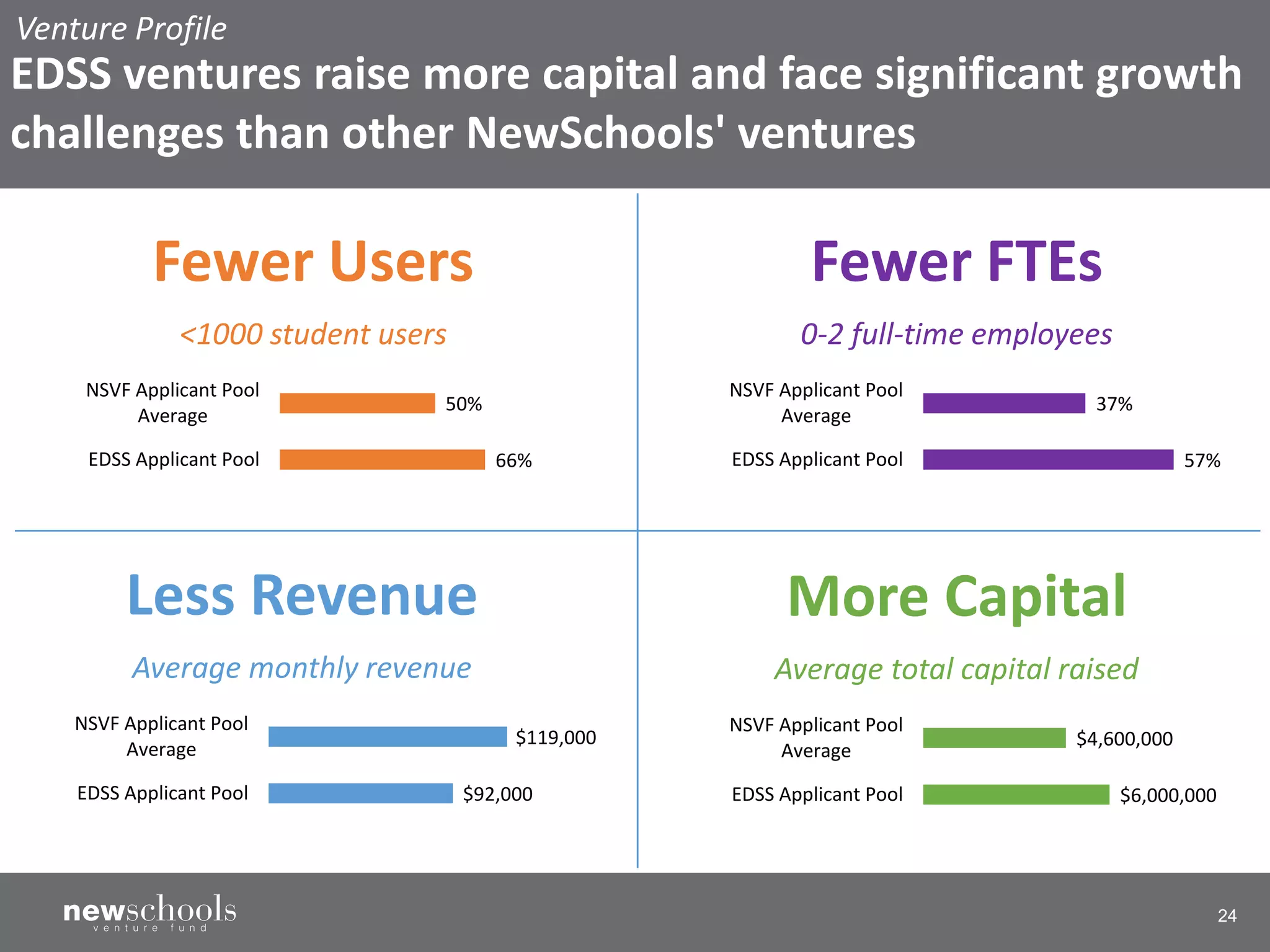
EDSS ventures raise more capital and face significant growth
challenges than other NewSchools' ventures
66%
50%
EDSS Applicant Pool
NSVF Applicant Pool
Average
<1000 student users
Fewer Users
$92,000
$119,000
EDSS Applicant Pool
NSVF Applicant Pool
Average
Average monthly revenue
Less Revenue
57%
37%
EDSS Applicant Pool
NSVF Applicant Pool
Average
0-2 full-time employees
Fewer FTEs
$6,000,000
$4,600,000
EDSS Applicant Pool
NSVF Applicant Pool
Average
Average total capital raised
More Capital
25
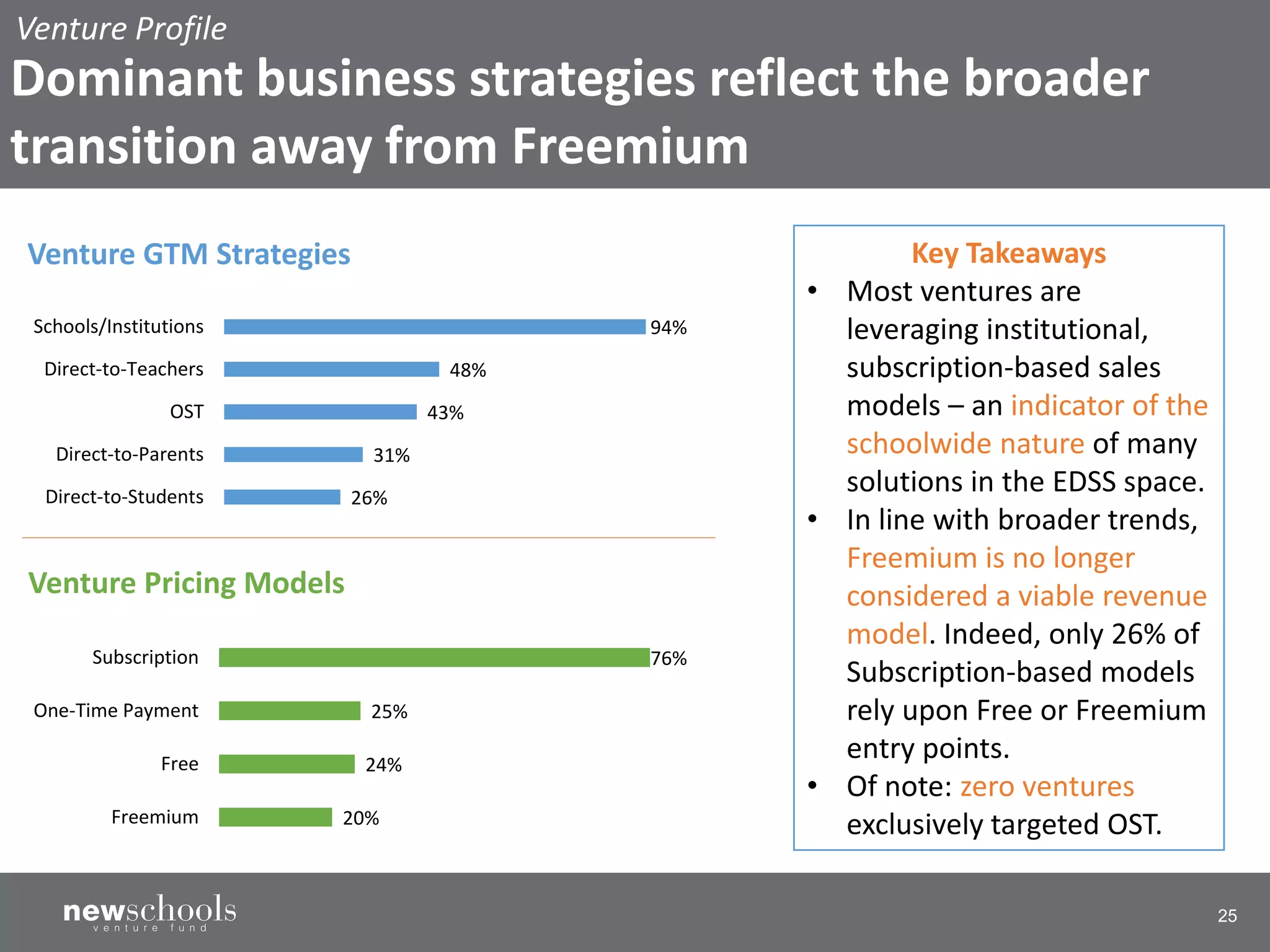
26%
31%
43%
48%
94%
Direct-to-Students
Direct-to-Parents
OST
Direct-to-Teachers
Schools/Institutions
Venture GTM Strategies
20%
24%
25%
76%
Freemium
Free
One-Time Payment
Subscription
Venture Pricing Models
Key Takeaways
• Most ventures are
leveraging institutional,
subscription-based sales
models – an indicator of the
schoolwide nature of many
solutions in the EDSS space.
• In line with broader trends,
Freemium is no longer
considered a viable revenue
model. Indeed, only 26% of
Subscription-based models
rely upon Free or Freemium
entry points.
• Of note: zero ventures
exclusively targeted OST.
Venture Profile
Dominant business strategies reflect the broader
transition away from Freemium
26
Venture Profile
EDSS ventures are more reliant upon institutional and paid
sales strategies than past applicants
20%
24%
25%
76%
29%
50%
31%
70%
Freemium
Free
One-Time Payment
Subscription
Venture Pricing Models
NSVF Applicant Pool
Average
EDSS Applicant Pool
26%
31%
43%
48%
94%
40%
50%
47%
62%
93%
Direct-to-Students
Direct-to-Parents
OST
Direct-to-Teachers
Schools/Institutions
Venture GTM Strategies
NSVF Applicant Pool
Average
EDSS Applicant Pool
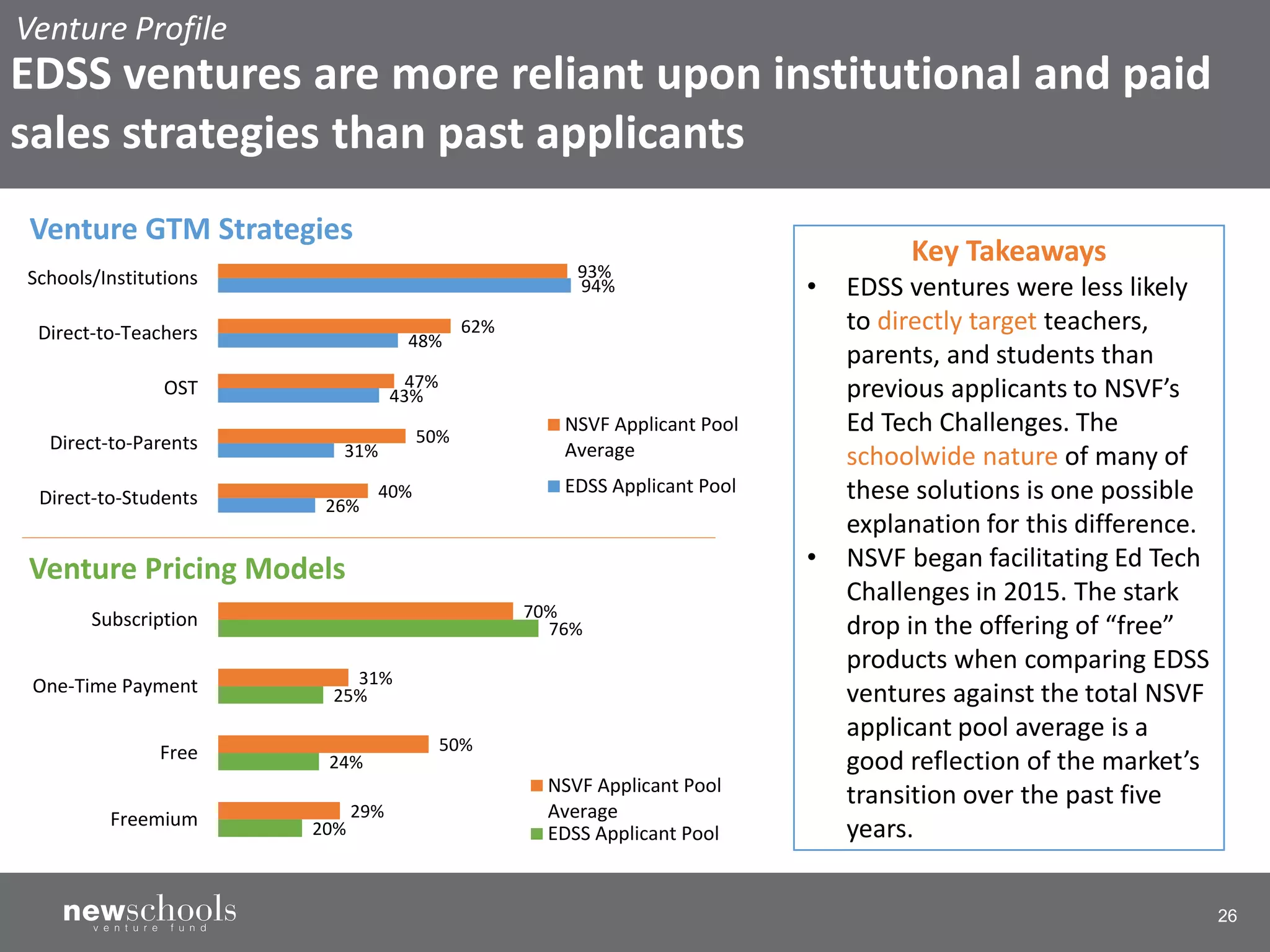
Key Takeaways
• EDSS ventures were less likely
to directly target teachers,
parents, and students than
previous applicants to NSVF’s
Ed Tech Challenges. The
schoolwide nature of many of
these solutions is one possible
explanation for this difference.
• NSVF began facilitating Ed Tech
Challenges in 2015. The stark
drop in the offering of “free”
products when comparing EDSS
ventures against the total NSVF
applicant pool average is a
good reflection of the market’s
transition over the past five
years.
Research Profile
28
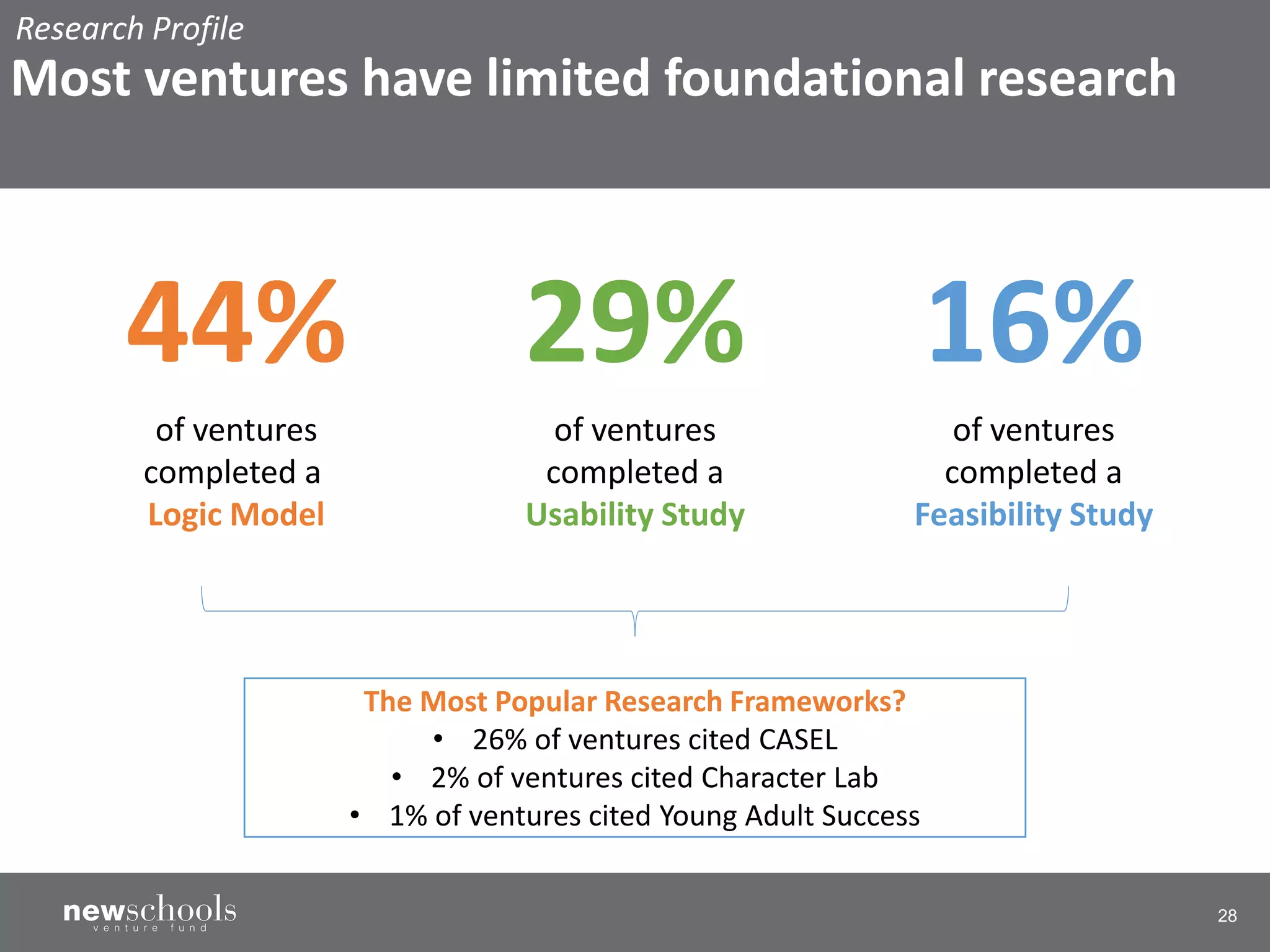
44% 29% 16%
of ventures
completed a
Logic Model
of ventures
completed a
Usability Study
of ventures
completed a
Feasibility Study
The Most Popular Research Frameworks?
• 26% of ventures cited CASEL
• 2% of ventures cited Character Lab
• 1% of ventures cited Young Adult Success
Research Profile
Most ventures have limited foundational research
29
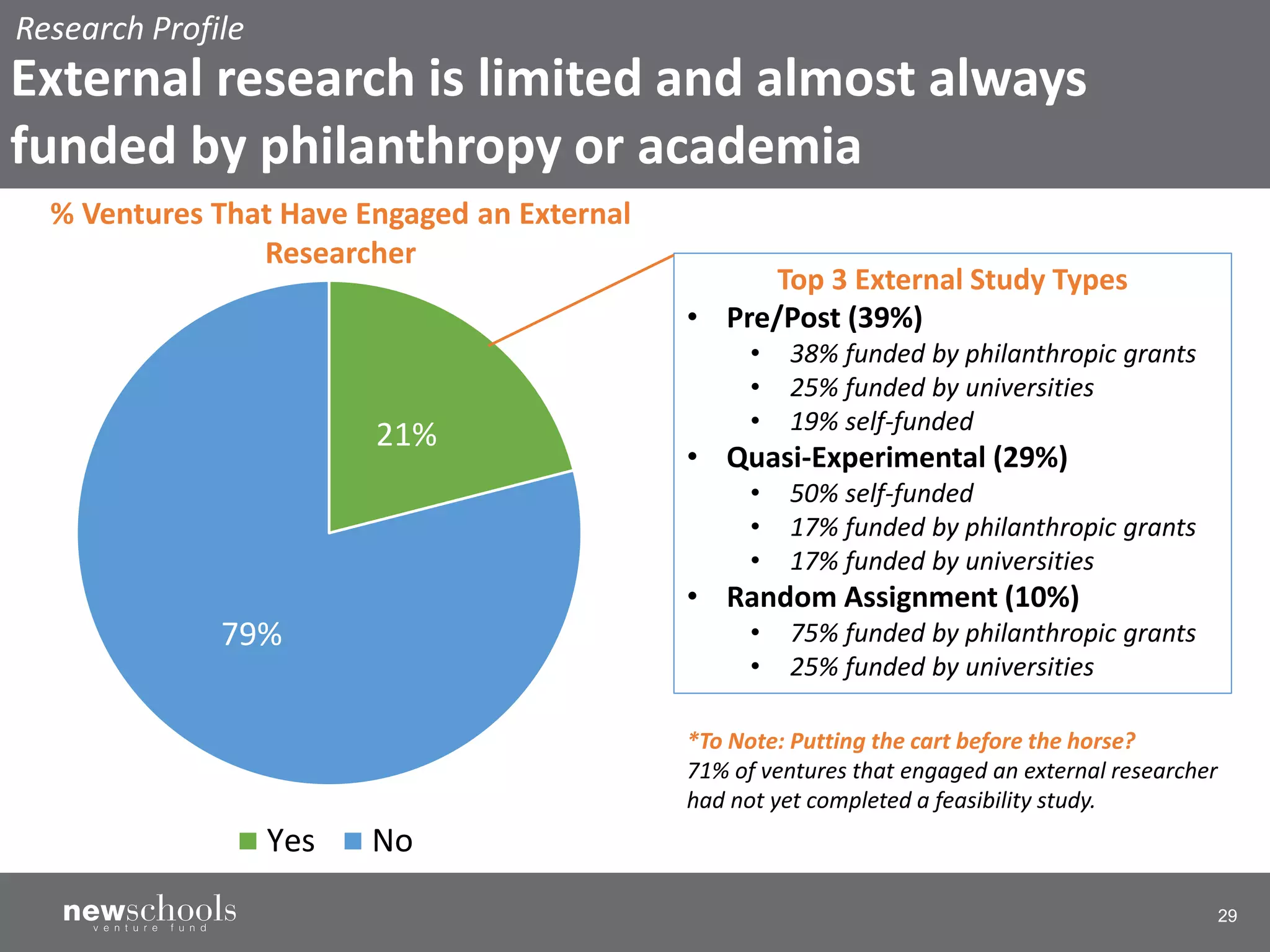
21%
79%
Yes No
% Ventures That Have Engaged an External
Researcher
Top 3 External Study Types
• Pre/Post (39%)
• 38% funded by philanthropic grants
• 25% funded by universities
• 19% self-funded
• Quasi-Experimental (29%)
• 50% self-funded
• 17% funded by philanthropic grants
• 17% funded by universities
• Random Assignment (10%)
• 75% funded by philanthropic grants
• 25% funded by universities
*To Note: Putting the cart before the horse?
71% of ventures that engaged an external researcher
had not yet completed a feasibility study.
Research Profile
External research is limited and almost always
funded by philanthropy or academia
Diversity Profile
31
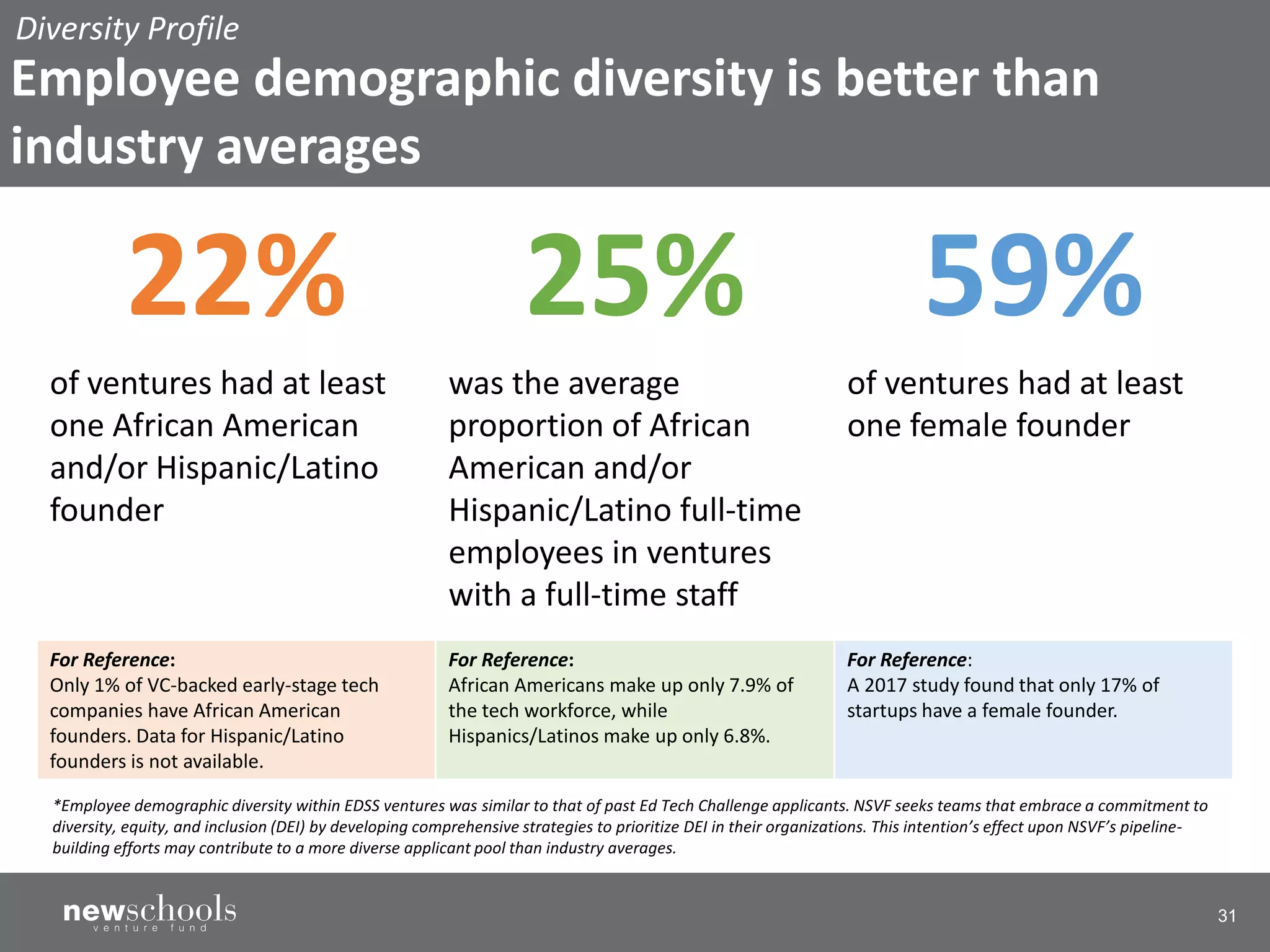
22% 25% 59%
of ventures had at least
one African American
and/or Hispanic/Latino
founder
was the average
proportion of African
American and/or
Hispanic/Latino full-time
employees in ventures
with a full-time staff
of ventures had at least
one female founder
For Reference:
Only 1% of VC-backed early-stage tech
companies have African American
founders. Data for Hispanic/Latino
founders is not available.
For Reference:
African Americans make up only 7.9% of
the tech workforce, while
Hispanics/Latinos make up only 6.8%.
For Reference:
A 2017 study found that only 17% of
startups have a female founder.
Diversity Profile
Employee demographic diversity is better than
industry averages
*Employee demographic diversity within EDSS ventures was similar to that of past Ed Tech Challenge applicants. NSVF seeks teams that embrace a commitment to
diversity, equity, and inclusion (DEI) by developing comprehensive strategies to prioritize DEI in their organizations. This intention’s effect upon NSVF’s pipeline-
building efforts may contribute to a more diverse applicant pool than industry averages.
32
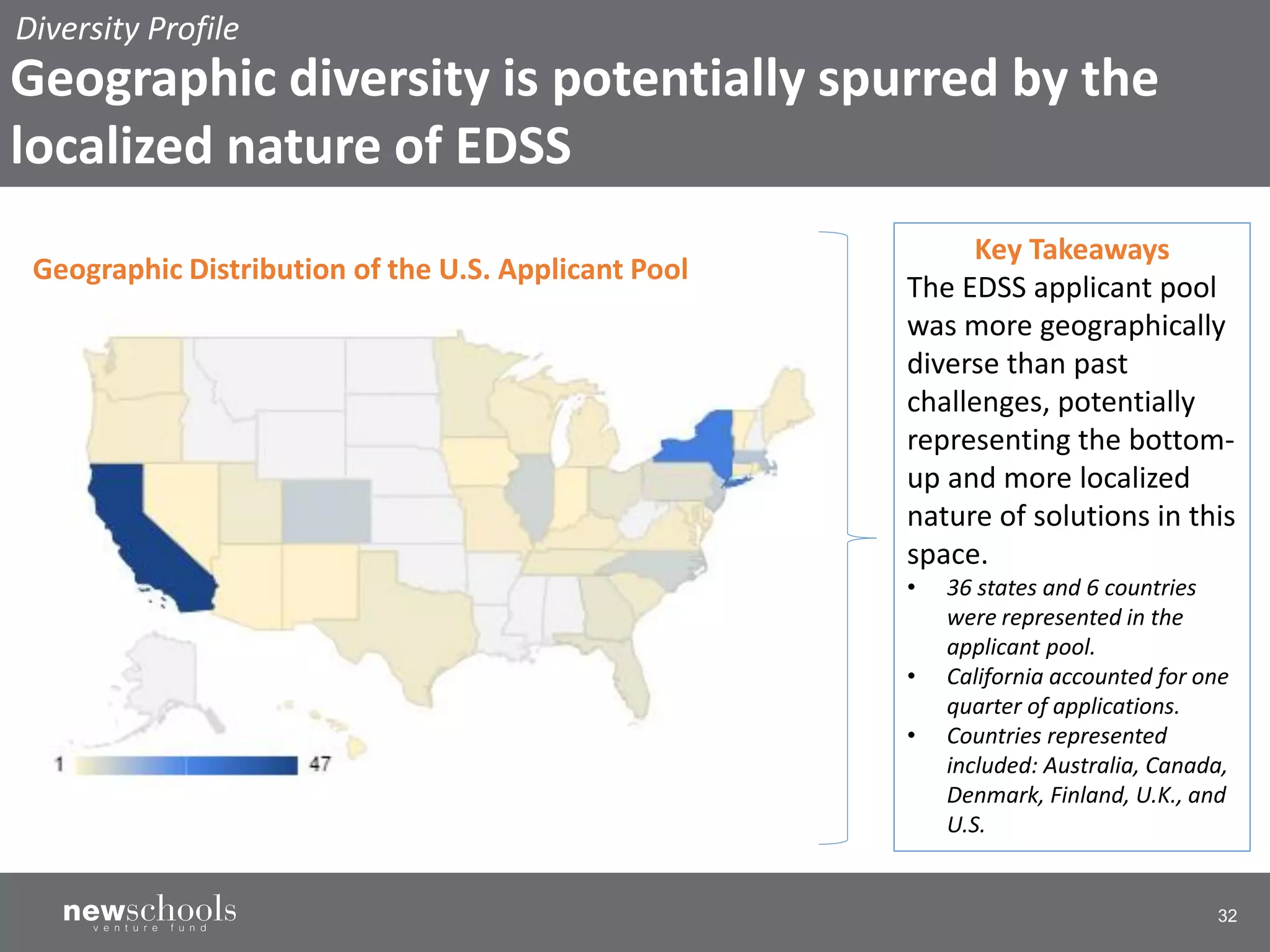
Key Takeaways
The EDSS applicant pool
was more geographically
diverse than past
challenges, potentially
representing the bottom-
up and more localized
nature of solutions in this
space.
• 36 states and 6 countries
were represented in the
applicant pool.
• California accounted for one
quarter of applications.
• Countries represented
included: Australia, Canada,
Denmark, Finland, U.K., and
U.S.
Geographic Distribution of the U.S. Applicant Pool
Diversity Profile
Geographic diversity is potentially spurred by the
localized nature of EDSS
Thank You
34
• The EDSS Ed Tech Challenge Website
• The EDSS Ed Tech Challenge Announcement
• The EDSS Ed Tech Challenge Winner Announcement
• Insight Brief: Embracing and Measuring an Expanded Definition of Student Success
• Insight Brief: Using Expanded Measures of Student Success for School Improvement
• Insight Brief: What We’re Learning From Our Investments in Ed Tech
• Is My Ed Tech Tool Making a Difference? An Entrepreneur’s Guide to Using Research to
Improve Products and Measure Impact.
• The NewSchools-Gallup Survey on Education Technology Use in Schools
• Making Meaning of The NewSchools-Gallup Survey of Educator & Student Perceptions of
Ed Tech
Additional Resources

Expanded Definition of Student Success Market Map

  • 1.
    Expanded Definition ofStudent Success Ed Tech Challenge Reflections on the Applicant Pool Justin Wedell January 2020
  • 2.
    2 1. Introduction 2. ApplicantPool Themes 3. Focus Areas 4. Venture Profile 5. Research Profile 6. Diversity Profile 7. Additional Resources Table of Contents
  • 3.
  • 4.
    4 What this is In2019, NewSchools Venture Fund launched the Expanded Definition of Student Success (EDSS) Ed Tech Challenge, open to entrepreneurs developing technology-enabled solutions to enhance academic and social-emotional learning while supporting the development of nurturing school and classroom environments. A record 192 applicants applied. This deck analyzes the applicant pool and offers a unique perspective on the approaches, challenges and opportunities of the current landscape of ed tech solutions supporting an expanded definition of student success. What this is not This analysis focuses specifically on ed tech’s intersection with the EDSS space and is not intended to be a comprehensive overview of the EDSS landscape. We also acknowledge the limitations of this analysis. Data was self-reported by challenge applicants. The definitions and coding of ventures were aligned to NewSchools’ definition of EDSS work. Despite imperfect conditions, we believe the conclusions drawn from this analysis can be informative for educators, entrepreneurs, and funders seeking to better understand and impact this space. About this analysis Introduction
  • 5.
    5 NewSchools Venture Fundis a nonprofit venture philanthropy that invests in promising teams of educators and innovators with the vision and skills to reimagine learning. We help them accomplish their missions to achieve outstanding results for the students, educators and schools they serve. We are committed to helping students finish high school prepared and inspired to achieve their most ambitious dreams and plans. Through our investing, management assistance, network building and thought leadership, NewSchools helps to reimagine PreK-12 education. Introduction About NewSchools Venture Fund
  • 6.
    6 INNOVATIVE PUBLIC SCHOOLS Investnationally in innovative public schools by supporting the launch of new schools & redesign of existing ones ED TECH Increase the availability & effectiveness of ed tech products that deepen and enrich student learning DIVERSE LEADERS Fund organizations that diversify education leadership to bring more innovative, effective, sustainable solutions to the field OUR CROSS-CUTTING ACTIVITIES Build pipelines of promising, diverse entrepreneurs. Fund teams with the highest potential for success. Provide management assistance to entrepreneurs. Create and support active communities of practice among them. Share our learning broadly through thought leadership. Introduction NewSchools' Investment Areas
  • 7.
    7 We are focusedon education technology that increases the availability and effectiveness of products that deepen and enrich student learning. Our goal is to catalyze product growth in areas that educators and students identify as important, but where innovation is lagging. To achieve our goal, we: Mobilize entrepreneurs through Ignite Challenges, providing funding, management assistance, research partnership, and collective learning opportunities Share our lessons with the broader education community to support more comprehensive and wide-scale impact Identify market gaps in which education technology is not meeting the critical needs of educators and students Introduction Our approach to education technology
  • 8.
    8 In February 2019,NewSchools’ Ed Tech team launched its seventh ed tech challenge, the Expanded Definition of Student Success Challenge – open to entrepreneurs developing technology-enabled learning experiences, instructional content, learning diagnostics, administrative tools, and other products that promote an expanded definition of student success by enhancing academic and social- emotional learning and supporting the development of nurturing school and classroom environments. We conducted market research – with students, educators, and researchers from across the country – to learn more about how technology might support an expanded definition of student success. Research suggests the most promising ed tech innovations will support the development of a range of social- emotional competencies, cognitive skills, and attributes of positive learning environments. We expect challenge winners will address one or more critical area of student need: • Promoting school readiness and skills that enable successful school transitions; • Integrating social-emotional development into core academic learning; • Enabling new ways to measure and analyze an expanded set of student outcomes; and • Building teachers’, parents’, and communities’ capacity to support an expanded definition of student success. Introduction About the Expanded Definition of Student Success Ed Tech Challenge
  • 9.
    9 192 11 applications venturesselected for funding $1.5M $500K in non-dilutive funding issued in additional funds ear-marked for research Introduction The numbers behind the Expanded Definition of Student Success Ed Tech Challenge
  • 10.
  • 11.
    11 “Yes, And” Products Most productswere positioned as having applicability to multiple subject areas and school settings. This ability for products to be malleable in focus and implementation could be viewed as a necessity of the loosely-defined EDSS space, but it also creates a barrier to determining true product-market fit as well as building out a sustainable customer success practice. Tech Second Most ventures had strong EDSS practitioners at the executive level, many of whom were seeking to transition in-person service delivery to technology-enabled scale. This correlated with weaker expertise in technical and sales/marketing functions, often resulting in less proprietary technology and the incorporation of off-the-shelf software to support distribution and scaling of content. Nonprofit Strength There was an increase in the proportion of nonprofits in the applicant pool (31%) and the final cohort (45%) relative to past challenges (average of 20%). Nonprofit providers tended to have been involved in the space longer (average age of 12 years vs. 5 years for for-profit ventures). Siloed Programs & Assessments Ventures were vocal in their desire for partnerships. Assessment providers demonstrated appetite for partnership with curricula/intervention program providers and vice-versa. Both parties saw in each other opportunity to validate their offerings and enhance retention. Applicant Pool Themes A diverse and do-it-all approach in an environment with little consensus
  • 12.
    12 Standalone Academic-Integration Assessment Theprimary focus is to support EDSS. These solutions are typically implemented as standalone or as supplemental to core academic instruction. The primary focus is to support core academic instruction. These solutions typically position EDSS outcomes as an additional benefit of their offering. The primary focus is to assess EDSS indicators in schools and/or individuals. These solutions are typically implemented biannually and are often accompanied by additional support services. Move This World is a curriculum and lesson plan platform featuring SEL-aligned, movement-based videos that enable PreK-12 teachers and students to engage with SEL topics as part of their daily classroom routine. Amira Learning offers an AI-driven reading program. Its personalized support is designed to help children develop mindsets, habits, and skills that support reading mastery and that are linked to long-term success (e.g., sense of purpose, belonging, and growth mindset). ACT’s Tessera is a comprehensive social and emotional skills formative assessment tool. Tessera’s student assessments yield personalized reports which provide next steps for skill development. Applicant Pool Themes Examples of the three primary product segments that emerged
  • 13.
  • 14.
    14 Ventures were codedby NSVF as having a Main Focus and, when applicable, a Complementary Focus • Social-Emotional Learning (SEL) • College & Career Readiness (CCR) • Culture & Climate (C/C) • Multiple Subjects (MULT) • Science, Technology, Engineering, & Math (STEM) • English Language Arts & Reading (ELAR) • School-to-Home Connection (S2HC) • Teacher PD (TPD) • Teacher Tools (TT) • Civics/Social Studies (CSS) • School Operations (SO) • Visual & Performing Arts (VPA) Focus Areas How the applicants were categorized
  • 15.
    15 1% 2% 4% 4% 5% 5% 6% 8% 9% 11% 15% 30% SO VPA TT CSS S2HC TPD C/C MULT ELAR STEM CCR SEL Main Focus Key Takeaways SELwas the dominant focus area, appearing as a main or complementary focus area for 50% of ventures, followed by CCR (20%) and C/C (17%) 0% 1% 1% 2% 3% 3% 3% 4% 5% 8% 11% 20% 40% VPA STEM CSS ELAR TPD TT SO S2HC CCR MULT C/C SEL NONE Complementary Focus Legend • Social-Emotional Learning (SEL) • College & Career Readiness (CCR) • Culture & Climate (C/C) • Multiple Subjects (MULT) • Science, Technology, Engineering, & Math (STEM) • English Language Arts & Reading (ELAR) • School-to-Home Connection (S2HC) • Teacher PD (TPD) • Teacher Tools (TT) • Civics/Social Studies (CSS) • School Operations (SO) • Visual & Performing Arts (VPA) Focus Areas While many solutions serve multiple focus areas, a significant proportion are standalone
  • 16.
    16 Social Emotional Learning-Focused Solutions College& Career Readiness-Focused Solutions Culture & Climate-Focused Solutions 26% are standalone 41% are standalone 12% are standalone Key Takeaway While many SEL solutions are offered as standalone, a third are paired with core academic offerings Key Takeaway CCR solutions’ prominent pairing with SEL reflects the trend of employer demand for soft skills Key Takeaway C/C solutions are rarely offered as standalone offerings; the majority include SEL support 0% 0% 0% 3% 3% 3% 6% 6% 6% 6% 55% ELAR TT VPA CCR MULT CSS STEM S2HC TPD SO SEL Pairings 0% 0% 0% 0% 3% 3% 3% 5% 5% 15% 26% TPD TT CSS VPA C/C ELAR SO MULT S2HC STEM SEL Pairings 0% 1% 1% 3% 4% 6% 6% 9% 10% 14% 19% SO TT VPA CSS S2HC STEM TPD MULT CCR ELAR C/C Pairings Focus Areas Dependencies across focus areas vary
  • 17.
    17 Shared mindsets, habitsand skills (Social-emotional competencies) • Growth mindset • Intellectual curiosity • Perseverance • Self-awareness • Self-efficacy • Self-regulation • Social awareness Attributes of a positive learning environment (School culture/climate factors) • Cultural and linguistic competence • Learning strategies • Rigorous expectations • School safety • Sense of belonging • Student engagement • Teacher-student relationships NSVF partnered with Transforming Education to select a set of indicators our portfolio of innovative public schools could collectively focus on, so that they and we could develop a deeper understanding of how to effectively help students develop along a broader set of academic and social-emotional competencies. We used the “Three M” framework to identify indicators that are Meaningful, Measurable, and Malleable. In their application the EDSS Ed Tech Challenge, ventures could select all that applied to their work. Focus Areas Mapping ventures to the EDSS indicators that NSVF tracks within its portfolio of schools
  • 18.
    18 Key Takeaway • Themajority of ventures were aligned with each of NewSchools' seven social-emotional competencies, a potential reflection of the holistic (and “Yes, And”) approach that many take to supporting an expanded definition of student success. 76% 78% 83% 85% 88% 88% 89% Self-regulation Curiosity Self-efficacy Perseverence Growth mindset Social awareness/social competence Self-awareness % of Ventures Aligned to Shared Mindsets, Habits, & Skills Focus Areas Most ventures align themselves to multiple attributes within the NSVF EDSS framework
  • 19.
    19 Key Takeaway • Throughtwo years of study with our Innovative Public Schools portfolio, NewSchools found perception of “school safety" to be one of the attributes most strongly associated with academic performance. Should we be encouraging more ventures to address “school safety?” In further exploration of this question, it will be important to clarify for respondents what falls under the school safety umbrella and to define whether a venture is engaging in it directly vs. indirectly. 32% 51% 52% 69% 78% 80% 93% School safety Rigorous expectations Cultural and linguistic competence Learning strategies Sense of belonging Teacher-student relationships Engagement % of Ventures Aligned to Attributes of a Positive Learning Environment Focus Areas “School safety” was not an explicit focus for most ventures
  • 20.
  • 21.
    21 7 years The averageage of a venture 2 years The average age of a venture’s EDSS product Key Takeaway Most EDSS products were new products from established ventures, a potential indicator of the increasing popularity of the space and opportunity for sales. Venture Profile Most ventures are established organizations seeking to enter the EDSS space
  • 22.
    22 Target Users TargetGrade Levels Target Settings Key Takeaway Many solutions are designed to also engage parents, a potential signifier of the more personal nature of these products Key Takeaway Most solutions serve at least two grade bands, with MS as the most common given its frequent packaging with Elementary- or HS-focused products Key Takeaway At present, most solutions are flexible in how and where they can be implemented within the school day – only 5% of solutions were designated for one setting 2% 13% 15% 36% 80% 80% Only Parents Only Teachers Only Students Parents Students Teachers Primary Users Served 21% 11% 3% 15% 60% 69% 67% 26% All K12 Only HS Only MS Only Elem. HS MS Elem. PK Grade Bands Served 27% 45% 71% 74% 87% 89% All Settings Health Advisory 1:1 Guidance OST Core Academics Implementation Settings Venture Profile Most ventures set out to serve multiple users, grade levels, and settings
  • 23.
    23 Funding Revenue UsersOrganization Size 57% raised <$500K 58% make <$10K monthly >Half serve <1K students 81% have <10 employees Key Takeaway The majority of ventures are pre- Seed and early in product development. Median funding raised is $328,500 and median runway is 7 months. Key Takeaway Most ventures have not yet identified or validated a sustainable revenue model and are struggling to convert whole school sales. Median monthly revenue is $5,850. Key Takeaway Most ventures’ difficulties to convert whole school sales has resulted in lesser reach in terms of student users. Median student user count is 515 students. Key Takeaway Most ventures are struggling to bring on >1 employee, often due to financing issues related to their inability to scale. 1% 3% 15% 4% 11% 66% 1M+ 100K-1M 10K-100K 5K-10K 1K-5K 0-1K EDSS Product Student Users 4% 8% 30% 18% 40% $500K+ $100K-500K $10K-100K $1K-10K $0-1K Monthly Revenue 7% 30% 6% 21% 16% 2% 18% $10M+ $1M-10M $500K-1M $100K-500K $10K-100K $1K-10K $0-1K Total Capital Raised 5% 1% 13% 24% 57% 101+ 51-100 11-50 3-10 0-2 Organization Size Venture Profile For most ventures, scale is elusive
  • 24.
    24 Venture Profile EDSS venturesraise more capital and face significant growth challenges than other NewSchools' ventures 66% 50% EDSS Applicant Pool NSVF Applicant Pool Average <1000 student users Fewer Users $92,000 $119,000 EDSS Applicant Pool NSVF Applicant Pool Average Average monthly revenue Less Revenue 57% 37% EDSS Applicant Pool NSVF Applicant Pool Average 0-2 full-time employees Fewer FTEs $6,000,000 $4,600,000 EDSS Applicant Pool NSVF Applicant Pool Average Average total capital raised More Capital
  • 25.
    25 26% 31% 43% 48% 94% Direct-to-Students Direct-to-Parents OST Direct-to-Teachers Schools/Institutions Venture GTM Strategies 20% 24% 25% 76% Freemium Free One-TimePayment Subscription Venture Pricing Models Key Takeaways • Most ventures are leveraging institutional, subscription-based sales models – an indicator of the schoolwide nature of many solutions in the EDSS space. • In line with broader trends, Freemium is no longer considered a viable revenue model. Indeed, only 26% of Subscription-based models rely upon Free or Freemium entry points. • Of note: zero ventures exclusively targeted OST. Venture Profile Dominant business strategies reflect the broader transition away from Freemium
  • 26.
    26 Venture Profile EDSS venturesare more reliant upon institutional and paid sales strategies than past applicants 20% 24% 25% 76% 29% 50% 31% 70% Freemium Free One-Time Payment Subscription Venture Pricing Models NSVF Applicant Pool Average EDSS Applicant Pool 26% 31% 43% 48% 94% 40% 50% 47% 62% 93% Direct-to-Students Direct-to-Parents OST Direct-to-Teachers Schools/Institutions Venture GTM Strategies NSVF Applicant Pool Average EDSS Applicant Pool Key Takeaways • EDSS ventures were less likely to directly target teachers, parents, and students than previous applicants to NSVF’s Ed Tech Challenges. The schoolwide nature of many of these solutions is one possible explanation for this difference. • NSVF began facilitating Ed Tech Challenges in 2015. The stark drop in the offering of “free” products when comparing EDSS ventures against the total NSVF applicant pool average is a good reflection of the market’s transition over the past five years.
  • 27.
  • 28.
    28 44% 29% 16% ofventures completed a Logic Model of ventures completed a Usability Study of ventures completed a Feasibility Study The Most Popular Research Frameworks? • 26% of ventures cited CASEL • 2% of ventures cited Character Lab • 1% of ventures cited Young Adult Success Research Profile Most ventures have limited foundational research
  • 29.
    29 21% 79% Yes No % VenturesThat Have Engaged an External Researcher Top 3 External Study Types • Pre/Post (39%) • 38% funded by philanthropic grants • 25% funded by universities • 19% self-funded • Quasi-Experimental (29%) • 50% self-funded • 17% funded by philanthropic grants • 17% funded by universities • Random Assignment (10%) • 75% funded by philanthropic grants • 25% funded by universities *To Note: Putting the cart before the horse? 71% of ventures that engaged an external researcher had not yet completed a feasibility study. Research Profile External research is limited and almost always funded by philanthropy or academia
  • 30.
  • 31.
    31 22% 25% 59% ofventures had at least one African American and/or Hispanic/Latino founder was the average proportion of African American and/or Hispanic/Latino full-time employees in ventures with a full-time staff of ventures had at least one female founder For Reference: Only 1% of VC-backed early-stage tech companies have African American founders. Data for Hispanic/Latino founders is not available. For Reference: African Americans make up only 7.9% of the tech workforce, while Hispanics/Latinos make up only 6.8%. For Reference: A 2017 study found that only 17% of startups have a female founder. Diversity Profile Employee demographic diversity is better than industry averages *Employee demographic diversity within EDSS ventures was similar to that of past Ed Tech Challenge applicants. NSVF seeks teams that embrace a commitment to diversity, equity, and inclusion (DEI) by developing comprehensive strategies to prioritize DEI in their organizations. This intention’s effect upon NSVF’s pipeline- building efforts may contribute to a more diverse applicant pool than industry averages.
  • 32.
    32 Key Takeaways The EDSSapplicant pool was more geographically diverse than past challenges, potentially representing the bottom- up and more localized nature of solutions in this space. • 36 states and 6 countries were represented in the applicant pool. • California accounted for one quarter of applications. • Countries represented included: Australia, Canada, Denmark, Finland, U.K., and U.S. Geographic Distribution of the U.S. Applicant Pool Diversity Profile Geographic diversity is potentially spurred by the localized nature of EDSS
  • 33.
  • 34.
    34 • The EDSSEd Tech Challenge Website • The EDSS Ed Tech Challenge Announcement • The EDSS Ed Tech Challenge Winner Announcement • Insight Brief: Embracing and Measuring an Expanded Definition of Student Success • Insight Brief: Using Expanded Measures of Student Success for School Improvement • Insight Brief: What We’re Learning From Our Investments in Ed Tech • Is My Ed Tech Tool Making a Difference? An Entrepreneur’s Guide to Using Research to Improve Products and Measure Impact. • The NewSchools-Gallup Survey on Education Technology Use in Schools • Making Meaning of The NewSchools-Gallup Survey of Educator & Student Perceptions of Ed Tech Additional Resources