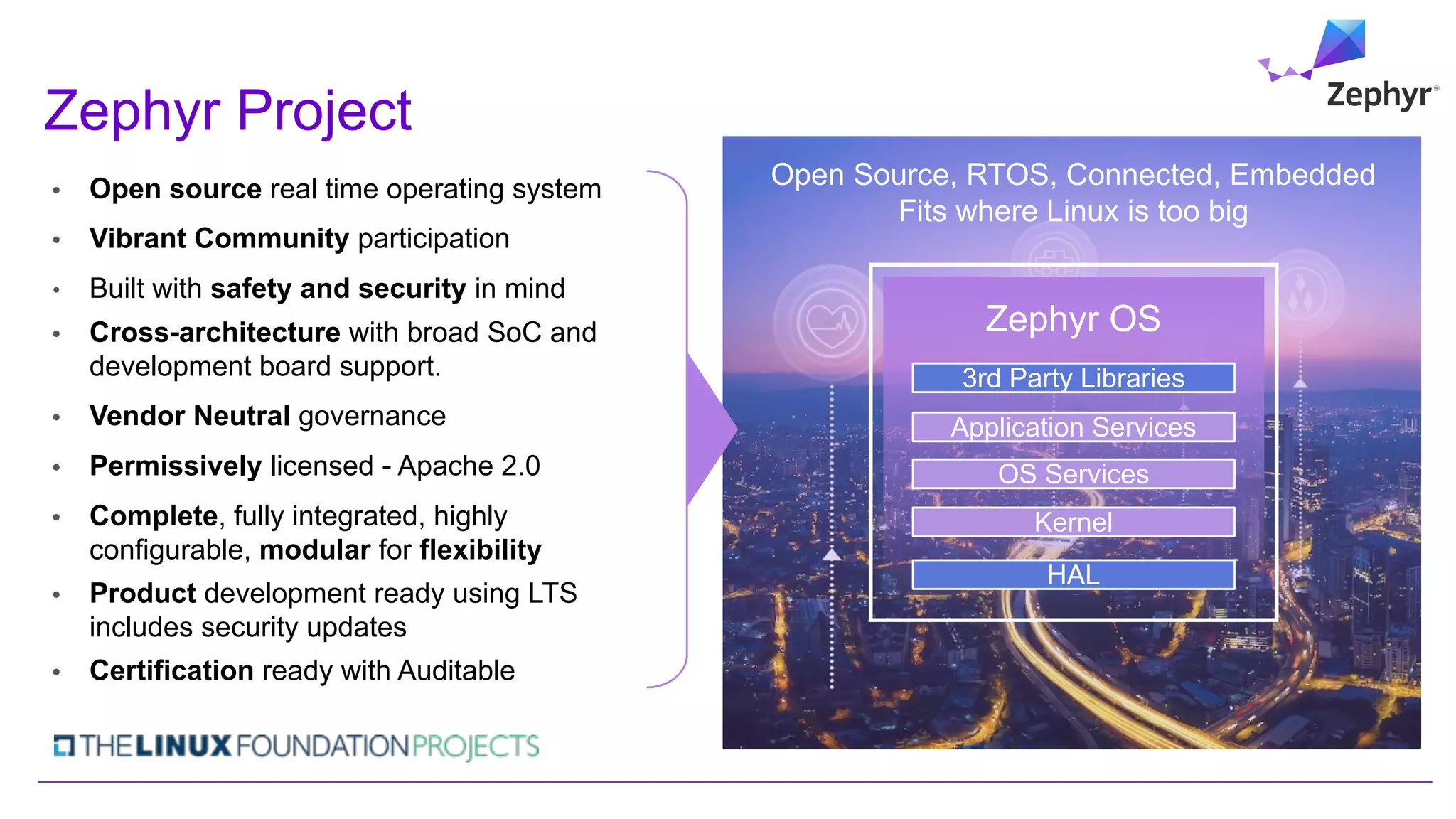
• Open source real time operating system
• Vibrant Community participation
• Built with safety and security in mind
• Cross-architecture with broad SoC and
development board support.
• Vendor Neutral governance
• Permissively licensed - Apache 2.0
• Complete, fully integrated, highly
configurable, modular for flexibility
• Product development ready using LTS
includes security updates
• Certification ready with Auditable
Zephyr Project
Open Source, RTOS, Connected, Embedded
Fits where Linux is too big
Kernel
OS Services
Application Services
HAL
3rd Party Libraries
Zephyr OS
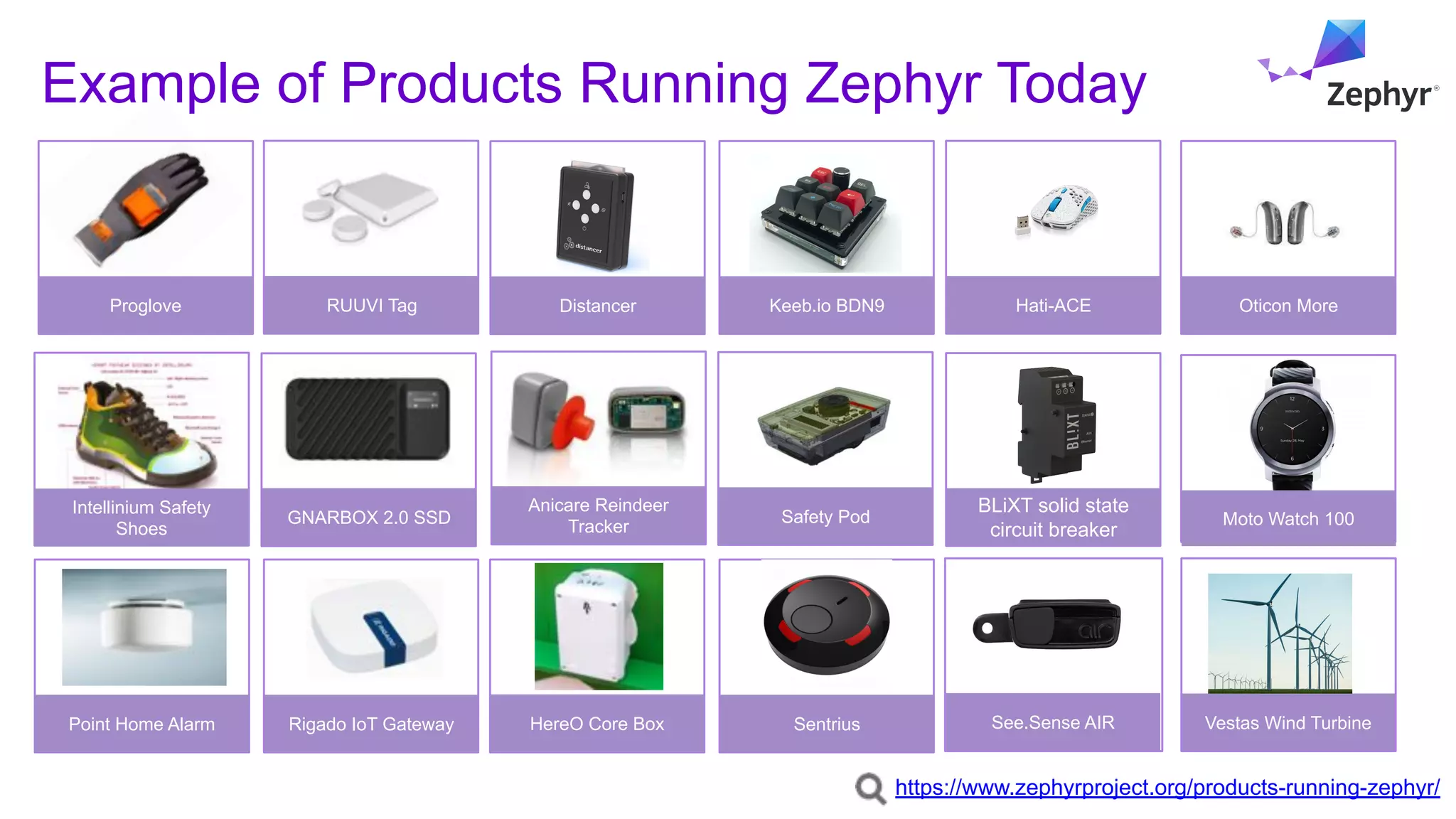
Example of Products Running Zephyr Today
Proglove
Rigado IoT Gateway
Intellinium Safety
Shoes
Anicare Reindeer
Tracker
GNARBOX 2.0 SSD
Keeb.io BDN9
Sentrius
BLiXT solid state
circuit breaker
HereO Core Box
RUUVI Tag
Point Home Alarm
Safety Pod
Oticon More
See.Sense AIR
Hati-ACE
Vestas Wind Turbine
Moto Watch 100
Distancer
https://www.zephyrproject.org/products-running-zephyr/
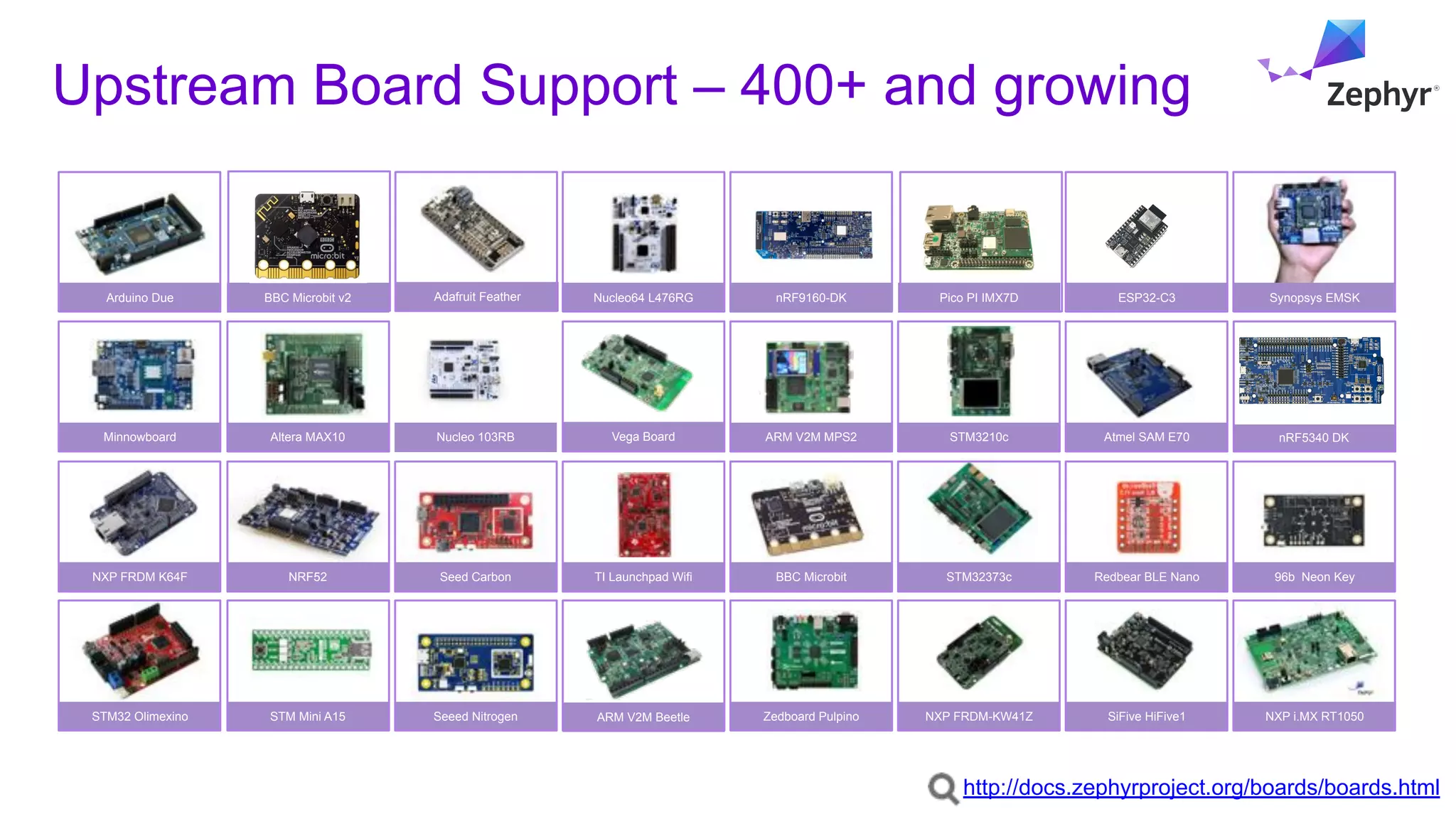
Upstream Board Support – 400+ and growing
http://docs.zephyrproject.org/boards/boards.html
NXP FRDM K64F
Arduino Due
Minnowboard
STM Mini A15
BBC Microbit v2
STM32 Olimexino
Synopsys EMSK
Altera MAX10
NRF52 Seed Carbon
Seeed Nitrogen
Nucleo64 L476RG
TI Launchpad Wifi
ARM V2M Beetle
nRF9160-DK
ARM V2M MPS2
NXP FRDM-KW41Z
BBC Microbit Redbear BLE Nano
Zedboard Pulpino
ESP32-C3
STM3210c
STM32373c
Pico PI IMX7D
Atmel SAM E70
NXP i.MX RT1050
SiFive HiFive1
96b Neon Key
Adafruit Feather
Vega Board nRF5340 DK
Nucleo 103RB
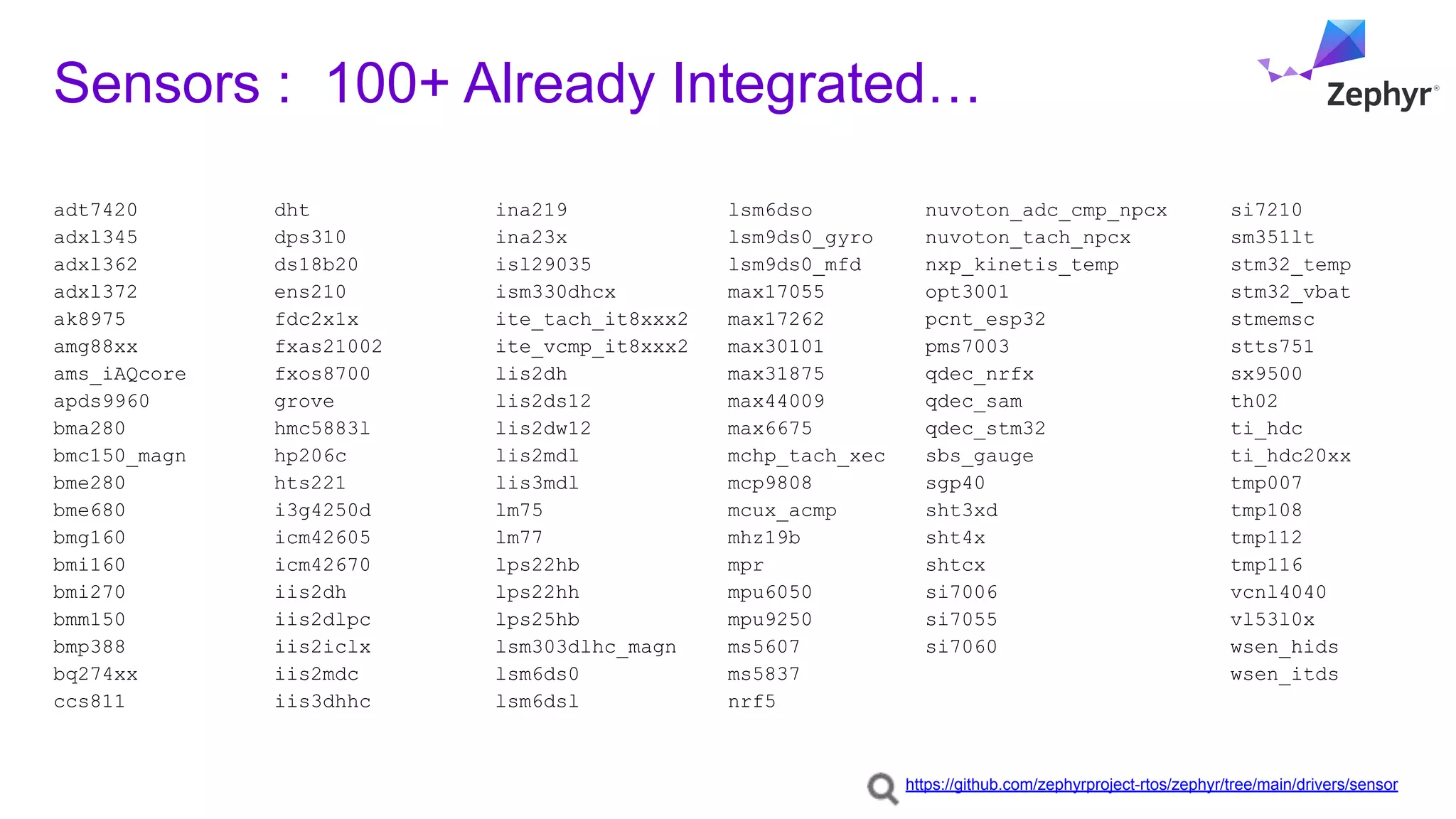
Sensors : 100+ Already Integrated…
adt7420
adxl345
adxl362
adxl372
ak8975
amg88xx
ams_iAQcore
apds9960
bma280
bmc150_magn
bme280
bme680
bmg160
bmi160
bmi270
bmm150
bmp388
bq274xx
ccs811
dht
dps310
ds18b20
ens210
fdc2x1x
fxas21002
fxos8700
grove
hmc5883l
hp206c
hts221
i3g4250d
icm42605
icm42670
iis2dh
iis2dlpc
iis2iclx
iis2mdc
iis3dhhc
ina219
ina23x
isl29035
ism330dhcx
ite_tach_it8xxx2
ite_vcmp_it8xxx2
lis2dh
lis2ds12
lis2dw12
lis2mdl
lis3mdl
lm75
lm77
lps22hb
lps22hh
lps25hb
lsm303dlhc_magn
lsm6ds0
lsm6dsl
lsm6dso
lsm9ds0_gyro
lsm9ds0_mfd
max17055
max17262
max30101
max31875
max44009
max6675
mchp_tach_xec
mcp9808
mcux_acmp
mhz19b
mpr
mpu6050
mpu9250
ms5607
ms5837
nrf5
nuvoton_adc_cmp_npcx
nuvoton_tach_npcx
nxp_kinetis_temp
opt3001
pcnt_esp32
pms7003
qdec_nrfx
qdec_sam
qdec_stm32
sbs_gauge
sgp40
sht3xd
sht4x
shtcx
si7006
si7055
si7060
si7210
sm351lt
stm32_temp
stm32_vbat
stmemsc
stts751
sx9500
th02
ti_hdc
ti_hdc20xx
tmp007
tmp108
tmp112
tmp116
vcnl4040
vl53l0x
wsen_hids
wsen_itds
https://github.com/zephyrproject-rtos/zephyr/tree/main/drivers/sensor
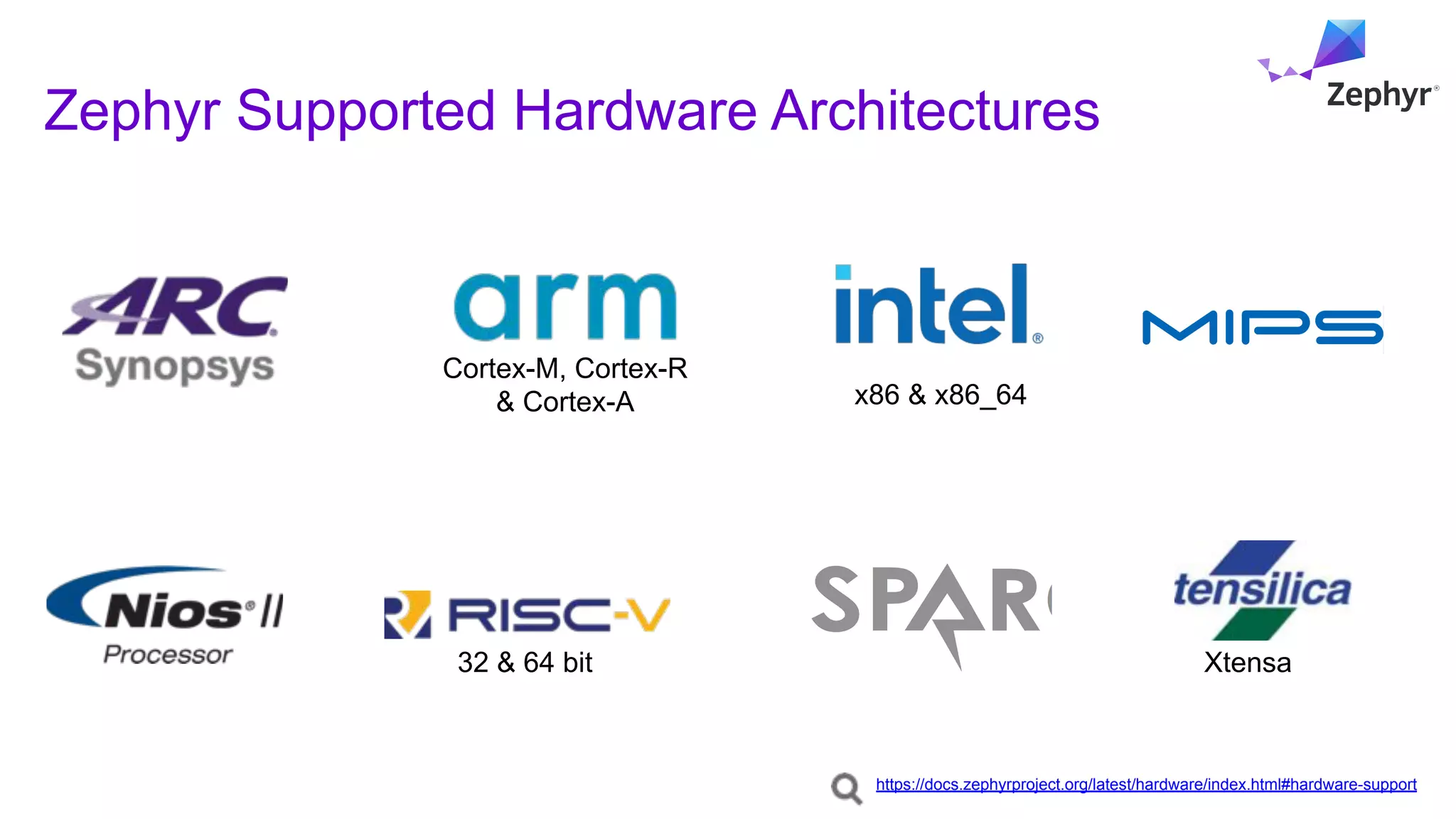
Zephyr Supported Hardware Architectures
Cortex-M, Cortex-R
& Cortex-A
32 & 64 bit
x86 & x86_64
Xtensa
https://docs.zephyrproject.org/latest/hardware/index.html#hardware-support
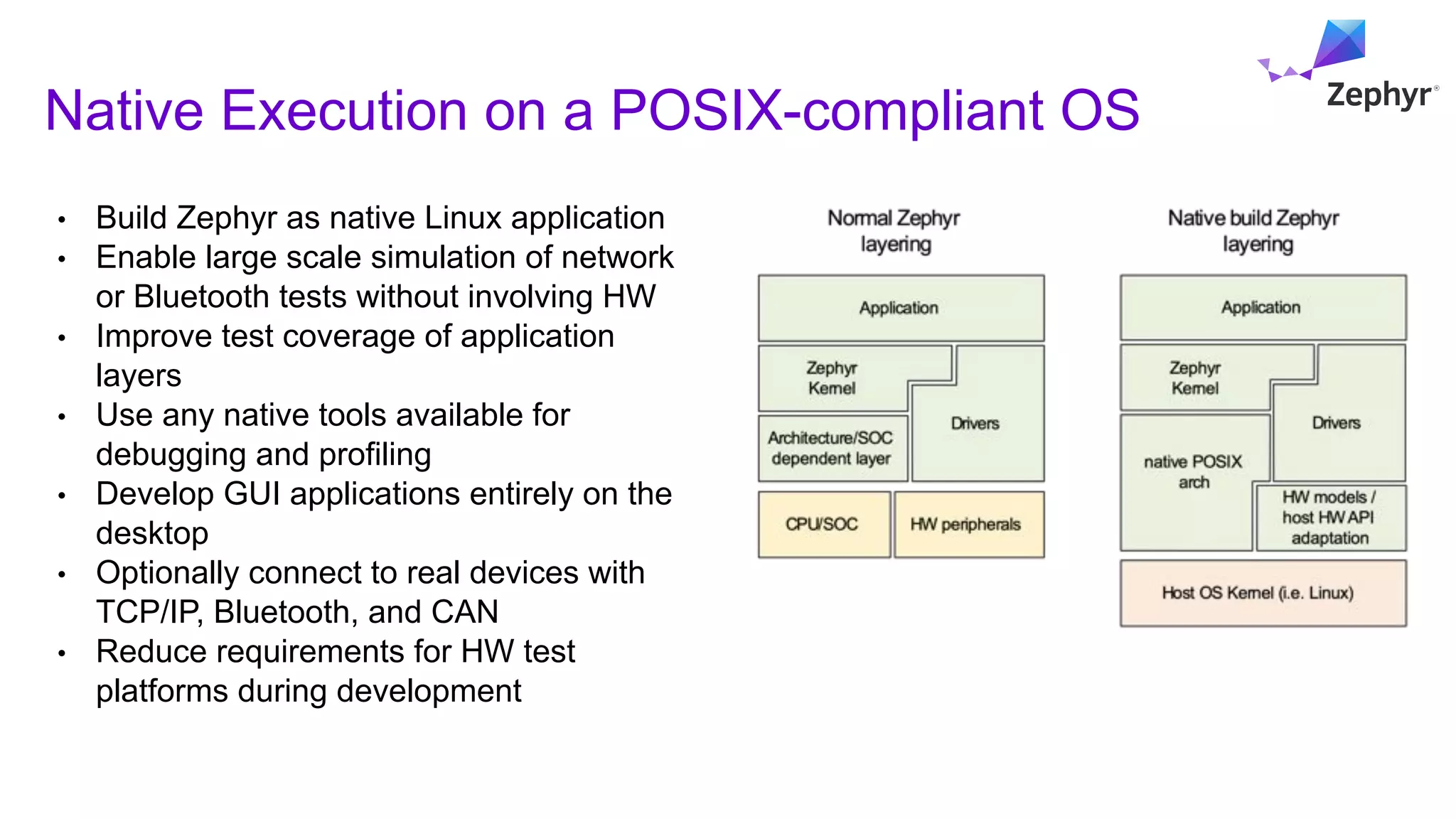
Native Execution on a POSIX-compliant OS
• Build Zephyr as native Linux application
• Enable large scale simulation of network
or Bluetooth tests without involving HW
• Improve test coverage of application
layers
• Use any native tools available for
debugging and profiling
• Develop GUI applications entirely on the
desktop
• Optionally connect to real devices with
TCP/IP, Bluetooth, and CAN
• Reduce requirements for HW test
platforms during development
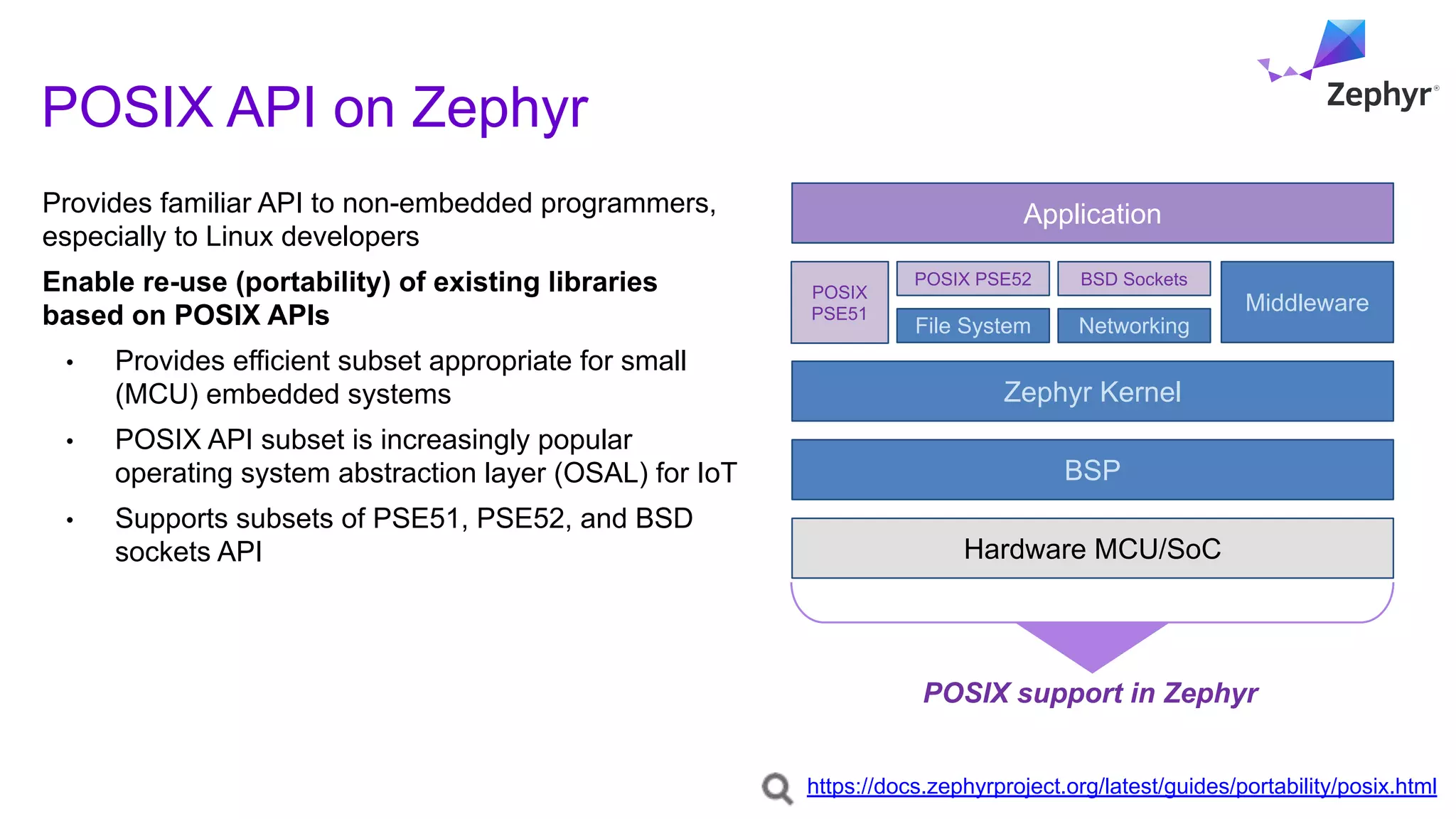
POSIX API on Zephyr
Provides familiar API to non-embedded programmers,
especially to Linux developers
Enable re-use (portability) of existing libraries
based on POSIX APIs
• Provides efficient subset appropriate for small
(MCU) embedded systems
• POSIX API subset is increasingly popular
operating system abstraction layer (OSAL) for IoT
• Supports subsets of PSE51, PSE52, and BSD
sockets API Hardware MCU/SoC
BSP
Zephyr Kernel
Middleware
Networking
Application
File System
BSD Sockets
POSIX PSE52
POSIX
PSE51
POSIX support in Zephyr
https://docs.zephyrproject.org/latest/guides/portability/posix.html
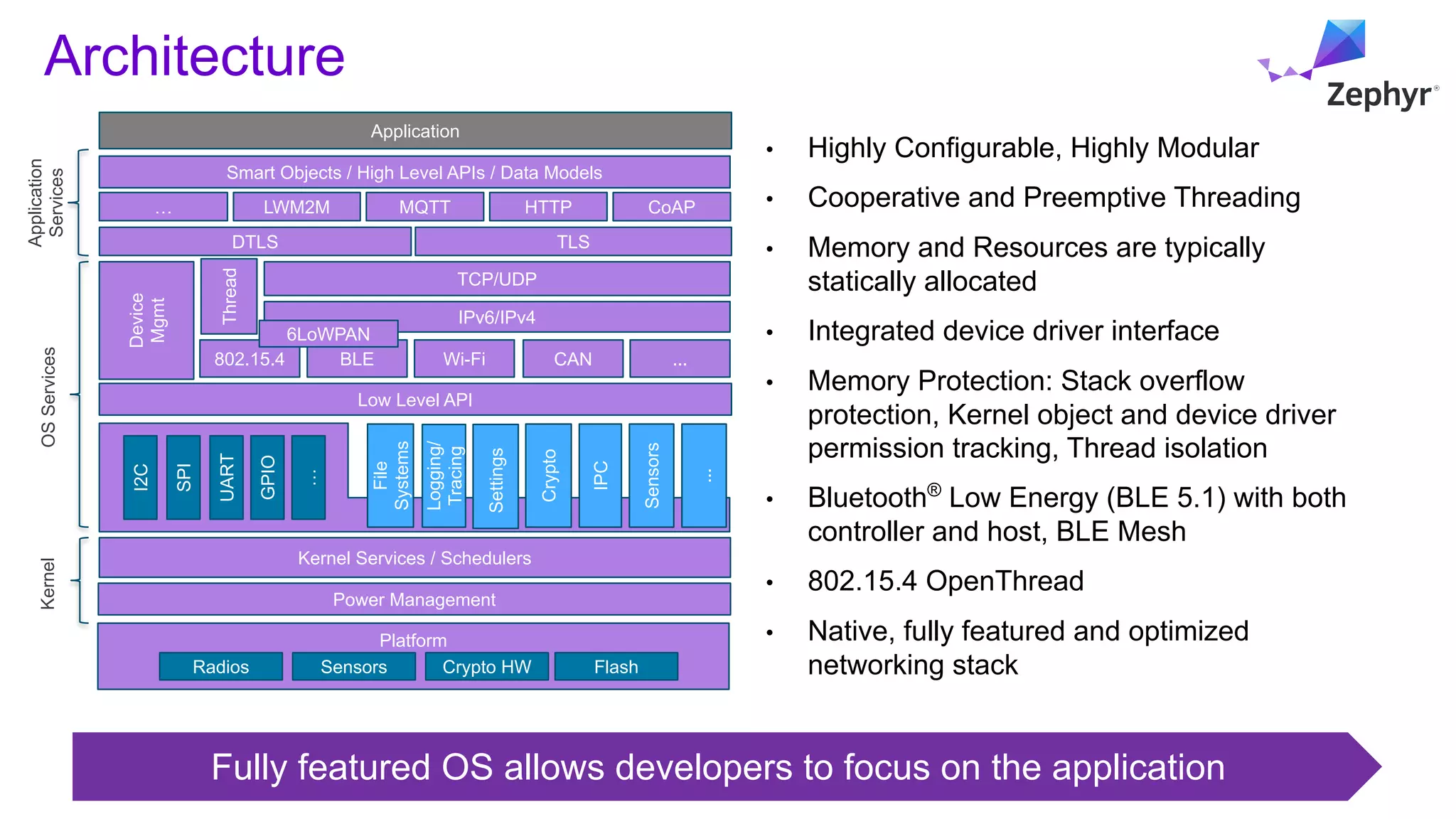
Architecture
• Highly Configurable, Highly Modular
• Cooperative and Preemptive Threading
• Memory and Resources are typically
statically allocated
• Integrated device driver interface
• Memory Protection: Stack overflow
protection, Kernel object and device driver
permission tracking, Thread isolation
• Bluetooth®
Low Energy (BLE 5.1) with both
controller and host, BLE Mesh
• 802.15.4 OpenThread
• Native, fully featured and optimized
networking stack
Platform
Radios
Power Management
Kernel Services / Schedulers
Sensors Crypto HW
I2C
SPI
UART
GPIO
…
File
Systems
Logging/
Tracing
Settings
Crypto
IPC
Flash
Sensors
...
Low Level API
Device
Mgmt
802.15.4
IPv6/IPv4
TCP/UDP
BLE Wi-Fi CAN ...
6LoWPAN
Thread
TLS
DTLS
CoAP
HTTP
MQTT
LWM2M
…
Application
Smart Objects / High Level APIs / Data Models
Kernel
OS
Services
Application
Services
Fully featured OS allows developers to focus on the application
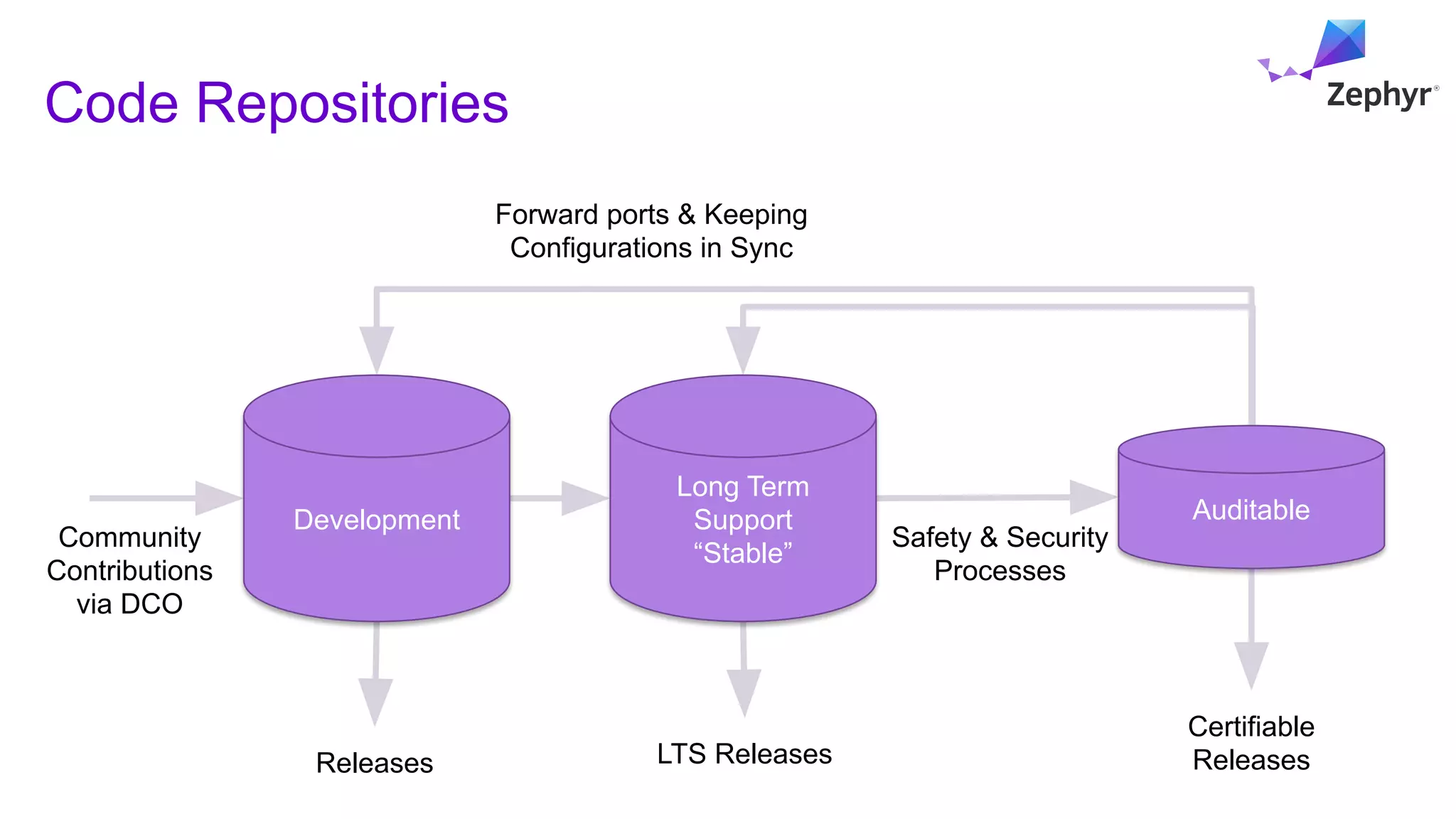
Code Repositories
Community
Contributions
via DCO
Releases LTS Releases
Safety & Security
Processes
Certifiable
Releases
Forward ports & Keeping
Configurations in Sync
Development
Long Term
Support
“Stable”
Auditable
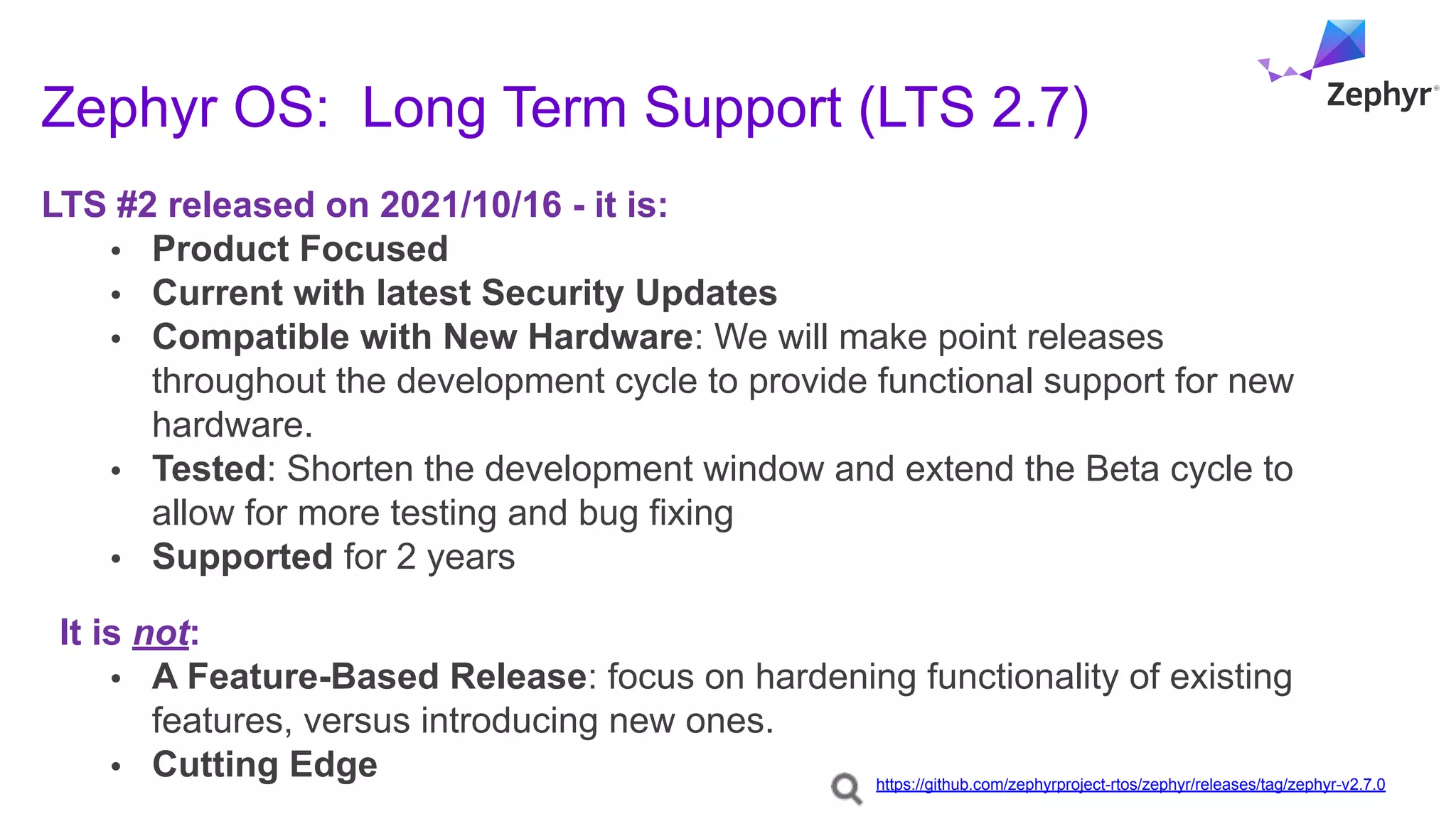
Zephyr OS: Long Term Support (LTS 2.7)
LTS #2 released on 2021/10/16 - it is:
• Product Focused
• Current with latest Security Updates
• Compatible with New Hardware: We will make point releases
throughout the development cycle to provide functional support for new
hardware.
• Tested: Shorten the development window and extend the Beta cycle to
allow for more testing and bug fixing
• Supported for 2 years
It is not:
• A Feature-Based Release: focus on hardening functionality of existing
features, versus introducing new ones.
• Cutting Edge https://github.com/zephyrproject-rtos/zephyr/releases/tag/zephyr-v2.7.0
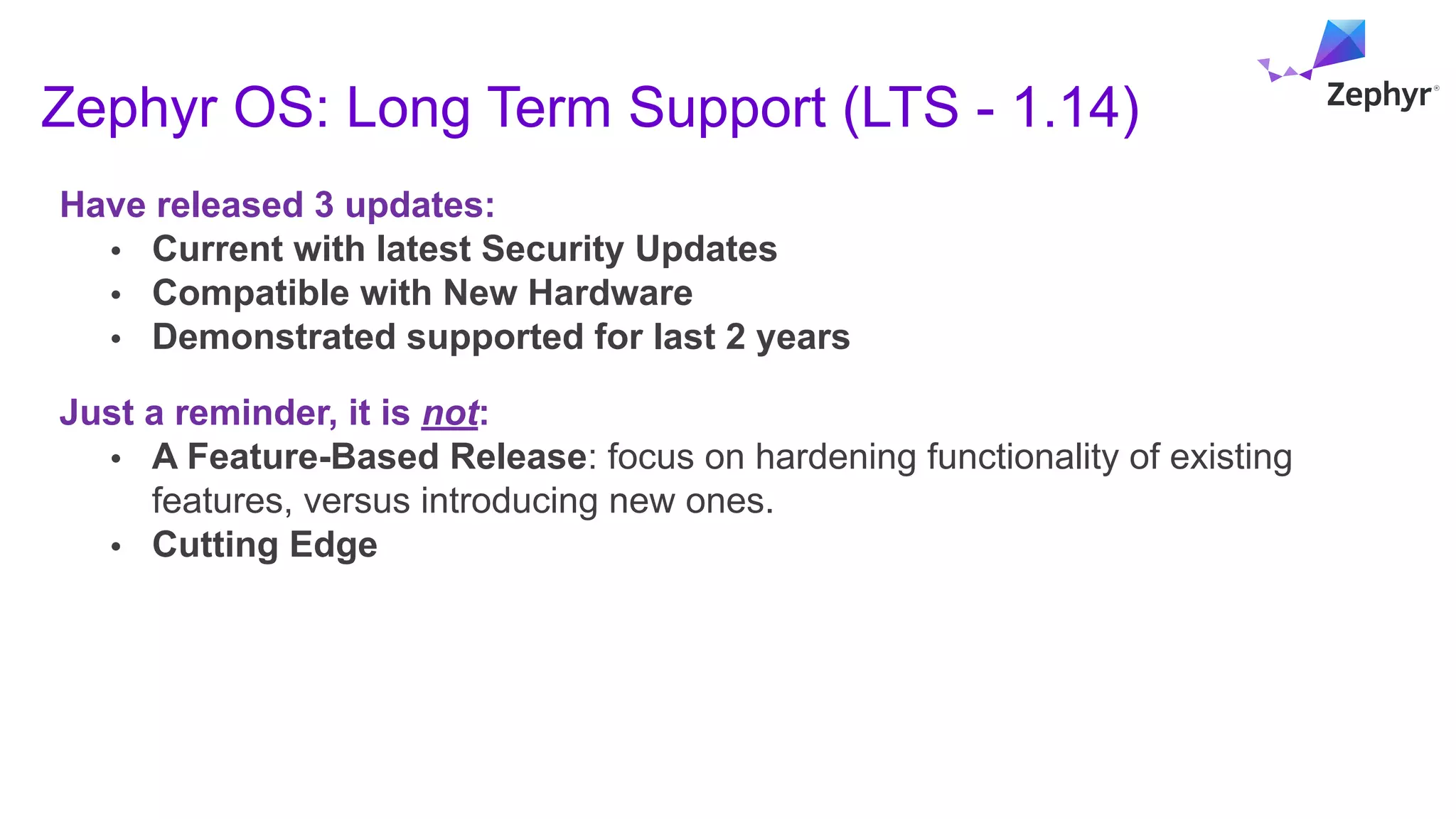
Zephyr OS: Long Term Support (LTS - 1.14)
Have released 3 updates:
• Current with latest Security Updates
• Compatible with New Hardware
• Demonstrated supported for last 2 years
Just a reminder, it is not:
• A Feature-Based Release: focus on hardening functionality of existing
features, versus introducing new ones.
• Cutting Edge
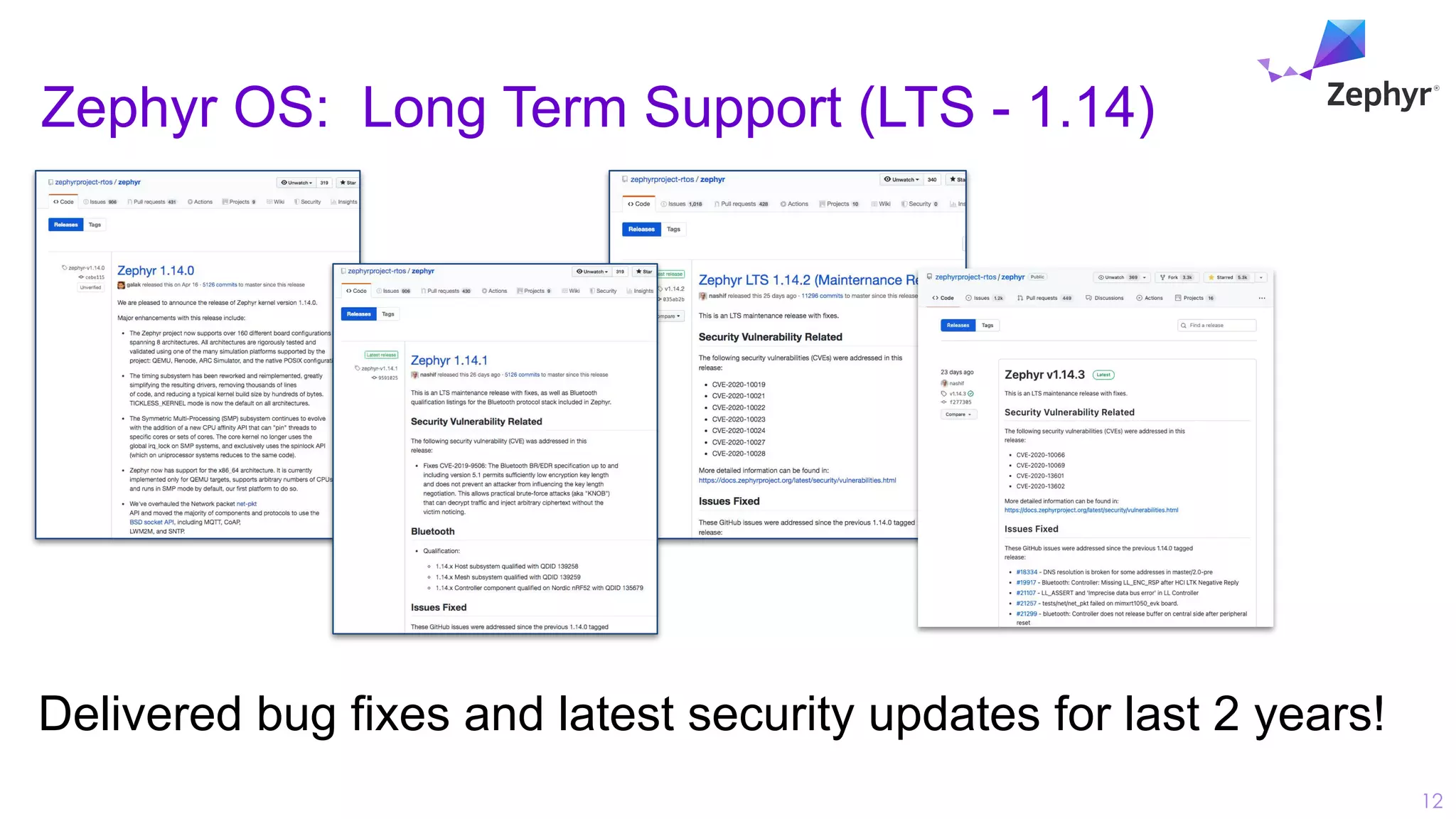
Zephyr OS: Long Term Support (LTS - 1.14)
12
Delivered bug fixes and latest security updates for last 2 years!
Zephyr OS: Auditable
13
An auditable code base will be established from a subset of the Zephyr OS LTS.
• Code bases will be kept in sync.
• More rigorous processes (necessary for certification) will be applied to the auditable code base.
Processes to achieve selected certification to be:
• Determined by Safety Committee and Security Committee
• Coordinated with Technical Steering Committee
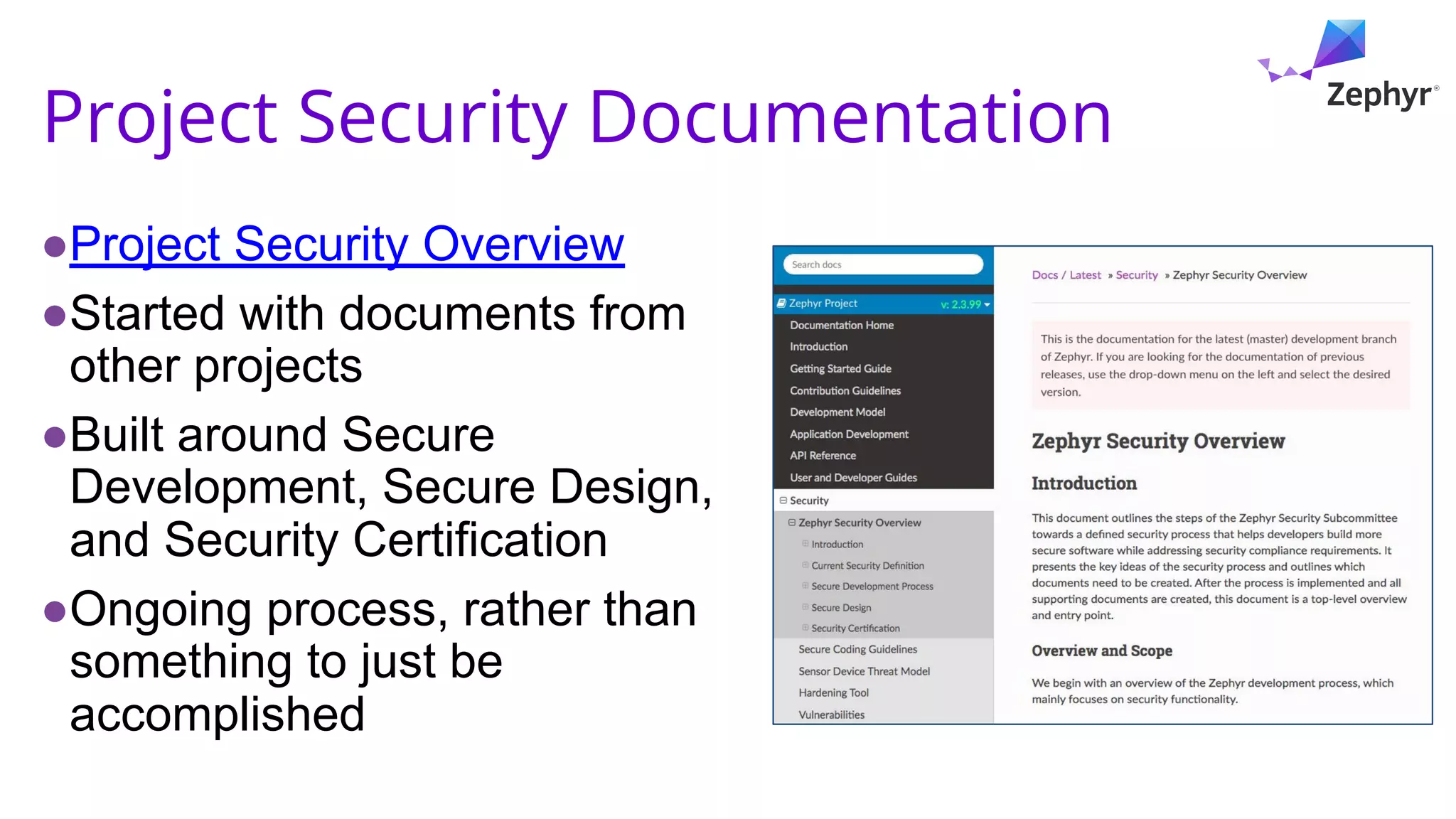
Project Security Documentation
●Project Security Overview
●Started with documents from
other projects
●Built around Secure
Development, Secure Design,
and Security Certification
●Ongoing process, rather than
something to just be
accomplished
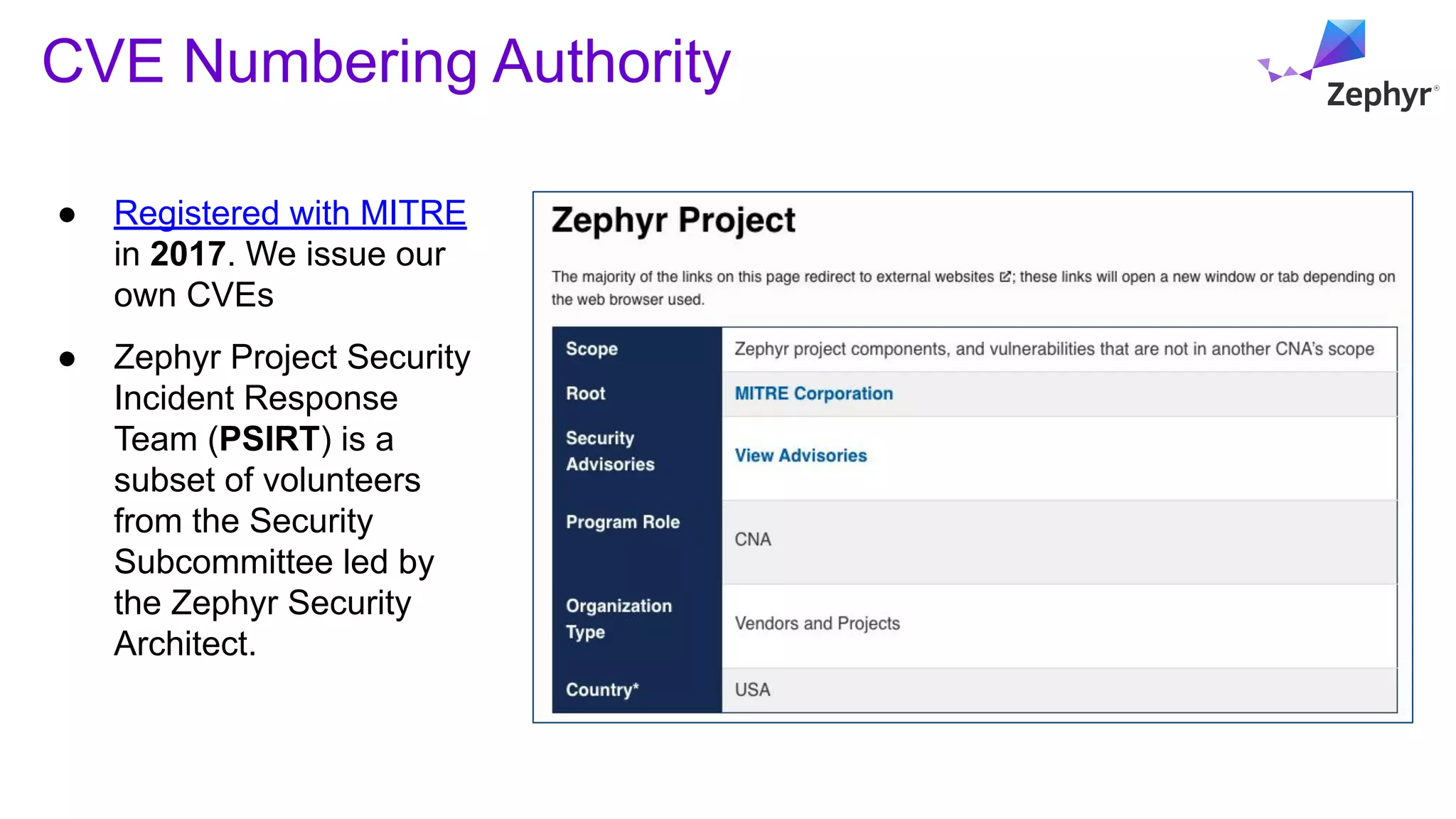
CVE Numbering Authority
● Registered with MITRE
in 2017. We issue our
own CVEs
● Zephyr Project Security
Incident Response
Team (PSIRT) is a
subset of volunteers
from the Security
Subcommittee led by
the Zephyr Security
Architect.
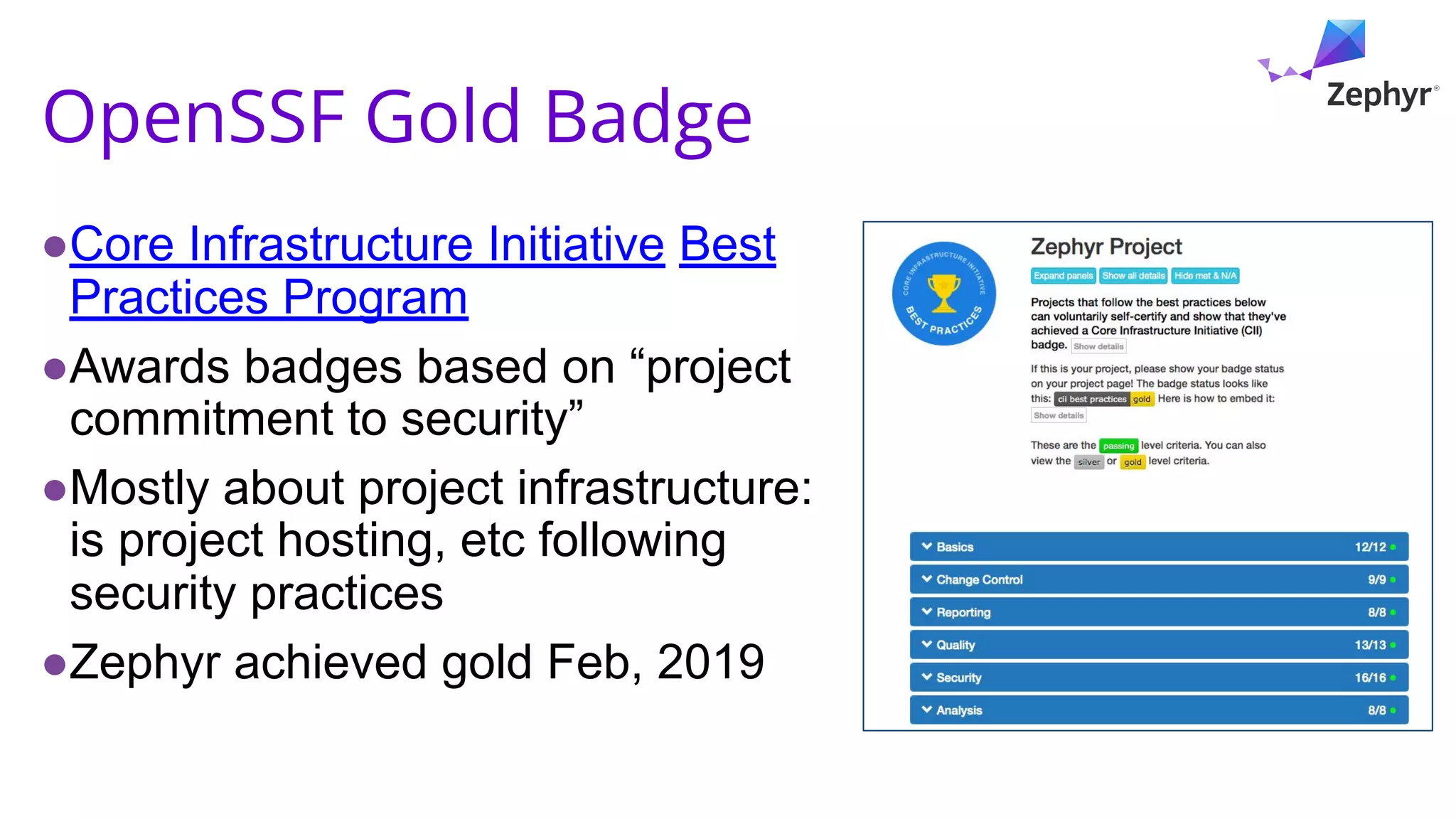
OpenSSF Gold Badge
●Core Infrastructure Initiative Best
Practices Program
●Awards badges based on “project
commitment to security”
●Mostly about project infrastructure:
is project hosting, etc following
security practices
●Zephyr achieved gold Feb, 2019
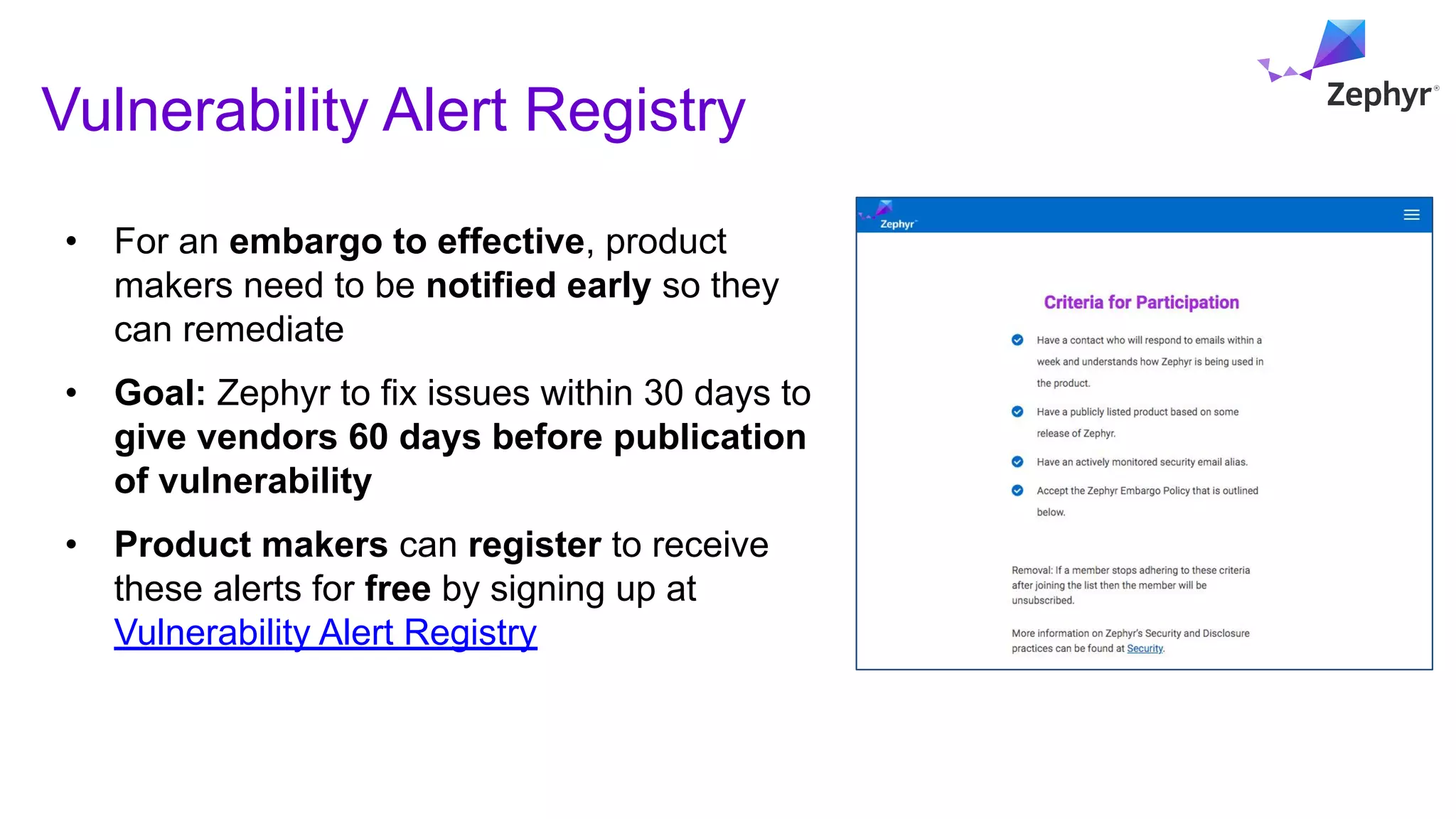
Vulnerability Alert Registry
• For an embargo to effective, product
makers need to be notified early so they
can remediate
• Goal: Zephyr to fix issues within 30 days to
give vendors 60 days before publication
of vulnerability
• Product makers can register to receive
these alerts for free by signing up at
Vulnerability Alert Registry
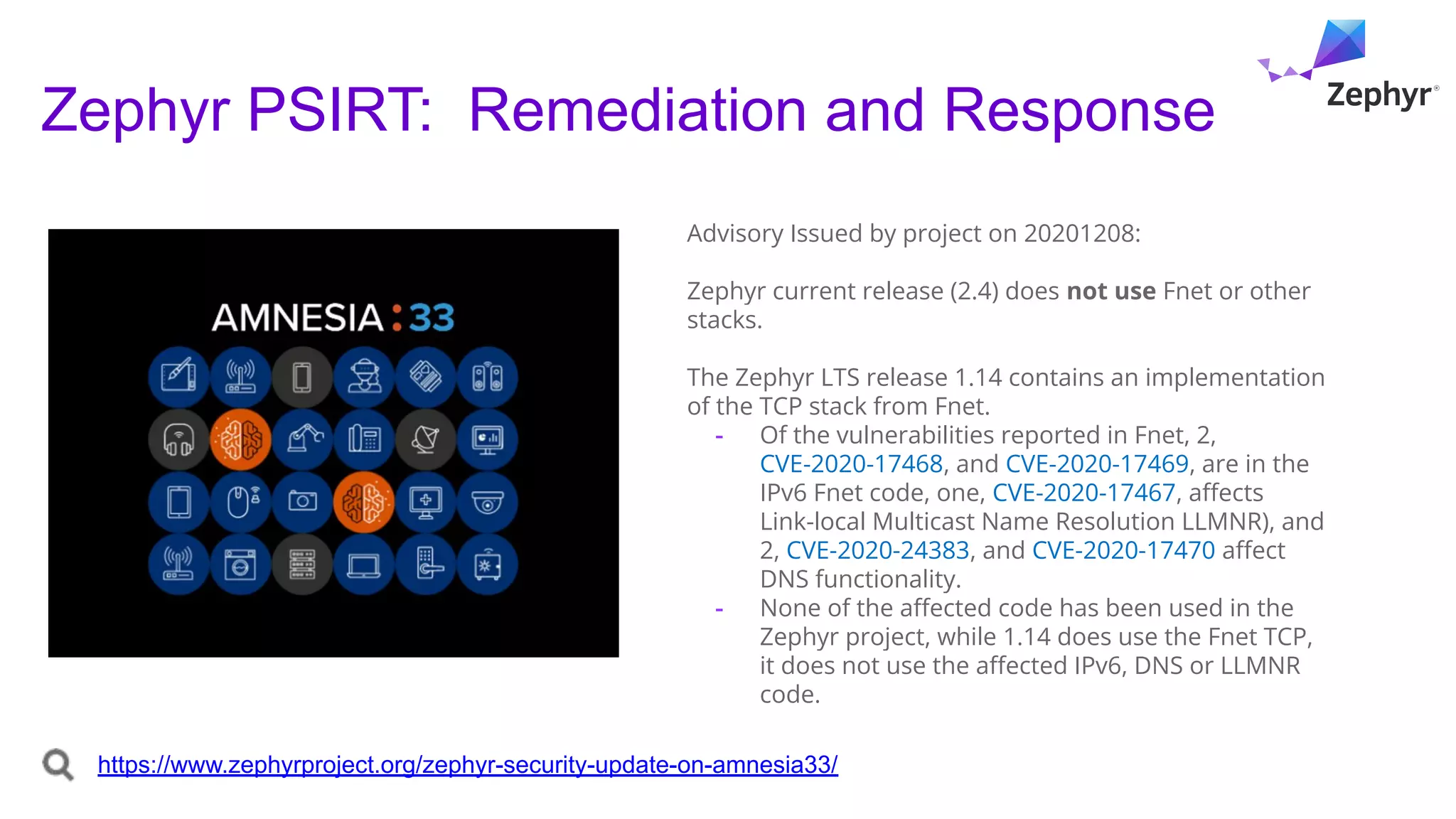
Zephyr PSIRT: Remediation and Response
Advisory Issued by project on 20201208:
Zephyr current release (2.4) does not use Fnet or other
stacks.
The Zephyr LTS release 1.14 contains an implementation
of the TCP stack from Fnet.
- Of the vulnerabilities reported in Fnet, 2,
CVE-2020-17468, and CVE-2020-17469, are in the
IPv6 Fnet code, one, CVE-2020-17467, affects
Link-local Multicast Name Resolution LLMNR), and
2, CVE-2020-24383, and CVE-2020-17470 affect
DNS functionality.
- None of the affected code has been used in the
Zephyr project, while 1.14 does use the Fnet TCP,
it does not use the affected IPv6, DNS or LLMNR
code.
https://www.zephyrproject.org/zephyr-security-update-on-amnesia33/
Zephyr Security Summary
• Established Security Committee at project launch in 2016 – meets bi-weekly.
• Secure Coding Practices have been publicly documented for project.
• Zephyr Project registered as a CVE Numbering Authority with MITRE since 2017.
• “Gold” Best Practices Badge criteria Core Infrastructure Initiative met in 2018
• Leveraging Automation to prevent security regressions:
• Weekly Coverity Scans to detect bad practices in imported code
• MISRA scans being incorporated, to evolve to conformance and address issues.
• Vulnerability Management in 2020
• Vulnerability response criteria publicly documented
• Product makers can register for free for notification of Zephyr
• SBOM generation in 2021
• Source SBOM’s for releases and updates going forward from version 2.5
• Ability to automatically generate SBOM for built images included in version 2.6
Building in Safety for LTS → Auditable
20
• Established Safety Committee in 2019, meets weekly. Community that understands
safety considerations, and implications.
• Representatives from Parasoft, Intel, Synopsys, Google, NXP, Baumer, etc.
• Work closely with the TSC
• Initial target is IEC 61508 SIL 3 / SC 3 (IEC 61508-3, 7.4.2.12, Route 3s) for a limited
scope.
• Multiple safety activities in progress to establish safety plan, coding guideline
compliance, traceability, requirements, test coverage, tooling, etc.
• LTS 2 is starting point for Auditable, branch made November 2021
• Zephyr Project Coding Guidelines based on MISRAC:2021
• Engagement with FSM and certification authority.
• FSM on board June 2021, safety plan drafting in progress
• Certification Authority engagement targeted Q1 2023
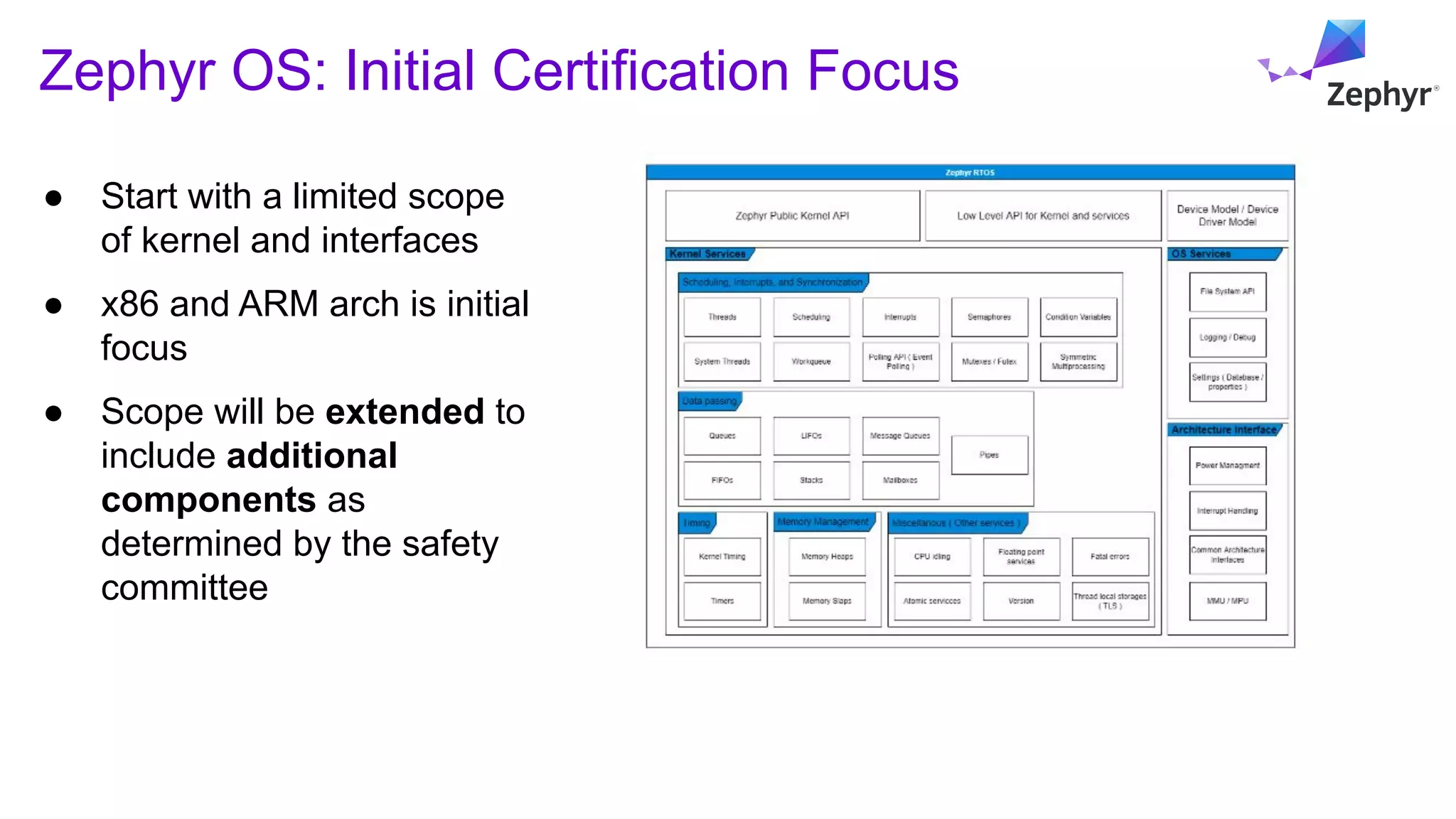
Zephyr OS: Initial Certification Focus
● Start with a limited scope
of kernel and interfaces
● x86 and ARM arch is initial
focus
● Scope will be extended to
include additional
components as
determined by the safety
committee
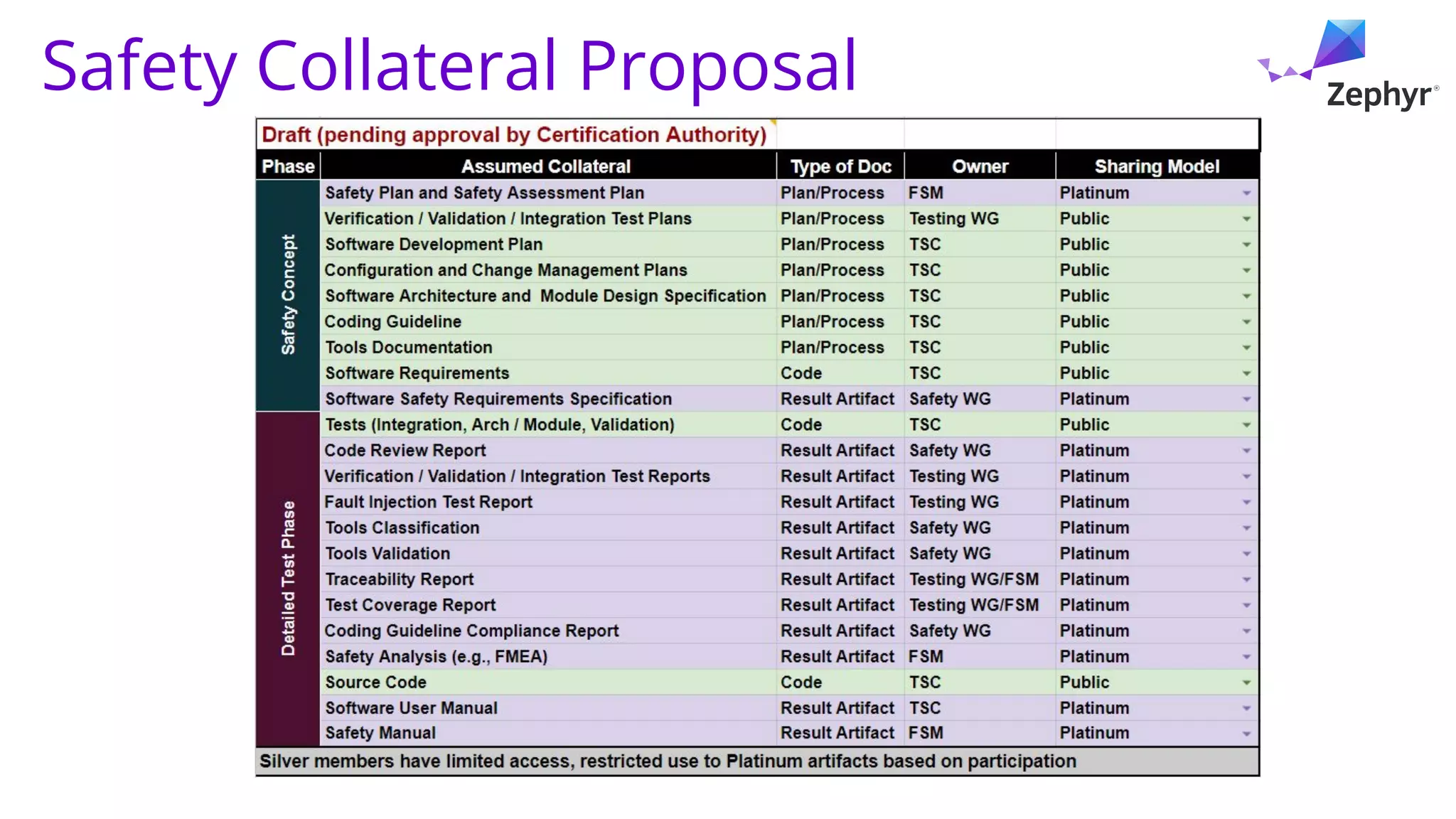
Safety Collateral Proposal
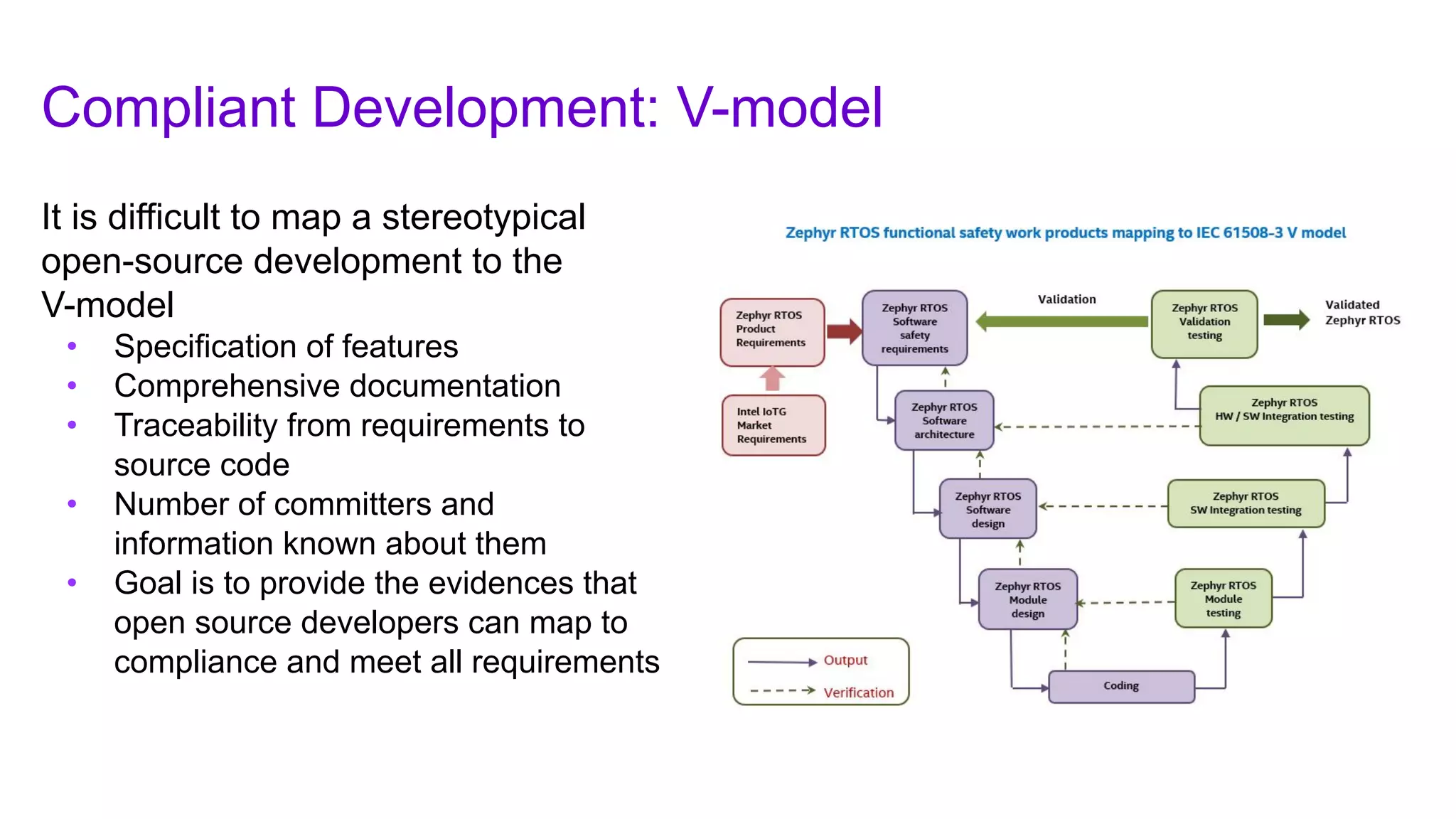
Compliant Development: V-model
It is difficult to map a stereotypical
open-source development to the
V-model
• Specification of features
• Comprehensive documentation
• Traceability from requirements to
source code
• Number of committers and
information known about them
• Goal is to provide the evidences that
open source developers can map to
compliance and meet all requirements
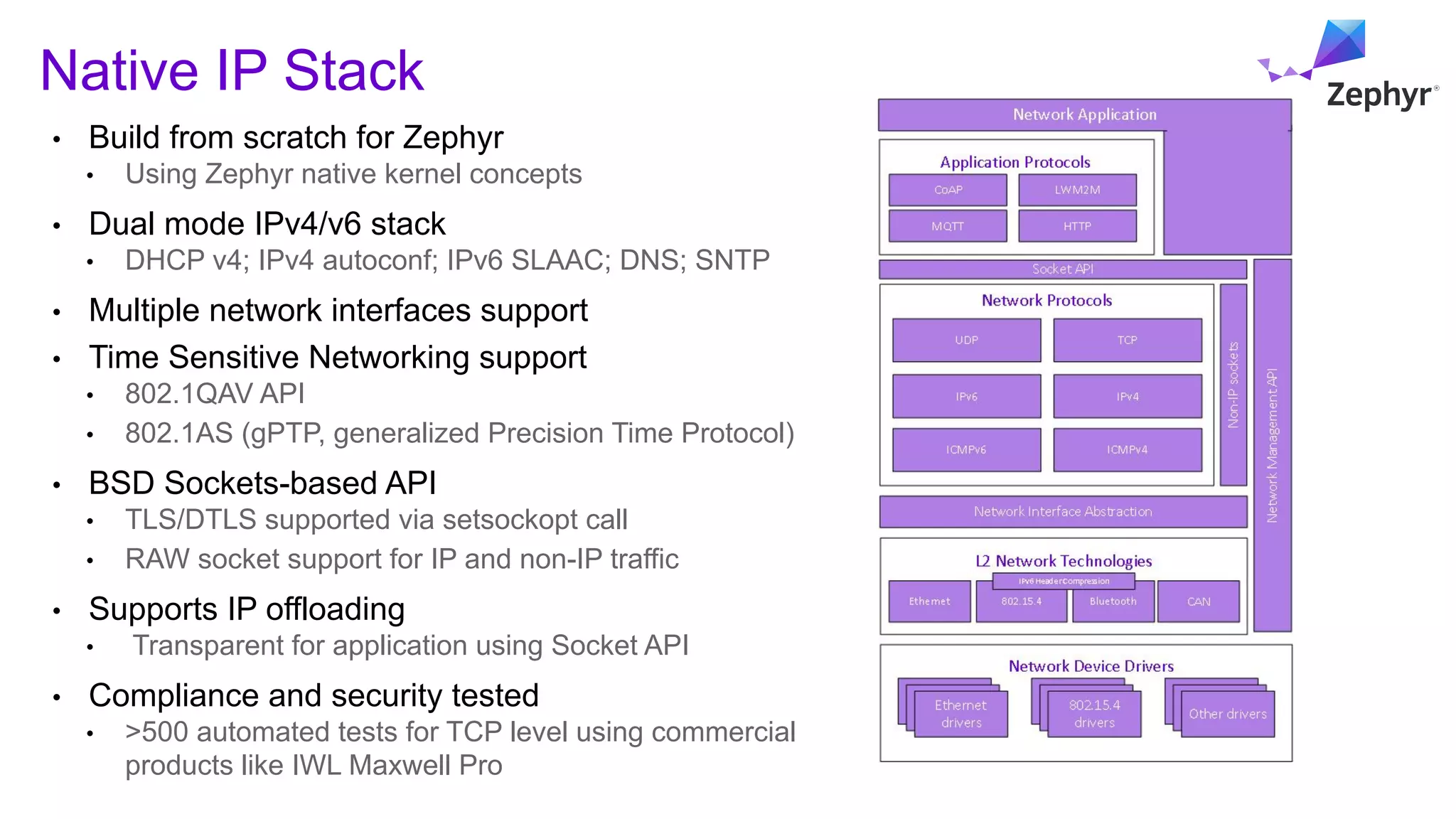
• Build from scratch for Zephyr
• Using Zephyr native kernel concepts
• Dual mode IPv4/v6 stack
• DHCP v4; IPv4 autoconf; IPv6 SLAAC; DNS; SNTP
• Multiple network interfaces support
• Time Sensitive Networking support
• 802.1QAV API
• 802.1AS (gPTP, generalized Precision Time Protocol)
• BSD Sockets-based API
• TLS/DTLS supported via setsockopt call
• RAW socket support for IP and non-IP traffic
• Supports IP offloading
• Transparent for application using Socket API
• Compliance and security tested
• >500 automated tests for TCP level using commercial
products like IWL Maxwell Pro
Native IP Stack
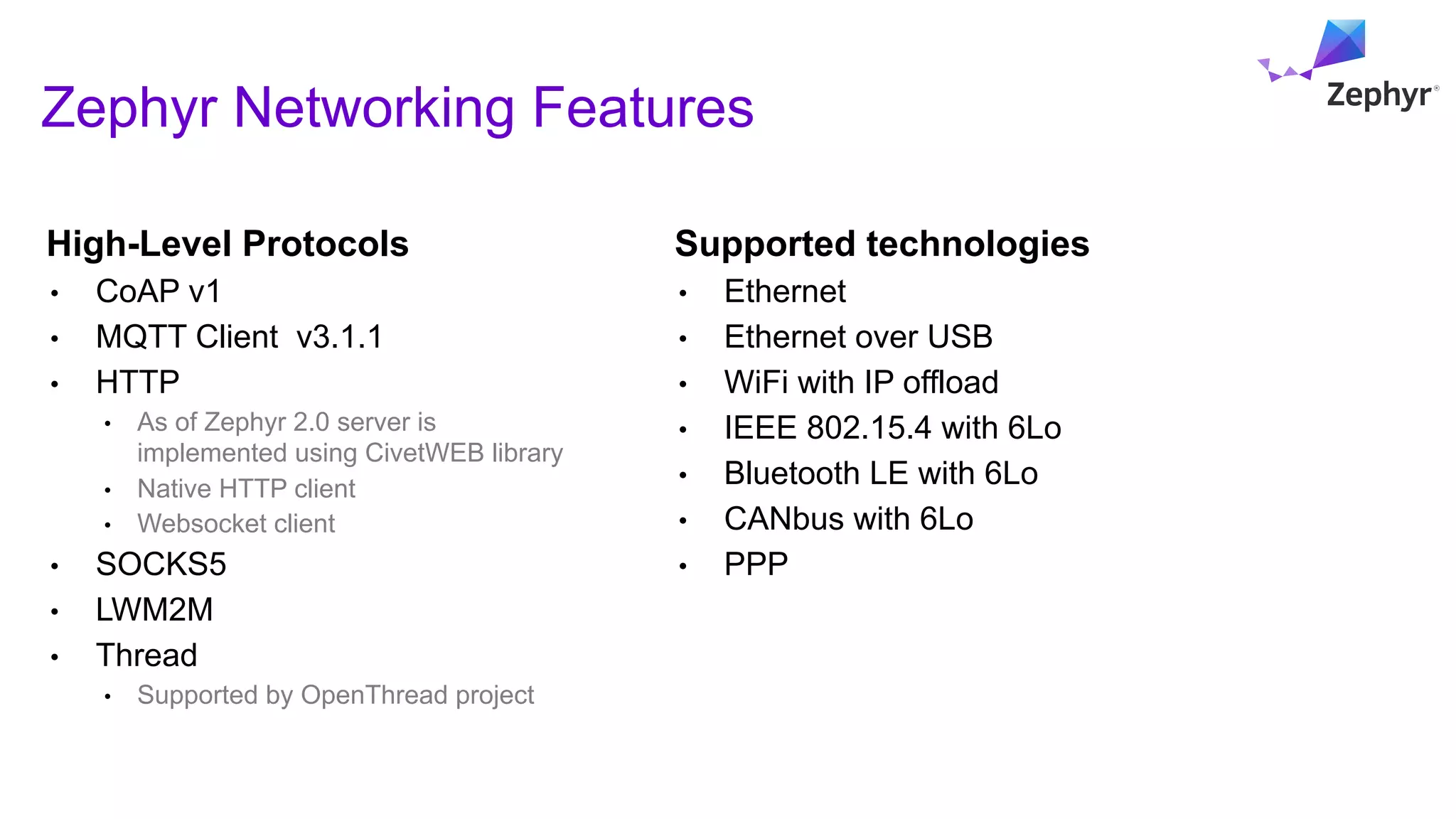
High-Level Protocols
• CoAP v1
• MQTT Client v3.1.1
• HTTP
• As of Zephyr 2.0 server is
implemented using CivetWEB library
• Native HTTP client
• Websocket client
• SOCKS5
• LWM2M
• Thread
• Supported by OpenThread project
Zephyr Networking Features
Supported technologies
• Ethernet
• Ethernet over USB
• WiFi with IP offload
• IEEE 802.15.4 with 6Lo
• Bluetooth LE with 6Lo
• CANbus with 6Lo
• PPP
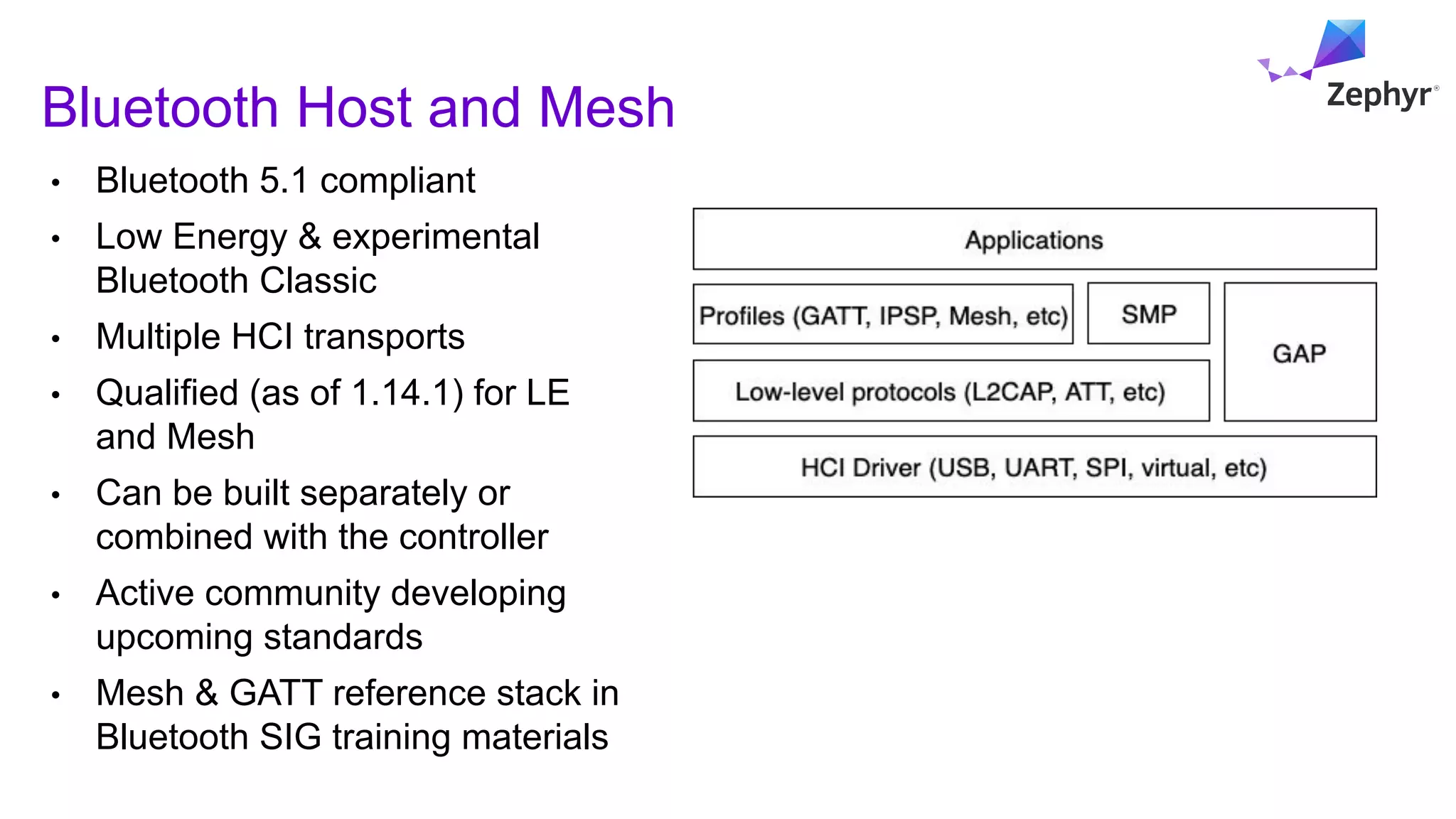
• Bluetooth 5.1 compliant
• Low Energy & experimental
Bluetooth Classic
• Multiple HCI transports
• Qualified (as of 1.14.1) for LE
and Mesh
• Can be built separately or
combined with the controller
• Active community developing
upcoming standards
• Mesh & GATT reference stack in
Bluetooth SIG training materials
Bluetooth Host and Mesh
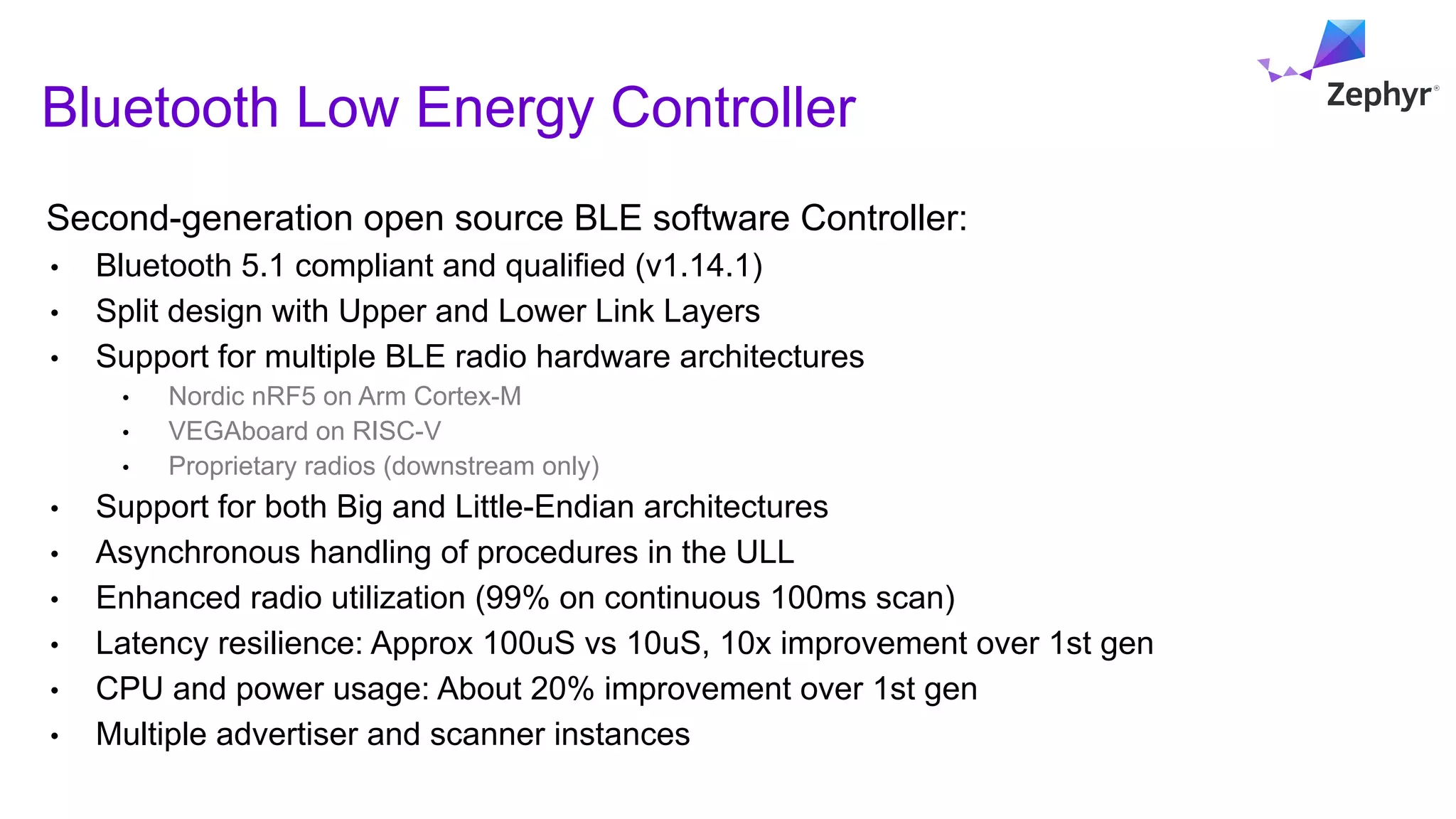
Second-generation open source BLE software Controller:
• Bluetooth 5.1 compliant and qualified (v1.14.1)
• Split design with Upper and Lower Link Layers
• Support for multiple BLE radio hardware architectures
• Nordic nRF5 on Arm Cortex-M
• VEGAboard on RISC-V
• Proprietary radios (downstream only)
• Support for both Big and Little-Endian architectures
• Asynchronous handling of procedures in the ULL
• Enhanced radio utilization (99% on continuous 100ms scan)
• Latency resilience: Approx 100uS vs 10uS, 10x improvement over 1st gen
• CPU and power usage: About 20% improvement over 1st gen
• Multiple advertiser and scanner instances
Bluetooth Low Energy Controller
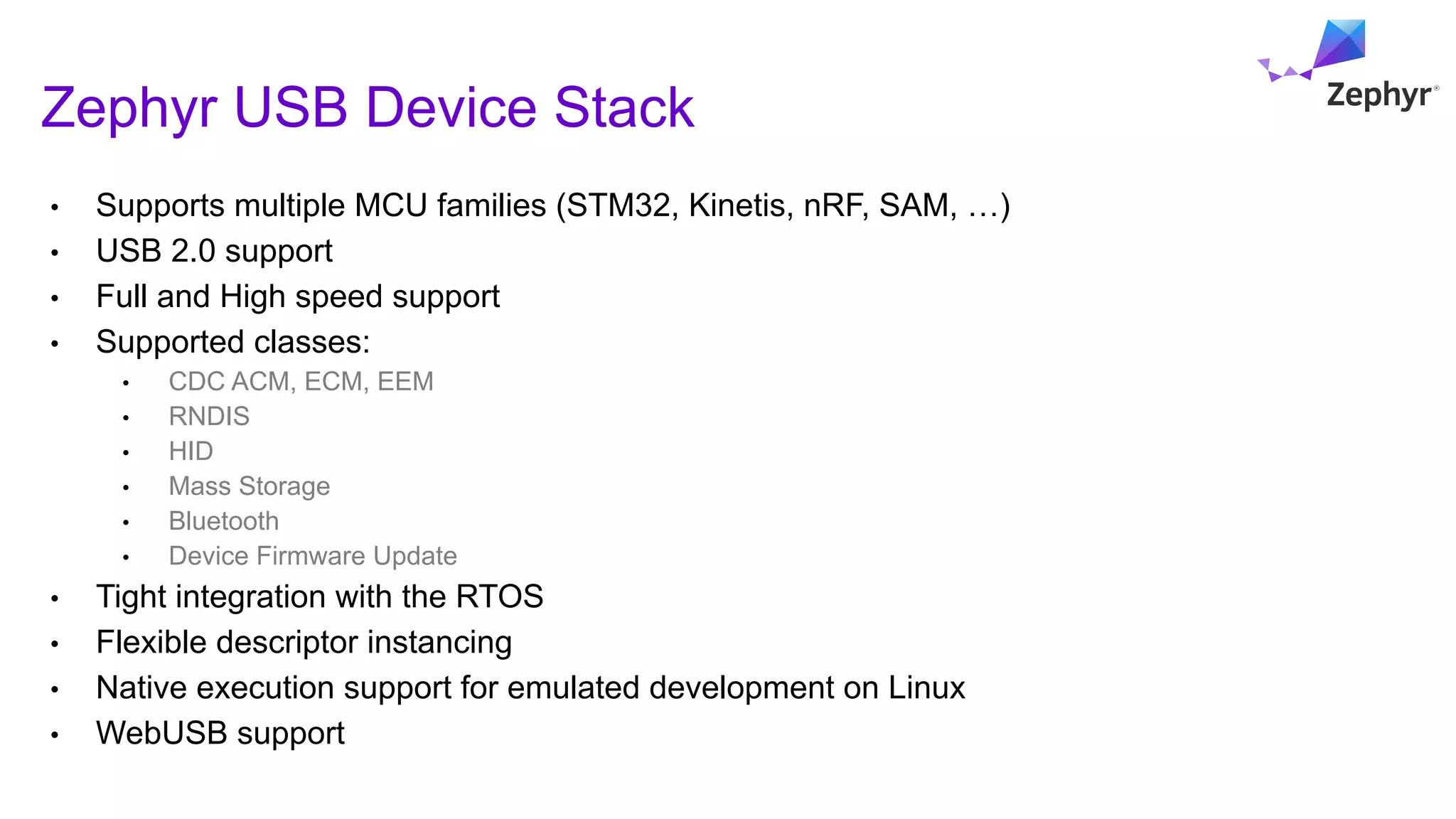
Zephyr USB Device Stack
• Supports multiple MCU families (STM32, Kinetis, nRF, SAM, …)
• USB 2.0 support
• Full and High speed support
• Supported classes:
• CDC ACM, ECM, EEM
• RNDIS
• HID
• Mass Storage
• Bluetooth
• Device Firmware Update
• Tight integration with the RTOS
• Flexible descriptor instancing
• Native execution support for emulated development on Linux
• WebUSB support
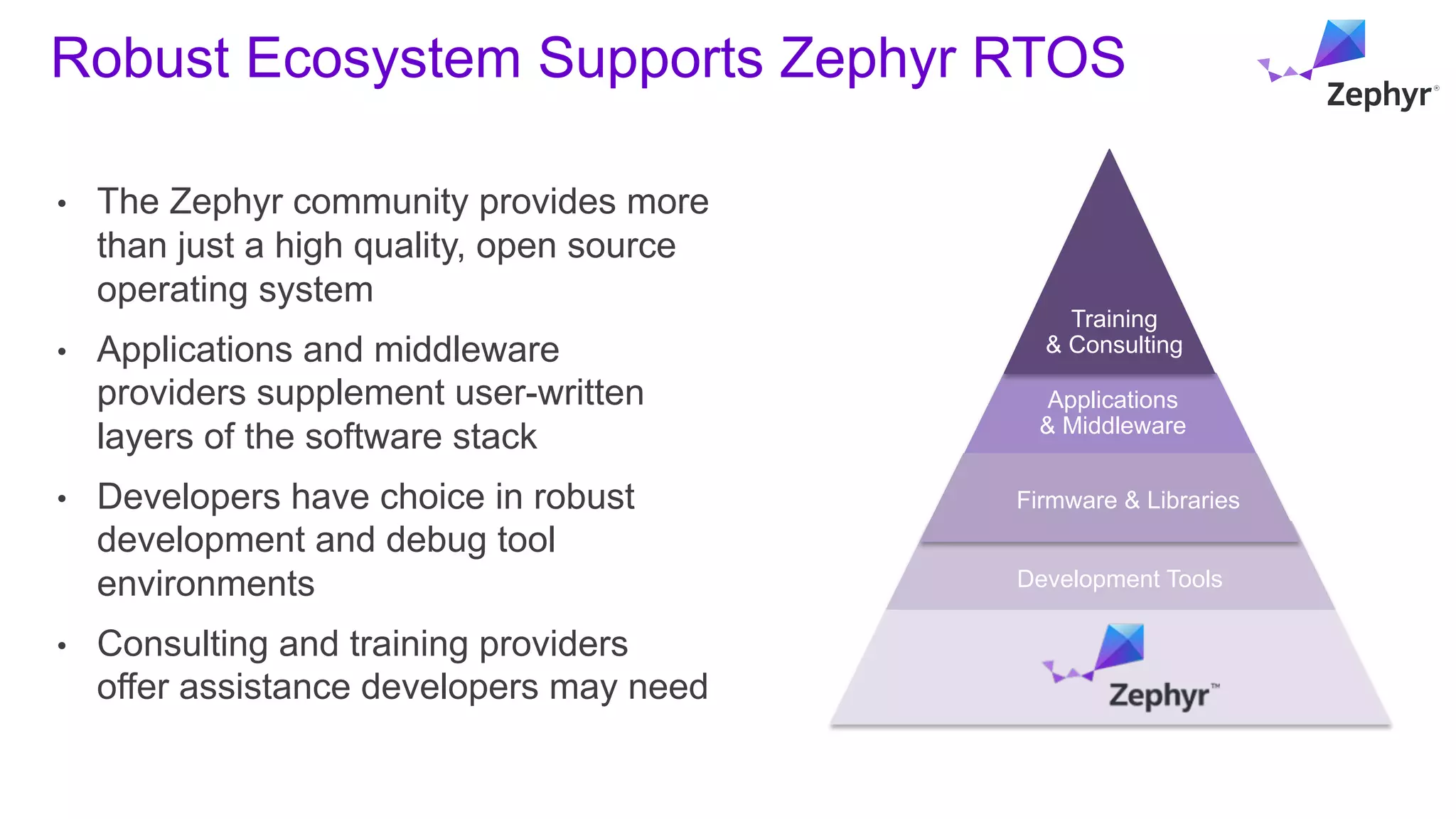
Robust Ecosystem Supports Zephyr RTOS
• The Zephyr community provides more
than just a high quality, open source
operating system
• Applications and middleware
providers supplement user-written
layers of the software stack
• Developers have choice in robust
development and debug tool
environments
• Consulting and training providers
offer assistance developers may need
Applications
& Middleware
Development Tools
Training
& Consulting
Firmware & Libraries
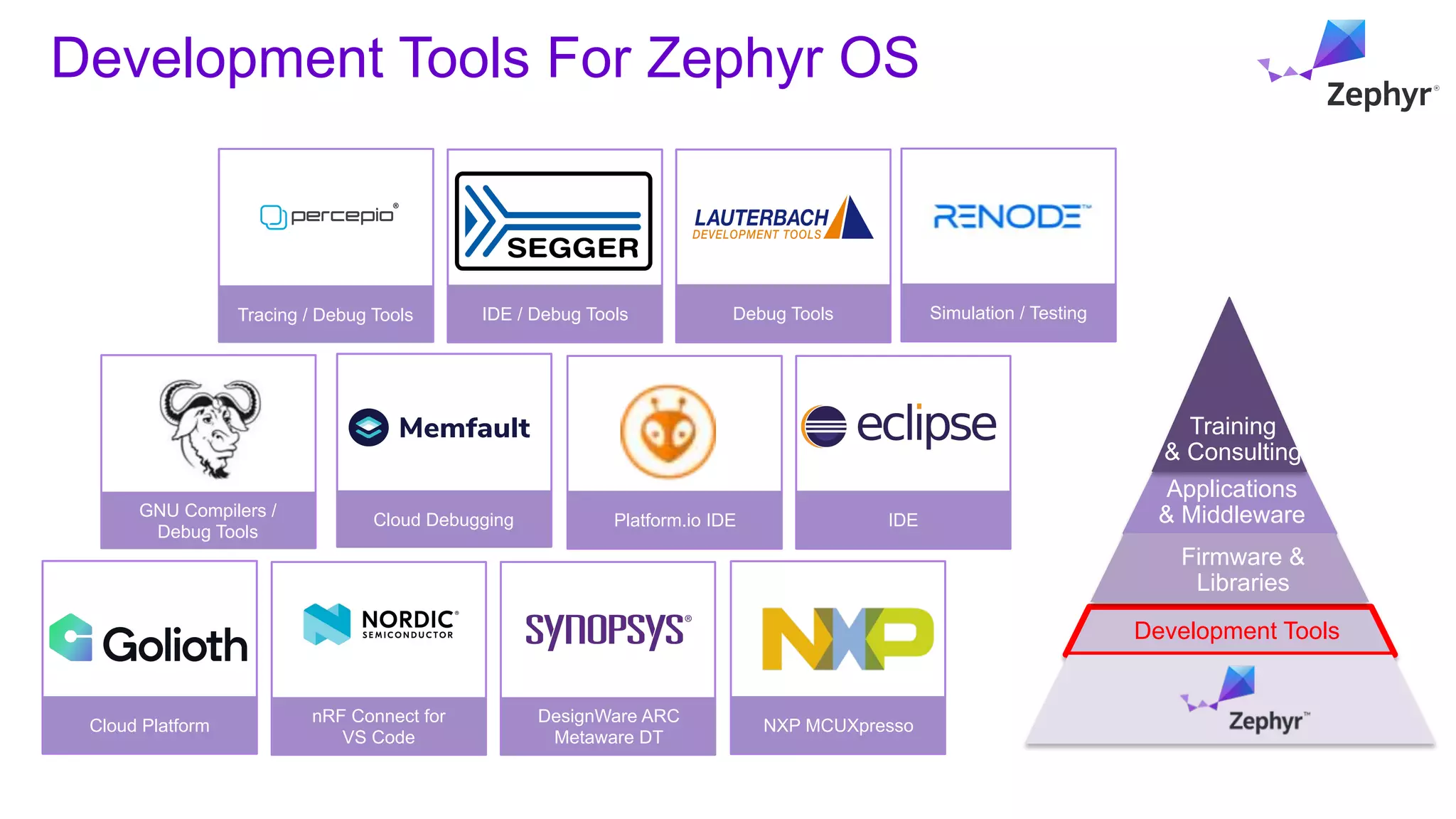
Development Tools For Zephyr OS
IDE / Debug Tools Debug Tools
IDE
GNU Compilers /
Debug Tools
Simulation / Testing
DesignWare ARC
Metaware DT
NXP MCUXpresso
nRF Connect for
VS Code
Cloud Debugging Platform.io IDE
Tracing / Debug Tools
Cloud Platform
Applications
& Middleware
Development Tools
Training
& Consulting
Firmware &
Libraries
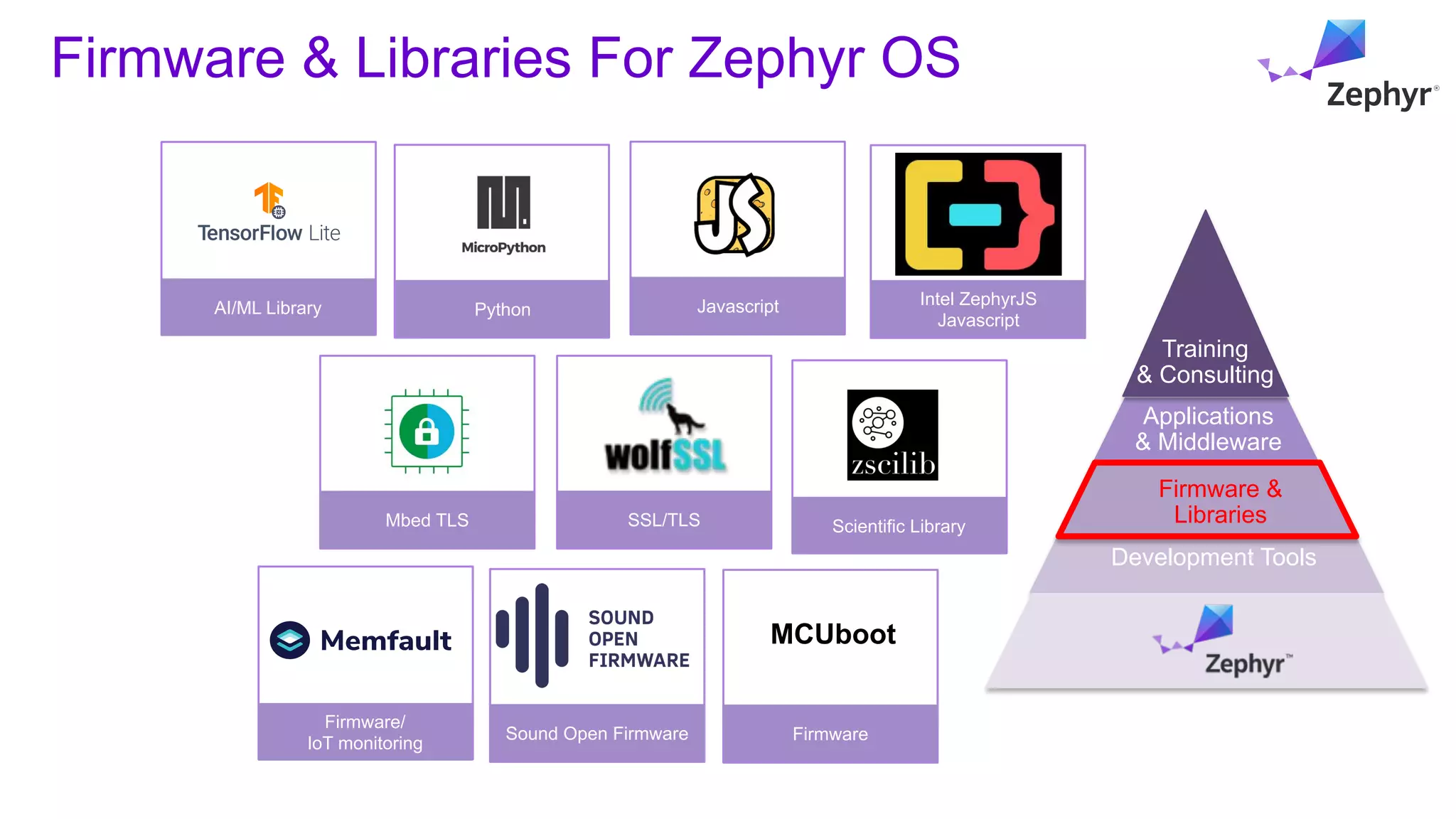
Firmware & Libraries For Zephyr OS
Firmware
Intel ZephyrJS
Javascript
SSL/TLS
Python
AI/ML Library
MCUboot
Applications
& Middleware
Development Tools
Training
& Consulting
Firmware/
IoT monitoring
Javascript
Mbed TLS Scientific Library
Sound Open Firmware
Firmware &
Libraries
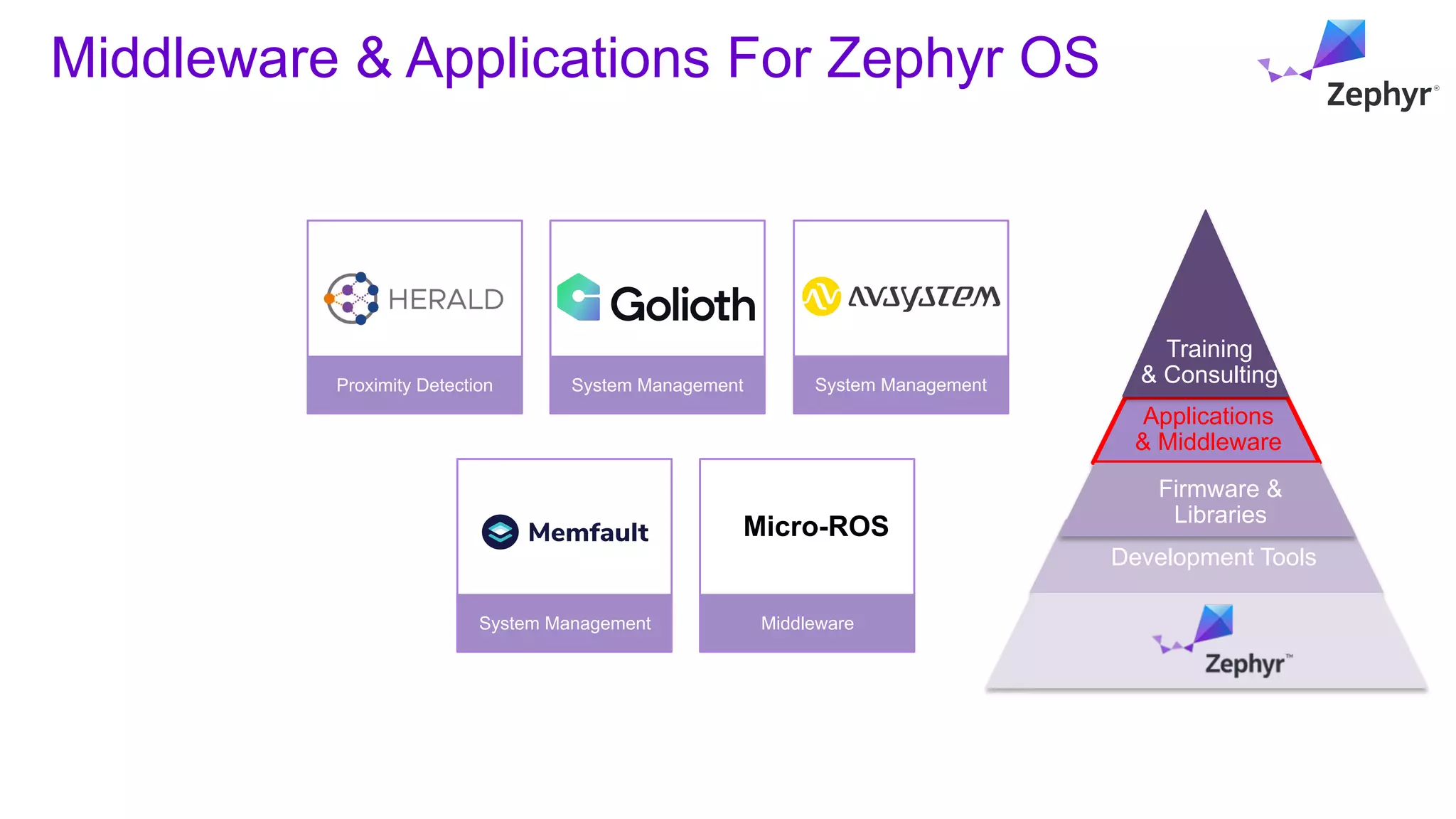
Middleware & Applications For Zephyr OS
Middleware
Micro-ROS
System Management
System Management
Applications
& Middleware
Development Tools
Training
& Consulting
Firmware &
Libraries
System Management
Proximity Detection
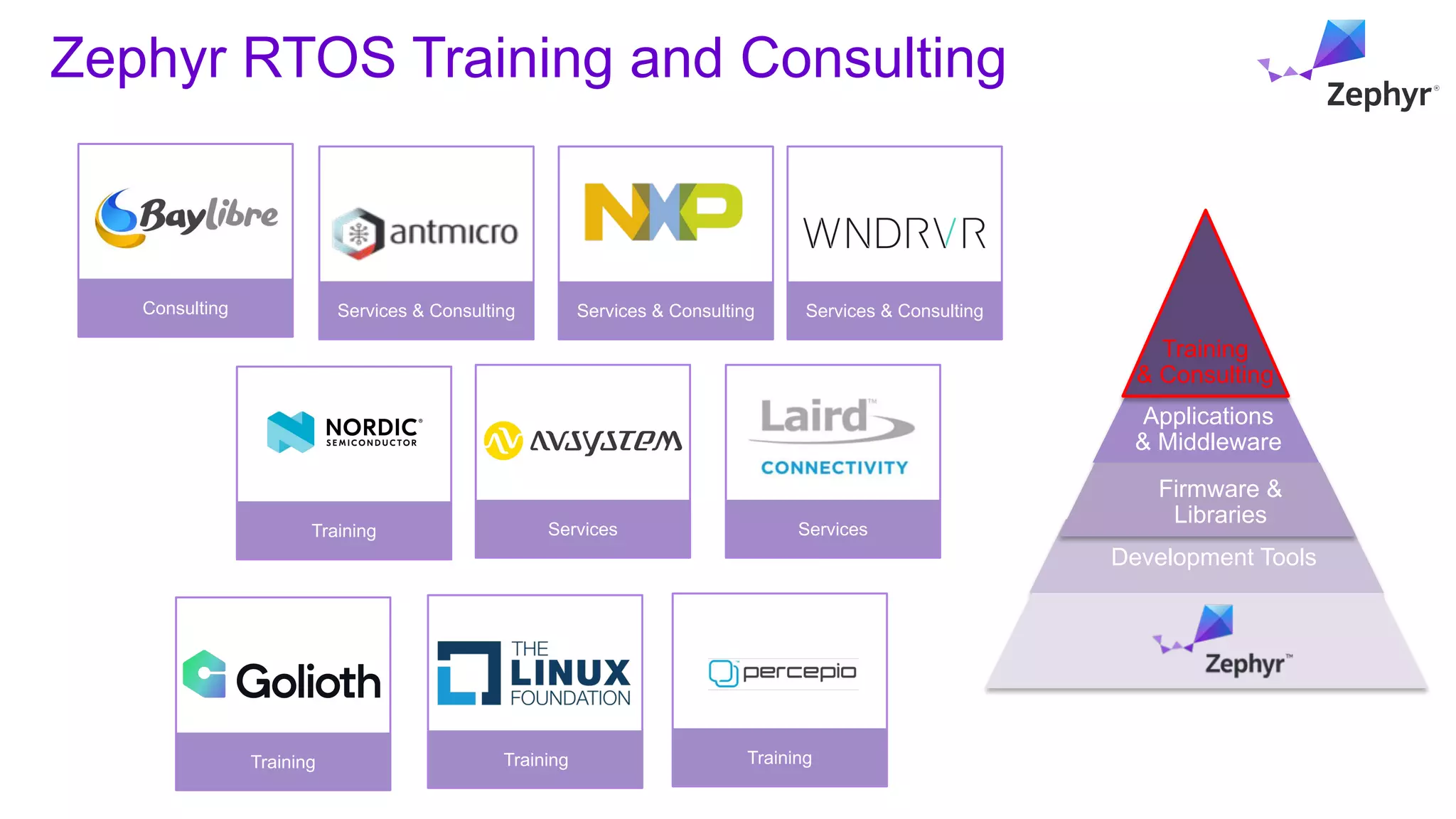
Zephyr RTOS Training and Consulting
Consulting
Training
Services & Consulting
Training
Services & Consulting
Services
Services & Consulting
Services
Training
Training
Applications
& Middleware
Development Tools
Training
& Consulting
Firmware &
Libraries
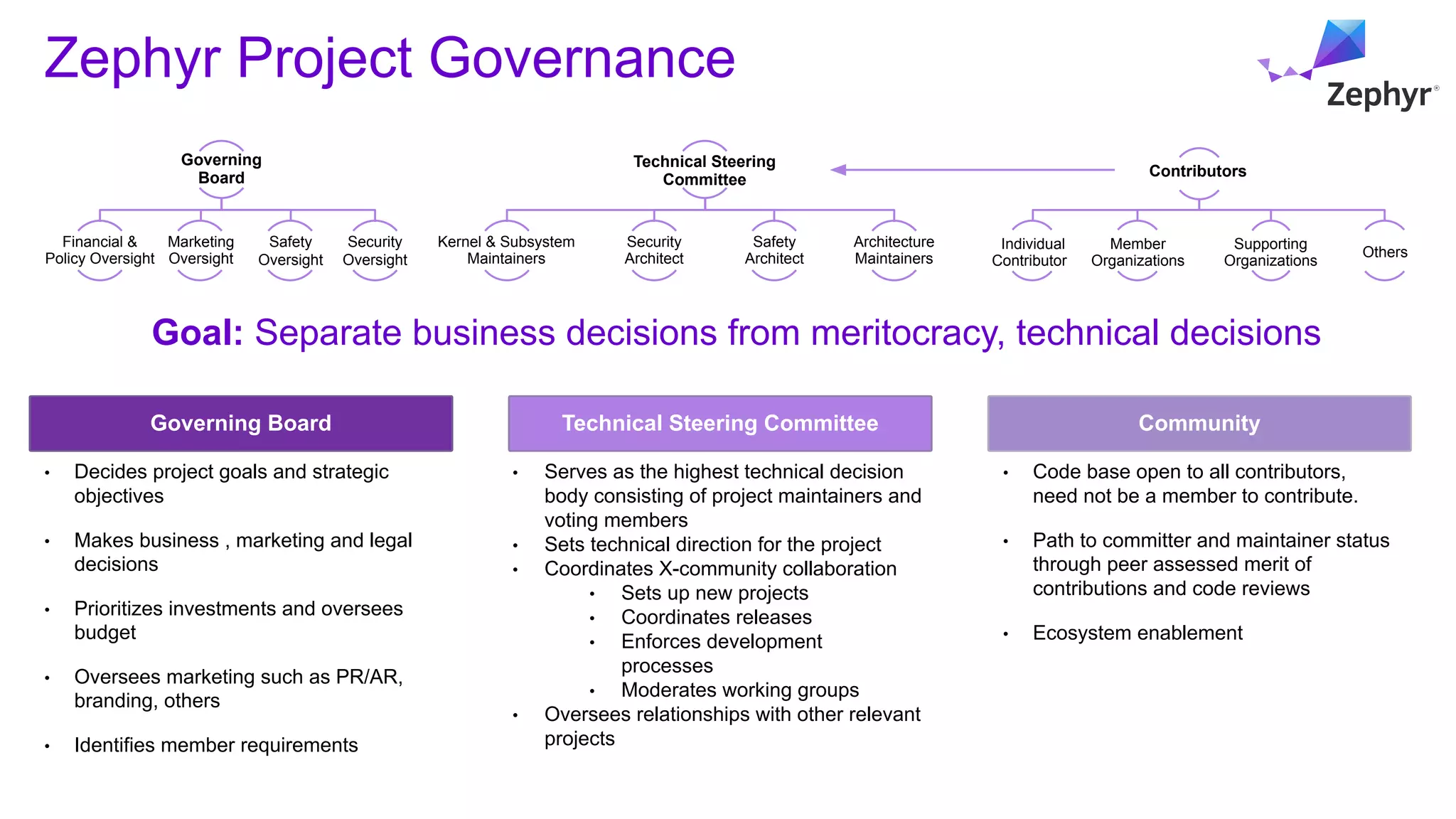
Zephyr Project Governance
• Serves as the highest technical decision
body consisting of project maintainers and
voting members
• Sets technical direction for the project
• Coordinates X-community collaboration
• Sets up new projects
• Coordinates releases
• Enforces development
processes
• Moderates working groups
• Oversees relationships with other relevant
projects
Governing Board
• Decides project goals and strategic
objectives
• Makes business , marketing and legal
decisions
• Prioritizes investments and oversees
budget
• Oversees marketing such as PR/AR,
branding, others
• Identifies member requirements
Technical Steering Committee Community
• Code base open to all contributors,
need not be a member to contribute.
• Path to committer and maintainer status
through peer assessed merit of
contributions and code reviews
• Ecosystem enablement
Goal: Separate business decisions from meritocracy, technical decisions
Security
Architect
Safety
Architect
Individual
Contributors
Supporting
Organizations
Kernel & Subsystem
Maintainers
Security
Oversight
Safety
Oversight
Financial &
Policy Oversight
Marketing
Oversight
Governing
Board
Member
Organizations
Others
Architecture
Maintainers
Technical Steering
Committee
Contributors
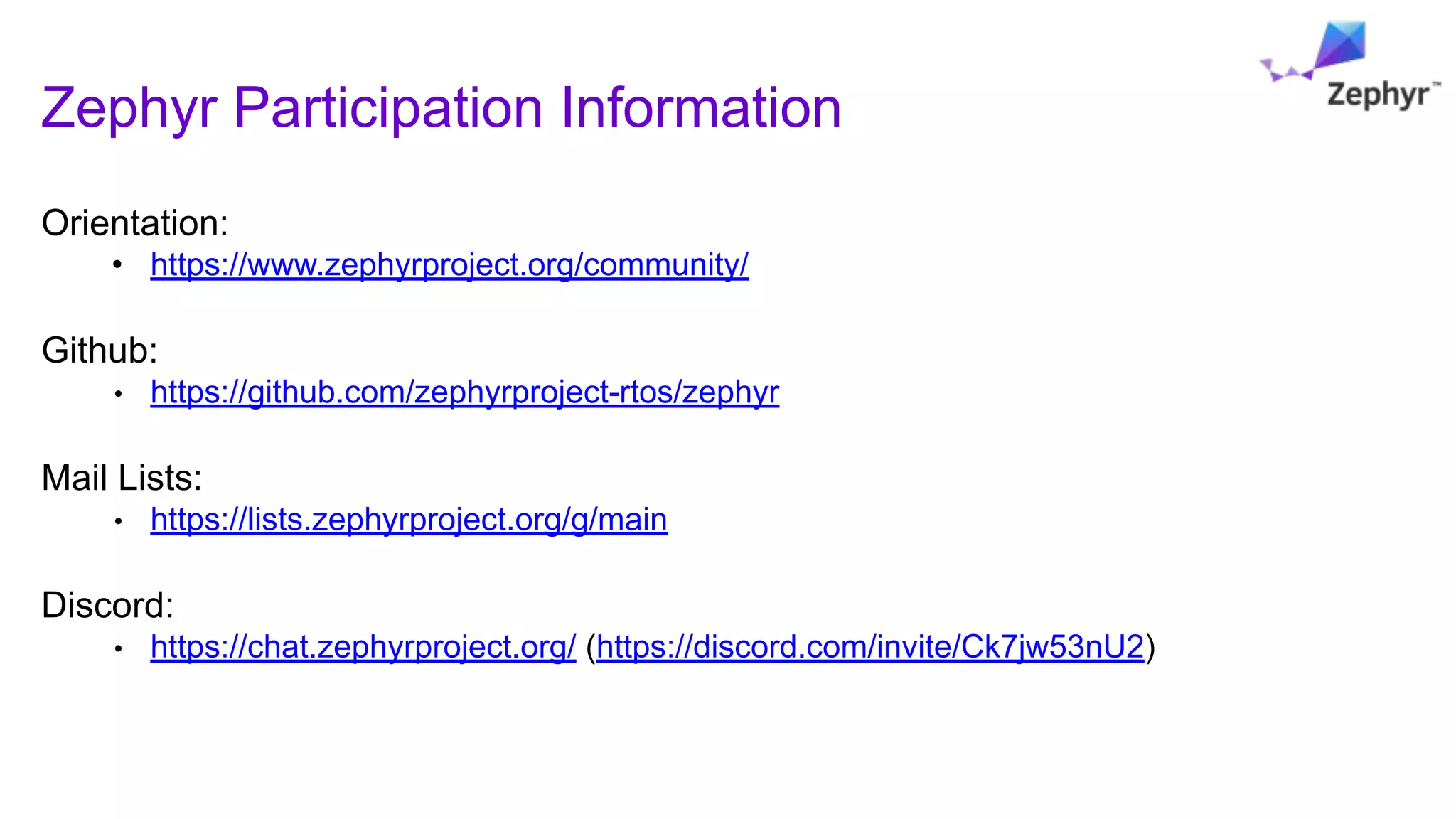
Zephyr Participation Information
Orientation:
• https://www.zephyrproject.org/community/
Github:
• https://github.com/zephyrproject-rtos/zephyr
Mail Lists:
• https://lists.zephyrproject.org/g/main
Discord:
• https://chat.zephyrproject.org/ (https://discord.com/invite/Ck7jw53nU2)
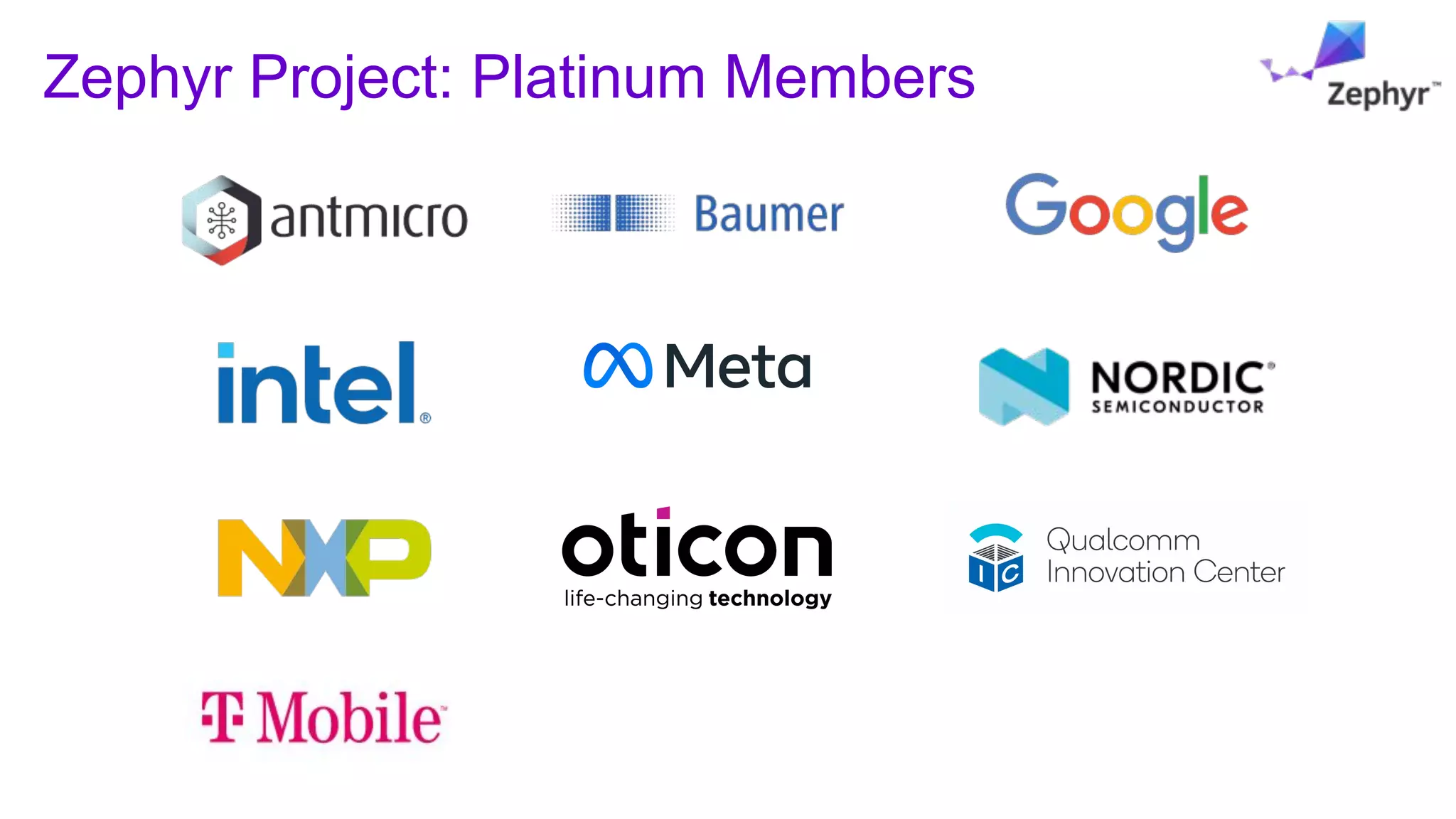
Zephyr Project: Platinum Members
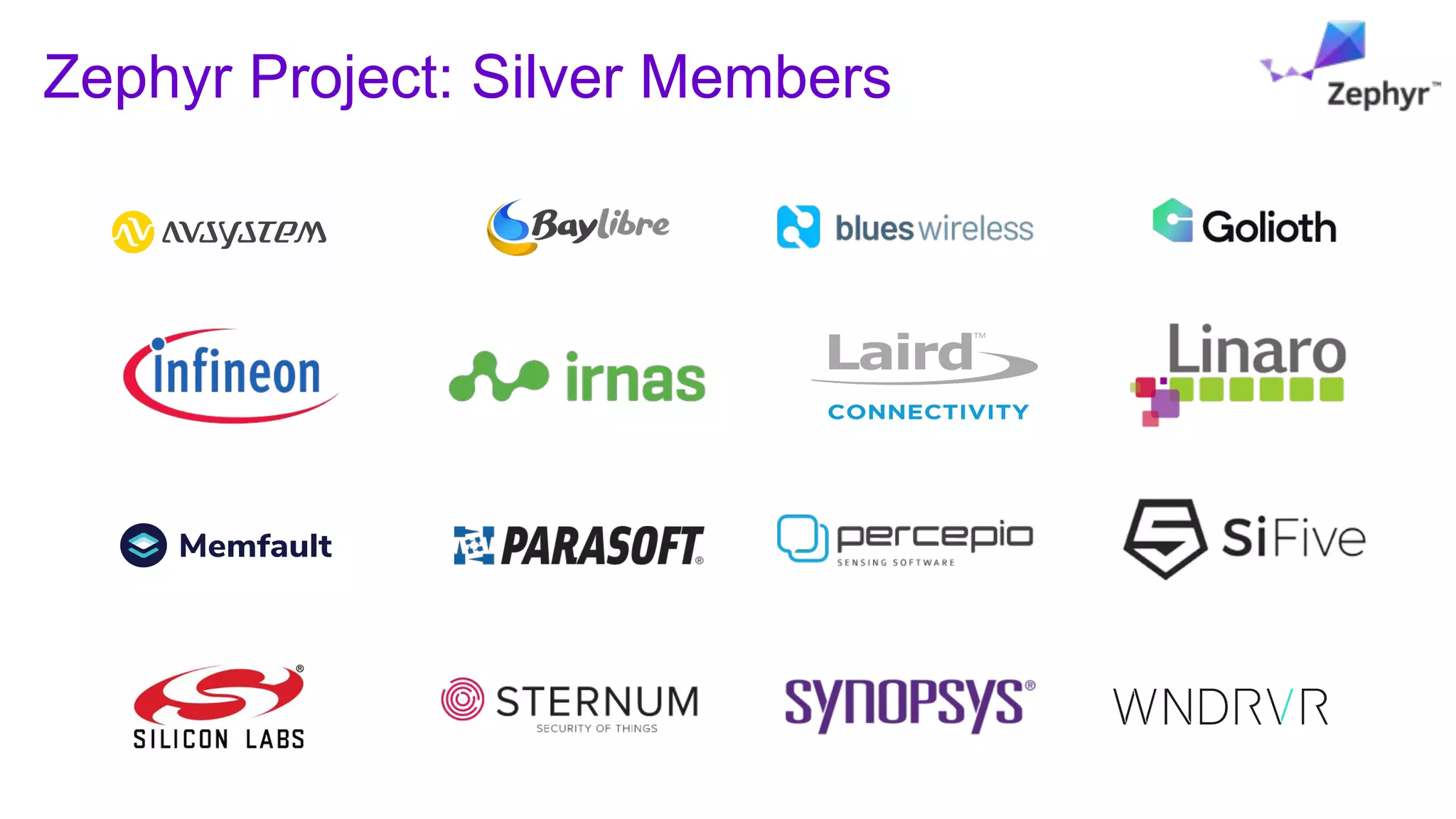
Zephyr Project: Silver Members
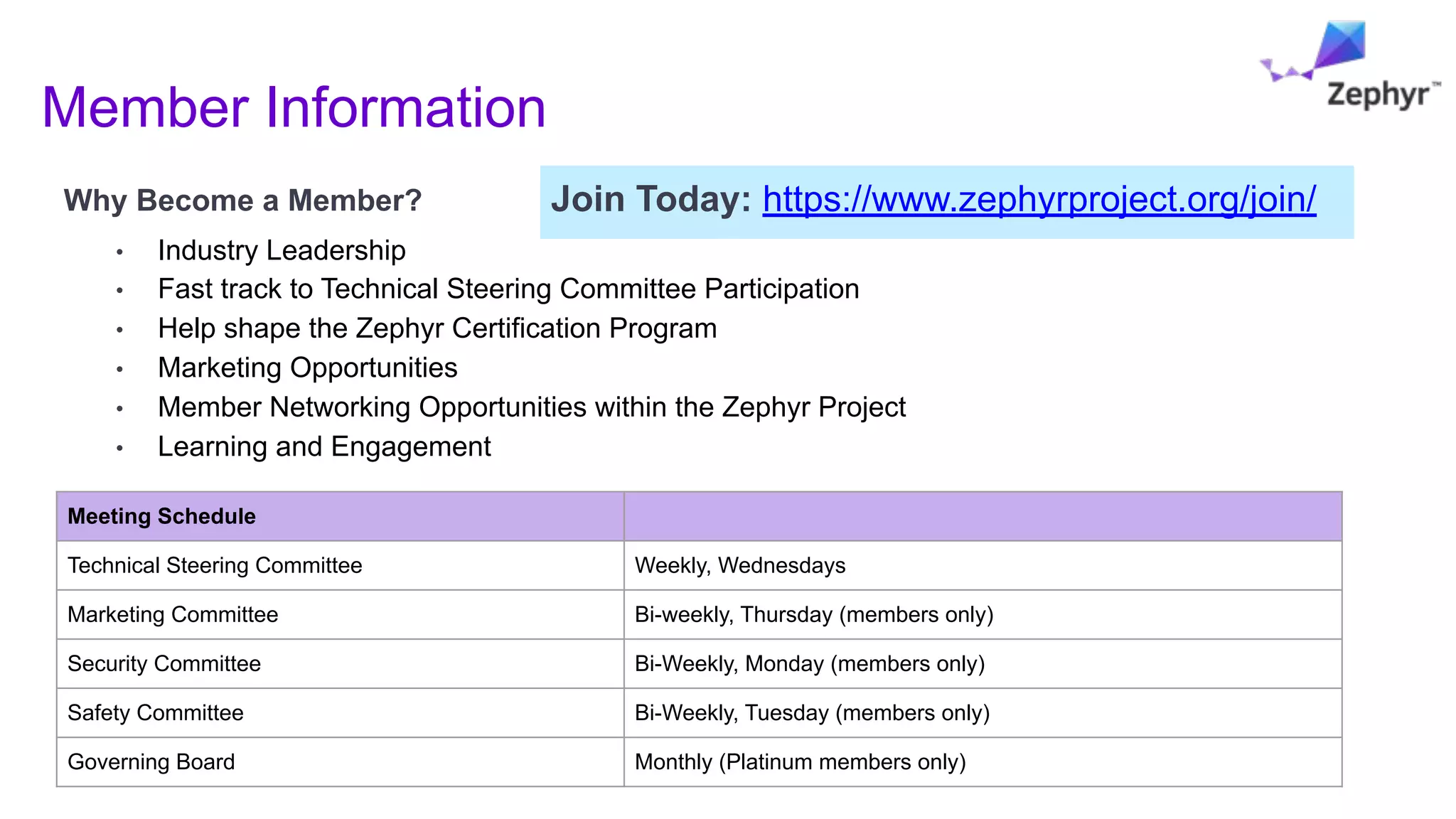
Member Information
Why Become a Member?
• Industry Leadership
• Fast track to Technical Steering Committee Participation
• Help shape the Zephyr Certification Program
• Marketing Opportunities
• Member Networking Opportunities within the Zephyr Project
• Learning and Engagement
Meeting Schedule
Technical Steering Committee Weekly, Wednesdays
Marketing Committee Bi-weekly, Thursday (members only)
Security Committee Bi-Weekly, Monday (members only)
Safety Committee Bi-Weekly, Tuesday (members only)
Governing Board Monthly (Platinum members only)
Join Today: https://www.zephyrproject.org/join/
www.zephyrproject.org

Zephyr-Overview-20230124.pdf

  • 1.
    • Open sourcereal time operating system • Vibrant Community participation • Built with safety and security in mind • Cross-architecture with broad SoC and development board support. • Vendor Neutral governance • Permissively licensed - Apache 2.0 • Complete, fully integrated, highly configurable, modular for flexibility • Product development ready using LTS includes security updates • Certification ready with Auditable Zephyr Project Open Source, RTOS, Connected, Embedded Fits where Linux is too big Kernel OS Services Application Services HAL 3rd Party Libraries Zephyr OS
  • 2.
    Example of ProductsRunning Zephyr Today Proglove Rigado IoT Gateway Intellinium Safety Shoes Anicare Reindeer Tracker GNARBOX 2.0 SSD Keeb.io BDN9 Sentrius BLiXT solid state circuit breaker HereO Core Box RUUVI Tag Point Home Alarm Safety Pod Oticon More See.Sense AIR Hati-ACE Vestas Wind Turbine Moto Watch 100 Distancer https://www.zephyrproject.org/products-running-zephyr/
  • 3.
    Upstream Board Support– 400+ and growing http://docs.zephyrproject.org/boards/boards.html NXP FRDM K64F Arduino Due Minnowboard STM Mini A15 BBC Microbit v2 STM32 Olimexino Synopsys EMSK Altera MAX10 NRF52 Seed Carbon Seeed Nitrogen Nucleo64 L476RG TI Launchpad Wifi ARM V2M Beetle nRF9160-DK ARM V2M MPS2 NXP FRDM-KW41Z BBC Microbit Redbear BLE Nano Zedboard Pulpino ESP32-C3 STM3210c STM32373c Pico PI IMX7D Atmel SAM E70 NXP i.MX RT1050 SiFive HiFive1 96b Neon Key Adafruit Feather Vega Board nRF5340 DK Nucleo 103RB
  • 4.
    Sensors : 100+Already Integrated… adt7420 adxl345 adxl362 adxl372 ak8975 amg88xx ams_iAQcore apds9960 bma280 bmc150_magn bme280 bme680 bmg160 bmi160 bmi270 bmm150 bmp388 bq274xx ccs811 dht dps310 ds18b20 ens210 fdc2x1x fxas21002 fxos8700 grove hmc5883l hp206c hts221 i3g4250d icm42605 icm42670 iis2dh iis2dlpc iis2iclx iis2mdc iis3dhhc ina219 ina23x isl29035 ism330dhcx ite_tach_it8xxx2 ite_vcmp_it8xxx2 lis2dh lis2ds12 lis2dw12 lis2mdl lis3mdl lm75 lm77 lps22hb lps22hh lps25hb lsm303dlhc_magn lsm6ds0 lsm6dsl lsm6dso lsm9ds0_gyro lsm9ds0_mfd max17055 max17262 max30101 max31875 max44009 max6675 mchp_tach_xec mcp9808 mcux_acmp mhz19b mpr mpu6050 mpu9250 ms5607 ms5837 nrf5 nuvoton_adc_cmp_npcx nuvoton_tach_npcx nxp_kinetis_temp opt3001 pcnt_esp32 pms7003 qdec_nrfx qdec_sam qdec_stm32 sbs_gauge sgp40 sht3xd sht4x shtcx si7006 si7055 si7060 si7210 sm351lt stm32_temp stm32_vbat stmemsc stts751 sx9500 th02 ti_hdc ti_hdc20xx tmp007 tmp108 tmp112 tmp116 vcnl4040 vl53l0x wsen_hids wsen_itds https://github.com/zephyrproject-rtos/zephyr/tree/main/drivers/sensor
  • 5.
    Zephyr Supported HardwareArchitectures Cortex-M, Cortex-R & Cortex-A 32 & 64 bit x86 & x86_64 Xtensa https://docs.zephyrproject.org/latest/hardware/index.html#hardware-support
  • 6.
    Native Execution ona POSIX-compliant OS • Build Zephyr as native Linux application • Enable large scale simulation of network or Bluetooth tests without involving HW • Improve test coverage of application layers • Use any native tools available for debugging and profiling • Develop GUI applications entirely on the desktop • Optionally connect to real devices with TCP/IP, Bluetooth, and CAN • Reduce requirements for HW test platforms during development
  • 7.
    POSIX API onZephyr Provides familiar API to non-embedded programmers, especially to Linux developers Enable re-use (portability) of existing libraries based on POSIX APIs • Provides efficient subset appropriate for small (MCU) embedded systems • POSIX API subset is increasingly popular operating system abstraction layer (OSAL) for IoT • Supports subsets of PSE51, PSE52, and BSD sockets API Hardware MCU/SoC BSP Zephyr Kernel Middleware Networking Application File System BSD Sockets POSIX PSE52 POSIX PSE51 POSIX support in Zephyr https://docs.zephyrproject.org/latest/guides/portability/posix.html
  • 8.
    Architecture • Highly Configurable,Highly Modular • Cooperative and Preemptive Threading • Memory and Resources are typically statically allocated • Integrated device driver interface • Memory Protection: Stack overflow protection, Kernel object and device driver permission tracking, Thread isolation • Bluetooth® Low Energy (BLE 5.1) with both controller and host, BLE Mesh • 802.15.4 OpenThread • Native, fully featured and optimized networking stack Platform Radios Power Management Kernel Services / Schedulers Sensors Crypto HW I2C SPI UART GPIO … File Systems Logging/ Tracing Settings Crypto IPC Flash Sensors ... Low Level API Device Mgmt 802.15.4 IPv6/IPv4 TCP/UDP BLE Wi-Fi CAN ... 6LoWPAN Thread TLS DTLS CoAP HTTP MQTT LWM2M … Application Smart Objects / High Level APIs / Data Models Kernel OS Services Application Services Fully featured OS allows developers to focus on the application
  • 9.
    Code Repositories Community Contributions via DCO ReleasesLTS Releases Safety & Security Processes Certifiable Releases Forward ports & Keeping Configurations in Sync Development Long Term Support “Stable” Auditable
  • 10.
    Zephyr OS: LongTerm Support (LTS 2.7) LTS #2 released on 2021/10/16 - it is: • Product Focused • Current with latest Security Updates • Compatible with New Hardware: We will make point releases throughout the development cycle to provide functional support for new hardware. • Tested: Shorten the development window and extend the Beta cycle to allow for more testing and bug fixing • Supported for 2 years It is not: • A Feature-Based Release: focus on hardening functionality of existing features, versus introducing new ones. • Cutting Edge https://github.com/zephyrproject-rtos/zephyr/releases/tag/zephyr-v2.7.0
  • 11.
    Zephyr OS: LongTerm Support (LTS - 1.14) Have released 3 updates: • Current with latest Security Updates • Compatible with New Hardware • Demonstrated supported for last 2 years Just a reminder, it is not: • A Feature-Based Release: focus on hardening functionality of existing features, versus introducing new ones. • Cutting Edge
  • 12.
    Zephyr OS: LongTerm Support (LTS - 1.14) 12 Delivered bug fixes and latest security updates for last 2 years!
  • 13.
    Zephyr OS: Auditable 13 Anauditable code base will be established from a subset of the Zephyr OS LTS. • Code bases will be kept in sync. • More rigorous processes (necessary for certification) will be applied to the auditable code base. Processes to achieve selected certification to be: • Determined by Safety Committee and Security Committee • Coordinated with Technical Steering Committee
  • 14.
    Project Security Documentation ●ProjectSecurity Overview ●Started with documents from other projects ●Built around Secure Development, Secure Design, and Security Certification ●Ongoing process, rather than something to just be accomplished
  • 15.
    CVE Numbering Authority ●Registered with MITRE in 2017. We issue our own CVEs ● Zephyr Project Security Incident Response Team (PSIRT) is a subset of volunteers from the Security Subcommittee led by the Zephyr Security Architect.
  • 16.
    OpenSSF Gold Badge ●CoreInfrastructure Initiative Best Practices Program ●Awards badges based on “project commitment to security” ●Mostly about project infrastructure: is project hosting, etc following security practices ●Zephyr achieved gold Feb, 2019
  • 17.
    Vulnerability Alert Registry •For an embargo to effective, product makers need to be notified early so they can remediate • Goal: Zephyr to fix issues within 30 days to give vendors 60 days before publication of vulnerability • Product makers can register to receive these alerts for free by signing up at Vulnerability Alert Registry
  • 18.
    Zephyr PSIRT: Remediationand Response Advisory Issued by project on 20201208: Zephyr current release (2.4) does not use Fnet or other stacks. The Zephyr LTS release 1.14 contains an implementation of the TCP stack from Fnet. - Of the vulnerabilities reported in Fnet, 2, CVE-2020-17468, and CVE-2020-17469, are in the IPv6 Fnet code, one, CVE-2020-17467, affects Link-local Multicast Name Resolution LLMNR), and 2, CVE-2020-24383, and CVE-2020-17470 affect DNS functionality. - None of the affected code has been used in the Zephyr project, while 1.14 does use the Fnet TCP, it does not use the affected IPv6, DNS or LLMNR code. https://www.zephyrproject.org/zephyr-security-update-on-amnesia33/
  • 19.
    Zephyr Security Summary •Established Security Committee at project launch in 2016 – meets bi-weekly. • Secure Coding Practices have been publicly documented for project. • Zephyr Project registered as a CVE Numbering Authority with MITRE since 2017. • “Gold” Best Practices Badge criteria Core Infrastructure Initiative met in 2018 • Leveraging Automation to prevent security regressions: • Weekly Coverity Scans to detect bad practices in imported code • MISRA scans being incorporated, to evolve to conformance and address issues. • Vulnerability Management in 2020 • Vulnerability response criteria publicly documented • Product makers can register for free for notification of Zephyr • SBOM generation in 2021 • Source SBOM’s for releases and updates going forward from version 2.5 • Ability to automatically generate SBOM for built images included in version 2.6
  • 20.
    Building in Safetyfor LTS → Auditable 20 • Established Safety Committee in 2019, meets weekly. Community that understands safety considerations, and implications. • Representatives from Parasoft, Intel, Synopsys, Google, NXP, Baumer, etc. • Work closely with the TSC • Initial target is IEC 61508 SIL 3 / SC 3 (IEC 61508-3, 7.4.2.12, Route 3s) for a limited scope. • Multiple safety activities in progress to establish safety plan, coding guideline compliance, traceability, requirements, test coverage, tooling, etc. • LTS 2 is starting point for Auditable, branch made November 2021 • Zephyr Project Coding Guidelines based on MISRAC:2021 • Engagement with FSM and certification authority. • FSM on board June 2021, safety plan drafting in progress • Certification Authority engagement targeted Q1 2023
  • 21.
    Zephyr OS: InitialCertification Focus ● Start with a limited scope of kernel and interfaces ● x86 and ARM arch is initial focus ● Scope will be extended to include additional components as determined by the safety committee
  • 22.
  • 23.
    Compliant Development: V-model Itis difficult to map a stereotypical open-source development to the V-model • Specification of features • Comprehensive documentation • Traceability from requirements to source code • Number of committers and information known about them • Goal is to provide the evidences that open source developers can map to compliance and meet all requirements
  • 24.
    • Build fromscratch for Zephyr • Using Zephyr native kernel concepts • Dual mode IPv4/v6 stack • DHCP v4; IPv4 autoconf; IPv6 SLAAC; DNS; SNTP • Multiple network interfaces support • Time Sensitive Networking support • 802.1QAV API • 802.1AS (gPTP, generalized Precision Time Protocol) • BSD Sockets-based API • TLS/DTLS supported via setsockopt call • RAW socket support for IP and non-IP traffic • Supports IP offloading • Transparent for application using Socket API • Compliance and security tested • >500 automated tests for TCP level using commercial products like IWL Maxwell Pro Native IP Stack
  • 25.
    High-Level Protocols • CoAPv1 • MQTT Client v3.1.1 • HTTP • As of Zephyr 2.0 server is implemented using CivetWEB library • Native HTTP client • Websocket client • SOCKS5 • LWM2M • Thread • Supported by OpenThread project Zephyr Networking Features Supported technologies • Ethernet • Ethernet over USB • WiFi with IP offload • IEEE 802.15.4 with 6Lo • Bluetooth LE with 6Lo • CANbus with 6Lo • PPP
  • 26.
    • Bluetooth 5.1compliant • Low Energy & experimental Bluetooth Classic • Multiple HCI transports • Qualified (as of 1.14.1) for LE and Mesh • Can be built separately or combined with the controller • Active community developing upcoming standards • Mesh & GATT reference stack in Bluetooth SIG training materials Bluetooth Host and Mesh
  • 27.
    Second-generation open sourceBLE software Controller: • Bluetooth 5.1 compliant and qualified (v1.14.1) • Split design with Upper and Lower Link Layers • Support for multiple BLE radio hardware architectures • Nordic nRF5 on Arm Cortex-M • VEGAboard on RISC-V • Proprietary radios (downstream only) • Support for both Big and Little-Endian architectures • Asynchronous handling of procedures in the ULL • Enhanced radio utilization (99% on continuous 100ms scan) • Latency resilience: Approx 100uS vs 10uS, 10x improvement over 1st gen • CPU and power usage: About 20% improvement over 1st gen • Multiple advertiser and scanner instances Bluetooth Low Energy Controller
  • 28.
    Zephyr USB DeviceStack • Supports multiple MCU families (STM32, Kinetis, nRF, SAM, …) • USB 2.0 support • Full and High speed support • Supported classes: • CDC ACM, ECM, EEM • RNDIS • HID • Mass Storage • Bluetooth • Device Firmware Update • Tight integration with the RTOS • Flexible descriptor instancing • Native execution support for emulated development on Linux • WebUSB support
  • 29.
    Robust Ecosystem SupportsZephyr RTOS • The Zephyr community provides more than just a high quality, open source operating system • Applications and middleware providers supplement user-written layers of the software stack • Developers have choice in robust development and debug tool environments • Consulting and training providers offer assistance developers may need Applications & Middleware Development Tools Training & Consulting Firmware & Libraries
  • 30.
    Development Tools ForZephyr OS IDE / Debug Tools Debug Tools IDE GNU Compilers / Debug Tools Simulation / Testing DesignWare ARC Metaware DT NXP MCUXpresso nRF Connect for VS Code Cloud Debugging Platform.io IDE Tracing / Debug Tools Cloud Platform Applications & Middleware Development Tools Training & Consulting Firmware & Libraries
  • 31.
    Firmware & LibrariesFor Zephyr OS Firmware Intel ZephyrJS Javascript SSL/TLS Python AI/ML Library MCUboot Applications & Middleware Development Tools Training & Consulting Firmware/ IoT monitoring Javascript Mbed TLS Scientific Library Sound Open Firmware Firmware & Libraries
  • 32.
    Middleware & ApplicationsFor Zephyr OS Middleware Micro-ROS System Management System Management Applications & Middleware Development Tools Training & Consulting Firmware & Libraries System Management Proximity Detection
  • 33.
    Zephyr RTOS Trainingand Consulting Consulting Training Services & Consulting Training Services & Consulting Services Services & Consulting Services Training Training Applications & Middleware Development Tools Training & Consulting Firmware & Libraries
  • 34.
    Zephyr Project Governance •Serves as the highest technical decision body consisting of project maintainers and voting members • Sets technical direction for the project • Coordinates X-community collaboration • Sets up new projects • Coordinates releases • Enforces development processes • Moderates working groups • Oversees relationships with other relevant projects Governing Board • Decides project goals and strategic objectives • Makes business , marketing and legal decisions • Prioritizes investments and oversees budget • Oversees marketing such as PR/AR, branding, others • Identifies member requirements Technical Steering Committee Community • Code base open to all contributors, need not be a member to contribute. • Path to committer and maintainer status through peer assessed merit of contributions and code reviews • Ecosystem enablement Goal: Separate business decisions from meritocracy, technical decisions Security Architect Safety Architect Individual Contributors Supporting Organizations Kernel & Subsystem Maintainers Security Oversight Safety Oversight Financial & Policy Oversight Marketing Oversight Governing Board Member Organizations Others Architecture Maintainers Technical Steering Committee Contributors
  • 35.
    Zephyr Participation Information Orientation: •https://www.zephyrproject.org/community/ Github: • https://github.com/zephyrproject-rtos/zephyr Mail Lists: • https://lists.zephyrproject.org/g/main Discord: • https://chat.zephyrproject.org/ (https://discord.com/invite/Ck7jw53nU2)
  • 36.
  • 37.
  • 38.
    Member Information Why Becomea Member? • Industry Leadership • Fast track to Technical Steering Committee Participation • Help shape the Zephyr Certification Program • Marketing Opportunities • Member Networking Opportunities within the Zephyr Project • Learning and Engagement Meeting Schedule Technical Steering Committee Weekly, Wednesdays Marketing Committee Bi-weekly, Thursday (members only) Security Committee Bi-Weekly, Monday (members only) Safety Committee Bi-Weekly, Tuesday (members only) Governing Board Monthly (Platinum members only) Join Today: https://www.zephyrproject.org/join/
  • 39.