ENERGY                       A research
                                                  collaboration


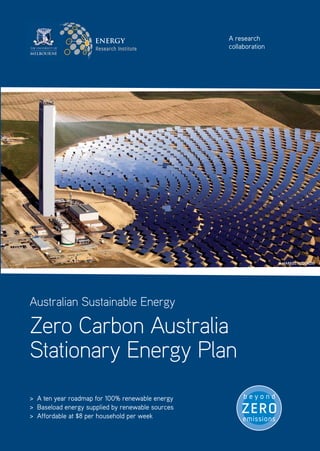
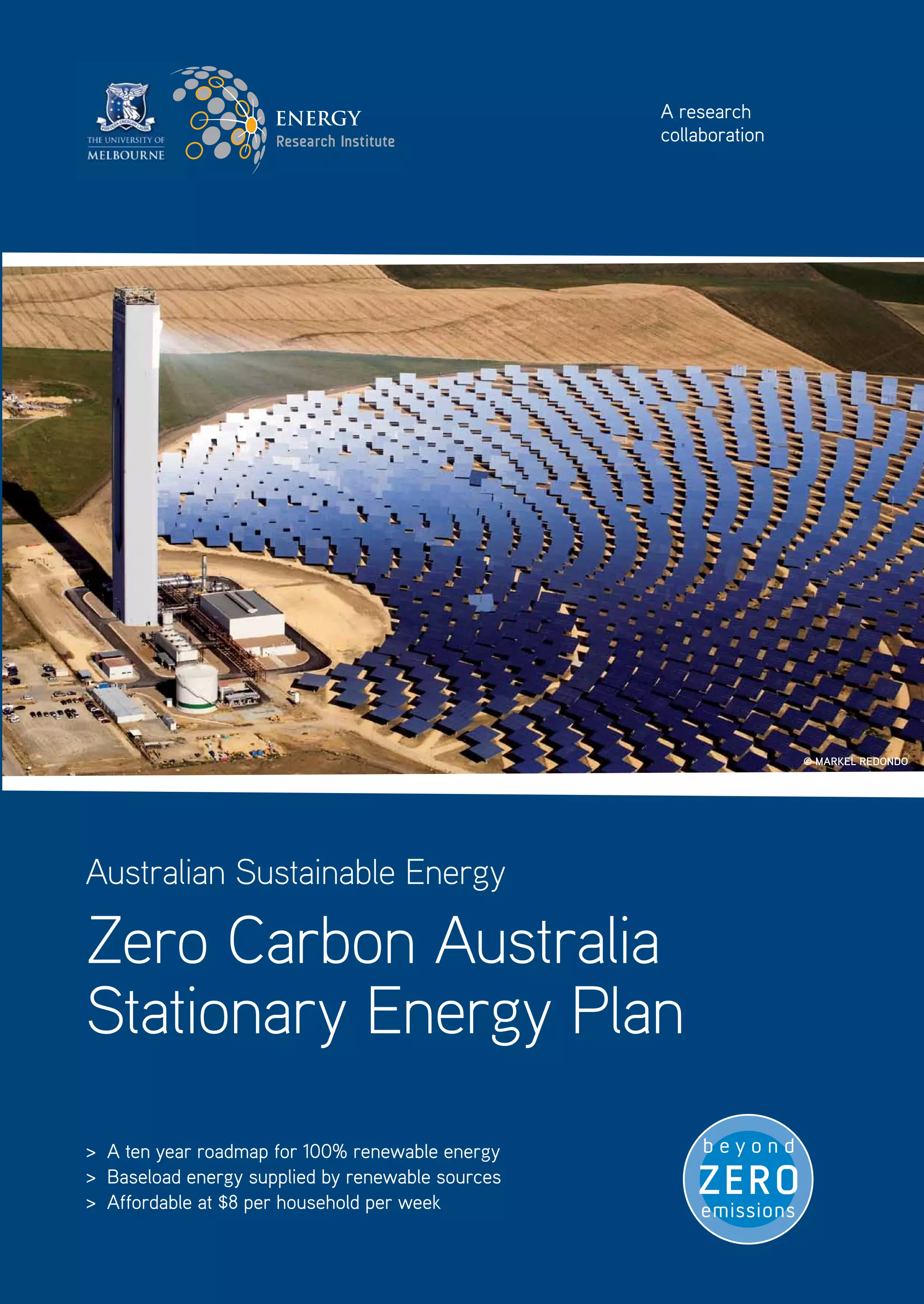
                                                                  © marKEl rEdondo


Australian Sustainable Energy

Zero Carbon Australia
Stationary Energy Plan
> A ten year roadmap for 100% renewable energy
> Baseload energy supplied by renewable sources
> Affordable at $8 per household per week
ENERGY


As the IEA has shown in its research, solar energy is now a serious global
player for providing the world’s energy. Australia has one of the world’s
best solar energy resource, especially suited for concentrating solar thermal
power plants, which can dispatch electricity when it is needed. The Zero
Carbon Australia Plan is based on up-to-date and sound information and
provides quality insights on how a country well-endowed in renewable
resources can transition to a solar and wind economy.
                                                              CédriC PhilibErt
                                                     rEnEwablE EnErgy diviSion
                                                  intErnational EnErgy agEnCy


With our natural advantage Australia can and should be positioning itself as
a global renewable super power for future prosperity. This report will help
shift the climate debate to focus on energy, security, affordability, export and
of course opportunity. Beyond Zero Emissions offers a new and invigorating
message that is much needed.
                                                         robin battErham
                KErnot ProfESSor of EnginEEring, univErSity of mElbournE
 PrESidEnt, auStralian aCadEmy of tEChnologiCal SCiEnCES and EnginEEring
                                    formErly ChiEf SCiEntiSt of auStralia


The Zero Carbon Australia 2020 plan shows that it is technically feasible and
affordable to replace all fossil fuel electricity with 100% renewable energy
given the willpower and commitment to do so. This is a cutting-edge science-
based plan that should be read by every energy decision maker and politician
in Australia.
                                                         marK Z. JaCobSon
                         ProfESSor of Civil and EnvironmEntal EnginEEring
                   ProfESSor by CourtESy of EnErgy rESourCES EnginEEring
                                    dirECtor, atmoSPhErE/EnErgy Program
                                                  Stanford univErSity, uSa


ISBN 978-0-9808258-0-0


                                     Published by the
                                     Melbourne Energy Institute
                                     University of Melbourne, July 2010
 9 780980 825800                     www.energy.unimelb.edu.au
The management of BrightSource Energy have had a long and extensive
involvement in the solar thermal industry. At BrightSource's predecessor, Luz, they
designed, developed, built and operated the nine SEGS parabolic trough plants in
California that still operate today. Built in the 1980's, these plants were the best that
could be built with the available technology at the time and certainly proved beyond
any doubt that one could capture the sun's energy and convert it into steam for large
scale electricity generation on a scale never before contemplated.

But, there were limits to this technology which resulted in low efficiencies and
capacity factors, and high capital costs. Our team at BrightSource has now
completely re-engineered the whole approach to solar thermal, utilising a centralised
tower to effect a direct solar to steam design. By using flat glass mirrors that track
the sun all day and through the seasons, our tower plants generate steam at 550˚C
and higher, allowing us to use standard Rankine cycle generation power blocks that
are dry cooled. With far greater efficiencies, higher capacity factors, lower capital
costs and the ability to operate the plant in hybrid mode and/or with storage, the
BrightSource Luz Power Tower is the proven technology of today and well into the
future for delivering firm, renewable power.

I certainly encourage and endorse the need for a holistic plan being developed for
our generation portfolio in Australia going forward – one that properly takes into
consideration our targets and desire to substantially increase the proportion of renewable
generation capacity. The plan requires careful consideration of our "as is" situation, the
desired "to be" at future dates such as 2020 and beyond, and a migration plan that will
transform our generation portfolio over time to meet our renewable targets and achieve
security of supply. Solar thermal power, as a firm, dispatchable power generation
source, will be an integral and significant component of this plan and its deployment.
                      — andrEw dyEr, dirECtor, brightSourCE EnErgy auStralia
|      i       ZCa2020 Stationary Energy Plan


As the IEA has shown in its research, solar energy is now a serious global player
for providing the world’s energy. Australia has one of the world’s best solar energy
resource, especially suited for concentrating solar thermal power plants, which can
dispatch electricity when it is needed. The Zero Carbon Australia Plan is based on
up-to-date and sound information and provides quality insights on how a country
well-endowed in renewable resources can transition to a solar and wind economy.
                                                             — CédriC PhilibErt
                       rEnEwablE EnErgy diviSion, intErnational EnErgy agEnCy


With our natural advantage Australia can and should be positioning itself as a global
renewable Super Power for future prosperity. This report will help shift the climate
debate to focus on energy; security; affordability; export and of course opportunity.
Beyond Zero Emissions offers a new and invigorating message that is much needed.
                                           — ProfESSor robin battErham
                KErnot ProfESSor of EnginEEring, univErSity of mElbournE
 PrESidEnt, auStralian aCadEmy of tEChnologiCal SCiEnCES and EnginEEring
                                    formErly ChiEf SCiEntiSt of auStralia


The Zero Carbon Australia 2020 plan shows that it is technically feasible and
affordable to replace all fossil fuel electricity with 100% renewable energy given the
willpower and commitment to do so. This is a cutting-edge science-based plan that
should be read by every energy decision maker and politician in Australia.
                                                          — marK Z. JaCobSon
                            ProfESSor of Civil and EnvironmEntal EnginEEring
                      ProfESSor by CourtESy of EnErgy rESourCES EnginEEring
                                      dirECtor, atmoSPhErE/EnErgy Program,
                                                     Stanford univErSity, uSa


No doubt improved technologies for tapping usable energy from the sun, the
winds, the tides, and the hot core of our planet will emerge as time goes by.
But this report shows clearly that the solutions available now are, with our small
population and enormous landmass, sufficient for Australia to move forward
very quickly to tap renewable energy sources and minimize greenhouse gas
emissions. We have the resources. We need the will.
                                                             — PEtEr dohErty
                 nobEl laurEatE, SChool of mEdiCinE, univErSity of mElbournE


This is an ambitious, technically feasible plan that should be looked at seriously.
                                                              — tim flannEry
                           ProfESSor faCulty of SCiEnCE, maCquariE univErSity
                                                  auStralian of thE yEar 2007


100 % renewable energy with zero emissions is achievable in Australia in about
a decade if politics takes concerted actions… Moreover, Australia can become the
initiator for a serious attempt to shift the world to a solar economy. This is the
only promising strategy for climate protection and would provide societies around
the world with solutions for climate protection, economic development, poverty
reduction and conflict resolution. We need action now!
                                                            — hanS-JoSEf fEll
                                   mEmbEr of thE gErman ParliamEnt allianCE 90
                                             thE grEEnS SPoKESman for EnErgy
|      ii      ZCa2020 Stationary Energy Plan


To achieve a safe climate future we need an urgent, large-scale transition. The work
of Beyond Zero Emissions shows that the technical transition is affordable and
achievable. Now we need a social and political transition to get behind it.
                                              — ProfESSor CarmEn lawrEnCE
                       SChool of PSyChology, univErSity of wEStErn auStralia
                                       formEr PrEmiEr of wEStErn auStralia


Over the past few decades the community in general and all sides of politics have
come to accept the significance of the threat that greenhouse gas emissions from
fossil fuel use has given rise to. Serious concrete action on changing our energy mix
is all too slow in coming.
One of the challenges that those of us promoting a renewable energy future face,
is that in the community and amongst decision makers, whilst there is widespread
support for the idea of the renewable energy solutions, there is a lack of information
on their level of technical and commercial maturity and their ability to deliver in
short time frames. This is the information gap that the Beyond Zero Emissions
study helps to fill in a very significant way.
The ZCA report analyses one particular scenario of renewable energy technology
choice based on available solutions, in considerable depth. It successfully shows in
detail that 100% renewable energy is both technically possible and economically
affordable. Clearly other renewable energy technology scenarios are also possible,
that only serves to strengthen the overall conclusion about viability. The group is to
be congratulated for their efforts.
                                          — aSSoCiatE ProfESSor KEith lovEgrovE
                                          high tEmPEraturE Solar thErmal grouP,
                                                  auStralian national univErSity


The chips are down - there is no longer any doubt about our need to rapidly
transition to a zero emission economy. The fate of Australia and the world
depend on it. The Zero Carbon Australia strategy being launched by Beyond
Zero Emissions provides the roadmap to the solutions. Let’s hope it is adopted by
responsible governments everywhere.
                                           — ProfESSor ovE hoEgh-goldbErg
            dirECtor, global ChangE inStitutE, thE univErSity of quEEnSland


“This is a bold and ground-breaking piece of work which should be a wake-up call
to all those in government and industry who refuse to see beyond coal.
This is a very exciting report. It has academic rigour; it has also the hope of a
generation and it has thousands of jobs waiting to happen.
We can and must aim to power Australia with 100% renewable energy as soon as
possible if we are to truly tackle the climate crisis - and the great news is, that will
bring huge benefits to us all, cleaning the air and creating jobs and investment from
the suburbs to the farmlands.
This Zero Carbon Australia plan is an extremely valuable contribution which all in
the parliament should be looking at very seriously”
                                                                   — ChriStinE milnE
                                                               SEnator for taSmania


“It’s not the five per cent cut project or the 20 per cent cut project with a bunch of
unachievable caveats. It’s a zero carbon project and I think people actually want
to be told a narrative, a story which is ambitious, which is aspirational, but also
practical and I think that is what this project is about.”
                                                                  — niCK XEnoPhon
                                                      SEnator for South auStralia
|     iii      ZCa2020 Stationary Energy Plan


It is difficult to imagine the Zero Carbon Australia plan being adopted in the context
of Australia’s current political and commercial culture and power cost structure.
However, as an examination of the technical feasibility of achieving its goals as it
seeks to shift this culture, it offers an interesting challenge for the imagination of
policymakers and power suppliers feeling their way in to an uncertain future.
                               — KEith orChiSon, dirECtor, Coolibah Pty ltd
     formEr managing dirECtor, ElECtriCity SuPPly aSSoCiation of auStralia


Every nation in the world should make a plan like this. If one can get a 100%
renewable, zero carbon electricity system by investing 3% of GDP (and 10% of
gross investment) for ten years, there is no good reason not to do it. Except, maybe,
the straitjacket of old ways of thinking and doing.
This plan lays out a high solar-wind renewable future and then does more. It looks
carefully at the materials requirements of such a future, an aspect of the matter too
often left unaddressed.
Australia could be the first large economy to show the way.
                                                            — John o. blaCKburn
                                                ProfESSor EmErituS of EConomiCS,
                                                            duKE univErSity, uSa


I strongly endorse the broad concept of such a solar and wind plan and applaud the
work of the University of Melbourne and Beyond Zero Emissions. Our own work
underway to calculate the feasibility of a 100% solar - wind plan for the United
States has so far had the aim of testing technical feasibility, and the match seems to
be 99-100%. We have considered the biomass backup options as well for CST plants
but increased thermal storage also seems to work for a 100% solar - wind system
for the USA. I have some differences in the discussion of CST technology used as
an example, but the study is at an initial stage. The advent of such a comprehensive
study in Australia will assist recognition of our own work directed to the USA case,
and speed the market development of the CST and wind technologies to supply
economical solar energy both day and night.
                                                                — dr david millS
                                                           foundEr and PaSt CEo
                                             Solar thErmal PowEr ComPany auSra


Wind Power is now a serious player in international energy. Installing 8,000
megawatt-class turbines along with smaller wind turbines and other renewables
where appropriate is achievable at a price the community can afford. Direct drive
turbines such as the Enercon turbines are very suitable for a modern electricity grid
where wind will be relied upon for a large proportion of overall electricity demand.
                                                               — david wood
                            EnmaX/SChuliCh ProfESSor of rEnEwablE EnErgy
                    dEPartmEnt of mEChaniCal and manufaCturing EnginEEring
                                              univErSity of Calgary, Canada


That Australia enjoys an abundance of renewable energy resources is beyond question.
The Zero Carbon Australia 2020 plan demonstrates that it is both technically feasible
and economically affordable for Australia to realise the benefit of these resources and
transition to a 100% renewable energy future. Australian politicians and decision makers
with the vision and commitment to embrace this new path have the opportunity to play
an important role in leading Australia to a sustainable low carbon future.
                  — Sharon maSChEr, aSSoCiatE ProfESSor, CEntrE for mining,
                  EnErgy and rESourCES law univErSity of wEStErn auStralia
For decades, those opposing the transition to clean energy have claimed that it is
not technically feasible. This report puts that argument convincingly to bed. There is
no longer an excuse for inaction. Starting the transition now is our responsibility to
future generations.
                                                         — ProfESSor ian lowE
                          PrESidEnt of thE auStralian ConSErvation foundation
                                        EmErituS ProfESSor griffith univErSity


Beyond Zero Emissions have been in my building, Kindness House, for five years.
The dedication of this remarkable team of individuals is astonishing. Most of all, I am
impressed by their relentless pursuit of the truth, wherever it may lead. They have
built their strategies cautiously, never letting the enthusiasm distract them from the
goal of getting the right answers by asking the right questions.
They are a welcoming organization, drawing experts from a variety of disciplines,
methodically searching for practical solutions to the challenges of reducing our
massive carbon footprint. I am personally delighted to see the tens of thousands of
hours they have invested in this important project, never once complaining about the
lack of financial resources at their disposal. They have focussed their attention heavily
on the carbon costs of stationary power, transport and building. I look forward to the
time when they devote their formidable intellect and energy to the Livestock industry,
where so much of our carbon share is squandered and emissions ignored. Beyond
Zero Emissions is one organization I am proud to say I helped to incubate.
I urge every serious institution to listen to them attentively. These are serious people
for serious times.                                                 — PhiliP wollEn oam
                                              auStralian of thE yEar viCtoria 2007

Australians are capable of rapid change when the historical circumstances call for it.
Indeed, we pride ourselves on being a resourceful people. The Beyond Zero Emissions
team show how inventive and resourceful we can be. Their plan for a transition to
100% renewables is a powerful and cogent response to those who claim it can’t be
done. The reception this report receives will be a sign of how much Australians believe
in their future and how much they take refuge in the thinking of the past.
                                                                  — ClivE hamilton
                                                    ProfESSor of PubliC EthiCS and
                                                   author of rEquiEm for a SPECiES


The Zero Carbon Australia Stationary Energy Plan is a provocative and timely
contribution to the climate change debate, and it deserves attention both here
and abroad. The Plan demolishes a pile of conventional wisdom that Australian
policymakers still seem unable to get past. The sorry history of Australian climate
policy procrastination is littered with polluter-friendly analyses conducted by
economic hired guns. Their work has been used to argue against action, or for
illusory schemes that price carbon without reducing the greenhouse pollution
billowing from Australian smokestacks and tailpipes. The effect has been to
constrain debate and obscure from our view a very different vision—a rapid switch
from fossil to renewable energy that makes economic and environmental sense. By
highlighting one of many pathways to achieving that vision, the ZCA report sheds
light where it is desperately needed.
                                                           — dr guy PEarSE
        rESEarCh fEllow, global ChangE inStitutE, univErSity of quEEnSland
                                   author of high & dry and quarry viSion
|      v       ZCa2020 Stationary Energy Plan


I get to work with people all over the world in the fight against global warming, a fight
growing increasingly desperate as temperatures climb and rainfall patterns shift. Since
Australia leads the world in per capita emissions, it makes sense that its transition
planners would be thinking big. This transition obviously won’t be easy or simple or
cost-free, but given the alternatives it’s very nice to know it’s technically feasible!
                                                           — bill mCKibbEn
   SCholar in rESidEnCE at middlEbury CollEgE, author and foundEr 350.org


This is exactly the type of initiative that we, the solar power industry, needs
to propel our technology into the energy markets of Australia. SolarReserve’s
concentrated solar power towers with molten salt storage are the most reliable,
stable form of clean, renewable energy, which is exactly what’s needed to achieve
the safe climate future proposed in BZE’s Zero Carbon Australia roadmap.
SolarReserve’s solar thermal technology with molten salt storage; proven at Solar
Two, the US Department of Energy’s 10 MW pilot plant that operated for over 3
years in the 1990’s, will not only aid in meeting Australia’s renewable energy and
carbon reduction objectives, but also have significant economic benefits, bringing
green jobs and cutting edge technology.
Solar Reserve is willing, ready and able to deploy our molten salt power towers and
fully supports the Zero Carbon Australia project.
                                                                      — tom gEorgiS
                                                      viCE PrESidEnt, SolarrESErvE

The twin threats of peak oil and climate change are now real and escalating rapidly.
They demand a radical re-think of our approach to energy, ending our fossil-fuel
dependence and moving to sustainable solutions before oil scarcity and climate
change impact cut off our options - and it has to happen far faster than our leaders
are prepared to acknowledge.
Zero Carbon Australia 2020 is exactly the type of positive, rigorous technical
analysis that is urgently needed to chart our path to a sustainable future - and
convince Australia that there are far better alternatives to the complacent
assumption that our high-carbon lifestyle can continue ad infinitum.
                                                              — ian dunloP
                     formEr CEo, auStralian inStitutE of ComPany dirECtorS
               formEr EXECutivE dirECtor of thE auStralian Coal aSSoCiation


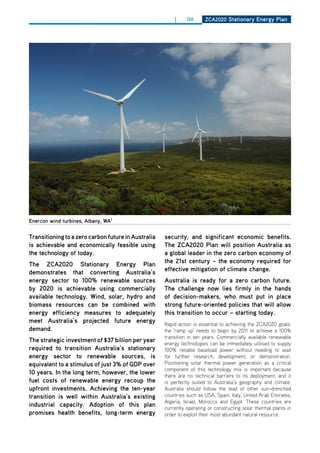
Renewable energy is the only way to go in the future. Enercon wind
energy converters are designed to the newest standards to integrate with
the modern high flexibility demands of electricity grids, providing sustainable
reliable power to keep the wheels of daily life, household and industry turning.
The Zero Carbon Plan outlines a technically achievable plan for generating all of
Australia’s energy from the wind and the sun. It can be a realistic goal if Australia
gets immediately seriously committed with decision making from industry and
government. We hope that its recommendations are taken up so that Australia can
also be a player in the renewable energy economy that is already booming around
the world.
                                                                      — EnErCon gmbh
|      vi      ZCa2020 Stationary Energy Plan


Success in restoring a safe climate depends on transforming the global economy by
2020. Every nation and every economy needs to act. The Beyond Zero Emissions
group shows in their Zero Carbon Australia 2020 report how this can be done for
Australia. The report charts a practical path—using only commercially available
technology—to a zero emissions stationary energy sector. Let’s hope that, very soon,
every country has such a plan.
                        — lEStEr r. brown, PrESidEnt of Earth PoliCy inStitutE
                           author of Plan b 4.0: mobiliZing to SavE CiviliSation


As a company involved in the development of solar plants all over the world, at
Torresol Energy we support the Zero Carbon Australia Plan that sets the path for a
future with clean, renewable energy.
Australia is one of the areas with better solar radiation and forms part of
the international ‘sun belt’. Besides, the country has excellent conditions for
profiting from that solar radiation: large low-populated areas to build the plants
and an industry that can support the technological development in the solar
generation sector. In that sense, each of Torresol Energy’s new projects introduces
technologically advanced improvements to make Concentrated Solar Energy a
manageable, economically competitive option and a real, viable, ecological and
sustainable alternative to traditional energy sources.
Torresol Energy has three plants currently under construction. Among them,
Gemasolar, with an innovative technology of central tower with molten salt receiver
and thermal storage system, is the first commercial plant in the world of its
kind. Due to this, the project has achieved considerable importance in the field of
renewable energies as it opens the path to a new solar thermal power generation.
Today, all of the analyses that have been carried out either by ourselves or by major
international institutions show that tower plants with thermal storage is the type of
technology that will be capable of generating reliable, manageable and renewable
energy at the lowest costs. Therefore Australia could adapt this kind of technology
in its renewable energy development plan that will allow the country to conserve
the environment for future generations with a reliable energy source through utility
scale baseload CSP plants.
                                                                 — Santiago ariaS
                                                    ChiEf infraStruCturE offiCEr,
                                                                 torrESol EnErgy


From the other side of the globe Protermosolar fully shares the vision of the realistic
and feasible Zero Carbon Australia Plan. Spain is currently the country with the
most intensive deployment of CST plants and their contribution to the grid stability
and to the dispatchability of power supply has been fully demonstrated. Molten
salt storage systems have been implemented in many Spanish plants providing
predictable and reliable operation after sunset. Thus CST technologies could be
considered as a real alternative to cover even the base load requirements of the
electricity system.
Australia must profit from its high solar resource, the sooner the better. An effective
boost to CST and to the other renewable technologies - as presented in this plan –
will not only go in the right direction in terms of the transition to a new energy mix
but it will also result in an excellent business for the Australian economy.
                                                               — dr. luiS CrESPo
                                             gEnEral-SECrEtary ProtErmoSolar
                                           SPaniSh aSSoCiation of CSt induStriES
|    vii     ZCa2020 Stationary Energy Plan


  australian Sustainable Energy
  Zero Carbon Australia
  Stationary Energy Plan


> a ten year roadmap for 100% renewable energy

> baseload energy supplied by renewable sources

> affordable at $8 per household per week


  L E Ad AUT ho RS

  matthew wright — Executive director, Beyond Zero Emissions
  Patrick hearps — University of Melbourne


  The University of Melbourne Energy Research Institute
  Beyond Zero Emissions
|     viii        ZCa2020 Stationary Energy Plan


australian Sustainable Energy
Zero Carbon Australia
Stationary Energy Plan
lead authors                   Dominic Eales                Patrick Hearps                  dr merryn redenbach
                               BEng, Pgdip (Elec),          BEng (Chem),                    Prof mike Sandiford
Matthew Wright
                               Swiss Federal Institute of   formerly ExxonMobil
Executive director,                                                                         warwick wright
                               Technology                   James Hutchison
Beyond Zero Emissions
                               Tim Forcey                   BSc (Physics), MEnv,            major Supporters
Patrick Hearps
                               BEng (Chem), Lehigh          Analyst, AEMo
University of Melbourne                                                                     winsome Constance
                               Energy Consultant            Richard Keech                   Kindness trust
Concept                        Trent Hawkins                MEng (Elec), formerly
                                                                                            donkey wheel foundation
Mark Ogge                      BEng (Mech)                  RAAF Engineering
director, Beyond Zero                                                                       Climate Positive
                               Nina Muhleisen               Jim Lambert
Emissions                      BEng (Mech), RMIT            BEng, MEngSc, Phd (Elec)        Climate Emergency
                                                                                            network
                               Anne O’Brian                 Eytan Lenko
beyond Zero                    BSc (hons),                  BEng, BSc,                      dr gavin wright
Emissions                      University of Sydney         formerly BP                     graeme wood
researchers                    Miwa Tominaga                Dylan McConnell                 derek bolton
Derek Bolton                   BEng (Elec), MSc (Ren En)    BEng (Chem)
MA, MSc (Maths),                                                                            Stephen whateley
                               Kevin Yeh                    Ben Robotham
oxford University                                                                           t10 alliance
                               BEng (Energy Systems),       MChem (Physics),
Pablo Brait                    formerly ANU Solar           Phd Candidate                   dan Cass and Co.
BEng (Env), Monash             Thermal Group                Matthew Sullivan
James Bramwell                 Adrian Young                 BEng, BSc, MEng (Energy)        graphic design
BEng (Mech), ANU                                                                            markmaking.com.au
Rob Campbell                   university                   technical Support               bindarri.com.au
MEng, RMIT                     of melbourne                 Sinclair Knight merz
                                                                                            ammon beyerle
Kevin Casey                    researchers                  Jack actuarial Consulting
                                                                                            Scott bilby
BEng (Elec), UNSW,             Reuben Finighan              (JaC)
formerly Ericsson              BSc/BA,                                                      dvize Creative
                                                            Expert review – adj Prof
Chris Clement                  Winner National Energy       alan Pears am, rmit             Sandy Chansiri
MSc (Energy Tech),             Essay Competition 2008
                                                                                            genevieve Engelhardt
BEng, Wind Engineer            Paul Fleckney                Editors
                                                                                            hive Studio
Vernon Crock                   BSc (Chem)                   andrew Campbell-fraser
                                                                                            luke hodge
BApp Sc                        Naomi Francis                Jonathan daly
                               BEng (Env)                                                   heidi lee
Richard Denby                                               dr roger dargaville
BArch, deakin                  Chloe Hanson-Boyd                                            glenn todd
                                                            andrew longmire
Andy Dinning                   BEng (Chem)                                                  Sharon wong
                                                            dr adam lucas
BEng (Elec),                   Rob Harrington
Transmission Engineer, SKM     BEng (Biomed)                Elena mcmaster
Rebecca Dunn                                                Jane morton
BEng (Solar), Phd Candidate,
ANU Solar Thermal Group
|       ix     ZCa2020 Stationary Energy Plan


foreword
Twenty-eight billion is a big number. Measured in tonnes it        always reduces with large-scale rollout. The 2003 US-
is a very heavy load. This figure is the amount of sediment        based Sargent & Lundy report anticipated solar thermal
eroded each year from all our mountains and carried by all         electricity costs would reach parity with coal fired power
our rivers to all our seas. And it is the amount of carbon         once 8.7 GW of capacity was installed – just a bit under
dioxide (Co2) we pump into the atmosphere each year from           Victoria’s stationary energy capacity today.
burning fossil fuels globally – enough to cover Australia in
                                                                   So far, there has not even been modest stimulus for solar
a blanket two metres thick. In dollars, it is just a little more
                                                                   thermal power. The Global Financial Crisis is partly to
than the extra annual investment needed to reconfigure
                                                                   blame, but political will is the resource in shortest supply.
Australia’s stationary energy system to have zero emissions
                                                                   The BP deepwater horizon oil spill may have changed that.
in just 10 years time.
                                                                   So what if we were to try to build a 100% renewable energy
Each year the 28 billion tonnes of Co2 we make induces
                                                                   system to power the Australian economy in just 10 years?
heating. The oceans are now heating at the phenomenal
                                                                   how could we possibly do that, and what would it cost?
rate of 300 trillion watts. In frighteningly human terms that
is equivalent to detonating five hiroshima sized A-bombs           That is the challenge outlined in Australian Sustainable
every second, every day of every year.                             Energy – Zero Carbon Australia Stationary Energy Plan.
To make 28 billion tonnes of Co2 we dig 7 billion tonnes           Zero Carbon Australia outlines a coherent and thoroughly
of coal and suck countless gallons of oil and gas from the         researched blueprint showing how 100% renewable energy
ground. In total we already excavate more rock from the            is achievable using technologies that are commercially
Earth than nature does. With peak oil rapidly approaching, if      available today: wind power and concentrating solar thermal
not passed, BP’s deepwater horizon catastrophe attests to          with molten salt storage. It goes through the options, costs
the huge risks entailed in maintaining production.                 and benefits, confirming that a 10 year transformation of the
                                                                   stationary energy sector is achievable and affordable. This
The rate we consume energy to emit that Co2 is 16 trillion
                                                                   will also add huge stimulus to the new green economy and
watts. That is already about 1/3 of the energy released by
                                                                   create jobs.
plate tectonics - the process that pushes continents around
the globe over geological time making mountains and                Zero Carbon Australia demonstrates that both cost and
earthquakes as it goes. on current growth trajectories we          variability can be readily addressed, and exposes as myth
are set to surpass this amount of energy by 2060.                  the frequent argument that we need coal, gas or nuclear
                                                                   to provide baseload electricity. This is achieved by first
Each year we are adding a bit under 1% to the atmospheric
                                                                   smoothing power output across the grid via geographically
Co2 load, enhancing the greenhouse effect by a small
                                                                   dispersed production, and secondly providing dispatchable
fraction of a percent. By trapping just a tiny extra fraction
                                                                   “back up” power from the molten salt storage at solar
of the incoming solar energy, we are heating not only the
                                                                   thermal power plants. our nation continent, stretching
atmosphere, but also the oceans and land.
                                                                   across climate and time zones, appears ready made for this.
Such numbers give a very real sense that we humans are
                                                                   Zero Carbon Australia provides a big vision - Australia as a
now operating as a geological change agent. But the scary
                                                                   renewable energy powerhouse. But 28 billion tonnes of Co2
thing is we have only just begun. Energy use is increasing
                                                                   is a big load, and getting bigger. Therefore a big vision for
exponentially, doubling every 34 years so that it will increase
                                                                   an alternative energy system is precisely what is needed.
by 800% in a century. Curtailing energy growth will not be
easy with 2 billion people already in energy poverty and 2         Zero Carbon Australia is an extraordinary and pragmatic
billion more added to the human number by mid century.             roadmap to a new and more sustainable energy system
                                                                   in Australia, and ultimately our region. I recommend it to
So how will we cater for our future energy needs?
                                                                   all who are truly interested in securing Australia’s energy
one answer stares us in the face. Effectively converting           future.
about 0.06% of the solar energy that hits the land would
meet the entire global energy demand.
                                                                   mike Sandiford
But aren’t there problems with renewable energy? Isn’t it
too expensive and unreliable? After all, the wind doesn’t          Professor of Geology
blow all the time and the sun doesn’t shine at night.              director, Melbourne Energy Institute
                                                                   University of Melbourne
Currently, advanced solar thermal power with molten salt
storage, capable of producing power on demand day or               June 2010
night, is about four times more expensive than the cheapest
coal fired power plants. But the cost of new technologies
|      x      ZCa2020 Stationary Energy Plan


© 2010                                                      acknowledgements

This work is licensed under the Creative Commons            lead authors: Matthew Wright, Executive director,
Attribution-NonCommercial-ShareAlike 3.0                    Beyond Zero Emissions and Patrick hearps,
Unported License. To view a copy of this license, visit     University of Melbourne
http:/ creativecommons.org/licenses/by-nc-sa/3.0/ or        Concept: Mark ogge, director, Beyond Zero Emissions
send a letter to Creative Commons, 171 Second Street,
Suite 300, San Francisco, California, 94105, USA.           beyond Zero Emissions researchers: derek Bolton
                                                            • Pablo Brait • James Bramwell • Rob Campbell • Kevin
ISBN: 978-0-9808258-0-0                                     Casey • Chris Clement • Vernon Crock • Richard Denby
                                                            • Andy Dinning • Rebecca Dunn • Dominic Eales • Tim
                                                            Forcey • Trent Hawkins • Nina Muhleisen • Kevin Yeh •
Published by University of Melbourne                        Adrian Young
Energy Research Institute, McCoy Building
Corner of Swanston and Elgin Streets                        university of melbourne researchers: Reuben Finighan
University of Melbourne                                     • Paul Fleckney • Naomi Francis • Chloe Hanson-Boyd
Carlton 3053, Victoria, Australia                           • Rob Harrington • Patrick Hearps • James Hutchison
                                                            • Richard Keech • Jim Lambert • Eytan Lenko • Dylan
designed using Adobe CS4                                    McConnell • Ben Robotham • Matthew Sullivan
Printed by Trojan Press,                                    technical support: Sinclair Knight Merz • Jack Actuarial
34 Temple drive, Thomastown 3074                            Consulting • Adjunct Professor Alan Pears
with vegetable based inks on post consumer recycled paper
                                                            Editors: Andrew Campbell-Fraser • Jonathan Daly • Dr
                                                            Roger Dargaville • Dr Adam Lucas • Elena McMaster •
Cover photograph: © Markel Redondo                          Jane Morton • Andrew Longmire • Dr Merryn Redenbach
                                                            • Warwick Wright
                                                            major supporters: Winsome Constance, • Kindness Trust
                                                            • Donkey Wheel Foundation • Climate Positive • Climate
                                                            Emergency Network • Dr Gavin Wright • Graeme Wood
                                                            • Derek Bolton • Stephen Whateley • T10 Alliance • Dan
                                                            Cass and Co.
                                                            graphic designers: markmaking.com.au • Bindarri.com.au
                                                            • Ammon Beyerle • Sandy Chansiri • Dvize Creative •
                                                            Genevieve Engelhardt • Luke Hodge • Heidi Lee • Glenn
                                                            Todd • Sharon Wong • Scott Bilby
                                                            reviewers: Zane Alcorn • David Bruce-Steer • Jonathan
                                                            Doig • Leigh Ewbank • John Fisher • Julie Knight • Petra
                                                            Liverani • Annie Neilsen • Dr Kate O’Brien • James Tonson
                                                            • Harry Troedel • Huong Truong
|        xi   ZCa2020 Stationary Energy Plan


Contents
foreword                                                                                          ix

Executive Summary                                                                                xv

Part 1    introduction and overview                                                                   1
    1.1   why Zero Emissions?                                                                         2
    1.2   why ten years?                                                                              3
    1.3   guiding Principles, assumptions and Project methodology                                     4
    1.4   Summary of technology Choices                                                               5
    1.5   the ZCa2020 Project and the Stationary Energy Plan                                          5
    1.6   Structure of the Stationary Energy Plan report                                              6
    1.7   the ZCa2020 working group                                                                   6
          1.7.1   the future of ZCa2020                                                               6
    footnotes                                                                                         7
    references                                                                                        7

Part 2    designing the ZCa2020 Stationary Energy Plan Supply System                              9
    2.1   overview of the ZCa2020 Stationary Energy Plan Supply System                            10
    2.2   analysis of Current australian Emissions and Energy-use trends                          11
          2.2.1 australian greenhouse gas Emissions                                               11
          2.2.2 Current australian Energy Consumption                                             11
    2.3   australian Energy demand in 2020 under the Plan                                         13
          2.3.1 Energy Efficiency measures Employed to reduce overall Energy demand               15
          2.3.2 buildings: Energy Efficiency and retrofitting                                     15
          2.3.3 transport Electrification and mode Shift to Public transport                      16
          2.3.4 industrial Energy reductions                                                      19
    2.4   Proposed Pattern of demand under the ZCa2020 Plan                                       20
          2.4.1 Seasonal variation and Shift of demand from a Summer Peak                         20
          2.4.2 baseload and Peaking under Current Electricity Supply                             21
          2.4.3 flattening Electricity demand Peaks                                               22
    2.5   Choosing feasible, Cost Effective Zero-Emissions Solutions                              23
          2.5.1 australia’s Solar resource                                                        23
          2.5.2 Concentrating Solar thermal Power—the most Suitable large-Scale Solar
                technology                                                                        23
          2.5.3 Smaller-Scale Solar technologies                                                  28
          2.5.4 wind Power                                                                        29
Contents                                                 |    xii    ZCa2020 Stationary Energy Plan


           2.5.5 biomass                                                                          32
           2.5.6 hydroelectric Power—meeting Peak Electricity demand and Energy Storage           33
           2.5.7 non-commercial technologies                                                      34
           2.5.8 lifecycle Emissions of Energy technologies                                       34
     references                                                                                   38

Part 3     australia’s 100% renewable energy supply                                              43
     3.1   Concentrating Solar Power with Storage — 24 hour dispatchable power                    45
           3.1.1   which CSt power tower technologies?                                            47
           3.1.2 technical specifications and description of CSt plant design                     48
           3.1.3 Scaling up of CSt                                                                53
           3.1.4 Choosing geographically diverse sites for CSt                                    55
           3.1.5 Sizing Capacity for winter minimum                                               55
           3.1.6 installation timeline                                                            57
           3.1.7 land use for Solar thermal Sites                                                 57
           3.1.8 CSt water consumption                                                            60
           3.1.9 CSt cost                                                                         61
     3.2   wind: Cheap, Clean and technologically advanced                                        62
           3.2.1 wind Power requirements                                                          62
           3.2.2 Siting for geographical diversity and winter Peak demand                         63
           3.2.3 installation timeline and resource requirements                                  65
           3.2.4 managing wind variability by means of integration with CSt with storage          65
           3.2.5 wind surpluses at high penetration levels                                        66
           3.2.6 Cost of wind turbines                                                            66
     3.3   modelling of the ZCa2020 renewable Electricity grid                                    68
     3.4   other renewable energy sources for energy security backup                              68
           3.4.1 hydroelectric power to address supply peaks and store energy                     68
           3.4.2 biomass — Co-firing with CSt plants                                              69
           3.4.3 biogas for industrial methane supply                                             70
     3.5   industrial Processes                                                                   71
           3.5.1 Electrification of heating loads                                                 71
           3.5.2 Case-study: Conversion of industrial facility to solar thermal                   72
           3.5.3 Zero-emissions steel smelting                                                    73
     references                                                                                   75

Part 4     modelling of ZCa2020 renewable energy supply                                          79
     4.1   the ZCa2020 grid model                                                                 80
     4.2   detailed overview of the ZCa2020 grid model                                            81
           4.2.1 introduction                                                                     81
Contents                                                |    xiii   ZCa2020 Stationary Energy Plan


           4.2.2 Proposed generating mix and demand                                              81
           4.2.3 method and Characteristics of the model                                         82
           4.2.4 Examples of model behaviour for Summer and winter Periods                       82
     4.3   high level modelling results                                                          84
     4.4   Conclusions                                                                           86
           4.4.1 limitations and future work                                                     86

Part 5     grid and load management—Creation of a national grid                                 87
     5.1   upgrading the grid                                                                    89
           5.1.1 grid extension—connecting renewable energy plants into the grid                 91
           5.1.2 Connecting nEm, SwiS and nwiS to form a national grid                           91
           5.1.3 increasing reinforcement and resilience within the existing grid                92
     5.2   Control of Supply and demand                                                          93
           5.2.1 minimising Peak demand                                                          93
           5.2.2 Supply Side management                                                          95
           5.2.3 demand Side management                                                          95
           5.2.4 Examples of Scale                                                               95
     references                                                                                  96

Part 6     resourcing the transition — implementation                                           97
     6.1   implementation timeline                                                               98
           6.1.1 wind Power timeline                                                             99
           6.1.2 Solar thermal (CSt) Power timeline                                              99
           6.1.3 transmission installations                                                      99
     6.2   material resources                                                                   100
           6.2.1 CSt — Concrete, Steel and glass                                                100
           6.2.2 wind — Concrete and Steel                                                      101
           6.2.3 transmission lines — Concrete, Steel and aluminium                             101
           6.2.4 total Concrete, Steel and glass                                                102
     6.3   Emissions resulting from Construction                                                103
           6.3.1 CSt related Emissions                                                          103
           6.3.2 wind related Emissions                                                         103
           6.3.3 transmission infrastructure                                                    104
           6.3.4 Combined total                                                                 104
     6.4   manufacturing                                                                        105
           6.4.1 CSt manufacturing Capacity                                                     105
           6.4.2 wind manufacturing Capacity                                                    106
     6.5   Jobs                                                                                 108
           6.5.1 Current Employment in Stationary Energy Production                             109
Contents                                              |   xiv   ZCa2020 Stationary Energy Plan


           6.5.2 Jobs in Solar                                                              109
           6.5.3 Jobs in wind                                                               109
           6.5.4 Jobs in new transmission lines                                             110
           6.5.5 Jobs in biomass                                                            110
           6.5.6 ramp-up and Comparison with Current Employment                             110
     6.6   Conclusion                                                                        111
     footnotes                                                                              112
     references                                                                             112

Part 7     Economic Comparisons                                                             115
     7.1   Summary of Economic findings                                                     116
     7.2   Economic Comparison:
           the ZCa2020 Plan vs business-as-usual                                            117
           7.2.1 modelling ZCa2020 and bau: which Provides lower-Cost Energy?               117
           7.2.2 Comparing the models                                                       118
           7.2.3 other unmodelled Economic benefits                                         119
     7.3   the ZCa2020 Stationary Energy Plan investment in the Context of other Economic
           activity                                                                         120
     7.4   how much would electricity cost under ZCa2020?                                   121
     references                                                                             123

Conclusion                                                                                  125

appendices                                                                                  129
     appendix 1
          Energy demand                                                                     130
     appendix 2
          System design and Costing                                                         138
     appendix 3a
          Scaling up Solar Power towers                                                     142
     appendix 3b
          Projected wind Energy Capital Costs                                               146
     appendix 4
          water use at CSt sites                                                            148
     appendix 5
          industrial Case Study                                                             152
     appendix 6
          transmission upgrades                                                             155
     appendix 7
          implementation – timeline and Jobs                                                160
     appendix 8
          resource requirements                                                             165
     appendix 9
          Economic Comparison assumptions and references                                    169
|   xv   ZCa2020 Stationary Energy Plan


Executive Summary
Executive Summary                                                     |    xvi      ZCa2020 Stationary Energy Plan


the Zero Carbon australia 2020 Stationary                        just 3% of GdP over ten years, to build a zero-emissions
Energy Plan (ZCa2020 Plan) is a detailed                         energy system that will last for at least 30-40 years.
and practical roadmap to decarbonise the                         The ZCA2020 research team also found that moving
australian stationary energy sector within a                     to 100% renewable energy by 2020 is well within the
                                                                 financial and industrial capability of Australia’s economy.
decade.                                                          The raw materials, and manufacturing and construction
                                                                 labour needed to implement the transition are small when
Current levels of greenhouse gases in the atmosphere
                                                                 compared with those employed every day within Australian
are already sufficiently high to carry the climate system
                                                                 industry. For example, 80,000 construction jobs will be
past significant tipping points. They pose an unacceptable
                                                                 required at the peak of the ZCA2020 Plan installation,
risk of dangerous and irreversible changes to the world’s
                                                                 equivalent to only 8% of Australia’s present construction
climate, to biodiversity, and therefore to human civilisation.
                                                                 workforce. This is easily achievable given that in the
These changes directly affect Australia’s food and water
                                                                 period immediately prior to the Global Financial Crisis,
security, and increase the risk of regional instability.
                                                                 new construction jobs were increasing at a rate of around
Using a global carbon budget approach, recent work               50,000 per year. Furthermore, the jobs created by the new
by the German Advisory Council on Global Change                  renewable energy economy will more than offset job losses
demonstrates that, to have a two-in-three chance of              in the fossil fuel industries.
keeping global warming to less than 2oC above pre-
                                                                 In narrow economic terms the ZCA2020 Stationary Energy
industrial temperatures, developed nations with the highest
                                                                 Plan does not impose a long-term cost on the economy
per capita rates of emissions, such as the United States
                                                                 above business-as-usual. That is, the net present costs
and Australia, would need to decarbonise their economies
                                                                 for both scenarios calculated for the period 2010-2040
by 2020. There is increasing consensus that the 2oC
                                                                 are approximately equal, at roughly $AU500 billion. This
threshold is too high and beyond a ‘safe boundary’, and
                                                                 calculation ignores savings from transport fuel costs and
that atmospheric carbon dioxide must be reduced from the
                                                                 possible carbon pricing. The ZCA2020 Plan is able to achieve
current level of around 390 parts per million (ppm) into the
                                                                 this low cost, because the pipeline of renewable energy
range of 300 to 350 ppm.
                                                                 projects in the plan contributes to the rapid reduction in the
For these reasons a timeline of ten years is recommended.        cost of renewable energy. Cost reductions from increased
Ten years is a meaningful timeframe for planning purposes,       cumulative capacity of these technologies are realised,
as it requires immediate action, whereas longer and less         as well as avoiding future rising costs of fossil fuels for
ambitious goals lead to half-responses and delay. over           power stations. Adoption of the full ZCA2020 Plan provides
this ten year period, fossil fuel generating assets will be      significant economic benefits, eliminates all dependence on
retired as new renewable energy infrastructure is brought        foreign energy sources, and positions Australia to lead in
on line and securely integrated into the electricity supply      the 21st century renewable energy economy.
system.
                                                                 decisive leadership is now needed from government,
A group of dedicated individuals with experience and             business, academia and the wider community for this
expertise in relevant energy industry disciplines, many of       transition to begin.
whom work in the fossil fuel energy industry, collaborated
                                                                 The Stationary Energy Plan is the first in a series of six
to develop the Zero Carbon Australia 2020 Stationary
                                                                 plans making up the ZCA2020 Project. Future reports will
Energy Plan.
                                                                 cover the sectors of Transport, Buildings, Land Use and
only proven and costed technologies are used in the              Agriculture, Industrial Processes and Replacing Fossil-Fuel
ZCA2020 Plan. Wind power and concentrating solar                 Export Revenue.
thermal (CST) with molten salt storage are the two primary
technologies used, providing approximately 40% and 60%
                                                                 ZCa2020 Stationary Energy Plan detail
of the energy mix respectively. These key energy sources
are backed up by a 2% annual contribution from crop
                                                                 The stationary energy sector accounts for almost 55% of
waste biomass and hydroelectricity. detailed modelling
                                                                 Australia’s Co2 equivalent emissions, with all fossil fuels
was undertaken to ensure that the new renewable energy
                                                                 accounting for over 70% of Australia’s emissions.
supply can meet all demand projected under the ZCA2020
Plan, 24 hours a day, 7 days a week, 365 days a year.            The ZCA2020 Stationary Energy Plan describes how to
                                                                 repower Australia’s stationary energy sector using 100%
When compared to other nations, Australia’s renewable
                                                                 renewable sources by 2020. The authors acknowledge that
energy resources are amongst the best and the most
                                                                 the Plan detailed herein is not the only way that Australia
profitable to develop. Thus, these resources offer a
                                                                 could achieve zero emissions from the stationary energy
strategic advantage for all Australians as we prepare to
                                                                 sector. While ongoing innovation will indeed make it even
compete in the future carbon-constrained global economy.
                                                                 easier and cheaper to meet the zero emissions target, the
The investment required to transition Australia’s stationary
                                                                 option presented here is available right now.
energy sector to renewables is a stimulus equivalent to
Executive Summary                                                      |    xvii     ZCa2020 Stationary Energy Plan


                                                                  reduced overall Energy requirements

                                                                  Total delivered energy use under the plan is reduced by
                                                                  more than half, from 3,915 PJ/yr (2008) to 1,660 PJ/yr
                                                                  (2020), while maintaining the same level of energy services,
                                                                  including transport, heating and cooling, industrial energy
                                                                  use and so on.
                                                                  This is achieved through a combination of energy efficiency
                                                                  measures, and by switching energy services currently
                                                                  provided with oil and natural gas, mostly for transport and
                                                                  heating, with far more efficient electrical systems.
                                                                  For instance, due to the inefficiency of internal combustion
                                                                  engines, less than 20% of the fossil fuel energy consumed
                                                                  by the transport sector is actually converted into useful
                                                                  vehicular motion, once stop-start inefficiencies are factored
                                                                  in. on the other hand, electric rail and electric cars convert
                                                                  80-90% of electrical energy into motion.
                                                                  Similarly, space heating with efficient heat pump systems
                                                                  uses a small amount of electricity to “pump” ambient heat -
                                                                  a renewable resource - from outside. Typically, heat pump
                                                                  systems for domestic and commercial buildings will use
                                                                  between one quarter and one third of the energy used by
                                                                  natural gas or resistive electrical heating systems to provide
                                                                  the same amount of heat.
                                                                  A minor allowance is made for biogas and biofuels to meet
                                                                  energy demands that cannot be electrified, though this is
                                                                  kept to a minimum.

                                                                  flatter Electricity-use Profile
Enercon E-126 turbines in belgium. image: Steenki
                                                                  Australian electricity and natural gas usage fluctuates
The ten-year timeframe has been mapped out taking into
                                                                  considerably from day to day and between seasons. This
account the need for initial growth of the renewable energy
                                                                  means that at present the energy generation and distribution
industry. The timeframe could be accelerated with continued
                                                                  infrastructure is under-utilised. The ZCA2020 Plan employs
growth in later years or delayed if policy action is too slow
                                                                  measures to flatten this profile on both a daily and seasonal
however the report demonstrates that such a rapid transition
                                                                  basis so that infrastructure is more effectively used and
is within Australia’s capacity.
                                                                  infrastructure investors can achieve suitable economic
There are a variety of policy mechanisms that could facilitate    returns.
implementation of the ZCA2020 Plan, with funding provided
from any mixture of public and private sources. It is beyond      Proven and Costed renewable Energy technologies
the scope of this report to recommend any particular
financing or policy mechanism.                                    The Plan relies only on existing, proven, commercially
                                                                  available and costed technologies. The Plan found that wind
                                                                  and concentrating solar thermal (CST) power with molten
Key features of the Plan include:
                                                                  salt heat storage are the most appropriate, cost effective,
                                                                  commercially available, and scalable technologies for
increased Electricity use                                         deployment in Australia.

Australia’s annual electricity demand increases by over           "better-than-baseload" Electricity generation
40%, from 822 PJ/yr (228 TWh/yr) in 2008 to 1,170 PJ/
yr (325 TWh/yr) in 2020. While this is more electricity           Storing the sun’s energy as heat in the form of hot molten
demand than would be required under business-as-usual             salt allows CST plants to provide power that is “better-than-
demand growth, it is demonstrated that with a combination         baseload”. Similar to a hydroelectricity dam, CST plants
of energy efficiency and fuel-switching measures, this            with heat storage can dispatch electricity as needed at very
is in fact sufficient to replace all fossil fuel use, including   short notice. This is achieved by using the heat from the
transport and heating.                                            stored molten salt to produce steam as necessary.
Executive Summary                                                   |    xviii     ZCa2020 Stationary Energy Plan


achievability                                                  one ZCA2020 CST module consists of a net 217 MWe
                                                               turbine, with a mirror field and molten salt system sized
The Plan examines the achievability of the required            to provide thermal energy for 17 hours of storage. Air-
transformation,    including  labour   and    resource         cooling of the power cycle is used instead of water
requirements and manufacturing capacity, and concludes         cooling in order to minimise water requirements. These
that there are no resource constraints that prevent the        solar thermal plants are capable of running at a 72%
transition to 100% renewable energy.                           annual capacity factor - more than the annual operating
                                                               capacity of most large black coal power plants operating in
                                                               Australia today. Twelve solar sites around Australia were
Electricity generation technology details
                                                               chosen, each with installed capacity of 3,500MW per site.
The Plan provides 100% of Australia’s electricity
                                                               wind Supplies 40% of Electricity demand
needs using the following renewable energy sources
geographically dispersed around an improved national
                                                               Wind power is generally the cheapest renewable energy
grid. This geographic diversity is a major contributor to
                                                               source to deploy and is technologically mature. Australia
the consistency of the ZCA2020 power supply. detailed
                                                               however, currently has less than 2,000 MWe of wind
modelling using real-world data on a half-hourly timescale
                                                               turbine capacity installed. The Plan provides 48,000 MWe
has shown that the proposed generation mix is capable
                                                               of new installed turbine capacity running at an average
of meeting 100% of electricity demand. The system is in
                                                               annual capacity factor of 30%. This consists of 6,400
fact able to generate at least 25% more power than the
                                                               7.5 MW wind turbines spread out over 23 geographically
projected 325TWh/yr demand.
                                                               diverse locations. detailed simulations have shown that
                                                               40% wind power can be readily integrated with the CST-
Concentrating Solar thermal (CSt) Power with molten
                                                               based electricity supply grid. For example, during periods of
Salt Storage supplies 60% of Electricity demand
                                                               high wind speeds, wind generated electricity is dispatched
                                                               to the grid first, while the sun’s energy is used mainly to
Enviably, Australia has the best solar resource of any
                                                               heat salt for storage. Conversely, when wind speeds are
developed country, and concentrating solar thermal power
                                                               low, the hot molten salt at CST plants is used to produce
is recognised as the optimal technology to exploit this. The
                                                               extra steam for the turbines and hence make up for the
Plan provides CST power towers with molten salt storage,
                                                               lull in wind generation. Based on detailed studies from the
such as those available from Torresol and Solar Reserve.
                                                               U.S.A., it is projected that at least 15% of the installed wind
Power towers offer the dual advantage of continued high
                                                               capacity will always be producing power, with the same
performance in winter, and higher operating temperatures
                                                               reliability as conventional ‘baseload’ power.
year-round. With fully integrated molten salt heat storage,
from which steam can be produced on demand, these plants
                                                               biomass and hydroelectricity backup
provide 24-hour electricity production. Crop-waste biomass
firing is used during extended periods of concurrent low
                                                               Biomass and hydroelectricity are used as contingency
solar and wind availability, as described below. Industry
                                                               backup for up to 2% of annual demand. Pelletised crop
scale-up and cost reduction trajectories have been detailed
                                                               waste biomass is provided as a backup heat source for the
by the U.S. department of Energy and Sargent & Lundy
                                                               CST plants to accommodate periods of extended cloud cover
Consulting LLC. Consistent with these, after a capacity of
                                                               in winter. This is similar to the way in which natural gas is
8,700 MWe is installed globally, solar thermal power towers
                                                               used to backup some existing CST plants. In both cases, the
will provide electricity at a cost that is competitive with
                                                               steam system and other power generation infrastructure
conventional coal power at 5-6 $AU cents/kWh.
                                                               of the CST plants function without regard to the source
                                                               of heat: sun, combusted biomass, or combusted natural
                                                               gas. Adequate backup can be provided by processing just
                                                               13% of waste straw residue from Australia’s annual wheat
                                                               crop. Pelletisation increases the energy density and cost
                                                               effectiveness of the transport of the biomass. Australia’s
                                                               existing hydroelectricity systems have also been factored in
                                                               to provide backup, though at a discounted rate to account
                                                               for future drought periods.


                                                               Electricity transmission infrastructure

                                                               The ZCA2020 Plan provides upgraded electricity grid
                                                               infrastructure connected to an optimal selection of
                                                               renewable energy plant sites. Sites for wind and solar
Proposed national renewable grid - see Part 5 for              power generation were chosen on the basis of data available
detail
Executive Summary                                                    |     xix      ZCa2020 Stationary Energy Plan


from NASA and Australian Government bodies. Emphasis             in Australia and overseas with the capability of producing
was placed on selecting sites with high year-round energy        300,000 to 500,000 cars per year.
availability so that both winter and summer peak electricity
demands are met.
                                                                 required investment and Economics compared to
Electrical transmission links are upgraded in order to           business-as-usual
strengthen the Australian grid and connect the new
renewable energy installations. New interstate connections       The ZCA2020 plan requires a total investment of $AU370
enable greater import and export capability between the          billion over the period 2011-2020. Annual investment,
geographically diverse renewable energy resources. The           averaging $AU37 billion per year, will be lower in initial
Plan provides 500kV alternating current links to connect         years and higher as the pace of construction ramps up.
new power stations near populated regions where the              Importantly, the up-front annual costs of construction need
power is to be used locally. Meanwhile efficient high            only be paid by investors, not by the Australian public. As
Voltage direct Current (hVdC) links are provided for low-        with any energy infrastructure project, up-front capital
loss long-distance transmission to connect specified solar       costs will be paid back over time through energy sales.
installations and for interstate connections to areas of high    Therefore the figure of $370 billion is not an expense to the
electricity demand. The Plan costings also allow for supply      economy without return. Rather it is a strategic investment
of 4,475 MW of offgrid electricity to load centres without       that secures Australia’s zero-emission future and results in
grid access.                                                     significant savings in future years.
                                                                 Compared to Australia’s annual GdP of $AU1.2 trillion, the
achievability and Employment                                     investment for ZCA2020 represents 3% of GdP over the
                                                                 ten years. Though the up-front investment required by the
Implementation of the plan would require a rapid ramp-up         Plan is significant, maintaining business-as-usual (BAU) is
of projects and industry. The ten year timeframe takes into      not without its costs either. BAU requires $AU135 billion
account that this will not happen overnight, and would see       for ongoing capital investments in energy infrastructure
most of the proposed infrastructure completed in the second      for the period 2011 to 2020, and then continues to pay
half of the decade. Mid-term goals are to have 15,000 MW         for increasingly expensive fossil fuels in later years, with
of wind and 5,000 MW of CST operational by 2015. This            $AU300 billion in fuel costs. Although the ZCA2020 Plan’s
requires fast-tracking existing projects and putting in place    up-front investment is substantially higher than BAU, the
the right policies to stimulate new projects.                    Plan’s low ongoing costs result in dramatically reduced
                                                                 expenditures over the long-term. Calculating net present
The labour resource requirements for the implementation
                                                                 costs on a longer timeframe (2011-2040) demonstrates that
are dwarfed by Australia’s existing industrial capacity. The
                                                                 the ZCA2020 Stationary Energy Plan is about the same
Plan would require a peak of 80,000 construction workers
                                                                 cost as the BAU scenario.
by 2016, out of an existing workforce of almost one million.
Prior to the Global Financial Crisis of 2008, the construction   These savings expand when the broader economic benefits
workforce was growing at the rate of 50,000 new jobs per         of the Plan are included. The use of electricity to power
year. Similarly in manufacturing, modelling has allowed          transport instead of oil realises fuel cost savings of nearly
for 50% of the manufacturing of wind turbine components          $AU1,170 billion. Lastly, in the event that a carbon price is
and CST heliostat mirrors to be done onshore. This would         implemented, an estimate of the savings made by avoiding
create up to 30,000 new jobs, out of Australia’s existing        potential Co2 emission charges shows that the Plan
manufacturing workforce of one million which is projected        avoids an additional $AU370 billion, raising total savings to
to decline under business-as-usual. The Plan would create a      $AU1,550 billion. Taking these costs into account realises a
further 45,000 ongoing jobs in operations and maintenance        very rapid economic payback of only a few years.
of the renewable energy infrastructure, which would more
                                                                 This report also compares the ZCA2020 Plan costs to other
than offset the loss of around 20,000 jobs in the domestic
                                                                 public and private expenditures – for example, the annual
fossil energy supply sector.
                                                                 ZCA2020 investment is equal to what Australians spend
The raw materials required by the Plan are primarily             each year on insurance. This demonstrates that the scale
concrete, steel and glass, none of which are constrained         of the projects described within this report are well within
by supply. The Plan would require the equivalent of only         the capacity and capability of the Australian economy. More
7% of Australia’s current concrete production, while             detailed economic modelling and policy recommendations
sourcing steel and glass would require some increase in          are beyond the scope of the ZCA2020 Stationary Energy
either domestic production or imports. The manufacturing         Report. Future work will include a separate financing and
of heliostats and wind turbine components would require          policy document to be produced at a later date.
the setting up of several new factories of a similar size to
                                                                 As a benchmark for gauging the economic impact of the
ones that already exist overseas. For example, it is feasible
                                                                 Plan, a preliminary analysis has been done based on one
that the production of 600,000 heliostats per year could be
                                                                 possible funding scenario where the investment is paid for
done in a single factory, as there are already car factories
                                                                 solely through electricity retail revenue. If the proposed
Executive Summary                                                      |     xx      ZCa2020 Stationary Energy Plan


brightSource Solar thermal Power tower


infrastructure was funded with revenue from electricity
                                                                  Summary
prices at a standard rate of return for regulated assets, it
would require a price rise of around 6.5c/kWh by 2020,
                                                                  The following chapters show in detail how the transition to
equivalent to the existing premium for GreenPower today.
                                                                  a Zero Carbon Australian economy can be achieved using
This should not be taken as a recommendation of the
                                                                  technology that is commercially available today. There are
ZCA2020 Plan, but it does provide a useful indication of the
                                                                  no technical barriers to this deployment. Implementing
costs involved. This price increase would cost approximately
                                                                  the proposed infrastructure in ten years is well within
$AU420 per household per year, or $AU8 per household
                                                                  the capability of Australia’s existing industrial capacity.
per week, by 2020, and is a similar electricity price rise
                                                                  ZCA2020 outlines a decisive and achievable transition
to what may be expected in Australia’s business-as-usual
                                                                  blueprint for a 100% renewable energy future which
electricity market. There are of course various policy
                                                                  would position Australia as a leader in the emerging global
options that could fund the Plan in different ways and would
                                                                  renewable energy economy. What is required to make this
not require electricity price increases. Also, further detailed
                                                                  happen is leadership through action from policymakers and
design to the Plan in later versions may decrease this price,
                                                                  society, with firm decisions made quickly that will allow this
as more detailed modelling and information comes to hand.
                                                                  transition to occur.
|   1       ZCa2020 Stationary Energy Plan


 Part 1
 introduction and
 overview


Contents

1.1   why Zero Emissions?                                      2

1.2   why ten years?                                           3

1.3   guiding Principles, assumptions and
      Project methodology                                      4

1.4   Summary of technology Choices                            5

1.5   the ZCa2020 Project and the Stationary Energy Plan       5

1.6   Structure of the Stationary Energy Plan report           6

1.7   the ZCa2020 working group                                6
      1.7.1 The Future of ZCA2020                              6

footnotes                                                      7

references                                                     7
Part 1: Introduction and overview                                                                        |          2    ZCa2020 Stationary Energy Plan


the Zero Carbon australia 2020 Stationary                           “[t]his goal is achievable, affordable and transformative.“
                                                                    u.S. viCE PrESidEnt al gorE, announCing hiS ProPoSal to
Energy Plan outlines a technically feasible,
                                                                      rE-PowEr amEriCa with ClEan ElECtriCity in tEn yEarS1
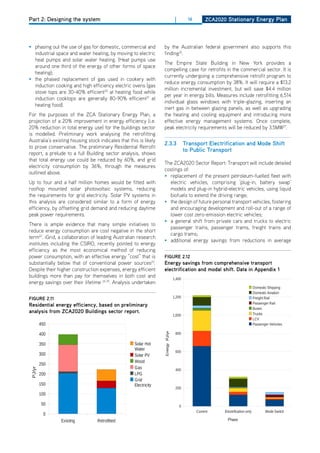
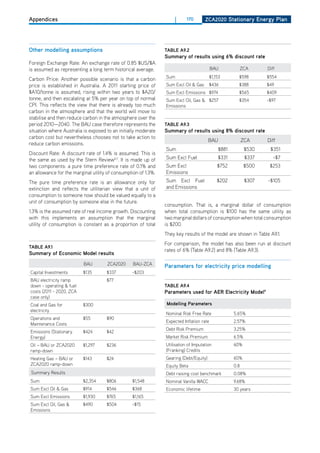
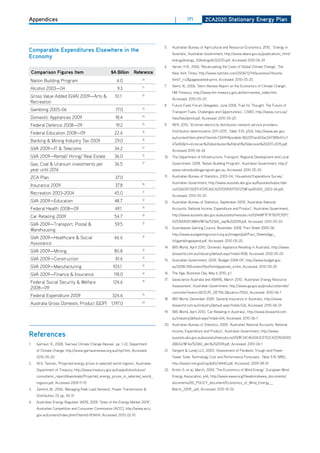
practical,     and economically attractive
transition to 100% renewable energy in                              “We know the country that harnesses the power of clean,
                                                                    renewable energy will lead the 21st century”
australia in ten years. the plan is a rational                                                                                              u.S. PrESidEnt obama2
and necessary response to the risk of major
climate change.
                                                                    1.1                                          why Zero Emissions?
As governments continue to grapple with the problem of
how to shift to low-carbon societies, the evidence mounts
                                                                    Present atmospheric levels of Co2 are at 390ppm3, well
that only a rapid transition to a zero-carbon economy can
                                                                    above the pre-industrial levels of 275 to 285 ppm (Ad
ensure climate and energy security for us all. Mitigating
                                                                    1000-1750)4. Furthermore, atmospheric Co2 concentration
climate change in an incremental manner ignores the
                                                                    has been growing rapidly for the last 40 years [note 1].
potentially catastrophic effects we face if global warming
                                                                    Many climate scientists now believe that Co2 levels must
“tipping points” are passed. Moving to a zero-carbon
                                                                    be reduced from today’s concentrations to avoid triggering
economy requires concerted efforts across all national
                                                                    dangerous “tipping point” mechanisms6,7 [note 2].
governments and across multiple sectors including
Stationary Energy, Transport, Building Efficiency, Industrial       Tipping points are serious because once they are passed,
Processes and Land Use.                                             a return to a normal climate situation may be impossible.
                                                                    For example, if global average temperatures increase by
Many different factors shape action to mitigate climate
                                                                    4°C , the huge carbon stores in the northern circumpolar
change. Societal and political barriers are quite
                                                                    permafrost zone (estimated at 1,672 gigatonnes) may be
different from technical barriers. This report is aimed at
                                                                    vulnerable to irreversible release8. Figure 1.1 shows that the
demonstrating the technical and financial feasibility of rolling
                                                                    current rate of loss of summer arctic sea ice is exceeding
out a 100% renewable energy system in Australia over the
                                                                    worst-case IPCC predictions.
next ten years. Importantly, only commercially available
technology is specified, to show that such a roll-out could         Many scientists have stated that the maximum safe
start today. This report does not address the political and         level of atmospheric Co2 concentration is 350 ppm or
social impediments to beginning such a Plan. It is aimed at         less—a level significantly below the present atmospheric
concluding the debate about whether renewable energy has            concentration of 390 ppm[note 3]. It is not too late—a rapid
the capability to keep the wheels of industry turning, in order     and decisive reduction in Co2 emissions can return us to
to enable the social and political changes that will lead to the    safe atmospheric levels with a reasonable probability of
transition to 100% renewable energy. The 2020 timeframe             avoiding dangerous tipping points. however, this can only be
is motivated by the best available climate science. While any
delay to the roll-out of such a ten-year ‘decadal plan’ could
still see a 100% renewable sector achieved at a later date,         figurE 1.1
this comes with greater risk of exceeding safe limits within        arctic Sea ice Extent—observed loss versus iPCC
the Earth’s climate system.                                         forecasts 9
This report focuses on the Stationary Energy sector in
Australia. Subsequent reports will address the other carbon                                        10
emitting sectors of the economy. The ZCA2020 Stationary
Energy Plan allows Australia to play a responsible,
                                                                   (S ept. minimum) [millions of km2 ]


constructive and leading role in promoting decisive action                                                   8
for climate protection around the world. For the remainder
                                                                           Arctic s ea ice extent


of this document, unless otherwise defined, the ZCA2020
Stationary Energy Plan will be referred to as “the Plan” or                                                  6
the “ZCA2020 Plan”.                                                                                                      Obs ervations
There are a number of potential paths to a zero-emissions                                                    4
stationary energy system. This Plan offers one possible
solution based on renewable resources, using existing
proven and reliable technologies, such that the costs and                                                    2
liabilities of the Plan can be rigorously assessed. In this                                                              Mean and range of
                                                                                                                         IP C C models
regard, the Plan concords with an emerging view that
national scale renewable systems are not only technically                                                    0
and economically viable, but are likely to accrue significant
benefits to the nations that first implement them.                                                           1900       1950         2000        2050       2100
                                                                                                                                     Year
Part 1: Introduction and overview                                                                                |      3       ZCa2020 Stationary Energy Plan


achieved through the implementation of urgent, purposeful                                                   would be that other rich countries, with the highest per-
action by governments to quickly reduce anthropogenic                                                       capita emissions, such as Australia12, would need to pursue
carbon emissions to zero.                                                                                   the same goal. As Figure 1.2 depicts, the “global budget
                                                                                                            per-capita” (the blue block in the background) shows that
“If humanity wishes to preserve a planet similar to that on
                                                                                                            the maximum per-capita emissions allowed across all
which civilization developed and to which life on Earth is
                                                                                                            populations of the world would need to be limited to around
adapted .... CO2 will need to be reduced from its current 385
                                                                                                            110 tonnes of Co2 per-capita (2.75 tonnes per-capita per
ppm to at most 350 ppm.”
                                                                                                            annum over a period of 40 years).
                                                                      hanSEn Et al, 20086
                                                                                                            As such, countries with high per-capita emissions (such
“... any reasonably comprehensive and up-to-date look at the
                                                                                                            as the USA or Australia [note 4]) have less than ten years
evidence makes clear that civilization has already generated
                                                                                                            to cut their emissions to zero. At the current Australian
dangerous anthropogenic interference in the climate system.
                                                                                                            emissions rate of about 20 tonnes per-capita per annum,
What keeps me going is my belief that there is still a chance
                                                                                                            our emissions budget would run out in five years. If instead
of avoiding catastrophe.”
                                                                                                            we begin 9/28/2009 emissions sooner, we could extend
                                                                                                                        reducing
                            John P. holdrEn, EnErgy and EnvironmEnt EXPErt
                                                                                                            the budget to ten years. As a country with high per-capita
                           at harvard univErSity, PrESidEnt of thE amEriCan
                                                                                                            emissions, Australia has the opportunity to be a catalyst
                           aSSoCiation for thE advanCEmEnt of SCiEnCE, and
                                                                                                            for other countries (particularly countries with high total
                             PrESidEntial SCiEnCE adviSor to baraCK obama10
                                                                                                            emissions but low per-capita emissions, such as China and
                                                                                                            India) by inspiring action on climate change and developing
                                                                                                            renewable energy industries.
1.2                         why ten years?
                                                                                                            A transition in ten years may seem challenging, but the
                                                                                                            world has seen remarkably fast economic transitions in
The Plan looks not only at how to implement a zero-
                                                                                                            the past; the restructuring of the United States economy
greenhouse gas emission energy sector, but also how to
                                                                                                            during the Second World War is a notable example13. A ten
achieve this within a ten year timeframe, from a technical
                                                                                                            year transformation period has also been nominated by Al
perspective. It is recognised that this is needed to properly
                                                                                                            Gore14. In his 2008 speech calling for America to move to
address the threat of severe and potentially irreversible
                                                                                                            100% renewable energy within ten years , Al Gore said: “To
climate change.
                                                                                                            those who say ten years is not enough time, I respectfully
The premise of a ten year timeframe to achieve zero                                                         ask them to consider what the world’s scientists are telling
emissions echoes several leading academics and public                                                       us about the risks we face if we don’t act in ten years. Ten
figures. In a recent report from the German Advisory                                                        years is about the maximum time that we as a nation can
Council on Global Change (WBGU), Prof. hans Joachim                                                         hold a steady aim and hit our target.”14
Schellnhuber (director of the Potsdam Institute for Climate
                                                                                                            There are many additional reasons for Australia planning
Impact Research) indicated that, in order to have a two-
                                                                                                            immediate and deep cuts to emissions. Global warming has
in-three chance of keeping global warming below 2°C over
                                                                                                            the potential to create irreversible ecological change, and
pre-industrial levels, and using a global per-capita carbon
                                                                                                            Australia is at particular risk of biodiversity reduction15. With
budget approach, it would be necessary for the USA to
                                                                                                            our agricultural and water systems also at particular risk,
reduce emissions to zero by 20209. An extension to this
                                                                                                            climate change threatens our national security.
                                                                                                            “Global average temperature increases of 1.5 or 2.0°C above
                                                                                                            pre-industrial levels will likely lead to a massive loss of
figurE 1.2
                              Scenario 2: Climate Compromise                                                biodiversity worldwide. ... The more effectively the rate of
Carbon budget 2010—2050: Emissions paths per
               T1 = 2010, T2 = 2050, TM = 2010, p                                                           climate change can be slowed and the sooner climate can be
capita for selected countries (adapted)11 = 2/3
                                                                                                            stabilised, the better are the prospects that biodiversity loss
                                    Emission paths per capita for selected countries
                   20
                                                                                                            will be lessened.”
                                                                                                                    Summary of a rEPort to thE natural rESourCE
                   18
                                                                                Germany
                                                                                USA (& Australia)
                                                                                                               managEmEnt miniStErial CounCil CommiSSionEd by thE
                   16
                                                                                China                                               auStralian govErnmEnt, 200916
                                                                                India
                   14                                                           Burkina Faso
                                                                                                            There is widespread recognition that those who lead the
t CO2 per capita


                   12                                                            Global budget per
                                                                                 capita assuming
                                                                                 constant annual
                                                                                                            renewable energy race will reap significant economic
                   10                                                            emissions
                                                                                                            benefits. Already, several Australian renewable energy
                    8                                                                                       technology firms have moved offshore to take advantage
                    6                                                                                       of more supportive and forward-looking regulatory
                    4
                                                                                                            environments. These include the now multi-million dollar
                    2
                                                                                                            corporations Ausra (now French-owned) and Suntech (now
                                                                                                            China-based). The dESERTEC program is pressing ahead
                    0
                    2005     2010      2015    2020    2025   2030    2035    2040     2045          2050   with plans to build a vast network of solar thermal plants
Part 1: Introduction and overview                                     |      4       ZCa2020 Stationary Energy Plan


across North Africa, the Middle East and Europe17 while          indeterminate length. A zero emissions plan is not simply
Spain will have 2.5 gigawatts (GW) of solar thermal power        an accelerated low emissions strategy. The point of a rapid
connected to the grid by 2013.18 In terms of renewable           transition to a zero emissions economy is not to just proceed
resources, Australia has all the natural advantages of the       further along the same path that will take us to a low emissions
dESERTEC proposal, with none of its multi-national political     economy over 50 years or so.
impediments.
                                                                 With this in mind, the ZCA2020 working group has framed
China has begun to invest heavily in renewable energy,           the development of the whole Project within the following
doubling its wind power capacity every year for the last         set of guiding principles to provide clarity of direction and
5 years, now having 25 GW as of 2009. China has a target         transparency of purpose.
of 150 GW of wind by 2020, but if it continues its current       • Proven and reliable Solutions. A plan for transition
rate of installation it will reach 150 GW by 2015—five years        to a zero emissions economy beginning now requires
ahead of schedule. This scale of growth is impressive and           us to use the best of what is now available. There have
actually accounts for one third of the total global wind            been major advances in renewable energy technology
power growth19,20.                                                  over recent years, and it is possible to move to a
                                                                    zero emissions economy without waiting for further
As these and other countries take actions which reduce
                                                                    technologies to be developed22. Consequently, the Plan
their reliance on coal, Australia has the opportunity to move
                                                                    considers only technological solutions that are already
beyond its ‘quarry vision’,21 which sees the success of our
                                                                    commercially available from existing companies which
economy strongly tied to fossil fuel exports, and look instead
                                                                    offer the technology at a multi-megawatt scale, and
to reap the economic benefits of being among the leaders in
                                                                    have moved beyond small-scale demonstration and
zero emissions technology innovation.
                                                                    pilot projects.
“The credit crunch has been brutal for solar start-ups in the    • implementation flexibility. While the Plan only
West, but not for Chinese firms with access to almost free          considers commercially proven technologies at the
finance from the state banking system. They have taken              outset, the ZCA2020 working group leaves open
advantage of the moment to flood the world with solar               the option of subsequent incorporation of new and
panels, driving down the retail price from $4.20 per watt           innovative technologies as they become commercially
last year to nearer $2 in what some say is a cut-throat drive       available, if they will reduce the cost of the transition
for market share ... We may soon be moving into a phase             and/or they have fewer associated environmental or
of history when ill-prepared countries cannot be sure of            social impacts. Example technologies that the ZCA2020
obtaining energy—whatever the price.”                               working group anticipates may become commercially
                               ambroSE EvanS-PritChard      22      available during the 10 year transition period include
                                                                    arrays of Australian National Universities’ 500 m2 SG4
By choosing to become a leader in the race towards zero
                                                                    concentrating solar thermal Big dishes,24 and Carnegie
emissions, Australia has the opportunity to secure its food,
                                                                    Corporation’s CETo III Wave Technology25,26.
water and energy supplies for the future, and build a new
                                                                 • a Socially Equitable Solution. The ZCA2020 Project
and robust economy as a global renewable powerhouse.
                                                                    will seek to ensure that social equity in Australia is
These arguments all promote the case for immediate action.
                                                                    maintained or enhanced during the transition to a zero
“I think that the word “now” has to creep into the vocabulary       emissions economy. In particular, this solution will
of people in public policy.”                                        continue to provide equitable access to energy for all
                   S david frEEman, uS EnErgy adviSor               Australians today, while ensuring that the costs and
       and formEr hEad of tEnESSEE vallEy authority 23              burdens are not deferred to future generations.
                                                                 • transition fuels. Whereas a long-term low emissions
                                                                    plan may recommend the use of natural (or petroleum)
1.3      guiding Principles, assumptions                            gas as a transition fuel, such a ‘double transition’ is
                                                                    not considered because it necessarily ties Australia
         and Project methodology                                    to continued fossil fuel emissions beyond the Plan’s
                                                                    timeframe, and would see money that could otherwise
A zero emissions target—not a low emissions target. The             be spent on renewable generation capacity diverted
ZCA2020 Project is based on a zero emissions methodology            into fossil fuel infrastructure.
underpinned by a set of guiding principles. These principles     • technology Sequencing. As with the idea of transition
relate to the use of proven technology solutions and the            fuels, investment in so-called ‘transition technologies’
achievement of social equity goals with minimal disruption to       will only serve to divert funding and attention from
food, water and energy supplies.                                    developing true zero emissions solutions. An example
                                                                    would be the development of more efficient petrol
The Plan differs from other emissions reductions plans in
                                                                    driven cars at the expense of investing in an electrified
that, from the outset, it seeks a target of zero emissions
                                                                    transport system that can be powered from a renewable
within ten years. Most other transition plans aim to move
                                                                    energy grid.
towards a low emissions economy over a period of
Part 1: Introduction and overview                                                        |         5         ZCa2020 Stationary Energy Plan


• minimal impact on food, water and Energy Supplies.
  The transition to a zero emissions economy should aim          1.5                              the ZCa2020 Project and the
  to do so without compromising Australia’s food, water
  and energy security.                                                                            Stationary Energy Plan
                                                                 The ZCA2020 Project consists of six inter-related reports,
1.4     Summary of technology Choices                            each addressing a specific Plan. The ZCA2020 Stationary
                                                                 Energy Plan is the first and most urgent of these, since 50%
While the choices of energy technologies are detailed with       of Australia’s emissions are generated by the stationary
references in Part 2 of the report, they are summarised          energy sector.
here to aid the reader in understanding why the guiding
                                                                 The complete set of ZCA2020 reports to be produced are:
principles outlined above led to the chosen technology
                                                                 • Report 1: The ZCA2020 Stationary Energy Plan
mix. There are commonly held perceptions that renewable
                                                                   addresses the re-powering of Australia’s stationary
energy has a limited future because “the wind doesn’t
                                                                   energy sector with zero emissions technology
always blow and the sun doesn’t shine at night”. The aim and
                                                                 • Report 2: The ZCA2020 Buildings Plan considers
scope of this report is to show that this is not an issue, and
                                                                   measures to improve energy efficiency, and hence
to demonstrate the feasibility of 100% renewable energy
                                                                   reduce the demand for stationary energy
in Australia within the next ten years. Instead of focusing
                                                                 • Report 3: The ZCA2020 Transport Plan is concerned
on various negative aspects of the technologies we have
                                                                   with powering private and public transportation with
not chosen, the authors wish to show the positive aspects
                                                                   renewable electricity
of the renewable technologies that are already available to
                                                                 • Report 4: The ZCA2020 Industrial Processes Plan
replace fossil fuels.
                                                                   addresses measures to reduce emissions from industry
The conclusions relating to technology choices are as            • Report 5: The ZCA2020 Land Use Plan considers
follows:                                                           changes to agriculture, forestry and other land use
• Wind, solar photovoltaics and concentrating solar                practices to minimise emissions
    thermal with storage are commercially proven, scaleable      • Report 6: The ZCA2020 Plan for Replacing Coal Export
    solutions that together can ensure reliable, 24-hour           Revenue focuses on Australia’s large fossil fuel exports.
    renewable energy supply.
                                                                 The reports will be inter-related and complementary. As
• Biomass and hydro are commercial renewable options
                                                                 an example, the design of the stationary energy supply
    that are limited in their scaleability due to other
    environmental considerations. They are better suited to
    supplying backup and balancing power to wind and solar.      figurE 1.3
                                                                                                                                                Sheet1
    Biomass is also needed for its carbon content to replace     australian greenhouse gas inventory 200727
    non-energy-related chemical carbon requirements.                                     350
• Wave, tidal and enhanced geothermal power are
    technologies that are on the horizon, but as yet have
    not overcome all technical hurdles nor have they been                                300           54%
    demonstrated at scale.
• Carbon capture and storage (CCS) is similarly an
    unproven technology, that is not expected to be                                      250
    commercially available within the ZCA2020 timeframe.
                                                                  Emissions (Mt CO2-e)


    It is also not a zero-emissions solution, as even should
    it be demonstrated at scale, proposed projects are not                               200
    expected to capture 100% of fossil fuel plant emissions.
• Nuclear power is highly unlikely to be viable in Australia
    over a ten-year period, as countries that already have a                             150
    nuclear power industry experience implementation times
    for nuclear plants in the order of 10-19 years for single
    reactors.                                                                            100                                       16%
                                                                                                              15%


                                                                                             50                     7%
                                                                                                                            6%
                                                                                                                                           3%

                                                                                              0

                                                                                                       Stationary   Transport      Fugitive
                                                                                                       Energy                      Emissions
                                                                                                                                   From Fuel
                                                                                                       Industrial   Agricultural   Waste
                                                                                                       Processes
Part 1: Introduction and overview                                        |     6    ZCa2020 Stationary Energy Plan


system (Report 1) must include projections of demand
and efficiencies from Reports 2, 3 and 4. Furthermore,           1.7         the ZCa2020 working group
emissions reductions achieved in the stationary energy
sector will have flow on effects in other sectors (Reports       The concept of a plan to achieve zero-emissions energy
2, 3 and 4) because, for example, electricity will become a      in ten years originally came from Beyond Zero Emissions,
low emissions energy source relative to gas. The Stationary      motivated by the scientific evidence that atmospheric
Energy Plan is released in Version 1.0 form prior to the         concentrations of greenhouse gases are already too high.
release of the other five components of the final report, in     BZE put together an enthusiastic expert team of engineers
order to allow for discussion and feedback at the earliest       and scientists with relevant industry and academic
opportunity. The remaining five reports of the ZCA2020           backgrounds who worked pro-bono to develop the plan.
Project will be completed following the release of this
                                                                 As one of the project leaders Patrick hearps, from The
report. Ultimately, each report will be combined into a single
                                                                 University of Melbourne’s Energy Institute, recruited a team
document to form a comprehensive Plan for reaching zero
                                                                 of University researchers and alumni, doubling the capacity
emissions in Australia over a ten year period.
                                                                 of the project. The Melbourne Energy Research Institute has
                                                                 reviewed the plan, and publishes it as part of its “Australian
                                                                 Sustainable Energy” series.
1.6     Structure of the Stationary
        Energy Plan report                                       1.7.1       the future of ZCa2020

The structure of the Plan is as follows:                         The ZCA2020 project is an ongoing initiative. It is a
• Part 2 describes the design of the proposed stationary         collaboration of pro bono contributors, and more people with
  energy system (including the implications of the size          relevant expertise and interests are welcome to contribute.
  and pattern of projected demand), an overview of the           The current publication is Version 1.0 of the Stationary
  available zero-emissions technologies, and the rationale       Energy Plan. Future work includes not only the other
  for the choice and weighting of these technologies.            ZCA2020 reports, but updated versions of the Stationary
• Part 3 provides a blueprint for the installation of the        Energy Plan that take into account more in-depth analysis,
  100% renewable electricity infrastructure, including           updated figures on energy projections, modelling with
  specifications, proposed locations, costs and installation     improved data, and any new technological developments.
  timelines.
                                                                 In the meantime, updates to the Plan will be available online.
• Part 4 shows energy modelling on real-time meteoro-
  logical data that demonstrates the reliability of the Plan’s   It is not the intent of the ZCA2020 Stationary Energy Plan
  specified grid.                                                to comment or recommend any particular financial or policy
• Part 5 shows how the new renewable energy                      mechanisms that would lead to the roll-out of the proposed
  infrastructure integrates into an upgraded grid to ensure      transition. There are a range of policy instruments that can
  reliable supply of electricity. It addresses the significant   be used, which should all be judged by their effectiveness
  upgrades to transmission networks that will be required        in achieving a desired outcome. The Plan demonstrates one
  in order to transition to 100% renewable energy.               potential outcome. however, future work will also involve
• Part 6 describes the resourcing of the transition, in          a separate publication discussing financial and economic
  terms of mobilising the material and human resources           policies in the context of the ZCA2020 plan.
  required within the ten-year timeline.
• Part 7 compares the investment for the Stationary
  Energy Plan with the Business-as-Usual case, putting
  the scale of the financial investment into context with
  Australia’s other present day expenditures.
The basis for the energy demand estimates used within
the Stationary Energy Plan are derived from work already
undertaken on the remaining ZCA2020 reports. These
remaining five reports are currently in development
and therefore it is possible that the projected stationary
energy demand may change from the estimates in this
initial version of the Plan. Nevertheless, the same design
principles would apply to the proposed stationary energy
system when updated demand figures become available.
Similarly, although the current figures for costing are well-
informed estimates, it is feasible that the figures in later
versions of the Plan may be higher or lower, depending on
updates relating to technologies and proposed efficiencies.
Part 1: Introduction and overview                                                                       |         7           ZCa2020 Stationary Energy Plan


                                                                                                       and Beyond, pp 10, http://www.eci.ox.ac.uk/4degrees/ppt/1-1schellnhuber.pdf,
footnotes                                                                                              Accessed: 2010-01-18
                                                                                                 12. United Nations Statistics division, 2009, ‘Environmental Indicators—
1. The absolute growth rate of CO2 in the atmosphere has increased substantially: the
                                                                                                       Greenhouse Gas Emissions’, http://unstats.un.org/unsd/environment/air_co2_
      first 50 ppm increase above the pre-industrial value was reached in the 1970s after
                                                                                                       emissions.htm, Accessed: 2010-01-23
      more than 200 years, whereas the second 50 ppm occurred in about 30 years. In
                                                                                                 13.   Sovacool, B. & Watts, C., 2009, ‘Going Completely Renewable: Is It Possible (Let
      the 10 years from 1995 to 2005, atmospheric CO2 increased by about 19 ppm; the
                                                                                                       alone desirable)’, The Electricity Journal, 22(4), pp 95-111
      highest average growth rate recorded for any decade since direct atmospheric CO2
                                                                                                 14. Gore, A., Jul 17, 2008, ‘A Generational Challenge To Repower America by Al
      measurements began in the 1950s5.
                                                                                                       Gore’, AlGore.org, http://www.algore.org/generational_challenge_repower_
2. While we normally tend to think of climate as having its own inherent equilibrium,
                                                                                                       america_al_gore, Accessed: 2009-06-05
      the concept of a “tipping point” mechanism7 breaks this rule, creating a situation
                                                                                                 15. 2002, Climate change impacts on biodiversity in Australia—outcomes of
      where large scale climate systems can finally switch into a different state, which is
                                                                                                       a workshop sponsored by the Biological diversity Advisory Committee,
      qualitatively different from past history, and recovery may be impossible. “Tipping
                                                                                                       http://www.environment.gov.au/biodiversity/publications/greenhouse/pubs/
      point” mechanisms include positive feedback, phase transitions with hysteresis, and
                                                                                                       greenhouse.pdf, Accessed: 2010-06-18
      bifurcations.
                                                                                                 16. 2009, Summary of a report to the Natural Resource Management Ministerial
3. Hansen recommends that atmospheric CO2 concentration be reduced to 350 ppm
                                                                                                       Council commissioned by the Australian Government, http://www.
      at most (but preferably less) to preserve a planet similar to that on which civilisation
                                                                                                       climatechange.gov.au/~/media/publications/biodiversity/biodiversity-summary-
      developed, and to which life is adapted6. Schellnhuber et al base their strategy on
                                                                                                       policy-makers.ashx, Accessed: 2010-06-17
      keeping temperature rise below a “guardrail” of 2°C rise above 1990 levels9. They do
                                                                                                 17.   desertec Foundation, 2010, ‘The desertec Concept’, http://www.desertec.org/
      not specify a particular concentration of atmospheric CO2, but strongly suggest that
                                                                                                       en/concept/, Accessed: 2010-04-19
      we should return to pre-industrial levels of atmospheric CO2 (280 ppm) to avoid the
                                                                                                 18. Protermo Solar, Apr 9, 2010, ‘La industria solar termoeléctrica española inicia
      risks of untested long term climate conditions.
                                                                                                       el despegue’, Protermo Solar, http://www.protermosolar.com/boletines/
4. Australia and USA have virtually the same per capita emissions—Australia 19.00
                                                                                                       boletin24.html#destacados01, Accessed: 2010-04-19
      tonnes per capita per annum, USA 19.7 tonnes per capita per annum (2006 data)12.
                                                                                                 19.   Global Wind Energy Council, 2010, ‘China’, Global Wind Energy Council, http://
                                                                                                       www.gwec.net/index.php?id=125, Accessed: 2010-04-19
                                                                                                 20. Green Blog, Feb 15, 2010, ‘Gains in Global Wind Capacity Reported’, The New
references                                                                                             York Times, http://greeninc.blogs.nytimes.com/2010/02/15/gains-in-global-
1.      Gore, A., July 17, 2008, ‘Gore asks U.S. to abandon fossil fuels’, New                         wind-capacity-reported/, Accessed: 2010-04-18
        York Times, http://www.nytimes.com/2008/07/17/world/americas/17iht-                      21.   2009, Pearse, G., ‘Quarry Vision: Coal, Climate Change and the End of the
        gore.4.14582865.html, Accessed: 2009-06-05                                                     Resources Boom’, Quarterly Essay 33
2.      2009, obama, B., Address to joint session of Congress, Whitehouse Press                  22. Evans-Pritchard, A., Aug 23, 2009, ‘China powers ahead as it seizes the green
        office, http://www.whitehouse.gov/the_press_office/remarks-of-president-                       energy crown from Europe’, The Telegraph, http://www.telegraph.co.uk/
        barack-obama-address-to-joint-session-of-congress/, Accessed: 2010-06-17                       finance/comment/6077374/China-powers-ahead-as-it-seizes-the-green-
3.      Tans, P., 2010, ‘NoAA ESRL data’, National oceanic and Atmospheric                             energy-crown-from-Europe.html, Accessed: 2009-09-05
        Administration, ftp://ftp.cmdl.noaa.gov/ccg/co2/trends/co2_mm_mlo.txt,                   23. Kreisler, h., Sep 29, 2003, ‘Energy, Conservation and the Public Interest:
        Accessed: 2010-04-12                                                                           Conversation with S. david Freeman’, Institute of International Studies, UC
4.      IPCC, 2007, ‘IPCC Fourth Assessment Report: Climate Change 2007’, Working                      Berkeley, http://globetrotter.berkeley.edu/people3/Freeman/freeman-con5.
        Group I: The Physical Science Basis (2.3.1 Atmospheric Carbon dioxide), http://                html, Accessed: 2009-06-05
        www.ipcc.ch/publications_and_data/ar4/wg1/en/ch2s2-3.html, Accessed:                     24. Lovegrove, K., dec 2009, ‘Concentrating Solar Thermal Gathers Momentum’,
        2010-05-06                                                                                     Presentation at the Solar 09—AuSES Annual Conference, http://media.
5.      UNFCCC, 2010, ‘Kyoto Protocol’, http://unfccc.int/kyoto_protocol/items/2830.                   beyondzeroemissions.org/keithlovegrove%20presentation%20dec%2009.pdf,
        php, Accessed: 2010-04-18                                                                      Accessed: 2010-01-31
6.      hansen J. et al., 2008, ‘Target Atmospheric Co2: Where Should humanity                   25. Carnegie Wave Energy Limited, 2009, ‘What is CETo’, Carnegie Wave Energy
        Aim?’, Columbia University, http://www.columbia.edu/~jeh1/2008/                                Limited, http://www.carnegiewave.com/index.php?url=/ceto/what-is-ceto,
        TargetCo2_20080407.pdf, Accessed: 2010-01-11                                                   Accessed: 2010-04-18
7.      Lenton T. M. et al., 2008, ‘Tipping elements in the Earth’s climate system’,             26. Beyond Zero Emissions, Jan 29, 2010, ‘Beyond Zero talks to Greg Allen of
        http://www.pnas.org/content/105/6/1786.full.pdf+html, Accessed: 2010-04-26                     Western Australia wave power developer Carnegie Corporation’, Beyond
8.      Schuur, E. et al., 2008, ‘Vulnerability of Permafrost Carbon to Climate Change:                Zero Emissions, http://beyondzeroemissions.org/media/radio/beyond-zero-
        Implications for the Global Carbon Cycle’, BioScience, 58(8), pp 701-714, doI                  talks-greg-allen-western-australia-wave-power-developer-carnegie-100129,
        10.1641/B580807                                                                                Accessed: 2010-01-31
9.      Schellnhuber h. J. et al., 2009, ‘Solving the climate dilemma: The budget                27. Australian Government, department of Climate Change, 2009, ‘National
        approach—Special report’, 10, German Advisory Council on Global Change                         Greenhouse Gas Inventory—accounting for the KYOTO target May 2009’,
        (WBGU), http://www.wbgu.de/wbgu_sn2009_en.pdf, Accessed: 2010-04-28                            department of Climate Change, http://www.climatechange.gov.au/climate-
10. Revkin, A., January 1, 2007, ‘A New Middle Stance Emerges in debate                                change/~/media/publications/greenhouse-report/national-greenhouse-gas-
        over Climate’, New York Times, http://www.nytimes.com/2007/01/01/                              inventory-pdf.ashx, Accessed: 2010-05-08
        science/01climate.html?_r=2&_r, Accessed: 2009-06-05
11.     Schellnhuber, h. J., September 28-30, 2009, ‘Terra Quasi-Incognita: Beyond
        the 2°C Line’, Presentation at the International Climate Conference: 4 degrees
Part 1: Introduction and overview   |   8   ZCa2020 Stationary Energy Plan
|       9        ZCa2020 Stationary Energy Plan


 Part 2
 designing the ZCa2020
 Stationary Energy Plan
 Supply System

Contents

2.1   overview of the ZCa2020 Stationary Energy Plan
      Supply System                                                  10

2.2   analysis of Current australian Emissions and
      Energy-use trends                                              11
      2.2.1 Australian Greenhouse Gas Emissions                      11
      2.2.2 Current Australian Energy Consumption                    11

2.3   australian Energy demand in 2020 under the Plan                13
      2.3.1 Energy Efficiency Measures Employed to Reduce
            Overall Energy Demand                                    15
      2.3.2 Buildings: Energy Efficiency and Retrofitting            15
      2.3.3 Transport Electrification and Mode Shift to Public
            Transport                                                16
      2.3.4 Industrial Energy Reductions                             19

2.4   Proposed Pattern of demand under the ZCa2020 Plan          20
      2.4.1 Seasonal Variation and Shift of Demand from a
            Summer Peak                                          20
      2.4.2 Baseload and Peaking under Current Electricity
            Supply                                                   21
      2.4.3 Flattening Electricity Demand Peaks                      22

2.5   Choosing feasible, Cost Effective Zero-Emissions
      Solutions                                                      23
      2.5.1 Australia’s Solar Resource                               23
      2.5.2 Concentrating Solar Thermal Power—The Most
            Suitable Large-Scale Solar Technology                    23
      2.5.3 Smaller-Scale Solar Technologies                         28
      2.5.4 Wind Power                                               29
      2.5.5 Biomass                                                  32
      2.5.6 Hydroelectric Power—Meeting Peak Electricity
            Demand and Energy Storage                                33
      2.5.7 Non-commercial Technologies                              34
      2.5.8 Lifecycle Emissions of Energy Technologies               34

references                                                           38
Part 2: Designing the system                                           |      10      ZCa2020 Stationary Energy Plan
                                                                                      Stationary Energy Sector report


                                                                   Seasonal energy demand variation, and ways of flattening
2.1      overview of the ZCa2020                                   demand curves, are also examined in detail. In particular,
                                                                   the strong peaking influence of Victorian cold weather gas
         Stationary Energy Plan Supply                             demand can be mitigated through a large-scale rollout of
         System                                                    building insulation and integrated photovoltaic technology in
                                                                   Victoria.
Part 2 presents a broad overview of the design of the
                                                                   In order to meet the new demand curves, the ZCA2020
ZCA2020 Stationary Energy Plan (the Plan). It begins with a
                                                                   Plan recommends the following commercially-available
description of Australia’s current stationary energy sector,
                                                                   generation technologies:
then outlines what Australia’s energy demand will look
                                                                   • Concentrated Solar thermal (CSt) Power towers
like in 2020 under the Plan’s implementation of efficiency
                                                                      with molten salt heat storage: meeting 60% of
upgrades and fuel-switching. Strategies for flattening
                                                                      electricity demand throughout the year;
demand peaks are discussed, and, finally, the commercially
                                                                   •	 wind power: meeting the remaining 40% of demand;
available renewable technologies that will meet this demand
                                                                   • Crop-waste biomass and hydroelectricity: providing
are introduced.
                                                                      backup for 2% of the demand, when simultaneous lulls
The renewable energy infrastructure proposed (further                 in solar and wind cause shortfalls in supply;
detailed and costed in Part 3) will be sized to supply a 2020      • national grid: flattening demand peaks and integrating
grid electricity demand of 325TWh/yr, more than 40%                   CST, wind and backup energy sources, to provide
higher than today’s electricity consumption. This is greater          reliable supply.
than would be expected under Business-As-Usual growth,
                                                                   Concentrating solar thermal with molten-salt-heat-storage
and is more than capable of meeting future electricity needs.
                                                                   technology provides the capability to store the sun’s energy
however, with further investment in energy efficiency and
                                                                   as heat, rather than as electricity. Electricity can then
fuel-switching, to be detailed and costed in future ZCA2020
                                                                   be generated either at a constant rate (‘baseload’) or as
reports, it is projected that this will be sufficient to replace
                                                                   required to meet peak demand. Cost-effective storage of the
not only current electricity, but oil and gas that is currently
                                                                   sun’s energy as heat means that CST can reliably provide
used for transport and direct heating, thereby replacing all
                                                                   electricity during cloudy periods and at night. overseas,
fossil fuel use.
                                                                   Concentrating Solar Thermal electricity generation already
Australia’s current energy consumption is approximately            operates at utility scale, providing efficient energy storage
3,915 PJ/yr, while the grid electricity component of this          and 24-hour electricity supply.
is 228 TWh/yr (822 PJ/yr). Under the Plan, total energy
                                                                   In Australia, a wide geographical distribution of generation
consumption will halve by 2020 without reducing the
                                                                   assets under the Plan allows lower-cost wind power to be
provision of energy services. To achieve this, grid electricity
                                                                   integrated with CST.
requirements will increase to 325TWh/yr. This new
requirement has two major parts:                                   In rare extended periods of low sun and wind across
• improved energy efficiency technologies reduce the               Australia, crop waste biomass-firing provides an additional
   electricity requirements for current services by one            source of heat at the CST plant sites, and/or existing
   third across the residential, commercial and industrial         hydro is used. historical system performance and weather
   sectors. This brings Australia energy efficiency into line      forecasts are used as tools to manage the system during
   with other modern, developed economies.;                        such periods.
• a fuel-switch from transport oil, heating gas, and
                                                                   Lastly, solar PV is likely to reach “grid parity” between
   industrial use of fossil fuels to highly efficient renewably-
                                                                   2015-2020, and an allowance is made for small scale solar
   sourced electricity. This reduces Australian consumption
                                                                   PV and solar hot water to provide 10% of energy by 2020.
   of energy dramatically, though of course leads to an
   increase in electricity demand.                                 A life-cycle emissions analysis of this system demonstrates
                                                                   that wind and CST have rapid energy pay-back periods,
                                                                   and vastly superior emissions profiles compared with
                                                                   alternative technologies such as carbon capture and storage
                                                                   (CCS). Moreover, unlike technologies such as enhanced
                                                                   geothermal and CCS, all the technologies relied upon in the
                                                                   Plan are commercially available today.
Part 2: Designing the system                                           |    11     ZCa2020 Stationary Energy Plan


                                                    Chapter 3: The reference scenario — Assumptions and projections
                                                               coal. other emissions associated with the use of fossil fuels
2.2     analysis of Current australian                   in the Stationary Energy Sector are related to industrial
Australia's low pollution future emissions from land use,processes and fugitive emissions, including leakage from
      From 1990 to and Energy-use trends
                          2006,                            land-use change and forestry fall as state
        Emissions                                        natural gas distribution networks and methane released
        governments enacted policies to reduce deforestation. In the absence of new government
        policies, emissions from this sector are expected toduring coal mining .2050.
                                                                                     1
                                                                remain stable to
2.2.1 australian greenhouse gas Emissions productivity in later decades, the mining sector is
 resource constraints start to affect underlying
                                                               Treasury modelling predicts that under Business As
 expected to grow by only slightly more thanpreviouslyUsual (BAU), largely driven by strong growth
        Fugitive emissions include liberated gas the national average, Australia’s greenhouse gas released will
                                                                trapped within coal seams, emissions emissions
Australia currently generates the highest per-capita the mining is 2assumed to grow at around
 in coal,producing and processing oil and gas, and 1gas continue to rise . The same modelling also predicts that any
        in iron ore and other metal ores. Overall leakage though transmission and distribution.
emissions of greenhouse gases amongst oECd countries
 2.1 per cent per fromto 2050.
        Emissions year the fugitives sector grow strongly, aroundgreenhouse gas emissions under2005 type
                                                               reductions in 1.7 per cent per year from CPRS
As shown by Figure 2.1, approximately two-thirds of
        to 2050, more than doubling to 67 Mt CO2-e inlegislation (5-15% reductions), world demand for on
Australia’s total greenhouse gas emissions result from           2050. Continued strong will depend substantially
 Australia’s natural in the stationary energy and transportan inexpensive although otherpartly offset by this predicted
                       resourcenamely coal and gas, drives this growth and from it issupply of electricity.
fossil fuel combustion fuels,
        Australia’s fossil        endowments provide           importing permits reliable countries. Given rising
 Access prices that encourage greater capture of methane emissions, exporting Australian carbon emissions
                                                               dependence on
sectors. to low-cost energy provides a comparative advantage and contributes to be used for energy
        gas                                                                         which can the development
                                                               offshore, it is difficult to see when and how, under current
 of a generation.energy-intensive manufacturingoccur
         range of                                       industries. Industries that benefit either directly
As shown by FigureThisclose to 90%also assumed tofrom in the waste policies, the Australian economy will make any
                     2.2, capture is of the emissions          government sector.
 (through their use Sector arise from the combustion of orsignificant move away from itsuse of electricity)
the Stationary Energy   of resources as material inputs)         indirectly (through their reliance on fossil fuels.
        The cumulative amount of emissions released into the atmosphere determines possible climate
 include mineral processing (iron and steel, non-ferrous metals), petroleum and chemicals, and
 wood and paper products. In 2005, together year (Chart 3.22). for 3.5 per cent of GDP; however,
        change impacts, not emissions in any one they accounted
figurE expected to fall to around 1.7 per cent by 2050 (Chart 3.33).
 this is 2.1
australia’s projected cumulative emissions by sector 2005 to emissions 2005 to 2050
                        Chart 3.22: Share of cumulative 2050
In aggregate, Australian manufacturing is expected to continue its historical decline. This decline
                                              Land use/Land-use
is largely driven by strong productivity growth in global manufacturing, particularly in developing
                                                   change
                       Industrial Waste Forestry
economies, resulting in a loss of competitiveness for Australian generation
                      processes    3%     1%         6%            Electricity manufacturing. Overall,
                                                                            33%
manufacturing is assumed to grow by 1.3 per cent per year to 2050. The contraction in
                          5%
manufacturing’s share of the Australian economy is widespread across the sector, with
metal-manufacturing industries such as steel and aluminium, textile, clothing and footwear,
chemical Agriculture
           manufacturing, and rubber and plastics industries all experiencing annual growth lower
             16%
than the national average.

Electricity generation sector
                  Fugitives
Australian electricity generation is expected to more than double by 2050, growing from around
                    6%
218 TWh in 2005 to around 512 TWh in 2050 (Chart 3.34). This reflects the economy’s
                                          Transport
                                                                Other stationary
                                                                   energy
expansion and sustained growth in residential consumption and high electricity-use sectors, such
                                            15%
                                                                    15%
as aluminium. Electricity generation grows less than output growth, reducing the electricity
intensity ofTreasury estimates from MMRF.
     Source:
             the economy.
figurE 2.2                                                     2.2.2       Current australian Energy Consumption
australia’s projected stationary energy emissions Electricity sector to fall slightly to 2050, largely
                                    Chart 3.34: by
      Emission intensity of energy-intensive industries is expected
fuel source2
      reflecting continual assumed improvements in energy efficiency (Box 3.5). However, as thereveals
                      Emissions                           Figure 2.3, sourced generation
                                                                    Electricity from Geoscience Australia,
                                                          important relationships between Australian energy supply
      economy shifts towards the services sectors,600andaggregate The relative intensitytheTWh 600 is the
        Mt CO2-e                      Mt CO2-e          theTWhutilisation. emission width of of output
                                                                                               lines represents
   400                                         400
      expected to fall (Chart 3.23).                      size of the energy flows.
                                                            500 Coal                                           500
                                                                      (shown in blue in Figure 2.3) is an inefficiently-used
   300                                              300         fuel. 2,050 PJ/yr of coal is burned in Australia to produce
                                                            400 only 750 PJ/yr of electricity3. Even then, about 7% of this is
                                                                                                               400
                                                                “parasitic” consumption used onsite by the power stations
                                                            300 themselves . This means that only 700 PJ 300useful, end-
                                                                                                               of
                                                                             4
   200                                              200
                                                                user coal-fired electricity makes it to consumers. The
                                                                remaining 1,350 PJ/yr, or 66% of the resource3, is lost in the
                                                            200                                                200
                                                                electricity generation process. This lost energy is rejected
   100                                              100         into the environment via vaporisation of cooling water or
                                                            100 when coal-fired power stations ‘blow steam’ at periods
                                                                                                               100
                                                                of low demand. Water used in the coal-fired generation of
      0                                             0         0 electricity is unavailable for other uses such 0 for growing
                                                                                                               as
      2005         2020             2035         2050         2005 A typical 500 MW coal-fired power station requires
                                                                food.          2020           2035         2050
                Coal          Gas          Oil                Black coal8.3 Brown coal of water per year5.
                                                                around       billion litres Gas Oil Renewables
Source: Treasury estimates from MMRF and MMA (2008).
                                                                                                              Page 49
��������������������������������������������������                                                                           ������������
                                                                                                                               ��������������������������������������������������������                                                                     �������������
                                                                                                                               ���������������������������������������������������                                                                          ��������������
Part 2: Designing the system                                                                                                             12
                                                                                                                                              |
                                                                                                                               ��������������������������������������������������� Plan
                                                                                                                                                 ZCa2020 Stationary Energy                                                                                  ��������������
                                                                                                                                                                                                                                                            ��������������
                                                                                                                               ���������������������������������������������������
                                                                                                                               ��������������������������������������������������������                                                                     �������������
                                                                                                                               ���������������������������������������������������                                                                          �������������
                                                                                                                                                                                                                                                            ��������������
In Australia, natural gas (shown in pink in Figure 2.3)                                                                        ���������������������������������������������������
                                                                                                                             figurE 2.4                                                                                                                     ������������
currently supplies more end-use energy than any other                                                                          �������������
                                                                                                                             australia’s projected oil supply-demand balance       8
fuel used in the Stationary Energy Sector, even coal. This                                                                                                                                                                                                  �������������
energy is largely consumed for industrial and residential                                                                            3000                                                                                                                   �������������
heating.                                                                                                                                                                                                                                                    �������������
                                                                                                                                                                                                                                                            ��������������
Australian passenger and freight movements are currently
powered primarily by the burning of 300 million barrels                                                                              2000
                                                                                                                                                                                                                                                            Major proje
per year of oil and LPG3 in inefficient internal combustion                                                                                                                                                                                                 ������������


                                                                                                                               PJ
engines. oil (shown in black in Figure 2.3) is a growing                                                                                                                                                                                                    ������������
expense which, under BAU, will cost the Australian                                                                                   1000                                                                                                                   �������������
economy ~$1.3 trillion (2010 dollars) between 2010 and                                                                                                                                                                                                      ������������
2040 (see Part 7—Economics). oil imports have grown                                                                                                                                                                                                         ������������
since Australian domestic oil production peaked in 2000.                                                                                       0                                                                                                            �������������
domestic oil production is now in decline and this is                                                                                              2007-08                               2017-18                                   2027-28                  ������������
projected to continue. Forty percent of the crude oil                                                                                                                                         Year                                                          �����������
consumed in Australia is imported, adding $15.7 billion to                                                                                                                                                                                                  of around $3
                                                                                                                                                                           Net imports                           Consumption
the 2007/2008 current account deficit6.                                                                                                                                                                                                                     �������������
                                                                                                                                                                           Production                                                                       ������������
                                                                                                                                                                                                                                      AERA 3.45             �������������
                                                                                                                                    Figure 3.45 ��������������������������������������                                                                      ������������
                                                                                                80                                  outlook                                                                                                                 �������������
                                                                                                                                    Source: ����������                                                                                                      ������������

figurE 2.3
australian Energy flows 2006-20073                                                                                                  Table 3.15 ����������������������������������������������������������
                                                                                                                                         Project                           Company                   Basin                               Status                       Sta
                                        AUSTRALIAN ENERGY FLOWS 2006–07 (Petajoules)

                                         IMPORTS           IMPORTS                                                          IMPORTS
         SUPPLY                                                                                                                          ������������� �����                                              UTILISATION
                                                                                                                                                                                                     ���������       under 
                                                                                 STOCKS                                                               STOCKS
                                               214             985                                                                       ��������
                                                                                                                                          661                                                                        construction
                                                                                        -54                                                               +84                                                    1337
                                                                                                                                                                                                            TRANSPORT
                                                                                        1502                           1388              ��������                          �������                       1320
                                                                                                                                                                                                     ���������                           Oil & LPG
                                                                                                                                                                                                                                         under                          �
 OIL                          1057                                                                                                                                                                                                              (61)
                                                                                                  Refinery
                                                                                                                                                                           �������������                    2                                  Gas
                                                                                                                                                                                                                                         construction
                                                                                                                                    48             207        25
                                                                                                                                         73                                                                 5                                     Coal
 LPG                          121
                                                                                                                                         ��������                          ��������������            ���������
                                                                                                                                                                                                         8                               under 
                                                                                                                                                                                                                                         Electricity                    �
                                                                                                                                                                           �������������
                                                                                                                                                                               461                          2                             Biofuels
                                                                                                                                                                                                                                         construction
                                                          594                                                          143

                                                                                                 22                                 Source: �����������
                                                                                                                                         280                                                                COMMERCIAL 255
                                     STOCKS
                                                                                                                                                                                                            26                            Oil & LPG
                                                                                                                                                                                                                                                      (3)
                                        +22                                                                                                                  1651           824
                                                                                                                                                                                                            44                                     Gas
 NATURAL GAS                  1706
                                                                                                              28
                                                                                                                                    Table 3.16 ����������������������������������������������������������
                                                                                                                                                                          4             Coal
 COAL BED METHANE         C    87                                                                                                                                                                           178                          Electricity
                                     STOCKS
                                                                                                                                         Project                           Company                   Basin
                                                                                                                                                                                                         3                               Status
                                                                                                                                                                                                                                            Solar                     Sta
                                                                        25                284                                        7
                                        +86
                                                                                                                                                                                                            INDUSTRIAL 1802
                                                                                                                                                                                                            424                           Oil & LPG
                                                                     7157                                                                                                                                                                            (28)
 COAL                         9293
                                                                                                                                         ��������������                    ��������������                644
                                                                                                                                                                                                     ���������                               Gas
                                                                                                                                                                                                                                         ���������
                                                                                                                                                                              214
                                                                                                                                                                                                            205                                   Coal
                                                                                                                                         ��������������                    ���������
                                                                                                                                                                              805
                                                                                                                              753                                                                           388                          Electricity
                                                                                                                                         ������������
                                                        2050                                                                                                                                                137               Bagasse & Wood
                                     STOCKS
                                                                                                 Power Stn.
                                                                                                                                    59   �������������                     ��������������                4
                                                                                                                                                                                                     ������                               Biofuels
                                                                                                                                                                                                                                         �����������
                                        +35

                                                                                                                                         �������                           ���������                        RESIDENTIAL 441���������
 URANIUM OXIDE   (U3O8)       4509                                   4474
                                                                                                                                                                                                         11                              Oil & LPG
                                                                                                                                         ���������������                   �������                   ���������                           ������������
                                                                                                                                                                                                                                                 (10)

 HYDRO ELECTRICITY              52                                                                                                                                                                          134                                Gas
                                                                                                                                                                                  63                                                     ������������
 WIND ELECTRICITY    B          7                                                                                                                                                                           231                          Electricity
                                                                             5      7                                                                                                                       2                            ���  Solar
 SOLAR   B                       5
                                                                                                                                    Source: �����������                                                     63                                  Wood
 BIOFUELS                      13
                                                                                                                                                                                                            OTHER 63
 BAGASSE & WOOD                205
 (111)
                                                                                                         A 1618         171              811         4474           6943   827
                                                                                                                                                                                                            63 Lubes, bitumen & solvents


                                                                                                              LOSSES                                     EXPORTS
                                                                                                                                                                                                       NOTE:
                                                                                                                                                                                                       A Includes transmission losses
                                                                                                                                                                                                       B   ORER estimates
                                          Total Primary           Stock change
                                                                 & discrepancies Imports                           Losses                                   Exports               Total end-use        C   Geoscience Australia estimate
                                             Energy                                                                                                                                                    •   Numbers rounded to nearest PJ

                                              17055 =                       - 173               + 1860
                                                                                                      AUSTRALIAN EN ERGY RESOURCE AS SES SMENT
                                                                                                         - 1789     - 13055   - 3898
                                                                                                                                                                                                       •   Source: ABARE ‘Australian Energy Statistics’
                                                                                                                                                                                                           Energy Update 2008.
Part 2: Designing the system                                                         |        13           ZCa2020 Stationary Energy Plan


                                                       Sheet1
figurE 2.5
australia’s oil Production and Consumption
                                                                              2.3         australian Energy demand in
1961-2008. data from abarE7 Supply/Demand
     Australian Petroleum                                                                 2020 under the Plan
                                   1961-2008
                60 000                                                        The ZCA2020 Plan proposes a complete phase-out of all
                                                                              fossil fuels (natural gas, oil and coal), starting from 2011.
                50 000                                                        By 2020, total Australian energy consumption is reduced to
                                                                              less than half of Business As Usual (BAU) projections. This
                40 000                                                        is the result of moving to a higher efficiency, zero carbon,
                                                                              electricity-based energy system that applies negative
Megalitres/yr


                30 000                                                        pressure on energy costs in the long term12. detailed
                                                                              modelling of this energy transition can be found in Appendix
                20 000                                                        1, though a short summary is presented in the following text.
                                               Production
                                               Consumption                    Figure 2.6 illustrates the impact of the transition from
                10 000                                                        present-day energy sources to ZCA2020 Plan sources.

                    0
                                                                              Under the ZCA2020 Plan, total energy consumption is
                     1960   1970     1980   1990     2000    2010             reduced to less than half of BAU, from 3,915 PJ/yr (2008)
                                                                              to only 1,660 PJ/yr (2020). how is such a dramatic fall
                                                                              possible?
                                                                              Under the Plan, oil and LPG production ceases and the
Moving away from oil as a transport fuel has the additional                   inefficient internal combustion engine is replaced with
benefit of improving Australia’s energy security. A number                    a combination of electrified heavy and light rail, electric
of studies support the conclusion that global oil production                  vehicles, and some range-extending biofueled hybrid-
is currently peaking, leading to supply/demand price spikes                   electric vehicles. These efficiency improvements mean that
in the near future9,10,11.                                                    the 1,217 PJ/yr currently used in transport, primarily oil-
due to the inefficiency of the internal combustion engine,                                                                                             TFSankey
less than 20% of the fossil fuel energy consumed by the                       figurE 2.6
Transport Sector is actually converted into useful vehicular                  australian Energy Sources: Present and under
                                                                                          Australian End-Use Energy:
motion, once stop-start ineffiencies are factored in. on the                  ZCa2020
                                                                                                Present and Under ZCA2020
other hand, electric rail and electric cars convert 80-90% of
electrical energy into motion—and the electrical energy can                    4500
be derived from 100% renewable sources. This presents
a massive opportunity to improve energy-use efficiency,                        4000
eliminate the vast cost of oil imports, and reduce the                                                                                         Oil & LPG
                                                                                                                                               Industrial Coal
carbon-intensity of Australia’s transport system to zero.                      3500                                                            Natural Gas
                                                                                                                                               Bioenergy
                                                                               3000                                                            Direct Solar
                                                                                                                                               Electricity

                                                                               2500
                                                                    PJ/year


                                                                               2000


                                                                               1500


                                                                               1000


                                                                                500


                                                                                    0
                                                                                                          2008                                     ZCA2020
                                                                              (Note: In Figure 2.6, “End-use” coal shown on the chart represents coal that is used
                                                       Page 1
                                                                              only for metallurgical smelting and process heat. Coal currently used for electricity
                                                                              production falls into the “electricity” section of this barchart.)
                                                                                                                                                         Page 1
Part 2: Designing the system                                             |           14       ZCa2020 Stationary Energy Plan


     fuelled, can be replaced with two far smaller energy inputs:        demand increases by 42% from 2008-2020 because of the
     first, 180PJ/yr (50TWh) of additional renewable electricity         electrification of transport as well as residential, commercial,
     generation capacity for electrified transport, and secondly,        and industrial heating. This increased electricity demand is
     just over 50PJ/yr of liquid biofuel to support non-electrified      supplied through the renewable generation system that
     transport services (approximately 5% of the total).                 forms the centerpiece of the Plan.
     Natural gas is completely phased out and replaced with              Under the ZCA2020 Plan, total annual grid electricity
     efficient electrically-driven devices. Natural gas space-           demand is 325 TWh.
     heating, for example, is replaced with high efficiency              • 152 TWh/year is required for the continuation of current
     electric heat pumps. As with oil, natural gas consumed for            end-use electricity functions (after a 20% reduction from
     transportation is replaced by additional electricity generation       current levels due to efficiency, and other reductions
     capacity. Certain industrial applications, however, cannot            outlined in Appendix 1 such as onsite solar).
     be electrified. Methane, for example, is used directly as a         • 123 TWh/year is required after the shift from gas to
     feedstock for the production of chemicals such as methanol            electricity for heating. Improved insulation minimises the
     and ammonia-based fertiliser. For these purposes, the plan            winter peaking effect of this shift.
     proposes 50 PJ/yr of biogas.                                        • 50 TWh/year is required for the electrification of
                                                                           transport. The transport component is inherently less
     Energy used in the refining of petrol, mining of coal and in
                                                                           volatile than current end-use functions, and in fact can
     the manufacture of liquefied natural gas (LNG), is excluded
                                                                           contribute to load levelling due to EV smart charging
     from the total future energy requirements. This is because
                                                                           capability.
     the ZCA2020 Plan assumes zero domestic demand for
                                                                         • onsite solar PV and solar hotwater displaces 30TWh/
     fossil fuels, and assumes that Australia will not be servicing
                                                                           year that would otherwise be required from the grid.
     overseas demand for any LNG, petrol, or other fossil fuels.
     Locally-collected solar energy for heating water, indoor            figurE 2.8
     spaces, and other purposes increases from 3 PJ/yr                   international comparison of primary energy
     (currently) to 110 PJ/yr. This includes household solar             consumption perPrimary(gJ, 2007). Capita
                                                                                           capita Energy per
     hot water systems and the use of direct solar energy for                            2007 data, selected countries
     industrial processes and other commercial consumption.                United States

     onsite solar energy use is modelled by reducing the                       Australia

     requirements for grid-delivered electricity.                          Saudi Arabia
                                                                                   Russia
     Lastly, the deployment of energy efficiency programs                   South Korea
     reduces the end-use energy demanded by traditional                     Kazakhstan

     services (i.e. not including newly electrified transport and                   Japan

     space heating/cooling) in the commercial, industrial, and                Germany

     residential sectors by 20% over existing services only
       Per-capita electricity consumption, the period 2011—2020.            Sw itzerland

     This Illustrating efficiency measures (IEA per-capita electricity
             translates to a 33% reduction in standard data)                        Spain
                                                                         United Kingdom
     use for these services when population growth is taken into
       14.0
                                                                              World Avg
     account. This 20% reduction in demand has been modelled
       12.0
                                                                                    China
     conservatively, and deeper analysis in later reports is likely
       10.0
                                                                                      India
MWh/person/yr


                                                          Aus, ZCA2020
     to identify greater energy savings within each sector.
         8.0
                                                          Aus, BAU
                                                                                              0   50       100    150    200      250   300        350   400
                6.0                                       Germany
     In summary, and as shown by Figure 2.7, though total energy
         4.0
                                                                                                           GigaJoules/person/yr

     demand is reduced by 50% under the Plan, total electricity
         2.0

                0.0
                                                                         figurE 2.9
                                                                         world energy intensityIntensity of Economies
                                                                                       Energy (mJ / $uS gdP, 2005).
     figurE 2.7
                2008
                20 0 9
                2010
                20 1 1
                2012
                20 1 3
                2014
                20 1 5
                2016
                20 1 7
                2018
                20 1 9
                2020
                20 2 1
                2022
                20 2 3
                2024
                20 2 5
                2026
                20 2 7
                2028
                20 2 9
                   30


                                             Sheet1
                20


                                                                                        2007 data, selected countries
     total electricity demand including fuel switch and
     transport electrificationswitching / electrification
                       ZCA Total Electricity Demand
                   Including fuel
                                                                            Kazakhstan
                                                                                   Russia
                350
                                                                            Saudi Arabia

                300                                                                  China
                                                                            South Korea
                250
                                                                                  Australia

                200                                                        United States
       TWh/yr


                                                                              World Avg
                150
                      ZCA Transport                                                   India
                      Electrification
                100   ZCA Other Fuel                                                Japan
                      Electrification
                      ZCA Current Electric
                                                                                     Spain
                 50   Services
                                                                               Germany
                  0                                                         Sw itzerland
                                                                         United Kingdom
                20 8
                20 9
                20 0
                  11

                20 2
                20 3
                20 4
                20 5
                20 6
                  17

                20 8
                20 9
                  20

                20 1
                20 2
                20 3
                20 4
                20 5
                  26

                20 7
                20 8
                20 9
                  30
                   0
                  0
                  1

                  1
                  1
                  1
                  1
                  1


                  1

                  2
                  2
                  2
                  2
                  2

                  2
                  2
                  2
                  1
                20


                20
                20


                20


                20


                                                                                              0        5            10            15          20          25
                                                                                                  MegaJoules/US$ GDP (2005 dollars)
Part 2: Designing the system                                             |      15      ZCa2020 Stationary Energy Plan


                                                                     Such improvements in energy efficiency appear realistic
2.3.1               Energy Efficiency measures Employed to
                                                                     and achievable when compared with experiences in
                    reduce overall Energy demand
                                                                     other developed economies—such as the aforementioned
                                                                     Germany. Germany is a comparable modern economy with
Australia has an energy intensive economy compared
                                                                     car manufacturing and energy-intensive metal refining
to other modern economies worldwide. Many European
                                                                     industries, including five aluminium smelters14. It provides
countries have significantly lower per capita primary
                                                                     a good example of what can be achieved through strong
energy consumption (Figure 2.8). high energy consumption
                                                                     energy efficiency measures: Germany and Australia have
is not necessarily linked to higher wealth or quality of life.
                                                                     similar per capita GdP15, but Germans currently use about
Countries like Kazakhstan and China have a higher energy
                                                                     36% less end-use delivered electricity than Australians (7.2
intensity (MJ/$GdP) than Australia and are poorer countries
                                                                     MWh of electricity per capita is used in Germany compared
with lower living standards.
                                                                     to 11.2 MWh per capita in Australia)16.
Increasing energy efficiency, and thereby reducing overall
                                                                     Germany plans to improve its use of energy still further,
demand, is the most cost-effective way to reduce carbon
                                                                     with an additional absolute cut of 8% from current net
dioxide emissions in Australia. our current per-capita
                                                                     energy levels between 2010 and 2020 and a further 9%
energy consumption is significantly higher than energy-
                                                                     cut during the decade after that17. This will be achieved
efficient countries such as Germany. In fact, even after the
                                                                     through the implementation of Germany’s National Energy
Plan’s 20% improvement in commercial, residential and
                                                                     Efficiency Action Plan which includes such measures as:
industrial energy efficiency, Australian per-capita electricity
                                                                     • rapid implementation of smart metering;
consumption is still above that of Germany (Figure 2.10), not
                                                                     • increased investment in energy efficiency for public
inclusive of the extra electricity for oil and gas replacement.
                                                                        buildings;
ongoing per-capita efficiency gains of 1-1.3% per year after
                                                                     • new guidelines emphasising energy efficiency in
2020 keep total demand steady at least to 2040, while
                                                                        government procurement processes;
allowing for population growth.
                                                                     • long-term, low-interest loans for retrofitting of old
This 20% improvement in energy efficiency can be achieved               residential buildings;
largely through targeting ‘low-hanging fruit’: technologies that     • subsidies for new low energy houses;
are easily implemented with rapid payback periods. Examples          • employment of specialised energy managers within
include upgrades to the latest appliances and machinery, and            municipal governments;
measures as basic as insulation of buildings and piping. These       • demand management projects to foster energy saving
‘low-hanging fruit’ improvements can be implemented without             actions by consumers;
negative effects on service levels or quality of life, and can       • improved energy consumption labelling on motor
realise per-capita efficiency gains of 3.5-4% per year.                 vehicles, equipment and products in general18.
As shown in Figure 2.7, total electricity demand will continue       Australia’s record on energy efficiency is poor, as shown in
to rise as electricity steadily replaces oil and gas. This will in   Figure 2.8. This has resulted from the absence of effective
fact result in higher total per-capita electricity consumption       government policies to provide incentives for investment in
than even the Business-As-Usual scenario of 2% growth                energy efficiency. Consequently, there is room for dramatic
per year. From 2020 to 2040, the Plan caps total electricity         improvement in energy efficiency in Australia13.
consumption at 325TWh/yr by continuously deploying ever-
                                                                     Given Germany’s plans for the future, and Australia’s
improving efficiency measures.
                                                                     current laggardly performance in energy efficiency, rapid
                                                                     improvements are feasible and will be cost-effective.
figurE 2.10                                                          Coordinated measures and policies can ensure both short-
Per capita electricity consumption                                   term and long-term gains in efficiency, and prevent negative
                                                                     rebound effects19.


                                                                     2.3.2   buildings: Energy Efficiency and
                                                                             retrofitting

                                                                     The cost of electricity in Australia has historically been
MWh/yr per person


                                                                     low compared to other developed nations, allowing lowest-
                                                                     initial-cost building practices and inefficient design to
                                                                     persist as the norm. Given a growing awareness that these
                                                                     practices are unsustainable, the ZCA2020 Sector Report
                                                                     2—“Buildings” will be developed to correct this. It will
                                                                     include detailed and costed proposals for:
                                                                     • a building efficiency retrofitting program, including
                                                                         insulation, double glazing and draught-proofing;
Part 2: Designing the system                                               |    16     ZCa2020 Stationary Energy Plan


• phasing out the use of gas for domestic, commercial and          by the Australian federal government also supports this
  industrial space and water heating, by moving to electric        finding26.
  heat pumps and solar water heating. (heat pumps use
                                                                   The Empire State Building in New York provides a
  around one third of the energy of other forms of space
                                                                   compelling case for retrofits in the commercial sector. It is
  heating);
                                                                   currently undergoing a comprehensive retrofit program to
• the phased replacement of gas used in cookery with
                                                                   reduce energy consumption by 38%. It will require a $13.2
  induction cooking and high efficiency electric ovens (gas
                                                                   million incremental investment, but will save $4.4 million
  stove tops are 30-40% efficient20 at heating food while
                                                                   per year in energy bills. Measures include retrofitting 6,514
  induction cooktops are generally 80-90% efficient21 at
                                                                   individual glass windows with triple-glazing, inserting an
  heating food).
                                                                   inert gas in between glazing panels, as well as upgrading
For the purposes of the ZCA Stationary Energy Plan, a              the heating and cooling equipment and introducing more
projection of a 20% improvement in energy efficiency (i.e.         effective energy management systems. once complete,
20% reduction in total energy use) for the buildings sector        peak electricity requirements will be reduced by 3.5MW27.
is modelled. Preliminary work analysing the retrofitting
Australia’s existing housing stock indicates that this is likely
                                                                   2.3.3       transport Electrification and mode Shift
to prove conservative. The preliminary Residential Retrofit
                                                                               to Public transport
report, a prelude to a full Building sector analysis, shows
that total energy use could be reduced by 60%, and grid
                                                                   The ZCA2020 Sector Report: Transport will include detailed
electricity consumption by 36%, through the measures
                                                                   costings of:
outlined above.
                                                                   • replacement of the present petroleum-fuelled fleet with
Up to four and a half million homes would be fitted with             electric vehicles, comprising ‘plug-in, battery swap’
rooftop mounted solar photovoltaic systems, reducing                 models and plug-in hybrid-electric vehicles, using liquid
the requirements for grid electricity. Solar PV systems in           biofuels to extend the driving range;
this analysis are considered similar to a form of energy           • the design of future personal transport vehicles, fostering
efficiency, by offsetting grid demand and reducing daytime           and encouraging development and roll-out of a range of
peak power requirements.                                             lower cost zero-emission electric vehicles;
                                                                   • a general shift from private cars and trucks to electric
There is ample evidence that many simple initiatives to
                                                                     passenger trains, passenger trams, freight trains and
reduce energy consumption are cost negative in the short
                                                                     cargo trams;
term22. iGrid, a collaboration of leading Australian research
                                                                   • additional energy savings from reductions in average
institutes including the CSIRo, recently pointed to energy
efficiency as the most economical method of reducing
power consumption, with an effective energy “cost” that is         figurE 2.12
substantially below that of conventional power sources23.          Energy savings from comprehensive transport
despite their higher construction expenses, energy efficient       electrification and modal shift. data in appendix 1
buildings more than pay for themselves in both cost and
energy savings over their lifetime 24 25. Analysis undertaken
                                                     Sheet1
figurE 2.11
residential energy efficiency, based on preliminary
     Residential Energy Efficiency ZCA2020
analysis from ZCa2020 buildings sector report.
               Retrofitting existing housing stock
         450
                                                                   PJ/yr


         400

         350                                         Solar Hot
                                                     Water
         300                                         Solar PV
                                                     Wood
         250
                                                     Gas
 PJ/yr


         200                                         LPG
                                                     Grid
         150                                         Electricity
         100

         50

          0
                   Existing       Retrofitted
Part 2: Designing the system                                          |     17       ZCa2020 Stationary Energy Plan


                                                                 cycling infrastructure will encourage the use of bicycles
                                                                 in urban areas.
                                                                 The modal shift from private passenger vehicles to shared
                                                                 electric rail vehicles has the capacity to reduce the private
                                                                 car fleet by around 50%. The average car will travel 8000km
                                                                 p.a. instead of the 15,000km travelled today. ZCA2020 aims
                                                                 for Australia to have six million pure electric, plug-in hybrid
                                                                 electric and battery swap electric vehicles by 2020.

                                                                 Electric Car Production Capacity and Jobs

                                                                 The introduction of 6 million new vehicles in 10 years may
                                                                 seem a challenge, but Australians currently purchases
                                                                 around 1 million new vehicles every year29. demand for new
                                                                 vehicles is therefore strong enough to drive the introduction
                                                                 of appropriately-priced zero emission vehicles. The
                                                                 Australian fleet currently numbers some 12 million private
                                                                 vehicles. The Plan does not attempt to replace all 12 million
high-speed train in Shenzhen, China28
                                                                 vehicles, as it anticipates vast improvements to public
                                                                 transport, higher fuel prices, and hence reduced demand for
  distances travelled, achieved through better urban
                                                                 private vehicles. Nevertheless, the capacity exists to deploy
  planning, localised access to services and a range of
                                                                 10 million electric cars over the 10 year implementation
  other policy settings.
                                                                 period. Whether these are sourced from overseas or
Figure 2.12 shows the reduction in energy consumed by the        domestic manufacturing is an economic matter for which
transport sector upon completion of the electric conversion      the Plan does not recommend any particular solution.
in 2020.                                                         An example is given below of the capability of Australia’s
                                                                 domestic car manufacturing capacity, to demonstrate the
Current annual domestic transport energy consumption
                                                                 feasibility of the transport shift.
is 1217PJ, mainly oil (international transport not included).
Analysis indicates that this can be reduced to 320PJ by          Mass car manufacturing has been a prominent industry in
electrifying 95% of land-based modes of transport, both          Australia since 1931, beginning with General Motors and
passenger and freight. A further modal switch to electric        Ford, then Toyota, Nissan and Mitsubishi. Three domestic
light & heavy rail would reduce this to 160PJ, just under        manufacturers remain. As of december 2009, none of their
45 TWh/yr of electricity. Allowing for population growth,        plants were running at full capacity. Toyota is currently
50TWh has been allocated for electric transport in 2020          producing 100,000—160,000 cars p.a., running 2 shifts and
(See Appendix 1 for details).                                    223 production line days. This could easily be increased to 3
                                                                 shifts and enough production line days to produce 300,000
These figures are based on a switch to efficient, electric
                                                                 cars per annum30. To achieve the required production of
light & heavy rail of
                                                                 electric vehicles, the remaining plants would need to increase
• 50% of urban passenger-kilometres
                                                                 production to 3 shifts, creating more employment and a
• 25% of non-urban passenger-kilometres
                                                                 combined capacity at the three plants of 900,000 cars p.a.
• 50% of urban freight tonne-kilometres
• 80% of non-urban freight tonne-kilometres                      Although the technology of the plug-in electric vehicles is
• all domestic passenger and freight air and shipping            considerably different from that of an internal combustion
                                                                 engine, the overall production of the car is the same31.
International air & shipping is beyond the scope of this
                                                                 For this reason, the required tooling changes in the plant
analysis for Australia.
                                                                 would be comparable to those required for the Toyota
The Plan proposes a large scale upgrade of public                hybrid Camry. The manufacture of this hybrid vehicle in
transport services, supplemented with a smaller-than-            Australia was initiated by a $35 million Government grant in
current private vehicle fleet, consisting of electric, battery   July 2008. Just 18 months later in december 2009, the car
swap and plug-in hybrid electric vehicles. Where plug-in         began production, from a plant designed with the capacity
hybrid vehicles exist in the fleet, The Plan proposes that       for every vehicle built to be a hybrid vehicle.
they use green biofuels instead of petrol or diesel fuel.
                                                                 At the beginning of World War II, holden was transformed
however, The Plan recommends a focus on development
                                                                 from a struggling automotive manufacturer to a produceer
and rollout of zero-emission electric vehicles, rather
                                                                 of high volumes of cars, aircraft, field guns and marine
than that of low emission fossil-fuel-powered vehicles.
                                                                 engines32. Increased production to 900,000 vehicles per
Additional energy savings can be accessed by reducing
                                                                 annum across the three existent auto plants is certainly
average distances travelled through better urban planning
                                                                 achievable in the twenty-first century, and would allow the
and localised access to services. A renewed emphasis on
                                                                 production of six million plug-in electric vehicles by 2020.
Part 2: Designing the system                                         |     18       ZCa2020 Stationary Energy Plan


figurE 2.13
range-extended Electric vehicle drive System39


Charging                                                        net Cost

Most cars are stationary for up to 22 hours a day. Car          The transformation of transport away from its present
batteries are charged passively during this time, as cars can   mode to the proposed ZCA2020 mode will be cost negative,
be left plugged in. When a correlation of high wind speed       as capital investment in infrastructure and vehicle stocks
and solar incidence across the geographically diverse grid      give way to lower operational costs. The electrification of
occurs, charging electric cars would be used as a means of      the vehicle fleet would present a number of advantages,
absorbing “excess” power. In this case the dumped power is      both in economic costs and in environmental impact34.
useful, both to society and to electricity consumers, rather    Electrification of the vehicle fleet is beneficial, primarily
than being an inconvenience to be managed, as would             due to the efficiency of electric motors transforming stored
otherwise be the case for an electricity supply system          electrical energy to motion. A battery electric vehicle fleet
without adequate energy storage.                                can get up to 5 times more work (motion) per unit of energy
                                                                input than a fleet of vehicles powered by internal combustion
The plug-in electric vehicles would be charged at standard
                                                                engines (in kms of travel)35. That is, an internal combustion
domestic single phase sockets (240V/10amps). Full
                                                                engine car such as the honda Civic or the Toyota Camry
recharging of the national electric vehicle fleet’s batteries
                                                                might achieve 0.28 to 0.52 km/MJ of input energy, while
would require 14.5 GWhr/day, and so could theoretically
                                                                an electric vehicle can achieve 2.18 km/MJ36 electrical-
occur in just over one hour if 14.5 GW grid power was
                                                                outlet-to-wheel. There will, however, be some additional
available. The ZCA2020 grid is capable of delivering this
                                                                infrastructure investment and operational costs required to
charging rate, because it is specified to transmit up to
                                                                support this change. There will be variations depending on
60 GW with near full wind output. however, this “rapid
                                                                the specific model implemented, but solutions outlined by
recharge”, would only occur rarely, when low electricity
                                                                Better Place and other significant movers in the sector are
demand coincided with high wind and/or solar output. In
                                                                in three principal categories:
the normal charging scenario, vehicles are plugged in (at
                                                                • Charge points—these will need to be located in all areas
work or at home) and slow charging can take place over the
                                                                    that electric cars are likely to be parked for extended
whole 22 hours, with a required average of only 650 MW
                                                                    periods (i.e. work and home);
battery charging power supply.
                                                                • Battery swap stations—conceptually similar to petrol
“It is all about the batteries...for our hybrids and plug-in        stations, these will be used to replace depleted batteries;
hybrids, ten years and 150,000 miles is not an issue at all”    • Increased electrical generation and distribution
                        nanCy gioia, ford motor ComPany31           requirements.
Part 2: Designing the system                                           |     19      ZCa2020 Stationary Energy Plan


The requirement for swap stations will likely be lower            chemicals, and able to replace incineration. These processes
than petrol stations as they will only be needed when cars        are highly efficient and cleaner than the alternative fossil
exceed the range of a single battery charge in one day.           fuel combustion techniques, and are detailed further in Part
                                                                  3.4.1 of this report.
The overall increase in peak demand and system capacity
requirements, caused by additional load on the network,           Switching of coal for iron smelting. The steel works
is subject to debate, which centres on the issue of when          at Port Kembla and Whyalla respectively use 3Mt and 1Mt
charging of the batteries will take place. detractors claim       of coal p.a.43, equating to 110PJ of coal energy. This is
that charging an electric vehicle fleet would require massive     primarily used for smelting of iron ore, and cannot simply
increases in power generation capabilities37. Instead, the        be replaced with electric heating. The direct Reduced Iron
timing of car charging can be controlled to take advantage        (dRI) process, coupled with Electric Arc Furnace steel
of lower cost, off-peak power, peak solar generation times        smelting, provides an alternative to this. dRI is already used
or when the wind output is very high and demand relatively        to produce a significant quantity of the world’s smelted
low. This will cause zero or minimal increase in peak             iron, and is inherently more efficient. Syngas (carbon
demand, and may even result in reductions in electricity          monoxide and hydrogen), sourced from waste-to-energy
prices due to increased utilisation of existing infrastructure.   or biomass, can be used as a reducing agent in place of
                                                                  coal44. Electric Arc Furnace steelmaking is growing rapidly,
Another argument against the use of electric vehicles
                                                                  and is already used to smelt over a million tonnes of scrap
regards concerns about the cost and relatively short lifespan
                                                                  iron in Australia. The process is well suited to receiving dRI
of the battery. These concerns are being addressed by
                                                                  as a feedstock, which can then be smelted with electricity.
developments being made in lithium ion technologies38 and
                                                                  An allowance of extra electricity and syngas from biomass
in the use of next generation lead acid battery technologies
                                                                  has been accounted for in the Stationary Energy ZCA2020
such as those from Firefly, a spin-off from Caterpillar39.
                                                                  demand scenario to continue smelting the 7.7Mt of steel
The high cost of the battery is also partially offset by the
                                                                  per annum produced in Australia45, with the 110PJ of coal
reduced complexity of the vehicle, and cost reductions are
                                                                  removed from the ZCA2020 energy demand scenario. The
expected to continue. overall there is a strong argument
                                                                  Industrial Processes working report will present details of
that even with substantial capital requirements, these costs
                                                                  this process, including the required investment.
will eventually be entirely compensated by the substantially
lower fuel costs and operational costs for electric cars.


2.3.4    industrial Energy reductions

report 4 on industry will include proposals for significant
efficiencies across Australian industry. For example, a 19%
reduction in energy use in the aluminium smelting process,
from an average of 14.8 MWh/tonne40, can be achieved by
using a new Chinese process (or equivalent) requiring less
than 12 MWh per tonne41.
industrial Case Study—alumina refining energy
replaced by solar thermal co-generation. In Part 3 of this
report, a single case study has been carried out using solar
thermal with molten salt storage as a direct co-generation
supplier of process steam and electricity to a large industrial
user—the Gladstone Alumina Refinery.
industrial gas use—Switching gas-fired furnaces to
electric furnaces. Approximately 36% of all natural gas
consumed in Australia is used by industry, making it the
largest consumer in the country. Within industry, gas is
the second most used energy source behind electricity.
Natural gas is used in many processes, including heating
and incineration42.
The ZCA2020 Plan incorporates the switching of industrial
heating loads from natural gas and other fossil fuels to
electricity. This can be achieved with existing, proven
technology such as electric resistance heating, electric arc
furnaces, induction and di-electric heating. Super-critical
water oxidation is a proven process for destruction of
Part 2: Designing the system                                                         |      20      ZCa2020 Stationary Energy Plan


                                                                                Implementation of the ZCA2020 Plan has an effect on both
2.4                    Proposed Pattern of demand                               the overall energy demand and its variability. The present
                                                                                overall energy demand (supplied by electricity, gas, and
                       under the ZCa2020 Plan                                   liquid automotive fuels) is shown in Figure 2.14. Under the
                                                                                ZCA2020 Plan, there is a reduction both in total energy
This section describes the finer details of energy demand
                                                                                demand, and its variability. This reduced variability is both
in Australia, as it varies both daily and through the seasons.
                                                                                long term and short term.
In particular, the ZCA2020 Plan will see a shift of peak
demand from summer to winter, and a decline in overall
                                                                                Peak Electricity demand will occur in winter in
seasonal demand variability. The section contrasts today’s
                                                                                most australian states
highly variable demand profile, characterised by large
spikes in demand that require the construction of expensive
                                                                                At present, peak electricity demand periods in most
reserve plants, with the demand profile flattening brought
                                                                                Australian states occur during hot summer days. however,
about by the building upgrades and transport technologies
                                                                                as the profile of Australia’s total delivered energy shows
of the ZCA2020 Plan. The Plan promises to significantly
                                                                                (Figure 2.14), winter is the period of greatest total energy
reduce the need to construct the underutilised peaking
                                                                                demand, primarily due to natural gas use. As natural gas is
plants of today.
                                                                                phased out, energy efficiency measures are implemented,
                                                                                and as the remaining temperature-dependent demand (i.e.
2.4.1                  Seasonal variation and Shift of demand                   space heating) is then supplied by methods derived from
                       from a Summer Peak                                       renewable electricity, peak Australian electricity demand
                                                                                will shift from summer to mid-winter. Efficiency measures
Under the ZCA2020 Stationary Energy Plan, peak electricity                      such as improved insulation will also lower the demand for
demand will move from summer to winter in most Australian                       electricity for cooling in summer.
states because of phased replacement of gas fired space
heating with electric heat pumps. Seasonal variation in                         reducing Seasonal variation in demand
energy demand will also be “flattened”, by reducinging
Victoria’s “winter-peak” gas demand, the dominant factor in                     Analysis has shown that the seasonal variation of the
seasonal energy use variability. heating-related efficiency                     current Australian energy demand profile is heavily
measures will initially be tackled in Victoria, before rolling                  influenced by demand in Victoria, due to temperature-
out efficiency programs Australia-wide. These energy                            dependent gas demand (mainly for gas fired space heating)
efficiency measures will lower energy demand generally                          or the “winter peak” gas demand46. Gas consumption in
and in particular will mitigate energy demand spikes during                     other states can be assumed to be constant year round
hot weather. The energy demand profile will be further                          by comparison. Furthermore, while industry is the largest
smoothed using smart-grids in combination with an electric                      user of natural gas by total volume (as shown in Section
vehicle fleet and demand-negating, small scale PV.                              2.2.2), the seasonal variation in industrial gas usage is quite


figurE 2.14                                                                 PDF EXPORT
Current (2007-08) australian seasonal energy demand profile
                        Current (2007-08) Australian Seasonal Energy Demand Profile
                 9000

                 8000
                                                                                                                                                                   9
                 7000

                 6000                                                                                                                                              8
TeraJoules/Day


                 5000
                                                                                                                             Transport Fuel                        7
                 4000                                                                                                        Natural Gas
                 3000                                                                                                        Electricity                           6
                                                                                                                             Total Energy
                 2000
                                                                                                                                                  TeraJoules/Day


                                                                                                                                                                   5
                 1000

                      0                                                                                                                                            4

                      un
                        e          us
                                      t
                                                  be
                                                     r         er         ary        rc h           ril           un
                                                                                                                    e
                  J              ug           c to           mb         nu         Ma             Ap          J
                             A            O                ve         Ja                                                                                           3
                                                         No
                                                                    Month
                                                                                                                                                                   2
SoURCE: AEMo 46


                                                                                                                                                                   1
Part 2: Designing the system                                                                                                                                                                                                                                                                                                                                                           |      21     ZCa2020 Stationary Energy Plan


              small compared to the seasonal variation due to space
                                                                                                                                                                                                                                                                                                                                                                                   2.4.2                   baseload and Peaking under Current
              heating in workplaces and businesses46. When an industrial
                                                                                                                                                                                                                                                                                                                                                                                                           Electricity Supply
              facility is using gas to heat processes to high temperatures,
              for example 300°C, it makes little difference whether the
                                                                                                                                                                                                                                                                                                                                                                                   The current electricity supply system typically groups
              starting temperature is 30°C in the summer or 15°C in the
                                                                                                                                                                                                                                                                                                                                                                                   generator types into “Baseload”, “Intermediate”, and
              winter. however, when tens of thousands of homes and
                                                                                                                                                                                                                                                                                                                                                                                   “Peaking” generating plants.
              businesses begin to switch on their natural gas heaters at
                                                                                                                                                                                                                                                                                                                                                                                   • “Baseload generators” are designed to operate
              the onset of the winter months, this results in considerably
                                                                                                                                                                                                                                                                                                                                                                                     continuously at high output. Coal plants are almost
              greater gas consumption. This is demonstrated in Figure
                                                                                                                                                                                                                                                                                                                                                                                     always operated as baseload plants.
              2.16 which presents Victoria’s seasonal gas consumption,
                                                                                                                                                                                                                                                                                                                                                                                   • “Intermediate generators” (or “load following” generators)
              where winter gas demand is more than twice the summer
                                                                                                                                                                                                                                                                                                                                                                                     are designed for faster startup and shutdown, but have
              gas demand.
                                                                                                                                                                                                                                                                                                                                                                                     higher operating cost. Intermediate generators provide
              A concentrated effort to flatten the Victorian winter                                                                                                                                                                                                                                                                                                                  “spinning reserve”, which can react quickly to the
              gas usage peak would yield major gains in flattening the                                                                                                                                                                                                                                                                                                               variability of load and sudden unscheduled generation
              Australian energy demand profile over the year. The                                                                                                                                                                                                                                                                                                                    outages. Natural gas and hydroelectric power plants are
              flattening would be achieved primarily by thermal insulation                                                                                                                                                                                                                                                                                                           typically operated as intermediate plants.
              of Victorian commercial buildings and households. This                                                                                                                                                                                                                                                                                                               • “Peaking Generators” are held in reserve for periods of
              can reduce heating loads by a factor of 2-4. A program                                                                                                                                                                                                                                                                                                                 unusually high demand, but are the most expensive to
              of replacing gas furnace heating with heat pumps would                                                                                                                                                                                                                                                                                                                 operate. Some of these may operate for only a few hours
              further reduce space heating energy demand by a factor                                                                                                                                                                                                                                                                                                                 per year48.
              of 4, given an 80% efficiency for gas furnaces and 320%
                                                                                                                                                                                                                                                                                                                                                                                   Fossil fuel power stations are often claimed to be superior
              seasonal average efficiency for heat pumps47. It is therefore
                                                                                                                                                                                                                                                                                                                                                                                   to renewables because of their capacity for ‘baseload’
              reasonable to assume that given widespread implementation
                                                                                                                                                                                                                                                                                                                                                                                   power and energy supply security. however, the fact is
              of heat pump and building efficiency improvement in
                                                                                                                                                                                                                                                                                                                                                                                   that they represent an expensive and inflexible response to
              Victoria, “winter peak”, space heating requirements could
                                                                                                                                                                                                                                                                                                                                                                                   energy demands. Currently, Australia has an average power
              be reduced by around a factor of 10. Note: further flattening
                                                                                                                                                                                                                                                                                                                                                                                   demand of 24,000 MW, which doubles to over 48,000 MW
              of the energy demand peaks, due to reduced air conditioner
                                                                                                                                                                                                                                                                                                                                                                                   during peak periods. Currently, meeting peak demand is a
              load during hot weather (as a result of improved insulation)
                                                                                                                                                                                                                                                                                                                                                                                   more pressing issue for the Australian grid than meeting
              is not modelled but would give further benefits.
                                                                                                                                                                                                                                                                                                                                                                                   baseload generation49.
                                                                                                                                                                                                                                                                                                                                                                                   The impact of short term peaking demands for NSW is shown
                                                                                                                                                                                                                                                                                                                                                                                   in Figure 2.15. Almost one third of the annual wholesale cost
                                                                                                                                                                                                                                                                                                                                                                                   of electricity comes from a few price spikes. These spikes
                                                                                                                                                                                                                                                                                                                                                                                   have an extremely high cost (over $1000 per MWh, as
                                                                                                                                                                                                                                                                                                                                                                                   opposed to a typical Australian wholesale electricity price
                                                                                                                                                                                                                                                                                                                                                                                   of $30-40 per MWh50). These price spikes are passed on to
                                                                                                                                                                                                                                                                                                                                                                                                                                                    PDF EXPORT

              figurE 2.15                                                                                                                                                                                                                                                                                                                                                          figurE 2.16
                                                                                                                                                                                                                                                                                                                                                                                                 Victorian Gas Consumption
              Current wholesale electricity market volatility51.Price                                                                                                                                                                                                                                                                                                              victorian gas consumption—winter 07 to'08
                                                                                                                                                                                                                                                                                                                                                                                              Seasonal, Winter '07 - Winter winter 08
              spike events offer opportunities for demand Side
                                                                                                                                                                                                                                                                                                                                                                                                    1400
                                                         Energy Price Volatility
              response (dSr) instead of building low-utilisation
              peak generating capacity.
                                                                                                                                                                                                                                                                                                                                                                                                    1200
                                                                                NSW Spot Prices Dec03 to Nov04
                     10000
                                                                                                                                                                                                                                                                                                                                                                                                    1000
                                                                                                                                                                   Peak prices are above $1000 / MWh
                                                                                                                                                                     Peak prices up to 300 x average
                     9000
                                                                                                                                                                   and represent ~20% of the cost annual
                                                                                                                                                                     represented 31.5% of the of
                                                                                                                                                                                                                                                                                                                                                                                   TeraJoules/Day


                     8000                                                                                                                                                     wholesale cost
                                                                                                                                                                   $1.5Bn per year nationally
                                                                                                                                                                                                                                                                                                                                                                                                    800
                     7000
                                                                                                                                                                                                   Opportunities
                                                                                                                                                                                                  Opportunities for DSR
                     6000
                                                                                                                                                                                                      for DSR                                                                                                                                                                                       600
             $/MWh


                     5000

                     4000
                                                                                                                                               Typical average                                                                                                                                                                                                                                      400
                     3000
                                                                                                                                                   price of
                                                                                                                                                 ~$35/MWh
                     2000

                     1000
                                                                                                                                                                                                                                                                                                                                                                                                    200
                        0
                                         15/12/2003
                                                      29/12/2003

                                                                   12/01/2004
                                                                                26/01/2004


                                                                                                         23/02/2004


                                                                                                                                  22/03/2004


                                                                                                                                                           19/04/2004


                                                                                                                                                                                    17/05/2004
                                                                                                                                                                                                 31/05/2004
                                                                                                                                                                                                              14/06/2004
                                                                                                                                                                                                                           28/06/2004

                                                                                                                                                                                                                                        12/07/2004
                                                                                                                                                                                                                                                     26/07/2004


                                                                                                                                                                                                                                                                              23/08/2004


                                                                                                                                                                                                                                                                                                       20/09/2004


                                                                                                                                                                                                                                                                                                                                18/10/2004


                                                                                                                                                                                                                                                                                                                                                         15/11/2004
                                                                                                                                                                                                                                                                                                                                                                      29/11/2004
                             1/12/2003


                                                                                             9/02/2004


                                                                                                                      8/03/2004


                                                                                                                                               5/04/2004


                                                                                                                                                                        3/05/2004


                                                                                                                                                                                                                                                                  9/08/2004


                                                                                                                                                                                                                                                                                           6/09/2004


                                                                                                                                                                                                                                                                                                                    4/10/2004


                                                                                                                                                                                                                                                                                                                                             1/11/2004


                                                                                                                                                                                                                                                                                                                                                                                                         0
                                                                                                                                                                                                                                                                                                                                                                                                         June      October      January   April
                                                                                                                                                                               12 months
                                                                                                                                                                                                                                                                                                                                                                                                                             Month
                                                                                                                                                                                                                                                                                                                                                                                       SoURCE: AEMo46

acilitating a more sustainable future
Part 2: Designing the system                                        |      22      ZCa2020 Stationary Energy Plan


figurE 2.17                                                     PDF EXPORT
australian seasonal energy profile—Current (2007/8) (total 3915 PJ/yr) vs Projected ZCa2020 electricity
(1170PJ/yr)                                Australian Seasonal Energy Profile
                                                   Current vs Projected ZCA2020
                  14

                  12

                  10

                   8
        PJ/day


                                                                                        Current (2007/08) – Total
                                                                                        Energy
                   6
                                                                                        ZCA 2020 – Electricity only

                   4

                   2

                   0
                   June       August    October    November      January        March           April           June
                                                            Month


consumers, who currently have limited options for adjusting     (nonessential deferred load) can be used to smooth peaks.
their energy use to avoid using energy during these ‘peak       Battery recharging of the transport fleet can occur during
price’ events.                                                  windy periods (or during coincidence of sunny and windy
                                                                periods) when excess electricity is available, and during
A recent example of this problem is outlined in the “2009
                                                                night-time hours when electricity demand is low, and the
State of The Energy Market” report by the Australian
                                                                distribution network has spare capacity. Further detail on
Energy Regulator (AER). The report indicates that certain
                                                                this measure will be available in Report 3 on Transport.
companies, who own peaking units, can exploit high demand
events such as peak demand caused by extreme heat, to           Under the ZCA2020 Plan the ‘peakiness’ of the pattern of
charge up to $10000 per MWh (over 150 times the normal          demand1is much reduced. This is due in part to the reduced
                                                                   Page
wholesale electricity price50).                                 volatility of domestic electricity use resulting from the
                                                                measures described above, and further detailed in the later
                                                                Report 2 on Buildings. however, it is important to note that
2.4.3            flattening Electricity demand Peaks
                                                                there is also a substantial reduction in the proportion of
                                                                electricity use that is subject to significant peaks.
As outlined above, short-term electricity demand spikes
(which are mainly due to air-conditioner load during hot
weather) account for one third of the current retail price of
electricity. Reducing short-term demand spikes yields high
returns in minimising the overall capital and operating costs
of the electricity supply system. Under the ZCA2020 Plan,
improved insulation and the use of ‘smart meters’ assists in
levelling short term spikes in electricity demand.
For example, well insulated houses with smart metering
combined with advanced forecasting for smart grid
operation can be preheated to 24 °C with electricity during
lower demand periods, then allowed to slowly cool to 19°C
over six hours or so. Virtual elimination of the energy
demand spikes could be achieved by a large scale rollout of
Building Integrated PV (BiPV). Buildings that are retrofitted
with high performance insulation, passive ventilation and
energy efficient devices can reduce their heating and
cooling energy needs by 50-75%, with BiPV meeting much
of the remaining demand47.
The electric-transport fleet can also be useful in managing
short term peaks, as off-peak charging of electric vehicles
Part 2: Designing the system                                         |     23       ZCa2020 Stationary Energy Plan


                                                                and operating. Table 2.1 shows monthly solar incidence
2.5     Choosing feasible, Cost Effective                       figures for three international sites which already have
                                                                operational large-scale solar power plants (the Mojave
        Zero-Emissions Solutions                                desert, California, and Granada and Seville in Spain) and
                                                                three possible Australian sites — Mildura, Carnarvon and
This section details the specific zero-emission solutions
                                                                Longreach.
that have been selected for use in the Plan. It describes why
these technologies have been chosen, highlighting their         This demonstrates the excellent solar characteristics of
advantages within the context of Australia’s geography,         Australia’s proposed sites. Mildura, one of the sunnier
resource availability, and demand curves. The electricity       places in Victoria, has a similar annual average insolation
generation technologies that form the centrepiece of            (5.9kWh/m2/day) to the Spanish/U.S. sites (5.8-6.9kWh/m2/
the Plan include a combination of wind turbines and             day), with a less significant ratio from summer to winter (1.8:1
concentrating solar thermal power towers with molten            vs 2.4:1) than the Spanish sites. Further north, Australia’s
storage to meet the bulk of demand, with a small quantity       other sites become much better than overseas. This will
of biomass and hydroelectric backup. Lastly, the life-cycle     make the economics of solar power in Australia even more
emissions of this system are analysed to demonstrate the        favourable, as more energy can be obtained and sold from
rapidity of the expected Co2 payback.                           any given solar power installation.
These technologies are all commercialised and ready for
deployment today.                                               2.5.2 Concentrating Solar thermal Power—
                                                                      the most Suitable large-Scale Solar
                                                                      technology
2.5.1   australia’s Solar resource
                                                                Two large scale centralised solar technologies are available:
Australia’s solar resource is equal to the world’s best.
                                                                • Concentrating Photovoltaic Solar (CPV); and
Figure 2.18 shows the annual average solar exposure,
                                                                • Concentrating Solar-thermal Power (CST).
which is greater than 6 kWh/m2/day (2,200 kWh/m2/year)
over much of the continent.                                     Both of these technologies can play a valuable role in a
                                                                future zero emissions economy.
Australia has many sites with superior solar incidence, and
less pronounced seasonal variations than overseas sites         Choosing between large-scale CPv and large scale
where extensive use of large scale solar power is planned       CSt. Central dish and power tower CPV systems (for


figurE 2.18
daily direct normal irradiation solar exposure—annual average. from dlr52
Part 2: Designing the system                                            |     24          ZCa2020 Stationary Energy Plan


tablE 2.1
Comparison of solar resource (direct normal irradiation, kwh/m2/day) in Spain, southern u.S. and australia.
data from naSa53
Site                  Jan    feb    mar    apr    may    Jun      Jul       aug     Sep     oct     nov    dec              max-min
                                                                                                                  average    ratio
Mojave desert USA     5.29   5.62   7.03   7.95   8.32   8.55     7.87       7.50   7.03     6.37   5.90   5.25     6.90      1.6:1
Granada Spain         4.36   4.96   5.68   5.71   6.33    7.93    8.80       7.57   6.08     4.60   3.96   3.64     5.81     2.4:1
Seville Spain         4.62   5.30   6.14   6.24   6.79   8.32     9.26      8.42    6.74     4.92   4.26   3.94     6.25     2.4:1
Mildura Australia     7.52   7.10   6.71   5.76   4.56   4.13     4.25      4.92    5.62     6.49   6.89   7.17     5.92      1.8:1
Carnarvon Australia   9.63   8.80   8.27   7.13   6.42   6.33     6.66       7.72   8.78     9.57   9.98   8.25     8.26      1.6:1
Longreach Australia   6.63   6.36   6.63   6.54   6.38   6.61      7.05      7.30   7.54     7.05   7.18   7.13     6.87      1.3:1


example, those developed by the Australian company, Solar        renewable energy55,56 (See Section 2.5.4 for more on
Systems) are fast increasing in efficiency and reducing in       wind power). hence, large scale CST is more suitable
price. These technologies will benefit from the development      than large scale CPV, as CST can be readily built with
of multi-junction silicon cells by the space industry and        integrated commercially available storage. Central receiver
National Renewable Energy Laboratories (NREL). Solar             CPV plants can only produce energy for reasonable costs
Systems’ CPV systems currently utilise 34% efficient             during on-sun hours. The cost of producing energy from
central receivers, however 40% efficiency has already been       Molten Salt Storage based CST Power Towers is the same
proven in the laboratory and up to 60% is achievable54.          during sun hours and non-sun hours. And when the plants
                                                                 are positioned in sunny locations, they have the ability
however, the ZCA2020 Plan grid design requires a fully
                                                                 to generate electricity at full capacity 24 hours a day in
dynamic, dispatchable generation source to complement
                                                                 summer, spring and autumn57.
wind power, which remains the cheapest way of generating


Solar millenium’s andasol 1 & 2 solar thermal with storage plants in operation in granada, Spain63.
Part 2: Designing the system                                          |      25      ZCa2020 Stationary Energy Plan


figurE 2.19
Energy flows in the andasol 1 power plant on a typical summer day65


CST is a utility scale, proven and reliable technology,           to lower output overnight, the plants can operate for longer
currently experiencing an exponential growth in global            than 7.5 hours if necessary. Their flexibility means they can
installed capacity. CST operates by concentrating sunlight to     take advantage of the best power peak prices throughout
a focus, and using the resultant heat to create steam, which      the day64. This is shown in Figure 2.19. during sunlight
drives a turbine to generate electricity. For the last 20 years   hours, enough energy is collected by the mirror field to run
there has been over 350 MWe of CST operating globally58.          the 50 MWe turbine and also fill the hot molten salt storage
A further 2,275 MWe of CST is to be commissioned and              tank. As the sun goes down, energy is drawn out of the hot
dispatching electricity into the Spanish grid by 201359. In       salt tank, continues to generate steam for the turbine, and
the U.S., the Californian Energy Commission has received          the salt is cycled back into the cold tank65.
applications for 4,800 MWe of CST projects in that state
alone60. In addition, suitable land for 100,000 MW of CST
is under assessment by the Bureau of Land Management
across six states. As of June 2009, the BLM has received
158 active solar applications, with a projected capacity
to generate 97,000 MWe of electricity61. There are solar
thermal projects in various stages of development in Italy,
United Arab Emirates, Algeria, Israel, Morocco and Egypt62.
In Spain, 150 MWe of CST plants with molten salt storage
are already in operation60. These plants—Andasol 1, Andasol
2 and Extrasol 1, each have an output capacity of 50 MWe.
Built by Solar Millennium AG, they use parabolic trough
technology coupled with molten salt thermal storage. A
portion of the heat collected during the day is stored in a
high-temperature molten salt tank, and used to continue
despatching electricity for the equivalent of 7.5 hours, if
operating at full 50 MWe output capacity. If ramped back
Part 2: Designing the system                                          |          26           ZCa2020 Stationary Energy Plan


                                                                 a dish. They therefore do lose some energy compared to
which CSt technology?
                                                                 a dish, but still have a much greater wintertime collection
                                                                 than a trough or fresnel system.
There are four major CST technologies available. These
are described and compared on the following page. To aid
                                                                 Chosen technology: Power towers with molten Salt
understanding, one important feature of solar collection is
                                                                 Storage
explained first.
                                                                 The ZCA2020 Plan recommends the use of the first of these
the Projection Effect – more wintertime energy from
                                                                 technologies— CST power towers, with heliostat mirror
elevation tracking solar collectors
                                                                 fields, using molten salt as a working fluid and storage.
                                                                 It is recognised that other CST technologies may end up
one of the key differences between the different solar
                                                                 forming part of a final mix, especially in initial years of
collection technologies is whether they track the elevation
                                                                 deployment, however power towers are recommended for
of the sun (two-axes tracking) which varies with seasons,
                                                                 their technical advantages, and for the ease of specifying
as well as the east-west daily path of the sun. When the sun
                                                                 the proposed Australian system with a single technology.
is low in the sky in the winter time, beams of light hitting
a horizontal surface are spread out over a larger area,          heliostat mirror fields have the advantages of:
compared to a surface at right angles to the sun’s rays. This    • They track the sun on two axes, so have a significantly
is known as the ‘projection effect’. Systems which track           higher collection efficiency than single-axis systems
the sun’s elevation can collect more than twice as much            (trough & fresnel).
energy per square metre of mirror surface in the winter          • They are simpler and more cost effective to manufacture
than systems which remain horizontal, the exact ratio              and install on a large scale than curved collectors like
depends upon the latitude of the site. Radiation received on       dishes and troughs.
a horizontal surface is known as Global horizontal Insolation
                                                                 Central receivers have the advantages of:
(GhI), where as radiation measured on a surface facing
                                                                 • Lower re-radiative losses. Power Towers involve one
directly towards the sun is called direct Normal Insolation
                                                                   central receiver tower, one turbine and one set of tanks,
(dNI). dNI has a higher wintertime value than GhI.
                                                                   all contained physically in a very small area, there is no
A horizontal surface receives less radiation per m2 than a         need to transport a working fluid throughout the field.
surface perpendicular to the sun’s rays. To put it another         dish-based systems, by contrast, though having higher
                     ion


                                                                                        ion


way, a horizontal collection system requires more mirror           optical efficiency than towers, typically require relatively
                  iat


                                                                                      iat
                rad


                                                                                   rad


surface (i.e. paying for more glass, steel etc) to collect the     complex and expensive fluid transport between dishes
               lar


                                                                                 lar


same amount of energy as an elevation-tracking system.             and a centrally located electrical generator. Trough and
            so


                                                                                so


                                                                   Linear Fresnel plants both require kilometres of piping
         ing


                                                                            ing


Parabolic trough and linear fresnel systems do not track
                                                                   back and forth due to their line focussing arrangement.
        om


                                                                           om


the sun elevation, so suffer significantly lower energy
      inc


                                                                          inc


                                                                 • Achieving temperatures in the range of 550—650°C
collection in the winter months. heliostat and paraboloidal                              captured             not captured
                                                                   means that standard double reheat supercritical steam
dish systems do track sun elevation, with heliostats or
                                                                   turbine technology (already deployed globally in coal,
dishes spaced further apart to allow for shading. A dish is a
           30 deg                                                         30 deg
           inclination                                             gas and nuclear facilities) can be used for generating
                                                                          inclination
near-perfect solar receiver, as it is always pointed directly
                                                                   electricity at the ZCA2020 proposed solar facilities.
at the sun. heliostats bounce light- at an angleEfficiency
    3m² Elevation Tracking Mirror Maximise onto a central                  3m² Horizontal Mirror - Reduced Efficiency
                                                                   higher temperatures also mean higher thermal efficiency
receiver tower, and only approximate the performance of
                                                                   of energy conversion to electricity.


figurE 2.20
Projection effect (Cosine losses). diagram showing two solar extremes of dni collection versus ghi collection.
                     ion


                                                                                        ion
                       t


                                                                                      iat
                   dia


                                                                                   rad
               r ra


                                                                                  lar
               la
            so


                                                                                so
         ng


                                                                            ing


                                                                                                              3m² more mirror
           i
        om


                                                                          om


                                                                                                              required for same
      inc


                                                                      inc


                                                                                                              solar radiation capture


            30 deg                                                              30 deg
            inclination                                                         inclination
                3m² Elevation Tracking Mirror                                                       6m² Horizontal Mirror
Part 2: Designing the system                                          |      27        ZCa2020 Stationary Energy Plan


Power tower (central receiver) and heliostat fields
                                             A heliostat field, comprising flat mirrors which track the sun, concentrates the solar
                                             radiation on a receiver located on the upper part of a tall tower. heat is transferred to
                                             a fluid (water or molten salts) generating steam that drives a turbine.

                                             • heliostats track the sun in two axes, so suffer less projection effect and have
                                               improved winter-time solar collection.
                                             • Receiver fluid can operate at 565, and potentially 650°C, the same temperature as
                                               conventional superheated steam turbines.
                                             • Central receiver minimises area through which heat is lost from re-radiation.
                                             • Molten salt thermal storage has been demonstrated with power towers.
imagE: abEngoa


Parabolic troughs
                                             Sunlight reflected from parabolic mirrors is concentrated onto a receiver tube, which
                                             runs parallel to the mirrors and contains a working fluid. A mature technology with
                                             over 20 years commercial history and more than 600 MWe in operation, more than 6
                                             GWe in development. Parabolic troughs:

                                             • Tracks the sun on one axis, aligned north-south in the horizontal plane, resulting in
                                               lower wintertime collection.
                                             • operate at around 400°C currently, aiming for 500°C.
                                             • Line-focusing system means extensive piping in the field loses energy through
                                               re-radiation.
imagE: SChott Solar CSP                      • Pipe plumbing requires specialised moving joints.
                                             • Molten salt thermal storage already operational.
                                             • Curved mirrors and specialised vacuum absorber tubes are relatively complex to
                                               manufacture.

linear fresnel reflectors
                                             Compact Linear Fresnel systems (CLFR) consist of multiple rows of flat mirrors track
                                             the sun, approximating the shape of a parabolic trough. Sunlight is concentrated a long
                                             receiver which runs parallel to the mirrors and contains a working fluid.

                                             •   Tracks the sun on one axis, aligned north-south in the horizontal plane.
                                             •   operates at 290-500°C, and can require specialised low temperature turbines.
                                             •   Line-focusing system means re-radiative heat loss.
                                             •   Pipe plumbing is fixed, not moving with the mirrors.
                                             •   Uses relatively flat mirrors which are cheaper to manufacture than curved troughs.
                                             •   Requires less land area than parabolic troughs as mirrors are more closely spaced.
imagE: arEva
                                             •   Molten salt thermal storage not demonstrated commercially with CLFR.


Paraboloidal dishes
                                             A parabolic mirror in the shape of a dish collects and concentrates the solar radiation
                                             onto a small area where a receiver is located. heat is collected from the receivers on
                                             multiple dishes and then runs a steam turbine (with or without storage).

                                             • Tracks the sun on two axes, with a higher optical efficiency than central receivers.
                                             • Can operate at very high temperatures, greater than 650°C.
                                             • Yet to be proven and commercialised in terms of installation cost and scale—challenges
                                               include wind loadings in large mirror systems and complexity of construction.
                                             • Are available in a light-weight resource-efficient design, (from the Australian
                                               National University—ANU) which has the lowest resource requirements of the solar
                                               technologies.
imagE: anu Stg                               • Energy storage is not yet demonstrated commercially, though it is compatible with
                                               molten salt storage, and others such as the ammonia thermochemical storage
                                               system at ANU.
Part 2: Designing the system                                                        |     28       ZCa2020 Stationary Energy Plan


  molten salts have the advantages of:                                           reaches 2,600—8,700 MWe65. This is 5-8c/kWh in today’s
  • Molten salt systems achieve higher temperatures                              Australian dollars. In 2008, the weighted average wholesale
    than those using water or oil as a working fluid. high                       price of fossil electricity in Australia ranged from 4.4 – 10
    temperature steam is difficult to contain in its vapour                      c/kWh68.
    state, and conventional synthetic oils used in trough
                                                                                 CST has the additional benefit of being virtually independent
    fields deteriorate at temperatures above 400°C. Molten
                                                                                 of the carbon price, thereby removing significant investment
    salts, on the other hand, have a known high degree of
                                                                                 risk, a critical factor in capital-intensive projects such as
    thermal stability to 600°C;
                                                                                 those required to address climate change.
  • Molten salt can be stored at temperatures in excess of
    600°C in insulated tanks. Storage remains viable for                         Solar thermal technologies have the ability to store energy,
    weeks, with losses averaging less than 1% of stored heat                     which is really rare for energy technologies. Really only
    per day;                                                                     hydro power has a similar capability. But because we are
  • Using molten salt as a working fluid as well as a storage                    creating heat we can actually stick that heat in a big tank,
    medium also reduces heat exchange losses that are                            much like a large thermos, and then we can pull that heat
    present in systems with multiple working fluids, as there                    back later on and use it to create steam and make electricity.
    is no heat exchanger and therefore no heat exchange                                               Craig turChi, uS doE, nrEl SCiEntiSt69
    loss;
  • The technology is commercially available—the Solar
                                                                                 2.5.3    Smaller-Scale Solar technologies
    Two molten salt power tower was developed and proven
    in the 1990s, and the Andasol solar power plants have
                                                                                 Smaller scale solar technologies, i.e. solar panels on roofs,
    been in full-scale commercial operation with 7.5 hours of
                                                                                 play a valuable role in reducing grid electricity demand,
    molten salt storage in Spain since 200866. As mentioned
                                                                                 and are well-suited to applications such as negating air
    previously, many larger plants incorporating molten salt
                                                                                 conditioner demand during hot weather. Electricity demand
    storage are now in construction in the USA and Spain;
                                                                                 spikes during hot weather are a major source of high price
  • The molten salt system is recommended primarily for
                                                                                 events and brown/blackouts on Australian electricity grids.
    its low losses, low cost, material stability, raw material
                                                                                 Solar hot water systems are well-suited to being combined
    availability and material safety - currently in common use
                                                                                 with heat pump boosting systems. Solar hot water is able
    as agricultural fertiliser.
                                                                                 to be stored for later use, meaning that daily variations
                                                                                 in radiation are not as much of an issue as for solar
  Cost Projections
                                                                                 photovoltaics. The Plan recommends the use of small-scale
                                                                                 solar for point-of-demand use to displace grid electricity
  The wholesale price of electricity from CST is projected
                                                                                 requirements. The full costings of these will be included in
  to be as cheap as electricity from new conventional coal-
                                                                                 the Buildings sector report.
  fired power sources (around 5c per kilowatt hour) under the
  proposed ZCA2020 installation timelines by around 201567.                      Although solar PV currently only provides a small amount
  The electricity cost of CST with storage is undergoing a                       of the world’s energy, it is the world’s fastest growing
  declining cost curve, and has been projected to drop to                        energy source, increasing at around 48% pa since 2002, to
  3.5—5.5 cents (US$ in 2003) per kilowatt hour when the                         a cumulative total of 15,200 MW in 200870.
  installed base of Solar Thermal Towers with Storage


  figurE 2.21
  Price of Photovoltaic (Pv) modules and systems72
Price of PV modules and systems


                                  16

                                  14
        (constant $US/W)


                                  12

                                  10

                                  8
                                                                                                                              Country#3 systems
                                                                                                                              Country#2 systems
                                  6                                                                                           Country#1 systems

                                  4                                                                                           Country#3 modules
                                                                                                                              Country#2 modules
                                                                                                                              Country#1 modules
                                  2

                                  0      |      |      |      |      |      |       |        |         |        |        |
                                       1998   1999   2000   2001   2002   2003    2004     2005      2006     2007     2008
Part 2: Designing the system                                                |       29     ZCa2020 Stationary Energy Plan


   figurE 2.22                                                            ZCa2020 System flexibility
   Cost of solar Pv, kwh
                                                                          There may be a point where, for example, distributed PV
                                                                          is so prolific that there is close to zero demand for power
                            35.0                                          from centralised power plants during direct sunlight
                                                                          hours. In these circumstances, the value of power from
End-to-End Cost (USc/KWh)


                            30.0              20
                                                10                        centralised PV without storage would be very low. Solar
                                                                          thermal power with storage, on the other hand, would offer
                            25.0                                          a relatively high-value alternative, since it allows energy to
                                                                          be dispatched at any time during a 24 hour period, in line
                            20.0                                          with demand.

                                             2015                         The ZCA2020 system design is highly flexible and can be
                            15.0                   -2020                  modified to accommodate different scenarios such as the
                                                                          situation just described.
                            10.0
                                                                          In this example scenario, the ZCA2020 Plan system design
                             5.0                                          would be adjusted by:
                                                                          • using smart grid technology to schedule more
                             0.0                                              nonessential demands during the day;
                             1 kW   10 kW          100 kW       1000 kW   • reducing the number of wind turbines and/or solar
                                         Size of Installation
                                                                              thermal storage plants required;
                                                                          • altering the design of planned solar thermal plants (with
   Currently the cost of electricity from distributed solar PV                storage) by changing the ratio of mirror field to storage
   is very high relative to the cost of centralised utility scale             and turbine size appropriately; and
   sources like CST with storage and wind, however it is worth            • adding 30% more heat storage to existing solar thermal
   noting that household PV competes with retail electricity                  plants by adding more storage infrastructure.
   prices currently (2010) around 20c/kWh in Victoria71, which
   is much higher than wholesale electricity prices (3-4 c/
                                                                          2.5.4      wind Power
   kWh68). Also, in contrast to CST with storage, there are no
   large-scale commercial storage options for photovoltaics.
                                                                          Australia has one of the highest commercially
   Nonetheless the cost per installed peak watt of solar power
                                                                          exploitable wind resources per capita in the world (see
   has fallen rapidly, dropping 57% between 1998-2008 to
                                                                          Figure 2.23)75.
   US$6/(installed) Watt (peak). This has corresponded to a drop
   in cost of solar PV per kWh, and is projected to decrease              The wind resource in Australia is concentrated along
   further. It is also worth noting that the larger the installed         the eastern and southern coasts, although there are also
   PV system the lower the cost per kWh, as demonstrated in               significant patches of inland resource. Wind speeds in
   Figure 2.22 73.                                                        Australia are conducive to the exploitation of the wind
                                                                          resource for power. The fact that many good wind sites
   The IEA Photovoltaic Power Systems Program projects
                                                                          are in areas that already have grid coverage is an added
   that solar PV could reach grid parity with current sources
                                                                          benefit.
   of generation (in certain parts of Australia) before 201774,
   thus Solar PV may reach parity with CST delivered to the               Wind power is the lowest cost renewable energy technology
   consumer before 2017.                                                  in Australia. The global boom in wind energy has already
                                                                          seen prices drop by 80% in the last two decades, from 30
   As it can compete with the consumer electricity price at point
                                                                          cents per kilowatt hour in the 1980s to 5 cents per kilowatt
   of demand, it is recommended that solar PV be developed
                                                                          hour today77.
   on the demand side (at customer premises for instance) as
   a first dispatch with very low transmission costs, creating a          Projects such as the Chinese government’s 20,000 MW
   negative demand for grid electricity. It is not recommended            ‘Three Gorges of Wind’ (already under construction) are
   for use in central plants where the cost of transmission and           expected to drop turbine costs to less than 75% of current
   storage need to be taken into consideration.                           prices in the short-term, judging by the cost of the project
                                                                          itself78.
   Because electricity produced from PV needs to be used as
   it is produced (during direct sunlight hours), this electricity        Ultimately wind’s going to be the cheapest thing to do, so
   could usefully displace the electricity being produced                 you’ll dispatch that first
   directly from solar thermal plants during daylight hours,                       Jon wEllinghoff, Chairman of thE fEdEral EnErgy
   allowing a higher percentage of thermal energy to be stored                          rEgulation CommiSSion in thE unitEd StatES79
   and dispatched when needed.
Part 2: Designing the system                                          |          30        ZCa2020 Stationary Energy Plan


figurE 2.23
mean wind speed at 80m above ground Source:          76


                   RENEWABLE ENERGY ATLAS OF AUSTRALIA:
                    Mean Wind Speed at 80m above ground level


                                                                                                                                    Metres per Second
                                                                                                                                                    5.6
                                                                                                                                                    5.8
                                                                                                                                                    6.0
                                                                                                                                                    6.1
                                                                                                                                                    6.2
                                                                                                                                                    6.3
                                                                                                                                                    6.4
                                                                                                                                                    6.5
                                                                                                                                                    6.6
                                                                                                                                                    6.7
                                                                                                                                                    6.9
                                                                                                                                                    7.0
                                                                                                                                                    7.2
                                                                                                                                                    7.8
                                                                                                                                                    10


                                                                                                                             Data Sources:
                                                                                                                             Capital Cities
                                                                                                                             © Commonwealth of Australia (Department
                                                                                                                             of the Environment, Water, Heritage and
                                                                                                                             the Arts) 2008
                                                                                                                             State Borders
                                                                                                                             © Commonwealth of Australia (Geoscience
                                                                                                                             Australia) 2008
                                                                                                                             Wind Speed
                                                                                                                             © Windlab Systems Pty Ltd 2007

                                                                                                                             Caveat:
                                                                                                                             All data are presumed to be correct as
                                                                                                                             received from data providers. No
                                                                                                                             responsiblility is taken by the
                                                                                                                             Commonwealth for errors or omissions.
                                                                                                                             The Commonwealth does not accept
                                                                                                                             responsibility in respect to any
                                                                                                                             information or advice given in relation
                                                                                                                             to, or as a consequence of anything
                                                                                                                             contained herein.

                                                                                                                             Map produced by:
                                                                                                                             Environmental Resources Information
                                                                                                                             Newtork (ERIN), Department of the
                                                                                                                             Environment, Water, Heritage and the
                                                                                                                             Arts, October 2008.

  www.environment.gov.au/renewable/atlas                                                                                     Albers Equal-Area Projection (GDA94)


Major technical advances in the last decade have greatly
                                                                figurE 2.24wind turbines over time
                                                                   Size evolution of
increased the power capacity of individual turbines, and the
                                                                growth in turbine size and capacity (1980—2009)80
viability of large scale power generation from wind. These
include:                                                                                                                             160 m Ø

• taller turbines—from 80-138m hub height (distance to                                                        126 m Ø


   blade centre), giving improved access to faster, more                                112 m Ø

   consistent wind speeds;                                                                                                                                       Airbus A380
                                                                                                                                                                wing span 80m


• increased turbine power capacity has generally led to
   lower costs;
• improved blade design has allowed the harvesting of                                                 2003
                                                                                                             2005       2009
                                                                                         2001                 5
   very low and very high wind speeds and increasing the                         1999           4.5
                                                                                                                         7                     ?
                                                                                                                                          8/10MW
   amount of power per swept area;                                 1997
                                                                    1.6
                                                                                  2

• power control electronics, together with electronic and
   hydraulic pump system gearboxes allow modern wind               1995
                                                                    1.3
   turbines to offer grid support and low voltage ride
                                                                          1993
   through; and                                                           0.5
                                                                                                              15 m Ø         Rotor diameter (m)
                                                                                  1992
• storage options (such as integration with Molten Salt                                    1991
                                                                                                      1990     1985          Year of operation
   Storage CST) can be used to provide dispatchable power                                                         0.5        Capacity (MW)

   to integrate with wind’s variability.
Wind power is not only cheap and efficient, it is also widely   MW of installed capacity82. Many of the turbines installed
utilised all over the world. In 2001, a total of 20 GW of       in Germany were installed at more than twice the price of
capacity was installed globally, and in 2009 this has now       modern turbines.
exceeded 120 GW. Growth projections are very positive
                                                                The ZCA2020 Plan proposes the highest percentage of
at around 20%—25% per annum” 81. With less available
                                                                wind power that can be reliably and economically integrated
wind resource than Australia, and 1/20th of the land area,
                                                                into the grid. Based on published studies, 40% is chosen.
Germany has in excess of 19,460 wind turbines and 23,000          In 25 years wind energy technology has developed enormously. With more R&D
                                                                  investment it can continue to become even more efficient and high performing.


                                                                                                                                                                                10
Part 2: Designing the system                                       |     31      ZCa2020 Stationary Energy Plan


This percentage may turn out to be conservatively low         Compressed Air Energy Storage (AA-CAES)83. It should
considering international research and precedents.            be noted however that denmark has one fifth of the
                                                              land area of the State of Victoria and therefore lacks the
the danish experience: The danish Government
                                                              geographical diversity of the current Eastern seaboard
has mandated that 30% of total danish energy demand
                                                              electricity grid and the proposed ZCA2020 ‘national grid’.
(including gross heat, transport and electricity) should be
supplied from renewable energy. To reach this target the    While the danish Modelling includes either grid
danish government has mandated 50% annual electricity       interconnection or Advanced Adiabatic Compressed Air
production from wind on the national grid by 2025. The      Energy Storage, in the Australian context, Australia benefits
danish national grid operator, Energinet has created the    not only from geographical diversity, but also from the
EcoGrid project to model scenarios in which the 50%         opportunity to use the balancing power of CST with storage.
target would take place. Energinet published a paper
                                                            In the ZCA2020 Plan, CST with storage provides the
called “Steps towards a danish power system with 50%
                                                            same service as the AA-CAES or neighbouring grid
wind energy” which indicates that high penetrations of
                                                            interconnection that is modelled in the danish 50% annual
wind (up to 50%) can be achieved by using some form
                                                            wind contribution scenario.
of ‘balancing power’ to manage wind variability 83. This
concept of ‘balancing power’ is an elegant idea that has    In the Australian context this balancing power can be
aspects that depend on the various timescales of system     achieved by adding grid interconnections to create greater
events, and on various parts of the system (suchand development of diversity, by active demand side management
         Increased market integration             as supply geographical common market
side, distribution, or demand side).
         solutions;                                         via a ‘smart grid’, and by the installation of CST with
                                                            storage, which can effectively act as a giant distributed
The danish national grid operator, EnerginetdK, has
                                                            battery. Variability can be further managed by adjusting
explored several scenarios for newfor increasing the
         A greater need (Ecogrid) domestic sources ofdemand curve through the supply side scheduling of
                                                            the system services
penetration of wind and balancing increased penetration
                                                            space and water heat-pump loads in industry and homes
against existing grid infrastructure. The Ecogrid project
reports Development of end-user markets use
                                                            and electric vehicle battery charging.
         that 50% wind penetration is feasible with the
of a small amount of wind output curtailment (shutting      Research undertaken for the National Grid U.K. suggests
down wind generators at high wind speeds to avoid an balancing resources from additional to wind
     All which provide increased flexibility and that wind variability is not a significant barrier
oversupply of electrical energy into the grid) and a source
                          regulatory conditions such penetration of up to and above 40% .
                                                                                                   84
     sources. OtherImportantly, sources of balancing as environmental concerns, emis-
of balancing power .  83
     sions be either house gases, and a ban on There are no significant barriers to the introduction of wind
power can of green interconnection with neighbouring new overhead lines, etc. will further
     influence the size and magnitude of and energy due to its variability, and contributions up to 40%
grids and/or new domestic dispatchable power the Danish power system challenge. Still,
                                                            or more of electricity consumption can be managed with
storage systems83. Under the danishhave to be of this via a combination of international
     it is clear that solutions system some found quantifiable—and modest—variability costs’
balancing power is expected to come and neighbouringmeans and measures.
     markets and agreements, from domestic                                                            david milborrow,
grids or from domestically sourced Advanced Adiabatic
                                                                                             grid variability EXPErt, uK


figurE 2.25
danish wind energy Illustration of and 50% penetration83
                   contribution at 25% the “Danish Power                  Challenges”


these charts show demand (orange) and wind Contribution (blue shaded) overlaid. in the 25% penetration example,
wind power peaks provide 100% of demand inthe entire Danish demand for electricity in many reaching
    At present wind power already covers west denmark and no wind power is discarded. when
higher penetration future, this will happenside of chart), on infrequent occasions wind outputbalancing
    hours. In the levels, such as 50% (right more frequently and increase the need for must be curtailed
in order not to significantly. At the same time, there will still be several hours where wind power
    resources exceed the demand.
   is not able to meet demand, and other resources must be put in operation to make up the
   energy and capacity deficit. New sources of system services have to be found, both to meet
   an increased demand for system services and to replace the services offered by current
   suppliers. The extent to which Denmark will have access to international provisions depend
Part 2: Designing the system                                         |     32       ZCa2020 Stationary Energy Plan


Variability of renewable sources is often deemed as a           Biomass co-firing of the solar thermal plants is
reason why renewables cannot provide ‘baseload power’.          recommended as a contingency strategy for any extended
however there are at least five ways in which variability can   periods of low wind output that coincide with full cloud
be mitigated, as follows:                                       cover at several CST plants. This co-firing would make
1. To interconnect renewable energy sources. When               use of existing steam turbine power block infrastructure
   numerous sources of power are combined over a                within the CST plants, overcoming the need for additional
   large geographical region the effects of variability are     turbines and power blocks, and requiring minimal additional
   reduced85. It has been found that by increasing the          costs. The ZCA2020 biomass backup system is based on
   capacity of wind generation in a system, and increasing      the standard backup heater/boiler for CST plants, combined
   its geographical diversity, volatility could be reduced by   with a local distribution infrastructure (standard freight train
   up to 70% 86. This was proven in a study completed by        hauling hopper freight cars and a biomass pelletising plant).
   Archer and Jacobson in 2006. The study concluded that
                                                                Solar Thermal plants will be built by bringing construction
   19 wind farms guaranteed 312kW of power for 79% of
                                                                materials and labour force to the sites using rail
   the year, which was four times greater than the power
                                                                infrastructure. This rail infrastructure will then be leveraged
   generated from the same nominal capacity located on
                                                                to distribute and amass pellets from pelletisation plants.
   one farm. The more sites that were connected, the
                                                                Pelletisation plants would be distributed in locations near
   more the array resembled one single farm with steady
                                                                growers, before processed pellets are transferred to the
   winds87;
                                                                rail network for distribution to the bunkers outside each of
2. Use appropriate forms of energy source that are able
                                                                the solar plants. Local trains would then deliver the pellets
   to respond reliably to demand. CST and wind are
                                                                from the bunker to the co-firing boilers at each of the solar
   complementary technologies in that the thermal storage
                                                                thermal modules, allowing continuing electricity generation
   available with CST can be used to balance the variability
                                                                in the event that multiple sites are without solar radiation for
   of wind when required. Biomass and existing hydro
                                                                extended periods (2-3 days).
   technologies can also be used to accommodate the
   demand peaks.                                                Land use changes proposed in the ZCA2020 Land Use plan
3. Use smart meters, for example to provide electric power      would free up some extra land for the production of biomass.
   to vehicles when wind or solar sources are high;             however, electricity supply from biomass is limited by:
4. Store electric power for later use; and                      • land availability for growing feedstock without competing
5. Forecast the weather to plan for energy supply. The            with food production;
   weather forecast can be provided in minute-by-               • the risk of stripping vital nutrients from the land if too
   minute predictions up to 4 days in advance with good           much crop residue is used; and
   accuracy88.                                                  • the need for some biomass to also be used as liquid fuel
                                                                  to extend the range of electric vehicles—though initial
                                                                  ZCA2020 projections are that only ~50PJ/annum, or less
2.5.5 biomass
                                                                  than 5% of today’s liquid transport fuel energy demand,
                                                                  would be met through liquid biofuels under the transport
Biomass, or plant matter, is renewable in the sense that
                                                                  plan. It is used mainly for range-extension of plug-in
plants grow and regrow in a matter of years, using energy
                                                                  hybrids in rural areas, and potentially for emergency
from the sun and storing it as chemical energy. Biomass
                                                                  services.
can be dried, stored, and later combusted. however,
photosynthesis in most plants is only around 3% efficient       Biomass production could also be used to produce liquid
at harvesting sunlight into usable energy. There is potential   fuels. For example, integrated wood processing of oil
for algae to produce biomass at higher efficiencies, but        mallee produces bio-oil, agrichar and electricity89, as well
this is not yet commercial technology. Sourcing biomass         as reducing salinity in soils. Crops such as jatropha produce
also raises issues such as biomass cropping competing           high yields of oil and can grow on marginal arid lands. While
with food production, and unsustainable forestry practices      the energy density and ease of handling of liquid fuels (e.g.
leading to ecosystem damage. Under the Plan, energy from        by using pipelines) would make them an attractive option
biomass would only be sourced from wastes that would            for biomass backup, it must be remembered that there will
not otherwise be used (such as crop residue), and truly         also be some requirement for biofuels under the ZCA2020
sustainably managed plantations.                                transport plan. Therefore if liquid biofuels were chosen
                                                                for CST backup, they would need to be priced at market
due to the relatively limited availability of biomass,
                                                                prices for transport biofuel, and they would require more
sustainability issues and the fact that biomass combustion
                                                                land dedicated to liquid fuel production, which currently
still causes localised particulate pollution effects, biomass
                                                                yields lower calorific value per land area than other biomass
is not a key primary supply of energy under the Plan. It
                                                                harvesting options.
will, however, play a valuable backup role by providing long-
term energy storage, as dried biomass can be stored for         Processing our biomass into pellets is a cheap and easy
many months. Pelletisation of agricultural waste can vastly     storage option, so that processing can occur year round
improve transport and storage efficiency.                       (or at the end of harvesting seasons). The biomass can
Part 2: Designing the system                                            |     33      ZCa2020 Stationary Energy Plan


be stockpiled in relatively cheap storage bunkers as used
by wheat growers, and could be replenished or drawn
down as required. A strategic reserve could allow for an
additional buffer quantity over and above the predicted
annual requirements under ZCA2020. This additional buffer
could be amassed prior to achieving the 2020 target, to help
create a more steady biomass industry.
Under ZCA2020, biomass is limited to less than 2% of the
annual electricity production and is used to supply mid-
winter electricity demand. This is a conservative figure and
it is likely in practice that the grid will operate with less
requirement for biomass backup than specified. In practice,
biomass backup may not be required at all, and further
modelling and optimisation could prove this scenario prior
to implementation of the plan.


2.5.6 hydroelectric Power—meeting Peak
      Electricity demand and Energy Storage

the Plan does not consider expanding australia’s
current hydro capacity, but it is useful for its role
in backup electricity supply and long term storage.
Pumped hydro for long term storage has not been
considered or costed in this version of the Stationary             Pumped hydro storage using seawater in okinawa
Energy Plan, but could play a part in a future energy
                                                                   SoURCE: GooGLE EARTh
mix.
hydroelectric power is dispatchable electricity that can           incidence, and more energy is produced than can be held
be used to help fill the winter shortfall from the CST             in thermal storage, pumped hydro would be a useful
component. however, changes in rainfall patterns are               secondary storage option.
reducing the amount of hydroelectricity that can be relied
                                                                   one advantage of pumped hydro is that the same water
upon in Australia. It is also likely that opposition to building
                                                                   supply is re-used with the only losses in water being
more hydro power would be strong given the ecological
                                                                   evaporation from the dams. Australian topography and
effects of creating reservoirs in existing river systems.
                                                                   water scarcity limits the opportunities for this type of
hence, ZCA2020 does not propose adding to existing
                                                                   energy storage. however overseas examples of coastal
hydroelectricity infrastructure.
                                                                   pumped hydro plants using sea water may also be relevant
In those areas of Australia where rain continues to fall           in the Australian context.
reliably, hydroelectricity can play a role in peak supply,
                                                                   Current proposals looking at the large scale addition of
dispatching power during peak demand times, when the
                                                                   pumped hydro storage at existing hydro facilities require
solar and/or wind resource is less than adequate.
                                                                   storage be built below (usually 200 metres or more below)
In areas where rainfall is declining or becoming erratic,          the existing storage. Unfortunately, most areas where these
hydroelectric facilities that are under-utilised, and possibly     facilities exist are of high ecological value and building
uneconomic, could also be used to provide pumped-hydro             these massive storages is considered inappropriate by the
electricity storage rather than being decommissioned.              authors.
Pumped hydro is a method of energy storage as well as              Round trip efficiency of pumped hydro is ~80%, this
electricity generation. When there is a surplus of energy, it      compares less favourably to storing sensible heat in molten
can be used to pump water from a lower dam to a higher             salts and holding the heat back until dispatch is required,
one. When energy is needed, water is released to drive             where losses are <1% per day.
turbines and produce electricity. For existing hydroelectric
plants, where turbine water races and turbines already
exist, this option could offer some relatively cheap additional
dispatchable firming power. This is not costed as part
of the plan but is a viable additional measure that can be
considered.
Given that there will certainly be times of excess energy
production when high wind periods coincide with high solar
Part 2: Designing the system                                          |     34       ZCa2020 Stationary Energy Plan


                                                                 emissions of any other competitor. Nuclear, geothermal
2.5.7   non-commercial technologies
                                                                 and solar PV fare better, but are still several times higher
                                                                 than the lower emission options. the comparison clearly
only existing commercial solutions are specified,
                                                                 shows that solar CSt and especially wind are best
as deployment of the ZCa2020 Stationary Energy
                                                                 suited to achieving considerable emission reductions.
Plan needs to start right away. however, if other
technologies become commercial during the roll-out at            The second part deals with the question of how long it takes
a competitive cost, they could also form part of the             from the time of the decision to build for a new plant to
future energy mix.                                               supply energy to the grid (as this is the time conventional
                                                                 sources need to be kept online and emitting) and how long
There are other potentially promising renewable energy
                                                                 it takes until the plant has produced more energy than it
technologies on the horizon. however, as outlined in Part 1,
                                                                 took to build and actually become a net producer. This
a core parameter for the ZCA2020 Project is that we have
                                                                 comparison shows that nuclear power, due to its high
specified existing technologies that are already a commercial
                                                                 technical and safety requirements, is by far the slowest
reality, meaning that there are no technical barriers to their
                                                                 to come online (on average 15 years), approximately ten
deployment. We already have the solutions that we need to
                                                                 years later than the low emission options. Coal CCS and
address the urgent climate situation, so there is no need
                                                                 hydroelectric fare better, but still take more than twice as
to wait for others to come along. This does not mean we
                                                                 long to come online than the other options. The remainder
should cease ongoing research and development of future
                                                                 is similar in this regard, but wind and solar CSt dominate
technologies, but it needs to be recognised that further
                                                                 the field by their very fast energy input payback.
R&d is not a barrier to beginning deployment of existing
solutions.
                                                                 lifecycle Emissions (lCE)
however, if other renewable technologies become available
over the ten year transition period that are cost effective      It is important to know the timing and quantity of emissions
and could further improve the reliability and diversity of the   produced by a given type of energy source. All sources
overall energy mix, they could be included in later years.       require some form of construction and production. This
Technologies that it is anticipated may become commercially      involves concrete, steel and other materials as well as
available during the 10 year transition period include:          the transport and engineering to set up on site, followed
• Arrays of Australian National Universities’s 500 m2 SG4        by some form of ongoing maintenance. Fuel consuming
   Concentrating Solar Thermal Big dishes90.                     sources require mining or drilling and pumping for the
• Carnegie Corporation’s CETo III Wave power technology,         fuel, processing, transporting, energy extraction (e.g. by
   being demonstrated in Western Australia91 92.                 combustion) and possibly removal of waste. At the end of its
• hot dry Rocks geothermal (or Enhanced Geothermal),             lifetime the site will require some form of decommissioning.
   which currently is only going through first-phase             All of this results in at least some emissions. Summing all
   demonstration and drilling. hdR geothermal, currently         of this up and combining it with the site’s lifetime and useful
   being tested in central Australia, is very different to       energy production allows us to calculate the emissions
   the type of geothermal already commercially operating         per kWh produced, usually quoted in g Co2 equivalents/
   overseas in places like Iceland and New Zealand, and          kWh. There is obviously some variability, for example due
   there are still technical issues to be overcome.              to location (wind speeds, hours of sunshine), fuel quality
• Conventional geothermal, currently being commercialised        (ore concentration), particular design (reactor type), etc., but
   in Victoria by GreenEarth93, may be available before hdR,     by combining the data from different locations, plant sizes,
   however at this stage only 140MW of potential has been        fuel sources, etc., it is possible to get figures that allow a
   identified.                                                   comparison of the lifecycle emissions between the various
• Beacon Power’s large storage array flywheels 94 95.            types of energy source.
• “Circulation control” aerodynamic technology which will
   increase wind turbine output at given wind speeds by up       Conclusions that can be drawn from figure 2.26
   to 40%, allowing feasible commercial operation at sites
   with lower wind resources 96 97.                              Wind power has the lowest LCE followed by CST. Both are
• Solar thermal Brayton combined cycle— such as that             within or close to the range of less than 10 gCo2e/kWh. PV,
   being trialled by CSIRo Newcastle98.                          geothermal, hydroelectric, wave and tidal power are in the
                                                                 range of 10—60 gCo2e/kWh. As the lower end estimates
                                                                 for nuclear LCE underestimate or omit emissions resulting
2.5.8   lifecycle Emissions of Energy
                                                                 from uranium mining and processing, the actual LCE figure
        technologies
                                                                 is likely to be at the higher end of the 9—70 gCo2e/kWh
                                                                 bracket. despite the capturing and sequestration of a high
The first part of this section compares the emissions from
                                                                 proportion of Co2 emissions resulting from coal combustion,
building, running and supplying various “low-emission”
                                                                 Coal CCS power produces at least 5 to 25 times the LCE
sources relative to their energy output. The comparison
                                                                 emissions of any of the other sources discussed.
shows that coal CCS still produces at least ten times the
Part 2: Designing the system                                               |     35        ZCa2020 Stationary Energy Plan


tablE 2.2
lifecycle emissions of various energy technologies

technology             notes                                                                                lCE (gCo2e/kwh)

Solar PV               Requires mining of the materials, production of the cells, transport and on site     19—59 99 100
                       setup, and minimal maintenance.

Concentrated solar     Requires materials, transport and construction and maintenance.                      8.5—11.3 101 102 103
thermal (CST)

Wind                   Requires materials, construction, transport and setup and minimal maintenance.       2.8 -7.4 104 105 106 107 108

Geothermal             Requires construction, setup and maintenance. Might result in emissions from         15.1—55 99 109 110
                       the decomposition of groundwater carbonic acid to water and Co2, but this can
                       be avoided by using binary plants.

hydroelectric          Emissions come largely from construction, but also from rotting biomass,             17—22 99 111 112 113
                       dependent on location (e.g. higher in tropics). This can be lowered by clearing
                       before flooding. Usually these plants have long lifetimes which lowers the LCE.

Wave                   Requires materials, transport and construction; low maintenance.                     21.7 99 114

Tidal                  Requires materials and construction; low maintenance.                                ~14 99 115

Nuclear                Requires construction, mining, enrichment, processing, transport, waste              9—70     99 116 117 118 119

                       handling, maintenance and plant decommissioning. Figures for LCE vary
                       considerably in the literature, mostly due to different assessments of
                       the emissions resulting from mining and processing of the fuel and who
                       commissioned the study.

Coal CCS               Requires construction and mining and transport of the fuel. The majority of its      255-442 99 121 122 123
                       emissions stem from the combustion of the fuel (dependent on fuel quality).          without CCS circa
                       CCS reduces direct emissions by 85-90%, but also requires more coal per              800—1000)
                       kWh produced to run the CCS equipment. Quantifying Co2 leakage over longer
                       periods is hard to predict as it depends on the local geology and is hard to
                       accurately measure. Injection at high pressures makes at least some leakage
                       likely and rock erosion from the formation of carbonic acid from water and Co2
                       is hard to predict. It is also as yet unknown how leaks over large areas would
                       be dealt with. It is estimated that leakage will result in additional LCE of 2- 42
                       gCo2e/kWh. 120


figurE 2.26
life cycle emissions
                                                  Life cycle emissions
   Coal CCS

        Nuclear

           Tidal
                                                                                      Highest estimate
          Wave                                                                        Lowest estimate
Hydroelectric

 Geothermal

           Wind

           CST

        Solar PV

                   0   50          100         150         200         250         300          350         400             450            500
                                                          g CO2-e / kWh
Part 2: Designing the system                                              |      36       ZCa2020 Stationary Energy Plan


tablE 2.3
Energy production timetable
Energy production      notes                                                                                implementation t ime
timeline technology

Nuclear                due to the safety requirements and the complex design, this source has had           10—19 years. 124 125 126 127
                       very long ITs, varying slightly depending on the country. Easing bureaucratic
                       hurdles and improving construction efficiency might improve this slightly. As
                       it requires an ongoing energy input to mine and process the fuel, the EPBT
                       depends strongly on the ore quality.

Wind                   The typical planning period is 1—3 years and the construction period, depending      2—5 years 124 128
                       on project size, 1—2 years. Similarly to CST the EPBT depends on the local wind
                       speeds.

Geothermal             The construction time depends heavily on the location and its geology. The EPBT 3—6 years 124 129 130
(conventional)         will depend on the local geology, which defines how much and how accessible
                       the energy is. There is little data available on geothermal EPBT but is estimated
                       that it will be between 5 and 50% of the plant lifetime.

CST                    This source is very similar to wind with regard to planning and construction         2—5 years 124 131
                       aspects that affect ITs. The EPBT for concentrated solar power depends mostly
                       on the location’s hours and intensity of sunshine.

PV                     This source is very similar to wind with regard to planning and construction         2—5 years. 124 132
                       aspects that affect ITs. Solar PV has EPBTs depending mostly on which type of
                       cells are used.

Wave and tidal power   These sources are very similar to wind with regard to planning and construction      2—5 years. 124
                       aspects that affect ITs. There is limited data on the EPBTs of these sources. due
                       to the harsher conditions these plants are exposed to, their overall lifetimes are
                       slightly shorter than the other sources, so that despite the EPBT being nearly as
                       short as (for example) wind and CST, it corresponds to a larger proportion of the
                       overall lifetime.

hydroelectric          Especially the construction time depends heavily on the size of the project.         8—16 years 124
                       For the Aswan dam this was 13 years, the hoover dam 4 years and the Three
                       Gorges dam 15 years. The EPBT of these projects depends on the location and
                       especially the scale.

Coal CCS               Without CCS the typical IT of a coal plant is 5—8 years, with CCS it is estimated    6—11 years 124 133
                       to be slightly longer. however, as no such plant has been built to date the actual
                       figure is unknown. As these sources require an ongoing energy input to mine
                       and process the fuel, the EPBTs depend strongly on the ore quality.

figurE 2.27
Energy Payback times for various technologies, where year Zero is commencement of energy production
Part 2: Designing the system                                         |      37      ZCa2020 Stationary Energy Plan


A long term consideration for LCE emissions is that              time, because this affects the time for which existing higher
recycling at the end of the plant’s lifetime would lower         emission sources need to continue to run. In principle, these
the LCE even further, this is especially true for sources        continuing higher emissions during implementation should
where construction materials such as steel and concrete          be added to the lifecycle emissions of the new sources for a
are the main source of emissions. For example, this              valid comparison. For most of the sources discussed here,
recycling could be for construction of the successor plant.      a source with longer implementation time also tends to have
Considering that plant lifetimes are in the order of several     higher lifecycle emissions, and so it is mostly reasonable to
decades, a quantified prediction of the effect of recycling      focus on lifecycle emissions.
is not feasible, but qualitatively, the effect of lowering LCE
is very likely. Energy inputs for successor plants (including
those to power transport, materials acquisition etc) would
be derived from the established zero emissions energy
system. This would significantly reduce Co2 emissions. If a
low emissions replacement for Portland-cement was used,
then emissions for a subsequent successor plant could
conceivably be close to zero. For Portland cement, 50% of
emissions are from a chemical reaction during the cement
production (the other 50% is due to the high temperature
kiln, which can be powered from a Renewable heat source
such as solar thermal).

Energy Production timeline

Lifecycle emissions are the total emissions from the planning
and construction stage to the final decommissioning stage
averaged out over this period. For emission reduction
planning, it is important to know how long is required
to implement and hence replace a higher emissions
alternative. This is needed to calculate when the actual
emissions savings will set in. Choosing a source with
a long implementation time over a faster one results in
conventional plants having to continue running for longer
and therefore produces more emissions.

implementation times (its)

The implementation time is the sum of licensing, site
acquisition, planning, construction and connection to
the grid. This depends on guidelines and the application
process of the responsible agencies, the specific design,
the location and many more aspects of this process. As a
future prediction of these is ambiguous at best, the umbers
in Table 2.3 are estimates arising from previous and current
construction.

Energy Payback time (EPbt)

The energy payback time is how long it takes for the facility
to produce as much energy as its construction required,
and therefore is the point in time when it has paid for itself
energetically and begins to produce net energy.

Conclusions that can be drawn from figure 2.27

Two different factors need to be considered in deciding
the types of production sources to include in the stationary
energy system. The first factor is the lifecycle emissions for
that type of source. The second factor is the implementation
Part 2: Designing the system                                                                     |        38           ZCa2020 Stationary Energy Plan


                                                                                                Efficiency Action Plan (EEAP) of the Federal Republic of Germany’, pp9-25, ,
references                                                                                      http://www.bmwi.de/English/Redaktion/Pdf/national-energy-efficiency-action-
                                                                                                plan-eeap,property=pdf,bereich=bmwi,sprache=en,rwb=true.pdf, Accessed:
1.    Garnaut, R., 2008, ‘The Garnaut Climate Change Review’, 153, Cambridge
                                                                                                2009-12-20
      University Press, Australia, http://www.garnautreview.org.au/
                                                                                          19.   hanley, N, & McGregor, et al, 2009, ‘do Increases in Energy Efficiency Improve
      CA25734E0016A131/Webobj/GarnautClimateChangeReview-FinalReport-30Se
                                                                                                Environmental Quality and Sustainability?’, Ecological Economics, Issue 68,
      ptember2008(Fullversion)/%24File/Garnaut%20Climate%20Change%20
                                                                                                pp704
      Review%20-%20Final%20Report%20-%2030%20September%202008%20
                                                                                          20. Wilson, A. 2010, ‘Efficient Cooking’, Green Building Advisor, http://www.
      (Full%20version).pdf, accessed 2010-04-09
                                                                                                greenbuildingadvisor.com/blogs/dept/energy-solutions/efficient-cooking,
2.    Australian Government—The Treasury, 2008, ‘Australia’s Low Pollution Future:
                                                                                                Accessed 2010-06-23
      The economics of climate change mitigation’, Chapter 3, Australian Treasury,
                                                                                          21.   TheInductionSite, ‘Induction Cooking: how It Works’, http://theinductionsite.
      http://www.treasury.gov.au/lowpollutionfuture/report/html/03_Chapter3.asp,
                                                                                                com/how-induction-works.shtml, Accessed 2010-06-23
      accessed 2009-07-28
                                                                                          22. McKinsey & Company, 2009, ‘Pathways to a Low Carbon Economy: Version 2
3.    Geoscience Australia, 2008, ‘Australian Energy Flows 2006-07’, office of the
                                                                                                of the Global Greenhouse Gas Abatement Cost Curve’, pp 7, 104, McKinsey &
      Renewable Energy Regulator
                                                                                                Company, https://solutions.mckinsey.com/Climatedesk/default.aspx, Accessed:
4.    ESAA, 2009, ‘Electricity Gas Australia 2009 Annual Report’, Table 2.5, p17
                                                                                                2010-01-10
5.    Union of Concerned Scientists, 2009, ‘Environmental impacts of coal power:
                                                                                          23. Glassmire, J.,Ison, N., & dunstan C., 2009, ‘description and Cost of distributed
      water use’, http://www.ucsusa.org/clean_energy/coalvswind/c02b.html,
                                                                                                Energy (d-CodE) Working Model’, Institute for Sustainable Futures—University
      Accessed: 2010-01-07
                                                                                                of Technology Sydney, http://igrid.net.au/node/190, Accessed: 2010-01-06
6.    Australian Bureau of Agriculture and Resource Economics, 2009, ‘Australian
                                                                                          24. Kats, G., 2003, ‘Green Building Costs and Financial Benefits’, Massachusetts
      Commodities: december quarter volume 15 number 4’, http://www.
                                                                                                Technology Collaborative, http://www.cap-e.com/ewebeditpro/items/
      abareconomics.com/interactive/08ac_dec/htm/oil.htm, Accessed: 2009-07-28
                                                                                                o59F3481.pdf, Accessed: 2010-01-05
7.    Australian Bureau of Agriculture and Resource Economics, 2009, ‘Australian
                                                                                          25. Wilkinson, P., oct 2007, ‘Energy, Energy Efficiency and the Built Environment’,
      energy statistics’, Tables h & k, http://www.abare.gov.au/publications_html/
                                                                                                The Lancet, 370(9593), pp1175-1187, 5 october 2007
      data/data/data.html, Accessed: 2010-05-30
                                                                                          26. Centre for International Economics, Sep 2009, ‘Consultation Regulation
8.    Geoscience Australia, 2010, ‘Australian Energy Resource Assessment’,
                                                                                                Impact Statement—Proposal to Revise the Energy Efficiency Requirements
      p80, https://www.ga.gov.au/products/servlet/controller?event=GEoCAT_
                                                                                                in the Building Code of Australia for Commercial Buildings—Classes 3 and
      dETAILS&catno=70142, Accessed 2010-04-20
                                                                                                5 to 9 (Consultation RIS 2009-04)’, 15, Australian Building Codes Board
9.    Energy Watch Group, 2007, ‘The Supply outlook, Report to the Energy Watch
                                                                                                (ABCB), http://www.abcb.gov.au/index.cfm?objectid=BA43049F-AEEd-
      Group’, http://www.energywatchgroup.org/fileadmin/global/pdf/EWG_
                                                                                                11dEA2d4001B2FB900AA, Accessed: 2010-01-08
      oilreport_10-2007.pdf, Accessed: 2009-07-28
                                                                                          27. Empire State Building, 2009, ‘The Iconic Empire State Building Gets a
10. Aleklett , K. et al, March 2010, ‘The Peak of the oil Age - analyzing the world oil
                                                                                                Makeover’, http://www.esbsustainability.com/SocMe/?Id=0, Accessed 2010-
      production Reference Scenario in World Energy outlook 2008’, Energy Policy,
                                                                                                -5-27
      38(3), pp1398-1414, http://www.tsl.uu.se/uhdsg/Publications/PeakoilAge.pdf,
                                                                                          28. Poeloq, ‘CRh5 Train waiting to depart to Beijing, Shenyang Railway Station’
      Accessed 2010-06-10
                                                                                                Wikimedia Commons, http://commons.wikimedia.org/wiki/File:Crh5_in_
11.   Sweetnam, G. 2009, ‘Meeting the World’s demand for Liquid Fuels A
                                                                                                Shenzhen.jpg, Accessed: 2010-06-18
      Roundtable discussion’, Energy Information Administration, http://www.eia.
                                                                                          29. Federal Chamber of Automotive Industries, , ‘Latest Sales Reports—New
      doe.gov/conference/2009/session3/Sweetnam.pdf, Accessed 2010-05-25
                                                                                                Vehicle Market’, http://www.fcai.com.au/sales/new-vehicle-market, Accessed:
12. Jacobson, M. & delucchi, M, 2009, ‘Evaluating the Feasibility of a Large-Scale
                                                                                                2010-01-05
      Wind, Water and Sun Energy Infrastructure’, Stanford University Press, pp1
                                                                                          30. Personal Communication, to Matthew Wright from Toyota Australia 2010-01-05
      -38,
                                                                                          31.   ‘Auto Electrification’, , Engineering and Technology, http://kn.theiet.org/
13.   Green, d. & Pears, A., 2003, ‘Policy options for Energy Efficiency in Australia’,
                                                                                                magazine/issues/0907/auto-electrification-0907.cfm, Accessed: 2009-10-22
      p3, The Australian CRC for Renewable Energy, http://www.acre.ee.unsw.edu.
                                                                                          32. department of the Environment, Water, heritage and the Arts, 2007, ‘The
      au/downloads/AEPG%20Energy%20Efficiency%20report%20-%202003.pdf,
                                                                                                holden car in Australia’, http://www.cultureandrecreation.gov.au/articles/
      Accessed: 2009-12-20
                                                                                                holdencar/index.htm, Accessed: 2009-10-22
14. CRU Analysis, 2010, ‘Aluminium Smelter Power Tariffs’, http://www.cruonline.
                                                                                          33. Chrysler, 2009, ‘Chrysler 200C EV’, http://image.moparmusclemagazine.
      crugroup.com/images/btn_brochure.gif Accessed 2010-05-14
                                                                                                com/f/mopar-news/chrysler-200c-ev-electric-vehicles-advanced-
15. International Monetary Fund, 2009, ‘World Economic outlook database—Gross
                                                                                                technology/16882249/inside-look-envi.jpg, Accessed: 2010-06-26
      domestic product based on purchasing-power-parity (PPP) per capita GdP’
                                                                                          34. Cuenca, R. & Gaines, L. et al, Nov 1999, ‘Evaluation of Electric Vehicle
      , http://imf.org/external/pubs/ft/weo/2009/02/weodata/weorept.aspx?pr.
                                                                                                Production and operating Costs’, pp 63-64, Argonne National Laboratory,
      x=46&pr.y=5&sy=2007&ey=2014&scsm=1&ssd=1&sort=country&ds=.&br=1&c
                                                                                                http://www.transportation.anl.gov/pdfs/hV/14.pdf, Accessed: 06/01/10
      =193%2C134%2C111&s=PPPPC&grp=0&a=, Accessed: 2010-01-07
                                                                                          35. Jacobson, M. & delucchi, M, 2009, ‘Evaluating the Feasibility of a Large-Scale
16. International Energy Agency (IEA), 2007, ‘IEA Statistics and Balances’, http://
                                                                                                Wind, Water and Sun Energy Infrastructure’, Stanford University Press, pp1-38,
      www.iea.org/stats/index.asp, Accessed: 2010-01-05
                                                                                          36. Tarpenning, M., 2006, ‘The 21st Century Electric Car’, Tesla Motors Inc, http://
17.   German Federal Ministry for the Environment, Nature Conservation and
                                                                                                www.veva.bc.ca/wtw/Tesla_20060719.pdf, Accessed: 10/01/10
      Nuclear Safety, Potsdam, 2008, ‘Investments for a Climate Friendly Germany:
                                                                                          37. Indiviglio, d., 2009, ‘Electric Cars Will Increase Power Costs’, The Atlantic,
      Synthesis Report’, p12, http://www.bmu.de/files/pdfs/allgemein/application/pdf/
                                                                                                http://business.theatlantic.com/2009/10/electric_car_will_increase_power_
      studie_klimadeutschland_en.pdf, Accessed: 2009-10-22
                                                                                                costs.php, Accessed: 5/01/10
18. German Federal Ministry of Economics and Technology, 2007, ‘National Energy
Part 2: Designing the system                                                                  |        39           ZCa2020 Stationary Energy Plan


38. Better Place, 2009, ‘Batteries’, Better Place, http://www.betterplace.com/               Accessed: 2010-01-17
      solution/batteries/, Accessed: 08/01/10                                          57. Jacobson, M. & delucchi, M, 2009, ‘Evaluating the Feasibility of a Large-Scale
39. ovan, M., Bilby, S. & Wright, M., 2009, ‘Mil ovan of Firefly Energy                      Wind, Water and Sun Energy Infrastructure’, Stanford University, pp1—38
      speaks about their microcell technology that improves traditional lead           58. NREL, 2008, ‘U.S. Parabolic Trough Power Plant data’, US department of
      acid battery peformance parameters’, , Beyond Zero Emissions, http://                  Energy, http://www.nrel.gov/csp/troughnet/power_plant_data.html, Accessed:
      beyondzeroemissions.org/media/radio/mil-ovan-firefly-energy-speaks-about-              2009-04-07
      their-microcell-technology-improves-traditional-lea, Accessed: 2010-05-06        59. Protermo Solar, 2009, ‘Localisacion de Centrales Termosolares en España’,
40. Australian Aluminium Council, 2003, ‘Submission to the Review of the                     http://www.protermosolar.com/boletines/18/mapa%20Rev22a.jpg, Accessed:
      operation of the Renewable Energy (Electricity) Act 2000 ... (the MRET                 2010-01-05
      Review)’, http://www.mretreview.gov.au/pubs/mret-submission156.pdf,              60. The California Energy Commission, 2009, ‘Large Solar Energy Projects’,
      Accessed: 2010-04-07                                                                   California State Government, http://www.energy.ca.gov/siting/solar/index.html,
41.   Shansan, C., 2009, ‘ChINALCo Reaches the Summit of Technology of                       Accessed: 2009-06-09
      Aluminum Electrolysis Again’, Science and Technology daily, http://www.          61.   US department of the Interior, ‘Secretary Salazar, Senator Reid Announce
      stdaily.com/english/content/2009-05/15/content_57737.htm                               ‘Fast-Track’ Initiatives for Solar Energy development on Western Lands’, http://
42. NaturalGas.org, ‘Natural Gas Uses in Industry’, , NaturalGas Supply                      www.doi.gov/news/09_News_Releases/062909.html, Accessed: 2009-07-05
      Association, http://www.naturalgas.org/overview/uses_industry.asp,               62. NTGR8, 2010, ‘Utility Scale Solar Thermal Projects’, http://www.ntgr8.com/
      Accessed: 2009-12-12                                                                   Utility-Solar-Thermal-Projects.html, Accessed 2010-06-12
43. BhP Billiton Illawarra Coal, Feb 2006, ‘BhP Billiton Illawarra Coal Submission     63. Schaeffler Technologies GMBh & Co, 2010, ‘Bearing Technology Ensures
      To The Road, Rail and Port Committee’, pp1-2, house of Representatives                 the Efficient Use of Renewable Energies’, http://www.schaeffler-group.
      Standing Committee on Transport and Regional Services, http://www.aph.gov.             com/content.schaefflergroup.de/en/press/pressreleases/standardsuche/
      au/house/committee/trs/networks/subs/sub166.pdf, Accessed: 2010-01-29                  pressreleasedetail.jsp?id=3369792
44. Quintero, R., 23 Mar 1995, ‘HYL II: Status and Trends’, , Gorham/Intertech         64. Nava, P., 2004, ‘Presentation—Two Times 50MWe in Southern Spain -The
      Conference on Iron & Steel Scrap, Scrap Substitutes and direct Steel Making,           AndaSol projects—(Province Granada, Spain)’, http://www.nrel.gov/csp/
      http://hbia.org/Technical/openpdf.cfm?filename=dRProcess/1995-2dR.pdf,                 troughnet/pdfs/nava_andasol_project.pdf, Accessed: 2009-04-07
      Accessed: 2010-01-29                                                             65. Geyer, M., 2008, ‘Potential of Solar Trough Installations in Europe’, pp12, Solar
45. Australian Steel Institute, ‘FAQ: What is the role of steel in sustainable               Millennium Group, http://ec.europa.eu/energy/res/events/doc/geyer_andasol.
      construction?’, http://www.steel.org.au/inside_group.asp?Id=616&pnav=612               pdf, Accessed: 2010-02-27
46. pers. comm., 2009, Matthew Wright with Australian Energy Market operator           66. Fairley, P., 2008, ‘Largest Solar Thermal Storage Plant to Start Up’, IEEE
47. IPCC, 2007, ‘Residential and commercial buildings. In Climate Change 2007:               Spectrum, http://spectrum.ieee.org/energy/environment/largest-solar-thermal-
      Mitigation. Contribution of Working Group III to the Fourth Assessment Report          storage-plant-to-start-up, Accessed: 2009-07-20
      of the Intergovernmental Panel on Climate Change’, , Cambridge University        67. Sargent & Lundy LLC Consulting Group, 2003, ‘Assessment of Parabolic
      Press, http://www.ipcc.ch/pdf/assessment-report/ar4/wg3/ar4-wg3-chapter6.              Trough and Power Tower Solar Technology Cost and Performance Forecasts’,
      pdf, Accessed: 2009-12-15                                                              pp ES-3, commissioned by US National Renewable Energy Laboratory, http://
48. National Renewable Energy Laboratory (NREL), 2010, ‘Wind Systems                         www.nrel.gov/csp/pdfs/34440.pdf, Accessed: 2009-08-01
      Integration Basics’, US department of Energy, http://www.nrel.gov/wind/          68. ACCC, ‘Chapter 2: National Electricity Market’, State of the Energy Market, p86,
      systemsintegration/system_integration_basics.html, Accessed: 2010-3-14                 http://www.accc.gov.au/content/item.phtml?itemId=850040&nodeId=e4b43a6
49. Energy Response Pty Ltd, 2010, ‘dSR Users’, http://www.energyresponse.                   18e90379e2722d78c51405ad0&fn=Chapter+2+National+electricity+market.pdf,
      com/?pageid=3, Accessed: 2010-2-27                                                     Accessed 2010-05-20
50. Australian Energy Regulator (AER), 2009, ‘State of the Energy Market 2009’,        69. Beyond Zero Emissions, 2009, ‘Solar power with storage is now mainstream,
      Australian Competition and Consumer Commission (ACCC), http://www.accc.                ‘firming’ wind power for continuous supply’, , Beyond Zero Radio Show—3CR
      gov.au/content/index.phtml?itemId=904614, Accessed: 2010-02-10                         Radio, http://beyondzeroemissions.org/media/radio/solar-power-storage-
51.   Fraser, R., 11 Nov 2005, ‘demand Side Response: IEA Workshop’, pp7, Energy             now-mainstream-firming-wind-power-continuous-supply-090728, Accessed:
      Response Pty Ltd, http://www.sustainability.vic.gov.au/resources/documents/            2009-08-12
      C3_Ross_Fraser.pdf, Accessed: 2010-02-27                                         70. Renewable Energy Policy Network (REN21), 2009, ‘Renewables Global Status
52. Trieb, F., et al, 2009, ‘Global Concentrating Solar Power Potentials’, dLR               Report Update 2009’, http://www.ren21.net/pdf/RE_GSR_2009_Update.pdf,
      (German Aerospace Centre), http://www.dlr.de/tt/desktopdefault.aspx/                   Accessed: 2010-02-05
      tabid-2885/4422_read-16596/, Accessed: 2010-02-01                                71.   origin Energy, 2010, ‘Victorian (Electricity) Price and Product Information
53. Atmospheric Science data Centre, 2008, ‘NASA surface meteorology and                     Statement’, http://www.originenergy.com.au/price/?_qf_p2_display=true,
      solar energy’, NASA, http://eosweb.larc.nasa.gov/sse/RETScreen/                        Accessed: 2010-02-05
54. Beyond Zero Emissions, 2008, ‘Radio interview with dr Mark Wanlass’,               72. IEA Photovoltaic Power Systems Programme, ‘Evolution of price of PV
      http://beyondzeroemissions.org/media/radio/dr-mark-wanlass-inverted-                   modules and small-scale systems in selected reporting countries accounting
      metamorphic-multi-junction-imm-photovoltaic-080826, Accessed: 2009-10-30               for inflation effects’, International Energy Agency, http://www.iea-pvps.org/
55. Straub, N. & Behr, P., 2009, ‘Energy Regulatory Chief Says New Coal, Nuclear             trends/download/2008/Figure__Seite_10.pdf, Accessed: 2010-02-05
      Plants May Be Unnecessary’, New York Times, http://www.nytimes.com/              73. Australian Academy of Science, 2009, ‘Australia’s Renewable Energy Future’,
      gwire/2009/04/22/22greenwire-no-need-to-build-new-us-coal-or-nuclear-                  pp12, Australian Academy of Science, http://www.science.org.au/reports/
      plants-10630.html, Accessed: 2010-01-17                                                documents/AusRenewableEnergyFuture.pdf, Accessed: 2010-02-05
56. Liu, J., 2009, ‘China to Invest $14.6 Billion in Wind Power by 2010’, Bloomberg,   74. Watt, M., 2008, ‘IEA -PVPS Annual Report 2008: Australia’, IEA -PVPS, http://
      http://www.bloomberg.com/apps/news?pid=20601072&sid=aX7usNmoCAIE,                      www.iea-pvps.org/ar/ar08/australia.pdf, Accessed: 2010-02-05
Part 2: Designing the system                                                                  |        40         ZCa2020 Stationary Energy Plan


75. Cristina, L. et al, 2005, ‘Evaluation of Global Wind Power’, Journal of            96. Environmental Protection online, 2010, ‘$3 M Grant Supports Study on Wind
      Geophysical Research, 110(d12), pp, 10.1029/2004Jd005462                              Turbine Aerodynamics’, Environmental Protection online, http://eponline.com/
76. department of Environment Water heritage and the Arts, 2008, ‘Mean                      articles/2010/01/18/3-m-grant-supports-study-on-wind-turbine-aerodynamics.
      Wind Speed at 80m above ground level’, http://www.environment.gov.au/                 aspx, Accessed: 2010-01-31
      settlements/renewable/atlas/pubs/mean-wind-speed.pdf, Accessed: 2009-10-         97. PAX Streamline, 2009, ‘PAX Streamline Awarded $3M for Wind Turbine
      05                                                                                    development’, Pax Streamline, http://www.paxstreamline.com/documents/
77. American Wind Energy Association, 2008, ‘Resources—Cost’, http://www.                   PSLpressrelease--doEaward.pdf, Accessed: 2010-01-31
      awea.org/faq/cost.html, Accessed: 2009-05-18                                     98. CSIRo, 2010, ‘Solar Brayton Cycle demonstration field‘, http://www.csiro.au/
78. Wind Energy News, 2009, ‘China’s huge Wind Energy Initiative’, http://www.              science/Solar-Brayton-Cycle.html, Accessed: 2010-04-29
      windenergynews.com/content/view/1571/45/, Accessed: 2010-02-10                   99. Jacobson, M., 2009, ‘Review of solutions to global warming, air pollution, and
79. Straub, N. & Behr, P., ‘Energy Regulatory Chief Says New Coal, Nuclear                  energy security’, Energy & Environmental Science, 2(), pp8, 10.1039/b809990c
      Plants May Be Unnecessary’, New York Times, http://www.nytimes.com/              100. Fthenakis, M. & Alsema, E., 2006, ‘Photovoltaics energy payback
      gwire/2009/04/22/22greenwire-no-need-to-build-new-us-coal-or-nuclear-                 times, greenhouse gas emissions and external costs’, PRoGRESS IN
      plants-10630.html, Accessed: 2009-08-30                                               PhoToVoLTAICS: RESEARCh ANd APPLICATIoNS, 14(), pp275–280, 10.1002/
80. European Wind Energy Association, 2010, ‘Research & Technology’, http://                pip.706
      www.ewea.org/fileadmin/swf/factsheet/10_researchandtechnology.pdf, p2,           101. Mark Z. Jacobson, 2009, ‘Review of solutions to global warming, air pollution,
      Accessed 2010-06-30                                                                   and energy security’, Energy & Environmental Science, 2(), pp8-9, 10.1039/
81.   Global Wind Energy Council, 2008, ‘Global Wind 2008 Report’, p15, http://             b809990c
      www.gwec.net/fileadmin/documents/Global%20Wind%202008%20Report.pdf,              102. du Marchie van Voorthuysen, E., 2006, LARGE-SCALE CoNCENTRATING
      Accessed: 2010-01-06                                                                  SOLAR POWER (CSP) TECHNOLOGY, Ch. 3, Springer, 1402037392
82. Global Wind Energy Council, 2008, ‘Global Wind 2008 Report’, pp34, http://         103. Mendax Microsystems, 2007, ‘Solar power plants’, http://www.mendax.com/
      www.gwec.net/fileadmin/documents/Global%20Wind%202008%20Report.pdf,                   Solution-Warehouse.aspx?slnid=75&iid=, Accessed: Mar 10, 2010
      Accessed: 2010-01-06                                                             104. Jacobson, M., 2009, ‘Review of solutions to global warming, air pollution, and
83. Kofoed-Wiuff, A. et al, 2007, ‘Steps toward a danish power system with                  energy security’, Energy & Environmental Science, 2(), pp7, 10.1039/b809990c
      50% wind energy’, EnerginetdK, http://www.e-pages.dk/energinet/137/55,           105. Archer, C., Jacobson, M., 2005, ‘Evaluation of global wind power’, Journal of
      Accessed: 2009-10-3                                                                   Geophysical Research, 110(), ppd12110, doi:10.1029/2004Jd005462
84. dale, L., et al, 2003, ‘A shift to wind is not unfeasible’, Power UK, Issue 109,   106. R. Wiser, and M. Bolinger, May 1 2008, ‘Annual report on U.S. wind power
      pp17-25                                                                               installation, cost, and performance trends: 2007’, {{{pages}}}, U.S. department
85. Jacobson, M., 2009, ‘Review of solutions to global warming, air pollution and           of Energy, http://eetd.lbl.gov/ea/ems/reports/lbnl-275e.pdf, Accessed: Mar 10,
      energy security’, Energy & Environmental Science, 2, pp148- 173                       2010
86. Sovacool, B., 2008, ‘The intermittency of wind, solar, and renewable electricity   107. Jacobson, M., & Masters, G., 2001, ‘Exploiting wind versus coal’, Science, 293(),
      generators: Technical barrier or rhetorical excuse?’, Elsevier,                       pp1438–1438
87. Archer, C. & Jacobson, M., 2006, ‘Supplying Baseload Power and Reducing            108. Krohn, S., 1997, ‘The energy balance of modern wind turbines’, Wind Power,
      Transmission requirements by interconnecting wind farms’, The Electricity             16(), pp1–15,
      Journal                                                                          109. Geothermal Energy Association, http://www.geo-energy.org/aboutGE/
88. Jacobson, M. & delucchi, M., 2009, ‘Evaluating the Feasibility of a Large-Scale         environment.asp, Accessed: Mar 10, 2010
      Wind, Water and Sun Energy Infrastructure’, Stanford University, (), pp1—38,     110. Meier, P., 2002, ‘Life-cycle assessment of electricity generation systems and
89. oil Mallee Association , ‘Integrated Wood Processing (IWP)’, http://www.                applications for climate change policy analysis’, Fusion Technology Institute—U.
      oilmallee.org.au/wood_processing.html, Accessed: 2010-01-06                           Wisconsin, http://fti.neep.wisc.edu/pdf/fdm1181.pdf, Accessed: Mar 10, 2010
90. Lovegrove, K., december 2009, ‘Concentrating Solar Thermal Gathers                 111. Spitzley, d., & Keoleian, G., Mar 25, 2004, ‘Life cycle environmental and
      Momentum’, ANU, http://media.beyondzeroemissions.org/keithlovegrove%20                economic assessment of willow biomass electricity: A comparison with other
      presentation%20dec%2009.pdf, Accessed: 2010-01-31                                     renewable and non-renewable sources’, Center for Sustainable Systems—
91.   Carnegie Wave Energy Limited, 2009, ‘What is CETo’, http://www.                       University of Michigan, http://css.snre.umich.edu/css_doc/CSS04-05R.pdf,
      carnegiewave.com/index.php?url=/ceto/what-is-ceto, Accessed: 2010-04-18               Accessed: Mar 10, 2010
92. Beyond Zero Emissions, 2010, ‘Beyond Zero talks to Greg Allen of                   112. Tahara, K. et al, 1997, ‘Evaluation of Co2 payback time of power plant by LCA’,
      Western Australia wave power developer Carnegie Corporation’, http://                 Energy Conversion and Management, 38(), ppS615–S620, 10.1016/S0196-
      beyondzeroemissions.org/media/radio/beyond-zero-talks-greg-allen-western-             8904(97)00005-8
      australia-wave-power-developer-carnegie-100129, Accessed: 2010-01-31             113. delmas, R., 2005, ‘Long term greenhouse gas emissions from the hydroelectric
93. Green Earth Energy, Ltd, 2010, ‘Geelong Geothermal Power Project’ http://               reservoir of Petit Saut (French Guiana) and potential impacts, Global Warming
      www.greenearthenergy.com.au/downloadfile.php?filename=files/downloads/                and hydroelectric Reservoirs’, 117–124, Springer, 978-3-540-23455-5
      GGPP+Fact+Sheet+1.pdf Accessed 2010-06-01                                        114. Banerjee, L. et al, 2006, ‘Life cycle analysis of selected solar and wave energy
94. Renewable Energy World, 2009, ‘Beacon Power To Begin Construction of First              systems’,http://www.ese.iitb.ac.in/~aer2006/papers/BKC_142.doc, Accessed:
      Flywheel Frequency Regulation Plant’, http://www.renewableenergyworld.                Mar 10, 2010
      com/rea/news/article/2009/11/beacon-power-to-begin-construction-of-first-        115. Tahara, K. et al, 1997, ‘Evaluation of Co2 payback time of power plant by LCA’,
      flywheel-frequency-regulation-plant, Accessed: 2010-01-31                             Energy Conversion and Management, 38(), ppS615–S620, 10.1016/S0196-
95. Lazarewicz, M., 2009, ‘Commercial Flywheel Based Frequency Regulation                   8904(97)00005-8
      Status’, Beacon Power Corporation, http://www.beaconpower.com/files/             116. Fthenakis, M. & Kim, h., 2007, ‘Greenhouse-gas emissions from solar electric-
      Beacon_ESA_%202009_FINAL.pdf, Accessed: 2010-01-31                                    and nuclear power: A life-cycle study’, Energy Policy, 35(), pp2549–2557,
Part 2: Designing the system                                                           |   41   ZCa2020 Stationary Energy Plan


117. World Nuclear Association, 2009, ‘Comparative carbon dioxide emissions from
     power generation’, http://www.world-nuclear.org/education/comparativeco2.
     html, Accessed: 2010-03-10
118. Sovacool, B., 2008, ‘Valuing the greenhouse gas emissions from nuclear
     power: A critical survey’, Energy Policy, 36(), pp2940–2953
119. Lenzen, M., 2008, ‘Life cycle energy and greenhouse gas emissions of nuclear
     energy: A review’, Energy Conversion and Management, 49(), pp2178–2199,
120. Jacobson, M., 2009, ‘Review of solutions to global warming, air pollution, and
     energy security’, Energy & Environmental Science, 2(), pp10, 10.1039/b809990c
121. Intergovernmental Panel on Climate Change, 2005, ‘IPCC special report on
     carbon dioxide capture and storage’, IPCC Working Group III, http://www1.ipcc.
     ch/ipccreports/srccs.htm, Accessed: Mar 10, 2010
122. World Nuclear Association, 2009, ‘Comparative carbon dioxide emissions from
     power generation’, http://www.world-nuclear.org/education/comparativeco2.
     html, Accessed: Mar 10, 2010
123. odeh, N. & Cockerill, T., 2008, ‘Life cycle GhG assessment of fossil fuel power
     plants with carbon capture and storage’, Energy Policy, 36(), pp367–380,
124. Jacobson, M., 2009, ‘Review of solutions to global warming, air pollution, and
     energy security’, Energy & Environmental Science, 2(), pp9, 10.1039/b809990c
125. Cohen, B., ‘The nuclear energy option’, Plenum Press, http://www.phyast.pitt.
     edu/~blc/book/chapter9.html, Accessed: Mar 10, 2010
126. Koomey, J. & hultman, 2007, ‘A reactor-level analysis of busbar costs for U.S.
     nuclear plants, 1970-2005’, Energy Policy, 35(), pp5630–5642,
127. World Nuclear Association, 2009, ‘Energy analysis of power systems’, http://
     www.world-nuclear.org/info/inf11.html, Accessed: Mar 10, 2010
128. Van de Wekken, T., , ‘doing it right: The four seasons of wind farm
     development’, {{{pages}}}, Renewable Energy World, http://www.
     renewableenergyworld.com/rea/news/article/2008/05/doing-it-right-the-four-
     seasons-of-wind-farm-development-52021, Accessed: Mar 10, 2010
129. Geothermal Energy Association, ‘Geothermal Basics—Potential Use’, http://
     www.geo-energy.org/PotentialUser.aspx, Accessed: Mar 10, 2010
130. Chandrasekharam, d., 2008, ‘Geothermal energy resources and utilization’,
     department of Earth Sciences, Indian Institute of Technology, http://www.geos.
     iitb.ac.in/geothermalindia/pubs/geoweb.htm, Accessed: Mar 10, 2010
131. Solar Power and Chemical Energy Systems, 2008, ‘1MW Solar Thermal Power
     Plant in Arizona and 50 MW Plant in Nevada’, http://solarpaces.org/Tasks/
     Task1/nevada_solar_one.htm, Accessed: Mar 10, 2010
132. Conergy, 2008, ‘Conergy completes construction of Asia’s largest photovoltaic
     plant in record time’, http://www.conergy.de/en/desktopdefault.aspx/
     tabid-181/316_read-9306/, Accessed: Mar 10, 2010
133. Naucler, T. et al, 2008, ‘Carbon Capture & Storage: Assessing the Economics’,
     McKinsey & Company, http://www.mckinsey.com/clientservice/ccsi/pdf/
     ccs_assessing_the_economics.pdf, Accessed: Mar 10, 2010
Part 2: Designing the system   |   42   ZCa2020 Stationary Energy Plan
|   43    ZCa2020 Stationary Energy Plan


 Part 3
 australia’s 100%
 renewable energy
 supply

Contents

3.1   Concentrating Solar Power with Storage — 24 hour
      dispatchable power                                         45
      3.1.1 Which CST power tower technologies?                  47
      3.1.2 Technical specifications and description of
            CST plant design                                     48
      3.1.3 Scaling up of CST                                    53
      3.1.4 Choosing geographically diverse sites for CST        55
      3.1.5 Sizing Capacity for winter minimum                   55
      3.1.6 Installation timeline                                57
      3.1.7 Land Use for Solar Thermal Sites                     57
      3.1.8 CST Water consumption                                60
      3.1.9 CST cost                                             61

3.2   wind: Cheap, Clean and technologically advanced            62
      3.2.1 Wind Power Requirements                              62
      3.2.2 Siting for Geographical Diversity and Winter Peak
            Demand                                               63
      3.2.3 Installation timeline and resource requirements      65
      3.2.4 Managing wind variability by means of integration
            with CST with storage                                65
      3.2.5 Wind surpluses at high penetration levels            66
      3.2.6 Cost of wind turbines                                66

3.3   modelling of the ZCa2020 renewable Electricity grid        68

3.4   other renewable energy sources for energy security
      backup                                                     68
      3.4.1 Hydroelectric power to address supply peaks and
            store energy                                         68
      3.4.2 Biomass — Co-firing with CST plants                  69
      3.4.3 Biogas for industrial methane supply                 70

3.5   industrial Processes                                       71
      3.5.1 Electrification of heating loads                     71
      3.5.2 Case-study: Conversion of Industrial facility
            to solar thermal                                     72
      3.5.3 Zero-emissions steel smelting                        73

references                                                       75
Part 3 : Australia’s 100% renewable energy supply                     |       44      ZCa2020 Stationary Energy Plan


                                                                                                         SoURCE: ABENGoA SoLAR1
PS10 Solar tower

Part 3 describes the Plan for each of the                         hydropower capacity (5 GW on the mainland), and from
recommended technologies in detail:                               biomass-fired heaters attached to some of the CST plants.
                                                                  These will only use waste biomass such as pelletised crop
• Part 3.1 describes the specifications of the                    residue, and directly heat the molten salt tanks, to provide
  proposed Concentrating Solar Thermal (CST)                      thermal energy to the existing CST generators. Modelling
  power plants with storage.                                      of the ZCA2020 Stationary Energy System shows that
                                                                  the wind and solar installations alone can meet 98% of the
• Part 3.2 describes the installation of wind                     electricity demand, and biomass heater backup capacity is
  power and its complementary relationship                        required to produce 15,000 MW (electrical equivalent) to
                                                                  ensure a 100% reliable supply of renewable electricity.
  with CST with storage.
                                                                  There is also an existing total of 4,810 MW of off-grid
• Part 3.3 describes modelling of the grid                        generation capacity in Australia, which includes remote
  behaviour with renewable energy sources.                        mine and town sites. To replace this fossil fuel capacity
                                                                  with renewables, allowance has been made to supply the
• Part 3.4 describes the use of other renewable                   equivalent generating capacity from extra solar thermal
  energy technologies as backup, allowing for                     plants, including their own biomass heater backup systems.
  the event of several consecutive days of cloud                  After allowance is made for the parasitic energy losses in
                                                                  the existing plants, the renewable replacement capacity is
  cover.
                                                                  sized at 4,475 MW.
• Part 3.5 provides extra detail on how the                       The total investment capital requirements for the proposed
  Industrial sector energy requirements can be                    system are summarised in Table 3.3. To build the 100%
  compatible with 100% renewable electricity,                     renewable grid will cost $AU353 Bn (2010 Australian
                                                                  dollars). The extra $AU17 Bn for off-grid installations takes
  together with case studies.
                                                                  the total investment requirements to $AU370 Bn.
As outlined in ‘designing the system’ of this report,
                                                                  detailed costings for the renewable energy generation
Australia’s projected on-grid electricity demand in 2020 is
                                                                  infrastructure are explained in the rest of Part 3. The
325 TWh/yr.
                                                                  transmission upgrades and associated costings are detailed
40% of this electricity (130 TWh/yr) will be supplied from        separately in ‘Part 5 Grid and load management — creation
wind power, which the Plan proposes to provide through            of a national grid’.
48,000 MW of new wind turbine capacity, spread over
23 sites across the country. This requires 6,400 7.5 MW           tablE 3.1
turbines. due to the geographical diversity, it is projected      ZCa2020 Stationary Energy Plan total investment costs
that half of the electricity produced from wind will be ‘firm’
— always available with the same reliability as conventional                Component                      $au,bn
‘baseload’ generators.                                                          CST                            $175

The rest of the electricity will be supplied from Concentrating           Backup heaters                        $8
Solar Thermal (CST) with storage, providing reliable, 24-                 Bioenergy supply                      $6
hour dispatchable power. 42,500 MW of CST capacity is                          Wind                            $72
proposed for twelve dispersed sites across Australia, and                  Transmission                        $92
the plants have up to 17 hours of molten salt thermal storage
                                                                              total                           $353
capacity for provision of electricity overnight.
                                                                      off-grid CST + Backup                     $17
In the event of prolonged winter-time periods of low wind
and high cloud cover, backup will be provided by existing                 total + offgrid                     $370
Part 3 : Australia’s 100% renewable energy supply                       |     45      ZCa2020 Stationary Energy Plan


figurE 3.1
direct heating of molten salt in a power tower.                                                             dRAWING: ShARoN WoNG


                                                                   flows down the tower into the hot tank (shown in red). To
3.1      Concentrating Solar Power with                            meet electricity demand as required, hot molten salt is taken
         Storage — 24 hour dispatchable                            from the tank and passed through a heat exchanger to boil
                                                                   water and generate steam. This flows to the steam turbine
         power                                                     where the energy is used to spin an electric generator and
                                                                   create the required amount of electricity. The heat energy
Under the ZCA 2020 plan, it is proposed that 60% of                extracted from the molten salt in the exchanger cools it down
Australia’s estimated 2020 electricity usage (195 TWh/yr) be       to 290°C, at which temperature it still remains molten, and
generated by large-scale, dispatchable Concentrating Solar         returns to the cold tank (shown in yellow) where it awaits
Thermal Power (CST) plants with storage. Solar Power               reheating again in the tower. The steam is re-condensed
Tower technology with molten salt storage is specified for         to water again by dry air-cooling fans so it can be reused.
all of the CST installations. As described in Part 2.5.2, power
                                                                   The technical specifications and costings for the CST
tower technology with molten salt as both working fluid and
                                                                   plants have been referenced from the U.S. department of
storage medium is the most suitable technology.
                                                                   Energy’s “SunLab” solar thermal program, a collaboration
The general principle of operation of the chosen CST Power         of Sandia National Laboratories and the National Renewable
Tower technology to be used in the plan is shown in Figure         Energy Laboratories. These have been published in detail
3.1. Note that for simplicity only six heliostats are depicted —   in the subcontract report “Assessment of Parabolic Trough
in reality there are hundreds to thousands of heliostats for       and Power Tower Solar Technology Cost and Performance
each tower.                                                        Forecasts” carried out by Sargent & Lundy Consulting
                                                                   Group, LLC7.
The Sun’s rays are reflected by several thousand heliostat
tracking mirrors which follow the Sun’s path and keep              “... it is S&L’s opinion that CSP [Concentrating Solar
maximum energy focused onto the central receiver located           Power] technology is a proven technology for energy
on top of a central tower, which is up to 280 m high. The          production, there is a potential market for CSP technology,
temperature generated in the receiver is 565-650°C, and the        and that significant cost reductions are achievable assuming
received heat is transferred directly to molten salt, which        reasonable deployment of CSP technologies occurs.”
Part 3 : Australia’s 100% renewable energy supply                |     46      ZCa2020 Stationary Energy Plan


Solar two in operation at daggett, California, 19992. molten salt tanks are the silver pair at base of tower.

The 2003 Sargent & Lundy Report is one of the most          The Plan proposes 3,500 MW of CST capacity to be installed
detailed and thorough sources of data on solar thermal      near each of the 12 towns shown in Figure 3.2. Each site is
power publicly available, and is yet to be superseded.      primarily made up of “Solar 220” generating units, which
                                                            have a net output of 217 MW. Each unit consists of:
                                                            • A single central receiver power tower, a concrete tower
figurE 3.2                                                     280 metres high, using molten salt as the working fluid
map of twelve proposed solar thermal sites                     (40% potassium nitrate, 60% sodium nitrate);
                                                            • 2.65 km2 of mirror surface, consisting of 17,900 heliostats
                                                               with an area of 148 m2 each (just over 12x12 m);
                                                            • 13.9 km2 of total land surface, in a circle with a 2.1 km
                                                               radius. This is due to the spacing required between
                                                               heliostats;
                                                            • A 245 MW (gross) supercritical reheat steam turbine,
                                                               delivering 217 MW to the grid at full output, including an
                                                               allowance for the air-cooling system;
                                                            • A two-tank molten salt storage system, able to store
                                                               enough heat for 17 hours of full turbine output without
                                                               sunlight; and
                                                            • Air-cooling system, using 15 fans of 9 m diameter each.
                                                            An allowance has been made for the first few power tower
                                                            units at each site to be of smaller capacity, for example
                                                            a progression of one 75 MW unit, two 100 MW units and
                                                            three 150 MW units. This is explained in more detail in the
                                                            following section. As a result, the exact specification for
                                                            each site is for thirteen Solar 220 (217 MW) modules, and
                                                            up to half a dozen smaller modules, for a total net output of
                                                            just over 3,500 MW.
Part 3 : Australia’s 100% renewable energy supply                   |      47      ZCa2020 Stationary Energy Plan


torresol gemasolar solar thermal power tower, Spain (artist’s impression)          SoURCE: ToRRESoL


                                                                In addition, there are several companies actively researching
3.1.1    which CSt power tower technologies?
                                                                and developing capability in this storage technology,
                                                                including:
Power towers with molten salt storage were proven
                                                                • abengoa — Spain’s engineering and construction
during 3 years of commercial-scale operation of the Solar
                                                                    multinational (builder of the power towers PS10 and 20
Two tower in the USA from 1996-19992. Table 3.2 gives
                                                                    in Seville, Spain).
an overview of CST commercialisation history to date,
                                                                • brightsource Energy — an Israeli-American company
including the latest project to be constructed — Torresol’s
                                                                    with over 2,200 MW of tower projects announced
17 MW Gemasolar tower in Spain.
                                                                    in California. This includes six 200-220 MW towers.
There are currently two companies offering commercial-              however they do not have storage and only operate
scale concentrating solar power towers using directly               during daylight hours6.
heated molten salt for storage, namely:                         •	 eSolar — backed by Google, eSolar has created
• torresol Energy — A joint venture between Spanish                 innovative 1.14m2 mirrors in close racking system, which
  engineering firm SENER and the Abu dhabi MASdAR                   are cheaper and quicker to construct and use less
  corporation, Torresol is currently constructing the 17 MW         materials than conventional large heliostats.
  Gemasolar Tower project with 15 hrs storage in Seville,       • Solar millennium — German technology provider for
  Spain5.                                                           the Andasol 50 MW trough plants already in operation
• Solarreserve — A US company, licensing Rocketdyne’s               with 7.5 hours molten salt storage.
  molten salt tower technology, with active projects for 50
                                                                None of the latter four companies offers storage power
  MW, 100 MW and 150 MW power towers.
                                                                tower products commercially as yet, however Torresol
                                                                Energy and Solar Reserve do. These two companies are
tablE 3.2                                                       using the molten salt power tower technology developed
molten Salt Power tower history                                 by SunLab, a U.S. department of Energy partnership
                                                                between Sandia Laboratories (run by Lockheed Martin)
 years      Project                                             and the National Renewable Energy Laboratories. The
1978-1985   Themis 2 MW prototype tower with molten salt        engineering designs and costings for 13.5, 50, 100, 200 and
            storage operated in the Pyrenees, France (now       220 MW power towers with molten salt storage developed
            being recommissioned)3.                             by SunLab were reviewed and published by Sargent &
1996-1999 10 MW Solar Two tower operated with 3 hours of        Lundy, LLC, a power engineering consulting firm with over
          molten salt storage in California, backed by the US   100 years experience, in 20037. This published data, along
          department of Energy, Boeing, Bechtel and others.     with information from torresol Energy and Solarreserve
                                                                projects in the construction and planning phases, has been
2008-       Construction of Torresol’s Gemasolar tower near
                                                                used as the basis for designing ZCA2020’s solar thermal
2010        Ecija, Spain — 17 MW with 15 hours of molten salt
            storage (~75% capacity factor)5                     energy system. The optimal plant capacity identified by
                                                                SunLab of 220 MW with 17 hours storage forms the bulk of
2010        Scheduled ground-breaking for SolarReserve’s 50
                                                                the installed CST capacity specified in the ZCA2020 Plan,
            MW power tower in Spain (~70% capacity factor)4,
            and 100 MW plant in Nevada with 10 hours storage    once full industry scale-up has been achieved.
Part 3 : Australia’s 100% renewable energy supply                      |     48       ZCa2020 Stationary Energy Plan


3.1.2      technical specifications and description
           of CSt plant design

tablE 3.3
basic CSt plant components
                     Component technology
Mirrors              148 m2 heliostats
Towers               Torresol / SolarReserve — concrete
                     tower (similar to existing power station
                     smokestacks)
Receivers            Torresol / SolarReserve — direct molten
                     salt receiver, 550-650˚C
Turbines             Supercritical Rankine steam cycle
Storage              Two-tank molten salt storage, 40%
                     Potassium/60% Sodium Nitrate Salt
Working Fluid        40% Potassium/60% Sodium Nitrate Salt
                                                                   121 m2 heliostat at abengoa PS10 power tower, Spain11
mirrors

A single Solar 220 unit will require just over 17,900 heliostat
mirrors of 148 m2 each.
As mentioned in Section 2.5.2, the heliostat mirrors are
slightly curved and track the sun through the course of
the day, focusing solar radiation on the receiver. The
conventional heliostat design includes large glass mirrors
(50 - 150 m2) with a supporting steel structure mounted
on pedestals with concrete foundations in the ground.
Larger heliostats of this design tend to be cheaper per unit
area than smaller ones9. This is because there is a greater
mirror surface area for each concrete foundation and pole
— which require earth drilling and cranes for installation —
along with the associated motors and tracking systems10.           atS148 heliostat at Sandia laboratories12
The 148m2 Advanced Thermal Systems (ATS) heliostat, as
shown in the photograph, is currently the largest heliostat
specified by Sandia Laboratories11. heliostats of similar
size and design have been operated commercially in the
Abengoa Solar PS-10 and PS-20 towers with a combined
mirror field area of 200,000m2 since 2006 and 2007
respectively. These heliostats were 121m2 each. In addition,
the ATS heliostat has been successfully operated at the US
department of Energy National Solar Thermal Test Facility
in Albuquerque for over 20 years.
over half the cost and most of the raw materials (concrete,
steel, and glass) of a solar thermal power plant is in the
heliostat field, therefore optimisation of this technology is
important for improving efficiency and price. The heliostat
field takes up the vast majority of land area in a solar thermal
                                                                   eSolar field in California13
plant, and the size and spacing of heliostats are important
factors in the land-use efficiency of the field.
                                                                   in area. These are installed on a modular racking system
eSolar option — While it has not been specified for the            which involves an interconnected steel frame mounted on
ZCA2020 plan, another innovative approach to heliostat             concrete pedestals or ballasts which do not penetrate the
fields is that invented by eSolar, a U.S. company backed by        ground. The modules are prevented from moving by the
Google. The eSolar field uses very small mirrors — 1.14 m2         combined weight of the whole rack.
Part 3 : Australia’s 100% renewable energy supply                     |   49   ZCa2020 Stationary Energy Plan


torresol gemasolar construction site, June 2010, showing the hot and cold molten salt tanks, the tower, and the
initial heliostats. gemasolar is the third step in the scale-up to the Sandia/Sunlab specified Solar 220 mw.
                                                                                                      SoURCE: ToRRESoL


                                                                                                FIGURE 2.2-3A
                                                                                                ELEVATION DRAWINGS
                                                                                                Rice Solar Energy Project
                                                                                                Riverside County, California
 Source: WorleyParsons, Ltd., Drawing SRRC-0-SK-112-002-006 Rev. B.
EY072009005SAC Figure_2.2-3a.ai 10.14.09 tdaus


drawings of a Solarreserve Solar 150 mw tower to be installed in rice County Ca8
Part 3 : Australia’s 100% renewable energy supply                        |     50       ZCa2020 Stationary Energy Plan


workers at eSolar mirror field13
                                                                    molten salt storage tanks, andasol 1, Spain
The result is advantageous for several reasons:                                                                   SoURCE: ACS CoBRA
• less overshadowing by the smaller mirrors results in less
                                                                    scale thermocline system setup at Valle I and II Solar plants in
  land-use per unit area of mirror than larger heliostats
                                                                    Spain that are currently under construction18. In a thermocline
• small mirrors can be installed by hand by semi-skilled
                                                                    tank, the layering effect due to density differences keeps the
  labourers, or electricians and other tradespeople on site,
                                                                    hot salt floating on top of the cold salt — similar to how a
  without the need for cranes and earth drills
                                                                    home hot water system works. Cheap quartzite is used as a
• lower resource use (concrete, and steel) per m2 of mirror
                                                                    filler for thermal mass, displacing a significant amount of salt
• lower overall cost
                                                                    requirements with even more readily available materials. This
• very low wind loadings which leads to lower operational
                                                                    system uses 32% of the salt of a regular two-tank molten
  and ongoing costs due to less mirror damage and
                                                                    salt system19. These fillers are very low cost, and reduce the
  replacement, but also allows a lighter supporting
                                                                    requirements for more expensive processed nitrate solar
  structure for the mirror in the first instance15.
                                                                    salts.
Currently the eSolar technology is used without thermal
                                                                    For a standard salt requirement of 25 tonnes per MWh
storage for direct on-sun steam generation in small
                                                                    electrical19, the tank for a Solar 220 module will need an
modules — 16 towers of 2.9 MW size each forming modules
                                                                    operating capacity of 52 Megalitres (ML). This is comparable
of 46 MW.
                                                                    in size to tanks used for oil storage and petroleum refining.
The benefits of eSolar technology were noted, and the               For example, the largest crude oil tank at Altona Refinery
authors considered the option of a hybrid incorporating             in Victoria, Australia, has an operational capacity of 80ML,
eSolar (small form factor) mirror fields with Torresol/             with dimensions 24m high x 72m diameter20.
SolarReserve towers and receivers (with molten salt as a
working fluid). however, no work has yet been done looking          receivers
at integrating these small form mirrors with the very large
2.1km radius fields required by a Solar 220 Power Tower.            The receiver is positioned at the top of the concrete central
Therefore, consistent with a conservative approach, the             receiver tower. It is a high-temperature heat exchanger,
Plan recommends the ATS heliostat technology.                       designed to absorb the reflected solar radiation and transfer
                                                                    it to the heat transfer fluid (in this case molten salt). In its
“...when we were developing this design we looked at all the
                                                                    simplest form, a receiver consists of many parallel tubes
resources that go into making a solar plant and the cost of
                                                                    through which the molten salt flows while being heated by the
virtually all those commodities — steel, copper, aluminum
                                                                    focused solar radiation. This receiver technology was proven
— was going up. The only thing going down was the cost
                                                                    in the 1990s by the US department of Energy’s Solar Two
of processing power. So we consciously decided to trade
                                                                    program. It is recommended that the receivers be equivalent
a design that needed much more computational power in
                                                                    to those available and designed by Rocketdyne Laboratories,
return for using less materials.”
                                                                    suppliers to SolarReserve or Spanish engineering firm
                                   bill groSS CEo ESolar       15
                                                                    SENER, supplier to Torresol Energy. They have the ability to
                                                                    operate at high temperatures whilst having low losses from
Storage tanks
                                                                    re-radiation of heat. Use of direct heating of molten salt for
                                                                    both the working fluid and storage medium minimises losses
The proven commercial storage currently available is the two-
                                                                    compared to the extra piping and heat exchange mechanisms
tank molten salt system used by the 50 MW Andasol 1 and 2
                                                                    needed for using intermediate working fluids such as steam
plants, and being constructed at the Torresol Gemasolar and
                                                                    or oil for the receiver working fluid.
SolarReserve projects. however, it is likely that single-tank
systems, or Thermocline, will be proven commercially in the         other heat exchangers used in the power station (e.g. salt-
near future, as it has already been proven at demonstration         to-steam) are simple shell and tube type designs that are
scale by Sandia Laboratories. Torresol will have a commercial       standard for processing industries world-wide.
Part 3 : Australia’s 100% renewable energy supply                      |    51      ZCa2020 Stationary Energy Plan


working fluid and storage medium

As noted earlier in Section 2.5.2, systems using molten salt
as a working fluid can achieve higher temperatures than
those using water, or oil as a working fluid. For example,
thermal oil as currently used in trough plants is limited
to an operating temperature of approximately 400oC19.
The salt used is a mixture of 40% potassium nitrate and
60% sodium nitrate. When in its molten form, it is a clear
liquid with a viscosity similar to water. Molten salt as a
working fluid and storage medium has the benefits of low
cost, material stability (it is not flammable), abundant raw
material availability, material safety (it is already used as an
agricultural fertiliser) and a product development roadmap7.
This roadmap would include molten salt use in:
• the current two-tank system with a 565oC hot tank.
• single tank thermocline systems with two-thirds quartzite
   filler and a temperature of 565oC.
• two-tank systems with a 650oC hot tank and oxygen
   blanket to prevent salt decomposition.
• single tank thermocline systems with two-thirds quartzite
   filler and a 650oC temperature and oxygen blanket.
In addition, as the molten salt only has to travel up and down
the tower, it experiences lower heat losses compared to the
long pipes required to return the oil to the power block in
a trough plant. As the molten salt serves as both the heat
transfer fluid and storage medium, there is no need for a
heat exchanger and thus, further losses before entering the
storage tank are prevented.
To generate steam, water is passed through a series of             Solar two receiver12
standard shell-and-tube heat exchangers to transfer heat
from the salt to the steam. This heat exchange system is
very flexible — changes in flowrate and energy transfer can                                             Fluid
be achieved in seconds to minutes, meaning that the power                                               downcomer
output can be ramped up and down quickly.
                                                                                                        Support
turbines — high efficiency, fast start                                                                  structure
                                                                                                        Receiver
A standard supercritical double reheat Steam Turbine                                                    panels
and Generator set is recommended, because these are
currently being specified for the most efficient coal plants,                                           Panel of
are commercially available, and can achieve over 45%                                                    tubes
thermal to electrical efficiency22 with temperatures above
565oC. Both Siemens and General Electric have 10-15 years
experience with supercritical steam turbines.
                                                                                                        Shielding
Solar thermal power plants have a fast response start-up
time, and are well-suited to matching the variable output from
wind power generation. Coal power plants have large boiler
                                                                                                        BCS target
systems with high thermal inertia, complex coal-pulverising
equipment on the front end and pollution control systems
on the back, so they are unsuited to being ramped up and
down. Siemens offers the SST-700 as part of their range of
standard steam turbines, which is specifically adapted to use
in solar thermal power plants. They are designed for rapid
start-up and power cycling, making them more flexible than         a receiver showing the tubes through which the
a standard coal turbine. There are already over 40 of these        molten salt passes16.
Part 3 : Australia’s 100% renewable energy supply                          |     52       ZCa2020 Stationary Energy Plan


on order for solar thermal power stations around the world23.         time, throughout an entire year. There is always downtime
The SST-700 operates up to 585oC24 which is the same                  for maintenance and repair, and depending on the type of
temperatures as specified by the high-temperature molten              power plant, they may be throttled up and down at various
salt power tower applications, and has separate reheat                times in response to changes in demand. Coal and nuclear
cycles for flexibility. It is optimised to maintain high efficiency   plants are usually operated at constant or slowly varying
across a range of power loadings25. If the turbine is shut            load, though in low-demand periods may have to resort to
down overnight, energy from the 290oC ‘cold’ salt is used to          the wasteful practice of blowing excess steam. Typically
continue generating small amounts of steam, which is used             these plants can maintain a capacity factor of up to 80%,
to keep the turbine and seals warm, meaning that it is ready          and 90% for plants of modern design. This means that, while
to start-up as soon as full steam generation recommences26.           a 1,000 MW power plant could produce 8,760,000 MWh/
                                                                      annum if operating at 100% output 24 hours a day 365 days
Cooling                                                               a year, this is impossible, and in practice it actually produces,
                                                                      for example 80% of that figure — 7,008,000 MWh/annum.
Conventional air-cooling using fan banks is specified rather          however it should be noted that in the Australian context,
than water cooling, due to the limited supply of available water      even so-called ‘baseload’ coal plants do not operate at such
at many of the best solar sites, which are mostly located             high capacity. In the state of New South Wales, there are
inland in low rainfall areas. Total plant water requirements          11,730 MW of coal-fired generation, which in 2008 generated
are reduced to less than 12% of the requirements of a                 67,500 GWh net electricity31. This corresponds to a fleet
water-cooled plant27. This is inclusive of the small amount           capacity factor of around 66%, though some individual power
of water required for washing the heliostat mirrors and in            stations are operating even lower, such as the 2,000 MW
the steam cycle makeup. The net annual performance loss               Liddell at 10,000GWh/yr, which is 57% capacity factor32. It
due to slightly lowered efficiency and higher power use for           can be seen therefore that individual power stations do not
the fans amounts to only 1.3% for power tower systems.                need to operate at full capacity 100% of the time to ensure
Therefore the Solar 220 system, net rated at 220 MW, is               reliable electricity supply. The NSW coal fleet is capable of
de-rated to 217 MW. Air-cooling of thermal power cycles is            operating at higher capacity if required, but the economics of
a mature technology. The Kogan Creek black coal-fired 750             importing cheap brown coal power from Victoria mean that
MW power station near Chinchilla, QLd uses air-cooling28,             they do not need to.
with a bank of 48 fans each of 9 metres diameter. It is also
                                                                      Gas plants are more flexible and many are designed as
specified in existing solar power tower projects, for example
                                                                      peaking plants that can adjust their output rapidly to meet grid
Brightsource’s standard Luz Power Tower technology
                                                                      demand at any given point in time or to respond to weather
incorporates air-cooling29, as do SolarReserve’s projects at
                                                                      changes or emergencies. As such their capacity factor,
Tonopah, NV (Crescent dune) and Rice, CA.
                                                                      which may be high technically, will often be much lower as
An even more attractive option may be the heller system,              their output is not called for long periods.
pioneered in the 1950s, and the subject of recent studies
                                                                      In the Australian context summer is currently the season
from dLR and the Electric Power Research Institute. This is
                                                                      of peak demand events and for this reason coal and gas
an ‘indirect’ dry cooling system, which could potentially be
                                                                      generators do not schedule maintenance during this season.
cheaper and have less parasitic energy losses than direct fan
                                                                      Conversely, a grid based on 100% renewable energy, with
air-cooling30.
                                                                      suitably managed end-use efficiency measures, will have
                                                                      its seasonal peak demand in winter. Therefore maintenance
Plant annual capacity factor
                                                                      on solar thermal plants will be scheduled for the non-winter
                                                                      months.
The solar thermal power towers specified in the Plan will be
able to operate at 70-75% annual capacity factor, similar to          The ability of solar thermal with storage to provide
conventional fossil fuel plants.                                      dispatchable power at high capacity factors is discussed and
                                                                      demonstrated below. For example, a “Solar 100” heliostat
Storage of 17 hours provides enough energy to allow full
                                                                      field and receiver as specified by the U.S. department of
power output 24 hours a day when fully charged. The annual
                                                                      Energy’s Sandia Laboratories/Sargent & Lundy can collect
capacity factor of a power plant is a measure of its power
                                                                      enough energy to provide 2,066 MWh of electricity per day. If
output over the course of a year. No power plant, whether
                                                                      the plant did not have storage, then a 258 MW turbine could
renewable, fossil or nuclear, runs at full output 100% of the

tablE 3.4
mirror fields annual capacity
  mirror field Size       total Electricity      Storage hours        turbine Size (mw)        hours of            annual Capacity
        (m2)              Per day (mwh)                                                    operation Per day           factor
       1,366,100                  2066                      16                   86                    24               75-80%
       1,366,100                  2066                       8                  130                     16              50-60%
       1,366,100                  2066                       0                  258                      8                  30%
Part 3 : Australia’s 100% renewable energy supply                               |     53         ZCa2020 Stationary Energy Plan


be run for the average 8 hours a day that the sun is shining at            capacity of 1,680 MW, which is made up of eight 210 MW
full strength. however this electricity would not be available             gross (193 MW net) turbines in parallel33.
overnight, and the plant would have an average annual
                                                                           The 17 MW Gemasolar power tower being constructed in Spain
capacity factor of only around 30%. Alternatively, if the plant
                                                                           is based on the Solar Tres design from Sandia Laboratories
has storage, it can deliver the electricity over a longer time
                                                                           and will likely not be repeated at such a small scale. Existing
period throughout the day and into the night. The trade-off is
                                                                           projects in the pipeline from SolarReserve are of comparable
a smaller turbine size, but the plant will still deliver the same
                                                                           size to a 75 MW plant if they ran at 75% capacity factor. Note
total amount of electricity. This is summarised in Table 3.4.
                                                                           that due to the different combinations of turbine sizes and
The Solar 220 plants specified in the Plan have a “Solar                   storage with a given mirror field, the nameplate power rating
Multiple” of 2.6 — this means that the mirror field and                    (MW) is less useful for comparison than the annual power
receiver at peak output produce 2.6 times more energy than                 output (GWh/yr) or mirror field area. Indeed, in their initial
is required by the turbine at full output. Therefore, during               applications to the Public Utilities Commission of Nevada,
the day, for every unit of energy going to produce electricity             SolarReserve had not yet settled on a turbine size for their
directly at the turbine, 1.6 units of energy are sent into the             Crescent dunes power tower in Tonopah, Nevada. Based on
storage tanks for use later at night.                                      the size of mirror field and tower receiver they applied to
                                                                           build, SolarReserve could have used a turbine size ranging
                                                                           from 100-180 MW, depending on the final configuration
3.1.3      Scaling up of CSt
                                                                           and number of storage hours chosen. Since their original
                                                                           application they have settled on a 100 MW plant, meaning
Solar 220 Power tower plants will be able to produce
                                                                           that it will have enough storage to run at a 50-55% annual
electricity at a cost competitive with fossil fuels, after
                                                                           capacity factor. It will have 10 hours storage34, meaning it can
an initial period of industry scale-up from 2011-2015.
                                                                           run well into the evening peak with enough heat left over for
this is dependent upon achieving a cumulative installed
                                                                           fast start-up the next day, but will not dispatch electricity at
capacity of 8,700 mw by 2015.
                                                                           times of lowest demand such as 3am in the morning. This
As with most industrial technologies, larger installations                 ability to provide peak dispatchable power on-demand is of
of solar thermal plant become cheaper per MW due to the                    very high value to the electricity utility customer.
economies of scale of construction. For this reason, larger
                                                                           From the pipeline of actual projects seen in Table 3.5, it can
power plants generally deliver cheaper electricity than
                                                                           be seen that the commercialisation is following the scale-
smaller ones. The Solar 220 described by SunLab/Sargent
                                                                           up projected originally by Sargent & Lundy/SunLab, with
& Lundy is currently the maximum size specified for a single
                                                                           Torresol’s Gemasolar the equivalent of the Solar Tres, and
generating module. A 72% capacity factor Solar 220 with
                                                                           SolarReserve’s Alcazar equivalent to the scaled up Solar 50.
enough mirror area and salt storage for 17 hours has mirror
                                                                           If the Tonopah and Rice SolarReserve projects had 15 hours
field diameter of 4.2km. Beyond this distance, much of the
                                                                           storage and 75% capacity factor, they could have a net output
light hitting the mirrors would not reach the central receiver,
                                                                           of 75 MW with their mirror field and thermal size – midway
due to diffusion and reflection angles. Therefore, for larger
                                                                           between Solar 50 and Solar 100. The approach of a solar
installations than 220 MW, a number of modules are built side
                                                                           thermal industry in Australia will be to progressively scale
by side. This is common practice in existing power stations.
                                                                           up the size of tower projects over time, until reaching the
For example, the hazelwood brown coal fired power station
                                                                           optimum size of 220 MW (with 2.1 km mirror field radius).
in Victoria’s Latrobe Valley has a total gross generating

tablE 3.5
Solar power plants annual power output.              SoLARRESERVE ALCAZAR35, SoLARRESERVE ToNoPAh36 37, SoLARRESERVE RICE38

    developer            name              net Power           Storage hours        Capacity factor   mirror area m2          annual power
                                             mwe                                                                                gwh /yr
        SunLab         Solar Two               10                      3                   21%             80,000                  18
        SunLab         Solar Tres             13.65                   16                   78%             230,000                 93
        SunLab          Solar 50               50                     16                   75%             720,000                329
        SunLab          Solar 100              100                    13                   73%            1,320,000               639
        SunLab         Solar 200               200                    13                   74%            2,610,000               1,296
        SunLab          Solar 220              220                    17                   72%            2,650,000               1,388
                                      actual Projects (— indicates details unknown at this time)
        Torresol    Gemasolar, Spain            17                    15                   67%             282,500                100
  SolarReserve       Alcazar, Spain            50                     —                    70%                -                   300
  SolarReserve        Tonopah, NV              100                    10                   55%            1,100,000               480
  SolarReserve          Rice, CA               150                    —                    34%            1,100,000               450
Part 3 : Australia’s 100% renewable energy supply                            |      54        ZCa2020 Stationary Energy Plan

                                            Figure ES-1 — Levelized Energy Cost Summary

  figurE 3.3
     16.0
  Cost reduction trajectory for Concentrating Solar thermal7
                  14.0


                  12.0


                  10.0
  cents per kWh


                   8.0


                                                                                                          6.2 cents/kWh    S&L-Trough
                   6.0
                                                                                                          5.5 cents/kWh    S&L - Tower

                   4.0                                                                                    4.3 cents/kWh    Sunlab -Trough

                                                                                                          3.5 cents/kWh     Sunlab - Tower

                   2.0


                   0.0
                              2004              2006           2010                2015               2020
                            Near Term                        Mid Term                               Long Term

                                S&l high-Cost bound    Cumulative deployment       Sunlab low-Cost bound        Cumulative deployment
                                                            2002-2020                                                2002–2020
                  Troughs           6.2 cents/kWh             2.8 GWe                     4.3 cents/kWh                   4.9 GWe
Sargent & Lundy allocated cost reduction as follows:
                  Towers            5.5 cents/kWh             2.6 GWe                     3.5 cents/kWh                   8.7 GWe
                                                     Cumulative                                           Cumulative
                         S&L High-Cost                                    SunLab Low-Cost
                                                     Deployment                                           Deployment
                               Bound
   As detailed by the Sargent & Lundy cost curve it is projected                 Bound
                                                                      use of the lower levelised energy cost figure from Sunlab as
                                                      2002–2020                                            2002–2020
   that at an installed power tower capacity of 8,700 MW, the         the basis for costing the ZCA2020 Plan is conservative.
   price of electricity will drop to 3.5c/kWh (US, 2003 dollars).
       Troughs            6.2 cents/kWh                2.8 GWe               4.3 cents/kWh                  4.9 GWe
                                                                      Sargent and Lundy noted the significant reductions in cost
   This translates to about 5-6c/kWh in today’s Australian
                                                                      from the initial pilot projects of the 1990’s to 2003 and
   dollars, which is competitive with the price of conventional
       Towers             5.5 cents/kWh                2.6 GWe        foresaw continuing reductions based on:GWe
                                                                             3.5 cents/kWh                  8.7
   coal power, in particular of recently built coal fired power
                                                                      • Industry learning from scaling up of plants to larger
   stations which are still paying off their cost of capital. The
                                                                         commercial size (49% of reductions)
   weighted average wholesale electricity price in Australia
Trough technology isc/kWh from 2006-200839. tower technology. Trough technologylarge 354 MW of commercial
   ranged from 5.37-6.38      further advanced than                   • Economies of scale from has volume production of
                                                                         components (e.g. heliostats) due to high deployment rates
generation in inoperation represents the Sargent & Lundy
   The red curve Figure 3.3 in the southwestern United (28%)              States. Tower technology has been successfully
   cost projection for towers while the pink curve represents         • Technological developments from R&d such as cheaper
demonstrated with a conceptual and pilot the Levelised Oneheliostat (mirror) modules and more efficient super-critical
   the SunLab projection. The 3.5-5.5 c/kWh is plants (Solar              and Solar Two). Trough technology is a fully mature
technology, and there is low technical anda power
   Electricity Cost (LEC) — the wholesale price at which financial risk inturbines (23%) near-term plants. The long-term
                                                                         steam developing
   plant needs to sell its electricity to break even over the life of
projection The main difference due to technology advances Since the thermal storage. Thereport technology needs
   the plant. has a higher risk between the two projections            needed in Sargent and Lundy tower in 2003 the
                                                                      development of the CST industry has been progressing,
   is the cumulative installed capacity assumed by each. The
to key difference between these two figures was an estimated as has There is a higher technical and financial as in
    proceed from demonstration to commercial development. research and development. Companies, such risk
                                                                      Torresol and SolarReserve, are commercialising industrial-
developing a first-of-its-kind commercial plant. as advantage of tower technology is that ifascommercial
   deployment of 2.6 GW in the case of Sargent and Lundy The
                                                                      scale power tower technology. Companies such           eSolar
   compared to 8.7 GW in the case of Sunlab. In the original
                                                                      have commercialised cheap, high production volume,
   report, these were referenced to an installation timeline
                                                                      heliostat mirror designs — eSolar power tower stations are
   from 2004—2020, but the key factor in achieving the cost
                                                                      already in operation and producing electricity. An updated
   reductions was not the timeline but the total installed capacity.
                                                                      publication from Sargent and Lundy in 2005 confirmed that
   This projection of 8,700 MW is likely to be substantially
                                                                      high-temperature super-critical steam turbines were now
   exceeded. There is currently 14GW of planned CST projects
                                                                      in operation.43
   in Spain40 and 2,440 MW under advanced development and
   construction41, 97 GW42 of solar applications received by the      The first plants to be built will naturally be more expensive
   U.S. Bureau of Land Management, and the ZCA2020 plan               than those produced when more industry experience and
   requires 47 gw of CST deployment in Australia. Thus, the           manufacturing capability are able to drive costs of solar
Part 3 : Australia’s 100% renewable energy supply                         |     55       ZCa2020 Stationary Energy Plan


thermal down to AU5c/kWh, as projected by Sargent &                  various different and potentially more optimised scenarios
Lundy. This has been taken into account when designing and           could be conceptualised, but the ZCA2020 team has made
costing the ZCA2020 CST system, with initial project costs           the best decision possible with available data and resources.
referenced to the actual costs of SolarReserve’s Tonopah
                                                                     The proposed sites for the ZCA2020 CST plants were
Solar 100.
                                                                     chosen based on three criteria:
Therefore the first 8,700 MW of solar thermal capacity in the        • Relatively high solar incidence and daily sunlight hours
ZCA2020 plan will be made up of plants in the range of 50—             to provide maximum ‘charge up’ time and solar intensity
150 MW and up to 200-220 MW. If distributed evenly across              for the plants.
the 12 sites, this will result in 725 MW of initial capacity at      • Low winter to summer ratios i.e. avoiding areas which
each site. This could be made up, for example, of a single             may enjoy excellent solar resource for one part of
75MW module, two 100 MW modules, and three 150 MW                      the year but which are dramatically less productive in
modules. After this point in time, it is proposed that all further     another part of the year.
CST installations be Solar 220. These later installations have       • Proximity to load centres. (See Part 5) The quality of a site
been costed at the prices from SunLab/Sargent & Lundy.                 in terms of the first two criteria needs to be reconciled
                                                                       with the need to connect the plants to existing population
Appendix 3 has more details of scaling up existing power
                                                                       centres, which entails the construction of high voltage
towers to Solar 220 MW modules in Australia, including the
                                                                       transmission infrastructure.
overall costs of the first 8,700 MW of power towers based on
existing project costs and SunLab mid-range cost estimates.          The economies of the townships adjacent to the sites chosen in
                                                                     accordance with the above criteria would benefit substantially
                                                                     from the project; first from the construction of the plants and
3.1.4    Choosing geographically diverse sites for
                                                                     then from ongoing operation and maintenance work.
         CSt

Geographical diversity is important in harnessing renewable          3.1.5    Sizing Capacity for winter minimum
energy resources, to take advantage of different weather
conditions at different locations. CST is suited to large            The impact of seasonal solar variations — such as lower
installations in areas of high solar incidence, and, as it can       solar incidence during winter in the southern part of the
store energy, it is not affected as much by daily weather            country, and lower solar incidence in northern Australia
patterns to the same extent as other renewable energy                during summer monsoonal activity — can be mitigated by
sources.                                                             the choice of geographically diverse sites for CST plant
                                                                     locations. This reduces the need to oversize mirror fields
As the locations with high solar incidence are typically
                                                                     and molten salt storage systems to accommodate these
inland, and a long distance from Australia’s coastal centres
                                                                     local regional variations. The annual average daily insolation
with high electricity demand, the CST plants require high-
                                                                     collected across all of the 12 sites is 7.95 kWh/m2/day, in
voltage transmission to connect them to the locations of
                                                                     terms of direct normal irradiation that is collected by the
demand. Building a smaller number of high-power-rating
                                                                     mirror fields. In the winter, the available aggregate energy
transmission cables is more economical than a large
                                                                     drops by 24% below average across the twelve sites, while
number of lower power transmission cables, which has
                                                                     in the summer there is in fact more energy available than
been taken into account in determining the number of solar
                                                                     required.
sites and their locations. Large high-voltage direct-current
transmission lines can deliver up to 4,000 MW, so the solar          Supplying a total of 325 TWh/yr of electricity to the Australian
sites have been sized just below this. While the most ideal          grid would require an average of 37 GW of installed turbine
sites for solar would be around the centre of Australia,             capacity, if demand were flat at all times. however, this does
the transmission costs involved in connecting these to the           not take into account the extra turbine capacity required for
main grid would be prohibitive. Therefore sites have been            peak output, during times of high demand such as winter
selected that are inland to take advantage of high insolation,       evenings and summer afternoons. Extra CST capacity has
but still in relative proximity to the main grids, in order to       been sized to meet peak demand.
lower transmission costs.
                                                                     As solar thermal draws its power from salt storage tanks
out of a number of potential high insolation sites, 12               independently of whether the sun is shining or not, it can
have been chosen: Mildura (VIC), Moree (NSW), Bourke                 produce power at full output at any time of the day. i.e.,
(NSW), dubbo (NSW), Broken hill (NSW) Port Augusta                   a Solar 220 can produce 217MW regardless of whether it
(SA), Carnarvon (WA), Kalgoorlie (WA), Longreach (QLd),              has 15 hours of salt storage remaining, or only 2 hours.
Charleville (QLd), Roma (QLd) and Prairie (QLd). It is               however, lower insolation in the winter lowers the total
believed that these selections represent a good solution             amount of energy that can be collected and stored per day.
taking into consideration the factors discussed already. It is
                                                                     due to lower solar insolation and wind availability
possible that with more in-depth multi-variable analysis of
                                                                     combined with space heating electricity requirements,
the trade-offs between solar resource, transmission costs,
                                                                     winter will be the time when matching supply and demand
geographical diversity and other environmental factors,
                                                                     is most crucial. Therefore, the solar thermal capacity has
Part 3 : Australia’s 100% renewable energy supply                                  |     56      ZCa2020 Stationary Energy Plan


            figurE 3.4
            Solar radiation collection at 12 proposed CSt sites, kwh/m2/day (mirror field efficiency factored in).
            from JaC modelling (details in Part 4)
            120

                                                                                                                                            Mildura
            100
                                                                                                                                            Broken Hill
                                                                                                                                            Port Augusta
             80                                                                                                                             Moree
                                                                                                                                            Dubbo
             60                                                                                                                             Bourke
                                                                                                                                            Kalgoorlie
                                                                                                                                            Carnarvon
             40
                                                                                                                                            Charleville
                                                                                                                                            Longreach
             20                                            Carnarvon                                                                        Roma
                                                           Charleville                                                                      Prairie
                                                           Roma
               0
                                                           Prairie
                Jan       Feb        Mar      Apr    May        Jun            Jul          Aug      Sep     Oct      Nov          Dec
                                                           Longreach
                                                           Kalgoorlie
            tablE 3.6                                      Bourke
            Solar radiation collected by a solar thermal power tower, kwh/m2/day (mirror field efficiency factored in).
                                                     Broken Hill
            from JaC modelling (details in Part 4) Port Augusta
                                                           Mildura
             insolation collected by solar thermal power tower, kwh/m2/day
                                                           Dubbo
                             Jan        feb   mar   apr Moree
                                                          may           Jun          Jul      aug    Sep    oct    nov      dec      max      min   min/
                                                                                                                                                    avg
            Carnarvon         7.9       6.5   9.1    9.0      8.7       6.6      6.6          7.4    7.6    9.7    7.6      9.4      9.7      6.5    82%
            Charleville       11.2      7.9   8.4    7.5      8.7        7.2     6.5          8.5    9.4    10.8   10.9     12.7     12.7     6.5    82%
            roma              6.2       6.1   8.7    8.3      8.1        6.7         6.3       7.1   7.4     9.1    7.4     8.9      9.1      6.1    76%
May   Jun    Prairie
            Jul    Aug    Sep 8.1 Oct   5.9
                                          Nov 9.1
                                                Dec 10.1      8.8       8.0          7.5      9.2    8.6    10.9    9.1     9.6      10.9     5.9    74%
            longreach         7.9       5.8   8.8    9.9      8.4        7.0         7.1      8.4    7.5    10.2   9.0      10.2     10.2     5.8    73%
            Kalgoorlie       10.2       6.6   7.5    6.5      7.7        6.4     5.8          7.4    7.7    8.0    7.6      11.4     11.4     5.8    73%
            bourke            9.5       7.7   9.1    9.0      8.1       5.5          6.4       7.1   8.0    9.6    6.9      9.8      9.8      5.5    70%
            broken hill      10.2       9.3   9.4    7.9      7.1       5.5      5.9          6.7    8.2    9.3     7.7     9.3      10.2     5.5    70%
            Port augusta      11.2      8.6   9.1    8.0      7.0       5.0          5.3      5.9    8.4    9.5    7.0      8.6      11.2     5.0    62%
            mildura           9.9       8.8   8.3    7.2      6.3        5.3         4.8      5.3    7.5     9.1   7.9      9.1      9.9      4.8    61%
            dubbo             9.5       6.9   8.6    6.9      7.4        4.7         5.7      5.1    7.6    8.5    6.7      9.7      9.7      4.7   59%
            moree            10.3       7.6   7.8    5.6      6.7        6.2     4.5          6.3    5.7    7.3    8.0      10.9     10.9     4.5    57%
             total            112       88    104    96       93         74          73       84      94    112     96      119          overall annual
            average           9.3       7.3   8.7    8.0      7.7        6.2     6.0          7.0    7.8    9.3    8.0      9.9            average

                                                overall winter minimum: 76% of average                                                       7.95

            been sized to make sure that demand can be met in the                          of 50-200 MW capacity. If divided equally between the
            middle of winter.                                                              12 sites, this will result in 725 MW (gross) at each site,
                                                                                           but this could be arranged differently depending on how
            Through an iterative process of modeling output, 42.5 GW
                                                                                           the first stages of the roll-out proceeds. From then on,
            of solar thermal generating capacity has been sized for the
                                                                                           13 Solar 220 modules will be rolled out per site, for a
            ZCA2020 plan.
                                                                                           total generating capacity of 3,585 MW. When taking into
            As outlined in Section 3.1.2 above, the first 8,700 MW of                      account the average 1.3% parasitic energy for aircooling,
            CST capacity will use plants with outputs in the range                         this results in a net output of 3,535 MW per site.
Part 3 : Australia’s 100% renewable energy supply                       |     57         ZCa2020 Stationary Energy Plan


The CST plants are designed for a 72% capacity factor              Stage 1 (2010-2015): It is proposed that a target of 8,700
with the equivalent additional mirror field to service             MW is set for installation by 2015, to be distributed across a
this, but due to the extra installed capacity to meet peak         number of the 12 sites depending on least cost opportunities
demand periods, the plants combined will only have an              for prioritising transmission infrastructure. An equal
effective annual average capacity factor of 52% to deliver         distribution across the 12 sites would end up with 725 MW
the 195TWh/yr. They will still have a 90% availability             at each one. This will involve fast tracking of site acquisition,
factor. Thus, significant (73 TWh/yr) additional power             and other planning measures in order to meet these tight
generation would be available for at least eight months of         timeframes. The plants will include 17 hours of storage — to
the year. This cheaper energy would create opportunities           provide 55 TWh/yr. The Torresol/SolarReserve towers and
for growth in innovative industries that can use seasonal          receivers would be built in module sizes such as 50, 75,
energy surpluses.                                                  100, 150 and 200 MW. The first-of-a-kind plants will take
                                                                   2.5 years to construct, as seen with SolarReserve’s Rice
This is similar to the situation in Australia today — there
                                                                   and Tonopah projects8.
is a total 48.5 GW of (gross) power generation capacity
on-grid, producing 227 TWh/yr (gross) which is an overall          Stage 2 (2015-2020): during stage 2, a constant rate of
annual capacity factor of 55%44. Some baseload plants have         around 6,000 - 7,000MW/yr of construction will see the
higher capacity factors than this, but other peaking and           completion of the bulk of the required CST capacity, around
intermediate plants operate at much lower capacity factors         30 Solar 220 units per year, tailing off towards the end of
                                                                   the decade. It is expected that the construction time of a
further optimisation to the system                                 Solar 220 module will drop to 1.5 years, as the industry
                                                                   experience streamlines the rollout. The Andasol projects
All of the solar thermal power towers have been specified          already completed in Spain took 1.5 years to construct45.
with 17 hours storage and solar multiple (oversized mirror
field) of 2.6, for simplicity, and because these designs are
                                                                   3.1.7    land use for Solar thermal Sites
already available from Sargent & Lundy. however, further
optimisation could involve having some solar thermal plants
                                                                   one Solar 220 (217 MW net) module has a 280 metre high
with larger turbines and smaller storage, to act more like
                                                                   concrete tower surrounded by a field of mirrors covering
‘peaking’ plants, which could reduce overall costs.
                                                                   a total land area of 13.9km2. This is roughly in the shape
                                                                   of a circle with a diameter of 2.1km2, with the tower offset
3.1.6     installation timeline                                    towards the equator. This land is not completely covered
                                                                   by heliostats, there is a large allowance for spacing. There
Under the plan, the CST power stations are installed in two        is in fact only 2.65km2 of mirror surface for the Solar 220.
stages, to allow time to build up manufacturing capacity,
                                                                   Each 3,500 MW site will require 230km2 of land for the
establish sites and up-skill the workforce. It is proposed
                                                                   solar thermal fields, taking into account the effect of
that the 2020 timeframe be achieved with a ramp-up of
                                                                   spacing between individual fields, each site could take
installation rates to 2015, then a constant rate of construction
                                                                   up an area of land approximately 16km x 16km. This
through to 2020.
                                                                   would ideally be situated on areas of marginal farmland,


tablE 3.7
timeline of CSt construction and electricity production

   year      under Construction,          CSt operational net                   Capacity                  annual generation
                gross (mw)                with air Cooling (mw)                  factor                       (twh/yr)
   2010                                             0                               0                              0
   2011              1,000                          0                              72%                             0
   2012              3,500                          0                              72%                             0
   2013              5,750                          0                              72%                             0
   2014              8,060                         1,974                           72%                             12
   2015              9,680                        4,935                            72%                             31
   2016              10,120                       11,410                           72%                             72
   2017              10,120                       18,141                           72%                            114
   2018              9,240                        24,655                           72%                            156
   2019              8,580                        33,992                           65%                            194
   2020              2,640                        37,032                           60%                            194
   2021                0                          42,461                           52%                            194
Part 3 : Australia’s 100% renewable energy supply                  |       58       ZCa2020 Stationary Energy Plan


which already has low commercial or ecological value.
                                                               figurE 3.5
The solar sites would not be located on good-quality
                                                               heliostat field layout for rice Solar Power tower26,
farmland, National Parks or other areas of high value.
                                                               showing increased spacing in outer field
The total minimum land footprint of all twelve 3,500 MW
sites will be approximately 2,760 km2, equivalent to a block
53 km x 53 km — less than 5% of the area of Tasmania,
or less than 0.04% of the area of Australia as a whole. All
twelve sites would fit onto an area the size of Kangaroo
Island and their total area would be considerably smaller
than many of Australia’s large cattle stations.
An approximate comparison of a proposed 3,500 MW site
with existing coal fired power stations at hazelwood in
Victoria and Collie in Western Australia shows that the
efficiency with which CST power stations utilise land
to produce energy is well within an order of magnitude
of both coal-fired cases. This comparison does not of
course account for the fact that open cut coal mines
will need to expand over time in order for their power
stations to maintain constant energy output, whereas
CST plants do not.
Figure 3.6 gives a relative comparison of the land area
for the 19 solar modules at a 3,500 MW site. An initial
site design was performed at Longreach to show a
possible arrangement of the modules (shown in orange).
The circles do not represent exclusive land use, just          cattle station in South Australia, known as Anna Creek,
the region in which mirrors would be contained, with           owned by S Kidman and Co. The total land area, shown in
spacing in between. Alternative arrangements are also          purple, of the three adjoining stations (Anna Creek, Peak,
possible including greater distances between individual        and Macumba) is 34,740 km2.. Also on the diagram is the
220 MW plant modules to allow for other uses of the land.      total footprint of all 12 CST sites (green square) and the
In Figure 3.7, the single 3,500 solar site is super-           total footprint (tower base and foundation) of the 6,400
imposed over the land area used by Australia’s largest         wind turbines (tiny blue square).


tablE 3.8                                                      tablE 3.9
details of land requirements for ZCa2020 CSt sites             land requirement comparison

                     land area requirements                    land use Comparison
Solar 220 land area                    13.9 km  2
                                                               Land use efficiency for a proposed CST site       6.5 ha/MW
                                                               (22,700ha/3,500MW)
diameter of circle                     4.2 km
                                                               Land use efficiency for hazelwood complex         2.3 ha/MW
Net output                             217 MWe                 (3,554ha/1,540MWnet)46
Land use efficiency                    0.064 km2/MWe           Land use efficiency for Muja and Collie           4.3 ha/MW
                                                               (~4,700ha/1,100MW)47
                                                               Area occupied by all twelve 3,500MW CST           2,760km2
one 3,500 mw site                      3,537 MWe
                                                               sites
one x Solar 75                         5.5km2                  Total area of Kangaroo Island 48                  4,400km2
two x Solar 100                        13.2km   2


three x Solar 150                      30.5km2                 Cattle station owned by Brunei, NT 49,50          5,858km2

thirteen x Solar 220                   180.7km2                Anna Creek and adjoining cattle stations, SA51    34,000km2
Total                                  230 km2
                                                               Land at serious risk of being lost due to         57,000km2
                                                               salinity in Australia (2000)52
Total Australia, 12 sites              2,760 km2
                                                               Area of Woomera Prohibited Area, SA53            127,000km2
Square analogy                         53 km x 53 km
Circle analogy (if one large circle)   59 km diameter          Total Australian Land Area54                     7,688,503km2
Part 3 : Australia’s 100% renewable energy supply             |     59     ZCa2020 Stationary Energy Plan


figurE 3.6
Possible layout of CSt plant sitings near longreach, queensland.


figurE 3.7
Comparison of ZCa2020 CSt & wind land area with anna Creek Cattle Station, Sa. green box (CSt total land area)
is the 2760 km2 required for all 12 sites, which does not consider spacing in between the individual CSt fields.
Part 3 : Australia’s 100% renewable energy supply                       |        60        ZCa2020 Stationary Energy Plan


3.1.8    CSt water consumption                                     tablE 3.10
                                                                   water use for CSt plants
The solar thermal power plants proposed in the Plan will
consume some water during their operation, although this            water Comparisons
will be kept to a minimal level through the use of air-cooling
                                                                   air-CoolEd Solar thErmal PowEr towErS
rather than water-cooling. Most of the water consumed
will be for the occasional cleaning of the mirrors. The total      Water per power generated                            341 Litres/MWh
water consumption of the 42,500MW grid of CST plants               Water requirements per land area                    0.28 ML/hectare/yr
outlined in the Plan is 76 GL/yr. In contrast, the brown-coal      Water per ~3500MW CST site                              6.3 GL/yr
generation of 7000 MW in the Latrobe Valley uses 106 GL/           total water                                             76 gl/yr
yr alone55. Clearly, Australia’s total water consumption for       all 12 australian sites (~42,500mw)
power generation will reduce under the Plan.

air-cooling to minimise water consumption                          latrobE vallEy brown Coal
                                                                   Water per power generated                           2,100 Litres/MWh
The steam Rankine cycle used by solar thermal power                total water for latrobe valley Power                    106 gl/yr
plants (as well as by coal and nuclear thermal power plants)       (7,000mw)
requires cooling in order to function. Although many thermal
power plants are water-cooled, technology is available to          farming irrigation watEr uSE
use air-cooling instead. For example, the 750 MW Kogan
                                                                   National average irrigation application              4.2 ML/hectare
Creek coal-fired power station in Chinchilla, Queensland
operates with air-cooling, using only 1,500 ML water/yr56.         total irrigation usage (2004-05)                      10,085 gl/yr
The solar thermal plants as outlined in the Plan will also
use air-cooling, thereby reducing their potential water
                                                                   tablE 3.11
consumption significantly. Although a small amount of
                                                                   water use at Solar sites
water is required for the occasional cleaning of the mirrors,
this is carried out using efficient high-pressure jets and is       Proposed          Surface          Current       Current
still significantly less than the total water consumption of        Site              water            available     water usage
water-cooled coal-fired power plants.                                                 management       Surface       (gl/yr)
                                                                                      authority        water (gl/yr)
As outlined in detailed studies from the U.S. department           Carnarvon          Gascoyne             64661              <1862
of Energy on the consumption of water by solar thermal                                River
power plants, an air-cooled power tower uses 340 L/MWh,
                                                                   Kalgoorlie         Salt Lake          No data                >11.463
with only a 1.3% performance penalty on the power cycle27.
In contrast the brown-coal power generation in Victoria’s          Port Augusta Mambray                    38 64
                                                                                                                                  464
                                                                                Coast
Latrobe Valley currently uses 2,100 L/MWh57. A single 217
MW solar thermal generating unit running at 60% capacity           Broken hill        darling River       294465              29966
factor in 2020 will use 389 ML/yr, which, given the plant          Mildura            Mid-Murray          11,16267           4,04567
has an area of 13.9 km2, corresponds to 0.28 ML/hectare/                              River
yr. In contrast, the national average irrigation rate is 4.2 ML/   Bourke             Barwon-             3,51568             23068
hectare/yr58. These figures are summarised in Table 3.10.                             darling Rivers
                                                                   dubbo              Macquarie-          1,56769             37169
water availability at each site                                                       Castlereagh
                                                                   Moree              Gwydir River         78270              32170
The water consumption of the CST plants outlined in the            Roma               Condamine-          1,363   71
                                                                                                                              72271
Plan only amounts to approximately 0.4% of Australia’s total                          Balonne
water consumption and only 5.7% of Australia’s industrial
                                                                   Charleville        Warrego River       42372                1172
water consumption (which includes the generation of
electricity)59. Although this is not a significant amount, it is   Longreach          Cooper Creek        1,126 73
                                                                                                                                 6.973
important to demonstrate the feasibility of each of the CST        Prairie            Flinders River     6,71874 75            86.374 75
sites proposed in the Plan with regard to water availability                          and Belyando/
(as they will each consume 6.3GL/yr) which is outlined in                             Suttor
Table 3.11.
                                                                   Australian Natural Resource Atlas as “the limit on potentially
This investigation focuses on the availability and use of
                                                                   divertible water that will be allowed to be diverted from a
surface water. The average total surface water availability
                                                                   resource after taking account of environmental values
is the mean annual outflow of water. Not all surface water is
                                                                   and making provision for environmental water needs”60.
available for use however, as some must be allocated to the
                                                                   Although the “sustainable yield” of water is a more useful
environment. The sustainable yield of water is defined in the
Part 3 : Australia’s 100% renewable energy supply                     |        61    ZCa2020 Stationary Energy Plan


figure, there is very little current data about sustainable
                                                                  tablE 3.12
yields in most of the proposed sites (see Appendix 4 for
                                                                  CSt installation cost table
sustainable yields in some of the proposed sites). hence,
the average water use is also noted to indicate the potential      Phase                                 Cost (2009 $au)
availability of water. This figure must be considered
cautiously however, as current water use is not necessarily       Phase one — First 8700 MW                $60 Billion
at a sustainable level. These figures are summarised in           Phase two — 156 x Solar 220             $115 Billion
Table 3.11.                                                       Total ongrid CST                        $175 billion
                                                                  off-grid CST — 4,475 MW                  $15 Billion
3.1.9    CSt cost                                                 all CSt sites for ZCa2020 + off-grid    $190 billion
                                                                  (LEC). The sizing of the air cooling was based on Kelly’s
The total capital cost for the CST system described is
                                                                  model.
$AU174 billion for on-grid CST (42,460 MW net) plus
$AU15.1Bn for 4,475 MW of off-grid CST(see Appendices 2           Based on these adjustments, the cost for one Solar 220
and 3 for calculations).                                          CST plant, (217 MW aircooled), is $AU739 Million. 156 Solar
                                                                  220 (217 MW) modules, will cost $au115 billion.
This is divided into two phases. As described in Section 3.1.3
above, the first 8,700 MW to be built will be more expensive      4,475 MW of CST for off-grid installations have been costed
than end-of-cost-curve Solar 220 MW plants. As detailed in        at the same price as end-of-cost-curve Solar 220, $AU3.41
Appendix 3A:                                                      Million/MW — $au15.2billion.
• The first 1,000 MW is priced at similar price to
                                                                  Therefore the total cost to supply 60% of Australia’s
   SolarReserve’s existing Crescent dunes Tonopah project
                                                                  projected 2020 demand under the ZCA2020 plan would be
   — $AU10.5 million per MW.
                                                                  $au190 billion.
• The next 1,600 MW is priced slightly cheaper at $AU9.0
   million per MW.                                                See Appendices 2 and 3A for more details.
• The next 2,400 MW is priced at Sargent & Lundy’
   conservative mid-term estimate for the Solar 100 module
   which is $AU6.5 million per MW.
• The next 3,700 MW is priced at Sargent & Lundy Solar
   200 module price of $AU5.3 million per MW
The total cost for the first 8,700 MW of CST with storage at
72% capacity factor is $au60 billion. Aircooling adjustment
gives this a final net output of 8,587 MW. If installed across
the 12 sites, this would be 725 MW (715 MW net aircooled)
once 725 MW is installed at each site, the remaining
capacity will be built as 220 (217 MW) modules — 13
modules per site. This will result in 3,585 MW of CST
capacity per site, that is, 3,537 mw minus aircooling.
Across all twelve sites, there will be a total of 43,020 MW
CST, 42,460 mw with aircooling.
The capital cost data for the Solar 220 plant (US$499.9Million)
from the Sargent and Lundy report was used as the
basis for costing the proposal. This figure was adjusted
for inflation and converted to Australian dollars with an
assumed foreign exchange rate of $AU1 = US$0.85. The
extra capital cost of dry air-cooling has been calculated
from data published by NREL separately. dry air-cooling
does cost slightly more in capital expenditure, and lowers
the efficiency of the steam cycle, but delivers the benefit
of requiring only 10-12% of the water of a conventionally
wet-cooled plant.78 The larger the air-cooling capacity,
the better the efficiency of the steam cycle. Thus, there
is a cost trade-off between the extra capital cost versus
the returns made from higher efficiency. Kelly 200678
determined the optimum air-cooling size based on this
trade-off, delivering the lowest Levelised Electricity Cost       brightSource luz Solar thermal Power tower77
Part 3 : Australia’s 100% renewable energy supply                   |      62      ZCa2020 Stationary Energy Plan


3.2     wind: Cheap, Clean and                                  which wind turbines?
        technologically advanced                                The Plan proposes that high quality, technologically advanced
                                                                7.5 MW onshore wind turbines be utilised, as these are the
The ZCA2020 Plan proposes that 40% of Australia’s total         largest commercially available turbines at present and their
estimated electricity demand of 325 TWh per year be             size enables the extraction of more energy from a given site
supplied by wind power. Therefore each year approximately       by tapping into stronger and more consistent wind resource
130 TWh will be generated by wind turbines. Assuming a          at greater heights. It is better to use fewer large turbines
30% capacity factor this requires the construction of an        than many smaller turbines as there are less moving parts
additional 48,000 MW of wind turbines.                          to maintain (and periodically replace)82. Smaller 2-3 MW
                                                                turbines are currently used in Australia and in early years,
To supply this 130 TWh/yr the Plan proposes that
                                                                this may continue. however as shown in Part 2.5.4, the
approximately 6,400 7.5MW wind turbines be deployed at 23
                                                                global trend in wind has been towards larger turbines.
geographically diverse sites across Australia at a total cost
of $AU72 Billion.                                               The Enercon E126 land-based wind turbine is currently
                                                                the only commercial 7.5MW turbine, upgraded from 6MW
Based on international studies, the Plan considers that
                                                                previously86. however, given global growth trends, it is
40% penetration from wind is achievable, with at least 15%
                                                                expected that 7.5 MW (and larger) turbines will be rolled
of the aggregated rated capacity being considered ‘firm’
                                                                out by all the major manufacturers. The Enercon E126 has
(guaranteed output available to the system at any time) and
                                                                a hub height of 138 metres, and a blade diameter of 127
only 4% of power lost annually in avoiding an oversupply of
                                                                metres.83
power (curtailment) in high wind output conditions.
                                                                These turbines could be sourced from European
                                                                manufacturers such as Enercon, Vestas, Nordic Wind,
3.2.1   wind Power requirements
                                                                Repower, or Areva Multibrid, or their Chinese competitors.
                                                                Another option is for a publicly owned company to produce
As presented in ‘designing the system’, the Plan proposes
                                                                proprietary technology under license and direction from one
that 40% of Australia’s total estimated electricity demand
                                                                or more of these manufacturers. Incentives could be made
of 325 TWh/yr be supplied by wind, which equates to 130
                                                                available to locate these factories in coal communities.
TWh/yr.
due to the intermittent nature of wind resource, wind
turbines do not operate at full capacity all of the time. The
percentage of actual wind energy that is generated at a
particular wind farm is called the capacity factor. This is
measured by taking the actual annual energy generation
and dividing it by the total amount of energy that would
be generated if the turbine was always operating at full
rated output.
In Australia capacity factors for operating wind farms
are in the range of 30-35%, however higher capacity
factors require sites with consistently high wind speeds
and good topography, which is unlikely to be the norm for
most future wind farm locations. In Victoria, the average
capacity factor of currently operating wind farms is
30%.79
Given the large number of sites required for the Plan,
an average capacity factor of 30% is expected.This
means that a 7.5 MW wind turbine will produce an annual
average output equivalent to running continuously at 2.25
MW all year round.
To supply 130 TWh/yr at 30% capacity factor, 50,000 MW
of combined rated capacity is required. There is already
an installed capacity of 1700 MW of wind turbines in
Australia, with a further 300 MW of wind farm projects
expected to be completed by the start of 2011 80, so the
Plan proposes to build an additional 48,000 MW of wind.
                                                                Enercon E-126 turbines in belgium. Source: Steenki88
Part 3 : Australia’s 100% renewable energy supply                  |      63      ZCa2020 Stationary Energy Plan


wind turbine blades transported by train87
                                                               direct drive of Enercon wind turbine90
Larger turbines are currently being commercialised, for
instance UK based Clipper Wind is developing a 10 MW
                                                               3.2.2   Siting for geographical diversity and
offshore wind turbine84.
                                                                       winter Peak demand
The Enercon E126 has other benefits including:
• direct-drive turbines with gearless operation that require   The Plan proposes 23 sites for wind power — each
  very little maintenance                                      consisting of either ~2,000 or ~3,000 MW of turbines. This
• Improved blade design which enables more power               is of comparable size to other large wind projects such as
  generation per swept area, and the harvesting of a           the Markbygden wind farm in Sweden, planned to have a
  greater range of wind speeds                                 capacity of 4,000MW and up to 1,100 turbines. Enercon is
                                                               the supplier for this project.
Transportation of the turbines represents a significant
cost, which rises as the turbines become larger. In spite      Under The Plan the grid is strengthened (see ‘Grid and
of its larger size, the Enercon E126 is easier to transport    load management — creation of a national grid’) and the
than its predecessor, the E112. This is due to the blades      wind farms are located across the length and breadth of
being manufactured in two sections, allowing for standard      the country. The geographically dispersed wind sites exploit
transportation, which could predominantly occur on existing    the diversity in weather systems that occur simultaneously
rail networks.87                                               across the Australian continent and counter localised wind
                                                               variability.
figurE 3.8
                                                               Attempts have been made to select wind sites according
wind turbine model capacity (kw)85
                                                               to highest average winter wind speeds rather than highest
                                    Power (kW)                 average annual speeds, to accommodate the projected
                      0      2000     4000       6000   8000   winter peak.
         Enercon E126                                          Figure 3.9 shows the proposed wind farm locations
         Enercon E112                                          selected for the Plan. It should be noted that the locations
           Repower 5M                                          are indicative only and further site design, environmental
        Multibrid M5000                                        studies, and community consultation would be required to
       Vestas V120-4.5                                         determine the precise location of wind turbines. Moreover
  Siemens SWT-36-107                                           the turbines at each site do not need to be grouped in one
       GE Energy 3.6sl                                         single location. For example the 3,000 MW of wind capacity
        Vestas V90-3.0                                         at Ceduna could be made up of ten 300 MW wind farms
Ecotecnia Ecotecnia 100                                        located in the general region of Ceduna, all linking back to
        GE Energy 3.0s                                         the same single high-voltage AC transmission line hub.
       GE Energy 3.0sl                                         Estimating reliable wind capacity. The Plan is based
    Winwind WWD-3-90                                           on a minimum reliable instantaneous output of 7,500 MW
   Winwind WWD-3-100                                           from the wind generators. This is 15% of the combined
    GE Energy GE3000                                           rated capacity (50,000 MW) of all wind generators installed
        Vestas V80-2.0                                         across the country. This ‘firm’ wind output is as reliable as
      Vestas V100-2.75                                         conventional baseload power.
  Neg Mcon NM92/2750
                                                               A grid planning study by South Australian utility company
        Nordex N90 2.5
                                                               ETSA, modelled output from sites without geographical
        Nordex N80 2.5
                                                               diversity. The report found that the worst case reliable
   Nordex N90 Offshore
                                                               wind contribution for South Australia in isolation was
Part 3 : Australia’s 100% renewable energy supply                       |     64          ZCa2020 Stationary Energy Plan


8% of aggregate turbine rated capacity for grid planning
                                                                   figurE 3.9
purposes.91 Therefore the 15% estimate is twice that of the
                                                                   ZCa2020 Plan wind Energy Sites
ETSA South Australian minimum. This figure is seen as a
conservative estimate of reliable wind contribution, given
the geographical and meteorological diversity of proposed
wind farm locations under the Plan.
This estimate is consistent with a recently published study
for the US National Renewable Energy Laboratory. This
study modelled the amount of firm power that can be relied
upon at any given time for different scenarios of wind farms
located in the Eastern States of America, generating 20%
of America’s power. This estimated a minimum reliable
instantaneous wind capacity for onshore wind generators
of between 14 and 27%, depending on the transmission
model used. For an upgraded and interconnected grid using
high voltage dC and AC lines similar to those in the Plan,
capacity values of up to 27% were achieved. however there
are significant differences between the Australian and
American electricity grid which limits the possibility of a
direct comparison 92. In the absence of a similarly detailed
study for Australia, the authors believe, based on the NREL        strongest wind speeds in Spring and the lowest wind speeds
study and the level of diversity and grid interconnection          in Autumn 93, 94. This differs from other wind patterns, which
proposed for the Plan, that a higher percentage could be           rely on land/ocean warming and cooling, where minimum
‘firm’. however the conservative value of 15% is assumed.          wind speeds are in winter.
If this instantaneous grid-wide minimum is assumed across          Figure 3.10 illustrates estimated power output from wind
the whole year, it can be considered a baseload equivalent of      farms located in South Australia, New South Wales, and
7,500 MW, equating to 67.5 TWh. Given that each individual         Victoria, using Bureau of Meteorology wind data and a
wind farm is projected to operate at 30% capacity factor,          Vestas V80 2MW Turbine power curve. This study was
this means our baseload equivalent is approximately half           undertaken by the CSIRo in 2003. It shows the minimum
the expected average annual ouput of the whole system.             wind output occurring in April/May.
If a period of system-wide low wind supply coincides with          To offset the reduced solar incidence in winter, some
high total demand (such as the winter peak), then the system       attempt was made to locate wind farms in southern regions
can draw upon the standby solar thermal energy, and on the         and other areas with high average winter wind resource
very rare occasions when solar thermal storage is also low,        and low seasonal variation. Additionally sites were chosen
the biomass boilers will be used to supplement dispatchable        to maximise geographical diversity, in order to minimise the
solar energy from the molten salt tanks.                           effect of local wind patterns and weather events.
accommodating the winter peak. Under the Plan, the                 Sites with high wind resource have less variation at high
seasonal peak demand is expected to occur in winter due to         wind speeds and reduce the intermittent nature of wind97.
the conversion from gas to renewable electricity for space         Therefore sites were chosen to have a minimum average
and water heating in winter, and reduced air conditioning          annual wind speed of 7 m/s (at 80m hub height) from the
use in summer. As outlined in Section 3.1 Solar incidence in       Australian Renewable Energy Atlas.
Australia is at a minimum in winter, and specifically in June.
                                                                   The final location of sites will need to take into account site
Along the southern and western regions of Australia,               suitability, focusing on accessibility (for heavy machinery) in
the Roaring Forties westerly wind patterns generate the            rural areas with non-critical farm land, away from forests

tablE 3.13
wind sites table

    wa        Capacity        Sa        Capacity       viC         Capacity        nSw       Capacity       qld         Capacity
               (mw)                      (mw)                       (mw)                      (mw)                       (mw)
   Albany      2,000        Ceduna       3,000      Port Fairy      2,000       Crookwell     2,000     Stanthorpe       2,000
 Esperance     2,000       Yongala       2,000       Ballarat       2,000        orange       2,000       Atherton       2,000
 Geraldton     2,000     Port Lincoln    2,000     Mt Gellibrand    2,000        Walcha       2,000      Collinsville    2,000
  Bunbury      2,000      Cape Jaffa     2,000      Wonthaggi       2,000        Cooma        2,000     Georgetown       2,000
                         Streaky Bay     3,000                                  Silverton     2,000
                         Port Augusta    2,000
Part 3 : Australia’s 100% renewable energy supply                          |      65       ZCa2020 Stationary Energy Plan


figurE 3.10
   60.0
Estimated annual wind Power variation across South Eastern australia95

                     50.0
Average Capacity %


                     40.0


                     30.0


                     20.0


                     10.0


                      0.0
                                 1      2       3       4        5   6      7          8        9         10      11          12
                                                                      Month                         SA   Vic   NSW      All


and sensitive environments, and with reasonable proximity              the requirements of the projected timeline. This will require
to urban areas. once installed, wind turbines have a low               assistance and support to fast-track all the projects.
impact on the land, allowing farmers to continue using the
land for grazing and crops.
                                                                       3.2.4    managing wind variability by means of
                                                                                integration with CSt with storage
3.2.3                       installation timeline and resource
                            requirements                               Wind integrates more efficiently with a predominantly
                                                                       CST plus storage electricity system than it does with a
The Plan proposes that 1,250 MW of wind turbine                        coal-dominated system. This is because conventional coal
construction begins in 2011, and that the rate of turbine              plants have little or no large-scale energy storage. Instead
installation increases between 2011 and 2013 until the rate            they must cope with large, difficult-to-manage boilers.
reaches 6,000 MW per year. From 2014 to 2020, 6,000 MW                 Therefore conventional coal power plants cannot efficiently
of wind capacity (800 x 7.5 MW turbines) should be installed           dispatch energy at relatively short notice to fill in troughs
per year for a total installed capacity of 48,000 MW by 2020.          in the wind energy delivery. Currently gas peaking plants
                                                                       would play this role in the absence of dispatchable stored
This allows for an increase of domestic manufacturing
                                                                       CST electricity.
capacity for turbines, and for establishing the sites. This
approach is consistent with the experience internationally             CST with storage, in combination with wind, creates an
in Spain and Texas. In Spain, for instance, the rate of annual         effective synergy. The dispatchable stored solar energy
wind installation rose from 1,500 MW in one year (2006)                ensures energy security, by providing effective backup for
to 3,000 MW (2007) 98. In Texas, 1,618 MW was installed in             the wind turbine fleet. At the same time, wind generated
2007 and 2,671 MW in 2008 - an annual increase of 65 per               electricity that is supplied during the day displaces daytime
cent 99, 100. This was all achieved using smaller turbines and         electricity production, which would otherwise need to come
with less global experience in installing wind power than              from the solar thermal generators. Thus the wind energy
we have today.                                                         allows a build-up of stored energy via the molten salt tanks.
The scheduled construction will occur in batches, with new             on these occasions, instead of putting only 60% of the
installations beginning every 6 months. Each batch will be             harvested solar resource into storage (as is specified in the
completed in approximately a year. For example in January              average design provisions) a higher percentage (at times
2011, 500 MW of wind power will begin installation, finishing          up to 100%) would go into storage. This would extend the
by January 2012, and 750 MW of projects will begin in July             reserves available for operation at night, and when there is
2011, finishing by July 2012.                                          no sun, beyond the plant’s specified 60%.
It should be noted that there are currently just over 11               during periods of no solar input (at night or during
GW of wind farm projects in the pipeline for Australia 80.             cloudy periods), wind-generated-electricity can be used
We have not directly incorporated these projects into our              in preference to accessing thermal energy stored in the
timeline as most of the projects have not left the planning            molten salt tanks, thus maximising the available backup
stage. If they do reach construction stage they will help to           store of energy.
reduce the overall requirements of The Plan. however it
is important that they are installed at a pace which meets
Part 3 : Australia’s 100% renewable energy supply                       |     66       ZCa2020 Stationary Energy Plan


                                                                   where regional power lines are at capacity, but is expected to
3.2.5    wind surpluses at high penetration levels
                                                                   occur only rarely across the whole system.
Based on international studies the Plan expects that 40%           If we plan for the conservative figure of 4% power loss due to
penetration of wind is possible, with a maximum of 4% of           curtailment, the absolute contribution from wind is factored
wind power lost to oversupply.                                     to reduce by not more than ~5 TWh/annum. The CST
                                                                   system is over-specified to allow for this. This allowance is
The issue of wind variability management is also discussed
                                                                   conservative, because curtailment is likely to occur mostly
in 2.5.4 Wind Power, and the problem of curtailment is
                                                                   in the summer months, since this would be the period of
illustrated. For larger installed capacities of wind power,
                                                                   highest supply (due to a relative abundance of spare capacity
occasions are possible when high wind events push the
                                                                   from the solar resource compared with the winter months)
combined output of the wind farms above what the electricity
                                                                   and of lowest demand (because cooling in summer uses less
system can cope with. This is even more of a problem during
                                                                   energy than electric ‘heat pump’ heating during the winter).
low demand periods. At these times curtailment action is
required to reduce the amount of power generated by each
turbine. Curtailment is the technical term used to describe        3.2.6    Cost of wind turbines
the process of remotely instructing the required number of
wind turbines (at one or more windfarms) to reduce their           The total investment for the 48,000 MW of new wind capacity
output (by physically rotating them to face out of the wind). In   is estimated at $AU72 Billion. This takes into account cost
these cases the wind turbines are stopped from producing as        reductions that would occur with a large ramp-up of the wind
much power as technically possible, and power is un-utilised       industry as proposed by the Plan.
(or lost).
                                                                   Assessment of the forecast and real capital costs of seven
Work by British Energy Consultant david Milborrow101               large new and recently completed wind farms in Australia
combines information from engineering consultancy Sinclair         gives the current average Australian capital cost for wind
Knight Merz and the danish grid operator Energinet dK in a         farms as $AU2.5 Million/MW.
report on managing wind variability. This study indicates that,
                                                                   This cost is relatively high compared to other regions such as
at 40% annual production from wind, only 4% of wind power
                                                                   Europe and America. Australia has seen a much slower growth
would be lost due to curtailment.
                                                                   in wind power than other countries and as a consequence
The percentage of wind power lost to curtailment increases         there are no turbine manufacturers in Australia, with most
with higher grid penetration. This is an important consideration   turbine components needing to be shipped from overseas. In
when calculating the optimum level of grid penetration by          addition, the current world price of wind turbines is higher
wind for a given nation or region. The proposed Australian         than in previous years, despite the long term trend of price
grid would have far greater geographical and meteorological        reductions with increases in turbine sizes and improvements
diversity than, for instance, the danish grid — which is one       in technology. This price increase was caused by a slower
fifth the size of Victoria. Yet Denmark has a target of 50%        than expected expansion of the wind industry in 2001-2004,
annual electricity production from wind by 2025 102. This          followed by a sharp increase in the global market for wind
diversity in Australia ensures that the overall wind system        turbines (30-40% annually) until around mid 2008. This was
will have a steadier output, meaning that Australia could          combined with an increase in raw material prices and later the
potentially have a higher percentage of its power coming           Global Financial Crisis103.
from wind than a country like denmark, whilst at the same
                                                                   The ZCA2020 Plan involves a large scale roll out of wind
time requiring less curtailment. Some curtailment may occur
                                                                   turbines, that will require a ramp up in production rate,
                                                                   which will help to reduce wind farm capital costs, and bring
                                                                   Australian costs into line with the world (European) markets.
figurE 3.11
Estimates of surplus wind energy for contributions up              A 2009 report by the European Wind Energy Association
to 60% 101 of total demand)                                        (EWEA) on the Economics of Wind Energy, included a long
                                                                   term projection of wind capital costs, taking into account the
                                                                   effect of current demand and supply on the costs of wind
                                                                   turbines103. Based on this study the 2010 forecast capital cost
                                                                   of onshore wind is approximately ¤1,200/kW (2006 prices)
                                                                   or $AU2,200/kW (current prices). By 2015 the European
                                                                   capital cost of onshore wind is estimated to be around ¤900/
                                                                   kW (2006 prices) (or $AU1,650 in current prices) and this is
                                                                   forecast to drop further to ¤826/kW (2006 prices) by 2020.
                                                                   The European Wind Energy Association research however
                                                                   did not take into account the expected impact that China’s
                                                                   wind turbines will have on the global market in the near future.
Part 3 : Australia’s 100% renewable energy supply                     |     67        ZCa2020 Stationary Energy Plan


The Chinese government has recently announced plans              It is expected that the final 5 years of the plan will benefit
to build seven wind power bases, each with a minimum             from the influence of Chinese manufacturers on the market,
capacity of 10,000 MW, by 2020. Laws in China require            either indirectly or directly (by purchasing from a Chinese
that new wind farms must have at least 70% of all wind           wind manufacturer). Accounting for differing labour costs and
power equipment manufactured in China. This is generating        adopting the 25% rule of thumb, capital costs are expected to
a massive boom in the Chinese wind turbine industry and          drop to approximately $AU1.25 Million/MW in Australia.
some Chinese manufacturers are already selling their
                                                                 The capital cost projections for the life of the project are
products internationally. Current industry estimates suggest
                                                                 summarised in Table 3.14. As explained in Section 3.2.3,
that wind turbines manufactured in China cost 20-25% less
                                                                 installations begin on a six monthly time frame and take a year
than the Australian market price.
                                                                 to complete. Note that the costs of transmission infrastructure
The first Chinese wind base, dubbed the “Three Gorges            is not included in these figures as it is presented in Part 5.
Wind” project, is the 20,000 MW wind farm to be constructed
                                                                 Thus, the total cost of 48,000 MW of wind power installed over
in Jiuquan city in the Gansu Province. Construction of this
                                                                 10 years to deliver 40% of Australia’s electricity requirement
wind farm is now under way at an estimated capital cost of
                                                                 in 2020 under the ZCA2020 plan is approximately $au72
USD 17.6 Billion (120 Billion Yuan). This equates to roughly
                                                                 billion.
$AU 1 million/MW, less than half the current capital cost for
wind farms in Australia 104.                                     See Appendix 3B for further details of wind power costs.
due to the planned nature of the ZCA2020 program, turbine
suppliers would be given significant forward notice of orders    tablE 3.14
for the Australian market. This significantly reduces the risk   ZCa2020 Projected annual Capital Costs of wind
of capacity constraints, as the turbine suppliers are able to    ($au 2010 prices)
address their supply chain, and ensure that components and
materials are available to meet the significant upswing in        year $million/     Constructed        operational           Costs
                                                                         mw           Capacity           Capacity           ($million)
demand. Implementation of the plan would involve forward
                                                                                        (mw)              (mw)
contracting for the supply of turbines in order to guarantee
this.                                                              2011     2.2            1,250            2,000            $2,750
                                                                  2012      1.9           3,250             2,500             $6,175
Setting up a local wind turbine manufacturing industry
would also assist in supplying some or all of the necessary       2013      1.9           5,500             4,500           $10,450
components.                                                       2014      1.65          6,000             9,000            $9,900
                                                                  2015      1.65          6,000            15,000            $9,900
For the aforementioned reasons and the large scale of the Plan
it is expected that Australian wind turbine costs in 2011 will    2016      1.25          6,000            21,000            $7,500
reduce to the current European costs of $AU2.2 Million/MW.        2017      1.25          6,000            27,000            $7,500

For the first 5 years of the Plan, the capital costs of wind      2018      1.25          6,000            33,000            $7,500
turbines are expected to transition from the current              2019      1.25          6,000            39,000            $7,500
European costs to the forecast 2015 European amount —             2020      1.25          2,000           45,000             $2,500
$AU1.65 Million/MW. This is because it will require some          2021                                    50,000
time before manufacturers can ramp up production and for
orders to be fulfilled in Australia.                                                           total Capital Costs          $71,675


figurE 3.12
EWEA	Onshore	Costs	Projection	(¤2006	prices)103
                  3,000


                  2,500                                                            European Commission o shore (     /kW)
                                                                                   European Commission onshore (    /kW)
                                                                                   EWEA o shore capital costs (   /kW)
                  2,000
                                                                                   EWEA onshore capital costs (   /kW)
           €/kW


                  1,500


                  1,000


                   500


                     0
                             03
                          20 0
                             01
                             02


                             04
                             05
                             06
                             07
                             08
                             09
                             10
                             11
                             12
                             13
                             14
                             15
                             16
                             17
                             18
                             19
                             20
                             21
                             22
                             23
                             24
                             25
                             26
                             27
                             28
                             29
                             30
                             0


                          20
                          20


                          20


                          20
                          20
                          20
                          20
                          20
                          20
                          20
                          20
                          20
                          20
                          20
                          20
                          20
                          20
                          20
                          20
                          20
                          20
                          20
                          20
                          20
                          20
                          20
                          20
                          20
                          20
                          20
Part 3 : Australia’s 100% renewable energy supply                     |    68       ZCa2020 Stationary Energy Plan


3.3     modelling of the ZCa2020                                3.4       other renewable energy sources
        renewable Electricity grid                                        for energy security backup
detailed modelling of electricity supply and demand on a        requirement for backup power. As described in previous
half-hourly timescale shows that the specified 42.5 GW          sections, the geographic diversity and overcapacity of
of CST and 50 GW of wind can meet 98% of electricity            the proposed wind and CST installations will improve
demand. This is outlined in further detail in Part 4. Initial   the system’s ability to provide continuous baseload or
sizing of the system was done based on monthly average          dispatchable electricity. For example, there should be enough
energy availability data. At a later stage, more detailed       spare capacity in the grid to make up the ‘slack’, should one
modelling was used to test the system’s performance. As         of the 3,500 MW CST sites receive several consecutive days
expected, there are some short periods in which the wind        of significant cloud cover, in which their molten salt reservoir
and solar thermal with storage alone are unable to meet         becomes empty and unable to dispatch electricity.
demand, so either backup is required, or extra solar or wind
                                                                There is the possibility of simultaneous cloud cover over
capacity would be needed. The tradeoff between backup
                                                                several of the CST sites coinciding with a period of low wind
sizing vs overdesign sizing has not been optimised, but the
                                                                and high demand. The kind of weather event which would
combination chosen has shown to be sufficient to meet
                                                                cause this would be extended cloud cover over large areas
100% reliable demand.
                                                                of Australia, and this type of macro-scale weather front
                                                                is easily forecast many days ahead of time. To completely
                                                                ensure energy security under the plan, a system of biomass
                                                                co-firing of the CST plants is incorporated, utilising only
                                                                waste biomass. The proposed system is to incorporate a
                                                                biomass thermal heater alongside the molten salt tanks at
                                                                the actual CST sites. Biomass is burnt, and the energy used
                                                                to heat the molten salt reservoirs, so that the existing steam
                                                                power cycle, turbine and transmission can be utilised. This
                                                                means the only extra expenditure is for the biomass heater,
                                                                minimising the extra cost of the backup system.
                                                                Modelling of the proposed ZCA2020 Grid, detailed in Part
                                                                4 of this report, has shown that a combination of 5 GW of
                                                                existing hydro capacity and 15 GW electrical equivalent of
                                                                biomass-fired backup heaters will be sufficient to ensure
                                                                reliable supply of electricity even at times of low wind and
                                                                sun. Under the modelling, 5.5 TWh/yr is delivered from
                                                                biomass via the CST plant turbines, and 1.1TWh is delivered
                                                                from hydro.


                                                                3.4.1     hydroelectric power to address supply
                                                                          peaks and store energy

                                                                It is proposed that existing hydroelectricity infrastructure be
                                                                used to provide dispatchable electricity that can also be used
                                                                to help fill the winter shortfall from the CST component.
                                                                Changes in rainfall patterns are reducing the amount of
                                                                hydroelectricity that can be relied upon, and opposition to
                                                                the building of hydro power is increasing. hence, ZCA2020
                                                                does not propose adding to existing hydroelectricity
                                                                infrastructure.
                                                                In those areas of Australia where rain continues to fall
                                                                reliably, hydroelectricity can play a peak supply role. on the
                                                                Australian mainland, there is currently 5,195 MW of hydro
                                                                power generation capacity 106 (including pumped storage
                                                                hydro). The Basslink hVdC interconnector allows up to
                                                                630 MW of electricity to be exported from Tasmania to the
                                                                mainland107. Allowing for seasonal availability and some run-
Enercon wind turbine, Sweden105                                 of-river installations that do not have significant storage, it
Part 3 : Australia’s 100% renewable energy supply                      |     69       ZCa2020 Stationary Energy Plan


is expected that 5 GW of hydro generation will be available       That is, instead of providing a few Solar 220 modules
under ZCA2020 for helping to meet peak supply and winter          with full backup to supply the 542.5MWth needed for the
shortfall from wind and solar.                                    217MWe turbine, it is proposed that a larger number of
                                                                  modules are supplied with partial backup. In this way, pre-
In the modelling outlined in Part 4, only 1-1.5 TWh is required
                                                                  emptive firing of the heaters can ‘top-up’ the salt tanks, and
from hydro to meet demand during the key low-sun, low-
                                                                  the backup heat is supplied to a greater number of turbines,
wind periods. In 2008, 4.65TWh was generated from hydro
                                                                  as ultimately it is the turbine capacity that is required to
on mainland Australia108, meaning that there is extra stored
                                                                  meet electricity demand.
hydro energy available if necessary. however, increased
drought conditions may reduce this excess hydro availability.     The majority of the plants to be built with backup will be
                                                                  built in the latter half of the CST rollout plan, reducing the
                                                                  upfront expenditure.
3.4.2    biomass — Co-firing with CSt plants
                                                                  Biomass backup is also specified for the entire 4,475 MW
It is recommended that biomass be used to fire CST plants         of off-grid CST, at a cost of $AU2.2 Billion. As off-grid CST
when the solar resource is inadequate for consecutive             has to be more of a standalone system, it makes sense to
days over several solar sites. This co-firing method has          provide full backup.
the benefit of eliminating the need to install more turbines,
                                                                  The 15 GWe of grid biomass would provide up to 7 TWh/
as combusting biomass can heat the molten salt — which
                                                                  yr of electrical energy, requiring 75 PJ of primary biomass
would otherwise be heated by the sun — to make steam to
                                                                  energy (i.e. 75 PJ from biomass combustion), taking into
drive the solar plant turbines. The only extra capital cost
                                                                  account thermal losses of the heater.
incurred would be a biomass-fired burner, a simple and
mature technology. It is also a more economical option to         The off-grid CST installations running at 72% capacity
heat the salt, which operates near atmospheric pressure,          factor will produce 28.2 TWh/yr. 36 TWh/yr is the current
than directly boiling steam in the biomass heater, which          gross generation from off-grid capacity, or 33.5 TWh/yr
operates at much higher pressure and therefore requires           net generation. Therefore 5.3 TWh/yr of electricity will be
more expensive materials. The winter shortfall in power           met by off-grid biomass backup, requiring 19 PJ of biomass
delivered by CST could also be addressed by increasing the        primary energy. The total CST biomass backup will require
CST capacity under the plan. however, using other forms of        around 93 PJ of combusted energy from biomass (results
renewable energy generation adds resilience to the system         rounded).
and reduces the overall cost.
                                                                  To demonstrate the feasibility of supplying this amount of
It is proposed that enough biomass heater capacity be             biomass energy, the example of wheat crop waste is used
installed to supply 15 GWe of the CST plants with backup.         to illustrate one option for meeting the biomass energy
In conjunction with forecasting, this would be fired up in        demand of 93 PJ/annum.
advance of large weather fronts that threaten to lower solar
energy availability, providing extra heat to the salt tanks       biomass from wheat crop waste — one option
prior to the peak demand/supply event. These would be
distributed across all twelve solar sites, but the optimum        Australia’s average annual wheat crop is 19.5 million
capacity at each individual site has not been determined.         tonnes110. Given that there is on average 1.8 kg of crop
It is likely that far southern sites such as Mildura, and far     residue (stubble, husk) per kg of wheat grain111, there is up
northern sites such as Prairie (affected by monsoon clouds)       to 35.1 million tonnes of wheat crop residue each year in
would have a larger amount of biomass capacity than more          Australia. With a calorific value of 17.1 MJ/kg112 , this means
inland, sunnier sites such as Kalgoorlie and Longreach.           there is a potential ‘primary’ energy resource of 600PJ/
                                                                  yr from Australia’s wheat crop residue. The total backup
Taking into account steam cycle efficiencies (45%) and
                                                                  energy required for ZCA2020 is only 93 PJ/yr or 15.5% of
parasitic energy requirements, 1 MWe of electrical output
                                                                  australia’s wheat crop residue. This would leave plenty
requires 2.5 MWth of thermal energy delivered from
                                                                  of crop residue to be left on the fields to improve the soil,
the molten salt system. Therefore 15 GWe of backup
                                                                  using ‘no-till’ cropping methods. The 75 PJ for just the
corresponds to 37.5 GWth of heater capacity. In consultation
                                                                  ongrid backup is 12.5% of Australia’s wheat crop.
with current industry pricings and taking into account
minor cost reductions associated with replicating the same        Taking into account the thermal efficiencies, this 93PJ/yr
biomass module across the sites without re-engineering,           for on and offgrid would generate 12.3TWh/yr of electricity.
the cost of the biomass backup is estimated at $AU0.5             A study by the Clean Energy Council113 has assessed that
million per MWe electrical backup required109. The 15 GWe         there is 47 TWhe of end-use electricity available to Australia
of biomass backup for the grid system will therefore cost         in the long term (by 2050 under the CEC scenario) from
an extra $AU7.5 Billion.                                          crop residue alone, with an additional 10TWhe available
                                                                  from urban waste, wood waste and non-crop residue
As shown in the modellling in Part 4, this backup capacity
                                                                  agricultural waste. Based on this benchmark, ZCA end-
is better suited to being spread out across many solar
                                                                  use electricity from biomass requirements are 26% of that
modules, providing partial backup instead of full backup.
                                                                  which is available to Australia.
Part 3 : Australia’s 100% renewable energy supply                        |     70       ZCa2020 Stationary Energy Plan


transport of bulk biomass — biomass pellets for
                                                                    3.4.3    biogas for industrial methane supply
greater energy density
                                                                    Currently, gas use in industry is primarily for heating
Biomass is usually of a lower energy density than fossil
                                                                    purposes, which can be replaced with electric heating,
fuels, so is traditionally seen as better suited to a distributed
                                                                    reactive processes and direct solar co-generation (as
energy system, with small-scale, local energy generation
                                                                    shown by various examples in this report). There are certain
reducing the need to transport bulky biomass long distances.
                                                                    industrial processes where gas is used for its chemical carbon
In recent times, a technology known as ‘pelletisation’ has
                                                                    content, i.e. making synthetic chemicals. While this is a very
become widespread in North America and Europe. Woody
                                                                    small amount of total gas use, it is demonstrated that biogas
biomass (e.g. woodchips and/or crop waste) is pressed and
                                                                    could meet this demand as one alternative to conventional
extruded into pellets or briquettes, which have a higher
                                                                    fossil fuel gas. This is not the only way that chemical carbon
energy density and a lower moisture content, making
                                                                    requirements could be met, it is just one example.
transport and storage more economical114. The product is
commonly referred to as ‘wood pellets’, but crop wastes             In the ZCA2020 plan, an allowance of 50 PJ/annum has
are regularly used to manufacture them as well as wood              been made to supply a small amount of methane from
waste. Wood pellets are used for domestic, commercial and           biogas. Methane is used as a feedstock for some chemical
industrial purposes in North America and Europe. The 2005           production (of methanol, for example).
global wood pellet market demand was estimated to be 30
                                                                    Preliminary costing for supplying this small amount of
million tonnes115. In contrast, the 92 PJ/annum CST backup
                                                                    bio energy is based on European bio energy projects. In
only requires 5.3 million tonnes of biomass pellets. These
                                                                    Germany, a single biogas plant is being installed at a cost of
would be transported by rail to the solar sites.
                                                                    10 million Euro ¤, with a capacity of 228 TJ/yr biomethane
The transport of 5.3 Mt/annum of pellets by rail is a small         production118. Scaling up this kind of facility to supply 50 PJ/
task by comparison with exports of coal at the port of              yr of bioenergy for ZCA would require $AU3.5 Billion of
Newcastle, the world’s largest coal export terminal, which          investment (using AUd/EUR ForEx rate of 0.6). This final
is currently running at 92.8 Mt/annum, and is expected to           number could be investigated in more detail, taking into
expand to 133 Mt/annum by 2011116.                                  account economies of scale and different configurations for
                                                                    biogas production, but, as bioenergy is a minor part of the
Small scale pelletisation plants, which are commonly used
                                                                    ZCA2020 proposal, it is simply assumed that $3.5 billion is
in Europe and North America, can be set up in areas where
                                                                    a conservative allowance for this part of the plan.
there is significant crop waste resource. The pellets will be
transported through the existing and upgraded rail system
to the CST plants, where it can be stored in bunkers until
required. 2,500 tonne trains, each consisting of 100 x 25
tonne wagons, would be used in the late summer / early
autumn to transport pellets from the pelletisation plants to
the bunkers at the CST plant sites. The trains would then be
placed on standby locally at the CST plants over the critical
winter period, where there may be a need for biomass
co-firing in order to continue seamless operation of the
electricity supply system. The electricity requirements for
this transport will be small compared to the rest of transport
activity in the economy, but it should also be noted that this
haulage task will be taking place over the summer/autumn
period where there will be excess energy availability from
wind and solar.
The pelletisation of the 5.3 million tonnes of waste in 5
months over summer/autumn, would require 150 small
scale pelletisation plants with a capacity of 10 tonnes/hr,
operating 24 hours a day during the period. These would
be set up in large agricultural areas, and could be either
allocated to a single farm, or share the tonnage from several
farms.
Cost. From industry sources, a 10 tonne/hr pelletisation
plant would cost $AU8.3million117.
the total cost for 150 crop waste pelletisation plants
would be $au1.25 billion
Part 3 : Australia’s 100% renewable energy supply                    |     71      ZCa2020 Stationary Energy Plan


                                                                Electric arc heating
3.5     industrial Processes
                                                                Electric arc heating is generally used in the melting of scrap
While the full changes required in the Industrial Sector to     steel, the production of phosphorous, aluminium and other
reach zero emissions will be covered in full depth in the       metals. The technology generally uses three electrodes. An
separate Industrial Processes report, this section shows        arc forms between the charge material and the electrodes.
some examples of how major industrial facilities can be         heating of the material occurs through two methods; by the
integrated with renewable energy. heating loads currently       charge passing through the material and also the radiant
delivered by natural gas and other fossil fuels can be          energy created by the arc. The electrodes are automatically
delivered by renewable electricity, while solar thermal         raised and lowered, regulating the system to maintain
co-generation can provide both electricity and direct heat,     constant current and power whilst the charge is melting.
saving on costs significantly. It is even feasible to use       Electric arc heating greatly reduces the specific energy
more efficient modern direct Iron Reduction combined            per unit weight required to produce steel in comparison
with biomass gasification to produce steel, replacing           to combustion technology. It also has the ability to vary
metallurgical coking coal.                                      production, and rapidly stop and start, allowing the plant to
                                                                respond to varying demand. This degree of control is not
                                                                available with blast furnaces, and therefore a reduction in
3.5.1   Electrification of heating loads
                                                                energy use is also seen here.
36% of all natural gas consumed in Australia is used by
                                                                induction heating
industry; this makes it the largest consumer. Natural gas
is used in a multitude of processes, a large portion being
                                                                Induction heating is a non contact heating process. It
heating applications and incineration 119.
                                                                works by sending an alternating current through the coil,
Industrial heating processes can be divided into 3 classes:     to generate a magnetic field. When a work piece is placed
low-temperature (to about 400oC), medium temperature            in the coil the magnetic field induces eddy currents. This
(between 400oC and 1150oC), and high temperature (beyond        generates precise amounts of localised heat.
1150oC). Low temperature applications can include baking and
                                                                The technology has been used in industry since the early
drying, medium temperature applications include annealing
                                                                1920s, and advances in solid state technology have made
or heat-treating, and high temperature applications include
                                                                induction heating a remarkably uncomplicated, cost-
steel making, welding and preparation of chemicals120.
                                                                effective heating method for applications which involve
For each gas application there is an available electrical       joining, treating, heating and materials testing123.
substitute. Electrical heating methods have advantages
over other forms of chemical combustion in regards to:          dielectric heating
precise control over the temperature, rapid provision
of heat energy, and ability to achieve temperatures             dielectric heating is also referred to as radio frequency or
not achievable through combustion. Electrical heating           microwave heating. It is used to heat materials that are poor
applications are also cleaner and quieter, with limited heat    electrical conductors. The heat is generated from within
by-product when compared to combustion, and therefore           the material. This heat can be created in asymmetrical
can be installed anywhere in a plant. They do not produce       and polar molecules. When a changing electric field is
flue gases, which lose 20-30% of heat in combustion             transmitted through the material the molecules will try to
processes. Methods of electric heating include electric         align themselves with the field, causing them to move and
resistance heating, induction heating, electric arc heating     rotate, and therefore collide with neighbouring molecules,
and dielectric heating.                                         generating heat. Currently the technology is used in
                                                                industry for welding plastic pipes, vulcanising rubber, and
Electric resistance heating                                     many other applications124.

Electrical resistance heaters work by forcing a large current   Supercritical water oxidation (SCwo)
through a small wire. The resistance in the wire generates
heat. The technology is advantageous as it is low cost, has     The treatment of organic waste in industry is usually
a low temperature coefficient of resistance and uses readily    completed using an incineration process. The purpose of
available materials. The process is extremely efficient,        incineration is to remove organic materials and substances
approaching 100%, making it an attractive alternative for       from industrial waste through a high temperature
high temperature applications121. Electric resistance heating   combustion mechanism that converts the waste into ash,
can be used to heat space, or in industrial furnaces using      flue gases and particulates. The flue gases need to be
forced convection to heat to temperatures greater than          cleaned of pollutants before release into the atmosphere.
650oC. Alternatively electric resistant heating can be used     In most applications in industry natural gas is used as the
in an immersion heater to heat water or generate steam for      fuel for combustion, however alternative technology such
processes122.                                                   as SCWo can be used as a cleaner technology.
Part 3 : Australia’s 100% renewable energy supply                       |     72       ZCa2020 Stationary Energy Plan


SCWo operates at pressures and temperatures above the
critical point for water125. In this state, there is no sharp
boundary between gas and liquid phases. Water, oxygen,
Co2 and organic compounds act as a single phase therefore
facilitating a complete reaction. operating under these
conditions the destruction and removal efficiency rate for
most wastes is 99.99%126. SCWo has proven to be more
reliable and more robust than traditional combustion
techniques127. Currently the technology can be used to treat
numerous contaminants, from wastewater to aromatic
hydrocarbons and it has the ability to treat sludges, paints,
synthetics, explosive, agricultural products and many
more128.

                                                                   queensland alumina refinery at gladstone129.
3.5.2    Case-study: Conversion of industrial
         facility to solar thermal
                                                                   economically divorce the refinery from the liabilities of the
                                                                   ETS, and will allow the refinery to maintain a competitive
The following case study provides an in-depth analysis
                                                                   advantage in a carbon-constrained economy.
of the feasibility of powering an alumina refinery directly
from a nearby solar thermal facility, modified to provide          In the proposed plant modification, the steam requirements
both the heat and electricity requirements for the refinery        are to be met by co-generation power plants, and the gas
as with conventional industrial cogeneration systems. The          requirements replaced by electricity. Co-generation of
analysis proved successful; showing that 4 modified Solar          steam and electrical power is a proven technology, and it is
220 plants and 1 unmodified plant could provide the refinery       well established that large efficiency gains can be achieved
with the required steam and electricity. The project has a 9       by implementing such a system; energy efficiencies of up
year payback period and a Return on Investment of 25.2%            to 85% have been recorded130. The gas requirement in the
making it an environmental and economically beneficial             kiln is to be replaced by electricity. In most cases, the choice
option.                                                            between electric and gas-fired power is economic, since
                                                                   most processes can be carried out equally well with either
The world’s largest producer of primary aluminium, United
                                                                   of these power sources131.
Company Rusal, recently published a public submission for
the Australian Government’s energy white paper. Specifically,      The modified energy requirements were calculated based
the submission highlighted the company’s vulnerability to an       on the current energy needs. An energy grade function
Emissions Trading Scheme (ETS), and the economic impact            of 0.913 for natural gas130 could be used to determine the
an ETS would have on the viability of the alumina refinery. As     electrical energy requirement, for an electrically fired kiln.
part of the submission, the energy types and requirements          however, a value of 1 was used in the calculation, as this
used and needed at the plant were outlined. These                  is a more conservative estimate. Similarly, a conservative
requirements were used in this case study and to formulate         estimate of the steam energy requirement was determined,
an economic case to modify the plant, using Solar 220              by assuming a 90% conversion from the coal energy to
technology to run the plant, eliminating the economic effects      steam energy132. The use of these conservative figures
and liabilities associated with an ETS. Like any thermal power     will over-estimate both the electrical and the steam
system, solar thermal power can be run as co-generation to         requirements for the modified plant.
supply both heat (via steam) and electricity with adjustments
                                                                   A back pressure turbine was determined to be the most
to the steam power cycle system, independent of the solar
                                                                   suitable co-generation option132. A back pressure turbine
field/molten salt part of the plant.
                                                                   discharges a portion of steam into a pressurised piping
The plant currently utilises energy from three separate            system that can be used for process heating, whilst the
sources: coal, electricity (albeit via coal) and gas. Coal is      remaining steam is converted into mechanical energy and
the largest energy input and is required to meet the large         used to run a generator also providing electricity to the
steam requirement; high quality steam (5000kPa, 270oC129)          plant. An electrical efficiency of 25% and thermal efficiency
is necessary to operate the bauxite digesters. The next            of 60% are regularly recorded132. The steam requirements
greatest energy requirement is from the gas needed to fire         for the plant (i.e. steam at 5000kPa and 270oC) were used to
the alumina calcination kilns, at temperatures in excess of        determine the output conditions of the back pressure turbine.
1100oC. The electrical requirement supplying auxiliary plant       It was calculated that a back pressure turbine with a 15%
demand, although constituting the smallest component of            electrical efficiency would be required to ensure that the
the plant’s energy use, is still significant. As outlined in the   output conditions were appropriate for the bauxite digesters.
submission, these sources of energy will be affected by an         Based on this, the Solar 220 designs133 were modified to
ETS, which will ultimately affect the viability of the project.    include back pressure turbines (with the appropriate steam
In this case study, modifications are proposed which               output conditions and electrical conversion efficiencies).
Part 3 : Australia’s 100% renewable energy supply                       |     73      ZCa2020 Stationary Energy Plan


It was determined that four Solar 220 plants would be              process will be another 3.3TWh of electricity (1% of total
able to meet the total steam requirements, and 61% of the          ZCA2020 electricity demand), and 72PJ of gas, which could
electrical requirements, of the entire processing facility. A      be provided through the gasification of 15% of Australia’s
single further unmodified Solar 220 (with no back pressure         wheat crop waste. This displaces 111 PJ of coal currently
turbine) would be sufficient to meet the remaining electrical      used for iron smelting.
demand, and would even generate a small excess, which
                                                                   Australia currently produces 7.86 million tonnes of steel per
could be exported to the grid. This modification was
                                                                   annum135. The method of steel making in Australia utilises
therefore found to be technically feasible.
                                                                   the blast furnace136, in which iron ore and coking coal are
An evaluation of the modification was then performed               fed into a furnace to produce (liquid) pig iron (iron making).
to determine the economic viability and feasibility of the         The pig iron is then fed to either a Basic oxygen Furnace
conversion. It was assumed that the modifications could            (BoF) or an Electric Arc Furnace (EAF), which reduces the
be treated as a stand-alone project, whereby the revenue           carbon content, to produce steel (steel making). In Australia,
delivered by the project is realised by the offset of energy       the vast majority of steel making occurs in a Basic oxygen
costs, delivered as a result of the modification. The revenue      furnace. This is summarised in Table 3.15.
equivalent was determined by taking current treasury
prices for the commodities used134, and included the current
                                                                   tablE 3.15
wholesale (rather than retail) price of electricity. The capital
                                                                   Current australian Steel Production by pathway and
expenditure for the project was taken from the Sargent and
                                                                   source (million tonnes per annum) 135,136
Lundy report133, as were the operation and maintenance
costs. It was assumed that the inclusion of back pressure
turbines (as opposed to high efficiency turbines) would not                           recycled Steel    virgin iron     total
affect the capital cost of the Solar 220 plants. In reality, the   Electric Arc
                                                                                         1.4              0.35            1.75
capital cost would be less, due to the use of smaller turbines     Furnace pathway
with lower efficiency, however as a conservative measure,          Basic oxygen
                                                                                         1.22             4.89           6.11
the unmodified Sargent and Lundy figures were used.                Furnace pathway
                                                                   total                 5.24             2.62            7.86
Utilising all the economic parameters, a cash flow analysis
was performed and the internal rate of return, payback
period, and net present value of the modifications were
                                                                   The blast furnace process relies on the iron oxides being
determined. A discount rate of 8% was deemed reasonable
                                                                   reduced by the carbon, so unavoidably produces Co2.
and the capital was assumed to depreciate in flat line
                                                                   Typically 500kg of coke is require to produce 1 ton of
manner over 10 years. The capital was assumed to be spent
                                                                   iron137. The Australian steel making industry’s current
over the commissioning period of the plant, with the Solar
                                                                   total greenhouse gas emissions are almost 13 megatons
220 plant constructed over 2 years133 and an economic life
                                                                   of carbon dioxide equivalent138 per annum, a significant
of 30 years133 was also assumed. These figures indicate that
                                                                   emission to address.
the modifications have a Net Present Value of over $AU430
Million, and will provide a return on Investment of 25.2%          The steel industry is an important part of the Australian
and have a payback period of 9 years. The internal rate of         economy, employing 78,000 people over Australia, with an
return for such a project would be 10.5%. The project is           annual turnover of $21 billion139. In order to transition to a
therefore economically feasible in the current economic            zero carbon economy, the Australian Steel Industry must
conditions. The introduction of a carbon price following this      adapt to more appropriate low carbon process routes.
modification would have limited impact, and would in fact          Alternatives do exist, and have proven to be economic
increase competitive advantage, over refineries which did          internationally.
not make such modifications.
                                                                   The process with the greatest potential to completely
With reference to Appendix 5 — Industrial Case Studies             eliminate the process’s reliance on coal, and the emission of
                                                                   carbon dioxide equivalents, is direct Reduced Iron (dRI), with
                                                                   68 million tonnes of steel being produced via this process
3.5.3    Zero-emissions steel smelting
                                                                   in 2008, the leading producer being India with 22 million
                                                                   tonnes140. This technique relies on the iron being directly
This section details the technical changes required to
                                                                   reduced by process gas; coking coal is not required. The
convert iron and steel production to a zero-emissions
                                                                   Midrex® and HYL® processes are commercially available
process, using the existing technologies of direct Reduced
                                                                   technologies for dRI production, the predominant process
Iron (dRI), and syngas produced from waste biomass. A
                                                                   routes for the total worldwide production of dRI. Typically,
detailed economic analysis has not been carried out as with
                                                                   the process would involve natural gas or syngas (synthesis
the Alumina case study, however given that dRI processes
                                                                   gas; a mixture of carbon monoxide and hydrogen)141.
are competitive overseas, it is expected that with appropriate
                                                                   As such, dRI is usually produced in regions where the
policy measures, this zero-emissions process would be
                                                                   availability of gas ensures the iron production remains cost
economically viable. The extra energy requirements for the
                                                                   competitive with coal-based iron smelting141. The abundance
Part 3 : Australia’s 100% renewable energy supply                      |      74        ZCa2020 Stationary Energy Plan


of coal, (metallurgical grade coal required for steel making)
                                                                  tablE 3.16
in Australia has resulted in the industry being dominated by
                                                                  Comparison of current and projected iron and steel
the blast furnace.
                                                                  processing capacities (per annum)
The dRI production route opens up the possibility of steel
making via biomass; the direct reduction process can be
                                                                                            Current      via dri     dri Path
carried out using syngas from biomass142. This allows a                                                   Path       with ZCa
carbon neutral process route for steel making. A European                                                              2020
program, Ultra Low Co2 for Steel making (UCLoS), has
                                                                  Blast Furnace (MT iron)     7.7          0            0
performed a detailed analysis of this process route142. There
is no technological or economical impediment to building a        dRI (MT Iron)               0            7.7         10.05
plant that incorporates both biogas to syngas, and syngas         EAF (MT steel)              1.75         0            0
to dRI. The production of syngas from biomass is well             BoS (MT steel)              6.11         7.86        11.7
documented, and the production of dRI from syngas is              Additional Electricity       —           3.34         4.6
similarly proven technology; the plants could effectively be      (TWh)
operated independently. UCLoS has indicated that dRI can
                                                                  Additional Gas (PJ)          —          71.6         93.4
be produced at a cost of $45-$90 per ton (30 - 50 ¤/t).
Traditionally, dRI prices have been around the $150 per
tonne mark, however recently input shortages have seen it         In Australia, the steel making industry generally revolves
at up to $435 per tonne143.                                       around an integrated mill. That is, the blast furnace and
                                                                  basic oxygen furnace, which produce the raw steel, are
The dRI can then be fed directly into either Electric Arc
                                                                  incorporated with casting, rough rolling, product rolling
Furnace (EAF), or a Basic oxygen Furnace (BoF) and
                                                                  facilities to produce rolled steel products. The proposed
refined to steel. The EAF is preferred over the BoF, as
                                                                  process modification does not render the remainder of
it can handle charges of almost 100% dRI144. The BoF is
                                                                  the mill invalid. Retrofitting existing mills would utilise the
limited in that it may only be able to process as little as
                                                                  existing capital, infrastructure and workforce availability. As
20% dRI, (with the remainder being molten iron from a blast
                                                                  mentioned above, the biomass and steel making facilities
furnace)136. If the BoF is to be eliminated from the process
                                                                  can be considered to be independent. As such, the biomass
route, then the EAF is essential.
                                                                  and syngas facilities could be produced either as part of the
In order to meet current production under a dRI process           onsite process, or piped from an offsite process.
route, 8.19 million tonnes the the direct Reduced Iron must
                                                                  The Australian steel making industry could be transformed
be produced, (based on 94% iron content of the dRI144).
                                                                  into a zero emissions process. It would require
That is, 8.19 million tonnes of new iron making capacity,
                                                                  transformation away from the emissions-intensive blast
via the dRI route must be installed to replace current blast
                                                                  furnace toward a process utilising biomass-based syngas
furnace operation. Additionally, 6.11 million tonnes of new
                                                                  in the production of direct Reduced Iron, and use of electric
EAF furnace capacity must be installed, to supplement the
                                                                  arc furnaces. Current production can be met competitively,
current installed capacity, to allow the dRI to be processed
                                                                  using only 15% of the wheat crop residue, as an energy feed
to steel. Based on the modified installed capacity, 71.6
                                                                  stock, and an additional 3.34 TWh of electricity.
PJ of gas is required (at a rate of 8.74 GJ per tonne142),
replacing the coke. This requires a total 5.33 million tonnes
of biomass142, which represents 15.2% of the Australian
Wheat crop residue. The new EAF and new dRI installed
required an additional 3.34 TWh (2.69 TWh for EAF145, and
0.66 TWh for dRI146). A summary can be found in Table 3.2
outlining the current usage, the planned usage via a dRI
path and also the usage via a dRI path but with the additional
requirements needed to meet the steel demands under the
ZCA2020 Plan.
A relatively small quantity of carbon is required in the EAF to
control the reduction potential within the furnace. Coke can
be used, however it is already common practice to utilise
synthetic graphite147. Traditionally, synthetic graphite has
been made through process routes involving coking coal,
however, it has been shown to be possible through biomass
routes148. This carbon requirement is essentially a control
mechanism that is, in essence, wasted in the process. Its
usage is in the 10s of thousands of tonnes per annum147 (as
opposed to the millions of tonnes used in the blast furnace).
Part 3 : Australia’s 100% renewable energy supply                                              |        75           ZCa2020 Stationary Energy Plan


                                                                                        22. Dr. Cziesla, F. Dr. Bewerunge, J. and Senzel, A. May 2009, ‘L√ºnen — State-
references                                                                                    of-the-Art Ultra Supercritical Steam Power Plant Under Construction’, p8,
                                                                                              Siemens, http://www.energy.siemens.com/hq/pool/hq/power-generation/
1.    Abengoa Solar, 2008, http://www.abengoasolar.com/corp/web/en/index.html,
                                                                                              power-plants/steam-power-plant-solutions/coal-fired-power-plants/Luenen.
      Accessed:2010-05-08
                                                                                              pdf, Accessed: 2009-11-10
2.    Pacheco, J. ,2000, ‘Solar Two Classic Aerial’, Sandia National Laboratories,
                                                                                        23. Siemens, 2008, ‘Steam turbines for solar thermal power plants’, 4, Siemens
      Photo Id: 3138, http://www.energylan.sandia.gov/stdb.cfm, Accessed: 2010-
                                                                                              AG, http://www.solarthermalworld.org/files/powergeneration.pdf?download,
      05-08
                                                                                              Accessed: 2010-04-28
3.    SolarPACES, ‘Solar Power Tower’, SolarPACES, http://www.solarpaces.org/
                                                                                        24. Siemens, 2010, ‘Steam Turbine SST-700’, , Siemens AG, http://www.energy.
      CSP_Technology/docs/solar_tower.pdf, Accessed: 2009-01-15
                                                                                              siemens.com/hq/en/power-generation/steam-turbines/sst-700.htm, Accessed:
4.    SolarReserve, 2009, ‘SolarReserve and Preneal Receive Environmental Permit
                                                                                              2010-04-28
      for 50 Megawatt Solar Energy Project in Spain’, http://www.solar-reserve.
                                                                                        25. Siemens, 2005, ‘Industrial Steam Turbines’, 3, Siemens AG, http://www.
      com/pressReleases/Alcazar-Cinco_Casas_Permitting_ENG.pdf, Accessed:
                                                                                              siemens.cz/siemjetstorage/files/30299_mid$range_combined_cycles.pdf,
      2009-11-24
                                                                                              Accessed: 2010-04-28
5.    Torresol Energy, 2008, ‘Projects under construction’, http://www.
                                                                                        26. SolarReserve, 22 october 2009, ‘Rice Solar Energy Project description
      torresolenergy.com/en/proyectos-en-construccion.html, Accessed: 2010-05-
                                                                                              Section 2.0’, 2-42, Californian Energy Commission, http://www.energy.ca.gov/
      08
                                                                                              sitingcases/ricesolar/documents/applicant/afc/Volume_1/RSEP_2.0_Proj_
6.    Californian Energy Commission, 2009, ‘Large Solar Energy Projects’, http://
                                                                                              description.pdf, Accessed: 2010-04-28
      www.energy.ca.gov/siting/solar/index.html, Accessed: 2010-01-11
                                                                                        27. ‘Concentrating Solar Power Commercial Application Study: Reducing Water
7.    Sargent & Lundy LLC Consulting Group, 2003, ‘Assessment of Parabolic
                                                                                              Consumption of Concentrating Solar Power Electricity Generation’, p17, U.S.
      Trough and Power Tower Solar Technology Cost and Performance Forecasts’,
                                                                                              department of Energy, http://www1.eere.energy.gov/solar/pdfs/csp_water_
      National Renewable Energy Laboratory USA, http://www.nrel.gov/csp/
                                                                                              study.pdf, Accessed: 2009-07-01
      pdfs/34440.pdf, Accessed: 2009-08-01
                                                                                        28. CS Energy, September 2008, ‘Kogan Creek Power Station Factsheet’, , CS
8.    Solar Reserve LLC, ‘Rice Solar Energy Project Power Plant Licensing Case
                                                                                              Energy, http://www.csenergy.com.au/userfiles/KCPS%20fact%20sheet.pdf,
      Project description’, p8-10, California Energy Commission, http://www.energy.
                                                                                              Accessed: Aug 19, 2009
      ca.gov/sitingcases/ricesolar/documents/applicant/afc/Volume_1/RSEP_2.0_
                                                                                        29. BrightSource, 2010, ‘how LPT works’, http://www.brightsourceenergy.com/
      Proj_description.pdf, Accessed: 2010-11-01
                                                                                              technology/how_lpt_works/, Accessed: 2010-05-02
9.    Kolb, J. Jones, S. donnelly, M. Gorman, d. Thomas, R. davenport, R. Lumia, R.
                                                                                        30. hogan, M. 2009, ‘The secret to low-water-use, high-efficiency concentrating
      June 2007, ‘heliostat Cost Reduction Study’, p16, Sandia National Laboratories,
                                                                                              solar power’, Climate Progress, http://climateprogress.org/2009/04/29/csp-
      http://prod.sandia.gov/techlib/access-control.cgi/2007/073293.pdf, Accessed:
                                                                                              concentrating-solar-power-heller-water-use/, Accessed: 2010-01-07
      2010-11-01
                                                                                        31.   ESAA, Electricity Gas Australia 2009 Annual Report, Table 2.5, p17
10. Stine, W. & Geyer, M. 2001, ‘Power from the sun — Central Reciever System’,
                                                                                        32. Macquarie Generation, 2006, ‘Liddell Power Station’, http://www.macgen.com.
      http://www.powerfromthesun.net/Chapter10/Chapter10new.htm, Accessed:
                                                                                              au/GenerationPortfolio/LiddellPowerStation.aspx, Accessed: 2010-04-20
      2010-05-08
                                                                                        33. International Power, 2008, ‘Annual Report 2008’, http://www.ipplc.com.au/
11.   desertec-UK, http://www.trec-uk.org.uk/images/PS10_Spain.jpg, Accessed:
                                                                                              uploads/2010/01/IPR_08_report_web.pdf, p7, Accessed 2010-05-20
      2010-06-29
                                                                                        34. SolarReserve, LLC, personal communication, Jan 13 2010
12. Sandia National Laboratories, Concentrating Solar Power Photo & document
                                                                                        35. SolarReserve, 17 November 2009, ‘SolarReserve and Preneal receive
      database, http://www.energylan.sandia.gov/stdb.cfm, Accessed: 2010-06-27
                                                                                              Environmental Permit for 50 Megawatt Solar Energy Project in Spain’, Public
13.   eSolar, Press Photos, http://www.esolar.com/news/press_photos.html,
                                                                                              Utilities Commission of Nevada, http://www.solar-reserve.com/pressReleases/
      Accessed: 2010-06-20
                                                                                              Alcazar-Cinco_Casas_Permitting_ENG.pdf, Accessed: 2010-01-13
14. Kolb, J et al, 2007, ‘heliostat Cost Reduction Study’, p30, Sandia National
                                                                                        36. Tonopah Solar Energy, LLC, 10 July 2009, ‘UEPA Application for a permit
      Laboratories, http://prod.sandia.gov/techlib/access-control.cgi/2007/073293.
                                                                                              to construct the Crescent dunes Solar Energy Project’, 14, Public Utilities
      pdf, Accessed: 2010-11-01
                                                                                              Commission of Nevada, http://budget.state.nv.us/clearinghouse/Notice/2010/
15. Woody, T. 2009, ‘For eSolar clean energy starts with computing power’, Grist,
                                                                                              E2010-016.pdf, Accessed: 2009-11-20
      http://www.grist.org/article/2009-03-27-esolar-clean-energy/, Accessed:
                                                                                        37. SolarReserve, LLC, 22 december 2009, ‘SolarReserve signs power contract
      2009-06-22
                                                                                              with NV Energy for utility scale solar power project in Nevada’, SolarReserve,
16. Stein, W. et al, 2001, ‘Power From The Sun’, http://www.powerfromthesun.
                                                                                              LLC, http://www.solar-reserve.com/pressReleases/Tonopah_PPA_Press_
      net/Chapter10/Chapter10new_files/image004.gif, Accessed: 2009-11-10
                                                                                              ReleaseFINAL.pdf, Accessed: 2010-01-13
17.   Mcdowell, M. ‘Solar Power Tower Technology: Large Scale Storable &
                                                                                        38. SolarReserve, LLC, 22 december 2009, ‘SolarReserve signs power contract
      dispatchable Solar Energy’, p12, Pratt & Whitney Rocketdyne, http://www.
                                                                                              with PG&E for utility scale solar power project in California’, SolarReserve,
      rice.edu/energy/events/past/Mcdowell%20Nano%202005.pdf, Accessed:
                                                                                              LLC, http://www.solar-reserve.com/pressReleases/RicePPAPressRelease.pdf,
      2010-05-02
                                                                                              Accessed: 2010-01-13
18. Personal Communicaton, Arias, S. 2009, Chief Technology officer, Torresol
                                                                                        39. Australian Bureau of Agricultural and Resource Economics, 2010, ‘ Energy in
      Energy
                                                                                              Australia’, p.21, Australian Government, http://www.abare.gov.au/publications_
19.   Personal Communication, SolarReserve, 2010
                                                                                              html/energy/energy_10/energyAUS2010.pdf, Accessed 2010-06-24
20. Personal Communication, ExxonMobil Australia, 2010
                                                                                        40. CSP today, 2010, http://www.csptoday.com/eu/presentations/
21.   Pacheco, J. Showalter, S & Kolb, W. 2002, ‘development of a Molten-Salt
                                                                                              day1/3Protermosolar.pdf, Accessed: 2010-05-08
      Thermocline Thermal Storage System for Parabolic Trough Plants’, Journal of
                                                                                        41.   Protermo Solar, Spanish Solar Thermal Industry, Current Situation report,
      Solar Energy Engineering, pp153-159, 10.1115/1.1464123
Part 3 : Australia’s 100% renewable energy supply                                             |        76          ZCa2020 Stationary Energy Plan


      http://www.protermosolar.com/boletines/18/mapa%20Rev22a.pdf, Accessed            61.   Australian Government department of the Environment, Water, heritage and
      Feb 4 2010                                                                             the Arts, 13 May 2009, ‘Australian Natural Resources Atlas — Water resources
42. http://www.blm.gov/or/news/files/doI_Energy_development_Press_                           — Availability — Western Australia — Gascoyne River’, Commonwealth
      Release_6-2009.pdf                                                                     of Australia, http://www.anra.gov.au/topics/water/availability/wa/basin-
43. Charles, R.P. davis, K.W. and Smith, J.L. 2005, ‘Assessment of Concentrating             gascoyne-river.html, Accessed: 2010-05-06
      Solar Power Technology Cost and Performance Forecasts’, 18, Sargent &            62. Midwest/Gascoyne Region of the Water and Rivers Commission, May,
      Lundy LLC Consulting Group, http://www.trec-uk.org.uk/reports/sargent_                 2004, ‘Managing the Groundwater Resources of the Lower Gascoyne River
      lundy_2005.pdf, Accessed: 2009-08-01                                                   (Carnarvon) WA Groundwater Management Strategy’, Midwest/Gascoyne
44. ABARE, 2009, ‘Energy In Australia 2009’, p20, Commonwealth of Australia,                 Region of the Water and Rivers Commission, http://www.water.wa.gov.au/
      http://www.abareconomics.com/publications_html/energy/energy_09/                       PublicationStore/first/65831.pdf, Accessed: 2010-05-06
      auEnergy09.pdf, Accessed: 2009-10-22                                             63. Australian Government department of the Environment, Water, heritage
45. SolarPACES, 2009, ‘Andasol 1’, NREL, http://www.nrel.gov/csp/solarpaces/                 and the Arts, 15 June 2009, ‘Australian Natural Resources Atlas — Water
      project_detail.cfm/projectId=3, Accessed: 2010-05-06                                   resources — Availability — Western Australia — Salt Lake’, Commonwealth of
46. International Power, 2007, ‘hazelwood Power Station and Mine’, http://www.               Australia, http://www.anra.gov.au/topics/water/allocation/wa/basin-salt-lake.
      ipplc.com.au/the-company/assets/hazelwood-power-station-and-mine/,                     html, Accessed: 2010-05-06
      Accessed 2010-06-10                                                              64. Australian Government department of the Environment, Water, heritage and
47. Ashton P and Evans L. 2005. ‘Community development through mine site                     the Arts, 13 May 2009, ‘Australian Natural Resources Atlas — Water resources
      rehabilitation projects.’ MCA Sustainable development Conference Alice                 — Availability — South Australia — Mambray Coast’, Commonwealth of
      Springs, 31 october — 4 November 2005                                                  Australia, http://www.anra.gov.au/topics/water/allocation/sa/basin-mambray-
48. Kangaroo Island Council, 2010, http://www.kangarooisland.sa.gov.au/site/page.            coast.html, Accessed: 2010-05-06
      cfm Accessed 2010-06-12                                                          65. CSIRo, october 2008, ‘Water availability in the Murray-darling Basin.
49. Bureau of East Asian and Pacific Affairs, 2009, ‘Background Note: Brunei’, U.S.          A report to the Australian Government from the CSIRo Murray-darling
      department of State, http://www.state.gov/r/pa/ei/bgn/2700.htm Accessed                Basin Sustainable Yields Project’, CSIRO, http://www.csiro.au/resources/
      2010-06-10                                                                             WaterAvailabilityInMurray-DarlingBasinMDBSY.html, Accessed: 2010-05-06
50. department of Foreign Affairs and Trade, 2009, ‘Brunei darussalam Country          66. State Water Corporation, 2009, ‘Menindee Lakes Brochure’, State Water
      Brief’, http://www.dfat.gov.au/geo/brunei/brunei_brief.html, Accessed 2010-            Corporation, http://www.statewater.com.au/_documents/dam%20brochures/
      06-10                                                                                  Menindee%20Lakes%20Brochure.pdf, Accessed: 2010-05-06
51.   S. Kidman & Co., http://www.kidman.com.au/, Accessed 2010-06-10                  67. CSIRo, 2008, ‘Murray region fact sheet: Murray-darling Basin Sustainable
52. ANZECC Taskforce on Salinity and Biodiversity, 2001, ‘Implications of Salinity           Yields Project’, CSIRO, http://www.csiro.au/resources/MurrayFactsheet.html,
      for Biodiversity Conservation and Management’, http://www.environment.                 Accessed: 2010-05-06
      sa.gov.au/biodiversity/pdfs/salinity_biodiversity.pdf, Accessed: 2010-06-10      68. CSIRo, 2008, ‘Barwon-darling region fact sheet: Murray-darling Basin
53. Eastwood, K. 2010, ‘Woomera: Nuclear danger Zone, Australian Geographic,                 Sustainable Yields Project’, CSIRO, http://www.csiro.au/resources/Barwon-
      http://www.australiangeographic.com.au/journal/woomera-sa-thunder-in-the-              darlingFactsheet.html, Accessed: 2010-05-06
      desert.htm, Accessed: 2010-06-10                                                 69. CSIRo, 2008, ‘Macquarie-Castlereagh region: CSIRo Murray-darling Basin
54. ACLUMP, 2005, ‘Land Use In Australia - At A Glance’, Bureau of                           Sustainable Yields Project’, CSIRO, http://www.csiro.au/org/Macquarie-
      Rural Sciences, http://adl.brs.gov.au/mapserv/landuse/pdf_files/Web_                   CastlereaghOverviewMDBSY.html, Accessed: 2010-05-06
      LandUseataGlance.pdf, Accessed 2010-06-10                                        70. CSIRo, december, 2007, ‘Gwydir region fact sheet: Murray-darling Basin
55. department of the Environment, Water, heritage and the Arts, 13 May 2009,                Sustainable Yields Project’, CSIRO, http://www.csiro.au/resources/pf140.html,
      ‘Basin & Surface Water Management Area: Latrobe River’, Commonwealth of                Accessed: 2010-05-06
      Australia, http://www.anra.gov.au/topics/water/overview/vic/basin-latrobe-       71.   CSIRo, June, 2008, ‘Condamine-Balonne region fact sheet: Murray-darling
      river.html, Accessed: 2010-01-05                                                       Basin Sustainable Yields Project’, CSIRO, http://www.csiro.au/resources/
56. CS Energy, September, 2008, ‘Kogan Creek Power Station fact sheet’, CS                   Condamine-BalonneFactSheet.html, Accessed: 2010-05-06
      Energy Ltd, http://www.csenergy.com.au/content-(42)-Kogan_Creek.htm,             72. CSIRo, August, 2007, ‘Warrego fact sheet: Murray-darling Basin Sustainable
      Accessed: 2010-05-06                                                                   Yields Project’, CSIRO, http://www.csiro.au/resources/pfzx.html, Accessed:
57. Australian Federal Senate, 3 February 2009, ‘The Senate Questions on                     2010-05-06
      Notice: Clean Coal Power Plant — Question 775’, Commonwealth of Australia,       73. Australian Government department of the Environment, Water, heritage and
      Parliamentary debates, http://parlinfo.aph.gov.au/parlInfo/genpdf/chamber/             the Arts, 13 May 2009, ‘Australian Natural Resources Atlas — Water resources
      hansards/2009-02-03/0160/hansard_frag.pdf;fileType=application%2Fpdf,                  — Availability — Queensland — Cooper Creek’, Commonwealth of Australia,
      Accessed: 2010-01-05                                                                   http://www.anra.gov.au/topics/water/availability/qld/swma-cooper-creek-qld.
58. Today, 30 January 2007, ‘Farming and water’, nineMSN, http://today.ninemsn.              html, Accessed: 2010-05-06
      com.au/article.aspx?id=182210, Accessed: 2010-01-05                              74. Australian Government department of the Environment, Water, heritage and
59. Australian Government National Water Commission, 25 July 2008, ‘Water use                the Arts, 13 May 2009, ‘Australian Natural Resources Atlas — Water resources
      in Australia’, {{{pages}}}, Commonwealth of Australia, http://www.nwc.gov.au/          — Availability — Queensland — Belyando/Suttor’, Commonwealth of Australia,
      www/html/236-water-use-in-australia.asp?intSiteId=1, Accessed: 2010-05-06              http://www.anra.gov.au/topics/water/availability/qld/swma-belyando-suttor.
60. Australian Government department of the Environment, Water, heritage and                 html, Accessed: 2010-05-06
      the Arts, 15 June 2009, ‘Australian Natural Resources Atlas — National water     75. Australian Government department of the Environment, Water, heritage and
      availability’, Commonwealth of Australia, http://www.anra.gov.au/topics/water/         the Arts, 13 May 2009, ‘Australian Natural Resources Atlas — Water resources
      availability/index.html, Accessed: 2010-05-06                                          — Availability — Queensland — Flinders River’, Commonwealth of Australia,
Part 3 : Australia’s 100% renewable energy supply                                               |         77         ZCa2020 Stationary Energy Plan


      http://www.anra.gov.au/topics/water/availability/qld/basin-flinders-river.html,     95. davy, R. & Coppin, P. 2003, ‘SoUTh EAST AUSTRALIA WINd PoWER
      Accessed: 2010-05-06                                                                     STUDY’, 27, CSIRO, http://www.environment.gov.au/settlements/renewable/
76. Kalgoorlie Consolidated Gold Mines, 2009, ‘Environment — Water’, Kalgoorlie                publications/pubs/windstudy.pdf, Accessed: 2010-04-28
      Consolidated Gold Mines, http://www.superpit.com.au/Environment/Water/              96. New Energy Finance, 2010, ‘Svevind and Enercon Team up for 4GW Wind
      tabid/129/default.aspx, Accessed: 2010-05-06                                             Plan’, http://www.cleanedge.com/news/story.php?nId=5431 Accessed 2010-
77.   BrightSource, 2010, Photo Gallery, http://www.brightsourceenergy.com/media_              06-14
      room/photo_gallery, Accessed 2010-06-29                                             97. Archer, C. & Jacobson, M. 2006, ‘Supplying Baseload Power and Reducing
78. Kelly B. , 2006, ‘Nexant Parabolic Trough Solar Power Plant Systems Analysis               Transmission requirements by interconnecting wind farms’, The Electricity
      Task 2: Comparison of Wet and dry Rankine Cycle heat Rejection’, National                Journal,
      Renewable Energy Laboratory, http://www.nrel.gov/csp/troughnet/pdfs/40163.          98. Global wind Energy Council, 2008, ‘GLoBAL WINd 2008 REPoRT’, 48, Global
      pdf, Accessed: 2009-08-01                                                                Wind Energy Council, http://www.gwec.net/fileadmin/documents/Global%20
79. Natakhan, d. 2009, ‘Wind Energy in Victoria — What Can be Achieved by                      Wind%202008%20Report.pdf, Accessed: 2010-01-07
      2020’, Enhar, http://www.enhar.com.au/index.php?page=wind_farms_victoria,           99. American Wind Energy Association, 2008, ‘WINd PoWER oUTLooK 2008’, 2,
      Accessed: 2009-12-07                                                                     American Wind Energy Association, http://www.awea.org/pubs/documents/
80. Geoscience Australia & ABARE, 2010, ‘Australian Energy Resource                            outlook_2008.pdf, Accessed: 2010-01-07
      Assessment 2010’, https://www.ga.gov.au/products/servlet/                           100. Tronche, JL., 2009, ‘Texas No.1 in wind energy, wind projects’, Fort Worth
      controller?event=GEoCAT_dETAILS&catno=70142, Accessed: 2010-04-14                        Business Press, http://www.fwbusinesspress.com/display.php?id=9968,
81.   Gizmodo, Feburary 03, 2008, ‘New Record: World’s Largest Wind Turbine (7+                Accessed: 2010-01-07
      Megawatts)’, Metaefficient, http://gizmodo.com/352914/worlds-largest-wind-          101. Milborrow, d. 2009, ‘Managing Variability’, 16, Greenpeace UK, http://www.
      turbine-powers-5000-homes-is-very-big, Accessed: 2010-01-09                              greenpeace.org.uk/files/pdfs/climate/wind-power-managing-variability.pdf,
82. danish Wind Industry Association, 2003, ‘Guided Tour on Wind Energy — Size                 Accessed: 2010-01-07
      of Wind Turbines’, danish Wind Industry Association, http://www.talentfactory.      102. Kofoed-Wiuff, A., et al., 2007, ‘Steps toward a danish power system with
      dk/en/tour/wtrb/size.htm, Accessed: 2009-29-04                                           50% wind energy’, EnerginetdK, http://www.e-pages.dk/energinet/137/55,
83. Windblatt Magazine, 2007, ‘World’s most powerful wind turbine installed near               Accessed: 2009-10-3
      Emden’, Enercon, http://www.enercon.de/www/en/windblatt.nsf/vwAnzeige/              103. Krohn S. et al,, March, 2009, ‘The Economics of Wind Energy’, European
      66Bd14BABA22BCA2C12573A7003FA82E/$FILE/WB-0407-en.pdf, Accessed:                         Wind Energy Association, http://www.ewea.org/fileadmin/ewea_documents/
      2009-04-20                                                                               documents/00_POLICY_document/Economics_of_Wind_Energy__
84. Clipper Windpower, September 16, 2009, ‘Clipper Awarded £4.4 Million                       March_2009_.pdf, Accessed: 2010-10-02
      dECC Grant for development of offshore Wind Turbine Blades’, http://www.            104. Wind Energy News, 2009, ‘China’s huge Wind Initiative’, WindEnergyNews.
      clipperwind.com/pr_091609.html, Accessed: 2009-10-01                                     com, http://www.windenergynews.com/content/view/1571/45/, Accessed:
85. New Launches, 2010, http://www.newlaunches.com/entry_images/0208/05/                       2010-03-31
      Largest_Wind_Turbine_7.jpg, Accessed: 2010-05-08                                    105. Svevind, 2010, ‘Markbygden’, http://www.svevind.se/Thumbnail.
86. Windblatt Magazine, 2010, ‘E-126 turns into 7.5 MW turbine‘, Enercon, http://              ashx?width=140&imageUrl=/UploadedFiles/Bilder/Projekt/Markbygden/
      www.enercon.de/www/en/windblatt.nsf/vwAnzeige/576d6E7CE6779761C1257                      dragaliden/dSC_8715.jpg, Accessed: 2010-06-30
      6C8003B3693/$FILE/WB-0110-en.pdf, Accessed 2010-0626                                106. ESAA, Electricity Gas Australia 2009 Annual Report, Table 2.1, p14, Melbourne
87. Windblatt Magazine, 2007, ‘World’s most powerful wind turbine installed near          107. Basslink, ‘The Basslink Interconnector’, CitySpring Infrastructure Management,
      Emden’, Enercon, http://www.enercon.de/www/en/windblatt.nsf/vwAnzeige/                   http://www.basslink.com.au/home/index.php?id=6, Accessed: 2010-02-07}4
      66Bd14BABA22BCA2C12573A7003FA82E/$FILE/WB-0407-en.pdf, Accessed:                    108. ESAA, 2009, Electricity Gas Australia 2009 Annual Report, Table 2.5, pp16-17,
      2009-04-20                                                                               Melbourne
88. Steenki, 2009, ‘Windpark Estinnes, Enercon E-126, http://www.panoramio.com/           109. Personal communication, Austrian Energy & Environment (AE&E) Australia Pty
      photo/25456437, Accessed 2010-06-20                                                      Ltd, April 2010
89. kedziers, 2008, Wind turbines on the move, http://www.flickr.com/                     110. ABARE, 2009, ‘Australian Crop Report’, , ABARE, http://www.abareconomics.
      photos/10372533@N06/2469742294/, Accessed: 2010-05-08                                    com/publications_html/crops/crops_09/crops_09.html, Accessed: 2009-08-14
90. Enercon, direct drive, http://www.wwindea.org/technology/ch01/en/1_2_3_2.             111. Combustion Gasification & Propulsion Laboratory, 2009, ‘Various Crop Images
      html, Accessed: 2010-06-26                                                               with Residue details’, pp57, http://lab.cgpl.iisc.ernet.in/Atlas/downloads/
91.   The Planning Council, 2005, ‘Planning Council Wind Report to ESCoSA’, 55,                CropImages_with_residuedetails.pdf, Accessed: 2009-08-14
      The Planning Council, http://www.esipc.sa.gov.au/webdata/resources/files/           112. Biofuels B2B, 2007, ‘Biomass and Biofuels Calorific Value’, Biofuels B2B,
      Planning_Council_Wind_Report_to_ESCoSA.pdf, Accessed: 2010-01-07                         www.biofuelsb2b.com/useful_info.php?page=Typic, Accessed: 2010-01-11
92. EnerNex Corporation, January 2010, ‘Eastern Wind Integration and                      113. Clean Energy Council, September 2008, ‘Australian Bioenegy Roadmap’,
      Transmission Study’, p202, The National Renewable Energy Laboratory, http://             20-21, Clean Energy Council, http://www.cleanenergycouncil.org.au/cec/
      www.nrel.gov/wind/systemsintegration/pdfs/2010/ewits_final_report.pdf,                   resourcecentre/reports/bioenergyroadmap.html, Accessed: 2010-03-19
      Accessed: 2010-01-24                                                                114. hansen, M. Rosentoft, A. hayes, S. Bateman, P. 2009, ‘English handbook
93. Geoscience Australia and ABARE, 2010, ‘Australian Energy Resource                          for Wood Pellet Combustion’, National Energy Foundation UK, http://www.
      Assessment 2010’, Geoscience Australia and ABARE, https://www.ga.gov.au/                 pelletcentre.info/pelletsatlas_docs/showdoc.asp?id=090.313.124119&type=doc&
      products/servlet/controller?event=GEoCAT_dETAILS&catno=70142, Accessed:                  pdf=true, Accessed: 2010-01-11
      2010-04-14                                                                          115. Urbanowski, E. 2005, ‘Strategic Analysis of a Pellet Fuel opportunity in
94. Coppin, P. Ayotte, K. Steggel, N. 2010, ‘Wind Resource Assessment in                       Northwest British Columbia’, pp 46, Simon Fraser University, http://ir.lib.sfu.
      Australia — A Planners Guide’, , CSIRo, http://www.csiro.au/files/files/pis7.pdf,        ca/retrieve/2213/etd1891.pdf, Accessed: 2010-01-11
      Accessed: 2010-04-20                                                                116. PWCS, 2010, ‘Annual Report 2009’, 7, Port Waratah Coal Services Ltd, http://
Part 3 : Australia’s 100% renewable energy supply                                                     |        78          ZCa2020 Stationary Energy Plan


     www.pwcs.com.au/pages/design/links/uploaded/2009AnnualReport.pdf,                              Steel’s Blast Furnace operation Technology, http://www.kobelco.co.jp/
     Accessed: 2010-05-07                                                                           ICSFiles/afieldfile/2008/08/21/3.pdf, Accessed: 2010-03-22
117. Pers. Comm. Buhler Group, 5 January 2010, Switzerland, http://www.                        138. department of Climate Change, 2010-03-09, ‘National Greenhouse and Energy
     buhlergroup.com/33794EN.htm?grp=60, Accessed: 2010-05-10                                       Reporting data’, Australian Government, http://www.steel.org.au/inside.
118. Burgermeister, J. 2008, ‘Biogas Flows Through Germany’s Grid Big Time’,                        asp?Id=393&pnav=393, Accessed: 2010-03-22
     Renewable Energy World, http://www.renewableenergyworld.com/rea/                          139. Australian Steel Institue, 2010, ‘Australian Steel Institute, Steel
     news/article/2008/07/biogas-flows-through-germanys-grid-big-time-53075,                        industry economic and statistical data’, http://www.steel.org.au/inside.
     Accessed: 2010-01-04                                                                           asp?Id=393&pnav=393, Accessed: 2010-03-22
119. Natural Gas, 2004 ‘Natural Gas Uses in Industry’, NaturalGas.org, www.                    140. Steel Guru, 2004, ‘Global dRI Production’, Steel Guru, http://steelguru.com/
     naturalgas.org, Accessed: 2009-12-12                                                           news/index/2010/02/25/MTM0MjA5/Global_dRI_production_in_2009_up_
120. Wikipedia, 2010, ‘Electric heating’, , Wikipedia, http://en.wikipedia.org/wiki/                by_9pct_YoY.html, Accessed: 2010-03-22
     Electric_heating, Accessed: 2009-12-12                                                    141. Cheely, R. 1999, ‘Gasification and the Midrex direct Reduction Process’,
121. Tri-state, ‘Electric Resistance Efficiency’, Tri-State Generation and                          Gasification Technologies Conference, http://www.gasification.org/docs/
     Transmission Association, http://tristate.apogee.net/res//rehelec.asp,                         Conferences/1999/GTC99260.pdf, Accessed: 2010-03-22
     Accessed: 2009-12-12                                                                      142. Buergler, T. di donato, A. 2008, ‘Biomass gasification for dRI production’,
122. Farlex, 2010, ‘Resistance heating’, Farlex, http://encyclopedia2.                              UCLoS, http://www.ulcos.org/en/docs/seminars/Ref23%20-%20SP12_
     thefreedictionary.com/Resistance+heating, Accessed: 2009-12-12                                 didonato.pdf, Accessed: 2010-03-22
123. Ameritherm, 2009, ‘Fundamentals of Induction heating’, Ameritherm, http://                143. Jha, d. K. 2010, ‘Sponge iron prices rise 20% on input shortage’, SiFy Finance,
     www.ameritherm.com/aboutinduction.php, Accessed: 2009-12-12                                    http://sify.com/finance/sponge-iron-prices-rise-20-on-input-shortage-news-
124. Callebaut, J. 2007, ‘dielectric heating’, Leonardo Energy, http://www.leonardo-                commodities-kebb4qicjjb.html, Accessed: 2010-03-22
     energy.org/webfm_send/172, Accessed: 2009-12-12                                           144. Feinman, J. Mac Rae, d. R. 2006, direct reduced iron: technology and
125. Abeln, J. Kluth, M. Petrich, G. Schmieder, h. ‘Waste Treatment by SCWo                         economics of production and use, , Iron & Steel Society, 188.636.2319
     Using a Pipe and a Transpiring Wall Reactor’, http://www.turbosynthesis.                  145. Industrial furnace suppliers, ‘Electric Arc Furnaces’, Industrial Furnace
     com/summitresearch/Kochi-revised1.pdf, turbosynthesis.com, , Accessed:                         Suppliers, http://www.furnacesuppliers.com/electric-arc-furnace.html,
     2010-02-20                                                                                     Accessed: 2010-03-22
126. Turbosystems Engineering, 2002, ‘overview of Super Critical Water oxidization             146. Lopez, G. Noriega, E. 2008, ‘hot Iron: Iron Reduction Technologies’, , Emerson,
     (SCWo)’, http://www.turbosynthesis.com/summitresearch/sumscw1.htm,                             Process Management, http://www.emersonprocessxperts.com/articles/InTech/
     Accessed: 2009-12-12                                                                           hot-Iron.pdf, Accessed: 2010-03-22
127. Lab Manager, 2009, ‘Supercritical Water oxidization Technology for ToC’,                  147. Asbury Carbons, 2010, ‘Carbons for Steel Making’, Asbury Carbons, http://
     Lab Manager, http://www.labmanager.com/articles.asp?Id=320, Accessed:                          www.asbury.com/ppt/CarbonsForSteelmaking.ppt, Accessed: 2010-03-22
     2009-12-12                                                                                148. Tamio, 2005, ‘Alternative coal coke by wood biomass’, Nippon Kikai Gakkai
128. Australian Government, 2007, ‘Supercritical Water oxidization’, , Australian                   Kansai Shibu Teiji Sokai Koenkai Koen Ronbunshu, 80, pp1.13-1.14,
     Government, department of Environment, Water, heritage and the Arts, http://
     www.environment.gov.au/settlements/publications/chemicals/scheduled-
     waste/swtt/super.html, Accessed: 2009-12-12
129. Rusal Australia, 2008, ‘Rusal Australia ETS submission’, http://www.
     climatechange.gov.au/submissions/cprs-green-paper/~/media/submissions/
     greenpaper/0606-rusal-australia., Accessed: 2009-12-10
130. Rosen, M. Le, M. dincer, I. 2005, ‘Efficiency analysis of a cogeneration
     and district energy system’, Applied Thermal Engineering, 25(1), pp147-159,
     10.1016/j.applthermaleng.2004.05.008
131. Perry, R.h. et al., 1997, Perry’s Chemical Engineers’ handbook, McGraw-hill
     Professional, 007.049.8415
132. horlock,J. h. 1996, Cogeneration-Combined heat and Power (ChP):
     Thermodynamics and Economics, Krieger Publishing Company, 089.464.9280
133. Sargent & Lundy LLC Consulting Group, ‘Assessment of Parabolic Trough and
     Power Tower Solar Technology Cost and Performance Forecasts’, National
     Renewable Energy Laboratory USA, http://www.nrel.gov/csp/pdfs/34440.pdf,
     Accessed: 2009-08-01
134. McLennan Magasanik Associates (MMA), 2008, ‘Impacts of the Carbon Pollution
     Reduction Scheme on Australia’s Electricity Markets’, 8, Australian Treasury,
     http://www.treasury.gov.au/lowpollutionfuture/consultants_report/downloads/
     Electricity_Sector_Modelling_Report_updated.pdf, Accessed: 2009-11-30
135. Australian Steel Institute, 2010, ‘Australian Steel Institute, Sustainability’, http://
     www.steel.org.au/inside_group.asp?Id=616&pnav=612, Accessed: 2010-03-22
136. Australian Steel Institute, 2010, ‘FAQ’, http://www.steel.org.au/inside_group.
     asp?Id=616&pnav=612, Accessed: 2010-03-22
137. Kobe Steel, 2008, ‘National Greenhouse and Energy Reporting data’, Kobe
|   79    ZCa2020 Stationary Energy Plan


 Part 4
 modelling of ZCa2020
 renewable energy
 supply

Contents

4.1   the ZCa2020 grid model                               80

4.2   detailed overview of the ZCa2020 grid model          81
      4.2.1 Introduction                                   81
      4.2.2 Proposed Generating Mix and Demand             81
      4.2.3 Method and Characteristics of the Model        82
      4.2.4 Examples of Model Behaviour for Summer
            and Winter Periods                             82

4.3   high level modelling results                         84

4.4   Conclusions                                          86
      4.4.1 limitations and future work                    86
Part 4 : Modelling of ZCA2020 Renewable energy supply                |     80       ZCa2020 Stationary Energy Plan


                                                                Explanatory notes for figure 4.1 and figure 4.2
4.1             the ZCa2020 grid model
                                                                light blue, [wind] is electrical output from wind power.
In order to assist with the Stationary Energy Plan, Jack        This is based on actual output from existing wind farms
Actuarial Consulting Pty Ltd (JAC) undertook to model, at       across southern Australia, published by the Australian
fine time scales, the correlation of renewable resources        Energy Market operator, which has been scaled to represent
(solar and wind) with demand.                                   the 50 GW of wind power specified in the Plan. Note that
                                                                this model does not currently incorporate data from other
To confirm that the proposed system can reliably meet
                                                                regions, such as Western Australia and Queensland. As a
the projected demand, modelling has been carried out on
                                                                result, the scaled wind output data has higher variability
the proposed ZCA2020 generation mix on a half-hourly
                                                                than would be expected under the proposed system and
timescale, with data (insolation, wind and NEM demand)
                                                                occasionally drops to a lower output value than would be
from 2008 and 2009.
                                                                expected from the total number of 23 wind sites proposed.
The modelling results show that the 50 GW of wind and 42.5      If, as discussed in Part 3, the geographically diverse wind
GW of concentrating solar thermal (CST) alone can meet          power can be relied upon for 15% of rated capacity at all
98% of the projected electricity demand. The combination        times, total wind output would not drop below 7,500 MW,
of existing hydro and biomass generation as backup at the       whereas in the model it actually does drop below this figure
CST sites can meet the remaining 2% of total demand,            on occasions. Therefore this modelling is conservative,
covering the few occasions where periods of low wind and        compared to what could be modelled if more region-specific
extended low sun coincide. The model found that biomass         data was available.
backup equivalent of 10 GW(electrical) on the CST should be
                                                                dark orange Shading, [CSt] is the electricity dispatched
sufficient to ensure reliable energy supply in most realistic
                                                                from the CST plants. This is calculated from satellite derived
low wind and sun periods, however the ZCA2020 Plan has
                                                                solar data from each of the 12 ZCA2020 sites, sourced from
allowed for 15 GWe biomass backup for conservatism.
                                                                the Australian Bureau of Meterology. The raw solar data
A further result of the modelling is that the ZCA2020           has been used to estimate the electrical output from the
generation mix allows for elasticity of demand with more        solar thermal plants. This takes into account such values as
than 90 TWh per year of excess energy available from the        the mirror field collection efficiency, steam cycle efficiency
specified renewable energy system.                              and other parameters. Underlying this data is the calculation


figurE 4.1
ZCa2020 grid model, 2008 (results shown in daily averages, underlying model on half-hourly data)

             1,600


             1,400


             1,200


             1,000

                                                                                                                  Excess
 GWh / day


              800                                                                                                 Biomass
                                                                                                                  Hydro
              600                                                                                                 CST
                                                                                                                  Wind
              400


              200


                0
                08


                       08

                                08


                                          8

                                         08


                                                 08


                                                           8

                                                          08


                                                                         08


                                                                                08


                                                                                          8

                                                                                         08
                                                         l0
                                       r0


                                                                                        v0
                             ar
                       b


                                                n
                n


                                                        g


                                                                      p
                                      ay


                                                                               ct


                                                                                       c
                                                       Ju
                                     Ap


                                                                                     No
                     Fe


                                              Ju


                                                      Au
              Ja


                                                                    Se


                                                                                     De
                                                                              O
                            M


                                     M
Part 4 : Modelling of ZCA2020 Renewable energy supply                     |     81       ZCa2020 Stationary Energy Plan


of the amount of energy sent to the heat storage tanks each
day for later dispatch.                                             4.2       detailed overview of the
black line, [demand] projected electrical grid demand                         ZCa2020 grid model
based on actual data from the National Electricity Market
(NEM). This has been adjusted to take into account
                                                                    4.2.1     introduction
electrification of transport and industrial and space heating.
The current baseline demand has also been reduced to
                                                                    This model enables assessment, at a high level, of whether
allow for efficiency improvements. After these adjustments,
                                                                    or not the proposed generation mix is a plausible means of
the demand totals 325 TWh/year.
                                                                    meeting the projected demand. It uses fine time scales to
light orange Shading, [Excess] shows the excess                     correlate renewable energy resources (solar and wind) with
electricity that would be available from the solar sites, but is    electricity demand.
not required by the demand.
                                                                    Although demand and supply have been modelled, no
dark blue Shading, [hydro] shows electricity dispatched             allowance has been made for transmission constraints or
from the 5 GW of existing hydro capacity in periods of              losses.
supply shortfall.
green Shading, [biomass] shows the electricity required             4.2.2     Proposed generating mix and demand
from the biomass backup system in periods of low sun and
wind availability. This is adjusted to reflect electrical output,   The ZCA2020 Stationary Energy Plan proposes a stationary
though in reality the biomass system provides thermal               energy sector with the following components:
energy to the heat storage tanks of the CST plants.                 • 325 TWh projected annual demand for grid supplied
                                                                      electricity;
                                                                    • 40% grid supply from 50 GW of wind generators installed
                                                                      at 23 sites;
                                                                    • 60% grid supply from 42.5 GW of concentrating solar
                                                                      thermal (CST) power stations installed at 12 sites;
                                                                    • 5 GW of hydro generation (the current mainland hydro
                                                                      capacity); and


figurE 4.2
ZCa2020 grid model, 2009 (results shown in daily averages, underlying model on half-hourly data)

             1,600


             1,400


             1,200


             1,000

                                                                                                                   Excess
 GWh / day


              800                                                                                                  Biomass
                                                                                                                   Hydro
              600                                                                                                  CST
                                                                                                                   Wind
              400


              200


                0
                09


                                          9


                                                     09


                                                              09


                                                                              09


                                                                                              09
                       09

                                09


                                         09


                                                               9


                                                                                     09


                                                                                               9
                                       r0


                                                             l0


                                                                                             v0
                                                   n
                             ar
                n


                       b


                                                            g


                                                                            p
                                      ay


                                                                                            c
                                                                                    ct
                                                           Ju
                                     Ap


                                                                                          No
                                                 Ju


                                                          Au
              Ja


                     Fe


                                                                          Se


                                                                                          De
                                                                                   O
                            M


                                     M
Part 4 : Modelling of ZCA2020 Renewable energy supply                    |     82       ZCa2020 Stationary Energy Plan


• Biomass fired boilers to supplement heating of the CST            • All intermediate variables (eg demand, reservoir storage,
  thermal reservoirs when required.                                   wind generation, CST dispatch, unmet demand) are
                                                                      stored for later analysis.
Critical aspects of the CST design are the solar multiple
and thermal storage capacity. The standard CST design               For the purposes of this analysis the ZCA2020 generation
proposed by this Plan is a 217 MW (net) solar tower with a          mix has been used with data (insolation, wind and NEM
solar multiple of 2.6 and thermal storage of 17 hours.              demand) for calendar years 2008 and 2009.
The solar multiple is the ratio of the amount of power              Analysis of the resulting time series readily identifies
(electrical equivalent) that can be captured at peak insolation     whether or not the specified generation mix can meet
to the turbine capacity. Accordingly, a solar multiple of 2.6       the projected demand and, if not, the extent of the deficit
in the context of a 217 MW plant, where 217 MW is the               and the ‘reason’ for the deficit. A subsidiary model fires
turbine rated peak output, could collect solar energy at peak       biomass boilers which charge the CST thermal reservoirs.
insolation at a rate of 2.6 multiplied by 217 MW, giving 564        This backup thermal charging is done when total thermal
MW. A solar multiple greater than 1 allows thermal energy           stored energy drops below a specified level (e.g. 8 hours
to be collected and stored for later use even if the turbine is     storage remaining). The biomass backup model is used to
operating at full capacity.                                         assess the boiler capacity and reservoir trigger required to
                                                                    meet the energy deficits identified in the main model. As the
Thermal storage of 17 hours indicates that a thermal reservoir
                                                                    biomass will keep firing until the reservoir is back above the
can store enough thermal energy to run the 217 MW turbine
                                                                    trigger level, this may result in short periods where biomass
at full capacity for 17 hours. As a result, thermal storage for
                                                                    energy is firing even though hydro is not being dispatched.
about 3.7 GWh(e) is modelled at each 217 MW CST plant.
The demand used here has a profile based on National
                                                                    4.2.4    Examples of model behaviour for Summer
Electricity Market (NEM) demand. The total demand has
                                                                             and winter Periods
been increased to allow for electrification of transport and
industrial and space heating, while the current grid demand
has been reduced to allow for efficiency improvements,              Summer — Curtailment due to excess supply
as explained in Part 2 of this report. Based on these
adjustments the projected annual demand is 325 TWh.                 Figure 4.3 shows a selected period in February that
                                                                    demonstrates the ‘normal operation’ of the proposed
                                                                    generating mix. Insolation is high (typically in the range
4.2.3    method and Characteristics of the model
                                                                    50 GW to 100 GW) during the day. Wind is around 20 GW
                                                                    for much of the period, albeit with low periods during the
The model has the following characteristics:
                                                                    middle of the day on both 13 and 14 February. With the
• daily global horizontal insolation (GhI) estimates derived
                                                                    high summer insolation, the reservoir is maintained at a
  from satellite images from the Bureau of Meteorology
                                                                    high level, being charged during the daylight hours when
  (BoM) are converted to estimated daily direct normal
                                                                    insolation and wind added together significantly exceed
  insolation (dNI) at each of the 12 ZCA CST sites.
                                                                    demand and being drawn down overnight when there is
• The daily dNI from the GhI is converted to an amount of
                                                                    no insolation and the wind does not meet demand. The
  energy available (for each CST site) either for dispatch or
                                                                    reservoir energy varies in the period shown between
  storage and spreads this through each day.
                                                                    about 580 GWh and 724 GWh. The upper limit, 724 GWh,
• A factor is applied for the mirror field as the heliostat field
                                                                    is the storage capacity of the overall CST reservoir
  is not a perfect dNI receiver. This mirror field efficiency
                                                                    system. When this limit is reached, otherwise potentially
  is based on the NREL Solar Advisor Model.
                                                                    harvestable energy is lost. This is evident in the flat section
• NEM wind energy data is converted from 9 existing
                                                                    of the reservoir contents during the high insolation period
  wind farms in South Eastern Australia to hourly capacity
                                                                    on 12 February.
  factors. data from operating wind farms is publicly
  available for viewing and download.
                                                                    winter — insufficient wind, insolation and hydro,
• CST and wind sites are weighted with specified
                                                                    therefore biomass backup is used
  generating capacities of 50 GW for wind and 42.5 GW for
  CST (with associated solar multiples and storage)
                                                                    The first few days of June 2009, shown in Figure 4.4,
• Potential output from solar and wind generators is
                                                                    display a typical period of integration of wind, solar, hydro
  compared to the projected demand.
                                                                    and biomass. First, with no allowance for biomass, there
• All available wind power and, if possible, sufficient CST
                                                                    is unmet demand as wind and insolation are relatively low.
  power are dispatched to meet demand.
                                                                    The unmet demand, of some 25 GW on 2 and 3 June, is
• hydro, if necessary, is dispatched after wind and CST,
                                                                    evident in the Figure 4.4 as the gap between the sum of the
  to meet demand.
                                                                    supply components (wind, CST and hydro) and the demand
• Firing of the biomass boilers, to heat the CST thermal
                                                                    line. Note that the reservoir drops to zero on both 2 and 3
  storage reservoirs, is triggered if these reservoirs, in
                                                                    June.
  total, fall below a specified level.
Part 4 : Modelling of ZCA2020 Renewable energy supply        |   83      ZCa2020 Stationary Energy Plan


figurE 4.3
hourly dispatch with excess supply in february 2009


figurE 4.4
hourly dispatch without biomass—June 2009
             Hourly dispatch - June unmet demand, no biomass
      60                                                                          300
                                                                                                          Hydro
                                                                                                          CST
      50                                                                          250
                                                                                                          Wind
                                                                                                          Demand
      40                                                                          200                     Insolation
                                                                                                          Reservoir (RHS)
 GW


      30                                                                          150
                                                                                        GWh (reservoir)


      20                                                                          100


      10                                                                          50


      0                                                                           0
         0


                    0


                                 0


                                             0


                                                         0


                                                                     0
       :0


                  :0


                               :0


                                           :0


                                                       :0


                                                                   :0
                12


                                         12


                                                                 12
     ,0


                             ,0


                                                     ,0
   ne


                           ne


                                                   ne
 Ju


                         Ju


                                                 Ju
1


                        2


                                                 3
Part 4 : Modelling of ZCA2020 Renewable energy supply                  |    84     ZCa2020 Stationary Energy Plan


figurE 4.5
hourly dispatch with biomass during June 2009


                                                                                                GWh (reservoir)
In this example the biomass is fired when the reservoir drops
below 8 hours storage (about 340 GWh). Comparing Figure          4.3       high level modelling results
4.5 to Figure 4.4 it is possible to see the additional supply
possible from the CST plants due to charging the reservoir       The outcomes of the high level modelling regarding the
with biomass. during the times when the CST plants are           proposed generating mix (50 GW wind, 42.5 GW CST with
using the reservoir to supply the supplementary power, the       17 hours thermal storage) are as follows:
stored heat energy (RhS) can be seen to be decreasing.           • The solar thermal and wind generating mix does meet
Biomass firing is a flat 10 GW(e) over the period apart from        about 98% of projected demand without biomass backup
one hour on the morning of 1 June. It is clear that on the       • The generating mix can meet all of the otherwise unmet
morning of 3 June the reservoir is nearly, though not in fact,      demand with hydro capacity of 5GW and biomass boiler
exhausted. This situation would require the equivalent of           capacity of 15 GW
10 GWelectrical biomass heaters (25 GWthermal) distributed       • The generating mix sheds approximately 35% of total
across around 25 GW(e) of the CST plants. The 25 GW(e) of           harvestable solar energy.
turbines have partial biomass backup, not full backup.
                                                                 monthly Supply breakdown over 2008 and 2009
worst-case scenario
                                                                 Figure 4.6 shows the monthly projections of supply
The period of lowest wind and sun over the modelled time         breakdown if the generation model was used for data over
period occurs on 27 June 2009 (early hours). This event          the 2008 and 2009 calendar years. (Note that both the
arose after a single day of very low insolation (371 GWh on      unmet and hydro components of this figure are too small to
26 June compared to next lowest for the month of 441 GWh         appear at this scale.)
and daily average for June of 690 GWh) and with very little
                                                                 There is a high level of consistency of the results between
wind overnight, dropping to almost no output. This low-wind
                                                                 the two years, as shown in Table 4.1. Note that the CST
situation would not be expected to actually eventuate in the
                                                                 values represent dispatched energy, not inclusive of excess
proposed ZCA2020 grid, as geographical diversity suggests
                                                                 energy that is discarded, mainly in the summer.
the system will have a realistic minimum wind output of
7,500 MW. (Refer to Section 3.2 for more information.)           Curtailment is primarily the excess energy available from
however, this example shows that using 15 GW of biomass          CST but also includes small components of biomass and
backup is conservative: potentially only a smaller backup        wind. This arises from biomass being used to charge
system would be required as the broader geographically           thermal reservoirs but then not being required or wind
diverse wind resource would reduce the variability of the        exceeding total demand. The values in Table 4.1 are for the
wind output.                                                     case where there is 10 GW(e) of biomass capacity and this
Part 4 : Modelling of ZCA2020 Renewable energy supply                |       85       ZCa2020 Stationary Energy Plan


figurE 4.6
                           Monthly supply components - 2008 and 2009
monthly supply breakdown over 2008 and 2009
   45
                                                                                                                   Curtailed
      40                                                                                                           Unmet
                                                                                                                   Bio
      35
                                                                                                                   Hydro
      30                                                                                                           CST
                                                                                                                   Wind
      25                                                                                                           Demand
TWh


      20

      15

      10

         5

         0


                                                                                      9
         08


                   8


                                 8


                                             08


                                                            09


                                                                      9


                                                                                               09


                                                                                                        09
                               l0


                                                                                    l0
                 r0


                                                                    r0
     n


                                                            n


                                                                                              ct
                                          ct


                                                                                                       c
                             Ju


                                                                                  Ju
                                                                  Ap
               Ap
   Ja


                                                          Ja


                                                                                                     De
                                         O


                                                                                             O
tablE 4.1                                                        tablE 4.2
Supply breakdown Comparison between 2008 and                     unmet demand (annual average) after use of hydro
2009                                                             and biomass backup (twh)
 Supply                   2008 twh            2009 twh                                         boiler Capacity
 Component
                                                                 boiler            5 gw(e)   10 gw(e)   15 gw(e)   20 gw(e)
Wind                        132.2                 133.8          trigger (hrs
CST                         188.4                 185.2          of storage)
hydro                        1.5                   1.3           2 hours             1.8       0.9         0.4        0.2
Bio                          3.4                   2.7           3 hours             1.6       0.6         0.2        0.1
 Total                      325.6                 323.1          5 hours             1.2       0.2         0.0        0.0

demand                      325.3                 322.5          8 hours             0.9       0.1         0.0        0.0

Unmet                        0.0                  0.0
Curtailed                    95.7                 116.6          tablE 4.3
                                                                 biomass energy (electrical equivalent) (annual
                                                                 average) (twh)
is triggered when the reservoir, in total, is down to 5 hours
of storage (5 multiplied by 42.5 GW, or 213 GWh).                                              boiler Capacity

With a biomass backup capacity of 15 GW and a firing             boiler            5 gw(e)   10 gw(e)   15 gw(e)   20 gw(e)
trigger of 8 hours remaining storage, there is no unmet          trigger (hrs
                                                                 of storage)
demand. Such early firing would be very likely if forecasting
(particularly the poor wind) were allowed for. Various           2 hours             1.4       2.4         3.0        3.3
combinations of boiler capacity and boiler trigger were          3 hours             1.7       2.9         3.5        3.7
modelled. The results of this modelling, averaged over 2008
                                                                 5 hours             2.5       3.8         4.3        4.5
and 2009, are shown in Table 4.2 and Table 4.3.
                                                                 8 hours             3.8       5.7         6.4        6.8
The extra cost of using the earlier trigger for biomass
firing (e.g. 8 hours of storage rather than 5 hours of           an additional 1.9 TWh(e) of biomass energy is used (5.7
storage) is high relative to the amount of energy supplied.      TWh less 3.8 TWh from Table 4.3) for a decrease in unmet
Nevertheless it is, arguably, quite low in absolute terms. For   demand to 0.1 TWh from 0.2 TWh (from Table 4.2).
example, considering the 10 GW(e) biomass capacity case,
Part 4 : Modelling of ZCA2020 Renewable energy supply                   |      86     ZCa2020 Stationary Energy Plan


                                                                   assess the appropriateness of its use in the context of the
4.4      Conclusions                                               modelling reported here. It is possible that the daily pattern
                                                                   of dNI used may be sufficiently different from reality to
The proposed generating mix would have been adequate to            introduce some errors.
meet the modelled demand using 2008 and 2009 data. The
demand modelled incorporates current demand, efficiency            wind data
improvements and electrification of transport, industrial and
space heating.                                                     The wind data used is only from from existing wind farms,
                                                                   publicly reported generators within the NEM, only in South
It appears that 17 hours of thermal storage is sufficient to
                                                                   Eastern Australia. This Plan proposes a wider geographic
allow for the absence of insolation overnight and for most
                                                                   spread than that covered by the NEM. Accordingly, it is
cloud events that occurred during the period under analysis.
                                                                   likely that the current model overstates the variability
To meet other deficiencies, 15 GW biomass backup is
                                                                   (i.e. understates the benefits of geographic diversity) of
sufficient when combined with 5 GW hydro. With improved
                                                                   power available from the wind component of the proposed
forecasting and demand management, a lower biomass
                                                                   generation mix.
capacity would likely be sufficient.
The seasonal correlation of supply and demand means                thermal losses
there is excess energy in summer periods. Although
the CST plants could run at around 75% capacity in the             There is no allowance for thermal losses from the CST
absence of supply constraints (meaning, if all that could be       reservoirs. In fact, the CST modelling is very simplistic.
produced could be dispatched to meet demand), the overall          however as the thermal storage is 99% efficient (there is
capacity factor derived from the model is around 50%. So           1% loss of stored thermal energy per day), the effect of this
approximately one third of the total solar energy available        is considered negligible.
is lost through curtailment, and this occurs mostly over the
summer period.                                                     demand management/smart grid

                                                                   other than that embodied in the NEM demand pattern, no
4.4.1    limitations and future work
                                                                   demand management has been allowed for. Particularly
                                                                   with electrification of transport and space heating, there is
The modelling has been done at a very high level and with
                                                                   a high capacity for short term demand management in the
several limitations. Many of these have the effect of making
                                                                   Plan. Accordingly, it is probable that the proposed wind and
the model more conservative vs what would actually occur.
                                                                   solar capacities are greater than required for a reliable and
Although the high level conclusions are deemed broadly
                                                                   secure grid using active demand management.
valid, further research is necessary in order to develop a
more sophisticated model and thereby further confirm the
                                                                   demand
adequacy of the proposed stationary energy plan. Some of
the limitations of the model include the following:
                                                                   Allowances for heating, ventilation, cooling, industrial and
                                                                   transport demands are high-level averages. Although
transmission
                                                                   the total energy demand modelled matches the demand
                                                                   proposed by this Plan, the pattern may be somewhat
The ZCA2020 Grid Model provides for substantial
                                                                   different.
investment in transmission infrastructure. The present work
has not allowed for the transmission capacity proposed by
                                                                   Extended data timeframe
the ZCA2020 Project, rather it has assumed that there are
effectively no transmission constraints. As the proposed
                                                                   The two years modelled data offer a good insight as to the
demand of 325 TWh has been based on the output in the
                                                                   capability of the system as designed. Modelling over more
NEM, there is, accordingly and effectively, some allowance
                                                                   years of data would improve the reliability of the results.
for transmission losses at similar levels to those in the NEM.
                                                                   This has been limited by the wind data only being available
                                                                   in recent years.
insolation model

Satellite image derived daily global horizontal insolation (GhI)
has been converted to half hourly direct normal insolation
(dNI) using a correlation reported in the literature for the
GhI to dNI conversion and a heuristic diurnal shape for the
half hour allocation within each day. Given the large storage
capacity assumed, the latter is unlikely to introduce errors
or bias. The GhI to dNI conversion is thought to be quite
reasonable on average however, further work is required to
|    87    ZCa2020 Stationary Energy Plan


 Part 5
 grid and load
 management—Creation
 of a national grid

Contents

5.1   upgrading the grid                                  89
      5.1.1 Grid extension—connecting renewable energy
            plants into the grid                          91
      5.1.2 Connecting NEM, SWIS and NWIS to form
            a National Grid                               91
      5.1.3 Increasing reinforcement and resilience
            within the existing grid                      92

5.2   Control of Supply and demand                        93
      5.2.1 Minimising Peak Demand                        93
      5.2.2 Supply Side Management                        95
      5.2.3 Demand Side Management                        95
      5.2.4 Examples of Scale                             95

references                                                96
Part 5: Grid and load management                                        |     88      ZCa2020 Stationary Energy Plan


the ZCa2020 Stationary Energy Plan proposes
a comprehensive upgrade to australia’s
electricity grid to allow full utilisation of the
distributed renewable energy network.
the centrepiece of this upgrade is the
interconnection of the three main grids across
australia that supply electricity to consumers,
to form one single “national grid”. this is
achieved with high voltage direct Current
(hvdC) and high voltage alternating Current
(hvaC) transmission lines.
The upgrade also requires the reinforcement of interstate
connections within the National Electricity Market (NEM)           IMAGE: SPACEMAN1
grid, to overcome existing capacity constraints.
Transmission lines are also specified to connect the new           some extent, these reports validate the transmission concepts
renewable energy sources to this grid.                             proposed for the various renewable energy sources.”
The total cost of this upgrade is $92 Billion, which is            “The costing of the proposed transmission connections has
considered an important investment in Australia’s future           been carried out using figures derived from past projects
energy security.                                                   but no formal evaluation has been made in this regard. It is
                                                                   recognised that the costs presented are very high—but not
Whilst peak demand will be reduced by the electrification
                                                                   unrealistic if the development timeframe is considered. The
of heating and cooling, demand and supply will be managed
                                                                   costs could amount to $10B/year over a 10 year development
across the network via a Smart Grid system.
                                                                   horizon with much of the cost ‘back-ended’.”
The Engineering firm Sinclair Knight Mertz has reviewed the                                      — SinClair Knight mErZ, 2010
connection to the transmission network of the generation
scenario proposed in the ZCA2020 Stationary Energy plan.
The review found “that the transmission scenario proposed
is technically feasible in terms of capacity and reliability. In
addition, the proposed transmission uses mature technology
with proven capability around the world.”
“The transmission concept is to use the existing network
wherever possible and to develop major HVDC hubs in South
Australia, Victoria and New South Wales (at Port Augusta,
Mildura and Mt Piper respectively). The HVDC transmission
will provide full access to the Solar Thermal generation located
across a number of time zones. HVDC at voltage levels in
excess of +/-500kV is used extensively throughout the world
and is considered a ‘mature’ technology.”
The location of the hubs has not been optimised but they are
viable locations, given the “sources of generation (Solar and
Wind) and the underlying transmission network. “
“Where HVDC is not practical ... 500kV HVAC transmission
has been used (e.g. for wind farms across South Australia).
500kV HVAC is currently employed in both Victoria and New
South Wales and is being proposed for Queensland.”
“In addition, AEMO (Australian Energy Market Operator) has
recently published reports entitled ‘Network Extensions to
Remote Areas: Parts 1 and 2’. In these reports, the concepts of
major enhancements to the 500kV grid are examined, as well
as using long-distance HVDC to connect remote renewable
generation and upgrading interstate transmission capability. To
Part 5: Grid and load management                                     |     89      ZCa2020 Stationary Energy Plan


                                                                In addition, there are some separate small grids to supply
5.1     upgrading the grid                                      darwin, Alice Springs and some intensive mining areas in
                                                                Western Australia and west Queensland. The Plan does not,
The ZCA2020 Plan calls for a nationally connected electricity   at this stage, propose linking these into the National Grid.
distribution grid.                                              Nonetheless we have included in the total system costs
                                                                estimates for solar thermal plants and biomass systems to
The creation of a national grid is an essential public
                                                                supply these isolated grids and “off grid” areas, but have not
infrastructure project that will make the supply of 100%
                                                                done the detailed modelling of where they would be located.
renewable energy more economical and help ensure
                                                                This will be dealt with in a future report. More detail on the
Australia’s energy security into the future. The proposed
                                                                costings can be found in Part 7.
interconnections and transmission upgrades allow full
utilisation of the distributed renewable energy resources.      Creation of the new National Grid requires four main
                                                                upgrades to the existing grid:
Currently three main grids supply electricity to Australian
                                                                1. Extend the existing grids to enable transmission of power
consumers1. The Plan calls for these three grids to be
                                                                   from solar and wind energy plants proposed in the Plan.
combined into one National Grid. The existing three grids
                                                                2. Interconnect the three main existing grids—NEM, SWIS
are shown in the map in Figure 5.1.
                                                                   and NWIS.
• The National Electricity Market (NEM), which supplies the
                                                                3. Upgrade connections within the existing grids to provide
   majority of the population, covering Queensland, New
                                                                   resilience and reinforcement
   South Wales, Victoria, South Australia and Tasmania.
                                                                4. Introduce more centralised grid management including
• The South West Interconnected System (SWIS), which
                                                                   active load management via a Smart Grid.
   supplies Perth and southern Western Australia.
• The North West interconnected system (NWIS), which            The new high-voltage transmission links have been designed
   covers the north of Western Australia and accounts for       to connect into the key high-voltage distribution nodes of
   the added load from mining activities in that area.          the existing grid. This means that the proposed upgrades


figurE 5.1
australia’s existing electricity grid
Part 5: Grid and load management                                          |     90       ZCa2020 Stationary Energy Plan


figurE 5.2
Proposed ZCa2020 national grid
Solar sites are shown as yellow icons. wind sites are shown as blue icons.
hvaC links are shown as green lines. hvdC links are shown as red lines


will easily merge with the present grid infrastructure and            dC converter stations (for inter-connections to the rest
enhance the secure distribution of electricity around the             of the AC grid). hVdC links have relatively low cabling
country.                                                              cost (approximately AU$1.2 million per kilometre 3), and
                                                                      relatively high converter cost. Because of this, hVdC is
These new transmission links are shown in Figure 5.2 and
                                                                      more economical for long links, and hVAC for short links.
Table 5.1, and discussed further in the sections below.
                                                                      however hVAC lines are also sometimes preferred for
Table 5.1 shows all the proposed new transmission links,              longer links, if multiple connections to the existing AC grid
separated into categories of:                                         are needed along their length—this is because of the high
1. “Solar Plug-ins” and “Wind Plug-ins”—links required to             cost of multiple converter stations.
   connect the new renewable energy generator sites into
                                                                      The map of Figure 5.3 shows the proposed hVdC
   the grid
                                                                      connections and long distance hVAC lines This shows how
2. “Grid Upgrades”—new links to improve the resilience
                                                                      the hVdC lines are used for connection to remote solar
   and power flow through the existing NEM grid
                                                                      generation sites and for grid interconnections.
3. “Inter-Grid”—links to interconnect the three main existing grids
                                                                      The Plan requires the roll-out of some 23,300km of high-
role of high-voltage direct Current transmission                      voltage transmission. These are summarised in Table 5.1
in ZCa2020 grid                                                       and explained below. Note that some corridors contain two
                                                                      parallel transmission lines, so the distances specified in
high-Voltage direct Current (hVdC) is the most economical             Table 5.1 add up to less than 23,300km.
technology for long-distance bulk power transmission links.
There are two parts to the cost of a link: cabling, and AC-
Part 5: Grid and load management                                    |     91       ZCa2020 Stationary Energy Plan


figurE 5.3
ZCa2020 proposed high voltage grid upgrades


                                                                               Mt Isa upgrade


          Geraldton to NWIS
           (HVAC) upgrade
                                                                                              Roma - Armidale
            (via Carnarvon)
                                                                                              (HVAC) upgrade
                                                                 Port Augusta
                                                                  to Mildura
                                                                                              Roma to
                          Kalgoorlie to Port Augusta
           Geraldton                                                                           Moree
            to Perth                                                               Broken Hill
                                                                                   to Mildura

                                        Cleve to Port Augusta                             Mildura to Mount Piper


                        Naracoorte to Port Augusta (Adelaide bypass)
                                                                                             Mildura to Melbourne
                                Portland - Naracoorte (HVAC) upgrade

                                                                   Port Augusta to
                                                                     Melbourne


5.1.1   grid extension—connecting renewable                    The wind and solar sites at Port Augusta and the solar site
        energy plants into the grid                            at Mildura have not been specified with dedicated plug-in
                                                               transmission links. This is because their final location would
As outlined in Part 3, the ZCA2020 Plan proposes that solar    need to be worked out. however they are in close proximity
and wind generators be located at sites chosen for optimal     to major transmission hubs, which are sized to meet the
solar or wind resource, together with their proximity to       load from these generators.
major load centres and consideration of environmental
and social factors. These sites need to be connected to the
                                                               5.1.2    Connecting nEm, SwiS and nwiS to form
existing grid to deliver power to consumers. Table 5.1 shows
                                                                        a national grid
the required grid extensions to connect the new renewable
energy sources. The proposed capacity for each CST
                                                               The creation of the National Grid (by interconnecting the
site is just less than 4,000 MW, so the transmission links
                                                               NEM, SWIS and NWIS grids) will improve its resilience, by
connecting these sites to the grid are designed to carry
                                                               harnessing the geographical and energy supply diversity of
4,000 MW. The proposed capacity for wind sites is 2,000-
                                                               the generators, and add redundancy (duplication providing
3,000 MW, so the transmission links are designed to match.
                                                               alternate transmission paths in case of failure). A national
Part 5: Grid and load management                                                                 |     92       ZCa2020 Stationary Energy Plan


integrated grid will smooth peak electricity demands across
                                                                                            geographical diversity
the geographical expanse of three time zones, whilst
providing increased security of supply to consumers.
                                                                                            The increased geographical diversity of the new National
The two essential transmission projects to interconnect the                                 Grid will have several major benefits for energy security:
NEM, SWIS and NWIS grids are:                                                               • weather diversity: For CST sites, the geographical
1. The Western Australia-South Australia SWIS-NEM                                              diversity reduces the likelihood of extended cloud
   Connection - 2,146 km of 4,000 MW capacity hVdC.                                            cover over several sites at the same time, and for wind
   despite the considerable length of this link, the estimated                                 sites it significantly increases the minimum reliable
   losses in worst case transmission scenarios would be                                        instantaneous power output available from the combined
   six per cent. Another link via Kalgoorlie also serves as a                                  system.
   connection point for the Kalgoorlie solar thermal power                                  • Seasonal variability: A mix of northern and southern
   plant—1,586 km of 4,000 MW hVdC from Kalgoorlie to Pt                                       latitude CST sites offsets the seasonal lows in solar
   Augusta, and 560 km of 6,000 MW hVAC from Kalgoorlie                                        radiation. The summer monsoon in northern latitudes
   to Perth.                                                                                   is offset by high solar incidence in more southerly
2. The SWIS-NWIS Connection - 561 km of 4,000 MW hVAC.                                         latitudes, and conversely, lower winter incidence in
   This also connects the Solar Thermal plant at Carnarvon                                     southern latitudes is offset by higher incidence in the
   to the SWIS and NWIS grids. This has been specified                                         northern latitudes during the dry season. Similarly, the
   as hVAC to allow plug-ins along the way, however the                                        seasonal variability between wind patterns along the
   option of making this hVdC could be further investigated.                                   southern coast and northern regions is minimised by the
                                                                                               integration of all wind farms into one single grid.
                                                                                            • time differences: The linking of CST plants in different
tablE 5.1
                                                                                               time zones helps to extend the overall generation capacity
detail of ZCa2020 transmission lines
                                                                                               of solar thermal. For example, Western Australian solar
                                                         Length Power Total Cost               power can help to meet the early evening peak demand
                       Line name                Type
                                                           km        MW         AUD$M          in the eastern states.
                 Carnarvon to Geraldton         HVAC            499     6000       $3,610
                 Kalgoorlie to Perth            HVAC            560     6000       $3,895
                                                                                            5.1.3    increasing reinforcement and resilience
Solar Plug­ins


                 Broken Hill to Mildura         HVDC            262     4000       $1,936
                 Bourke to Mount Piper          HVDC            567     4000       $2,293
                 Dubbo to Mt Piper Direct       HVAC            249     3000       $1,220            within the existing grid
                 Moree to Armidale              HVAC            364     6000       $2,980
                 Prairie Plug­in                HVAC            296     6000       $2,660
                 Longreach Plug­in (direct)     HVDC            654     4000       $2,395   Network resilience is the ability of the network to continue
                 Charleville to Roma            HVDC            311     4000       $1,993   providing service in the face of faults or unusual levels of
                 Albany Plug­in                 HVAC            430     3000       $1,643
                 Esperance Plug­in              HVAC            363     3000       $1,487   demand. Network reinforcement is a term for additions to
                 Geraldton to Perth             HVDC            440     4000       $2,144   an existing network to improve its capacity or reliability.
                 Bunbury Plug­in                HVAC             10     3000         $662
                 Cleve to Port Augusta          HVDC            201     8000       $3,729   Within the existing NEM eastern seaboard grid, there are
                 Ceduna Plug­in                 HVAC            327     3000       $1,403
                 Yongala Plug­in                HVAC            125     3000         $930   significant capacity constraints on the interconnecting
                 Port Lincoln Plug­in           HVAC            121     3000         $921   transmission lines, particularly between states.
                 Cape Jaffa Plug­in             HVAC             54     3000         $765
                                                                                            The ZCA2020 Plan proposes upgrades to address these
Wind Plug­ins


                 Streaky Bay Plug­in            HVAC            269     3000       $1,267
                 Port Fairy Plug­in             HVAC             61     3000         $780
                 Ballarat Plug­in               HVAC             79     3000         $823   exisiting constraints. The upgrades are also designed to
                 Mt Gellibrand Plug­in          HVAC             56     3000         $769   improve the flexibility and security of the network, by allowing
                 Wonthaggi Plug­in              HVAC             96     3000         $862
                 Crookwell Plug­in              HVAC             86     3000         $839
                                                                                            capacity to ship significant power from one area to another.
                 Dubbo­Orange­Mt Piper          HVAC             93     3000         $854   To maintain security of supply under the Plan, it is necessary
                 Walcha Plug­in                 HVAC             35     3000         $719   to be able to readily send power from one region to another.
                 Cooma Plug­in                  HVAC            122     3000         $923
                 Silverton to Mildura           HVAC            287     3000       $1,310   This can help lower electricity costs by eliminating the need
                 Stanthorpe Plug­in             HVAC             98     3000         $867   for localised peak generation units, such as gas power
                 Atherton Plug­in               HVAC             62     3000         $783
                 Collinsville Plug­in           HVAC             18     3000         $680   plants, as power can flow from a region of high reserve
                 Georgetown Plug­in             HVAC            272     3000       $1,274   capacity to regions of low capacity and high demand. Under
                                                           Subtotal, plug­ins     $49,416
                 Roma to Moree                    HVDC          417     4000       $2,117
                                                                                            the Plan, due to the large wind and solar resource, and the
                 Port Augusta to Mount Piper      HVDC         1169     8000       $5,994   gain from diversity, power generally is sent eastward. This
Grid Upgrades


                 Mildura to Mount Piper           HVDC          708     4000       $2,458   contrasts with today’s NEM grid where a net surplus of
                 Mildura to Melbourne             HVDC          544     8000       $4,533
                 Port Augusta to Mildura          HVDC          461     4000       $2,169   power is typically sent west to South Australia.
                 Port Augusta to Melbourne        HVDC          886     4000       $2,666
                 Port Augusta to Naracoorte       HVDC          560     4000       $2,285
                 Naracoorte to Portland           HVAC          216     6000       $2,286   • Portland to Port augusta upgrade: It is recommended
                 Roma to Armidale                 HVAC          662     6000       $4,372     that the existing 500kV transmission line from
                                    Subtotal, grid strengthening & upgrades       $28,879
                 Mt Isa upgrade                   HVDC          847     4000       $2,620
                                                                                              Melbourne, which terminates at the Portland Aluminium
InterGrid


                 Perth to Port Augusta            HVDC         2146     4000       $4,140     Smelter, be upgraded with an extension to Naracoorte in
                 Kalgoorlie to Port Augusta
                 SWIS­NWIS Connection
                                                  HVDC
                                                  HVAC
                                                               1586
                                                                561
                                                                        4000
                                                                        6000
                                                                                   $3,485
                                                                                   $3,900
                                                                                              South Australia and then a hVdC line to Port Augusta.
                                    Subtotal, national grid interconnections      $14,145     This will be achieved with a 560km 4,000 MW hVdC line
                                              TOTAL for ZCA2020 Grid             $92,440      between Port Augusta and Naracoorte, and continued
Part 5: Grid and load management                                    |    93       ZCa2020 Stationary Energy Plan


  with a 216km 6,000 MW hVAC line between Naracoorte
  and Portland.                                               5.2       Control of Supply and demand
• Port augusta to hunter valley (mt Piper) link: It is
  recommended that 1,169km of 8,000 MW capacity (2 x          The creation of a national grid and the integration of
  4,000 MW) hVdC transmission line be built to allow wind     country-wide renewable energy generators will require
  and solar power generated in the west to be shifted         some management and control mechanisms for forward
  east to supply the major demand centre in Australia         organisation of supply and demand correlation.
  (Wollongong—Sydney—Newcastle). The transmission
                                                              Under the current electricity system, baseload generators
  line will run from Port Augusta via Mildura across South
                                                              provide power for most periods of the day, however
  Western NSW to the existing generation hub in the
                                                              peakload power is needed for a few short periods when
  hunter Valley.
                                                              power demand increases significantly. A typical cause
• qld-nSw import/export upgrade: Currently the
                                                              of these peaks is when air-conditioners are switched on
  connection between the Queensland and New South
                                                              simultaneously in mid afternoon in summer.
  Wales grids has a capacity of only about 1,150 MW.
  This is provided by the QNI and Terranora interstate        The ZCA2020 Plan combats this variation in demand both
  connections 4. however there is significant export          through system design and active load management, using
  potential southwards from Queensland (16,000 MWe of         Smart Grid technologies. The Plan also requires the active
  solar thermal and 13,000 MW of wind power). To allow        monitoring of country-wide weather events to choose the
  greater flow of electricity between these two states, the   proportions of power supply source (wind, CST, biomass,
  Plan recommends a 417 km link of 4,000 MW hVdC from         hydro) utilised to maintain energy supply.
  Roma-Moree and a 662 km link of 6,000 MW hVAC from
                                                              The Plan involves the retrofit and redesign of commercial
  Roma-Armidale.
                                                              and domestic buildings to minimise the need for heating and
                                                              cooling, while also converting from gas heating to electric
                                                              heat pumps. This will help to reduce peak energy demand
                                                              and also allow for control over the timing of heating and
                                                              cooling during non peak periods.
                                                              Smartgrid5 is an umbrella term for a set of modern grid
                                                              management technologies which can be combined to
                                                              coordinate the control of demand and supply across a
                                                              national grid. It is an information and control system, which
                                                              can send information and commands from generation to
                                                              load and vice versa. The term was developed to highlight the
                                                              shortcomings of conventional grids, which provide very little
                                                              real-time information to controllers and consumers, and
                                                              hence are insufficient to deal with the emerging complexity
                                                              of modern electricity networks.


                                                              5.2.1     minimising Peak demand

                                                              The ZCA2020 Plan involves a system design in which the
                                                              overall extra generating capacity needed to meet peak
                                                              demand is reduced relative to the current requirements. A
                                                              major cost in the existing electricity system is the installed
                                                              capacity needed to meet peak demand. Figure 5.4 shows
                                                              the large difference between current average demand and
                                                              the total installed capacity to meet the peak demand.
                                                              The ZCA2020 Plan makes these changes to the energy
                                                              demand pattern:
                                                              • Reduction in total stationary energy demand, through
                                                                building efficiency programs which reduce the overall
                                                                need for heating and cooling.
                                                              • Conversion of gas heating to more efficient heat pumps,
                                                                which reduces overall energy demand, while increasing
                                                                total electricity demand. however, given that a large part
                                                                of total current gas use is for industrial applications,
                                                                which is a relatively stable demand, this reduces the
                                                                variability (ratio of peak to average) of electricity demand.
Part 5: Grid and load management                                                       |     94       ZCa2020 Stationary Energy Plan


In addition the electrification of heating, in conjunction with                      reduced by a 3 GW allowance for ‘Negawatt’ reductions
an active load management system, enables the deferral of                            in peak demand, to give an overall maximum demand of
heating and cooling load to smooth out peaks in demand.                              55 GW.
This significantly reduces the overall installed capacity
                                                                                  With a normal wind output, there is a comfortable excess
required to meet peak demand, as the load is distributed
                                                                                  of installed generation capacity to meet peak demand. In
across a longer time frame, flattening the instantaneous
                                                                                  the worst case scenario of low wind and low sun, there is
peaks generated when consumers turn on air-conditioners
                                                                                  a minimum of 55 GW reliable capacity. It is projected that
or heaters simultaneously. deferral of electric vehicle
                                                                                  15%, or 7.5 GW, of wind power will always be available.
charging also provides a form of load management.This is
                                                                                  The 42.5 GW of solar thermal turbine capacity can be called
discussed in section 5.2.4.
                                                                                  upon at any time, with up to 15 GW of this turbine capacity
A simplified presentation of the components of energy                             backed up by biomass heaters. The 5 GW of existing hydro
supply and demand is shown in Figure 5.4.                                         capacity is also available on-demand.
here the total current annual energy demand (213 net                              Negawatts can be conceptually understood as real
TWh/y) is converted to an average power figure (24 net GW).                       decreases in necessary installed generating capacity, due
The current installed capacity to meet maximum demand                             to real reductions in overall peak energy demand 6. In the
is 45 GW. The difference (21 net GW) is then considered                           ZCA2020 Plan, Negawatts are achieved through energy
power for meeting the demand for intermediate and peak                            efficiency programs which have the effect of lowering both
loads only.                                                                       overall energy demand and peak electricity demand, and
                                                                                  the time shifting of loads due to active load management.
This is compared with the components that make up the
                                                                                  Normally wind energy will operate somewhere between
demand under the ZCA2020 Plan. These components are:
                                                                                  the minimum firm amount and the maximum peak output
• The present average electrical energy demand, reduced
                                                                                  amount, so the reliance on Negawatts will only arise on
   by 30%, which is the projected contribution from energy
                                                                                  a few occasions during the year. The economic incentive
   efficiency programs and distributed solar PV generation.
                                                                                  for these Negawatts is that they cost less than the extra
   The annual average of this demand is shown as ‘Existing
                                                                                  installed generating capacity that would otherwise be
   elec’ in Figure 5.4.
                                                                                  required for only a few short periods in the year 7.
• The expected increase in average electricity demand
   due to the conversion of industrial gas applications to                        It should be stressed that this is only a simplified
   electricity (shown as ‘Gas Switch’).                                           representation of the real peak and non-peak demand
• The extra average amount of electrical power needed                             requirements of the system. Future work needs to be
   to charge electric vehicles and for increased public                           conducted to determine the actual peak demand expected in
   transport (shown as ‘Transport’).                                              the proposed renewables grid, and the amount of reduction
• The additional provision for meeting peak loads is initially                    in peak demand that can actually be achieved. The latter
   assumed to be equal to that for the current demand                             will be dealt with in the Buildings and Industrial Processes
   pattern (21 GW on top of the average of 37 GW), but this is                     Sheet1
                                                                                  Reports. however, the demand values assumed here are
                                                                                  considered to be conservative.


figurE 5.4                                    ZCA2020 Energy Supply Demand
illustration of peak and average generation capacity for current and projected demand
                                                       Comparison
                  70
                  60
                                                                                                                            Hydro
                  50                                                                                                        CST
      Gigawatts


                  40                                                                                                        Firm Wind
                                                                                                                            Negawatts
                  30                                                                                                        Minimum peak
                  20                                                                                                        Transport
                                                                                                                            Gas Switch
                  10
                                                                                                                            Total
                   0                                                                                                        Existing Elec
                                 nd                   c it
                                                          y                     nd             nd           ply
                         ma                         pa                        ma             ma          up
                       De                     C   a                         e
                                                                           gD         xD
                                                                                           e           nS
                vg                      tal                             Av                           Mi
              tA                      To                                            Ma        02
                                                                                                 0
        en                     en
                                  t                                  20          20        A2
   ur r                   rr                                      20           20
 C                     Cu                                     ZC
                                                                 A            A         ZC
                                                                           ZC
Part 5: Grid and load management                                     |      95      ZCa2020 Stationary Energy Plan


5.2.2 Supply Side management                                     figurE 5.5
                                                                 hypothetical daily demand Profile including Storage
The variable nature of the wind and solar resource will
require active monitoring of Australia-wide weather events
to plan the proportion of power supplied from the different
energy sources in the grid.
For example a weather pattern providing good consistent
wind resource at a number of wind farm sites would allow
the CST plants to keep more heat in storage. on the other
hand a large storm front hitting the south eastern states
could cause a sharp loss of power, as wind turbines are
shut down at high wind speeds to avoid any damage. In
this circumstance wind turbines would go from producing
at maximum output to producing nothing in the space of
minutes. Such an event would need to be planned for in
advance, with CST plants ready to dispatch power to ensure
supply continuity. If this event coincided with a forecast
                                                                 the opportunity for innovative ways of managing the load to
period of low solar incidence, the biomass boilers would
                                                                 help smooth the peaks in demand.
need to be switched on a few hours in advance so that
they are operating at sufficient capacity to heat the molten     Figure 5.5 shows an illustrative example of smoothing the
salt storage tanks to meet the loss in supply. hydro-            load peaks, in an area of the network where demand from
electric power can also be rapidly dispatched in situations      commercial buildings in Summer peaks around midday.
of unexpected change in weather conditions, to provide an        The “original Load Curve” shows normal demand peaking
additional back-up.                                              before lunch. The “Adjusted Load Curve” (pink line) shows
                                                                 a reduction in the peak, that might be created by bringing
In most cases the system will operate with a reserve capacity,
                                                                 forward the demand from some loads9. Some examples of
either stored energy in the molten salt storage tanks, or
                                                                 loads that could be re-scheduled for peak smoothing are
via curtailed wind turbines to avoid power oversupply. This
                                                                 given in the next section. All of these examples have some
reserve power can be rapidly deployed to increase the total
                                                                 form of energy storage, and so have the potential to be
energy supply, during peak periods. For example, during
                                                                 intelligently re-scheduled either earlier or later in time.
periods of high wind resource, curtailed wind turbines
can act as a form of ‘spinning reserve’ 8 (reserve turbine       General Electric estimates that installing smart meters in
capacity in terms of today’s baseload plants), because wind      25% of American homes would be an equivalent energy
turbines temporarily turned out of the wind can be rapidly       reduction to removing 1.7 million cars from the roads10.
returned to full power generation.
                                                                 5.2.4 Examples of Scale
5.2.3 demand Side management
                                                                 Some examples of the scale of the proposed contribution to
Smart Grid can allow reductions in peak load, either by          load management are:
bringing forward some expected demand, based on advanced
                                                                 Cars—The ZCA2020 Transport Plan involves a significant
forecasting, or by delaying load from non-essential services,
                                                                 modal shift from private passenger vehicles to shared
or by load shedding, during demand peaks. Currently the
                                                                 electric rail vehicles, with the car fleet reducing by around
price of electricity increases sharply during high demand
                                                                 50%. The result is that the average car travels 8,000 km
periods (see Part 2) and decreases during low demand but
                                                                 per annum instead of 15,000 km today. It is estimated that,
these variations in price are absorbed by the electricity
                                                                 across Australia, there would be six million pure electric,
retailer, and ultimately passed on to the consumer. Thus,
                                                                 plug-in hybrid electric, and battery swap electric vehicles.
the incentive for consumers to adjust demand is lost.
                                                                 These can be charged using standard domestic power
Smart Grid allows demand-side management. If consumers           sockets. off-peak charging could reduce peak demand on
are equipped with smart grid tools, they can make price-         the electricity system by 650 MW or more (where 650 MW
based decisions not to use heating and cooling, charging of      is the average charging rate for a full vehicle fleet - see
cars, etc. during times when the demand would otherwise          Part 2.2.4).
be high, or when supply is low. This provides an incentive
                                                                 Usually vehicles are left plugged in for an average of 22
to ease system congestion and reduce the need for new
                                                                 hours per day (at work and home), meaning that charging
infrastructure.
                                                                 can be scheduled for any time during that period. Electric
In the future, incorporating technology that allows common       car charging would only be scheduled for non-peak times,
appliances to communicate with smart meters may offer            and assuming that the cars are trickle-charged over a period
Part 5: Grid and load management                                           |        96           ZCa2020 Stationary Energy Plan


of 13 hours (so excluding morning and evening peaks), this
would require 2,000 MW of capacity. Some or all of this             references
2,000 MW could be shed at a moment’s notice to help deal
                                                                    1.    Spaceman, J. 2009, http://www.flickr.com/photos/22404965@
with peak electricity loads. It has also been suggested that
                                                                          N08/3666156193/sizes/o/, Accessed: 2010-06-14
another potential benefit of electric vehicles is the possibility
                                                                    2.    AEMC, 2008, ‘Role of the System operator in Electricity and Gas Markets’,
that car batteries can be used to feed electricity back into
                                                                          P1, http://www.aemc.gov.au/Media/docs/Role%20of%20the%20System%20
the grid, to increase peak electricity availability (Vehicle-To-
                                                                          operator%20in%20Electricity%20and%20Gas%20Markets-0d5cb3a8-fde2-
Grid charging). however, this is not yet commercial, and the
                                                                          4de2-b183-3d0da98b34eb-0.pdf, Accessed: 2010-04-11
leading electric car infrastructure supplier, Better Place, is
                                                                    3.    For AUd/USd=0.85, see Appendix 6 and Bahrman, M. P. & Johnson, B.K.,
not considering this as an option for their cars in the near-
                                                                          March 2007, ‘The ABCs of hVdC Transmission Technology’, IEEE Power &
term11.
                                                                          Energy Magazine, http://library.abb.com/GLoBAL/SCoT/scot221.nsf/Veritydis
The most desirable option is to time the charging of cars                 play/776A210BF39A662AC1257297002F8F45/$File/The%20ABCs%20of%20
to coincide with the periods of greatest solar and wind                   hVdC%20Transmission%20Technology%20web.pdf, Accessed: 2009-07-10
resource, thus helping with load management. When a                 4.    Electricity Systems operations Planning and Performance, 2009,
correlation of high wind and solar incidence occurs across                ‘Interconnector Quarterly Performance Report’, AEMo, http://www.aemo.com.
the geographically diverse grid, charging can be used as a                au/planning/0200-0002.pdf, Accessed: 2009-11-21
“dump load”. In this case the “dump load” is useful, profitable     5.    Wissam Balshe, ‘An Introduction to the Smart Grid - White Paper’, from the
and valuable, both to society and to electricity consumers.               series Technical Information from Cummins Power Station, http://www.
                                                                          cumminspower.com/www/literature/technicalpapers/PT-9003-SmartGrid-en.
Space heating—Space heating aims to heat buildings to a
                                                                          pdf, Accessed: 2010-03-16
constant, comfortable temperature, typically 20˚C. Under
                                                                    6.    Lovins, A, ‘The Negawatt Revolution - Solving the Problem’, Keynote address
the ZCA2020 project, traditional gas space heating can
                                                                          at the Green Energy Conference, http://www.ccnr.org/amory.html, Accessed:
be converted to electric heat pumps. Suitably equipped
                                                                          2010-03-29
households and businesses can have their heating re-
                                                                    7.    Lovins, A, ‘A ‘Negawatt’ is a watt saved by either more efficient or more timely
scheduled to non-peak times, using low-priced surplus
                                                                          use’, Interview on Beyond Zero Radio, http://beyondzeroemissions.org/radio/
electricity. For example, demand forecasting can be used to
                                                                          dr-amory-lovins-talks-about-energy-efficiency-transport-and-renewable-
predict surplus electricity generation, and buildings can be
                                                                          energy-090226, Accessed: 2010-05-27
preheated to 24˚C during the lower demand period before
                                                                    8.    Rebours, Y, Kirschen, D, University of Manchester, 2005, ‘What is Spinning
the peak arrives, and then allowed to cool slowly over
                                                                          Reserve?’ http://www.eee.manchester.ac.uk/research/groups/eeps/
several hours during the high demand period.
                                                                          publications/reportstheses/aoe/rebours%20et%20al_tech%20rep_2005A.pdf,
hot water systems—hot water systems that use heat                         Accessed: 2010-02-16
pumps or direct electric-boost could also be useful for load        9.    CSIRo, 2009, ‘Report ET/IR 1152 Intelligent Grid - A value proposition for
management, by accepting redirected surplus electricity.                  distributed energy in Australia’, p62, http://www.csiro.au/files/files/ptyg.pdf,
Assuming, for example, 5 million households with hot                      Accessed: 2010-04-11
water heat pumps and typical power consumption of 500-              10. 20 March 2009, ‘The push for a more intelligent grid’, The Economist, http://
1,000 W each12, the potential flexibility in peak load is 2,500-          viewswire.eiu.com/index.asp?layout=ib3Article&pubtypeid=1142462499&artic
5,000 MW. This is an extension of traditional off-peak hot                le_id=1344361319&rf=0, Accessed: 2010-01-11
water where households had separate meters for peak and             11.   pers. comm., Thornley, E, CEo Better Place Australia, Keynote Speaker at
off-peak power consumption.                                               SSEE conference, Melbourne, 24 Nov 2009, http://www.sustaintheplanet09.
                                                                          com/speakers-program/speakers/
refrigeration—Existing refrigerators could be supplied
                                                                    12. Morrison, G, ‘heat Pump Water heaters’, School of Mechanical and
from dedicated smart meter circuits to allow for central grid
                                                                          Manufacturing Engineering, The University of New South Wales, Sydney,
management, and new smart refrigerators can progressively
                                                                          Australia, http://solar1.mech.unsw.edu.au/glm/papers/heat_pump_water_
replace the existing stock to interact more directly with the
                                                                          heaters.pdf, Accessed: 2010-03-22
network, pre-empting and deferring refrigeration loads
while keeping temperatures within acceptable tolerances.
domestic refrigeration can be switched off during periods
of high demand or low supply, with limited impact on
performance. Commercial refrigeration systems can be
adapted to make ice for 12 to 16 hours per day and then melt
ice for 8 to 12 hours per day in order to smooth the overall
demand.
|   97     ZCa2020 Stationary Energy Plan


 Part 6
 resourcing the
 transition —
 implementation

Contents

6.1   implementation timeline                              98
      6.1.1 Wind Power Timeline                            99
      6.1.2 Solar Thermal (CST) Power Timeline             99
      6.1.3 Transmission Installations                     99

6.2   material resources                                  100
      6.2.1 CST — Concrete, Steel and Glass               100
      6.2.2 Wind — Concrete and Steel                      101
      6.2.3 Transmission Lines — Concrete, Steel
            and Aluminium                                 101
      6.2.4 Total Concrete, Steel and Glass               102

6.3   Emissions resulting from Construction               103
      6.3.1 CST Related Emissions                         103
      6.3.2 Wind Related Emissions                        103
      6.3.3 Transmission Infrastructure                   104
      6.3.4 Combined Total                                104

6.4   manufacturing                                       105
      6.4.1 CST Manufacturing Capacity                    105
      6.4.2 Wind Manufacturing Capacity                   106

6.5   Jobs                                                108
      6.5.1 Current Employment in Stationary Energy
            Production                                    109
      6.5.2 Jobs in Solar                                 109
      6.5.3 Jobs in Wind                                  109
      6.5.4 Jobs in New Transmission Lines                110
      6.5.5 Jobs in Biomass                               110
      6.5.6 Ramp-up and Comparison with
            Current Employment                            110

6.6   Conclusion                                           111

footnotes                                                 112

references                                                112
Part 6: Resourcing the transition - Implementation                      |    98       ZCa2020 Stationary Energy Plan


the transition to 100% renewable energy
in ten years is achievable, given australia
                                                                  6.1       implementation timeline
already has a large industrial capability. our                    the implementation of the ZCa2020 Stationary Energy
                                                                  Plan will require a scale-up of construction and
human and material resources are far in                           manufacturing capability. it is recognised that with
excess of those required to implement the                         any moves to new industries, changes do not happen
                                                                  overnight, and this has been taken into account in the
ZCa2020 Stationary Energy Plan.                                   modelling of the ten year implementation period.
The ten-year timeline has been mapped out taking into
                                                                  The timeline for installation under the Plan has been
account a gradual scale-up of the renewables industry,
                                                                  modelled over the period January 1, 2011 to december 31,
which would see most of the proposed infrastructure
                                                                  2020, representing a ten-year transition period. An initial
completed in the second half of the decade.
                                                                  ramp-up in the first few years leads to a constant rate
The large-scale conversion to renewable energy                    of construction in the later years until completion of the
technologies globally will require large amounts of material,     Plan. The modelling has been carried out over 6-monthly
technological and human resources. In Australia, we are in        intervals. Alternative scenarios could see a slow growth
an enviable position to exploit renewable energy sources,         rate in earlier years with continued higher growth in later
given not only our abundance of wind and solar resource,          years.
but also an abundance of the raw materials needed to
                                                                  Significant economies of scale and efficiencies can result
construct wind and solar plants.
                                                                  from the planned roll-out of modular equipment. The
The bulk of raw materials required for the construction of        engineering for solar power towers does not need to be
a 100% renewable grid are not in short supply domestically        repeated for each single unit. once the design and planning
or globally. over 99.5% of all materials required to construct    is complete for one of the 13 Solar 220 modules that will
new renewable energy systems are “basic construction              be built at each of the 12 solar sites, all that is required is
materials and metals abundantly available”1. Studies in           the replication of the same construction job another dozen
the Australian context indicate that the supply of core           times. As the companies and workforce scale up and gain
materials will not be constrained during the construction         experience, it is expected that the installation timeline will
of the ZCA2020 Plan, because the resources required only          become faster and more efficient.
represent a fraction of Australia’s total production capacity.
                                                                  A constant pipeline of projects ensures that component
At the peak of installation, the Plan would require over          factories for producing wind turbines and heliostat mirrors
80,000 construction workers, only 8% of Australia’s               can run with continuous output, making the most efficient
existing construction workforce, which has already shown          use of their capacity, as opposed to stopping and starting
it is capable of ramping up at a faster rate than called for      for individual projects. Sourcing of some components that
by the Plan.                                                      are cheaply and easily transported from overseas may be an
                                                                  economical option, however there is significant advantage
The Plan calls for expansion in our manufacturing industry
                                                                  to be gained from doing a portion of manufacturing
to include the production of heliostats and wind turbines.
                                                                  onshore. Large components such as 60-metre wind turbine
This would create over 30,000 new jobs, setting Australia
                                                                  blades (in 30-metre sections) and 12m x 12m heliostats
up with new renewable industries, ready to take part in the
                                                                  are well-suited to being assembled close to their point of
global clean energy economy.
                                                                  installation to minimise transport. It is also expected that
In transitioning from an energy industry based on extracting      as other countries ramp up renewable energy installations,
and using fossil fuels to an energy industry based on solar       there will be greater demand and competition for overseas
plants and wind farms, more jobs will be created than             components. onshore manufacturing will ensure greater
lost. Renewable energy power plants, in most cases, are           reliability for sourcing components on time. As domestic
somewhat more labour intensive in their operation and             installation declines, Australia would be well set-up to export
maintenance than fossil fuel power plants, which is offset        components and skills to the rest of the world, positioning
by not having fuel costs. The Plan will require over 45,000       itself as a renewable energy leader.
ongoing people in operations and maintenance jobs. This
compares with current employment of approximately
20,000 people in producing stationary energy from fossil fuels.
The amount of greenhouse emissions due to constructing
the new system are not insignificant, but these emissions
are recovered in only 2 months of operation of the new
system, because the new system avoids the continuing
emissions of the present fossil fuel system.
Part 6: Resourcing the transition - Implementation                                    |       99        ZCa2020 Stationary Energy Plan


figurE 6.1                                                             figurE 6.2
windpower installation timeline                                        Solar thermal installation timeline


              50000
                                                                                     50000
              45000
                                                                                     45000
              40000
                                                                                     40000
              35000
                                                                                     35000
MW capacity


                                                                       MW capacity
              30000
                                                                                     30000
              25000
                                                                                     25000
              20000
                                                                                     20000
              15000
                                                                                     15000
              10000
                                                                                     10000
               5000
                                                                                      5000
                  0
                                                                                          0
                           12


                                     14


                                              16


                                                        18


                                                                 20
                       20


                                 20


                                          20


                                                    20


                                                             20


                                                                                                       12


                                                                                                                 14


                                                                                                                          16


                                                                                                                                    18


                                                                                                                                             20
                                                                                                   20


                                                                                                             20


                                                                                                                      20


                                                                                                                                20


                                                                                                                                         20
                      n


                                n


                                          n


                                                   n


                                                             n
                      Ja


                                Ja


                                      Ja


                                                   Ja


                                                         Ja


                                                                                                   n


                                                                                                            n


                                                                                                                      n


                                                                                                                               n


                                                                                                                                         n
                                                                                               Ja


                                                                                                            Ja


                                                                                                                  Ja


                                                                                                                               Ja


                                                                                                                                     Ja
                                              Under construction                                                          Under construction
                                              Cumulative operational                                                      Cumulative operational


6.1.1            wind Power timeline                                   6.1.2              Solar thermal (CSt) Power timeline

The proposed installation timeline for wind turbines is                The proposed timeline for on-grid CST is shown in Figure
described in Part 3, and summarised in Figure 6.1. This                6.2. CST capacity is projected to grow initially at a slower
shows the capacity under construction at any one time                  rate than wind capacity. By January 2015, the operational
(green line), and the cumulative completed capacity (red               CST capacity (on-grid) will be 5,000 MW (which meets
line).                                                                 11% of total electricity demand). From 2015 onwards, the
                                                                       installation rate is constant at about 10,000 MW per year at
By January 2015, operational wind capacity will be 15,000
                                                                       the 12 main sites.
MW (which meets 14% of total electricity demand). From
2014 onwards, the installation rate is 6,000 MW per year.              In addition to this on-grid CST, the Plan calls for construction
This equates to 800 turbines of 7.5 MW capacity per year.              of 4,475 MW of CST capacity at off-grid sites during the
Currently in Australia the operational wind power capacity             2015-2020 period.
is 1,700 MW2. With the addition of projects currently under
                                                                       The early timeline allows 2.5 years for the construction of
way this capacity will be around 2,000 MW by the end of
                                                                       a plant, as with the Solar Reserve projects. The later part
2010. As noted in Part 3, coordination is required with the
                                                                       of the timeline allows 1.5 years construction timeline per
11,000 MW of wind projects already at various stages of
                                                                       CST plant, as with the Andasol projects4. At the peak of
development and planning around Australia, many of them
                                                                       construction, this will require the installation each year of
with projected completion dates in the period 2011-20143.
                                                                       30 large concrete towers, and 600,000 148 m2 heliostats.


                                                                       6.1.3              transmission installations

                                                                       The Plan requires construction of 23,300 km of high-
                                                                       voltage 500 kV transmission line (hVAC and hVdC) by 2020,
                                                                       as some of the proposed transmission lines are double-
                                                                       circuit. The highest priority is for lines that allow connection
                                                                       of the new solar and wind sites to the grid—7,500 km of
                                                                       lines, which need to be completed by 2015. From that time
                                                                       onwards, the Plan calls for 4,500 km/year of new line.
Part 6: Resourcing the transition - Implementation                                    |   100       ZCa2020 Stationary Energy Plan


                                                                    tablE 6.2
6.2      material resources                                         total CSt resource requirements

                                                                                               total CSt resource requirements
6.2.1    CSt — Concrete, Steel and glass                                                                   millions

The main resource requirements for large-scale CST plants                                                     ATS 148            eSolar
incorporating power tower technology and molten salt                 Steel (tonnes)                            18.2                9.0
storage are:                                                         Glass (tonnes)                             5.7               4.5
• Concrete                                                           Concrete (tonnes)                         21.8               17.8
• Steel
                                                                     Concrete (m )         3
                                                                                                                9.1                7.4
• Glass
• Sodium/Potassium Nitrate Salt (Fertiliser)
All of these materials are already produced in very large
                                                                    figurE 6.3
quantities in Australia and globally. The Stationary Energy
                                                                    CSt Silver requirements
Plan would require on average 7% of Australia’s annual
output of concrete, for construction of solar thermal and
wind plants. Australia’s construction industry already uses
over 60 million tonnes of concrete per year. The Plan
would require only minor growth in concrete production, or
                                                                    Thousand Tonnes

alternatively a small re-scheduling of activities.
over 95% of the materials in a solar thermal plant are
contained within the heliostat field5. The type of heliostat
currently specified in the Plan consists of a large mirror
surface of around 50–150 m2, mounted on a steel pedestal
which is held in the ground with concrete foundations. Large
heliostats of this type tend to be more resource efficient and
cheaper than smaller heliostats (with the notable exception
of the eSolar type racked heliostat field). The resource
requirements for the Plan have been calculated using
available data for the ATS 148, a 148 m2 heliostat designed
                                                                                                     Silver
by Sandia Laboratories6.
Though costing and design is based on the conventional              mirror Silver
large heliostat model, for comparative purposes the resource
requirements for eSolar mirror fields have been calculated as       Mirrors are manufactured with a thin film of silver on the
well. This very innovative approach to heliostats uses much         back of the glass. however the silver requirements are very
less in the way of materials, land and installation labour. While   low. Even high-quality precision glass, specially made for
the eSolar technology is currently only used for daytime            concentrating solar power, only requires 75mg of silver per
direct-steam generation in small modules (46 MWe), if their         square foot of glass7. Australia was the world’s 4th largest
mirror field design could be adapted for large-scale molten         producer of silver in 2008 with 62 million ounces8, or
salt power towers, it could significantly save on resource          1,755 tonnes per year. In context, the ZCA2020 Plan would
requirements, installation time and ultimately cost.                require only 460 tonnes over the ten years.
For the entire 47 GWe of concentrating solar thermal
                                                                    Solar Salt
installations under the Plan, the total basic resource
requirements are shown in Table 6.2.
                                                                    Solar salt is a mix of 60% sodium nitrate with 40% potassium
                                                                    nitrate. These materials are very common—nitrate salts are
                                                                    made by the oxidation of ammonia, one of the world’s highest
tablE 6.1
                                                                    volume production chemicals, while sodium and potassium
heliostat resource requirements
                                                                    are also very common components of the Earth’s crust.
               heliostat resource requirements
                                                                    Initial CST projects use a two-tank molten salt system, with
                 kg per mirror square metre                         separate hot and cold tanks. however Sandia Laboratories
                                                                    have run successful trials on a single tank thermocline
                             ATS 148               eSolar           system, where the layering effect due to density differences
Steel                          31.9                 15.8            keeps the hot salt floating on top of the cold salt. Low cost
Glass                          10.0                   7.8           quartzite is used as a filler for thermal mass, displacing
Concrete                       31.0                 23.9            a significant amount of the salt required with even more
Part 6: Resourcing the transition - Implementation                               |          101      ZCa2020 Stationary Energy Plan


tablE 6.3
material resources for 2 mw wind turbine installed in la rioja, Spain10
                                                                                              materials (t)
Component Sub-component         weight (t)    Steel     Concrete                     iron         resin       fibreglass   Copper         Silica
Rotor         Three blades          19.5                                                            11.7          7.8
              Blade hub             14                                               14
              Nose cone              0.31                                                           0.186         0.124
Foundation    Footing             725                     700                        25
              Ferrule               15          15
tower         Three sections       143         143
Nacelle       Bed frame             10.5                                             10.5
              Main shaft             6.1         6.1
              Transformer            5           3.3                                                                           1.5           0.149
              Generator              6.5         4.29                                                                          2             0.195
              Gearbox               16           8                                    8
              Nacelle cover          2                                                               1.2          0.8
              total                962.91      179.69     700                        57.5          13.086         8.724        3.5           0.344


readily available materials. This system uses only 32%
                                                                tablE 6.4
of the salt of a regular two-tank molten salt system9. The
                                                                transmission resource requirements
ZCA2020 Plan would require 17.5 million tonnes of nitrate
salts if two-tank systems were used, or only 5.6 million
tonnes for thermoclines. The Plan recommends the use of                                             transmission materials
thermocline systems for this reason.                               0.67                           million tonnes steel for transmission
                                                                   0.18                           million tonnes aluminium for conductors
6.2.2 wind — Concrete and Steel                                    1.81                           million tonnes concrete for transmission

The main raw materials required in the construction of wind
turbines are steel and concrete. Relatively smaller amounts
of glass fibre reinforced plastics (fibreglass) and resin are   figurE 6.4
also required.                                                  aluminium requirements
Studies are available quantifying the raw resources (tonnes)
needed for wind turbines. however, due to market maturity,
comprehensive data is only readily available for 2 MW
turbines. The results of one study into the requirements of
a 2 MW wind turbine are in Table 6.3.
                                                                Million Tonnes


6.2.3     transmission lines — Concrete, Steel and
          aluminium

The ZCA2020 plan requires construction of 23,300 km of
high-voltage 500 kV transmission line by 2020. This is made
up of 16,700 km of hVAC, 9,600km of hVdC and requires
39,000 transmission towers.
The main resources required for manufacturing
transmission lines are concrete, steel and aluminium. A
summary of the required resources is shown in Table 6.4.
Further detailed information on Resource Requirements
can be found in Appendix 8.
Part 6: Resourcing the transition - Implementation        |     102      ZCa2020 Stationary Energy Plan


figurE 6.5                                           6.2.4    total Concrete, Steel and glass
ZCa Concrete requirements
                                                     The following results show the total material resources
                                                     required for CST, Wind and Transmission lines.

                                                     Concrete

                                                     Australia currently produces 25,000,000 cubic metres
                                                     of concrete11 (60,000,000 tonnes) per year. over the 10
                                                     year period of construction, the ZCA2020 Plan requires
                                                     40,500,000 tonnes. This comprises the concrete for CST
                                                     plants, wind plants and transmission lines. This total is only
                                                     6.8% of Australia’s total concrete production over the 10
                                                     year time frame. It is therefore realistic that the required
                                                     amount of concrete could either be supplied from current
                                                     production, or by a small expansion of production capacity.

                                                     Steel
figurE 6.6
ZCa Steel requirements including Steel and ore
                                                     Australia currently produces 7,860,000 tonnes per year of
Exports
                                                     steel12. Therefore, over ten years, it is assumed that at least
                                                     78.6 million tonnes could be produced. Construction of solar
                                                     thermal, wind power plants and associated transmission
                            Potential Steel
                            from ore exports         lines for the Plan requires 24.6 million tonnes of steel
                                                     (or 15.8 million tonnes if eSolar-style mirror fields were
                                                     deployed—this demonstrates the value of investing more
                                                     R&d into exploring the eSolar heliostat option). While the
Million Tonnes


                                                     Plan may appear to require a sizeable proportion (20%-
                                                     30%) of Australia’s steel production, it must be pointed out
                                                     that some of this requirement could be met by imports,
                                                     or by expanding the domestic industry. Australia exported
                                                     267 million tonnes of iron ore in 2007 alone13, which would
                                                     eventually be smelted into 183 million tonnes of steel[note 1].
                                                     When taking this ‘potential steel’ into account, it is clear that
                                                     meeting the ZCA2020 steel requirements from domestic
                                                     and international sources should not impose any significant
                                                     constraint.

                                                     glass

                                                     The amount of glass required for manufacturing heliostats
                                                     under ZCA2020 is large compared with current domestic
                                                     production. The Australian glass industry however is
figurE 6.7
                                                     relatively small, with Viridian (CSR) being the single major
CSt glass requirements including new factories
                                                     manufacturer (270,000 tonnes/year14). The required
                 10                                  quantity of 5.8 million tonnes (or 4.5 million tonnes for the
                  9   Potential glass                eSolar heliostats) could be met from the output of two large
                      with new factories             (300,000 tonne/yr) glass factories, similar to that recently
                  8
                                                     announced by glass manufacturer Saint-Gobain in India at a
                  7
                                                     cost of INR 10 billion, or $AU250 million15.
Million Tonnes


                  6
                  5
                  4
                  3
                  2
                  1
                  0
Part 6: Resourcing the transition - Implementation                      |        103      ZCa2020 Stationary Energy Plan


6.3             Emissions resulting from                            6.3.1    CSt related Emissions

                Construction                                        Using the data for the ATS 148 heliostat design (slightly
                                                                    more materials intensive than the eSolar design) and the
Stationary energy, including electricity, is responsible for        thermal storage requirements for the proposed 47 GW of
more than half of all Australian emissions16. Implementing          CST power, the material manufacture results in emissions
this Plan could therefore reduce Australia’s emissions              of some 60 Mt Co2-e. The majority of this is due to the steel
by more than half. The total emissions produced in                  requirements of the mirror fields which could be reduced
commissioning the Plan (materials, construction, etc.) are          as proposed by the eSolar option.
only a fraction of the overall reductions achieved—a tiny
“emissions-investment” with a huge return in emissions-
saving.                                                             tablE 6.5
                                                                    CSt materials and associated Emissions
For conventional fossil fuel energy sources, most of the
lifetime emissions originate from the fuel that is consumed          materials         mt required for   t(Co2-e)/         mt Co2-e
in operating the plant. The emissions are produced in mining,                          47,000mw          t(material)
processing and transporting the fuel to the plant, and then
                                                                    Concrete              22.16               0.15919          3.51
in the final consumption of fuel in the plant. In contrast,
wind and CST sources need no fuel for their operation.              Iron and steel        18.56               2.7519          50.88
Therefore their emissions per kWh are low (see section              Glass                  5.86               0.8519           4.93
2.5.9), with over 90% of their lifetime emissions coming            Storage salt           5.69
                                                                                                              0.33    20
                                                                                                                                1.85
from manufacture of the required construction materials.                                                       Total          61.17
The remainder comes from transport of the materials, and
from plant construction and ongoing maintenance.
The bulk of the materials-associated emissions are due              6.3.2    wind related Emissions
to the iron/steel and concrete requirements for both wind
and CST. Minor contributions come from resin, fibre glass           Based on the data available for the material requirements
and copper (for wind), and glass and the thermal storage            of the above mentioned 2 MW facility in La Rioja, Spain,
salt (for CST), as well as materials for the transmission           and scaled to meet the proposed additional construction of
infrastructure. The contribution from other building                48,000 MW of wind power, the manufacture of the materials
materials (such as plastic insulation, protective paint, silver     would result in some 20 Mt Co2-e.
and other metals, etc.) is marginal by comparison10,17,18.

                                                                    tablE 6.6
figurE 6.8
                                                                    wind materials and associated Emissions based on
manufacturing Emissions
                                                                    2mw facility in la rioja, Spain

           70                                                        materials         mt required for   t(Co2-e)/         mt Co2-e
                                                                                       48,000mw          t(material)
                     Storage Salt
           60                                                       Concrete               16.810             0.15919          2.67
                     Glass
                                                                    Iron and steel          5.6910            2.7519           15.66
                     Resin                                          Resin                   0.3110            2.519            0.79
           50
                     Copper                                         Fibre glass             0.2210           1.5319           0.33
           40        Fibre Glass                                    Copper                  0.08    10
                                                                                                             3.8319
                                                                                                                              0.32
MT CO2-e


                     Aluminium                                                                               Total           19.75

           30        Steel
                     Concrete
           20


           10


            0
                Transmission       Wind Materials   CST Materials
                Infrastructure
Part 6: Resourcing the transition - Implementation                          |      104      ZCa2020 Stationary Energy Plan


6.3.3   transmission infrastructure                             tablE 6.7
                                                                transmission infrastructure materials and associated
The linking of CST plants and wind farms to the grid, as well   Emissions
as the requirements to upgrade the existing grid, involve
the building of new transmission line infrastructure. The       materials                mt required   t(Co2-e)/        mt Co2-e
emissions resulting from this are mainly associated with                                               t(material)
the required steel and concrete, as well as the aluminium       Concrete                     1.81          0.15919            0.29
used for power transmission lines.
                                                                Iron and steel               0.67          2.75 19
                                                                                                                              1.84
                                                                Aluminium                    0.18          8.2419             1.48
6.3.4   Combined total                                                                                     Total              3.61

The combined emissions resulting from the manufacture
of the listed materials in the sections above are therefore
around 85 Mt Co2-e. Assuming that the above mentioned           figurE 6.9
numbers amount to 90% of all of the emissions, the              Comparison of Emissions15
construction of all wind farms, CST plants and the required
transmission upgrades as outlined in this Plan would result
                                                                                6000
in around 94 Mt Co2-e. This obviously is a significant amount
of emissions, but should be seen in context with emissions
that would be emitted under the BAU scenario, due to the
continued burning of fossil fuels, and the construction of                      5000
new conventional power plants. These BAU emissions
would be several tens of times higher.
Considering that Australia’s current annual emissions
                                                                                4000
are around 540 Mt Co2-e,16 the proposed 10 year roll-
out corresponds to about 2 months of current Australian
                                                                 MT CO2-e


emissions (or 6 days of emissions per year for 10 years—
i.e. 1.6%). Because electricity and stationary energy are                       3000
currently responsible for over half of Australia’s emissions,
the final result of these “investment” emissions is that
Australia’s emissions are reduced by more than half. All
of this can be achieved using technology that is currently                      2000
available.


                                                                                1000


                                                                                   0
                                                                                                         ZCA2020 Plan Total
                                                                                                         10 year Construction
                                                                                                         Emissions

                                                                                                         Current Stationary Energy
                                                                                                         Incl. electricity 2009
                                                                                                         Australia Total Emissions
                                                                                                         2009

                                                                                                         BAU Stationary Energy
                                                                                                         incl. Electricity until 2020
                                                                                                         BAU Australia Total
                                                                                                         Emissions until 2020
Part 6: Resourcing the transition - Implementation                          |     105      ZCa2020 Stationary Energy Plan


6.4             manufacturing
Australia’s domestic manufacturing capacity will need to
be ramped up quickly to enable the broad-scale roll-out
of a 100% renewable electricity grid. The manufacture of
CST and wind components domestically has the potential to
create thousands of job opportunities in areas that currently
rely on coal- or gas-fired power plants, and coal or gas
extraction, for direct and indirect job benefits. Unlike the
construction, operations and maintenance jobs in CST plants
and wind farms, jobs in factories are not tied to regions with
high solar or wind incidence. The factories can therefore be
sited strategically for smart regional development.
In the 1960s manufacturing accounted for approximately
25% of our GdP. Since then it has been steadily decreasing
as seen in Figure 6.1025. The last decade has been no
exception, with Australia’s manufacturing industry
currently accounting for approximately only 10% of our
GdP26. This has led to the closure of numerous factories,
as manufacturing overseas becomes a cheaper alternative.
The movement has left factories empty, and an estimated
100,000 jobs lost from the sector in the past 10 years27.
This gives Australia excess capacity that can be utilised
by the ZCA2020 Plan. The Australian Federal Government
supports this view when it states that:
“There is no doubt that clean energy development and
manufacture represents a significant opportunity for
Australia, building on existing strengths in research,                  torresol gemasolar solar thermal power tower under
innovation and production technologies.”28.                             construction, may 2010 SOURCE: TORRESOL ENERGY

                                                                        • 30 concrete towers per year
                                                                        • 30 receivers per year
figurE 6.10
                                                                        • 600,000 ATS 148 heliostats per year
australian manufacturing as percentage of gdP25
                                                                        • 30 steam turbines and associated ancillary equipment
                                                                          per year, readily available from industrial suppliers
          30
                                                                        • 60 insulated tanks for molten salt storage system per year
          25
                                                                        The concrete towers use exactly the same continuous-pour
          20
                                                                        system that is currently employed to construct smokestacks
Percent


          15                                                            for conventional powerstations—the company employed to
          10                                                            construct Torresol’s Gemasolar tower already has years
                                                                        of experience in the conventional fossil industry21. one
           5
                                                                        tower would take a crew of ten workers about 2 months
           0                                                            to complete, once the ground is prepared along with all the
               1901 1911 1921 1929 1939 1949 1959 1969 1979 1989 1995
                                                       Share of GDP     other associated civil works22.
                                                       Employment       Existing factories can be re-tooled and refurbished to
                                                                        manufacture CST component parts. The first factory
                                                                        manufacturing CST components in the United States was
                                                                        opened in an old furniture factory in 2008 by Ausra. The
6.4.1           CSt manufacturing Capacity
                                                                        Ausra plant will produce 700 MWe of solar electricity
                                                                        equipment each year, including reflectors, absorber tubes
The ZCA2020 CST system has been designed based on
                                                                        and other components for Ausra’s Compact Linear Fresnel
Solar-Reserve/Torresol power towers, receivers and
                                                                        Reflector system. While employing only about 50 people,
molten-salt-as-working-fluid technologies, with 148 m2
                                                                        the factory supports over 2,500 jobs in construction23.
heliostat mirrors. At the peak of construction activity,
installation of the CST infrastructure will require the                 For SolarReserve’s newly announced project in Alcazar,
following quantities of component parts:                                Spain, as well as the 750 jobs for direct construction of the
Part 6: Resourcing the transition - Implementation                    |     106      ZCa2020 Stationary Energy Plan


Enercon rotor blade factory in viana do Castelo, Portugal32

project, a new heliostat production facility is built nearby to
                                                                  6.4.2   wind manufacturing Capacity
employ an additional 50 skilled workers and introduce new
technology manufacturing to the region24.
                                                                  The ZCA2020 wind system design is based on the Enercon
The modelling for ZCA2020 has assumed that 50% of                 E-126 wind turbine. This turbine has a nameplate capacity of
the heliostat production is done in Australia. This could         7.5 MW, is 138m high and has a rotor diameter of 127m. The
also reflect having some components (such as individual           quantities of component parts of the Enercon E-126 wind
mirror panels) manufactured overseas and having the final         turbines for the ZCA2020 Plan at peak installation rates are:
assembly carried out onshore to reduce the transport of           • 800 turbines per year
bulky heliostats. Manufacturing industries are generally          • 2400 blades per year
broken down into two groups—elaborately transformed               • 800 nacelles per year
manufactures (ETM) and simply transformed manufactures            • 800 towers per year
(STM)25. Whilst heliostats would still be classified as an
                                                                  These parts can all be manufactured in fairly conventional
ETM, the manufacturing process is nowhere near as
                                                                  factories after the requisite re-tooling.
complex as that required for a car. In 2008 Toyota Australia
manufactured over 140,000 vehicles29 and in comparison            There are examples, globally, of wind turbine manufacture
with overseas plants the automotive manufacturing plants          being ramped up quickly. Enercon has established a
in Australia are relatively small. In 2009 over 500,000           manufacturing hub in less than two years for wind turbine
vehicles rolled off the production line at the Audi plant         manufacture in Portugal. In the harbour of Viana do
in Ingolstadt30. It is therefore reasonable to expect that a      Castello, a rotor blade factory and a concrete tower factory
single manufacturing plant in Australia, when equipped with       are producing 250 towers and 600 rotor blades (for the
the correct tools could easily produce and assemble the           E-82 turbine) each year. In nearby Lanheses, the production
300,000 heliostats suggested for local manufacture, and           lines have all been set up with the completion of plants for
possibly even the full 600,000 required.                          generator manufacturing, e-module assembly and final
                                                                  assembly. Eventually Enercon expects to export 60% of
Based on the manufacturing labour requirements detailed in
                                                                  the production output from these factories, hence their
studies from Sandia National Laboratories31, the production
                                                                  harbourside location.
of 300,000 heliostats per year could create another 7,000
manufacturing jobs. If Australia then positions itself well       As mentioned in Part 3.2 the Chinese have begun
with manufacturing expertise, we could continue to produce        construction of the world’s largest wind farm dubbed the
components for export after the surge of domestic CST             “Three Gorges on the Land”, in Gansu Province33. The wind
installation declines.                                            farm will have 20 GW installed capacity by 2020 and 40
                                                                  GW eventually (representing just under two-thirds of the
Part 6: Resourcing the transition - Implementation                   |     107      ZCa2020 Stationary Energy Plan


Enercon rotor blade manufacturing in magdeburg35                 inside the Enercon permanent magnet factory35

ZCA2020 overall wind requirement). A series of wind
turbine and blade manufacturing plants are being built by
the Chinese government to remove supply constraints on
the project and keep costs down34.
In the United States, Vestas has completed the world’s
largest wind turbine tower factory in Pueblo, Colorado.
The factory is producing 900 towers a year. Vestas’ first
America-based wind turbine blade factory opened in 2009
with a capacity of 1,800 wind turbines per year36. While these
Vestas factories are producing wind turbine equipment of
smaller capacity than the 7.5 MW turbines recommended
for the Plan, it must be pointed out that manufacturing is a
modular process that can be scaled up by simply installing
more equipment. Enercon E-126 turbine blades are actually
transported as two separate sections which are shorter
than the blades of smaller model turbines.
These international examples indicate how it is possible to
install a large manufacturing base very quickly, even under
a lukewarm regulatory environment. Vertical integration
appears to aid a speedy roll-out. The large companies
favour vertical integration in order to lower costs, maintain
quality and ensure that project timelines are not disrupted
by production line problems. however the ZCA2020
Plan represents such a broad scale construction and
implementation project that vertical integration may be a
strategy that could be debated for the Australian context.
To manufacture the required wind components for the
ZCA2020 Plan, Australia would require slightly more than the
equivalent production capacity of the Vestas tower factory       Enercon E126 under construction
in Colorado USA (which produces 900 towers a year), and
less than double the capacity of the existing Vestas blade       turbine manufacturing industry in Australia: to be a part of
manufacturing plant in Windsor, Colorado (which produces         the global boom in renewable energy technology, and to
1,800 blades a year), or 1.5 times the manufacturing capacity    develop domestic jobs, expertise and capacity. The Plan
being installed by China in just Gansu province alone over       recommends a mix of locally manufactured and imported
the next decade.                                                 turbines. Factories producing wind turbine components
                                                                 could be geographically dispersed throughout Australia,
of course, Australia would not need to produce all these
                                                                 depending on labour market capacity and proximity to rail
turbines domestically. Many of the turbines and component
                                                                 transport.
parts could be imported, particularly to take advantage of
lower-cost turbines being produced in China. however
there are significant advantages in developing a substantial
Part 6: Resourcing the transition - Implementation                              |       108     ZCa2020 Stationary Energy Plan


6.5     Jobs                                                        figurE 6.11
                                                                    overall construction, manufacturing and o&m jobs
                                                                    directly created by the ZCa2020 Plan
ZCA2020 modelling shows that many more jobs are
                                                                         160,000
created with the construction of a 100% renewable energy
grid than are lost with the phasing out of coal and gas from             140,000
the stationary energy supply chain (see Appendix 7). In                  120,000
this modelling only the direct jobs are included, and so the
model estimates are considered conservative. From 2010                   100,000


                                                                 No. of Jobs
to 2020, the ZCA2020 Stationary Energy Plan will create                        80,000
just over 80,000 jobs from installation of renewable energy                    60,000
infrastructure at the peak of construction, plus over 45,000
continuing jobs in operations and maintenance, which will                      40,000
continue for the life of the plant (see Appendix 7). These                     20,000
jobs will be in a diverse range of fields including, but not
                                                                                    0
restricted to, construction, manufacturing, engineering,


                                                                                          12


                                                                                                  14


                                                                                                          16


                                                                                                                  18


                                                                                                                           20
trades and plant management. over 30,000 jobs would


                                                                                        20


                                                                                                20


                                                                                                        20


                                                                                                                20


                                                                                                                         20
                                                                                      n


                                                                                                 n


                                                                                                         n


                                                                                                                 n


                                                                                                                         n
also be created in manufacturing of wind turbines and


                                                                                    Ja


                                                                                               Ja


                                                                                                       Ja


                                                                                                               Ja


                                                                                                                       Ja
heliostat mirrors, assuming for this scenario that 50% of                                                       Total Construction
manufacturing is done onshore. If Australia moves to export                                                     Total Manufacturing
these components as domestic demand begins to taper off                                                         Total O&M
towards the end of the transition decade, we can ensure
that we are well-positioned to be a leader in the global            fluctuations in employment levels, for example the change
renewable energy economy. These figures refer only to               of 19,480 jobs in January 201041.
direct jobs involved in the renewable energy systems.
                                                                    As can be seen from Figure 6.11, over half of the jobs created
In comparison, around 20,000 jobs in stationary energy              in the installation of the renewable energy plants under the
production from coal and gas will be lost in the same               Plan will be ongoing after the construction phase is complete.
period, including those in the extraction of coal and gas           The decline in construction jobs at the end of the period is
for electricity production and end-use gas for heating37,38,39      to be expected, as all individual construction projects have a
(see details in Appendix 7). The job creation figures are           short lifetime, and people employed in this industry are used
broadly consistent with the findings of a recent study by           to transitioning from one job to the next.
the Australia’s CSIRo40, which estimated overall job growth
                                                                    Australia’s solar thermal and wind industry would then be
of 230,000—340,000 jobs over the next 10 years in making
                                                                    well-placed to export expertise and skills to assist other
the transition to an environmentally sustainable society.
                                                                    countries around the world in the shift to a renewable
The loss of 20,000 jobs is comparable to average monthly
                                                                    energy future.


Construction workers installing heliostats at a brightsource solar thermal power tower42
Part 6: Resourcing the transition - Implementation                                    |       109     ZCa2020 Stationary Energy Plan


figurE 6.12                                                              figurE 6.13
Jobs created by the ZCa2020 CSt plants.                                  Jobs created by the ZCa2020 wind component.
         100,000                                                                     60,000


                                                                       No. of Jobs
              80,000                                                                 40,000
No. of Jobs


              60,000                                                                 20,000
              40,000
                                                                                          0
              20,000


                                                                                                 12


                                                                                                         14


                                                                                                                  16


                                                                                                                           18


                                                                                                                                    20
                                                                                               20


                                                                                                       20


                                                                                                                20


                                                                                                                         20


                                                                                                                                  20
                  0


                                                                                            n


                                                                                                        n


                                                                                                                n


                                                                                                                         n


                                                                                                                                  n
                                                                                          Ja


                                                                                                      Ja


                                                                                                              Ja


                                                                                                                       Ja


                                                                                                                                Ja
                         12


                                 14


                                         16


                                                   18


                                                            20
                                                                                                               Total Wind installation
                       20


                               20


                                       20


                                                 20


                                                          20
                    n


                                n


                                        n


                                                n


                                                          n
                                                                                                               Total Wind Manufacturing
                  Ja


                              Ja


                                      Ja


                                              Ja


                                                        Ja
                                       Total CST installation                                                  Total Wind O&M
                                       Total Heliostat Manufacturing
                                       Total CST O&M


6.5.1             Current Employment in Stationary Energy                6.5.3            Jobs in wind
                  Production
                                                                         The best wind sites in Australia are located along the
It is estimated that there are just over 20,000 people directly          coast. This means that many of the wind sites chosen
employed in the production of stationary energy (electricity             under ZCA2020 are situated in areas close to population
and heat) from fossil fuels currently. Most of those (just               centres. during the construction phase of the ZCA2020
under 8,000) are employed in coal mining (not including                  wind component this will be convenient in terms of tapping
coal for export). 6,300 are directly employed in fossil-                 into large labour markets. Traditionally, construction and
fuel-fired power stations and around 6,100 are employed                  maintenance jobs in the wind sector can be very well-paid
in the extraction of natural gas for domestic purposes38,39.             due to the heights at which some of the work is done.
The majority of Australia’s coal and natural gas reserves
                                                                         Manufacturing of wind turbines and components is the
are extracted for export. only the people employed in
                                                                         most significant source of jobs in wind power46. Assuming
the extraction of these resources for stationary energy
                                                                         50% of the turbines are manufactured domestically, over
production domestically have been included in this study.
                                                                         22,000 manufacturing jobs could be created by the time
                                                                         the installation rate reaches 6,000 MW per year. The
6.5.2 Jobs in Solar                                                      ZCA modelling has assumed that the wind manufacturing
                                                                         industry continues to grow at 1.5% p.a., as Australia begins
The construction and operation of the CST plants will                    to export high-quality wind turbines.
create many high-quality skilled and unskilled jobs. due
                                                                         during the construction and installation phase, up to a
to the geographical diversity of the CST sites these job
                                                                         further 7,000 jobs in installation will be created after the
opportunities will be dispersed throughout Australia. By
                                                                         initial ramp-up to 2014, then a continuous steady rate of
coincidence many of the sites with high solar incidence
                                                                         installation until completion in 2020. This matches the ramp-
where CST plants will be installed are in regions that support
                                                                         up that has been achieved in other areas internationally,
a great deal of mining activity. This means that many jobs
                                                                         such as Texas47,48.
lost in the mining sector can be replaced by jobs in the new
solar power industries. The construction and o&M jobs for                over 17,000 permanent jobs will be created in the ongoing
CST have been based upon real-world employment figures                   operation and maintenance of the wind farms (see Appendix 7).
for SolarReserve’s announced molten salt power tower
                                                                         Wind farms can bring a range of benefits to local
projects in Rice, CA43 and Tonopah, NV44.
                                                                         communities and families. They create a significant change in
As shown in Figure 6.12, construction of the solar plants                the dynamics of local towns, offering employment and more
will create around 65,000 direct jobs in the peak installation           secure, steady incomes, supporting population growth instead
phase (2017), after a ramp-up of manufacturing and                       of decline, and allowing familities to stay together. They can
construction capacity[note 2].                                           help to reverse the trend of people leaving rural areas at
                                                                         times of drought and hardship on the land. Many can now
Assuming that half of the heliostat manufacturing is done
                                                                         enjoy a rural lifestyle without the hardships of toiling on the
in Australia, a further 7,000 jobs could be created in this
                                                                         land.
industry, which can then be directed to offshore exports as
                                                                                                    SuZlon—PowEring a grEEnEr tomorrow49
domestic demand declines [note 3]. once plants are brought
online, over 28,000 people will be employed in operation
and maintenance. This includes both grid-connected and
off-grid CST (see also Appendix 7).
Part 6: Resourcing the transition - Implementation                                       |       110    ZCa2020 Stationary Energy Plan


                                                                            will be relatively small (assumed to be zero here). The
  6.5.4             Jobs in new transmission lines
                                                                            more significant job numbers are in biomass fuel collection
                                                                            and general CST plant o&M labour. The biomass plants
  Jobs required in the construction of transmission lines are
                                                                            proposed under the ZCA2020 Stationary Energy Plan
  shown in Figure 6.14. The priorities in installation are, first
                                                                            consist of large-scale pelletised biomass boilers (very
  to connect new generator sites into the grid, and second to
                                                                            similar to existing pulverised coal boilers). As an illustrative
  create the interconnects for the complete national grid. The
                                                                            example, each 220 MWe CST turbine with biomass backup
  job numbers are based on employment rates reported for
                                                                            can be likened to one-eighth of Victoria’s eight-unit, 1540
  two 500 kV transmission line construction projects in the
                                                                            MWe hazelwood power station, in terms of output capacity
  US50,51.
                                                                            and operational labour requirements.

  figurE 6.14
                                                                            6.5.6 ramp-up and Comparison with Current
  Jobs created by the ZCa2020 transmission lines
                                                                                  Employment

                                                                            The ZCA2020 Plan will create an ongoing 77,000 jobs
               10,000                                                       in manufacturing and o&M. At the peak of construction,
 No. of Jobs


                                                                            there will be over 80,000 people employed in installation
                5,000
                                                                            of the solar, wind, transmission and biomass sites. The
                    0                                                       bulk of these will be in construction, these figures are not
                                                                            necessarily inclusive of all jobs in engineering, financing,
                            12


                                      14


                                                16


                                                          18


                                                                    20
                        20


                                      20


                                                20


                                                          20


                                                                    20


                                                                            management and administration.
                        n


                                  n


                                            n


                                                      n


                                                                n
                    Ja


                                 Ja


                                           Ja


                                                     Ja


                                                               Ja


                                                                            The graph of Figure 6.17 compares the labour requirement
                                                                            of the ZCA2020 Plan with the size of the existing
  6.5.5 Jobs in biomass
                                                                            Australian workforce—showing a selection of industries
                                                                            that are relevant to the jobs in the Plan.
  The biomass plants will be installed alongside the CST
  plants so that biomass can be used to co-fire the boilers                 Actual industry figures up to 2009 are shown to the left of
  (when there is concurrent low-wind and low-solar                          the dotted line. This includes a flat line in job growth after
  incidence). due to the biomass back-up being installed as                 the Global Financial Crisis of 2008. To the right is the
  supplements to the CST plants, the installation of the total              projected growth in jobs, published by the department
  15 GWe of biomass heaters will occur at the same rate as,                 of Education, Employment and Workplace Relations. The
  and in conjunction with, the CST plants. over 8,000 jobs                  total job requirements for the ZCA2020 Plan are shown
  will be created during the construction, manufacturing and                in blue.
  installation phase, which for biomass will begin in 2015, as
  the large-scale Solar-220 plants are being built. The extra
  labour force for construction of biomass heaters will be
  located mainly at the southern-latitude CST sites.
                                                                            figurE 6.16
  It is expected that the biomass backup will only operate                  total Jobs created by the ZCa2020 Plan
  for 1-2 weeks each year, for example during winter, when
  low solar incidence may coincide with low wind incidence                          160,000
  and high electricity demand. Since the backup will only be
                                                                                    140,000
  used on the CST sites when solar thermal activity is low,
  it is expected that its contribution to overall o&M labour                        120,000
                                                                                    100,000
                                                                            No. of Jobs


                                                                                          80,000
  figurE 6.15
                                                                                          60,000
  Jobs created by the ZCa2020 biomass component
                                                                                          40,000
               10,000                                                                     20,000
No. of Jobs


                5,000                                                                          0
                                                                                                     12


                                                                                                               14


                                                                                                                         16


                                                                                                                                   18


                                                                                                                                             20


                   0
                                                                                                   20


                                                                                                           20


                                                                                                                     20


                                                                                                                               20


                                                                                                                                         20
                                                                                                n


                                                                                                          n


                                                                                                                    n


                                                                                                                              n


                                                                                                                                        n
                                                                                               Ja


                                                                                                          Ja


                                                                                                                    Ja


                                                                                                                              Ja


                                                                                                                                        Ja
                            2


                                      4


                                                6


                                                          8


                                                                    0
                           1


                                     1


                                               1


                                                         1


                                                                   2
                        20


                                  20


                                            20


                                                      20


                                                                20


                                                                                          Line Installation          Wind manufacturing
                        n


                                 n


                                           n


                                                     n


                                                               n
                   Ja


                                 Ja


                                           Ja


                                                     Ja


                                                               Ja


                                                                                          Biomass Installation       Heliostat manufacturing
                                            Total Biomass installation                                               Wind O&M
                                                                                          Wind Installation
                                            Total jobs collecting biomass                 CST Installation           CST O&M
Part 6: Resourcing the transition - Implementation                      |    111      ZCa2020 Stationary Energy Plan


figurE 6.17
Jobs in context. Jobs prior to 2010 are actual figures from dEEwr52 for relevant sectors, with official mid-term
projections post 2010, and total ZCa2020 jobs from figure 6.16 shown in blue.

                    3,500

                                                                                                              ZCA2020
                    3,000                                                                                     Electricity, Gas,
                                                                                                              Water & Waste
                                                                                                              Professional,
                    2,500                                                                                     Scientific &
                                                                                                              Technical services
                                                                                                              Manufacturing
Thousands of Jobs


                    2,000                                                                                     Construction
                                                                                                              Mining

                    1,500


                    1,000


                     500


                       0
                                                             12


                                                                     14


                                                                               16
                        00


                             02


                                  04


                                       06


                                            08


                                                   10


                                                                                        18


                                                                                                 20
                                                           20


                                                                    20


                                                                             20
                      20


                             20


                                  20


                                       20


                                            20


                                                  20


                                                                                      20


                                                                                                20


Already one million people are employed in construction in
Australia, with a further one million in manufacturing. In the    6.6       Conclusion
five years before 2008, the number of construction jobs was
growing at 50,000 new jobs per year52. The construction           The ZCA2020 Plan is clearly achievable, using available
jobs component of the Plan requires an average of 9,000           technologies, and within Australia’s currently available
new jobs per year (ranging from 8,000 to 13,000 with a            material, human and economic resources. We already have
peak in 2015). This appears to be entirely achievable in the      construction and manufacturing sectors that are large
context of Australian industry capabilities.                      enough to supply the resources for the ten year transition
                                                                  period.
People employed in existing industries can readily switch
and adapt to the new jobs in renewable energy, says Kevin         The material requirements for steel and concrete are a
Smith, CEo of the U.S. company Solar Reserve. he was              fraction of Australia’s current annual production. Production
recently interviewed about the rapidly expanding green            of float glass for the heliostats would need a significant
economy, and was asked how a company like his can                 increase in capacity—of approximately 600,000 tonnes per
deal with the crucial aspect of training. he discussed the        annum—but this is equivalent to a couple of new factories
issue of finding appropriate people as the business goes          of 300,000 tonnes/year capacity15.
through a rapid expansion—doubling or tripling in 6 months.
                                                                  The manufacturing requirements are well within Australia’s
People can be recruited with broad skills in business and
                                                                  capabilities. The Plan calls for several new factories to
engineering, and trained in 6 to 12 months. The dynamics
                                                                  produce components for wind turbines and solar thermal
are much the same as any normal expansion phase in the
                                                                  plants, of similar size to factories that already exist overseas.
economy53.
                                                                  The Plan would require only a fraction of Australia’s existing
                                                                  cosntruction and manufacturing workforce, and yet would
                                                                  create more ongoing jobs in renewable energy than would
                                                                  be lost in old fossil fuel industries.
Part 6: Resourcing the transition - Implementation                                             |        112         ZCa2020 Stationary Energy Plan


footnotes                                                                               references
1. Australian iron ore is primarily hematite (Fe2o3) and magnetite (Fe3o4), ~70%        1.    Lund, P.d., 2007, ‘Upfront resource requirements for large-scale exploitation
   elemental iron (Fe), by weight steel is >98% iron.                                         schemes of new renewable technologies’, Renewable Energy Volume 32, Issue
2. Job numbers are based on total 700 job-yrs/MW for Rice SolarReserve, a                     3, doi: 10.1016/j.renene.2006.01.010
   450,000 GWh/yr solar power tower plant (normalised to 75% capacity factor),          2.    2010, ‘Technology—Wind—Australia’, Clean Energy Council, http://www.
   but for plants with a shorter construction time of 1.5 years, the number of                cleanenergycouncil.org.au/cec/technologies/wind.html, Accessed: 2010-05-04
   construction jobs/yr has been increased. i.e. total manpower has been kept           3.    Geoscience Australia and ABARE, Canberra, 2010, ‘Australian Energy
   constant at 700 job-yrs/MW, so for a shorter timeframe, more people are needed             Resource Assessment’, pp271-274, https://www.ga.gov.au/products/servlet/
   at any one time. Total job-yrs has been calculated from average construction               controller?event=GEoCAT_dETAILS&catno=70142, Accessed: 2010-04-15
   numbers (not peak numbers), because the average gives the more meaningful            4.    ‘Concentrating Solar Power Projects—Andasol-1’, NREL—National Renewable
   total for job-yrs, which can be adjusted to different timeframes, and it is not            Energy Laboratory, http://www.nrel.gov/csp/solarpaces/project_detail.cfm/
   specified how long peak construction takes place. As there will be many plants             projectId=3, Accessed: 2010-05-04
   under construction in various places at any one time, peaks will occur at            5.    Bill Gross, 2009, eSolar
   different times.                                                                     6.    Kolb, J. et al, ‘heliostat Cost Reduction Study’, p30, Sandia National
3. heliostat manufacturing data31. For a heliostat size of 148 m2, the manufacturing          Laboratories, http://prod.sandia.gov/techlib/access-control.cgi/2007/073293.
   workload is 46 man-hrs per heliostat. This is based on factories running at 223            pdf, Accessed: 2010-11-01
   production days per year (like an Australian Toyota factory), see Electric Vehicle   7.    Precision Glass and Mirror Components, Naugatuck Glass, http://www.
   section in Part 2. Single 8-hour shift per day is modelled. See further details in         naugatuckglass.com/mirror_sheet.html, accessed 2010-05-06
   Appendix 7 Manufacturing 50% of the heliostats in Australia would create just        8.    The Indispensable Metal, The Silver Institute, http://www.silverinstitute.org/
   over 7,000 jobs.                                                                           production.php, accessed 2010-05-06
                                                                                        9.    Pacheco, J. E., Showalter, S. K. & Kolb, W. J., 2002, ‘development of a Molten-
                                                                                              Salt Thermocline Thermal Storage System for Parabolic Trough Plants’,
                                                                                              Journal of Solar Energy Engineering, Vol 124, pp153-159, doi 10.1115/1.1464123
                                                                                        10. Martinez, E., Sanz, F., Pellegrini, S., Jimenez, E., Blanco, J., 2009, ‘Life cycle
                                                                                              assessment of a multi-megawatt wind turbine’, Renewable Energy, vol 34, pp
                                                                                              667ñ673, doi 10.1016/j.renene.2008.05.020
                                                                                        11.   Australian Bureau of Statistics, http://www.abs.gov.au/AUSSTATS/abs@.nsf/
                                                                                              mf/8301.0.55.002, Accessed 2010-01-13
                                                                                        12. Australian Steel Institute, 2010, http://www.steel.org.au/inside_group.
                                                                                              asp?Id=616&pnav=612 Accessed 2010-01-13
                                                                                        13.   Sait, R., 2009, ‘Iron ore, Australian Atlas of minerals resources, mines and
                                                                                              processing centres’, Geoscience Australia, http://www.australianminesatlas.
                                                                                              gov.au/aimr/commodity/iron_ore.jsp, Accessed: 2010-01-18
                                                                                        14. CSR Ltd, 2006, ‘Viridian Glass TM’, http://www.csr.com.au/facts/Pages/
                                                                                              default3278.aspx, Accessed: 2010-02-07
                                                                                        15. IANS, June 23, 2008, ‘Saint-Gobain to invest Rs.10 bn in Rajasthan’, Thaindian
                                                                                              News, http://www.thaindian.com/newsportal/business/saint-gobain-to-invest-
                                                                                              rs10-bn-in-rajasthan_10063413.html, Accessed: 2010-01-23
                                                                                        16. department of of Climate Change and Energy Efficiency, 2009, ‘Australia’s
                                                                                              emissions’, http://www.climatechange.gov.au/climate-change/emissions.aspx,
                                                                                              Accessed: 2010-03-24
                                                                                        17.   du Marchie van Voorthuysen, E.h., 2006, Large-scale concentrating solar
                                                                                              power (CSP) technology, Springer, Ch 3, isbn 1402037392
                                                                                        18. Mendax Microsystems, 2007, ‘Solar power plants’, http://www.mendax.com/
                                                                                              Solution-Warehouse.aspx?slnid=75&iid=, Accessed: 2010-03-10
                                                                                        19.   hammond, G., Jones, C., 2008, ‘Embodied energy and carbon in construction
                                                                                              materials’, University of Bath, http://www.bath.ac.uk/mech-eng/sert/
                                                                                              embodied/, Accessed 2010-03-24
                                                                                        20. heath, G., Turchi, C., Burkhardt, J., Kutscher, C., decker, T., 2009, ‘Life Cycle
                                                                                              Assessment of Thermal Energy Storage: Two-Tank Indirect and Thermocline’,
                                                                                              NREL, http://www.docstoc.com/docs/20678986/Life-Cycle-Assessment-of-
                                                                                              Thermal-Energy-Storage-Two-Tank-Indirect, Accessed: 2010-03-24
                                                                                        21.   pers. comm., Arias, S., Chief operating officer, Torresol Energy, Spain
                                                                                        22. pers. comm., Prof J. Sanjayan, Professor of Concrete Structures, Swinburne
                                                                                              University of Technology, 2010-05-05
                                                                                        23. heimbuch, J., october 7, 2008, ‘Ausra Goes Viva Las Vegas with Solar
                                                                                              Thermal Power Factory’, Envirogeek, http://www.ecogeek.org/content/
Part 6: Resourcing the transition - Implementation                                           |         113        ZCa2020 Stationary Energy Plan


      view/1856/, Accessed: 2009-10-01                                                40. hatfield-dodds, dr S., Turner, dr G., Schandl, dr h., and doss, T., 2008,
24. SolarReserve, Nov 17, 2009, ‘SolarReserve and Preneal Receive Environmental             ‘Growing the Green Australia Collar Economy: Skills and labour challenges in
      Permit for 50 Megawatt Solar Energy Project in Spain’, SolarReserve, http://          reducing our greenhouse emissions and national environmental footprint’, p1,
      www.solar-reserve.com/pressReleases/Alcazar-Cinco_Casas_Permitting_                   CSIRo, http://www.csiro.au/files/files/plej.pdf, Accessed: 2010-01-11
      ENG.pdf, Accessed 2009-12-15                                                    41.   Feb 2010, ‘6202.0 - Labour Force, Australia, Jan 2010’ Australian
25. Clark, C., Geer, T., Underhill, B., 1996, ‘The changing of Australian                   Bureau of Statistics, http://www.abs.gov.au/AUSSTATS/abs@.nsf/
      Manufacturing’, p144, Australian Government, http://www.pc.gov.au/ic/                 Lookup/6202.0Main+Features1Jan%202010?opendocument, Accessed: 23
      research/information/changman/changman.pdf, Accessed 2010-05-06                       Feb 2010
26. Australian Bureau of Statistics, 2010, ‘Australian National Accounts:National     42. BrightSource, 2010, Photo Gallery, http://www.brightsourceenergy.com/
      Income, expenditure and product’, p80, Australian Government, http://www.             media_room/photo_gallery, Accessed 2010-06-29
      ausstats.abs.gov.au/ausstats/meisubs.nsf/0/4A8F1F3F7607C92FCA2576A9001          43. 2009, ‘Executive Summary, Rice Solar Energy Project Power Plant Licensing
      38841/$File/52060_sep%202009.pdf Accessed 2010-05-06                                  Case: Application For Certification, document Number 09-AFC-10’, p10,
27. Rudd, K., Carr, K., 2009, ‘Fresh ideas: Manufacturing Roundtable and                    California Energy Commission, http://www.energy.ca.gov/sitingcases/
      background paper’, p30, Australian Government, http://parlinfo.aph.gov.               ricesolar/documents/applicant/afc/Volume_1/RSEP_0%200_Executive_
      au/parlInfo/search/display/display.w3p;adv=;db=;group=;holdingType=;id                Summary.pdf, Accessed: 2010-01-16
      =;orderBy=;page=;query=AuthorSpeakerReporterId%3AZ82%20Author_                  44. dec 22, 2009, ‘Solar Reserve signs power contract with NV Energy for utility
      Phrase%3A%22carr,%20sen%20kim%22%20SearchCategory_Phrase%3A%2                         scale Solar Power Project in Nevada’, Solar Reserve Press Release, http://
      2library%22;querytype=;rec=1;resCount=, Accessed: 2010-05-06                          www.solar-reserve.com/pressReleases/Tonopah_PPA_Press_ReleaseFINAL.
28. Rudd, K. and Carr, K., 2009, ‘Fresh ideas: Manufacturing Roundtable and                 pdf, Accessed 2010-01-16
      background paper’, p13, Australian Government, http://parlinfo.aph.gov.         45. 2009, ‘our Projects. eSolar: Utility-scale Solar Power’, eSolar, http://www.
      au/parlInfo/search/display/display.w3p;adv=;db=;group=;holdingType=;id                esolar.com/our_projects/photos.html, Accessed: 2009-09-21
      =;orderBy=;page=;query=AuthorSpeakerReporterId%3AZ82%20Author_                  46. Clifford, S. coordinator, 2009, ‘Wind at Work—Wind energy and job creation
      Phrase%3A%22carr,%20sen%20kim%22%20SearchCategory_Phrase%3A%2                         in the EU’, p9 table 3, The European Wind Energy Association, http://www.
      2library%22;querytype=;rec=1;resCount=, Accessed: 2010-05-06                          ewea.org/fileadmin/ewea_documents/documents/publications/Wind_at_work_
29. Toyota Motor Corporation, 2010, ‘Manufacturing’, Toyota Motor Corporation               FINAL.pdf, Accessed 2010-05-06
      Australia, http://www.toyota.com.au/about/manufacturing, Accessed 2010-         47. 2008, ‘WINd PoWER oUTLooK 2008’, 2, American Wind Energy Association,
      05-06                                                                                 p2, American Wind Energy Association, http://www.awea.org/pubs/
30. AUdI AG, 2010, ‘Ingolstadt production plant overview’, AUdI AG, http://www.             documents/outlook_2008.pdf, Accessed: 2010-01-07
      audi.com/com/brand/en/company/production_plants/ingolstadt.html, Accessed       48. Tronche, J.L., April 13, 2009, ‘Texas No.1 in wind energy, wind projects’, Fort
      2010-05-06                                                                            Worth Business Press, http://www.fwbusinesspress.com/display.php?id=9968,
31.   Kolb, J. et al, 2007, ‘heliostat Cost Reduction Study’, p126, Sandia National         Accessed: 2010-01-07
      Laboratories, http://prod.sandia.gov/techlib/access-control.cgi/2007/073293.    49. ‘Benefits of Wind Farming—Local Families’, Suzlon, http://www.suzlon.com/
      pdf, Accessed 2010-11-01                                                              pdf/localfamilies_web_25NoV09.pdf, Accessed: 2010-05-06
32. 2009, ‘Windblatt: Successful Implementation of production facilities’, p 6,       50. 2002, ‘Grand Coulee-Bell 500 kV Transmission Line Project—draft EIS’,
      Enercon, http://www.enercon.de/www/en/windblatt.nsf/vwAnzeige/98523AC5                Chapter 2, ABPA, http://gc.energy.gov/NEPA/nepa_documents/docs/deis/
      412FA0C6C125756000338CEd/$FILE/WB-0109-en.pdf Accessed: 2010-01-11                    eis0344/chapter2_agencyproposed2.pdf, Accessed: 2010-05-04
33. July 5, 2009, ‘China to start building first 10 million-kw-level wind power       51.   ‘harry Allen-Mead 500 kV Transmission Line—Environmental Assessment’,
      station in mid-July’, China View, Xinhua News Agency, http://news.xinhuanet.          Chapter 2, http://gc.energy.gov/NEPA/nepa_documents/ea/ea1470/chap2.pdf,
      com/english/2009-07/05/content_11657423.htm, Accessed 2010-01-07                      Accessed: 2010-05-04
34. Backwell, B., July 6, 2009, ‘China to begin work on Gansu wind farm’,             52. SkillsInfo, ‘Industry outlooks’, department of Education, Employment and
      Recharge: the Global source for Renewable Energy News, http://www.                    Workplace Relations, http://www.skillsinfo.gov.au/skills/Industryoutlooks/
      rechargenews.com/business_area/finance/article182425.ece, Accessed 2009-              Industryoutlooks.htm, Accessed: 2010-04-02
      10-01                                                                           53. Solar Reserve CEo Kevin Smith, december 12, 2009, ‘Solar in the
35. German Wind Energy Association, 2009, ‘Enercon Gmbh’, http://www.                       Jobs Spotlight’, , FoX Business, http://www.foxbusiness.com/search-
      wind-industry-germany.com/en/companies/manufacturers/enercon-gmbh/,                   results/m/27876983/solar-in-the-jobs-spotlight.htm, Accessed: 2010-05-06
      Accessed 2010-06-23
36. Chabara, R., 2008, ‘Who’ll solve the wind turbine supply crisis?’,
      ClimateChangeCorp, http://www.climatechangecorp.com/content.
      asp?ContentId=5344, Accessed 2009-10-01
37. ‘Coal Facts Australia 2008’ Australian Coal Association, p1, http://www.
      australiancoal.com.au/resources.ashx/Publications/7/Publication/6C91AB6A13
      d9d31F5d15F5A816354C7A/CoAL_FACTS_AUSTRALIA_2008_Feb08-4.pdf,
      Accessed 2010-05-06
38. ‘Australian Energy Flows 2006-07’, office of the Renewable Energy Regulator
      and Geoscience Australia, http://www.orer.gov.au/publications/pubs/energy-
      flows-2006-07.pdf , Accessed: 2010-05-06
39. “Australian Census 2006: Census Table 20680—Industry of Employment 2006
      ANZIC (full classification) by Sex—Australia” Australian Bureau of Statistics
Part 6: Resourcing the transition - Implementation   |   114   ZCa2020 Stationary Energy Plan
|   115    ZCa2020 Stationary Energy Plan


 Part 7
 Economic Comparisons


Contents

7.1   Summary of Economic findings                         116

7.2   Economic Comparison:
      the ZCa2020 Plan vs business-as-usual                117
      7.2.1 Modelling ZCA2020 and BAU: Which Provides
            Lower-Cost Energy?                             117
      7.2.2 Comparing the Models                           118
      7.2.3 Other Unmodelled Economic Benefits             119

7.3   the ZCa2020 Stationary Energy Plan investment
      in the Context of other Economic activity           120

7.4   how much would electricity cost under ZCa2020?       121

references                                                 123
Part 7: Economic Comparisons                                               |    116      ZCa2020 Stationary Energy Plan


a commonly cited reason for stalling action
on climate change is the cost of mitigation,                         7.1       Summary of Economic findings
even though we are warned that the eventual                          The ZCA2020 Stationary Energy Plan (the Plan) requires
cost of adaptation will be far higher. while                         a total capital expenditure of $AU370 billion over the 2011-
implementation of the ZCa2020 Stationary                             2020 period, in contrast to a BAU capital expenditure of
Energy Plan will require a higher upfront                            $AU135 billion. While the Plan’s up-front investment is
                                                                     relatively high when compared to BAU, its lower ongoing
investment than business-as-usual, it avoids                         cost results in dramatically reduced expenditures in the
future fuel costs. moreover, when measured                           long-term. In fact, over a longer timeframe (2011-2040),
over the long term, the ZCa2020 Stationary                           the ZCA2020 Stationary Energy Plan and BAU have an
Energy Plan has an approximately equal                               approximately equal Net Present Cost (taking into account
                                                                     capital, operations, and fossil fuel costs).
net present cost to the business-as-usual
scenario.                                                            The savings expand significantly if the broader benefits
                                                                     of the Plan on the economy are included. The use of
The purpose of Part 7 is to detail the financial                     electricity to power transport instead of oil realises fuel cost
dimensions of the ZCA2020 Stationary Energy                          savings under the Plan of $AU1,170 billion. Furthermore, a
                                                                     conservative estimate of the savings realised by avoiding
Plan and examine whether the economic                                Co2 emissions charges suggests that the Plan could negate
arguments for inaction have any merit. In                            the need for a further $AU370 billion of expenditure, raising
particular, this section:                                            total savings to almost $AU1,550 billion. Most importantly
                                                                     of all, if the Plan helps to stimulate global action on climate
• provides an economic comparison of the                             change mitigation, then the Stern Review suggests that by
  ZCA2020 Plan with a modelled Business-As-                          2050, 20% of GdP will be saved annually ($AU240 billion/
  Usual (BAU) scenario.                                              yr)2.
                                                                     The average annual capital investment to fund the Plan over
• identifies the economic challenges of                              2011-2020 amounts to $AU37 billion per year, approximately
  implementation and their potential solutions.                      3% of Australia’s GdP. As this section demonstrates, the
                                                                     financial scale of the Plan is comparable to several other
• contextualises the scale of expenditure                            areas of large public and private expenditure suggesting
  required by the Plan by comparing it against                       that the Plan is within the capacity and capability of the
  other areas of past and present Australian                         Australian economy. Furthermore, the additional $AU260
  economic activity.                                                 billion of up-front investment required by 2020 under the
                                                                     Plan, when divided by 21 million Australians over ten years,
                                                                     only equates to $AU3.40 per person per day and moreover
                                                                     this expense is readily recouped in future years by avoiding
                                                                     fossil fuel costs.
                                                                     Although the Plan does require a high degree of up-front
                                                                     investment, in the longer term it aims to release Australia
                                                                     from the twin threats of rising fuel costs and the potentially
                                                                     immense expenditure associated with future climate
                                                                     change. There are no roadblocks to implementing the Plan
                                                                     given Australia’s economic capacity.
                                                                     A preliminary analysis of the potential impact on electricity
“...a solar thermal power plant has no fuel cost, but it does
                                                                     prices indicates that the renewable energy system proposed
have a high initial cost because you basically, once you build
                                                                     would raise the price of electricity by 6.5c/kWh over
the plant, you have all the fuel for the 30 or 40 years of the
                                                                     today’s levels by 2020. This is based only on one potential
design life. If you had to buy 30 or 40 years of coal, along
                                                                     funding scenario, and as such should not be taken as a
with your coal plant, the price might be quite a bit different...”
                                                                     recommendation of the Plan. however, it gives a benchmark
                                         dr frEd morSE1
                                                                     of the likely relative cost of the Plan, with this price increase
     SEnior adviSor u.S. oPErationS, abEngoa Solar inC
                                                                     amounting to only an extra $AU8 per week for residential
Chairman, CSP diviSion, uS Solar induStriES aSSoCiation
                                                                     households. This rate of electricity price rise is similar to
                                                                     what has already been experienced in Australia’s electricity
                                                                     market.
Part 7: Economic Comparisons                                         |     117      ZCa2020 Stationary Energy Plan


                                                                2020, implementing energy efficiency measures, rather
7.2     Economic Comparison:                                    than installing new power generation, will be the most
        the ZCa2020 Plan vs business-                           economically viable way to meet the increasing demand for
                                                                services; even with such measures, Australia’s per capita
        as-usual                                                electricity generation will still be significantly higher than
                                                                other developed economies (see Part 2). however, future
To allow a valid comparison of Net Present Costs of the         demand growth is beyond the current scope of the analysis.
Plan versus the BAU scenario, economic models were
constructed for both scenarios over the 2010-2040 period.       modelling business-as-usual
The purpose of this section is to present and explain
these models, analyse the results and discuss some other        To allow a fair and reasonable cost comparison between
economic impacts of the transition that are excluded from       fossil fuels and renewable energy, this section examines the
the modelling. For comparison, both systems have been           projected expenditure associated with sizing the Business-
sized to meet an electricity demand of 325TWh/yr in 2020,       As-Usual model to generate 325TWh/yr of electricity from
which is enough to either supply BAU electricity growth         fossil fuel resources by 2020.
with no efficiency or fuel-switching measures, or to supply
                                                                Under BAU, no significant adjustments in technology
all energy needs if these extra measures are implemented.
                                                                choices are made in response to rising oil or carbon costs.
Section 7.2.1 introduces the modelling, explains the key        Thus, in order to supply the projected demand growth,
assumptions and presents the key findings for each model;       additional conventional coal and gas-fired power plants are
section 7.2.2 provides an analysis of the payback period of     constructed and old coal-fired power plants are replaced as
the Plan when compared to the BAU scenario; and finally,        needed. The use of energy supply infrastructure remains
section 7.2.3 introduces the unmodelled impacts, primarily      inefficient, with large investments continuing to be made
focusing on the benefits derived from transitioning oil-        to supply energy during short demand peaks. outside of
dependent transport to electrified transportation.              peak demand times, more than a third of Australia’s total
                                                                electricity generation infrastructure is idled or throttled
                                                                back.
7.2.1   modelling ZCa2020 and bau: which
        Provides lower-Cost Energy?                             While capital expenditure for fuel-switching and efficiency
                                                                has not been included, the analysis shows the future costs of
only the most fundamental and easily measurable economic        oil for transport and gas for heating that would be incurred,
impacts, such as fuel, capital and maintenance costs,           under either BAU or ZCA2020, if these switches do not
are modelled quantitatively in this analysis. Social and        take place and the extra electricity supply is used to meet
environmental externalities arising from, for example, fossil   a growing demand for current services with no efficiency
fuel pollution, road trauma, and water use, are not included.   measures. This future energy ‘bill’ can be considered a
Indeed, even climate change is excluded from the analysis,      fund that is available for efficiency and fuel-switching
despite Stern’s warning that it may reduce GdP by up to         investments.
20% each year by 20502. Were these externalities to be
                                                                Under BAU, resources such as natural gas are consumed
included, their economic value would heavily favour the
                                                                in ever increasing quantities. The cost of natural gas is
Plan.
                                                                expected to nearly double, in real terms, by 20503. The price
In the BAU scenario, it is assumed that future growth in        of oil is also likely to rise rapidly, although for the purposes
energy demand is met by conventional energy technologies,       of this modelling, it is assumed that the oil price will plateau
with electricity primarily generated from coal combustion,      at $AU130 per barrel. This is based on the likely probability
heating mostly derived from natural gas, and transport          that oil price rises above this point would, under BAU,
dependent on oil. The ZCA2020 Plan scenario is principally      incentivise energy companies to undertake more costly and
based upon wind and solar technologies that have high           environmentally destructive ways of securing oil supplies,
upfront capital expenditure but low ongoing costs. Both         such as coal-to-oil technologies, tar sand processing, and
models explore the option of an increasing price on             oil from shale.
greenhouse gas emissions with a $AU10/tonne impost
assumed for 2011 and rising thereafter. A discount rate of      modelling the ZCa2020 Stationary Energy Plan
1.4% is used as per the Stern report. A detailed examination
of all the assumptions underlying the models is provided in     As detailed in Part 3 of this report and in Table 7.1, the
Appendix 9.                                                     Stationary Energy Plan requires capital expenditure of
                                                                $AU370 billion in the 2011-2020 timeframe. This will provide
Extra generating capacity and growth in electricity demand
                                                                a new, renewable grid able to supply at least 325TWh/yr of
beyond 2020 is not included in either the BAU or ZCA2020
                                                                electricity, 40% higher than today’s electricity consumption.
scenario. The analysis compares capital expenditure
                                                                The Stationary Energy Plan excludes the costs associated
out to 2020, and the ongoing costs of the two 325TWh/
                                                                with building retrofitting (to be described in the Commercial
yr systems out to 2040. The Plan assumes that beyond
                                                                and Residential Buildings Sector Plan), electric cars and
Part 7: Economic Comparisons                                                                               |       118        ZCa2020 Stationary Energy Plan


tablE 7.1                                                        figurE 7.1
ZCa2020 Stationary Energy Plan total Cost                        Economic model Comparison

 Component                               aud$,bn                                                               2,500

CST                                         $175
Backup heaters                               $8


                                                                 Net Present Cost $A billion (real 2010)
Bioenergy supply                             $6                                                                2,000
Wind                                        $72
Transmission                                $92
 total                                      $353                                                               1,500
off-grid CST + Backup                       $17
 “total + offgrid”                          $370
                                                                                                               1,000
expanded public transport (to be described in the Transport
Sector Plan) and industry retrofitting (to be described in the
Industrial Processes Sector Plan).
                                                                                                                 500
With the Plan heavily reliant on freely available energy
sources such as solar insolation and wind, there are
no ongoing fuel costs. As such, the rising prices of oil
and gas have only a marginal impact on the Plan during                                                             0
the transition period 2011-2020 as these fossil fuels are                                                                Business as usual         ZCA 2020
phased out.
                                                                                                               Capital Investments            Heating Gas - BAU or
A complete switch to renewable energy will leave the                                                                                          ZCA2020 ramp-down
                                                                                                               Coal and Gas for
owners of fossil fuel infrastructure with stranded assets.                                                     electricity                    Emissions (Stationary Energy)
The economic models do not include provisions for                                                              Operations and
any compensation payments. The question of financial                                                           Maintenance costs              BAU electricity ramp-down
compensation to generators is a political one that is not                                                      Oil - BAU or ZCA2020           operating and fuel costs
                                                                                                               ramp-down                      (2011-2020, ZCA2020 case only)
addressed in this report however two points are made.
Firstly, many fossil fuel power plants in Australia will be
at least 40 years old and due for replacement during the
time of the transition4. Given the age of these assets, they
                                                                 tablE 7.2
are fully depreciated5. Secondly, when many of these assets
                                                                 results of Economic model (real 2010 $au billion)
were privatised and purchased by the current owners,
climate change and its implications for fossil fuel power
generation were a known business risk. due diligence by
                                                                                                                                     BAU      ZCA2020        difference
the purchasers of these assets at the time of acquisition
would therefore have alerted them to the risk of these               Total                                                           $2,354   $806           $1,548
assets becoming stranded.
                                                                     Sum Excl oil & Gas                                              $914     $546           $368
                                                                     Sum Excl Emissions $1,930                                                $765           $1,165
7.2.2    Comparing the models
                                                                     Sum Excl oil, Gas & $490                                                 $504           -$15
Figure 7.1 compares net present costs (2011— 2040) under             Emissions
Business-As-Usual versus the ZCA2020 Stationary Energy
Plan. Net present fuel, operations, maintenance and capital
                                                                 billion) and potential emissions permits (~ $AU420 billion for
costs required are approximately equal for both BAU and
                                                                 2011— 2040) are included, this brings the total net present
ZCA2020, at $AU500 billion. The ZCA2020 scenario is
                                                                 costs under BAU to approximately $AU2,350 billion.
more capital intensive, while most of the costs under BAU
are for purchasing coal and gas. The full results are shown      The equivalent net present costs under the ZCA2020
numerically in Appendix 9.                                       Stationary Energy Plan bring the total to $AU800 billion
                                                                 (2011— 2040) representing a net present cost savings of
however, if the net present costs of meeting Australia’s
                                                                 nearly $AU1,550 billion.
BAU demand for domestic and foreign-sourced crude oil (~
$AU1,300 billion for 2011— 2040), gas for heating ($AU140        These different scenarios are summarised in Table 7.2.
Part 7: Economic Comparisons                                                              |     119      ZCa2020 Stationary Energy Plan


      figurE 7.2                                                                            applying different discount rates
      net Present Costs: bau minus ZCa2020
                                                                                            As previously mentioned, the economic comparisons have
                                                                                            been calculated using the Stern Review discount rate
            $A billion (real 2010)


                                                                                            of 1.4% which is regarded as a representative measure
             Net Present Cost


                                                                                            for long term societal costs. however, similar results
                                                                                            are produced when other discount rates are applied.
                                                                                            For example, using either the Government bond rate of
                                                                                            6% or the standard infrastructure investment rate of
                                                                                            8%, the comparison reveals that the ZCA2020 plan is
                                                 2020


                                                                  2030


                                                                                     2040
                                          2011


                                                                                            only marginally more costly than BAU when oil, gas and
                                                        Year
                                                                                            emissions costs are excluded - $AU 100 billion over the 30
                                                        Including Oil, Gas and Emissions
                                                                                            years (refer to Appendix 9).
                                                        Excluding Emissions
                                                        Excluding Oil, Gas and Emissions
                                                                                            7.2.3   other unmodelled Economic benefits

      figurE 7.3                                                                            Transitioning to an electrified transport system of
      Cumulative net Present Costs: bau minus ZCa2020                                       electric vehicles and expansion of the rail network will
                                                                                            require investment in addition to the $AU370 billion for
                                                                                            the Stationary Energy Plan, which will be outlined in the
Net Present Cost $A billion (real 2010)


                                                                                            ZCA2020 Transport Plan. however, given the very large
                                                                                            costs that the continuation of oil imports imposes on the
                                                                                            Australian economy, transport electrification will be a very
                                                                                            attractive investment.
                                                                                            oil is not, however, the only cost of Australia’s current
                                                                                            transportation system. Establishing a transport network
                                                                                            based around electric cars and electrified public transport
                                                                                            brings many co-benefits in reducing the social and medical
                                                                                            burdens imposed by today’s oil-based transport system.
                                                                                            Soot particle pollution costs the Australian economy
                                                                                            between $AU1.6 and $AU3.8 billion per year in premature
                                                                                            death and disease6. Taking the central estimate of this
                                                                                            range ($AU2.7 billion), this adds up to a cost of $AU80
                                                 2020


                                                                  2030


                                                                                     2040
                                          2011


                                                                                            billion (in 2009 dollars) between 2011 and 2040, without
                                                         Year
                                                                                            accounting for growth in vehicle and population numbers.
                                                                                            Medical, insurance, and the clean-up cost risks associated
      Economic Payback Period                                                               with the extraction, transportation and storage of oil are
                                                                                            low in typical years (the cost of cleaning up oil spills in
      The Plan requires a capital expenditure of $AU370 billion                             Australia was $AU5 million in 2007-2008)7, but can be
      over the period 2011-2020 as renewable energy systems                                 extremely high. A single large incident, such as the Exxon
      are sequentially installed to provide Australia with an                               Valdez oil spill in 1989, cost ExxonMobil $US 3.8 billion
      essentially new and expanded electricity supply system.                               in clean-up costs.8 Such spills are always a risk when
                                                                                            producing oil in, or transporting oil over, the sea.
      over this same 2011-2020 period, the BAU scenario
      requires capital investment of $AU135 billion for electricity                         Traffic congestion was estimated to cost Australian
      system expansion and ongoing replacement of fossil fuel                               businesses $AU9.4 billion annually in 2005, rising to $20
      plants. however, the BAU scenario incurs higher ongoing                               billion per year by 20209. Road construction costs are
      costs due to increasing coal and natural gas consumption                              around $AU14 billion annually Australia-wide.10 The level of
      over the full 2011-2040 modelling period whereas the Plan                             expenditure required to maintain roads is largely dictated
      phases out the use of fossil fuels.                                                   by the volume of heavy axle-weight vehicles. A doubling
                                                                                            of axle-weight increases road-damage costs by sixteen
      Figure 7.2 and Figure 7.3 show the range of various economic
                                                                                            times.11 12 Under the ZCA2020 Plan, heavy road freight
      payback curves for the Plan scenario. In the narrow terms of
                                                                                            and passenger bus transport are transferred to heavy and
      capital and operating expenditure for electricity generation,
                                                                                            light rail. This change, combined with large reductions in
      the avoided costs of fossil fuels under the Plan allow the
                                                                                            the volume of traffic will significantly lengthen the period
      inital capital costs to be recouped by 2040. however, if the
                                                                                            between resurfacing of roads. The modal shift to electrified
      full potential costs for oil, gas and emissions are included,
                                                                                            rail will also eliminate the need for large extensions to the
      the Plan will have an economic payback time of only a few
                                                                                            road network.
      years after its completion in 2020.
Part 7: Economic Comparisons                                           |    120     ZCa2020 Stationary Energy Plan


figurE 7.4
ZCa2020 Stationary Energy Plan capital cost compared to other economic activity


                                                22.6


                                                          66.6


figurE 7.5
ZCa2020 Stationary Energy Plan capital cost compared to australian gdP


In 2006, road trauma in Australia cost $AU17 billion
annually, or 1.4% of GdP13. With a modal shift of passengers     7.3       the ZCa2020 Stationary Energy
and dangerous heavy road vehicles to electrified rail, road                Plan investment in the Context of
trauma costs will be substantially reduced.
                                                                           other Economic activity
Co-benefits also exist for a phase-out of coal and natural gas
extraction such as improved air quality and the associated
                                                                 As outlined above, the implementation of the ZCA2020
benefits for health, agriculture and the natural environment.
                                                                 Plan results in considerable savings when compared to
                                                                 Business-As-Usual over the coming decades. The initial
                                                                 expenses are recouped by eliminating fossil fuel costs and
                                                                 by reducing other externalities such as congestion, pollution
                                                                 and dependency on foreign oil imports.
                                                                 despite these evident economic benefits, the frequently
                                                                 quoted reason for not investing in large scale renewable
                                                                 technologies to reduce Australia’s emissions is that this
                                                                 would be too expensive.
Part 7: Economic Comparisons                                            |    121      ZCa2020 Stationary Energy Plan


Certainly, the Plan’s required up-front capital expenditure
of $AU370 billion (averaged at $AU37 billion per year over        7.4       how much would electricity cost
the coming decade) is significant. however, when this is
compared to other expenditures within the Australian
                                                                            under ZCa2020?
economy, it becomes evident that this is neither unachievable
                                                                  Analysis of the proposed ZCA2020 renewable energy
nor unrealistic.
                                                                  infrastructure based on current market financial parameters
The required annual ZCA2020 investment will not originate         indicates that electricity prices would rise by approximately
from any single source but rather will be a combination of        6.5 cents per kWh (real 2010 currency) by 2020, or about 33%
public and private investment. The goal of both sectors will      of the current domestic consumer price of 20c/kWh. While
be to benefit from being a part of this future industry, in the   not prescriptive, this is indicative of the relative costs of the
same way that others benefited from conventional energy           ZCA2020 Plan. 6.5c/kWh is a similar premium to today’s
production in the past.                                           cost of GreenPower, and would only impose an extra $AU8
                                                                  per household per week in direct electricity costs. This
Figure 7.4 compares a range of micro and macroeconomic
                                                                  rate of increase is similar to the price increase expected
annual figures from the Australian economy (see Appendix 9
                                                                  under Business-As-Usual. The wholesale electricity price
for references) and shows that the ZCA2020 investment of
                                                                  would also increase for businesses and industry, creating
$AU37 billion per year is not extraordinary when compared
                                                                  incentives to increase their energy efficiency.
with other public or private spending. of particular
significance are the Gross Value Added (GVA) measures for         The $AU370 billion investment required for the installation
Construction and Manufacturing. GVA represents the value          of the 100% renewable energy grid under ZCA2020 is not
of goods and services produced in a given area and can be         a cost to the economy. It is an investment that will generate
seen as quantification of the size and production capacity        returns over the lifetime of the infrastructure. The exact
of the sector. Figure 7.4 clearly shows that the scale of the     impact of the investment on electricity prices depends
Plan is fully within the capacity of the Construction and         entirely upon the financing mechanisms used, of which there
Manufacturing industries while at the same time it would          are many. Some policies would allow for the infrastructure
contribute significantly towards both sectors.                    to be built with minimal impact on electricity prices. For
                                                                  example the current policies in the U.S.A. include a 30%
At approximately 3% of the 2009 Australian Gross
                                                                  Investment Tax Credit on new solar plants, which lower the
domestic Product, the implementation of the Plan is not
                                                                  initial cost of capital through a tax concession and thereby
only within the capacity of the Australian economy but it
                                                                  lowers the cost of electricity required for these projects to
would significantly contribute to it. Jobs and new industries
                                                                  be profitable.
will be created, dependencies on foreign oil imports will be
minimised and Australian greenhouse gas emissions will be         however, to aid understanding of how the impacts of the
substantially reduced.                                            $AU370 billion investment are in fact spread over 30+ years,
                                                                  a single example is given below of one potential funding
                                                                  scenario, to gauge the actual costs that would be involved.


figurE 7.6
Projected electricity price path modelled for ZCa2020 StationaryPrice Path
                                    Projected Electricity Energy Plan
                                                           ZCA2020
                 $200                                                                                                 350
                 $180
                                                                                                                      300
                 $160
                 $140                                                                                                 250

                 $120
                                                                                                                      200
                 $100
                                                                                                                             TWh/yr
         $/MWh


                                                                                                                      150
                  $80
                                                                              Price Path, real 2010$
                  $60                                                         Energy Delivered                        100
                  $40                                                         Forecast (TWh/yr)
                                                                                                                      50
                  $20
                   $0                                                                                                 0
                    20 23


                    20 25


                            0
                    20 28

                    20 29
                    20 24


                    20 26

                    20 27
                   20 -21

                    20 22
                    20 18

                    20 19

                    20 20
                    20 15

                    20 16

                    20 17
                    20 12

                    20 13

                    20 14


                         -3
                        -0


                         -

                         -

                         -
                         -

                         -

                         -
                         -
                         -
                         -

                         -

                         -
                         -

                         -
                        1-

                         -

                         -


                      28

                      29
                      26

                      27
                      23

                      24

                      25
                      22
                      18

                      19

                      20
                      16

                      17
                      14

                      15
                      12

                      13


                     21
                    1
                 20
Part 7: Economic Comparisons                                         |    122      ZCa2020 Stationary Energy Plan


This investigates the potential impact on electricity prices    pricing determinations for Victorian power companies ,
if the ZCA2020 Plan was funded in the same way that             giving a “nominal vanilla” WACC (Weighted Average Cost of
existing power transmission and distribution assets are         Capital) of 9.68%15 (see Appendix 9 for details).
funded under current regulated market arrangements.
                                                                Current average NEM wholesale electricity prices are about
The price of electricity to consumers is made up of several     $AU55/MWh, or 5.5c/kWh. It is calculated that funding
components:                                                     the ZCA2020 renewable energy infrastructure including
• wholesale price – the price of power dispatched from a        the extra high-voltage transmission lines would raise the
  power plant.                                                  equivalent wholesale price to $AU120/MWh (12c/kWh) after
• transmission – charges for using the high-voltage             2020. Figure 7.6 shows the projected price path in real
  transmission network to transport the electricity.            (2010) dollars, as well as the nominal (inflation adjusted)
• distribution – charges for using the low-voltage network      price. on completion of the Plan the wholesale electricity
  that conveys electricity to consumers, mainly residential     price would be 6.5c/kWh greater than today.
  and commercial (industrial customers often plug directly
                                                                The results of the modelling are consistent with the current
  into the transmission grid).
                                                                cost of renewable energy in Australia.
• retail margin – charges from the electricity retailing
  companies.                                                    While it is expected that the costs of solar thermal power
                                                                would drop to 5-6c/kWh, this only applies to plants that are
of the above four cost components, the natural monopolies
                                                                run at 70-75% capacity factor. due to the extra capacity
of the transmission and distribution charges are regulated
                                                                specified, under the Plan CST plants would only be required
under determinations of the Australian Energy Regulator,
                                                                to run at slightly over 50% capacity factor. With further
according to agreed regulatory revenue models. These
                                                                optimisation of the proposed infrastructure, it is expected
models are built up from payment for regulated return
                                                                that this over-design would become smaller and lower the
on debt and equity portions of invested capital, as well
                                                                overall costs.
as operating and maintenance costs of the regulated
transmission and distribution assets. The generation cost       The higher price of 12c/kWh also takes into account the
component of electricity in the National Electricity Market     costs for the new ZCA2020 high voltage transmission
(NEM) is not determined by the AER but rather by a              links, which are required to deliver the wholesale power
competitive auction process in which generators bid, are        to relevant nodes of the existing high voltage transmisson
scheduled and dispatched under the central coordination of      grids.
the Australian Energy Market operator.
                                                                The price premium of 6.5c/kWh is equivalent to the
This study has modelled the long term wholesale cost of         current premium that already exists in Australia today for
electricity which would apply to generation assets foreseen     GreenPower, which ranges from 5-6.5c/kWh16.
under the ZCA2020 plan, and transmission to nodes of the
                                                                This increase is less than electricity price increases already
existing hVAC grid via the new ZCA2020 hVdC and hVAC
                                                                experienced by household consumers. For example the
upgrades. The model used has amalgamated the capital and
                                                                Independent Pricing and Regulatory Tribunal in NSW has
operating costs of the new renewable generation assets
                                                                proposed annual tariff increases of between 7 and 10%
and new transmission grid assets, and applied these costs
                                                                over 3 years to June 201317. This rise was motivated by the
to the AER regulated asset pricing model in conjunction
                                                                need to “enable higher levels of investment in the electricity
with typical financial model parameters which have been
                                                                distribution networks”. The price increases mean that after
used for recent AER price determinations.
                                                                3 years the price of electricity will increase by up to 42%
It is recognized that generation businesses are not regulated   which equates to a 8.6 c/kWh increase.
assets, and would in practice use other economic models
                                                                With an estimated 9.8 million households in 202018,
to determine their required revenue to achieve target
                                                                consuming 63TWh/yr of electricity under ZCA2020 (see
economic performance. Nonetheless, the AER model’s
                                                                Appendix 1), this price rise would impose a cost of around
inclusion of terms for capital repayment, return on equity
                                                                $AU420 per household per year, or $AU8 per household per
and debt, operation and maintenance costs and treatment
                                                                week. The wholesale price rise of electricity for businesses
of imputation credits is considered by this study to provide
                                                                and industry would also have a flow-on effect that has not
a reasonable estimate of long term marginal costs of
                                                                been determined with this preliminary analysis, however,
power which would be required to finance the ZCA2020
                                                                such a price rise would also create an incentive for them to
generation and transmission grid assets.
                                                                improve their energy efficiency.
The Australian Energy Regulator provides a publicly
available ‘post-tax revenue model’ that is used to calculate
electricity prices for regulated power assets14. This has
been used to model the investment and ongoing costs for
the ZCA2020 generation and transmission infrastructure.
Financing parameters used for the ZCA2020 model were
set as currently specified by AER in recent regulated
Part 7: Economic Comparisons                                                                   |       123         ZCa2020 Stationary Energy Plan


                                                                                             30 June 2013 – Final Report’, http://www.ipart.nsw.gov.au/files/Fact%20
references                                                                                   Sheet%20-%20Regulated%20electricity%20retail%20tariffs%20for%201%20
                                                                                             July%202010%20to%2030%20June%202013%20-%20Final%20Report%20
1.    Morse, F. 2010, ‘Beyond Zero talks to dr Fred Morse head of the CSP
                                                                                             -%20March%202010%20-%20WEBSITE%20doCUMENT.PdF, Accessed
      division Solar Energy Industries Association’, Beyond Zero Radio, http://
                                                                                             2010-06-29
      beyondzeroemissions.org/media/radio/beyond-zero-talks-dr-fred-morse-
                                                                                         18. department of the Environment, Water, heritage and the Arts, 2008, ‘Energy
      abengoa-solar-and-csp-division-seia-100517, Accessed: 2010-06-26
                                                                                             Use in the Australian Residential Sector 1986-2020‘, Table 10, p72, http://www.
2.    Stern, N., 2006, ‘Stern Review Final Report’, pp. 284-308, h.M Treasury, http://
                                                                                             climatechange.gov.au/what-you-need-to-know/buildings/publications/~/media/
      www.hm-treasury.gov.uk/stern_review_report.htm, Accessed: 2010-02-25
                                                                                             publications/energy-efficiency/buildings/energyuse-part1.ashx, Accessed:
3.    ACIL Tasman, May 2008, ‘Projected Energy Prices in Selected World Regions’,
                                                                                             2010-06-29
      Table 1, ACIL Tasman, http://www.treasury.gov.au/lowpollutionfuture/
      consultants_report/downloads/Projected_energy_prices_in_selected_world_
      regions.pdf, Accessed: 2010-04-26
4.    house of Representatives, Standing Committee on Science and Innovation,
      october 2007, ‘Between a rock and a hard place : The science of
      geosequestration, Appendix d, The principle power stations in Australia’, 142-
      150, Parliament of Australia, http://www.aph.gov.au/house/committee/scin/
      geosequestration/report/appendixd.pdf, Accessed: 2010-03-03
5.    Schwarz, h.G., 2005, ‘Modernisation of existing and new construction of
      power plants in Germany: results of an optimisation model’, Energy Economics,
      27(1), pp. 113-137
6.    Bureau of Transport and Regional Economics, 2005, ‘health impacts of
      transport emissions in Australia: Economic costs’, xiv, department of
      Transport and Regional Services, http://www.bitre.gov.au/publications/94/
      Files/wp63.pdf, Accessed: 2010-05-08
7.    Australian Maritime Safety Authority, 05-Sept-2008, ‘Australia’s Plan to
      National Plan to Combat Pollution of the Sea by oil and other Noxious and
      hazardous Substances Annual report 2007/2008.’, 17, Australian Maritime
      Saftey Authority, http://www.amsa.gov.au/Marine_Environment_Protection/
      National_plan/Annual_Reports/AR_2007-2008/NatPlanAnrep07-08.pdf,
      Accessed: 2010-02-25
8.    Exxon Mobil, 20-March-2009, ‘The 1989 Valdez oil Spill’, http://www.
      exxonmobil.com/corporate/about_issues_valdez.aspx, Accessed: 2010-02-25
9.    Bureau of Transport and Regional Economics, 2007, ‘Estimating urban traffic
      and congestion cost trends for Australian cities’, xv, department of Transport
      and Regional Services, http://www.bitre.gov.au/publications/49/Files/wp71.pdf,
      Accessed: 2010-05-08
10. Bureau of Infrastructure, Transport and Regional Economics, 2009, ‘Public
      road-related expenditure and revenue in Australia 2009’, 1, department of
      Infrastructure, Transport, Regional development and Local Government, http://
      www.bitre.gov.au/publications/38/Files/IS37_RoadExpend.pdf, Accessed:
      2010-05-08
11.   White, G., 15-Aug-2007, ‘Equivalent Single Axle Load’, http://
      pavementinteractive.org/index.php?title=ESAL, Accessed: 2010-05-15
12. South dakota department of Transportation, 23-Sep-2003, ‘Truck Weights
      and highways’, http://www.sddot.com/docs/SddoT_Truck_Briefing_2d.pdf,
      Accessed: 2010-05-15
13.   Connelly, L.B. & Supangan, R., 2006, ‘The Economic Costs of Road Trauma:
      Australia, States and Territories’, Accident Analysis and Prevention, 38(6), pp.
      1087-93, http://dx.doi.org/10.1016/j.aap.2006.04.015, Accessed: 2010-05-15
14. AER, 2007, First proposed post-tax revenue model, http://www.aer.gov.au/
      content/index.phtml/itemId/709385, Accessed 2010-06-23
15. AER, 2010, ‘Victorian electricity distribution network service providers:
      distribution determination 2011-2015’, Table 11.10, p526, http://www.aer.gov.
      au/content/item.phtml?itemId=736991&nodeId=1822051ac603ac047389b47cc1
      47e492&fn=Victorian%20distribution%20draft%20decision%202011-2015.pdf,
      Accessed 2010-06-26
16.   Carbon Planet, http://www.carbonplanet.com/GreenPower, Accessed 2010-06-29
17.   IPART, March 2010, ‘Regulated electricity retail tariffs for 1 July 2010 to
Part 7: Economic Comparisons   |   124   ZCa2020 Stationary Energy Plan
|   125   ZCa2020 Stationary Energy Plan


Conclusion
|     126     ZCa2020 Stationary Energy Plan


Enercon wind turbines, albany, wa1


transitioning to a zero carbon future in australia   security, and significant economic benefits.
is achievable and economically feasible using        the ZCa2020 Plan will position australia as
the technology of today.                             a global leader in the zero carbon economy of
                                                     the 21st century – the economy required for
the ZCa2020 Stationary Energy Plan
                                                     effective mitigation of climate change.
demonstrates that converting australia’s
energy sector to 100% renewable sources              australia is ready for a zero carbon future.
by 2020 is achievable using commercially             the challenge now lies firmly in the hands
available technology. wind, solar, hydro and         of decision-makers, who must put in place
biomass resources can be combined with               strong future-oriented policies that will allow
energy efficiency measures to adequately             this transition to occur – starting today.
meet australia’s projected future energy             Rapid action is essential to achieving the ZCA2020 goals:
demand.                                              the ‘ramp up’ needs to begin by 2011 to achieve a 100%
                                                     transition in ten years. Commercially available renewable
the strategic investment of $37 billion per year     energy technologies can be immediately utilised to supply
required to transition australia’s stationary        100% reliable baseload power without needing to wait
energy sector to renewable sources, is               for further research, development, or demonstration.
equivalent to a stimulus of just 3% of gdP over      Positioning solar thermal power generation as a critical
                                                     component of this technology mix is important because
10 years. in the long term, however, the lower       there are no technical barriers to its deployment, and it
fuel costs of renewable energy recoup the            is perfectly suited to Australia’s geography and climate.
upfront investments. achieving the ten-year          Australia should follow the lead of other sun-drenched
transition is well within australia’s existing       countries such as USA, Spain, Italy, United Arab Emirates,
                                                     Algeria, Israel, Morocco and Egypt. These countries are
industrial capacity. adoption of this plan           currently operating or constructing solar thermal plants in
promises health benefits, long-term energy           order to exploit their most abundant natural resource.
|       127        ZCa2020 Stationary Energy Plan


other mature technologies specified by the Plan are wind           growth in renewable energy and the potential for ongoing
energy, high-voltage direct-current transmission, biomass          exports, providing tens of thousands of jobs.
from agricultural waste, small-scale photovoltaic and solar
                                                                   The total investment to transition Australia’s stationary
hot water, electrified rail and road vehicles and electrified
                                                                   energy sector to renewable electricity production is $370
heating and cooling with heat pump systems. All these
                                                                   billion over the next ten years, or an average of $37 billion
technologies are proven, mature and ready to be rolled out
                                                                   per year. This is equivalent to 3% of Australia’s $1,200
on a national scale.
                                                                   billion annual Gross domestic Product. While this is about
Currently more than half of all Australian emissions come          $260 billion more than the capital spending required under
from the stationary energy sector. The ZCA2020 Plan                business-as-usual by 2020, this investment is easily
reduces these emissions to zero, by converting electricity         recouped over the longer term as the costs of purchasing
production to 100% renewable energy, improving demand              oil, gas, and coal are avoided. The net present cost of the
side efficiency and switching from less efficient oil and gas      ZCA2020 Stationary Energy Plan is approximately equal
furnaces and engines with measures that are inherently             to the net present cost of business-as-usual to 2040. The
more efficient, while delivering the same, if not better,          economic cost-benefit analysis is therefore attractive, even
services to the Australian public.                                 without considering the enormous value of avoiding climate
                                                                   change costs which, as Sir Nicholas Stern warns, could
Modelling conducted by the ZCA2020 team and Jack
                                                                   reach 20% of yearly GdP by 2050.
Actuarial Consulting using two-years of actual half-hourly
data found that the electricity generation mix will meet           As demonstrated by the electricity price analysis, which
100% of Australia’s electricity demand for every hour of           indicates that electricity prices may increase by only
the year. Seasonal and daily variability is accommodated by        6.5c/kWh, the ZCA2020 investment will ensure that the
geographic diversity of renewables sites and the flexibility       transition to 100% renewable energy is affordable. Whatever
of solar thermal’s dispatchable-on-demand electricity. The         mechanism is used to achieve the Plan, a cost of $8 per
combination of backup reserves from existing hydro power           household per week is an impressively low benchmark,
and biomass firing with solar thermal is able to meet the          considering the enormous benefits of making the transition.
2% yearly energy shortfall that the modelling indicates will
                                                                   In summary, transforming Australia’s energy sector to 100%
occur during infrequent low sun and wind periods.
                                                                   renewable electricity production in ten years is achievable
Upgrades to the electricity transmission grid with                 using today’s commercially available technologies, and is
commercially available high-voltage direct current and             economically attractive. It would deliver the benefits of zero
alternating current (hVdC/hVAC) technologies will be used          energy-related greenhouse gas emissions and eliminate
to connect the new wind and solar sites. Not only are these        dependence on foreign oil imports while strategically
transmission upgrades viable and economically feasible, but        positioning Australia as a world leader in the emerging
they will also strengthen and modernise the grid.                  renewable energy economy. This plan offers a pragmatic
                                                                   and realistic vision for a zero carbon future. Converting
The scale of the construction, manufacturing, resource,
                                                                   this vision into reality requires an immediate commitment
and workforce requirements is well within the capability
                                                                   to change from Australian policymakers to deal decisively
of the Australian economy. For example, the 80,000
                                                                   with these pressing climate and energy issues.
construction jobs which will be required at the peak of the
Plan installation represent only 8% of Australia’s present
construction workforce. during the recent resources boom
                                                                   “The time has come to aggressively accelerate that
until 2008, new construction jobs increased at the rate of
                                                                   transition... The time has come, once and for all, for this
50,000 per year – far in excess of the Plan’s requirements.
                                                                   nation to fully embrace a clean-energy future.’’
Jobs lost in the existing fossil fuel supply industry will be
                                                                                                                 — baraCK obama,
more than replaced by the many jobs created in renewable
                                                                                       PrESidEnt of thE unitEd StatES of amEriCa,
energy manufacturing, operations and maintenance.
                                                                                                                       JunE 20102
The Plan’s requirement for concrete, steel, glass and other
materials is minor when compared with the quantities
currently available. Furthermore, the life-cycle emissions
resulting from the production of these materials, as well
as those from the construction of wind farms, solar plants,
grid upgrades, etc., are negligible. After an initial ‘emissions
investment’, the payback time, in terms of emissions
saving compared with business-as-usual, is approximately
two months. Wind and solar thermal plants are built from           1.   Nomad, P. ‘Albany wind farm’, http://www.panoramio.com/photo/21091803,
components that can be mass-produced, and the resultant                 Accessed: 2010-06-30
economies of scale that will develop during ramp-up will           2.   EERE. 2020, ‘President obama says America needs to ‘fully embrace’ a clean
drive down the cost of renewable electricity. Furthermore,              energy future’, U.S. department of Energy, http://www.energyempowers.gov/
the Australian manufacturing industry will benefit from the             post/renewable-energy-barack-obama.aspx, Accessed: 2010-06-20
|   128   ZCa2020 Stationary Energy Plan
|     129    ZCa2020 Stationary Energy Plan


 appendices


Contents

appendix 1
     Energy demand                                    130

appendix 2
     System design and Costing                         138

appendix 3a
     Scaling up Solar Power towers                     142

appendix 3b
     Projected wind Energy Capital Costs               146

appendix 4
     water use at CSt sites                            148

appendix 5
     industrial Case Study                             152

appendix 6
     transmission upgrades                            155

appendix 7
     implementation – timeline and Jobs               160

appendix 8
     resource requirements                             165

appendix 9
     Economic Comparison assumptions and references    169
Appendices                                                           |     130      ZCa2020 Stationary Energy Plan


appendix 1
Energy demand
                                                                • coal used in smelting of iron ore (counted as industrial
Steps for converting 2006-07                                      coal)
australian energy usage to ZCa2020                              • diesel and electrical energy used in coal mining
                                                                • natural gas used domestically to process LNG for
final energy use.                                                 export—10% of exported natural gas energy

This outlines the top-down analysis that has been used          Parasitic electricity
to project 2020 energy and electricity demand under the
ZCA2020 plan, taking into account efficiency measures and       ESAA3 reports that 228.6 TWh of electricity was generated
electrification of services currently provided by gas and       in 2007-08. however only 213 TWh was ultimately delivered
petroleum. In summary, Australia’s grid electricity demand      to the grid - an average loss of 7% (15.6 TWh), due to the
will increase by 42% from 228 TWh/yr in 2008 to 325 TWh/        parasitic electricity requirements of power stations. In the
yr in 2020, however the overall end-use energy demand           ZCA2020 Plan, CST generation plant parasitic loads have
will drop by more than half due to the increased efficiency     been allowed for in the designed capacity of the CST facilities.
of electrified services.
                                                                off-grid generation
Figure A1.1, “Australian Energy Flows 2006-07 from the
office of the Renewable Energy Regulator“1, is a graphical
                                                                The actual electricity generated by the 4,810 MW of off-
representation of the data found in ABARE’s Energy in
                                                                grid capacity is not reported in ABARE092, so the numbers
Australia 09 Report2. End-use energy consumption is
                                                                in ABARE104 are used to crosscheck. This reports 265
shown as “Utilisation”. This is used in Table A1.3 as a base
                                                                TWh of total electricity generation in 2007-08, but only 229
for calculating energy demand under the ZCA Plan (see the
                                                                TWh of this is on-grid4. Therefore the difference (36 TWh)
columns referred to as “Set 1” for 2006-2007).
                                                                is off-grid. Much of this off-grid electricity is generated
The energy values in columns “Set 2” are scaled up for          by reciprocating engine and open-cycle gas turbine plant
2007-08 using a 2% GdP growth rate, so that they can be         located at remote mine sites and off-grid towns. Assuming
crosschecked with the most recent ESAA Electricity Gas          an average thermal efficiency of 35%, these are using 103
Australia 2009 Report, with data from 2007-08 (available in     PJ of oil and gas to generate the 36 TWh of electricity. 103
hardcopy3). This scaling of ABARE numbers crosschecks           PJ of oil and gas is therefore removed from the industrial
with ESAA—228 TWh of electricity generation in 2008,            energy usage column. The 36 TWh will be provided from
from on-grid electricity sources. 2008 is used as the           solar thermal and dedicated biomass backup, costed into
benchmark year for this analysis due to the availability        the Plan separately. In reality, some of this could also
of data at the time of working. however, while historically     be provided from small-scale remote solar PV/battery
energy consumption has been tied to GdP growth, ZCA2020         systems. This is an area for further research..
intends to decouple energy use from GdP growth. Energy
use per capita is used as a reference, taking into account      Coal for smelting
medium-range population growth.
                                                                Coal is used as the carbon source for smelting of iron ore
                                                                to iron. As outlined in Part 3, preliminary work suggests
“Set 3” columns—adjusting industrial energy
                                                                that replacing coal blast furnaces with direct Reduced Iron
consumption to reflect the ZCa Plan.
                                                                utilising biomass gasification is a feasible zero-emissions
                                                                alternative.
In the “Set 3” columns, an adjustment is made for energy
associated with the existing fossil fuel industry that does     ABARE092 lists 13.2 PJ of coal used in coke ovens, and 55.7
not require replacement under ZCA2020. In summary these         PJ used in iron and steel. however, this may not reflect the
energy savings arise from:                                      extra energy produced as a byproduct of the conversion
• fossil fuels used to generate off-grid and embedded           of coal to coke. The ZCA2020 analysis uses data directly
   electricity—there is an extra 4,810 MW of off-grid and       from the source to determine how much coal is entering
   embedded capacity in Australia (ESAA3 p14), however          the smelters. Illawarra Coal, a BhP subsidiary, supplies
   in ABARE’s accounting, the fuel used to fire these is        premium quality coking coal to the domestic and export
   counted as industrial primary energy use (ABARE092,          markets. According to their reports, 4 million tonnes per
   p15, see footnote).                                          year of coking coal are delivered to the Port Kembla and
• parasitic electricity used by fossil fuel power stations to   Whyalla steel works5. At an energy content of 27.7 GJ/
   run their own processes                                      tonne for black coal6, this represents 110 PJ of coal energy
AUSTRALIAN ENERGY FLOWS 2006–07 (Petajoules)

                                        IMPORTS           IMPORTS                                                         IMPORTS
        SUPPLY                                                                                                                                                                                          UTILISATION
                                                                                STOCKS                                                                               STOCKS
                                              214             985                                                                      661                              +84
                                                                                       -54                                                                                                          TRANSPORT 1337                                                                                 figurE a1.1
                                                                                                                                                                                                                                                                                                                 Appendices


                                                                                       1502                          1388
                                                                                                                                                                                                    1320                          Oil & LPG
OIL                          1057                                                                                                                                                                                                            (61)
                                                                                                Refinery                                                                                            2                                      Gas
                                                                                                                                  48         207        25
                                                                                                                                       73                                                           5                                     Coal
LPG                          121
                                                                                                                                                                                                    8                            Electricity
                                                                                                                                                                                461                 2                               Biofuels
                                                         594                                                         143

                                                                                                22                                           280                                                    COMMERCIAL 255
                                    STOCKS
                                                                                                                                                                                                    26                            Oil & LPG
                                                                                                                                                                                                                                              (3)
                                       +22                                                                                                             1651              824
                                                                                                                                                                                                    44                                     Gas
NATURAL GAS                  1706
                                                                                                                                                                                                    4                                     Coal
                                                                                                            28
COAL BED METHANE         C    87                                                                                                                                                                    178                          Electricity
                                                                                                                                                                                                                                                    australian energy flows 2006–07 (Petajoules)


                                    STOCKS                                                                                                                                                          3                                    Solar
                                                                       25                284                                       7
                                       +86
                                                                                                                                                                                                    INDUSTRIAL 1802
                                                                                                                                                                                                    424                           Oil & LPG
                                                                    7157                                                                                                                                                                     (28)
COAL                         9293                                                                                                                                                                   644                                   Gas
                                                                                                                                                                               214
                                                                                                                                                                                                    205                                   Coal
                                                                                                                                                                               805
                                                                                                                                                                                                                                                                                                                 |


                                                                                                                            753                                                                     388                          Electricity
                                                       2050                                                                                                                                         137               Bagasse & Wood
                                    STOCKS
                                                                                               Power Stn.
                                                                                                                                  59                                                                4                               Biofuels
                                                                                                                                                                                                                                                                                                                    131


                                       +35


URANIUM OXIDE   (U3O8)       4509                                   4474
                                                                                                                                                                                                    RESIDENTIAL 441
                                                                                                                                                                                                    11                            Oil & LPG
                                                                                                                                                                                                                                             (10)

HYDRO ELECTRICITY              52                                                                                                                                                                   134                                    Gas
                                                                                                                                                                               63

WIND ELECTRICITY    B          7                                                                                                                                                                    231                          Electricity
                                                                            5      7                                                                                                                2                                    Solar
SOLAR   B                       5
                                                                                                                                                                                                    63                                  Wood
BIOFUELS                      13
                                                                                                                                                                                                    OTHER 63
BAGASSE & WOOD                205
(111)                                                                                                                                                                                               63 Lubes, bitumen & solvents
                                                                                                        A 1618        171              811     4474           6943      827


                                                                                                            LOSSES                                 EXPORTS
                                                                                                                                                                                               NOTE:
                                                                                                                                                                                               A Includes transmission losses
                                                                                                                                                                                               B   ORER estimates
                                         Total Primary           Stock change                                                                                                                  C   Geoscience Australia estimate
                                            Energy              & discrepancies Imports                          Losses                               Exports                  Total end-use
                                                                                                                                                                                               •   Numbers rounded to nearest PJ
                                                                                                                                                                                                                                                                                                                 ZCa2020 Stationary Energy Plan


                                                                                                                                                                                               •   Source: ABARE ‘Australian Energy Statistics’
                                             17055 =                       - 173               + 1860            - 1789                               - 13055                         - 3898       Energy Update 2008.
tablE a1.3
Calculation detail for 2020 Energy Estimates
                                                                                        TFSankey
                                                                                                                                                                                            Appendices


                                   SET 1              SET 2                 SET 3                    SET 4                  SET 5                            SET 6

                                                                      Exclude gas for LNG
                                                                     export, smelting coal,
                                                  Adjust for GDP      offgrid fuel & power    Electrifying Transport   Other Fuel Switch
                                  2006-2007       Growth to 2008        plant parasitics.          Adjustment            Adjustments       Efficiency Adjustments and Onsite Solar Use
                                 PJ/yr TW-hr/yr    PJ/yr TW-hr/yr         PJ/yr TW-hr/yr            PJ/yr TW-hr/yr        PJ/yr TW-hr/yr      PJ/yr TW-hr/yr GW-hr/d avg        GW avg
Energy savings from each step                                              577                      1132                   269                 278
TOTAL                           3834       1065   3915        1087      3338          927          2206        613      1936         538    1659         461

Transport                       1337               1365                   1365                      233                    233                 233
     Oil & LPG                  1320               1348                   1348                        0                      0
     Natural Gas                   2                  2                      2                        0                      0
     Coal                          5                  5                      5                        0                      0
     Electricity                   8                  8                      8                      180          50        180                 180          50            137         5.7
     BioLiquids for Transport      2                  2                      2                       53                     53                  53


Commercial                       254                259                    259                      259                   225                  180
     Oil & LPG                    26                 27                     27                       27                     0
     Natural Gas                  44                 45                     45                       45                     0
     Coal                          4                  4                      4                        4                     0
     Electricity                 178                182                    182                      182                   223                 161           45            122         5.1
     Wood                          1                  1                      1                        1                     1                   1
                                                                                                                                                                                            |


     Biogas                        0                  0                      0                        0                     0                   0
     Solar Heating                 1                  1                      1                        1                     1                  18
                                                                                                                                                                                               132


Industrial                      1802               1840                   1263                     1263                   1094                928
     Oil & LPG                   424                433                    209                      209                      0                  0
     Natural Gas                 644                658                    391                      391                      0                  0
     Coal                        205                209                    108                      108                      0                  0
     Electricity                 388                396                    339                      339                    833                599          167            456        19.0
     Wood & Bagasse              137                140                    212                      212                    212                212
     Biogas                        4                  4                      4                        4                     50                 50
     Solar Heating                 0                  0                      0                        0                      0                 67


Residential                      441                450                    450                      450                   384                 318
     Oil & LPG                    11                 11                     11                       11                     0                   0
     Natural Gas                 134                137                    137                      137                     0                   0
     Electricity                 231                236                    236                      236                   317                 228           63            174         7.2
     Wood                         63                 64                     64                       64                    64                  64
     Solar Heating                 2                  2                      2                        2                     2                  25
                                                                                                                                                                                            ZCa2020 Stationary Energy Plan


Electricity Subtotal            805         224    822         228        765         212           936        260      1553         431    1169         325            889       37.1

                                                                                          Page 1
Appendices                                                                |    133      ZCa2020 Stationary Energy Plan


to be replaced by biomass-gasified dRI. From the working             transferred to the pot. Electric induction stovetops directly
in Section 3, the replacement energy required is 72 PJ of            transfer electrical energy to the metal base of the saucepan,
biomass, as well as 3.3 TWh of electricity for Electric Arc          a highly efficient process. Induction stovetops require only
Furnace smelting.                                                    50% to 80% of the energy of a gas stovetop to deliver the
                                                                     same amount of heat energy to food.
gas used for export lng
                                                                     however, space heating using heat pumps is even more
                                                                     energy efficient. heat pump heaters are like airconditioners
LNG requires a large amount of energy to compress, cool
                                                                     run in reverse. They use only one unit of electricity to
and liquefy natural gas. Typically, an extra 10-15% of the
                                                                     deliver three units of heat, as the refrigeration cycle is
energy value of LNG is required for liquefying, which is
                                                                     actually drawing energy from the surrounding ambient
provided by extra gas. 827 PJ of LNG was exported in 2008,
                                                                     environment11. This means that switching from a gas heater
therefore an estimated 10% (83 PJ) of gas was used in
                                                                     to a heat pump would require less than 33% of the energy
industrial onshore preparation processes. It is assumed that
                                                                     to deliver the same heating service. Under some conditions,
there is no place for LNG exports in a low-carbon future, so
                                                                     heat pumps can achieve even higher efficiencies, however
this has been removed from the analysis.
                                                                     this has not been modelled.
Energy used in coal mining                                           Taking into account the fact that there is a mix of heating
                                                                     and cooking requirements with different conversion
Brown coal mining uses electricity from the associated               efficiencies, it is assumed that the switch from gas to
power plant to directly deliver coal using conveyor belts and        electricity in commercial and residential use requires 55%
equipment running on the plant’s own electricity, which is           of the original energy to deliver the same service.
already included in the 15.6 TWh of parasitics.
                                                                     industrial sector—x 0.75
Australia produced 327 Mt of black coal in 2007-087. of
this, 77% is from open-cut mines, with the remainder from
                                                                     Most industrial gas and fossil fuel is used for high
underground mines8. of this total, 135 Mt was export coking
                                                                     temperature heating in furnaces. These lose a lot of energy
coal, for steel production. For this analysis, it is assumed that
                                                                     in the flue gases which are a by-product of the combustion.
all domestic coal consumption is phased out by 2020, along
                                                                     old heaters may only be 60-70% efficient, newer heaters
with thermal coal exports. For conservatism, it is assumed
                                                                     70-85%12. Many industrial facilities in Australia are several
that the 135 Mt coking coal exports may still be in operation.
                                                                     decades old, and without modern monitoring equipment
open-cut coal mining uses 0.23 GJ of onsite energy per               cannot be run with the tight parameters required for high
tonne of coal mined, of which 90% is from diesel fuel9, the          efficiency operation13. In the ZCA2020 Plan, electrical
remainder being mostly from electricity. Underground mines           resistance heating is used instead, which can directly
have similar extraction efficiencies10, so this has been used        transfer heat via efficient heating elements without the flue
as the basis for coal mining parasitics.                             losses. A 25% energy reduction is considered reasonable
                                                                     given both the lack of flue losses, and the potential for some
Phasing out of 190 Mt of coal mining for domestic and thermal
                                                                     low-temperature applications to be met via heat pumps.
coal exports will save 39 PJ of diesel and 1.2 TWh of electricity.

                                                                     “Set 6” columns—Energy Efficiency in utilised
“Set 4” columns—Electrification of transport
                                                                     energy—x 0.8, economy-wide
50 TWh is allocated for 2020 transport electrification - see
                                                                     If 1 MJ of heat is delivered to a room, either by 1 MJ of gas,
separate explanation below.
                                                                     or by 0.3 MJ of electricity via a heat pump, much of that heat
                                                                     will escape if the room is not insulated properly. Based on a
“Set 5” columns—Electrification improves                             broad range of efficiency improvements, such as insulation,
delivered energy efficiency                                          upgraded appliances, and improved industrial processes,
                                                                     the ZCA2020 Plan projects that, in 2020, total end-use of
The energy currently provided by fossil fuels is replaced            energy is reduced by 20% from 2008 levels. This translates
by electricity. however, the conversion efficiency is not 1:1,       to a per capita efficiency gain of 33%, taking into account
as electricity is inherently more efficient in energy delivery       mid-range population growth as project by ABS14.
than combustion of fossil fuels. It is assumed that, to deliver
the same services of heating, less electricity is required,          Per capita electricity
with the following breakdown:
                                                                     As shown in part 2, with a per capita efficiency gain of 33%,
Commercial and residential sector—x 0.55                             Australian electricity use per capita in 2020 will approach
                                                                     that of Germany. Germany has ongoing targets for reduction
Most fossil fuel use in the residential and commercial sector        in overall electricity consumption. This particular dataset is
is for cooking and for space heating. Cooking with natural           based on standardised data from the IEA15, and the official
gas wastes heat that is lost to the surrounding air, not             efficiency targets of the German Meseberg Report16.
14.0

                                                                                   12.0

                                                                                   10.0

Appendices                                                                                    |                         ZCa2020 Stationary Energy Plan


                                                                   MWh/person/yr
                                                                                       8.0               134                                  Aus, ZCA2020
                                                                                                                                              Aus, BAU
                                                                                       6.0                                                                   Germany

                                                                                       4.0

                                                                                       2.0

                                                                                       0.0
figurE a1.2                                                                 figurE a1.3


                                                                                        2008
                                                                                        20 0 9
                                                                                        2010
                                                                                        20 1 1
                                                                                        2012
                                                                                        20 1 3
                                                                                        2014
                                                                                        20 1 5
                                                                                        2016
                                                                                        20 1 7
                                                                                        2018
                                                                                        20 1 9
                                                                                        2020
                                                                                        20 2 1
                                                                                        2022
                                                                                        20 2 3
                                                                                        2024
                                                                                        20 2 5
                                                                                        2026
                                                                                        20 2 7
                                                                                        2028
                                                                                        20 2 9
                                                                                           30
Per-capita electricity consumption, existing services                       ZCa2020 total Electricity demand including fuel
                                                                                                             Sheet1


                                                                                        20
only illustrating efficiency measures (iEa standard                         switching/electrification
                                                                                           ZCA Total Electricity Demand
data)                                                                                                          Including fuel switching / electrification
                                                                                       350

                                                                                       300

                                                                                       250

                                                                                       200


                                                                          TWh/yr
                                                                                       150
MWh/yr per person


                                                                                                        ZCA Transport
                                                                                                        Electrification
                                                                                       100              ZCA Other Fuel
                                                                                                        Electrification
                                                                                                        ZCA Current Electric
                                                                                             50         Services

                                                                                             0


                                                                                         20 8
                                                                                            09

                                                                                         20 0
                                                                                         20 1
                                                                                         20 2
                                                                                         20 3
                                                                                         20 4
                                                                                           15

                                                                                         20 6
                                                                                         20 7
                                                                                         20 8
                                                                                         20 9
                                                                                         20 0
                                                                                         20 1
                                                                                           22

                                                                                         20 3
                                                                                         20 4
                                                                                         20 5
                                                                                         20 6
                                                                                         20 7
                                                                                           28

                                                                                         20 9
                                                                                           30
                                                                                            0

                                                                                            1

                                                                                           1
                                                                                           1
                                                                                           1

                                                                                           1
                                                                                           1

                                                                                           1
                                                                                           2
                                                                                           2
                                                                                           1


                                                                                           2
                                                                                           2
                                                                                           2
                                                                                           2
                                                                                           2

                                                                                           2
                                                                                           1
                                                                                         20
                                                                                         20

                                                                                         20


                                                                                         20


                                                                                         20
                                                                            transport electrification

                                                                            This high-level analysis investigates the electricity
This compares existing electricity uses only and ignores                    requirements to supply the Australian transport function
the ZCA2020 strategy of fuel-switch electrification for                     using electrified vehicles and rail. A small allowance (5%) is
transport, residential and commercial heating (and others)                  made for non-electrified transport services to be provided
as described elsewhere.                                                     through liquid biofuels. Non motorised transport measures
                                                                            (e.g. cycling, walking) are not considered in this analysis,
                                                                            though modal switches of this kind would further reduce
onsite solar—x 0.9
                                                                            transport energy demand.
It is assumed that 10% of the electricity requirements                      Energy and transport data is all sourced from Apelbaum
can be displaced through the use of onsite solar, over the                  Consulting’s Australian Transport Facts 2007—latest data is
commercial, residential and industrial sectors.                             for 2004/0517. Analysis has been on the basis of supplying
                                                                            the equivalent passenger-kilometres (p-km) and tonne-
Use of solar PV onsite at the point of use avoids losses
                                                                            kilometres (t-km) of the existing transport system with an
in transmission and distribution from centralised sources.
                                                                            electrified system.
Also low-temperature (< 100°C) solar hot water is well
suited to hybridisation with heat pumps. It is reasonable to                                                                                                TFSankey
increase the amount of solar energy at point-of-use, though                 figurE a1.4
this is still backed up by the 100% renewable grid.                         australian End-use Energy: Present and ZCa2020
                                                                                         Australian End-Use Energy:
                                                                                                                Present and Under ZCA2020
what does this all mean?                                                                      4500
                                                                                                                                       Page 1

This analysis has found that, with appropriate efficiency                                     4000
                                                                                                                                                   Oil & LPG
targets, Australia’s energy requirements could be met with                                                                                         Industrial Coal
325 TWh/yr of grid electricity in 2020 and beyond. Figure                                     3500                                                 Natural Gas
A1.3 shows how this electricity demand is made up of                                                                                               Bioenergy
existing electricity services (which become more efficient                                    3000                                                 Direct Solar
                                                                                                                                                   Electricity
over time), electrification of transport, and electrification of
other services presently fueled by fossil fuels (especially                                   2500
                                                                                   PJ/year


natural gas). This 325 TWh/yr by 2020 is more electricity
than would be required under BAU growth of 1.8%/yr (as                                        2000

reported in AERA) and with no fuel switch electrification.
The ZCA2020 Plan 100% renewable energy mix has been                                           1500

sized to deliver this 325 TWhr/yr.
                                                                                              1000
ZCA2020 does not propose expanding electrical generating
capacity from 2020 through to 2030. Rather, continuously                                          500
improving efficiency measures will counter demand
increases caused by increasing population.                                                          0
                                                                                                                         2008                         ZCA2020


                                                                                                                                                             Page 1
Appendices                                                            |      135      ZCa2020 Stationary Energy Plan


Total end-use liquid fuel consumption in 2004/05 was 1301        Modal switching to rail is best suited to cities where a
PJ. All data has been scaled up to reflect the 1337 PJ used in   lot of people are travelling along central corridors (e.g.
2007/08, as shown in Table A1.1. This analysis indicates that    commuting), and for long-distance travel between towns
this could be reduced to 210 PJ for land-based transport         outside of cities. The following modal switches are assumed:
using electrification, and with increased modal shift to
                                                                 In this analysis, a further 5:1 efficiency gain is projected for
electric rail for both passenger and freight, this could be
                                                                 modal switch to urban public transport. An electric vehicle
further reduced to 160 PJ of electricity (45 TWh) for today’s
                                                                 operating at 22 kWh/100km, 1.5 average persons/vehicle,
entire domestic passenger and freight task (including
                                                                 delivers 0.15 kWh/p-km. An efficient light rail public transport
domestic aviation and shipping). 50 twh of electricity is
                                                                 system can achieve 0.024 kWh/p-km19, a ratio of more than
allocated for transport in 2020.
                                                                 6:1 (based on the Siemens Combino tram in Switzerland,
                                                                 1.53 kWh/vehicle-km, average passenger loading of 65 (out
tablE a1.1
                                                                 of crush capacity 180)).
transport Energy use 2007/08 (scaled from 2004/05
data using a factor of 1.027)                                    Non-urban transport with high-efficiency highspeed rail,
                                                                 can achieve 0.07-0.08 kWh/km20, a 2:1 efficiency gain over
 Category                  urban     non-urban       total       electric vehicles.
                            (PJ)        (PJ)         (PJ)
                                                                 Freight rail can achieve 0.07 kWh/t-km21. Based on
Passenger Vehicles         474.2       181.4       655.6
                                                                 current energy intensities (derived from Apelbaum data),
Motorcycles                  2.6         1.1          3.7        it conservatively modelled that freight rail has an extra
Light Commercial            99.9       67.2         167.1        efficiency gain per tonne-km of 3:1 (urban) and 2:1 (non-
Vehicles                                                         urban), versus electrified trucks. With the exception of Light
Rigid Trucks                55.3       32.4          87.7        Commercial Vehicles, which are a highly energy intensive
Artic. Trucks               36.9       98.7         135.6        way to transport goods—5:1 (urban) and 10:1 (non-urban) is
                                                                 assumed.
other Trucks                 1.7        0.7           2.4
Buses                       15.2        6.9         22.1         tablE a1.2
Total Road                 686        388         1074           fraction of p-km shifted to electrified rail
Passenger Rail               0.3        2.2           2.5
                                                                  Category                      urban            non-urban
Freight Rail                           23.6         23.6
Ancillary Freight                                     6.3        Passenger Vehicles              50%                 25%

Total Rail (liquid fuel)                            32           Motorcycles                     20%                 20%

domestic Aviation                                    91.1        Light Commercial                50%                 80%
                                                                 Vehicles
domestic Shipping                                    19.4
                                                                 Rigid Trucks                    50%                 80%
Electric Rail (Light and                              6.5
heavy)                                                           Artic. Trucks                   50%                 80%

ToTAL domestic Liquids                             1217.2        other Trucks                    50%                 80%

International Aviation                              119.8        Buses                           100%               100%

ToTAL Liquids                                     1337
                                                                 Table A1.2 shows the fraction of passenger-km that would
Electrification of transport results in 5:1 energy reduction,    be shifted to an electrified rail transport (light and heavy)
due to the inherent efficiency of electric motor vs internal     system under the ZCA2020 Plan.
combustion engine18. Internal combustion engines are
                                                                 International Aviation and Shipping is beyond the scope
around 15-20% efficient under normal driving conditions,
                                                                 of this analysis. domestic aviation and shipping is moved
whereas electric motors are around 85% efficient at
                                                                 to electric rail. domestic shipping freight task (excluding
converting energy into motion.
                                                                 petroleum) is 86.8 billion t-km, primarily for ore. This is
however, switching from road vehicles to electric rail (light    shifted to high-efficiency bulk rail, with the 0.02 kWh/t-km
and heavy, passenger and freight) has the advantages of:         efficiency currently seen by ancillary rail in Australia (e.g.
• steel-on-steel wheels to tracks reducing vehicle rolling       dedicated rail for iron ore transport in northern Western
  resistance                                                     Australia). domestic aviation is moved to high-speed rail,
• overhead electric cables eliminating the need for              41.8 billion p-km at an efficiency of 0.07 kWh/p-km.
  batteries—especially relevant for long-distance freight
  and passenger corridors
• higher loadings (passengers or freight-tonnes) per
  vehicle further increasing the efficiency of travel.
Appendices                                                            |         136             ZCa2020 Stationary Energy Plan


tablE a1.4
results of switching transport from liquid fuels to electric vehicles and rail

 final results (PJ)               Current                          Electrification only                     rail mode Switch
                                  liquids       Electricity        liquids             Electricity          liquids              Electricity
 Passenger Vehicles                655.6                              31.9               124.6                  31.9                70.9
 Motorcycles                          3.7                              0.2                  0.7                  0.2                  0.6
 Light Commercial Vehicles          167.1                              8.1                 31.7                  8.1                 12
 Rigid Trucks                        87.7                              4.3                 16.7                  4.3                  6.5
 Artic. Trucks                     135.6                               6.6                25.8                   6.6                  7.3
 other Trucks                         2.4                              0.1                  0.4                  0.1                  0.2
 Buses                              22.1                                  1.1               4.2                                       0
 Passenger Rail                       2.5                                                   0.5                                     28.9
 Freight Rail                       23.6                                                    4.7                                     28.3
 Ancillary Freight                    6.3                                                       1.3
 domestic Aviation                   91.1                             91.1
 domestic Shipping                   19.4                             19.4
 Existing Elec Rail                                6.3                                      6.3                                       6.3
 Totals                            1217            6                163                  217                    51                 161


                                                              The final transport energy requirement after electrification
figurE a1.5                                                   and mode switch is 160 PJ, or just under 45 TWh of
transport Energy Electrification and model Shift              electricity. Taking into account further population growth,
                                                              50 twh of electricity is allocated for Transport in 2020.
                                                              A further 51 PJ of bioliquids is reserved for land transport
                                                              that is not electrified, and some hybrid vehicles. This is
                                                              additional to the 2 PJ of biofuels used currently.


                                                              references
                                                              1.     Geoscience Australia, 2008, ‘Australian Energy Flows 2006-07’, office of the
                                                                     Renewable Energy Regulator, http://www.orer.gov.au/publications/energy-
                                                                     flows2006-07.html, Accessed 2010-05-10
PJ/yr


                                                              2.     Australian Bureau of Agricultural and Resource Economics, 2009, ‘ Energy in
                                                                     Australia’, Australian Government, http://www.abare.gov.au/publications_html/
                                                                     energy/energy_09/auEnergy09.pdf, Accessed 2010-06-24
                                                              3.     Energy Supply Association of Australia, ‘ Electricity Gas Australia 2009 Annual
                                                                     Report’, Table 2.5, p.17
                                                              4.     Australian Bureau of Agricultural and Resource Economics, 2010, ‘ Energy in
                                                                     Australia’, p.21, Australian Government, http://www.abare.gov.au/publications_
                                                                     html/energy/energy_10/energyAUS2010.pdf, Accessed 2010-06-24
                                                              5.     BhP Billiton, Iulawarra Coal Pty Ltd, 2006, ‘Submission to the road, rail and
                                                                     port committee’ Australian Parliament house, http://www.aph.gov.au/house/
                                                                     committee/trs/networks/subs/sub166.pdf, Accessed 2010-06-24
                                                              6.     Australian Institute of Energy, ‘Energy Value and Greenhouse Emission Factor
                                                                     of Selected Fuels’, http://aie.org.au/Content/NavigationMenu/Resources/
                                                                     Energydata/Energy_Value_Greenh.htm, Accessed 2010-06-24
                                                              7.     Australian Coal Association, 2009, ‘Black Coal Australia – Statistical Summary’,
                                                                     http://www.australiancoal.com.au/resources.ashx/FurtherReadings/13/
                                                                     documentFile/4C2dC7337A2838301EEAdd453C32dF2F/BLACK_CoAL_
                                                                     AUSTRALIA_160909.pdf, Accessed 2010-06-24
Appendices                                                                              |   137   ZCa2020 Stationary Energy Plan


8.    Geoscience Australia, 2009, ‘Australian atlas of minerals resources, mines
      and processing centres: Coal Fact Sheet’, http://www.australianminesatlas.gov.
      au/education/fact_sheets/coal.jsp, Accessed 2010-06-24
9.    BhP Billiton, 2007, ‘Mt. Arthur Acquisition Executive Management Report’,
      p.26, http://www.bhpbilliton.com/bbContentRepository/mtarthuraemr07.pdf,
      Accessed 2010-06-24
10. Anglo Coal, 2006, ‘Capcoal Mine Report’, http://www.anglocoal.com.au/wps/
      wcm/resources/file/eb341e4ee63b298/ANC601%20-%20Capcoal%20SR%20
      29102007%20WEB.pdf, Accessed 2010-06-24
11.   Morrison, G., 2006, ‘heat Pump Water heaters’, School of Mechanical and
      Manufacturing Engineering, The University of New South Wales, http://solar1.
      mech.unsw.edu.au/glm/papers/heat_pump_water_heaters.pdf, Accessed
      2010-06-24
12. Natural Resources Canada, 2009, ‘Boilers’, office of Energy Efficiency,
      http://www.oee.nrcan.gc.ca/industrial/equipment/boilers/index.cfm?attr=24,
      Accessed 2010-06-24
13.   Process heating, 2000, ‘Improving Boiler Combustion Efficiency’, BNP Media,
      http://www.process-heating.com/Articles/Industry_News/2dee7e71bb268010V
      gnVCM100000f932a8c0, Accessed 2010-06-24
14. Australian Bureau of Statistics, 2008, ‘Population Projections, Australia, 2006
      to 2101’, Series B, Australian Government, http://www.abs.gov.au/Ausstats/
      abs@.nsf/mf/3222.0, Accessed 2010-06-24
15. International Energy Agency, 2007, ‘Selected 2007 Indicators’, Germany: http://
      www.iea.org/stats/indicators.asp?COUNTRY_CODE=DE, Australia: http://
      www.iea.org/stats/indicators.asp?COUNTRY_CODE=AU, Accessed 2010-06-24
16. Federal Ministry for the Environment, Nature Conservation and Nuclear
      Safety, 2008, ‘Investments for a climate-friendly Germany’, p.12, German
      Government, http://www.bmu.de/files/pdfs/allgemein/application/pdf/studie_
      klimadeutschland_en.pdf, Accessed 2010-06-24
17.   Apelbaum Consulting Group Pty Ltd, 2007, ‘Australian Transport Facts 2007’
18. Jacobson, M. and delucchi, M., 2009, ‘Evaluating the Feasibility of a Large-
      Scale Wind, Water and Sun Energy Infrastructure’, Stanford University, p.5,
      http://www.stanford.edu/group/efmh/jacobson/WindWaterSun1009.pdf,
      Accessed 2010-06-24
19.   Strickland, J., 2008, ‘Energy Efficiency of different modes of transportation’,
      pp. 3-4, http://www.docstoc.com/docs/22180542/Energy-Efficiency-of-
      different-modes-of-transportation, Accessed: 2010-05-01
20. Lukaszewicz, P. and Andersson, E., 2008, ‘Energy Efficiency of high-speed
      rail’, p.4, 6th World Congress on high Speed Rail, http://www.docstoc.com/
      docs/24557603/Energy-Efficiency-of-high-speed-Rail, Accessed: 2010-05-01
21.   SBB AG, Rail Environmental Center, 2003, ‘Environmental Report 2002/2003’,
      p.26, SBB CFF FFS, http://mct.sbb.ch/mct/en/umweltbericht_02-03.pdf,
      Accessed: 2010-05-03
Appendices                                                               |     138       ZCa2020 Stationary Energy Plan


appendix 2
System design and Costing
wind
        40%          percent               of annual electricity to come from wind
         130         TWh/yr                from Wind per year
        30%          percent               Annual average Capacity Factor (ref)
    49,412           MWe                   Total Wind Turbine capacity required
   50,000            MWe                   Proposed installed capacity


           6         MWe                   Nameplate wind turbine rating
    15,768           Mwhe/yr               annual average per turbine


    2,000            MWe                   existing wind turbine capacity (end 2010)
   48,000            mwe                   actually installed new capacity
       8,000         no.                   Number of 6MWe turbines


        15%                                of wind capacity that is reliable & firm (i.e. ‘baseload wind’)
       7,500         MWe                   Wind capacity reliable at peak times
          66         TWh/yr                Wind electricity that is ‘baseload’


Solar thermal - based on Solar 220 plant with air-cooling
          12         sites                  Number of geographically different sites
       8,700         MW                     Gross Capacity needed to achieve Solar 220 Cost reductions
         725         MW                     Amount of small-capacity CST at each of 12 sites
          13         no.                    Solar 220 modules per site excluding scaleup
       3,585         MW                     Total gross output per site (before air-cooling)
         217         MW                     Actual Solar 220 output (with aircooling)
       3,537         MW                     Net output with aircooling
         156         no.                    Solar 220 modules total
    43020            MW                     Total grid CST capacity without aircooling
    42,461           mw                     total CSt capacity with aircooling


        60%          percent                of annual electricity to come from CST
         195         TWh/yr                 from CST
        52%          C.F.                   Actual capacity factor required (to meet 60% of energy)


        72%          C.F.                   design capacity factor (annual average)
        267.8        TWh/yr                 Max annual electricity available
        73.0         TWh/yr                 Extra TWh available per year
Appendices                                                                 |     139       ZCa2020 Stationary Energy Plan


biomass backup basis
                 7.0         TWh/yr                                             from biomass (TJ grids modelling)
            40%              net turbine efficiency
            17.54            TWh/yr thermal energy
            85%              heater thermal efficiency
            20.6             TWh/yr primary biomass energy
                 74          PJ biomass stored energy for Australia


           4,475             MW of off-grid CST
                5.3          TWh thermal biomass stored energy for off-
                             grid
                 19          PJ energy for off-grid


                 93          PJ biomass stored energy for Australia
           15.5%             of Australia’s wheat crop waste


Capital Costs
wind
           48000              MWe                        New wind turbine capacity
                71.68         AU$Bn                      Billion Australian dollars - Total Wind Cost


                CST
                8700          MWe                        Gross capacity needed to achieve Solar 220 Cost reductions
                 $60          AU$Bn                      Cost of first 8700Gross/8587Net MWe


                739.0         AU$M                       Cost for Solar 220 plant, 2010 currency
                 3.41         AU$M/MWe                   per unit MW
                  115         AU$Bn                      Cost of Solar 220s
            $175.4            AU$Bn                      Billion Australian dollars - Total CST Cost


off-grid CSt with biomass
backup
                4,810         MWe                        Gross off-grid
            7.00%                                        parasitic energy (average from ESAA)
                4475          MWe                        net off-grid
                $15.2         AU$Bn                      off-grid CST (not including biomass backup)
                $500          AU$                        AUd per kWe biomass boiler
             $2.24            AU$Bn                      off-grid biomass backup


                 17.5         AU$Bn                      Total off-grid cost, CST and biomass


backup heater Capital Cost
                   15         GWe                        biomass heater capacity required (TJ model)
                  0.5         AU$m/MWe                   Million AU$ per MWe equivalent biomass backup heater cost 4
                  7.5         $Bn                        Total grid backup capability
Appendices                                                                      |       140   ZCa2020 Stationary Energy Plan


waste pelletisation plant costs
             9662754             tonnes of wheat crop residue required for 60 PJ
                      4          months - period of pelletisation after/during harvest (assumed)
                  2880           hours - pelletisation period
                  3355           tonnes/hr pelletisation capacity required
                      10         tonnes/hr average plant size 8
                     336         10 tonne/hr plants required
                     8.3         AU$M per 10 tonne/hr plant 8
                  2.79           AU$billion - total cost for all pelletisation plants


air cooling Capital Cost & Performance adjustment
total Plant Capital Cost
Wet cooling, $k                                    $267,747 3               US$k
dry cooling, $k                                    $279,120   3
                                                                            US$k
difference, $k                                         $11,373              US$k              extra cost for air cooling
Plant size, MWe                                            80               MWe
aircooling, $/mwe                                        $142.20            uS$k/mw           (2005 dollars)
CPI 2003-->2005                                               1.06   5
                                                                            CPI
Air cooling, $/MWe                                       $134.10            US$k/MW           (2003 dollars)
                                                         $186.20            au$k/mw           (2010 dollars)
Nominal Solar 220 plant size                              220               MW
Extra cost for air-cooling                           $29,505                US$k              (2003 dollars)
add 10% contingency (as per S&l)                     $32,456                uS$k              (2003 $) extra capital for air cooling
Initial Plant size                                        220               MW                With wet cooling
Air-cooled performance penalty                                1.30%         (tower)           U.S. doE Water Study
                                                           217              MW                Net output with dry cooling
Capital costs for Sunlab Solar 220 Solar thermal Plant (table E-1, Sargent & lundy1)
Structures & Improvements                                  $7.20            US$M
heliostat field                                         $198.80             US$M
Receiver                                                 $34.40             US$M
Tower & Piping                                           $24.30             US$M
Thermal Storage                                          $57.20             US$M
Steam Generator                                            $9.30            US$M
Elec Power Block                                         $83.60             US$M
Master Control                                             $1.60            US$M
Balance of plant                                           $9.90            US$M
direct Cost                                             $426.30             US$M
Eng, Mgmt, dev (7.8%)                                    $33.30             US$M
Land at $5000/ha                                           $7.00            US$M
Contingency                                              $34.30             US$M
total Cost                                              $500.00             uS$m              the summed cost is $499.9 (reference1
                                                                                              presents $599.9 as the total.)
Add in air cooling                                        $32.46            US$M
Cost with air cooling (2003 US$M)                        $532.36            US$M
Consumer Price Index (2003 to 2010)   5
                                                              1.18          CPI
Solar 220 Plant total Cost (2010 uS$m)                   $628.18            uS$m
Solar 220 Plant total Cost (2010 au$m)                   $739.04            au$m              assumed forEx $0.85uS = $1.0au
Appendices                                                                          |   141   ZCa2020 Stationary Energy Plan


references
1.   Sargent & Lundy LLC Consulting Group, 2003, “Assessment of Parabolic
     Trough and Power Tower Solar Technology Cost and Performance Forecasts”,
     Chicago, Illinois.
2.   U.S. department of Energy, “Concentrating Solar Power Commercial
     Application Study:   Reducing Water Consumption of Concentrating Solar
     Power Electricity Generation”, Report to Congress. http://www.nrel.gov/csp/
     pdfs/csp_water_study.pdf
3.   Kelly, B, 2006, “Nexant Parabolic Trough Solar Power Plant Systems Analysis;
     Task 2 Comparison of Wet and dry Rankine Cycle heat Rejection”, National
     Renewable Energy Laboratory, NREL/SR-550-40163, http://www.nrel.gov/csp/
     troughnet/pdfs/40163.pdf
4.   Pers. comm., April 2010, AE&E Australia
5.   U.S. department of Labor, “Consumer Price Index Calculator”. http://www.bls.
     gov/data/inflation_calculator.htm
6.   Combustion Gasification & Propulsion Laboratory, 2009, “Various Crop
     Images with Residue details”, http://lab.cgpl.iisc.ernet.in/Atlas/downloads/
     CropImages_with_residuedetails.pdf
7.   ABARE, 2009, “Australian Crop Report”, http://www.abareconomics.com/
     publications_html/crops/crops_09/crops_09.html
8.   Pers. comm., Buhler Group AG, European manufacturer of pelletisation plants,
     http://www.buhlergroup.com/33794EN.htm?grp=60
Appendices                                                                                                         |     142      ZCa2020 Stationary Energy Plan


 appendix 3a
 Scaling up Solar Power towers
 Cost reduction trajectories of power towers                                                                    In summary, 49% of cost reductions from first-of-a-kind
                                                                                                                plants to more advanced 220 MWe plants comes from
 Both the US department of Energy’s SunLab (Sandia/NREL)                                                        economies of scale, a further 28% of cost reductions from
 program, and the engineering consultancy firm Sargent                                                          high-volume component production, and the remaining 23%
 & Lundy have modelled the economics of CST energy                                                              from continuous technology improvements, for example
 systems in the document Assessment of Parabolic Trough                                                         from the continued R&d by Sandia Laboratories, and
 and Power Tower Solar Technology Cost and Performance                                                          breakthrough innovations such as eSolar’s low-cost mirror
 Forecasts, compiled by Sargent & Lundy1.                                                                       field design. Sargent & Lundy projected that as costs of
                                                                                                                towers come down, tower installed capacity would overtake
 The cost reduction trajectory from the Sargent & Lundy
                                                    ES-3                                                        trough installations. Given that troughs are a more mature
 report1 is repeated in Figure A3.1.                SL-5641
                                                                                                     Final      technology with less scope for cost reductions than towers,
                                                                                                                and that tower installation capacity is already about to
 figurE a3.1
                                                                                                                overtake troughs, building trough plants in Australia would
 Cost reduction trajectory for Energy Cost Summary power
                                      solar thermal
              Figure ES-1 — Levelized                                                                           not represent the best value for money.
                  16.0


                  14.0
                                                                                                                optimum Plant Size
                  12.0


                  10.0
                                                                                                                In Spain, where there are ten solar thermal plants in
                                                                                                                operation and over fifty under construction2 the Feed-in-
  cents per kWh


                   8.0
                                                                                                                Tariff only applies to plants below 50 MW. however, better
                   6.0
                                                                              6.2 cents/kWh

                                                                              5.5 cents/kWh
                                                                                              S&L-Trough

                                                                                              S&L - Tower
                                                                                                                economies of scale will come from plants larger than
                   4.0                                                        4.3 cents/kWh   Sunlab -Trough    this. designs are detailed by Sargent & Lundy and NREL
                                                                              3.5 cents/kWh   Sunlab - Tower
                                                                                                                for tower plants sized at 13.5 MW, 50 MW, 100 MW, 200
                   2.0
                                                                                                                MW and 220 MW with storage. This progression of larger
                   0.0
                           2004      2006     2010          2015           2020
                                                                                                                tower projects is being implemented at the time of writing
                         Near Term          Mid Term                     Long Term
                                                                                                                by concentrating solar thermal companies, with Torresol’s
                                                                                                                17 MW Gemasolar tower with 15h storage currently in
Sargent & Lundy allocated cost reduction as follows:                                                            construction near Ecija, Spain and Solar Reserve’s latest
  The red curve on the Deployment SunLab Low-Cost Deployment
                  S&L High-Cost         chart above represents Cumulative
                                       Cumulative
                                                                                the Sargent                     announcements comprising:
                       Bound                                  Bound
  & Lundy cost projection for towers, while the mauve curve
                                        2002–2020                               2002–2020

     Troughs       6.2 cents/kWh         2.8 GWe          4.3 cents/kWh          4.9 GWe
  represents the SunLab tower projection. The main difference
     Towers        5.5 cents/kWh         2.6 GWe          3.5 cents/kWh          8.7 GWe                        • 150 MW, 450 GWh/yr tower plant in Rice, California3.
  between the two projections is the cumulative installed
                                                                                                                • 100 MW, 480 GWh/yr project at Tonopah, Nevada4.
  capacity assumed by each. In the original report, these were
Trough technology is further advanced than tower technology. Trough technology has 354 MW of commercial
                                                                                                                • And a 50 MW, 300,000 GWh/yr plant in Alcazar de San
generation in operation anthe southwestern United States. fromtechnology has been successfully
  referenced to in installation timeline Tower 2004—2020, but
demonstrated with a conceptual achieving(Solar One and Solar Two). Trough technology is a fully mature
                                                                                                                  Juan, Spain5.
  the key factor in and pilot plants the cost reductions was not the
technology, and there is low technical and financial risk in developing near-term plants. The long-term
  timeline but the total installed capacity.                                                                    The nature of progress in tower plants, however, is to build
projection has a higher risk due to technology advances needed in thermal storage. The tower technology needs
                                                                                                                a larger plant than the last. For example, Abengoa built a 10
 The key finding from this was that the levelised cost of
to proceed from demonstration to commercial development. There is a higher technical and financial risk in
developing a first-of-its-kind commercial plant. The advantage of tower technology is that if commercial        MW power tower, PS10, followed by a 20 MW tower, PS20.
 electricity would come down to $US3.5c/kWh (or 5c/kWh
 in 2010 Australian currency) once global installed capacity                                                    The 220 MW tower described by Sargent & Lundy with
 reaches 8,700 MWe of power towers. Most of these cost                                                          17 hours of storage is approaching the optical limits of a
 reductions would come from simple economies of scale—i.e.                                                      single mirror field to reflect sunlight onto a single tower—
 when the industry is able to build 75% capacity factor 200-                                                    at the outer heliostats the reflected light is too diffuse to
 220 MWe towers, it is much cheaper than the first-of-a-kind                                                    heat the solar receiver on top of the tower. however, to
 10-50 MWe plants. There are also significant cost reductions                                                   construct a larger power plant, for example 2,200 MW, you
 to be achieved from mass-manufacturing of heliostats. The                                                      simply construct 10 modules of the 220 MW power tower.
 mirror field makes up about half the capital cost of a Solar                                                   It is standard for a power station to consist of a number
 Power Tower plant, therefore tooling up for large-volume                                                       of smaller operating modules—for example, hazelwood
 production of these components on a continuous basis (as                                                       in Victoria’s Latrobe valley has a total generating capacity
 opposed to start-stop, one-off constructions) has a huge                                                       of 1,680 MW (gross)6, but this is actually composed of 8
 cost-reduction potential.                                                                                      separate 210 MW (gross) generating turbines.
Appendices                                                                                                                            |        143       ZCa2020 Stationary Energy Plan


                                                                                                         A graphical comparison of plant capacity (turbine size) and
     mirror field Size and Electrical output
                                                                                                         storage for the same mirror field size.
     The amount of energy that a mirror field and receiver
                                                                                                         figurE a3.3
     tower can collect ultimately determines the amount of
                                                                                                         Capital cost breakdown of S&l Solar 100                                                 PDF EXPORT
     electricity that can be generated, and is a more relevant
                                                                                                         (75% capacity factor)
     comparison of solar thermal power plant size than the rated
     turbine capacity. For example—a Solar 100 heliostat field
     as specified by the U.S. department of Energy’s Sandia
     Laboratories/Sargent & Lundy can collect enough energy to                                                                                                                           Heliostat field
     provide 2,066 MWh of electricity per day. If the plant did not                                                                                                                      Receiver

     have storage, then a 258 MW turbine could be run for the
                                                                                                                                                                                         Tower & Piping
                                                                                                                                                                                         Thermal Storage
     average 8 hours a day that the sun is shining at full strength.                                                                                                                     Steam Generator

     however this electricity would not be available overnight,
                                                                                                                                                                                         Turbine &
                                                                                                                                                                                         Rankine cycle
     and the plant would have an average annual capacity factor                                                                                                                          Structures &
                                                                                                                                                                                         Improvements
     of only 30%. Alternatively, if the plant has storage, it can                                                                                                                        Master Control
     deliver the electricity over a longer time period and into the                                                                                                                      Balance of plant

     night. The trade-off is a smaller turbine size, but it will still
     deliver the same total amount of electricity.
     As an example, the different configurations to deliver the
     same total of 2,066 MWh per day are explored in Table A3.1
                                                                                                         Sargent and Lundy’s cost breakdown of a Solar 100 with 16
     and Figure A3.2, using numbers from the Sargent & Lundy
                                                                                                         hours storage.
     report discussed in section 3.1.
                                                                                                         As shown in Figure A3.3, over half the capital cost of a solar
     tablE a3.1                                                                                          thermal power tower plant is the heliostat field. Therefore,
     Comparisons of plant capacity (turbine size) and                                                    scaling up the storage size while downsizing the turbine
     storage for the same mirror field size.                                                             for the same sized mirror field will not significantly impact
                                                                                                         the total capital cost of the plant, as the cost increase and
      mirror                                 total         Storage      turbine hours of      annual     decrease roughly cancel out.
      field                                  Electricity   hours        Size (  operation/    Capacity
      Size                                   Per day                    mw)     day           factor     In fact, as illustrated in Figure A3.4, storage is slightly 1
                                                                                                                                                                 Page
      (m2)                                   ( mwh)                                                      cheaper than turbines, so a plant with 16 hours storage will
      1,366,100 2,066                                          16        86          24       75-80%     be about 97% of the cost of a plant with no storage. Again
                                                                                                         they will both produce the same total amount of electricity
      1,366,100 2,066                                           8       130          16       50-60%
                                                                                                         from the same mirror field size, but the plant with storage
      1,366,100 2,066                                          0        258           8       30%        can provide power reliably 24 hours a day.

     figurE a3.2                                                 figurE a3.4                    Solar 100 resize
                                      Solar 100 resize
      turbine size vs storage for same size mirror field         Capital cost vs storage for Solar 100 plant
      (2,066 mwh/day)                                    Capital cost mwt tower/field)
Turbine size vs storage for same size mirror field (2066MWh/day) (700 vs storage for Solar 100 plant (700MWt tower/field)
                                   300


                                   250                                                                                                     $500
                                                                                                         Total capital cost (US$million)
       net MWe electrical output


                                   200                                                                                                     $400

                                   150                                                                                                     $300

                                   100
                                                                                                                                           $200

                                   50
                                                                                                                                           $100
                                    0
                                         0       2         4        6    8    10    12       14     16                                         $0
                                                               Storage Hours                                                                        0     2    4      6    8   10   12     14      16
                                                                                                                                                                   Storage Hours
Appendices                                                                        |     144          ZCa2020 Stationary Energy Plan


In summary, the capital costs and total electricity generation
                                                                 figurE a3.5
(GWh/yr) are primarily dependent on the size of the mirror
                                                                 levelised Electricity Costs in PDF EXPORT
                                                                                                relation to Capital
field. The turbine size and capacity factor is dependent upon
                                                                 Expenditure Costs (derived from Sargent & lundy1)
the amount of thermal storage, but does not significantly                             LEC vs CAPEX
affect the plant capital cost. This is important when                         Solar Thermal Power Towers
comparing the published costs of today’s solar thermal                           25.0
projects. Therefore a plant that produces electricity 24                                      R² = 0.998
hours a day can be built for roughly the same price as a                         20.0
plant with the same mirror field size that only operates on
sun.


                                                                 LEC, AU c/kWh
                                                                                 15.0

Economics of Solar thermal Power                                                 10.0

The economics and financing of solar thermal power
projects are fundamentally different from that of fossil                          5.0

energy projects. Most of the cost of a solar thermal plant is
in the capital expenditure, with fixed o&M costs very low,                        0.0
and there is no fuel cost. In fact, for an end-of-the-cost                           $2.0     $4.0    $6.0    $8.0      $10.0    $12.0   $14.0   $16.0
curve plant with a total levelised energy cost (LEC) of 5 AU                                               CAPEX, AU$ M/MW
c/kWh, the ongoing o&M cost component is only around                                                 LEC, c/kWh      Linear
1c/kWh. As opposed to fossil energy, which has a lower                                                               Regression f or
                                                                                                                     LEC, c/kWh
upfront capital, but higher ongoing fuel costs which are
                                                                 achieving 10c/kwh baseload solar electricity
subject to variability.
There are a variety of financial policies available for          It is assumed that to be a financially viable renewable
governments to assist the uptake of renewable energy. Two        energy project in the current Australian market, solar
broadly different approaches are: An ongoing subsidy such        thermal plants will at least need to be able to achieve a
as a Feed-in-Tariff, which pays the difference between the       wholesale price (after any subsidies) equivalent to or less
renewable LEC and the market LEC. An upfront subsidy,            than wind power (10c/kWh). After achieving such a price,
such as a direct investment, government loan, or Investment      solar thermal could fit into a wider renewable energy
Tax Credit such as that implemented in the U.S., that lowers     incentive policy, for example an expanded version of the
the debt associated with the capital cost of the plant.          current Australian Mandatory Renewable Energy Target
                                                                 (would need to be much greater than 20%), an appropriately
                                                                 structured Feed-In-Tariff or similar.
Current cost of molten salt power towers
                                                                 From the same Sargent & Lundy cost modelling, a CST
The cost of a molten salt power tower project today is           plant with a LEC of 10c/kWh needs to have a upfront capital
referenced to the cost of SolarReserve’s Tonopah project in      of only $AU6-6.5 million/MW.
Nevada. This will produce 480,000 GWh/year of electricity7,
                                                                 As shown in Figure A3.1, Sargent & Lundy predict that
and will cost over U.S.$700 million8. With enough storage
                                                                 once 2,600 MW of towers (with ~15h storage) are installed
(15 hrs) for full 24-hr dispatchable power and 75% capacity
                                                                 globally, the levelised energy cost for tower plants will
factor, a plant this size could have a turbine output of 75
                                                                 drop to US 5.5c/kWh, which equates to AU 8c/kWh today.
MW. Adjusting for foreign exchange, it can be inferred that
                                                                 Adjusting for Australian labour costs, we project that after
the cost of a First-of-A-Kind plant of this size is $AU10.5
                                                                 2,600 MW of 75% capacity factor solar power tower plants
million per MW capacity. (Note that due to economies of
                                                                 with molten salt storage are built, power towers will be
scale, a plant producing less than 480,000 GWh per year
                                                                 cost-competitive with wind, conservatively estimated at
would be expected to cost more per MW.) SolarReserve
                                                                 10c/kWh. This takes into account continued cost reductions
also has molten salt power tower projects announced in
                                                                 in wind turbine technology.        Page 1
Rice, California and Alcazar, Spain.
                                                                 The investment costs of these first plants have been
Based on the equivalently priced projects from Sargent &
                                                                 modelled as such:
Lundy’s cost modelling, these SolarReserve plants should
                                                                 • First 1,000 MW priced at SolarReserve Tonopah
have a Levelised Electricity Cost of AU 20c/kWh, derived
                                                                   equivalent, $10.5 million per MW—$10.5 Bn investment
from Sargent & Lundy data1 shown in .
                                                                 • Next 1,600 MW priced at midway cost of $9 million per
                                                                   MW—$14.4 Bn investment
                                                                 As seen in Spain, a true pipeline of projects is necessary
                                                                 within Australia to avoid stop-start of component factories,
                                                                 and achieve cost reductions and economies of scale.
Appendices                                                                |        145          ZCa2020 Stationary Energy Plan


tablE a3.2
Cost trajectory for Solar thermal

 Phase                                         Phase 1         Phase 2                        Phase 3                  Phase 4

 Price reference                               Solar Reserve   SunLab First-of a-kind         Solar 100                Solar 200                 ToTAL

 incremental installation        mw                 1,000                1,600                      2,400                    3,700

 Cumulative installed capacity mw                   1,000                2,600                      5,000                    8,700

 Capacity factor                 %                   72%                  72%                         72%                     72%

 Produced Electricity            gwh /yr            6,300               16,400                     31,535                  54,870

 unit Capital cost               $m/mw              $10.5                 $9.0                        $6.5                    $5.3

 total Phase Capital Cost        $bn                $10.5                $14.4                       $15.6                   $19.6                $60

 lEC                             c/kwh                   20                   16                         10                       8                   5


Cost parity with conventional fossil energy                        references
                                                                   1.    Sargent & Lundy LLC Consulting Group, oct, 2003, ‘Assessment of Parabolic
Again, as shown in Figure A3.1, further expansion to a
                                                                         Trough and Power Tower Solar Technology Cost and Performance Forecasts’,
total of 8,700 MW of global installed tower capacity would
                                                                         15, U.S. department of Energy, http://www.nrel.gov/csp/pdfs/34440.pdf,
allow CST tower plants with storage to hit cost parity with
                                                                         Accessed: 2010-02-01
conventional new coal & gas plants: AU 5c/kWh (US 3.5c/
                                                                   2.    Protermosolar, 2010, ‘Protermosolar presents the new edition of Map of
kWh).
                                                                         solar electricity industry in Spain’, http://www.protermosolar.com/boletines/
once parity with wind is achieved, the price will continue to            boletin24.html#destacados03, Accessed: 2010-04-21
drop. The stage of installments has been costed as:                3.    SolarReserve, dec 22, 2009, ‘SolarReserve signs power contract with PG&E
• 2,400 MW at wind price parity, $6.5 million per MW—$15.6               for utility scale solar power project in California’, http://www.solar-reserve.
   Bn investment                                                         com/pressReleases/RicePPAPressRelease.pdf, Accessed: 2010-01-16
• 3,700 MW at Solar 200 price, $5.3 million per MW—$19.6           4.    dec 22, 2009, ‘Solar Reserve signs power contract with NV Energy for
   Bn investment                                                         utility scale Solar Power Project in Nevada’, SolarReserve, http://www.
                                                                         solar-reserve.com/pressReleases/Tonopah_PPA_Press_ReleaseFINAL.pdf,
Note on conservatism: These costs and required subsidies
                                                                         Accessed: 2010-01-16
are very conservative. In reality, it is likely that the initial
                                                                   5.    SolarReserve, dec 22, 2009, ‘SolarReserve and Preneal receive environmental
costs of tower plants will come down much more rapidly
                                                                         permit for 50 Megawatt solar energy project in Spain’, http://www.solar-
from the current $AU10.2million/MW, due to continuous
                                                                         reserve.com/pressReleases/Alcazar-Cinco_Casas_Permitting_ENG.pdf,
industry improvement elsewhere in the world. In addition,
                                                                         Accessed: 2010-01-16
the requirements of building 2,600 MW and 8,700 MW
                                                                   6.    International Power, ‘Annual Report 2008’, 46, http://www.ipplc.com.au/
to bring costs down should take into account total global
                                                                         uploads/2010/01/IPR_08_report_web.pdf, Accessed: 2010-05-06
installed capacity, the projects being built in the U.S.A. &
                                                                   7.    Tonopah Solar Energy, LLC, Jul 10, 2009, ‘UEPA Application for a permit
Spain. however, we have assumed that this is the maximum
                                                                         to construct the Crescent dunes Solar Energy Project’, 7, Public Utilities
industry size that will need to be developed in Australia to
                                                                         Commission of Nevada, http://budget.state.nv.us/clearinghouse/Notice/2010/
achieve the Sargent & Lundy cost reductions.
                                                                         E2010-016.pdf, Accessed: 2009-11-20
Therefore, the required phases of installation given here          8.    Waite, M., Jul 24, 2009, ‘Nye County supports new Solar Reserve site’, ,
represent the upper bounds of the initial higher-cost                    Pahrump Valley Times, http://www.pahrumpvalleytimes.com/2009/Jul-24-
investment that will be necessary to introduce cheap                     Fri-2009/news/30179718.html, Accessed: 2009-11-20
baseload solar electricity to Australia.


Conclusion

From this trajectory, it is projected that building the first
8,700 MWe of solar thermal power towers with >15hrs
molten salt storage will cost a total of $AU60 billion. Initial
plants in the range of 50-200 MW will be scaled up in
size until 220 MW modules are built which will achieve a
levelised electricity cost of 5c/kWh when run at 70-75%
capacity factor.
Appendices                                                               |    146      ZCa2020 Stationary Energy Plan


appendix 3b
Projected wind Energy Capital Costs
                                                                    the wind industry will grow to 180 GW internationally by
Current costs of wind power
                                                                    2020 and that half of all new investments in 2020 will be for
                                                                    offshore wind farms.
Table A3.3 gives the average capital costs from 7 large
current wind farm projects in Australia. This gives the             This work took into account the recent increases in wind
total capital costs of $2.5 Million/MW. This figure has been        turbine costs due to market constraints to extend the work
confirmed by Australian wind developers Pacific hydro               of the European commission to produce a forecast cost
and turbine manufacturer Suzlon. The large variation                reduction for wind turbines.
between each wind project is due to differences between
                                                                    Based on this study the 2010 forecast capital costs of
each wind farm project, such as grid connection, planning
                                                                    onshore wind is approximately ¤1,200/kW (2006 prices)
requirements, and terrain (which will alter the construction
                                                                    or $AU2,200/kW (current prices). By 2015 the European
costs).
                                                                    capital costs of onshore wind is estimated at around ¤900/
While turbine costs have historically reduced over the past         kW (2006 prices, $AU1,650 in current prices) and forecast
decade with increases in turbine sizes and improvement in           to drop to ¤826/kW (2006 prices, $AU1500) by 2020.
technology, in recent years prices have gone up.
                                                                    The report also gathered information from a number of
This price increase was caused by a slower than expected            wind farms in Europe to show the relative costs of each
expansion of the wind industry in 2001-2004, followed by a          component in the installation of a wind turbine. This is
sharp increase in the global market for wind turbines (30-          presented in Table 2. The report found that the turbine
40% annually) until around mid 2008. This was combined              accounted for 68-84% of the total share of capital costs,
with an increase in raw material prices and later the Global        with a typical amount for an average turbine installation
Financial Crisis.6                                                  in Europe of 75.6%. The second largest figure was Grid
                                                                    Connection.
In addition to this the current capital cost of wind farms in
Australia is much higher than it is in Europe. This is because      The ZCA2020 Plan has calculated the transmissions costs
Australia has seen a much slower growth in wind power               separately to the capital costs of the wind farm projects, but
than in other countries such as Europe and America. There           given the large range possible for this figure, we have not
are currently no turbine manufacturers located in Australia,        excluded this cost from the total average capital cost of a
with most turbine components needing to be shipped from             wind farm. Therefore it is expected that wind farm capital
overseas, which increases the costs.                                costs used in the Plan are conservative and the final cost
                                                                    may be slightly lower than quoted.
Short term wind turbine Costs
                                                                    long term Capital Costs – the influence of China
A 2009 report by the EWEA on the Economics of Wind
Energy, incorporated the effect of current demand and               The European Wind Energy Association research however
supply on the changing costs of wind turbines to obtain a long      has not taken into account the impact that China's wind
term estimate of wind capital costs.6 This study assumes            turbines will have on the global market in the near future.


tablE a3.3
Capital Costs of major wind farms in australia
        developer              location      operating date      Capacity (mw)   Capital Costs ($million)   $m/mw     reference
          origin            Stockyard hill        2011                484                 1400                2.89         1
         Acciona               Waubra             2009                 192                 450                2.34        2
           AGL                MacArthur           2011                365                  800                2.19        3
   Silverton Wind Farm         Silverton          2011               1000                 2200                2.20        4
       developments
 AGL & Windlab Systems       Coopers Gap          2011                440                 1200                2.73        4
           AGL                 hallet 5           2011                 52                   120               2.31        5
       Roaring 40s             Waterloo           2010                 111                 300                2.70        4
                                                                                        average               2.48
Appendices                                                             |       147         ZCa2020 Stationary Energy Plan


                                                                 materials are available to meet the significant upswing in
tablE a3.4
                                                                 demand. Implementation of the plan would involve forward
Cost breakdown for a medium Sized turbine - based
                                                                 contracting for the supply of turbines in order to guarantee
on data from germany, denmark, Spain and uK6
                                                                 this.
                                                                 Alternatively government investment could help set up a local
                        Share of Total     Typical Share of
                                                                 wind turbine manufacturing industry to supply some or all of
                        Cost (%)           other Cost (%)
                                                                 the necessary components.
Turbine (ex works)           68-84                 -
                                                                 For the first 6 years of the Stationary Energy plan, the capital
Grid Connection               2-10              35-45            costs of wind turbines are expected to transition from the
                                                                 current Australian capital costs – $2.5 million/MW to the
Foundation                    1-9               20-25
                                                                 forecast 2015 European amount - $1.65 million/MW. This is
Electric Installation         1-9                10-15           because it will require some time before manufacturers can
                                                                 ramp up production and for orders to be fulfilled in Australia.
Land                          1-5                5-10
                                                                 It is expected that the final 5 years of the plan will make
Financial Costs               1-5                5-10
                                                                 the most of the influence of Chinese manufacturers on the
Road Construction             1-5                5-10            market, either indirectly or directly (by purchasing from a
                                                                 Chinese wind manufacturer).
Consultancy                    1-3               5-10
                                                                 Given that the Three Gorges of Wind project will take a
                                                                 number of years to construct, it is expected that the Chinese
Current industry estimates suggest that wind turbines
                                                                 capital cost estimate will remain relatively stable at $1 million/
manufactured in China are 20-25% of Australian wind
                                                                 MW. Accounting for differing labour costs and adopting the
turbine prices.
                                                                 25% rule of thumb, we can reliable expect the capital costs to
In 2005 the Chinese Government passed the Renewable              drop to approximately $1.25 million/MW in Australia.
Energy Law. This law mandated that new wind farms must
                                                                 Table 3.9 in Section 3.2 gives the yearly expected costs of
have at least 70% of all wind power equipment manufactured
                                                                 turbine installations.
in China. The Chinese National Energy Administration has
indicated that it plans to remove this requirement in the
near future, although no date has been set.7
                                                                 references
Nonetheless this law has created an incredible boom
                                                                 1.   Renewable Energy development, Sept 2009, ‘Stockyard hill Wind Farm
in Chinese manufactured turbines, with total domestic
                                                                      Proposed in Australia‘, http://renewableenergydev.com/red/wind-power-
installations from Chinese manufacturers growing from
                                                                      stockyard-hill-wind-farm-proposed-in-australia, Accessed 2010-06-29
only 18% in 2004 to 62% in 2008.7
                                                                 2.   EcoGeneration, Sept 2009, ‘Waubra Wind Farm’, http://ecogeneration.com.au/
Companies such as Goldwind, which is one of the largest               news/waubra_wind_farm/005001, Ecogeneration Magazine Sept-oct 2009,
and most reliable wind turbine manufacturers in China, are            Accessed 2010-06-29
planning to start selling a 3 MW wind turbine on the global      3.   Weaver, A. Mar 2010, ‘$800m Macarthur wind farm revived’, http://www.
market from 2011 onwards.8                                            standard.net.au/news/local/news/general/800m-macarthur-wind-farm-
                                                                      revived/1764363.aspx, The Standard, Accessed 2010-06-29
The Chinese government has recently announced plans
                                                                 4.   Copeland, A. Noveber 2010, ‘Electricity generation Major development projects
to build seven wind power bases, each with a minimum
                                                                      –october 2009 listing’, http://www.abare.gov.au/publications_html/energy/
capacity of 10,000 MW, by 2020. The planned combined
                                                                      energy_09/EG09_oct.pdf, ABARE, Accessed 2010-06-29
capacity of these wind bases will be 120GW.9
                                                                 5.   Aireview, Mar 2010, ‘AGL’s New Windfarms’, http://www.ibtimes.com.au/
The first of these wind bases, dubbed the “Three Gorges               articles/20100302/agls-new-windfarms.htm, International Business Times,
Wind” project, is the 20,000 MW wind farm to be constructed           Accessed 2010-06-29
in Jiuquan city in the Gansu Province. Construction of the       6.   Krohn S. et al, March 2009, ‘The Economics of Wind Power’, http://www.
wind farm is now under way at an estimated capital cost of            ewea.org/fileadmin/ewea_documents/documents/00_POLICY_document/
$US 17.6 Billion (120 Billion Yuan).9 This equates to roughly         Economics_of_Wind_Energy__March_2009_.pdf, EWEA, Accessed 2010-06-
$AU 1 million/MW, more than half the current capital cost             29
for wind farms in Australia.                                     7.   Xinhua, Nov 2009, ‘debate on overcapacity blows up in China’s wind
                                                                      power sector’, http://www.chinadaily.com.cn/bizchina/2009-11/24/
                                                                      content_9033778_3.htm, China daily, Accessed 2010-06-29
Estimated costs for ZCa 2020 Plan
                                                                 8.   Private correspondance with author
                                                                 9.   Wind Energy News, July 2009, ‘China’s huge Wind Initiative’, http://www.
due to the planned nature of the ZCA2020 program, turbine
                                                                      windenergynews.com/content/view/1571/45, WindEnergyNews.com, Accessed
suppliers would be given significant forward notice of orders
                                                                      2010-06-29
for the Australian market. This significantly reduces the risk
of capacity constraints, as the turbine suppliers are able to
address their supply chain, and ensure that components and
Appendices                                                                        |     148      ZCa2020 Stationary Energy Plan


appendix 4
water use at CSt sites
This appendix outlines in more detail, the availability of                   In some regions either the total surface water availability or
water for consumption as well as current water use in each                   the sustainable yield is unknown, hence the average water
of the concentrating solar tower (CST) plants proposed in                    use is also noted to indicate the potential availability of
the Plan. The total water consumption of the proposed                        water. This figure must be considered cautiously, however,
CST plants combined is far less than the amount of water                     as current water use is not necessarily at a sustainable
consumed through Australia’s power generation currently.                     level. These figures are summarised in Table A4.1.
however, it is important to demonstrate that there is
sufficient water availability at the proposed CST plant sites
                                                                             Carnarvon
which each consume 6.3 GL/yr.
This investigation focuses on the availability and use of                    Surface Water Management Authority: Gascoyne River
surface water (water from above-ground rivers and lakes)
                                                                             Although the sustainable yield in this catchment is 196 GL/yr
although in some instances ground water and desalinated
                                                                             with 98% reliability in 95% of years3, the current maximum
sea-water are also considered. The average total surface
                                                                             allocation limit is 18 GL/yr4. of this 18 GL/yr, 80% is allocated
water availability is the mean annual outflow of water. This
                                                                             to irrigation and new industries in the region4. Current water
is generally measured at the points of maximum available
                                                                             use is below this allocation limit, hence there is potentially
flow within a region or surface water management authority
                                                                             sufficient water in this region to supply a CST plant.
(SWMA)1. SWMAs are regions of water management, which
are generally defined by the catchment of a river system.
                                                                             Kalgoorlie
Not all surface water is available for use however, as
some must be allocated to the environment. hence, the
                                                                             Surface Water Management Authority: Salt Lake
“sustainable yield” of water is a more useful figure. The
sustainable yield of water is defined in the Australian                      The nominal estimate of the sustainable yield of surface
Natural Resource Atlas as “the limit on potentially divertible               water in this catchment is 1.03 GL/yr5. The actual water
water that will be allowed to be diverted from a resource                    use is much higher however (approximately 11.4 GL/yr),
after taking account of environmental values and making                      which consists almost completely (>99%) of imported
provision for environmental water needs”2.                                   surface water from nearby catchments and is allocated


tablE a4.1
water use at Solar sites (with Sustainable yield for some sites)

 Proposed Site            Surface water               Current available                  Sustainable yield (gl/      Current water usage
                       management authority         Surface water (gl/yr)                         yr)                      (gl/yr)
Carnarvon                  Gascoyne River                    646 3                                196 3                     < 18.0 4
Kalgoorlie                    Salt Lake                    No data                                1.03 5                    > 11.41 5
Port Augusta               Mambray Coast                     38    6
                                                                                                   6   6
                                                                                                                             3.96 6
Broken hill                  darling River                  2,944 1                              No data                     299 7
Mildura                    Mid-Murray River                 11,162       8
                                                                                                 No data                    4,045 8
Bourke                  Barwon-darling Rivers               3,515 9                              No data                     230 9
dubbo                   Macquarie-Castlereagh              1,567 10                              No data                     371 10
Moree                        Gwydir River                    782    11
                                                                                                 No data                     321 11
Roma                     Condamine-Balonne                 1,363 12                              No data                     722 12
Charleville                 Warrego River                   423 13                               No data                      11 13
Longreach                   Cooper Creek                    1,126      14
                                                                                                 No data                     6.9 14
Prairie              Flinders River and Belyando/          6,718 15,16                           No data                    86.3 15,16
                                 Suttor
Appendices                                                             |     149       ZCa2020 Stationary Energy Plan


mostly to urban and industrial use5. In addition to surface       river’s banks from Albury-Wodonga to Goolwa and therefore
water, large volumes of hyper saline groundwater (which           there is high demand for water for domestic and agricultural
is unfit for domestic use) are used by the local mines for        use8. The average surface water availability for this region
mineral processing and dewatering17. For example, KCGM, a         is 11,162 GL/yr of which 4,045 GL/yr is used8. This level of
local gold mine, uses approximately 12 GL/yr, of which 83%        consumption is quite high (36%) and although a reliable figure
comes from ground water and recycled water18. Whether or          for the sustainable yield in the region was not found, it would
not such saline water could be used directly on the mirrors       almost certainly be less than current levels of consumption.
without treatment, the water demand by CST plants in this         hence, although the demand of 6.7 GL/yr by one CST site
region will not need to compete with local domestic or            in this region could easily be met by current surface water
irrigation demands.                                               availability, care would need to be taken to ensure that this
                                                                  was balanced with allocations to other water consumers as
                                                                  well as meeting environmental flow requirements.
Port augusta

Surface Water Management Authority: Mambray Coast                 bourke
The sustainable yield of surface water in this region is 6
                                                                  Surface water management authority: Barwon-darling
GL/yr, although the highly variable runoff means that the
                                                                  Rivers
supply is fairly unreliable6. Water use is 3.96 GL/yr of which
approximately 40% is imported surface water6.                     Bourke is located in the Barwon-darling region of the
                                                                  Murray-darling basin in north-west New South Wales and
Clearly, meeting the demand for a CST plant in this area
                                                                  shares the region’s water resources with several other
will be a challenge. Further investigation is necessary to
                                                                  town centres. The average surface water availability for
ascertain whether or not water can be imported from nearby
                                                                  the entire darling Basin assessed at Bourke is 3515 GL/yr,
catchments or from groundwater in order to supply the CST
                                                                  however as this is not the sustainable yield, it is not indicative
plant proposed in the Plan at this site. If this proves to be
                                                                  of what can realistically be consumed9. Current surface
unfeasible, it may be worth considering desalination plants
                                                                  water use for the region is 230 GL/yr and groundwater use
in order to meet the CST plant’s as well as local domestic
                                                                  is about 10 GL/yr which is thought to be underdeveloped9.
demand for water.
                                                                  hence, meeting the water resource requirements for the
                                                                  proposed CST plant site in this region is feasible.
broken hill
                                                                  dubbo
Surface water management authority: darling River
Broken hill falls into the darling River SWMA. Much of the        Surface Water Management Authority: Macquarie-
water supplied to the region is stored in the Menindee Lakes,     Castlereagh
which are located about 70 km south-east of Broken hill. The
                                                                  dubbo is located in the Macquarie-Castlereagh region,
lakes have a combined capacity of 1,794 GL and the average
                                                                  which is also part of the greater Murray-darling basin.
surface water availability, as measured at Menindee is 2,944
                                                                  This region includes the Macquarie, Castlereagh and Bogan
GL/yr1. of this approximately 299 GL/yr are allocated to
                                                                  Rivers which supply water to the centres of Wellington,
meet the local industrial, domestic and agricultural demand
                                                                  Mudgee, orange, Bathurst as well as dubbo for domestic
for water along 690 km of the darling River7. There has
                                                                  use, but mostly irrigation10. The current average surface
been some concern about the declining water levels in the
                                                                  water availability is 1,567 GL/yr of which 371 GL/yr are
lakes, in particular due to the amount of water lost through
                                                                  used10. Again, meeting the water resource requirements
evaporation from their large surface areas19. however data
                                                                  for the proposed CST plant site in this region should not be
acquisition is underway to research the potential for storing
                                                                  a challenge, however care will need to be taken to ensure
water in naturally occurring underground aquifers (which
                                                                  that environmental flows are met together with meeting the
will eliminate losses due to evaporation) which so far, has
                                                                  demands of other water users.
been promising.

                                                                  moree
mildura
                                                                  Surface Water Management Authority: Gwydir
Surface water management authority: Mid-Murray River
                                                                  The Gwydir region, also part of the Murray-darling basin, is
Mildura is located on the banks of the Murray River, which,
                                                                  based around the Gwydir River and supplies the town of Moree
as Australia’s largest river means that this site is one of the
                                                                  as well as local agriculture. The current average surface water
Plan’s more secure sites with regard to water supply. The
                                                                  availability is 782 GL/yr of which 321 GL/yr is used11.
mid-Murray region spans several major centres along the
Appendices                                                                |       150          ZCa2020 Stationary Energy Plan


                                                                   Further investigation will be necessary to determine the
roma
                                                                   exact location of the proposed CST plant in this region and
                                                                   hence whether it will be more feasible to draw water from
Surface Water Management Authority: Condamine
                                                                   the Flinders River or the Belyando/Suttor catchment. Both
Balonne
                                                                   regions have quite a low level of development meaning that
This region, located mostly in the Queensland share of the         with new or expanded infrastructure, there is potential for
Murray-darling basin, services several centres including           diversions to be increased beyond current use as long as
Roma. Average surface water availability is 1,363 GL/yr and        environmental flows can be met.
current use is 722 GL/yr12. Groundwater is an additional
source of water, with current use at 160 GL/yr12.
                                                                   references
Charleville                                                        1.    CSIRo, october, 2008, ‘Water availability in the Murray-darling Basin.
                                                                         A report to the Australian Government from the CSIRo Murray-darling
Surface water management authority: Warrego                              Basin Sustainable Yields Project’, CSIRO, http://www.csiro.au/resources/
                                                                         WaterAvailabilityInMurray-DarlingBasinMDBSY.html, Accessed: 2010-05-06
The Warrego region, which is mostly located in Queensland
                                                                   2.    Australian Government department of the Environment, Water, heritage and
is one of the northern regions of the Murray-darling Basin.
                                                                         the Arts, June 15, 2009, ‘Australian Natural Resources Atlas - National water
Water availability here is less reliable than in other parts of
                                                                         availability’, Commonwealth of Australia, http://www.anra.gov.au/topics/water/
the Murray-darling Basin, although the average total water
                                                                         availability/index.html, Accessed: 2010-05-06
availability is still 423 GL/yr13. In the lowest one-year period
                                                                   3.    Australian Government department of the Environment, Water, heritage
on record, diversions from this region were 11.3 GL/yr13.
                                                                         and the Arts, May 13, 2009, ‘Australian Natural Resources Atlas - Water
                                                                         resources - Availability - Western Australia - Gascoyne River’, Commonwealth
longreach                                                                of Australia, http://www.anra.gov.au/topics/water/availability/wa/basin-
                                                                         gascoyne-river.html, Accessed: 2010-05-06
Surface water management authority: Cooper Creek                   4.    Midwest/Gascoyne Region of the Water and Rivers Commission, May,
                                                                         2004, ‘Managing the Groundwater Resources of the Lower Gascoyne River
Longreach is located within the part of the Cooper Creek
                                                                         (Carnarvon) WA – Groundwater Management Strategy’, Midwest/Gascoyne
catchment that lies in Queensland. There is no data for the
                                                                         Region of the Water and Rivers Commission, http://www.water.wa.gov.au/
sustainable yield of water from this catchment however
                                                                         PublicationStore/first/65831.pdf, Accessed: 2010-05-06
the average total available surface water is 1126 GL/yr14.
                                                                   5.    Australian Government department of the Environment, Water, heritage and
diversions of water for use are 6.9 GL/yr14. As a fraction
                                                                         the Arts, June 15, 2009, ‘Australian Natural Resources Atlas - Water resources
of the total available surface water, this level of diversion
                                                                         - Availability - Western Australia - Salt Lake’, Commonwealth of Australia,
is fairly low. Whilst this might usually be explained by there
                                                                         http://www.anra.gov.au/topics/water/allocation/wa/basin-salt-lake.html,
being a high demand for environmental flows in the region, in
                                                                         Accessed: 2010-05-06
this case, it could also be due to the low level of development
                                                                   6.    Australian Government department of the Environment, Water, heritage and
in the region. That is, there are no major storages or other
                                                                         the Arts, May 13, 2009, ‘Australian Natural Resources Atlas - Water resources
types of development within the catchment14 which may be
                                                                         - Availability - South Australia - Mambray Coast’, Commonwealth of Australia,
why current diversions of water are significantly less than
                                                                         http://www.anra.gov.au/topics/water/allocation/sa/basin-mambray-coast.html,
the total available surface water. More investigation into
                                                                         Accessed: 2010-05-06
the actual sustainable yield of this SWMA will be necessary
                                                                   7.    State Water Corporation, 2009, ‘Menindee Lakes Brochure’, State Water
to ascertain whether or not it can supply the CST plant
                                                                         Corporation, http://www.statewater.com.au/_documents/dam%20brochures/
proposed in the Plan for this site without competing with
                                                                         Menindee%20Lakes%20Brochure.pdf, Accessed: 2010-05-06
other water users. If sufficient water is available within a
                                                                   8.    CSIRo, July, 2008, ‘Murray region fact sheet: Murray-darling Basin
sustainable yield, further developments might be necessary
                                                                         Sustainable Yields Project’, CSIRO, http://www.csiro.au/resources/
to facilitate the extra diversion to the CST plants.
                                                                         MurrayFactsheet.html, Accessed: 2010-05-06
                                                                   9.    CSIRo, June, 2008, ‘Barwon-darling region fact sheet: Murray-darling Basin
Prairie                                                                  Sustainable Yields Project’, CSIRO, http://www.csiro.au/resources/Barwon-
                                                                         darlingFactsheet.html, Accessed: 2010-05-06
Surface water management authority: Flinders River                 10. CSIRo, March, 2008, ‘Macquarie-Castlereagh region: CSIRo Murray-darling
and Belyando/Suttor                                                      Basin Sustainable Yields Project’, CSIRO, http://www.csiro.au/org/Macquarie-
                                                                         CastlereaghOverviewMDBSY.html, Accessed: 2010-05-06
Prairie is located in Queensland, on the border of the Flinders
                                                                   11.   CSIRo, december, 2007, ‘Gwydir region fact sheet: Murray-darling Basin
River and Belyando/Suttor catchments. There is no data
                                                                         Sustainable Yields Project’, CSIRO, http://www.csiro.au/resources/pf140.html,
for the sustainable yield of water from these catchments,
                                                                         Accessed: 2010-05-06
however their total available surface water is 3,857 GL/yr
                                                                   12. CSIRo, June, 2008, ‘Condamine-Balonne region fact sheet: Murray-darling
and 2,861 GL/yr respectively15,16. The current water use in
                                                                         Basin Sustainable Yields Project’, CSIRO, http://www.csiro.au/resources/
these catchments is 7.7 GL/yr and 78.6 GL/yr respectively15,16.
                                                                         Condamine-BalonneFactSheet.html, Accessed: 2010-05-06
                                                                   13.   CSIRo, August, 2007, ‘Warrego fact sheet: Murray-darling Basin Sustainable
Appendices                                                                              |   151   ZCa2020 Stationary Energy Plan


      Yields Project’, CSIRO, http://www.csiro.au/resources/pfzx.html, Accessed:
      2010-05-06
14. Australian Government department of the Environment, Water, heritage and
      the Arts, May 13, 2009, ‘Australian Natural Resources Atlas - Water resources
      - Availability - Queensland - Cooper Creek’, Commonwealth of Australia, http://
      www.anra.gov.au/topics/water/availability/qld/swma-cooper-creek-qld.html,
      Accessed: 2010-05-06
15. Australian Government department of the Environment, Water, heritage and
      the Arts, May 13, 2009, ‘Australian Natural Resources Atlas - Water resources
      - Availability - Queensland - Belyando/Suttor’, Commonwealth of Australia,
      http://www.anra.gov.au/topics/water/availability/qld/swma-belyando-suttor.
      html, Accessed: 2010-05-06
16. Australian Government department of the Environment, Water, heritage and
      the Arts, May 13, 2009, ‘Australian Natural Resources Atlas - Water resources
      - Availability - Queensland - Flinders River’, Commonwealth of Australia,
      http://www.anra.gov.au/topics/water/availability/qld/basin-flinders-river.html,
      Accessed: 2010-05-06
17.   Australian Government department of the Environment, Water, heritage and
      the Arts, May 13, 2009, ‘Australian Natural Resources Atlas - Water - Western
      Australia - Water Resources overview’, Commonwealth of Australia, http://
      www.anra.gov.au/topics/water/pubs/state_overview/wa_ovpage.html,
      Accessed: 2010-05-06
18. Kalgoorlie Consolidated Gold Mines, 2009, ‘Environment - Water’, Kalgoorlie
      Consolidated Gold Mines, http://www.superpit.com.au/Environment/Water/
      tabid/129/default.aspx, Accessed: 2010-05-06
19.   Senator the hon Penny Wong, March 4, 2009, ‘Media Release: ‘$16 Million
      Towards Securing Broken hill’s Water Supply, Commonwealth of Australia,
      http://www.climatechange.gov.au/minister/wong/2009/media-releases/March/
      mr20090304c.aspx, Accessed: 2010-05-06
Appendices                                                            |       152       ZCa2020 Stationary Energy Plan


appendix 5
industrial Case Study
                                                                 tablE a5.2
alumina refinery Cogeneration Case                               annual Energy requirements for the modified Plant
Study                                                            design

                                                                  Energy required                              quantity
This details and analyses how a series of solar thermal
power plants, based on the Solar 220 design, can be adapted      Electrical                                 4527 GWh
to meet the combined heat and power requirements of the          Steam                                      10650 GWh
Gladstone Alumina Refinery. Combined heat and power,
or co-generation, is a commonly used industrial process
                                                                 The modified system is based on the Solar 220 design. A
whereby the excess heat from an electrical generating
                                                                 Co-generation heat and Power (ChP) system was design to
system is used directly for heating requirements. Solar
                                                                 meet the various energy requirements of the plant. Given the
thermal, like other power stations, also produce excess
                                                                 steam conditions required in the process, a backpressure
heat, which can be used for this purpose.
                                                                 turbine with an efficiency of 15% is necessary. The outputs
                                                                 from the Solar 220 systems are shown in Table A5.3 and
basis                                                            Table A5.4.

The information provided in the United Company Rusal’s           tablE a5.3
recent public submission1 to the Australian Government’s         Solar 220 output
energy white paper provided the basis for this case study.
The annual energy requirements for the Alumina plant,                               Efficiency   output (mw)      gwh per year
outlined in the submission, can be found in Table A5.1.          Electrical           0.463         245               2146.2

tablE a5.1
                                                                 tablE a5.4
annual Energy requirements for alumina Plant1
                                                                 Cogen Solar 220 output
 Energy Required                          Quantity
                                                                                    Efficiency   output (mw)      gwh per year
Electricity                           777000 MWh
                                                                 Electrical            0.15         79.37          695.31
Gas                                         13.5 PJ
                                                                 Steam                 0.6         317.49          2781.25
Coal                                         1.42 Mt

The coal is used to generate steam; the required quality         Using this modified design, it was determined that 4 of
of this steam is a significant factor. high pressure steam       these modified 220 plants would be required to meet the
5,000 kPa at 270°C is required to operate the digester1, and     total steam requirement of the plant. A single unmodified
must be available from any proposed modified system.             Solar 220 is required to ensure the remaining electrical
                                                                 demand is met. A slight excess of electricity is produced,
An Australian Exchange Rate of 0.91362 was used in the
                                                                 perhaps suitable for export to the grid.
economic basis of the case study.

                                                                 Capital Cost
modified design
                                                                 The capital costs of the project were based on the results
The energy requirements of the plant were altered to
                                                                 reported in the Sargent and Lundy report5 for the Solar
reflect the change in energy use in the modified plant. In the
                                                                 220 design. It was assumed that the capital costs for the
proposed modification, the gas fired kiln is to be replaced
                                                                 modified Solar 220 with cogeneration were the same as
by an electrically fired kiln. The electrical requirement was
                                                                 that for the Solar 220 outlined in the report. The receiver
based on an energy grade function of 1 (even though a value
                                                                 and heliostats represent the largest proportion of the capital
of 0.9133 would be acceptable). The energy content of coal
                                                                 cost (74%) and are unmodified in the co-generation design.
is 30 GJ/tonne and the steam requirement was calculated
                                                                 The inclusion of a backpressure turbine in the power block
on 90%4 conversion rate from coal energy to steam. These
                                                                 (the remaining 26% of the cost) is more likely to decrease the
numbers are conservative values. The plant’s modified
                                                                 cost of this component (backpressure turbines are typically
energy requirements are shown in Table A5.2:
Appendices                                                                    |      153      ZCa2020 Stationary Energy Plan


less expensive than their high efficiency counterparts4). A             to the similarity in the designs. A breakdown of the costs
break down of the costs can be found in Table A5.5.                     can be found in Table A5.8.

tablE a5.5                                                              tablE a5.8
Cost breakdown                                                          breakdown of operation and maintenance Costs

                                         CaPEX (million $uS)                                                oPEX (million $uS)
heliostat                                       198.8   5
                                                                        Burdened labour rate                        0.04 5
Power block                                     83.6 5                  Staff Cost                                  2.81 5
Receiver                                        34.4    5
                                                                        Material and Service Cost                  34.4 5
Total                                          316.8                    Total                                       4.71
total ($au)                                    346.76                   Total ($AU)                                 5.16
No. Solar 220 modules                            5                      Total # Solar 220’s                         5
 total CaPEX ($au)                             1733.8                   ToTAL oPEX                                 25.8


                                                                        Cashflow analysis
revenue
                                                                        A cashflow analysis of the project was performed to allow
The revenue delivered by this project is realised by the
                                                                        various economic measures (including return on investment,
reduction in utility expenditure. To determine this reduction,
                                                                        payback period and net present value) to be determined.
utility prices are required; the prices used were taken from
                                                                        In the evaluation of the cashflow sheet, several standard
treasury estimates and can be found in Table A5.6.
                                                                        assumptions were utilised. The assumptions used in this
                                                                        analysis are as follows:
tablE a5.6
                                                                        • Fixed Capital Investment expenditure spread over two
utility Prices
                                                                           years5 (70% first year, 30% second year7
 Commodity                   Price                           unit
                                                                        • Flat line depreciation of capital over 10 years7).
                                                                        • Corporate tax rate of 30% 8
Electricity                42.4     6
                                                            $/MWh       • operating life of 30 years 5
(wholesale)
                                                                        • discount rate of 8%
Gas                          5.0 6                           $/MJ       • operating Capital equivalent to 10% of the Fixed Capital
Coal                       125. 6                           $/Tonne        Investment7, and redeemable in the final year of operation.
Using the prices in Table A5.6, and the current energy                  Units: Million AUd
usage, the potential savings (via reduction in expenditure
on utility costs) were determined. Table A5.7 outlines a
breakdown of the realised revenue.                                      Summary
tablE a5.7
                                                                        The above cashflow analysis was used to determine some
realised revenue breakdown
                                                                        basic economic measures. These measures provide an
                 amount                 unit              realised
                                                                        indication of the feasibility and economic viability of a
                                                          revenue       project.
                                                        (million $au)
                                                                         Payback Period                 9 years
Electricity   777000                    MWh                   32.94
                                                                        RoI                            25.2%
Gas                13.5                 PJ                    67.5
                                                                        IRR                            10.5%
Coal                1.42                Mt                   177.5
                                                                        NPV                            436 Million $AU


operation and maintenance

The operating costs were based on the results reported in
the Sargent and Lundy report5 for a Solar 220 design. It was
assumed that the operating cost for the modified Solar 220
with cogeneration would be the same as that for the Solar
220 outlined in the report. The modified designs would not
significantly alter the operational and maintenance cost, due
Appendices                                                                                           |       154          ZCa2020 Stationary Energy Plan


tablE 5.9
results of discount cashflow analysis for alumina refinery Cogeneration
     year     CaPEX        o and      rEvEnuE          dEPrECiation           taXablE      taX           Profit       CaShflow          CumulativE           dCCf         nPv
                             m                                                 inComE                                                    CaShflow

      -2      -1213.66          0          0               0                       0            0            0        -1213.66          -1213.66             -1213.66    -1213.66
      -1      -520.14           0          0               0                       0            0            0        -520.14           -1733.8               -481.61   -1695.27
      0        -86.69        -25.8       277.94         -173.38                   78.77    -23.63          228.52        141.83         -1591.97               121.59 -1573.68
      1           0          -25.8       277.94         -173.38                   78.77    -23.63          228.52       228.52          -1363.46               181.4    -1392.28
      2           0          -25.8       277.94         -173.38                   78.77    -23.63          228.52       228.52          -1134.94               167.97   -1224.31
      3           0          -25.8       277.94         -173.38                   78.77    -23.63          228.52       228.52          -906.43               155.52 -1068.78
      4           0          -25.8       277.94         -173.38                   78.77    -23.63          228.52       228.52           -677.91              144        -924.78
      5           0          -25.8       277.94         -173.38                   78.77    -23.63          228.52       228.52          -449.39                133.34     -791.44
      6           0          -25.8       277.94         -173.38                   78.77    -23.63          228.52       228.52          -220.88                123.46    -667.98
      7           0          -25.8       277.94         -173.38                   78.77    -23.63          228.52       228.52              7.64               114.31    -553.67
      8           0          -25.8       277.94         -173.38                   78.77    -23.63          228.52       228.52           236.15               105.85     -447.82
      9           0          -25.8       277.94         -173.38                   78.77    -23.63          228.52       228.52           464.67                 98.01    -349.82
      10          0          -25.8       277.94         -173.38                   78.77    -23.63          228.52       228.52           693.19                90.75     -259.07
      11          0          -25.8       277.94            0                     252.15    -75.64           176.5       176.5             869.69               64.9       -194.17
      12          0          -25.8       277.94            0                     252.15    -75.64           176.5       176.5           1046.19                60.09      -134.08
      13          0          -25.8       277.94            0                     252.15    -75.64           176.5       176.5           1222.69                55.64       -78.44
      14          0          -25.8       277.94            0                     252.15    -75.64           176.5       176.5            1399.19                51.52      -26.92
      15          0          -25.8       277.94            0                     252.15    -75.64           176.5       176.5           1575.7                  47.7        20.79
      16          0          -25.8       277.94            0                     252.15    -75.64           176.5       176.5           1752.2                 44.17        64.96
      17          0          -25.8       277.94            0                     252.15    -75.64           176.5       176.5            1928.7                40.9       105.85
      18          0          -25.8       277.94            0                     252.15    -75.64           176.5       176.5           2105.2                  37.87      143.72
      19          0          -25.8       277.94            0                     252.15    -75.64           176.5       176.5            2281.7                35.06       178.78
     20           0          -25.8       277.94            0                     252.15    -75.64           176.5       176.5           2458.21                32.47       211.25
      21          0          -25.8       277.94            0                     252.15    -75.64           176.5       176.5           2634.71                30.06       241.31
      22          0          -25.8       277.94            0                     252.15    -75.64           176.5       176.5            2811.21                27.83      269.15
      23          0          -25.8       277.94            0                     252.15    -75.64           176.5       176.5           2987.71                25.77      294.92
      24          0          -25.8       277.94            0                     252.15    -75.64           176.5       176.5           3164.21                 23.86      318.78
     25           0          -25.8       277.94            0                     252.15    -75.64           176.5        176.5          3340.72                22.1       340.88
      26          0          -25.8       277.94            0                     252.15    -75.64           176.5        176.5           3517.22               20.46       361.34
      27          0          -25.8       277.94            0                     252.15    -75.64           176.5        176.5          3693.72                 18.94     380.28
      28          0          -25.8       277.94            0                     252.15    -75.64           176.5        176.5          3870.22                 17.54      397.82
      29          0          -25.8       277.94            0                     252.15    -75.64           176.5        176.5          4046.72                 16.24     414.06
     30          86.69       -25.8       277.94            0                     252.15    -75.64           176.5       263.19          4309.92                22.42      436.49


                                                                                                    National Renewable Energy Laboratory USA, http://www.nrel.gov/csp/
references                                                                                          pdfs/34440.pdf, Accessed: 2009-08-01
                                                                                           6.       McLennan Magasanik Associates (MMA), 2008, ‘Impacts of the Carbon Pollution
1.     Rusal Australia, ‘Rusal Australia ETS submission’, http://www.climatechange.
                                                                                                    Reduction Scheme on Australia’s Electricity Markets’, Australian Treasury,
       gov.au/submissions/cprs-green-paper/~/media/submissions/greenpaper/0606-
                                                                                                    http://www.treasury.gov.au/lowpollutionfuture/consultants_report/downloads/
       rusal-australia, Accessed: 2009-12-10
                                                                                                    Electricity_Sector_Modelling_Report_updated.pdf, Accessed: 2009-11-30
2.     Reserve Bank of Australia, ‘Reserve Bank of Australia home page’, http://
                                                                                           7.       Perry, R.h. et al., 1997, Perry’s Chemical Engineers’ handbook, McGraw-hill
       www.rba.gov.au, Accessed: 2009-12-07
                                                                                                    Professional, 007.049.8415
3.     Rosen, M. A., Le, M. N., dincer, I., 2005, ‘Efficiency analysis of a cogeneration
                                                                                           8.       Warburton d. and hendy P., 2006, ‘Statutory corporate tax rates’, Australian
       and district energy system’, Applied Thermal Engineering, 25(1), pp147-159,
                                                                                                    Government; The Treasury, http://comparativetaxation.treasury.gov.au/content/
       10.1016/j.applthermaleng.2004.05.008
                                                                                                    report/html/07_Chapter_5-03.asp, Accessed: 2009-11-01
4.     horlock, J. h., 1996, Cogeneration-Combined heat and Power (ChP):
       Thermodynamics and Economics, Krieger Publishing Company, 089.464.9280
5.     Sargent and Lundy LLC Consulting Group, 2003, ‘Assessment of Parabolic
       Trough and Power Tower Solar Technology Cost and Performance Forecasts’,
Appendices                                                                                                       |            155        ZCa2020 Stationary Energy Plan


                                appendix 6
                                transmission upgrades
                                Costs for transmission have been derived from published
                                                                                                                                            TABLE A6.1
                                industry data.
                                                                                                                                            Converted costs of hvdC substations2
                                distances of transmission lines have been mapped out
                                using highly accurate Google Earth software. These are                                                                                                           original Project        Scaled
                                detailed in Table A6.2.                                                                                                                                                                  (ZCa2020)
                                                                                                                                            MW                                                               1000                   4000
                                Costs of hVdC & hVAC cabling, and hVAC reactive
                                compensation stations have been sourced from ABB, a                                                         kV                                                                450                     500
                                leading power engineering company and pioneers of the                                                       EUR per substation                                   EUR 220,000,000      EUR 978,000,000
                                hVdC technology.                                                                                            pair
                                The cost of the hVdC converter station has been derived                                                     AUd/EUR                                                                                       0.6
                                from the existing published cost of Siemen’s hVdC project                                                   Cost for ZCA2020 pair                                                        $1,630,000,000
                                from UK to the Netherlands. This is considered a more real-
                                world indicative cost, as recommended by SKM’s review.
                                however, as the cabling for this project is underwater,
                                it would be more expensive and is not considered
                                representative compared to ZCA2020’s land-based hVdC
march/april 2007

                               power import capability. Local
                               depends on local generation and
                               Power supply for large cities
                                                                 Large Urban Areas
                                                                 Power Delivery to

                                                                                     to reverse voltage polarity.
                                                                                     flow direction without switching
                                                                                     independently of the main power
                                                                                     be reversed at an intermediate tap
                                                                                     voltage polarity. Thus, power can
                                                                                     the current direction rather than
                                                                                     reverses power through reversal of
                                                                                     HVDC transmission, however,
                                                                                     verter to the opposite pole. VSC
                                                                                     be done by connecting the con-
                                                                                     nals. For a bipolar system this can
                                                                                     direction on the remaining termi-
                                                                                     maintaining the same power
                                                                                     the power direction at a tap while
                                                                                     where it may be desired to reverse
                                                                                     a multiterminal system, however,
                                                                                     are needed for polarity reversal in
                                                                                     dc-side switching arrangements
                                                                                     reverse power direction. Special
                                                                                     action with no switching to
                                                                                     nals reverse polarity by control
                                                                                     terminal system where both termi-
                                                                                     switching arrangement for a two-
                                                                                     ity reversal requires no special
                                                                                     reverse the power direction. Polar-
                                                                                     uses voltage polarity reversal to
                                                                                     Conventional HVDC transmission
                                                                                     use of intermediate taps is rare.
                                                                                     converter station at each end. The
                                                                                     point-to-point transmission with a
                                                                                     Most HVDC systems are for
                                                                                                                                                                         Multiterminal Systems

                                                                                                                                                                                                 offshore wind generation.
                                                                                                                                                                                                 designed to transmit power from
                                                                                                                                                                                                 for an offshore converter station
                                                                                                                                                                                                 plex. Figure 12 shows a design
                                                                                                                                                                                                 port to the wind generation com-
                                                                                                                                                                                                 cables and provides reactive sup-
                                                                                                                                                                                                 long-distance land or submarine
                                                                                                                                                                                                 mission allows efficient use of
                                                                                                                                                                                                 shore. VSC-based HVDC trans-
                                                                                                                                                                                                 capacity factors are located off-
                                                                                                                                                                                                 better wind sites with higher
                                                                                                                                                                                                 or bodies of water. Many of the
                                                                                                                                                                                                 environmentally sensitive areas
                                                                                                                                                                                                 tion must often traverse scenic or
                                                                                                                                                                                                 Transmission for wind genera-
                                                                                                                                                                                                 support, and outlet transmission.
                                links.
                                All costs have been converted to Australian dollars at an
                                exchange rate of 1AUd = 0.85USd, and 1AUd = 0.6EURo.


                                FIGURE A6.1
                                Costs of hvaC and hvdC1
                                                                                               table 1. Comparative costs of HVDC and EHV AC transmission alternatives.

                                                                                                             DC Alternatives                                    AC Alternatives                                 Hybrid AC/DC Alternative
                                      Alternative                                             + 500 Kv   2 x + 500 kV + 600 kV    +800 kV          500 kV          500 kV       765 kV                      + 500 kV   500 kV       Total
                                                                                               Bipole      2 bipoles     Bipole    Bipole        2 Single Ckt    Double Ckt 2 Singl Ckt                      Bipole   Single Ckt AC + DC
                                      Capital Cost
                                      Rated Power (MW)                                          3000        4000        3000       3000               3000            3000                         3000       3000      1500      4500
                                      Station costs including reactive
                                        compenstation (M$)                                     $420         $680       $465        $510            $542               $542                         $630      $420       $302      $722
                                      Transmission line cost (M$/mile)                         $1.60        $1.60      $1.80       $1.95           $2.00              $3.20                        $2.80     $1.60      $2.00
                                      Distance in miles                                          750        1,500        750         750           1,500                750                        1,500       750        750    1,500
                                      Transmission Line Cost (M$)                             $1,200       $2,400     $1,350      $1,463          $3,000             $2,400                       $4,200    $1,200     $1,500   $2,700
                                      Total Cost (M$)                                         $1,620       $3,080     $1,815      $1,973          $3,542             $2,942                       $4,830    $1,620     $1,802   $3,422

                                      Annual Payment, 30 years @ 10%                           $172         $327       $193        $209             $376               $312                         $512      $172      $191      $363
                                      Cost per kW-Yr                                          $57.28       $81.68     $64.18      $69.75         $125.24            $104.03                      $170.77    $57.28    $127.40   $80.66
                                      Cost per MWh @ 85% Utilization Factor                    $7.69       $10.97      $8.62       $9.37          $16.82             $13.97                       $22.93     $7.69     $17.11   $10.83

                                      Losses @ full load                                         193          134         148        103                208             208                          139        106        48       154
                                      Losses at full load in %                                6.44%        3.35%       4.93%      3.43%              6.93%           6.93%                        4.62%      5.29%     4.79%     5.12%
                                      Capitalized cost of losses @ $1500 kW (M$)               $246         $171        $188       $131               $265            $265                         $177       $135        $61     $196
IEEE power & energy magazine


                                      Parameters:
                                      Interest rate %                                           10%
                                      Capitalized cost of losses $/kW                         $1,500

                                      Note:
                                      AC current assumes 94% pf
                                      Full load converter station losses = 9.75% per station
                                      Total substation losses (transformers, reactors) assumed = 0.5% of rated power
39
Appendices                                                   |    156    ZCa2020 Stationary Energy Plan


tablE a6.2
technical details and costings of ZCa2020 proposed high-voltage transmission upgrades


                        Power
                        Station
Site                     Size     Purpose           Line name                     Type   Length Rating
                          MW                                                               km     MW
Carnarvon                4000     Solar Plug-in     Carnarvon to Geraldton        HVAC       499 6000
Kalgoorlie               4000     Solar Plug-in     Kalgoorlie to Perth           HVAC       560 6000
Broken Hill              4000     Solar Plug-in     Broken Hill to Mildura        HVDC       262 4000
Bourke                   4000     Solar Plug-in     Bourke to Mount Piper         HVDC       567 4000
Dubbo                    4000     Solar Plug-in     Dubbo to Mt Piper Direct      HVAC       249 3000
Moree                    4000     Solar Plug-in     Moree to Armidale             HVAC       364 6000
Prairie                  4000     Solar Plug-in     Prairie Plug-in               HVAC       296 6000
Longreach                4000     Solar Plug-in     Longreach Plug-in (direct)    HVDC       654 4000
Charleville              4000     Solar Plug-in     Charleville to Roma           HVDC       311 4000
Albany                   2000     Wind plug-in      Albany Plug-in                HVAC       430 3000
Esperance                2000     Wind plug-in      Esperance Plug-in             HVAC       363 3000
Geraldton                2000     Wind plug-in      Geraldton to Perth            HVDC       440 4000
Bunbury                  2000     Wind plug-in      Bunbury Plug-in               HVAC        10 3000
(Great Aust. Bight)               Wind plug-in      Cleve to Port Augusta         HVDC       201 8000
Ceduna                    3000    Wind plug-in      Ceduna Plug-in                HVAC       327 3000
Yongala                   2000    Wind plug-in      Yongala Plug-in               HVAC       125 3000
Port Lincoln              2000    Wind plug-in      Port Lincoln Plug-in          HVAC       121 3000
Cape Jaffa                2000    Wind plug-in      Cape Jaffa Plug-in            HVAC        54 3000
Streaky Bay               3000    Wind plug-in      Streaky Bay Plug-in           HVAC       269 3000
Port Fairy                2000    Wind plug-in      Port Fairy Plug-in            HVAC        61 3000
Ballarat                  2000    Wind plug-in      Ballarat Plug-in              HVAC        79 3000
Mt Gellibrand             2000    Wind plug-in      Mt Gellibrand Plug-in         HVAC        56 3000
Wonthaggi                 2000    Wind plug-in      Wonthaggi Plug-in             HVAC        96 3000
Crookwell                 2000    Wind plug-in      Crookwell Plug-in             HVAC        86 3000
Orange                    2000    Wind plug-in      Dubbo-Orange-Mt Piper         HVAC        93 3000
Walcha                    2000    Wind plug-in      Walcha Plug-in                HVAC        35 3000
Cooma                     2000    Wind plug-in      Cooma Plug-in                 HVAC       122 3000
Silverton                 2000    Wind plug-in      Silverton to Mildura          HVAC       287 3000
Stanthorpe                2000    Wind plug-in      Stanthorpe Plug-in            HVAC        98 3000
Atherton                  2000    Wind plug-in      Atherton Plug-in              HVAC        62 3000
Collinsville              2000    Wind plug-in      Collinsville Plug-in          HVAC        18 3000
Georgetown                2000    Wind plug-in      Georgetown Plug-in            HVAC       272 3000
Interstate QLD-NSW                Grid Upgrade      Roma to Moree                 HVDC       417 4000
Interstate SA-NSW                 Grid Upgrade      Port Augusta to Mount Piper   HVDC      1169 8000
Interstate VIC-NSW                Grid Upgrade      Mildura to Mount Piper        HVDC       708 4000
Intrastate                        Grid Upgrade      Mildura to Melbourne          HVDC       544 8000
Interstate SA-VIC                 Grid Upgrade      Port Augusta to Mildura       HVDC       461 4000
Interstate SA-VIC                 Grid Upgrade      Port Augusta to Melbourne     HVDC       886 4000
Interstate SA-VIC                 Grid Upgrade      Port Augusta to Naracoorte    HVDC       560 4000
Interstate SA-VIC                 Grid Upgrade      Naracoorte to Portland        HVAC       216 6000
Interstate QLD-NSW                Grid Upgrade      Roma to Armidale              HVAC       662 6000
NEM-Mt Isa                        Grid Connection   Mt Isa upgrade                HVDC       847 4000
SWIS-NEM                          Grid Connection   Perth to Port Augusta         HVDC      2146 4000
SWIS-NEM                          Grid Connection   Kalgoorlie to Port Augusta    HVDC      1586 4000
SWIS-NWIS                         Grid Connection   SWIS-NWIS Connection          HVAC       561 6000
Appendices                                             |    157       ZCa2020 Stationary Energy Plan


                                                         HVDC               HVAC
 Multiple                                           Transmission       Transmission
  lines – HVDC station costs HVAC station costs     line cost ($AU     line cost ($AU Total Cost ($AU
 single or ($AU M) – 4 GW          ($AU M)          M/km) – 4 GW       M/km) – 3 GW     M) (cable +
  double      Capacity        - 3 GW Capacity          Capacity           Capacity        station)
               $1,630                $638                $1.17              $2.34
     2                                     $1,275                                $2,335         $3,610
     2                                     $1,275                                $2,620         $3,895
     1                 $1,630                                 $306                              $1,936
     1                 $1,630                                 $663                              $2,293
     1                                      $638                                   $582         $1,220
     2                                     $1,275                                $1,705         $2,980
     2                                     $1,275                                $1,385         $2,660
     1                 $1,630                                 $765                              $2,395
     1                 $1,630                                 $363                              $1,993
     1                                      $638                                 $1,005         $1,643
     1                                      $638                                   $849         $1,487
     1                 $1,630                                 $515                              $2,144
     1                                      $638                                    $24            $662
     2                 $3,259                                 $470                              $3,729
     1                                      $638                                   $765         $1,403
     1                                      $638                                   $293            $930
     1                                      $638                                   $283            $921
     1                                      $638                                   $127            $765
     1                                      $638                                   $630         $1,267
     1                                      $638                                   $143            $780
     1                                      $638                                   $186            $823
     1                                      $638                                   $131            $769
     1                                      $638                                   $224            $862
     1                                      $638                                   $202            $839
     1                                      $638                                   $217            $854
     1                                      $638                                    $81            $719
     1                                      $638                                   $285            $923
     1                                      $638                                   $672         $1,310
     1                                      $638                                   $230            $867
     1                                      $638                                   $145            $783
     1                                      $638                                    $43            $680
     1                                      $638                                   $636         $1,274
     1                 $1,630                                 $488                              $2,117
     2                 $3,259                                $2,735                             $5,994
     1                 $1,630                                 $828                              $2,458
     2                 $3,259                                $1,273                             $4,533
     1                 $1,630                                 $539                              $2,169
     1                 $1,630                                $1,036                             $2,666
     1                 $1,630                                 $655                              $2,285
     2                                     $1,275                                $1,011         $2,286
     2                                     $1,275                                $3,096         $4,372
     1                 $1,630                                 $991                              $2,620
     1                 $1,630                                $2,510                             $4,140
     1                 $1,630                                $1,855                             $3,485
     2                                     $1,275                                $2,625         $3,900
                                                                                TOTAL:         $92,440
Appendices                                                             |      158     ZCa2020 Stationary Energy Plan


Sinclair Knight merz (SKm) review of                               overall generation/load balance

ZCa2020 Stationary Energy Plan                                     The plan provides a reasonable balance between generation
                                                                   and load in each state as shown in the following table:
Keith Frearson, 20 May 2010
                                                                   Important points to note from the table are:
                                                                   • The total installed Solar thermal generation is 42,500
background                                                           MW; note – Numbers in table have been rounded, each
                                                                     CST solar thermal site is in fact 3,537 MW
SKM has reviewed the ZCA2020 Stationary Energy plan                • The total load is 58,200 MW;
prepared by Beyond Zero Emissions and the Climate                  • Wind and existing hydro provide a further 53,000 MW;
Emergency Network in terms of the connection of the                • The major source for hydro generation is the Snowy
proposed Zero Carbon generation and its connection to the            Mountains scheme;
transmission network.                                              • Victoria and New South Wales have a slight deficit in
                                                                     terms of Solar Thermal generation and peak demand
The review finds that the transmission scenario proposed
                                                                     but this is compensated for by wind generation, hydro
is technically feasible in terms of capacity and reliability. In
                                                                     generation and enhanced transmission interconnections
addition, the proposed transmission uses mature technology
                                                                     to other regions. Furthermore, additional Solar Thermal
with proven capability around the world.
                                                                     stations could be installed in both Victoria and New South
                                                                     Wales should the need arise.
Key review findings
                                                                   transmission Concept
general arrangements
                                                                   The transmission concept is to use the existing network
                                                                   wherever possible and to develop major hVdC hubs in
The transmission connection arrangements have been
                                                                   South Australia, Victoria and New South Wales (at Port
designed based on using large centralised generation
                                                                   Augusta, Mildura and Mt Piper respectively). The hVdC
centres for both solar thermal installations and wind farms
                                                                   transmission will provide full access to the Solar Thermal
– typically 3500 MW and 2000 MW respectively. As a
                                                                   generation located across a number of time zones. hVdC
consequence, the transmission arrangements are sized to
                                                                   at voltage levels in excess of +/-500 kV is used extensively
accommodate these power levels.
                                                                   throughout the world and is considered a “mature”
due to the magnitude of the generation and the distances           technology. The major technical drawback with hVdC is the
involved, the transmission connection for the solar thermal        difficulty in creating connections between the terminating
plant has been assumed to be hVdC at +/-500 kV and 4000            hubs. In this study, it has been assumed that all hVdC links
MW capability. This makes sense in terms of Node-Node              are hub-hub and no off-takes are provided.
transfer capability of large amounts of energy.
                                                                   The location of the hubs has not been optimised but they
For wind farms, the connection has been assumed to be              are viable locations, given the sources of generation (Solar
hVAC at 500 kV with 3000 MW capability (per circuit) to            and Wind) and the underlying transmission network.
allow for easier connection of dispersed sites. For example,
                                                                   Where hVdC is not practical (for example where a
the south western coastline of South Australia has been
                                                                   significant number of connections are required), 500 kV
identified as a major wind-resource area. As there are a
                                                                   hVAC transmission has been used (eg for wind farms
number of wind generation centres proposed for that area,
                                                                   across South Australia). 500 kV hVAC is currently employed
it is preferable to use hVAC as distributed connection points
                                                                   in both Victoria and New South Wales and is being proposed
can be more easily arranged.
                                                                   for Queensland.


TABLE A6.3
Power generation Supply and demand analysis by State
 State *                   Solar (mw)            wind (mw)           hydro (mw)        total generation    Peak demand (mw
                                                                                             (mw)              in 2020)
Western Australia              7,000                 8,000                     -             15,000                7,500
South Australia                3,500                14,000                     -             17,500                4,300
Victoria                       7,000                 8,000                  500              15,000               12,800
NSW                           10,500                10,000                 3,750             24,250               19,600
Queensland                    14,000                 8,000                  700              22,000               14,000

*Tasmania has been neglected from this analysis as the possible use of solar thermal generation is limited
Appendices                                                             |       159         ZCa2020 Stationary Energy Plan


In addition, AEMo has recently published reports entitled          the 500 kV QNI via Moree would represent an efficient
“Network Extensions to Remote Areas: Parts 1 and 2”.               solution.
In these reports, the concepts of major enhancements             • dubbo Solar Thermal plant is 180 km from Mt Piper while
to the 500 kV grid are examined, as well as using long-            orange Wind Farm is approximately 80 km from Mt Piper
distance hVdC to connect remote renewable generation               and almost in a direct line to dubbo. Mt Piper is already
and upgrading interstate transmission capability. To some          a major transmission hub in NSW so connection costs
extent, these reports validate the transmission concepts           can be kept to a minimum. The possibility of using one
proposed for the various renewable energy sources.                 double Circuit 500 kV line to service both dubbo CST
                                                                   and orange Wind Farm, at least in the initial development
                                                                   stages, creates opportunities for significant savings.
generation Sources
                                                                 • Port Augusta Solar Thermal plant is close to the davenport
                                                                   275 kV substation. Assuming the proposed olympic
Solar Thermal stations have been sited across Australia
                                                                   dam load eventuates, davenport 275 kV substation
in a number of different time zones. This feature, together
                                                                   could accommodate significant injection from the CST
with using locations having high solar incidence, will act
                                                                   (say 500 MW) without the need for major inter-regional
to ensure high availability of output from the solar thermal
                                                                   transmission development. Thus, initial development
generators.
                                                                   could proceed in a staged manner at minimal initial cost.
The proposed centres for wind farms are located along over
6,000 km of coastline from Albany to Cairns. This diversity      hydro
should ensure that there will be a significant wind resource
available at one or more locations.                              No new hydro power stations have been proposed but
                                                                 the presence of existing hydro generation will provide a
The hydro generation can be used to provide a buffer to
                                                                 reliable and easily controlled generation source should it
the variability of the wind generation. Alternatively, the
                                                                 be required.
wind generation can be thought of as preserving the hydro
resources for periods when it can most usefully be used.
                                                                 transmission Costs
This also applies to solar thermal power – in periods of high
wind output, excess heat can be stored in the molten salt
                                                                 The costing of the proposed transmission connections has
tanks for later use.
                                                                 been carried out using figures derived from past projects
                                                                 but no formal evaluation has been made in this regard. It
System demand
                                                                 is recognised that the costs presented are very high – but
                                                                 not unrealistic if the development timeframe is considered.
The system demand for 2020 has been estimated based on
                                                                 The costs could amount to $10 B/year over a 10 year
load forecasts in the various annual planning reports publicly
                                                                 development horizon with much of the cost “back-ended”.
available. Where necessary, the data has been extrapolated
to 2020 using the growth rate assumed in these forecasts.
                                                                 disclaimer
network development
                                                                 The review has considered connection feasibility in terms
                                                                 of capacity and security. The network examined has not
The transmission network as proposed will not appear
                                                                 been optimised and constraints on the underlying (existing)
overnight – it will be staged over many years. As a
                                                                 transmission system have not been specifically addressed.
consequence, there will be a need to consider the staging
                                                                 The costing of the proposed transmission connections has
options to provide the most efficient and practical outcome
                                                                 been carried out using figures derived from past projects
over time. For example, it may well be the case that the
                                                                 but no formal evaluation has been made in this regard.
Western Australian connections to South Australia would
be the last connections to be made – if found to be of value.
The development of a 500 kV network to capture the wind          references
potential of South Australia could well be the first project
                                                                 1.   Bahrman, M. P. & Johnson, B.K., March 2007, ‘The ABCs of hVdC
requiring major capital investment but would provide access
                                                                      Transmission Technology’, , IEEE Power & Energy Magazine, http://library.
for proven wind farm technology.
                                                                      abb.com/GLoBAL/SCoT/scot221.nsf/Veritydisplay/776A210BF39A662AC125
A number of the CST plants and wind farms could be                    .729.7002F8F45/$File/The%20ABCs%20of%20hVdC%20Transmission%20
completed without the requirement for major transmission              Technology%20web.pdf, Accessed: 2009-07-10
upgrades, at least in the initial phases of development.         2.   Siemens AG, May 2007, ‘BritNed: Linking the Netherlands with the UK’, ,
Three examples demonstrate this:                                      Siemens AG Power Transmission Newsletter, <http://recp.mkt32.net/ctt?kn=
• Moree Solar Thermal plant is situated within 200 km to              5&m=4121329&r=MTE4MzU4NdA3NQS2&b=3&j=MTIzNdA1oTk3S0&mt=1&
  Armidale in NSW and Bulli in Queensland. These two                  rt=0>, through <http://www.ptd.siemens.de/newsletter0609.htm>, Accessed:
  stations form part of the Queensland-NSW Interconnector             2009-12-30
  (QNI). If the QNI is to be upgraded to 500 kV then taking
Appendices                                                                |    160     ZCa2020 Stationary Energy Plan


appendix 7
implementation – timeline and Jobs
                                                                    annual decline factors for various technologies
implementation timeline modelling
                                                                     Technology Type            Annual decline in Job Factors
The ten-year timeline for implementing the ZCA2020 Plan
has been modelled from January 2011 to december 2020.               Coal                                   1.00%
The plan takes into account a ramp-up of the renewables
                                                                    Gas                                   0.40%
industry over a number of years. This analysis is intended to
demonstrate the scale of installation that would be required        Solar thermal                          1.60%
to achieve the transition. It is recognised that there are social
                                                                    Wind (on-shore)                        1.40%
and political constraints that would need to be overcome to
allow this timeline to occur, along with fast-track planning        Biomass                                1.00%
approval for projects.
                                                                    Solar PV                               7.72%
The installation of the various components of the renewable
                                                                    hydro                                -0.60%
energy system (wind, CST, transmission etc) have been
modelled in six monthly time intervals, to approximate a            * These decline factors are based on Greenpeace’s Energy
steady stream of projects. Construction timelines vary with         [R]evolution scenario which has a global (if more limited)
each particular technology.                                         roll-out of renewable energy technologies. There are
                                                                    considerable uncertainties in deciding how much these
                                                                    factors would change under the ZCA2020 scenario, but
Jobs calculation methodology
                                                                    they give a reasonable indication of the employment pattern
                                                                    over time.
The methodology for calculating the jobs requirements is
based on similar work completed by Rutovitz and Atherton
                                                                    manufacturing industry employment
analysing the rollout of renewable energy on a global scale1.
Construction jobs are calculated on the basis of the required       It is assumed that as domestic demand declines towards
job-years per MW of capacity, using referenced industry             the end of the construction period, we are able to continue
data. one job-year is the equivalent of one person employed         manufacturing renewable equipment, and export it into the
for one year, and is considered the most relevant measure           emerging international markets.
of the labour task required for construction projects. For
example, a project that requires 50 job-years to construct,
                                                                    CSt parameters
could be completed in one year with 50 workers, or two
years with 25 workers.
                                                                    As of 2010, there is not yet a CST industry in Australia. It
operations and Maintenance (o&M) jobs are calculated                is therefore expected that it will take a number of years to
on the basis of jobs per MW of commissioned capacity.               grow.
These job numbers progressively increase during the
                                                                    SolarReserve currently expects a 2-2.5 year construction
project period, in line with the progressive increase in
                                                                    timeline for its first CST tower plants in the USA2. The Rice
commissioned capacity.
                                                                    Solar Energy Project is a tower plant that will produce over
‘decline factors’ are used to describe the way employment           450,000 MWh/yr of electricity in California. As outlined in
intensity (job-years per MW) reduces gradually over time,           more detail in Appendices 3A and 3B, this is equivalent to
as skills and technology efficiency improve. This factor            a 75 MW plant running at 70-75% capacity factor, as with
accounts for the projected reduction in employment per              the configurations specified for ZCA2020. official project
MW of renewable and fossil fuel technologies over time, as          documentation gives the labour requirements as an average
the technologies and companies become more efficient, and           of 280 construction jobs over a 2.5-year construction
as economies of scale are realised. The decline factors are         period, equivalent to 700 job-years – 9.33 job-years/MW, or
applied to all categories of jobs (manufacture, installation,       an average of 3.73 jobs per year per MW. For later stages of
and operation and maintenance).                                     the ZCA2020 Plan, employment for the shorter construction
                                                                    timelines has been modelled as still requiring the same total
                                                                    labour (job-years/MW), but with a larger number of jobs
                                                                    over the period, to complete the task in a shorter timeframe.
Appendices                                                        |     161       ZCa2020 Stationary Energy Plan


 Parameter              Value        Reference                 Parameter                         Value           Reference
Construction time       2.5 years    SolarReserve Rice2       Construction time                     1 year       Industry
(2011 projects)                                                                                                  standard
Construction time       2 years      Mid-term estimate        Installation Job-years/MW             1.2          EWEA7
(2012-2013 projects)
                                                              Manufacturing Job-years/MW            7.5          EWEA7
Construction time       1.5 years    Andasol   3
                                                              o&M Jobs/MW                           0.33         EWEA7
(2014 onward)
Installation            9.33         SolarReserve Rice2
Job-years/MW                                                  biomass parameters
o&M Jobs/MW             0.7          SolarReserve Rice2
                                                              Biomass plant construction requires adding biomass firing
                                                              facilities to selected CST plants. The biomass construction
                                                              timeline begins in January 2015 and continues through
 Construction period years      Construction Jobs/yr/MW       to the end of 2020. Construction activity for each plant is
                                                              assumed to take 1 year.
        2.5                           3.73
                                                              Biomass jobs are considered in two components - those
        2                             4.67
                                                              associated with co-firing the CST plants (biomass backup),
         1.5                          6.22                    and those associated with supplying the biomass fuel. Two
                                                              modifiers are used:
CSt heliostat manufacturing                                   Construction — Since the biomass here will use most of the
                                                              same facilities as the CST plant, the jobs factor for biomass
Sandia National Laboratories4 have completed studies and      construction is reduced to 0.5 of the normal factor. The
costing regarding labour requirements (person-hours)          factor used is based on the analysis of thermal plants from
for manufacturing assembly of heliostats of various           Atherton et al8.
sizes. This has been used as the basis for estimating
                                                              o&M — The o&M jobs specifically for biomass backup
direct manufacturing labour requirements for heliostat
                                                              are considered negligible compared with CST because the
production. A 148 m2 heliostat requires 46 person-hours of
                                                              normal jobs factor used for biomass electricity generation
shop assembly. Based on 223 production days per year,
                                                              is quite high, reflecting the relatively small size of plant
and single 8-hour shifts per day, job requirements have
                                                              usually involved. Since the biomass here is associated with
been calculated at 25.8 jobs per 1000 heliostats per year.
                                                              relatively large CST plants, and the biomass will only be
however it has also been assumed that only 50% of the
                                                              brought online occasionally (when the sun is not shining,
manufacturing task is carried out in Australia. This could
                                                              the salt storage is exhausted and the wind cannot cover
reflect an arrangement such as shipping individual mirror
                                                              the demand), so that the o&M staff at the CST plants will
panels for assembly in Australia.
                                                              be able to manage the o&M requirements for the biomass.
                                                              For jobs in the supply of biomass fuel, the normal jobs
wind parameters
                                                              factor is applied.
Wind power is already a fast growing industry in Australia,   The following parameters were used in the modelling of
with a current operational wind power of 1,700 MW5, and       ZCA2020 biomass system:
another 11,000 MW of projects at various stages of planning
and development6.                                              Parameter                     Value           Reference
With fast tracking of existing wind power projects and        Construction time              1 year
continued growth, it is expected that by 2014, wind power
                                                              Installation Job-years/MW      4.3 x 0.5 Atherton et al8
installation can reach a constant rate of construction of
                                                                                             = 2.15
6,000 MW per year.
                                                              o&M Jobs/MW                    0             discussion in
It is also assumed that 50% of manufacturing is done
                                                                                                           text
onshore. As of mid-2010 there is no domestic wind
manufacturing in Australia.                                   Jobs collecting biomass        0.22          Atherton et al8
                                                              fuel Jobs/GWh
The following parameters were used in the modelling of
ZCA2020 wind installation:
Appendices                                                           |           162        ZCa2020 Stationary Energy Plan


       results of detailed timeline modelling. ‘under construction’ is the amount of capacity under construction at the
       beginning of each 6-month time period. ‘operational (Cumulative) is the total amount of operational capacity at
       the beginning of the time period.

                                          Jan 2011   Jul 2011   Jan 2012   Jul 2012           Jan 2013   Jul 2013   Jan 2014   Jul 2014   Jan 2015
Construction Task
CST (on-grid) Under Construction             250       1,000     2,000      3,500              5,000      5,750      6,700      8,060      9,860
(MW)           operational (Cumulative)        0           0         0             0               0        250      2,000      3,500      5,000


CST (off-grid) Under Construction              0           0         0             0               0          0          0          0          0
(MW)           operational (Cumulative)        0           0         0             0               0          0          0          0          0


Wind           Under Construction            500       1,250     2,000      3,250              4,500      5,500      6,000      6,000      6,000
(MW)           operational (Cumulative)    2,000      2,000      2,500      3,250              4,500      6,500      9,000     12,000     15,000


Biomass        Under Construction              0           0         0             0               0          0          0          0        500
(MW)           operational (Cumulative)        0           0         0             0               0          0          0          0          0


Transmission Under Construction              500       1,500     3,000      4,000              4,500      4,500      4,500      4,500      4,500
(km)          operational (Cumulative)         0           0         0          500            1,500      3,000      4,500      6,000      7,500


Jobs
CST (on-grid) Construction                   933       3,703     8,266      15,032             21,689     25,101     33,791    43,723     56,060
Jobs          o&M                              0           0         0             0               0         168      1,334      2,316      3,281
              heliostat Manufacturing          0           0       172       1,366              2,371      3,191     4,465      5,329      6,466


CST (off-grid) Construction                    0           0         0             0               0          0          0          0          0
Jobs          o&M                              0           0         0             0               0          0          0          0          0


Wind          Construction                   600       1,490     2,367       3,819             5,250       6,372     6,903      6,855      6,807
Jobs          o&M                            800        794        986          1,273           1,750      2,510      3,451     4,570      5,672
              Manufacturing                    0           0     7,395      11,933             16,407     19,913     21,571     21,742     21,913


Biomass       Construction                     0           0         0             0               0          0          0          0       1,033
Jobs          o&M                              0           0         0             0               0          0          0          0          0
              Collecting Biomass               0           0         0             0               0          0          0          0          0


Transmission Construction                    700       2,100     4,200      5,600              6,300      6,300      6,300      6,300      6,300
Jobs


Total Jobs    Construction                 2,233       7,293    14,832      24,451            33,239      37,773    46,994     56,877      70,199
Total Jobs    o&M                            800        794        986          1,273           1,750     2,678      4,785      6,885      8,953
Total Jobs    Manufacturing                    0          0      7,567      13,299             18,778    23,105     26,037     27,070     28,380
Appendices                                                               |      163      ZCa2020 Stationary Energy Plan


Jul 2015   Jan 2016   Jul 2016   Jan 2017   Jul 2017   Jan 2018   Jul 2018       Jan 2019   Jul 2019   Jan 2020 Jul 2020   Jan 2021


  9,680     10,120     10,120     9,900       9,680     9,460       9,240         9,020      8,580      5,500     2,640         0
 8,700      11,560     14,860     18,380     21,680    24,980     28,280          31,360    34,440     37,520    40,380    43,020


   400        850       1,350      1,475      1,550      1,575      1,575          1,575      1,550      1,025     500          0
     0          0          0        400        850       1,350      1,875         2,400       2,925     3,450     3,975     4,475


 6,000      6,000      6,000      6,000      6,000      6,000      6,000          6,000      6,000      5,000     2,000         0
18,000     21,000     24,000     27,000     30,000     33,000     36,000         39,000     42,000     45,000    48,000    50,000


  1,000     1,500      2,000      3,000      4,000      4,000      4,000          4,000      3,000      2,000     1,000         0
     0        500       1,000     2,000      3,000      5,000      7,000          9,000      11,000    13,000    14,000    15,000


 4,500      4,500      4,500      4,500      4,500      4,250      3,750          3,250      2,750       1,750     750          0
 9,000     10,500     12,000     13,500     15,000     16,500     18,000         19,500     20,750     21,750    22,750    23,500


56,014     58,090     57,623      55,918    54,236     52,578     50,943         49,330     46,547     29,598    14,093         0
 5,664      7,465       9,519     11,679     13,665     15,619     17,540         19,295     21,019     22,715   24,250    25,628
 6,558      7,079       7,342      7,223      7,237     7,250       7,264          7,278      7,292     7,305     7,319     7,333


  2,315     4,879       7,687      8,331     8,685      8,754      8,683           8,614     8,409      5,516     2,669         0
     0          0          0        254        536        844       1,163          1,477      1,785     2,089     2,387     2,666


 6,759       6,712     6,665       6,618     6,572      6,526      6,480          6,435      6,390      5,287     2,100         0
 6,759      7,830      8,886       9,927    10,953      11,964     12,960         13,942     14,909    15,862    16,801     17,379
22,086      22,261    22,436      22,614    22,792     22,972      23,153        23,336     23,520     23,706    23,893    24,082


 2,055      3,067      4,069      6,073      8,057       8,017      7,977          7,937     5,923      3,929     1,955         0
     0          0          0          0          0          0          0              0           0         0        0          0
     0         38         76        152        227        376        524            670         815       958     1,027      1,095


 6,300      6,300      6,300      6,300      6,300      5,950      5,250          4,550      3,850      2,450     1,050         0


73,443     79,048     82,344      83,241    83,850      81,824    79,333         76,866       71,118   46,780    21,867         0
 12,423    15,295     18,405     21,860      25,154    28,427      31,663         34,713     37,713    40,666    43,439    45,673
28,644     29,340     29,779     29,837     30,029     30,222     30,418         30,614     30,812      31,011   31,212     31,415
Appendices                                                                |        164          ZCa2020 Stationary Energy Plan


                                                                   Replacement of coal and gas as fuel sources in the domestic
transmission parameters
                                                                   market, and conversion of existing fossil fuel electricity
                                                                   generation to renewable energy would therefore directly
New transmission line capacity is required early in the
                                                                   affect approximately 20,300 jobs.
project, to connect new generating plant into the grid.
The transmission installation timeline begins in 2011, and         This displacement of 20,300 jobs over 10 years can be
continues steadily throughout the project. The parameters          compared with the monthly average fluctuations in national
for construction rate and employment are derived from              employment of 19,480 for January 201014, or the 77,000
National Environmental Policy Act (NEPA) documents on              ongoing jobs created in o&M and manufacturing by the
500kV transmission lines projects in the USA. Construction         ZCA2020 Plan.
jobs are based on an employment level of 2.1 job-yrs/km at
an installation rate of 1.5 years/km of line. This is equivalent
to 1.4 jobs/yr/km.                                                 references
The following parameters were used for installation of new         1.    Rutovitz, J. and A. Atherton, 2009, ‘Energy Sector Jobs to 2030: A Global
transmission lines:                                                      Analysis. p28’ The Institute for Sustainable Futures: Sydney, http://epress.lib.
                                                                         uts.edu.au/dspace/handle/2100/898, Accessed: 2010-01-14
 Parameter                      Value      Reference               2.    oct 22, 2009, ‘Executive Summary, Rice Solar Energy Project Power Plant
                                                                         Licensing Case: Application For Certification, document Number 09-AFC-10’,
Construction time               1.5 years NEPA9,10
                                                                         p10, California Energy Commission, http://www.energy.ca.gov/sitingcases/
Installation Job-years/        2.1         See text and                  ricesolar/documents/applicant/afc/Volume_1/RSEP_0%200_Executive_
km                                         NEPA9,10                      Summary.pdf, Accessed: 2010-01-16
                                                                   3.    National Renewable Energy Laboratory, Concentrating Solar Power Projects,
Jobs/yr/MW                      1.4
                                                                         Andasol-1, http://www.nrel.gov/csp/solarpaces/project_detail.cfm/projectId=3,
                                                                         Accessed 2010-05-15
                                                                   4.    Kolb et al 2007 “heliostat Cost Reduction Study” Sandia National Laboratories,
                                                                         Albuquerque, http://prod.sandia.gov/techlib/access-control.cgi/2007/073293.pdf,
direct displacement of fossil fuel Employment
                                                                         p126, Accessed 2010-01-11
                                                                   5.    Clean Energy Council - Renewable Energy installed capacity by fuel type, http://
The assessment of fossil fuel jobs displaced by the ZCA2020
                                                                         cleanenergyaustraliareport.com.au/industry-snapshot/section-2-2/, Accessed
Stationary Energy System is based on the following:
                                                                         2010-06-15
• Jobs created by coal and gas exports are
                                                                   6.    Geoscience Australia, 2010, ‘Australian Energy Resource Assessment’,
   not counted in this study.
                                                                         p257, https://www.ga.gov.au/products/servlet/controller?event=GEoCAT_
   The most recent employment data that details coal
                                                                         dETAILS&catno=70142, Accessed 2010-04-20
   mining and gas extraction jobs as opposed to overall
                                                                   7.    EWEA, 2009, ‘Wind at Work: Wind energy and job creation in the EU’, Table 3,
   mining industry employment is 2007. This has been
                                                                         p9 <http://www.ewea.org/fileadmin/ewea_documents/documents/publications/
   scaled up at a factor of 2% growth per year to 2010.
                                                                         Wind_at_work_FINAL.pdf>, Accessed 2010-04-13
   This is considered reasonable for domestic fossil fuel
                                                                   8.    Atherton, A., et al., 2009, ‘Working for the Climate, R. Short, Editor. (derived
   production, which has not seen the fast rate of growth
                                                                         from EWEA data)’, p15, European Renewable Energy Council and Greenpeace
   that the export fossil fuel industry has in the years to
                                                                         International, Amsterdam, http://www.greenpeace.org/international/press/
   2010.
                                                                         reports/working-for-the-climate, Accessed: 2010-01-14
• The proportion of coal mined in Australia that is used
                                                                   9.    August 2002, ‘Grand Coulee-Bell 500 kV Transmission Line Project - draft
   in domestic electricity production is 28%12. As at June
                                                                         EIS’, Chapter 2, ABPA, http://gc.energy.gov/NEPA/nepa_documents/docs/deis/
   2007, a total of 26,491 Australians were employed in coal
                                                                         eis0344/chapter2_agencyproposed2.pdf, Accessed: 2010-05-04
   mining11, leading to an estimated 28,100 for 2010 and so
                                                                   10. ‘harry Allen-Mead 500 kV Transmission Line - Environmental Assessment’,
   approximately 7,900 of these are counted as directly
                                                                         Chapter 2, http://gc.energy.gov/NEPA/nepa_documents/ea/ea1470/chap2.pdf,
   employed in the generation of electricity from coal.
                                                                         Accessed: 2010-05-04
• The proportion of gas and LPG extracted (or refined) in
                                                                   11.   Australian Bureau of Statistics – Employment in Australian Mining Jobs http://
   Australia that is used in domestic electricity production
                                                                         www.abs.gov.au/ausstats/abs@.nsf/Products/444237E63B2A6BB9CA25748d00
   and end-use heat is 55%12. As at June 2007, a total
                                                                         12E3EF?opendocument accessed 2010-05-15
   of 10,240 Australians were employed in oil and Gas
                                                                   12.   Geoscience Australia, 2008, “Australian Energy Flows 2006-07”, office of the
   Extraction11, with an estimated 11,100 in 2010, and so
                                                                         Renewable Energy Regulator, <http://www.orer.gov.au/publications/energy-
   approximately 6,100 of these are counted as directly
                                                                         flows2006-07.html>, Accessed 2010-05-10
   employed in the generation of electricity and end-use
                                                                   13.   Australian census 2006: Census Table 20680 – Industry of Employment – 2006
   heat.
                                                                         ANZIC (full classification) by Sex – Australia”Australian Bureau of Statistics
• There were 5,914 existing (2006) direct jobs in electricity
                                                                   14. Feb 2010, ‘6202.0 - Labour Force, Australia, Jan 2010’ Australian
   production from fossil fuels (excluding extraction of
                                                                         Bureau of Statistics, http://www.abs.gov.au/AUSSTATS/abs@.nsf/
   fuels as above)13. Scaled up to 2010, this is approximately
                                                                         Lookup/6202.0Main+Features1Jan%202010?opendocument, Accessed: 23 Feb
   6,300 electricity generation jobs.
                                                                         2010
Appendices                                                           |          165      ZCa2020 Stationary Energy Plan


appendix 8
resource requirements
Resource requirements calculated for major components of         For the CST component of the ZCA2020 project the
CST, Wind and transmission systems.                              requirements of steel, glass and concrete is as follows.
                                                                 This calculation is based on data from eSolar and the ATS-
                                                                 148 heliostat.
CSt

There are six main types of resources required for a CST         tablE a8.2
Tower system as proposed in the ZCA2020 project. The             Summary of eSolar resource requirements, calculated
resources are steel, concrete, glass, silver, aluminium and      from information from eSolar product information2
nitrate salt (or fertiliser).                                    and communication from eSolar CEo bill gross4.
                                                                 additional concrete information from 5.
Steel, glass and Concrete                                                             eSolar Steel
                                                                     46               MWe on-sun power tower module 1
tablE a8.1                                                           16               towers and receivers 1
Summary of atS-148 resource requirements,                        192000               heliostats 1
calculated using data from Sandia labs’ heliostat
                                                                         1.14         m2/mirror 3
study1. Steel and glass from table 3-4, pg 44;
Concrete from table 3-10, pg 49, and concrete data6.             218880               m2 mirrors
                                                                   4758               m2 mirror/MWe
 atS-148 heliostat requirements                                          4.76         m2/kWe
 material                 lb     kg                                  75               kg steel/kWe 3
 breakdown                                                           15.8             kg/m2 mirror field
Structural Steel        8709    3950                                                  eSolar concrete
Gear drives (steel      1500     675                                 60               lbs/mirror 3
and cast iron)
Steel Fasteners and      104      47
                                                                     27.2             kg/mirror
Misc.
                                                                     23.9             kg concrete/m2 mirror
Motors & Controls        120      54
(Steel, Copper, etc.)                                                                 eSolar glass
Glass Mirrors           3300    1485                                     3            mm thick glass 3
Adhesives                160      72                                     0.0030       m3 glass/m2 mirror
                        13893   6283                               2600               kg/m3 glass density 4
                                         148      m2 heliostat           7.8          kg glass/m2 mirror
Total Steel                     4726     31.9     kg/m2
Total Glass                     1485     10.0     kg/m2
Total Adhesive                    72


 atS Concrete requirements
Concrete Foundation                2.5     yards (cubic) per
                                               heliostat
                                 0.914          yards/metre
m3 per heliostat                  1.91     m3 per heliostat
kg/m3 concrete                  2400
kg per heliostat                4587
                                         31.0         kg/m2
Appendices                                                             |     166         ZCa2020 Stationary Energy Plan


mirrors and heliostats
                                                                  tablE a8.5
                                                                  nitrate Salt requirements for thermocline vs two-tank
Mirrors are constructed of a substrate, a reflective material
and a protective coating for the reflective material. Typically    Component               two-tank molten        thermocline
mirrors has glass as the substrate and silver as the reflective                            Salt                   with quartzite
material, with copper and paint applied as protection. In the     Nitrate Solar Salt $           11,800,000         3,800,000
ZCA2020 project, standard mirrors are used for the CST
                                                                  Filler Material                             0     2,200,000
systems. There are other alternatives such as polymer
based mirrors or polished steel or aluminum mirrors. But          Tanks(s)                        3,800,000         2,400,000
standard mirrors are ideal due to their availability, cost        Salt-to-oil heat               5,500,000          5,500,000
effectiveness and efficiency.                                     Exchanger
                                                                  Total                          21,100,000         13,900,000
The total mirror required for heliostats in the ZCA2020
project. This is based on Solar 220 requirements of               Specific Cost,$/kWh                       31                 20
2,650,000 m2 of mirrors per 217 MWe (spread out over 13.9
km2 of land) 7.                                                   MWh storage                     688
Summary of silver requirements for ZCA2020 and                    per tonne salt                $450.00
Australian silver production.9                                    per tonne quartzite             $72.00
                                                                  filler


                                                                                                 Two tank           Thermocline
tablE a8.3
                                                                                               $11,800,000        $3,800,000
total mirror field requirements
                                                                  tonnes salt                        26222               8444
 value            units                                           tonnes/MWh                                38             12
     217          MWe – Solar 220                                                               difference:               32%
         2.65     km2 – mirror aperture area for Solar 2207       Filler                                           $2,200,000
         0.012    km2 mirror/MWe                                  tonnes filler                                         30556
  47000           MWe Total CST capacity for Australia             Power tower system
     572          km2 mirror surface
                                                                  (uses less salt than trough due to higher operating temperature)
                                                                  tonnes salt per MWh              14.3
                                                                  tonnes if thermocline             4.61
tablE a8.4                                                        used
mirror Silver requirements (both mirror types)
                                                                  MWe installed                46,878
 Silver film backing on high peformance glass
                                                                  hours storage each                17
                 75        mg per ft2, source 8                   MWh storage                 796,919
                 0.09      m2 per ft2
                833        mg per m2
                                                                                                Two-tank            Thermocline
                 0.83      g per m2
                                                                  tonnes salt               11,395,936             3,669,878
                572        km2 mirror surface for ZCA2020
                                                                  MT salt                           11.40                 3.67
    572,098,864            m2 mirror surface
 ZCa2020 requirements
 476,749                   kg of silver needed                    CSt Energy Storage
         0.48              thousand tonnes of silver total
                                                                  The ZCA2020 proposes a molten salt storage systems to be
 australian silver production                                     integrated to provide energy storage for the CST system.
      61.9                 millions of ounces per year (2008)9    Molten salt utilises common nitrate salts, such as fertiliser,
      28.35                grams per ounce                        to store energy as heat in a insulated environment. Table
                                                                  A8.5 and Table A8.6 compare salt requirements for various
         2                 thousand tonnes/yr of silver
                                                                  systems, based on data from Sandia studies10,11.
 australian 10 year silver production
      18                   thousand tonnes of silver
Appendices                                                                           |        167       ZCa2020 Stationary Energy Plan


tablE a8.6
Comparison of amount of salt required for higher temperature (650°C) storage and lower temperature storage.11

molten salt storage                                         binary salt         binary salt         binary salt      ternary salt     quaternary salt
                                                                                                    with oxygen      with oxygen       with oxygen
                                                                                                      blanket          blanket           blanket
                                            MWh                     1                1                   1                1                  1
Specific heat capacity (c) of molten salt   kJ/kg.K                      1.52             1.52                1.52             1.35              1.35


hot tank temperature                        C
                                            o
                                                                   500               565                 650              650               650
Cold tank temperature                       o
                                                C                   290              290                 290               190              170
Rankine (steam) cycle efficiency -          %                           46               46                  46               46             46
supercritical double reheat


Electrical energy required                  kJ             3,600,000            3,600,000           3,600,000        3,600,000        3,600,000
Thermal energy storage requirement          kJ              7,826,087           7,826,087           7,826,087        7,826,087         7,826,087
Q= mc(T2-T1)
m = Q/(c(T2-T1))         mass of salt       kg                 24,518              18,723              14,302           12,602            12,077
                                            m3                          14               10                   8                7                 7


Mass of salt with 2/3 quartzite filler      kg                     8,173            6,241               4,767            4,201            4,026


density                                     kg/m3                  1800             1800                1800             1800              1800


tablE a8.7                                                                      transmission
resources required for ZCa2020 Electrical
transmission                                                                    The ZCA2020 project will require a total of 23,304 km of
                                                                                transmission lines, 13,673 km of hVdC and 9,613 km of hVAC
hvdC                                                   resources
                                                                                of transmission lines. A total of 39067 transmission towers
                                                        required
Equivalent to single circuit hvaC                                               are required at 350 m intervals. The hVdC transmission
(single tower)                                                                  lines are estimated to be equivalant to a single circuit hVAC
Length of 500kV hVdC line                              13,673 km                requirements. The hVAC transmission lines are estimated
Steel                                                379,210 tonnes             to be equivalant to two single circuit hVAC requirements.
Aluminium                                             73,823 tonnes             The estimation of transmission system resources is
Concrete                                            1,063,604 tonnes            based on the summaries for outlined in the tables in this
                                                                                section. This includes both resources requirements per
hvaC                                                   resources
                                                        required
                                                                                transmission tower and resources requirement per unit
Equivalent of two single circuit hvaC                                           length of transmission lines. The 500 kV transmission lines
(double circuit, single tower)                                                  requirements are based two orange/Zebra 1 conducter per
Length of 500kV hVAC line                               9,631 km                unit length, and 2 oPGW Earth wire per unit length. data
Steel                                                 290,631 tonnes            from 12,13,14.
Aluminium                                             103,999 tonnes
Concrete                                               749,181 tonnes


total resources required
Steel                                                 669,841 tonnes
Aluminium                                             177,822 tonnes
Concrete                                             1,812,785 tonnes
Appendices                                                         |        168          ZCa2020 Stationary Energy Plan


tablE a8.8
Conductor resource requirements
                                                            references
                                                            1.    Kolb, J et al, June 2007, ‘heliostat Cost Reduction Study’, Sandia National
Conductor               material         ton/km                   Laboratories, http://prod.sandia.gov/techlib/access-control.cgi/2007/073293.

orange / Zebra x1       Steel                   0.44              pdf, Accessed: 2010-11-01
                                                            2.    eSolar, 2009, ‘eSolar Utility Scale Solar Power’, p5, http://www.esolar.com/
                        Aluminium               1.19
                                                                  esolar_brochure.pdf, Accessed: 2010-01-12
Earth Wire (oPGW)       Steel                   0.35        3.    G. Elert, 2001, ‘density of Concrete’, hypertextbook.com, http://hypertextbook.
                        Aluminium               0.33              com/facts/1999/KatrinaJones.shtml, Accessed: 2010-05-02
                                                            4.    Gross, B. 2009, CEo eSolar, pers. comm. to M. Wright,
                                                            5.    Elert, G. ‘density of Glass’, The Physics Factbook, http://hypertextbook.com/
tablE a8.9
                                                                  facts/2004/ShayeStorm.shtml, Accessed: 2010-01-10
tower and Conductor totals
                                                            6.    Roymech.co.uk, ‘Concrete data’, http://www.roymech.co.uk/Useful_Tables/
                                                                  Matter/Concrete.html, Accessed: 2010-11-01
individual tower weights (kg)
                                                            7.    Sargent & Lundy, LLC, 2003, ‘Assessment of Parabolic Trough and Power
  voltage     Steel     aluminium   Concrete     Circuits         Tower Solar Technology Cost and Performance Forecasts’, Table 5-1, Sargent
   (kv)                                                           & Lundy LLC Consulting Group Chicago, Illinois, http://www.nrel.gov/docs/
   500       8,851.86           0   27,225.13          1          fy04osti/34440.pdf, Accessed: 2009-06-29

Conductor (kg/km)                                           8.    Naugatuck Glass, ‘Mirror Sheet Stock’, Naugatuck Glass, http://www.
                                                                  naugatuckglass.com/mirror_sheet.html, Accessed: 2010-05-02
  voltage     Steel     aluminium    rating        mva
                                                            9.    The Silver Institute, ‘Silver Production’, The Silver Institute, http://www.
   (kv)                              amps
                                                                  silverinstitute.org/production.php, Accessed: 2010-05-02
   500        2,442.4     5,399.2    3,484       3,017.23   10. Pacheco, Showalter, Kolb et al, ‘development of a Molten-Salt Thermocline
                                                                  Thermal Storage System for Parabolic Trough Plants’, Journal of Solar Energy
                                                                  Engineering, 124, pp153-159
                                                            11.   R. Bradshaw and N. Siegel, ‘development of Molten Nitrate Salt Mixtures For
                                                                  Concentrating Solar Power Systems’, SolarPACES conference proceedings
                                                                  2009, Berlin
                                                            12. Montana department of Environmental Quality, ‘Townsend to Midpoint 500kV
                                                                  Transmission Line Final Siting Study and Preliminary Engineering Report’,
                                                                  Montana department of Environmental Quality, http://deq.mt.gov/MFS/MSTI/
                                                                  pdfs/VolumeIVA/appendices.pdf, Accessed: 2010-05-02
                                                            13.   YACYLEC, ‘Summary of Technical Characteristics’, YACYLEC, http://www.
                                                                  yacylec.com.ar/Technical_1.htm, Accessed: 2010-05-02
                                                            14. Weedy B.M. and Cory B.J., 1998, Electric power systems, p427, Wiley,
                                                                  9780471976776
Appendices                                                            |     169      ZCa2020 Stationary Energy Plan


appendix 9
Economic Comparison assumptions
and references
This appendix provides the basis for “Business-As-Usual”         Black coal is $85/tonne in 2011, $100/tonne in 2012 and
(BAU) Stationary and Transport energy supply and demand,         rises in line with GdP growth (2.1%/yr) thereafter, reflecting
the resulting greenhouse gas emissions, and the discounted       parity with international markets. Average black coal fleet
present-value costs, for the period 2010 to 2040. In addition,   efficiency is 35% sent-out, reflecting a mix of older, low-
it provide back-up information regarding comparisons of          efficiency plants and newer, higher-efficiency plants.
the Plan to other economic activity.
                                                                 Natural gas is priced based on ACIL Tasman forecasts.
                                                                 $3.9/GJ in 2010, to $4.5/GJ in 2020, $5.2 in 2030 and $6.1
                                                                 in 2040. Thermal efficiency is 40%, reflecting the mix of
ZCa2020 Plan vs business as usual                                oCGT and CCGT.
                                                                 For fossil fuels, variable o&M Costs are $1.50/MWh. Fixed
The assumptions on which the BAU scenario was modelled
                                                                 o&M costs are $40,000/MW/yr (coal) and $10,500/MW/
include the following:
                                                                 yr (gas). Solar fixed o&M is $60,000/MW/yr21, wind is
The BAU scenario models how much conventional fossil fuel        $40,000/MW/yr22.
generation will be required to meet a projected electricity
demand of 325TWh/yr by 2020. Capital expenditure is
                                                                 non-electrical fuels
made until 2020 to meet growing demand, and in the same
fashion as the ZCA2020 case, any new capacity required
                                                                 BAU oil and gas demand for transport and heating,
beyond 2020 is not in the scope of this analysis. This 325
                                                                 respectively, are also modelled. This is the ‘bill’ that would
TWh/yr would be enough to meet BAU demand growth if
                                                                 occur if no efforts are made (under either BAU or ZCA2020)
no efficiency measures are implemented, or the full heating
                                                                 to fuel-switch to supply these service with electricity, and
& transport load if efficiency and fuel swtiching occurs.
                                                                 the extra electricity supply is used to meet a growing
Capital and operating costs are based on data from ACIL
                                                                 demand for current services with no efficiency measures. It
Tasman2 and other industry sources.
                                                                 is recognised that extra capital investment would be needed
                                                                 to supply the electrified transport and heating infrastructure
Capital expenditure                                              to make this change. however, the fossil fuel ‘bill’ that will
                                                                 otherwise be incurred can be considered a fund from which
New black coal power stations are built to replace old coal      the fuel switch and efficiency expenditure can be sourced,
generation as it is retired, the equivalent of 1/30th of total   to avoid future fossil fuel costs.
MW capacity per year amortised over the time period. This
                                                                 It is assumed that without efficiency or fuel switching,
is priced at $1,900/kW.
                                                                 demand for oil and gas continue to rise from current rates
New capacity which is added to meet growing peak and             of consumption in line with GdP growth of 2.1%/yr1.
average demand is a mixture of open-cycle (oCGT) and
                                                                 Gas price is the same as above.
combined-cycle gas turbines (CCGT), at $850/kW. Based on
industry sources, BAU peak electricity demand is assumed         Crude oil Price: The present crude oil price is used as a
to continue to grow faster than GdP at 3.15%/yr3.                2010 starting point (US$80/bbl). Given that the world is now
                                                                 broadly at the peak of oil production, an escalation rate of
New transmission expenditure is $2 billion/yr4.
                                                                 5% on top of normal CPI is assumed, but capped at $US
                                                                 130 / barrel (2010 real dollar terms). This cap represents
operating expenditures                                           a view that under Business As Usual, alternative (and
                                                                 environmentally damaging) oil sources such as tar sands
Electricity generation grows to supply 325TWh/yr in 2020.        and shale oil will set a limit to which the price of oil can rise
Mix continues to be 25% brown coal, 55% black coal and           in real dollar terms. This price projection is informed by
20% gas5.                                                        CSIRo research8.
Brown coal fuel cost is $5/MWh (electrical), based on
current industry prices, and is assumed to remain constant.
Appendices                                                          |      170       ZCa2020 Stationary Energy Plan


other modelling assumptions                                     tablE a9.2
                                                                Summary of results using 6% discount rate
Foreign Exchange Rate: An exchange rate of 0.85 $US/$A
is assumed as representing a long term historical average.                                BAU              ZCA     diff

Carbon Price: Another possible scenario is that a carbon        Sum                     $1,153         $598        $554
price is established in Australia. A 2011 starting price of     Sum Excl oil & Gas      $436           $388        $49
$A10/tonne is assumed, rising within two years to $A20/         Sum Excl Emissions $974                $565        $409
tonne, and then escalating at 5% per year on top of normal      Sum Excl oil, Gas & $257               $354        -$97
CPI. This reflects the view that there is already too much      Emissions
carbon in the atmosphere and that the world will move to
stabilise and then reduce carbon in the atmosphere over the
period 2010—2040. The BAU case therefore represents the         tablE a9.3
situation where Australia is exposed to an initially moderate   Summary of results using 8% discount rate
carbon cost but nevertheless chooses not to take action to
                                                                                        BAU                ZCA     diff
reduce carbon emissions.
                                                                Sum                           $881          $530    $351
discount Rate: A discount rate of 1.4% is assumed. This is
the same as used by the Stern Review6,7. It is made up of       Sum Excl Fuel               $331            $337      -$7
two components: a pure time preference rate of 0.1% and         Sum Excl                    $752            $500    $253
an allowance for the marginal utility of consumption of 1.3%.   Emissions
The pure time preference rate is an allowance only for          Sum Excl Fuel               $202            $307   -$105
extinction and reflects the utilitarian view that a unit of     and Emissions
consumption to someone now should be valued equally to a
unit of consumption by someone else in the future.
                                                                consumption. That is, a marginal dollar of consumption
1.3% is the assumed rate of real income growth. discounting     when total consumption is $100 has the same utility as
with this implements an assumption that the marginal            two marginal dollars of consumption when total consumption
utility of consumption is constant as a proportion of total     is $200.
                                                                They key results of the model are shown in Table A9.1.
                                                                For comparison, the model has also been run at discount
tablE a9.1
                                                                rates of 6% (Table A9.2) and 8% (Table A9.3).
Summary of Economic model results
                          BAU        ZCA2020      BAU-ZCA       Parameters for electricity price modelling
Capital Investments       $135       $337        -$203
BAU electricity ramp                 $77
down - operating & fuel                                         tablE a9.4
costs (2011 - 2020, ZCA                                         Parameters used for aEr Electricity model9
case only)
Coal and Gas for          $300                                   modelling Parameters
electricity
                                                                Nominal Risk Free Rate               5.65%
operations and            $55        $90
                                                                Expected Inflation rate              2.57%
Maintenance Costs
                                                                debt Risk Premium                    3.25%
Emissions (Stationary     $424       $42
Energy)                                                         Market Risk Premium                  6.5%
oil – BAU or ZCA2020      $1,297     $236                       Utilisation of Imputation            60%
ramp-down                                                       (Franking) Credits
heating Gas – BAU or      $143       $24                        Gearing (debt/Equity)                60%
ZCA2020 ramp-down                                               Equity Beta                          0.8
 Summary Results                                                debt raising cost benchmark          0.08%
Sum                       $2,354     $806        $1,548         Nominal Vanilla WACC                 9.68%
Sum Excl oil & Gas        $914       $546        $368           Economic lifetime                    30 years
Sum Excl Emissions        $1,930     $765        $1,165
Sum Excl oil, Gas &       $490       $504        -$15
Emissions
Appendices                                                                                   |        171         ZCa2020 Stationary Energy Plan


                                                                                      5.    Australian Bureau of Agricultural and Resource Economics, 2010, ‘ Energy in
Comparable Expenditures Elsewhere in the
                                                                                            Australia’, Australian Government, http://www.abare.gov.au/publications_html/
Economy
                                                                                            energy/energy_10/energyAUS2010.pdf, Accessed 2010-06-24
                                                                                      6.    Varian, h.R., 2006, ‘Recalculating the Costs of Global Climate Change’, The
     Comparison figures item                            $a billion reference                New York Times, http://www.nytimes.com/2006/12/14/business/14scene.

 Nation Building Program                                    6.0              10             html?_r=2&pagewanted=print, Accessed: 2010-05-20
                                                                                      7.    Stern, N., 2006, ‘Stern Review Report on the Economics of Climate Change’,
 Alcohol 2003—04                                            9.3              11
                                                                                            hM Treasury, http://www.hm-treasury.gov.uk/sternreview_index.htm,
 Gross Value Added (GVA) 2009—Arts &                       10.1              12
                                                                                            Accessed: 2010-05-20
 Recreation
                                                                                      8.    Future Fuels Forum delegates, June 2008, ‘Fuel for Thought: The Future of
 Gambling 2005-06                                          17.0              13
                                                                                            Transport Fuels: Challenges and opportunities’, CSIRo, http://www.csiro.au/
 domestic Appliances 2009                                  18.4              14
                                                                                            files/files/plm4.pdf, Accessed: 2010-05-20
 Federal defence 2008—09                                   19.2              15       9.    AER, 2010, ‘Victorian electricity distribution network service providers:
                                                                                            distribution determination 2011-2015’, Table 11.10, p526, http://www.aer.gov.
 Federal Education 2008—09                                22.6               15

                                                                                            au/content/item.phtml?itemId=736991&nodeId=1822051ac603ac047389b47cc1
 Banking & Mining Industry Tax 2009                       29.0               16
                                                                                            47e492&fn=Victorian%20distribution%20draft%20decision%202011-2015.pdf,
 GVA 2009—IT & Telecoms                                   34.2               12
                                                                                            Accessed 2010-06-26
 GVA 2009—Rental/ hiring/ Real Estate                     36.0               12
                                                                                      10. The department of Infrastructure, Transport, Regional development and Local
 Gas, Coal & Uranium investments per                      36.5               17             Government, 2008, ‘Nation Building Program’, Australian Government, http://
 year until 2016                                                                            www.nationbuildingprogram.gov.au, Accessed: 2010-05-20

 ZCA Plan                                                  37.0                       11.   Australian Bureau of Statistics, 2003-04, ‘household Expenditure Survey’,
                                                                                            Australian Government, http://www.ausstats.abs.gov.au/Ausstats/subscriber.
 Insurance 2009                                            37.8              18
                                                                                            nsf/0/6d5F1ddFF4729C60CA25705900755727/$File/65300_2003-04.pdf,
 Recreation 2003-2004                                     45.0               11
                                                                                            Accessed: 2010-05-20
 GVA 2009—Education                                       48.7               12
                                                                                      12. Australian Bureau of Statistics, September 2009, ‘Australian National
 Federal health 2008—09                                   49.1               15             Accounts: National Income, Expenditure and Product’, Australian Government,

 Car Retailing 2009                                       54.7               19             http://www.ausstats.abs.gov.au/ausstats/meisubs.nsf/0/4A8F1F3F7607C92FC
                                                                                            A2576A900138841/$File/52060_sep%202009.pdf, Accessed: 2010-05-20
 GVA 2009—Transport, Postal &                             59.5               12
                                                                                      13.   Australasian Gaming Council, November 2008, ‘Fact Sheet 2005-06’,
 Warehousing
                                                                                            http://www.austgamingcouncil.org.au/images/pdf/Fact_Sheets/agc_
 GVA 2009—healthcare & Social                             66.6               12
                                                                                            fs5gamblingexpend.pdf, Accessed: 2010-05-20
 Assistance
                                                                                      14. IBIS World, April 2010, ‘domestic Appliance Retailing in Australia’, http://www.
 GVA 2009—Mining                                          80.8               12
                                                                                            ibisworld.com.au/industry/default.aspx?indid=1838, Accessed: 2010-05-20
 GVA 2009—Construction                                     81.6              12
                                                                                      15. Australian Government, 2009, ‘Budget 2008-09’, http://www.budget.gov.
 GVA 2009—Manufacturing                                  103.1               12             au/2008-09/content/fbo/html/appendix_a.htm, Accessed: 2010-05-20

 GVA 2009—Finance & Insurance                             118.0              12       16. The Age, Business day, May 6 2010, p.1
                                                                                      17.   Geoscience Australia and ABARE, March 2010, ‘Australian Energy Resource
 Federal Social Security & Welfare                       124.6               15
                                                                                            Assessment’, Australian Government, http://www.ga.gov.au/products/servlet/
 2008—09
                                                                                            controller?event=GEoCAT_dETAILS&catno=70142, Accessed: 2010-06-1
 Federal Expenditure 2009                                324.6               15
                                                                                      18. IBIS World, december 2009, ‘General Insurance in Australia’, http://www.
 Australia Gross domestic Product (GdP) 1,197.0                             20
                                                                                            ibisworld.com.au/industry/default.aspx?indid=526, Accessed: 2010-06-01
                                                                                      19.   IBIS World, April 2010, ‘Car Retailing in Australia’, http://www.ibisworld.com.
                                                                                            au/industry/default.aspx?indid=434, Accessed: 2010-06-1
                                                                                      20. Australian Bureau of Statistics, 2009, ‘Australian National Accounts: National
                                                                                            Income, Expenditure and Product’, Australian Government, http://www.
references                                                                                  ausstats.abs.gov.au/ausstats/meisubs.nsf/0/8F24C4E60A3CE152CA2576dA001
1.     Garnaut, R., 2008, ‘Garnaut Climate Change Review’, pp. 1-22, department             2BEA2/$File/52060_dec%202009.pdf, Accessed: 2010-06-1
       of Climate Change, http://www.garnautreview.org.au/chp1.htm, Accessed:         21.   Sargent & Lundy LLC, 2003, ‘Assessment of Parabolic Trough and Power
       2010-05-20                                                                           Tower Solar Technology Cost and Performance Forecasts’, Table 5.19, NREL,
2.     ACIL Tasman, ‘Projected energy prices in selected world regions’, Australian         http://www.nrel.gov/csp/pdfs/34440.pdf, Accessed: 2009-08-01
       department of Treasury, http://www.treasury.gov.au/lowpollutionfuture/         22. Krohn S. et al,, March, 2009, ‘The Economics of Wind Energy’, European Wind
       consultants_report/downloads/Projected_energy_prices_in_selected_world_              Energy Association, p46, http://www.ewea.org/fileadmin/ewea_documents/
       regions.pdf, Accessed 2009-11-15                                                     documents/00_POLICY_document/Economics_of_Wind_Energy__
3.     Zammit, M., 2006, ‘Managing Peak Load demand’, Power Transmission &                  March_2009_.pdf, Accessed: 2010-10-02
       distribution, (1), pp. 30-31
4.     Australian Energy Regulator (AER), 2009, ‘State of the Energy Market 2009’,
       Australian Competition and Consumer Commission (ACCC), http://www.accc.
       gov.au/content/index.phtml?itemId=904614, Accessed: 2010-02-10

Zca2020 stationary energy_report_v1-1

  • 1.
    ENERGY A research collaboration © marKEl rEdondo Australian Sustainable Energy Zero Carbon Australia Stationary Energy Plan > A ten year roadmap for 100% renewable energy > Baseload energy supplied by renewable sources > Affordable at $8 per household per week
  • 2.
    ENERGY As the IEAhas shown in its research, solar energy is now a serious global player for providing the world’s energy. Australia has one of the world’s best solar energy resource, especially suited for concentrating solar thermal power plants, which can dispatch electricity when it is needed. The Zero Carbon Australia Plan is based on up-to-date and sound information and provides quality insights on how a country well-endowed in renewable resources can transition to a solar and wind economy. CédriC PhilibErt rEnEwablE EnErgy diviSion intErnational EnErgy agEnCy With our natural advantage Australia can and should be positioning itself as a global renewable super power for future prosperity. This report will help shift the climate debate to focus on energy, security, affordability, export and of course opportunity. Beyond Zero Emissions offers a new and invigorating message that is much needed. robin battErham KErnot ProfESSor of EnginEEring, univErSity of mElbournE PrESidEnt, auStralian aCadEmy of tEChnologiCal SCiEnCES and EnginEEring formErly ChiEf SCiEntiSt of auStralia The Zero Carbon Australia 2020 plan shows that it is technically feasible and affordable to replace all fossil fuel electricity with 100% renewable energy given the willpower and commitment to do so. This is a cutting-edge science- based plan that should be read by every energy decision maker and politician in Australia. marK Z. JaCobSon ProfESSor of Civil and EnvironmEntal EnginEEring ProfESSor by CourtESy of EnErgy rESourCES EnginEEring dirECtor, atmoSPhErE/EnErgy Program Stanford univErSity, uSa ISBN 978-0-9808258-0-0 Published by the Melbourne Energy Institute University of Melbourne, July 2010 9 780980 825800 www.energy.unimelb.edu.au
  • 3.
    The management ofBrightSource Energy have had a long and extensive involvement in the solar thermal industry. At BrightSource's predecessor, Luz, they designed, developed, built and operated the nine SEGS parabolic trough plants in California that still operate today. Built in the 1980's, these plants were the best that could be built with the available technology at the time and certainly proved beyond any doubt that one could capture the sun's energy and convert it into steam for large scale electricity generation on a scale never before contemplated. But, there were limits to this technology which resulted in low efficiencies and capacity factors, and high capital costs. Our team at BrightSource has now completely re-engineered the whole approach to solar thermal, utilising a centralised tower to effect a direct solar to steam design. By using flat glass mirrors that track the sun all day and through the seasons, our tower plants generate steam at 550˚C and higher, allowing us to use standard Rankine cycle generation power blocks that are dry cooled. With far greater efficiencies, higher capacity factors, lower capital costs and the ability to operate the plant in hybrid mode and/or with storage, the BrightSource Luz Power Tower is the proven technology of today and well into the future for delivering firm, renewable power. I certainly encourage and endorse the need for a holistic plan being developed for our generation portfolio in Australia going forward – one that properly takes into consideration our targets and desire to substantially increase the proportion of renewable generation capacity. The plan requires careful consideration of our "as is" situation, the desired "to be" at future dates such as 2020 and beyond, and a migration plan that will transform our generation portfolio over time to meet our renewable targets and achieve security of supply. Solar thermal power, as a firm, dispatchable power generation source, will be an integral and significant component of this plan and its deployment. — andrEw dyEr, dirECtor, brightSourCE EnErgy auStralia
  • 4.
    | i ZCa2020 Stationary Energy Plan As the IEA has shown in its research, solar energy is now a serious global player for providing the world’s energy. Australia has one of the world’s best solar energy resource, especially suited for concentrating solar thermal power plants, which can dispatch electricity when it is needed. The Zero Carbon Australia Plan is based on up-to-date and sound information and provides quality insights on how a country well-endowed in renewable resources can transition to a solar and wind economy. — CédriC PhilibErt rEnEwablE EnErgy diviSion, intErnational EnErgy agEnCy With our natural advantage Australia can and should be positioning itself as a global renewable Super Power for future prosperity. This report will help shift the climate debate to focus on energy; security; affordability; export and of course opportunity. Beyond Zero Emissions offers a new and invigorating message that is much needed. — ProfESSor robin battErham KErnot ProfESSor of EnginEEring, univErSity of mElbournE PrESidEnt, auStralian aCadEmy of tEChnologiCal SCiEnCES and EnginEEring formErly ChiEf SCiEntiSt of auStralia The Zero Carbon Australia 2020 plan shows that it is technically feasible and affordable to replace all fossil fuel electricity with 100% renewable energy given the willpower and commitment to do so. This is a cutting-edge science-based plan that should be read by every energy decision maker and politician in Australia. — marK Z. JaCobSon ProfESSor of Civil and EnvironmEntal EnginEEring ProfESSor by CourtESy of EnErgy rESourCES EnginEEring dirECtor, atmoSPhErE/EnErgy Program, Stanford univErSity, uSa No doubt improved technologies for tapping usable energy from the sun, the winds, the tides, and the hot core of our planet will emerge as time goes by. But this report shows clearly that the solutions available now are, with our small population and enormous landmass, sufficient for Australia to move forward very quickly to tap renewable energy sources and minimize greenhouse gas emissions. We have the resources. We need the will. — PEtEr dohErty nobEl laurEatE, SChool of mEdiCinE, univErSity of mElbournE This is an ambitious, technically feasible plan that should be looked at seriously. — tim flannEry ProfESSor faCulty of SCiEnCE, maCquariE univErSity auStralian of thE yEar 2007 100 % renewable energy with zero emissions is achievable in Australia in about a decade if politics takes concerted actions… Moreover, Australia can become the initiator for a serious attempt to shift the world to a solar economy. This is the only promising strategy for climate protection and would provide societies around the world with solutions for climate protection, economic development, poverty reduction and conflict resolution. We need action now! — hanS-JoSEf fEll mEmbEr of thE gErman ParliamEnt allianCE 90 thE grEEnS SPoKESman for EnErgy
  • 5.
    | ii ZCa2020 Stationary Energy Plan To achieve a safe climate future we need an urgent, large-scale transition. The work of Beyond Zero Emissions shows that the technical transition is affordable and achievable. Now we need a social and political transition to get behind it. — ProfESSor CarmEn lawrEnCE SChool of PSyChology, univErSity of wEStErn auStralia formEr PrEmiEr of wEStErn auStralia Over the past few decades the community in general and all sides of politics have come to accept the significance of the threat that greenhouse gas emissions from fossil fuel use has given rise to. Serious concrete action on changing our energy mix is all too slow in coming. One of the challenges that those of us promoting a renewable energy future face, is that in the community and amongst decision makers, whilst there is widespread support for the idea of the renewable energy solutions, there is a lack of information on their level of technical and commercial maturity and their ability to deliver in short time frames. This is the information gap that the Beyond Zero Emissions study helps to fill in a very significant way. The ZCA report analyses one particular scenario of renewable energy technology choice based on available solutions, in considerable depth. It successfully shows in detail that 100% renewable energy is both technically possible and economically affordable. Clearly other renewable energy technology scenarios are also possible, that only serves to strengthen the overall conclusion about viability. The group is to be congratulated for their efforts. — aSSoCiatE ProfESSor KEith lovEgrovE high tEmPEraturE Solar thErmal grouP, auStralian national univErSity The chips are down - there is no longer any doubt about our need to rapidly transition to a zero emission economy. The fate of Australia and the world depend on it. The Zero Carbon Australia strategy being launched by Beyond Zero Emissions provides the roadmap to the solutions. Let’s hope it is adopted by responsible governments everywhere. — ProfESSor ovE hoEgh-goldbErg dirECtor, global ChangE inStitutE, thE univErSity of quEEnSland “This is a bold and ground-breaking piece of work which should be a wake-up call to all those in government and industry who refuse to see beyond coal. This is a very exciting report. It has academic rigour; it has also the hope of a generation and it has thousands of jobs waiting to happen. We can and must aim to power Australia with 100% renewable energy as soon as possible if we are to truly tackle the climate crisis - and the great news is, that will bring huge benefits to us all, cleaning the air and creating jobs and investment from the suburbs to the farmlands. This Zero Carbon Australia plan is an extremely valuable contribution which all in the parliament should be looking at very seriously” — ChriStinE milnE SEnator for taSmania “It’s not the five per cent cut project or the 20 per cent cut project with a bunch of unachievable caveats. It’s a zero carbon project and I think people actually want to be told a narrative, a story which is ambitious, which is aspirational, but also practical and I think that is what this project is about.” — niCK XEnoPhon SEnator for South auStralia
  • 6.
    | iii ZCa2020 Stationary Energy Plan It is difficult to imagine the Zero Carbon Australia plan being adopted in the context of Australia’s current political and commercial culture and power cost structure. However, as an examination of the technical feasibility of achieving its goals as it seeks to shift this culture, it offers an interesting challenge for the imagination of policymakers and power suppliers feeling their way in to an uncertain future. — KEith orChiSon, dirECtor, Coolibah Pty ltd formEr managing dirECtor, ElECtriCity SuPPly aSSoCiation of auStralia Every nation in the world should make a plan like this. If one can get a 100% renewable, zero carbon electricity system by investing 3% of GDP (and 10% of gross investment) for ten years, there is no good reason not to do it. Except, maybe, the straitjacket of old ways of thinking and doing. This plan lays out a high solar-wind renewable future and then does more. It looks carefully at the materials requirements of such a future, an aspect of the matter too often left unaddressed. Australia could be the first large economy to show the way. — John o. blaCKburn ProfESSor EmErituS of EConomiCS, duKE univErSity, uSa I strongly endorse the broad concept of such a solar and wind plan and applaud the work of the University of Melbourne and Beyond Zero Emissions. Our own work underway to calculate the feasibility of a 100% solar - wind plan for the United States has so far had the aim of testing technical feasibility, and the match seems to be 99-100%. We have considered the biomass backup options as well for CST plants but increased thermal storage also seems to work for a 100% solar - wind system for the USA. I have some differences in the discussion of CST technology used as an example, but the study is at an initial stage. The advent of such a comprehensive study in Australia will assist recognition of our own work directed to the USA case, and speed the market development of the CST and wind technologies to supply economical solar energy both day and night. — dr david millS foundEr and PaSt CEo Solar thErmal PowEr ComPany auSra Wind Power is now a serious player in international energy. Installing 8,000 megawatt-class turbines along with smaller wind turbines and other renewables where appropriate is achievable at a price the community can afford. Direct drive turbines such as the Enercon turbines are very suitable for a modern electricity grid where wind will be relied upon for a large proportion of overall electricity demand. — david wood EnmaX/SChuliCh ProfESSor of rEnEwablE EnErgy dEPartmEnt of mEChaniCal and manufaCturing EnginEEring univErSity of Calgary, Canada That Australia enjoys an abundance of renewable energy resources is beyond question. The Zero Carbon Australia 2020 plan demonstrates that it is both technically feasible and economically affordable for Australia to realise the benefit of these resources and transition to a 100% renewable energy future. Australian politicians and decision makers with the vision and commitment to embrace this new path have the opportunity to play an important role in leading Australia to a sustainable low carbon future. — Sharon maSChEr, aSSoCiatE ProfESSor, CEntrE for mining, EnErgy and rESourCES law univErSity of wEStErn auStralia
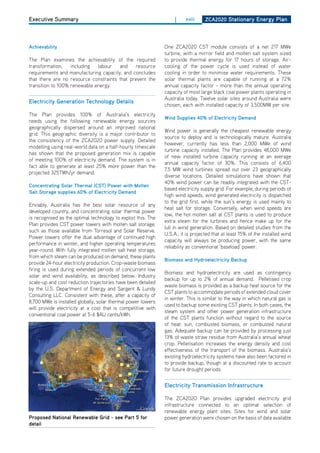
  • 7.
    For decades, thoseopposing the transition to clean energy have claimed that it is not technically feasible. This report puts that argument convincingly to bed. There is no longer an excuse for inaction. Starting the transition now is our responsibility to future generations. — ProfESSor ian lowE PrESidEnt of thE auStralian ConSErvation foundation EmErituS ProfESSor griffith univErSity Beyond Zero Emissions have been in my building, Kindness House, for five years. The dedication of this remarkable team of individuals is astonishing. Most of all, I am impressed by their relentless pursuit of the truth, wherever it may lead. They have built their strategies cautiously, never letting the enthusiasm distract them from the goal of getting the right answers by asking the right questions. They are a welcoming organization, drawing experts from a variety of disciplines, methodically searching for practical solutions to the challenges of reducing our massive carbon footprint. I am personally delighted to see the tens of thousands of hours they have invested in this important project, never once complaining about the lack of financial resources at their disposal. They have focussed their attention heavily on the carbon costs of stationary power, transport and building. I look forward to the time when they devote their formidable intellect and energy to the Livestock industry, where so much of our carbon share is squandered and emissions ignored. Beyond Zero Emissions is one organization I am proud to say I helped to incubate. I urge every serious institution to listen to them attentively. These are serious people for serious times. — PhiliP wollEn oam auStralian of thE yEar viCtoria 2007 Australians are capable of rapid change when the historical circumstances call for it. Indeed, we pride ourselves on being a resourceful people. The Beyond Zero Emissions team show how inventive and resourceful we can be. Their plan for a transition to 100% renewables is a powerful and cogent response to those who claim it can’t be done. The reception this report receives will be a sign of how much Australians believe in their future and how much they take refuge in the thinking of the past. — ClivE hamilton ProfESSor of PubliC EthiCS and author of rEquiEm for a SPECiES The Zero Carbon Australia Stationary Energy Plan is a provocative and timely contribution to the climate change debate, and it deserves attention both here and abroad. The Plan demolishes a pile of conventional wisdom that Australian policymakers still seem unable to get past. The sorry history of Australian climate policy procrastination is littered with polluter-friendly analyses conducted by economic hired guns. Their work has been used to argue against action, or for illusory schemes that price carbon without reducing the greenhouse pollution billowing from Australian smokestacks and tailpipes. The effect has been to constrain debate and obscure from our view a very different vision—a rapid switch from fossil to renewable energy that makes economic and environmental sense. By highlighting one of many pathways to achieving that vision, the ZCA report sheds light where it is desperately needed. — dr guy PEarSE rESEarCh fEllow, global ChangE inStitutE, univErSity of quEEnSland author of high & dry and quarry viSion
  • 8.
    | v ZCa2020 Stationary Energy Plan I get to work with people all over the world in the fight against global warming, a fight growing increasingly desperate as temperatures climb and rainfall patterns shift. Since Australia leads the world in per capita emissions, it makes sense that its transition planners would be thinking big. This transition obviously won’t be easy or simple or cost-free, but given the alternatives it’s very nice to know it’s technically feasible! — bill mCKibbEn SCholar in rESidEnCE at middlEbury CollEgE, author and foundEr 350.org This is exactly the type of initiative that we, the solar power industry, needs to propel our technology into the energy markets of Australia. SolarReserve’s concentrated solar power towers with molten salt storage are the most reliable, stable form of clean, renewable energy, which is exactly what’s needed to achieve the safe climate future proposed in BZE’s Zero Carbon Australia roadmap. SolarReserve’s solar thermal technology with molten salt storage; proven at Solar Two, the US Department of Energy’s 10 MW pilot plant that operated for over 3 years in the 1990’s, will not only aid in meeting Australia’s renewable energy and carbon reduction objectives, but also have significant economic benefits, bringing green jobs and cutting edge technology. Solar Reserve is willing, ready and able to deploy our molten salt power towers and fully supports the Zero Carbon Australia project. — tom gEorgiS viCE PrESidEnt, SolarrESErvE The twin threats of peak oil and climate change are now real and escalating rapidly. They demand a radical re-think of our approach to energy, ending our fossil-fuel dependence and moving to sustainable solutions before oil scarcity and climate change impact cut off our options - and it has to happen far faster than our leaders are prepared to acknowledge. Zero Carbon Australia 2020 is exactly the type of positive, rigorous technical analysis that is urgently needed to chart our path to a sustainable future - and convince Australia that there are far better alternatives to the complacent assumption that our high-carbon lifestyle can continue ad infinitum. — ian dunloP formEr CEo, auStralian inStitutE of ComPany dirECtorS formEr EXECutivE dirECtor of thE auStralian Coal aSSoCiation Renewable energy is the only way to go in the future. Enercon wind energy converters are designed to the newest standards to integrate with the modern high flexibility demands of electricity grids, providing sustainable reliable power to keep the wheels of daily life, household and industry turning. The Zero Carbon Plan outlines a technically achievable plan for generating all of Australia’s energy from the wind and the sun. It can be a realistic goal if Australia gets immediately seriously committed with decision making from industry and government. We hope that its recommendations are taken up so that Australia can also be a player in the renewable energy economy that is already booming around the world. — EnErCon gmbh
  • 9.
    | vi ZCa2020 Stationary Energy Plan Success in restoring a safe climate depends on transforming the global economy by 2020. Every nation and every economy needs to act. The Beyond Zero Emissions group shows in their Zero Carbon Australia 2020 report how this can be done for Australia. The report charts a practical path—using only commercially available technology—to a zero emissions stationary energy sector. Let’s hope that, very soon, every country has such a plan. — lEStEr r. brown, PrESidEnt of Earth PoliCy inStitutE author of Plan b 4.0: mobiliZing to SavE CiviliSation As a company involved in the development of solar plants all over the world, at Torresol Energy we support the Zero Carbon Australia Plan that sets the path for a future with clean, renewable energy. Australia is one of the areas with better solar radiation and forms part of the international ‘sun belt’. Besides, the country has excellent conditions for profiting from that solar radiation: large low-populated areas to build the plants and an industry that can support the technological development in the solar generation sector. In that sense, each of Torresol Energy’s new projects introduces technologically advanced improvements to make Concentrated Solar Energy a manageable, economically competitive option and a real, viable, ecological and sustainable alternative to traditional energy sources. Torresol Energy has three plants currently under construction. Among them, Gemasolar, with an innovative technology of central tower with molten salt receiver and thermal storage system, is the first commercial plant in the world of its kind. Due to this, the project has achieved considerable importance in the field of renewable energies as it opens the path to a new solar thermal power generation. Today, all of the analyses that have been carried out either by ourselves or by major international institutions show that tower plants with thermal storage is the type of technology that will be capable of generating reliable, manageable and renewable energy at the lowest costs. Therefore Australia could adapt this kind of technology in its renewable energy development plan that will allow the country to conserve the environment for future generations with a reliable energy source through utility scale baseload CSP plants. — Santiago ariaS ChiEf infraStruCturE offiCEr, torrESol EnErgy From the other side of the globe Protermosolar fully shares the vision of the realistic and feasible Zero Carbon Australia Plan. Spain is currently the country with the most intensive deployment of CST plants and their contribution to the grid stability and to the dispatchability of power supply has been fully demonstrated. Molten salt storage systems have been implemented in many Spanish plants providing predictable and reliable operation after sunset. Thus CST technologies could be considered as a real alternative to cover even the base load requirements of the electricity system. Australia must profit from its high solar resource, the sooner the better. An effective boost to CST and to the other renewable technologies - as presented in this plan – will not only go in the right direction in terms of the transition to a new energy mix but it will also result in an excellent business for the Australian economy. — dr. luiS CrESPo gEnEral-SECrEtary ProtErmoSolar SPaniSh aSSoCiation of CSt induStriES
  • 10.
    | vii ZCa2020 Stationary Energy Plan australian Sustainable Energy Zero Carbon Australia Stationary Energy Plan > a ten year roadmap for 100% renewable energy > baseload energy supplied by renewable sources > affordable at $8 per household per week L E Ad AUT ho RS matthew wright — Executive director, Beyond Zero Emissions Patrick hearps — University of Melbourne The University of Melbourne Energy Research Institute Beyond Zero Emissions
  • 11.
    | viii ZCa2020 Stationary Energy Plan australian Sustainable Energy Zero Carbon Australia Stationary Energy Plan lead authors Dominic Eales Patrick Hearps dr merryn redenbach BEng, Pgdip (Elec), BEng (Chem), Prof mike Sandiford Matthew Wright Swiss Federal Institute of formerly ExxonMobil Executive director, warwick wright Technology James Hutchison Beyond Zero Emissions Tim Forcey BSc (Physics), MEnv, major Supporters Patrick Hearps BEng (Chem), Lehigh Analyst, AEMo University of Melbourne winsome Constance Energy Consultant Richard Keech Kindness trust Concept Trent Hawkins MEng (Elec), formerly donkey wheel foundation Mark Ogge BEng (Mech) RAAF Engineering director, Beyond Zero Climate Positive Nina Muhleisen Jim Lambert Emissions BEng (Mech), RMIT BEng, MEngSc, Phd (Elec) Climate Emergency network Anne O’Brian Eytan Lenko beyond Zero BSc (hons), BEng, BSc, dr gavin wright Emissions University of Sydney formerly BP graeme wood researchers Miwa Tominaga Dylan McConnell derek bolton Derek Bolton BEng (Elec), MSc (Ren En) BEng (Chem) MA, MSc (Maths), Stephen whateley Kevin Yeh Ben Robotham oxford University t10 alliance BEng (Energy Systems), MChem (Physics), Pablo Brait formerly ANU Solar Phd Candidate dan Cass and Co. BEng (Env), Monash Thermal Group Matthew Sullivan James Bramwell Adrian Young BEng, BSc, MEng (Energy) graphic design BEng (Mech), ANU markmaking.com.au Rob Campbell university technical Support bindarri.com.au MEng, RMIT of melbourne Sinclair Knight merz ammon beyerle Kevin Casey researchers Jack actuarial Consulting Scott bilby BEng (Elec), UNSW, Reuben Finighan (JaC) formerly Ericsson BSc/BA, dvize Creative Expert review – adj Prof Chris Clement Winner National Energy alan Pears am, rmit Sandy Chansiri MSc (Energy Tech), Essay Competition 2008 genevieve Engelhardt BEng, Wind Engineer Paul Fleckney Editors hive Studio Vernon Crock BSc (Chem) andrew Campbell-fraser luke hodge BApp Sc Naomi Francis Jonathan daly BEng (Env) heidi lee Richard Denby dr roger dargaville BArch, deakin Chloe Hanson-Boyd glenn todd andrew longmire Andy Dinning BEng (Chem) Sharon wong dr adam lucas BEng (Elec), Rob Harrington Transmission Engineer, SKM BEng (Biomed) Elena mcmaster Rebecca Dunn Jane morton BEng (Solar), Phd Candidate, ANU Solar Thermal Group
  • 12.
    | ix ZCa2020 Stationary Energy Plan foreword Twenty-eight billion is a big number. Measured in tonnes it always reduces with large-scale rollout. The 2003 US- is a very heavy load. This figure is the amount of sediment based Sargent & Lundy report anticipated solar thermal eroded each year from all our mountains and carried by all electricity costs would reach parity with coal fired power our rivers to all our seas. And it is the amount of carbon once 8.7 GW of capacity was installed – just a bit under dioxide (Co2) we pump into the atmosphere each year from Victoria’s stationary energy capacity today. burning fossil fuels globally – enough to cover Australia in So far, there has not even been modest stimulus for solar a blanket two metres thick. In dollars, it is just a little more thermal power. The Global Financial Crisis is partly to than the extra annual investment needed to reconfigure blame, but political will is the resource in shortest supply. Australia’s stationary energy system to have zero emissions The BP deepwater horizon oil spill may have changed that. in just 10 years time. So what if we were to try to build a 100% renewable energy Each year the 28 billion tonnes of Co2 we make induces system to power the Australian economy in just 10 years? heating. The oceans are now heating at the phenomenal how could we possibly do that, and what would it cost? rate of 300 trillion watts. In frighteningly human terms that is equivalent to detonating five hiroshima sized A-bombs That is the challenge outlined in Australian Sustainable every second, every day of every year. Energy – Zero Carbon Australia Stationary Energy Plan. To make 28 billion tonnes of Co2 we dig 7 billion tonnes Zero Carbon Australia outlines a coherent and thoroughly of coal and suck countless gallons of oil and gas from the researched blueprint showing how 100% renewable energy ground. In total we already excavate more rock from the is achievable using technologies that are commercially Earth than nature does. With peak oil rapidly approaching, if available today: wind power and concentrating solar thermal not passed, BP’s deepwater horizon catastrophe attests to with molten salt storage. It goes through the options, costs the huge risks entailed in maintaining production. and benefits, confirming that a 10 year transformation of the stationary energy sector is achievable and affordable. This The rate we consume energy to emit that Co2 is 16 trillion will also add huge stimulus to the new green economy and watts. That is already about 1/3 of the energy released by create jobs. plate tectonics - the process that pushes continents around the globe over geological time making mountains and Zero Carbon Australia demonstrates that both cost and earthquakes as it goes. on current growth trajectories we variability can be readily addressed, and exposes as myth are set to surpass this amount of energy by 2060. the frequent argument that we need coal, gas or nuclear to provide baseload electricity. This is achieved by first Each year we are adding a bit under 1% to the atmospheric smoothing power output across the grid via geographically Co2 load, enhancing the greenhouse effect by a small dispersed production, and secondly providing dispatchable fraction of a percent. By trapping just a tiny extra fraction “back up” power from the molten salt storage at solar of the incoming solar energy, we are heating not only the thermal power plants. our nation continent, stretching atmosphere, but also the oceans and land. across climate and time zones, appears ready made for this. Such numbers give a very real sense that we humans are Zero Carbon Australia provides a big vision - Australia as a now operating as a geological change agent. But the scary renewable energy powerhouse. But 28 billion tonnes of Co2 thing is we have only just begun. Energy use is increasing is a big load, and getting bigger. Therefore a big vision for exponentially, doubling every 34 years so that it will increase an alternative energy system is precisely what is needed. by 800% in a century. Curtailing energy growth will not be easy with 2 billion people already in energy poverty and 2 Zero Carbon Australia is an extraordinary and pragmatic billion more added to the human number by mid century. roadmap to a new and more sustainable energy system in Australia, and ultimately our region. I recommend it to So how will we cater for our future energy needs? all who are truly interested in securing Australia’s energy one answer stares us in the face. Effectively converting future. about 0.06% of the solar energy that hits the land would meet the entire global energy demand. mike Sandiford But aren’t there problems with renewable energy? Isn’t it too expensive and unreliable? After all, the wind doesn’t Professor of Geology blow all the time and the sun doesn’t shine at night. director, Melbourne Energy Institute University of Melbourne Currently, advanced solar thermal power with molten salt storage, capable of producing power on demand day or June 2010 night, is about four times more expensive than the cheapest coal fired power plants. But the cost of new technologies
  • 13.
    | x ZCa2020 Stationary Energy Plan © 2010 acknowledgements This work is licensed under the Creative Commons lead authors: Matthew Wright, Executive director, Attribution-NonCommercial-ShareAlike 3.0 Beyond Zero Emissions and Patrick hearps, Unported License. To view a copy of this license, visit University of Melbourne http:/ creativecommons.org/licenses/by-nc-sa/3.0/ or Concept: Mark ogge, director, Beyond Zero Emissions send a letter to Creative Commons, 171 Second Street, Suite 300, San Francisco, California, 94105, USA. beyond Zero Emissions researchers: derek Bolton • Pablo Brait • James Bramwell • Rob Campbell • Kevin ISBN: 978-0-9808258-0-0 Casey • Chris Clement • Vernon Crock • Richard Denby • Andy Dinning • Rebecca Dunn • Dominic Eales • Tim Forcey • Trent Hawkins • Nina Muhleisen • Kevin Yeh • Published by University of Melbourne Adrian Young Energy Research Institute, McCoy Building Corner of Swanston and Elgin Streets university of melbourne researchers: Reuben Finighan University of Melbourne • Paul Fleckney • Naomi Francis • Chloe Hanson-Boyd Carlton 3053, Victoria, Australia • Rob Harrington • Patrick Hearps • James Hutchison • Richard Keech • Jim Lambert • Eytan Lenko • Dylan designed using Adobe CS4 McConnell • Ben Robotham • Matthew Sullivan Printed by Trojan Press, technical support: Sinclair Knight Merz • Jack Actuarial 34 Temple drive, Thomastown 3074 Consulting • Adjunct Professor Alan Pears with vegetable based inks on post consumer recycled paper Editors: Andrew Campbell-Fraser • Jonathan Daly • Dr Roger Dargaville • Dr Adam Lucas • Elena McMaster • Cover photograph: © Markel Redondo Jane Morton • Andrew Longmire • Dr Merryn Redenbach • Warwick Wright major supporters: Winsome Constance, • Kindness Trust • Donkey Wheel Foundation • Climate Positive • Climate Emergency Network • Dr Gavin Wright • Graeme Wood • Derek Bolton • Stephen Whateley • T10 Alliance • Dan Cass and Co. graphic designers: markmaking.com.au • Bindarri.com.au • Ammon Beyerle • Sandy Chansiri • Dvize Creative • Genevieve Engelhardt • Luke Hodge • Heidi Lee • Glenn Todd • Sharon Wong • Scott Bilby reviewers: Zane Alcorn • David Bruce-Steer • Jonathan Doig • Leigh Ewbank • John Fisher • Julie Knight • Petra Liverani • Annie Neilsen • Dr Kate O’Brien • James Tonson • Harry Troedel • Huong Truong
  • 14.
    | xi ZCa2020 Stationary Energy Plan Contents foreword ix Executive Summary xv Part 1 introduction and overview 1 1.1 why Zero Emissions? 2 1.2 why ten years? 3 1.3 guiding Principles, assumptions and Project methodology 4 1.4 Summary of technology Choices 5 1.5 the ZCa2020 Project and the Stationary Energy Plan 5 1.6 Structure of the Stationary Energy Plan report 6 1.7 the ZCa2020 working group 6 1.7.1 the future of ZCa2020 6 footnotes 7 references 7 Part 2 designing the ZCa2020 Stationary Energy Plan Supply System 9 2.1 overview of the ZCa2020 Stationary Energy Plan Supply System 10 2.2 analysis of Current australian Emissions and Energy-use trends 11 2.2.1 australian greenhouse gas Emissions 11 2.2.2 Current australian Energy Consumption 11 2.3 australian Energy demand in 2020 under the Plan 13 2.3.1 Energy Efficiency measures Employed to reduce overall Energy demand 15 2.3.2 buildings: Energy Efficiency and retrofitting 15 2.3.3 transport Electrification and mode Shift to Public transport 16 2.3.4 industrial Energy reductions 19 2.4 Proposed Pattern of demand under the ZCa2020 Plan 20 2.4.1 Seasonal variation and Shift of demand from a Summer Peak 20 2.4.2 baseload and Peaking under Current Electricity Supply 21 2.4.3 flattening Electricity demand Peaks 22 2.5 Choosing feasible, Cost Effective Zero-Emissions Solutions 23 2.5.1 australia’s Solar resource 23 2.5.2 Concentrating Solar thermal Power—the most Suitable large-Scale Solar technology 23 2.5.3 Smaller-Scale Solar technologies 28 2.5.4 wind Power 29
  • 15.
    Contents | xii ZCa2020 Stationary Energy Plan 2.5.5 biomass 32 2.5.6 hydroelectric Power—meeting Peak Electricity demand and Energy Storage 33 2.5.7 non-commercial technologies 34 2.5.8 lifecycle Emissions of Energy technologies 34 references 38 Part 3 australia’s 100% renewable energy supply 43 3.1 Concentrating Solar Power with Storage — 24 hour dispatchable power 45 3.1.1 which CSt power tower technologies? 47 3.1.2 technical specifications and description of CSt plant design 48 3.1.3 Scaling up of CSt 53 3.1.4 Choosing geographically diverse sites for CSt 55 3.1.5 Sizing Capacity for winter minimum 55 3.1.6 installation timeline 57 3.1.7 land use for Solar thermal Sites 57 3.1.8 CSt water consumption 60 3.1.9 CSt cost 61 3.2 wind: Cheap, Clean and technologically advanced 62 3.2.1 wind Power requirements 62 3.2.2 Siting for geographical diversity and winter Peak demand 63 3.2.3 installation timeline and resource requirements 65 3.2.4 managing wind variability by means of integration with CSt with storage 65 3.2.5 wind surpluses at high penetration levels 66 3.2.6 Cost of wind turbines 66 3.3 modelling of the ZCa2020 renewable Electricity grid 68 3.4 other renewable energy sources for energy security backup 68 3.4.1 hydroelectric power to address supply peaks and store energy 68 3.4.2 biomass — Co-firing with CSt plants 69 3.4.3 biogas for industrial methane supply 70 3.5 industrial Processes 71 3.5.1 Electrification of heating loads 71 3.5.2 Case-study: Conversion of industrial facility to solar thermal 72 3.5.3 Zero-emissions steel smelting 73 references 75 Part 4 modelling of ZCa2020 renewable energy supply 79 4.1 the ZCa2020 grid model 80 4.2 detailed overview of the ZCa2020 grid model 81 4.2.1 introduction 81
  • 16.
    Contents | xiii ZCa2020 Stationary Energy Plan 4.2.2 Proposed generating mix and demand 81 4.2.3 method and Characteristics of the model 82 4.2.4 Examples of model behaviour for Summer and winter Periods 82 4.3 high level modelling results 84 4.4 Conclusions 86 4.4.1 limitations and future work 86 Part 5 grid and load management—Creation of a national grid 87 5.1 upgrading the grid 89 5.1.1 grid extension—connecting renewable energy plants into the grid 91 5.1.2 Connecting nEm, SwiS and nwiS to form a national grid 91 5.1.3 increasing reinforcement and resilience within the existing grid 92 5.2 Control of Supply and demand 93 5.2.1 minimising Peak demand 93 5.2.2 Supply Side management 95 5.2.3 demand Side management 95 5.2.4 Examples of Scale 95 references 96 Part 6 resourcing the transition — implementation 97 6.1 implementation timeline 98 6.1.1 wind Power timeline 99 6.1.2 Solar thermal (CSt) Power timeline 99 6.1.3 transmission installations 99 6.2 material resources 100 6.2.1 CSt — Concrete, Steel and glass 100 6.2.2 wind — Concrete and Steel 101 6.2.3 transmission lines — Concrete, Steel and aluminium 101 6.2.4 total Concrete, Steel and glass 102 6.3 Emissions resulting from Construction 103 6.3.1 CSt related Emissions 103 6.3.2 wind related Emissions 103 6.3.3 transmission infrastructure 104 6.3.4 Combined total 104 6.4 manufacturing 105 6.4.1 CSt manufacturing Capacity 105 6.4.2 wind manufacturing Capacity 106 6.5 Jobs 108 6.5.1 Current Employment in Stationary Energy Production 109
  • 17.
    Contents | xiv ZCa2020 Stationary Energy Plan 6.5.2 Jobs in Solar 109 6.5.3 Jobs in wind 109 6.5.4 Jobs in new transmission lines 110 6.5.5 Jobs in biomass 110 6.5.6 ramp-up and Comparison with Current Employment 110 6.6 Conclusion 111 footnotes 112 references 112 Part 7 Economic Comparisons 115 7.1 Summary of Economic findings 116 7.2 Economic Comparison: the ZCa2020 Plan vs business-as-usual 117 7.2.1 modelling ZCa2020 and bau: which Provides lower-Cost Energy? 117 7.2.2 Comparing the models 118 7.2.3 other unmodelled Economic benefits 119 7.3 the ZCa2020 Stationary Energy Plan investment in the Context of other Economic activity 120 7.4 how much would electricity cost under ZCa2020? 121 references 123 Conclusion 125 appendices 129 appendix 1 Energy demand 130 appendix 2 System design and Costing 138 appendix 3a Scaling up Solar Power towers 142 appendix 3b Projected wind Energy Capital Costs 146 appendix 4 water use at CSt sites 148 appendix 5 industrial Case Study 152 appendix 6 transmission upgrades 155 appendix 7 implementation – timeline and Jobs 160 appendix 8 resource requirements 165 appendix 9 Economic Comparison assumptions and references 169
  • 18.
    | xv ZCa2020 Stationary Energy Plan Executive Summary
  • 19.
    Executive Summary | xvi ZCa2020 Stationary Energy Plan the Zero Carbon australia 2020 Stationary just 3% of GdP over ten years, to build a zero-emissions Energy Plan (ZCa2020 Plan) is a detailed energy system that will last for at least 30-40 years. and practical roadmap to decarbonise the The ZCA2020 research team also found that moving australian stationary energy sector within a to 100% renewable energy by 2020 is well within the financial and industrial capability of Australia’s economy. decade. The raw materials, and manufacturing and construction labour needed to implement the transition are small when Current levels of greenhouse gases in the atmosphere compared with those employed every day within Australian are already sufficiently high to carry the climate system industry. For example, 80,000 construction jobs will be past significant tipping points. They pose an unacceptable required at the peak of the ZCA2020 Plan installation, risk of dangerous and irreversible changes to the world’s equivalent to only 8% of Australia’s present construction climate, to biodiversity, and therefore to human civilisation. workforce. This is easily achievable given that in the These changes directly affect Australia’s food and water period immediately prior to the Global Financial Crisis, security, and increase the risk of regional instability. new construction jobs were increasing at a rate of around Using a global carbon budget approach, recent work 50,000 per year. Furthermore, the jobs created by the new by the German Advisory Council on Global Change renewable energy economy will more than offset job losses demonstrates that, to have a two-in-three chance of in the fossil fuel industries. keeping global warming to less than 2oC above pre- In narrow economic terms the ZCA2020 Stationary Energy industrial temperatures, developed nations with the highest Plan does not impose a long-term cost on the economy per capita rates of emissions, such as the United States above business-as-usual. That is, the net present costs and Australia, would need to decarbonise their economies for both scenarios calculated for the period 2010-2040 by 2020. There is increasing consensus that the 2oC are approximately equal, at roughly $AU500 billion. This threshold is too high and beyond a ‘safe boundary’, and calculation ignores savings from transport fuel costs and that atmospheric carbon dioxide must be reduced from the possible carbon pricing. The ZCA2020 Plan is able to achieve current level of around 390 parts per million (ppm) into the this low cost, because the pipeline of renewable energy range of 300 to 350 ppm. projects in the plan contributes to the rapid reduction in the For these reasons a timeline of ten years is recommended. cost of renewable energy. Cost reductions from increased Ten years is a meaningful timeframe for planning purposes, cumulative capacity of these technologies are realised, as it requires immediate action, whereas longer and less as well as avoiding future rising costs of fossil fuels for ambitious goals lead to half-responses and delay. over power stations. Adoption of the full ZCA2020 Plan provides this ten year period, fossil fuel generating assets will be significant economic benefits, eliminates all dependence on retired as new renewable energy infrastructure is brought foreign energy sources, and positions Australia to lead in on line and securely integrated into the electricity supply the 21st century renewable energy economy. system. decisive leadership is now needed from government, A group of dedicated individuals with experience and business, academia and the wider community for this expertise in relevant energy industry disciplines, many of transition to begin. whom work in the fossil fuel energy industry, collaborated The Stationary Energy Plan is the first in a series of six to develop the Zero Carbon Australia 2020 Stationary plans making up the ZCA2020 Project. Future reports will Energy Plan. cover the sectors of Transport, Buildings, Land Use and only proven and costed technologies are used in the Agriculture, Industrial Processes and Replacing Fossil-Fuel ZCA2020 Plan. Wind power and concentrating solar Export Revenue. thermal (CST) with molten salt storage are the two primary technologies used, providing approximately 40% and 60% ZCa2020 Stationary Energy Plan detail of the energy mix respectively. These key energy sources are backed up by a 2% annual contribution from crop The stationary energy sector accounts for almost 55% of waste biomass and hydroelectricity. detailed modelling Australia’s Co2 equivalent emissions, with all fossil fuels was undertaken to ensure that the new renewable energy accounting for over 70% of Australia’s emissions. supply can meet all demand projected under the ZCA2020 Plan, 24 hours a day, 7 days a week, 365 days a year. The ZCA2020 Stationary Energy Plan describes how to repower Australia’s stationary energy sector using 100% When compared to other nations, Australia’s renewable renewable sources by 2020. The authors acknowledge that energy resources are amongst the best and the most the Plan detailed herein is not the only way that Australia profitable to develop. Thus, these resources offer a could achieve zero emissions from the stationary energy strategic advantage for all Australians as we prepare to sector. While ongoing innovation will indeed make it even compete in the future carbon-constrained global economy. easier and cheaper to meet the zero emissions target, the The investment required to transition Australia’s stationary option presented here is available right now. energy sector to renewables is a stimulus equivalent to
  • 20.
    Executive Summary | xvii ZCa2020 Stationary Energy Plan reduced overall Energy requirements Total delivered energy use under the plan is reduced by more than half, from 3,915 PJ/yr (2008) to 1,660 PJ/yr (2020), while maintaining the same level of energy services, including transport, heating and cooling, industrial energy use and so on. This is achieved through a combination of energy efficiency measures, and by switching energy services currently provided with oil and natural gas, mostly for transport and heating, with far more efficient electrical systems. For instance, due to the inefficiency of internal combustion engines, less than 20% of the fossil fuel energy consumed by the transport sector is actually converted into useful vehicular motion, once stop-start inefficiencies are factored in. on the other hand, electric rail and electric cars convert 80-90% of electrical energy into motion. Similarly, space heating with efficient heat pump systems uses a small amount of electricity to “pump” ambient heat - a renewable resource - from outside. Typically, heat pump systems for domestic and commercial buildings will use between one quarter and one third of the energy used by natural gas or resistive electrical heating systems to provide the same amount of heat. A minor allowance is made for biogas and biofuels to meet energy demands that cannot be electrified, though this is kept to a minimum. flatter Electricity-use Profile Enercon E-126 turbines in belgium. image: Steenki Australian electricity and natural gas usage fluctuates The ten-year timeframe has been mapped out taking into considerably from day to day and between seasons. This account the need for initial growth of the renewable energy means that at present the energy generation and distribution industry. The timeframe could be accelerated with continued infrastructure is under-utilised. The ZCA2020 Plan employs growth in later years or delayed if policy action is too slow measures to flatten this profile on both a daily and seasonal however the report demonstrates that such a rapid transition basis so that infrastructure is more effectively used and is within Australia’s capacity. infrastructure investors can achieve suitable economic There are a variety of policy mechanisms that could facilitate returns. implementation of the ZCA2020 Plan, with funding provided from any mixture of public and private sources. It is beyond Proven and Costed renewable Energy technologies the scope of this report to recommend any particular financing or policy mechanism. The Plan relies only on existing, proven, commercially available and costed technologies. The Plan found that wind and concentrating solar thermal (CST) power with molten Key features of the Plan include: salt heat storage are the most appropriate, cost effective, commercially available, and scalable technologies for increased Electricity use deployment in Australia. Australia’s annual electricity demand increases by over "better-than-baseload" Electricity generation 40%, from 822 PJ/yr (228 TWh/yr) in 2008 to 1,170 PJ/ yr (325 TWh/yr) in 2020. While this is more electricity Storing the sun’s energy as heat in the form of hot molten demand than would be required under business-as-usual salt allows CST plants to provide power that is “better-than- demand growth, it is demonstrated that with a combination baseload”. Similar to a hydroelectricity dam, CST plants of energy efficiency and fuel-switching measures, this with heat storage can dispatch electricity as needed at very is in fact sufficient to replace all fossil fuel use, including short notice. This is achieved by using the heat from the transport and heating. stored molten salt to produce steam as necessary.
  • 21.
    Executive Summary | xviii ZCa2020 Stationary Energy Plan achievability one ZCA2020 CST module consists of a net 217 MWe turbine, with a mirror field and molten salt system sized The Plan examines the achievability of the required to provide thermal energy for 17 hours of storage. Air- transformation, including labour and resource cooling of the power cycle is used instead of water requirements and manufacturing capacity, and concludes cooling in order to minimise water requirements. These that there are no resource constraints that prevent the solar thermal plants are capable of running at a 72% transition to 100% renewable energy. annual capacity factor - more than the annual operating capacity of most large black coal power plants operating in Australia today. Twelve solar sites around Australia were Electricity generation technology details chosen, each with installed capacity of 3,500MW per site. The Plan provides 100% of Australia’s electricity wind Supplies 40% of Electricity demand needs using the following renewable energy sources geographically dispersed around an improved national Wind power is generally the cheapest renewable energy grid. This geographic diversity is a major contributor to source to deploy and is technologically mature. Australia the consistency of the ZCA2020 power supply. detailed however, currently has less than 2,000 MWe of wind modelling using real-world data on a half-hourly timescale turbine capacity installed. The Plan provides 48,000 MWe has shown that the proposed generation mix is capable of new installed turbine capacity running at an average of meeting 100% of electricity demand. The system is in annual capacity factor of 30%. This consists of 6,400 fact able to generate at least 25% more power than the 7.5 MW wind turbines spread out over 23 geographically projected 325TWh/yr demand. diverse locations. detailed simulations have shown that 40% wind power can be readily integrated with the CST- Concentrating Solar thermal (CSt) Power with molten based electricity supply grid. For example, during periods of Salt Storage supplies 60% of Electricity demand high wind speeds, wind generated electricity is dispatched to the grid first, while the sun’s energy is used mainly to Enviably, Australia has the best solar resource of any heat salt for storage. Conversely, when wind speeds are developed country, and concentrating solar thermal power low, the hot molten salt at CST plants is used to produce is recognised as the optimal technology to exploit this. The extra steam for the turbines and hence make up for the Plan provides CST power towers with molten salt storage, lull in wind generation. Based on detailed studies from the such as those available from Torresol and Solar Reserve. U.S.A., it is projected that at least 15% of the installed wind Power towers offer the dual advantage of continued high capacity will always be producing power, with the same performance in winter, and higher operating temperatures reliability as conventional ‘baseload’ power. year-round. With fully integrated molten salt heat storage, from which steam can be produced on demand, these plants biomass and hydroelectricity backup provide 24-hour electricity production. Crop-waste biomass firing is used during extended periods of concurrent low Biomass and hydroelectricity are used as contingency solar and wind availability, as described below. Industry backup for up to 2% of annual demand. Pelletised crop scale-up and cost reduction trajectories have been detailed waste biomass is provided as a backup heat source for the by the U.S. department of Energy and Sargent & Lundy CST plants to accommodate periods of extended cloud cover Consulting LLC. Consistent with these, after a capacity of in winter. This is similar to the way in which natural gas is 8,700 MWe is installed globally, solar thermal power towers used to backup some existing CST plants. In both cases, the will provide electricity at a cost that is competitive with steam system and other power generation infrastructure conventional coal power at 5-6 $AU cents/kWh. of the CST plants function without regard to the source of heat: sun, combusted biomass, or combusted natural gas. Adequate backup can be provided by processing just 13% of waste straw residue from Australia’s annual wheat crop. Pelletisation increases the energy density and cost effectiveness of the transport of the biomass. Australia’s existing hydroelectricity systems have also been factored in to provide backup, though at a discounted rate to account for future drought periods. Electricity transmission infrastructure The ZCA2020 Plan provides upgraded electricity grid infrastructure connected to an optimal selection of renewable energy plant sites. Sites for wind and solar Proposed national renewable grid - see Part 5 for power generation were chosen on the basis of data available detail
  • 22.
    Executive Summary | xix ZCa2020 Stationary Energy Plan from NASA and Australian Government bodies. Emphasis in Australia and overseas with the capability of producing was placed on selecting sites with high year-round energy 300,000 to 500,000 cars per year. availability so that both winter and summer peak electricity demands are met. required investment and Economics compared to Electrical transmission links are upgraded in order to business-as-usual strengthen the Australian grid and connect the new renewable energy installations. New interstate connections The ZCA2020 plan requires a total investment of $AU370 enable greater import and export capability between the billion over the period 2011-2020. Annual investment, geographically diverse renewable energy resources. The averaging $AU37 billion per year, will be lower in initial Plan provides 500kV alternating current links to connect years and higher as the pace of construction ramps up. new power stations near populated regions where the Importantly, the up-front annual costs of construction need power is to be used locally. Meanwhile efficient high only be paid by investors, not by the Australian public. As Voltage direct Current (hVdC) links are provided for low- with any energy infrastructure project, up-front capital loss long-distance transmission to connect specified solar costs will be paid back over time through energy sales. installations and for interstate connections to areas of high Therefore the figure of $370 billion is not an expense to the electricity demand. The Plan costings also allow for supply economy without return. Rather it is a strategic investment of 4,475 MW of offgrid electricity to load centres without that secures Australia’s zero-emission future and results in grid access. significant savings in future years. Compared to Australia’s annual GdP of $AU1.2 trillion, the achievability and Employment investment for ZCA2020 represents 3% of GdP over the ten years. Though the up-front investment required by the Implementation of the plan would require a rapid ramp-up Plan is significant, maintaining business-as-usual (BAU) is of projects and industry. The ten year timeframe takes into not without its costs either. BAU requires $AU135 billion account that this will not happen overnight, and would see for ongoing capital investments in energy infrastructure most of the proposed infrastructure completed in the second for the period 2011 to 2020, and then continues to pay half of the decade. Mid-term goals are to have 15,000 MW for increasingly expensive fossil fuels in later years, with of wind and 5,000 MW of CST operational by 2015. This $AU300 billion in fuel costs. Although the ZCA2020 Plan’s requires fast-tracking existing projects and putting in place up-front investment is substantially higher than BAU, the the right policies to stimulate new projects. Plan’s low ongoing costs result in dramatically reduced expenditures over the long-term. Calculating net present The labour resource requirements for the implementation costs on a longer timeframe (2011-2040) demonstrates that are dwarfed by Australia’s existing industrial capacity. The the ZCA2020 Stationary Energy Plan is about the same Plan would require a peak of 80,000 construction workers cost as the BAU scenario. by 2016, out of an existing workforce of almost one million. Prior to the Global Financial Crisis of 2008, the construction These savings expand when the broader economic benefits workforce was growing at the rate of 50,000 new jobs per of the Plan are included. The use of electricity to power year. Similarly in manufacturing, modelling has allowed transport instead of oil realises fuel cost savings of nearly for 50% of the manufacturing of wind turbine components $AU1,170 billion. Lastly, in the event that a carbon price is and CST heliostat mirrors to be done onshore. This would implemented, an estimate of the savings made by avoiding create up to 30,000 new jobs, out of Australia’s existing potential Co2 emission charges shows that the Plan manufacturing workforce of one million which is projected avoids an additional $AU370 billion, raising total savings to to decline under business-as-usual. The Plan would create a $AU1,550 billion. Taking these costs into account realises a further 45,000 ongoing jobs in operations and maintenance very rapid economic payback of only a few years. of the renewable energy infrastructure, which would more This report also compares the ZCA2020 Plan costs to other than offset the loss of around 20,000 jobs in the domestic public and private expenditures – for example, the annual fossil energy supply sector. ZCA2020 investment is equal to what Australians spend The raw materials required by the Plan are primarily each year on insurance. This demonstrates that the scale concrete, steel and glass, none of which are constrained of the projects described within this report are well within by supply. The Plan would require the equivalent of only the capacity and capability of the Australian economy. More 7% of Australia’s current concrete production, while detailed economic modelling and policy recommendations sourcing steel and glass would require some increase in are beyond the scope of the ZCA2020 Stationary Energy either domestic production or imports. The manufacturing Report. Future work will include a separate financing and of heliostats and wind turbine components would require policy document to be produced at a later date. the setting up of several new factories of a similar size to As a benchmark for gauging the economic impact of the ones that already exist overseas. For example, it is feasible Plan, a preliminary analysis has been done based on one that the production of 600,000 heliostats per year could be possible funding scenario where the investment is paid for done in a single factory, as there are already car factories solely through electricity retail revenue. If the proposed
  • 23.
    Executive Summary | xx ZCa2020 Stationary Energy Plan brightSource Solar thermal Power tower infrastructure was funded with revenue from electricity Summary prices at a standard rate of return for regulated assets, it would require a price rise of around 6.5c/kWh by 2020, The following chapters show in detail how the transition to equivalent to the existing premium for GreenPower today. a Zero Carbon Australian economy can be achieved using This should not be taken as a recommendation of the technology that is commercially available today. There are ZCA2020 Plan, but it does provide a useful indication of the no technical barriers to this deployment. Implementing costs involved. This price increase would cost approximately the proposed infrastructure in ten years is well within $AU420 per household per year, or $AU8 per household the capability of Australia’s existing industrial capacity. per week, by 2020, and is a similar electricity price rise ZCA2020 outlines a decisive and achievable transition to what may be expected in Australia’s business-as-usual blueprint for a 100% renewable energy future which electricity market. There are of course various policy would position Australia as a leader in the emerging global options that could fund the Plan in different ways and would renewable energy economy. What is required to make this not require electricity price increases. Also, further detailed happen is leadership through action from policymakers and design to the Plan in later versions may decrease this price, society, with firm decisions made quickly that will allow this as more detailed modelling and information comes to hand. transition to occur.
  • 24.
    | 1 ZCa2020 Stationary Energy Plan Part 1 introduction and overview Contents 1.1 why Zero Emissions? 2 1.2 why ten years? 3 1.3 guiding Principles, assumptions and Project methodology 4 1.4 Summary of technology Choices 5 1.5 the ZCa2020 Project and the Stationary Energy Plan 5 1.6 Structure of the Stationary Energy Plan report 6 1.7 the ZCa2020 working group 6 1.7.1 The Future of ZCA2020 6 footnotes 7 references 7
  • 25.
    Part 1: Introductionand overview | 2 ZCa2020 Stationary Energy Plan the Zero Carbon australia 2020 Stationary “[t]his goal is achievable, affordable and transformative.“ u.S. viCE PrESidEnt al gorE, announCing hiS ProPoSal to Energy Plan outlines a technically feasible, rE-PowEr amEriCa with ClEan ElECtriCity in tEn yEarS1 practical, and economically attractive transition to 100% renewable energy in “We know the country that harnesses the power of clean, renewable energy will lead the 21st century” australia in ten years. the plan is a rational u.S. PrESidEnt obama2 and necessary response to the risk of major climate change. 1.1 why Zero Emissions? As governments continue to grapple with the problem of how to shift to low-carbon societies, the evidence mounts Present atmospheric levels of Co2 are at 390ppm3, well that only a rapid transition to a zero-carbon economy can above the pre-industrial levels of 275 to 285 ppm (Ad ensure climate and energy security for us all. Mitigating 1000-1750)4. Furthermore, atmospheric Co2 concentration climate change in an incremental manner ignores the has been growing rapidly for the last 40 years [note 1]. potentially catastrophic effects we face if global warming Many climate scientists now believe that Co2 levels must “tipping points” are passed. Moving to a zero-carbon be reduced from today’s concentrations to avoid triggering economy requires concerted efforts across all national dangerous “tipping point” mechanisms6,7 [note 2]. governments and across multiple sectors including Stationary Energy, Transport, Building Efficiency, Industrial Tipping points are serious because once they are passed, Processes and Land Use. a return to a normal climate situation may be impossible. For example, if global average temperatures increase by Many different factors shape action to mitigate climate 4°C , the huge carbon stores in the northern circumpolar change. Societal and political barriers are quite permafrost zone (estimated at 1,672 gigatonnes) may be different from technical barriers. This report is aimed at vulnerable to irreversible release8. Figure 1.1 shows that the demonstrating the technical and financial feasibility of rolling current rate of loss of summer arctic sea ice is exceeding out a 100% renewable energy system in Australia over the worst-case IPCC predictions. next ten years. Importantly, only commercially available technology is specified, to show that such a roll-out could Many scientists have stated that the maximum safe start today. This report does not address the political and level of atmospheric Co2 concentration is 350 ppm or social impediments to beginning such a Plan. It is aimed at less—a level significantly below the present atmospheric concluding the debate about whether renewable energy has concentration of 390 ppm[note 3]. It is not too late—a rapid the capability to keep the wheels of industry turning, in order and decisive reduction in Co2 emissions can return us to to enable the social and political changes that will lead to the safe atmospheric levels with a reasonable probability of transition to 100% renewable energy. The 2020 timeframe avoiding dangerous tipping points. however, this can only be is motivated by the best available climate science. While any delay to the roll-out of such a ten-year ‘decadal plan’ could still see a 100% renewable sector achieved at a later date, figurE 1.1 this comes with greater risk of exceeding safe limits within arctic Sea ice Extent—observed loss versus iPCC the Earth’s climate system. forecasts 9 This report focuses on the Stationary Energy sector in Australia. Subsequent reports will address the other carbon 10 emitting sectors of the economy. The ZCA2020 Stationary Energy Plan allows Australia to play a responsible, (S ept. minimum) [millions of km2 ] constructive and leading role in promoting decisive action 8 for climate protection around the world. For the remainder Arctic s ea ice extent of this document, unless otherwise defined, the ZCA2020 Stationary Energy Plan will be referred to as “the Plan” or 6 the “ZCA2020 Plan”. Obs ervations There are a number of potential paths to a zero-emissions 4 stationary energy system. This Plan offers one possible solution based on renewable resources, using existing proven and reliable technologies, such that the costs and 2 liabilities of the Plan can be rigorously assessed. In this Mean and range of IP C C models regard, the Plan concords with an emerging view that national scale renewable systems are not only technically 0 and economically viable, but are likely to accrue significant benefits to the nations that first implement them. 1900 1950 2000 2050 2100 Year
  • 26.
    Part 1: Introductionand overview | 3 ZCa2020 Stationary Energy Plan achieved through the implementation of urgent, purposeful would be that other rich countries, with the highest per- action by governments to quickly reduce anthropogenic capita emissions, such as Australia12, would need to pursue carbon emissions to zero. the same goal. As Figure 1.2 depicts, the “global budget per-capita” (the blue block in the background) shows that “If humanity wishes to preserve a planet similar to that on the maximum per-capita emissions allowed across all which civilization developed and to which life on Earth is populations of the world would need to be limited to around adapted .... CO2 will need to be reduced from its current 385 110 tonnes of Co2 per-capita (2.75 tonnes per-capita per ppm to at most 350 ppm.” annum over a period of 40 years). hanSEn Et al, 20086 As such, countries with high per-capita emissions (such “... any reasonably comprehensive and up-to-date look at the as the USA or Australia [note 4]) have less than ten years evidence makes clear that civilization has already generated to cut their emissions to zero. At the current Australian dangerous anthropogenic interference in the climate system. emissions rate of about 20 tonnes per-capita per annum, What keeps me going is my belief that there is still a chance our emissions budget would run out in five years. If instead of avoiding catastrophe.” we begin 9/28/2009 emissions sooner, we could extend reducing John P. holdrEn, EnErgy and EnvironmEnt EXPErt the budget to ten years. As a country with high per-capita at harvard univErSity, PrESidEnt of thE amEriCan emissions, Australia has the opportunity to be a catalyst aSSoCiation for thE advanCEmEnt of SCiEnCE, and for other countries (particularly countries with high total PrESidEntial SCiEnCE adviSor to baraCK obama10 emissions but low per-capita emissions, such as China and India) by inspiring action on climate change and developing renewable energy industries. 1.2 why ten years? A transition in ten years may seem challenging, but the world has seen remarkably fast economic transitions in The Plan looks not only at how to implement a zero- the past; the restructuring of the United States economy greenhouse gas emission energy sector, but also how to during the Second World War is a notable example13. A ten achieve this within a ten year timeframe, from a technical year transformation period has also been nominated by Al perspective. It is recognised that this is needed to properly Gore14. In his 2008 speech calling for America to move to address the threat of severe and potentially irreversible 100% renewable energy within ten years , Al Gore said: “To climate change. those who say ten years is not enough time, I respectfully The premise of a ten year timeframe to achieve zero ask them to consider what the world’s scientists are telling emissions echoes several leading academics and public us about the risks we face if we don’t act in ten years. Ten figures. In a recent report from the German Advisory years is about the maximum time that we as a nation can Council on Global Change (WBGU), Prof. hans Joachim hold a steady aim and hit our target.”14 Schellnhuber (director of the Potsdam Institute for Climate There are many additional reasons for Australia planning Impact Research) indicated that, in order to have a two- immediate and deep cuts to emissions. Global warming has in-three chance of keeping global warming below 2°C over the potential to create irreversible ecological change, and pre-industrial levels, and using a global per-capita carbon Australia is at particular risk of biodiversity reduction15. With budget approach, it would be necessary for the USA to our agricultural and water systems also at particular risk, reduce emissions to zero by 20209. An extension to this climate change threatens our national security. “Global average temperature increases of 1.5 or 2.0°C above pre-industrial levels will likely lead to a massive loss of figurE 1.2 Scenario 2: Climate Compromise biodiversity worldwide. ... The more effectively the rate of Carbon budget 2010—2050: Emissions paths per T1 = 2010, T2 = 2050, TM = 2010, p climate change can be slowed and the sooner climate can be capita for selected countries (adapted)11 = 2/3 stabilised, the better are the prospects that biodiversity loss Emission paths per capita for selected countries 20 will be lessened.” Summary of a rEPort to thE natural rESourCE 18 Germany USA (& Australia) managEmEnt miniStErial CounCil CommiSSionEd by thE 16 China auStralian govErnmEnt, 200916 India 14 Burkina Faso There is widespread recognition that those who lead the t CO2 per capita 12 Global budget per capita assuming constant annual renewable energy race will reap significant economic 10 emissions benefits. Already, several Australian renewable energy 8 technology firms have moved offshore to take advantage 6 of more supportive and forward-looking regulatory 4 environments. These include the now multi-million dollar 2 corporations Ausra (now French-owned) and Suntech (now China-based). The dESERTEC program is pressing ahead 0 2005 2010 2015 2020 2025 2030 2035 2040 2045 2050 with plans to build a vast network of solar thermal plants
  • 27.
    Part 1: Introductionand overview | 4 ZCa2020 Stationary Energy Plan across North Africa, the Middle East and Europe17 while indeterminate length. A zero emissions plan is not simply Spain will have 2.5 gigawatts (GW) of solar thermal power an accelerated low emissions strategy. The point of a rapid connected to the grid by 2013.18 In terms of renewable transition to a zero emissions economy is not to just proceed resources, Australia has all the natural advantages of the further along the same path that will take us to a low emissions dESERTEC proposal, with none of its multi-national political economy over 50 years or so. impediments. With this in mind, the ZCA2020 working group has framed China has begun to invest heavily in renewable energy, the development of the whole Project within the following doubling its wind power capacity every year for the last set of guiding principles to provide clarity of direction and 5 years, now having 25 GW as of 2009. China has a target transparency of purpose. of 150 GW of wind by 2020, but if it continues its current • Proven and reliable Solutions. A plan for transition rate of installation it will reach 150 GW by 2015—five years to a zero emissions economy beginning now requires ahead of schedule. This scale of growth is impressive and us to use the best of what is now available. There have actually accounts for one third of the total global wind been major advances in renewable energy technology power growth19,20. over recent years, and it is possible to move to a zero emissions economy without waiting for further As these and other countries take actions which reduce technologies to be developed22. Consequently, the Plan their reliance on coal, Australia has the opportunity to move considers only technological solutions that are already beyond its ‘quarry vision’,21 which sees the success of our commercially available from existing companies which economy strongly tied to fossil fuel exports, and look instead offer the technology at a multi-megawatt scale, and to reap the economic benefits of being among the leaders in have moved beyond small-scale demonstration and zero emissions technology innovation. pilot projects. “The credit crunch has been brutal for solar start-ups in the • implementation flexibility. While the Plan only West, but not for Chinese firms with access to almost free considers commercially proven technologies at the finance from the state banking system. They have taken outset, the ZCA2020 working group leaves open advantage of the moment to flood the world with solar the option of subsequent incorporation of new and panels, driving down the retail price from $4.20 per watt innovative technologies as they become commercially last year to nearer $2 in what some say is a cut-throat drive available, if they will reduce the cost of the transition for market share ... We may soon be moving into a phase and/or they have fewer associated environmental or of history when ill-prepared countries cannot be sure of social impacts. Example technologies that the ZCA2020 obtaining energy—whatever the price.” working group anticipates may become commercially ambroSE EvanS-PritChard 22 available during the 10 year transition period include arrays of Australian National Universities’ 500 m2 SG4 By choosing to become a leader in the race towards zero concentrating solar thermal Big dishes,24 and Carnegie emissions, Australia has the opportunity to secure its food, Corporation’s CETo III Wave Technology25,26. water and energy supplies for the future, and build a new • a Socially Equitable Solution. The ZCA2020 Project and robust economy as a global renewable powerhouse. will seek to ensure that social equity in Australia is These arguments all promote the case for immediate action. maintained or enhanced during the transition to a zero “I think that the word “now” has to creep into the vocabulary emissions economy. In particular, this solution will of people in public policy.” continue to provide equitable access to energy for all S david frEEman, uS EnErgy adviSor Australians today, while ensuring that the costs and and formEr hEad of tEnESSEE vallEy authority 23 burdens are not deferred to future generations. • transition fuels. Whereas a long-term low emissions plan may recommend the use of natural (or petroleum) 1.3 guiding Principles, assumptions gas as a transition fuel, such a ‘double transition’ is not considered because it necessarily ties Australia and Project methodology to continued fossil fuel emissions beyond the Plan’s timeframe, and would see money that could otherwise A zero emissions target—not a low emissions target. The be spent on renewable generation capacity diverted ZCA2020 Project is based on a zero emissions methodology into fossil fuel infrastructure. underpinned by a set of guiding principles. These principles • technology Sequencing. As with the idea of transition relate to the use of proven technology solutions and the fuels, investment in so-called ‘transition technologies’ achievement of social equity goals with minimal disruption to will only serve to divert funding and attention from food, water and energy supplies. developing true zero emissions solutions. An example would be the development of more efficient petrol The Plan differs from other emissions reductions plans in driven cars at the expense of investing in an electrified that, from the outset, it seeks a target of zero emissions transport system that can be powered from a renewable within ten years. Most other transition plans aim to move energy grid. towards a low emissions economy over a period of
  • 28.
    Part 1: Introductionand overview | 5 ZCa2020 Stationary Energy Plan • minimal impact on food, water and Energy Supplies. The transition to a zero emissions economy should aim 1.5 the ZCa2020 Project and the to do so without compromising Australia’s food, water and energy security. Stationary Energy Plan The ZCA2020 Project consists of six inter-related reports, 1.4 Summary of technology Choices each addressing a specific Plan. The ZCA2020 Stationary Energy Plan is the first and most urgent of these, since 50% While the choices of energy technologies are detailed with of Australia’s emissions are generated by the stationary references in Part 2 of the report, they are summarised energy sector. here to aid the reader in understanding why the guiding The complete set of ZCA2020 reports to be produced are: principles outlined above led to the chosen technology • Report 1: The ZCA2020 Stationary Energy Plan mix. There are commonly held perceptions that renewable addresses the re-powering of Australia’s stationary energy has a limited future because “the wind doesn’t energy sector with zero emissions technology always blow and the sun doesn’t shine at night”. The aim and • Report 2: The ZCA2020 Buildings Plan considers scope of this report is to show that this is not an issue, and measures to improve energy efficiency, and hence to demonstrate the feasibility of 100% renewable energy reduce the demand for stationary energy in Australia within the next ten years. Instead of focusing • Report 3: The ZCA2020 Transport Plan is concerned on various negative aspects of the technologies we have with powering private and public transportation with not chosen, the authors wish to show the positive aspects renewable electricity of the renewable technologies that are already available to • Report 4: The ZCA2020 Industrial Processes Plan replace fossil fuels. addresses measures to reduce emissions from industry The conclusions relating to technology choices are as • Report 5: The ZCA2020 Land Use Plan considers follows: changes to agriculture, forestry and other land use • Wind, solar photovoltaics and concentrating solar practices to minimise emissions thermal with storage are commercially proven, scaleable • Report 6: The ZCA2020 Plan for Replacing Coal Export solutions that together can ensure reliable, 24-hour Revenue focuses on Australia’s large fossil fuel exports. renewable energy supply. The reports will be inter-related and complementary. As • Biomass and hydro are commercial renewable options an example, the design of the stationary energy supply that are limited in their scaleability due to other environmental considerations. They are better suited to supplying backup and balancing power to wind and solar. figurE 1.3 Sheet1 Biomass is also needed for its carbon content to replace australian greenhouse gas inventory 200727 non-energy-related chemical carbon requirements. 350 • Wave, tidal and enhanced geothermal power are technologies that are on the horizon, but as yet have not overcome all technical hurdles nor have they been 300 54% demonstrated at scale. • Carbon capture and storage (CCS) is similarly an unproven technology, that is not expected to be 250 commercially available within the ZCA2020 timeframe. Emissions (Mt CO2-e) It is also not a zero-emissions solution, as even should it be demonstrated at scale, proposed projects are not 200 expected to capture 100% of fossil fuel plant emissions. • Nuclear power is highly unlikely to be viable in Australia over a ten-year period, as countries that already have a 150 nuclear power industry experience implementation times for nuclear plants in the order of 10-19 years for single reactors. 100 16% 15% 50 7% 6% 3% 0 Stationary Transport Fugitive Energy Emissions From Fuel Industrial Agricultural Waste Processes
  • 29.
    Part 1: Introductionand overview | 6 ZCa2020 Stationary Energy Plan system (Report 1) must include projections of demand and efficiencies from Reports 2, 3 and 4. Furthermore, 1.7 the ZCa2020 working group emissions reductions achieved in the stationary energy sector will have flow on effects in other sectors (Reports The concept of a plan to achieve zero-emissions energy 2, 3 and 4) because, for example, electricity will become a in ten years originally came from Beyond Zero Emissions, low emissions energy source relative to gas. The Stationary motivated by the scientific evidence that atmospheric Energy Plan is released in Version 1.0 form prior to the concentrations of greenhouse gases are already too high. release of the other five components of the final report, in BZE put together an enthusiastic expert team of engineers order to allow for discussion and feedback at the earliest and scientists with relevant industry and academic opportunity. The remaining five reports of the ZCA2020 backgrounds who worked pro-bono to develop the plan. Project will be completed following the release of this As one of the project leaders Patrick hearps, from The report. Ultimately, each report will be combined into a single University of Melbourne’s Energy Institute, recruited a team document to form a comprehensive Plan for reaching zero of University researchers and alumni, doubling the capacity emissions in Australia over a ten year period. of the project. The Melbourne Energy Research Institute has reviewed the plan, and publishes it as part of its “Australian Sustainable Energy” series. 1.6 Structure of the Stationary Energy Plan report 1.7.1 the future of ZCa2020 The structure of the Plan is as follows: The ZCA2020 project is an ongoing initiative. It is a • Part 2 describes the design of the proposed stationary collaboration of pro bono contributors, and more people with energy system (including the implications of the size relevant expertise and interests are welcome to contribute. and pattern of projected demand), an overview of the The current publication is Version 1.0 of the Stationary available zero-emissions technologies, and the rationale Energy Plan. Future work includes not only the other for the choice and weighting of these technologies. ZCA2020 reports, but updated versions of the Stationary • Part 3 provides a blueprint for the installation of the Energy Plan that take into account more in-depth analysis, 100% renewable electricity infrastructure, including updated figures on energy projections, modelling with specifications, proposed locations, costs and installation improved data, and any new technological developments. timelines. In the meantime, updates to the Plan will be available online. • Part 4 shows energy modelling on real-time meteoro- logical data that demonstrates the reliability of the Plan’s It is not the intent of the ZCA2020 Stationary Energy Plan specified grid. to comment or recommend any particular financial or policy • Part 5 shows how the new renewable energy mechanisms that would lead to the roll-out of the proposed infrastructure integrates into an upgraded grid to ensure transition. There are a range of policy instruments that can reliable supply of electricity. It addresses the significant be used, which should all be judged by their effectiveness upgrades to transmission networks that will be required in achieving a desired outcome. The Plan demonstrates one in order to transition to 100% renewable energy. potential outcome. however, future work will also involve • Part 6 describes the resourcing of the transition, in a separate publication discussing financial and economic terms of mobilising the material and human resources policies in the context of the ZCA2020 plan. required within the ten-year timeline. • Part 7 compares the investment for the Stationary Energy Plan with the Business-as-Usual case, putting the scale of the financial investment into context with Australia’s other present day expenditures. The basis for the energy demand estimates used within the Stationary Energy Plan are derived from work already undertaken on the remaining ZCA2020 reports. These remaining five reports are currently in development and therefore it is possible that the projected stationary energy demand may change from the estimates in this initial version of the Plan. Nevertheless, the same design principles would apply to the proposed stationary energy system when updated demand figures become available. Similarly, although the current figures for costing are well- informed estimates, it is feasible that the figures in later versions of the Plan may be higher or lower, depending on updates relating to technologies and proposed efficiencies.
  • 30.
    Part 1: Introductionand overview | 7 ZCa2020 Stationary Energy Plan and Beyond, pp 10, http://www.eci.ox.ac.uk/4degrees/ppt/1-1schellnhuber.pdf, footnotes Accessed: 2010-01-18 12. United Nations Statistics division, 2009, ‘Environmental Indicators— 1. The absolute growth rate of CO2 in the atmosphere has increased substantially: the Greenhouse Gas Emissions’, http://unstats.un.org/unsd/environment/air_co2_ first 50 ppm increase above the pre-industrial value was reached in the 1970s after emissions.htm, Accessed: 2010-01-23 more than 200 years, whereas the second 50 ppm occurred in about 30 years. In 13. Sovacool, B. & Watts, C., 2009, ‘Going Completely Renewable: Is It Possible (Let the 10 years from 1995 to 2005, atmospheric CO2 increased by about 19 ppm; the alone desirable)’, The Electricity Journal, 22(4), pp 95-111 highest average growth rate recorded for any decade since direct atmospheric CO2 14. Gore, A., Jul 17, 2008, ‘A Generational Challenge To Repower America by Al measurements began in the 1950s5. Gore’, AlGore.org, http://www.algore.org/generational_challenge_repower_ 2. While we normally tend to think of climate as having its own inherent equilibrium, america_al_gore, Accessed: 2009-06-05 the concept of a “tipping point” mechanism7 breaks this rule, creating a situation 15. 2002, Climate change impacts on biodiversity in Australia—outcomes of where large scale climate systems can finally switch into a different state, which is a workshop sponsored by the Biological diversity Advisory Committee, qualitatively different from past history, and recovery may be impossible. “Tipping http://www.environment.gov.au/biodiversity/publications/greenhouse/pubs/ point” mechanisms include positive feedback, phase transitions with hysteresis, and greenhouse.pdf, Accessed: 2010-06-18 bifurcations. 16. 2009, Summary of a report to the Natural Resource Management Ministerial 3. Hansen recommends that atmospheric CO2 concentration be reduced to 350 ppm Council commissioned by the Australian Government, http://www. at most (but preferably less) to preserve a planet similar to that on which civilisation climatechange.gov.au/~/media/publications/biodiversity/biodiversity-summary- developed, and to which life is adapted6. Schellnhuber et al base their strategy on policy-makers.ashx, Accessed: 2010-06-17 keeping temperature rise below a “guardrail” of 2°C rise above 1990 levels9. They do 17. desertec Foundation, 2010, ‘The desertec Concept’, http://www.desertec.org/ not specify a particular concentration of atmospheric CO2, but strongly suggest that en/concept/, Accessed: 2010-04-19 we should return to pre-industrial levels of atmospheric CO2 (280 ppm) to avoid the 18. Protermo Solar, Apr 9, 2010, ‘La industria solar termoeléctrica española inicia risks of untested long term climate conditions. el despegue’, Protermo Solar, http://www.protermosolar.com/boletines/ 4. Australia and USA have virtually the same per capita emissions—Australia 19.00 boletin24.html#destacados01, Accessed: 2010-04-19 tonnes per capita per annum, USA 19.7 tonnes per capita per annum (2006 data)12. 19. Global Wind Energy Council, 2010, ‘China’, Global Wind Energy Council, http:// www.gwec.net/index.php?id=125, Accessed: 2010-04-19 20. Green Blog, Feb 15, 2010, ‘Gains in Global Wind Capacity Reported’, The New references York Times, http://greeninc.blogs.nytimes.com/2010/02/15/gains-in-global- 1. Gore, A., July 17, 2008, ‘Gore asks U.S. to abandon fossil fuels’, New wind-capacity-reported/, Accessed: 2010-04-18 York Times, http://www.nytimes.com/2008/07/17/world/americas/17iht- 21. 2009, Pearse, G., ‘Quarry Vision: Coal, Climate Change and the End of the gore.4.14582865.html, Accessed: 2009-06-05 Resources Boom’, Quarterly Essay 33 2. 2009, obama, B., Address to joint session of Congress, Whitehouse Press 22. Evans-Pritchard, A., Aug 23, 2009, ‘China powers ahead as it seizes the green office, http://www.whitehouse.gov/the_press_office/remarks-of-president- energy crown from Europe’, The Telegraph, http://www.telegraph.co.uk/ barack-obama-address-to-joint-session-of-congress/, Accessed: 2010-06-17 finance/comment/6077374/China-powers-ahead-as-it-seizes-the-green- 3. Tans, P., 2010, ‘NoAA ESRL data’, National oceanic and Atmospheric energy-crown-from-Europe.html, Accessed: 2009-09-05 Administration, ftp://ftp.cmdl.noaa.gov/ccg/co2/trends/co2_mm_mlo.txt, 23. Kreisler, h., Sep 29, 2003, ‘Energy, Conservation and the Public Interest: Accessed: 2010-04-12 Conversation with S. david Freeman’, Institute of International Studies, UC 4. IPCC, 2007, ‘IPCC Fourth Assessment Report: Climate Change 2007’, Working Berkeley, http://globetrotter.berkeley.edu/people3/Freeman/freeman-con5. Group I: The Physical Science Basis (2.3.1 Atmospheric Carbon dioxide), http:// html, Accessed: 2009-06-05 www.ipcc.ch/publications_and_data/ar4/wg1/en/ch2s2-3.html, Accessed: 24. Lovegrove, K., dec 2009, ‘Concentrating Solar Thermal Gathers Momentum’, 2010-05-06 Presentation at the Solar 09—AuSES Annual Conference, http://media. 5. UNFCCC, 2010, ‘Kyoto Protocol’, http://unfccc.int/kyoto_protocol/items/2830. beyondzeroemissions.org/keithlovegrove%20presentation%20dec%2009.pdf, php, Accessed: 2010-04-18 Accessed: 2010-01-31 6. hansen J. et al., 2008, ‘Target Atmospheric Co2: Where Should humanity 25. Carnegie Wave Energy Limited, 2009, ‘What is CETo’, Carnegie Wave Energy Aim?’, Columbia University, http://www.columbia.edu/~jeh1/2008/ Limited, http://www.carnegiewave.com/index.php?url=/ceto/what-is-ceto, TargetCo2_20080407.pdf, Accessed: 2010-01-11 Accessed: 2010-04-18 7. Lenton T. M. et al., 2008, ‘Tipping elements in the Earth’s climate system’, 26. Beyond Zero Emissions, Jan 29, 2010, ‘Beyond Zero talks to Greg Allen of http://www.pnas.org/content/105/6/1786.full.pdf+html, Accessed: 2010-04-26 Western Australia wave power developer Carnegie Corporation’, Beyond 8. Schuur, E. et al., 2008, ‘Vulnerability of Permafrost Carbon to Climate Change: Zero Emissions, http://beyondzeroemissions.org/media/radio/beyond-zero- Implications for the Global Carbon Cycle’, BioScience, 58(8), pp 701-714, doI talks-greg-allen-western-australia-wave-power-developer-carnegie-100129, 10.1641/B580807 Accessed: 2010-01-31 9. Schellnhuber h. J. et al., 2009, ‘Solving the climate dilemma: The budget 27. Australian Government, department of Climate Change, 2009, ‘National approach—Special report’, 10, German Advisory Council on Global Change Greenhouse Gas Inventory—accounting for the KYOTO target May 2009’, (WBGU), http://www.wbgu.de/wbgu_sn2009_en.pdf, Accessed: 2010-04-28 department of Climate Change, http://www.climatechange.gov.au/climate- 10. Revkin, A., January 1, 2007, ‘A New Middle Stance Emerges in debate change/~/media/publications/greenhouse-report/national-greenhouse-gas- over Climate’, New York Times, http://www.nytimes.com/2007/01/01/ inventory-pdf.ashx, Accessed: 2010-05-08 science/01climate.html?_r=2&_r, Accessed: 2009-06-05 11. Schellnhuber, h. J., September 28-30, 2009, ‘Terra Quasi-Incognita: Beyond the 2°C Line’, Presentation at the International Climate Conference: 4 degrees
  • 31.
    Part 1: Introductionand overview | 8 ZCa2020 Stationary Energy Plan
  • 32.
    | 9 ZCa2020 Stationary Energy Plan Part 2 designing the ZCa2020 Stationary Energy Plan Supply System Contents 2.1 overview of the ZCa2020 Stationary Energy Plan Supply System 10 2.2 analysis of Current australian Emissions and Energy-use trends 11 2.2.1 Australian Greenhouse Gas Emissions 11 2.2.2 Current Australian Energy Consumption 11 2.3 australian Energy demand in 2020 under the Plan 13 2.3.1 Energy Efficiency Measures Employed to Reduce Overall Energy Demand 15 2.3.2 Buildings: Energy Efficiency and Retrofitting 15 2.3.3 Transport Electrification and Mode Shift to Public Transport 16 2.3.4 Industrial Energy Reductions 19 2.4 Proposed Pattern of demand under the ZCa2020 Plan 20 2.4.1 Seasonal Variation and Shift of Demand from a Summer Peak 20 2.4.2 Baseload and Peaking under Current Electricity Supply 21 2.4.3 Flattening Electricity Demand Peaks 22 2.5 Choosing feasible, Cost Effective Zero-Emissions Solutions 23 2.5.1 Australia’s Solar Resource 23 2.5.2 Concentrating Solar Thermal Power—The Most Suitable Large-Scale Solar Technology 23 2.5.3 Smaller-Scale Solar Technologies 28 2.5.4 Wind Power 29 2.5.5 Biomass 32 2.5.6 Hydroelectric Power—Meeting Peak Electricity Demand and Energy Storage 33 2.5.7 Non-commercial Technologies 34 2.5.8 Lifecycle Emissions of Energy Technologies 34 references 38
  • 33.
    Part 2: Designingthe system | 10 ZCa2020 Stationary Energy Plan Stationary Energy Sector report Seasonal energy demand variation, and ways of flattening 2.1 overview of the ZCa2020 demand curves, are also examined in detail. In particular, the strong peaking influence of Victorian cold weather gas Stationary Energy Plan Supply demand can be mitigated through a large-scale rollout of System building insulation and integrated photovoltaic technology in Victoria. Part 2 presents a broad overview of the design of the In order to meet the new demand curves, the ZCA2020 ZCA2020 Stationary Energy Plan (the Plan). It begins with a Plan recommends the following commercially-available description of Australia’s current stationary energy sector, generation technologies: then outlines what Australia’s energy demand will look • Concentrated Solar thermal (CSt) Power towers like in 2020 under the Plan’s implementation of efficiency with molten salt heat storage: meeting 60% of upgrades and fuel-switching. Strategies for flattening electricity demand throughout the year; demand peaks are discussed, and, finally, the commercially • wind power: meeting the remaining 40% of demand; available renewable technologies that will meet this demand • Crop-waste biomass and hydroelectricity: providing are introduced. backup for 2% of the demand, when simultaneous lulls The renewable energy infrastructure proposed (further in solar and wind cause shortfalls in supply; detailed and costed in Part 3) will be sized to supply a 2020 • national grid: flattening demand peaks and integrating grid electricity demand of 325TWh/yr, more than 40% CST, wind and backup energy sources, to provide higher than today’s electricity consumption. This is greater reliable supply. than would be expected under Business-As-Usual growth, Concentrating solar thermal with molten-salt-heat-storage and is more than capable of meeting future electricity needs. technology provides the capability to store the sun’s energy however, with further investment in energy efficiency and as heat, rather than as electricity. Electricity can then fuel-switching, to be detailed and costed in future ZCA2020 be generated either at a constant rate (‘baseload’) or as reports, it is projected that this will be sufficient to replace required to meet peak demand. Cost-effective storage of the not only current electricity, but oil and gas that is currently sun’s energy as heat means that CST can reliably provide used for transport and direct heating, thereby replacing all electricity during cloudy periods and at night. overseas, fossil fuel use. Concentrating Solar Thermal electricity generation already Australia’s current energy consumption is approximately operates at utility scale, providing efficient energy storage 3,915 PJ/yr, while the grid electricity component of this and 24-hour electricity supply. is 228 TWh/yr (822 PJ/yr). Under the Plan, total energy In Australia, a wide geographical distribution of generation consumption will halve by 2020 without reducing the assets under the Plan allows lower-cost wind power to be provision of energy services. To achieve this, grid electricity integrated with CST. requirements will increase to 325TWh/yr. This new requirement has two major parts: In rare extended periods of low sun and wind across • improved energy efficiency technologies reduce the Australia, crop waste biomass-firing provides an additional electricity requirements for current services by one source of heat at the CST plant sites, and/or existing third across the residential, commercial and industrial hydro is used. historical system performance and weather sectors. This brings Australia energy efficiency into line forecasts are used as tools to manage the system during with other modern, developed economies.; such periods. • a fuel-switch from transport oil, heating gas, and Lastly, solar PV is likely to reach “grid parity” between industrial use of fossil fuels to highly efficient renewably- 2015-2020, and an allowance is made for small scale solar sourced electricity. This reduces Australian consumption PV and solar hot water to provide 10% of energy by 2020. of energy dramatically, though of course leads to an increase in electricity demand. A life-cycle emissions analysis of this system demonstrates that wind and CST have rapid energy pay-back periods, and vastly superior emissions profiles compared with alternative technologies such as carbon capture and storage (CCS). Moreover, unlike technologies such as enhanced geothermal and CCS, all the technologies relied upon in the Plan are commercially available today.
  • 34.
    Part 2: Designingthe system | 11 ZCa2020 Stationary Energy Plan Chapter 3: The reference scenario — Assumptions and projections coal. other emissions associated with the use of fossil fuels 2.2 analysis of Current australian in the Stationary Energy Sector are related to industrial Australia's low pollution future emissions from land use,processes and fugitive emissions, including leakage from From 1990 to and Energy-use trends 2006, land-use change and forestry fall as state Emissions natural gas distribution networks and methane released governments enacted policies to reduce deforestation. In the absence of new government policies, emissions from this sector are expected toduring coal mining .2050. 1 remain stable to 2.2.1 australian greenhouse gas Emissions productivity in later decades, the mining sector is resource constraints start to affect underlying Treasury modelling predicts that under Business As expected to grow by only slightly more thanpreviouslyUsual (BAU), largely driven by strong growth Fugitive emissions include liberated gas the national average, Australia’s greenhouse gas released will trapped within coal seams, emissions emissions Australia currently generates the highest per-capita the mining is 2assumed to grow at around in coal,producing and processing oil and gas, and 1gas continue to rise . The same modelling also predicts that any in iron ore and other metal ores. Overall leakage though transmission and distribution. emissions of greenhouse gases amongst oECd countries 2.1 per cent per fromto 2050. Emissions year the fugitives sector grow strongly, aroundgreenhouse gas emissions under2005 type reductions in 1.7 per cent per year from CPRS As shown by Figure 2.1, approximately two-thirds of to 2050, more than doubling to 67 Mt CO2-e inlegislation (5-15% reductions), world demand for on Australia’s total greenhouse gas emissions result from 2050. Continued strong will depend substantially Australia’s natural in the stationary energy and transportan inexpensive although otherpartly offset by this predicted resourcenamely coal and gas, drives this growth and from it issupply of electricity. fossil fuel combustion fuels, Australia’s fossil endowments provide importing permits reliable countries. Given rising Access prices that encourage greater capture of methane emissions, exporting Australian carbon emissions dependence on sectors. to low-cost energy provides a comparative advantage and contributes to be used for energy gas which can the development offshore, it is difficult to see when and how, under current of a generation.energy-intensive manufacturingoccur range of industries. Industries that benefit either directly As shown by FigureThisclose to 90%also assumed tofrom in the waste policies, the Australian economy will make any 2.2, capture is of the emissions government sector. (through their use Sector arise from the combustion of orsignificant move away from itsuse of electricity) the Stationary Energy of resources as material inputs) indirectly (through their reliance on fossil fuels. The cumulative amount of emissions released into the atmosphere determines possible climate include mineral processing (iron and steel, non-ferrous metals), petroleum and chemicals, and wood and paper products. In 2005, together year (Chart 3.22). for 3.5 per cent of GDP; however, change impacts, not emissions in any one they accounted figurE expected to fall to around 1.7 per cent by 2050 (Chart 3.33). this is 2.1 australia’s projected cumulative emissions by sector 2005 to emissions 2005 to 2050 Chart 3.22: Share of cumulative 2050 In aggregate, Australian manufacturing is expected to continue its historical decline. This decline Land use/Land-use is largely driven by strong productivity growth in global manufacturing, particularly in developing change Industrial Waste Forestry economies, resulting in a loss of competitiveness for Australian generation processes 3% 1% 6% Electricity manufacturing. Overall, 33% manufacturing is assumed to grow by 1.3 per cent per year to 2050. The contraction in 5% manufacturing’s share of the Australian economy is widespread across the sector, with metal-manufacturing industries such as steel and aluminium, textile, clothing and footwear, chemical Agriculture manufacturing, and rubber and plastics industries all experiencing annual growth lower 16% than the national average. Electricity generation sector Fugitives Australian electricity generation is expected to more than double by 2050, growing from around 6% 218 TWh in 2005 to around 512 TWh in 2050 (Chart 3.34). This reflects the economy’s Transport Other stationary energy expansion and sustained growth in residential consumption and high electricity-use sectors, such 15% 15% as aluminium. Electricity generation grows less than output growth, reducing the electricity intensity ofTreasury estimates from MMRF. Source: the economy. figurE 2.2 2.2.2 Current australian Energy Consumption australia’s projected stationary energy emissions Electricity sector to fall slightly to 2050, largely Chart 3.34: by Emission intensity of energy-intensive industries is expected fuel source2 reflecting continual assumed improvements in energy efficiency (Box 3.5). However, as thereveals Emissions Figure 2.3, sourced generation Electricity from Geoscience Australia, important relationships between Australian energy supply economy shifts towards the services sectors,600andaggregate The relative intensitytheTWh 600 is the Mt CO2-e Mt CO2-e theTWhutilisation. emission width of of output lines represents 400 400 expected to fall (Chart 3.23). size of the energy flows. 500 Coal 500 (shown in blue in Figure 2.3) is an inefficiently-used 300 300 fuel. 2,050 PJ/yr of coal is burned in Australia to produce 400 only 750 PJ/yr of electricity3. Even then, about 7% of this is 400 “parasitic” consumption used onsite by the power stations 300 themselves . This means that only 700 PJ 300useful, end- of 4 200 200 user coal-fired electricity makes it to consumers. The remaining 1,350 PJ/yr, or 66% of the resource3, is lost in the 200 200 electricity generation process. This lost energy is rejected 100 100 into the environment via vaporisation of cooling water or 100 when coal-fired power stations ‘blow steam’ at periods 100 of low demand. Water used in the coal-fired generation of 0 0 0 electricity is unavailable for other uses such 0 for growing as 2005 2020 2035 2050 2005 A typical 500 MW coal-fired power station requires food. 2020 2035 2050 Coal Gas Oil Black coal8.3 Brown coal of water per year5. around billion litres Gas Oil Renewables Source: Treasury estimates from MMRF and MMA (2008). Page 49
  • 35.
    �������������������������������������������������� ������������ �������������������������������������������������������� ������������� ��������������������������������������������������� �������������� Part 2: Designing the system 12 | ��������������������������������������������������� Plan ZCa2020 Stationary Energy �������������� �������������� ��������������������������������������������������� �������������������������������������������������������� ������������� ��������������������������������������������������� ������������� �������������� In Australia, natural gas (shown in pink in Figure 2.3) ��������������������������������������������������� figurE 2.4 ������������ currently supplies more end-use energy than any other ������������� australia’s projected oil supply-demand balance 8 fuel used in the Stationary Energy Sector, even coal. This ������������� energy is largely consumed for industrial and residential 3000 ������������� heating. ������������� �������������� Australian passenger and freight movements are currently powered primarily by the burning of 300 million barrels 2000 Major proje per year of oil and LPG3 in inefficient internal combustion ������������ PJ engines. oil (shown in black in Figure 2.3) is a growing ������������ expense which, under BAU, will cost the Australian 1000 ������������� economy ~$1.3 trillion (2010 dollars) between 2010 and ������������ 2040 (see Part 7—Economics). oil imports have grown ������������ since Australian domestic oil production peaked in 2000. 0 ������������� domestic oil production is now in decline and this is 2007-08 2017-18 2027-28 ������������ projected to continue. Forty percent of the crude oil Year ����������� consumed in Australia is imported, adding $15.7 billion to of around $3 Net imports Consumption the 2007/2008 current account deficit6. ������������� Production ������������ AERA 3.45 ������������� Figure 3.45 �������������������������������������� ������������ 80 outlook ������������� Source: ���������� ������������ figurE 2.3 australian Energy flows 2006-20073 Table 3.15 ���������������������������������������������������������� Project Company Basin Status Sta AUSTRALIAN ENERGY FLOWS 2006–07 (Petajoules) IMPORTS IMPORTS IMPORTS SUPPLY ������������� ����� UTILISATION ��������� under  STOCKS STOCKS 214 985 �������� 661 construction -54 +84 1337 TRANSPORT 1502 1388 �������� ������� 1320 ��������� Oil & LPG under  � OIL 1057 (61) Refinery ������������� 2 Gas construction 48 207 25 73 5 Coal LPG 121 �������� �������������� ��������� 8 under  Electricity � ������������� 461 2 Biofuels construction 594 143 22 Source: ����������� 280 COMMERCIAL 255 STOCKS 26 Oil & LPG (3) +22 1651 824 44 Gas NATURAL GAS 1706 28 Table 3.16 ���������������������������������������������������������� 4 Coal COAL BED METHANE C 87 178 Electricity STOCKS Project Company Basin 3 Status Solar Sta 25 284 7 +86 INDUSTRIAL 1802 424 Oil & LPG 7157 (28) COAL 9293 �������������� �������������� 644 ��������� Gas ��������� 214 205 Coal �������������� ��������� 805 753 388 Electricity ������������ 2050 137 Bagasse & Wood STOCKS Power Stn. 59 ������������� �������������� 4 ������ Biofuels ����������� +35 ������� ��������� RESIDENTIAL 441��������� URANIUM OXIDE (U3O8) 4509 4474 11 Oil & LPG ��������������� ������� ��������� ������������ (10) HYDRO ELECTRICITY 52 134 Gas 63 ������������ WIND ELECTRICITY B 7 231 Electricity 5 7 2 ��� Solar SOLAR B 5 Source: ����������� 63 Wood BIOFUELS 13 OTHER 63 BAGASSE & WOOD 205 (111) A 1618 171 811 4474 6943 827 63 Lubes, bitumen & solvents LOSSES EXPORTS NOTE: A Includes transmission losses B ORER estimates Total Primary Stock change & discrepancies Imports Losses Exports Total end-use C Geoscience Australia estimate Energy • Numbers rounded to nearest PJ 17055 = - 173 + 1860 AUSTRALIAN EN ERGY RESOURCE AS SES SMENT - 1789 - 13055 - 3898 • Source: ABARE ‘Australian Energy Statistics’ Energy Update 2008.
  • 36.
    Part 2: Designingthe system | 13 ZCa2020 Stationary Energy Plan Sheet1 figurE 2.5 australia’s oil Production and Consumption 2.3 australian Energy demand in 1961-2008. data from abarE7 Supply/Demand Australian Petroleum 2020 under the Plan 1961-2008 60 000 The ZCA2020 Plan proposes a complete phase-out of all fossil fuels (natural gas, oil and coal), starting from 2011. 50 000 By 2020, total Australian energy consumption is reduced to less than half of Business As Usual (BAU) projections. This 40 000 is the result of moving to a higher efficiency, zero carbon, electricity-based energy system that applies negative Megalitres/yr 30 000 pressure on energy costs in the long term12. detailed modelling of this energy transition can be found in Appendix 20 000 1, though a short summary is presented in the following text. Production Consumption Figure 2.6 illustrates the impact of the transition from 10 000 present-day energy sources to ZCA2020 Plan sources. 0 Under the ZCA2020 Plan, total energy consumption is 1960 1970 1980 1990 2000 2010 reduced to less than half of BAU, from 3,915 PJ/yr (2008) to only 1,660 PJ/yr (2020). how is such a dramatic fall possible? Under the Plan, oil and LPG production ceases and the Moving away from oil as a transport fuel has the additional inefficient internal combustion engine is replaced with benefit of improving Australia’s energy security. A number a combination of electrified heavy and light rail, electric of studies support the conclusion that global oil production vehicles, and some range-extending biofueled hybrid- is currently peaking, leading to supply/demand price spikes electric vehicles. These efficiency improvements mean that in the near future9,10,11. the 1,217 PJ/yr currently used in transport, primarily oil- due to the inefficiency of the internal combustion engine, TFSankey less than 20% of the fossil fuel energy consumed by the figurE 2.6 Transport Sector is actually converted into useful vehicular australian Energy Sources: Present and under Australian End-Use Energy: motion, once stop-start ineffiencies are factored in. on the ZCa2020 Present and Under ZCA2020 other hand, electric rail and electric cars convert 80-90% of electrical energy into motion—and the electrical energy can 4500 be derived from 100% renewable sources. This presents a massive opportunity to improve energy-use efficiency, 4000 eliminate the vast cost of oil imports, and reduce the Oil & LPG Industrial Coal carbon-intensity of Australia’s transport system to zero. 3500 Natural Gas Bioenergy 3000 Direct Solar Electricity 2500 PJ/year 2000 1500 1000 500 0 2008 ZCA2020 (Note: In Figure 2.6, “End-use” coal shown on the chart represents coal that is used Page 1 only for metallurgical smelting and process heat. Coal currently used for electricity production falls into the “electricity” section of this barchart.) Page 1
  • 37.
    Part 2: Designingthe system | 14 ZCa2020 Stationary Energy Plan fuelled, can be replaced with two far smaller energy inputs: demand increases by 42% from 2008-2020 because of the first, 180PJ/yr (50TWh) of additional renewable electricity electrification of transport as well as residential, commercial, generation capacity for electrified transport, and secondly, and industrial heating. This increased electricity demand is just over 50PJ/yr of liquid biofuel to support non-electrified supplied through the renewable generation system that transport services (approximately 5% of the total). forms the centerpiece of the Plan. Natural gas is completely phased out and replaced with Under the ZCA2020 Plan, total annual grid electricity efficient electrically-driven devices. Natural gas space- demand is 325 TWh. heating, for example, is replaced with high efficiency • 152 TWh/year is required for the continuation of current electric heat pumps. As with oil, natural gas consumed for end-use electricity functions (after a 20% reduction from transportation is replaced by additional electricity generation current levels due to efficiency, and other reductions capacity. Certain industrial applications, however, cannot outlined in Appendix 1 such as onsite solar). be electrified. Methane, for example, is used directly as a • 123 TWh/year is required after the shift from gas to feedstock for the production of chemicals such as methanol electricity for heating. Improved insulation minimises the and ammonia-based fertiliser. For these purposes, the plan winter peaking effect of this shift. proposes 50 PJ/yr of biogas. • 50 TWh/year is required for the electrification of transport. The transport component is inherently less Energy used in the refining of petrol, mining of coal and in volatile than current end-use functions, and in fact can the manufacture of liquefied natural gas (LNG), is excluded contribute to load levelling due to EV smart charging from the total future energy requirements. This is because capability. the ZCA2020 Plan assumes zero domestic demand for • onsite solar PV and solar hotwater displaces 30TWh/ fossil fuels, and assumes that Australia will not be servicing year that would otherwise be required from the grid. overseas demand for any LNG, petrol, or other fossil fuels. Locally-collected solar energy for heating water, indoor figurE 2.8 spaces, and other purposes increases from 3 PJ/yr international comparison of primary energy (currently) to 110 PJ/yr. This includes household solar consumption perPrimary(gJ, 2007). Capita capita Energy per hot water systems and the use of direct solar energy for 2007 data, selected countries industrial processes and other commercial consumption. United States onsite solar energy use is modelled by reducing the Australia requirements for grid-delivered electricity. Saudi Arabia Russia Lastly, the deployment of energy efficiency programs South Korea reduces the end-use energy demanded by traditional Kazakhstan services (i.e. not including newly electrified transport and Japan space heating/cooling) in the commercial, industrial, and Germany residential sectors by 20% over existing services only Per-capita electricity consumption, the period 2011—2020. Sw itzerland This Illustrating efficiency measures (IEA per-capita electricity translates to a 33% reduction in standard data) Spain United Kingdom use for these services when population growth is taken into 14.0 World Avg account. This 20% reduction in demand has been modelled 12.0 China conservatively, and deeper analysis in later reports is likely 10.0 India MWh/person/yr Aus, ZCA2020 to identify greater energy savings within each sector. 8.0 Aus, BAU 0 50 100 150 200 250 300 350 400 6.0 Germany In summary, and as shown by Figure 2.7, though total energy 4.0 GigaJoules/person/yr demand is reduced by 50% under the Plan, total electricity 2.0 0.0 figurE 2.9 world energy intensityIntensity of Economies Energy (mJ / $uS gdP, 2005). figurE 2.7 2008 20 0 9 2010 20 1 1 2012 20 1 3 2014 20 1 5 2016 20 1 7 2018 20 1 9 2020 20 2 1 2022 20 2 3 2024 20 2 5 2026 20 2 7 2028 20 2 9 30 Sheet1 20 2007 data, selected countries total electricity demand including fuel switch and transport electrificationswitching / electrification ZCA Total Electricity Demand Including fuel Kazakhstan Russia 350 Saudi Arabia 300 China South Korea 250 Australia 200 United States TWh/yr World Avg 150 ZCA Transport India Electrification 100 ZCA Other Fuel Japan Electrification ZCA Current Electric Spain 50 Services Germany 0 Sw itzerland United Kingdom 20 8 20 9 20 0 11 20 2 20 3 20 4 20 5 20 6 17 20 8 20 9 20 20 1 20 2 20 3 20 4 20 5 26 20 7 20 8 20 9 30 0 0 1 1 1 1 1 1 1 2 2 2 2 2 2 2 2 1 20 20 20 20 20 0 5 10 15 20 25 MegaJoules/US$ GDP (2005 dollars)
  • 38.
    Part 2: Designingthe system | 15 ZCa2020 Stationary Energy Plan Such improvements in energy efficiency appear realistic 2.3.1 Energy Efficiency measures Employed to and achievable when compared with experiences in reduce overall Energy demand other developed economies—such as the aforementioned Germany. Germany is a comparable modern economy with Australia has an energy intensive economy compared car manufacturing and energy-intensive metal refining to other modern economies worldwide. Many European industries, including five aluminium smelters14. It provides countries have significantly lower per capita primary a good example of what can be achieved through strong energy consumption (Figure 2.8). high energy consumption energy efficiency measures: Germany and Australia have is not necessarily linked to higher wealth or quality of life. similar per capita GdP15, but Germans currently use about Countries like Kazakhstan and China have a higher energy 36% less end-use delivered electricity than Australians (7.2 intensity (MJ/$GdP) than Australia and are poorer countries MWh of electricity per capita is used in Germany compared with lower living standards. to 11.2 MWh per capita in Australia)16. Increasing energy efficiency, and thereby reducing overall Germany plans to improve its use of energy still further, demand, is the most cost-effective way to reduce carbon with an additional absolute cut of 8% from current net dioxide emissions in Australia. our current per-capita energy levels between 2010 and 2020 and a further 9% energy consumption is significantly higher than energy- cut during the decade after that17. This will be achieved efficient countries such as Germany. In fact, even after the through the implementation of Germany’s National Energy Plan’s 20% improvement in commercial, residential and Efficiency Action Plan which includes such measures as: industrial energy efficiency, Australian per-capita electricity • rapid implementation of smart metering; consumption is still above that of Germany (Figure 2.10), not • increased investment in energy efficiency for public inclusive of the extra electricity for oil and gas replacement. buildings; ongoing per-capita efficiency gains of 1-1.3% per year after • new guidelines emphasising energy efficiency in 2020 keep total demand steady at least to 2040, while government procurement processes; allowing for population growth. • long-term, low-interest loans for retrofitting of old This 20% improvement in energy efficiency can be achieved residential buildings; largely through targeting ‘low-hanging fruit’: technologies that • subsidies for new low energy houses; are easily implemented with rapid payback periods. Examples • employment of specialised energy managers within include upgrades to the latest appliances and machinery, and municipal governments; measures as basic as insulation of buildings and piping. These • demand management projects to foster energy saving ‘low-hanging fruit’ improvements can be implemented without actions by consumers; negative effects on service levels or quality of life, and can • improved energy consumption labelling on motor realise per-capita efficiency gains of 3.5-4% per year. vehicles, equipment and products in general18. As shown in Figure 2.7, total electricity demand will continue Australia’s record on energy efficiency is poor, as shown in to rise as electricity steadily replaces oil and gas. This will in Figure 2.8. This has resulted from the absence of effective fact result in higher total per-capita electricity consumption government policies to provide incentives for investment in than even the Business-As-Usual scenario of 2% growth energy efficiency. Consequently, there is room for dramatic per year. From 2020 to 2040, the Plan caps total electricity improvement in energy efficiency in Australia13. consumption at 325TWh/yr by continuously deploying ever- Given Germany’s plans for the future, and Australia’s improving efficiency measures. current laggardly performance in energy efficiency, rapid improvements are feasible and will be cost-effective. figurE 2.10 Coordinated measures and policies can ensure both short- Per capita electricity consumption term and long-term gains in efficiency, and prevent negative rebound effects19. 2.3.2 buildings: Energy Efficiency and retrofitting The cost of electricity in Australia has historically been MWh/yr per person low compared to other developed nations, allowing lowest- initial-cost building practices and inefficient design to persist as the norm. Given a growing awareness that these practices are unsustainable, the ZCA2020 Sector Report 2—“Buildings” will be developed to correct this. It will include detailed and costed proposals for: • a building efficiency retrofitting program, including insulation, double glazing and draught-proofing;
  • 39.
    Part 2: Designingthe system | 16 ZCa2020 Stationary Energy Plan • phasing out the use of gas for domestic, commercial and by the Australian federal government also supports this industrial space and water heating, by moving to electric finding26. heat pumps and solar water heating. (heat pumps use The Empire State Building in New York provides a around one third of the energy of other forms of space compelling case for retrofits in the commercial sector. It is heating); currently undergoing a comprehensive retrofit program to • the phased replacement of gas used in cookery with reduce energy consumption by 38%. It will require a $13.2 induction cooking and high efficiency electric ovens (gas million incremental investment, but will save $4.4 million stove tops are 30-40% efficient20 at heating food while per year in energy bills. Measures include retrofitting 6,514 induction cooktops are generally 80-90% efficient21 at individual glass windows with triple-glazing, inserting an heating food). inert gas in between glazing panels, as well as upgrading For the purposes of the ZCA Stationary Energy Plan, a the heating and cooling equipment and introducing more projection of a 20% improvement in energy efficiency (i.e. effective energy management systems. once complete, 20% reduction in total energy use) for the buildings sector peak electricity requirements will be reduced by 3.5MW27. is modelled. Preliminary work analysing the retrofitting Australia’s existing housing stock indicates that this is likely 2.3.3 transport Electrification and mode Shift to prove conservative. The preliminary Residential Retrofit to Public transport report, a prelude to a full Building sector analysis, shows that total energy use could be reduced by 60%, and grid The ZCA2020 Sector Report: Transport will include detailed electricity consumption by 36%, through the measures costings of: outlined above. • replacement of the present petroleum-fuelled fleet with Up to four and a half million homes would be fitted with electric vehicles, comprising ‘plug-in, battery swap’ rooftop mounted solar photovoltaic systems, reducing models and plug-in hybrid-electric vehicles, using liquid the requirements for grid electricity. Solar PV systems in biofuels to extend the driving range; this analysis are considered similar to a form of energy • the design of future personal transport vehicles, fostering efficiency, by offsetting grid demand and reducing daytime and encouraging development and roll-out of a range of peak power requirements. lower cost zero-emission electric vehicles; • a general shift from private cars and trucks to electric There is ample evidence that many simple initiatives to passenger trains, passenger trams, freight trains and reduce energy consumption are cost negative in the short cargo trams; term22. iGrid, a collaboration of leading Australian research • additional energy savings from reductions in average institutes including the CSIRo, recently pointed to energy efficiency as the most economical method of reducing power consumption, with an effective energy “cost” that is figurE 2.12 substantially below that of conventional power sources23. Energy savings from comprehensive transport despite their higher construction expenses, energy efficient electrification and modal shift. data in appendix 1 buildings more than pay for themselves in both cost and energy savings over their lifetime 24 25. Analysis undertaken Sheet1 figurE 2.11 residential energy efficiency, based on preliminary Residential Energy Efficiency ZCA2020 analysis from ZCa2020 buildings sector report. Retrofitting existing housing stock 450 PJ/yr 400 350 Solar Hot Water 300 Solar PV Wood 250 Gas PJ/yr 200 LPG Grid 150 Electricity 100 50 0 Existing Retrofitted
  • 40.
    Part 2: Designingthe system | 17 ZCa2020 Stationary Energy Plan cycling infrastructure will encourage the use of bicycles in urban areas. The modal shift from private passenger vehicles to shared electric rail vehicles has the capacity to reduce the private car fleet by around 50%. The average car will travel 8000km p.a. instead of the 15,000km travelled today. ZCA2020 aims for Australia to have six million pure electric, plug-in hybrid electric and battery swap electric vehicles by 2020. Electric Car Production Capacity and Jobs The introduction of 6 million new vehicles in 10 years may seem a challenge, but Australians currently purchases around 1 million new vehicles every year29. demand for new vehicles is therefore strong enough to drive the introduction of appropriately-priced zero emission vehicles. The Australian fleet currently numbers some 12 million private vehicles. The Plan does not attempt to replace all 12 million high-speed train in Shenzhen, China28 vehicles, as it anticipates vast improvements to public transport, higher fuel prices, and hence reduced demand for distances travelled, achieved through better urban private vehicles. Nevertheless, the capacity exists to deploy planning, localised access to services and a range of 10 million electric cars over the 10 year implementation other policy settings. period. Whether these are sourced from overseas or Figure 2.12 shows the reduction in energy consumed by the domestic manufacturing is an economic matter for which transport sector upon completion of the electric conversion the Plan does not recommend any particular solution. in 2020. An example is given below of the capability of Australia’s domestic car manufacturing capacity, to demonstrate the Current annual domestic transport energy consumption feasibility of the transport shift. is 1217PJ, mainly oil (international transport not included). Analysis indicates that this can be reduced to 320PJ by Mass car manufacturing has been a prominent industry in electrifying 95% of land-based modes of transport, both Australia since 1931, beginning with General Motors and passenger and freight. A further modal switch to electric Ford, then Toyota, Nissan and Mitsubishi. Three domestic light & heavy rail would reduce this to 160PJ, just under manufacturers remain. As of december 2009, none of their 45 TWh/yr of electricity. Allowing for population growth, plants were running at full capacity. Toyota is currently 50TWh has been allocated for electric transport in 2020 producing 100,000—160,000 cars p.a., running 2 shifts and (See Appendix 1 for details). 223 production line days. This could easily be increased to 3 shifts and enough production line days to produce 300,000 These figures are based on a switch to efficient, electric cars per annum30. To achieve the required production of light & heavy rail of electric vehicles, the remaining plants would need to increase • 50% of urban passenger-kilometres production to 3 shifts, creating more employment and a • 25% of non-urban passenger-kilometres combined capacity at the three plants of 900,000 cars p.a. • 50% of urban freight tonne-kilometres • 80% of non-urban freight tonne-kilometres Although the technology of the plug-in electric vehicles is • all domestic passenger and freight air and shipping considerably different from that of an internal combustion engine, the overall production of the car is the same31. International air & shipping is beyond the scope of this For this reason, the required tooling changes in the plant analysis for Australia. would be comparable to those required for the Toyota The Plan proposes a large scale upgrade of public hybrid Camry. The manufacture of this hybrid vehicle in transport services, supplemented with a smaller-than- Australia was initiated by a $35 million Government grant in current private vehicle fleet, consisting of electric, battery July 2008. Just 18 months later in december 2009, the car swap and plug-in hybrid electric vehicles. Where plug-in began production, from a plant designed with the capacity hybrid vehicles exist in the fleet, The Plan proposes that for every vehicle built to be a hybrid vehicle. they use green biofuels instead of petrol or diesel fuel. At the beginning of World War II, holden was transformed however, The Plan recommends a focus on development from a struggling automotive manufacturer to a produceer and rollout of zero-emission electric vehicles, rather of high volumes of cars, aircraft, field guns and marine than that of low emission fossil-fuel-powered vehicles. engines32. Increased production to 900,000 vehicles per Additional energy savings can be accessed by reducing annum across the three existent auto plants is certainly average distances travelled through better urban planning achievable in the twenty-first century, and would allow the and localised access to services. A renewed emphasis on production of six million plug-in electric vehicles by 2020.
  • 41.
    Part 2: Designingthe system | 18 ZCa2020 Stationary Energy Plan figurE 2.13 range-extended Electric vehicle drive System39 Charging net Cost Most cars are stationary for up to 22 hours a day. Car The transformation of transport away from its present batteries are charged passively during this time, as cars can mode to the proposed ZCA2020 mode will be cost negative, be left plugged in. When a correlation of high wind speed as capital investment in infrastructure and vehicle stocks and solar incidence across the geographically diverse grid give way to lower operational costs. The electrification of occurs, charging electric cars would be used as a means of the vehicle fleet would present a number of advantages, absorbing “excess” power. In this case the dumped power is both in economic costs and in environmental impact34. useful, both to society and to electricity consumers, rather Electrification of the vehicle fleet is beneficial, primarily than being an inconvenience to be managed, as would due to the efficiency of electric motors transforming stored otherwise be the case for an electricity supply system electrical energy to motion. A battery electric vehicle fleet without adequate energy storage. can get up to 5 times more work (motion) per unit of energy input than a fleet of vehicles powered by internal combustion The plug-in electric vehicles would be charged at standard engines (in kms of travel)35. That is, an internal combustion domestic single phase sockets (240V/10amps). Full engine car such as the honda Civic or the Toyota Camry recharging of the national electric vehicle fleet’s batteries might achieve 0.28 to 0.52 km/MJ of input energy, while would require 14.5 GWhr/day, and so could theoretically an electric vehicle can achieve 2.18 km/MJ36 electrical- occur in just over one hour if 14.5 GW grid power was outlet-to-wheel. There will, however, be some additional available. The ZCA2020 grid is capable of delivering this infrastructure investment and operational costs required to charging rate, because it is specified to transmit up to support this change. There will be variations depending on 60 GW with near full wind output. however, this “rapid the specific model implemented, but solutions outlined by recharge”, would only occur rarely, when low electricity Better Place and other significant movers in the sector are demand coincided with high wind and/or solar output. In in three principal categories: the normal charging scenario, vehicles are plugged in (at • Charge points—these will need to be located in all areas work or at home) and slow charging can take place over the that electric cars are likely to be parked for extended whole 22 hours, with a required average of only 650 MW periods (i.e. work and home); battery charging power supply. • Battery swap stations—conceptually similar to petrol “It is all about the batteries...for our hybrids and plug-in stations, these will be used to replace depleted batteries; hybrids, ten years and 150,000 miles is not an issue at all” • Increased electrical generation and distribution nanCy gioia, ford motor ComPany31 requirements.
  • 42.
    Part 2: Designingthe system | 19 ZCa2020 Stationary Energy Plan The requirement for swap stations will likely be lower chemicals, and able to replace incineration. These processes than petrol stations as they will only be needed when cars are highly efficient and cleaner than the alternative fossil exceed the range of a single battery charge in one day. fuel combustion techniques, and are detailed further in Part 3.4.1 of this report. The overall increase in peak demand and system capacity requirements, caused by additional load on the network, Switching of coal for iron smelting. The steel works is subject to debate, which centres on the issue of when at Port Kembla and Whyalla respectively use 3Mt and 1Mt charging of the batteries will take place. detractors claim of coal p.a.43, equating to 110PJ of coal energy. This is that charging an electric vehicle fleet would require massive primarily used for smelting of iron ore, and cannot simply increases in power generation capabilities37. Instead, the be replaced with electric heating. The direct Reduced Iron timing of car charging can be controlled to take advantage (dRI) process, coupled with Electric Arc Furnace steel of lower cost, off-peak power, peak solar generation times smelting, provides an alternative to this. dRI is already used or when the wind output is very high and demand relatively to produce a significant quantity of the world’s smelted low. This will cause zero or minimal increase in peak iron, and is inherently more efficient. Syngas (carbon demand, and may even result in reductions in electricity monoxide and hydrogen), sourced from waste-to-energy prices due to increased utilisation of existing infrastructure. or biomass, can be used as a reducing agent in place of coal44. Electric Arc Furnace steelmaking is growing rapidly, Another argument against the use of electric vehicles and is already used to smelt over a million tonnes of scrap regards concerns about the cost and relatively short lifespan iron in Australia. The process is well suited to receiving dRI of the battery. These concerns are being addressed by as a feedstock, which can then be smelted with electricity. developments being made in lithium ion technologies38 and An allowance of extra electricity and syngas from biomass in the use of next generation lead acid battery technologies has been accounted for in the Stationary Energy ZCA2020 such as those from Firefly, a spin-off from Caterpillar39. demand scenario to continue smelting the 7.7Mt of steel The high cost of the battery is also partially offset by the per annum produced in Australia45, with the 110PJ of coal reduced complexity of the vehicle, and cost reductions are removed from the ZCA2020 energy demand scenario. The expected to continue. overall there is a strong argument Industrial Processes working report will present details of that even with substantial capital requirements, these costs this process, including the required investment. will eventually be entirely compensated by the substantially lower fuel costs and operational costs for electric cars. 2.3.4 industrial Energy reductions report 4 on industry will include proposals for significant efficiencies across Australian industry. For example, a 19% reduction in energy use in the aluminium smelting process, from an average of 14.8 MWh/tonne40, can be achieved by using a new Chinese process (or equivalent) requiring less than 12 MWh per tonne41. industrial Case Study—alumina refining energy replaced by solar thermal co-generation. In Part 3 of this report, a single case study has been carried out using solar thermal with molten salt storage as a direct co-generation supplier of process steam and electricity to a large industrial user—the Gladstone Alumina Refinery. industrial gas use—Switching gas-fired furnaces to electric furnaces. Approximately 36% of all natural gas consumed in Australia is used by industry, making it the largest consumer in the country. Within industry, gas is the second most used energy source behind electricity. Natural gas is used in many processes, including heating and incineration42. The ZCA2020 Plan incorporates the switching of industrial heating loads from natural gas and other fossil fuels to electricity. This can be achieved with existing, proven technology such as electric resistance heating, electric arc furnaces, induction and di-electric heating. Super-critical water oxidation is a proven process for destruction of
  • 43.
    Part 2: Designingthe system | 20 ZCa2020 Stationary Energy Plan Implementation of the ZCA2020 Plan has an effect on both 2.4 Proposed Pattern of demand the overall energy demand and its variability. The present overall energy demand (supplied by electricity, gas, and under the ZCa2020 Plan liquid automotive fuels) is shown in Figure 2.14. Under the ZCA2020 Plan, there is a reduction both in total energy This section describes the finer details of energy demand demand, and its variability. This reduced variability is both in Australia, as it varies both daily and through the seasons. long term and short term. In particular, the ZCA2020 Plan will see a shift of peak demand from summer to winter, and a decline in overall Peak Electricity demand will occur in winter in seasonal demand variability. The section contrasts today’s most australian states highly variable demand profile, characterised by large spikes in demand that require the construction of expensive At present, peak electricity demand periods in most reserve plants, with the demand profile flattening brought Australian states occur during hot summer days. however, about by the building upgrades and transport technologies as the profile of Australia’s total delivered energy shows of the ZCA2020 Plan. The Plan promises to significantly (Figure 2.14), winter is the period of greatest total energy reduce the need to construct the underutilised peaking demand, primarily due to natural gas use. As natural gas is plants of today. phased out, energy efficiency measures are implemented, and as the remaining temperature-dependent demand (i.e. 2.4.1 Seasonal variation and Shift of demand space heating) is then supplied by methods derived from from a Summer Peak renewable electricity, peak Australian electricity demand will shift from summer to mid-winter. Efficiency measures Under the ZCA2020 Stationary Energy Plan, peak electricity such as improved insulation will also lower the demand for demand will move from summer to winter in most Australian electricity for cooling in summer. states because of phased replacement of gas fired space heating with electric heat pumps. Seasonal variation in reducing Seasonal variation in demand energy demand will also be “flattened”, by reducinging Victoria’s “winter-peak” gas demand, the dominant factor in Analysis has shown that the seasonal variation of the seasonal energy use variability. heating-related efficiency current Australian energy demand profile is heavily measures will initially be tackled in Victoria, before rolling influenced by demand in Victoria, due to temperature- out efficiency programs Australia-wide. These energy dependent gas demand (mainly for gas fired space heating) efficiency measures will lower energy demand generally or the “winter peak” gas demand46. Gas consumption in and in particular will mitigate energy demand spikes during other states can be assumed to be constant year round hot weather. The energy demand profile will be further by comparison. Furthermore, while industry is the largest smoothed using smart-grids in combination with an electric user of natural gas by total volume (as shown in Section vehicle fleet and demand-negating, small scale PV. 2.2.2), the seasonal variation in industrial gas usage is quite figurE 2.14 PDF EXPORT Current (2007-08) australian seasonal energy demand profile Current (2007-08) Australian Seasonal Energy Demand Profile 9000 8000 9 7000 6000 8 TeraJoules/Day 5000 Transport Fuel 7 4000 Natural Gas 3000 Electricity 6 Total Energy 2000 TeraJoules/Day 5 1000 0 4 un e us t be r er ary rc h ril un e J ug c to mb nu Ma Ap J A O ve Ja 3 No Month 2 SoURCE: AEMo 46 1
  • 44.
    Part 2: Designingthe system | 21 ZCa2020 Stationary Energy Plan small compared to the seasonal variation due to space 2.4.2 baseload and Peaking under Current heating in workplaces and businesses46. When an industrial Electricity Supply facility is using gas to heat processes to high temperatures, for example 300°C, it makes little difference whether the The current electricity supply system typically groups starting temperature is 30°C in the summer or 15°C in the generator types into “Baseload”, “Intermediate”, and winter. however, when tens of thousands of homes and “Peaking” generating plants. businesses begin to switch on their natural gas heaters at • “Baseload generators” are designed to operate the onset of the winter months, this results in considerably continuously at high output. Coal plants are almost greater gas consumption. This is demonstrated in Figure always operated as baseload plants. 2.16 which presents Victoria’s seasonal gas consumption, • “Intermediate generators” (or “load following” generators) where winter gas demand is more than twice the summer are designed for faster startup and shutdown, but have gas demand. higher operating cost. Intermediate generators provide A concentrated effort to flatten the Victorian winter “spinning reserve”, which can react quickly to the gas usage peak would yield major gains in flattening the variability of load and sudden unscheduled generation Australian energy demand profile over the year. The outages. Natural gas and hydroelectric power plants are flattening would be achieved primarily by thermal insulation typically operated as intermediate plants. of Victorian commercial buildings and households. This • “Peaking Generators” are held in reserve for periods of can reduce heating loads by a factor of 2-4. A program unusually high demand, but are the most expensive to of replacing gas furnace heating with heat pumps would operate. Some of these may operate for only a few hours further reduce space heating energy demand by a factor per year48. of 4, given an 80% efficiency for gas furnaces and 320% Fossil fuel power stations are often claimed to be superior seasonal average efficiency for heat pumps47. It is therefore to renewables because of their capacity for ‘baseload’ reasonable to assume that given widespread implementation power and energy supply security. however, the fact is of heat pump and building efficiency improvement in that they represent an expensive and inflexible response to Victoria, “winter peak”, space heating requirements could energy demands. Currently, Australia has an average power be reduced by around a factor of 10. Note: further flattening demand of 24,000 MW, which doubles to over 48,000 MW of the energy demand peaks, due to reduced air conditioner during peak periods. Currently, meeting peak demand is a load during hot weather (as a result of improved insulation) more pressing issue for the Australian grid than meeting is not modelled but would give further benefits. baseload generation49. The impact of short term peaking demands for NSW is shown in Figure 2.15. Almost one third of the annual wholesale cost of electricity comes from a few price spikes. These spikes have an extremely high cost (over $1000 per MWh, as opposed to a typical Australian wholesale electricity price of $30-40 per MWh50). These price spikes are passed on to PDF EXPORT figurE 2.15 figurE 2.16 Victorian Gas Consumption Current wholesale electricity market volatility51.Price victorian gas consumption—winter 07 to'08 Seasonal, Winter '07 - Winter winter 08 spike events offer opportunities for demand Side 1400 Energy Price Volatility response (dSr) instead of building low-utilisation peak generating capacity. 1200 NSW Spot Prices Dec03 to Nov04 10000 1000 Peak prices are above $1000 / MWh Peak prices up to 300 x average 9000 and represent ~20% of the cost annual represented 31.5% of the of TeraJoules/Day 8000 wholesale cost $1.5Bn per year nationally 800 7000 Opportunities Opportunities for DSR 6000 for DSR 600 $/MWh 5000 4000 Typical average 400 3000 price of ~$35/MWh 2000 1000 200 0 15/12/2003 29/12/2003 12/01/2004 26/01/2004 23/02/2004 22/03/2004 19/04/2004 17/05/2004 31/05/2004 14/06/2004 28/06/2004 12/07/2004 26/07/2004 23/08/2004 20/09/2004 18/10/2004 15/11/2004 29/11/2004 1/12/2003 9/02/2004 8/03/2004 5/04/2004 3/05/2004 9/08/2004 6/09/2004 4/10/2004 1/11/2004 0 June October January April 12 months Month SoURCE: AEMo46 acilitating a more sustainable future
  • 45.
    Part 2: Designingthe system | 22 ZCa2020 Stationary Energy Plan figurE 2.17 PDF EXPORT australian seasonal energy profile—Current (2007/8) (total 3915 PJ/yr) vs Projected ZCa2020 electricity (1170PJ/yr) Australian Seasonal Energy Profile Current vs Projected ZCA2020 14 12 10 8 PJ/day Current (2007/08) – Total Energy 6 ZCA 2020 – Electricity only 4 2 0 June August October November January March April June Month consumers, who currently have limited options for adjusting (nonessential deferred load) can be used to smooth peaks. their energy use to avoid using energy during these ‘peak Battery recharging of the transport fleet can occur during price’ events. windy periods (or during coincidence of sunny and windy periods) when excess electricity is available, and during A recent example of this problem is outlined in the “2009 night-time hours when electricity demand is low, and the State of The Energy Market” report by the Australian distribution network has spare capacity. Further detail on Energy Regulator (AER). The report indicates that certain this measure will be available in Report 3 on Transport. companies, who own peaking units, can exploit high demand events such as peak demand caused by extreme heat, to Under the ZCA2020 Plan the ‘peakiness’ of the pattern of charge up to $10000 per MWh (over 150 times the normal demand1is much reduced. This is due in part to the reduced Page wholesale electricity price50). volatility of domestic electricity use resulting from the measures described above, and further detailed in the later Report 2 on Buildings. however, it is important to note that 2.4.3 flattening Electricity demand Peaks there is also a substantial reduction in the proportion of electricity use that is subject to significant peaks. As outlined above, short-term electricity demand spikes (which are mainly due to air-conditioner load during hot weather) account for one third of the current retail price of electricity. Reducing short-term demand spikes yields high returns in minimising the overall capital and operating costs of the electricity supply system. Under the ZCA2020 Plan, improved insulation and the use of ‘smart meters’ assists in levelling short term spikes in electricity demand. For example, well insulated houses with smart metering combined with advanced forecasting for smart grid operation can be preheated to 24 °C with electricity during lower demand periods, then allowed to slowly cool to 19°C over six hours or so. Virtual elimination of the energy demand spikes could be achieved by a large scale rollout of Building Integrated PV (BiPV). Buildings that are retrofitted with high performance insulation, passive ventilation and energy efficient devices can reduce their heating and cooling energy needs by 50-75%, with BiPV meeting much of the remaining demand47. The electric-transport fleet can also be useful in managing short term peaks, as off-peak charging of electric vehicles
  • 46.
    Part 2: Designingthe system | 23 ZCa2020 Stationary Energy Plan and operating. Table 2.1 shows monthly solar incidence 2.5 Choosing feasible, Cost Effective figures for three international sites which already have operational large-scale solar power plants (the Mojave Zero-Emissions Solutions desert, California, and Granada and Seville in Spain) and three possible Australian sites — Mildura, Carnarvon and This section details the specific zero-emission solutions Longreach. that have been selected for use in the Plan. It describes why these technologies have been chosen, highlighting their This demonstrates the excellent solar characteristics of advantages within the context of Australia’s geography, Australia’s proposed sites. Mildura, one of the sunnier resource availability, and demand curves. The electricity places in Victoria, has a similar annual average insolation generation technologies that form the centrepiece of (5.9kWh/m2/day) to the Spanish/U.S. sites (5.8-6.9kWh/m2/ the Plan include a combination of wind turbines and day), with a less significant ratio from summer to winter (1.8:1 concentrating solar thermal power towers with molten vs 2.4:1) than the Spanish sites. Further north, Australia’s storage to meet the bulk of demand, with a small quantity other sites become much better than overseas. This will of biomass and hydroelectric backup. Lastly, the life-cycle make the economics of solar power in Australia even more emissions of this system are analysed to demonstrate the favourable, as more energy can be obtained and sold from rapidity of the expected Co2 payback. any given solar power installation. These technologies are all commercialised and ready for deployment today. 2.5.2 Concentrating Solar thermal Power— the most Suitable large-Scale Solar technology 2.5.1 australia’s Solar resource Two large scale centralised solar technologies are available: Australia’s solar resource is equal to the world’s best. • Concentrating Photovoltaic Solar (CPV); and Figure 2.18 shows the annual average solar exposure, • Concentrating Solar-thermal Power (CST). which is greater than 6 kWh/m2/day (2,200 kWh/m2/year) over much of the continent. Both of these technologies can play a valuable role in a future zero emissions economy. Australia has many sites with superior solar incidence, and less pronounced seasonal variations than overseas sites Choosing between large-scale CPv and large scale where extensive use of large scale solar power is planned CSt. Central dish and power tower CPV systems (for figurE 2.18 daily direct normal irradiation solar exposure—annual average. from dlr52
  • 47.
    Part 2: Designingthe system | 24 ZCa2020 Stationary Energy Plan tablE 2.1 Comparison of solar resource (direct normal irradiation, kwh/m2/day) in Spain, southern u.S. and australia. data from naSa53 Site Jan feb mar apr may Jun Jul aug Sep oct nov dec max-min average ratio Mojave desert USA 5.29 5.62 7.03 7.95 8.32 8.55 7.87 7.50 7.03 6.37 5.90 5.25 6.90 1.6:1 Granada Spain 4.36 4.96 5.68 5.71 6.33 7.93 8.80 7.57 6.08 4.60 3.96 3.64 5.81 2.4:1 Seville Spain 4.62 5.30 6.14 6.24 6.79 8.32 9.26 8.42 6.74 4.92 4.26 3.94 6.25 2.4:1 Mildura Australia 7.52 7.10 6.71 5.76 4.56 4.13 4.25 4.92 5.62 6.49 6.89 7.17 5.92 1.8:1 Carnarvon Australia 9.63 8.80 8.27 7.13 6.42 6.33 6.66 7.72 8.78 9.57 9.98 8.25 8.26 1.6:1 Longreach Australia 6.63 6.36 6.63 6.54 6.38 6.61 7.05 7.30 7.54 7.05 7.18 7.13 6.87 1.3:1 example, those developed by the Australian company, Solar renewable energy55,56 (See Section 2.5.4 for more on Systems) are fast increasing in efficiency and reducing in wind power). hence, large scale CST is more suitable price. These technologies will benefit from the development than large scale CPV, as CST can be readily built with of multi-junction silicon cells by the space industry and integrated commercially available storage. Central receiver National Renewable Energy Laboratories (NREL). Solar CPV plants can only produce energy for reasonable costs Systems’ CPV systems currently utilise 34% efficient during on-sun hours. The cost of producing energy from central receivers, however 40% efficiency has already been Molten Salt Storage based CST Power Towers is the same proven in the laboratory and up to 60% is achievable54. during sun hours and non-sun hours. And when the plants are positioned in sunny locations, they have the ability however, the ZCA2020 Plan grid design requires a fully to generate electricity at full capacity 24 hours a day in dynamic, dispatchable generation source to complement summer, spring and autumn57. wind power, which remains the cheapest way of generating Solar millenium’s andasol 1 & 2 solar thermal with storage plants in operation in granada, Spain63.
  • 48.
    Part 2: Designingthe system | 25 ZCa2020 Stationary Energy Plan figurE 2.19 Energy flows in the andasol 1 power plant on a typical summer day65 CST is a utility scale, proven and reliable technology, to lower output overnight, the plants can operate for longer currently experiencing an exponential growth in global than 7.5 hours if necessary. Their flexibility means they can installed capacity. CST operates by concentrating sunlight to take advantage of the best power peak prices throughout a focus, and using the resultant heat to create steam, which the day64. This is shown in Figure 2.19. during sunlight drives a turbine to generate electricity. For the last 20 years hours, enough energy is collected by the mirror field to run there has been over 350 MWe of CST operating globally58. the 50 MWe turbine and also fill the hot molten salt storage A further 2,275 MWe of CST is to be commissioned and tank. As the sun goes down, energy is drawn out of the hot dispatching electricity into the Spanish grid by 201359. In salt tank, continues to generate steam for the turbine, and the U.S., the Californian Energy Commission has received the salt is cycled back into the cold tank65. applications for 4,800 MWe of CST projects in that state alone60. In addition, suitable land for 100,000 MW of CST is under assessment by the Bureau of Land Management across six states. As of June 2009, the BLM has received 158 active solar applications, with a projected capacity to generate 97,000 MWe of electricity61. There are solar thermal projects in various stages of development in Italy, United Arab Emirates, Algeria, Israel, Morocco and Egypt62. In Spain, 150 MWe of CST plants with molten salt storage are already in operation60. These plants—Andasol 1, Andasol 2 and Extrasol 1, each have an output capacity of 50 MWe. Built by Solar Millennium AG, they use parabolic trough technology coupled with molten salt thermal storage. A portion of the heat collected during the day is stored in a high-temperature molten salt tank, and used to continue despatching electricity for the equivalent of 7.5 hours, if operating at full 50 MWe output capacity. If ramped back
  • 49.
    Part 2: Designingthe system | 26 ZCa2020 Stationary Energy Plan a dish. They therefore do lose some energy compared to which CSt technology? a dish, but still have a much greater wintertime collection than a trough or fresnel system. There are four major CST technologies available. These are described and compared on the following page. To aid Chosen technology: Power towers with molten Salt understanding, one important feature of solar collection is Storage explained first. The ZCA2020 Plan recommends the use of the first of these the Projection Effect – more wintertime energy from technologies— CST power towers, with heliostat mirror elevation tracking solar collectors fields, using molten salt as a working fluid and storage. It is recognised that other CST technologies may end up one of the key differences between the different solar forming part of a final mix, especially in initial years of collection technologies is whether they track the elevation deployment, however power towers are recommended for of the sun (two-axes tracking) which varies with seasons, their technical advantages, and for the ease of specifying as well as the east-west daily path of the sun. When the sun the proposed Australian system with a single technology. is low in the sky in the winter time, beams of light hitting a horizontal surface are spread out over a larger area, heliostat mirror fields have the advantages of: compared to a surface at right angles to the sun’s rays. This • They track the sun on two axes, so have a significantly is known as the ‘projection effect’. Systems which track higher collection efficiency than single-axis systems the sun’s elevation can collect more than twice as much (trough & fresnel). energy per square metre of mirror surface in the winter • They are simpler and more cost effective to manufacture than systems which remain horizontal, the exact ratio and install on a large scale than curved collectors like depends upon the latitude of the site. Radiation received on dishes and troughs. a horizontal surface is known as Global horizontal Insolation Central receivers have the advantages of: (GhI), where as radiation measured on a surface facing • Lower re-radiative losses. Power Towers involve one directly towards the sun is called direct Normal Insolation central receiver tower, one turbine and one set of tanks, (dNI). dNI has a higher wintertime value than GhI. all contained physically in a very small area, there is no A horizontal surface receives less radiation per m2 than a need to transport a working fluid throughout the field. surface perpendicular to the sun’s rays. To put it another dish-based systems, by contrast, though having higher ion ion way, a horizontal collection system requires more mirror optical efficiency than towers, typically require relatively iat iat rad rad surface (i.e. paying for more glass, steel etc) to collect the complex and expensive fluid transport between dishes lar lar same amount of energy as an elevation-tracking system. and a centrally located electrical generator. Trough and so so Linear Fresnel plants both require kilometres of piping ing ing Parabolic trough and linear fresnel systems do not track back and forth due to their line focussing arrangement. om om the sun elevation, so suffer significantly lower energy inc inc • Achieving temperatures in the range of 550—650°C collection in the winter months. heliostat and paraboloidal captured not captured means that standard double reheat supercritical steam dish systems do track sun elevation, with heliostats or turbine technology (already deployed globally in coal, dishes spaced further apart to allow for shading. A dish is a 30 deg 30 deg inclination gas and nuclear facilities) can be used for generating inclination near-perfect solar receiver, as it is always pointed directly electricity at the ZCA2020 proposed solar facilities. at the sun. heliostats bounce light- at an angleEfficiency 3m² Elevation Tracking Mirror Maximise onto a central 3m² Horizontal Mirror - Reduced Efficiency higher temperatures also mean higher thermal efficiency receiver tower, and only approximate the performance of of energy conversion to electricity. figurE 2.20 Projection effect (Cosine losses). diagram showing two solar extremes of dni collection versus ghi collection. ion ion t iat dia rad r ra lar la so so ng ing 3m² more mirror i om om required for same inc inc solar radiation capture 30 deg 30 deg inclination inclination 3m² Elevation Tracking Mirror 6m² Horizontal Mirror
  • 50.
    Part 2: Designingthe system | 27 ZCa2020 Stationary Energy Plan Power tower (central receiver) and heliostat fields A heliostat field, comprising flat mirrors which track the sun, concentrates the solar radiation on a receiver located on the upper part of a tall tower. heat is transferred to a fluid (water or molten salts) generating steam that drives a turbine. • heliostats track the sun in two axes, so suffer less projection effect and have improved winter-time solar collection. • Receiver fluid can operate at 565, and potentially 650°C, the same temperature as conventional superheated steam turbines. • Central receiver minimises area through which heat is lost from re-radiation. • Molten salt thermal storage has been demonstrated with power towers. imagE: abEngoa Parabolic troughs Sunlight reflected from parabolic mirrors is concentrated onto a receiver tube, which runs parallel to the mirrors and contains a working fluid. A mature technology with over 20 years commercial history and more than 600 MWe in operation, more than 6 GWe in development. Parabolic troughs: • Tracks the sun on one axis, aligned north-south in the horizontal plane, resulting in lower wintertime collection. • operate at around 400°C currently, aiming for 500°C. • Line-focusing system means extensive piping in the field loses energy through re-radiation. imagE: SChott Solar CSP • Pipe plumbing requires specialised moving joints. • Molten salt thermal storage already operational. • Curved mirrors and specialised vacuum absorber tubes are relatively complex to manufacture. linear fresnel reflectors Compact Linear Fresnel systems (CLFR) consist of multiple rows of flat mirrors track the sun, approximating the shape of a parabolic trough. Sunlight is concentrated a long receiver which runs parallel to the mirrors and contains a working fluid. • Tracks the sun on one axis, aligned north-south in the horizontal plane. • operates at 290-500°C, and can require specialised low temperature turbines. • Line-focusing system means re-radiative heat loss. • Pipe plumbing is fixed, not moving with the mirrors. • Uses relatively flat mirrors which are cheaper to manufacture than curved troughs. • Requires less land area than parabolic troughs as mirrors are more closely spaced. imagE: arEva • Molten salt thermal storage not demonstrated commercially with CLFR. Paraboloidal dishes A parabolic mirror in the shape of a dish collects and concentrates the solar radiation onto a small area where a receiver is located. heat is collected from the receivers on multiple dishes and then runs a steam turbine (with or without storage). • Tracks the sun on two axes, with a higher optical efficiency than central receivers. • Can operate at very high temperatures, greater than 650°C. • Yet to be proven and commercialised in terms of installation cost and scale—challenges include wind loadings in large mirror systems and complexity of construction. • Are available in a light-weight resource-efficient design, (from the Australian National University—ANU) which has the lowest resource requirements of the solar technologies. imagE: anu Stg • Energy storage is not yet demonstrated commercially, though it is compatible with molten salt storage, and others such as the ammonia thermochemical storage system at ANU.
  • 51.
    Part 2: Designingthe system | 28 ZCa2020 Stationary Energy Plan molten salts have the advantages of: reaches 2,600—8,700 MWe65. This is 5-8c/kWh in today’s • Molten salt systems achieve higher temperatures Australian dollars. In 2008, the weighted average wholesale than those using water or oil as a working fluid. high price of fossil electricity in Australia ranged from 4.4 – 10 temperature steam is difficult to contain in its vapour c/kWh68. state, and conventional synthetic oils used in trough CST has the additional benefit of being virtually independent fields deteriorate at temperatures above 400°C. Molten of the carbon price, thereby removing significant investment salts, on the other hand, have a known high degree of risk, a critical factor in capital-intensive projects such as thermal stability to 600°C; those required to address climate change. • Molten salt can be stored at temperatures in excess of 600°C in insulated tanks. Storage remains viable for Solar thermal technologies have the ability to store energy, weeks, with losses averaging less than 1% of stored heat which is really rare for energy technologies. Really only per day; hydro power has a similar capability. But because we are • Using molten salt as a working fluid as well as a storage creating heat we can actually stick that heat in a big tank, medium also reduces heat exchange losses that are much like a large thermos, and then we can pull that heat present in systems with multiple working fluids, as there back later on and use it to create steam and make electricity. is no heat exchanger and therefore no heat exchange Craig turChi, uS doE, nrEl SCiEntiSt69 loss; • The technology is commercially available—the Solar 2.5.3 Smaller-Scale Solar technologies Two molten salt power tower was developed and proven in the 1990s, and the Andasol solar power plants have Smaller scale solar technologies, i.e. solar panels on roofs, been in full-scale commercial operation with 7.5 hours of play a valuable role in reducing grid electricity demand, molten salt storage in Spain since 200866. As mentioned and are well-suited to applications such as negating air previously, many larger plants incorporating molten salt conditioner demand during hot weather. Electricity demand storage are now in construction in the USA and Spain; spikes during hot weather are a major source of high price • The molten salt system is recommended primarily for events and brown/blackouts on Australian electricity grids. its low losses, low cost, material stability, raw material Solar hot water systems are well-suited to being combined availability and material safety - currently in common use with heat pump boosting systems. Solar hot water is able as agricultural fertiliser. to be stored for later use, meaning that daily variations in radiation are not as much of an issue as for solar Cost Projections photovoltaics. The Plan recommends the use of small-scale solar for point-of-demand use to displace grid electricity The wholesale price of electricity from CST is projected requirements. The full costings of these will be included in to be as cheap as electricity from new conventional coal- the Buildings sector report. fired power sources (around 5c per kilowatt hour) under the proposed ZCA2020 installation timelines by around 201567. Although solar PV currently only provides a small amount The electricity cost of CST with storage is undergoing a of the world’s energy, it is the world’s fastest growing declining cost curve, and has been projected to drop to energy source, increasing at around 48% pa since 2002, to 3.5—5.5 cents (US$ in 2003) per kilowatt hour when the a cumulative total of 15,200 MW in 200870. installed base of Solar Thermal Towers with Storage figurE 2.21 Price of Photovoltaic (Pv) modules and systems72 Price of PV modules and systems 16 14 (constant $US/W) 12 10 8 Country#3 systems Country#2 systems 6 Country#1 systems 4 Country#3 modules Country#2 modules Country#1 modules 2 0 | | | | | | | | | | | 1998 1999 2000 2001 2002 2003 2004 2005 2006 2007 2008
  • 52.
    Part 2: Designingthe system | 29 ZCa2020 Stationary Energy Plan figurE 2.22 ZCa2020 System flexibility Cost of solar Pv, kwh There may be a point where, for example, distributed PV is so prolific that there is close to zero demand for power 35.0 from centralised power plants during direct sunlight hours. In these circumstances, the value of power from End-to-End Cost (USc/KWh) 30.0 20 10 centralised PV without storage would be very low. Solar thermal power with storage, on the other hand, would offer 25.0 a relatively high-value alternative, since it allows energy to be dispatched at any time during a 24 hour period, in line 20.0 with demand. 2015 The ZCA2020 system design is highly flexible and can be 15.0 -2020 modified to accommodate different scenarios such as the situation just described. 10.0 In this example scenario, the ZCA2020 Plan system design 5.0 would be adjusted by: • using smart grid technology to schedule more 0.0 nonessential demands during the day; 1 kW 10 kW 100 kW 1000 kW • reducing the number of wind turbines and/or solar Size of Installation thermal storage plants required; • altering the design of planned solar thermal plants (with Currently the cost of electricity from distributed solar PV storage) by changing the ratio of mirror field to storage is very high relative to the cost of centralised utility scale and turbine size appropriately; and sources like CST with storage and wind, however it is worth • adding 30% more heat storage to existing solar thermal noting that household PV competes with retail electricity plants by adding more storage infrastructure. prices currently (2010) around 20c/kWh in Victoria71, which is much higher than wholesale electricity prices (3-4 c/ 2.5.4 wind Power kWh68). Also, in contrast to CST with storage, there are no large-scale commercial storage options for photovoltaics. Australia has one of the highest commercially Nonetheless the cost per installed peak watt of solar power exploitable wind resources per capita in the world (see has fallen rapidly, dropping 57% between 1998-2008 to Figure 2.23)75. US$6/(installed) Watt (peak). This has corresponded to a drop in cost of solar PV per kWh, and is projected to decrease The wind resource in Australia is concentrated along further. It is also worth noting that the larger the installed the eastern and southern coasts, although there are also PV system the lower the cost per kWh, as demonstrated in significant patches of inland resource. Wind speeds in Figure 2.22 73. Australia are conducive to the exploitation of the wind resource for power. The fact that many good wind sites The IEA Photovoltaic Power Systems Program projects are in areas that already have grid coverage is an added that solar PV could reach grid parity with current sources benefit. of generation (in certain parts of Australia) before 201774, thus Solar PV may reach parity with CST delivered to the Wind power is the lowest cost renewable energy technology consumer before 2017. in Australia. The global boom in wind energy has already seen prices drop by 80% in the last two decades, from 30 As it can compete with the consumer electricity price at point cents per kilowatt hour in the 1980s to 5 cents per kilowatt of demand, it is recommended that solar PV be developed hour today77. on the demand side (at customer premises for instance) as a first dispatch with very low transmission costs, creating a Projects such as the Chinese government’s 20,000 MW negative demand for grid electricity. It is not recommended ‘Three Gorges of Wind’ (already under construction) are for use in central plants where the cost of transmission and expected to drop turbine costs to less than 75% of current storage need to be taken into consideration. prices in the short-term, judging by the cost of the project itself78. Because electricity produced from PV needs to be used as it is produced (during direct sunlight hours), this electricity Ultimately wind’s going to be the cheapest thing to do, so could usefully displace the electricity being produced you’ll dispatch that first directly from solar thermal plants during daylight hours, Jon wEllinghoff, Chairman of thE fEdEral EnErgy allowing a higher percentage of thermal energy to be stored rEgulation CommiSSion in thE unitEd StatES79 and dispatched when needed.
  • 53.
    Part 2: Designingthe system | 30 ZCa2020 Stationary Energy Plan figurE 2.23 mean wind speed at 80m above ground Source: 76 RENEWABLE ENERGY ATLAS OF AUSTRALIA: Mean Wind Speed at 80m above ground level Metres per Second 5.6 5.8 6.0 6.1 6.2 6.3 6.4 6.5 6.6 6.7 6.9 7.0 7.2 7.8 10 Data Sources: Capital Cities © Commonwealth of Australia (Department of the Environment, Water, Heritage and the Arts) 2008 State Borders © Commonwealth of Australia (Geoscience Australia) 2008 Wind Speed © Windlab Systems Pty Ltd 2007 Caveat: All data are presumed to be correct as received from data providers. No responsiblility is taken by the Commonwealth for errors or omissions. The Commonwealth does not accept responsibility in respect to any information or advice given in relation to, or as a consequence of anything contained herein. Map produced by: Environmental Resources Information Newtork (ERIN), Department of the Environment, Water, Heritage and the Arts, October 2008. www.environment.gov.au/renewable/atlas Albers Equal-Area Projection (GDA94) Major technical advances in the last decade have greatly figurE 2.24wind turbines over time Size evolution of increased the power capacity of individual turbines, and the growth in turbine size and capacity (1980—2009)80 viability of large scale power generation from wind. These include: 160 m Ø • taller turbines—from 80-138m hub height (distance to 126 m Ø blade centre), giving improved access to faster, more 112 m Ø consistent wind speeds; Airbus A380 wing span 80m • increased turbine power capacity has generally led to lower costs; • improved blade design has allowed the harvesting of 2003 2005 2009 2001 5 very low and very high wind speeds and increasing the 1999 4.5 7 ? 8/10MW amount of power per swept area; 1997 1.6 2 • power control electronics, together with electronic and hydraulic pump system gearboxes allow modern wind 1995 1.3 turbines to offer grid support and low voltage ride 1993 through; and 0.5 15 m Ø Rotor diameter (m) 1992 • storage options (such as integration with Molten Salt 1991 1990 1985 Year of operation Storage CST) can be used to provide dispatchable power 0.5 Capacity (MW) to integrate with wind’s variability. Wind power is not only cheap and efficient, it is also widely MW of installed capacity82. Many of the turbines installed utilised all over the world. In 2001, a total of 20 GW of in Germany were installed at more than twice the price of capacity was installed globally, and in 2009 this has now modern turbines. exceeded 120 GW. Growth projections are very positive The ZCA2020 Plan proposes the highest percentage of at around 20%—25% per annum” 81. With less available wind power that can be reliably and economically integrated wind resource than Australia, and 1/20th of the land area, into the grid. Based on published studies, 40% is chosen. Germany has in excess of 19,460 wind turbines and 23,000 In 25 years wind energy technology has developed enormously. With more R&D investment it can continue to become even more efficient and high performing. 10
  • 54.
    Part 2: Designingthe system | 31 ZCa2020 Stationary Energy Plan This percentage may turn out to be conservatively low Compressed Air Energy Storage (AA-CAES)83. It should considering international research and precedents. be noted however that denmark has one fifth of the land area of the State of Victoria and therefore lacks the the danish experience: The danish Government geographical diversity of the current Eastern seaboard has mandated that 30% of total danish energy demand electricity grid and the proposed ZCA2020 ‘national grid’. (including gross heat, transport and electricity) should be supplied from renewable energy. To reach this target the While the danish Modelling includes either grid danish government has mandated 50% annual electricity interconnection or Advanced Adiabatic Compressed Air production from wind on the national grid by 2025. The Energy Storage, in the Australian context, Australia benefits danish national grid operator, Energinet has created the not only from geographical diversity, but also from the EcoGrid project to model scenarios in which the 50% opportunity to use the balancing power of CST with storage. target would take place. Energinet published a paper In the ZCA2020 Plan, CST with storage provides the called “Steps towards a danish power system with 50% same service as the AA-CAES or neighbouring grid wind energy” which indicates that high penetrations of interconnection that is modelled in the danish 50% annual wind (up to 50%) can be achieved by using some form wind contribution scenario. of ‘balancing power’ to manage wind variability 83. This concept of ‘balancing power’ is an elegant idea that has In the Australian context this balancing power can be aspects that depend on the various timescales of system achieved by adding grid interconnections to create greater events, and on various parts of the system (suchand development of diversity, by active demand side management Increased market integration as supply geographical common market side, distribution, or demand side). solutions; via a ‘smart grid’, and by the installation of CST with storage, which can effectively act as a giant distributed The danish national grid operator, EnerginetdK, has battery. Variability can be further managed by adjusting explored several scenarios for newfor increasing the A greater need (Ecogrid) domestic sources ofdemand curve through the supply side scheduling of the system services penetration of wind and balancing increased penetration space and water heat-pump loads in industry and homes against existing grid infrastructure. The Ecogrid project reports Development of end-user markets use and electric vehicle battery charging. that 50% wind penetration is feasible with the of a small amount of wind output curtailment (shutting Research undertaken for the National Grid U.K. suggests down wind generators at high wind speeds to avoid an balancing resources from additional to wind All which provide increased flexibility and that wind variability is not a significant barrier oversupply of electrical energy into the grid) and a source regulatory conditions such penetration of up to and above 40% . 84 sources. OtherImportantly, sources of balancing as environmental concerns, emis- of balancing power . 83 sions be either house gases, and a ban on There are no significant barriers to the introduction of wind power can of green interconnection with neighbouring new overhead lines, etc. will further influence the size and magnitude of and energy due to its variability, and contributions up to 40% grids and/or new domestic dispatchable power the Danish power system challenge. Still, or more of electricity consumption can be managed with storage systems83. Under the danishhave to be of this via a combination of international it is clear that solutions system some found quantifiable—and modest—variability costs’ balancing power is expected to come and neighbouringmeans and measures. markets and agreements, from domestic david milborrow, grids or from domestically sourced Advanced Adiabatic grid variability EXPErt, uK figurE 2.25 danish wind energy Illustration of and 50% penetration83 contribution at 25% the “Danish Power Challenges” these charts show demand (orange) and wind Contribution (blue shaded) overlaid. in the 25% penetration example, wind power peaks provide 100% of demand inthe entire Danish demand for electricity in many reaching At present wind power already covers west denmark and no wind power is discarded. when higher penetration future, this will happenside of chart), on infrequent occasions wind outputbalancing hours. In the levels, such as 50% (right more frequently and increase the need for must be curtailed in order not to significantly. At the same time, there will still be several hours where wind power resources exceed the demand. is not able to meet demand, and other resources must be put in operation to make up the energy and capacity deficit. New sources of system services have to be found, both to meet an increased demand for system services and to replace the services offered by current suppliers. The extent to which Denmark will have access to international provisions depend
  • 55.
    Part 2: Designingthe system | 32 ZCa2020 Stationary Energy Plan Variability of renewable sources is often deemed as a Biomass co-firing of the solar thermal plants is reason why renewables cannot provide ‘baseload power’. recommended as a contingency strategy for any extended however there are at least five ways in which variability can periods of low wind output that coincide with full cloud be mitigated, as follows: cover at several CST plants. This co-firing would make 1. To interconnect renewable energy sources. When use of existing steam turbine power block infrastructure numerous sources of power are combined over a within the CST plants, overcoming the need for additional large geographical region the effects of variability are turbines and power blocks, and requiring minimal additional reduced85. It has been found that by increasing the costs. The ZCA2020 biomass backup system is based on capacity of wind generation in a system, and increasing the standard backup heater/boiler for CST plants, combined its geographical diversity, volatility could be reduced by with a local distribution infrastructure (standard freight train up to 70% 86. This was proven in a study completed by hauling hopper freight cars and a biomass pelletising plant). Archer and Jacobson in 2006. The study concluded that Solar Thermal plants will be built by bringing construction 19 wind farms guaranteed 312kW of power for 79% of materials and labour force to the sites using rail the year, which was four times greater than the power infrastructure. This rail infrastructure will then be leveraged generated from the same nominal capacity located on to distribute and amass pellets from pelletisation plants. one farm. The more sites that were connected, the Pelletisation plants would be distributed in locations near more the array resembled one single farm with steady growers, before processed pellets are transferred to the winds87; rail network for distribution to the bunkers outside each of 2. Use appropriate forms of energy source that are able the solar plants. Local trains would then deliver the pellets to respond reliably to demand. CST and wind are from the bunker to the co-firing boilers at each of the solar complementary technologies in that the thermal storage thermal modules, allowing continuing electricity generation available with CST can be used to balance the variability in the event that multiple sites are without solar radiation for of wind when required. Biomass and existing hydro extended periods (2-3 days). technologies can also be used to accommodate the demand peaks. Land use changes proposed in the ZCA2020 Land Use plan 3. Use smart meters, for example to provide electric power would free up some extra land for the production of biomass. to vehicles when wind or solar sources are high; however, electricity supply from biomass is limited by: 4. Store electric power for later use; and • land availability for growing feedstock without competing 5. Forecast the weather to plan for energy supply. The with food production; weather forecast can be provided in minute-by- • the risk of stripping vital nutrients from the land if too minute predictions up to 4 days in advance with good much crop residue is used; and accuracy88. • the need for some biomass to also be used as liquid fuel to extend the range of electric vehicles—though initial ZCA2020 projections are that only ~50PJ/annum, or less 2.5.5 biomass than 5% of today’s liquid transport fuel energy demand, would be met through liquid biofuels under the transport Biomass, or plant matter, is renewable in the sense that plan. It is used mainly for range-extension of plug-in plants grow and regrow in a matter of years, using energy hybrids in rural areas, and potentially for emergency from the sun and storing it as chemical energy. Biomass services. can be dried, stored, and later combusted. however, photosynthesis in most plants is only around 3% efficient Biomass production could also be used to produce liquid at harvesting sunlight into usable energy. There is potential fuels. For example, integrated wood processing of oil for algae to produce biomass at higher efficiencies, but mallee produces bio-oil, agrichar and electricity89, as well this is not yet commercial technology. Sourcing biomass as reducing salinity in soils. Crops such as jatropha produce also raises issues such as biomass cropping competing high yields of oil and can grow on marginal arid lands. While with food production, and unsustainable forestry practices the energy density and ease of handling of liquid fuels (e.g. leading to ecosystem damage. Under the Plan, energy from by using pipelines) would make them an attractive option biomass would only be sourced from wastes that would for biomass backup, it must be remembered that there will not otherwise be used (such as crop residue), and truly also be some requirement for biofuels under the ZCA2020 sustainably managed plantations. transport plan. Therefore if liquid biofuels were chosen for CST backup, they would need to be priced at market due to the relatively limited availability of biomass, prices for transport biofuel, and they would require more sustainability issues and the fact that biomass combustion land dedicated to liquid fuel production, which currently still causes localised particulate pollution effects, biomass yields lower calorific value per land area than other biomass is not a key primary supply of energy under the Plan. It harvesting options. will, however, play a valuable backup role by providing long- term energy storage, as dried biomass can be stored for Processing our biomass into pellets is a cheap and easy many months. Pelletisation of agricultural waste can vastly storage option, so that processing can occur year round improve transport and storage efficiency. (or at the end of harvesting seasons). The biomass can
  • 56.
    Part 2: Designingthe system | 33 ZCa2020 Stationary Energy Plan be stockpiled in relatively cheap storage bunkers as used by wheat growers, and could be replenished or drawn down as required. A strategic reserve could allow for an additional buffer quantity over and above the predicted annual requirements under ZCA2020. This additional buffer could be amassed prior to achieving the 2020 target, to help create a more steady biomass industry. Under ZCA2020, biomass is limited to less than 2% of the annual electricity production and is used to supply mid- winter electricity demand. This is a conservative figure and it is likely in practice that the grid will operate with less requirement for biomass backup than specified. In practice, biomass backup may not be required at all, and further modelling and optimisation could prove this scenario prior to implementation of the plan. 2.5.6 hydroelectric Power—meeting Peak Electricity demand and Energy Storage the Plan does not consider expanding australia’s current hydro capacity, but it is useful for its role in backup electricity supply and long term storage. Pumped hydro for long term storage has not been considered or costed in this version of the Stationary Pumped hydro storage using seawater in okinawa Energy Plan, but could play a part in a future energy SoURCE: GooGLE EARTh mix. hydroelectric power is dispatchable electricity that can incidence, and more energy is produced than can be held be used to help fill the winter shortfall from the CST in thermal storage, pumped hydro would be a useful component. however, changes in rainfall patterns are secondary storage option. reducing the amount of hydroelectricity that can be relied one advantage of pumped hydro is that the same water upon in Australia. It is also likely that opposition to building supply is re-used with the only losses in water being more hydro power would be strong given the ecological evaporation from the dams. Australian topography and effects of creating reservoirs in existing river systems. water scarcity limits the opportunities for this type of hence, ZCA2020 does not propose adding to existing energy storage. however overseas examples of coastal hydroelectricity infrastructure. pumped hydro plants using sea water may also be relevant In those areas of Australia where rain continues to fall in the Australian context. reliably, hydroelectricity can play a role in peak supply, Current proposals looking at the large scale addition of dispatching power during peak demand times, when the pumped hydro storage at existing hydro facilities require solar and/or wind resource is less than adequate. storage be built below (usually 200 metres or more below) In areas where rainfall is declining or becoming erratic, the existing storage. Unfortunately, most areas where these hydroelectric facilities that are under-utilised, and possibly facilities exist are of high ecological value and building uneconomic, could also be used to provide pumped-hydro these massive storages is considered inappropriate by the electricity storage rather than being decommissioned. authors. Pumped hydro is a method of energy storage as well as Round trip efficiency of pumped hydro is ~80%, this electricity generation. When there is a surplus of energy, it compares less favourably to storing sensible heat in molten can be used to pump water from a lower dam to a higher salts and holding the heat back until dispatch is required, one. When energy is needed, water is released to drive where losses are <1% per day. turbines and produce electricity. For existing hydroelectric plants, where turbine water races and turbines already exist, this option could offer some relatively cheap additional dispatchable firming power. This is not costed as part of the plan but is a viable additional measure that can be considered. Given that there will certainly be times of excess energy production when high wind periods coincide with high solar
  • 57.
    Part 2: Designingthe system | 34 ZCa2020 Stationary Energy Plan emissions of any other competitor. Nuclear, geothermal 2.5.7 non-commercial technologies and solar PV fare better, but are still several times higher than the lower emission options. the comparison clearly only existing commercial solutions are specified, shows that solar CSt and especially wind are best as deployment of the ZCa2020 Stationary Energy suited to achieving considerable emission reductions. Plan needs to start right away. however, if other technologies become commercial during the roll-out at The second part deals with the question of how long it takes a competitive cost, they could also form part of the from the time of the decision to build for a new plant to future energy mix. supply energy to the grid (as this is the time conventional sources need to be kept online and emitting) and how long There are other potentially promising renewable energy it takes until the plant has produced more energy than it technologies on the horizon. however, as outlined in Part 1, took to build and actually become a net producer. This a core parameter for the ZCA2020 Project is that we have comparison shows that nuclear power, due to its high specified existing technologies that are already a commercial technical and safety requirements, is by far the slowest reality, meaning that there are no technical barriers to their to come online (on average 15 years), approximately ten deployment. We already have the solutions that we need to years later than the low emission options. Coal CCS and address the urgent climate situation, so there is no need hydroelectric fare better, but still take more than twice as to wait for others to come along. This does not mean we long to come online than the other options. The remainder should cease ongoing research and development of future is similar in this regard, but wind and solar CSt dominate technologies, but it needs to be recognised that further the field by their very fast energy input payback. R&d is not a barrier to beginning deployment of existing solutions. lifecycle Emissions (lCE) however, if other renewable technologies become available over the ten year transition period that are cost effective It is important to know the timing and quantity of emissions and could further improve the reliability and diversity of the produced by a given type of energy source. All sources overall energy mix, they could be included in later years. require some form of construction and production. This Technologies that it is anticipated may become commercially involves concrete, steel and other materials as well as available during the 10 year transition period include: the transport and engineering to set up on site, followed • Arrays of Australian National Universities’s 500 m2 SG4 by some form of ongoing maintenance. Fuel consuming Concentrating Solar Thermal Big dishes90. sources require mining or drilling and pumping for the • Carnegie Corporation’s CETo III Wave power technology, fuel, processing, transporting, energy extraction (e.g. by being demonstrated in Western Australia91 92. combustion) and possibly removal of waste. At the end of its • hot dry Rocks geothermal (or Enhanced Geothermal), lifetime the site will require some form of decommissioning. which currently is only going through first-phase All of this results in at least some emissions. Summing all demonstration and drilling. hdR geothermal, currently of this up and combining it with the site’s lifetime and useful being tested in central Australia, is very different to energy production allows us to calculate the emissions the type of geothermal already commercially operating per kWh produced, usually quoted in g Co2 equivalents/ overseas in places like Iceland and New Zealand, and kWh. There is obviously some variability, for example due there are still technical issues to be overcome. to location (wind speeds, hours of sunshine), fuel quality • Conventional geothermal, currently being commercialised (ore concentration), particular design (reactor type), etc., but in Victoria by GreenEarth93, may be available before hdR, by combining the data from different locations, plant sizes, however at this stage only 140MW of potential has been fuel sources, etc., it is possible to get figures that allow a identified. comparison of the lifecycle emissions between the various • Beacon Power’s large storage array flywheels 94 95. types of energy source. • “Circulation control” aerodynamic technology which will increase wind turbine output at given wind speeds by up Conclusions that can be drawn from figure 2.26 to 40%, allowing feasible commercial operation at sites with lower wind resources 96 97. Wind power has the lowest LCE followed by CST. Both are • Solar thermal Brayton combined cycle— such as that within or close to the range of less than 10 gCo2e/kWh. PV, being trialled by CSIRo Newcastle98. geothermal, hydroelectric, wave and tidal power are in the range of 10—60 gCo2e/kWh. As the lower end estimates for nuclear LCE underestimate or omit emissions resulting 2.5.8 lifecycle Emissions of Energy from uranium mining and processing, the actual LCE figure technologies is likely to be at the higher end of the 9—70 gCo2e/kWh bracket. despite the capturing and sequestration of a high The first part of this section compares the emissions from proportion of Co2 emissions resulting from coal combustion, building, running and supplying various “low-emission” Coal CCS power produces at least 5 to 25 times the LCE sources relative to their energy output. The comparison emissions of any of the other sources discussed. shows that coal CCS still produces at least ten times the
  • 58.
    Part 2: Designingthe system | 35 ZCa2020 Stationary Energy Plan tablE 2.2 lifecycle emissions of various energy technologies technology notes lCE (gCo2e/kwh) Solar PV Requires mining of the materials, production of the cells, transport and on site 19—59 99 100 setup, and minimal maintenance. Concentrated solar Requires materials, transport and construction and maintenance. 8.5—11.3 101 102 103 thermal (CST) Wind Requires materials, construction, transport and setup and minimal maintenance. 2.8 -7.4 104 105 106 107 108 Geothermal Requires construction, setup and maintenance. Might result in emissions from 15.1—55 99 109 110 the decomposition of groundwater carbonic acid to water and Co2, but this can be avoided by using binary plants. hydroelectric Emissions come largely from construction, but also from rotting biomass, 17—22 99 111 112 113 dependent on location (e.g. higher in tropics). This can be lowered by clearing before flooding. Usually these plants have long lifetimes which lowers the LCE. Wave Requires materials, transport and construction; low maintenance. 21.7 99 114 Tidal Requires materials and construction; low maintenance. ~14 99 115 Nuclear Requires construction, mining, enrichment, processing, transport, waste 9—70 99 116 117 118 119 handling, maintenance and plant decommissioning. Figures for LCE vary considerably in the literature, mostly due to different assessments of the emissions resulting from mining and processing of the fuel and who commissioned the study. Coal CCS Requires construction and mining and transport of the fuel. The majority of its 255-442 99 121 122 123 emissions stem from the combustion of the fuel (dependent on fuel quality). without CCS circa CCS reduces direct emissions by 85-90%, but also requires more coal per 800—1000) kWh produced to run the CCS equipment. Quantifying Co2 leakage over longer periods is hard to predict as it depends on the local geology and is hard to accurately measure. Injection at high pressures makes at least some leakage likely and rock erosion from the formation of carbonic acid from water and Co2 is hard to predict. It is also as yet unknown how leaks over large areas would be dealt with. It is estimated that leakage will result in additional LCE of 2- 42 gCo2e/kWh. 120 figurE 2.26 life cycle emissions Life cycle emissions Coal CCS Nuclear Tidal Highest estimate Wave Lowest estimate Hydroelectric Geothermal Wind CST Solar PV 0 50 100 150 200 250 300 350 400 450 500 g CO2-e / kWh
  • 59.
    Part 2: Designingthe system | 36 ZCa2020 Stationary Energy Plan tablE 2.3 Energy production timetable Energy production notes implementation t ime timeline technology Nuclear due to the safety requirements and the complex design, this source has had 10—19 years. 124 125 126 127 very long ITs, varying slightly depending on the country. Easing bureaucratic hurdles and improving construction efficiency might improve this slightly. As it requires an ongoing energy input to mine and process the fuel, the EPBT depends strongly on the ore quality. Wind The typical planning period is 1—3 years and the construction period, depending 2—5 years 124 128 on project size, 1—2 years. Similarly to CST the EPBT depends on the local wind speeds. Geothermal The construction time depends heavily on the location and its geology. The EPBT 3—6 years 124 129 130 (conventional) will depend on the local geology, which defines how much and how accessible the energy is. There is little data available on geothermal EPBT but is estimated that it will be between 5 and 50% of the plant lifetime. CST This source is very similar to wind with regard to planning and construction 2—5 years 124 131 aspects that affect ITs. The EPBT for concentrated solar power depends mostly on the location’s hours and intensity of sunshine. PV This source is very similar to wind with regard to planning and construction 2—5 years. 124 132 aspects that affect ITs. Solar PV has EPBTs depending mostly on which type of cells are used. Wave and tidal power These sources are very similar to wind with regard to planning and construction 2—5 years. 124 aspects that affect ITs. There is limited data on the EPBTs of these sources. due to the harsher conditions these plants are exposed to, their overall lifetimes are slightly shorter than the other sources, so that despite the EPBT being nearly as short as (for example) wind and CST, it corresponds to a larger proportion of the overall lifetime. hydroelectric Especially the construction time depends heavily on the size of the project. 8—16 years 124 For the Aswan dam this was 13 years, the hoover dam 4 years and the Three Gorges dam 15 years. The EPBT of these projects depends on the location and especially the scale. Coal CCS Without CCS the typical IT of a coal plant is 5—8 years, with CCS it is estimated 6—11 years 124 133 to be slightly longer. however, as no such plant has been built to date the actual figure is unknown. As these sources require an ongoing energy input to mine and process the fuel, the EPBTs depend strongly on the ore quality. figurE 2.27 Energy Payback times for various technologies, where year Zero is commencement of energy production
  • 60.
    Part 2: Designingthe system | 37 ZCa2020 Stationary Energy Plan A long term consideration for LCE emissions is that time, because this affects the time for which existing higher recycling at the end of the plant’s lifetime would lower emission sources need to continue to run. In principle, these the LCE even further, this is especially true for sources continuing higher emissions during implementation should where construction materials such as steel and concrete be added to the lifecycle emissions of the new sources for a are the main source of emissions. For example, this valid comparison. For most of the sources discussed here, recycling could be for construction of the successor plant. a source with longer implementation time also tends to have Considering that plant lifetimes are in the order of several higher lifecycle emissions, and so it is mostly reasonable to decades, a quantified prediction of the effect of recycling focus on lifecycle emissions. is not feasible, but qualitatively, the effect of lowering LCE is very likely. Energy inputs for successor plants (including those to power transport, materials acquisition etc) would be derived from the established zero emissions energy system. This would significantly reduce Co2 emissions. If a low emissions replacement for Portland-cement was used, then emissions for a subsequent successor plant could conceivably be close to zero. For Portland cement, 50% of emissions are from a chemical reaction during the cement production (the other 50% is due to the high temperature kiln, which can be powered from a Renewable heat source such as solar thermal). Energy Production timeline Lifecycle emissions are the total emissions from the planning and construction stage to the final decommissioning stage averaged out over this period. For emission reduction planning, it is important to know how long is required to implement and hence replace a higher emissions alternative. This is needed to calculate when the actual emissions savings will set in. Choosing a source with a long implementation time over a faster one results in conventional plants having to continue running for longer and therefore produces more emissions. implementation times (its) The implementation time is the sum of licensing, site acquisition, planning, construction and connection to the grid. This depends on guidelines and the application process of the responsible agencies, the specific design, the location and many more aspects of this process. As a future prediction of these is ambiguous at best, the umbers in Table 2.3 are estimates arising from previous and current construction. Energy Payback time (EPbt) The energy payback time is how long it takes for the facility to produce as much energy as its construction required, and therefore is the point in time when it has paid for itself energetically and begins to produce net energy. Conclusions that can be drawn from figure 2.27 Two different factors need to be considered in deciding the types of production sources to include in the stationary energy system. The first factor is the lifecycle emissions for that type of source. The second factor is the implementation
  • 61.
    Part 2: Designingthe system | 38 ZCa2020 Stationary Energy Plan Efficiency Action Plan (EEAP) of the Federal Republic of Germany’, pp9-25, , references http://www.bmwi.de/English/Redaktion/Pdf/national-energy-efficiency-action- plan-eeap,property=pdf,bereich=bmwi,sprache=en,rwb=true.pdf, Accessed: 1. Garnaut, R., 2008, ‘The Garnaut Climate Change Review’, 153, Cambridge 2009-12-20 University Press, Australia, http://www.garnautreview.org.au/ 19. hanley, N, & McGregor, et al, 2009, ‘do Increases in Energy Efficiency Improve CA25734E0016A131/Webobj/GarnautClimateChangeReview-FinalReport-30Se Environmental Quality and Sustainability?’, Ecological Economics, Issue 68, ptember2008(Fullversion)/%24File/Garnaut%20Climate%20Change%20 pp704 Review%20-%20Final%20Report%20-%2030%20September%202008%20 20. Wilson, A. 2010, ‘Efficient Cooking’, Green Building Advisor, http://www. (Full%20version).pdf, accessed 2010-04-09 greenbuildingadvisor.com/blogs/dept/energy-solutions/efficient-cooking, 2. Australian Government—The Treasury, 2008, ‘Australia’s Low Pollution Future: Accessed 2010-06-23 The economics of climate change mitigation’, Chapter 3, Australian Treasury, 21. TheInductionSite, ‘Induction Cooking: how It Works’, http://theinductionsite. http://www.treasury.gov.au/lowpollutionfuture/report/html/03_Chapter3.asp, com/how-induction-works.shtml, Accessed 2010-06-23 accessed 2009-07-28 22. McKinsey & Company, 2009, ‘Pathways to a Low Carbon Economy: Version 2 3. Geoscience Australia, 2008, ‘Australian Energy Flows 2006-07’, office of the of the Global Greenhouse Gas Abatement Cost Curve’, pp 7, 104, McKinsey & Renewable Energy Regulator Company, https://solutions.mckinsey.com/Climatedesk/default.aspx, Accessed: 4. ESAA, 2009, ‘Electricity Gas Australia 2009 Annual Report’, Table 2.5, p17 2010-01-10 5. Union of Concerned Scientists, 2009, ‘Environmental impacts of coal power: 23. Glassmire, J.,Ison, N., & dunstan C., 2009, ‘description and Cost of distributed water use’, http://www.ucsusa.org/clean_energy/coalvswind/c02b.html, Energy (d-CodE) Working Model’, Institute for Sustainable Futures—University Accessed: 2010-01-07 of Technology Sydney, http://igrid.net.au/node/190, Accessed: 2010-01-06 6. Australian Bureau of Agriculture and Resource Economics, 2009, ‘Australian 24. Kats, G., 2003, ‘Green Building Costs and Financial Benefits’, Massachusetts Commodities: december quarter volume 15 number 4’, http://www. Technology Collaborative, http://www.cap-e.com/ewebeditpro/items/ abareconomics.com/interactive/08ac_dec/htm/oil.htm, Accessed: 2009-07-28 o59F3481.pdf, Accessed: 2010-01-05 7. Australian Bureau of Agriculture and Resource Economics, 2009, ‘Australian 25. Wilkinson, P., oct 2007, ‘Energy, Energy Efficiency and the Built Environment’, energy statistics’, Tables h & k, http://www.abare.gov.au/publications_html/ The Lancet, 370(9593), pp1175-1187, 5 october 2007 data/data/data.html, Accessed: 2010-05-30 26. Centre for International Economics, Sep 2009, ‘Consultation Regulation 8. Geoscience Australia, 2010, ‘Australian Energy Resource Assessment’, Impact Statement—Proposal to Revise the Energy Efficiency Requirements p80, https://www.ga.gov.au/products/servlet/controller?event=GEoCAT_ in the Building Code of Australia for Commercial Buildings—Classes 3 and dETAILS&catno=70142, Accessed 2010-04-20 5 to 9 (Consultation RIS 2009-04)’, 15, Australian Building Codes Board 9. Energy Watch Group, 2007, ‘The Supply outlook, Report to the Energy Watch (ABCB), http://www.abcb.gov.au/index.cfm?objectid=BA43049F-AEEd- Group’, http://www.energywatchgroup.org/fileadmin/global/pdf/EWG_ 11dEA2d4001B2FB900AA, Accessed: 2010-01-08 oilreport_10-2007.pdf, Accessed: 2009-07-28 27. Empire State Building, 2009, ‘The Iconic Empire State Building Gets a 10. Aleklett , K. et al, March 2010, ‘The Peak of the oil Age - analyzing the world oil Makeover’, http://www.esbsustainability.com/SocMe/?Id=0, Accessed 2010- production Reference Scenario in World Energy outlook 2008’, Energy Policy, -5-27 38(3), pp1398-1414, http://www.tsl.uu.se/uhdsg/Publications/PeakoilAge.pdf, 28. Poeloq, ‘CRh5 Train waiting to depart to Beijing, Shenyang Railway Station’ Accessed 2010-06-10 Wikimedia Commons, http://commons.wikimedia.org/wiki/File:Crh5_in_ 11. Sweetnam, G. 2009, ‘Meeting the World’s demand for Liquid Fuels A Shenzhen.jpg, Accessed: 2010-06-18 Roundtable discussion’, Energy Information Administration, http://www.eia. 29. Federal Chamber of Automotive Industries, , ‘Latest Sales Reports—New doe.gov/conference/2009/session3/Sweetnam.pdf, Accessed 2010-05-25 Vehicle Market’, http://www.fcai.com.au/sales/new-vehicle-market, Accessed: 12. Jacobson, M. & delucchi, M, 2009, ‘Evaluating the Feasibility of a Large-Scale 2010-01-05 Wind, Water and Sun Energy Infrastructure’, Stanford University Press, pp1 30. Personal Communication, to Matthew Wright from Toyota Australia 2010-01-05 -38, 31. ‘Auto Electrification’, , Engineering and Technology, http://kn.theiet.org/ 13. Green, d. & Pears, A., 2003, ‘Policy options for Energy Efficiency in Australia’, magazine/issues/0907/auto-electrification-0907.cfm, Accessed: 2009-10-22 p3, The Australian CRC for Renewable Energy, http://www.acre.ee.unsw.edu. 32. department of the Environment, Water, heritage and the Arts, 2007, ‘The au/downloads/AEPG%20Energy%20Efficiency%20report%20-%202003.pdf, holden car in Australia’, http://www.cultureandrecreation.gov.au/articles/ Accessed: 2009-12-20 holdencar/index.htm, Accessed: 2009-10-22 14. CRU Analysis, 2010, ‘Aluminium Smelter Power Tariffs’, http://www.cruonline. 33. Chrysler, 2009, ‘Chrysler 200C EV’, http://image.moparmusclemagazine. crugroup.com/images/btn_brochure.gif Accessed 2010-05-14 com/f/mopar-news/chrysler-200c-ev-electric-vehicles-advanced- 15. International Monetary Fund, 2009, ‘World Economic outlook database—Gross technology/16882249/inside-look-envi.jpg, Accessed: 2010-06-26 domestic product based on purchasing-power-parity (PPP) per capita GdP’ 34. Cuenca, R. & Gaines, L. et al, Nov 1999, ‘Evaluation of Electric Vehicle , http://imf.org/external/pubs/ft/weo/2009/02/weodata/weorept.aspx?pr. Production and operating Costs’, pp 63-64, Argonne National Laboratory, x=46&pr.y=5&sy=2007&ey=2014&scsm=1&ssd=1&sort=country&ds=.&br=1&c http://www.transportation.anl.gov/pdfs/hV/14.pdf, Accessed: 06/01/10 =193%2C134%2C111&s=PPPPC&grp=0&a=, Accessed: 2010-01-07 35. Jacobson, M. & delucchi, M, 2009, ‘Evaluating the Feasibility of a Large-Scale 16. International Energy Agency (IEA), 2007, ‘IEA Statistics and Balances’, http:// Wind, Water and Sun Energy Infrastructure’, Stanford University Press, pp1-38, www.iea.org/stats/index.asp, Accessed: 2010-01-05 36. Tarpenning, M., 2006, ‘The 21st Century Electric Car’, Tesla Motors Inc, http:// 17. German Federal Ministry for the Environment, Nature Conservation and www.veva.bc.ca/wtw/Tesla_20060719.pdf, Accessed: 10/01/10 Nuclear Safety, Potsdam, 2008, ‘Investments for a Climate Friendly Germany: 37. Indiviglio, d., 2009, ‘Electric Cars Will Increase Power Costs’, The Atlantic, Synthesis Report’, p12, http://www.bmu.de/files/pdfs/allgemein/application/pdf/ http://business.theatlantic.com/2009/10/electric_car_will_increase_power_ studie_klimadeutschland_en.pdf, Accessed: 2009-10-22 costs.php, Accessed: 5/01/10 18. German Federal Ministry of Economics and Technology, 2007, ‘National Energy
  • 62.
    Part 2: Designingthe system | 39 ZCa2020 Stationary Energy Plan 38. Better Place, 2009, ‘Batteries’, Better Place, http://www.betterplace.com/ Accessed: 2010-01-17 solution/batteries/, Accessed: 08/01/10 57. Jacobson, M. & delucchi, M, 2009, ‘Evaluating the Feasibility of a Large-Scale 39. ovan, M., Bilby, S. & Wright, M., 2009, ‘Mil ovan of Firefly Energy Wind, Water and Sun Energy Infrastructure’, Stanford University, pp1—38 speaks about their microcell technology that improves traditional lead 58. NREL, 2008, ‘U.S. Parabolic Trough Power Plant data’, US department of acid battery peformance parameters’, , Beyond Zero Emissions, http:// Energy, http://www.nrel.gov/csp/troughnet/power_plant_data.html, Accessed: beyondzeroemissions.org/media/radio/mil-ovan-firefly-energy-speaks-about- 2009-04-07 their-microcell-technology-improves-traditional-lea, Accessed: 2010-05-06 59. Protermo Solar, 2009, ‘Localisacion de Centrales Termosolares en España’, 40. Australian Aluminium Council, 2003, ‘Submission to the Review of the http://www.protermosolar.com/boletines/18/mapa%20Rev22a.jpg, Accessed: operation of the Renewable Energy (Electricity) Act 2000 ... (the MRET 2010-01-05 Review)’, http://www.mretreview.gov.au/pubs/mret-submission156.pdf, 60. The California Energy Commission, 2009, ‘Large Solar Energy Projects’, Accessed: 2010-04-07 California State Government, http://www.energy.ca.gov/siting/solar/index.html, 41. Shansan, C., 2009, ‘ChINALCo Reaches the Summit of Technology of Accessed: 2009-06-09 Aluminum Electrolysis Again’, Science and Technology daily, http://www. 61. US department of the Interior, ‘Secretary Salazar, Senator Reid Announce stdaily.com/english/content/2009-05/15/content_57737.htm ‘Fast-Track’ Initiatives for Solar Energy development on Western Lands’, http:// 42. NaturalGas.org, ‘Natural Gas Uses in Industry’, , NaturalGas Supply www.doi.gov/news/09_News_Releases/062909.html, Accessed: 2009-07-05 Association, http://www.naturalgas.org/overview/uses_industry.asp, 62. NTGR8, 2010, ‘Utility Scale Solar Thermal Projects’, http://www.ntgr8.com/ Accessed: 2009-12-12 Utility-Solar-Thermal-Projects.html, Accessed 2010-06-12 43. BhP Billiton Illawarra Coal, Feb 2006, ‘BhP Billiton Illawarra Coal Submission 63. Schaeffler Technologies GMBh & Co, 2010, ‘Bearing Technology Ensures To The Road, Rail and Port Committee’, pp1-2, house of Representatives the Efficient Use of Renewable Energies’, http://www.schaeffler-group. Standing Committee on Transport and Regional Services, http://www.aph.gov. com/content.schaefflergroup.de/en/press/pressreleases/standardsuche/ au/house/committee/trs/networks/subs/sub166.pdf, Accessed: 2010-01-29 pressreleasedetail.jsp?id=3369792 44. Quintero, R., 23 Mar 1995, ‘HYL II: Status and Trends’, , Gorham/Intertech 64. Nava, P., 2004, ‘Presentation—Two Times 50MWe in Southern Spain -The Conference on Iron & Steel Scrap, Scrap Substitutes and direct Steel Making, AndaSol projects—(Province Granada, Spain)’, http://www.nrel.gov/csp/ http://hbia.org/Technical/openpdf.cfm?filename=dRProcess/1995-2dR.pdf, troughnet/pdfs/nava_andasol_project.pdf, Accessed: 2009-04-07 Accessed: 2010-01-29 65. Geyer, M., 2008, ‘Potential of Solar Trough Installations in Europe’, pp12, Solar 45. Australian Steel Institute, ‘FAQ: What is the role of steel in sustainable Millennium Group, http://ec.europa.eu/energy/res/events/doc/geyer_andasol. construction?’, http://www.steel.org.au/inside_group.asp?Id=616&pnav=612 pdf, Accessed: 2010-02-27 46. pers. comm., 2009, Matthew Wright with Australian Energy Market operator 66. Fairley, P., 2008, ‘Largest Solar Thermal Storage Plant to Start Up’, IEEE 47. IPCC, 2007, ‘Residential and commercial buildings. In Climate Change 2007: Spectrum, http://spectrum.ieee.org/energy/environment/largest-solar-thermal- Mitigation. Contribution of Working Group III to the Fourth Assessment Report storage-plant-to-start-up, Accessed: 2009-07-20 of the Intergovernmental Panel on Climate Change’, , Cambridge University 67. Sargent & Lundy LLC Consulting Group, 2003, ‘Assessment of Parabolic Press, http://www.ipcc.ch/pdf/assessment-report/ar4/wg3/ar4-wg3-chapter6. Trough and Power Tower Solar Technology Cost and Performance Forecasts’, pdf, Accessed: 2009-12-15 pp ES-3, commissioned by US National Renewable Energy Laboratory, http:// 48. National Renewable Energy Laboratory (NREL), 2010, ‘Wind Systems www.nrel.gov/csp/pdfs/34440.pdf, Accessed: 2009-08-01 Integration Basics’, US department of Energy, http://www.nrel.gov/wind/ 68. ACCC, ‘Chapter 2: National Electricity Market’, State of the Energy Market, p86, systemsintegration/system_integration_basics.html, Accessed: 2010-3-14 http://www.accc.gov.au/content/item.phtml?itemId=850040&nodeId=e4b43a6 49. Energy Response Pty Ltd, 2010, ‘dSR Users’, http://www.energyresponse. 18e90379e2722d78c51405ad0&fn=Chapter+2+National+electricity+market.pdf, com/?pageid=3, Accessed: 2010-2-27 Accessed 2010-05-20 50. Australian Energy Regulator (AER), 2009, ‘State of the Energy Market 2009’, 69. Beyond Zero Emissions, 2009, ‘Solar power with storage is now mainstream, Australian Competition and Consumer Commission (ACCC), http://www.accc. ‘firming’ wind power for continuous supply’, , Beyond Zero Radio Show—3CR gov.au/content/index.phtml?itemId=904614, Accessed: 2010-02-10 Radio, http://beyondzeroemissions.org/media/radio/solar-power-storage- 51. Fraser, R., 11 Nov 2005, ‘demand Side Response: IEA Workshop’, pp7, Energy now-mainstream-firming-wind-power-continuous-supply-090728, Accessed: Response Pty Ltd, http://www.sustainability.vic.gov.au/resources/documents/ 2009-08-12 C3_Ross_Fraser.pdf, Accessed: 2010-02-27 70. Renewable Energy Policy Network (REN21), 2009, ‘Renewables Global Status 52. Trieb, F., et al, 2009, ‘Global Concentrating Solar Power Potentials’, dLR Report Update 2009’, http://www.ren21.net/pdf/RE_GSR_2009_Update.pdf, (German Aerospace Centre), http://www.dlr.de/tt/desktopdefault.aspx/ Accessed: 2010-02-05 tabid-2885/4422_read-16596/, Accessed: 2010-02-01 71. origin Energy, 2010, ‘Victorian (Electricity) Price and Product Information 53. Atmospheric Science data Centre, 2008, ‘NASA surface meteorology and Statement’, http://www.originenergy.com.au/price/?_qf_p2_display=true, solar energy’, NASA, http://eosweb.larc.nasa.gov/sse/RETScreen/ Accessed: 2010-02-05 54. Beyond Zero Emissions, 2008, ‘Radio interview with dr Mark Wanlass’, 72. IEA Photovoltaic Power Systems Programme, ‘Evolution of price of PV http://beyondzeroemissions.org/media/radio/dr-mark-wanlass-inverted- modules and small-scale systems in selected reporting countries accounting metamorphic-multi-junction-imm-photovoltaic-080826, Accessed: 2009-10-30 for inflation effects’, International Energy Agency, http://www.iea-pvps.org/ 55. Straub, N. & Behr, P., 2009, ‘Energy Regulatory Chief Says New Coal, Nuclear trends/download/2008/Figure__Seite_10.pdf, Accessed: 2010-02-05 Plants May Be Unnecessary’, New York Times, http://www.nytimes.com/ 73. Australian Academy of Science, 2009, ‘Australia’s Renewable Energy Future’, gwire/2009/04/22/22greenwire-no-need-to-build-new-us-coal-or-nuclear- pp12, Australian Academy of Science, http://www.science.org.au/reports/ plants-10630.html, Accessed: 2010-01-17 documents/AusRenewableEnergyFuture.pdf, Accessed: 2010-02-05 56. Liu, J., 2009, ‘China to Invest $14.6 Billion in Wind Power by 2010’, Bloomberg, 74. Watt, M., 2008, ‘IEA -PVPS Annual Report 2008: Australia’, IEA -PVPS, http:// http://www.bloomberg.com/apps/news?pid=20601072&sid=aX7usNmoCAIE, www.iea-pvps.org/ar/ar08/australia.pdf, Accessed: 2010-02-05
  • 63.
    Part 2: Designingthe system | 40 ZCa2020 Stationary Energy Plan 75. Cristina, L. et al, 2005, ‘Evaluation of Global Wind Power’, Journal of 96. Environmental Protection online, 2010, ‘$3 M Grant Supports Study on Wind Geophysical Research, 110(d12), pp, 10.1029/2004Jd005462 Turbine Aerodynamics’, Environmental Protection online, http://eponline.com/ 76. department of Environment Water heritage and the Arts, 2008, ‘Mean articles/2010/01/18/3-m-grant-supports-study-on-wind-turbine-aerodynamics. Wind Speed at 80m above ground level’, http://www.environment.gov.au/ aspx, Accessed: 2010-01-31 settlements/renewable/atlas/pubs/mean-wind-speed.pdf, Accessed: 2009-10- 97. PAX Streamline, 2009, ‘PAX Streamline Awarded $3M for Wind Turbine 05 development’, Pax Streamline, http://www.paxstreamline.com/documents/ 77. American Wind Energy Association, 2008, ‘Resources—Cost’, http://www. PSLpressrelease--doEaward.pdf, Accessed: 2010-01-31 awea.org/faq/cost.html, Accessed: 2009-05-18 98. CSIRo, 2010, ‘Solar Brayton Cycle demonstration field‘, http://www.csiro.au/ 78. Wind Energy News, 2009, ‘China’s huge Wind Energy Initiative’, http://www. science/Solar-Brayton-Cycle.html, Accessed: 2010-04-29 windenergynews.com/content/view/1571/45/, Accessed: 2010-02-10 99. Jacobson, M., 2009, ‘Review of solutions to global warming, air pollution, and 79. Straub, N. & Behr, P., ‘Energy Regulatory Chief Says New Coal, Nuclear energy security’, Energy & Environmental Science, 2(), pp8, 10.1039/b809990c Plants May Be Unnecessary’, New York Times, http://www.nytimes.com/ 100. Fthenakis, M. & Alsema, E., 2006, ‘Photovoltaics energy payback gwire/2009/04/22/22greenwire-no-need-to-build-new-us-coal-or-nuclear- times, greenhouse gas emissions and external costs’, PRoGRESS IN plants-10630.html, Accessed: 2009-08-30 PhoToVoLTAICS: RESEARCh ANd APPLICATIoNS, 14(), pp275–280, 10.1002/ 80. European Wind Energy Association, 2010, ‘Research & Technology’, http:// pip.706 www.ewea.org/fileadmin/swf/factsheet/10_researchandtechnology.pdf, p2, 101. Mark Z. Jacobson, 2009, ‘Review of solutions to global warming, air pollution, Accessed 2010-06-30 and energy security’, Energy & Environmental Science, 2(), pp8-9, 10.1039/ 81. Global Wind Energy Council, 2008, ‘Global Wind 2008 Report’, p15, http:// b809990c www.gwec.net/fileadmin/documents/Global%20Wind%202008%20Report.pdf, 102. du Marchie van Voorthuysen, E., 2006, LARGE-SCALE CoNCENTRATING Accessed: 2010-01-06 SOLAR POWER (CSP) TECHNOLOGY, Ch. 3, Springer, 1402037392 82. Global Wind Energy Council, 2008, ‘Global Wind 2008 Report’, pp34, http:// 103. Mendax Microsystems, 2007, ‘Solar power plants’, http://www.mendax.com/ www.gwec.net/fileadmin/documents/Global%20Wind%202008%20Report.pdf, Solution-Warehouse.aspx?slnid=75&iid=, Accessed: Mar 10, 2010 Accessed: 2010-01-06 104. Jacobson, M., 2009, ‘Review of solutions to global warming, air pollution, and 83. Kofoed-Wiuff, A. et al, 2007, ‘Steps toward a danish power system with energy security’, Energy & Environmental Science, 2(), pp7, 10.1039/b809990c 50% wind energy’, EnerginetdK, http://www.e-pages.dk/energinet/137/55, 105. Archer, C., Jacobson, M., 2005, ‘Evaluation of global wind power’, Journal of Accessed: 2009-10-3 Geophysical Research, 110(), ppd12110, doi:10.1029/2004Jd005462 84. dale, L., et al, 2003, ‘A shift to wind is not unfeasible’, Power UK, Issue 109, 106. R. Wiser, and M. Bolinger, May 1 2008, ‘Annual report on U.S. wind power pp17-25 installation, cost, and performance trends: 2007’, {{{pages}}}, U.S. department 85. Jacobson, M., 2009, ‘Review of solutions to global warming, air pollution and of Energy, http://eetd.lbl.gov/ea/ems/reports/lbnl-275e.pdf, Accessed: Mar 10, energy security’, Energy & Environmental Science, 2, pp148- 173 2010 86. Sovacool, B., 2008, ‘The intermittency of wind, solar, and renewable electricity 107. Jacobson, M., & Masters, G., 2001, ‘Exploiting wind versus coal’, Science, 293(), generators: Technical barrier or rhetorical excuse?’, Elsevier, pp1438–1438 87. Archer, C. & Jacobson, M., 2006, ‘Supplying Baseload Power and Reducing 108. Krohn, S., 1997, ‘The energy balance of modern wind turbines’, Wind Power, Transmission requirements by interconnecting wind farms’, The Electricity 16(), pp1–15, Journal 109. Geothermal Energy Association, http://www.geo-energy.org/aboutGE/ 88. Jacobson, M. & delucchi, M., 2009, ‘Evaluating the Feasibility of a Large-Scale environment.asp, Accessed: Mar 10, 2010 Wind, Water and Sun Energy Infrastructure’, Stanford University, (), pp1—38, 110. Meier, P., 2002, ‘Life-cycle assessment of electricity generation systems and 89. oil Mallee Association , ‘Integrated Wood Processing (IWP)’, http://www. applications for climate change policy analysis’, Fusion Technology Institute—U. oilmallee.org.au/wood_processing.html, Accessed: 2010-01-06 Wisconsin, http://fti.neep.wisc.edu/pdf/fdm1181.pdf, Accessed: Mar 10, 2010 90. Lovegrove, K., december 2009, ‘Concentrating Solar Thermal Gathers 111. Spitzley, d., & Keoleian, G., Mar 25, 2004, ‘Life cycle environmental and Momentum’, ANU, http://media.beyondzeroemissions.org/keithlovegrove%20 economic assessment of willow biomass electricity: A comparison with other presentation%20dec%2009.pdf, Accessed: 2010-01-31 renewable and non-renewable sources’, Center for Sustainable Systems— 91. Carnegie Wave Energy Limited, 2009, ‘What is CETo’, http://www. University of Michigan, http://css.snre.umich.edu/css_doc/CSS04-05R.pdf, carnegiewave.com/index.php?url=/ceto/what-is-ceto, Accessed: 2010-04-18 Accessed: Mar 10, 2010 92. Beyond Zero Emissions, 2010, ‘Beyond Zero talks to Greg Allen of 112. Tahara, K. et al, 1997, ‘Evaluation of Co2 payback time of power plant by LCA’, Western Australia wave power developer Carnegie Corporation’, http:// Energy Conversion and Management, 38(), ppS615–S620, 10.1016/S0196- beyondzeroemissions.org/media/radio/beyond-zero-talks-greg-allen-western- 8904(97)00005-8 australia-wave-power-developer-carnegie-100129, Accessed: 2010-01-31 113. delmas, R., 2005, ‘Long term greenhouse gas emissions from the hydroelectric 93. Green Earth Energy, Ltd, 2010, ‘Geelong Geothermal Power Project’ http:// reservoir of Petit Saut (French Guiana) and potential impacts, Global Warming www.greenearthenergy.com.au/downloadfile.php?filename=files/downloads/ and hydroelectric Reservoirs’, 117–124, Springer, 978-3-540-23455-5 GGPP+Fact+Sheet+1.pdf Accessed 2010-06-01 114. Banerjee, L. et al, 2006, ‘Life cycle analysis of selected solar and wave energy 94. Renewable Energy World, 2009, ‘Beacon Power To Begin Construction of First systems’,http://www.ese.iitb.ac.in/~aer2006/papers/BKC_142.doc, Accessed: Flywheel Frequency Regulation Plant’, http://www.renewableenergyworld. Mar 10, 2010 com/rea/news/article/2009/11/beacon-power-to-begin-construction-of-first- 115. Tahara, K. et al, 1997, ‘Evaluation of Co2 payback time of power plant by LCA’, flywheel-frequency-regulation-plant, Accessed: 2010-01-31 Energy Conversion and Management, 38(), ppS615–S620, 10.1016/S0196- 95. Lazarewicz, M., 2009, ‘Commercial Flywheel Based Frequency Regulation 8904(97)00005-8 Status’, Beacon Power Corporation, http://www.beaconpower.com/files/ 116. Fthenakis, M. & Kim, h., 2007, ‘Greenhouse-gas emissions from solar electric- Beacon_ESA_%202009_FINAL.pdf, Accessed: 2010-01-31 and nuclear power: A life-cycle study’, Energy Policy, 35(), pp2549–2557,
  • 64.
    Part 2: Designingthe system | 41 ZCa2020 Stationary Energy Plan 117. World Nuclear Association, 2009, ‘Comparative carbon dioxide emissions from power generation’, http://www.world-nuclear.org/education/comparativeco2. html, Accessed: 2010-03-10 118. Sovacool, B., 2008, ‘Valuing the greenhouse gas emissions from nuclear power: A critical survey’, Energy Policy, 36(), pp2940–2953 119. Lenzen, M., 2008, ‘Life cycle energy and greenhouse gas emissions of nuclear energy: A review’, Energy Conversion and Management, 49(), pp2178–2199, 120. Jacobson, M., 2009, ‘Review of solutions to global warming, air pollution, and energy security’, Energy & Environmental Science, 2(), pp10, 10.1039/b809990c 121. Intergovernmental Panel on Climate Change, 2005, ‘IPCC special report on carbon dioxide capture and storage’, IPCC Working Group III, http://www1.ipcc. ch/ipccreports/srccs.htm, Accessed: Mar 10, 2010 122. World Nuclear Association, 2009, ‘Comparative carbon dioxide emissions from power generation’, http://www.world-nuclear.org/education/comparativeco2. html, Accessed: Mar 10, 2010 123. odeh, N. & Cockerill, T., 2008, ‘Life cycle GhG assessment of fossil fuel power plants with carbon capture and storage’, Energy Policy, 36(), pp367–380, 124. Jacobson, M., 2009, ‘Review of solutions to global warming, air pollution, and energy security’, Energy & Environmental Science, 2(), pp9, 10.1039/b809990c 125. Cohen, B., ‘The nuclear energy option’, Plenum Press, http://www.phyast.pitt. edu/~blc/book/chapter9.html, Accessed: Mar 10, 2010 126. Koomey, J. & hultman, 2007, ‘A reactor-level analysis of busbar costs for U.S. nuclear plants, 1970-2005’, Energy Policy, 35(), pp5630–5642, 127. World Nuclear Association, 2009, ‘Energy analysis of power systems’, http:// www.world-nuclear.org/info/inf11.html, Accessed: Mar 10, 2010 128. Van de Wekken, T., , ‘doing it right: The four seasons of wind farm development’, {{{pages}}}, Renewable Energy World, http://www. renewableenergyworld.com/rea/news/article/2008/05/doing-it-right-the-four- seasons-of-wind-farm-development-52021, Accessed: Mar 10, 2010 129. Geothermal Energy Association, ‘Geothermal Basics—Potential Use’, http:// www.geo-energy.org/PotentialUser.aspx, Accessed: Mar 10, 2010 130. Chandrasekharam, d., 2008, ‘Geothermal energy resources and utilization’, department of Earth Sciences, Indian Institute of Technology, http://www.geos. iitb.ac.in/geothermalindia/pubs/geoweb.htm, Accessed: Mar 10, 2010 131. Solar Power and Chemical Energy Systems, 2008, ‘1MW Solar Thermal Power Plant in Arizona and 50 MW Plant in Nevada’, http://solarpaces.org/Tasks/ Task1/nevada_solar_one.htm, Accessed: Mar 10, 2010 132. Conergy, 2008, ‘Conergy completes construction of Asia’s largest photovoltaic plant in record time’, http://www.conergy.de/en/desktopdefault.aspx/ tabid-181/316_read-9306/, Accessed: Mar 10, 2010 133. Naucler, T. et al, 2008, ‘Carbon Capture & Storage: Assessing the Economics’, McKinsey & Company, http://www.mckinsey.com/clientservice/ccsi/pdf/ ccs_assessing_the_economics.pdf, Accessed: Mar 10, 2010
  • 65.
    Part 2: Designingthe system | 42 ZCa2020 Stationary Energy Plan
  • 66.
    | 43 ZCa2020 Stationary Energy Plan Part 3 australia’s 100% renewable energy supply Contents 3.1 Concentrating Solar Power with Storage — 24 hour dispatchable power 45 3.1.1 Which CST power tower technologies? 47 3.1.2 Technical specifications and description of CST plant design 48 3.1.3 Scaling up of CST 53 3.1.4 Choosing geographically diverse sites for CST 55 3.1.5 Sizing Capacity for winter minimum 55 3.1.6 Installation timeline 57 3.1.7 Land Use for Solar Thermal Sites 57 3.1.8 CST Water consumption 60 3.1.9 CST cost 61 3.2 wind: Cheap, Clean and technologically advanced 62 3.2.1 Wind Power Requirements 62 3.2.2 Siting for Geographical Diversity and Winter Peak Demand 63 3.2.3 Installation timeline and resource requirements 65 3.2.4 Managing wind variability by means of integration with CST with storage 65 3.2.5 Wind surpluses at high penetration levels 66 3.2.6 Cost of wind turbines 66 3.3 modelling of the ZCa2020 renewable Electricity grid 68 3.4 other renewable energy sources for energy security backup 68 3.4.1 Hydroelectric power to address supply peaks and store energy 68 3.4.2 Biomass — Co-firing with CST plants 69 3.4.3 Biogas for industrial methane supply 70 3.5 industrial Processes 71 3.5.1 Electrification of heating loads 71 3.5.2 Case-study: Conversion of Industrial facility to solar thermal 72 3.5.3 Zero-emissions steel smelting 73 references 75
  • 67.
    Part 3 :Australia’s 100% renewable energy supply | 44 ZCa2020 Stationary Energy Plan SoURCE: ABENGoA SoLAR1 PS10 Solar tower Part 3 describes the Plan for each of the hydropower capacity (5 GW on the mainland), and from recommended technologies in detail: biomass-fired heaters attached to some of the CST plants. These will only use waste biomass such as pelletised crop • Part 3.1 describes the specifications of the residue, and directly heat the molten salt tanks, to provide proposed Concentrating Solar Thermal (CST) thermal energy to the existing CST generators. Modelling power plants with storage. of the ZCA2020 Stationary Energy System shows that the wind and solar installations alone can meet 98% of the • Part 3.2 describes the installation of wind electricity demand, and biomass heater backup capacity is power and its complementary relationship required to produce 15,000 MW (electrical equivalent) to ensure a 100% reliable supply of renewable electricity. with CST with storage. There is also an existing total of 4,810 MW of off-grid • Part 3.3 describes modelling of the grid generation capacity in Australia, which includes remote behaviour with renewable energy sources. mine and town sites. To replace this fossil fuel capacity with renewables, allowance has been made to supply the • Part 3.4 describes the use of other renewable equivalent generating capacity from extra solar thermal energy technologies as backup, allowing for plants, including their own biomass heater backup systems. the event of several consecutive days of cloud After allowance is made for the parasitic energy losses in the existing plants, the renewable replacement capacity is cover. sized at 4,475 MW. • Part 3.5 provides extra detail on how the The total investment capital requirements for the proposed Industrial sector energy requirements can be system are summarised in Table 3.3. To build the 100% compatible with 100% renewable electricity, renewable grid will cost $AU353 Bn (2010 Australian dollars). The extra $AU17 Bn for off-grid installations takes together with case studies. the total investment requirements to $AU370 Bn. As outlined in ‘designing the system’ of this report, detailed costings for the renewable energy generation Australia’s projected on-grid electricity demand in 2020 is infrastructure are explained in the rest of Part 3. The 325 TWh/yr. transmission upgrades and associated costings are detailed 40% of this electricity (130 TWh/yr) will be supplied from separately in ‘Part 5 Grid and load management — creation wind power, which the Plan proposes to provide through of a national grid’. 48,000 MW of new wind turbine capacity, spread over 23 sites across the country. This requires 6,400 7.5 MW tablE 3.1 turbines. due to the geographical diversity, it is projected ZCa2020 Stationary Energy Plan total investment costs that half of the electricity produced from wind will be ‘firm’ — always available with the same reliability as conventional Component $au,bn ‘baseload’ generators. CST $175 The rest of the electricity will be supplied from Concentrating Backup heaters $8 Solar Thermal (CST) with storage, providing reliable, 24- Bioenergy supply $6 hour dispatchable power. 42,500 MW of CST capacity is Wind $72 proposed for twelve dispersed sites across Australia, and Transmission $92 the plants have up to 17 hours of molten salt thermal storage total $353 capacity for provision of electricity overnight. off-grid CST + Backup $17 In the event of prolonged winter-time periods of low wind and high cloud cover, backup will be provided by existing total + offgrid $370
  • 68.
    Part 3 :Australia’s 100% renewable energy supply | 45 ZCa2020 Stationary Energy Plan figurE 3.1 direct heating of molten salt in a power tower. dRAWING: ShARoN WoNG flows down the tower into the hot tank (shown in red). To 3.1 Concentrating Solar Power with meet electricity demand as required, hot molten salt is taken Storage — 24 hour dispatchable from the tank and passed through a heat exchanger to boil water and generate steam. This flows to the steam turbine power where the energy is used to spin an electric generator and create the required amount of electricity. The heat energy Under the ZCA 2020 plan, it is proposed that 60% of extracted from the molten salt in the exchanger cools it down Australia’s estimated 2020 electricity usage (195 TWh/yr) be to 290°C, at which temperature it still remains molten, and generated by large-scale, dispatchable Concentrating Solar returns to the cold tank (shown in yellow) where it awaits Thermal Power (CST) plants with storage. Solar Power reheating again in the tower. The steam is re-condensed Tower technology with molten salt storage is specified for to water again by dry air-cooling fans so it can be reused. all of the CST installations. As described in Part 2.5.2, power The technical specifications and costings for the CST tower technology with molten salt as both working fluid and plants have been referenced from the U.S. department of storage medium is the most suitable technology. Energy’s “SunLab” solar thermal program, a collaboration The general principle of operation of the chosen CST Power of Sandia National Laboratories and the National Renewable Tower technology to be used in the plan is shown in Figure Energy Laboratories. These have been published in detail 3.1. Note that for simplicity only six heliostats are depicted — in the subcontract report “Assessment of Parabolic Trough in reality there are hundreds to thousands of heliostats for and Power Tower Solar Technology Cost and Performance each tower. Forecasts” carried out by Sargent & Lundy Consulting Group, LLC7. The Sun’s rays are reflected by several thousand heliostat tracking mirrors which follow the Sun’s path and keep “... it is S&L’s opinion that CSP [Concentrating Solar maximum energy focused onto the central receiver located Power] technology is a proven technology for energy on top of a central tower, which is up to 280 m high. The production, there is a potential market for CSP technology, temperature generated in the receiver is 565-650°C, and the and that significant cost reductions are achievable assuming received heat is transferred directly to molten salt, which reasonable deployment of CSP technologies occurs.”
  • 69.
    Part 3 :Australia’s 100% renewable energy supply | 46 ZCa2020 Stationary Energy Plan Solar two in operation at daggett, California, 19992. molten salt tanks are the silver pair at base of tower. The 2003 Sargent & Lundy Report is one of the most The Plan proposes 3,500 MW of CST capacity to be installed detailed and thorough sources of data on solar thermal near each of the 12 towns shown in Figure 3.2. Each site is power publicly available, and is yet to be superseded. primarily made up of “Solar 220” generating units, which have a net output of 217 MW. Each unit consists of: • A single central receiver power tower, a concrete tower figurE 3.2 280 metres high, using molten salt as the working fluid map of twelve proposed solar thermal sites (40% potassium nitrate, 60% sodium nitrate); • 2.65 km2 of mirror surface, consisting of 17,900 heliostats with an area of 148 m2 each (just over 12x12 m); • 13.9 km2 of total land surface, in a circle with a 2.1 km radius. This is due to the spacing required between heliostats; • A 245 MW (gross) supercritical reheat steam turbine, delivering 217 MW to the grid at full output, including an allowance for the air-cooling system; • A two-tank molten salt storage system, able to store enough heat for 17 hours of full turbine output without sunlight; and • Air-cooling system, using 15 fans of 9 m diameter each. An allowance has been made for the first few power tower units at each site to be of smaller capacity, for example a progression of one 75 MW unit, two 100 MW units and three 150 MW units. This is explained in more detail in the following section. As a result, the exact specification for each site is for thirteen Solar 220 (217 MW) modules, and up to half a dozen smaller modules, for a total net output of just over 3,500 MW.
  • 70.
    Part 3 :Australia’s 100% renewable energy supply | 47 ZCa2020 Stationary Energy Plan torresol gemasolar solar thermal power tower, Spain (artist’s impression) SoURCE: ToRRESoL In addition, there are several companies actively researching 3.1.1 which CSt power tower technologies? and developing capability in this storage technology, including: Power towers with molten salt storage were proven • abengoa — Spain’s engineering and construction during 3 years of commercial-scale operation of the Solar multinational (builder of the power towers PS10 and 20 Two tower in the USA from 1996-19992. Table 3.2 gives in Seville, Spain). an overview of CST commercialisation history to date, • brightsource Energy — an Israeli-American company including the latest project to be constructed — Torresol’s with over 2,200 MW of tower projects announced 17 MW Gemasolar tower in Spain. in California. This includes six 200-220 MW towers. There are currently two companies offering commercial- however they do not have storage and only operate scale concentrating solar power towers using directly during daylight hours6. heated molten salt for storage, namely: • eSolar — backed by Google, eSolar has created • torresol Energy — A joint venture between Spanish innovative 1.14m2 mirrors in close racking system, which engineering firm SENER and the Abu dhabi MASdAR are cheaper and quicker to construct and use less corporation, Torresol is currently constructing the 17 MW materials than conventional large heliostats. Gemasolar Tower project with 15 hrs storage in Seville, • Solar millennium — German technology provider for Spain5. the Andasol 50 MW trough plants already in operation • Solarreserve — A US company, licensing Rocketdyne’s with 7.5 hours molten salt storage. molten salt tower technology, with active projects for 50 None of the latter four companies offers storage power MW, 100 MW and 150 MW power towers. tower products commercially as yet, however Torresol Energy and Solar Reserve do. These two companies are tablE 3.2 using the molten salt power tower technology developed molten Salt Power tower history by SunLab, a U.S. department of Energy partnership between Sandia Laboratories (run by Lockheed Martin) years Project and the National Renewable Energy Laboratories. The 1978-1985 Themis 2 MW prototype tower with molten salt engineering designs and costings for 13.5, 50, 100, 200 and storage operated in the Pyrenees, France (now 220 MW power towers with molten salt storage developed being recommissioned)3. by SunLab were reviewed and published by Sargent & 1996-1999 10 MW Solar Two tower operated with 3 hours of Lundy, LLC, a power engineering consulting firm with over molten salt storage in California, backed by the US 100 years experience, in 20037. This published data, along department of Energy, Boeing, Bechtel and others. with information from torresol Energy and Solarreserve projects in the construction and planning phases, has been 2008- Construction of Torresol’s Gemasolar tower near used as the basis for designing ZCA2020’s solar thermal 2010 Ecija, Spain — 17 MW with 15 hours of molten salt storage (~75% capacity factor)5 energy system. The optimal plant capacity identified by SunLab of 220 MW with 17 hours storage forms the bulk of 2010 Scheduled ground-breaking for SolarReserve’s 50 the installed CST capacity specified in the ZCA2020 Plan, MW power tower in Spain (~70% capacity factor)4, and 100 MW plant in Nevada with 10 hours storage once full industry scale-up has been achieved.
  • 71.
    Part 3 :Australia’s 100% renewable energy supply | 48 ZCa2020 Stationary Energy Plan 3.1.2 technical specifications and description of CSt plant design tablE 3.3 basic CSt plant components Component technology Mirrors 148 m2 heliostats Towers Torresol / SolarReserve — concrete tower (similar to existing power station smokestacks) Receivers Torresol / SolarReserve — direct molten salt receiver, 550-650˚C Turbines Supercritical Rankine steam cycle Storage Two-tank molten salt storage, 40% Potassium/60% Sodium Nitrate Salt Working Fluid 40% Potassium/60% Sodium Nitrate Salt 121 m2 heliostat at abengoa PS10 power tower, Spain11 mirrors A single Solar 220 unit will require just over 17,900 heliostat mirrors of 148 m2 each. As mentioned in Section 2.5.2, the heliostat mirrors are slightly curved and track the sun through the course of the day, focusing solar radiation on the receiver. The conventional heliostat design includes large glass mirrors (50 - 150 m2) with a supporting steel structure mounted on pedestals with concrete foundations in the ground. Larger heliostats of this design tend to be cheaper per unit area than smaller ones9. This is because there is a greater mirror surface area for each concrete foundation and pole — which require earth drilling and cranes for installation — along with the associated motors and tracking systems10. atS148 heliostat at Sandia laboratories12 The 148m2 Advanced Thermal Systems (ATS) heliostat, as shown in the photograph, is currently the largest heliostat specified by Sandia Laboratories11. heliostats of similar size and design have been operated commercially in the Abengoa Solar PS-10 and PS-20 towers with a combined mirror field area of 200,000m2 since 2006 and 2007 respectively. These heliostats were 121m2 each. In addition, the ATS heliostat has been successfully operated at the US department of Energy National Solar Thermal Test Facility in Albuquerque for over 20 years. over half the cost and most of the raw materials (concrete, steel, and glass) of a solar thermal power plant is in the heliostat field, therefore optimisation of this technology is important for improving efficiency and price. The heliostat field takes up the vast majority of land area in a solar thermal eSolar field in California13 plant, and the size and spacing of heliostats are important factors in the land-use efficiency of the field. in area. These are installed on a modular racking system eSolar option — While it has not been specified for the which involves an interconnected steel frame mounted on ZCA2020 plan, another innovative approach to heliostat concrete pedestals or ballasts which do not penetrate the fields is that invented by eSolar, a U.S. company backed by ground. The modules are prevented from moving by the Google. The eSolar field uses very small mirrors — 1.14 m2 combined weight of the whole rack.
  • 72.
    Part 3 :Australia’s 100% renewable energy supply | 49 ZCa2020 Stationary Energy Plan torresol gemasolar construction site, June 2010, showing the hot and cold molten salt tanks, the tower, and the initial heliostats. gemasolar is the third step in the scale-up to the Sandia/Sunlab specified Solar 220 mw. SoURCE: ToRRESoL FIGURE 2.2-3A ELEVATION DRAWINGS Rice Solar Energy Project Riverside County, California Source: WorleyParsons, Ltd., Drawing SRRC-0-SK-112-002-006 Rev. B. EY072009005SAC Figure_2.2-3a.ai 10.14.09 tdaus drawings of a Solarreserve Solar 150 mw tower to be installed in rice County Ca8
  • 73.
    Part 3 :Australia’s 100% renewable energy supply | 50 ZCa2020 Stationary Energy Plan workers at eSolar mirror field13 molten salt storage tanks, andasol 1, Spain The result is advantageous for several reasons: SoURCE: ACS CoBRA • less overshadowing by the smaller mirrors results in less scale thermocline system setup at Valle I and II Solar plants in land-use per unit area of mirror than larger heliostats Spain that are currently under construction18. In a thermocline • small mirrors can be installed by hand by semi-skilled tank, the layering effect due to density differences keeps the labourers, or electricians and other tradespeople on site, hot salt floating on top of the cold salt — similar to how a without the need for cranes and earth drills home hot water system works. Cheap quartzite is used as a • lower resource use (concrete, and steel) per m2 of mirror filler for thermal mass, displacing a significant amount of salt • lower overall cost requirements with even more readily available materials. This • very low wind loadings which leads to lower operational system uses 32% of the salt of a regular two-tank molten and ongoing costs due to less mirror damage and salt system19. These fillers are very low cost, and reduce the replacement, but also allows a lighter supporting requirements for more expensive processed nitrate solar structure for the mirror in the first instance15. salts. Currently the eSolar technology is used without thermal For a standard salt requirement of 25 tonnes per MWh storage for direct on-sun steam generation in small electrical19, the tank for a Solar 220 module will need an modules — 16 towers of 2.9 MW size each forming modules operating capacity of 52 Megalitres (ML). This is comparable of 46 MW. in size to tanks used for oil storage and petroleum refining. The benefits of eSolar technology were noted, and the For example, the largest crude oil tank at Altona Refinery authors considered the option of a hybrid incorporating in Victoria, Australia, has an operational capacity of 80ML, eSolar (small form factor) mirror fields with Torresol/ with dimensions 24m high x 72m diameter20. SolarReserve towers and receivers (with molten salt as a working fluid). however, no work has yet been done looking receivers at integrating these small form mirrors with the very large 2.1km radius fields required by a Solar 220 Power Tower. The receiver is positioned at the top of the concrete central Therefore, consistent with a conservative approach, the receiver tower. It is a high-temperature heat exchanger, Plan recommends the ATS heliostat technology. designed to absorb the reflected solar radiation and transfer it to the heat transfer fluid (in this case molten salt). In its “...when we were developing this design we looked at all the simplest form, a receiver consists of many parallel tubes resources that go into making a solar plant and the cost of through which the molten salt flows while being heated by the virtually all those commodities — steel, copper, aluminum focused solar radiation. This receiver technology was proven — was going up. The only thing going down was the cost in the 1990s by the US department of Energy’s Solar Two of processing power. So we consciously decided to trade program. It is recommended that the receivers be equivalent a design that needed much more computational power in to those available and designed by Rocketdyne Laboratories, return for using less materials.” suppliers to SolarReserve or Spanish engineering firm bill groSS CEo ESolar 15 SENER, supplier to Torresol Energy. They have the ability to operate at high temperatures whilst having low losses from Storage tanks re-radiation of heat. Use of direct heating of molten salt for both the working fluid and storage medium minimises losses The proven commercial storage currently available is the two- compared to the extra piping and heat exchange mechanisms tank molten salt system used by the 50 MW Andasol 1 and 2 needed for using intermediate working fluids such as steam plants, and being constructed at the Torresol Gemasolar and or oil for the receiver working fluid. SolarReserve projects. however, it is likely that single-tank systems, or Thermocline, will be proven commercially in the other heat exchangers used in the power station (e.g. salt- near future, as it has already been proven at demonstration to-steam) are simple shell and tube type designs that are scale by Sandia Laboratories. Torresol will have a commercial standard for processing industries world-wide.
  • 74.
    Part 3 :Australia’s 100% renewable energy supply | 51 ZCa2020 Stationary Energy Plan working fluid and storage medium As noted earlier in Section 2.5.2, systems using molten salt as a working fluid can achieve higher temperatures than those using water, or oil as a working fluid. For example, thermal oil as currently used in trough plants is limited to an operating temperature of approximately 400oC19. The salt used is a mixture of 40% potassium nitrate and 60% sodium nitrate. When in its molten form, it is a clear liquid with a viscosity similar to water. Molten salt as a working fluid and storage medium has the benefits of low cost, material stability (it is not flammable), abundant raw material availability, material safety (it is already used as an agricultural fertiliser) and a product development roadmap7. This roadmap would include molten salt use in: • the current two-tank system with a 565oC hot tank. • single tank thermocline systems with two-thirds quartzite filler and a temperature of 565oC. • two-tank systems with a 650oC hot tank and oxygen blanket to prevent salt decomposition. • single tank thermocline systems with two-thirds quartzite filler and a 650oC temperature and oxygen blanket. In addition, as the molten salt only has to travel up and down the tower, it experiences lower heat losses compared to the long pipes required to return the oil to the power block in a trough plant. As the molten salt serves as both the heat transfer fluid and storage medium, there is no need for a heat exchanger and thus, further losses before entering the storage tank are prevented. To generate steam, water is passed through a series of Solar two receiver12 standard shell-and-tube heat exchangers to transfer heat from the salt to the steam. This heat exchange system is very flexible — changes in flowrate and energy transfer can Fluid be achieved in seconds to minutes, meaning that the power downcomer output can be ramped up and down quickly. Support turbines — high efficiency, fast start structure Receiver A standard supercritical double reheat Steam Turbine panels and Generator set is recommended, because these are currently being specified for the most efficient coal plants, Panel of are commercially available, and can achieve over 45% tubes thermal to electrical efficiency22 with temperatures above 565oC. Both Siemens and General Electric have 10-15 years experience with supercritical steam turbines. Shielding Solar thermal power plants have a fast response start-up time, and are well-suited to matching the variable output from wind power generation. Coal power plants have large boiler BCS target systems with high thermal inertia, complex coal-pulverising equipment on the front end and pollution control systems on the back, so they are unsuited to being ramped up and down. Siemens offers the SST-700 as part of their range of standard steam turbines, which is specifically adapted to use in solar thermal power plants. They are designed for rapid start-up and power cycling, making them more flexible than a receiver showing the tubes through which the a standard coal turbine. There are already over 40 of these molten salt passes16.
  • 75.
    Part 3 :Australia’s 100% renewable energy supply | 52 ZCa2020 Stationary Energy Plan on order for solar thermal power stations around the world23. time, throughout an entire year. There is always downtime The SST-700 operates up to 585oC24 which is the same for maintenance and repair, and depending on the type of temperatures as specified by the high-temperature molten power plant, they may be throttled up and down at various salt power tower applications, and has separate reheat times in response to changes in demand. Coal and nuclear cycles for flexibility. It is optimised to maintain high efficiency plants are usually operated at constant or slowly varying across a range of power loadings25. If the turbine is shut load, though in low-demand periods may have to resort to down overnight, energy from the 290oC ‘cold’ salt is used to the wasteful practice of blowing excess steam. Typically continue generating small amounts of steam, which is used these plants can maintain a capacity factor of up to 80%, to keep the turbine and seals warm, meaning that it is ready and 90% for plants of modern design. This means that, while to start-up as soon as full steam generation recommences26. a 1,000 MW power plant could produce 8,760,000 MWh/ annum if operating at 100% output 24 hours a day 365 days Cooling a year, this is impossible, and in practice it actually produces, for example 80% of that figure — 7,008,000 MWh/annum. Conventional air-cooling using fan banks is specified rather however it should be noted that in the Australian context, than water cooling, due to the limited supply of available water even so-called ‘baseload’ coal plants do not operate at such at many of the best solar sites, which are mostly located high capacity. In the state of New South Wales, there are inland in low rainfall areas. Total plant water requirements 11,730 MW of coal-fired generation, which in 2008 generated are reduced to less than 12% of the requirements of a 67,500 GWh net electricity31. This corresponds to a fleet water-cooled plant27. This is inclusive of the small amount capacity factor of around 66%, though some individual power of water required for washing the heliostat mirrors and in stations are operating even lower, such as the 2,000 MW the steam cycle makeup. The net annual performance loss Liddell at 10,000GWh/yr, which is 57% capacity factor32. It due to slightly lowered efficiency and higher power use for can be seen therefore that individual power stations do not the fans amounts to only 1.3% for power tower systems. need to operate at full capacity 100% of the time to ensure Therefore the Solar 220 system, net rated at 220 MW, is reliable electricity supply. The NSW coal fleet is capable of de-rated to 217 MW. Air-cooling of thermal power cycles is operating at higher capacity if required, but the economics of a mature technology. The Kogan Creek black coal-fired 750 importing cheap brown coal power from Victoria mean that MW power station near Chinchilla, QLd uses air-cooling28, they do not need to. with a bank of 48 fans each of 9 metres diameter. It is also Gas plants are more flexible and many are designed as specified in existing solar power tower projects, for example peaking plants that can adjust their output rapidly to meet grid Brightsource’s standard Luz Power Tower technology demand at any given point in time or to respond to weather incorporates air-cooling29, as do SolarReserve’s projects at changes or emergencies. As such their capacity factor, Tonopah, NV (Crescent dune) and Rice, CA. which may be high technically, will often be much lower as An even more attractive option may be the heller system, their output is not called for long periods. pioneered in the 1950s, and the subject of recent studies In the Australian context summer is currently the season from dLR and the Electric Power Research Institute. This is of peak demand events and for this reason coal and gas an ‘indirect’ dry cooling system, which could potentially be generators do not schedule maintenance during this season. cheaper and have less parasitic energy losses than direct fan Conversely, a grid based on 100% renewable energy, with air-cooling30. suitably managed end-use efficiency measures, will have its seasonal peak demand in winter. Therefore maintenance Plant annual capacity factor on solar thermal plants will be scheduled for the non-winter months. The solar thermal power towers specified in the Plan will be able to operate at 70-75% annual capacity factor, similar to The ability of solar thermal with storage to provide conventional fossil fuel plants. dispatchable power at high capacity factors is discussed and demonstrated below. For example, a “Solar 100” heliostat Storage of 17 hours provides enough energy to allow full field and receiver as specified by the U.S. department of power output 24 hours a day when fully charged. The annual Energy’s Sandia Laboratories/Sargent & Lundy can collect capacity factor of a power plant is a measure of its power enough energy to provide 2,066 MWh of electricity per day. If output over the course of a year. No power plant, whether the plant did not have storage, then a 258 MW turbine could renewable, fossil or nuclear, runs at full output 100% of the tablE 3.4 mirror fields annual capacity mirror field Size total Electricity Storage hours turbine Size (mw) hours of annual Capacity (m2) Per day (mwh) operation Per day factor 1,366,100 2066 16 86 24 75-80% 1,366,100 2066 8 130 16 50-60% 1,366,100 2066 0 258 8 30%
  • 76.
    Part 3 :Australia’s 100% renewable energy supply | 53 ZCa2020 Stationary Energy Plan be run for the average 8 hours a day that the sun is shining at capacity of 1,680 MW, which is made up of eight 210 MW full strength. however this electricity would not be available gross (193 MW net) turbines in parallel33. overnight, and the plant would have an average annual The 17 MW Gemasolar power tower being constructed in Spain capacity factor of only around 30%. Alternatively, if the plant is based on the Solar Tres design from Sandia Laboratories has storage, it can deliver the electricity over a longer time and will likely not be repeated at such a small scale. Existing period throughout the day and into the night. The trade-off is projects in the pipeline from SolarReserve are of comparable a smaller turbine size, but the plant will still deliver the same size to a 75 MW plant if they ran at 75% capacity factor. Note total amount of electricity. This is summarised in Table 3.4. that due to the different combinations of turbine sizes and The Solar 220 plants specified in the Plan have a “Solar storage with a given mirror field, the nameplate power rating Multiple” of 2.6 — this means that the mirror field and (MW) is less useful for comparison than the annual power receiver at peak output produce 2.6 times more energy than output (GWh/yr) or mirror field area. Indeed, in their initial is required by the turbine at full output. Therefore, during applications to the Public Utilities Commission of Nevada, the day, for every unit of energy going to produce electricity SolarReserve had not yet settled on a turbine size for their directly at the turbine, 1.6 units of energy are sent into the Crescent dunes power tower in Tonopah, Nevada. Based on storage tanks for use later at night. the size of mirror field and tower receiver they applied to build, SolarReserve could have used a turbine size ranging from 100-180 MW, depending on the final configuration 3.1.3 Scaling up of CSt and number of storage hours chosen. Since their original application they have settled on a 100 MW plant, meaning Solar 220 Power tower plants will be able to produce that it will have enough storage to run at a 50-55% annual electricity at a cost competitive with fossil fuels, after capacity factor. It will have 10 hours storage34, meaning it can an initial period of industry scale-up from 2011-2015. run well into the evening peak with enough heat left over for this is dependent upon achieving a cumulative installed fast start-up the next day, but will not dispatch electricity at capacity of 8,700 mw by 2015. times of lowest demand such as 3am in the morning. This As with most industrial technologies, larger installations ability to provide peak dispatchable power on-demand is of of solar thermal plant become cheaper per MW due to the very high value to the electricity utility customer. economies of scale of construction. For this reason, larger From the pipeline of actual projects seen in Table 3.5, it can power plants generally deliver cheaper electricity than be seen that the commercialisation is following the scale- smaller ones. The Solar 220 described by SunLab/Sargent up projected originally by Sargent & Lundy/SunLab, with & Lundy is currently the maximum size specified for a single Torresol’s Gemasolar the equivalent of the Solar Tres, and generating module. A 72% capacity factor Solar 220 with SolarReserve’s Alcazar equivalent to the scaled up Solar 50. enough mirror area and salt storage for 17 hours has mirror If the Tonopah and Rice SolarReserve projects had 15 hours field diameter of 4.2km. Beyond this distance, much of the storage and 75% capacity factor, they could have a net output light hitting the mirrors would not reach the central receiver, of 75 MW with their mirror field and thermal size – midway due to diffusion and reflection angles. Therefore, for larger between Solar 50 and Solar 100. The approach of a solar installations than 220 MW, a number of modules are built side thermal industry in Australia will be to progressively scale by side. This is common practice in existing power stations. up the size of tower projects over time, until reaching the For example, the hazelwood brown coal fired power station optimum size of 220 MW (with 2.1 km mirror field radius). in Victoria’s Latrobe Valley has a total gross generating tablE 3.5 Solar power plants annual power output. SoLARRESERVE ALCAZAR35, SoLARRESERVE ToNoPAh36 37, SoLARRESERVE RICE38 developer name net Power Storage hours Capacity factor mirror area m2 annual power mwe gwh /yr SunLab Solar Two 10 3 21% 80,000 18 SunLab Solar Tres 13.65 16 78% 230,000 93 SunLab Solar 50 50 16 75% 720,000 329 SunLab Solar 100 100 13 73% 1,320,000 639 SunLab Solar 200 200 13 74% 2,610,000 1,296 SunLab Solar 220 220 17 72% 2,650,000 1,388 actual Projects (— indicates details unknown at this time) Torresol Gemasolar, Spain 17 15 67% 282,500 100 SolarReserve Alcazar, Spain 50 — 70% - 300 SolarReserve Tonopah, NV 100 10 55% 1,100,000 480 SolarReserve Rice, CA 150 — 34% 1,100,000 450
  • 77.
    Part 3 :Australia’s 100% renewable energy supply | 54 ZCa2020 Stationary Energy Plan Figure ES-1 — Levelized Energy Cost Summary figurE 3.3 16.0 Cost reduction trajectory for Concentrating Solar thermal7 14.0 12.0 10.0 cents per kWh 8.0 6.2 cents/kWh S&L-Trough 6.0 5.5 cents/kWh S&L - Tower 4.0 4.3 cents/kWh Sunlab -Trough 3.5 cents/kWh Sunlab - Tower 2.0 0.0 2004 2006 2010 2015 2020 Near Term Mid Term Long Term S&l high-Cost bound Cumulative deployment Sunlab low-Cost bound Cumulative deployment 2002-2020 2002–2020 Troughs 6.2 cents/kWh 2.8 GWe 4.3 cents/kWh 4.9 GWe Sargent & Lundy allocated cost reduction as follows: Towers 5.5 cents/kWh 2.6 GWe 3.5 cents/kWh 8.7 GWe Cumulative Cumulative S&L High-Cost SunLab Low-Cost Deployment Deployment Bound As detailed by the Sargent & Lundy cost curve it is projected Bound use of the lower levelised energy cost figure from Sunlab as 2002–2020 2002–2020 that at an installed power tower capacity of 8,700 MW, the the basis for costing the ZCA2020 Plan is conservative. price of electricity will drop to 3.5c/kWh (US, 2003 dollars). Troughs 6.2 cents/kWh 2.8 GWe 4.3 cents/kWh 4.9 GWe Sargent and Lundy noted the significant reductions in cost This translates to about 5-6c/kWh in today’s Australian from the initial pilot projects of the 1990’s to 2003 and dollars, which is competitive with the price of conventional Towers 5.5 cents/kWh 2.6 GWe foresaw continuing reductions based on:GWe 3.5 cents/kWh 8.7 coal power, in particular of recently built coal fired power • Industry learning from scaling up of plants to larger stations which are still paying off their cost of capital. The commercial size (49% of reductions) weighted average wholesale electricity price in Australia Trough technology isc/kWh from 2006-200839. tower technology. Trough technologylarge 354 MW of commercial ranged from 5.37-6.38 further advanced than • Economies of scale from has volume production of components (e.g. heliostats) due to high deployment rates generation in inoperation represents the Sargent & Lundy The red curve Figure 3.3 in the southwestern United (28%) States. Tower technology has been successfully cost projection for towers while the pink curve represents • Technological developments from R&d such as cheaper demonstrated with a conceptual and pilot the Levelised Oneheliostat (mirror) modules and more efficient super-critical the SunLab projection. The 3.5-5.5 c/kWh is plants (Solar and Solar Two). Trough technology is a fully mature technology, and there is low technical anda power Electricity Cost (LEC) — the wholesale price at which financial risk inturbines (23%) near-term plants. The long-term steam developing plant needs to sell its electricity to break even over the life of projection The main difference due to technology advances Since the thermal storage. Thereport technology needs the plant. has a higher risk between the two projections needed in Sargent and Lundy tower in 2003 the development of the CST industry has been progressing, is the cumulative installed capacity assumed by each. The to key difference between these two figures was an estimated as has There is a higher technical and financial as in proceed from demonstration to commercial development. research and development. Companies, such risk Torresol and SolarReserve, are commercialising industrial- developing a first-of-its-kind commercial plant. as advantage of tower technology is that ifascommercial deployment of 2.6 GW in the case of Sargent and Lundy The scale power tower technology. Companies such eSolar compared to 8.7 GW in the case of Sunlab. In the original have commercialised cheap, high production volume, report, these were referenced to an installation timeline heliostat mirror designs — eSolar power tower stations are from 2004—2020, but the key factor in achieving the cost already in operation and producing electricity. An updated reductions was not the timeline but the total installed capacity. publication from Sargent and Lundy in 2005 confirmed that This projection of 8,700 MW is likely to be substantially high-temperature super-critical steam turbines were now exceeded. There is currently 14GW of planned CST projects in operation.43 in Spain40 and 2,440 MW under advanced development and construction41, 97 GW42 of solar applications received by the The first plants to be built will naturally be more expensive U.S. Bureau of Land Management, and the ZCA2020 plan than those produced when more industry experience and requires 47 gw of CST deployment in Australia. Thus, the manufacturing capability are able to drive costs of solar
  • 78.
    Part 3 :Australia’s 100% renewable energy supply | 55 ZCa2020 Stationary Energy Plan thermal down to AU5c/kWh, as projected by Sargent & various different and potentially more optimised scenarios Lundy. This has been taken into account when designing and could be conceptualised, but the ZCA2020 team has made costing the ZCA2020 CST system, with initial project costs the best decision possible with available data and resources. referenced to the actual costs of SolarReserve’s Tonopah The proposed sites for the ZCA2020 CST plants were Solar 100. chosen based on three criteria: Therefore the first 8,700 MW of solar thermal capacity in the • Relatively high solar incidence and daily sunlight hours ZCA2020 plan will be made up of plants in the range of 50— to provide maximum ‘charge up’ time and solar intensity 150 MW and up to 200-220 MW. If distributed evenly across for the plants. the 12 sites, this will result in 725 MW of initial capacity at • Low winter to summer ratios i.e. avoiding areas which each site. This could be made up, for example, of a single may enjoy excellent solar resource for one part of 75MW module, two 100 MW modules, and three 150 MW the year but which are dramatically less productive in modules. After this point in time, it is proposed that all further another part of the year. CST installations be Solar 220. These later installations have • Proximity to load centres. (See Part 5) The quality of a site been costed at the prices from SunLab/Sargent & Lundy. in terms of the first two criteria needs to be reconciled with the need to connect the plants to existing population Appendix 3 has more details of scaling up existing power centres, which entails the construction of high voltage towers to Solar 220 MW modules in Australia, including the transmission infrastructure. overall costs of the first 8,700 MW of power towers based on existing project costs and SunLab mid-range cost estimates. The economies of the townships adjacent to the sites chosen in accordance with the above criteria would benefit substantially from the project; first from the construction of the plants and 3.1.4 Choosing geographically diverse sites for then from ongoing operation and maintenance work. CSt Geographical diversity is important in harnessing renewable 3.1.5 Sizing Capacity for winter minimum energy resources, to take advantage of different weather conditions at different locations. CST is suited to large The impact of seasonal solar variations — such as lower installations in areas of high solar incidence, and, as it can solar incidence during winter in the southern part of the store energy, it is not affected as much by daily weather country, and lower solar incidence in northern Australia patterns to the same extent as other renewable energy during summer monsoonal activity — can be mitigated by sources. the choice of geographically diverse sites for CST plant locations. This reduces the need to oversize mirror fields As the locations with high solar incidence are typically and molten salt storage systems to accommodate these inland, and a long distance from Australia’s coastal centres local regional variations. The annual average daily insolation with high electricity demand, the CST plants require high- collected across all of the 12 sites is 7.95 kWh/m2/day, in voltage transmission to connect them to the locations of terms of direct normal irradiation that is collected by the demand. Building a smaller number of high-power-rating mirror fields. In the winter, the available aggregate energy transmission cables is more economical than a large drops by 24% below average across the twelve sites, while number of lower power transmission cables, which has in the summer there is in fact more energy available than been taken into account in determining the number of solar required. sites and their locations. Large high-voltage direct-current transmission lines can deliver up to 4,000 MW, so the solar Supplying a total of 325 TWh/yr of electricity to the Australian sites have been sized just below this. While the most ideal grid would require an average of 37 GW of installed turbine sites for solar would be around the centre of Australia, capacity, if demand were flat at all times. however, this does the transmission costs involved in connecting these to the not take into account the extra turbine capacity required for main grid would be prohibitive. Therefore sites have been peak output, during times of high demand such as winter selected that are inland to take advantage of high insolation, evenings and summer afternoons. Extra CST capacity has but still in relative proximity to the main grids, in order to been sized to meet peak demand. lower transmission costs. As solar thermal draws its power from salt storage tanks out of a number of potential high insolation sites, 12 independently of whether the sun is shining or not, it can have been chosen: Mildura (VIC), Moree (NSW), Bourke produce power at full output at any time of the day. i.e., (NSW), dubbo (NSW), Broken hill (NSW) Port Augusta a Solar 220 can produce 217MW regardless of whether it (SA), Carnarvon (WA), Kalgoorlie (WA), Longreach (QLd), has 15 hours of salt storage remaining, or only 2 hours. Charleville (QLd), Roma (QLd) and Prairie (QLd). It is however, lower insolation in the winter lowers the total believed that these selections represent a good solution amount of energy that can be collected and stored per day. taking into consideration the factors discussed already. It is due to lower solar insolation and wind availability possible that with more in-depth multi-variable analysis of combined with space heating electricity requirements, the trade-offs between solar resource, transmission costs, winter will be the time when matching supply and demand geographical diversity and other environmental factors, is most crucial. Therefore, the solar thermal capacity has
  • 79.
    Part 3 :Australia’s 100% renewable energy supply | 56 ZCa2020 Stationary Energy Plan figurE 3.4 Solar radiation collection at 12 proposed CSt sites, kwh/m2/day (mirror field efficiency factored in). from JaC modelling (details in Part 4) 120 Mildura 100 Broken Hill Port Augusta 80 Moree Dubbo 60 Bourke Kalgoorlie Carnarvon 40 Charleville Longreach 20 Carnarvon Roma Charleville Prairie Roma 0 Prairie Jan Feb Mar Apr May Jun Jul Aug Sep Oct Nov Dec Longreach Kalgoorlie tablE 3.6 Bourke Solar radiation collected by a solar thermal power tower, kwh/m2/day (mirror field efficiency factored in). Broken Hill from JaC modelling (details in Part 4) Port Augusta Mildura insolation collected by solar thermal power tower, kwh/m2/day Dubbo Jan feb mar apr Moree may Jun Jul aug Sep oct nov dec max min min/ avg Carnarvon 7.9 6.5 9.1 9.0 8.7 6.6 6.6 7.4 7.6 9.7 7.6 9.4 9.7 6.5 82% Charleville 11.2 7.9 8.4 7.5 8.7 7.2 6.5 8.5 9.4 10.8 10.9 12.7 12.7 6.5 82% roma 6.2 6.1 8.7 8.3 8.1 6.7 6.3 7.1 7.4 9.1 7.4 8.9 9.1 6.1 76% May Jun Prairie Jul Aug Sep 8.1 Oct 5.9 Nov 9.1 Dec 10.1 8.8 8.0 7.5 9.2 8.6 10.9 9.1 9.6 10.9 5.9 74% longreach 7.9 5.8 8.8 9.9 8.4 7.0 7.1 8.4 7.5 10.2 9.0 10.2 10.2 5.8 73% Kalgoorlie 10.2 6.6 7.5 6.5 7.7 6.4 5.8 7.4 7.7 8.0 7.6 11.4 11.4 5.8 73% bourke 9.5 7.7 9.1 9.0 8.1 5.5 6.4 7.1 8.0 9.6 6.9 9.8 9.8 5.5 70% broken hill 10.2 9.3 9.4 7.9 7.1 5.5 5.9 6.7 8.2 9.3 7.7 9.3 10.2 5.5 70% Port augusta 11.2 8.6 9.1 8.0 7.0 5.0 5.3 5.9 8.4 9.5 7.0 8.6 11.2 5.0 62% mildura 9.9 8.8 8.3 7.2 6.3 5.3 4.8 5.3 7.5 9.1 7.9 9.1 9.9 4.8 61% dubbo 9.5 6.9 8.6 6.9 7.4 4.7 5.7 5.1 7.6 8.5 6.7 9.7 9.7 4.7 59% moree 10.3 7.6 7.8 5.6 6.7 6.2 4.5 6.3 5.7 7.3 8.0 10.9 10.9 4.5 57% total 112 88 104 96 93 74 73 84 94 112 96 119 overall annual average 9.3 7.3 8.7 8.0 7.7 6.2 6.0 7.0 7.8 9.3 8.0 9.9 average overall winter minimum: 76% of average 7.95 been sized to make sure that demand can be met in the of 50-200 MW capacity. If divided equally between the middle of winter. 12 sites, this will result in 725 MW (gross) at each site, but this could be arranged differently depending on how Through an iterative process of modeling output, 42.5 GW the first stages of the roll-out proceeds. From then on, of solar thermal generating capacity has been sized for the 13 Solar 220 modules will be rolled out per site, for a ZCA2020 plan. total generating capacity of 3,585 MW. When taking into As outlined in Section 3.1.2 above, the first 8,700 MW of account the average 1.3% parasitic energy for aircooling, CST capacity will use plants with outputs in the range this results in a net output of 3,535 MW per site.
  • 80.
    Part 3 :Australia’s 100% renewable energy supply | 57 ZCa2020 Stationary Energy Plan The CST plants are designed for a 72% capacity factor Stage 1 (2010-2015): It is proposed that a target of 8,700 with the equivalent additional mirror field to service MW is set for installation by 2015, to be distributed across a this, but due to the extra installed capacity to meet peak number of the 12 sites depending on least cost opportunities demand periods, the plants combined will only have an for prioritising transmission infrastructure. An equal effective annual average capacity factor of 52% to deliver distribution across the 12 sites would end up with 725 MW the 195TWh/yr. They will still have a 90% availability at each one. This will involve fast tracking of site acquisition, factor. Thus, significant (73 TWh/yr) additional power and other planning measures in order to meet these tight generation would be available for at least eight months of timeframes. The plants will include 17 hours of storage — to the year. This cheaper energy would create opportunities provide 55 TWh/yr. The Torresol/SolarReserve towers and for growth in innovative industries that can use seasonal receivers would be built in module sizes such as 50, 75, energy surpluses. 100, 150 and 200 MW. The first-of-a-kind plants will take 2.5 years to construct, as seen with SolarReserve’s Rice This is similar to the situation in Australia today — there and Tonopah projects8. is a total 48.5 GW of (gross) power generation capacity on-grid, producing 227 TWh/yr (gross) which is an overall Stage 2 (2015-2020): during stage 2, a constant rate of annual capacity factor of 55%44. Some baseload plants have around 6,000 - 7,000MW/yr of construction will see the higher capacity factors than this, but other peaking and completion of the bulk of the required CST capacity, around intermediate plants operate at much lower capacity factors 30 Solar 220 units per year, tailing off towards the end of the decade. It is expected that the construction time of a further optimisation to the system Solar 220 module will drop to 1.5 years, as the industry experience streamlines the rollout. The Andasol projects All of the solar thermal power towers have been specified already completed in Spain took 1.5 years to construct45. with 17 hours storage and solar multiple (oversized mirror field) of 2.6, for simplicity, and because these designs are 3.1.7 land use for Solar thermal Sites already available from Sargent & Lundy. however, further optimisation could involve having some solar thermal plants one Solar 220 (217 MW net) module has a 280 metre high with larger turbines and smaller storage, to act more like concrete tower surrounded by a field of mirrors covering ‘peaking’ plants, which could reduce overall costs. a total land area of 13.9km2. This is roughly in the shape of a circle with a diameter of 2.1km2, with the tower offset 3.1.6 installation timeline towards the equator. This land is not completely covered by heliostats, there is a large allowance for spacing. There Under the plan, the CST power stations are installed in two is in fact only 2.65km2 of mirror surface for the Solar 220. stages, to allow time to build up manufacturing capacity, Each 3,500 MW site will require 230km2 of land for the establish sites and up-skill the workforce. It is proposed solar thermal fields, taking into account the effect of that the 2020 timeframe be achieved with a ramp-up of spacing between individual fields, each site could take installation rates to 2015, then a constant rate of construction up an area of land approximately 16km x 16km. This through to 2020. would ideally be situated on areas of marginal farmland, tablE 3.7 timeline of CSt construction and electricity production year under Construction, CSt operational net Capacity annual generation gross (mw) with air Cooling (mw) factor (twh/yr) 2010 0 0 0 2011 1,000 0 72% 0 2012 3,500 0 72% 0 2013 5,750 0 72% 0 2014 8,060 1,974 72% 12 2015 9,680 4,935 72% 31 2016 10,120 11,410 72% 72 2017 10,120 18,141 72% 114 2018 9,240 24,655 72% 156 2019 8,580 33,992 65% 194 2020 2,640 37,032 60% 194 2021 0 42,461 52% 194
  • 81.
    Part 3 :Australia’s 100% renewable energy supply | 58 ZCa2020 Stationary Energy Plan which already has low commercial or ecological value. figurE 3.5 The solar sites would not be located on good-quality heliostat field layout for rice Solar Power tower26, farmland, National Parks or other areas of high value. showing increased spacing in outer field The total minimum land footprint of all twelve 3,500 MW sites will be approximately 2,760 km2, equivalent to a block 53 km x 53 km — less than 5% of the area of Tasmania, or less than 0.04% of the area of Australia as a whole. All twelve sites would fit onto an area the size of Kangaroo Island and their total area would be considerably smaller than many of Australia’s large cattle stations. An approximate comparison of a proposed 3,500 MW site with existing coal fired power stations at hazelwood in Victoria and Collie in Western Australia shows that the efficiency with which CST power stations utilise land to produce energy is well within an order of magnitude of both coal-fired cases. This comparison does not of course account for the fact that open cut coal mines will need to expand over time in order for their power stations to maintain constant energy output, whereas CST plants do not. Figure 3.6 gives a relative comparison of the land area for the 19 solar modules at a 3,500 MW site. An initial site design was performed at Longreach to show a possible arrangement of the modules (shown in orange). The circles do not represent exclusive land use, just cattle station in South Australia, known as Anna Creek, the region in which mirrors would be contained, with owned by S Kidman and Co. The total land area, shown in spacing in between. Alternative arrangements are also purple, of the three adjoining stations (Anna Creek, Peak, possible including greater distances between individual and Macumba) is 34,740 km2.. Also on the diagram is the 220 MW plant modules to allow for other uses of the land. total footprint of all 12 CST sites (green square) and the In Figure 3.7, the single 3,500 solar site is super- total footprint (tower base and foundation) of the 6,400 imposed over the land area used by Australia’s largest wind turbines (tiny blue square). tablE 3.8 tablE 3.9 details of land requirements for ZCa2020 CSt sites land requirement comparison land area requirements land use Comparison Solar 220 land area 13.9 km 2 Land use efficiency for a proposed CST site 6.5 ha/MW (22,700ha/3,500MW) diameter of circle 4.2 km Land use efficiency for hazelwood complex 2.3 ha/MW Net output 217 MWe (3,554ha/1,540MWnet)46 Land use efficiency 0.064 km2/MWe Land use efficiency for Muja and Collie 4.3 ha/MW (~4,700ha/1,100MW)47 Area occupied by all twelve 3,500MW CST 2,760km2 one 3,500 mw site 3,537 MWe sites one x Solar 75 5.5km2 Total area of Kangaroo Island 48 4,400km2 two x Solar 100 13.2km 2 three x Solar 150 30.5km2 Cattle station owned by Brunei, NT 49,50 5,858km2 thirteen x Solar 220 180.7km2 Anna Creek and adjoining cattle stations, SA51 34,000km2 Total 230 km2 Land at serious risk of being lost due to 57,000km2 salinity in Australia (2000)52 Total Australia, 12 sites 2,760 km2 Area of Woomera Prohibited Area, SA53 127,000km2 Square analogy 53 km x 53 km Circle analogy (if one large circle) 59 km diameter Total Australian Land Area54 7,688,503km2
  • 82.
    Part 3 :Australia’s 100% renewable energy supply | 59 ZCa2020 Stationary Energy Plan figurE 3.6 Possible layout of CSt plant sitings near longreach, queensland. figurE 3.7 Comparison of ZCa2020 CSt & wind land area with anna Creek Cattle Station, Sa. green box (CSt total land area) is the 2760 km2 required for all 12 sites, which does not consider spacing in between the individual CSt fields.
  • 83.
    Part 3 :Australia’s 100% renewable energy supply | 60 ZCa2020 Stationary Energy Plan 3.1.8 CSt water consumption tablE 3.10 water use for CSt plants The solar thermal power plants proposed in the Plan will consume some water during their operation, although this water Comparisons will be kept to a minimal level through the use of air-cooling air-CoolEd Solar thErmal PowEr towErS rather than water-cooling. Most of the water consumed will be for the occasional cleaning of the mirrors. The total Water per power generated 341 Litres/MWh water consumption of the 42,500MW grid of CST plants Water requirements per land area 0.28 ML/hectare/yr outlined in the Plan is 76 GL/yr. In contrast, the brown-coal Water per ~3500MW CST site 6.3 GL/yr generation of 7000 MW in the Latrobe Valley uses 106 GL/ total water 76 gl/yr yr alone55. Clearly, Australia’s total water consumption for all 12 australian sites (~42,500mw) power generation will reduce under the Plan. air-cooling to minimise water consumption latrobE vallEy brown Coal Water per power generated 2,100 Litres/MWh The steam Rankine cycle used by solar thermal power total water for latrobe valley Power 106 gl/yr plants (as well as by coal and nuclear thermal power plants) (7,000mw) requires cooling in order to function. Although many thermal power plants are water-cooled, technology is available to farming irrigation watEr uSE use air-cooling instead. For example, the 750 MW Kogan National average irrigation application 4.2 ML/hectare Creek coal-fired power station in Chinchilla, Queensland operates with air-cooling, using only 1,500 ML water/yr56. total irrigation usage (2004-05) 10,085 gl/yr The solar thermal plants as outlined in the Plan will also use air-cooling, thereby reducing their potential water tablE 3.11 consumption significantly. Although a small amount of water use at Solar sites water is required for the occasional cleaning of the mirrors, this is carried out using efficient high-pressure jets and is Proposed Surface Current Current still significantly less than the total water consumption of Site water available water usage water-cooled coal-fired power plants. management Surface (gl/yr) authority water (gl/yr) As outlined in detailed studies from the U.S. department Carnarvon Gascoyne 64661 <1862 of Energy on the consumption of water by solar thermal River power plants, an air-cooled power tower uses 340 L/MWh, Kalgoorlie Salt Lake No data >11.463 with only a 1.3% performance penalty on the power cycle27. In contrast the brown-coal power generation in Victoria’s Port Augusta Mambray 38 64 464 Coast Latrobe Valley currently uses 2,100 L/MWh57. A single 217 MW solar thermal generating unit running at 60% capacity Broken hill darling River 294465 29966 factor in 2020 will use 389 ML/yr, which, given the plant Mildura Mid-Murray 11,16267 4,04567 has an area of 13.9 km2, corresponds to 0.28 ML/hectare/ River yr. In contrast, the national average irrigation rate is 4.2 ML/ Bourke Barwon- 3,51568 23068 hectare/yr58. These figures are summarised in Table 3.10. darling Rivers dubbo Macquarie- 1,56769 37169 water availability at each site Castlereagh Moree Gwydir River 78270 32170 The water consumption of the CST plants outlined in the Roma Condamine- 1,363 71 72271 Plan only amounts to approximately 0.4% of Australia’s total Balonne water consumption and only 5.7% of Australia’s industrial Charleville Warrego River 42372 1172 water consumption (which includes the generation of electricity)59. Although this is not a significant amount, it is Longreach Cooper Creek 1,126 73 6.973 important to demonstrate the feasibility of each of the CST Prairie Flinders River 6,71874 75 86.374 75 sites proposed in the Plan with regard to water availability and Belyando/ (as they will each consume 6.3GL/yr) which is outlined in Suttor Table 3.11. Australian Natural Resource Atlas as “the limit on potentially This investigation focuses on the availability and use of divertible water that will be allowed to be diverted from a surface water. The average total surface water availability resource after taking account of environmental values is the mean annual outflow of water. Not all surface water is and making provision for environmental water needs”60. available for use however, as some must be allocated to the Although the “sustainable yield” of water is a more useful environment. The sustainable yield of water is defined in the
  • 84.
    Part 3 :Australia’s 100% renewable energy supply | 61 ZCa2020 Stationary Energy Plan figure, there is very little current data about sustainable tablE 3.12 yields in most of the proposed sites (see Appendix 4 for CSt installation cost table sustainable yields in some of the proposed sites). hence, the average water use is also noted to indicate the potential Phase Cost (2009 $au) availability of water. This figure must be considered cautiously however, as current water use is not necessarily Phase one — First 8700 MW $60 Billion at a sustainable level. These figures are summarised in Phase two — 156 x Solar 220 $115 Billion Table 3.11. Total ongrid CST $175 billion off-grid CST — 4,475 MW $15 Billion 3.1.9 CSt cost all CSt sites for ZCa2020 + off-grid $190 billion (LEC). The sizing of the air cooling was based on Kelly’s The total capital cost for the CST system described is model. $AU174 billion for on-grid CST (42,460 MW net) plus $AU15.1Bn for 4,475 MW of off-grid CST(see Appendices 2 Based on these adjustments, the cost for one Solar 220 and 3 for calculations). CST plant, (217 MW aircooled), is $AU739 Million. 156 Solar 220 (217 MW) modules, will cost $au115 billion. This is divided into two phases. As described in Section 3.1.3 above, the first 8,700 MW to be built will be more expensive 4,475 MW of CST for off-grid installations have been costed than end-of-cost-curve Solar 220 MW plants. As detailed in at the same price as end-of-cost-curve Solar 220, $AU3.41 Appendix 3A: Million/MW — $au15.2billion. • The first 1,000 MW is priced at similar price to Therefore the total cost to supply 60% of Australia’s SolarReserve’s existing Crescent dunes Tonopah project projected 2020 demand under the ZCA2020 plan would be — $AU10.5 million per MW. $au190 billion. • The next 1,600 MW is priced slightly cheaper at $AU9.0 million per MW. See Appendices 2 and 3A for more details. • The next 2,400 MW is priced at Sargent & Lundy’ conservative mid-term estimate for the Solar 100 module which is $AU6.5 million per MW. • The next 3,700 MW is priced at Sargent & Lundy Solar 200 module price of $AU5.3 million per MW The total cost for the first 8,700 MW of CST with storage at 72% capacity factor is $au60 billion. Aircooling adjustment gives this a final net output of 8,587 MW. If installed across the 12 sites, this would be 725 MW (715 MW net aircooled) once 725 MW is installed at each site, the remaining capacity will be built as 220 (217 MW) modules — 13 modules per site. This will result in 3,585 MW of CST capacity per site, that is, 3,537 mw minus aircooling. Across all twelve sites, there will be a total of 43,020 MW CST, 42,460 mw with aircooling. The capital cost data for the Solar 220 plant (US$499.9Million) from the Sargent and Lundy report was used as the basis for costing the proposal. This figure was adjusted for inflation and converted to Australian dollars with an assumed foreign exchange rate of $AU1 = US$0.85. The extra capital cost of dry air-cooling has been calculated from data published by NREL separately. dry air-cooling does cost slightly more in capital expenditure, and lowers the efficiency of the steam cycle, but delivers the benefit of requiring only 10-12% of the water of a conventionally wet-cooled plant.78 The larger the air-cooling capacity, the better the efficiency of the steam cycle. Thus, there is a cost trade-off between the extra capital cost versus the returns made from higher efficiency. Kelly 200678 determined the optimum air-cooling size based on this trade-off, delivering the lowest Levelised Electricity Cost brightSource luz Solar thermal Power tower77
  • 85.
    Part 3 :Australia’s 100% renewable energy supply | 62 ZCa2020 Stationary Energy Plan 3.2 wind: Cheap, Clean and which wind turbines? technologically advanced The Plan proposes that high quality, technologically advanced 7.5 MW onshore wind turbines be utilised, as these are the The ZCA2020 Plan proposes that 40% of Australia’s total largest commercially available turbines at present and their estimated electricity demand of 325 TWh per year be size enables the extraction of more energy from a given site supplied by wind power. Therefore each year approximately by tapping into stronger and more consistent wind resource 130 TWh will be generated by wind turbines. Assuming a at greater heights. It is better to use fewer large turbines 30% capacity factor this requires the construction of an than many smaller turbines as there are less moving parts additional 48,000 MW of wind turbines. to maintain (and periodically replace)82. Smaller 2-3 MW turbines are currently used in Australia and in early years, To supply this 130 TWh/yr the Plan proposes that this may continue. however as shown in Part 2.5.4, the approximately 6,400 7.5MW wind turbines be deployed at 23 global trend in wind has been towards larger turbines. geographically diverse sites across Australia at a total cost of $AU72 Billion. The Enercon E126 land-based wind turbine is currently the only commercial 7.5MW turbine, upgraded from 6MW Based on international studies, the Plan considers that previously86. however, given global growth trends, it is 40% penetration from wind is achievable, with at least 15% expected that 7.5 MW (and larger) turbines will be rolled of the aggregated rated capacity being considered ‘firm’ out by all the major manufacturers. The Enercon E126 has (guaranteed output available to the system at any time) and a hub height of 138 metres, and a blade diameter of 127 only 4% of power lost annually in avoiding an oversupply of metres.83 power (curtailment) in high wind output conditions. These turbines could be sourced from European manufacturers such as Enercon, Vestas, Nordic Wind, 3.2.1 wind Power requirements Repower, or Areva Multibrid, or their Chinese competitors. Another option is for a publicly owned company to produce As presented in ‘designing the system’, the Plan proposes proprietary technology under license and direction from one that 40% of Australia’s total estimated electricity demand or more of these manufacturers. Incentives could be made of 325 TWh/yr be supplied by wind, which equates to 130 available to locate these factories in coal communities. TWh/yr. due to the intermittent nature of wind resource, wind turbines do not operate at full capacity all of the time. The percentage of actual wind energy that is generated at a particular wind farm is called the capacity factor. This is measured by taking the actual annual energy generation and dividing it by the total amount of energy that would be generated if the turbine was always operating at full rated output. In Australia capacity factors for operating wind farms are in the range of 30-35%, however higher capacity factors require sites with consistently high wind speeds and good topography, which is unlikely to be the norm for most future wind farm locations. In Victoria, the average capacity factor of currently operating wind farms is 30%.79 Given the large number of sites required for the Plan, an average capacity factor of 30% is expected.This means that a 7.5 MW wind turbine will produce an annual average output equivalent to running continuously at 2.25 MW all year round. To supply 130 TWh/yr at 30% capacity factor, 50,000 MW of combined rated capacity is required. There is already an installed capacity of 1700 MW of wind turbines in Australia, with a further 300 MW of wind farm projects expected to be completed by the start of 2011 80, so the Plan proposes to build an additional 48,000 MW of wind. Enercon E-126 turbines in belgium. Source: Steenki88
  • 86.
    Part 3 :Australia’s 100% renewable energy supply | 63 ZCa2020 Stationary Energy Plan wind turbine blades transported by train87 direct drive of Enercon wind turbine90 Larger turbines are currently being commercialised, for instance UK based Clipper Wind is developing a 10 MW 3.2.2 Siting for geographical diversity and offshore wind turbine84. winter Peak demand The Enercon E126 has other benefits including: • direct-drive turbines with gearless operation that require The Plan proposes 23 sites for wind power — each very little maintenance consisting of either ~2,000 or ~3,000 MW of turbines. This • Improved blade design which enables more power is of comparable size to other large wind projects such as generation per swept area, and the harvesting of a the Markbygden wind farm in Sweden, planned to have a greater range of wind speeds capacity of 4,000MW and up to 1,100 turbines. Enercon is the supplier for this project. Transportation of the turbines represents a significant cost, which rises as the turbines become larger. In spite Under The Plan the grid is strengthened (see ‘Grid and of its larger size, the Enercon E126 is easier to transport load management — creation of a national grid’) and the than its predecessor, the E112. This is due to the blades wind farms are located across the length and breadth of being manufactured in two sections, allowing for standard the country. The geographically dispersed wind sites exploit transportation, which could predominantly occur on existing the diversity in weather systems that occur simultaneously rail networks.87 across the Australian continent and counter localised wind variability. figurE 3.8 Attempts have been made to select wind sites according wind turbine model capacity (kw)85 to highest average winter wind speeds rather than highest Power (kW) average annual speeds, to accommodate the projected 0 2000 4000 6000 8000 winter peak. Enercon E126 Figure 3.9 shows the proposed wind farm locations Enercon E112 selected for the Plan. It should be noted that the locations Repower 5M are indicative only and further site design, environmental Multibrid M5000 studies, and community consultation would be required to Vestas V120-4.5 determine the precise location of wind turbines. Moreover Siemens SWT-36-107 the turbines at each site do not need to be grouped in one GE Energy 3.6sl single location. For example the 3,000 MW of wind capacity Vestas V90-3.0 at Ceduna could be made up of ten 300 MW wind farms Ecotecnia Ecotecnia 100 located in the general region of Ceduna, all linking back to GE Energy 3.0s the same single high-voltage AC transmission line hub. GE Energy 3.0sl Estimating reliable wind capacity. The Plan is based Winwind WWD-3-90 on a minimum reliable instantaneous output of 7,500 MW Winwind WWD-3-100 from the wind generators. This is 15% of the combined GE Energy GE3000 rated capacity (50,000 MW) of all wind generators installed Vestas V80-2.0 across the country. This ‘firm’ wind output is as reliable as Vestas V100-2.75 conventional baseload power. Neg Mcon NM92/2750 A grid planning study by South Australian utility company Nordex N90 2.5 ETSA, modelled output from sites without geographical Nordex N80 2.5 diversity. The report found that the worst case reliable Nordex N90 Offshore wind contribution for South Australia in isolation was
  • 87.
    Part 3 :Australia’s 100% renewable energy supply | 64 ZCa2020 Stationary Energy Plan 8% of aggregate turbine rated capacity for grid planning figurE 3.9 purposes.91 Therefore the 15% estimate is twice that of the ZCa2020 Plan wind Energy Sites ETSA South Australian minimum. This figure is seen as a conservative estimate of reliable wind contribution, given the geographical and meteorological diversity of proposed wind farm locations under the Plan. This estimate is consistent with a recently published study for the US National Renewable Energy Laboratory. This study modelled the amount of firm power that can be relied upon at any given time for different scenarios of wind farms located in the Eastern States of America, generating 20% of America’s power. This estimated a minimum reliable instantaneous wind capacity for onshore wind generators of between 14 and 27%, depending on the transmission model used. For an upgraded and interconnected grid using high voltage dC and AC lines similar to those in the Plan, capacity values of up to 27% were achieved. however there are significant differences between the Australian and American electricity grid which limits the possibility of a direct comparison 92. In the absence of a similarly detailed study for Australia, the authors believe, based on the NREL strongest wind speeds in Spring and the lowest wind speeds study and the level of diversity and grid interconnection in Autumn 93, 94. This differs from other wind patterns, which proposed for the Plan, that a higher percentage could be rely on land/ocean warming and cooling, where minimum ‘firm’. however the conservative value of 15% is assumed. wind speeds are in winter. If this instantaneous grid-wide minimum is assumed across Figure 3.10 illustrates estimated power output from wind the whole year, it can be considered a baseload equivalent of farms located in South Australia, New South Wales, and 7,500 MW, equating to 67.5 TWh. Given that each individual Victoria, using Bureau of Meteorology wind data and a wind farm is projected to operate at 30% capacity factor, Vestas V80 2MW Turbine power curve. This study was this means our baseload equivalent is approximately half undertaken by the CSIRo in 2003. It shows the minimum the expected average annual ouput of the whole system. wind output occurring in April/May. If a period of system-wide low wind supply coincides with To offset the reduced solar incidence in winter, some high total demand (such as the winter peak), then the system attempt was made to locate wind farms in southern regions can draw upon the standby solar thermal energy, and on the and other areas with high average winter wind resource very rare occasions when solar thermal storage is also low, and low seasonal variation. Additionally sites were chosen the biomass boilers will be used to supplement dispatchable to maximise geographical diversity, in order to minimise the solar energy from the molten salt tanks. effect of local wind patterns and weather events. accommodating the winter peak. Under the Plan, the Sites with high wind resource have less variation at high seasonal peak demand is expected to occur in winter due to wind speeds and reduce the intermittent nature of wind97. the conversion from gas to renewable electricity for space Therefore sites were chosen to have a minimum average and water heating in winter, and reduced air conditioning annual wind speed of 7 m/s (at 80m hub height) from the use in summer. As outlined in Section 3.1 Solar incidence in Australian Renewable Energy Atlas. Australia is at a minimum in winter, and specifically in June. The final location of sites will need to take into account site Along the southern and western regions of Australia, suitability, focusing on accessibility (for heavy machinery) in the Roaring Forties westerly wind patterns generate the rural areas with non-critical farm land, away from forests tablE 3.13 wind sites table wa Capacity Sa Capacity viC Capacity nSw Capacity qld Capacity (mw) (mw) (mw) (mw) (mw) Albany 2,000 Ceduna 3,000 Port Fairy 2,000 Crookwell 2,000 Stanthorpe 2,000 Esperance 2,000 Yongala 2,000 Ballarat 2,000 orange 2,000 Atherton 2,000 Geraldton 2,000 Port Lincoln 2,000 Mt Gellibrand 2,000 Walcha 2,000 Collinsville 2,000 Bunbury 2,000 Cape Jaffa 2,000 Wonthaggi 2,000 Cooma 2,000 Georgetown 2,000 Streaky Bay 3,000 Silverton 2,000 Port Augusta 2,000
  • 88.
    Part 3 :Australia’s 100% renewable energy supply | 65 ZCa2020 Stationary Energy Plan figurE 3.10 60.0 Estimated annual wind Power variation across South Eastern australia95 50.0 Average Capacity % 40.0 30.0 20.0 10.0 0.0 1 2 3 4 5 6 7 8 9 10 11 12 Month SA Vic NSW All and sensitive environments, and with reasonable proximity the requirements of the projected timeline. This will require to urban areas. once installed, wind turbines have a low assistance and support to fast-track all the projects. impact on the land, allowing farmers to continue using the land for grazing and crops. 3.2.4 managing wind variability by means of integration with CSt with storage 3.2.3 installation timeline and resource requirements Wind integrates more efficiently with a predominantly CST plus storage electricity system than it does with a The Plan proposes that 1,250 MW of wind turbine coal-dominated system. This is because conventional coal construction begins in 2011, and that the rate of turbine plants have little or no large-scale energy storage. Instead installation increases between 2011 and 2013 until the rate they must cope with large, difficult-to-manage boilers. reaches 6,000 MW per year. From 2014 to 2020, 6,000 MW Therefore conventional coal power plants cannot efficiently of wind capacity (800 x 7.5 MW turbines) should be installed dispatch energy at relatively short notice to fill in troughs per year for a total installed capacity of 48,000 MW by 2020. in the wind energy delivery. Currently gas peaking plants would play this role in the absence of dispatchable stored This allows for an increase of domestic manufacturing CST electricity. capacity for turbines, and for establishing the sites. This approach is consistent with the experience internationally CST with storage, in combination with wind, creates an in Spain and Texas. In Spain, for instance, the rate of annual effective synergy. The dispatchable stored solar energy wind installation rose from 1,500 MW in one year (2006) ensures energy security, by providing effective backup for to 3,000 MW (2007) 98. In Texas, 1,618 MW was installed in the wind turbine fleet. At the same time, wind generated 2007 and 2,671 MW in 2008 - an annual increase of 65 per electricity that is supplied during the day displaces daytime cent 99, 100. This was all achieved using smaller turbines and electricity production, which would otherwise need to come with less global experience in installing wind power than from the solar thermal generators. Thus the wind energy we have today. allows a build-up of stored energy via the molten salt tanks. The scheduled construction will occur in batches, with new on these occasions, instead of putting only 60% of the installations beginning every 6 months. Each batch will be harvested solar resource into storage (as is specified in the completed in approximately a year. For example in January average design provisions) a higher percentage (at times 2011, 500 MW of wind power will begin installation, finishing up to 100%) would go into storage. This would extend the by January 2012, and 750 MW of projects will begin in July reserves available for operation at night, and when there is 2011, finishing by July 2012. no sun, beyond the plant’s specified 60%. It should be noted that there are currently just over 11 during periods of no solar input (at night or during GW of wind farm projects in the pipeline for Australia 80. cloudy periods), wind-generated-electricity can be used We have not directly incorporated these projects into our in preference to accessing thermal energy stored in the timeline as most of the projects have not left the planning molten salt tanks, thus maximising the available backup stage. If they do reach construction stage they will help to store of energy. reduce the overall requirements of The Plan. however it is important that they are installed at a pace which meets
  • 89.
    Part 3 :Australia’s 100% renewable energy supply | 66 ZCa2020 Stationary Energy Plan where regional power lines are at capacity, but is expected to 3.2.5 wind surpluses at high penetration levels occur only rarely across the whole system. Based on international studies the Plan expects that 40% If we plan for the conservative figure of 4% power loss due to penetration of wind is possible, with a maximum of 4% of curtailment, the absolute contribution from wind is factored wind power lost to oversupply. to reduce by not more than ~5 TWh/annum. The CST system is over-specified to allow for this. This allowance is The issue of wind variability management is also discussed conservative, because curtailment is likely to occur mostly in 2.5.4 Wind Power, and the problem of curtailment is in the summer months, since this would be the period of illustrated. For larger installed capacities of wind power, highest supply (due to a relative abundance of spare capacity occasions are possible when high wind events push the from the solar resource compared with the winter months) combined output of the wind farms above what the electricity and of lowest demand (because cooling in summer uses less system can cope with. This is even more of a problem during energy than electric ‘heat pump’ heating during the winter). low demand periods. At these times curtailment action is required to reduce the amount of power generated by each turbine. Curtailment is the technical term used to describe 3.2.6 Cost of wind turbines the process of remotely instructing the required number of wind turbines (at one or more windfarms) to reduce their The total investment for the 48,000 MW of new wind capacity output (by physically rotating them to face out of the wind). In is estimated at $AU72 Billion. This takes into account cost these cases the wind turbines are stopped from producing as reductions that would occur with a large ramp-up of the wind much power as technically possible, and power is un-utilised industry as proposed by the Plan. (or lost). Assessment of the forecast and real capital costs of seven Work by British Energy Consultant david Milborrow101 large new and recently completed wind farms in Australia combines information from engineering consultancy Sinclair gives the current average Australian capital cost for wind Knight Merz and the danish grid operator Energinet dK in a farms as $AU2.5 Million/MW. report on managing wind variability. This study indicates that, This cost is relatively high compared to other regions such as at 40% annual production from wind, only 4% of wind power Europe and America. Australia has seen a much slower growth would be lost due to curtailment. in wind power than other countries and as a consequence The percentage of wind power lost to curtailment increases there are no turbine manufacturers in Australia, with most with higher grid penetration. This is an important consideration turbine components needing to be shipped from overseas. In when calculating the optimum level of grid penetration by addition, the current world price of wind turbines is higher wind for a given nation or region. The proposed Australian than in previous years, despite the long term trend of price grid would have far greater geographical and meteorological reductions with increases in turbine sizes and improvements diversity than, for instance, the danish grid — which is one in technology. This price increase was caused by a slower fifth the size of Victoria. Yet Denmark has a target of 50% than expected expansion of the wind industry in 2001-2004, annual electricity production from wind by 2025 102. This followed by a sharp increase in the global market for wind diversity in Australia ensures that the overall wind system turbines (30-40% annually) until around mid 2008. This was will have a steadier output, meaning that Australia could combined with an increase in raw material prices and later the potentially have a higher percentage of its power coming Global Financial Crisis103. from wind than a country like denmark, whilst at the same The ZCA2020 Plan involves a large scale roll out of wind time requiring less curtailment. Some curtailment may occur turbines, that will require a ramp up in production rate, which will help to reduce wind farm capital costs, and bring Australian costs into line with the world (European) markets. figurE 3.11 Estimates of surplus wind energy for contributions up A 2009 report by the European Wind Energy Association to 60% 101 of total demand) (EWEA) on the Economics of Wind Energy, included a long term projection of wind capital costs, taking into account the effect of current demand and supply on the costs of wind turbines103. Based on this study the 2010 forecast capital cost of onshore wind is approximately ¤1,200/kW (2006 prices) or $AU2,200/kW (current prices). By 2015 the European capital cost of onshore wind is estimated to be around ¤900/ kW (2006 prices) (or $AU1,650 in current prices) and this is forecast to drop further to ¤826/kW (2006 prices) by 2020. The European Wind Energy Association research however did not take into account the expected impact that China’s wind turbines will have on the global market in the near future.
  • 90.
    Part 3 :Australia’s 100% renewable energy supply | 67 ZCa2020 Stationary Energy Plan The Chinese government has recently announced plans It is expected that the final 5 years of the plan will benefit to build seven wind power bases, each with a minimum from the influence of Chinese manufacturers on the market, capacity of 10,000 MW, by 2020. Laws in China require either indirectly or directly (by purchasing from a Chinese that new wind farms must have at least 70% of all wind wind manufacturer). Accounting for differing labour costs and power equipment manufactured in China. This is generating adopting the 25% rule of thumb, capital costs are expected to a massive boom in the Chinese wind turbine industry and drop to approximately $AU1.25 Million/MW in Australia. some Chinese manufacturers are already selling their The capital cost projections for the life of the project are products internationally. Current industry estimates suggest summarised in Table 3.14. As explained in Section 3.2.3, that wind turbines manufactured in China cost 20-25% less installations begin on a six monthly time frame and take a year than the Australian market price. to complete. Note that the costs of transmission infrastructure The first Chinese wind base, dubbed the “Three Gorges is not included in these figures as it is presented in Part 5. Wind” project, is the 20,000 MW wind farm to be constructed Thus, the total cost of 48,000 MW of wind power installed over in Jiuquan city in the Gansu Province. Construction of this 10 years to deliver 40% of Australia’s electricity requirement wind farm is now under way at an estimated capital cost of in 2020 under the ZCA2020 plan is approximately $au72 USD 17.6 Billion (120 Billion Yuan). This equates to roughly billion. $AU 1 million/MW, less than half the current capital cost for wind farms in Australia 104. See Appendix 3B for further details of wind power costs. due to the planned nature of the ZCA2020 program, turbine suppliers would be given significant forward notice of orders tablE 3.14 for the Australian market. This significantly reduces the risk ZCa2020 Projected annual Capital Costs of wind of capacity constraints, as the turbine suppliers are able to ($au 2010 prices) address their supply chain, and ensure that components and materials are available to meet the significant upswing in year $million/ Constructed operational Costs mw Capacity Capacity ($million) demand. Implementation of the plan would involve forward (mw) (mw) contracting for the supply of turbines in order to guarantee this. 2011 2.2 1,250 2,000 $2,750 2012 1.9 3,250 2,500 $6,175 Setting up a local wind turbine manufacturing industry would also assist in supplying some or all of the necessary 2013 1.9 5,500 4,500 $10,450 components. 2014 1.65 6,000 9,000 $9,900 2015 1.65 6,000 15,000 $9,900 For the aforementioned reasons and the large scale of the Plan it is expected that Australian wind turbine costs in 2011 will 2016 1.25 6,000 21,000 $7,500 reduce to the current European costs of $AU2.2 Million/MW. 2017 1.25 6,000 27,000 $7,500 For the first 5 years of the Plan, the capital costs of wind 2018 1.25 6,000 33,000 $7,500 turbines are expected to transition from the current 2019 1.25 6,000 39,000 $7,500 European costs to the forecast 2015 European amount — 2020 1.25 2,000 45,000 $2,500 $AU1.65 Million/MW. This is because it will require some 2021 50,000 time before manufacturers can ramp up production and for orders to be fulfilled in Australia. total Capital Costs $71,675 figurE 3.12 EWEA Onshore Costs Projection (¤2006 prices)103 3,000 2,500 European Commission o shore ( /kW) European Commission onshore ( /kW) EWEA o shore capital costs ( /kW) 2,000 EWEA onshore capital costs ( /kW) €/kW 1,500 1,000 500 0 03 20 0 01 02 04 05 06 07 08 09 10 11 12 13 14 15 16 17 18 19 20 21 22 23 24 25 26 27 28 29 30 0 20 20 20 20 20 20 20 20 20 20 20 20 20 20 20 20 20 20 20 20 20 20 20 20 20 20 20 20 20 20
  • 91.
    Part 3 :Australia’s 100% renewable energy supply | 68 ZCa2020 Stationary Energy Plan 3.3 modelling of the ZCa2020 3.4 other renewable energy sources renewable Electricity grid for energy security backup detailed modelling of electricity supply and demand on a requirement for backup power. As described in previous half-hourly timescale shows that the specified 42.5 GW sections, the geographic diversity and overcapacity of of CST and 50 GW of wind can meet 98% of electricity the proposed wind and CST installations will improve demand. This is outlined in further detail in Part 4. Initial the system’s ability to provide continuous baseload or sizing of the system was done based on monthly average dispatchable electricity. For example, there should be enough energy availability data. At a later stage, more detailed spare capacity in the grid to make up the ‘slack’, should one modelling was used to test the system’s performance. As of the 3,500 MW CST sites receive several consecutive days expected, there are some short periods in which the wind of significant cloud cover, in which their molten salt reservoir and solar thermal with storage alone are unable to meet becomes empty and unable to dispatch electricity. demand, so either backup is required, or extra solar or wind There is the possibility of simultaneous cloud cover over capacity would be needed. The tradeoff between backup several of the CST sites coinciding with a period of low wind sizing vs overdesign sizing has not been optimised, but the and high demand. The kind of weather event which would combination chosen has shown to be sufficient to meet cause this would be extended cloud cover over large areas 100% reliable demand. of Australia, and this type of macro-scale weather front is easily forecast many days ahead of time. To completely ensure energy security under the plan, a system of biomass co-firing of the CST plants is incorporated, utilising only waste biomass. The proposed system is to incorporate a biomass thermal heater alongside the molten salt tanks at the actual CST sites. Biomass is burnt, and the energy used to heat the molten salt reservoirs, so that the existing steam power cycle, turbine and transmission can be utilised. This means the only extra expenditure is for the biomass heater, minimising the extra cost of the backup system. Modelling of the proposed ZCA2020 Grid, detailed in Part 4 of this report, has shown that a combination of 5 GW of existing hydro capacity and 15 GW electrical equivalent of biomass-fired backup heaters will be sufficient to ensure reliable supply of electricity even at times of low wind and sun. Under the modelling, 5.5 TWh/yr is delivered from biomass via the CST plant turbines, and 1.1TWh is delivered from hydro. 3.4.1 hydroelectric power to address supply peaks and store energy It is proposed that existing hydroelectricity infrastructure be used to provide dispatchable electricity that can also be used to help fill the winter shortfall from the CST component. Changes in rainfall patterns are reducing the amount of hydroelectricity that can be relied upon, and opposition to the building of hydro power is increasing. hence, ZCA2020 does not propose adding to existing hydroelectricity infrastructure. In those areas of Australia where rain continues to fall reliably, hydroelectricity can play a peak supply role. on the Australian mainland, there is currently 5,195 MW of hydro power generation capacity 106 (including pumped storage hydro). The Basslink hVdC interconnector allows up to 630 MW of electricity to be exported from Tasmania to the mainland107. Allowing for seasonal availability and some run- Enercon wind turbine, Sweden105 of-river installations that do not have significant storage, it
  • 92.
    Part 3 :Australia’s 100% renewable energy supply | 69 ZCa2020 Stationary Energy Plan is expected that 5 GW of hydro generation will be available That is, instead of providing a few Solar 220 modules under ZCA2020 for helping to meet peak supply and winter with full backup to supply the 542.5MWth needed for the shortfall from wind and solar. 217MWe turbine, it is proposed that a larger number of modules are supplied with partial backup. In this way, pre- In the modelling outlined in Part 4, only 1-1.5 TWh is required emptive firing of the heaters can ‘top-up’ the salt tanks, and from hydro to meet demand during the key low-sun, low- the backup heat is supplied to a greater number of turbines, wind periods. In 2008, 4.65TWh was generated from hydro as ultimately it is the turbine capacity that is required to on mainland Australia108, meaning that there is extra stored meet electricity demand. hydro energy available if necessary. however, increased drought conditions may reduce this excess hydro availability. The majority of the plants to be built with backup will be built in the latter half of the CST rollout plan, reducing the upfront expenditure. 3.4.2 biomass — Co-firing with CSt plants Biomass backup is also specified for the entire 4,475 MW It is recommended that biomass be used to fire CST plants of off-grid CST, at a cost of $AU2.2 Billion. As off-grid CST when the solar resource is inadequate for consecutive has to be more of a standalone system, it makes sense to days over several solar sites. This co-firing method has provide full backup. the benefit of eliminating the need to install more turbines, The 15 GWe of grid biomass would provide up to 7 TWh/ as combusting biomass can heat the molten salt — which yr of electrical energy, requiring 75 PJ of primary biomass would otherwise be heated by the sun — to make steam to energy (i.e. 75 PJ from biomass combustion), taking into drive the solar plant turbines. The only extra capital cost account thermal losses of the heater. incurred would be a biomass-fired burner, a simple and mature technology. It is also a more economical option to The off-grid CST installations running at 72% capacity heat the salt, which operates near atmospheric pressure, factor will produce 28.2 TWh/yr. 36 TWh/yr is the current than directly boiling steam in the biomass heater, which gross generation from off-grid capacity, or 33.5 TWh/yr operates at much higher pressure and therefore requires net generation. Therefore 5.3 TWh/yr of electricity will be more expensive materials. The winter shortfall in power met by off-grid biomass backup, requiring 19 PJ of biomass delivered by CST could also be addressed by increasing the primary energy. The total CST biomass backup will require CST capacity under the plan. however, using other forms of around 93 PJ of combusted energy from biomass (results renewable energy generation adds resilience to the system rounded). and reduces the overall cost. To demonstrate the feasibility of supplying this amount of It is proposed that enough biomass heater capacity be biomass energy, the example of wheat crop waste is used installed to supply 15 GWe of the CST plants with backup. to illustrate one option for meeting the biomass energy In conjunction with forecasting, this would be fired up in demand of 93 PJ/annum. advance of large weather fronts that threaten to lower solar energy availability, providing extra heat to the salt tanks biomass from wheat crop waste — one option prior to the peak demand/supply event. These would be distributed across all twelve solar sites, but the optimum Australia’s average annual wheat crop is 19.5 million capacity at each individual site has not been determined. tonnes110. Given that there is on average 1.8 kg of crop It is likely that far southern sites such as Mildura, and far residue (stubble, husk) per kg of wheat grain111, there is up northern sites such as Prairie (affected by monsoon clouds) to 35.1 million tonnes of wheat crop residue each year in would have a larger amount of biomass capacity than more Australia. With a calorific value of 17.1 MJ/kg112 , this means inland, sunnier sites such as Kalgoorlie and Longreach. there is a potential ‘primary’ energy resource of 600PJ/ yr from Australia’s wheat crop residue. The total backup Taking into account steam cycle efficiencies (45%) and energy required for ZCA2020 is only 93 PJ/yr or 15.5% of parasitic energy requirements, 1 MWe of electrical output australia’s wheat crop residue. This would leave plenty requires 2.5 MWth of thermal energy delivered from of crop residue to be left on the fields to improve the soil, the molten salt system. Therefore 15 GWe of backup using ‘no-till’ cropping methods. The 75 PJ for just the corresponds to 37.5 GWth of heater capacity. In consultation ongrid backup is 12.5% of Australia’s wheat crop. with current industry pricings and taking into account minor cost reductions associated with replicating the same Taking into account the thermal efficiencies, this 93PJ/yr biomass module across the sites without re-engineering, for on and offgrid would generate 12.3TWh/yr of electricity. the cost of the biomass backup is estimated at $AU0.5 A study by the Clean Energy Council113 has assessed that million per MWe electrical backup required109. The 15 GWe there is 47 TWhe of end-use electricity available to Australia of biomass backup for the grid system will therefore cost in the long term (by 2050 under the CEC scenario) from an extra $AU7.5 Billion. crop residue alone, with an additional 10TWhe available from urban waste, wood waste and non-crop residue As shown in the modellling in Part 4, this backup capacity agricultural waste. Based on this benchmark, ZCA end- is better suited to being spread out across many solar use electricity from biomass requirements are 26% of that modules, providing partial backup instead of full backup. which is available to Australia.
  • 93.
    Part 3 :Australia’s 100% renewable energy supply | 70 ZCa2020 Stationary Energy Plan transport of bulk biomass — biomass pellets for 3.4.3 biogas for industrial methane supply greater energy density Currently, gas use in industry is primarily for heating Biomass is usually of a lower energy density than fossil purposes, which can be replaced with electric heating, fuels, so is traditionally seen as better suited to a distributed reactive processes and direct solar co-generation (as energy system, with small-scale, local energy generation shown by various examples in this report). There are certain reducing the need to transport bulky biomass long distances. industrial processes where gas is used for its chemical carbon In recent times, a technology known as ‘pelletisation’ has content, i.e. making synthetic chemicals. While this is a very become widespread in North America and Europe. Woody small amount of total gas use, it is demonstrated that biogas biomass (e.g. woodchips and/or crop waste) is pressed and could meet this demand as one alternative to conventional extruded into pellets or briquettes, which have a higher fossil fuel gas. This is not the only way that chemical carbon energy density and a lower moisture content, making requirements could be met, it is just one example. transport and storage more economical114. The product is commonly referred to as ‘wood pellets’, but crop wastes In the ZCA2020 plan, an allowance of 50 PJ/annum has are regularly used to manufacture them as well as wood been made to supply a small amount of methane from waste. Wood pellets are used for domestic, commercial and biogas. Methane is used as a feedstock for some chemical industrial purposes in North America and Europe. The 2005 production (of methanol, for example). global wood pellet market demand was estimated to be 30 Preliminary costing for supplying this small amount of million tonnes115. In contrast, the 92 PJ/annum CST backup bio energy is based on European bio energy projects. In only requires 5.3 million tonnes of biomass pellets. These Germany, a single biogas plant is being installed at a cost of would be transported by rail to the solar sites. 10 million Euro ¤, with a capacity of 228 TJ/yr biomethane The transport of 5.3 Mt/annum of pellets by rail is a small production118. Scaling up this kind of facility to supply 50 PJ/ task by comparison with exports of coal at the port of yr of bioenergy for ZCA would require $AU3.5 Billion of Newcastle, the world’s largest coal export terminal, which investment (using AUd/EUR ForEx rate of 0.6). This final is currently running at 92.8 Mt/annum, and is expected to number could be investigated in more detail, taking into expand to 133 Mt/annum by 2011116. account economies of scale and different configurations for biogas production, but, as bioenergy is a minor part of the Small scale pelletisation plants, which are commonly used ZCA2020 proposal, it is simply assumed that $3.5 billion is in Europe and North America, can be set up in areas where a conservative allowance for this part of the plan. there is significant crop waste resource. The pellets will be transported through the existing and upgraded rail system to the CST plants, where it can be stored in bunkers until required. 2,500 tonne trains, each consisting of 100 x 25 tonne wagons, would be used in the late summer / early autumn to transport pellets from the pelletisation plants to the bunkers at the CST plant sites. The trains would then be placed on standby locally at the CST plants over the critical winter period, where there may be a need for biomass co-firing in order to continue seamless operation of the electricity supply system. The electricity requirements for this transport will be small compared to the rest of transport activity in the economy, but it should also be noted that this haulage task will be taking place over the summer/autumn period where there will be excess energy availability from wind and solar. The pelletisation of the 5.3 million tonnes of waste in 5 months over summer/autumn, would require 150 small scale pelletisation plants with a capacity of 10 tonnes/hr, operating 24 hours a day during the period. These would be set up in large agricultural areas, and could be either allocated to a single farm, or share the tonnage from several farms. Cost. From industry sources, a 10 tonne/hr pelletisation plant would cost $AU8.3million117. the total cost for 150 crop waste pelletisation plants would be $au1.25 billion
  • 94.
    Part 3 :Australia’s 100% renewable energy supply | 71 ZCa2020 Stationary Energy Plan Electric arc heating 3.5 industrial Processes Electric arc heating is generally used in the melting of scrap While the full changes required in the Industrial Sector to steel, the production of phosphorous, aluminium and other reach zero emissions will be covered in full depth in the metals. The technology generally uses three electrodes. An separate Industrial Processes report, this section shows arc forms between the charge material and the electrodes. some examples of how major industrial facilities can be heating of the material occurs through two methods; by the integrated with renewable energy. heating loads currently charge passing through the material and also the radiant delivered by natural gas and other fossil fuels can be energy created by the arc. The electrodes are automatically delivered by renewable electricity, while solar thermal raised and lowered, regulating the system to maintain co-generation can provide both electricity and direct heat, constant current and power whilst the charge is melting. saving on costs significantly. It is even feasible to use Electric arc heating greatly reduces the specific energy more efficient modern direct Iron Reduction combined per unit weight required to produce steel in comparison with biomass gasification to produce steel, replacing to combustion technology. It also has the ability to vary metallurgical coking coal. production, and rapidly stop and start, allowing the plant to respond to varying demand. This degree of control is not available with blast furnaces, and therefore a reduction in 3.5.1 Electrification of heating loads energy use is also seen here. 36% of all natural gas consumed in Australia is used by induction heating industry; this makes it the largest consumer. Natural gas is used in a multitude of processes, a large portion being Induction heating is a non contact heating process. It heating applications and incineration 119. works by sending an alternating current through the coil, Industrial heating processes can be divided into 3 classes: to generate a magnetic field. When a work piece is placed low-temperature (to about 400oC), medium temperature in the coil the magnetic field induces eddy currents. This (between 400oC and 1150oC), and high temperature (beyond generates precise amounts of localised heat. 1150oC). Low temperature applications can include baking and The technology has been used in industry since the early drying, medium temperature applications include annealing 1920s, and advances in solid state technology have made or heat-treating, and high temperature applications include induction heating a remarkably uncomplicated, cost- steel making, welding and preparation of chemicals120. effective heating method for applications which involve For each gas application there is an available electrical joining, treating, heating and materials testing123. substitute. Electrical heating methods have advantages over other forms of chemical combustion in regards to: dielectric heating precise control over the temperature, rapid provision of heat energy, and ability to achieve temperatures dielectric heating is also referred to as radio frequency or not achievable through combustion. Electrical heating microwave heating. It is used to heat materials that are poor applications are also cleaner and quieter, with limited heat electrical conductors. The heat is generated from within by-product when compared to combustion, and therefore the material. This heat can be created in asymmetrical can be installed anywhere in a plant. They do not produce and polar molecules. When a changing electric field is flue gases, which lose 20-30% of heat in combustion transmitted through the material the molecules will try to processes. Methods of electric heating include electric align themselves with the field, causing them to move and resistance heating, induction heating, electric arc heating rotate, and therefore collide with neighbouring molecules, and dielectric heating. generating heat. Currently the technology is used in industry for welding plastic pipes, vulcanising rubber, and Electric resistance heating many other applications124. Electrical resistance heaters work by forcing a large current Supercritical water oxidation (SCwo) through a small wire. The resistance in the wire generates heat. The technology is advantageous as it is low cost, has The treatment of organic waste in industry is usually a low temperature coefficient of resistance and uses readily completed using an incineration process. The purpose of available materials. The process is extremely efficient, incineration is to remove organic materials and substances approaching 100%, making it an attractive alternative for from industrial waste through a high temperature high temperature applications121. Electric resistance heating combustion mechanism that converts the waste into ash, can be used to heat space, or in industrial furnaces using flue gases and particulates. The flue gases need to be forced convection to heat to temperatures greater than cleaned of pollutants before release into the atmosphere. 650oC. Alternatively electric resistant heating can be used In most applications in industry natural gas is used as the in an immersion heater to heat water or generate steam for fuel for combustion, however alternative technology such processes122. as SCWo can be used as a cleaner technology.
  • 95.
    Part 3 :Australia’s 100% renewable energy supply | 72 ZCa2020 Stationary Energy Plan SCWo operates at pressures and temperatures above the critical point for water125. In this state, there is no sharp boundary between gas and liquid phases. Water, oxygen, Co2 and organic compounds act as a single phase therefore facilitating a complete reaction. operating under these conditions the destruction and removal efficiency rate for most wastes is 99.99%126. SCWo has proven to be more reliable and more robust than traditional combustion techniques127. Currently the technology can be used to treat numerous contaminants, from wastewater to aromatic hydrocarbons and it has the ability to treat sludges, paints, synthetics, explosive, agricultural products and many more128. queensland alumina refinery at gladstone129. 3.5.2 Case-study: Conversion of industrial facility to solar thermal economically divorce the refinery from the liabilities of the ETS, and will allow the refinery to maintain a competitive The following case study provides an in-depth analysis advantage in a carbon-constrained economy. of the feasibility of powering an alumina refinery directly from a nearby solar thermal facility, modified to provide In the proposed plant modification, the steam requirements both the heat and electricity requirements for the refinery are to be met by co-generation power plants, and the gas as with conventional industrial cogeneration systems. The requirements replaced by electricity. Co-generation of analysis proved successful; showing that 4 modified Solar steam and electrical power is a proven technology, and it is 220 plants and 1 unmodified plant could provide the refinery well established that large efficiency gains can be achieved with the required steam and electricity. The project has a 9 by implementing such a system; energy efficiencies of up year payback period and a Return on Investment of 25.2% to 85% have been recorded130. The gas requirement in the making it an environmental and economically beneficial kiln is to be replaced by electricity. In most cases, the choice option. between electric and gas-fired power is economic, since most processes can be carried out equally well with either The world’s largest producer of primary aluminium, United of these power sources131. Company Rusal, recently published a public submission for the Australian Government’s energy white paper. Specifically, The modified energy requirements were calculated based the submission highlighted the company’s vulnerability to an on the current energy needs. An energy grade function Emissions Trading Scheme (ETS), and the economic impact of 0.913 for natural gas130 could be used to determine the an ETS would have on the viability of the alumina refinery. As electrical energy requirement, for an electrically fired kiln. part of the submission, the energy types and requirements however, a value of 1 was used in the calculation, as this used and needed at the plant were outlined. These is a more conservative estimate. Similarly, a conservative requirements were used in this case study and to formulate estimate of the steam energy requirement was determined, an economic case to modify the plant, using Solar 220 by assuming a 90% conversion from the coal energy to technology to run the plant, eliminating the economic effects steam energy132. The use of these conservative figures and liabilities associated with an ETS. Like any thermal power will over-estimate both the electrical and the steam system, solar thermal power can be run as co-generation to requirements for the modified plant. supply both heat (via steam) and electricity with adjustments A back pressure turbine was determined to be the most to the steam power cycle system, independent of the solar suitable co-generation option132. A back pressure turbine field/molten salt part of the plant. discharges a portion of steam into a pressurised piping The plant currently utilises energy from three separate system that can be used for process heating, whilst the sources: coal, electricity (albeit via coal) and gas. Coal is remaining steam is converted into mechanical energy and the largest energy input and is required to meet the large used to run a generator also providing electricity to the steam requirement; high quality steam (5000kPa, 270oC129) plant. An electrical efficiency of 25% and thermal efficiency is necessary to operate the bauxite digesters. The next of 60% are regularly recorded132. The steam requirements greatest energy requirement is from the gas needed to fire for the plant (i.e. steam at 5000kPa and 270oC) were used to the alumina calcination kilns, at temperatures in excess of determine the output conditions of the back pressure turbine. 1100oC. The electrical requirement supplying auxiliary plant It was calculated that a back pressure turbine with a 15% demand, although constituting the smallest component of electrical efficiency would be required to ensure that the the plant’s energy use, is still significant. As outlined in the output conditions were appropriate for the bauxite digesters. submission, these sources of energy will be affected by an Based on this, the Solar 220 designs133 were modified to ETS, which will ultimately affect the viability of the project. include back pressure turbines (with the appropriate steam In this case study, modifications are proposed which output conditions and electrical conversion efficiencies).
  • 96.
    Part 3 :Australia’s 100% renewable energy supply | 73 ZCa2020 Stationary Energy Plan It was determined that four Solar 220 plants would be process will be another 3.3TWh of electricity (1% of total able to meet the total steam requirements, and 61% of the ZCA2020 electricity demand), and 72PJ of gas, which could electrical requirements, of the entire processing facility. A be provided through the gasification of 15% of Australia’s single further unmodified Solar 220 (with no back pressure wheat crop waste. This displaces 111 PJ of coal currently turbine) would be sufficient to meet the remaining electrical used for iron smelting. demand, and would even generate a small excess, which Australia currently produces 7.86 million tonnes of steel per could be exported to the grid. This modification was annum135. The method of steel making in Australia utilises therefore found to be technically feasible. the blast furnace136, in which iron ore and coking coal are An evaluation of the modification was then performed fed into a furnace to produce (liquid) pig iron (iron making). to determine the economic viability and feasibility of the The pig iron is then fed to either a Basic oxygen Furnace conversion. It was assumed that the modifications could (BoF) or an Electric Arc Furnace (EAF), which reduces the be treated as a stand-alone project, whereby the revenue carbon content, to produce steel (steel making). In Australia, delivered by the project is realised by the offset of energy the vast majority of steel making occurs in a Basic oxygen costs, delivered as a result of the modification. The revenue furnace. This is summarised in Table 3.15. equivalent was determined by taking current treasury prices for the commodities used134, and included the current tablE 3.15 wholesale (rather than retail) price of electricity. The capital Current australian Steel Production by pathway and expenditure for the project was taken from the Sargent and source (million tonnes per annum) 135,136 Lundy report133, as were the operation and maintenance costs. It was assumed that the inclusion of back pressure turbines (as opposed to high efficiency turbines) would not recycled Steel virgin iron total affect the capital cost of the Solar 220 plants. In reality, the Electric Arc 1.4 0.35 1.75 capital cost would be less, due to the use of smaller turbines Furnace pathway with lower efficiency, however as a conservative measure, Basic oxygen 1.22 4.89 6.11 the unmodified Sargent and Lundy figures were used. Furnace pathway total 5.24 2.62 7.86 Utilising all the economic parameters, a cash flow analysis was performed and the internal rate of return, payback period, and net present value of the modifications were The blast furnace process relies on the iron oxides being determined. A discount rate of 8% was deemed reasonable reduced by the carbon, so unavoidably produces Co2. and the capital was assumed to depreciate in flat line Typically 500kg of coke is require to produce 1 ton of manner over 10 years. The capital was assumed to be spent iron137. The Australian steel making industry’s current over the commissioning period of the plant, with the Solar total greenhouse gas emissions are almost 13 megatons 220 plant constructed over 2 years133 and an economic life of carbon dioxide equivalent138 per annum, a significant of 30 years133 was also assumed. These figures indicate that emission to address. the modifications have a Net Present Value of over $AU430 Million, and will provide a return on Investment of 25.2% The steel industry is an important part of the Australian and have a payback period of 9 years. The internal rate of economy, employing 78,000 people over Australia, with an return for such a project would be 10.5%. The project is annual turnover of $21 billion139. In order to transition to a therefore economically feasible in the current economic zero carbon economy, the Australian Steel Industry must conditions. The introduction of a carbon price following this adapt to more appropriate low carbon process routes. modification would have limited impact, and would in fact Alternatives do exist, and have proven to be economic increase competitive advantage, over refineries which did internationally. not make such modifications. The process with the greatest potential to completely With reference to Appendix 5 — Industrial Case Studies eliminate the process’s reliance on coal, and the emission of carbon dioxide equivalents, is direct Reduced Iron (dRI), with 68 million tonnes of steel being produced via this process 3.5.3 Zero-emissions steel smelting in 2008, the leading producer being India with 22 million tonnes140. This technique relies on the iron being directly This section details the technical changes required to reduced by process gas; coking coal is not required. The convert iron and steel production to a zero-emissions Midrex® and HYL® processes are commercially available process, using the existing technologies of direct Reduced technologies for dRI production, the predominant process Iron (dRI), and syngas produced from waste biomass. A routes for the total worldwide production of dRI. Typically, detailed economic analysis has not been carried out as with the process would involve natural gas or syngas (synthesis the Alumina case study, however given that dRI processes gas; a mixture of carbon monoxide and hydrogen)141. are competitive overseas, it is expected that with appropriate As such, dRI is usually produced in regions where the policy measures, this zero-emissions process would be availability of gas ensures the iron production remains cost economically viable. The extra energy requirements for the competitive with coal-based iron smelting141. The abundance
  • 97.
    Part 3 :Australia’s 100% renewable energy supply | 74 ZCa2020 Stationary Energy Plan of coal, (metallurgical grade coal required for steel making) tablE 3.16 in Australia has resulted in the industry being dominated by Comparison of current and projected iron and steel the blast furnace. processing capacities (per annum) The dRI production route opens up the possibility of steel making via biomass; the direct reduction process can be Current via dri dri Path carried out using syngas from biomass142. This allows a Path with ZCa carbon neutral process route for steel making. A European 2020 program, Ultra Low Co2 for Steel making (UCLoS), has Blast Furnace (MT iron) 7.7 0 0 performed a detailed analysis of this process route142. There is no technological or economical impediment to building a dRI (MT Iron) 0 7.7 10.05 plant that incorporates both biogas to syngas, and syngas EAF (MT steel) 1.75 0 0 to dRI. The production of syngas from biomass is well BoS (MT steel) 6.11 7.86 11.7 documented, and the production of dRI from syngas is Additional Electricity — 3.34 4.6 similarly proven technology; the plants could effectively be (TWh) operated independently. UCLoS has indicated that dRI can Additional Gas (PJ) — 71.6 93.4 be produced at a cost of $45-$90 per ton (30 - 50 ¤/t). Traditionally, dRI prices have been around the $150 per tonne mark, however recently input shortages have seen it In Australia, the steel making industry generally revolves at up to $435 per tonne143. around an integrated mill. That is, the blast furnace and basic oxygen furnace, which produce the raw steel, are The dRI can then be fed directly into either Electric Arc incorporated with casting, rough rolling, product rolling Furnace (EAF), or a Basic oxygen Furnace (BoF) and facilities to produce rolled steel products. The proposed refined to steel. The EAF is preferred over the BoF, as process modification does not render the remainder of it can handle charges of almost 100% dRI144. The BoF is the mill invalid. Retrofitting existing mills would utilise the limited in that it may only be able to process as little as existing capital, infrastructure and workforce availability. As 20% dRI, (with the remainder being molten iron from a blast mentioned above, the biomass and steel making facilities furnace)136. If the BoF is to be eliminated from the process can be considered to be independent. As such, the biomass route, then the EAF is essential. and syngas facilities could be produced either as part of the In order to meet current production under a dRI process onsite process, or piped from an offsite process. route, 8.19 million tonnes the the direct Reduced Iron must The Australian steel making industry could be transformed be produced, (based on 94% iron content of the dRI144). into a zero emissions process. It would require That is, 8.19 million tonnes of new iron making capacity, transformation away from the emissions-intensive blast via the dRI route must be installed to replace current blast furnace toward a process utilising biomass-based syngas furnace operation. Additionally, 6.11 million tonnes of new in the production of direct Reduced Iron, and use of electric EAF furnace capacity must be installed, to supplement the arc furnaces. Current production can be met competitively, current installed capacity, to allow the dRI to be processed using only 15% of the wheat crop residue, as an energy feed to steel. Based on the modified installed capacity, 71.6 stock, and an additional 3.34 TWh of electricity. PJ of gas is required (at a rate of 8.74 GJ per tonne142), replacing the coke. This requires a total 5.33 million tonnes of biomass142, which represents 15.2% of the Australian Wheat crop residue. The new EAF and new dRI installed required an additional 3.34 TWh (2.69 TWh for EAF145, and 0.66 TWh for dRI146). A summary can be found in Table 3.2 outlining the current usage, the planned usage via a dRI path and also the usage via a dRI path but with the additional requirements needed to meet the steel demands under the ZCA2020 Plan. A relatively small quantity of carbon is required in the EAF to control the reduction potential within the furnace. Coke can be used, however it is already common practice to utilise synthetic graphite147. Traditionally, synthetic graphite has been made through process routes involving coking coal, however, it has been shown to be possible through biomass routes148. This carbon requirement is essentially a control mechanism that is, in essence, wasted in the process. Its usage is in the 10s of thousands of tonnes per annum147 (as opposed to the millions of tonnes used in the blast furnace).
  • 98.
    Part 3 :Australia’s 100% renewable energy supply | 75 ZCa2020 Stationary Energy Plan 22. Dr. Cziesla, F. Dr. Bewerunge, J. and Senzel, A. May 2009, ‘L√ºnen — State- references of-the-Art Ultra Supercritical Steam Power Plant Under Construction’, p8, Siemens, http://www.energy.siemens.com/hq/pool/hq/power-generation/ 1. Abengoa Solar, 2008, http://www.abengoasolar.com/corp/web/en/index.html, power-plants/steam-power-plant-solutions/coal-fired-power-plants/Luenen. Accessed:2010-05-08 pdf, Accessed: 2009-11-10 2. Pacheco, J. ,2000, ‘Solar Two Classic Aerial’, Sandia National Laboratories, 23. Siemens, 2008, ‘Steam turbines for solar thermal power plants’, 4, Siemens Photo Id: 3138, http://www.energylan.sandia.gov/stdb.cfm, Accessed: 2010- AG, http://www.solarthermalworld.org/files/powergeneration.pdf?download, 05-08 Accessed: 2010-04-28 3. SolarPACES, ‘Solar Power Tower’, SolarPACES, http://www.solarpaces.org/ 24. Siemens, 2010, ‘Steam Turbine SST-700’, , Siemens AG, http://www.energy. CSP_Technology/docs/solar_tower.pdf, Accessed: 2009-01-15 siemens.com/hq/en/power-generation/steam-turbines/sst-700.htm, Accessed: 4. SolarReserve, 2009, ‘SolarReserve and Preneal Receive Environmental Permit 2010-04-28 for 50 Megawatt Solar Energy Project in Spain’, http://www.solar-reserve. 25. Siemens, 2005, ‘Industrial Steam Turbines’, 3, Siemens AG, http://www. com/pressReleases/Alcazar-Cinco_Casas_Permitting_ENG.pdf, Accessed: siemens.cz/siemjetstorage/files/30299_mid$range_combined_cycles.pdf, 2009-11-24 Accessed: 2010-04-28 5. Torresol Energy, 2008, ‘Projects under construction’, http://www. 26. SolarReserve, 22 october 2009, ‘Rice Solar Energy Project description torresolenergy.com/en/proyectos-en-construccion.html, Accessed: 2010-05- Section 2.0’, 2-42, Californian Energy Commission, http://www.energy.ca.gov/ 08 sitingcases/ricesolar/documents/applicant/afc/Volume_1/RSEP_2.0_Proj_ 6. Californian Energy Commission, 2009, ‘Large Solar Energy Projects’, http:// description.pdf, Accessed: 2010-04-28 www.energy.ca.gov/siting/solar/index.html, Accessed: 2010-01-11 27. ‘Concentrating Solar Power Commercial Application Study: Reducing Water 7. Sargent & Lundy LLC Consulting Group, 2003, ‘Assessment of Parabolic Consumption of Concentrating Solar Power Electricity Generation’, p17, U.S. Trough and Power Tower Solar Technology Cost and Performance Forecasts’, department of Energy, http://www1.eere.energy.gov/solar/pdfs/csp_water_ National Renewable Energy Laboratory USA, http://www.nrel.gov/csp/ study.pdf, Accessed: 2009-07-01 pdfs/34440.pdf, Accessed: 2009-08-01 28. CS Energy, September 2008, ‘Kogan Creek Power Station Factsheet’, , CS 8. Solar Reserve LLC, ‘Rice Solar Energy Project Power Plant Licensing Case Energy, http://www.csenergy.com.au/userfiles/KCPS%20fact%20sheet.pdf, Project description’, p8-10, California Energy Commission, http://www.energy. Accessed: Aug 19, 2009 ca.gov/sitingcases/ricesolar/documents/applicant/afc/Volume_1/RSEP_2.0_ 29. BrightSource, 2010, ‘how LPT works’, http://www.brightsourceenergy.com/ Proj_description.pdf, Accessed: 2010-11-01 technology/how_lpt_works/, Accessed: 2010-05-02 9. Kolb, J. Jones, S. donnelly, M. Gorman, d. Thomas, R. davenport, R. Lumia, R. 30. hogan, M. 2009, ‘The secret to low-water-use, high-efficiency concentrating June 2007, ‘heliostat Cost Reduction Study’, p16, Sandia National Laboratories, solar power’, Climate Progress, http://climateprogress.org/2009/04/29/csp- http://prod.sandia.gov/techlib/access-control.cgi/2007/073293.pdf, Accessed: concentrating-solar-power-heller-water-use/, Accessed: 2010-01-07 2010-11-01 31. ESAA, Electricity Gas Australia 2009 Annual Report, Table 2.5, p17 10. Stine, W. & Geyer, M. 2001, ‘Power from the sun — Central Reciever System’, 32. Macquarie Generation, 2006, ‘Liddell Power Station’, http://www.macgen.com. http://www.powerfromthesun.net/Chapter10/Chapter10new.htm, Accessed: au/GenerationPortfolio/LiddellPowerStation.aspx, Accessed: 2010-04-20 2010-05-08 33. International Power, 2008, ‘Annual Report 2008’, http://www.ipplc.com.au/ 11. desertec-UK, http://www.trec-uk.org.uk/images/PS10_Spain.jpg, Accessed: uploads/2010/01/IPR_08_report_web.pdf, p7, Accessed 2010-05-20 2010-06-29 34. SolarReserve, LLC, personal communication, Jan 13 2010 12. Sandia National Laboratories, Concentrating Solar Power Photo & document 35. SolarReserve, 17 November 2009, ‘SolarReserve and Preneal receive database, http://www.energylan.sandia.gov/stdb.cfm, Accessed: 2010-06-27 Environmental Permit for 50 Megawatt Solar Energy Project in Spain’, Public 13. eSolar, Press Photos, http://www.esolar.com/news/press_photos.html, Utilities Commission of Nevada, http://www.solar-reserve.com/pressReleases/ Accessed: 2010-06-20 Alcazar-Cinco_Casas_Permitting_ENG.pdf, Accessed: 2010-01-13 14. Kolb, J et al, 2007, ‘heliostat Cost Reduction Study’, p30, Sandia National 36. Tonopah Solar Energy, LLC, 10 July 2009, ‘UEPA Application for a permit Laboratories, http://prod.sandia.gov/techlib/access-control.cgi/2007/073293. to construct the Crescent dunes Solar Energy Project’, 14, Public Utilities pdf, Accessed: 2010-11-01 Commission of Nevada, http://budget.state.nv.us/clearinghouse/Notice/2010/ 15. Woody, T. 2009, ‘For eSolar clean energy starts with computing power’, Grist, E2010-016.pdf, Accessed: 2009-11-20 http://www.grist.org/article/2009-03-27-esolar-clean-energy/, Accessed: 37. SolarReserve, LLC, 22 december 2009, ‘SolarReserve signs power contract 2009-06-22 with NV Energy for utility scale solar power project in Nevada’, SolarReserve, 16. Stein, W. et al, 2001, ‘Power From The Sun’, http://www.powerfromthesun. LLC, http://www.solar-reserve.com/pressReleases/Tonopah_PPA_Press_ net/Chapter10/Chapter10new_files/image004.gif, Accessed: 2009-11-10 ReleaseFINAL.pdf, Accessed: 2010-01-13 17. Mcdowell, M. ‘Solar Power Tower Technology: Large Scale Storable & 38. SolarReserve, LLC, 22 december 2009, ‘SolarReserve signs power contract dispatchable Solar Energy’, p12, Pratt & Whitney Rocketdyne, http://www. with PG&E for utility scale solar power project in California’, SolarReserve, rice.edu/energy/events/past/Mcdowell%20Nano%202005.pdf, Accessed: LLC, http://www.solar-reserve.com/pressReleases/RicePPAPressRelease.pdf, 2010-05-02 Accessed: 2010-01-13 18. Personal Communicaton, Arias, S. 2009, Chief Technology officer, Torresol 39. Australian Bureau of Agricultural and Resource Economics, 2010, ‘ Energy in Energy Australia’, p.21, Australian Government, http://www.abare.gov.au/publications_ 19. Personal Communication, SolarReserve, 2010 html/energy/energy_10/energyAUS2010.pdf, Accessed 2010-06-24 20. Personal Communication, ExxonMobil Australia, 2010 40. CSP today, 2010, http://www.csptoday.com/eu/presentations/ 21. Pacheco, J. Showalter, S & Kolb, W. 2002, ‘development of a Molten-Salt day1/3Protermosolar.pdf, Accessed: 2010-05-08 Thermocline Thermal Storage System for Parabolic Trough Plants’, Journal of 41. Protermo Solar, Spanish Solar Thermal Industry, Current Situation report, Solar Energy Engineering, pp153-159, 10.1115/1.1464123
  • 99.
    Part 3 :Australia’s 100% renewable energy supply | 76 ZCa2020 Stationary Energy Plan http://www.protermosolar.com/boletines/18/mapa%20Rev22a.pdf, Accessed 61. Australian Government department of the Environment, Water, heritage and Feb 4 2010 the Arts, 13 May 2009, ‘Australian Natural Resources Atlas — Water resources 42. http://www.blm.gov/or/news/files/doI_Energy_development_Press_ — Availability — Western Australia — Gascoyne River’, Commonwealth Release_6-2009.pdf of Australia, http://www.anra.gov.au/topics/water/availability/wa/basin- 43. Charles, R.P. davis, K.W. and Smith, J.L. 2005, ‘Assessment of Concentrating gascoyne-river.html, Accessed: 2010-05-06 Solar Power Technology Cost and Performance Forecasts’, 18, Sargent & 62. Midwest/Gascoyne Region of the Water and Rivers Commission, May, Lundy LLC Consulting Group, http://www.trec-uk.org.uk/reports/sargent_ 2004, ‘Managing the Groundwater Resources of the Lower Gascoyne River lundy_2005.pdf, Accessed: 2009-08-01 (Carnarvon) WA Groundwater Management Strategy’, Midwest/Gascoyne 44. ABARE, 2009, ‘Energy In Australia 2009’, p20, Commonwealth of Australia, Region of the Water and Rivers Commission, http://www.water.wa.gov.au/ http://www.abareconomics.com/publications_html/energy/energy_09/ PublicationStore/first/65831.pdf, Accessed: 2010-05-06 auEnergy09.pdf, Accessed: 2009-10-22 63. Australian Government department of the Environment, Water, heritage 45. SolarPACES, 2009, ‘Andasol 1’, NREL, http://www.nrel.gov/csp/solarpaces/ and the Arts, 15 June 2009, ‘Australian Natural Resources Atlas — Water project_detail.cfm/projectId=3, Accessed: 2010-05-06 resources — Availability — Western Australia — Salt Lake’, Commonwealth of 46. International Power, 2007, ‘hazelwood Power Station and Mine’, http://www. Australia, http://www.anra.gov.au/topics/water/allocation/wa/basin-salt-lake. ipplc.com.au/the-company/assets/hazelwood-power-station-and-mine/, html, Accessed: 2010-05-06 Accessed 2010-06-10 64. Australian Government department of the Environment, Water, heritage and 47. Ashton P and Evans L. 2005. ‘Community development through mine site the Arts, 13 May 2009, ‘Australian Natural Resources Atlas — Water resources rehabilitation projects.’ MCA Sustainable development Conference Alice — Availability — South Australia — Mambray Coast’, Commonwealth of Springs, 31 october — 4 November 2005 Australia, http://www.anra.gov.au/topics/water/allocation/sa/basin-mambray- 48. Kangaroo Island Council, 2010, http://www.kangarooisland.sa.gov.au/site/page. coast.html, Accessed: 2010-05-06 cfm Accessed 2010-06-12 65. CSIRo, october 2008, ‘Water availability in the Murray-darling Basin. 49. Bureau of East Asian and Pacific Affairs, 2009, ‘Background Note: Brunei’, U.S. A report to the Australian Government from the CSIRo Murray-darling department of State, http://www.state.gov/r/pa/ei/bgn/2700.htm Accessed Basin Sustainable Yields Project’, CSIRO, http://www.csiro.au/resources/ 2010-06-10 WaterAvailabilityInMurray-DarlingBasinMDBSY.html, Accessed: 2010-05-06 50. department of Foreign Affairs and Trade, 2009, ‘Brunei darussalam Country 66. State Water Corporation, 2009, ‘Menindee Lakes Brochure’, State Water Brief’, http://www.dfat.gov.au/geo/brunei/brunei_brief.html, Accessed 2010- Corporation, http://www.statewater.com.au/_documents/dam%20brochures/ 06-10 Menindee%20Lakes%20Brochure.pdf, Accessed: 2010-05-06 51. S. Kidman & Co., http://www.kidman.com.au/, Accessed 2010-06-10 67. CSIRo, 2008, ‘Murray region fact sheet: Murray-darling Basin Sustainable 52. ANZECC Taskforce on Salinity and Biodiversity, 2001, ‘Implications of Salinity Yields Project’, CSIRO, http://www.csiro.au/resources/MurrayFactsheet.html, for Biodiversity Conservation and Management’, http://www.environment. Accessed: 2010-05-06 sa.gov.au/biodiversity/pdfs/salinity_biodiversity.pdf, Accessed: 2010-06-10 68. CSIRo, 2008, ‘Barwon-darling region fact sheet: Murray-darling Basin 53. Eastwood, K. 2010, ‘Woomera: Nuclear danger Zone, Australian Geographic, Sustainable Yields Project’, CSIRO, http://www.csiro.au/resources/Barwon- http://www.australiangeographic.com.au/journal/woomera-sa-thunder-in-the- darlingFactsheet.html, Accessed: 2010-05-06 desert.htm, Accessed: 2010-06-10 69. CSIRo, 2008, ‘Macquarie-Castlereagh region: CSIRo Murray-darling Basin 54. ACLUMP, 2005, ‘Land Use In Australia - At A Glance’, Bureau of Sustainable Yields Project’, CSIRO, http://www.csiro.au/org/Macquarie- Rural Sciences, http://adl.brs.gov.au/mapserv/landuse/pdf_files/Web_ CastlereaghOverviewMDBSY.html, Accessed: 2010-05-06 LandUseataGlance.pdf, Accessed 2010-06-10 70. CSIRo, december, 2007, ‘Gwydir region fact sheet: Murray-darling Basin 55. department of the Environment, Water, heritage and the Arts, 13 May 2009, Sustainable Yields Project’, CSIRO, http://www.csiro.au/resources/pf140.html, ‘Basin & Surface Water Management Area: Latrobe River’, Commonwealth of Accessed: 2010-05-06 Australia, http://www.anra.gov.au/topics/water/overview/vic/basin-latrobe- 71. CSIRo, June, 2008, ‘Condamine-Balonne region fact sheet: Murray-darling river.html, Accessed: 2010-01-05 Basin Sustainable Yields Project’, CSIRO, http://www.csiro.au/resources/ 56. CS Energy, September, 2008, ‘Kogan Creek Power Station fact sheet’, CS Condamine-BalonneFactSheet.html, Accessed: 2010-05-06 Energy Ltd, http://www.csenergy.com.au/content-(42)-Kogan_Creek.htm, 72. CSIRo, August, 2007, ‘Warrego fact sheet: Murray-darling Basin Sustainable Accessed: 2010-05-06 Yields Project’, CSIRO, http://www.csiro.au/resources/pfzx.html, Accessed: 57. Australian Federal Senate, 3 February 2009, ‘The Senate Questions on 2010-05-06 Notice: Clean Coal Power Plant — Question 775’, Commonwealth of Australia, 73. Australian Government department of the Environment, Water, heritage and Parliamentary debates, http://parlinfo.aph.gov.au/parlInfo/genpdf/chamber/ the Arts, 13 May 2009, ‘Australian Natural Resources Atlas — Water resources hansards/2009-02-03/0160/hansard_frag.pdf;fileType=application%2Fpdf, — Availability — Queensland — Cooper Creek’, Commonwealth of Australia, Accessed: 2010-01-05 http://www.anra.gov.au/topics/water/availability/qld/swma-cooper-creek-qld. 58. Today, 30 January 2007, ‘Farming and water’, nineMSN, http://today.ninemsn. html, Accessed: 2010-05-06 com.au/article.aspx?id=182210, Accessed: 2010-01-05 74. Australian Government department of the Environment, Water, heritage and 59. Australian Government National Water Commission, 25 July 2008, ‘Water use the Arts, 13 May 2009, ‘Australian Natural Resources Atlas — Water resources in Australia’, {{{pages}}}, Commonwealth of Australia, http://www.nwc.gov.au/ — Availability — Queensland — Belyando/Suttor’, Commonwealth of Australia, www/html/236-water-use-in-australia.asp?intSiteId=1, Accessed: 2010-05-06 http://www.anra.gov.au/topics/water/availability/qld/swma-belyando-suttor. 60. Australian Government department of the Environment, Water, heritage and html, Accessed: 2010-05-06 the Arts, 15 June 2009, ‘Australian Natural Resources Atlas — National water 75. Australian Government department of the Environment, Water, heritage and availability’, Commonwealth of Australia, http://www.anra.gov.au/topics/water/ the Arts, 13 May 2009, ‘Australian Natural Resources Atlas — Water resources availability/index.html, Accessed: 2010-05-06 — Availability — Queensland — Flinders River’, Commonwealth of Australia,
  • 100.
    Part 3 :Australia’s 100% renewable energy supply | 77 ZCa2020 Stationary Energy Plan http://www.anra.gov.au/topics/water/availability/qld/basin-flinders-river.html, 95. davy, R. & Coppin, P. 2003, ‘SoUTh EAST AUSTRALIA WINd PoWER Accessed: 2010-05-06 STUDY’, 27, CSIRO, http://www.environment.gov.au/settlements/renewable/ 76. Kalgoorlie Consolidated Gold Mines, 2009, ‘Environment — Water’, Kalgoorlie publications/pubs/windstudy.pdf, Accessed: 2010-04-28 Consolidated Gold Mines, http://www.superpit.com.au/Environment/Water/ 96. New Energy Finance, 2010, ‘Svevind and Enercon Team up for 4GW Wind tabid/129/default.aspx, Accessed: 2010-05-06 Plan’, http://www.cleanedge.com/news/story.php?nId=5431 Accessed 2010- 77. BrightSource, 2010, Photo Gallery, http://www.brightsourceenergy.com/media_ 06-14 room/photo_gallery, Accessed 2010-06-29 97. Archer, C. & Jacobson, M. 2006, ‘Supplying Baseload Power and Reducing 78. Kelly B. , 2006, ‘Nexant Parabolic Trough Solar Power Plant Systems Analysis Transmission requirements by interconnecting wind farms’, The Electricity Task 2: Comparison of Wet and dry Rankine Cycle heat Rejection’, National Journal, Renewable Energy Laboratory, http://www.nrel.gov/csp/troughnet/pdfs/40163. 98. Global wind Energy Council, 2008, ‘GLoBAL WINd 2008 REPoRT’, 48, Global pdf, Accessed: 2009-08-01 Wind Energy Council, http://www.gwec.net/fileadmin/documents/Global%20 79. Natakhan, d. 2009, ‘Wind Energy in Victoria — What Can be Achieved by Wind%202008%20Report.pdf, Accessed: 2010-01-07 2020’, Enhar, http://www.enhar.com.au/index.php?page=wind_farms_victoria, 99. American Wind Energy Association, 2008, ‘WINd PoWER oUTLooK 2008’, 2, Accessed: 2009-12-07 American Wind Energy Association, http://www.awea.org/pubs/documents/ 80. Geoscience Australia & ABARE, 2010, ‘Australian Energy Resource outlook_2008.pdf, Accessed: 2010-01-07 Assessment 2010’, https://www.ga.gov.au/products/servlet/ 100. Tronche, JL., 2009, ‘Texas No.1 in wind energy, wind projects’, Fort Worth controller?event=GEoCAT_dETAILS&catno=70142, Accessed: 2010-04-14 Business Press, http://www.fwbusinesspress.com/display.php?id=9968, 81. Gizmodo, Feburary 03, 2008, ‘New Record: World’s Largest Wind Turbine (7+ Accessed: 2010-01-07 Megawatts)’, Metaefficient, http://gizmodo.com/352914/worlds-largest-wind- 101. Milborrow, d. 2009, ‘Managing Variability’, 16, Greenpeace UK, http://www. turbine-powers-5000-homes-is-very-big, Accessed: 2010-01-09 greenpeace.org.uk/files/pdfs/climate/wind-power-managing-variability.pdf, 82. danish Wind Industry Association, 2003, ‘Guided Tour on Wind Energy — Size Accessed: 2010-01-07 of Wind Turbines’, danish Wind Industry Association, http://www.talentfactory. 102. Kofoed-Wiuff, A., et al., 2007, ‘Steps toward a danish power system with dk/en/tour/wtrb/size.htm, Accessed: 2009-29-04 50% wind energy’, EnerginetdK, http://www.e-pages.dk/energinet/137/55, 83. Windblatt Magazine, 2007, ‘World’s most powerful wind turbine installed near Accessed: 2009-10-3 Emden’, Enercon, http://www.enercon.de/www/en/windblatt.nsf/vwAnzeige/ 103. Krohn S. et al,, March, 2009, ‘The Economics of Wind Energy’, European 66Bd14BABA22BCA2C12573A7003FA82E/$FILE/WB-0407-en.pdf, Accessed: Wind Energy Association, http://www.ewea.org/fileadmin/ewea_documents/ 2009-04-20 documents/00_POLICY_document/Economics_of_Wind_Energy__ 84. Clipper Windpower, September 16, 2009, ‘Clipper Awarded £4.4 Million March_2009_.pdf, Accessed: 2010-10-02 dECC Grant for development of offshore Wind Turbine Blades’, http://www. 104. Wind Energy News, 2009, ‘China’s huge Wind Initiative’, WindEnergyNews. clipperwind.com/pr_091609.html, Accessed: 2009-10-01 com, http://www.windenergynews.com/content/view/1571/45/, Accessed: 85. New Launches, 2010, http://www.newlaunches.com/entry_images/0208/05/ 2010-03-31 Largest_Wind_Turbine_7.jpg, Accessed: 2010-05-08 105. Svevind, 2010, ‘Markbygden’, http://www.svevind.se/Thumbnail. 86. Windblatt Magazine, 2010, ‘E-126 turns into 7.5 MW turbine‘, Enercon, http:// ashx?width=140&imageUrl=/UploadedFiles/Bilder/Projekt/Markbygden/ www.enercon.de/www/en/windblatt.nsf/vwAnzeige/576d6E7CE6779761C1257 dragaliden/dSC_8715.jpg, Accessed: 2010-06-30 6C8003B3693/$FILE/WB-0110-en.pdf, Accessed 2010-0626 106. ESAA, Electricity Gas Australia 2009 Annual Report, Table 2.1, p14, Melbourne 87. Windblatt Magazine, 2007, ‘World’s most powerful wind turbine installed near 107. Basslink, ‘The Basslink Interconnector’, CitySpring Infrastructure Management, Emden’, Enercon, http://www.enercon.de/www/en/windblatt.nsf/vwAnzeige/ http://www.basslink.com.au/home/index.php?id=6, Accessed: 2010-02-07}4 66Bd14BABA22BCA2C12573A7003FA82E/$FILE/WB-0407-en.pdf, Accessed: 108. ESAA, 2009, Electricity Gas Australia 2009 Annual Report, Table 2.5, pp16-17, 2009-04-20 Melbourne 88. Steenki, 2009, ‘Windpark Estinnes, Enercon E-126, http://www.panoramio.com/ 109. Personal communication, Austrian Energy & Environment (AE&E) Australia Pty photo/25456437, Accessed 2010-06-20 Ltd, April 2010 89. kedziers, 2008, Wind turbines on the move, http://www.flickr.com/ 110. ABARE, 2009, ‘Australian Crop Report’, , ABARE, http://www.abareconomics. photos/10372533@N06/2469742294/, Accessed: 2010-05-08 com/publications_html/crops/crops_09/crops_09.html, Accessed: 2009-08-14 90. Enercon, direct drive, http://www.wwindea.org/technology/ch01/en/1_2_3_2. 111. Combustion Gasification & Propulsion Laboratory, 2009, ‘Various Crop Images html, Accessed: 2010-06-26 with Residue details’, pp57, http://lab.cgpl.iisc.ernet.in/Atlas/downloads/ 91. The Planning Council, 2005, ‘Planning Council Wind Report to ESCoSA’, 55, CropImages_with_residuedetails.pdf, Accessed: 2009-08-14 The Planning Council, http://www.esipc.sa.gov.au/webdata/resources/files/ 112. Biofuels B2B, 2007, ‘Biomass and Biofuels Calorific Value’, Biofuels B2B, Planning_Council_Wind_Report_to_ESCoSA.pdf, Accessed: 2010-01-07 www.biofuelsb2b.com/useful_info.php?page=Typic, Accessed: 2010-01-11 92. EnerNex Corporation, January 2010, ‘Eastern Wind Integration and 113. Clean Energy Council, September 2008, ‘Australian Bioenegy Roadmap’, Transmission Study’, p202, The National Renewable Energy Laboratory, http:// 20-21, Clean Energy Council, http://www.cleanenergycouncil.org.au/cec/ www.nrel.gov/wind/systemsintegration/pdfs/2010/ewits_final_report.pdf, resourcecentre/reports/bioenergyroadmap.html, Accessed: 2010-03-19 Accessed: 2010-01-24 114. hansen, M. Rosentoft, A. hayes, S. Bateman, P. 2009, ‘English handbook 93. Geoscience Australia and ABARE, 2010, ‘Australian Energy Resource for Wood Pellet Combustion’, National Energy Foundation UK, http://www. Assessment 2010’, Geoscience Australia and ABARE, https://www.ga.gov.au/ pelletcentre.info/pelletsatlas_docs/showdoc.asp?id=090.313.124119&type=doc& products/servlet/controller?event=GEoCAT_dETAILS&catno=70142, Accessed: pdf=true, Accessed: 2010-01-11 2010-04-14 115. Urbanowski, E. 2005, ‘Strategic Analysis of a Pellet Fuel opportunity in 94. Coppin, P. Ayotte, K. Steggel, N. 2010, ‘Wind Resource Assessment in Northwest British Columbia’, pp 46, Simon Fraser University, http://ir.lib.sfu. Australia — A Planners Guide’, , CSIRo, http://www.csiro.au/files/files/pis7.pdf, ca/retrieve/2213/etd1891.pdf, Accessed: 2010-01-11 Accessed: 2010-04-20 116. PWCS, 2010, ‘Annual Report 2009’, 7, Port Waratah Coal Services Ltd, http://
  • 101.
    Part 3 :Australia’s 100% renewable energy supply | 78 ZCa2020 Stationary Energy Plan www.pwcs.com.au/pages/design/links/uploaded/2009AnnualReport.pdf, Steel’s Blast Furnace operation Technology, http://www.kobelco.co.jp/ Accessed: 2010-05-07 ICSFiles/afieldfile/2008/08/21/3.pdf, Accessed: 2010-03-22 117. Pers. Comm. Buhler Group, 5 January 2010, Switzerland, http://www. 138. department of Climate Change, 2010-03-09, ‘National Greenhouse and Energy buhlergroup.com/33794EN.htm?grp=60, Accessed: 2010-05-10 Reporting data’, Australian Government, http://www.steel.org.au/inside. 118. Burgermeister, J. 2008, ‘Biogas Flows Through Germany’s Grid Big Time’, asp?Id=393&pnav=393, Accessed: 2010-03-22 Renewable Energy World, http://www.renewableenergyworld.com/rea/ 139. Australian Steel Institue, 2010, ‘Australian Steel Institute, Steel news/article/2008/07/biogas-flows-through-germanys-grid-big-time-53075, industry economic and statistical data’, http://www.steel.org.au/inside. Accessed: 2010-01-04 asp?Id=393&pnav=393, Accessed: 2010-03-22 119. Natural Gas, 2004 ‘Natural Gas Uses in Industry’, NaturalGas.org, www. 140. Steel Guru, 2004, ‘Global dRI Production’, Steel Guru, http://steelguru.com/ naturalgas.org, Accessed: 2009-12-12 news/index/2010/02/25/MTM0MjA5/Global_dRI_production_in_2009_up_ 120. Wikipedia, 2010, ‘Electric heating’, , Wikipedia, http://en.wikipedia.org/wiki/ by_9pct_YoY.html, Accessed: 2010-03-22 Electric_heating, Accessed: 2009-12-12 141. Cheely, R. 1999, ‘Gasification and the Midrex direct Reduction Process’, 121. Tri-state, ‘Electric Resistance Efficiency’, Tri-State Generation and Gasification Technologies Conference, http://www.gasification.org/docs/ Transmission Association, http://tristate.apogee.net/res//rehelec.asp, Conferences/1999/GTC99260.pdf, Accessed: 2010-03-22 Accessed: 2009-12-12 142. Buergler, T. di donato, A. 2008, ‘Biomass gasification for dRI production’, 122. Farlex, 2010, ‘Resistance heating’, Farlex, http://encyclopedia2. UCLoS, http://www.ulcos.org/en/docs/seminars/Ref23%20-%20SP12_ thefreedictionary.com/Resistance+heating, Accessed: 2009-12-12 didonato.pdf, Accessed: 2010-03-22 123. Ameritherm, 2009, ‘Fundamentals of Induction heating’, Ameritherm, http:// 143. Jha, d. K. 2010, ‘Sponge iron prices rise 20% on input shortage’, SiFy Finance, www.ameritherm.com/aboutinduction.php, Accessed: 2009-12-12 http://sify.com/finance/sponge-iron-prices-rise-20-on-input-shortage-news- 124. Callebaut, J. 2007, ‘dielectric heating’, Leonardo Energy, http://www.leonardo- commodities-kebb4qicjjb.html, Accessed: 2010-03-22 energy.org/webfm_send/172, Accessed: 2009-12-12 144. Feinman, J. Mac Rae, d. R. 2006, direct reduced iron: technology and 125. Abeln, J. Kluth, M. Petrich, G. Schmieder, h. ‘Waste Treatment by SCWo economics of production and use, , Iron & Steel Society, 188.636.2319 Using a Pipe and a Transpiring Wall Reactor’, http://www.turbosynthesis. 145. Industrial furnace suppliers, ‘Electric Arc Furnaces’, Industrial Furnace com/summitresearch/Kochi-revised1.pdf, turbosynthesis.com, , Accessed: Suppliers, http://www.furnacesuppliers.com/electric-arc-furnace.html, 2010-02-20 Accessed: 2010-03-22 126. Turbosystems Engineering, 2002, ‘overview of Super Critical Water oxidization 146. Lopez, G. Noriega, E. 2008, ‘hot Iron: Iron Reduction Technologies’, , Emerson, (SCWo)’, http://www.turbosynthesis.com/summitresearch/sumscw1.htm, Process Management, http://www.emersonprocessxperts.com/articles/InTech/ Accessed: 2009-12-12 hot-Iron.pdf, Accessed: 2010-03-22 127. Lab Manager, 2009, ‘Supercritical Water oxidization Technology for ToC’, 147. Asbury Carbons, 2010, ‘Carbons for Steel Making’, Asbury Carbons, http:// Lab Manager, http://www.labmanager.com/articles.asp?Id=320, Accessed: www.asbury.com/ppt/CarbonsForSteelmaking.ppt, Accessed: 2010-03-22 2009-12-12 148. Tamio, 2005, ‘Alternative coal coke by wood biomass’, Nippon Kikai Gakkai 128. Australian Government, 2007, ‘Supercritical Water oxidization’, , Australian Kansai Shibu Teiji Sokai Koenkai Koen Ronbunshu, 80, pp1.13-1.14, Government, department of Environment, Water, heritage and the Arts, http:// www.environment.gov.au/settlements/publications/chemicals/scheduled- waste/swtt/super.html, Accessed: 2009-12-12 129. Rusal Australia, 2008, ‘Rusal Australia ETS submission’, http://www. climatechange.gov.au/submissions/cprs-green-paper/~/media/submissions/ greenpaper/0606-rusal-australia., Accessed: 2009-12-10 130. Rosen, M. Le, M. dincer, I. 2005, ‘Efficiency analysis of a cogeneration and district energy system’, Applied Thermal Engineering, 25(1), pp147-159, 10.1016/j.applthermaleng.2004.05.008 131. Perry, R.h. et al., 1997, Perry’s Chemical Engineers’ handbook, McGraw-hill Professional, 007.049.8415 132. horlock,J. h. 1996, Cogeneration-Combined heat and Power (ChP): Thermodynamics and Economics, Krieger Publishing Company, 089.464.9280 133. Sargent & Lundy LLC Consulting Group, ‘Assessment of Parabolic Trough and Power Tower Solar Technology Cost and Performance Forecasts’, National Renewable Energy Laboratory USA, http://www.nrel.gov/csp/pdfs/34440.pdf, Accessed: 2009-08-01 134. McLennan Magasanik Associates (MMA), 2008, ‘Impacts of the Carbon Pollution Reduction Scheme on Australia’s Electricity Markets’, 8, Australian Treasury, http://www.treasury.gov.au/lowpollutionfuture/consultants_report/downloads/ Electricity_Sector_Modelling_Report_updated.pdf, Accessed: 2009-11-30 135. Australian Steel Institute, 2010, ‘Australian Steel Institute, Sustainability’, http:// www.steel.org.au/inside_group.asp?Id=616&pnav=612, Accessed: 2010-03-22 136. Australian Steel Institute, 2010, ‘FAQ’, http://www.steel.org.au/inside_group. asp?Id=616&pnav=612, Accessed: 2010-03-22 137. Kobe Steel, 2008, ‘National Greenhouse and Energy Reporting data’, Kobe
  • 102.
    | 79 ZCa2020 Stationary Energy Plan Part 4 modelling of ZCa2020 renewable energy supply Contents 4.1 the ZCa2020 grid model 80 4.2 detailed overview of the ZCa2020 grid model 81 4.2.1 Introduction 81 4.2.2 Proposed Generating Mix and Demand 81 4.2.3 Method and Characteristics of the Model 82 4.2.4 Examples of Model Behaviour for Summer and Winter Periods 82 4.3 high level modelling results 84 4.4 Conclusions 86 4.4.1 limitations and future work 86
  • 103.
    Part 4 :Modelling of ZCA2020 Renewable energy supply | 80 ZCa2020 Stationary Energy Plan Explanatory notes for figure 4.1 and figure 4.2 4.1 the ZCa2020 grid model light blue, [wind] is electrical output from wind power. In order to assist with the Stationary Energy Plan, Jack This is based on actual output from existing wind farms Actuarial Consulting Pty Ltd (JAC) undertook to model, at across southern Australia, published by the Australian fine time scales, the correlation of renewable resources Energy Market operator, which has been scaled to represent (solar and wind) with demand. the 50 GW of wind power specified in the Plan. Note that this model does not currently incorporate data from other To confirm that the proposed system can reliably meet regions, such as Western Australia and Queensland. As a the projected demand, modelling has been carried out on result, the scaled wind output data has higher variability the proposed ZCA2020 generation mix on a half-hourly than would be expected under the proposed system and timescale, with data (insolation, wind and NEM demand) occasionally drops to a lower output value than would be from 2008 and 2009. expected from the total number of 23 wind sites proposed. The modelling results show that the 50 GW of wind and 42.5 If, as discussed in Part 3, the geographically diverse wind GW of concentrating solar thermal (CST) alone can meet power can be relied upon for 15% of rated capacity at all 98% of the projected electricity demand. The combination times, total wind output would not drop below 7,500 MW, of existing hydro and biomass generation as backup at the whereas in the model it actually does drop below this figure CST sites can meet the remaining 2% of total demand, on occasions. Therefore this modelling is conservative, covering the few occasions where periods of low wind and compared to what could be modelled if more region-specific extended low sun coincide. The model found that biomass data was available. backup equivalent of 10 GW(electrical) on the CST should be dark orange Shading, [CSt] is the electricity dispatched sufficient to ensure reliable energy supply in most realistic from the CST plants. This is calculated from satellite derived low wind and sun periods, however the ZCA2020 Plan has solar data from each of the 12 ZCA2020 sites, sourced from allowed for 15 GWe biomass backup for conservatism. the Australian Bureau of Meterology. The raw solar data A further result of the modelling is that the ZCA2020 has been used to estimate the electrical output from the generation mix allows for elasticity of demand with more solar thermal plants. This takes into account such values as than 90 TWh per year of excess energy available from the the mirror field collection efficiency, steam cycle efficiency specified renewable energy system. and other parameters. Underlying this data is the calculation figurE 4.1 ZCa2020 grid model, 2008 (results shown in daily averages, underlying model on half-hourly data) 1,600 1,400 1,200 1,000 Excess GWh / day 800 Biomass Hydro 600 CST Wind 400 200 0 08 08 08 8 08 08 8 08 08 08 8 08 l0 r0 v0 ar b n n g p ay ct c Ju Ap No Fe Ju Au Ja Se De O M M
  • 104.
    Part 4 :Modelling of ZCA2020 Renewable energy supply | 81 ZCa2020 Stationary Energy Plan of the amount of energy sent to the heat storage tanks each day for later dispatch. 4.2 detailed overview of the black line, [demand] projected electrical grid demand ZCa2020 grid model based on actual data from the National Electricity Market (NEM). This has been adjusted to take into account 4.2.1 introduction electrification of transport and industrial and space heating. The current baseline demand has also been reduced to This model enables assessment, at a high level, of whether allow for efficiency improvements. After these adjustments, or not the proposed generation mix is a plausible means of the demand totals 325 TWh/year. meeting the projected demand. It uses fine time scales to light orange Shading, [Excess] shows the excess correlate renewable energy resources (solar and wind) with electricity that would be available from the solar sites, but is electricity demand. not required by the demand. Although demand and supply have been modelled, no dark blue Shading, [hydro] shows electricity dispatched allowance has been made for transmission constraints or from the 5 GW of existing hydro capacity in periods of losses. supply shortfall. green Shading, [biomass] shows the electricity required 4.2.2 Proposed generating mix and demand from the biomass backup system in periods of low sun and wind availability. This is adjusted to reflect electrical output, The ZCA2020 Stationary Energy Plan proposes a stationary though in reality the biomass system provides thermal energy sector with the following components: energy to the heat storage tanks of the CST plants. • 325 TWh projected annual demand for grid supplied electricity; • 40% grid supply from 50 GW of wind generators installed at 23 sites; • 60% grid supply from 42.5 GW of concentrating solar thermal (CST) power stations installed at 12 sites; • 5 GW of hydro generation (the current mainland hydro capacity); and figurE 4.2 ZCa2020 grid model, 2009 (results shown in daily averages, underlying model on half-hourly data) 1,600 1,400 1,200 1,000 Excess GWh / day 800 Biomass Hydro 600 CST Wind 400 200 0 09 9 09 09 09 09 09 09 09 9 09 9 r0 l0 v0 n ar n b g p ay c ct Ju Ap No Ju Au Ja Fe Se De O M M
  • 105.
    Part 4 :Modelling of ZCA2020 Renewable energy supply | 82 ZCa2020 Stationary Energy Plan • Biomass fired boilers to supplement heating of the CST • All intermediate variables (eg demand, reservoir storage, thermal reservoirs when required. wind generation, CST dispatch, unmet demand) are stored for later analysis. Critical aspects of the CST design are the solar multiple and thermal storage capacity. The standard CST design For the purposes of this analysis the ZCA2020 generation proposed by this Plan is a 217 MW (net) solar tower with a mix has been used with data (insolation, wind and NEM solar multiple of 2.6 and thermal storage of 17 hours. demand) for calendar years 2008 and 2009. The solar multiple is the ratio of the amount of power Analysis of the resulting time series readily identifies (electrical equivalent) that can be captured at peak insolation whether or not the specified generation mix can meet to the turbine capacity. Accordingly, a solar multiple of 2.6 the projected demand and, if not, the extent of the deficit in the context of a 217 MW plant, where 217 MW is the and the ‘reason’ for the deficit. A subsidiary model fires turbine rated peak output, could collect solar energy at peak biomass boilers which charge the CST thermal reservoirs. insolation at a rate of 2.6 multiplied by 217 MW, giving 564 This backup thermal charging is done when total thermal MW. A solar multiple greater than 1 allows thermal energy stored energy drops below a specified level (e.g. 8 hours to be collected and stored for later use even if the turbine is storage remaining). The biomass backup model is used to operating at full capacity. assess the boiler capacity and reservoir trigger required to meet the energy deficits identified in the main model. As the Thermal storage of 17 hours indicates that a thermal reservoir biomass will keep firing until the reservoir is back above the can store enough thermal energy to run the 217 MW turbine trigger level, this may result in short periods where biomass at full capacity for 17 hours. As a result, thermal storage for energy is firing even though hydro is not being dispatched. about 3.7 GWh(e) is modelled at each 217 MW CST plant. The demand used here has a profile based on National 4.2.4 Examples of model behaviour for Summer Electricity Market (NEM) demand. The total demand has and winter Periods been increased to allow for electrification of transport and industrial and space heating, while the current grid demand has been reduced to allow for efficiency improvements, Summer — Curtailment due to excess supply as explained in Part 2 of this report. Based on these adjustments the projected annual demand is 325 TWh. Figure 4.3 shows a selected period in February that demonstrates the ‘normal operation’ of the proposed generating mix. Insolation is high (typically in the range 4.2.3 method and Characteristics of the model 50 GW to 100 GW) during the day. Wind is around 20 GW for much of the period, albeit with low periods during the The model has the following characteristics: middle of the day on both 13 and 14 February. With the • daily global horizontal insolation (GhI) estimates derived high summer insolation, the reservoir is maintained at a from satellite images from the Bureau of Meteorology high level, being charged during the daylight hours when (BoM) are converted to estimated daily direct normal insolation and wind added together significantly exceed insolation (dNI) at each of the 12 ZCA CST sites. demand and being drawn down overnight when there is • The daily dNI from the GhI is converted to an amount of no insolation and the wind does not meet demand. The energy available (for each CST site) either for dispatch or reservoir energy varies in the period shown between storage and spreads this through each day. about 580 GWh and 724 GWh. The upper limit, 724 GWh, • A factor is applied for the mirror field as the heliostat field is the storage capacity of the overall CST reservoir is not a perfect dNI receiver. This mirror field efficiency system. When this limit is reached, otherwise potentially is based on the NREL Solar Advisor Model. harvestable energy is lost. This is evident in the flat section • NEM wind energy data is converted from 9 existing of the reservoir contents during the high insolation period wind farms in South Eastern Australia to hourly capacity on 12 February. factors. data from operating wind farms is publicly available for viewing and download. winter — insufficient wind, insolation and hydro, • CST and wind sites are weighted with specified therefore biomass backup is used generating capacities of 50 GW for wind and 42.5 GW for CST (with associated solar multiples and storage) The first few days of June 2009, shown in Figure 4.4, • Potential output from solar and wind generators is display a typical period of integration of wind, solar, hydro compared to the projected demand. and biomass. First, with no allowance for biomass, there • All available wind power and, if possible, sufficient CST is unmet demand as wind and insolation are relatively low. power are dispatched to meet demand. The unmet demand, of some 25 GW on 2 and 3 June, is • hydro, if necessary, is dispatched after wind and CST, evident in the Figure 4.4 as the gap between the sum of the to meet demand. supply components (wind, CST and hydro) and the demand • Firing of the biomass boilers, to heat the CST thermal line. Note that the reservoir drops to zero on both 2 and 3 storage reservoirs, is triggered if these reservoirs, in June. total, fall below a specified level.
  • 106.
    Part 4 :Modelling of ZCA2020 Renewable energy supply | 83 ZCa2020 Stationary Energy Plan figurE 4.3 hourly dispatch with excess supply in february 2009 figurE 4.4 hourly dispatch without biomass—June 2009 Hourly dispatch - June unmet demand, no biomass 60 300 Hydro CST 50 250 Wind Demand 40 200 Insolation Reservoir (RHS) GW 30 150 GWh (reservoir) 20 100 10 50 0 0 0 0 0 0 0 0 :0 :0 :0 :0 :0 :0 12 12 12 ,0 ,0 ,0 ne ne ne Ju Ju Ju 1 2 3
  • 107.
    Part 4 :Modelling of ZCA2020 Renewable energy supply | 84 ZCa2020 Stationary Energy Plan figurE 4.5 hourly dispatch with biomass during June 2009 GWh (reservoir) In this example the biomass is fired when the reservoir drops below 8 hours storage (about 340 GWh). Comparing Figure 4.3 high level modelling results 4.5 to Figure 4.4 it is possible to see the additional supply possible from the CST plants due to charging the reservoir The outcomes of the high level modelling regarding the with biomass. during the times when the CST plants are proposed generating mix (50 GW wind, 42.5 GW CST with using the reservoir to supply the supplementary power, the 17 hours thermal storage) are as follows: stored heat energy (RhS) can be seen to be decreasing. • The solar thermal and wind generating mix does meet Biomass firing is a flat 10 GW(e) over the period apart from about 98% of projected demand without biomass backup one hour on the morning of 1 June. It is clear that on the • The generating mix can meet all of the otherwise unmet morning of 3 June the reservoir is nearly, though not in fact, demand with hydro capacity of 5GW and biomass boiler exhausted. This situation would require the equivalent of capacity of 15 GW 10 GWelectrical biomass heaters (25 GWthermal) distributed • The generating mix sheds approximately 35% of total across around 25 GW(e) of the CST plants. The 25 GW(e) of harvestable solar energy. turbines have partial biomass backup, not full backup. monthly Supply breakdown over 2008 and 2009 worst-case scenario Figure 4.6 shows the monthly projections of supply The period of lowest wind and sun over the modelled time breakdown if the generation model was used for data over period occurs on 27 June 2009 (early hours). This event the 2008 and 2009 calendar years. (Note that both the arose after a single day of very low insolation (371 GWh on unmet and hydro components of this figure are too small to 26 June compared to next lowest for the month of 441 GWh appear at this scale.) and daily average for June of 690 GWh) and with very little There is a high level of consistency of the results between wind overnight, dropping to almost no output. This low-wind the two years, as shown in Table 4.1. Note that the CST situation would not be expected to actually eventuate in the values represent dispatched energy, not inclusive of excess proposed ZCA2020 grid, as geographical diversity suggests energy that is discarded, mainly in the summer. the system will have a realistic minimum wind output of 7,500 MW. (Refer to Section 3.2 for more information.) Curtailment is primarily the excess energy available from however, this example shows that using 15 GW of biomass CST but also includes small components of biomass and backup is conservative: potentially only a smaller backup wind. This arises from biomass being used to charge system would be required as the broader geographically thermal reservoirs but then not being required or wind diverse wind resource would reduce the variability of the exceeding total demand. The values in Table 4.1 are for the wind output. case where there is 10 GW(e) of biomass capacity and this
  • 108.
    Part 4 :Modelling of ZCA2020 Renewable energy supply | 85 ZCa2020 Stationary Energy Plan figurE 4.6 Monthly supply components - 2008 and 2009 monthly supply breakdown over 2008 and 2009 45 Curtailed 40 Unmet Bio 35 Hydro 30 CST Wind 25 Demand TWh 20 15 10 5 0 9 08 8 8 08 09 9 09 09 l0 l0 r0 r0 n n ct ct c Ju Ju Ap Ap Ja Ja De O O tablE 4.1 tablE 4.2 Supply breakdown Comparison between 2008 and unmet demand (annual average) after use of hydro 2009 and biomass backup (twh) Supply 2008 twh 2009 twh boiler Capacity Component boiler 5 gw(e) 10 gw(e) 15 gw(e) 20 gw(e) Wind 132.2 133.8 trigger (hrs CST 188.4 185.2 of storage) hydro 1.5 1.3 2 hours 1.8 0.9 0.4 0.2 Bio 3.4 2.7 3 hours 1.6 0.6 0.2 0.1 Total 325.6 323.1 5 hours 1.2 0.2 0.0 0.0 demand 325.3 322.5 8 hours 0.9 0.1 0.0 0.0 Unmet 0.0 0.0 Curtailed 95.7 116.6 tablE 4.3 biomass energy (electrical equivalent) (annual average) (twh) is triggered when the reservoir, in total, is down to 5 hours of storage (5 multiplied by 42.5 GW, or 213 GWh). boiler Capacity With a biomass backup capacity of 15 GW and a firing boiler 5 gw(e) 10 gw(e) 15 gw(e) 20 gw(e) trigger of 8 hours remaining storage, there is no unmet trigger (hrs of storage) demand. Such early firing would be very likely if forecasting (particularly the poor wind) were allowed for. Various 2 hours 1.4 2.4 3.0 3.3 combinations of boiler capacity and boiler trigger were 3 hours 1.7 2.9 3.5 3.7 modelled. The results of this modelling, averaged over 2008 5 hours 2.5 3.8 4.3 4.5 and 2009, are shown in Table 4.2 and Table 4.3. 8 hours 3.8 5.7 6.4 6.8 The extra cost of using the earlier trigger for biomass firing (e.g. 8 hours of storage rather than 5 hours of an additional 1.9 TWh(e) of biomass energy is used (5.7 storage) is high relative to the amount of energy supplied. TWh less 3.8 TWh from Table 4.3) for a decrease in unmet Nevertheless it is, arguably, quite low in absolute terms. For demand to 0.1 TWh from 0.2 TWh (from Table 4.2). example, considering the 10 GW(e) biomass capacity case,
  • 109.
    Part 4 :Modelling of ZCA2020 Renewable energy supply | 86 ZCa2020 Stationary Energy Plan assess the appropriateness of its use in the context of the 4.4 Conclusions modelling reported here. It is possible that the daily pattern of dNI used may be sufficiently different from reality to The proposed generating mix would have been adequate to introduce some errors. meet the modelled demand using 2008 and 2009 data. The demand modelled incorporates current demand, efficiency wind data improvements and electrification of transport, industrial and space heating. The wind data used is only from from existing wind farms, publicly reported generators within the NEM, only in South It appears that 17 hours of thermal storage is sufficient to Eastern Australia. This Plan proposes a wider geographic allow for the absence of insolation overnight and for most spread than that covered by the NEM. Accordingly, it is cloud events that occurred during the period under analysis. likely that the current model overstates the variability To meet other deficiencies, 15 GW biomass backup is (i.e. understates the benefits of geographic diversity) of sufficient when combined with 5 GW hydro. With improved power available from the wind component of the proposed forecasting and demand management, a lower biomass generation mix. capacity would likely be sufficient. The seasonal correlation of supply and demand means thermal losses there is excess energy in summer periods. Although the CST plants could run at around 75% capacity in the There is no allowance for thermal losses from the CST absence of supply constraints (meaning, if all that could be reservoirs. In fact, the CST modelling is very simplistic. produced could be dispatched to meet demand), the overall however as the thermal storage is 99% efficient (there is capacity factor derived from the model is around 50%. So 1% loss of stored thermal energy per day), the effect of this approximately one third of the total solar energy available is considered negligible. is lost through curtailment, and this occurs mostly over the summer period. demand management/smart grid other than that embodied in the NEM demand pattern, no 4.4.1 limitations and future work demand management has been allowed for. Particularly with electrification of transport and space heating, there is The modelling has been done at a very high level and with a high capacity for short term demand management in the several limitations. Many of these have the effect of making Plan. Accordingly, it is probable that the proposed wind and the model more conservative vs what would actually occur. solar capacities are greater than required for a reliable and Although the high level conclusions are deemed broadly secure grid using active demand management. valid, further research is necessary in order to develop a more sophisticated model and thereby further confirm the demand adequacy of the proposed stationary energy plan. Some of the limitations of the model include the following: Allowances for heating, ventilation, cooling, industrial and transport demands are high-level averages. Although transmission the total energy demand modelled matches the demand proposed by this Plan, the pattern may be somewhat The ZCA2020 Grid Model provides for substantial different. investment in transmission infrastructure. The present work has not allowed for the transmission capacity proposed by Extended data timeframe the ZCA2020 Project, rather it has assumed that there are effectively no transmission constraints. As the proposed The two years modelled data offer a good insight as to the demand of 325 TWh has been based on the output in the capability of the system as designed. Modelling over more NEM, there is, accordingly and effectively, some allowance years of data would improve the reliability of the results. for transmission losses at similar levels to those in the NEM. This has been limited by the wind data only being available in recent years. insolation model Satellite image derived daily global horizontal insolation (GhI) has been converted to half hourly direct normal insolation (dNI) using a correlation reported in the literature for the GhI to dNI conversion and a heuristic diurnal shape for the half hour allocation within each day. Given the large storage capacity assumed, the latter is unlikely to introduce errors or bias. The GhI to dNI conversion is thought to be quite reasonable on average however, further work is required to
  • 110.
    | 87 ZCa2020 Stationary Energy Plan Part 5 grid and load management—Creation of a national grid Contents 5.1 upgrading the grid 89 5.1.1 Grid extension—connecting renewable energy plants into the grid 91 5.1.2 Connecting NEM, SWIS and NWIS to form a National Grid 91 5.1.3 Increasing reinforcement and resilience within the existing grid 92 5.2 Control of Supply and demand 93 5.2.1 Minimising Peak Demand 93 5.2.2 Supply Side Management 95 5.2.3 Demand Side Management 95 5.2.4 Examples of Scale 95 references 96
  • 111.
    Part 5: Gridand load management | 88 ZCa2020 Stationary Energy Plan the ZCa2020 Stationary Energy Plan proposes a comprehensive upgrade to australia’s electricity grid to allow full utilisation of the distributed renewable energy network. the centrepiece of this upgrade is the interconnection of the three main grids across australia that supply electricity to consumers, to form one single “national grid”. this is achieved with high voltage direct Current (hvdC) and high voltage alternating Current (hvaC) transmission lines. The upgrade also requires the reinforcement of interstate connections within the National Electricity Market (NEM) IMAGE: SPACEMAN1 grid, to overcome existing capacity constraints. Transmission lines are also specified to connect the new some extent, these reports validate the transmission concepts renewable energy sources to this grid. proposed for the various renewable energy sources.” The total cost of this upgrade is $92 Billion, which is “The costing of the proposed transmission connections has considered an important investment in Australia’s future been carried out using figures derived from past projects energy security. but no formal evaluation has been made in this regard. It is recognised that the costs presented are very high—but not Whilst peak demand will be reduced by the electrification unrealistic if the development timeframe is considered. The of heating and cooling, demand and supply will be managed costs could amount to $10B/year over a 10 year development across the network via a Smart Grid system. horizon with much of the cost ‘back-ended’.” The Engineering firm Sinclair Knight Mertz has reviewed the — SinClair Knight mErZ, 2010 connection to the transmission network of the generation scenario proposed in the ZCA2020 Stationary Energy plan. The review found “that the transmission scenario proposed is technically feasible in terms of capacity and reliability. In addition, the proposed transmission uses mature technology with proven capability around the world.” “The transmission concept is to use the existing network wherever possible and to develop major HVDC hubs in South Australia, Victoria and New South Wales (at Port Augusta, Mildura and Mt Piper respectively). The HVDC transmission will provide full access to the Solar Thermal generation located across a number of time zones. HVDC at voltage levels in excess of +/-500kV is used extensively throughout the world and is considered a ‘mature’ technology.” The location of the hubs has not been optimised but they are viable locations, given the “sources of generation (Solar and Wind) and the underlying transmission network. “ “Where HVDC is not practical ... 500kV HVAC transmission has been used (e.g. for wind farms across South Australia). 500kV HVAC is currently employed in both Victoria and New South Wales and is being proposed for Queensland.” “In addition, AEMO (Australian Energy Market Operator) has recently published reports entitled ‘Network Extensions to Remote Areas: Parts 1 and 2’. In these reports, the concepts of major enhancements to the 500kV grid are examined, as well as using long-distance HVDC to connect remote renewable generation and upgrading interstate transmission capability. To
  • 112.
    Part 5: Gridand load management | 89 ZCa2020 Stationary Energy Plan In addition, there are some separate small grids to supply 5.1 upgrading the grid darwin, Alice Springs and some intensive mining areas in Western Australia and west Queensland. The Plan does not, The ZCA2020 Plan calls for a nationally connected electricity at this stage, propose linking these into the National Grid. distribution grid. Nonetheless we have included in the total system costs estimates for solar thermal plants and biomass systems to The creation of a national grid is an essential public supply these isolated grids and “off grid” areas, but have not infrastructure project that will make the supply of 100% done the detailed modelling of where they would be located. renewable energy more economical and help ensure This will be dealt with in a future report. More detail on the Australia’s energy security into the future. The proposed costings can be found in Part 7. interconnections and transmission upgrades allow full utilisation of the distributed renewable energy resources. Creation of the new National Grid requires four main upgrades to the existing grid: Currently three main grids supply electricity to Australian 1. Extend the existing grids to enable transmission of power consumers1. The Plan calls for these three grids to be from solar and wind energy plants proposed in the Plan. combined into one National Grid. The existing three grids 2. Interconnect the three main existing grids—NEM, SWIS are shown in the map in Figure 5.1. and NWIS. • The National Electricity Market (NEM), which supplies the 3. Upgrade connections within the existing grids to provide majority of the population, covering Queensland, New resilience and reinforcement South Wales, Victoria, South Australia and Tasmania. 4. Introduce more centralised grid management including • The South West Interconnected System (SWIS), which active load management via a Smart Grid. supplies Perth and southern Western Australia. • The North West interconnected system (NWIS), which The new high-voltage transmission links have been designed covers the north of Western Australia and accounts for to connect into the key high-voltage distribution nodes of the added load from mining activities in that area. the existing grid. This means that the proposed upgrades figurE 5.1 australia’s existing electricity grid
  • 113.
    Part 5: Gridand load management | 90 ZCa2020 Stationary Energy Plan figurE 5.2 Proposed ZCa2020 national grid Solar sites are shown as yellow icons. wind sites are shown as blue icons. hvaC links are shown as green lines. hvdC links are shown as red lines will easily merge with the present grid infrastructure and dC converter stations (for inter-connections to the rest enhance the secure distribution of electricity around the of the AC grid). hVdC links have relatively low cabling country. cost (approximately AU$1.2 million per kilometre 3), and relatively high converter cost. Because of this, hVdC is These new transmission links are shown in Figure 5.2 and more economical for long links, and hVAC for short links. Table 5.1, and discussed further in the sections below. however hVAC lines are also sometimes preferred for Table 5.1 shows all the proposed new transmission links, longer links, if multiple connections to the existing AC grid separated into categories of: are needed along their length—this is because of the high 1. “Solar Plug-ins” and “Wind Plug-ins”—links required to cost of multiple converter stations. connect the new renewable energy generator sites into The map of Figure 5.3 shows the proposed hVdC the grid connections and long distance hVAC lines This shows how 2. “Grid Upgrades”—new links to improve the resilience the hVdC lines are used for connection to remote solar and power flow through the existing NEM grid generation sites and for grid interconnections. 3. “Inter-Grid”—links to interconnect the three main existing grids The Plan requires the roll-out of some 23,300km of high- role of high-voltage direct Current transmission voltage transmission. These are summarised in Table 5.1 in ZCa2020 grid and explained below. Note that some corridors contain two parallel transmission lines, so the distances specified in high-Voltage direct Current (hVdC) is the most economical Table 5.1 add up to less than 23,300km. technology for long-distance bulk power transmission links. There are two parts to the cost of a link: cabling, and AC-
  • 114.
    Part 5: Gridand load management | 91 ZCa2020 Stationary Energy Plan figurE 5.3 ZCa2020 proposed high voltage grid upgrades Mt Isa upgrade Geraldton to NWIS (HVAC) upgrade Roma - Armidale (via Carnarvon) (HVAC) upgrade Port Augusta to Mildura Roma to Kalgoorlie to Port Augusta Geraldton Moree to Perth Broken Hill to Mildura Cleve to Port Augusta Mildura to Mount Piper Naracoorte to Port Augusta (Adelaide bypass) Mildura to Melbourne Portland - Naracoorte (HVAC) upgrade Port Augusta to Melbourne 5.1.1 grid extension—connecting renewable The wind and solar sites at Port Augusta and the solar site energy plants into the grid at Mildura have not been specified with dedicated plug-in transmission links. This is because their final location would As outlined in Part 3, the ZCA2020 Plan proposes that solar need to be worked out. however they are in close proximity and wind generators be located at sites chosen for optimal to major transmission hubs, which are sized to meet the solar or wind resource, together with their proximity to load from these generators. major load centres and consideration of environmental and social factors. These sites need to be connected to the 5.1.2 Connecting nEm, SwiS and nwiS to form existing grid to deliver power to consumers. Table 5.1 shows a national grid the required grid extensions to connect the new renewable energy sources. The proposed capacity for each CST The creation of the National Grid (by interconnecting the site is just less than 4,000 MW, so the transmission links NEM, SWIS and NWIS grids) will improve its resilience, by connecting these sites to the grid are designed to carry harnessing the geographical and energy supply diversity of 4,000 MW. The proposed capacity for wind sites is 2,000- the generators, and add redundancy (duplication providing 3,000 MW, so the transmission links are designed to match. alternate transmission paths in case of failure). A national
  • 115.
    Part 5: Gridand load management | 92 ZCa2020 Stationary Energy Plan integrated grid will smooth peak electricity demands across geographical diversity the geographical expanse of three time zones, whilst providing increased security of supply to consumers. The increased geographical diversity of the new National The two essential transmission projects to interconnect the Grid will have several major benefits for energy security: NEM, SWIS and NWIS grids are: • weather diversity: For CST sites, the geographical 1. The Western Australia-South Australia SWIS-NEM diversity reduces the likelihood of extended cloud Connection - 2,146 km of 4,000 MW capacity hVdC. cover over several sites at the same time, and for wind despite the considerable length of this link, the estimated sites it significantly increases the minimum reliable losses in worst case transmission scenarios would be instantaneous power output available from the combined six per cent. Another link via Kalgoorlie also serves as a system. connection point for the Kalgoorlie solar thermal power • Seasonal variability: A mix of northern and southern plant—1,586 km of 4,000 MW hVdC from Kalgoorlie to Pt latitude CST sites offsets the seasonal lows in solar Augusta, and 560 km of 6,000 MW hVAC from Kalgoorlie radiation. The summer monsoon in northern latitudes to Perth. is offset by high solar incidence in more southerly 2. The SWIS-NWIS Connection - 561 km of 4,000 MW hVAC. latitudes, and conversely, lower winter incidence in This also connects the Solar Thermal plant at Carnarvon southern latitudes is offset by higher incidence in the to the SWIS and NWIS grids. This has been specified northern latitudes during the dry season. Similarly, the as hVAC to allow plug-ins along the way, however the seasonal variability between wind patterns along the option of making this hVdC could be further investigated. southern coast and northern regions is minimised by the integration of all wind farms into one single grid. • time differences: The linking of CST plants in different tablE 5.1 time zones helps to extend the overall generation capacity detail of ZCa2020 transmission lines of solar thermal. For example, Western Australian solar Length Power Total Cost power can help to meet the early evening peak demand Line name Type km MW AUD$M in the eastern states. Carnarvon to Geraldton HVAC 499 6000 $3,610 Kalgoorlie to Perth HVAC 560 6000 $3,895 5.1.3 increasing reinforcement and resilience Solar Plug­ins Broken Hill to Mildura HVDC 262 4000 $1,936 Bourke to Mount Piper HVDC 567 4000 $2,293 Dubbo to Mt Piper Direct HVAC 249 3000 $1,220 within the existing grid Moree to Armidale HVAC 364 6000 $2,980 Prairie Plug­in HVAC 296 6000 $2,660 Longreach Plug­in (direct) HVDC 654 4000 $2,395 Network resilience is the ability of the network to continue Charleville to Roma HVDC 311 4000 $1,993 providing service in the face of faults or unusual levels of Albany Plug­in HVAC 430 3000 $1,643 Esperance Plug­in HVAC 363 3000 $1,487 demand. Network reinforcement is a term for additions to Geraldton to Perth HVDC 440 4000 $2,144 an existing network to improve its capacity or reliability. Bunbury Plug­in HVAC 10 3000 $662 Cleve to Port Augusta HVDC 201 8000 $3,729 Within the existing NEM eastern seaboard grid, there are Ceduna Plug­in HVAC 327 3000 $1,403 Yongala Plug­in HVAC 125 3000 $930 significant capacity constraints on the interconnecting Port Lincoln Plug­in HVAC 121 3000 $921 transmission lines, particularly between states. Cape Jaffa Plug­in HVAC 54 3000 $765 The ZCA2020 Plan proposes upgrades to address these Wind Plug­ins Streaky Bay Plug­in HVAC 269 3000 $1,267 Port Fairy Plug­in HVAC 61 3000 $780 Ballarat Plug­in HVAC 79 3000 $823 exisiting constraints. The upgrades are also designed to Mt Gellibrand Plug­in HVAC 56 3000 $769 improve the flexibility and security of the network, by allowing Wonthaggi Plug­in HVAC 96 3000 $862 Crookwell Plug­in HVAC 86 3000 $839 capacity to ship significant power from one area to another. Dubbo­Orange­Mt Piper HVAC 93 3000 $854 To maintain security of supply under the Plan, it is necessary Walcha Plug­in HVAC 35 3000 $719 to be able to readily send power from one region to another. Cooma Plug­in HVAC 122 3000 $923 Silverton to Mildura HVAC 287 3000 $1,310 This can help lower electricity costs by eliminating the need Stanthorpe Plug­in HVAC 98 3000 $867 for localised peak generation units, such as gas power Atherton Plug­in HVAC 62 3000 $783 Collinsville Plug­in HVAC 18 3000 $680 plants, as power can flow from a region of high reserve Georgetown Plug­in HVAC 272 3000 $1,274 capacity to regions of low capacity and high demand. Under Subtotal, plug­ins $49,416 Roma to Moree HVDC 417 4000 $2,117 the Plan, due to the large wind and solar resource, and the Port Augusta to Mount Piper HVDC 1169 8000 $5,994 gain from diversity, power generally is sent eastward. This Grid Upgrades Mildura to Mount Piper HVDC 708 4000 $2,458 contrasts with today’s NEM grid where a net surplus of Mildura to Melbourne HVDC 544 8000 $4,533 Port Augusta to Mildura HVDC 461 4000 $2,169 power is typically sent west to South Australia. Port Augusta to Melbourne HVDC 886 4000 $2,666 Port Augusta to Naracoorte HVDC 560 4000 $2,285 Naracoorte to Portland HVAC 216 6000 $2,286 • Portland to Port augusta upgrade: It is recommended Roma to Armidale HVAC 662 6000 $4,372 that the existing 500kV transmission line from Subtotal, grid strengthening & upgrades $28,879 Mt Isa upgrade HVDC 847 4000 $2,620 Melbourne, which terminates at the Portland Aluminium InterGrid Perth to Port Augusta HVDC 2146 4000 $4,140 Smelter, be upgraded with an extension to Naracoorte in Kalgoorlie to Port Augusta SWIS­NWIS Connection HVDC HVAC 1586 561 4000 6000 $3,485 $3,900 South Australia and then a hVdC line to Port Augusta. Subtotal, national grid interconnections $14,145 This will be achieved with a 560km 4,000 MW hVdC line TOTAL for ZCA2020 Grid $92,440 between Port Augusta and Naracoorte, and continued
  • 116.
    Part 5: Gridand load management | 93 ZCa2020 Stationary Energy Plan with a 216km 6,000 MW hVAC line between Naracoorte and Portland. 5.2 Control of Supply and demand • Port augusta to hunter valley (mt Piper) link: It is recommended that 1,169km of 8,000 MW capacity (2 x The creation of a national grid and the integration of 4,000 MW) hVdC transmission line be built to allow wind country-wide renewable energy generators will require and solar power generated in the west to be shifted some management and control mechanisms for forward east to supply the major demand centre in Australia organisation of supply and demand correlation. (Wollongong—Sydney—Newcastle). The transmission Under the current electricity system, baseload generators line will run from Port Augusta via Mildura across South provide power for most periods of the day, however Western NSW to the existing generation hub in the peakload power is needed for a few short periods when hunter Valley. power demand increases significantly. A typical cause • qld-nSw import/export upgrade: Currently the of these peaks is when air-conditioners are switched on connection between the Queensland and New South simultaneously in mid afternoon in summer. Wales grids has a capacity of only about 1,150 MW. This is provided by the QNI and Terranora interstate The ZCA2020 Plan combats this variation in demand both connections 4. however there is significant export through system design and active load management, using potential southwards from Queensland (16,000 MWe of Smart Grid technologies. The Plan also requires the active solar thermal and 13,000 MW of wind power). To allow monitoring of country-wide weather events to choose the greater flow of electricity between these two states, the proportions of power supply source (wind, CST, biomass, Plan recommends a 417 km link of 4,000 MW hVdC from hydro) utilised to maintain energy supply. Roma-Moree and a 662 km link of 6,000 MW hVAC from The Plan involves the retrofit and redesign of commercial Roma-Armidale. and domestic buildings to minimise the need for heating and cooling, while also converting from gas heating to electric heat pumps. This will help to reduce peak energy demand and also allow for control over the timing of heating and cooling during non peak periods. Smartgrid5 is an umbrella term for a set of modern grid management technologies which can be combined to coordinate the control of demand and supply across a national grid. It is an information and control system, which can send information and commands from generation to load and vice versa. The term was developed to highlight the shortcomings of conventional grids, which provide very little real-time information to controllers and consumers, and hence are insufficient to deal with the emerging complexity of modern electricity networks. 5.2.1 minimising Peak demand The ZCA2020 Plan involves a system design in which the overall extra generating capacity needed to meet peak demand is reduced relative to the current requirements. A major cost in the existing electricity system is the installed capacity needed to meet peak demand. Figure 5.4 shows the large difference between current average demand and the total installed capacity to meet the peak demand. The ZCA2020 Plan makes these changes to the energy demand pattern: • Reduction in total stationary energy demand, through building efficiency programs which reduce the overall need for heating and cooling. • Conversion of gas heating to more efficient heat pumps, which reduces overall energy demand, while increasing total electricity demand. however, given that a large part of total current gas use is for industrial applications, which is a relatively stable demand, this reduces the variability (ratio of peak to average) of electricity demand.
  • 117.
    Part 5: Gridand load management | 94 ZCa2020 Stationary Energy Plan In addition the electrification of heating, in conjunction with reduced by a 3 GW allowance for ‘Negawatt’ reductions an active load management system, enables the deferral of in peak demand, to give an overall maximum demand of heating and cooling load to smooth out peaks in demand. 55 GW. This significantly reduces the overall installed capacity With a normal wind output, there is a comfortable excess required to meet peak demand, as the load is distributed of installed generation capacity to meet peak demand. In across a longer time frame, flattening the instantaneous the worst case scenario of low wind and low sun, there is peaks generated when consumers turn on air-conditioners a minimum of 55 GW reliable capacity. It is projected that or heaters simultaneously. deferral of electric vehicle 15%, or 7.5 GW, of wind power will always be available. charging also provides a form of load management.This is The 42.5 GW of solar thermal turbine capacity can be called discussed in section 5.2.4. upon at any time, with up to 15 GW of this turbine capacity A simplified presentation of the components of energy backed up by biomass heaters. The 5 GW of existing hydro supply and demand is shown in Figure 5.4. capacity is also available on-demand. here the total current annual energy demand (213 net Negawatts can be conceptually understood as real TWh/y) is converted to an average power figure (24 net GW). decreases in necessary installed generating capacity, due The current installed capacity to meet maximum demand to real reductions in overall peak energy demand 6. In the is 45 GW. The difference (21 net GW) is then considered ZCA2020 Plan, Negawatts are achieved through energy power for meeting the demand for intermediate and peak efficiency programs which have the effect of lowering both loads only. overall energy demand and peak electricity demand, and the time shifting of loads due to active load management. This is compared with the components that make up the Normally wind energy will operate somewhere between demand under the ZCA2020 Plan. These components are: the minimum firm amount and the maximum peak output • The present average electrical energy demand, reduced amount, so the reliance on Negawatts will only arise on by 30%, which is the projected contribution from energy a few occasions during the year. The economic incentive efficiency programs and distributed solar PV generation. for these Negawatts is that they cost less than the extra The annual average of this demand is shown as ‘Existing installed generating capacity that would otherwise be elec’ in Figure 5.4. required for only a few short periods in the year 7. • The expected increase in average electricity demand due to the conversion of industrial gas applications to It should be stressed that this is only a simplified electricity (shown as ‘Gas Switch’). representation of the real peak and non-peak demand • The extra average amount of electrical power needed requirements of the system. Future work needs to be to charge electric vehicles and for increased public conducted to determine the actual peak demand expected in transport (shown as ‘Transport’). the proposed renewables grid, and the amount of reduction • The additional provision for meeting peak loads is initially in peak demand that can actually be achieved. The latter assumed to be equal to that for the current demand will be dealt with in the Buildings and Industrial Processes pattern (21 GW on top of the average of 37 GW), but this is Sheet1 Reports. however, the demand values assumed here are considered to be conservative. figurE 5.4 ZCA2020 Energy Supply Demand illustration of peak and average generation capacity for current and projected demand Comparison 70 60 Hydro 50 CST Gigawatts 40 Firm Wind Negawatts 30 Minimum peak 20 Transport Gas Switch 10 Total 0 Existing Elec nd c it y nd nd ply ma pa ma ma up De C a e gD xD e nS vg tal Av Mi tA To Ma 02 0 en en t 20 20 A2 ur r rr 20 20 C Cu ZC A A ZC ZC
  • 118.
    Part 5: Gridand load management | 95 ZCa2020 Stationary Energy Plan 5.2.2 Supply Side management figurE 5.5 hypothetical daily demand Profile including Storage The variable nature of the wind and solar resource will require active monitoring of Australia-wide weather events to plan the proportion of power supplied from the different energy sources in the grid. For example a weather pattern providing good consistent wind resource at a number of wind farm sites would allow the CST plants to keep more heat in storage. on the other hand a large storm front hitting the south eastern states could cause a sharp loss of power, as wind turbines are shut down at high wind speeds to avoid any damage. In this circumstance wind turbines would go from producing at maximum output to producing nothing in the space of minutes. Such an event would need to be planned for in advance, with CST plants ready to dispatch power to ensure supply continuity. If this event coincided with a forecast the opportunity for innovative ways of managing the load to period of low solar incidence, the biomass boilers would help smooth the peaks in demand. need to be switched on a few hours in advance so that they are operating at sufficient capacity to heat the molten Figure 5.5 shows an illustrative example of smoothing the salt storage tanks to meet the loss in supply. hydro- load peaks, in an area of the network where demand from electric power can also be rapidly dispatched in situations commercial buildings in Summer peaks around midday. of unexpected change in weather conditions, to provide an The “original Load Curve” shows normal demand peaking additional back-up. before lunch. The “Adjusted Load Curve” (pink line) shows a reduction in the peak, that might be created by bringing In most cases the system will operate with a reserve capacity, forward the demand from some loads9. Some examples of either stored energy in the molten salt storage tanks, or loads that could be re-scheduled for peak smoothing are via curtailed wind turbines to avoid power oversupply. This given in the next section. All of these examples have some reserve power can be rapidly deployed to increase the total form of energy storage, and so have the potential to be energy supply, during peak periods. For example, during intelligently re-scheduled either earlier or later in time. periods of high wind resource, curtailed wind turbines can act as a form of ‘spinning reserve’ 8 (reserve turbine General Electric estimates that installing smart meters in capacity in terms of today’s baseload plants), because wind 25% of American homes would be an equivalent energy turbines temporarily turned out of the wind can be rapidly reduction to removing 1.7 million cars from the roads10. returned to full power generation. 5.2.4 Examples of Scale 5.2.3 demand Side management Some examples of the scale of the proposed contribution to Smart Grid can allow reductions in peak load, either by load management are: bringing forward some expected demand, based on advanced Cars—The ZCA2020 Transport Plan involves a significant forecasting, or by delaying load from non-essential services, modal shift from private passenger vehicles to shared or by load shedding, during demand peaks. Currently the electric rail vehicles, with the car fleet reducing by around price of electricity increases sharply during high demand 50%. The result is that the average car travels 8,000 km periods (see Part 2) and decreases during low demand but per annum instead of 15,000 km today. It is estimated that, these variations in price are absorbed by the electricity across Australia, there would be six million pure electric, retailer, and ultimately passed on to the consumer. Thus, plug-in hybrid electric, and battery swap electric vehicles. the incentive for consumers to adjust demand is lost. These can be charged using standard domestic power Smart Grid allows demand-side management. If consumers sockets. off-peak charging could reduce peak demand on are equipped with smart grid tools, they can make price- the electricity system by 650 MW or more (where 650 MW based decisions not to use heating and cooling, charging of is the average charging rate for a full vehicle fleet - see cars, etc. during times when the demand would otherwise Part 2.2.4). be high, or when supply is low. This provides an incentive Usually vehicles are left plugged in for an average of 22 to ease system congestion and reduce the need for new hours per day (at work and home), meaning that charging infrastructure. can be scheduled for any time during that period. Electric In the future, incorporating technology that allows common car charging would only be scheduled for non-peak times, appliances to communicate with smart meters may offer and assuming that the cars are trickle-charged over a period
  • 119.
    Part 5: Gridand load management | 96 ZCa2020 Stationary Energy Plan of 13 hours (so excluding morning and evening peaks), this would require 2,000 MW of capacity. Some or all of this references 2,000 MW could be shed at a moment’s notice to help deal 1. Spaceman, J. 2009, http://www.flickr.com/photos/22404965@ with peak electricity loads. It has also been suggested that N08/3666156193/sizes/o/, Accessed: 2010-06-14 another potential benefit of electric vehicles is the possibility 2. AEMC, 2008, ‘Role of the System operator in Electricity and Gas Markets’, that car batteries can be used to feed electricity back into P1, http://www.aemc.gov.au/Media/docs/Role%20of%20the%20System%20 the grid, to increase peak electricity availability (Vehicle-To- operator%20in%20Electricity%20and%20Gas%20Markets-0d5cb3a8-fde2- Grid charging). however, this is not yet commercial, and the 4de2-b183-3d0da98b34eb-0.pdf, Accessed: 2010-04-11 leading electric car infrastructure supplier, Better Place, is 3. For AUd/USd=0.85, see Appendix 6 and Bahrman, M. P. & Johnson, B.K., not considering this as an option for their cars in the near- March 2007, ‘The ABCs of hVdC Transmission Technology’, IEEE Power & term11. Energy Magazine, http://library.abb.com/GLoBAL/SCoT/scot221.nsf/Veritydis The most desirable option is to time the charging of cars play/776A210BF39A662AC1257297002F8F45/$File/The%20ABCs%20of%20 to coincide with the periods of greatest solar and wind hVdC%20Transmission%20Technology%20web.pdf, Accessed: 2009-07-10 resource, thus helping with load management. When a 4. Electricity Systems operations Planning and Performance, 2009, correlation of high wind and solar incidence occurs across ‘Interconnector Quarterly Performance Report’, AEMo, http://www.aemo.com. the geographically diverse grid, charging can be used as a au/planning/0200-0002.pdf, Accessed: 2009-11-21 “dump load”. In this case the “dump load” is useful, profitable 5. Wissam Balshe, ‘An Introduction to the Smart Grid - White Paper’, from the and valuable, both to society and to electricity consumers. series Technical Information from Cummins Power Station, http://www. cumminspower.com/www/literature/technicalpapers/PT-9003-SmartGrid-en. Space heating—Space heating aims to heat buildings to a pdf, Accessed: 2010-03-16 constant, comfortable temperature, typically 20˚C. Under 6. Lovins, A, ‘The Negawatt Revolution - Solving the Problem’, Keynote address the ZCA2020 project, traditional gas space heating can at the Green Energy Conference, http://www.ccnr.org/amory.html, Accessed: be converted to electric heat pumps. Suitably equipped 2010-03-29 households and businesses can have their heating re- 7. Lovins, A, ‘A ‘Negawatt’ is a watt saved by either more efficient or more timely scheduled to non-peak times, using low-priced surplus use’, Interview on Beyond Zero Radio, http://beyondzeroemissions.org/radio/ electricity. For example, demand forecasting can be used to dr-amory-lovins-talks-about-energy-efficiency-transport-and-renewable- predict surplus electricity generation, and buildings can be energy-090226, Accessed: 2010-05-27 preheated to 24˚C during the lower demand period before 8. Rebours, Y, Kirschen, D, University of Manchester, 2005, ‘What is Spinning the peak arrives, and then allowed to cool slowly over Reserve?’ http://www.eee.manchester.ac.uk/research/groups/eeps/ several hours during the high demand period. publications/reportstheses/aoe/rebours%20et%20al_tech%20rep_2005A.pdf, hot water systems—hot water systems that use heat Accessed: 2010-02-16 pumps or direct electric-boost could also be useful for load 9. CSIRo, 2009, ‘Report ET/IR 1152 Intelligent Grid - A value proposition for management, by accepting redirected surplus electricity. distributed energy in Australia’, p62, http://www.csiro.au/files/files/ptyg.pdf, Assuming, for example, 5 million households with hot Accessed: 2010-04-11 water heat pumps and typical power consumption of 500- 10. 20 March 2009, ‘The push for a more intelligent grid’, The Economist, http:// 1,000 W each12, the potential flexibility in peak load is 2,500- viewswire.eiu.com/index.asp?layout=ib3Article&pubtypeid=1142462499&artic 5,000 MW. This is an extension of traditional off-peak hot le_id=1344361319&rf=0, Accessed: 2010-01-11 water where households had separate meters for peak and 11. pers. comm., Thornley, E, CEo Better Place Australia, Keynote Speaker at off-peak power consumption. SSEE conference, Melbourne, 24 Nov 2009, http://www.sustaintheplanet09. com/speakers-program/speakers/ refrigeration—Existing refrigerators could be supplied 12. Morrison, G, ‘heat Pump Water heaters’, School of Mechanical and from dedicated smart meter circuits to allow for central grid Manufacturing Engineering, The University of New South Wales, Sydney, management, and new smart refrigerators can progressively Australia, http://solar1.mech.unsw.edu.au/glm/papers/heat_pump_water_ replace the existing stock to interact more directly with the heaters.pdf, Accessed: 2010-03-22 network, pre-empting and deferring refrigeration loads while keeping temperatures within acceptable tolerances. domestic refrigeration can be switched off during periods of high demand or low supply, with limited impact on performance. Commercial refrigeration systems can be adapted to make ice for 12 to 16 hours per day and then melt ice for 8 to 12 hours per day in order to smooth the overall demand.
  • 120.
    | 97 ZCa2020 Stationary Energy Plan Part 6 resourcing the transition — implementation Contents 6.1 implementation timeline 98 6.1.1 Wind Power Timeline 99 6.1.2 Solar Thermal (CST) Power Timeline 99 6.1.3 Transmission Installations 99 6.2 material resources 100 6.2.1 CST — Concrete, Steel and Glass 100 6.2.2 Wind — Concrete and Steel 101 6.2.3 Transmission Lines — Concrete, Steel and Aluminium 101 6.2.4 Total Concrete, Steel and Glass 102 6.3 Emissions resulting from Construction 103 6.3.1 CST Related Emissions 103 6.3.2 Wind Related Emissions 103 6.3.3 Transmission Infrastructure 104 6.3.4 Combined Total 104 6.4 manufacturing 105 6.4.1 CST Manufacturing Capacity 105 6.4.2 Wind Manufacturing Capacity 106 6.5 Jobs 108 6.5.1 Current Employment in Stationary Energy Production 109 6.5.2 Jobs in Solar 109 6.5.3 Jobs in Wind 109 6.5.4 Jobs in New Transmission Lines 110 6.5.5 Jobs in Biomass 110 6.5.6 Ramp-up and Comparison with Current Employment 110 6.6 Conclusion 111 footnotes 112 references 112
  • 121.
    Part 6: Resourcingthe transition - Implementation | 98 ZCa2020 Stationary Energy Plan the transition to 100% renewable energy in ten years is achievable, given australia 6.1 implementation timeline already has a large industrial capability. our the implementation of the ZCa2020 Stationary Energy Plan will require a scale-up of construction and human and material resources are far in manufacturing capability. it is recognised that with excess of those required to implement the any moves to new industries, changes do not happen overnight, and this has been taken into account in the ZCa2020 Stationary Energy Plan. modelling of the ten year implementation period. The ten-year timeline has been mapped out taking into The timeline for installation under the Plan has been account a gradual scale-up of the renewables industry, modelled over the period January 1, 2011 to december 31, which would see most of the proposed infrastructure 2020, representing a ten-year transition period. An initial completed in the second half of the decade. ramp-up in the first few years leads to a constant rate The large-scale conversion to renewable energy of construction in the later years until completion of the technologies globally will require large amounts of material, Plan. The modelling has been carried out over 6-monthly technological and human resources. In Australia, we are in intervals. Alternative scenarios could see a slow growth an enviable position to exploit renewable energy sources, rate in earlier years with continued higher growth in later given not only our abundance of wind and solar resource, years. but also an abundance of the raw materials needed to Significant economies of scale and efficiencies can result construct wind and solar plants. from the planned roll-out of modular equipment. The The bulk of raw materials required for the construction of engineering for solar power towers does not need to be a 100% renewable grid are not in short supply domestically repeated for each single unit. once the design and planning or globally. over 99.5% of all materials required to construct is complete for one of the 13 Solar 220 modules that will new renewable energy systems are “basic construction be built at each of the 12 solar sites, all that is required is materials and metals abundantly available”1. Studies in the replication of the same construction job another dozen the Australian context indicate that the supply of core times. As the companies and workforce scale up and gain materials will not be constrained during the construction experience, it is expected that the installation timeline will of the ZCA2020 Plan, because the resources required only become faster and more efficient. represent a fraction of Australia’s total production capacity. A constant pipeline of projects ensures that component At the peak of installation, the Plan would require over factories for producing wind turbines and heliostat mirrors 80,000 construction workers, only 8% of Australia’s can run with continuous output, making the most efficient existing construction workforce, which has already shown use of their capacity, as opposed to stopping and starting it is capable of ramping up at a faster rate than called for for individual projects. Sourcing of some components that by the Plan. are cheaply and easily transported from overseas may be an economical option, however there is significant advantage The Plan calls for expansion in our manufacturing industry to be gained from doing a portion of manufacturing to include the production of heliostats and wind turbines. onshore. Large components such as 60-metre wind turbine This would create over 30,000 new jobs, setting Australia blades (in 30-metre sections) and 12m x 12m heliostats up with new renewable industries, ready to take part in the are well-suited to being assembled close to their point of global clean energy economy. installation to minimise transport. It is also expected that In transitioning from an energy industry based on extracting as other countries ramp up renewable energy installations, and using fossil fuels to an energy industry based on solar there will be greater demand and competition for overseas plants and wind farms, more jobs will be created than components. onshore manufacturing will ensure greater lost. Renewable energy power plants, in most cases, are reliability for sourcing components on time. As domestic somewhat more labour intensive in their operation and installation declines, Australia would be well set-up to export maintenance than fossil fuel power plants, which is offset components and skills to the rest of the world, positioning by not having fuel costs. The Plan will require over 45,000 itself as a renewable energy leader. ongoing people in operations and maintenance jobs. This compares with current employment of approximately 20,000 people in producing stationary energy from fossil fuels. The amount of greenhouse emissions due to constructing the new system are not insignificant, but these emissions are recovered in only 2 months of operation of the new system, because the new system avoids the continuing emissions of the present fossil fuel system.
  • 122.
    Part 6: Resourcingthe transition - Implementation | 99 ZCa2020 Stationary Energy Plan figurE 6.1 figurE 6.2 windpower installation timeline Solar thermal installation timeline 50000 50000 45000 45000 40000 40000 35000 35000 MW capacity MW capacity 30000 30000 25000 25000 20000 20000 15000 15000 10000 10000 5000 5000 0 0 12 14 16 18 20 20 20 20 20 20 12 14 16 18 20 20 20 20 20 20 n n n n n Ja Ja Ja Ja Ja n n n n n Ja Ja Ja Ja Ja Under construction Under construction Cumulative operational Cumulative operational 6.1.1 wind Power timeline 6.1.2 Solar thermal (CSt) Power timeline The proposed installation timeline for wind turbines is The proposed timeline for on-grid CST is shown in Figure described in Part 3, and summarised in Figure 6.1. This 6.2. CST capacity is projected to grow initially at a slower shows the capacity under construction at any one time rate than wind capacity. By January 2015, the operational (green line), and the cumulative completed capacity (red CST capacity (on-grid) will be 5,000 MW (which meets line). 11% of total electricity demand). From 2015 onwards, the installation rate is constant at about 10,000 MW per year at By January 2015, operational wind capacity will be 15,000 the 12 main sites. MW (which meets 14% of total electricity demand). From 2014 onwards, the installation rate is 6,000 MW per year. In addition to this on-grid CST, the Plan calls for construction This equates to 800 turbines of 7.5 MW capacity per year. of 4,475 MW of CST capacity at off-grid sites during the Currently in Australia the operational wind power capacity 2015-2020 period. is 1,700 MW2. With the addition of projects currently under The early timeline allows 2.5 years for the construction of way this capacity will be around 2,000 MW by the end of a plant, as with the Solar Reserve projects. The later part 2010. As noted in Part 3, coordination is required with the of the timeline allows 1.5 years construction timeline per 11,000 MW of wind projects already at various stages of CST plant, as with the Andasol projects4. At the peak of development and planning around Australia, many of them construction, this will require the installation each year of with projected completion dates in the period 2011-20143. 30 large concrete towers, and 600,000 148 m2 heliostats. 6.1.3 transmission installations The Plan requires construction of 23,300 km of high- voltage 500 kV transmission line (hVAC and hVdC) by 2020, as some of the proposed transmission lines are double- circuit. The highest priority is for lines that allow connection of the new solar and wind sites to the grid—7,500 km of lines, which need to be completed by 2015. From that time onwards, the Plan calls for 4,500 km/year of new line.
  • 123.
    Part 6: Resourcingthe transition - Implementation | 100 ZCa2020 Stationary Energy Plan tablE 6.2 6.2 material resources total CSt resource requirements total CSt resource requirements 6.2.1 CSt — Concrete, Steel and glass millions The main resource requirements for large-scale CST plants ATS 148 eSolar incorporating power tower technology and molten salt Steel (tonnes) 18.2 9.0 storage are: Glass (tonnes) 5.7 4.5 • Concrete Concrete (tonnes) 21.8 17.8 • Steel Concrete (m ) 3 9.1 7.4 • Glass • Sodium/Potassium Nitrate Salt (Fertiliser) All of these materials are already produced in very large figurE 6.3 quantities in Australia and globally. The Stationary Energy CSt Silver requirements Plan would require on average 7% of Australia’s annual output of concrete, for construction of solar thermal and wind plants. Australia’s construction industry already uses over 60 million tonnes of concrete per year. The Plan would require only minor growth in concrete production, or Thousand Tonnes alternatively a small re-scheduling of activities. over 95% of the materials in a solar thermal plant are contained within the heliostat field5. The type of heliostat currently specified in the Plan consists of a large mirror surface of around 50–150 m2, mounted on a steel pedestal which is held in the ground with concrete foundations. Large heliostats of this type tend to be more resource efficient and cheaper than smaller heliostats (with the notable exception of the eSolar type racked heliostat field). The resource requirements for the Plan have been calculated using available data for the ATS 148, a 148 m2 heliostat designed Silver by Sandia Laboratories6. Though costing and design is based on the conventional mirror Silver large heliostat model, for comparative purposes the resource requirements for eSolar mirror fields have been calculated as Mirrors are manufactured with a thin film of silver on the well. This very innovative approach to heliostats uses much back of the glass. however the silver requirements are very less in the way of materials, land and installation labour. While low. Even high-quality precision glass, specially made for the eSolar technology is currently only used for daytime concentrating solar power, only requires 75mg of silver per direct-steam generation in small modules (46 MWe), if their square foot of glass7. Australia was the world’s 4th largest mirror field design could be adapted for large-scale molten producer of silver in 2008 with 62 million ounces8, or salt power towers, it could significantly save on resource 1,755 tonnes per year. In context, the ZCA2020 Plan would requirements, installation time and ultimately cost. require only 460 tonnes over the ten years. For the entire 47 GWe of concentrating solar thermal Solar Salt installations under the Plan, the total basic resource requirements are shown in Table 6.2. Solar salt is a mix of 60% sodium nitrate with 40% potassium nitrate. These materials are very common—nitrate salts are made by the oxidation of ammonia, one of the world’s highest tablE 6.1 volume production chemicals, while sodium and potassium heliostat resource requirements are also very common components of the Earth’s crust. heliostat resource requirements Initial CST projects use a two-tank molten salt system, with kg per mirror square metre separate hot and cold tanks. however Sandia Laboratories have run successful trials on a single tank thermocline ATS 148 eSolar system, where the layering effect due to density differences Steel 31.9 15.8 keeps the hot salt floating on top of the cold salt. Low cost Glass 10.0 7.8 quartzite is used as a filler for thermal mass, displacing Concrete 31.0 23.9 a significant amount of the salt required with even more
  • 124.
    Part 6: Resourcingthe transition - Implementation | 101 ZCa2020 Stationary Energy Plan tablE 6.3 material resources for 2 mw wind turbine installed in la rioja, Spain10 materials (t) Component Sub-component weight (t) Steel Concrete iron resin fibreglass Copper Silica Rotor Three blades 19.5 11.7 7.8 Blade hub 14 14 Nose cone 0.31 0.186 0.124 Foundation Footing 725 700 25 Ferrule 15 15 tower Three sections 143 143 Nacelle Bed frame 10.5 10.5 Main shaft 6.1 6.1 Transformer 5 3.3 1.5 0.149 Generator 6.5 4.29 2 0.195 Gearbox 16 8 8 Nacelle cover 2 1.2 0.8 total 962.91 179.69 700 57.5 13.086 8.724 3.5 0.344 readily available materials. This system uses only 32% tablE 6.4 of the salt of a regular two-tank molten salt system9. The transmission resource requirements ZCA2020 Plan would require 17.5 million tonnes of nitrate salts if two-tank systems were used, or only 5.6 million tonnes for thermoclines. The Plan recommends the use of transmission materials thermocline systems for this reason. 0.67 million tonnes steel for transmission 0.18 million tonnes aluminium for conductors 6.2.2 wind — Concrete and Steel 1.81 million tonnes concrete for transmission The main raw materials required in the construction of wind turbines are steel and concrete. Relatively smaller amounts of glass fibre reinforced plastics (fibreglass) and resin are figurE 6.4 also required. aluminium requirements Studies are available quantifying the raw resources (tonnes) needed for wind turbines. however, due to market maturity, comprehensive data is only readily available for 2 MW turbines. The results of one study into the requirements of a 2 MW wind turbine are in Table 6.3. Million Tonnes 6.2.3 transmission lines — Concrete, Steel and aluminium The ZCA2020 plan requires construction of 23,300 km of high-voltage 500 kV transmission line by 2020. This is made up of 16,700 km of hVAC, 9,600km of hVdC and requires 39,000 transmission towers. The main resources required for manufacturing transmission lines are concrete, steel and aluminium. A summary of the required resources is shown in Table 6.4. Further detailed information on Resource Requirements can be found in Appendix 8.
  • 125.
    Part 6: Resourcingthe transition - Implementation | 102 ZCa2020 Stationary Energy Plan figurE 6.5 6.2.4 total Concrete, Steel and glass ZCa Concrete requirements The following results show the total material resources required for CST, Wind and Transmission lines. Concrete Australia currently produces 25,000,000 cubic metres of concrete11 (60,000,000 tonnes) per year. over the 10 year period of construction, the ZCA2020 Plan requires 40,500,000 tonnes. This comprises the concrete for CST plants, wind plants and transmission lines. This total is only 6.8% of Australia’s total concrete production over the 10 year time frame. It is therefore realistic that the required amount of concrete could either be supplied from current production, or by a small expansion of production capacity. Steel figurE 6.6 ZCa Steel requirements including Steel and ore Australia currently produces 7,860,000 tonnes per year of Exports steel12. Therefore, over ten years, it is assumed that at least 78.6 million tonnes could be produced. Construction of solar thermal, wind power plants and associated transmission Potential Steel from ore exports lines for the Plan requires 24.6 million tonnes of steel (or 15.8 million tonnes if eSolar-style mirror fields were deployed—this demonstrates the value of investing more R&d into exploring the eSolar heliostat option). While the Million Tonnes Plan may appear to require a sizeable proportion (20%- 30%) of Australia’s steel production, it must be pointed out that some of this requirement could be met by imports, or by expanding the domestic industry. Australia exported 267 million tonnes of iron ore in 2007 alone13, which would eventually be smelted into 183 million tonnes of steel[note 1]. When taking this ‘potential steel’ into account, it is clear that meeting the ZCA2020 steel requirements from domestic and international sources should not impose any significant constraint. glass The amount of glass required for manufacturing heliostats under ZCA2020 is large compared with current domestic production. The Australian glass industry however is figurE 6.7 relatively small, with Viridian (CSR) being the single major CSt glass requirements including new factories manufacturer (270,000 tonnes/year14). The required 10 quantity of 5.8 million tonnes (or 4.5 million tonnes for the 9 Potential glass eSolar heliostats) could be met from the output of two large with new factories (300,000 tonne/yr) glass factories, similar to that recently 8 announced by glass manufacturer Saint-Gobain in India at a 7 cost of INR 10 billion, or $AU250 million15. Million Tonnes 6 5 4 3 2 1 0
  • 126.
    Part 6: Resourcingthe transition - Implementation | 103 ZCa2020 Stationary Energy Plan 6.3 Emissions resulting from 6.3.1 CSt related Emissions Construction Using the data for the ATS 148 heliostat design (slightly more materials intensive than the eSolar design) and the Stationary energy, including electricity, is responsible for thermal storage requirements for the proposed 47 GW of more than half of all Australian emissions16. Implementing CST power, the material manufacture results in emissions this Plan could therefore reduce Australia’s emissions of some 60 Mt Co2-e. The majority of this is due to the steel by more than half. The total emissions produced in requirements of the mirror fields which could be reduced commissioning the Plan (materials, construction, etc.) are as proposed by the eSolar option. only a fraction of the overall reductions achieved—a tiny “emissions-investment” with a huge return in emissions- saving. tablE 6.5 CSt materials and associated Emissions For conventional fossil fuel energy sources, most of the lifetime emissions originate from the fuel that is consumed materials mt required for t(Co2-e)/ mt Co2-e in operating the plant. The emissions are produced in mining, 47,000mw t(material) processing and transporting the fuel to the plant, and then Concrete 22.16 0.15919 3.51 in the final consumption of fuel in the plant. In contrast, wind and CST sources need no fuel for their operation. Iron and steel 18.56 2.7519 50.88 Therefore their emissions per kWh are low (see section Glass 5.86 0.8519 4.93 2.5.9), with over 90% of their lifetime emissions coming Storage salt 5.69 0.33 20 1.85 from manufacture of the required construction materials. Total 61.17 The remainder comes from transport of the materials, and from plant construction and ongoing maintenance. The bulk of the materials-associated emissions are due 6.3.2 wind related Emissions to the iron/steel and concrete requirements for both wind and CST. Minor contributions come from resin, fibre glass Based on the data available for the material requirements and copper (for wind), and glass and the thermal storage of the above mentioned 2 MW facility in La Rioja, Spain, salt (for CST), as well as materials for the transmission and scaled to meet the proposed additional construction of infrastructure. The contribution from other building 48,000 MW of wind power, the manufacture of the materials materials (such as plastic insulation, protective paint, silver would result in some 20 Mt Co2-e. and other metals, etc.) is marginal by comparison10,17,18. tablE 6.6 figurE 6.8 wind materials and associated Emissions based on manufacturing Emissions 2mw facility in la rioja, Spain 70 materials mt required for t(Co2-e)/ mt Co2-e 48,000mw t(material) Storage Salt 60 Concrete 16.810 0.15919 2.67 Glass Iron and steel 5.6910 2.7519 15.66 Resin Resin 0.3110 2.519 0.79 50 Copper Fibre glass 0.2210 1.5319 0.33 40 Fibre Glass Copper 0.08 10 3.8319 0.32 MT CO2-e Aluminium Total 19.75 30 Steel Concrete 20 10 0 Transmission Wind Materials CST Materials Infrastructure
  • 127.
    Part 6: Resourcingthe transition - Implementation | 104 ZCa2020 Stationary Energy Plan 6.3.3 transmission infrastructure tablE 6.7 transmission infrastructure materials and associated The linking of CST plants and wind farms to the grid, as well Emissions as the requirements to upgrade the existing grid, involve the building of new transmission line infrastructure. The materials mt required t(Co2-e)/ mt Co2-e emissions resulting from this are mainly associated with t(material) the required steel and concrete, as well as the aluminium Concrete 1.81 0.15919 0.29 used for power transmission lines. Iron and steel 0.67 2.75 19 1.84 Aluminium 0.18 8.2419 1.48 6.3.4 Combined total Total 3.61 The combined emissions resulting from the manufacture of the listed materials in the sections above are therefore around 85 Mt Co2-e. Assuming that the above mentioned figurE 6.9 numbers amount to 90% of all of the emissions, the Comparison of Emissions15 construction of all wind farms, CST plants and the required transmission upgrades as outlined in this Plan would result 6000 in around 94 Mt Co2-e. This obviously is a significant amount of emissions, but should be seen in context with emissions that would be emitted under the BAU scenario, due to the continued burning of fossil fuels, and the construction of 5000 new conventional power plants. These BAU emissions would be several tens of times higher. Considering that Australia’s current annual emissions 4000 are around 540 Mt Co2-e,16 the proposed 10 year roll- out corresponds to about 2 months of current Australian MT CO2-e emissions (or 6 days of emissions per year for 10 years— i.e. 1.6%). Because electricity and stationary energy are 3000 currently responsible for over half of Australia’s emissions, the final result of these “investment” emissions is that Australia’s emissions are reduced by more than half. All of this can be achieved using technology that is currently 2000 available. 1000 0 ZCA2020 Plan Total 10 year Construction Emissions Current Stationary Energy Incl. electricity 2009 Australia Total Emissions 2009 BAU Stationary Energy incl. Electricity until 2020 BAU Australia Total Emissions until 2020
  • 128.
    Part 6: Resourcingthe transition - Implementation | 105 ZCa2020 Stationary Energy Plan 6.4 manufacturing Australia’s domestic manufacturing capacity will need to be ramped up quickly to enable the broad-scale roll-out of a 100% renewable electricity grid. The manufacture of CST and wind components domestically has the potential to create thousands of job opportunities in areas that currently rely on coal- or gas-fired power plants, and coal or gas extraction, for direct and indirect job benefits. Unlike the construction, operations and maintenance jobs in CST plants and wind farms, jobs in factories are not tied to regions with high solar or wind incidence. The factories can therefore be sited strategically for smart regional development. In the 1960s manufacturing accounted for approximately 25% of our GdP. Since then it has been steadily decreasing as seen in Figure 6.1025. The last decade has been no exception, with Australia’s manufacturing industry currently accounting for approximately only 10% of our GdP26. This has led to the closure of numerous factories, as manufacturing overseas becomes a cheaper alternative. The movement has left factories empty, and an estimated 100,000 jobs lost from the sector in the past 10 years27. This gives Australia excess capacity that can be utilised by the ZCA2020 Plan. The Australian Federal Government supports this view when it states that: “There is no doubt that clean energy development and manufacture represents a significant opportunity for Australia, building on existing strengths in research, torresol gemasolar solar thermal power tower under innovation and production technologies.”28. construction, may 2010 SOURCE: TORRESOL ENERGY • 30 concrete towers per year • 30 receivers per year figurE 6.10 • 600,000 ATS 148 heliostats per year australian manufacturing as percentage of gdP25 • 30 steam turbines and associated ancillary equipment per year, readily available from industrial suppliers 30 • 60 insulated tanks for molten salt storage system per year 25 The concrete towers use exactly the same continuous-pour 20 system that is currently employed to construct smokestacks Percent 15 for conventional powerstations—the company employed to 10 construct Torresol’s Gemasolar tower already has years of experience in the conventional fossil industry21. one 5 tower would take a crew of ten workers about 2 months 0 to complete, once the ground is prepared along with all the 1901 1911 1921 1929 1939 1949 1959 1969 1979 1989 1995 Share of GDP other associated civil works22. Employment Existing factories can be re-tooled and refurbished to manufacture CST component parts. The first factory manufacturing CST components in the United States was opened in an old furniture factory in 2008 by Ausra. The 6.4.1 CSt manufacturing Capacity Ausra plant will produce 700 MWe of solar electricity equipment each year, including reflectors, absorber tubes The ZCA2020 CST system has been designed based on and other components for Ausra’s Compact Linear Fresnel Solar-Reserve/Torresol power towers, receivers and Reflector system. While employing only about 50 people, molten-salt-as-working-fluid technologies, with 148 m2 the factory supports over 2,500 jobs in construction23. heliostat mirrors. At the peak of construction activity, installation of the CST infrastructure will require the For SolarReserve’s newly announced project in Alcazar, following quantities of component parts: Spain, as well as the 750 jobs for direct construction of the
  • 129.
    Part 6: Resourcingthe transition - Implementation | 106 ZCa2020 Stationary Energy Plan Enercon rotor blade factory in viana do Castelo, Portugal32 project, a new heliostat production facility is built nearby to 6.4.2 wind manufacturing Capacity employ an additional 50 skilled workers and introduce new technology manufacturing to the region24. The ZCA2020 wind system design is based on the Enercon The modelling for ZCA2020 has assumed that 50% of E-126 wind turbine. This turbine has a nameplate capacity of the heliostat production is done in Australia. This could 7.5 MW, is 138m high and has a rotor diameter of 127m. The also reflect having some components (such as individual quantities of component parts of the Enercon E-126 wind mirror panels) manufactured overseas and having the final turbines for the ZCA2020 Plan at peak installation rates are: assembly carried out onshore to reduce the transport of • 800 turbines per year bulky heliostats. Manufacturing industries are generally • 2400 blades per year broken down into two groups—elaborately transformed • 800 nacelles per year manufactures (ETM) and simply transformed manufactures • 800 towers per year (STM)25. Whilst heliostats would still be classified as an These parts can all be manufactured in fairly conventional ETM, the manufacturing process is nowhere near as factories after the requisite re-tooling. complex as that required for a car. In 2008 Toyota Australia manufactured over 140,000 vehicles29 and in comparison There are examples, globally, of wind turbine manufacture with overseas plants the automotive manufacturing plants being ramped up quickly. Enercon has established a in Australia are relatively small. In 2009 over 500,000 manufacturing hub in less than two years for wind turbine vehicles rolled off the production line at the Audi plant manufacture in Portugal. In the harbour of Viana do in Ingolstadt30. It is therefore reasonable to expect that a Castello, a rotor blade factory and a concrete tower factory single manufacturing plant in Australia, when equipped with are producing 250 towers and 600 rotor blades (for the the correct tools could easily produce and assemble the E-82 turbine) each year. In nearby Lanheses, the production 300,000 heliostats suggested for local manufacture, and lines have all been set up with the completion of plants for possibly even the full 600,000 required. generator manufacturing, e-module assembly and final assembly. Eventually Enercon expects to export 60% of Based on the manufacturing labour requirements detailed in the production output from these factories, hence their studies from Sandia National Laboratories31, the production harbourside location. of 300,000 heliostats per year could create another 7,000 manufacturing jobs. If Australia then positions itself well As mentioned in Part 3.2 the Chinese have begun with manufacturing expertise, we could continue to produce construction of the world’s largest wind farm dubbed the components for export after the surge of domestic CST “Three Gorges on the Land”, in Gansu Province33. The wind installation declines. farm will have 20 GW installed capacity by 2020 and 40 GW eventually (representing just under two-thirds of the
  • 130.
    Part 6: Resourcingthe transition - Implementation | 107 ZCa2020 Stationary Energy Plan Enercon rotor blade manufacturing in magdeburg35 inside the Enercon permanent magnet factory35 ZCA2020 overall wind requirement). A series of wind turbine and blade manufacturing plants are being built by the Chinese government to remove supply constraints on the project and keep costs down34. In the United States, Vestas has completed the world’s largest wind turbine tower factory in Pueblo, Colorado. The factory is producing 900 towers a year. Vestas’ first America-based wind turbine blade factory opened in 2009 with a capacity of 1,800 wind turbines per year36. While these Vestas factories are producing wind turbine equipment of smaller capacity than the 7.5 MW turbines recommended for the Plan, it must be pointed out that manufacturing is a modular process that can be scaled up by simply installing more equipment. Enercon E-126 turbine blades are actually transported as two separate sections which are shorter than the blades of smaller model turbines. These international examples indicate how it is possible to install a large manufacturing base very quickly, even under a lukewarm regulatory environment. Vertical integration appears to aid a speedy roll-out. The large companies favour vertical integration in order to lower costs, maintain quality and ensure that project timelines are not disrupted by production line problems. however the ZCA2020 Plan represents such a broad scale construction and implementation project that vertical integration may be a strategy that could be debated for the Australian context. To manufacture the required wind components for the ZCA2020 Plan, Australia would require slightly more than the equivalent production capacity of the Vestas tower factory Enercon E126 under construction in Colorado USA (which produces 900 towers a year), and less than double the capacity of the existing Vestas blade turbine manufacturing industry in Australia: to be a part of manufacturing plant in Windsor, Colorado (which produces the global boom in renewable energy technology, and to 1,800 blades a year), or 1.5 times the manufacturing capacity develop domestic jobs, expertise and capacity. The Plan being installed by China in just Gansu province alone over recommends a mix of locally manufactured and imported the next decade. turbines. Factories producing wind turbine components could be geographically dispersed throughout Australia, of course, Australia would not need to produce all these depending on labour market capacity and proximity to rail turbines domestically. Many of the turbines and component transport. parts could be imported, particularly to take advantage of lower-cost turbines being produced in China. however there are significant advantages in developing a substantial
  • 131.
    Part 6: Resourcingthe transition - Implementation | 108 ZCa2020 Stationary Energy Plan 6.5 Jobs figurE 6.11 overall construction, manufacturing and o&m jobs directly created by the ZCa2020 Plan ZCA2020 modelling shows that many more jobs are 160,000 created with the construction of a 100% renewable energy grid than are lost with the phasing out of coal and gas from 140,000 the stationary energy supply chain (see Appendix 7). In 120,000 this modelling only the direct jobs are included, and so the model estimates are considered conservative. From 2010 100,000 No. of Jobs to 2020, the ZCA2020 Stationary Energy Plan will create 80,000 just over 80,000 jobs from installation of renewable energy 60,000 infrastructure at the peak of construction, plus over 45,000 continuing jobs in operations and maintenance, which will 40,000 continue for the life of the plant (see Appendix 7). These 20,000 jobs will be in a diverse range of fields including, but not 0 restricted to, construction, manufacturing, engineering, 12 14 16 18 20 trades and plant management. over 30,000 jobs would 20 20 20 20 20 n n n n n also be created in manufacturing of wind turbines and Ja Ja Ja Ja Ja heliostat mirrors, assuming for this scenario that 50% of Total Construction manufacturing is done onshore. If Australia moves to export Total Manufacturing these components as domestic demand begins to taper off Total O&M towards the end of the transition decade, we can ensure that we are well-positioned to be a leader in the global fluctuations in employment levels, for example the change renewable energy economy. These figures refer only to of 19,480 jobs in January 201041. direct jobs involved in the renewable energy systems. As can be seen from Figure 6.11, over half of the jobs created In comparison, around 20,000 jobs in stationary energy in the installation of the renewable energy plants under the production from coal and gas will be lost in the same Plan will be ongoing after the construction phase is complete. period, including those in the extraction of coal and gas The decline in construction jobs at the end of the period is for electricity production and end-use gas for heating37,38,39 to be expected, as all individual construction projects have a (see details in Appendix 7). The job creation figures are short lifetime, and people employed in this industry are used broadly consistent with the findings of a recent study by to transitioning from one job to the next. the Australia’s CSIRo40, which estimated overall job growth Australia’s solar thermal and wind industry would then be of 230,000—340,000 jobs over the next 10 years in making well-placed to export expertise and skills to assist other the transition to an environmentally sustainable society. countries around the world in the shift to a renewable The loss of 20,000 jobs is comparable to average monthly energy future. Construction workers installing heliostats at a brightsource solar thermal power tower42
  • 132.
    Part 6: Resourcingthe transition - Implementation | 109 ZCa2020 Stationary Energy Plan figurE 6.12 figurE 6.13 Jobs created by the ZCa2020 CSt plants. Jobs created by the ZCa2020 wind component. 100,000 60,000 No. of Jobs 80,000 40,000 No. of Jobs 60,000 20,000 40,000 0 20,000 12 14 16 18 20 20 20 20 20 20 0 n n n n n Ja Ja Ja Ja Ja 12 14 16 18 20 Total Wind installation 20 20 20 20 20 n n n n n Total Wind Manufacturing Ja Ja Ja Ja Ja Total CST installation Total Wind O&M Total Heliostat Manufacturing Total CST O&M 6.5.1 Current Employment in Stationary Energy 6.5.3 Jobs in wind Production The best wind sites in Australia are located along the It is estimated that there are just over 20,000 people directly coast. This means that many of the wind sites chosen employed in the production of stationary energy (electricity under ZCA2020 are situated in areas close to population and heat) from fossil fuels currently. Most of those (just centres. during the construction phase of the ZCA2020 under 8,000) are employed in coal mining (not including wind component this will be convenient in terms of tapping coal for export). 6,300 are directly employed in fossil- into large labour markets. Traditionally, construction and fuel-fired power stations and around 6,100 are employed maintenance jobs in the wind sector can be very well-paid in the extraction of natural gas for domestic purposes38,39. due to the heights at which some of the work is done. The majority of Australia’s coal and natural gas reserves Manufacturing of wind turbines and components is the are extracted for export. only the people employed in most significant source of jobs in wind power46. Assuming the extraction of these resources for stationary energy 50% of the turbines are manufactured domestically, over production domestically have been included in this study. 22,000 manufacturing jobs could be created by the time the installation rate reaches 6,000 MW per year. The 6.5.2 Jobs in Solar ZCA modelling has assumed that the wind manufacturing industry continues to grow at 1.5% p.a., as Australia begins The construction and operation of the CST plants will to export high-quality wind turbines. create many high-quality skilled and unskilled jobs. due during the construction and installation phase, up to a to the geographical diversity of the CST sites these job further 7,000 jobs in installation will be created after the opportunities will be dispersed throughout Australia. By initial ramp-up to 2014, then a continuous steady rate of coincidence many of the sites with high solar incidence installation until completion in 2020. This matches the ramp- where CST plants will be installed are in regions that support up that has been achieved in other areas internationally, a great deal of mining activity. This means that many jobs such as Texas47,48. lost in the mining sector can be replaced by jobs in the new solar power industries. The construction and o&M jobs for over 17,000 permanent jobs will be created in the ongoing CST have been based upon real-world employment figures operation and maintenance of the wind farms (see Appendix 7). for SolarReserve’s announced molten salt power tower Wind farms can bring a range of benefits to local projects in Rice, CA43 and Tonopah, NV44. communities and families. They create a significant change in As shown in Figure 6.12, construction of the solar plants the dynamics of local towns, offering employment and more will create around 65,000 direct jobs in the peak installation secure, steady incomes, supporting population growth instead phase (2017), after a ramp-up of manufacturing and of decline, and allowing familities to stay together. They can construction capacity[note 2]. help to reverse the trend of people leaving rural areas at times of drought and hardship on the land. Many can now Assuming that half of the heliostat manufacturing is done enjoy a rural lifestyle without the hardships of toiling on the in Australia, a further 7,000 jobs could be created in this land. industry, which can then be directed to offshore exports as SuZlon—PowEring a grEEnEr tomorrow49 domestic demand declines [note 3]. once plants are brought online, over 28,000 people will be employed in operation and maintenance. This includes both grid-connected and off-grid CST (see also Appendix 7).
  • 133.
    Part 6: Resourcingthe transition - Implementation | 110 ZCa2020 Stationary Energy Plan will be relatively small (assumed to be zero here). The 6.5.4 Jobs in new transmission lines more significant job numbers are in biomass fuel collection and general CST plant o&M labour. The biomass plants Jobs required in the construction of transmission lines are proposed under the ZCA2020 Stationary Energy Plan shown in Figure 6.14. The priorities in installation are, first consist of large-scale pelletised biomass boilers (very to connect new generator sites into the grid, and second to similar to existing pulverised coal boilers). As an illustrative create the interconnects for the complete national grid. The example, each 220 MWe CST turbine with biomass backup job numbers are based on employment rates reported for can be likened to one-eighth of Victoria’s eight-unit, 1540 two 500 kV transmission line construction projects in the MWe hazelwood power station, in terms of output capacity US50,51. and operational labour requirements. figurE 6.14 6.5.6 ramp-up and Comparison with Current Jobs created by the ZCa2020 transmission lines Employment The ZCA2020 Plan will create an ongoing 77,000 jobs 10,000 in manufacturing and o&M. At the peak of construction, No. of Jobs there will be over 80,000 people employed in installation 5,000 of the solar, wind, transmission and biomass sites. The 0 bulk of these will be in construction, these figures are not necessarily inclusive of all jobs in engineering, financing, 12 14 16 18 20 20 20 20 20 20 management and administration. n n n n n Ja Ja Ja Ja Ja The graph of Figure 6.17 compares the labour requirement of the ZCA2020 Plan with the size of the existing 6.5.5 Jobs in biomass Australian workforce—showing a selection of industries that are relevant to the jobs in the Plan. The biomass plants will be installed alongside the CST plants so that biomass can be used to co-fire the boilers Actual industry figures up to 2009 are shown to the left of (when there is concurrent low-wind and low-solar the dotted line. This includes a flat line in job growth after incidence). due to the biomass back-up being installed as the Global Financial Crisis of 2008. To the right is the supplements to the CST plants, the installation of the total projected growth in jobs, published by the department 15 GWe of biomass heaters will occur at the same rate as, of Education, Employment and Workplace Relations. The and in conjunction with, the CST plants. over 8,000 jobs total job requirements for the ZCA2020 Plan are shown will be created during the construction, manufacturing and in blue. installation phase, which for biomass will begin in 2015, as the large-scale Solar-220 plants are being built. The extra labour force for construction of biomass heaters will be located mainly at the southern-latitude CST sites. figurE 6.16 It is expected that the biomass backup will only operate total Jobs created by the ZCa2020 Plan for 1-2 weeks each year, for example during winter, when low solar incidence may coincide with low wind incidence 160,000 and high electricity demand. Since the backup will only be 140,000 used on the CST sites when solar thermal activity is low, it is expected that its contribution to overall o&M labour 120,000 100,000 No. of Jobs 80,000 figurE 6.15 60,000 Jobs created by the ZCa2020 biomass component 40,000 10,000 20,000 No. of Jobs 5,000 0 12 14 16 18 20 0 20 20 20 20 20 n n n n n Ja Ja Ja Ja Ja 2 4 6 8 0 1 1 1 1 2 20 20 20 20 20 Line Installation Wind manufacturing n n n n n Ja Ja Ja Ja Ja Biomass Installation Heliostat manufacturing Total Biomass installation Wind O&M Wind Installation Total jobs collecting biomass CST Installation CST O&M
  • 134.
    Part 6: Resourcingthe transition - Implementation | 111 ZCa2020 Stationary Energy Plan figurE 6.17 Jobs in context. Jobs prior to 2010 are actual figures from dEEwr52 for relevant sectors, with official mid-term projections post 2010, and total ZCa2020 jobs from figure 6.16 shown in blue. 3,500 ZCA2020 3,000 Electricity, Gas, Water & Waste Professional, 2,500 Scientific & Technical services Manufacturing Thousands of Jobs 2,000 Construction Mining 1,500 1,000 500 0 12 14 16 00 02 04 06 08 10 18 20 20 20 20 20 20 20 20 20 20 20 20 Already one million people are employed in construction in Australia, with a further one million in manufacturing. In the 6.6 Conclusion five years before 2008, the number of construction jobs was growing at 50,000 new jobs per year52. The construction The ZCA2020 Plan is clearly achievable, using available jobs component of the Plan requires an average of 9,000 technologies, and within Australia’s currently available new jobs per year (ranging from 8,000 to 13,000 with a material, human and economic resources. We already have peak in 2015). This appears to be entirely achievable in the construction and manufacturing sectors that are large context of Australian industry capabilities. enough to supply the resources for the ten year transition period. People employed in existing industries can readily switch and adapt to the new jobs in renewable energy, says Kevin The material requirements for steel and concrete are a Smith, CEo of the U.S. company Solar Reserve. he was fraction of Australia’s current annual production. Production recently interviewed about the rapidly expanding green of float glass for the heliostats would need a significant economy, and was asked how a company like his can increase in capacity—of approximately 600,000 tonnes per deal with the crucial aspect of training. he discussed the annum—but this is equivalent to a couple of new factories issue of finding appropriate people as the business goes of 300,000 tonnes/year capacity15. through a rapid expansion—doubling or tripling in 6 months. The manufacturing requirements are well within Australia’s People can be recruited with broad skills in business and capabilities. The Plan calls for several new factories to engineering, and trained in 6 to 12 months. The dynamics produce components for wind turbines and solar thermal are much the same as any normal expansion phase in the plants, of similar size to factories that already exist overseas. economy53. The Plan would require only a fraction of Australia’s existing cosntruction and manufacturing workforce, and yet would create more ongoing jobs in renewable energy than would be lost in old fossil fuel industries.
  • 135.
    Part 6: Resourcingthe transition - Implementation | 112 ZCa2020 Stationary Energy Plan footnotes references 1. Australian iron ore is primarily hematite (Fe2o3) and magnetite (Fe3o4), ~70% 1. Lund, P.d., 2007, ‘Upfront resource requirements for large-scale exploitation elemental iron (Fe), by weight steel is >98% iron. schemes of new renewable technologies’, Renewable Energy Volume 32, Issue 2. Job numbers are based on total 700 job-yrs/MW for Rice SolarReserve, a 3, doi: 10.1016/j.renene.2006.01.010 450,000 GWh/yr solar power tower plant (normalised to 75% capacity factor), 2. 2010, ‘Technology—Wind—Australia’, Clean Energy Council, http://www. but for plants with a shorter construction time of 1.5 years, the number of cleanenergycouncil.org.au/cec/technologies/wind.html, Accessed: 2010-05-04 construction jobs/yr has been increased. i.e. total manpower has been kept 3. Geoscience Australia and ABARE, Canberra, 2010, ‘Australian Energy constant at 700 job-yrs/MW, so for a shorter timeframe, more people are needed Resource Assessment’, pp271-274, https://www.ga.gov.au/products/servlet/ at any one time. Total job-yrs has been calculated from average construction controller?event=GEoCAT_dETAILS&catno=70142, Accessed: 2010-04-15 numbers (not peak numbers), because the average gives the more meaningful 4. ‘Concentrating Solar Power Projects—Andasol-1’, NREL—National Renewable total for job-yrs, which can be adjusted to different timeframes, and it is not Energy Laboratory, http://www.nrel.gov/csp/solarpaces/project_detail.cfm/ specified how long peak construction takes place. As there will be many plants projectId=3, Accessed: 2010-05-04 under construction in various places at any one time, peaks will occur at 5. Bill Gross, 2009, eSolar different times. 6. Kolb, J. et al, ‘heliostat Cost Reduction Study’, p30, Sandia National 3. heliostat manufacturing data31. For a heliostat size of 148 m2, the manufacturing Laboratories, http://prod.sandia.gov/techlib/access-control.cgi/2007/073293. workload is 46 man-hrs per heliostat. This is based on factories running at 223 pdf, Accessed: 2010-11-01 production days per year (like an Australian Toyota factory), see Electric Vehicle 7. Precision Glass and Mirror Components, Naugatuck Glass, http://www. section in Part 2. Single 8-hour shift per day is modelled. See further details in naugatuckglass.com/mirror_sheet.html, accessed 2010-05-06 Appendix 7 Manufacturing 50% of the heliostats in Australia would create just 8. The Indispensable Metal, The Silver Institute, http://www.silverinstitute.org/ over 7,000 jobs. production.php, accessed 2010-05-06 9. Pacheco, J. E., Showalter, S. K. & Kolb, W. J., 2002, ‘development of a Molten- Salt Thermocline Thermal Storage System for Parabolic Trough Plants’, Journal of Solar Energy Engineering, Vol 124, pp153-159, doi 10.1115/1.1464123 10. Martinez, E., Sanz, F., Pellegrini, S., Jimenez, E., Blanco, J., 2009, ‘Life cycle assessment of a multi-megawatt wind turbine’, Renewable Energy, vol 34, pp 667ñ673, doi 10.1016/j.renene.2008.05.020 11. Australian Bureau of Statistics, http://www.abs.gov.au/AUSSTATS/abs@.nsf/ mf/8301.0.55.002, Accessed 2010-01-13 12. Australian Steel Institute, 2010, http://www.steel.org.au/inside_group. asp?Id=616&pnav=612 Accessed 2010-01-13 13. Sait, R., 2009, ‘Iron ore, Australian Atlas of minerals resources, mines and processing centres’, Geoscience Australia, http://www.australianminesatlas. gov.au/aimr/commodity/iron_ore.jsp, Accessed: 2010-01-18 14. CSR Ltd, 2006, ‘Viridian Glass TM’, http://www.csr.com.au/facts/Pages/ default3278.aspx, Accessed: 2010-02-07 15. IANS, June 23, 2008, ‘Saint-Gobain to invest Rs.10 bn in Rajasthan’, Thaindian News, http://www.thaindian.com/newsportal/business/saint-gobain-to-invest- rs10-bn-in-rajasthan_10063413.html, Accessed: 2010-01-23 16. department of of Climate Change and Energy Efficiency, 2009, ‘Australia’s emissions’, http://www.climatechange.gov.au/climate-change/emissions.aspx, Accessed: 2010-03-24 17. du Marchie van Voorthuysen, E.h., 2006, Large-scale concentrating solar power (CSP) technology, Springer, Ch 3, isbn 1402037392 18. Mendax Microsystems, 2007, ‘Solar power plants’, http://www.mendax.com/ Solution-Warehouse.aspx?slnid=75&iid=, Accessed: 2010-03-10 19. hammond, G., Jones, C., 2008, ‘Embodied energy and carbon in construction materials’, University of Bath, http://www.bath.ac.uk/mech-eng/sert/ embodied/, Accessed 2010-03-24 20. heath, G., Turchi, C., Burkhardt, J., Kutscher, C., decker, T., 2009, ‘Life Cycle Assessment of Thermal Energy Storage: Two-Tank Indirect and Thermocline’, NREL, http://www.docstoc.com/docs/20678986/Life-Cycle-Assessment-of- Thermal-Energy-Storage-Two-Tank-Indirect, Accessed: 2010-03-24 21. pers. comm., Arias, S., Chief operating officer, Torresol Energy, Spain 22. pers. comm., Prof J. Sanjayan, Professor of Concrete Structures, Swinburne University of Technology, 2010-05-05 23. heimbuch, J., october 7, 2008, ‘Ausra Goes Viva Las Vegas with Solar Thermal Power Factory’, Envirogeek, http://www.ecogeek.org/content/
  • 136.
    Part 6: Resourcingthe transition - Implementation | 113 ZCa2020 Stationary Energy Plan view/1856/, Accessed: 2009-10-01 40. hatfield-dodds, dr S., Turner, dr G., Schandl, dr h., and doss, T., 2008, 24. SolarReserve, Nov 17, 2009, ‘SolarReserve and Preneal Receive Environmental ‘Growing the Green Australia Collar Economy: Skills and labour challenges in Permit for 50 Megawatt Solar Energy Project in Spain’, SolarReserve, http:// reducing our greenhouse emissions and national environmental footprint’, p1, www.solar-reserve.com/pressReleases/Alcazar-Cinco_Casas_Permitting_ CSIRo, http://www.csiro.au/files/files/plej.pdf, Accessed: 2010-01-11 ENG.pdf, Accessed 2009-12-15 41. Feb 2010, ‘6202.0 - Labour Force, Australia, Jan 2010’ Australian 25. Clark, C., Geer, T., Underhill, B., 1996, ‘The changing of Australian Bureau of Statistics, http://www.abs.gov.au/AUSSTATS/abs@.nsf/ Manufacturing’, p144, Australian Government, http://www.pc.gov.au/ic/ Lookup/6202.0Main+Features1Jan%202010?opendocument, Accessed: 23 research/information/changman/changman.pdf, Accessed 2010-05-06 Feb 2010 26. Australian Bureau of Statistics, 2010, ‘Australian National Accounts:National 42. BrightSource, 2010, Photo Gallery, http://www.brightsourceenergy.com/ Income, expenditure and product’, p80, Australian Government, http://www. media_room/photo_gallery, Accessed 2010-06-29 ausstats.abs.gov.au/ausstats/meisubs.nsf/0/4A8F1F3F7607C92FCA2576A9001 43. 2009, ‘Executive Summary, Rice Solar Energy Project Power Plant Licensing 38841/$File/52060_sep%202009.pdf Accessed 2010-05-06 Case: Application For Certification, document Number 09-AFC-10’, p10, 27. Rudd, K., Carr, K., 2009, ‘Fresh ideas: Manufacturing Roundtable and California Energy Commission, http://www.energy.ca.gov/sitingcases/ background paper’, p30, Australian Government, http://parlinfo.aph.gov. ricesolar/documents/applicant/afc/Volume_1/RSEP_0%200_Executive_ au/parlInfo/search/display/display.w3p;adv=;db=;group=;holdingType=;id Summary.pdf, Accessed: 2010-01-16 =;orderBy=;page=;query=AuthorSpeakerReporterId%3AZ82%20Author_ 44. dec 22, 2009, ‘Solar Reserve signs power contract with NV Energy for utility Phrase%3A%22carr,%20sen%20kim%22%20SearchCategory_Phrase%3A%2 scale Solar Power Project in Nevada’, Solar Reserve Press Release, http:// 2library%22;querytype=;rec=1;resCount=, Accessed: 2010-05-06 www.solar-reserve.com/pressReleases/Tonopah_PPA_Press_ReleaseFINAL. 28. Rudd, K. and Carr, K., 2009, ‘Fresh ideas: Manufacturing Roundtable and pdf, Accessed 2010-01-16 background paper’, p13, Australian Government, http://parlinfo.aph.gov. 45. 2009, ‘our Projects. eSolar: Utility-scale Solar Power’, eSolar, http://www. au/parlInfo/search/display/display.w3p;adv=;db=;group=;holdingType=;id esolar.com/our_projects/photos.html, Accessed: 2009-09-21 =;orderBy=;page=;query=AuthorSpeakerReporterId%3AZ82%20Author_ 46. Clifford, S. coordinator, 2009, ‘Wind at Work—Wind energy and job creation Phrase%3A%22carr,%20sen%20kim%22%20SearchCategory_Phrase%3A%2 in the EU’, p9 table 3, The European Wind Energy Association, http://www. 2library%22;querytype=;rec=1;resCount=, Accessed: 2010-05-06 ewea.org/fileadmin/ewea_documents/documents/publications/Wind_at_work_ 29. Toyota Motor Corporation, 2010, ‘Manufacturing’, Toyota Motor Corporation FINAL.pdf, Accessed 2010-05-06 Australia, http://www.toyota.com.au/about/manufacturing, Accessed 2010- 47. 2008, ‘WINd PoWER oUTLooK 2008’, 2, American Wind Energy Association, 05-06 p2, American Wind Energy Association, http://www.awea.org/pubs/ 30. AUdI AG, 2010, ‘Ingolstadt production plant overview’, AUdI AG, http://www. documents/outlook_2008.pdf, Accessed: 2010-01-07 audi.com/com/brand/en/company/production_plants/ingolstadt.html, Accessed 48. Tronche, J.L., April 13, 2009, ‘Texas No.1 in wind energy, wind projects’, Fort 2010-05-06 Worth Business Press, http://www.fwbusinesspress.com/display.php?id=9968, 31. Kolb, J. et al, 2007, ‘heliostat Cost Reduction Study’, p126, Sandia National Accessed: 2010-01-07 Laboratories, http://prod.sandia.gov/techlib/access-control.cgi/2007/073293. 49. ‘Benefits of Wind Farming—Local Families’, Suzlon, http://www.suzlon.com/ pdf, Accessed 2010-11-01 pdf/localfamilies_web_25NoV09.pdf, Accessed: 2010-05-06 32. 2009, ‘Windblatt: Successful Implementation of production facilities’, p 6, 50. 2002, ‘Grand Coulee-Bell 500 kV Transmission Line Project—draft EIS’, Enercon, http://www.enercon.de/www/en/windblatt.nsf/vwAnzeige/98523AC5 Chapter 2, ABPA, http://gc.energy.gov/NEPA/nepa_documents/docs/deis/ 412FA0C6C125756000338CEd/$FILE/WB-0109-en.pdf Accessed: 2010-01-11 eis0344/chapter2_agencyproposed2.pdf, Accessed: 2010-05-04 33. July 5, 2009, ‘China to start building first 10 million-kw-level wind power 51. ‘harry Allen-Mead 500 kV Transmission Line—Environmental Assessment’, station in mid-July’, China View, Xinhua News Agency, http://news.xinhuanet. Chapter 2, http://gc.energy.gov/NEPA/nepa_documents/ea/ea1470/chap2.pdf, com/english/2009-07/05/content_11657423.htm, Accessed 2010-01-07 Accessed: 2010-05-04 34. Backwell, B., July 6, 2009, ‘China to begin work on Gansu wind farm’, 52. SkillsInfo, ‘Industry outlooks’, department of Education, Employment and Recharge: the Global source for Renewable Energy News, http://www. Workplace Relations, http://www.skillsinfo.gov.au/skills/Industryoutlooks/ rechargenews.com/business_area/finance/article182425.ece, Accessed 2009- Industryoutlooks.htm, Accessed: 2010-04-02 10-01 53. Solar Reserve CEo Kevin Smith, december 12, 2009, ‘Solar in the 35. German Wind Energy Association, 2009, ‘Enercon Gmbh’, http://www. Jobs Spotlight’, , FoX Business, http://www.foxbusiness.com/search- wind-industry-germany.com/en/companies/manufacturers/enercon-gmbh/, results/m/27876983/solar-in-the-jobs-spotlight.htm, Accessed: 2010-05-06 Accessed 2010-06-23 36. Chabara, R., 2008, ‘Who’ll solve the wind turbine supply crisis?’, ClimateChangeCorp, http://www.climatechangecorp.com/content. asp?ContentId=5344, Accessed 2009-10-01 37. ‘Coal Facts Australia 2008’ Australian Coal Association, p1, http://www. australiancoal.com.au/resources.ashx/Publications/7/Publication/6C91AB6A13 d9d31F5d15F5A816354C7A/CoAL_FACTS_AUSTRALIA_2008_Feb08-4.pdf, Accessed 2010-05-06 38. ‘Australian Energy Flows 2006-07’, office of the Renewable Energy Regulator and Geoscience Australia, http://www.orer.gov.au/publications/pubs/energy- flows-2006-07.pdf , Accessed: 2010-05-06 39. “Australian Census 2006: Census Table 20680—Industry of Employment 2006 ANZIC (full classification) by Sex—Australia” Australian Bureau of Statistics
  • 137.
    Part 6: Resourcingthe transition - Implementation | 114 ZCa2020 Stationary Energy Plan
  • 138.
    | 115 ZCa2020 Stationary Energy Plan Part 7 Economic Comparisons Contents 7.1 Summary of Economic findings 116 7.2 Economic Comparison: the ZCa2020 Plan vs business-as-usual 117 7.2.1 Modelling ZCA2020 and BAU: Which Provides Lower-Cost Energy? 117 7.2.2 Comparing the Models 118 7.2.3 Other Unmodelled Economic Benefits 119 7.3 the ZCa2020 Stationary Energy Plan investment in the Context of other Economic activity 120 7.4 how much would electricity cost under ZCa2020? 121 references 123
  • 139.
    Part 7: EconomicComparisons | 116 ZCa2020 Stationary Energy Plan a commonly cited reason for stalling action on climate change is the cost of mitigation, 7.1 Summary of Economic findings even though we are warned that the eventual The ZCA2020 Stationary Energy Plan (the Plan) requires cost of adaptation will be far higher. while a total capital expenditure of $AU370 billion over the 2011- implementation of the ZCa2020 Stationary 2020 period, in contrast to a BAU capital expenditure of Energy Plan will require a higher upfront $AU135 billion. While the Plan’s up-front investment is relatively high when compared to BAU, its lower ongoing investment than business-as-usual, it avoids cost results in dramatically reduced expenditures in the future fuel costs. moreover, when measured long-term. In fact, over a longer timeframe (2011-2040), over the long term, the ZCa2020 Stationary the ZCA2020 Stationary Energy Plan and BAU have an Energy Plan has an approximately equal approximately equal Net Present Cost (taking into account capital, operations, and fossil fuel costs). net present cost to the business-as-usual scenario. The savings expand significantly if the broader benefits of the Plan on the economy are included. The use of The purpose of Part 7 is to detail the financial electricity to power transport instead of oil realises fuel cost dimensions of the ZCA2020 Stationary Energy savings under the Plan of $AU1,170 billion. Furthermore, a conservative estimate of the savings realised by avoiding Plan and examine whether the economic Co2 emissions charges suggests that the Plan could negate arguments for inaction have any merit. In the need for a further $AU370 billion of expenditure, raising particular, this section: total savings to almost $AU1,550 billion. Most importantly of all, if the Plan helps to stimulate global action on climate • provides an economic comparison of the change mitigation, then the Stern Review suggests that by ZCA2020 Plan with a modelled Business-As- 2050, 20% of GdP will be saved annually ($AU240 billion/ Usual (BAU) scenario. yr)2. The average annual capital investment to fund the Plan over • identifies the economic challenges of 2011-2020 amounts to $AU37 billion per year, approximately implementation and their potential solutions. 3% of Australia’s GdP. As this section demonstrates, the financial scale of the Plan is comparable to several other • contextualises the scale of expenditure areas of large public and private expenditure suggesting required by the Plan by comparing it against that the Plan is within the capacity and capability of the other areas of past and present Australian Australian economy. Furthermore, the additional $AU260 economic activity. billion of up-front investment required by 2020 under the Plan, when divided by 21 million Australians over ten years, only equates to $AU3.40 per person per day and moreover this expense is readily recouped in future years by avoiding fossil fuel costs. Although the Plan does require a high degree of up-front investment, in the longer term it aims to release Australia from the twin threats of rising fuel costs and the potentially immense expenditure associated with future climate change. There are no roadblocks to implementing the Plan given Australia’s economic capacity. A preliminary analysis of the potential impact on electricity “...a solar thermal power plant has no fuel cost, but it does prices indicates that the renewable energy system proposed have a high initial cost because you basically, once you build would raise the price of electricity by 6.5c/kWh over the plant, you have all the fuel for the 30 or 40 years of the today’s levels by 2020. This is based only on one potential design life. If you had to buy 30 or 40 years of coal, along funding scenario, and as such should not be taken as a with your coal plant, the price might be quite a bit different...” recommendation of the Plan. however, it gives a benchmark dr frEd morSE1 of the likely relative cost of the Plan, with this price increase SEnior adviSor u.S. oPErationS, abEngoa Solar inC amounting to only an extra $AU8 per week for residential Chairman, CSP diviSion, uS Solar induStriES aSSoCiation households. This rate of electricity price rise is similar to what has already been experienced in Australia’s electricity market.
  • 140.
    Part 7: EconomicComparisons | 117 ZCa2020 Stationary Energy Plan 2020, implementing energy efficiency measures, rather 7.2 Economic Comparison: than installing new power generation, will be the most the ZCa2020 Plan vs business- economically viable way to meet the increasing demand for services; even with such measures, Australia’s per capita as-usual electricity generation will still be significantly higher than other developed economies (see Part 2). however, future To allow a valid comparison of Net Present Costs of the demand growth is beyond the current scope of the analysis. Plan versus the BAU scenario, economic models were constructed for both scenarios over the 2010-2040 period. modelling business-as-usual The purpose of this section is to present and explain these models, analyse the results and discuss some other To allow a fair and reasonable cost comparison between economic impacts of the transition that are excluded from fossil fuels and renewable energy, this section examines the the modelling. For comparison, both systems have been projected expenditure associated with sizing the Business- sized to meet an electricity demand of 325TWh/yr in 2020, As-Usual model to generate 325TWh/yr of electricity from which is enough to either supply BAU electricity growth fossil fuel resources by 2020. with no efficiency or fuel-switching measures, or to supply Under BAU, no significant adjustments in technology all energy needs if these extra measures are implemented. choices are made in response to rising oil or carbon costs. Section 7.2.1 introduces the modelling, explains the key Thus, in order to supply the projected demand growth, assumptions and presents the key findings for each model; additional conventional coal and gas-fired power plants are section 7.2.2 provides an analysis of the payback period of constructed and old coal-fired power plants are replaced as the Plan when compared to the BAU scenario; and finally, needed. The use of energy supply infrastructure remains section 7.2.3 introduces the unmodelled impacts, primarily inefficient, with large investments continuing to be made focusing on the benefits derived from transitioning oil- to supply energy during short demand peaks. outside of dependent transport to electrified transportation. peak demand times, more than a third of Australia’s total electricity generation infrastructure is idled or throttled back. 7.2.1 modelling ZCa2020 and bau: which Provides lower-Cost Energy? While capital expenditure for fuel-switching and efficiency has not been included, the analysis shows the future costs of only the most fundamental and easily measurable economic oil for transport and gas for heating that would be incurred, impacts, such as fuel, capital and maintenance costs, under either BAU or ZCA2020, if these switches do not are modelled quantitatively in this analysis. Social and take place and the extra electricity supply is used to meet environmental externalities arising from, for example, fossil a growing demand for current services with no efficiency fuel pollution, road trauma, and water use, are not included. measures. This future energy ‘bill’ can be considered a Indeed, even climate change is excluded from the analysis, fund that is available for efficiency and fuel-switching despite Stern’s warning that it may reduce GdP by up to investments. 20% each year by 20502. Were these externalities to be Under BAU, resources such as natural gas are consumed included, their economic value would heavily favour the in ever increasing quantities. The cost of natural gas is Plan. expected to nearly double, in real terms, by 20503. The price In the BAU scenario, it is assumed that future growth in of oil is also likely to rise rapidly, although for the purposes energy demand is met by conventional energy technologies, of this modelling, it is assumed that the oil price will plateau with electricity primarily generated from coal combustion, at $AU130 per barrel. This is based on the likely probability heating mostly derived from natural gas, and transport that oil price rises above this point would, under BAU, dependent on oil. The ZCA2020 Plan scenario is principally incentivise energy companies to undertake more costly and based upon wind and solar technologies that have high environmentally destructive ways of securing oil supplies, upfront capital expenditure but low ongoing costs. Both such as coal-to-oil technologies, tar sand processing, and models explore the option of an increasing price on oil from shale. greenhouse gas emissions with a $AU10/tonne impost assumed for 2011 and rising thereafter. A discount rate of modelling the ZCa2020 Stationary Energy Plan 1.4% is used as per the Stern report. A detailed examination of all the assumptions underlying the models is provided in As detailed in Part 3 of this report and in Table 7.1, the Appendix 9. Stationary Energy Plan requires capital expenditure of $AU370 billion in the 2011-2020 timeframe. This will provide Extra generating capacity and growth in electricity demand a new, renewable grid able to supply at least 325TWh/yr of beyond 2020 is not included in either the BAU or ZCA2020 electricity, 40% higher than today’s electricity consumption. scenario. The analysis compares capital expenditure The Stationary Energy Plan excludes the costs associated out to 2020, and the ongoing costs of the two 325TWh/ with building retrofitting (to be described in the Commercial yr systems out to 2040. The Plan assumes that beyond and Residential Buildings Sector Plan), electric cars and
  • 141.
    Part 7: EconomicComparisons | 118 ZCa2020 Stationary Energy Plan tablE 7.1 figurE 7.1 ZCa2020 Stationary Energy Plan total Cost Economic model Comparison Component aud$,bn 2,500 CST $175 Backup heaters $8 Net Present Cost $A billion (real 2010) Bioenergy supply $6 2,000 Wind $72 Transmission $92 total $353 1,500 off-grid CST + Backup $17 “total + offgrid” $370 1,000 expanded public transport (to be described in the Transport Sector Plan) and industry retrofitting (to be described in the Industrial Processes Sector Plan). 500 With the Plan heavily reliant on freely available energy sources such as solar insolation and wind, there are no ongoing fuel costs. As such, the rising prices of oil and gas have only a marginal impact on the Plan during 0 the transition period 2011-2020 as these fossil fuels are Business as usual ZCA 2020 phased out. Capital Investments Heating Gas - BAU or A complete switch to renewable energy will leave the ZCA2020 ramp-down Coal and Gas for owners of fossil fuel infrastructure with stranded assets. electricity Emissions (Stationary Energy) The economic models do not include provisions for Operations and any compensation payments. The question of financial Maintenance costs BAU electricity ramp-down compensation to generators is a political one that is not Oil - BAU or ZCA2020 operating and fuel costs ramp-down (2011-2020, ZCA2020 case only) addressed in this report however two points are made. Firstly, many fossil fuel power plants in Australia will be at least 40 years old and due for replacement during the time of the transition4. Given the age of these assets, they tablE 7.2 are fully depreciated5. Secondly, when many of these assets results of Economic model (real 2010 $au billion) were privatised and purchased by the current owners, climate change and its implications for fossil fuel power generation were a known business risk. due diligence by BAU ZCA2020 difference the purchasers of these assets at the time of acquisition would therefore have alerted them to the risk of these Total $2,354 $806 $1,548 assets becoming stranded. Sum Excl oil & Gas $914 $546 $368 Sum Excl Emissions $1,930 $765 $1,165 7.2.2 Comparing the models Sum Excl oil, Gas & $490 $504 -$15 Figure 7.1 compares net present costs (2011— 2040) under Emissions Business-As-Usual versus the ZCA2020 Stationary Energy Plan. Net present fuel, operations, maintenance and capital billion) and potential emissions permits (~ $AU420 billion for costs required are approximately equal for both BAU and 2011— 2040) are included, this brings the total net present ZCA2020, at $AU500 billion. The ZCA2020 scenario is costs under BAU to approximately $AU2,350 billion. more capital intensive, while most of the costs under BAU are for purchasing coal and gas. The full results are shown The equivalent net present costs under the ZCA2020 numerically in Appendix 9. Stationary Energy Plan bring the total to $AU800 billion (2011— 2040) representing a net present cost savings of however, if the net present costs of meeting Australia’s nearly $AU1,550 billion. BAU demand for domestic and foreign-sourced crude oil (~ $AU1,300 billion for 2011— 2040), gas for heating ($AU140 These different scenarios are summarised in Table 7.2.
  • 142.
    Part 7: EconomicComparisons | 119 ZCa2020 Stationary Energy Plan figurE 7.2 applying different discount rates net Present Costs: bau minus ZCa2020 As previously mentioned, the economic comparisons have been calculated using the Stern Review discount rate $A billion (real 2010) of 1.4% which is regarded as a representative measure Net Present Cost for long term societal costs. however, similar results are produced when other discount rates are applied. For example, using either the Government bond rate of 6% or the standard infrastructure investment rate of 8%, the comparison reveals that the ZCA2020 plan is 2020 2030 2040 2011 only marginally more costly than BAU when oil, gas and Year emissions costs are excluded - $AU 100 billion over the 30 Including Oil, Gas and Emissions years (refer to Appendix 9). Excluding Emissions Excluding Oil, Gas and Emissions 7.2.3 other unmodelled Economic benefits figurE 7.3 Transitioning to an electrified transport system of Cumulative net Present Costs: bau minus ZCa2020 electric vehicles and expansion of the rail network will require investment in addition to the $AU370 billion for the Stationary Energy Plan, which will be outlined in the Net Present Cost $A billion (real 2010) ZCA2020 Transport Plan. however, given the very large costs that the continuation of oil imports imposes on the Australian economy, transport electrification will be a very attractive investment. oil is not, however, the only cost of Australia’s current transportation system. Establishing a transport network based around electric cars and electrified public transport brings many co-benefits in reducing the social and medical burdens imposed by today’s oil-based transport system. Soot particle pollution costs the Australian economy between $AU1.6 and $AU3.8 billion per year in premature death and disease6. Taking the central estimate of this range ($AU2.7 billion), this adds up to a cost of $AU80 2020 2030 2040 2011 billion (in 2009 dollars) between 2011 and 2040, without Year accounting for growth in vehicle and population numbers. Medical, insurance, and the clean-up cost risks associated Economic Payback Period with the extraction, transportation and storage of oil are low in typical years (the cost of cleaning up oil spills in The Plan requires a capital expenditure of $AU370 billion Australia was $AU5 million in 2007-2008)7, but can be over the period 2011-2020 as renewable energy systems extremely high. A single large incident, such as the Exxon are sequentially installed to provide Australia with an Valdez oil spill in 1989, cost ExxonMobil $US 3.8 billion essentially new and expanded electricity supply system. in clean-up costs.8 Such spills are always a risk when producing oil in, or transporting oil over, the sea. over this same 2011-2020 period, the BAU scenario requires capital investment of $AU135 billion for electricity Traffic congestion was estimated to cost Australian system expansion and ongoing replacement of fossil fuel businesses $AU9.4 billion annually in 2005, rising to $20 plants. however, the BAU scenario incurs higher ongoing billion per year by 20209. Road construction costs are costs due to increasing coal and natural gas consumption around $AU14 billion annually Australia-wide.10 The level of over the full 2011-2040 modelling period whereas the Plan expenditure required to maintain roads is largely dictated phases out the use of fossil fuels. by the volume of heavy axle-weight vehicles. A doubling of axle-weight increases road-damage costs by sixteen Figure 7.2 and Figure 7.3 show the range of various economic times.11 12 Under the ZCA2020 Plan, heavy road freight payback curves for the Plan scenario. In the narrow terms of and passenger bus transport are transferred to heavy and capital and operating expenditure for electricity generation, light rail. This change, combined with large reductions in the avoided costs of fossil fuels under the Plan allow the the volume of traffic will significantly lengthen the period inital capital costs to be recouped by 2040. however, if the between resurfacing of roads. The modal shift to electrified full potential costs for oil, gas and emissions are included, rail will also eliminate the need for large extensions to the the Plan will have an economic payback time of only a few road network. years after its completion in 2020.
  • 143.
    Part 7: EconomicComparisons | 120 ZCa2020 Stationary Energy Plan figurE 7.4 ZCa2020 Stationary Energy Plan capital cost compared to other economic activity 22.6 66.6 figurE 7.5 ZCa2020 Stationary Energy Plan capital cost compared to australian gdP In 2006, road trauma in Australia cost $AU17 billion annually, or 1.4% of GdP13. With a modal shift of passengers 7.3 the ZCa2020 Stationary Energy and dangerous heavy road vehicles to electrified rail, road Plan investment in the Context of trauma costs will be substantially reduced. other Economic activity Co-benefits also exist for a phase-out of coal and natural gas extraction such as improved air quality and the associated As outlined above, the implementation of the ZCA2020 benefits for health, agriculture and the natural environment. Plan results in considerable savings when compared to Business-As-Usual over the coming decades. The initial expenses are recouped by eliminating fossil fuel costs and by reducing other externalities such as congestion, pollution and dependency on foreign oil imports. despite these evident economic benefits, the frequently quoted reason for not investing in large scale renewable technologies to reduce Australia’s emissions is that this would be too expensive.
  • 144.
    Part 7: EconomicComparisons | 121 ZCa2020 Stationary Energy Plan Certainly, the Plan’s required up-front capital expenditure of $AU370 billion (averaged at $AU37 billion per year over 7.4 how much would electricity cost the coming decade) is significant. however, when this is compared to other expenditures within the Australian under ZCa2020? economy, it becomes evident that this is neither unachievable Analysis of the proposed ZCA2020 renewable energy nor unrealistic. infrastructure based on current market financial parameters The required annual ZCA2020 investment will not originate indicates that electricity prices would rise by approximately from any single source but rather will be a combination of 6.5 cents per kWh (real 2010 currency) by 2020, or about 33% public and private investment. The goal of both sectors will of the current domestic consumer price of 20c/kWh. While be to benefit from being a part of this future industry, in the not prescriptive, this is indicative of the relative costs of the same way that others benefited from conventional energy ZCA2020 Plan. 6.5c/kWh is a similar premium to today’s production in the past. cost of GreenPower, and would only impose an extra $AU8 per household per week in direct electricity costs. This Figure 7.4 compares a range of micro and macroeconomic rate of increase is similar to the price increase expected annual figures from the Australian economy (see Appendix 9 under Business-As-Usual. The wholesale electricity price for references) and shows that the ZCA2020 investment of would also increase for businesses and industry, creating $AU37 billion per year is not extraordinary when compared incentives to increase their energy efficiency. with other public or private spending. of particular significance are the Gross Value Added (GVA) measures for The $AU370 billion investment required for the installation Construction and Manufacturing. GVA represents the value of the 100% renewable energy grid under ZCA2020 is not of goods and services produced in a given area and can be a cost to the economy. It is an investment that will generate seen as quantification of the size and production capacity returns over the lifetime of the infrastructure. The exact of the sector. Figure 7.4 clearly shows that the scale of the impact of the investment on electricity prices depends Plan is fully within the capacity of the Construction and entirely upon the financing mechanisms used, of which there Manufacturing industries while at the same time it would are many. Some policies would allow for the infrastructure contribute significantly towards both sectors. to be built with minimal impact on electricity prices. For example the current policies in the U.S.A. include a 30% At approximately 3% of the 2009 Australian Gross Investment Tax Credit on new solar plants, which lower the domestic Product, the implementation of the Plan is not initial cost of capital through a tax concession and thereby only within the capacity of the Australian economy but it lowers the cost of electricity required for these projects to would significantly contribute to it. Jobs and new industries be profitable. will be created, dependencies on foreign oil imports will be minimised and Australian greenhouse gas emissions will be however, to aid understanding of how the impacts of the substantially reduced. $AU370 billion investment are in fact spread over 30+ years, a single example is given below of one potential funding scenario, to gauge the actual costs that would be involved. figurE 7.6 Projected electricity price path modelled for ZCa2020 StationaryPrice Path Projected Electricity Energy Plan ZCA2020 $200 350 $180 300 $160 $140 250 $120 200 $100 TWh/yr $/MWh 150 $80 Price Path, real 2010$ $60 Energy Delivered 100 $40 Forecast (TWh/yr) 50 $20 $0 0 20 23 20 25 0 20 28 20 29 20 24 20 26 20 27 20 -21 20 22 20 18 20 19 20 20 20 15 20 16 20 17 20 12 20 13 20 14 -3 -0 - - - - - - - - - - - - - 1- - - 28 29 26 27 23 24 25 22 18 19 20 16 17 14 15 12 13 21 1 20
  • 145.
    Part 7: EconomicComparisons | 122 ZCa2020 Stationary Energy Plan This investigates the potential impact on electricity prices pricing determinations for Victorian power companies , if the ZCA2020 Plan was funded in the same way that giving a “nominal vanilla” WACC (Weighted Average Cost of existing power transmission and distribution assets are Capital) of 9.68%15 (see Appendix 9 for details). funded under current regulated market arrangements. Current average NEM wholesale electricity prices are about The price of electricity to consumers is made up of several $AU55/MWh, or 5.5c/kWh. It is calculated that funding components: the ZCA2020 renewable energy infrastructure including • wholesale price – the price of power dispatched from a the extra high-voltage transmission lines would raise the power plant. equivalent wholesale price to $AU120/MWh (12c/kWh) after • transmission – charges for using the high-voltage 2020. Figure 7.6 shows the projected price path in real transmission network to transport the electricity. (2010) dollars, as well as the nominal (inflation adjusted) • distribution – charges for using the low-voltage network price. on completion of the Plan the wholesale electricity that conveys electricity to consumers, mainly residential price would be 6.5c/kWh greater than today. and commercial (industrial customers often plug directly The results of the modelling are consistent with the current into the transmission grid). cost of renewable energy in Australia. • retail margin – charges from the electricity retailing companies. While it is expected that the costs of solar thermal power would drop to 5-6c/kWh, this only applies to plants that are of the above four cost components, the natural monopolies run at 70-75% capacity factor. due to the extra capacity of the transmission and distribution charges are regulated specified, under the Plan CST plants would only be required under determinations of the Australian Energy Regulator, to run at slightly over 50% capacity factor. With further according to agreed regulatory revenue models. These optimisation of the proposed infrastructure, it is expected models are built up from payment for regulated return that this over-design would become smaller and lower the on debt and equity portions of invested capital, as well overall costs. as operating and maintenance costs of the regulated transmission and distribution assets. The generation cost The higher price of 12c/kWh also takes into account the component of electricity in the National Electricity Market costs for the new ZCA2020 high voltage transmission (NEM) is not determined by the AER but rather by a links, which are required to deliver the wholesale power competitive auction process in which generators bid, are to relevant nodes of the existing high voltage transmisson scheduled and dispatched under the central coordination of grids. the Australian Energy Market operator. The price premium of 6.5c/kWh is equivalent to the This study has modelled the long term wholesale cost of current premium that already exists in Australia today for electricity which would apply to generation assets foreseen GreenPower, which ranges from 5-6.5c/kWh16. under the ZCA2020 plan, and transmission to nodes of the This increase is less than electricity price increases already existing hVAC grid via the new ZCA2020 hVdC and hVAC experienced by household consumers. For example the upgrades. The model used has amalgamated the capital and Independent Pricing and Regulatory Tribunal in NSW has operating costs of the new renewable generation assets proposed annual tariff increases of between 7 and 10% and new transmission grid assets, and applied these costs over 3 years to June 201317. This rise was motivated by the to the AER regulated asset pricing model in conjunction need to “enable higher levels of investment in the electricity with typical financial model parameters which have been distribution networks”. The price increases mean that after used for recent AER price determinations. 3 years the price of electricity will increase by up to 42% It is recognized that generation businesses are not regulated which equates to a 8.6 c/kWh increase. assets, and would in practice use other economic models With an estimated 9.8 million households in 202018, to determine their required revenue to achieve target consuming 63TWh/yr of electricity under ZCA2020 (see economic performance. Nonetheless, the AER model’s Appendix 1), this price rise would impose a cost of around inclusion of terms for capital repayment, return on equity $AU420 per household per year, or $AU8 per household per and debt, operation and maintenance costs and treatment week. The wholesale price rise of electricity for businesses of imputation credits is considered by this study to provide and industry would also have a flow-on effect that has not a reasonable estimate of long term marginal costs of been determined with this preliminary analysis, however, power which would be required to finance the ZCA2020 such a price rise would also create an incentive for them to generation and transmission grid assets. improve their energy efficiency. The Australian Energy Regulator provides a publicly available ‘post-tax revenue model’ that is used to calculate electricity prices for regulated power assets14. This has been used to model the investment and ongoing costs for the ZCA2020 generation and transmission infrastructure. Financing parameters used for the ZCA2020 model were set as currently specified by AER in recent regulated
  • 146.
    Part 7: EconomicComparisons | 123 ZCa2020 Stationary Energy Plan 30 June 2013 – Final Report’, http://www.ipart.nsw.gov.au/files/Fact%20 references Sheet%20-%20Regulated%20electricity%20retail%20tariffs%20for%201%20 July%202010%20to%2030%20June%202013%20-%20Final%20Report%20 1. Morse, F. 2010, ‘Beyond Zero talks to dr Fred Morse head of the CSP -%20March%202010%20-%20WEBSITE%20doCUMENT.PdF, Accessed division Solar Energy Industries Association’, Beyond Zero Radio, http:// 2010-06-29 beyondzeroemissions.org/media/radio/beyond-zero-talks-dr-fred-morse- 18. department of the Environment, Water, heritage and the Arts, 2008, ‘Energy abengoa-solar-and-csp-division-seia-100517, Accessed: 2010-06-26 Use in the Australian Residential Sector 1986-2020‘, Table 10, p72, http://www. 2. Stern, N., 2006, ‘Stern Review Final Report’, pp. 284-308, h.M Treasury, http:// climatechange.gov.au/what-you-need-to-know/buildings/publications/~/media/ www.hm-treasury.gov.uk/stern_review_report.htm, Accessed: 2010-02-25 publications/energy-efficiency/buildings/energyuse-part1.ashx, Accessed: 3. ACIL Tasman, May 2008, ‘Projected Energy Prices in Selected World Regions’, 2010-06-29 Table 1, ACIL Tasman, http://www.treasury.gov.au/lowpollutionfuture/ consultants_report/downloads/Projected_energy_prices_in_selected_world_ regions.pdf, Accessed: 2010-04-26 4. house of Representatives, Standing Committee on Science and Innovation, october 2007, ‘Between a rock and a hard place : The science of geosequestration, Appendix d, The principle power stations in Australia’, 142- 150, Parliament of Australia, http://www.aph.gov.au/house/committee/scin/ geosequestration/report/appendixd.pdf, Accessed: 2010-03-03 5. Schwarz, h.G., 2005, ‘Modernisation of existing and new construction of power plants in Germany: results of an optimisation model’, Energy Economics, 27(1), pp. 113-137 6. Bureau of Transport and Regional Economics, 2005, ‘health impacts of transport emissions in Australia: Economic costs’, xiv, department of Transport and Regional Services, http://www.bitre.gov.au/publications/94/ Files/wp63.pdf, Accessed: 2010-05-08 7. Australian Maritime Safety Authority, 05-Sept-2008, ‘Australia’s Plan to National Plan to Combat Pollution of the Sea by oil and other Noxious and hazardous Substances Annual report 2007/2008.’, 17, Australian Maritime Saftey Authority, http://www.amsa.gov.au/Marine_Environment_Protection/ National_plan/Annual_Reports/AR_2007-2008/NatPlanAnrep07-08.pdf, Accessed: 2010-02-25 8. Exxon Mobil, 20-March-2009, ‘The 1989 Valdez oil Spill’, http://www. exxonmobil.com/corporate/about_issues_valdez.aspx, Accessed: 2010-02-25 9. Bureau of Transport and Regional Economics, 2007, ‘Estimating urban traffic and congestion cost trends for Australian cities’, xv, department of Transport and Regional Services, http://www.bitre.gov.au/publications/49/Files/wp71.pdf, Accessed: 2010-05-08 10. Bureau of Infrastructure, Transport and Regional Economics, 2009, ‘Public road-related expenditure and revenue in Australia 2009’, 1, department of Infrastructure, Transport, Regional development and Local Government, http:// www.bitre.gov.au/publications/38/Files/IS37_RoadExpend.pdf, Accessed: 2010-05-08 11. White, G., 15-Aug-2007, ‘Equivalent Single Axle Load’, http:// pavementinteractive.org/index.php?title=ESAL, Accessed: 2010-05-15 12. South dakota department of Transportation, 23-Sep-2003, ‘Truck Weights and highways’, http://www.sddot.com/docs/SddoT_Truck_Briefing_2d.pdf, Accessed: 2010-05-15 13. Connelly, L.B. & Supangan, R., 2006, ‘The Economic Costs of Road Trauma: Australia, States and Territories’, Accident Analysis and Prevention, 38(6), pp. 1087-93, http://dx.doi.org/10.1016/j.aap.2006.04.015, Accessed: 2010-05-15 14. AER, 2007, First proposed post-tax revenue model, http://www.aer.gov.au/ content/index.phtml/itemId/709385, Accessed 2010-06-23 15. AER, 2010, ‘Victorian electricity distribution network service providers: distribution determination 2011-2015’, Table 11.10, p526, http://www.aer.gov. au/content/item.phtml?itemId=736991&nodeId=1822051ac603ac047389b47cc1 47e492&fn=Victorian%20distribution%20draft%20decision%202011-2015.pdf, Accessed 2010-06-26 16. Carbon Planet, http://www.carbonplanet.com/GreenPower, Accessed 2010-06-29 17. IPART, March 2010, ‘Regulated electricity retail tariffs for 1 July 2010 to
  • 147.
    Part 7: EconomicComparisons | 124 ZCa2020 Stationary Energy Plan
  • 148.
    | 125 ZCa2020 Stationary Energy Plan Conclusion
  • 149.
    | 126 ZCa2020 Stationary Energy Plan Enercon wind turbines, albany, wa1 transitioning to a zero carbon future in australia security, and significant economic benefits. is achievable and economically feasible using the ZCa2020 Plan will position australia as the technology of today. a global leader in the zero carbon economy of the 21st century – the economy required for the ZCa2020 Stationary Energy Plan effective mitigation of climate change. demonstrates that converting australia’s energy sector to 100% renewable sources australia is ready for a zero carbon future. by 2020 is achievable using commercially the challenge now lies firmly in the hands available technology. wind, solar, hydro and of decision-makers, who must put in place biomass resources can be combined with strong future-oriented policies that will allow energy efficiency measures to adequately this transition to occur – starting today. meet australia’s projected future energy Rapid action is essential to achieving the ZCA2020 goals: demand. the ‘ramp up’ needs to begin by 2011 to achieve a 100% transition in ten years. Commercially available renewable the strategic investment of $37 billion per year energy technologies can be immediately utilised to supply required to transition australia’s stationary 100% reliable baseload power without needing to wait energy sector to renewable sources, is for further research, development, or demonstration. equivalent to a stimulus of just 3% of gdP over Positioning solar thermal power generation as a critical component of this technology mix is important because 10 years. in the long term, however, the lower there are no technical barriers to its deployment, and it fuel costs of renewable energy recoup the is perfectly suited to Australia’s geography and climate. upfront investments. achieving the ten-year Australia should follow the lead of other sun-drenched transition is well within australia’s existing countries such as USA, Spain, Italy, United Arab Emirates, Algeria, Israel, Morocco and Egypt. These countries are industrial capacity. adoption of this plan currently operating or constructing solar thermal plants in promises health benefits, long-term energy order to exploit their most abundant natural resource.
  • 150.
    | 127 ZCa2020 Stationary Energy Plan other mature technologies specified by the Plan are wind growth in renewable energy and the potential for ongoing energy, high-voltage direct-current transmission, biomass exports, providing tens of thousands of jobs. from agricultural waste, small-scale photovoltaic and solar The total investment to transition Australia’s stationary hot water, electrified rail and road vehicles and electrified energy sector to renewable electricity production is $370 heating and cooling with heat pump systems. All these billion over the next ten years, or an average of $37 billion technologies are proven, mature and ready to be rolled out per year. This is equivalent to 3% of Australia’s $1,200 on a national scale. billion annual Gross domestic Product. While this is about Currently more than half of all Australian emissions come $260 billion more than the capital spending required under from the stationary energy sector. The ZCA2020 Plan business-as-usual by 2020, this investment is easily reduces these emissions to zero, by converting electricity recouped over the longer term as the costs of purchasing production to 100% renewable energy, improving demand oil, gas, and coal are avoided. The net present cost of the side efficiency and switching from less efficient oil and gas ZCA2020 Stationary Energy Plan is approximately equal furnaces and engines with measures that are inherently to the net present cost of business-as-usual to 2040. The more efficient, while delivering the same, if not better, economic cost-benefit analysis is therefore attractive, even services to the Australian public. without considering the enormous value of avoiding climate change costs which, as Sir Nicholas Stern warns, could Modelling conducted by the ZCA2020 team and Jack reach 20% of yearly GdP by 2050. Actuarial Consulting using two-years of actual half-hourly data found that the electricity generation mix will meet As demonstrated by the electricity price analysis, which 100% of Australia’s electricity demand for every hour of indicates that electricity prices may increase by only the year. Seasonal and daily variability is accommodated by 6.5c/kWh, the ZCA2020 investment will ensure that the geographic diversity of renewables sites and the flexibility transition to 100% renewable energy is affordable. Whatever of solar thermal’s dispatchable-on-demand electricity. The mechanism is used to achieve the Plan, a cost of $8 per combination of backup reserves from existing hydro power household per week is an impressively low benchmark, and biomass firing with solar thermal is able to meet the considering the enormous benefits of making the transition. 2% yearly energy shortfall that the modelling indicates will In summary, transforming Australia’s energy sector to 100% occur during infrequent low sun and wind periods. renewable electricity production in ten years is achievable Upgrades to the electricity transmission grid with using today’s commercially available technologies, and is commercially available high-voltage direct current and economically attractive. It would deliver the benefits of zero alternating current (hVdC/hVAC) technologies will be used energy-related greenhouse gas emissions and eliminate to connect the new wind and solar sites. Not only are these dependence on foreign oil imports while strategically transmission upgrades viable and economically feasible, but positioning Australia as a world leader in the emerging they will also strengthen and modernise the grid. renewable energy economy. This plan offers a pragmatic and realistic vision for a zero carbon future. Converting The scale of the construction, manufacturing, resource, this vision into reality requires an immediate commitment and workforce requirements is well within the capability to change from Australian policymakers to deal decisively of the Australian economy. For example, the 80,000 with these pressing climate and energy issues. construction jobs which will be required at the peak of the Plan installation represent only 8% of Australia’s present construction workforce. during the recent resources boom “The time has come to aggressively accelerate that until 2008, new construction jobs increased at the rate of transition... The time has come, once and for all, for this 50,000 per year – far in excess of the Plan’s requirements. nation to fully embrace a clean-energy future.’’ Jobs lost in the existing fossil fuel supply industry will be — baraCK obama, more than replaced by the many jobs created in renewable PrESidEnt of thE unitEd StatES of amEriCa, energy manufacturing, operations and maintenance. JunE 20102 The Plan’s requirement for concrete, steel, glass and other materials is minor when compared with the quantities currently available. Furthermore, the life-cycle emissions resulting from the production of these materials, as well as those from the construction of wind farms, solar plants, grid upgrades, etc., are negligible. After an initial ‘emissions investment’, the payback time, in terms of emissions saving compared with business-as-usual, is approximately two months. Wind and solar thermal plants are built from 1. Nomad, P. ‘Albany wind farm’, http://www.panoramio.com/photo/21091803, components that can be mass-produced, and the resultant Accessed: 2010-06-30 economies of scale that will develop during ramp-up will 2. EERE. 2020, ‘President obama says America needs to ‘fully embrace’ a clean drive down the cost of renewable electricity. Furthermore, energy future’, U.S. department of Energy, http://www.energyempowers.gov/ the Australian manufacturing industry will benefit from the post/renewable-energy-barack-obama.aspx, Accessed: 2010-06-20
  • 151.
    | 128 ZCa2020 Stationary Energy Plan
  • 152.
    | 129 ZCa2020 Stationary Energy Plan appendices Contents appendix 1 Energy demand 130 appendix 2 System design and Costing 138 appendix 3a Scaling up Solar Power towers 142 appendix 3b Projected wind Energy Capital Costs 146 appendix 4 water use at CSt sites 148 appendix 5 industrial Case Study 152 appendix 6 transmission upgrades 155 appendix 7 implementation – timeline and Jobs 160 appendix 8 resource requirements 165 appendix 9 Economic Comparison assumptions and references 169
  • 153.
    Appendices | 130 ZCa2020 Stationary Energy Plan appendix 1 Energy demand • coal used in smelting of iron ore (counted as industrial Steps for converting 2006-07 coal) australian energy usage to ZCa2020 • diesel and electrical energy used in coal mining • natural gas used domestically to process LNG for final energy use. export—10% of exported natural gas energy This outlines the top-down analysis that has been used Parasitic electricity to project 2020 energy and electricity demand under the ZCA2020 plan, taking into account efficiency measures and ESAA3 reports that 228.6 TWh of electricity was generated electrification of services currently provided by gas and in 2007-08. however only 213 TWh was ultimately delivered petroleum. In summary, Australia’s grid electricity demand to the grid - an average loss of 7% (15.6 TWh), due to the will increase by 42% from 228 TWh/yr in 2008 to 325 TWh/ parasitic electricity requirements of power stations. In the yr in 2020, however the overall end-use energy demand ZCA2020 Plan, CST generation plant parasitic loads have will drop by more than half due to the increased efficiency been allowed for in the designed capacity of the CST facilities. of electrified services. off-grid generation Figure A1.1, “Australian Energy Flows 2006-07 from the office of the Renewable Energy Regulator“1, is a graphical The actual electricity generated by the 4,810 MW of off- representation of the data found in ABARE’s Energy in grid capacity is not reported in ABARE092, so the numbers Australia 09 Report2. End-use energy consumption is in ABARE104 are used to crosscheck. This reports 265 shown as “Utilisation”. This is used in Table A1.3 as a base TWh of total electricity generation in 2007-08, but only 229 for calculating energy demand under the ZCA Plan (see the TWh of this is on-grid4. Therefore the difference (36 TWh) columns referred to as “Set 1” for 2006-2007). is off-grid. Much of this off-grid electricity is generated The energy values in columns “Set 2” are scaled up for by reciprocating engine and open-cycle gas turbine plant 2007-08 using a 2% GdP growth rate, so that they can be located at remote mine sites and off-grid towns. Assuming crosschecked with the most recent ESAA Electricity Gas an average thermal efficiency of 35%, these are using 103 Australia 2009 Report, with data from 2007-08 (available in PJ of oil and gas to generate the 36 TWh of electricity. 103 hardcopy3). This scaling of ABARE numbers crosschecks PJ of oil and gas is therefore removed from the industrial with ESAA—228 TWh of electricity generation in 2008, energy usage column. The 36 TWh will be provided from from on-grid electricity sources. 2008 is used as the solar thermal and dedicated biomass backup, costed into benchmark year for this analysis due to the availability the Plan separately. In reality, some of this could also of data at the time of working. however, while historically be provided from small-scale remote solar PV/battery energy consumption has been tied to GdP growth, ZCA2020 systems. This is an area for further research.. intends to decouple energy use from GdP growth. Energy use per capita is used as a reference, taking into account Coal for smelting medium-range population growth. Coal is used as the carbon source for smelting of iron ore to iron. As outlined in Part 3, preliminary work suggests “Set 3” columns—adjusting industrial energy that replacing coal blast furnaces with direct Reduced Iron consumption to reflect the ZCa Plan. utilising biomass gasification is a feasible zero-emissions alternative. In the “Set 3” columns, an adjustment is made for energy associated with the existing fossil fuel industry that does ABARE092 lists 13.2 PJ of coal used in coke ovens, and 55.7 not require replacement under ZCA2020. In summary these PJ used in iron and steel. however, this may not reflect the energy savings arise from: extra energy produced as a byproduct of the conversion • fossil fuels used to generate off-grid and embedded of coal to coke. The ZCA2020 analysis uses data directly electricity—there is an extra 4,810 MW of off-grid and from the source to determine how much coal is entering embedded capacity in Australia (ESAA3 p14), however the smelters. Illawarra Coal, a BhP subsidiary, supplies in ABARE’s accounting, the fuel used to fire these is premium quality coking coal to the domestic and export counted as industrial primary energy use (ABARE092, markets. According to their reports, 4 million tonnes per p15, see footnote). year of coking coal are delivered to the Port Kembla and • parasitic electricity used by fossil fuel power stations to Whyalla steel works5. At an energy content of 27.7 GJ/ run their own processes tonne for black coal6, this represents 110 PJ of coal energy
  • 154.
    AUSTRALIAN ENERGY FLOWS2006–07 (Petajoules) IMPORTS IMPORTS IMPORTS SUPPLY UTILISATION STOCKS STOCKS 214 985 661 +84 -54 TRANSPORT 1337 figurE a1.1 Appendices 1502 1388 1320 Oil & LPG OIL 1057 (61) Refinery 2 Gas 48 207 25 73 5 Coal LPG 121 8 Electricity 461 2 Biofuels 594 143 22 280 COMMERCIAL 255 STOCKS 26 Oil & LPG (3) +22 1651 824 44 Gas NATURAL GAS 1706 4 Coal 28 COAL BED METHANE C 87 178 Electricity australian energy flows 2006–07 (Petajoules) STOCKS 3 Solar 25 284 7 +86 INDUSTRIAL 1802 424 Oil & LPG 7157 (28) COAL 9293 644 Gas 214 205 Coal 805 | 753 388 Electricity 2050 137 Bagasse & Wood STOCKS Power Stn. 59 4 Biofuels 131 +35 URANIUM OXIDE (U3O8) 4509 4474 RESIDENTIAL 441 11 Oil & LPG (10) HYDRO ELECTRICITY 52 134 Gas 63 WIND ELECTRICITY B 7 231 Electricity 5 7 2 Solar SOLAR B 5 63 Wood BIOFUELS 13 OTHER 63 BAGASSE & WOOD 205 (111) 63 Lubes, bitumen & solvents A 1618 171 811 4474 6943 827 LOSSES EXPORTS NOTE: A Includes transmission losses B ORER estimates Total Primary Stock change C Geoscience Australia estimate Energy & discrepancies Imports Losses Exports Total end-use • Numbers rounded to nearest PJ ZCa2020 Stationary Energy Plan • Source: ABARE ‘Australian Energy Statistics’ 17055 = - 173 + 1860 - 1789 - 13055 - 3898 Energy Update 2008.
  • 155.
    tablE a1.3 Calculation detailfor 2020 Energy Estimates TFSankey Appendices SET 1 SET 2 SET 3 SET 4 SET 5 SET 6 Exclude gas for LNG export, smelting coal, Adjust for GDP offgrid fuel & power Electrifying Transport Other Fuel Switch 2006-2007 Growth to 2008 plant parasitics. Adjustment Adjustments Efficiency Adjustments and Onsite Solar Use PJ/yr TW-hr/yr PJ/yr TW-hr/yr PJ/yr TW-hr/yr PJ/yr TW-hr/yr PJ/yr TW-hr/yr PJ/yr TW-hr/yr GW-hr/d avg GW avg Energy savings from each step 577 1132 269 278 TOTAL 3834 1065 3915 1087 3338 927 2206 613 1936 538 1659 461 Transport 1337 1365 1365 233 233 233 Oil & LPG 1320 1348 1348 0 0 Natural Gas 2 2 2 0 0 Coal 5 5 5 0 0 Electricity 8 8 8 180 50 180 180 50 137 5.7 BioLiquids for Transport 2 2 2 53 53 53 Commercial 254 259 259 259 225 180 Oil & LPG 26 27 27 27 0 Natural Gas 44 45 45 45 0 Coal 4 4 4 4 0 Electricity 178 182 182 182 223 161 45 122 5.1 Wood 1 1 1 1 1 1 | Biogas 0 0 0 0 0 0 Solar Heating 1 1 1 1 1 18 132 Industrial 1802 1840 1263 1263 1094 928 Oil & LPG 424 433 209 209 0 0 Natural Gas 644 658 391 391 0 0 Coal 205 209 108 108 0 0 Electricity 388 396 339 339 833 599 167 456 19.0 Wood & Bagasse 137 140 212 212 212 212 Biogas 4 4 4 4 50 50 Solar Heating 0 0 0 0 0 67 Residential 441 450 450 450 384 318 Oil & LPG 11 11 11 11 0 0 Natural Gas 134 137 137 137 0 0 Electricity 231 236 236 236 317 228 63 174 7.2 Wood 63 64 64 64 64 64 Solar Heating 2 2 2 2 2 25 ZCa2020 Stationary Energy Plan Electricity Subtotal 805 224 822 228 765 212 936 260 1553 431 1169 325 889 37.1 Page 1
  • 156.
    Appendices | 133 ZCa2020 Stationary Energy Plan to be replaced by biomass-gasified dRI. From the working transferred to the pot. Electric induction stovetops directly in Section 3, the replacement energy required is 72 PJ of transfer electrical energy to the metal base of the saucepan, biomass, as well as 3.3 TWh of electricity for Electric Arc a highly efficient process. Induction stovetops require only Furnace smelting. 50% to 80% of the energy of a gas stovetop to deliver the same amount of heat energy to food. gas used for export lng however, space heating using heat pumps is even more energy efficient. heat pump heaters are like airconditioners LNG requires a large amount of energy to compress, cool run in reverse. They use only one unit of electricity to and liquefy natural gas. Typically, an extra 10-15% of the deliver three units of heat, as the refrigeration cycle is energy value of LNG is required for liquefying, which is actually drawing energy from the surrounding ambient provided by extra gas. 827 PJ of LNG was exported in 2008, environment11. This means that switching from a gas heater therefore an estimated 10% (83 PJ) of gas was used in to a heat pump would require less than 33% of the energy industrial onshore preparation processes. It is assumed that to deliver the same heating service. Under some conditions, there is no place for LNG exports in a low-carbon future, so heat pumps can achieve even higher efficiencies, however this has been removed from the analysis. this has not been modelled. Energy used in coal mining Taking into account the fact that there is a mix of heating and cooking requirements with different conversion Brown coal mining uses electricity from the associated efficiencies, it is assumed that the switch from gas to power plant to directly deliver coal using conveyor belts and electricity in commercial and residential use requires 55% equipment running on the plant’s own electricity, which is of the original energy to deliver the same service. already included in the 15.6 TWh of parasitics. industrial sector—x 0.75 Australia produced 327 Mt of black coal in 2007-087. of this, 77% is from open-cut mines, with the remainder from Most industrial gas and fossil fuel is used for high underground mines8. of this total, 135 Mt was export coking temperature heating in furnaces. These lose a lot of energy coal, for steel production. For this analysis, it is assumed that in the flue gases which are a by-product of the combustion. all domestic coal consumption is phased out by 2020, along old heaters may only be 60-70% efficient, newer heaters with thermal coal exports. For conservatism, it is assumed 70-85%12. Many industrial facilities in Australia are several that the 135 Mt coking coal exports may still be in operation. decades old, and without modern monitoring equipment open-cut coal mining uses 0.23 GJ of onsite energy per cannot be run with the tight parameters required for high tonne of coal mined, of which 90% is from diesel fuel9, the efficiency operation13. In the ZCA2020 Plan, electrical remainder being mostly from electricity. Underground mines resistance heating is used instead, which can directly have similar extraction efficiencies10, so this has been used transfer heat via efficient heating elements without the flue as the basis for coal mining parasitics. losses. A 25% energy reduction is considered reasonable given both the lack of flue losses, and the potential for some Phasing out of 190 Mt of coal mining for domestic and thermal low-temperature applications to be met via heat pumps. coal exports will save 39 PJ of diesel and 1.2 TWh of electricity. “Set 6” columns—Energy Efficiency in utilised “Set 4” columns—Electrification of transport energy—x 0.8, economy-wide 50 TWh is allocated for 2020 transport electrification - see If 1 MJ of heat is delivered to a room, either by 1 MJ of gas, separate explanation below. or by 0.3 MJ of electricity via a heat pump, much of that heat will escape if the room is not insulated properly. Based on a “Set 5” columns—Electrification improves broad range of efficiency improvements, such as insulation, delivered energy efficiency upgraded appliances, and improved industrial processes, the ZCA2020 Plan projects that, in 2020, total end-use of The energy currently provided by fossil fuels is replaced energy is reduced by 20% from 2008 levels. This translates by electricity. however, the conversion efficiency is not 1:1, to a per capita efficiency gain of 33%, taking into account as electricity is inherently more efficient in energy delivery mid-range population growth as project by ABS14. than combustion of fossil fuels. It is assumed that, to deliver the same services of heating, less electricity is required, Per capita electricity with the following breakdown: As shown in part 2, with a per capita efficiency gain of 33%, Commercial and residential sector—x 0.55 Australian electricity use per capita in 2020 will approach that of Germany. Germany has ongoing targets for reduction Most fossil fuel use in the residential and commercial sector in overall electricity consumption. This particular dataset is is for cooking and for space heating. Cooking with natural based on standardised data from the IEA15, and the official gas wastes heat that is lost to the surrounding air, not efficiency targets of the German Meseberg Report16.
  • 157.
    14.0 12.0 10.0 Appendices | ZCa2020 Stationary Energy Plan MWh/person/yr 8.0 134 Aus, ZCA2020 Aus, BAU 6.0 Germany 4.0 2.0 0.0 figurE a1.2 figurE a1.3 2008 20 0 9 2010 20 1 1 2012 20 1 3 2014 20 1 5 2016 20 1 7 2018 20 1 9 2020 20 2 1 2022 20 2 3 2024 20 2 5 2026 20 2 7 2028 20 2 9 30 Per-capita electricity consumption, existing services ZCa2020 total Electricity demand including fuel Sheet1 20 only illustrating efficiency measures (iEa standard switching/electrification ZCA Total Electricity Demand data) Including fuel switching / electrification 350 300 250 200 TWh/yr 150 MWh/yr per person ZCA Transport Electrification 100 ZCA Other Fuel Electrification ZCA Current Electric 50 Services 0 20 8 09 20 0 20 1 20 2 20 3 20 4 15 20 6 20 7 20 8 20 9 20 0 20 1 22 20 3 20 4 20 5 20 6 20 7 28 20 9 30 0 1 1 1 1 1 1 1 2 2 1 2 2 2 2 2 2 1 20 20 20 20 20 transport electrification This high-level analysis investigates the electricity This compares existing electricity uses only and ignores requirements to supply the Australian transport function the ZCA2020 strategy of fuel-switch electrification for using electrified vehicles and rail. A small allowance (5%) is transport, residential and commercial heating (and others) made for non-electrified transport services to be provided as described elsewhere. through liquid biofuels. Non motorised transport measures (e.g. cycling, walking) are not considered in this analysis, though modal switches of this kind would further reduce onsite solar—x 0.9 transport energy demand. It is assumed that 10% of the electricity requirements Energy and transport data is all sourced from Apelbaum can be displaced through the use of onsite solar, over the Consulting’s Australian Transport Facts 2007—latest data is commercial, residential and industrial sectors. for 2004/0517. Analysis has been on the basis of supplying the equivalent passenger-kilometres (p-km) and tonne- Use of solar PV onsite at the point of use avoids losses kilometres (t-km) of the existing transport system with an in transmission and distribution from centralised sources. electrified system. Also low-temperature (< 100°C) solar hot water is well suited to hybridisation with heat pumps. It is reasonable to TFSankey increase the amount of solar energy at point-of-use, though figurE a1.4 this is still backed up by the 100% renewable grid. australian End-use Energy: Present and ZCa2020 Australian End-Use Energy: Present and Under ZCA2020 what does this all mean? 4500 Page 1 This analysis has found that, with appropriate efficiency 4000 Oil & LPG targets, Australia’s energy requirements could be met with Industrial Coal 325 TWh/yr of grid electricity in 2020 and beyond. Figure 3500 Natural Gas A1.3 shows how this electricity demand is made up of Bioenergy existing electricity services (which become more efficient 3000 Direct Solar Electricity over time), electrification of transport, and electrification of other services presently fueled by fossil fuels (especially 2500 PJ/year natural gas). This 325 TWh/yr by 2020 is more electricity than would be required under BAU growth of 1.8%/yr (as 2000 reported in AERA) and with no fuel switch electrification. The ZCA2020 Plan 100% renewable energy mix has been 1500 sized to deliver this 325 TWhr/yr. 1000 ZCA2020 does not propose expanding electrical generating capacity from 2020 through to 2030. Rather, continuously 500 improving efficiency measures will counter demand increases caused by increasing population. 0 2008 ZCA2020 Page 1

  • 158.
    Appendices | 135 ZCa2020 Stationary Energy Plan Total end-use liquid fuel consumption in 2004/05 was 1301 Modal switching to rail is best suited to cities where a PJ. All data has been scaled up to reflect the 1337 PJ used in lot of people are travelling along central corridors (e.g. 2007/08, as shown in Table A1.1. This analysis indicates that commuting), and for long-distance travel between towns this could be reduced to 210 PJ for land-based transport outside of cities. The following modal switches are assumed: using electrification, and with increased modal shift to In this analysis, a further 5:1 efficiency gain is projected for electric rail for both passenger and freight, this could be modal switch to urban public transport. An electric vehicle further reduced to 160 PJ of electricity (45 TWh) for today’s operating at 22 kWh/100km, 1.5 average persons/vehicle, entire domestic passenger and freight task (including delivers 0.15 kWh/p-km. An efficient light rail public transport domestic aviation and shipping). 50 twh of electricity is system can achieve 0.024 kWh/p-km19, a ratio of more than allocated for transport in 2020. 6:1 (based on the Siemens Combino tram in Switzerland, 1.53 kWh/vehicle-km, average passenger loading of 65 (out tablE a1.1 of crush capacity 180)). transport Energy use 2007/08 (scaled from 2004/05 data using a factor of 1.027) Non-urban transport with high-efficiency highspeed rail, can achieve 0.07-0.08 kWh/km20, a 2:1 efficiency gain over Category urban non-urban total electric vehicles. (PJ) (PJ) (PJ) Freight rail can achieve 0.07 kWh/t-km21. Based on Passenger Vehicles 474.2 181.4 655.6 current energy intensities (derived from Apelbaum data), Motorcycles 2.6 1.1 3.7 it conservatively modelled that freight rail has an extra Light Commercial 99.9 67.2 167.1 efficiency gain per tonne-km of 3:1 (urban) and 2:1 (non- Vehicles urban), versus electrified trucks. With the exception of Light Rigid Trucks 55.3 32.4 87.7 Commercial Vehicles, which are a highly energy intensive Artic. Trucks 36.9 98.7 135.6 way to transport goods—5:1 (urban) and 10:1 (non-urban) is assumed. other Trucks 1.7 0.7 2.4 Buses 15.2 6.9 22.1 tablE a1.2 Total Road 686 388 1074 fraction of p-km shifted to electrified rail Passenger Rail 0.3 2.2 2.5 Category urban non-urban Freight Rail 23.6 23.6 Ancillary Freight 6.3 Passenger Vehicles 50% 25% Total Rail (liquid fuel) 32 Motorcycles 20% 20% domestic Aviation 91.1 Light Commercial 50% 80% Vehicles domestic Shipping 19.4 Rigid Trucks 50% 80% Electric Rail (Light and 6.5 heavy) Artic. Trucks 50% 80% ToTAL domestic Liquids 1217.2 other Trucks 50% 80% International Aviation 119.8 Buses 100% 100% ToTAL Liquids 1337 Table A1.2 shows the fraction of passenger-km that would Electrification of transport results in 5:1 energy reduction, be shifted to an electrified rail transport (light and heavy) due to the inherent efficiency of electric motor vs internal system under the ZCA2020 Plan. combustion engine18. Internal combustion engines are International Aviation and Shipping is beyond the scope around 15-20% efficient under normal driving conditions, of this analysis. domestic aviation and shipping is moved whereas electric motors are around 85% efficient at to electric rail. domestic shipping freight task (excluding converting energy into motion. petroleum) is 86.8 billion t-km, primarily for ore. This is however, switching from road vehicles to electric rail (light shifted to high-efficiency bulk rail, with the 0.02 kWh/t-km and heavy, passenger and freight) has the advantages of: efficiency currently seen by ancillary rail in Australia (e.g. • steel-on-steel wheels to tracks reducing vehicle rolling dedicated rail for iron ore transport in northern Western resistance Australia). domestic aviation is moved to high-speed rail, • overhead electric cables eliminating the need for 41.8 billion p-km at an efficiency of 0.07 kWh/p-km. batteries—especially relevant for long-distance freight and passenger corridors • higher loadings (passengers or freight-tonnes) per vehicle further increasing the efficiency of travel.
  • 159.
    Appendices | 136 ZCa2020 Stationary Energy Plan tablE a1.4 results of switching transport from liquid fuels to electric vehicles and rail final results (PJ) Current Electrification only rail mode Switch liquids Electricity liquids Electricity liquids Electricity Passenger Vehicles 655.6 31.9 124.6 31.9 70.9 Motorcycles 3.7 0.2 0.7 0.2 0.6 Light Commercial Vehicles 167.1 8.1 31.7 8.1 12 Rigid Trucks 87.7 4.3 16.7 4.3 6.5 Artic. Trucks 135.6 6.6 25.8 6.6 7.3 other Trucks 2.4 0.1 0.4 0.1 0.2 Buses 22.1 1.1 4.2 0 Passenger Rail 2.5 0.5 28.9 Freight Rail 23.6 4.7 28.3 Ancillary Freight 6.3 1.3 domestic Aviation 91.1 91.1 domestic Shipping 19.4 19.4 Existing Elec Rail 6.3 6.3 6.3 Totals 1217 6 163 217 51 161 The final transport energy requirement after electrification figurE a1.5 and mode switch is 160 PJ, or just under 45 TWh of transport Energy Electrification and model Shift electricity. Taking into account further population growth, 50 twh of electricity is allocated for Transport in 2020. A further 51 PJ of bioliquids is reserved for land transport that is not electrified, and some hybrid vehicles. This is additional to the 2 PJ of biofuels used currently. references 1. Geoscience Australia, 2008, ‘Australian Energy Flows 2006-07’, office of the Renewable Energy Regulator, http://www.orer.gov.au/publications/energy- flows2006-07.html, Accessed 2010-05-10 PJ/yr 2. Australian Bureau of Agricultural and Resource Economics, 2009, ‘ Energy in Australia’, Australian Government, http://www.abare.gov.au/publications_html/ energy/energy_09/auEnergy09.pdf, Accessed 2010-06-24 3. Energy Supply Association of Australia, ‘ Electricity Gas Australia 2009 Annual Report’, Table 2.5, p.17 4. Australian Bureau of Agricultural and Resource Economics, 2010, ‘ Energy in Australia’, p.21, Australian Government, http://www.abare.gov.au/publications_ html/energy/energy_10/energyAUS2010.pdf, Accessed 2010-06-24 5. BhP Billiton, Iulawarra Coal Pty Ltd, 2006, ‘Submission to the road, rail and port committee’ Australian Parliament house, http://www.aph.gov.au/house/ committee/trs/networks/subs/sub166.pdf, Accessed 2010-06-24 6. Australian Institute of Energy, ‘Energy Value and Greenhouse Emission Factor of Selected Fuels’, http://aie.org.au/Content/NavigationMenu/Resources/ Energydata/Energy_Value_Greenh.htm, Accessed 2010-06-24 7. Australian Coal Association, 2009, ‘Black Coal Australia – Statistical Summary’, http://www.australiancoal.com.au/resources.ashx/FurtherReadings/13/ documentFile/4C2dC7337A2838301EEAdd453C32dF2F/BLACK_CoAL_ AUSTRALIA_160909.pdf, Accessed 2010-06-24
  • 160.
    Appendices | 137 ZCa2020 Stationary Energy Plan 8. Geoscience Australia, 2009, ‘Australian atlas of minerals resources, mines and processing centres: Coal Fact Sheet’, http://www.australianminesatlas.gov. au/education/fact_sheets/coal.jsp, Accessed 2010-06-24 9. BhP Billiton, 2007, ‘Mt. Arthur Acquisition Executive Management Report’, p.26, http://www.bhpbilliton.com/bbContentRepository/mtarthuraemr07.pdf, Accessed 2010-06-24 10. Anglo Coal, 2006, ‘Capcoal Mine Report’, http://www.anglocoal.com.au/wps/ wcm/resources/file/eb341e4ee63b298/ANC601%20-%20Capcoal%20SR%20 29102007%20WEB.pdf, Accessed 2010-06-24 11. Morrison, G., 2006, ‘heat Pump Water heaters’, School of Mechanical and Manufacturing Engineering, The University of New South Wales, http://solar1. mech.unsw.edu.au/glm/papers/heat_pump_water_heaters.pdf, Accessed 2010-06-24 12. Natural Resources Canada, 2009, ‘Boilers’, office of Energy Efficiency, http://www.oee.nrcan.gc.ca/industrial/equipment/boilers/index.cfm?attr=24, Accessed 2010-06-24 13. Process heating, 2000, ‘Improving Boiler Combustion Efficiency’, BNP Media, http://www.process-heating.com/Articles/Industry_News/2dee7e71bb268010V gnVCM100000f932a8c0, Accessed 2010-06-24 14. Australian Bureau of Statistics, 2008, ‘Population Projections, Australia, 2006 to 2101’, Series B, Australian Government, http://www.abs.gov.au/Ausstats/ abs@.nsf/mf/3222.0, Accessed 2010-06-24 15. International Energy Agency, 2007, ‘Selected 2007 Indicators’, Germany: http:// www.iea.org/stats/indicators.asp?COUNTRY_CODE=DE, Australia: http:// www.iea.org/stats/indicators.asp?COUNTRY_CODE=AU, Accessed 2010-06-24 16. Federal Ministry for the Environment, Nature Conservation and Nuclear Safety, 2008, ‘Investments for a climate-friendly Germany’, p.12, German Government, http://www.bmu.de/files/pdfs/allgemein/application/pdf/studie_ klimadeutschland_en.pdf, Accessed 2010-06-24 17. Apelbaum Consulting Group Pty Ltd, 2007, ‘Australian Transport Facts 2007’ 18. Jacobson, M. and delucchi, M., 2009, ‘Evaluating the Feasibility of a Large- Scale Wind, Water and Sun Energy Infrastructure’, Stanford University, p.5, http://www.stanford.edu/group/efmh/jacobson/WindWaterSun1009.pdf, Accessed 2010-06-24 19. Strickland, J., 2008, ‘Energy Efficiency of different modes of transportation’, pp. 3-4, http://www.docstoc.com/docs/22180542/Energy-Efficiency-of- different-modes-of-transportation, Accessed: 2010-05-01 20. Lukaszewicz, P. and Andersson, E., 2008, ‘Energy Efficiency of high-speed rail’, p.4, 6th World Congress on high Speed Rail, http://www.docstoc.com/ docs/24557603/Energy-Efficiency-of-high-speed-Rail, Accessed: 2010-05-01 21. SBB AG, Rail Environmental Center, 2003, ‘Environmental Report 2002/2003’, p.26, SBB CFF FFS, http://mct.sbb.ch/mct/en/umweltbericht_02-03.pdf, Accessed: 2010-05-03
  • 161.
    Appendices | 138 ZCa2020 Stationary Energy Plan appendix 2 System design and Costing wind 40% percent of annual electricity to come from wind 130 TWh/yr from Wind per year 30% percent Annual average Capacity Factor (ref) 49,412 MWe Total Wind Turbine capacity required 50,000 MWe Proposed installed capacity 6 MWe Nameplate wind turbine rating 15,768 Mwhe/yr annual average per turbine 2,000 MWe existing wind turbine capacity (end 2010) 48,000 mwe actually installed new capacity 8,000 no. Number of 6MWe turbines 15% of wind capacity that is reliable & firm (i.e. ‘baseload wind’) 7,500 MWe Wind capacity reliable at peak times 66 TWh/yr Wind electricity that is ‘baseload’ Solar thermal - based on Solar 220 plant with air-cooling 12 sites Number of geographically different sites 8,700 MW Gross Capacity needed to achieve Solar 220 Cost reductions 725 MW Amount of small-capacity CST at each of 12 sites 13 no. Solar 220 modules per site excluding scaleup 3,585 MW Total gross output per site (before air-cooling) 217 MW Actual Solar 220 output (with aircooling) 3,537 MW Net output with aircooling 156 no. Solar 220 modules total 43020 MW Total grid CST capacity without aircooling 42,461 mw total CSt capacity with aircooling 60% percent of annual electricity to come from CST 195 TWh/yr from CST 52% C.F. Actual capacity factor required (to meet 60% of energy) 72% C.F. design capacity factor (annual average) 267.8 TWh/yr Max annual electricity available 73.0 TWh/yr Extra TWh available per year
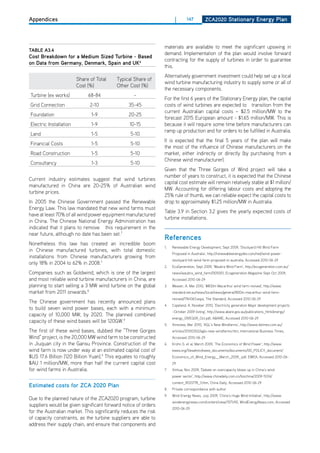
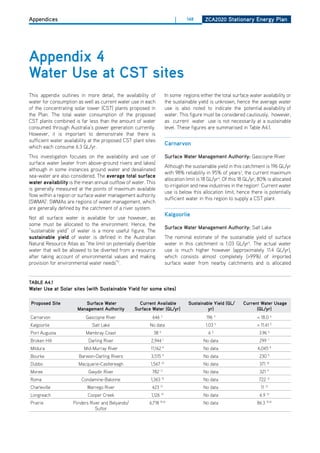
  • 162.
    Appendices | 139 ZCa2020 Stationary Energy Plan biomass backup basis 7.0 TWh/yr from biomass (TJ grids modelling) 40% net turbine efficiency 17.54 TWh/yr thermal energy 85% heater thermal efficiency 20.6 TWh/yr primary biomass energy 74 PJ biomass stored energy for Australia 4,475 MW of off-grid CST 5.3 TWh thermal biomass stored energy for off- grid 19 PJ energy for off-grid 93 PJ biomass stored energy for Australia 15.5% of Australia’s wheat crop waste Capital Costs wind 48000 MWe New wind turbine capacity 71.68 AU$Bn Billion Australian dollars - Total Wind Cost CST 8700 MWe Gross capacity needed to achieve Solar 220 Cost reductions $60 AU$Bn Cost of first 8700Gross/8587Net MWe 739.0 AU$M Cost for Solar 220 plant, 2010 currency 3.41 AU$M/MWe per unit MW 115 AU$Bn Cost of Solar 220s $175.4 AU$Bn Billion Australian dollars - Total CST Cost off-grid CSt with biomass backup 4,810 MWe Gross off-grid 7.00% parasitic energy (average from ESAA) 4475 MWe net off-grid $15.2 AU$Bn off-grid CST (not including biomass backup) $500 AU$ AUd per kWe biomass boiler $2.24 AU$Bn off-grid biomass backup 17.5 AU$Bn Total off-grid cost, CST and biomass backup heater Capital Cost 15 GWe biomass heater capacity required (TJ model) 0.5 AU$m/MWe Million AU$ per MWe equivalent biomass backup heater cost 4 7.5 $Bn Total grid backup capability
  • 163.
    Appendices | 140 ZCa2020 Stationary Energy Plan waste pelletisation plant costs 9662754 tonnes of wheat crop residue required for 60 PJ 4 months - period of pelletisation after/during harvest (assumed) 2880 hours - pelletisation period 3355 tonnes/hr pelletisation capacity required 10 tonnes/hr average plant size 8 336 10 tonne/hr plants required 8.3 AU$M per 10 tonne/hr plant 8 2.79 AU$billion - total cost for all pelletisation plants air cooling Capital Cost & Performance adjustment total Plant Capital Cost Wet cooling, $k $267,747 3 US$k dry cooling, $k $279,120 3 US$k difference, $k $11,373 US$k extra cost for air cooling Plant size, MWe 80 MWe aircooling, $/mwe $142.20 uS$k/mw (2005 dollars) CPI 2003-->2005 1.06 5 CPI Air cooling, $/MWe $134.10 US$k/MW (2003 dollars) $186.20 au$k/mw (2010 dollars) Nominal Solar 220 plant size 220 MW Extra cost for air-cooling $29,505 US$k (2003 dollars) add 10% contingency (as per S&l) $32,456 uS$k (2003 $) extra capital for air cooling Initial Plant size 220 MW With wet cooling Air-cooled performance penalty 1.30% (tower) U.S. doE Water Study 217 MW Net output with dry cooling Capital costs for Sunlab Solar 220 Solar thermal Plant (table E-1, Sargent & lundy1) Structures & Improvements $7.20 US$M heliostat field $198.80 US$M Receiver $34.40 US$M Tower & Piping $24.30 US$M Thermal Storage $57.20 US$M Steam Generator $9.30 US$M Elec Power Block $83.60 US$M Master Control $1.60 US$M Balance of plant $9.90 US$M direct Cost $426.30 US$M Eng, Mgmt, dev (7.8%) $33.30 US$M Land at $5000/ha $7.00 US$M Contingency $34.30 US$M total Cost $500.00 uS$m the summed cost is $499.9 (reference1 presents $599.9 as the total.) Add in air cooling $32.46 US$M Cost with air cooling (2003 US$M) $532.36 US$M Consumer Price Index (2003 to 2010) 5 1.18 CPI Solar 220 Plant total Cost (2010 uS$m) $628.18 uS$m Solar 220 Plant total Cost (2010 au$m) $739.04 au$m assumed forEx $0.85uS = $1.0au
  • 164.
    Appendices | 141 ZCa2020 Stationary Energy Plan references 1. Sargent & Lundy LLC Consulting Group, 2003, “Assessment of Parabolic Trough and Power Tower Solar Technology Cost and Performance Forecasts”, Chicago, Illinois. 2. U.S. department of Energy, “Concentrating Solar Power Commercial Application Study: Reducing Water Consumption of Concentrating Solar Power Electricity Generation”, Report to Congress. http://www.nrel.gov/csp/ pdfs/csp_water_study.pdf 3. Kelly, B, 2006, “Nexant Parabolic Trough Solar Power Plant Systems Analysis; Task 2 Comparison of Wet and dry Rankine Cycle heat Rejection”, National Renewable Energy Laboratory, NREL/SR-550-40163, http://www.nrel.gov/csp/ troughnet/pdfs/40163.pdf 4. Pers. comm., April 2010, AE&E Australia 5. U.S. department of Labor, “Consumer Price Index Calculator”. http://www.bls. gov/data/inflation_calculator.htm 6. Combustion Gasification & Propulsion Laboratory, 2009, “Various Crop Images with Residue details”, http://lab.cgpl.iisc.ernet.in/Atlas/downloads/ CropImages_with_residuedetails.pdf 7. ABARE, 2009, “Australian Crop Report”, http://www.abareconomics.com/ publications_html/crops/crops_09/crops_09.html 8. Pers. comm., Buhler Group AG, European manufacturer of pelletisation plants, http://www.buhlergroup.com/33794EN.htm?grp=60
  • 165.
    Appendices | 142 ZCa2020 Stationary Energy Plan appendix 3a Scaling up Solar Power towers Cost reduction trajectories of power towers In summary, 49% of cost reductions from first-of-a-kind plants to more advanced 220 MWe plants comes from Both the US department of Energy’s SunLab (Sandia/NREL) economies of scale, a further 28% of cost reductions from program, and the engineering consultancy firm Sargent high-volume component production, and the remaining 23% & Lundy have modelled the economics of CST energy from continuous technology improvements, for example systems in the document Assessment of Parabolic Trough from the continued R&d by Sandia Laboratories, and and Power Tower Solar Technology Cost and Performance breakthrough innovations such as eSolar’s low-cost mirror Forecasts, compiled by Sargent & Lundy1. field design. Sargent & Lundy projected that as costs of towers come down, tower installed capacity would overtake The cost reduction trajectory from the Sargent & Lundy ES-3 trough installations. Given that troughs are a more mature report1 is repeated in Figure A3.1. SL-5641 Final technology with less scope for cost reductions than towers, and that tower installation capacity is already about to figurE a3.1 overtake troughs, building trough plants in Australia would Cost reduction trajectory for Energy Cost Summary power solar thermal Figure ES-1 — Levelized not represent the best value for money. 16.0 14.0 optimum Plant Size 12.0 10.0 In Spain, where there are ten solar thermal plants in operation and over fifty under construction2 the Feed-in- cents per kWh 8.0 Tariff only applies to plants below 50 MW. however, better 6.0 6.2 cents/kWh 5.5 cents/kWh S&L-Trough S&L - Tower economies of scale will come from plants larger than 4.0 4.3 cents/kWh Sunlab -Trough this. designs are detailed by Sargent & Lundy and NREL 3.5 cents/kWh Sunlab - Tower for tower plants sized at 13.5 MW, 50 MW, 100 MW, 200 2.0 MW and 220 MW with storage. This progression of larger 0.0 2004 2006 2010 2015 2020 tower projects is being implemented at the time of writing Near Term Mid Term Long Term by concentrating solar thermal companies, with Torresol’s 17 MW Gemasolar tower with 15h storage currently in Sargent & Lundy allocated cost reduction as follows: construction near Ecija, Spain and Solar Reserve’s latest The red curve on the Deployment SunLab Low-Cost Deployment S&L High-Cost chart above represents Cumulative Cumulative the Sargent announcements comprising: Bound Bound & Lundy cost projection for towers, while the mauve curve 2002–2020 2002–2020 Troughs 6.2 cents/kWh 2.8 GWe 4.3 cents/kWh 4.9 GWe represents the SunLab tower projection. The main difference Towers 5.5 cents/kWh 2.6 GWe 3.5 cents/kWh 8.7 GWe • 150 MW, 450 GWh/yr tower plant in Rice, California3. between the two projections is the cumulative installed • 100 MW, 480 GWh/yr project at Tonopah, Nevada4. capacity assumed by each. In the original report, these were Trough technology is further advanced than tower technology. Trough technology has 354 MW of commercial • And a 50 MW, 300,000 GWh/yr plant in Alcazar de San generation in operation anthe southwestern United States. fromtechnology has been successfully referenced to in installation timeline Tower 2004—2020, but demonstrated with a conceptual achieving(Solar One and Solar Two). Trough technology is a fully mature Juan, Spain5. the key factor in and pilot plants the cost reductions was not the technology, and there is low technical and financial risk in developing near-term plants. The long-term timeline but the total installed capacity. The nature of progress in tower plants, however, is to build projection has a higher risk due to technology advances needed in thermal storage. The tower technology needs a larger plant than the last. For example, Abengoa built a 10 The key finding from this was that the levelised cost of to proceed from demonstration to commercial development. There is a higher technical and financial risk in developing a first-of-its-kind commercial plant. The advantage of tower technology is that if commercial MW power tower, PS10, followed by a 20 MW tower, PS20. electricity would come down to $US3.5c/kWh (or 5c/kWh in 2010 Australian currency) once global installed capacity The 220 MW tower described by Sargent & Lundy with reaches 8,700 MWe of power towers. Most of these cost 17 hours of storage is approaching the optical limits of a reductions would come from simple economies of scale—i.e. single mirror field to reflect sunlight onto a single tower— when the industry is able to build 75% capacity factor 200- at the outer heliostats the reflected light is too diffuse to 220 MWe towers, it is much cheaper than the first-of-a-kind heat the solar receiver on top of the tower. however, to 10-50 MWe plants. There are also significant cost reductions construct a larger power plant, for example 2,200 MW, you to be achieved from mass-manufacturing of heliostats. The simply construct 10 modules of the 220 MW power tower. mirror field makes up about half the capital cost of a Solar It is standard for a power station to consist of a number Power Tower plant, therefore tooling up for large-volume of smaller operating modules—for example, hazelwood production of these components on a continuous basis (as in Victoria’s Latrobe valley has a total generating capacity opposed to start-stop, one-off constructions) has a huge of 1,680 MW (gross)6, but this is actually composed of 8 cost-reduction potential. separate 210 MW (gross) generating turbines.
  • 166.
    Appendices | 143 ZCa2020 Stationary Energy Plan A graphical comparison of plant capacity (turbine size) and mirror field Size and Electrical output storage for the same mirror field size. The amount of energy that a mirror field and receiver figurE a3.3 tower can collect ultimately determines the amount of Capital cost breakdown of S&l Solar 100 PDF EXPORT electricity that can be generated, and is a more relevant (75% capacity factor) comparison of solar thermal power plant size than the rated turbine capacity. For example—a Solar 100 heliostat field as specified by the U.S. department of Energy’s Sandia Laboratories/Sargent & Lundy can collect enough energy to Heliostat field provide 2,066 MWh of electricity per day. If the plant did not Receiver have storage, then a 258 MW turbine could be run for the Tower & Piping Thermal Storage average 8 hours a day that the sun is shining at full strength. Steam Generator however this electricity would not be available overnight, Turbine & Rankine cycle and the plant would have an average annual capacity factor Structures & Improvements of only 30%. Alternatively, if the plant has storage, it can Master Control deliver the electricity over a longer time period and into the Balance of plant night. The trade-off is a smaller turbine size, but it will still deliver the same total amount of electricity. As an example, the different configurations to deliver the same total of 2,066 MWh per day are explored in Table A3.1 Sargent and Lundy’s cost breakdown of a Solar 100 with 16 and Figure A3.2, using numbers from the Sargent & Lundy hours storage. report discussed in section 3.1. As shown in Figure A3.3, over half the capital cost of a solar tablE a3.1 thermal power tower plant is the heliostat field. Therefore, Comparisons of plant capacity (turbine size) and scaling up the storage size while downsizing the turbine storage for the same mirror field size. for the same sized mirror field will not significantly impact the total capital cost of the plant, as the cost increase and mirror total Storage turbine hours of annual decrease roughly cancel out. field Electricity hours Size ( operation/ Capacity Size Per day mw) day factor In fact, as illustrated in Figure A3.4, storage is slightly 1 Page (m2) ( mwh) cheaper than turbines, so a plant with 16 hours storage will 1,366,100 2,066 16 86 24 75-80% be about 97% of the cost of a plant with no storage. Again they will both produce the same total amount of electricity 1,366,100 2,066 8 130 16 50-60% from the same mirror field size, but the plant with storage 1,366,100 2,066 0 258 8 30% can provide power reliably 24 hours a day. figurE a3.2 figurE a3.4 Solar 100 resize Solar 100 resize turbine size vs storage for same size mirror field Capital cost vs storage for Solar 100 plant (2,066 mwh/day) Capital cost mwt tower/field) Turbine size vs storage for same size mirror field (2066MWh/day) (700 vs storage for Solar 100 plant (700MWt tower/field) 300 250 $500 Total capital cost (US$million) net MWe electrical output 200 $400 150 $300 100 $200 50 $100 0 0 2 4 6 8 10 12 14 16 $0 Storage Hours 0 2 4 6 8 10 12 14 16 Storage Hours
  • 167.
    Appendices | 144 ZCa2020 Stationary Energy Plan In summary, the capital costs and total electricity generation figurE a3.5 (GWh/yr) are primarily dependent on the size of the mirror levelised Electricity Costs in PDF EXPORT relation to Capital field. The turbine size and capacity factor is dependent upon Expenditure Costs (derived from Sargent & lundy1) the amount of thermal storage, but does not significantly LEC vs CAPEX affect the plant capital cost. This is important when Solar Thermal Power Towers comparing the published costs of today’s solar thermal 25.0 projects. Therefore a plant that produces electricity 24 R² = 0.998 hours a day can be built for roughly the same price as a 20.0 plant with the same mirror field size that only operates on sun. LEC, AU c/kWh 15.0 Economics of Solar thermal Power 10.0 The economics and financing of solar thermal power projects are fundamentally different from that of fossil 5.0 energy projects. Most of the cost of a solar thermal plant is in the capital expenditure, with fixed o&M costs very low, 0.0 and there is no fuel cost. In fact, for an end-of-the-cost $2.0 $4.0 $6.0 $8.0 $10.0 $12.0 $14.0 $16.0 curve plant with a total levelised energy cost (LEC) of 5 AU CAPEX, AU$ M/MW c/kWh, the ongoing o&M cost component is only around LEC, c/kWh Linear 1c/kWh. As opposed to fossil energy, which has a lower Regression f or LEC, c/kWh upfront capital, but higher ongoing fuel costs which are achieving 10c/kwh baseload solar electricity subject to variability. There are a variety of financial policies available for It is assumed that to be a financially viable renewable governments to assist the uptake of renewable energy. Two energy project in the current Australian market, solar broadly different approaches are: An ongoing subsidy such thermal plants will at least need to be able to achieve a as a Feed-in-Tariff, which pays the difference between the wholesale price (after any subsidies) equivalent to or less renewable LEC and the market LEC. An upfront subsidy, than wind power (10c/kWh). After achieving such a price, such as a direct investment, government loan, or Investment solar thermal could fit into a wider renewable energy Tax Credit such as that implemented in the U.S., that lowers incentive policy, for example an expanded version of the the debt associated with the capital cost of the plant. current Australian Mandatory Renewable Energy Target (would need to be much greater than 20%), an appropriately structured Feed-In-Tariff or similar. Current cost of molten salt power towers From the same Sargent & Lundy cost modelling, a CST The cost of a molten salt power tower project today is plant with a LEC of 10c/kWh needs to have a upfront capital referenced to the cost of SolarReserve’s Tonopah project in of only $AU6-6.5 million/MW. Nevada. This will produce 480,000 GWh/year of electricity7, As shown in Figure A3.1, Sargent & Lundy predict that and will cost over U.S.$700 million8. With enough storage once 2,600 MW of towers (with ~15h storage) are installed (15 hrs) for full 24-hr dispatchable power and 75% capacity globally, the levelised energy cost for tower plants will factor, a plant this size could have a turbine output of 75 drop to US 5.5c/kWh, which equates to AU 8c/kWh today. MW. Adjusting for foreign exchange, it can be inferred that Adjusting for Australian labour costs, we project that after the cost of a First-of-A-Kind plant of this size is $AU10.5 2,600 MW of 75% capacity factor solar power tower plants million per MW capacity. (Note that due to economies of with molten salt storage are built, power towers will be scale, a plant producing less than 480,000 GWh per year cost-competitive with wind, conservatively estimated at would be expected to cost more per MW.) SolarReserve 10c/kWh. This takes into account continued cost reductions also has molten salt power tower projects announced in in wind turbine technology. Page 1 Rice, California and Alcazar, Spain. The investment costs of these first plants have been Based on the equivalently priced projects from Sargent & modelled as such: Lundy’s cost modelling, these SolarReserve plants should • First 1,000 MW priced at SolarReserve Tonopah have a Levelised Electricity Cost of AU 20c/kWh, derived equivalent, $10.5 million per MW—$10.5 Bn investment from Sargent & Lundy data1 shown in . • Next 1,600 MW priced at midway cost of $9 million per MW—$14.4 Bn investment As seen in Spain, a true pipeline of projects is necessary within Australia to avoid stop-start of component factories, and achieve cost reductions and economies of scale.
  • 168.
    Appendices | 145 ZCa2020 Stationary Energy Plan tablE a3.2 Cost trajectory for Solar thermal Phase Phase 1 Phase 2 Phase 3 Phase 4 Price reference Solar Reserve SunLab First-of a-kind Solar 100 Solar 200 ToTAL incremental installation mw 1,000 1,600 2,400 3,700 Cumulative installed capacity mw 1,000 2,600 5,000 8,700 Capacity factor % 72% 72% 72% 72% Produced Electricity gwh /yr 6,300 16,400 31,535 54,870 unit Capital cost $m/mw $10.5 $9.0 $6.5 $5.3 total Phase Capital Cost $bn $10.5 $14.4 $15.6 $19.6 $60 lEC c/kwh 20 16 10 8 5 Cost parity with conventional fossil energy references 1. Sargent & Lundy LLC Consulting Group, oct, 2003, ‘Assessment of Parabolic Again, as shown in Figure A3.1, further expansion to a Trough and Power Tower Solar Technology Cost and Performance Forecasts’, total of 8,700 MW of global installed tower capacity would 15, U.S. department of Energy, http://www.nrel.gov/csp/pdfs/34440.pdf, allow CST tower plants with storage to hit cost parity with Accessed: 2010-02-01 conventional new coal & gas plants: AU 5c/kWh (US 3.5c/ 2. Protermosolar, 2010, ‘Protermosolar presents the new edition of Map of kWh). solar electricity industry in Spain’, http://www.protermosolar.com/boletines/ once parity with wind is achieved, the price will continue to boletin24.html#destacados03, Accessed: 2010-04-21 drop. The stage of installments has been costed as: 3. SolarReserve, dec 22, 2009, ‘SolarReserve signs power contract with PG&E • 2,400 MW at wind price parity, $6.5 million per MW—$15.6 for utility scale solar power project in California’, http://www.solar-reserve. Bn investment com/pressReleases/RicePPAPressRelease.pdf, Accessed: 2010-01-16 • 3,700 MW at Solar 200 price, $5.3 million per MW—$19.6 4. dec 22, 2009, ‘Solar Reserve signs power contract with NV Energy for Bn investment utility scale Solar Power Project in Nevada’, SolarReserve, http://www. solar-reserve.com/pressReleases/Tonopah_PPA_Press_ReleaseFINAL.pdf, Note on conservatism: These costs and required subsidies Accessed: 2010-01-16 are very conservative. In reality, it is likely that the initial 5. SolarReserve, dec 22, 2009, ‘SolarReserve and Preneal receive environmental costs of tower plants will come down much more rapidly permit for 50 Megawatt solar energy project in Spain’, http://www.solar- from the current $AU10.2million/MW, due to continuous reserve.com/pressReleases/Alcazar-Cinco_Casas_Permitting_ENG.pdf, industry improvement elsewhere in the world. In addition, Accessed: 2010-01-16 the requirements of building 2,600 MW and 8,700 MW 6. International Power, ‘Annual Report 2008’, 46, http://www.ipplc.com.au/ to bring costs down should take into account total global uploads/2010/01/IPR_08_report_web.pdf, Accessed: 2010-05-06 installed capacity, the projects being built in the U.S.A. & 7. Tonopah Solar Energy, LLC, Jul 10, 2009, ‘UEPA Application for a permit Spain. however, we have assumed that this is the maximum to construct the Crescent dunes Solar Energy Project’, 7, Public Utilities industry size that will need to be developed in Australia to Commission of Nevada, http://budget.state.nv.us/clearinghouse/Notice/2010/ achieve the Sargent & Lundy cost reductions. E2010-016.pdf, Accessed: 2009-11-20 Therefore, the required phases of installation given here 8. Waite, M., Jul 24, 2009, ‘Nye County supports new Solar Reserve site’, , represent the upper bounds of the initial higher-cost Pahrump Valley Times, http://www.pahrumpvalleytimes.com/2009/Jul-24- investment that will be necessary to introduce cheap Fri-2009/news/30179718.html, Accessed: 2009-11-20 baseload solar electricity to Australia. Conclusion From this trajectory, it is projected that building the first 8,700 MWe of solar thermal power towers with >15hrs molten salt storage will cost a total of $AU60 billion. Initial plants in the range of 50-200 MW will be scaled up in size until 220 MW modules are built which will achieve a levelised electricity cost of 5c/kWh when run at 70-75% capacity factor.
  • 169.
    Appendices | 146 ZCa2020 Stationary Energy Plan appendix 3b Projected wind Energy Capital Costs the wind industry will grow to 180 GW internationally by Current costs of wind power 2020 and that half of all new investments in 2020 will be for offshore wind farms. Table A3.3 gives the average capital costs from 7 large current wind farm projects in Australia. This gives the This work took into account the recent increases in wind total capital costs of $2.5 Million/MW. This figure has been turbine costs due to market constraints to extend the work confirmed by Australian wind developers Pacific hydro of the European commission to produce a forecast cost and turbine manufacturer Suzlon. The large variation reduction for wind turbines. between each wind project is due to differences between Based on this study the 2010 forecast capital costs of each wind farm project, such as grid connection, planning onshore wind is approximately ¤1,200/kW (2006 prices) requirements, and terrain (which will alter the construction or $AU2,200/kW (current prices). By 2015 the European costs). capital costs of onshore wind is estimated at around ¤900/ While turbine costs have historically reduced over the past kW (2006 prices, $AU1,650 in current prices) and forecast decade with increases in turbine sizes and improvement in to drop to ¤826/kW (2006 prices, $AU1500) by 2020. technology, in recent years prices have gone up. The report also gathered information from a number of This price increase was caused by a slower than expected wind farms in Europe to show the relative costs of each expansion of the wind industry in 2001-2004, followed by a component in the installation of a wind turbine. This is sharp increase in the global market for wind turbines (30- presented in Table 2. The report found that the turbine 40% annually) until around mid 2008. This was combined accounted for 68-84% of the total share of capital costs, with an increase in raw material prices and later the Global with a typical amount for an average turbine installation Financial Crisis.6 in Europe of 75.6%. The second largest figure was Grid Connection. In addition to this the current capital cost of wind farms in Australia is much higher than it is in Europe. This is because The ZCA2020 Plan has calculated the transmissions costs Australia has seen a much slower growth in wind power separately to the capital costs of the wind farm projects, but than in other countries such as Europe and America. There given the large range possible for this figure, we have not are currently no turbine manufacturers located in Australia, excluded this cost from the total average capital cost of a with most turbine components needing to be shipped from wind farm. Therefore it is expected that wind farm capital overseas, which increases the costs. costs used in the Plan are conservative and the final cost may be slightly lower than quoted. Short term wind turbine Costs long term Capital Costs – the influence of China A 2009 report by the EWEA on the Economics of Wind Energy, incorporated the effect of current demand and The European Wind Energy Association research however supply on the changing costs of wind turbines to obtain a long has not taken into account the impact that China's wind term estimate of wind capital costs.6 This study assumes turbines will have on the global market in the near future. tablE a3.3 Capital Costs of major wind farms in australia developer location operating date Capacity (mw) Capital Costs ($million) $m/mw reference origin Stockyard hill 2011 484 1400 2.89 1 Acciona Waubra 2009 192 450 2.34 2 AGL MacArthur 2011 365 800 2.19 3 Silverton Wind Farm Silverton 2011 1000 2200 2.20 4 developments AGL & Windlab Systems Coopers Gap 2011 440 1200 2.73 4 AGL hallet 5 2011 52 120 2.31 5 Roaring 40s Waterloo 2010 111 300 2.70 4 average 2.48
  • 170.
    Appendices | 147 ZCa2020 Stationary Energy Plan materials are available to meet the significant upswing in tablE a3.4 demand. Implementation of the plan would involve forward Cost breakdown for a medium Sized turbine - based contracting for the supply of turbines in order to guarantee on data from germany, denmark, Spain and uK6 this. Alternatively government investment could help set up a local Share of Total Typical Share of wind turbine manufacturing industry to supply some or all of Cost (%) other Cost (%) the necessary components. Turbine (ex works) 68-84 - For the first 6 years of the Stationary Energy plan, the capital Grid Connection 2-10 35-45 costs of wind turbines are expected to transition from the current Australian capital costs – $2.5 million/MW to the Foundation 1-9 20-25 forecast 2015 European amount - $1.65 million/MW. This is Electric Installation 1-9 10-15 because it will require some time before manufacturers can ramp up production and for orders to be fulfilled in Australia. Land 1-5 5-10 It is expected that the final 5 years of the plan will make Financial Costs 1-5 5-10 the most of the influence of Chinese manufacturers on the Road Construction 1-5 5-10 market, either indirectly or directly (by purchasing from a Chinese wind manufacturer). Consultancy 1-3 5-10 Given that the Three Gorges of Wind project will take a number of years to construct, it is expected that the Chinese Current industry estimates suggest that wind turbines capital cost estimate will remain relatively stable at $1 million/ manufactured in China are 20-25% of Australian wind MW. Accounting for differing labour costs and adopting the turbine prices. 25% rule of thumb, we can reliable expect the capital costs to In 2005 the Chinese Government passed the Renewable drop to approximately $1.25 million/MW in Australia. Energy Law. This law mandated that new wind farms must Table 3.9 in Section 3.2 gives the yearly expected costs of have at least 70% of all wind power equipment manufactured turbine installations. in China. The Chinese National Energy Administration has indicated that it plans to remove this requirement in the near future, although no date has been set.7 references Nonetheless this law has created an incredible boom 1. Renewable Energy development, Sept 2009, ‘Stockyard hill Wind Farm in Chinese manufactured turbines, with total domestic Proposed in Australia‘, http://renewableenergydev.com/red/wind-power- installations from Chinese manufacturers growing from stockyard-hill-wind-farm-proposed-in-australia, Accessed 2010-06-29 only 18% in 2004 to 62% in 2008.7 2. EcoGeneration, Sept 2009, ‘Waubra Wind Farm’, http://ecogeneration.com.au/ Companies such as Goldwind, which is one of the largest news/waubra_wind_farm/005001, Ecogeneration Magazine Sept-oct 2009, and most reliable wind turbine manufacturers in China, are Accessed 2010-06-29 planning to start selling a 3 MW wind turbine on the global 3. Weaver, A. Mar 2010, ‘$800m Macarthur wind farm revived’, http://www. market from 2011 onwards.8 standard.net.au/news/local/news/general/800m-macarthur-wind-farm- revived/1764363.aspx, The Standard, Accessed 2010-06-29 The Chinese government has recently announced plans 4. Copeland, A. Noveber 2010, ‘Electricity generation Major development projects to build seven wind power bases, each with a minimum –october 2009 listing’, http://www.abare.gov.au/publications_html/energy/ capacity of 10,000 MW, by 2020. The planned combined energy_09/EG09_oct.pdf, ABARE, Accessed 2010-06-29 capacity of these wind bases will be 120GW.9 5. Aireview, Mar 2010, ‘AGL’s New Windfarms’, http://www.ibtimes.com.au/ The first of these wind bases, dubbed the “Three Gorges articles/20100302/agls-new-windfarms.htm, International Business Times, Wind” project, is the 20,000 MW wind farm to be constructed Accessed 2010-06-29 in Jiuquan city in the Gansu Province. Construction of the 6. Krohn S. et al, March 2009, ‘The Economics of Wind Power’, http://www. wind farm is now under way at an estimated capital cost of ewea.org/fileadmin/ewea_documents/documents/00_POLICY_document/ $US 17.6 Billion (120 Billion Yuan).9 This equates to roughly Economics_of_Wind_Energy__March_2009_.pdf, EWEA, Accessed 2010-06- $AU 1 million/MW, more than half the current capital cost 29 for wind farms in Australia. 7. Xinhua, Nov 2009, ‘debate on overcapacity blows up in China’s wind power sector’, http://www.chinadaily.com.cn/bizchina/2009-11/24/ content_9033778_3.htm, China daily, Accessed 2010-06-29 Estimated costs for ZCa 2020 Plan 8. Private correspondance with author 9. Wind Energy News, July 2009, ‘China’s huge Wind Initiative’, http://www. due to the planned nature of the ZCA2020 program, turbine windenergynews.com/content/view/1571/45, WindEnergyNews.com, Accessed suppliers would be given significant forward notice of orders 2010-06-29 for the Australian market. This significantly reduces the risk of capacity constraints, as the turbine suppliers are able to address their supply chain, and ensure that components and
  • 171.
    Appendices | 148 ZCa2020 Stationary Energy Plan appendix 4 water use at CSt sites This appendix outlines in more detail, the availability of In some regions either the total surface water availability or water for consumption as well as current water use in each the sustainable yield is unknown, hence the average water of the concentrating solar tower (CST) plants proposed in use is also noted to indicate the potential availability of the Plan. The total water consumption of the proposed water. This figure must be considered cautiously, however, CST plants combined is far less than the amount of water as current water use is not necessarily at a sustainable consumed through Australia’s power generation currently. level. These figures are summarised in Table A4.1. however, it is important to demonstrate that there is sufficient water availability at the proposed CST plant sites Carnarvon which each consume 6.3 GL/yr. This investigation focuses on the availability and use of Surface Water Management Authority: Gascoyne River surface water (water from above-ground rivers and lakes) Although the sustainable yield in this catchment is 196 GL/yr although in some instances ground water and desalinated with 98% reliability in 95% of years3, the current maximum sea-water are also considered. The average total surface allocation limit is 18 GL/yr4. of this 18 GL/yr, 80% is allocated water availability is the mean annual outflow of water. This to irrigation and new industries in the region4. Current water is generally measured at the points of maximum available use is below this allocation limit, hence there is potentially flow within a region or surface water management authority sufficient water in this region to supply a CST plant. (SWMA)1. SWMAs are regions of water management, which are generally defined by the catchment of a river system. Kalgoorlie Not all surface water is available for use however, as some must be allocated to the environment. hence, the Surface Water Management Authority: Salt Lake “sustainable yield” of water is a more useful figure. The sustainable yield of water is defined in the Australian The nominal estimate of the sustainable yield of surface Natural Resource Atlas as “the limit on potentially divertible water in this catchment is 1.03 GL/yr5. The actual water water that will be allowed to be diverted from a resource use is much higher however (approximately 11.4 GL/yr), after taking account of environmental values and making which consists almost completely (>99%) of imported provision for environmental water needs”2. surface water from nearby catchments and is allocated tablE a4.1 water use at Solar sites (with Sustainable yield for some sites) Proposed Site Surface water Current available Sustainable yield (gl/ Current water usage management authority Surface water (gl/yr) yr) (gl/yr) Carnarvon Gascoyne River 646 3 196 3 < 18.0 4 Kalgoorlie Salt Lake No data 1.03 5 > 11.41 5 Port Augusta Mambray Coast 38 6 6 6 3.96 6 Broken hill darling River 2,944 1 No data 299 7 Mildura Mid-Murray River 11,162 8 No data 4,045 8 Bourke Barwon-darling Rivers 3,515 9 No data 230 9 dubbo Macquarie-Castlereagh 1,567 10 No data 371 10 Moree Gwydir River 782 11 No data 321 11 Roma Condamine-Balonne 1,363 12 No data 722 12 Charleville Warrego River 423 13 No data 11 13 Longreach Cooper Creek 1,126 14 No data 6.9 14 Prairie Flinders River and Belyando/ 6,718 15,16 No data 86.3 15,16 Suttor
  • 172.
    Appendices | 149 ZCa2020 Stationary Energy Plan mostly to urban and industrial use5. In addition to surface river’s banks from Albury-Wodonga to Goolwa and therefore water, large volumes of hyper saline groundwater (which there is high demand for water for domestic and agricultural is unfit for domestic use) are used by the local mines for use8. The average surface water availability for this region mineral processing and dewatering17. For example, KCGM, a is 11,162 GL/yr of which 4,045 GL/yr is used8. This level of local gold mine, uses approximately 12 GL/yr, of which 83% consumption is quite high (36%) and although a reliable figure comes from ground water and recycled water18. Whether or for the sustainable yield in the region was not found, it would not such saline water could be used directly on the mirrors almost certainly be less than current levels of consumption. without treatment, the water demand by CST plants in this hence, although the demand of 6.7 GL/yr by one CST site region will not need to compete with local domestic or in this region could easily be met by current surface water irrigation demands. availability, care would need to be taken to ensure that this was balanced with allocations to other water consumers as well as meeting environmental flow requirements. Port augusta Surface Water Management Authority: Mambray Coast bourke The sustainable yield of surface water in this region is 6 Surface water management authority: Barwon-darling GL/yr, although the highly variable runoff means that the Rivers supply is fairly unreliable6. Water use is 3.96 GL/yr of which approximately 40% is imported surface water6. Bourke is located in the Barwon-darling region of the Murray-darling basin in north-west New South Wales and Clearly, meeting the demand for a CST plant in this area shares the region’s water resources with several other will be a challenge. Further investigation is necessary to town centres. The average surface water availability for ascertain whether or not water can be imported from nearby the entire darling Basin assessed at Bourke is 3515 GL/yr, catchments or from groundwater in order to supply the CST however as this is not the sustainable yield, it is not indicative plant proposed in the Plan at this site. If this proves to be of what can realistically be consumed9. Current surface unfeasible, it may be worth considering desalination plants water use for the region is 230 GL/yr and groundwater use in order to meet the CST plant’s as well as local domestic is about 10 GL/yr which is thought to be underdeveloped9. demand for water. hence, meeting the water resource requirements for the proposed CST plant site in this region is feasible. broken hill dubbo Surface water management authority: darling River Broken hill falls into the darling River SWMA. Much of the Surface Water Management Authority: Macquarie- water supplied to the region is stored in the Menindee Lakes, Castlereagh which are located about 70 km south-east of Broken hill. The dubbo is located in the Macquarie-Castlereagh region, lakes have a combined capacity of 1,794 GL and the average which is also part of the greater Murray-darling basin. surface water availability, as measured at Menindee is 2,944 This region includes the Macquarie, Castlereagh and Bogan GL/yr1. of this approximately 299 GL/yr are allocated to Rivers which supply water to the centres of Wellington, meet the local industrial, domestic and agricultural demand Mudgee, orange, Bathurst as well as dubbo for domestic for water along 690 km of the darling River7. There has use, but mostly irrigation10. The current average surface been some concern about the declining water levels in the water availability is 1,567 GL/yr of which 371 GL/yr are lakes, in particular due to the amount of water lost through used10. Again, meeting the water resource requirements evaporation from their large surface areas19. however data for the proposed CST plant site in this region should not be acquisition is underway to research the potential for storing a challenge, however care will need to be taken to ensure water in naturally occurring underground aquifers (which that environmental flows are met together with meeting the will eliminate losses due to evaporation) which so far, has demands of other water users. been promising. moree mildura Surface Water Management Authority: Gwydir Surface water management authority: Mid-Murray River The Gwydir region, also part of the Murray-darling basin, is Mildura is located on the banks of the Murray River, which, based around the Gwydir River and supplies the town of Moree as Australia’s largest river means that this site is one of the as well as local agriculture. The current average surface water Plan’s more secure sites with regard to water supply. The availability is 782 GL/yr of which 321 GL/yr is used11. mid-Murray region spans several major centres along the
  • 173.
    Appendices | 150 ZCa2020 Stationary Energy Plan Further investigation will be necessary to determine the roma exact location of the proposed CST plant in this region and hence whether it will be more feasible to draw water from Surface Water Management Authority: Condamine the Flinders River or the Belyando/Suttor catchment. Both Balonne regions have quite a low level of development meaning that This region, located mostly in the Queensland share of the with new or expanded infrastructure, there is potential for Murray-darling basin, services several centres including diversions to be increased beyond current use as long as Roma. Average surface water availability is 1,363 GL/yr and environmental flows can be met. current use is 722 GL/yr12. Groundwater is an additional source of water, with current use at 160 GL/yr12. references Charleville 1. CSIRo, october, 2008, ‘Water availability in the Murray-darling Basin. A report to the Australian Government from the CSIRo Murray-darling Surface water management authority: Warrego Basin Sustainable Yields Project’, CSIRO, http://www.csiro.au/resources/ WaterAvailabilityInMurray-DarlingBasinMDBSY.html, Accessed: 2010-05-06 The Warrego region, which is mostly located in Queensland 2. Australian Government department of the Environment, Water, heritage and is one of the northern regions of the Murray-darling Basin. the Arts, June 15, 2009, ‘Australian Natural Resources Atlas - National water Water availability here is less reliable than in other parts of availability’, Commonwealth of Australia, http://www.anra.gov.au/topics/water/ the Murray-darling Basin, although the average total water availability/index.html, Accessed: 2010-05-06 availability is still 423 GL/yr13. In the lowest one-year period 3. Australian Government department of the Environment, Water, heritage on record, diversions from this region were 11.3 GL/yr13. and the Arts, May 13, 2009, ‘Australian Natural Resources Atlas - Water resources - Availability - Western Australia - Gascoyne River’, Commonwealth longreach of Australia, http://www.anra.gov.au/topics/water/availability/wa/basin- gascoyne-river.html, Accessed: 2010-05-06 Surface water management authority: Cooper Creek 4. Midwest/Gascoyne Region of the Water and Rivers Commission, May, 2004, ‘Managing the Groundwater Resources of the Lower Gascoyne River Longreach is located within the part of the Cooper Creek (Carnarvon) WA – Groundwater Management Strategy’, Midwest/Gascoyne catchment that lies in Queensland. There is no data for the Region of the Water and Rivers Commission, http://www.water.wa.gov.au/ sustainable yield of water from this catchment however PublicationStore/first/65831.pdf, Accessed: 2010-05-06 the average total available surface water is 1126 GL/yr14. 5. Australian Government department of the Environment, Water, heritage and diversions of water for use are 6.9 GL/yr14. As a fraction the Arts, June 15, 2009, ‘Australian Natural Resources Atlas - Water resources of the total available surface water, this level of diversion - Availability - Western Australia - Salt Lake’, Commonwealth of Australia, is fairly low. Whilst this might usually be explained by there http://www.anra.gov.au/topics/water/allocation/wa/basin-salt-lake.html, being a high demand for environmental flows in the region, in Accessed: 2010-05-06 this case, it could also be due to the low level of development 6. Australian Government department of the Environment, Water, heritage and in the region. That is, there are no major storages or other the Arts, May 13, 2009, ‘Australian Natural Resources Atlas - Water resources types of development within the catchment14 which may be - Availability - South Australia - Mambray Coast’, Commonwealth of Australia, why current diversions of water are significantly less than http://www.anra.gov.au/topics/water/allocation/sa/basin-mambray-coast.html, the total available surface water. More investigation into Accessed: 2010-05-06 the actual sustainable yield of this SWMA will be necessary 7. State Water Corporation, 2009, ‘Menindee Lakes Brochure’, State Water to ascertain whether or not it can supply the CST plant Corporation, http://www.statewater.com.au/_documents/dam%20brochures/ proposed in the Plan for this site without competing with Menindee%20Lakes%20Brochure.pdf, Accessed: 2010-05-06 other water users. If sufficient water is available within a 8. CSIRo, July, 2008, ‘Murray region fact sheet: Murray-darling Basin sustainable yield, further developments might be necessary Sustainable Yields Project’, CSIRO, http://www.csiro.au/resources/ to facilitate the extra diversion to the CST plants. MurrayFactsheet.html, Accessed: 2010-05-06 9. CSIRo, June, 2008, ‘Barwon-darling region fact sheet: Murray-darling Basin Prairie Sustainable Yields Project’, CSIRO, http://www.csiro.au/resources/Barwon- darlingFactsheet.html, Accessed: 2010-05-06 Surface water management authority: Flinders River 10. CSIRo, March, 2008, ‘Macquarie-Castlereagh region: CSIRo Murray-darling and Belyando/Suttor Basin Sustainable Yields Project’, CSIRO, http://www.csiro.au/org/Macquarie- CastlereaghOverviewMDBSY.html, Accessed: 2010-05-06 Prairie is located in Queensland, on the border of the Flinders 11. CSIRo, december, 2007, ‘Gwydir region fact sheet: Murray-darling Basin River and Belyando/Suttor catchments. There is no data Sustainable Yields Project’, CSIRO, http://www.csiro.au/resources/pf140.html, for the sustainable yield of water from these catchments, Accessed: 2010-05-06 however their total available surface water is 3,857 GL/yr 12. CSIRo, June, 2008, ‘Condamine-Balonne region fact sheet: Murray-darling and 2,861 GL/yr respectively15,16. The current water use in Basin Sustainable Yields Project’, CSIRO, http://www.csiro.au/resources/ these catchments is 7.7 GL/yr and 78.6 GL/yr respectively15,16. Condamine-BalonneFactSheet.html, Accessed: 2010-05-06 13. CSIRo, August, 2007, ‘Warrego fact sheet: Murray-darling Basin Sustainable
  • 174.
    Appendices | 151 ZCa2020 Stationary Energy Plan Yields Project’, CSIRO, http://www.csiro.au/resources/pfzx.html, Accessed: 2010-05-06 14. Australian Government department of the Environment, Water, heritage and the Arts, May 13, 2009, ‘Australian Natural Resources Atlas - Water resources - Availability - Queensland - Cooper Creek’, Commonwealth of Australia, http:// www.anra.gov.au/topics/water/availability/qld/swma-cooper-creek-qld.html, Accessed: 2010-05-06 15. Australian Government department of the Environment, Water, heritage and the Arts, May 13, 2009, ‘Australian Natural Resources Atlas - Water resources - Availability - Queensland - Belyando/Suttor’, Commonwealth of Australia, http://www.anra.gov.au/topics/water/availability/qld/swma-belyando-suttor. html, Accessed: 2010-05-06 16. Australian Government department of the Environment, Water, heritage and the Arts, May 13, 2009, ‘Australian Natural Resources Atlas - Water resources - Availability - Queensland - Flinders River’, Commonwealth of Australia, http://www.anra.gov.au/topics/water/availability/qld/basin-flinders-river.html, Accessed: 2010-05-06 17. Australian Government department of the Environment, Water, heritage and the Arts, May 13, 2009, ‘Australian Natural Resources Atlas - Water - Western Australia - Water Resources overview’, Commonwealth of Australia, http:// www.anra.gov.au/topics/water/pubs/state_overview/wa_ovpage.html, Accessed: 2010-05-06 18. Kalgoorlie Consolidated Gold Mines, 2009, ‘Environment - Water’, Kalgoorlie Consolidated Gold Mines, http://www.superpit.com.au/Environment/Water/ tabid/129/default.aspx, Accessed: 2010-05-06 19. Senator the hon Penny Wong, March 4, 2009, ‘Media Release: ‘$16 Million Towards Securing Broken hill’s Water Supply, Commonwealth of Australia, http://www.climatechange.gov.au/minister/wong/2009/media-releases/March/ mr20090304c.aspx, Accessed: 2010-05-06
  • 175.
    Appendices | 152 ZCa2020 Stationary Energy Plan appendix 5 industrial Case Study tablE a5.2 alumina refinery Cogeneration Case annual Energy requirements for the modified Plant Study design Energy required quantity This details and analyses how a series of solar thermal power plants, based on the Solar 220 design, can be adapted Electrical 4527 GWh to meet the combined heat and power requirements of the Steam 10650 GWh Gladstone Alumina Refinery. Combined heat and power, or co-generation, is a commonly used industrial process The modified system is based on the Solar 220 design. A whereby the excess heat from an electrical generating Co-generation heat and Power (ChP) system was design to system is used directly for heating requirements. Solar meet the various energy requirements of the plant. Given the thermal, like other power stations, also produce excess steam conditions required in the process, a backpressure heat, which can be used for this purpose. turbine with an efficiency of 15% is necessary. The outputs from the Solar 220 systems are shown in Table A5.3 and basis Table A5.4. The information provided in the United Company Rusal’s tablE a5.3 recent public submission1 to the Australian Government’s Solar 220 output energy white paper provided the basis for this case study. The annual energy requirements for the Alumina plant, Efficiency output (mw) gwh per year outlined in the submission, can be found in Table A5.1. Electrical 0.463 245 2146.2 tablE a5.1 tablE a5.4 annual Energy requirements for alumina Plant1 Cogen Solar 220 output Energy Required Quantity Efficiency output (mw) gwh per year Electricity 777000 MWh Electrical 0.15 79.37 695.31 Gas 13.5 PJ Steam 0.6 317.49 2781.25 Coal 1.42 Mt The coal is used to generate steam; the required quality Using this modified design, it was determined that 4 of of this steam is a significant factor. high pressure steam these modified 220 plants would be required to meet the 5,000 kPa at 270°C is required to operate the digester1, and total steam requirement of the plant. A single unmodified must be available from any proposed modified system. Solar 220 is required to ensure the remaining electrical demand is met. A slight excess of electricity is produced, An Australian Exchange Rate of 0.91362 was used in the perhaps suitable for export to the grid. economic basis of the case study. Capital Cost modified design The capital costs of the project were based on the results The energy requirements of the plant were altered to reported in the Sargent and Lundy report5 for the Solar reflect the change in energy use in the modified plant. In the 220 design. It was assumed that the capital costs for the proposed modification, the gas fired kiln is to be replaced modified Solar 220 with cogeneration were the same as by an electrically fired kiln. The electrical requirement was that for the Solar 220 outlined in the report. The receiver based on an energy grade function of 1 (even though a value and heliostats represent the largest proportion of the capital of 0.9133 would be acceptable). The energy content of coal cost (74%) and are unmodified in the co-generation design. is 30 GJ/tonne and the steam requirement was calculated The inclusion of a backpressure turbine in the power block on 90%4 conversion rate from coal energy to steam. These (the remaining 26% of the cost) is more likely to decrease the numbers are conservative values. The plant’s modified cost of this component (backpressure turbines are typically energy requirements are shown in Table A5.2:
  • 176.
    Appendices | 153 ZCa2020 Stationary Energy Plan less expensive than their high efficiency counterparts4). A to the similarity in the designs. A breakdown of the costs break down of the costs can be found in Table A5.5. can be found in Table A5.8. tablE a5.5 tablE a5.8 Cost breakdown breakdown of operation and maintenance Costs CaPEX (million $uS) oPEX (million $uS) heliostat 198.8 5 Burdened labour rate 0.04 5 Power block 83.6 5 Staff Cost 2.81 5 Receiver 34.4 5 Material and Service Cost 34.4 5 Total 316.8 Total 4.71 total ($au) 346.76 Total ($AU) 5.16 No. Solar 220 modules 5 Total # Solar 220’s 5 total CaPEX ($au) 1733.8 ToTAL oPEX 25.8 Cashflow analysis revenue A cashflow analysis of the project was performed to allow The revenue delivered by this project is realised by the various economic measures (including return on investment, reduction in utility expenditure. To determine this reduction, payback period and net present value) to be determined. utility prices are required; the prices used were taken from In the evaluation of the cashflow sheet, several standard treasury estimates and can be found in Table A5.6. assumptions were utilised. The assumptions used in this analysis are as follows: tablE a5.6 • Fixed Capital Investment expenditure spread over two utility Prices years5 (70% first year, 30% second year7 Commodity Price unit • Flat line depreciation of capital over 10 years7). • Corporate tax rate of 30% 8 Electricity 42.4 6 $/MWh • operating life of 30 years 5 (wholesale) • discount rate of 8% Gas 5.0 6 $/MJ • operating Capital equivalent to 10% of the Fixed Capital Coal 125. 6 $/Tonne Investment7, and redeemable in the final year of operation. Using the prices in Table A5.6, and the current energy Units: Million AUd usage, the potential savings (via reduction in expenditure on utility costs) were determined. Table A5.7 outlines a breakdown of the realised revenue. Summary tablE a5.7 The above cashflow analysis was used to determine some realised revenue breakdown basic economic measures. These measures provide an amount unit realised indication of the feasibility and economic viability of a revenue project. (million $au) Payback Period 9 years Electricity 777000 MWh 32.94 RoI 25.2% Gas 13.5 PJ 67.5 IRR 10.5% Coal 1.42 Mt 177.5 NPV 436 Million $AU operation and maintenance The operating costs were based on the results reported in the Sargent and Lundy report5 for a Solar 220 design. It was assumed that the operating cost for the modified Solar 220 with cogeneration would be the same as that for the Solar 220 outlined in the report. The modified designs would not significantly alter the operational and maintenance cost, due
  • 177.
    Appendices | 154 ZCa2020 Stationary Energy Plan tablE 5.9 results of discount cashflow analysis for alumina refinery Cogeneration year CaPEX o and rEvEnuE dEPrECiation taXablE taX Profit CaShflow CumulativE dCCf nPv m inComE CaShflow -2 -1213.66 0 0 0 0 0 0 -1213.66 -1213.66 -1213.66 -1213.66 -1 -520.14 0 0 0 0 0 0 -520.14 -1733.8 -481.61 -1695.27 0 -86.69 -25.8 277.94 -173.38 78.77 -23.63 228.52 141.83 -1591.97 121.59 -1573.68 1 0 -25.8 277.94 -173.38 78.77 -23.63 228.52 228.52 -1363.46 181.4 -1392.28 2 0 -25.8 277.94 -173.38 78.77 -23.63 228.52 228.52 -1134.94 167.97 -1224.31 3 0 -25.8 277.94 -173.38 78.77 -23.63 228.52 228.52 -906.43 155.52 -1068.78 4 0 -25.8 277.94 -173.38 78.77 -23.63 228.52 228.52 -677.91 144 -924.78 5 0 -25.8 277.94 -173.38 78.77 -23.63 228.52 228.52 -449.39 133.34 -791.44 6 0 -25.8 277.94 -173.38 78.77 -23.63 228.52 228.52 -220.88 123.46 -667.98 7 0 -25.8 277.94 -173.38 78.77 -23.63 228.52 228.52 7.64 114.31 -553.67 8 0 -25.8 277.94 -173.38 78.77 -23.63 228.52 228.52 236.15 105.85 -447.82 9 0 -25.8 277.94 -173.38 78.77 -23.63 228.52 228.52 464.67 98.01 -349.82 10 0 -25.8 277.94 -173.38 78.77 -23.63 228.52 228.52 693.19 90.75 -259.07 11 0 -25.8 277.94 0 252.15 -75.64 176.5 176.5 869.69 64.9 -194.17 12 0 -25.8 277.94 0 252.15 -75.64 176.5 176.5 1046.19 60.09 -134.08 13 0 -25.8 277.94 0 252.15 -75.64 176.5 176.5 1222.69 55.64 -78.44 14 0 -25.8 277.94 0 252.15 -75.64 176.5 176.5 1399.19 51.52 -26.92 15 0 -25.8 277.94 0 252.15 -75.64 176.5 176.5 1575.7 47.7 20.79 16 0 -25.8 277.94 0 252.15 -75.64 176.5 176.5 1752.2 44.17 64.96 17 0 -25.8 277.94 0 252.15 -75.64 176.5 176.5 1928.7 40.9 105.85 18 0 -25.8 277.94 0 252.15 -75.64 176.5 176.5 2105.2 37.87 143.72 19 0 -25.8 277.94 0 252.15 -75.64 176.5 176.5 2281.7 35.06 178.78 20 0 -25.8 277.94 0 252.15 -75.64 176.5 176.5 2458.21 32.47 211.25 21 0 -25.8 277.94 0 252.15 -75.64 176.5 176.5 2634.71 30.06 241.31 22 0 -25.8 277.94 0 252.15 -75.64 176.5 176.5 2811.21 27.83 269.15 23 0 -25.8 277.94 0 252.15 -75.64 176.5 176.5 2987.71 25.77 294.92 24 0 -25.8 277.94 0 252.15 -75.64 176.5 176.5 3164.21 23.86 318.78 25 0 -25.8 277.94 0 252.15 -75.64 176.5 176.5 3340.72 22.1 340.88 26 0 -25.8 277.94 0 252.15 -75.64 176.5 176.5 3517.22 20.46 361.34 27 0 -25.8 277.94 0 252.15 -75.64 176.5 176.5 3693.72 18.94 380.28 28 0 -25.8 277.94 0 252.15 -75.64 176.5 176.5 3870.22 17.54 397.82 29 0 -25.8 277.94 0 252.15 -75.64 176.5 176.5 4046.72 16.24 414.06 30 86.69 -25.8 277.94 0 252.15 -75.64 176.5 263.19 4309.92 22.42 436.49 National Renewable Energy Laboratory USA, http://www.nrel.gov/csp/ references pdfs/34440.pdf, Accessed: 2009-08-01 6. McLennan Magasanik Associates (MMA), 2008, ‘Impacts of the Carbon Pollution 1. Rusal Australia, ‘Rusal Australia ETS submission’, http://www.climatechange. Reduction Scheme on Australia’s Electricity Markets’, Australian Treasury, gov.au/submissions/cprs-green-paper/~/media/submissions/greenpaper/0606- http://www.treasury.gov.au/lowpollutionfuture/consultants_report/downloads/ rusal-australia, Accessed: 2009-12-10 Electricity_Sector_Modelling_Report_updated.pdf, Accessed: 2009-11-30 2. Reserve Bank of Australia, ‘Reserve Bank of Australia home page’, http:// 7. Perry, R.h. et al., 1997, Perry’s Chemical Engineers’ handbook, McGraw-hill www.rba.gov.au, Accessed: 2009-12-07 Professional, 007.049.8415 3. Rosen, M. A., Le, M. N., dincer, I., 2005, ‘Efficiency analysis of a cogeneration 8. Warburton d. and hendy P., 2006, ‘Statutory corporate tax rates’, Australian and district energy system’, Applied Thermal Engineering, 25(1), pp147-159, Government; The Treasury, http://comparativetaxation.treasury.gov.au/content/ 10.1016/j.applthermaleng.2004.05.008 report/html/07_Chapter_5-03.asp, Accessed: 2009-11-01 4. horlock, J. h., 1996, Cogeneration-Combined heat and Power (ChP): Thermodynamics and Economics, Krieger Publishing Company, 089.464.9280 5. Sargent and Lundy LLC Consulting Group, 2003, ‘Assessment of Parabolic Trough and Power Tower Solar Technology Cost and Performance Forecasts’,
  • 178.
    Appendices | 155 ZCa2020 Stationary Energy Plan appendix 6 transmission upgrades Costs for transmission have been derived from published TABLE A6.1 industry data. Converted costs of hvdC substations2 distances of transmission lines have been mapped out using highly accurate Google Earth software. These are original Project Scaled detailed in Table A6.2. (ZCa2020) MW 1000 4000 Costs of hVdC & hVAC cabling, and hVAC reactive compensation stations have been sourced from ABB, a kV 450 500 leading power engineering company and pioneers of the EUR per substation EUR 220,000,000 EUR 978,000,000 hVdC technology. pair The cost of the hVdC converter station has been derived AUd/EUR 0.6 from the existing published cost of Siemen’s hVdC project Cost for ZCA2020 pair $1,630,000,000 from UK to the Netherlands. This is considered a more real- world indicative cost, as recommended by SKM’s review. however, as the cabling for this project is underwater, it would be more expensive and is not considered representative compared to ZCA2020’s land-based hVdC march/april 2007 power import capability. Local depends on local generation and Power supply for large cities Large Urban Areas Power Delivery to to reverse voltage polarity. flow direction without switching independently of the main power be reversed at an intermediate tap voltage polarity. Thus, power can the current direction rather than reverses power through reversal of HVDC transmission, however, verter to the opposite pole. VSC be done by connecting the con- nals. For a bipolar system this can direction on the remaining termi- maintaining the same power the power direction at a tap while where it may be desired to reverse a multiterminal system, however, are needed for polarity reversal in dc-side switching arrangements reverse power direction. Special action with no switching to nals reverse polarity by control terminal system where both termi- switching arrangement for a two- ity reversal requires no special reverse the power direction. Polar- uses voltage polarity reversal to Conventional HVDC transmission use of intermediate taps is rare. converter station at each end. The point-to-point transmission with a Most HVDC systems are for Multiterminal Systems offshore wind generation. designed to transmit power from for an offshore converter station plex. Figure 12 shows a design port to the wind generation com- cables and provides reactive sup- long-distance land or submarine mission allows efficient use of shore. VSC-based HVDC trans- capacity factors are located off- better wind sites with higher or bodies of water. Many of the environmentally sensitive areas tion must often traverse scenic or Transmission for wind genera- support, and outlet transmission. links. All costs have been converted to Australian dollars at an exchange rate of 1AUd = 0.85USd, and 1AUd = 0.6EURo. FIGURE A6.1 Costs of hvaC and hvdC1 table 1. Comparative costs of HVDC and EHV AC transmission alternatives. DC Alternatives AC Alternatives Hybrid AC/DC Alternative Alternative + 500 Kv 2 x + 500 kV + 600 kV +800 kV 500 kV 500 kV 765 kV + 500 kV 500 kV Total Bipole 2 bipoles Bipole Bipole 2 Single Ckt Double Ckt 2 Singl Ckt Bipole Single Ckt AC + DC Capital Cost Rated Power (MW) 3000 4000 3000 3000 3000 3000 3000 3000 1500 4500 Station costs including reactive compenstation (M$) $420 $680 $465 $510 $542 $542 $630 $420 $302 $722 Transmission line cost (M$/mile) $1.60 $1.60 $1.80 $1.95 $2.00 $3.20 $2.80 $1.60 $2.00 Distance in miles 750 1,500 750 750 1,500 750 1,500 750 750 1,500 Transmission Line Cost (M$) $1,200 $2,400 $1,350 $1,463 $3,000 $2,400 $4,200 $1,200 $1,500 $2,700 Total Cost (M$) $1,620 $3,080 $1,815 $1,973 $3,542 $2,942 $4,830 $1,620 $1,802 $3,422 Annual Payment, 30 years @ 10% $172 $327 $193 $209 $376 $312 $512 $172 $191 $363 Cost per kW-Yr $57.28 $81.68 $64.18 $69.75 $125.24 $104.03 $170.77 $57.28 $127.40 $80.66 Cost per MWh @ 85% Utilization Factor $7.69 $10.97 $8.62 $9.37 $16.82 $13.97 $22.93 $7.69 $17.11 $10.83 Losses @ full load 193 134 148 103 208 208 139 106 48 154 Losses at full load in % 6.44% 3.35% 4.93% 3.43% 6.93% 6.93% 4.62% 5.29% 4.79% 5.12% Capitalized cost of losses @ $1500 kW (M$) $246 $171 $188 $131 $265 $265 $177 $135 $61 $196 IEEE power & energy magazine Parameters: Interest rate % 10% Capitalized cost of losses $/kW $1,500 Note: AC current assumes 94% pf Full load converter station losses = 9.75% per station Total substation losses (transformers, reactors) assumed = 0.5% of rated power 39
  • 179.
    Appendices | 156 ZCa2020 Stationary Energy Plan tablE a6.2 technical details and costings of ZCa2020 proposed high-voltage transmission upgrades Power Station Site Size Purpose Line name Type Length Rating MW km MW Carnarvon 4000 Solar Plug-in Carnarvon to Geraldton HVAC 499 6000 Kalgoorlie 4000 Solar Plug-in Kalgoorlie to Perth HVAC 560 6000 Broken Hill 4000 Solar Plug-in Broken Hill to Mildura HVDC 262 4000 Bourke 4000 Solar Plug-in Bourke to Mount Piper HVDC 567 4000 Dubbo 4000 Solar Plug-in Dubbo to Mt Piper Direct HVAC 249 3000 Moree 4000 Solar Plug-in Moree to Armidale HVAC 364 6000 Prairie 4000 Solar Plug-in Prairie Plug-in HVAC 296 6000 Longreach 4000 Solar Plug-in Longreach Plug-in (direct) HVDC 654 4000 Charleville 4000 Solar Plug-in Charleville to Roma HVDC 311 4000 Albany 2000 Wind plug-in Albany Plug-in HVAC 430 3000 Esperance 2000 Wind plug-in Esperance Plug-in HVAC 363 3000 Geraldton 2000 Wind plug-in Geraldton to Perth HVDC 440 4000 Bunbury 2000 Wind plug-in Bunbury Plug-in HVAC 10 3000 (Great Aust. Bight) Wind plug-in Cleve to Port Augusta HVDC 201 8000 Ceduna 3000 Wind plug-in Ceduna Plug-in HVAC 327 3000 Yongala 2000 Wind plug-in Yongala Plug-in HVAC 125 3000 Port Lincoln 2000 Wind plug-in Port Lincoln Plug-in HVAC 121 3000 Cape Jaffa 2000 Wind plug-in Cape Jaffa Plug-in HVAC 54 3000 Streaky Bay 3000 Wind plug-in Streaky Bay Plug-in HVAC 269 3000 Port Fairy 2000 Wind plug-in Port Fairy Plug-in HVAC 61 3000 Ballarat 2000 Wind plug-in Ballarat Plug-in HVAC 79 3000 Mt Gellibrand 2000 Wind plug-in Mt Gellibrand Plug-in HVAC 56 3000 Wonthaggi 2000 Wind plug-in Wonthaggi Plug-in HVAC 96 3000 Crookwell 2000 Wind plug-in Crookwell Plug-in HVAC 86 3000 Orange 2000 Wind plug-in Dubbo-Orange-Mt Piper HVAC 93 3000 Walcha 2000 Wind plug-in Walcha Plug-in HVAC 35 3000 Cooma 2000 Wind plug-in Cooma Plug-in HVAC 122 3000 Silverton 2000 Wind plug-in Silverton to Mildura HVAC 287 3000 Stanthorpe 2000 Wind plug-in Stanthorpe Plug-in HVAC 98 3000 Atherton 2000 Wind plug-in Atherton Plug-in HVAC 62 3000 Collinsville 2000 Wind plug-in Collinsville Plug-in HVAC 18 3000 Georgetown 2000 Wind plug-in Georgetown Plug-in HVAC 272 3000 Interstate QLD-NSW Grid Upgrade Roma to Moree HVDC 417 4000 Interstate SA-NSW Grid Upgrade Port Augusta to Mount Piper HVDC 1169 8000 Interstate VIC-NSW Grid Upgrade Mildura to Mount Piper HVDC 708 4000 Intrastate Grid Upgrade Mildura to Melbourne HVDC 544 8000 Interstate SA-VIC Grid Upgrade Port Augusta to Mildura HVDC 461 4000 Interstate SA-VIC Grid Upgrade Port Augusta to Melbourne HVDC 886 4000 Interstate SA-VIC Grid Upgrade Port Augusta to Naracoorte HVDC 560 4000 Interstate SA-VIC Grid Upgrade Naracoorte to Portland HVAC 216 6000 Interstate QLD-NSW Grid Upgrade Roma to Armidale HVAC 662 6000 NEM-Mt Isa Grid Connection Mt Isa upgrade HVDC 847 4000 SWIS-NEM Grid Connection Perth to Port Augusta HVDC 2146 4000 SWIS-NEM Grid Connection Kalgoorlie to Port Augusta HVDC 1586 4000 SWIS-NWIS Grid Connection SWIS-NWIS Connection HVAC 561 6000
  • 180.
    Appendices | 157 ZCa2020 Stationary Energy Plan HVDC HVAC Multiple Transmission Transmission lines – HVDC station costs HVAC station costs line cost ($AU line cost ($AU Total Cost ($AU single or ($AU M) – 4 GW ($AU M) M/km) – 4 GW M/km) – 3 GW M) (cable + double Capacity - 3 GW Capacity Capacity Capacity station) $1,630 $638 $1.17 $2.34 2 $1,275 $2,335 $3,610 2 $1,275 $2,620 $3,895 1 $1,630 $306 $1,936 1 $1,630 $663 $2,293 1 $638 $582 $1,220 2 $1,275 $1,705 $2,980 2 $1,275 $1,385 $2,660 1 $1,630 $765 $2,395 1 $1,630 $363 $1,993 1 $638 $1,005 $1,643 1 $638 $849 $1,487 1 $1,630 $515 $2,144 1 $638 $24 $662 2 $3,259 $470 $3,729 1 $638 $765 $1,403 1 $638 $293 $930 1 $638 $283 $921 1 $638 $127 $765 1 $638 $630 $1,267 1 $638 $143 $780 1 $638 $186 $823 1 $638 $131 $769 1 $638 $224 $862 1 $638 $202 $839 1 $638 $217 $854 1 $638 $81 $719 1 $638 $285 $923 1 $638 $672 $1,310 1 $638 $230 $867 1 $638 $145 $783 1 $638 $43 $680 1 $638 $636 $1,274 1 $1,630 $488 $2,117 2 $3,259 $2,735 $5,994 1 $1,630 $828 $2,458 2 $3,259 $1,273 $4,533 1 $1,630 $539 $2,169 1 $1,630 $1,036 $2,666 1 $1,630 $655 $2,285 2 $1,275 $1,011 $2,286 2 $1,275 $3,096 $4,372 1 $1,630 $991 $2,620 1 $1,630 $2,510 $4,140 1 $1,630 $1,855 $3,485 2 $1,275 $2,625 $3,900 TOTAL: $92,440
  • 181.
    Appendices | 158 ZCa2020 Stationary Energy Plan Sinclair Knight merz (SKm) review of overall generation/load balance ZCa2020 Stationary Energy Plan The plan provides a reasonable balance between generation and load in each state as shown in the following table: Keith Frearson, 20 May 2010 Important points to note from the table are: • The total installed Solar thermal generation is 42,500 background MW; note – Numbers in table have been rounded, each CST solar thermal site is in fact 3,537 MW SKM has reviewed the ZCA2020 Stationary Energy plan • The total load is 58,200 MW; prepared by Beyond Zero Emissions and the Climate • Wind and existing hydro provide a further 53,000 MW; Emergency Network in terms of the connection of the • The major source for hydro generation is the Snowy proposed Zero Carbon generation and its connection to the Mountains scheme; transmission network. • Victoria and New South Wales have a slight deficit in terms of Solar Thermal generation and peak demand The review finds that the transmission scenario proposed but this is compensated for by wind generation, hydro is technically feasible in terms of capacity and reliability. In generation and enhanced transmission interconnections addition, the proposed transmission uses mature technology to other regions. Furthermore, additional Solar Thermal with proven capability around the world. stations could be installed in both Victoria and New South Wales should the need arise. Key review findings transmission Concept general arrangements The transmission concept is to use the existing network wherever possible and to develop major hVdC hubs in The transmission connection arrangements have been South Australia, Victoria and New South Wales (at Port designed based on using large centralised generation Augusta, Mildura and Mt Piper respectively). The hVdC centres for both solar thermal installations and wind farms transmission will provide full access to the Solar Thermal – typically 3500 MW and 2000 MW respectively. As a generation located across a number of time zones. hVdC consequence, the transmission arrangements are sized to at voltage levels in excess of +/-500 kV is used extensively accommodate these power levels. throughout the world and is considered a “mature” due to the magnitude of the generation and the distances technology. The major technical drawback with hVdC is the involved, the transmission connection for the solar thermal difficulty in creating connections between the terminating plant has been assumed to be hVdC at +/-500 kV and 4000 hubs. In this study, it has been assumed that all hVdC links MW capability. This makes sense in terms of Node-Node are hub-hub and no off-takes are provided. transfer capability of large amounts of energy. The location of the hubs has not been optimised but they For wind farms, the connection has been assumed to be are viable locations, given the sources of generation (Solar hVAC at 500 kV with 3000 MW capability (per circuit) to and Wind) and the underlying transmission network. allow for easier connection of dispersed sites. For example, Where hVdC is not practical (for example where a the south western coastline of South Australia has been significant number of connections are required), 500 kV identified as a major wind-resource area. As there are a hVAC transmission has been used (eg for wind farms number of wind generation centres proposed for that area, across South Australia). 500 kV hVAC is currently employed it is preferable to use hVAC as distributed connection points in both Victoria and New South Wales and is being proposed can be more easily arranged. for Queensland. TABLE A6.3 Power generation Supply and demand analysis by State State * Solar (mw) wind (mw) hydro (mw) total generation Peak demand (mw (mw) in 2020) Western Australia 7,000 8,000 - 15,000 7,500 South Australia 3,500 14,000 - 17,500 4,300 Victoria 7,000 8,000 500 15,000 12,800 NSW 10,500 10,000 3,750 24,250 19,600 Queensland 14,000 8,000 700 22,000 14,000 *Tasmania has been neglected from this analysis as the possible use of solar thermal generation is limited
  • 182.
    Appendices | 159 ZCa2020 Stationary Energy Plan In addition, AEMo has recently published reports entitled the 500 kV QNI via Moree would represent an efficient “Network Extensions to Remote Areas: Parts 1 and 2”. solution. In these reports, the concepts of major enhancements • dubbo Solar Thermal plant is 180 km from Mt Piper while to the 500 kV grid are examined, as well as using long- orange Wind Farm is approximately 80 km from Mt Piper distance hVdC to connect remote renewable generation and almost in a direct line to dubbo. Mt Piper is already and upgrading interstate transmission capability. To some a major transmission hub in NSW so connection costs extent, these reports validate the transmission concepts can be kept to a minimum. The possibility of using one proposed for the various renewable energy sources. double Circuit 500 kV line to service both dubbo CST and orange Wind Farm, at least in the initial development stages, creates opportunities for significant savings. generation Sources • Port Augusta Solar Thermal plant is close to the davenport 275 kV substation. Assuming the proposed olympic Solar Thermal stations have been sited across Australia dam load eventuates, davenport 275 kV substation in a number of different time zones. This feature, together could accommodate significant injection from the CST with using locations having high solar incidence, will act (say 500 MW) without the need for major inter-regional to ensure high availability of output from the solar thermal transmission development. Thus, initial development generators. could proceed in a staged manner at minimal initial cost. The proposed centres for wind farms are located along over 6,000 km of coastline from Albany to Cairns. This diversity hydro should ensure that there will be a significant wind resource available at one or more locations. No new hydro power stations have been proposed but the presence of existing hydro generation will provide a The hydro generation can be used to provide a buffer to reliable and easily controlled generation source should it the variability of the wind generation. Alternatively, the be required. wind generation can be thought of as preserving the hydro resources for periods when it can most usefully be used. transmission Costs This also applies to solar thermal power – in periods of high wind output, excess heat can be stored in the molten salt The costing of the proposed transmission connections has tanks for later use. been carried out using figures derived from past projects but no formal evaluation has been made in this regard. It System demand is recognised that the costs presented are very high – but not unrealistic if the development timeframe is considered. The system demand for 2020 has been estimated based on The costs could amount to $10 B/year over a 10 year load forecasts in the various annual planning reports publicly development horizon with much of the cost “back-ended”. available. Where necessary, the data has been extrapolated to 2020 using the growth rate assumed in these forecasts. disclaimer network development The review has considered connection feasibility in terms of capacity and security. The network examined has not The transmission network as proposed will not appear been optimised and constraints on the underlying (existing) overnight – it will be staged over many years. As a transmission system have not been specifically addressed. consequence, there will be a need to consider the staging The costing of the proposed transmission connections has options to provide the most efficient and practical outcome been carried out using figures derived from past projects over time. For example, it may well be the case that the but no formal evaluation has been made in this regard. Western Australian connections to South Australia would be the last connections to be made – if found to be of value. The development of a 500 kV network to capture the wind references potential of South Australia could well be the first project 1. Bahrman, M. P. & Johnson, B.K., March 2007, ‘The ABCs of hVdC requiring major capital investment but would provide access Transmission Technology’, , IEEE Power & Energy Magazine, http://library. for proven wind farm technology. abb.com/GLoBAL/SCoT/scot221.nsf/Veritydisplay/776A210BF39A662AC125 A number of the CST plants and wind farms could be .729.7002F8F45/$File/The%20ABCs%20of%20hVdC%20Transmission%20 completed without the requirement for major transmission Technology%20web.pdf, Accessed: 2009-07-10 upgrades, at least in the initial phases of development. 2. Siemens AG, May 2007, ‘BritNed: Linking the Netherlands with the UK’, , Three examples demonstrate this: Siemens AG Power Transmission Newsletter, <http://recp.mkt32.net/ctt?kn= • Moree Solar Thermal plant is situated within 200 km to 5&m=4121329&r=MTE4MzU4NdA3NQS2&b=3&j=MTIzNdA1oTk3S0&mt=1& Armidale in NSW and Bulli in Queensland. These two rt=0>, through <http://www.ptd.siemens.de/newsletter0609.htm>, Accessed: stations form part of the Queensland-NSW Interconnector 2009-12-30 (QNI). If the QNI is to be upgraded to 500 kV then taking
  • 183.
    Appendices | 160 ZCa2020 Stationary Energy Plan appendix 7 implementation – timeline and Jobs annual decline factors for various technologies implementation timeline modelling Technology Type Annual decline in Job Factors The ten-year timeline for implementing the ZCA2020 Plan has been modelled from January 2011 to december 2020. Coal 1.00% The plan takes into account a ramp-up of the renewables Gas 0.40% industry over a number of years. This analysis is intended to demonstrate the scale of installation that would be required Solar thermal 1.60% to achieve the transition. It is recognised that there are social Wind (on-shore) 1.40% and political constraints that would need to be overcome to allow this timeline to occur, along with fast-track planning Biomass 1.00% approval for projects. Solar PV 7.72% The installation of the various components of the renewable hydro -0.60% energy system (wind, CST, transmission etc) have been modelled in six monthly time intervals, to approximate a * These decline factors are based on Greenpeace’s Energy steady stream of projects. Construction timelines vary with [R]evolution scenario which has a global (if more limited) each particular technology. roll-out of renewable energy technologies. There are considerable uncertainties in deciding how much these factors would change under the ZCA2020 scenario, but Jobs calculation methodology they give a reasonable indication of the employment pattern over time. The methodology for calculating the jobs requirements is based on similar work completed by Rutovitz and Atherton manufacturing industry employment analysing the rollout of renewable energy on a global scale1. Construction jobs are calculated on the basis of the required It is assumed that as domestic demand declines towards job-years per MW of capacity, using referenced industry the end of the construction period, we are able to continue data. one job-year is the equivalent of one person employed manufacturing renewable equipment, and export it into the for one year, and is considered the most relevant measure emerging international markets. of the labour task required for construction projects. For example, a project that requires 50 job-years to construct, CSt parameters could be completed in one year with 50 workers, or two years with 25 workers. As of 2010, there is not yet a CST industry in Australia. It operations and Maintenance (o&M) jobs are calculated is therefore expected that it will take a number of years to on the basis of jobs per MW of commissioned capacity. grow. These job numbers progressively increase during the SolarReserve currently expects a 2-2.5 year construction project period, in line with the progressive increase in timeline for its first CST tower plants in the USA2. The Rice commissioned capacity. Solar Energy Project is a tower plant that will produce over ‘decline factors’ are used to describe the way employment 450,000 MWh/yr of electricity in California. As outlined in intensity (job-years per MW) reduces gradually over time, more detail in Appendices 3A and 3B, this is equivalent to as skills and technology efficiency improve. This factor a 75 MW plant running at 70-75% capacity factor, as with accounts for the projected reduction in employment per the configurations specified for ZCA2020. official project MW of renewable and fossil fuel technologies over time, as documentation gives the labour requirements as an average the technologies and companies become more efficient, and of 280 construction jobs over a 2.5-year construction as economies of scale are realised. The decline factors are period, equivalent to 700 job-years – 9.33 job-years/MW, or applied to all categories of jobs (manufacture, installation, an average of 3.73 jobs per year per MW. For later stages of and operation and maintenance). the ZCA2020 Plan, employment for the shorter construction timelines has been modelled as still requiring the same total labour (job-years/MW), but with a larger number of jobs over the period, to complete the task in a shorter timeframe.
  • 184.
    Appendices | 161 ZCa2020 Stationary Energy Plan Parameter Value Reference Parameter Value Reference Construction time 2.5 years SolarReserve Rice2 Construction time 1 year Industry (2011 projects) standard Construction time 2 years Mid-term estimate Installation Job-years/MW 1.2 EWEA7 (2012-2013 projects) Manufacturing Job-years/MW 7.5 EWEA7 Construction time 1.5 years Andasol 3 o&M Jobs/MW 0.33 EWEA7 (2014 onward) Installation 9.33 SolarReserve Rice2 Job-years/MW biomass parameters o&M Jobs/MW 0.7 SolarReserve Rice2 Biomass plant construction requires adding biomass firing facilities to selected CST plants. The biomass construction timeline begins in January 2015 and continues through Construction period years Construction Jobs/yr/MW to the end of 2020. Construction activity for each plant is assumed to take 1 year. 2.5 3.73 Biomass jobs are considered in two components - those 2 4.67 associated with co-firing the CST plants (biomass backup), 1.5 6.22 and those associated with supplying the biomass fuel. Two modifiers are used: CSt heliostat manufacturing Construction — Since the biomass here will use most of the same facilities as the CST plant, the jobs factor for biomass Sandia National Laboratories4 have completed studies and construction is reduced to 0.5 of the normal factor. The costing regarding labour requirements (person-hours) factor used is based on the analysis of thermal plants from for manufacturing assembly of heliostats of various Atherton et al8. sizes. This has been used as the basis for estimating o&M — The o&M jobs specifically for biomass backup direct manufacturing labour requirements for heliostat are considered negligible compared with CST because the production. A 148 m2 heliostat requires 46 person-hours of normal jobs factor used for biomass electricity generation shop assembly. Based on 223 production days per year, is quite high, reflecting the relatively small size of plant and single 8-hour shifts per day, job requirements have usually involved. Since the biomass here is associated with been calculated at 25.8 jobs per 1000 heliostats per year. relatively large CST plants, and the biomass will only be however it has also been assumed that only 50% of the brought online occasionally (when the sun is not shining, manufacturing task is carried out in Australia. This could the salt storage is exhausted and the wind cannot cover reflect an arrangement such as shipping individual mirror the demand), so that the o&M staff at the CST plants will panels for assembly in Australia. be able to manage the o&M requirements for the biomass. For jobs in the supply of biomass fuel, the normal jobs wind parameters factor is applied. Wind power is already a fast growing industry in Australia, The following parameters were used in the modelling of with a current operational wind power of 1,700 MW5, and ZCA2020 biomass system: another 11,000 MW of projects at various stages of planning and development6. Parameter Value Reference With fast tracking of existing wind power projects and Construction time 1 year continued growth, it is expected that by 2014, wind power Installation Job-years/MW 4.3 x 0.5 Atherton et al8 installation can reach a constant rate of construction of = 2.15 6,000 MW per year. o&M Jobs/MW 0 discussion in It is also assumed that 50% of manufacturing is done text onshore. As of mid-2010 there is no domestic wind manufacturing in Australia. Jobs collecting biomass 0.22 Atherton et al8 fuel Jobs/GWh The following parameters were used in the modelling of ZCA2020 wind installation:
  • 185.
    Appendices | 162 ZCa2020 Stationary Energy Plan results of detailed timeline modelling. ‘under construction’ is the amount of capacity under construction at the beginning of each 6-month time period. ‘operational (Cumulative) is the total amount of operational capacity at the beginning of the time period. Jan 2011 Jul 2011 Jan 2012 Jul 2012 Jan 2013 Jul 2013 Jan 2014 Jul 2014 Jan 2015 Construction Task CST (on-grid) Under Construction 250 1,000 2,000 3,500 5,000 5,750 6,700 8,060 9,860 (MW) operational (Cumulative) 0 0 0 0 0 250 2,000 3,500 5,000 CST (off-grid) Under Construction 0 0 0 0 0 0 0 0 0 (MW) operational (Cumulative) 0 0 0 0 0 0 0 0 0 Wind Under Construction 500 1,250 2,000 3,250 4,500 5,500 6,000 6,000 6,000 (MW) operational (Cumulative) 2,000 2,000 2,500 3,250 4,500 6,500 9,000 12,000 15,000 Biomass Under Construction 0 0 0 0 0 0 0 0 500 (MW) operational (Cumulative) 0 0 0 0 0 0 0 0 0 Transmission Under Construction 500 1,500 3,000 4,000 4,500 4,500 4,500 4,500 4,500 (km) operational (Cumulative) 0 0 0 500 1,500 3,000 4,500 6,000 7,500 Jobs CST (on-grid) Construction 933 3,703 8,266 15,032 21,689 25,101 33,791 43,723 56,060 Jobs o&M 0 0 0 0 0 168 1,334 2,316 3,281 heliostat Manufacturing 0 0 172 1,366 2,371 3,191 4,465 5,329 6,466 CST (off-grid) Construction 0 0 0 0 0 0 0 0 0 Jobs o&M 0 0 0 0 0 0 0 0 0 Wind Construction 600 1,490 2,367 3,819 5,250 6,372 6,903 6,855 6,807 Jobs o&M 800 794 986 1,273 1,750 2,510 3,451 4,570 5,672 Manufacturing 0 0 7,395 11,933 16,407 19,913 21,571 21,742 21,913 Biomass Construction 0 0 0 0 0 0 0 0 1,033 Jobs o&M 0 0 0 0 0 0 0 0 0 Collecting Biomass 0 0 0 0 0 0 0 0 0 Transmission Construction 700 2,100 4,200 5,600 6,300 6,300 6,300 6,300 6,300 Jobs Total Jobs Construction 2,233 7,293 14,832 24,451 33,239 37,773 46,994 56,877 70,199 Total Jobs o&M 800 794 986 1,273 1,750 2,678 4,785 6,885 8,953 Total Jobs Manufacturing 0 0 7,567 13,299 18,778 23,105 26,037 27,070 28,380
  • 186.
    Appendices | 163 ZCa2020 Stationary Energy Plan Jul 2015 Jan 2016 Jul 2016 Jan 2017 Jul 2017 Jan 2018 Jul 2018 Jan 2019 Jul 2019 Jan 2020 Jul 2020 Jan 2021 9,680 10,120 10,120 9,900 9,680 9,460 9,240 9,020 8,580 5,500 2,640 0 8,700 11,560 14,860 18,380 21,680 24,980 28,280 31,360 34,440 37,520 40,380 43,020 400 850 1,350 1,475 1,550 1,575 1,575 1,575 1,550 1,025 500 0 0 0 0 400 850 1,350 1,875 2,400 2,925 3,450 3,975 4,475 6,000 6,000 6,000 6,000 6,000 6,000 6,000 6,000 6,000 5,000 2,000 0 18,000 21,000 24,000 27,000 30,000 33,000 36,000 39,000 42,000 45,000 48,000 50,000 1,000 1,500 2,000 3,000 4,000 4,000 4,000 4,000 3,000 2,000 1,000 0 0 500 1,000 2,000 3,000 5,000 7,000 9,000 11,000 13,000 14,000 15,000 4,500 4,500 4,500 4,500 4,500 4,250 3,750 3,250 2,750 1,750 750 0 9,000 10,500 12,000 13,500 15,000 16,500 18,000 19,500 20,750 21,750 22,750 23,500 56,014 58,090 57,623 55,918 54,236 52,578 50,943 49,330 46,547 29,598 14,093 0 5,664 7,465 9,519 11,679 13,665 15,619 17,540 19,295 21,019 22,715 24,250 25,628 6,558 7,079 7,342 7,223 7,237 7,250 7,264 7,278 7,292 7,305 7,319 7,333 2,315 4,879 7,687 8,331 8,685 8,754 8,683 8,614 8,409 5,516 2,669 0 0 0 0 254 536 844 1,163 1,477 1,785 2,089 2,387 2,666 6,759 6,712 6,665 6,618 6,572 6,526 6,480 6,435 6,390 5,287 2,100 0 6,759 7,830 8,886 9,927 10,953 11,964 12,960 13,942 14,909 15,862 16,801 17,379 22,086 22,261 22,436 22,614 22,792 22,972 23,153 23,336 23,520 23,706 23,893 24,082 2,055 3,067 4,069 6,073 8,057 8,017 7,977 7,937 5,923 3,929 1,955 0 0 0 0 0 0 0 0 0 0 0 0 0 0 38 76 152 227 376 524 670 815 958 1,027 1,095 6,300 6,300 6,300 6,300 6,300 5,950 5,250 4,550 3,850 2,450 1,050 0 73,443 79,048 82,344 83,241 83,850 81,824 79,333 76,866 71,118 46,780 21,867 0 12,423 15,295 18,405 21,860 25,154 28,427 31,663 34,713 37,713 40,666 43,439 45,673 28,644 29,340 29,779 29,837 30,029 30,222 30,418 30,614 30,812 31,011 31,212 31,415
  • 187.
    Appendices | 164 ZCa2020 Stationary Energy Plan Replacement of coal and gas as fuel sources in the domestic transmission parameters market, and conversion of existing fossil fuel electricity generation to renewable energy would therefore directly New transmission line capacity is required early in the affect approximately 20,300 jobs. project, to connect new generating plant into the grid. The transmission installation timeline begins in 2011, and This displacement of 20,300 jobs over 10 years can be continues steadily throughout the project. The parameters compared with the monthly average fluctuations in national for construction rate and employment are derived from employment of 19,480 for January 201014, or the 77,000 National Environmental Policy Act (NEPA) documents on ongoing jobs created in o&M and manufacturing by the 500kV transmission lines projects in the USA. Construction ZCA2020 Plan. jobs are based on an employment level of 2.1 job-yrs/km at an installation rate of 1.5 years/km of line. This is equivalent to 1.4 jobs/yr/km. references The following parameters were used for installation of new 1. Rutovitz, J. and A. Atherton, 2009, ‘Energy Sector Jobs to 2030: A Global transmission lines: Analysis. p28’ The Institute for Sustainable Futures: Sydney, http://epress.lib. uts.edu.au/dspace/handle/2100/898, Accessed: 2010-01-14 Parameter Value Reference 2. oct 22, 2009, ‘Executive Summary, Rice Solar Energy Project Power Plant Licensing Case: Application For Certification, document Number 09-AFC-10’, Construction time 1.5 years NEPA9,10 p10, California Energy Commission, http://www.energy.ca.gov/sitingcases/ Installation Job-years/ 2.1 See text and ricesolar/documents/applicant/afc/Volume_1/RSEP_0%200_Executive_ km NEPA9,10 Summary.pdf, Accessed: 2010-01-16 3. National Renewable Energy Laboratory, Concentrating Solar Power Projects, Jobs/yr/MW 1.4 Andasol-1, http://www.nrel.gov/csp/solarpaces/project_detail.cfm/projectId=3, Accessed 2010-05-15 4. Kolb et al 2007 “heliostat Cost Reduction Study” Sandia National Laboratories, Albuquerque, http://prod.sandia.gov/techlib/access-control.cgi/2007/073293.pdf, direct displacement of fossil fuel Employment p126, Accessed 2010-01-11 5. Clean Energy Council - Renewable Energy installed capacity by fuel type, http:// The assessment of fossil fuel jobs displaced by the ZCA2020 cleanenergyaustraliareport.com.au/industry-snapshot/section-2-2/, Accessed Stationary Energy System is based on the following: 2010-06-15 • Jobs created by coal and gas exports are 6. Geoscience Australia, 2010, ‘Australian Energy Resource Assessment’, not counted in this study. p257, https://www.ga.gov.au/products/servlet/controller?event=GEoCAT_ The most recent employment data that details coal dETAILS&catno=70142, Accessed 2010-04-20 mining and gas extraction jobs as opposed to overall 7. EWEA, 2009, ‘Wind at Work: Wind energy and job creation in the EU’, Table 3, mining industry employment is 2007. This has been p9 <http://www.ewea.org/fileadmin/ewea_documents/documents/publications/ scaled up at a factor of 2% growth per year to 2010. Wind_at_work_FINAL.pdf>, Accessed 2010-04-13 This is considered reasonable for domestic fossil fuel 8. Atherton, A., et al., 2009, ‘Working for the Climate, R. Short, Editor. (derived production, which has not seen the fast rate of growth from EWEA data)’, p15, European Renewable Energy Council and Greenpeace that the export fossil fuel industry has in the years to International, Amsterdam, http://www.greenpeace.org/international/press/ 2010. reports/working-for-the-climate, Accessed: 2010-01-14 • The proportion of coal mined in Australia that is used 9. August 2002, ‘Grand Coulee-Bell 500 kV Transmission Line Project - draft in domestic electricity production is 28%12. As at June EIS’, Chapter 2, ABPA, http://gc.energy.gov/NEPA/nepa_documents/docs/deis/ 2007, a total of 26,491 Australians were employed in coal eis0344/chapter2_agencyproposed2.pdf, Accessed: 2010-05-04 mining11, leading to an estimated 28,100 for 2010 and so 10. ‘harry Allen-Mead 500 kV Transmission Line - Environmental Assessment’, approximately 7,900 of these are counted as directly Chapter 2, http://gc.energy.gov/NEPA/nepa_documents/ea/ea1470/chap2.pdf, employed in the generation of electricity from coal. Accessed: 2010-05-04 • The proportion of gas and LPG extracted (or refined) in 11. Australian Bureau of Statistics – Employment in Australian Mining Jobs http:// Australia that is used in domestic electricity production www.abs.gov.au/ausstats/abs@.nsf/Products/444237E63B2A6BB9CA25748d00 and end-use heat is 55%12. As at June 2007, a total 12E3EF?opendocument accessed 2010-05-15 of 10,240 Australians were employed in oil and Gas 12. Geoscience Australia, 2008, “Australian Energy Flows 2006-07”, office of the Extraction11, with an estimated 11,100 in 2010, and so Renewable Energy Regulator, <http://www.orer.gov.au/publications/energy- approximately 6,100 of these are counted as directly flows2006-07.html>, Accessed 2010-05-10 employed in the generation of electricity and end-use 13. Australian census 2006: Census Table 20680 – Industry of Employment – 2006 heat. ANZIC (full classification) by Sex – Australia”Australian Bureau of Statistics • There were 5,914 existing (2006) direct jobs in electricity 14. Feb 2010, ‘6202.0 - Labour Force, Australia, Jan 2010’ Australian production from fossil fuels (excluding extraction of Bureau of Statistics, http://www.abs.gov.au/AUSSTATS/abs@.nsf/ fuels as above)13. Scaled up to 2010, this is approximately Lookup/6202.0Main+Features1Jan%202010?opendocument, Accessed: 23 Feb 6,300 electricity generation jobs. 2010
  • 188.
    Appendices | 165 ZCa2020 Stationary Energy Plan appendix 8 resource requirements Resource requirements calculated for major components of For the CST component of the ZCA2020 project the CST, Wind and transmission systems. requirements of steel, glass and concrete is as follows. This calculation is based on data from eSolar and the ATS- 148 heliostat. CSt There are six main types of resources required for a CST tablE a8.2 Tower system as proposed in the ZCA2020 project. The Summary of eSolar resource requirements, calculated resources are steel, concrete, glass, silver, aluminium and from information from eSolar product information2 nitrate salt (or fertiliser). and communication from eSolar CEo bill gross4. additional concrete information from 5. Steel, glass and Concrete eSolar Steel 46 MWe on-sun power tower module 1 tablE a8.1 16 towers and receivers 1 Summary of atS-148 resource requirements, 192000 heliostats 1 calculated using data from Sandia labs’ heliostat 1.14 m2/mirror 3 study1. Steel and glass from table 3-4, pg 44; Concrete from table 3-10, pg 49, and concrete data6. 218880 m2 mirrors 4758 m2 mirror/MWe atS-148 heliostat requirements 4.76 m2/kWe material lb kg 75 kg steel/kWe 3 breakdown 15.8 kg/m2 mirror field Structural Steel 8709 3950 eSolar concrete Gear drives (steel 1500 675 60 lbs/mirror 3 and cast iron) Steel Fasteners and 104 47 27.2 kg/mirror Misc. 23.9 kg concrete/m2 mirror Motors & Controls 120 54 (Steel, Copper, etc.) eSolar glass Glass Mirrors 3300 1485 3 mm thick glass 3 Adhesives 160 72 0.0030 m3 glass/m2 mirror 13893 6283 2600 kg/m3 glass density 4 148 m2 heliostat 7.8 kg glass/m2 mirror Total Steel 4726 31.9 kg/m2 Total Glass 1485 10.0 kg/m2 Total Adhesive 72 atS Concrete requirements Concrete Foundation 2.5 yards (cubic) per heliostat 0.914 yards/metre m3 per heliostat 1.91 m3 per heliostat kg/m3 concrete 2400 kg per heliostat 4587 31.0 kg/m2
  • 189.
    Appendices | 166 ZCa2020 Stationary Energy Plan mirrors and heliostats tablE a8.5 nitrate Salt requirements for thermocline vs two-tank Mirrors are constructed of a substrate, a reflective material and a protective coating for the reflective material. Typically Component two-tank molten thermocline mirrors has glass as the substrate and silver as the reflective Salt with quartzite material, with copper and paint applied as protection. In the Nitrate Solar Salt $ 11,800,000 3,800,000 ZCA2020 project, standard mirrors are used for the CST Filler Material 0 2,200,000 systems. There are other alternatives such as polymer based mirrors or polished steel or aluminum mirrors. But Tanks(s) 3,800,000 2,400,000 standard mirrors are ideal due to their availability, cost Salt-to-oil heat 5,500,000 5,500,000 effectiveness and efficiency. Exchanger Total 21,100,000 13,900,000 The total mirror required for heliostats in the ZCA2020 project. This is based on Solar 220 requirements of Specific Cost,$/kWh 31 20 2,650,000 m2 of mirrors per 217 MWe (spread out over 13.9 km2 of land) 7. MWh storage 688 Summary of silver requirements for ZCA2020 and per tonne salt $450.00 Australian silver production.9 per tonne quartzite $72.00 filler Two tank Thermocline tablE a8.3 $11,800,000 $3,800,000 total mirror field requirements tonnes salt 26222 8444 value units tonnes/MWh 38 12 217 MWe – Solar 220 difference: 32% 2.65 km2 – mirror aperture area for Solar 2207 Filler $2,200,000 0.012 km2 mirror/MWe tonnes filler 30556 47000 MWe Total CST capacity for Australia Power tower system 572 km2 mirror surface (uses less salt than trough due to higher operating temperature) tonnes salt per MWh 14.3 tonnes if thermocline 4.61 tablE a8.4 used mirror Silver requirements (both mirror types) MWe installed 46,878 Silver film backing on high peformance glass hours storage each 17 75 mg per ft2, source 8 MWh storage 796,919 0.09 m2 per ft2 833 mg per m2 Two-tank Thermocline 0.83 g per m2 tonnes salt 11,395,936 3,669,878 572 km2 mirror surface for ZCA2020 MT salt 11.40 3.67 572,098,864 m2 mirror surface ZCa2020 requirements 476,749 kg of silver needed CSt Energy Storage 0.48 thousand tonnes of silver total The ZCA2020 proposes a molten salt storage systems to be australian silver production integrated to provide energy storage for the CST system. 61.9 millions of ounces per year (2008)9 Molten salt utilises common nitrate salts, such as fertiliser, 28.35 grams per ounce to store energy as heat in a insulated environment. Table A8.5 and Table A8.6 compare salt requirements for various 2 thousand tonnes/yr of silver systems, based on data from Sandia studies10,11. australian 10 year silver production 18 thousand tonnes of silver
  • 190.
    Appendices | 167 ZCa2020 Stationary Energy Plan tablE a8.6 Comparison of amount of salt required for higher temperature (650°C) storage and lower temperature storage.11 molten salt storage binary salt binary salt binary salt ternary salt quaternary salt with oxygen with oxygen with oxygen blanket blanket blanket MWh 1 1 1 1 1 Specific heat capacity (c) of molten salt kJ/kg.K 1.52 1.52 1.52 1.35 1.35 hot tank temperature C o 500 565 650 650 650 Cold tank temperature o C 290 290 290 190 170 Rankine (steam) cycle efficiency - % 46 46 46 46 46 supercritical double reheat Electrical energy required kJ 3,600,000 3,600,000 3,600,000 3,600,000 3,600,000 Thermal energy storage requirement kJ 7,826,087 7,826,087 7,826,087 7,826,087 7,826,087 Q= mc(T2-T1) m = Q/(c(T2-T1)) mass of salt kg 24,518 18,723 14,302 12,602 12,077 m3 14 10 8 7 7 Mass of salt with 2/3 quartzite filler kg 8,173 6,241 4,767 4,201 4,026 density kg/m3 1800 1800 1800 1800 1800 tablE a8.7 transmission resources required for ZCa2020 Electrical transmission The ZCA2020 project will require a total of 23,304 km of transmission lines, 13,673 km of hVdC and 9,613 km of hVAC hvdC resources of transmission lines. A total of 39067 transmission towers required Equivalent to single circuit hvaC are required at 350 m intervals. The hVdC transmission (single tower) lines are estimated to be equivalant to a single circuit hVAC Length of 500kV hVdC line 13,673 km requirements. The hVAC transmission lines are estimated Steel 379,210 tonnes to be equivalant to two single circuit hVAC requirements. Aluminium 73,823 tonnes The estimation of transmission system resources is Concrete 1,063,604 tonnes based on the summaries for outlined in the tables in this section. This includes both resources requirements per hvaC resources required transmission tower and resources requirement per unit Equivalent of two single circuit hvaC length of transmission lines. The 500 kV transmission lines (double circuit, single tower) requirements are based two orange/Zebra 1 conducter per Length of 500kV hVAC line 9,631 km unit length, and 2 oPGW Earth wire per unit length. data Steel 290,631 tonnes from 12,13,14. Aluminium 103,999 tonnes Concrete 749,181 tonnes total resources required Steel 669,841 tonnes Aluminium 177,822 tonnes Concrete 1,812,785 tonnes
  • 191.
    Appendices | 168 ZCa2020 Stationary Energy Plan tablE a8.8 Conductor resource requirements references 1. Kolb, J et al, June 2007, ‘heliostat Cost Reduction Study’, Sandia National Conductor material ton/km Laboratories, http://prod.sandia.gov/techlib/access-control.cgi/2007/073293. orange / Zebra x1 Steel 0.44 pdf, Accessed: 2010-11-01 2. eSolar, 2009, ‘eSolar Utility Scale Solar Power’, p5, http://www.esolar.com/ Aluminium 1.19 esolar_brochure.pdf, Accessed: 2010-01-12 Earth Wire (oPGW) Steel 0.35 3. G. Elert, 2001, ‘density of Concrete’, hypertextbook.com, http://hypertextbook. Aluminium 0.33 com/facts/1999/KatrinaJones.shtml, Accessed: 2010-05-02 4. Gross, B. 2009, CEo eSolar, pers. comm. to M. Wright, 5. Elert, G. ‘density of Glass’, The Physics Factbook, http://hypertextbook.com/ tablE a8.9 facts/2004/ShayeStorm.shtml, Accessed: 2010-01-10 tower and Conductor totals 6. Roymech.co.uk, ‘Concrete data’, http://www.roymech.co.uk/Useful_Tables/ Matter/Concrete.html, Accessed: 2010-11-01 individual tower weights (kg) 7. Sargent & Lundy, LLC, 2003, ‘Assessment of Parabolic Trough and Power voltage Steel aluminium Concrete Circuits Tower Solar Technology Cost and Performance Forecasts’, Table 5-1, Sargent (kv) & Lundy LLC Consulting Group Chicago, Illinois, http://www.nrel.gov/docs/ 500 8,851.86 0 27,225.13 1 fy04osti/34440.pdf, Accessed: 2009-06-29 Conductor (kg/km) 8. Naugatuck Glass, ‘Mirror Sheet Stock’, Naugatuck Glass, http://www. naugatuckglass.com/mirror_sheet.html, Accessed: 2010-05-02 voltage Steel aluminium rating mva 9. The Silver Institute, ‘Silver Production’, The Silver Institute, http://www. (kv) amps silverinstitute.org/production.php, Accessed: 2010-05-02 500 2,442.4 5,399.2 3,484 3,017.23 10. Pacheco, Showalter, Kolb et al, ‘development of a Molten-Salt Thermocline Thermal Storage System for Parabolic Trough Plants’, Journal of Solar Energy Engineering, 124, pp153-159 11. R. Bradshaw and N. Siegel, ‘development of Molten Nitrate Salt Mixtures For Concentrating Solar Power Systems’, SolarPACES conference proceedings 2009, Berlin 12. Montana department of Environmental Quality, ‘Townsend to Midpoint 500kV Transmission Line Final Siting Study and Preliminary Engineering Report’, Montana department of Environmental Quality, http://deq.mt.gov/MFS/MSTI/ pdfs/VolumeIVA/appendices.pdf, Accessed: 2010-05-02 13. YACYLEC, ‘Summary of Technical Characteristics’, YACYLEC, http://www. yacylec.com.ar/Technical_1.htm, Accessed: 2010-05-02 14. Weedy B.M. and Cory B.J., 1998, Electric power systems, p427, Wiley, 9780471976776
  • 192.
    Appendices | 169 ZCa2020 Stationary Energy Plan appendix 9 Economic Comparison assumptions and references This appendix provides the basis for “Business-As-Usual” Black coal is $85/tonne in 2011, $100/tonne in 2012 and (BAU) Stationary and Transport energy supply and demand, rises in line with GdP growth (2.1%/yr) thereafter, reflecting the resulting greenhouse gas emissions, and the discounted parity with international markets. Average black coal fleet present-value costs, for the period 2010 to 2040. In addition, efficiency is 35% sent-out, reflecting a mix of older, low- it provide back-up information regarding comparisons of efficiency plants and newer, higher-efficiency plants. the Plan to other economic activity. Natural gas is priced based on ACIL Tasman forecasts. $3.9/GJ in 2010, to $4.5/GJ in 2020, $5.2 in 2030 and $6.1 in 2040. Thermal efficiency is 40%, reflecting the mix of ZCa2020 Plan vs business as usual oCGT and CCGT. For fossil fuels, variable o&M Costs are $1.50/MWh. Fixed The assumptions on which the BAU scenario was modelled o&M costs are $40,000/MW/yr (coal) and $10,500/MW/ include the following: yr (gas). Solar fixed o&M is $60,000/MW/yr21, wind is The BAU scenario models how much conventional fossil fuel $40,000/MW/yr22. generation will be required to meet a projected electricity demand of 325TWh/yr by 2020. Capital expenditure is non-electrical fuels made until 2020 to meet growing demand, and in the same fashion as the ZCA2020 case, any new capacity required BAU oil and gas demand for transport and heating, beyond 2020 is not in the scope of this analysis. This 325 respectively, are also modelled. This is the ‘bill’ that would TWh/yr would be enough to meet BAU demand growth if occur if no efforts are made (under either BAU or ZCA2020) no efficiency measures are implemented, or the full heating to fuel-switch to supply these service with electricity, and & transport load if efficiency and fuel swtiching occurs. the extra electricity supply is used to meet a growing Capital and operating costs are based on data from ACIL demand for current services with no efficiency measures. It Tasman2 and other industry sources. is recognised that extra capital investment would be needed to supply the electrified transport and heating infrastructure Capital expenditure to make this change. however, the fossil fuel ‘bill’ that will otherwise be incurred can be considered a fund from which New black coal power stations are built to replace old coal the fuel switch and efficiency expenditure can be sourced, generation as it is retired, the equivalent of 1/30th of total to avoid future fossil fuel costs. MW capacity per year amortised over the time period. This It is assumed that without efficiency or fuel switching, is priced at $1,900/kW. demand for oil and gas continue to rise from current rates New capacity which is added to meet growing peak and of consumption in line with GdP growth of 2.1%/yr1. average demand is a mixture of open-cycle (oCGT) and Gas price is the same as above. combined-cycle gas turbines (CCGT), at $850/kW. Based on industry sources, BAU peak electricity demand is assumed Crude oil Price: The present crude oil price is used as a to continue to grow faster than GdP at 3.15%/yr3. 2010 starting point (US$80/bbl). Given that the world is now broadly at the peak of oil production, an escalation rate of New transmission expenditure is $2 billion/yr4. 5% on top of normal CPI is assumed, but capped at $US 130 / barrel (2010 real dollar terms). This cap represents operating expenditures a view that under Business As Usual, alternative (and environmentally damaging) oil sources such as tar sands Electricity generation grows to supply 325TWh/yr in 2020. and shale oil will set a limit to which the price of oil can rise Mix continues to be 25% brown coal, 55% black coal and in real dollar terms. This price projection is informed by 20% gas5. CSIRo research8. Brown coal fuel cost is $5/MWh (electrical), based on current industry prices, and is assumed to remain constant.
  • 193.
    Appendices | 170 ZCa2020 Stationary Energy Plan other modelling assumptions tablE a9.2 Summary of results using 6% discount rate Foreign Exchange Rate: An exchange rate of 0.85 $US/$A is assumed as representing a long term historical average. BAU ZCA diff Carbon Price: Another possible scenario is that a carbon Sum $1,153 $598 $554 price is established in Australia. A 2011 starting price of Sum Excl oil & Gas $436 $388 $49 $A10/tonne is assumed, rising within two years to $A20/ Sum Excl Emissions $974 $565 $409 tonne, and then escalating at 5% per year on top of normal Sum Excl oil, Gas & $257 $354 -$97 CPI. This reflects the view that there is already too much Emissions carbon in the atmosphere and that the world will move to stabilise and then reduce carbon in the atmosphere over the period 2010—2040. The BAU case therefore represents the tablE a9.3 situation where Australia is exposed to an initially moderate Summary of results using 8% discount rate carbon cost but nevertheless chooses not to take action to BAU ZCA diff reduce carbon emissions. Sum $881 $530 $351 discount Rate: A discount rate of 1.4% is assumed. This is the same as used by the Stern Review6,7. It is made up of Sum Excl Fuel $331 $337 -$7 two components: a pure time preference rate of 0.1% and Sum Excl $752 $500 $253 an allowance for the marginal utility of consumption of 1.3%. Emissions The pure time preference rate is an allowance only for Sum Excl Fuel $202 $307 -$105 extinction and reflects the utilitarian view that a unit of and Emissions consumption to someone now should be valued equally to a unit of consumption by someone else in the future. consumption. That is, a marginal dollar of consumption 1.3% is the assumed rate of real income growth. discounting when total consumption is $100 has the same utility as with this implements an assumption that the marginal two marginal dollars of consumption when total consumption utility of consumption is constant as a proportion of total is $200. They key results of the model are shown in Table A9.1. For comparison, the model has also been run at discount tablE a9.1 rates of 6% (Table A9.2) and 8% (Table A9.3). Summary of Economic model results BAU ZCA2020 BAU-ZCA Parameters for electricity price modelling Capital Investments $135 $337 -$203 BAU electricity ramp $77 down - operating & fuel tablE a9.4 costs (2011 - 2020, ZCA Parameters used for aEr Electricity model9 case only) Coal and Gas for $300 modelling Parameters electricity Nominal Risk Free Rate 5.65% operations and $55 $90 Expected Inflation rate 2.57% Maintenance Costs debt Risk Premium 3.25% Emissions (Stationary $424 $42 Energy) Market Risk Premium 6.5% oil – BAU or ZCA2020 $1,297 $236 Utilisation of Imputation 60% ramp-down (Franking) Credits heating Gas – BAU or $143 $24 Gearing (debt/Equity) 60% ZCA2020 ramp-down Equity Beta 0.8 Summary Results debt raising cost benchmark 0.08% Sum $2,354 $806 $1,548 Nominal Vanilla WACC 9.68% Sum Excl oil & Gas $914 $546 $368 Economic lifetime 30 years Sum Excl Emissions $1,930 $765 $1,165 Sum Excl oil, Gas & $490 $504 -$15 Emissions
  • 194.
    Appendices | 171 ZCa2020 Stationary Energy Plan 5. Australian Bureau of Agricultural and Resource Economics, 2010, ‘ Energy in Comparable Expenditures Elsewhere in the Australia’, Australian Government, http://www.abare.gov.au/publications_html/ Economy energy/energy_10/energyAUS2010.pdf, Accessed 2010-06-24 6. Varian, h.R., 2006, ‘Recalculating the Costs of Global Climate Change’, The Comparison figures item $a billion reference New York Times, http://www.nytimes.com/2006/12/14/business/14scene. Nation Building Program 6.0 10 html?_r=2&pagewanted=print, Accessed: 2010-05-20 7. Stern, N., 2006, ‘Stern Review Report on the Economics of Climate Change’, Alcohol 2003—04 9.3 11 hM Treasury, http://www.hm-treasury.gov.uk/sternreview_index.htm, Gross Value Added (GVA) 2009—Arts & 10.1 12 Accessed: 2010-05-20 Recreation 8. Future Fuels Forum delegates, June 2008, ‘Fuel for Thought: The Future of Gambling 2005-06 17.0 13 Transport Fuels: Challenges and opportunities’, CSIRo, http://www.csiro.au/ domestic Appliances 2009 18.4 14 files/files/plm4.pdf, Accessed: 2010-05-20 Federal defence 2008—09 19.2 15 9. AER, 2010, ‘Victorian electricity distribution network service providers: distribution determination 2011-2015’, Table 11.10, p526, http://www.aer.gov. Federal Education 2008—09 22.6 15 au/content/item.phtml?itemId=736991&nodeId=1822051ac603ac047389b47cc1 Banking & Mining Industry Tax 2009 29.0 16 47e492&fn=Victorian%20distribution%20draft%20decision%202011-2015.pdf, GVA 2009—IT & Telecoms 34.2 12 Accessed 2010-06-26 GVA 2009—Rental/ hiring/ Real Estate 36.0 12 10. The department of Infrastructure, Transport, Regional development and Local Gas, Coal & Uranium investments per 36.5 17 Government, 2008, ‘Nation Building Program’, Australian Government, http:// year until 2016 www.nationbuildingprogram.gov.au, Accessed: 2010-05-20 ZCA Plan 37.0 11. Australian Bureau of Statistics, 2003-04, ‘household Expenditure Survey’, Australian Government, http://www.ausstats.abs.gov.au/Ausstats/subscriber. Insurance 2009 37.8 18 nsf/0/6d5F1ddFF4729C60CA25705900755727/$File/65300_2003-04.pdf, Recreation 2003-2004 45.0 11 Accessed: 2010-05-20 GVA 2009—Education 48.7 12 12. Australian Bureau of Statistics, September 2009, ‘Australian National Federal health 2008—09 49.1 15 Accounts: National Income, Expenditure and Product’, Australian Government, Car Retailing 2009 54.7 19 http://www.ausstats.abs.gov.au/ausstats/meisubs.nsf/0/4A8F1F3F7607C92FC A2576A900138841/$File/52060_sep%202009.pdf, Accessed: 2010-05-20 GVA 2009—Transport, Postal & 59.5 12 13. Australasian Gaming Council, November 2008, ‘Fact Sheet 2005-06’, Warehousing http://www.austgamingcouncil.org.au/images/pdf/Fact_Sheets/agc_ GVA 2009—healthcare & Social 66.6 12 fs5gamblingexpend.pdf, Accessed: 2010-05-20 Assistance 14. IBIS World, April 2010, ‘domestic Appliance Retailing in Australia’, http://www. GVA 2009—Mining 80.8 12 ibisworld.com.au/industry/default.aspx?indid=1838, Accessed: 2010-05-20 GVA 2009—Construction 81.6 12 15. Australian Government, 2009, ‘Budget 2008-09’, http://www.budget.gov. GVA 2009—Manufacturing 103.1 12 au/2008-09/content/fbo/html/appendix_a.htm, Accessed: 2010-05-20 GVA 2009—Finance & Insurance 118.0 12 16. The Age, Business day, May 6 2010, p.1 17. Geoscience Australia and ABARE, March 2010, ‘Australian Energy Resource Federal Social Security & Welfare 124.6 15 Assessment’, Australian Government, http://www.ga.gov.au/products/servlet/ 2008—09 controller?event=GEoCAT_dETAILS&catno=70142, Accessed: 2010-06-1 Federal Expenditure 2009 324.6 15 18. IBIS World, december 2009, ‘General Insurance in Australia’, http://www. Australia Gross domestic Product (GdP) 1,197.0 20 ibisworld.com.au/industry/default.aspx?indid=526, Accessed: 2010-06-01 19. IBIS World, April 2010, ‘Car Retailing in Australia’, http://www.ibisworld.com. au/industry/default.aspx?indid=434, Accessed: 2010-06-1 20. Australian Bureau of Statistics, 2009, ‘Australian National Accounts: National Income, Expenditure and Product’, Australian Government, http://www. references ausstats.abs.gov.au/ausstats/meisubs.nsf/0/8F24C4E60A3CE152CA2576dA001 1. Garnaut, R., 2008, ‘Garnaut Climate Change Review’, pp. 1-22, department 2BEA2/$File/52060_dec%202009.pdf, Accessed: 2010-06-1 of Climate Change, http://www.garnautreview.org.au/chp1.htm, Accessed: 21. Sargent & Lundy LLC, 2003, ‘Assessment of Parabolic Trough and Power 2010-05-20 Tower Solar Technology Cost and Performance Forecasts’, Table 5.19, NREL, 2. ACIL Tasman, ‘Projected energy prices in selected world regions’, Australian http://www.nrel.gov/csp/pdfs/34440.pdf, Accessed: 2009-08-01 department of Treasury, http://www.treasury.gov.au/lowpollutionfuture/ 22. Krohn S. et al,, March, 2009, ‘The Economics of Wind Energy’, European Wind consultants_report/downloads/Projected_energy_prices_in_selected_world_ Energy Association, p46, http://www.ewea.org/fileadmin/ewea_documents/ regions.pdf, Accessed 2009-11-15 documents/00_POLICY_document/Economics_of_Wind_Energy__ 3. Zammit, M., 2006, ‘Managing Peak Load demand’, Power Transmission & March_2009_.pdf, Accessed: 2010-10-02 distribution, (1), pp. 30-31 4. Australian Energy Regulator (AER), 2009, ‘State of the Energy Market 2009’, Australian Competition and Consumer Commission (ACCC), http://www.accc. gov.au/content/index.phtml?itemId=904614, Accessed: 2010-02-10