Conclusions
Introduction      Background   Algorithms   Experiments
                                                          & Future Work


      Comparing Metaheuristic Algorithms for
        Error Detection in Java Programs


               Francisco Chicano, Marco Ferreira and Enrique Alba

 SSBSE 2011, Szeged, Hungary, September 10-12                             1 / 25
Conclusions
 Introduction    Background       Algorithms     Experiments
                                                               & Future Work


Motivation

Motivation
  •  Concurrent software is difficult to test ...
  •  ... and it is in the heart of a lot of critical systems


  •  Techniques for proving the correctness of concurrent software are required
  •  Model checking → fully automatic
  •  Traditional techniques for this purpose have problems with large models
  •  We compare several metaheuristics and classical algorithms for model checking

  SSBSE 2011, Szeged, Hungary, September 10-12                                 2 / 25
Conclusions
 Introduction             Background       Algorithms           Experiments
                                                                                    & Future Work


Explicit State MC Properties State Explosion Heuristic MC

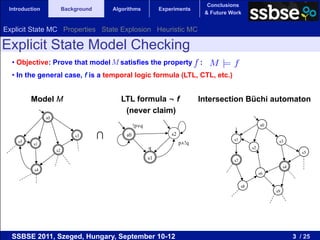
Explicit State Model Checking
  •  Objective: Prove that model M satisfies the property                       :
  •  In the general case, f is a temporal logic formula (LTL, CTL, etc.)


         Model M                             LTL formula ¬ f                    Intersection Büchi automaton
                                              (never claim)
                s0
                                                    !p∨q                                                     s0


    s5
                              s3       ∩       s0                   s2
                                                                                              s1                   s3
          s1                                                             p∧!q
                     s2
                                                           q                                            s2
                                                                                                                               s5
                                                           s1                                 s7
                                                                                                                       s4
          s4
                                                                                                             s6

                                                                                                   s8
                                                                                                                  s9


  SSBSE 2011, Szeged, Hungary, September 10-12                                                                              3 / 25
Conclusions
 Introduction             Background       Algorithms           Experiments
                                                                                    & Future Work


Explicit State MC Properties State Explosion Heuristic MC

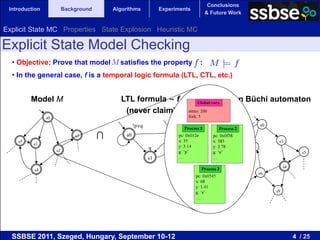
Explicit State Model Checking
  •  Objective: Prove that model M satisfies the property                       :
  •  In the general case, f is a temporal logic formula (LTL, CTL, etc.)


         Model M                             LTL formula ¬ f                    Intersection Büchi automaton
                                              (never claim)
                s0
                                                    !p∨q                                                     s0


    s5
                              s3       ∩       s0                   s2
                                                                                    =         s1                   s3
          s1                                                             p∧!q
                     s2
                                                           q                                            s2
                                                                                                                               s5
                                                           s1                                 s7
                                                                                                                       s4
          s4
                                                                                                             s6

                                                                                                   s8
                                                                                                                  s9


  SSBSE 2011, Szeged, Hungary, September 10-12                                                                              4 / 25
Conclusions
 Introduction             Background       Algorithms           Experiments
                                                                                    & Future Work


Explicit State MC Properties State Explosion Heuristic MC

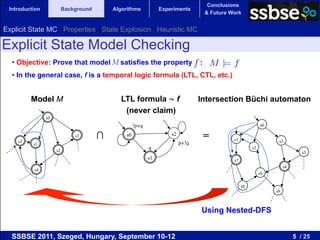
Explicit State Model Checking
  •  Objective: Prove that model M satisfies the property                       :
  •  In the general case, f is a temporal logic formula (LTL, CTL, etc.)


         Model M                             LTL formula ¬ f                    Intersection Büchi automaton
                                              (never claim)
                s0
                                                    !p∨q                                                     s0


    s5
                              s3       ∩       s0                   s2
                                                                                    =         s1                   s3
          s1                                                             p∧!q
                     s2
                                                           q                                            s2
                                                                                                                               s5
                                                           s1                                 s7
                                                                                                                       s4
          s4
                                                                                                             s6

                                                                                                   s8
                                                                                                                  s9


                                                                                Using Nested-DFS


  SSBSE 2011, Szeged, Hungary, September 10-12                                                                              5 / 25
Conclusions
 Introduction   Background                    Algorithms   Experiments
                                                                           & Future Work


Explicit State MC Properties State Explosion Heuristic MC

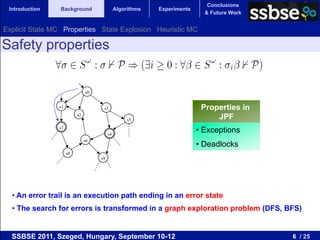
Safety properties


                               s0


                s1                   s3                                   Properties in
                          s2
                                                   s5                         JPF
                s7
                                         s4
                                                                         •  Exceptions
                               s6
                                                                         •  Deadlocks
                     s8
                                    s9


  •  An error trail is an execution path ending in an error state
  •  The search for errors is transformed in a graph exploration problem (DFS, BFS)


  SSBSE 2011, Szeged, Hungary, September 10-12                                             6 / 25
Conclusions
 Introduction             Background          Algorithms      Experiments
                                                                            & Future Work


Explicit State MC Properties State Explosion Heuristic MC

State Explosion Problem
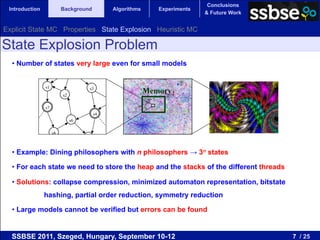
  •  Number of states very large even for small models
                               s0


                s1                   s3
                          s2
                                                           Memory
                                              s5
                s7
                                         s4
                               s6

                     s8
                                    s9


  •  Example: Dining philosophers with n philosophers → 3n states

  •  For each state we need to store the heap and the stacks of the different threads

  •  Solutions: collapse compression, minimized automaton representation, bitstate
                hashing, partial order reduction, symmetry reduction

  •  Large models cannot be verified but errors can be found


  SSBSE 2011, Szeged, Hungary, September 10-12                                              7 / 25
Conclusions
 Introduction     Background                 Algorithms                  Experiments
                                                                                              & Future Work


Explicit State MC Properties State Explosion Heuristic MC

Heuristic Model Checking
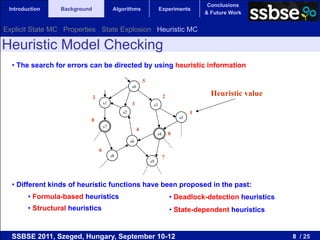
  •  The search for errors can be directed by using heuristic information

                                                               5
                                                      s0

                               2                                             2                  Heuristic value
                                       s1             3             s3
                                                 s2                                       1
                                                                                     s5
                            0
                                       s7
                                                           4
                                                                        s4       0
                                                      s6

                                   6
                                            s8                               7
                                                                   s9


  •  Different kinds of heuristic functions have been proposed in the past:
        •  Formula-based heuristics                                              •  Deadlock-detection heuristics
        •  Structural heuristics                                                 •  State-dependent heuristics


  SSBSE 2011, Szeged, Hungary, September 10-12                                                                      8 / 25
Conclusions
 Introduction     Background         Algorithms   Experiments
                                                                & Future Work


Algorithms GA GAMO PSO ACO SA

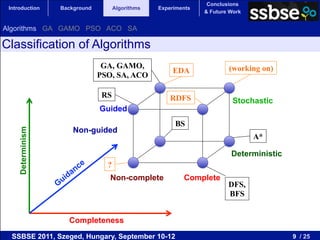
Classification of Algorithms
                                GA, GAMO,                               (working on)
                                                       EDA
                               PSO, SA, ACO

                                RS                    RDFS                Stochastic
                               Guided
                                                       BS
                      Non-guided
    Determinism


                                                                                A*

                                                                         Deterministic
                                 ?
                                  Non-complete            Complete
                                                                        DFS,
                                                                        BFS


                    Completeness
  SSBSE 2011, Szeged, Hungary, September 10-12                                           9 / 25
Conclusions
 Introduction     Background      Algorithms     Experiments
                                                                & Future Work


Algorithms GA GAMO PSO ACO SA

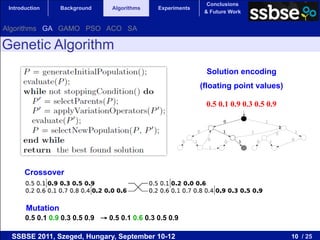
Genetic Algorithm
                                                                Solution encoding
                                                               (floating point values)

                                                                0.5 0.1 0.9 0.3 0.5 0.9


       Crossover


       Mutation
       0.5 0.1 0.9 0.3 0.5 0.9 → 0.5 0.1 0.6 0.3 0.5 0.9

  SSBSE 2011, Szeged, Hungary, September 10-12                                            10 / 25
Conclusions
 Introduction     Background     Algorithms   Experiments
                                                            & Future Work


Algorithms GA GAMO PSO ACO SA

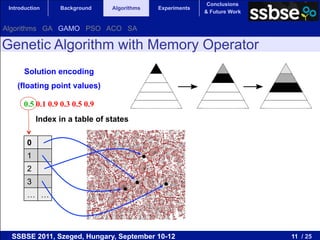
Genetic Algorithm with Memory Operator
       Solution encoding
    (floating point values)

      0.5 0.1 0.9 0.3 0.5 0.9
            Index in a table of states

        0
        1
        2
        3
        … …


  SSBSE 2011, Szeged, Hungary, September 10-12                              11 / 25
Conclusions
 Introduction        Background   Algorithms   Experiments
                                                                & Future Work


Algorithms GA GAMO PSO ACO SA

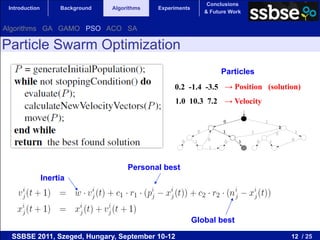
Particle Swarm Optimization
                                                                     Particles
                                                    0.2 -1.4 -3.5 → Position (solution)
                                                    1.0 10.3 7.2 → Velocity


                                       Personal best
                Inertia


                                                             Global best

  SSBSE 2011, Szeged, Hungary, September 10-12                                      12 / 25
Conclusions
 Introduction    Background      Algorithms     Experiments
                                                                     & Future Work


Algorithms GA GAMO PSO ACO SA

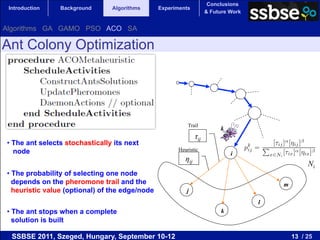
Ant Colony Optimization


                                                          Trail
                                                                          k
                                                               τij
•  The ant selects stochastically its next
   node                                               Heuristic
                                                                              i
                                                         ηij
                                                                                                  Ni
•  The probability of selecting one node
  depends on the pheromone trail and the                                                 m
  heuristic value (optional) of the edge/node            j
                                                                                     l
•  The ant stops when a complete                                          k
  solution is built

  SSBSE 2011, Szeged, Hungary, September 10-12                                               13 / 25
Conclusions
 Introduction    Background      Algorithms     Experiments
                                                              & Future Work


Algorithms GA GAMO PSO ACO SA

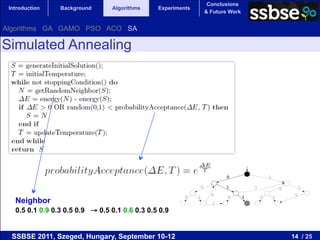
Simulated Annealing


   Neighbor
   0.5 0.1 0.9 0.3 0.5 0.9 → 0.5 0.1 0.6 0.3 0.5 0.9


  SSBSE 2011, Szeged, Hungary, September 10-12                                14 / 25
Conclusions
 Introduction    Background       Algorithms         Experiments
                                                                    & Future Work


Parameterization Hit Rate Length of Error Trails

Parameterization
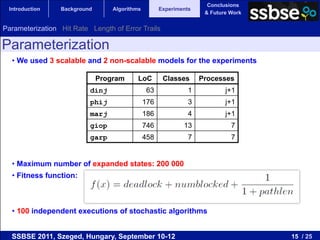
  •  We used 3 scalable and 2 non-scalable models for the experiments

                              Program      LoC        Classes      Processes
                          dinj                  63             1           j+1
                          phij                 176             3           j+1
                          marj                 186             4           j+1
                          giop                 746           13              7
                          garp                 458             7             7


  •  Maximum number of expanded states: 200 000
  •  Fitness function:


  •  100 independent executions of stochastic algorithms


  SSBSE 2011, Szeged, Hungary, September 10-12                                      15 / 25
Conclusions
 Introduction    Background       Algorithms         Experiments
                                                                    & Future Work


Parameterization Hit Rate Length of Error Trails

Parameterization
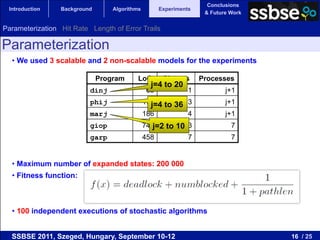
  •  We used 3 scalable and 2 non-scalable models for the experiments

                              Program      LoC        Classes      Processes
                                                 j=4 to 20
                          dinj                  63             1           j+1
                          phij                 176 to 36 3
                                                 j=4                       j+1
                          marj                 186       4                 j+1
                          giop                 746j=2 to 1013                7
                          garp                 458             7             7


  •  Maximum number of expanded states: 200 000
  •  Fitness function:


  •  100 independent executions of stochastic algorithms


  SSBSE 2011, Szeged, Hungary, September 10-12                                      16 / 25
Conclusions
 Introduction    Background      Algorithms    Experiments
                                                             & Future Work


Parameterization Hit Rate Length of Error Trails

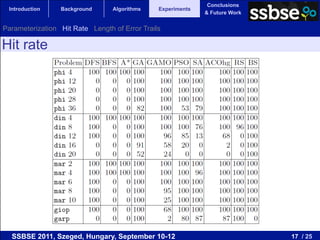
Hit rate


  SSBSE 2011, Szeged, Hungary, September 10-12                               17 / 25
Conclusions
 Introduction    Background      Algorithms    Experiments
                                                             & Future Work


Parameterization Hit Rate Length of Error Trails

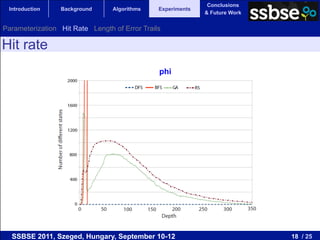
Hit rate
                                               phi


  SSBSE 2011, Szeged, Hungary, September 10-12                               18 / 25
Conclusions
 Introduction    Background      Algorithms    Experiments
                                                             & Future Work


Parameterization Hit Rate Length of Error Trails

Hit rate
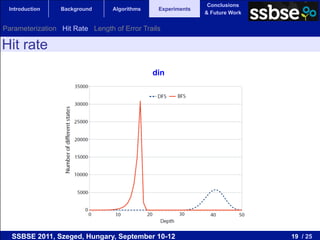
                                              din


  SSBSE 2011, Szeged, Hungary, September 10-12                               19 / 25
Conclusions
 Introduction    Background      Algorithms    Experiments
                                                             & Future Work


Parameterization Hit Rate Length of Error Trails

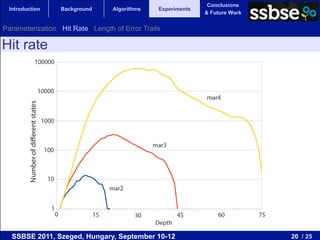
Hit rate


  SSBSE 2011, Szeged, Hungary, September 10-12                               20 / 25
Conclusions
 Introduction    Background      Algorithms    Experiments
                                                               & Future Work


Parameterization Hit Rate Length of Error Trails

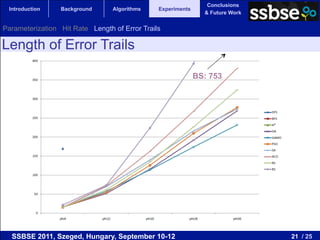
Length of Error Trails

                                                             BS: 753


  SSBSE 2011, Szeged, Hungary, September 10-12                                 21 / 25
Conclusions
 Introduction    Background      Algorithms    Experiments
                                                             & Future Work


Parameterization Hit Rate Length of Error Trails

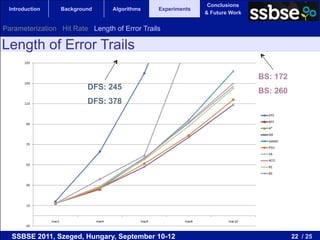
Length of Error Trails

                                                                             BS: 172
                         DFS: 245                                            BS: 260
                         DFS: 378


  SSBSE 2011, Szeged, Hungary, September 10-12                                         22 / 25
Conclusions
 Introduction    Background      Algorithms    Experiments
                                                             & Future Work


Parameterization Hit Rate Length of Error Trails

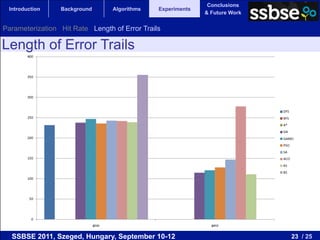
Length of Error Trails


  SSBSE 2011, Szeged, Hungary, September 10-12                               23 / 25
Conclusions
 Introduction   Background    Algorithms   Experiments
                                                         & Future Work


Conclusions & Future Work

Conclusions & Future Work
                                   Conclusions
  •  Metaheuristics are more effective than classical algorithms in finding errors
  •  Beam Search has advantages over complete search algorithms
  •  An even distribution of the search in depth levels tends to raise hit rate
  •  Stochastic algorithms obtain short error trails

                                    Future Work
  •  Design a stochastic complete guided algorithm to find errors and verify
  •  Design of hybrid algorithms to more efficiently explore the search space
  •  Explore the design of parallel metaheuristics for this problem


  SSBSE 2011, Szeged, Hungary, September 10-12                                    24 / 25
Comparing Metaheuristic Algorithms
 for Error Detection in Java Programs
Thanks for your attention !!!


 SSBSE 2011, Szeged, Hungary, September 10-12   25 / 25

Comparing Metaheuristic Algorithms for Error Detection in Java Programs

  • 1.
    Conclusions Introduction Background Algorithms Experiments & Future Work Comparing Metaheuristic Algorithms for Error Detection in Java Programs Francisco Chicano, Marco Ferreira and Enrique Alba SSBSE 2011, Szeged, Hungary, September 10-12 1 / 25
  • 2.
    Conclusions Introduction Background Algorithms Experiments & Future Work Motivation Motivation •  Concurrent software is difficult to test ... •  ... and it is in the heart of a lot of critical systems •  Techniques for proving the correctness of concurrent software are required •  Model checking → fully automatic •  Traditional techniques for this purpose have problems with large models •  We compare several metaheuristics and classical algorithms for model checking SSBSE 2011, Szeged, Hungary, September 10-12 2 / 25
  • 3.
    Conclusions Introduction Background Algorithms Experiments & Future Work Explicit State MC Properties State Explosion Heuristic MC Explicit State Model Checking •  Objective: Prove that model M satisfies the property : •  In the general case, f is a temporal logic formula (LTL, CTL, etc.) Model M LTL formula ¬ f Intersection Büchi automaton (never claim) s0 !p∨q s0 s5 s3 ∩ s0 s2 s1 s3 s1 p∧!q s2 q s2 s5 s1 s7 s4 s4 s6 s8 s9 SSBSE 2011, Szeged, Hungary, September 10-12 3 / 25
  • 4.
    Conclusions Introduction Background Algorithms Experiments & Future Work Explicit State MC Properties State Explosion Heuristic MC Explicit State Model Checking •  Objective: Prove that model M satisfies the property : •  In the general case, f is a temporal logic formula (LTL, CTL, etc.) Model M LTL formula ¬ f Intersection Büchi automaton (never claim) s0 !p∨q s0 s5 s3 ∩ s0 s2 = s1 s3 s1 p∧!q s2 q s2 s5 s1 s7 s4 s4 s6 s8 s9 SSBSE 2011, Szeged, Hungary, September 10-12 4 / 25
  • 5.
    Conclusions Introduction Background Algorithms Experiments & Future Work Explicit State MC Properties State Explosion Heuristic MC Explicit State Model Checking •  Objective: Prove that model M satisfies the property : •  In the general case, f is a temporal logic formula (LTL, CTL, etc.) Model M LTL formula ¬ f Intersection Büchi automaton (never claim) s0 !p∨q s0 s5 s3 ∩ s0 s2 = s1 s3 s1 p∧!q s2 q s2 s5 s1 s7 s4 s4 s6 s8 s9 Using Nested-DFS SSBSE 2011, Szeged, Hungary, September 10-12 5 / 25
  • 6.
    Conclusions Introduction Background Algorithms Experiments & Future Work Explicit State MC Properties State Explosion Heuristic MC Safety properties s0 s1 s3 Properties in s2 s5 JPF s7 s4 •  Exceptions s6 •  Deadlocks s8 s9 •  An error trail is an execution path ending in an error state •  The search for errors is transformed in a graph exploration problem (DFS, BFS) SSBSE 2011, Szeged, Hungary, September 10-12 6 / 25
  • 7.
    Conclusions Introduction Background Algorithms Experiments & Future Work Explicit State MC Properties State Explosion Heuristic MC State Explosion Problem •  Number of states very large even for small models s0 s1 s3 s2 Memory s5 s7 s4 s6 s8 s9 •  Example: Dining philosophers with n philosophers → 3n states •  For each state we need to store the heap and the stacks of the different threads •  Solutions: collapse compression, minimized automaton representation, bitstate hashing, partial order reduction, symmetry reduction •  Large models cannot be verified but errors can be found SSBSE 2011, Szeged, Hungary, September 10-12 7 / 25
  • 8.
    Conclusions Introduction Background Algorithms Experiments & Future Work Explicit State MC Properties State Explosion Heuristic MC Heuristic Model Checking •  The search for errors can be directed by using heuristic information 5 s0 2 2 Heuristic value s1 3 s3 s2 1 s5 0 s7 4 s4 0 s6 6 s8 7 s9 •  Different kinds of heuristic functions have been proposed in the past: •  Formula-based heuristics •  Deadlock-detection heuristics •  Structural heuristics •  State-dependent heuristics SSBSE 2011, Szeged, Hungary, September 10-12 8 / 25
  • 9.
    Conclusions Introduction Background Algorithms Experiments & Future Work Algorithms GA GAMO PSO ACO SA Classification of Algorithms GA, GAMO, (working on) EDA PSO, SA, ACO RS RDFS Stochastic Guided BS Non-guided Determinism A* Deterministic ? Non-complete Complete DFS, BFS Completeness SSBSE 2011, Szeged, Hungary, September 10-12 9 / 25
  • 10.
    Conclusions Introduction Background Algorithms Experiments & Future Work Algorithms GA GAMO PSO ACO SA Genetic Algorithm Solution encoding (floating point values) 0.5 0.1 0.9 0.3 0.5 0.9 Crossover Mutation 0.5 0.1 0.9 0.3 0.5 0.9 → 0.5 0.1 0.6 0.3 0.5 0.9 SSBSE 2011, Szeged, Hungary, September 10-12 10 / 25
  • 11.
    Conclusions Introduction Background Algorithms Experiments & Future Work Algorithms GA GAMO PSO ACO SA Genetic Algorithm with Memory Operator Solution encoding (floating point values) 0.5 0.1 0.9 0.3 0.5 0.9 Index in a table of states 0 1 2 3 … … SSBSE 2011, Szeged, Hungary, September 10-12 11 / 25
  • 12.
    Conclusions Introduction Background Algorithms Experiments & Future Work Algorithms GA GAMO PSO ACO SA Particle Swarm Optimization Particles 0.2 -1.4 -3.5 → Position (solution) 1.0 10.3 7.2 → Velocity Personal best Inertia Global best SSBSE 2011, Szeged, Hungary, September 10-12 12 / 25
  • 13.
    Conclusions Introduction Background Algorithms Experiments & Future Work Algorithms GA GAMO PSO ACO SA Ant Colony Optimization Trail k τij •  The ant selects stochastically its next node Heuristic i ηij Ni •  The probability of selecting one node depends on the pheromone trail and the m heuristic value (optional) of the edge/node j l •  The ant stops when a complete k solution is built SSBSE 2011, Szeged, Hungary, September 10-12 13 / 25
  • 14.
    Conclusions Introduction Background Algorithms Experiments & Future Work Algorithms GA GAMO PSO ACO SA Simulated Annealing Neighbor 0.5 0.1 0.9 0.3 0.5 0.9 → 0.5 0.1 0.6 0.3 0.5 0.9 SSBSE 2011, Szeged, Hungary, September 10-12 14 / 25
  • 15.
    Conclusions Introduction Background Algorithms Experiments & Future Work Parameterization Hit Rate Length of Error Trails Parameterization •  We used 3 scalable and 2 non-scalable models for the experiments Program LoC Classes Processes dinj 63 1 j+1 phij 176 3 j+1 marj 186 4 j+1 giop 746 13 7 garp 458 7 7 •  Maximum number of expanded states: 200 000 •  Fitness function: •  100 independent executions of stochastic algorithms SSBSE 2011, Szeged, Hungary, September 10-12 15 / 25
  • 16.
    Conclusions Introduction Background Algorithms Experiments & Future Work Parameterization Hit Rate Length of Error Trails Parameterization •  We used 3 scalable and 2 non-scalable models for the experiments Program LoC Classes Processes j=4 to 20 dinj 63 1 j+1 phij 176 to 36 3 j=4 j+1 marj 186 4 j+1 giop 746j=2 to 1013 7 garp 458 7 7 •  Maximum number of expanded states: 200 000 •  Fitness function: •  100 independent executions of stochastic algorithms SSBSE 2011, Szeged, Hungary, September 10-12 16 / 25
  • 17.
    Conclusions Introduction Background Algorithms Experiments & Future Work Parameterization Hit Rate Length of Error Trails Hit rate SSBSE 2011, Szeged, Hungary, September 10-12 17 / 25
  • 18.
    Conclusions Introduction Background Algorithms Experiments & Future Work Parameterization Hit Rate Length of Error Trails Hit rate phi SSBSE 2011, Szeged, Hungary, September 10-12 18 / 25
  • 19.
    Conclusions Introduction Background Algorithms Experiments & Future Work Parameterization Hit Rate Length of Error Trails Hit rate din SSBSE 2011, Szeged, Hungary, September 10-12 19 / 25
  • 20.
    Conclusions Introduction Background Algorithms Experiments & Future Work Parameterization Hit Rate Length of Error Trails Hit rate SSBSE 2011, Szeged, Hungary, September 10-12 20 / 25
  • 21.
    Conclusions Introduction Background Algorithms Experiments & Future Work Parameterization Hit Rate Length of Error Trails Length of Error Trails BS: 753 SSBSE 2011, Szeged, Hungary, September 10-12 21 / 25
  • 22.
    Conclusions Introduction Background Algorithms Experiments & Future Work Parameterization Hit Rate Length of Error Trails Length of Error Trails BS: 172 DFS: 245 BS: 260 DFS: 378 SSBSE 2011, Szeged, Hungary, September 10-12 22 / 25
  • 23.
    Conclusions Introduction Background Algorithms Experiments & Future Work Parameterization Hit Rate Length of Error Trails Length of Error Trails SSBSE 2011, Szeged, Hungary, September 10-12 23 / 25
  • 24.
    Conclusions Introduction Background Algorithms Experiments & Future Work Conclusions & Future Work Conclusions & Future Work Conclusions •  Metaheuristics are more effective than classical algorithms in finding errors •  Beam Search has advantages over complete search algorithms •  An even distribution of the search in depth levels tends to raise hit rate •  Stochastic algorithms obtain short error trails Future Work •  Design a stochastic complete guided algorithm to find errors and verify •  Design of hybrid algorithms to more efficiently explore the search space •  Explore the design of parallel metaheuristics for this problem SSBSE 2011, Szeged, Hungary, September 10-12 24 / 25
  • 25.
    Comparing Metaheuristic Algorithms for Error Detection in Java Programs Thanks for your attention !!! SSBSE 2011, Szeged, Hungary, September 10-12 25 / 25