ZARASupply Chain and Value-CreationEmily Pan, Stephanie Pan, Casey Chen, Jing yaChen(PC)2
PurposeTo analyze ZARA's success due to its supply chain How it correlates with value-creation for the companyLook at the supply chain from a global perspective and try to apply it to China
AgendaZARA: Company Profile ZARA: The Supply ChainVertically IntegratedZARA: Competitors Landscape   Challenges in ChinaFuture Suggestions for ZARA
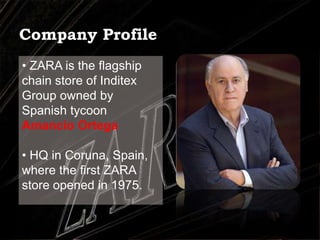
Company Profile ZARA is the flagship chain store of Inditex Group owned by Spanish tycoon Amancio Ortega
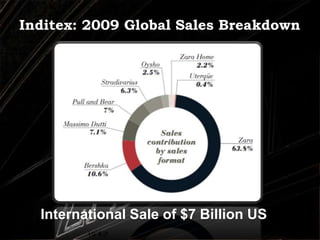
 HQ in Coruna, Spain, where the first ZARA store opened in 1975.Inditex: 2009 Global Sales BreakdownInternational Sale of $7 Billion US
ZARA in China“Inditex has strong potential to continue growing in a profitable way over the coming years and, in this regard, our priority is to focus on expansion in Europe and Asia”– 2009 Inditex Annual Report
ZARA in China“In other words: Right Working Conditions (Compliance), Right Health and Safety, Right Quality, Right Delivery Time and, finally Right Price” –2009 Inditex Annual Report
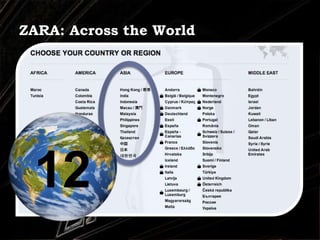
ZARA: Across the WorldHow is ZARA Involved in Asia?12
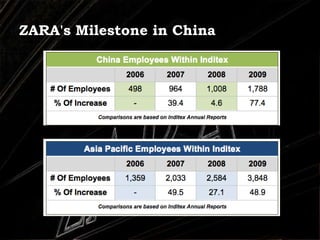
ZARA's Milestone in China
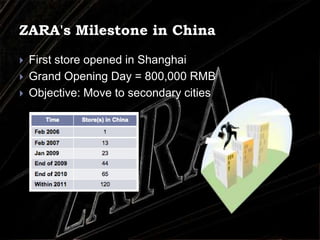
ZARA's Milestone in ChinaFirst store opened in ShanghaiGrand Opening Day = 800,000 RMBObjective: Move to secondary cities
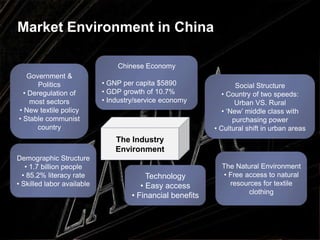
Market Environment in ChinaChinese Economy GNP per capita $5890
 GDP growth of 10.7%
 Industry/service economyGovernment & Politics Deregulation of most sectors
 New textile policy
 Stable communist country Social Structure Country of two speeds: Urban VS. Rural
 ‘New’ middle class with purchasing power
 Cultural shift in urban areasThe Industry EnvironmentDemographic Structure 1.7 billion people
 85.2% literacy rate
 Skilled labor availableThe Natural Environment Free access to natural resources for textile clothingTechnology Easy access
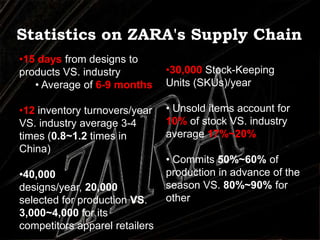
 Financial benefitsStatistics on ZARA's Supply Chain15 days from designs to products VS. industry
 Average of 6-9 months
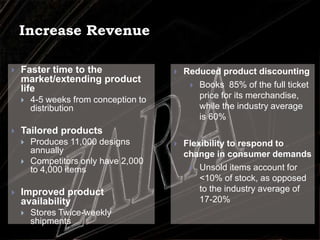
12 inventory turnovers/year VS. industry average 3-4 times (0.8~1.2 times in China)
40,000 designs/year, 20,000 selected for production VS. 3,000~4,000 for its competitors apparel retailers
30,000 Stock-Keeping Units (SKUs)/year
 Unsold items account for 10% of stock VS. industry average 17%~20%
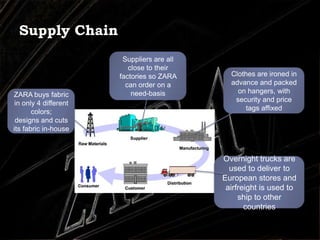
 Commits 50%~60% of production in advance of the season VS. 80%~90% for other The Key to ZARA's SuccessVertically integrated supply chain where design, production, distribution, and retailing were integrated.“The vertical integration of our production system allows us to place a garment in any store around the world in a period between two to three weeks.”
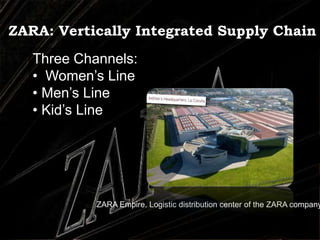
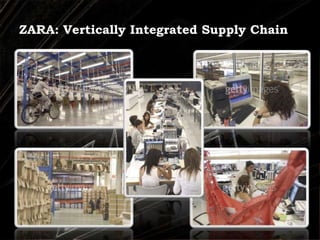
ZARA: Vertically Integrated Supply ChainThree Channels:  Women’s Line
 Men’s Line
 Kid’s LineZARA Empire. Logistic distribution center of the ZARA company
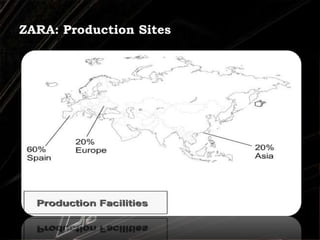
ZARA: Production Sites
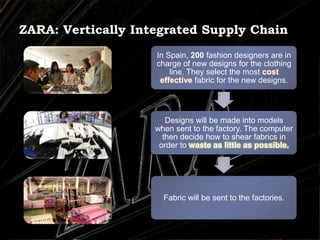
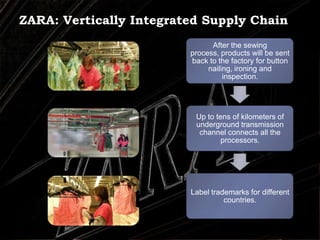
ZARA: Vertically Integrated Supply Chain
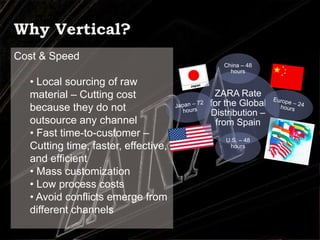
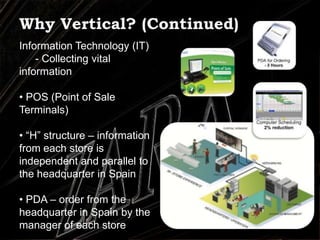
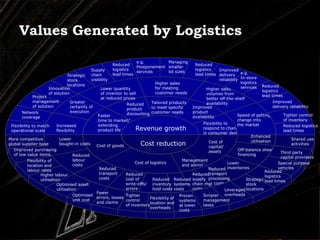
Why Vertical?Cost & Speed Local sourcing of raw material – Cutting cost because they do not outsource any channel
 Fast time-to-customer – Cutting time, faster, effective, and efficient
 Mass customization
 Low process costs

Zara in China

Editor's Notes

  • #3 steph
  • #4 steph
  • #5 steph
  • #6 steph8 Brands in InditexOver 60 percent is centrally focused on ZARAZARA Home and ZARA, but we are solely focusing on ZARA
  • #7 EmilySTATE:Asian markets show great long-term growth potential for Inditex“Inditex has strong potential to continue growing in a profitable way over the coming years and, in this regard, our priority is to focus on expansion in Europe and Asia”“In other words: Right Working Conditions (Compliance), Right Health and Safety, Right Quality, Right Delivery Time and, finally Right Price” –2009 Inditex Annual Report
  • #8 EmilySTATE:Asian markets show great long-term growth potential for Inditex“Inditex has strong potential to continue growing in a profitable way over the coming years and, in this regard, our priority is to focus on expansion in Europe and Asia”“In other words: Right Working Conditions (Compliance), Right Health and Safety, Right Quality, Right Delivery Time and, finally Right Price” –2009 Inditex Annual Report
  • #9 Emily75 countriesin five regions, with 12 of those countries being in Asia 2 11 12 39 11
  • #10 emily
  • #11 Emily恒隆广场 (进南京西路)Nanjing Xi Lu, ShanghaiZARA opened its first store in Shanghai, China during February of 2006. On the day of the grand opening, the Company gained a revenue of 80,000RMB. Within three years, 23 stores appeared in 2009, and by the end of that year the number of stores nearly doubled. ZARA has predicted to increase the number of stores within 2011 by a 150 percent jump from the previous year. The Company intends to expand towards secondary cities, expanding quicker than many popular apparel brands (i.e., H&M, Gap, etc). First – shanghai, then beijing – then they started to move towards first tiered cities like Nanjing, ShenzhenObjective: Expand to secondary cities (ask casey more about secondary cities)Established institution
  • #12 CAsey
  • #13 Casey
  • #14 Casey
  • #15 Casey
  • #16 Casey
  • #17 Casey\\ZARA operates using a vertical supply chain, which is a unique strategy in the fashion industry. Vertically integrated business undertakes a variety of activities from designing, manufacturing, sourcing, and to distribution to retail stores around the world. it has total control of various business activities and gives the company total business management.
  • #18 Casey
  • #19 Casey
  • #20 Jingya
  • #21 Jingya
  • #22 Jingya
  • #23 Jingya
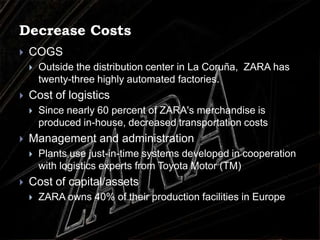
  • #24 JingyaJIT-the process relies on signals between different points in the process, which tell production when to make the next part.saves warehousespace and costs.-gives the company a level of control that would be impossible if it were entirely dependent on outsiders.Buy fabrics in only 4 colors. Cut and dye them themselves, allows for flexibility.In their huge DC, they pre-iron and put clothes on hangers->ready to be put onto shelves-> cuts three hours of prime time for store employees
  • #25 Jingya
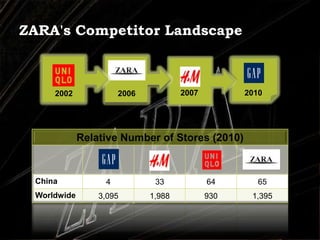
  • #26 EMIOLYYH&M came to China a year after China, where 33 stores were operating by the end of 2010, half of the amount of ZARA stores in China.At Huahai Road’s H&M store, the Company intakes a monthly revenue of 8 million RMB (around $1.2 million USD). Gap entered the Chinese market in 2010, with only four stores. ZARA not only has the most stores in China, but around the world as well with over 13,000 stores. Gap trails as the runner up with approximately 3,000 GAP stores, and there are nearly 2,000 H&M stores.ZARA's expanding quicker than UniqloH&M came to China 2007End of 2010: 33 StoresMonthly Revenue @ Huahai store: 8 million RMB (2010)ZARA ( around 30 % more expensive than in Europe and US to equate the transportation ) Comparison: H&M needs 5 more days from design – product (by doing that, prices are 30 – 50 % lower than ZARA)ZARA – design to product: 15 daysH&M – 21 daysGap – 90 days (more quantity, less designs)Comparison: Gap came to China last year – 4 stores (2010)In the world:ZARA 13,095 stores (2010)H&M 1,988 GAP 3,095
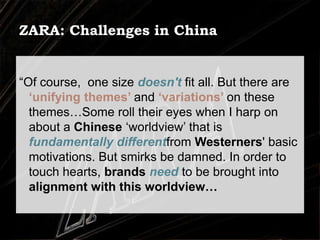
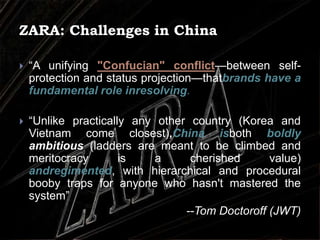
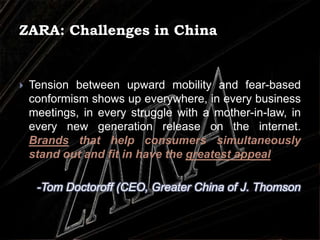
  • #28 EMIOLYY13 years of being here – Tom DoctoroffConfucian conflict: self protection (Darwinism 1.4 billion people) & status projection (mianzi) Achieve success by understanding China’s hierarchical system, ambitions and regimentsThose who don’t fail and fall into the traps (i.e., failure in business models, logistics, and operations management)
  • #29 EMIOLYY
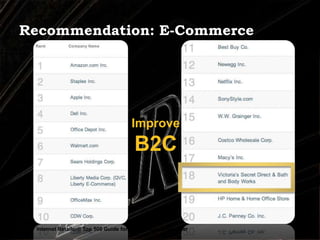
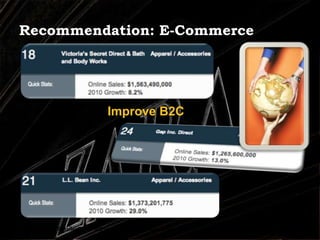
  • #30 EMIOLYY1998 – VS gained involvement with E-CommerceWhile some retailers such as Gap Inc.  and ZARA have launched new localized international sites this year, several more retailers will focus on global expansion in 2011, predicts Zia DaniellWigder, a Forrester Research Inc. senior analyst. Rather, Wigder, who also wrote about global e-commerce markets in the December issue of Internet Retailer, predicts many retailers will increasingly look to expanding in China because the country has the world’s largest online population and a burgeoning e-commerce marketChina’s poised to Rival US E-Commerce in the coming years
  • #31 EMIOLYY1998 – VS gained involvement with E-CommerceWhile some retailers such as Gap Inc.  and ZARA have launched new localized international sites this year, several more retailers will focus on global expansion in 2011, predicts Zia DaniellWigder, a Forrester Research Inc. senior analyst. Rather, Wigder, who also wrote about global e-commerce markets in the December issue of Internet Retailer, predicts many retailers will increasingly look to expanding in China because the country has the world’s largest online population and a burgeoning e-commerce marketChina’s poised to Rival US E-Commerce in the coming years VS - #1 Apparels/Accssories in Online SalesLL bean #2 GAP - #3
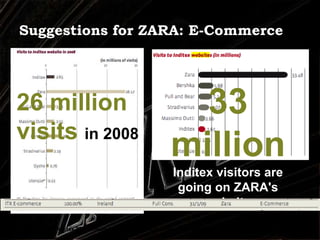
  • #32 Nearly raised by 30 percent of visitors (27 percent to be exact)Backfront - StorefrontIT, LOGISTICS, SALES MANAGEMENTTake stuff after marketPut the on sale onlineWorking from a computerManagers from the warehouse Keep value of product w/o
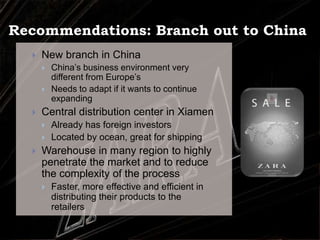
  • #33 ZARA's current supply chain strategy works well in Spain, but as it expands more in China, the costs of shipping will outweigh the benefits of being centered in Spain. China’s business environment is very different from Spain’s so ZARA will need to adapt to Chinese practices if it truly wants to expand successfully. We suggest starting a new branch in Xiaomen. The location is ideal since it is located near the ocean, decreasing the costs of transportation. It also has many foreign investors, so business there are accustomed to working with western policies.
  • #34 ZARA uses many suppliers in Spain to keep up with its frequent orders. This has caused problems with fabric quality. To prevent this problem in China, we suggest for ZARA to choose a few reliable suppliers and focus on making good relations. This way, they can treat the suppliers as if they were part of the same company, achieving the same flexibility and low costs they are used to. We suggest working directly with HungJin Trading, a supplier known for its variety of fabrics, high quality, and good relations with customers. Since ZARA has experience dealing with suppliers, we suggest ZARA cut out any middlemen. ZARA is “capital intensive”, meaning it relies mostly on machines rather than people to make their clothes. Since China is still a developing country, labor is only a sixth of the cost.