by
Kanhaiya Kejriwal – MP17016
Korivi Sravan Kumar – MP17017
L Nandakumar – MP17019
Rahul Sharma – MP17029
Rajat Kulshreshta – MP17031
International Expansion
Introduction and Early History
• Amancio Ortega started his business in 1963 with a small time workshop
which made dresses and gowns for distribution
• In 1975 the first Zara store was opened inA Coruña in Spain.
• Positioned clothes as consumables – Use and Dispose.
• High fashion, In-trend products at affordable prices
• Inditex was officially founded in 1985 which brought all Zara businesses under
one holding company
• A number of new brands were acquired/ launched to cater to various
customer segments
• Company went public in 2001 and got listed on the Madrid Stock Exchange
• By 2004, Zara crossed 2000 stores count globally.
Source:
Wikipedia
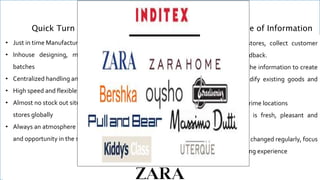
The Business Model
Quick Turn Around Stores as Source of Information
• Just in time Manufacturing systems
• Inhouse designing, manufacturing small
batches
• Centralized handling and distribution
• High speed and flexible logistics solutions
• Almost no stock out situations in any of the
stores globally
• Always an atmosphere of privilege, scarcity
and opportunity in the stores
• Managers at the stores, collect customer
preferences and feedback.
• Design group uses the information to create
new articles or modify existing goods and
deliver at the stores
• Outlets located at prime locations
• Stores atmosphere is fresh, pleasant and
welcoming
• Layout and displays changed regularly, focus
on customer shopping experience
• Change in customer behavior in 1980’s seen in Spain.
Less spending on clothing
• Reactive need for internationalization
• Internationalization motivation – Market Seeking
• Established first international store in Portugal
• Gradually moved to a proactive
pull based international growth
• Internationalization trajectory best explained by the
Upsala and Case Models
• 3 Stage process adopted
 Initial reluctance- Focus in host country
 Watchful spread
 Aggressive Expansion
INTERNATIONALISATION
 Initial reluctance- Focus in host country
• Acquire experience and knowledge- adjust BM to suite
changing enviroment
 Watchful spread
• Focused only on markets with least psychic distance
• Cultural, administrative, geographic and economically
close market
• Mainly European markets- France , Belgium, Sweden,
mexico, United States
 Aggressive Expansion
• Experience gained made Zara more bold to enter
completely alien territories
• South America, Middle East, Asian markets targeted
• European position reinforced
International Strategy
• Transnational international corporate level strategy adopted
• Seek to achieve both global efficiency and local
responsiveness
• Strong global data collection, central designing, production
and distribution, which are centrally controlled
• Store designs, layouts and customer experience guided
centrally
• Local responsiveness achieved through adoption of local
fashion trends and providing the market what it needs
• Quick changes to any new trends and customer
requirements
Approach to market entry
• Zara adopts a mix of market entry modes
depending specifically to the country and
conditions
• Wholly owned subsidiary is the most preferred
mode of entry, as it helps in maintaining control
which in turn help with the International corporate
levelTransnational Strategy
Most preferred. Used in stable countries
such as Europe, US, where perceived risk
wrt Political and Economic is minimal.
Adopted in large growing markets, where
difficulty in acquiring prime property, govt
regulations etc
Where business risk is highest eg Saudi
Arabia, Malaysia, Indonesia, Kuwait etc
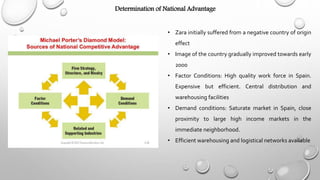
• Zara initially suffered from a negative country of origin
effect
• Image of the country gradually improved towards early
2000
• Factor Conditions: High quality work force in Spain.
Expensive but efficient. Central distribution and
warehousing facilities
• Demand conditions: Saturate market in Spain, close
proximity to large high income markets in the
immediate neighborhood.
• Efficient warehousing and logistical networks available
Determination of National Advantage
OUTLOOK OF INDIA
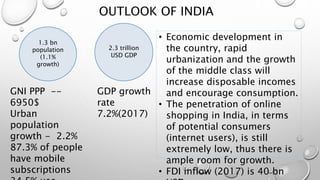
• Economic development in
the country, rapid
urbanization and the growth
of the middle class will
increase disposable incomes
and encourage consumption.
• The penetration of online
shopping in India, in terms
of potential consumers
(internet users), is still
extremely low, thus there is
ample room for growth.
• FDI inflow (2017) is 40 bn
1.3 bn
population
(1.1%
growth)
GNI PPP --
6950$
Urban
population
growth - 2.2%
87.3% of people
have mobile
subscriptions
2.3 trillion
USD GDP
GDP growth
rate
7.2%(2017)
* Sources: MarketLine; Euromonitor
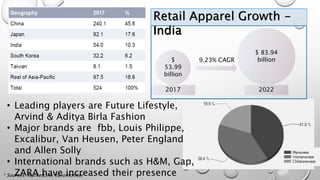
$
53.99
billion
2017
9.23% CAGR
• Leading players are Future Lifestyle,
Arvind & Aditya Birla Fashion
• Major brands are fbb, Louis Philippe,
Excalibur, Van Heusen, Peter England
and Allen Solly
• International brands such as H&M, Gap,
ZARA have increased their presence
$ 83.94
billion
2022
Retail Apparel Growth -
India
Retail Apparel Growth -
India
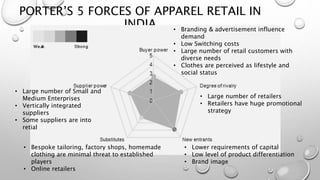
PORTER’S 5 FORCES OF APPAREL RETAIL IN
INDIA • Branding & advertisement influence
demand
• Low Switching costs
• Large number of retail customers with
diverse needs
• Clothes are perceived as lifestyle and
social status
• Lower requirements of capital
• Low level of product differentiation
• Brand image
• Bespoke tailoring, factory shops, homemade
clothing are minimal threat to established
players
• Online retailers
• Large number of Small and
Medium Enterprises
• Vertically integrated
suppliers
• Some suppliers are into
retial
• Large number of retailers
• Retailers have huge promotional
strategy
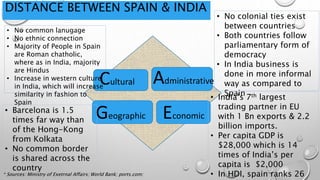
Cultural Administrative
Geographic Economic
DISTANCE BETWEEN SPAIN & INDIA
• No common lanugage
• No ethnic connection
• Majority of People in Spain
are Roman chatholic,
where as in India, majority
are Hindus
• Increase in western culture
in India, which will increase
similarity in fashion to
Spain
• Barcelona is 1.5
times far way than
of the Hong-Kong
from Kolkata
• No common border
is shared across the
country
• No colonial ties exist
between countries
• Both countries follow
parliamentary form of
democracy
• In India business is
done in more informal
way as compared to
Spain
• India’s 7th largest
trading partner in EU
with 1 Bn exports & 2.2
billion imports.
• Per capita GDP is
$28,000 which is 14
times of India’s per
capita is $2,000
• In HDI, spain ranks 26* Sources: Ministry of Exetrnal Affairs; World Bank; ports.com;
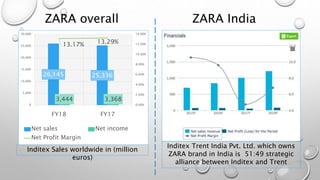
Inditex Trent India Pvt. Ltd. which owns
ZARA brand in India is 51:49 strategic
alliance between Inditex and Trent
26,145 25,336
3,444 3,368
13.17% 13.29%
0.00%
2.00%
4.00%
6.00%
8.00%
10.00%
12.00%
14.00%
0
5,000
10,000
15,000
20,000
25,000
30,000
FY18 FY17
Net sales Net income
Net Profit Margin
Inditex Sales worldwide in (million
euros)
ZARA overall ZARA India
CONCLUSION
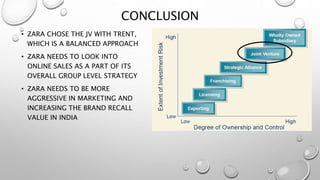
• ZARA CHOSE THE JV WITH TRENT,
WHICH IS A BALANCED APPROACH
• ZARA NEEDS TO LOOK INTO
ONLINE SALES AS A PART OF ITS
OVERALL GROUP LEVEL STRATEGY
• ZARA NEEDS TO BE MORE
AGGRESSIVE IN MARKETING AND
INCREASING THE BRAND RECALL
VALUE IN INDIA
Thank
You

Study on Zara International Strategy

  • 1.
    by Kanhaiya Kejriwal –MP17016 Korivi Sravan Kumar – MP17017 L Nandakumar – MP17019 Rahul Sharma – MP17029 Rajat Kulshreshta – MP17031 International Expansion
  • 2.
    Introduction and EarlyHistory • Amancio Ortega started his business in 1963 with a small time workshop which made dresses and gowns for distribution • In 1975 the first Zara store was opened inA Coruña in Spain. • Positioned clothes as consumables – Use and Dispose. • High fashion, In-trend products at affordable prices • Inditex was officially founded in 1985 which brought all Zara businesses under one holding company • A number of new brands were acquired/ launched to cater to various customer segments • Company went public in 2001 and got listed on the Madrid Stock Exchange • By 2004, Zara crossed 2000 stores count globally. Source: Wikipedia
  • 3.
    The Business Model QuickTurn Around Stores as Source of Information • Just in time Manufacturing systems • Inhouse designing, manufacturing small batches • Centralized handling and distribution • High speed and flexible logistics solutions • Almost no stock out situations in any of the stores globally • Always an atmosphere of privilege, scarcity and opportunity in the stores • Managers at the stores, collect customer preferences and feedback. • Design group uses the information to create new articles or modify existing goods and deliver at the stores • Outlets located at prime locations • Stores atmosphere is fresh, pleasant and welcoming • Layout and displays changed regularly, focus on customer shopping experience
  • 4.
    • Change incustomer behavior in 1980’s seen in Spain. Less spending on clothing • Reactive need for internationalization • Internationalization motivation – Market Seeking • Established first international store in Portugal • Gradually moved to a proactive pull based international growth • Internationalization trajectory best explained by the Upsala and Case Models • 3 Stage process adopted  Initial reluctance- Focus in host country  Watchful spread  Aggressive Expansion INTERNATIONALISATION
  • 5.
    INTERNATIONALISATION  Initial reluctance-Focus in host country • Acquire experience and knowledge- adjust BM to suite changing enviroment  Watchful spread • Focused only on markets with least psychic distance • Cultural, administrative, geographic and economically close market • Mainly European markets- France , Belgium, Sweden, mexico, United States  Aggressive Expansion • Experience gained made Zara more bold to enter completely alien territories • South America, Middle East, Asian markets targeted • European position reinforced
  • 6.
    International Strategy • Transnationalinternational corporate level strategy adopted • Seek to achieve both global efficiency and local responsiveness • Strong global data collection, central designing, production and distribution, which are centrally controlled • Store designs, layouts and customer experience guided centrally • Local responsiveness achieved through adoption of local fashion trends and providing the market what it needs • Quick changes to any new trends and customer requirements
  • 7.
    Approach to marketentry • Zara adopts a mix of market entry modes depending specifically to the country and conditions • Wholly owned subsidiary is the most preferred mode of entry, as it helps in maintaining control which in turn help with the International corporate levelTransnational Strategy Most preferred. Used in stable countries such as Europe, US, where perceived risk wrt Political and Economic is minimal. Adopted in large growing markets, where difficulty in acquiring prime property, govt regulations etc Where business risk is highest eg Saudi Arabia, Malaysia, Indonesia, Kuwait etc
  • 8.
    • Zara initiallysuffered from a negative country of origin effect • Image of the country gradually improved towards early 2000 • Factor Conditions: High quality work force in Spain. Expensive but efficient. Central distribution and warehousing facilities • Demand conditions: Saturate market in Spain, close proximity to large high income markets in the immediate neighborhood. • Efficient warehousing and logistical networks available Determination of National Advantage
  • 9.
    OUTLOOK OF INDIA •Economic development in the country, rapid urbanization and the growth of the middle class will increase disposable incomes and encourage consumption. • The penetration of online shopping in India, in terms of potential consumers (internet users), is still extremely low, thus there is ample room for growth. • FDI inflow (2017) is 40 bn 1.3 bn population (1.1% growth) GNI PPP -- 6950$ Urban population growth - 2.2% 87.3% of people have mobile subscriptions 2.3 trillion USD GDP GDP growth rate 7.2%(2017)
  • 10.
    * Sources: MarketLine;Euromonitor $ 53.99 billion 2017 9.23% CAGR • Leading players are Future Lifestyle, Arvind & Aditya Birla Fashion • Major brands are fbb, Louis Philippe, Excalibur, Van Heusen, Peter England and Allen Solly • International brands such as H&M, Gap, ZARA have increased their presence $ 83.94 billion 2022 Retail Apparel Growth - India Retail Apparel Growth - India
  • 11.
    PORTER’S 5 FORCESOF APPAREL RETAIL IN INDIA • Branding & advertisement influence demand • Low Switching costs • Large number of retail customers with diverse needs • Clothes are perceived as lifestyle and social status • Lower requirements of capital • Low level of product differentiation • Brand image • Bespoke tailoring, factory shops, homemade clothing are minimal threat to established players • Online retailers • Large number of Small and Medium Enterprises • Vertically integrated suppliers • Some suppliers are into retial • Large number of retailers • Retailers have huge promotional strategy
  • 12.
    Cultural Administrative Geographic Economic DISTANCEBETWEEN SPAIN & INDIA • No common lanugage • No ethnic connection • Majority of People in Spain are Roman chatholic, where as in India, majority are Hindus • Increase in western culture in India, which will increase similarity in fashion to Spain • Barcelona is 1.5 times far way than of the Hong-Kong from Kolkata • No common border is shared across the country • No colonial ties exist between countries • Both countries follow parliamentary form of democracy • In India business is done in more informal way as compared to Spain • India’s 7th largest trading partner in EU with 1 Bn exports & 2.2 billion imports. • Per capita GDP is $28,000 which is 14 times of India’s per capita is $2,000 • In HDI, spain ranks 26* Sources: Ministry of Exetrnal Affairs; World Bank; ports.com;
  • 13.
    Inditex Trent IndiaPvt. Ltd. which owns ZARA brand in India is 51:49 strategic alliance between Inditex and Trent 26,145 25,336 3,444 3,368 13.17% 13.29% 0.00% 2.00% 4.00% 6.00% 8.00% 10.00% 12.00% 14.00% 0 5,000 10,000 15,000 20,000 25,000 30,000 FY18 FY17 Net sales Net income Net Profit Margin Inditex Sales worldwide in (million euros) ZARA overall ZARA India
  • 14.
    CONCLUSION • ZARA CHOSETHE JV WITH TRENT, WHICH IS A BALANCED APPROACH • ZARA NEEDS TO LOOK INTO ONLINE SALES AS A PART OF ITS OVERALL GROUP LEVEL STRATEGY • ZARA NEEDS TO BE MORE AGGRESSIVE IN MARKETING AND INCREASING THE BRAND RECALL VALUE IN INDIA
  • 15.